My passion is studying American history leading up to & including the Civil War. I particularly enjoy reading, transcribing & researching primary sources such as letters and diaries.
The following letter was written by Joseph L. Gordon (1846-1904), the son of Ephraim Gordon (1805-1873) and Margaret Sheeler (1802-1896). He wrote the letter to Hannah Scrib [Squibb] whom he would marry after the Civil War.
Joseph wrote the letter while serving in Co. M, 198th Pennsylvania Infantry—a regiment that was not organized until the summer of 1864. They were sent to Petersburg battle front in September and assigned to 1st Brigade, 1st Division, 5th Army Corps commanded by Gen. Warren. The Battle of Peeble’s Farm was their first engagement. This letter describes the December 1864 expedition by the 5th Army Corps to destroy the Weldon Railroad. It began on 6 December and until the evening of the 9th, the work went on vigorously as planned—the ties being burned and the rails twisted—to a point beyond Bellefield, Virginia.
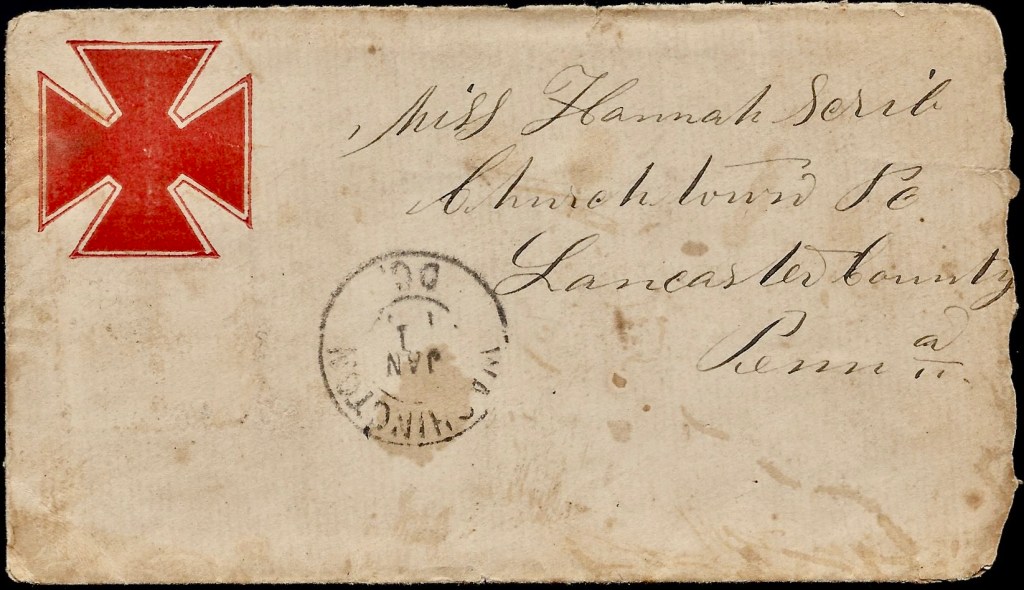
Joseph’s letter was mailed in an envelope ornamented with a red iron cross—the badge of the 1st Division, 5th Army Corps.
Transcription
Addressed to Miss Hannah Scrib, Churchtown P. O., Lancaster county, Pennsylvania
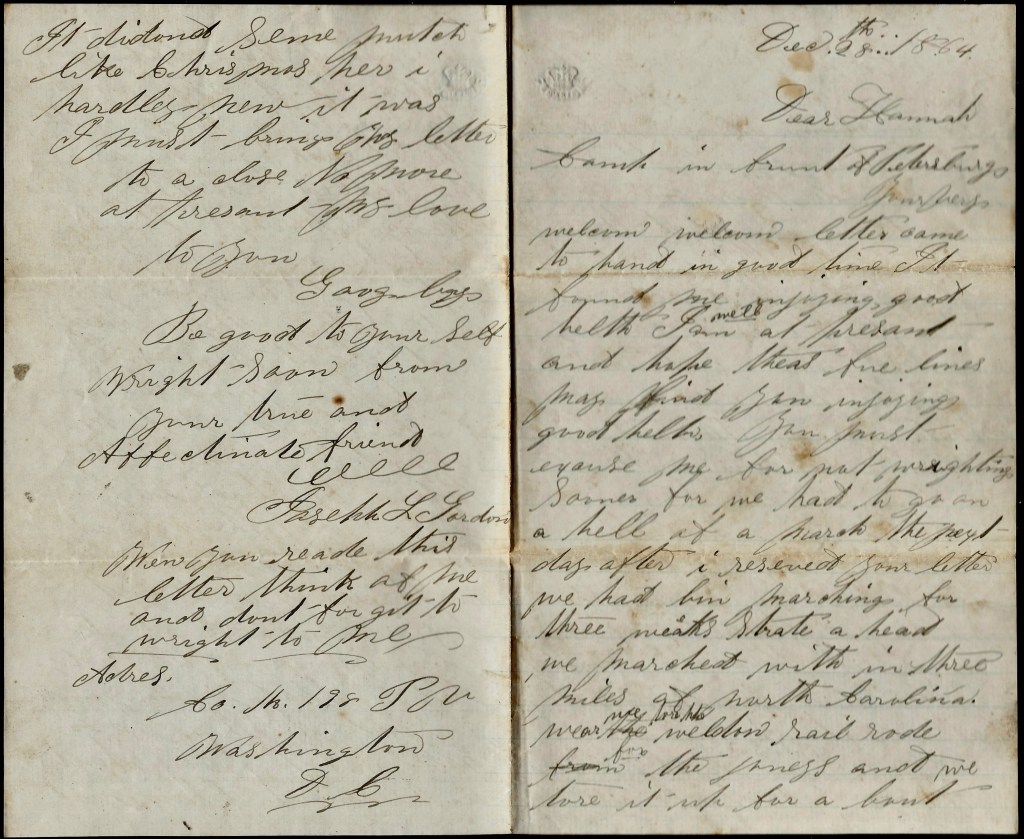
Camp in front of Petersburg, Virginia December 28th 1864
Your very welcome, welcome letter came to hand in good time. It found me enjoying good health. I am well at present and hope these few lines may find you enjoying good health. You must excuse me for not writing sooner for we had to go on a hell of a march the next day after I received your letter. We had been marching for three weeks straight ahead.
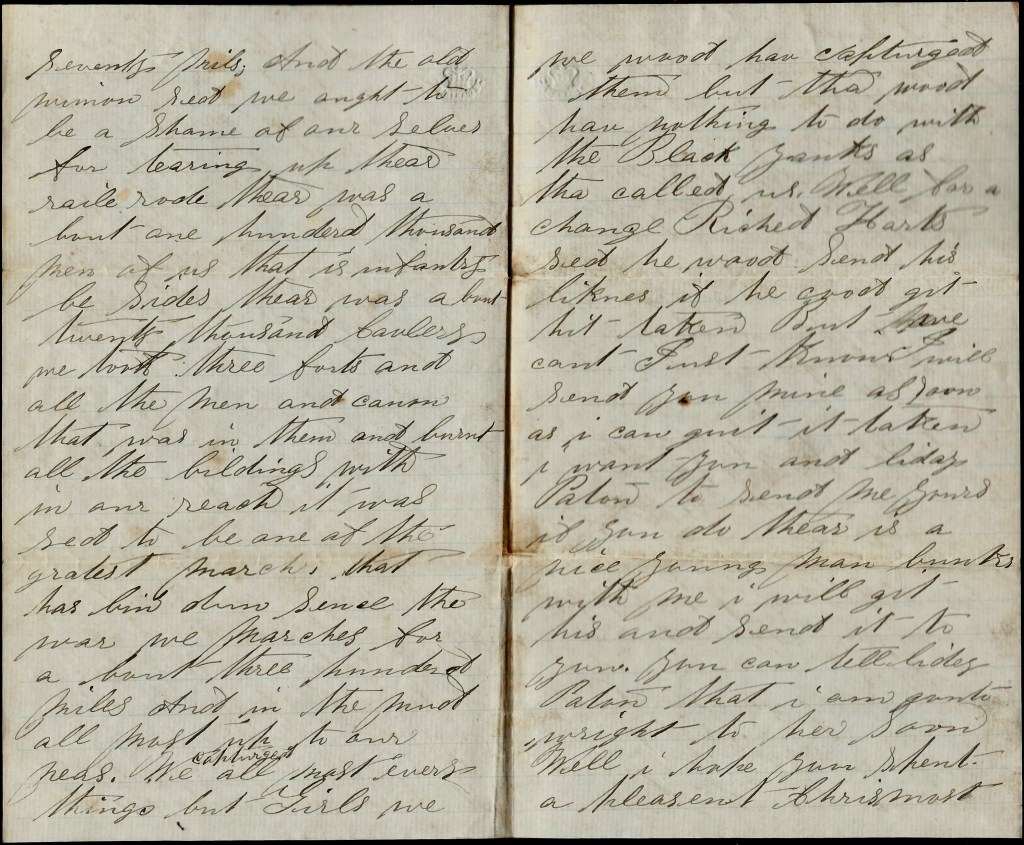
We marched within three miles of North Carolina where we tore up the Weldon Railroad for the Johnnies. We tore it up for about seventy miles and the old women said we ought to be ashamed of ourselves for tearing up that railroad. There was about one hundred thousand men of us—that is, infantry. Besides [that] there was about twenty thousand cavalry. We took three forts and all the men and cannon that was in them and burnt all the buildings within our reach. It was said to be one of the greatest marches that has been done since the war [began].
We marched for about three hundred miles and in the mud almost up to our knees. We captured almost everything but girls. We would have captured them but they would have nothing to do with the Black Yanks as they called us.
Well, for a change, Richard Harts said he would sent his likeness if he could get it taken but we can’t just now. I will send you mine as soon as I can get it taken. I want you and Lide Patton to send me yours. If you do, there is a nice young man bunks with me. I will get his and send it to you. You can tell Lide Patton that I am going to write to her soon.
Well, hope you spent a pleasant Christmas. It didn’t seem much like Christmas here. I hardly knew it was. I must bring this letter to a close. No more at present. My love to you. Goodbye. Be good to yourself. Write soon. From your true and affectionate friend, — Joseph L. Gordon
When you read this letter, think of me an don’t forget to write to me. Address: Co. M, 198th P. V., Washington D. C.
The following letter was written by Thomas E. Bispham (1835-1865), the son of Thomas Bispham (1797-1879) and Elizabeth Jennings (1795-1878) of Wayne township, Warren county, Ohio. Thomas was married to Sarah Frances Likins (1840-1902) in March 1857 and the couple had two children at the time that Thomas enlisted as a private in Co. H, 79th Ohio Volunteer Infantry (OVI) in August 1862.
Thomas was promoted to a corporal in February 1863 and made it through the Atlanta campaign without injury but was wounded at Averysboro, North Carolina on 16 March 1865. He died of his wounds at David’s Island (N.Y. harbor) hospital on 25 May 1865.
In this letter, Thomas describes the Battle of 20 July 1864 at Peachtree Creek in the Atlanta Campaign.
There is a striking similarity in Thomas’s handwriting with that of a diary fragment that I transcribed back in January 2021 which I was able to attribute to the 79th OVI but not to any particular soldier. I suspect, however, the mystery soldier served in Co. I.
Transcription
Addressed to Thomas Bispham, Esq., Waynesville, Warren county, Ohio
Camp 79th OVI Sunday, July 24th 1863
My Dear Father & Mother,
I thought as Sallie was from home, maybe you would not hear from me, and perhaps you might wish to. Therefore, I will write.
On the 20th we got into quite a battle. The rebs attacked our lines. We (our brigade) was laying in the rear of a gap, and when the attack was made we had to move up to get on the line. We had a fair, open fight and defeated them. I had some very fine shots. Our regiment lost 58—ten killed and forty-eight wounded. Co. H had George Brinker & Corp. I[saac] F. Stump killed. Joseph H. Wolfe, Asa Chandler, John Prater, Wm. Watkinson and Martin Lansey wounded. I have heard they are all doing very well but Wolfe. It is estimated from the number we have in our possession that the Rebels lost from ten to fifteen hundred in front of our brigade.
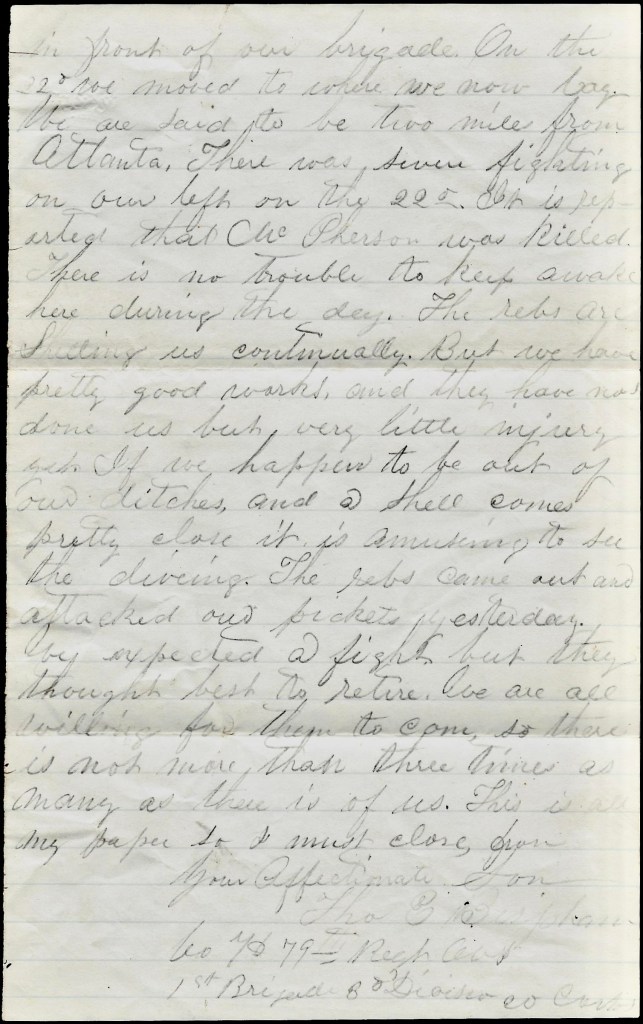
On the 22d, we moved to where we now lay. We are said to be two miles from Atlanta. There was severe fighting on our left on the 22d. It is reported that [James B.] McPherson was killed. There is no trouble to keep awake here during the day. The rebs are shelling us continually. But we have pretty good works and they have not done us but very little injury yet. If we happen to be out of our ditches, and a shell comes pretty close, it is amusing to see the diving. The rebs came out and attacked our pickets yesterday. We expected a fight but they thought best to retire. We are all willing for them to come, so there is not more than three times as many as there is of us. This is all my paper so I must close.
From your Affectionate Son — Thos. E. Bispham
Co. H, 79th OVI, 1st Brigade, 3d Division, 20 [Army] Corps
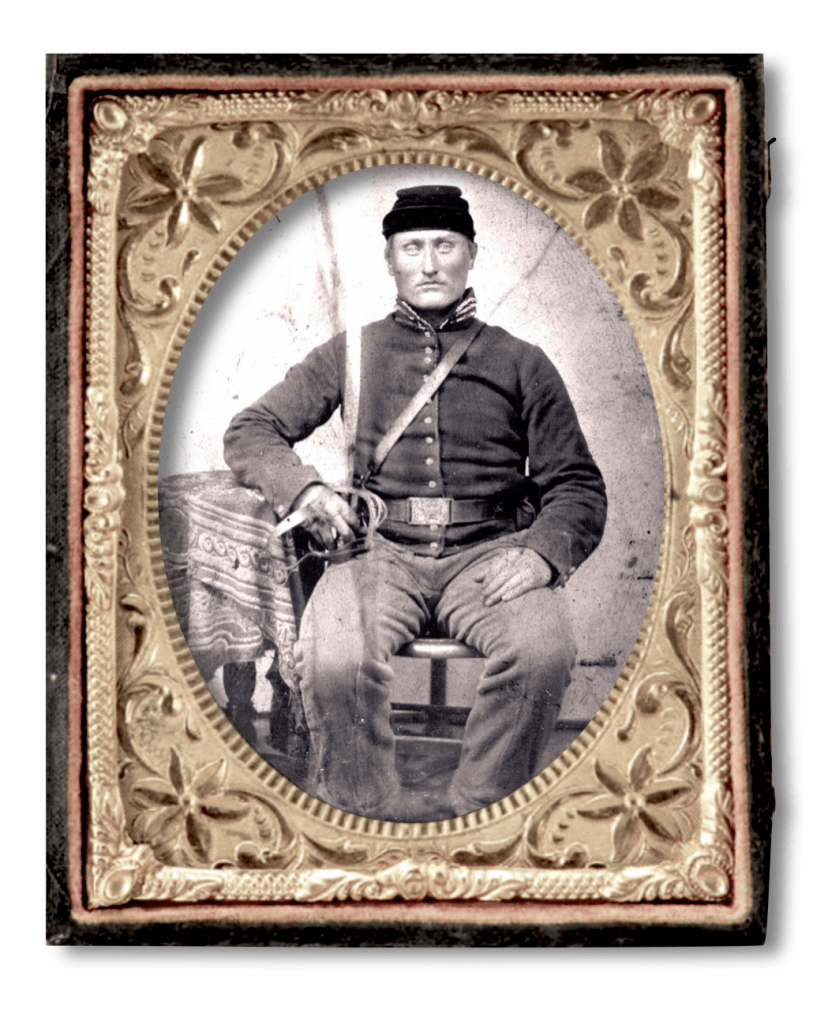
I could not find an image of Edward but here is a tintype of Jacob Kunckle who served in Co. M, 14th Pennsylvania Cavalry (Ancestry)
The following letter was written by Edward F. Tubbs (1841-1864) who enlisted September 11, 1862 and mustered into Co. I, 14th Pennsylvania Cavalry on 27 October 1862 at Erie, Pennsylvania. Edward mustered in as a corporal and was promoted to sergeant. Although one source erroneously states that Edward died of disease at Winchester, Virginia, in 17 December 1864, the truth is that he was among the 100 troopers led by Capt. William Miles of Co. I on a scouting expedition toward Ashby’s Gap on 17 December 1864. Mosby and his guerrillas ambushed this scouting party from a woods near Millwood, Virginia, killing Miles and about a dozen others, including Sergt. Tubbs. About 20 others were wounded, and nearly everybody else was captured. Mosby set one man free after slashing his face with a saber, allowing him to return to camp to tell the story of the ambush. The wounded and dead were recovered on the next day. Mosby sent his prisoners to Libby Prison.
Edward was the son of Irene Tubbs (1812-Aft1870) of Conneaut township, Erie county, Pennsylvania. Irene’s husband, Frederick Tubbs, died on 19 November 1842 after 9 years of marriage, leaving her to raise her children on the family 40-acre farm. Frederick, it seems, died a tragic death, have been shipwrecked and drowned in Lake Erie.
Many of Edwards letter were sold at auction in 2018. They were summarized as follows:
“Exceptional archive of 18 handwritten letters related to Edward F. Tubbs, a soldier in Company I of the 14th Pennsylvania Cavalry (159th Volunteers), dated between July 2, 1863 and December 13, 1864. The collection totals to 46 pages, with 16 of the letters written by Tubbs and addressed to his mother Irene Tubbs of Albion, Erie County, Pennsylvania. The content of the archive consists of Tubbs’s plans to visit home, new clothes and items he purchased, reports on his health, hospital stays, and camp life, his disdain for the war and his desire to see it through to the end. Highlighted sections from Tubbs’s letters are as follows:
July 2, 1863, from Frederick City, Maryland: “I thought I would write a line to let you know where I was Harpers Ferry is Evacuated and we are on the march I suppose to reinforce Gen’l Mead I expect we will annihilate the whole Rebel army…they say our army is marching on to Richmond we have about 20 thousand men here it makes quite a show there is cavalry artillery & infantry all together.”
September 25, 1863, from Beverly, West Virginia: “It is now over one year since I left home you know I said when I left home I did not think the war would last a year if I had had known that the war was going to last so long as it has I would never have enlisted I would have waited for the draft & stood my chance with the rest I never enlisted to stay over a year.”
October 16, 1863, also from Beverly, WV: “I have plenty to eat drink & wear but yet I am not at home there is talk of the rebels coming but we have got so used to hearing it that we do not believe anything until we see it with our own eyes I have not much news our men have had a little skirmishing with the rebels at a place called Bulltown about 50 miles from here…patience and perseverance a strong heart & a strong mind are all that keeps the soldier alive.”
October 31, 1863, from Camp Montgomery in Pittsburgh: “We left Erie on Wednesday and got into Pittsburgh the next morning…then we marched two miles to Camp Montgomery…When I got to Cleveland I saw a lot of squaws and almost all kinds of animals…I have seen the wonderful city of Pittsburgh…it is a large place but most dreadfully nasty it is the smokiest place I ever saw.” Includes an undated letter from Tubbs, presumably to his mother and written on the same day as the above letter, noting that he sent his clothes home and requesting that she forward all news to his friends.
March 20, 1864, from Martinsburg, WV: “I found a rebel officer who had just come into our lines a deserter from Lee’s army he says he thinks the rebels are going to fight as long as they can but does not think that will be a great while longer he is going to take the Oath of Allegiance and live under the Old flag again…they say we are going to have a chance to reenlist this month or next but I guess I will wait until Old Abe reenlists before I do.”
June 9, 1864, from Staunton, Virginia, relaying news of the Union’s victory at Piedmont, in part: “We had our fight on Sunday of June 5th we whipped the rebels and captured about 1000 of them, 52 rebel officers besides. I captured a rebel captain in our first charge. I could tell a big story but stories don’t fight Battles. Stanton has fallen & is holding a great many Yanks.”
The archive features seven letters written by Tubbs during his stay at the state hospital in Gallipolis, Ohio, dating between July and September, 1864. Highlighted sections include:
July 18, 1864: “I was at Charleston & in very good health but I was taken sick at that place and was brought down here so you see I’m in Ohio…there is about 100 sick & wounded soldiers here my disease is the fever.”
July 30, 1864: “I am gaining quite fast I am in hopes to be able to join the Reg’t in a couple of weeks I do not know where our Regiment is but I expect they are in the vicinity of Martinsburg we had reports that Gen’l Averill was killed but the papers today say it is not so.”
A particularly fiery letter from Gallipolis, dated August 9, 1864: “I walked down to the City of Gallipolis today…there is 3 [racial epithet] to one white person…if I had known that this [racial epithet] war was going to continue so long I never would have left home…I see this war as it is now it is nothing but a curse to be a United States Soldier men are less thought of than the black [racial epithet] this war is a speculation the way it is going on now but if God spares my life a short time I shall be out of it I will do my duty as long as my time lasts which I have sworn to do and then I shall bid them goodbye…I will own that I prefer peace to war but we want it right but I don’t fear them I have fought them in close contact when we were not over 20 feet apart the rebel lead whistled close but yankey lead and yankey steel makes them run…I have lain in front of their fortifications in plain open field when they had all man could wish to protect them while we had nothing to protect us but the great God of Battle.”
September 13, 1864: “I now take my pen to inform you that the time has arrived for me to quit this bed of sickness which I have been impatiently waiting for I shall probably leave here soon.”
On October 9, 1864, not long after his release, Tubbs writes from Martinsburg, WV: “I was very much disappointed in coming back I wanted to go to my company but I shall try and content myself here for a while…I see you have heard of Genl. Averill’s removal from this Command and it is very much regretted by all under his Command I don’t know who will command our Division after this the men say they won’t fight under any other General…I have no news today everything is progressing finely in the Valley & around Richmond.”
Tubbs’s final letter, written from a “Camp Near Winchester Va” on December 12 and 13th, 1864, in part: “I am not I sorry to say well at present the weather is very cold at present about 6 inches of Snow on the ground and it is getting dark & w ill have to stop writing as I have no candle.” The following day: “After a hard ride of 25 miles in a very cold day & in about 5 hours time I will try to finish my letter we went on a Scout this morning but saw nothing the weather is very cold we are on about half rations now I had a cracker for my breakfast with coffee yesterday I had 2 now.” Tubbs passed only four days later on December 17, 1864, a little over two years after mustering into service; although the manner of Tubbs’s death remains unknown, the grim atmosphere of the above letter suggests that he likely succumbed to sickness, starvation, or the elements.
The archive also includes two letters written by officers and addressed to Irene Tubbs: the first, written from Camp Blakely, a letter from W. W. Miles, Company I captain of the 14th Pa. Cav., dated April 14, 1863, who notes that her son, once “very sick with Typhoid fever,” has “very much improved [and]…in a very few days be able to report for duty”; and the second, written from Grafton, addressed by an officer named Edgar Peirce, dated November 25, 1863, affirming that “Edward is safe and sound, the regt are at New Creek about 100 miles from here on the R Road towards Harpers Ferry.” In overall very good to fine condition. Accompanied by several original mailing envelopes.”
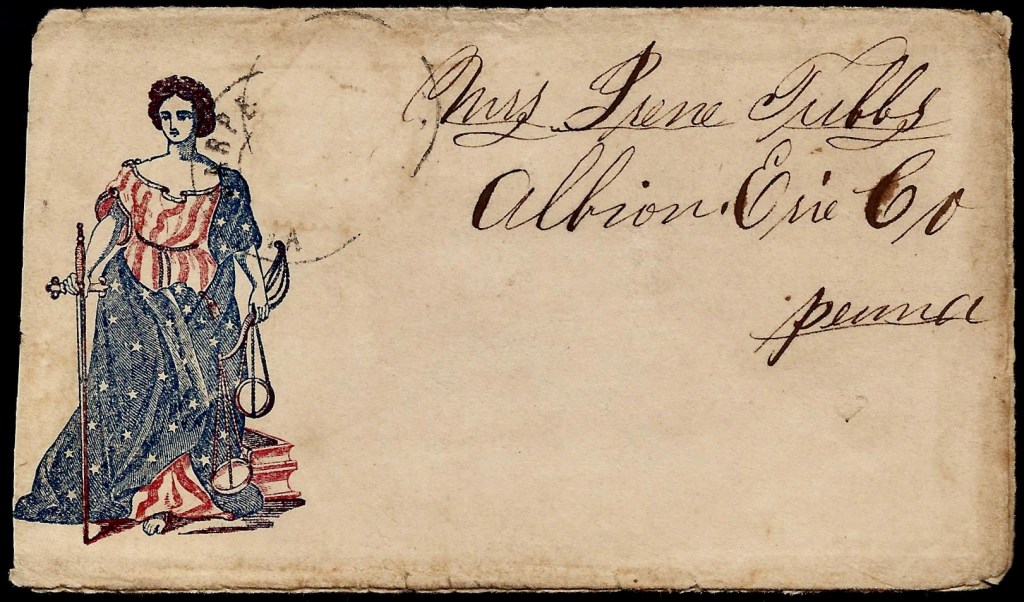
Addressed to Miss Irene Tubbs, Albion, Erie county, Pennsylvania
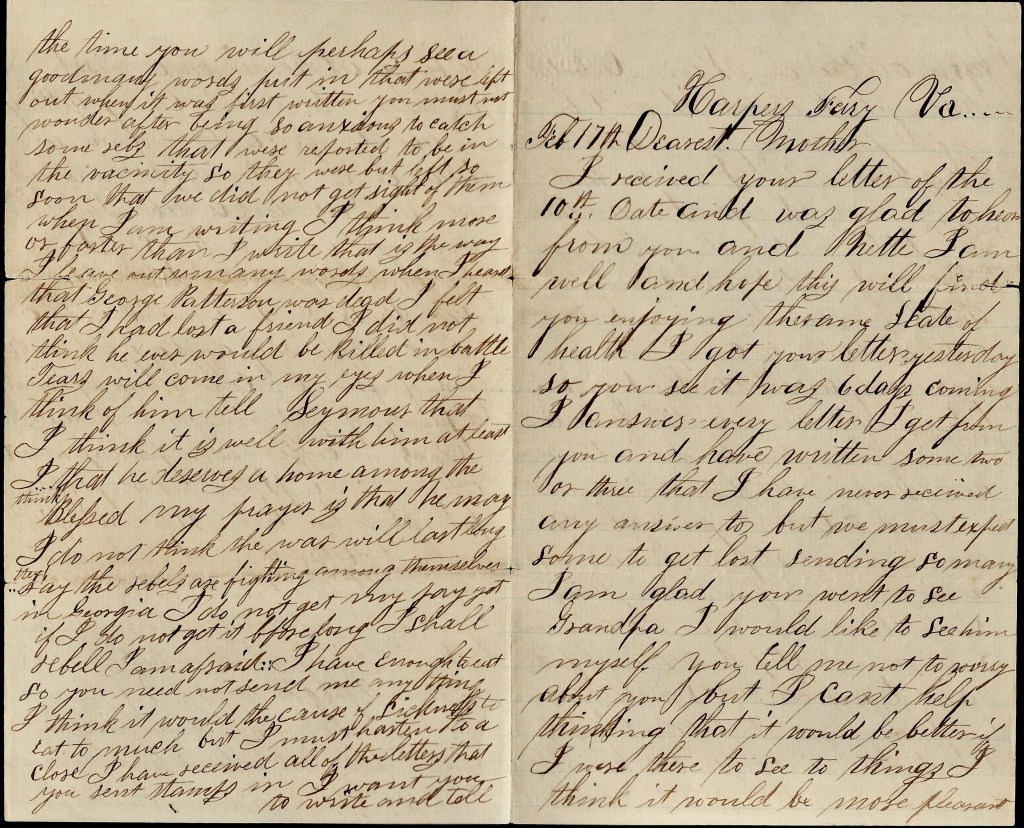
Harpers Ferry, Virginia February 17th [1863]
Dearest Mother,
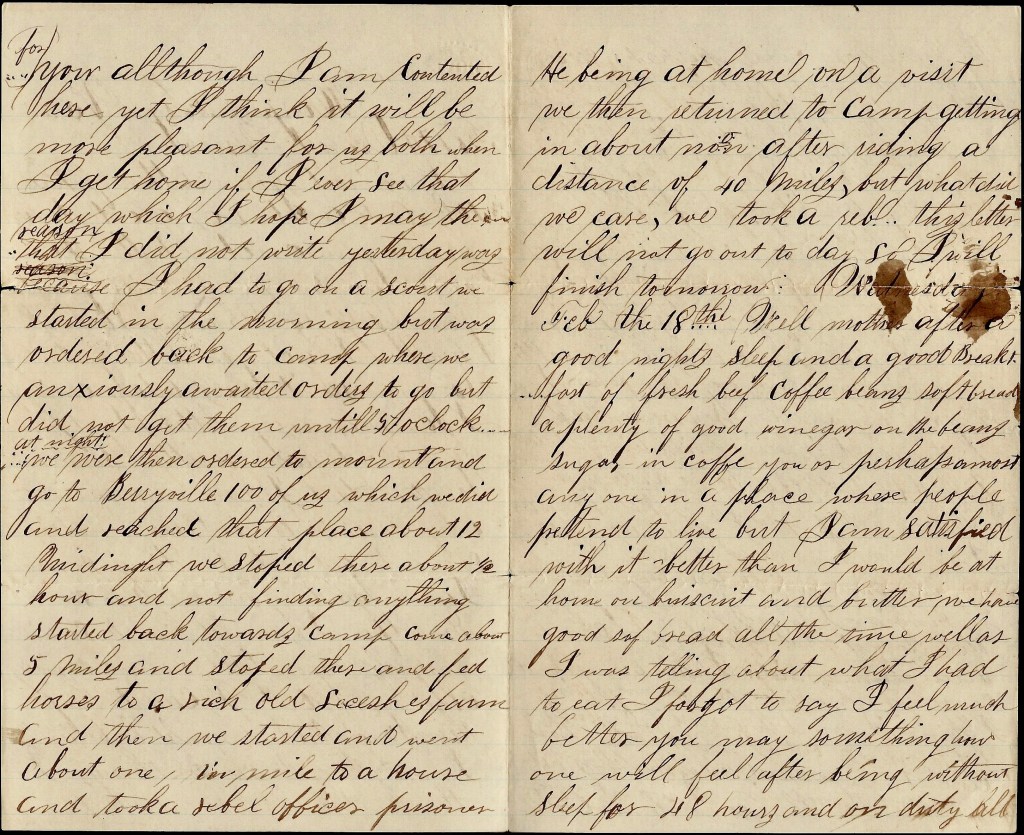
I received your letter of the 10th date and was glad to hear from you and Nette. I am well and hope this will find you enjoying the same state of health. I got your letter yesterday so you will see it was 6 days coming. I answer every letter I get from you and have written some two or three that I have never received any answer to but we must expect some to get lost sending so many. I am glad you went to see Grandpa. I would like to see him myself. You tell me not to worry about you but I can’t help thinking that it would be better if I were there to see to things. I think it would be more pleasant for you although I am contented here, yet I think it will be more pleasant for us both when I get home—if I ever see that day which I hope I may.
The reason I did not write yesterday was because I had to go on a scout. We started in the morning but was ordered back to camp where we anxiously awaited orders to go but did not get them until 5:00 o’clock at night. We were then ordered to mount and go to Berryville—100 of us—which we did and reach that place about 12:00 midnight. We stopped there about ½ hour and, not finding anything, started back towards camp. Came about 5 miles and stopped and fed horses to a rich Secesh’s farm and then we started and went about one mile to a house and took a Rebel officer prisoner—he being at home on a visit. We then returned to camp, getting in about noon after riding a distance of 40 miles. But what did we care, we took a Reb. This letter will not go out today so I will finish tomorrow.
Wednesday, February 18th. Well Mother, after a good night’s sleep and a good breakfast of fresh beef, coffee, beans, soft bread, and plenty of good vinegar on the beans, sugar in coffee, you or perhaps amost anyone in a place where people pretend to live but I am satisfied with it better than I would be at home on biscuit and butter. We have good soft bread all the time.
Well, as I was telling about what I had to eat, I forgot to say I feel much better. You may [know] something how one will feel after being without sleep for 48 hours and on duty all the time. You will perhaps see a good many words put in that were left out when it was first written. You must not wonder after being so anxious to catch some rebs that were reported to be in the vicinity. So they were but left so soon that we did not get sight of them. When I am writing, I think more or faster than I write. That is the way I leave out so many words.
When I heard that George Patterson was dead, I felt that I had lost a friend. I did not think he would be killed in battle. Tears will come in my eyes when I think of him. Tell Seymour that I think it is well with him. At least I thought he deserves a home among the blessed. My prayer is that he may.
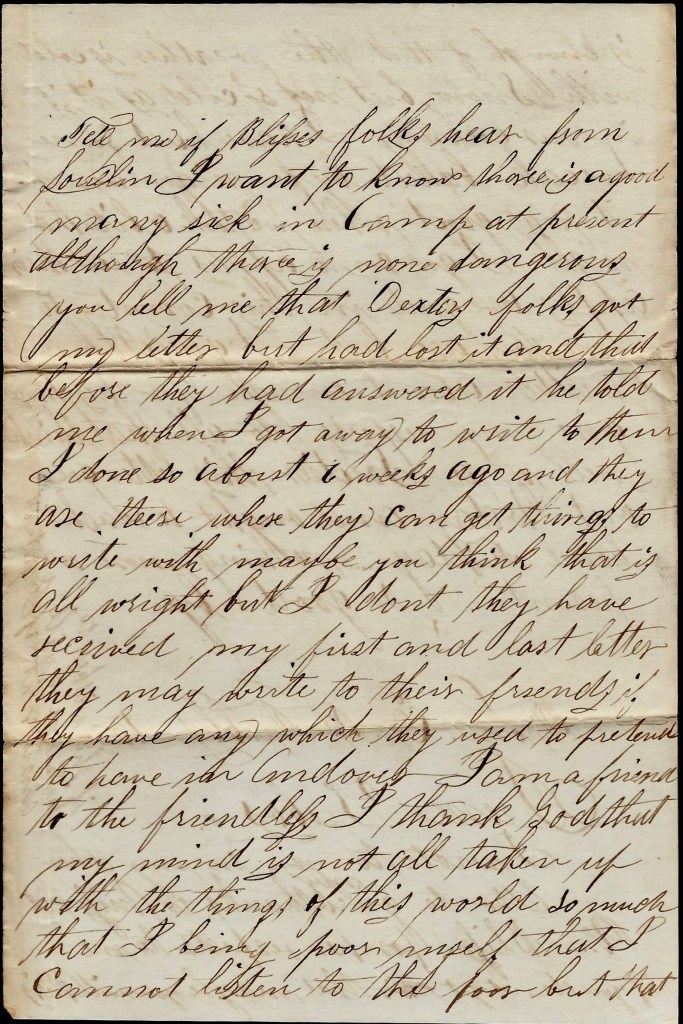
I do not think the war will last long. They say the Rebels are fighting amongst themselves in Georgia. I do not get my pay yet. If I do not get it before long, I shall rebel I am afraid. I have enough to eat so you so you need not send me anything. I think it would cause the sickness to eat too much. But I must hasten to a close. I received all the letters that you sent stamps in. I want to you to write and tell me if Bliss’s folks hear from Soutlin. I want to know. There is a good many sick in camp at present although there is none dangerous. You tell me that Dexter’s folks got my letter but had lost it and that before. they had answered it he told me when I got away to write to them. I done so about 6 weeks ago and they are these where they can get things to write with. Maybe you think that is alright but I don’t. They have received my first and last letter. They may write to their friends if they have any which they used to pretend to have in Andover. I am a friend to the friendless. I thank God that my mind is not all taken up with the things of this world so much that I, being poor myself, that I cannot listen to the poor. But that is enough of that.
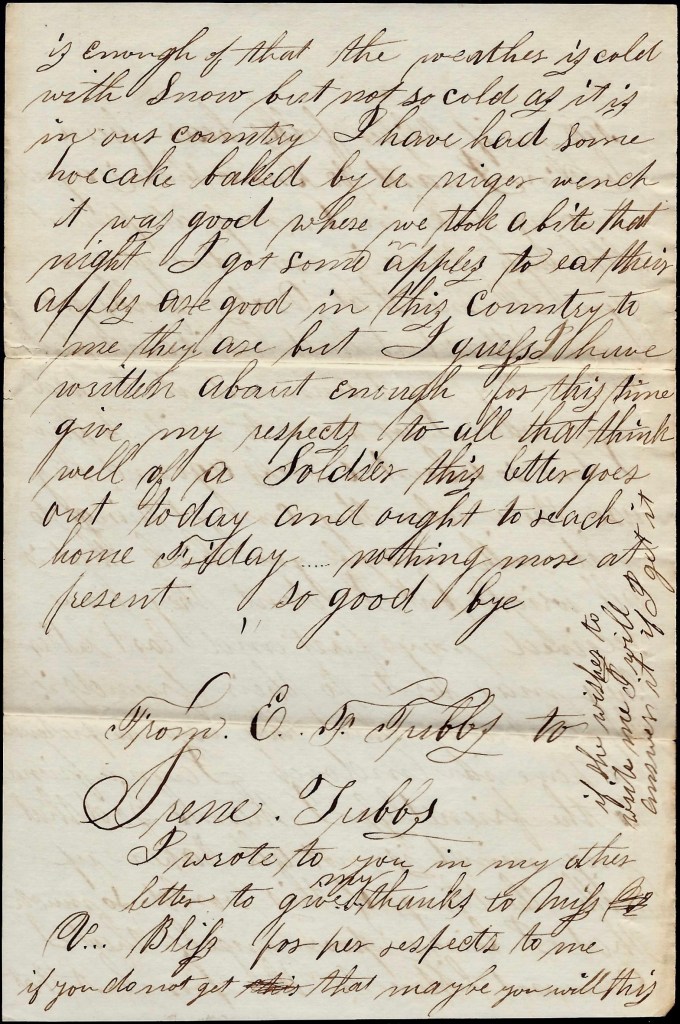
The weather is cold with snow but not so cold as it is in our country. I have had some hoecake baked by a nigger wench. It was good. Where we took a bite that night, I got some apples to eat. Their apples are good in this country. To me they are but I guess I have written about enough for this time. Give my respects to all that think well of a soldier. This letter goes out today and ought to reach home Friday. Nothing more at present so good bye.
From E. F. Tubbs to Irene Tubbs
P. S. I wrote to you in my other letter to give thanks to Miss V. Bliss for her respects to me. If you do not get that maybe you will her if she wishes to write to me I will answer it if I get it.
The following home front letter was written by 18 year-old Elizabeth (“Eliza”) Jane Cobb (1845-1892), the daughter of John Cobb (1803-1871) and Roseanna Wagner (1809-1881) of McLeansville, Guilford county, North Carolina.
Eliza wrote the letter to her 26 year-old brother, John A. Cobb, who enlisted at age 25 in June 1861 as a private in Co. M (Guilford Dixie Boys”), 11th (later 21st) North Carolina Infantry. He was promoted to a 2nd Lieutenant in January 1863 and was with his regiment in Hoke’s Brigade, Early’s Division of Ewell’s Corps at Gettysburg where he was wounded by grapeshot, most likely in the assault at dusk on East Cemetery Hill on 2 July. He was taken prisoner on the field and treated at the Letterman General Hospital near Gettysburg where his left hand was amputated. He remained in captivity until he finally died of small pox at the Marine Hospital in Baltimore, Maryland in May 1864. [See his treatment record in footnotes.]
At the time that Eliza wrote his letter to her brother, the regiment would have been in winter camp near Fredericksburg, Virginia, where one member of the 21st North Carolina wrote his friend at the time, “We are all well and fat and sassy, and black and dirty and lousey.” [William Sprinkle to Thomas Poindexter, 7 April 1863]
Transcription
McLeansville, North Carolina March 16, [1863]
Dear Brother,
I seat myself to answer your most kind letter come to hand the 14th inst. It wasn’t dated. It found us all well and leaves us the same. John, I have been to three burryings since I wrote to you—Uncle Joshey Boon’s 1 youngest son Boston, and Cabsil’s oldest daughter. Them two was buried at Shoemaker’s Church in one day. And Calvin Hubbard [was buried] last Saturday at Mount Pleasant. 2 He belonged to D. R. Mac’s company. There is a great many deaths in the country now.
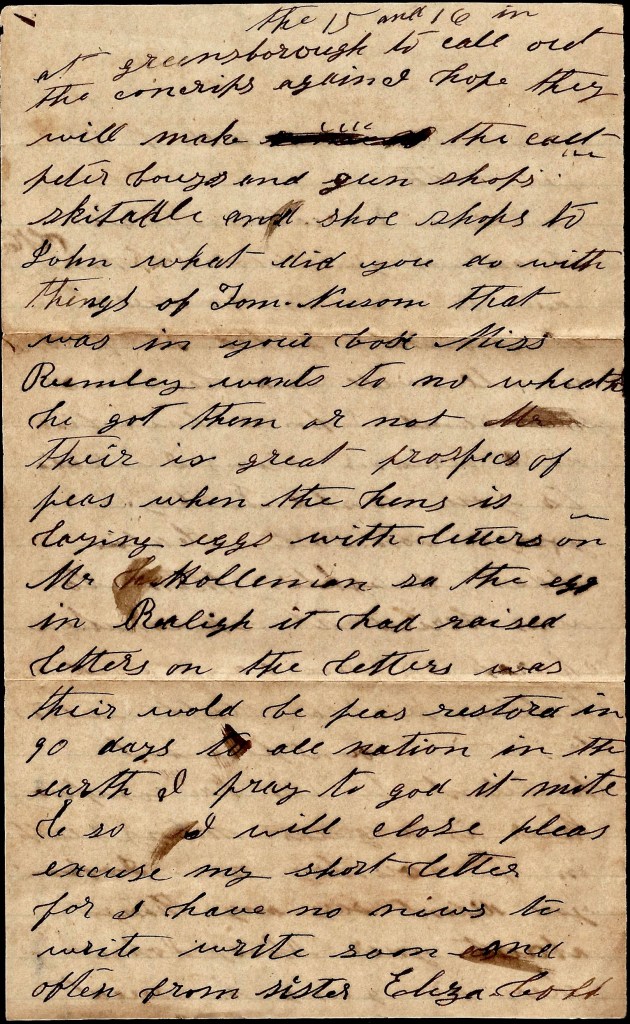
John, you didn’t say anything about your shoes. John, they are going to meet at Greensboro to call out the conscripts again. Hope they will make all the saltpetre and gun shops skedaddle—and shoe shops too. 3
John, what did you do with things of Tom Newsom that was in your Company. Miss Rumley wants to know whether he got them or not.
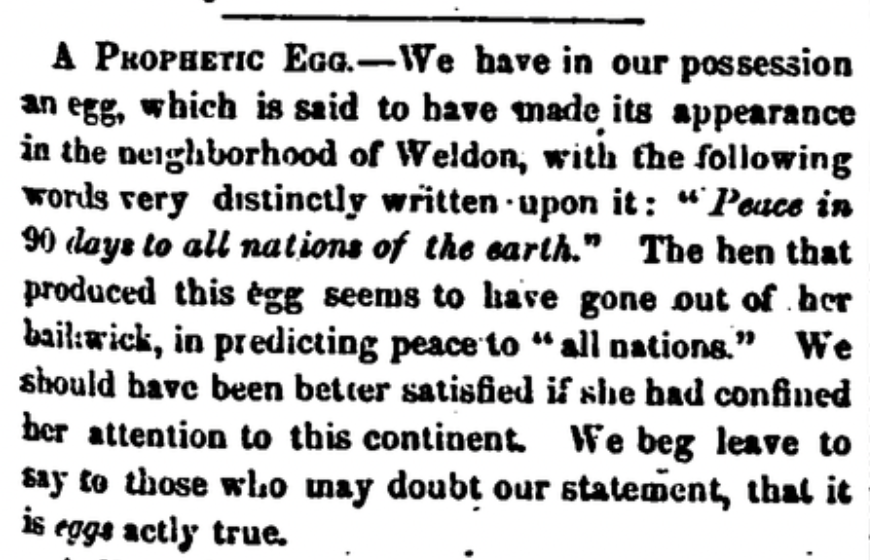
Semi-weekly Standard, Raleigh, 6 March 1863
There is great prospect of peace when hens is laying eggs with letters on. Mr. Hollenian saw the egg in Raleigh. It had raised letters on [it]. The letters was there would be peace restored in 90 days to all nation in the earth. I pray to God it might be so.
I will close, Please excuse my short letter for I have no news to write. Write and often. From sister—Eliza Cobb
1 Joshua Riley Boon (1822-1884) of Guilford county, N. C., was married to Matilda Ingle (1832-1907).At age 42, he was drafted into Co. A, 53rd North Carolina Infantry in December 1864.
2 William Calvin Hubbard (1831-1863) was the son of Solomon Hubbard (1787-1835) and Sarah Jane Matthews (1806-1860) of Mount Pleasant, Guilford, North Carolina. He was married to Emily Donnell (1831-1878) in 1859 and had two young sons when he volunteered in 1862 to serve as a private in Co. A, 53rd North Carolina Infantry. He died of disease at Kinston, North Carolina, on 3 March 1863.
3 I believe Eliza is hoping that the drafting of conscripts to serve in the Confederate army would not longer exempt those who worked in the saltpetre, gun or shoe making industries which it had previously done. Many volunteers resented that otherwise eligible young men hid behind these exemptions to avoid service.
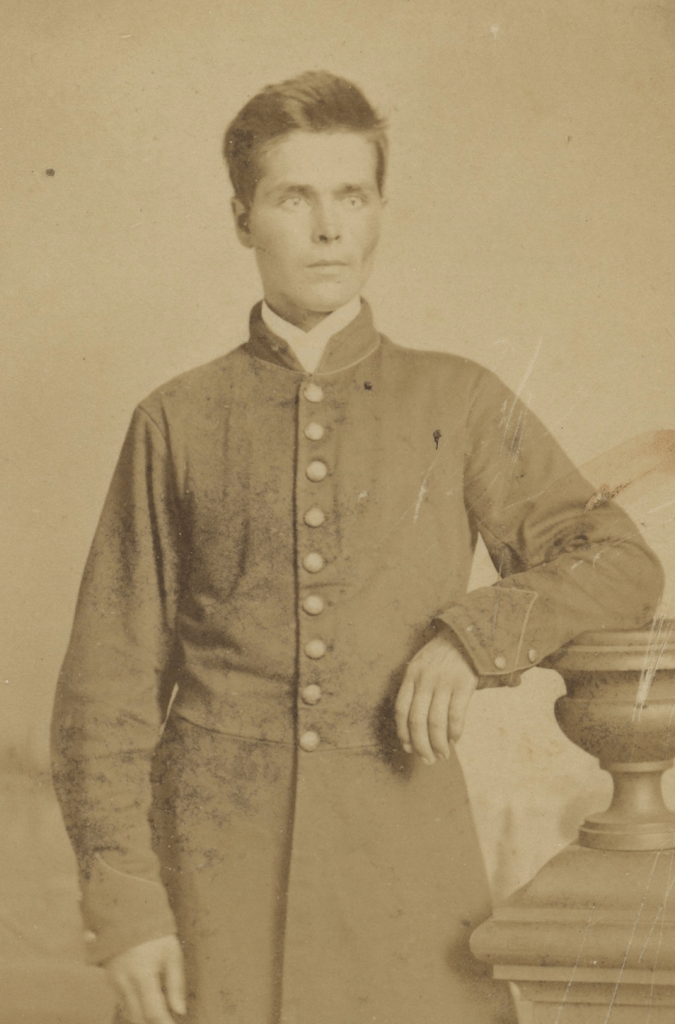
I could not find an image of Marcus but here is one of Dewitt Holmes who also served as a private in Co. D, 24th Iowa Infantry (Mike Huston Collection)
The following letters were written by Israel Marcus Ritter (1841-1864), the son of Benjamin Franklin Ritter (1814-1904) and Mary Stover (1818-1915) of Iowa City, Iowa. Marcus enlisted at the age of 21 in Co. D, 24th Iowa Infantry on 20 August 1862. He survived the Battle of Champion Hill and the siege of Vicksburg but was severely wounded by gunshot in the left arm at the 3rd Battle of Winchester, Virginia, on 19 September 1864 and died at a Winchester hospital on 4 October 1864. According to the Office of Veterans Affairs in Johnson county, Iowa, Marcus was orginally buried on the battlefield at Woods Farm but was later reburied with a military headstone at the Winchester National Cemetery, Section 76, Grave 3557.
Marcus was married to Julia A. Barnes while in the service. The marriage ceremony took place in Johnson county, Iowa, and was performed by his captain, Jacob Casebeer, who also happened to be a Minister of the Gospel. The wedding took place on 23 February 1864.
Letter 1
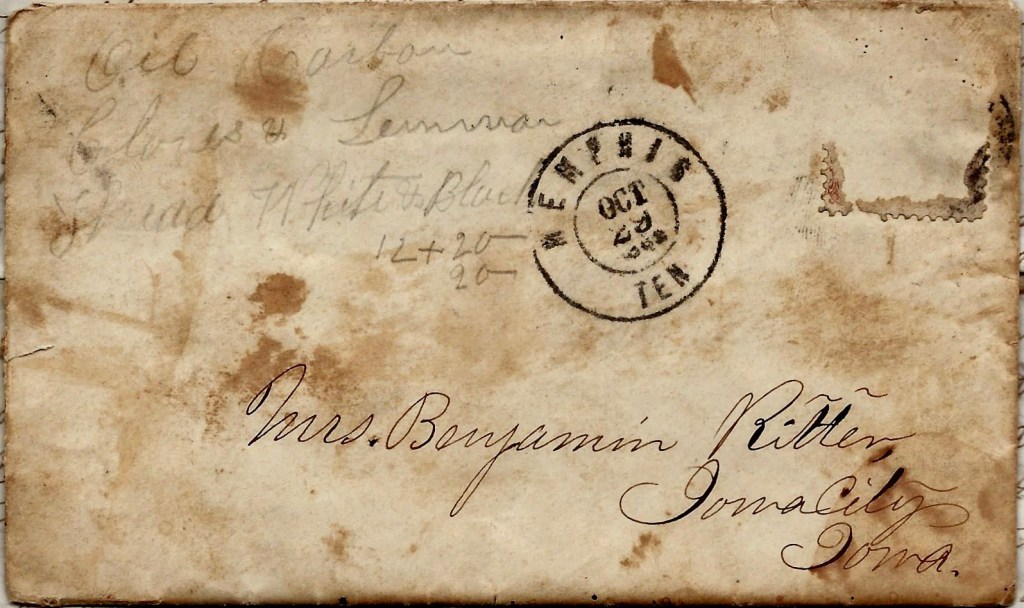
Addressed to Mrs. Benjamin Ritter, Iowa City, Iowa
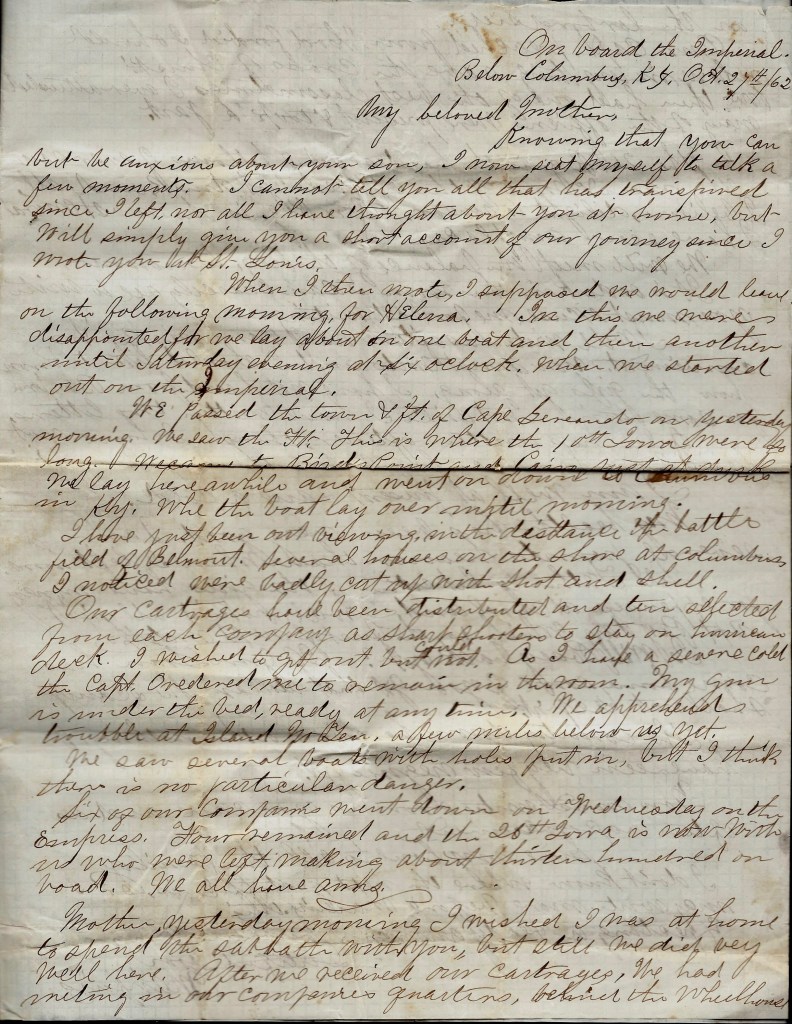
On board the Imperial Below Columbus, Kentucky October 27, 1862
My beloved Mother,
Knowing that you can but be anxious about your son, I now seat myself to talk a few moments. I cannot tell you all that has transpired since I left, nor all I have thought about you at home, but will simply give you a short account of our journey since I wrote you at St. Louis. When I then wrote, I supposed we would leave on the following morning for Helena. In this we were disappointed for we lay about on one boat and then another until Saturday evening at six o’clock when we started out on the Imperial.
We passed the town of Cape Gerardo on yesterday morning. We saw the fort. This is where the 1st Iowa were so long. We came to Bird’s Point and Cairo just at dark. We lay here awhile and went on down to Columbus in Kentucky where the boat lay over until morning. I have just been out viewing in the distance the battlefield of Belmont. Several houses on the shore at Columbus I noticed were badly cut up with shot and shell.
Our cartridges have been distributed and ten selected from each company as sharp shooters to stay on hurricane deck. I wished to get out but could not. As I have a severe cold, the Capt. ordered me to remain in the room. My gun is under the bed, ready at any time. We apprehend trouble at Island No. 10, a few miles below us yet. We saw several boats with holes put in but I think there is no particular danger. Six of our companies went down on Wednesday on the Empress. Four remained and the 26th Iowa is now with us who were left making about thirteen hundred on board. We all have arms.
Mother, yesterday morning I wished I was at home to spend the Sabbath with you but still we did very well here. After we received our cartridges, we had meeting in our company’s quarters behind the wheelhouse on the larboard side. Our Capt. preached from, “God forbid I should glory in anything save the cross of Christ.” We then had one of the best class meetings I ever attended. Many of the officers were present & took a part.
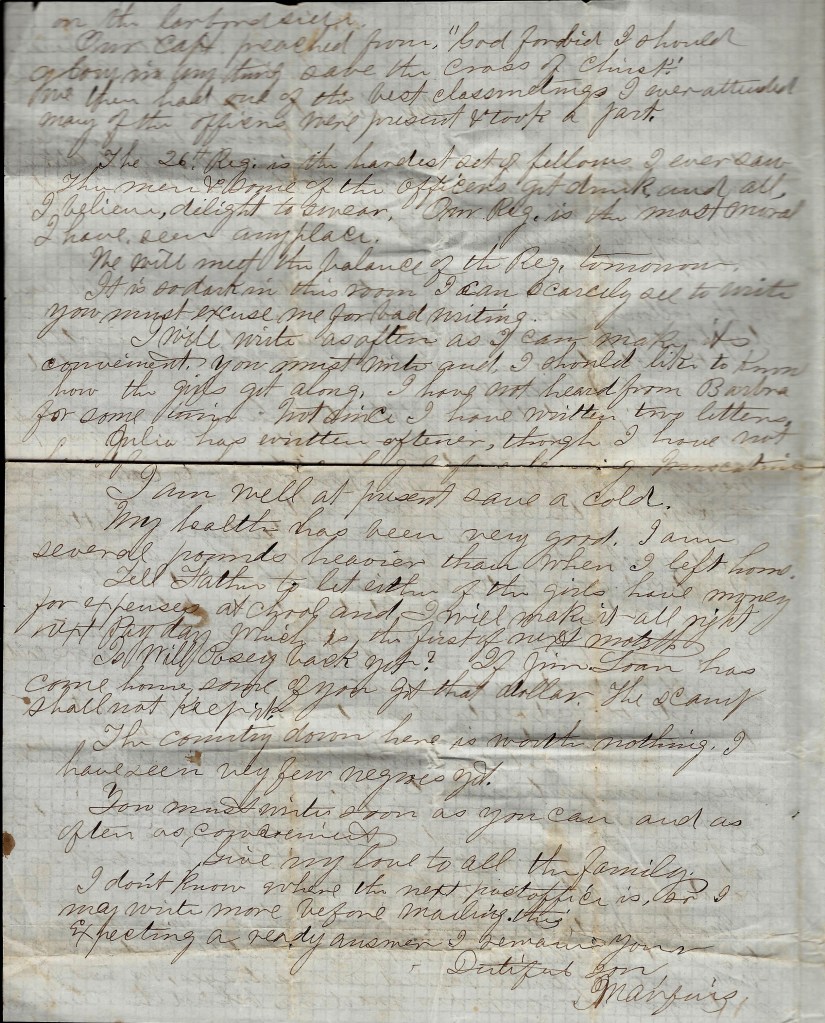
The 26th Regiment is the hardest set of fellows I ever saw. Them men & some of the officers get drunk and all, I believe, delight to swear. Our regiment is the most moral I have seen anyplace.
We will meet the balance of the regiment tomorrow. It is so dark in this room I can scarcely see to write. You must excuse me for bad writing. I will write as often as I can make it convenient. You must write and I should like to know how the girls get along. I have not heard from Barbara for some time—not since I have written two letters. Julia has written oftener though I have not [paper creased].
I am well at present save a cold. My health has been very good. I am several pounds heavier than when I left home. Tell Father to let either of the girls have money for expenses at school and I will make it all right next payday which is the first of next month.
Is Will Posey back yet? If Jim Loan has come home, some of you got that dollar. The scamp shall not keep it.
The country down here is worth nothing. I have seen very few negroes yet. You must write soon as you can and as often as convenient. Give my love to all the family. I don’t know where the next Post Office is so I may write more before mailing this. Expecting a ready answer, I remain your dutiful son, — Marcus
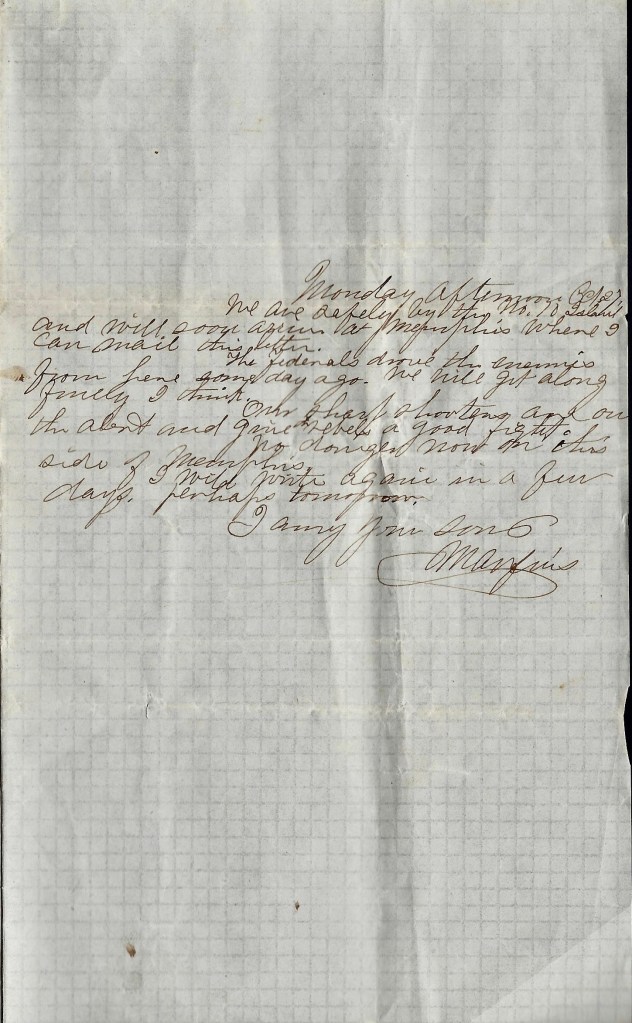
Monday afternoon, Oct. 27. We are safely by No. 10 Island and will soon arrive at Memphis where I can mail this letter. The Federals drove the enemies from here some days ago. We will get along finely I think. Our sharp shooters are on the alert and five rebels a good fight. No danger now on this side of Memphis. I will write again in a few days—perhaps tomorrow. I am you son, — Marcus
Letter 2
In Camp, Rear of Vicksburg, Mississippi Thursday afternoon, July 2, 1863
My dear Brother Jacob,
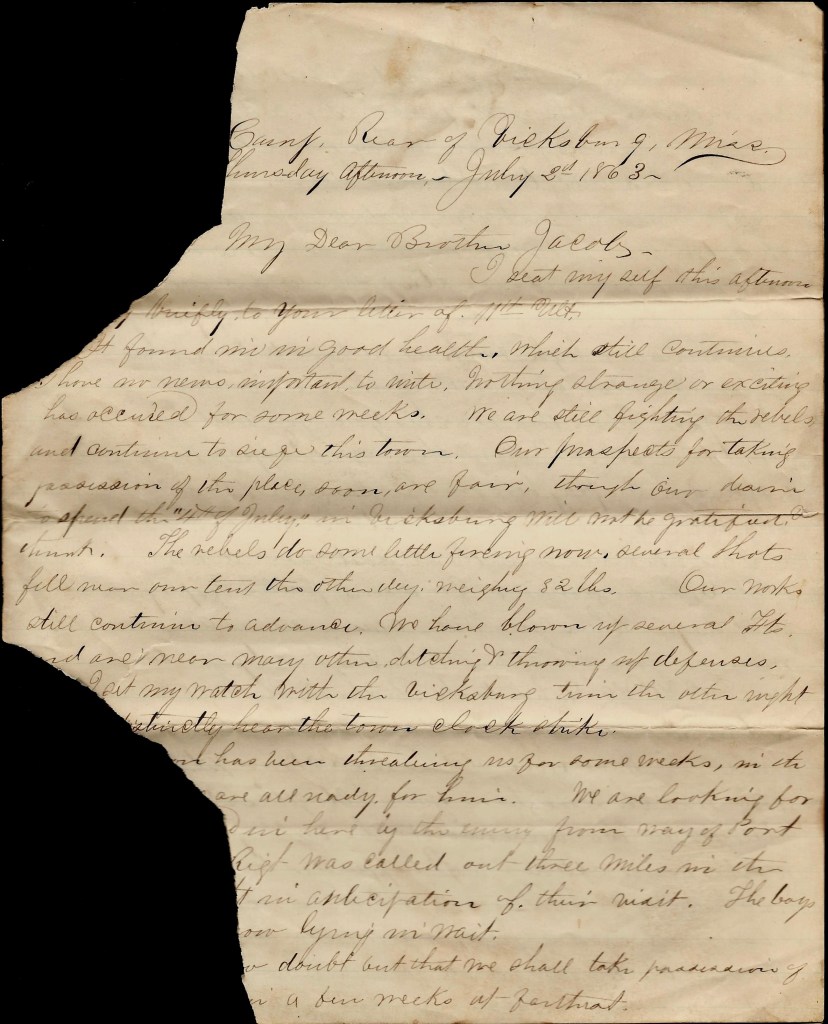
I seat myself this afternoon to respond briefly to your letter of 11th ult. It found me in good health which still continues. I have no news important to write, Nothing strange or exciting has occurred for some weeks. We are still fighting the rebels and continue to siege this town. Our prospects for taking possession of the place soon are fair, though our desire to spend the “4th of July” in Vicksburg will not be gratified, I think. The rebels do some little firing now. Several shots fell near our tent the other day weighing 32 pounds. our works still continue to advance. We have blown up several forts and are near many others, ditching and throwing up defenses. I set my watch with the Vicksburg time the other night. We could distinctly hear the town clock strike.
Gen. Johnston has been threatening us for some weeks in the rear [of us but we] are all ready for him. We are looking for [paper missing] in here by the enemy from way of Port [Hudson] [paper missing] Regt. was called out three miles in the [paper missing] in anticipation of their visit. The boys [paper missing] now lying in wait. [There seems to be] no doubt but that we shall take possession of [paper missing] a few weeks at farthest.
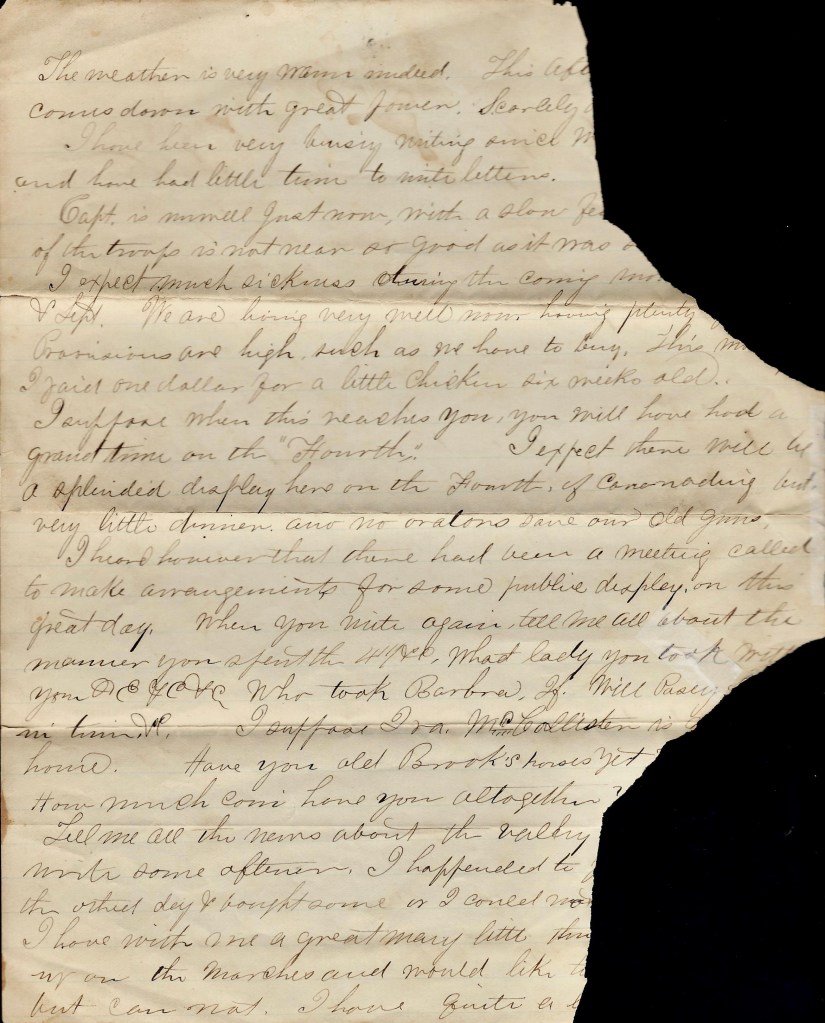
The weather is very warm indeed. This afternoon the sun comes down with great power. Scarcely [paper missing]. I have been very busy writing since we have been here and have had little time to write letters.
Capt. [Casebeer] is unwell just now with a slow fever. Some of the troops is not near so good as it was so [paper missing]. I expect much sickness during the coming months of August and September. We are living very well now, having plenty [paper missing]. Provisions are high, such as we have to buy. This morning I paid one dollar for a little chicken six weeks old. I suppose when this reaches you, you will have had a grand time on the “Fourth.” I expect there will be a splendid display here on the Fourth, of cannonading, but very little dinner and no orations save our old guns.
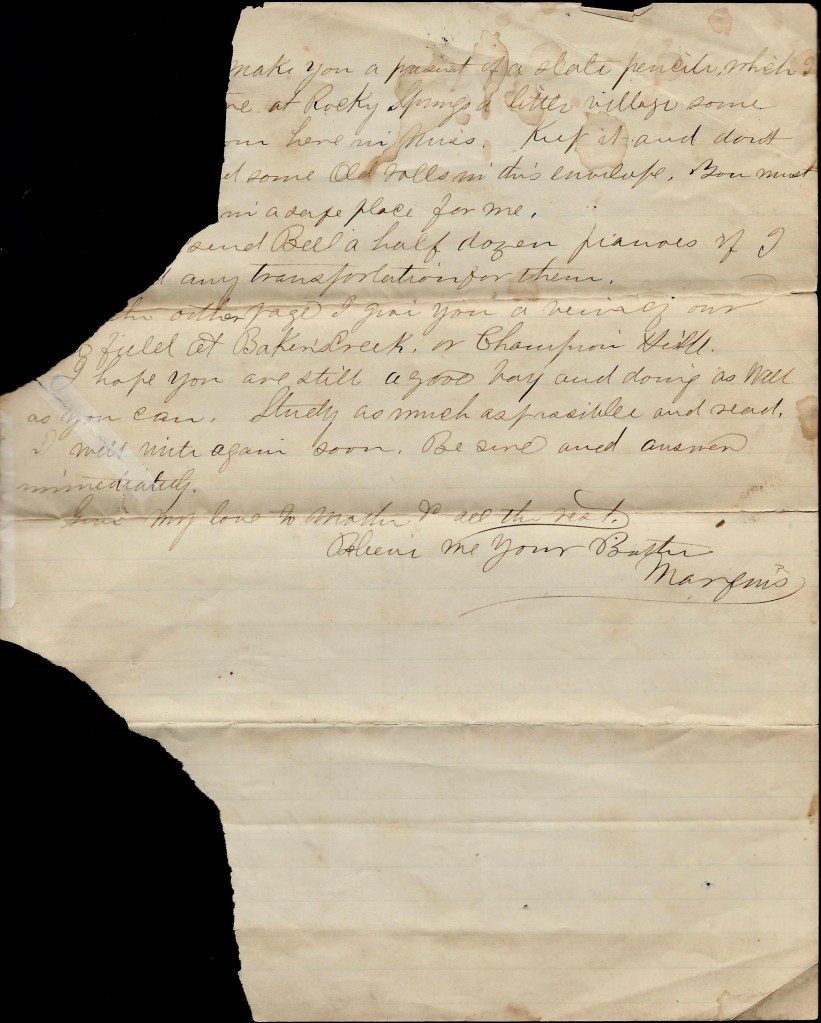
I heard however that there had been a meeting called to make arrangements for some public display on the great day. When you write again, tell me all about the manner you spent the 4th, &c. What lady you took with you, &c. &c. Who took Barbara? If Will Posey [paper missing] in turn, &c. I suppose Ira McCollister is at home. Have you old Brooks’ horses yet? How much corn have you altogether? Tell me all the news about the valley. Write some oftener. I happened to [paper missing] the other day & bought some or I could [paper missing]. I have me a great many little [paper missing] up on the marches and would like to [paper missing] but can not. I have quite a [paper missing]…make you a present of a slate pencil which I [paper missing] at Rocky Springs—a little village some [paper missing] from here in Mississippi. Keep it and don’t [paper missing] sole Old rolls in this envelope. You must keep it in a safe place for me…
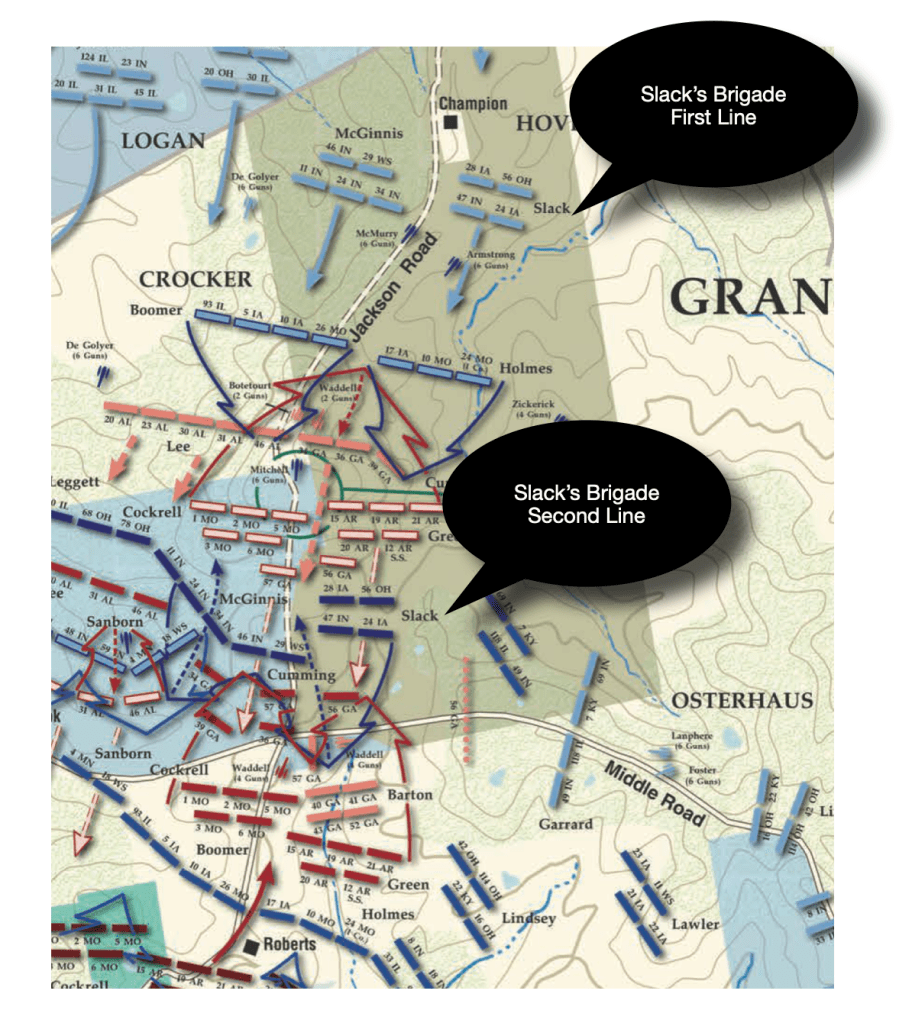
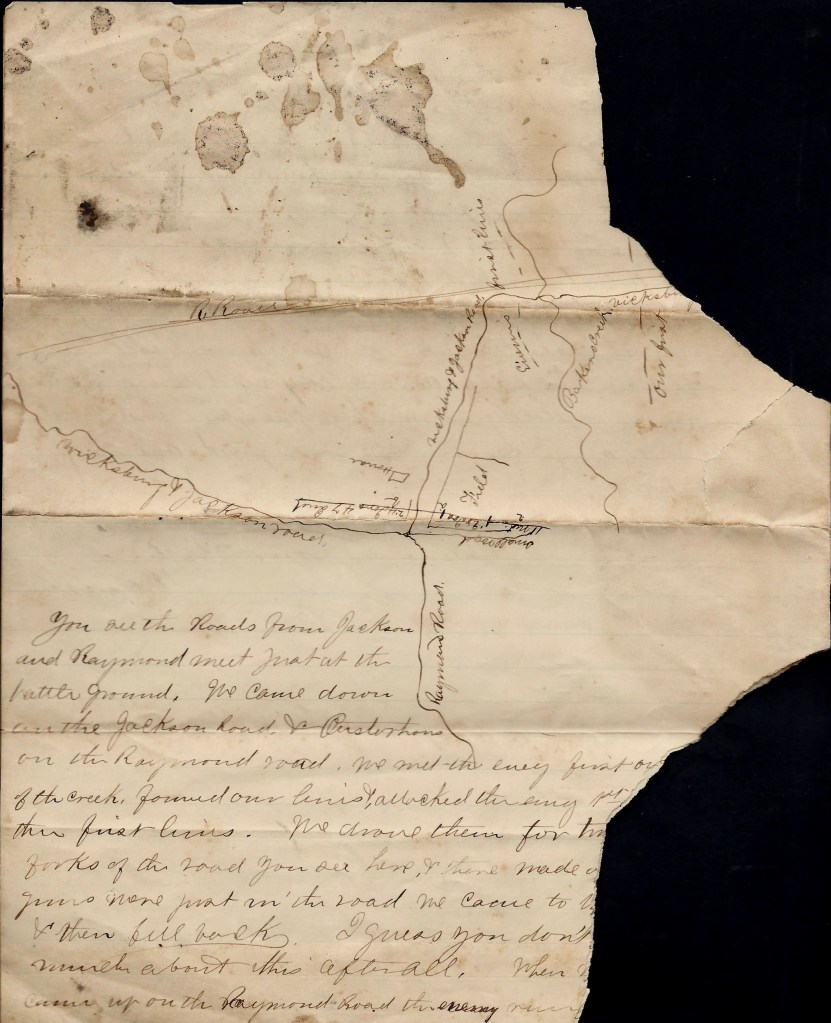
Marcus’ sketch of the Battlefield at Champion Hill, showing the first and second battle lines at Bakers’s Creek and the junction of the Raymond and Jackson Roads. The sketch shows the 28th Iowa on one side of the Vicksburg-Jackson Road and the 24th Iowa on the other.The American Battlefield Trust Map below informs that the Iowans were fighting Arkansans and Georgians on 16 May 1863.
You see the roads from Jackson and Raymond meet just at the battleground. We came down on the Jackson Road & Osterhaus on the Raymond Road. We met the enemy first on [paper missing] of the creek, formed our lines, and attacked the enemy 1st [paper missing] their first lines. We drove them for two [paper missing] forks of the road you see here & there made [paper missing] guns were just in the road we came to [paper missing] and then fell back. I guess you don’t [paper missing] much about this after all. When [paper missing] came up on the Raymond Road, the enemy run [paper missing].
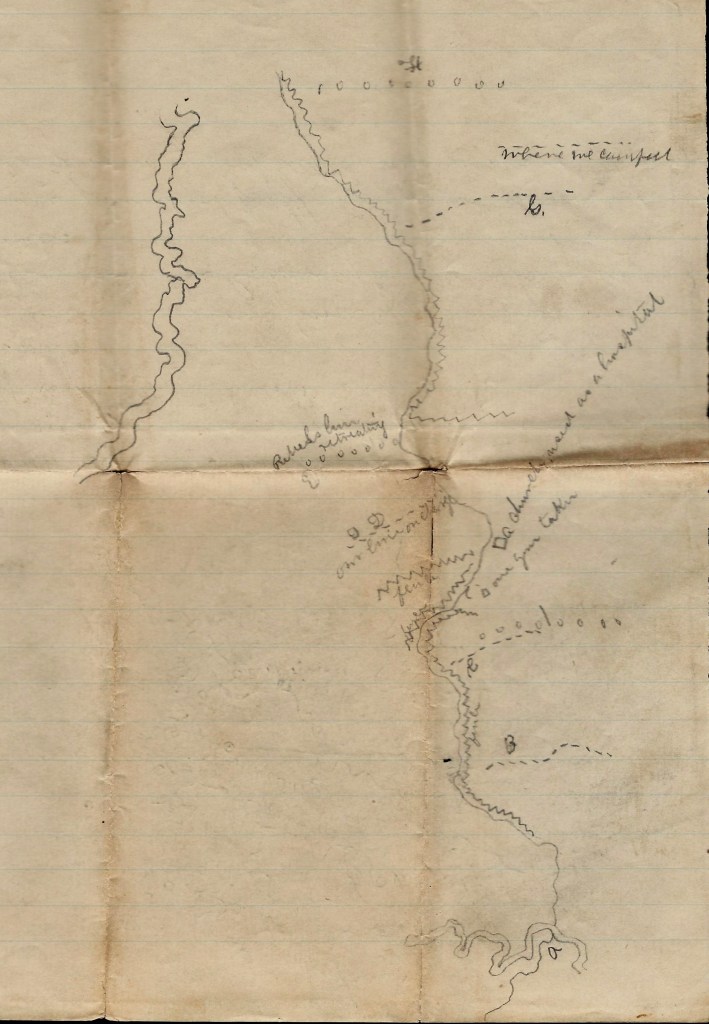
On the other page I gave you a view of our battlefield at Baker’s Creek, or Champion Hill. I hope you are still a good boy and doing as well as you can. Study as much as possible and read. I will write again soon. Be sure and answer immediately. Give my love to Mother and all the rest. Believe me your brother, — Marcus
American Battlefields Trust Map
Map drawn by Israel Marcus Ritter, Co. D, 24th Iowa Infantry, Vicksburg Campaign
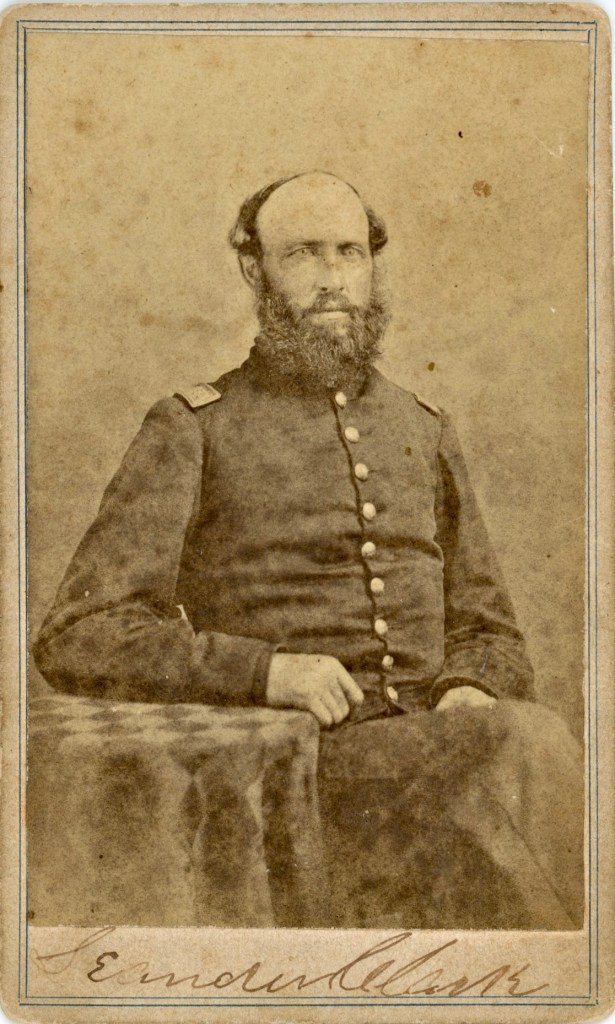
Leander Clark served as the captain of Co. E, 24th Iowa Infantry from September 1862 to July 1865. (Iowa Civil War Images)
The following letters were written by James Henry Mead of Marengo, Iowa, who, at age 33, enlisted on 12 August 1862 and was mustered into Co. E, 24th Iowa Infantry on 28 August 1862. He was discharged for promotion in December 1864 as a Commissary Sergeant in the 1st Missouri Colored Infantry, and later in the 62nd USCT.
James wrote the letters to Ellen Elizabeth Kepner (1842-1923) of Marengo with whom he would marry in 1866.
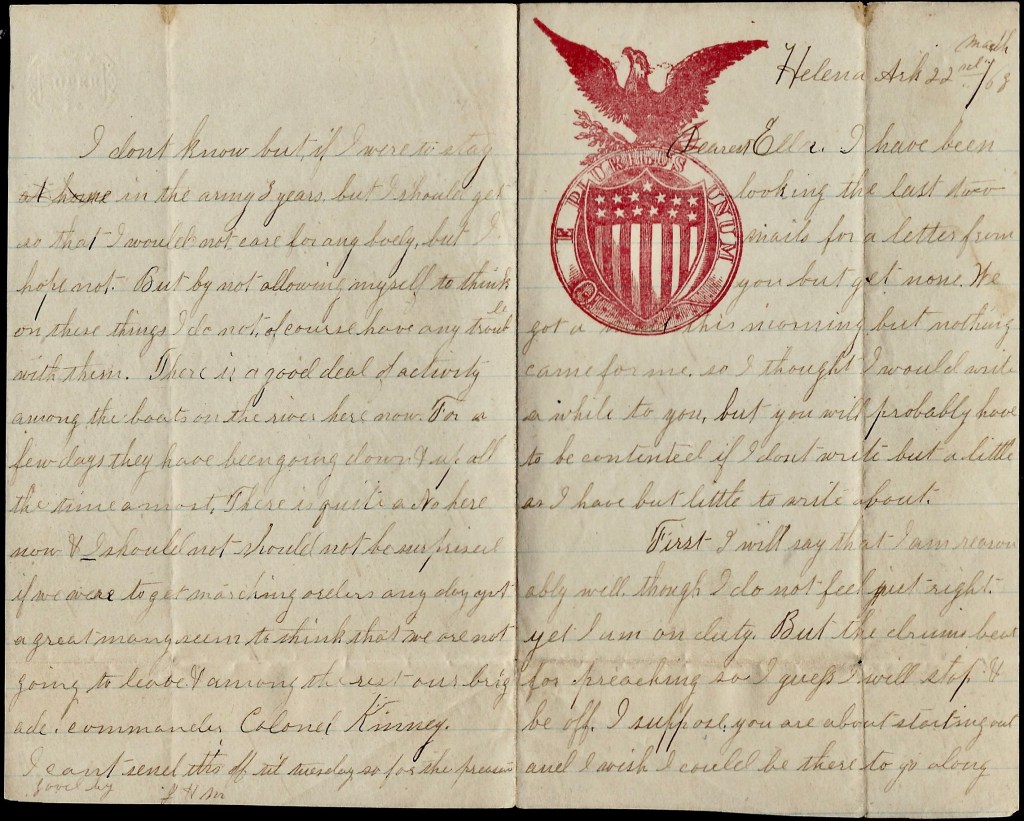
I have been looking the last two mails for a letter from you but get none. We got a mail this morning but nothing came for me so I thought I would write a while to you, but you will probably have to be contented if I don’t write but a little as I have but little to write about.
First I will say that I am reasonably well though I do not feel just right, yet I am on duty. But the drums beat for preaching so I guess I will stop & be off. I suppose you are about starting out and I wish I could be there to go along.
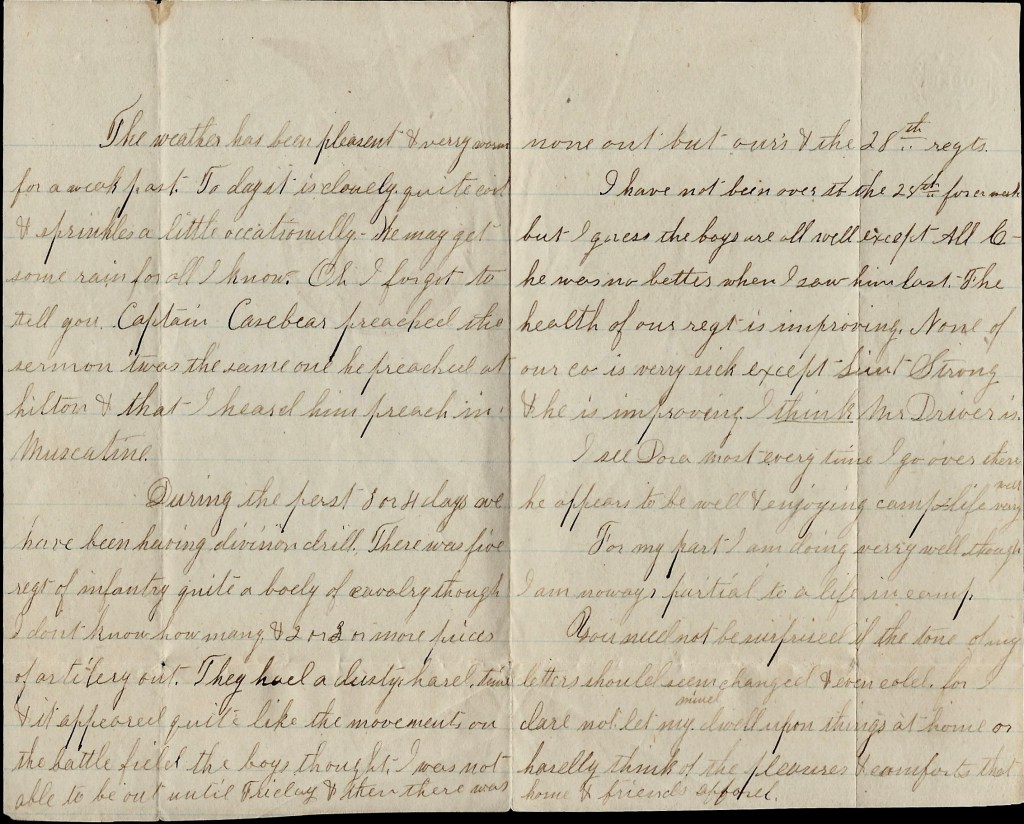
The weather has been pleasant and very warm for a week past. Today it is cloudy—quite cool and sprinkles a little occasionally. We may get some rain for all I know. Oh, I forgot to tell you, Captain [Jacob B.] Casebeer [of Co. D] preached the sermon. Twas the same one he preached at Hilton & that I heard him preach in Muscatine.
During the past 3 or 4 days we have been having division drill. There was five regiments of infantry, quite a body of cavalry though I don’t know how many, & two or three or more pieces of artillery out. They had a dusty, hard time & it appeared quite like the movements on the battlefield the boys thought. I was not able to be out Friday & then there was none but ours and the 28th Regiments.
I have not been over to the 28th for a week but I guess the boys are all well except All C. He was no better when I saw him last. The health of our regiment is improving. None of our company is very sick except Lieutenant Strong and he is improving. I think Mr. [John P.] Driver [of Co. G] is.
I see Dora most every time I go over there. He appears to be well & enjoying camp life very well. For my part, I am doing very well though I am no ways partial to a life in camp.
You need not be surprised if the tone of my letters should seem changed & even cold for I dare not let my mind dwell upon things at home or hardly think of the pleasures & comforts that home & friends afford. I don’t know but if I were to stay in the army three years, but I should get so that I would not care for anybody but I hope not. But by not allowing myself to think on these things, I do not of course have any trouble with them.
There is a good deal of activity among the boats on the river here now. For a few days they have been going down & up all the time amost. There is quite a number here now & I should not be surprised if we were to get marching orders any day yet. A great many seem to think that we are not going to leave & among the rest our Brigade Commander, Col. Kinney.
I can’t send this off till Tuesday so for the present, goodbye. — J. H. M.
Letter 2
Helena, Arkansas April 10, 1863
Dear Ellen,
I just received your most welcome letter. I have been looking for it for several days. It was one week ago last Tuesday that I got my last letter from anyone. I tell you, I begun to. think that you were all sick or something was the matter. Ellen, you must write as often as you can.
I am very much pleased with your letter & the progress you are making in writing. I am gratified to learn that you have got a certificate [to teach]. I hope you will succeed in getting a good school. I felt satisfied when I read that you and my folks were well for I had not heard from you for so long that I was almost sure something must be wrong and I heard it was so sickly up north.
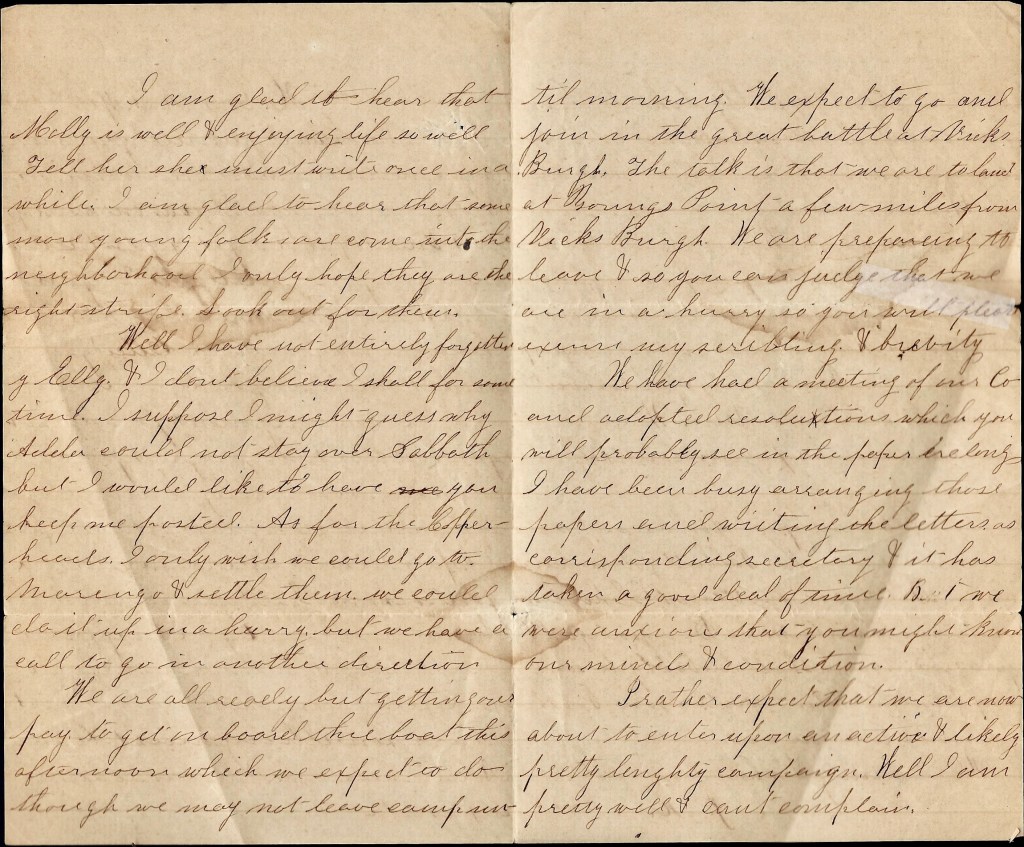
I am glad to hear that Molly is well & enjoying life so well. Tell her she must write once in a while. I am glad to hear that some young folks are come into the neighborhood. I only hope they are the right stripe. Look out for them.
Well, I have not entirely forgotten you Elly & I don’t believe I shall for some time. I suppose I might guess why Adda could not stay over Sabbath but I would like to have you keep me posted. As for the Copperheads, I only wish we could go to Marengo & settle them. We could do it in a hurry but we have a call to go in another direction,
We are all ready but getting our pay to get on board the boat this afternoon which we expect to do though we may not leave camp until morning. We expect to go and join in the great battle of Vicksburg. The talk is that we are to land at Young’s Point, a few miles from Vicksburg. We are prepared to leave & so you can judge that we are in a hurry so you will please excuse my scribbling & brevity.
We have had a meeting of our company and adopted resolutions which you will probably see in the paper ere long. I have been busy arranging those papers and writing the letters as corresponding secretary & it has taken a good deal of time. But we were anxious that you might know our minds & condition.
I rather expect that we are now about to enter upon an active and likely pretty lengthy campaign. Well, I am pretty well & can’t complain. I don’t exactly like to leave our camp for we shall have to leave a great many of our little conveniences. However I don’t care much as long as I am well. We have just been mustered for the purpose of finding out the number of men in the company so that they may know how many conscripts to send us. This is my opinion but I don’t know for certain. We are to receive 4 months pay in about half an hour
Oh, I suppose you are not so lonesome since Mr. Talbutt got his hired man. But I have written all I have room or time to write now. Be a good girl & pray for me. I shall probably be some way from her when I write again. For the present, fare you well. Yours truly & wholly. — J. M.
Letter 3
Keokuk, [Iowa] Saturday, August 1st, 1863
Dear Ellen,
I just received your letter of the 29th July & was glad to hear from you & when I came to look at my journal. I was astonished to find that it was already over a week since I wrote last. I have not heard from either of two letters that I have written home since I came here. I had a letter from Adela which were directed to Jefferson Barracks. I have been afraid that some of them were sick & I feel the more concerned since I have learned that Adda has the whooping cough. I fear some of them are pretty sick. I wrote the same day I got here a week ago last Monday.
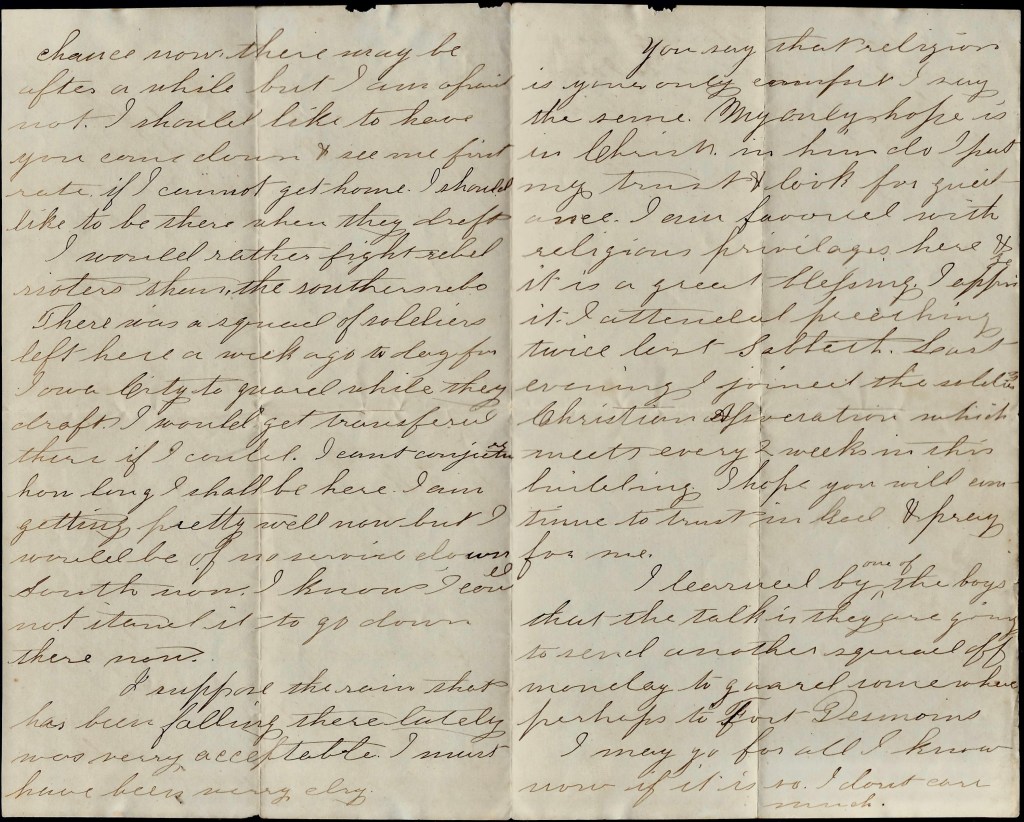
I should like to go home first rate but there is no chance now. There may be after a while but I am afraid not, I should like to have you come down & see me first rate if I cannot get home. I should like to be there when they draft. I would rather fight rebel rioters than the southers rebs. There was a squad of soldiers left here a week ago today for Iowa City to quarrel while they draft. I would get transferred there if I could. I can’t conjecture how long I shall be here. I am getting pretty well now but I would be of no service down South now. I know I could not stand it to go down there now.
I suppose the rain that has been falling there lately wsa very acceptable. It must have been very dry.
You say that religion is your only comfort. I say the same. My only hope us in Christ. in Him do I put my trust & look for guidance. I am favored with religious privileges here and it is a great blessing. I attended preaching twice last Sabbath, Last evening I joined the Soldier’s Christian Association which meets every two weeks in this building. I hope you will continue to trust in God and pray for me.
I learned by one of the boys that the talk is they are going to send another squad off Monday to quarrel somewhere—perhaps to Fort Desmoins. I may go for all I know now. If it is so, I don’t care much. I have nothing more to write I believe so I close. Hoping you will write soon & tell me how you are getting along with your school, &c, remember me to all enquiring friends & believe me your own, — J. M.
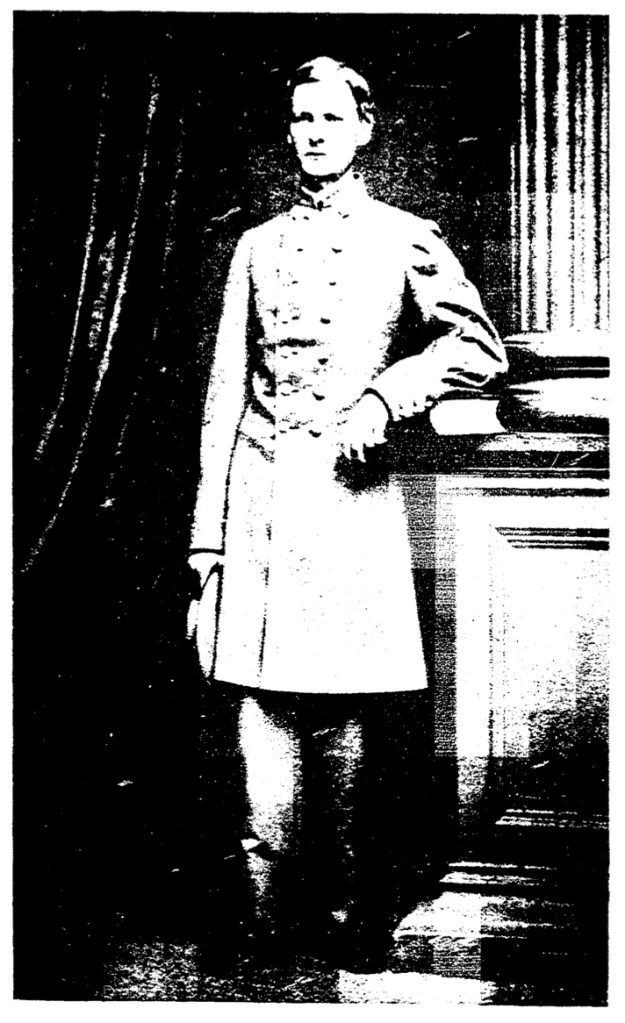
The following letter was penned by James Holdsworth Gordon (1847-1924) in July 1864 while a student at Columbian College in the District of Columbia. Gordon was the son of William Alexander Gordon, Sr. (1802-1873) and Glorvina Blake (1810-1890). He graduated from Columbian College and Law School and was admitted to the bar in 1867.
The letter was addressed to his older brother, William Alexander Gordon, Jr. (1841-1923), who had previously graduated from Columbian College. When the war broke out in 1861, William elected to serve in the Confederate army, accepting a commission as a lieutenant, first as an adjutant of the 1st Confederate Engineers, and later on the staff of General Pickett. After the war, the brothers reunited to form the law firm Gordon and Gordon which had a long history in the District of Columbia.
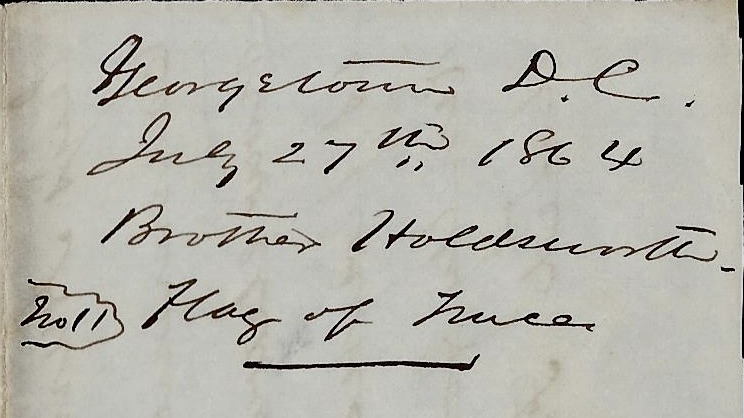
The letter is relatively brief and contains little or no war news. This is because it was officially and legally transmitted through enemy lines by Flag-of-Truce couriers. All such letters were opened and read to look for any content that was considered militarily sensitive. The only other way to send mail was by smuggling it through enemy lines.
J. Holdsworth Gordon, 1862William Alexander Gordon, 1863
Transcription
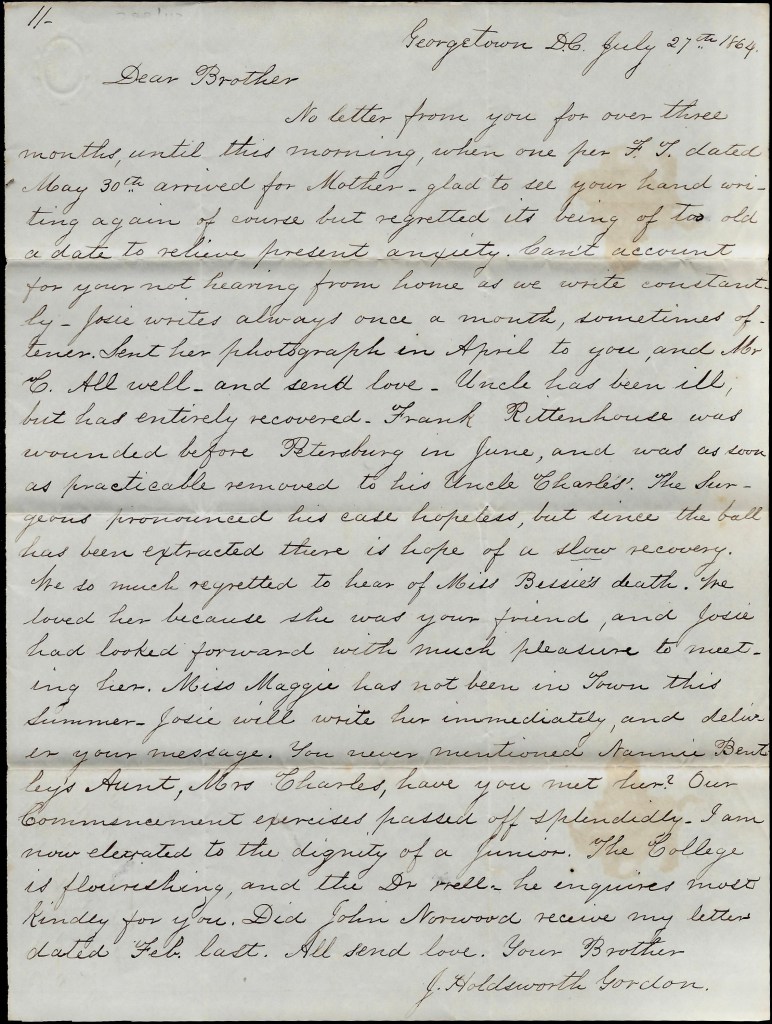
Georgetown, District of Columbia July 27th 1864
Dear Brother,
“Flag of Truce” Letter
No letter from you for other three months until this morning when one per F. T. dated May 30th arrived for Mother. Glad to see your hand writing again if course but regretted. its being of too old a date to relieve present anxiety. Can’t account for your not hearing from home as we write constantly. Josie writes always once a month—sometimes oftener. Sent her photograph in April to you and Mr. C. All well and send love. Uncle has been ill but had entirely recovered. Frank Rittenhouse was wounded before Petersburg in June and was as soon as practicable removed to his Uncle Charles’. The surgeons pronounced his case hopeless but since the ball has been extracted, there is hope of a slow recovery.
We so much regretted to hear of Miss Bessie’s death. We loved her because she was your friend and Josie had looked forward with much pleasure to meeting her. Miss Maggie has not been in town this summer. Josie will write her immediately and deliver your message. You never mentioned Nannie Bentley’s Aunt, Mrs. Charles. Have you met her? Our commencement exercises passed off splendidly. I am now elevated to the dignity of a Junior. The [Columbian] College is flourishing and the Dr. well. He enquires most kindly for you. Did John Norwood receive my letter dated February last? All send love. Your brother, — J. Holdsworth Gordon
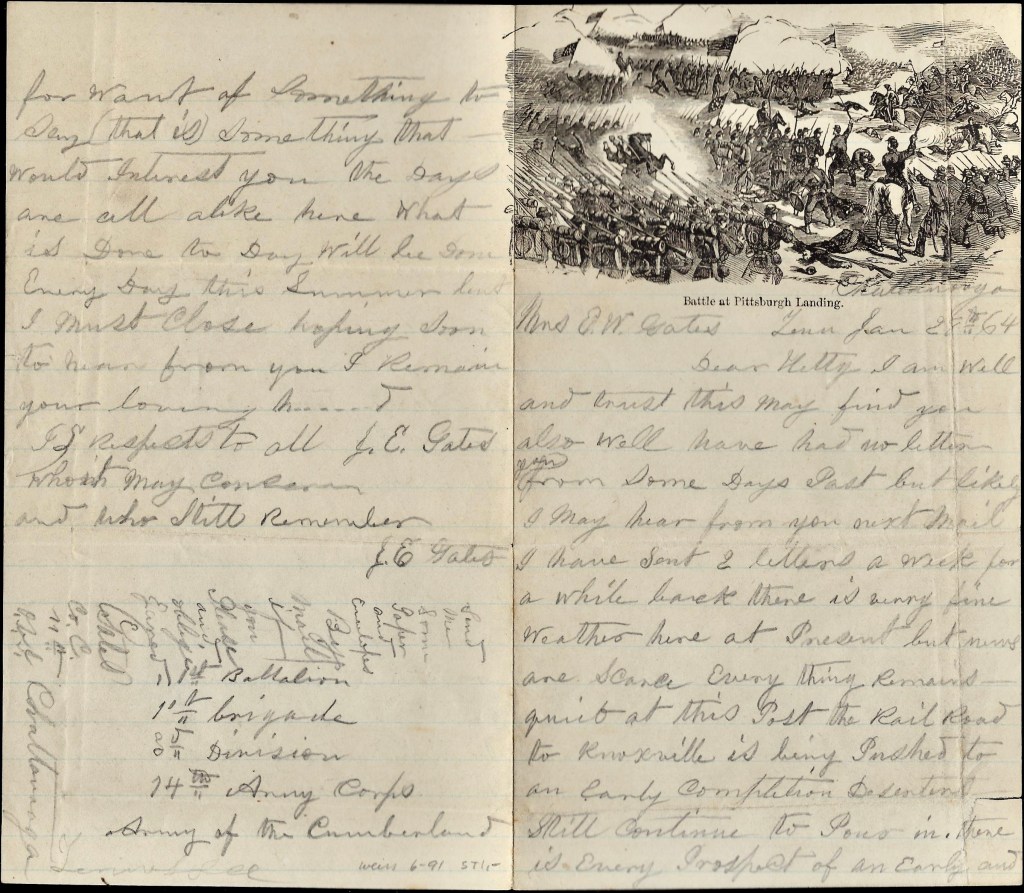
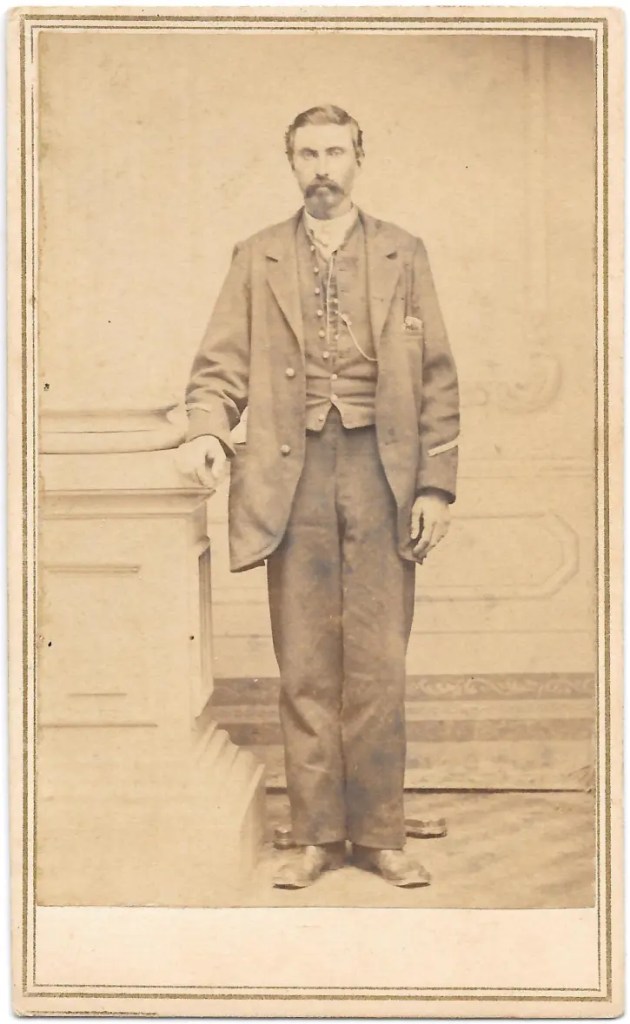
The following letter was written by Jared E. Gates (1832-1911) of Salem, Columbiana county, Ohio. In the 1860 US Census, 28 year-old Jared was the oldest of several siblings by that name living in the Salem household of 48 year-old Lydia Minsor. Ohio Marriage records inform us that Lydia Gates married, William Henry Minsor in 1845—presumably her second marriage. At that time, Jared was employed as a “confectioner.”
Jared was one of the first to join Co. C, 11th Ohio Volunteer Infantry (OVI) and was mustered in on 1 July 1861. He mustered out three years later on 21 June 1864. Jared must have been home on furlough in January 1863 for it was on 9 January 1863 that he and Esther (“Hetty”) W. Hart (1834-1915) were married in Columbiana county. Jared lived his last thirty years in McKean county, Pennsylvania.
Transcription
Chattanooga Tennessee January 27th 1864
Mrs. E. W. Gates,
Dear Hetty, I am well and trust this may find you also well. Have had no letter from you [for] some days past but likely I may hear from you next mail. I have sent 2 letters a week for a while back. There is very fine weather here at present but news are scarce. Everything remains quiet at this post. The railroad to Knoxville is being pushed to an early completion. Deserters still continue to pour in. There is every prospect of an early and vigorous campaign in front of this line—that is, I mean the line of the Tennessee. It may be that the storm will burst forth at Knoxville. The Rebels are evidently about to make a desperate effort to retrieve their fortunes in this section of the country and Uncle Sam is making preparations to receive them in a style becoming their chivalry and prestige.
The weather is very warm—so warm today that a blouse feels uncomfortable. I am in hopes that before it gets very hot we shall be on our way north. Our time is said to be out April 20th. If so, we shall be just in time to escape the hot season. Will finish this tomorrow. In the meantime, there might arrive a letter (for the undersigned) with news from home.
Well the night has passed pleasantly away. The train from Nashville came in just after retreat but it brought no letter for J. E. G. There is no news. Some ladies (southward bound) were searched at the Provost Marshal’s the other day. Various contraband articles were brought to light among which were some 30 revolvers nicely concealed in a bed tick. These ladies were sent on their way to Dixie with a lighter load than they had intended to take. They were the hardest set of women I ever saw.
Well, I will have to close this important letter for want of something to say—that is, something that would interest you. The days are all alike here. What is done today, will be done every day this summer. But I must close hoping soon to hear from you. I remain your loving husband.
Respects to all, — J. E. Gates
Who it may concern and who still remember—J. E. Gates
Send some paper and envelopes by mail if you please and I oblige, Jared E. Gates, Co. C, 11th O. V. I., Chattanooga, Tennessee
1st Battalion, 1st Brigade, 3rd Division, 14th Army Corps, Army of the Cumberland
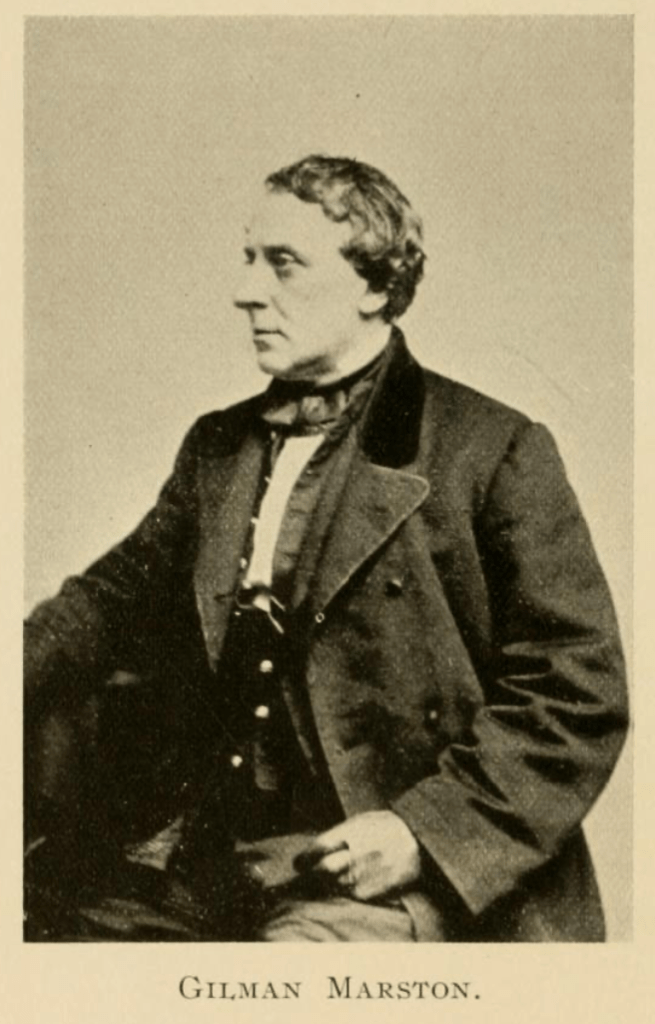
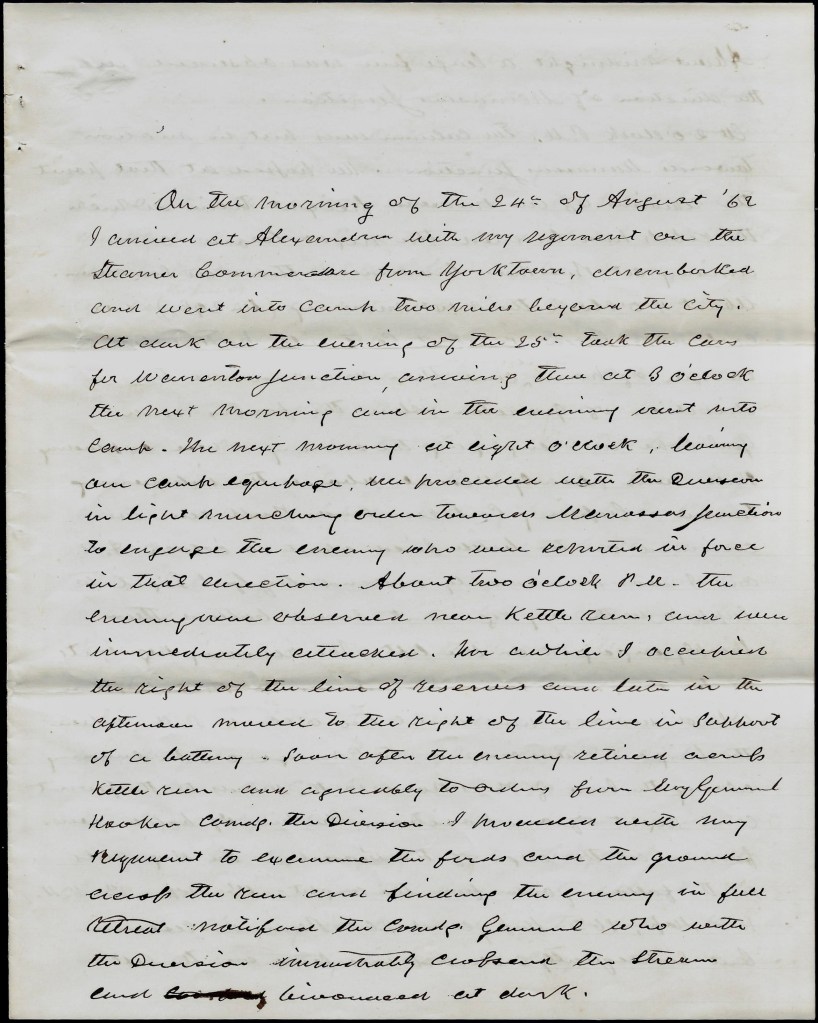
Though unsigned, the following appears to be Col. Gilman Marston’s after action report chronicling the movements of the 2nd New Hampshire Regiment in the days leading up to and including the Battle of Second Manassas. The report also includes an appendix listing all of the known casualties of the regiment broken down by company and notes individual acts of courage.
For a good synopsis of the role played by the 2nd New Hampshire in the 2nd Battle of Manassas, readers are referred to the excellent article by William E. Welsh entitled “Grover’s Savage Attack at the Battle of Second Manassas” published on the Warfare History Network.
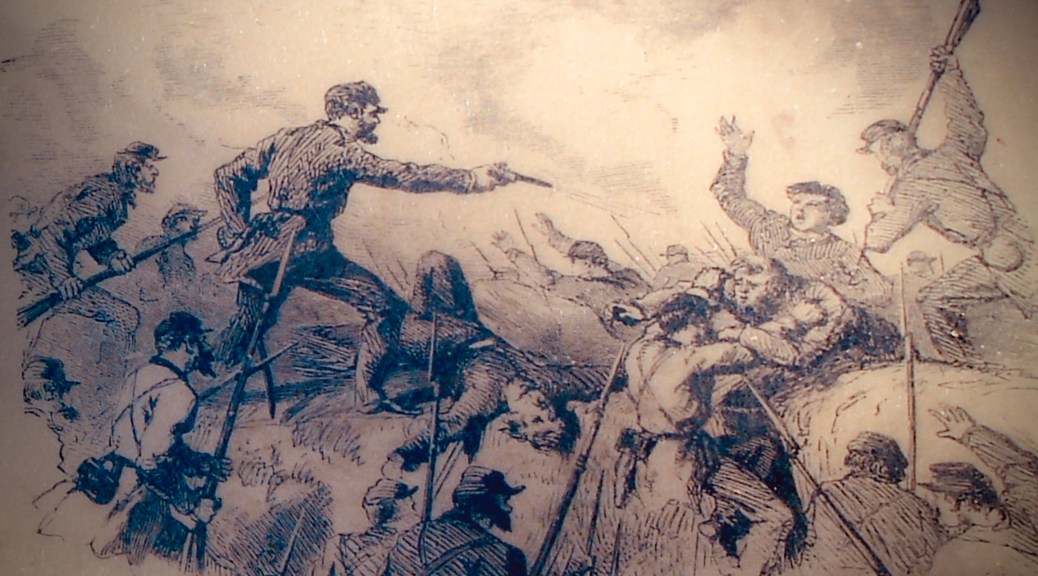
The image in the banner of this post is displayed on the Historical Marker placed at the location of Grover’s Bayonet Charge on 29 August 1862 which states: “Grover’s troops waited for the Rebels to fire, then charged up the ten-foot embankment. With no time to reload, Confederates were caught hugging the rear slope. The charging Federals stabbed with bayonets, crushed skulls with musket butts, and broke through the next line of defenders. Their success was almost suicidal; no one reinforced Grover’s advance. As Georgians and South Carolinians rushed to close the gap, the isolated Federals had to fall back over the ground they had won, back through a lethal crossfire. In twenty minutes General Grover’s Brigade lost 487 men—a third of his command.”
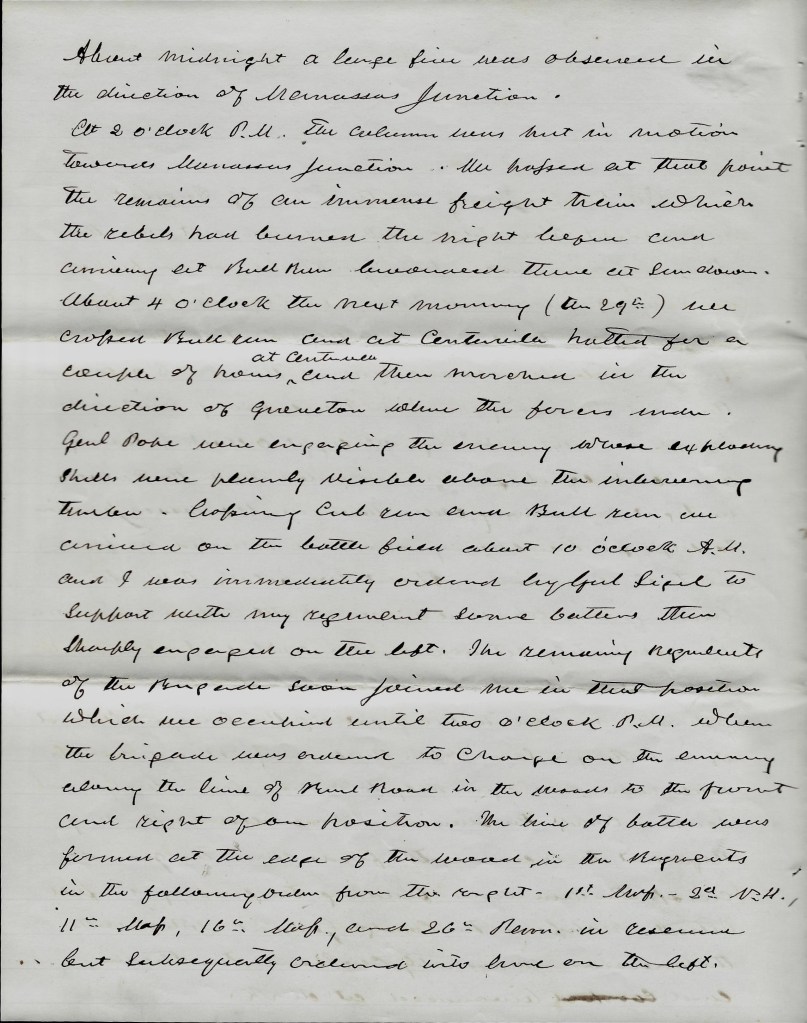
Transcription
On the morning of the 24th of August, ’62, I arrived at Alexandria with my regiment on the Steamer Commodore from Yorktown, disembarked, and went into camp two miles beyond the city. At dark on the evening of the 25th, took the cars for Warrenton Junction, arriving there at 3 o’clock the next morning and in the evening went into camp. The next morning at eight o’clock, leaving our camp equipage, we proceeded with the Division in light marching order towards Manassas Junction to engage the enemy who were reported in force in that direction.
About two o’clock P.M. the enemy were observed near Kettle Run, and were immediately attacked. For a while I occupied the right of the line of reserves and late in the afternoon moved to the right of the line in support of a battery. Soon after the enemy retired across Kettle Run, and agreeably to orders from Maj. General Hooker, Commanding the Division, I proceeded with my Regiment to examine the fords and the ground across the run and, finding the enemy in full retreat, notified the Commanding General who with the Division immediately crossed the stream and bivouacked at dark.
About midnight a large fire was observed in the direction of Manassas Junction.
At 2 o’clock p.m. the column was put in motion towards Manassas Junction. We passed at that point the remains of an immense freight train which the rebels had burned the night before and arriving at Bull Run, bivouacked there at sundown. About 4 o’clock the next morning (the 29th), we crossed Bull Run and at Centerville halted for a couple of hours at Centreville, and then marched in the direction of Groveton where the forces under Gen. Pope were engaging the enemy whose exploding shells were plainly visible above the intervening timber. Crossing Cub Run and Bull Run, we arrived on the battlefield about 10 o’clock a.m. and I was immediately ordered by Gen. Sigel to support with my regiment some batteries then sharply engaged on the left. The remaining regiments of the Brigade soon joined me in that position which we occupied until two o’clock p.m. when the brigade was ordered to charge on the enemy along the line of railroad in the woods to the front and right of our position. The line of battle was formed at the edge of the wood, the regiments in the following order from the right—1st Mass, 2nd N.H., 11th Mass, 16th Mass, and 26 Penn in reserve, but subsequently ordered into line on the left.
The Brigade advanced in this order through the wood and when within fifty yards of the railroad where the enemy lay concealed we received their fire. The order was immediately given to charge bayonets which was done and the rebel line quickly broke and those that remained alive scattered [&] fled to the rear. A second line of the enemy soon reached the field which, at not more than 70 yards distant, killed and wounded a large number, but the men were soon rallied and drove the enemy until the fire of a third line was received which compelled the brigade to retire. At this time the enemy opened fire with canister from a battery on our left. Falling back to the open ground, we reformed our line of battle, and, after holding our position for about one hour, retired under cover of our batteries occupying the high ground in rear of the wood through which we had charged.
The loss in killed wounded and missing was very severe. In my regiment 311 enlisted men and 21 commissioned officers went into the fight of whom 122 did not return. In this engagement the bayonet was freely used and with excellent effect pursuing without attempting to use the bayonet in defense.
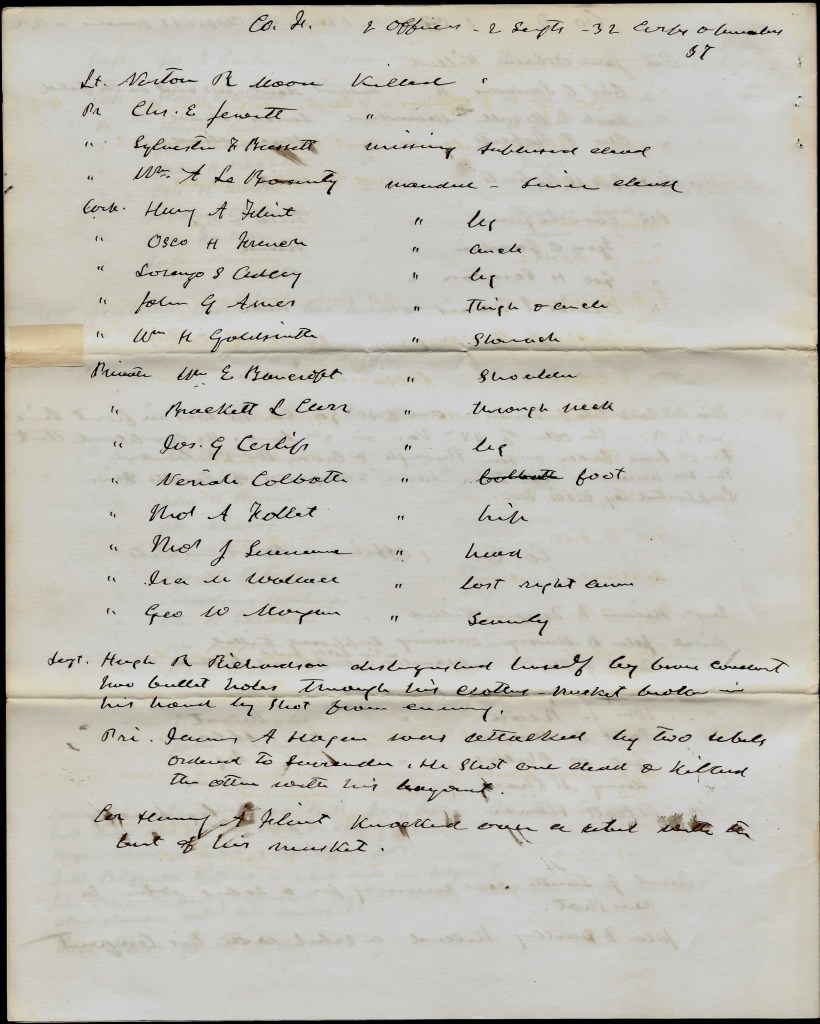
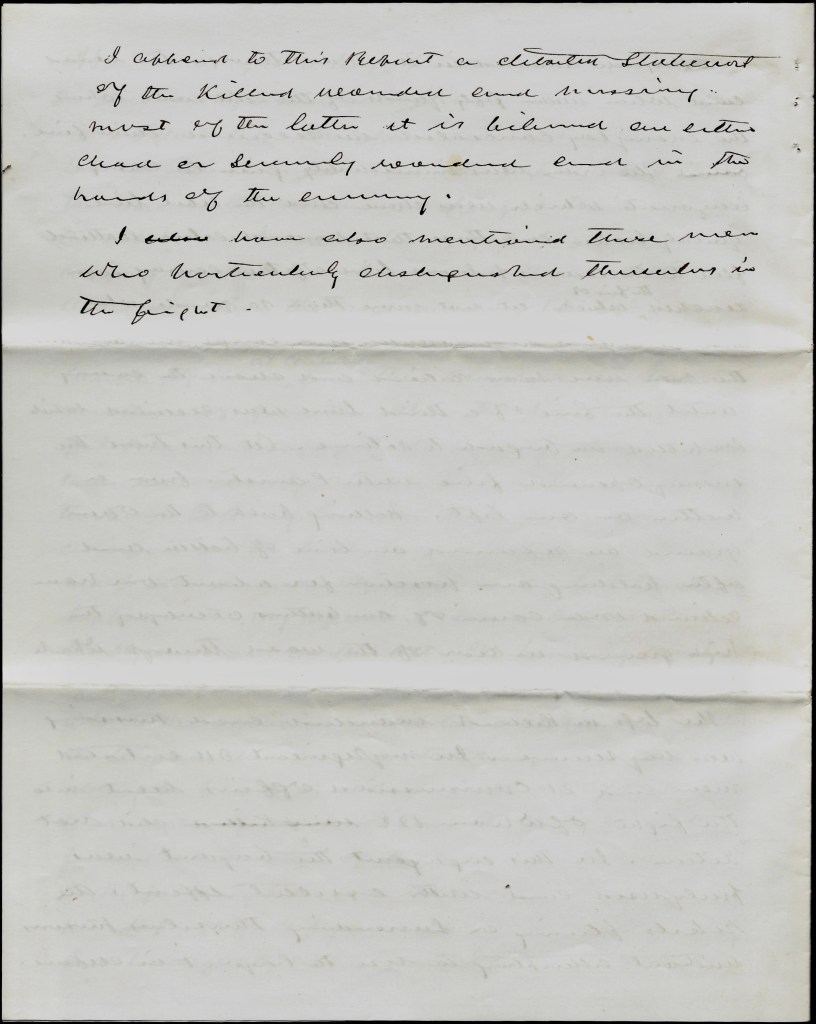
I append to this report a detailed statement of the killed, wounded and missing. Most of the latter it is believed are either dead or severely wounded and in the hands of the enemy. I have also mentioned those men who distinguished themselves in the fight.
Wm A. Haywood—killed Gardner W. Turner—killed or is supposed wounded & left on the field Wm. Dunton—wounded in face, severely Elwin Young—wounded, shot through the body Albert G. Stone—wounded, thigh fractured Wm H. Preckle—wounded in leg Allen B. Heyward—wounded in thigh Geo. Stevens—wounded in shoulder Geo Ruffin—wounded in hand
Lieut. Converse fired 8 rounds. A.R. Walker took a prisoner. Geo. Ruffle took two prisoners & got wounded bringing them out. Prisoners got away. John H. Bronill brought out a prisoner. O. S. Adams and Gardner Turner each killed a man with the bayonet. Many of the 1st & 2nd line threw away their guns and ran.
Capt. Joshua F. Littlefield—wounded right thigh & arm. Died Sept. DeWitt C. Sanborn—killed Johnson N. Danforth—wounded; since died Geo. W. Ladd—wounded; since died James E. Edgerley—missing; supposed dead John C. Rand—missing; supposed dead Lieut. W. W. Ballard—wounded in head Lieut. John D. Cooper—wounded, shot through the body Sergt. Geo F Carter—wounded, thigh fractured Corp. Isaac W. Walton—wounded, in ankle severely Pvt. Hiram Cutter—wounded, in foot; brought out a prisoner Pvt. John Danforth—wounded in leg Pvt John H. Nichols—wounded in thigh Pvt. Charles H. Worth—wounded in arm, severely; bayonetted the rebel Pvt. Joseph E. Chapman—wounded through head Pvt. Asa Folsom—wounded in arm Pvt. John Hanson—wounded in neck
Wm Carlton brought out two prisoners; on Wednesday previous Algeron Chan had sun stroke and died.
1st Sergt F. O. Robinson—killed Pvt. Charles L. Tabor—wounded both legs Pvt. John B. Stevens—wounded hand severely Pvt. Wm. Sidney—wounded, shot through body Pvt. Charles McGauflin—wounded, shot through body Pvt. Geo W. McKennon—wounded, foot Pvt. Cornelius Hastings—wounded, leg Pvt. Charles R. Farnham—wounded, leg Pvt. Wm. Fitzgerald—wounded, head Pvt. John Fift—wounded, head Pvt. George Clement—wounded, arm Pvt. J. W. Bignold—wounded, leg Pvt. John Cushing—wounded, abdomen
Enemy fired canister down R.R. from left. All of this company went over the R R but those who got hit before reaching it. Hagen Davis, Jr. took & brought off a prisoner. J. W. Bignold killed a rebel with his bayonet. John Chase being attacked by two rebels, shot one & knocked the other down with his musket. Capt. Carr fired 5 rounds
Pvt. John Osborn—killed Pvt. Charles C. Saunders—killed without doubt, fell & left on the field Pvt. Mark D. Merrill—wounded, since died Pvt. Charles P. Roberts—wounded, wrist Lieut. Geo. W. Roberts—wounded, wrist Pvt. Eben LeGrow—wounded, neck and leg Pvt. Ezra C. Goodwin—wounded, hand Pvt. Geo H. Scranton—wounded, arm Pvt. Orwell J. Davis—wounded, side Pvt. Thos. J. Mahoney—wounded, wrist and thigh
This company took two prisoners—one of 35th Ga (he was in front line on R.R.); the other of 45th Va. in 2nd line. He complained that the 1st line boke & run through & broke the 2nd line. The Va. prisoners admitted there were 3 brigades of Ewell’s Div. Supported by Hill’s Div.
Co. E.—1 officer, 12 muskets
Sergt. Hirsen F. Durgin—killed Pvt. John B. Mussey—missing, supposed killed Pvt. Daniel G. Smith—wounded, on sick list on field, supposed dead Pvt. Henry M. Gordon—wounded, leg Pvt. William C. Bean—wounded, throat Pvt. Paul C. Morgan—wounded, elbow Pvt. George W. Phelps—wounded, hand Corp. Alcott Stover—wounded, in leg severely
Daniel F. Smith was running for a rebel when he was shot. John F. Dudley killed a rebel with his bayonet.
Lt. Norton R. Moore—killed Pvt. Charles E. Jewett—killed Pvt. Sylvester F. Bassett—missing, supposed dead Pvt. Wm. A. LeBosinty—wounded Corp. Henry A. Flint—wounded, leg Corp. Osco H. French—wounded, ankle Corp. Lorenzo S. Adley—wounded, leg Corp. John G. Ames—wounded, thigh and ankle Corp. Wm. H. Goldsmith—wounded, shoulder Pvt. Wm. E. Bancroft—wounded, shoulder Pvt. Brackett L. Carr—wounded, shoulder Pvt. Jos. G. Cerliss—wounded, leg Pvt. Veriate Colboten—wounded, foot Pvt. A. Follet—wounded, hip Pvt. J Semmes—wounded, head Pvt. Ira M. Wallace—wounded, lost right arm Pvt. Geo W. Morgan—wounded severely
Sergt. Hugh R. Richardson distinguished himself by brave conduct two bullet holes through his clothes, musket broke in his hand by shot from enemy. Pvt. James A Hagen was attacked by two rebels, ordered to surrender. He shot one dead & killed the other with his bayonet. Corp. Henry A. Flint knocked over a rebel with the butt of his musket.
Lieut. Sylvester Rogers—killed, shot through stomach Pvt. Charles P. Phillips—killed. shot through head Pvt. Harvey H. Winn—killed, shot through head Pvt. Charles O. Collister—killed, shot through head Pvt. A.S. Hutchinson—killed, shot twice, head and body, also in leg Pvt. Marcus J. Hall—wounded, since dead Pvt. Wm D. Coffin—supposed shot and killed Lieut. David Steel—wounded, right arm Corp. E. G. Sturkey—wounded, thigh fractured Pvt. Timothy N. Hutchinson—wounded, right arm Pvt. George D. Felt—wounded, in groin Pvt. Michael A. Dillon—wounded, through lungs Pvt. Thomas O’Brien—wounded, right arm Pvt. Charles Holt—wounded, face severely
Alex McRobie brought out a prisoner. John Hagen was attacked by two, shot one bayoneted the other. Asum attacked by one whom he bayoneted. Corp. Dascomb was the last to leave the woods. John B. Roule bayoneted one man & brought out a prisoner.
Pvt. John S. Rolf—missing, supposed killed Pvt. John B. Buntin—missing, supposed killed Lieut. John F. Holman—wounded, thigh fractured Lieut. H. D. F. Young—wounded, arm slightly Sergt. Andrew G. Bracy—wounded Corp. John B. Reed—wounded, knee Pvt. Lyman F. Parish, wounded, thigh Pvt. Charles H. Smith—wounded, neck Corp. John L. Davis—wounded, leg Pvt. Sam’l Poor—wounded, head Pvt. George Beny—wounded, ankle Pvt. Henry Bowman—wounded, head
Sergt. Silver had his gun shattered in his hand. Corp. Hanson had two guns shattered in his hands. Corp. Reed had his gun stock shattered. P. Sexton same. Pr. James H. Andrews shot a rebel who opposed him.
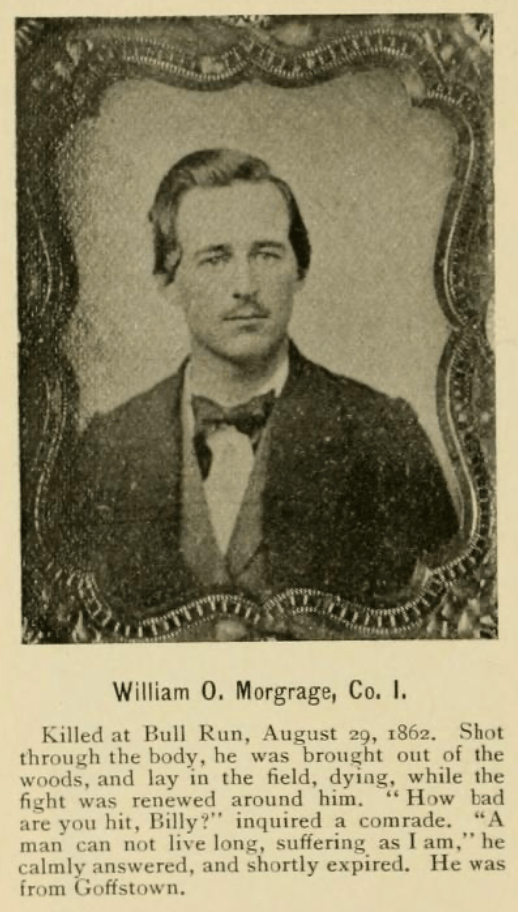
Pvt. Wm. O. Mortgage—killed Pvt. Wm. F. Wright—wounded, since dead Corp. Charles H. Smiley—missing, supposed dead Lieut. Geo. W. Gordon—wounded, in head Corp. James M. House—wounded, thigh Pvt. Eugene G. Haswell—wounded, neck Pvt. Lyman A. Dickey—wounded, hand severely Pvt. Allain R. Simmons—wounded, leg fractured Pvt. Rand—wounded, thigh fractured Pvt. Jos. H. Gleason—wounded, ear Pvt. Martin A. Haynes—wounded, face
Cor. John E. Ogden killed one with bayonet. All went over R.R. most of them twice. Enemy first seen by this co. at R.R. 1st line broken by our fire, 2nd by bayonet. Jas. Lanoy brought out two prisoners & Charles F. Pariot one. Corp. James M. House took two prisoners—one was shot at the same time with the corporal. Levi H. Sleeper Jr. was attacked by three rebels. He bayoneted one, knocked another down with his musket & was then forced to retire.
Pvt. Henry Walker—killed Pvt. Henry Wilson—killed Pvt. Jere Mahony—supposed killed Pvt. John Moore—wounded, in groin Pvt. James T. Gamman—wounded, both thighs fractured Pvt. Wm. H. Goodson—wounded, foot Pvt. Warren L Stebbins—wounded, in hand Pvt. Alex Steward—wounded, in head Pvt. Geo Johnston—wounded, in leg Pvt. Charles Robinson—wounded, in face
The whole company went over the Railroad. Mahoney and Al ab Manson were seen by Lt. Sides to use the bayonet. Lt. Sides thinks there were two lines of the enemy beyond the R.R. besides the skirmishers on the western side who were pretty thick. The 1st line broke and the fire of the 2nd line somewhat broke us. Our men were engaged with the 2nd line. Whitney Dunbar shot down the color bearer. Co. K took 4 or 5 prisoners. Thinks 25 prisoners were taken between the right & the colors. The enemy’s colors were 20 ft. in front of R.R.—a large splendid flag—and line of rebels on the R.R. & 3rd line on opposite side. The 1st line was a strong line of skirmishers. It was the 2nd line we broke with the bayonet.
DOCKET Casualties of 2nd Reg N.H. Vol. at Bull Run 29th & 30th Aug. 1862
The following letter was written by Washington Pinckney Shooter (1837-1864) of Marion county, South Carolina. “W. P.” commenced service in Marion District, August 1, 1861, as a 27 year old Lieutenant, in Co. K, “Meagher Guards” of Charleston, South Carolina 1st Infantry Volunteers. Later he was reorganized into Co. E, South Carolina 1st Infantry Regiment (McCreary’s), as Company Commander, Captain. He was present for all the major battlesof the regiment except Sharpsburg.
On January 4, 1864, he was promoted to Lieutenant Colonel, Regimental Commanding Officer but was killed in action at The Bloody Angle, Battle of Spotsylvania Court House, waving his sword while leading a counterattack. When some of his Regiment stopped to assist him, he told them to go forward and leave him, saying “I know that I am a dead man; but I die with my eyes fixed on victory!”
In this letter, W. P. wrote a letter to the father of one of the members of his company, 18 year-old Charles Reaves, who was killed in the charge of Perrin’s South Carolina Brigade on the 1st Corps’ last position on Seminary Ridge in front of the Lutheran Theological Seminary. W. P. gives all the particulars of Charles’ death as well as his burial location.
[Note: This letter is from the personal collection of Richard Weiner and was transcribed and published on Spared & Shared by express consent. The painting appearing in the banner of this post is Dale Gallon’s artwork entitled “Day’s End—July 1st”]
Transcription
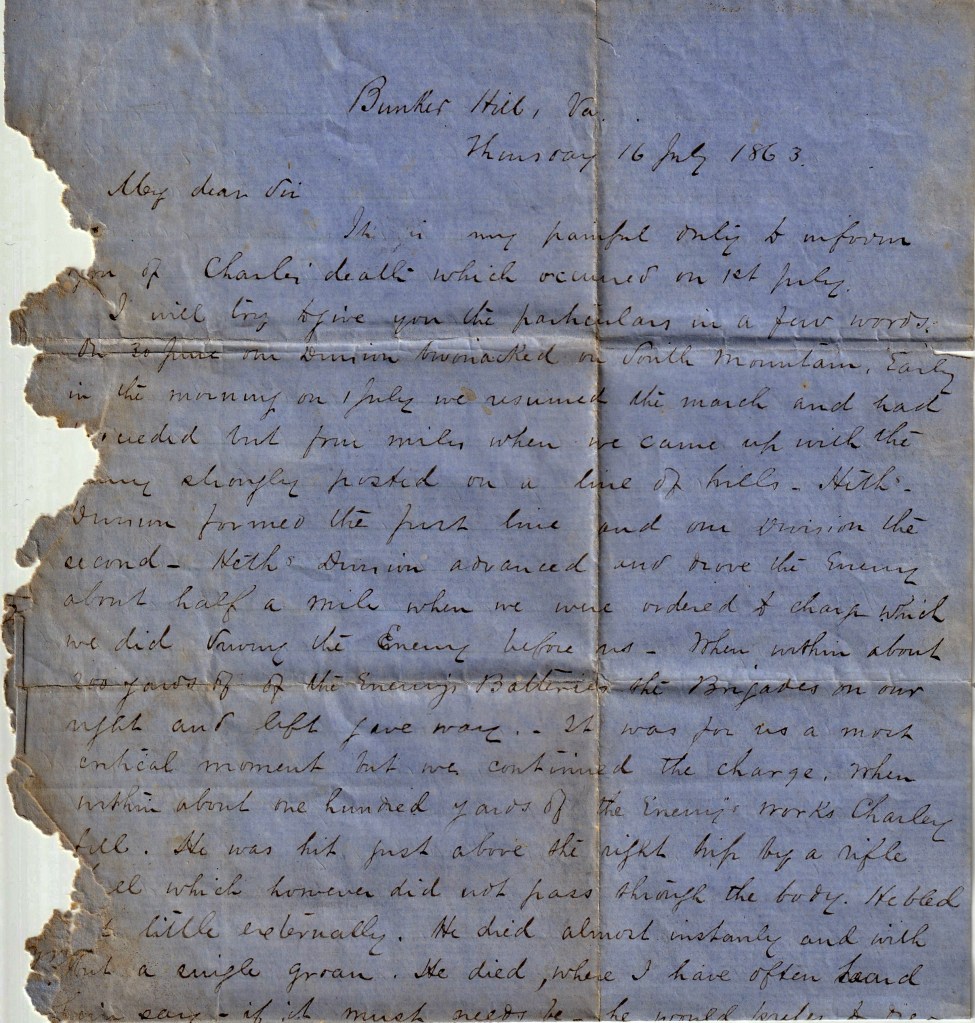
Bunker Hill, Virginia Thursday, 16 July 1863
My dear sir,
It is my painful duty to inform you of Charles’ death which occurred on 1st July. I will try to give you the particulars in a few words. On 30 June, our Division bivouacked on South Mountain. Early in the morning on 1 July, we resumed the march and had proceeded but four miles when we came up with the enemy strongly posted on line of hills. Heth’s Division formed the first line and our Division the second. Heth’s Division advanced and drove the enemy about half a mile when we were ordered to charge which we did, driving the enemy before us. When within about 200 yards of the enemy’s batteries, the brigades on our right and left gave way. It was for us a most critical moment but we continued the charge. When within about one hundred yards of the enemy’s works, Charley fell. He was hit just above the right hip by a rifle ball which, however, did not pass through the body. He bled but little externally. He died almost instantly and with but a single groan. He died where I have often heard him say—if it must needs be, he would write to me—on the field in a victorious charge. The last sound that ever fell upon his ears was the shout of victory of his comrades.
On the second (2nd) July, our Brigade was again engaged and we did not have an opportunity to bury him. On [the] 3rd, we found he had been buried by [the] Pioneer Corps. To be sure that it was his body, Lt. Z[ach B.] Smith & [Corp. William J.] Woodward dug down to the body and found it was his. He was buried where he fell, near the corner of a field and a park of [the] Gettysburg Female College. 1 His pocket book, &c. are in the possession of Lieut. Z. Smith who was badly wounded three days ago at Hagerstown and has been sent to the rear. 2
It is needless for me to try to express in words my grief at Charley’s death. It is equally needless for me to dwell upon his virtues or to praise him. I never saw a young man whom I more admired who was more worthy of admiration. A boy in years but in all else a man—a pure, noble, simple-hearted gentleman. In the graceful courtesies, tender humanities, and kindly charities of life, I never saw his superior. He did not talk but he lived [a] christian. He was beloved by everybody who knew him and was known by every officer and almost every man in the regiment. As a soldier, he had no superior. At all time and under all circumstances, he was ready to do his duty—always at his post and always cheerful and apparently happy and as brave as the bravest. We shall never cease to deplore his loss or fail to honor his memory. He had the mind and qualities to make a great and good man but his early promise has found a bloody grave. I beg you to remember in your sorrow that he died while fighting the battles of his country—and that for his youth, he never did a mean or dishonorable thing. I know the great loss you have sustained most heavily & I sympathize with you and yours. May God temper the afflictions of his family with recollections of his virtue and worth.
I am, my dear sir, most truly yours, — W. P. Shooter
P. S. I would have written much sooner but have been continuously on outpost duty since 1st July. This morning, I am so ill and feeble that I can scarcely stand up. The army got here last night—will resume the march, I expect, tomorrow. We have experienced a serious disaster but not a fatal one. The next victory will be ours.
1 Given A.P.’s description of the charge and when Charles was wounded, I have to believe that he meant the Lutheran Theological Seminary and not the “Gettysburg Female College.” There was a Young Ladies Seminary that operated in Gettysburg at the time of the battle, but it was located on the corner of High and Washington Streets.
2 Lt. Z. B. Smith of Co. E died of his wounds on 1 September 1863.




















 Spared & Shared 23