All posts by Griff

My passion is studying American history leading up to & including the Civil War. I particularly enjoy reading, transcribing & researching primary sources such as letters and diaries.

1861: William H. Overmire to his Mother

The author of this letter only signed his name “Will” but he was clearly from an Ohio regiment and since he referred to the “Vienna boys,” my hunch was that he served in Co. H, 7th Ohio Volunteer Infantry (OVI). Checking the rosters for Ohio soldiers named William enlisting from Vienna, I found only one soldier that fit the description—Pvt. William H. Overmire who enlisted for three months in April 1861 in Co. H, 7th OVI and then reenlisted for three years after that 1st organization disbanded. William was wounded and taken prisoner at the Battle of Cedar Mountain, Virginia, on 9 August 1862, and there is no further record of him.

William’s letter includes a description of an incident that took place on the Gauley River on 24 July 1861 when the 11th OVI fired on a transport steamer and sunk it.

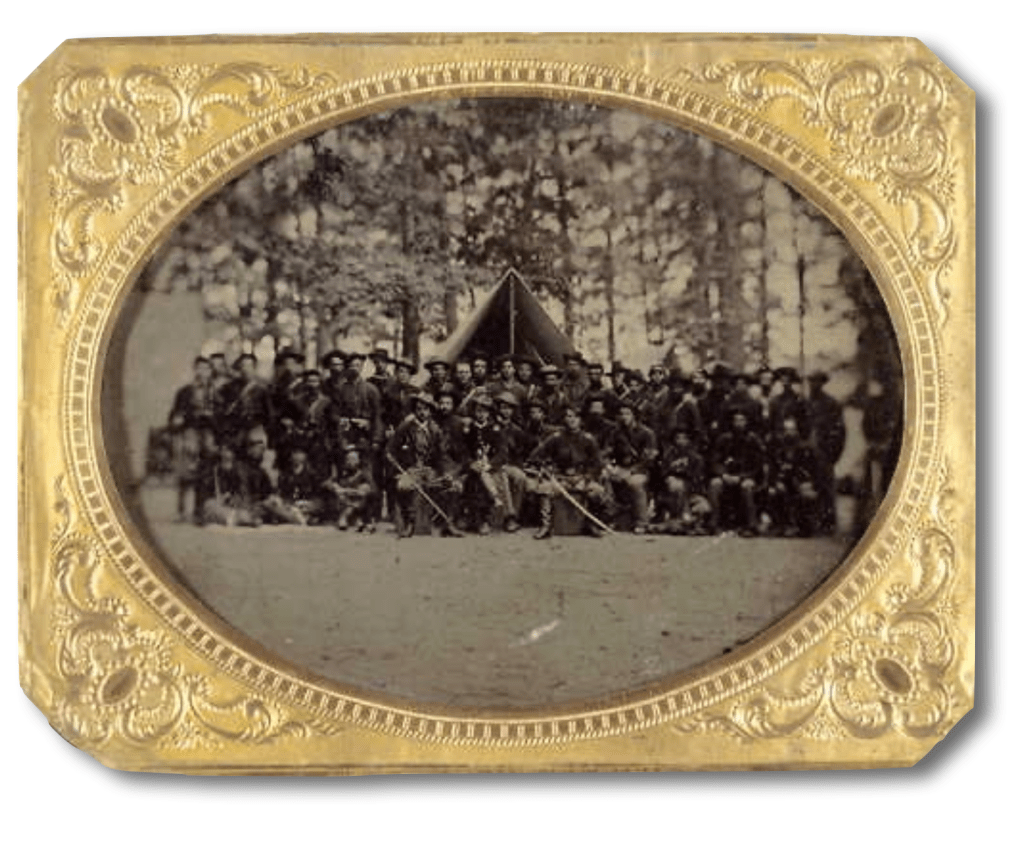
I could not find an image of Will but here is one of Stephen Burrows who also served in Co. H, 7th Ohio Volunteer Infantry (Ancestry.com)

Transcription

Camp Gauley, Virginia
August 2nd 1861

It was with much pleasure that I received your letter of the 27th. I had just come off picket guard. Six of us (Vienna boys) were stationed about three miles from camp up on the opposite side of the river (we are upon the Gauley River about forty miles from Charleston). We lay under the shade of an apple tree all day. In the evening it rained and we went to a barn which was nearby where we lodged till next morning. During the day we met with a man who had been in the Rebel army but who had gone home on furlough and never returned. He told us he had been forced into the service about three months since. He told us that there had been about two thousand five hundred men in Gen. Wise’s army of which two thousand were Union men and that just this side of Charleston six hundred had deserted the army at one time and that they were continually deserting. Where Gen. Wise is or what he is going to do, we know not, but we have possession of the Kanawha Valley.

We had expected to have had several skirmishes before we reached our present position. We had prepared for a hard battle at Charleston but to our surprise when we reached there, the enemy had gone a few miles down the river. We came across a boat loaded with wheat which was bearing the American flag. Col. [Frizzellof the 11th [Ohio] Regiment placed some of his men in the bushes and they placed a canon upon the bank. He then asked who they were. They answered they were Kanawha Rangers. He asked them what they meant. They said they were northern troops. He asked again if they were Union men and they, thinking that there were but few on shore to oppose them not seeing those in the bushes, answered that they belonged to the Southern Confederacy. The Colonel then ordered to fire. When the cannon opened upon them, striking the furnace and throwing the fire all over the boat, a volley then opened upon them from behind the bushes when they all took to flight, leaving everything—tents, provision, guns, and all to the flames which had already highly spread. They burned another boat themselves above Charleston and marched on. We have pursued them to Gauley Bridge which they burned, the cost of which was $18,000. 1

We have now settled down for how long, I do not know. We are in a most delightful place, surrounded on all sides by lofty hills which we might call mountains. Upon the top of one of these hills I am now sitting. At my feet is a cool stream of water. I look down upon the camp and them look like pygmies.

Dear mother, you have spoken of my not writing soon while some of the others have written. We marched almost all the way after leaving Ohio. Those who were unable to march went aboard the boat. Many of the boys were unwell. They rode while I kept my health and marched. Thus you see they had abundance of time while I had none. Indeed, I might have found some time to have written, but after marching all day with my knapsack upon my back under the burning sun (for the sun comes down very hot here), a letter of mine should not have been very interesting. Thus is the apparent neglect, and not from a want of feeling for home for never did home appear more dear than now.

As for my wants, I am in want of nothing. Money I have no need of. But I must close as it is past noon and dinner is waiting. I am perfectly well and have been ever since I left home. The boys are all well and we are all in high spirits.

N. B. [Nota bene]—I had commenced writing home about the battle when on the other side of Charleston but before I could finish it, we were ordered to march. I suppose you have heard all about it now. Tell sis I received her letter just before we marched out of Charleston and was very happy to hear from her but was surprised at the question contained in that note. My love to all. May this find you enjoying health and happiness. Yours in filial affection, — Will

N. B.—i have not yet received that paper which Pa and Ben Smith sent. Excuse this letter for the mosquitoes bother me so I can hardly write at all.


1 This incident is described in A History of the Eleventh Regiment by Horton & Teverbaugh (1866), pp. 30-31, but it varies somewhat in the details. It was Lt. Colonel Frizzell of the 11th OVI that commanded the regiment on 24 July 1861 when on the march to Gauley’s Bridge, they encountered a steamboat loaded with troops crossing the river. “Hailing the boat, the Colonel asked what troops they were, and being answered by the interrogatory if ‘you’uns’ were rebels the Colonel responded, ‘All right—run ‘er up!’ and had not hte hoisting of the Union flag been too hastily ordered by some officer on the hill adjoining, a valuable loss of ammunition, stores and prisoners would have been easily captured. The rebel commander saw the flag, and the boat was put across to the opposite shore with all possible speed. Capt. Cotter soon succeeded in getting his six pounders in position, and a shell sent through the steamer not only greatly hastened the disembarkation of the rebels but set fire to the boat and charred and blackened timbers of the hull of which probably may yet be seen at low water at the foot of the shoals.”

1863: Samuel Putnam to James L. Green

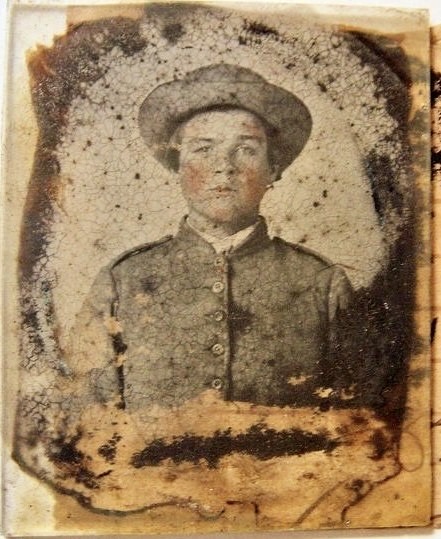
I could not find an image of Samuel but here is an Ambrotype of Samuel John Hoyle who served in Co. K, 49th North Carolina Infantry

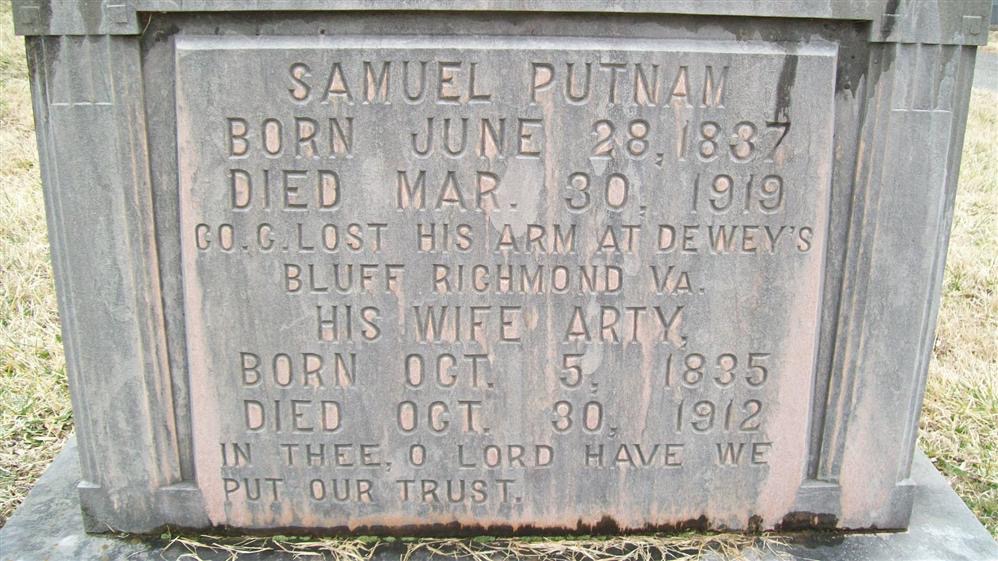
The following letter was written by Samuel Putnam (1837-1919) of Shelby, Cleveland county, North Carolina, who volunteered as a private in Co. D, 15th North Carolina Infantry in mid-May 1861. He was 24 years old at the time of his enlistment. The 15th North Carolina served in Lee’s Army of Northern Virginia throughout the Peninsula Campaign and on the Maryland Campaign in Longstreet’s Corps, McLaw’s Division, Cobb’s Brigade. During the Battle of Antietam, Samuel was wounded and taken prisoner but paroled and sent to a hospital until he could rejoin his regiment.

In mid-January 1863, Co. D of the 15th North Carolina was transferred to the 49th North Carolina, Ransom’s Brigade, in exchange for Co. B of that regiment. When Gen. Robert Ransom’s Brigade was recalled to eastern North Carolina, the 49th served in the New Bern area and near the Chowan River in North Carolina with the purpose of protecting the Petersburg/Weldon/Wilmington railroad. During this time they fought frequent skirmishes with Union cavalry forces attempting to raid the railroad. Samuel wrote this letter from their encampment near Petersburg in July 1863 where he expressed little hope for the Confederacy.

Ten months later, Samuel was still with his regiment when he was wounded in the arm at Drewry’s Bluff on 16 May 1864—a wound so severe it required amputation.

Samuel was the son of Elias Putnam (1807-1859) and Rachel Poston (1808-1841)—both deceased prior to the war.

Samuel’s Tombstone. Some errors in the details.

Transcription

Camp near Petersburg, Virginia
July 21, 1863

Dear Uncle,

Once more I am permitted to drop you a few lines to let you know that I am well, hoping when this comes to hand that they may find you & your family all well.

As for news, I hant got none that is good on our side. It looks like this war is going against us but it is just as it is & it can’t be helped though I may be mistaken. But them [that] lives 12 months from this time, they will see how it goes. They say that our men will have to give up Charleston to the Yankees. It looks like they are coming in on every side. General Lee made a bad trip going into Maryland and has got lots of his men killed and no good done on our side. They say the 34th & 38th & 55th [North Carolina] Regiments is cut up bad & I heard that Sam Telford was killed. I don’t know it to be so but expect that he was killed.

Jimmy, you need not tell this to everybody what I have wrote about the war. You may think I am out of heart, but you will see if you are permitted to live how it will go—that is, if we don’t get help from somewhere else. We have got as good fighting men as theirs, but we can’t whip a whole world out. They are going to overpower us for they can do it because they have so many more men than us. And Old Abe has ordered three hundred thousand more men & if they come out, I think we had as well quit. But our men won’t give up until they get all of their men killed.

Jimmy, I want you to write to me and let me know how you are getting along. I would like to see you the best in the world but it is so that I can’t have the opportunity. But I hope that I will be permitted to live to see you all gone. Goodbye. — Samuel Putnam

[to] J. L. Green

Direct your letter to Petersburg’, Co. B, 49th North Carolina troops in Care of Capt. N. B. Corbett, Ransom’s Brigade

1864: Albert Doty to Elizabeth Gardner Doty

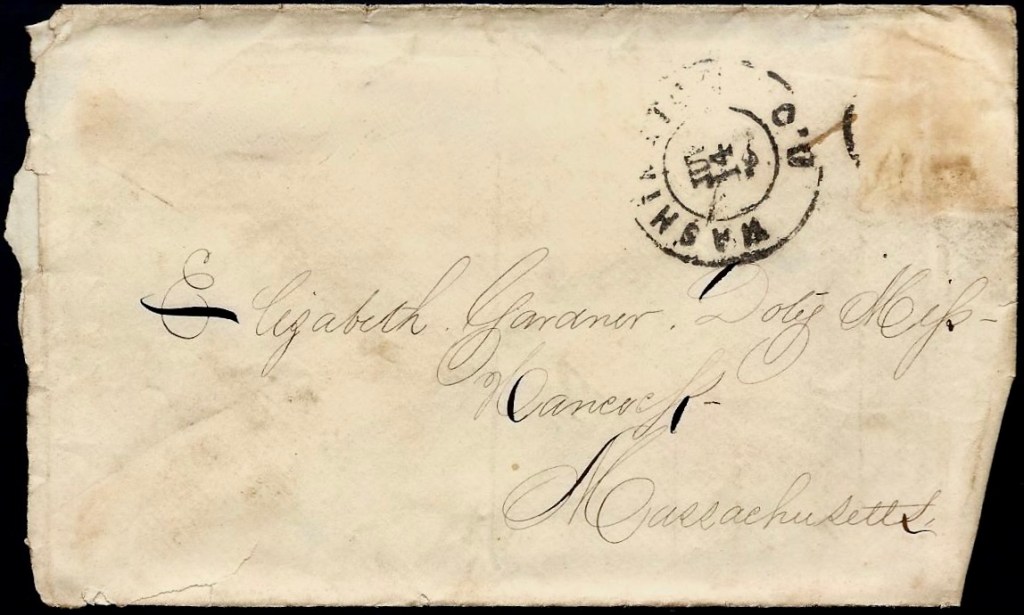
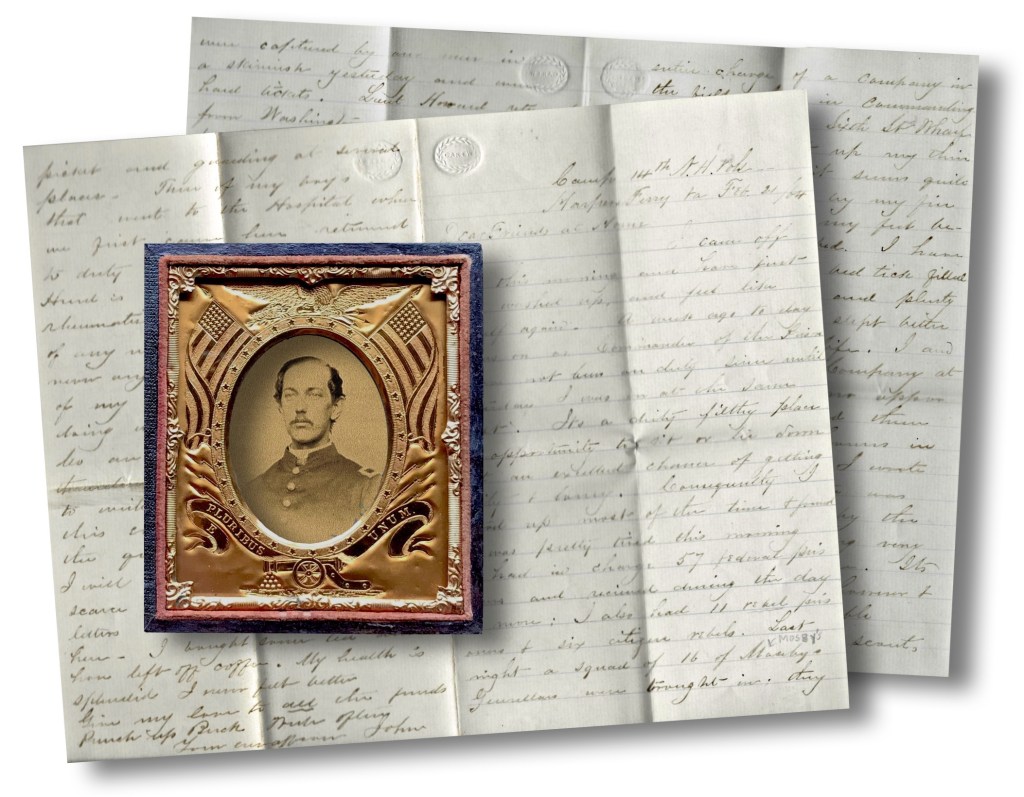
The following letter was written by Albert Doty (1841-1873), the son of Leonard Doty (1812-1882) and Lydia Louise Gardner (1810-1892) of Hancock, Berkshire county, Massachusetts. Albert first enlisted with the 34th New York Infantry in May 1861 to serve two years. He rose in rank from private to 1st Sergeant by December 1861 and then was commissioned a 1st Lieutenant in March 1862 and Adjutant in January 1863. He was discharged for disability from the regiment in May 1863. He returned to the service in March 1864, and was a Sergeant Major in Co. I, 57th Massachusetts Infantry when this letter was written. He was then promoted to a 1st Lieutenant of Co. K by late July, and brevetted a captain in August 1864 for gallant service in the engagements on the Weldon Railroad. He mustered out of the service in late July 1865.

Doty’s letter speaks of the mortar shelling their regiment endured in front of Petersburg that pre-dated the following incident:

On July 24, 1864, Doty and some of the men were at a Bomb-Proof just behind the trenches.  This bomb-proof was small about twelve feet square, and was hot inside so the men had built a arbor out side the bomb-proof. It was covered with branches and old canvas for protection from the sun.  Earlier they were shelling the enemy and now the Confederates were returning the favor.  The men paid no mind as they were use to it.  Some were laying on the ground and some were sitting on an old cracker box writing letters home, when without warning or sound the bomb-proof exploded. It was found that the enemy artillery gunners aim was off and a ten-inch mortar shell fell in the middle of the “Bomb-proof.”  Some of the men were either wounded or killed; some would die later from their wounds. Doty, who was a Sergeant Major at the time, came out of it only slightly bruised.[Source: Civil War Days and Those Surnames]

Doty does not explain his use of the pseudoname “Oliver Ditson” to sign his letter so he must have used it regularly or at least occasionally when corresponding with his younger sister Elizabeth Gardner Doty (1845-1917). The real Oliver Ditson (1811-1888) was “the pioneer of music publishing in American, having published a number of popular songs, including “Battle Hymn of the Republic” and “Tenting on the Old Camp Ground.” Ditson also marketed drums under his company name though they did not manufacture them.

Sadly, though Doty survived the war, he was counted among the large number of veterans who committed suicide in the post-war years. He was 32 years old at the time of his death.

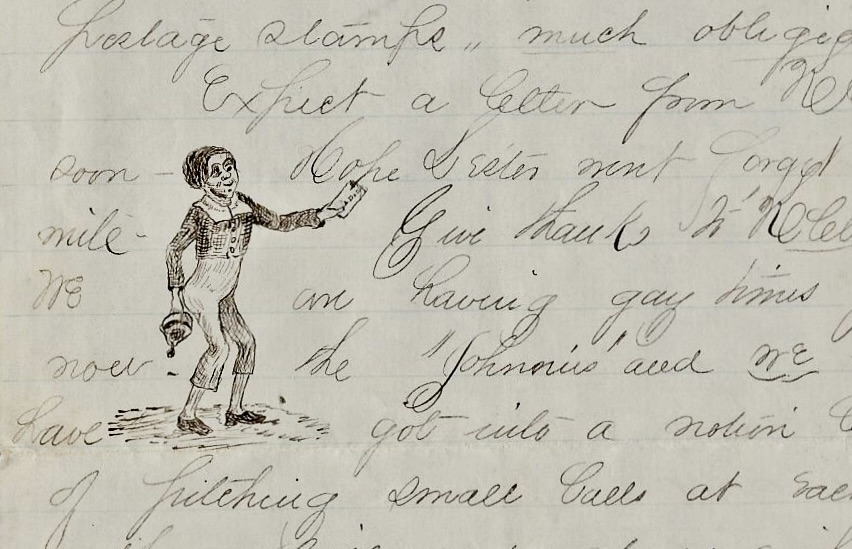
Doty’s letter incorporates a sketch of a boy delivering the mail. He was most likely a runaway Negro boy (“contraband”) who attached himself to the regiment, performing services in return for shelter, food and clothing. He holds his hat in hand while extending a letter in the other.

Transcription

Headquarters 57th Massachusetts Infantry
Near Petersburg, Virginia
July 12th 1864

Lib,

Received today a letter from your headquarters dated July 6th. Have now in my clutches 1 vignette of “Laura Clark” for the same. Am much obliged. Have heard of my death from two different (both reliable) sources—presume it must be so. Shows the advantages we have over the ancients now-a-days. You can read your own obituary and attend your own funeral. Nice, ain’t it? Please tell me the origin of the rumor. Charles Daniels received a letter yesterday in which his mother expressed fear that he might be “lonely, now Albert Doty was killed” and wished him to write the circumstances upon my departure. I ask forgiveness of the good people of the land of my nativity and wish to assure them that it’s none of my fault that they are this time disappointed. Will do better next time, &c. I didn’t mean to!

I received a lead pencil and some postage tamps. Much obliged. Expect a letter from N. E. G. soon. Hope Lester won’t forget to write. Give thanks to “Kleber.”

We are having gay times just now. The “Johnnies” and we have got into a notion lately of pitching small balls at each other—little mortar shells eight inches in diameter. Can’t tell when they are coming—they go so slow. They have a way of “dropping in” quietly now and then just for a short chat. They travel as unostentatiously as a Quaker deacon. Keep losing men. Have on this morning’s report 157 enlisted men present. Rather a mournful record. Don’t see how we can have many more “big funerals” in case is should be required of us. Will be obliged to send home for more stock.

Please to write to me about the Hancock boys in the 34th Massachusetts. 1 Any news in good condition will be gladly received. Please send me a box of Gillott’s Steel Pens. Have lately lost my pen holder pencil pen and the whole “consarn” gone to grass.

Very respectfully, your obedient servant, — Oliver Ditson

1 A number of men from Berkshire county served in Co. K of the 34th Massachusetts—particularly Hancock and Pittsfield.

1862: Gustavus Warren Knowlton to Friends

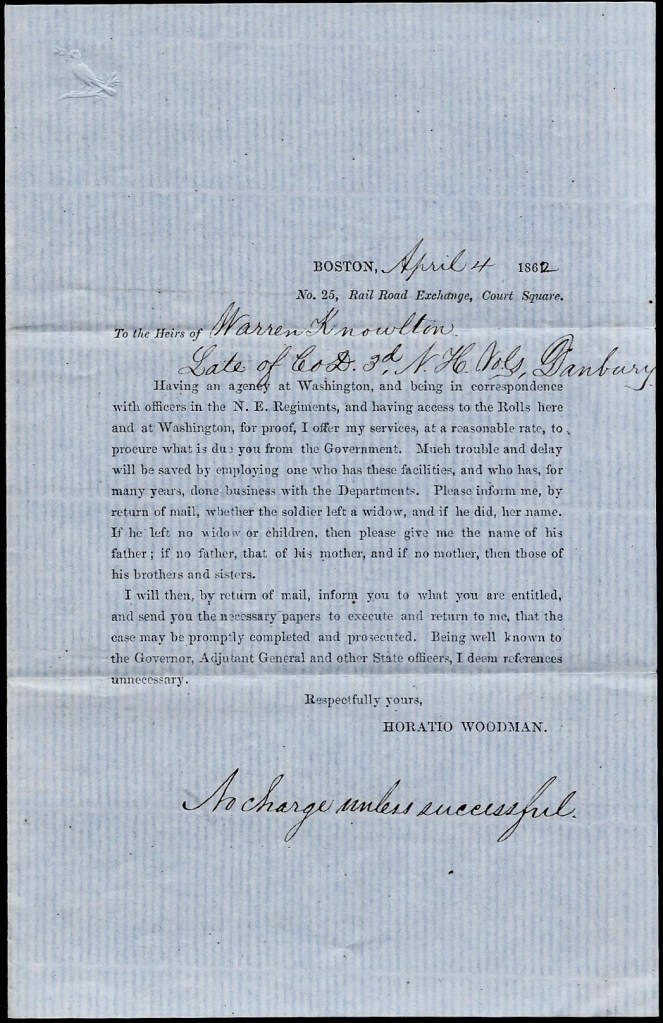
The following letter was written by Gustavus “Warren” Knowlton (1840-1862), the son of Stephen C. Knowlton (1782-1873) and Mary Green (1793-1882) of Danbury, Merrimack county, New Hampshire. Warren was a 22 year-old shoemaker when he enlisted on 15 May 1861 to serve in Co. D, 3rd New Hampshire Infantry. He did not survive the war; he died of disease on 26 March 1862 at Hilton Head—just three weeks after sending this letter to his “far distant friends.”
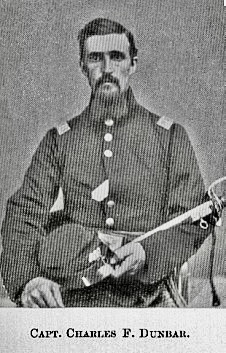
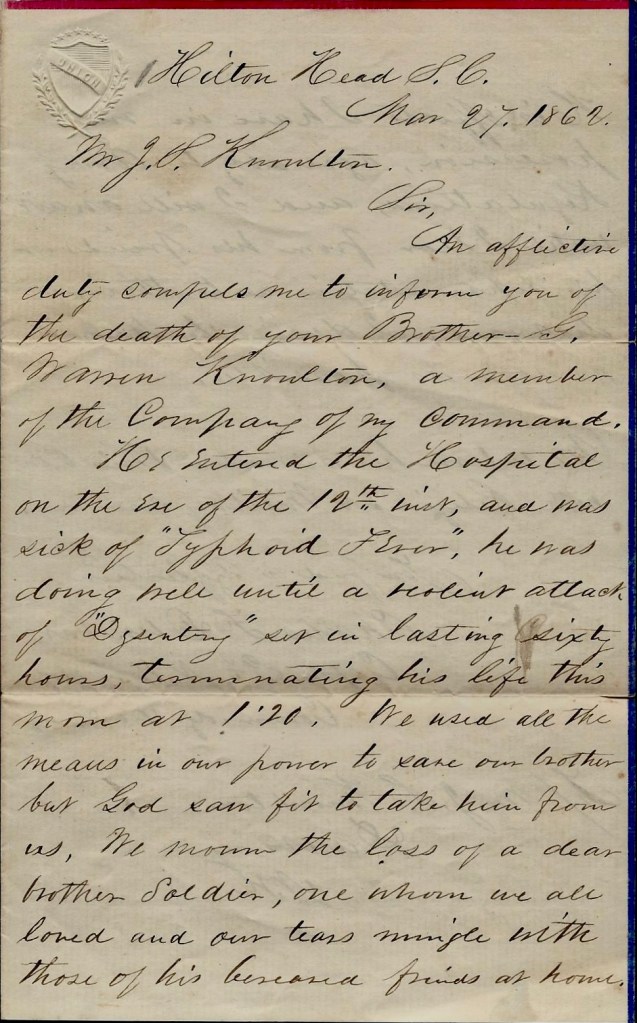
A second letter is also posted on this page which was penned by Capt. Charles F. Dunbar of Co. D, 3rd New Hampshire Infantry, informing Warren’s next of kin of his death on 27 March 1862 and of his planned interment later that same day.

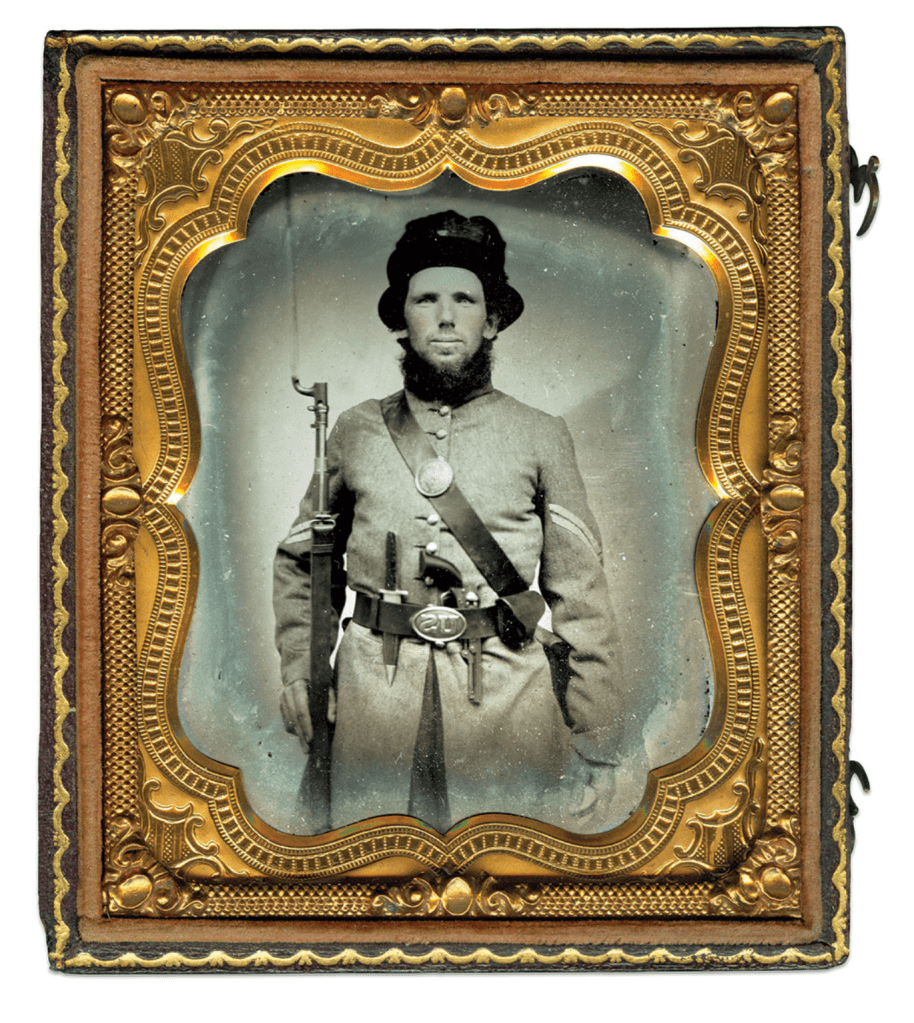
This unidentified soldier in the 3rd New Hampshire is wearing the first uniform issued to the regiment which was a gray frock coat with 9-button front, 2-button cuff, and rear skirts with two buttons at the waist level. Pants were also plain for all enlisted ranks. Havelock caps were issued to this regiment. (Ron Field Collection)

Letter 1

Hilton Head, South Carolina
March 3rd 1862

Far Distant Friends,

I received a letter from you this morning. Was very glad to hear from you and more. I am in good health and spirits and hope this will find you the same. If my memory serves me, I wrote you nearly one year ago soon after I joined the army & have heard nothing from you until I received your letter of February 10th. Your Mother also.

Article First

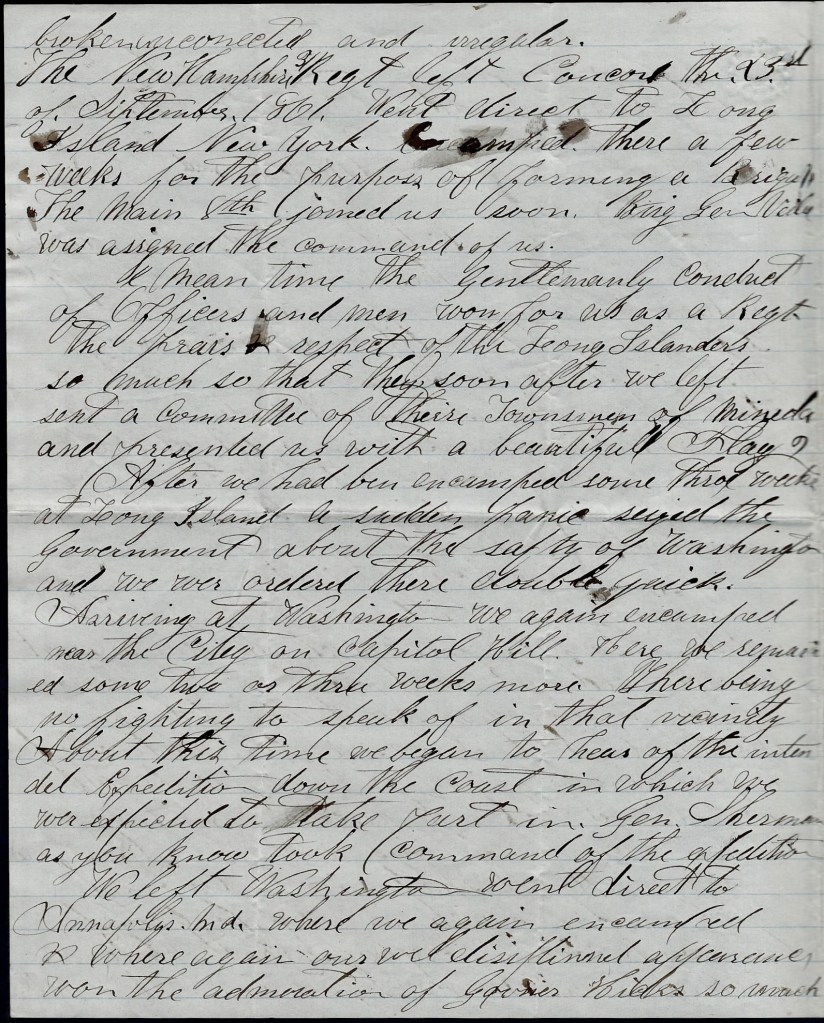
Probably you will get very much disappointed—that is, if you expect to hear a great deal of adventure from me. I must make some excuse so I will tell you on the start that I was unfortunate enough to lose my diary at the disembarkation here. Since that, I have not kept any written account of things which have transpired. Consequently I shall have to draw from my memory which is very forgetful as you know. So you see that whatever history of our moves I give you will be rather broken, unconnected, and irregular.

The New Hampshire 3rd Regiment left Concord the 23rd of September 1861. Went direct to [Camp Scott on] Long Island, New York. Encamped there a few weeks for the purpose of forming a Brigade. The Maine 8th joined us soon. Brig. Gen. [ ] was assigned to the command of us.

Meantime, the gentlemanly conduct of officers and men won for us as a regiment the praise and respect of the Long Islanders, so much so that they soon after we left sent a committee of their townsmen of Mineola and presented us with a beautiful flag.

After we had encamped some three weeks at Long Island, a sudden panic seized the government about the safety of Washington and we was ordered there double quick. Arriving at Washington we again encamped near the city on Capitol Hill. Here we remained some two or three weeks more, there being no fighting to speak of in that vicinity. About this time we began to hear of the intended Expedition down the coast in which we were expected to take part in. Gen. [Thomas W.] Sherman, as you know, took command of the Expedition.

We left Washington & went direct to Annapolis, Maryland, where we again encamped & where again our well disciplined appearance won the admiration of Governor Hicks so much so that he wanted us to stay and garrison the fortifications there. But Gen. Sherman would not give us up on no account. So we embarked some time about the middle of October on board the steamship Atlantic for an unknown destination. But it seems that we fetched up at Port Royal, South Carolina, where we now are. I had the pleasure of viewing the bombardment of Port Royal which you probably have heard about ere this. Since we landed here, I have been engaged in various duties of soldiering. I have acted as scout with some success & picket duty is familiar to me.

Article Second—On the War

My opinion in regard to this war is soon told. In the first place, the Southern people alone are responsible for it (if we except a few hot headed Abolitionists which are of no account). In the next place I think this war is rather a necessity and will do the country as a Nation more good than hurt. There is one thing sure and that is this—the southern power is broken and will never assume the importance which it has heretofore. And when this rebellion is subdued—which it will be, and that soon—I believe the country will assume a more prosperous & flourishing condition than it ever has yet. It will be better prepared to resist foreign invasions than ever it was yet.

And as for Southern gentlemen or rather scoundrels trampling under foot Northern principles and rights again, is out of the question.

As for grub, we get a plenty to eat and that what is good enough for anybody. As for treatment, I should like to see the man or men that would mistreat or ill treat New Hampshire volunteers. I guess he would vamoose quicker. But I have taxed your patience long enough already. So adieu. Yours, &c. — Warren Knowlton

It has been cold, wet and backward this spring. Love to Father & Mother and want very much to see them and all.


Letter 2

Hilton Head, South Carolina
March 27, 1862

Mr. J. S. Knowlton

Sir, an afflictive duty compels me to inform you of the death of your brother, G. Warren Knowlton, a member of the company of my command. He entered the hospital on the eve of the 12th instant, and was sick of “Typhoid Fever.” He was doing well until a violent attack of “Dysentery” set in lasting sixty hours, terminating his life this morn at 1:20. We used all the means in our power to save your brother but God saw fit to take him from us. We mourn the loss of a dear brother soldier—one whom we all loved and our tears mingle with those of his bereaved friends at home.
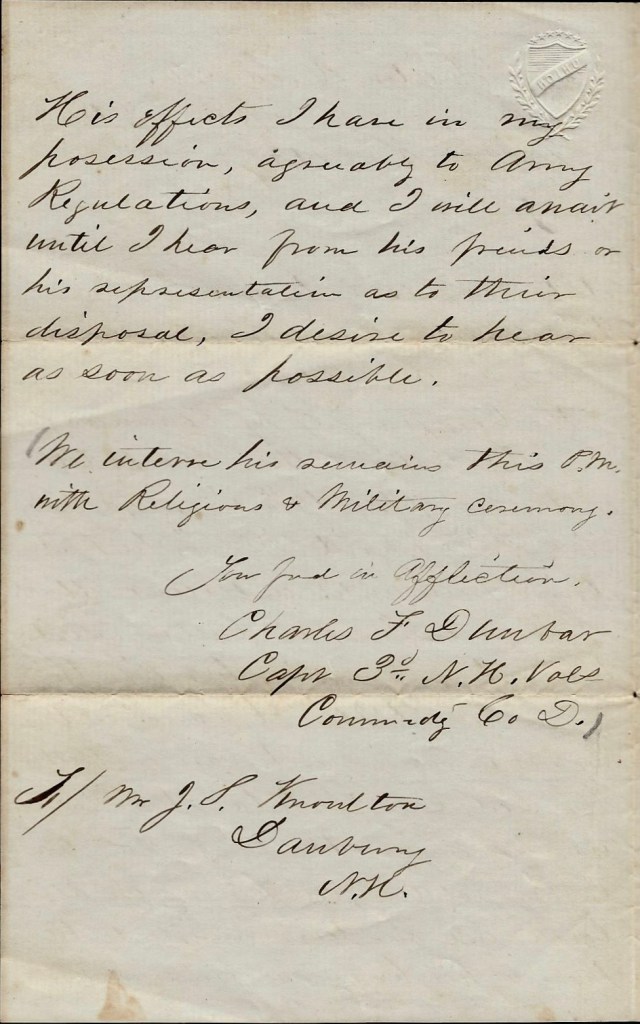
His effects I have in my possession, agreeably to Army Regulations, and I will await until I hear from his friends or his representation as to their disposal. I desire to hear as soon as possible.

We inter his remains this remains this p.m. with religious and military ceremony. Your friend in affliction, — Charles F. Dunbar, Capt. 3rd New Hampshire Vols., Commanding Co. D

To Mr. J. S. Knowlton, Danbury, New Hampshire

1862-4: Eli Bogue to Josephine Cook

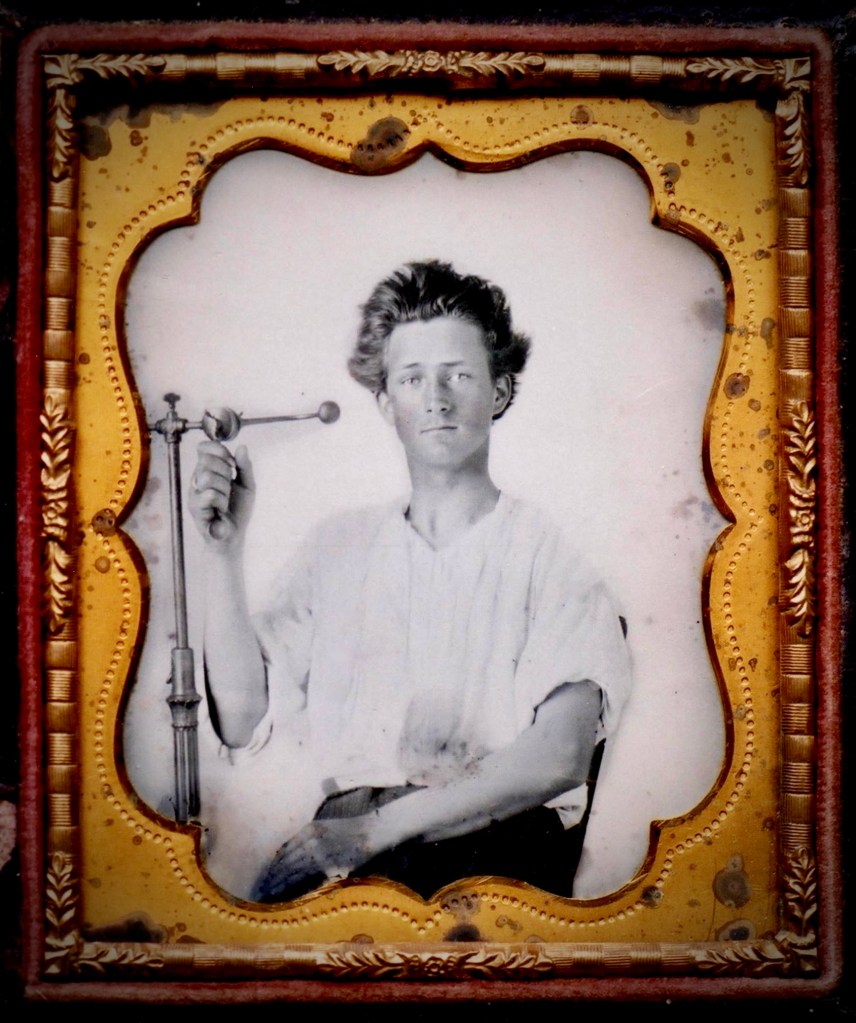
I could not find an image of Eli but here is one of Orville Powers who served in the 37th Illinois and was killed in the Battle of Pea Ridge in March 1862 (Steven Altic Collection)

The following letters were written by Eli Bogue (1840-1921), the son of William Bogue (1816-1846) and Rebecca Cook (1808-1900) of Ridge Farm, Vermilion county, Illinois. Eli enlisted as a private on 7 September 1861 in Co. K, 37th Illinois Infantry and remained with the regiment 3 years, mustering out on 17 October 1864. At the time of his enlistment he was described as a 5′ 10″ farmer with dark hair and dark eyes. From Eli’s letters it appears he was detached from the regiment from time to time working as a teamster.

Eli wrote all of the letters to his cousin, Josephine Cook (1847-1924), the daughter of Henderson and Lucinda (Trout) Cook of Georgetown, Vermilion county, Illinois.

[Note : These letters are from the Sic Parvis Magna, Gratias Jesu Collection and remain in private hands. They were made available expressly for transcription and publication on Spared & Shared.]

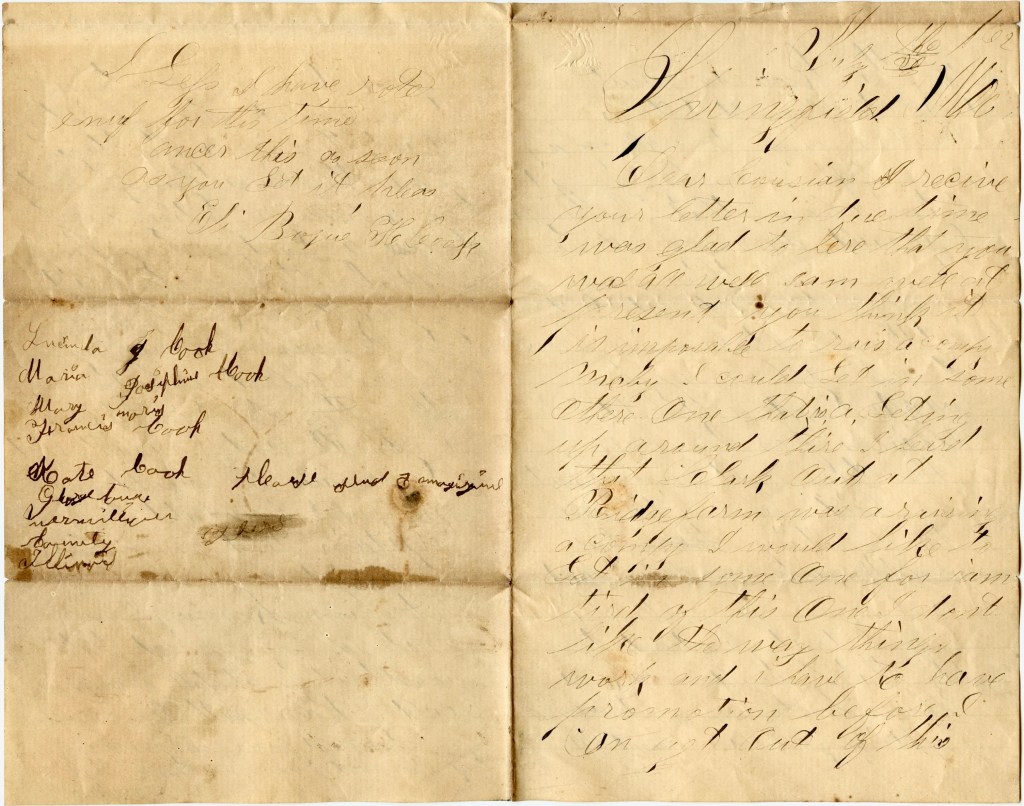
Letter 1

Springfield, Missouri
July [ ], 1862

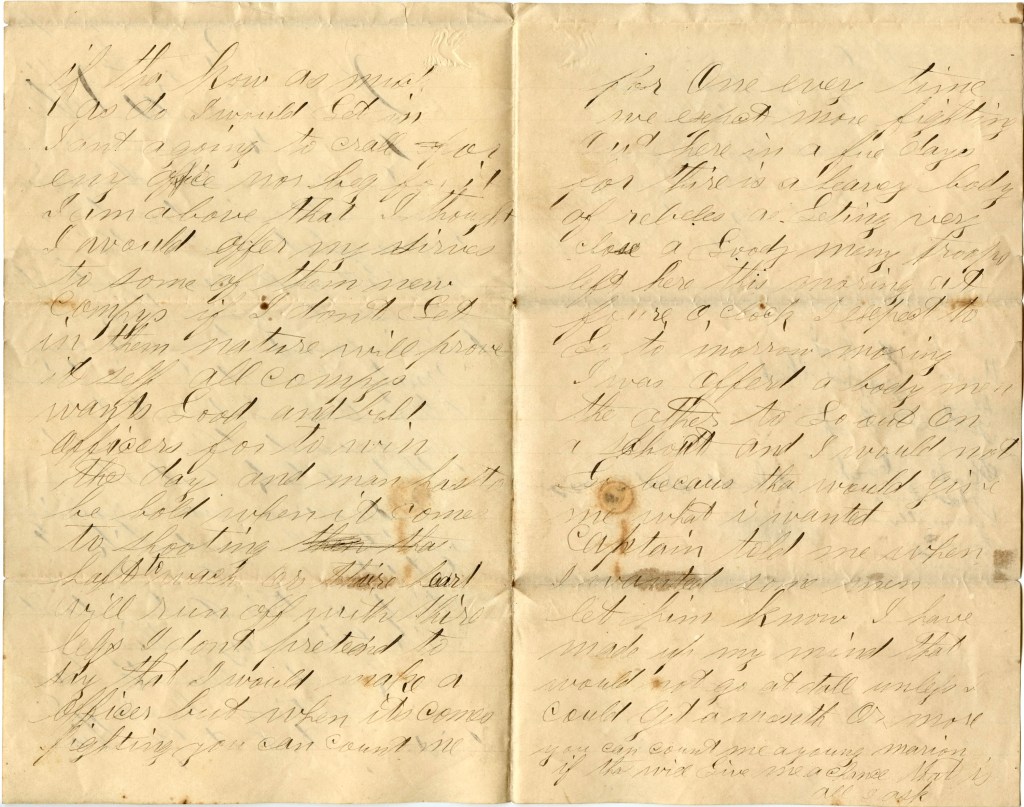
Dear Cousin, I received your letter in due time. I was glad to hear that you was all well. I am well at present. You [say you] think it is impossible to raise a company [and that] maybe I should get in some other one that is a getting up around there. I heard that Clark out at Ridge Farm was a raising a company. I would like to get in some one for I am tired of this one. I don’t like the way things work and I have to have a promotion before I can get out of this. If they know as much as I do, I would get in. I ain’t a going to crawl for any office nor beg for it. I am above that. I thought I would offer my services to some of the new companies. If I don’t get in them, nature will prove itself. All companies want good and bold officers for to win the day and man has to be bold. When it comes to shooting, they have to watch or their heart will run off with their legs. I don’t pretend to say that I would make a officer, but when it comes to fighting, you can count me for one every time.

We expect more fighting out here in a few days for there is a heavy body of rebels a getting very close. A good many troops left here this morning at four o’clock. I expect to go tomorrow morning.

I was offered a body of men the other day to go out on a scout and I would not go because they wouldn’t give me what I wanted. Captain told me when I wanted some men, let him know. I have made up my mind that I would not go unless I could get a month or more. You can count me a young marrying [man], if they will give me a chance, that is. [That’s] all I ask.

I guess I have wrote enough for this time. Answer this as soon as you get it please. — Eli Bogue


Letter 2

Camp on Illinois Creek, Arkansas
December 19 [?], 1862

Dear Cousin,

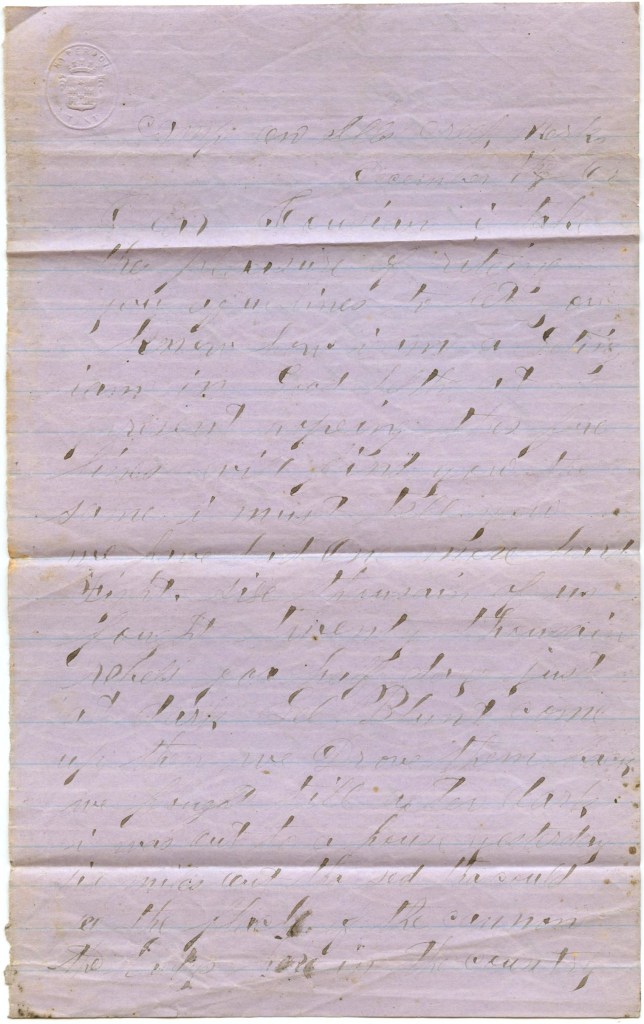
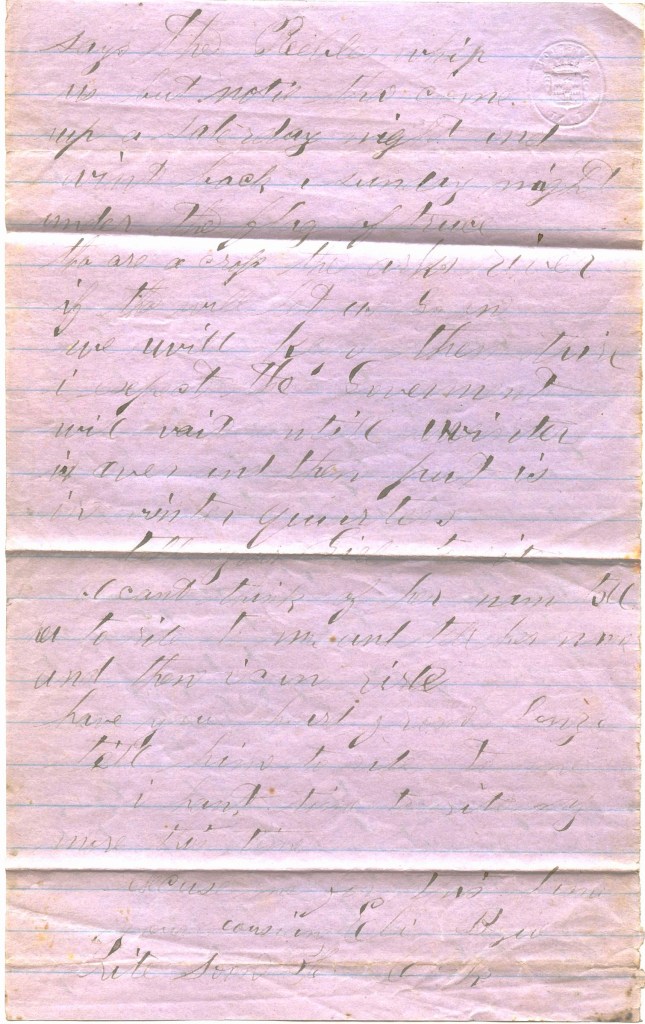
I take the pleasure of writing you a few lines to let you know how I am getting along. I m in good health at the present, hoping these lines will find you the same. I must tell you we have had one more hard fight. Six thousand of us fought twenty thousand rebels for half a day. Just at dark, General Blunt came up, then we drove them back. We fought till after dark. I was out to a house yesterday six miles out. They said they could see the flash of the cannon. The folks here in the country says the Rebels whip us but noticed they come up a Saturday night and went back Sunday night under the flag of truce. They are across the Arkansas River. If they will let us go in, we will kill them twice. I expect the Government will wait till winter is over and then put us in winter quarters.

Tell your girl to write. I can’t think of her name. Tell her to write to me and tell her name and then I can write…. Your cousin, — Eli Bogue


Letter 3

In Camp at Pilot Knob, Mo.
Headquarters, Army of the Frontier
April 3rd 1863

Dear Cousin.

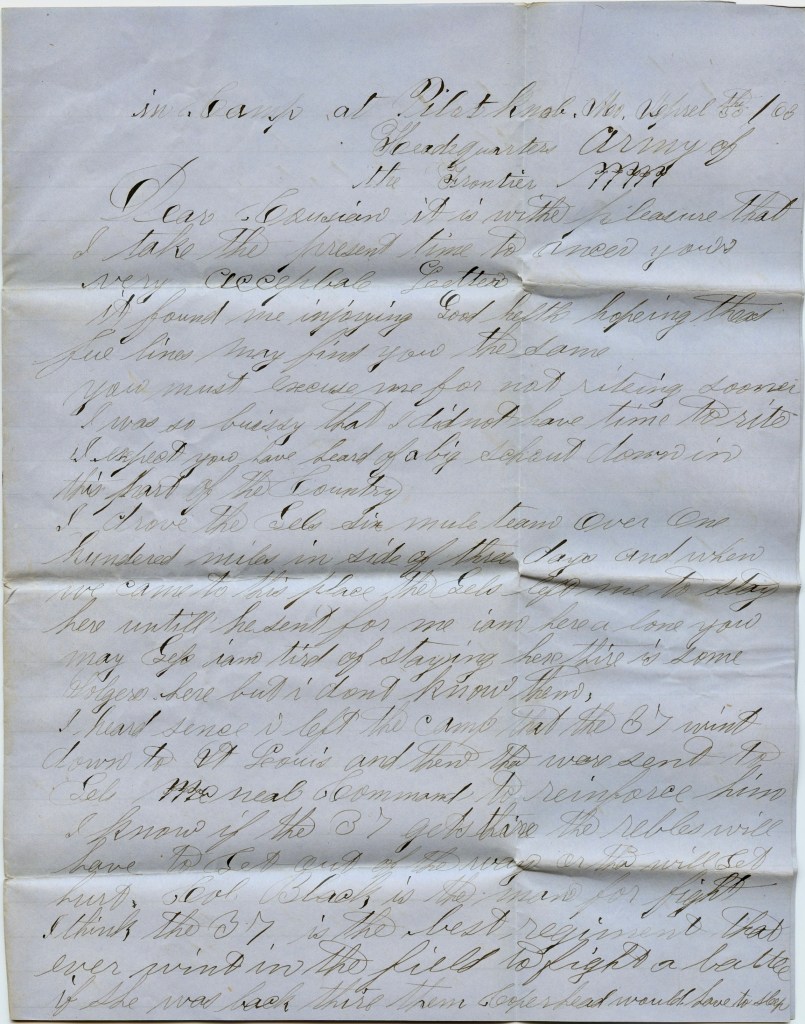
It is with pleasure that I take the present time to answer your very acceptable letter. It found me enjoying good health [and] hoping that these few lines may find you the same. You must excuse me for not writing sooner. I was so busy that I did not have time to write. I expect you have heard of a big shout down in this part of the country.

I drove the General’s six-mule team over one hundred miles inside of three days and when we came to this place, the General left me to stay here until he sent for me. I am here alone. You may guess I am tired of staying here. There is some soldiers here but I don’t know them.

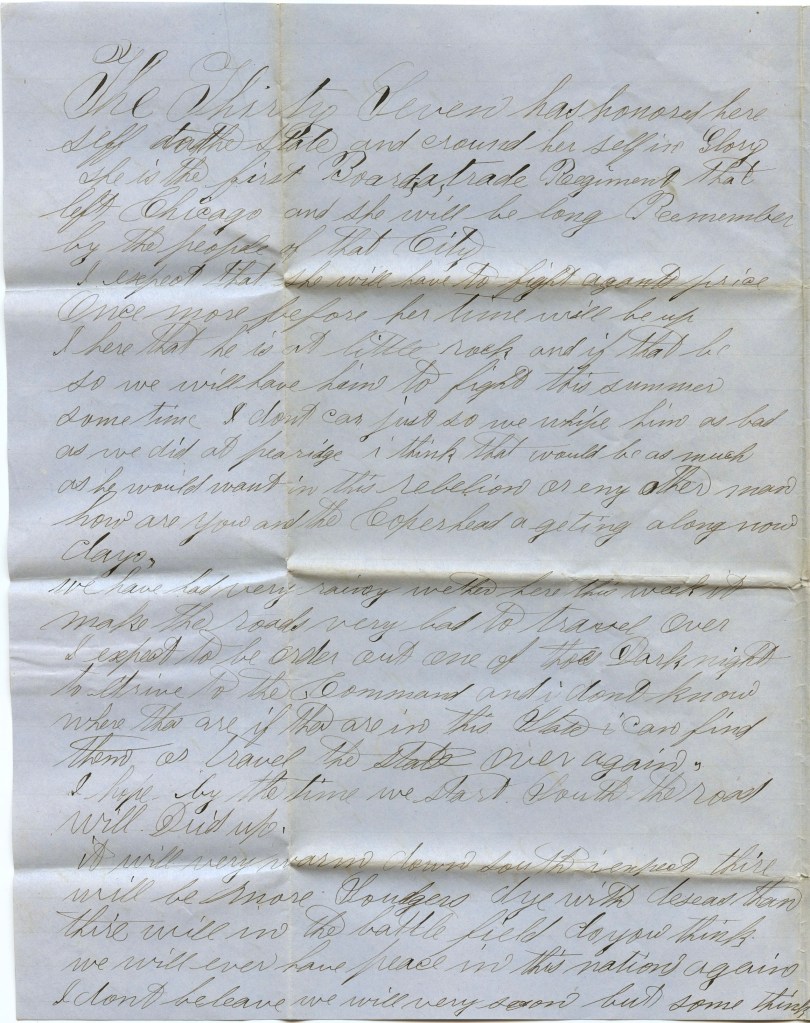
I heard since I left the camp that the 37th [Illinois Regt.] went down to St. Louis and then they were sent to General McNeil’s command to reinforce him. I know if the 37th gets there, the rebels will get hurt. Col. [John Charles] Black is the man for fight. I think the 37th is the best regiment that ever went into the field to fight a battle. If she was back there [in Illinois], them Copperheads would have to sleep. The 37th has honored herself to the state and crowned herself in glory. She is the first Board of Trade Regiment that left Chicago and she will be long remembered by the people of that city. I expect that she will have to fight against Price once more before her time will be up. I hear that he is at Little Rock and if that be so, we will have him to fight this summer sometime. I don’t care, just so we whip him as bas as we did at Pea Ridge. I think that would be as much as he would want in this rebellion or any other man. 

How are you and the Copperheads a getting along now-a-days?

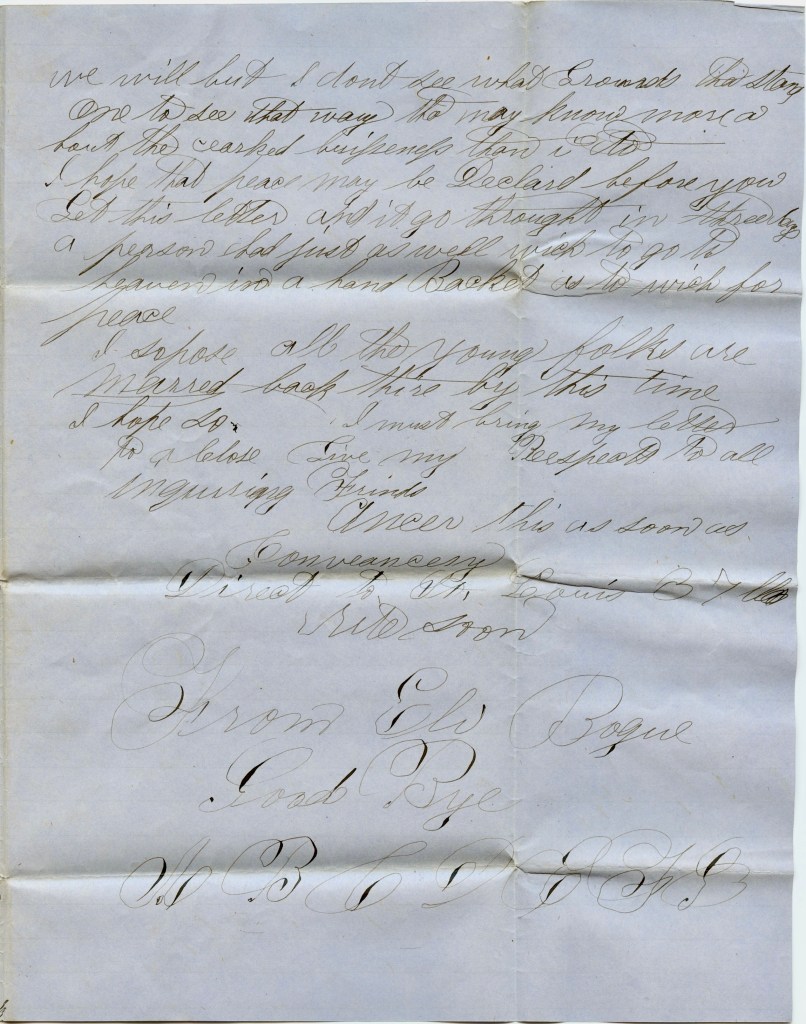
We have had very rainy weather here this week. It makes the roads very bad to travel over. I expect to be ordered out one of these dark nights to drive to the command and I don’t know where they are. If they are in this state, I can find them or travel the state over again. I hope by the time we start South, the road will dry up. It will be very warm down South, I expect. There will be more soldiers die with disease than there will in the battlefield. Do you think we will ever have peace in the Nation again? I don’t believe we will very soon but some think we will. But I don’t see what grounds they stand on to see that way. They may know more about the cursed business than I do.

I hope that peace may be declared before you get this letter and it go through in three days. A person had just as well wish to go to heaven in a hand basket as to wish for peace. I suppose all the young folks are married back there by this time. I hope so. I must bring my letter to a close. Give my respects to all enquiring friends. Answer this as soon as convenient. Direct to St. Louis, 37th Illinois. Write soon. From Eli Bogue

Goodbye.


Letter 4

Early in the Civil War, Clarksville, Texas, prospered because of the cotton trade and presence of Confederate blockade-runners. In 1863, however, the area was captured and occupied by Union forces, which seized private homes and warehouses and caused most residents to flee. As part of emperor Maximilian’s efforts to suppress Mexican resistance, French gunboats occasionally shelled Clarksville. Theresa Clark Clearwater, daughter of the town’s founder, recalled that “often the families were forced to take refuge behind some big sand hill during these bombardments.” Troops of the Texas Confederate Calvary, as well as French and Austrian soldiers from Maximilian’s forces also frequented Clarksville.

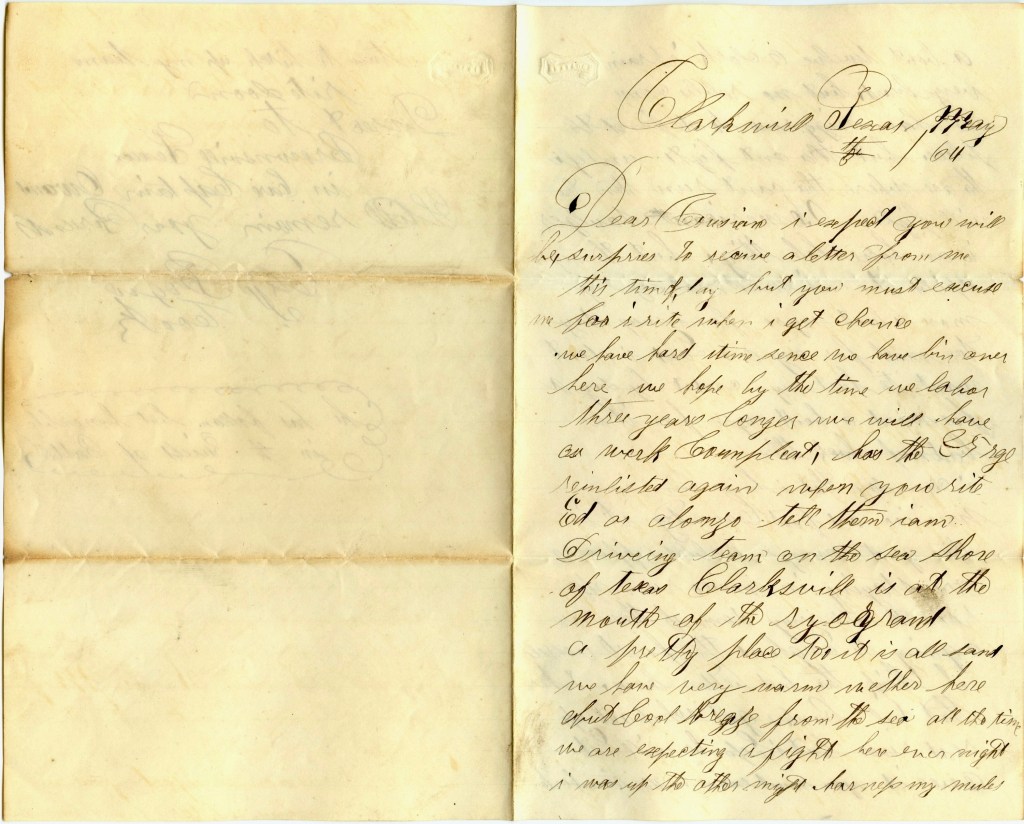
Clarksville, Texas
May 3rd 1864

Dear Cousin,

I expect you will be surprised to receive a letter from me this time of day but you must excuse me for I write when I get chance. We have hard times since we have been over here. We hope by the time we labor three years longer we will have our work complete. Has the 25th [Illinois] Regiment reenlisted again? When you write Ed[gar] or Alonzo, tell them I am driving team on the sea shore of Texas. Clarksville is at the mouth of the Rio Grande—a pretty place too. It is all sand. We have very warm weather here but cool breezes from the sea all the time.

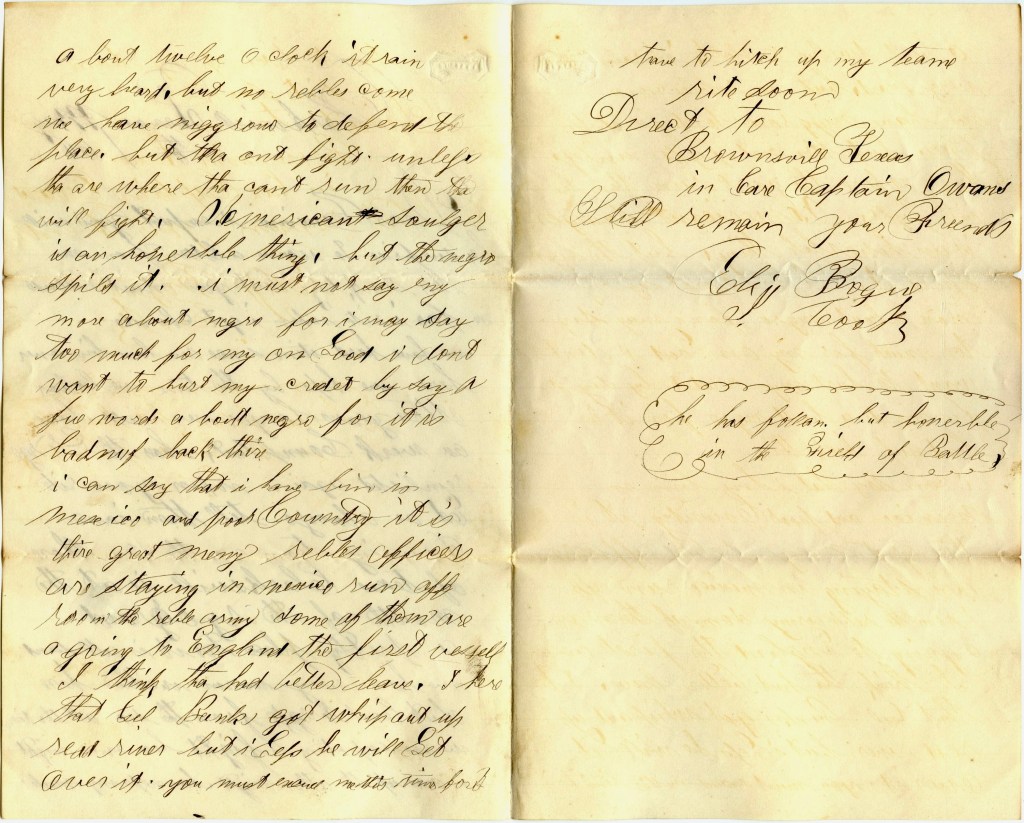
We are expecting a fight here every night. I was up the other night [to] harness my mules about 12 o’clock. It rained very hard but no rebels came. We have niggrons to defend the place but they won’t fight unless they are where they can’t run—then they will fight. [An] American soldier is an honorable thing but the negro spils it. I must not say any more about negro for I may say too much for my own good. I don’t want to hurt my credit by saying a few words about negro for it is bad news back there.

I can say that I have been in Mexico and [a] poor country it is there. A great many rebel officers are staying in Mexico—run off from the rebel army. Some of them are a going to England the first vellel. I think they had better leave.

I hear that Gen. Banks got whip[ped] out up Red River but I guess he will get over it. You must excuse me this time for I have to hitch up my team. Direct to Brownsville, Texas in care of Captain Owens. Still remain your friend, — Eli Bogue

He has fallen but honorable in the field of battle.

1864: John Warner Sturtevant to Isabelle (Litchfield) Sturtevant

The following letter was written by John Warner Sturtevant (1840-1892) the son of Luther Sturtevant, Jr. (1803-1872) and Isabelle Litchfield (1810-1905) of Keene, Cheshire county, New Hampshire. At the outbreak of the Civil War, John was working as a clerk in Tilden’s bookstore in Keene.

In August 1862, he enlisted in the 14th New Hampshire Regiment and went to the front as a sergeant in Co. G. He performed gallant service, was badly wounded at the Battle of Opequan (gunshot wound left leg, right arm hurt by shell), and was mustered out in 1865 with the rank of captain. For two years after the war he was in business in Beaufort, South Carolina, but returned to Keene in the spring of 1867 and purchased an interest in the bookstore where he was formerly engaged as clerk. He served as the town clerk of Keene in 1869 until its incorporation as a city in 1874. He was a member of the State Legislature in 1876, 1877, and 1885.

John W. Sturtevant  married Clara, daughter of Charles Chase of Keene in January 1871.

See also—1864: John Warner Sturtevant to Family on S&S 17.

Transcription

Addressed to Mrs. I. L. Sturtevant, Keene, New Hampshire

Camp 14th New Hampshire Volunteers
1st Brigade, 2nd Division, 19th Army Corps
Berryville, Virginia
September 18th 1864

Dear Friends at Home,

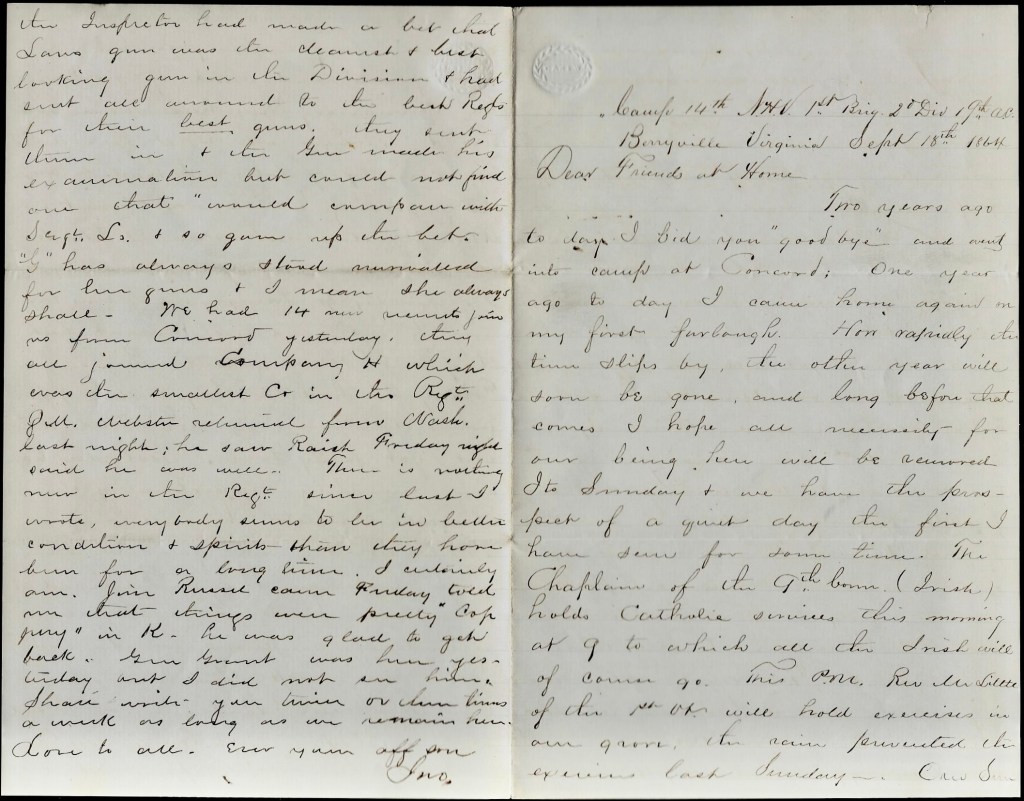
Two years ago today I bid you “goodbye” and went into camp at Concord. One year ago today I came home again on my first furlough. How rapidly time slips by. The other year will soon be gone and long before that comes I hope all necessity for our being here will be removed. It’s Sunday & we have the prospect of a quiet day—the first I have seen for some time. The chaplain of the 9th Connecticut (Irish) holds Catholic services this morning at 9 to which all the Irish will of course go this p.m. Rev. Mr. Little of the 1st Vermont will hold exercises in our grove. The rain prevented the exercises last Sunday.

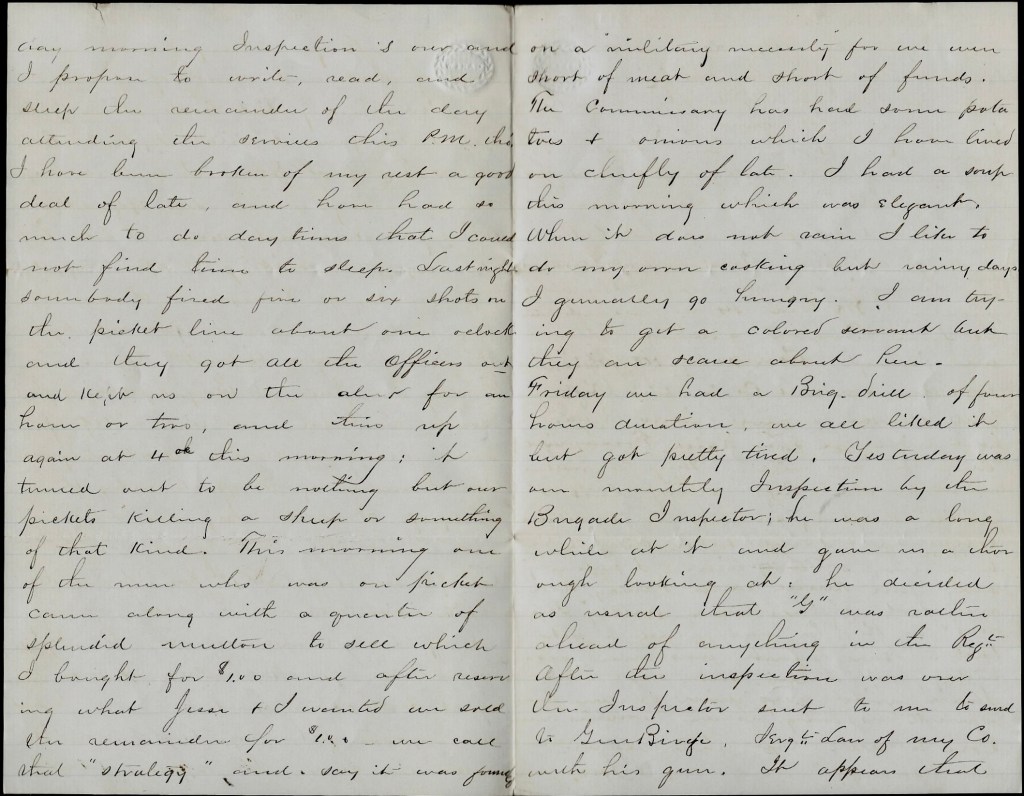
Our Sunday morning inspection’s over and I propose to write, read and sleep the remainder of the day, attending the services this p.m., though I have broken off my rest a good deal of late, and have had so much tto do daytimes that I could not find time to sleep.

Last night somebody fired five or six shots on the picket line about one o’clock and they got all the officers out and kept us on the alert for an hour or two, and then up again at 4 o’clock this morning. It turned out to be nothing but our pickets killing a sheep or something of that kind. This morning one of the men who was on picket came along with a quarter of splendid mutton to see which I bought for $1 and after reserving what Jesse and I wanted, we sold the remainder for $1. We call that “strategy” and say it was formed on a military necessity for we were short of meat and short of funds. The commissary has had some potatoes & onions which I have lived on chiefly of late. I had a soup this morning which was elegant. When it does not rain, I like to do my own cooking but rainy days I generally go hungry. I am trying to get a colored servant but they are scarce about here.

Friday we had a Brigade Drill of four hours duration. We all liked it but got pretty tired. Yesterday was our Monthly Inspection by the Brigade Inspector. He was a long while at it and gave us a thorough looking at. He decided as usual that “G” was rather ahead of anything in the regiment. After the inspection was over the Inspector sent to me to send to Gen. [ ] Sergt. Law of my company with his gun. It appears that the Inspector had made a bet that Law’s gun was the cleanest and best looking gun in the Division & had sent all around to the best regiments for their best guns. They sent them in & the General made his examination but could not find one that would compare with Sergt. L’s and so gave up the bet.

[Co.] G has always stood unrivaled for her guns & I mean she always shall. We had 14 new recruits join us from Concord yesterday. They all joined Company H which was the smallest company in the regiment.

Quartermaster Webster returned from Nash. last night. He saw Raish Friday night. Said he was well. There is nothing new in the regiment since last I wrote. Everybody seems to be in better condition & spirits than they have been for a long time. I certainly am. Jim Russell came Friday. Told me that things were pretty “Coppery” in K. He was glad to get back. Gen. Grant was here yesterday and I did not see him. Shall write you twice or three times a week as long as we remain here. Love to all. Ever your affectionate son, — Jno.

1863: Richard Shelton Ellis to Fannie A. Cocke

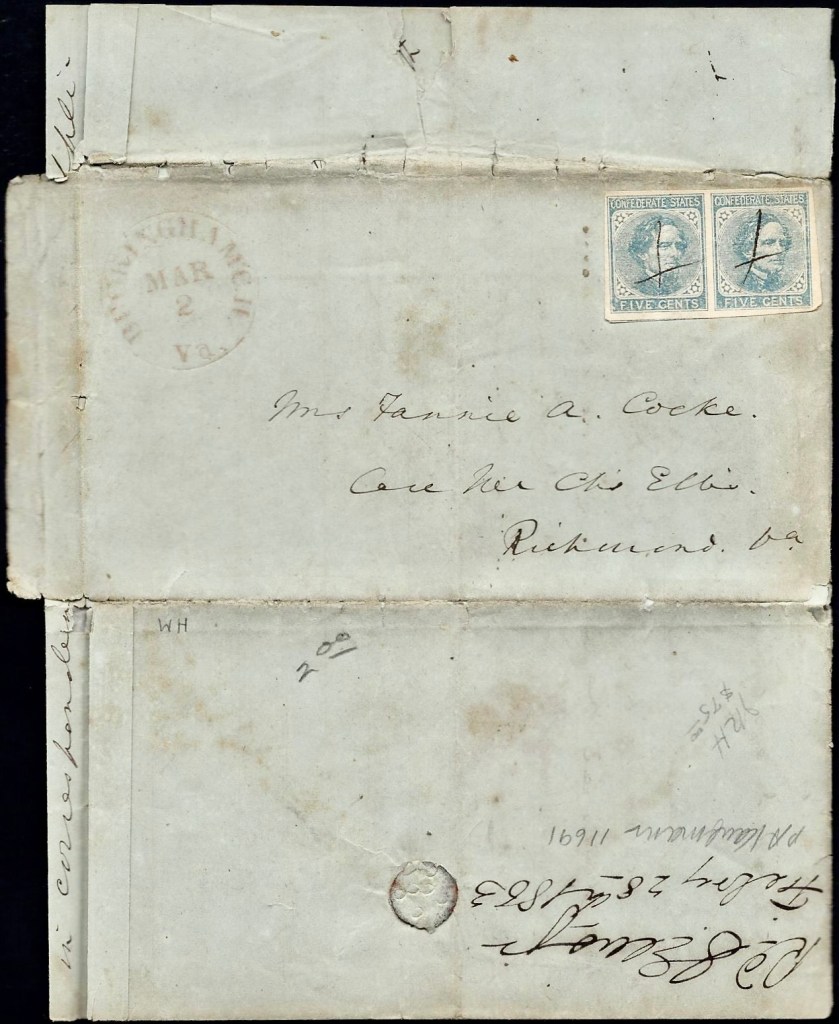
This letter was written by Richard Shelton Ellis (1823-1867) who was married to Anne (“Nannie”) Frances Perkins (1827-1907) and resided in Buckingham county, Virginia, on a plantation they called “Afton.” Richard was born in Richmond, Virginia.

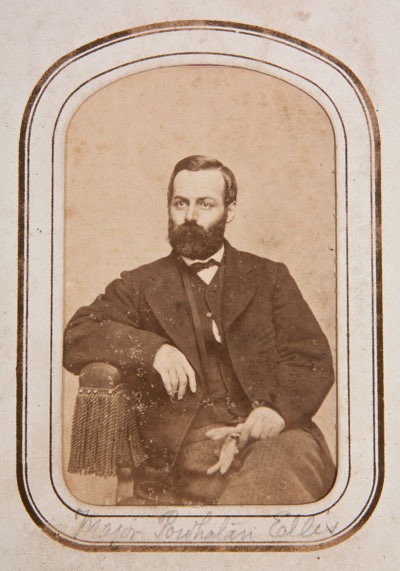
Richard’s younger brother, Powhatan Ellis

Richard was the son of Charles Ellis (1772-1840) and Margaret Keeling Nimmo (1790-1877) of Richmond, Virginia. Richard learned the merchant’s trade from his father. The letter was sent to Richard’s sister, Frances (“Fannie”) Allan (Ellis) Cocke (1827-1886), the wife of Richard Ivanhoe Cocke (1820-1873) of Richmond. Richard had a younger brother, Powhatan Ellis (1829-1906), named after an uncle, who served in the 3rd Kentucky Mounted Infantry during the Civil War. He was an Assistant Adjutant General (AAG) to a series of Confederate generals: Lloyd Tilghman, Patrick R. Cleburn, Leonidas Polk, Richard Taylor, Stephen D. Lee, and Nathan B. Forrest. He fought at the Battles of Corinth and Fort Donelson, and other battles in the army of the Southwest. By the end of the war, he had reached the rank of major.

Richard’s letter speaks of the Exemption Bill being debated in the Confederate Congress. At the time, one exclusion under consideration was to exempt an otherwise age-eligible male if there were ten of more white people living in the household.

Transcription

Afton [Plantation]
February 28th 1863

My dear Fannie,

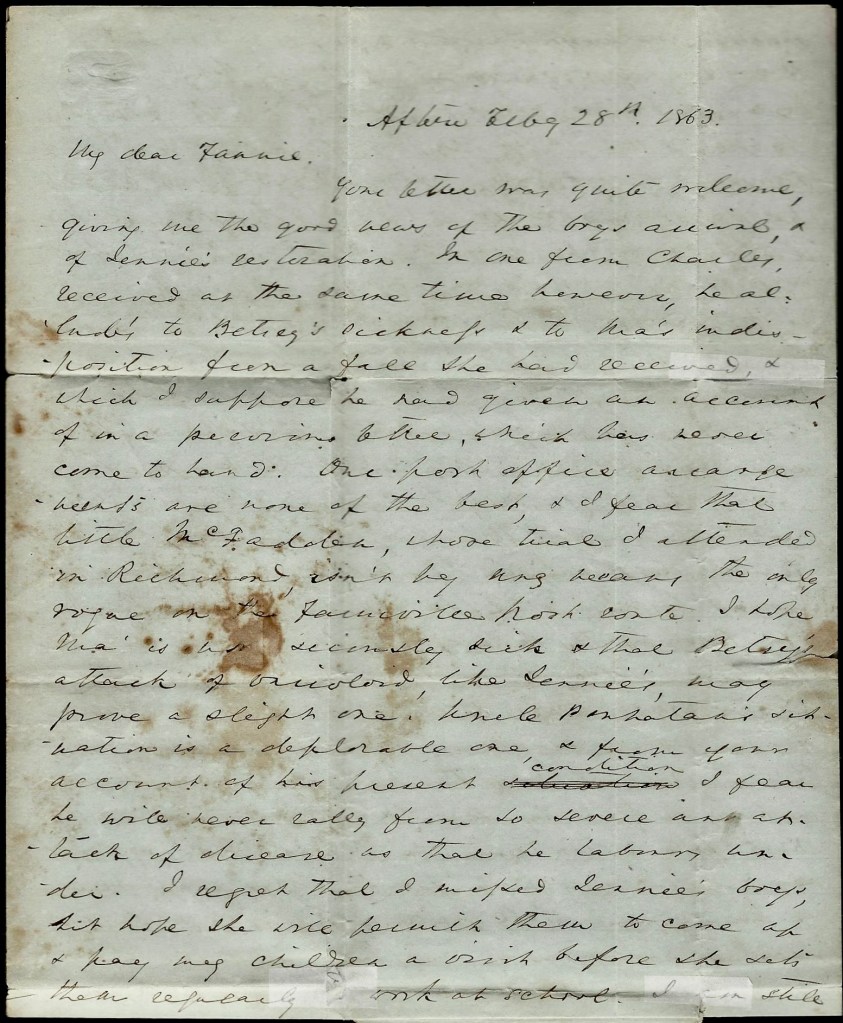
Your letter was quite welcome, giving me the good news of the boys arrival & of Jennie’s restoration. In one from Charles received at the same time, however, he alludes to Betsy’s sickness & to Ma’s indisposition from a fall she had received & which I suppose he had given an account of in a previous letter which has since come to hand. Our post office arrangements are none of the best & I fear that little McFadden, whose trial I attended in Richmond, isn’t by any means the only rogue on the Farmville post route. I hope Ma is not seriously sick and that Betsy’s attack of varioloid, like Jennie’s, may prove a slight one. Uncle Powhatan’s situation is a deplorable one and from your account of his present condition, I fear he will never rally from so severe an attack of disease as that he labors under. I regret that I missed Jennie’s boys but hope she will permit them to come up & pay my children a visit before she sets them back to work at school. I can still….

…a single ball at the first fire. Mildred like all girls is more of a student & is very much engaged with the little story books. We think the three youngest children have the whooping cough, though quite mildly. Nannie and sister Kate keep very well but are closely [ ] this bad weather. The roads being impassable for vehicles as is proved by the fact that Nannie has not been to sister Eliza’s or she here for a month. Mrs. Thomas Perkins is fast recovering from her sickness & she and the baby are now as well as could be expected.

Will you say to Charles that I have not time before the boy leaves for the Court House today to answer his letter, but that I would be glad if he comes again & Mr. Powers, the agent of the M. C. & W. Manufacturing Co. & ascertain if a bale of hot cotton Ogby’s can be had and at what price, & if he cannot get that or do better than to try the No. 2 we sow, to get a bale of that for me, and to write me what No. 5 bale cotton can be bought at. I will send him a check for the amount of purchase of the Ogby’s. Tell him I will get him some more butter but that he will have to pay $1.25 for lard. I can get butter a hundred or more pounds at that price, adnd being [ ] new bacon for the same price. He must write at once & let me know whether he wishes me to purchase fowls.

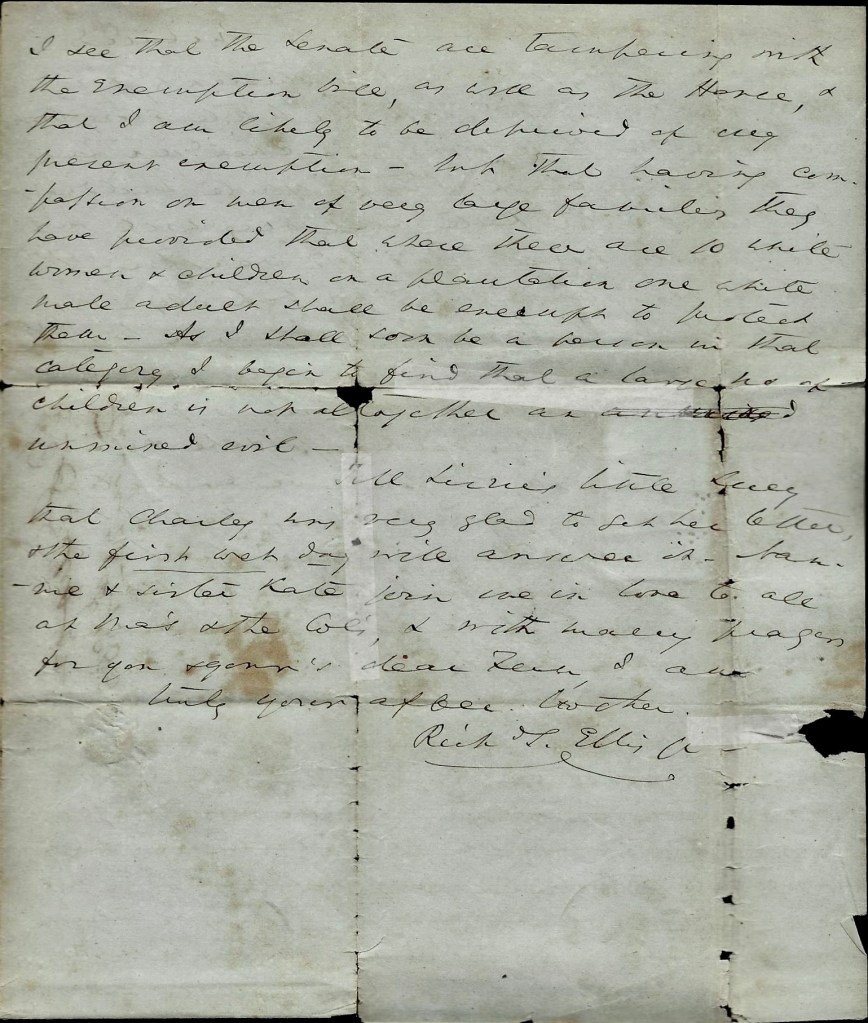
I see that the Senate are tampering with the Exemption Bill, as well as the House, and that I am likely to be deprived of my present exemption—but that having compassion on men of very large families they have provided that where there are 10 white women & children on a plantation, one white male adult shall be exempt to protect them. As I shall soon be a person in that category, I begin to find that a large number of children is not altogether an un[ad]mired evil. 1

Tell Lizzie’s little Lucy that Charley was very glad to get her letter & the first wet day will answer it. Nannie & sister Kate join me in love to all at Ma’s and the Colonel’s, and with maby prayers for you & yours, dear Fan, I am truly your affectionate brother, — Rich T. Ellis


1 Nannie was pregnant at the time of this letter and gave birth to James Nimmo Ellis (1863-1931) on 6 March 1863.

1861: DeForest Hedges to Friend Samuel

This letter was penned by DeForest Hedges (1831-1921), the son of Christopher E. Hedges (1801-1883) and Mary Newell (1806-1881) of Waverly, Tioga county, New York. DeForest attended the Charlottesville Seminary in Schoharie county and then in 1859 he drove a freight wagon for Clark & McCormick from Omaha to Denver so that he could get the gold fields of Colorado. He did some placer mining in 1860 but then returned to freighting to make a living, driving the route from Denver to Virginia City, Montana. He eventually got into ranching in Montana.

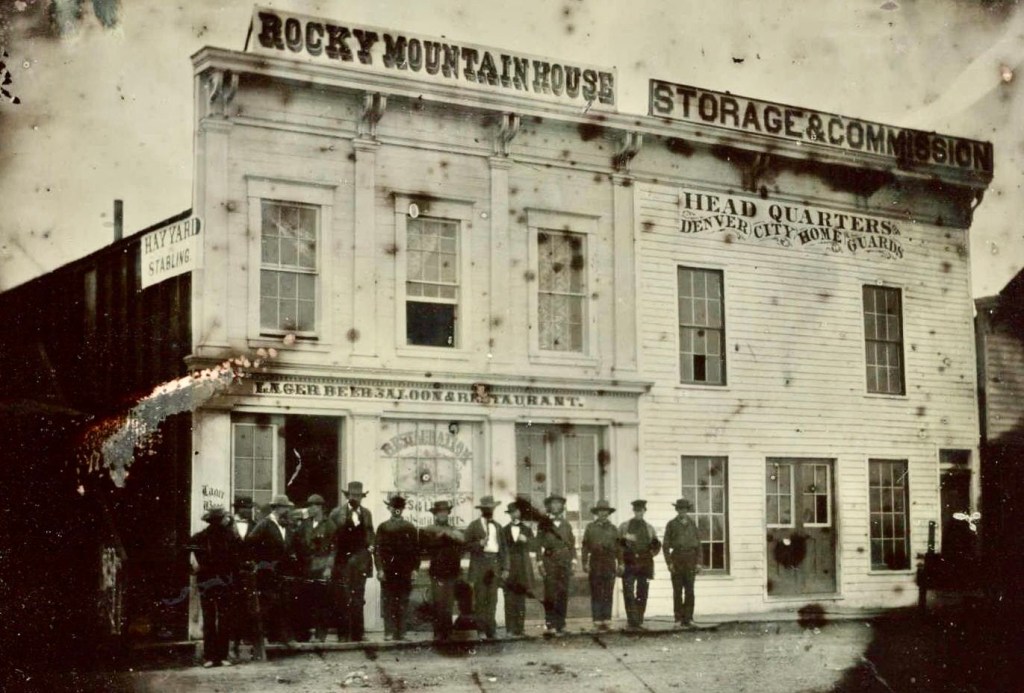
No better place to raise recruits than the local beer hall next door to the “Denver City Home Guards Headquarters” (Denver Public Library)

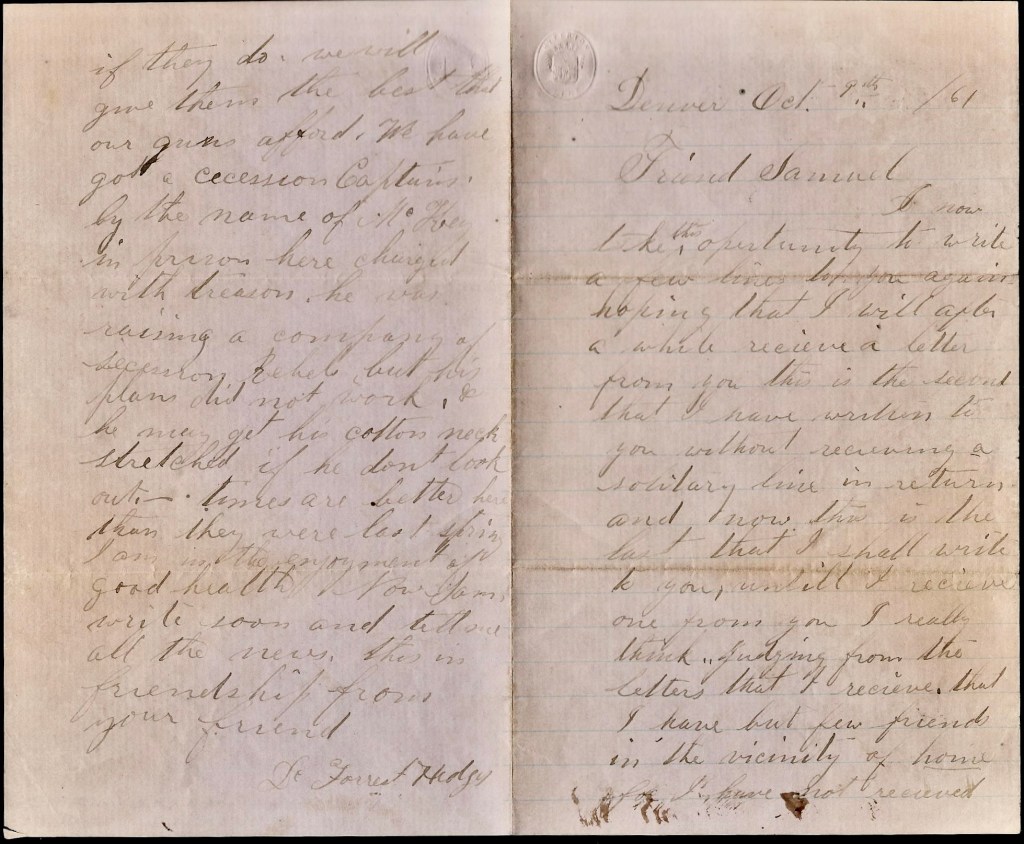
Transcription

Denver [Colorado Territory]
October 9th 1861

Friend Samuel,

I now take the opportunity to write a few lines to you again hoping that I will after a while receive a letter from you. This is the second that I have written to you without receiving a solitary line in return and now this is the last that I shall write to you until I receive one from you. I really think judging from the letters that I receive that I have but few friends in the vicinity of home if I have not received a letter, excepting from Father’s family, from anyone in the neighborhood since H. P. Crane left. Well, if the folks don’t feel disposed to write to me, they can do the other thing—they can let it alone. But Sam, I hope that you are not one of the number that feel disposed to write.

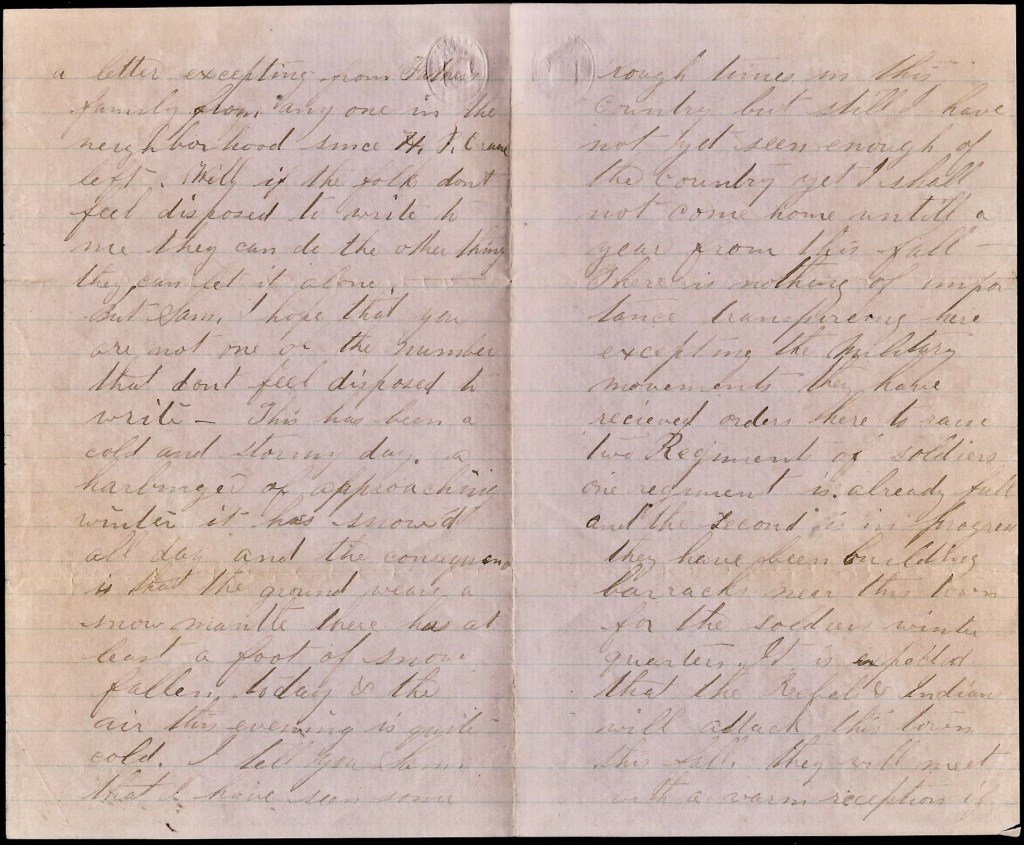
This has been a cold and stormy day—a harbinger of approaching winter. It has snowed all day and the consequence is that the ground wears a snow mantle. There has at least a foot of snow fallen today & the air this evening is quite cold. I tell you, Sam, that I have seen some rough times in this country but still I have not yet seen enough of the country yet. I shall not come home until a year from this fall.

There is nothing of importance transpiring here excepting the military movements. They have received orders here to raise two regiments of soldiers. One regiment is already full and the second is in progress. They have been building barracks near the town for the soldiers’ winter quarters. It is expected that the Rebels & Indians will attack this town this fall. They will meet with a warm reception if they do. We will give them the best that our guns afford. We have got a secession Captain by the name of McKey 1 in prison here charged with treason. He was raising a company of secession Rebels but his plans did not work & he may get his cotton neck stretched if he don’t look out.

Times are better than they were last spring. Write soon and tell me all the news. This in friendship from your friend, — DeForest Hedges


1 It was Captain Joel McKee that was arrested by order of William Gilpin, Governor of Colorado Territory and placed in jail by Copeland Townsend, US Marshal. Gilpin’s executive order read: “Information having reached me that a Texan named McKee is raising troops within this Territory for an unlawful purpose, I deem it incompatible with the public safety for him to be suffered longer to be at large. You are, therefore, directed to arrest and detain him until further orders.” When McKee petitioned for a Writ of Habeas Corpus, it was denied with the argument by the court that it does not apply to persons who engage in open rebellion or invasion of public safety. According to one source, Joel McKee was born in 1824 in Indiana, father was born in Kentucky, and his mother was born in Pennsylvania. “He was in CO in 1861, described as a “frontiersman” or ” old Indian fighter,” probably mining gold, who was a leader of the pro-South forces around Denver according to the (Yankee dominated) newspapers. They had a secret camp at the ghost town of Russellville in 1861. He led a group of about 45 men toward TX in Oct. 1861. They were captured near Ft Wise, held in Denver, charged with treason. They busted out 28 Feb 1862 and made their way South.” (Civil War Message Board)

1861: William H. Talbott to Elizabeth D. Knowles

The following letter was written by William (“Bill”) H. Talbott (1836-1900), a native of Springfield, La Porte county, Indiana. Bill enlisted in July 1861 to serve in Co. C, 1st Indiana Cavalry. He was discharged for disability (“disease of Kidneys”) on 8 September 1862. When he returned home, he married Elizabeth (“Lizzy”) Dorcas Knowles (1840-1926) in 1863 in Gibson county, Indiana, and together they had seven children. They lived in Owensville for a decade or more and then moved to Kansas in 1878.

The First Cavalry regiment of Indiana volunteers contained no less than three full companies of Posey county men. They were C, D and H, and were organized in the months of July and August, 1861. The first captain of Company C was John K. Highman, who was killed at Fredericktown, MO., in November, 1861. All the officers of Co. C were from New Harmony and the entire company came from the northern part of the county. The first encounter with the enemy was September 12, near Ironton, Mo., when three companies had a sharp skirmish with the rebels.

1st Indiana Cavalry
(On Noah R. Greenwalt’s Ancestry Family Page)

Transcription

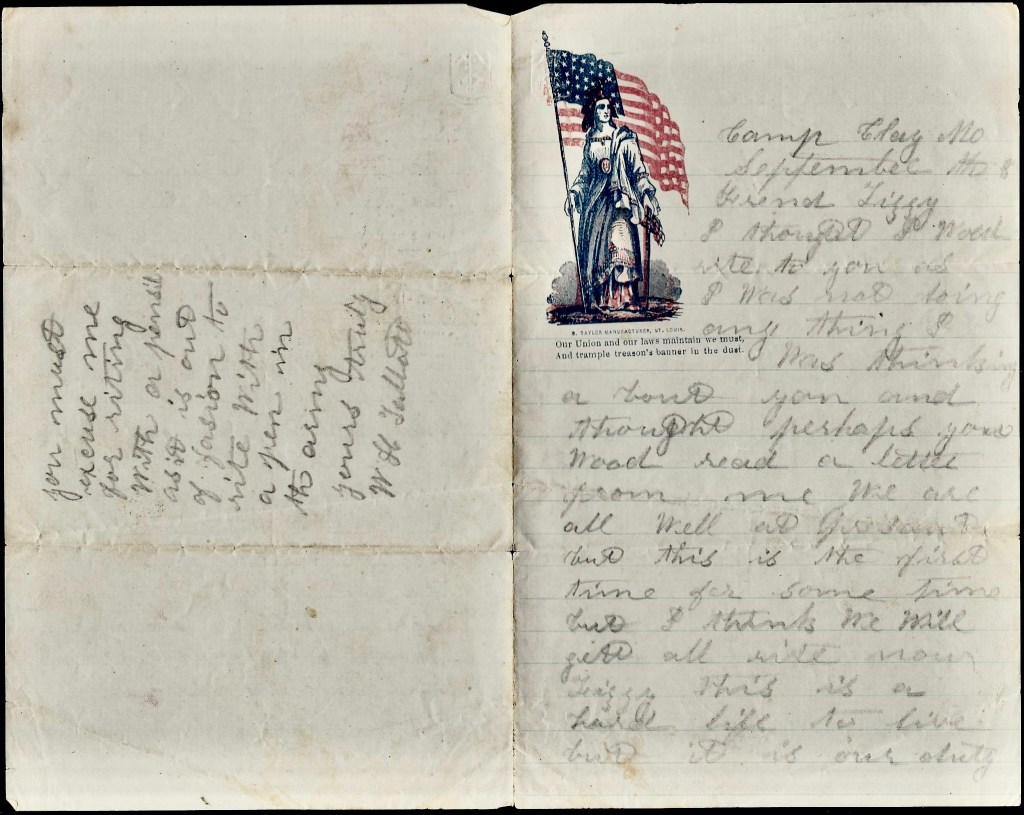
Camp Clay, Missouri
September 8th [1861]

Friend Lizzy,

I thought I would write to you as I was not doing anything. I was thinking about you and thought perhaps you would read a little from me. We are all well at present but this is the first time for some time. But I think we will get alright now.

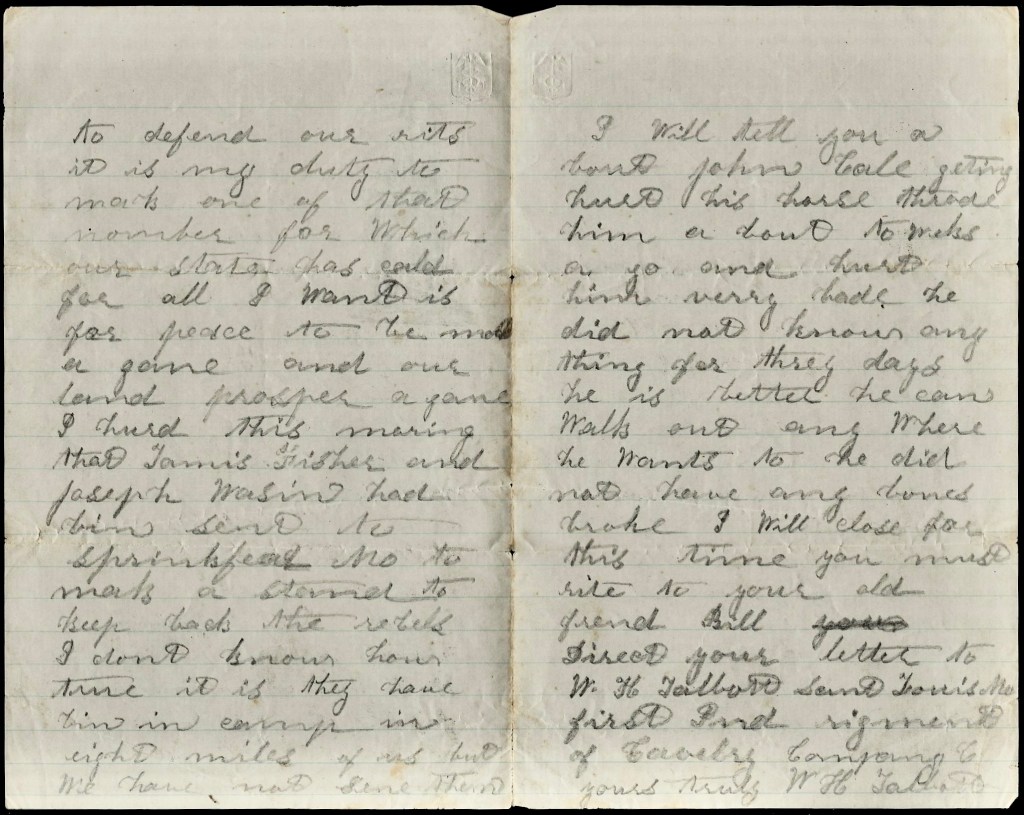
Lizzie, this is a hard life to live but it is our duty to defend our rights. It is my duty to mark one of that number for which our state has called for. All I want is for peace to be made again and our land prosper again.

I heard this morning that James Fisher and Joseph Wasin had been sent to Springfield, Missouri, to make a stand to keep back the rebels. I don’t know how true it is. They have been in camp [with]in eight miles of us but we have not seen them.

I will tell you about John Cole getting hurt. His horse throwed him about two weeks ago and hurt him very bad. He did not know anything for three days. He is better. He can walk out anywhere he wants to. He did not have any bones broke.

I will close for this time. You must write to your old friend Bill. Direct your letter to W. H. Talbott, Saint Louis, Missouri. 1st Indiana Regiment of Cavalry, Company C.

Your truly, — W. H. Talbott

You must excuse me for writing with a pencil as it is out of fashion to write with a pen in the army. Yours truly, — W. H. Talbott

1863: Charles Otto Henthorn to Nelson George Henthorn

The following letters were written by Charles Otto Henthorn (1841-1910), the son of Nelson George Henthorn (1810-1890) and Elizabeth C. Moeller (1815-1887) of Lacon, Marshall county, Illinois. of Co. B, 77th Illinois Infantry. Charles’ parents were married in Licking county, Ohio, but had relocated to Marshall county, Illinois, prior to the 1840 US Census.

I could not find an image of Charles but here is a CDV of William G. Boman who served in Co. B, 77th Illinois Infantry (Photo Sleuth)

Charles enlisted in Co. D, 77th Illinois Infantry during the Civil War. Many of his letters are housed in the William L. Clements Library at the University of Michigan. Charles is described in that collection as “an unusually powerful writer and provides thoughtful, evocative descriptions of the events unfolding around him. His observations on the varied roles of African Americans in the army are particularly noteworthy. They are depicted in several ways: as informers on Confederate sympathizers hiding from the Union Army, as victims of racism and southern hatred, and as highly motivated and effective soldiers at the Battle of Milliken’s Bend. Henthorn appears to have a much more positive attitude toward blacks than many of his fellow soldiers, and he appears equally to be aware of this fact. Equally interesting are Henthorn’s descriptions of the land itself, including fine descriptions of towns in Indiana and Ohio, and of evacuated plantations in Louisiana. He makes several references to hostile southern attitudes toward the Union troops, and describes an instance of pillaging by members of his regiment. There are two second-hand accounts of battles, the Battles of Richmond and Milliken’s Bend, but by and large, there is very little martial content in Henthorn’s letters. He is instead at his best in his reflections on the effect of the conflict on the soldiers and civilians. The final two letters in the collection provide (respectively) an insight into the depth of Henthorn’s religiously held pro-Union, anti-slavery views, and an account of a copperhead rally in Lacon during the 1864 presidential election which featured a coffin containing a likeness of Lincoln with buzzards flying overhead…Like many soldiers in his regiment, Henthorn was striken with illness during the Vicksburg Campaign, and spent seven weeks in the Van Buren Hospital at Milliken’s Bend, La., before being sent to St. Louis for convalescence. This series of correspondence essentially ends when Henthorn leaves the south, however the regimental history for the 77th Illinois records Henthorn as mustering out only at the end of the war.”

Although Charles is carried on the Muster rolls of Co. B as Charles O. Henthorn, there is also a Charles O. Hawthorn on the rolls of Co. D which is also the company commanded by Capt. Robert Brock and the other privates mentioned in this letter. Henthorn, not Hawthorn, is the surname that Charles wrote on his letter and envelope. Because of the other names mentioned in this letter, I’m going to assume Charles was in Company D.

Letter 1

In Camp opposite Vicksburg
January 31st 1863

Dear Father,

I received a letter yesterday from you stating that you had not received a letter from me since leaving Memphis. I have written four since the one to George while going down the river the first time. In [it] I told him he might have the skates and gun. Then I think I wrote one to you from a place called Milliken’s Bend, 25 miles from Vicksburg. Then I wrote you one on the 4th of January—the same day that Goodrich opened his box—informing you that i had received the letter containing the five dollars and also the boots and box of notions. I do not wonder that you are all uneasy though I suppose some of my letters have reached home before yours reached me. There even may be a possibility that mine may have been miscarried or misplaced. While on the boat, I was too unwell to feel much like writing. Besides, the jar of the boat rendered it difficult. I shall try to write oftener.

All the time that I have been sick, there has not been a day but what I could walk around. Our regiment left the boat on the 24th of January (on which some of us had stayed over a month) and marched down the river to our present camp ground—a distance of 3 or four miles. I could not keep up with the regiments with my accoutrements on so had to fall behind and take my time for it.

We have some bright and shiny days here though the principal part of the time has been cloudy and rainy since we came into camp. I am still unwell and unfit for duty but have good and accommodating messmates—Will Fenn, Joseph Will, Martin Hoagland, &c.

The mails now is quite irregular and sometimes far between in going up. I hope you may receive all my letters. I think I got all of yours. I hope soon to become entirely well. The most that troubles me is the diarrhea—very common in the camp. A baker with an army bake oven has been engaged to bake light bread for the regiment. We got our first today. You can have a fine view of Vicksburg from the top of the levee. 

February 2nd, This morning two of our gunboats ran the blockade of the water batteries. There was a brisk cannonade for over half an hour. It sounded quite interesting. You will perceive from my handwriting that my hand is nervous.

Yours sincerely with love to all. — C. O. Henthorn


Letter 2

In Camp Opposite Vicksburg
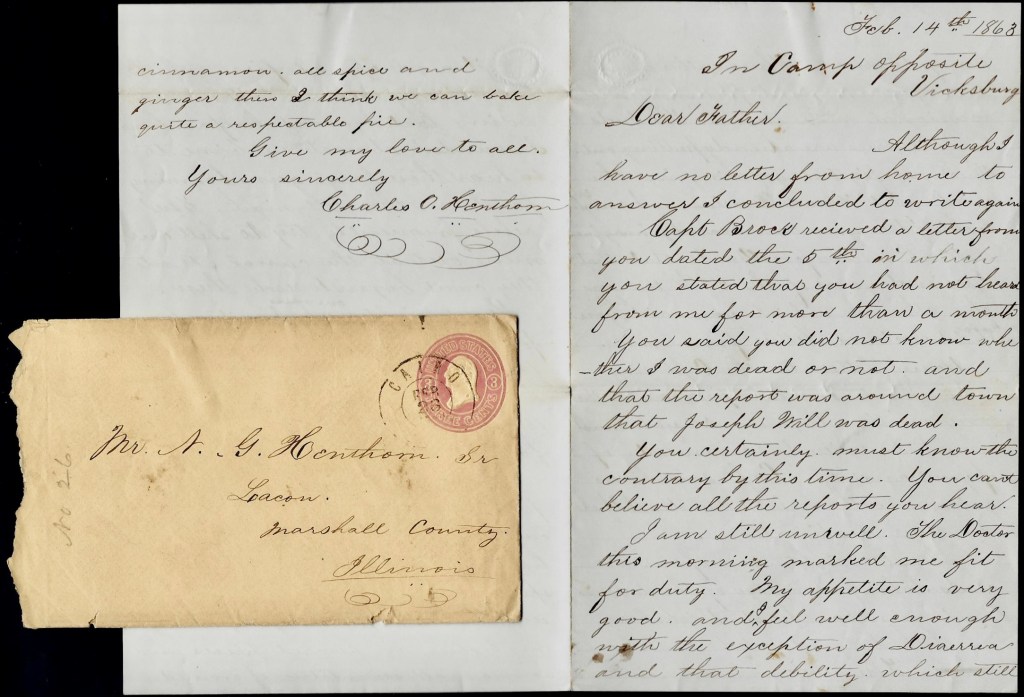
February 14th 1863

Dear Father,

Although I have no letter from home to answer, I concluded to write again. Capt. [Robert H.] Brock [of Co. D] received a letter from you dated the 5th in which you stated that you had not heard from me for more than a month. You said you did not know whether I was dead or not and that the report was around town that Joseph Will was dead. You certainly must know the contrary by this time. You can’t believe all the reports you hear.

I am still unwell. The doctor this morning marked me fit for duty My appetite is very good and I feel well enough with the exception of diarrhea and that debility which still hangs to me.

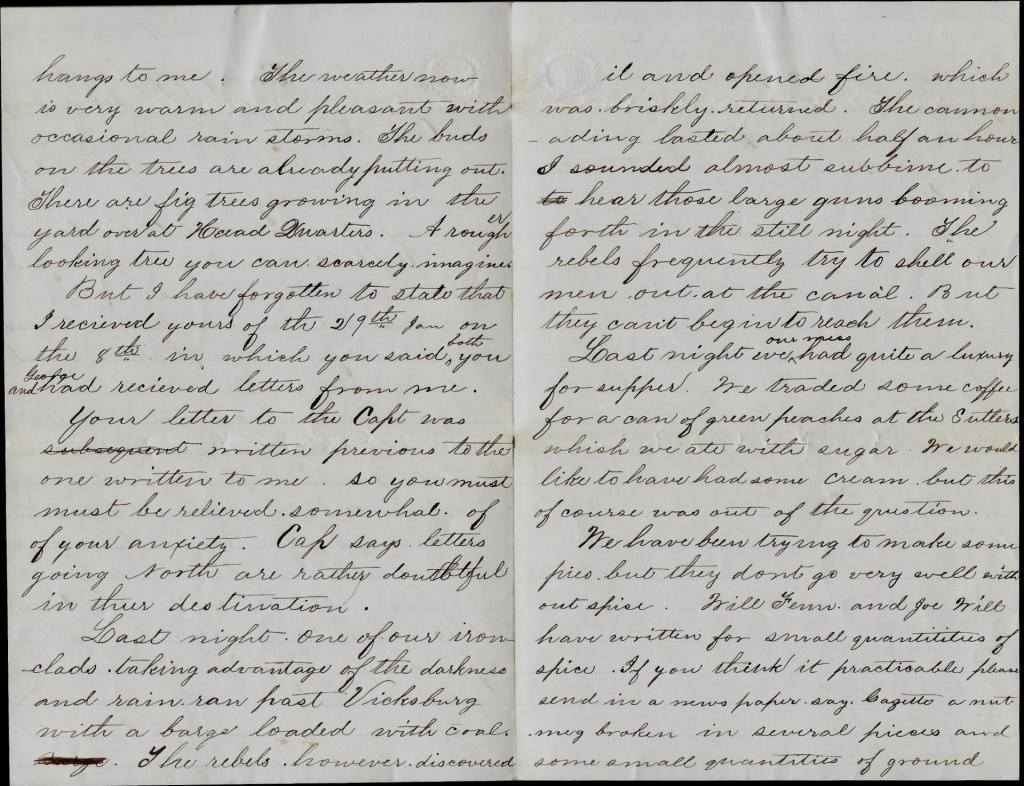
The weather now is very warm and pleasant with occasional rain storms. The buds on the trees are already putting out. There are fig trees growing in the yard over at Headquarters. A rougher looking tree you can scarcely imagine.

But I have forgotten to state that I received yours of the 29th January on the 8th inst. which you said both you and George had received letters from me. Your letter to the Captain was written previous to the one written to me so you must be relieved somewhat of your anxiety. Captain says letters going North are rather doubtful in their destination.

Last night one of our ironclads 1 taking advantage of the darkness and ran ran past Vicksburg with a barge laded with coal. The rebels, however, discovered it and opened fire which was briskly returned. The cannonading lasted about half an hour. It sounded almost sublime to hear those large guns booming forth in the still night. The rebels frequently try to shell our men out at the canal but they can’t begin to reach them.

Last night we (our mess) had quite a luxury for supper. We traded some coffee for a can of green peaches at the sutler’s which we ate with sugar. We would like to have had some cream but this of course was out of the question. We have been trying to make some pies but they don’t go very well without spice. Will Fenn and Joe Will have written for small quantities of spice. If you think it practicable, please send in a newspaper—say Gazette—a nutmeg broken in several pieces and some small quantities of ground cinnamon, all spice and ginger. Then I think we can bake quite a respectable pie.

Give my love to all. Yours sincerely, — Charles O. Henthorn


1 USS Indianola, a 511-ton ironclad river gunboat, was built at Cincinnati, Ohio. Commissioned in an incomplete state in September 1862 to defend Cincinnati against a threatened Confederate attack, she was ready for active service in January 1863. Sent to join the Mississippi Squadron north of Vicksburg, she ran past the guns of that fortress city on 13 February 1863 in an effort to cut off Confederate supply lines.