My passion is studying American history leading up to & including the Civil War. I particularly enjoy reading, transcribing & researching primary sources such as letters and diaries.
The following letter was written by 19 year-old Nancy Jane Gallaway of Mina, Chautauqua county, New York. I believe Nancy was the daughter of Martha Gallaway (1817-Aft1880), a widow who lived with her two daughters Nancy and Elizabeth, in the same household as Andrew R. Johnson (1802-1882).
The letter was addressed to Mike Johnson who was most likely Andrew’s son by a former marriage. Martha Gallaway is supposed to have married Andrew in October 1860 but, curiously, her surname appears in later census records as Gallaway so I can’t be certain of the relationships. Instead of cousins, Nancy and Mike may actually have been step-siblings.
Nancy’s letter conveys news of the war casualties of Chautauqua county, New York—particularly from Mina where companies serving in the 111th and 112th New York Infantry as well as the 15th New York Cavalry were recruited. She also speaks of a counterfeit money scandal that took place in the county implicating a number of men. These scandals were not so unusual during the war when paper currency came into widespread use but the government lacked resources to regulate it.
[Note: This letter is from the private collection of Austin Sundstrom and was transcribed and published on Spared & Shared by express consent.]
Transcription
Mina, [Chautauqua county, New York] August 5, 1864
Now, Mike Johnson, I take my pen in hand to let you know that we are all well at present time and I am in hopes that these few lines may find you in good health. I have not much to write this time but I thought that must write a little. I got a letter from Mr. Wilson July the 14th. He was well then. It was dated July the 9th. I will give you the names of the killed and wounded. I hope you don’t know them but I will tell who they are.
Daniel Johnson, left arm; Mr. Clive’s cousin Robert [Amos] Corbett, 1 hip; Mr. Calvin’s cousin’s husband Charles [H.] Munger, 2 right breast and left arm; Charles Pratt, left arm; James [D.] Findley, 3 left arm broke off; Oren Sweet, 4 arm. They have all been to home but two or three and they are coming home. Frank McIntosh 5 in the knee and a prisoner. Wm. H. Greenman, foot. Rubin Stafford, arm prisoner, death.
James Scidmore6, Henry [Barber] Findley7, Ishmer Babcock wounded. The report is that Albert Shinn 8 is killed. He was seen falling off from his horse and the blade a raising.
There is lots of men taking up for passing counterfeit money. I will tell you their names—Doctor Phillips, James McIntosh, Jacob Fields, Mr. Beish. Henry Dugels took up Money Daves and cleared him. Mr. Broadhead, Mr. Busherl and a young man I have not learned his name and three or four more is reported to be in the scrape but I don’t know where they are or not but I can tell their names, Anna Raymond, Orrin Dunn, Henry Schalley.
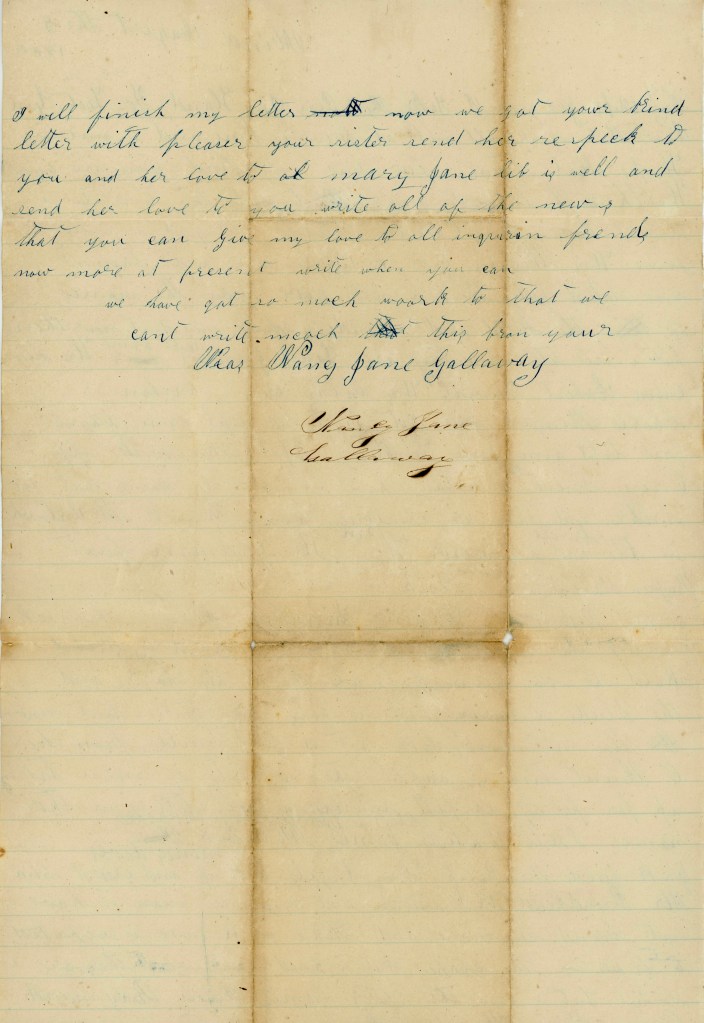
I will finish my letter now. We got your kind letter with pleasure. Your sister sends her respects to you and her love to Mary Jane. Lib is well and send her love to you. Write all of the news that you can. Give my love to all enquiring friends. No more at present. Write when you can.
We have got so much work to do that we can’t write much. This from your cousin—Nancy Jane Gallaway
1 Robert Amos Corbett (1829-1895) was a 1st Lieutenant in Co. D, 112th New York Infantry. He enlisted at Mina in August 1862 and was wounded in the hip at Cold Harbor on 1 June 1864. He was discharged for disability on 17 October 1864.
Lt. Robert Corbett’s sword
2 Charles H. Munger was 39 years old when he enlisted in Co. D, 112th New York Infantry. He was a corporal when he was wounded in action at Cold Harbor on 1 June 1864. He mustered out with the company at Raleigh, N. C. on 13 June 1865.
3 James D. Findley was 25 years old when he enlisted in August 1862 to serve in Co. H, 112th New York Infantry. He was transferred later to Co. K and was wounded severely on 24 June 1864 near Petersburg, Virginia. He was discharged for disability on 11 September 1865.
4 Oren or Orrin Sweet (1843-1892) served in Co. B, 111th New York Infantry. He was wounded on 29 October 1863 at Wauhatchie, Tennessee, and again on 25 May 1864 at Dallas, Georgia. He was taken prisoner and held until 13 April 1865.
5 Frank McIntosh of Mina enlisted at the age of 19 in 1863 to serve in the 15th New York Cavalry.
6 James C. Scidmore (1838-1864) served as a private in Co. B, 111th New York Infantry. He was wounded at Wauhatchie, Tenn. on October 29, 1863; killed at Culp’s [Kolbs] Farm, Ga. on June 17, 1864.
7 Henry Barber Findley (1846-1864) was a private in Co. D, 112th New York Infantry. He was mortally wounded at Cold Harbor on 2 June 1864.
8 23 year-old Albert Shinn enlisted at Mina in January 1864 to serve in the 15th New York Cavalry. He deserted at Lynchburg, Virginia, on 19 June 1864 according to military records. Albert was born in Germany and was a farmer by occupation.
The following distressing letter was written by 37 year-old Cordelia [Scovell] Havens (1826-1898), the wife of Thomas Havens (1812-1875) whom she married after her first husband, James Jameson (1819-1845) died in 1845. Cordelia and her 2nd husband moved to Henry county, Iowa, in 1854 and to Cherokee county, Kansas in 1866. Her letter implores of an unidentified hospital surgeon the fate of the only son by her first marriage—Harlan J. Jameson (1843-1886). I believe the letter was sent to Annapolis, Maryland, where paroled soldiers were exchanged.
Harlan Jameson enlisted as a private when he was 18 years old in Co. K, 4th Iowa Cavalry. He was mustered into service on 25 November 1861 and was taken prisoner at Bear Creek, Mississippi, on 22 June 1863. He was exchanged and returned to service on 14 October 1863 at Vicksburg. He mustered out of the regiment on 4 December 1864 when his term of service expired.
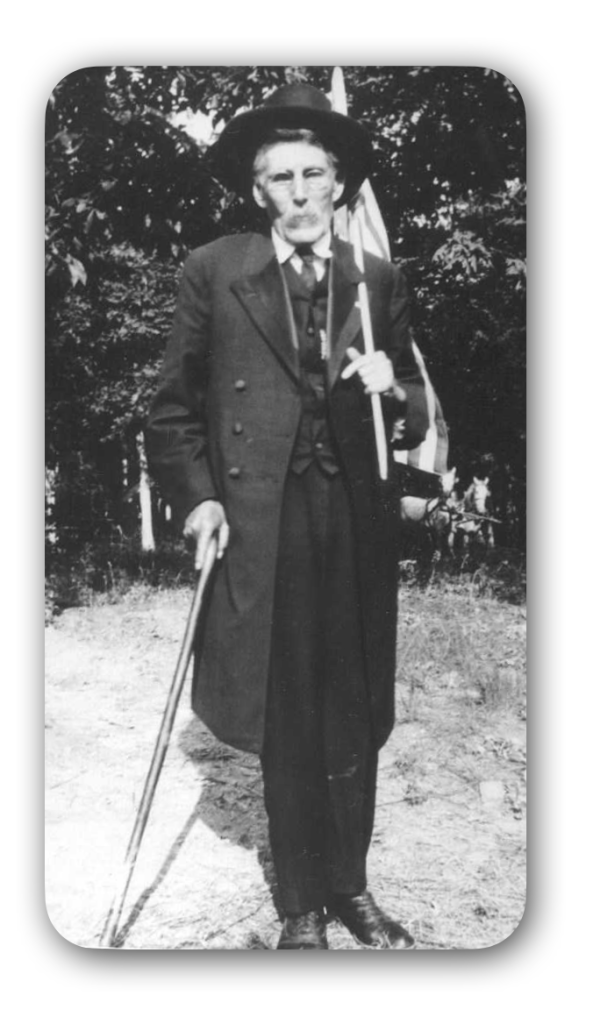
Harlan J. Jameson, Co. K, 4th Iowa Cavalry Iowa Civil War Images
Harlan’s obituary, published in the Cherokee Sentinel on 21 January 1887, claims that he was seriously wounded in the Battle of Helena (Arkansas) and “subsequently captured and carried to Castle Thunder and Libby prison in which places he was confined for nine months, when he was exchanged and again joined his command and served till the expiration of his term of service in December, 1864, at which time he received an honorable discharge.” Clearly there is a discrepancy between the military record and the obituary record, and I’m inclined to believe the obituary was fabricated out of half-truths and exaggerated tales told by the old warrior, especially given that Co. K was, indeed, on Hill’s Plantation near Bear Creek on 22 June 1863. On page 557 of his book, The Story of a Cavalry Regiment, William Force Scott informs us that Harlan was among several men of the 4th Iowa Cavalry captured, exchanged, and returned to service in October 1863. While he may have been sent to Richmond as a POW, he did not languish there for nine months.
Harlan met his death by falling from the tramway at the Cherokee coal shaft, where he was employed as night watchman and while in the discharge of duty, between 10 and 11 o’clock at night Jan. 17th, 1887.
Letter 1
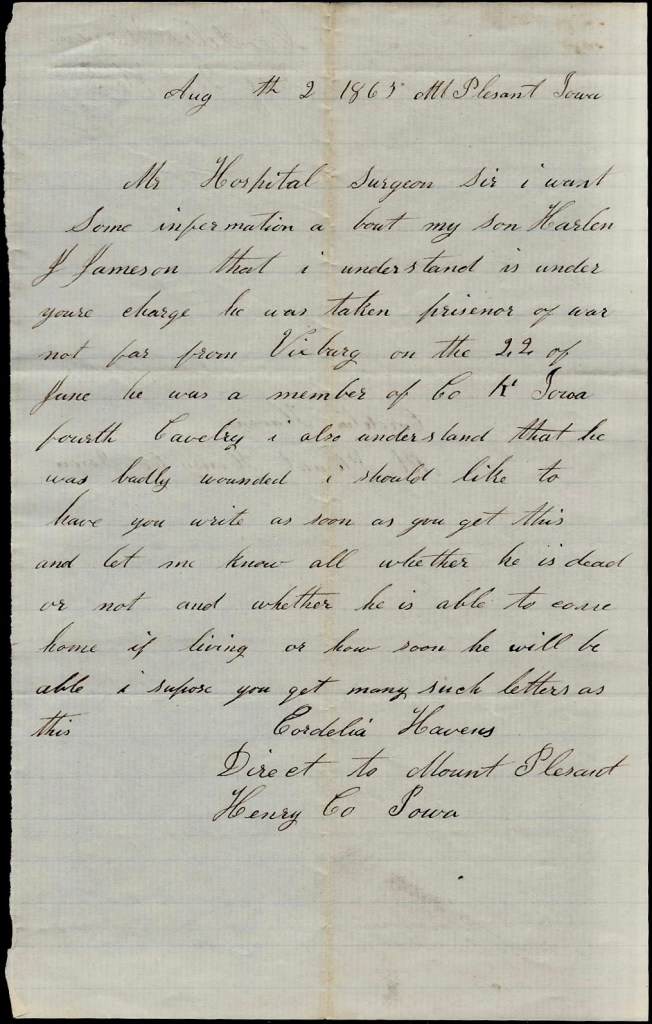
Mt. Pleasant, Iowa August the 2nd, 1863
Mr. Hospital Surgeon,
Sir, I want some information about my son Harlen J. Jameson that I understand is under your charge. He was taken prisoner of war not far from Vicksburg on the 22nd of June. He was a member of Co. K, Iowa Fourth Cavalry. I also understand that he was badly wounded. I should like to have you write as soon as you get this and let me know all—whether he is dead or not, and whether he is able to come home if living, or how soon he will be able.
I suppose you get many such letters as this. — Cordelia Havens
Direct to Mount Pleasant, Henry county, Iowa
Letter 2
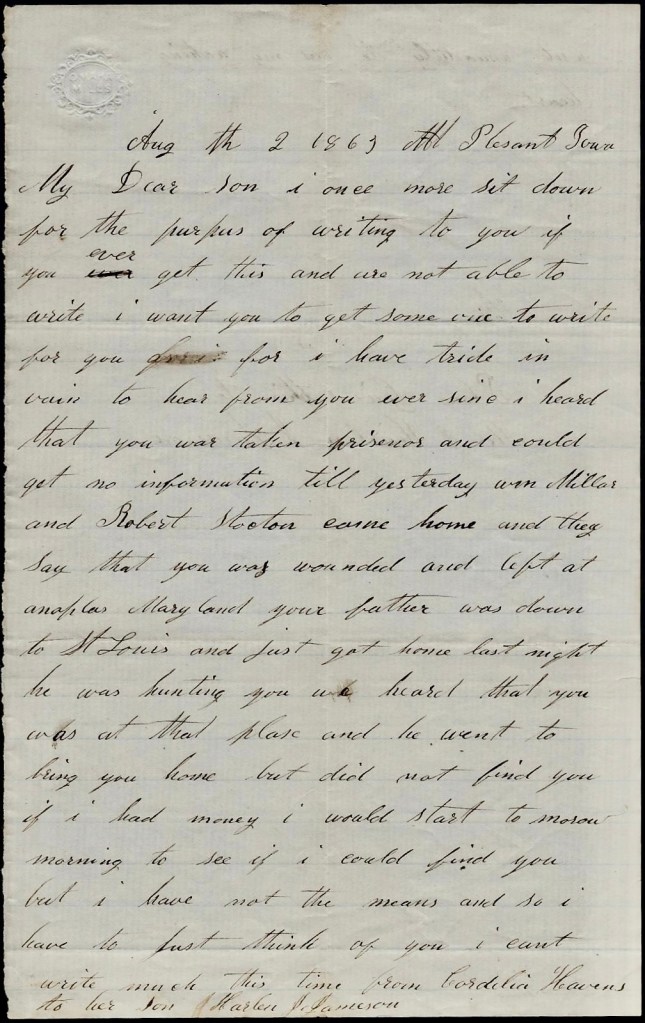
Mt. Pleasant, Iowa August 2nd 1863
My Dear Son,
I once more sit down for the purpose of writing to you—if you ever get this—and are not able to write, I want you to get someone to write for you for I have tried in vain to hear from you ever since I heard that you were taken prisoner and could get no information till yesterday when [William] Miller and Robert [S.] Stockton came home and they say that you was wounded and left at Annapolis, Maryland.
Your father was down to St. Louis and just got home last night. He was hunting you. We heard that you was at that place and he went to bring you home but did not find you. If I had money, I would start tomorrow morning to see if I could find you but I have not the means and so I have to just think of you. I can’t write much this time.
The following late war letter was written by William Wiley Jones (1839-1918), the son of John and Susan (Emberton) Jones who came to Sullivan County, Missouri from Monroe County, Kentucky in the early 1840s.
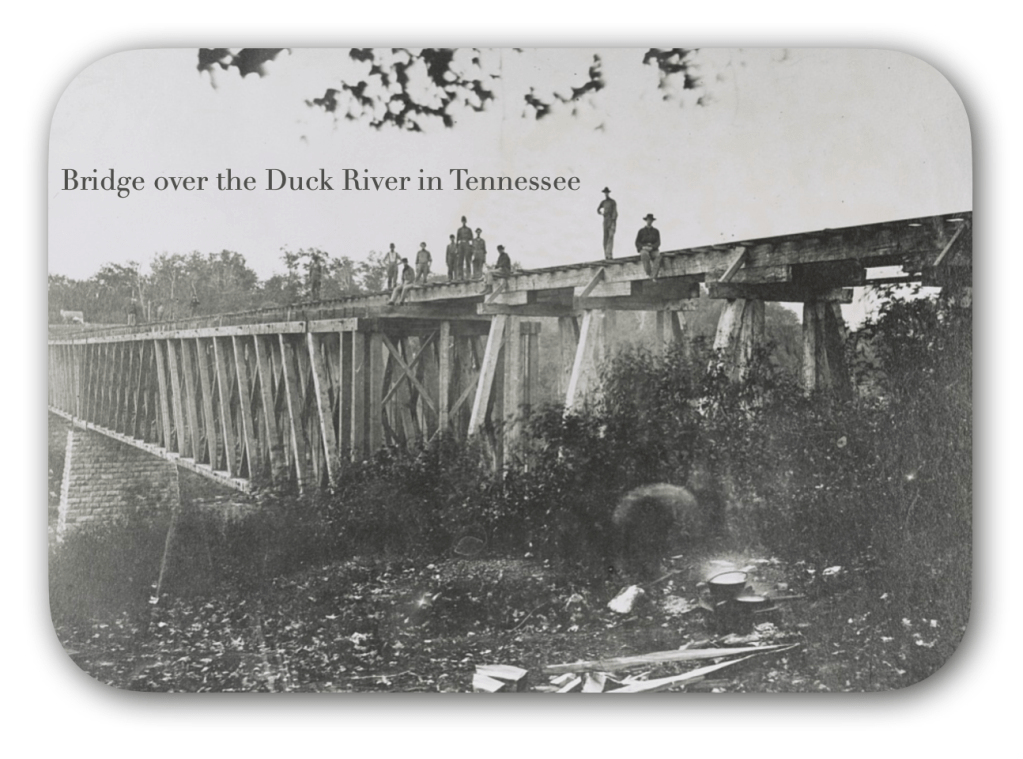
William enlisted in Co. E, 42nd Missouri (Union) Infantry at the time of its organization in September 1864. The regiment was sent to Tullahoma, Tennessee in the Department of the Cumberland in December 1864 and assigned as an unattached unit to the 20th Army Corps. In March, 1865, when this letter was written, the regiment had just arrived in Shelbyville, Tennessee, where they were garrisoned for the remainder of the war and performed picket duty on the Duck River Bridge. They mustered out in late June 1865. During its service, the regiment lost six enlisted men killed or mortally wounded and 124 to disease for a total of 134 casualties.
[Note: The scans of this letter were provided to Spared & Shared for transcription and publication by Reta McCollum Riley, a 2nd great-granddaughter of the soldier.]
Transcription
A man on picket duty prepares the mess in foreground.
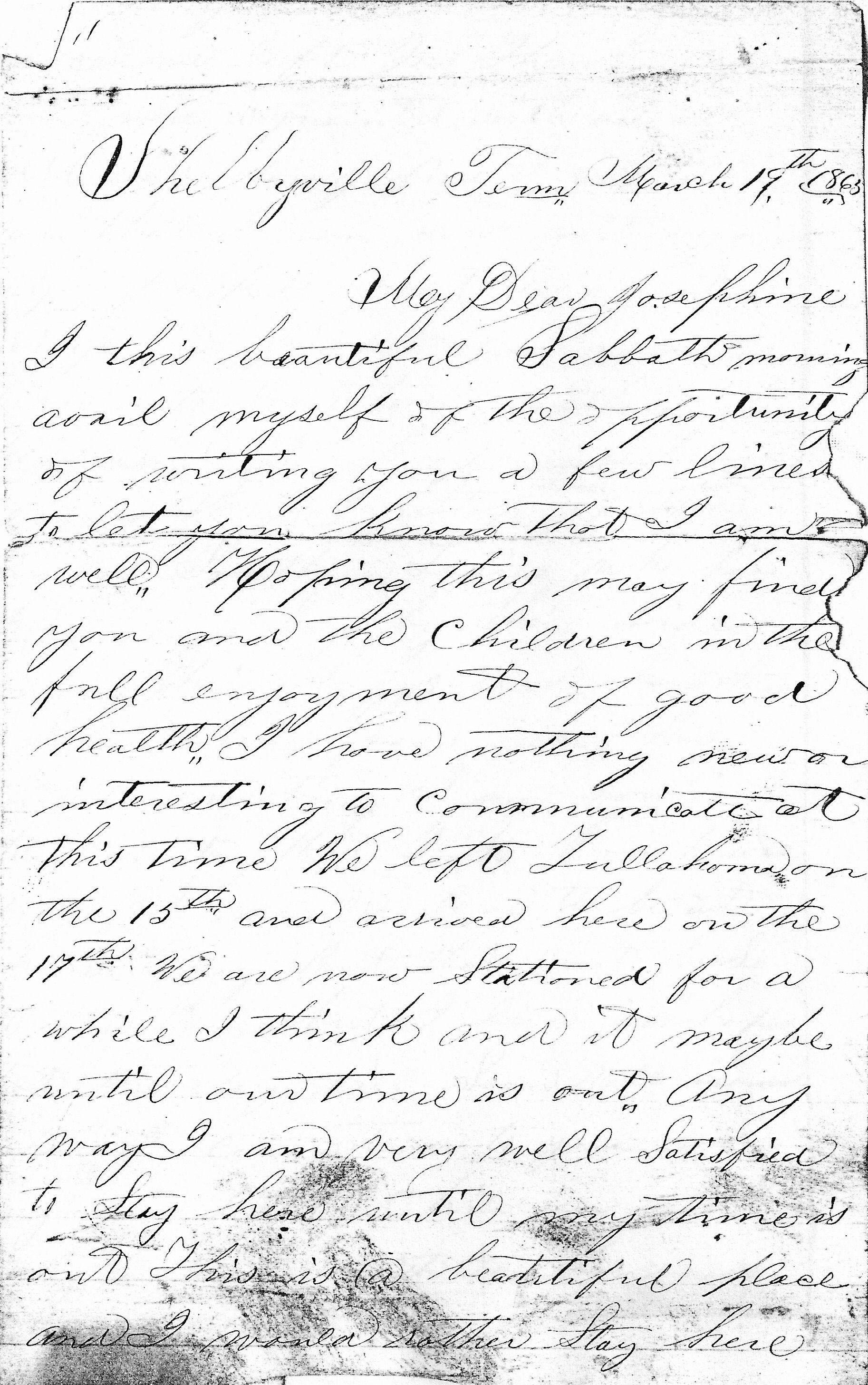
Shelbyville, Tennessee March 19, 1865
My dear Josephine,
I this beautiful Sabbath morning avail myself of the opportunity of writing you a few lines to let you know that I am well [and] hoping this may find you and the children in the full enjoyment of good health.
I have nothing new or interesting to communicate at this time. We left Tullahoma on the 15th and arrived here on the 17th. We are now stationed for a while I think and it may be until our time is out. Anyway, I am very well satisfied to stay here until my time is out.
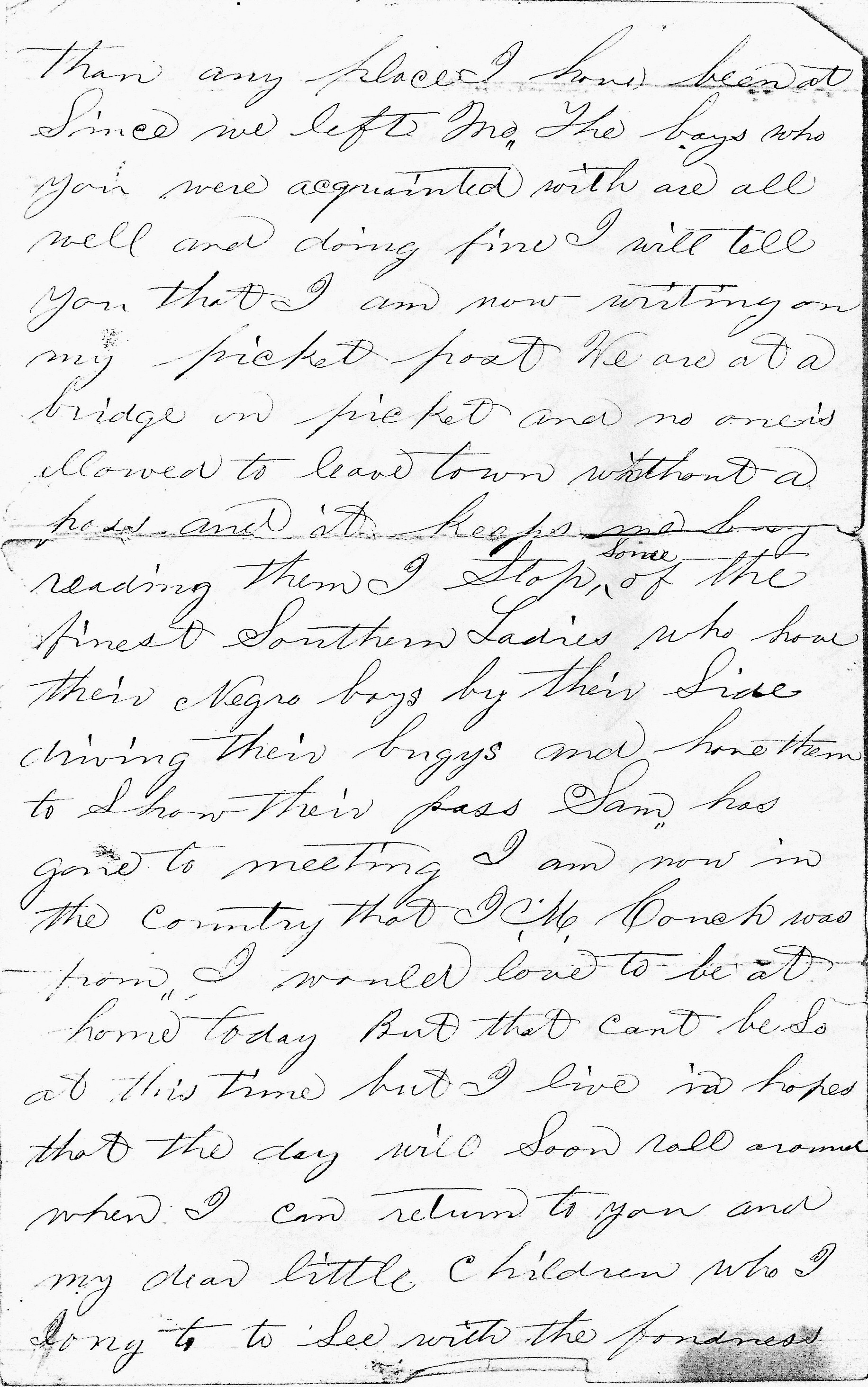
This is a beautiful place and I would rather stay here than any place I have been at since we left Missouri. The boys who you were acquainted with are all well and doing fine. I will tell you that I am now writing on my picket post. We are at a bridge on picket and no one is allowed to leave town without a pass and it keeps me busy reading them, I stop some of the finest Southern ladies who have their Negro boys by their side driving their buggies and have them to show their pass.
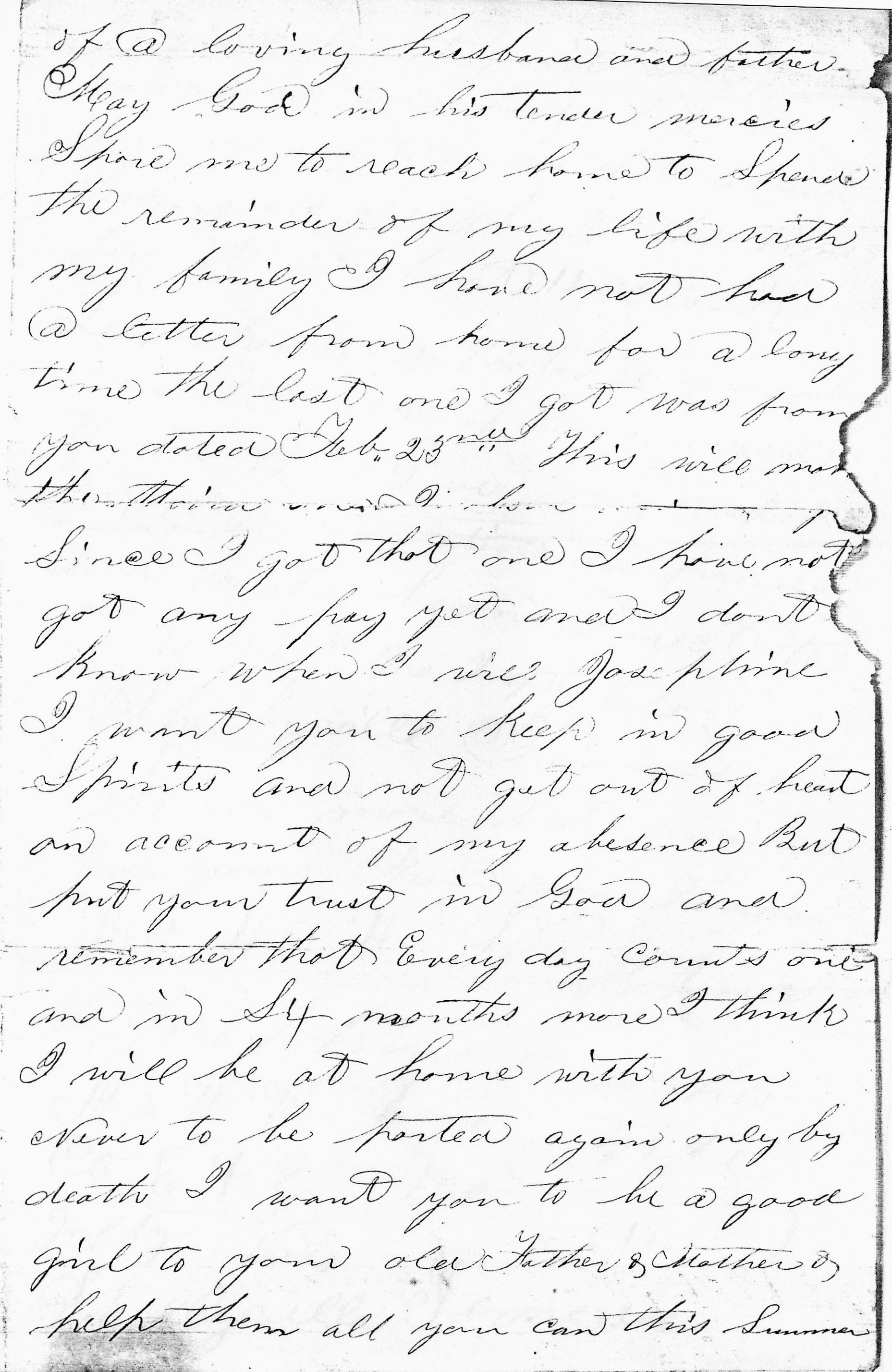
Sam has gone to meeting. I am now in the country that J. M. Conch was from. I would love to be at home today but that can’t be so at this time, but I live in hopes that they day will soon roll around when I can return to you and my dear little children who I long to see with the fondness of a loving husband and father. May God in His tender mercies spare me to reach home to spend the remainder of my life with my family.
I have not had a letter from home for a long time. The last one I got was from you dated February 23rd. This will make the third one I have written since I got that one. I have not got any pay yet and I don’t know when I will.
Josephine, I want you to keep in good spirits and not get out of heart on account of my absence. But put your trust in God and remember that every day counts one and six months more I think I will be at home with you, never to be parted again—only by death. I want you to be a good girl to your old Father & Mother & help them all you can this summer.
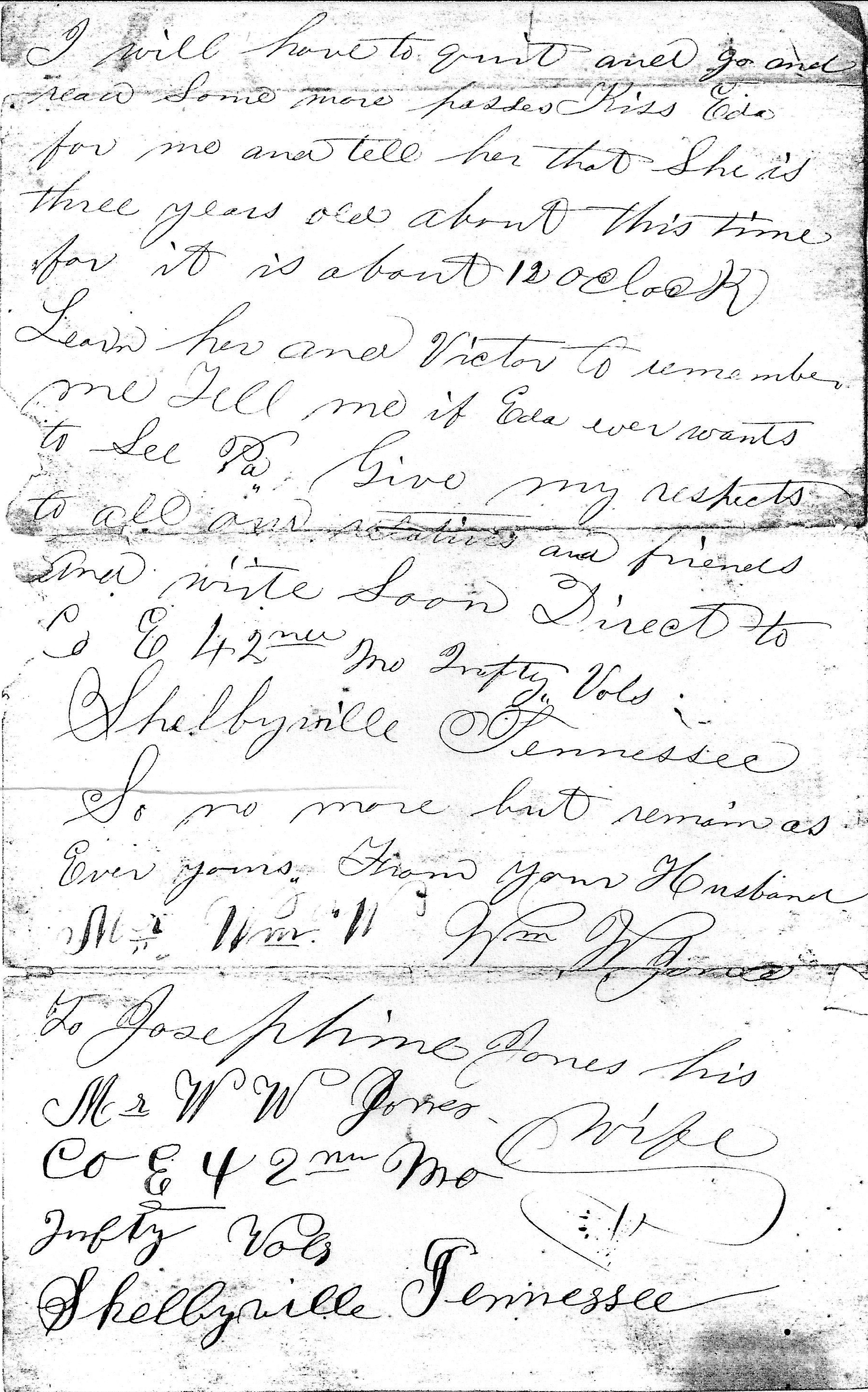
I will have to quit and go and read some more passes. Kiss Eda for me and tell her that she is three years old about this time for it is about 12 o’clock. Learn her and Victor to remember me if Eda ever wants to see Pa. Give my respects to all our relatives and friends and write soon. Direct to Co. E, 42nd Missouri Infantry Vols., Shelbyville, Tennessee
So no more but remain as ever yours, from your husband, 00 Mr. Wm. W. Jones
The following letter was written by Samuel Tyler Miller (1826-1905), the son of John B. Miller (1797-1858) and Elizabeth A. Tyler (1800-1889) of Paulsboro, Gloucester county, New Jersey. Samuel attended the University of Pennsylvania School of Medicine and was practicing allopathic medicine in Paulsboro, Gloucester county, New Jersey at the time of the 1860 US Census. In August 1862, he left his wife Fannie M. Price (1834-1879) of five years to accept a commission as an Assistant Surgeon, Field and Staff, 12th New Jersey Volunteer Infantry. He remained in that capacity until he resigned due to disability 8 November 1864.
Samuel wrote the letter to “Steward Knapp” who was otherwise unidentified in the letter but an internet search yielded the following information on Knapp: “The Edgar Knapp Letters span the years 1862-1864 and are comprised of 40 letters received by Edgar Knapp while he was working as a hospital steward at the U.S. military hospital in Annapolis, Maryland.” These letters were purchased by Special Collections at Virginia Tech in April 2002 with the following biographical note. “Lieutenant Edgar R. Knapp (ca. 1836-?) of Adrian, Lenawee County, Michigan, was a steward at the United States military hospital in Annapolis, Maryland from 1862-1864. His brother H. Knapp was probably Henry Knapp (1813-1893), who is listed in the 1860 census as a doctor in Adrian, Lenawee County, Michigan. Randolph Knapp, whose death is the subject of some of the correspondence, was born in 1840 in Michigan and died at the Battle of Gettysburg.”
Transcription
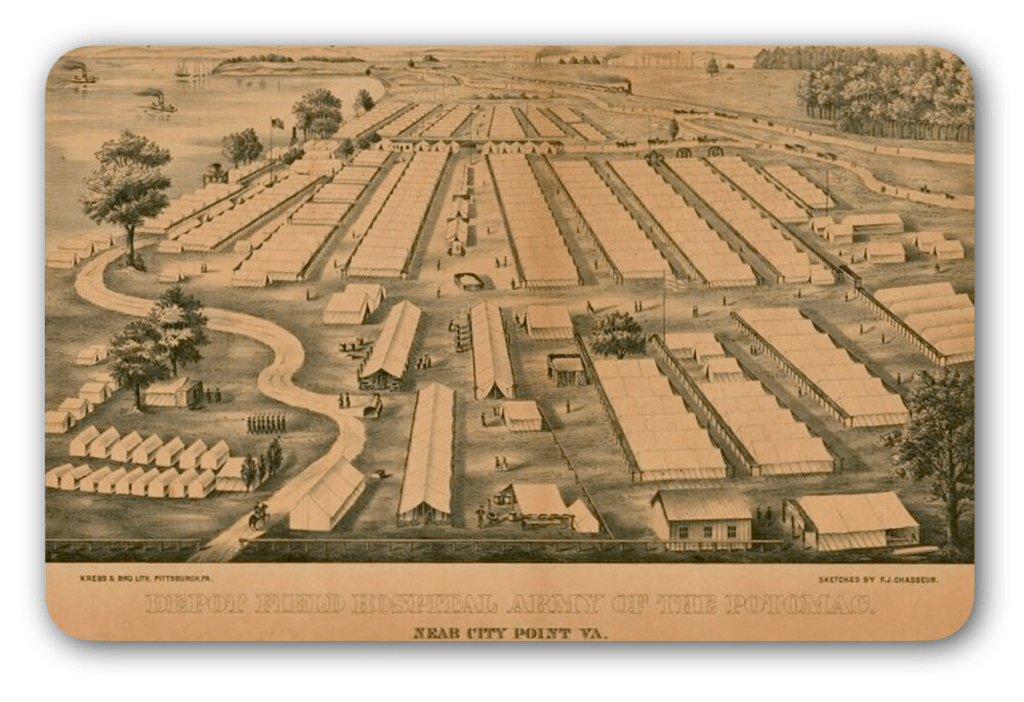
The Depot Field Hospital near City Point, Virginia
Hospital 2nd Division, 2nd Army Corps City Point, Virginia July 9th 1864
Steward Knapp,
Sir, when last I saw you, who would have thought that so long a time would have elapsed before one or the other of us would have written. For my own part, there is the best excuse in the world, having been on the most active campaign that has taken place during the war, with a good disposition, but no facilities but a lead pencil & my knee for a writing desk.
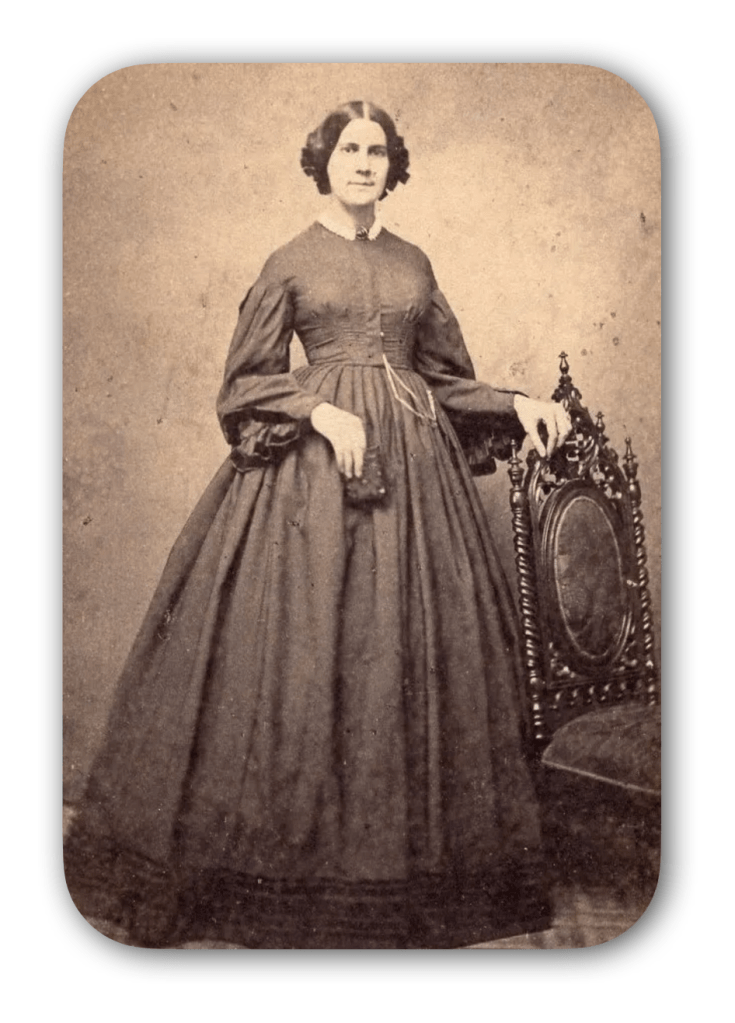
Mrs. Rebecca Lane (Pennypacker) Price
There is no use in me in relating any incidents that have taken place during this time. Suffice it to say that my regiment is reduced from 420 muskets to about 100. Have run clear myself so far (only having been struck once upon the spur) but do not intend to have them in so close proximity again if I know myself. About two weeks since I detailed to this place and have virtually been running the machine. Mrs. Price 1 is with me as one of my female nurses. I have three more, one of which is rather an interesting young lady—“Nuff Ced.”
I have met the Lieutenant who accompanied us to the Depot the night I went home in April and if I may judge from his statement, I think the service would be doing you a favor in removing you to some other place where attractions are not so liberally displayed and inducements not constantly staring you in the face. A word of caution may not be out of place. Young man, be cautious and hold a tight rein.
That you have not written to me, I must acknowledge that I am somewhat ashamed of you, surrounded as you are with all the facilities for writing and neglecting a friend who would volunteer advice as the above. I forget the Lieutenant’s name but you doubtless recollect him. He is a patient in the 9th Corps Hospital about 100 yards from here and over which Dr. Wheeler presides.
I might say during this campaign, many friends have fallen & more disabled I fear for life. May God hasten the time when this unholy warfare shall cease.
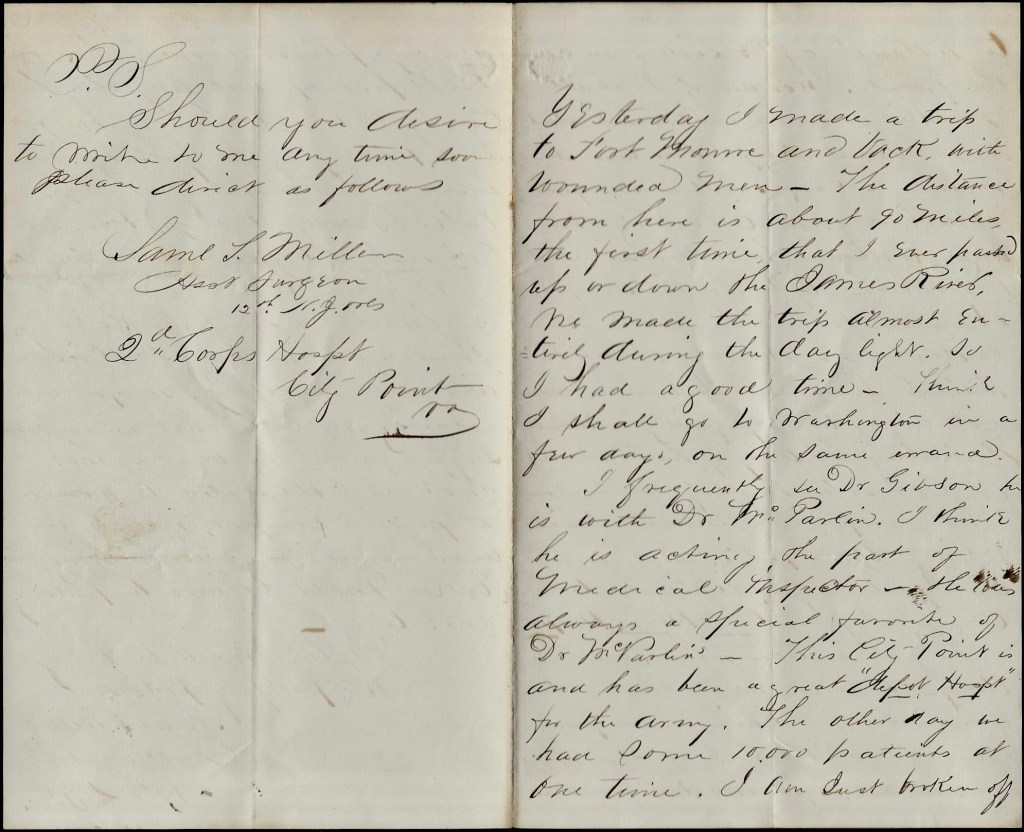
Yesterday I made a trip to Fort Monroe and back with wounded men. The distance from here is about 90 miles, the first time that I ever passed up or down the James River. We made the trip almost entirely during the daylight so I had a good time. Think I shall go to Washington in a few days on the same errand. I frequently see Dr. Gibson. He is with Dr. [Thomas Andrew] McParlin. I think he is acting the part of Medical Inspector. He was always a special favorite of Dr. McParlin’s.
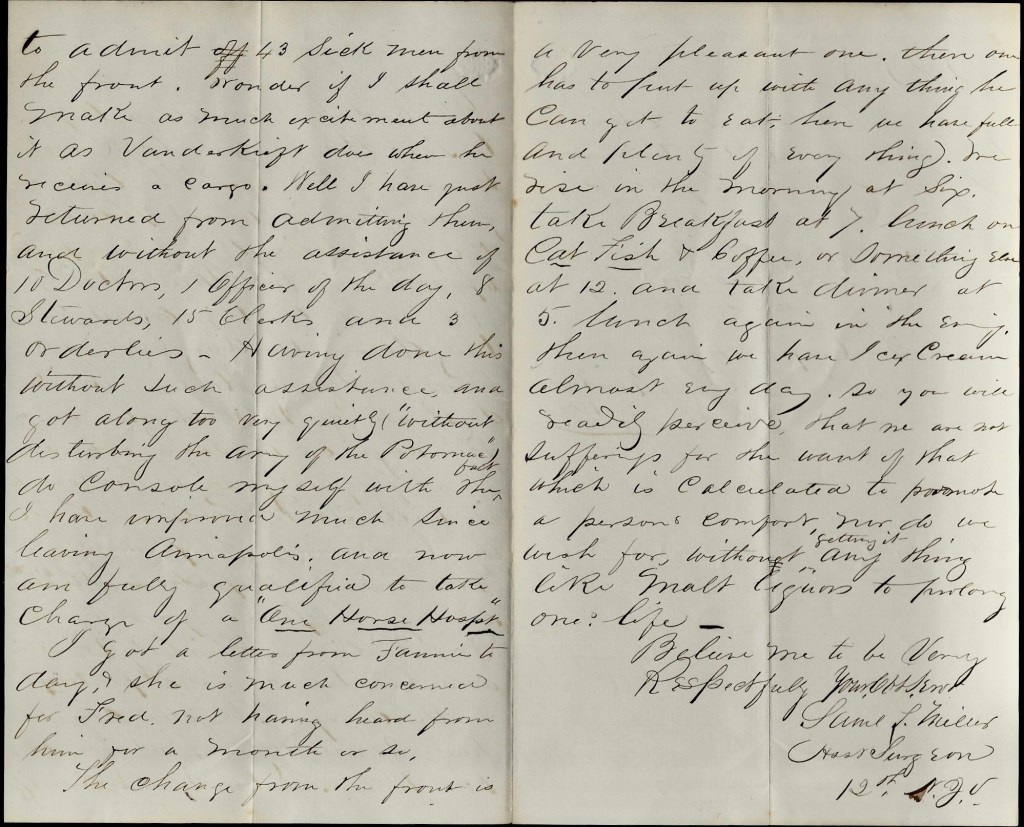
This City Point is and has been a great “Depot Hospital” for the army. The other day we had some 10,000 patients at one time. I am just broken off to admit 43 sick men from the front. Wonder if I shall make as much excitement about it as Vandergrift does when he receives a cargo. Well I have just returned from admitting them and without the assistance of 10 doctors, 1 officer of the day, 8 stewards, 15 clerks, and 3 orderlies. Having done this without such assistance and got along too very quietly (“without disturbing the Army of the Potomac”) I do console myself with the fact I have improved much since leaving Annapolis and now am fully gratified to take charge of a “One Horse Hospital.”
I got a letter from Fannie today & she is much concerned for Fred, not having heard from him for a month or so.
The change from the front is a very pleasant one. There one has to put up with anything he can get to eat. Here we have full and plenty of everything. We rise in the morning at six, take breakfast at 7, lunch on cat fish and coffee, or something else at 12 and take dinner at five. Lunch again in the evening, then again we have ice cream almost every day. So you will readily perceive that we are not suffering for the want of that which is calculated to promote a person’s comfort, nor do we wish for, without getting it, anything like malt liquors to prolong one’s life.
Believe me to be very respectfully your obedient servant, — Samuel T. Miller, Hospital Surgeon, 12th New Jersey Volunteers
P. S. Should you desire to write to me anytime soon, please direct as follows:
Samuel T. Miller Asst. Surgeon 12th N. J. Vols, 2nd Corps Hospital City Point, Va.
1 Mrs. Rebecca Lane (Pennypacker) Price (1837-1919) was a native of Phoenixville, Pennsylvania. She married Edwin Price in 1853 and volunteered as a nurse during the Civil War. She came to City Point after working at White House Landing with Mr. Ritz and Miss Sayles. “While at City Point, she was often seen helping with the organization of the wounded onto the hospital steamers using a state agent’s pass that Governor Curtin has issued her.” Rebecca came from the prominent Pennypacker family of eastern Pennsylvania. First cousin Galusha Pennypacker was a Civil War brigadier general by the time he was 20 years old and was awarded a Medal of Honor for his bravery at the Second Battle of Fort Fisher, North Carolina, in January 1865. She was second cousin to Samuel Whitaker Pennypacker, governor of Pennsylvania from 1903 to 1907, and her mother, Elizabeth, ran a Union Army hospital in Chambersburg, Pennsylvania.Source: The Women of City Point, Virginia” by Jeanne Marie Christie, pp.183-4.
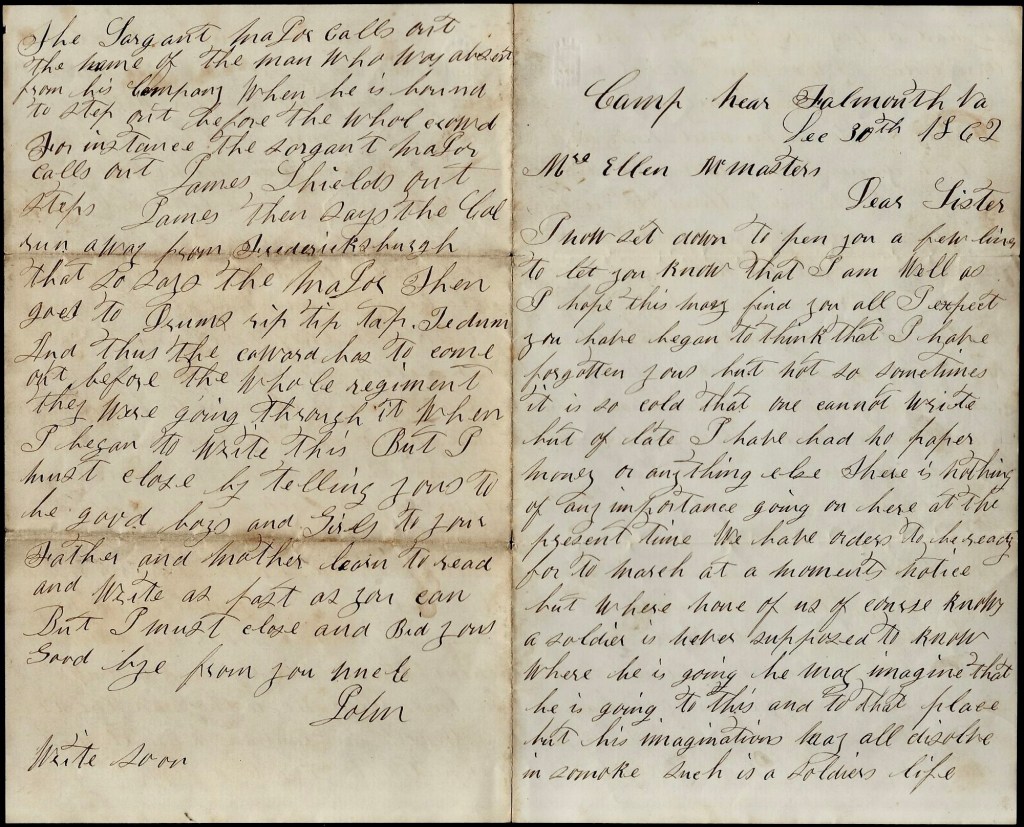
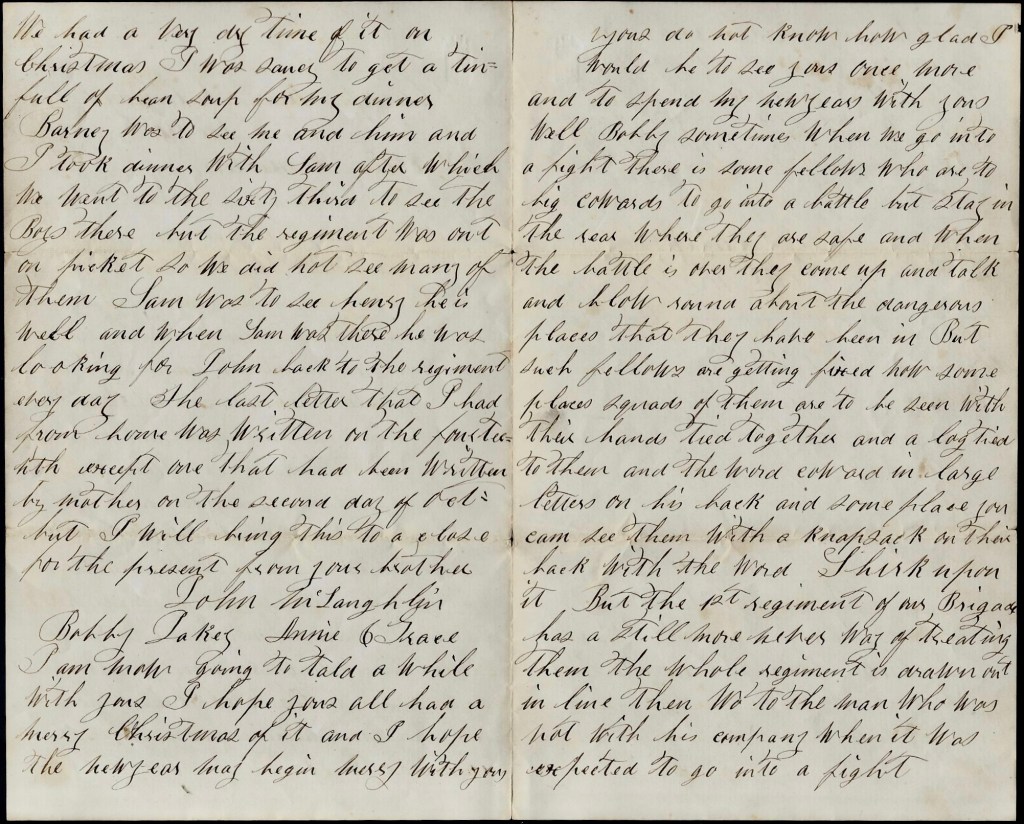
The following letters were written by John McLaughlin (1837-1863) who enlisted on 22 April 1861 at the age of 24 to served three years in Co. A, 74th New York Infantry. Prior to mid-December 1861, however, the regiment was known simply as the 5th Regiment of the Excelsior Brigade. Companies A and B were recruited in Pittsburg and in New York City—John joining in Pittsburg. These two companies were known as the U. S. Zouave Cadets, wearing a dark blue Zouave jacket with yellow trimming, a dark blue Zouave vest with yellow trimming, a sky blue sash, a red Zouave cap with yellow tassel, red pantaloons with yellow trimming, and white gaitors. John entered the regiment as a private but was later promoted to corporal. He was killed in action on 2 July 1863 in the Battle of Gettysburg and was originally buried on the south side of Nicholas Cordori’s farm but was later reinterred at the Gettysburg National Cemetery.
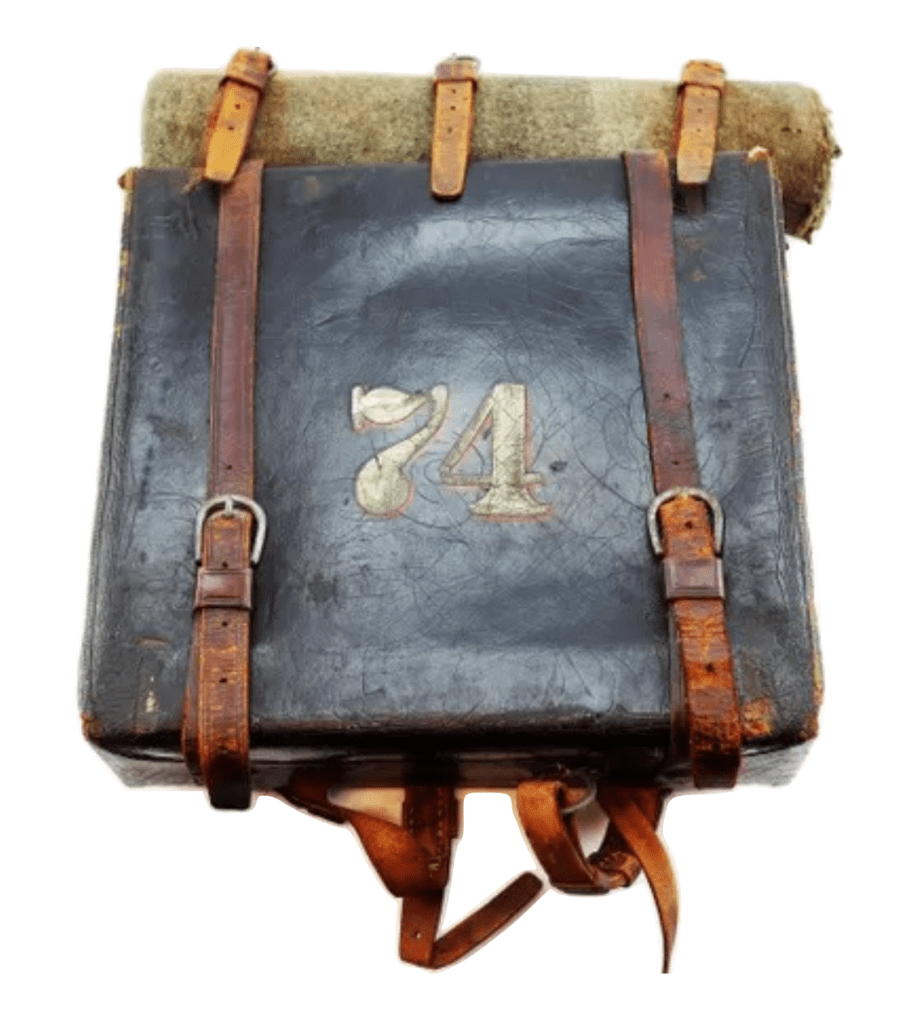
A knapsack from the 74th New York Infantry
The 74th New York Infantry mustered into the U. S. service at Camp Scott, Long Island, June 30 to Oct. 6, 1861, for a three year term. It left New York Aug. 20, for Washington; was attached to Sickles’ Excelsior Brigade and stationed along the Lower Potomac in Maryland during the first winter; embarked in April, 1862, for the Peninsula with the brigade, as part of the 2nd division, 3d corps; shared in the siege operations before Yorktown; took a prominent part in the battle of Williamsburg, for which the brigade won the highest praises, the loss of the regiment in this battle being 143 killed, wounded or missing, and in the ensuing engagements of Fair Oaks and the Seven Days’ battles it was constantly in action. Upon its withdrawal from the Peninsula in August, the regiment was sent to the support of Gen. Pope at Manassas, after which it retired to the Defenses of Washington. In November it marched to Falmouth; participated in the battle of Fredericksburg; returned to its camp at Falmouth for the winter; was engaged at Chancellorsville in May, 1863; returned again to camp at Falmouth; marched in June to Gettysburg and there experienced the hard fighting of the second day on the Emmitsburg road, with a loss of 89 killed, wounded and missing.
John wrote all three letters to his sister’s family. Eleanor (“Ellen”) McLaughlin (1833-1907) was married to a “coal agent” named William D. McMasters (1825-1877) in the early 1850s. The couple lived in McKeesport, Allegheny county, Pennsylvania, and had several children, the oldest four being Robert (“Bobby”) born in 1853, Jacob (“Jakey”) born in 1855, Emma (“Annie”) born in 1858, and Grace born in 1860. They are all mentioned in these letters.
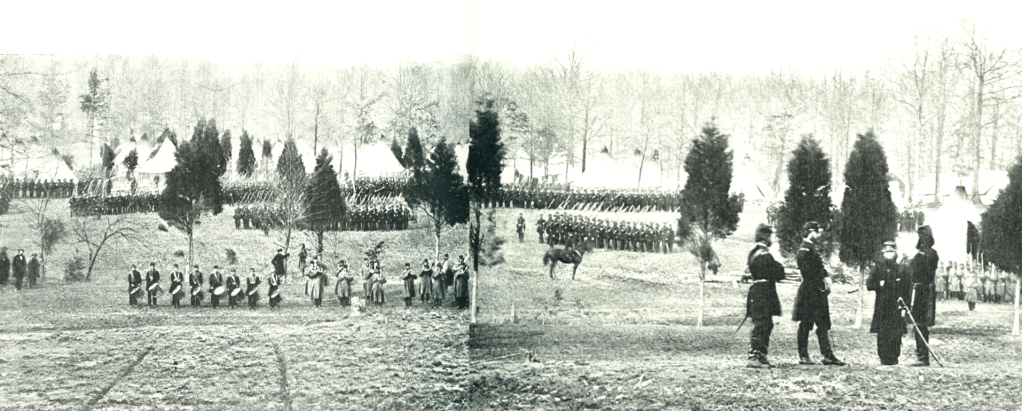
The 74th New York Infantry drilling in camp in 1861
Letter 1
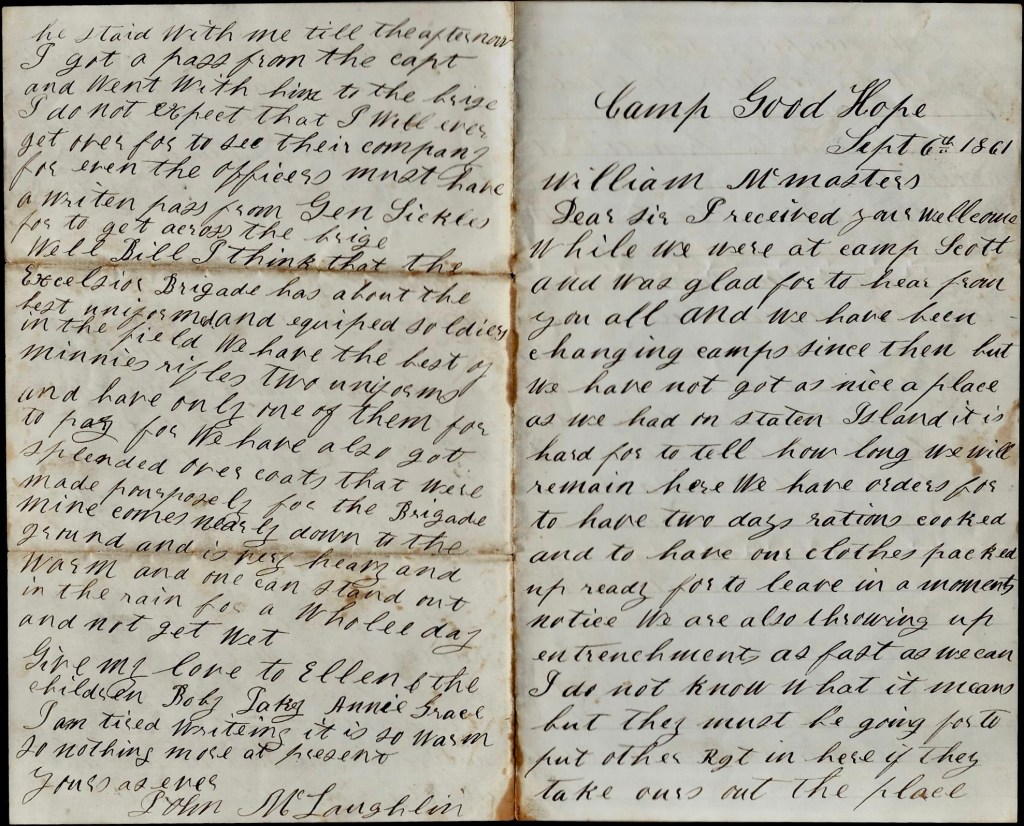
Camp Good Hope September 6, 1861
William McMasters,
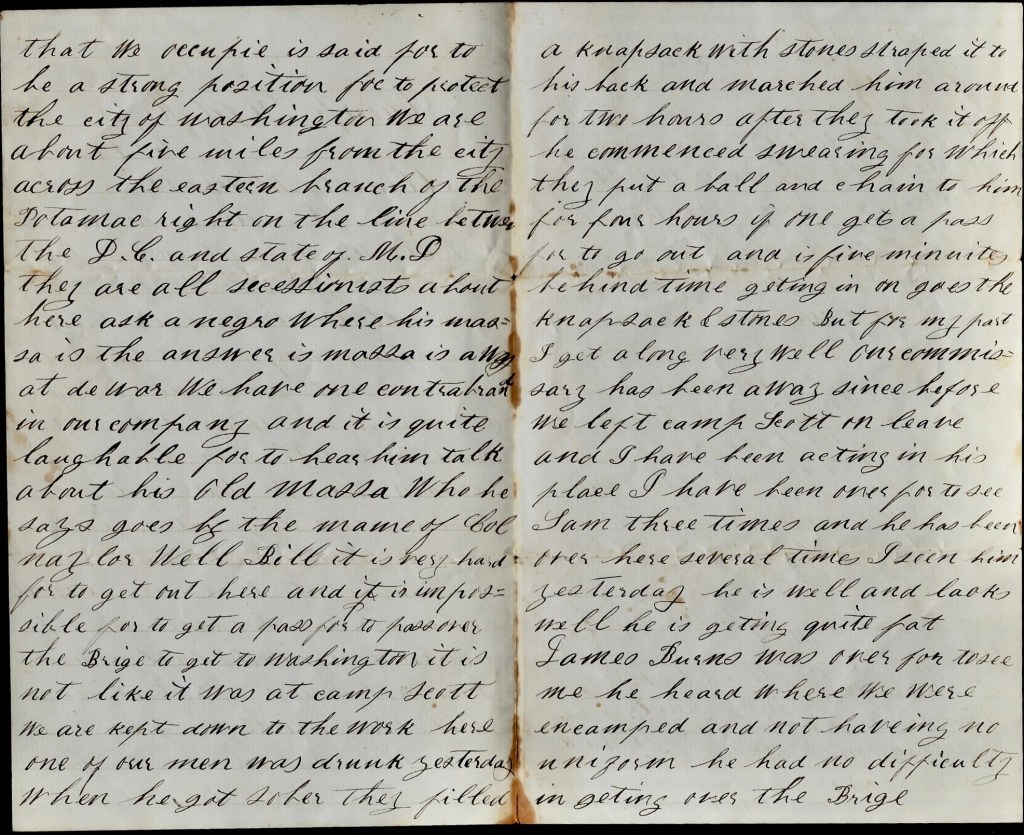
Dear sir, I received your welcome [letter] while we were at Camp Scott and was glad for to hear from you all and we have been changing camps since then but we have not got as nice a place as we had on Staten Island. It is hard for to tell how long we will remain here. We have orders for to have two days rations cooked and to have our clothes packed up ready for to leave in a moment’s notice. We are also throwing up entrenchments as fast as we can. I do not know what it means but they must be going for to put other regiments in here if they take ours out. The place that we occupy is said for to be a strong position for to protect the City of Washington.
We are about five miles from the city across the eastern branch of the Potomac, right on the line between the District of Columbia and State of Maryland. They are all secessionists about here. Ask a negro where his massa is, the answer is massa is away at de war. We have one contraband in our company and it is quite laughable for to hear him talk about his Old Massa who he says goes by the name of Col. Naylor.
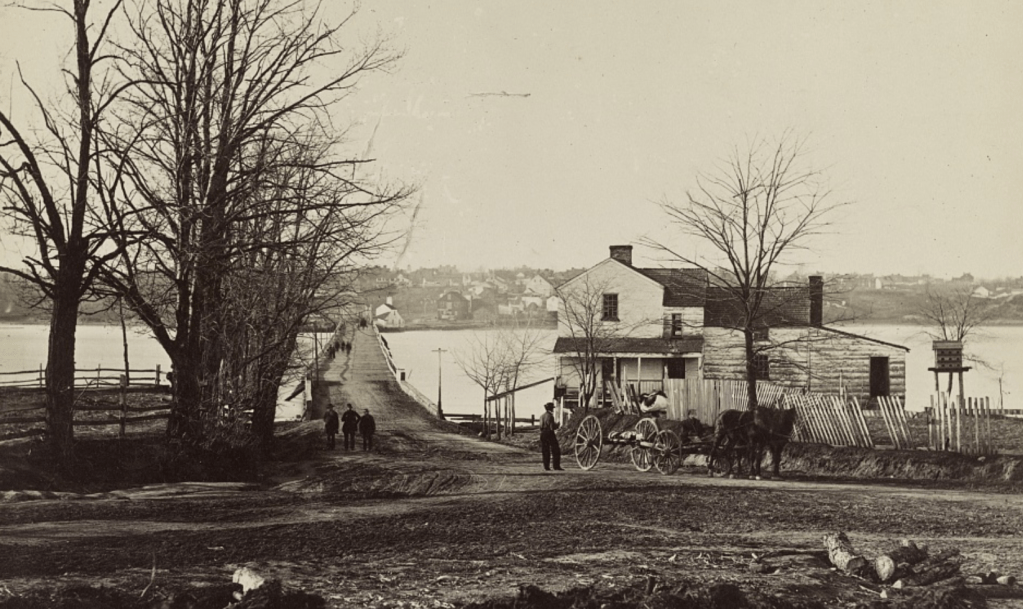
The bridge across the Eastern Branch of the Potomac (now called the Anacostia River) river between Washington City and Maryland. Library of Congress.
Well, Bill, it is very hard for to get a pass to pass over the bridge to get to Washington. It is not like it was at Camp Scott. We are kept down to the work here. One of our men was drunk yesterday. When he got sober they filled a knapsack with stones, strapped it to his back, and marched him around for two hours. After they took it off, he commenced swearing for which they put a ball and chain to him for four hours. If one gets a pass to go out and is five minutes behind time getting in, on goes the knapsack & stones. But for my part, I get along very well.
Our commissary [sergeant] has been away since before we left Camp Scott on leave and I have been acting in his place. I have been over for to see Sam three times and he has been over here several times. I seen him yesterday. He is well and looks well. He is getting quite fat.
James Burns was over for to see me. He heard where we were encamped and not having no uniform, he had no difficulty in getting over the bridge. He staid with me till the afternoon. I got a pass from the captain and went with him to the bridge. I do not expect that I will ever get over to see their company for even the officers must have a written pass from Gen. Sickles for to get across the bridge.
Well, Bill, I think that the Excelsior Brigade has about the best uniforms and [best] equipped soldiers in the field. We have the best of Minié rifles [and] two uniforms (and have only one of them for to pay for). We have also got splendid overcoats that were made purposely for the brigade. Mine comes nearly down to the ground and is very heavy and warm and one can stand out in the rain and not get wet.
Give my love to Ellen & the children—Bobby, Jakey, Annie, Grace. I am tired writing, it is so warm. So nothing more at present. Yours as ever, — John McLaughlin
Letter 2
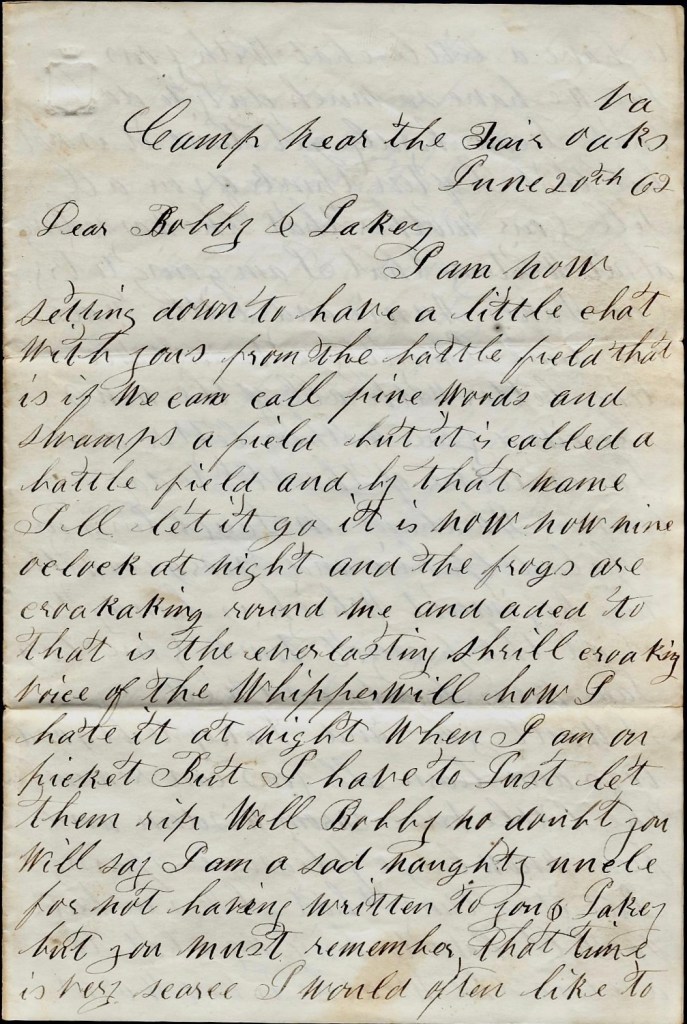
Camp near Fair Oaks, Virginia June 20th 1862
Dear Bobby and Jakey,
I am now sitting down to have a little chat with you from the battle field—that is, if we can call pine woods and swamps a field; but it is called battle field and by that name I’ll let it go. It is now nine o’clock at night and the frogs are croaking round me and added to that is the everlasting shrill croaking voice of the whippoorwill. How I hate it at night when I am on picket. But I have to just let them rip.
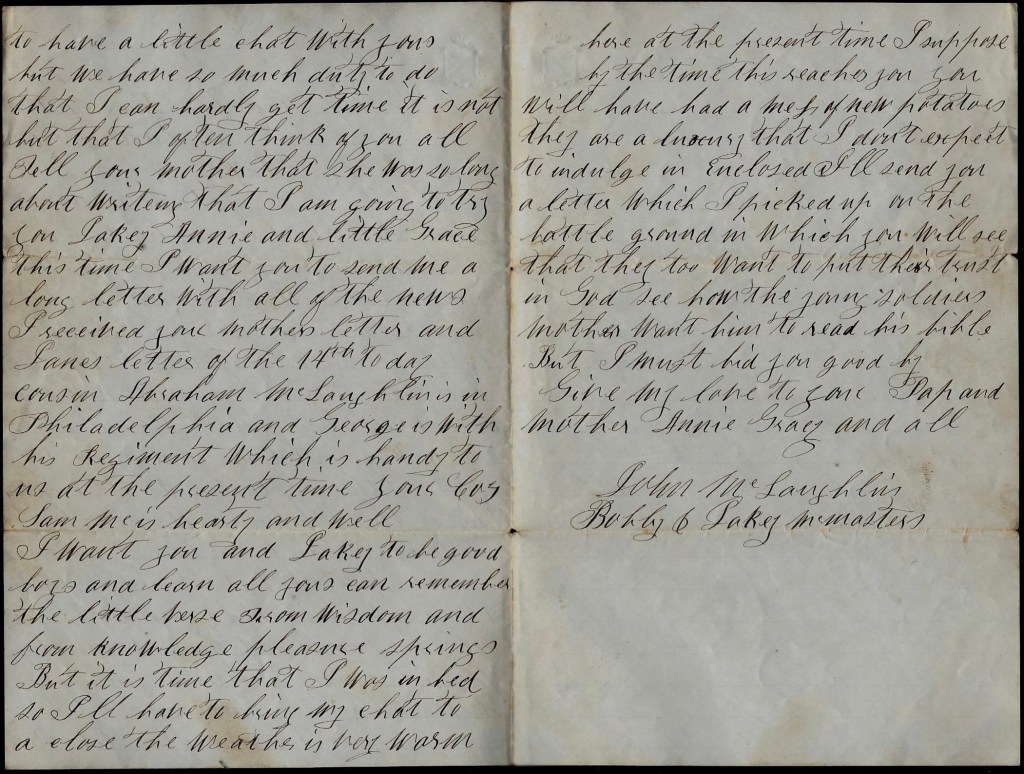
Well, Bobby, no doubt you will say I am a sad, naughty uncle for not having written to you & Jakey but you must remember that time is very scarce. I would often like to have a little chat with you but we have so much duty to do that I can hardly get time. It is not but that I often think of you all. Tell your mother that she was so long about writing that I am going to try you, Jakey, Annie, and little Grace this time. I want you to send me a long letter with all of the news. I received your mother’s letter adn Jane’s letter of the 14th today. Cousin Abraham McLaughlin is in Philadelphia and George is with his regiment which is handy to us at the present time. Your cousin Sam McLaughlin is hearty and well.
I want you and Jakey to be good boys and learn all you can. Remember the little verse from wisdom and knowledge pleasure springs. But it is time that I was in bed so I’ll have to bring my chat to a close. The weather is very warm here at the present time. I suppose by the time this reaches you, you will have had a mess of new potatoes. They are a luxury that I don’t expect to indulge in.
Enclosed I’ll send you a letter which I picked up on the battle ground in which you will see that they [the Rebels] too want to put their trust in God. See how the young soldier’s mother wants him to read his bible?
Give my love to your Pap and Mother, Annie, Grace, and all.
— John McLaughlin
Letter 3
Camp near Falmouth, Va. December 30th 1862
Mrs. Ellen McMasters,
Dear sister, I now sit down to pen you a few lines to let you know that I am well as I hope this may find you all. I expect you have began to think that I have forgotten you but no so. Sometimes it is so cold that one cannot write but of late I have had no paper, money, or anything else. There is nothing of importance going on here at the present time. We have orders to be ready for to march at a moment’s notice but where, none of us of course knows. A soldier is never supposed to know where he is going. He may imagine that he is going to this and to that place, but his imaginations may all dissolve in smoke. Such is a soldier’s life.
We had a very dry time of it on Christmas. It was saucy to get a tin-full of bean soup for my dinner. Barney was to see me and him and I took dinner with Sam after which we went to the 63rd [New York Regiment] to see the boys there but the regiment was out on picket so we did not see many of them. Sam was to see Henry. He is well and when Sam was there, he was looking for John back to the regiment every day. The last letter that I had from home was written on the 14th except one that had been written by mother on the 2nd day of October. But I will bring this to a close for the present. From your brother, — John McLaughlin
Bobby, Jakey, Annie & Grace, I am now going to talk awhile with you. I hope you all had a Merry Christmas of it and I hope the New Year may begin merry with you. You do not know how glad I would be to see you once more and to spend my New Years with you.
Well, Bobby, sometimes when we go into a fight there is some fellows who are too big [of] cowards to go into a battle but stay in the rear where they are safe and when the battle is over, they come up and talk and blow round about the dangerous places that they have been in. But such fellows are getting fixed now. [In] some places, squads of them are to be seen with their hands tied together and a log tied to them and the word “Coward” in large letters on his back. And some places you can see them with a knapsack on their back with the world “Shirk” upon it. But the 1st regiment of our brigade has a still more severe way of treating them. The whole regiment is drawn out in line, then woe to the man who was not with the company when it was expected to go into a fight. The Sergeant Major calls out the name of the man who was absent from his company when he bound to step out before the whole crowd. The instance, the Sergeant Major calls out, “James Shields!” [and] out steps James. Then says the Colonel, “Run away from Fredericksburg!” “That’s so!” says the Major. Then goes the drums—rip, tip, tap, the dum—and thus the coward has to come out before the whole regiment. They were going through it when I began to write this. But I must close by telling you to be good boys and girls to your Father and Mother. Learn to read and write as fast as you can. But I must close and bid you goodbye. From your uncle, — John
The following letter was written by Thomas A. Sanders (1840-1910), the son of Thomas Sanders and Ellen Leonard (1818-Aft1850) of Clermont county, Ohio. It’s probable that one or both of Thomas’s parents were deceased before the Census of 1860.
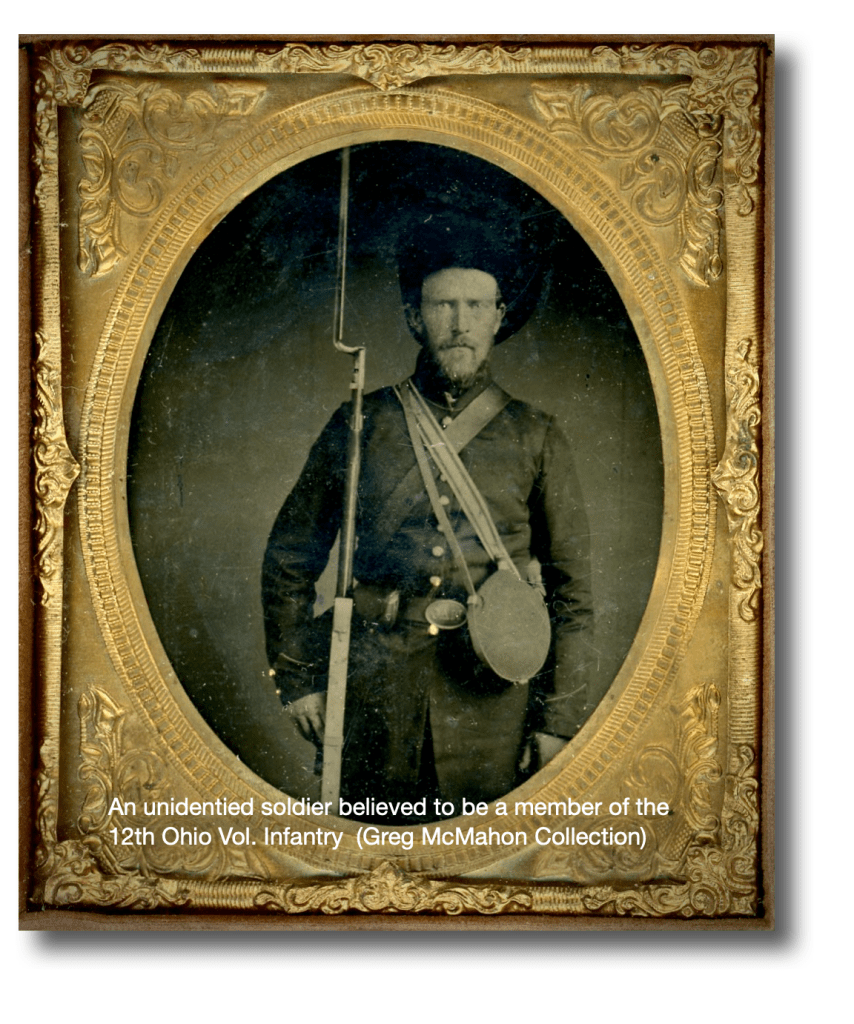
I could not find an image of Thomas but here’s a tintype of a member of the 12th OVI (Greg McMahon Collection)
Thomas wrote the letter while serving in Co. C, 12th Ohio Volunteers Infantry (OVI. He enlisted in the 12th OVI on 22 April 1861 when it was a 3-month’s regiment and then reenlisted as a private in the same company for three years and was discharged at Fayetteville, West Virginia on 31 December 1863 as a 1st Sergeant. In July 1864 he reenlisted as a 1st Sergeant in Co. C of the 23rd OVI.
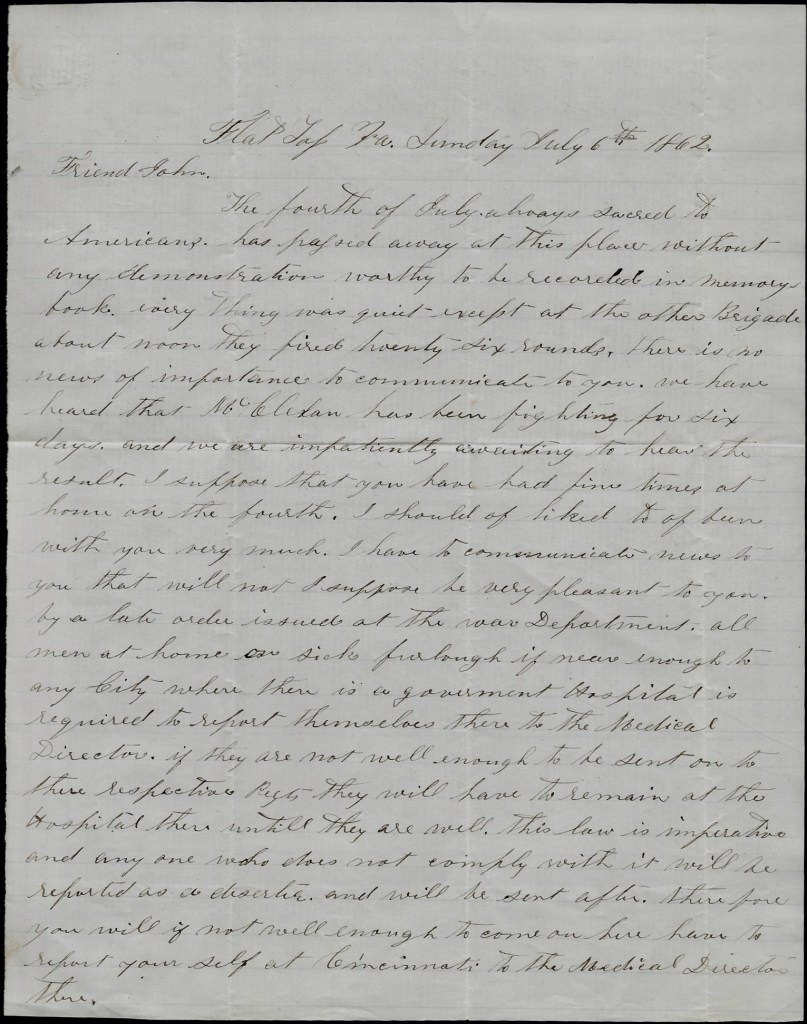
Thomas’s letter informs us that the regiment spent the 4th of July quietly, without celebration, at Flat Top, Virginia (now W. Va.) in the Kanawha Valley where they were attached to the 1st Brigade, Dept. of the Mountains. They had seen combat in the Battle of Carnifex Ferry in the fall of 1861 but they would not see serious action again until the Maryland Campaign a year later at South Mountain and the Otto Farm at Antietam.
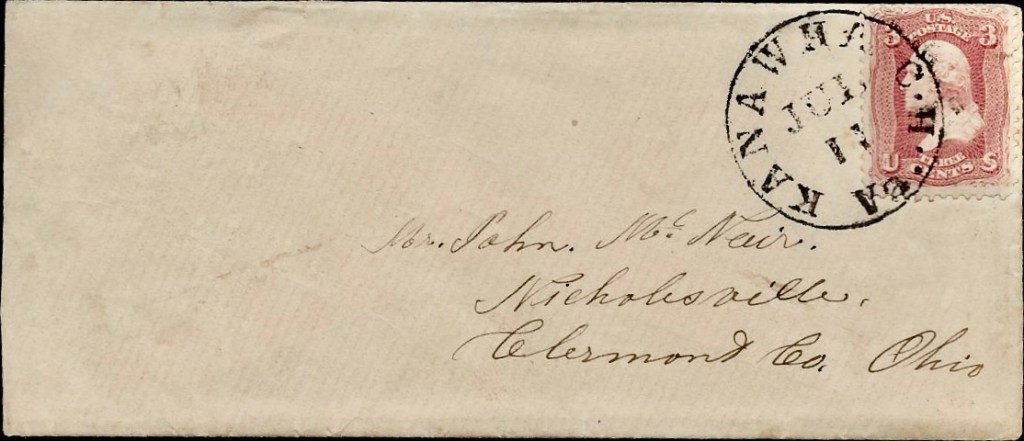
Thomas wrote the letter to his comrade John McNair of the 12th OVI who was at his home in Nicholasville, Ohio, apparently recuperating from a severe illness. John was discharged for disability on 9 February 1863. He later served in the 53rd Ohio Vol. Infantry (National Guard) in July 1863 for 100 days. The main theme of the letter is to communicate an order by the War Department directing all sick men at home to report to the Medical Director of the nearest military hospital.
Transcription
Addressed to Mr. John McNair, Nicholasville, Clermont county, Ohio
Flat Top, Va. Sunday, July 6th 1862
Friend John,
The fourth of July—always sacred to Americans—has passed away at this place without any demonstration worthy to be recorded in memory’s book. Everything was quiet except at the other Brigade. About noon the fired twenty-six rounds. There is no news of importance to communicate to you. We have heard that McClellan has been fighting for six days and we are impatiently awaiting to hear the result.
I suppose that you have had fine times at home on the fourth. I should have liked to of been with you very much. I have to communicate news to you that will not I suppose be very pleasant to you. By a late order issued at the War Department, all men at home on sick or furlough if near enough to any city where there is a government hospital is required to report themselves there to the Medical Director. If they are not well enough to be sent on to their respective regiments, they will have to remain at the hospital there until they are well. This law is imperative and anyone who does not comply with it will be reported as a deserter and will be sent after. Therefore you will if not well enough to come on here have to report yourself at Cincinnati to the Medical Director.
The order is published I believe in all county papers but I have thought it best to give you notice by letter for fear you would not see it in the papers. I know it will not be very pleasant for you to leave home and go to any hospital, but it will be better for you to do so. I hope that you are much better by this time. I should like to hear from you often if it will be convenient for you. The boys all join me in love to you. Please write soon.
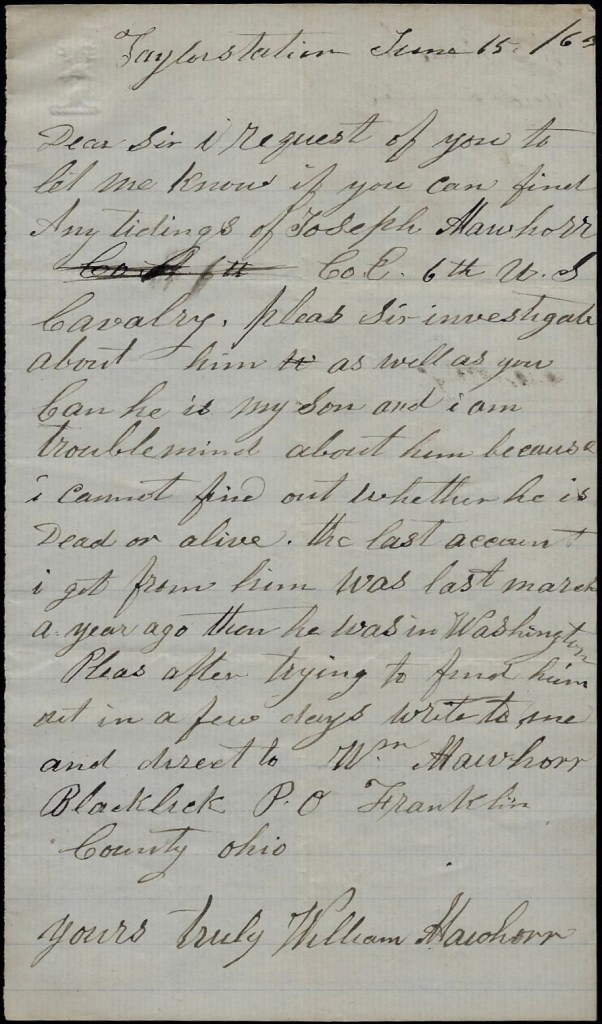
I could not identify the author of this letter whose name appears to read “William Mawhorr.” He gives his location as Taylor’s Station which was a whistle stop on the railroad east of Columbus, Ohio—just east of the present day Columbus International Airport. William’s letter beseeches the US Military to send him some word of his son Joseph, having not heard from him in 15 months. William states his believe that Joseph was serving in the 6th US Cavalry, Co. C.
I do not have access to a roster to enable me to check for Joseph so for now, Joseph and his father will remain identified in name only.
Transcription
Taylor’s Station June 15th 1863
Dear Sir,
I request of you to let me know if you can find any tidings of Joseph Mawhorr, Co. C, 6th U. S. Cavalry. Please, sir, investigate about him as we as you can. He is my son and I am trouble mind about him because I cannot find out whether he is dead or alive. The last account I got from him was last March a year ago. Then he was in Washington.
Please, after trying to find him out, in a few days write to me and direct to Wm. Hawhorr, Blacklick P. O., Franklin county, Ohio
The following letter was written by Isaac Smedley (1838-1867), the eldest son of Jeffrey Smedley (1810-1861) and Catherine W. Denny (1802-1877) of Willistown, Chester county, Pennsylvania. Isaac was 23 years-old when he was mustered into Co. C, 97th Pennsylvania Infantry on 11 September 1861. He was quickly appointed 1st Sergeant of his company and was commissioned at 2nd Lieutenant on 19 February 1862. He was discharged for disability on 9 March 1863, at Seabrook Island, South Carolina. Unmarried, he sadly died of consumption (tuberculosis) on 12 February 1867 at the young age of 28 and was buried in Willistown Friends Cemetery, Chester, Delaware Co.
In his letter, Isaac describes the expedition led by Flag Officer Samuel Du Pont to take Fernandina, Florida—a railroad connected port city of some importance near the border with Georgia. With limited resources at hand in early 1862, the Confederates strengthened Savannah and Charleston and all but abandoned the lesser ports like Fernandina which was guarded by Fort Clinch. When an escaped slave informed DuPont that Fernandina was only lightly defended, he took the city with little or no resistance. The 97th Pennsylvania was part of that expedition and remained in Fernandina from March 5th until March 24th, when they moved to Jacksonville. Isaac suggests that the few rebels that guarded Fernandina were duped into not firing on the Union fleet because they approached the city under French colors but I have not been able to verify this under any other account.
This image showing Union troops marching down Second Street in Fernandina, was published on March 4, 1862. On March 3, the Union fleet had arrived and exchanged fire with the Confederates, who were abandoning Fort Clinch.
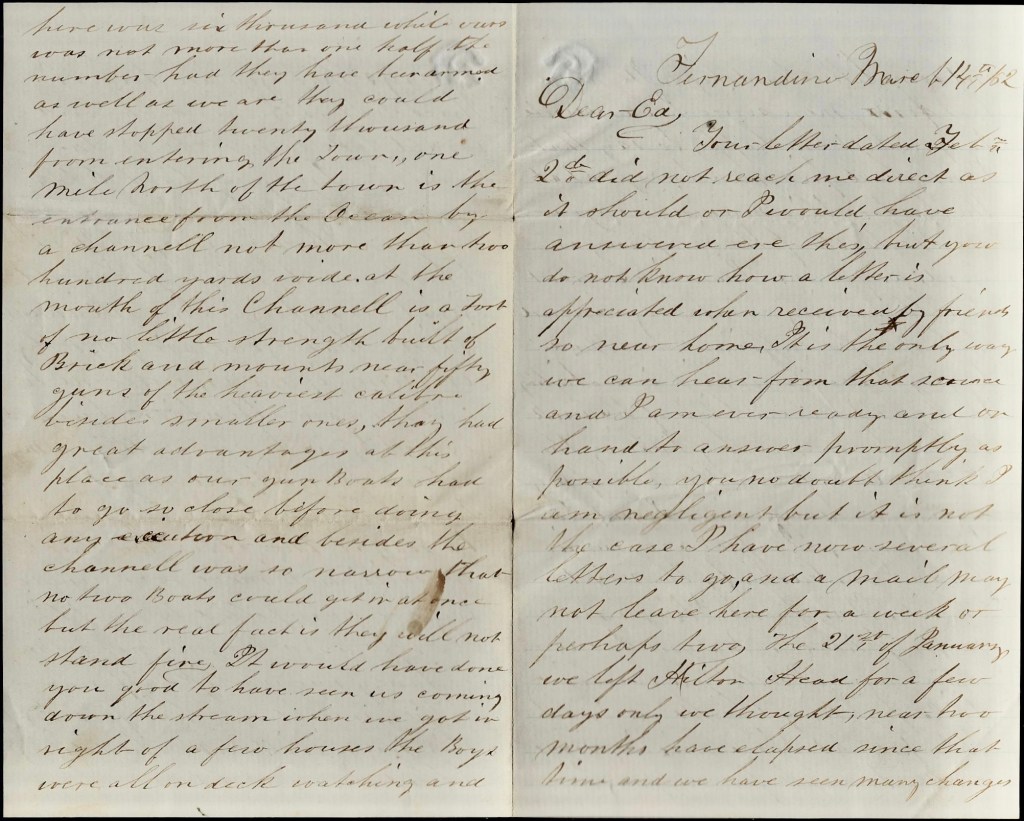
Fernandina, [Florida] March 14, 1862
Dear Ed,
Your letter dated February 2nd did not reach me direct as it should or I would have answered ere this but you do not know how a letter is appreciated when received by friends so near home. It is the only way we can hear from that source and I am ever ready and on hand to answer promptly as possible. You no doubt think I am negligent but it is not the case. I have now several letters to go and a mail may not leave here for a week or perhaps two.
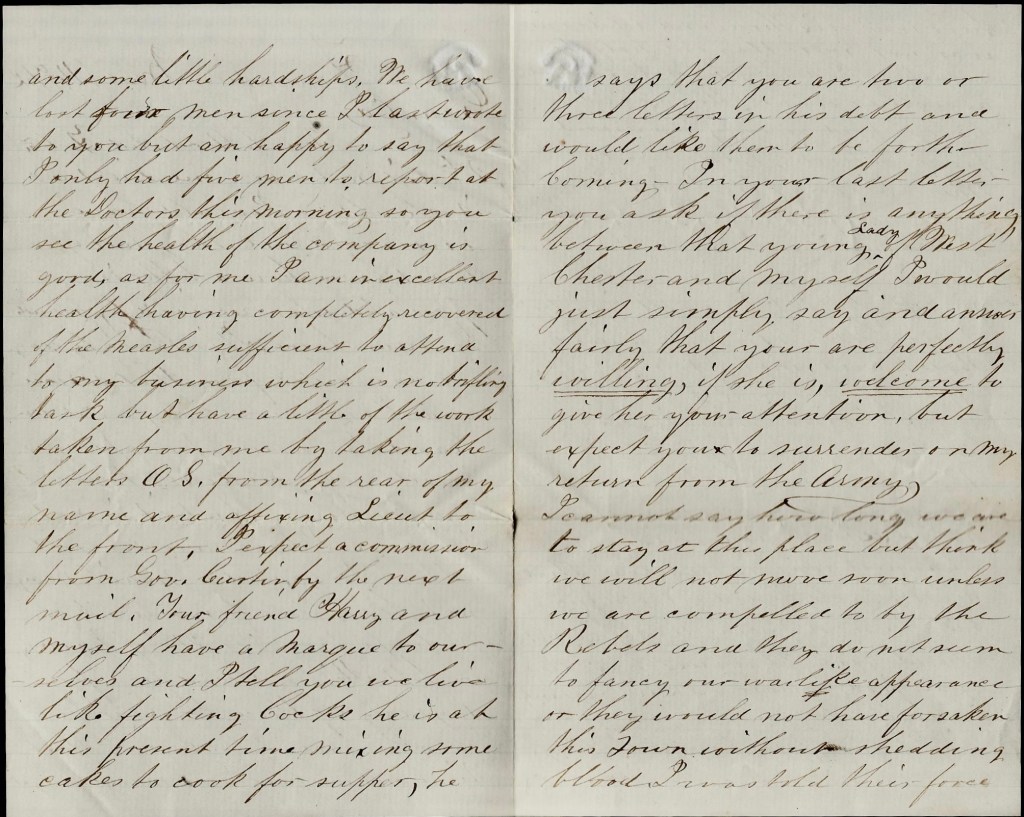
The 21st of January, we left Hilton Head for a few days only we thought. Near two months have elapsed since that time and we have seen many changes and some little hardships. We have lost four men since I last wrote to you, but am happy to say that I only had five men to report at the Doctor’s this morning, so you see the health of the company is good. As for me, I am in excellent health, having completely recovered of the measles sufficient to attend to my business which is no trifling task, but have a little of the work taken from me by taking the letters O. S. [Orderly Sergeant] from the rear of my name and affixing Lieut. to the front. I expect a commission from Gov. Curtin by the next mail. Your friend Harry and myself have a marque to ourselves, and I tell you we live like fighting cocks. He is at this present time mixing some cakes to cook for supper. He says that you are two or three letters in his debt and would like them to be forthcoming.
In your last letter you ask if there is anything between that young lady of West Chester and myself. I would just simply say and answer fairly that you are perfectly willing, if she is, welcome to give her your attention, but expect you to surrender on my return from the army.
I cannot say how long we are to stay at this place but think we will not move soon unless we are compelled to by the Rebels and they do not seem to fancy our warlike appearance or they would not have forsaken this town without shedding blood. I was told their force here was six thousand while ours was not more than one half the number. Had they have been armed as well as we are, they could have stopped twenty thousand from entering the town. One mile north of the town is the entrance from the ocean by a channel not more than two hundred yards wide. At the mouth of this channel is a fort of no little strength, built of brick, and mounts near fifty guns of the heaviest caliber, besides smaller ones. They had great advantages at this place, as our gun boats had to go so close before doing any execution, and besides the channel was so narrow that no two boats could get in at once. But the real fact is they will not stand fire. It would have done you good to have seen us coming down the stream.
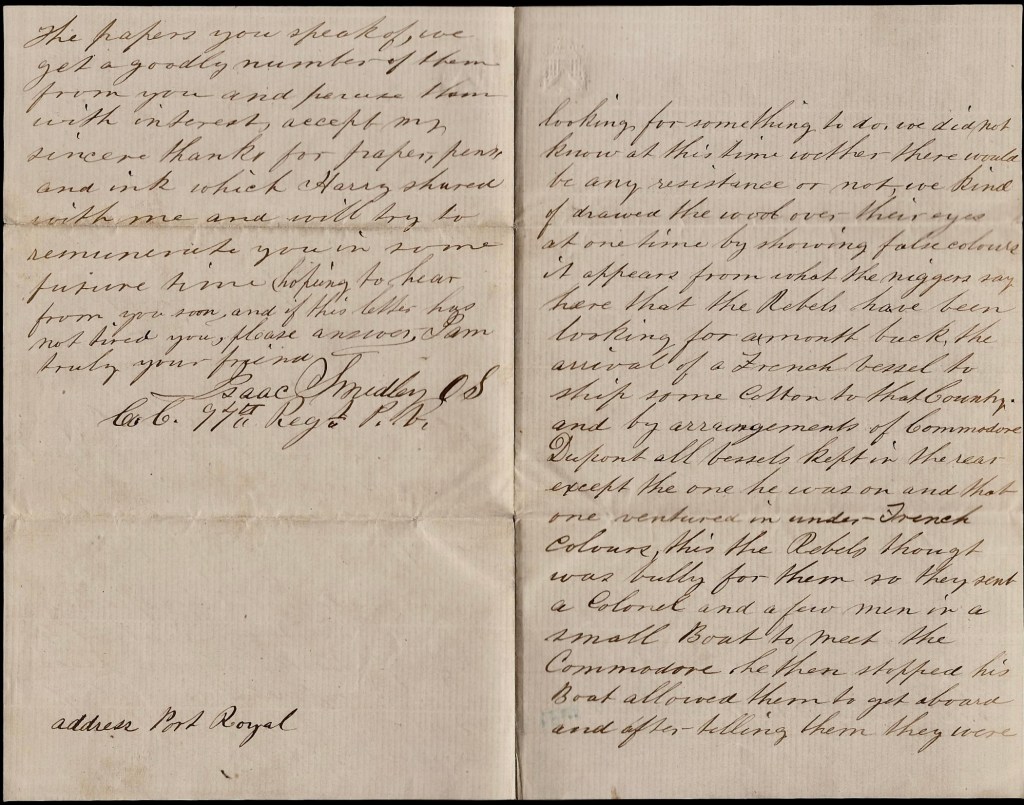
When we got in sight of a few houses, the boys were all on deck watching and looking for something to do. We did not know at this time whether there would be any resistance or not. We kind of drawed the wool over their eyes at one time by showing false colors. It appears—from what the niggers say here—that the Rebels have been looking for a month back the arrival of a French vessel to ship some cotton to that country and by arrangements of Commodore DuPont, all vessels kept in the rear, except the one he was on, and that one ventured in under French colors. This the Rebels thought was bully for them, so they sent a Colonel and a few men in a small boat to meet the Commodore. He then stopped his boat, allowed them to get aboard, and after telling them they were prisoners, deposited them below for safe keeping and immediately hoisted the flag of our Union. This I consider was a pretty nice affair, but we had one great disadvantage to contend with, which was the low tide of waters, the channel being so narrow that the large vessels which carried the transports could not get in which gave the Rebels time enough to leave the town and take everything with them of any value. The only capture we made of any importance was a pleasure boat. It would have made its escape had it not have been for a shell fired after it, warning it of the danger of attempting to pass one of those Kill Devils, as the Rebels call them and dread so much.
I have just come in from drill and will attempt to finish this letter before dress parade. Lieut. Griffith has been unwell ever since we came here, which throws the company in my charge. I have had no time to go into town since I came here, only a few minutes at a time. I want to as soon as Lieut. Griffith is able to command the company, to take a good look over it and see a little over the country. It has been a splendid place and from the style of the houses, there must have been an aristocratic set of inhabitants therein. The town is about the size of West Chester. Our place of encampment is south of it about a hundred yards alongside of a park.
The papers you speak of we get a goodly number of them from you and peruse them with interest. Accept my sincere thanks for paper, pen, and ink which Harry shared with me and will try to remunerate you in some future time. Hoping to hear from you soon, and if this letter has not tired you, please answer.
I am truly your friend, — Isaac Smedley, O.S., Co. C, 97th Regt. P. V.
The following letters were written by William Newell Brainard (1823-1894), the son of Jonathan Brainard (1794-1856) and Sarah Gage (1797-1867 of De Ruyter, New York. William went to California as a gold seeker in 1850. He mined on the North Fork of the American River and then went to Sacramento where he engaged in the produce commission business with Morehouse. While there, he was elected city treasurer. He returned to Chicago in the spring of 1858 and engaged in the grain trade.
William wrote the letters to Ransom Morehouse (b. 1827) who, with his brother William Henry Morehouse (1832-1901) were partners with Brainard in the firm Morehouse & Brainard. The Morehouse brothers were from Kane county, Illinois.
William was married to Melinda B. Coley (1826-1908) on 3 May 1853 in Syracuse, New York. The couple had at least three children—Hattie Belle Brainard (1855-1855), William Vallejo Brainard (1857-1886), and Frances Marion Brainard (1863-1894).
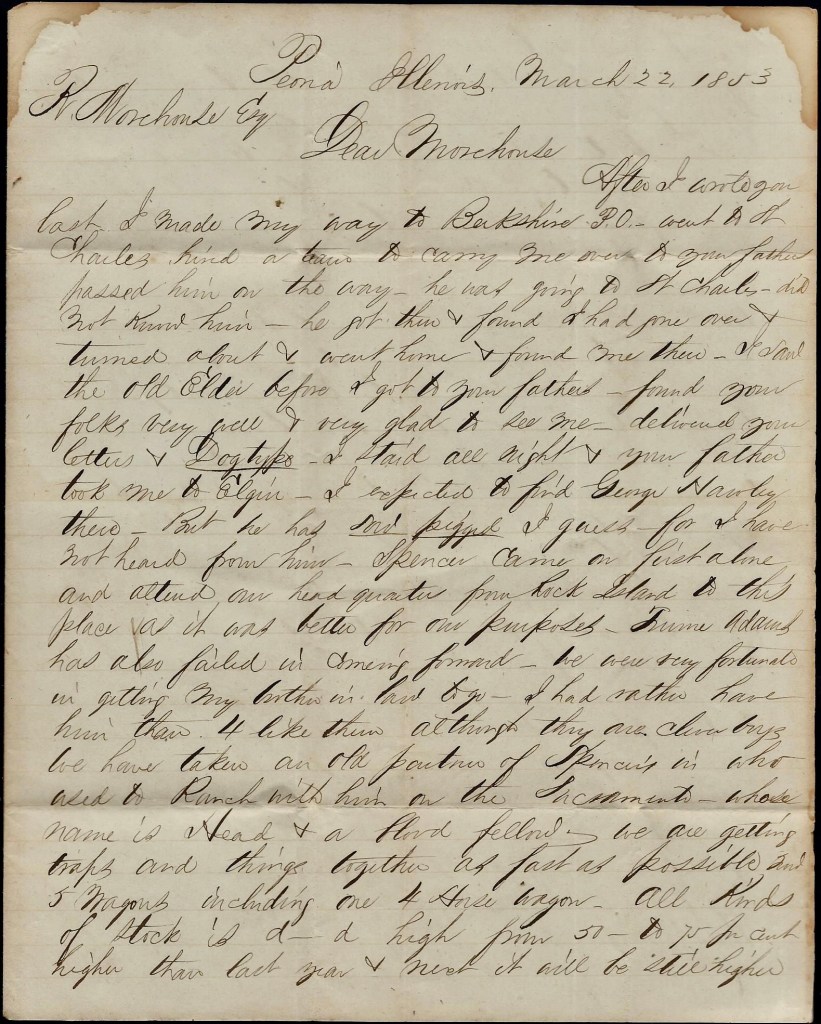
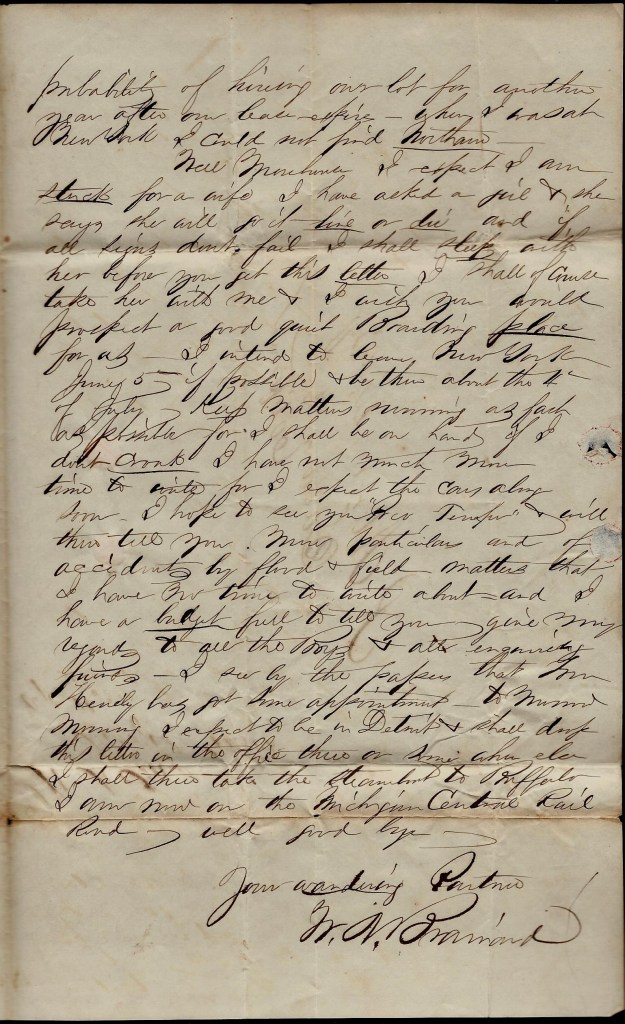
Dear Morehouse, after I wrote you last, I made my way to Berkshire P. O., went to St. Charles, hired a team to carry me over to your father’s, passed him on the way—he was going to St. Charles—did not know him—he got there and found I had gone over & turned about & went home & found me there. I saw the old Elder before I got to your father’s—found your folks very well & very glad to see me—delivered your letters & Dogtype [daguerreotype]. I staid all night & your father took me to Elgin. I expected to find George Hawley there but he has sow pigged I guess for I have not heard from him. Spence came on first alone and attend our headquarters from Rock Island to this place as it was better for our purposes. Triune Adams has also failed in coming forward. We were very fortunate in getting my brother-in-law to go. I had rather have him than 4 like then although they are clever boys.
We have taken an old partner of Spencer’s in who used to ranch with him on the Sacramento whose name is Head & a blood fellow. We are getting traps and things together as fast as possible and five wagons including one 4-horse wagon. All kinds of stock is damned high—from 50 to 75 percent higher than last year & next it will be still higher.
The company have bought 7 horses costing about $120 each and rousing horses too. I have also bought a dray horse for our own use & going over on our own hook. He is a buster—17 hands high, coal black, and weighs 1500. He will take down anything in California. He is green as grass. I bought him of the man who raised him. 6 years old. I paid $150 & I could sell him in Chicago, I’ll bet, for $300. [Lewis W.] Walker 1 has on his own hook a French mare for his wife to ride. Spencer’s wife is on the ground all right.
We mean to leave here April 4th. We have about all our work oxen bought. We calculate on 16 yoke cattle. 4 wagons & 4 yoke to each wagon. We have also some cows bought up and the boys all out now buying. I have just come in town—have been out buying. Good cows will cost us on an average $20 & cattle for yoke $75. We shall start and buy along the road till the money gives out.
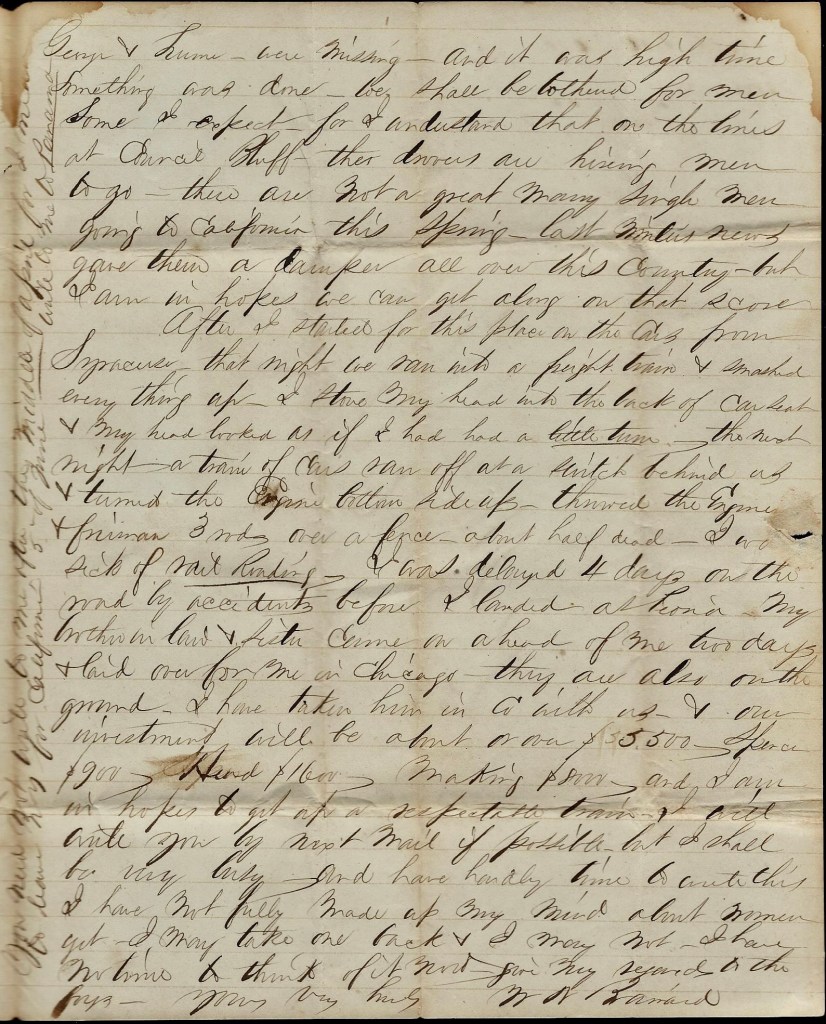
Your father paid me $275 & I wrote him to send me the balance he could make out to this place for as George has failed me, we cannot operate any up in Kane county & did not see Bill Smith. I sent and to him but he did not come up & did not see John McClelland & told your father about his & George’s affairs. I saw Ed Hucley. His father was away. I had quite a visit with the old Elder. He is all right. I was in a devil of a hurry when I was there, having learned that George & Lum were missing—and it was high time something was done. We shall be bothered for men some, I expect, for I understand that on the lines at Council Bluff their drovers are hiring men to go. There are not a great many single men going to California this spring. Last winter’s news gave them a damper all over this country, but I am in hopes we can get along on that score.
After I started for this place on the cars from Syracuse, that night we ran into a freight train & smashed everything up. I stove my head into the back of a car seat & my head looked as if I had had a little turn. The next night a train of cars ran off at a switch behind us & turned the engine bottom side up, thrower the engine and fireman 3 rods over a fence about half dead. I was sick of railroading & was delayed 4 days on the road by accidents before I landed at Peoria. My brother-in-law and sister came on ahead of me two days and laid over for me in Chicago. They are also on the ground. I have taken him in company with us & our investments will be about or over $5,500. Spence $900, Head $1600, making $8,000, and I am in hopes to get up a respectable train.
I will write you by next mail if possible but I shall be very busy and have hardly time to write this. I have not fully made up my mind about women yet. I may take one back & I may not. I have no time to think it now. Give my regards to the boys. Yours very hasty, — W. N. Brainard
You must not write to me after the middle of April for I mean to leave N. Y. for California 5th of June. Write to me to Panama.
1 Lewis W. Walker (b. 1825) was married to Lydia Jane Brainard (b. 1826). The couple made it to California on the overland trail in the summer of 1853 and Lewis took a farm in Petaluma.
Letter 2
Dowagiac, Michigan April 14, 1853
R. Morehouse, Esq. Sacramento, California
Dear Morehouse, I have got so far on my way back to New York and stopped here a few days to see some of my friends and am now waiting for the cars to come along and thus shall continue my way back home, and thought I would write you now for I don’t know when I shall have the opportunity to do so & get the letter in the mail that leaves New York the 20th inst. and I don’t know that this will be in but hope so.
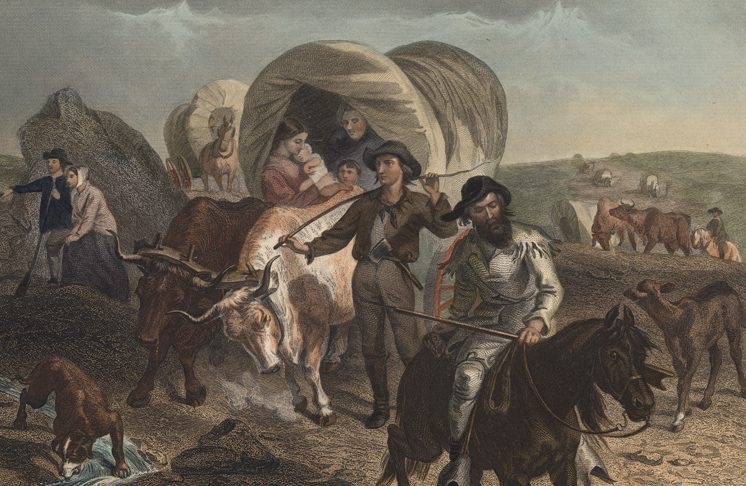
Well, to commence where I left off in my last, we—the “New York California Co.” left Peoria April 4th with the 4 ox wagons & one 4-horse wagon, got in our loose stock about there & went over to Farmington & collected in the next day what I had bought about there and went on toward Burlington, Iowa. April 9th we crossed the Mississippi with 170 cows and heifers and steer, some 20 yoke of oxen, 7 horses belonging to the company, one of our own, one more belonging to my brother-in-law, and myself for my sister to ride, and 20 other horse belonging to two men in the train making 11 horses in all. The outfit was all about the wagons excepting flour, sugar, and bacon which they are to take in at Council Bluffs. And we have got O entire to say as good a lot of stock as will start this year from the states. I had rather have our 200 or more head than double the number of any stock I have seen start. The company consists of Spencer, Head & Walker with Spencer’s wife and my sister and 12 men besides. Some of the men paid in $50, some less, and some nothing, and are good men, I guess, as can generally be got together. The capital stock included is $7825 and I have invested on our account $4250, besides the dray horse and charges on him for shoeing & keeping him $160 and my expense going out and back will be not far from $100.
I left the company Burlington & they had some $1500 left for expenses & to invest in stock in trade across the plains or otherwise as needed and that will make as large a drove as is well to drive in one company. I did not go to your father’s on my way back for my time would not admit of it. Just before I started I had a letter from your father & one from George Hawley who had got out there but he was sick and of no account as to going across the plains. I got only the $275 of your money at home. Your father wrote me that he could not collect in the rest and it is just as well.
I have pledged the boys that you will meet them on the desert & you must if I should be cast away or go down to the bottom on my way back. I wish you would make some suitable enquiries as to where we can drive the stock after we get there into California. Perhaps we can make some arrangements with Jim & Alex McCane to drive them onto their ranch and I should like to have Alex or Jim go over to Carson Valley with you and buy stock in company & meet our train. Broach the matter to them in time for them to prepare for it and also as regards our business there.
You have as yet not wrote me how you are doing or how much or hoe much trade you have been having & I can form no idea about it & can’t advice. I have received your letter up to February 14. I think you had best try on [ ] as to the probability of hiring out lot for another year after our lease expires. When I was at New York I could not find Wortham.
Well, Morehouse, I expect I am stuck for a wife. I have asked a girl and she says she will go it live or die and if all signs don’t fail, I shall sleep with her before you get this letter. I shall of course take her with me & I wish you would prospect a good, quiet boarding place for us. I intend to leave New York June 5th if possible & be there about the 4th of July. Keep matters running as fast as possible for I shall be on hand if I don’t croak.
I have not much more time to write for I expect the cars along soon. I hope to see you “Prev Tempor” & will then tell you more particulars and of accidents by flood & field—matters that I have no time to write about. And I have a budget full to tell you. Give my regards to all the boys and all enquiring friends. I see by the papers that Tom Hendly has got some appointment. Tomorrow morning I expect to be in Detroit & shall drop this letter there, then take the steamboat to Buffalo. I am now on the Michigan Central Railroad. Well, goodbye.
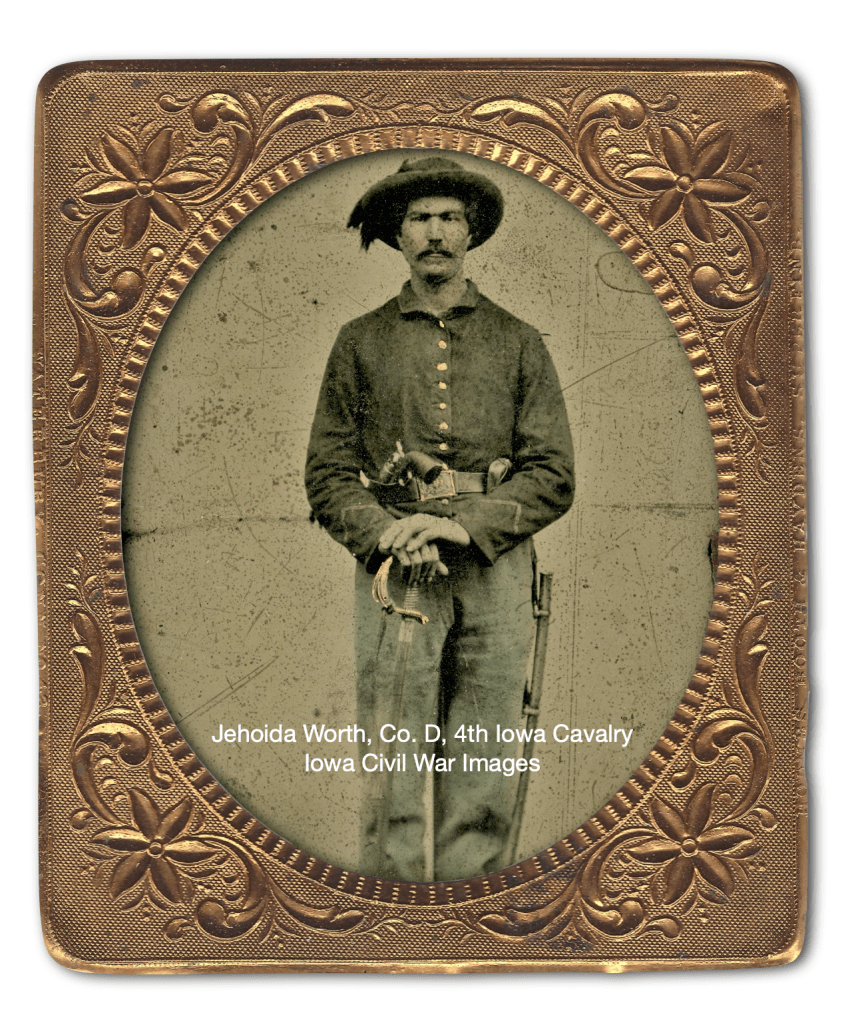
I couldn’t find an image of Isaac in uniform but here is Jehoida Worth of Co. D, 4th Iowa Cavalry.
The following letter was written by Isaac Harry Botkin (1834-1922), the son of Robert C. Botkin (1791-1863) and Rachel Vernon (1796-1841). Isaac was living in Mt. Pleasant, Henry county, Iowa, when he enlisted as a Private in Co. C of the 4th Iowa Cavalry on Oct 15, 1861. He was mustered into federal service on Nov 25, 1861, and appointed as 4th Corporal. During his term of service, Botkin was promoted to 3rd Corporal on Feb 1, 1862; to 2nd Corporal on Feb 25, 1862; to 1st Corporal on Sept 1, 1862; to 6th Sergeant on June 10, 1863; to 2nd Sergeant on Feb 9, 1864; and finally commissioned as the 1st Lieutenant of Co. I of the 4th Iowa Cavalry on Feb 18, 1865.
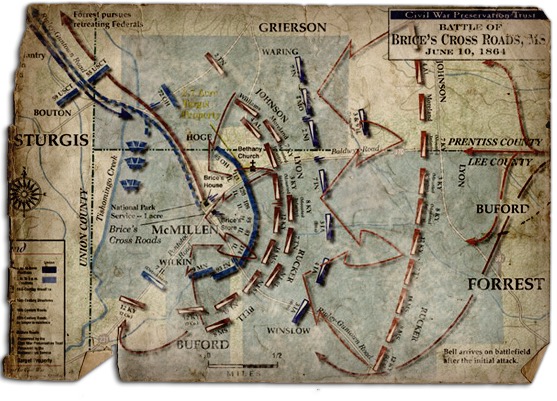
Isaac’s letter gives us a good description of Brig. Gen. Samuel D. Sturgis’s June 1864 expedition from Memphis down into Mississippi hoping to cut the Mobile & Ohio Railroad and proceed on as far as Mobile, if possible. The expedition was a disaster. Though Isaac claimed they were outnumbered 2:1, Maj. Gen. Nathan B. Forrest with only 3,500 cavalry were successful in turning back Sturgis who had 4,800 infantry and 3,300 cavalry with him—odds that favored the Federal force by nearly 3:1. Sturgis and his men retreated all the way back to Memphis, losing men and military supplies all the way. The fight came to be known as the Battle of Brice’s Cross Roads or the Battle of Guntown.
Several years ago I transcribed the diary of Lot Abraham who served in Co. D of the 4th Iowa. His diary entries for the day of the battle, June 10, and the day after read as follows:
Friday, 10. Moved out early. Went 10 miles & met the Rebels at 11 o’clock A.M. 1st Brigade of Cavalry went in 1st. We went in about noon & there in that thick brush at Brice’s cross roads [we] witnessed sights & heard noises that will never be forgotten. Infantry got cut all to pieces. Had our artillery taken & was in full retreat at sundown. Badly whipped.
June, Saturday, 11, 1864. A ruined army retreated all night. Lost all our train. Abandoned all artillery that was not taken [by the enemy] & could see nothing but confusion & rout. Rebels come up with us at daylight. Four hit hard in Ripley & got routed. They passed us hard, took all the infantry, then we come faster. All I knew how & kept the 1st Battalion together (except Co. A). The boys done well. The Rebels gave up the chase at dark.
Transcription
Memphis, Tennessee June 21st [1864]
Mr. William Lowery
Sir, being anxious to hear from that quarter, I thought I would drop you a few lines. I was reading a speech made by the traitor [Clement] Vallindigham 1 and was surprised to hear of his being back there again [in Ohio]. There is considerable talk in our regiment about it and I think the people of Ohio ought to do something with him immediately. He has come back on no other purpose but to raise another disturbance this fall and I am in hopes some soldier will shoot him. He has done more harm to our cause than Jefferson Davis himself and [I] say let him suffer a traitor’s doom. Well, I close on that subject.
I had a very pleasant trip from there back to the army again. Our regiment did not have a man that stayed over his time. All was prompt to return at their appointed time.
We have been moving ever since we came back into the field. We have just returned from the Expedition under General [Samuel D.] Sturgis. There was about eight thousand troops started from here to cut the Mobile and Ohio Railroad and to drive Forrest out of the country. Well we moved along without being molested until we came within five miles of the railroad where the enemy met us. I suppose they had been preparing for us and the met us in the morning about ten with about two to one. The fight lasted until dark. Our forces was rather worsted and retreated that night. The enemy followed in full force. We lost considerable in wagons and prisoners and some artillery. We fought the enemy all the way back to Memphis.
A. J. Smith is here now and is building the railroad from here to Corinth and is in command of the army and tomorrow we will move on the enemy again in the direction of Tupelo, Mississippi. I suppose you will hear from us soon again. The boys are anxious to give Forrest another fight and I think we will clean him out this time. Our company lost thirteen men killed and wounded—two killed dead, the rest badly wounded. We went into the fight dismounted and stayed there until the retreat was ordered.
I will close by saying do something with Vallandigham. Do not let him raise another fuss this fall.
Give my love to all and if I come back safe this time, I will write again. Yours, — Isaac H. Botkin
Co. C, 4th Iowa Cavalry
1 “During the Civil War he bitterly attacked the administration of President Abraham Lincoln, charging that it was destroying not only the Constitution but civil liberty as well. He also became commander of the secret, antiwar Knights of the Golden Circle (later Sons of Liberty). In 1863 he made vigorous speeches in Ohio against the war and the government and consequently grew to be one of the most suspected and hated men in the North. He was arrested in May by military authorities for expressing treasonable sympathy with the enemy; tried and found guilty by a military commission, he was sentenced to imprisonment. Soon afterward Lincoln commuted his sentence to banishment behind Confederate lines. Bored with exile in the South, Vallandigham made his way to Canada, where he continued his campaign of harassment from across the border. In September 1863 the Ohio Peace Democrats nominated him in absentia for governor, but resounding Union military victories at Gettysburg and Vicksburg in July ensured his decisive defeat at the polls. He returned illegally to Ohio in 1864 and took an active part in that year’s election campaign. He also wrote part of the national Democratic platform in which the war was denounced as a failure.”



















 Spared & Shared 23