All posts by Griff

My passion is studying American history leading up to & including the Civil War. I particularly enjoy reading, transcribing & researching primary sources such as letters and diaries.

1862: “Sallie” to Joseph R. Dickerson

How Sallie might have looked

I can’t be certain of the identity of the author of this letter who signed her name “Sallie” but she was clearly a cousin of several members of the Gravely family who lived in Pittsylvania county, Virginia. I believe she wrote the letter to her friend Joseph R. Dickerson who was, at the time, sick in a hospital at Staunton, Virginia, while serving as a private in the Danville Artillery. Joseph enlisted in the spring of 1861 and was with the company in the Battle of Greenbrier River (West Virginia) in early October where he was wounded, but was taken ill in November and December of that year. In April 1862 when the company reenlisted, he was elected 3rd Lieutenant.

The letter contains a lot of news about local soldiers. More research would likely lead to the author’s identity.

Transcription

Danville, Virginia
January 29th 1862

Dear friend Josephene,

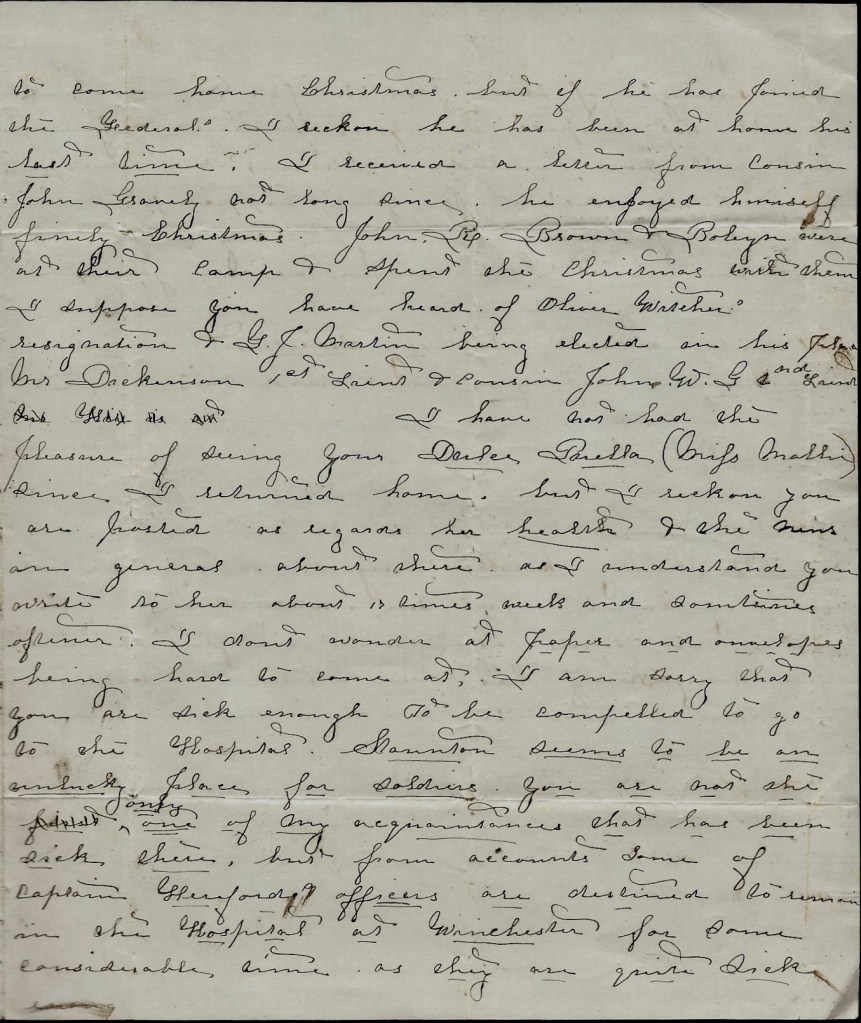
I received your interesting communication last night and hasten to reply. As you expect to get a furlough, I thought I would write before you left Staunton. I was exceedingly glad to hear that you was improving and was also glad to hear that my sweetheart (as you say) (Mr. William Lawrence) was improving. I thought he had gone to his last resting place long ago.

Mr. George Wooding 1 came up on the cars one day last week. He is improving, but very slowly indeed. I think he is about as smart a young man as there is in Danville, “don’t you?” I have heard him deliver some excellent speeches. Mr. Henry Stamps (your orderly sergeant) is also at home. He has gotten well again. He has made him up a company. Has nearly 100 men already. 2

Capt. [T. D.] Claiborne of the Danville Greys 3 has made up an artillery company out of that regiment. He is in town now on 30 days furlough. Uncle Marshall has not joined. Neither has Lewis or Frank.

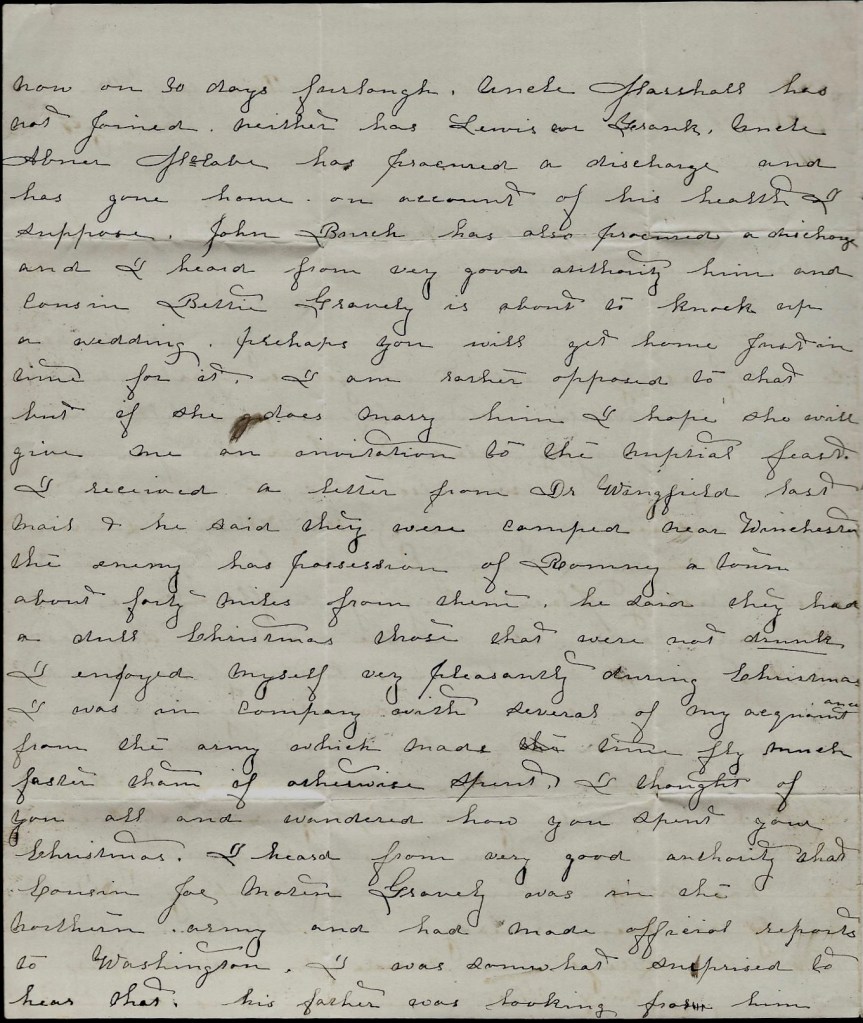
Uncle Abner McCabe 4 has procured a discharge and has gone home on account of his health, I suppose. John Burch has also procured a discharge and I heard from very good authority him and cousin Bettie Gravely is about to knock up a wedding. Perhaps you will get home just in time for it. I am rather opposed to chat but if she does marry him, I hope she will give me an invitation to the nuptial feast.

I received a letter from Dr. Wingfield last mail & he said they were camped near Winchester. The enemy has possession of Romney—a town about forty miles from them. He said they had a dull Christmas, those that were not drunk. I enjoyed myself very pleasantly during Christmas. I was in company with several of my acquaintance from the army which made the time fly much faster than if otherwise spent. I thought of you all and wondered how you spent your Christmas.

I heard from a very good authority that Cousin Joe Morton Gravely 5 was in the Northern army and had made official reports to Washington. I was somewhat surprised to hear that. His father [Edmund] was looking for him to come home Christmas but if he has joined the Federals, I reckon he has been at home his last time.

I received a letter from cousin John Gravely not long since. He enjoyed himself finely Christmas. John R. Brown & Boleyn were at their camp & spent the Christmas with them. I suppose you have heard of Oliver Witcher’s resignation 6 & T. J. Martin being elected in his place. Mr. [George W.] Dickinson 1st Lieut. & cousin John W. G[ravely] 2nd Lieut. 7

I have not had the pleasure of seeing your Dules Parella (Miss Mollie) since I returned home but I reckon you are posted as regards her health & the news in general about there as I understand you write to her about 17 times a week and sometimes oftener. I don’t wonder at paper and envelopes being hard to come at. I am sorry that you are sick enough to be compelled to go to the hospital. Staunton seems to be an unlucky place for soldiers. You are not the only one of my acquaintances that has been sick there, but from accounts, some of Captain Hereford’s officers are destined to remain in the hospital at Winchester for some considerable time as they are quite sick. But enough of that foolishness.
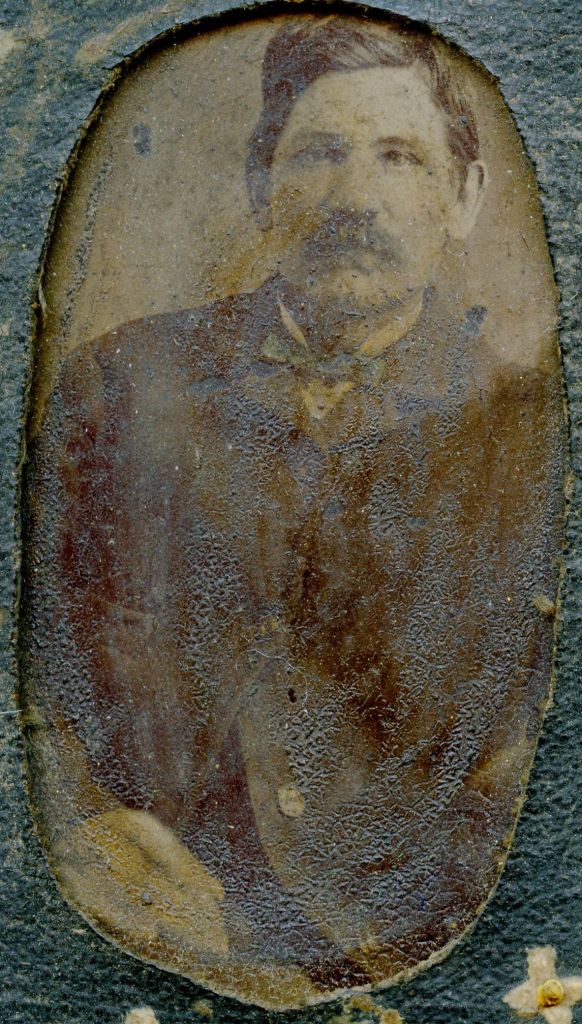
Joseph Henry Harrison Gravely (1840- ) was born in Leatherwood, Henry Co., VA. He was the son of Willis Gravely and Ann Marshall (Barrow) Gravely.

I will not trespass on your patience any longer but will now conclude. Permit me to express many kind wishes for your happiness & with a hope of hearing from you very soon, will now desist. I remain as ever your true friend, — Sallie

I would almost bet my sweetheart against Barkmill that you can’t read this letter.

P. S. My kindest regards to anyone that may enquire after me. Write soon. Excuse all defects as I write in great haste. Joe Henry Gravely 8 has been elected 3rd Lieutenant in place of Lieut. Law who died some time ago.


1 George W. Wooding, a lawyer in Pittsylvania county, Va., was 23 years old when he enlisted in May 1861 to serve in the Danville Artillery. He was elected 2nd Lieutenant and was with the unit until late in 1861 when he was reported sick at Warm Springs. In December 1861 he returned to Danville, as noted in this letter. In April 1862, he was elected Captain of the Danville Artillery and was with them at the Battle of Fredericksburg where he was wounded on 13 December 1862. He appears to have been court martialed the following month.

2 Timothy “Henry” Stamps was a 41 year-old Pittsylvania county farmer who enlisted at Danville in Capt. L. M. Shumaker’s Company (“Danville Artillery”) in May 1861. He was selected as the 1st (Orderly) Sergeant. Late in 1861, he was reported sick and at Warm Springs. We learn from this letter that Henry raised another company in 1862 which became part of the “Ringgold Battery,” 13th Battalion Virginia Artillery. He resigned his commission of captain in June 1863.

3 The Danville Greys became Co. B of the Eighteenth Virginia Infantry. Capt. Thomas D. Claiborne led the company. Claiborne’s men were covered with glory at the Battle of Bull Run when they captured Union guns (Sherman Battery) posted between the Henry House and the Sudley Road. They successfully turned the guns around and used them against the federals.
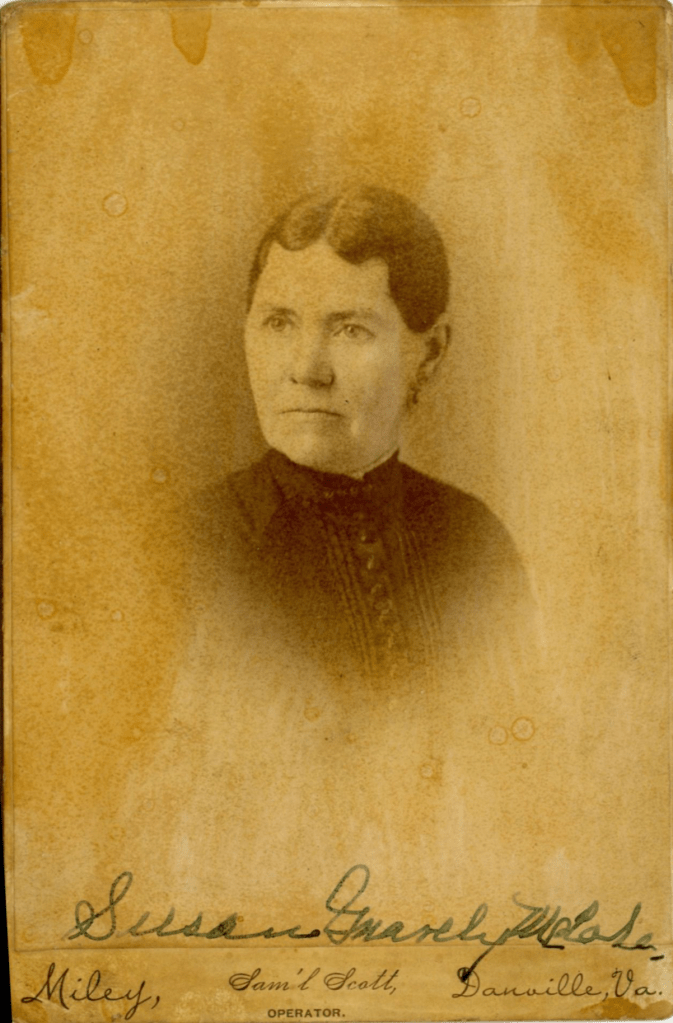
Susan (Gravely) McCabe)

4 Abner McCabe (1831-1866) was married in 1853 to Susan Eleanor (“Sue Ellen”) Gravely (1834-1920). He enlisted at Danville as a private in Capt. Claiborne’s Co. B, 18th Virginia Infantry and served until 20 August 1861 when he was hospitalized with a hernia. (Perhaps he injured himself dragging the guns at Bull Run.) He was discharged for disability on 15 January 1862. He was a farmer in Bedford county, Virginia. Susan Gravely was the daughter of Willis Gravely (1800-1885) and Ann Marshall Barrow (1812-1885) of Henry county, Virginia.

5 Joseph Morton Gravely (b. 1832) was the son of Edmund Gravely (1788-1883) and Susan Robertson (1800-1879) of Henry county, Virginia. Willis Gravely mentioned in footnote 4 was Edmund’s younger brother.

6 Vincent Oliver Witcher was the captain of Co. F, 57th Virginia Infantry from July 1861 until 21 October 1861 when he became ill and went home to Pittsylvania county on furlough. He resigned his commission in November 1861 and his successor was T. J. Martin.

7 John W. Gravely, the author’s cousin, was wounded in the wrist slightly at the Battle of Malvern Hill (or Crew’s Farm) on 1 July 1862 while serving as lieutenant in Co. F, 57th Virginia. He resigned his commission in late September 1862 for medical reasons claiming his eyesight was failing due to congenital blindness.

8 Joseph Henry Harrison Gravely (1840-1920) became a lieutenant in Co. F, 42nd Virginia Infantry. He was a younger brother of Sue Ellen Gravely (wife of Abner McCabe) mentioned in footnote 4.

1862: Amos Clinton Metzgar to Alberto Osborn

The following letter was written by 37 year-old Amos Clinton Metzgar (1825-1903) who enlisted on 31 May 1861 in Co. E, 42nd Pennsylvania (1st Pennsylvania Rifles, or “Bucktails”) and was discharged on a Surgeon’s Certificate 23 February 1862. A note in his 1890 Veteran’s Schedule claims he was discharged from the service “due to epilepsy” but this letter suggest that he received a gunshot wound to his leg on 15 September 1861 that was not healing. I can’t find any engagement of the regiment on that day so it may have been an accidental discharge.

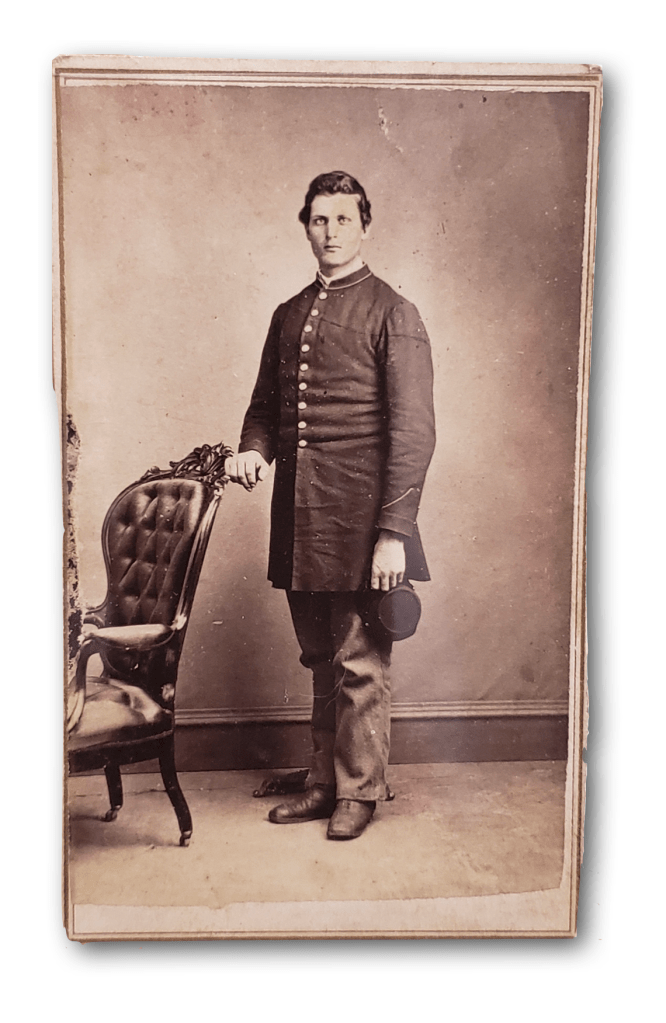
I could not find an image of Amos or Edward but here is one of Robert B. Valentine who fought with the Bucktails (Ronn Palm Collection)

The boys of Co. E were recruited primarily in Tioga county and, like other companies in the regiment, were mostly lumbermen on the upper reaches of the Susquehanna River. The boys wore a distinctive bucktail in their hats and bragged of their marksmanship. Co. E branded themselves the “Tioga Rifles.”

The last page of the letter was written by Edward Osborn (1833-1876) who enlisted on 7 August 1861 in Co. E, 42nd Pennsylvania, and was discharged on a surgeon’s certificate on 18 April 1863. Edward was the son of Daniel Osborn (1809-1878) and Harriette Hoadley (1811-1863) of Stony Fork, Tioga county, Pennsylvania. In the 1860 US Census, Amos Metzgar lived on the property adjacent to the Osborn family in Stony Creek, Tioga county.

Amos and Edward addressed the letter to Edward’s brother, Albert Osborn (1836-1908) who also was in the service. Albert served initially as a sergeant in Co. G, 7th Pennsylvania Cavalry from 9 October 1861 to 2 June 1862. He then reenlisted as a private in Battery E, 5th US Artillery from 10 August 1863 to 17 June 1866 (though the veteran’s schedule claims he was a veteran of Gettysburg and Cold Harbor).

To read other letters I have transcribed and published on Spared & Shared that were written by members of this regiment, see:

Jacob Snyder, Co. E, 42nd Pennsylvania (Union/1 Letter)
Lewis Hoover, Co. K, 42nd Pennsylvania (Union/1 Letter)

Transcription

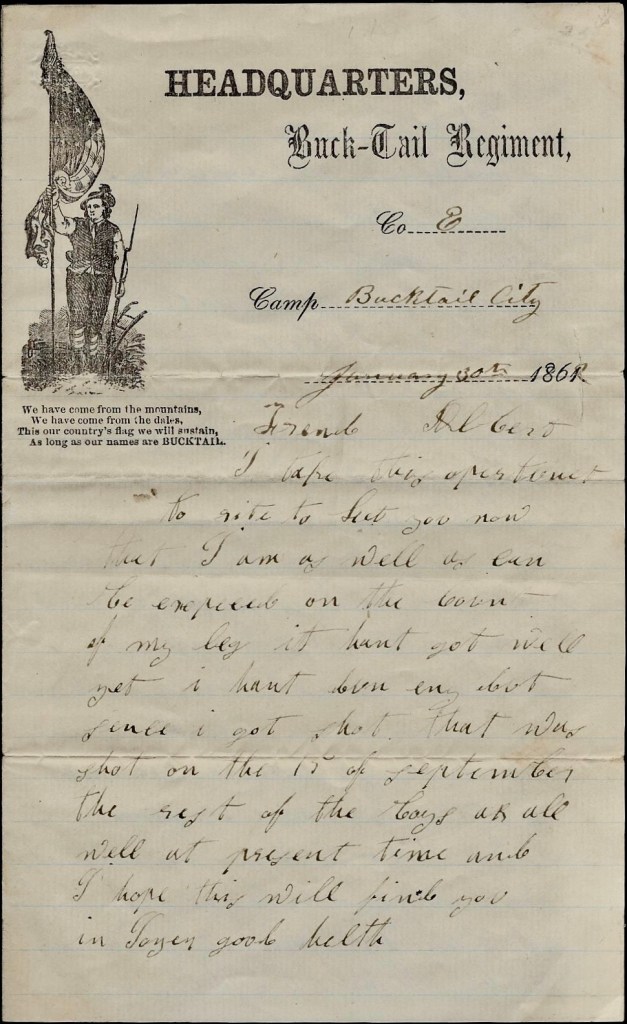
Headquarters Bucktail Regiment, Co. E
Camp Bucktail City
January 30th 1862

Friend Alberto,

I take this opportunity to write to let you know that I am as well as can be expected on the account of my leg. I han’t got well yet. I han’t been any about since I got shot. That was shot on the 15th of September. The rest of the boys are all well at present time and I hope this will find you enjoying good health.

Albert, they have made out my discharge and I will start for home next week and when I get home, I will write to you again. Albert, it is very muddy and rainy here all the time. The camp is very quiet at present time. Nothing going on to raise a excitement in or about camp for the mud is so deep that they can’t get around.

Albert, may God watch and protect you through this campaign and land you safe in the old free state once more on Stony Fork to join your friends there that is close to you.

So no more at present. From your friend, — Amos C. Metzgar

[In a different hand]

Dear brother,

I thought that I would write a few lines in Amos’s letter. I received a letter from you night before last about eight o’clock in the evening and I sat down and answered it before I went to bed. Captain [Alanson E.] Niles started for home last Sunday and I sent 30 dollars by him.

The weather is not very cold. It is not as cold as I wish it was. If it was cold enough to harden the mud so that we could get top of it, it would be a great blessing. No more at present. From your affectionate brother, — Edward Osborn


1863: James S. Sickels to Susan M. Sickels

Pvt. James S. Sickels, Co. E, 9th New Jersey

This partial letter was written by Pvt. James S. Sickels (1839-1864) of Co. E, 9th New Jersey Infantry. He enlisted on 20 September 1861, veteranized in January 1864, and was wounded on 7 May 1864 at Port Walthal Junction, Virginia. He died of his wounds on 1 June 1864 at Hampton, Virginia.

James wrote this letter from Carolina City where the 9th New Jersey was stationed from April 25 until June, 1863. 

James was the son of Jacob Sickels (1799-1871) and Elizabeth Foose (1810-1876). He wrote the letter to his sister, Susan M. Sickels (b. 1842). She married John Stout in 1879.

Transcription

Addressed to Miss Susan M. Sickels, Alamuchy, Warren county, New Jersey
Also signed by John J. Carrell, Chaplain (9th New Jersey)

Newbern, North Carolina Carolina City
May 12, 1863

Dear Sister,

I received yours dated the 3rd of May this morning. I am well at present and I hope these few lines may find you enjoying the same comfort. You say I don’t write but tis a mistake. I send one a week but you can’t or I don’t get them. But it will be alright some day for I don’t think it will be more than two or three months till I will see you all but not long till I will go to the army again so you may look for me in that time if not sooner. Byt that time sure anyhow…

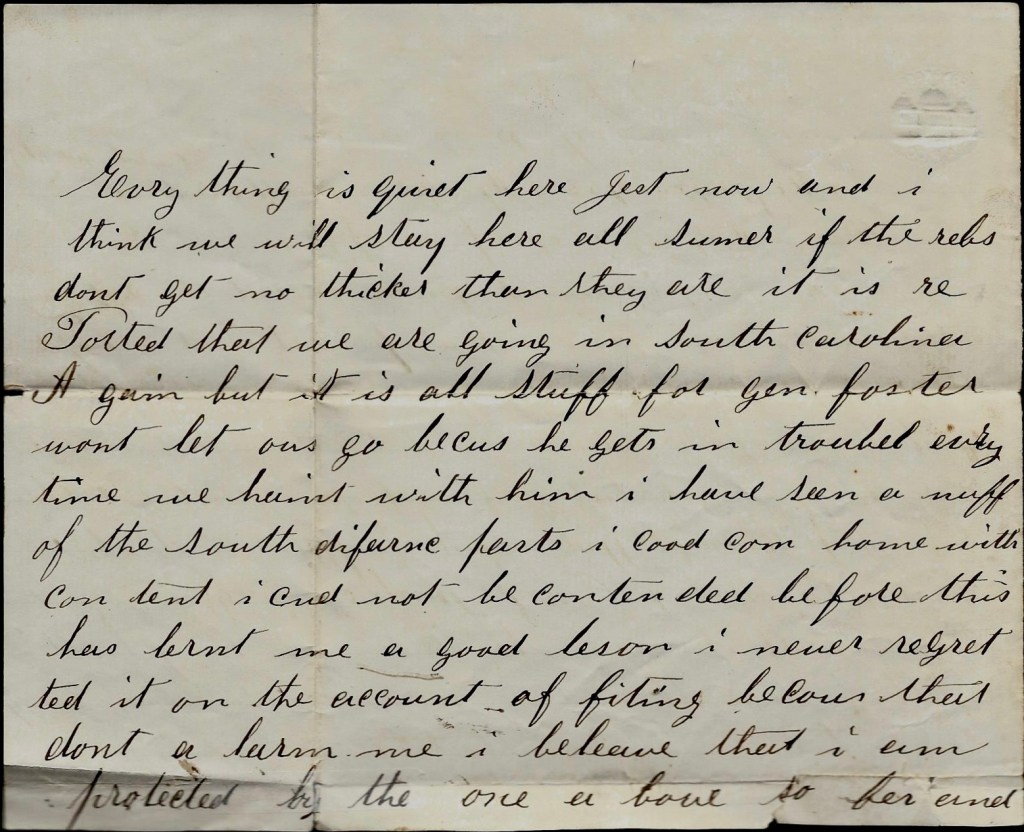
Everything is quiet here just now and I think we will stay here all summer if the rebs don’t get thicker than they are. It is reported that we are going in South Carolina again but it is all stuff for Gen. Foster won’t let us go because he gets in trouble every time we hain’t with him. I have seen enough of the South’s difference parts. I could come home with content. I could not be contented before. This has learnt me a good lesson. I never regretted it on the account of fighting because that don’t larn me. I believe that I am protected by the one above so far and…

1861: Jane Margaret Brown to Christopher Valentine Winfree

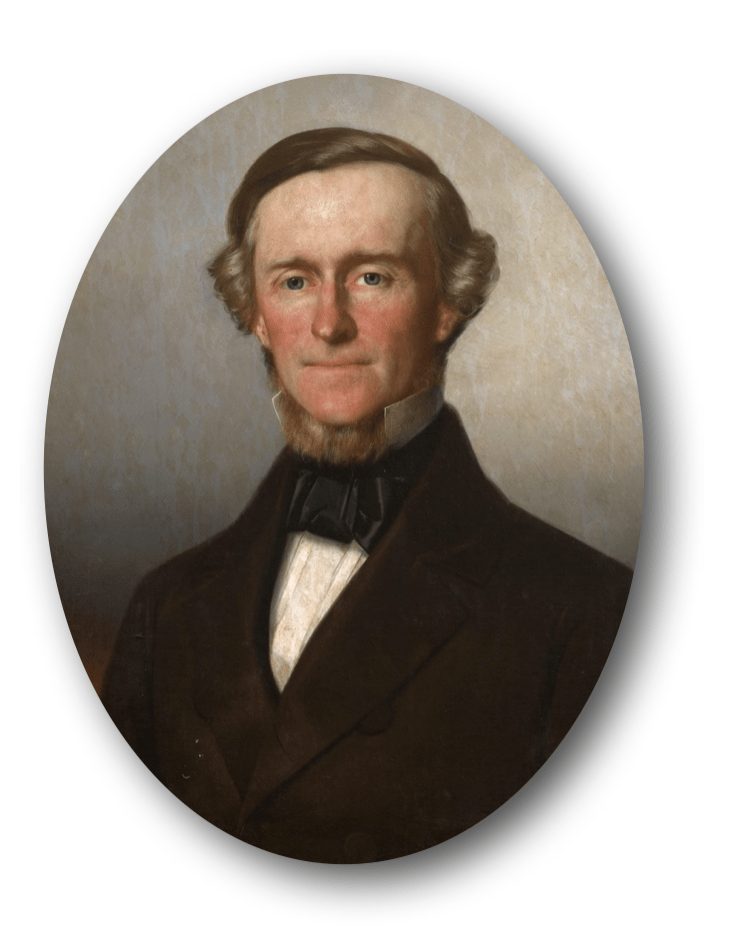
How Jane might have looked

This letter was written by 40 year-old Jane Margaret (Winfree) Brown (1821-1910), the daughter of Christopher Winfree (1785-1858) and Cornelia Meyer Tilden (1798-1836) of Lynchburg, Campbell county, Virginia. Jane married attorney Edward Smith Brown (1818-1908) in 1845, the son of James and Mary (Spearman) Brown of Cumberland county. The couple had three children: Cornelia (b. 1846), Mary Virginia (b. 1849), and Anne (b. 1856). After the Civil War, Edward and Jane moved to Lynchburg where he resumed his law practice.

Jane wrote the letter to her younger brother, Christopher Valentine Winfree (1826-1902)—a graduate of the Virginia Military Institute and a civil engineer on the Norfolk & Western railroad. In November 1860, just a few months before the Civil War, Christopher was married to Virginia (“Jinnie”) Ann Brown (1838-1884)—a younger sister of Jane’s husband. Christopher was commissioned a Lieutenant in Co. E, 11th Virginia Infantry on 19 April 1861 and promoted to Captain in August 1861. He was dropped from the reorganization in April 1862.

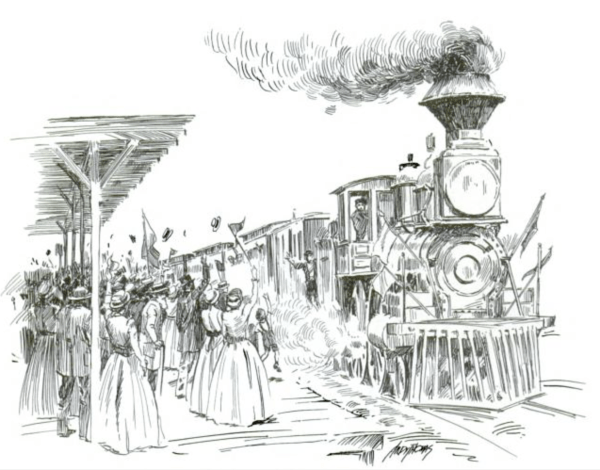
Illustration from Steve Cottrell’s Book, Civil War in Tennessee

Transcription

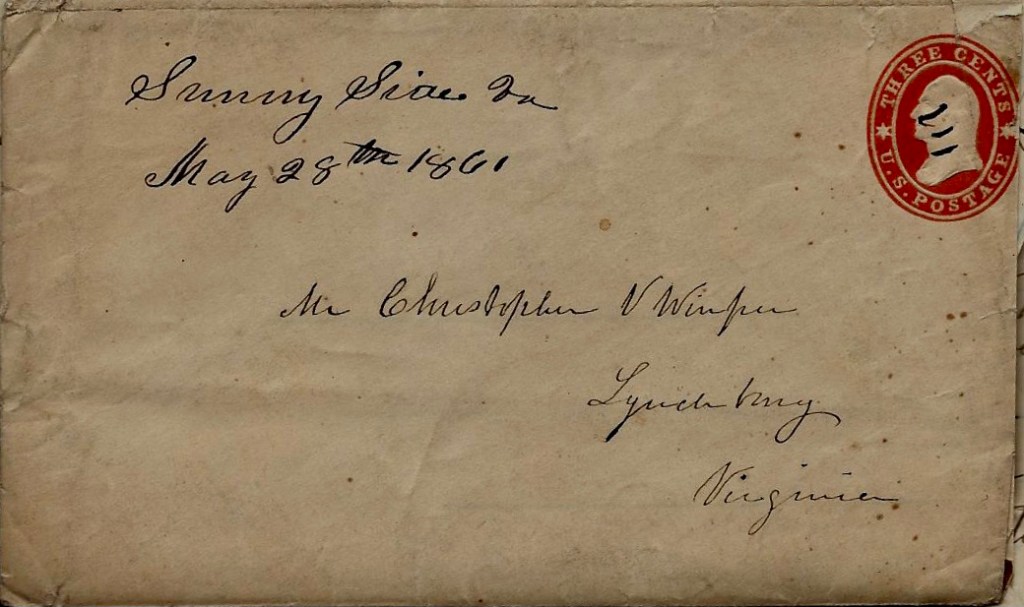
Addressed to Mr. Christopher V. Winfree. Lynchburg, Virginia

[Sunnyside, Va.] 1
May 27, 1861

My very dear brother,

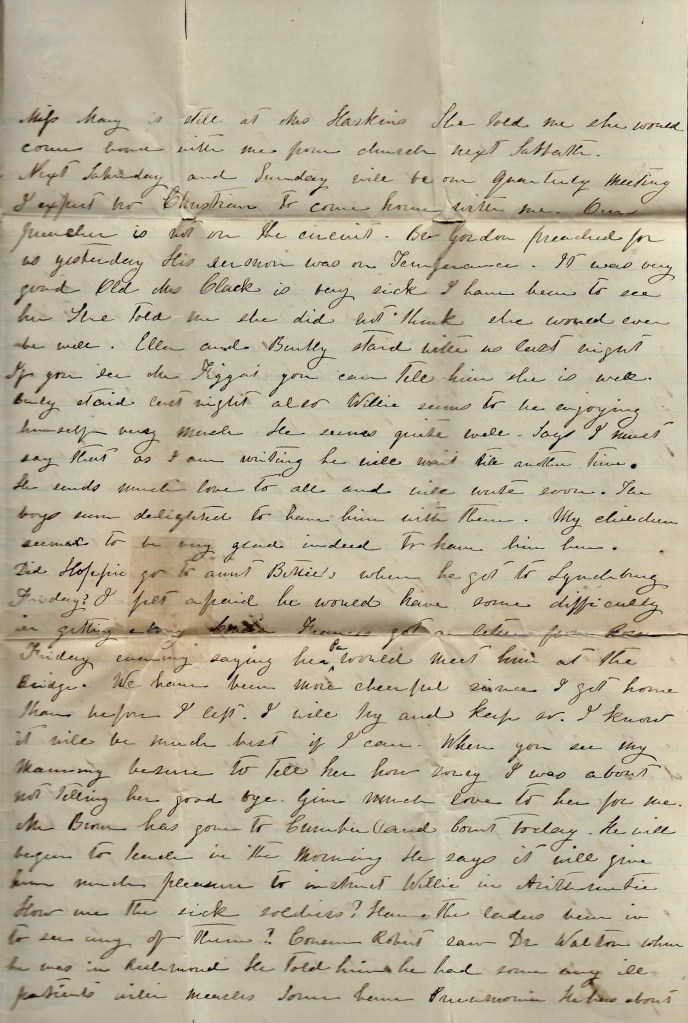
As you may so soon have to leave home, I will address this letter to you. We reached Farmville very safely after a pleasant trip. Old Mrs. French, mother of Mrs. Powers, came down with us. One of her granddaughters (Miss Woodson) came in with her. Mrs. Loomis, daughter of Mrs. Sam Hobson came also. After we got to Farmville, several Tennessee soldiers came out of the cars. A good many girls and gentlemen had collected at the Depot. The girls threw bouquets to the soldiers. One of them (the soldiers) made a nice little speech in return for the flowers. Mrs. Loomis said he was an Editor and a very nice gentleman. She came to Virginia under his care. One of the soldiers proposed three cheers for the Virginia girls and they were cheered in style. 2

We got home about three o’clock. Mary Virginia had a little dinner for us. She had gathered strawberries and insisted I should let her have cream with it. I did so and they were very nice. The next morning she and Willie gathered some for dinner. In the evening Mary and Anne Eliza gathered a large mess for Sunday. Mary and Toliver have gone again. They are wild strawberries but larger than wild ones are generally.

Philip St. George Cocke (1809-1861) was a wealthy planter in Powhatan county with hundreds of slaves and thousands of acres. He organized a cavalry troop in response to John Brown’s Raid. He committed suicide on 26 December 1861.

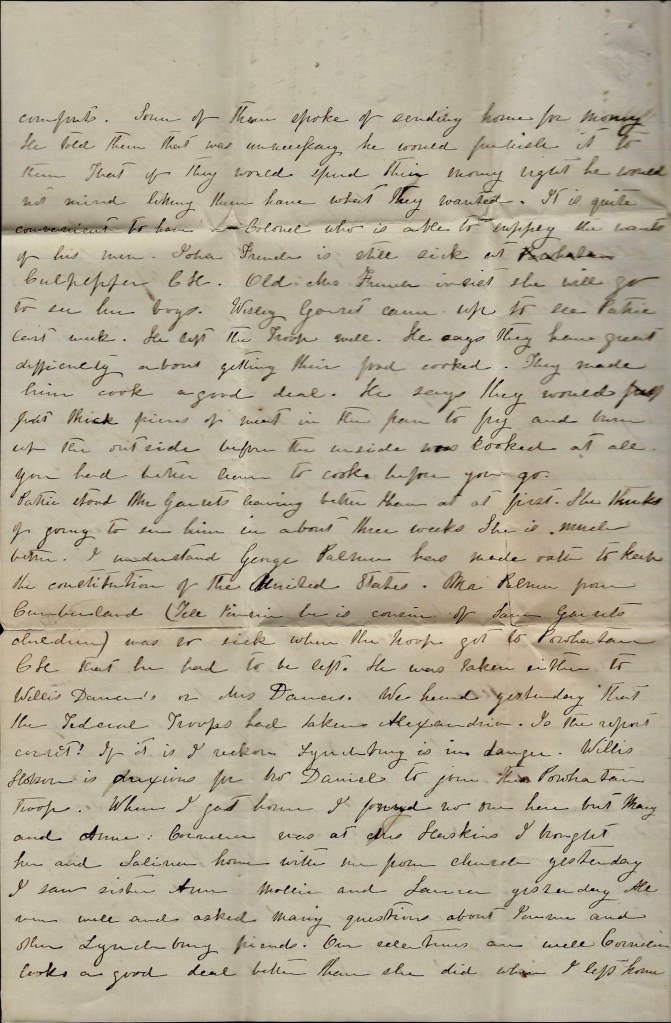
Willie went with Mr. Brown Saturday to drill. He drilled one squad. He says they drilled pretty well. A few members of the Powhatan Troop have returned to visit their friends. They say Mr. [Philip St. George] Cocke wants more persons in his troop. I understand he authorized Mr. Murray to get new members. They say Mr. Cocke is very kind and furnishes them with many comforts. Some of them spoke of sending for money. He told them that was unnecessary—he would furnish it to them. That if they would spend their money right, he would not mind letting them have what they wanted. It is quite convenient to have a Colonel who is able to supply the wants of his men.

John French is still sick at Culpeper Court House. Old Mrs. French insists she will go to see her boys. Wesley Garrett 3 came up to see Pattie last week. He left the troops well. He says they have great difficulty about getting their food cooked. They made him cook a good deal. He says they would put thick pieces of meat in the pan to fry and burn up the outside before the inside was cooked at all. You had better learn to cook before you go. Pattie stood Mr. Garrett’s leaving better than at first. She thinks of going to see him in about three weeks. She is much better.

I understand George Palmer has made oath to keep the Constitution of the United States. Mr. Palmer from Cumberland (Tell Parlin [?] he is cousin of Sam Garrett’s children) was so sick when the troops got to Powhatan Court House that he had to be left. He was taken either to Willis Dance’s or Mrs. Dance’s.

We heard yesterday that Federal troops had taken Alexandria. Is the report correct? If it is, I reckon Lynchburg is in danger. Willis Hobson is anxious for Mr. Daniel to join the Powhatan troop. When I got home, I found no one here but Mary and Anne. Cornelia was at Mrs. Haskins’. I brought here and Salina home with me from church yesterday. I saw sister Ann, Mollie, and Laura yesterday. All were well and asked many questions about Jinnie and other Lynchburg friends. Our relations are well. Cornelia looks a good deal better than she did when I left home.

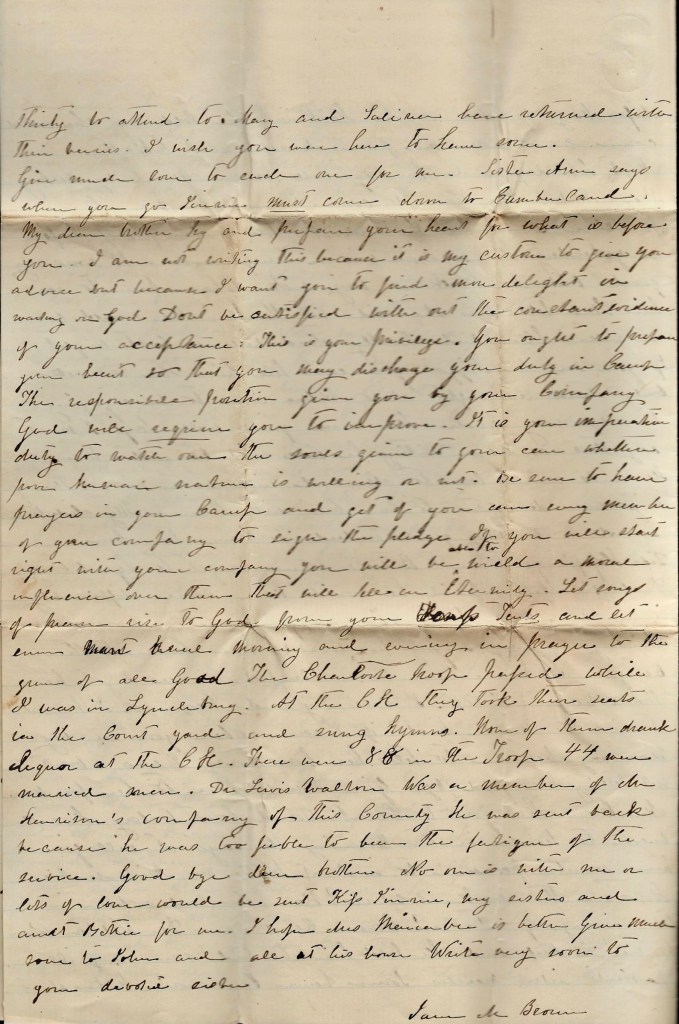
Miss Mary is still at Mrs. Haskins. She told me she would come home with me from church next Sabbath. Next Saturday and Sunday will be our Quarterly Meeting. I expect Mr. [William H.] Christian to come home with me. Our preacher is not on the circuit. Brother Jordon preached for us yesterday. His sermon was on Temperance. It was very good. Old Mrs. Clack is very sick. I have been to see her. She told me she did not think she would ever be well. Ellen and Bently staid with us last night. If you see Mr. Figgai, you can tell him she is well. Only staid last night. Also Willie seems to be enjoying himself very much. He seems quite well. Says I must say that as I am writing, he will wait till another time. He sends much love to all and will write soon. The boys see, delighted to have him with them. My children seem to be very glad indeed to have him here.

Did Hoppie go to Aunt Betties when he got to Lynchburg Friday? I felt afraid he would have some difficulty in getting along. Cousin Frances got a letter from home Friday evening saying her Pa would meet him at the Bridge. We have been more cheerful since I got home than before I left. I will try and keep so. I know it will be much best if I can…

Mr. Brown has gone to Cumberland County today. He will begin to teach in the morning. He says it will give him much pleasure to instruct Willie in arithmetic.

How are the sick soldiers? Have the leaders been in to see any of them? Cousin Robert saw Dr. Walton when he was in Richmond. He told him he had some very ill patients with measles. Some have pneumonia. He has about thirty to attend to. Mary and Salina have returned with their berries. I wish you were here to have some. Give much love to every one for me. Sister Anne says when you go, Jinnie must come down to Cumberland.

My dear brother, try and prepare your heart for what is before you. I am not writing this because it is my custom to give you advice, but because I want you to find more delight in waiting on God. Don’t be satisfied without the constant evidence of your acceptance. This is your privilege. You ought to prepare yourself so that you may discharge your duty in camp. The responsible position given you by your company, God will require you to improve. It is your imperative duty to watch over the souls given to your care whether poor human nature is willing or not. Be sure to have prayers in your camp and get, if you can, every member of your company to sign the pledge. If you will start right with your company, you will be able to wield a moral influence over them that will tell in eternity. Let songs of praise rise to God from your tents and let every man have morning and evening in prayer to the giver of all good.

The Charlotte troop 4 passed while I was in Lynchburg. At the Court House they took their seats in the court yard and sung hymns. None of them drank liquor at the Court House. There were 88 in their troop. 44 were married men.

Dr. Lewis Walkin was a member of Mr. Harrison’s Company of this county. He was sent back because he was too feeble to bear the fatigue of the service.

Goodbye dear brother. No one is with me ot lots of love would be sent. Kiss Jinnie, my sisters, and Aunt Bettie for me. I hope Mrs. M____ is better, Give much love to John and all at his house. write very soon to your devoted sister. — Jane M. Brown

Dear Jinnie,

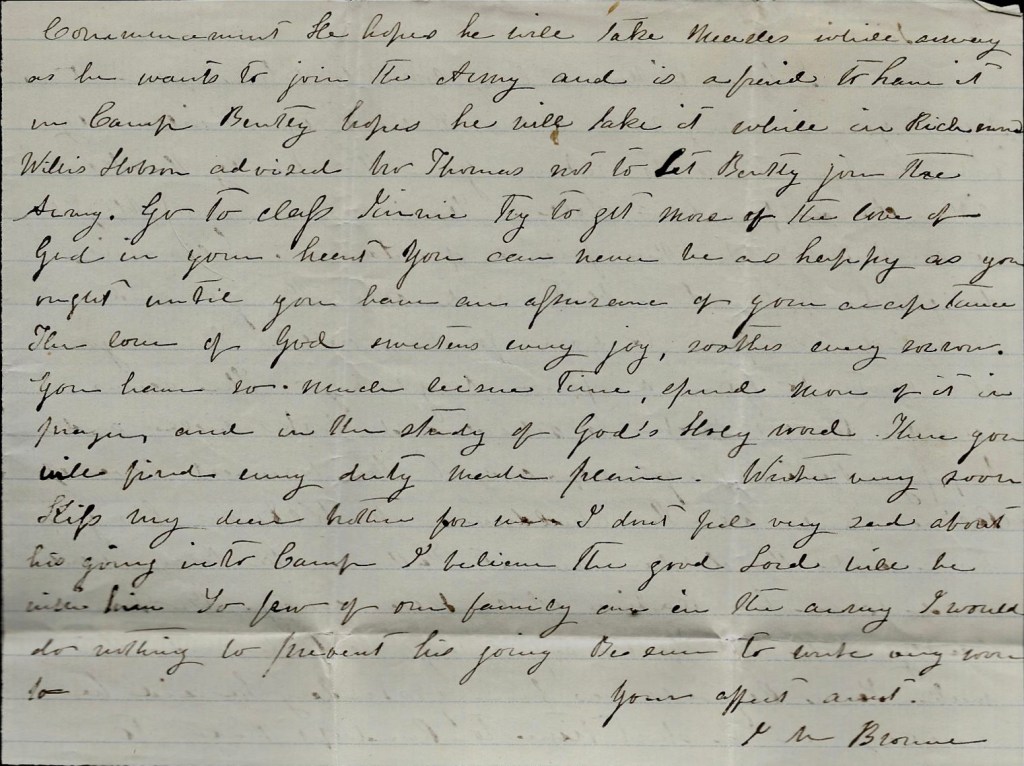
I have written a long letter to Christopher & as I wrote you a long letter before I went up, I will only write a few lines to return you the hardy thanks of little Anne for her doll. She is also much obliged to Aunt Bettie for the piece of ___. Salina is delighted with her flat [?] and other things and is much obliged to you for her doll. She says she wrote to you a few days ago. She seems pleased to get back to school and looks well and happy. Receive for yourself and C. the warmest love of Salina and all the children. Mrs. Wilkerson has gone home and the children are at Father’s. Mr. Brown went round to see his relatives while I was away. Bro. Daniel Bently and Bro. Zack expect to go to Richmond this week. James Reynolds was here yesterday. He said he would go in a short time to Randolph-Macon [College] to commencement. He hopes he will take measles while away as he wants to join the army and is afraid to have it in camp. Bently hopes he will take it while in Richmond. Willis Hobson advised Dr. Thomas not to let Bently join the army.

Go to class, Jinnie. Try to get more of the love of God in your heart. you can never be as happy as you might until you have an assurance of your acceptance. The love of God sweetens every joy, soothes every sorrow. You have so much leisure time, spend more of it in prayer and in the study of God’s Hold Word. There you will find every duty made plain. Write very soon. Kiss my dear brother for me. I don’t feel very sad about his going into camp. I believe the good Lord will be with him. So few of our family are in the army, I would do nothing to prevent his going. Be sure to write very soon.

Your affectionate Aunt, — P. M. Brown


1 Sunny Side was an unincorporated village in Buckingham and Cumberland counties, Virginia. It was a stop on the Farmville and Powhatan Railroad. It is located approximately four miles east of Cumberland and some 50 miles west of Richmond.

2 These Tennessee soldiers were probably members of the 1st Tennessee Infantry. This regiment was ordered to proceed by the Virginia & Tennessee Railroad to Lynchburg, Virginia on 3 May 1861. Six companies arrived there on 5 May 1861; the other four companies arriving shortly afterwards. They were mustered into Confederate service for twelve months on 8 May 1861. They were then ordered to proceed by the Southside Railroad to Richmond on 19 May 1861 and arrived there very late on 20 May 1861. They probably passed through Farmville (midway between Lynchburg and Richmond) on the 19th or 20th of May. A private in the 1st Tennessee named Sam Watkins remembered, “Leaving Nashville, we went bowling along twenty or thirty miles an hour, as fast as steam could carry us. At every town and station citizens and ladies were waving their handkerchiefs and hurrahing for Jeff Davis and the Southern Confederacy. Magnificent banquets were prepared for us all along the entire route. It was one magnificent festival from one end of the line to the other. At Chattanooga, Knoxville, Bristol, Farmville, Lynchburg, everywhere, the same demonstrations of joy and welcome greeted us. Ah those were glorious times…” [Civil War in Tennessee, by Steve Cottrell, pg 13]

3 John “Wesley” Garret was married to Pattie Frances Clark of Cumberland county, Virginia, in July 1860. Wesley served as a corporal in Capt. Henry R. Johnson’s Company (Cumberland Light Dragoons) or the 3rd Virginia Cavalry from 14 May 1861 till he was wounded on 29 May 1864 at Haw’s Shop.

4 The 14th Virginia Cavalry, Co. B, was sometimes referred to as “the Charlotte Troop.”

1864: John Sowden to his Family

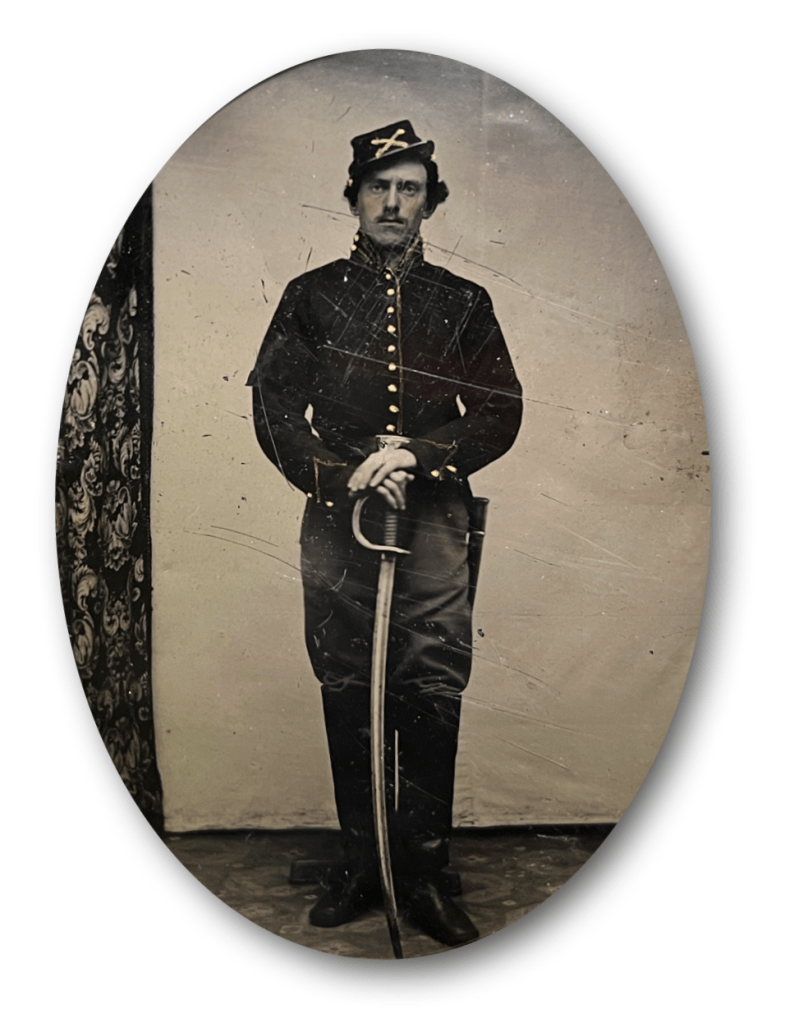
John Sowden, Co. K, 1st Massachusetts Cavalry, half-plate ferrotype
(Rob Morgan Collection)

The following letters were written by John Sowden (1841-1917) who emigrated as a small child from England with his mother, Mary Ann Sowden (1808-1870)—a “matron”—and older siblings in August 1843 aboard the ship Stephen Whitney. John’s maternal grandfather’s surname may have been “Caser” or “Cazer.” Mary Ann settled her family in Lanesborough in the Housatonic River Valley of the Berkshire Mountains in western Massachusetts—a rural settlement that must have reminded her considerably of her native home.

From John’s letter we learn that his mother persuaded him to resist the temptation to give up his job as an engineer and enlist with his friends in the 1st Massachusetts Cavalry when it was first being formed in the fall of 1861. He was married to Harriet E. Stocking (1842-1905) in 1862; their firstborn of eventually eight children was born in May 1863. Finally, near the end of December 1863, John accepted a state bounty of $325 and enlisted as a private in Co. K of the 1st Massachusetts Cavalry where he served until 10 June 1865. John’s second letter includes a brief description of the cavalry fight at Jerusalem Plank Road on 16 September 1864, 12 days previous. In this ill-advised engagement, the regiment charged Rebel earthworks with artillery multiple times hoping to recapture a herd of cattle that had been carried off by Lee’s army the day before. The regimental history claims only two of their own troopers were killed, ten wounded, and nine missing.

After his discharge from the service, John returned to his family in Lanesborough where he was employed as a “blowers assistant” (glassblower presumably). By the 1880s, he had moved his family to Anoka county, Minnesota, where he worked in a planing mill. In 1900, the family resided in Minneapolis.

[Note: These letters are from the personal collection of Rob Morgan and were transcribed and published on Spared & Shared by express consent.]

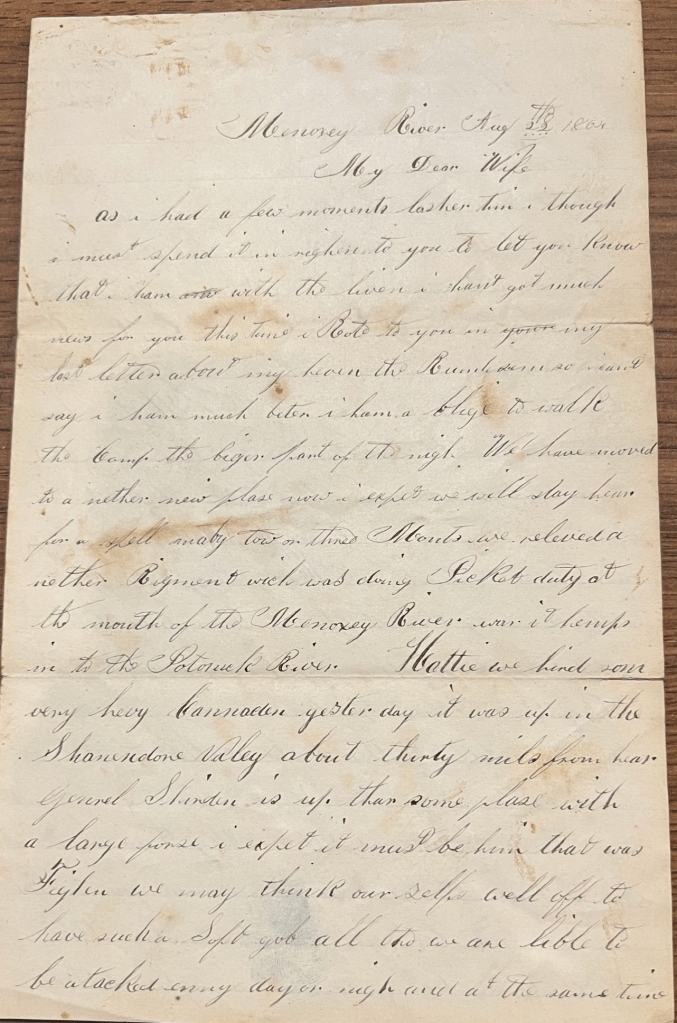
Letter 1

Monocacy River
August 28, 1864

My Dear Wife,

As I had a few moments leisure time I thought I must spend it in writing to you to let you know that I am with the living. I hant got much news for you this time. I wrote to you in my last letter about my having the rheumatism. I can’t say I am much better. I am obliged to walk the camp the bigger part of the night.

We have moved to another new place now. I expect we will stay here for a spell—maybe two or three months. We relieved another regiment which was doing picket duty at the mouth of the Monocacy River where it empties into the Potomac River.

Hattie, we heard some very heavy cannonading yesterday. It was up in the Shenandoah Valley about thirty miles from here. General Sheridan is up there someplace with a large force. I expect it must be him that was fighting. We may think ourselves well off to have such a soft job although we are liable to be attacked any day or night and at the same time we might stay here three years and not be attacked.

Hattie, haven’t you heard from James yet? I saw a man from Camp Stoneman the other day. He told me that everyone that he was acquainted with had got back and I thought that everyone of them had got back. It is quite strange that he don’t write. I am a going to write to Camp Stoneman to see if I can find out anything about him. I shall write today. When you write again, let me know where Arthur Smith was when he wrote to his mother.

Hattie, I am a going to direct an envelope myself for you to send back and I want you to direct just like it as near as you can to see if it will make any difference in getting through. Henry Boggart was just sitting down by the side of me. He sends his best respects to you and all the rest who enquires after him.

My dear, I don’t think of any more to write this time. Tell Mother I should like to get a letter from her because I know it would be a good one for I must say she can write a good letter. My dear, I don’t want you to think that I have run down your letters for I do not but you must acknowledge that Mother can beat you a little on writing letters. But never mind that. Maybe when you have wrote as many letters as she has, you can compose a letter as good as she can. I can’t find any fault with your letters for your writing, spelling, and composing is much better than mine. But I do as well as I can considering the way I have to right. Often times I can’t find a piece of board to right on so I have to write on my blanket in any way I can but am writing on a little box this time. It seems quite good to get it to write on.

You must give my love to Father & Mother. Also the rest. Remember yourself whilst giving it out and remember them kisses sent to Jenny. How is the dear little thing getting along? If I could only see you for a few hours, what is there I would not give. But I feel in pretty good spirits if it was not for the pains I have in my shoulder. But I am in hopes it will wear off in a little while.

Well, my dear, I will bid you goodbye for this time. From your ever loving husband, — John Sowden

To Mrs. H. E. S.


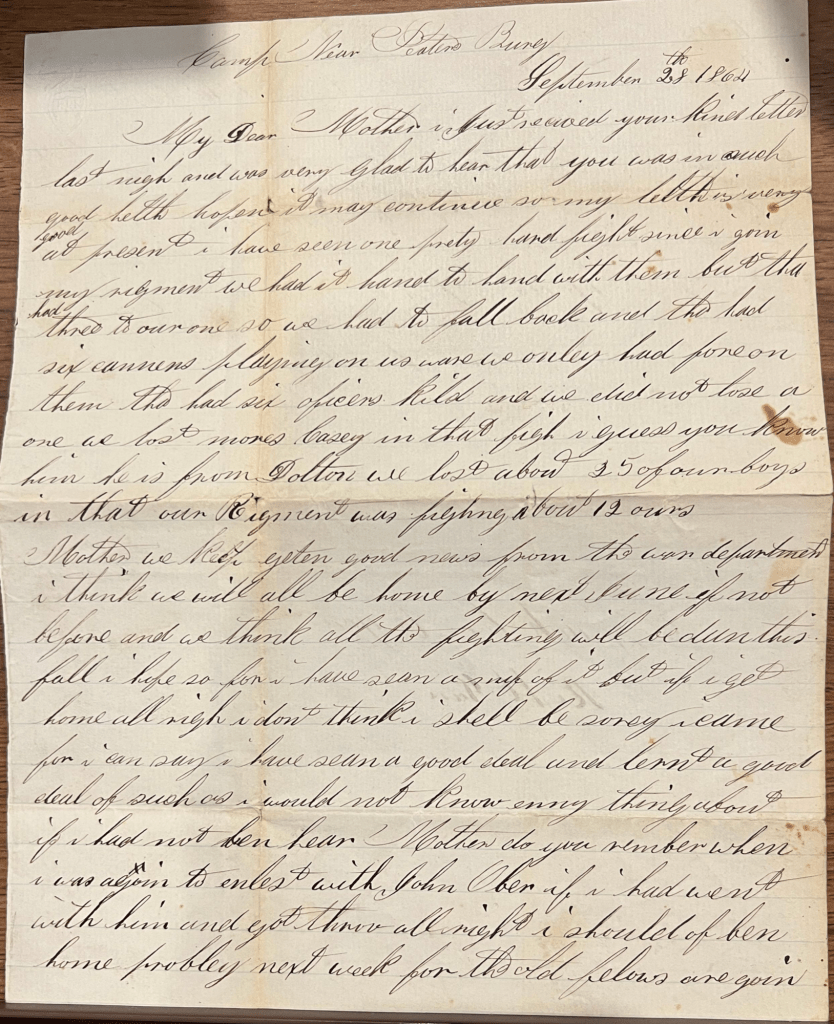
Letter 2

Camp near Petersburg [Virginia]
September 28, 1864

My Dear Mother,

I just received your kind letter last night and was very glad to hear that you was in such good health, hoping it may continue so. My health is very good at present. I have seen one pretty hard fight since I joined my regiment. We had it hand to hand with them but they had three to our one so we had to fall back and they had six cannons playing on us where we only had four on them. They had six officers killed and we did not lose a one. We lost Maurice Casey in that fight. 1 I guess you know him. He is from Dolton. We lost about 25 of our boys in that [fight]. Our regiment was fighting about 12 hours.

Mother, we keep getting good news from the War Department. I think we will all be home by next June if not before and we think all the fighting will be done this fall. I hope so for I have seen enough of it. But if I get home all right, I don’t think I shall be sorry I came for I can say I have seen a good deal and learnt a good deal of such as I would not know anything about if I had not been here.

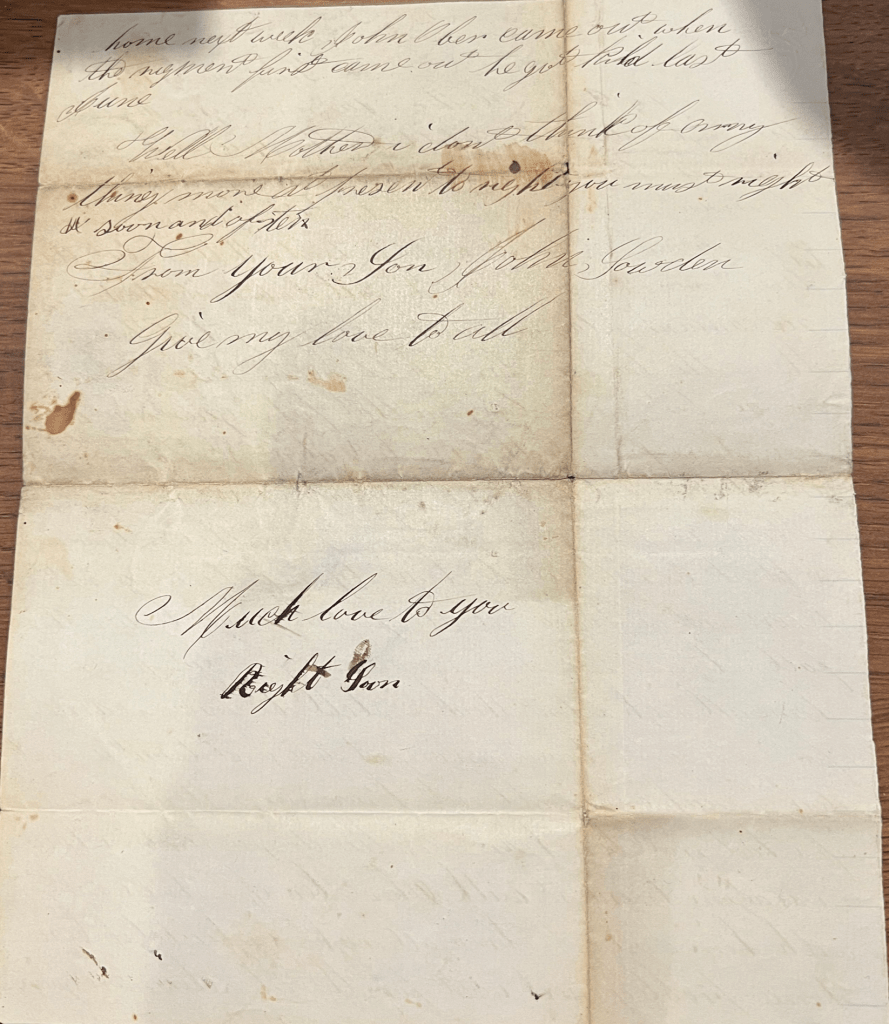
Mother, do you remember when I was a going to enlist with John Ober? If I had went with him and got through all tight, I should of been home probably next week for the old fellows are going home next week. John Ober came out when the regiment first came out. He got killed last June. 2

Well, Mother, I don’t think of anything more at present to write. You must write soon and often/ From your son, — John Sowden

Give my love to all. Much love to you. Write soon.

1 Maurice Casey of Pittsfield was 28 years old when he mustered into Co. K, 1st Massachusetts Cavalry on 14 January 1864. He was killed on 16 September 1864 in the fighting at Jerusalem Plank Road.
2 John P. Ober of Pittsfield was 26 years old when he mustered into Co. F, 1st Massachusetts Cavalry on 19 September 1861. He was killed on 17 June 1863 in the fighting at Aldie. See “Not for Gain or Glory: The 1st Mass. Cavalry at Aldie,” by Daniel Davis.

1862: Mahlon Pitney Davis to Mahlon Oscar Davis

These two letters were written by 49 year-old Lt. Mahlon Pitney Davis (1813-1876) of Co. K, 63rd Ohio Volunteer Infantry. He wrote both letters to his son, Mahlon “Oscar” Davis (1844-1862), who served as a musician in the same company and regiment. Oscar died of typhoid fever at the regimental hospital on 28 May 1862. Mahlon resigned his commission on 27 May 1862.

The 63rd OVI did not get organized until late January 1863 and then it was set immediately took the field and joined Major General John Pope in Missouri. At New Madrid, the 63rd was brigaded with other Ohio regiments in what became known as the Ohio Brigade. It took part in all the operations resulting in the surrender of Island No. 10.

Mahlon was married in 1838 to Lydia Ann Morrow (1819-1899). The Davis’s were enumerated on the family farm near Trimble, Athens county, Ohio, at the time of the 1860 US Census.

I could not find an image of either Mahlon or his son Oscar, but here is an Ambrotype of William Harrison Moore (1828-1894) who enlisted in the same company (Co. K) of the 63rd Ohio Volunteer Infantry. (Harrison G. Moore IV Collection)

Letter 1

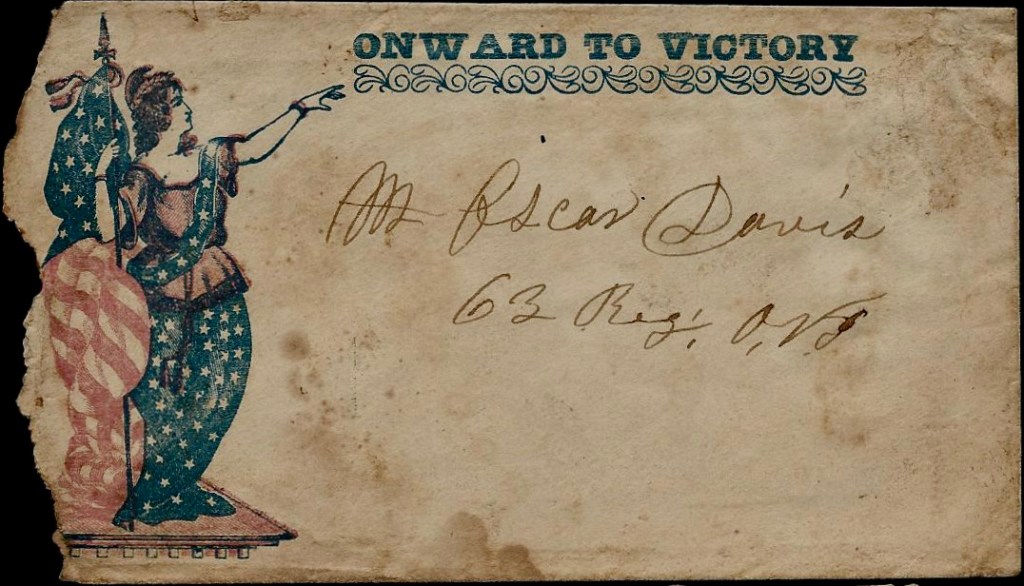
Addressed to Mr. Oscar Davis, 63rd Regt. OVI

[Hamburg, Tennessee]
May 19, 1862

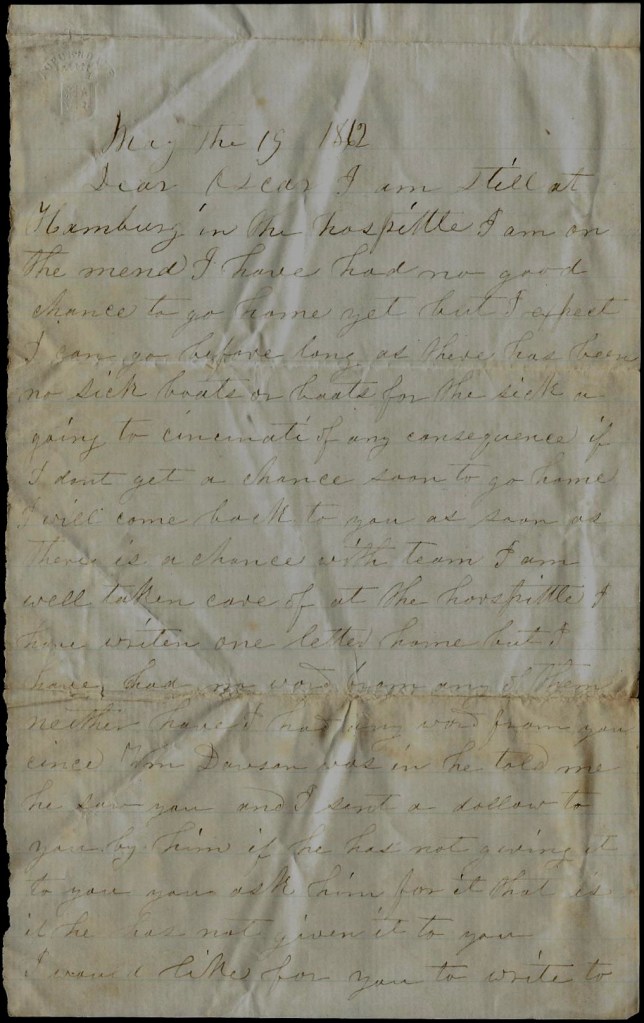
Dear Oscar. I am still at Hamburg in the hospital. I am on the mend. I have had no good chance to go home yet but I expect I can go before long as there has been no sick boats—or boats for the sick—a going to Cincinnati of any consequence. If I don’t get a chance soon to go home, I will come back to you as soon as there is a chance with team. I am well taken care of at the hospital. I have written one letter home but I have had no word from any of them. Neither have I had any word from you since Tom Dawson was in. He told me he saw you and I sent a dollar to you by him. If he has not given it to you, ask him for it—that is, if he has not given it to you. I would like for you to write to me and let me know how you are getting along. Direct your letter to Hamburg P. O., Tennessee.

Lieut. [Wesley S.] Tucker 1 of Fouts’ company [D] is here with me. He wants to go home but the doctor who is tending the ward won’t let him go home but he will let me on the account of my bad health. William Vore [Co. A] is attending in the ward or he is sick now in Ward No. 3. I want you to see Solomon Johnston. 2 Tell him that William Vore wants him to send his Descriptive Roll as he talks of going home. He wants Johnston to forward it on as soon as he can to Hamburg either by mail or any reliable person. You go and tell Solomon Johnston or show him these lines as it was Vore’s request for me to write.

Oscar, I want you to write to me as soon as you can conveniently. — M. P. Davis

[to] Oscar Davis

1 Lt. Wesley S. Tucker was commissioned 1st Lt. in October 1861 and resigned on 18 June 1862.

2 Solomon H. Johnston was a lieutenant in Co. A, 63rd OVI.


Letter 2

Hamburg [Tennessee]
May 21, 1862

Oscar,

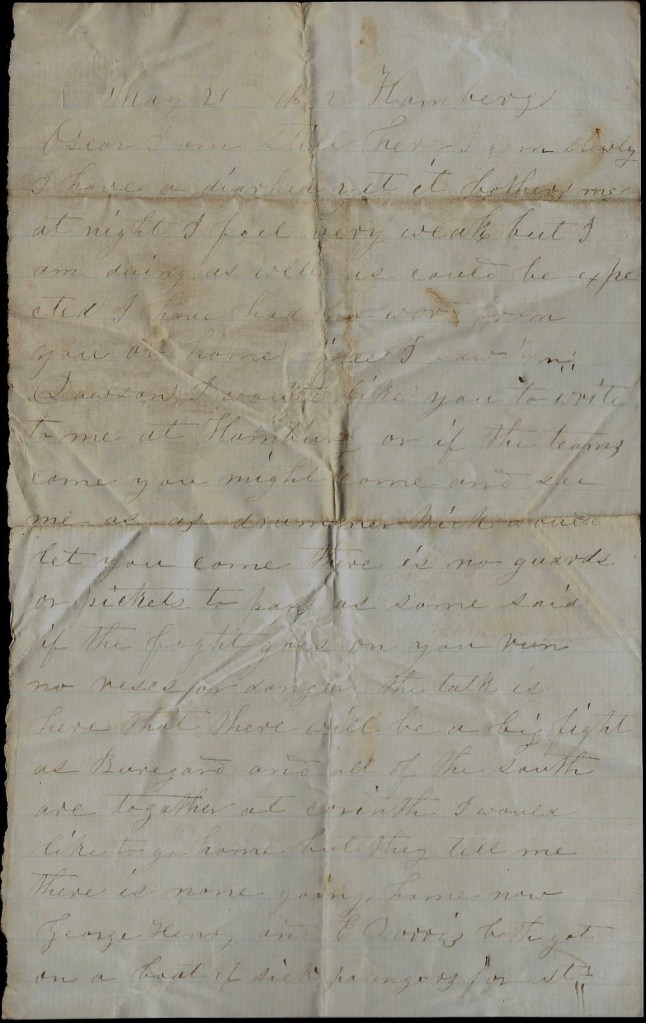
I am still here. I gain slowly. I have a diarrhea yet. It bothers me at night. I feel very weak but I am doing as well as could be expected. I have had no word from you or home since I saw Tom Dawson. I would like you to write to me at Hamburg or if the teams come, you might come and see me as a drummer. Mick would let you come. There is no guards or pickets to pass as some said if the fight goes on you run no necessary danger. The talk is here that there will be a big fight as Beauregard and all of the South are together at Corinth. I would like to go home but they tell me there is none going home now.

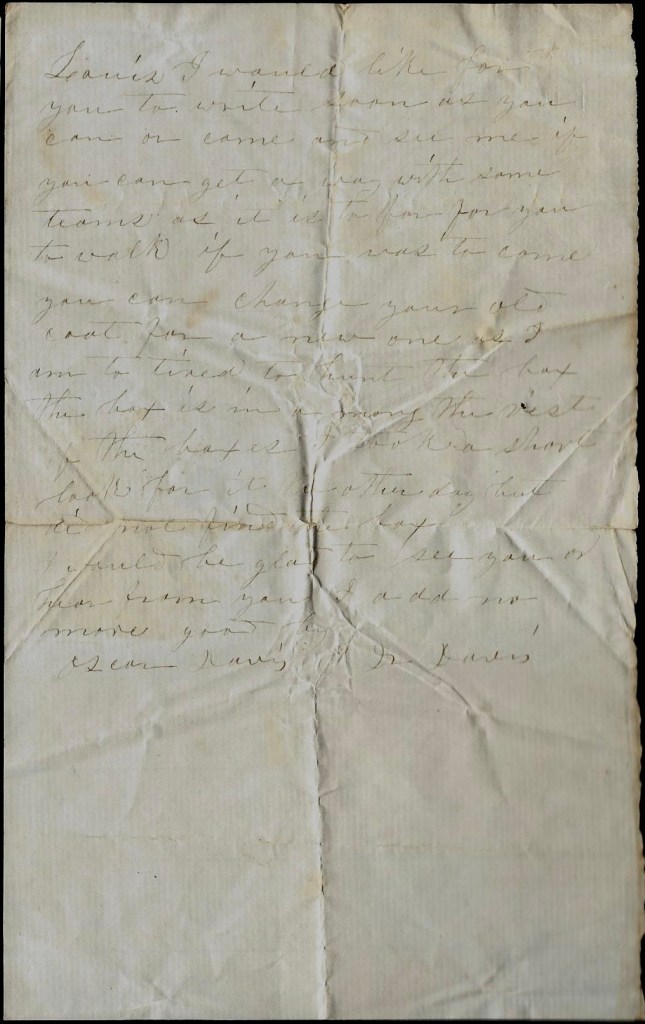
George Henry and E. Davis both got on a boat of sick passengers for St. Louis. I would like for you to write soon as you can or come and see me if you can get away with some teams as it is too far for you to walk. If you was to come, change your old coat for a new one as I am too tired to hunt the box. The box is in among the rest of the boxes. I took a short look for it the other day but did not find the box.

I would be glad to see you or hear from you. I add no more. Goodbye. — M. P. Davis

[to] Oscar Davis

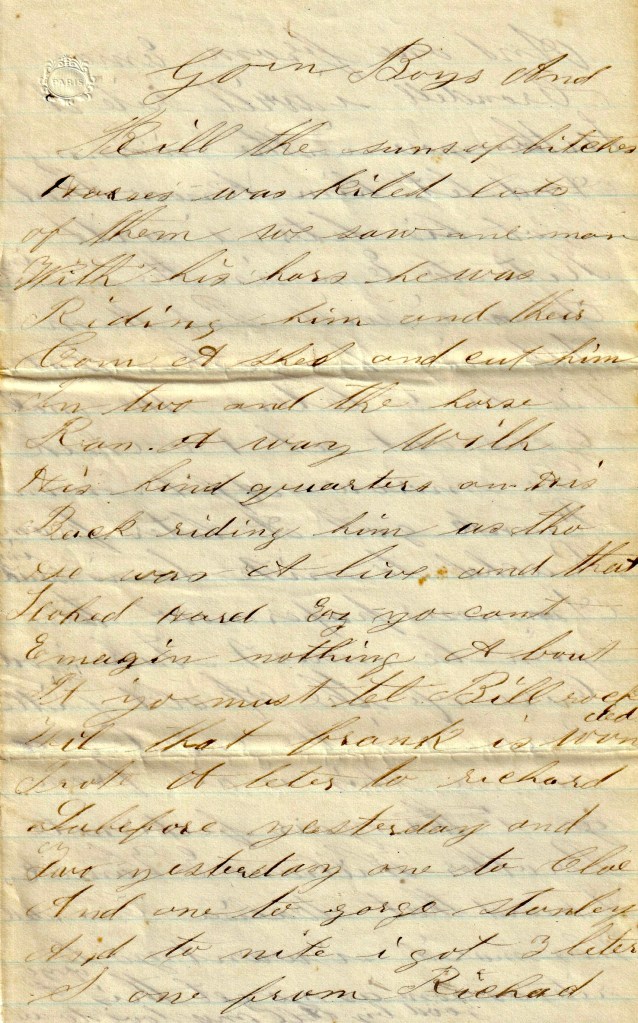
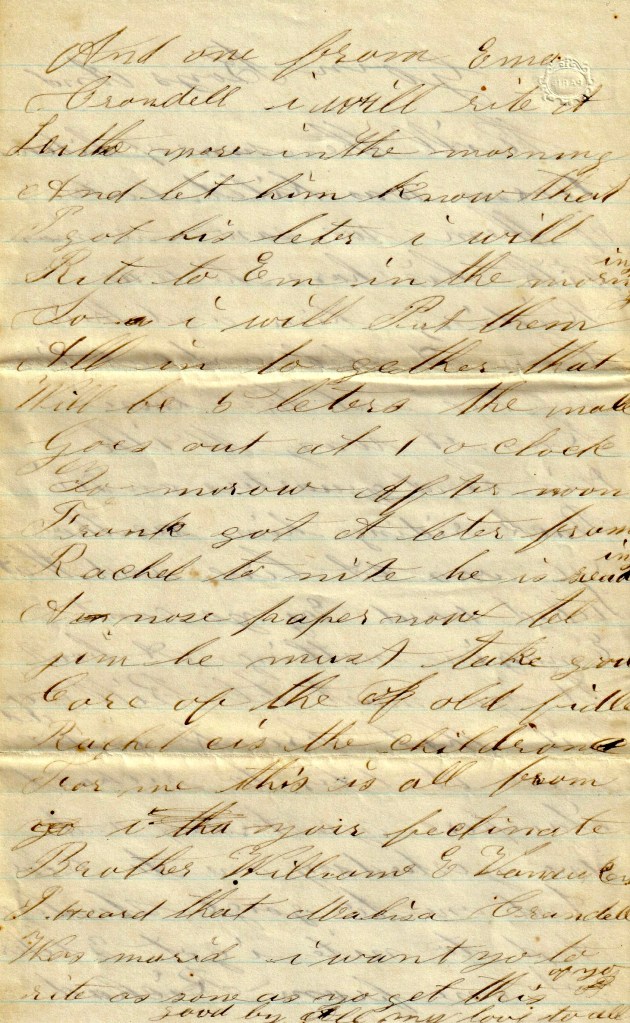
1862: William E. Vanauken to his Family

This incredible letter was written by William E. Vanauken, the son of John Vanauken (1810-1856) and Emmaleta Vredenburg (1804-1862) of Chemung county, New York. William enlisted at the age of 21 as a private in Co. D, 107th New York Infantry (the “Campbell Guards”) on 7 August 1862. At the time of his enlistment he was described as standing 5′ 7″ tall, with blue eyes and brown hair. He was promoted to a corporal sometime prior to 10 April 1863 and made sergeant on 5 March 1864. Unfortunately, William himself died in a similar fashion to what he described in the present letter at Dallas, Georgia, on 25 May 1864.

William’s Headstone in Marietta National Cemetery misspelled “Nanauken”

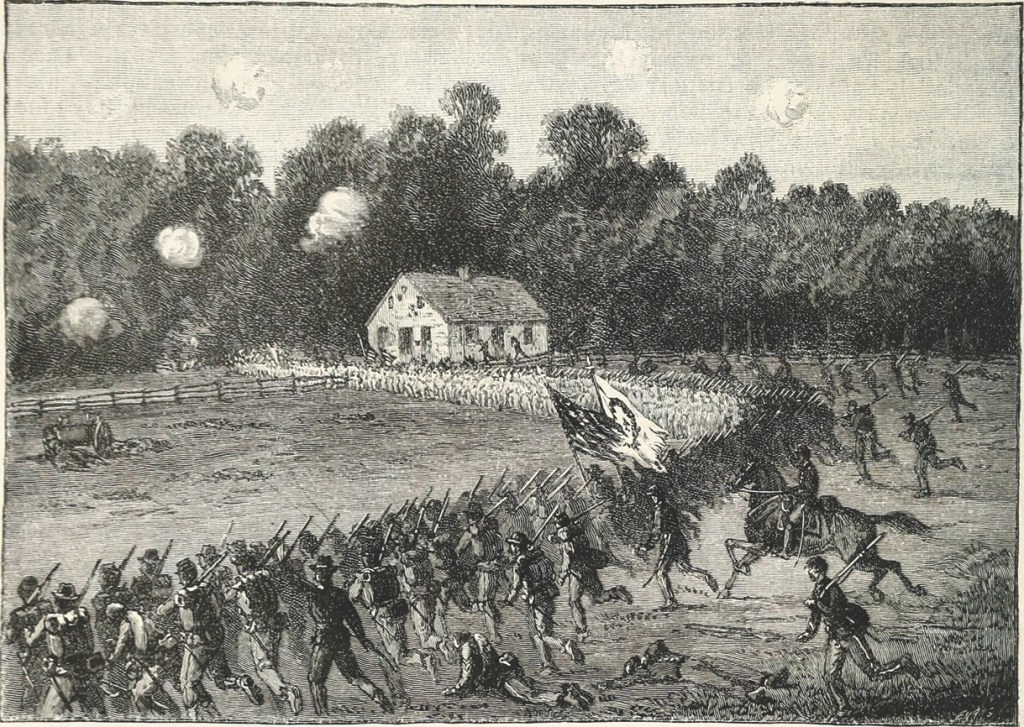
In his letter, William describes the maelstrom the 107th New York found itself in on the morning of 17 September 1862 near Miller’s Cornfield and the East Woods on the Antietam Battlefield. After making their advance, the yet untested regiment soon found itself hunkered down behind a fence on the Smoketown Road near Mumma’s Lane. Across the clearing before them, through the dense smoke of battle, they could just barely make out the Dunker Church and the West Woods beyond. On the right before them was Monroe’s Battery and to the left was Owen’s Battery, both under heavy fire from Rebel cannoneers. And when their right flank was threatened, the regiment was order to change front to meet the new attack, only to find themselves soon afterward prostrate again between two rows of Union artillery, every cannon belching out fire and canister as fast as it could be loaded.  For four hours, the regiment lay pinned to the ground between the rows of artillery, one member of the regiment [Newton T. Colby] telling his father he “tried to get as thin as possible and felt somewhat like a pancake.”

Not all of the boys in the 107th performed as well as they thought they would under fire according to Willie Graham of Co. B. “I honestly think we have a great many cowards in our regiment. We have got a great many of the village loafers and whiskey soakers—great braggarts—swearing what they would do when they got there [on the battlefield] and when we did get there, them very boys was taken sick or skulking behind straw stacks.” [see 1862: William Graham to Libbie Graham]

[Note: This letter is from the personal collection of Richard Weiner and was transcribed and published on Spared & Shared by express consent.]

Transcription

Camp Third [Brigade] 1
September 27, 1862

Dear Brother and Sister,

I got your letter and was glad to hear from you. We are at Harper’s Ferry now. We are both well. Frank is reading your letter now. I have not seen Frank Vredenburg 2 since he was wounded. He is wounded in the hand. We are up on the hill a half a mile away from Harper’s Ferry. We can see the little village all the time. We went down to the Potomac this afternoon and went in a swimming and washed our clothes. We had a good time. When I got back, the mail had come in and there was jumping to get our letters.

Here is where John Brown was hung. The rebels was here and burnt the bridges to Harper’s Ferry. The engineer company has been here building bridges.

I am writing by candle light and I can’t half see. You need not be alarmed about the rebels coming up there for we give them one of the finest dressings that they ever had. The most of the talk now is that we have got them whipped now. They are a hard-looking set. Ez, I saw a good many of them giving their last prayer to God. I saw them gasp their last breath.

They had a battle here before we came and there was a [Union] General give up his men 3 and he is arrested now for it. That is when they burnt the bridge.

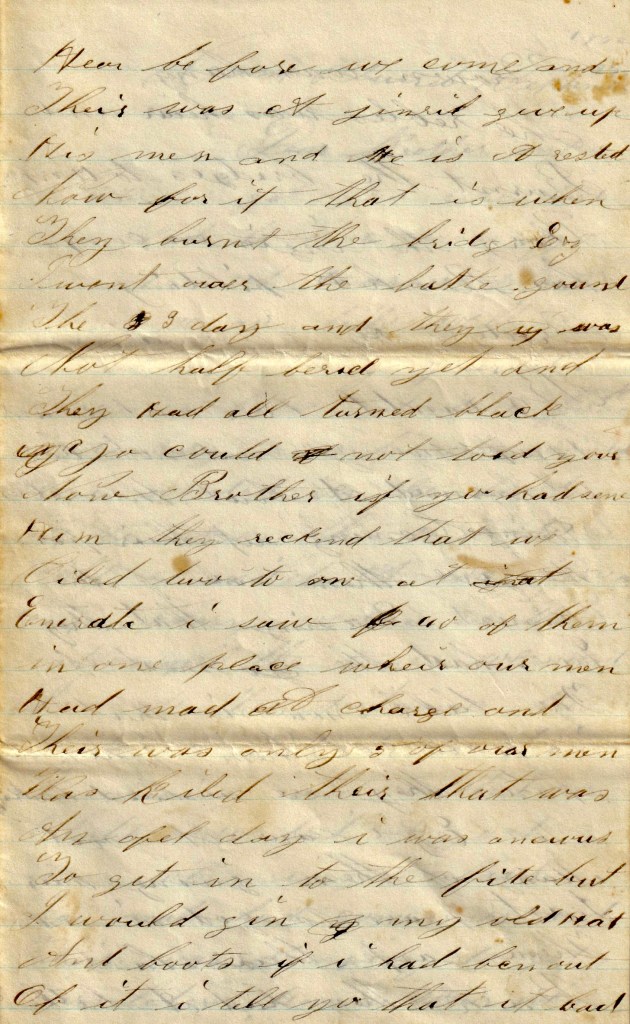
Ez, I went over the battleground the 3[rd] day and they was not half buried yet and they had all turned black. You could not have told your own brother if you had seen him. They reckoned that we killed two to one At any rate, I saw 40 of them in one place where our men had made a charge and there was only 5 of our men was killed there. That was an awful day. I was nervous to get into the fight but I would give my old hat and boots if I had been out of it. I tell you that it’s bad to see your companions dropping on every side of you.

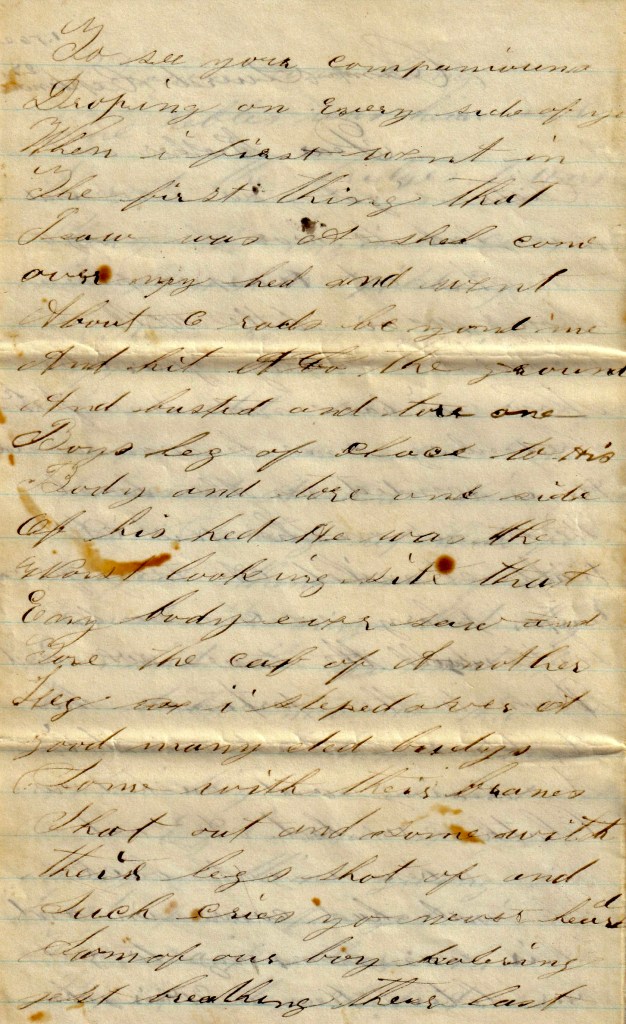
When I first went in, the first thing that I saw was a shell come over my head and went about 6 rods beyond me and hit the ground and bursted and tore one boy’s leg off close to his body and tore one side off his head. He was the worst looking sight that anybody ever saw. I stepped over a good many dead bodies, some with their brains shot out and some with their legs shot off and such cries you never heard. Some of our boys [were] hollering, “Go in boys and kill the sons of bitches!” Horses was killed—lots of them. We saw one man with his horse. He was riding him and there come a shell and cut him in two and the horse ran away with his hind quarters on his back riding him as though he was alive and that looked hard. Ez, you can’t imagine nothing about it.

You must tell Bill Rockwell that Frank is wounded. I wrote a letter to Richard day before yesterday and two yesterday—one to Chloe and one to George Stanley. And tonight I got three letters—one from Richard and one from Emma Crandall. I will write a little more in the morning and let him know that I got his letter. I will write to Em in the morning so I will put them all together. That will be 5 letters. The mail goes out at 1 o’clock tomorrow afternoon. Frank got a letter from Rachel tonight. He is reading a newspaper now. Tell Jim he must take good care of the old fiddle. Rachel, kiss the children for me. This is all from your affectionate brother, — William Vanauken.

I heard that Melissa Crandall was married. I want you to write as soon as you get this. Goodbye. All my love to all of you.


1 I can’t be certain that I have transcribed the name of the camp correctly. It may have been “Third” Brigade, XII Corps, as that is the unit the 107th was part of at the time. After the Battle of Antietam, the 107th New York, 13th New Jersey, and the rest of the Third Brigade went into camp across the Potomac from Harpers Ferry on Maryland Heights, where they occupied a piece of farmland on a plateau on the west side of the ridge. They did not see action again until Chancellorsville.

2 Francis (“Frank”) D. Vredenburgh was 21 years old when he enlisted with William at Elmira in Co. D, 107th New York Infantry. Muster rolls indicate that he “deserted, no date, from hospital.” Frank was a cousin of William’s.

3 William is probably referring to Union General Dixon Stansbury Miles (1804-1862) who surrendered Harper’s Ferry to Stonewall Jackson’s men on 15 September 1862 giving up almost 12,500 prisoners. Miles was mortally wounded after calling for a ceasefire so probably avoided being cashiered. A commission was subsequently tasked to investigate the fiasco and concluded that Miles was probably a traitor and one or more subordinates were found at fault as well.

1832: Walthall Burton’s Statement of Theft

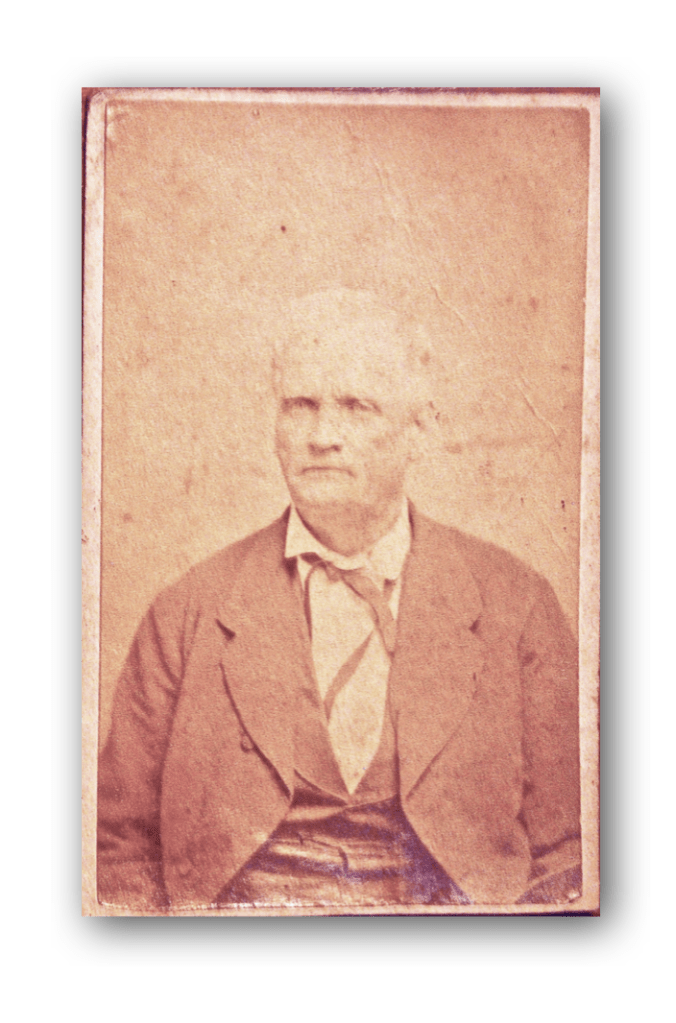
Walthall Burton in post-Civil War years

This unusual statement was written in 1832 by Walthall Burton (1807-1899) a planter residing near Woodville in Wilkinson county, Mississippi, in the early 1830s. Woodville was one of the earliest towns established in Mississippi. It was sited in the rolling hills just north of the Louisiana-Mississippi border in the southwest corner of the state on the Natchez Trace. The planter community centered at Woodville thrived on cotton production from the 1830s until the Civil War.

Burton was born in Nelson county, Kentucky, the son of Wilson Burton (1779-1825) and Eleanor Gray Bruce (1778-1862). He lived there with his parents until 1811 when the family relocated to Wilkinson county, Mississippi. When he was 19 years old, he became the overseer of a plantation near his parent’s home but by 1827 he was ready to start his own plantation near Woodville. It was on this plantation that he wrote the following.

The year following, 1833, he move to St. Helena Parish where he resided until 1849. Following the Civil War, Burton spent his time steamboating on the Atchafalaya river. He was married in 1827 to Theresa A. Terrel of Mississippi.

This statement appears to have been meticulously prepared as if it were intended as an exhibit in a trial, but I can find no record in the Woodville newspapers of either the described incident itself or a trial that might have followed.

[Note: This statement is from the personal collection of Rob Morgan and was transcribed and published on Spared & Shared by express consent.]

Walthall Burton’s Pocket Book, Wilkinson, County, Mississippi—Woodville

Transcription

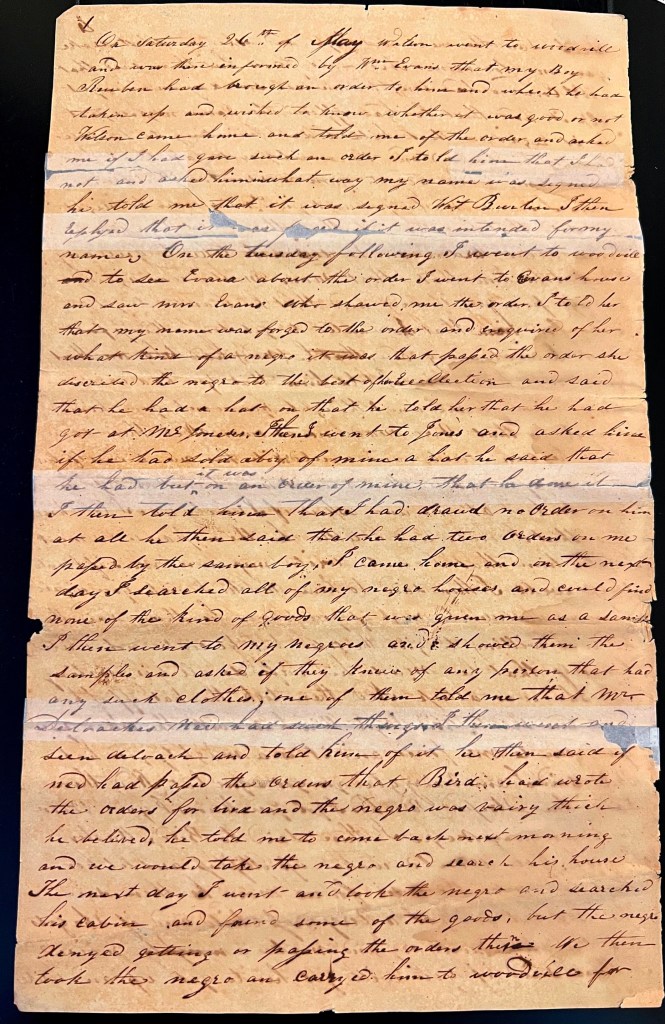
On Saturday, 26th of May, Wilson went to Woodville and was there informed by William Evans that my Boy Reuben 1 had brought an order to him and which he had taken up and wished to know whether it was good or not. Wilson came home and told me of the order and asked me if I had gave such an order. I told him that I had not and asked him in what way my name was signed. He told me that it was signed Wat Burten. I then realized that it was forged if it was intended for my name.

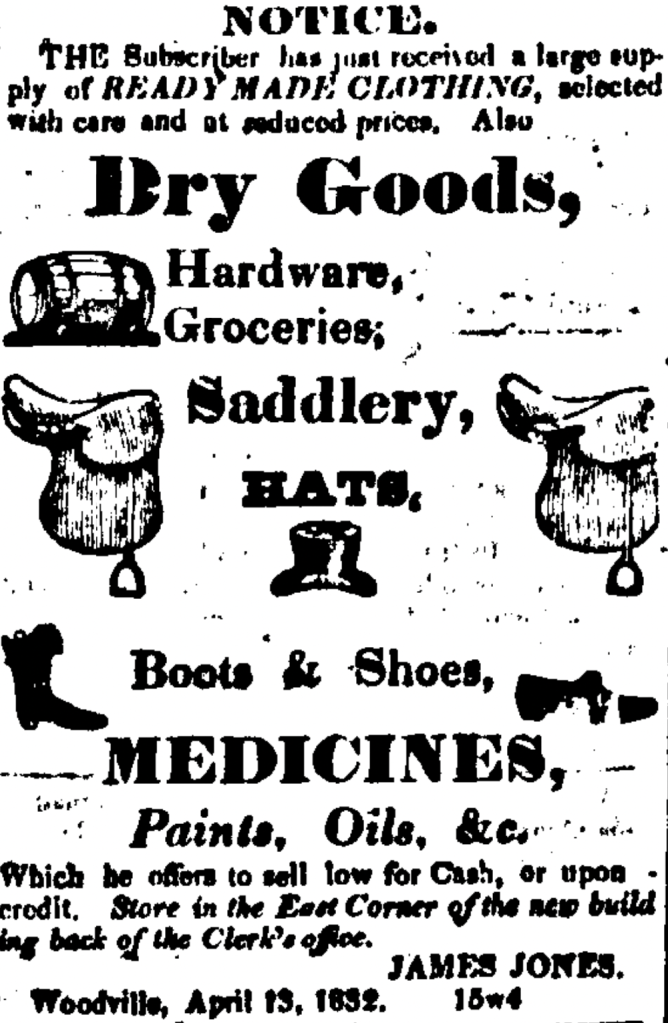
Advertisement for store operated by James Jones in Woodville in April 1832

On the Thursday following I went to Woodville to see Evans about the order. I went to Evans’ house and saw Mrs. Evans who showed me the order. I told her that my name was forged to the order and enquired of her what kind of a negro it was that passed the order. She described the negro to the best of her recollection and said that he had a hat on that he told her he had got at Mr. [James] Jones’s. I then went to Jones and asked him if he had sold a boy of mine a hat. He said that he had but it was on an order of mine that he done it. I then told him that I had drawed no order on him at all. He then said that he had two orders on me passed by the same boy. I came home and on the next day I searched all of my negro houses and could find none of the kind of goods that was given me as a sample. I then went to my negroes and showed them the samples and asked if they knew of any person that has such clothes; one of them told me that Mr. Deloroches’ Ned had such them goods. I then went and seen Delroch and told him of it. He then said if Ned had passed the orders that Bird had wrote the orders, for Bird and the negro was very thick he believed. He told me to come back next morning and he would take the negro and search his house.

“The negro still denying the charge, we then resorted to means to make him confess. He stood out for some time…” Scene from Twelve Years A Slave.

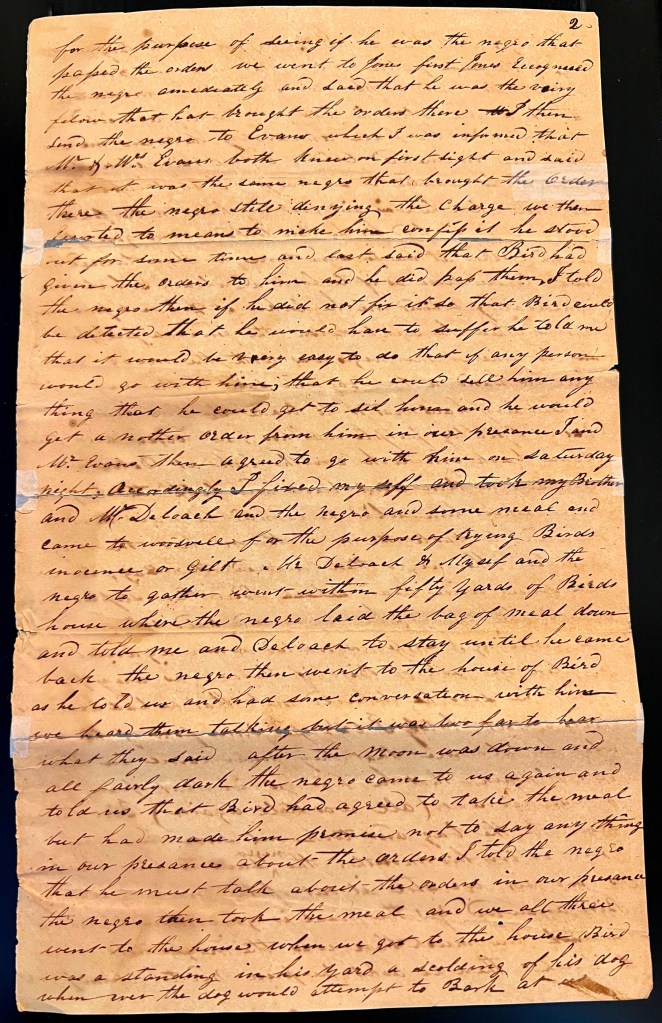
The next day I went and took the negro and searched his cabin and found some of the goods, but the negro denied getting or passing the orders then. We then took the negro and carried him to Woodville for the purpose of seeing if he was the negro that passed the orders. We went to Jones’ first. Jones recognized the negro immediately and said that he was the very fellow that had brought the orders there. I then sent the negro to Evans’ which I was informed that Mr. & Mrs. Evans both knew on first sight and said that it was the same negro that brought the order there. The negro still denying the charge, we then resorted to means to make him confess it. He stood out for some time and [at] last said that Bird had given the orders to him and he did pass them. I told the negro then if he did not fix it so that Bird could be detected, that he would have to suffer. He told me that it would be very easy to do that if any person would go with him; that he could tell him anything that he could get to suit him and he would get another order from him in our presence. I and Mr. Evans then agreed to go with him on Saturday night.

Accordingly, I fixed myself and took my brother and Mr. Deloach and the negro and some meal and came to Woodville for the purpose of trying Bird’s innocence or guilt. Mr. Deloach & myself and the negro together went within fifty yards of Bird’s house where the negro laid the bag of meal down and told me and Deloach to stay until he came back. The negro the went to the house of Bird as he told us and had some conversation with him. We heard them talking but it was too far to hear what they said. After the moon was down and all fairly dark, the negro came to us again and told that Bird had agreed to take the meal but had made him promise not to say anything in our presence about the orders. I told the negro that he must talk about the orders in our presence. The negro then took the meal and we all three went to the house. When we got to the house, Bird was standing in his yard a scolding of his dog whenever the dog would attempt to bark at us.

The negro walked up to the palin and set the bag on the top of the palin & I walked in about 5 or 6 feet of the palin and stopped. Delroch stopped immediately behind me. After he had got the dog reconciled, he stepped to the fence immediately between me and him and commenced looking at me very close. I thought he wanted to see me good. I stepped up close to the fence where he was and laid my hand on the fence close to where he had his. He then looked at me good. He had looked at me for some time. He then turned his head to one side as if to look at Delroch which was immediately behind me. He looked at Delroach for some time. Then he went down the fence a few feet to where the negro was with the meal and laid his hand on the bag and said to the negro it is a very hard matter to trade now. Times is very squally. People watches very close. And then [he[ came back and took another look at Deloach & myself. He then went back and felt the bag. The negro asked him what he wanted. He said that he wanted to taste the meal but the bag was tied. The negro then untied the bag. There was some noise heard. Bird then stepped back against the side of his house and said some person was coming. I sorter squatted down against the paylen and asked Bird if there was any patrol about. He said he believed not—that he had heard no noise about lately. I expressed some fear of the patrol. He told me that they never came in that part of town—that he had got in that part of town on that account (all was still again).

Bird then stepped to the bag and took out some meal and put it in his mouth. The negro said to him the meal is good, sir, we stole it out of the mill yesterday. Bird answered yes, the meal is good. Then he asked how much there was. The negro told him a bushel. Then he asked the price. Ned told him 75 cents. Bird said the meal was high and asked me what Drake gave me for mine. Ned said 75 cents. He then said that Mrs. Conrad had bought some last Sunday morning at 62.5 cents and that he had offered the same negroes 75 cents for it right on that hillside (pointing to the hills east of his house) and he would not take that but went and took 62.5 cents from Mrs. Conrad. Ned then said I suppose Master you won’t give nairy order tonight. He said that he rather not. That there had been some noise about orders and he did not like to give any. Ned told him that that man’s master was a going away (pointing to me) and that he wanted to get an order for him—that he wanted to get some things before he went away and I told him that you had written some orders for me and I thought you would give him one. To that Bird made no answer. Ned then said that he can write and would write one himself but he was afraid. Bird then said it is a bad business. He then looked at me and asked if I could read. I told him yes, that I could read a little. He then paused a moment. I told him that I could write my own orders if I could spell well. I then said to him, Master, I wish you would give us an order tonight, if you please. He then said that he was willing to give the order but he could not write himself—that he made his wife so all his writing and she was asleep.

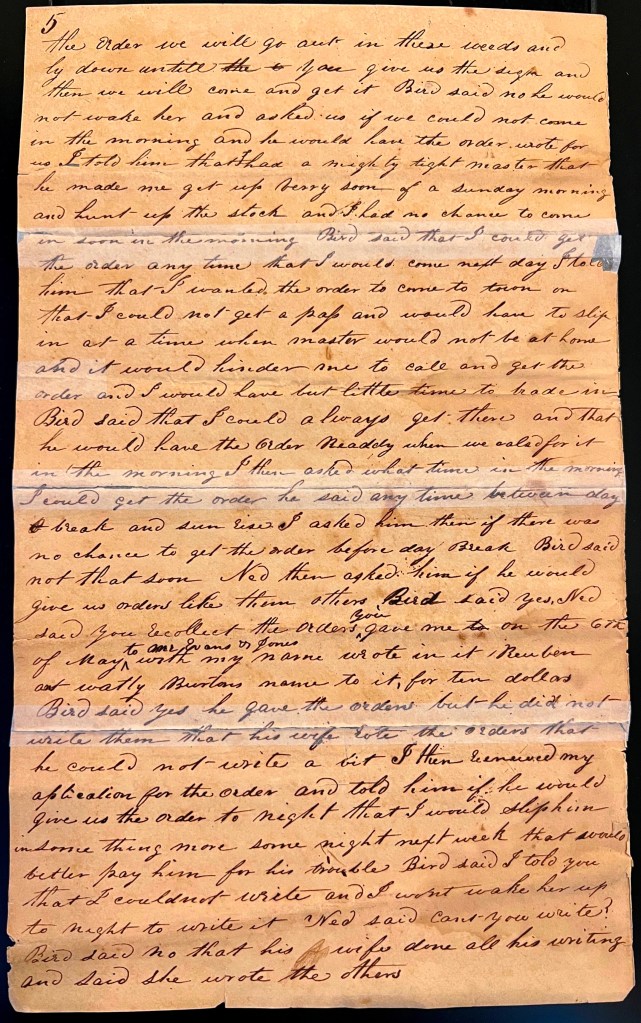
Ned then took the hat off his head and said to Bird. I got this hat with the order you gave me to Mr. Jones and it is a mighty good hat. Bird said I am very glad you got a good hat. Ned then said the stamped britches I got, you know I gave them to a runaway negro. I then said to Bird, Master, I wish you would wake up mistress and let her write the order for us now. He then said she is a bed and got a very cross child and if she gets up, the child will cry and make noise. I then said if you will get her to get up and write the order, we will go out in these weeds and lie down until you give us the sign and then we will come and get it. Bird said no he would not wake her and asked us if we could not come in the morning and he would have he order wrote for us. I told him that I had a mighty tight master—that he made me get up very soon of a Sunday morning and hunt up the stock and I had no chance to come in soon in the morning. Bird said that I could get the order any time that I would come next day. I told him that I wanted the order to come to town or that I could not get a pass and would have to slip in at a time when master would not be at home and it would hinder me to call and get the order and I would have but little time to trade in. Bird said that I could always get there and that he would have the order ready when we called for it in the morning. I then asked what time in the morning I could get the order. He said any time between daybreak and sunrise. I asked him then if there was no chance to get the order before daybreak. Bird said not that soon.

Ned then asked him if he would give us orders like them others. Bird said yes. Ned said you recollect he orders you give me on the 6th of May to Mr. Evans and Mr. Jones with my name wrote in it, Reuben, and Watly Burton’s name to it, for ten dollars. Bird said yes, he gave the orders but he did not write them—that his wife wrote the orders—that he could not write a bot. I then renewed my application for the order and told him if he would give us the order tonight, that I would slip him in something more some night next week that would better pay him for his trouble. Bird said I told you that I could not write and I won’t waker her up tonight to write it. Ned said can’t you write? Bird said, no, that his wife done all his writing and said she wrote the others.

Advertisement for the new store in Woodville run by David Armstrong, May 1832

At this moment we heard some beast cough. Bird said there is somebody a coming and started like as if he was a going in his house and said some person will come presently and I won’t stay here any longer. Ned said as Bird walked a little off we can get the order in the morning, can’t we? Bird said yes and turned and came back and went into the corner formed with a little room that project beyond his house and joins with the corner of the paylon near a door that leads into that rom or just between the room and house. He there leaned back against the wall of his house with his crutches in one hand and a hold on the side of the door with the other hand as if prepared to spring in at the door the moment he should see or hear anything that might affright him. Bird had in the course of our conversation about the orders taken the bag of meal from the fence and put it on a barrel and laid a board on it. We asked him for the bag. He asked us if we could not get the bag in the morning. I told him that master always sent to mill on Sunday morning and that was one of the mill bags and if the bag was not at home ready for mill, that there would be a noise. Bird said he would empty it then and started back from the door where he had so completely fixed himself that Ned then told him to write the order to Mr. Jones. He said yes but he did not like Jones much ad would rather give one to Armstrong [see adjoining advertisement]. He said Armstrong was a very fine fellow and his goods is cheaper. He then took the meal and hopped along with it in at the door above mentioned and emptied out the meal and gave us the bag at a different place from where he got it and gave us some water to drink. We then told him that we would be back in the morning to get the order, bid him farewell, and left him.

June 5th, 1832

— Wathall Burton

1 A Slave book kept by Burton indicates that Reuben & Amy were a couple and together they had the following children: Amstead, b. 1 December 1831; Edmund, b. 15 Jan. 1834; Delphine, b. 4 July 1836; and Mariah, b. 12 October 1842.

1861: James William Denver to Patrick Henry Harris

Brig. General James William Denver

The following draft of a letter was penned by James William (“Jim”) Denver (1817-1892), an American politician, soldier and lawyer. He served in the California state government, as an officer in the United States Army in two wars, and as a Democratic member of the United States House of Representatives from California. He served as secretary and Governor of the Kansas Territory during the struggle over whether or not Kansas would be open to slavery. The city of Denver, Colorado, is named after him.

Though a native of Virginia, and a staunch conservative Democrat, during the Civil War, Denver would cast his lot with the Union. He was appointed a Brigadier General in the Union army by President Lincoln in August 1861.

In the following two documents, Denver expresses his views on the deepening divide between the North & South from his residence in California in January 1861, some three months before hostilities erupted. The second document, written in June 1861, is his retrospective reaction to the dashed hopes expressed in his first document and includes the rationale for pursuing his personal course of action as a Union Democrat. The first document was clearly a draft and includes handwritten corrections by Denver. The finished letter was known to have been submitted to Harris because there is a reference to it in George C. Barns’ book, Denver, the Man, published in 1949.

Denver wrote the letter to his old friend, Patrick Henry Harris (1819-Aft1861) of Harrodsburg, Kentucky, who served as a 1st Lieutenant in the 16th Regiment of the US Infantry during the Mexican War. I believe the appellation of “General” was simply a term of affection for a former military comrade. In the 1860 US Census, Patrick was enumerated as a lawyer and later District Attorney in Butte county, California, where he had been in practice since at least the mid 1850s in partnership with J. M. Burt. The last record I find for him in Butte county is in 1862.

Transcription

Sacramento, California
January 26, 1861

Gen. P. H. Harris, Sir,

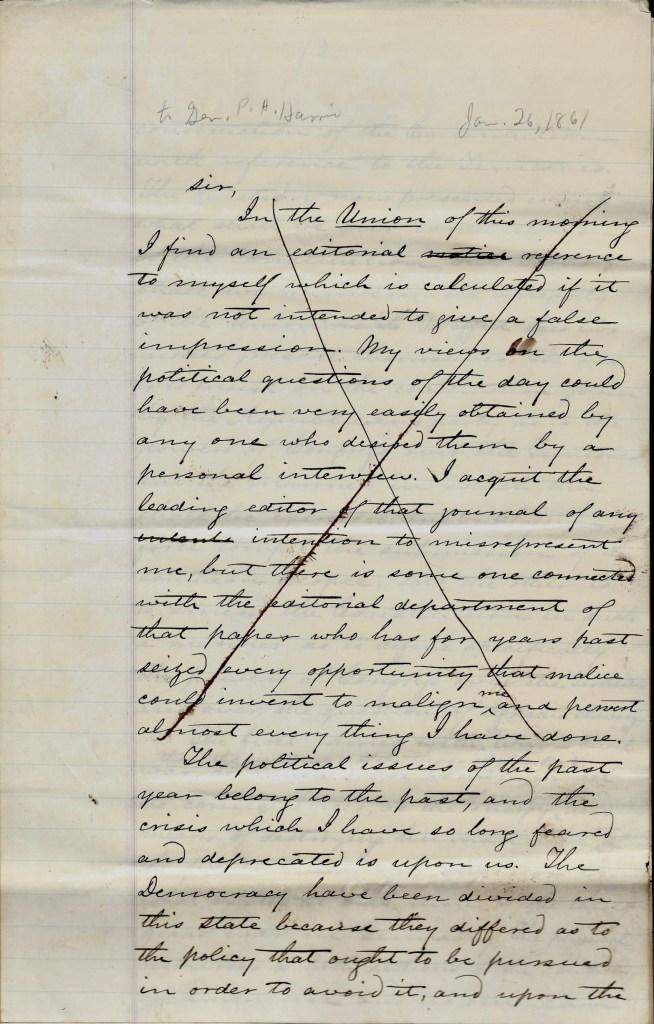
At your request I proceed to give my views in regard to the troubles at present existing in the southern states of our Union and the course which I think ought to be pursued to restore harmony to the country. About these matters, I have no concealments and if anything I can say or do will contribute in any degree to the preservation of our government and the restoration of good feeling in our hitherto prosperous and happy country, I shall always be ready to respond. That we are surrounded by dangers the most threatening our country has ever yet encountered, no one will deny. So long as the government was in the hands of a great national party, there could be no real danger. But when it became evident that that power was to pass into the hands of a sectional party who entertained opinions hostile to what the other section of the country believed to be their constitutional rights, it it not to be wondered that the very foundations of the government are shaken.

The political issues of the past year belong to the past, and the crisis which I have so long feared and deprecated is upon us. The Democracy have been divided in this state because they differed as to the policy that ought to be pursued in order to avoid it, and upon the construction of the Constitution with reference to the Territories. The question now presented is not what shall be our construction of the Constitution, but how shall we maintain the integrity of the Union? To effect this, two modes present themselves. The one is to insist on the construction given by the Republican Party as to the powers of Congress over the Territories and the manner in which thy shall be exercised, and by physical force compel the submission of the southern people; and the other is to amend the Constitution in such a manner as to define specifically the powers of Congress over the Territories and over the question of African slavery.

The first carries with it war—civil war, as much more horrible than the civil wars of the times of Charles V, in all its consequences, as the energy of our people and means of destroying human life at the present day are superior to what existed at the time of the thirty years’ war in Germany. The physical resources of both sections of the country are immense and no one can even calculate upon the result of a resort to the sword. If the present movement in the southern states was confined to the politicians alone, we might hope to see them checked by the conservative masses of the people, but almost all accounts agree in representing the excitement in the popular mind as being far in advance of the mere politicians. All accounts agree too in representing the people of the South as being almost a unit on the questions now agitating the community. A resort to the sword would inevitably drive the border slave-holding states to take sides with the extreme southern states, which would at once and forever terminate this confederacy.

Suppose, however, those states should be conquered. What then is to be done with them? We cannot compel the people there to elect members of Congress. We cannot compel them to exercise any right which is secured to them by the Federal Constitution. How then are they to be governed? Congress has no power to supply a government. Even then in the event of a successful invasion of the southern states (which is hardly probable), the Federal Government would find itself in a worse condition at the termination than at the commencement of hostilities.

Our government is based upon and dependent on the affections of the people. Destroy the confidence and affections that attach the people to the government and it can no longer exist. Confidence cannot be secured by merely conforming to the forms of the Constitution while grossly violating its spirit. Neither can a great section of the confederacy composing a number of states, be coerced by military force to accept a construction of the Constitution which they believe will deprive them of their rights and deprive them of their equality in the government. A small community or even a single state might be compelled to submit and give but little trouble, for the opinion of their neighbors would force them to do so, but the case in point is very different.

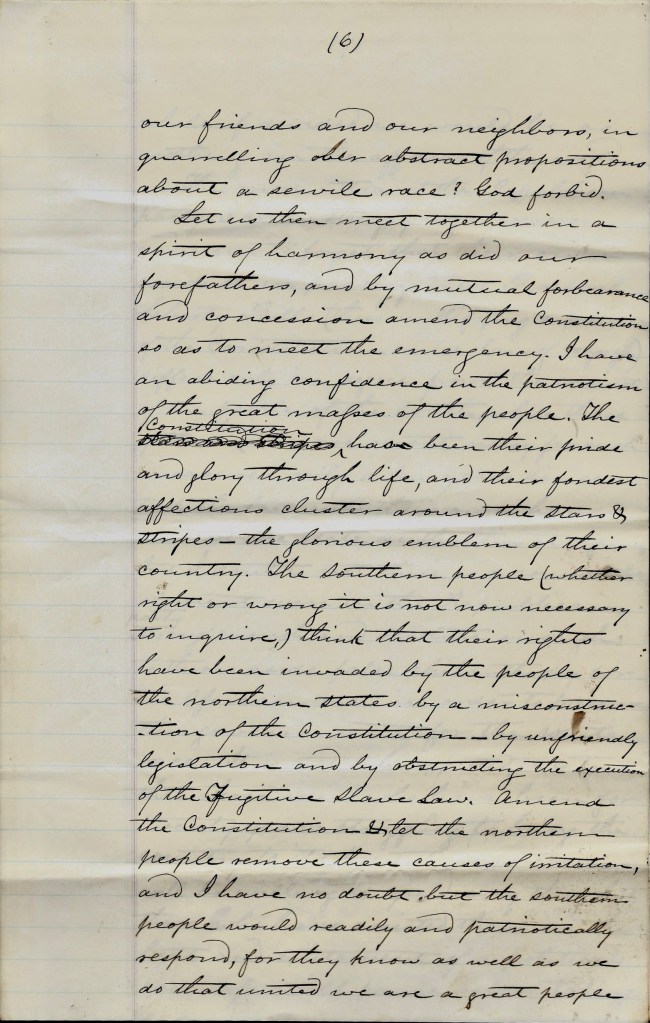
Looking at the subject then from this point of view without finding any solution for our present difficulties, let us turn to the Federal Constitution itself. That instrument was framed by the patriots of the revolution and was the result of many compromises and concessions. After a trial, it was found to be defective and it was amended so as to meet the requirements of the times. Are we of the present generation less patriotic than our forefathers? Can we not imitate their example of moderation, of concession, or magnanimity? Are we incapable of upholding and maintaining that glorious inheritance—that monument of their wisdom, which has been so long the pride of Americans and challenged the admiration of the civilized world? Shall we throw away everything—shall we destroy the best government the world ever saw and bathe our hands in the blood of our relatives, our friends, and our neighbors, in quarreling over abstract propositions about a servile race? God forbid.

Let us then meet together in a spirit of harmony as did our forefathers, and by mutual forbearance and concession amend the Constitution so as to meet the emergency. I have an abiding confidence in the patriotism of the great masses of the people. The Constitution has been their pride and glory through life, and their fondest affections cluster around the stars & stripes—the glorious emblem of their country. The southern people (whether right or wrong it is not now necessary to inquire), think that their rights have been invaded by the people of the northern states by a misconstruction of the Constitution—by unfriendly legislation and by obstructing the execution of the Fugitive Slave Law. Amend the Constitution & let the northern people remove these causes of irritation, and I have no doubt but the southern people would readily and patriotically respond, for they know as well as we do that united we are a great people, while if divided we would be as nothing in the affairs of the world.

The more ultra of the Republican Party I know strongly urge coercion, and seem to forget that their own conduct in passing heir Personal Liberty Bills (thus nullifying a provision of the Constitution and a law of Congress), differs only in degree from the conduct of the people of the South, while those of them here who are most noisy for such measures only a few years since took the law into their own hands and set the state authorities at defiance; but I doubt not there is a conservative element even in the Republican Party strong enough and resolute enough to throw aside false philanthropy for the African race in order to preserve this government for the white race. It is not to be expected, it is true, that those men who have been for twenty years struggling to bring the country to its present condition will be willing to yield anything, but those who have assisted them in the heat and excitement of a political canvass will pause before taking a step which must finally plunge us into civil war.

California occupies a position in the Union at this time that would very well justify her in presenting herself as a mediator, and she cannot in my opinion pursue any other course with safety. Among our population is to be found representatives from every state. The great mass of the people are eminently conservative/ They love their old homes, their old friends, and they love their whole country/ There are few among us who would regard with any kind of favor a proposition to dismember the Union and I apprehend there are not many who would be willing to have the state take part in a war in favor of the North against the South, or of the South against the North, for such an act would surely bring civil war to our own homes.

I would cling to the Union as long as the Union has an existence, but I would not engage in a fratricidal war which would result in the destruction of the Republic. By pursuing the course indicated, I believe our government can be preserved, and any other course I am certain will be its destruction. These are great emergencies when the strongest governments must yield to the force of circumstances. Such a crisis is upon us now and it remains to be determined whether we will yield to reasonable demands or adhere to abstract propositions and destroy our government.

You will observe that I have confined myself to the examination of the single proposition—the best means of preserving the government under existing circumstances, and being clearly of opinion that an attempt at coercion by military force would be impracticable and disastrous in its results. I am in favor of peaceable compromises and reasonable concessions.

Very respectfully your obedient servant, — J. W. Denver


June 1861

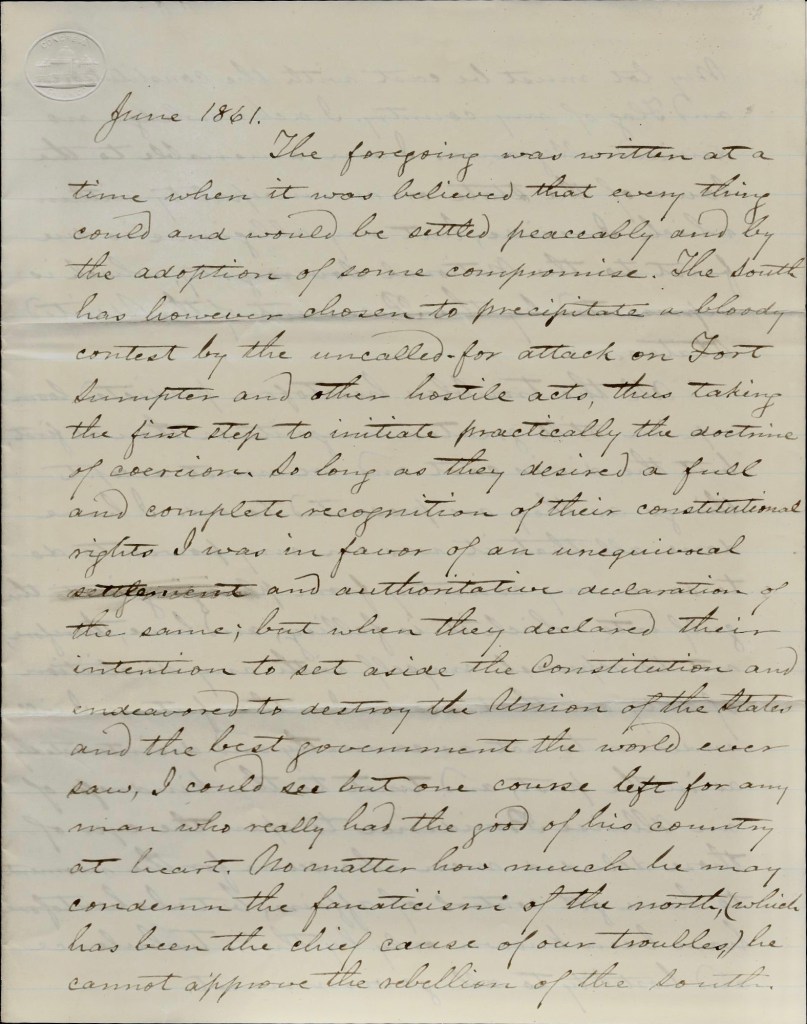
The foregoing was written at a time when it was believed that everything could and would be settled peaceably and by the adoption of some compromise. The South as, however, chosen to precipitate a bloody contest by the uncalled for attack on Fort Sumter and other hostile acts, thus taking the first step to initiate practically the doctrine of coercion. So long as they desired a full and complete recognition of their constitutional rights, I was in favor of an unequivocal settlement and authoritative declaration of the same; but when they declared their intention to set aside the Constitution and endeavored to destroy the Union of the States and the best government the world ever saw, I could see but one course left for any man who really had the good of his county at heart. No matter how much he may condemn the fanaticism of the north (which has been the chief cause of our troubles), he cannot approve the rebellion of the South.

My lot must be cast with the Constitution and Flag of my country. I acknowledge no divided allegiance. I am amenable to the laws of the State or municipality within which I reside, but my allegiance is due to the National Sovereignty which is represented by the President of the United States.

All the troubles heretofore predicted loom up in still greater magnitude than at first, but the die is cast and we must accept things as they are presented to us. I have done all that it was in my power to do to save my country from plunging into the gulf into which it is falling, and have, therefore, not to reproach myself with any dereliction of duty on that score. In the future I will endeavor to act as earnestly and disinterestedly as in the past, and trust to the kindness of al All Wise Providence to open the eyes of those deluded men who seem for the moment to have got control of affairs, but who heretofore have been known only by their turbulence and hostility to all government.

1863: Henry Spencer Murray to William M. Murray

The following letters were written by Henry Spencer Murray (1840-1874), the son of William Murray (1803-1875) and Ellen Maria Matlack (1809-1895) of Goshen, Orange county, New York. Henry’s father was a former US Congressman, representing New York’s 9th & 10th Districts in the US House of Representatives from 1851 to 1855. Two of the three envelopes were addressed to Henry’s older brother, William Matlack Murray (1838-1897), a tinner by trade.

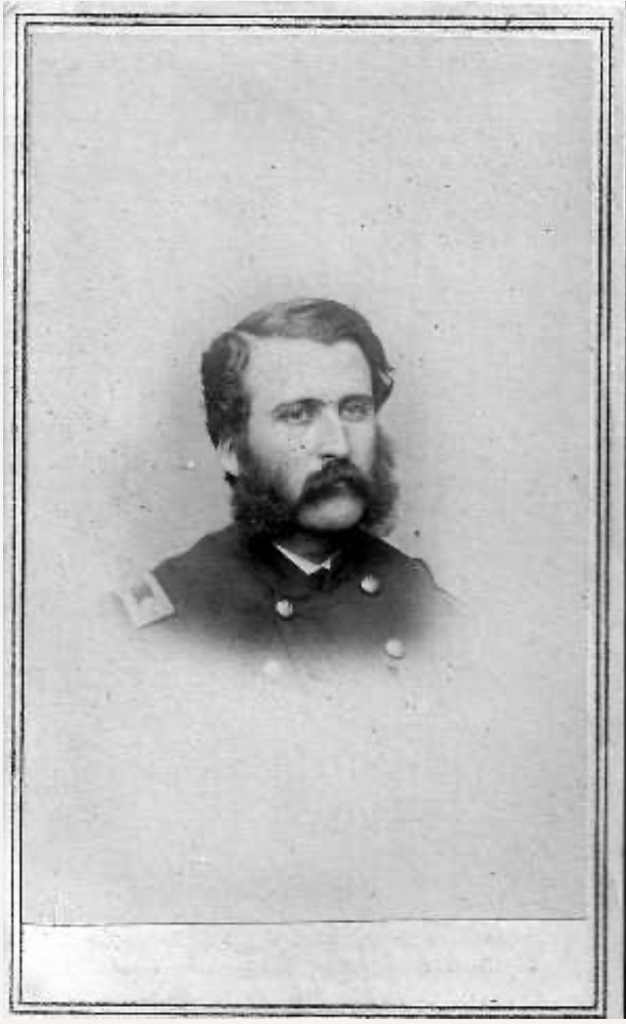
Major Henry Spencer Murray, 124th New York Vols.

When the Civil War erupted in April 1861, Henry was rushed to the defenses of Washington D. C. with the 17th New York State Militia. They later guarded Baltimore. In the fall of 1862, he raised a company (Co. B) for the 124th New York Volunteers and entered the service with them as their captain. Part of the Army of the Potomac, the 124th New York participated in the Battle of Chancellorsville in May 1863 where Henry was wounded and captured but afterwards paroled.

At the Battle of Gettysburg, both the Colonel (Ellis) and Major of the 124th New York were killed and Henry was promoted from the rank of Captain to Major and assigned to duty at the Camp of Paroled Prisoners at Annapolis, Maryland where he remained until regularly exchanged in January 1864.

After he rejoined the regiment, he was again wounded and taken prisoner in the fighting at Boydton Road on 27 October 1864. This time he was sent to Libby Prison where he remained until the end of the war when he was finally discharged. He never fully recovered from the effects of his first wound and he died at Goshen on 6 March 1874.

Though he does not speak of it in his letter of 22 November 1863, Henry married Sarah Dunning at Goshen on 10 November 1863 while home on furlough.

Letter 1

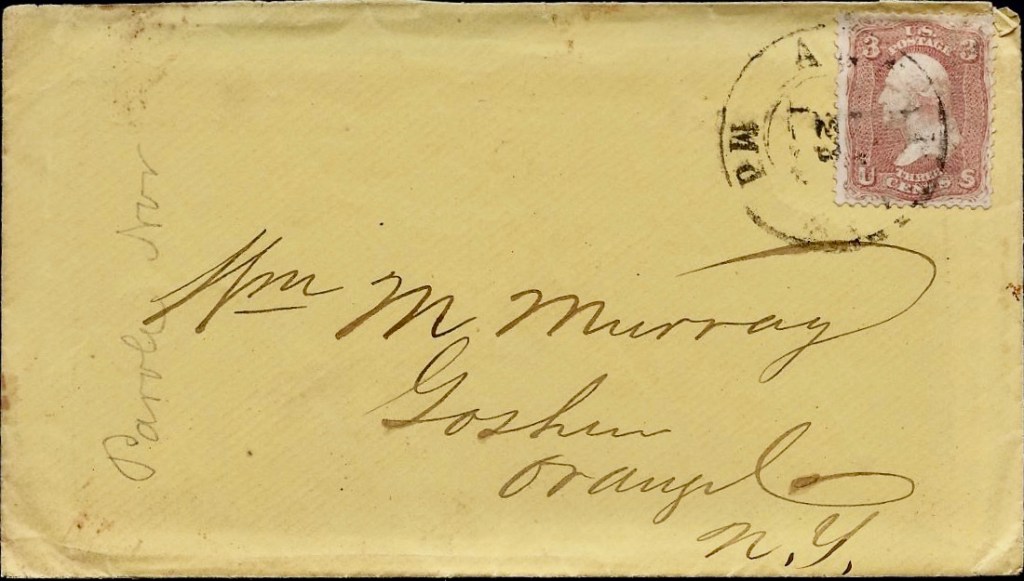
Addressed to William M. Murray, Goshen, Orange county, New York

Camp Parole
September 13, 1863

Dear Will,

Hon. William Murray

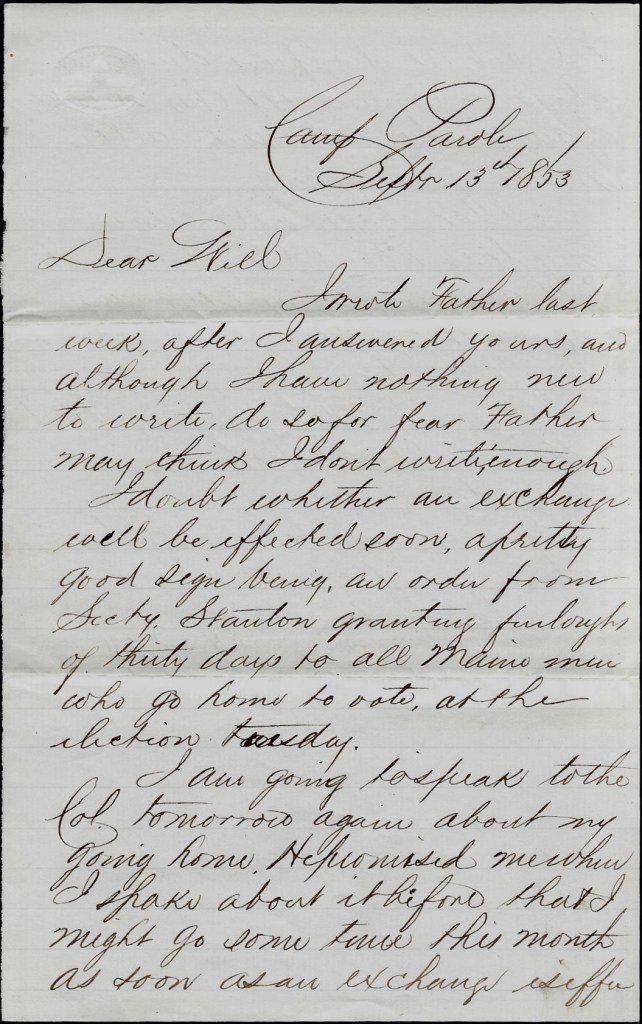
I wrote Father last week after I answered yours and although I have nothing new to write, do so far dear Father may think I don’t write enough.

I doubt whether an exchange will be effected soon, a pretty good sign being an order from Secretary Stanton granting furloughs of thirty days to all Maine men who go home to vote at the election Tuesday.

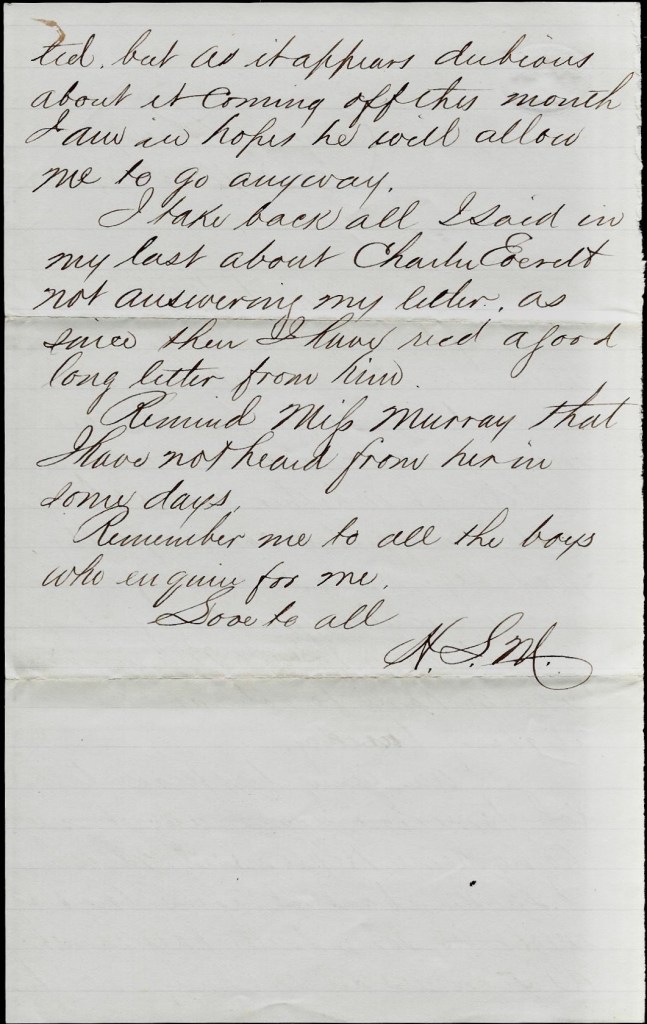
I am going to speak to the Colonel [Francis M. Cummins] tomorrow again about my going home. He promised me when I spoke about it before that I might go some time this month as soon as an exchange is effected but as it appears dubious about it coming off this month, I am in hopes he will allow me to go anyway.

I take back all I said in my last about Charlie Everett not answering my letter as since then I have received a good long letter from him. Remind Miss Murray that I have not heard from her in some days. Remember me to all the boys who enquire for me.

Love to all, — H. S. M.


Letter 2

Camp Parole
October 14, 1863

Dear Mother,

I have received your announcing Will’s good luck and also yours of Sunday. I knew nothing of the draft coming off or of the soldiers being in town until I learned of it from your letter as I have received no papers of any kind in a great while. I am sorry Will is drafted, although I knew it would be so as it is our family luck. It does seem too bad that A. S. & E. B. should escape. Henry Murray sent me a list of the conscripts. Twll Will when he writes that i want to know who was in that Draft Insurance concern & how many of them were caught. Was that Sawyer Frank’s son?

Excuse me if I am a little incoherent in my writing as I am slightly excited over some news that Colonel just gave me. He has approved & forwarded my application for twenty days & says there is no doubt of its going through all right. I’m afraid my luck is changing.

I sent $650 home by Express Monday & sent Father receipt by same day’s mail. Love to all. — H. S. M.


Letter 3

Camp Parole
November 22, 1863

Dear Will,

I have not written you since I left home but Mrs. M has done my correspondence & has written two or three times now. I can’t plead business as an excuse for I have not had enough to do since I came back to keep a moderately smart man at work over five minutes. All I have to do is to sign my morning report & then lay off the rest of the day.

We are boarding at a Mr. Welch’s opposite the camp—a very good place but strongly secesh. I expect the old man & I will have a blow out one of these days if he talks very strong. I have written to Bob & last night was down to the train to see if he was on board but I guess the rain or some other cause (probably some other) kept him at Washington.

The Colonel has not returned. When he does, we are going to make a dead set on him and either have him fortify us against being reported absent without leave from our regiments by an order of detail from the War Department or else send us to the field. As we stand now, we are in a rather delicate situation.

Briggs is recovering slowly from his diphtheria and Durkee is suffering from chills & fever, in bed one day and up the next. They had been sick all the while I was gone and besides had had a difficulty with the surgeons in account of Brigg’s calling in a citizen physician instead of employing one of them. They were glad enough to see me, I tell you.

I understand the Young Christian’s prayed for the “happy couple” on Tuesday night at the Academy prayer meeting. Just tell him for me that I will hire a regularly licensed “praying man” to do mine for me. Love to all, — H. S. M.