My passion is studying American history leading up to & including the Civil War. I particularly enjoy reading, transcribing & researching primary sources such as letters and diaries.
The following letters were written by Benjamin Franklin Roberts (b. 1835), the son of Morehouse (“Morris”) Roberts (1790-1847) and Susannah (“Susan”) Newman (1806-1898) of Sunbury, Delaware county, Ohio. Ben was 26 years old when he enlisted as a sergeant in Co. D, 20th Ohio Volunteer Infantry (OVI). He was with the regiment until the spring of 1862 when he became ill and had so much difficulty regaining his health that he was actually discharged from the regiment in July 1862.
In the first letter that follows, written from Sunbury, Ohio, in September 1862 to his older brother George Washington Roberts (1829-1900) of Ottawa, Illinois, Ben expresses some desire to return to his regiment though feels his health won’t allow it yet. In the second letter datelined from Helena, Arkansas, in mid-November 1863, we learn that Ben has regained his health and is serving as a Sergt. Major in the 15th Illinois Cavalry. He later served as Sergt. Major of the 4th Louisiana Colored Cavalry and left the service in October 1865.
In his letters, Ben mentions several brothers: Giles Hartley Roberts (1845-1908) who enlisted at the age of 18 in Co. G, 96th Ohio Vol. Infantry (OVI) in August 1862. He was transferred to Co. D of the 17th Veteran Reserve Corps in January 1864. He also mentions brothers Lord Byron Roberts (1827-1889), Edward Henry Roberts (1841-1912) who also served in the 20th OVI, and John L. Roberts (b. 1838) in the 18th Illinois Infantry, later the VRC.
After the war he eventually moved to Labette county, Kansas, where he lived out his days.
Letter 1
Home [Sunbury, Delaware county, Ohio] September 15, 1862
Dear Brother,
I thought I would try and answer your letter for Mother although I am in a dull mood for writing. I have been quite unwell for the last two weeks. I had the ague one week. Have got it broke but don’t feel any better.
[Brother] Edward is, I suppose, a prisoner if not released. He was taken at a battle near Bolivar. James Herring was killed. They are the only ones that met with any misfortune of our acquaintance. The word came by letter written by Lieut. Hill of Delaware to his wife. Lieut. Hill is a member of that company. He did not give the particulars of the battle. I think Edward will be home before long as they don’t hold prisoners long. Communication is cut off so we don’t hear from the boys often.
[Brother] Giles has enlisted. He went with Joe Kimball of Sunbury. I think Joe will make a good captain. We have not heard direct from him since the fifth. He was at Covington, Kentucky, at that time. I think they are there yet. There is quite a number gone from Sunbury & Gang Street in the same company. Some of them are writing nearly every day as we hear from them often. Giles wrote he was getting fat and liked camp life much better than he expected. Giles ought to of stayed at home with mother. He was not subject to a draft. Mother wanted him at home.
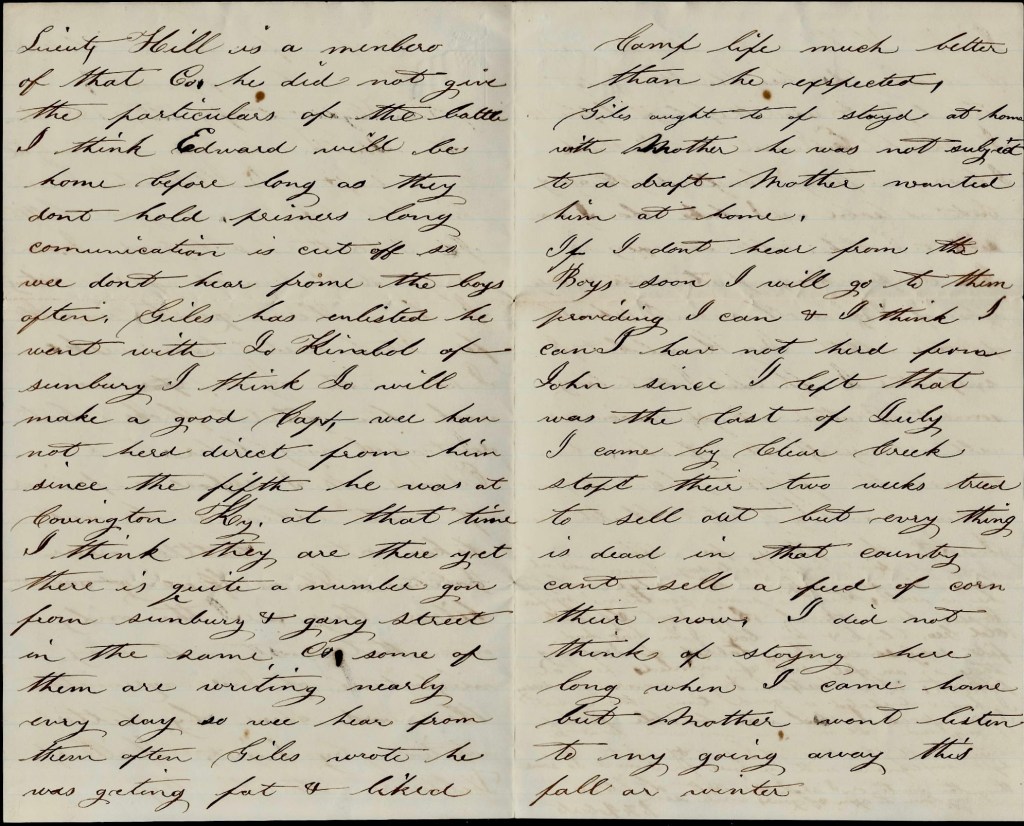
If I don’t hear from the boys soon, I will go to them providing I can & I think I can. I have not heard from [brother] John since I left. That was the last of July. I came by Clear Creek, stopped there two weeks, tried to sell out, but everything is dead in that country. Can’t sell a feed of corn there now. I did not think of staying here long when I came home but mother won’t listen to my going away this fall or winter. I don’t know how it will be yet. It is owing how my health gets. I shall try and see the boys before long anyhow. I sometimes think I am going to get well right away but as soon as I take cold, I am sick and I take cold so easy.
I will promise again to come and see you if I go west soon. I should of come that way home but I expected to go back that way soon & mother was so anxious as well as myself to get home. The excitement is pretty high here at present.
Mother is washing today. Her health is good. Burt is plowing for wheat. I was at Aunt Julie’s yesterday. Vance was at home. He saw [brother] Byron the night before. He is well. There is some southern sympathizers here—Searles, Cigs Drent, Squire Wilson, Old George Clark & his boys. Jim has had fits every day since they talked of drafting. There is an awful sight of invalids here at present. The Hartford Fair commences Wednesday. I had anticipated a good time there but I am afraid I shall not be able to keep up my end.
Tell me when you write what the chance will be there this fall and winter for light employment with indoors for I must do something this winter or I shall die with the blues. My love to you and yours. write son. — B. F. Roberts
Letter 2
Headquarters 15th Illinois Cavalry Helena, Arkansas November 15th 1863
Dear Brother,
Your letter has just come to hand but not until it went the rounds from Memphis. It was sent to Vicksburg & back here ere it reached me. My health has got quite good again. We have a good deal of duty to do of late—scouting and guard duty.
I forget whether I told you or not in my last letter I expected to go into an American Regiment of African Descent. The adjutant and I have positions offered us providing we will accept which we have. Maj. Wilson, formerly of this regiment, is Colonel with the privilege of choosing his own officers and has chosen the adjutant and myself from this regiment. It is a cavalry regiment. Col. Wilson is now in Texas with Banks. He expects to fill his regiment there.
I received a letter from [brother] Ed not long ago. He had got to his regiment. Said he was fat and in as good health as ever. The other boys was well. I hear from [brother] John quite often. He is well. Wants to go with me. The adjutant and I will do all we can to get him in. I suppose you have heard that John has a commission but can’t get mustered as the company is so reduced that they are not entitled to but two officers.
We are having beautiful weather here now—very warm and dry—but the citizens say when it begins to rain that it don’t quit until it rains out & the soil is such that when it gets muddy, there is no bottom.
We have some gay times running guerrillas around here of late & with pretty good success too. We have caught a good many lately. We are going out tomorrow or the next day with three rations. I anticipate a good time going where the bushwhackers are thick and lots of chickens, any amount of girls. Such scouts make a soldier fat. Write soon. My compliments to family. Yours, &c.
— B. F. Roberts, Sergt. Major, 15th Illinois Cavalry
These letters were written by Daniel N. Roberts (1836-1906), the son of Morehouse Roberts (1790-1847) and Susannah Newman (1806-1898) of Sunbury, Delaware county, Ohio. Daniel was 25 years old when he enlisted as a private in Co. D, 20th Ohio Infantry on 3 October 1861. He remained in the service for three years, mustering out on 17 October 1864.
In his first letter of 24 April 1861, Daniel recounts the significant events of the Battle of Shiloh, which occurred near Pittsburg Landing on April 6-7, 1862. The 20th Ohio Infantry was consolidated with other Ohio regiments within the 3rd Brigade of Maj. Gen. Lew Wallace’s 3rd Division within Grant’s Army of the Tennessee. Despite being within a reasonable distance to reach the battlefield by noon of the first day’s combat (just six miles), a tangle of confusing orders and miscommunications led to a tardy arrival, which only allowed them to engage in the fighting on the second day.
In his second letter of 7 September 1863, Dan writes considerably about his brother Giles Hartley Roberts (1845-1908). Giles enlisted at the age of 18 in Co. G, 96th Ohio Vol. Infantry (OVI) in August 1862. He was transferred to Co. D of the 17th Veteran Reserve Corps in January 1864. He also mentions brothers Lord Byron Roberts (1827-1889), Edward Henry Roberts (1841-1912) who also served in the 20th OVI, John L. Roberts (b. 1838) in the 18th Illinois Infantry, and Benjamin Franklin Roberts who served in the 18th Illinois Infantry and later in the 15th Illinois Cavalry.
After the war, Dan settled in Ottawa, LaSalle County, Illinois, and was married in 1870 to Julia Branin (1845-1923).
Letter 1
Pittsburg [Landing], Tennessee April 24th 1862
Dear Brother,
I received your welcome letter yesterday and was very glad to hear from you. We are all well at present. I have been sick ever since the battle here, My disease was mostly bowel complaint. I have gotten over that now and getting quite hearty again. Edward is as hearty as anyone in our company. He has been hearty most all the time. Ben and John is camped about two miles from us. Tip and me was down to see them last Monday. They was both well then. Benjamin came up from Cairo the same night the fight ended.
Our division was down the river about six miles from here when the fight commenced on Sunday. We was ordered to march Sunday after noon. We reached the battlefield that night and was out in line of battle that night for next morning. The ball opened about daylight. We was put on the right wing. The most of the fighting on that day was done on the left and center. We only had one killed and about fifteen wounded in our regiment. I don’t believe none hurt htat you was acquainted with.
George, it was [an] awful sight the next day on the battlefield to see the dead. I never want to see another such a battle. I expect we will have a big one to Corinth about 18 miles from here. I can’t tell when we will move. There [are] troops coming up the river every day now.
Well, George, we was badly whipped Sunday but the rebels got it worse Monday. I don’t see how our men let them come on them Sunday morning like they did. George, we wrote to mother right after the battle. Edward has done the writing since the battle for I have been sick. It was no wonder I was sick for we did not fetch our tents here when we came here. We laid out four nights and [it] rained every night. As quick as we got our tents here, it quit raining.
It has been very sickly in our regiment since that exposure. Two men died in our regiment yesterday. Well, I must close. I came very near forgetting about that money you spoke about. You can have it. I don’t expect I will want it that soon. Please write soon. Yours truly, — D. N. Roberts
Letter 2
Vicksburg [Mississippi] September 7, 1863
Dear Brother,
I received yours of the 14th and was very glad to hear from you once more but was sorry to hear that your children had such sore eyes. My health is very good now. Ed has gone home on a sick furlough. He left here the 23rd of August. He was getting better all the time. Most all the boys that had been sick or was not well got a sick furlough. I have not heard from him since he left here. Sanders and John Mayfield got a furlough too. Tip has not got back yet. He has been gone over a month.
I have not had a letter from home for a long time. I got one from Giles last night. His health is very poor yet. He has the chills yet. Giles is talking about going to his regiment. He says he can’t get his discharge. He thinks if he was to his regiment, he would get it. The 96th [Ohio Infantry] has gone to New Orleans. Giles is now at Schofield Barracks Hospital, Mo. I wish you or Byron would go and get him home. He would get his discharge. I think you had better write to him and see what he says about it. I do wish he had his discharge and at home for Mother worries the most of her time about him.
I heard from John about a month ago. He was at Helena then. He said they had marching orders then. He thought they would go up White River. John was not very well then. He had been quite sick but was getting a great deal better then.
I had a letter from Ben about the same time I got one from John. Ben was well. He was at Corinth, Mississippi, then.
Well, George, we just got back last Thursday night from a long march. We was gone fifteen days. We went to Monroe, Louisiana. We got on the boats here and went up the river sixty miles. We got off the boats then and it was 75 miles to Monroe. We had to walk. The weather being very warm, it made a very hard march. We suffered a great deal for water.
The rebs had quite a large force of cavalry at Oak Ridge, about fifty miles from the river. They heard it was Johnny A. Logan’s rats 1 that was after them [so] they pulled up stakes and the way they went for Monroe. We followed them [and] we expected to have a fight when we got there but they did not stop there. They left a good many sick there in the hospital. George, it was the lonesomest country that I was ever in—nothing but woods and swamps and any number of rattlesnakes. I saw one killed seven feet long. It had 13 rattlers on. There was a boy bit by one of them. He did not live one hour after he was bit.
Well, George, I must now close by asking you to write soon.
Your brother, — Dan
1 John Alexander Logan (1826-1886), nicknamed “Black Jack” was at the height of his popularity at the time this letter was written, having lead his division with distinction in campaign to capture Vicksburg, most notably in the assault following the explosion of a mine. I have not been able to find any other references to Logan’s men being called “rats.”
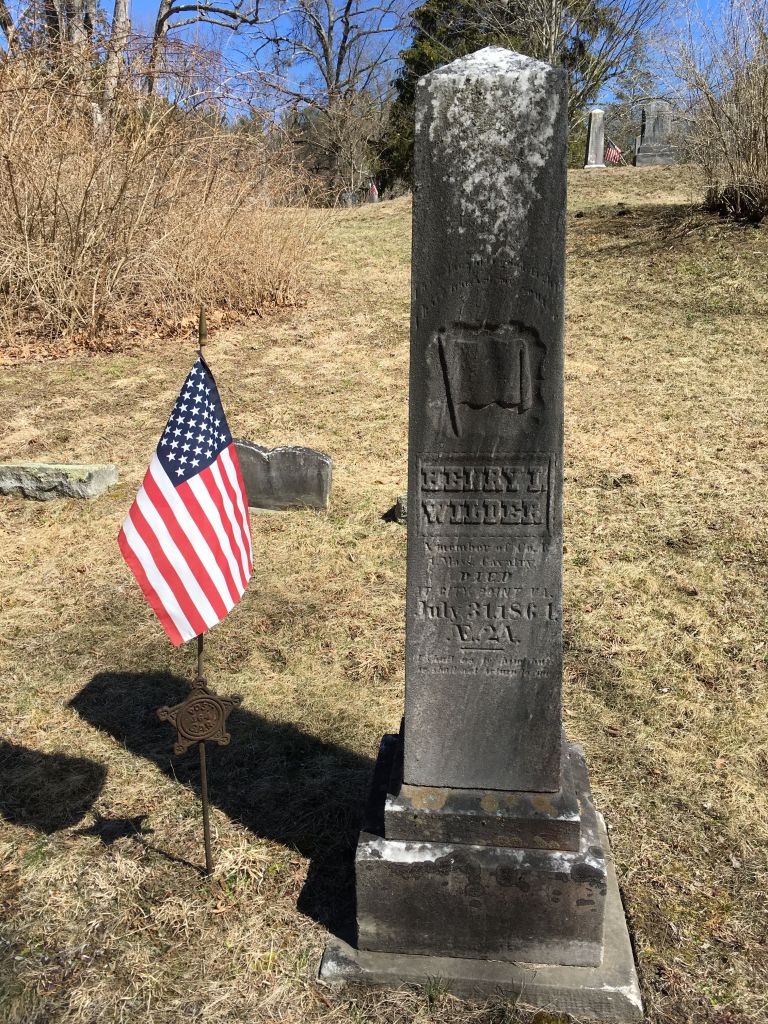
The following letter was written by Henry Israel Wilder (1840-1864), a 21 year-old farmer when he enlisted to serve as a private in Co. E, 1st Massachusetts Cavalry on 18 September 1861. He was wounded on 30 July 1864 in the small skirmish at Lee’s Mill, Virginia, and died the following day at City Point. The skirmish took place as Gregg’s 2nd Cavalry Division attempted to coordinate an attack on the rebel right as the Battle of the Crater took place.
Henry was the son of Israel and Mary (Childs) Wilder of Conway, Franklin county, Massachusetts. The loss to his parents would be sad enough but Henry was married while home on furlough to his hometown sweetheart Maria E. M. Graves on 7 March 1864—less than four months before his death.
I could not find an image of Henry but maybe this sketch by Stanton P. Allen of the 1st Massachusetts Cavalry depicts Henry wielding his saber for the camera or peeking around the corner of the backdrop.
Transcription
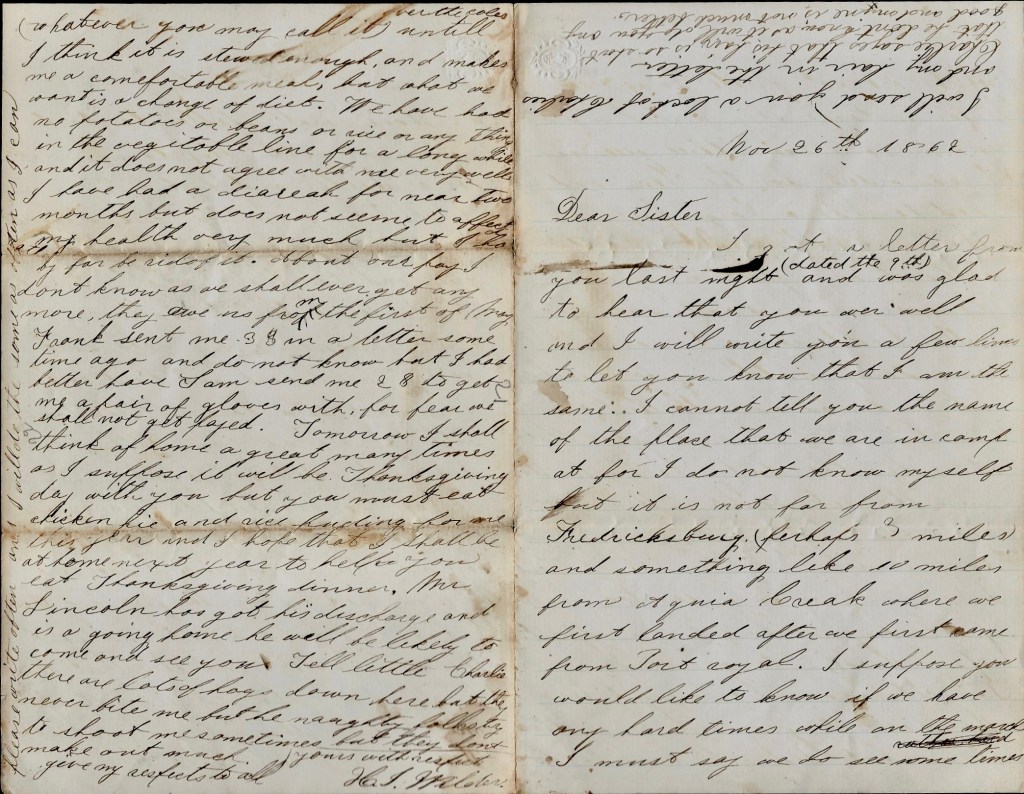
November 26, 1862
Dear Sister,
I got a letter from you last night (dated the 9th) and was glad to hear that you were well and I will write you a few lines to let you know that I am the same. I cannot tell you the name of the place that we are in camp at for I do not know myself but it is not far from Fredericksburg (perhaps three miles) and something like 10 miles from Aquia Creek where we first landed after we first came from Port Royal.
I suppose you would like to know if we have any hard times while on the march. I must say we do see some times which are not quite so agreeable. For instance, when we had a little snowstorm some two or three weeks ago, I was orderly fo the General and had to ride a large part of the time both night and day without any gloves or anything to wear on my hands which was rather cold riding. I was left an orderly until my horse failed up and now am with the company—out company being so small noew it makes the duty harder for the men that it would if they were all here. But we are expecting the new recruits and all the rest of them here today or in a day or two.
Yesterday we had to go off with Gen. Hooker to a review in Gen. Stoneman’s Corps and today they have gone out on another review but did not have to go as I am on other duty.
We have small shelter tents to cover us with. They do very well for a shelter and but little protection from the cold, although I have not suffered very much yet and hope that I shall not, and don’t think that I shall.
Our rations are very good such as they are, pork and hard tack, hard tack and pork, all the time with occasionally a little fresh beef and coffee for drink.
Perhaps you would like to know how I prepare my meals. We have these common tin plates which I take and fry my pork in over the fire and then I take my hard bread and soak them in water and then put them in the fat which I fry out of the meat with the water which I soak them in and then hold the mess (whatever you may call it) over the coals until I think it is stewed enough and makes me a comfortable meal, but what we want is a change of diet. We have had no potatoes or beans or rice or anything in the vegetable line for a long while and it does not agree with me very well. I have had a diarrhea for near two months but does not seem to affect my health very much. But I had by far be rid of it.
About our pay, I don’t know as we shall ever get any more. They owe us from the first of May. Frank sent me $3 in a letter some time ago and do not know but I had better have Sam send me $2 to get me a pair of gloves with for fear we shall not get paid.
Tomorrow I shall think of home a great many times as I suppose it will be Thanksgiving Day with you. But you must eat chicken pie and rice pudding for me this year and I hope that I shall be at home next year to help you eat Thanksgiving dinner. Mr. Lincoln has got his discharge and is a going home. He will be likely to come and see you. Tell little Charlie there are lots of hogs down here but they never bite me. But the naughty folks try to shoot me sometimes but they don’t make out much.
Yours with respect. Give my respects to all, — H. J. Wilder
Please write often as I will do the same as often as I can. I send you a lock of Charlie’s and my hair in the letter. Charlie says that his hair is so short that he don’t know as it will do you any good and mine is not much better.
The following letters were written by August Robert (“Gust”) Nebinger (1834-1884), the son of Dr. Robert Nebinger (1796-1867) and Elizabeth Prowell (1799-1864) of York county, Pennsylvania. In 1860, Gust was a doctor living with shoemaker David Howe in Warrington Township, York County, Pennsylvania, with a Lewisberry postal address.
Gust first enlisted and mustered into state service September 11, 1862, as assistant surgeon for the 12th Pennsylvania Militia, and honorably discharged with his company September 27, 1862. His name sometimes appears as “A. Rox Nebinger” as “Rox” must have been a nickname and that is how he signed both of these letters. He then enlisted—voluntarily—and mustered into federal service at Chambersburg December 1, 1862, as assistant surgeon for the 158th Pennsylvania Infantry (aka “Drafted Militia”), and honorably discharged with the regiment August 12, 1863. He last enlisted in the field July 1, 1864, mustered into federal service July 8 as assistant surgeon with the 11th Pennsylvania Cavalry (108th Pa), and honorably discharged with the regiment August 13, 1865.
Back in January 2020, I transcribed three other letters by Gust Nebinger, one after the failed Foster Expedition, another just before leaving New Bern in May 1863, and the 3rd from Chambersburg, Pennsylvania, where he was treating wounded from the Battle of Gettysburg in the “School House Hospital.” See: 1863: Augustus Robert Nebinger to Robert Nebinger.
Letter 1
New Bern, North Carolina January 4th 1863 Sunday night 10 o’clock
Dear father,
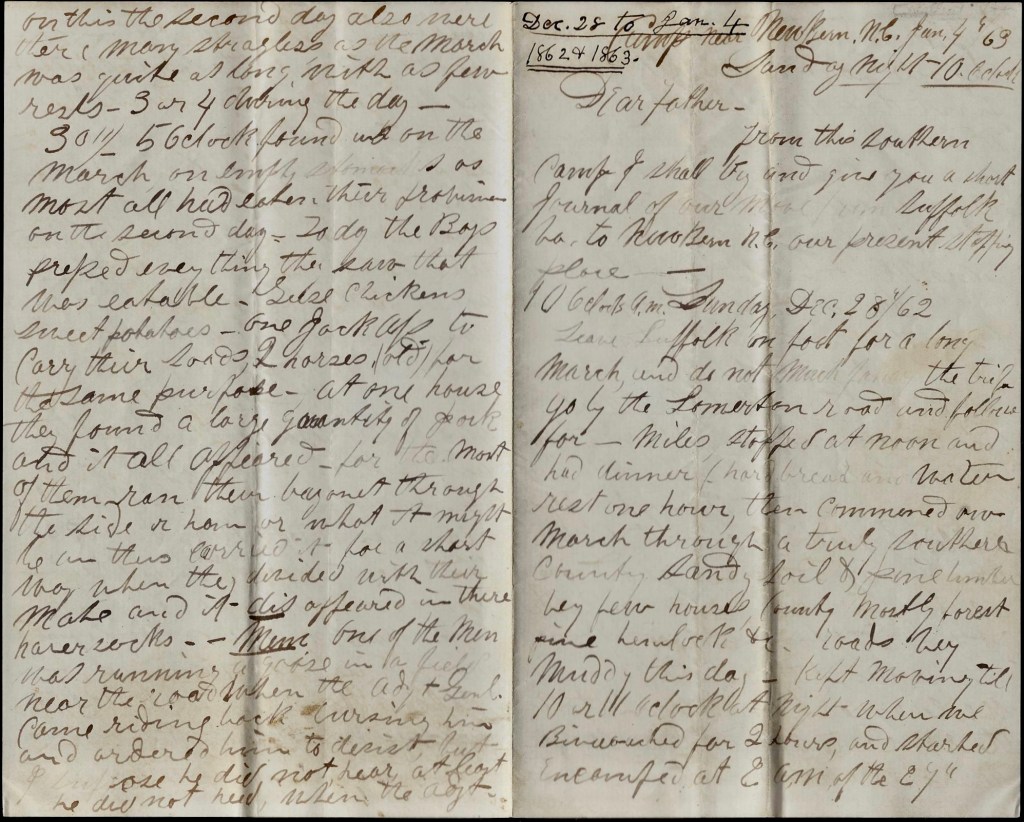
From this southern camp I shall try and give you a short journal of our move from Suffolk, Va., to New Bern, N. C., our present stopping place.
At 6 o’clock a.m. Sunday, December 28, 1862 we left Suffolk on foot for a long march and did not much fancy the trip. Go by the Somerton Road and follow it for ___ miles. Stopped Saturday noon and had dinner of hard bread and water, rest one hour, then commenced our march through a truly southern country—sandy soil and pine lumber. Very few houses. Country mostly forest pine, hemlock, &c. Roads very muddy this day. Kept moving till 10 o’clock at night when we bivouacked for two hours and started. Encamped at 2 a.m. of the 29th, supper hard bread and coffee which was our fare during all the march. First day’s march many of the men gave out, the 158th [Pennsylvania] having few stragglers as any of the brigade. As for myself, I felt very tired after walking nearly 20 miles. This night built large fires of rails which were very convenient, being dry and small. Done very well but got a little cold.
29th—on the march by daylight and continued so all day through the same dreary country, enlivened by our passing through a place called Galesville about dusk. Also by our advance guard passing us on their return to Suffolk being composed of three companies of the 11th Pennsylvania Cavalry. We learned from them that the river to which we were marching was but 3.5 miles distant, but the word soon passed along the lines that we were not on the shortest road to the river. This day we marched until 8 o’clock and was helped by General Spinola for fear of running into an ambush which he conjectured might exist, we were in the Reb’s country. The men were all ordered to load and then rest for the night.
This day about noon the column was halted and skirmishers sent forward as someone of the general’s orderlies had seen 10 to 15 reb cavalry and 40 to 50 infantry just half mile in advance of the column. The skirmishers could find nothing so we moved on. Today I thought I should have to succumb but as it would have looked badly, I Thomased it as I carried no load and the men did. On this second day also there were many stragglers as the march was quite as long with as few rests—three or four during the day.
30th at 5 o’clock found us on the march on empty stomachs as most all had eaten their provisions on the second day. Today the boys pressed everything they saw that was eatable—geese, chickens, sweet potatoes, one jackass to carry their loads, two horses (old) for the same purpose. At one house they found a large quantity of pork and it all appeared for the most of them ran their bayonet through the side or ham, or what it might be, and thus carried it for a short way when they divided with their mate and it disappeared in their haversacks. One of the men was running a goose in a field near the road when the adjutant & general came riding back, cursing him and ordered him to desist, but I suppose he did not hear—at least he did not heed—when the adjutant drew his revolver with the intention of shooting him, but somehow his horse stumbled and in the endeavor to get the horse right, the pistol went off and an act of justice (as far as the man was concerned) was performed, for the ball took effect in the neck of the horse, killing him instantly. I was just 20 feet from him when he fell and was almost tempted to cry out, “settled him right.” Indeed, that was the sentiment of all who saw the occurrence.
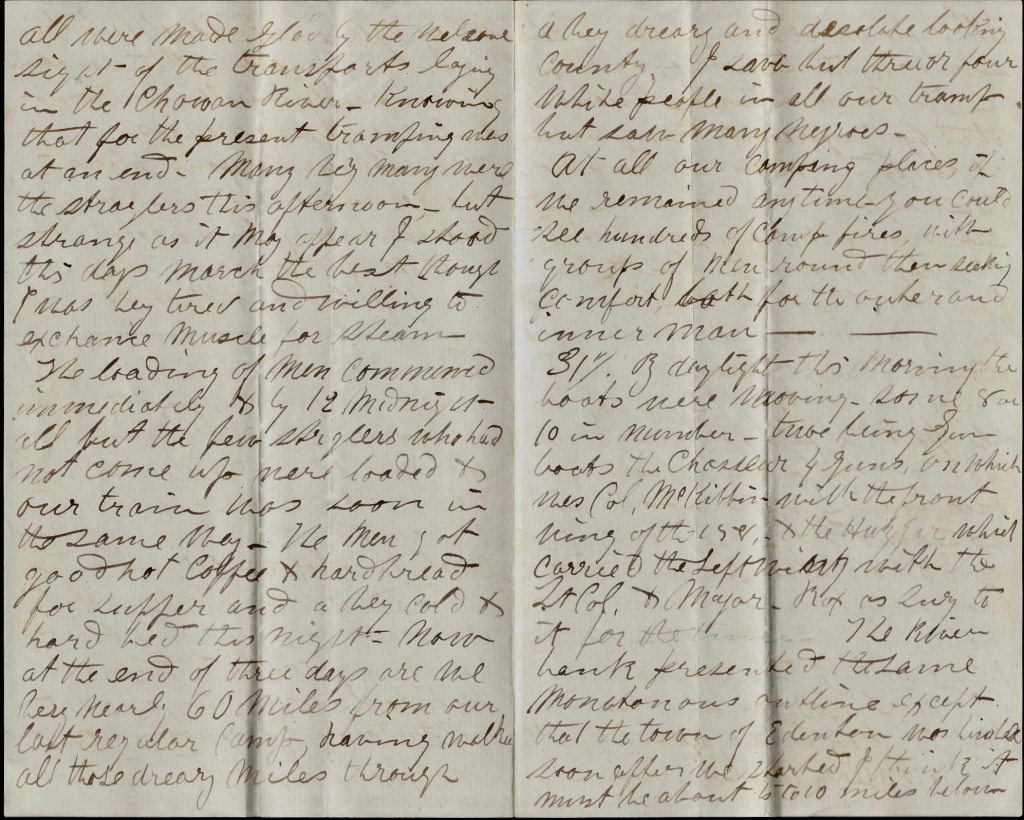
That was the great incident of this day’s march. Fording a small stream was another. Almost all the men got into water up to their hips—a very cold bath. Stopped for supper at 4 p.m., rested one hour, and continued our tramp until dark when all were made gladly to welcome the sight of the transports laying on the Chowan River, knowing that for the present, trampling was at an end. Many, very many, were the stragglers this afternoon, but strange as it may appear, I stood this days march the best though I was very tired and willing to exchange muscle for steam.
The loading of men commenced immediately & by midnight, all but the few stragglers who had not come up were loaded & our train was soon in the same way. The men got good hot coffee and hard bread for supper and a very cold & hard bed this night. Now at the end of three days are we very nearly 60 miles from our last regular camp, having walked all those dreary miles through a very dreary and desolate looking country. I saw but three or four white people in all our tramp but saw many negroes.
At all our camping places where we remained for any time, you could see hundreds of camp fires with groups of men round them seeking comfort both for the outer and inner man.
31st—at daylight this morning the boats were moving, some 8 or 10 in number, two being gunboats—the Chasseur of 4 guns on which was Col. McKibbin with the front wing of the 158th [Pennsylvania], and the Huzzar which carried the left wing with the Lt. Col. & Major. The river bank presented the same monotonous outline except that the town of Edenton was visible soon after we started. I think it must be about 5 to 10 miles below the landing at which we embarked, the name of which I forget. In fact, I do not know that I ever knew it positively.
We got along very well until some time during the night when there was quite a storm arose when the boat did some pretty fine rolling, making many of the men sick, and in fact, placing the boat in danger of being wrecked or swamped. As for me, I slept all the time except about 10 minutes when I got such a horrid bump that I waked, but soon again was asleep.
New Year found us just entering Neuse river and by 9 or 10 we lay gladly off New Bern, a right smart town, they tell me, but as I have just passed through it once, I am unable to judge and will defer a description of it until I have seen it. The night of the 1st, we built large fires and slept under what the boys call dog tents (shelter tents). Now we have the usual wall tent or Markee & this evening we have things quite comfortable, having received our stoves which were sent by way of Norfolk. So much for our second move.
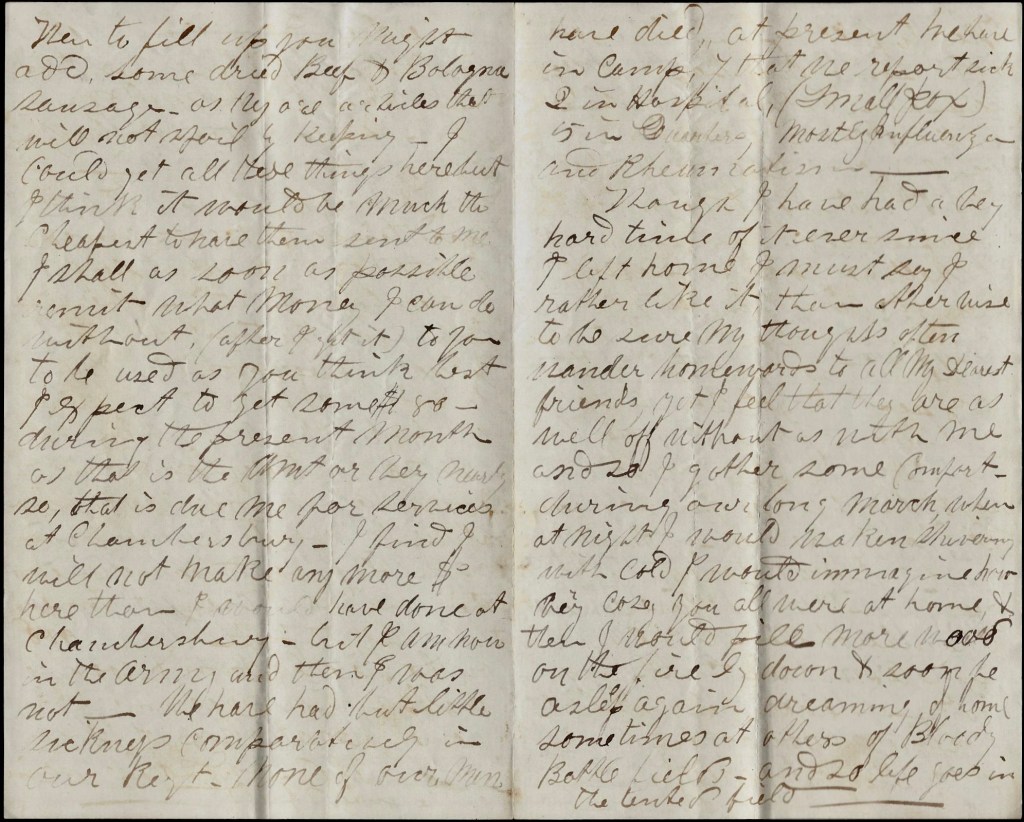
I believe we (the Empire Brigade of General Spinola of New York, Commanding) shall stay here for some two or three months and if so, I should like to get from home, or sent from home by some of you, some few things which in my great and unexpectedly quick march, I was unable to get—viz: half to 1 dozen pairs cotton stockings, handkerchiefs—some silk (can’t bear linen). one pair woolen overshirts—something like those of Wills), pair buckskin gloves (gauntlets) and as tobacco is quite exalted in this part of the country, I would like say five lbs. Can be had for $1 to $1.25 lb. such as I prefer to chaw. Will knows where I bought in Harrisburg—called Mountain Dew. For smoking, any good brand, say 5 lbs. Then to fill up [the box] you might add some dried beef and bologna sausage as they are articles that will not spoil by keeping. I could get all these things here but I think it would be much the cheapest to have them sent to me. I shall as soon as possible remit what money I can do without (after I get it) to you to be used as you think best. I expect to get some $180 during the present month as that is the amount or very nearly so that is due me for services at Chambersburg. I find I will not many any more money here than I would have done at Chambersburg but I am now in the army and then I was not.
We have had but little sickness comparatively in our regiment. None of our men have died at present. We have in camp 7 that are reported sick, 2 in hospital (smallpox), 5 in quarters—mostly influenza and rheumatism.
Though I have had a very hard time of it ever since I left home, I must say I rather like it than otherwise. To be sure, my thoughts often wander homewards to all my dearest friends, yet I feel that they are as well off without as with me and so I gather some comfort. During our long march, when at night I would waken shivering with cold, I would imagine how very cozy you all were at home and then I would fill more wood on the fire, lie down and soon be asleep again, dreaming of home sometimes, at others of bloody battlefields, and so life goes in the tented field.
I like to read letters from home. I hope you all had a Merry Christmas & a Happy New Year. Love to all. If you send [a box], send quickly. Let the box be made strongly and well nailed with iron hoops on each end to be marked as you direct my letters, viz: 158th Regiment Pennsylvania Infantry, Col. D. B. McKibbin, Newbern, N. C., via New York.
So I will say goodbye for this time. Perhaps I may write some again to someone of you. Your affectionate son. — A. Rox Nebinger
Letter 2
Hospital 158th [Pennsylvania] Regiment Camp New Bern January 27, 1863
My dear Father,
Since writing to you we have changed our camp from the east of New Bern to the south crossing the Trent to the right side. We also crossed a small creek on the banks of which we are now encamped. We are now in a fortified camp having thrown up breastworks in front, crossing the railroad to Beaufort. We (Empire Brigade) have three regiments on this side and one on the other of the creek.
The expedition I spoke of some time ago has just started—the last leaving today (I hear). Where to, I cannot learn.
January 29th—Last night I received your nos. 2 & 3 and Beckie’s No. [ ] making four & dates 9, 12, 16 & 19. Now for one to answer your two and one to answer sister’s 3. I have received & answered your no. 1 giving a poor account of New Bern which I learn has but 6,000 inhabitants instead of 15 to 20. Tis a poor kind of a town having but few good houses.
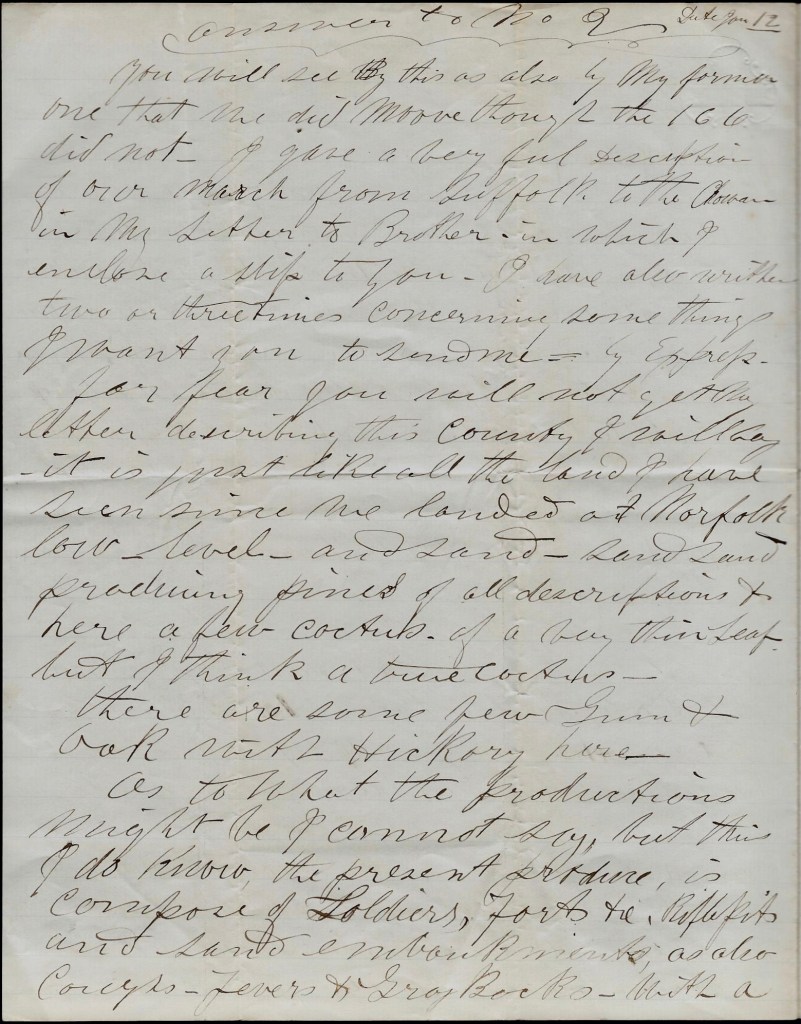
You will see by this as also by my former one that we did move though the 166th did not. I gave a very full description of our march from Suffolk to the Chowan [River] in my letter to brother in which I enclose a slip to you. I have also written two or three times concerning some things I want you to send me by Express.
For fear you will not get my letter describing this country and railway, it is just like all the land I have seen since we landed at Norfolk—low, level, and sandy land producing pines of all descriptions & here a few cactus of a very thin leaf but I think a true cactus. There are some few gum and oak with hickory [trees] here.
As to what the productions might be, I cannot say, but this I do know—the present produce is composed of soldiers, forts, rifle pits, and land embankments, as also coughs, fevers, and graybacks [lice], with a few contrabands and high prices. That is certainly all I can say of the productions of this part of the Old North State, but suppose the usual southern productions are here raised such as sweet potatoes, corn and perhaps oats. I have noticed some cane growing but no large ones.
In the swamps the strange growing cypress is found in plenty now with bare branches except when the long gray moss covers them with its long hanging bunches. By the by, I forgot to say swamps were quite as plenty here as hills in our country.
As for vegetation, as yet I have seen nothing green but pine, cactus and cane. Everywhere sand, sand, sand.
Contrabands look like badly dressed niggers in their peculiar gray cloth. The fact is, I very seldom leave the regiment, preferring to stay near my own quarters though frequently visiting the officers & of course receiving visits from them.
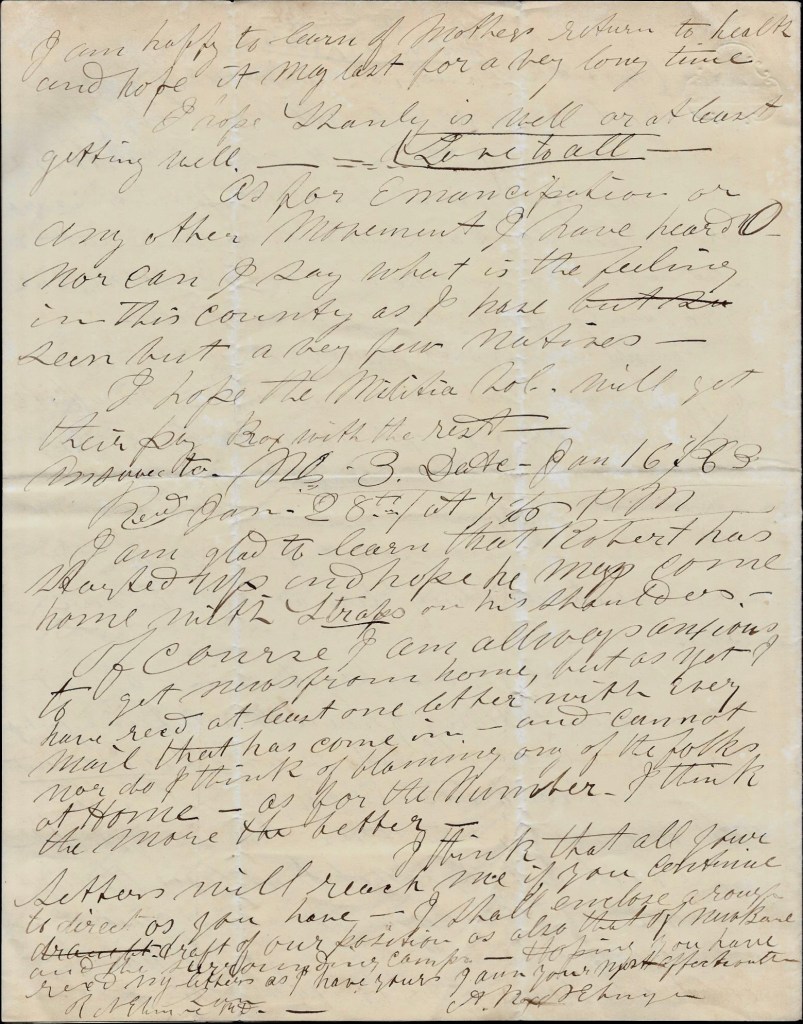
I am happy to learn of Mother’s return to health and hope it may last for a very long time. I hope Stanley is well or at least getting well. Love to all.
As for emancipation or any other movement, I have heard nor can I say what is the feeling in this country as I have seen but a very few natives. I hope the militia Volunteers will get their pay box with the rest.
I am glad to learn that Robert has started up and hope he may come home with straps on his shoulders. Of course I am always anxious to get news from home but as yet I have received at least one letter with every mail that has come in and cannot nor do I think of blaming any of the folks at home. As for the number, I think the more the better.
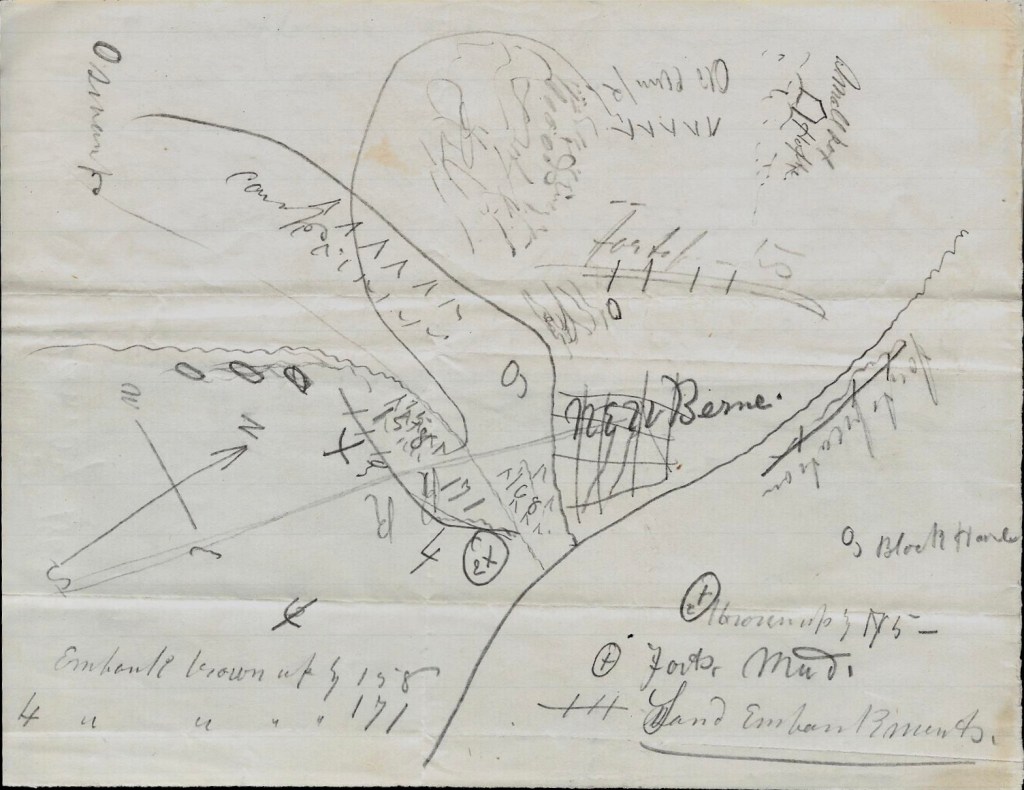
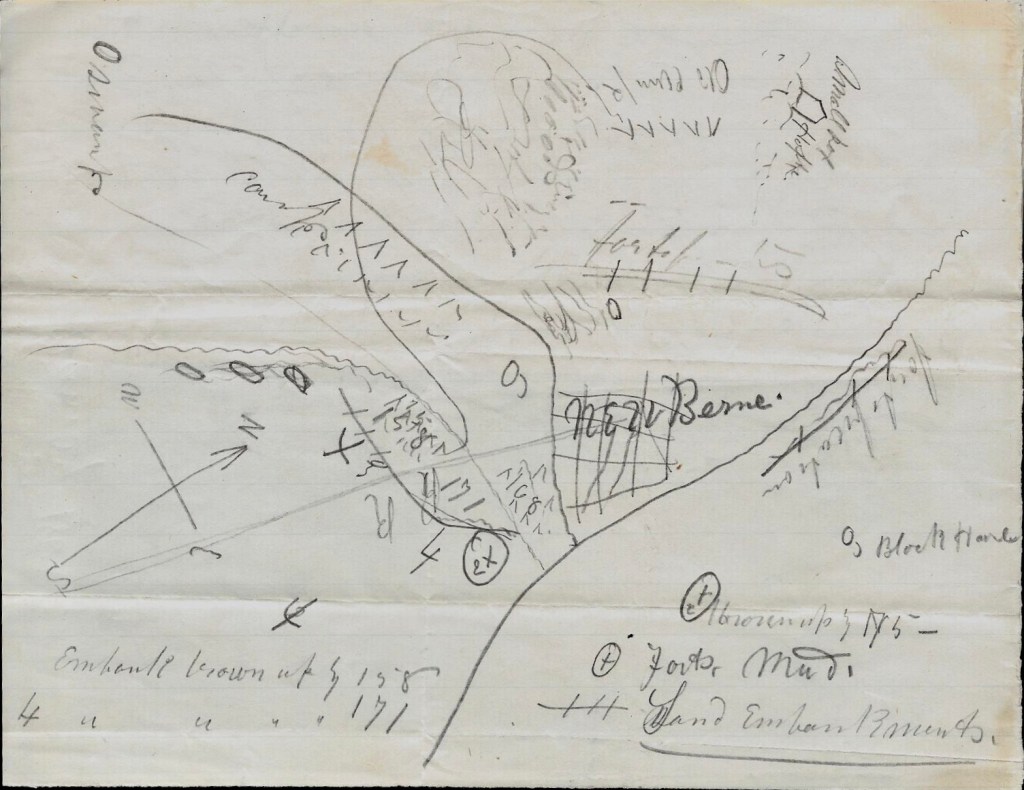
I think that all of your letters will reach me if you continue to direct as you have. I shall enclose a rough draft of our position as also that of New Bern and the surrounding camps. Hoping you have received my letters as I have yours, I am your most affectionate son, — A. Rox Nebinger
Hand drawn sketch of Union positions at hospitals at New Bern, N. C. in January 1863
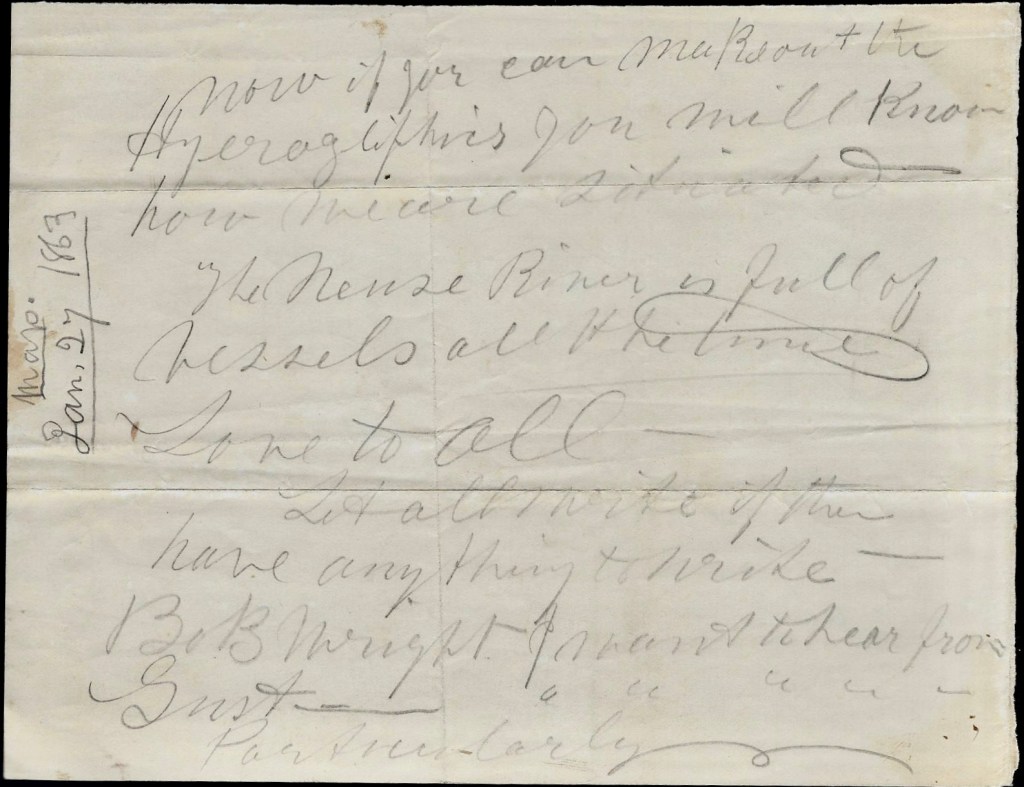
Noe if you can make out the hieroglyphics, you will know how we are situated. The Neuse river is full of vessels all the time. Love to all. Let all write if they have anything to write. Bob Wright, I want to hear from particularly. — Gust
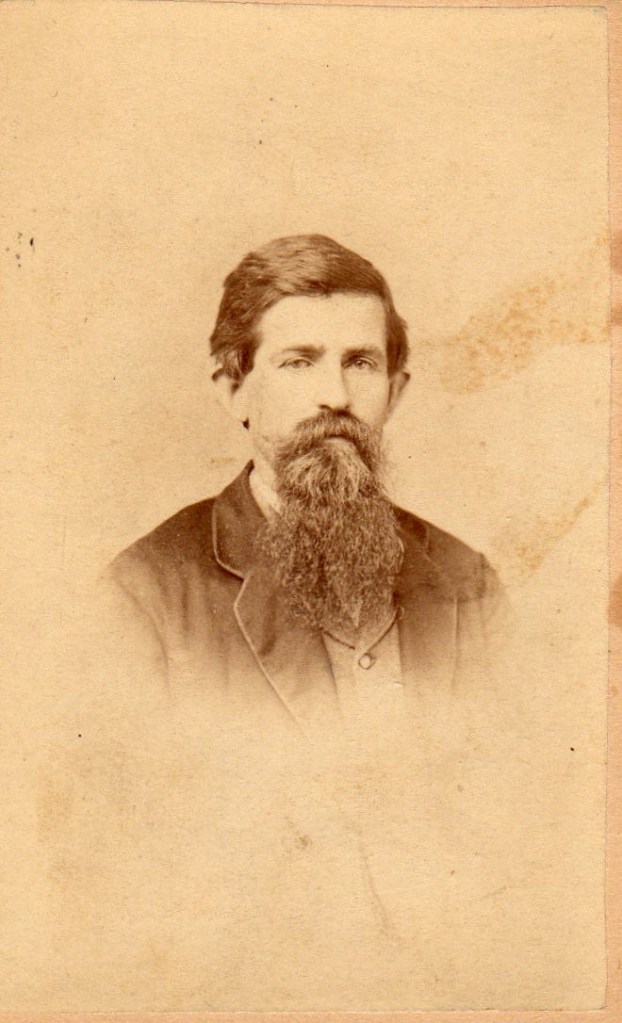
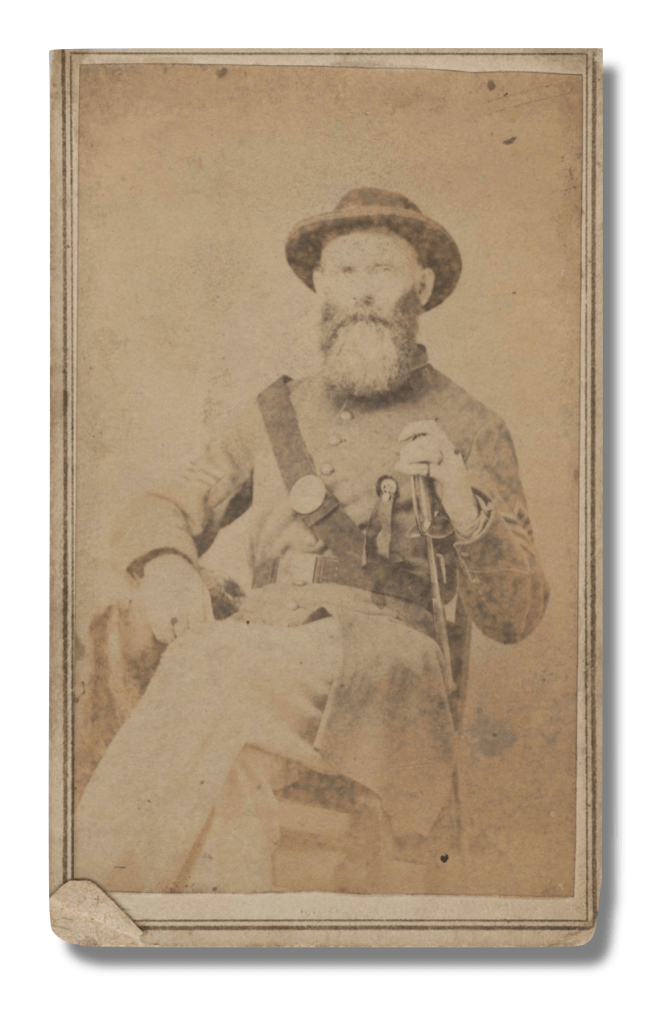
I could not find an image of John but here is one of L. Smith Cogswell who also served as a sergeant in Co. E, 18th Illinois Infantry (Photo Sleuth)
The following letters were written by John L. Roberts (b. 1838), a native of Wyoming county, Pennsylvania, who was earning his living as a farmer in Clear Creek township, Alexander county, Illinois at the time the Civil War began. When he enlisted as a corporal in Co. E, 18th Illinois Infantry on 28 May 1861, he was described as a 5 foot 7 inch tall, brown-haired, blue-eyed, single, 23 year-old farmer. John had recently been promoted to a sergeant before the Battle of Shiloh which he describes in some detail in the first letter. In that two-day fight, the regiment lost 10 killed, 63 wounded and 2 missing—all on the first day. The 3 color bearers who carried the flag in the first day’s conflict were all killed while supporting the banner.
John Roberts’ actions in the battle no doubt earned him recognition and he was later commissioned a lieutenant by Captain Charles H. Reed. Also serving with him in the same company was his older brother, Sgt. Benjamin Franklin Roberts (b. 1835) who became seriously ill in the spring of 1862 and had to be discharged for disability in July 1862.
The 18th Illinois Infantry saw its first major action at Fort Donelson in February 1862 where it occupied the right of Oglesby’s brigade, on the right of the line of battle, and during the second day’s fight lost 200 men in killed and wounded, 50 dying upon the field and 10 soon afterward. The regiment during the battle bravely and persistently maintained the position to which it was assigned in the early morning, and not until its ammunition was spent was the order to retire given.
Letter 1
Pittsburg, Tennessee March 31st [1862]
Dear Brother & Sister,
As I have a little time this morning I will write you a few lines in answer to yours of the 27th. I have just received a letter from Benjamin. He is a Clear Creek [and] has been very sick but is now able to be around. He will stay there till he is able for duty.
I saw the boys of the Ohio 20th a week ago. Tip was not very well. Dan and Ed are both very fleshy. Ed is much larger than either of us. I received a letter from Giles the other [day]. They are well at home.
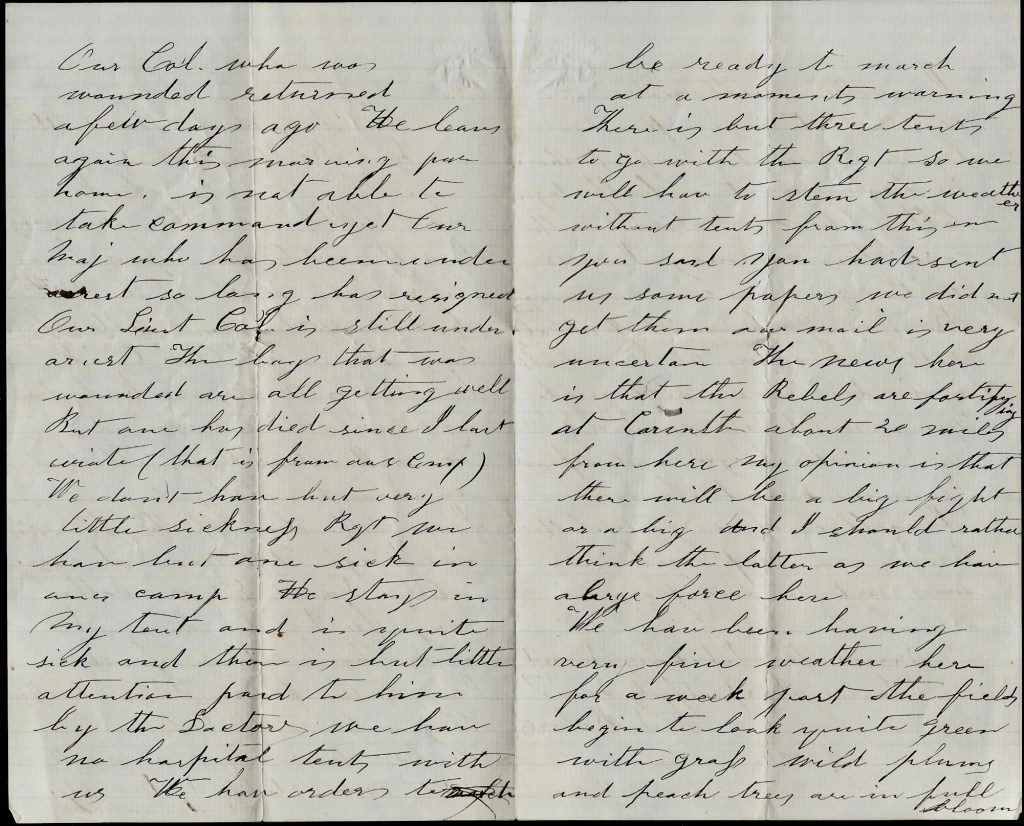
We have been here since the 22nd. We stopped two days at Savannah. Our Colonel who was wounded returned a few days ago. He leaves again this morning for home—is not able to take command yet. Our Major who has been under arrest so long has resigned. Our Lieut. Colonel is still under arrest. The boys that was wounded are all getting well. But one has died since I last wrote (that is, from our camp). We don’t have but very little sickness [in the] regiment. We have but one in our camp. He stays in my tent and is quite sick and there is but little attention paid to him by the doctors. We have no hospital tents with us.
We have orders to be ready to march at a moment’s warning. There is but three tents to go with the regiment so we will have to stem the weather without tents from this on.
You said you had sent us some papers. We did not get them. Our mail is very uncertain. The news here that the Rebels are fortifying Corinth about twenty miles from here. My opinion is that there will be a big fight or a big dud. I should rather think the latter as we have a large force here.
We have been having very fine weather here for a week past. The fields begin to look quite green with grass wild plums, and peach trees are in full bloom.
I will now close as it is impossible for me to write when there is from one to a half dozen talking to me which is the case this morning. I will write again as soon as convenient. Ben says he will probably sell out before he comes back. If he does, we will make you a visit as soon as we are discharged and spend a few weeks at home. I will enclose your letter in an envelope which was sent to me from a friend.
Direct to Pittsburg Landing, Tennessee
Respectfully yours, — J. L. Roberts
Letter 2
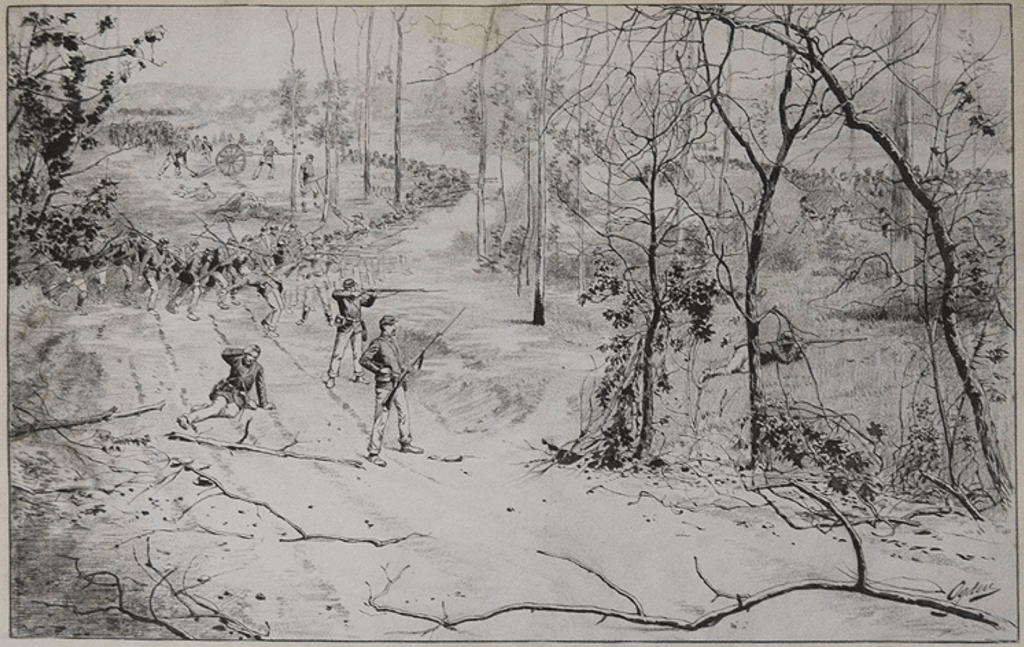
The Battle of Shiloh
Pittsburg [Landing], Tennessee April 10th 1862
Dear Brother,
As you have doubtless heard of the late battle here, would be anxious to know how we came out. I am happy to [say] Ben and I luckily came through without a scratch, although Benjamin was not in action as he did not get here from home till we had been thrown back in the rear as a reserve.
Our regiment did not suffer here as they did at Donelson—only 9 or 10 killed and 18 or 19 wounded which we thought very lucky as we was engaged a part of two days. We lost the most of our men the first day. We was ordered to retreat by our Major [Samuel Eaton] who was in command of the regiment—an order which he had no occasion for giving at that time although he was wounded. That through us in confusion and some of them retreated so far that they could not be found to rally again.
Mason Brayman (1813-1895) of Springfield, Illinois (Heritage Auctions)
After we had rallied the men that was left, the rebels came up again and undertook to charge a battery but failed in the attempt. We had a good position and just raked them from two [directions]. Major [Mason] Brayman took the flag and rode up and down our lines and cheered us on (Brayman is a staff officer of our division). 1
Monday we followed close in the rear of the forces that was engaged until late in the day [when] we was ordered to charge a battery which had been charged twice by our force but could not hold it. We charged it and held it and gave them about forty rounds of canister before they got out of range of the battery. Our Captain [Charles H. Reed] fired a gun three times before he could get a man to help him. He then was assisted by our 2nd Lieutenant [Daniel W. Flick] and Capt. [Henry S.] Wilson [of Co. B] and myself. The General 2 told our Captain he should have the battery so we hitched on and soon was ready for action again. 3
I cannot tell you but little about the battle—only what I saw myself [and] that was but a small portion. But one thing I know, that there was a perfect stampede of our forces on Sunday. They conducted themselves shamefully—both men and officers. They run and left but few braves to face the enemy who kept them from all being taken prisoners or brutally slaughtered. I will now close hoping to hear from you soon. I will write when I have time.
— John L. Roberts
1 Major Mason Brayman, an AAG on the staff of Gen. McClernand, is credited with helping to rally the troops of McClernand’s command to make a stand.For his bravery at Shiloh, Brayman was promoted to a Colonelon 15 April 1862 and given the command of the 29th Illinois Infantry.
2 Roberts does not identify the general by name but the first general in the Union chain of command of the Division in which the 18th Illinois was a part of would have been Major General John McClernand. The 18th Illinois was commanded by their Major Eaton). The 1st Brigade, of which they were a part, was commanded by a Colonel (Ware), and they were a part of McClernand’s 1st Division of Grant’s Army of the Tennessee.
3 One source describes this action as follows: “On the morning of the 7th the regiment fell in as a reserve to General Thomas L. Crittenden’s brigade. At about 2 PM they charged a Confederate battery, capturing two 6-pounder brass field pieces, one of which Captain Charles H. Reed, of Co. E loaded and brought to bear upon the retreating enemy, giving them three shots unassisted. He was then assisted by Captain Wilson and Lieutenants Daniel Flick and John Davis [could they mean John Roberts?], and fired 15 or 20 rounds into the retreating Confederate cavalry. [see Shiloh National Military Park]
Letter 3
Map of area between Pittsburg Landing on the Tennessee River at bottom right and the Confederate Stronghold at Corinth, Mississippi, at upper left. Roberts wrote the 2nd letter from near Monterey located at the center of the map.
Army in the field Camp near Monterey [Tennessee] May 26, 1862
Dear Brother,
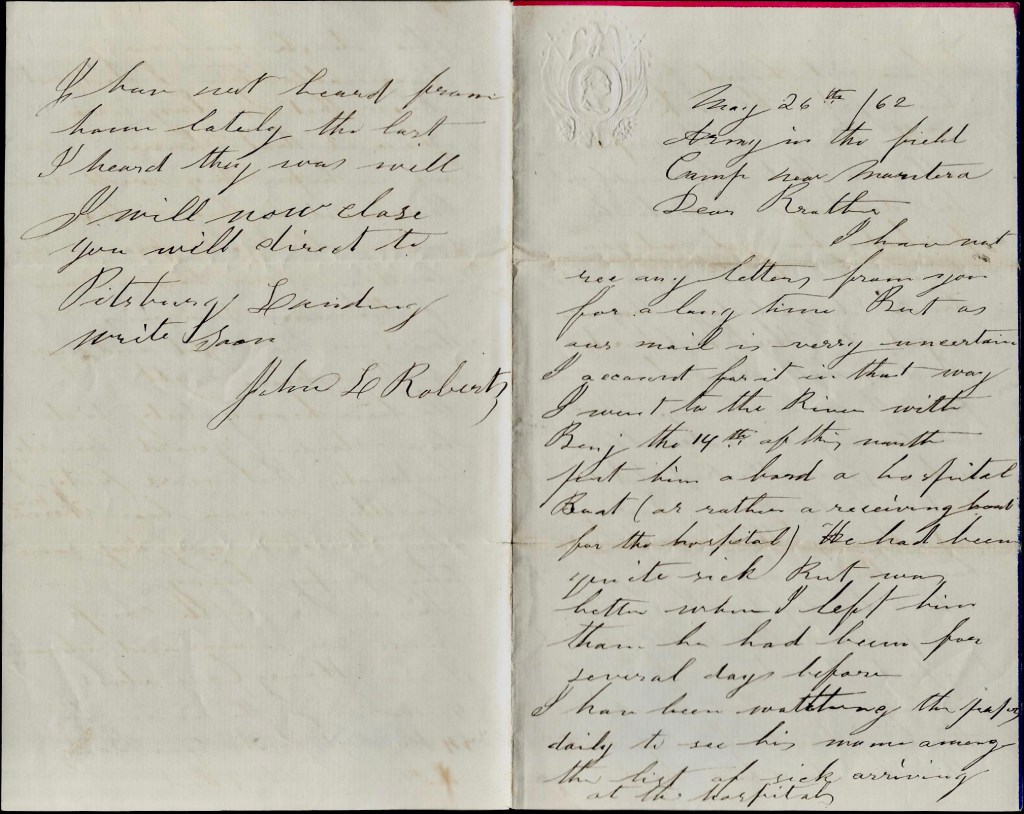
I have not received any letters from you for a long time but as our mail is very uncertain, I account for it in that way. I went to the river with Benjamin the 14th of this month, but him aboard a hospital boat (or rather a receiving boat for the hospital). He had been quite sick but was better when I left him than he had been for several days before. I have been watching the papers daily to see him name among the list of sick arriving at the hospital. I have not heard from him yet. He took with him his Descriptive Roll so that he could get his discharge which he perhaps has got and gone home to Ohio.
I received a note from Ed yesterday. They are camped at Shiloh Church about 14 miles from here [and] 3 miles from the river landing. They are having considerable sickness in the regiment. Ed Perfect 1 died not long ago. Leroy [Perfect] and Henry Wilson has gone home. Henry was very sick when he left. They are camped on the battlefield. I expect the stench from the carnage is what causes them sickness. I camped at the church a few nights ago [and] the stench was very disagreeable then. I did not know that the boys was there at the time. I am in hopes they will soon be relieved as they are there guarding the road from the landing.
Our Division is one of the reserve divisions. We are on the right and rear of the extreme right. We have heavy duty to do here standing guard [and] building breastworks, but we are pretty healthy. We can hear skirmishing along the lines every day, sometimes pretty heavy.
This is our fifth camp since we commenced advancing. I saw Henry Case about five weeks ago. He is in the 34th Illinois Regiment and Sam Beaty is in the 9th Indiana. I have not heard from home lately. The last I heard they was well. I will now close. you will direct to Pittsburg Landing. Write soon. — John L. Roberts
1 Edwin R. Perfect (1839-1862) was the son of William Perfect (1797-1882) and Maria Stark (1804-1870) of Trenton, Delaware county, Ohio. Ed was a corporal in Co. D, 20th Ohio Volunteer Infantry. He died of disease on 3 May 1862 in Shiloh Church which had been converted into a hospital.Leroy Perfect (Edwin’s cousin) and Henry Wilson also served in the same company. They both contracted typhoid fever and were put on a steamer and taken to a hospital in Cincinnati.[See 20th Ohio Vol. Infantry]
Letter 4
Jackson, Tennessee September 16, 1862
Dear Brother,
As I have a little time this morning, I will improve it by writing. General R____ Division passed here yesterday on their way to Corinth. I saw Dan and Tip. They was engaged in the fight at Bolivar which you perhaps saw an account of (Aug. 31st). James Herron was killed. Ed was taken prisoner. He has not been heard from since. There was some prisoners paroled down on the River a few days ago. We are in hopes that Ed is among them. There was two companies taken of the 20th—K & G. Ed was at the spring about a half mile up when the alarm was given and did not get to camp in time to fall in with his company as they had been deployed in advance. He was with Company K when taken. Giles has enlisted in the 96th Ohio Regiment. Joseph Kimball is their Captain (Company G is their company). They are at Covington, Kentucky. Benjamin is at home. He has hte ague.
We have a great deal of duty to do here. We are on guard every other day. I think we do a great deal of guarding that is uncalled for.
There was quite an excitement here about ten days ago. We expected to be attacked. If we had have, the boys would have burned the town. As it was, there was several fires. I would have been glad to saw it burn. We then would have less guard duty to do.
George I am getting disgusted in the way this war is carried on. Men that we know to be the most rabid secesh are granted all the privilege they ask for. They are allowed to extortion on the soldiers in every way they can, [yet] we are not allowed to forage at all. Vegetables are sold so high that a private cannot afford to buy them. The soldiers here have but little confidence in our General. They doubt his loyalty.
I will now close hoping to hear from you soon, — J. L. Roberts
Letter 5
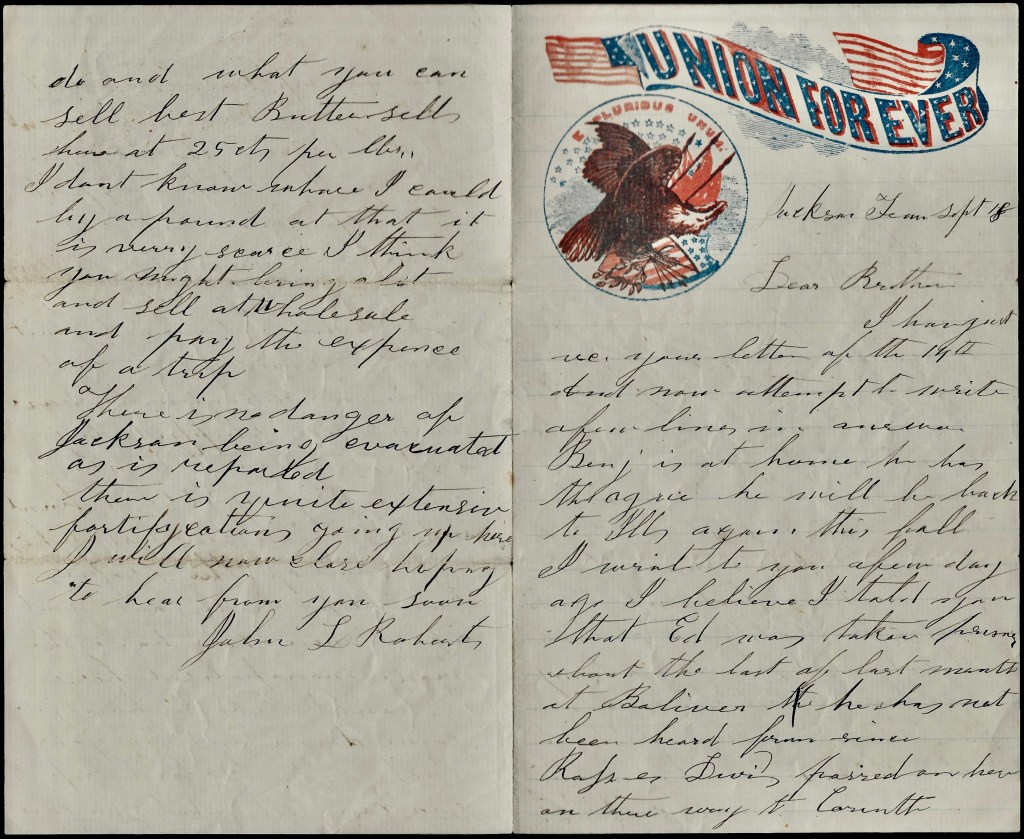
Patriotic stationery used by John L. Roberts in his letter of September 18, 1862
Jackson, Tennessee September 18, 1862
Dear Brother,
I have just received your letter of the 14th and now attempt to write a few lines in answer. Benjamin is at home. He has the ague. He will be back to Illinois again this fall.
I wrote to you a few days ago. I believe I told you that Ed was taken prisoner about the last of last month at Bolivar. He has not been heard from since. Rufus Davis [?] passed on here on the way to Corinth. I saw Dan and Tip when they passed. Giles [H. Roberts] is in the 96th Ohio, Co. G. Joseph Kimball is their captain.
You say you are out of business. Now if you will go to trading with the soldiers, I will insure you to make money. Anything that can be eaten will sell at high prices. I know men that are making fortunes trading with the soldiers. One man discharged from our camp told me that he made $72 clear in two weeks at Helena. I know he has but small capital. He was up here last week with a stock and sold out at wholesale. He has gone for another stock. I expect to help him sell out when he comes. He is going to buy tobacco, cigars, oysters, sardines, canned fruit, crackers, cheese, nuts, and stationery &c. He has to have everything shipped by express from Columbus up and pay $250 a hundred. So you see that takes off some of the profits. But keeps traders out and a few men here have the trade monopolized here. I should like to have you come down and try your luck. After the first trip, you can tell what you can do and what you can sell best. Butter sells here at 25 cents per lb. I don’t know where I could buy a pound at that. It is very scarce. I think you might bring a lot and sell at wholesale and pay the expense of a trip.
There is no danger of Jackson being evacuated as is reported. There is quite extensive fortifications going up here. I will now close hoping to hear from you soon. — John L. Roberts
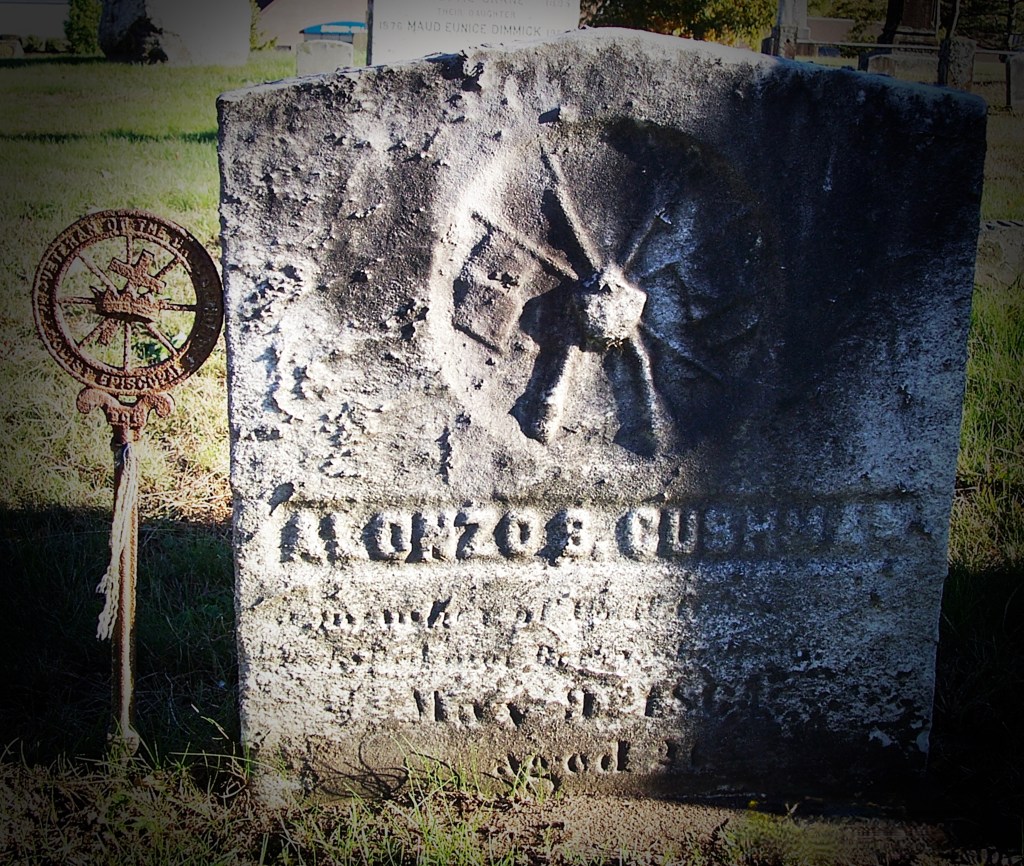
The following letter was written by Alonzo S. Cushman (1843-1864), the son of Lemuel Cushman (1800-1866) and Polly Sisson (1802-1886) of New London county, Connecticut.
Alonzo enlisted as a private in Co. H, 11th Connecticut Infantry in December 1861 and by the time this letter was written in April 1864 he was a veteran of many battles and campaigns. Little could he have realized as he penned this letter on 21 April and fancied himself home “rolling lemons” with his friends Betsy and Mary that he would be dead a little more than two weeks—killed on the battlefield of Swift Creek in Powhatan county, Virginia, in what would be Maj. Gen. Benjamin Butler’s last attempt to isolate Petersburg from Richmond on 9 May 1864. Union casualties that day were estimated at 128 killed, wounded or missing.
I believe the Mary J. McNeely to whom Alonzo addressed his letter was 18 year-old Irish-born daughter of the widow Nellie McNeely. Mary worked as a housekeeper and later in the woolen mills at Lisbon.
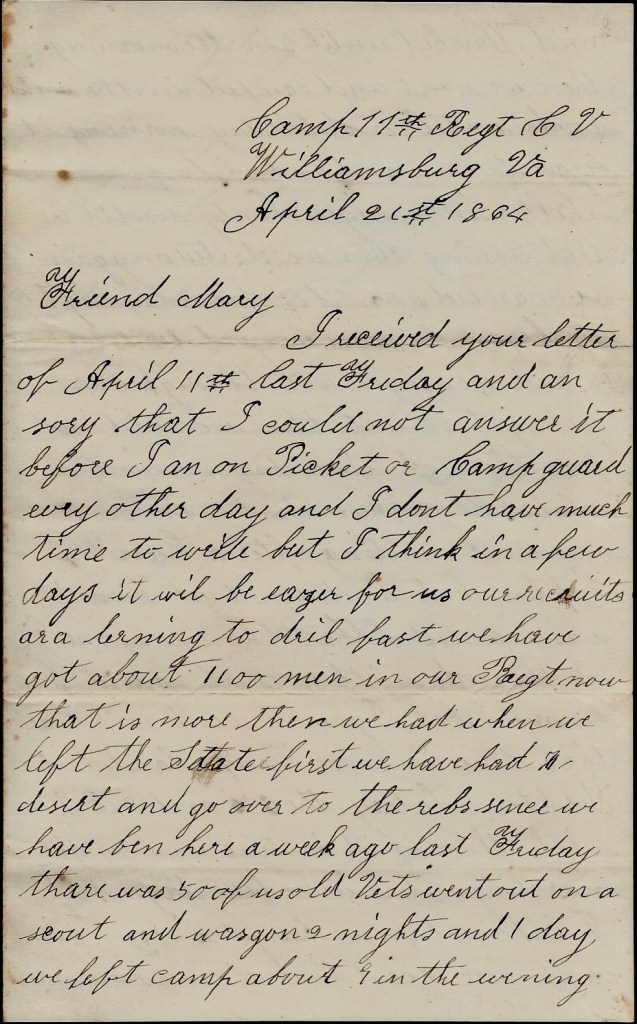
Transcription
Addressed to Miss Mary J. McNeely, Yantic, Connecticut
Camp 11th Regt. Connecticut Volunteers Williamsburg, Virginia April 21st 1864
Friend Mary,
I received your letter of April 11th last Friday and am sorry that I could not answer it before. I am on picket or camp guard every other day and I don’t have much time to write. But I think in a few days it will be easier for us. Our recruits are learning to drill fast. We have got about 1100 men in our regiment now. That is more than we had when we left the state first. We have had 7 [?] desert and go over to the rebs since we have been here.
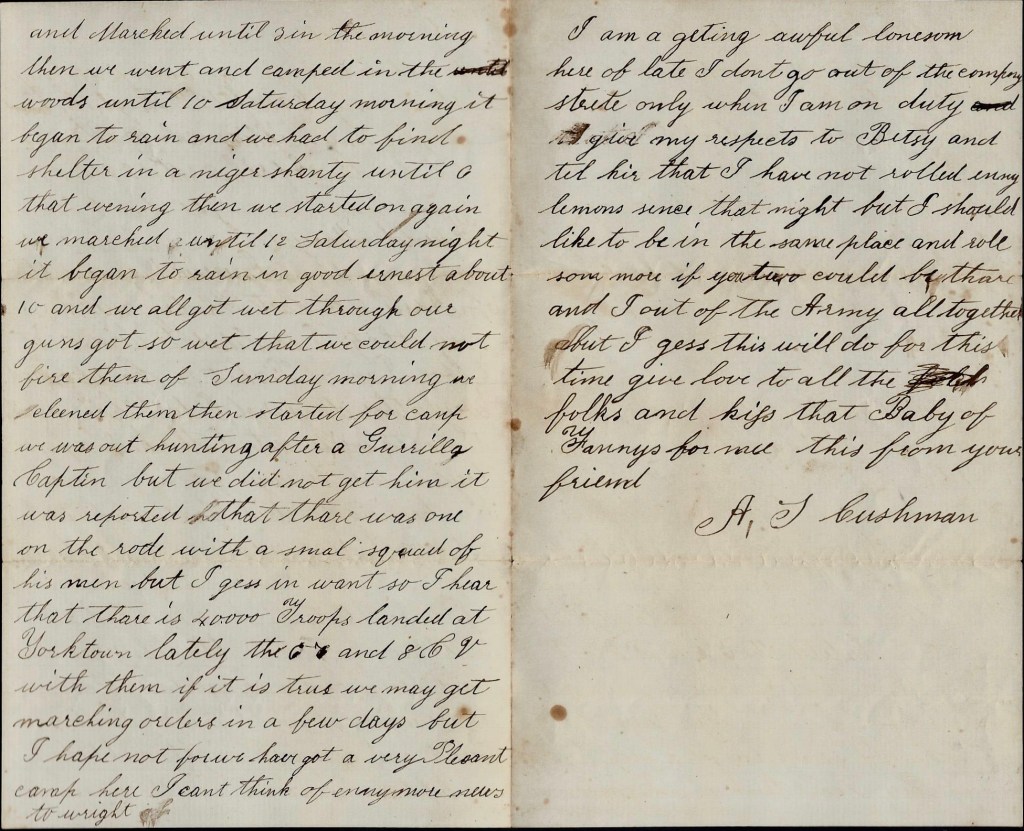
A week ago last Friday there was 50 of us old vets went out on a scout and was gone two nights and 1 day. We left camp about 9 in the evening and marched until 3 in the morning. Then we went and camped in the woods until 10 Saturday morning [when] it began to rain and we had to find shelter in a nigger shanty until that evening. Then we started on again. We marched until 12 Saturday night. It began to rain in good earnest about 10 and we all got so wet that we could not fire them off.
Sunday morning we cleaned them [and] then started for camp. We was out hunting after a guerrilla captain but we did not get him. It was reported that there was one on the road with a small squad of his men but I guess it wasn’t so.
I hear that there is 40,000 troops landed at Yorktown lately. The 6th, 7th, and 8th Conn. Vol. with them. If it true, we may get marching orders in a few days but I hope not for we have got a very pleasant camp here.
I can’t think of any more news to write. I am getting awful lonesome here of late. I don’t go out of the company street, only when I am on duty.
Give my respects to Betsy and tell her that I have not rolled any lemons since that night but I should like to be in the same place and roll some more if you two could be there and I out of the army altogether. But I guess this will do for this time. Give my love to all the folks and kiss that baby of Fanny’s for me.
The following letters were written by Martha Jane Irwin (1825-Bef1856), the eldest of four children born to John Maclay Irwin (1785-1856) and his second wife, Martha Nourse (17xx-1829). John’s first wife was Nancy McMurtry (1785-1821) with whom he had seven children. His third wife was Elizabeth Glass Marshall (1801-1844) with whom he had three children, and his fourth wife was Martha Culbertson. We learn from this letter that Martha’s father took his fourth wife in the summer of 1847 and that she was from the Pittsburgh, Pennsylvania, area.
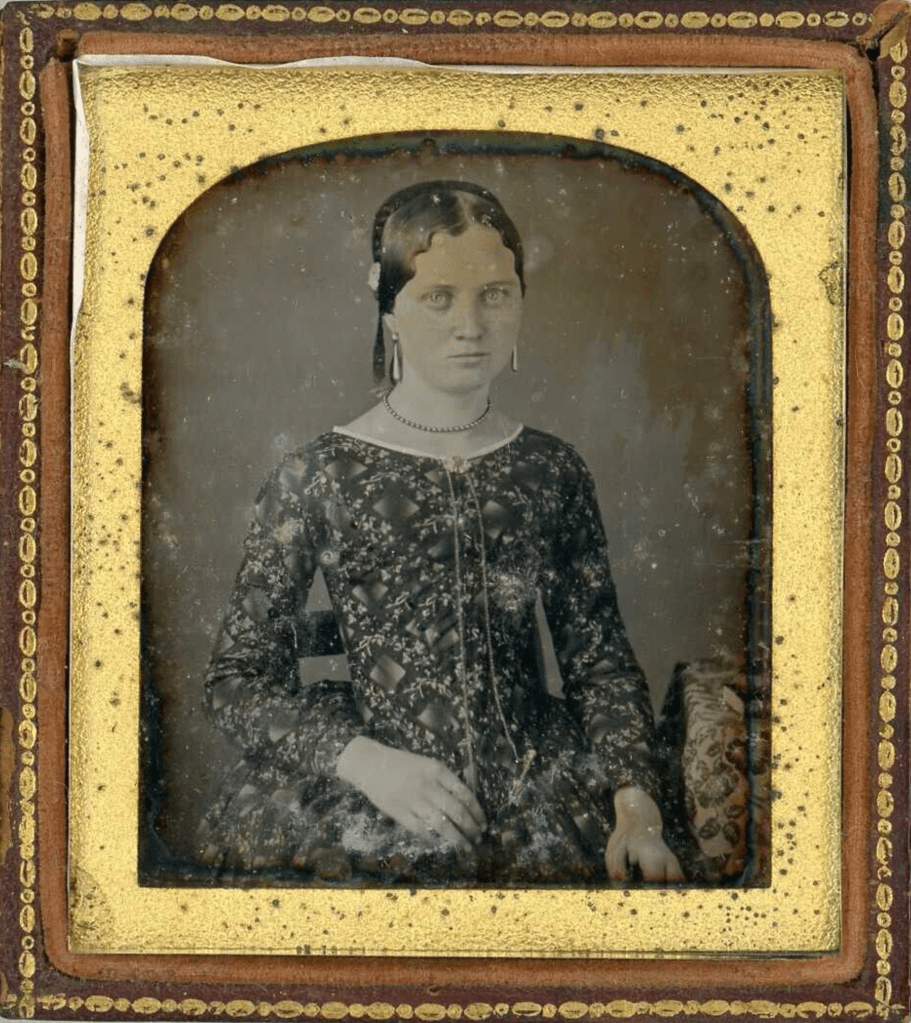
How Martha might have looked
It appears that Martha’s father lived his entire life on the farm he had near Lexington, Fayette county, Kentucky. When he died in 1856, his will directed that his slaves Moses, Juba, Matilda, Rachel and Ann be hired out “at good and suitable places” and that half their earnings go toward their support and the other half to them. The other slaves, namely Lewis, Aaron, William, Solomon, Samuel, Mary and Jane, he directed should be hired out for $200 per year and then, he expressed his hope, that would voluntarily “elect to go to Liberia” and given $200 each. It appears that he wished his slaves Betsy and her two children, James & Eliza, as well Sarah and Susan would be offered the same terms. Two boys—Thomas & John, he desired should learn a trade and then in five years be sent to Liberia, but if they refused to go, they would be sold.
We also learn from the will that his daughter Martha was deceased by the time it was written in 1856.
Martha wrote the letter to her much older sister, Eleanor Estill (Irwin) Chambers (1808-1888) and brother-in-law, George Maxwell Chambers (1800-1891). George moved with his parents from Maryland to Kentucky in 1805 and married Eleanor in 1820 in Fayette county. In 1835 they relocated to Jacksonville, Morgan county, Illinois, where he engaged in various business pursuits.
Midway, Kentucky [May 14th 1847]
Dear Brother George,
I feel very grateful to you for the two very interesting letters I have received from you and as I consider two of yours quite equal to one of mine, I have determined on answering them forthwith. Lizzie and myself are almost alone this evening having no one but George to protect us. Pa has left for Pittsburg where he will remain for a week or two (Providence permitting) taking unto himself in the meantime another rib as our friend, Dr. English, so affectionately designates his companion. Now this step I shall make no remarks on knowing as I do the very desolate situation of a widower even though he have an interesting, accomplished daughter like myself to manage his domestic concerns and one whose housekeeping qualifications are the boast of an admiring community.
As to intellectuality, you yourself are forced to acknowledge in almost every document I receive at your hands the decided superiority of my humble self, but after all that can be said of these admirable attainments and commendable traits, I consider my humility my most shining characteristic, and I would ask of you what can be more interesting than to imagine a being possessed of all these charms and yet perfectly ignorant of her numerous graces and virtues? If the mere imagining of so exceedingly delightful, how infinitely blest you should consider yourself to have just such an exquisite for a correspondent. Oh yes, I doubt not but the “bright reality” will be overpowering and the intensity of feeling so great that you will have an alarming attack of “high strikes“—put the children all in the corners for not being intellectual—and endeavor to burnish your own ideas by an excessive application of your ten scratchers to the region of phrenological developments.
I am glad to hear that you are all well. No one can tell the great anxiety I feel to see you all once more and I hope to be able to visit you this fall if nothing should turn up to prevent and I have a suitable opportunity.
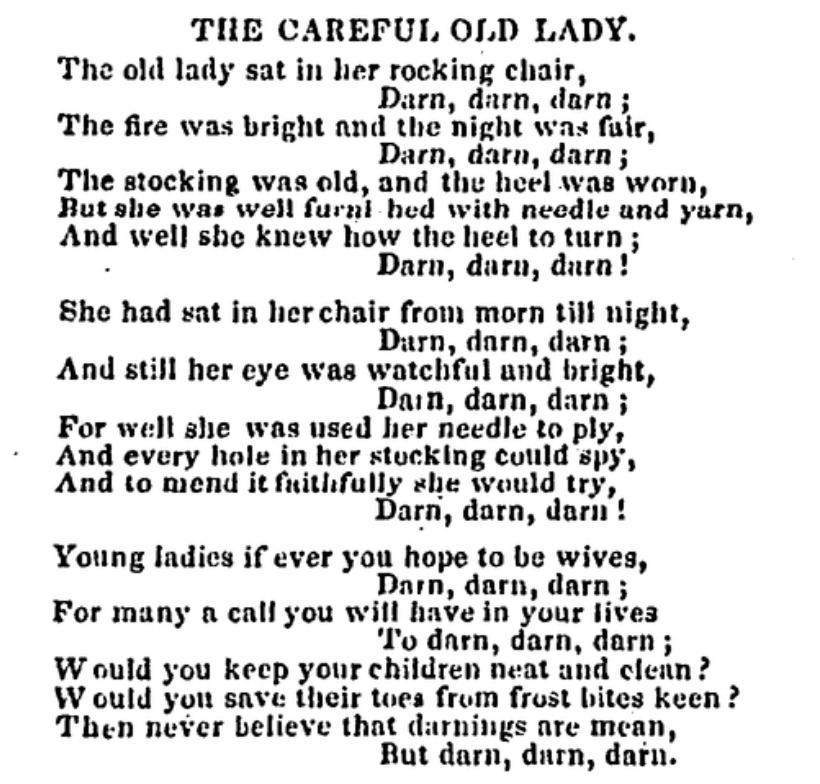
It may be that this is the poem referred to which was making the rounds in newspapers in the fall of 1846.
There is no news of consequence to communicate except that we have whitewashed the fence, broke one of the parlor looking-glasses, and killed the black cat for eating chickens. Tell Sister that I thank her very much for those tomato seeds and planted them immediately. I cannot express the very deep sense of gratitude that I felt on receiving that very applicable piece of poetry relative to the gal that had a hole in her stocking. Now it is nothing very uncommon for folks to have rents in their hose, but it was certainly “shocking” on an occasion like that and I would advise anyone placed in similar circumstances to adopt my plan of sewing them up.
Well another day has fled and I have not yet finished this letter and the worst of it is I have no additional news to communicate except that Old Frederic Cable of Woodford County was shot night before last by two negro men. One of them was named Hawkins—a brother of our Maria’s former husband. I suppose they will be hung. 1
This is the first day of our big meeting. We have brother Strahan and I have to assist Mr. Logan. My best love to sister, Charles, Kate, Rowland and all the rest of the children and believe me to be yours affectionately, —M. J. Irwin.
1 I inferred from this statement initially that Frederic Cable was killed but it appears he was only shot. Frederick Cable was born in Mississippi in 1774 and did not die until 1853. He was married to Mary Dickerson (1777-1853). I couldn’t find anything in the newspapers pertaining to this incident.
Letter 2
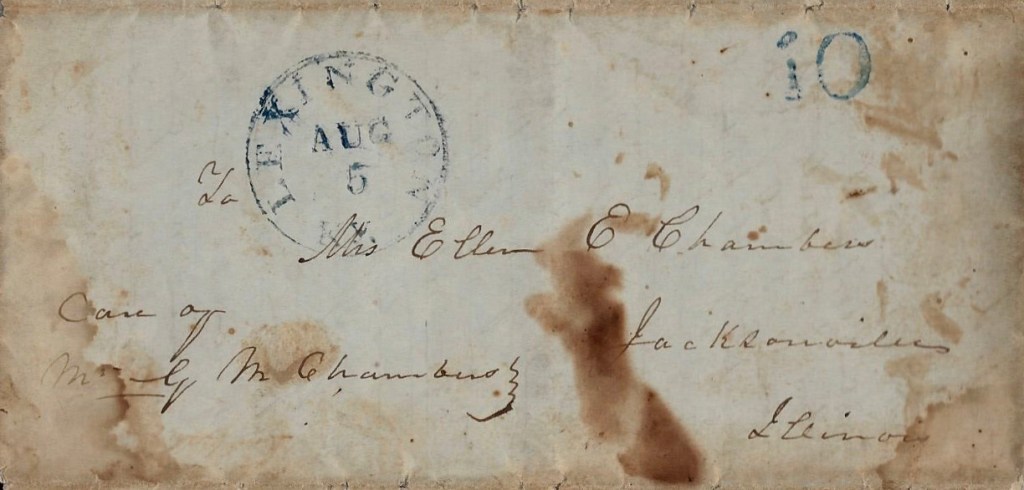
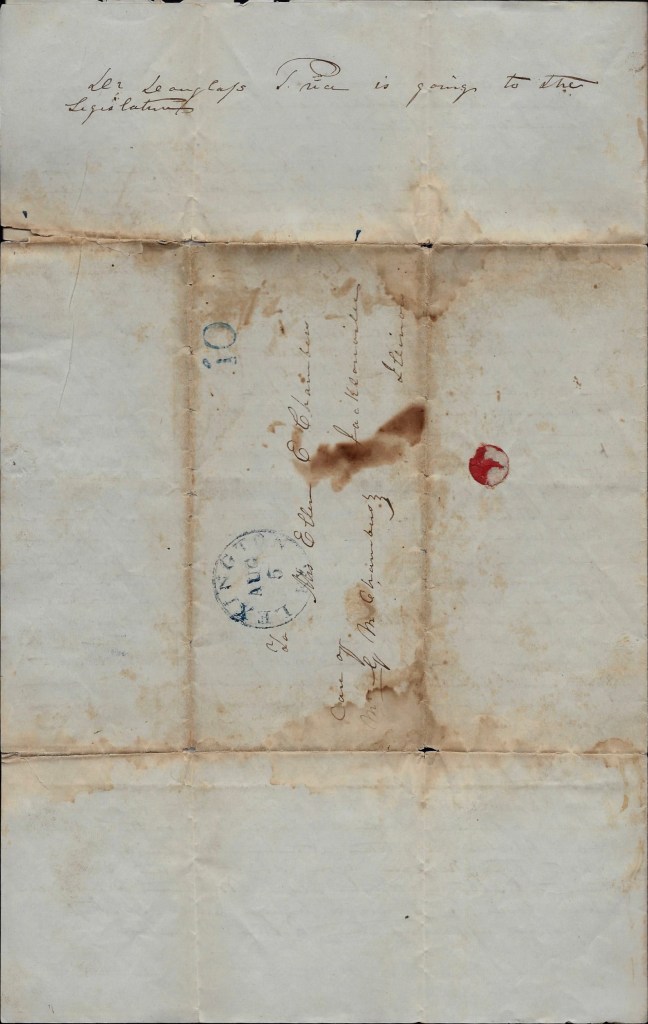
Addressed to Mrs. Ellen E. Chambers, Jacksonville, Illinois Care of Mr. G. M. Chambers [Postmarked at Lexington, KY]
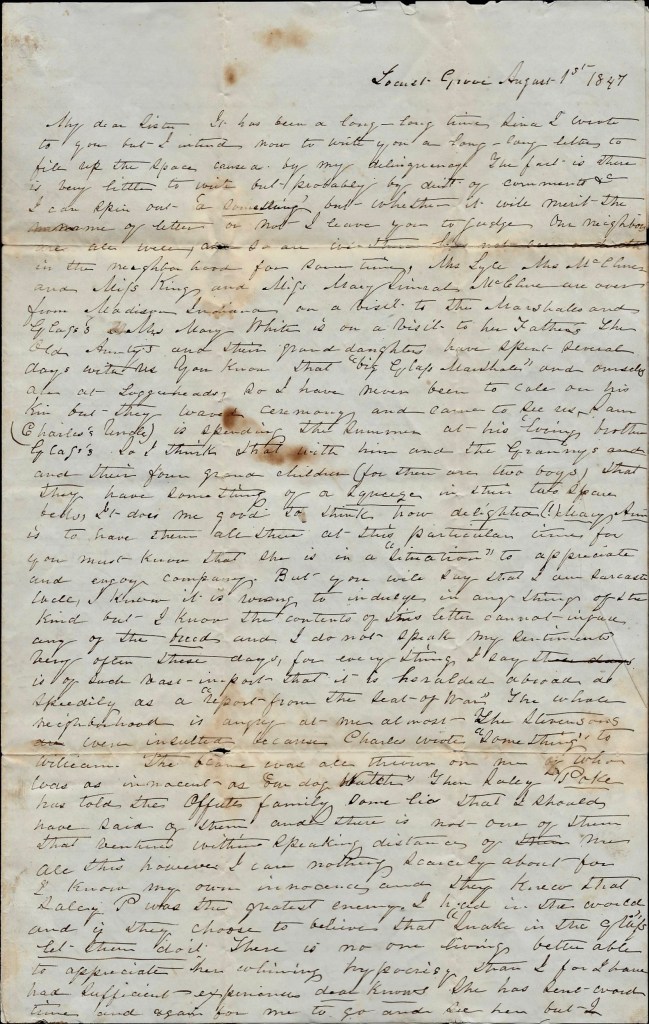
Locust Grove, [6 miles from Lexington, Kentucky] August 1st 1847
My dear Sister,
It has been a long, long time since I wrote to you but I intend now to write you a long, long letter to fill up the space caused by my delinquency. The fact is there is very little to write but probably by dint of comments, &c., I can spin out “a something.” But whether it will merit the name of letter or not, I leave you to judge.
Our neighbors are all well and so are we. There has not been a death in the neighborhood for some time. Mrs. Lyle, Mrs. McClure, and Miss King and Miss Mary Simrall McClure 1 are over from Madison, Indiana, on a visit to the Marshall’s and Glass’s. Mrs. Mary White is on a visit to her Father’s. The old Aunty’s and their granddaughters have spent several days with us. You know that “big Glass Marshall” 2 and ourselves are at loggerheads so I have never been to call on his kin, but they waved ceremony and came to see us. Sam (Charles’ uncle) is spending the summer at his “loving brother Glass’s” so I think that with him and the Granny’s and their four grandchildren (for there are two boys), that they have something for a squeeze in their two spare beds. It does me good to think how delighted (!) Mary Ann is to have them all there at this particular time for you must know that she is in a “situation” to appreciate and enjoy company. But you will say that I am sarcastic. Well, I know it is wrong to indulge in anything of the kind, but I know the contents of this letter cannot injure any of the breed and I do not speak my sentiments very often these days, for everything I say is of such vast import that it is heralded abroad as speedily as a “report from the seat of war.”
The whole neighborhood is angry at me almost. The Stevenson’s were insulted because Charles wrote “something” to William. The blame was all thrown on me who was as innocent as “our dog Watch.” Then Sally Poke has told the Offutt’s family some lie that I should have said of them and there is not one of them that ventures within speaking distance of me. All this, however, I care nothing scarcely about for I know my own innocence and they knew that Sally Poke was the greatest enemy I had in the world and if they choose to believe that “snake in the grass,” let them do it There is no one living better able to appreciate her whining hypocrisies than I for I have had sufficient experiences. Dear knows she has sent word time and again for me to go and see her but I treat her invocations with that perfect contempt which they so richly merit.
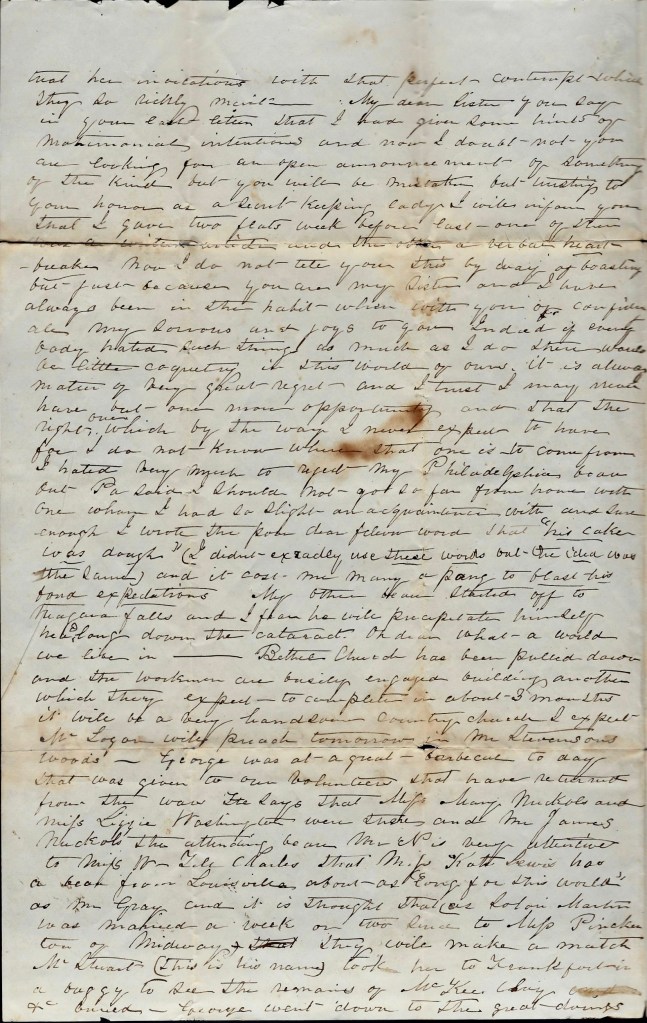
My dear sister, you say in your last letter that I had given some hints of matrimonial intentions and now I doubt not you are looking for an open announcement of something of the kind. But you will be mistaken. But trusting to you honor as secret-keeping lady, I will inform you that I gave two flats [rejections?] week before last—one of them was a written [letter] and the other a verbal heartbreak. Now I do not tell you this by way of boasting but just because you are my sister and I have always been in the habit when with you of confiding all my sorrows and joys to you. Indeed, if everybody hated such things as much as I do, there would be little coquetry in this world of ours. It is always a matter of very great regret and I trust I may never have but one more opportunity and that the right one—which by the way I never expect to have for I do not know where that one is to come from. I hated very much to reject my Philadelphia beau but Pa said I should not go so far from home with one whom I had so slight an acquaintance with. And sure enough, I wrote the poor, dear fellow and that “his cake was dough” (I didn’t exactly use these words but the idea was the same) and it cost me many a pang to blast his fond expectations.
My other beau started off to Niagara Falls and I fear he will precipitate himself headlong down the cataract. Oh dear, what a world we live in.
Bethel Church has been pulled down and the workmen are busily engaged building another which they expect to complete in about three months. It will be a very handsome country church. I expect Mr. Logan will preach tomorrow in Mr. Stephenson’s Woods.
George was at a great barbecue today that was given to our Volunteers that have returned from the [Mexican] War. He says that Miss Mary Nuckols and Miss Lizzie Washington were there and Mr. James Nuckols. The attending beau, Mr. Nuckols, is very attractive to Miss Washington. Tell Charles that Miss Kate Lewis has a beau from Louisville about as “long for this world” as Mr. Gray and it is thought that (as Solon Martin was married a week or two since to Miss [Catherine Harriett] Pinkerton of Midway) 3 they will make a match. Mr. Stuart (this is his name) took her to Frankfort in a buggy to see the remains of McKee Ivy, &c. buried. George went down to the great doings on that occasion and Pa gave all the negroes holiday. Susan Dolan went down and I as I generally do, staid at home.
Wednesday morning.
You will want to know, I suppose, how we all like our new mother. Well she has been with us nearly three months and she and I have not had the first hard word between us, and you know it takes a right clever person to get along amicably with me. Yes, she is devoted to Pa and seems to take a lively interest in his children. I not only like but love her. She is a very dignified, fine-looking woman and the only blue-eyed wife Pa has had. I do not want you to think her pretty for she is not, but she has a countenance that is a true index to her kind heart and if it had been left to me to choose for Pa, she is the one I would have chosen. She is too old to promise any more little brothers and sisters, and I don’t know how it is with you, but I feel satisfied on that score. She is a perfect pattern of housekeeper, but the sewing will still devolve on me till I get married and that will be a little while yet. If I am spared and can get anybody to accompany me, I will try and see my Illinois friends this fall. Pa says he feels very anxious to see you all but he cannot go now as all the winter work is coming on.
I have not got to Cincinnati yet and have almost declined going.
We are fixing up wonderfully here. We have got a set of very handsome mahogany chairs, a handsome wardrobe, sofa, and venetian blinds for the parlor and are expecting a handsome bedstead and silver candlesticks soon.
Tell Charles that his true love is the admired of all admirers and has more beaus than she can shake a stick at. Mrs. Laird says what’s the reason you don’t write? She is quite hurt at you all. Mother sends on her love. Pa’s in a hurry and I stop. Your affectionate sister, — Martha
Dr. Douglas Price is going to the Legislature.
1 Mary Simrall M’Clure (1832-1916) lived her entire live in Madison, Jefferson county, Indiana. She was a life-long member of the 1st Presbyterian Church and a school teacher. Her father was Dr. William McClure, a pioneer physician, and her younger brothers were Colonel William Simrall McClure (1834-1900), and Captain David G. McClure (1837-1894), both of whom were members of the First Indiana Cavalry in the Civil War.
2 Glass Marshall (1809-1899) was the son of Rev. Robert Marshall (1760-1832) and Betsy Glass (1772-1828). He’s buried in the Bethel Presbyterian Church Cemetery in Lexington, Fayette county, Ky.
3 Catherine Harriett Pinkerton (1827-1903) and Solon D. Martin (1825-1907) were married on 28 June 1847 in Woodford county, Kentucky. Not long after the couple were married, they relocated to Kansas City where Solon practiced medicine.
The following letter was written by Martin Van Buren Richardson (1838-1885), the son of Reuben M. Richardson (1795-1875) and Mary Ann Sanborn (1799-1883) of Manchester, Hillsborough county, New Hampshire. As stated in this early May 1861 letter, Martin was commissioned a 1st Lieutenant in Co. C, 1st New Hampshire Infantry—a three months organization. The following September, he was commissioned an officer in Co. C, 4th New Hampshire Infantry and he was promoted to captain of that company on 12 September 1864.
“The First Regiment New Hampshire Volunteers did no fighting, excepting the exchange of shots at intervals for two days across the river at Conrad’s Ferry. In this affray none of our men were hit. The rebels admit one captain and two privates killed and about twelve wounded. The regiment, however, did a large amount of guard duty, a service, which, though unattended with much eclat, may have accomplished as great good as a victory on the field of blood and carnage. The regiment did faithfully all that was required of it. If, as a regiment, its history is meagre, its individual members have an enviable record. Not less, probably, than five hundred members re-enlisted in subsequent military organizations.” [New Market Historical Society.]
An obituary notice for Richardson published in the Boston Evening Journal on 23 October 1885 informs us that he was only 47 years old when he died and that he had been with the firm of Jerome Marble & Co., in Worcester. His obituary was posted next to that of “the widow of the celebrated actor, Junius Brutus Booth, and the mother of John Wilkes Booth, who apparently died on the same day.
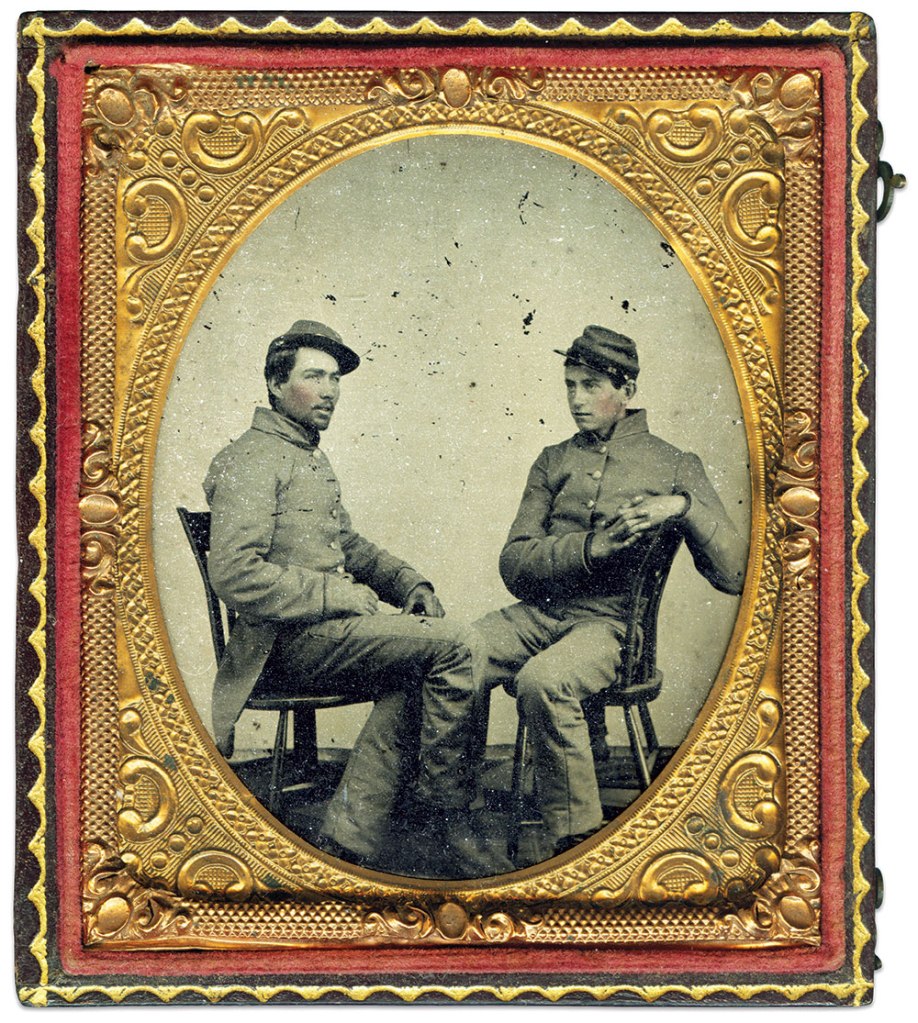
In his letter, Martin writes of the uniforms they expected to be issued: “The officers of the regiment, including lieutenants, were measured for their uniforms last Monday and will receive them next week Monday. The uniform of the officers will be blue frock coat, sky blue pants, &c. The privates will be dressed in grey.”(see image above)
Transcription
Addressed to Frank T. E. Richardson, Manchester, New Hampshire
“Camp Union” near Concord, N. H. May 2, 1861
Dear brother,
Mr. Barron was in my quarters today and wanted me to send word to my friends and of course I was desirous of doing so.
You will be a little surprised when I tell you that I have been commissioned 1st Lieutenant Company B, 1st Regiment. Day before yesterday we divided our recruits from Manchester into two companies. Capt. [John L.] Kelly, myself and Ensign Charles O. Jenison command the 1st Company. Capt. Sleepers, 2nd Lieutenant [Hollis O.] Dudley, and another man from West Point for 1st Lieutenant of Company H.
Today we were mustered into the service and received our arms so that we will be pretty well drilled in the course of a week. We may not receive our uniforms until the first of next week. The officers of the regiment, including lieutenants, were measured for their uniforms last Monday and will receive them next week Monday. The uniform of the officers will be blue frock coat, sky blue pants, &c. The privates will be dressed in grey.
We received our papers from Mr. Porter of Manchester and the officers & men voted their thanks heartily for the same. I may possibly visit Manchester again before I leave the state so to fix up matters a little.
You had better lay some soft paper upon the surface of the stone that I received from Boston and pack in snugly in a box that you will find in the closet in our room and have it in readiness when I leave the state or before.
My health is good. My quarters are good as anybodies and I am well contented with a soldier’s life so far as I have been.
I cannot write much now for Mr. Barron is waiting and so I will stop for the present. Give my love to Mother, Father, and all the rest. Write soon and address, — Lieut. Martin V. B. Richardson, “Camp Union”
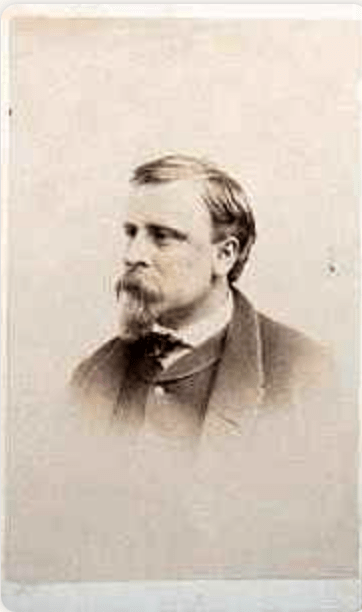
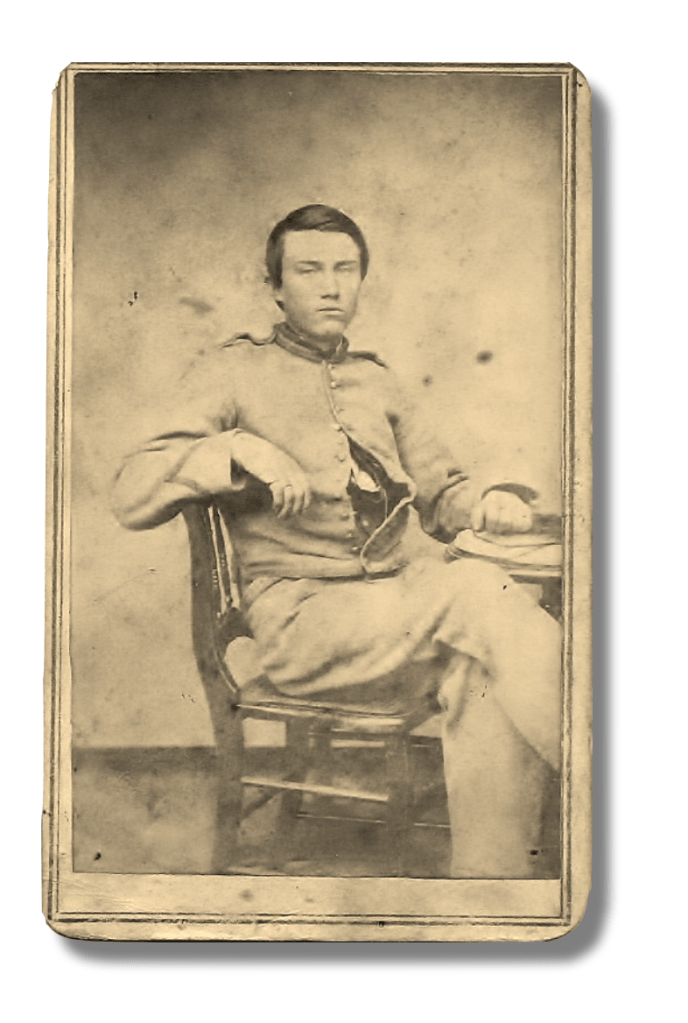
I could not find an image of William but here is a cdv of Calvin Jerome LeFevre of Co. H, 116th Pennsylvania Infantry. Calvin was wounded at Spottsylvania Court House on 12 May 1864, transferred into the 14th VRC and died in July 1865.(Ancestry.com)
These letters were written by William Augustus Smith of Co. D, 116th Pennsylvania Infantry (fought with the Irish Brigade). The first letter discusses the Battle of Falling Water (soon after Gettysburg, in which that unit was heavily involved) among other things. Even though that letter is not datelined, it most likely was written on July 15, 1863, since it is headed “near Harpers Ferry.” According to Mulholland’s history of the regiment, the 116th spent the night of 15 July 1863 there following Falling Water. William served as a private in Co. D, and later as a corporal in Co. A of the 116th Pennsylvania before being transferred to the Veteran Reserve Corps.
William A. Smith was the son of John Matlock Smith (1809-1873) and Phebe M. Medenhall (1813-1900) of West Chester, Chester county, Pennsylvania. It is curious, however, that he was not enumerated in his parent’s household in the 1850 US Census.
There are several references to this soldier—including quotations from other letters—posted on the internet or published in books. In his book, Defeating Lee: A History of the Second Corps, Army of the Potomac, (page 87), Lawrence Kreiser wrote that Pvt. William Smith—when he learned of Lincoln’s Emancipation Proclamation—was quoted as writing, “To hell with the Niggers…I would shoot one quick as a wink if he gave me any sase.”
Letter 1
[This letter is from the collection of Richard Weiner and is published with express consent. It was first published on 10 December 2017 on Spared & Shared 10.]
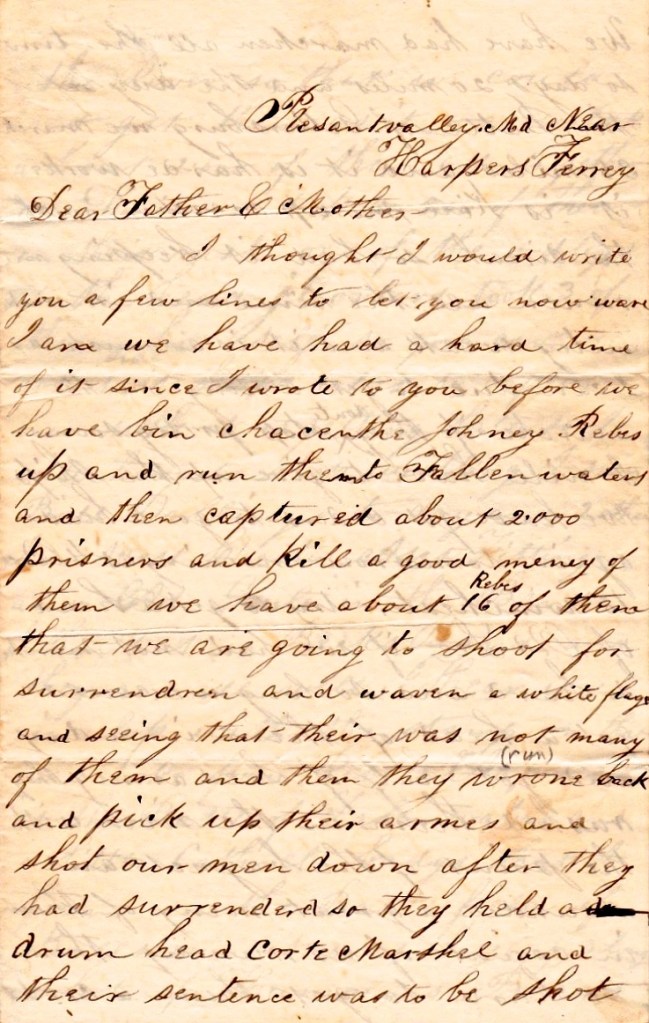
Pleasant Valley, Md, near Harper’s Ferry [15 July 1863]
Dear Father & Mother,
I thought I would write a few lines to let you know where I am. We have had a hard time of it since I wrote to you before. We have been chasin’ the johnnie rebs up and run them to Falling Waters and then captured about 2,000 prisoners and kill[ed] a good many of them. We have about 16 rebs of them that we are going to shoot for surrendering and waving a white flag and seeing that there was not many of them and then they run back and pick[ed] up their arms and shot our men down after they had surrendered. So they held a drumhead court martial and their sentence was to be shot.
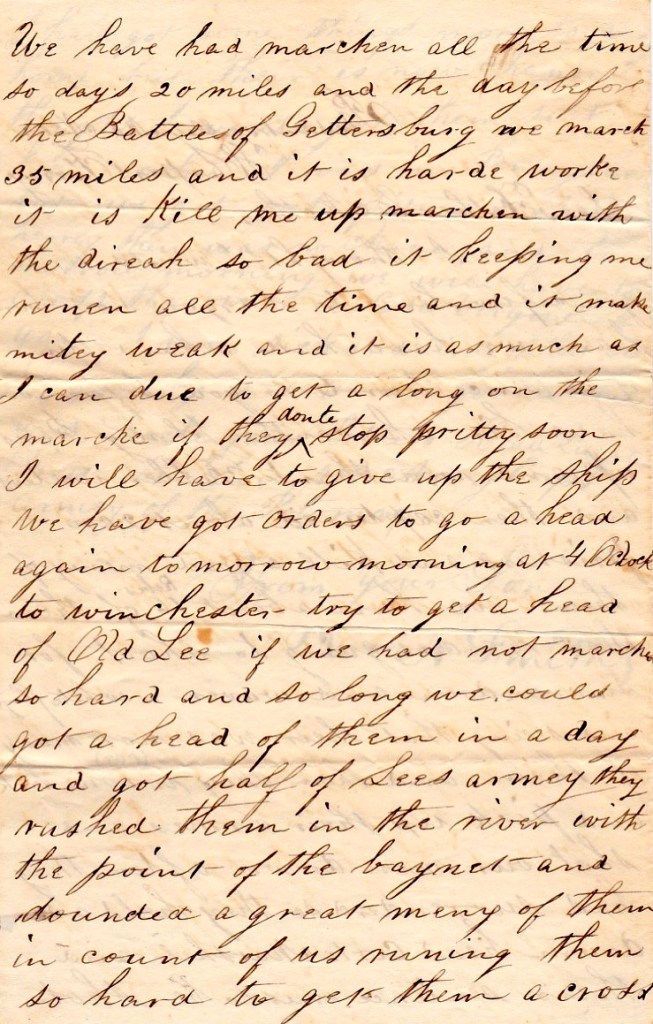
We have had marching all the time—today 20 miles. And the day before the Battle of Gettysburg we marched 35 miles—and it is hard work. It is kill[ing] me up marching with the diarrhea so bad. It [is] keeping me running all the time and it makes [me] mighty weak. And it is as much as I can do to get along on the march. If they don’t stop pretty soon, I will have to give up the ship.
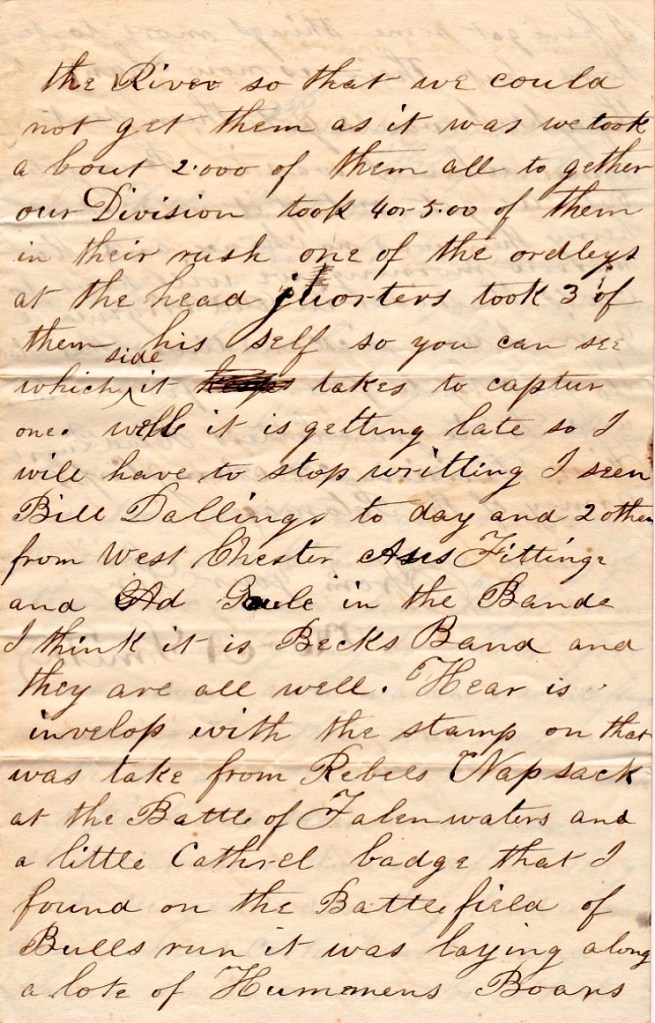
We have got orders to go ahead again tomorrow at 4 o’clock to Winchester [to] try to get ahead of Old Lee. If we had not marched so hard and so long, we could [have] got ahead of them in a day and got half of Lee’s army. They rushed them in the river with the point of the bayonet and drowned a great many of them in [ac]count of us running them so hard to get them across the river so that we could not get them. As it was, we took about 2,000 of them altogether. Our division took 4 or 500 of them. In their rush, one of the orderlies at the headquarters took 3 of them himself—so you can see which side it takes to capture one.
Well, it is getting late so I will have to stop writing. I seen Bill Dollings today and 2 others from West Chester. Asis Fittings and Gad Goule in the bands. I think it is Beck’s [Philadelphia Brass] Band and they are all well.
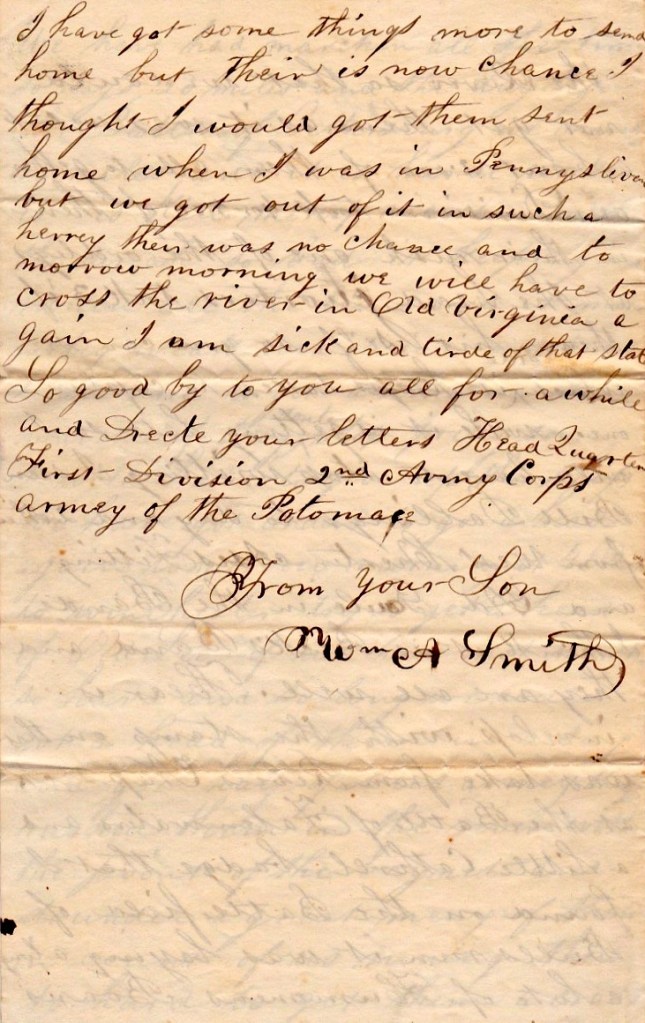
Here is an envelope with the stamp on that was taken from [a] rebel’s knapsack at the Battle of Falling Waters and a little cathrel [?] badge that I found on the Battlefield of Bulls Run. It was laying along a lot of human bones. I have got some things more to send home but there is no chance. I thought I would [have] got them sent home when I was in Pennsylvania but we got out of it in such a hurry there was no chance. And tomorrow morning we will have to cross the river in[to] Old Virginia again. I am sick and tired of that state.
So goodbye to you all for awhile and direct your letters [to] Headquarters, First Division, 2nd Army Corps, Army of the Potomac.
From your son, — Wm. A. Smith
Letter 2
Headquarters Turkey Run 1st November 1863
Dear Father & Mother & Sisters,
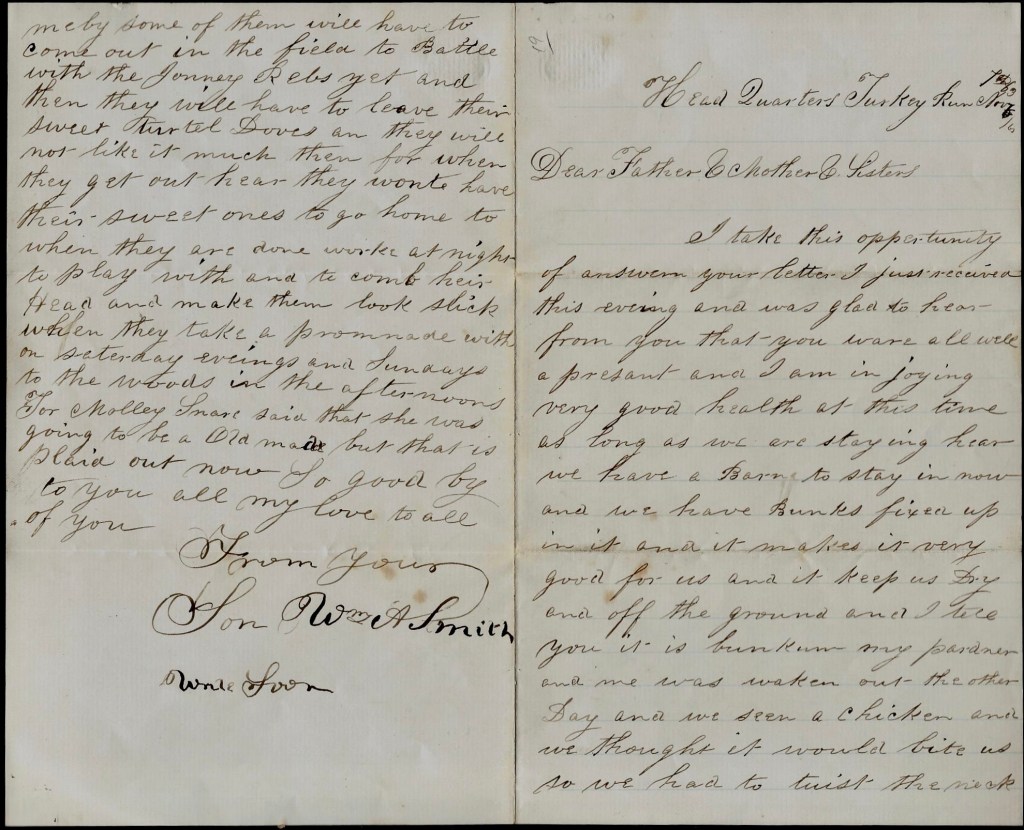
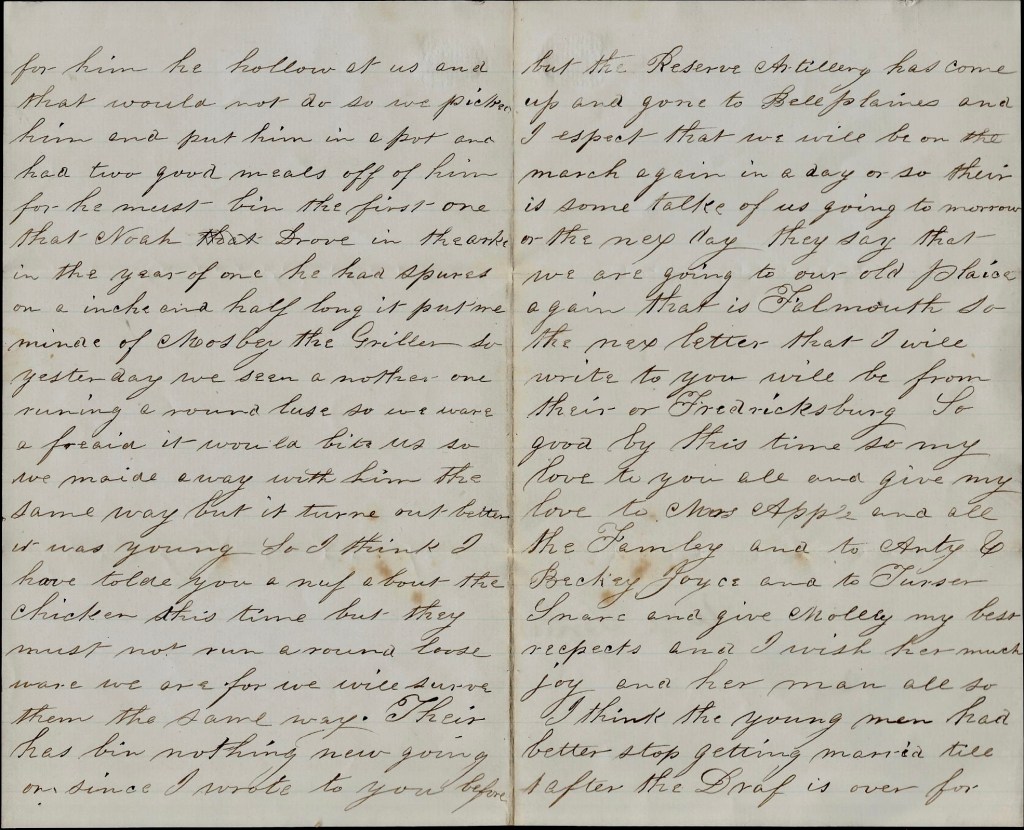
I take this opportunity of answering your letter I just received this evening and was glad to hear from you that you were all well at present and I am enjoying very good health at this time as long as we are staying here. We have a barn to stay in now and we have bunks fixed up in it and it makes it very good for us and it keeps us dry and off the ground. I tell you, it is bunkum. My pardner and me was waken out the other day and we seen a chicken and we thought it would bite us so we had to twist the neck for him. He hollow at us and that would not do so we picked him and put him in a pot and had two good meals off of him for he must bin the first one that Noah drove in the Ark in the year of one. He had spurs on a inch and a half long. It put me mind of Mosby—the Griller [guerrilla].
So yesterday we seen another one running around loose so we were afraid it would bite us so we made away with him the same way. But it turned out better. It was young. So I think I have told you anuf about the chicken this time. But they must not run around here loose where we are for we will serve them the same way.
There has been nothing new going on since I wrote to you before but the Reserve Artillery has come up and gone to Belle Plains and I expect that we will be on the march again in a day or so. There is some talk of us going tomorrow or the next day. They say that we are going to our old place again—that is Falmouth. So the next letter that I will write to you will be from there or Fredericksburg.
So goodbye this time. So my love to you all and give my love to Mrs. Apple and all the family and to Aunty & Becky Joyce and to Turser Snare and give Molly my best respects and I wish her much joy and her man also.
I think the young men had better stop getting married till after the draft is over for maybe some of them will have to come out in the field to battle with the Johnny Rebs yet and then they will have to leave their sweet turtle doves and they will not like it much then for when they get out here, they won’t have their sweet ones to go home to when they are done work at night to play with and to comb their head and make them look slick when they take a promenade with on Saturday evenings and Sundays to the woods in the afternoon. For Molly Snare said that she was going to be a old maid but that is played out now.
So goodbye to you all. My love to all of you. From your son, — Wm. A. Smith
Write soon.
Letter 3
Camp near Stevensburg January 17, 1864
Dear Father & Mother & Sisters,
I take my pen in hand to write you a few lines to let you know that I received your kind letter last night and was very glad to hear from you, that you were all very well at present, and that you had a happy Christmas there together. And I would like to been there with you, but it was no go for I could not make it. The furloughs has stopped now and I think there is a poor chance for me now without I play the Old Soldier and get my discharge, or get in a hospital away from here and then I will have a chance. Then I might have a chance.
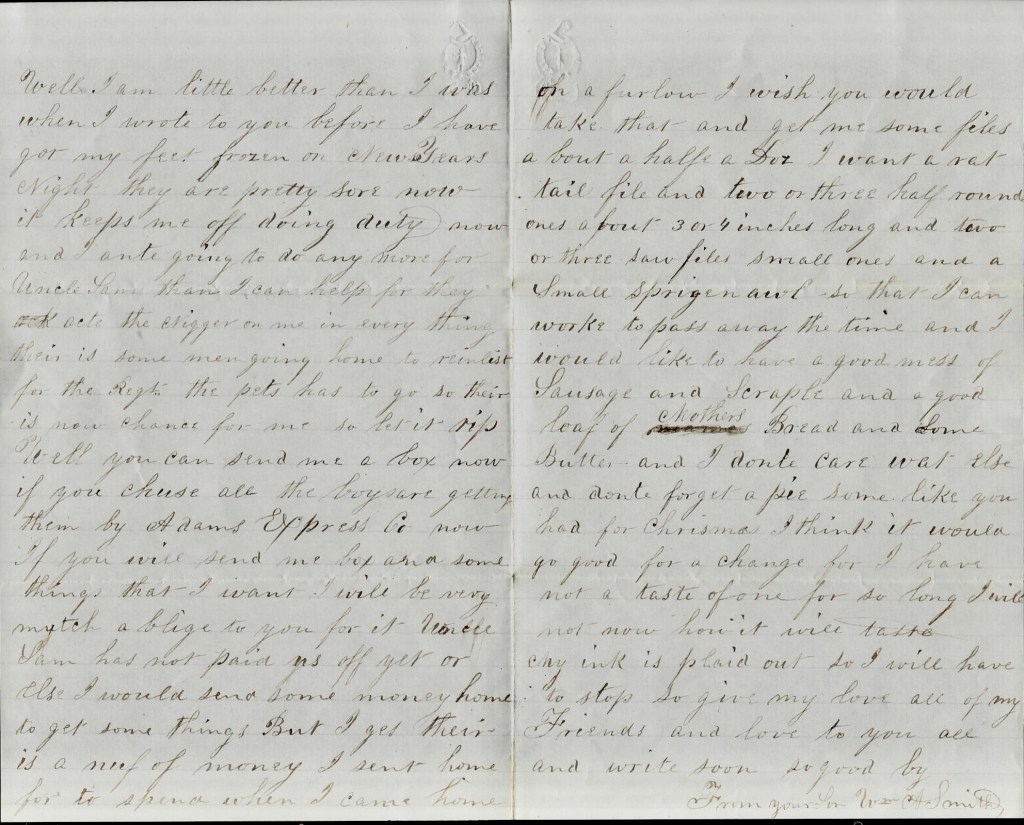
Well, I am a little better than I was when I wrote to you before. I have got my feet frozen on New Year’s night. They are pretty sore now. It keeps me off doing duty now and I ain’t going to do anymore for Uncle Sam than I can help for they act the nigger on me in everything. There is some men going home to reenlist for the regiment. The pets has to go so there is no chance for me so let it rip.
Well, you can send me a box now if you choose. All the boys are getting them by Adams Express Co. now. If you you send me a box and some things that I want, I will be very much obliged to you for it. Uncle Sam has not paid us off yet or else I would send some money home to get some things. But I guess there is enough of money I sent home for to spend when I come home on a furlough. I wish you would take that and get me some files—about a half dozen. I want a rat tail file and two or three half round ones about 3 or 4 inches long and two or three saw files—small ones—and a small sprigen awl so that I can work to pass away the time. And I would like to have a good mess of sausage and scrapple and a good loaf of Mother’s bread and some butter and I don’t care what else. And don’t forget a pie—some like you had for Christmas. I think it would do good for a change for I have not a taste of one for so long. I will not know how it will taste.
My ink is played out so I will have to stop. So give my love [to] all of my friends and love to you all and write soon. So goodbye from your son, — Wm. A. Smith
Direct this:
Wm. A. Smith Co. A, 116th Regt. P. V. 2nd Brigade, 1st Division, 2nd Corps Washington D. C.
Letter 4
Camp near Stevensburg March 4, 1864
My dear Father & Mother & Sisters
I take my pen in hand to write you a few lines to let you know that I received your kind and welcome letter last night and was glad to hear that you are all well at present when it left you. Well, for my part I am getting along very well at present here now. I have not done any duty since I left the Headquarters the 26th December.
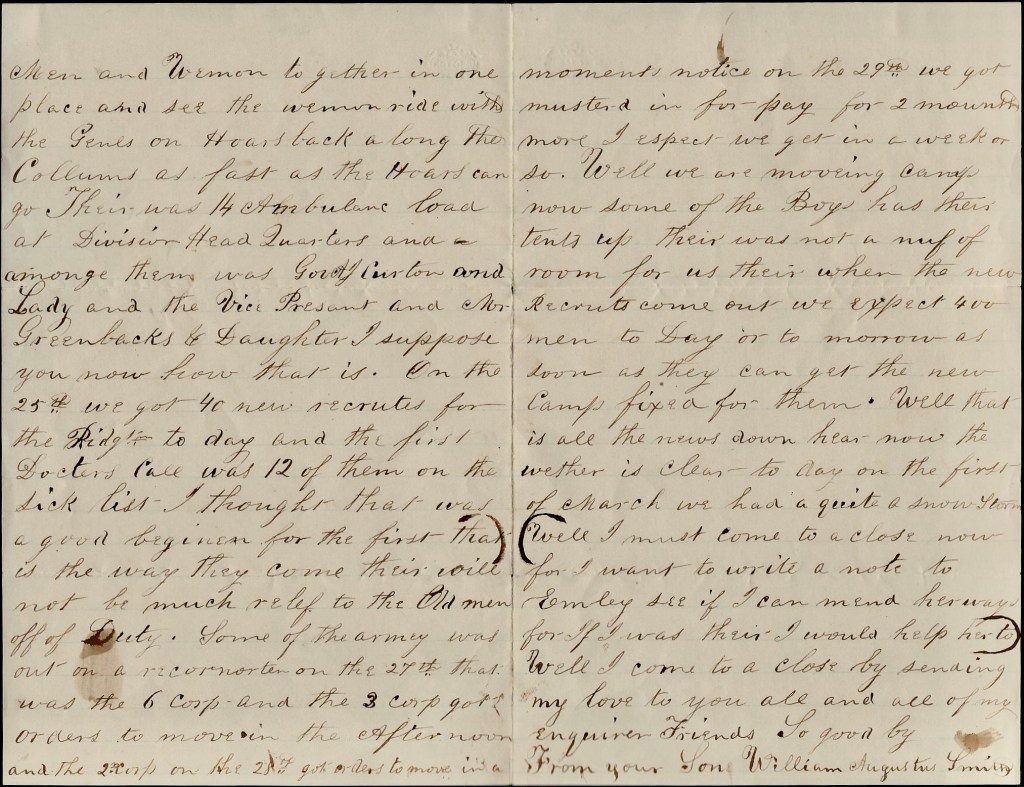
Well, there is not much news here now. We had a big ball on the 22nd of February [Washington’s Birthday] and had all of the Heads of Washington our here to see us and it was a grand thing to see so many men and women together in one place and see the women ride with the generals on horseback along the columns as fast as the horse can go. There was 14 ambulance loads at Division Headquarters and among them was Gov. A. J. Curtin and Lady, and the Vice President and Mr. Greenbacks [Salmon Chase] & daughter [Kate]. I suppose you know how that is.
On the 25th we got 40 new recruits for the regiment today and the first doctor’s call was 12 of them on the sick list. I thought that was a good bargain for the first. That is the way they come—there will not be much relief to the old men off of duty.
Some of the army was out on a reconnoiter on the 27th—that was the 6th Corps—and the 3rd Corps got orders to move in the afternoon and the 2nd Corps on the 28th got orders to move in a moment’s notice. On the 29th we got mustered in for pay for two months more. I expect we [will] get [it] in a week or so.
Well, we are moving camp now. Some of the boys has their tents up. There was not anuf of room for us there when the new recruits come out. We expect 400 men today or tomorrow as soon as they can get the new camp fixed for them.
Well, that is all the news down here now. The weather is clear today. On the 1st of March we had quite a snowstorm. Well, I must come to a close now for I want to write a note to Emily [and] see if I can mend her ways for if I was there, I would help her to. Well, I come to a close by sending my love to you all and all of my enquiring friends. So goodbye. From your son, — William Augustus Smith
Mother, here is a ring I send to you with your letters [initials] in—P. M. S.
Letter 5
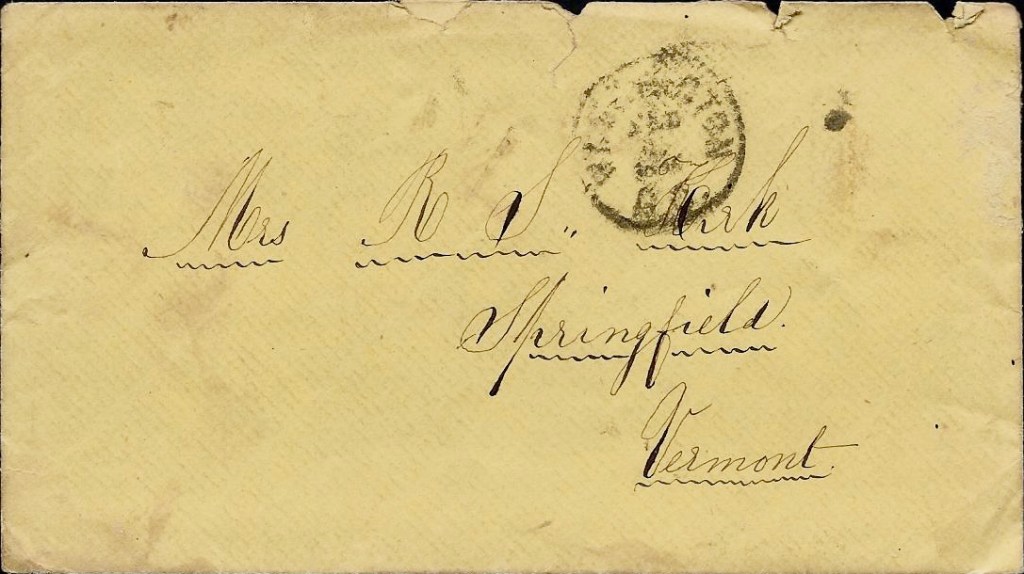
Addressed to Mr. John M. Smith, No. 27, Union Street, West Chester, Chester county, Pa.
Alexandria [Virginia] [May] 26th 1864
My dear Father & Mother & Sisters,
I take this opportunity of writing you a few lines to let you know that I received your letter dated the 22nd and was very glad to hear from you all that you are all well at present. I am better than I was a few day ago. I left Cliffburne Barracks on the 22nd of May and was reassigned to the 3rd Regiment Veteran Reserve Corps. The boys are first rate fellows but the captain is a darn mean man. He shows too much of the red tape about him. He will damn a man uphill and down for little or nothing. He has but one eye. The other is a glass eye. I hate it that his name is Smith for he is a disgrace to the name of Smith.
There is not much news here now—only that I got 5 letters from the front last night—all of the back letters that is at the regiment. My old Company A is doing provost guard duty at Division Headquarters. The boys say that they are getting along first rate and if they keep on doing as well as they have been doing, they say that they will go in Richmond before the 4th of July or take his head for a foot ball.
Is Frank’s corps the 10th or 16th for I can’t tell in Anne’s letter for it looks like a 16th. I have forgot the run of the corps now or else I would know.
So I come to a close by sending my love to you all and all of my friends. So goodbye. From your son, — W. A. Smith
Direct your letter to Corporal Wm. A. Smith, Co. D, 1st Battalion, 3rd Regiment, Veteran Reserve Corps, Alexandria, Virginia
I could not find an image of Reuben but here is one of Harmon Whitton who also served in the 10th Vermont Infantry. Harmon served in Co. E.
The following letter was written by Reuben Stephen Kirk (1834-1910)—the “tinman” of Springfield, Vermont, and the son of William Kirk, Jr. (1787-1874) and Lydia Bruce (1794-1854). Reuben was married in 1858 to Mary C. Long (1833-1910) and was the father of one (surviving) child named Ida G. Kirk who was born in 1862.
Reuben enlisted on 19 December 1863 to serve in Co. H, 10th Vermont Infantry. Perhaps he was drafted. He entered the war as a private but his age and maturity elevated him to a corporal in early 1865. He was with the regiment throughout the Overland Campaign, Opequan, Cedar Creek, and the Appomattox Campaign before mustering out on 29 March 1865 to return to his small family. According to his obituary, Reuben participated in “14 of the most important battles of the war.”
Transcription
Camp near Weldon Railroad February 2nd 1865
Dear Mary,
Another month has passed swiftly by—a month gone on my second year in the Yankee army. The question comes to mind tonight with force, what will another year bring forth? But still I would not seek to look into those things that only deity knows.
I received a letter from you dated 26th yesterday while on the picket line and I passed a few moments very pleasantly reading it over and over and thinking about Ida—how she looked when writing to Father. I have the picture fairly drawn in my mind now & it is a pleasing one. I think I have not missed writing you twice a week lately. I presume you have not got all of my letters. I am glad you went to the Donation [fund raiser]. I hope you will go out as much as you can so as to not get lonesome and homesick or sick (of home rather).
I have no choice about you letting the rooms. I want you to do as you please with the house while I am away. I shall not want you to send me any more money. I earned 50 cents washing Monday. I pick up some change now and then in that way so I have a plenty now & I do not need to spend any for a good while now I have got the box of goodies you sent. I am living like a king now but I have to be careful & not eat but a little at a time. The things will last me a long time if we do not move.
Night before last we had orders to be ready to move at a moment’s notice & I feared I should have to give away about all my stuff. But we have not gone yet & I hope we shall not at present. Our of 5 nights past, I have been on camp guard 28, picket one, so tonight I am plotting on having a good sleep and who knows but I shall visit you in my dreams (I hope so). I found the pickles and other canned stuff—lilly I think you call it—very nice & it goes complete with my pork and beef. The sausage too was No. 1 on the list. I have not eaten Ida’s candy yet. I guess it is sweet but I would swap it for a kiss on her red cheeks.
I made a mess of my griddle cakes for supper. I mixed the meal and flour together with salt and a little vinegar to rise them and they were extra nice. Sergeant Ross that I tent with received a box the other day from home & nearly half of the contents have been taken out & what there was left was well mixed up.
John Howe has come back to the company. I have written to [ ] to send you some money if he has it to spare, to pay up your store bills. You know how I feel about store debts. I think a good deal of my credit—more than most men do.
The rebs sent over a bullet at the post I was on yesterday but they did not take very good aim. I heard the ball whistle as it passed us. They are rather saucy. We are so near that we can converse with them by hallowing moderately loud. Their camp fires are right in sight in the edge of a woods. We are strengthening the works in our front & working on the forts more or less every week when not on duty. Today we had target shooting and battalion drill.
Lieutenant Thompson of our regiment has got back. He was taken prisoner at Cold Harbor the 1st of June. Also two privates—one was taken here near Petersburg in July last. They tell hard stories of rebel barbarities too sad to relate. Methinks they will have sins to account for that are enough to sink any native.
I received two papers also from you a few days ago. I wish I could get hold of something to send you but I cannot as I know of. I am attending meetings evenings when I am not on duty & I think I am profited by doing so, I am well and happy so cast not a anxious thought for me. Good night almost with a kiss.