All posts by Griff

My passion is studying American history leading up to & including the Civil War. I particularly enjoy reading, transcribing & researching primary sources such as letters and diaries.

1862-64: Charles Darwin Carpenter to Martha J. Carpenter

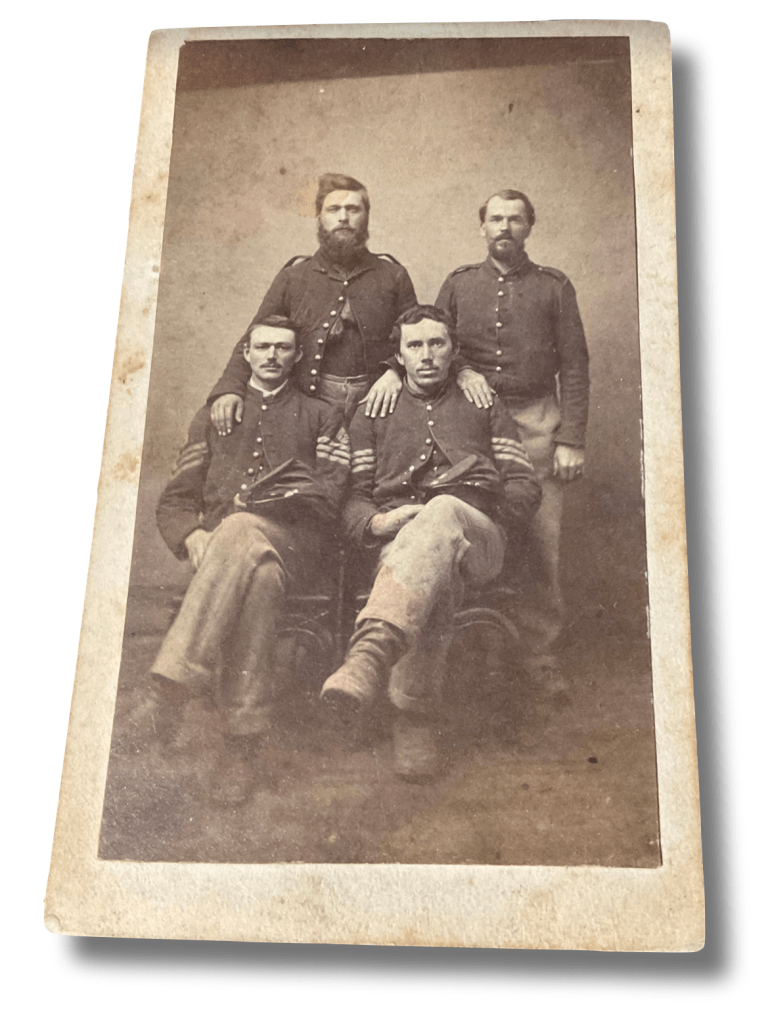
I could not find an image of Charles but here are four members of Co. H, 20th Ohio Volunteers; Downs, Quackenbush, Ohl, & Wonder
(Al Niemiec Collection)

The following letters were written by Sergeant Charles (“Charlie”) Darwin Carpenter (1839-1925), the son of David Cooley Carpenter (1805-1886) and Sarah Cleveland (1809-Aft1880). Charlie’s father was a stone cutter turned farmer in Berkshire Township, Delaware County, Ohio. He wrote most of the letters to his sister, Martha J. Carpenter (1837-1921). Martha married Charles Pierson in McLean County, Illinois on 10 February 1869. They resided in Decatur, Illinois. Some letters were written to his brother Corwin (“Cor”) Carpenter.

Charlie served in Co. D, 20th Ohio Infantry, enlisting as a private on 24 September 1861 when he was 22 years old. He was made a corporal a couple of weeks later and promoted to sergeant on 15 May 1862. Charlie was mustered out of the service as the first sergeant of his company on 28 September 1864 after three years of service.

After the war it appears that Charlie took up farming near Bloomington, McLean County, Illinois and married Hanna Maria Cravath (1846-Aft1920) on 3 July 1872. Maria was the daughter of Myrtillus and Polly Cravath of Pittsfield, Michigan; later Bloomington, Illinois.

The couple eventually relocated to Fort Scott, Bourbon County, Kansas, where Charlie became a nurseryman. His last residence (1910) before retirement was in Parsons, Kansas, where he worked as a teamster for a dairy. He is enumerated in the 1920 Census residing in the household of his son, Ernest Fay Carpenter (1873-1852) in Center Township, Vernon County, Missouri. Ernest was married to Agnes D. Estes (1873-1953). Pension records suggest that Charlie died in 1925.

Letter 1

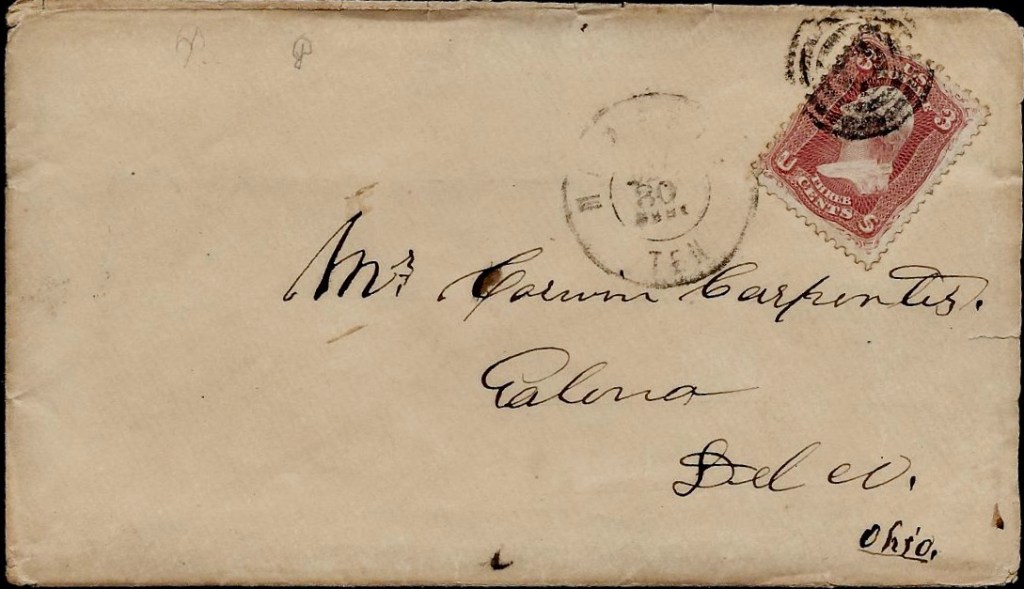
Addressed to Miss M . J. Carpenter, Galena, Delaware county, Ohio

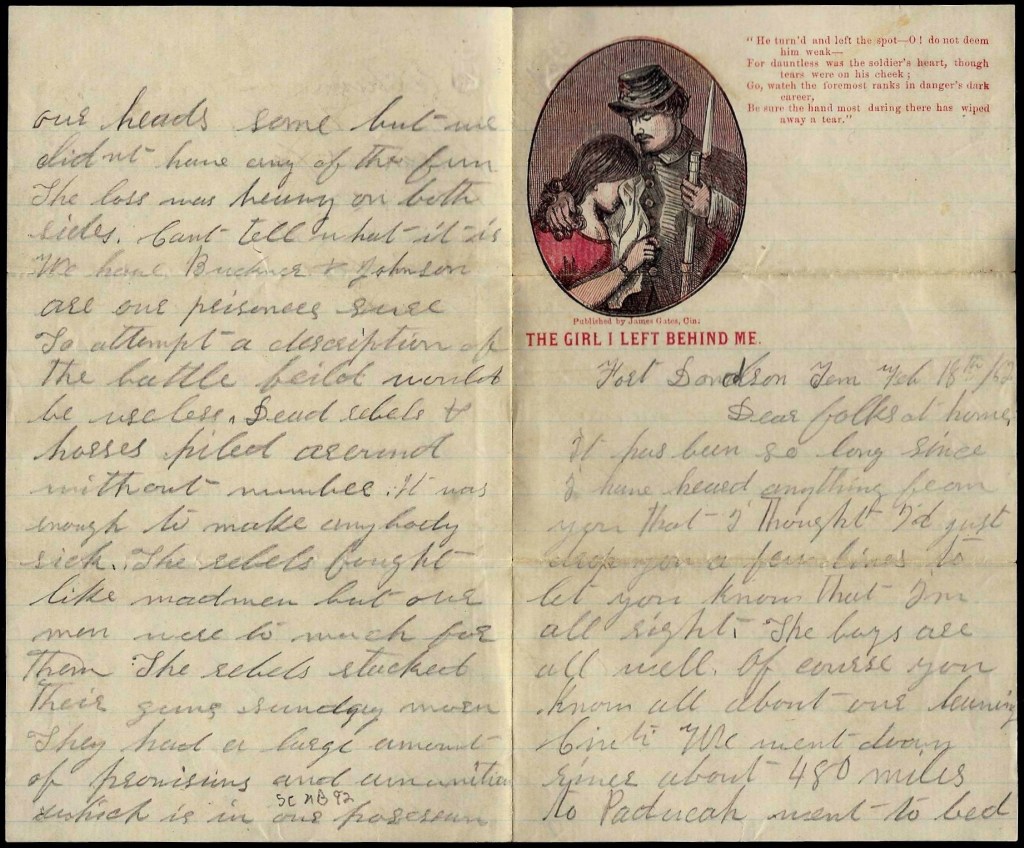
Fort Donelson, Tennessee
February 18, 1862

Dear folks at home,

It has been so long since I have heard anything from you that I thought I’d just drop a few lines to let you know that I’m all right. The boys are all well. Of course you know all about our leaving Cincinnati. We went down river about 480 miles to Paducah, went to bed and next morning found ourselves going up Cumberland river to the fort where we are now. The gunboats were playing on the forts finely when we got here. They were not long in silencing the guns at the fort but then the work was not quarter done. The fort is as strong a one as the rebels have and then their entrenchments extended about five miles down the river. They would come out and fire on our men and then retreat to their ditches. We had a force of about fifty thousand here. I can’t tell anything about the rebel force.

One thing certain, we have got ten or twelve thousand prisoners for I have seen them. Our regiment is going down river with them. Co. B is on board a boat now expecting to start every minute. We have about twelve hundred on board. They are going to Cairo or St. Louis.

If I was at home, I could give a description of the fort and the fight but I can’t do it now. We were not in the fight. We were held in reserve for a charge bayonet but they surrendered before it came to that. We were held so close that the balls whistled around our heads some but we didn’t have any of the fun.

The loss was heavy on both sides. Can’t tell what it is. We have Buckner & Johnson are our prisoners, sure. To attempt a description of the battlefield would be useless. Dead rebels & horses piled around without number. It was enough to make anybody sick. The rebels fought like madmen but our men were too much for them. The rebels stacked their guns Sunday morn. They had a large amount of prisoners and ammunition which is in our possession.

Letter 2

Camp near Pittsburg Landing
May 7th 1862

Sister Mat,

I received yours & mother’s good letters on the 5th and would have written immediately but could not do it. We were camped out towards Corinth when I got it and before I’d got it half read, our regiment was ordered back to the old camp. So we won’t be in the fight at Corinth at all. I have been on duty so much that I couldn’t write before. Last night was the first night’s sleep I’ve had out of three but that don’t happen often. My health is good—better than it has been this time of year for two years.

Of course you have heard of Ed Perfect’s death by way of Ken Sherman before this time. He was sick some time. I would have written and sent by him but thought I might as well send one by Orleans as by him for when we asked him how our folks were, he said didn’t know; he had not seen any of them. We boys thought that was rather mean in him so we didn’t send any word by him. The letter that you & Cor wrote, I never got. Don’t much wonder that you were sick. Your tramp was nearly equal to some of our marches. I wish I had been with you. But never mind. I expect to be up there to fish  before long. I’d like to see you all once more, you had better believe.

I have got the appointment of sergeant in the company so I shan’t have as much to do and will get $17 per month. I should have seen Daniel’s brother but we had to move in such a hurry the other day that I couldn’t do it. His regiment was camped about one half mile from us. Give my respects to O. G. when you write to him. You must excuse this short letter for we expect to get our pay in a day or two and then I shall write again. Tell the boys that I think if they want to keep a pet, they’d better keep a pig or a calf though I suppose a fox is a very valuable animal when he is tamed. Give love to all  the folks and believe me as ever, — Charley

Mother, you seem to doubt some whether I am well or not. I don’t know as there is anything the matter with me but consumption—and that is consumption of crackers and coffee. If you think I need any medicine for that, you can send some but I don’t think I need any. You wanted to know how about my clothes. I have drawn a new blouse and the other day found a new pair of pants where a regiment had left in a hurry. They were first rate ones, so you see I am well enough off for clothes. My boots are good yet.

Doc Beech is assistant surgeon in our regiment. I hadn’t seen him to speak to him yet as he has been here but a short time. The boys are all well but John D. He is not very well.


Letter 3

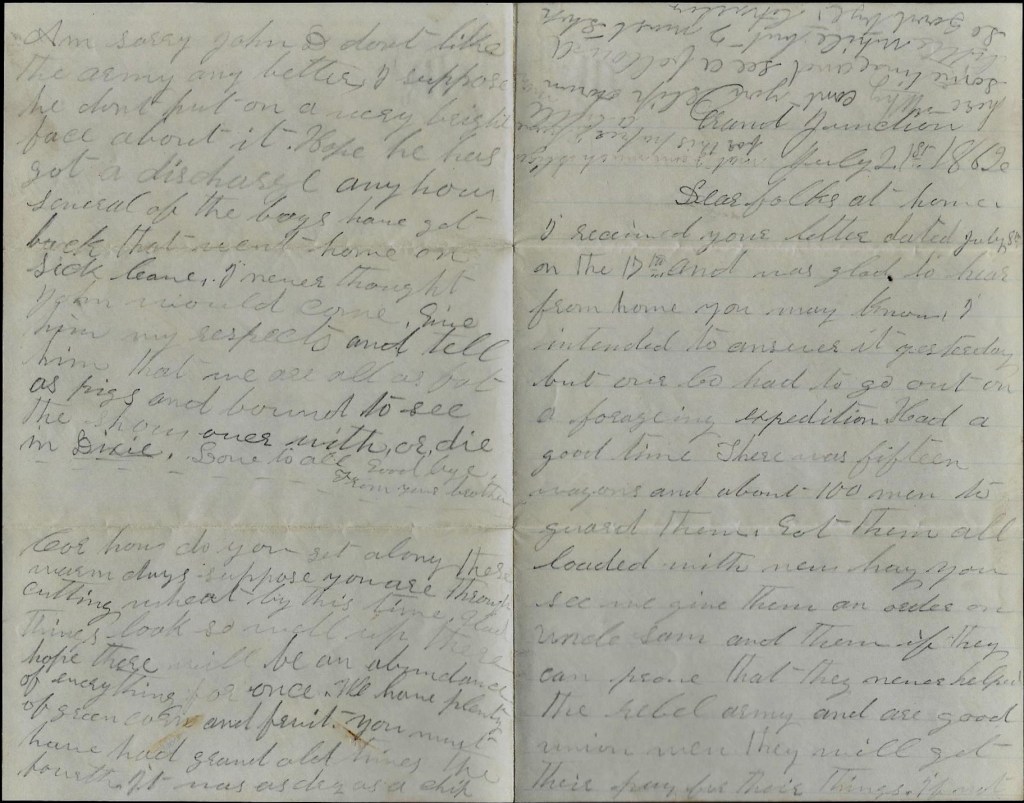
Camp Shiloh
May 25th 1862.

Dear Folks at Home,

I just received your good long letter about two hours ago and if ever a fellow was glad to get anything, I was to get that. Was glad to hear that you are all well. My health is good—better than it generally is this time of year. The boys are all well that are here. John Dustin left us sick about two weeks ago. Haven’t heard from him since. Presume he is in a hospital on the river somewhere. Should thought he would have written home before this time.

We are still camped where we were when I wrote last. Are having quite easy times now. Don’t know when we will have to start though. I hope  next time we move, it will be towards old Ohio but don’t want to go till they all go and I think that will be before long. Would like to have slipped in while Uncle Joel, Grandfather & Grandmother was there and had a good time with you all. Think it is kind of funny Grandfather can’t be contented there, but I guess he will be better off in Vermont. Hope Grandmother won’t go.

You wanted to know what my duties were now. I can hardly tell you now. Will tell you all about it when I get home. Our orderly has been sick and I have been acting in his place about two weeks and have been pretty busy. (Don’t want you to say anything about it. Folks will think I am conceited you know.) Am glad you are getting so you can walk to town so easily because you know I won’t know how to do anything but walk when I get back.

How I should like to hear some music this afternoon. I think about it every night about dark—just about the time you always play so much. Just play some for me when you sit down some night. I see they still keep having parties yet. Should think they would play out before long.

Gill & I went on a tramp the other day and of all the looking girls & women that I ever saw, that took the lead. All they have to eat is corn pone and buttermilk. Well, I just wish you could be down here and see some  of them. We are right in the meanest part of the state. It’s a perfect wilderness of woe. But I will have to stop for it is almost time for dress parade.

Got your picture safe and sound. Think it is a splendid one. I wouldn’t take a small farm for it. I am going to send the old one back and I want you to be sure to keep it for me for I have carried [it] so long that I want to keep it for it has been the rounds sure. Now write very soon—all of you. Tell Father I want him to be ready to go west when I get back. Love to all. Good bye. From Charley C.

26th. Cor, I couldn’t finish my letter yesterday so I will do it this morn. The company have all  gone out on picket this morning. Think you are getting along finely with your work. Tell Matt I would like to have a drink of milk from that durham of hers. The orderly & I are  going out fishing this afternoon. I just thought I would write a little this time.

Letter 4

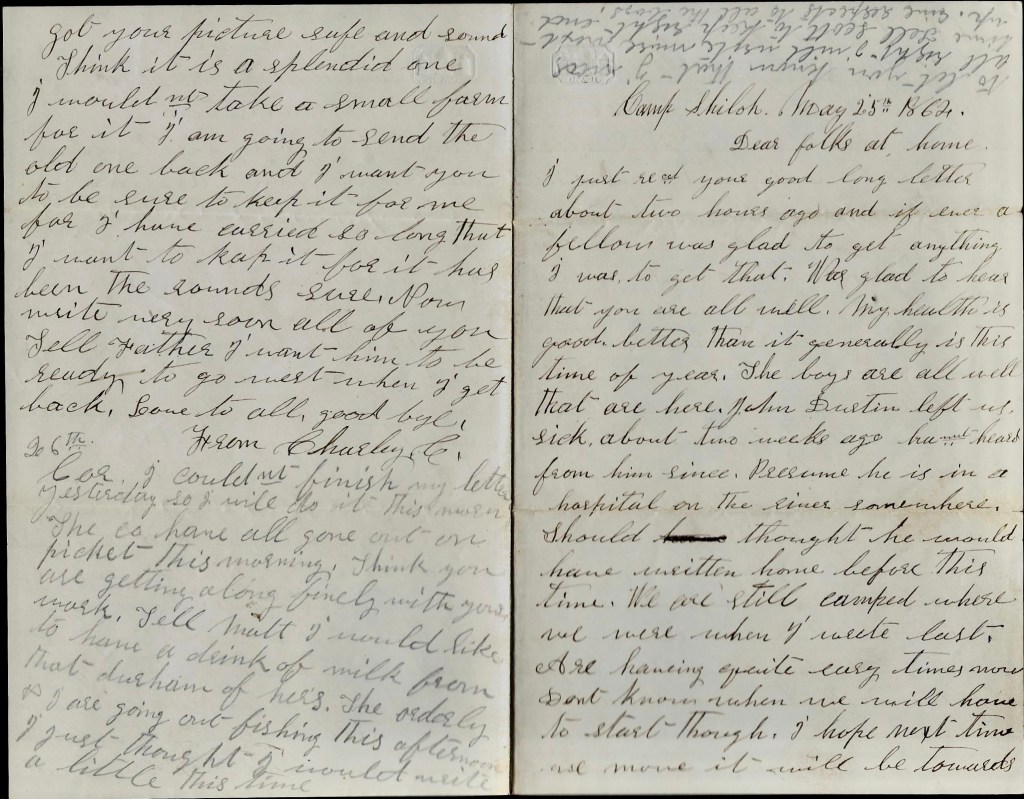
Grand Junction
July 21st 1862

Dear Folks at Home,

I received your letter dated July 8th on the 17th and was glad to hear from home. You may know I intended to answer it yesterday but our company had to go out on a foraging expedition. Had a good time. There was fifteen wagons and about 100 men to guard them. Got them all loaded with new hay. You see we give them an order on Uncle Sam and then if they can prove that they never helped the rebel army and are  good Union men, they will get their pay for their things. If not, they can whistle for it.

We are expecting an attack from rebel cavalry every day, but I guess we are enough for them. I know now the reason why I didn’t get your letters any better. That train that started from Memphis for Grand Junction was run off the track by the rebels, and they got a large mail in their possession that was for our brigade. So I suppose that has gone up the spout.

It is very warm here but I suppose not much warmer than it is up there. I  think you must be enjoying yourselves first rate—plenty of good fruit though I guess we are a little ahead of you in that line for yesterday we had plenty of peaches, melons & apples. You must have had gay times the Fourth [of July]. I should like to have been there very much.

12 o’clock p.m. I have been to the pond to bathe. Got back, ate dinner and will write a few lines more. Gill is on picket duty today. Zeph has gone up to town. Bruce is sitting here fighting flies. It is very hot but we don’t seem to mind any more than we  would at home. The Galena boys are very healthy. There are only five excused from duty by the surgeon in our company. We have got tanned so that we look like so many Indians. Don’t know whether it will ever get off or not. Don’t care.

Am sorry John D. don’t like the army any better. I suppose he don’t put on a very bright face about it. Hope he has got a discharge anyhow. Several of the boys have got back that went home on sick leave. I never thought John would come. Give him my respects and tell him that we are all as fat as pigs and bound to see the show over with or die in Dixie. Love to  all. Goodbye. From your Brother

Cor., how do you get along these warm days? Suppose you are through cutting wheat by this time. Glad things looks so well up there. Hope there will be an abundance of  everything for once. We have plenty of green corn and fruit. You must have had grand  old times the fourth. It was as dry as a chip. Mat, I am obliged for this paper. I have a  little here. Why can’t you slip down sometime and see a fellow a little while? But I must stop. So good bye. — Charley

Letter 5

Bolivar, Tennessee
September 28th, 1862

Sister Mat,

It has been so long since I’ve had a letter from home that I don’t know what to  make of it. Haven’t heard a word since Cor. wrote. I don’t blame you for I suppose you have written but if us boys don’t get a letter from home every week, we get very impatient. I do for it’s mighty little that I hear from there unless it comes directly from my own folks. That accounts for my impatience. So you see ,you’ll have to write pretty often or I shall lose track of everything. I am enjoying excellent health at present which is about as much as I can ask while I am in the service.

We have had big times since I wrote last. If I should undertake to give you a  history of our tramp, it would take two or three sheets of paper. We went to Corinth via Jackson, from there down to luka where Price was. But we were about three hours too  late. The bird had flown. We were only about four miles from there at the time of that hard fight between Price and Rosecrans’ men. We hurried up to help them, but were too late. Better believe we had a sweet time. It rained most of the time—no tents,  sleeping on the wet ground, hard crackers, raw meat and coffee, &c. &c. Well, in fact it was what you might call a pleasure trip in a soldiers’ life. But then the war will soon be closed now. Abe is going to free the niggers. (It will be closed over the left though) and then we will be at peace again I hope.

Our regiment has been out on two foraging expeditions since we got back here. Had a train of teams about three miles long. Loaded them mostly with corn. The way us boys went for sweet potatoes, tomatoes, chickens, and such things was a caution. Got enough to last us a good while. We are living now on the top shelf. Have tomatoes & bread cooked every meal. We had turkey for breakfast, tomatoes & sweet potatoes for dinner and don’t know what we shall have for supper.

But to change the subject, how do the forlorn ones get along since their men went to war? Pretty lonesome I expect. Suppose you hear from Hem now & then. How does he like it? He has an easy place. He couldn’t help liking it. Oh yes, did you ever get the things that Gill, Zeph, & I sent? We sent them to Lewis Center by a fellow  that was discharged from our company. His name was William Kellar. The things for you were all marked. If you get them, please tell me. I must stop for it is most dress parade time. Write soon. We get a mail every day now. All write. Love to all. Good bye. From your brother, — Charley


Letter 6

Bolivar, Tennessee
October 12th, 1862

Dear Folks at Home,

I received your letter dated 5th this morn. We were just falling in for inspection and had to wait till that was over. I was mad I tell you, but got it tonight quick when I  got a chance. Never was so glad to get a letter as I was to get this one. Glad to hear that you were well but sorry that Scott is sick. I know how it goes when he has the chills. Hope he is well by this time.

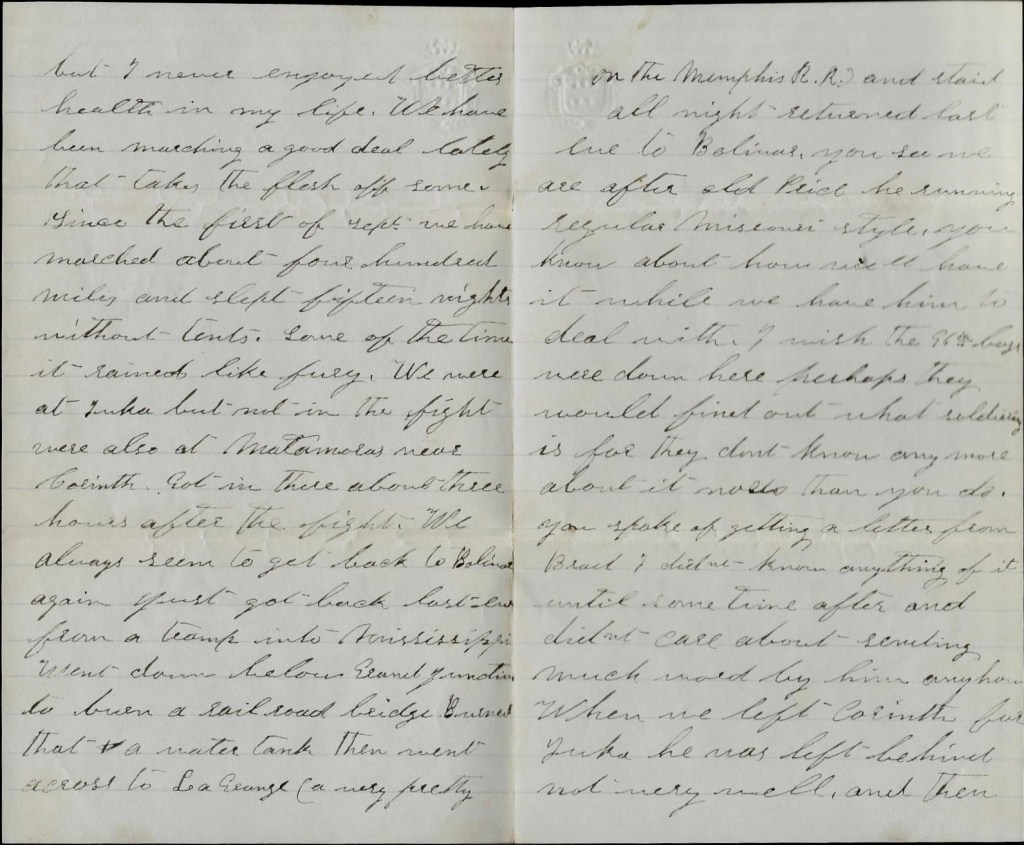
My health is good. I am not as fleshy as common as a matter of course, and I am glad of it, but I never enjoyed better health in my life. We have been marching a good deal lately. That takes the flesh off some. Since the  first of September we have marched about four hundred miles and slept fifteen nights without tents. Some of the time it rained like fury. We were at luka, but not in the fight. Were also at Matamoras near Corinth. Got in there about three hours after the fight. We always seem to get back to Bolivar again. Just got back last eve from a tramp into Mississippi. Went down below Grand Junction to burn a railroad bridge—burned that and a water tank. Then went across to La Grange (a very pretty [village] on the Memphis R. R.)  and stayed all night. Returned last eve to Bolivar.

You see we are after old Price—he running regular Missouri style. You know about how we’ll have it while we have him to deal with. I wish the 96th [Ohio] boys were down here. Perhaps they would find out what  soldiering is for. They don’t know anymore about it more than you do. You spoke of getting a letter from Brad. I didn’t know anything of it until sometime after and didn’t care about sending much word by him anyhow. When we left Corinth for luka, he was left behind not very well and then he can find a good deal more time to write than I can. You know some folks always have plenty of time to do everything. Perhaps I’ll  learn to take time too, but I can’t find time to do any more than my duty here and that I must attend to sure. Brad has always had a good many correspondents, but I guess it don’t amount to much.

Looking for [Joshua L.] Dunlevy every day now. I am not suffering for the things though. They will be very acceptable. How I should like to have been up there to help eat that turkey. Guess we had some fowl too. Eat all the chickens and turkey we could carry while we were out the last time. Tore down five or six bee hives for one man that were full of honey. Eat just all we wanted. Guess I must take another sheet.

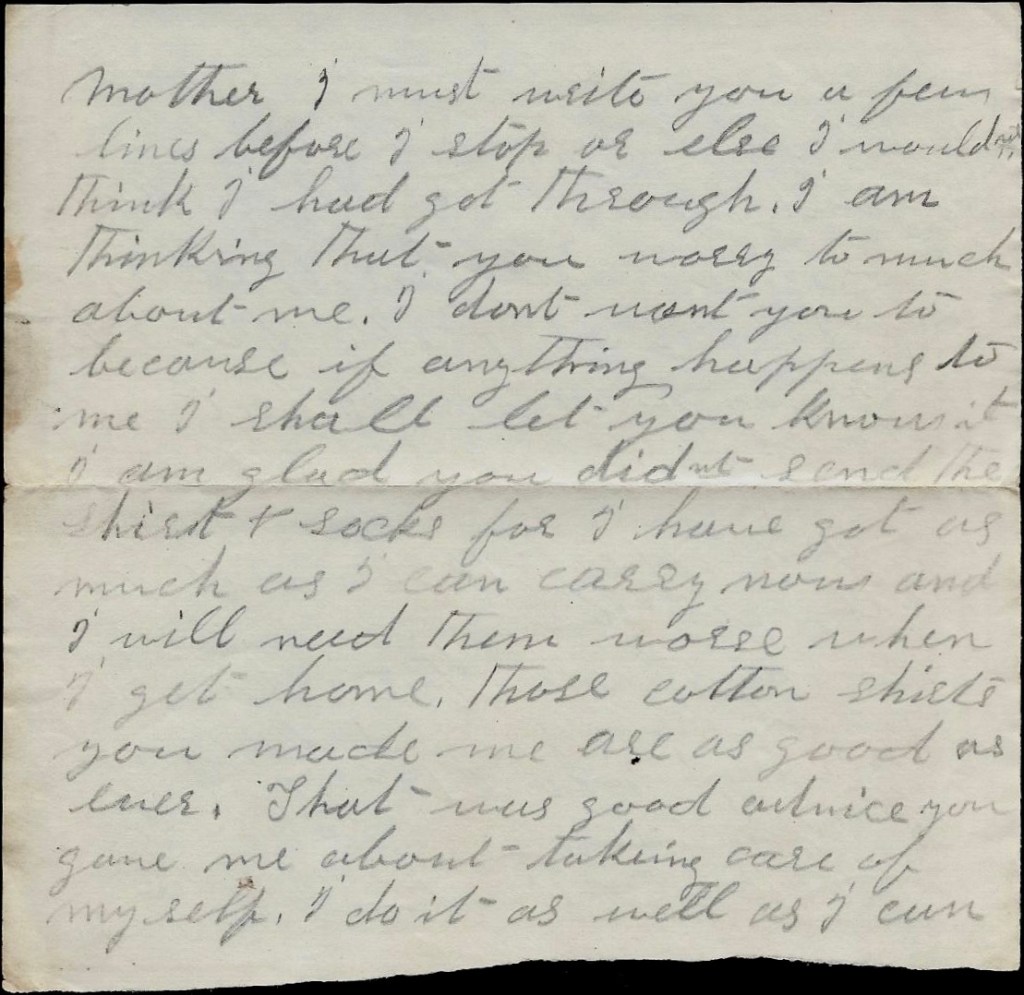
Mother, I must write you a few lines before I stop or else I wouldn’t think I had got through. I am thinking that you worry too much about me. I don’t want you to because if anything happens to me, I shall let you know it. I am glad you didn’t send the shirt & socks for I have got as much as I can carry now and I will need them worse when I get home. Those cotton shirts you made me are as good as ever. That was good advice you gave me about taking care of myself. I do it as well as I can under the circumstances and that you know wouldn’t be any too good part of the time. There is a nice run close to camp and I visit it pretty often to wash my face, neck and feet. I should like to be up there in time to get some strawberries but don’t expect that will be hardly possible. you must excuse these short notes for I have had so much on my mind for a week or two that I couldn’t think of anything hardly. Give my love to Grandfather, Grandmother, and all the rest. From C. D. C.


Letter 7

Monday Morn
October 13, 1862

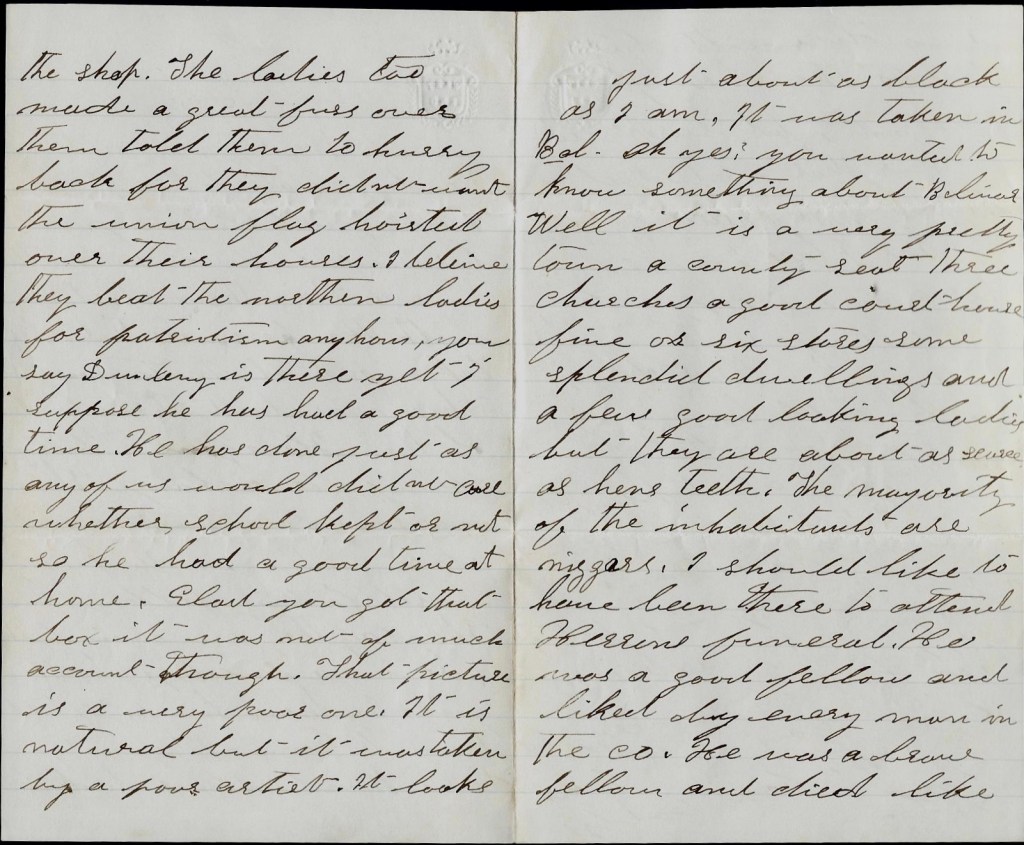
How do you all do this fine morning. Ell & I have just been up town on some little business. Saw them start off with the prisoners that were taken out at Matamoras. There was bout three hundred of them. Have gone to Holly Springs for exchange. There was some from most every state in the South. Pretty hard-looking fellows too. They say they are coming back here in a few days with guns in their hands. We told them to come along, we’ll give them the best we had in the shop. The ladies too made a great fuss over them. Told them to hurry back for they didn’t want the Union flag hoisted over their houses. I believe they beat the northern ladies for patriotism anyhow.

You say [Joshua L.] Dunlevy is there yet? I suppose he has had a good time. He has done just as any of us would—didn’t care whether school kept or not, so he had a good time at home. Glad you got that box. It was not of much account though. That picture is a very poor one. It is natural but it was taken by a poor artist. It looks just about as black as I am. I was taken in Bolivar.

Oh yes, you wanted to know something about Bolivar. Well it is a very pretty town—a county seat, three churches, a good court house, five or six stores, some splendid dwellings, and a few goof-looking ladies but they are about as severe as hen’s teeth. The majority of the inhabitants are niggers.

I should like to have been there to attend [James J.] Herron’s funeral. He was a good fellow and liked by every man in the company. He was a brave fellow and died like a soldier with his face to the enemy.

I was not a bit surprised to hear that Uncle Joel & Hannah had parted. If I was in his place, I would give here a nice little sum to get rid of her. Hope Hem & M. W. will have a good time writing to one another. I guess the thing has about played out here.

But I must stop. It is most mail time and I want this to go out today. Mat, that piece of your dress—I shall keep it—is very pretty. I’l write again in a few days to the boys. Goodbye, — Charley Carpenter


Letter 8

In camp on Yochnapataffa River [Little Tallahachie River?]
December 17th, 1862

Brother Cor.

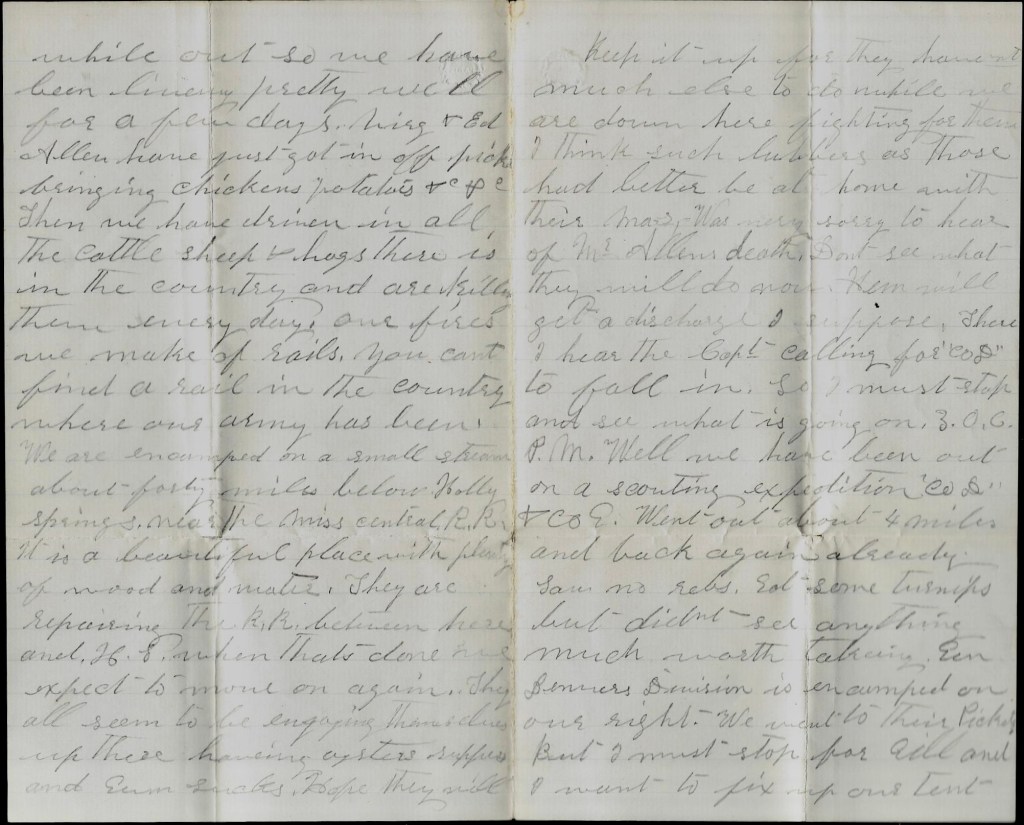
I received your good long letter on the eve of 14th and was very glad to get it, I assure you. Sorry that you are all so unwell. Hope your throat is well by this time. My  health is good. The boys are all well. I couldn’t find a man to go to surgeon’s this  morning. I would have answered this before this but the next day after I got it, was sent out with the teams after forage and it rained all day too. I never got so wet in my life. It took me about two days to dry out, but I am all right now. Got a big sack of sweet  potatoes while out so we have been living pretty well for a few days. Wirz & Ed Allen have just got in off picket bringing chickens, potatoes, &c. Then we have driven in all the cattle, sheep & hogs there is in the country and are killing them every day. Our fires we make of rails. You can’t find a rail in the country where our army has been.

We are  encamped on a small stream about forty miles below Holly Springs near the Mississippi Central R. R. It is a beautiful place with plenty of wood & water. They are repairing the railroad between here and Holly Springs. When that’s done we expect to move on again. They all seem to be enjoying themselves up there–having oyster supper and even sucks. Hope they will keep it up for they have not much else to do while we are down here fighting for them. I think such lubbers as those had better be at home with their ma’s.

Was very sorry to hear of Mr. Allen’s death. Don’t see what they will do now. Hem will get a discharge I suppose. There, I hear the Captain calling for “Co. D” to fall in so I must stop and see what is going on.

3 o’clock p. m. Well, we have been out on a scouting expedition. Co. D & Co. E. went out about  4 miles and back again already. Saw no rebs. Eat some turnips but didn’t see anything much worth taking. Gen. [James W.] Denver’s Division is encamped on our right. We went to their picket. But I must stop for drill and I want to fix up our tent a little better this afternoon. Wirz, Ed A., Frank P., Ame Mounts, Lee Sherman, Gill & I bunk  together. We have some gay times you can bet. If anything new happens here I will write. Want you to write just as often as you can. Love to all of you. Hope this will find  you all better than when you wrote. Good bye. From your brother, — Charley
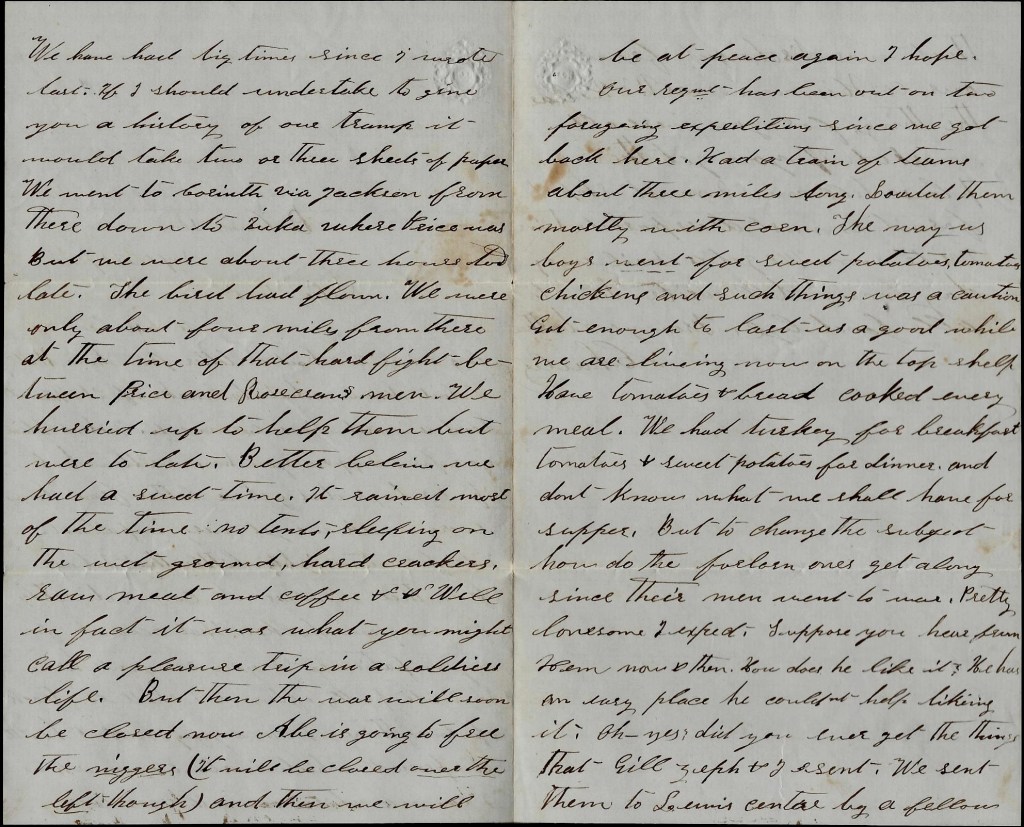
P. S. Direct to Holly Springs, Miss.
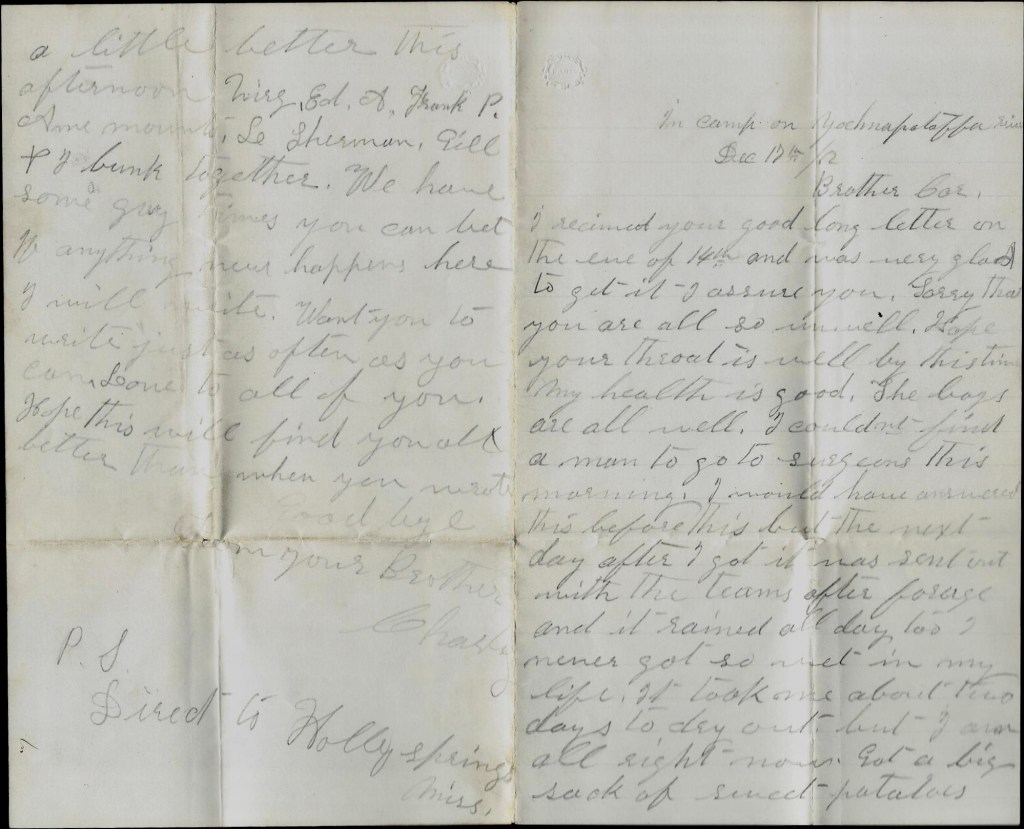

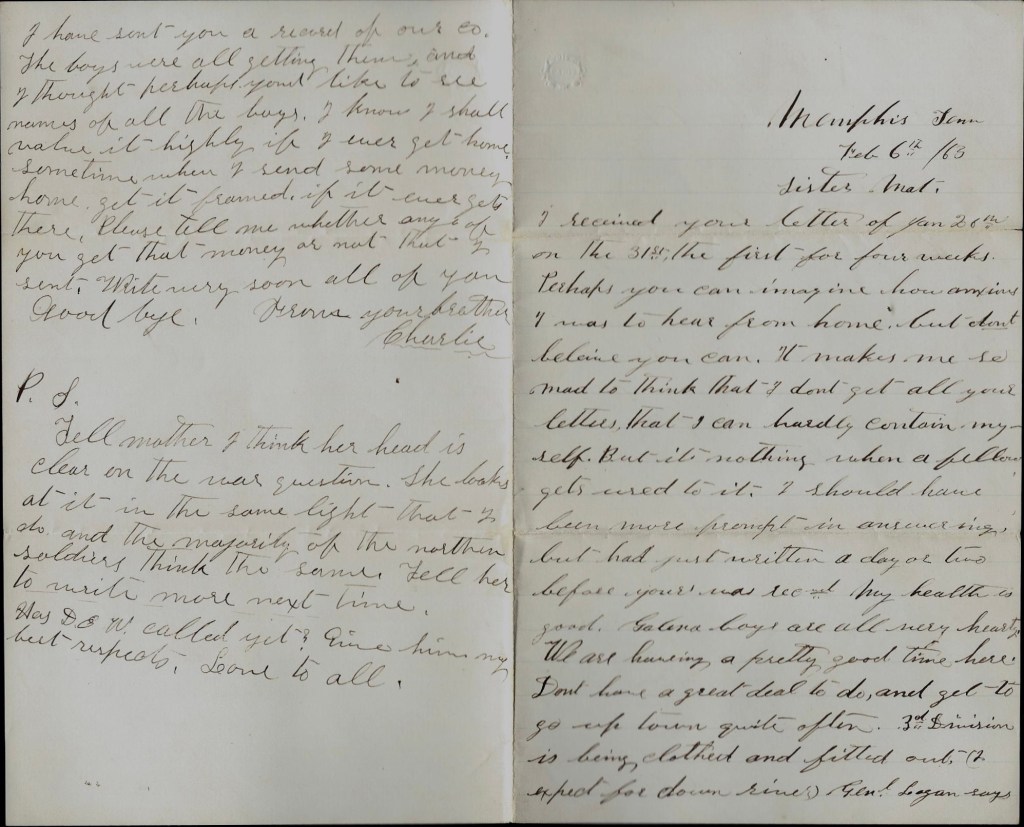
Letter 9

Memphis Tennessee
February 6th, 1863

Sister Mat,

I received your letter of January 26th on the 31st—the first for four weeks. Perhaps you can imagine how anxious I was to hear from home but don’t believe you can. It makes me so mad to think that I don’t get all your letters that I can hardly contain myself. But its nothing when a  fellow gets used to it. I should have been more prompt in answering but had just written a day or two before yours was received.

My health is good. Galena boys are all very hearty. We are having a pretty good time here. Don’t have a great deal to do and get to go up to town quite often. 3rd Division is being clothed and fitted out (I expect for down river). General Logan says his men can’t fight until they get good warm clothes. When they get them, they can help take Vicksburg. The snow is about an inch deep here and it freezes every night like fury. Co. D  don’t suffer much for all have brick fireplaces by our tents. Gill, Ame Mounts, Len Sherman & I  bunk together. Wish you could see our rig. We have a floor in our tent and a large fireplace in one end of it (one of our own make) and we can keep as warm as you please. Have been  drawing new tents (the wedge). Guess they are better than the “dog tents.”

February 8th. You see I have made quite a jump here, but I’m glad of it for I received your other letter yesterday dated January 12th so I didn’t lose anything by waiting a day or two. I am sure you don’t get all my letters for I most always write two for every one I get. Glad that Jud has got home. Hope he will get a discharge. Think it’s quite strange they should have an aid society meet at Nic Arnold’s. I do hope that their donations will benefit some poor soldier but am sorry to say that our regiment has never had much good of them. Perhaps others have.

The 32nd [Ohio] are  encamped close to us. Have seen all the boys from that country. Lieut. Adams, I suppose, has resigned. Does he contemplate going into business at Galena? I perceive he is up there quite often. Very pretty present he made you. Think I shall send you my photograph before long. Wish I was up there today to hear your new music. There is no good music store in town or I would send you some. It is quite muddy or I should attend church. Guess I’ll wait till next Sunday.

I have sent you a record of our company. The boys were all getting them and I thought perhaps you’d like to see names of all the boys. I know I shall value it highly if I ever get home. Sometime when I send some money home, get it framed. If it ever gets there. Please tell me whether any of you get that money or not that I sent. Write very soon all of you. Good bye. From your brother, — Charlie

P. S. Tell mother I think her head is clear on the war question. She looks at it in the same light  that I do, and the majority of the northern soldiers think the same. Tell her to write more next  time. Has D. E. W. called yet? Give him my best respects. Love to all.

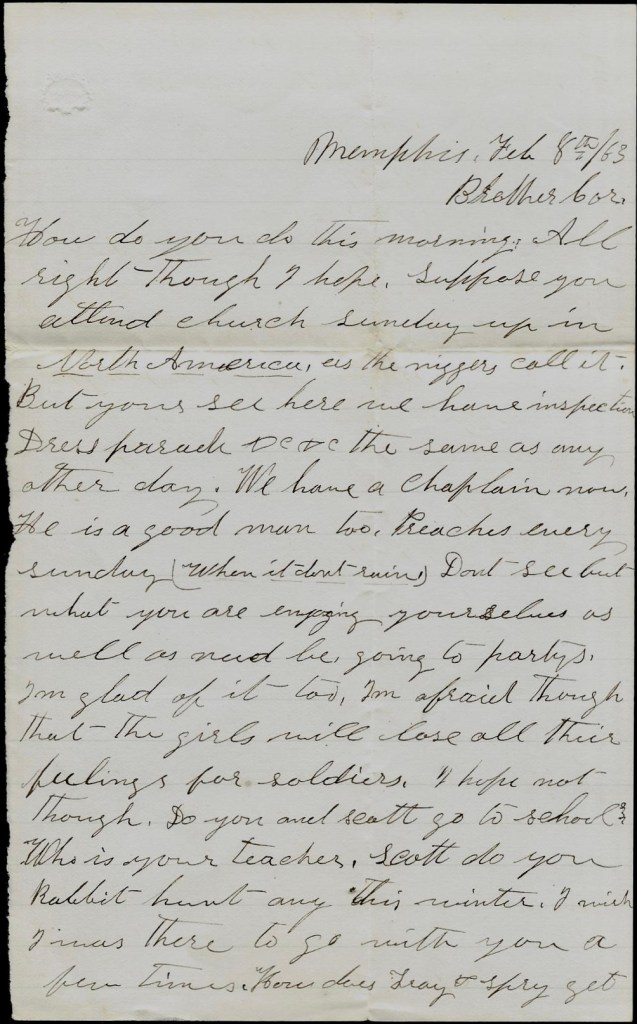
Letter 10

Memphis, Tennessee
February 8th, 1863

Brother Cor.,

How do you do this morning? All right though I hope. Suppose you attend  church Sunday up in North America as the niggers call it. But you see here we have inspection, dress parade, &c. &c. the same as any other day. We have a chaplain now. He is a good man too. Preaches every Sunday (when it don’t rain). Don’t see but what you are enjoying yourselves as well as need be, going to parties. I’m glad of it too. I’m afraid though that the girls will lose all their feelings for soldiers. I hope not though. Do you and Scott go to school? Who is your teacher? Scott, do you rabbit hunt any this winter? I wish I was there to go with you a few times. How does Tray &  Spry get along? Both of you write a good long letter next time.

Cor., if I get hold of a reb gun, I will be sure to send it to you. Love to all. Good bye.  — C. D. C.

Letter 11

Camp near Vicksburg
June 7th 1863

Sister Mat,

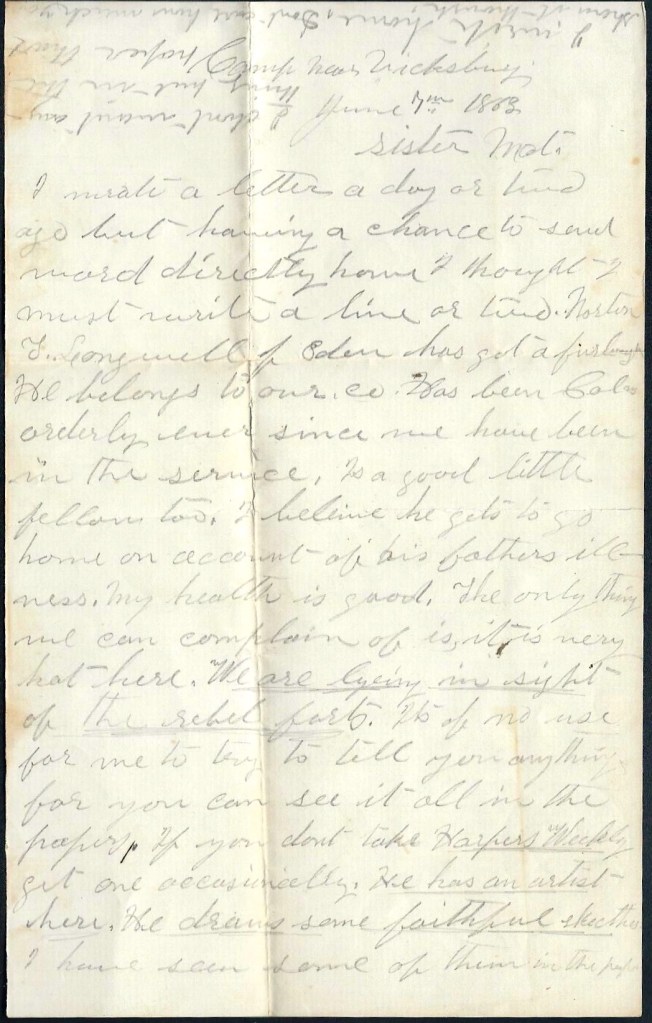
I wrote a letter a day or two ago but having a chance to send word directly home I thought I must write a line or two. Norton T. Longwell ¹ of Eden has got a furlough. He belongs to our company. Has been Col’s ² orderly ever since we have been in the service. Is a good little fellow too. I believe he gets to go home on account of his father’s illness.

My health is good. The only thing we can complain of is it is very hot here. We are lying in sight of the rebel forts. It’s of no use for me to try to tell you anything for you can see it all in the papers. If you don’t take Harpers Weekly, get one occasionally. He has an artist here. He draws some faithful sketches. I have seen some of them in the paper.
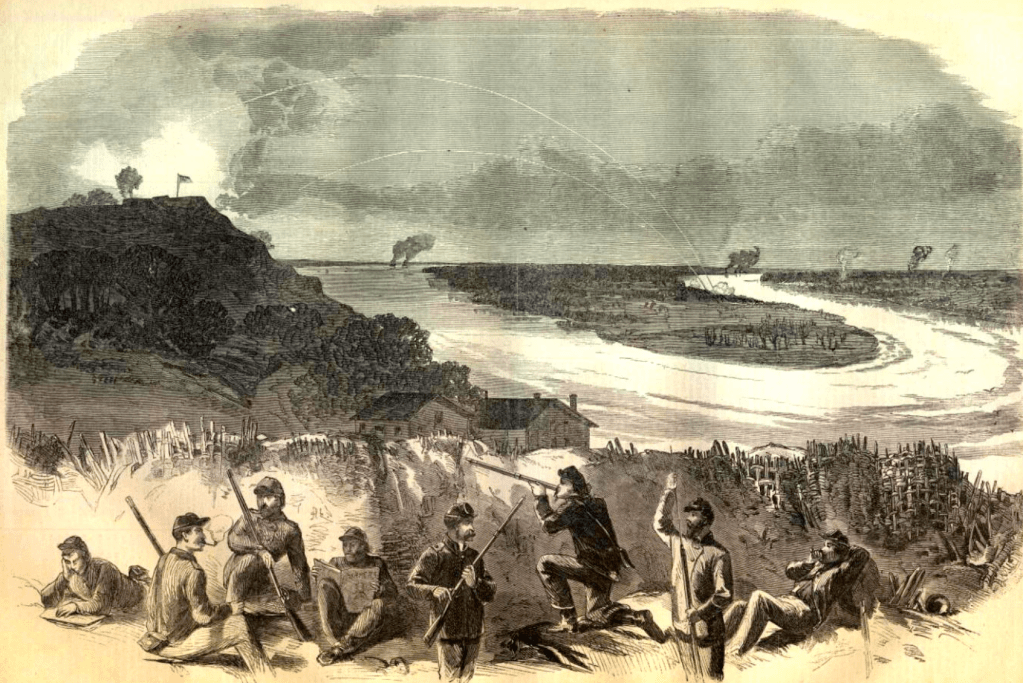
Drawing by Harpers Weekly artist of Vicksburg Siege

We have been drawing new clothes. Feel somewhat better. Tell Father I would like to have him get me another pair of boots. The boys are nearly all going to send and they can all come in one box. Nort says he will bring them through for us. I want a pair of light kid-lined all through, with heavy soles. Get them made where he did before, if possible. My boots are not worn out yet but will be by time I get another pair.

Nort Longwell is going in a few hours so I can’t write much. I have so much to do that I can’t write much at a time anyhow. Write often. Love to all. Good bye.

From, — Charlie Carpenter

The other boots were just the right size.

P. S. Mat, please send a towel or two. Can’t get any good ones here. Mat. Please send me a few postage stamps if you can as well as not.

¹ Norton Thurston Longwell (1842-1930) was the son of Ralph S. and Elizabeth (Thurston) Longwell — early residents of Berkshire, Ohio. Norton T. was the tenth of a family of thirteen children. One who was a surgeon in the army with the rank of Major, and died at Camp Chase. Norton enlisted in Co. D, 20th O. V. I., and served three years; he was Orderly on the Colonel’s staff throughout the war. After the war, “Nort” return home to a farm of 164 acres situated north of Eden. In 1867 he married Ella E. Hyde (b. 1848), the daughter of Udney and Olive (Hunter) Hyde.

² The Colonel of the 20th Ohio at the time was Manning Ferguson Force (1824-1899). Force was born in Washington, D.C., where his father, Peter Force, was the mayor. He attended Harvard College until 1845, and graduated from Harvard Law School in 1848. The following year, Force moved to Cincinnati, Ohio, and began his law practice. Colonel Force’s 20th Ohio bore the brunt of the Battle of Raymond, Mississippi, in the Vicksburg Campaign. Osborn Oldroyd related the number of casualties from the 20th Ohio to his commander: “I took the roll-book from the pocket of our dead sergeant, and found that while we had gone in with thirty-two men, we came out with but sixteen – one-half of the brave little band, but a few hours before so full of hope and patriotism, either killed or wounded. Nearly all the survivors could show bullet marks in clothing or flesh, but no man left the field on account of wounds. When I told Colonel Force of our loss, I saw tears course down his cheeks, and so intent were his thoughts upon his fallen men that he failed to note the bursting of a shell above him, scattering the powder over his person, as he sat at the foot of a tree.” After the war, Force returned to Cincinnati, where he became a justice of the Superior Court of Cincinnati. He also authored several law books and became a prominent writer as well as a lecturer. [Source: Wikipedia]

Letter 12

Vicksburg, Mississippi
September 3rd, 1863.

Sister Mat,

It may seem rather hard that I have not written before, but it was only because I couldn’t do it. I received a good long letter from you & Cor[win] on the 21st of last month just as our division had got ready to start into Louisiana on a big tramp. Started to the boat about an hour after I got it. Was glad to hear from you two.

We just got back last eve. Had a very hard trip too. Traveled about a hundred miles by river and 175 miles by land. Went out on Bayou Macon and Washita River. Saw some beautiful country and some miserable. Plenty of bear, deer, rattlesnakes, and almost everything else you can  think of.

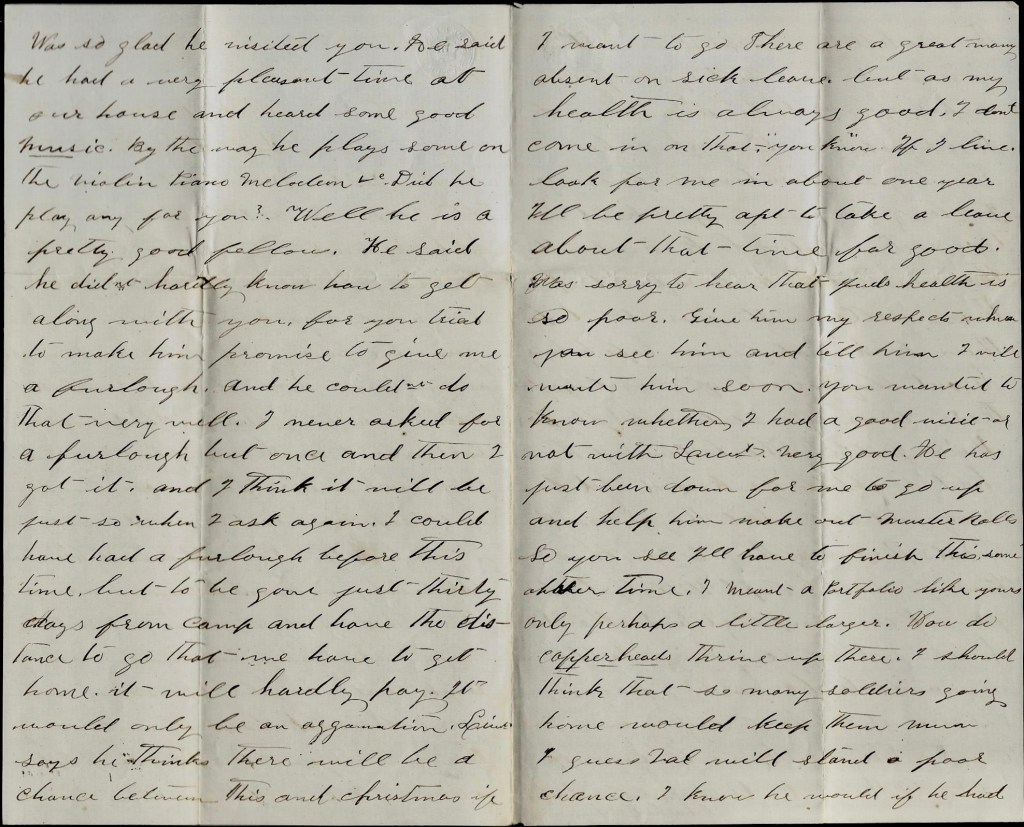
Found Lieut. Humiston here when I got back. He had a letter for me. Was so glad he visited you. He said he had a very pleasant time at our house and heard some good music. By the way, he plays some on the violin, piano, melodeon. Did he play any for you? Well, he is a pretty good fellow. He said he didn’t hardly know how to get along with you for you tried to make him promise to give me a furlough and he couldn’t do that very well. I never asked for a furlough but once and then I got it and I think it will be just so when I ask again. I could have had a furlough before this time, but to be gone just thirty days from camp and have the distance to go that we have to get home, it will hardly pay. It would only be an aggravation. Lieut. says he thinks there will be a chance between this and Christmas if I want to go.

There are a great many absent on sick leave but as my health is always good, I don’t come in on that you know. If I live, look for me in about one year. I’ll be pretty apt to take a leave about that time for good. Was sorry to hear that Jud’s health is so poor. Give him my respects when you  see him and tell him I will write him soon.

You wanted to know whether I had a good visit or not with Lieut. Very good. He has just been down for me to go up and help him make out muster rolls, so you see I’ll have to finish this some other time. I meant a portfolio like yours—only perhaps little larger.

How do copperheads thrive up  there? I should think that so many soldiers going home would keep them Union. I  guess Vallandigham will stand a poor chance. I know he would if he had the soldiers to depend  on. Think you must feel quite patriotic when you and the boys ran out to hurrah for [John] Brough when Townley and band were passing. I glory in your spunk. It is time the ladies took in hand. The men seem to be afraid of those fellows. It wouldn’t do for them to hurrah for a rope to hang Grant [in effigy] before one of our boys for their lives would have to pay for their folly. The ladies up there had ought to go armed and then say and do what they pleased. That’s the way they do here (some of them). Have you seen Capt. Hills yet? If you and Cor[win] would go to Del. and him and wife you would have no cause to be sorry, I assure you. But I will stop. I want to write some to Mother this eve. Love to yourself and all the rest. As ever your brother, — Charlie D. Carpenter

9 o’clock p.m. Mat, enclosed you will find a photograph. I want you to keep it for me. I shall want it when I get home. He is a member of Co. D and a particular friend of mine. His name is Charles Weisner—a first rate fellow too. Used to go to school in Delaware.

Letter 13

Vicksburg, Mississippi
September 14th, 1863

Brother Cor[win],

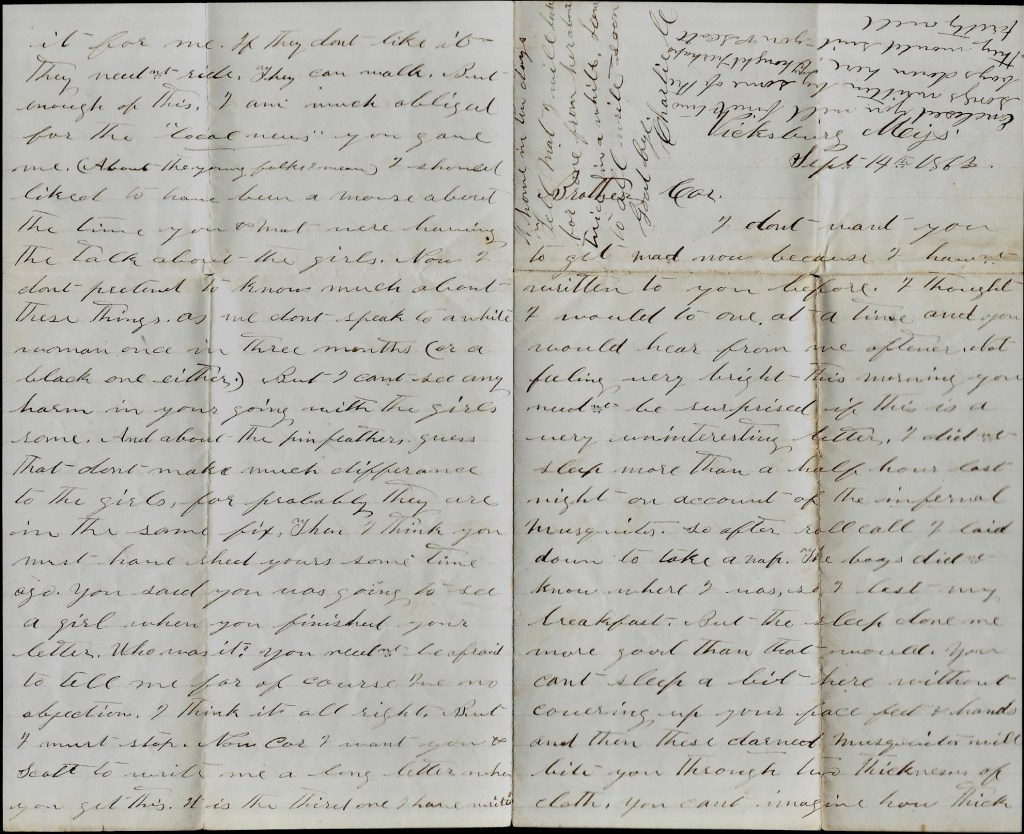
I don’t want you to get mad now because I haven’t written to you before. I thought I would [write] to one at a time and you would hear from me oftener. Not feeling very bright this morning. You needn’t be surprised if this is a very uninteresting letter. I did not sleep more than a half hour last night on account of the infernal mosquitoes. So after roll call, I laid down to take a nap. The boys didn’t know where I was so I lost my  breakfast. But the sleep done me more good than that would. You can’t sleep a bit  here without covering up your face, feet, & hands, and then these darned mosquitoes will bite you through two thicknesses of cloth. You can’t imagine how thick they are.

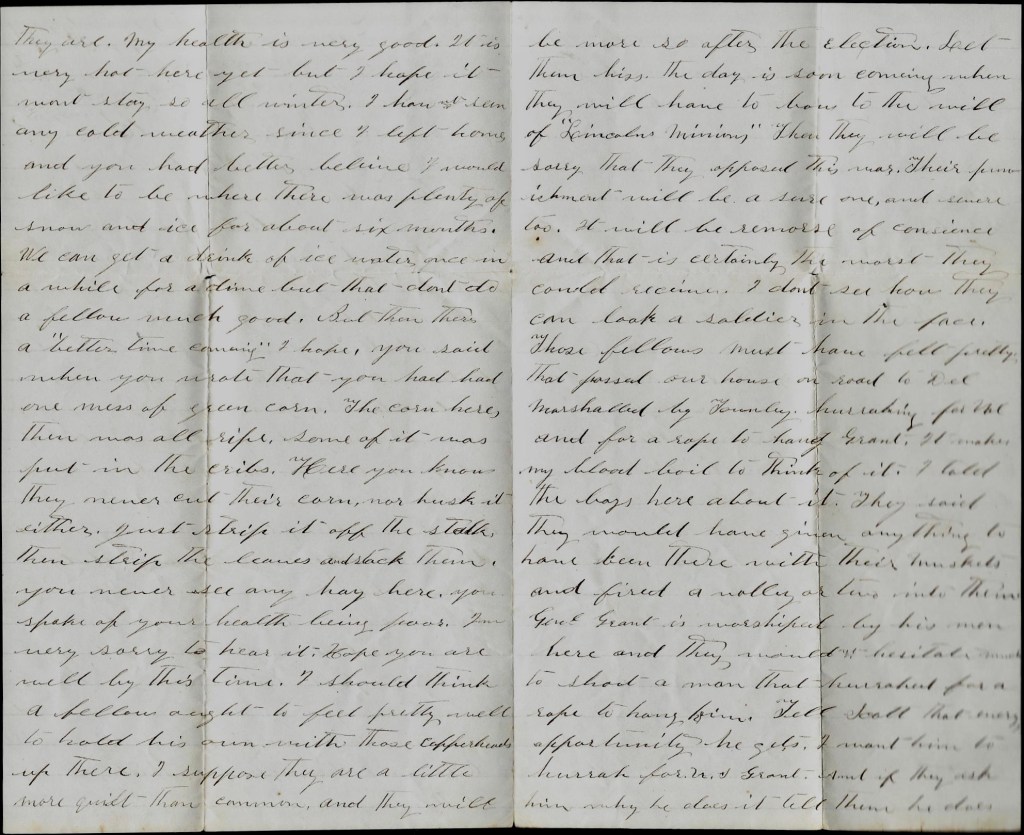
My health is very good. It is very hot here yet but I hope it won’t stay so all winter. I haven’t seen any cold weather since I left home and you had better believe I would like to be where there was plenty of snow and ice for about six months. We can get a drink of ice water once in a while for a dime but that don’t do a fellow much good. But then there’s a “better time coming,” I hope.

You said when you wrote that you had had one mess of green corn. The corn here then was all ripe. Some of it was put in the cribs. Here you know they never cut their corn nor husk it either. Just strip it off the stalk. Then strip the leaves and stack them. You never see any hay here.

You spoke of your health being poor. I’m very sorry to hear it. Hope you are well by this time. I should  think a fellow ought to feel pretty well to hold his own with those copperheads up there. I suppose they are a little more quiet than common and they will be more so after the election. Let them hiss. The day is soon coming when they will have to bow to the will of “Lincoln’s minions.” Then they will be sorry that they opposed this war.  Their punishment will be a sure one and severe too. It will be remorse of conscience and that is certainly the worst they could receive. I don’t see how they can look a soldier in the face. Those fellows must have felt pretty [big] that passed our house on road  to Del., marshaled by Townley, hurrahing for Val and for a rope to hang Grant. It makes  my blood boil to think of it. I told the boys here about it. They said they would have given anything to have been there with their muskets and fired a volley or two into them. Genl. Grant is worshiped by his men here and they wouldn’t hesitate much to  shoot a man that hurrahed for a rope to hang him. Tell Scott that every opportunity he  gets I want him to hurrah for U. S. Grant. And if they ask him why he does it, tell them he does it for me. If they don’t like it, they needn’t ride. They can walk. But enough of  this.

I am much obliged for the “local news” you gave me. (About the young folks I  mean.) I should liked to have been a mouse about the time you & Mat were having the talk about the girls. Now I don’t pretend to know much about these things as we don’t  speak to a white woman once in three months (or a black one either). But I can’t see any harm in your going with the girls some. And about the pin feathers. Guess that don’t make much difference to the girls for probably they are in the same fix. Then I think you must have shed yours some time ago. You said you was going to see a girl when you finished your letter. Who was it? You needn’t be afraid to tell me for of course I’ve no objection. I think it all right. But I must stop. Now Cor[win], I want you & Scott to write me a long letter when you get this. It is the third one I have written though. Enclosed you will find two songs written by some of the boys down here. I thought perhaps they would suit you songs & Scott pretty well. Love to all at home. Write soon. Tell Good Mat I will look for one from her about twice in a while.  — Charlie C.

Letter 14

Vicksburg, Mississippi
October 5th, 1863

Sister Mat,

It has been such a long long time since I received a letter from home that I thought I must write a little. The last one was dated Aug. 26th. That one I received by O. H. Just think of it—five long weeks without a word from home. The other boys get letters often. Why can’t I? This is the third one (the fourth I believe) since I received one from home. Well, if I don’t get one in a day or two, I guess I’ll have to write to someone else. I believe I can find someone that will write.

My health is good—never was better. The boys are all well, I believe. We are enjoying very pleasant weather now. Expect we’ll get it after while. We live in hopes that they will leave us here this winter. Don’t know how it will be yet. Sherman’s Corps has all left to reinforce Rosecrans. Glad it wasn’t us for I shouldn’t like much to spend a winter up in that country. I do hope our troops will be successful there for I think that is going to decide the length of the war—that, and the election.

I received a letter from  Joel P. yesterday. Shall answer it in a day or two. My respects to him if you see him. Lieut. [Joshua L.] Dunlevy’s wife [Mary (Torrence) Dunlevy] is here. She made a very narrow escape on the river. The boat she was on burned about fifty miles above here. They had to jump into the water about two hundred yards from shore. She managed to save herself some way. Don’t  hardly know how. There was about thirty lives lost. When D.’s wife gets home I want you to see her. You will like her very much I know. She is a very pretty woman. Now I only wrote this note to let you know that I was alive and that my P. O. address was Vicksburg, Mississippi, and I would be more than glad to hear from you often. Love to all.  Good bye. Please don’t forget that you have a brother in the army. — C. D. Carpenter

To Mattie Carpenter


Letter 15
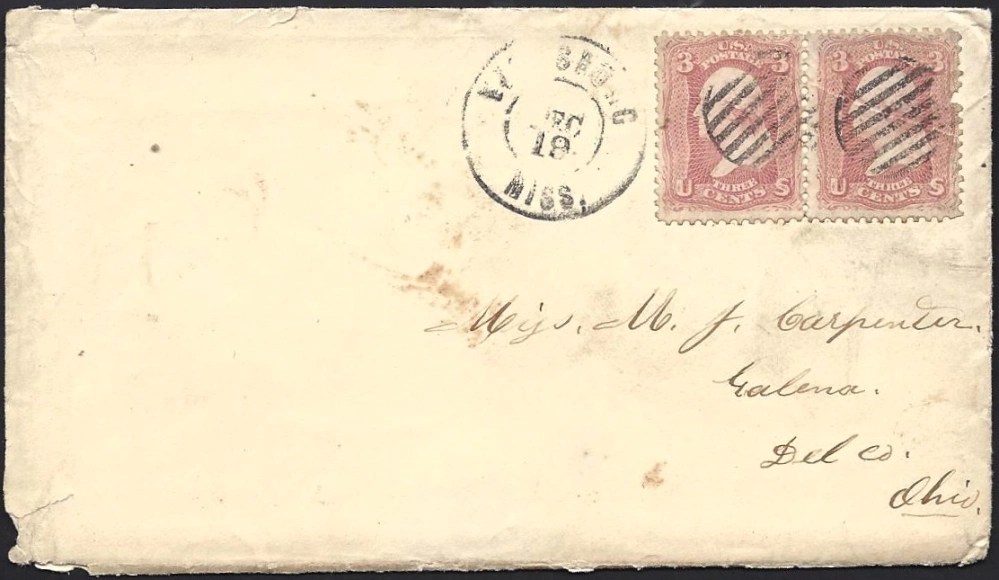
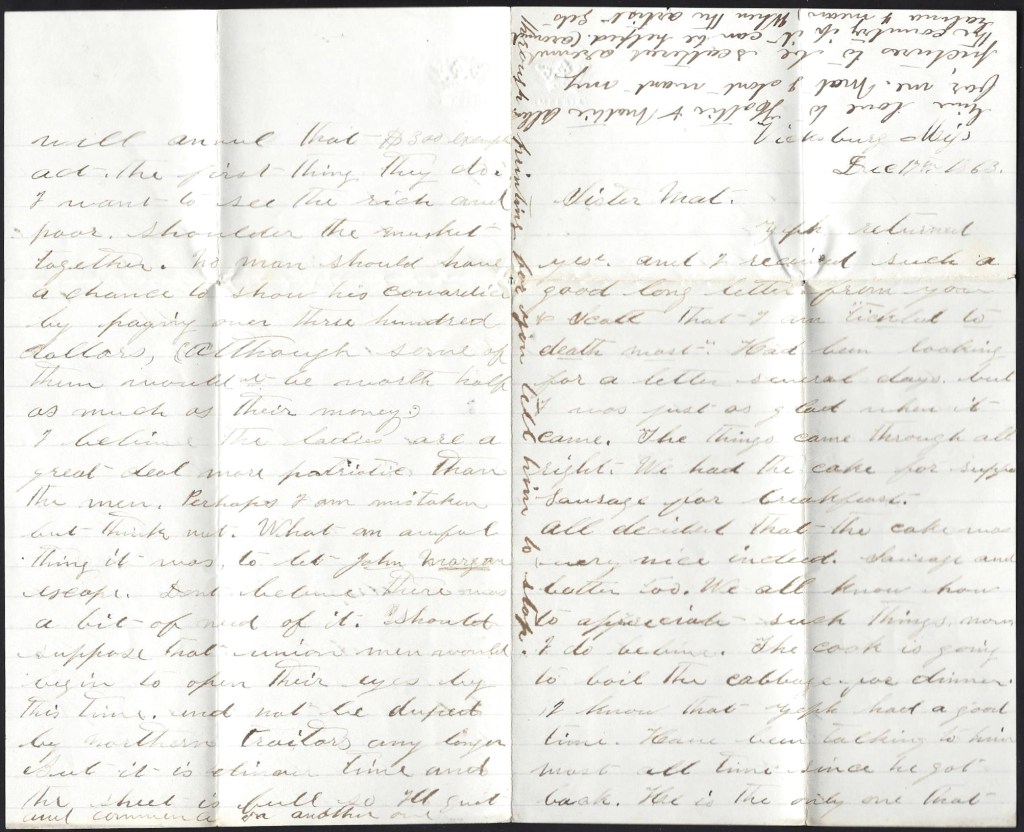
Vicksburg, Mississippi
December 17th, 1863

Sister Mat,

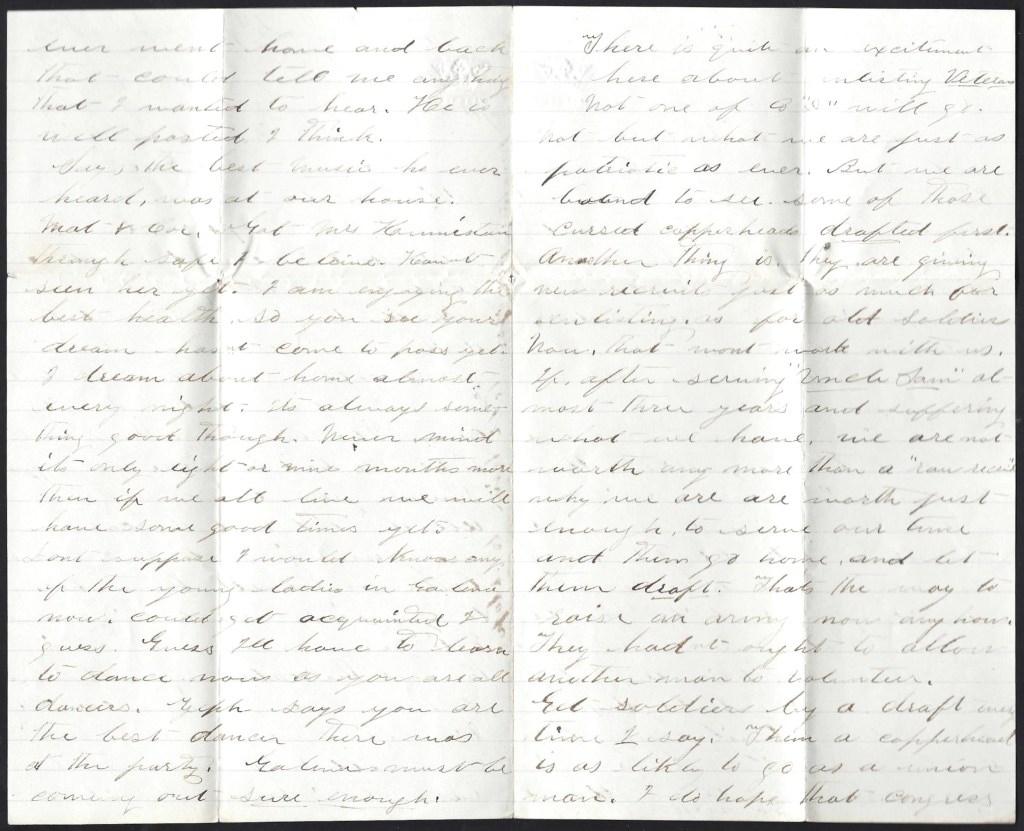
Zeph[ania Cook] returned yesterday and I received such a good long letter from you & Scott that I am tickled to death most. Had been looking for a letter several days but I was just as glad when it came. The things came through all right. We had the cake for supper [and] sausage for breakfast. All decided that the cake was very nice indeed. Sausage and butter too. We all know how to appreciate such things now, I do believe. The cook is going to boil the cabbage for dinner.

I know that Zeph had a good time. Have been talking to him most all time since he got back. He is the only one that ever went home and back that could tell me anything that I wanted to hear. He is well posted, I think. Says the best music he ever heard was at our house. Mat & Cor. got Mrs. Kenniston through safe, I believe. Haven’t seen her yet.

I am enjoying the best health so you see your dream hasn’t come to pass yet. I dream about home almost every night. It’s always something good though. Never mind it’s only eight or nine months more. Then, if we all live, we will have some good times yet. Don’t suppose I would know any of the young ladies in Galena now. Could get acquainted I guess. have to learn to dance now as you are all dancers. Zeph says you are the best dancer there was at the party. Galena must be coming out, sure enough.

There is quite an excitement here about enlisting [as] Veterans. Not one of Co. D will go — not but what we are just as patriotic as ever. But we are bound to see some of those cursed Copperheads drafted first. Another thing is they are giving new recruits just as much for enlisting as for old soldiers. Now that won’t work with us. If after serving “Uncle Sam” almost three years and suffering what we have we are not worth anymore than a “raw recruit,” why we are worth just enough to serve our time and then go home and let them draft. That’s the way to raise an army now anyhow. They hadn’t ought to allow another man to volunteer. Get soldiers by a draft every time I say. Then a Copperhead is as like to go as a Union man. I do hope that Congress will annul that $300 Exemption Act the first thing they do. I want to see the rich and poor shoulder the musket together. No man should have a chance to show his cowardice by paying over three hundred dollars (although some of them would it be worth half as much as their money). I believe the latter are a great deal more patriotic than the men. Perhaps I am mistaken but think not.

What an awful thing it was to let John [Hunt] Morgan escape. ¹ Don’t believe there was a bit of need of it. Should suppose that Union men would begin to open their eyes by this time and not be duped by Northern traitors any longer. But it is dinner time and my sheet is full so I’ll quit and commence on another one.

Give my love to Hattie & Mattie Allen for me. Mat, I don’t want my pictures to be scattered around the country if it can be helped (around Galena, I mean). When the artist gets through printing for you, tell him to stop.

[unsigned]

¹ Confederate cavalry raider John Hunt Morgan escaped from the Ohio State Penitentiary at Columbus, Ohio, on 27 November 1863.
Letter 16

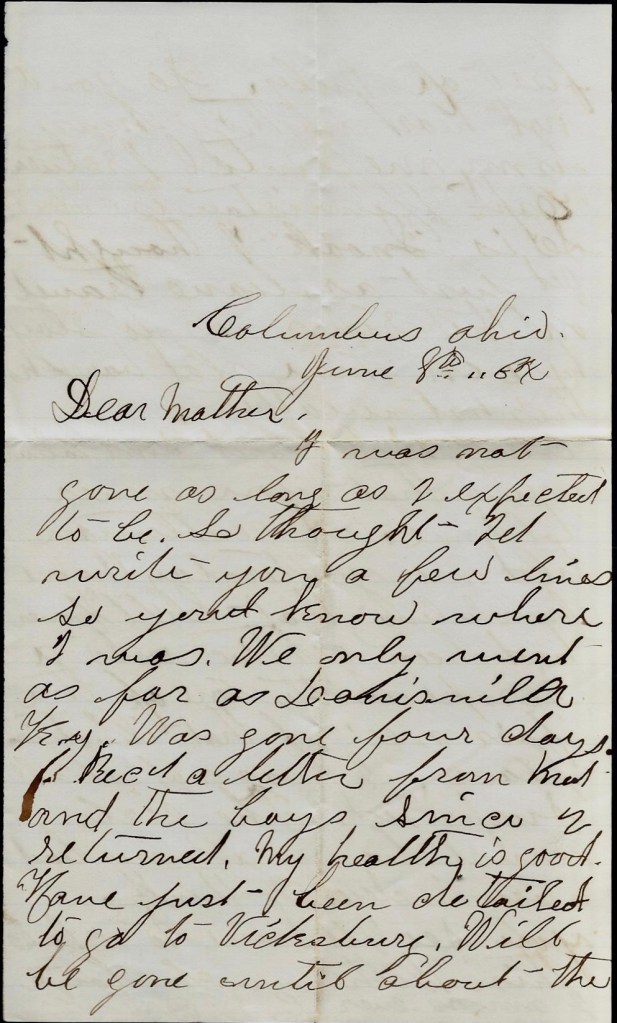
Columbus, Ohio
June 8, 1864

Dear Mother,

I was not gone as long as I expected to be so thought I’d write you a few lines to let you know where I was. We only went as far as Davisville, Kentucky. Was gone four days. I received a letter from Mat and the boys since I returned. My health is good. Have just been detailed to go to Vicksburg. Will be gone until about the first of July so you’ll not hear anything more from me until I return.

Capt. [Arthur] Humiston is going. So is “Snook.” I thought I’d just as leave travel on the river as to stay here in these old barracks this hot weather.

Oh yes! I heard some Galena news that you never told me. A gentleman told me yesterday (no one from Galena) that Gill Hoover had been getting into a scrape with one of the “fair ones” at that illustrious place. I was not at all surprised. The girls must be in a very bad way indeed, I think.

You see I’ll have to close this. With much love, I am as ever, — C. D. Carpenter

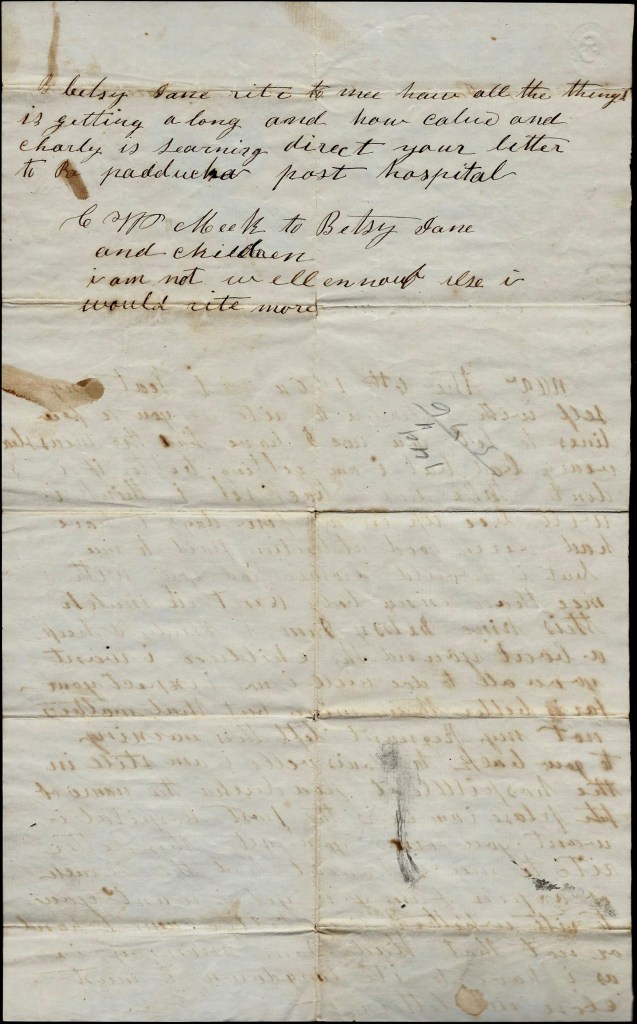
1864: Cyrus W. Meek to Betsy Jane (Rector) Meek

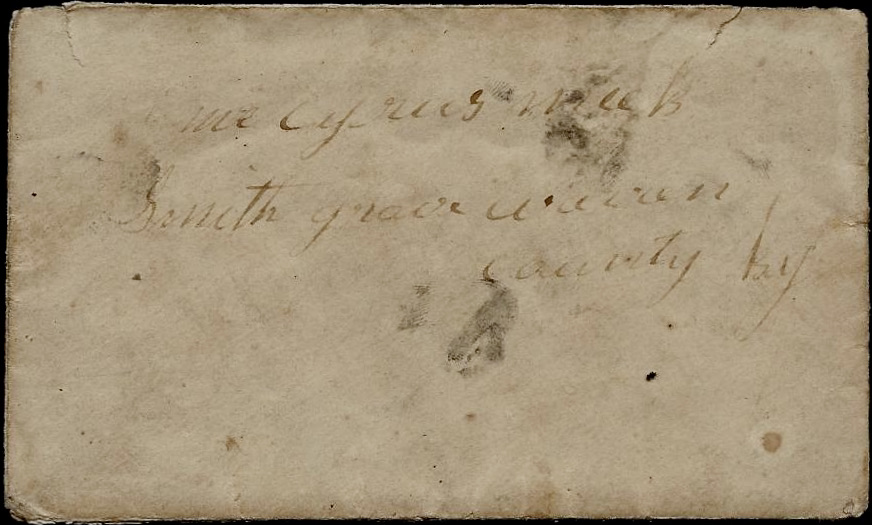
This letter was written by Cyrus W. Meek (1828-1864) to his wife Elizabeth (“Betsy”) Jane (Rector) Meek (1835-18xx) of Smith Grove, Warren county, Kentucky.

Cyrus was drafted on 19 September 1864 as a private into Co. F, 26th Kentucky (Union) Infantry but he did not survive the war. He died of disease of measles/erysipelas at Paducah on 24 November 1864.

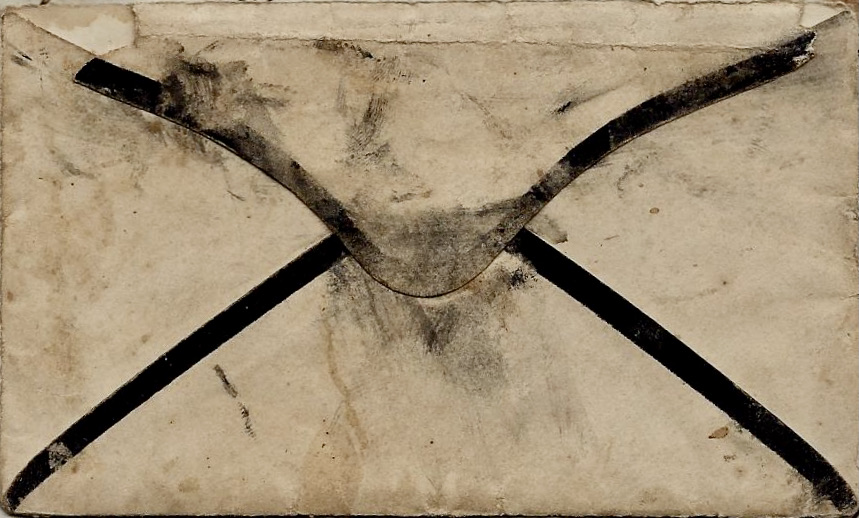
The black outline of the paper edges on the envelope and the decorative artwork on the letter may have been added post-death, marking this as Cyrus’ last letter before his death two weeks later.

Transcription

[Paducah, Kentucky]
November 6th 1864

I seat myself with pleasure to write you a few lines to let you know I have had the measles very bad but I am getting better. If I don’t take no backset, I will be up in a few days. I have had very good attention paid to me but I would drother had you with me than any body [else].

I can’t write much this time, Betsy Jane. I study a heap about you and the children. I want you all to do well. I know I expect your fare is better than mine but that matters not.

My regiment left this morning to go back to Louisville. I am still in the hospital at Paducah. The name of the place I am in is the Post Hospital. I want you soon as you get this letter to write to me. I haven’t had the scratch of a pen from you yet. I want you to write whether my letters came to hand or not that had some money in. As I have to write lying down, I must close my letter.

Betsey Jane, write to me how all the things is getting along and how Calve & Charley is learning. Direct your letter to Paducah Post Hospital.

C. W. Meek to Betsy Jane and children.

I am not well enough else I would write more.

1863: Ralph M. Butler to “Loved Ones at Home”

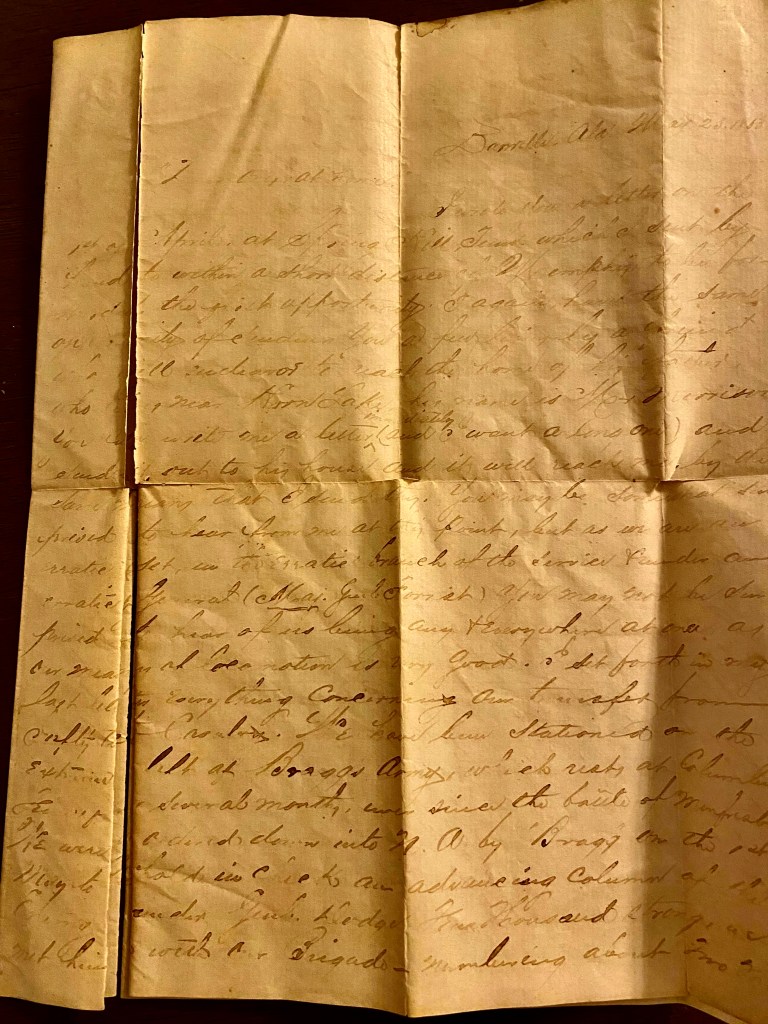
The identity of the Confederate soldier named “Ralph” who penned this letter has not been confirmed. His home appears to have been Shelby county, Tennessee, and it is believed that he was originally a member of the 154th Senior Tennessee Infantry Regiment (1st Tennessee Infantry), Capt. J. H. Edmondson’s company. A notation in his muster records indicate that early in 1862, Co. B became a company of sharpshooters in Gen. Preston Smith’s Brigade, and then on 25 February 1863, it was assigned as a part of Co. F, 11th Tennessee Cavalry.

I could not find an image of Ralph but here is one of Pvt. Whitmell Ransom of the 11th Tennessee Cavalry

“Ralph” was not a particularly common name at the time and there was only one by that name in his company—Ralph M. Butler. Ralph was 21 years old when he enlisted for duty in May 1861. Family records are scarce but one indicates he died in 1863. However, I found a Ralph M. Butler in the Memphis City Directory in 1866 and 1867 who was employed as a bookkeeper and later as a salesman for the William Jack China Company. I’m inclined to believe he is the author as his handwriting was actually quite good—suitable for a bookkeeper. Additionally, Ralph’s service record indicates that he was detailed for a time as a hospital steward in 1862 and in the following letter, he states that he had been left behind to care for the wounded. He also mentions having received a letter from “Addie” who was probably his sister (see footnote).

Ralph’s father was Elias C. Butler who married Mary Turley in Davidson county, Tennessee, in 1838. By 1860, Elias has relocated from Tennessee to Batesville, Arkansas, where he was a merchant. Ralph was enumerated there in his father’s household at that time.

The following letter describes Streight’s Raid in Northern Alabama. A summary of that raid, entitled Spring 1863: Forrest Halts Yankee Raiders, was published by the University of Alabama in 2013 which reads:

Map showing the route of Colonel Abel Streight as he made his way towards Rome, Georgia

The spring of 1863 brought Yankees into Alabama once again, but this time, rather than occupying towns, the federal troops were bent on raiding the state and destroying Confederate supply lines. Union troops, led by Gen. Abel D. Streight, began their journey in Murfreesboro, Tennessee, in April, where they separated from Gen. William Rosecrans’s army. From there, Streight and his men headed along the Tennessee River toward Alabama. They aimed to cut through northern Alabama on the way to Rome, Georgia, and there blow up the railroads that carried Confederate supplies to Chattanooga.

Unfortunately for the Union army, the expedition was a disaster from the beginning. Streight’s soldiers, who were trained as infantrymen, were given mules to carry them over the mountains of North Alabama. At first, using mules seemed a fine substitute for the lack of horses, but the animals–true to their reputation–did not cooperate and slowed progress. The raiders soon became known as the “Jackass Cavalry.” If temperamental mules did not cause enough difficulties, Streight’s men also had to deal with Gen. Nathan Bedford Forrest, perhaps the best cavalry commander of the Confederacy, who was already famous for his brilliant fighting in North Alabama and the Tennessee Valley. From the beginning, the Union army’s plan had been to deceive the Confederates into thinking that Streight’s raid was part of a larger raid on the Tennessee Valley. Initially, the federals were successful in their trick, and Forrest headed to Tuscumbia, where Union troops under the command of G. M. Dodge had invaded on April 24. Quickly, however, Forrest figured out that the fighting in Tuscumbia was nothing more than a decoy, and he set off across Alabama in pursuit of Streight. 


On the last day of April, Forrest and his 600 cavalrymen tangled with Streight’s 1,500 soldiers on Sand Mountain. Over the next few days, the Confederates chased Streight’s raiders through the northern part of the state. The Yankee soldiers destroyed Confederate property and captured Gadsden, Alabama, but they were eventually defeated before they reached their destination of Rome, Georgia. On the morning of May 3, 1863, Forrest and his men caught up with the exhausted Union soldiers near the Alabama-Georgia border. Although Forrest arrived with forces only half the size of Streight’s, the Confederate general believed he could trick his foe into surrendering. Knowing that Streight would only be able to glimpse the Confederates through the trees, Forrest ordered his artillery section to march in a circle. To the Yankee commander, it appeared that Forrest’s forces were much larger than they were. Forrest demanded unconditional surrender and insisted that he had “enough [men] to whip you out of your boots.” With that, Streight surrendered his men near Lawrence, Alabama. He and his men were taken to Libby Prison in Richmond, Virginia, and Streight remained there until he escaped in February of 1864. Meanwhile, Forrest was lauded throughout Alabama and other portions of the Deep South for protecting Confederate supply lines from destruction.

Readers are also referred to a newspaper account of Forrest’s “Exploit in Georgia” published in the Daily Dispatch on 13 May 1863, and an article entitled Streight’s Raid by Keith S. Hebert of the University of West Georgia.

[Note: This letter is from the personal collection of Cody Cummings and was transcribed and published on Spared & Shared by express consent.]

Transcription

Danville, Alabama
May 23, 1863

“Loved Ones at Home”

I wrote you a letter on the 1st of April at Spring Hill, Tennessee, which I sent by hand to within a short distance of Memphis to be forwarded the first opportunity. I again have the same opportunity of sending you a few lines by a friend who will endeavor to reach the home of his father who lives near Horn Lake. His name is Mr. Morrison. You can write me a letter immediately (and I want a long one) and send it out to his house and it will reach me by the same means that I send this.

“As we are an erratic set in the erratic branch of the service & under an erratic General (Maj. Gen. Forrest), you may not be surprised to hear of us being any and everywhere at once…”

— Ralph M. Butler, 11th Tennessee Cavalry, May 1863

You may be somewhat surprised to hear from me at this point, but as we are an erratic set in the erratic branch of the service & under an erratic General (Maj. Gen. Forrest), you may not be surprised to hear of us being any and everywhere at once as our means of locomotion is very good. I set forth in my last letter everything concerning our transfer from infantry to cavalry.

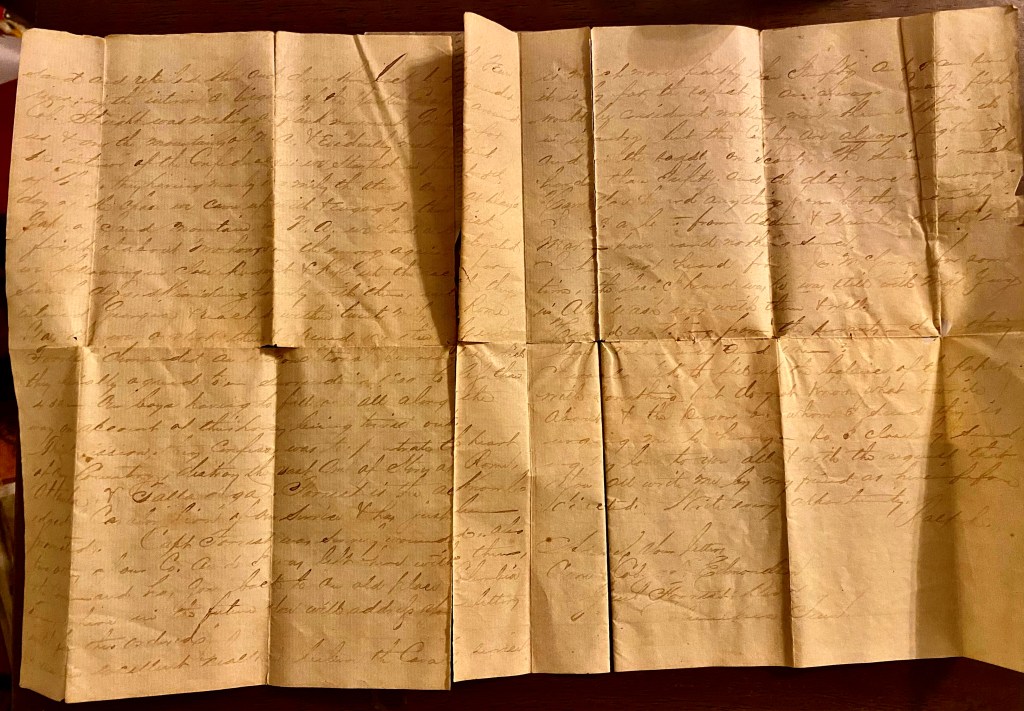
We have been stationed on the extreme left of Bragg’s Army which rests at Columbia for past several months, ever since the battle of Murfreesboro. We were ordered down into North Alabama by Bragg on the 1st of May to hold in check an advancing column of the enemy under General Dodge five thousand strong. We met him with our Brigade—numbers about two thousand—and repulsed them and drove them back to the Tennessee river; in the interim a brigade of the Yankee cavalry under Col. [Abel Delos] Streight was making a flank movement going around us & over the mountains of North Alabama & evidently making for the “interior” of the Confederacy. We started in pursuit of them, they having nearly 100 miles the start, on the 5th day of the chase, we came up with & engaged them at Day’s Gap of Sand Mountain in North Alabama. 1 We had a brisk fight of about two hours & the enemy again retreated, we following in close pursuit & kept up the race for several days, skirmishing hourly with them, until they entered Georgia & reached within twenty miles of Rome.

Finally we overtook them & General Forrest demanded an unconditional surrender which they finally agreed to in surrendering 300 to less than 450—our boys having to fall out all along the way on account of their horses being tired out. Their mission, they confessed, was to penetrate to the heart of our country, destroy the vast amount of stores at Rome, Atlanta, & Chattanooga. Forrest is the acknowledged “Cavalry Lion” of the service & has just been promoted. Capt. Forrest was seriously wounded—also two others of our company, and I was left here with them. The command has gone back to our old place Columbia, Tennessee, where in the future you will address your letters until further orders.

I am in excellent health & believe the cavalry service is much more healthy that infantry and I am sure it is by far the safest. An average cavalry fight would be considered nothing more than a skirmish in infantry, but the cavalry are always fighting and in the saddle on “scouts.” The service is much harder than infantry and the duties more numerous.

Have you heard anything from brother recently? I received a letter from Addie 2 & U____ dated 2nd March. Have heard nothing since.

I have not heard from Jas. McCrea for some time. The last I heard was he was still with Maj. Young [?] in Alabama. “Wash” was with them & well.

Heard anything from the servants? Did they leave voluntarily and when?

I would like to fill up the balance of the paper with something but do not know what to write about & the person by whom I send this is urging me to hurry so I close by sending my love to you all & with the request that you all write me by my friend as here before directed. Write every opportunity. — Ralph

Address your letters care of Col. [ ] Edmondson, General Forrest’s Division, Columbia, Tennessee


1 The Battle of Day’s Gap took place in Cullman County near Sand Mountain. During this fight, Streight’s men thwarted Forrest’s attempt to surround him from the rear with a series of charges led by the 73rd Illinois and 51st Indiana. Undeterred, a few hours later Forrest resumed the attack upon Streight, whose men dismounted and occupied a ridge along Hog Mountain in preparation for what they incorrectly believed was a larger force. Again Streight’s men repulsed several assaults and then resumed the march at an accelerated pace.”

2 Ralph Butler had a sister named Margaret Adelaide (“Addie”) Butler (1839-1913) who married Samuel Jack (1835-1926). The couple were married in 1864 and lived in Memphis after the war.

1863: Martha Rebecca (Payne) Russell to Augusta L. Baldwin

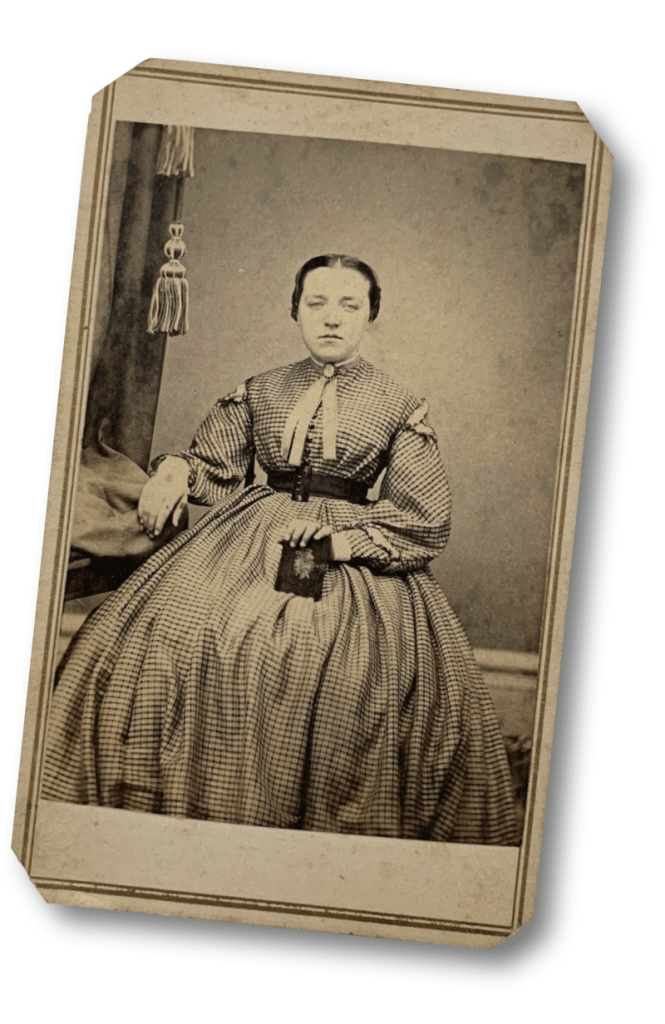
How Martha might have looked in 1863

The following letter was penned by 19 year-old Martha Rebecca (Payne) Russell (1844-1924), the daughter of Harmon Payne (1819-1900) and Sarah Esther Hotchkiss (1820-1907) of New Haven county, Connecticut. One source gives the date of Martha’s marriage to Charles E. Russell (1840-1920) as 1 September 1862 though it appears the couple were living together prior to the June 1860 US Census in Hartford with a 6-month old daughter named Mary. Charles was employed as a “carriage trimmer.” During the war, when her husband was in the service, we learn from the letter that Martha earned a living hiring herself out as a housekeeper.

Martha’s husband volunteered in Co. A, 20th Connecticut with several other young men from Prospect. The company was raised in July 1862, and placed under the command of Colonel Samuel Ross, a former Regular Army officer. With him becoming brigade commander soon afterwards; for most of the war the regiment was commanded by its Lieutenant Colonel, William Wooster. Wooster was a businessman in civilian life and more popular than the stern disciplinarian Ross. The regiment became part of the 1st Division XII Corps and had its baptism of fire at the Battle of Chancellorsville. On May 2, 1863, at Chancellorsville, the unit suffered heavy casualties as they and other units of the XII Corps bore the brunt of Confederate General Stonewall Jackson’s surprise assault.

Martha’s letter to her cousin Augusta Baldwin (1846-1866) in Naugatuck was written in the days following the battle of Chancellorsville when she had yet to hear of his safety. A final page added to the letter shares the latest news received from the front.

Transcription

Addressed to Miss Augusta L. Baldwin, Naugatuck, Ct.
Care of Monroe Terrell

[Prospect, Connecticut]
Monday eve, May 11 [1863]

I am at last seated to answer your long-neglected letter. I thought of it everyday but when I first received it I was cleaning house and now, Oh! me the fighting seems to me I shall go crazy for the 20th Regiment was in the battle. I have seen only the death of two from that company but quite a number from other companies. I have not known nor done anything for the last week. I cannot work. It makes me just about sick. I forget what I am doing half of the time. Made up my beds yesterday morning without putting on any sheets and that is just about the way I work. I pity anyone that has got any friends in this war. It seems awful to me to have so many lives lost. I can tell you I am not much of a Republican. Be you?

Augusta, I cannot write so I will bring my letter to a close hoping to hear from you soon. You must excuse me for not writing more. If you knew how I felt, you would not blame me for writing such a short letter.

Yours in haste, — Martha

I could not find an image of Charlie but here is Pvt. Henry Cornwall of the 20th Connecticut Vols.

Augusta, I will try and write a little more as I have a few moments. In what regiment is Ellen’s husband in—with the nine-month’s men, is he not? And your brother L[ouis], where is he? and is he well? I suppose if my folks could hear Charlie was dead, they would rejoice with exceeding great joy as the first words mother said to me after we were married was, “I hope he will die or never come back.” Was not that a comfort to me? Think I cannot bear to think of the thing but still I am afraid what news I shall have. It is two weeks since I have heard from him—two weeks this morning since they marched. Now do write to me soon for I am very lonesome and sad. Such times I never see in my life as the last week has been. I wish I could see you. Give my love to all inquiring friends if I may chance to have any in that vicinity and reserve a share for yourself. Excuse writing and mistakes. Write soon, sooner, soonest. From your cousin, — Martha R. Russell

I advise you not to go to Waterbury to doing housework to be made nigger of for the big bugs. I have had enough of it. Don’t say anything to anyone what I wrote about my folks for they would hear of it and only make matters worse. Bad enough at the best, I think.

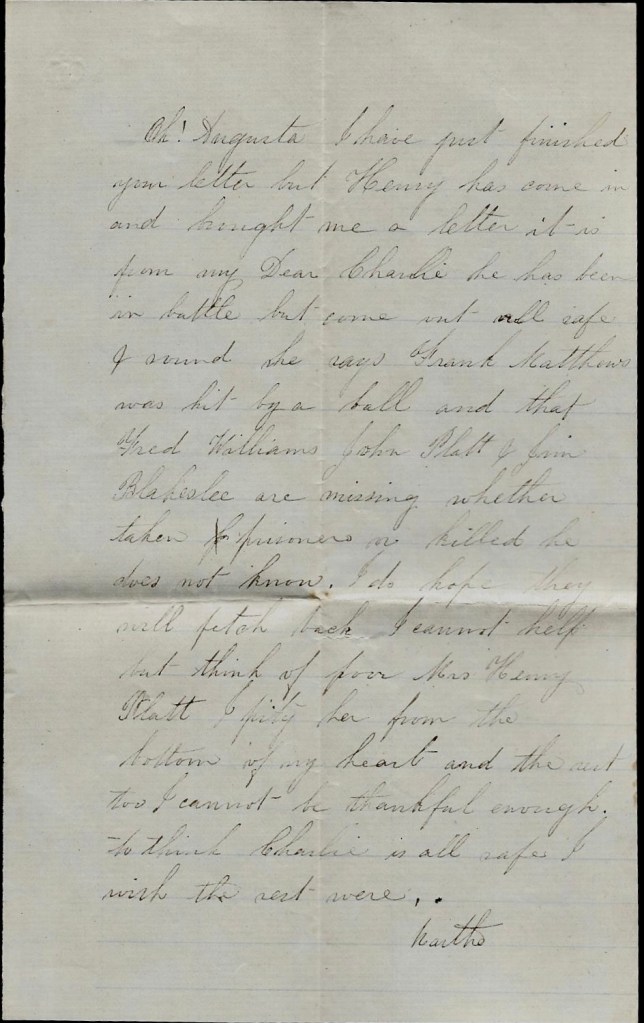
Oh! Augusta, I have just finished [writing] your letter but Henry has come in and brought me a letter. It is from my dear Charlie. He has been in battle but come out all safe & sound. He says Frank Matthews 1 was hit by a ball and that Fred Williams, 2 John Platt, 3 & Jim Blakeslee 4 are missing. Whether taken prisoners or killed, he does not know. I do hope they will fetch back. I cannot help but think of poor Mrs. Henry Platt. I pity her from the bottom of my heart and the rest too. I cannot be thankful enough to think Charlie is all safe. I wish the rest were. — Martha


1 Sergeant John “Frank” Matthews of Prospect, CT, was wounded on 3 May 1863 and was discharged for disability on 15 May 1864.

2 Frederick H. William of Prospect, CT, died on 27 May 1863 of wounds received at the Battle of Chancellorsville.

3 John H. Platt of Prospect, CT, survived Chancellorsville but was wounded later in the war on 19 March 1865 and discharged for disability on 22 June 1865.

4 James (“Jim”) Blakeslee of Prospect, CT, was transferred to the Invalid Corps and died in a hospital on 30 April 1864.

1864: William Brittin Durie to Mary Emma Durie

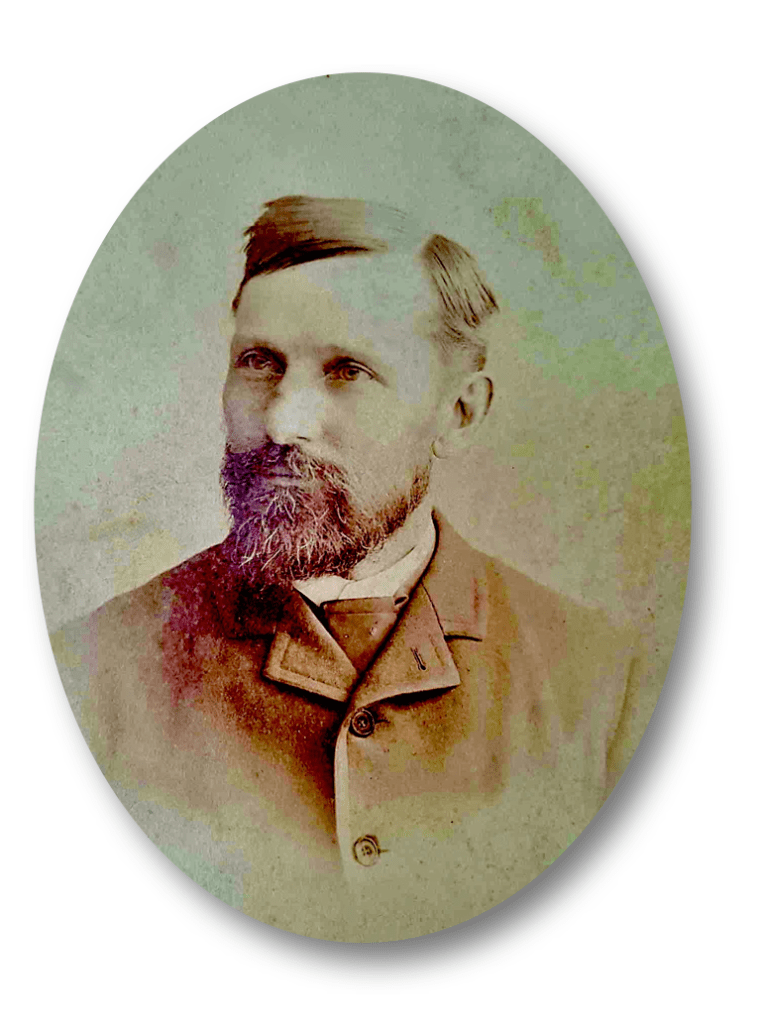
A post war image of William B. Durie

The following letter was written by William Brittin Durie (1840-1916), the eldest child of Samuel (Duryea) Durie (1814-1901) and Nancy Maxwell (1817-1891) of New Providence, New Jersey. William initially enlisted in Co. B, 13th New Jersey, serving from 12 April 1863 to 27 June 1863. He wrote this letter while serving in Co. C, 39th New Jersey Volunteers which he joined on 8 October 1864. He mustered out of the service on 17 June 1865.

By the 1880 US Census, William was married to Frances E. Clark (1849-1930, with two children, and working as a school teacher in Rahway, New Jersey. William wrote the letter to his sister, Mary Emma Durie (1846-1927) who married William C. Johnson (1829-1892) in 1870.

[Note: This letter is from the personal collection of Greg Herr and was transcribed and published on Spared & Shared by express consent.]

Transcription

Addressed to Miss Mary E. Durie, New Providence, New Jersey

Steamboat Guide, James River
Between Fortress Monroe & City Point
October 16, 1864

Dear Sister,

I take this opportunity to write you a few lines that you may know how I am getting along & where I am, &c. We left Newark Friday morning, stayed at Philadelphia Friday night in the cars. Yesterday we went to Baltimore by rail & took passage from there upon the Guide. We left 6 o’clock p.m. down the Chesapeake Bay & arrived at Fortress Monroe about 11 o’clock where we stopped about an hour, we are now plying for the James [river] & expect to land at City Point tomorrow morning.

My health is first rate and has been all the time. We are having a fine time of it—much better than marching. I am now seated upon the deck of the steamboat with a friend of mine, Mr. Jacob Lewis Pierson. 1 He is writing a letter too. We write about two lines & then rest to look at the scenery or talk or listen to [each] other.

Half past five p.m., I have just been downstairs to a prayer meeting for three-quarters of an hour. It is now nearly sundown. We shall not have much more time to write. We have it very nice upon board. We—that is, our company—occupy the Ladies Cabin. We have nice berths to sleep in. I should like to stay on the boat all the time. This letter can not be mailed until we get to City Point. That will be tomorrow. I believe I shall have to close for tonight for it will soon be dark. I want to get my supper. I will write to you again as soon as I get to camp.

Your brother, — W. B. Durie

October 16, 7 a.m.

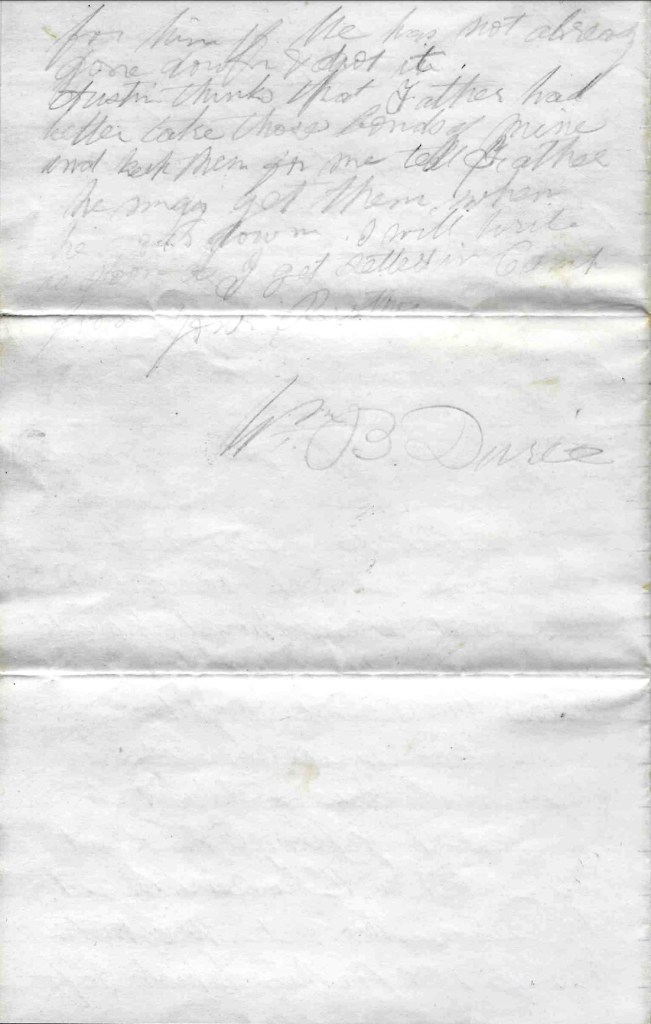
We are almost to City Point. The boat was anchored all night, otherwise we would have been there last night. You can write as soon as you get this & direct to Co. C, 39th New Jersey Volunteers., City Point, Va. Tell Father that Mr. E. Austin has $105 for him which I left for him if he has not already gone down & got it. Austin thinks that Father had better take those bonds of mine and invest them for me. Tell Father he may get them when he goes down. I will write as soon as I get settled in camp.

Your brother, — W. B. Durie


1 As it turns out, I previously transcribed two of Jacob Lewis Pierson’s letters some time ago. They were: 1865: Jacob Lewis Pierson to Mary Emma Durie published on Spared & Shared 14, and 1865: J. Lewis Pierson to Mary Emma Durie published on Spared & Shared 12.

1861: William Fuller to Mary Ellen Leavenworth

This letter was written by William Fuller (1837-1877), the son of Richard and Maria (Parrott) Fuller of Vermont. He wrote the letter to his friend (later wife) Mary Ellen Leavenworth (1846-1930). After the couple were married in 1863, they resided in West Haven, Connecticut, where William worked as a carriage maker. He died young on 28 June 1877 and was buried in the town of Roxbury, Litchfield county, Connecticut.

Twenty-four year-old William Fuller enlisted in the 5th Connecticut Infantry on 22 July 1861 and was made first sergeant of Co. D. He served under Captain David F. Lane of Hartford. According to a history of the regiment by E. E. Marvin (1889), William was taken prisoner on 25 May 1862 at Winchester. A family biography states that he spent four months in Libby Prison. He was exchanged on 15 September 1862 and discharged for disability in mid-February 1863.

In this letter, William mentions the “bad managed affair” at Ball’s Bluff and Edward’s Ferry on 21-22 October 1862 and reassures his friend that, “They will soon receive a blow from us that they will long remember and will make them feel the power of [our] noble Union army. I think the war will be short and decisive.”

See also—The Desertion of Edward Arthur Elliott, 5th Conn. Infantry on Spared & Shared 19.

[Note: This letter is from the private collection of Greg Herr and was transcribed and published on Spared & Shared by express consent.]

Transcription

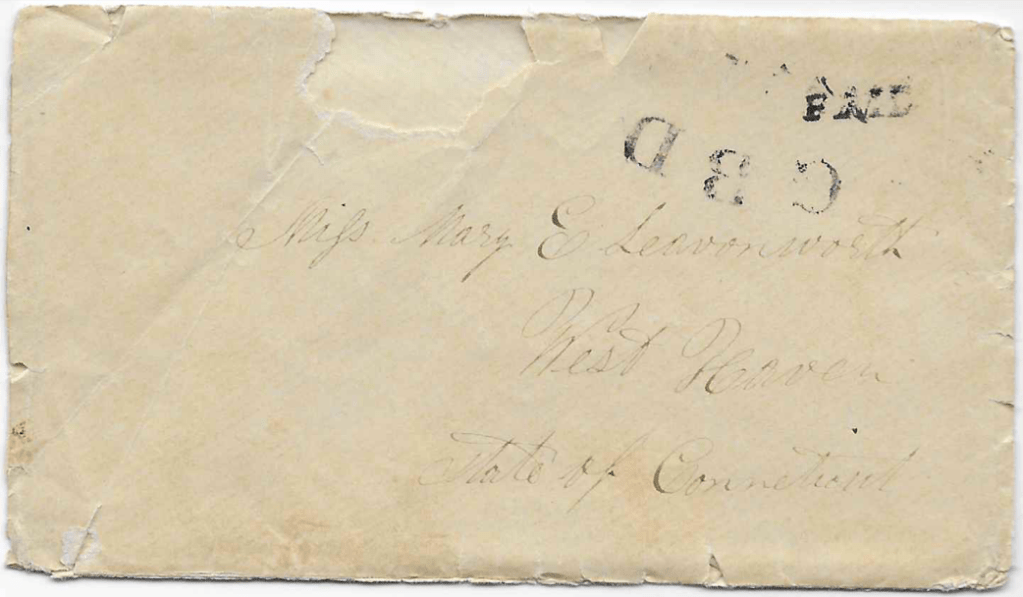
Addressed to Miss Mary E. Leavenworth, West Haven, State of Connecticut

Camp near Muddy Branch
November 12th 1861

Dear Friend,

Yes, I am fully convinced that you are a friend to me in every respect and you can be well assured that I am the same to you. I remember a few lines that a friend of mine wrote in the back part of my writing book that made a lasting impression on my mind. they were as follows:

“A constant friend is harder to find and if you find one that is true, change not an old one for a new.”

I received your last on the 18th. The reason of my letters being so long getting to you is our mails do not go regular. If it storms very much, they are delayed. The storm you spoke of reached us here. It raged for 24 hours most terrifically blowing and raining without ceasing. It makes it very unpleasant for the soldiers. We have to be out nearly as much in stormy weather as in pleasant.

There is no mistake that our troops suffered very much at the affair of Edward Ferry. It was a very bad managed affair. Our men were led to a complete trap and scattered like cattle without a chance for their lives. I am very glad our regiment was not there. They will soon receive a blow from us that they will long remember and will make them feel the power of [our] noble Union army. I think the war will be short and decisive.

This is a very pleasant morning for this season of the year. I ave just come in from usual morning work and take these few leisure moments to write to you thinking that I cannot put them to a better purpose. My duties are not quite as arduous as they were when I was in Hartford although I am busy most of the time. I have a good deal of care on my mind which keeps me busy thinking and writing when I am not otherwise engaged.

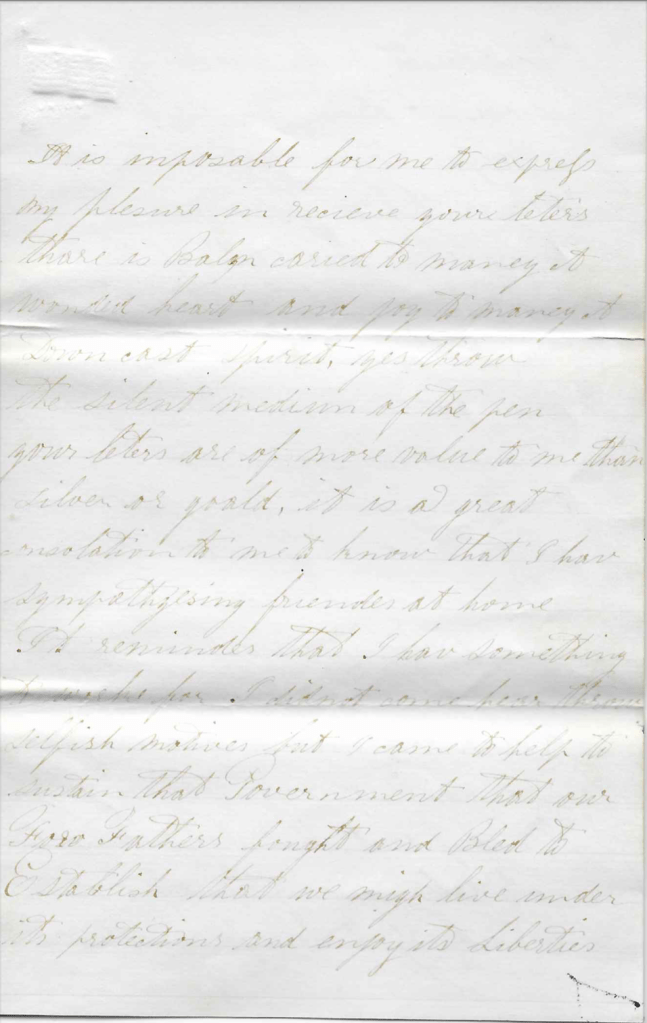
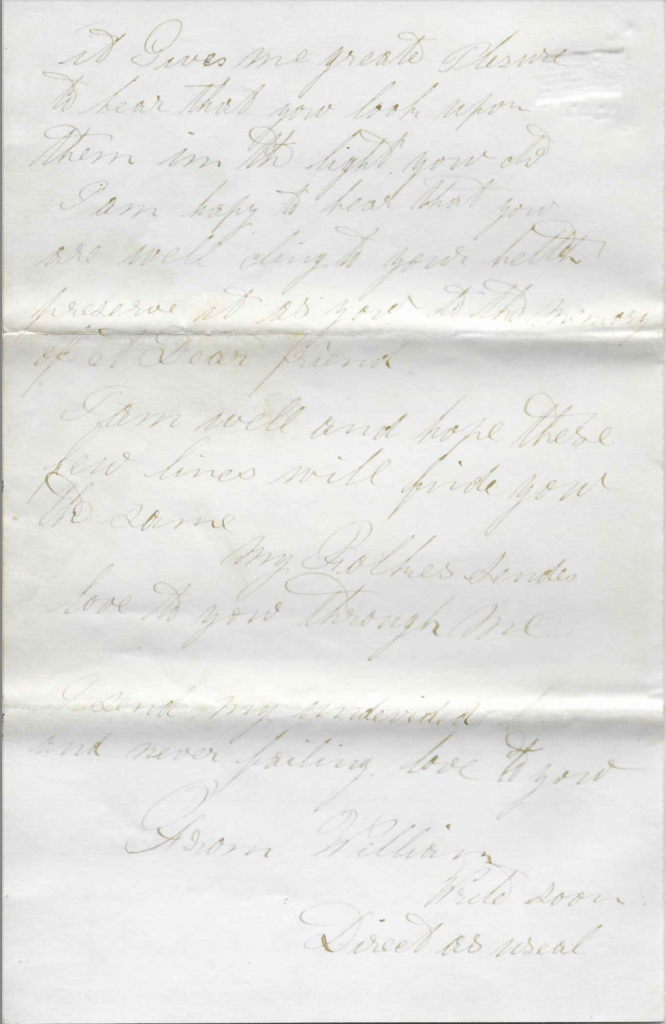
It is impossible for me to express my pleasure in receiving your letter—they are balm carried to many a wounded heart and joy to many a downcast spirit. Yes, through the silent medium of the pen, your letters are of more value to me than silver or gold. It is a great consolation to me to know that I have sympathizing friends at home. It reminds [me] that I have something to work for. I didn’t come here through selfish motives but i came to help to sustain that government that our fore fathers fought and bled to establish that we might live under the protections and enjoy its liberties.

If you could see the works of the secession soldier, it would make you weep. They ravish the country where ere they go. They pay no regards to the most sacred rights of the homes and firesides of private citizens. They rob the widow of her sole dependence—her sons, and impress them into their infamous armies and grossly insult and even murder the aged parent and innocent maiden. These are the kinds of beasts we are contending against. God grant that they may never set their unhallowed feet one inch farther north than they now do to pollute the sacred soil of our noble, loyal states. I feel confident that they never will. I could relate many incidents of their barbarity to hard for my part to describe. It is the other way with us. we place guards over houses that are likely to be intruded upon by any ill disposed one.

I received letters from two of my sisters since I write to you. My mother is as well as usual. I don’t know how long we will stay in this place. I think it will not be long. You need—or I hope you will not—let your mind be so uneasy. Let fond hope cheer your lonely hours. Let us both look forward to the time when we shall meet again and when we [will] be blessed with peace in our land.

Yes, Mary, I know just what kind of a set you are surrounded by. Keep yourself, or keep them to a respectable distance. They would lead you astray. It gives me great pleasure to hear that you look upon them in the light you do. I am happy to hear that you are well. Cling to your health. Preserve it as you do the memory of a dear friend. I am well and hope these few lines will find you the same. My folks send love to you through me.

I send my undivided and never failing love to you. From William. Write soon. Direct as usual.

1847: Calvin Waldo Marsh to Sarah (Whitney) Marsh

This letter was written by Calvin Waldo Marsh (1825-1873), the son of Henry Marsh (1797-1852) and Sarah Whitney (1796-1883) of Berkshire county, Massachusetts. Calvin’s father, Henry, died of cholera at LaSalle, Illinois in 1852 when he was 55 years old. Calvin graduated from Williams College in 1844) and later worked as a commission merchant in St. Louis, Missouri, and served as a Union officer in the Civil War.

Transcription

Addressed to Mrs. Henry Marsh, Sandusky City, Ohio

Buffalo [New York]
August 29, 1847

Dear Mother,

I take a few moments this evening to write you a few lines although it is Sabbath evening. I was quite disappointed when I arrived here not to find Father. But next morning I received a letter from him dated Pittsfield, August 25th, being last Thursday. He writes me he should be in Albany tomorrow and next day to attend to his wool and that he should be here on Thursday of this week so you will not expect him till the very last of this week. He will undoubtedly write you from here when he will be at home.

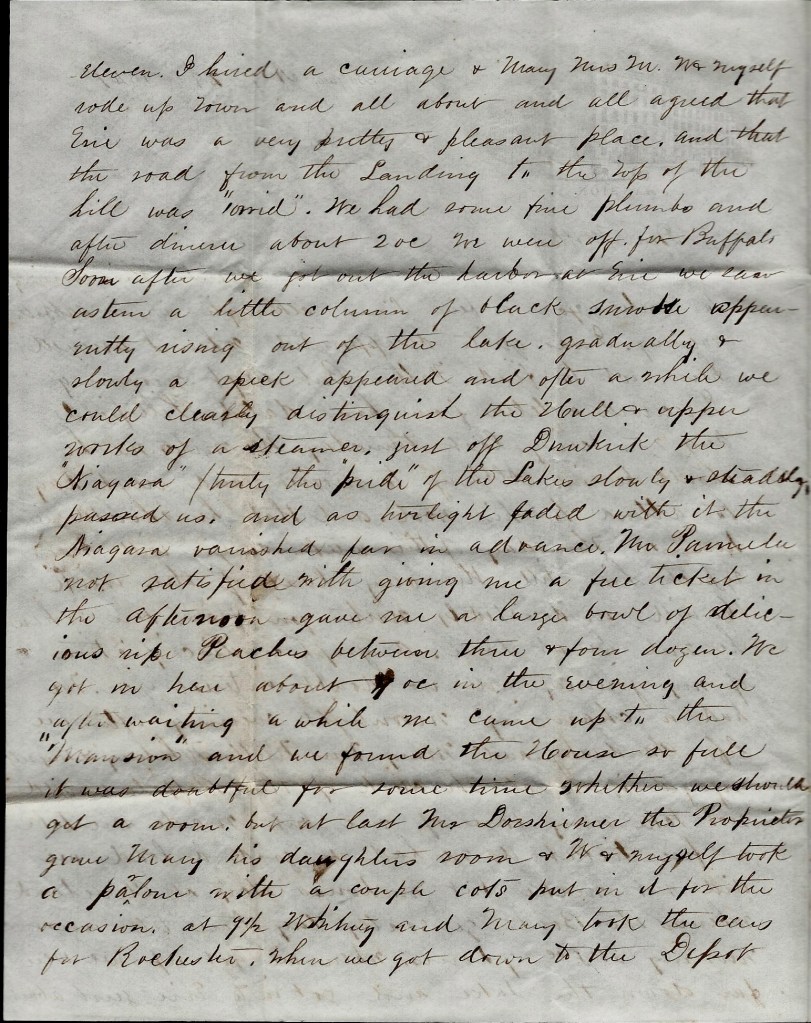
A graphic description of my journey will no doubt interest you. We had a charming moonlight evening after we left Sandusky and Mary, Mrs. Mills, Whitney & myself enjoyed it much. The clerk of the Buffalo would not take any fare of me but made me take a fare ticket as we had so good a load, we did not make but an hour’s stay at Cleveland whereas the boats generally lay there till next morning at 8 o’clock, 7 hours. When we got up we were far down the Lake and got into Erie [Pennsylvania] just about eleven. I hired a carriage & Mary, Mrs. Mills, Whitney & myself rode up town and all about and all agreed that Erie was a very pretty & pleasant place and that the road from the Landing to the top of the hill was “‘orrid”) We had some fine plums and after dinner about 2 o’clock we were off for Buffalo.

The Sidewheel Steamer Niagara (ca. 1847)

Soon after we got out of the harbor at Erie, we saw asteern a little column of black smoke apparently rising out of the lake. Gradually & slowly a speck appeared and after awhile we could clearly distinguish the hull and upper works of a steamer, just off Dunkirk—the “Niagara“—truly the “pride” of the Lakes, slowly & steadily passed us, and as twilight faded with it, the Niagara vanished far in advance. Mr. Parmelee, not satisfied with giving me a free ticket, in the afternoon gave me a large bowl of delicious peaches—between three & four dozen.

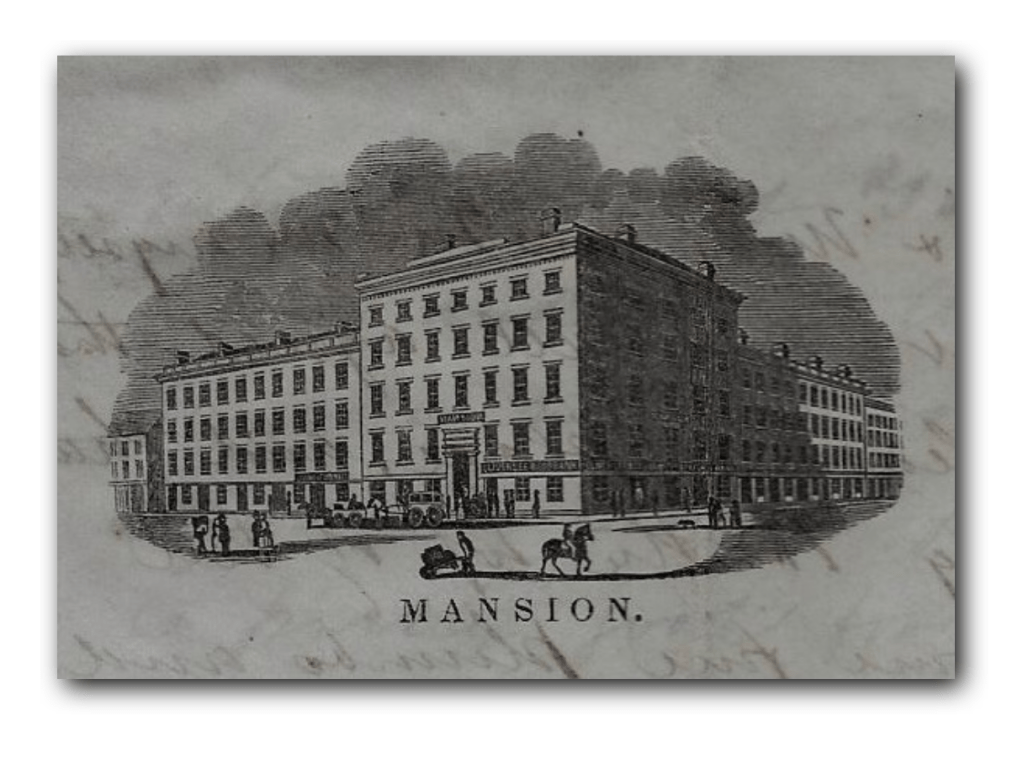
We got in here about 7 o’clock in the evening and after waiting awhile we came up to the “Mansion” 1 and we found the House so full it was doubtful for some time whether we should get a room but at last Mr. [Philip] Dorsheimer, the proprietor, gave Mary his daughter’s room & Whitney and myself took a parlor with a couple of cots put in it for the occasion. At 9:30 Whitney and Mary took the cars for Rochester. When we got down to the depot, found some St. Louis gentlemen who told him that Judge Carr & Dabney were in the depot somewhere. We looked all around but could not find him. Just as the cars started, Whitney found that he had walked out on the track a little ways to see the cars pass. As the cars passed, Whitney put his head out of the window and the Judge recognized him and bowed. After the cars left, I walked out and introduced myself to him at Whitney’s request. He gave me a very cordial reception and said that he was going to the [Niagara] Falls in the afternoon train and urged me when I told him I had thought of going down to accompany him and Dabney.

Tourists in top hats standing on the American side of the Niagara Falls, early 1850s (LOC)

After dinner I wrote a letter to Father, one to Henry, and one to one of our captains. I just finished my business in time to run to the cars at 4:30. We reached the Falls about 6 o’clock and we went down to the cataract. Judge Carr at first sight was very much disappointed in the falls. Next morning we went down the bank in the cars which take down and bring up passengers by water power at an angle of about 45 degrees. 2 Went across the small boat and visited the battleground of Lundy’s Lane, Table Rock, British Museum, Camera Obscura, &c. 3 I stopped at the cataract & Judge Carr insisted upon paying everything except my bill at the hotel and what trinkets I bought which I did not give him an opportunity to do. He went on in the cars & is going by way of Montreal and Boston to enter Dabney at Yale College.

I went to Mr. Ware’s house and saw Aunt and the rest of the family. Aunt is not as broken down by her age as I expected and looked perfectly natural. Her health is pretty good for her age as she is now over eighty. She seemed glad to see me & thought I had altered very much. She desired her love to be sent and all of the rest of the family. Charles gave me a very pretty cane. I saw Moses Miller & Chester White of Racine the first evening I got here. They left Racine last Monday in the Niagara and said Harry was well and Mr. Canfield’s family also.

Last evening after the cars came in, who should come in but Mr. John Boalt & I soon made”wacks” for the Ladies Drawing room. Miss “Pill” & “Nan” appeared very glad to see me and after they got some tea, we had a very pleasant chat. “Pill” had a bad headache and retired about 9:30. I ate breakfast with them this morning and soon after they took a cab and went down to the house of some of their cousins. They got up Tuesday morning and I shall send a small package by them which I wish you would open & ask Clara to deliver the one to Kate & Martha. With much love to [all]. From your affectionate son, — Waldo

Kind regards to all enquiring friends.

The Mansion on the corner of Main & Exchange Streets in Buffalo, New York

1 The Mansion House was built on land purchase by Philip Dorsheimer sometime after the British burned buffalo in 1813. The location was formerly the site of the Crow’s Tavern. Philip built his five story structure and then added another floor which was styled a modern hotel in 1829. It stood on the sire for over 100 years. It was torn down in 1932 to make way for building utilized by the New York Central Railroad.

2 An 1847 visitor to Niagara Falls wrote of this conveyance to the base of the falls in an article published in the New York Commercial Advertiser on 4 August. Among the most recent improvements he observed at the falls, he stated, was “the stairs and inclined plane on the American side, constructed [in 1845 and operated by water power] by the Messrs Porter, the proprietors of the land adjacent to the falls. They afford an easy ascent and descent to the ferry across the river, where thousands annually cross and recross within full view of the mighty cataract, but still there seemed something wanting to enable visitors to obtain a closer view of the falls from below, and this want has been supplied by the construction of a steam boat appropriately called the Maid of the Mist, which now safely conveys passengers from the lower landing on the American side to the very verge of the falls themselves—passing the American falls and nearly approaching the Horse shoe falls, where three-fourths of the waters of the Niagara plunge over a precipice of about 160 feet. This steamboat excursion, which occupies about forty minutes, has become very popular, and will no doubt well repay the enterprising proprietors. The Maid of the Mist is commanded by Captain H. Filkins, whose obliging manners have made himself and boat deservedly popular.”

3 It has been said that “tackiness is a cherished tradition at Niagara Falls.” Tourist attractions have abounded at the falls saince at least the mid 1920s. An 1847 visitor reported: “Now the neighborhood of the great wonder is overrun with every species of abominable fungus—the growth of rank bad taste, with equal luxuriance on the English and American sides—Chinese pagoda, menagerie, camera obscura, museum, watchtower, wooden monument, tea-gardens and old curiosity shops.”  The “Camera Obscura was “Robinson’s Canadian Pagoda which was built in 1847. It stood 70 feet tall and had three observations platforms for viewing the Horseshoe Falls. It was torn down in 1860.

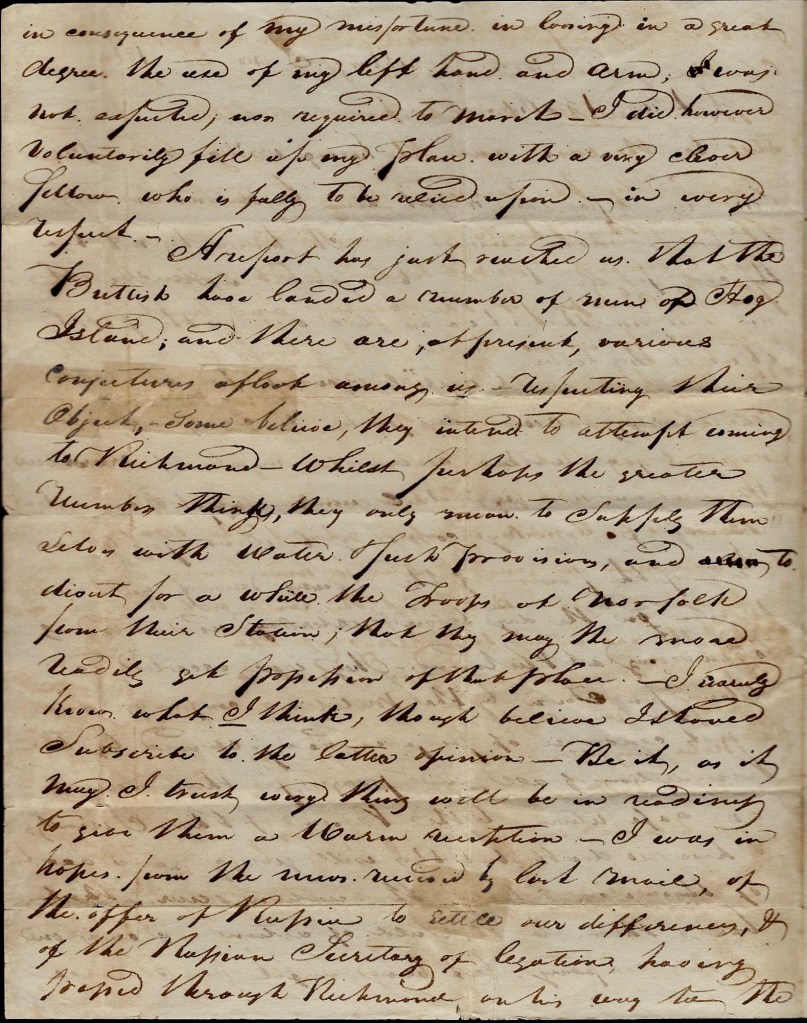
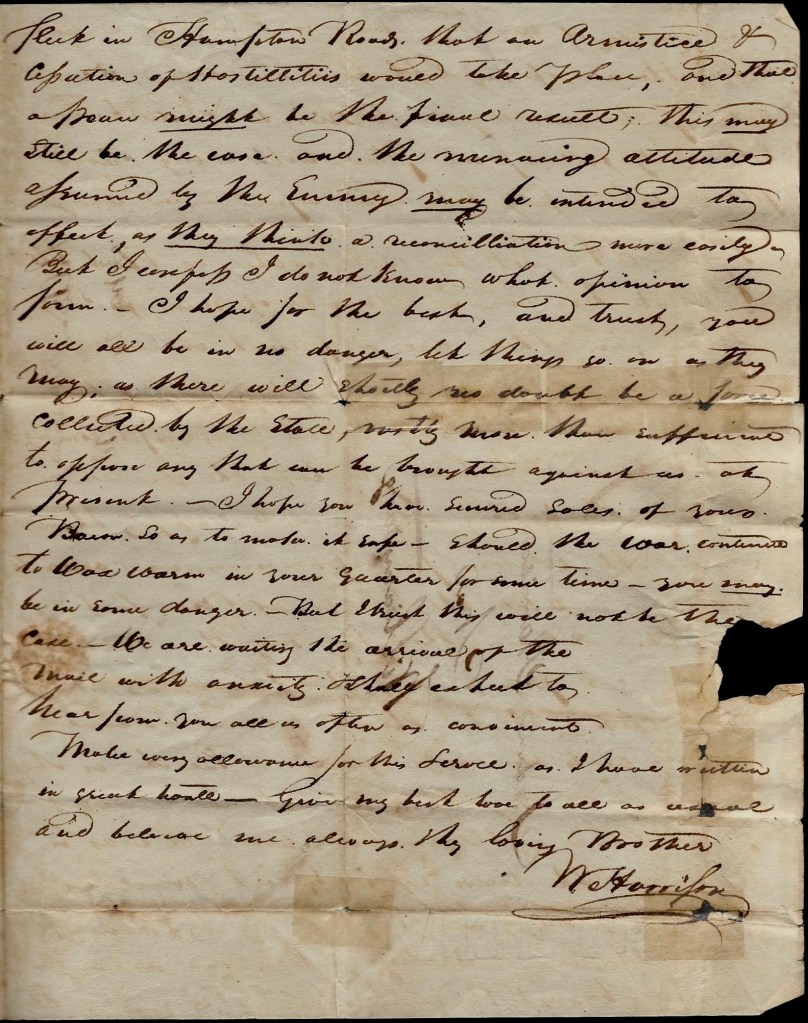
1813: William Harrison, Jr. to Jordan Harrison

This letter was written by William Harrison, Jr. (1780-1827), the son of William Harrison (1740-1819) and Margaret Jordan (1747-1831) of Williamsburg, Virginia. He wrote the letter to his brother, Samuel Jordan Harrison (1785-1842).

Type of uniform the Lynchburg artillerists might have worn in 1813

In his letter, datelined from Lynchburg, Virginia, in late March 1813, William informed his brother of rumors of a British invasion into Virginia and of the recent departure of an artillery company from Lynchburg to Richmond where troops were being amassed to confront them should they advance up the James River. The artillery company was led by Capt. James Dunnington who served under Col. John H. Cocke from 22 March to 22 August 1813 at Camp Holly (or Camp Holly Springs) which was located northwest of Malvern Hills near the junction of Newmarket Road and Long Branch Road.

In the spring of 1813, the British were preoccupied with fighting Napoleon’s army in Europe so they had limited resources available to devote to fighting the Americans. At this point in the War of 1812, the British Navy’s primary objective was to blockade American ports and interrupt trade, hoping to impact the American economy and diminish public support of “Mr. Madison’s War.” In February 1813, the British Navy began patrolling the entrance to Chesapeake Bay, intercepting merchant ships entering or leaving the bay, and conducting land raids which entailed burning and looting.

British Raid On Chesapeake Bay in War Of 1812 Painting from Patuxent River Naval Air Station in Maryland of the U.S. Navy.

Transcription

Lynchburg, [Virginia]
3 Mo. 24. 1813

Dear Brother,

Not having written to thee for some time, I fear thou mayest have thought that something has been the matter amongst us. This, however, has not been the case for we have all been favored with health and to inform thee that we are still well is the first object of this letter.

Our little town has been all bustle and anxiety for several days past inconsequence of having to part with a considerable number of our relations and most intimate friends. Capt. [James] Dunnington’s Company of Artillery consisting of between fifty and sixty of the flower of the young men of Lynchburg march on the day before yesterday under orders to rendezvous at Richmond. They were escorted a distance from town by the militia company and a vast concourse of people, and followed by the benedictions of all, and prayers, for their travels and safe return to the bosom of their friends. I have no doubt but they will give a good account of themselves should the occasion occur that brings them to the field of action. I was one of this company but being unfit for service in consequence of my misfortune in losing in a great degree the use of my left hand and arm, I was not expected, nor required, to march. I did, however, voluntarily fill up my place with a very clever fellow who is fully to be relied upon in every respect.

A report has just reached us that the British have landed a humber of men on Hog Island and there are at present various conjectures afloat among us respecting their object. Some believe they intend to attempt coming to Richmond, whilst perhaps the greater numbers think they only mean to supply themselves with water & fresh provisions and to draw out for awhile the troops of Norfolk from their station that they may the more readily get possession of that place. I hardly know what I think, though believe I should subscribe to the latter opinion. Be it as it may, I trust everything will be in readiness to give them a warm reception.

I was in hopes from the news received by last mail of the offer of Russia to settle our differences & of the Russian Secretary of legation having passed through Richmond on his way to the fleet in Hampton Roads that an armistice & cessation of hostilities would take place. and that a peace might be the final result. This may still be the case and the menacing attitude assumed by the enemy may be intended to affect, as they think a reconciliation more easily. But I confess I do not know what opinion to form. I hope for the best and trust you will all be in no danger, let things go on as they may, as there will shortly no doubt be a force collected by the state, vastly more than sufficient to oppose any that can be brought against us at present. I hope you have secured souls of your borough so as to make it safe. Should he war continue to wax warm in your quarter for some time, you may be in some danger. But I trust this will not be the case. We are waiting the arrival of the mail with anxiety. I shall expect to hear from you all as often as convenient.

Make every allowance for this service as I have written in great haste. Give my best love to all as usual and believe me always thy loving brother, — W. Harrison

1808: William Dalrymple to his Parents

How William Dalrymple might have looked

This historically significant letter was written by 27 year-old William Dalrymple (1781-1811), the eldest son of James Dalrymple (1758-1847) and Azubah Parmenter (1764-1850) of Framingham, Middlesex county, Massachusetts. According to family history, William moved to Montreal, Quebec, Canada in 1809 and visited distant parts of Quebec, dying during one of those trips. William’s father was a drummer in Capt. Jonathan W. Edes’ 4th Company, Col. Thomas Craft’s Artillery Regiment in the Revolutionary War. He served from 1 August 1776 to 1 November 1776, 3 months.

William’s letter to his parents describes his 5-day passage from Boston to New York City aboard the sloop Ten Sisters on what appears to have been a business venture. His landing in New York City just happened to coincide with the “Grand Procession to the Tomb of the Martyr’s” on the morning following his arrival. The “Martyrs” were the roughly 11-12,000 American patriot prisoners who died during the American Revolution onboard the British Prison Ship Jersey (and other lesser vessels) that was anchored in Wallabout Bay on the East River. William shares some of his observations from the procession that day that began in Manhattan, crossed the East River to Brooklyn (by boats), and then proceeded to Wallabout Bay.

Transcription

Addressed to Mr. James Dalrymple. Framingham, near Boston [Mass.]
Postmarked New York [City]

New York [City, New York]
May 26, 1808

Dear Parents,

The Sloop Ten Sisters plied the New England coast carrying freight or passengers

I take my pen to inform you of my safe arrival in this place after a pleasant passage of about five days. Perhaps you will expect a sort of journal & as I have little to write, I will give you some account of our passage. After being politely favored by Mr. Grew with letters [of introduction] to Mr. Holliday 1 of this place, I went on board the sloop Ten Sisters, Capt. [Benjamin] Hallet, and at 9 o’clock on Thursday evening, got under way having on board an agreeable company of passengers. We had four ladies on board, among whom were two young ladies—daughters of a merchant in this place, and a daughter of Mr. B. Russell of Boston. At 11, o’clock, passed lighthouse. On Friday morning, find ourselves off Cape Cod. This morning have an opportunity of conversing with the company & find the ladies very polite & indeed all the passengers were quite agreeable.

On Saturday, wind ahead. 6 o’clock passed Nantucket Light. Half past ten came to anchor off Barnstable. Went on shore in the boat to see the young ladies after whom our sloop was named together with a younger sister. We spend the afternoon in sporting. After tea we formed a party and walked till evening. Find people high in their demands. Sunday morning went on board & got under way (having taken another lady passenger on board). At 11 o’clock, wind ahead. At night, anchored in a cove.

Monday morning 6 o’clock got under weigh. Wind still ahead with a very rough sea. At 4 o’clock find ourselves near Newport. Tuesday, 6 o’clock a.m., storm comes on. Wednesday 10 o’clock pass through Hell Gate. 2 12 o’clock arrive at New York [City] and go on shore where I have taken lodgings for a few days but expect no business. 4 o’clock called on Mr. Holliday whom I found very polite. Having taken a glass of wine and passed an hour at his house, he promised me his good offices in forwarding my views in this place & politely offers me letters to his friends in Philadelphia & Baltimore. I now retire to my lodgings after having received an invitation to dine at 2 o’clock on Thursday.

An idyllic scene of Hell Gate, about 1820. From an engraving by John Hill of a painting by Joshua Shaw. The view is from Ward’s Island looking south across Hell Gate. The blockhouse is apparently the one at Mill Rock. Note the tidal movement of the water, depicted in striations in the foreground. (Image courtesy of NYPL.)

Thursday morning I was awakened by the tolling of all the bells in this city, it being the day fixed to perform the grand funeral ceremony over the bones of the unfortunate Americans who died on board the old Jersey Prison Ship. 3 They had collected the entire skeletons of 11,500 persons which were put into 13 coffins. All the troops in the city paraded to do them military honors. The different societies formed in the procession & the sailors dressed in white dimety trousers & waistcoats & blue jackets likewise formed—the whole in mourning. I have no time nor room to give a description of the procession as it deserves but shall mention only a few particulars.

The Prison Ship Jersey anchored in Wallabout Bay in the East River

Between the military corps and the societies [was] a grand figure representing a monument such as might be raised over the dead. It was placed on wheels which were unseen. On one side of this was inscribed, “Youth of my Country, Martyrdom prefer to Slavery.” On the other sides were inscribed, “Tyrants dread the gathering storm while we these obsequies perform—Sires of Columbia, transmit to posterity the cruelty of Britain—Columbia remember Britain.” On this was erected the American standard, the golden Eagle in deep mourning. The flag [was] supported by a tall figure representing he genius of Columbia—her head dressed with feathers & her body robed in an elegant manner.

After the procession formed, I was obliged to pay attention to my engagement and found Mr. Holliday, Mr. Frears, &c., who were very free in conversation. This made time pass agreeably as it drew my attention from the gloomy prospects of poverty which too often renders me unhappy. We now walk in the park to take a view of the Transparent representation of the British evacuating New York. Over the city hovered the Goddess of Liberty—the Genius of History, Fame, &c.

I now retire to my lodgings to write this, where poverty again disturbs me, as I pay 6 dollars for my board, beside what wine spirit, &c. I make use of. I cannot tell where you may direct your letters as in all probability I shall leave New York in a few days. Philadelphia will be my next resting place after which I shall proceed to Baltimore. I shall now close this by subscribing myself your dutiful son, — William Dalrymple


1 I could find only two men named Holliday in the New York City Directory in 1809. These were Thomas Holliday, grocer, 48 Henry Street; and William Holliday, 25 Mulberry (no occupation given).

2 Hell Gate was a narrow, dangerous tidal straight in the East River near New York City that required the full attention of mariners.

The first monument to the American Patriots who died aboard the Prison Ship Jersey in the American Revolution

3 During the American Revolution, the British resorted to confining American prisoners in the hold of old ships, the most famous of which was the HMS Jersey—an old converted 64-gun man-of-war that was stripped of all its fittings except for the flagstaff and anchored in Wallabout Bay in the East River. “Conditions on board were despicable. Meager rations of maggoty bread and rotted meat left the prisoners sick, weak and emaciated.” There were no toilets. By 1780, prisoners were dying aboard the Jersey at a rate of roughly ten each day, their bodies either buried in shallow graves on the shoreline or simply thrown overboard. More than 1,000 men were kept aboard the Jersey at one time. Even after the British surrender at Yorktown in late 1781, prisoners were kept aboard the Jersey and other ships until the war formally ended in 1783. Only 1,400 Americans survived captivity onboard the Jersey. At least 11,000 men and boys died—more Americans than in all the Revolutionary Battles combined. In the years that followed, the skeletons—whole or partial—that were collected from the bay or from the shoreline were gathered by citizens until 1808 when a crypt was constructed for their burial. One hundred years later, in 1908, a more proper monument was erected on the hilltop overlooking the bay. Today, almost no ones visit the spot to honor these patriots. I may have to make the journey there before I die. One of my ancestors, Capt. Peter Griffing (1742-1781), who led a company of volunteers at New Haven and fell prisoner to the British when they burned the city in July 1779, was placed on board the Jersey where he died in 1781. Peter’s brother, Capt. Moses Griffing (1745-1804), the captain of a merchant vessel, was likewise taken prisoner at sea and placed aboard the Jersey, but survived the ordeal when his wife called at the camp of Washington who gave her an English captain prisoner to exchange for her husband.


1849: Darius Henry Starbuck to Gerrit Smith

This incredible letter was written by Darius Henry Starbuck (1818-1887), the son of Reuben Starbuck (1787-1880) and Mary Beeson (1789-1840) who raised him in a Quaker family in Guilford county, North Carolina. Darius was a graduate of New Garden College and was one of the earliest lawyers in Winston and helped in the formation of Forsyth county and the building of the first courthouse in 1849. He took up residence in the town of Salem in 1849 when this letter was penned.

Darius H. Starbuck, ca. 1880

He was a delegate to the North Carolina state constitutional conventions of 1861 and 1865. In December 1865, he was appointed to his position as US Attorney for the North Carolina federal district court by President Andrew Johnson. In 1870 he was reappointed to this same seat by President Ulysses S. Grant.

Darius was married in 1856 to Ellen Blickenderfer (1834-1920), a native of Lancaster, Pennsylvania, who came to love in Salem, North Carolina, when she was 10 years old. Darius and Ellen were members of the Moravian Church.

Starbuck’s letter was addressed to Gerrit Smith, the well-known abolitionist, social reformer, and philanthropist. The letter explains the circumstances of Starbuck’s having become the owners of seven slaves formerly the property of his friend Thomas Adams of Stokes county and having incurred a debt while settling Adams’ estate. He then asks Gerrit Smith if he would be willing to pay the debt so that he might honor his friend’s wish that the slaves be liberated.

Gerrit Smith

Incredible details of this transaction are provided in Wikipedia although Starbuck’s letter makes it clear that Syphax and Letty were siblings, not husband and wife as was presumed. That segment of Starbuck’s biography follows:

On February 24, 1840, Darius Starbuck was written into the will of his “friend” Thomas Adams of Stokes County; Starbuck was also named executor of this will. This was witnessed by Thomas J. Wilson. In the will, Starbuck was named heir to an enslaved family owned by Adams upon the death of his wife Lucy, on the condition that Starbuck would emancipate them “as soon as the law will allow.” They were named Syphax, Letty, and their children Syphax L., Mary Addine (Mary Magdeline), and Sarah Jane (Sally). The will was notarized on 15 July 1843. On June 22, 1844, however, Starbuck purchased the family for $85.20. Mr. and Mrs. Adams were to continue using Syphax and his family for labor until both of their deaths. Under the new terms Starbuck was to instead free the family after they had “worked out the consideration money and interest”. This mandated that the family work as Indentured servants for Starbuck until the price Starbuck had paid for them—with interest—was returned to him either through labor or by payment. This bill of sale also mentions two more children, Emeline (Nancy Adeline) and Lewis. At the time of purchase in 1844 Syphax was aged about 26 and his wife Letty was about 30. This deed of sale was witnessed by John Hasten, who had to confirm this in court in April 1845.[9] The estate files of Thomas Adams were probated in 1848.

According to the Slave Schedule of 1850, Darius owned one male slave who was reported to census takers as being 37 years old. This may have been Syphax Adams who appears by his fluctuating age in written records to have not known his exact age. As Starbuck’s home in Winston was built in 1851, it is possible that Syphax’s labor may have been used during the brick mansion’s construction. On March 15, 1857, Syphax’s daughter, Nancy Adaline Adams, requested to become a member of the Salem African Moravian Church, a month later she began receiving instruction, and by October 11 she was baptized by the church. The church register in October 1857 listed her as, “Nancy Adelia, a single woman, property of Darius Starbuck.”

By the time of the 1860 Census, before the abolition of slavery, Syphax and his family were living as freed citizens of the Broadbay Township in Forsyth County. By the time of Starbuck’s death in 1887 he owned 322 acres—an area referred to in his will as the “Bouer Place”—in the Broadbay township; it is unknown whether the Adams’ ever lived or worked on this property during their residence in Broadbay. On April 14, 1861, Syphax’s daughter, Mary Magdalene Adams (single), was baptized into the Moravian Church on the same day as Lewis Hege (also single). At this time Mary was employed by Traugott Frederick Crist, and Lewis was a servant of George Hege. Lewis also served as an elder of the African Moravian Church in Salem. At some point before 1862 Mary and Lewis were married. As there is no surviving record of the marriage in the church register, it is possible that the couple jumped the broom. On July 17, 1862, Lewis and Mary had a child named Arabella Hege who was baptized on November 30, 1862. On February 14, 1864, however, Mary died of typhoid fever. At the time of her death she was described as “a quasi free woman of color.” Lewis later remarried to Dinah Ann (Malone). Jane, a servant of Louisa Shober Crossland, died on June 26, 1864, at the age of 19; this may have been Syphax’s daughter Sarah Jane “Sally” Adams. On October 23, 1864, Nathan, “a boy in care of D. H. Starbuck,” was baptized by the Salem African Church. A girl by the name of Lucinda, who was a servant of Julius Edward Mickey, was also baptized this day.This Lucinda could be Syphax’s younger daughter Lucy Adams.

On August 29, 1887, Lewis Hege, widower of Mary Magdalene Adams, was named in the land divisions of Starbuck’s estate. A Daniel Hege also owed the estate a personal loan debt of $200 at the time of Starbucks death. The loan was originally lent on July 26, 1859.

Whether Gerrit Smith ever responded to Starbuck’s solicitation is unknown. A search of Smith’s correspondence among his papers housed at Syracuse University does not include any letters to or from Starbuck. Given that the slaves remained in Forsyth county for years to come suggests to me that Gerrit never provided the requested funds but it appears that the temptation to sell the family to pay off the debts incurred in settling Adams’ estate was resisted and that Starbuck partially recovered his costs by their continued labor to him as indentured servants until he eventually freed them.

The hiring of Slaves for twelve months from the estate of Thomas Adams. Document found in the Adams’ Probate Records, dated 12 March 1849

Transcription

Addressed to Gerrit Smith, Esq., Petersborough, New York
Postmarked Salem, [Forsyth county] North Carolina

Salem, North Carolina
September 29th 1849

Sir,

I trust you will excuse a stranger for calling your attention to a matter calculated to enlist the sympathy of every feeling heart. It is the freedom of eight slaves.

About six years past an elderly gentleman by the name of Thomas Adams willed to me his slaves (which were his only property) expressing a desire that I should emancipate them. At that time he was much involved in debt. Many of his creditors brought suit & pressed payment. His negroes being his only property were about to be sold to make payment. After applying to neighbor after neighbor to assist him & to no avail, he then applied to me & begged me to intercede in his behalf to prevent the negroes from being sold, promising me a bill of sale for them. I accordingly paid off most of the claims & he made me a bill of sale for the slaves, I not being able to lose the money paid out.

He died nearly two years ago and after a series of continued litigation from that time to the present with his heirs who were nephews and nieces living in Alabama and Mississippi, I succeeded in establishing my title to the negroes. In consequence of this litigation, the costs, together with the demands at present against the estate, with those I have paid off, amount to near a thousand dollars.

From the fact that the freedom of the slaves was a matter which Mr. Adams had very much at heart, I am desirous to get them free if I can have that amount refunded me. The negroes would bring at this moment more than ($3,000.) three thousand dollars if I would sell them but this is something I wish to avoid if possible. But I am not able to lose this amount of money. Hence I shall be under the necessity of continuing them in slavery, or selling part of them to refund me in order to free the balance. Their being all of one family would make this a painful duty to separate them. In order to avoid either of these unpleasant dilemmas, & from your character of unbounded munificence & exalted philanthropy, I have been induced to solicit your aid in their behalf.

If you should feel disposed to aid these slaves in obtaining their freedom, they will doubtless long cherish you as their benefactor, besides being willing to pay you by their labor or other means if thy should ever get able, and I will make you a bill of sale of them or pursue any other course you may suggest for the purpose of freeing them.

If you should desire to correspond with others on this subject, or for the purpose of reference as to myself, I will give you the names of Thomas J. Wilson, Esq., of this place, John A. Gilmer, 1 Esq., Greensboro, Dougan Clark sen. of New Garden—a minister of the gospel in Friends Church, or Thomas Hunt, superintendent of Friends Boarding School at New Garden, N. C. I hope to hear from you soon on this subject.

Yours truly, — D. H. Starbuck

[to] Gerrit Smith, Esq., Petersboro, New York

P. S. Perhaps a more minute description of these slaves may interest you. The two oldest, Syphax & Letty are brother & sister. Syphax is about 35 years old & a free woman of color for a wife who has three children by him. Letty is about 32 years old, has a slave husband and six children, the oldest of whom is about 15 years of age. — D. H. S.

1 Darius read law with John A. Gilmer, Sr. of Greensboro prior to being admitted to the bar in 1841.