My passion is studying American history leading up to & including the Civil War. I particularly enjoy reading, transcribing & researching primary sources such as letters and diaries.
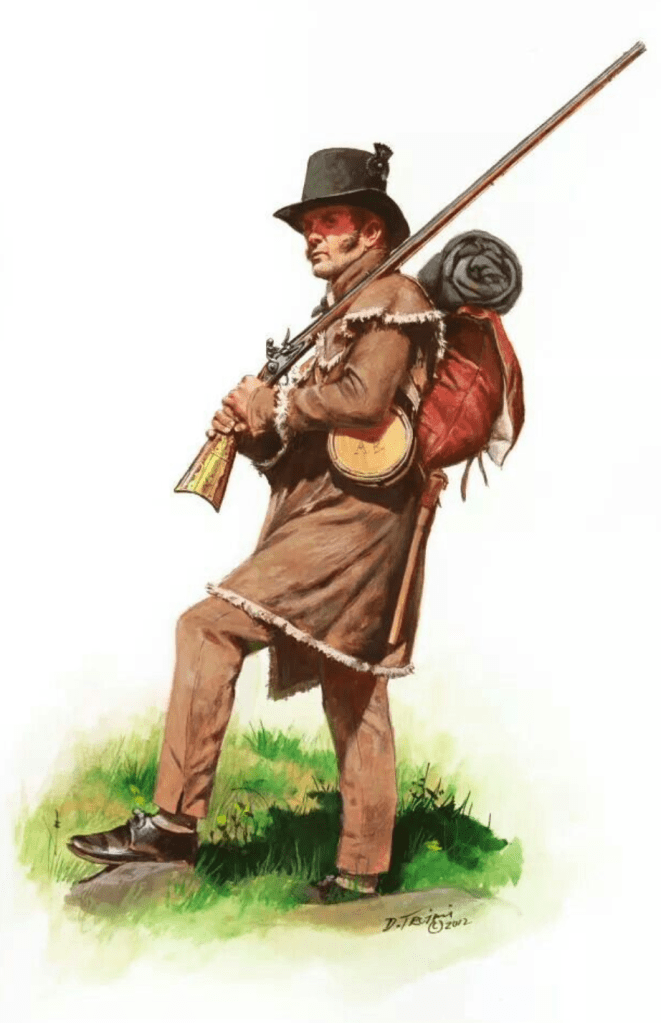
Don Troiani’s Painting of a western militiaman in the War of 1812 era.
The following letter was written by John Stark Edwards (1777-1813), a native of New Haven, Connecticut. He was the grandson of Princeton President Jonathan Edwards and the son of Pierpont Edwards—the founder of the Connecticut Land Company that settled the Western Reserve of Ohio. After graduating from Princeton in 1796 and earning his law degree, John Stark Edwards left New Haven for the Northwest Territory to take charge as sales agent of his father’s lands in the Reserve. He arrived in Warren, Trumbull county, Ohio in 1799 and was one of the first lawyers to settle in the Reserve.
In March 1811, Edwards was commissioned Colonel of the 2nd Regiment, 3rd Brigade, 4th Division of the Ohio Militia. When news of General William Hull’s surrender at Detroit in August 1812, reached those living in the Reserve, it caused great excitement and the settlers feared they might expect raids by the British and Indians. Many settlers fled in panic to the South and to the East. This letter was written at the time of that excitement, ordering men of his command to join Capt. Daniel Dull to a point near the Huron river where Camp Huron was built.
I am ordered by General [Simon] Perkins to detach from the regiment under my command seventy-two men including officers—each private to furnish himself with a blanket & knapsack, and to be clothed & prepared for a winter campaign. Your proportion of that number will be five privates to make up which Jacob Earl, Robert J. Freeman, & Joseph Netterfield & Levi Benedict who are now on duty will be taken. The other one will be taken from the privates of your company highest on the class rolls that have not been discharged. If he is now on duty, you will return his name to me forthwith but if at home, you will muster him at Warren on Saturday next by ten o’clock a.m. prepared to march to Huron, there to join the company under the command of Capt. Daniel Dull.
With respect, yours &c. — John S. Edwards, Col. Commanding 2d Regt., 3rd Brigade, 4th Division Ohio Militia
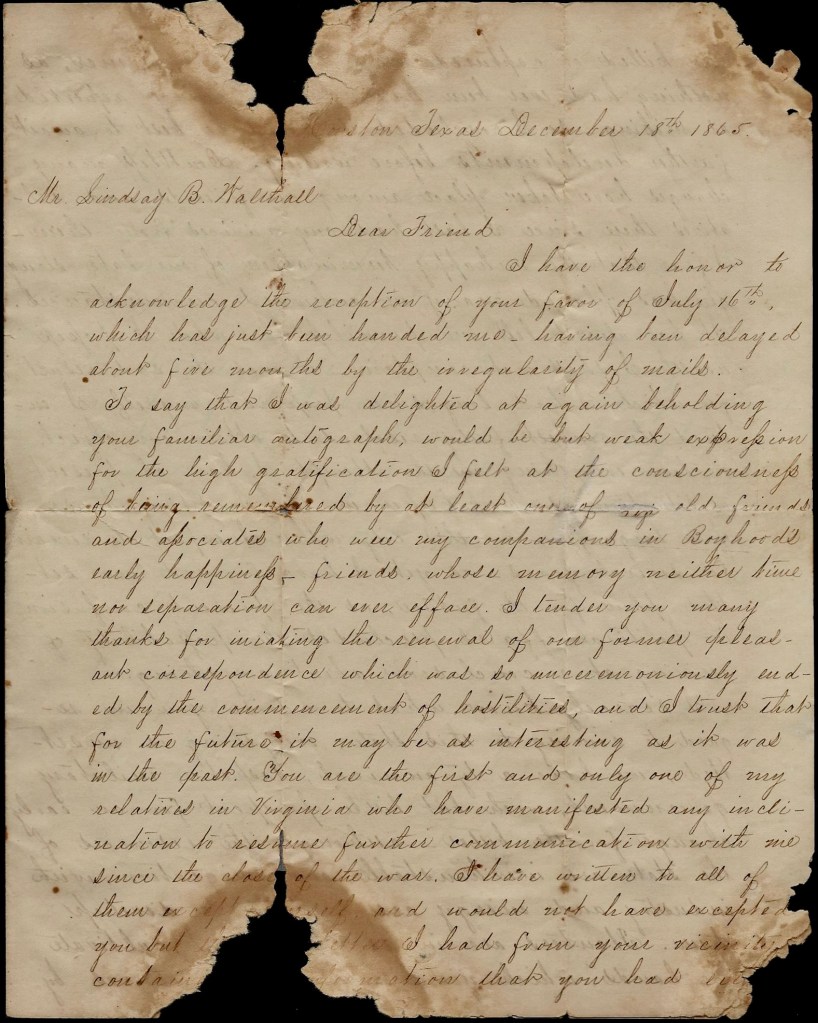
The following letter was written by Thomas Willis Blanton (1829-1920), the son of Thomas Willis Blanton (1802-1850) and Martha A. E. Ligon (1804-1829) of Amelia county, Virginia. He wrote the letter to his friend and comrade, Lindsay Branch Walthall (1840-1912) with whom he had entered the Confederate service as a member of the Old Dominion Riflemen (ODR) in May 1861. That company eventually consolidated with other companies to become the 53rd Virginia Infantry. Lindsay was married to Martha Susan (“Suzie”) Overton whose mother was Martha Willis Blanton so the two were probably cousins from Prince Edward county, Virginia.
Thomas was married in April 1858 to Martha Frances Bruce (1830-1899), the daughter of Samuel B. and Elizabeth Bruce of Amelia county, Virginia. He served as the 1st Sergeant of Co. C, 53rd Virginia Infantry. He was wounded in May 1862 and did not return to his regiment for nearly six months. He submitted a pension application for a “Disabled Confederate Soldier” in 1906, claiming that he was nearly blind. He died in 1920 in Lockett, Prince Edward county, Virginia.
Transcription
Houston, Texas December 18, 1865,
Mr. Lindsay B. Walthall Dear Friend,
I have the honor to acknowledge the reception of your favor of July 16th, which has just ben handed me—having been delayed about five months by the irregularity of mails.
To say that I was delighted at again beholding your familiar autograph, would be but weak expression for the high gratification I felt at the consciousness of being remembered by at least one of my old friends and associates who were my companions in boyhood’s early happiness—friends whose memory neither time nor separation can ever efface. I tender you many thanks for initiating the renewal of our former, pleasant correspondence which was so unceremoniously ended by the commencement of hostilities and I trust that for the future, it may be as interesting as it was in the past.
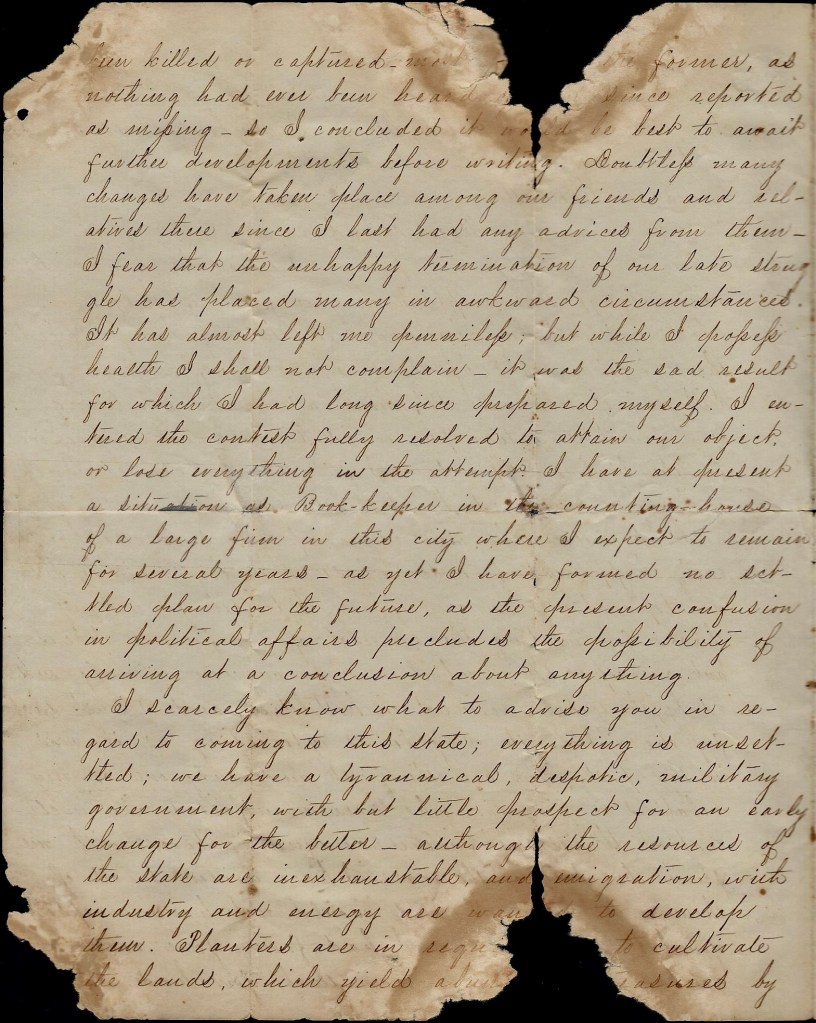
You are the first and only one of my relatives in Virginia who have manifested any inclination to resume further communication with me since the close of the war. I have written to all of them except yourself and would not have excepted you but the last letter I had from your vicinity contained information that you been killed or captured—most likely the former, as nothing had ever been heard from you since reported as missing. So I concluded it would be best to await further developments before writing.
Doubtless many changes have taken place among our friends and relatives there since I last had any advices from them. I fear that the unhappy termination of our late struggle has placed many in awkward circumstances. It has almost left me penniless; but while I possess health, I shall not complain. It was the sad result for which I had long since prepared myself. I entered the contest fully resolved to attain our object or lose everything in the attempt. I have at present a situation as book-keeper in the counting house of a large firm in this city where I expect to remain for several years. As yet, I have formed no settled plan for the future, as the present confusion in political affairs precluded the possibility of arriving at a conclusion about anything.
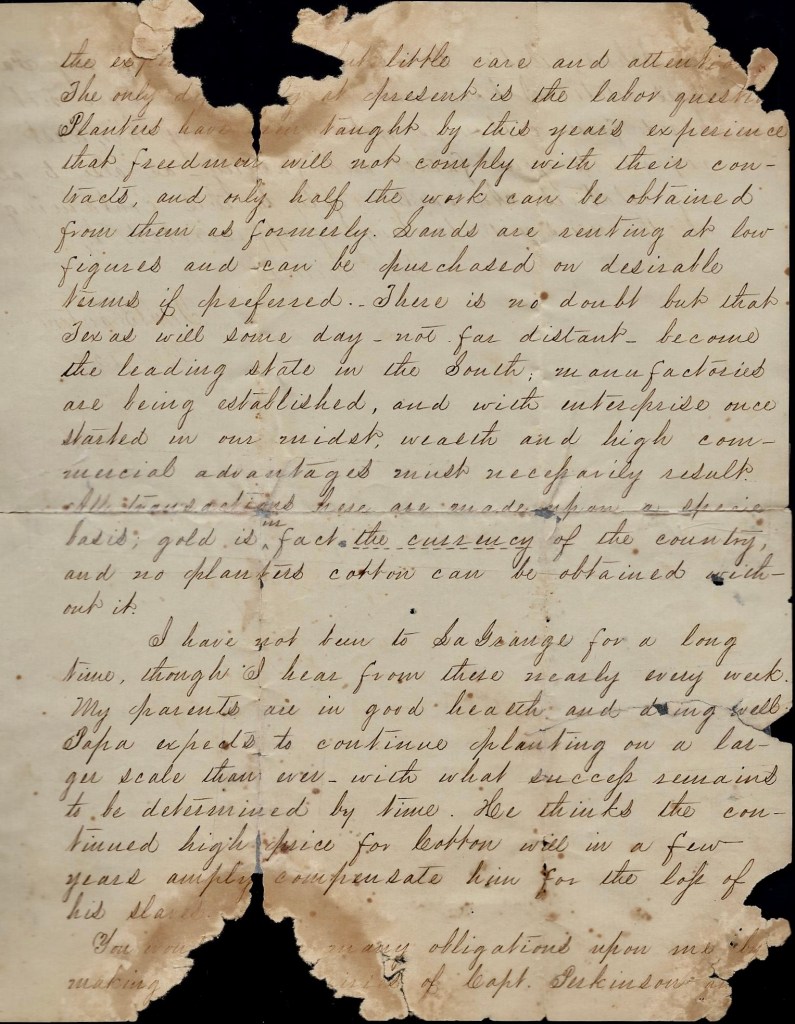
I scarcely knew what to advise you in regard to coming to this state. Everything is unsettled. We have a tyrannical, despotic, military government with but little prospect for an early change for the better—although the resources of the state are inexhaustible and emigration with industry and energy are wanted to develop them. Planters are in requisition to cultivate the lands which yield abundance and are pastured by the exertion of but little care and attention. The only [ ] at present is the labor question. Planters have been taught by this year’s experience that freedmen will not comply with their contracts, and only half the work can be obtained from them as formerly. Lands are renting at low figures and can be purchased on desirable terms if preferred.
There is no doubt but that Texas will some day—not far distant—become the leading state in the South. Manufactories are being established, and with enterprise once started in our midst, wealth and high commercial advantages must necessarily result. All transactions here are made upon a specie basis; gold is in fact the currency of the country, and no planted cotton can be obtained without it.
I have not been to La Grange for a long time, though I hear from there nearly every week. My parents are in good health and doing well. Papa expects to continue planting on a larger scale than ever—with what success remains to be determined by time. He thinks the continued high price for cotton will in a few years amply compensate him for the loss of his shares.
You would confer many obligations upon me by making inquiries of Capt. Dickerson and Mr. Johns relative to what became of my Father’s estate. I have written to them but have not heard from either as yet. Present my highest regards to your father and family—as also to all my relatives. An early reply to this containing all the news will be highly appreciated by
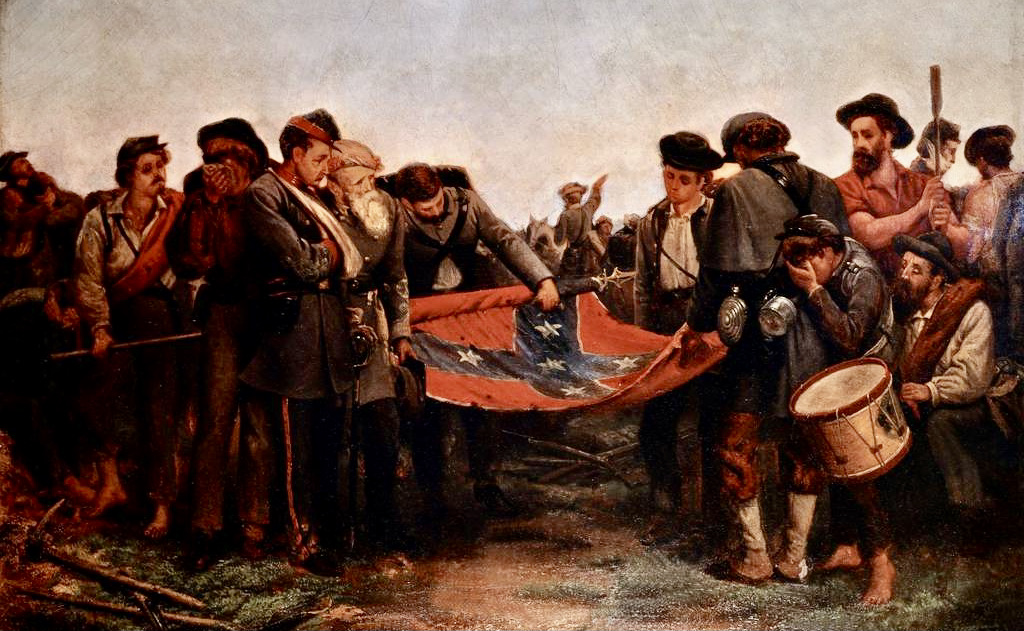
Confederate soldiers rolled up their flag after General Lee’s surrender at Appomattox
Among the personal papers of Lindsay Branch Walthall (1840-1912) of Prince Edward County, Virginia, were found the following handwritten terms of surrender of Gen. Lee’s Army of Northern Virginia to Gen. Grant on 9 April 1865. Lindsay served the entire war, entering initially in May 1861 with other boys of his county in the Old Dominion Rifles. The boys in this company were eventually consolidated into the 53rd Virginia Infantry. He was taken prisoner at the Battle of Gettysburg, captured in “Pickett’s Charge” on 3 July 1863—the 53rd Virginia serving as the color regiment of Armistead’s Brigade. He was transported from the battlefield and confined at Fort McHenry, at Fort Delaware, and at Point Lookout where he was finally exchanged from the Hammond General Hospital suffering from chronic diarrhea on 31 August 1864.
When he returned to his regiment following his exchange and recovery from illness, Lindsay was promoted on 1 November 1864 to a 2nd Lieutenant of Company C, 53rd Virginia Infantry. The 53rd Virginia was at the time brigaded with four other Virginia regiment under the command of Gen. George Hume Steuart in Maj. General George E. Pickett’s Division of Longstreet’s Corps. Moreover, at the time of the fall of Petersburg and Richmond in April 1865, Lindsay was acting as aide-de-camp to Gen. Steuart and would have been in his company as Longstreet’s Corps crossed over to the south side of the James river and struck out westward on the South Side Railroad hoping to rendezvous with the rest of Lee’s army at Amelia Court House on the Richmond and Danville Railroad. Their path would take them directly through the county where Lindsay grew up and immediately past the home of Suzie Overton, his future wife.
The surrender of Lee’s army in the days that followed is well known and the drafting of the terms of surrender in McLean’s farmhouse at Appomattox Court House has been immortalized in both words and pictures. Once the official copy of the terms were drafted, they needed to be disseminated to the officers of the various commands so it may be imagined that clerks were ordered to sit down and quickly make multiple handwritten copies for this purpose. It is my hunch that this copy was either one that Lindsay received, or wrote himself, as aide-de-camp to Gen. Steuart. Perhaps he used it to read the terms to the rank and file at the request of his commander.
The top portion of the document is more legible than the bottom though this may be partially due to the quality of the scan that was proved to me.
Docketed on reverse side of sheet
Transcription
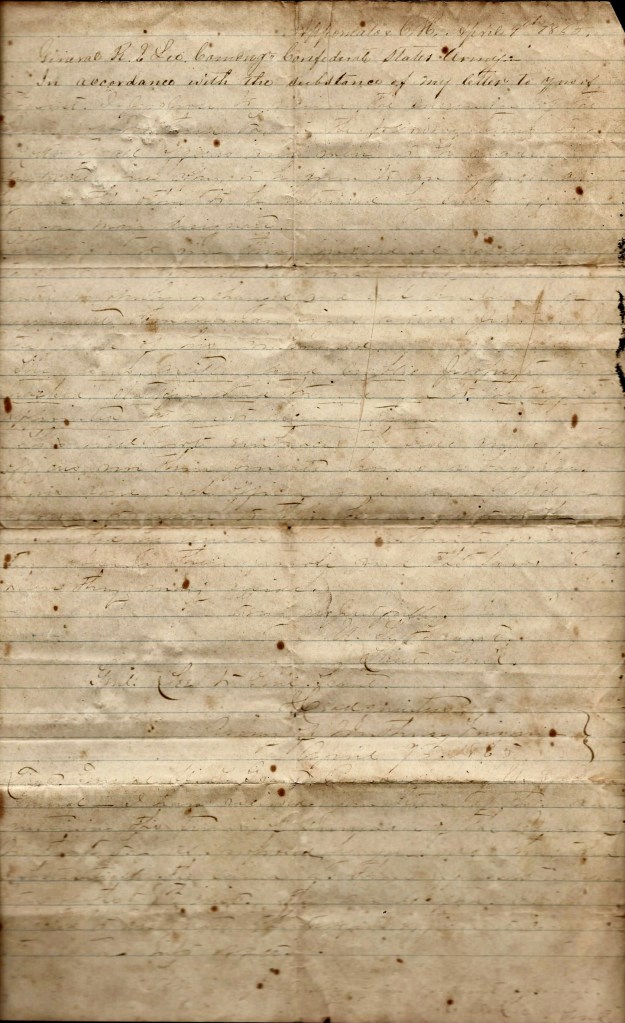
Appomattox Court House April 9th 1865
General Robert E. Lee, Commanding, Confederate States Army:
In accordance with the substance of my letter to you of 8th inst., I propose to receive the surrender of the Army of Northern Va. on the following terms (to wit): Rolls of all the officers and men to be made in duplicate—one copy to be given to an officer to be designated by me; the other to be retained by such officer as you may designate.
The officers to give their individual paroles not to take up arms against the Government of the United States until properly exchanged, and each company or regimental commander to sign a like parole for the men of his command.
The arms, artillery, & public property to be parked, stacked & turned over to the Officer appointed by me to receive them. This will not include the side arms of the officers nor the private horses or baggages. This done, each officer and men will be allowed to return to their homes, not to be disturbed by the United States authorities as long as they observe their parole & the laws enforced where they may reside.
Very Respectfully, — US Grant, Lt General
General Lee to General Grant
Headquarters, Army of Northern Virginia April 9th 1865
Lt. General U. S. Grant, commanding U. S.
General, I have received your letter of this date containing the terms of surrender of the Army of Northern Virginia, as proposed by you. As they are substantially the same as those expressed in your letter of the 8th inst., they are accepted. I will proceed to designate the proper officers to carry out the stipulations into effect.
Very respectfully, your obedient servant, — R. E. Lee, General
The following collection of letters were all written to Martha Susan (“Suzie”) Overton (1844-1935) of Rice’s Depot, Prince Edward county, Virginia, during the Civil War. Suzie was the youngest of several children born to Dr. Thomas Carlton Overton (1803-1844) and Martha White (1811-Aft1880). Her siblings included: William M. Overton (b. 1829), Elizabeth Carleton Overton (1831-1860), James Lee Overton (b. 1835), Nancy (“Nannie”) Overton (b. 1838), and Mary (“Mollie”) Overton (b. 1841).
Suzie married Lindsay Branch Walthall (1840-1912) in May 1866 in Prince Edward County, VA. They had three children. Lindsay served in Co. C of the 53rd Virginia Infantry Regiment. He was acting aide-de-camp at the surrender. After the war, Lindsay and Suzie settle in Lockett, Prince Edward county, Virginia.
The story that accompanies this small cache of letters claims that they were found “in the walls of the Overton/Walthall House in Prince Edward county, Virginia.” I have not been able to confirm this story but if true, it must have been Suzie Overton’s mother’s house where Suzie and her widowed mother were residing at war’s end near Rice’s Depot. It’s possible that Suzie hid the letters there in 1865 when Union General John Gibbon’s Corps approached the station on April 6th as they pursued Longstreet’s retreating Corps westward from Richmond on the South Side Railroad. The letters certainly have the appearance of having been stored in the walls of a home—they are badly stained though mostly still legible.
Map showing the location (orange oval) of the “Mrs. Overton” home near the South Side Railroad and overlooking the Appomattox River valley not far from Farmville.The famous “High Bridge crosses the Appomattox River at far right on the map. The Overton home was located just a mile to the northwest of the bridge.
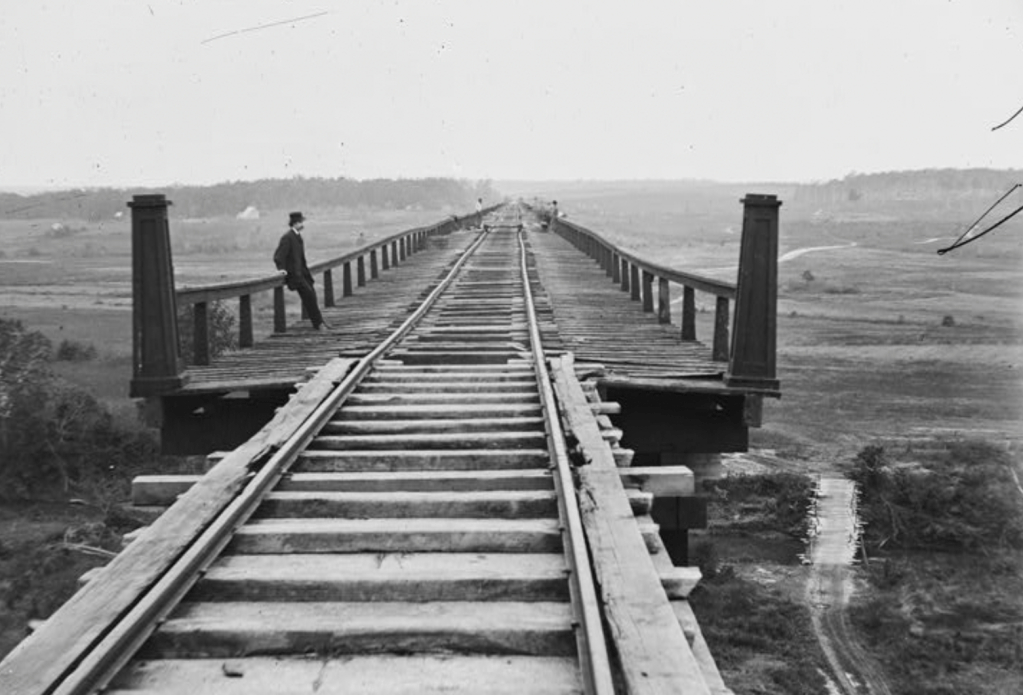
In the 1850s, the South Side Railroad was built between Lynchburg and Petersburg passing through Farmville. Subsidized by a contribution from the Town of Farmville, this route required an expensive crossing of the Appomattox River. High Bridge was built in 1853. In the following decade, High Bridge was heavily damaged during the final days of the Civil War. After the battle at nearby Sayler’s Creek, the last major engagement of the Civil War, Confederate General Robert E. Lee retreated directly through the Town of Farmville, and the Confederate army crossed and then attempted to burn High Bridge. The Union forces saved the bridge and continued their pursuit of Lee’s army towards Appomattox Courthouse, where General Lee surrendered a few days later to General Ulysses S. Grant.
Letter 1
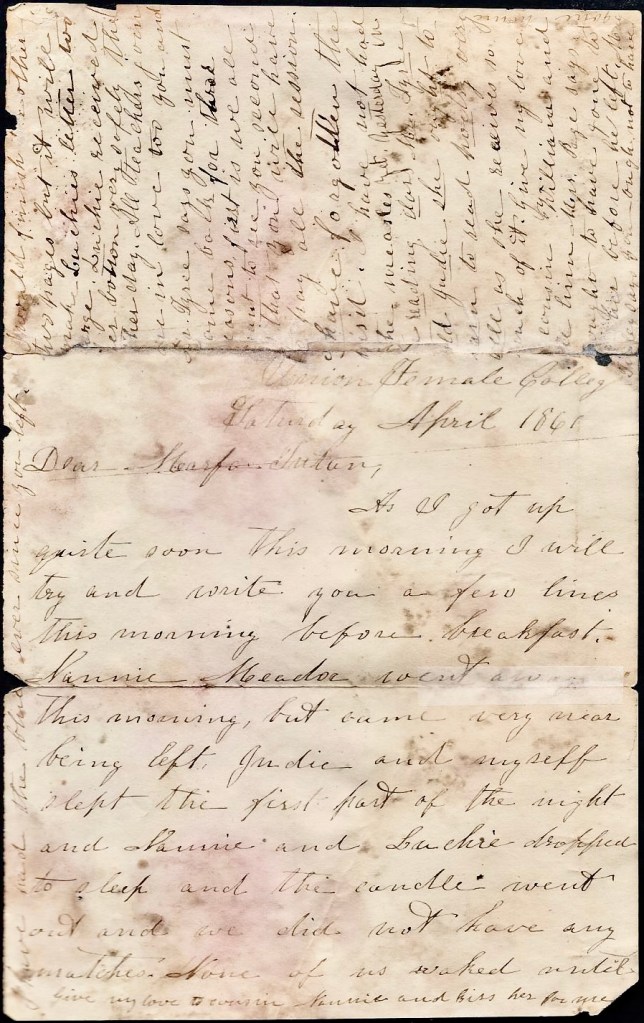
Union Female College 1 Saturday, April 1861
Dear Martha Susan,
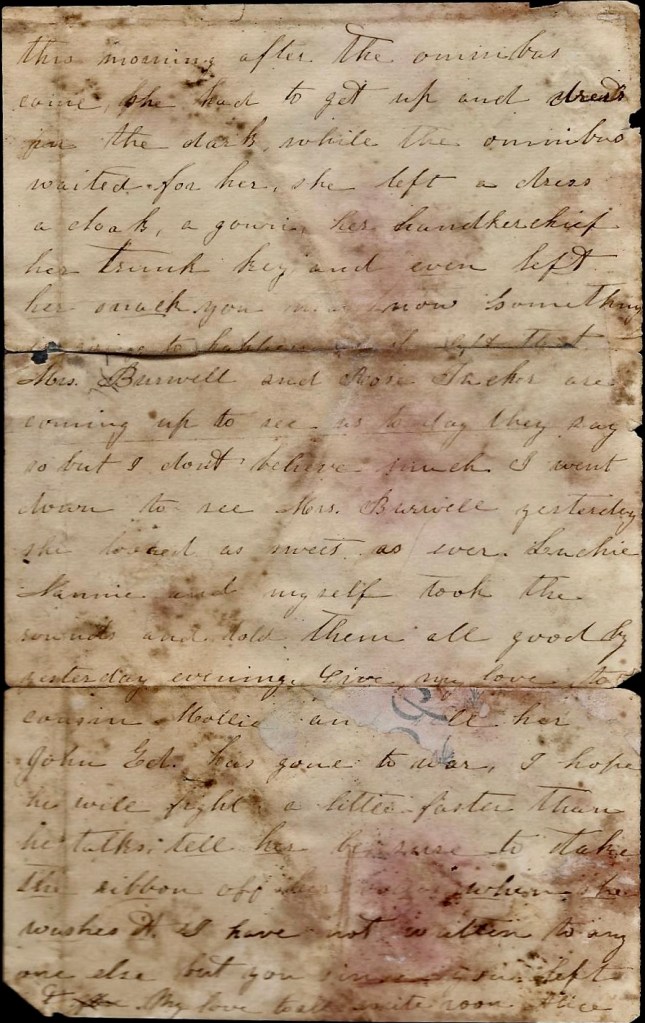
As I got up quite soon this morning, I will try and write you a few lines this morning before breakfast. Nannie Meador went home this morning but came very near being left. Judie and myself slept the first part of the night and Nannie and Luchie dropped to sleep and the candle went out and we did not have any matches. None of us waked until this morning after the omnibus came. She had to get up and dress in the dark while the omnibus waited for her. She left a dress, a cloak, a gown, her handkerchief, her trunk, key and even left her snack. You may know something [ ] to happen if she left that.
Mrs. Burwell and Rose Tacher are coming up to see us today. They say so but I don’t believe much. I went down to see Mrs. Burwell yesterday. She looked as sweet as ever. Luchie, Nannie, and myself took the rounds and told them all goodbye yesterday evening. Give my love to cousin Mollie and tell her John Ed. has gone to war. I hope he will fight a little faster than he talks. Tell her be sure to take the ribbon off her bonnet when she washes it. I have not written to anyone else but you since you left.
I have had the blues ever since you left. I would finish another two pages but it will make Luchies letter too large. Luchie received her button very safely the other day. All teachers join us in love to you and Mr. [William A.] Tyree says you must come back for three reasons. First is we all want to see you. Second is that you will have to pay all the session. I have forgotten the third. I have not had the measles yet. Yesterday in reading class, Mr. Tyree told Judie she ought to learn to read poetry very well as she receives so much of it. Give my love to Cousin William [Susie Overton’s brother and a Confederate Surgeon] and tell him Mrs. Page says he ought to have gone to her before he left. Mr. Tyree says you ought not to have gone home. Love to Cousin Nannie and kiss her for me.
[from cousin Alice to Martha Susan Overton]
1 The college was incorporated by the Assembly of Virginia in December of 1859 as the Union Female College. A new brick building was erected on top of “Baptist Hill” at Ridge and Patton Streets in Danville next door to William I. Berryman’s home who had previously operated the Danville Female Institute. In 1861, Rev. William Allen Tyree replaced his brother-in-law Nathan Penick as principal. Tyree served a the principal until 1863. The school’s name was changed in 1864 (the word “Union” not popular) to the Roanoke Female College. It’s known today as Averett University.
Letter 2
Danville [Virginia] Thursday night, May 7th, 1861
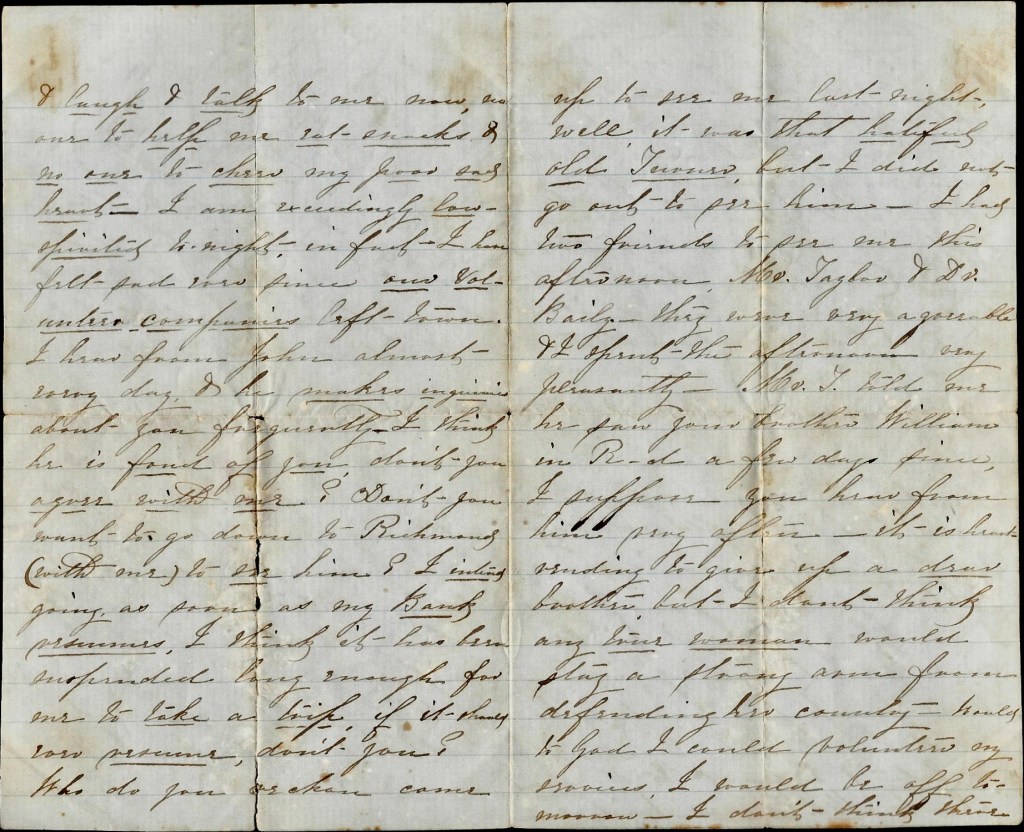
Scarcely a day has passed since the reception of your kind, dear, missive in which I have not intended to devote one or more of its golden hours in sweet communion with thee, my beloved friend. But various things have conflicted with my plans. Consequently, hope you will forgive my delay. Dear friend, you have no idea how much I have missed you since your exit, & do, if you please, make haste & come back. I have no one to come in my room & laugh & talk to me now—no one to help me eat snacks and no one to cheer my poor sad heart.
I am exceedingly low spirited tonight. In fact, I have felt sad ever since our volunteer companies left town. I hear from John almost every day & he makes inquiries about you frequently. I think he is fond of you. Don’t you agree with me? Don’t you want to go down to Richmond (with me) to see him? I intend to go as soon as my Bank resumes. I think it has been suspended long enough for me to take a trip if it should ever resume, don’t you?
Who do you reckon came up to see me last night? Well, it was that hateful old Turner, but I did not go out to see him. I had two friends to see me this afternoon—Mr. Taylor and Dr. Baily. They were very agreeable & I spent the afternoon very pleasantly. Mr. Taylor told me he saw your brother William in Richmond a few days since. I suppose you hear from him very often. It is heart-wrenching to give up a true brother. But I don’t think any true woman would stay a strong arm from defending his country. Would to God I could volunteer my services. I would be off tomorrow. I don’t think there are enough gentlemen [left] in Danville to protect the ladies so I will have to stay at home & be Capt.
Mollie Vaughan has left town. She came to see Mr. Vry frequently after you left. Sallie Law has been suffering very much with her bosom (breast) for the last two days. Dr. Green lanced it today & she is much better. She grieves Bob’s absence much better than I expected. Sister Mary don’t do much else than cry about Sam’s being absent. He came up Saturday to see her, but left yesterday.
My friend George is now at West Point. Poor fellow. I am fearful we shall never see him again. Well my paper is out so I must conclude & besides, it is late & I want to dream about Mr. Turner. Write soon.
Farewell, dear friend, & may God bless & protect you is the wish & prayer of your devoted & affectionate friend, — Fannie
[Frances Walthall, sister of Lindsey B. Walthall]
This is the meanest pen I ever wrote with. If you can’t read this writing, you must guess at it.
P. S. Remember me very affectionately to Nannie & Mary [Overton]. Excuse this hastily written letter. I am sitting with my gown and I am fearful it will make “Poor little me” sick if I don’t write in haste. Good night. I did not write you half I intended to write but will do better next time.
Letter 3
[The following letter was written by Richard H. Phillips (b. 1832), the son of Joseph Phillips, 1800-1870) and his wife Louisa D. (last name not known but possibly Overton?) of Prince Edward county, Virginia. Richard was the oldest of at least six children.]
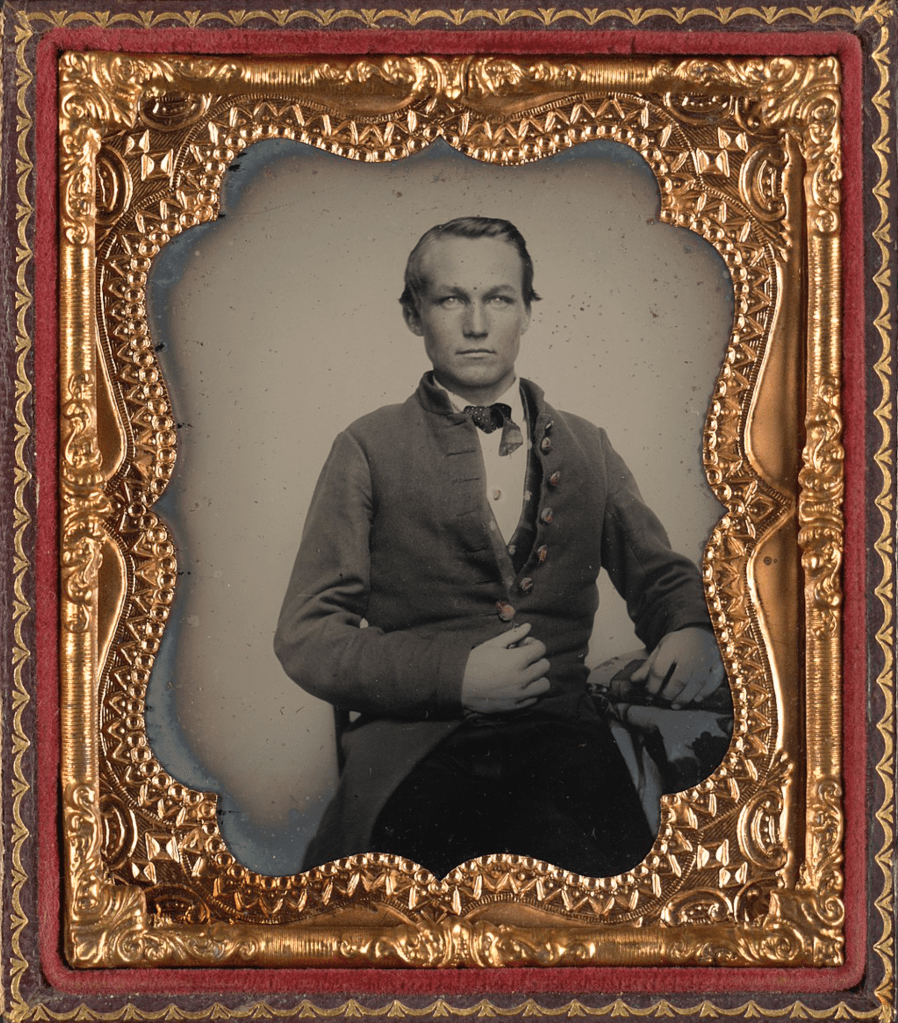
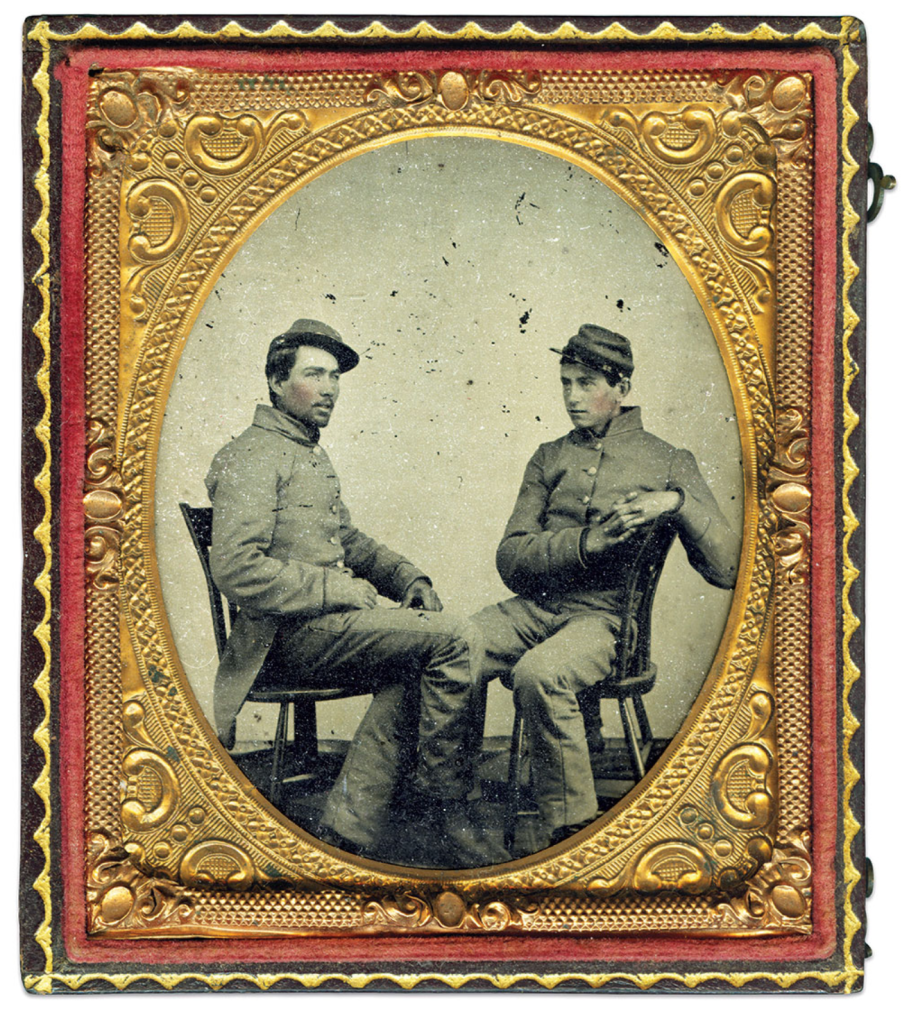
Unidentified soldier in Confederate uniform with state of Virginia buttons (LOC)
Yorktown [Virginia] May 27, 1861
Dear Cousin [Suzie],
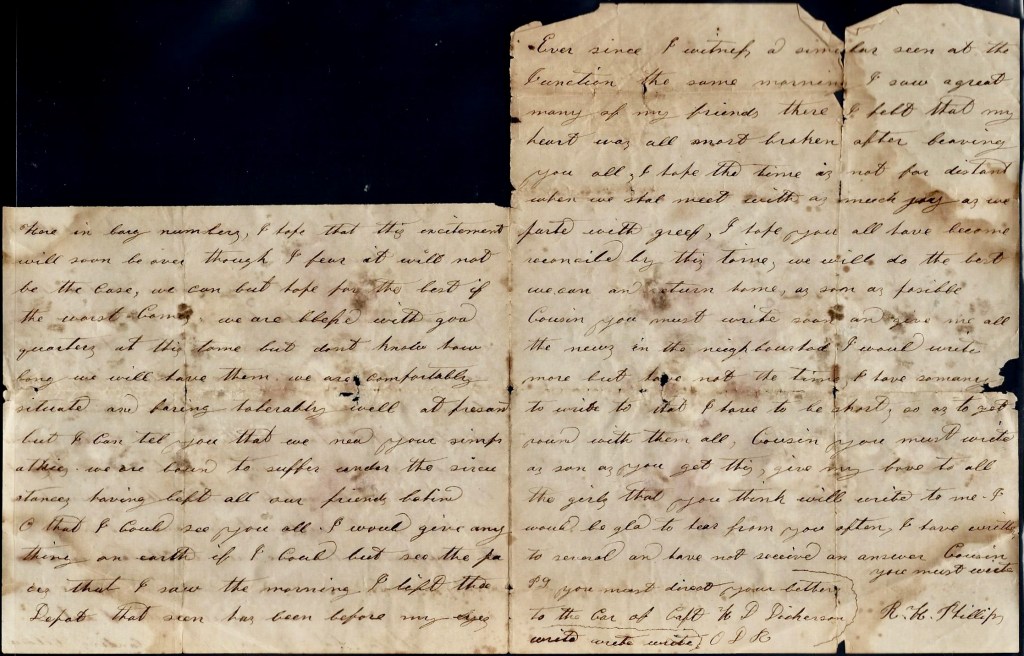
I am anxious to hear from you and will write to you hoping that you will not hesitate to answer this when you receive it. I should have written to you before now, but circumstances would not admit of it. I have nothing that will interest you. We are spending the time as pleasantly as could be expected under the circumstances. We have great excitement in camp at present. It is supposed that we will be attacked in a short time. I would not be surprised if we were attacked tonight. We are all called out tonight. It said that Lincoln’s men is landing below here in large numbers. I hope that the excitement will soon be over though I fear it will not be the case. We can but hope for the best [even] if the worst comes. 1
“I would not be surprised if we were attacked tonight. We are all called out tonight. It said that Lincoln’s men is landing below here in large numbers. I hope that the excitement will soon be over though I fear it will not be the case. We can but hope for the best [even] if the worst comes.”
— Lt. Richard H. Phillips, Old Dominion Riflemen, 27 May 1861
We are blessed with good quarters at this time but don’t know how long we will have them. We are comfortably situated and faring tolerably well at present but I can tell you that we need your sympathy. We are bound to suffer under the circumstances, having left all our friends behind. Oh that I could see you all. I would give anything on earth if I could but see the faces that I saw the morning I left the depot. That scene has been before my eyes ever since I witnessed a similar scene at the [Burkeville] Junction the same morning. I saw a great many of my friends there. I felt that my heart was almost broken after leaving you all. I hope the time is not far distant when we shall meet with as much joy as we parted with grief. I hope you all have become reconciled by this time. We will do the best we can and return home as soon as possible.
Cousin, you must write soon and give me all the news in the neighborhood. I would write more but have not the time. I have so many to write to that I have to be short so as to get round with them all. Cousin, you must write as soon as you get this. Give my love to all the girls that you think will write to me. I would be glad to hear from you often. I have written to several and have not received an answer. Cousin you must write. — R. H. Phillips
P. S. You must direct your letters to the care of Capt. H. D. Dickerson, ODR 2
Write, write, write.
1 By the end of May 1861, nearly 4,500 officers and men under the command of Major General Benjamin F. Butler had been transferred to Fortress Monroe for its defense.
2Capt. Henry D. Dickerson put together a company in May 1861 known as the Old Dominion Riflemen (“ODR”). This Company joined Major Edgar B Montague’s Battalion of Virginia Infantry. This Battalion had only three Companies; A – Halifax Light Infantry, B – Chatham Grays and C – Old Dominion Riflemen and was accepted into Confederate service on 1 July 1861. The Battalion was assigned temporarily to the 32nd Virginia Infantry and saw action at Big Bethel Church during the Peninsula fighting during June 1861, this was possibly the first land battle of the Civil War. During Nov. 1861 the Battalion was reassigned to the 53rd Virginia Volunteer Infantry per Special Order #214 from the A&IGO. The 53rd consolidated Fort Grafton in York County, VA then moved to Kings Mill Wharf just below Jamestown, VA. They then moved to Sandy Cross, Gates County, NC by rail in April 1862. In May 5 1862 it was in Suffolk County, VA and only 35 miles from the Battle of Williamsburg. The 53rd held elections on May 5th and at this time Capt. Henry D. Dickerson and other officers, including 2Lt Richard H. Phillips, lost the election. Capt. Dickerson and Lt. Phillips retired at this time.” [Civil War Talk, 21 August 2009]
Letter 4
[The following letter was written by Richard H. Phillips (b. 1832), the son of Joseph Phillips, 1800-1870) and his wife Louisa D. (last name not known but possibly Overton?) of Prince Edward county, Virginia. Richard was the oldest of at least six children.]
Williamsburg [Virginia] June 24th 1861
Dear Cousin [M. S. Overton],
I am indebted to you a letter and should have written to you before now but having nothing that I thought would interest you—therefore would not write hoping I would get something by the time that would be worth your attention but have not. I am sorry you have taken up an idea that I had become offended at something you wrote in your last letter. I can assure you that far from that, I was more than pleased to receive a letter from you and was glad to find that you were interested enough in my welfare to give me advice upon an important subject as you did. I return my heartfelt thanks to you for your kindness. Cousin, the advice you gave me affected me more than anything that I have seen or heard since I left home. The idea of your thinking that I had become offended with you is out [of] the question, when I think that you are one of my best friends.
I correspond with a good many and can’t get round very quick. I would like to write to all of my friends but have not time. Therefore I write to those that I think most of. You will scold me for putting off writing so long and then write nothing worth your attention.
Our company is stationed in one mile of Williamsburg. I like the place very much. I have been fortunate since I got here. I have had the pleasure of seeing a great many ladies since I got here and have formed some acquaintances among them. I find the ladies here very kind. They appear to be willing to do anything that is in their power. They have been working for the soldiers at the different churches. I enjoyed myself very well with them. I had a little work that I wanted them to do that made me feel free and easy with them. I was not acquainted with any of them but they showed a disposition to get acquainted. Therefore, I did not hold back. Some of them were tolerably fast, so I did not hold back at all. You may guess I engaged myself very well as I am fond of ladies company.
We are all well except those that have the measles. They are all improving. I hope they will be fit for duty soon. Cousin, you must make those militia boys come down and join our company if you can so as to get them…[unfinished letter]
[—Cousin Richard H. Phillips, Old Dominion Riflemen]
Letter 5
[The following letter was written by Richard H. Phillips (b. 1832), the son of Joseph Phillips, 1800-1870) and his wife Louisa D. (last name not known but possibly Overton?) of Prince Edward county, Virginia. Richard was the oldest of at least six children.]
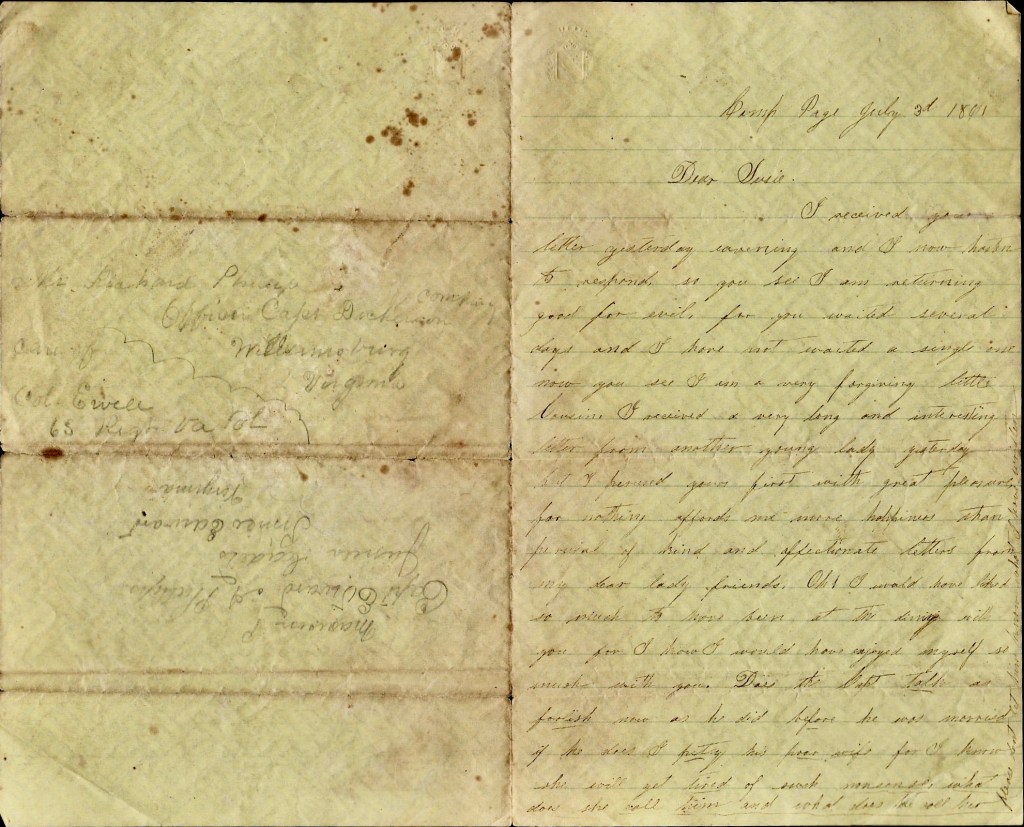
Camp Page 1 [Williamsburg, Virginia] July 3rd 1861
Dear Susie,
I received your letter yesterday evening and I now hasten to respond so you see I am returning good for evil, for you waited several days and I have not waited a single one. Now you see I am a very forgiving little cousin.
I received a very long and interesting letter from another young lady yesterday but I perused yours first with great pleasure, for nothing affords me more happiness than perusal of kind and affectionate letters from my dear lady friends. Oh! I would have liked so much to have been at the dining with you for oh how I would have enjoyed myself so much with you. Does the Capt. talk as foolish now as he did before he was married? If he does, I pity his poor wife for I know she will get tired of such nonsense. What does she call him and what does he call her?
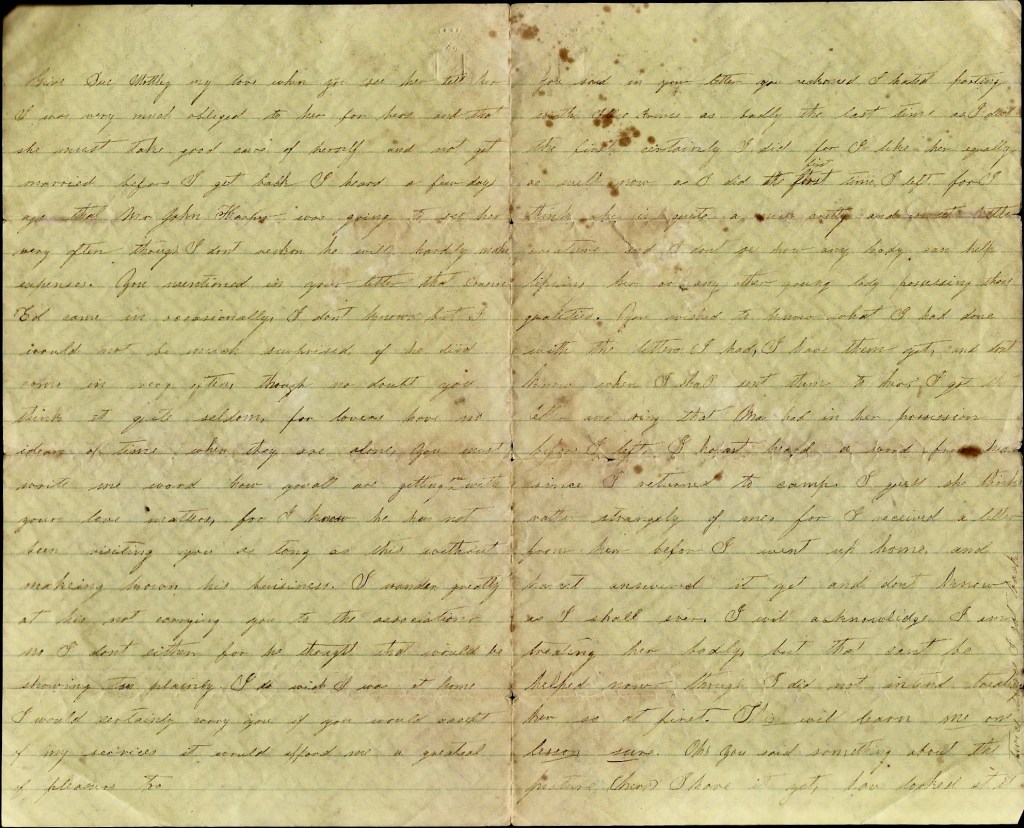
Give Sue Mottley my love when you see her. Tell her I was very much obliged to her for hers and that she must take good care of herself and not get married before I get back. I heard a few days ago that Mr. John Harper was going to see her very often though I don’t reckon he will hardly make expenses.
You mentioned in your letter that Cousin Ed came in occasionally. I don’t know but I would not be much surprised if he didn’t come in very often though no doubt you think it quite seldom for lovers have no idea of time when they are alone. You must write me word how you all are getting on with your love matters for I know he has not been visiting you as long as this without making known his business. I wonder greatly at his not carrying you to the associations. No I don’t either, for he thought that would be showing too plainly. I do wish I was at home. I would certainly carry you, if you would accept of my services. It would afford me the greatest of pleasure too.
You said in your letter you reckoned I hated parting with Alice Arends as badly the last time as I did the first. Certainly I did for I liked her equally as well now as I did the first time I left, for I think she is quite a nice, pretty, and sweet little creation, and I don’t see how anybody can help liking her or any other young lady possessing those qualities. You wished to know what I had done with the letters I had. I have them yet and don’t know when I shall send them to her. I got the letter and ring that Ma had in her possession before I left. I haven’t heard a word from her since I returned to camp. I guess she thinks rather strangely of me for I received a letter from her before I went up home and haven’t answered it yet, and don’t know as I shall ever. I will acknowledge I am treating her badly, but that can’t be helped now, though I did not intend treating her so at first. This will learn me one lesson sure. Oh, you said something about the picture (hers). I have it yet. Have looked at it twice since I got back. Please don’t let her know what I have written.
— Mr. Richard H. Phillips, Capt. [Henry D.] Dickerson’s Company, Williamsburg Virginia
Capt. Edward A Phillips Junior Cadets, Prince Edward, Virginia
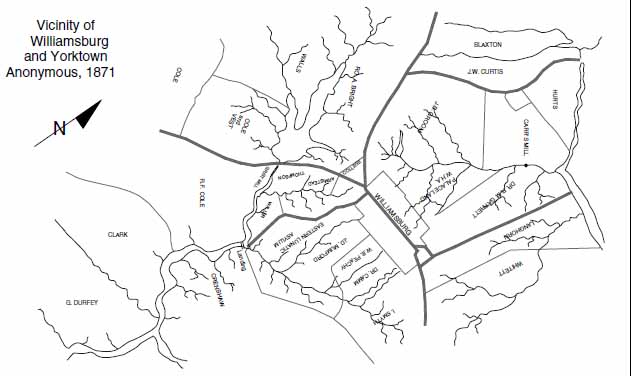
1 According to an account by Colonel Benjamin Stoddert Ewell, the Williamsburg Junior Guard had a training field on Capitol Landing Road that they called Camp Page. Land ownership patterns suggest that it was located on the west side of Capitol Landing Road on property that in 1871 belonged to Dr. R. M. Garrett (Chapman 1984:125, 127-132; Anonymous 1871)
Letter 6
[The following letter was written by Richard H. Phillips (b. 1832), the son of Joseph Phillips, 1800-1870) and his wife Louisa D. (last name not known but possibly Overton?) of Prince Edward county, Virginia. Richard was the oldest of at least six children.]
Camp Page [near Williamsburg, Virginia] July 22, 1861
Dear Suzie,
I think it is getting high time I was replying to your letter received some time since though we have seen each other since. Yet I hold the obligation good and I will transfer it to you. My visit among you all was more than satisfactory and has enabled since my return to my duties to perform them much more cheerfully than I otherwise would. I have been talking and telling the news ever since my return. Several of the boys enquired very particularly about you. You just ought to have sen Dick when I was telling of the pleasant moments spent with you while on my visit to my friends and relatives. They give me reflection which must soothe my mind here among the clang of warlike operations.
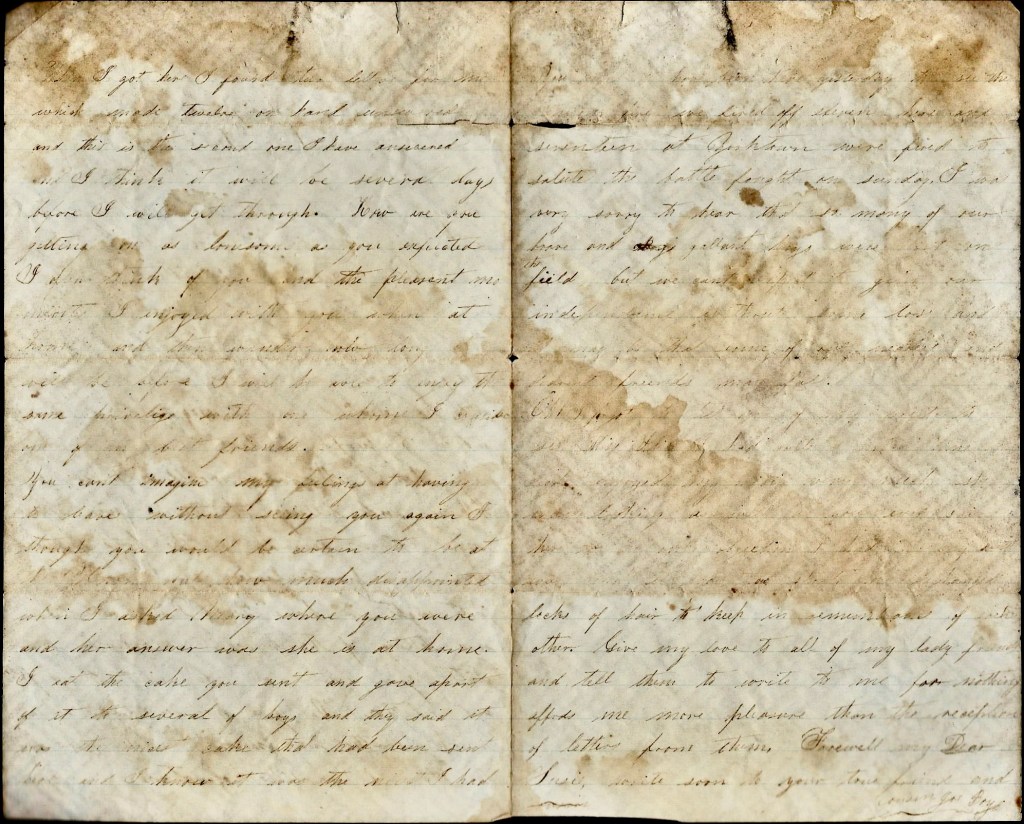
When I got here I found two letters for me which made twelve on hand unanswered and this is the second one I have answered and I think it will be several days before I will get through. How are you getting on? As lonesome as you expected? I often think of you and the pleasant moments I enjoyed with you when at home and then wonder how long it will be before I will be able to enjoy the same privilege with one whom I consider one of my best friends.
You can’t imagine my feelings at having to leave without seeing you again. I thought you would be certain to be at the train but how much disappointed when I asked Mary where you were and her answer was, “she is at home.” I eat the cake you sent and gave a part of it to several of the boys and they said it was the nicest cake that had been sent here and I know it was the nicest I had.
You should have been here yesterday to see the cannon fire. We fired off eleven here and seventeen at Yorktown were fired to salute the battle fought on Sunday [at Manassas]. I was very sorry to hear that so many of our brave and gallant boys were left on the field but we can’t expect to gain our independence without some loss and it may be that some of our nearest and dearest friends may fall.
Oh! I forgot to tell you of my visit to see Miss [illegible]…enjoyed my visit very well. She was looking as sweet as you ever saw her and the only objection I had was [illegible]…locks of hair to keep in remembrance of each other.
Give my love to all of my lady friends and tell them to write to me for nothing affords me more pleasure than the reception of letters from them. Farewell my dear Suzie. Write soon to your true friend and cousin, — Jos. Boys
Letter 7
[Late July or early August 1861?]
….You said you wanted I should write you long letters when I wrote. I will try my best this time, but I am afraid it [will] prove void of interest for I haven’t any news to write at all. Haven’t been anywhere or heard anything that would interest you. I reckon I think of the pleasant moments spent with you at Pa’s as often as you do and perhaps oftener. I hope it may be my privilege soon to enjoy some equally as pleasant [as] those.
Well, Dr. Owen 1 has left us. He left last Monday. Said he was going to his Pa’s and from there to Manassas. Then he was coming back to our neighborhood and stay a few days and then return to camp again, but I don’t much expect him back for I think he got pretty tired of camp life before he left. He told me about writing to Susan. Said if he had thought of it, he would have shown me the letter before he sealed it. We had lots of fun with him while he was here. Dick, Rich, and your brother William all send their love to you. Dick says he wrote to you a few days ago. You must write me word how you and Dick are getting on for he won’t tell me a single word, or let me see your letters either so I guess there must be some secrets in them.
I had my picture taken in Petersburg as I came on down here. It is not a very good one but if you will accept of it, you are perfectly welcome to it. I will send it by the first passing. I would like to have yours very much. Will think as much of it as anybody except [ ]. Mine is in a very small case and just about as black as the one you now have.
Well, I believe I have written you all the news I have at this time or almost all I can think of. Give my love to your Mother and Mary, and accept a large portion for yourself. Be sure and answer this soon. Don’t show my letters to any lady at all, for if you do, I will certainly find it out. I don’t show yours. Goodby, Susie
From your fond cousin, — J. Boy
P. S. I have concluded since I finished my letter to send the picture by mail with the letter, as we have just received orders to hold ourselves in readiness to march at a moment’s warning and don’t know when I shall have an opportunity to send at privilege. I think I have done mighty smart. Have written about six pages to you and have fixed my picture up too for my dear little cousin Susie. — J. Boy.”
1 Christian David Owens, Surgeon 1st Virginia Cavalry
Letter 8
[The following letter was written by Richard H. Phillips (b. 1832), the son of Joseph Phillips, 1800-1870) and his wife Louisa D. (last name not known but possibly Overton?) of Prince Edward county, Virginia. Richard was the oldest of at least six children.]
Camp Page [near Williamsburg, Virginia] August 16th [1861]
My Dear Susie,
I received your long looked for and interesting letter this evening. Will now make a faint attempt to answer it though I am afraid it will prove void of all interest as I have not heard any news since I wrote to you last. I had almost given out ever getting an answer to mine. Was thinking perhaps it was lost and you had never received it or that you did not intend making me any reply at all, but under the circumstances I can’t think anything of it or at least I will not as I know you to be such a good little creature. Enough of this.
I went to preaching twice last Sunday. Dr. McCabe preached in the morning and Dr. Young in the evening. The latter is much the best preacher. I think he is a Baptist and Dr. McCabe an Episcopalian. We went to the Georgia camp to preaching in the afternoon and there were more of our company there than there were of the whole regiment. Don’t you think that speaks well for us? We also had a great sermon last night from Mr. Witt and he complimented us very highly indeed and I believe brought tears from almost every one of us for he spoke very touching in winding up—called us all “his boys” and wondered if he should ever meet us all again under similar circumstances. He said he thought we had been greatly blessed since we left our homes and friends—more so than any other company he knew of.
You said you had a very lonesome time at the association. I wonder at that as your cousin Ed was there. I did not think he would let you get so while he was there. You seemed to think if I had been there you would have enjoyed yourself a great deal more provided my beloved was not there and if so you didn’t think I would notice you at all. Well, if you think so, I can’t help this.
I was very sorry to hear you could not have your picture taken for me for I would like very much to have [it and] would prize it very highly. You said you reckoned the young [lady] that I alluded to in your last whose picture that I would prize more highly than yours was one by the name of Alice. Perhaps she may, but I will leave that to you to find out. Dick sends his love to you. Says he has a great mind to stop writing altogether to all his correspondents. It is because he doesn’t receive letters as often as he thinks he ought from Anna, I reckon. He has written to her twice since I have been here and hasn’t gotten an answer to either of them yet. I don’t know why though she hasn’t written…. [unsigned]
Letter 9
[The following letter was written by Richard H. Phillips (b. 1832), the son of Joseph Phillips, 1800-1870) and his wife Louisa D. (last name not known but possibly Overton?) of Prince Edward county, Virginia. Richard was the oldest of at least six children.]
Camp Page near Williams[burg, Va,] August 21st 1861
My Dear Susie,
I received your very dear and interesting letter yesterday and will now try and answer it tonight as I will have to be on guard duty tomorrow and will not have time to write and I can’t think of waiting longer to write in reply to your kind letter as you are so punctual in writing. You are the only lady that I have received a letter from for two or three weeks except Cousin Jennie Branch. I received one from her a few days ago. She said as she had not received an answer to the last letter she wrote me (which was about two months ago), that she had come to the conclusion that perhaps I had not received it and under the impression she had at last come to the conclusion to write again, and she said if I did receive the other one, that I must forgive her for writing the last and let it pass by unnoticed and let her know if I ever received her letter. I haven’t written to her yet and don’t know when I shall, though I know I ought to have written to her before now. I feel very badly about it very often for I know I have treated her as I ought not to have. Well, enough about this affair.
I would like very much to come up home and spend a few days with you all and go to one of the society meetings. I think I could have some fun there if I could just get up there for a short time—especially if [I] could just ride out with you [on] horseback occasionally.
I went down to Williamsburg to preaching last Sunday and what do you think—I went to sleep as soon as I sat down and slept the whole time the man was preaching. But that was because I had just come off of duty and had not slept any since the night before so I think I was excusable for it.
You wished to know what I meant when I told you you must not be too sure that Ed might fool you. Cousin, I didn’t want you to think for a moment that I thought he would jest or flirt with you in earnest for I don’t think he would. And another thing, I don’t think you would let him. You seemed to think I was displeased at something that you wrote me in your last letter—certainly not. My dear cousin, you have never written anything I could get offended at. And another thing is I am not one of the sort to be watching and itching at every little thing I see and hear—to be making something of nothing. I am always willing to look on the bright side of everything so you need never be afraid of my getting offended or displeased at anything that you will write for I know you don’t mean any harm in anything that you say or do, or at least I don’t reckon you do.
Dick says I must give you his best love and tell you he has stopped writing to every[one], but if he ever writes to any”
[— Mr. Richard H. Phillips, Capt. [Henry D.] Dickerson’s Company, Williamsburg Virginia]
Letter 10
The High Bridge conveying the South Side Railroad across the broad seeping valley of the Appomattox River east of Farmville, Va.
[uncertain author]
Farmville, Virginia December 5th, 1862
My Dear Susie,
I received your kind this week in which you asked me to go to Lockett’s 1 and get you one quire of letter paper and ten stamps. I send you the stamps and one quire of the best paper which is to be had in Farmville. I did not want to get you blue paper but it was the very best I could do. I send you five sheets of nice white paper. You must write to your beau on them if you have one and if not, you can write to who you please. I got the paper and stamps at Mr. Lockett’s. Hope they will suit you.
Well, Martha Sue, how do you manage to keep warm this chilly, cold snowy night. I can well imagine you all drawn around a warm fore in Aunt Martha’s room and she sitting in the corner smoking her pipe. I often wish that I could be with you all sometimes. I reckon you have scolded me before this for not writing to you sooner but the days are so short I scarcely have tome to write much of a letter after school before night come on and then I have to prepare my lessons for the next day. Surely your friends and Luchie must be married or she would have answered my letter before this. I wrote to her sometime before I wrote to you the first time and she has not answered my letter yet.
Sue Motley was in town yesterday. She bought her two winter calicoes at 150 cents a yard. I think if I was in her place, I would have given a little more and gotten something nicer than a calico while I was getting. What sort of a Christmas do you expect to spend? I have not decided yet whether or not to go home. I think you and I both had better get in the bed and sleep the whole week of Christmas out. Has your school broken up yet? You did not say anything about her in your last letter, or first either.
I saw Mrs. Farley 2 yesterday evening. I have not been to see her yet, nor do I expect to as long as she stays at a hospital. She begs me to visit her every time she sees me. Mr. Elijah Baker is going to be married next Wednesday evening [10 December 1862] at four o’clock to Miss Rhoda Harvey of Richmond. 3 I reckon you have seen Mr. Baker. He lives at Walton’s store.
Martha Susan, I send you a few pieces of music and if you have the words to “The Cottage by the Sea,” please…”
1 Christopher Columbus Lockett (1815-1870) was a merchant in Farmville, Prince Edward county, Virginia.When he died in 1870, townfolk called him “one of our oldest and best citizens.” He was for more than twenty years a leading merchant in Farmville—“a good citizen, a kind parent, an affectionate husband and a conscientious christian.”
2 Mrs. Farley was identified as the Chief Matron at the Farmville General Hospital from 1 January 1864 to 1 January 1865. Source: Confederate Matrons—Women who served in Virginia Civil War Hospitals by A. Elise Allison, 1998, page 62.
3 Elijah Fuqua Baker (1837-1892) was the son of William Price Baker (1802-1860) and Maccarina Barksdale Harvey (1804-1884) of Farmville, Prince Edward county, Virginia. He was married to Rhoda E. Harvey (b. 1842). One source [Virginia Select Marriages] places the date of their marriage on 18 February 1863 instead of the 10 December 1862 date stated in the letter. It may be the couple had to quickly wed as Rhoda gave birth to her first child, William Abner Baker on 21 December 1862.
Letter 11
[Nannie Overton to Susie Overton]
[Amelia county, Virginia?] June 24th, 63
Dear Martha,
I suppose you all would like to hear something from me so I thought I would try and write a few lines home this evening. Cousin Toody has been quite sick for a fortnight—confined to her bed all the time and Dr. comes to see her once a day. She is strongly threatened with the typhoid fever but I think she is better this morning. I have to keep house and doing something of most everything. Have as much as I can stand too. Cousin Toody says I came in very good time. They also have the mumps in the family, but no one has it at this time. I expect I shall have it soon.
Has Jimmie gone to his company? If he has, does he ever write to any of you. I heard from my friend & you know who last week. He was well but has to be on the march all the time. He was [with Lee’s army] in or near Pennsylvania at the time he wrote. Someone is all the time coming in here. Have a great deal of company since she has been sick.
Have you found my Guineas nest yet? I wish you would find it and set the eggs. Cousin M. has a great many chickens and 46 turkeys. How many chickens have you? I don’t get much chance to do sewing. Haven’t done any work hardly since I left home. I feel very unwell this morning myself. You know I left off my gown before I left home. I took a violent cold from it and had to put them on again. So I shall have to buy me some cloth soon or at least to make me some as I have none but nice ones [and] I do not like to wear them.
Cousin M. said she thought you were coming home to see her. Says she thinks you all might come down once [ ] at least. My bonnet is very much adored down here. They say it is the prettiest one in the neighborhood. Write to me soon as you get this and all the news. Tell Mary and sister to write also. How is Aunt Lou Overton? All send love. My love to Mother and Mary and tell Mary she must write. I must close as I am in a hurry. My love to Beck Farley and all hers. I saw Mrs. Gills and Bettie Sunday. They were well. I haven’t been anywhere since I have been here, as I am so closely confined now, but I hope it will not be so long, for I hope cousin will be well soon. Have you all had beets and potatoes? We have them every day and chicken all the time. Mr. Whitlock says he thinks I will make a very good housekeeper. They broke into his smoke house not long [ago] and took three or four hundred pounds of meat and some ice.
Your sister, —Nannie [Nancy Overton]
Be sure to write soon. Burn this letter.
Letter 12
[Amelia county, Virginia] August 13th 1863
Dear Susie,
It has been a week today since I received your long long looked-for letter. I had come to the conclusion that you did not intend to write again. Perhaps you are thinking the same about me. Well, I would of written before but I have been busy making myself a dress. I finished it yesterday.
I guess you will be surprised when I tell you that I have not been to Nottoway yet. I thought I would have been there two weeks ago but I could not possibly get ready and now I am nearly ready. I will not go until I find out whether Uncle Charlie has to go in the army or not. So you see I am bothered on all sides. I doubt whether I go there at all. I would like so much to go to [see] cousin Eugenia and Ada is up now. Sister gave your note to Johnny last Thursday. I guess by that time you have got it as he goes to see you every day so I am sorry you did not enjoy yourself when you were here last. I was in so much trouble that I could not be at all agreeable. I am getting over my trouble a little. You have no idea how much trouble I have seen since I saw you. I almost wish sometimes I was hearing of some of some of the people around here. Perhaps I will be some of these days.
Fannie Walthall came to see us once while she was staying with Alice. They got here about dark and left about ten o’clock that night. Four gentlemen were with them. We would of gone to see her but the horses were busy all the time she was there. Some people down this way think Fannie quite pretty. John S. told me that you showed him your foot when in Farmville and that you said I would do the same. I told him I never show my feet to gentlemen.
I havent had peas but once. That was yesterday. We have had some time watermelons &c. Also sister and the children are eating a watermelon now. I have had a few very nice peaches—some that Cousin Joe brought me. I reckon you have had them plentiful. I have not been from home but once since you were here. I staid at Mr. Farley’s a week. Cousin Joe and Cousin Jimmie came to see us while we were there. The rain caught them and they had to stay all night but I did not talk as loud as I did when Johnny was there. I had a jolly time with them.
Miss Lightfoot—the one that was at Mr. Walthall’s—is teaching at Mr. Tom Webster’s. She commenced her school last week. I heard Fannie intended going to Mr. [Elihu] Morrisette. 1 I am sorry your pigeons got out. I would like so much for you to have them. I would make my beau Johnny more accommodating if I were you. He might have carried the pigeons home for you. I don’t reckon you blame him at all as you are so desperately in love with him. Judy says she is coming with us when we come to see you but there is no telling when that will be—months before [we do] I reckon, but hope not. The Baptist school in Danville will commence the 15th of September. All new teachers. Mr. Lake president. Suppose you and I go back?
Dr. Lipscomb is a sergeant in the navy at Charleston. What do you think of that? I would not like to take medicine from him. William Henry is still in the army. I suppose you got the buttons for your wedding gown when in Farmville. If you will have it made like I want it, it will certainly be nice and pretty and will cost only $100 now. So you had better get the materials now if you expect to sew soon. I would certainly get me one like it now if I could. I never seen one made so but sister and I took of a notion, it would be pretty. If I had one hundred dollars, I think I would spend it for a gown. I will certainly have yours made when you get ready—that is, if you think Sallie can make it nice enough. Be sure to tell Mollie [Susie’s sister Mollie] to send the pattern of her handkerchief the next time you write and any others that she has. I can’t think of anything else to write, so must close. You must write soon. Don’t do as you did before, and write a long letter. This neighborhood is so dull. I never hear anything worth writing. Be sure to burn this. My best love to all and accept for yourself the most of it. Your true friend, — Mollie
1 Elihu Morrisette was born in Chesterfield county, Virginia in 1837. He graduated from William and Mary College at the age of 19 and conducted the Smithside Institute in Farmville. Served in the Farmville Guards during the Civil War and was wounded at Frazier’s Farm. He was married to Nannie Overton of Cumberland county who died in 1866.
Letter 13
Oak Grove Amelia County, Virginia March 5th 1864
My Dear Friend Susie [Overton],
A long, long time has passed since I received your letter but I have a good reason for so long a delay. I received it a day or so after getting from Petersburg. I then expected to come to see you the next week but could not get ready and I have been waiting so as to tell you when I now can come, but I cannot now say I know. You would not want me now and I would be afraid to come as we have the variola small pox here. I have not yet been exposed to it but am awfully afraid I will get it. I am currently tied at home now for a long time. I cannot go anywhere until it it all over and no one can come here. How sad to think of it. I must tell you of the pleasant time I had at the Springs on Wednesday last. You know the Amelia Cavalry had a dinner and party given them on that day. I had a delightful time. We commenced dancing in the evening and danced until about three the next morning. I missed only one set & I could hardly walk the next day. I certainly enjoyed myself. Got acquainted with several very nice gents. Several were there from your neighborhood. I saw your Brother William [Confederate Surgeon].
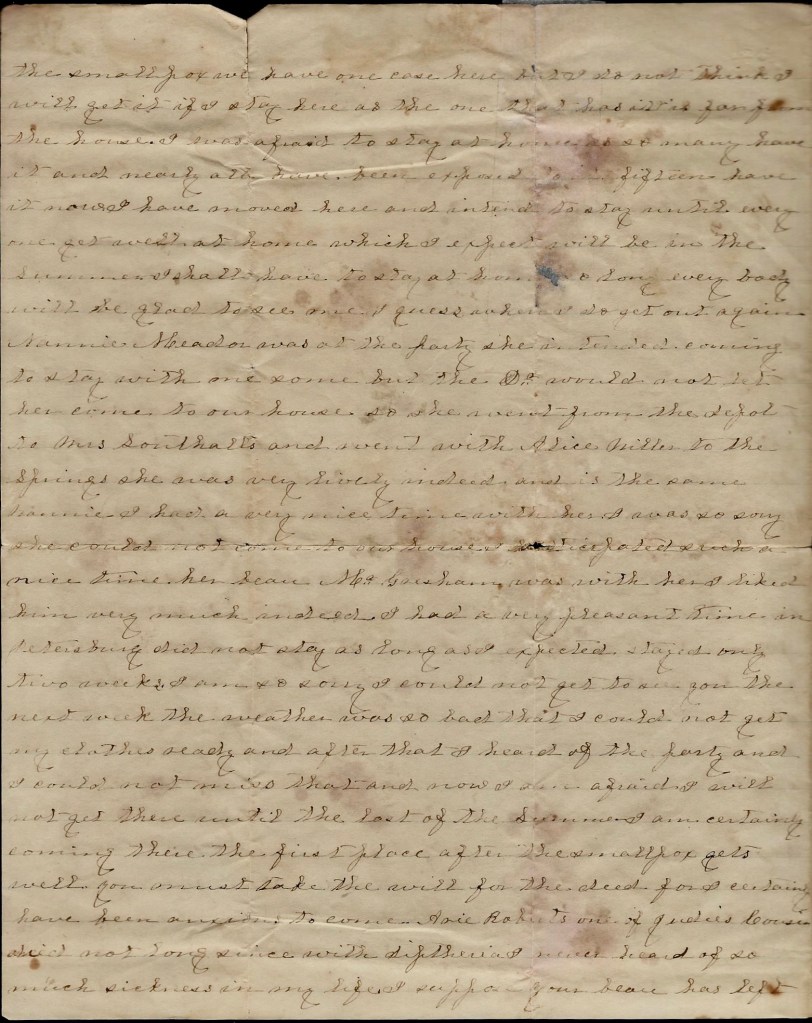
I commenced this yesterday and would of finished it but commenced to come down here (Mr. Farley’s I mean) to keep from the small pox. We have one case here but I do not think I will get it if I stay here as the one that had it is far from the house. I was afraid to stay at home as so many have it and nearly all have been exposed to it. Fifteen have it. Now I have moved here and intend to stay until everyone gets well at home which I expect will be in the summer. I shall stay at home. Soon everybody will be glad to see me I guess when I do get out again. Nannie Meador was at the party. She intended coming to stay with me some but the Dr. would not let her come to our house, so she went from the depot to Mrs. Southalls and went with Alice Miller to the Springs. She was very lively indeed and is the same Nannie. I had a very nice time with her. I was so sorry she could not come to our house. I anticipated such a nice time. Her beau Mr. Graham was with her. I liked him very much indeed.
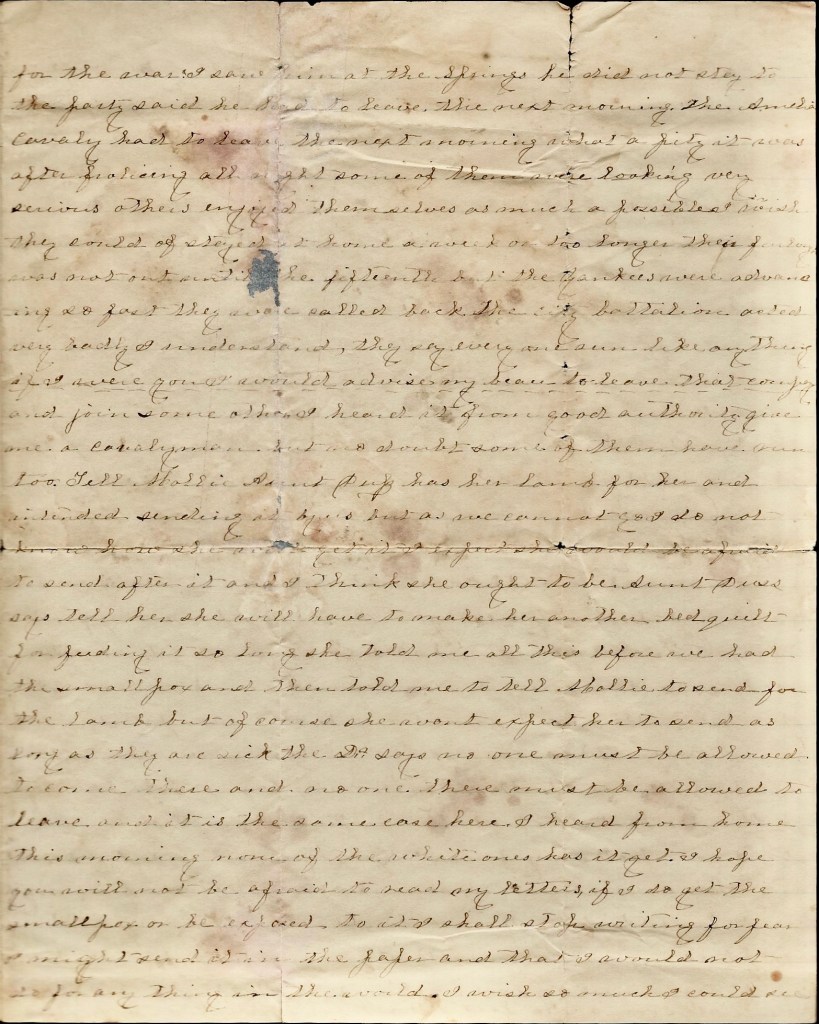
Had a very pleasant time in Petersburg. Did not stay as long as I expected. Stayed only two weeks. I am so sorry I could not get to see you. The next week the weather was so bad that I could not get my clothes ready and after that I heard of the party and I could not miss that and now I am afraid I will not get there until the last of Summer. I am certainly coming there the first place after the small pox gets well. You must take the will for the deed for I certainly have been anxious to come. Annie Roberts, one of Judie’s cousins died not long since with diphtheria. I never heard of so much sickness in my life. I suppose your beau has left for the war. I saw him at the Springs. He did not stay to the party. Said he had to leave the next morning. What a pity it was. After frolicking all night, some of them were looking very serious. Others enjoyed themselves as much as possible. I wish they could have stayed a second week or too longer. Their furlough was not out until the fifteenth but the Yankees were advancing so fast they were called back. The city battalion acted very badly & surrendered. The say everyone run like anything. If I were you I would advise my beau to leave that company and join some other. I heard it from good authority. Give me a cavalryman, but no doubt some of them have run too.
Tell Mollie [that] Aunt Duss has her lamb for her and intended sending it by us but as we cannot go, I do not know how she can get it. I expect she would be afraid to send after it and I think she ought to be. Aunt Duss says tell her she will have to make her another bed quilt for feeding it so long. She told me all this before we had the small pox and then told me to tell Mollie to send for the lamb but of course she won’t expect her to send as long as they are sick. The Dr. says no one must be allowed to come there and no must be allowed to leave and it is the same case here. I heard from home this morning. None of the white ones has it yet. I hope you will not be afraid to read my letters. If I do get the small pox or be exposed to it, I shall stop writing for fear I might send it in the paper, and that I would not do for anything in the world. I wish so much I could see you. There are so many things I can’t tell you that I cannot write. But I expect I shall forget all before I see you.
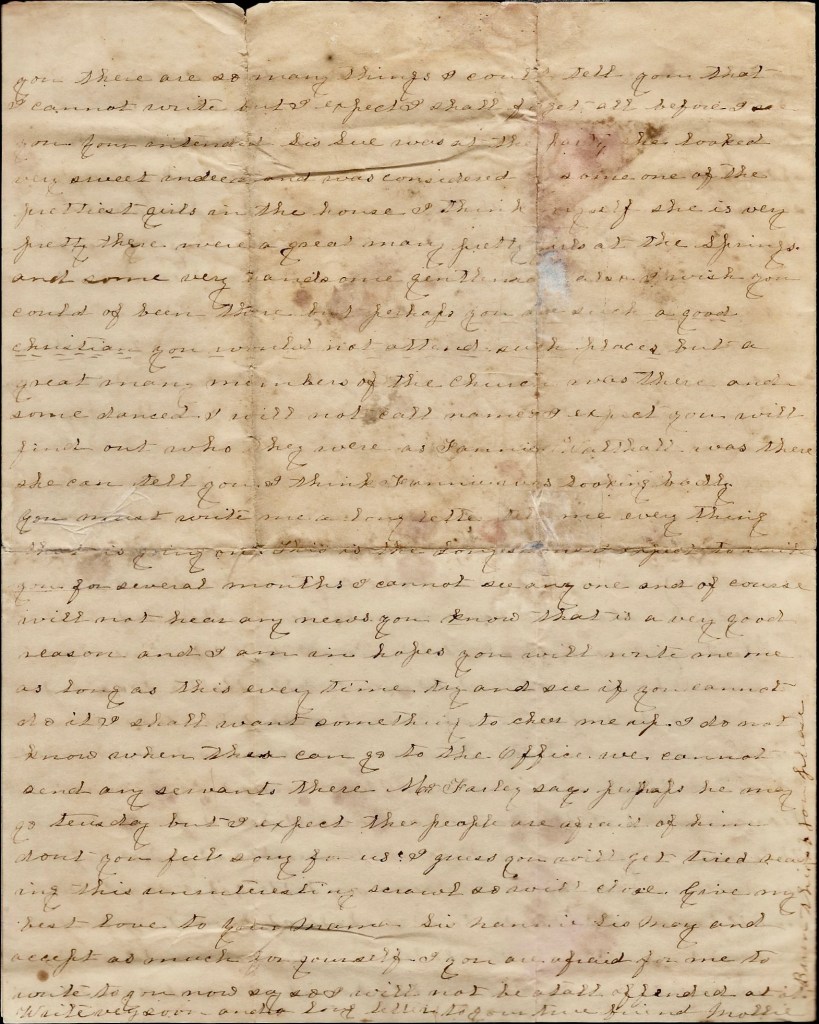
Your intended sis Sue was at the party. She looked very sweet indeed and was considered as one of the prettiest girls in the house. I think myself she is very pretty. There were a great many pretty girls at the Springs and some very handsome gentlemen also. I wish you could have been there but perhaps you are such a good Christian you would not attend such places. But a great many members of the church was there and some danced. I will not call names. I expect you will find out who they were as Fannie Walthall was there. She can tell you. Fannie was looking badly.
You must write me a long letter. Tell me everything that is going on. This is the longest one & I expect to write you for several months. I cannot see any one and of course will not hear any news. You know that is a very good reason and I am in hopes you will write me one as long as this every time. Try and see if you cannot do it & I shall want something to cheer me up. I do not know when we can go to the office. We cannot send any servants there. Mr. Farley says perhaps he may go Saturday but I expect the people are afraid of him. Don’t you feel sorry for us? I guess you will get tired reading this uninteresting scrawl so will close. Give my best love to your Mamma, Sis Nannie, Sis Mary and accept as much for yourself. If you are afraid for me to write to you now, say so & I will not be at all offended at it. Write very soon another long letter to your true friend, —Mollie
Burn this if you please.
Letter 14
[This letter was written by James (Jimmie”) Jefferson Overton (1845-1924) of Capt. Paris’ Company, Virginia Artillery (Staunton Hill Artillery— formerly Capt. Charles Bruce’s Company, Virginia Artillery). Jimmie enlisted on 11 September 1863. James was the son of John Motley Overton (1796-1869) and Loiosa Walthall (1807-@1863]. Louisa was the daughter of Branch Hall. After Louisa’s death, John took Nancy (“Nannie”) White Overton Childress, widow of James Childress as his 2nd wife. Jimmie married Sallie Jean Atkins (1849-1911) in 1870.]
Camp Bruce near Wilmington, North Carolina February 10th 1864
Dear Cousin,
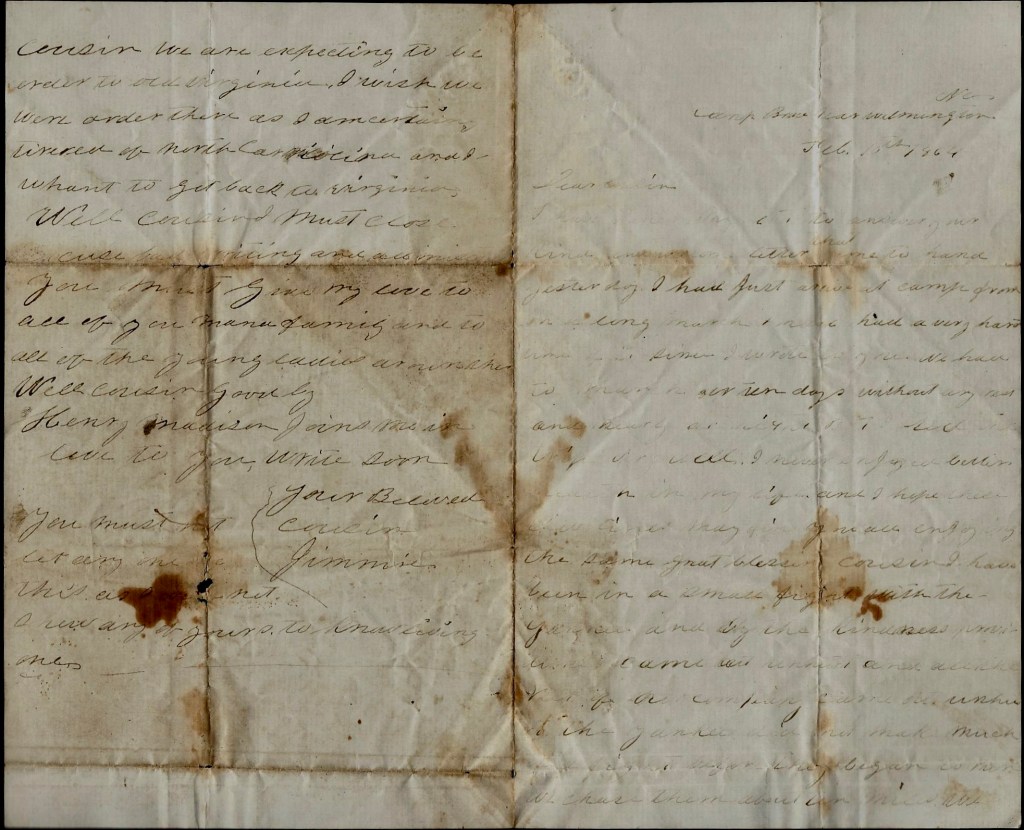
I have the privilege to answer your kind letter that came to hand yesterday. I had just arrived at camp from on a long march & have had a very hard time of it. Since I wrote to you, we have had to march for ten days without any rest and nearly all night but I did the trip very well. I never enjoyed better health in my life and I hope these few lines may find you all enjoying the same great blessing.
Cousin, I have been in a small fight with the Yankees and by the kindness of Providence came out unhurt and all the rest of our company came out unhurt . The Yankees did not make much of a fight before they began to run. We chased them about ten miles. We captured around eighty prisoners. We lost in the whole engagement about five men killed and about twenty wounded and that of the enemy was double ours. The Yankees had very fine living in their encampment and everything that heart could wish for. We got some nice eatables. I captured a very nice overcoat and some other things.
Well cousin, I will stop telling you the Yankees as I know it will not be nice reading to you. You must excuse a short letter from me as I haven’t gotten over my trip yet and I cannot get a chance to write in the daytime as the boys make so much fuss so you must excuse a badly written letter and all the mistakes.
Cousin, you wanted to know how Maggie Brassnow and myself are getting along. There is nothing between me and her no more than a friend. I have not got any sweetheart. I want you to pick me out one by the time I come home on a furlough. You must be sure to do it. Cousin, you must tell me who is your sweetheart and if you love s____ and I will tell you mine….
Cousin, I am glad that you enjoyed your Christmas so much. I am sorry to say that I had a very lonesome time of it. I went to see some young ladies the last Christmas night but I did not enjoy myself much. I am glad that you enjoyed yourself. You must not give Miss Mollie Vaughan away to no one else. You must [ ] for me. I wish it was in my power so I could come home to call on her and to have a nice time with you all.
Cousin, we are expecting to be ordered to Old Virginia. I wish we were ordered there as I am certainly tired of North Carolina and I want to get back to Virginia.
Well, cousin, I must close. Excuse bad writing and all mistakes. You must give my love to all of your Mam’s family and to all of the young ladies around there. Well, cousin, goodbye. Henry Madison joins me in love to you. Write soon. Your beloved cousin, — Jimmie [Overton]
You must not let anyone see this…
Letter 15
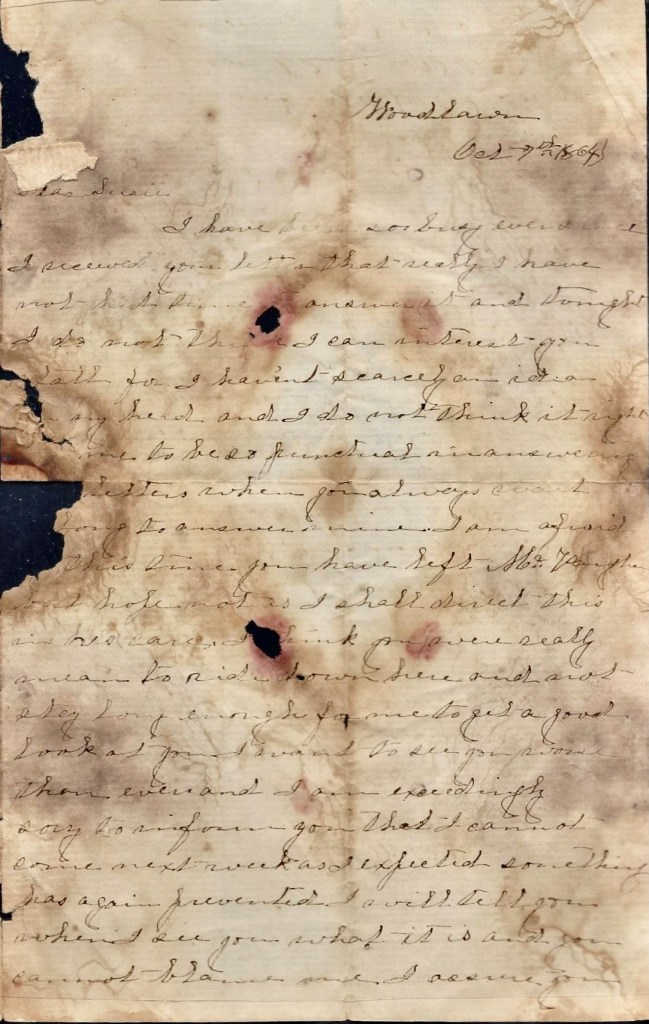
Woodlawn [Carroll County, VA] October 7th 1864
Dear Susie,
I have been so busy ever since I received your letter that really I have not had time to answer it and tonight I do not think I can interest you at all for I haven’t scarcely an idea in my head and I do not think it right [for] me to be so punctual in answering [your] letters when you always wait [so] long to answer mine. I am afraid this time you have left Mr. Vaughan but hope not as I shall direct this in his care. I think you were really mean to ride down here and not stay long enough for me to get a good look at you. I want to see you worse than ever and I am exceedingly sorry to inform you that I cannot come next week as I expect something has again prevented. I will tell you when I see you what it is and you cannot blame me. I assure you, I will be very much disappointed not coming, but I will try to come in a few weeks. I cannot set any time.
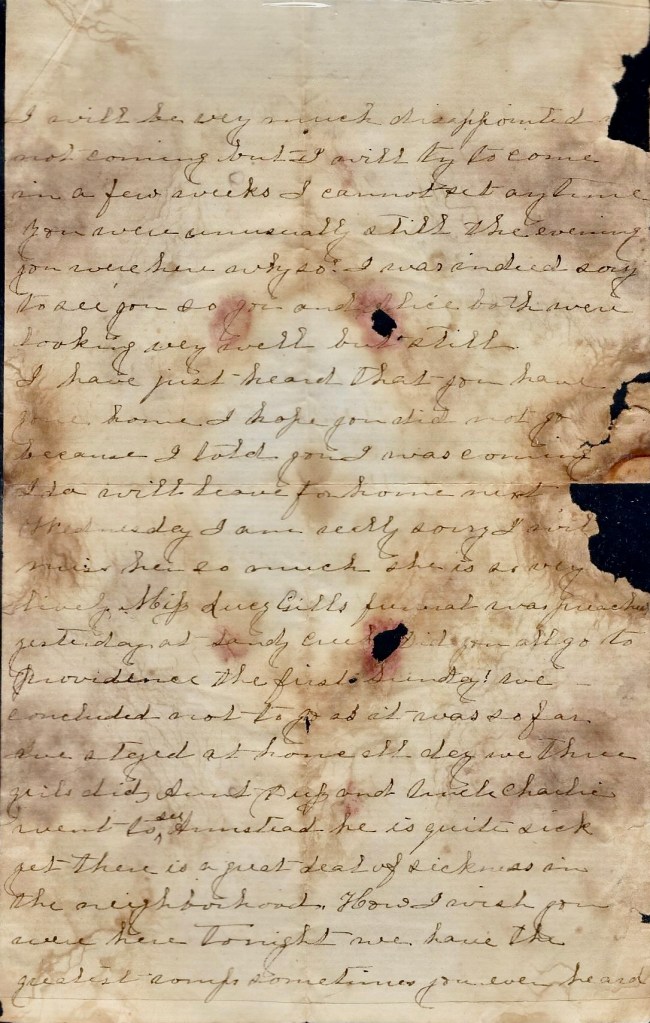
You were unusually still the evening you were here. Why so? I was indeed sorry to see you so. You and Alice both were looking very well but still I have just heard that you have gone home. I hope you did not go because I told you I was coming. Ida will leave for home next Wednesday. I am really sorry. I will miss her so much. She is so very lively. Miss Lucy Gills’ funeral was preached yesterday at Sandy Creek. Did you all go to Providence the first Sunday? We concluded not to go as it was so far. We stayed at home all day—we three girls did. Aunt Duss and Uncle Charlie went to see Armistead. He is quite sick yet. There is a great deal of sickness in the neighborhood.
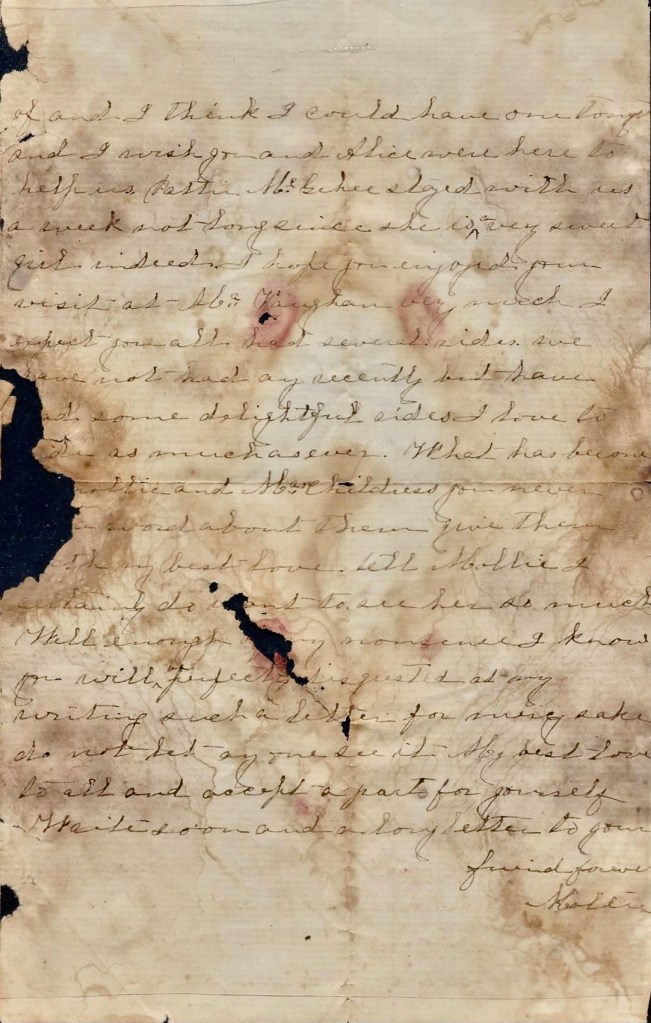
How I wish you were here tonight. We have the greatest romps sometimes you ever heard of and I think I could have one longer and I wish you and Alice were here to help us. Pattie McGehee stayed with us a week not long since. She is a very sweet girl indeed. I hope you enjoyed your visit at Mr. Vaughan very much. I expect you all had several rides. We had not had any recently but have had some delightful rides. I have to ride as much as ever. What has become of Mollie and Mr. Childress? You never said a word about them. Give them both my very best love. Tell Mollie I certainly do want to see her so much.
Well, enough of my nonsense. I know you will be perfectly disgusted at my writing such a letter. For mercy sake, do not let anyone see it. My best love to all and accept a part for yourself. Write soon and a long letter to your friend forever, — Nellie
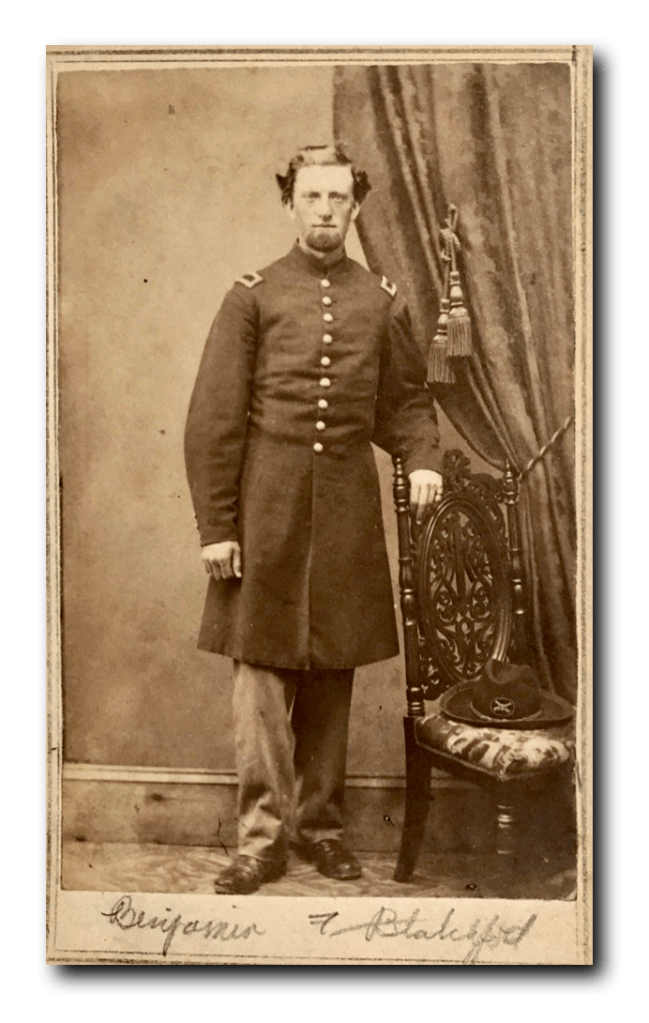
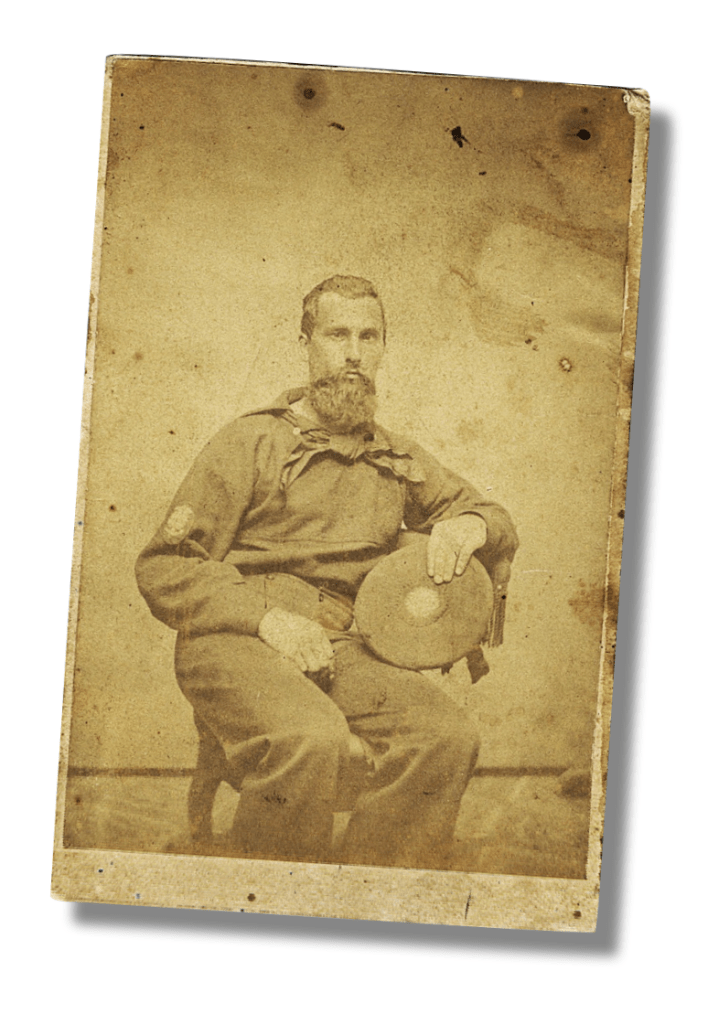
Blatchford in his Lieut. uniform later in the war.
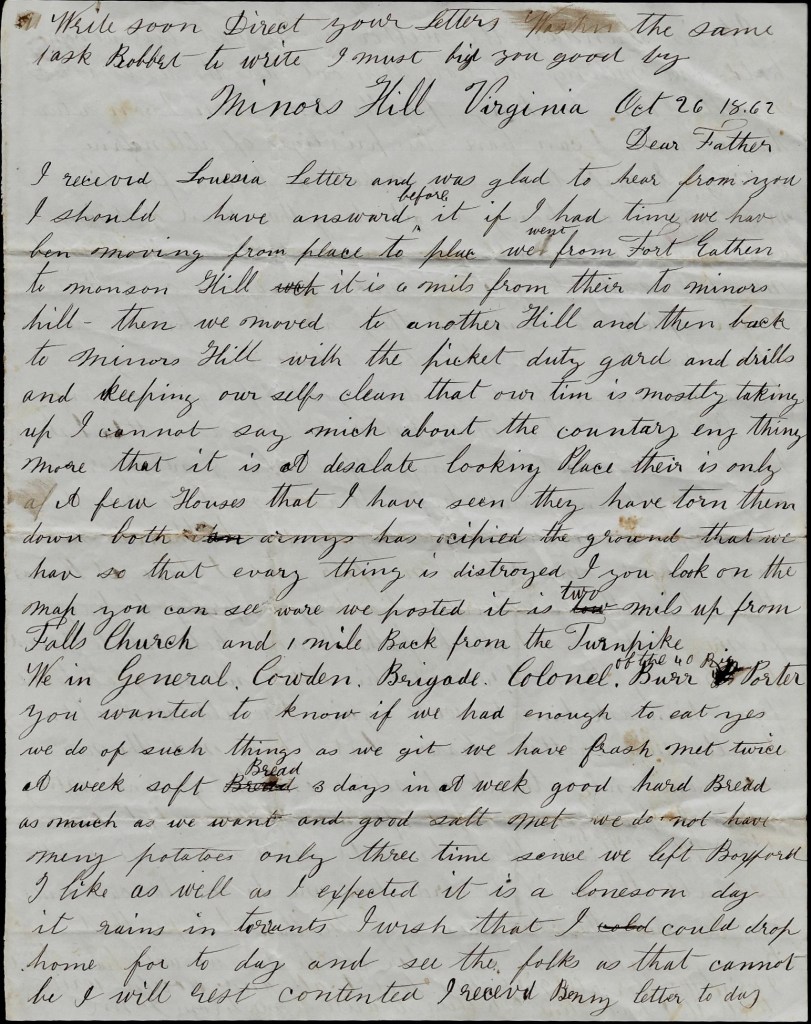
The following letters were written by Benjamin (“Ben”) Franklin Blatchford (1835-1906), the son of William Blatchford (1788-1864) and Mary Gott (1806-1873). Ben was married to Emily (“Em”) F. Snow (1833-1917) in Boston in August 1855 and was laboring as a carpenter in Rockport, Essex county, Massachusetts, at the time of the 1860 US Census. Emily was the daughter of David Snow (1793-1869) and Sarah Weston (1801-1850) of Easton, Massachusetts.
Service records indicate that Ben first enlisted as a 1st Sergeant in Co. B, 50th Massachusetts Infantry on 20 August 1862 and that he mustered out on 24 August 1863 at Wenham, Massachusetts. He was later commissioned a 2nd Lieutenant in Co. K, 2nd Massachusetts Heavy Artillery. He was promoted to 1st Lieutenant in June 1865 and mustered out at Wilmington, North Carolina in September 1865.
To read letters by other members of the 50th Massachusetts Infantry that I have transcribed & published on Spared & Shared, see: William G. Hammond, Co. A, 50th Massachusetts (1 Letter) Rufus Melvin Graham, Co. F, 50th Massachusetts (29 Letters) Jackson Haynes, Co. F. 50th Massachusetts (1 Letter) William Rockwell Clough, Co. G, 50th Massachusetts (5 Letters) Benjamin Austin Merrill, Co. K, 50th Massachusetts (5 Letters) Moses Edward Tenney, Co. K, 50th Massachusetts (1 Letter)
Letter 1
Camp Banks, Long Island, New York 1 November 28th 1862
Dear Mother & Father,
I suppose you have been looking for a letter from me but I have not had much chance to write to anyone yet and I have not much of a chance to write now. But I take this time and will try to give you a idea of the voyage here and the prospects ahead. When we went through Boston, I saw very few that I was acquainted with. We went on board the cars in Boston and went through the city of Worcester and arrived in Norwich about 9:30 p.m. when we went on board the steamer City of Boston and left for New York. We had a very pleasant passage. Just inside of Throgg’s Point, we passed the Great Eastern at anchor. She is what I call a large ship. We went near enough to her to read her name.
We arrived in New York about 9 a.m. and marched down Broadway and into the Park and halted in front of the City Hall, stacked arms, and got our dinner in the Park Barracks. We then marched down Broadway to Franklin Street and went into a large building and stopped about 40 hours when we packed our knapsacks and left for this place. We had a march of about six miles and got here about 4 p.m., stacked arms, and went to the Quartermaster’s and got our tents and had them pitched before it was very dark and turned in on the ground. We could get no hay that night. I put my rubber blanket under and my woolen blanket over me and went to sleep and concluded sleeping on the ground in a tent was not so bad after all.
We are very comfortable here. We live in small A tents, six men in one tent—rather snug quarters. The men as a general thing are well. Joseph Beals is no better (if he is so well as when we left home). I never felt better in my life than I do now and never had a better appetite and the men all say I grow fat and I think I do myself.
I don’t want you to answer this letter until you hear from me again. I expect we will be off from here by Monday sure, for four companies from this regiment leave today and the rest will follow as soon as the transports are ready. They say we are bound to Fortress Monroe and wait for the rest of the Division or Expedition which is said will consist of fifty thousand men. There is a light battery going with us that will fire 160 shots per minute. It has 25 barrels and is breach loading and has a rake of 45 degrees and is considered the most destructive weapons now in use.
As soon as you find out where we are bound, I want you to write and let me know all the news. Ask Mr. Lowe to write too and tell him I will write to him as soon as anything turns up that will be of interest to him. I wrote Em the other day and have had no answer yet but I expect a letter from her today.
I think I like it better than I did at first and am getting on first rate. I had my sword engraved in New York and it looks first rate. Give my respects to Dr. and Capt. Haskell and tell them we are well. Tell Robert that Andrew is well and has been all along and can lug his knapsack with the best of them. Ask him to write to me when he has a chance and tell Louisa to write as soon as she finds out where we are. You can send this to Em or write one to her just as you see fit—only be sure and let her know you have had a letter and she will write as soon as she finds out where we are. I don’t get much time to write or I would write to her today.
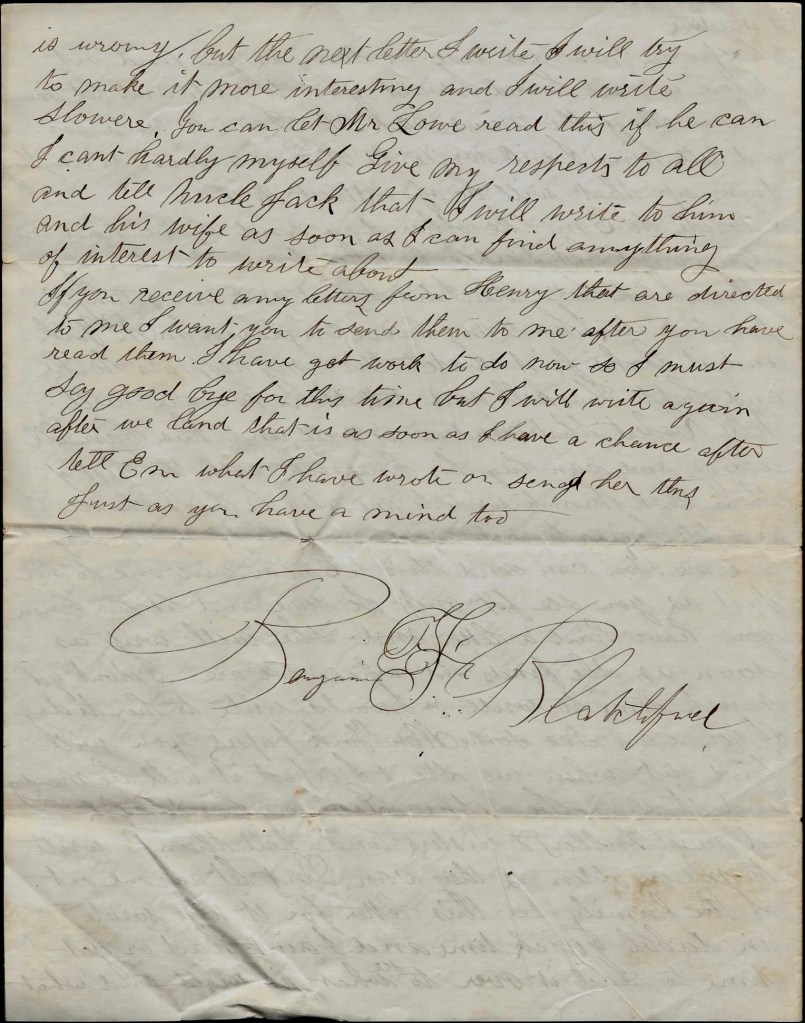
If you can see some New York papers, you will find out when we start. I expect it will be Monday and it may be before. Give my love to each of my brothers and sisters and tell them to write to me as often as they can. Don’t let anyone out of the family see this letter for it was wrote in double quick time and I ain’t had or got time to read it over to see what is right and what is wrong. But the next letter I write I will try to make it more interesting and I will write slower. You can let Mr. Lowe read this if he can. I can’t hardly myself. Give my respects to all and tell Uncle Jack that I will write to him and his wife as soon as I can find anything of interest to write about.
If you receive any letters from Henry that are directed to me, I want you to send them to me after you have read them. I have got work to do now so I must say goodbye for this time but I will write again after we land—that is, as soon as I have a chance after. Tell Em what I have wrote or send her this just as you have a mind to.
— Benjamin F. Blatchford
1 In a letter to his father, 18 year-old drummer boy Rufus Melvin Graham described Camp Banks to his father not long after the regiment arrived: “Our camp is a very level place—the Union Trotting Course—but bleak and cold. It is situated right under some hills and the wind blows over on to us. We left New York at 11 o’clock a.m. and marched down to the ferry boat and crossed the ferry to Williamsburgh, then formed a line and marched to camp—a distance of 10 miles through the mud.” [Rufus Graham to his Father, 23 November 1862]
Letter 2
Camp N. P. Banks December 11th 1862
Dear Mother & Father,
I suppose you have been looking for a letter fro me for some time but as there is not much going on here that would be of interest to you, I have not wrote to you before for sometime, and I only write now to let you know that I am as well as ever and hope to get out of this soon. It is rather cold here. During the cold snap that we have had it has been uncomfortable here. One night it was so sold that our canteens froze solid and one canteen with whiskey in it froze. But of late we have had warm and comfortable weather. We all want to get off before we have another cold snap. It has not been so cold as to cause much suffering (but uncomfortable).
Our situation is—or would be—very pleasant in the summer. We are on the Union Race Course and within a half a mile from here is a burying ground where six hundred soldiers are buried. Part of our regiment went on board the steamer yesterday and we expect to go soon.
I would like to have Louisa write to me as soon as you receive this. Tell William I will write to him after I get off and if anything turns up that will be of interest and as I find time. I will write to Dudley and the rest of the folks. I wrote to Em three days since and she will send the letter to you or write one to you soon.
We have 11 men on the sick list but none of [them] are very sick. All that is the matter with most of them is bad colds.
Benjamin F. Sleeper has had the Shakes or the fever and ague but he is all right now. John M. Tuttle has been sick for about a week but he is better now and he will be ready for duty in a day or two.
The rest of the Rockport boys are well with the exception of slight colds. I am well and have been all along. My back don’t trouble me any and I think I am as well as I ever was in my life and I like it as well as ever.
If I have time, I will write again before I sail and if I don’t find time to write, you will see when we go by the papers. As soon as you find out where we land, I want you to write and let me know all the news. Tell Dr. Haskell I would like to have him write and I will answer it as soon as I find time. Since I have been writing, I hear that we are going to New York tomorrow but I don’t believe it yet. The news is too good to be true. At any rate, you can tell when we go by the papers. Write to Em or send this and let her know that I am well and if I don’t go away, I shall expect a letter soon.
The men don’t get half of the letters that is sent to them and if you don’t get letters as often as you expect to, you must not think I don’t write for I shall write to you or Em as often as I find time and I want you to tell Em to write as often as anything turns up of interest and do the same yourself.
Give my love to all. — Benj. F. Blatchford
Letter 3
Delaware Bay December 15th 1862
Dear Father & Mother,
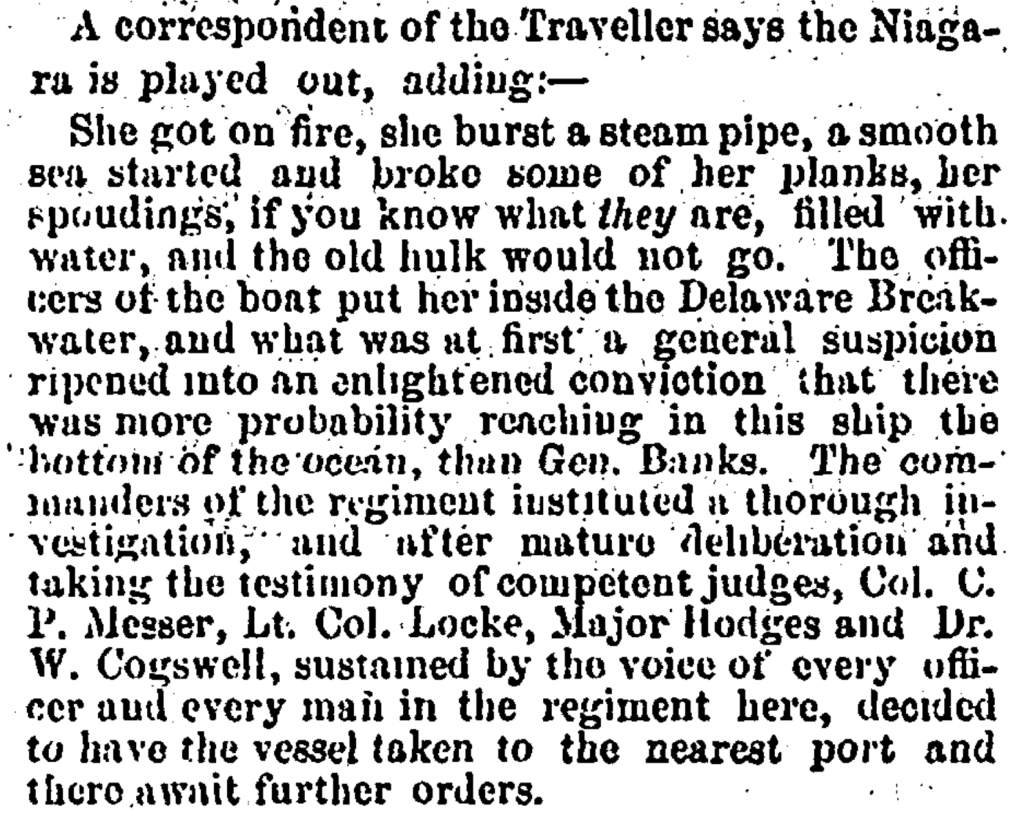
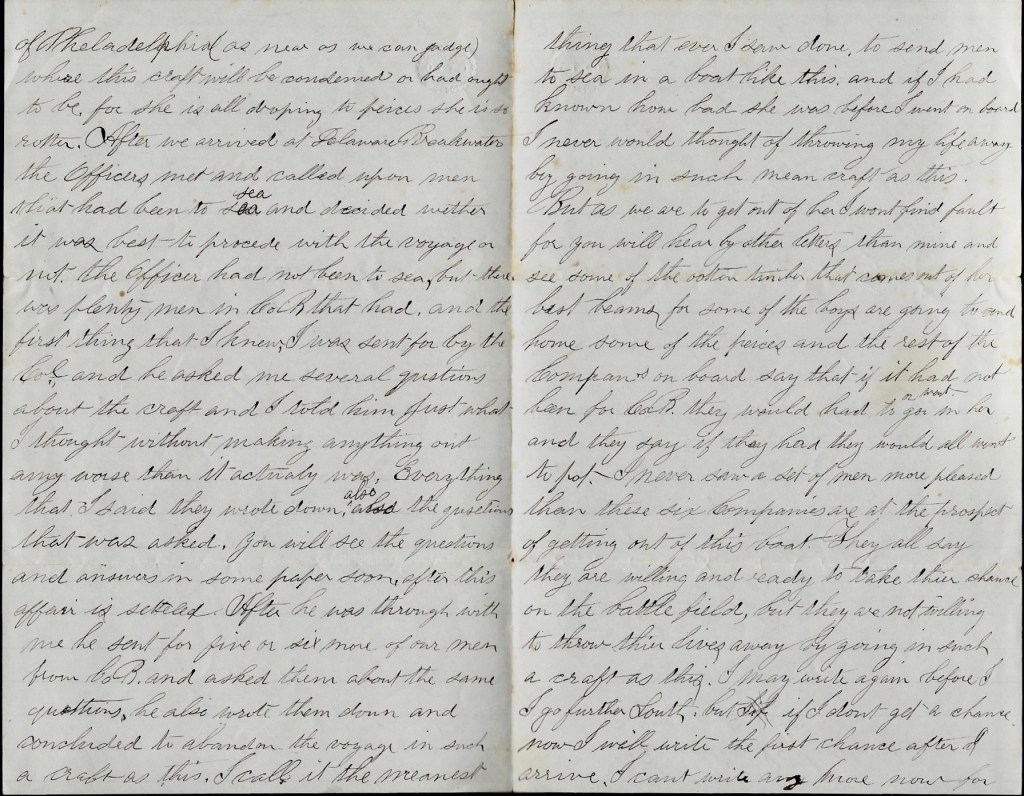
On the 12th we received marching orders and I was left behind to take charge of the sick and see to the striking the tents and see that the baggage and everything was forwarded to Brooklyn which I done and gave satisfaction to all concerned. At nine o’clock p.m. I went on board of the steamer Niagara and at 2 p.m. on the 13th, we sailed for parts unknown. Everything went on well until the morning of the 14th when we began to mistrust that something was wrong—and so it proved, for she had sprung a leak and we was making our way for a harbor as fast as steam would drive her. At 10 o’clock Sunday we arrived at Delaware Breakwater and pumped and bailed the water out of her and got a pilot and now we are bound up the Delaware Bay for the port of Philadelphia (as near as we can judge) where this craft will be condemned—or had ought to be—for she is so rotten.
The Salem Register, 18 December 1862
After we arrived at Delaware Breakwater, the officers met and called upon men that had been to sea and decide whether it was best to proceed with the voyage or not. The officer had not been to sea but there was plenty of men in Co. B that had and the first thing that I knew, I was sent for by the Colonel and he asked me several questions about the craft and I told him just what I thought without making anything out any worse than it actually was. Everything that I said they wrote down; also the questions that was asked. You will see the questions and answers in some papers soon after this affair is settled.
After he was through with me, he sent for five or six more of our men from Co. B and asked them about the same questions. He also wrote them down and concluded to abandon the voyage in such a craft as this. I call it the meanest thing that I ever saw done—to send men to sea in a boat like this, and if I had known how bad she was before I went on board, I never would thought of throwing my life away by going in such mean craft as this. But as we are to get out of her, I won’t find fault for you will hear by other letters than mine and see some of the rotten timber that comes out of her best beams, for some of the boys are going to send home some of the pieces and the rest of the companies on board say that if it had not been for Co. B, they would had to go or went in her and they say if they had, they would all went to pot. 1
I never saw a set of men more pleased than these six companies are at the prospect of getting out of this boat. THey all say they are willing and ready to take their chance on the battlefield, but they are not willing to throw their lives away by going in such a craft as this. I may write again before I go further South, but if I don’t get a chance now, I will write the first chance after I arrive. I can’t write any more now for I have got work to do soon. Give my respects to all. Let Uncle Jack read this is he wants to and any of my brothers and sisters that happen to be at the house while this happens to be there. And tel them that I will write to all of them if I can find anything of interest to write about….
Our Rockport men are all well except Mr. Beals. He improves every day. I am as well as ever. My respects to all. You must excuse blunders as this was wrote in haste and the old boat shaking and I ain’t got time to look over to see whether it is written wrong.
We are in Philadelphia. No time to write more.
1 Drummer boy Rufus Melvin Graham of Co. F, 50th Massachusetts also felt relieved to have found safe harbor in Philadelphia: “All the time we were coming, the steam pumps were at work and when we got into Philadelphia, there was—they say—ten feet of water in the hold. The old boat trembled and it was awful dangerous. We all think that we are lucky to come off with our lives. it was a great wonder that the old shell didn’t sink before we got here but here we are all alive and feeling as well as circumstances will permit. We are anchored out in the steam opposite the Navy Yard and we don’t know how long we shall stay here but we will stay here till we can get a steamer that can keep above water at least. There is five companies on this craft and in this port. Companies C, D, F, G, [and] B is with us. Companies A, K, [and] E are gone on board of the Jersey Blue and have gone to their destination, I guess. And Company H has gone on board some other steamer and our regimental baggage with them and they have gone I don’t know where and our Band has gone in another boat and I don’t know where they are. We have got all of staff officers with us on this boat. We shall all meet together again at our destination, I don’t know when or where. It was well that the men did not know what danger we were in night before last. If they had, we should have surely have gone to the bottom. The old boat lasted us in here and that is about all. [Rufus Graham to his Father, 15 December 1862]
Letter 4
Philadelphia [Pennsylvania] January 15th 1863
Dear Mother and Father,
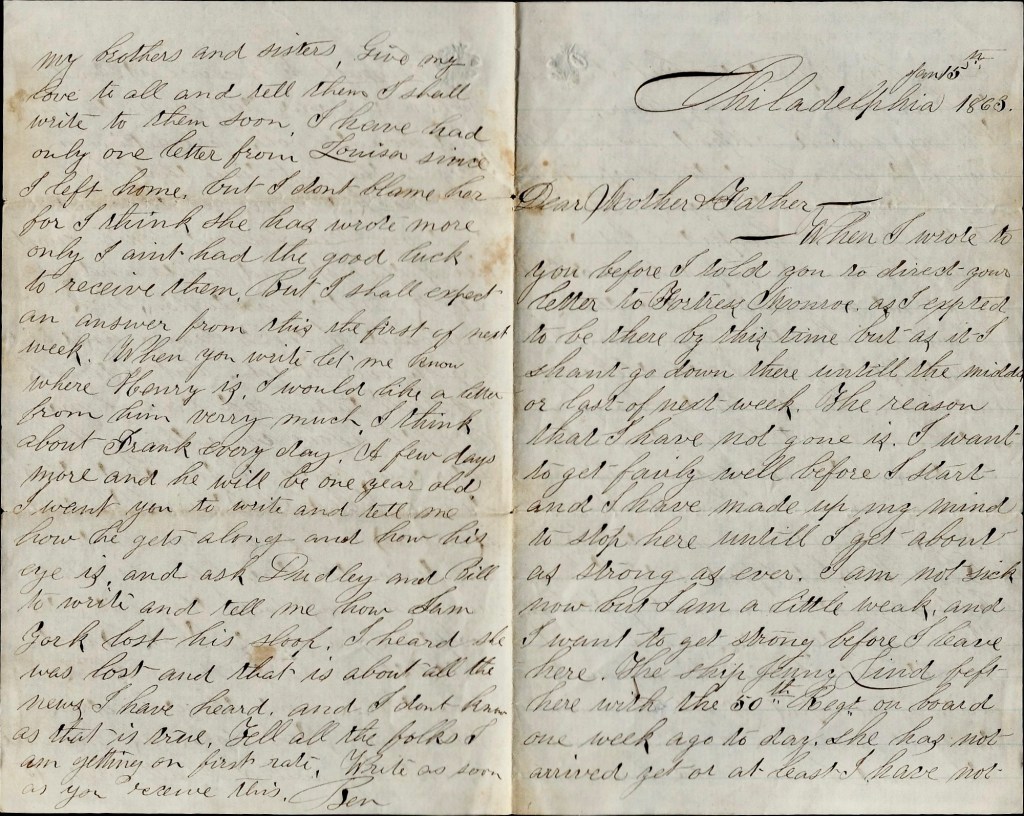
When I wrote to you before I told you to direct your letter to Fortress Monroe as I expected to be there by this time, but as it is, I shan’t go down there until the middle or last of next week. The reason that I have not gone is I want to get fairly well before I start and I have made up my mind to stop here until I get about as strong as ever. I am not sick now but I am a little weak and I want to get strong before I leave here. The ship Jenny Lind left here with the 50th [Mass.] Regiment on board one week ago today. She has not arrived yet, or at least I have not seen her reported but I expect to hear from her every hour.
The boys from Rockport was all well enough to go on board the ship except Joseph Beals and myself. I am here at this private hospital but Beals is in a General Hospital off 5th Street. He is not very well and I think he will get his discharge or not he will not be able to go any further. I think if you answer as soon as you receive this, I shall get it. Direct your letter to Sergt. Benj. F. Blatchford at the Volunteer Refreshment Saloon, foot of Washington Street, Philadelphia, and I shall get it. But it will be no use to write if you put it off. You want to write as soon as you receive this and I shall be here long enough to receive it. And when you write, tell me all the news and how the folks are getting on.
This is the first time that I have been sick. I never got the least cold on Long Island while almost all the rest had colds and was sick, but I was taken sick on board of the Niagara and ain’t hardly over it yet. But I think I shall take good care of my health above everything else after I go back to the Regiment this time. Tell Robert I think Andrew is (or was) well for he came in to see me twice the day before he went away. He was well then with the exception of a cold. Ask Rob to write to me and let me know how Ann and the children get along. As soon as my head is entirely well, I shall write to my brothers and sisters. Give my love to all and tell them I shall write to them soon.
I have had one letter from Louisa since I left home but I don’t blame her for I think she has wrote more—only I ain’t had the good luck to receive them. But I shall expect an answer from this the first of next week. When you write, let me know where Henry [Lowe] is. I would like a letter from him very much. I think about [his boy] Frank every day. A few days more and he will be one years old. I want you to write and tell me how his eye is and ask Dudley and Bill to write and tell me how Sam York lost his sloop. I heard she was lost and that is about all the news I have heard, and I don’t know as that is true. Tell all the folks I am getting on first rate. Write as soon as you receive this. — Ben
Letter 5
Addressed to Mr. Henry M. Lowe, Newbern, N. C., On board U. S. Steamer Southfield
Rockport [Massachusetts] August 1863
Dear Brother [in-law],
I received a letter from you this forenoon and was glad to learn that you was in good spirits but was sorry to know that you are troubled with the shakes. I wrote to you when I first got home but you did not say that you had received a letter from me. But in case you don’t get that letter, I will commence and give you a short account of the part we took in the siege of Port Hudson.
On the 27th of May at daylight the first battle commenced. We were ordered to support batteries which we did until about 2 o’clock in the afternoon when we was ordered to the left center to take part in the charge. This was rather hard for us as we had marched upwards of 20 miles and had had but about an hour’s rest. But we had made up our minds to go into Port Hudson that day and off we started. But the men was so tired they could not hold out to march under the burning sun so a great many fell out and lay be the wayside. And when we halted at the battlefield, our company numbered [only] 15 men and 8 of that number I was glad to see belonged to Rockport.
After halting a while, quite a number of the boys that fell out caught up with us and we fell in again and started for the front which was about 600 yards. We had not gone but a short distance when we were ordered into the edge of the woods and order[ed] to lie down which we did under a middling sharp fire where we lay about 2 hours when our whole force began to retreat leaving—as the boys all think—about 1900 killed, wounded and missing. 1
Our regiment then went back to the right center and supported the Marien Battery which was about 700 yards from the Rebel works. After supporting this battery for about 10 days, we built more breastworks of cotton 300 yards from the Rebel works. This work we done in the night without losing a man out of our company and only one out of the crowd. So when daylight came, the Rebs found 4 pieces of Mack’s Battery 2 within 300 yards of their noses.
We supported this battery until the 13th of June when we was ordered to take part in the charge which was to come off the next day (Sunday, the 14th). So at 10 o’clock at night, we formed a line, had the whiskey, and started for the left of our line where we joined the advance column. Here we were ordered to save our powder until we were close on them when we was to fire and then give them the bayonet. This began to look like war. As the rebs opened a sharp fire, men began to fall. We passed over a number of dead and wounded until we, or the regiment ahead of us, came to a deep ravine and could not get across so we had to lie down the rest of the day and get off when it came dark. One company within 25 yards of us lost 13 men that day. We did not lose any but a number was wounded in the regiment. 3
After we got out of this—the worst battle we ever had at Port Hudson—we went back to Mack’s Battery within 300 yards of the Rebel works and supported that battery until the surrender. Then I was willing to come home, but I never wanted to come home until Port Hudson was ours.
While our company was in the service, we lost 16 all told. The last one that died that you was acquainted [with] was William Goday. Solomon Choate is sick but he is getting on first rate. About 20 of our company are sick here in Rockport. I don’t know how many in other places. Ten of our regiment died on the passage home. We came up the Mississippi and had a good chance to see the Western States. Joseph Devon of our company we left sick in Mound City, Illinois. Also Solomon Choate & Ephraim Brown. The two latter are at home but Devon’s case is hard.
I was down to your Mother’s last night. She and Susan send their love. I have not seen Edward yet. He is at Dover. Your Father is down East.
I was onboard of Arthur Parson’s vessel at Port Hudson a number of times. He is promoted to Ensign. George Rowe is dead. John Rowe’s George—the one that married Eliza Gilbert, he died at Louisville, Kentucky. He was in the 35th [Mass.] Regiment.
Father is about the same as when you left home. Your boy is a great friend of mine. He is trying to help me on this letter but I think he does more hurt than good and half of the blunders here you must charge to him. I found him a smarter and bigger boy that I expected. We soon got acquainted and now we are chums. He tries to help me in everything I do but I don’t think he does much good, but as he thinks he does, it’s all right. He calls me Ben and every time I come upstairs he takes hold of my hand and leads me into the room.
A short time since, Louisa wrote to you and put a letter in the box she sent. She also wrote two letters beside. She will write again in a day or two. She wants you to look out for that box that she sent August 12th. It was worth or cost her $28. I was very, very sorry to find you off when I got home for I had not seen you for so long. I had planned a good many good times and was sure you was at home until I heard the contrary in Boston. But I am in hopes to see you before many months as I expect to come that way soon.
We was sorry to hear that Addison [Pool] is so slim but as cold weather comes on, we are in hopes he will be better. Of the whole number of the drafted men that you mentioned to Louisa, all are exempt with the exception of Frank Farr, James Gott, Arta Gott, Joseph Haskins. These had to fork over $300 each. And of the whole number drafted, no one that I know of are going. And that man that worked for Dr. Haskell took an axe and cut two fingers off of his right hand as soon as he found he was drafted. This of course cleared him.
You wanted to know what we think of the prospect of the war coming to an end. Well, I have heard the Mississippi called the backbone of the rebellion from the beginning of the war. Within a few weeks I had the opportunity of traveling over that backbone from Port Hudson to Cairo and did not see a sign of a reb except what was prisoners and fighting in the Southwest is about over. And of the 1500 prisoners I went with (as a guard) from Port Hudson to Red River, Vidalia, and Natchez, very few say they will fight again.
And as Charleston is called the Head of the Rebellion, we think as the walls of Fort Sumter have crumbled away before our gunboats, the head of the rebellion has received a dreadful shock and the prospects for peace is brighter now than it has been at any time during the war. As I have no more room, I must draw this to a close. Write soon. — Ben. F. Blatchford
1 Drummer boy Rufus Melvin Graham of Co. F, 50th Massachusetts, kept to the rear for duty as stretcher bearer, was more direct in his assessment of the days fight: “The next morning our regiment was ordered to go and support a battery as soon as light. They went off without any breakfast. They supported a battery all the forenoon and in the afternoon went into battle (the 27th). Our folk made a charge upon the breastworks and got driven back. We accomplished nothing but had a lot of men killed and wounded. We had two men wounded in our company—Charles Stickney ¹ in the ankle and Hugh McDermott ² in the hand. Our regiment was in the thickest of the fight. The rebs fired grape and canister and horse shoes and pieces of railroad iron and almost everything. Our batteries fired at them all the time.” [Rufus Graham to his Father, 19 June 1863]
2 Capt. Albert G. Mack commanded the 18th Battery, New York Light Artillery that was attached to Augur’s Division in Banks’ 19th Corps at Port Hudson.The battery was also known as the “Black Horse Artillery.”The battery was active at Fort Bisland, the Amite river, Plains store, and the siege of Port Hudson, La., where it participated in the assaults of May 27 and June 14.
3 Drummer boy Rufus Melvin Graham wrote his father of this day’s action as well: “On the 14th of June (Sunday), we had another battle. Our folks stormed the fort again and two companies succeeded in getting inside of the fort. That was all. They were taken prisoners. We lost in killed and wounded 2,000 men and accomplished nothing. Gen. [Halbert Eleazer] Paine was wounded twice and when they were carrying him off the field on a stretcher, he was shot through the head and killed. That day our regiment was down on the left supporting a battery and were under fire all day and had no one hurt. [Rufus Graham to his Father, 19 June 1863]
The following incredible letter describes the sinking of the U. S. Steamer Southfield by the Confederate Ram Albemarle during the Battle of Plymouth. It was written by 21 year-old Acting Master’s Mate John J. Allen, Jr. (1842-1920) who was aboard the Southfield when she was rammed in the early morning hours of 19 April 1864—a day that John said “will ever remain fresh in my memory.”
I could not find an image of John but here is George W. Marchant wearing the uniform of an Acting Master’s Mate. (Ron Coddington Collection)
John was born in Warren, Bristol county, Rhode Island, the son of John J. Allen (1814-1890) and Mary Tyler Bowen (1823-18xx). He was appointed Acting Master’s Mate on 18 May 1863 and served initially on the USS Sumpter when she joined the North Atlantic Blockading Squadron at Hampton Roads. She was initially stationed off Hampton Bar but in June she was sent to the Yorktown, Virginia, area to search for the Confederate privateer Clarence. On the morning of 24 June, she collided with the Union transport, USS General Meigs eight or nine miles from the Smith Island lighthouse and sank in 42 feet of water. The officers and crew were rescued by the Jamestown and taken to Newport News, Virginia. Later, in 1864, he was assigned to the U. S. Steamer Southfield. Ironically, just before the action described in this letter, on 10 April 1864, he wrote a letter to Gideon Welles requesting a copy of his appointment to Acting Master’s Mate stating that he had lost it “at the time of the disaster of the United States Steamer Sumpter.“
Once again, when the U. S. Steamer Southfield sank just a few days after writing the letter to Welles, John lost everything he owned again. Feeling snakebitten, John tendered his resignation on 23 April 1864 claiming that he was destitute. “I made them think that there was nothing but destitution before me if I remained. I hope that I will get out of here for I am too unlucky to stay here any longer,” he confided to his friend.
Less than three months later, on 15 July, John left the Tacony at New Bern on sick leave and arrived at Warren, Rhode Island on 21 July, sick with chills & fever. He official resigned on 22 August 64.
After the war, on 10 July 1866. John married Eunice “Josephine” Starkey (1843-1908) in Bristol county, Rhode Island. Eunice was the daughter of Abel and Louisa E. Starkey of Westmoreland, New Hampshire.
The letter was addressed to Henry Martin Lowe (1840-1907) of Rockport, Essex county, Massachusetts, who had served throughout most of 1862 and early early 1863 aboard the USS Gunboat Penobscot as the Paymaster Steward. In July 1863, however, he was reassigned to the US Steamer Southfield as the Paymaster’s Clerk with his Uncle Addison Pool serving as the Assistant Paymaster. In March 1864, just one month before the Battle of Plymouth, Lowe wrote his wife that he was going to be returning home soon. George W. Brown would take Henry’s place as Paymaster’s Clerk aboard the Southfield and it would be Brown, not Lowe, that would be taken prisoner. Lowe’s uncle, Addison Pool, would fortuitously avoid death or captivity too, having gone to Newbern just prior to the attack. [Note—Lowe’s letters can be read at 1862-64: Henry Martin Lowe to his Family.]
“Gunfight on the Roanoke,” The gun crew of the U.S.S. Miami witnesses the sinking to the U.S.S. Southfield by the C.S.S. Albemarle, April 19, 1864. Via TomFreemanArt.com
Transcription
U. S. Steamer Tacony Roanoke Island, North Carolina Monday, April 25th 1864
My dear friend Henry,
How I wish that I could be writing this letter from the Southfield at Plymouth today but fate has destined it otherwise and we must calmly submit to it. Ere this reaches you, you will have undoubtedly been made acquainted with all the particulars of the late battle and fall of Plymouth and the sinking of our gallant Southfield by that infernal ram [CSS Albemarle] of which we joked so much about and ever doubted such an idea as her appearance at Plymouth which we had fortified so well. Henry, what do you think of it & was it not a shame that we were whipped so badly after the confidence we always entertained on our fortifications if the place was attacked?
A week ago last night [17 April 1864] or 3:30 P. M. the attack was first made. The pickets were driven inside and Fort Grey 1 was the recipient of the first fire from the enemy’s batteries erected about a mile up the river from the fort opposite and by the fisheries of Major Willi___]. The [picket boat] Whitehead, Ceres, and Bombshell took an active part that night. The Ceres received several shots, had two men killed, one Engineer and four men wounded. 2 The batteries ceased their fire at about 9 P. M. and later in the evening repeated attempts were made to take Fort Grey but without success.
At daylight the next morning [18 April 1864] the battle again commenced from up the river and back of the town at all points. Bombshell in charge of [Acting Ensign Thomas B.] Stokes was sunk by the enemy early in the morning while carrying a dispatch to “Grey.” In the afternoon I went with a party of men to bury the two killed on the Ceres and after performing that duty, we went over to the breastworks to see the sport there. When returning to the ship, the enemy (a force estimated at 12,000) made a powerful assault with intention, I suppose, of taking the town by storm, but they found their mistake for the Southfield and Miami cut adrift (as we had not at that time taken any part) and poured upon them our shell as fast as we could load and fire—Miami below the town and we above—and making a cross and terrific fire upon them. It seemed as though the whole strength of the enemy’s shell fell in the river for it actually boiled with them. And though we were struck, not one of our men was injured that I know of. Some were knocked over but not hurt.
The curtain did not drop upon that scene until nearly eleven o’clock at night when the enemy fell back after making their best efforts to scale the breastworks and forts. They fought hard and well—I will give them the credit of that. 3
As the Ram [Albemarle] up to that time was not heard from, we felt sure of success and did not expect another attack. But at one the next morning (Tuesday)—and one which will ever remain fresh in my memory—the Whitehead came down reporting that the Ram was coming, called all hands, and commenced making fast to Miami 4 as before to receive her, and at 4 a.m., just as we were getting the last fast secure, the infernal thing came right down past the town and made straight wake for us (we were laying then down to the picket station). I can’t tell how the vessel passed all the torpedoes, blockades, forts, &c. no more than a man in the moon. Besides, I am unable to see how it was we didn’t slip cables and run before her to lessen the blow, but there she appeared coming full speed with that Cotton Planter steamer with her with two hundred sharpshooters in her. The Ram struck the Southfield on the starboard bow and cut her through to the boilers. 5 From both of our vessels we gave her 13 shots which made no impression upon her whatever. Capt. [Charles] Flusser was killed by the reflection of one of his shells that could not be drawn and was fired on the Ram. 6 Mr. Hargous and Farrington were wounded pretty badly. Also about a dozen of the Miami’s men. [Charles A.] French was the first to leave the Southfield after being struck but when the Southfield was nearly under, about a third of the men and all the officers except Newman, Stokes, George Pratt, Goff, Strieby, and Brown escaped. 7 Capt. French then ordered a retreat and we steamed out of the river [aboard the Miami] in company with Whitehead and Ceres. The Ram following but could not catch.
The Ram never fired upon us and I don’t know why without it was because she was afraid to open her ports. I could not say that there was a man killed on the Southfield but some must have drowned. I know I saved [W. C.] Jackson 8 and three of the men by getting in one of the Miami’s boats which were along side hoisted up and pulling them on board. Jackson would not acknowledge it, I know, but I can tell him that he would [have] been in the hands of the enemy now if I had not pulled him over. But that’s nothing.
Well, the town could not hold out after we were drove out and at noon on Wednesday [April 20, 1864] they then surrendered to the Confederates. Some say nothing was surrendered, but taken—that is, we fought to the last.
On Wednesday the steamer Tacony came up to the head of the Albemarle Sound where we were laying with the Miami and Whitehead and we got up an expedition to go up and see if we could pick up anyone and capture the Dollie if we could. I had charge of one of the boats. Hadn’t got but a little ways past Louise Island when we met the Ram and two other steamers coming down and we had to put back accomplishing nothing. The Ram nor the Rebel steamer have come out of the river yet and we are keeping a sharp lookout for them in case they do undertake it.
Thursday morning [April 21, 1864] I was ordered to this steamer which started for Roanoke Island immediately and we have been lying here ever since. You saw the Eutaw at Newbern. Well, this steamer is just the model of her. We steamed 16 knots and came from the mouth of the Roanoke to this place in 4 hours. Vast boat! hey! Accommodations splendid but I feel splendid afraid of her with one old suit only to my back. I am getting used to it now but don’t expect to remain here long for my “resignation” has been sent in to the captain of this steamer and I presume he has approved and forwarded it in for here I am destitute and I made them think that there was nothing but destitution before me if I remained. I hope that I will get out of here for I am too unlucky to stay here any longer and it is a disgrace for a man to be in these surrounds with no hope of promotion.
Newbern and Washington are to be attacked I hear and they have Rams also you know and if they don’t look out pretty sharp, they will fall into the hands of the Rebels. Gideon Wells will wake up bye and bye and get his eyes open. Pool, your uncle, went to Newbern just before the Ram came down at Plymouth. Doc [Peter H. Purcell] & [Surgeon’s Asst. W. C.] Jack[son] have gone to Newbern. Farris is on the Ceres. William [F.] Pratt, [John R.] Peacock, and [Joseph S.] Watts is on the Miami.
I have heard that the entrenchments around Plymouth were filled three and four deep with the dead bodies of the rebs who were killed when trying to scale the breastworks. Tough old battle, I assure you. Two of the companies of cavalry made a dash through the lines just before the town gave in and made their escape to Washington, North Carolina. I might write enough of the affair to fill a dozen sheets of foolscap but I hope to come where you are one of these old days and then I can tell you all about the affair. I want you to answer immediately and let me know if there is any chance for me where you are and if you are making a good business for if you can give me any encouragement whatever, I shall follow you out there with a capital to start on.
I am fully decided upon what I say and would like nothing better than to get into business with such a valuable friend and agreeable companion as you have been to me. I missed you dreadfully after you left us and very often I would look for your familiar voice and footstep. I am glad that you went away as you did for you might have shared the same fate as Brown—your successor. He might have got clear for he had no station and we did. Don’t you remember how much you used to say that if you thought the Ram would come down, you would stay to see her? Do you still wish that you had stayed? I would have given a thousand dollars if we had sunk her but as it is, I don’t know what to make of it. Don’t forget to tell me all about how you are prospering and if there is any chance for me down that way. I shall have to send this letter to Rockport and I presume your wife will forward it on. Direct to U. S. Steamer Tacony, Newbern, N. C., and I guess they will come all right. Goodbye for today, Lowe, and I remain your true friend, — John J. Allen, Jr.
1 Fort Grey [Gray] was “a detached Union position upstream from the town built to fend off Confederate gunboats descending” the Roanoke River. The fort was attacked by a force led by James Dearing. It consisted of Terry’s Virginia Brigade and several guns, including three 20-pounder Parrotts (probably from Blount’s and Macon’s batteries). They approached the fort from Long Acre Road. [The Fight for the Old North State, by Hampton Newsome, page 208.]
2 “The Confederate gunners [in Dearing’s command] trained their Parrott rifles on the Ceres and opened a storm of shot. Several found their mark. One smashed a launch, wrecked machinery, and hit the port quarter just above the waterline near the magazine. Another drilled through the prt gangway. The projectiles killed fireman William Rose outright and wounded cook Samuel Pascall, who died later.” After returning to the wharf at Plymouth later that night, “the bodies of Rose and Pascall were laid out in the quartermaster’s office. Seven others had been wounded and they were all treated by the Miami’s surgeon, Dr. William Mann, with the assistance of Sayres Nichols.” [The Fight for the Old North State, by Hampton Newsome, page 214.]
3 The Confederate forces were led by Gen. Robert Hoke, a native of Noth Carolina. He had three infantry brigades with him—his own Brigade led by Col. John T. Mercer; Matt Ransom’s North Carolinians; and Kemper’s Virginia Brigade under Col. William Terry. The city of Plymouth was defended by General Wessells who had about 2800 men—the better part of four infantry regiments. These included the 16th Connecticut, 85th New York, and 101st ands 103rd Pennsylvania. There were also some detached artillery units and two companies of 2nd North Carolina Colored troops.
4 “After a busy day of bombarding the attacking Confederates, the Miami and the Southfield had anchored below the town where the Union line was in danger of being outflanked by Hoke’s forces. Shortly after midnight, the Whitehead sighted the Albemarle coming downriver, and reported the fact to Flusser. According to a prearranged and, it would seem, somewhat foolhardy plan, a heavy chain was passed from the Southfield to the Miami. Flusser’s intention was that the two ships would maneuver to catch the Albemarle between them, and as the Confederate ship thrust against the chain, the two gunboats would be drawn alongside the Albemarle where the impact of their guns would loosen her plating, and demoralize her crew from the concussion alone.” [Civil War Ironclads: The Dawn of Armor” by Robert MacBride]
5 “Showing no sign of stopping or even slowing down, the Albemarle reach the Union vessels, brushed the Miami’s port bow, ‘gouging two planks through for nearly 10 feet,’ and then drove straight into the Southfield’s starboard bow. It was no contest. The Albemarle’s iron-plated prow sliced right through the Union vessel’s hull, penetrating 10 feet through the forward storeroom and into the fire rom, then driving ‘a hole clear through to the boiler.’ The impact delivered a catastrophic blow to the Southfield, which immediately started to sink with much of its crew still inside….much of the Southfield’s crew escaped onto the Miami.” [The Fight for the Old North State, by Hampton Newsome, page 232.]
6 While the Albemarle tried frantically to extricate itself from the Southfield which was sinking rapidly and pulling it under with it, the crew on the Miami turned their 100-pounder Parrott and 9-inch Dahlgren on the Albemarle. “During the first moments of the fight, Capt. Flusser personally manned several of the Miami’s guns, firing the first three shots at pointblank range. According to one eyewitness aboard the Miami, Flusser hopped from gun to gun, firing the 100-pounder first, then the bow gun, and then the port broadside Dahlgren. Surgeon’s steward Sayres Nichols recalled that the first round ‘struck her plumb, but the shot, though solid, produced no more effect, than one of those little torpedoes we have on fourth of Julys.’ When Flusser reached the third piece on the port side ahead of the hurricane deck, the weapon’s captain yelled, ‘There’s a shell, sir, in that gun,’ revealing that the tube had been charged with an explosive round and not solid shot. Flusser supposedly replied, ‘Well, it does not matter much. Depress, stand clear, boys.’ With that he yanked the lock string, send the round jetting toward the ironclad. The projectile, a ’10 second’ Dahlgren shell, smacked against the Albemarle’s casement and ricocheted back, exploding on board the Miami. One large fragment, 4 inches square, tore through Flusser’s body, and severed his arm. Another shard entered his skull. As he fell with the lanyard still in his hand, he was heard exhorting his men to ‘sink the ram.'” [The Fight for the Old North State, by Hampton Newsome, page 232-3.]
7 The officers of the Southfield crew mentioned by Acting Master’s Mate, John J. Allen, Jr. who survived the sinking but who were taken prisoners included Acting Master William B. Newman (who allegedly fired the last shot at the Albemarle before the Southfield sank); Acting Ensign Thomas B. Stokes; Acting Master’s Mate George W. Pratt; Acting 2nd Assistant Engineer William F. Goff; Acting 3rd Assistant Engineer John A. Strieby; and Paymaster’s Clerk George W. Brown.
8 W. C. Jackson was the Surgeon’s Steward aboard the U. S. Steamer Southfield at the time of the Battle of Plymouth.
I could not find an image of John but here an unidentified infantryman from Massachusetts who appears to be about the same age as John (Dave Morin Collection)
The following letters were written by 41 year-old John Blatchford (1821-1912), the son of William Blatchford (1789-1864) and Betsy Foster (17xx-1832), and the husband of Lydia Wright (1827-1913). John was working as a brick mason in Boston, Massachusetts, when he enlisted on 16 August 1862 as a private in Co. F, 40th Massachusetts Infantry. At the time of his enlistment, he had two sons—Frederick (age 8) and William (age 6).
According to military records, John served with his regiment until 7 February 1865 when he was discharged prematurely for disability at the age of 43.
The regiment arrived at Fort Ethan Allen across the Potomac from the Capitol on 12 September 1862. It remained manning the defenses of Washington DC, under the operational and administrative control of the 2nd Brigade, Abercrombie’s Division, Military District of Washington, until February 1863. This time was relatively uneventful for the regiment save for the response to a raid on 28 December by Stuart’s rebel cavalry where they arrived only in time to capture a small number of the cavalry’s rear guard. The regiment remained in the defenses south of Washington through the winter and early spring of 1863. On 2 February, the forces defending Washington were reorganized into the XXII Corps.
Letters by other members of the 40th Massachusetts Infantry that I have transcribed and published on Spared & Shared include: Mahlon N. Thatcher, Co. B, 40th Massachusetts (14 Letters) Warren P. Searles, Co. C, 40th Massachusetts (1 Letter) Charles Wilson Crocker, Co. E, 40th Massachusetts (1 Letter) Edwin Augustus Lane, Co. H, 40th Massachusetts (10 Letters) Wisner Park, Co. H, 40th Massachusetts (1 Letter) Moses M. Ordway, Co. I, 40th Massachusetts (2 Letters) Cyrus W. Conant, Co. K, 40th Massachusetts (4 Letters) Robert B. Foster, Co. K, 40th Massachusetts (1 Letter)
Letter 1
Munson’s Hill October 14, 1862
Dear Father,
I thought that I would write a few lines to let you know where I am. I do not know where we was when I wrote the last letter—we have been moving about so much, and [now] we are back to the same place. The regiment is on Munson’s Hill. Some think that we shall stop here all winter. We cannot tell anything about that.
I am stopping at a farm house about one mile from the camp with a sick boy. I have been with him two weeks. I think I shall have to stop one week more. The name of the farm is Summer Dale. They appear to be nice folks though some say that the man has been in the Rebel army and has three sons in it now, but I do not know how that is. They are very kind to Charley. Our pickets has a post in front of the house, one back of it, and for two miles on the road it is a desolate looking country. There is but few houses to be seen. They tell me that there has been 50 houses torn or burnt down within two miles around this place.
This is quite a farm. He has 500 acres and cultivates 280 acres. He has 40 acres of corn and they planted it with 3 men in 4 days. I think that is faster than Robert could get corn into the ground. They have just commenced to harvest. We had a snowstorm Friday and since then, it has been fine weather but quite cold. The day that it stormed, the boys tore down a house and barn to fix their tents. I can take no part in such things. I did not leave my home to steal or to destroy the property of any man.
I often think of home and its comforts but it is useless to complain. My country calls and I thought it was best for me to do my duty. How I miss the blessings of home. How I miss going to meeting and Sunday School and how the family prays. When at home, we could kneel together and thank Him for His kindness to us. But now when we try to pray in our tent, some one will be cursing [or] drums beating—it is not no easy to be a Christian—to be a follower of the meek and lowly. I do not know how I should be able to bear up under it but for the Bible. I can always find some words to cheer me on the way.
When I was in camp, a few of us would get in a tent and read and pray. A prayer in camp does not sound like one in church [where] it has a solemn sound and it goes to the heart of all that try to serve God. [In camp and] in prayer, it is hard to shut the heart to all sound that comes to the ear. I try to serve Him that has kept me from harm. Pray for me that I may be faithful to the end.
Benjamin (“Benny”) Franklin Blatchford
I had a letter from Benny 1 yesterday. I expect that he has left camp. He wanted me to answer to Father. Tell him when you write that I have answered his letter. I don’t know as you can find out what I have wrote. I have taken Charley out of bed four times while writing this page. Mother, when you go to Boston, call and see Lydia. She writes that Louisa came up. I think if William Blackford, Jr. had any Christian spirit or brotherly love, he would call and see her often. Time makes many changes in this world. I do not wish him to call if it will cause her much pain.
Give my love to all—William in particular. Ask them all to write. I cannot write to all but can write to you so they can all hear from me. When there is any news, I will write. We are in General Cowdin’s Brigade, Abercrombie’s Division. Burr Porter is our Colonel.
I shall have to bid you all good night for Charley is calling me. He has the typhoid fever. Ask some of the folks to write soon. Goodbye Father and Mother, — from John [Blatchford]
1 Benny was John’s half brother Benjamin Franklin Blatchford (1835-1906), the son of William Blatchford (1788-1864) and Mary Gott (1806-1873). Ben was married to Emily F. Snow (1833-1917) in Boston in August 1855 and was laboring as a carpenter in Rockport, Essex county, Massachusetts, at the time of the 1860 US Census. Emily was the daughter of David Snow (1793-1869) and Sarah Weston (1801-1850) of Easton, Massachusetts. Ben first enlisted as a 1st Sergeant in Co. B, 50th Massachusetts Infantry. He then became a 2nd Lieutenant in Co. K, 2nd Massachusetts Heavy Artillery. He was promoted to 1st Lieutenant in June 1865 and mustered out at Wilmington, North Carolina in September 1865. See Benjamin Franklin Blatchford Letters.
Letter 2
Members of the 40th Massachusetts in Skirmish Drill near their encampment on Minor’s Hill in 1862. [Digital Commonwealth]
Minor’s Hill, Virginia October 26, 1862
Dear Father,
I received Louisa’s letter and was glad to hear from you. I should have answered it before if I had time. We have been moving from place to place. We went from Fort Ethen [Allen] to Munson’s Hill. It is a mile from there to Minor’s Hill. Then we moved to another hill and then back to Minor’s Hill. With the picket guard duty, and drills, and keeping ourselves clean, our time is mostly taken up. I cannot say much about the country anything more than it is a desolate looking place. There is only a few houses that I have seen. They have torn them down. Both armies has occupied the ground that we have so that everything is destroyed. If you look on the map, you can see where we [are] posted. It is two miles up from Falls Church and 1 mile back from the turnpike. We [are] in General Cowdin’s Brigade. Colonel Burr Porter of the 40th Regiment.
You wanted to know if we had enough to eat. Yes, we do—of such things as we get. We have fresh meat twice a week, soft bread 3 days in a week, good hard bread as much as we want, and good salt meat. We do not have many potatoes—only three times since we left Boxford. I like it as well as I expected. It is a lonesome day. It rains in torrents. I wish that I could drop home for today and see the folks. As that cannot be, I will rest contented.
I received Benny’s letter today.
It is Sunday. The weather is so bad that we cannot hold our meetings. We have them outdoors—the tents is so small. I am looking for the time when I can return home where I can have the privilege of attending meetings. I miss them very much. We have a few pious men in our company. We get together, ring and sing and pray. We cannot feel as we do at home for it makes me feel sad to hear so much cursing. Sometimes I can speak to them and they receive it kindly. At other times they do not like it but I trust in God for we cannot see that it does good. I feel quite contented in the army. I do not know the reason that I should. I never was used to camp life. I have gone so far without complaining and hope that I shall do my duty to my country and my God.
Father, do not worry about me. I have no fear and I have a promise that I shall be rewarded. I ask you to pray for me that I shall be faithful and hold out to the end. Tell Benny that I received his letter and was glad to hear from him. Ask him to write again. I would write often to all my brothers and sisters but I have not the [time] nor convenience. Only think of sitting on the ground writing letters.
I have not heard from William but once. I should think that he could send me a paper or letter. I should think if he cared for me he would call and see her (Lydia) and the children. Mother, I hope that Benny will come out here. If he does, we will have a good time. I write this for all. Give my love to all, and would write to all if I had time. Ask them to write to me. From John [Blatchford]
One can image the following General Orders being read to the troops of the 2nd New Hampshire Infantry following dress parade and subsequently posted near regimental headquarters. It prescribed the camp regulations and order of the day for Camp Sullivan by its commander, Colonel Gilman Marston. At the time these General Orders were issued, the regiment had not long been in its camp which was located in the vicinity of Glenwood Cemetery, west of North Capitol Street in the District of Columbia. They were bivouacked there from 23 June to 16 July 1861 before participating in the Battle of 1st Bull Run.
Over the years I have transcribed the following letters by members of the 2nd New Hampshire Infantry: Abiel Walker Colby, Co. B, 2nd New Hampshire (1 Letter) James Webster Carr, Co. C, 2nd New Hampshire (6 Letters) Isaiah Foy Haines, Co. E, 2nd New Hampshire (1 Letter) Francis D. Bacon, Co. F, 2nd New Hampshire (1 Letter) Charles Edwin Jewett, Co. F, 2nd New Hampshire (22 Letters) [Jewett’s Letter 3 has a good description of Camp Sullivan] Hugh R. Richardson, Co. F, 2nd New Hampshire (1 Letter) Simeon Clark Buck, Co. G. 2nd New Hampshire (1 Letter) Alexander Lyle, Co. G, 2nd New Hampshire (10 Letters)
These unidentified privates wear the gray dress uniform provided for both the 1st or 2nd New Hampshire infantries by the state quartermaster in May 1861. The man at left is clearly seated to show his “spike-tail” coat to best advantage. Their chasseur-pattern caps had red bands, and high standing collars and closed cuffs were trimmed with narrow red cord. Trousers were plain gray. Sixth-plate ruby ambrotype by an anonymous photographer. [Ron Field Collection, Military Images]
CAMP SULLIVAN,
WASHINGTON, D. C., June 28, 1861.
GENERAL ORDERS
No. 15
REVEILLE at 4.30 o’clock A. M., when the men will immediately rise, put themselves, their equipments and quarters in order for the day.
ASSEMBLY at 5 o’clock A. M., and is the signal to form by companies.
PEAS UPON A TRENCHER at 6 o’clock A. M., and is the signal for breakfast.
Surgeons’ Call immediately after breakfast.
THE TROOP will be beat at 7.30 o’clock A. M. for guard mounting. A Police Officer and police party under his direction will be detached immediately after. The Police Officer, accompanied by the Surgeon, will inspect daily the sinks, the kitchens, and the mode of preparing food.
Reports must be presented at Regimental Headquarters before 8 o’clock A. M.
The Officer of the Day will, immediately after guard mounting, read to the guard the army regulations relating to the duties of Sentinels.
At 9 o’clock, companies will march to the parade for drill. ROAST BEEF—the signal for dinner—will be beat at 12 o’clock noon.
Retreat at 5 o’clock P. M.
Supper at 7 o’clock P. M.
The Tattoo at 9.30 o’clock P. M., after which both officers and soldiers will remain in camp until Reveille, unless out under orders or with special written permit from the commanding officers.
There will be three stated Roll-Calls, viz: At Reveille, Retreat and Tattoo.
All firing of guns and pistols within the camp is strictly prohibited unless by written permit from the commanding officer; and the officer of the guard is directed to arrest all persons violating this order, and report the same to the commanding officer. All Target Practice must take place be tween the hours of 7 A. M. and 12 noon.
By the Order of the Colonel Commanding: 1
S[amuel] G. LANGLEY, Adjutant.
H. Polkinhorn, Printer, Washington.
Gilman Marston
1 “The 2nd New Hampshire was originally organized as a three-month regiment. The Abbot Guards of Manchester, one of the first companies to be raised in New Hampshire, had gone to Concord as part of the 1st New Hampshire. On May 1, 1861, the company marched forty-five miles to Portsmouth to join the 2nd New Hampshire under the command of Colonel Thomas Prescott Pierce. Pierce, then serving as the U.S. Postmaster of Manchester, New Hampshire, had served with the 9th U.S. Infantry during the Mexican War and had seen action at Contreras and Churubusco. By May 10, 979 men, all enlisted for three months, had arrived at camp and were being “drilled, disciplined and made acquainted with the duties pertaining to a soldier’s life.” When the U.S. War Department ordered the governor not to send any more three-month men, the regiment was re- organized, between May 31 and June 8, as a three-year unit. With this change in the unit’s status, Colonel Pierce resigned on June 4, 1861. The unit’s new colonel, Gilman Marston, was a graduate of Dartmouth and Harvard. He had served as a member of the New Hampshire House of Representatives (1845-1849) and as a delegate to the state constitutional convention in 1850. He had been elected as a Republican to the Thirty-sixth U.S. Congress (and would be re-elected to the Thirty-seventh Congress and serve until March 3, 1863). Marston and the 1,046 officers and men of the 2nd New Hampshire were mustered into federal service on June 10 at Portsmouth.” Col. Marston was in command of the 2nd New Hampshire Infantry at the Battle of 1st Bull Run where his arm was shattered but he refused amputation and survived.[“We drop a comrade’s tear” by Karlton D. Smith]
Posted Regulations for Camp Sullivan, 2nd New Hampshire Infantry, 28 June 1861
The following letters were written by Henry “Martin” Lowe (1840-1907), the son of Henry Thurston Lowe (1806-1888) and Rachel Pool (1816-1897), and the husband of Louisa Foster Blatchford (1841-1910) of Rockport, Essex county, Massachusetts. Martin and Louisa were married on 21 April 1860 at Newburyport and in the 1860 US Census, they were enumerated as newlyweds in her parents home—William and Mary (Gott) Blatchford of Rockport. At that time, Martin was employed as a clerk. Louisa’s brother was Benjamin Franklin Blatchford (1835-1906).
I could not find an image of Henry Martin Lowe but here is an unidentified Navy petty officer wearing the typical enlisted sailor’s clothing. (Ron Field Collection)
One of some forty-one men from the fishing port of Rockport, Massachusetts who served in the Navy during the Civil War, Henry M. Lowe was a Paymaster’s Steward aboard the U.S.S. Penobscot. He entered the service in early February 1862 and was discharged in March 1864. According to my friend Ron Field, author of the book, “Bluejackets: Uniforms of the United States Navy in the Civil War Period, 1852-1865,” Paymaster Stewards “wore jumpers with ‘eagle, anchor & star’ insignia on their right sleeves. Although drawn from the ranks as reasonably educated fellows, they were still required to wear enlisted sailor’s clothing. In 1864 they were entitled to wear a blue cloth or flannel jacket with rolling collar—double-breasted with two rows of six medium-sized buttons; slashed sleeves with four small-sized navy buttons. Headgear consisted of a cap without wreath or device.”
During his time in the service, Lowe wrote numerous letters home to his wife and parents. The Penobscot was built by C. P. Carter of Belfast, Maine, launched on November of 1861, and delivered to the Navy in Boston in January of 1862. Initially assigned to the North Atlantic Blockading Squadron, she was later shifted to the Gulf of Mexico, joining the blockade ships cruising off the Texas coast. Lowe served on the Penobscot through almost all of 1862 and early into 1863. After spending two or three month ashore in the winter of 1863-64, he was reassigned to the U. S. Steamer Southfield, a pre-war ferry boat that was converted into a sidewheel steam gunboat. While on the Southfield, his position was that of Paymaster’s Clerk. He was assigned to her until he left the service in March 1864—just one month before the Southfield was sunk by the Confederate Ram Albemarle in the Battle of Plymouth.
Apparently Martin also kept a journal while serving on the gunboat Penobscot but his journal only spans approximately one month, describing a number of chases and other actions involving the Penobscot; the activity of other ships in the blockade fleet; the activities of the Confederates, and so forth. That journal was available for purchase at the James E. Arsenault & Company (Rare Books & Manuscripts) at one time but has since been sold.
Some representative passages from Lowe’s diary:
23 Dec. 1862: “As it was quite thick we could not see the shipping of this place when we left the shore. As it was soon dark we hoisted our numbers (two lights at the fore-top-mast-head, one white and the other red). In a few moments they was answered and we hauled down our lights and steamed for the other boats, then we sent up two rockets—one white and one red—but they did not understand this…We soon came within hale of the two steamers. The Genessee was coming with full steam for our port-bow and the DayLight for our starboard. All hands on the two steamers were at quarters, they thinking that we were a strange vessel trying to run the blockade. When the Genessee was a few rods from us our engine was stopped and the Genessee run into our ship, carrying away our bowsprit, [cat]head and [?] and doing us some other damage…”
29 Dec. 1862: “At half past eleven the lookout saw a light again. It was a steamer, for all on deck saw her. We made signals and our numbers. She made signals in return but we couldn’t make out what steamer it was so we got underweigh for her. She put in for the shore and we lost her. At half past twelve raised the Str again and again up anchor again gave chase. She was soon of[f] again like Bob’s horse…This morning the impression is fore & aft that the steamer we saw last night was trying to run the blockade but did not get in. Got underweigh at 4 o’clock this morning and steamed for the shipping. About 10 o’clock heard heavy firing towards the Fort and saw the smoke of the guns … We are now stationed at Topsail Inlet, twenty four miles from Fort Fisher.”
30 Dec. 1862: “Raised a sail about 11:30 two points on our starboard bow. All hands up anchor and went in chase. She proved to be the U.S. Str. Cambridge with fresh beef and mail for us. We also got three contrabands from her (they run away the night before). While the Cambridge laid longside us, we raised another sail and went in chase. At first we did not gain on her but after we set our sail soon came up on her. As we neared her we raised another sail to windward. Both of them were schooners. At last we got within gun shot and brought one of them to with a shot across her bows…”
2 Jan 1863: “Every officer (commissioned) that was on the ship when we went in commission has received their discharge or been transferred to other ships, except the Paymaster. He is quite down-hearted to lose all the old officers. The Penobscot will never have such good officers as we had when we left Boston. The Daylight came down to Topsail Inlet to releave us and we went up to Fort Fisher. Got news that the Monitor was lost.”
16 Jan: “About 8 o’clock spoke with ship Cambridge. We both went in towards her and we came to anchor. It was not long down before the Rebel shot & shell went thick and fast over us. One piece of a shell hit our nigger but it did not damage us any … We got up anchor as soon as we could after the enemy opened on us, and put out. The rebels then fired from three batteries on the Columbia so she hoisted a Flag of Truce … about noon we had quite a battle with the enemy we drove them from their guns without getting any damage to us. I expended from my shell room some 20 pa[?] shell. We now have on board 42 men and three officers. The others will be taken as prisoners of war. Last night the Columbia threw all their guns overboard and some of their shot & shell…”
17 Jan: “Last night we layed to anchor about two miles outside of the Columbia. At 9 o’clock the Cambridge came up to us and ordered us to get up anchor and prepare for action. The ship Cambridge went in and fired the first four shots we then went in and had a great battle with the enemy. Some of their shots were very good ones. They went over us thick and fast. Some hit in the water not more than 10 feet from us.”
Letter 1
The USS Penobscot was Unadilla-class gunboat built for the US Navy in the American Civil War. She would have looked much like this vesselin the forground.
U. S. Gunboat Penobscot Fort Monroe March 20 [1862]
Dear Wife,
I think I had better give you short and frequent letters so that you may keep the run of me. I was shore yesterday and stopped three hours. I went around with some of the Rockport Boys and had a fine time. While there, twenty steamboats came in here and landed 16,000 soldiers and 5,000 mules. By tomorrow night, I think there will be 60,000 troops here and 15,000 mules. There is not less than 75 steamers here now.
Published in the Boston Daily Advertiser, 8 March 1862
We had a hard storm last night. Two steamboats and six barges loaded with army wagons went ashore not 100 rods from where we lay. Two drifted by us and went towards Sewell’s Point. This morning we see three more that will fall in the Rebel’s hands. They were loaded with stores for the army. This storm will do us a great deal of damage and I think we shall have to lay here a week or 10 days before we start. The wind is southeast.
When I wrote to you before, I did not ask you to give my love to anyone for I had not time. The best friend I have is the yeoman (except Uncle Addison). He is a fine young man and has been on the water five or six years. He has done a heavy business in Boston but it is not good now. I wish that all of the crew was like him. We sleep in the fore hatch all alone. It is a nice place for us. Father knows him. When I wrote before, I thought we should have a action with the Rebels and I thought I would tell you, but at the same time it was rather hard for me to. Addison is some better than when we left Boston.
[in pencil]
Friday morning. This is a fine morning and it looks quite lively here. I shall go ashore this morning and stop about an hour. I wish you was here to go round with me. It is worth a while to go in the camps and see what is going on. Next time I write to Susan, that will be Sunday. I wish that you would not let anyone see my letters as I may write to you sometimes in a hurry. Give my best respects to all friends, and tell them to write.
From your husband, — Henry M. Lowe
Letter 2
U. S. S. Gunboat Penobscot York River April 13, 1862
My Dear Wife,
This is a place of excitement. We can see any quantity of Rebels & Rebel Batteries. There is one on Freeman’s Point about two miles up the river, mounting about 30 guns. Ten of them is 10-inch Columbiads and they have as near as we can make out about 10,000 troops in and around this Battery. The encampments on the other side are very extensive and I think they have a force of 10 or 15,000 troops. Their transports are constantly playing along the shore and at times we can see as man as 15 or 20 schooners employed in carrying troops from the Gloucester side to the other, and sometimes we can see very dense columns of smoke far away over the woods coming, it is supposed, from the Rebel gunboats (for there is three of them up the river).
We can see the American and Rebel flags on shore with the naked eye. They are not more than two miles apart. From our boat with a glass there seems to be a long, low breastwork behind which the Rebels are closely hidden. I think they are determined to wait for close quarters before expending their ammunition. If it was not so, they would have fired at us more than they did the other day and yesterday. We made some fine shots yesterday afternoon at a schooner that was at the mills loading with meal and if she had not left, we would have had her in half an hour for the Captain was agoing to send two boats armed to the teeth after her—one of them in care of the Lieutenant, and the other in care of the Paymaster.
The men are in for sport. On Friday one of the boats went to the rebel shore with armed men and when they landed, the rebels left their house, pigs, cows, and turkeys. As for the house, the boys did not want that. It was pigs and turkeys they was after and they got them too. We had some of them for dinner yesterday.
Last night we slipped our cable at ten o’clock and went up the river one mile of a water battery and would have fired into it if we had not see the enemy making signals from one fort to another. It was 12 o’clock when we cane to anchor again. And at four this morning we was turned out again to put after a Rebel boat. She proved to be a boat from Fort Monroe with orders for us. We have heard very heavy firing all day. I suppose is was at Norfolk and Fort Monroe. There was quite a large fire at Yorktown Friday night. It showed so bright that we could see the men at their guns.
It is a very pleasant place here and I like it very much. I think we shall lay here some time. General McClellan was on board the Flag Ship Thursday and he said it was not of any use for us to try to take any forts around here till we had some eight or ten gunboats. We have 107 men in all on board and they are as smart men as ever I see. Most of them have been in the Navy before. Every Sunday they have to dress in clean blue clothes for muster. I have to call the names of the Petty Officers and the men. They answer (“here, sir”) and take off their cap as they pass by me. I think you would laugh to see them.
I got a compliment from the Captain yesterday. He said he was glad to hear that I was liked on the Berth Deck by the men.
I received a letter from Father yesterday stating that Master Frank was first rate. Has he learnt X, Y, & Z yet? At any rate, I know he is smart enough to go after milk. I want you to send me his Ambrotype the first chance you can get. Send all my letters to Fort Monroe and the Ambrotype too. You must write often as you can and I will do the same. I do not know when this letter will go but I hope by tomorrow or next day. It will go on board the Flag Ship tonight. We have good water now and I can get along first rate. My cold is better. Addison is smart. Hodgkins send his love to his wife. He is well.
You must get Father to buy Frank a wagon. I will send you $5 and you will draw $15 the last of the month. I was glad to hear that Susan was better. I suppose she is up to see the baby most every day. What does Mother think of him? Does your Father sing Dixie to him when he is a bad boy? What is his weight? I wrote to Mother not long since but have not received any answer as yet. I wish you would give her my best respects and tell her I think of her quite often. Payson must write to me and let me know how he gets along with the youngster. Tell Susan to make Frank a nightgown and charge the sum to me. Give my best respects to all friends.
From your most affectionate and loving husband, — H. M. Lowe
Letter 3
U. S. Gunboat Penobscot Off New Inlet below Wilmington [N. C.] May 27th 1862
My own dear wife,
On Friday afternoon the 17th, we received orders from Fort Monroe to go round to this and to attack a fort at the mouth of this inlet. The fort [Fort Fisher 1] mounts twenty-eight guns. I do not know the name of the fort because it has been built since the war broke out. On the 18th at 5 o’clock in the morning we got under weigh and came round here. At three o’clock we opened fire on them and it was not long before they returned the fire, I can assure you. Our first shell fell short of their fort. The second one burst over them. The third one dismounted one of their largest guns and laid eight or ten men flat. All of our shots except the first were very good ones.
Published in the Daily Evening Standard, New Bedford, MA, 31 May 1862
The Rebels opened fire on us from ten guns at one time. The men say it was a most spledid sight to see the smoke rise from the guns. But what about the shots? Some went over us, some short of us, and in fact, all round us. I was sick in my hammock at the time but could hear the shot go over us and I heard three hit in the water. I will leave it to you to judge how near they came to us.
On the 21st we had another brush with them but did not fight long for this reason—because if we took the fort, we could not hold it as there are not any troops here.
I have been sick for the past three weeks but I am now on the mend. The Doctor and the Paymaster are very kind to me. They think I had better go home. If I am not well soon, I shall do so. If I should leave, it would be quite bad for the Paymaster as there is not a man on board the boat he would take to do my work.
On the 22nd we fell in with a steamer that was bound to Wilmington. The Lieutenant went on board and the Captain showed him his papers and as he thought all was right, let him go. He said he was from New York bound to Port Royal. In three hours after, she was taken a prize by a gun boat at the other inlet. If we had taken her, my part would have been nothing less than $200, or if we had stopped at York River, my prize money would have been more than that.
Beaufort, North Carolina May 30th 1862
I am much better than when I wrote the 27th. I have been up three hours this afternoon. This is quite a pleasant place and if I was well, I could have had a chance to spend most of my time ashore. Now dear wife, do not feel uneasy about me for I think I shall be better soon. I was quite sorry that the Paymaster wrote to Father that I was sick. If he had not wrote, you would not have known it till after I was well again. It is quite hard work for me to write when I am laying down so you must excuse me if this is a little hard to read.
As for Frank, I suppose he will be quite a smart one. Look out he don’t get the upper hand of you. Let me know how he grows and if he is well. I feel quite earnest to hear how Father and the rest of you are. It has been one month today since I received a letter. If you have $2 to spare, I wish you would pay it to William Marshall for my dues at the tent and send me the receipt that he will give you.
Give my love to all friends. From your most affectionate and loving husband, — H. Martin Lowe
Write often as you can. I sent you five cents.
1 “Until the arrival of Col. William Lamb in July 1862, Fort Fisher was little more than several sand batteries mounting fewer than two dozen guns. Under Colonel Lamb’s direction and design, which was greatly influenced by the Malakoff Tower (a Crimean War fortification) in Sebastopol, Russia, expansion of the fortress began. Unlike older fortifications built of brick and mortar, Fort Fisher was made mostly of earth and sand, which was ideal for absorbing the shock of heavy explosives.” [North Carolina Historic Sites]
Letter 4
Off Fort Caswell June 15th [1862]
Dear Wife,
A steamer has just arrived with letters. She goes out at once. I received eight letters. I have not had time to read them but I find Frank’s Ambrotype.
I am well as ever. I will write the first mail. I sent a letter to Father & Mother the other day. Yours truly, — Henry
Write soon. Send your letter to Beaufort, North Carolina
I am well—that is so.
Letter 5
U.S.S. Gun Boat Penobscot Off Fort Caswell June 16th 1862
Dear Wife,
Last Sunday afternoon a steamer came in here with a mail for us. I received eight letters and three old papers. The latest letter was the 1st of this month. When the letters come all the men, all the men are piped aft on the quarter deck and the Paymaster Steward calls the names. The number of letters that came was over three hundred and one hundred and eighteen papers. All of them was old ones that had been at Fort Monroe for some time. Some of the boys had quite a large number and others did not get any. You cannot think how pleased they was to hear from home. I was so pleased with my many letters and notes. I had to go away from the other men—my heart was filled to the brim when I read some of them—especially when I read Mother’s very kind note. I wish it had been so that I could have answered some of them in time to send home the same day but the steamer went out in a short time after she arrived and so I will try and answer them today. I will send one to Father & Mother, also one to Susan and Edward Payson. I will write to brother Benny [Benjamin F. Blatchford] next week.
I was sick. I was too sick to go on board of a strange ship when the Paymaster wrote and since then there has not been but one chance, and as I was getting better, I thought it best for me to stop. I have had the very best of care. Most all I have to do is to lay back, eat, sleep, think, laugh, and grow fat, and at the end of the month have $34.20 due me.
Now dear wife, I know just how you feel. You want me to take care of Master Frank, “don’t you?” I was much pleased with the Ambrotypes—especially with Frank’s. I think he must be a P. B. He is as fat as butter and looks as sweet as sugar. I wish I could see him. Payson says you have got a fine carriage for him. You must get everything he is in want of and if you have not got money enough, I shall send you some the first chance. His Gold shows to good advantage. How much does he weigh? I think he will weigh about 25 lbs.
I see by the New York Tribune of the 2nd that we get quite a compliment for opening the ball at Fort Fisher. They say Captain [John Mellen Brady] Clitz is the right man in the right place. They are right. The men like him first rate and will stay by him to the last moment.
There is no news here now among the vessels; we see two Rebel steamers twice a day which come down, look at us, turn round and goes home to report what we are doing. Last week one of our gunboats exchanged a few shots with them but neither hot. He has but a little more careful sense since but never mind, we will have him soon. We are anxiously awaiting the arrival of some transport wit troops so to put in the Forts (for there is three of them) when we taken them. There is five gunboats at this place. The brst looking one is the Penobscot and she has the men and guns that will do the work—at least we have always come out best.
I am very glad our army are doing so well. I hope they will push forward in this great and good cause. I think that Gen. McClellan is in possession of Richmond by this time. If he is not, I think he will have a hard struggle to take it. Let me know at what places the Rockport Boys are and if any of them have been in any battles since I left home.
I sent a gold dollar home by Charles Blatchford fr Frank. Let me know if you received it. Also, let me know how much money you have received from Boston. I hear by the way of Mother’s letter that Rev. W. Gale has left the desk. Why did he do this? I know that he will be a great loss to the Church. I hope that they will get a smart young man to take his place.
I hope that Frank will live to a good old age and make a good enterprising man. I think I shall have a chance to stop with you about a week the last of next month for there’s some talk about our going to Nork York as our engine is a little out of order. My washing bill is about two dollars a month. This morning I got up at 4 o’clock and scrubbed my hammock. It is as white as snow. When I was at Beaufort, the Yeoman bought me a Panama hat for $2. It is a good one. We have enough to eat and that that is good. I wish you had some of our preserved tomatoes. They are good and I know you would like them. I give them out every Tuesday and Friday. Our water is very bad so I got two pounds of Ginger. This makes it go a little better.
The Captain gave me quite a compliment about a week ago. He said that he should call me Mr. Lowe after this instead of Steward. Thee is not ten men on board the boat that know my name. I can muster every man from the Captain to the cabin boy without any book. This I done last Sunday morning.
Has the Rockport Steam Cotton Mills got under way yet? If so, is Dudley in there to work? I came off the sick list last Saturday and I was never better than I am at the present time. Just before I was taken sick, my weight was 153 lbs. Ten days ago it was 140 lbs. I am getting fat as fast as I did last summer and I am as hungry as a bear. I often think of Mrs. Robert Tarr’s squash pies. Some of them would go good in the morning or any other time of day. Robert has not as yet answered my letter. You must put him in mind of it. Ask him to write me all the news.
You have not said one word about your business in the store. Let me know what you are doing and if your mother has been to Boston this summer. As I have wrote two long letters today, I am what you may call played out. One of them was to Father and Mother and one to Payson & Appleton. If you wish, you can read them and I suppose they will want to read this. If so, you can let them have it. Give my love to all friends and ask them to write.
From your most loving and affectionate husband, — Henry Martin Lowe
June 17th. All is quiet. A steamer goes to Beaufort today. I am smart as ever. Paymaster [Addison] Pool sends love. I was glad to hear your Father was as well as when I left home. Kiss Frank for me (not less than ten times). You must call on Father and Mother as often as you can. The next letter I write will be to Mum Pool. Lieut. [Francis Marvin] Bunce1 says I write more letters than any three men on board.
1 Francis Marvin Bunce (1836-1901) eventually rose the rank of Rear Admiral in the US Navy. A graduate of the Naval Academy in 1857, Bunce was warranted the rank of midshipman and assigned to a scientific expedition to Panama before the Civil War. He was named the executive officer of the gunboat Penobscot and was with her on the York River in 1862 when he was attached temporarily to the army to take charge of the disembarkation of the heavy siege guns used in the siege at Yorktown. He returned to the Penobscot in time for the passage to Wilmington, North Carolina, and the blockade of the port there. He eventually left the Penobscot to become the executive office of the sloop-of-war USS Pawnee.
Letter 6
U. S. S. Gunboat Penobscot Off Cape Fear River July 1st 1862
My own dear wife,
Since I last write, nothing worthy of note has taken place but I think I had better write you a few lines. As for my sprained thumb, it is better than it was day before yesterday when I wrote to Mother. The way I sprained it was in getting mackerel out of the prize. We got ten barrels of No. 2. The men like them first rate. We also got some good ham and herring. These do not go bad. I wish it had been so that I could have finished Father’s letter of the 26th but I suppose it was just as well for the Paymaster to do it for me. For the news, you must read Father’s and Mother’s letters of the 26th and 29th.
We have burnt four schooners in less than four weeks. 1 This was the best thing we could do with them as they all run ashore to get out of our way. we have done the Rebels great damage for the last three weeks. We will soon run them off the track. We have been on a cruise today and ew spoke with three schooners, all of which was bound to Port Royal. I am quite smart now. The Paymaster and myself have been quite busy for the last week making out the Quarterly Returns. From your affectionate husband, — Henry M. Lowe
I think I will write a few lines to our Mary Blatchford, mother-in-law to one Henry M. Lowe, the son of Henry T. and Rachel Lowe. We are now thirty-five miles at sea in sight of three schooners. We shall board these and if everything is right, let them go on their way. We are on the move most of the time and we are ready to give the Rebels battle at any moment. You can rest assured that the Rebels are not able to hit the Gunboat Penobscot. They have tried that quite a number of times but it is a no go.
As for Frank, how does he grow? I wish I could see him next Sunday when you have him dressed up to the nines. I suppose he is about as large as William’s boy. How does he like his carriage? I suppose Susan is up to see him most every day. Louisa must send me his Ambrotype the first chance. There is two Gloucester Boys in this boat. One of them was with Chas. Nute last year.
Yours truly, — H. M. Lowe
At Sea off Frying Pan Shoal 10 o’clock A.M. July 2, 1862
Dear Father-in-law [Blatchford],
What do you think of this war? Do you think it will be to an end on one year from now? As we do not get many papers, we are not at all posted up in the affairs of the country. I should like to go home and see that little fellow you have there but I am afraid I shall not have the chance this year.
Six Contrabands went on board the gunboat Victoria day before yesterday. They say the Rebels are sick of the war.
Well, Father, I believe there are many a Rebel who are weary and tired of everything in the shape of the Rebellion. They are unhappy because they know they are not doing that which is right, although they will not confess it. They had better give up their pride, the self-will and the stubbornness of their own ways and come to ours. The sooner they do this, the better.
We are bound to New Inlet of Fort Fisher. I think we shall go to Beaufort Sunday (for we do most of our work, fighting, fishing, and cruising on that day). I sent for some things last week. I suppose we shall get them when we go to Beaufort. If you have not sent them, send the Ambrotypes the paymaster sent for in the box. Mr. Hodgkins sends his love to you. Tell Benny [Benjamin F. Blatchford] he must write. Give my love to all friends. I will write when we go to Beaufort. My next letter will be to Susan and Edward. Let me know how much Frank’s weight is. Has Doctor Haskell received any letter from me? Has Mom Pool got down to Dock Square yet? Let me know at what place the Rockport Company are. I have wrote to Robert but have not received any answer.
I think we shall have to set up our rigging tomorrow for we are rolling like a log. I wish you could see her. It would be a sight for anyone. Enclosed is a note to Grandmother Pool. It is some warm out this way. How is it with you? From your son-in-law, — Henry M. Lowe
1 One of these schooners was the Sereta of Nassau from which carried a cargo of salt and fruit. She was burned in the Shallotte Inlet on 8 June 1862.
Letter 7
U. S. S. Gunboat Penobscot Off Fort Fisher July 20th 1862
Dear Wife,
I have not received a letter from you for a long time. The last one I got was Father’s. I think that we will not get any for a month or two. Then I expect to have a fine time reading a large lot of them from you and my many friends.
Since I last wrote, nothing worthy of note has taken place. I am quite smart now and I hope that you and Frank are well. I think I could see the fine little fellow. As for the Paymaster [Addison Pool], he is not as well as when I last wrote. He is under the Doctor’s care now. I hope and think that he will be better soon. Mr. Hodgkins is well.
The USS Transport Massachusetts brought us down some fresh beef day before yesterday. Last Wednesday I sent a letter to Aunt Sarah and Mom Pool. You had better keep what I sent to you in her letter. I will send you a 25 cts. bill in this note. You must keep this too. In a day or two I will write you a long letter. Give my best respects and love to all friends. From your most loving husband.
H. M. Lowe
P. S. Write soon. The bill that I send to you was taken out of one of the schooners we burnt. One fellow got $107 in Rebel money.
“The 25 cent bill” that Lowe sent his wife would have looked much like this one.
Letter 8
U. S. S. Gunboat Penobscot Off Fort Fisher July 27, 1862
My own dear Wife and Parents,
The box was received Friday morning and I can assure you that I was highly pleased with the many things that you was so very kind to get and send to me. Everything was in good order. As for the fishing lines, they were just what I wanted for the officers. The officers have enjoyed themselves better for the last three days (fishing) than they have any time since we left Boston. I gave Mr. Caplin one pollock and one mackerel line and some hooks. When I gave them to him, he said, “Mr. Lowe, you shall be well paid for your kindness to me since we left York River.” There is nothing like getting on the right side of the officers. I think that I give good satisfaction to every man on board.
Dear wife, you wanted to know what I had done with my shirts. I have to have three on every week and as we have been away from home five months, some of them are going, going, going, and I thought that I had better send after some of them that have been laying by so long. I have sent to New York after two. When I receive them, I think that they will make out enough to last me till next March. Then I shall go home and see the little wife and darling little boy Frank. Next week I will send you some sheeting (we sell it at 60 cents per yard). It is very good so you must say nothing more about shirts.
The cake was very good. I shall keep one loaf for a day or two. Don’t you think it is a good plan? I am afraid it will spoil if I keep it too long. Mr. Hodgkins was much pleased with his bundle. I did not get one word of news in your letter so I think that business must be dead.
When you weritte, let me know how much money you have on hand. The amount I have due me is $48. If we stop out till January next, I shall draw $100 due me. If you have half of that, I think you will do well.
I see by the New York Herald of July 15th a letter about the schooner we burnt at this place and at Little River, South Carolina. Next time you write, please send me Frank’s Ambrotype if you can. I sent a letter to Mother last Thursday with a note for you in it.
The Paymaster [Addison Pool] is quite smart now for him. I am as smart as ever. I should be very much pleased to receive a letter from Edward & Susan. Ask them to write the first chance. Give my best respects to all friends and tell Benny [Benjamin F. Blatchford] I am much obliged to him for the shark skin. Write often as you can. Your most affectionate husband, — Henry M. Lowe, Paymaster Steward.
Letter 9
U. S. S. Gunboat Penobscot Off Fort Caswell August 28th, 1862
My own darling wife,
I suppose you was much pleased with your long letter that I wrote to you on Monday the 25th and think you would like to have another just as long but as nothing worthy of note has taken place since then, I think that you will have to put up with a short one.
We we was at Beaufort, all of the men got liberty to go on shore and stop 12 hours (the port watch went one day and the starboard the other). All of the men that was in debt had to get men to go security for them. There was one fine young man (as I thought) that went security for to the amount of $40. He left with four men for parts unknown. All that run away was in debt. One fellow had $12.50 that belonged to the Paymaster. We got out a reward of $150 for the deserters. I hope that they will be caught and that I shall have the pleasure of putting a musket ball in Lambert’s heart for that is what he should have done to him. Anyone that will desert in such times as these should suffer death. All five of the deserters belonged to R. Island. The first time we was in Beaufort, a Frenchman that we had deserted. He was shot by the pickets at Newbern (just right for him).
When we was at Beaufort, the steamer State of Georgia took a prize at this place. She was a fine schooner 1 of about 60 tons from Nassau, N. P. loaded with salt &c. The steamer Kate run in here about two weeks ago and she has run out before this. She has run the blockade six times. I think that we shall get her before long. There is not a week but what schooners and steamers run in and out of this place. We want about six more boats down here. Then I think that we shall take some prizes.
The Pilot says that next month will be a hard one with us. This is one of the roughest places on the whole coast. Oh how I wish you could see how she is rolling now. It is hard work to walk the decks.
I did not go on shore when we was in Beaufort as the Paymaster was away most of the time. Bumboats (as we call) came off three times a day. They brought pies, cakes, hot bread, fruit, eggs, &c. &c. I bought a small cheese, eighth barrel tongues, 10 dozen eggs, & [ ], 1 ham, and a few other things for Mr. Hodgkins and myself. I think that we shall enjoy ourselves eating them.
The box that you sent by Pilot Dow on the 9th has not as yet arrived. Do not send anymore by him.
When we was at Beaufort, we did not receive one letter. The mail dies not come to that place very often so when we get any letters, we get a lot of them. The man that I was to send the money home by goes in the steamer Massachusetts in a few days but as I went security for the desertion, I shall not have the pleasure of sending you any money. Oh how I wish I could get my hands on him. It would not be long before I would let him know that I was no friend of his.
Our Captain is Flag Officer at this Inlet. Yesterday we had our ship dressed in flags. I will give you the names of some of the flags. It was a most splendid sight to see her. They went from the bowsprit to the main boom. Then we had them from the deck to the topmast on the port and starboard side.
Please let no one see my letters but Father and Mother. I mean just what I say about them. When I write to Father and Mother, you can see their letters if you wish, but I am not willing to have everybody see them. You can tell or read to anyone my letters, but don’t let them see them.
1 Possibly the sloop Lizzie from Nassau sailing under British Colors and loaded with salt, blankets, sheet tin, &c.
Letter 10
U. S. S. Gunboat Penobscot Off Shallot’s Inlet, North Carolina Monday, October 3rd 1862
Father Blatchford,
Since my last letter home, something has taken place which I think is worthy of note, and thinking it would be of interest to you, I will address a few lines to you.
Yesterday at 10 o’clock, one of the contrabands raised a sail down the coast. We slipped our cable and gave chase. As we neared the sail, she proved to be a schooner making the best of her way for the shore. We soon opened fire on her from the Parrott Gun as she didn’t heave to. We kept up the firing till we had fired eight shots. She had by this time reached the shore and was hand and foot in the breakers which was running quite heavy. Two boats was lowered and sent on course. In a short time one returned and said that they wanted eight men to get the schooner off. I went on the 3rd boat. We took out an anchor and tried to get her off but as the sea was now so high, we could not do it. All of our boats was swamped and the men was washed ashore on the beach. I was in the boat most of the time when I went on board the schooner. Our boat was capsized and I had to swim for the schooner. Her name was the Path Finder of Nassau, N. P., loaded with salt, boots, shoes, hardware, sweet oil, &c. &c. At six o’clock the schooner was set on fire. The Paymaster and eight men that were on board at the time had to get overboard and swim for the boats. We value the schooner & cargo at $5,000.
We are now at Shallot’s Inlet, 18 miles from Fort Caswell. We have not as yet got the three schooners that I spoke of in my letter to Louisa but I think that we shall have them in a few days.
One night last week 15 men deserted from Fort Caswell and went on board the steamer Genesee. They report that the Kate is covered with railroad iron and ready to run out and that if any of our troops attempt to take her, she will run them down. I am sure that if Capt. Clitz of the Penobscot gets a chance at her, he will not stop for railroad iron. Our Captain is a man that will not be frightened. He has been in the Navy for 28 years and he understands how to attack a ship or fort.
The steamer Daylight captured a prize of the shoals last Wednesday morning. I sent a letter to Louisa the other day with $5 in it for Frank.
The schooner that we bunt was half a mile south of the North and South Carolina line.
With much love to all and a request that you look out for my boy, I remain your son-in-law, — H. Martin Lowe
Letter 11
U. S. S. Gunboat Penobscot Off Wilmington, N. C. October 5th 1862
Brother Benny [Benjamin F. Blatchford],
We still remain at our old station without any change in matters. A survey was called on this ship and engine about two weeks ago and it was very much in need of repair and it was recommended that we “go North for repairs,” but a few days ago two of the vessels at the other inlet run into each other—the State of Georgia and the Mystic—and it became necessary for the former of these to go North at once. She left yesterday. I sent a lot of letters in her. I am sorry that we are not going up as we should most likely have gone to Boston which would have suited me first rate and I know that it would have been highly pleasing to Louisa.
The State of Georgia has been on the station about the same length of time as ourselves. The men of my rank have about $500 prize money coming to them. I have not got one red cent. This is the second time she has been ordered North for repairs—not once for us. Well, so mote it be. I have on the whole passed a very pleasant time here. Never enjoyed myself better than for the eight months I have been connected with the good ship Penobscot. There are at present on this station the Monticello, Cambridge, Mystic, Maratanza, and ourselves. The Mount Vernon, Chippewa, Stars & Stripes, and State of Georgia are all gone for repairs and three of those remaining here are unfit for the duty of the blockade, being broken down or something else which prevents them being effective.
What wonder is it that the steamers and schooners run the blockade here. The Kate which got in the other night must have been worth half million dollars and could we have captured her, my share of the prize money would have been $700—not a very bad thing to take, you would say. And I don’t suppose I should disagree with you. But because we have not been fortunate, it is no sign that we are not vigilant for there is not a vessel in the service better commanded than this, nor one where the officers and crew are more willing to assist in any work for the good of our country.
Well, Benny [Benjamin F. Blatchford], I think you are better off where you are than you would be here even if you had an Acting Master’s Mate billet. I understand you are to go as 1st Sergeant of the company—a first rate officer for you. I hope you will make a mark in the first battle, then get promoted to 2nd Lieutenant. When I was in Boston I had Quartermaster Sergeant’s billet offered me but as I had a good place, I let it go.
Oh how glad I am that the Rockport Boys have left for the seat of war. I hope that they all have the pleasure of returning to their friends at Rockport. I want you to remember me to all of the boys. Please ask them to write to me as often as they can. I shall write to [ ] in a day or two. I have wrote this in double quick time. From your most affectionate friend, — Henry M. Lowe
Letter 12
U. S. S. Gunboat Penobscot Beaufort, North Carolina 6 o’clock A.M. Sunday, December 21, 1862
My Dear Wife,
Today I received a letter from Andrew F. Clark. I have received no letter from you in answer to me letters for the last six week but presuming that you have written and that it has been miscarried, I will address a few lines to you.
First of all, I have enjoyed a Sabbath on shore while at this place. In the afternoon I went to church with the Doctor and the Paymaster. I was much pleased with the [ ] as it had been a long time since I attended a meeting. The Paymaster was at Newbern two days last week. He then saw James Brown and St___ D. Pool of Rockport. Yesterday afternoon the schooner Ellen H. Gott came in here. She went within ten feet of our ship. As I was in my room to work on my weekly returns (at the time), I did not see her till after they came to anchor about one quarter of a mile from us. I shall try to go on board and see how it is there. I think that we shall lay here till Thursday as our engine is out of order. Since we have been here, there has been a very heavy blow. I am glad we was in port for our ship does roll so bad in rough weather. But I don’t expect to be in her much longer. I am in hopes to be ordered to Boston and there get on board some large ship for I think it would be better for me. Should I receive orders to report at New York or Boston, I think I could get a chance to spend one or two weeks with you. That I know would suit you to the nines. At least it would be agreeable to your most humble servant who is now addressing you.
Well, Louisa, I have not as yet received the third edition of Frank Lowe. Please send it on as soon as you can for I am earnest to see him. Andrew’s letter said you was all well. I was much pleased to hear that. As for my health, it is first rate. The men say I am fat as butter. That is about so. I have not received a letter from Benny [Benjamin F. Blatchford] for a long while. Please ask him to write to me.
After the last day of February, your allotment will close. If you wish to have it left for another year, please write and let me know. Next letter I get from home, I hope, will bring the news that H. T. Lowe is in the State House. One reason he will have time and paper so he can write to his son, H. Martin Lowe.
At 10 o’clock this morning, the Paymaster and myself went on board the schooner E. H. Gott. We there found John Thompson, William Witham, George Grimes, George Rowe, & Beny Giles. I can assure you that we was very much pleased to see them and to get the news, When I was eating dinner, I could not but think of home sweet home for the baked beans and the boiled bread was just such as your Mother has. At 3 o’clock the Paymaster and Mr. Giles went on shore to attend church. As I was quite anxious to hear the news from home, I stopped on board till 5 o’clock. John Thompson says Frank is a big boy. Oh how I wish I could see the little fellow. They all say I never looked more healthy than I do now. You will I know be pleased to hear this.. From your most loving and most affectionate husband, — Henry M. Lowe
Paymaster Steward, U. S. Gunboat Penobscot
Letter 13
[January 1, 1863]
My dear wife,
Wishing to make you a New Year’s present, I enclosed Father three dollars to buy you an album. I wish you a Happy New Year. May peace be around you at all time and happiness be within your door. May you be restored to health and when I return may I find you in health and vigor. — H. Martin Lowe
My dear son,
I wish you a Happy New Year. May you live to a good old age and he an honor to your parents, your town, and these United States of America. — H. Martin Lowe
Dear Father & Mother in law,
I wish you a Happy New Year. When I return (April next), I hope to find you in as good health as when I left home. — H. M. Lowe
Letter 14
U. S. S. Gunboat Penobscot Off Topsail Inlet, North Carolina Thursday, January
My darling wife,
It is over two weeks since I last wrote you. The cause of the delay was on account of a fever which I have. Today I got up at 10 o’clock and I am much better than for the last 10 days and I think I shall be well enough to do my duty in a few days. The Paymaster has a bad cold and is about sick. Mr. Hodgkins is on the sick list. He has a bad cold. As it will not do for me to write more today, I must close wishing you all a happy New Year.
From your most loving and affectionate husband, — Henry M. Lowe, Paymaster Steward, U. S. N.
Some pages in Lowe’s diary from January 1863
Letter 15
U. S. S. Gunboat Penobscot Off New Inlet, North Carolina January 25 [1863]
My dear wife,
Friday I received a letter from you wrote December 30th. For your kind wish, I thank you a thousand times. I wish you had sent me Frank’s Ambrotype for I am quite earnest to see how he is growing. I should like very much to see him in person (but that is played out). I suppose we will have to lay down here five or six months longer. Then perhaps we may not be ordered north of Philadelphia. I shall be at home by that time for I have had the promise to go just when I had a wished to. There is no one on board who would like to go better than your humble servant who is now addressing you but I think it would be better for me to stop till the ship goes North.
I have not received my commission as Master’s Mate. When it comes, I think I shall not take it. I did not want to send for it. It was Capt. Clitz’s doings. I can make as much money where I am as if I had Masters Mate billet. Then I would have to stand a watch every day and night. Now I have nothing to do day or night. I would like the billet if you was willing for me to go to sea for I think in a few months I could hold a good officer in the Navy. Please not let anyone know what I have wrote to you about this billet.
Last Tuesday the Genessee captured a prize. As it was quite rough, she couldn’t send a boat to her so she brought her to anchor under her stern for the night. In the morn she had slipped and put for Topsail Inlet. The Mount Vernon saw her trying to get in so they put a few shot and shell in her and she went to bottom. Wednesday the Checorora captured a prize from Nassau. She was loaded with brandy & quinine. I sent a letter to Father by her. Friday the Cambridge captured a fine prize. She was from Nassau N. P. bound to Wilmington. We have a share in it.
Yesterday we went down to the U. S. Steamer Columbia and sent a boat in to see if the Rebel had left anything. The found a 30-lb. Parrott Gun sent in our launch and got it safe on board. While our men was on board the Columbia we kept up a constant firing so to keep off the Rebels. We drove them from their guns and knocked their sand batteries in a knocked up hat. We learn by the way of three deserters that came off to the Cambridge that the Rebels on the morning of the 16th before light took the crew and officers as prisoners and that when we fired on the Columbia, there was about 40 Rebels on board. When they found that we was putting shot through her, they left for the shore. In their haste, 17 men was drowned in the surf. In the night the enemy came off to her and set her on fire. She didn’t burn much as the sea broke over her and put it out. On the 15th and 16th we kept up a fire on the Rebels all day. They fired on us from their batteries and some of their shots was very good ones. We had out topmast back-stay hit but two or three yams was cut away.
I suppose you have seen by this time an account of our going in and saving three officers and 42 men of the Columbia. At the time our boats left the ship, the sea was running very high. I thought we would lose them. The Columbia was a fine iron steamer. She had not been in commission but three weeks. There was $5000 in money on board and any quantity of provision, clothing & small stores. It is hard to see such a good steamer fall in the enemy’s hands. I think that we shall in a day or two blow her to pieces. 1
Today (Sunday) it is quite pleasant. We have been on a cruise all day. Tonight we arrived back to the fleet and sent ten men on board the Genessee and five on board the steamer Cambridge. I hope we shall get rid of all of them in a few days for we have not room for them.
As for my health, it is first rate. The Paymaster is well. Mr. Hodgkins still on the sick list. The Doctor will send him home the first chance. I will again wish you all a Happy New Year. With much love to all friends and a wish that they may write often.
I remain your most loving husband, — Henry Martin Lowe
1 Columbia, a 503-ton (burden) iron screw steamer, was built at Dumbarton, England, in 1862 for use running the Federal blockade of the Confederate coast. She was captured off Florida by USS Santiago de Cuba on 3 August 1862, during her first voyage in this trade. The U.S. Navy purchased her in November of that year, fitted her out as a gunboat and placed her in commission as USS Columbia. Assigned to the North Atlantic Blockading Squadron, she ran aground off Masonboro Inlet, North Carolina, on 14 January 1863. Efforts to get her off were unsuccessful and many of her crew was captured by the Confederates. She was destroyed by fire on 17 January.
Letter 16
Washington D. C. February 18, 1863
My dear wife,
I suppose you are quite anxious to see me—at least I hope to see you on the 1st day March. I shall have a chance to stay at home two weeks and then shall have to come back to this City and stop two months more. I have had a good look at the Capitol and the City. Last night I was to call on Aunt Augusta but as I fell and hurt my leg, I was not able to go on shore. My leg is quite well this morning.
We had six inches of snow yesterday. It was the first I have seen since I left home. I shall go over to the hospital today to see Mr. Hodgkins. I am quite well. With love to all, I remain your affectionate husband, — H. Martin Lowe, U. S. N.
I will write to Mother in a day or two. Send your letters to H. M. Lowe, Washington Navy Yard, Washington D. C.
Letter 17
Washington D. C. March 22, 1862
Father [William] Blatchford,
I suppose you will be quite surprised when you hear that the Penobscot will be ready for sea in ten days or two weeks. She is now off the ways, her masts is in, and guns on deck. The Ward Room, Cabin, and Steerage are put in good order. Quite a number of the Boys deserted while I was at home. They all have money due them.
I think I shall have a chance to see you before I go to sea as I do not expect to go out in the Penobscot. I shall have to stay here two months or more with the Paymaster to make out our final returns for the cruise. We will go to sea in the same craft if we can. What one we do not know. At least we will not go in the Penobscot. I have not had time to call on one of the Boys since I came here. Uncle Addison [Pool] is quite unwell. I am as well as ever. Look out for my better half and Frank. With much love to all.
I remain your affectionate son-in-law, — Henry Martin Lowe
P. S. The Columbia’s crew arrived from the South last Friday. The officers are in prison. 1
1 Columbia, a 503-ton (burden) iron screw steamer, was built at Dumbarton, England, in 1862 for use running the Federal blockade of the Confederate coast. She was captured off Florida by USS Santiago de Cuba on 3 August 1862, during her first voyage in this trade. The U.S. Navy purchased her in November of that year, fitted her out as a gunboat and placed her in commission as USS Columbia. Assigned to the North Atlantic Blockading Squadron, she ran aground off Masonboro Inlet, North Carolina, on 14 January 1863. Efforts to get her off were unsuccessful and many of her crew was captured by the Confederates. She was destroyed by fire on 17 January.
Letter 18
U. S. S. Miami Bound to Plymouth, North Carolina July 17th 1863
My dear wife,
I did not think to write to you again (when I was in Newbern) till I arrived to the Southfield, but as it is quite uncertain when we shall get there, I will write a few lines to let you know I am well. We shall stop at Hatteras on our way down the sound. How long we are to lay in more than I can tell. I shall there get a chance to send this note to you.
When I arrive at Plymouth, I will write and let you know how we like our new ship. I am most tired out with my long journey. So is [Uncle] Addison [Pool]. It is some hot down this way—much more so than you have it at Rockport. I have not heard one word from the war since I left New York on the 11th. I expect that the Rebels have skedaddled to Richmond. When we get the next papers, I think we shall hear of our having Charleston in our hands.
With much love to all and a kiss for Frank, I remain your affectionate husband, — H. M. Lowe
Letter 19
U. S. S. Southfield1 Off Plymouth, North Carolina Sunday, July 19, 1863
My dear wife,
I will now tell you about my long journey down South. In just twenty-four hours from home I arrived in the City of Baltimore where I had to stop ninety-six hours for transportation to Fortress Monroe, Va. The four days I was in Baltimore I enjoyed myself first rate. On the evening of the Fourth, I was at the fireworks which was most beautiful. What pleased me the most when at Baltimore was to find so many good Union men. Most of them was the strongest Union men I had ever been with. I not only know them so by their talk but by their kindness to the poor wounded troops [from Gettysburg] that arrived at that City when I was there. Hundreds volunteered to go out to the battlefield and take care of the sick and wounded. I there saw a subscription list for the disabled fighting men—over $3,000 was on the list that was raised in one day. The amounts on the paper was from $5 to $500. Oh! how I wish I had a hundred dollars to give. I would have given it in less than no time. I must say I think that Baltimore is one of the best places we have to send wounded troops. It is Union. Our troops are used like brothers in that City.
I must now tell you about the Rebel prisoners that arrived there when I was in the City. I saw 4,853 come in. It was quite a sight to see them—some with shoes and some without. There was not any two in the whole lot that had hats or caps alike. To make a long story short—they was a [sorry] looking set.
On the 6th we went to Hampton Roads where we had to wait to receive orders to proceed on our journey. I spent two days at that place with Charles Knowlton which was very pleasant for me. We then took a steamer to New York where we had to stop till 3 p.m. on the 11th. I there saw George Gott and sent a note to you by him. I was very much pleased with my passage from New York to Newbern for I had a friend on board who was acquainted with the coast and he booked me up in all points of any account. At Newbern, we stopped two or three days and then got passage to this place in the U. S. Steamer Miami where we arrived yesterday morning.
Monday, 20th
I have a chance to send you this letter at once so I will not tell you anything about the boat today. We are quite well. Kiss Frank for me and give love to all friends. Yours, — H. M. Lowe
P. S. I will write in a day or two.
A view of the USS Southfield after she was sunk by the Confederate Ram Albemarle at Plymouth in 1864
1 The USS Southfield was a double-ended, sidewheel steam gunboat of the Union Navy during the American Civil War. She was sunk in action against the Confederate ironclad ram CSS Albemarle during the Battle of Plymouth (1864). Southfield was built in 1857 at Brooklyn, New York by John English, and served as a ferry between South Ferry, New York, and St. George, Staten Island, until she was purchased by the U.S. Navy at New York City on December 16, 1861 from the New York Ferry Company. She was commissioned late in December 1861, Acting Volunteer Lieutenant Charles F. W. Behm in command.
Letter 20
U. S. Steamer Southfield Off Newbern, North Carolina August 1st 1863
My Dear Wife,
Today I received a paper from you. Oh how I wished I had seen a letter so I could have heard how you and the friends at home was. I would give most anything to know how my little boy is getting along. You must write as soon as you can and let me know how Father, Frank, and all of you enjoy your health. I hope to hear you are better than when I left home.
Foster’s Expedition has returned to this place. They brought back with them 60 fine horses, a large lot of cattle, and some 80 prisoners. The camp of the 25th Massachusetts Regiments is about 200 feet from our ship. I saw some of the Gloucester Boys yesterday. They were not well enough to go on the expedition.
One of our mess was transferred today on board another ship. I was very sorry to have him go as he was a fine fellow and a brother mason. There is nothing going on down here. I do not like [it] very well. It is not my style to lay still. I like to smell powder once in awhile but we shall not get a chance to do so in this place. Addison [Pool] is well. I am the same.
Give my love to one and all friends. From your affectionate husband, — H. M. Lowe
Letter 21
U. S. Steamer Southfield Off Newbern, North Carolina August 12, 1863
My dear wife,
I received a letter from you this morning. It was the first since I left home. I was glad to hear that Frank was getting along so well. When you next write, I hope to hear you are all as well as ever. There is nothing of any importance going on down this way.
As I have the shakes 1 today, you must excuse this letter. I am not sick. The shakes will go away in a few days and then I can write to you.
We have Rebel papers on board as late as the 9th. Write soon and give my best respects to all friends. Send a few stamps. From your most affectionate husband, — Henry M. Lowe, Paymaster Clerk, U. S. N.
1 Martin probably contracted malaria (“Ague”) which gives rise to periodic paroxysms which people referred to as “the shakes.”
Letter 22
Envelope marked with “U. S. Steamer Southfield”postmarked at Newbern, N. C.
U. S. Steamer Southfield October 1st 1863
My dear wife,
This morning we received a mail from the North. I had four papers but not my letters. The last letter I received was from Benjamin [F. Blachford] wrote on the 10th of last month.
There is no news worthy of note. I am in the best of health. The Paymaster is well as usual. We have six officers and about forty men sick with the fever and ague.
I think we shall go down to Roanoke in a few days as it will not do for us to stop here any longer. If we do, we shall not have men enough to get her out of the river.
The steamer Phoenix arrived today with fresh provisions for this boat. I received a receipt for $50 that I sent you by Adams Express Company. I now send you in this letter $5.
You will please send me two undershirts in the box with the boots. Give my love to all friends from your most affectionate husband, — Henry M. Lowe, U. S. N.
Letter 23
U. S. Steamer Southfield Off Roanoke Island, North Carolina October 12, 1863
My dear wife,
On the morning of the 10th we arrived at this place and I think by what I can hear that we shall stop here for a few days. Then we go to Hatteras Inlet and lay till our provisions run out.
This morning when I got up I was one hundred percent better than I have been for the last week.
A large number of steamers have passed us today (all from Newbern). We do not know where they are bound. We spoke one boat who said their expedition consisted of 1200 cavalry. 1
At 6 o’clock the mail arrived and as most of the officers was sick (I volunteered to go in charge of the boat for mail and do some business for the Captain. I received one letter—viz. from R. B. Pool. The Paymaster or myself didn’t receive any letter from home.
I am quite smart today. Give my love to all friends and a thousand kisses for Master Frank Henry Lowe.
From your affectionate husband, — Henry M. Lowe, Paymaster Clerk, U. S. N.
to Louisa F. Lowe, Cape Ann, Rockport, Mass.
1 “There is a report from Newbern that Governor Vance of North Carolina has been offered the next Confederate Presidency, provided he will ‘wheel the Old North State back into line,’ and that he is ‘wheeling’ to his utmost ability. A recent cavalry expedition has succeeded in frustrating the rebel conscription in the counties east of the Chowan River and south of Albemarle Sound. The citizens have repudiated the rebel government.” [The Pittsfield Sun, 29 October 1863]
Letter 24
U. S. Steamer Southfield Hatteras Inlet, North Carolina [late October 1863]My dear wife,
For the last ten days it has been blowing a tremendous breeze. Therefore steamers and schooners who would have went North have been delayed so I have not wrote any letter since the 19th. In the morning we are to go to Newbern for coal and provisions. I think we shall lay there ten days or two weeks. This afternoon I went on board the steamer Delaware to see John Griffin. 1 He is in good health and looks well. You will please tell his Mother (Mrs. Thurston) when you see her.
When I last wrote to you, I thought I could make it convenient to send you $100 but as I have sent $40 to New York for a few articles from which I shall [make] $50 without any trouble, I shall have to delay it till the first of December. I shall send you $50 the first of November.
The Paymaster is well. I am in good health. Give my love to all friends and kiss my little Frank. From your affectionate husband, — Henry Martin Lowe
1 John Griffin of Rockport, Massachusetts, was 19 years old when he enlisted in the US Navy in November 1861. He was described as having black hair, black eyes, a ruddy complexion, and stood 5’7″ tall.John’s parents were Andrew and Esther.
Letter 25
U. S. Steamer Southfield Off Newbern, North Carolina November 1st 1863
My dear wife,
Yesterday and day before I got our provisions, clothing, and small stores on board. Therefore, I have not had much time to look around town. Cyrus Pool went on board and took dinner with me yesterday. I sent you per Adams Express Company $50.
After breakfast I shall go on shore and spend the day with George Gott. He is well. We received a mail on Friday and yesterday but there was not a letter for me. I should like to have someone to keep me booked up as to the health of friends and the news.
Addison [Pool] is about the same. I am in good health. Give my love to all friends. I hope that this letter will find you all in good health. Kiss Frank for me. From your affectionate and most loving husband, — Henry M. Lowe, Paymaster Clerk, U. S. N.
To Louisa . Lowe, Rockport, Mass.
Letter 26
U. S. Steamer Southfield Off Bateman’s Cornfield, North Carolina January 30th 1864
My dear wife,
I have nothing of importance to write now and if I had, could not do it as I am Officer of the Deck. I am writing now on my knee so you must excuse bad writing. I will write you a letter by next mail. Enclosed you will find $10. I am well. Give my love to all friends. Kiss Frank for me.
From your husband, — Henry M. Lowe
Letter 27
United States Steamer Southfield Roanoke River off Plymouth, North Carolina Wednesday, March 9th 1864
My dear wife,
Your letter of February 22nd was received yesterday evening. I was pleased to learn that you and Frank was well and hope to find you so on about the 1st or 2nd of next month.
I have wrote to Benjamin [F. Blatchford] quite a number of letters but have not received any answered as yet. Today I send a Rebel paper to Robert and one to Father. We are having some fine weather.
You will please answer this letter. I think you had better not write any after the 20th or 22nd as I may not get any wrote after that date. We receive no letters through this canal, nor is any ever allowed to go through. If the canal is not open, I cannot see Benjamin before I go home.
Addison [Pool] and myself are well as usual. There is no news. Give my love to all friends. With a kiss for you and Frank. I remain your affectionate husband, – Henry M. Lowe
The following brief diary was kept by 25 year-old Gilbert D. Wilkinson (1836-Aft1910) who enlisted in Co. F, 4th Alabama Infantry on 26 April 1861 at Huntsville, Alabama. Gilbert’s name was recorded as “George” in the company records and may be found under both names but I’ve used Gilbert since this appears to have been his birth name. Gilbert was with his regiment in the early days of the war until he was “severely wounded through both thighs” at the First Battle of Manassas on 21 July 1861. He was taken to a hospital at Charlottesville for treatment but, being permanently disabled, was never able to return to his regiment and served until November 1864 as a hospital steward while he pursued “studies at the University.” He was officially discharged on 11 July 1865.
A record in his military file written by his surgeon claimed that “this man was very badly wounded at the 1st Battle of Manassas in July 1861 in the thighs & suffered a compound fracture of the left femur in the upper third. After a struggle of six or eight months, during which time the issue was regarded as very doubtful, he recovered with the loss of three inches of the shaft of the bone & consequent shortening to that extent. For a year or more he acted as Ward Master in one of the wards of this hospital [at Charlotte] with extreme fidelity but with great and at length increasing suffering which compelled him to solicit a retirement. He was retired by a Field Board and ordered to report to the Medical Director, W. A. Carrington, for assignment.”
Piecing together Gilbert’s ancestry proved to be a little difficult but we know he was born in 1836 in Missouri from his military records and that his actual name was Gilbert instead of George. This led me to the family of Livingston Wilkinson (1806-1881) and his wife, Rainey H. Granger (18xxx-1843). Livingston and Rainey were married in Lafayette county, Missouri, in 1832, and were living in Johnson county, Missouri in 1837. By the time of the 1850 US Census, Lafayette had remarried (his first wife dying in 1843) and was living in Washington county, Texas, working as a mechanic. 14 year-old Gilbert was enumerated in his father’s household at that time. By the time of the 1860 US Census, 24 year-old Gilbert was no longer living with his father in Texas. Presumably he was working as a mechanic somewhere in the South—possibly in Alabama.
After the war, Gilbert returned to Texas. He was enumerated in the 1910 US Census in Houston, Texas—a 74 year-old widower and an “out of work” physician, residing as a “patient” in the Houston Infirmary and Sanitarium, Ward 6, managed by Dr. Joseph R. Stuart. He may have died not long afterwards, of broken body and mind.
A sample of Gilbert D. Wilkinson’s Handwriting
[Note: This diary transcript, never before published, was provided to me for publication on Spared & Shared by the express consent of Greg Starbuck, one-time owner of the diary. He sold the diary about 30 years ago to a dealer who subsequently sold it to a customer but it was reportedly lost in the mail and only Greg’s xerox copy of the diary and his transcript survives.]
Transcription
Col. Egbert J. Jones, 4th Alabama Infantry, was mortally wounded at the Battle of First Manassas
May 1861, Harpers Ferry—Orders of the day, one company drill, three battalion drills, and one dress parade at half past six by orders of Egbert J. Jones, Colonel of the Fourth regiment of Alabama Volunteers. Commanding officer at this place—Gen. Joseph Johnston, late of the U. S. Army and commander in the Utah expedition in 1858.
June 5th 1861—This day it rained all day and also yesterday. No appearance of clear weather. Everything has a dull appearance.
June 8th 1861, Harpers Ferry. After waiting two days on the skirmish line, we at last received orders to march, having in the meantime blown up the bridges and public buildings—sacredly respecting all private property—and taking the Pike road towards Winchester. Marched all day and encamped three miles beyond Charlestown.
June 17th—Wheeled to the right and marched towards Martinsburg rapidly. After marching 17 miles, we encamped at a little place called Bunker’s Hill. Plenty of good water but no whiskey and the weather pretty warm. And here I will add that we shall never forget the numerous acts of kindness shown us all along our line of march and especially at the town of Charlestown. God bless the ladies of that place. At Bunker’s Hill there are a great many union men.
June 18th—Waited here to see what movement the federal troops would take. In the meantime, having formed our line of battle, our men being anxious to fight but perfectly cool and collected. About 10 o’clock the federal troops having re-crossed the Potomac river in haste, we were ordered to Winchester where we expected to rest. Marched 10 miles and encamped.
Monday the 19th—[with]in four miles of that place [Winchester]. Remained here until Wednesday the 21st when we moved up into Winchester and were formed into a brigade under the command of Brigadier General Bee of South Carolina. Provisions plenty, [but] no whiskey. Here we were reviewed by Gen. Johnston—the commanding officer of this department who expressed himself pleased with our movements.
This Thursday 28th, camp guards all round the camps. Very rigid orders and very difficult to get out of camp on business or pleasure. The ladies as usual [are] vying with each other in showing us acts of kindness. Our sick in the hospitals—of which, by the way, we have but few—being treated with every kindness. The Mississippians and Tennesseans have quite a number here in the hospitals owing to the severe exposure whilst on their journey to Virginia.
Our boys are in good spirits and pleased with their officers but would like to fight the Northerners and go home. Here the boys receive their letters and money from home regularly and many other things which are calculated to reconcile a soldier to his hard lot. We receive papers from home and other places by which we are enabled to see into the operations taking place elsewhere. A great many amusing incidents come off in our camp such as a small fisticuff now and then, and wrestling, tumbling, evading the camp guards, raising merry hell generally. Here you will see some reading a Bible or a paper, some writing, some playing cards for sport, some cooking, some smoking, some sleeping, some walking the slow and solemn sentry round whist others are being put through the manual of arms or the evolution.
This flag may have been manufactured between February 21 and November 17, 1860 by J. O. Belknap, 28 Dauphin St., Mobile, Alabama [Note 1]. It was issued to the Canebrake Rifle Guards (Co. D, 4th Alabama Infantry) prior to their departure for Virginia and was last carried during a dress parade at Harpers Ferry, Virginia in June 1861. No subsequent information concerning the history of the flag has been located.[Alabama Dept. of Archives & History]
It would be worth six months of a man’s lifetime to see the Fourth Alabama Volunteer regiment cooking and preparing to cook, the most of whom are the sons of the best families of Alabama—wealthy and educated—rolling up their sleeves [and] going into it with determination, if not cheerfulness, some bringing water, some browning coffee, some frying meat, and others making dough for bread. It is truly laughable to think how I have seen them at home—the proudest in the land—now stooping to do this which at home they would die before they do. But war is a leveler of all distinctions and what won’t men do when home and country and liberty are involved? Beneath the tall and white bowled cotton stalk lines coiled the vindictive rattlesnake and beneath this engraving are written these words, “Noli me tangere” [“Touch me not”].
Friday June 29th—The weather is moderately warm. The wind balmily and steadily sweeps across the green orchards and groves and the ripening wheat fields all around the Blue Ridge belt—the horizon forming a scene as the eye need look upon. And still our minds run back to the dear old homes and pleasant faces we left behind us and which we may never see again. Still in imagination we hear the sweet voices of those we love, and silently in our hearts we chant that to us holy name—Alabama, Alabama. — G. D. Wilkinson of Huntsville.
June the 29th—this evening we moved from our very pleasant camp in between two hills to a high shady grove [though] we are not quite so conveniently situated as to water. Everyone seems pleased. Myself and mess are better fixed in our tenting arrangements than we have been since our enlistment. Besides, we have one of the finest views from the back of our camp that is to be seen in many a day’s travel. It is night and reveille is sounding for roll call, so I must close my diary for today. — G. D. Wilkinson.
Saturday, June 30th—This day was passed in the usual drill and in picking raspberries of which a great many abound in the fields and fence corners. In the afternoon, some of the boys treed a squirrel and such yelling and hollering as took place then would have frightened even the Yankees.
Sunday, June the last— It is raining and gloomy with nothing of special interest passing. This day has been by adoption our regimental marching day, but we are permitted to rest this one Sunday I suppose by default with a regimental inspection of arms. By way of amusement, some of the boys are very much disappointed, having laid off to visit the city and flirt with the girls. Amongst the number, none the more so than your humble servant. Orders have been given not to suffer anyone to pass until the inspection is over. — G. D. Wilkinson
Monday, July 1st 1861—This day has passed without anything transpiring worthy of notice but same military routine of a soldier, duty, and camp life. The weather continues pleasant and agreeable. It is a great many degrees cooler here than it is in Alabama or Tennessee at this season of the year. The ripening wheat and grain fields now are in their golden yellow. The farmers are already gathering in their store and I must say, I never saw such another crop as will be gathered from this valley—the beautiful valley of Virginia.
Tuesday, the 2nd July, 1861—This day at one o’clock precisely, we received orders to be ready to march in ten minutes time, Gen. [Joe] Johnston having received a dispatch from Col. [Thomas] Jackson that his command was then engaged in furious combat with the enemy in overwhelming odds under the command of General Patterson at Martinsburg some 22 miles distant from this place. Col. Jackson’s command is the advance guard of the Army of the Shenandoah. At the tap of the drum, our regiment fell into line and amidst the most vociferous cheering, rapidly took up the line of march followed by the other regiments of our brigade & also two others—in all, about eight thousand strong. We left our tents standing, taking nothing but our knapsacks and guns.
[We] reached the little town of Bunker’s Hill at dark, camped, and some of our companies got their suppers whilst others having no cooking utensils, lay down on the hard ground to seek rest and repose—probably the last this side of the cold grave. The clouds looked lowering, but luckily we were spared this the most unpleasant mishap of a soldier’s career—a cold rain at night without tents. Gradually towards ten, the clouds cleared away and full in the North, a blazing comet met our gaze. It was truly sublime. Its tail almost spanned the heavens. Its head in the direction we are marching. What it may portend, I cannot tell—if anything. In all probability, [it’s] some heavenly visitant sent to mark the fratricidal strife now forced upon us. It is said that a comet appeared in the time of the great Napoleon, at three of the most interesting periods of his eventful career—the rise, the zenith of his fame, and his fate.1
1 “The celestial body soon became known as ‘The War Comet’ and as the comet blazed across the Northern sky in early July, it soon became visible to those in the theater of war…Each clear night, the comet became visible in the summer sky and soldiers and citizens alike gawked at its fiery splendor and reflected on what the comet’s appearance meant to them and to their country…The great comet of 1861 gradually grew more distant, and disappeared from the night sky by late summer. The question of what the object foretold was soon settled—even as the comet flew overhead, the armies of North and South engaged on the battlefield at Bull Run.” [A Civil War Soldier Reflects on the Comet of 1861, Emerging Civil War, 25 October 2017]
July 3rd1861—Precisely at three o’clock our troops were wakened at the tap of the drum and immediately and in good order fell into line of march. Noiselessly and rapidly we moved onward until we reached the little town of Darkesville to which the Virginia regiments had fallen back to after the fight. We reached this place just as the first gray streaks of dawn were gilding the East and at once prepared for refreshing the inner man. Some went to cooking, some strayed off to the village to hunt something to eat, whilst others too tired for either, stretched their wearied limbs beneath the shade of the tall trees which grew around. [It was] here [that] another one of those painful episodes in the carelessness handling of firearms occurred. A soldier, a fine young man in the prime of manhood, lay reclining in profound sleep upon the ground. A companion of his, more wakeful, was sitting beside him arranging his pistols after reloading them. Through some mishap, the pistol exploded—the ball taking effect in his sleeping friend’s back, severing the spinal column [and] producing a frightful, if not mortal wound. What must have been the feelings of him who unintentionally had ruined—if not killed—his best friend. I will not attempt to describe them.
After breakfast and a careful reconnaissance, Gen. Johnston moved his columns forward and took up his position in battle array one mile beyond this town fully expecting that Gen. Patterson—the commander of the Lincoln forces, now reinforced to 20 thousand strong—would immediately attack us. Our position is a splendid place for positioning sharp shooters and skirmishers, a branch of war in which our troops far excel the Yankees. The regiment to which I belonged had a grove in its rear wherein to camp and fall back upon. Here we found many springs of excellent water—a thing appreciated by our soldiers after their furious marching through the heat and dust. Our men stacked their arms in front of their position and took to the shade, prepared to fall in whenever the enemy should make their appearance, which he declined to do and this night we lay down to rest quietly again.
July 4th 1861—This the birthday of American Independence eighty odd years ago—the day on which our forefathers pledged their lives, their fortunes, and their sacred honor in defense of their liberties. We fully expected to fight our (now no more) brothers of the North on precisely the same issues, but the gods decreed it otherwise. Old Pat [Patterson] refused to come to town as we passed the day in quietness with nothing but the hope of meeting the Yankees to interest us or drive dull care away. I forgot to mention that this morning we were aroused at three o’clock and silently took our place beside our guns, each man covering as much ground as he could lie upon, prepared to spring the arms at a moment’s warning.
July 5th 1861—This morning we arose somewhat later owing perhaps to the many disappointments we have been subject to in not meeting the enemy. Our force at this place amounts so far as I can learn to near fifteen thousand fighting men. The sick whom we were compelled to leave behind in Winchester are pouring into camp and our ranks are fuller now than they have been for some time. I have seen several members of the fighting Fifth regiment of Virginia who were engaged with the Yankees. They all revel in stating that they killed a great many more than they lost. Their loss was only two killed and seven wounded whilst from everything we can gather, the Yankees must have lost some two hundred. We have taken thus far in this “war” near eighty of their men prisoner—amongst them one or two lieutenants and one captain and one lieutenant-colonel.
I must not forget to mention the great kindness with which I was treated when hungry and tired by a couple of ladies in Darkesville. They gave me a nice breakfast and treated me with various marks of kindness, refusing to receive any pay besides. I made the acquaintance of two very handsome young ladies—daughters of the postmasters of Darksville, the Misses Mysongs.
“It is reported in the camps this evening that Gen. Patterson sent word to Johnston that if he would stack some arms and go home, he would let him off on favorable terms. General Johnston sent back an answer that if he would wait patiently he would bring them down to him and save them the trouble of coming after them.”
—George D. Wilkinson, 4th Alabama, 5 July 1861
The day passed off with nothing of special interest except flying rumors. The enemy are said to have received reinforcements, increasing their force to twenty-five thousand men and plenty of cannon. They fortified Martinsburg immediately after occupying it and we should have been on them before this time. It is reported in the camps this evening that Gen. Patterson sent word to Johnston that if he would stack some arms and go home, he would let him off on favorable terms. General Johnston sent back an answer that if he would wait patiently he would bring them down to him and save them the trouble of coming after them.
July 6th 1861—All quiet this morning. Visited the camps of the 4th Virginia regiment and met an old friend of mine, Pat Feagan. Just as I reached camp, the pickets came running in with the news that the federal troops were advancing and had fired on them. Then commenced a scene I shall never forget. The men raised such a shout as shook the forest around and flew to arms and fell into ranks with an alacrity I never witnessed before, eager to cross bayonets with the foe. Oh! it was a joyous sight for a general to see his soldiers so inspired by the proximity of battle. Can an army of such material be conquered? I do not think they can. Our ranks rapidly took the positions assigned them and waited with perfect coolness the approach of the enemy. After waiting for some hours, it was discovered that the enemy were not advancing and once again we were marched back to camp and in the evening the company to which I belong were ordered out on picket guard.
July 7th 1861—This morning came off picket and found that we were ordered to fall back on Winchester. Gen. Johnston finding that he was outflanked, and that the enemy were strongly entrenched besides receiving large reinforcements rendering an attack on him rash and ill timed, issued an address to the army under him stating that for four days he had with vastly inferior numbers offered battle to the enemy, but that he had refused to accept it, that the army would now fall back to a more convenient and healthy position where he could strike a more effective blow when necessary, and once we turned our backs to the foe, sadly and grumblingly, although we could not help approving the policy of the move. We arrived at our old quarters at Winchester about five o’clock, wearied somewhat after marching fifteen long miles.
July 8th, 9th, 10th, and 11th—Nothing of interest [occurred]. The health of the troops is good. The weather is pleasant. The boys have recovered from the fatigue of the march. More troops are arriving daily. Our strength must [now] be somewhat near twenty thousand. We are planting cannon in the heights and throwing up breastworks in the valleys around the town. There is said to be mutiny in the enemy’s camp. Our letters do not come regularly [but] in every respect we are comfortable enough, cheerful, prepared to fight [and] eager and anxious for the fray.
July 12th, 1861—Nothing of special note took place today. The customary drill, the usual amusements, & the batteries are still in course of creation. Our regiment was highly complimented whilst on dress parade by the commander of the brigade. He said that ours was the best dress parade he had seen since he was in the old U. S. A. This announcement was received by our boys with vociferous applause. Last night the hardest rain fell I think I ever witnessed. It fell in torrents, drenching everything.
July 13th, 1861—All quiet. Weather cool and raining.
July 16th, 1861—This day the federal troops attacked our mounted pickets with a battery of flying artillery, killing several and dispensing the balance on the 13th. Our cavalry under Col. [J. E. B.] Stuart attacked a regiment of federal infantry and slew thirty or more, losing one man—Col. Stuart himself being wounded. Just before dark, our troops were moved to their position in case of an attack and everything put in readiness for their warm reception.
July 17th 1861—The night wore off without any alarm and the sun broke again in unclouded splendor upon this beautiful valley and still nobody hurt. This evening our troops moved back to quarters and peace and quiet reigned supreme.
[July] 18th 1861—-This morning at the reveille came to order to strike tents, pack baggage, and prepare.
July 8th 1861 [Composed at] Camp near Winchester
A small portion of the Don Troiani Painting of the 4th Alabama at 1st Bull Run
On Darks hill where the sun was high and nary a cloud was in the sky, And many a soldiers heart beat high With hopes of coming victory.
The camp fires burning all aglow, the sentinel tramped to and fro; whilst wakeful for the coming foe And still perhaps impatiently
Beyond within the sentry’s post, the pride of Alabama’s host; A thousand eager hearts almost repose in all security.
And there are some prone at the cards, And others swearing fast and hard and others mimicking the bard of Avon, a droller minstrel.
There you may hear the sleeper’s snore, and some rehearse the news of war, and others wrestle, run, or spar with I might say impunity.
And there are some whose hopes run high, and there are some whose eyes are dry and some almost in mode to cry, at news from home and relatives.
And there a slim [James H.] Brown with constant grin, and trouble shouting for his tin; And [Jerome B.] Williams raising hell again, and full of fun and deviltry.
There’s Sandy White; who sweats try And [Robert N.] Hilburn of the lying squad; and [Jasper N.] Risoner with his smile and nod a laughing trio certainly.
There’s [E. Wilton] Croxton with a devil’s wit, and [William G.] Cunningham all gas and grit; and [John B.] Worthem with his face all lit, with smiles and make incessantly.