My passion is studying American history leading up to & including the Civil War. I particularly enjoy reading, transcribing & researching primary sources such as letters and diaries.
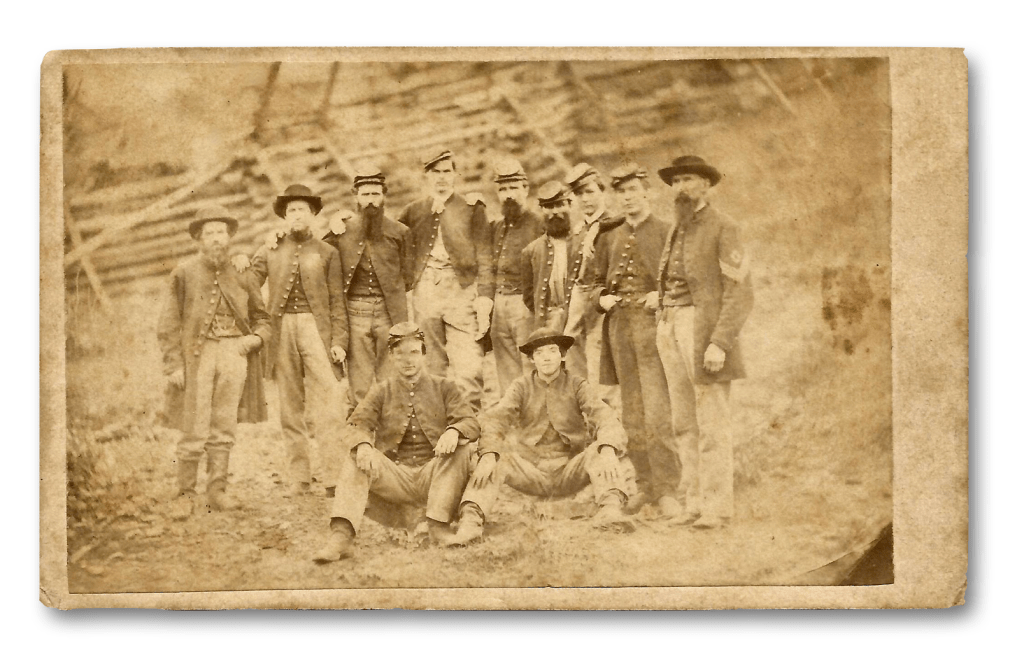
I could not find an image of Charles but here is a cdv of a group of guys from Co. B, 83rd Illinois Infantry that were stationed at Fort Donelson 1863-65. The men are identified (left to right) as Robert McClelland, Robert P. Morrison, Robert Gowdy, John M. Martin, Robert M Stevenson, John N Hogue, Josiah Moore, Marion Morrison, and 1st Sgt. William Struthers. Sitting in the front row are: James Neeley and Joseph Moore. (John Walsh Collection)
The following letter was written by Charles Wesley Harrison (1837-1931) of Victoria, Knox county, Illinois, who served in Co. K, 83rd Illinois Infantry during the Civil War. Charles’ parents were Alfred Harrison (1808-1866) and Margaret Cherrington (1816-1846). He wrote the letter to his sister, Delilah Harrison (1843-1907).
When Charles enlisted in August 1862, he was described as a dark-haired, dark-eyed 5 foot, 11-inch single farmer. He entered the service as a private, was promoted to corporal, and finally to sergeant in March 1865, just before mustering out of the regiment on 26 June 1865 at Nashville. During most of their time in the service, the 83rd Illinois was garrisoned at Fort Donelson which they successfully defended in an attack by Forrest and Wheeler on 3 February 1863.
Transcription
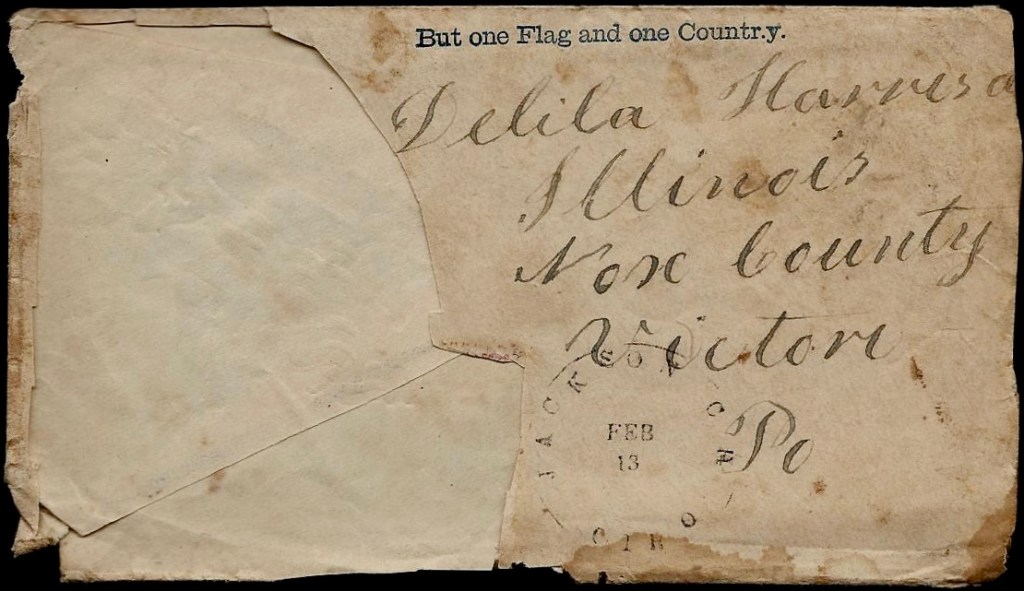
Addressed to Delila Harrison, Illinois, Knox County, Victoria, PO
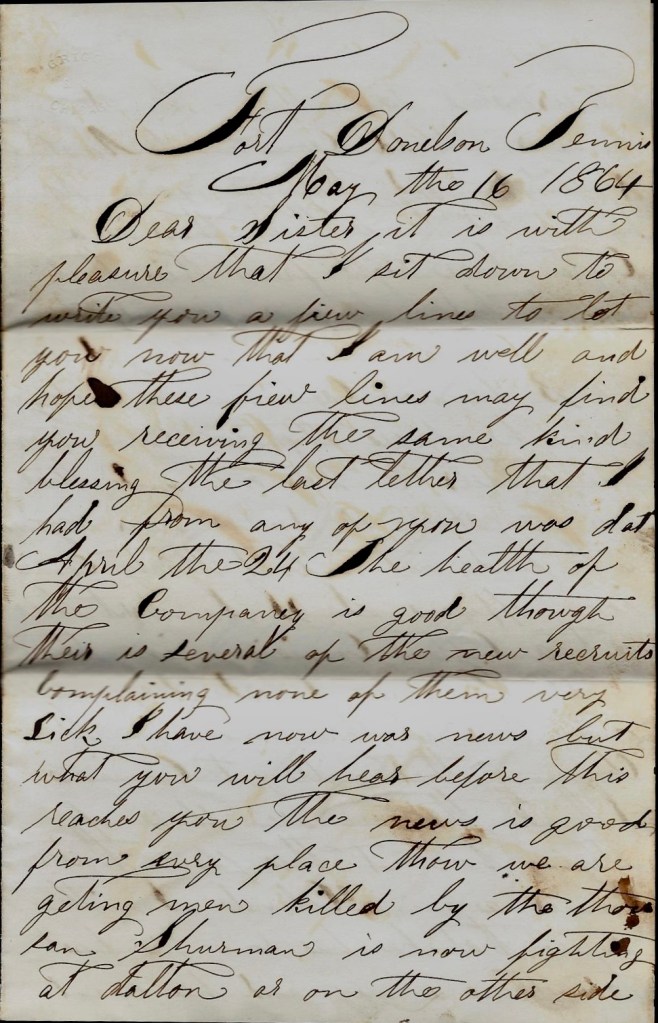
Fort Donelson, Tennessee May the 16, 1864
Dear Sister,
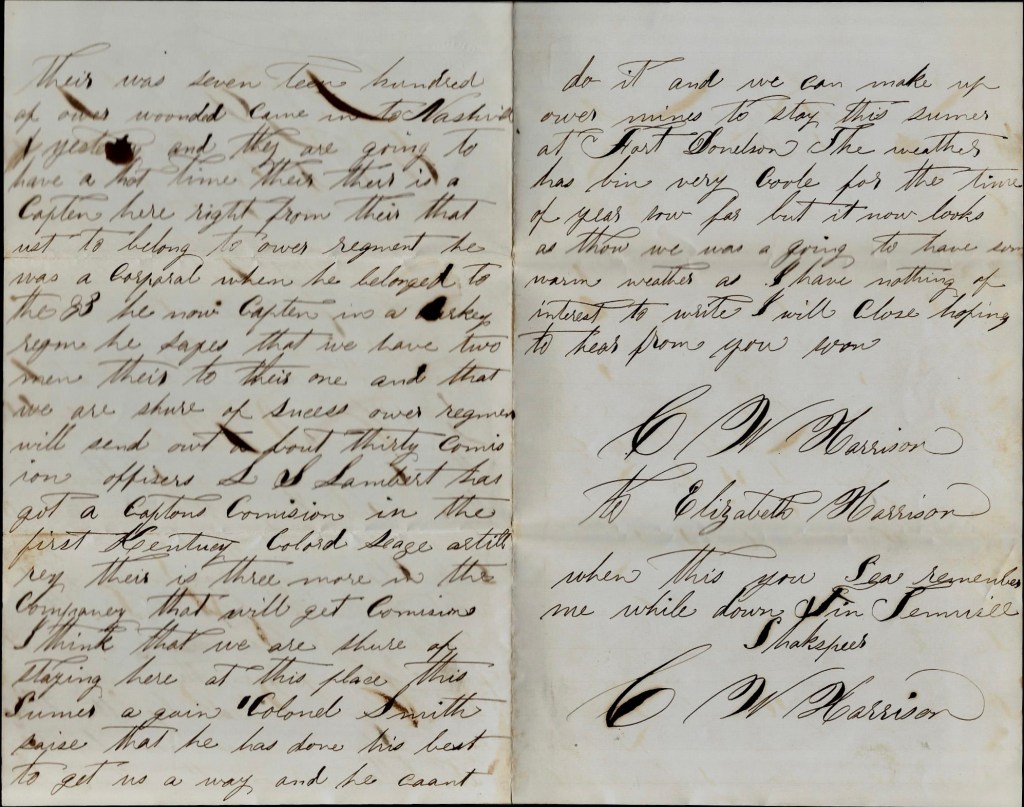
It is with pleasure that I sit down to write you a few lines to let you know that I am well and hope these few lines may find you receiving the same kind blessing the last letter that I had from any of you was dated April the 24th. The health of the company is good though there is several of the new recruits complaining. There is several of the new recruits complaining—none of them very sick. I have no war news but what you will hear before this reaches you. The news is good from every place though we are getting men killed by the thousands. Sherman is now fighting at Dalton or on the other side. There was seventeen hundred of our wounded came into Nashville yesterday and they are going to have a hot time there. There is a Captain here right from there that used to belong to our regiment. He was a Corporal when he belonged to the 83rd. He [is] now [a] Captain in a Darkey Regiment. He says that we have two men there to this one and that we are sure of success. Our regiment will send out about thirty commission officers.
L[ucian] S. Lambert has got a Captain’s commission in the First Kentucky Colored and still there is three more in the company that will get commissions. 1 I think that we are sure of staying here at this place this summer again. Colonel [Arthur A.] Smith says that he has done his best to get us away and he can’t do it and we can make up our minds to stay this summer at Fort Donelson.
The weather has been very cool for this time of year so far but it now looks as though we are a going to have some warm weather as I have nothing of interest to write. I will close hoping to hear from you soon.
— C. W. Harrison
When this you see, remember me, while down in Tennessee. — Shakespeer
1 According to Fold3, Lucian was commissioned Captain of the 8th Regt. U. S. Colored Heavy Artillery on 18 April 1864 at Paducah, Kentucky.
The following four letters were written by James B. Moyer (1845-1920), the son of George Moyer (1810-1865) and Magdalena Wolf (1812-1883) of Myerstown, Lebanon county, Pennsylvania. At an early age, James entered the carriage painting trade. When he entered the service in 1864, he was described as a brown-eyed, brown-haired recruit who stood feet 4 inches tall. He enlisted at Harrisburg on 26 August 1864 and immediately mustered into Co. F, 200th Pennsylvania Infantry.
These letters were written during the winter of 1864-65 when James was with the regiment before Petersburg. In the spring of 1865, he was detailed to brigade headquarters as a painter. He was honorably discharged in late May 1865.
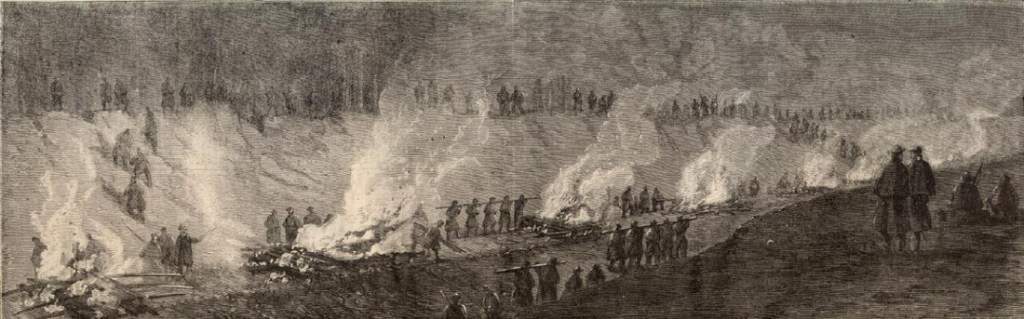
One of James B. Moyer’s letters describes the “Applejack Raid” or the “Hicksford Expedition” led by the 5th Corps, shown here tearing up and burning the Weldon Railroad.
Letter 1
[Note: The following letter describes the expedition led by Maj. Gen. Gouverneur K. Warren’s Fifth Corps composed of 26,000 troops to disrupt the Weldon Railroad. The Union troops were in high spirits during the raid, despite the frigid temperatures, and their exuberance was further fueled by the availability of potent apple brandy – “apple jack” – taken from farms along the expedition’s route. Officially known as “Hicksford Expedition” or “Weldon Raid,” the foray was dubbed “The Apple Jack Raid” by the Union troops. See The Union “Apple Jack Raid” by Robert Plumb.]
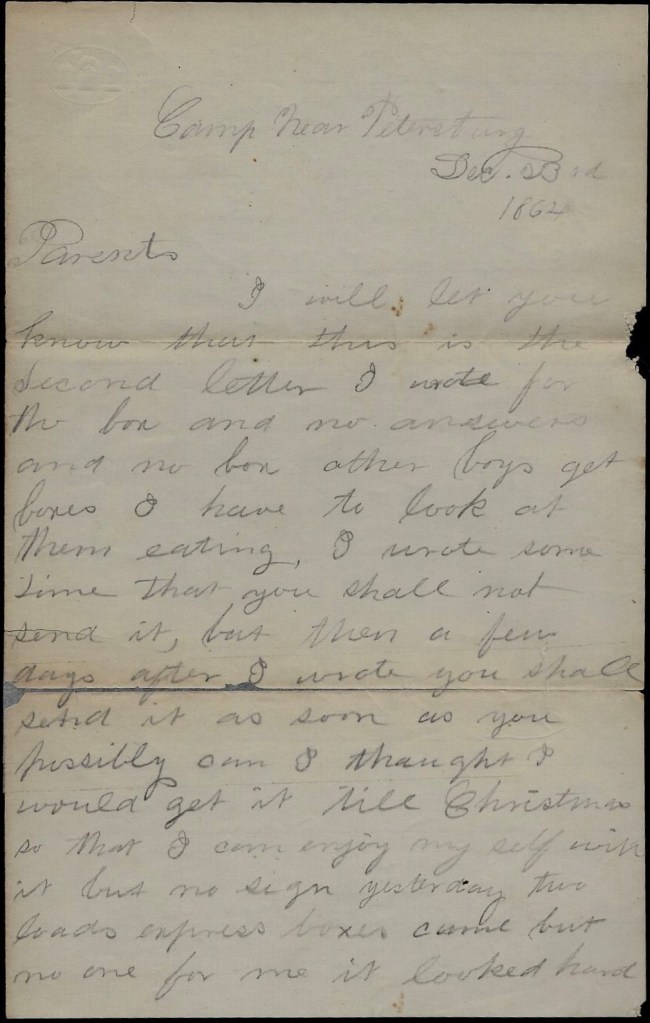
Camp near Petersburg, December 18th 1864
Parents,
I will let you know that we left here on Friday evening and marched five miles till at Meades Headquarters. Then it commenced to rain, snowing, and it was so cold that one man of Co. D froze to death. Then the next day there were two men to be hung. The scaffold was ready. They hung them between 12 and 1 o’clock on account of deserting in the Rebel Army. That was the first time I seen and I hope that is the last time. They were smoking their cigars till on the scaffold. I could tell you a great deal more about it but I have no time.
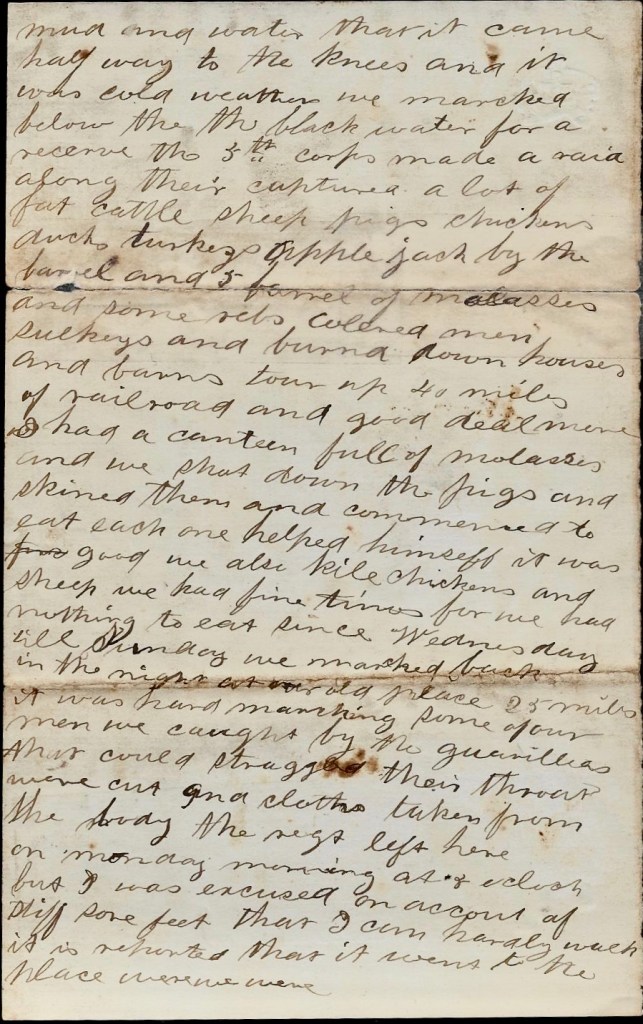
Saturday night we marched 25 miles through mud and water that came half way to the knees and it was cold weather. We marched below the Black Water for a reserve [while] the 5th Corps made a raid along there [and] captured a lot of fat cattle sheep, pigs, chickens, and turkeys, apple jack by the barrel and 5 barrel of molasses, and some rebs, colored men, sulkys, burned down houses and barns, tore up 40 miles of railroad, and good deal more.
I had a canteen full of molasses and we shot down the pigs and skinned them and commenced to eat. Each one helped himself. It was good. We also killed chickens and sheep. We had a fine time for we had nothing to eat since Wednesday till Sunday. We marched back in the night at our old place 25 miles. It was hard marching. Some of our men were caught by the guerrillas that straggled. Their throats were cut and clothes taken from their bodies.
The regiment left here on Monday morning at 4 o’clock but I was excused on account of stiff, sore feet [such] that I can hardly walk. It is reported that it went to the place were we were.
[unsigned]
Letter 2
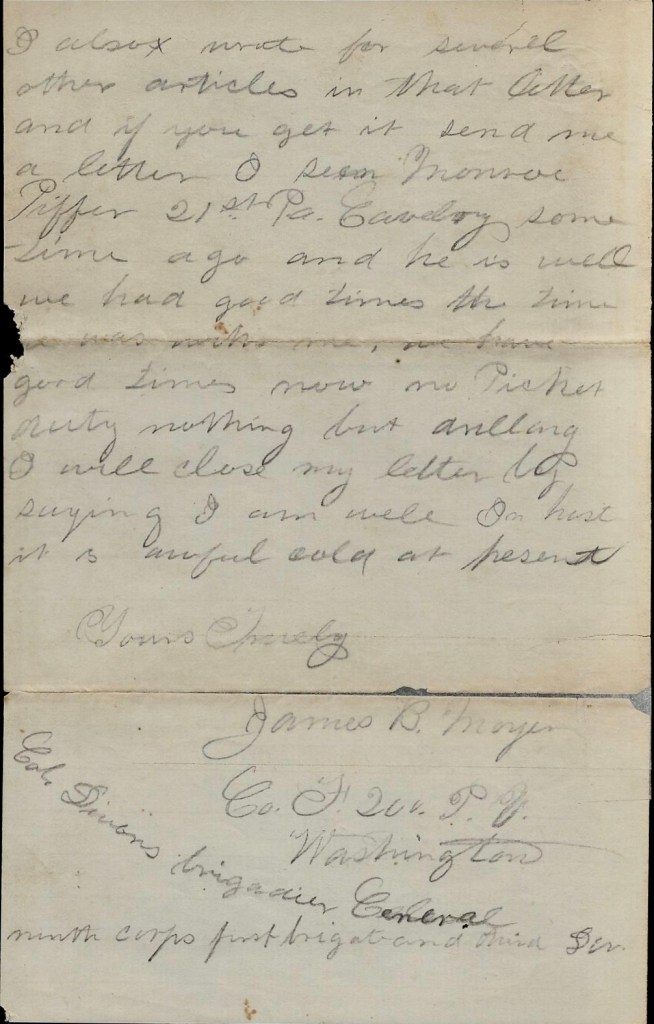
Addressed to Mr. George Moyer, Myerstown, Lebanon county, Pennsylvania
Camp near Petersburg [Virginia] December 23rd 1864
Parents,
I will let you know that this is the second letter I wrote for the box and no answer and no box. Other boys get boxes. I have to look at them eating. I wrote some time that you shall not send it, but then a few days after I wrote you shall send it as soon as you possibly can. I thought I would get it till Christmas so that I can enjoy my elf with it but no sign. Yesterday two loads of express boxes came but not one for me. It looked hard. I also wrote for several other articles in that letter and if you get it, send me a letter.
I seen Monroe Piffer [Peiffer], 21st Pa. Cavalry some time ago and he is well. We had good times the time he was with me. We have good times now. No Picket duty. Nothing but drilling. I will close my letter by saying I am well. In haste. It is very cold at present.
Yours truly, — James B Moyer, Co. F, 200th P. V., Washington
Col. [Charles Worth] Diven, Brigadier General Ninth Corps, First Brigade and third Div.
Letter 3
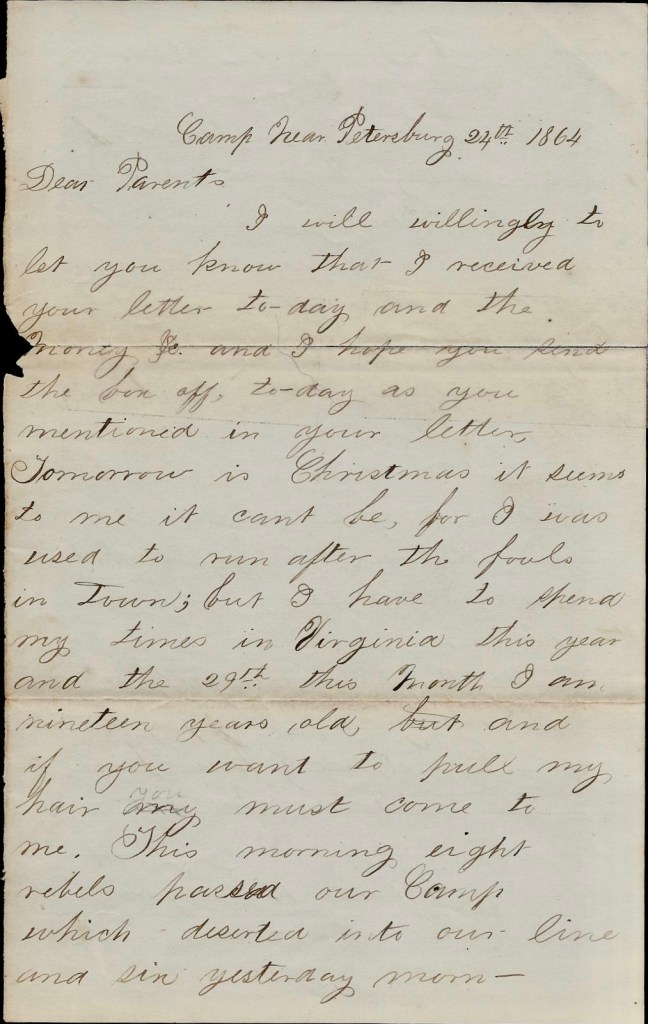
Camp near Petersburg [Virginia] 24th [December] 1864
Dear Parents,
I will willingly [write] to let you know that I received your letter today and the money, &c., and I hope you send the box off today as you mentioned in your letter. Tomorrow is Christmas. It seems to me it can’t be for I was used to run after the fools in town. But I have to spend my times in Virginia this year. And the 29th this month, I am nineteen years old and if you want to pull my hair, you must come to me.
This morning eight rebels passed our Camp which deserted in to our line and six yesterday morn. That is the way to close the war—lay down the arms and come in peace. The rebs are deserting fast all along our line.
Further we also drawed new clothes. I was used to get a new suit at home for Christmas and so I got a suit for this time. I have not much to say this time by closing my letter. I will make Robert a ring sometime. I am well, hoping you are the same. I wish you all a merry and happy Christmas & New Year. Yours Truly, — James B. Moyer
Letter 4
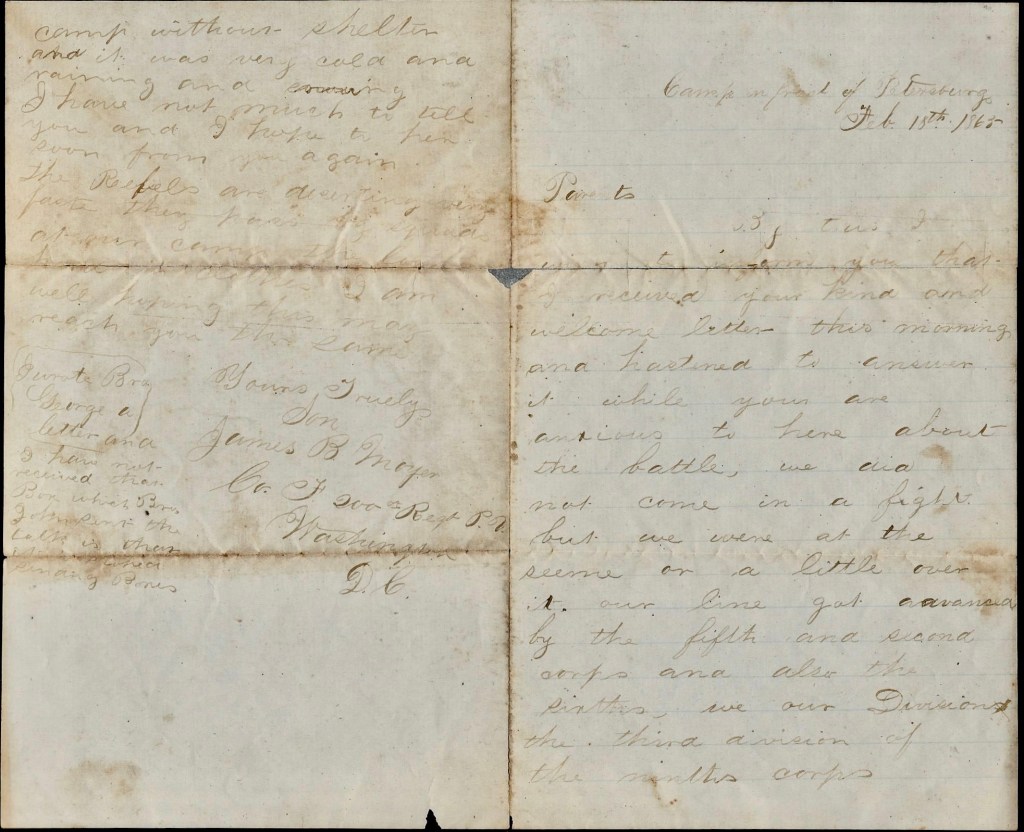
Camp in front of Petersburg, Virginia February 18, 1865
Parents,
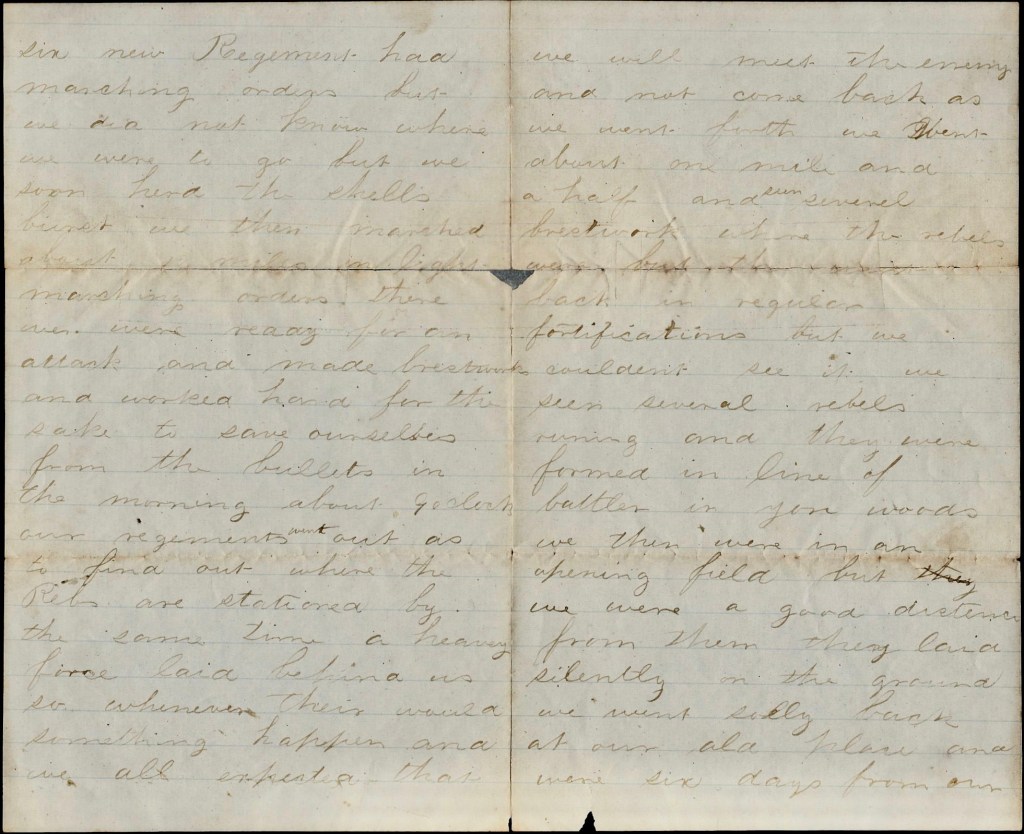
By this I wish to inform you that I received your kind and welcome letter this morning and hastened to answer it while you are anxious to hear about the battle. We did not come in a fight, but we were at the scene—or a little over it. Our line got advanced by the Fifth and Second Corps, and also the Sixth [Corps]. We—our Division 1, the 3rd Division of the Ninth Corps—six new regiments—had marching orders but we did not know when or were to go but we soon heard the shells burst. We then marched about 2 miles in light marching order. There we were ready for an attack and made breastworks and worked hard for the sake to save ourselves from the bullets.
In the morning about 9 o’clock, our regiments went out to find out where the Rebs are stationed. By the same time a heavy force laid behind us so whenever there would something happen and we all expected that we will meet the enemy and not come back as we went forth. We went about one mile and a half and seen several breastworks where the rebels were but the next night were back in regular fortifications. But we couldn’t see it. We seen several rebels running and they were formed in line of battle in yon[der] woods. We were then in an open field but we were a good distance from them. They laid silently on the ground. We went sadly back at our old place and were six days from our camp without shelter and it was very cold and raining and snowing.
I have not much to tell you and I hope to hear from you soon again. The Rebels are deserting very fast. They pass by squad at our camp. They hardly have any clothes. I am well hoping this may reach you the same
Yours truly Son, — James B. Moyer
Co. F, 200th Regt P. V., Washington D. C.
I wrote a Bro. George a letter and I have not received that box which Bro. John sent. The talk is that it is stopped sending boxes.
I could not find an image of Albert but here is a CDV of Francis H. Warner of Boston who also served in the 11th Massachusetts Light Artillery at the same time (Dave Morin Collection)
The following letter was written by 21 year-old Albert S. Garland (1843-1918), the son of David Gardland (1816-1846) and Mary Ann Trickey (1823-1887) of South Boston. Albert was working as an blacksmith when he enlisted as a private in late December 1863 in the 11th Massachusetts Light Artillery. He was promoted to artificer prior to his mustering out of the service at Camp Meigs, Readville, Massachusetts, in mid-June 1865 after nearly one and a half year’s service.
The 11th Massachusetts Light Artillery began 1864 with the 9th Corps, of the Army of the Potomac. It was then present at the Wilderness, engaged at the North Anna river with the 2nd Corps, and at the Weldon railroad with the 5th Corps. It shared in the operations before Petersburg, from June 17, 1864, to March 24, 1865 ; was active in repelling the attack upon Fort Stedman, and after the fall of Petersburg, joined in the pursuit of the vanquished army to Appomattox.
Just days before he left to join his regiment, on Christmas eve in Boston, Albert was married to Annie Streeter (1843-1908).
Transcription
Poplar Grove Church [near Petersburg, Virginia] November 18th 1864
Dear Sister and all the folks,
Yours was received last night in company with one from Annie and I was very glad to hear you all & all the folks were well, and I was very glad to hear you were all well. I am well—never better in my life. There is nothing to write about—not a thing. Everything is quiet. But there is another fight a brewing and a big one at that. Then I will have something to write about. It has been very quiet and very pleasant lately, but it has set in for a storm for it rains quite hard now.
I have not received Annie’s box yet but expect it Monday. I was very glad to hear that you had so good a time [on your visit] East.
[George W.] Marsh 1 and I are living pretty well now. We have got a Sutler’s work to do, & take our pay in goods, and sold a horse for him today and charged him 3 dollars, and got some potatoes, butter, & the rest in money. And we bought some beef steak, and tomorrow morning we are going to have boiled potatoes and beef steak. This morning we had hash meat fried brown on the bottom and it went bully, I tell you.
I should like to have some of mother’s brown bread. Dear Sister, it is Taps & the lights are to be put out, & I do not think of any more to write so I will close & try to write more next time. Send my best love to Mother & all the folks & keep a good share for yourself & I will send you some more papers tomorrow.
Please excuse this & I will now close. Good night. From your Brother, — Albert S. Garland
1 George W. Marsh was a 27 year-old carriage trimmer from Chelsea when he enlisted in 1863 to serve in the 11th Massachusetts Light Artillery.
I could not find an image of John but here is a one of a young Georgian thought to be Thomas Blount Bowen but is unconfirmed (David Vaughn Collection)
The following letter was written by 19 year-old Pvt. John Mornington Raines (1845-1899) of Milledgeville, Baldwin county, Georgia, who enlisted in October 1863 in Co. G, 45th Georgia Infantry. He was taken prisoner on 25 March 1865 at Petersburg, Virginia, and released in June 1865 at Point Lookout, Maryland. John had a brother who served with him in the same company—Thomas Turner Raines (1838-1865)—who was probably the individual he referred to as “Bud” in this letter. I believe there was another brother names James Cadwallader Raines (b. 1840) who may have served the Confederacy in a different regiment.
John’s military records indicate that he had brown hair, blue eyes, and that he stood 5 feet 7.5 inches tall. His parents were Robert Cadwallader Raines, Jr. (1808-1860) and Matilda Caroline (“Carry”) Young (1810-1883) who were married in 1832. Cadwallader Raines died in September 1860, leaving 50 year-old Carrie with seven children and a plantation to run.
Three months after this letter was written, when the left wing of Sherman’s army marched through Milledgeville in late November 1864 on its way to Savannah, “Mrs. Cadwallader Raines, a widow and the mother of three Confederate soldiers,” found herself in the center of the Federal encampment. “She had been bedridden for several months and was attended only by two young daughters [Ellen and Mary]. Her plantation suffered complete devastation, having been depleted of all fences, livestock, and food.” A neighbor named Terrell Barksdale later wrote that, “They did not leave a living animal on her plantation…they have nothing except what the neighbors give them and they have but few of them that have anything to spare.” [“Sherman at Milledgeville in 1864” by James C. Bonner, published in The Journal of Southern History, Vol. 22, No. 3, August 1956, page 280]
I can’t be certain of the date of this letter as it is illegible on the letter itself. There were several attempts to capture the Weldon Railroad before it was finally accomplished in mid-August 1864.
Transcription
In Line of Battle near Petersburg August [ ] 1864
Dear Mother,
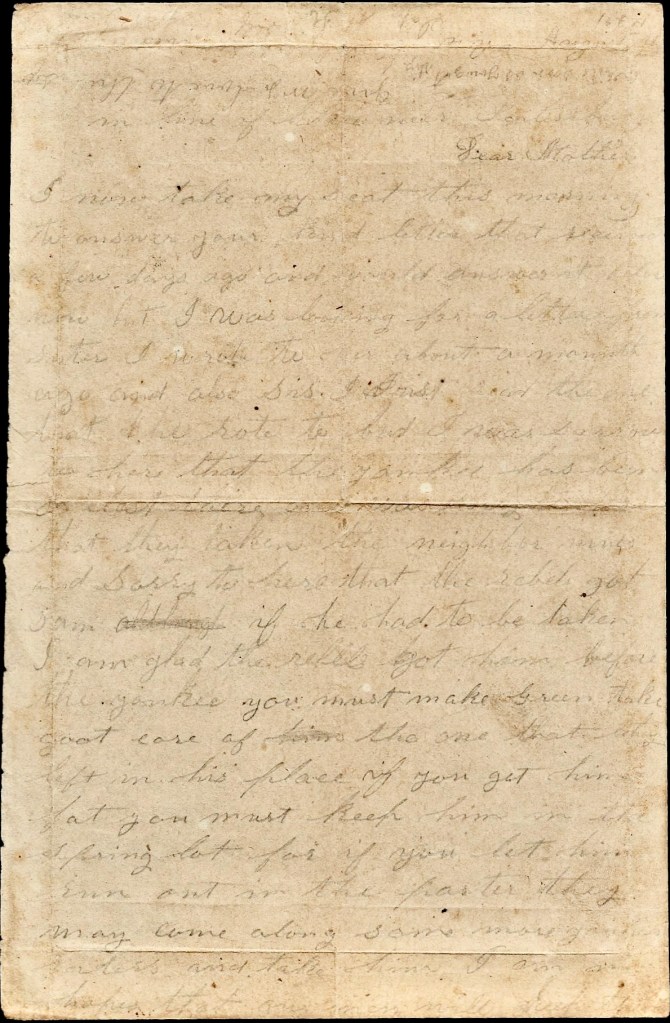
I now take my seat this morning to answer your kind letter that I received a few days ago, and would answer it before now, but I was looking for a letter from sister. I wrote to her about a month ago and also Sis. I just rec’d the one that she wrote to Bud.
I was sorry to hear that the Yankees has been so close there and was sorry also that they taken the neighbor’s mule, and sorry to hear that the rebels got Sam. If he had to be taken, I am glad the rebels got him before the Yankees. You must make Green take good care of the one that they left in his place. If you get him fat, you must keep him in the Spring lot, for if you let him run out in the pasture, there may come along some more Yankees and take him. I am in hopes that our men will keep them back from that part of the country, for they will destroy things as they go. I hope that Gen. Hood will whip them clear out from Georgia.
There was a fight here yesterday on the Petersburg and Weldon Railroad. Our men whipped them back and taken a good many prisoners. We have a fight every day on some part of the line. The Yankees is tame in front of me. We are are close enough to talk to each other when I am out on [the] skirmish [line].
I went over to the hospital this morning to see Bud. He is getting along finely. He will be able for duty in a few days. This leaves me in good health at this time, and hoping this will find you up and about and also the rest of the family. This is the 5th letter I have wrote to you since I been at this place. I only received one. I have wrote to Puss and Sister and Sis and have not got any answer from them. You must tell them to write. I will close. I will send this letter by hand with the yarn. I remain your son, — John M. Raines
I could not find an image of William but here is one of Pvt. Ezra Joseph Davy of Co. D, 121st Ohio Infantry (Ancestry.com)
The following letter was written by 23 year-old William E. Scott (1839-1911), the youngest son of Francis Scott (1791-1860) and Nancy Gadd (1793-1873) of Leesburg, Union county, Ohio. William enlisted in August 1862 to serve as a private in Co. I, 121st Ohio Volunteer Infantry (OVI).
William had two brothers who served with him in the same company—Norton (“Nort”) Scott (1820-1905) who was the 1st Sergeant in Co. I, and Ross Scott (1828-1901) who was also a private. Nort was discharged for disability on 9 May 1863, no doubt as a result of the chronic diarrhea mentioned in William’s letter. Ross was discharged for disability as well.
The 121st OVI was organized at Delaware, Ohio, and ordered to Kentucky to pursue confront Bragg on his northern invasion. They participated in the Battle of Perryville and then pursued Morgan in the winter of 1862-63. After spending some time in Nashville, they were ordered to Franklin, Tennessee, where this letter was penned in mid-March 1863. They went on to participate in in the Battle of Chickamauga, the Atlanta Campaign, the March to the Sea, and the Carolina Campaign.
Transcription
Camp at Franklin, Tennessee March 16, 1863
Dear Mother and Sisters,
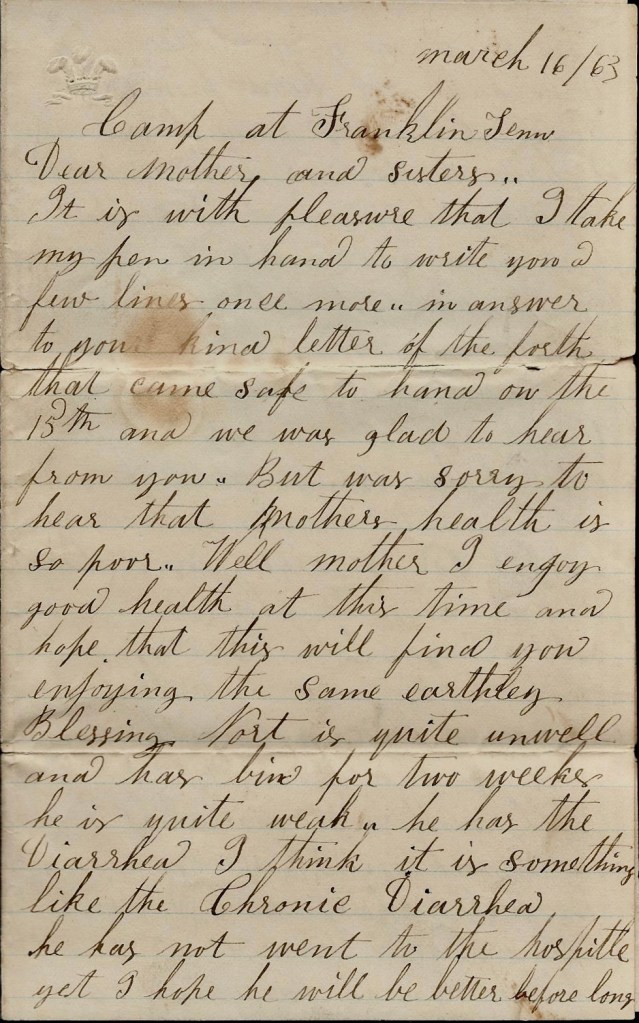
It is with pleasure that I take my pen in hand to write you a few lines once more in answer to your kind letter of the fourth that came safe to hand on the 15th and we was glad to hear from you but was sorry to hear that Mother’s health is so poor. Well, mother, I enjoy good health at this time and hope that this will find you enjoying the same earthly blessing.
Nort is quite unwell, and has been for two weeks. He is quite weak. He has the diarrhea. I think it is something like the chronic diarrhea. He has not went to the hospital yet. I hope he will be better before long.
You said in your letter that you had not heard from us since Charles came home. I have wrote one letter since he went home but I suppose that you never got it for there is hundreds of letters that never reach their destination. I am glad to hear that Ross’s cough is better. I think he had better stay where he is for I don’t think he ever will be fit for service as it takes a well man to stand soldering. Tell Gerry’s mother that he is well and that he stands soldering with the best of the Boys.
Well, Mother, we are still here at Franklin, Tennessee. How long we will stay here, I can’t tell. We have moved our camp five times since we came here, and have to move again tomorrow. We have not moved one mile in all. One more move and we will be where we started from.
I want you to write and tell me whether you got the money I sent home or not, and if you have not got it, go and get it for it is there for you as I never heard whether you got it or not. The folks is making garden here now. The peach trees is in bloom. The sun shines so hot, it makes me lazy. So I will bring my letter to a close for this time, write oftener and I will answer them.
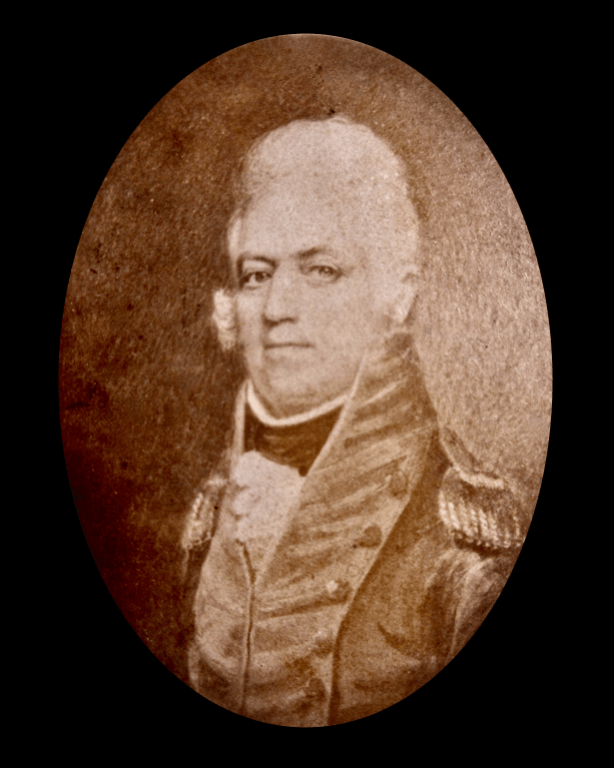
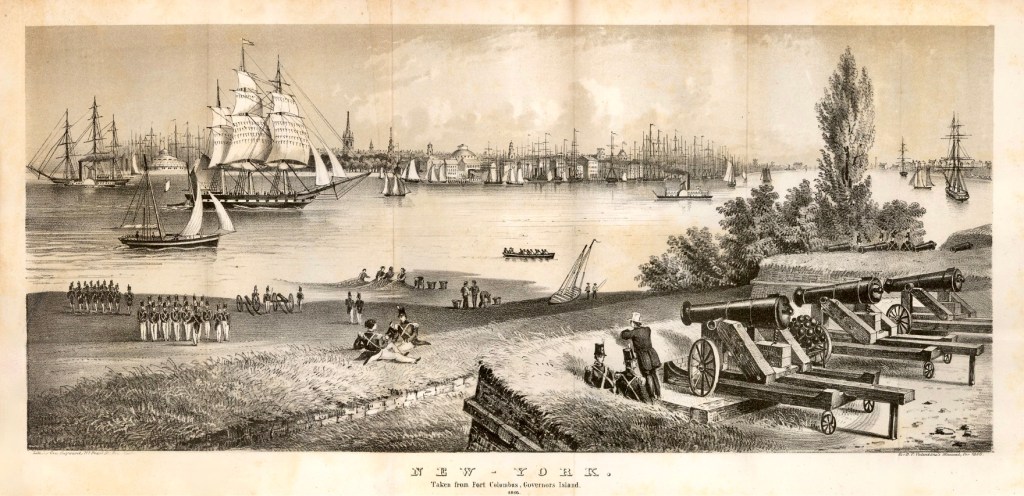
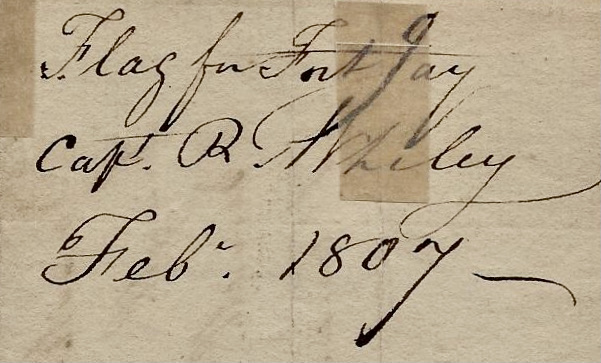
The following rare receipt for the making of a garrison flag to fly over Fort Jay was commissioned by Captain Richard Whiley (1767-1847)—a native of London, England, who came to the United States in the 1780s. He served under General Anthony Wayne in the Northwest Indian War (1785-1795) and received a commission as a lieutenant of artillery in 1796. By 1803, he was a captain of artillery, and commanded Fort Jay on Governors Island in New York Harbor from 1804 to 1806. In the spring of 1806, with tensions rising between the U. S. and England, the U. S. Congress appropriated funds to partially demolish the fort which was described as “in a state of absolute ruin,”—its sodded ramparts eroded by wind and rain. Beginning in July 1806 and for the next two years, it was enlarged, rebuilt, and recommissioned as Fort Columbus. Capt. Whiley then commanded the fort until 1809 and then retired from the military in June 1811. Afterwards, he lived for several years on the Hudson River near Poughkeepsie. He served as president of the North River Insurance Company for many years.
Capt. Richard Whiley (1767-1847)
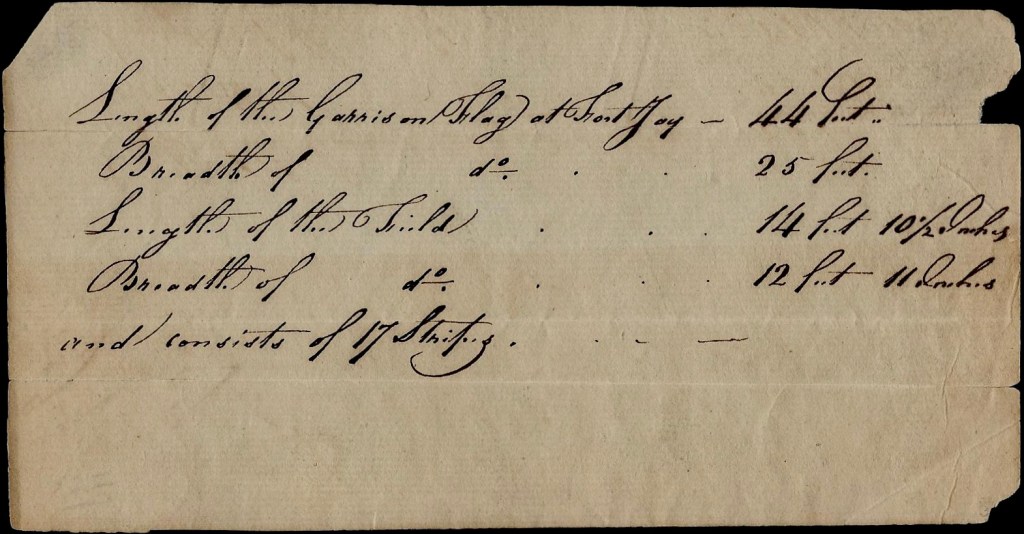
The receipt itself conveys important information. It reveals the flag’s prescribed dimensions, the quantity and cost of the materials used to make it, and the name of the flag’s maker. The order for the flag was placed in February 1807 during the aforementioned construction period when the fort transitioned from “Fort Jay” to “Fort Columbus.” The total cost of the flag was $103.30.
The official U. S. flag at this time contained 15 alternating red and white stripes, and 15 stars on a field of blue. It was the same pattern flag that flew over Fort McHenry during the War of 1812 which inspired Francis Scott Key to write “The Star Spangled Banner.” That flag was commissioned by Major George Armistead in 1813 and its dimensions were 42 x 30 feet. Each star was about two feet in diameter and each stripe about 24 inches wide. The field of blue was 20 x 16 feet.
By comparison, the “Jay Fort” flag commissioned by Capt. Whiley in 1807 was 44 x 25 feet—slighter longer and considerably narrower. The field of blue only 14 x 12 feet, correspondingly smaller. What is most unusual, however, is the specification calling for 17 stripes instead of the 15 stars and 15 stripes prescribed by the second Flag Act on 1794.
To aid in the visualization of the difference in dimensions between the Fort McHenry flag (“Star Spangled Banner”) of 1813 and the Fort Jay flag of 1807, I’ve depicted the dimensions on a grid.Each grid square represents 1 square foot.
The receipt also reveals to us that the order for making the Fort Jay flag was placed in 1807 with Simon Schermerhorn whom I believe to be the same Simon Schermerhorn (1748-1818) described as a New York City merchant and ship’s chandler in city and census records. His parents, I believe, were John Shermerhorn and Sara Canon.
A view of New York City from the rebuilt ramparts of Fort Columbus (formerly Fort Jay) on Governors Island (1815)
Steamer Northwest, likely at the pier in Cleveland, OH. The decks are crammed with excursionists. (Rick Brown Collection)
My friend Rick Brown acquired a carte-de-visite (CDV) recently which was labeled as the steamer Northwest of Cincinnati, Ohio. This didn’t look right to me. Yes, there were steamers on the western rivers by that name but this vessel looked too massive, with a hull that rose up high out of the water more typical of “coasters”–those vessels used along the eastern seaboard, or more likely, on the Great Lakes. A quick search of newspaper clippings from the 1860s when CDV’s were in vogue revealed that there was a large steamer by that name that plied the Great Lakes, often out of Cleveland. My friend Dale Niesen soon found the steamer listed among the “Historical Collections of the Great Lakes.” She was built in Manitowoc, Wisconsin, in 1867 by George S. Rand. She had a wood hull and weighed 1100 tons.
Knowing the name of the steamer and that she worked the Great Lake routes was a good start, but it didn’t explain why the photograph would have been taken of her with so many passengers crammed on her decks and even standing on top of the wheelhouse. Noticeably present, in addition to finely attired men, are a fair number of ladies and some children. To me it had the appearance of an excursion—a day trip, if you will. There are clearly too many passengers onboard to be comfortably accommodated for anything longer than an excursion of a couple hours. Daytime and even moonlight excursions on the lake were extremely popular at the time.
Intuitively I began to search old newspaper articles mentioning the words, “steamer Northwest” and “excursion” and Cleveland in the 1867 to 1870 timeframe. I found several excursions that took place during this period aboard the steamer Northwest—too numerous to list them all. One of the first in which the steamer was chartered was the 4th of July Celebration in 1867—its first year on Lake Erie. An extract from the article appearing in the Cleveland Plain Dealer on 5 July 1867 describing that event states, “The steamer Northwest made an excursion at noon yesterday, from Erie to Port Dover, Canada. The Cleveland Cornet Band accompanied the party, which numbered fully 1,500 persons. The boat got back at 9 o’clock in the evening.” Just a few days later, on 11 July 1867, the Cleveland Daily Leader printed an announcement for an “Excursion to Lake Superior” to be made by “the elegant steamer Northwest” and informing readers that “several parties from Eastern cities have engaged passage” for the trip that planned to leave Cleveland and visit the “North Shore, Isle Royal, Fort William, and every point of interest on the South Shore. The steamer is entirely new, very commodious, and one of the best furnished boats in every particular over the lakes.”
There was an excursion party from Marion, Ohio, that chartered the steamer Northwest “for a few hours’ sail on the lake” in September 1868. The occasion was not stated and the party was “five hundred strong.” That same month, the “splendid steamer Northwest” carried excursionists to Put-in-Bay Island and return for the day. No occasion was stated.
In 1869, there were more excursions in the fall. In early August, the steamer Northwest was chartered to transport excursionists on a picnic to Black River and return—a benefit for the 2nd Baptist Church. The crowd was described as “happy and joyous…young and old, male and female, to the number of 700 persons.” The boat left the pier at 9:30 a. m. and returned in the evening.
Aside from a few smaller and shorter excursions, there was another made in September 1869 to Put-in-Bay to celebrate the anniversary of Perry’s Victory there during the War of 1812. It was hosted by the 7th Regiment and accompanied by a brass band.
In the early 1870s there were several more excursions of a similar nature.
My hunch is that the photograph was likely taken to commemorate one of these shorter excursion events in the late 1860’s at Cleveland during which time Cleveland was the home port of the steamer Northwest. I don’t see anyone in shirt sleeves—even the dock workers—and the clothing of the passengers suggest a fall wardrobe to me so I suspect this was either the excursion to Black River or to Put-in-Bay, or possibly even a GAR encampment meeting.
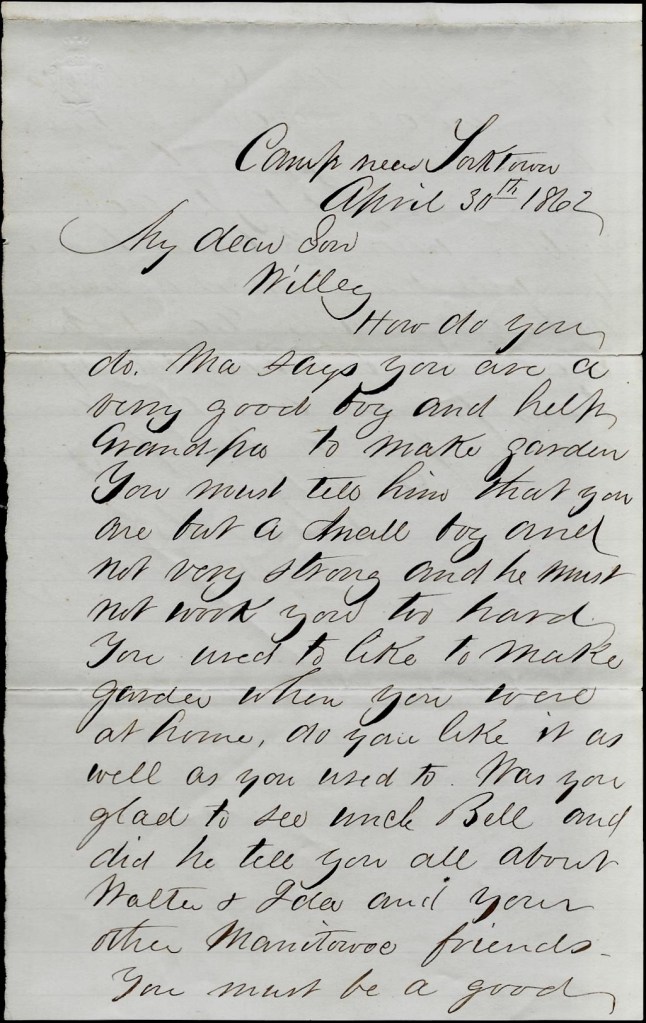
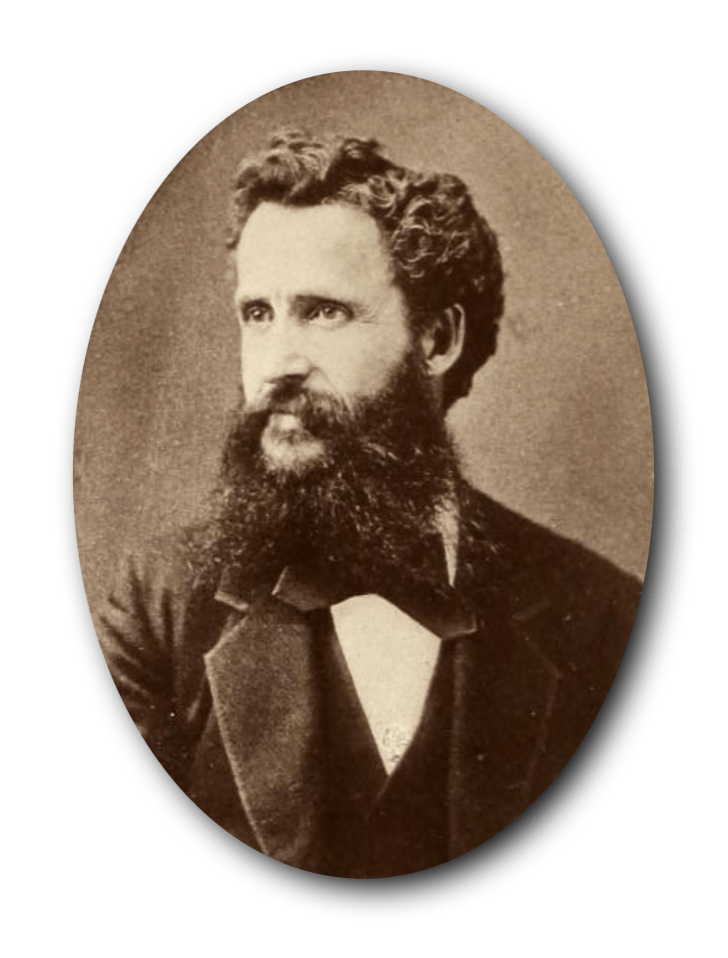
The following letter was written by David Higgins Van Valkenburg (1823-1862), the son of Jacob Van Valkenburgh (1795-1879) and Mary Bethia Higgins (1793-1871). David was born in Plattsburg, Steuben county, New York, and was married in December 1852 to Elizabeth Humphrey in Manitowoc, Wisconsin, where he was enumerated in the 1860 US Census as a “Dry Goods Merchant.” His son, William (“Willey”) Gilbert Van Valkenburg (1854-1934) was born in September 1854.
According to his biographical sketch, David was a sheriff in Manitowoc county at one time. When the Civil War began, David joined the 1st New York Light Artillery, mustering in as Major of Battery A on 26 October 1861. During the Battle of Fair Oaks (or “Seven Pines”) on 31 May 1862, after both of his superior officers had been killed, David took command of the battery and was shot and killed instantly. That David’s battery was in the thick of the fight is demonstrated by the number of casualties and the loss of 100 horses. The battery with all its camp and garrison equipage was captured by the enemy. The company was so reduced in strength that it was not even reconstituted; the survivors were reassigned to Battery H.
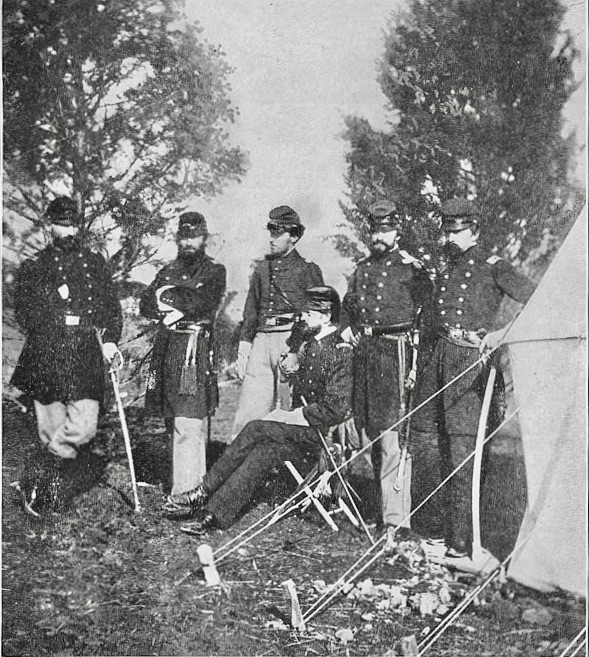
Major David Higgins Van Valkenburg is standing at far left with legs crossed. (Ancestry.com)
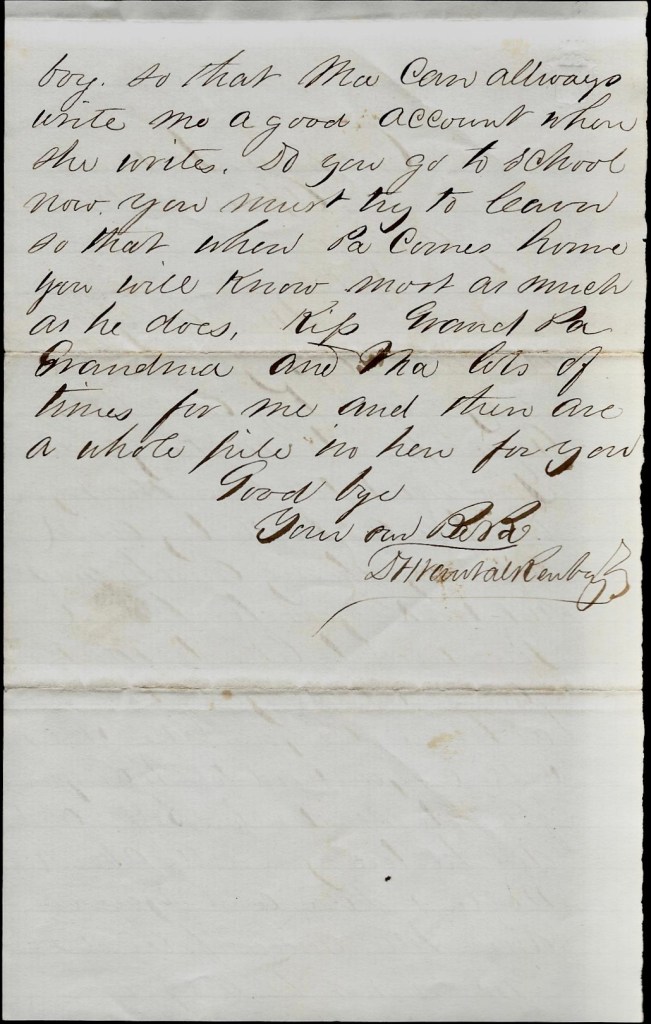
Transcription
Camp near Yorktown, [Virginia] April 30th 1862
My dear son Willey,
How do you do? Ma says you are a very good boy and help Grandpa to make garden. You must tell him that you are but a small boy and not very strong and he must not work you too hard. You used to like to make garden when you were at home. Do you like it as well as you used to? Was you glad to see Uncle Bill and did he tell you all about Walter and Ida and your other Manitowoc friends?
You must be a good boy so that Ma can always write me a good account when she writes. Do you go to school now? You must try to learn so that when Pa comes home you will know most as much as he does. Kiss Grandpa, Grandma, and Ma lots of times for me and there are a whole pile in here for you. Goodbye. Your own PaPa., — D. H. VanValkenburg
The following letter was written by John Fite Goodner (1822-1870), the son of James G. Goodner (1792-1883) and Margaret Martha Fite (1798-1862) of DeKalb county, Tennessee.
As a field officer in the 7th Tennessee Infantry, C.S.A., this Mexican war veteran attained the ranks of Captain, Co. A, on 20 May 1861; as Lieutenant Colonel of the regiment on 27 May 1861, and on 23 May 1862, he became Colonel and commander of the famed 7th Tennessee Infantry after Robert Hatton was elevated to the rank of Brigadier General. “Ill heath” forced his resignation from the service on 8 April 1863.
John was married to Nancy C. Floyd (1830-1850) but she died in childbirth in December 1850 and he never remarried.
Transcription
Camp of 7th Regiment Tennessee General J. J. Archer’s Brigade December 8, 1862
To the Hon. Secretary of War,
The following named persons are most respectfully suggested to you for promotion on Co. G, 7th Regiment Tennessee Volunteers:
William F. Graves, now 1st Lieutenant in said company to Captain of it instead of Capt. James H. Bond [who] resigned 7th October 1862.
Newbern A. Jennings, now 2nd Lieutenant to 1st [Lieutenant] in place of William F. Graves, promoted.
John C. Ingram, now Junior 2nd Lieutenant, to Senior 2nd Lieutenant in place of Newbern A. Jennings, promoted.
William H. Robbins, now 2nd Sergeant to Junior 2nd Lieutenant in place of John C. Ingram, promoted.
The said William H. Robbins has made a good soldier and was wounded at Seven Pines while gallantly charging the enemy, has recovered from his wounds, and continued in the line of duty, bearing imself like a true soldier and patriot through the recent battles from Cedar Run to Shephardstown.
All of which is most respectfully submitted for your consideration, — Jno. F. Goodner, Col. Commanding 7th Regiment Tennessee
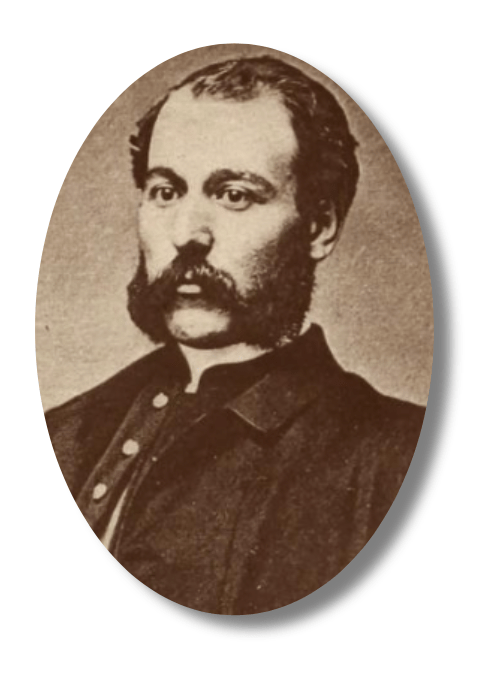
Samuel H. Putnam (“Wearing the Blue” by Capt. Denny)
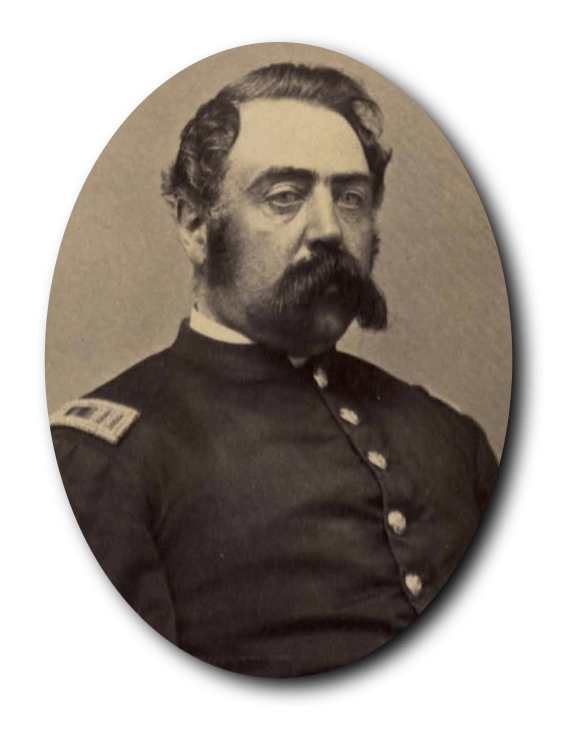
The following letters were written by Samuel Henry Putnam (1833-1911) to his brother Otis Earle Putnam (1831-1911). They were the only surviving sons of Salmon Putnam (1800-1892) and Tryphena Bigelow (1800-1865) of Worchester, Massachusetts.
Samuel was working as a clerk in Worcester when he enlisted as a corporal in Co. A, 25th Massachusetts Infantry on 19 September 1861 and was promoted to sergeant three months later. He survived the war though he was wounded at the Battle of Cold Harbor on 3 June 1864. He mustered out of the regiment as Sergeant Major of his company on 20 October 1864 after three years service.
Like most young men, Samuel was anxious to see some action. Before embarking on Burnside’s Expedition, he had written his cousin, in December 1861, “I find the love for camp life rather grows on me; It may be the being outdoors is the thing, but anyhow my health is first rate and there is a kind of feeling—a sort of independence too—that one does not experience in common every day life. I hope it will be more exciting as we move onward.” [I’m Off to See the Elephant, by Dennis Buttacavoli, 9/3/2018 History Net]
In 1862, the regiment suffered losses of 50 killed or wounded in the Battle of Roanoke Island, and they were also active in the taking of New Bern and Goldsboro that year. By March, 1863, the 25th was part of the 2nd Brigade, 1st Division, 18th Corps, Dept. of North Carolina.
Putnam’s long, detailed first letter reads much like a book and he no doubt used it to recall the event when he wrote, “The Story of Company A, Twenty-fifth Regiment Mass. Volunteers in the war of the rebellion,” published in 1886. A e-version of the book may be found on Internet Archive. Two other valuable sources on the history of the regiment may be found on-line in a book entitled, “My Diary of the Rambles with the 25th Mass. Volunteer Infantry“ by D. L. Day, and “Wearing the Blue,” by J. Waldo Denny, published in 1879. Neither of the events described in Putnam’s letter of March 12-16, 1863, are described in these latter publications, however.
Incredibly, there is a companion letter to the one by Putnam that was written by William Jahaney Lowry (1841-1863) of Co. B, 45th North Carolina Infantry, that describes the exact same event described in Putnam’s letter—only from the perspective of the Rebel encampment that was the object of their nighttime attack. Lowry’s letter can be found as Letter 3 on 1863: William Jahaney Lowry to Ann (Walker) Lowry on Spared & Shared 17.
The last part of Putnam’s 1st letter, written on March 16th, describes the Battle of Deep Gully in which Gen. D. H. Hill devised a three-pronged plan to wrestle New Bern away from the Union forces garrisoned there. See Battle of Deep Gully and Fort Anderson.
Putnam’s second letter was also datelined from Newbern, but in September 1864, after having relocated from the trench warfare of the Petersburg/Bermuda Hundred front in Virginia. The regiment arrived at Newbern in early September where they took up garrison and outpost duty in and around the city.
To read other letters by member of the 25th Massachusetts that I have transcribed and published on Spared & Shared, see: Charles Newton, Co. B, 25th Massachusetts (1 Letter) Henry Arthur White, Co. H, 25th Massachusetts (1 Letter)
Letter 1
[Note: This letter is from the personal collection of Richard Weiner and was transcribed and published on Spared & Shared by express consent.]
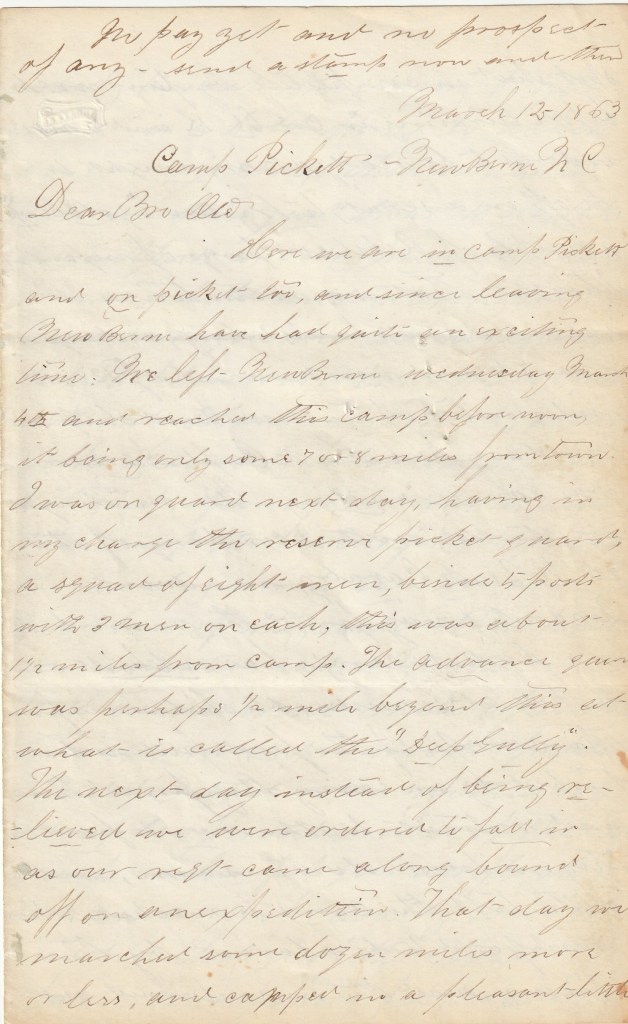
Camp Pickett 1 New Bern, North Carolina March 12, 1863
Dear Bro. Otis,
Here we are in Camp Pickett and on picket too, and since leaving New Bern have had quite an exciting time. We left New Bern Wednesday, March 4th, and reached this camp before noon, it being only some 7 or 8 miles from town. I was on guard next day, having in my charge the reserve picket guard—a squad of eight men, behind 5 posts with 3 men on each. This was about 1.5 miles from camp. The advance guard was perhaps half mile beyond this at what is called the “Deep Gully” [on the Trent Road].
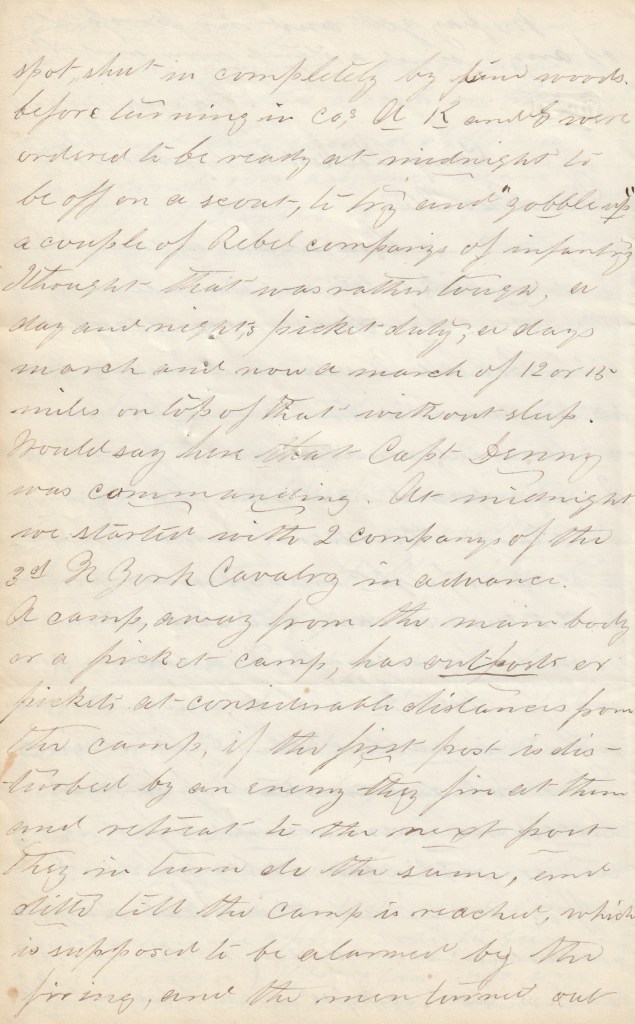
The next day instead of being relieved, we were ordered to fall in as our regiment came along bound off on an expedition. That day we marched some dozen miles more or less, and camped in a pleasant little spot shut inn completely by pine woods. Before turning in, companies A, K and G were ordered to be ready at midnight to be off on a scout, to try and “gobble up” a couple of Rebel companies of infantry. I thought that was rather tough—a day and night’s picket duty, a day’s march, and now a march of 12 or 15 miles on top of that without sleep. Would say here that Capt. [Joseph Waldo] Denny was commanding.
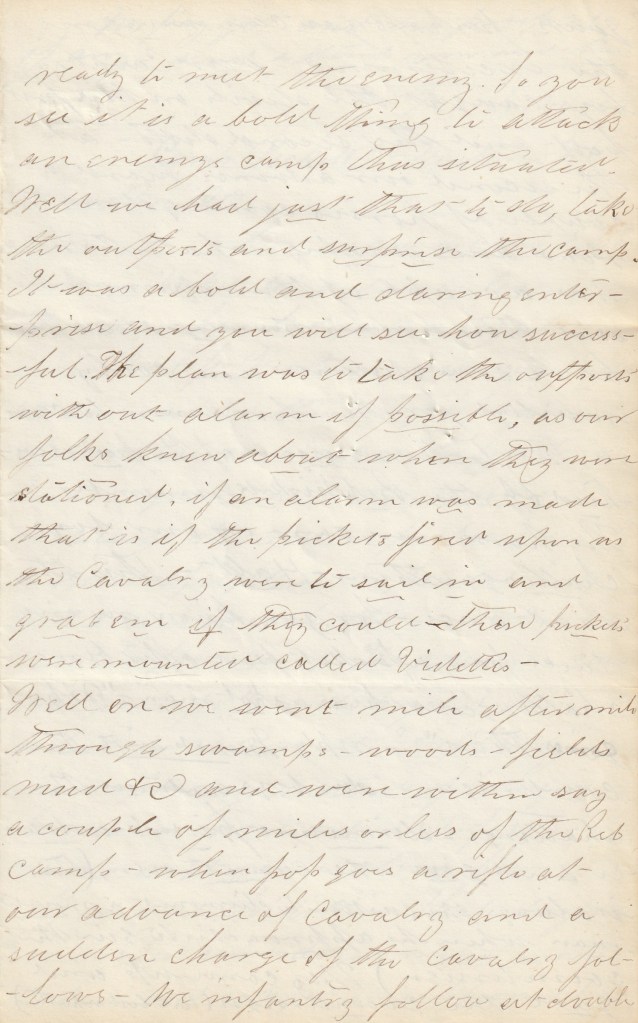
At midnight we started with two companies of the 3rd New York Cavalry in advance. A camp, away from the main body or a picket camp, has outposts or pickets at considerable distances from the camp. If the first post is disturbed by an enemy, they fire at them and retreat to the next post. They in turn do the same, and ditto till the camp is reached, which is supposed to be alarmed by the firing, and the men turned out, ready to meet the enemy. So you see, it is a bod thing to attack an enemy camp thus situated.
Well, we had just that to do—take the outposts and surprise the camp. It was a bold and daring enterprise and you will see how successful. The plan was to take the outposts without alarm if possible as our folks knew about where they were stationed. If an alarm was made—that is, if the pickets fired upon us, the cavalry were to sail in and grab them if they could. Their pickets were mounted—called videttes.
Well, on we went mile after mile through swamps, woods, fields, mud &c. and were within say a couple of miles or less of the Reb camp when pop goes a rifle at our advance of cavalry and a sudden charge of the cavalry follows. We infantry follow at double quick. Perhaps you can imagine the excitement.
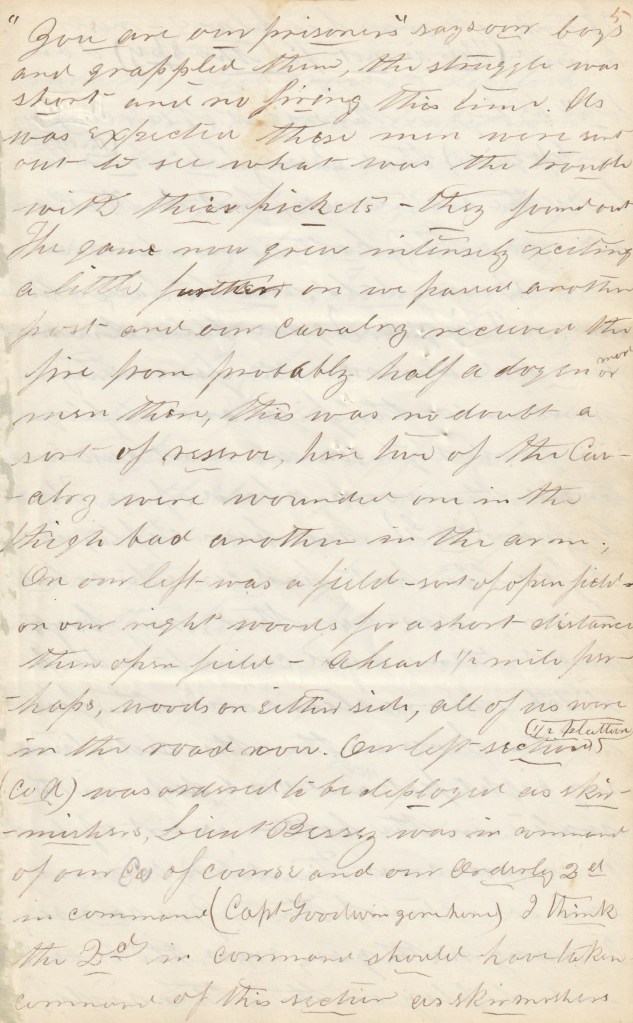
Our cavalry boys caught the devils on this first post and the second ditto. At the second, our advance heard a couple of horses coming down the road and guessing what the trouble was, a couple of them dismounted, sent their horses to the rear—or rather back some distance, and cooly waited for the horsemen to come on. They took possession of the post occupied by the Rebel pickets remember. The horsemen came on, our boys challenge them—“Halt!” This they do at once, for you know no one dares pass a picket post after being challenged or he is a shot man. “Who goes there.” Reply—“Friends with the countersign.” Our boys continue the challenge, “Dismount friends. Advance and give the countersign.” (This is always the custom—to dismount a mounted man when he approaches to give the countersign.) They came up and gave the countersign (two low whistles). “You are our prisoners,” say our boys, and grappled them. The struggle was short and no firing this time. As was expected, these men were sent out to see what was the trouble with their pickets—they found out!
Lt. Merrit B. Bessey, in command of Co. A on expedition described in letter (Photo Sleuth)
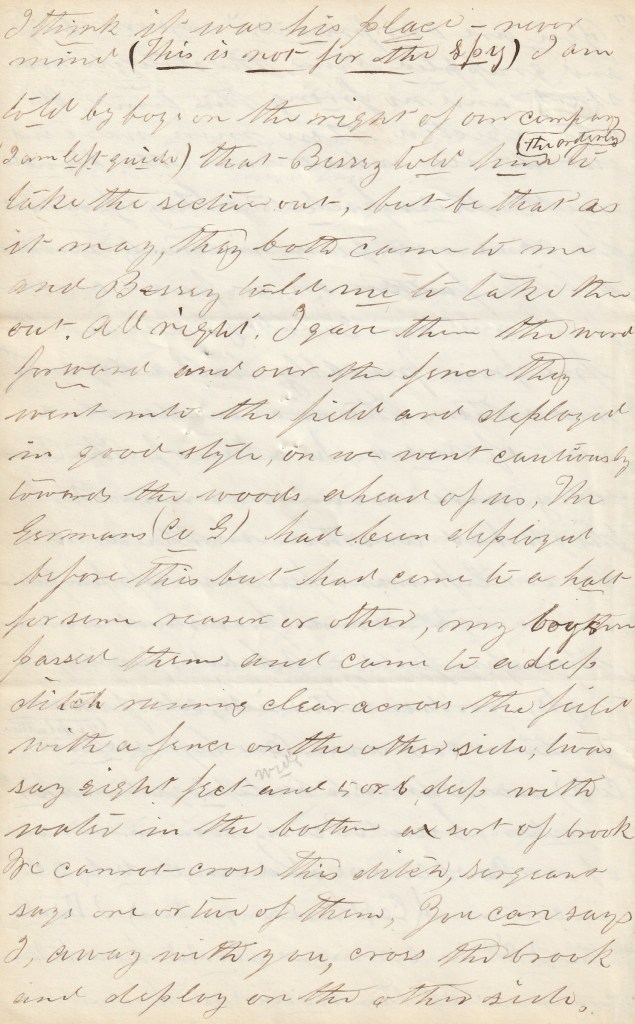
The game now grew intensely exciting. A little further on we passed another post and our cavalry received the fire from probably half a dozen or more men then. This was no doubt a sort of reserve. Here two of the cavalry were wounded—one in the thigh bad, another in the arm. On our left was a field—sort of open field. On our right woods for a short distance, then open field. Ahead half mile perhaps, woods on either side. All of us were in the road now. Our left section (half platoon—Co. A) was ordered to be deployed as skirmishers. Lieut. [Merrit B.] Bessey was in command of our company of course, and our Orderly [George Burr] 2nd in command (Capt. [Frank] Goodwin gone home). I think the 2nd in command should have taken command of this section as skirmishers. I think it was his place—never mind (This is not for the [Worchester Daily] Spy) I am told by our boys on the right of our company (I am left guide) that Bessey told him (the Orderly) to take the section out but be that as it may, they both came to me and Bessey told me to take them out. All right.
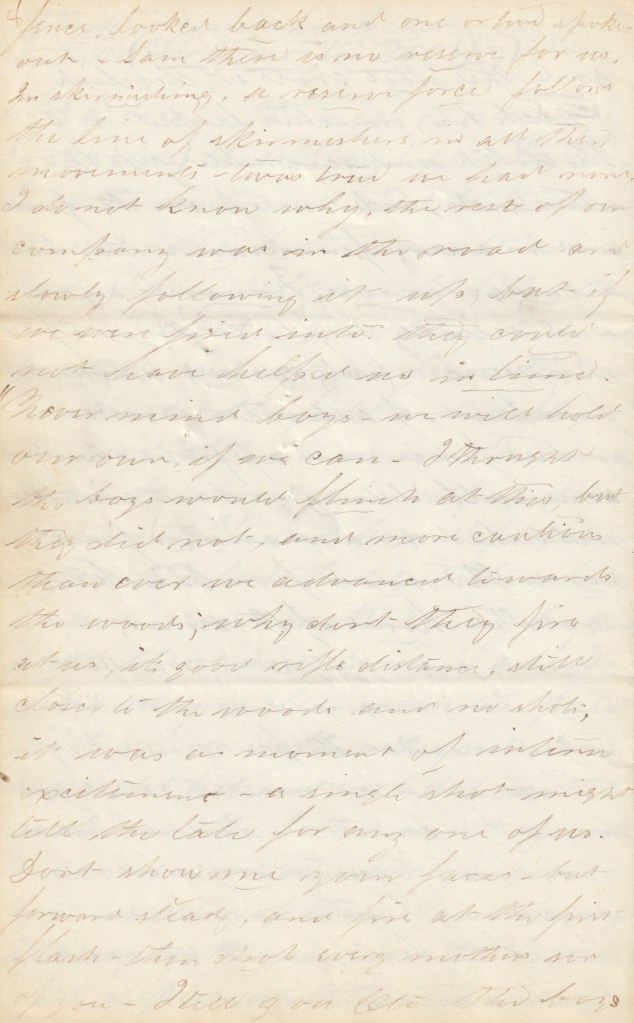
I gave them the word forward and over the fence they went into the field and deployed in good style. On we went cautiously towards the woods ahead of us. The Germans (Co. G) had been deployed before this but had come to a halt for some reason or other. My boys passed them and came to a deep ditch running clear across the field with a fence on the other side. Twas say eight feet wife and 5 or 6 deep with water in the bottom—a sort of brook. We cannot cross this ditch, sergeant, says one or two of them [to me]. “You can,” says I. “Away with you—cross the brook and deploy on the other side,” and they did cross it—devilish quick too. One or two leaped into the ditch and scrambled up the other side, took rails from the fence, and in a very few minutes that had a bridge across. [The following comment was inserted later here: “before reaching this ditch a volley was fired on our right but from where I did not know. Some said from our own boys, the Germans, but it did us no harm, the balls going over us.”] “Forward!” again and silently my little line of skirmishers (only 12 men) advanced ahead of all others, crossed another fence, and approached some outbuildings—a barn evidently with sheds, &c.. and another fence across the road from this barn was the house of the owner.
“Boys, we shall catch it here.” Steady now and slowly the boys advanced, rifles cocked, ready at the first flash of a gun to blaze away. Bit no shots came. We passed the fence and buildings scaring up a flock of geese that gobbled and squawked and hissed at us, lending a little of the ludicrous to the occasion. The boys as they passed this last fence, looked back and one or two spoke out—saw there is no reserve for us. In skirmishing, a reserve force follows the line of skirmishers in all their movements. Twas true, we had none. I do not know why the rest of our company was in the road and slowly following it up, but if we were fired into, they could not have helped us in time.
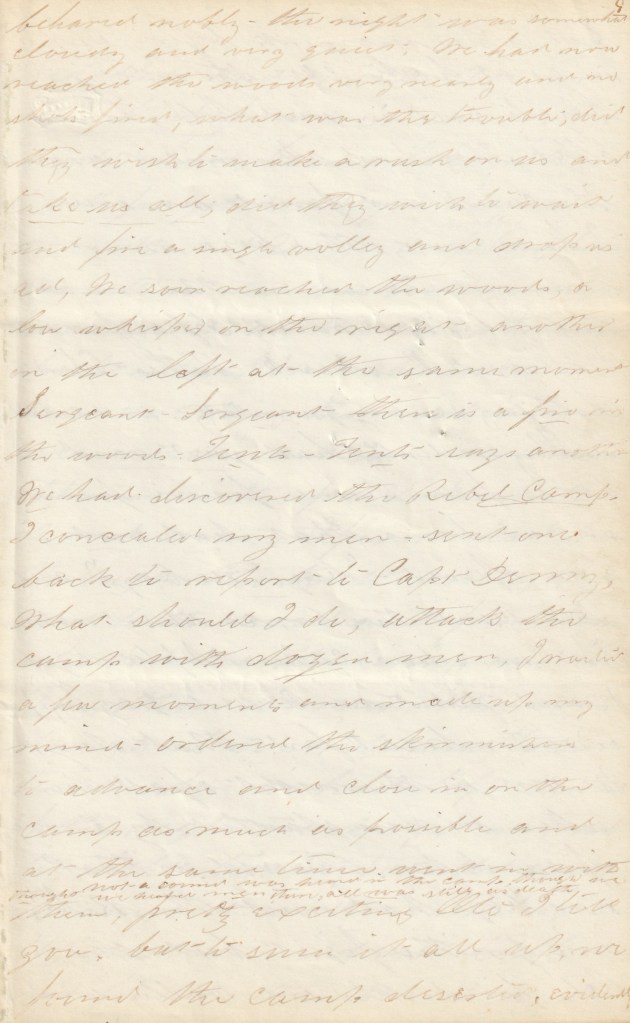
“Never mind boys. We will hold our own if we can.” I though the boys would flinch at this but they did not and more cautious than ever we advanced towards the woods. Why don’t they fire at us—it’s good rifle distance? Still closer to the woods and no shots. It was a moment of intense excitement—a single shot might tell the tale for anyone of us. Don’t show me your faces, but forward steady and fire at the first flash, then drop, every Mother’s son of you. I tell you, Otis, the boys behaved nobly. The night was somewhat cloudy and very quiet.
We had now reached the woods very nearly and no shots fired. What was the trouble? Did they wish to make a rush on us and take us all? Did they wish to wait and fire a single volley and drop us all? We soon reached the woods. A low whisper on the right, another on the left at the same moment—Sergeant, sergeant, there is a fire in the woods. “Tents. Tents,” says another. We had discovered the Rebel Camp.
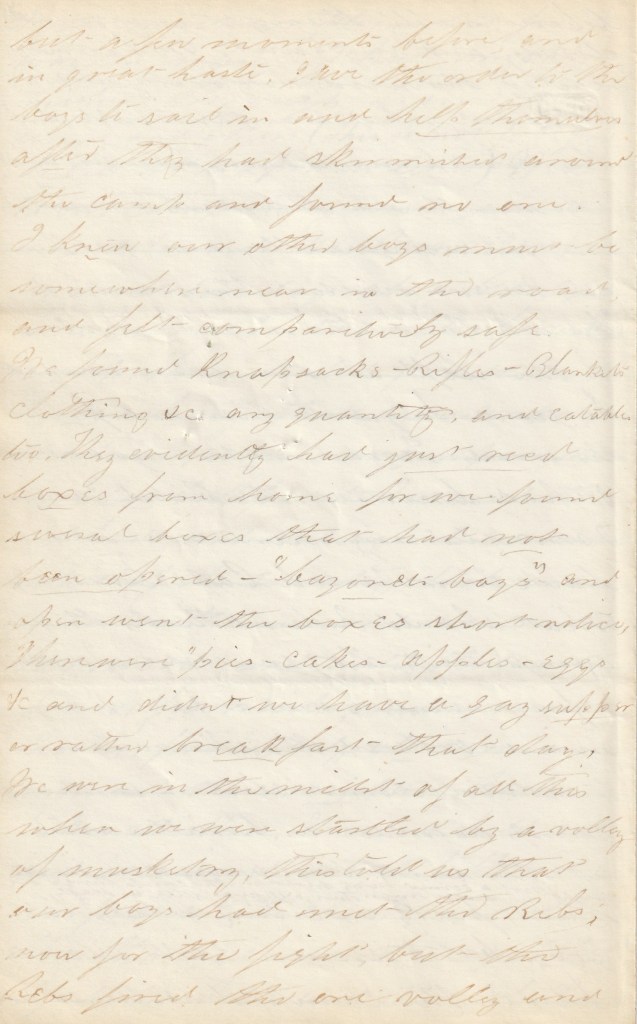
I concealed my men. Sent one back to report to Capt. Denny. What should I do? Attack the camp with a dozen men? I waited a few moments and made up my mind, ordered the skirmishers to advance and close in on the camp as much as possible and at the same time went in with them—pretty exciting, Otis, I tell you. But to sum it all up, we found the camp deserted—evidently but a few moments before and in great haste. I gave the order to the boys to sail in and help themselves. After they had skirmished around the camp and found no one. I knew our other boys must be somewhere near in the road and felt comparatively safe.
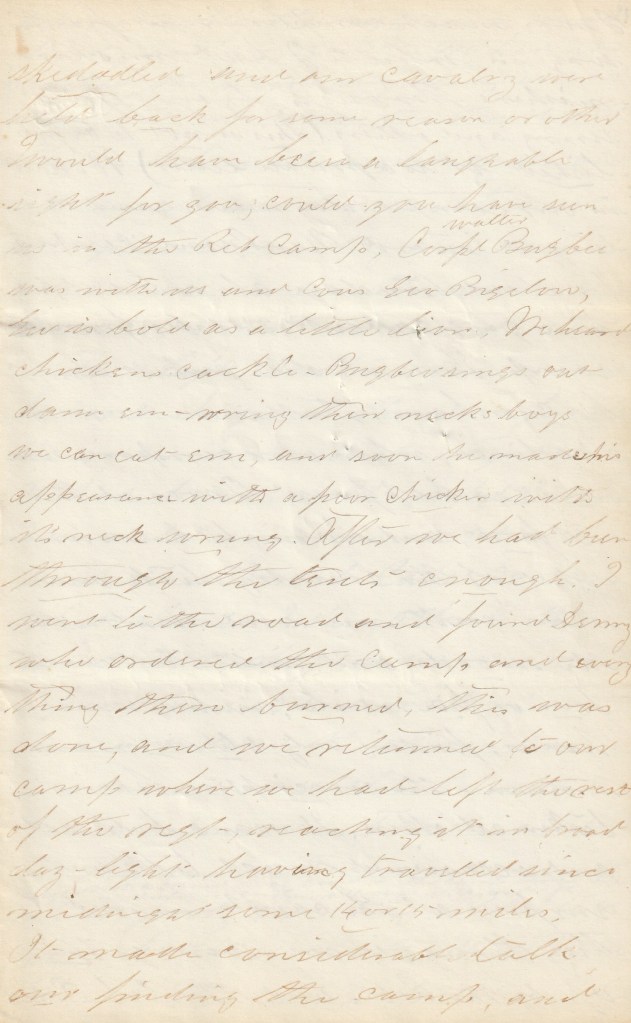
We found knapsacks, rifles, blankets, clothing, &c. any quantity, and eatables too. They evidently had just received boxes from home for we found several boxes that had not been opened. “Bayonet’s Boys! and open went the boxes on short notice. There were pies, cakes, apples, eggs, &c. and didn’t we have a gay supper, or rather breakfast that day. We were in the midst of all this when we were startled by a volley of musketry. This told us that our boys had met the Rebs. Now for the fight, but the Rebs fired the one volley and skedaddled and our cavalry were held back for some reason or other. It would have been a laughable sight for you could you have seen us in this Reb Camp.
Corp. Walter [S.] Bugbee was with us and Cousin George Bigelow. George is bold as a little lion. We heard chickens cackle [and] Bugbee sings out, “Damn ’em. Wring their necks, boys. We can cut ’em.” and soon he made his appearance with a poor chicken with its neck wrung.
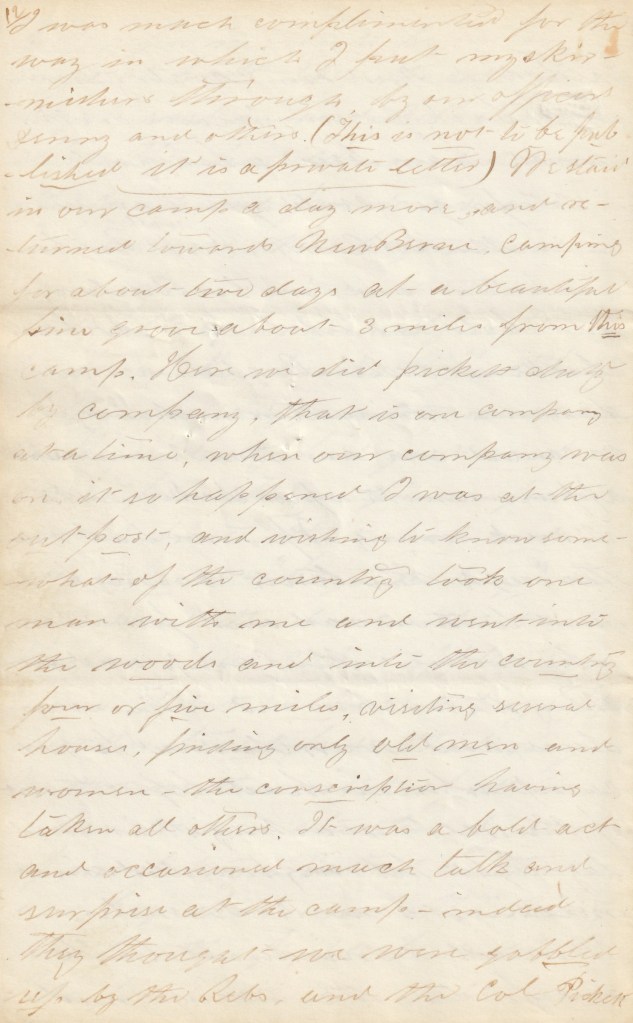
After we had been through the tents enough, I went to the road and found [Capt.] Denny who ordered the camp and everything there burned. This was done and we returned to our camp where we had left the rest of the regiment, reaching it in broad daylight, having travelled since midnight some 14 or 15 miles. It made considerable talk—our finding the camp and I was much complimented for the way in which I put my skirmishers through by our officers, Denny and others. (This is not to be published—it is a private letter.)
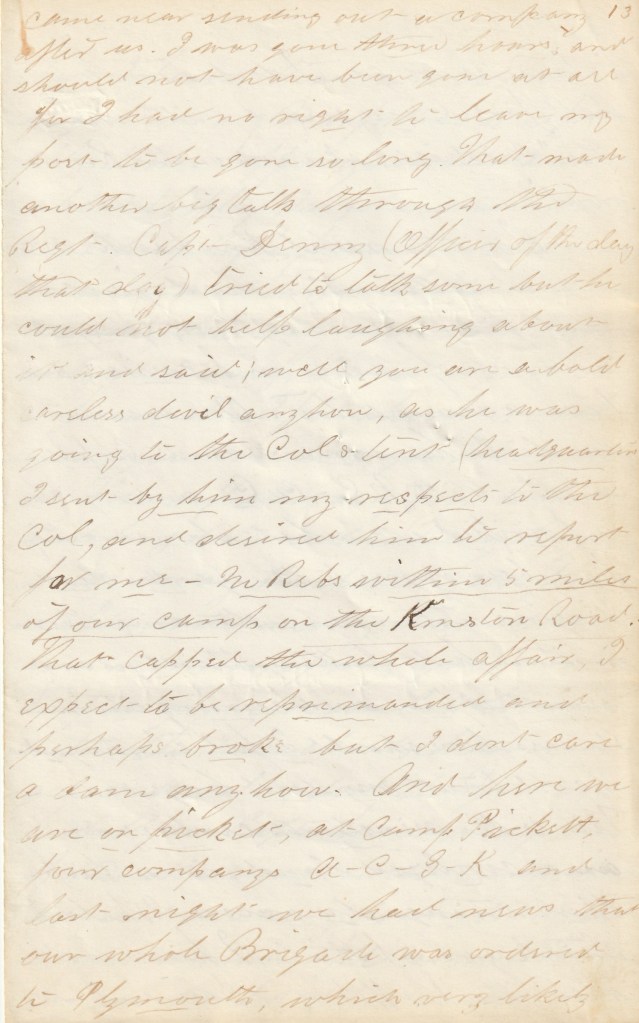
We staid in our camp a day more and returned towards New Bern, camping for about two days at a beautiful pine grove about 3 miles from this camp. Here we did picket duty by company—that is, one company at a time. When our company was on, it so happened I was at the outpost, and wishing to know somewhat of the country, took one man with me and went into the woods and into the country four or miles miles, visiting several houses, finding only old men and woman—the conscription having taken all others. It was a bold act and occasioned much talk and surprise at the camp. Indeed, they thought we were gobbled up by the Rebs and the Colonel came near sending out a company after us. I was gone three hours and should not have been gone at all for I have no right to leave my post to be gone so long. What made another big talk through the regiment, Capt. Denny (Officer of the Day that day) tried to talk some but he could not help laughing about it and said, “Well, you are a bold, careless devil anyhow.” As he was going to the Colonel’s tent (headquarters), I sent by him my respects to the Colonel and desired him to report for me, “No Rebs within 5 miles of our camp on the Kinston Road.” That capped the whole affair. I expect to be reprimanded and perhaps broke but I don’t care a damn anyhow.
And here we were on picket at Camp Pickett four companies A, C, G, K and last night we had news that our whole Brigade was ordered to Plymouth which very likely is true, so we go. I don’t think I shall forget very soon at all event the “midnight skirmish on the Kinston Road.”
“In the rebel knapsacks we found letters they had just received from home giving pitiful accounts of things in Secessia, and true accounts too. One woman writes to her sons named Apple in the 45th North Carolina, Co. C, and says she is horrified at what she hears they have been doing to the Yankee dead—digging them up—standing them on their feet—pulling their eyes and mouths open and cursing them. She says, how should I feel if the Yankees should treat my dead boys so.”
In the rebel knapsacks we found letters they had just received from home giving pitiful accounts of things in Secessia, and true accounts too. One woman writes to her sons named Apple in the 45th North Carolina, Co. C, and says she is horrified at what she hears they have been doing to the Yankee dead—digging them up—standing them on their feet—pulling their eyes and mouths open and cursing them. She says, how should I feel if the Yankees should treat my dead boys so. 2 This is the nineteenth century and in a civilized land in which these things do occur. What think you of that?
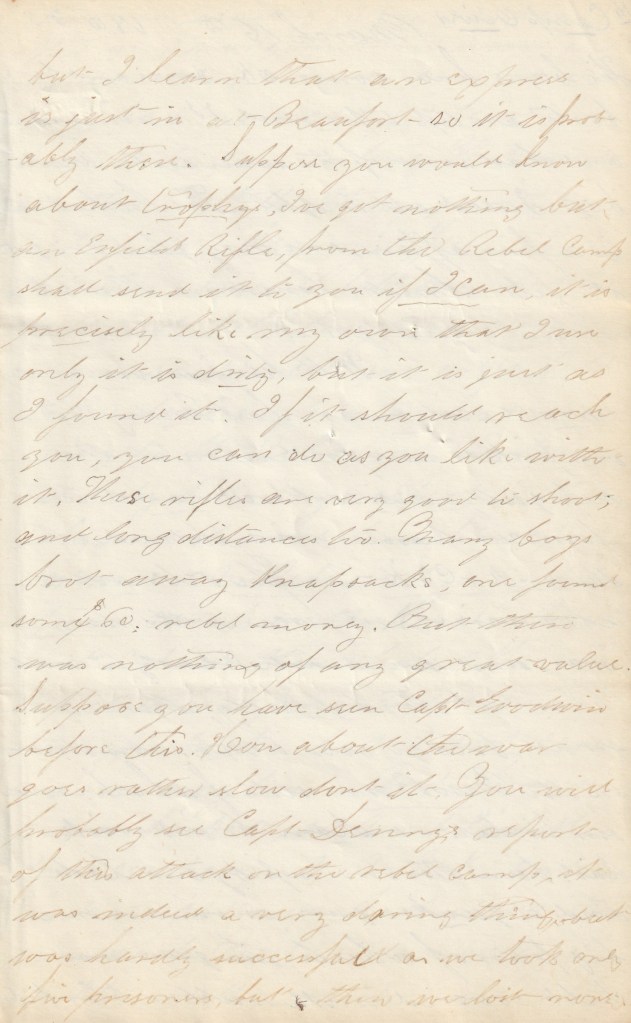
I have not received the snuff box or Dave his boots but I learn that an Express is just in at Beaufort so it is probably there.
I suppose you would know about trophies. I’ve got nothing but an Enfield Rifle from the Rebel Camp. Shall send it to you if I can. It is precisely like my own that I use only it is dirty. But it is just as I found it. If it should reach you, you can do as you like with it. These rifles are very good to shoot and long distances too. Many boys brought away knapsacks. One found some $60 rebel money. But there was nothing of any great value.
Suppose you have seen Capt. Goodwin before this. How about the war? Goes rather slow, don’t it? You will probably see Capt. Denny’s report of this attack on the rebel camp. It was indeed a very daring thing, but was hardly successful as we took only five prisoners but then we lost none.
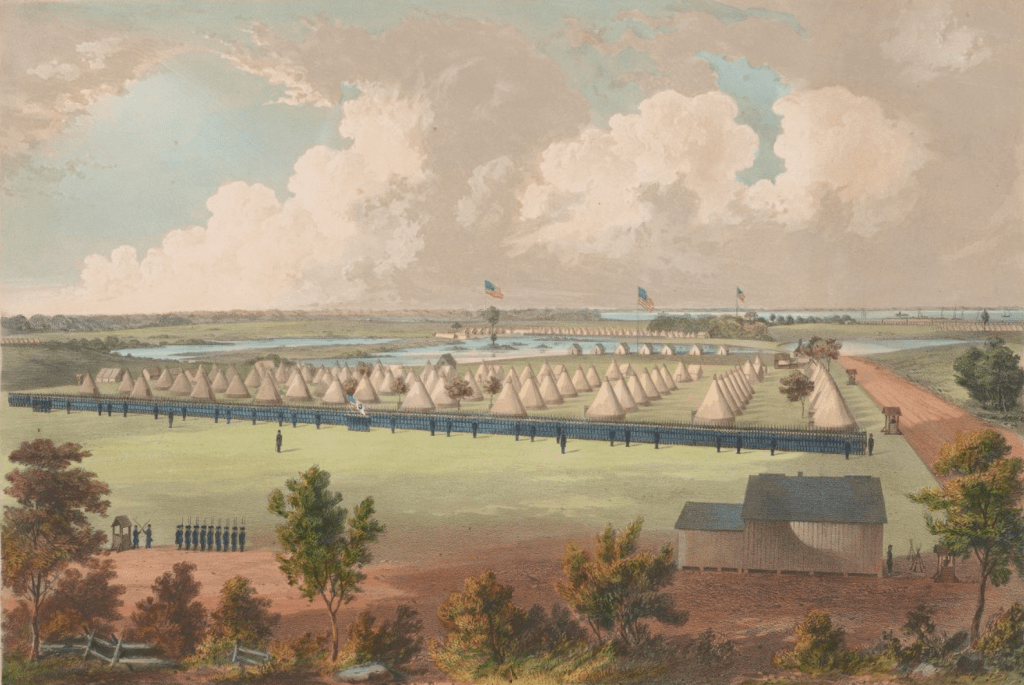
Camp Oliver, 25th Mass. Infantry, New Berne, N. C.(The Huntington Library)
Camp Oliver March 16, 1863
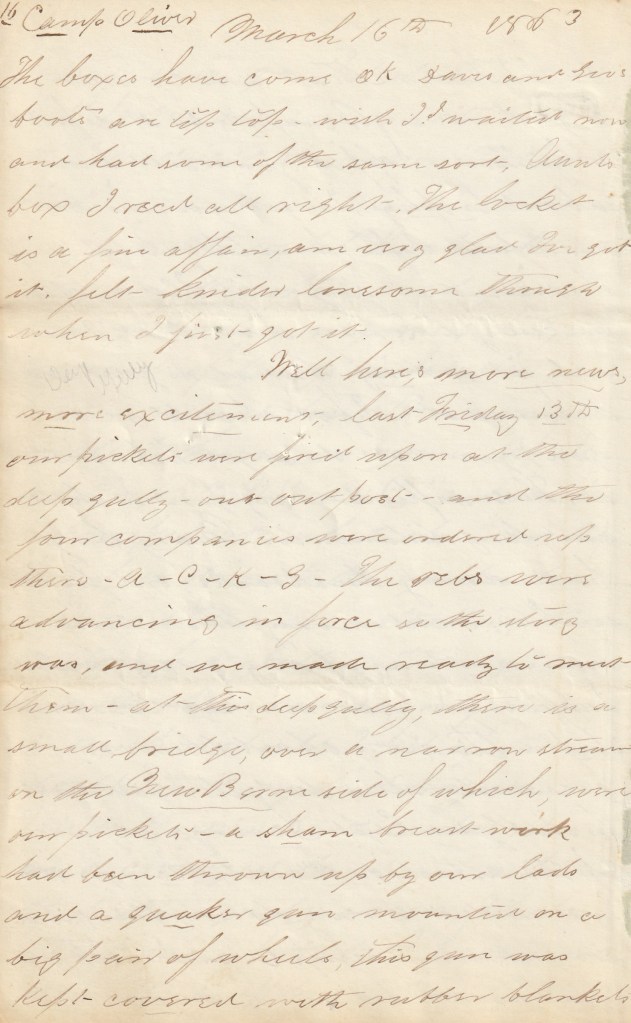
The boxes have come OK. Davis and George’s boots are tip top. Wish I’d waited now and had some of the same sort. Aunt’s box I received all right. The locket is a fine affair. Am very glad I’ve got it. Felt kinder lonesome though when I first got it.
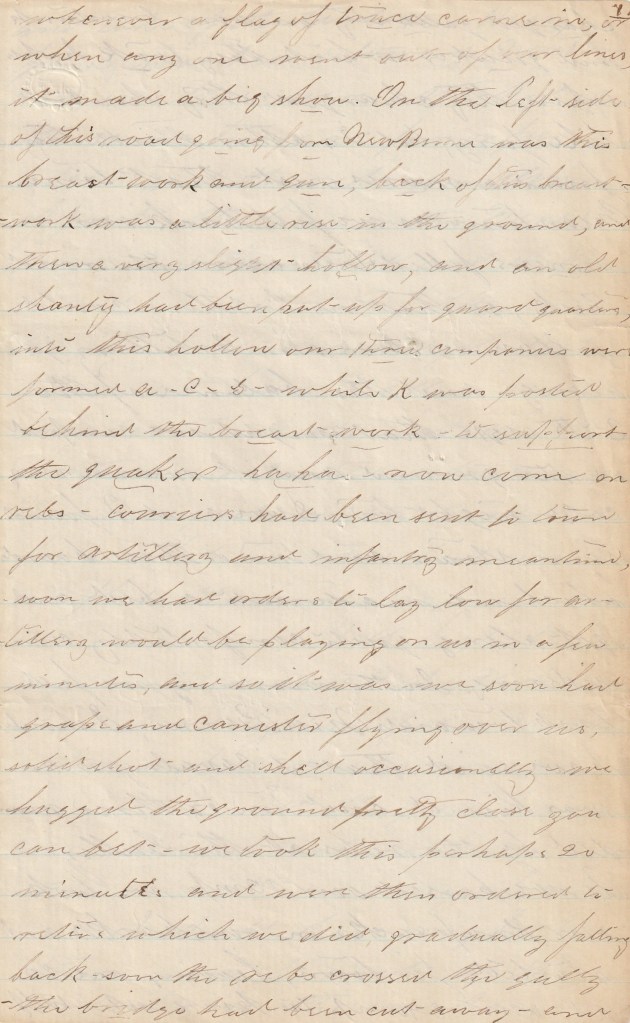
Well, her’s more news—more excitement. Last Friday 13th, our pickets were fired upon at the deep gully, our outpost, and the four companies were ordered up there—A, C, K, G. the Rebs were advancing in force so the story was, and we made ready to meet them. At this deep gully, there is a small bridge over a narrow stream on the New Bern side of which were our pickets. A sham breastwork had been thrown up by our lads and a Quaker gun mounted on a big pair of wheels. This gun was kept covered with rubber blankets whenever a Flag-of-Truce came in or when anyone went out of our lines, it made a big show.
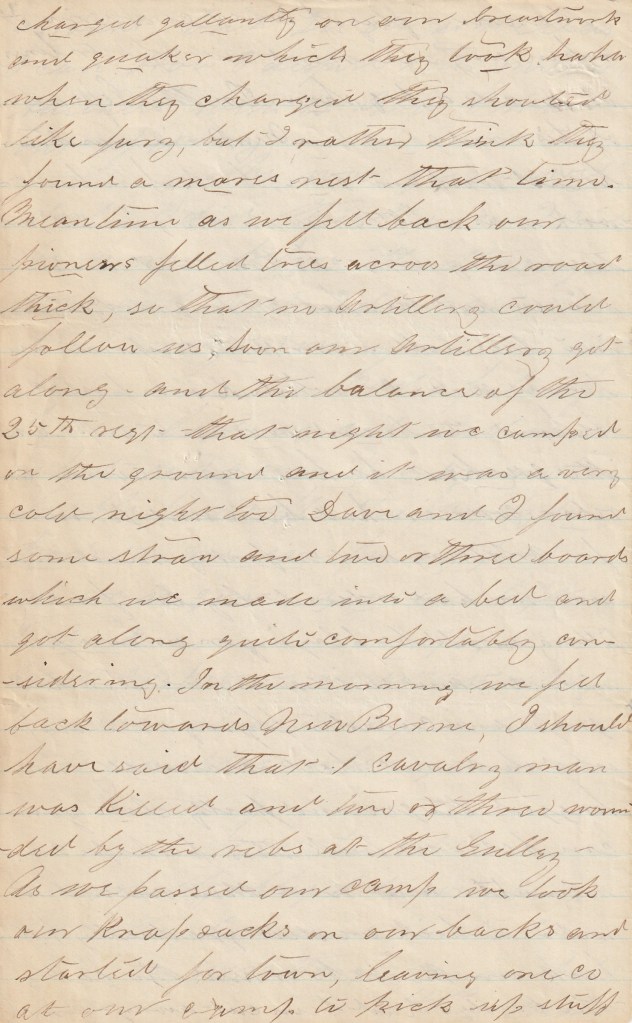
On the left side of this road going from New Bern was the breastwork and gun. Back of this breastwork was a little rise in the ground and then a very slight hollow, and an old shanty had been put up for guard quarters. Into this hollow our three companies were formed—A, C, and G, while K was posted behind the breastwork to support the Quaker (ha, ha). Now come on the Rebs. Couriers have been sent to town for artillery and infantry meantime. Soon we had orders to lay down low for artillery would be playing on us in a few minutes, and so it was we soon had grape and canister flying over us, solid shot and shell occasionally. We hugged the ground pretty close, you can bet. We took this perhaps 20 minutes and were then ordered to retire which we did gradually, falling back. Soon the Rebs crossed the gully. The bridge had been cut away and charged gallantly on our breastworks and Quaker which they took (ha ha). When they charged, they shouted like fury but I rather think they found a mares nest that time.
Meantime as we fell back, our pioneers felled trees across the road thick so that no artillery could follow us. Soon our artillery got along and the balance of the 25th Regiment. That night we camped on the ground and it was a very cold night too. Dave and I found some straw and two or three boards which we made into a bed and got along quite comfortably considering.
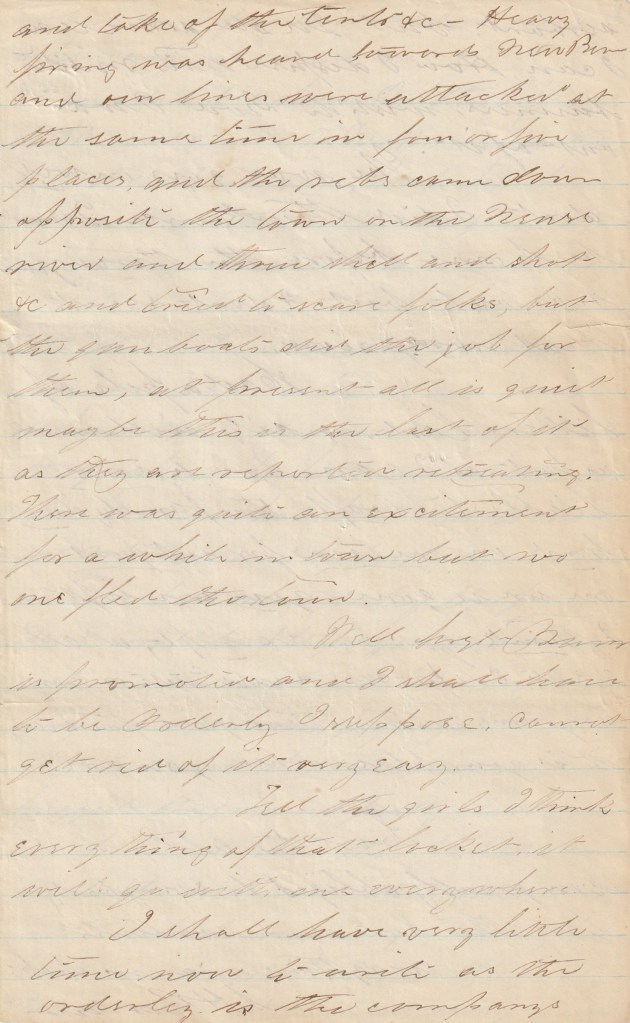
In the morning we back towards New Bern. I should have said that 1 cavalryman was killed and two or three wounded by the Rebs at the Gully. As we passed our camp, we took our knapsacks on our backs and started for town, leaving one company at our camp to pick up stuff and take off the tents, &c. Heavy firing was heard towards New Bern and our lines were attacked at the same time in four or five places and the Rebs came down opposite the town on the Neuse River and threw shell and shot, &c. and tried to scare folks, but the gunboats did the job for them. At present, all is quiet. Maybe this is the last of it as they are reported retreating. There was quite an excitement for awhile in town but no one fled the town.
Well, Sergt. [George] Burr is promoted and I shall have to be Orderly. I suppose I cannot get rid of it very easy.
Tell the girls I think everything of that locket. It will go with me everywhere.
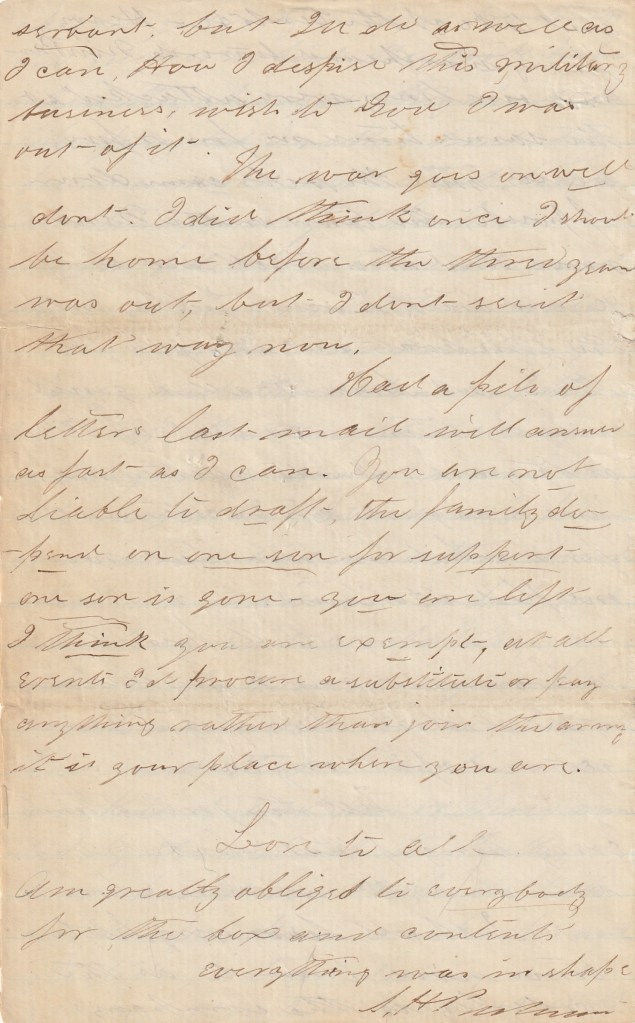
I shall have very little time now to write as the orderly is the company’s servant, but I’ll do as well as I can. How I despise this military business. Wish to God I was out of it. The war goes on well, don’t [it]. I did think once I should be home before the three years was out but I don’t see it that way now.
Had a pile of letters last mail. Will answer as fast as I can. You are not liable to draft. The family depend on one son for support. One son is gone. You are left. I think you are exempt. At all events, I’d procure a substitute or pay anything rather than join the army. It is your place where you are.
Love to all. Am greatly obliged to everybody for the box and contents. Everything was in [good] shape. — S. H. Putnam
1 Camp Pickett was named for Josiah Pickett who began his service with the 25th Massachusetts as the Captain of Co. A and was eventually promoted as its Colonel.
2 The mother of the soldiers named Apple who served in the 45th North Carolina Infantry was probably Rachel (Flack) Apple of Guilford county, North Carolina. She had two sons who served in the regiment in Co. B who were both with the regiment in March 1863 when this letter was penned. There were only three soldiers with the surname “Apple” in the 45th North Carolina—the two named brothers, and a 35 year-old in a different company named Richard. The salutation “Dear Sons” convinces me the soldiers were James M. (“Jim”) Apple (1844-1940) and Andrew Flack Apple (1846-1913). The boys came from a poor subsistence farm in Guilford county. Their father had died before they were ten years old, leaving them to care for their mother and two sisters. Andrew, the youngest, was definitely illiterate; his older brother may have been so too (soldiers sometimes relied on comrades to write and read letters for them). Both soldiers would end up being taken prisoner, Andrew twice (on 3 July 1863 at Gettysburg and again on 10 10 May 1864 at Spotsylvania Courthouse), and James once (on 25 March 1865 during the Siege of Petersburg). Following their final capture, both men were held in Union prisons (Andrew at Point Lookout, MD and Elmira, NY, and James only at Point Lookout) until, after war’s end, when they signed the Union Oath of Allegiance.[Note: Extracts of the original letter, datelined 2 February 1863, by Mother Adams was published in Putnam’s book on page 164 if you’d like to read it.]
The 45th NC was organized on Apr. 1, 1862 and was mustered out on Apr. 9, 1865. At the time of Putnam’s letter, the 45th NC was in Daniel’s Brigade, D. H. Hill’s Corps, Dept. of NC and South VA. The 45th NC was also a hard-fought unit, suffering enormous losses at the Battle of Gettysburg, with 247 killed or wounded and 161 captured (totaling 40% loss). Severe losses were also sustained at the Battle of Spotsylvania Courthouse. Ironically, the 45th NC fought (with little loss) in the Battle of Cold Harbor, where the 25th MA was decimated and Putnam wounded (although it does not appear that they faced each other).
Letter 2
[Editor’s Note: The initial draft of this transcription was prepared by Abbey Weber Jones, who further assisted in confirming the identity of the author as an individual I had previously transcribed and featured on Spared & Shared.]
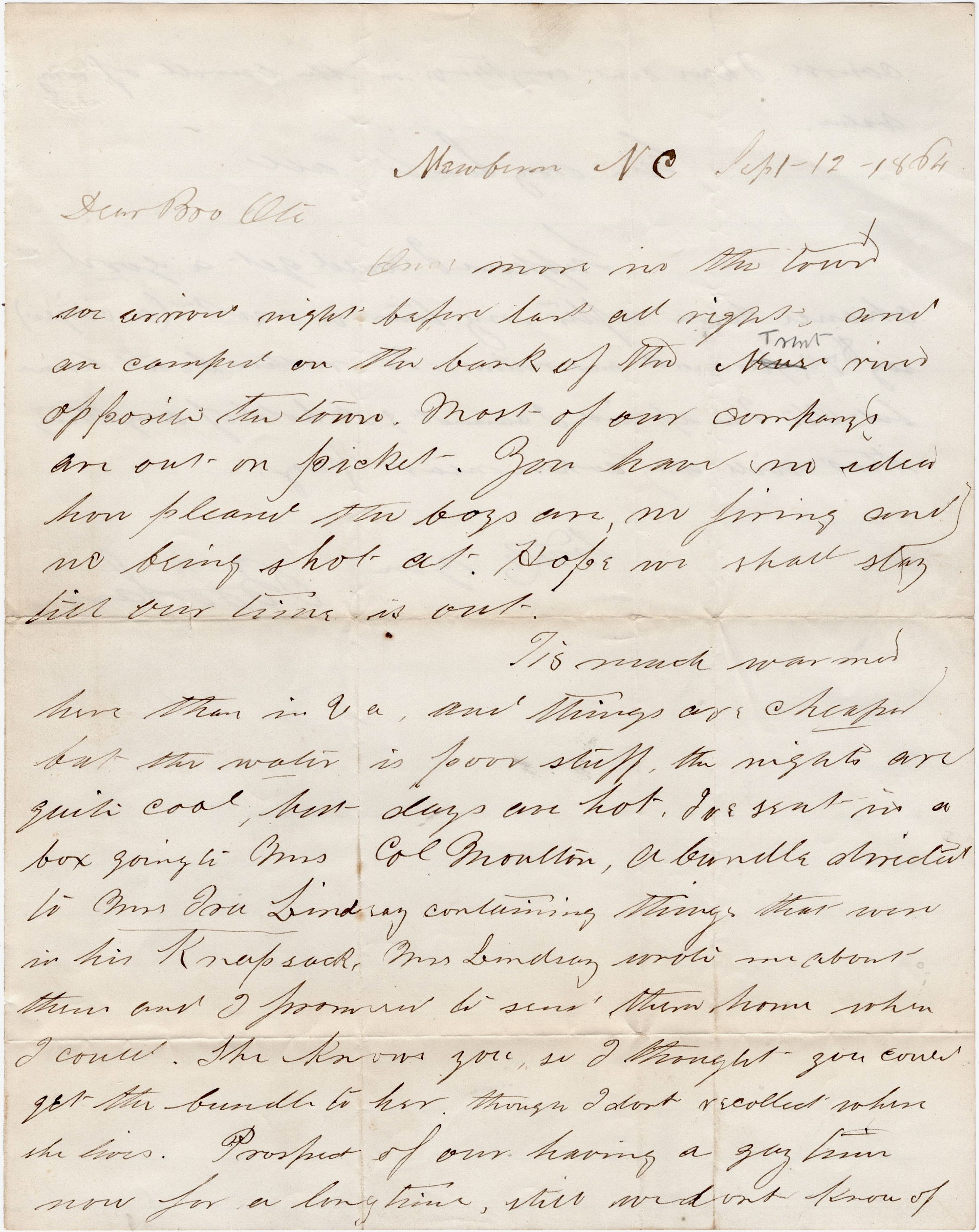
Newbern, North Carolina Sept 12 1864
Dear Bro Oti,
Once more in the town [of Newbern]. We arrived night before last all right and are camped on the bank of the Trent River opposite the town. Most of our companies are out on picket. You have no idea how pleasant the boys are—no firing and no being shot at. Hope we shall stay till our time is out.
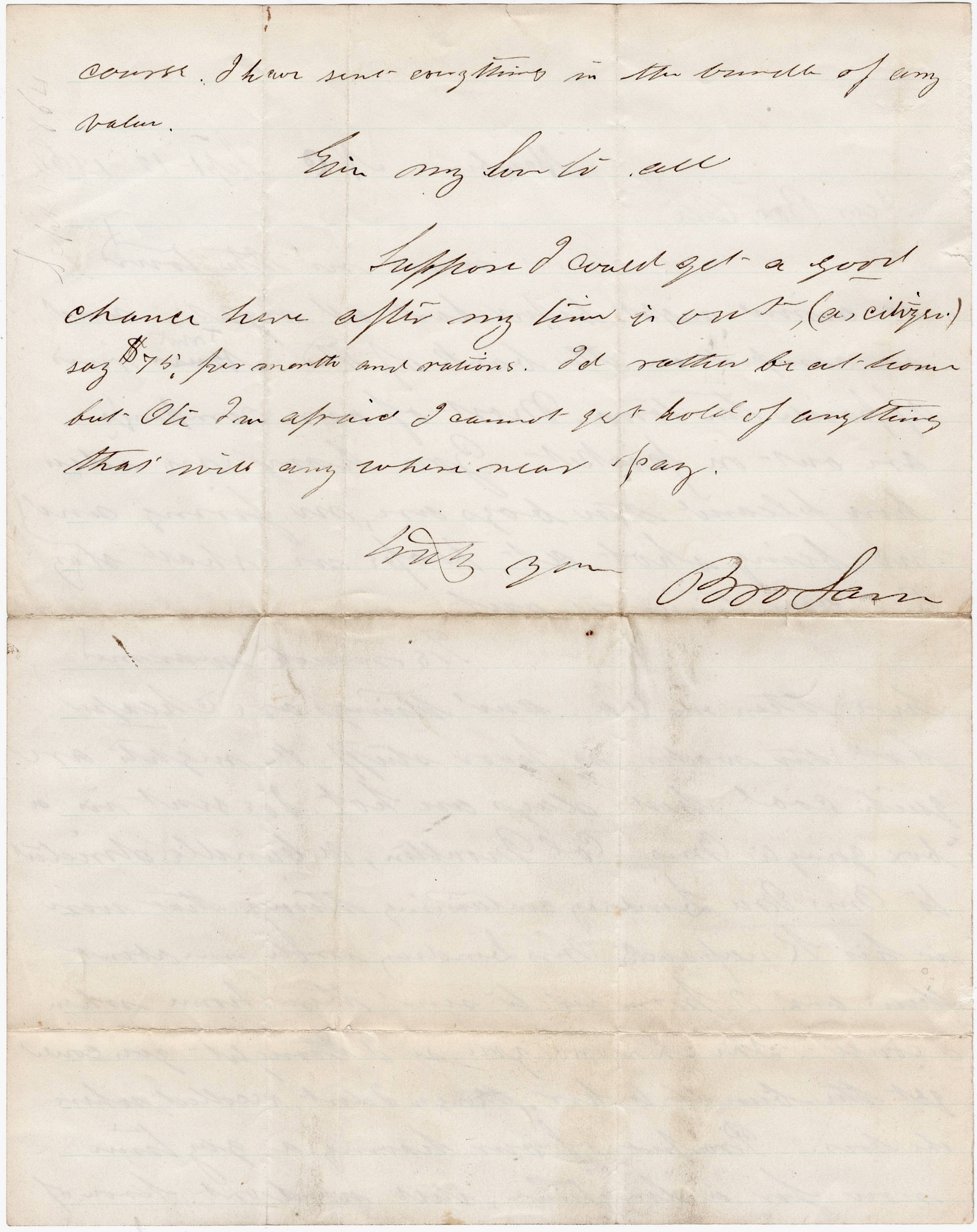
Tis much warmer here than in Virginia and things are cheaper, but the water is poor stuff. The nights are quite cool, but days are hot. I’ve sent in a box going to Mrs. Col. Moulton, a bundle directed to Mrs. Lou Lindsay containing things that were in his knapsack. Mrs. Lindsay wrote me about them and I promised to send them home when I could. She knows you, so I thought you could get the bundle to her though I don’t recollect where she lives. Prospect of our having a gay time now for a long time—still, we don’t know of course. I have sent everything in the bundle of any value.
Give my love to all.
Suppose I could get a good chance here after my time is out (as citizen)— say $75 per month and rations. I’d rather be at home, but Oti, I’m afraid I cannot get hold of anything that will anywhere near pay. Truly yours, –Bro. Sam