All posts by Griff

My passion is studying American history leading up to & including the Civil War. I particularly enjoy reading, transcribing & researching primary sources such as letters and diaries.

1863: John Rison Gibbons to his Father

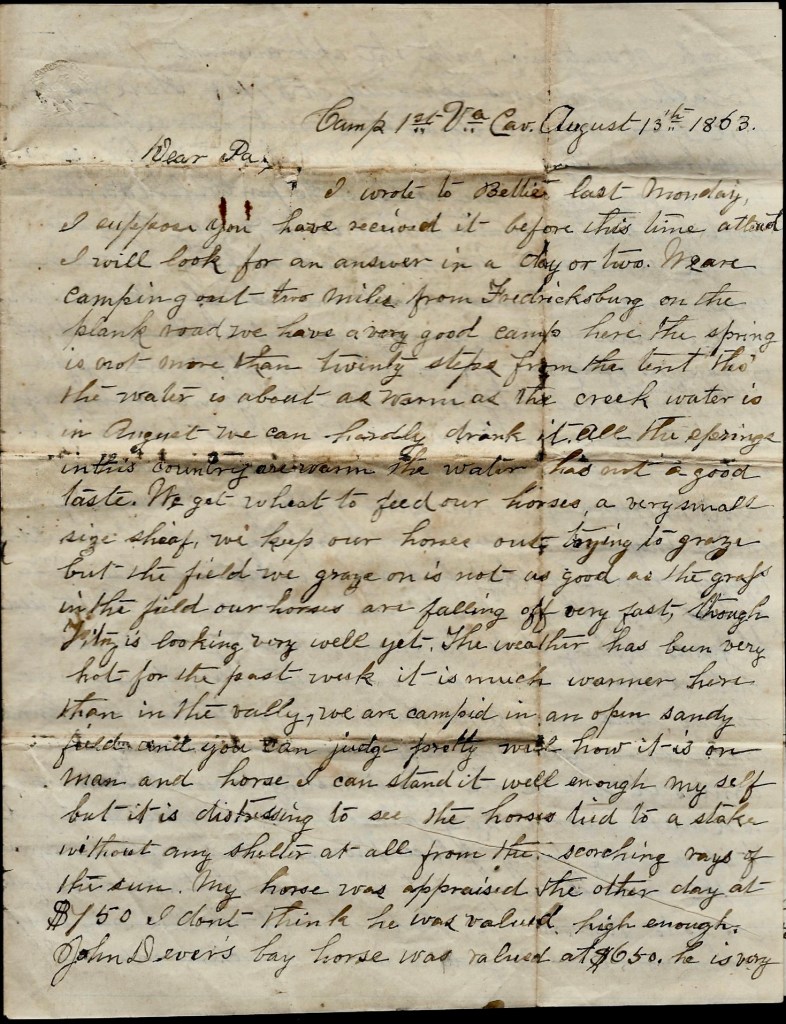
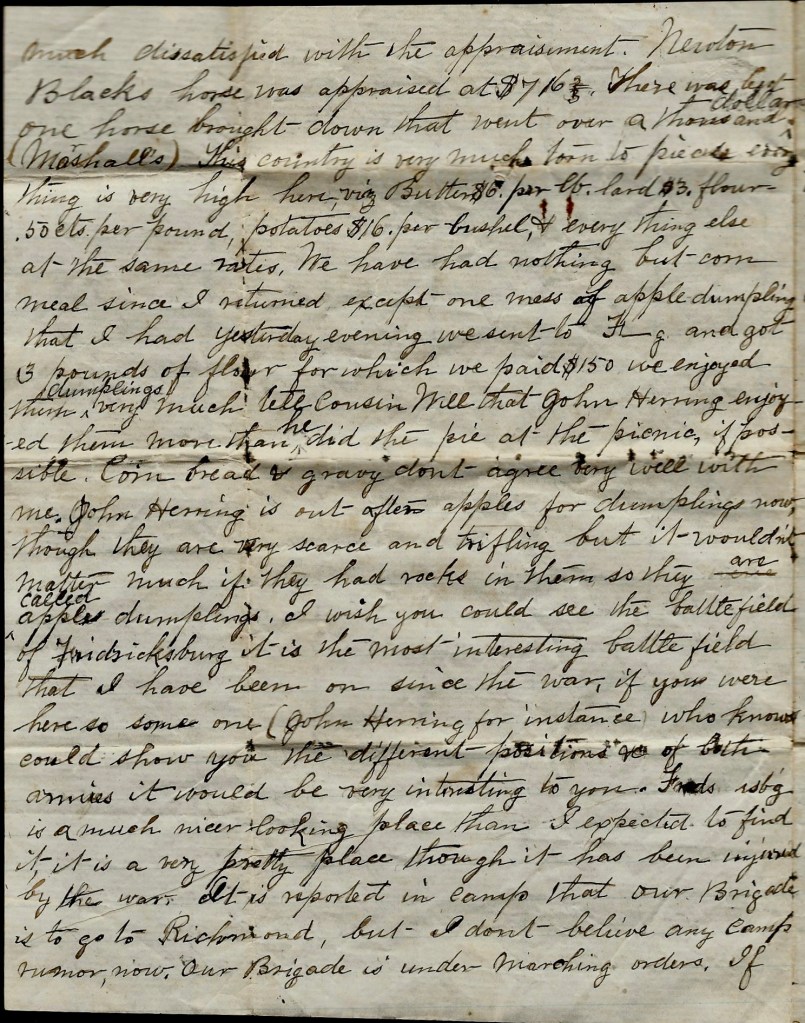
This letter was written by Pvt. John “Rison” Gibbons (1843-1919) who enlisted at Harrisonburg in Co. I, 1st Virginia Cavalry in December 1861. He remained with his company throughout the war until he surrendered at Appomattox Court House on 9 April 1865 at which time he was described as being 20 years old, standing 5′ 8″ tall, with light hair and blue eyes. He filed a claim for a bay horse killed in action near Berryville, Virginia, in August 1862 which was valued at $2900 when he entered the service.
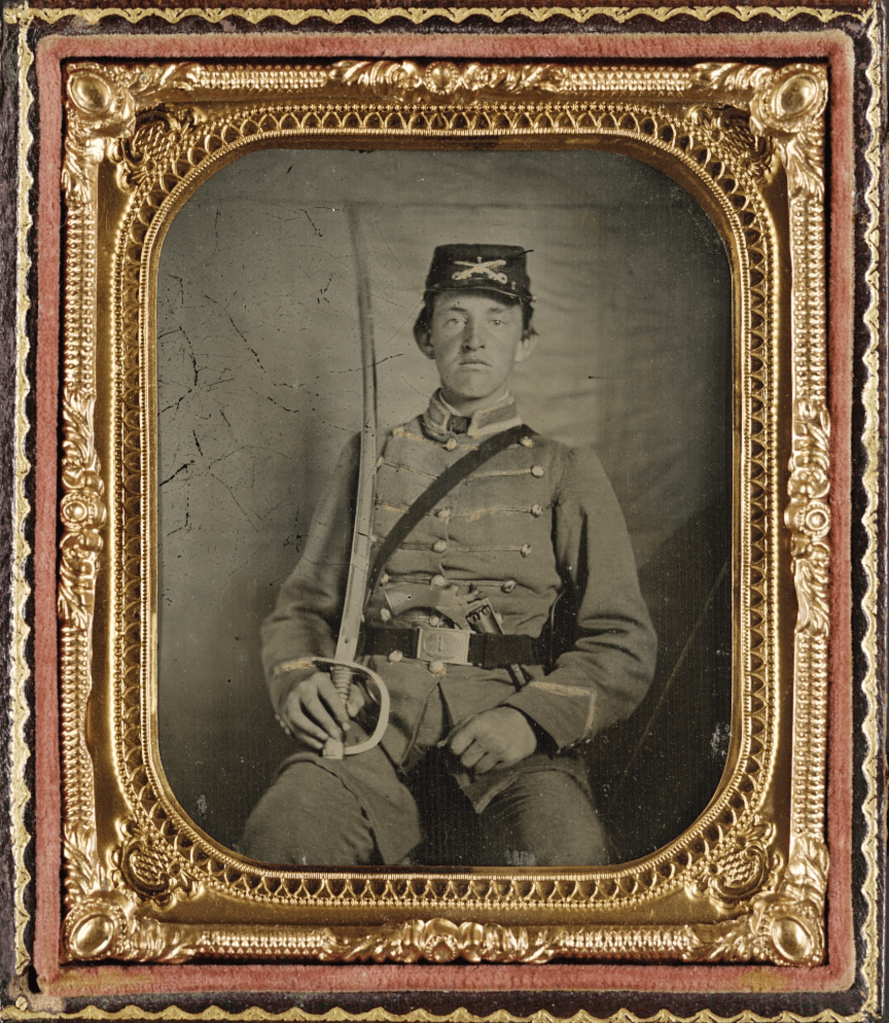
I could not find a Civil War era photograph of Gibbons but here is one of Pvt. David M. Thatcher who also served in the 1st Virginia Cavalry (LOC)

Rison Gibbons was the son of George Rockingham Gibbons (1814-1907) and Harriet Caroline Rison (1818-1876) of Rockingham county, Virginia. He married, in 1874, Ann America Felton (1848-1938). After the war he farmed in Georgia, went into the wool manufacturing business in Brentwood, Tennessee, and finally became a Mining Engineer in Georgia.

Gibbons’ letter includes a description of the battlefield at Fredericksburg and mentions the collection of two Yankee teeth he pulled from the jawbone of a half-buried Union soldier. Most soldiers found this behavior reprehensible but a great many others engaged in the occasional collection of such morbid souvenirs when time and opportunity allowed. Both sides were guilty of collecting these human trophies. After the Battle of Seven Pines, it was reported in the Pontiac Weekly Gazette (11 July 1862) that “a [Union] soldier pulled off the lower jaw [bone of a dead rebel] and asked” his comrades if they didn’t want a rebel relic.” [See Dark Trophies, by Simon Harrison]

Transcription

Camp 1st Virginia Cavalry
August 13th 1863

Dear Pa,

I wrote to Bettie last Monday. I suppose you have received it before this time. At least I will look for an answer in a day or two. We are amping out two miles from Fredericksburg on the plank road. We have a very good camp here. The spring is not more than twenty steps from the tent though the water is about as warm as the creek water is in August. We can hardly drink it. All the springs in this country are warm. The water has not a good taste. We get wheat to feed our horses—a very small sheaf. We keep our horses out trying to graze but the field we graze on is not as good as the grass in the field. Our horses are falling off very fast though Fitz is looking very well yet.

The weather has been very hot for the past week. It is much warmer here than in the valley. We are camped in an open, sandy field and you can judge pretty well how it is on man and horse. I can stand it well enough myself but it is distressing to the horses tied to a stake without any shelter at all from the scorching rays of the sun. My horse was appraised the other day at $750. I don’t think he was valued high enough. John Dever’s bay horse was valued at $650. He is very much dissatisfied with the appraisement. Newton Black’s horse was appraised at $716. There was but one horse brought down that went over a thousand dollars (Marshall’s).

This country is very much torn to pieces. Everything is very high here—viz: butter $6 per lb., lard $3, flour 50 cents per pound, potatoes $16 per bushel, & everything else at the same rates. We have had nothing but corn meal since I returned except one mess of apple dumpling that I had yesterday evening. We sent to Fredericksburg and got 3 pounds of flour which we paid $150. We enjoyed them dumplings very much. Tell Cousin Will that John Herring enjoyed them more than he did the pie at the picnic, if possible. Corn bread & gravy don’t agree very well with me. John Herring is out after apples now though they are very scarce and trifling but it wouldn’t matter much of they had rocks in them so they are called apple dumplings.

I wish you could see the battlefield of Fredericksburg. It is the most interesting battlefield that I have been on since the war. If you were here so someone (John Herring, for instance) who knows [it] could show you the different positions of the armies, it would be very interesting to you. Fredericksburg is a much nicer looking place than I expected to find it. It is a very pretty place though it has been injured by the war.

It is reported in camp that our Brigade is to go to Richmond but I don’t believe any camp rumor now. Our Brigade is under marching orders. If you get this before Lute Dever starts, send by him my dictionary & spirits turpentine. I neglected them when I left.

Enclosed you will find a Yankee tooth which you will please give to Mr. Irvine. He told me when I first started into service to send his a Yankee’s tooth which request I will comply with. Uncle Shanks Miller made the same request. I have one for him also. I will write to Uncle Robert as soon as I get through this and will enclose it to him. Both of these teeth came out of the mouth of a Yankee that was killed at the first Battle of Fredericksburg. He is buried about three hundred yards from camp. The reason why I know he is a Yankee is that a part of his blue coat is sticking out of the ground (not grave). I got his jaw bone and extricated six teeth and picked out two of the nicest to send away. The others I gave to some of the boys who wanted them for some other purpose. There are a good many Yankee bones bleaching upon the field that I am now writing on.

I must close this uninteresting letter so as to have time to write to Uncle Robert. You must come down before you go south if practicable. Some of the boys are anxious to see you before you leave. Give my love to all the family, Aunt Mary, cousins Laura & Will. write soon to your affectionate son, — J. Rison Gibbons
1864: John Birchard Rice to Eliza Ann (Wilson) Rice

Surgeon John Birchard Rice

This letter was written by Surgeon John Birchard Rice (1832-1893), a physician from Fremont, Ohio, who served in the 72nd Ohio Infantry. He was promoted to Brigade Surgeon after the Battle of Shiloh and eventually made Chief Surgeon of a Division in the 15th Army Corps, and Medical Office of the District of Memphis, overseeing 150 surgeons and 15,000 soldiers. He later served in the US Congress (1881-1883).

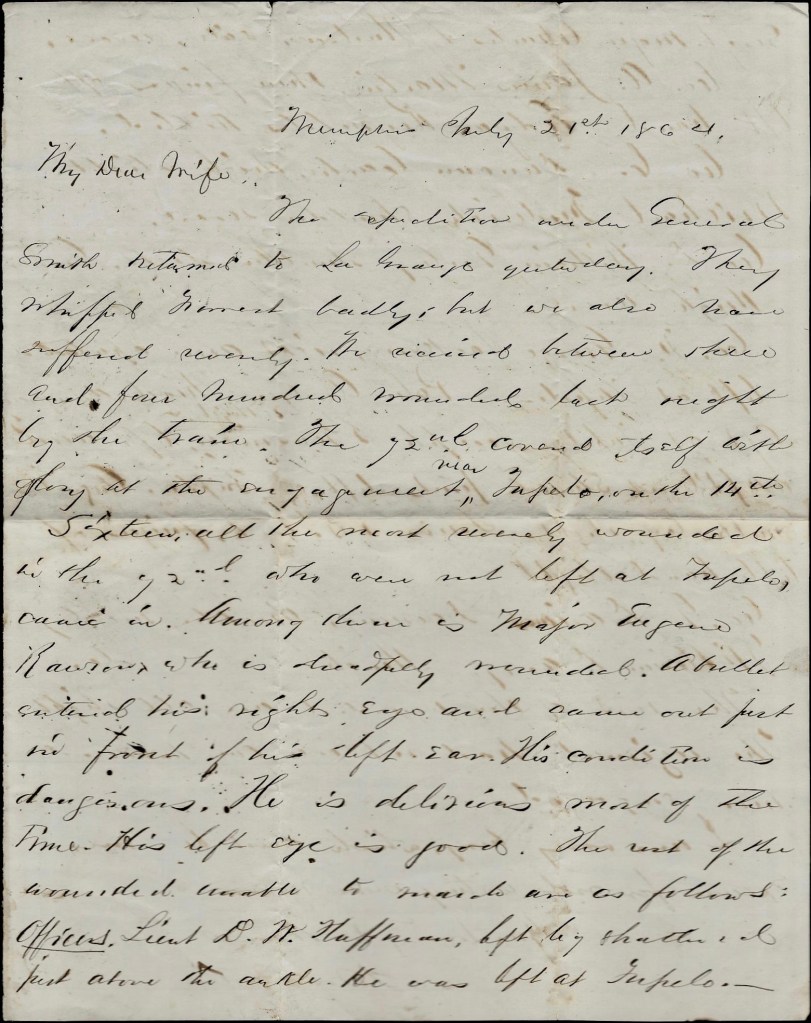
In this letter, Rice informs his wife of the casualties sustained by members of the 72nd Ohio during the expedition to Tupelo, Mississippi, in July 1864 under the command of Gen. Andrew Jackson Smith. In the Battle of Tupelo (July 14-15), Union forces turned back Confederate forces under Gen. Nathan B. Forrest that were threatening the disruption of Sherman’s supply lines during the Atlanta Campaign.

John B. Rice was the son of Robert Stuart Rice (1805-1875) and Eliza Ann Caldwell (1807-1873) of Fremont, Sandusky county, Ohio. He was married to Sarah Eliza Wilson (1842-1928) in 1861.

Transcription

Memphis, [Tennessee]
July 21, 1864

My Dear Wife,

The expedition under General Smith returned to La Grange yesterday. They whipped Forrest badly but we also have suffered severely. We received between three and four hundred wounded last night by the train. The 72nd covered itself with glory at the engagement near Tupelo, on the 14th. Sixteen, all the most severely wounded in the 72nd who were not left at Tupelo, came in. Among them is Major Eugene Rawson who is dreadfully wounded. A bullet entered his right eye and came out just in front of his left ear. His condition is dangerous. He is delirious most of the time. His left eye is good. 1

The rest of the wounded unable to march are as follows: 

Officers:
Lieut. D. W. Huffman [Co. B], left leg shattered just above the ankle. He was left at Tupelo.
Sergt. Major [& Adjutant] Charles L. Hudson, side, severe. 
Co. A, [Pvt.] James Martin, three fingers off left hand. [Pvt.] Edgar Reynolds killed. 
Co. C, [Sgt.] Duncan Carter, thigh, slight. [Pvt.] Michael Frederick, shoulder, severe.
Co. D, [Pvt.] William Gooley, shoulder, slight. Grones, thigh, severe. 
Co. F, [Pvt.] George Jackson, right arm amputated, left at Tupelo. [Pvt.] Peter Andrews, head, dangerous, left at Tupelo. [Pvt.] Joseph Bensinger, in thigh & left arm amputated at shoulder joint—left at Tupelo. [Pvt.] Augustus Smith, leg, slight. [Pvt.] Louis Bowlach, fingers of left hand, slight.
Co. G, [Pvt.] Darius Downing, shoulder, severely. William Davis, thigh, severely.

The rest of the wounded are all slight.  The Regiment had not over one hundred men engaged. I am very busy, which must be my excuse for not writing more now. 

Your loving husband, — John B. Rice


1 Major Eugene A. Rawson died on 22 July 1864 at Memphis from wounds received on 15 July 1864 at Old Town Creek, Mississippi.

1862-63: Charles Abial Wright to his Family

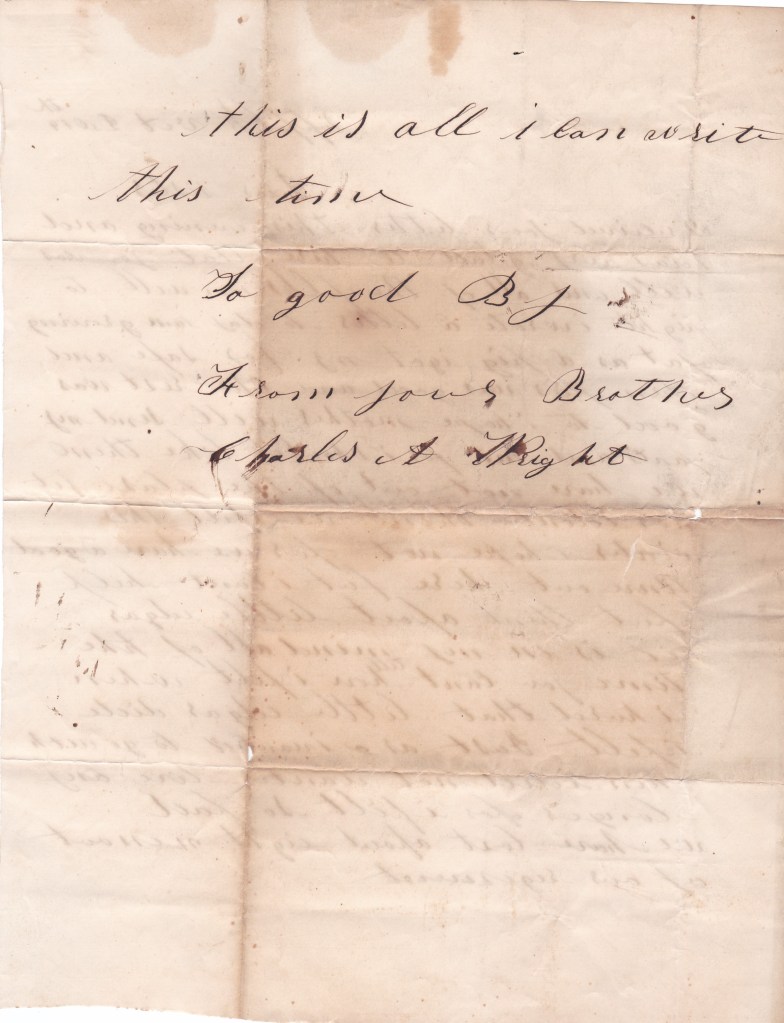
These letters were written by Charles A. Wright (1843-1899), a 19 year-old cooper from Townsend, Massachusetts, who enlisted on August 25, 1862 in Co. B of the 6th Massachusetts Infantry during their second term of service—a nine-month’s stretch when they were attached to the VII Corps and saw duty in and around Suffolk, Virginia. After he was discharged from the 6th Mass, he enlisted into Co. D, 2nd Massachusetts Heavy Artillery. He was discharged for disability at New Berne in July 1865.

Charles was the son of William Henry Wright (1804-1887) and Mary Baldwin (1807-1873) of Townsend, Middlesex county, Massachusetts.

Five soldiers, four unidentified, in Union uniforms of the 6th Regiment Massachusetts Volunteer Militia outfitted with Enfield muskets in front of encampment. Photo shows soldiers wearing frock coats and standing at ease with their Enfield Rifles. An encampment is visible in the background. Photo shows one identified soldier, Albert L. Burgess, on far right. Taken during their second term of service probably in Suffolk, Virginia. Published by North South Trader, May-June 1983, p. 23.

[Note: These letters are from the personal collection of Jim Doncaster and are published on Spared & Shared by express consent.]

Letter 1

Suffolk, VA
Sunday morning, October 5, 1862

I am pretty well today. We have had a fight it out here yesterday. We whipped them up pretty well. We killed about thirty of them.  We lost only four men in all. The Rebels had to skedaddle and burn the bridge so we could not get across.

I wish you would send Jennie out here in a letter. I would kiss her and send her back home safe. Henry, I suppose you feel pretty big of your horse. I hope you do. If I live to get home I shall buy me a wife and live happy. I tell you, I shall. I am a different man now to what I was at home.

I want you to tell Augusta to send her picture to me. I should like to have her send it as soon as she can. I did not think of it when I wrote to her. I want you [to] tell John Going to write to me, and I will write to him. I go to church every Sunday. I hope you all go to church every Sunday. You tell William to write to me….also Martha and do tell her to write to me and send Hattie out here in a letter and I will kiss her and send her back safe at home. I should like to see the little ones. I hope I shall live to see them once more and see you all. 

I hope you will write as often as you can. So goodbye. From your brother, — Charles A Wright


Letter 2

Suffolk, Virginia
December 19th [1862]

Dear Sister,

I received your letter this evening and I was very glad to hear that you was well and all the folks. I am well tonight. I wrote a letter today. I am growing fat as a pig. I got my box safe and them pies was good and the rest was good too. I hope mother will send my pants and hat for I should like them. We have not [moved] out of this place yet nor I don’t think we shall this winter. I hope not for we have a good time out here. But I can’t help but think about Little Edgar. 1 It is in my mind all the time. You can’t tell how [bad] I felt when I heard Little Edgar died. I felt just as I wanted to go with him. I did not want to live any longer for I felt so bad. We have lost about eight men out of our regiment.

This is all I can write this time. So goodbye. From your brother, — Charles A. Wright

1 Little Edgar was Charles’ nephew, Edgar Heselton (1859-1862). Edgar’s parents were Franklin Loring Heselton (1836-1917) and Mary Roanna Wright (1834-1864).


Letter 3

Suffolk, Virginia
1863

Dear Mother,

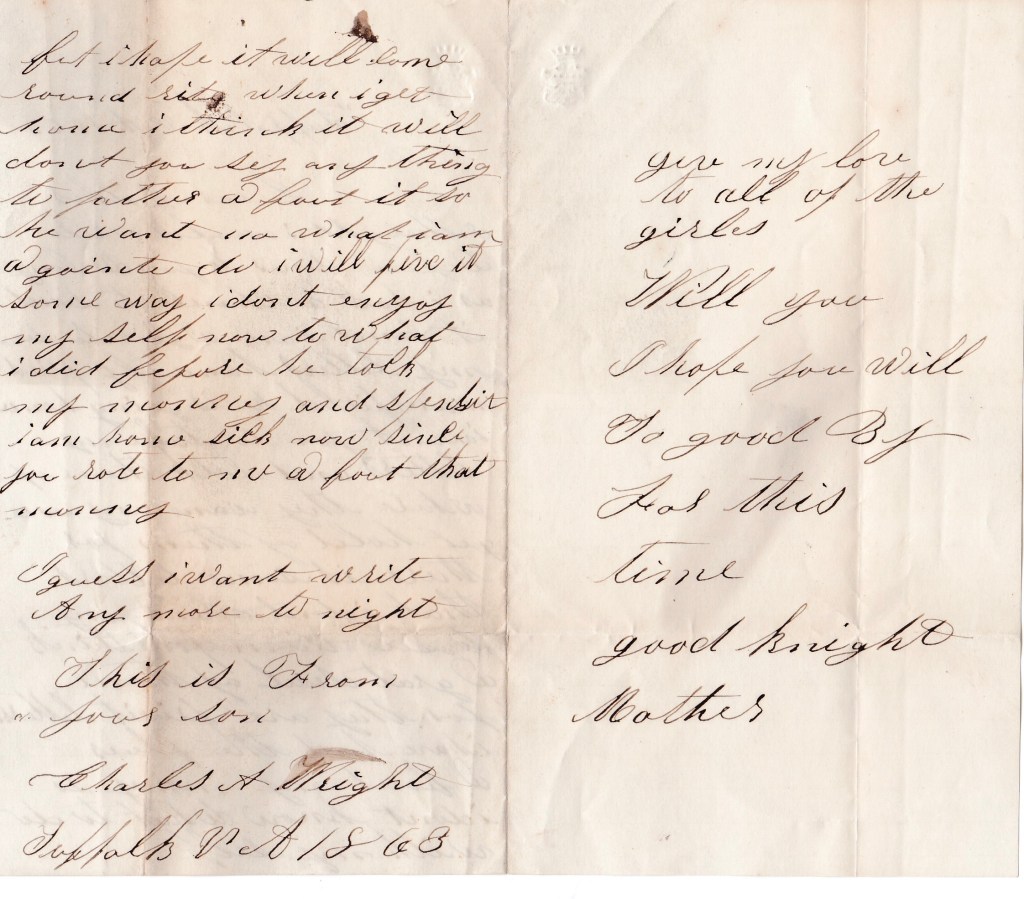
I thought I would write a few lines to you as long as I had a chance to send it and I am a going to send my letter home by Fred Mansfield. He is going home. I want you to take my letters and lock them up where they won’t anyone get hold of them for there is some letters that I don’t want any[one] to see them for I think a great deal of them for they are private letters. I have had the blues about my money so I don’t know what to do with myself but I hope it will come round right when I get home. I think it will. Don’t you say anything to Father about it so he won’t know what I am a going to do. I will fix it some way. I don’t enjoy myself now to what I did before. He took my money and spent it. I am homesick now since you wrote to me about my money.

I guess I won’t write anymore tonight. This is from your son, — Charles A. Wright.

Give my love to all the girls, will you? I hope you will. So goodbye for this time. Goodnight, Mother.


Letter 4

Suffolk, Virginia
January 29, [1863]

Dear Mother,

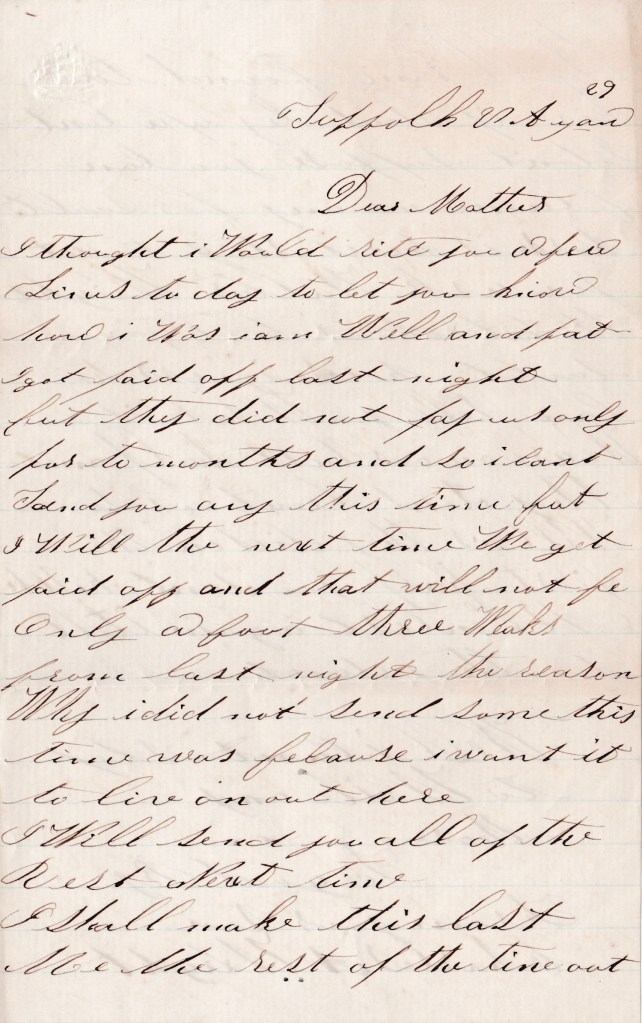
I thought I would write you a few lines today to let you know how I was. I am well and fat. I got paid off last night but they did not pay us only for two months and so I can’t send any this time but I will next time we get off and that will not be only about three weeks from last night. The reason why I did not send some this time was because I want it to live on out here. I will send you all of the rest next time. I shall make this last me the rest of the time out.

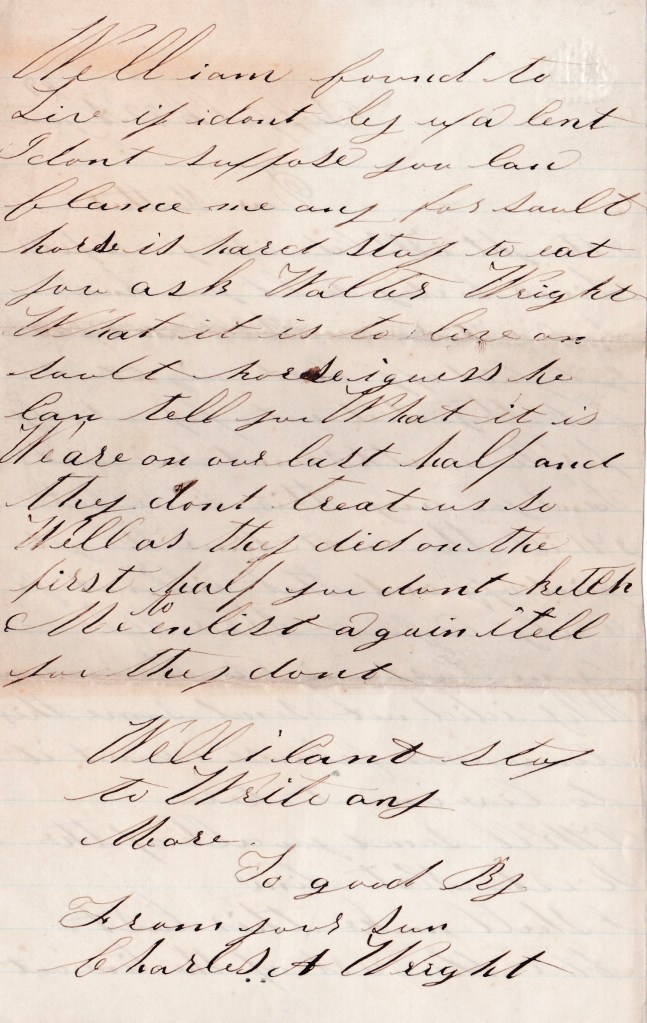
Well, I am bound to live if I don’t lay up a cent. I don’t suppose you can blame me any for salt horse is hard stuff to eat. You ask Walter Wright what it is to live on salt horse. I guess he can tell you what it is.

We are on our last half and they don’t treat us so well as they did on the first half. You don’t catch me to enlist again, I tell you they don’t.

Well I can’t stop to write anymore. So goodbye. From your son, — Charles A. Wright


Letter 5

Suffolk, Virginia
April 21, [1863]

Dear Mother,

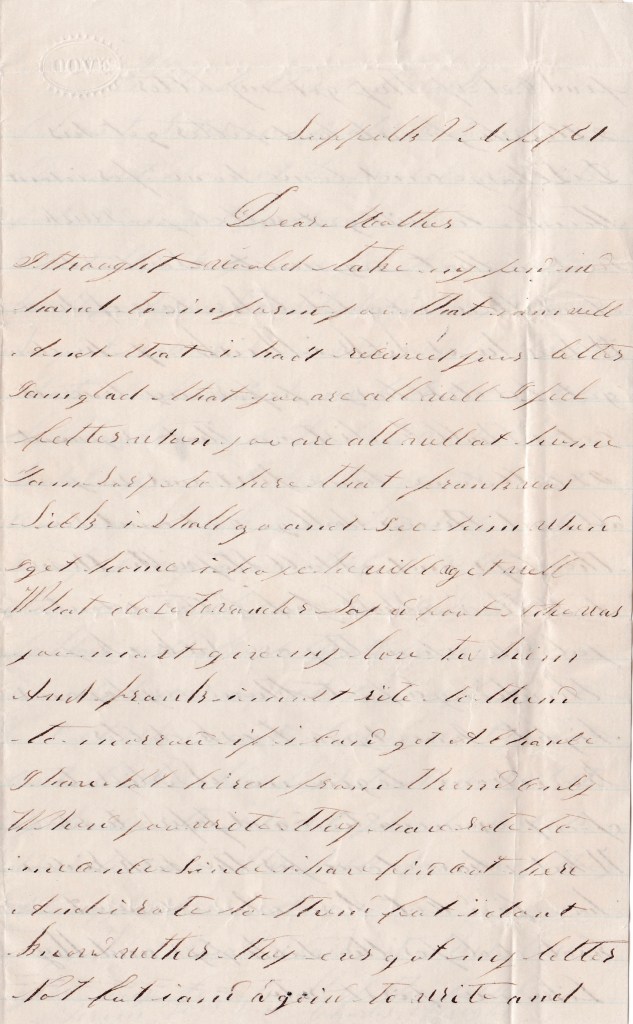
I thought I would take my pen in hand to inform you that I am well and that I had received your letter. I am glad that you are all well. I feel better when you are all well at home. I was sorry to hear that Frank was sick. 1 I shall go and see him when I get home. I hope he will get well. What does Frank say about the war? You must give my love to him. And Frank must write to them tomorrow if I can get a chance. I have not heard from them, only when you write. They have wrote to me once since I have been out here. And I wrote to them but didn’t know whether they ever got my letters. But I am a going to write and find out if they got my letters. I think Frank had better get his discharge and come home for I don’t think he will get well, do you? I wish I was in that regiment as a nurse and that I could take care of him when he is sick. I think if he don’t get his discharge before my time is out, I shall enlist in that regiment. I shall come home first and see you all and then I shall go out and see the boys and I shall stay with them. And then I shall feel better. I don’t feel right when they are sick. I keep thinking about them every day and night. I am a going to ask Doctor [Walter] Burnham to give me a certificate of my examination and papers to show what I have done for the sick soldiers here. I have done a great deal for the sick boys and they like me first rate.

Well, Mother, I think the climate suits me better out here than it does at home. I’ve never been so fat in my life as I am now. I don’t think you would know me now hardly if you should see me for I am so fat. I don’t suppose you would think that I could get so much fat onto my little frame but I have and I can hold up a great deal more if I had it on me. I weight one hundred and twenty-five pounds. That is pretty good for me, I think. Don’t you? I suppose Father will buy that horse for me. I hope he will for I want it when I get home. And if I go out to see the boys, he can sell it if he wants. I don’t find nothing else to write. The sick boys are getting along first rate now.

This is all I can write this time. Give my love to all the folks. From your son, — Charles A. Wright

1 I presume Charles is referring to his older brother Franklin S. Wright (1841-1863). Frank was serving in the 33rd Massachusetts Infantry. He was killed at the Battle of Brown’s Ferry Farm on 29 October 1863.

1864-65: William D. Semans to Adam S. Miller

Pvt. William D. Semans, wounded at Ft. Stedman
Find-A-Grave

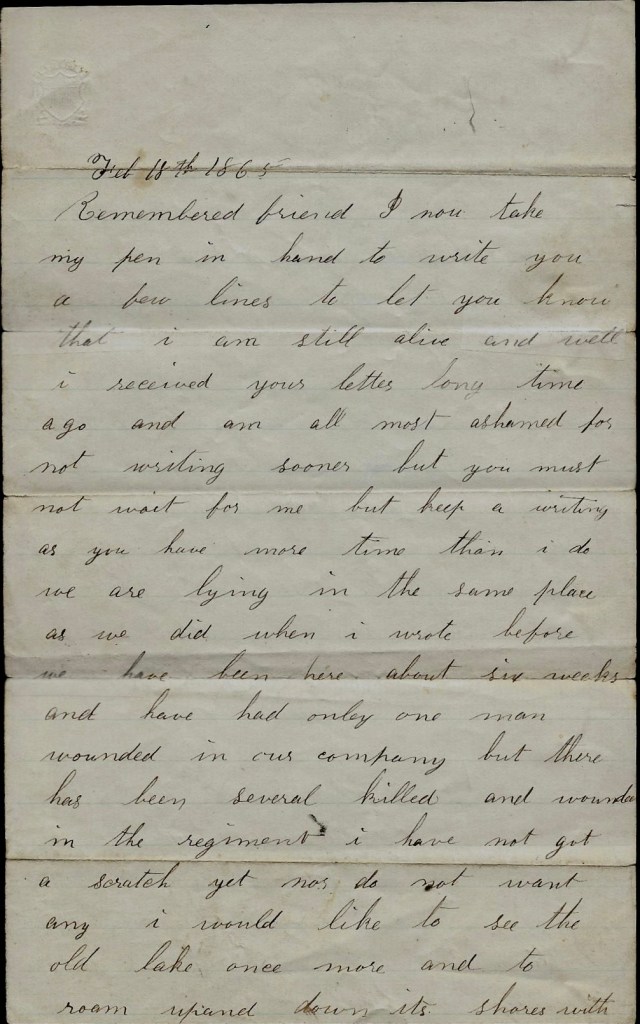
These two letters were written by William D. Semans (1844-1924), the son of Nelson Semans (1819-1891) and Hannah Briggs (1826-1905) of Starkey, Yates county, New York. William enlisted as a private in Co. L, 14th New York Heavy Artillery, in December 1863. He was wounded in the jaw by a shell fragment at Fort Stedman on 25 March 1865, five weeks after writing his friend, “I have not got a scratch yet nor do not want any.” He was treated for his wound at Armory Square Hospital in Washington D. C., from which place he was discharged from the service.

The 14th New York Heavy Artillery saw hard service. After manning the batteries in New York Harbor, they were ordered to the front as infantrymen in the 9th Corps. They passed through the Wilderness, then suffered heavily at Spottsylvania, Cold Harbor, and the first assault on Petersburg. In the Battle of the Crater they were one of the first to plant the colors on the enemies works. They occupied Fort Stedman at the time of the enemy attack in March 1865 and fought their way to Fort Haskell.

The letter was addressed to Adam S. Miller of Starkey, Yates county, New York, who enlisted in August 1862 but mustered out of the regiment on 8 January 1864 for disability.

Letter 1

[Fort Richmond, New York (?)]
January 6th 1864

Remembered friend,

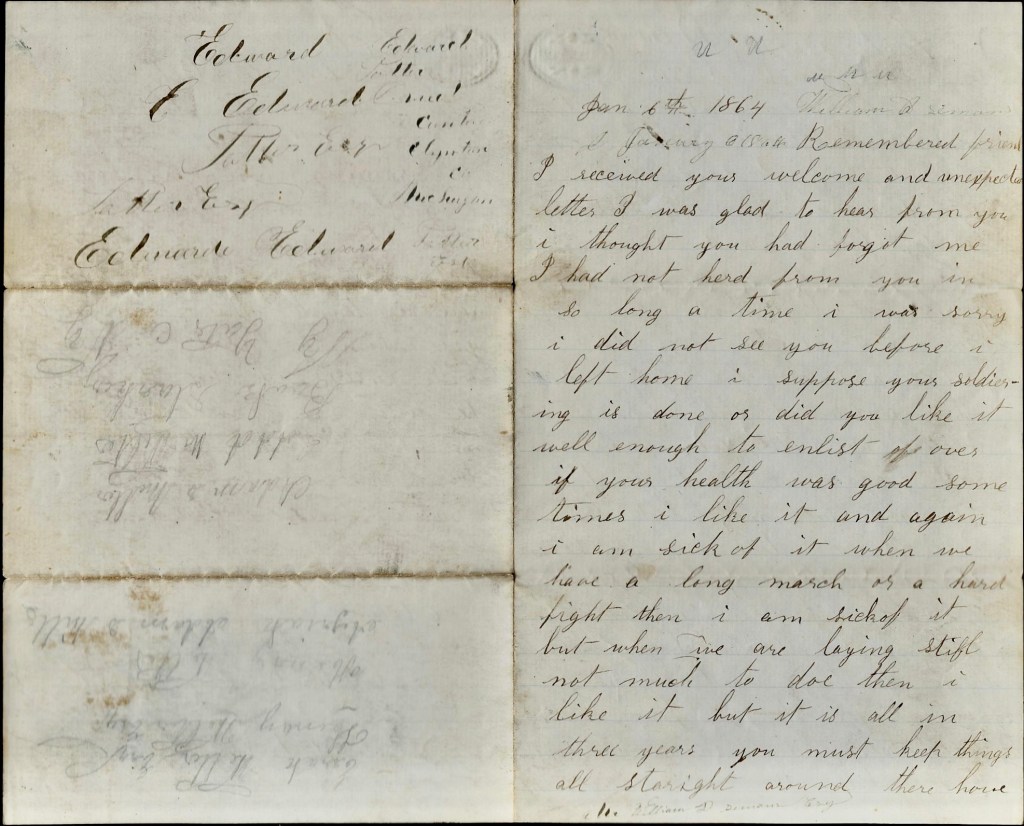
I received your welcome and unexpected letter. I was glad to hear from you. I thought you had forgot me, I had not heard from you in so long a time. I was sorry I did not see you before I left home. I suppose your soldiering is is done, or did you like it well enough to enlist over if your health was good? Sometimes I like it and again I am sick of it. When we have a long march or a hard fight, then I am sick of it. But when we are laying still [with] not much to do, then I like it. But it is all in three years.

“Tell them if they want to see hard times, to go for a soldier. But take Billy’s advice and live free while they can. Soldiering will do to talk about when you are in the bar room or some other safe place.”

— Pvt. William D. Seman, Co. L, 14th N. Y. Heavy Artillery

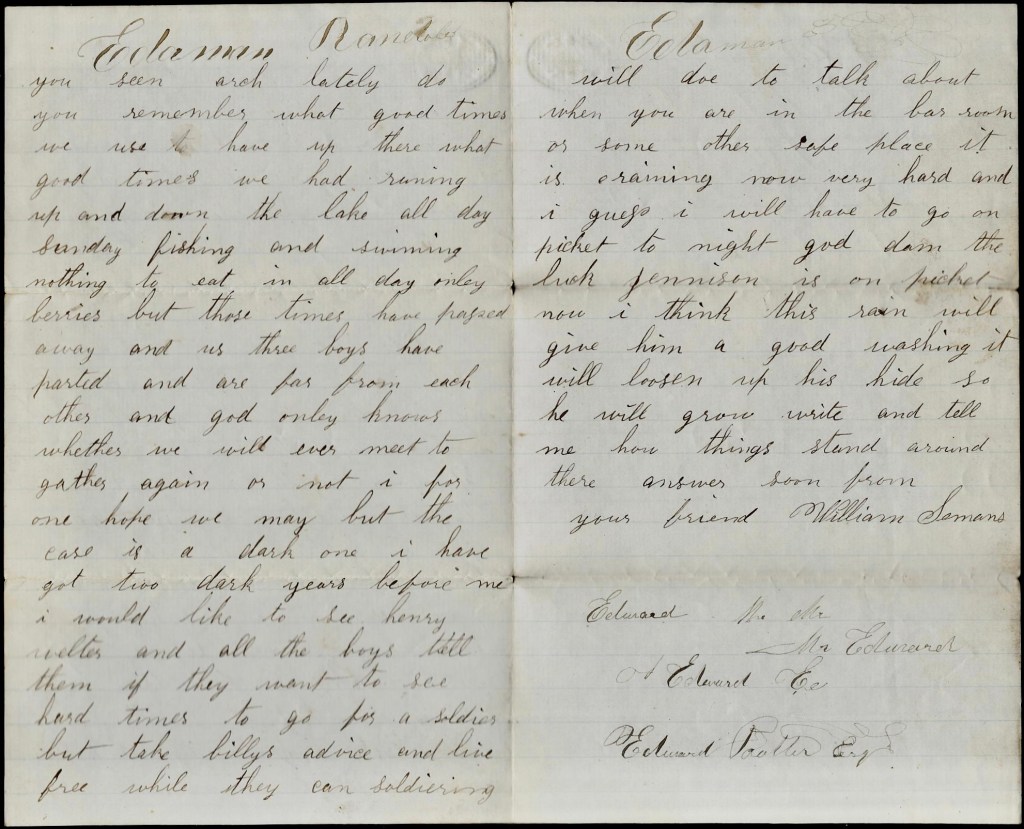
You must keep things all straight around there. Have you seen Arch lately? Do you remember what good times we used to have up there? What good times we had running up and down the lake all day Sunday, fishing and swimming, nothing to eat in all day—only berries. But those times have passed away and us three boys have parted and are far from each other and God only knows whether we will ever meet together again or not. I for one hope we may, but the case is a dark one. I have got two dark years before me. I would like to see Henry Welter and all the boys. Tell them if they want to see hard times, to go for a soldier. But take Billy’s advice and live free while they can. Soldiering will do to talk about when you are in the bar room or some other safe place.

It is raining now very hard and I guess I will have to go on picket tonight. God damn the luck. Jennison 1 is on picket now, I think. This rain will give him a good washing. It will loosen up his hide so he will grow. Write and tell me how things stand around there. Answer soon. From your friend, — William Semans.

1 George A. Jennison (or Jamison) enlisted at age 18 with William Semans in December 1863 in Co. L, 14th New York Heavy Artillery. He was wounded on 12 May 1864 and again on 25 March 1865. He mustered out of the regiment from Lincoln US General Hospital.


Letter 2

[Fort Stedman near Petersburg, Va.]
February 18th 1865

Remembered friend,

I now take my pen in hand to write you a few lines to let you know that I am still alive and well. I received your letter a long time ago and am almost ashamed for not writing sooner, but you must not wait for me but keep a writing as you have more time than I do.

We are lying in the same place as we did when I wrote before. We have been here about six weeks and have had only one man wounded in our company but there has been several killed and wounded in the regiment. I have not got a scratch yet nor do not want any. I would like to see the old lake once more and to roam up and down its shores with you and Old Carmer. Then was when I enjoyed myself eating berries and stealing Mr. Conkling’s apples. But apples are scarce here. They cost five cents apiece and not very large at that.

You spoke about your sweetheart Nelly. Tell me her other name so if I ever get a furlough, I can find her. There is not much firing going on here. They get to shelling every two or three days. There has three shells bursted in our company. Only wounded one and scared the rest pretty badly. Please answer soon from your friend.

— William Semans

1864: Richard Chapman to Adam S. Miller

These letters were written by 19 year-old Richard Chapman who enlisted on 15 August 1862 to serve in Co. B. 148th New York Infantry for three years. His health failed him, however, and he died at the Fortress Monroe Hospital on 2 September 1864. The letters were addressed to Adam S. Miller of Starkey, Yates county, New York, who enlisted in the company at the same time as Chapman but mustered out of the regiment on 8 January 1864 for disability.

Richard’s two letters were written at the time of Gen. Isaac J. Wistar’s raid on Richmond in February 1864. The following partial newspaper extract published in the Daily Press on 14 February 2014 describes the raid:

Sometime about 10 a.m. on Feb. 6, 1864, the road leading west from Williamsburg began to rumble under the weight of one of the largest Union raids ever aimed at the Confederate capital in Richmond. Nearly 7,000 bluecoats moved out in an ambitious expedition led by Yorktown commander Brig. Gen. Isaac J. Wistar—more soldiers than the area had seen since the Army of the Potomac attacked retreating Confederates in the May 1862 Battle of Williamsburg.

Sparked by the plight of hundreds of captured Federal officers held in Richmond’s notorious Libby Prison, the mission became more urgent after Union spies got word of a planned transfer to the newly built yet soon-to-be-infamous Confederate POW camp in Andersonville, Ga. Two Southern deserters had described the defenses at Bottoms Bridge as lightly manned, too—and they’d confirmed their reliability through a late 1863 raid that brought nearly 100 prisoners back from Charles City County, writes Carol Kettenburg Dubbs in “Defend this Old Town: Williamsburg During the Civil War.”

Despite the efforts of Wistar and Williamsburg Col. Robert M. West to keep their preparations secret, however, the advance units of 2,200 Union cavalry “found the enemy (at Bottoms Bridge) posted in strong force, and continually receiving accessions by railroad” when they arrived early the following morning, Wistar reported. Nine troopers were killed or wounded attempting to force a crossing, after which Wistar—recognizing that he’d lost the advantage of surprise—reluctantly ordered his men to withdraw. “It was a very good plan — and they had a sizable force to carry it out. But the Confederates knew they were coming,” says Carson Hudson, author of “Civil War Williamsburg.”

“Even before their return, Maj. Gen. Benjamin F. Butler at Fort Monroe discovered from a Richmond newspaper that a Union deserter had given them up—and he was just livid. “Butler offered to exchange any number of prisoners to get him back. But the Confederates wouldn’t.”

Letter 1

Headquarters [Isaac J.] Wistar’s Brigade
Butler’s Division, 18th Army Corps
Department of Virginia & North Carolina
148th Regt. N. Y. S. Vol. Infantry
Yorktown, Virginia
February 8, 1864

Friend Adam,

Thinking perhaps that a few lines from an old friend & used to be brother soldier would not come amiss, I thought I would write to you and let you know how we are getting along. The regiment has gone out on another raid—or expedition rather. They started last Friday at half past 2 o’clock with six days rations in their knapsacks & some took their rubber blankets & shelter tents & overcoats & a pair of socks, & there was the regiments of Colored Troops & Battery L & the 1st Rhode Island Battery & two other batteries and five regiments of cavalry & the 16th New York Heavy Artillery, & the 118th N. Y. S. Vol. Infantry & the 139th N. Y. S. Vol. Infantry, & the 25th Massachusetts Vol. & several other regiments. They were commanded by Brig. Gen. Wistar & they left here at 3 o’clock p.m. Friday 7 arrived at Williamsburg that night at 9 o’clock. At 12 M. that night they left Williamsburg for the mouth of the James river where they expected to meet Maj. Gen. Butler with about thirty-three thousand men and with the force that they had, they will number at least fifty thousand men. They had a nice little squad of them, don’t you think so? The report is that they are going to try & take a very large fort at what is called Bottom’s Bridge about fourteen miles this side of Richmond. if they succeed in taking it, they are going on further.

There is but nine of us left here. All the invalids were left here to take care of the camp & I will tell you their names commencing with Andrew Morrison [age 29], George Winans [age 46], David Griswold [age 46], David Hughes [age 46], Andrew Bradley [age 45], John H. Tymeson [age 22], Thomas H. Little [age 19], Lyman A. Stoll [age 24], and myself. My health is not very good at present. I caught a heavy cold and it settled in my right side & I have been very lame for some time but am some better now.

Ben [Grace] was enjoying good health when he left but I fear that he will never see Yorktown again for this season. Joseph Decker [age 46] & A[lexander] P. Houghtailing [age 22] has just come back. They gave out & were ordered back by the doctor & they say that Ben fell out. He could not keep up with the regiment but they say he is following up the regiment and if that is the case, he will probably be taken by the guerrillas which the country is full of & you know how they will be treated by them as well as I do.

After the regiment got to Williamsburg, the next morning the whole brigade were ordered in line & the orders were read to them by Gen. Wistar & they were as follows—that they would see long and forced marched & calm and severe fighting & I would give one month’s pay to be well & be with them.

Well, Adam, please write & tell me how you are getting along & if you got your bounty or not & all about your going home & all the news in general. The boys all send their best respects to you & I the same.

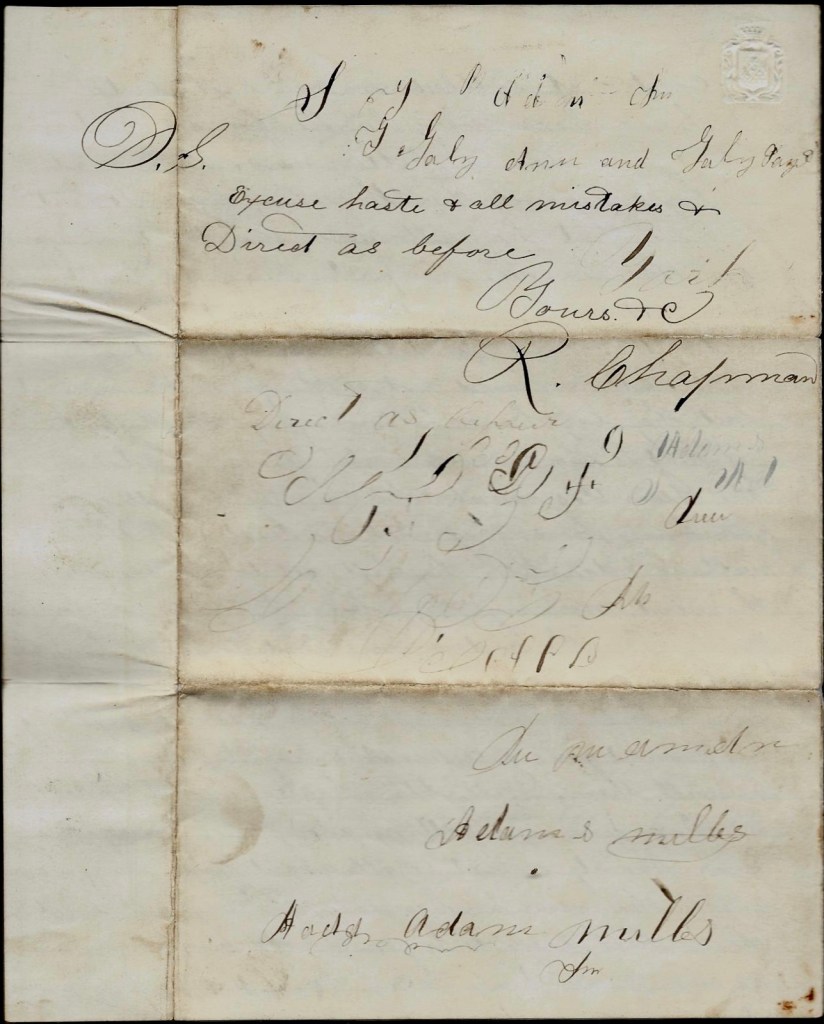
I remain as ever yours truly &c., — Richard Chapman

P. S. Excuse haste and all mistakes & direct as before, Yours &c. — R. Chapman


Letter 2

Headquarters 148th N. Y. Vol.
Yorktown, Va.
February 24, 1864

Friend Adam,

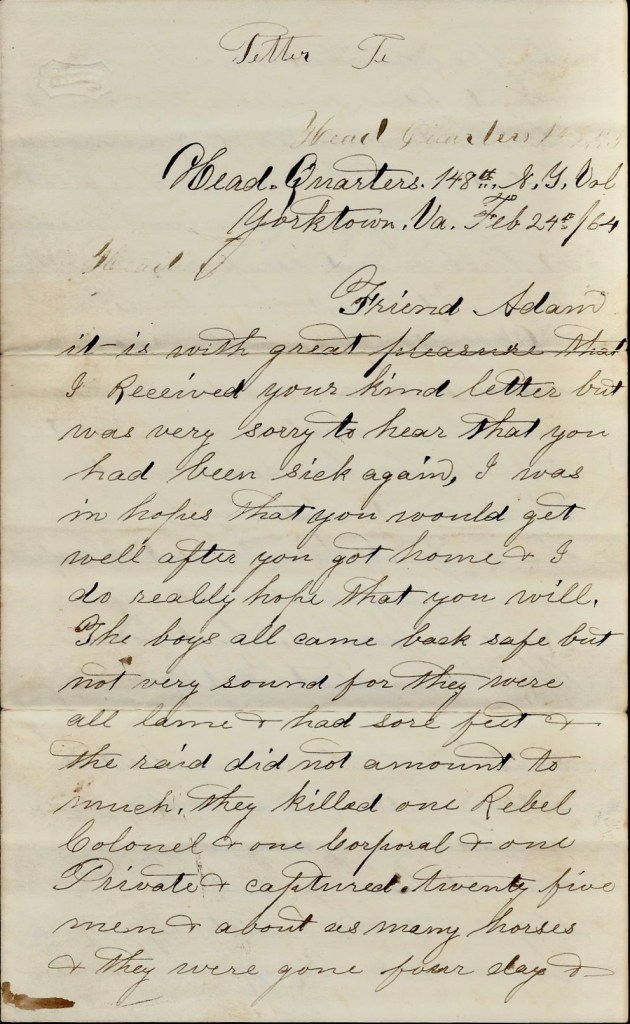
It is with great pleasure that I received your kind letter but was very sorry to hear that you had been sick again. I was in hopes that you would get well after you got home & I do really hope that you will.

The boys all came back safe but not very sound for they were all lame & had sore feet & the raid did not amount to much. They killed one Rebel Colonel & one corporal and one private and captured twenty-five men and about as many horses & they were gone four days and a half and marched one hundred and thirty-four miles. They went within ten miles of Richmond but it was the means of a great number of our Union prisoners at Richmond escaping & getting safe into the Union lines.

Well, Adam, you wanted to know where Randall G. Bacon is. Well he is at or near Fort Norfolk. He has command of the recruits that they have enlisted. He is 1st Lieutenant & expects something higher after the regiment [38th USCT] is formed. And John Morrison [age 45] is at Fort Monroe in the hospital & he has been very sick with the fever but is getting better. Ben [Grace] & Roy [Tubbs] are to bed a laughing and raising the old harry as bad as ever & they send their best respects to you & John Knapp the same.

The boys are all enjoying good health except John Clark. 1 He is pretty sick. Well, Adam, we have got two new recruits in our company & one of them is Charley Gabriel’s [18 year-old] brother [George] & the other one’s name is [William W.] “Roberts.”

I am on guard today and No. 1 on the relief & I have stood three tricks. Captain is feeling well now and he uses us very well. His wife is here & they went down to Norfolk this morning.

Well, Adam, you must excuse this poor writing for I am in a hurry and a short letter this time & please write as soon as convenient & oblige. Well good evening & pleasant dreams. I remain as ever your true & faithful friend, — Richard Chapman

1 John Clark was 22 years old when he enlisted in August 1862 in Co. B, 148th New York Infantry. He was killed in action on 18 June 1864 in the first assault on Petersburg.

1862-63: Rees John Lewis to Mary (Allison) Lewis

These letters were written by Welsh emigrant Rees John Lewis, Sr. (1830-1907), who settled in Bourbon county, Kansas, prior to the Civil War. Muster records inform us that Rees was the 1st Lt. of Co. C, 6th Kansas Cavalry, and commanded his company during the absences of his captain, Harris Soper Greeno. He mustered out 1 December 1864 at Fort Scott.

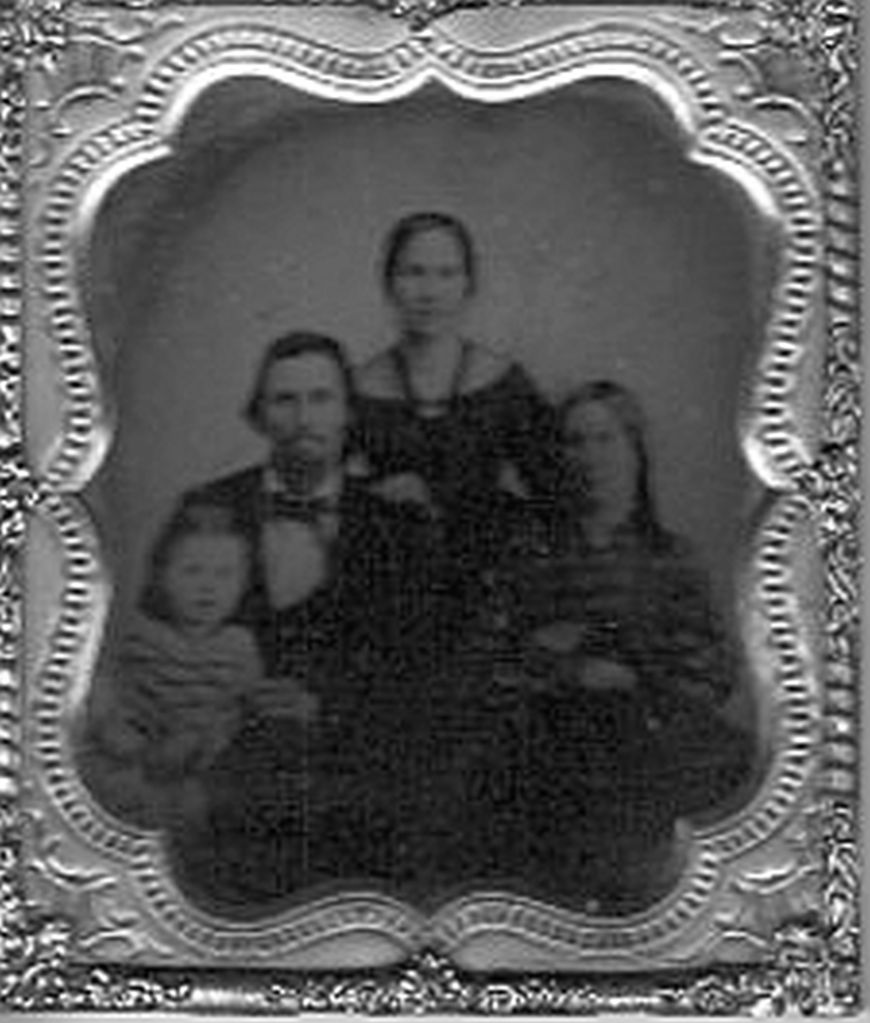
A poor image from Find-A-Grave but supposed to be Rees with wife Mary, daughter Jenny, and perhaps a sister (ca. 1865)

“In common with other units, the 6th Kansas Cavalry initially wore civilian clothing and many men continued to do so after the regiment was uniformed; they also sometimes grew their hair long like their Confederate adversaries, as a disguise when scouting. A similar tactic was employed by Capt Tough’s notorious “Buckskin Scouts,” described as being as flamboyantly bedecked with feathers, ribbons and revolvers as the guerrillas they were hunting.” [Source]
Lieutenant Reese J. Lewis, 6th Kansas Volunteer Cavalry. In January 1864 he took his company on a scout into the Territory, traveling 130 miles and capturing a Confederate outpost, killing 7 and capturing 25 before returning to Fort Smith, Arkansas. His frock coat has first lieutenant’s shoulder straps, and his dark blue trousers a Vein yellow welt. (Kansas State Historical Society, Topeka)

Rees was married to Mary Elizabeth Allison (1839-1905) in 1860. Together they had at least eight children, only daughter Jennie Mae Lewis (1862-1934)—the oldest—being born during the Civil War. Mary may have been living in Westport, Jackson county, Missouri, during the Civil War; the family resided there after the war.

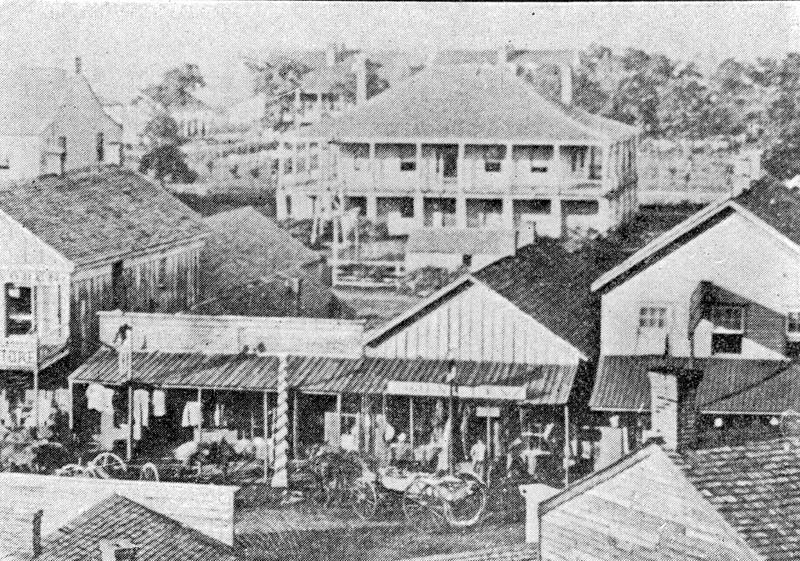
1863 photograph of Market Street with hospital in background; Fort Scott, Kansas. Courtesy of the Kansas Historical Society

Letter 1

Fort Scott, Kansas
August 2nd 1862

My Dear Mary,

I did not receive a letter from you by the last mail as I was in hopes to.

We are still camped near Fort Scott (three miles from town). I am in command of the company. The question of the quartermastership is not settled. You must not be disappointed if I should not get it. All of the officers have recommended me but the two colonels—the Col. appoints.

I have been getting along very well every way since I came here. I think I will get along well in the company. I have been trying to find a place here for you but as yet I have failed.

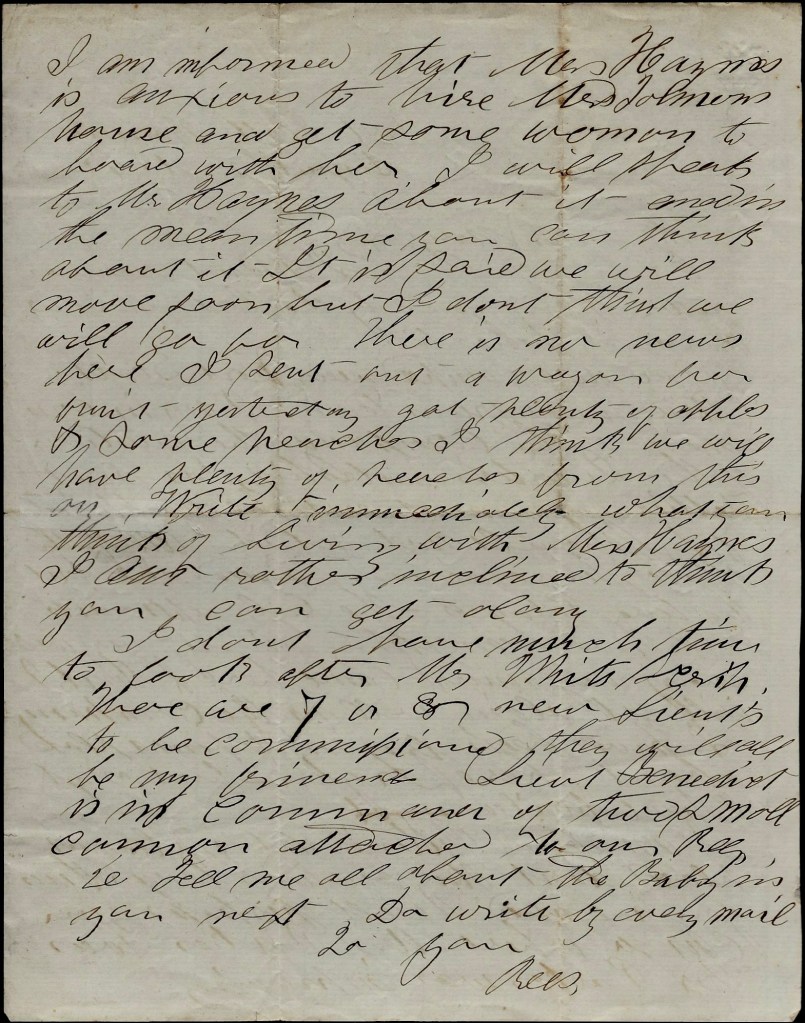
I am afraid Writ’s is not a pleasant place. Don’t stay an hour longer than you are used well. Perhaps you can go where Mrs. Parker was. Dr. Parker was improving. I am informed that Mrs. Haynes is anxious to hire Mrs. Tolman’s house and get some woman to board with her. I will speak to Mr. Haynes about it and in the meantime you can think about it. It is said we will move soon but I don’t think we will go far.

There is no news here. I sent out a wagon for fruit yesterday. Got plenty of apples & some peaches. I think we will have plenty of peaches from this on. Write immediately what you think of living with Mrs. Haynes. I am rather inclined to think you can get along.

I don’t have much time to look after Mr. Writ’s crib. There are 7 or 8 new Lieut.’s to be commissioned. They will all be my friends. Lieut. [Brainerd D.] Benedict [of Co. E] is in command of two small cannon attached to our regiment.

So tell me all about the baby in your next. Do write by every mail. To you, — Rees


Letter 2

Fort Scott, Kansas
September 5th, 1862

My Dear Mary,

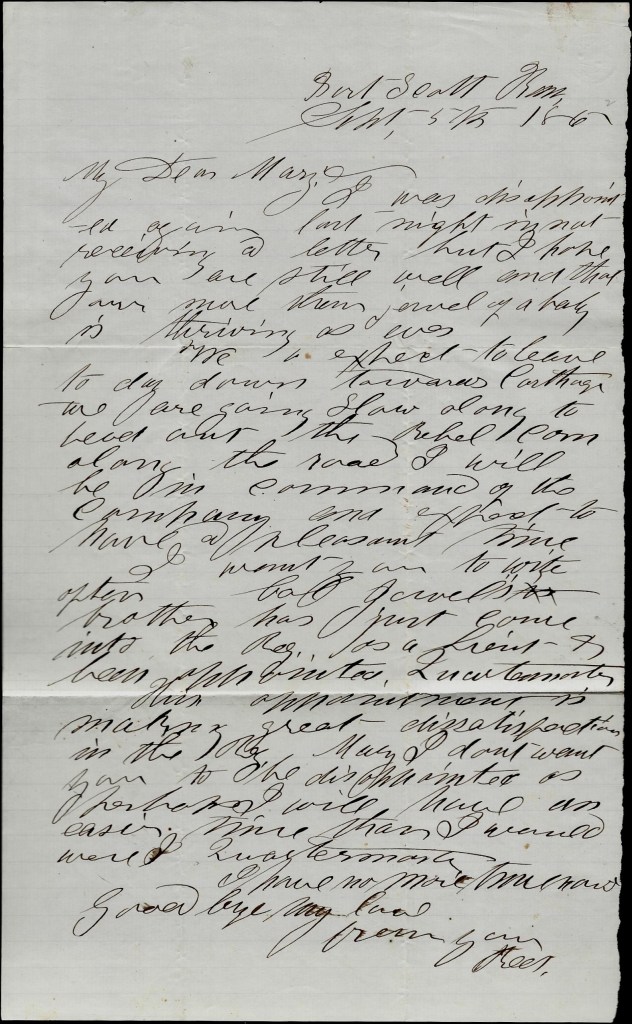
I was disappointed again last night in not receiving a letter but I hope you are still well and that our more than jewel of a baby is thriving as ever.

We expect to leave today towards Carthage. We are going slow along to head out the Rebel come along the road. I will be in command of the company and expect to have a pleasant time.

I want you to write often. Col. [Lewis R.] Jewell’s brother [Charles W. Jewell] has just come into the regiment as a Lieutenant & been appointed Quartermaster. This appointment is making great dissatisfaction in the regiment. Mary, I don’t want you to be disappointed as perhaps I will have an easier time than I would were I quartermaster.

I have no more time now. Goodbye my love, From your, — Rees


Letter 3

Fort Scott, Kansas
May 3rd 1863

My Dear Mary,

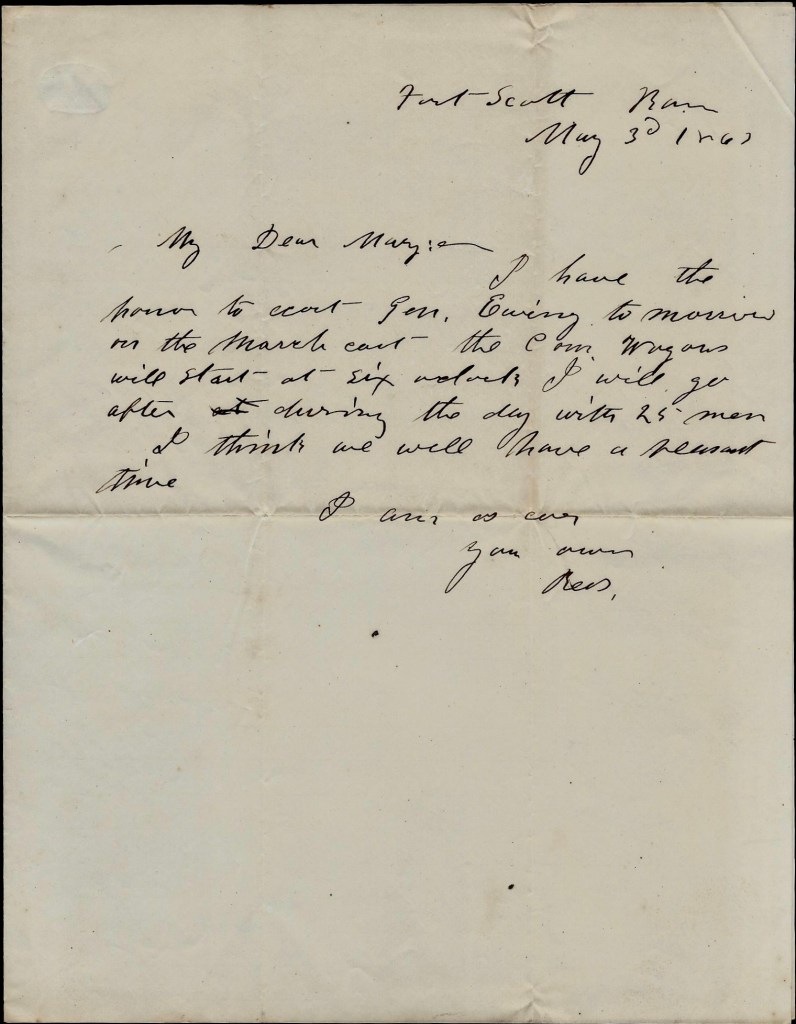
I have the honor to escort Gen. Ewing tomorrow on the march East. The commissary wagons will start at six o’clock. I will go after during the day with 25 men. I think we will have a pleasant time.
I am as ever your own, — Rees


Letter 4

Rolla [Missouri]
June 17, 1863

My dear Mary,

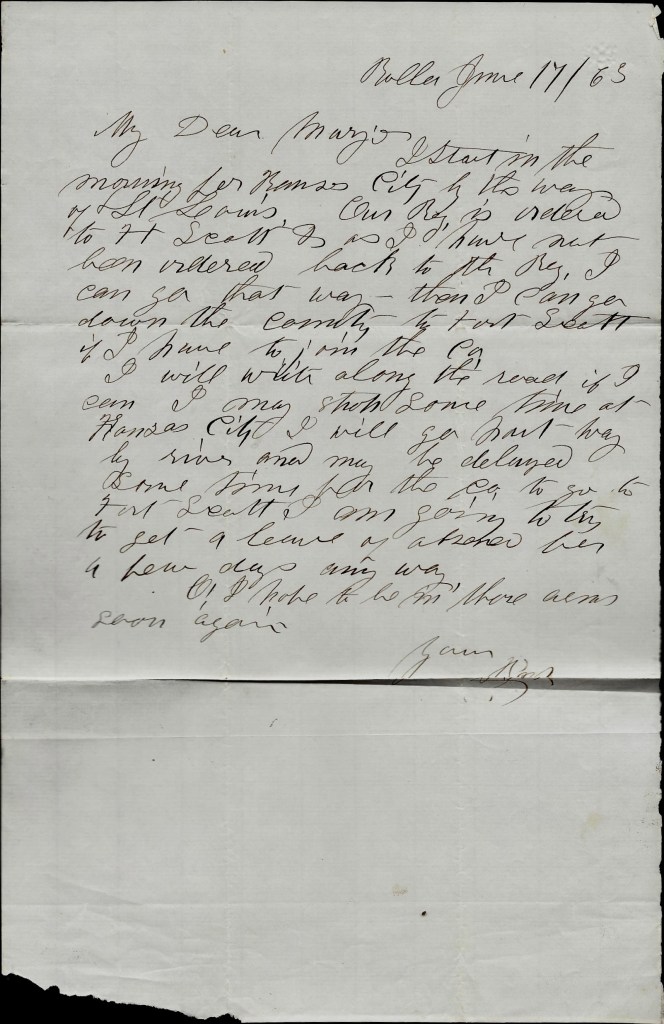
I start in the morning for Kansas City by the way of St. Louis. Our regiment is ordered to Fort Scott & as I have not been ordered back to the regiment, I can go that way. Them I can go down the country to Fort Scott if I have to join the company.

I will write along the road if I can. I may stop some time at Kansas City. I will got part way by river and may be delayed some time for the company to go to Fort Scott. I am going to try to get a leave of absence for a few days any way.

O! I hope to be in those arms soon again. Yours, — Rees


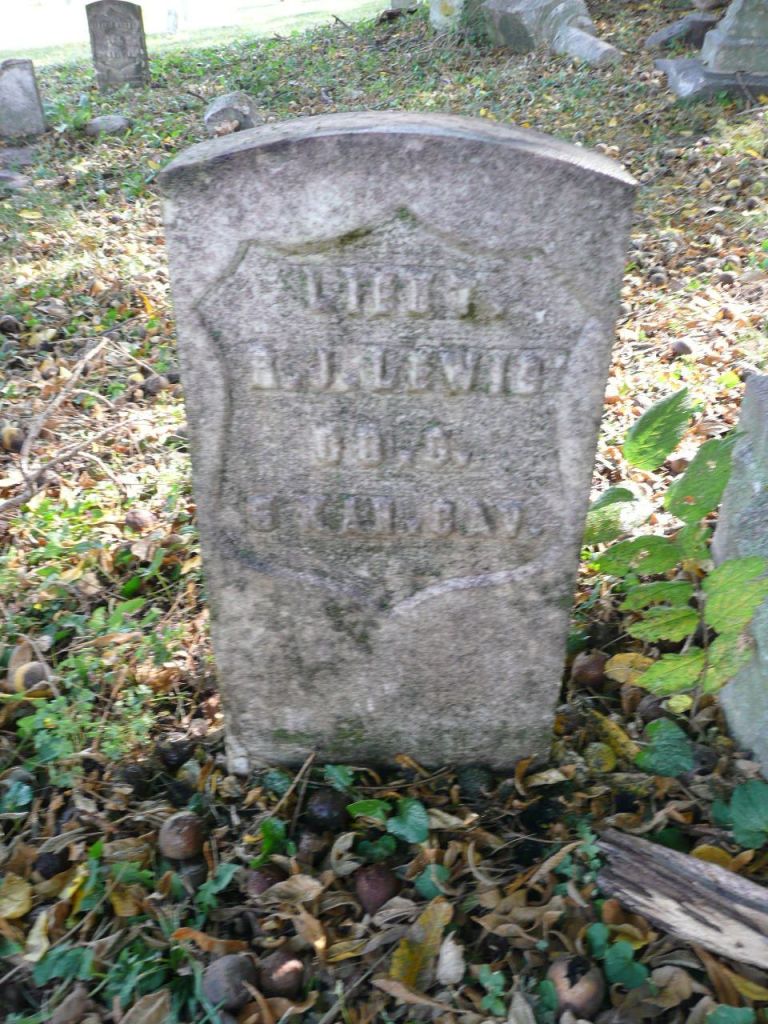
Lt. Rees John Lewis lies buried in Union Cemetery in Kansas City, Missouri, under a Black Walnut Tree.

1898: William Bell to Sheriff of Fayette County, Kentucky

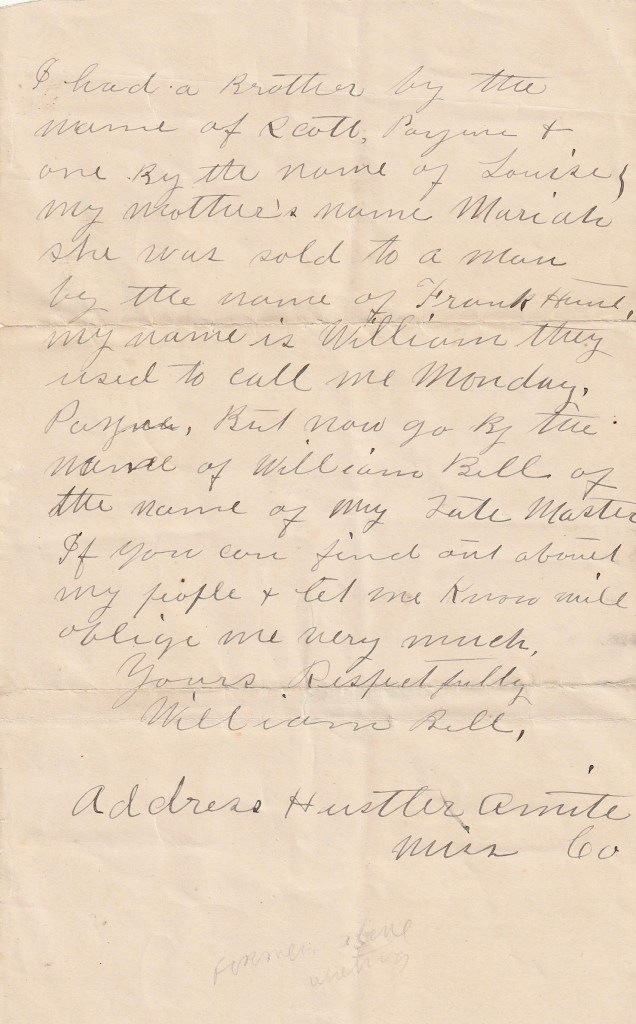
In this letter, former slave William Bell, now living in Amite Co., MS, writes the Sheriff of Fayette County, Kentucky in 1898, inquiring about his relatives, whom he is seeking after over 30 years have passed. He notes that he has already written his family’s primary slave owner, John Breckinridge Payne, to no avail, and requests the Sheriff’s assistance.

According to 1900 and later U. S. Census data, William Bell, born Nov. 1832 in Kentucky, resided in Beat 4, Amite Co., Mississippi (probably died 1900-1910); wife Jane (b. 1826 in AL; illiterate—still alive in 1910); children, Seaborn (b. 1880; wife Lena), Benjamin (b. 1883; wife Janie, b. 1880; stepson: Able Brown, b. 1894), Lucus (b. 1884), Ridley (b. 1887; wife Victoria, b. 1884), Myrtis (b. 1881), Maria (b. 1890), and Pinkey (b. 1890).

William Bell’s former owner was John Breckinridge Payne (1830-1891), the son of Daniel McCarty Payne (17954-1865) and Zelinda Ann Smith (1809-1883) of Lexington, Fayette county, Kentucky. Paine graduated from Transylvania Law School in 1851 and entered into his father’s law practice in Lexington, Kentucky. He was married to Ellen Douglas Woolley on 25 June 1861. According to the 1850 Slave Schedules, at age 20, John owned 9 slaves ranging in age from 3 to 90 years old, most of the young slaves being female. In the 1860 Slave Schedules, 30 year-old John owned 15 slaves, ranging in age from 50 to 9 years old. The males were ages 32, 25, 24, 7, and 4; the females were 50, 32, 25, 16, 14, 12, 10, 8, 9, and 3.

There was a Francis (“Frank”) Key Hunt (1817-1879)—a lawyer— who resided in Lexington, Kentucky in 1860. At the time of the 1860 Census, he was enumerated with one slave, a 30 year-old male. In the 1870 Census, this same Frank Hunt is, age 53, was enumerated with his wife, Julia Warfield Hunt (1819-1895), and a their daughter Maria Barr Hunt.

The only record I can find for a Mariah Payne, a Black woman born in 1817, was a mortuary record dated 16 June 1899 in Jefferson, Kentucky. She was 82 years old when she died of malarial typhoid fever in Louisville, Kentucky. If this was William’s mother, it’s sad to think that he was trying to find her a little more than a year before she died.

[This letter is from the private collection of Richard Weiner and is published by express consent.]

Transcription

March 8, 1898
Hustler, Mississippi 

To the sheriff of Fayette Co., Lexington Ky. 
Dear Sir,

I wrote a letter about a month ago making inquiry of a man by the name of John Breckinridge Payne, of whom I used to belong before the war. I wrote to him to know where my people were still living in Lexington and if he could tell me anything about them, but did not receive an answer. Please write and let me know if you know of any of the Payne family and give me their name. I had a brother by the name of Scott Payne & one by the name of Louis. My mother’s name [was] Mariah. She was sold to a man by the name of Frank Hunt. My name is William. They used to call Monday Payne, but now go by the name of William Bell of the name of my late Master. If you can find out about my people & let me know, [you] will oblige me very much. 

Yours Respectfully, — William Bell

Address Hustler, Amite, Miss Co. 

1864: George Roy Tubbs to Adam S. Miller

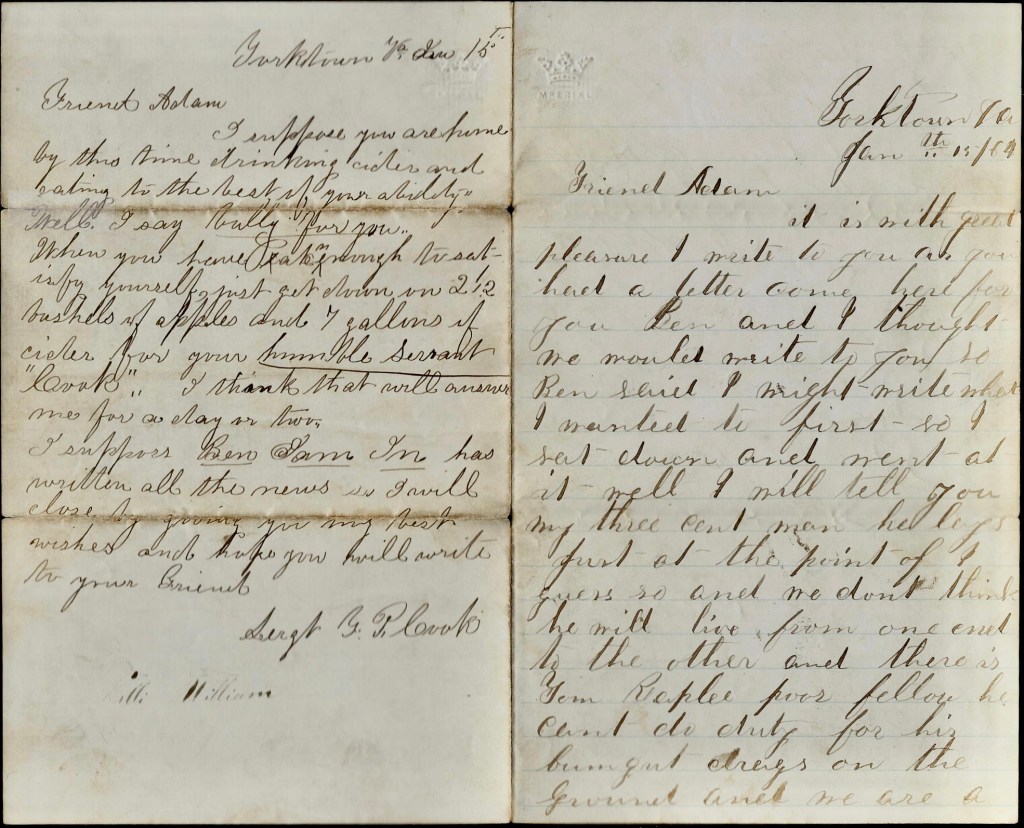
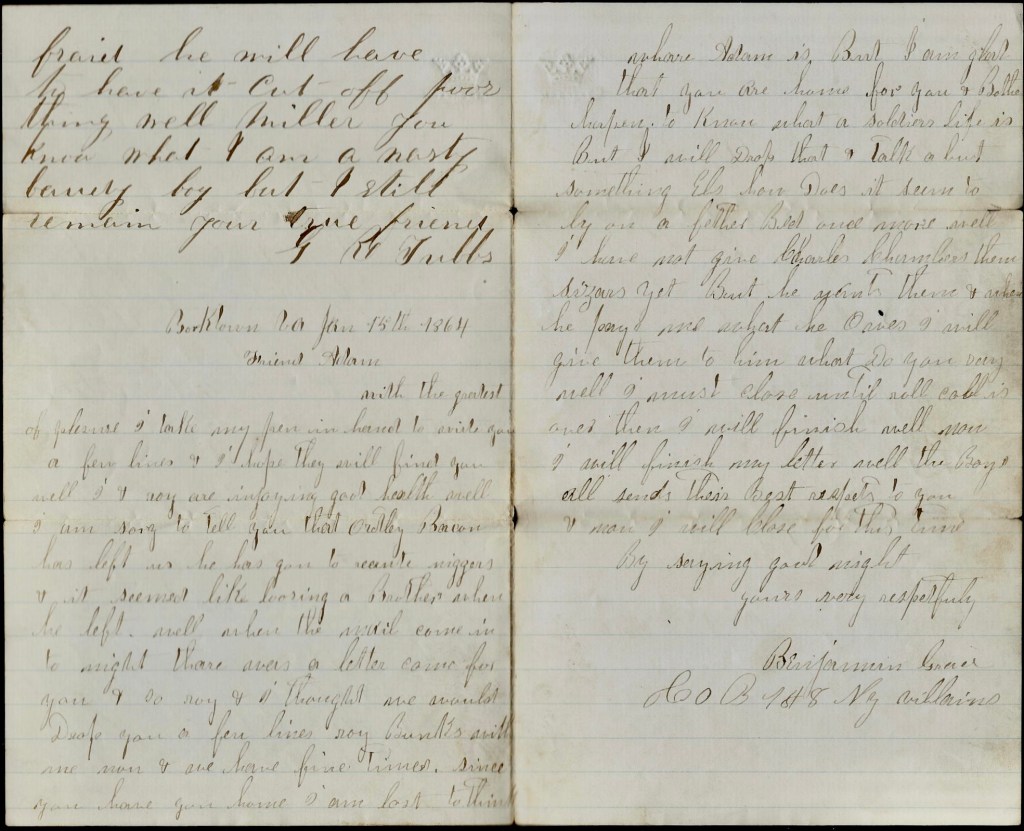
This letter was written by three different soldiers, all serving in in Co. B, 148th New York Infantry. The first part was written by George “Roy” Tubbs who enlisted on 8 August 1862 at Starkey to serve three years. He was wounded in action on 16 May 1864 in the fighting at Drewry’s Bluff and died of his wounds on 19 June 1864 at Fortress Monroe.

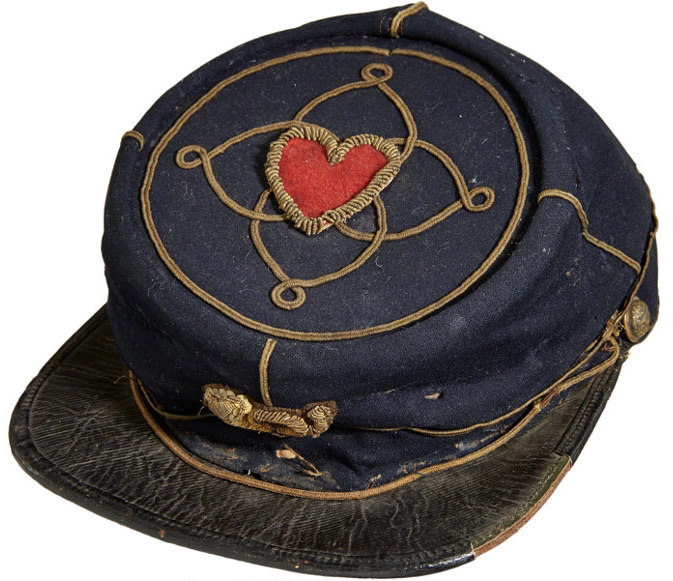
A kepi identified to George Waddle of the 148th new York Infantry

The second part of the letter was written by Benjamin Grace of Barrington who enlisted on 26 August 1862 who, like Roy Tubbs, wounded at Drewry’s Bluff and died of his wounds on 25 July 1864.

The third part of the letter was written by Sergt. Foster P. Cook of Starkey who enlisted on 28 August 1862 and was promoted to sergeant in October 1862. He made 1st Sergt. on 17 January 1864 and was wounded in action on 15 June 1864 near Petersburg. Unlike his two buddies, however, Foster survived his wounds and was promoted to Lieutenant in Co. F.

The letter was addressed to Adam S. Miller of Starkey, Yates county, New York, who enlisted in the company at the same time as the others but mustered out of the regiment on 8 January 1864 for disability.

Transcription

Yorktown, Virginia
January 15, 1864

Friend Adam,

It is with great pleasure I write to you as you had a letter here for you Ben and I though we would write to you so Ben said I might write what I wanted to first. So I sat down and went at it. Well I will tell you my three cent man he lays just at the point of I guess so and we don’t think he will live from one end to the other and there is Tom Raplee, poor fellow. He can’t do duty for him bum gut drags on the ground and we are afraid he will have it cut off. Poor thing. Well, Miller, you know what? I am a nasty [ ] boy but I still remain your true friend. — G. Roy Tubbs

[in a different hand]

Yorktown, Va.
January 15th 1864

Friend Adam,

With the greatest of pleasure I take my pen in hand to write you a few lines & I hope they will find you well. I & Roy are enjoying good health. Well, I am sorry to tell you that Orderly [Randall G.] Bacon has left us. He has gone to recruit niggers & it seemed like losing a brother when he left. 1 Well, when the mail came in tonight, there was a letter came from you & so Roy and I thought we would drop you a few lines. Roy bunks with me now & we have fine times. Since you have gone home I am lost to think where Adam is. But I am glad that you are home for you & Both happen to know what a solder’s life is. But I will drop that & talk about something else.

How does it seem to lay on a feather bed once more? Well I have not give Charles Chambers them cigars yet. But he wants them and when he pays me what he owes me, I will give them to him. What do you say?

Well, I must close until roll call is over. Then I will finish. well, now I will finish my letter. well the boys all sends their best respects to you and now I will close for this time by saying good night. Yours very respectfully. — Benjamin Grace. Co. B, 148th New York Villains

[in a different hand]

Yorktown, Va.
January 15th

Friend Adam,

I suppose you are home by this time drinking cider and eating to the best of your ability. Well, I say “Bully for you.”
When you have ate enough to satisfy yourself, just get down on 2.5 bushels of apples and 7 gallons of cider for your humble servant “Cook.” I think that will answer me for a day or two.

I suppose Ben has written all the news so I will close by giving you my best wishes and hope you will write to your friend, — Sergt. F. P. Cook


1 Randall Graves Bacon (1837-1924) was mustered in as a 1st Lieutenant on 6 February 1864 in the 38th U. S. Colored Infantry. He served as adjutant of the regiment for a time and when he requested to resign with an honorable discharge in January 1865, his request was disapproved with the following less than complimentary comments: “Disapproved. Lieut. Bacon is a restless, negligent, and discontented officer who is not pleased at being required to perform his duty. He has been an officer about twelve and a half months, has been absent from his regiment about six months of that time on recruiting service and other pleasant detached duty, and has little to complain. In my opinion, the spirit of his resignation is highly reprehensible and he not deserve an honorable discharge. He was finally discharged after he received a gunshot wound on April 5, 1865 near Richmond necessitating the amputation of the first two fingers on his right hand.

1861-62: George Bouton to Lucetta F. (Nalle) Bouton

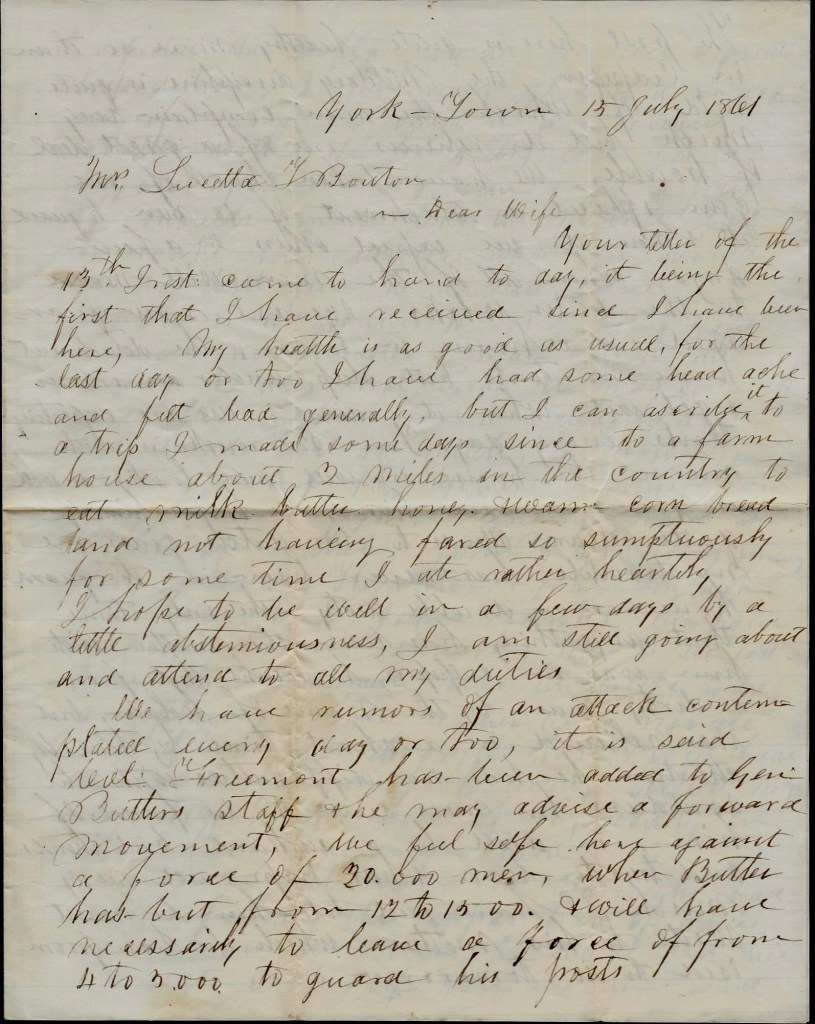
These two letters were written by George Bouton (1817-1891), the son of Richard Crittenden Booton (1785-1842) and Lucy C. Ware Scott (1789-1846) of Madison county, Virginia. In his letters, George mentions two of his brothers, James W. Booton (1815-1889) and R. Sinclair Boton (1830-1882). George was married to Lucetta F. Nalle (1819-1893). I believe the plantation where they lived at the time of the Civil War was called “Hilton” and was located in Rochelle, Madison county. It should be noted that George’s signature appears to read “Bouton” but the family surname was actually Booton. This change in spelling appears to have been intentional as his name appears as Bouton in military records and post war census records.

Thomas Taylor Pettus was 1st Lt. in the 34th Virginia and took over as Captain of Co. B, 4th Regt., Heavy Artillery in May 1862.

Muster records of the 34th Virginia Infantry indicate that George raised his own company and joined the regiment in June 1861 when he was nearly 45 years old. His company was shortly afterward designated Co. B (“Madison Artillery”), 4th Regt. Heavy Artillery and placed in charge of some of the guns at Yorktown. His requisition for fuel in December 1861 indicates that he had in camp a total of 37 members in his company, including himself and two lieutenants. The placement of the Madison Artillery in the defenses is not known but it was reported to be near the “Naval Battery.” In late May 1862, at the reelection of officers following one years service, George was not reelected as captain. His last requisition as captain of the company was for the replacement of tents and cooking utensils—having been “left on the field at Yorktown” when it was evacuated—was dated 8 May 1862.

Once replaced as captain of his company, it appears that he took a position as captain of Co. H in the 1st Battalion of Virginia Reserves guarding Richmond. He did not take the Oath of Allegiance to the United States until 1865.

The first transcribed letter comes from a private collection and was written not long after George and his company arrived at Yorktown, having come from Culpeper, Virginia. The second letter was transcribed by me from the on-line digital archives of Cornell Library where the letter is housed but not previously transcribed. It should also be noted that the Library of Virginia purchased two letters of George’s letters—one dated 13 January and the other 20 February 1862 while stationed at Yorktown, Virginia, to his wife, Lucetta Bouton discussing his health, camp life, military preparations at Yorktown, and friends in the regiment; and another, 2 March, to his daughter Mollie Bouton discussing the same topics and trying to explain the significance of the war. (44972)

Letter 1

Addressed to Mrs. Lucetta F. Bouton, rochelle, Madison county, Virginia

Yorktown [Virginia]
15 July 1861

Mrs. Lucetta F. Bouton, dear wife,

Your letter of the 13th inst. came to hand today, it being the first that I have received since I have been here. My health is as good as usual. For the last day or two I have had some headache and felt bad generally, but I can assign it to a trip I made some days since to a farm house about two miles in the country to east milk, butter, honey, warm corn bread, and not having fared so sumptuously for some time, I ate rather heartily. I hope to be well in a few days by a little abstemiousness. I am still going about and attend to all my duties.

We have rumors of an attack contemplated every day or two. It is said Col. Fremont has been added to Gen. Butler’s staff [at Fortress Monroe] adn he may advise a forward movement. We feel safe here against a force of 20,000 men, when Butler has but 12 to 15,00[0] & will have necessarily to leave a force of from 4 to 5,000 to guard his posts.

The post here is quite healthy—more so than in Culpeper. The military discipline is quite rigid of which the men complain very much but it relieves me of a great deal of trouble. We have taken charge of one gun and placed a detachment of 10 men to guard & man it. we expect others in a few days when all of the men will move to the outer works.

We are now quartered in a house in town. The detachment have no tents but sleep under an arbor & get wet when it rains. We are expecting tents every day. Tom Burroughs is with me in the house, is well, and looks as well as you ever saw him. He keeps himself quite clean, attends to his duties, gives me no trouble, has never been in the guard house or on double duty. The only time that anything has been the matter with him was in Culpeper, he caught that from a dirty man by the name of Colvin, but was relieved in a short time by timely attention. He has no difficulties with the soldiers. His mess seem to be fond of him. In drill he is awkward but attends and tries to learn & has improved very much. I have just told him he must write to his mother which he has promised to do tomorrow.

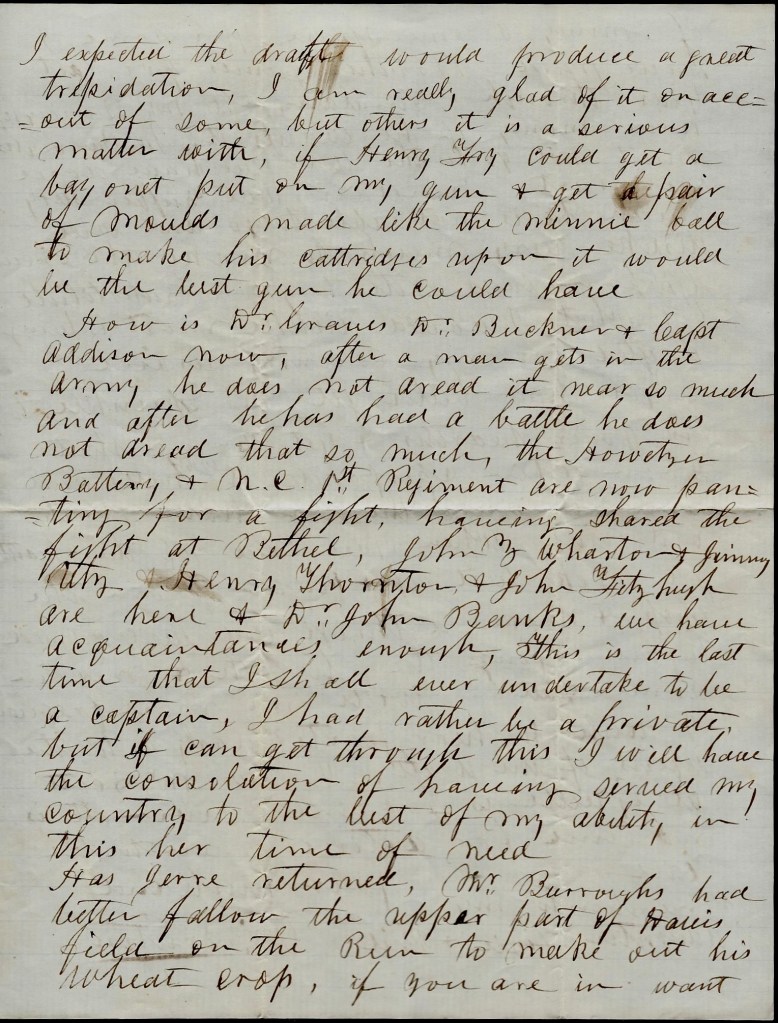
I expected the draft would produce a great trepidation. I am really glad of it on account of some, but others it is a serious matter with. If Henry Fry could get a bayonet put on my gun & get the pair of moulds made like the minié ball to make his cartridges upon, it would be the best gun he could have.

How is Dr. Graves, Dr. Buckner, and Capt. Addison now? After a man gets in the army, he does not dread it near so much and after he has had a battle, he does not dread that so much. The Howitzer Battery & N. C. 1st Regiment are now panting for a fight, having shared the fight at Bethel. John Z. Wharton & Jimmy Utly & Henry Thornton & John Fitzhugh are here & Dr. John Banks. We have acquaintances enough. This is the last time that I shall ever undertake to be a captain. I had rather be a private but if I can get through this, I will have the consolation of having served my country to the best of my ability in this her time of need.

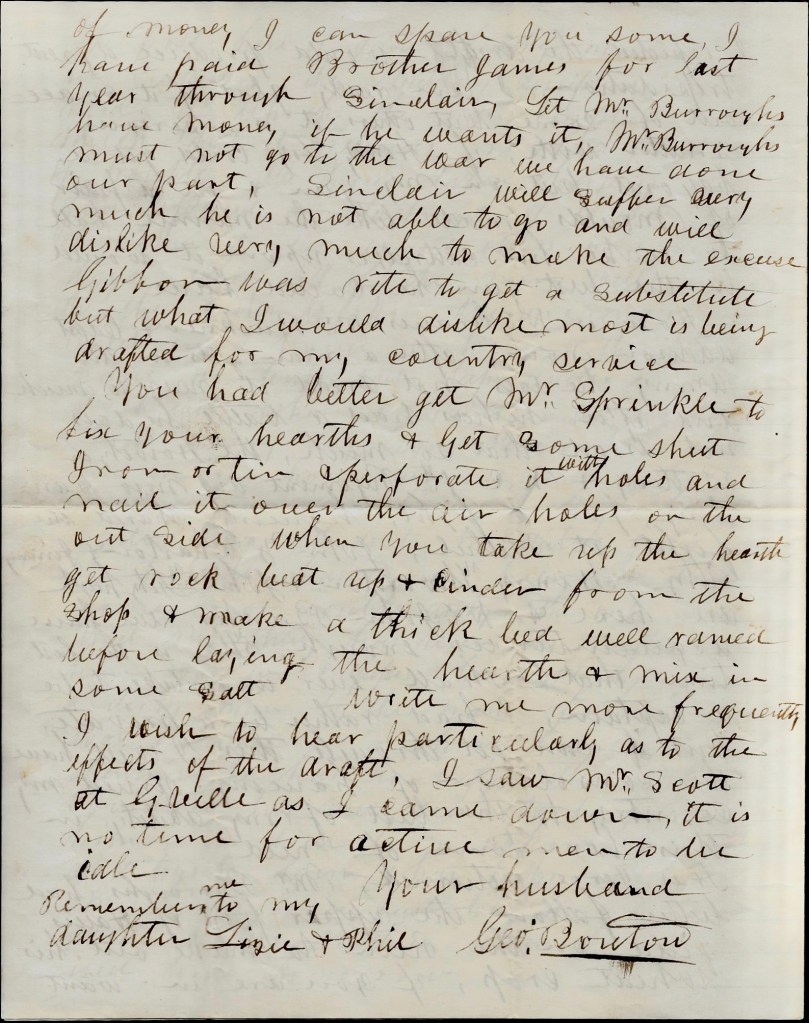
Has Jerre returned? Mr. Burroughs had better fallow the upper part of Davis field on the Run to make out his wheat crop. If you are in want of money, I can spare you some. I have paid Brother James for last year through Sinclair. Let Mr. Burroughs have money if he wants it. Mr. Burroughs must not go to the war. We have done our part. Sinclair will suffer very much. He is not able to go and will dislike very much to make the excuse. Gibbon was right to get a substitute. But what I would dislike most is being drafted for my country service.

You had better get Mr. Sprinkle to fix your hearths & get some sheet iron or tin & perforate it with holes and nail it over the air holes on the outside. When you take up the hearth, get rock beat up & cinder from the shop and make a thick bed, well rammed before laying the hearth & mix in some salt.

Write me more frequently. I wish to hear particularly as to the effects of the draft. I saw Mr. Scott at Gordonsville as I came down. It is no time for active men to be idle. Yours husband, — George Bouton

Remember me to my daughter Lizzie & Phil


Letter 2

Yorktown [Virginia]
20 March 1862

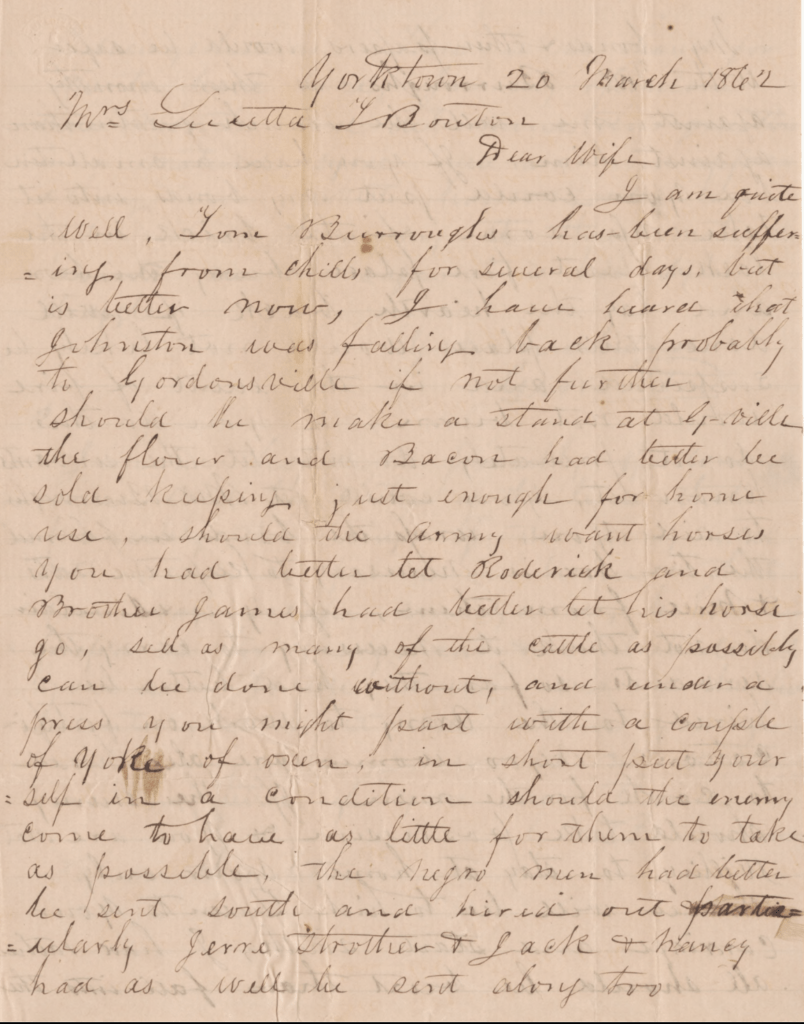
Mrs. Lucetta F. Bouton, dear wife,

I am quite well. Tom Burroughs has been suffering from chills for several days but is better now. I have hearrd that Johnston was falling back, probably to Gordonsville, if not further. She he make a stand at Gordonsville, the flour and bacon had better be sold keeping just enough for home use. Should the enemy want horses, you had better let Roderick and Brother James had better let his horse go. Sell as many of the cattle as possibly can be done without, and under a press you might part with a couple of yoke of oxen. In short, put yourself in a condition should the enemy come to have as little for them to take as possible. The negro men had better be sent south and hired out—particularly Jerre Strother, & Jack & Nancy had as well be sent along too.

My bonds and other papers would be safe with Mr. Burroughs as their e__ity against me will be much greater than against him. If you have a small tin box, you coud put my bonds into it, take up some of the brick in the lock closet fire place, bury the box, and lay the hearth back. If well done, this place would not likely be suspected and in the event of fire, would not burn. If you do this, do it privately. Do not let the servants know it. You could get Mr. Burroughs to aid you. Wrap the bonds in flannel. The tin box is necessary to keep the rats and mice from them. If you & Sinclair do not think it necessary to carry the servants so far, they had better be hired to the Army to work on fortifications. Negro women are also hired to cook for the men. If the enemy should take possession & you are not willing ot stay at home, your only chance will be to hitch Queen to your carriage and start south. I had rather all should be burnt than fall into the enemy’s hands.

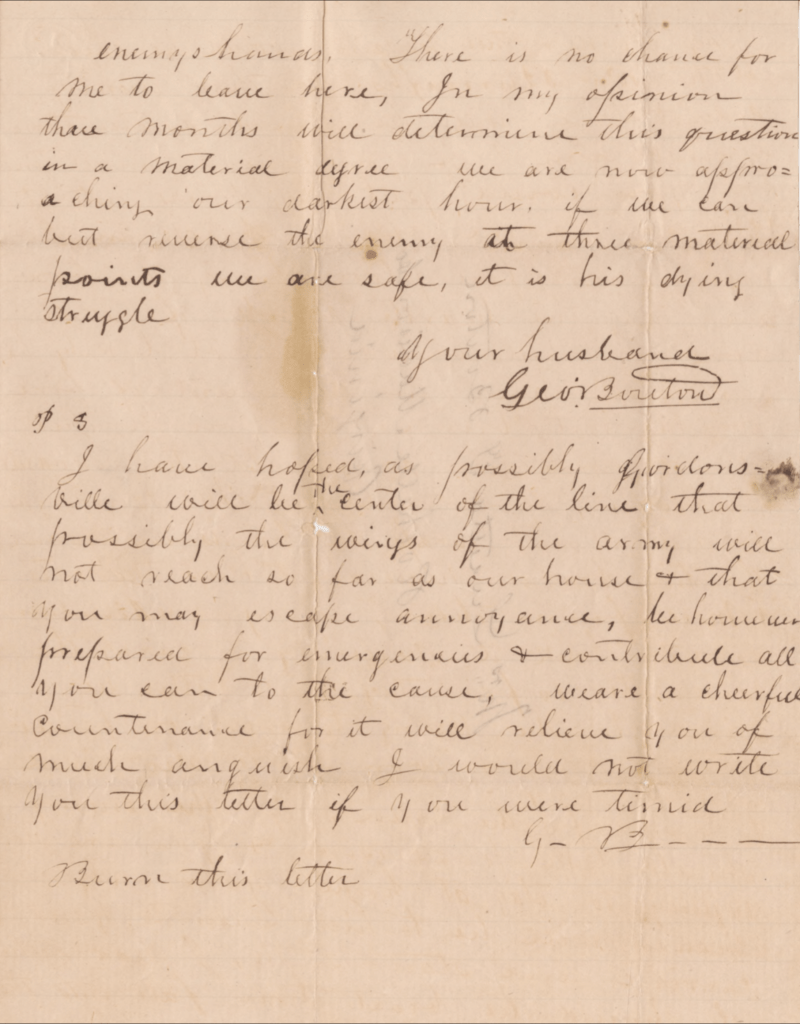
There is no chance for me to leave here. In my opinion, three months will determine this question in a material degree. We are now approaching our darkest hour. If we can but reverse the enemy at three material points, we are safe/ It is his dying struggle.

Your husband, — George Bouton

P. S. I have hoped as possibly Gordonsville will be the center of the line that possibly the wings of the army will not reach so far as our house & that you may escape annoyance. Be however prepared for emergencies & contribute all you can to the cause. Wear a cheerful countenance for it will relieve you of much anguish. I would not write this letter if you were timid. — G. B.

Burn this letter.

1861: Thomas W. Powell to Olive Powell

Though unsigned, the provenance that came with this letter attributes it to Thomas W. Powell while serving in Co. E (the “Huron Infantry”), 7th Ohio Volunteer Infantry (OVI) when it was a three-months organization. This regiment was mustered into service in late April 1861 at Cleveland and mustered out on 24 July 1861 at Camp Dennison, Ohio. The regiment never saw any action and were barely organized and drilled before military authorities began requested that the soldiers reenlist for three years of service. Most men agreed, but those who did not were mustered out of service upon the end of their three-months term.

There is a muster record for a “Powell” (no first name given) in Co. E, 7th OVI (3 months) and I assume this is the same soldier. His name does not appear in the roster of the 7th OVI (3 years) regiment so I can only assume he decided against reenlisting as it appears his sister had advised him.

I have searched the census records in Erie county for Thomas and his sister Olive but have not found him though I note he refers to the United States as his “adopted” country so it may be that he was a recent emigrant. If a recent immigrant, he probably came from Canada as his English vocabulary is pretty good though his spelling is poor.

An early war image of Camp Dennison on an envelope

Transcription

Camp Dennison (Ohio)
May 30, 1861

Sister Olive, 

Once more I find myself engaged in the delightful task of writing you a letter—although I realize it is in much weakness—but then I know you are charitable in some respects, and will make due allowance. I received yours Tuesday [and] not tell you how thankful I was for your condescension in writing to one so unworthy and hope this will be received with half the appreciation that yours was. Would also acknowledge the reception of your note which has been remailed from Berea.

I must apologize at the onset for writing you as long a letter as I intend to, but judging from some parts of your letters, you are considerably tinctured with that which goes by the name of patriotism although in your case I believe it sincere. I thought it would not come amiss to give you my opinion of some matters as they now stand. It is with a heart of sorrow I write what I am going to—sorrow for this my land of adoption as I see her crumbling and falling from her once glorious position and bending under the iron heel of oppression.

I with the thousands left my home to contend for right, as the booming cannon of Sumter echoed not only in Charleston but in the heart of every freeman calling him to arms. But little did I think that while going to fight for freedom, of myself becoming a slave to a set of “petty tyrants.” Not only have we to be nosed round by a set of officers but the government has used us as no feeling man would use his dog. Some men have been sent home because they would not enlist for three years—hundreds of miles from home, no provision made for their return, and without a cent in their pocket and scarcely a rag on their back.

Those at home are no more honorable who promised to provide for the families of those who volunteered. I have seen letters from wives to their husbands stating what suffering they are called upon to pass through. Two from Milan [Erie county, Ohio] I saw yesterday saying they had not received a cent’s worth since their husbands left and beg of them to return home as soon as possible. You would be astonished to see three-quarters of the men, some without breaches, making drawers supply their deficiency. Others barefooted. Uncle Sam supplied some of the most needy with split leather shoes which I should call worse than one.

You advise me not to go for three years. I certainly shall not under present circumstances although if the case is urgent of two evils, I shall choose the least—that is, to be a slave to a military despotism or a southern aristocracy. As regards my constitution failing, that is all nonsense. There is not a person in the company better able to go than I am as far as that is concerned. I will give you a little of our camp life. We have to stand guard 24 hours about once a week. I was on a few days ago. It rained all day and all night. we are two hours on and four off while on duty. We have to walk back and forth. When off, we are housed in a guard house or lie on the ground.

— Thomas W. Powell, Co. E, 7th Regiment, care of Capt. [John W.] Sprague 1


1 On April 25, 1861, at the beginning of the Civil War, John Wilson Sprague joined the 7th Ohio Infantry and was made a captain in the unit’s Company E. In August 1861, while heading home on leave, he and a small group of other Ohio soldiers were captured in West Virginia by Confederate troops. He was held at the infamous Libby Prison in Virginia, and then moved to South Carolina where he was held in Charleston and then Columbia. After five months, Sprague was released as part of a prisoner exchange in January 1862. He returned to duty with the Ohio 63rd Infantry Regiment. On January 23, 1862, he was promoted to colonel. Sprague led the regiment at the Siege of Corinth.