All posts by Griff

My passion is studying American history leading up to & including the Civil War. I particularly enjoy reading, transcribing & researching primary sources such as letters and diaries.

1862-63: Augustus Oswald McDonell Diary & Musings

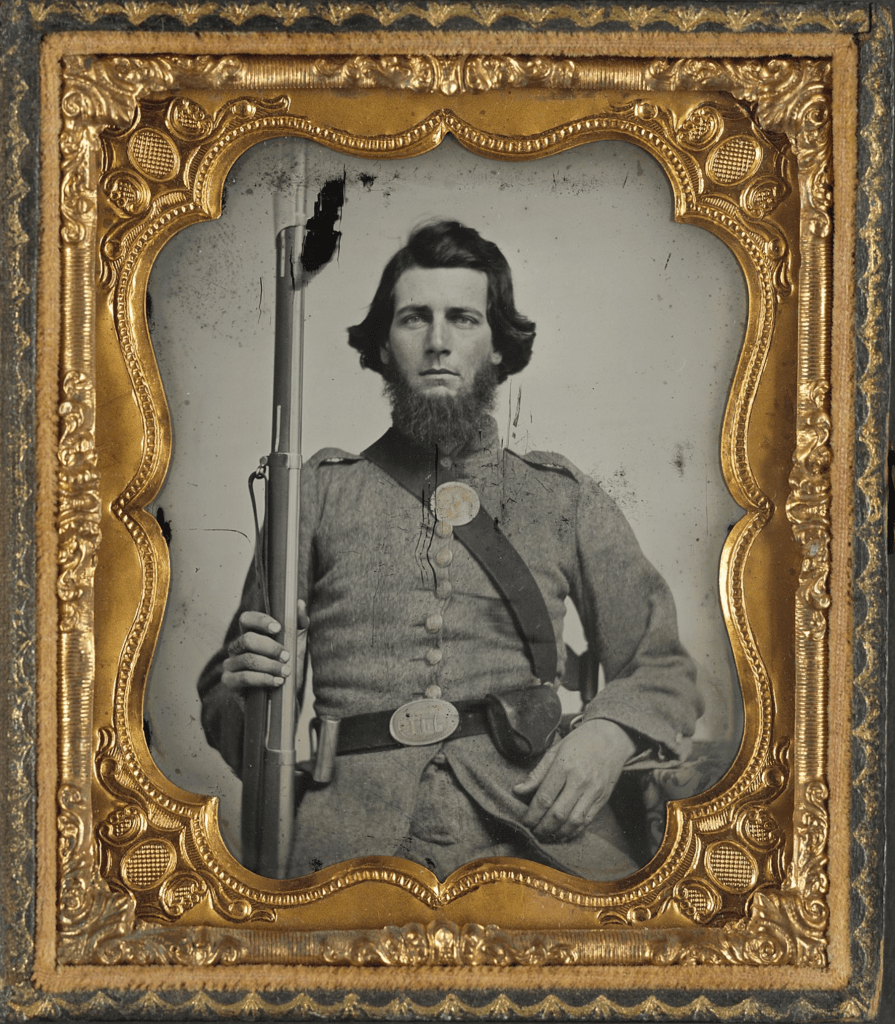
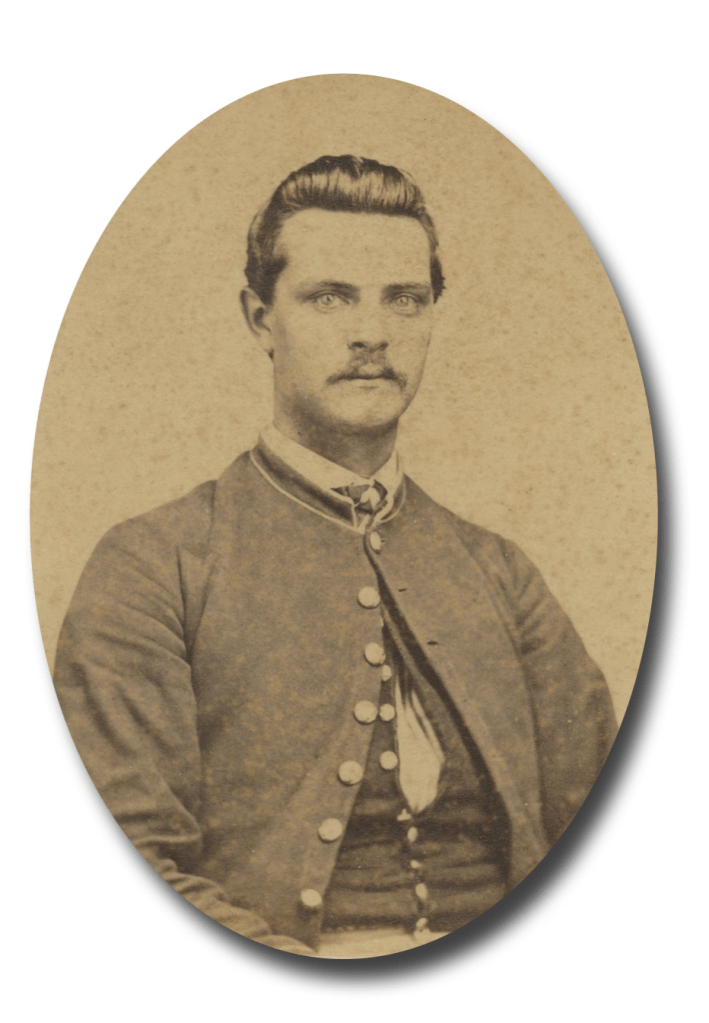
Augustus Oswald McDonell (1839-1912), Image found on Richard Ferry Military Antiques.

These diary entries were made by Augustus Oswald McDonell (1839-1912), the son of Alexander Harrison MacDonell (1809-1871) and Ann Elizabeth Nowland (1808-1880). Augustus was born in Savannah, Georgia, and came to Florida in 1854 where he was educated and working as a merchant in the gulfport city of Alachua when the Civil War started. He joined the Gainesville Minute Men (militia) in 1860 and then enlisted at Gainesville, Florida on 5 April 1861 in Co. H, 1st Florida Infantry. In mid-April 1862 he was commissioned a 2nd Lieutenant in Co. K. He was wounded at the Battle of Perryville in October 1862 and promoted to the Captain of his company sometime early in 1864. He was taken prisoner by the 23rd Army Corps before Atlanta on 7 August 1864 and was not released from Johnson’s Island Prison until taking the oath on 16 June 1865.

In the 1860 US Census, “A. O. McDonell” was enumerated as a “merchant” in Alachua, Florida. His father was enumerated at that time in Marion county, Florida, and owned 25 slaves ranging in ages from 1 to 73. In the 1850 US Census, 8 year-old “Augustus” was enumerated in his father’s residence in Early County, Georgia. Others in the household included his siblings, George (age 19), Roselin (age 17), Hannah (age 8), and James (age 4). 

I discovered McDonell’s diary in the P. K. Yonge Library at the University of Florida [see Augustus O. McDonell Papers, Diary, 1862-1864, to Download] while researching a letter than I was asked to transcribe written by McDonell in May 1861 [see 1861: Augustus Oswald McDonell to Elizabeth (Nowland) MacDonell on Spared & Shared 23]. Images of McDonell’s diary were made public on-line by the Library and I found them to be incredible reading and couldn’t wait to transcribe them for others to enjoy. My thanks to the university for sharing them.

Transcript

Camp near Lookout Mountain
August 10, 1862

We left Tupelo on Saturday the 2nd inst., and arrived at this place last night about dark after a tedious (but somewhat pleasant) journey. Our Battalion and the 30th Mississippi Regiment were sent up the river from Mobile to Montgomery. We were very much crowded and the passage was anything but a pleasant one. We stopped in Montgomery one night and notwithstanding the General Order forbidding the officers and men from leaving their commands, some of them (yes, nearly two-thirds of them) ran the blockade and went up to the city and had a gay time generally. Some of them got slightly inebriated and talked too much, hereby letting the cat out of the bag. We left Montgomery for Atlanta, Georgia, about 2 o’clock the following day. Several of the men were left then but afterwards caught up with us before arriving at Chattanooga. We were greeted with smiles & cheers at every station along the road from the ladies. At some places refreshments were prepared for us by the fair hands of woman. I think the ladies in Georgia, as a general thing, are more enthusiastic & evince more genuine concern for the soldiers than in any state I have passed through.

Lookout Mountain, Tennessee
August 17, 1862

I obtained permission this morning to visit Lookout Mountain, the first time I have left camp since my arrival in Tennessee. We had quite a time getting to the top of the mountain. Lieutenants Anderson, Williams, Rangan and myself composed the party. We had to make our rests frequent in our ascent as the mountain in some places is very steep. At last we arrived and here we are. Lieut. Anderson is seated on my left making a note of the beautiful scenery. We occupy a ledge of rock that overlooks a deep abyss. The prospect is a grand one. As far as the eye can reach are nothing but mountain peaks and in the gorges and valleys beneath are little farms and beautiful plots of grass dotted with little farm houses which gives the whole a picturesque view. While I write, I gaze upon the grand panorama of nature and the cooling zephyrs gently, quietly, fan my cheek and whispers to me of one beloved and others around whom affectionate remembrances always cluster. I would like to spend a day or two up here. One feels lifted nearer to heaven when he contemplates the vast and stupendous works of nature and then beholds the hand of nature’s God.

We took dinner on the mountain at a private house. The landlady dealt extensively in Irish potatoes. This is quite a little village on the top of the mountain. The most of these [ ] abodes are occupied as hospitals for the sick. I don’t think a more desirable place for a sick man could be found anywhere—the water is so pure and the air so invigorating.

The Tennessee River flows at the base of the mountain and is quite a bold stream but from Lookout Rock, it appears like a huge serpent basking in the sun, its meanderings are beautiful—a rich green border fringes its banks, its bright sparking waters and the beautiful oasis formed by the serpentine windings of the stream gives it an air of enchanting loveliness and renders the scene at once picturesque and grand.

On our return to camp we took a different route which was not so steep and more pleasant to walk. We visited the Blowing Cave with its very cold water. It is quite a curiosity. The spring flows out of the side of the mountain into the river and out of the [ ] in the rock issues a perpetual breeze so cold that it will make you shiver in a few moments to stand near the mouth of the cave. We also visited thew Saltpetre Cave and witnessed its operation.


Chattanooga, Tennessee
August 20th 1862

While I was engaged finishing the court martial proceedings of which I was judge advocate (on yesterday), an order came to prepare 2 days rations and e ready for marching by 12 o’clock. I soon tumbled the writing proceedings into my valise & commenced packing up to leave. Everything was soon bustle and confusion, however, we were ready & took up our line of march at 2 o’clock p.m. We had an awful dusty time getting here. As we passed through the city, we were greeted with smiles & cheers & the waving of miniature flags by the fair daughters of Tennessee.

We camped in the city in a beautiful green valley. The dew was rather heavy and wet our bed clothes considerable. I must confess that I never enjoyed a night’ rest more in my life. I slept soundly and sweetly. We were all up at an early hour, attended rolls, and ate breakfast.

We crossed the river about 10 o’clock and marched about six miles to where we are now encamped. We have a delightful spring of water near us and plenty wood but nothing to eat.

Camp near Chattanooga
August 21, 1862

My gentle slumbers were slightly disturbed last night by the falling rain. Fortunately it was very slight and did not do much damage. I pulled on my coat & boots, turned in again, and was soon lost in dream land. I thought I was at home, that peace had been restored to our land, and that the dread clarion of war was heard no more—that victory was ours and our independence been won. I thought I sat in the old arm chair in the long piazza at home and Annie W. was by me. We talked over the trials and troubles, the joys & pleasures that we had passed through since our separation. Oh how happy I felt with my arms resting on her small white neck and my fingers [ ] with her silken curls. We talked of the future, the happy future that was to crown us the happiest of earth’s children. While I thus dreamed, the morning dawned and the rattling drums beating reveille awakened me to the consciousness that it was all a dream.

While I write, an order comes to be ready to move in half an hour. Poor soldier—there is no rest for him. Privation and toil is his life’s lot. The men are all grumbling very much about something to eat. We left Lookout Mountain after an hour and a half’s notice so we had not time to prepare anything. I can’t blame them much for finding fault with the management of affairs. It does seem to me they could be done better. We got a little fresh beef this morning but have no salt or bread to eat with it, and have to roast it on the coals.

Well, I am seated again. Our march was not very far. It was only to give us more pleasant grounds and room for camping. The 3rd Florida arrived today and was united to our Brigade. Col. [William S.] Dilworth commands the Brigade. I saw a good many of my old acquaintances in the 3rd Regiment.


Camp near Glasgow, Kentucky
September 14, 1862 (Sunday)

We left Camp Moccasin on the 29th ult., and have marched almost every day since. In some portions of Tennessee we were welcomely received, but in others nothing but sour looks & short answers has greeted us. And now we have crossed Tennessee and have advanced 50 odd miles into Kentucky without ever firing a gun at Yankees. Who would ever have dreamed such a thing. I certainly expected we would encounter Buell and have one desperate battle before leaving Tennessee but that gentleman seems to have taken to himself wings and left the country in double quick time. But if he is not very smart, he will be slightly tripped up before he gets in his safe retreat.

We left camp this evening, passed through Glasgow, and were enthusiastically cheered by the beautiful women of that place. Flags and snow white handkerchiefs waved as shout after shout went up from the stalwart soldier as he witnessed this demonstration of fidelity to our cause. We reached 18 miles that evening and night and arrived at Cave City about 4 o’clock on Tuesday morning.

Tuesday, September 16, 1862

We left Cave City this morning about 9 o’clock and marched 12 miles to Mumfordville where the Yankees are in force about 5,000 strong. Gen. [James R.] Chalmers attacked them on Sunday in their fortifications and after a desperate fight, was repulsed with the loss of 200 killed and wounded. I think Chalmers was rash in making the attack with so small a force. After our arrival at said place, our guns were soon placed in position so as to command every point of the enemy’s fortifications. Gen. Bragg then sent in and demanded a surrender of the place, which was refused until that night about 2 o’clock [when] they surrendered unconditionally the place with 5,000 prisoners. Col. [John T.] Wilder commanded the Yankee force.

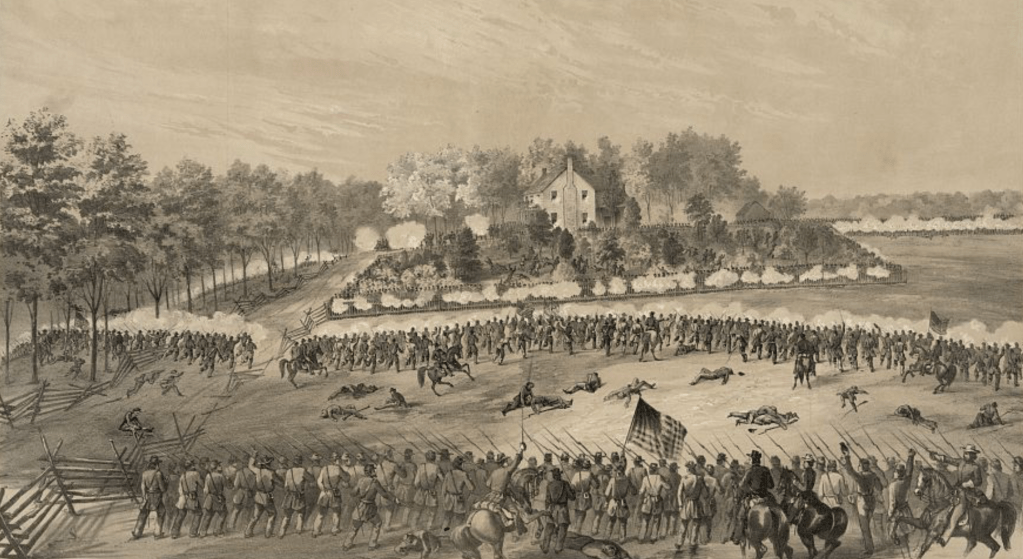
The Battle of Munfordville, Kentucky, September 14, 1862. Harper’s Pictorial History of the Great Rebellion

Camp near Bardstown, Kentucky
September 26, 1862

Col. [William] Miller, [Thaddeus A.] McDonell, [Lucius A.] Church, and Captain D. Bird, C[apers] Bird, and myself went out in the country and spent the day with a good Unionist. We went out to dinner by invitation. They had a very nice dinner prepared for us, & treated us in a very hostile manner. Grigsby was the name. They have a pretty daughter about 14 years—very intelligent and precocious for her years. She plays and sings very well. The old folks have a son in the Federal Army. Miss Ella (the young lady) I think is a little smitten with our young friend Capt. C. Bird.

Wm. Capers Bird, 1st Florida

Ella Grigsby (1849-1871) was the daughter of William Remey Grigsby (1797-1887) and Martha A. Newman (1824-1892) of Bardstown, Nelson county, Kentucky. Ella was married in February 1869 to Richard Eastham, but died two years later. It was Ella’s older brother, Redmond T. Grigsby who served as a sergeant in Co. K, 6th Kentucky Cavalry, fighting for the Union. The handsome captain Ella was smitten with was Wm. Capers Bird, of Co. I, 1st Florida Infantry.

Camp near Bardstown, Kentucky
September 27, 1862

Julius Keifer and myself started out this morning with Lieut. Gonzallius on a foraging expedition. It rained on us nearly all day. All we were able to obtain was a turkey apiece. We got a first rate dinner with a sporting character. Also a good wetting and returned to camp.

Sunday, 28th 1862

We all left camp at an early hour for picket guard. The Brigade was left about 7 miles from town. Capt. Pool’s company and Co, B, myself in command, were sent on outpost at the bridge.

[The following was written after the Battle of Perryville in a different hand.]

October 8, 1862

[The] Battle [of Perryville] occurred at about 3 p.m. 15,000 engaged on our side. The enemy was supposed to have had 30,000. we occupied the battle ground at night. I was wounded in the right arm. The loss of the regiment was as follows:

Wounded 55
Killed 12
Missing 6

[In Augustus’ hand]

N. B. This note was made for me by Sergt. Enisstre at Camp Dick Robinson. My arm was too painful to be used but it is now all right. — A. O. McD

[The following was written after the Battle of Stones River. It appears that after he was wounded in the right arm at the Battle of Perryville, McDonell was permitted to return home to recuperate before joining his comrades in time for the Battle of Stones River.]

Near Manchester, Tennessee
Sunday, January 4, 1863

An order came yesterday evening for all the wagons to skedaddle to the rear after fighting the enemy 5 days, driving him back and capturing a large number of prisoners. Rosecrans was said to be heavily reinforced and as usdyal we had to fall back. It was rainy yesterday when we started back and it continued raining, the wind blowing hard all night. We marched twenty miles through it, soaking wet with a skinned foot. I limped along through wind and water. I don’t know when I suffered from the cold as much. How my mind reverted to the pleasant and comfortable home I had jus left and sighed to be back again enjoying its sweets. This morning I was fortunate enough to find a pie or two at an old woman’s [place] along the road. They were coarse and dry but I was hungry and swallowed them down like a sweet morsel.

I really feel a sympathy for the poor people through this portion of the country. They are almost destitute and then our armies having to fall back, the Yankees will destroy the little they have left.


Camp near Murfreesboro
January 1, 1863

New Years Eve! What visions of departed glory loom up from memory’s corridor at the very words “Years gone by,” when our hearts were young. What gay times would we have in the old hall, and how we would laugh and shout, until every rafter would reverberate with our merriment. When the old year was slowly declining and the new rising upon the ashes of the past, then joy reigned supreme in our hearts. Childhood’s blissful time! why Oh wehy will not the thrill of joy course through our veins as once it did?

Oh! for one single moment of that exquisite ecstatic bliss which thus we thought do enduring. The remembrance of New Year’s eve is ever an oasis in the great desert of life, back to which even now my thoughts delight to wander.

When wearied with our amusements, how many nice things collected by our parents were there to refresh our bodies! and what fun to see the great table fairly grown beneath the weight of what we children called goodies. How free we all felt for no restriction was ever placed upon our mirth during those bright holiday times. Laugh, shout, dance as we pleased, and nobody would say a word, no matter if the very house was turned inside out.

New Year’s Eve! What a sad night. What a time for reflection upon the past year! Tonight the winds shriek a requiem for the departed year, gone from the earth forever, and seemed to whisper into our ears solemn words of warning. Oh! the changes which have swept over our paths since this time one year ago. “It’s shade is on each brow, it’s shadow in every heart.” Hope, joy, and love, which then so colored our existence, are now lying stark and cold upon the altar of our hearts.

Tonight we may gaze upon their pale forms, may resurrect the past, and scatter dead flowers where once life and beauty reigned. We may look upon the faces of those whose hearts, one year ago, beat high and bounding hope, but now are hid forever from our view by the cruel turf of the graveyard. Through the telescope of the past the new year would indeed be a dreary prospect did not hope, with her brilliant colored pecil o’er the canvas of the past and gild with bewildering loveliness the unwritten pages of the future. By her radiant beams, those loved forms now asleep forever in deaths embrace are beheld and thought of as in a former clime, where pain and parting are unknown and upon whose peaceful shore the storms which cloud our sky were burst, and naught save beauty, order and tranquility reign forever. Did no thorns pierce our feet upon the dusty highway of life. We could never fully appreciate the flowers which at every step spring up and gladden us with their enlivening presence. Bulwer has truly said that “Hope is a plant which can never be rooted out of a noble heart, till the last heartstring cravk as it is pulled away.”

I am sad tonight. Memory recalls vividly the bright and happy days recently spent with loved ones at the dear old homestead in my ever sweet “land of flowers.” They, like the old year, are gone forever. God only knows if I shall ever visit again this “sunny land,” where all that is dear on earth to me dwells. Dread war still desolates our land. While I write, the reverberations of distant cannon break upon my ear and denote in deep toned language the fearful carnage of yesterday. There has been but little fighting today. At intervals artillery and musketry have been heard in blended tones, plainly telling that our skirmishers were contesting gallantly the ground they occupied. The battlefield is still strewn with the enemy’s dead—their bland eyes & distorted features show in wht agony they died. Our wounded with the enemy’s have all been cared for and our dead buried. The battlefield is one vast grove of cedars and thousands of these beautiful evergreens are wrent in shivers by the bursting shell and lightning grape shot. Among this beautiful forest wreck are the graves of the noble dead, the newly turned sod silently says, “Here sleep the Masters of Liberty.” They have passed from earth, but their memories are embalmed in the hearts of a grateful people, and when the springtime comes, the daisy and violet will spring up and spread their sweet fragrance o’er their mouldering forms. The blue bird will warble his song of love, and the gentle zephyrs chant a requiem to the heroes of the past.


Camp near Tullahoma, Tennessee
February 10, 1863

We moved our encampment today. When the order came for the change, we were all delighted as we thought as a matter of course we would be moved to more pleasant grounds and where we would find wood and water more plentiful. But just to the reverse of the two, our former camp was the more pleasant one. Our disappointment was not small when we halted in an old field covered with briers, mud and dirt, the boys were very indignant and declared they were subjects for the hospital or would be in about three days. We had sickness enough before the change but I’m confident it will be increased double.

February 22, 1863
Tullahoma

This is the Sabbath and had it not been for the kindness of General Hardee, I should now instead of writing in my diary, be on duty at the fortifications. It rained incessantly yesterday and notwithstanding the extreme unpleasantness of the weather, an order was issued to prepare rations for dinner and breakfast and be in readiness at seven o’clock this morning with my company for duty on the entrenchments. Owing to the rain, it was a matter of impossibility to cook anything ad when the time arrived for the regiment to assemble, we were ready to go but with empty haversacks. “It’s a devil of a hard case a man has to dig clay all day on an empty stomach,” might be heard all along the line. I thought so too and did not blame the men for grumbling but said nothing.

The whole country is flooded with water and we would have had to wade for two or three miles before reaching the fortifications. The regiment was moved forward, Col. Dilworth at the head. In passing Gen’l. [William] Preston’s Headquarters, Hardee happened to be present and turned the detail back. I never saw a more rejoiced set of fellows in my life. They could not resist the temptation to hallow, so peal after peal of joy echoed o’er hill and valley as they were marched back to camp in double quick time. It has been very cold and muddy all day and on that account, I have thought much of home and loved ones.

February 23, 1863
Tullahoma

This morning at seven o’clock we started to the fortifications. Nearly all of the regiment went out. we also got a detail of 100 men from the 20th Tennessee. The morning was bright and beautiful and promised to be a charming day but to our disappointment, about eleven o’clock distant thundering was heard. It soon became louder and nearer, the clouds lowering and dark. In a little while, hailstones began to fall thick and giant but did not last long. The rain followed and plenty of it. As a matter of course, we had to suspend operating. My detail consisted of axe men. I had the axes returned to the [ ] tent and we were dismissed. We arrived at camp about 3 o’clock soaking wet & bespattered with mud. I don’t know when I have had a more unpleasant walk. I soon dried myself and felt alright again. No mail today. The heavy rains having washed several of the railroad bridges away, the cars cannot run until repairs are made.

Eatonton, Georgia
April 7, 1863

I left Tullahoma in company with Capt. Means on the 2nd inst., with orders to report to General Pillow at Huntsville, Alabama, we we did not the night of the same day and received orders to report at once to Lt. Col. McDonell for duty in East Florida. We stopped one day in Atlanta and stayed that night with Judge Neal. We left Atlanta on Sunday morning, arrived in Macon 1:30 o’clock in the afternoon. After dinner, I went round to Mr. Rodgers’ and spent a very pleasant evening. I am more pleased than ever with cousin Julia Rodgers. I think her a magnificent woman. Will be a prize for the fortunate man who gets her. We left Macon at 7:30 o’clock p.m. I parted with the captain at Gordon where I took the train for Eatonton. Arrived 20 minutes to 12 o’clock the same night. I succeeded after a little trouble in finding the parsonage, awoke the inmates of the kitchen and soon brother and sister Mag, up and glad to receive me.

Eatonton, Georgia
April 11, 1863

This morning being appointed by the young folks of the place for a fishing party, they assembled at the Academy about 9 o’clock a.m. and then repaired to the picnic grounds. Miss Genie Walker and myself went about two o’clock & found others amusing themselves in different ways. In the course of an hour we all adjourned to the 3rd story of the mill and some of the young folks formed for a dance & engaged for some time in that fascinating entertainment, We changed, however, in a little while and engaged in the play of “Steal partners” which was highly amusing. I enjoyed myself highly talking to the young ladies. Miss Fanny J. was preset and looked more charming than ever. I think her beautiful. She must really be very fastidious or she would now be the partner of some loving spouse.

1862: Starr L. Booth to friend “Nettie”

I could not find an image of Starr but here is a cdv of Joseph Dobbs Bishop of Danbury who served as chief musician in 23rd Connecticut. Bishop died of disease returning home from his enlistment (Western Conn. State University Archives)

This letter was written by Starr L. Booth (1842-Aft1920), the son of Charles Booth (1802-Aft1860) and Eliza Beardsley (1808-Aft1860 of Newtown, Fairfield county, Connecticut. Starr datelined his letter from Camp Parapet near New Orleans on 29 December 1862 while serving in the Co. C, 23rd Connecticut Infantry. Despite contending that he would not serve “Uncle Sam” beyond his 9 month enlistment in the 23rd, records indicate that he subsequently served in Co. M, 2nd Connecticut Heavy Artillery from 5 September 1864 to 12 June 1865. They also indicate that he was wounded on 6 February 1865 in the fighting at Hatcher’s Run, Virginia.

In the 1875 Rhode Island State Census, Starr was enumerated as a boarder with his wife Annie (1840-1945) and 7 year-old daughter Alice in Bristol where he labored as a “Rubber worker.” Later in life he worked as a florist and gardner.

To read other letters I have transcribed by members of the 23rd Connecticut Infantry and posted on Spared & Shared, see:
Abel M. Wheeler, Co. B, 23rd Connecticut (1 Letter)
James Fillow Jelliff, Co. E, 23rd Connecticut (2 Letters)
Edwin Benedict, Co. G, 23rd Connecticut (1 Letter)
George Leander Hotchkiss, Co. H, 23rd Connecticut (1 Letter)
Frederic C. Barnum, Co. K, 23rd Connecticut (1 Letter)

Transcription

Camp Parapet
23rd [Connecticut] Regiment, Co. C, USA
New Orleans, 29 December 1862

Miss Nettie,

As I have a few leisure moments I thought the best way for me to improve them would be to write you a few lines although I have not received any answer from those that I wrote you while on Camp Buckingham. I did not write but a few lines on account of having marching orders while writing them.

The 23rd is now encamped about three miles above the City of New Orleans. We left Camp Buckingham the 4th. It being pleasant, we set sail for Ship Island and sailed along nice until the 7th when we met with a severe gale which came very near capsizing our boat. After sailing nine days, we arrived at Ship Island. We stayed there three days and then started for this place.

I must say this is the pleasantest place that I ever was in. It is as warm here now as it is North in July. We have all kinds of fruit here such as orange, lemons, oranges, pineapples, and various other kinds. Oranges are as plenty here as apples are north. The boys go out and pick all they wish for. They make themselves at home whenever they go out. It looks hard to see the property that is destroyed here. There is hundreds of houses that no one lives in and some of them are the most splendid houses that I ever saw. Those that lived in them are now in the Southern army. They must have thought they were in the right to have left them in the way they did.

I am in hopes they will make some treaty for peace. As for me, I am getting tired of soldiering in it and for this reason: we do not have enough to eat and drink and that we do have is not fit to eat. I am waiting with patience to have my nine months come to a close and then I think I close my work for Uncle Sam.

I am very anxious to hear from the New Haven folks as I have not heard from any of them since I left there. Give my love to Aggy and Fanny and all the rest. As I have no more time and the mail is going out, I shall close by remaining your friends, — Starr L. Booth

1861: Jacob Shanklin to Elizabeth A. Salmons

I could not find an image of Jacob but here is one of Clarkson Beebe Strickland of Co. B, 41st OVI (Sara Thompson Collection)

This letter was written by Jacob Shanklin (1841-1863) who died in November 1863 of the wounds he received in the Battle of Missionary Ridge while serving in Co. C, 41st Ohio Volunteer Infantry (OVI). Jacob enlisted as a private on 19 September 1862 and was mustered out of the company two years later on 27 November 1863—two days after the battle, at Chattanooga, Tennessee.

Jacob was the son of Irish emigrant John Shanklin (1804-1899) and Mary Jane Wiseman (b. 1814) of East Union, Wayne county, Ohio.

I can’t be certain of her identity, but I believe that Jacob may have written this letter to Elizabeth Salmon (b. 1842) who was enumerated in the household of Peter Gerald in Wooster, Wayne county, Ohio in the 1860 US Census.

Colonel Hazen, a Regular Army officer, organized the 41st Ohio Regiment at Cleveland in the fall of 1861, and saw its first service at Pittsburgh Landing (Shiloh), losing severely. After the siege of Corinth it rested at Athens, Alabama. Moving with Buell’s army, to Louisville and returning to Murfreesboro, the Regiment lost about 73 of its force. At Chickamauga it again lost heavily, and was complimented by Thomas at Mission Ridge. The Regiment returned from Veteran furlough to perform well its part in the Atlanta campaign, losing more or less heavily in the various encounters. Returning from there it did good service with Thomas at Nashville, and finally rested at Huntsville, Alabama, after the pursuit of Hood. In June, 1865, the Regiment was ordered to Texas, and mustered out at San Antonio in November.

For a good article on the 41st OVI, see “Summoning Hell’s Half Acre: The 41st Ohio in the Round Forest” on Dan Masters’ Civil War Chronicles. See also—1862-63: John Henry Wakefield to Hellen (Wakefield) Munyan.

[Transcribed by Jeannette Ann Vannan; edited & researched by Griff]

Transcription

Kentucky
December 6, 1861

Miss E. A. Salmons, dear friend,

I take my pen in hand to inform you that I am well at present and hoping these few lines may find you enjoying the same health. Tis been a long time since I have had the time to write, but finding a few leisure moments, I thought I would write to you we are in camp expecting every moment to get marching orders to go to Cumberland gap where there is 60,000 men well fortified. There will be some hard fighting to do but God speed the right in all cases.

Since we left Camp Wood, we have been in Gallipolis, Louisville, Camp Dennison, Camp Jenkins. I can’t tell where we will be next but I hope to be at home next year. You may see me very soon. You ought to [see] us boys in our muslin houses when it snows. We get up in the morning covered with snow, get up Co. C., fall out for roll call, then the boys growl about getting out from their warm blankets. But what gets them the worst is getting marching orders about 12 o’clock at night. Then the boys fall out, sling knapsacks and haversacks with 3 days provisions and have the beef burnt, march all night too. Tis a pleasant thing to fight for one’s country. I hope it is and more to get along. That’s what killed the horse.

I wish that I was in your company to talk of the times we had buggy riding.

It almost seems those those lips of thine
Might kiss away the pain
To dream of joys that one in
had but now can have again.

The black crow was a [ ] song 
Its plumage it was white
If I prove false to you, Lizzie,
Bright day will turn to night

I remain yours, — Jacob Shanklin

Write soon as you get this. Direct to Kentucky, 41st Regiment O. V. USA, Co. C., Care of Captain A. Wiley

1863: Susan (Walker) Burnham to Granville Fernald

This letter was written by Susan (Walker) Burnham, the 47 year-old wife of John Burnham of Busti, Chautaugua county, New York. The content of Susan’s letter gives us a back door account of the Battle of Fredericksburg experienced by her 25 year-old son, Charles N. Burnham (1837-1924) who served as a corporal in the 39th Pennsylvania Volunteers (10th Pennsylvania Reserves) during the Civil War. Charles was working as a printer in Warren, Pennsylvania, when he enlisted in May 1861 and was with his regiment until taken prisoner at the Battle of Fredericksburg and held captive in Libby Prison until mid January 1863. He was discharged from the regiment in July 1864 after three years service. Susan’s letter contains quotations from a large segment of a letter Charles had written to her of the fight at Fredericksburg and of his captivity.

The following account of the part played by the 10th Pennsylvania Reserves (39th Penna.) at Fredericksburg comes from Pa-Roots:

On the night of the 10th of December, the Tenth left camp with the Third Brigade, under command of Brigadier General Jackson, and proceeded to the bank of the river, three miles below Fredericksburg, where two pontoon bridges were speedily laid and a crossing was effected without loss. On the morning of the 13th, the regiment moved with the division to the point whence the attack was to be made, where it was formed, and was soon under a heavy fire of artillery; Soon the word was given to advance, and in the face of a destructive fire of musketry and artillery it swept forward and carried the enemy’s intrenchments; but failing of support the division was forced back and compelled to retire with great loss. The Tenth, in this engagement, was led by Lieutenant Colonel Knox, who won great credit for his skill and bravery. The loss was severe, being eleven killed, seventy-five wounded and fifty-one captured.
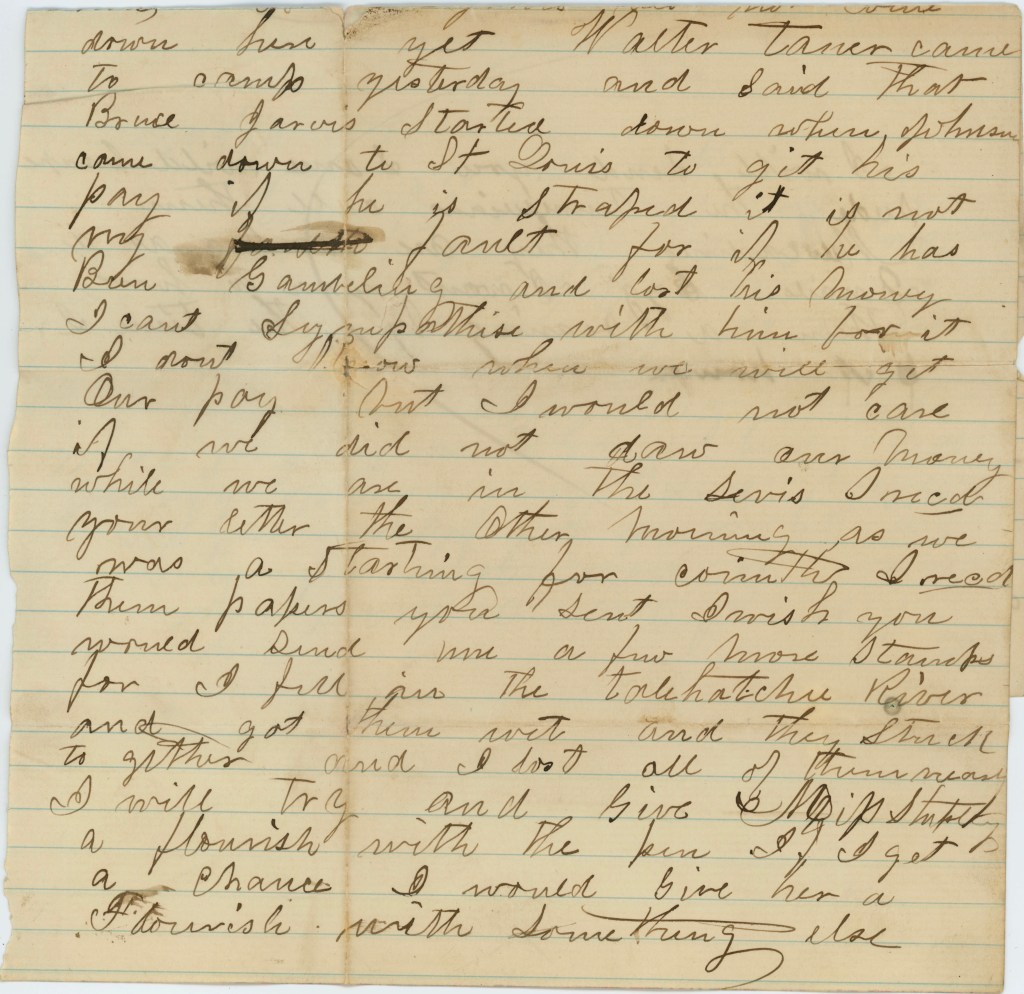
In her letter, Susan also mentions another son, 19 year-old Andrew Burnham, who served as a sergeant in Co. D, 112th New York Infantry and who was, at the time, posted at Fort Halleck in Suffolk, Virginia.

To read letters I’ve transcribed by other soldiers who served in the 39th Pennsylvania, see:
James Wilson Hanna, Co. G, 39th Pennsylvania (2 Letters)
James Wilson Hanna, Co. G, 39th Pennsylvania (1 Letter)
Ira Ayer, Co. I, 39th Pennsylvania (1 Letter)
William J. Mitchell, Co. I, 39th Pennsylvania (1 Letter)
Jairus Waid, Co. I, 39th Pennsylvania (3 Letters)
George W. Morris, Co. K, 39th Pennsylvania (6 Letters)

Transcription

Addressed to Capt. Granville Fernald, Co. B, 23rd Maine Regt., Washington D. C.

Busti [New York]
January 21, 1863

Brother Granville,

I will devote a few moments this morning in writing to you for I have not heard a word from you since you wrote me when you first arrived at the seat of war and I would like very much to know where you are and how you like to be a soldier. Perhaps you would like to know something about us. We are all well as usual excepting [our daughter] Sarah. She has a slight touch of diphtheria. We are doctoring her pretty thoroughly and I am in hopes it will not prove to be serious.

I must tell you something about my boys in the army. Soon after the Battle of Fredericksburg, the sad news came to us that Charles was among the missing. We received a letter from Mr. H[iram] T[hompson] Houghton, a member of his company, giving us the particulars of the fight of Saturday, December 13th, stating that he thought Charles was a prisoner and that he also had a son [William Henry Houghton] among the missing. (They were in the Left Grand Division under General Franklin.)

You may judge of our feelings during a month of dreadful suspense and anxiety when a few days ago we received a letter from Charles stating that their division crossed the Rappahannock a little below Fredericksburg Friday, December 12th and Saturday 13th about 9 o’clock in the morning the fighting commenced and soon after, their Brigade was ordered to charge on the Rebs who were concealed in a piece of woods nearly half a mile from them. He says “away we went across an open field, the Rebs pouring grape and canister into us all the time and the men falling all around us, till some of us succeeded in reaching the railroad which was about 10 rods [@ 55 yards] from the woods when we were ordered to halt & commence firing. we went to work and succeeded in keeping the Rebs back about an hour when first we knew about 300 of us were surrounded and captured, which would not have happened if our Generals had sent in support as they ought to.”

They were then taken to the rear of the Rebel army and kept over night and the next day marched toward Richmond. They marched to Hanover Junction and then put aboard of the cars and arrived at the Libby Prison about dark, Wednesday December 17th. He says they were treated pretty well by those that captured them and by the Rebel soldiers generally, but those that never fired a gun nor smelt powder use them rather rough. The women especially seemed very bitter toward them and would frequently come out and sing out to them, “On to Richmond! On to Richmond, you black Du[t]ch you!” 1

They were put into a room (250 of them) 120 feet long by 50 wide where a streak of daylight was almost a stranger and kept half starved. All they had to eat was half a pint of rice and bean soup and a small piece of bread twice a day. He said he thought he had seen some hard times before but he had never seen anything like that. They remained there until the 9th of January when they were released on parole and sent to Annapolis, Maryland.

Charles was taken sick the same day they left the prison and is in the U. S. General Hospital at Annapolis. He wrote a line to us the day he arrived there stating that he had a fever but was not seriously sick and was gaining. I am in hopes he can come home. If he don’t, I think his father will go and see him.

Andrew is at Suffolk, Virginia. He is on detached service in Fort Halleck, is sergeant and has to drill a squad of 5 men four hours a day. He writes that he is well and like his place in the fort better than he did in the regiment. I think he makes a good soldier. Please excuse this poor letter and write soon and let me know how you are getting along. Yours truly, — S. W. Burnham

(I wrote to Mother today)


1 The “Dutch” was a reference to Germans which, by the time of the Civil War was used derisively and had almost became synonymous with the word “stupid.” I have not researched it but there may have been a number of Germans captured at Fredericksburg from other regiments.

1864: Milo L. Partridge to Richard Partridge

This incredibly detailed letter was written by Milo L. Partridge (1846-1865) who enlisted at age 18 as a private in Co. C, 177th Ohio Volunteer Infantry (OVI) on 17 August 1864. He did not survive the war. He died of disease at Smithville, North Carolina on 22 February 1865 after six months service.

A canteen carried by a member of the 177th OVI during the war. Milo and his comrades filled their canteens with whiskey they stole from a residence in Tennessee and then shared it with their officers. “We felt as though we could take Hood’s whole army by the time we got to camp,” he wrote his parents.

This regiment was organized at Camp Cleveland from Sept. 23 to Oct. 4, 1864, to serve for one year. Immediately after its organization it proceeded to Nashville, Tenn., via Indianapolis and Louisville. The day after its arrival it was ordered to Tullahoma and constituted a part of the garrison at that place under Gen. Milroy. It remained at Tullahoma until Hood’s invasion, when it was ordered to Murfreesboro, where it arrived on Dec. 2. On Dec. 7, Milroy’s command, including the regiment, charged the works and drove the Confederates back, capturing 2 pieces of artillery and over 200 prisoners. A few days after this, while on a foraging expedition, the regiment had an engagement with the enemy, in which it lost several wounded. After Hood had been driven from Tennessee the regiment was ordered to Clifton. About the middle of Jan., 1865, it embarked at Clifton, proceeded down the Tennessee and up the Ohio to Cincinnati, where it took the railroad for Washington, D. C. From there it moved to Annapolis, Md., and embarked on a vessel for North Carolina, arriving at Fort Fisher on Feb. 7. It was engaged in two attacks on the enemy’s works from the Cape Fear river to the coast, and crossed the river and participated in the flank movement which compelled the Confederates to evacuate Fort Anderson. It next engaged the enemy at Town creek, charging in the rear and capturing the entire command. The next morning it arrived opposite Wilmington, where it remained about a week, then joined Gen. Cox at Kinston and proceeded to Goldsboro, where it joined Sherman’s army. 

Milo was the son of Richard Partridge (b. 1817) and his wife, Maria (b. 1822) of Colebrook, Ashtabula county, Ohio. His siblings included Amelia, Esther and Harlo.

Transcription

Addressed to Mr. Richard Partridge, Colebrook, Ashtabula county, Ohio

Camp in Fort Rosecrans
Mufreesboro, Tennessee
December 14, 1864

Kind Parents,

Today finds me seated to answer your most welcome letter that I received the 4th. I was glad to hear from you and to hear that you were all well. Your letter found me in good spirits and enjoying good health.

Well it seems you have got the family pretty well shod up. I am still wearing the government [shoes] that I drawed in Warren. They are getting rather thin on the bottom. It don’t agree with shoes to march over these Cumberland Mountains very well. You wanted to know how I got along for money. I haven’t spent but $7 out of that $10 bill yet so I hant in want of any just now, but if you are a mind to, you may send me a few stamps for they are hard to be got here. I am not quite out yet but I thought I would send in time.

You wrote Addie had been there. I should like to have been there and spent an afternoon with her if I could have talked polite enough to converse with her. I presume her mother will ride out quite often now she has found her harness. I think you have got a new style of burying apples. I should like to do your foddering this winter first rate. It would be quite a sight to me to see a barrel of apples—much more than it would be to see a brigade on the march. Well, mother, I can tell you how we get along with our washing. When we can, we take a camp kettle and heat water and wash right in the kettle and when we can’t do it, we have to wear dirty shirts. We soldiers are all seven day Baptist. We have to take our Sunday as we can catch it. Those folks where I got dinner that day did not ask me to call again. I guess they were not fond of company.

“I had better send my pants up and have them patched. They are getting rather thin on the seat and when they come through, there is the bare ass right there—no drawers between. What do you think of that?”

—Milo L. Partridge, Co. C, 177th OVI, 14 December 1864

It seems by your letter that you and Amelia keep the sewing machine running pretty lively. I don’t know but I had better send my pants up and have them patched. They are getting rather thin on the seat and when they come through, there is the bare ass right there—no drawers between. What do you think of that?

I have not heard from Edgar since we left Nashville. You wrote how much good it done you to get a letter while at home. Think how much good it does the soldier who is far from home and neighbors to get a letter from home. I wish you could see the boys when the orderly hollers fall in for your letters. It makes no odds what they are doing. If they are eating, the will leave it. To get a letter, there is nothing soldiers watch as close as they do the mail. I will write as often as I can and I hope you will do the same which you have already done. You are no doubt looking for a letter before this and I should have wrote before if the communications had been open.

The 24th of November, I was on picket in Tullahoma and when the officer of the day came around, he told us to keep a close lookout and if we were attacked, to deploy and skirmish till they drove us in for they expected to be attacked that night. But we was not troubled. The next day they went to digging rifle pits. The 27th (Sunday), Co. C had orders to start at 5 o’clock for this place to guard a train loaded with stores. All we took was our overcoats that day. We marched about 14 miles on the railroad track to a town called Wartrace and camped for the night. About 10 o’clock they waked us up and sent out more pickets for they could hear firing not a great ways off.

Pretty soon the citizens commenced coming in from Shelbyville off towards where the fighting was. They said Hood was with three miles of there when they left. Pretty soon we had a dispatch from General Milroy to push on as fast as possible so we sent for a guide that lived about 5 miles from there but he did not get there till just about daylight when we started on and marched about 9 miles and then rode the rest of the way. Some of their cavalry was within two miles of us. Once they come in on a crossroad to cut us off but were not quite soon enough. We got there that night a little after dark and went in on our fresh pork that we picked up on the way.

We camped down and stayed a day or two when we heard that out regiment was coming so we did not start back. That Saturday night the regiment and the rest of the troops from Tullahoma came in. We were detached from the regiment to stay with the train, they liked us so well. Sunday we went over to the regiment to see if our baggage had come. I lost one blanket and a canteen. The rest came through all right and was glad to get that much. We were away from the regiment but a short time. We are with them now.

While we were waiting for the regiment to come, they were busy moving things from town into the forts so we are all here inside the fortifications, citizens and all. It seems that Hood was making for Nashville for there has been heavy cannonading by spells ever since that way. Some of his cavalry have been playing around here for a day or two but as soon as they come out of the woods in sight of our big guns, they gave them a few shells and made them scatter right smart.

There was heavy skirmishing for two or three days. We could stand on the fortifications and see both parties perfectly plain. We had a line of battle out once or twice but could not draw them out of the woods. One afternoon, General Milroy went out and captured 169 wagons and pitched in and whipped them and took some 150 or 200 prisoners. Our regiment was out but did not fire any. They were supporting a battery. Our company was not with them then. They were with the train. Their cavalry are lurking around here yet so to keep up foraging. Everyday we send out from 40 to 100 wagons but we have to have a strong guard and have a few pieces of artillery along. The boys were out the other day and got into quite a skirmish with them but I was down looking at an engine that had been fired into the night before while after wood and so was not along. Dave was with them.

We had one in our company wounded very bad and one or two hurt a little by spent balls yesterday. We were out again. Our Colonel was Acting Brigadier and so he had command of the train. He told us to get what we could so we went in. We stopped at one house and got any amount of nice lard, molasses, salt beef, ad pork and hogs, tobacco and clothing, and Frank and I found a keg of whiskey. We emptied it into canteens and filled the keg with molasses and brought to camp. The house was covered with molasses, upstairs and down when we left. I was looking at some boots to find me a pair and found a nice chunk of sausage done up and put in one of the boots. We got pails and cups and everything we could use in camp and fetched in. I think they will have a worse time cleaning the house than Amy and I did their milkroom.

What our company fetched in we divided it among all the company except my sausage. I and Frank and Dave had that for dinner. The company had in all over half a barrel of molasses and it makes our mush go bully too which is our diet now. We don’t have but little [hard] tack for our communications are cut off and we can’ get anymore just now. But we can fight as long as we get plenty of mush and molasses and hogs—that’s whats the matter. The officers—Colonel and all—helped empty our canteens and we felt as though we could take Hood’s whole army by the time we got to camp and if they ain’t double our number, we can lick them every time too—that is what ales Co. C.

“We have had about a week or ten days about as cold weather as I ever saw in Ohio. There was one man froze to death on picket since we have been here. we had to spoon up pretty close to sleep warm in our dog tents too I notice.”

—Milo L. Partridge, Co. C, 177th OVI, 14 December 1864

The weather is wet and muddy now. We have had about a week or ten days about as cold weather as I ever saw in Ohio. There was one man froze to death on picket since we have been here. we had to spoon up pretty close to sleep warm in our dog tents too I notice. We were out foraging one Sunday when it was so cold that it was all we could do to keep warm marching with our overcoats on. There is very sudden changes in the weather down here. We have had two pretty cold snaps this winter but it is warm enough now and muddy enough too.

Friday, December 23, 1864

Well, as the Rebs are drove away from here now and the cars are expected to be running to Nashville in a few days, I will try and finish my letter. Today finds me still enjoying good health. It is rather cold and wet but we get along very well for all that. There hant been any fighting nearer than Nashville since I commenced this letter. I presume ere this you have heard of General Thomas’ victory there. Yesterday we got our mail. It came from Nashville in wagons as the railroad is not quite repaired yet. There was seven wagonloads of mail came for the troops that are here. There was about 10 bushels for our regiment. I got seven letters—one was from you dated the 11th. I see that you are looking anxiously for a letter, This will probably not go out before tomorrow or next day but I will get it ready and send it as soon as possible. I got one from G. Weed and wife, and one from Amelia and Harlo and shall answer them as soon as I can.

We are expecting to leave here today. Where to, we don’t know, but we expect along the railroad somewhere and as soon as we get settled, I will answer them. We have seen some rather snug times during the siege. Mush has been our diet. It was good enough if we could get enough of it but we had to forage for about 13 or 14,000 men besides a great many refugees and what mules and horses it takes for that amount of men and it made rations rather small. But we are going to draw full rations again now and then we are all right.

Howard got to the regiment night before last. He looks quite tough and hearty. Earl has been sick for a day or two. The rest of the boys from Co. C are all right.

Well, as I have given you a kind of a detail of our proceeds since we left Tullahoma, I will close by asking you to write soon if not sooner. Give my respects to all and accept a share yourself from — M. L. Partridge

Direct as usual. That is all this time.

1862: Cornelius J. Madden to Mary (Hadley) Madden

I could not find an image of Cornelius but here is one of George Washington Deatrick of Co. H, 102nd Ohio Infantry (Photo Sleuth)

This letter was written by Cornelius J. Madden of Shelby, Richland county, Ohio, who enlisted in Co. C, 102nd Ohio Volunteer Infantry (OVI) on 12 August 1862 and mustered out of the regiment on 16 June 1865. He was promoted to corporal on 18 October 1862.

Cornelius’ father, James Madden (1813-1888), a wagon maker by trade, also served in the Civil War though he was 48 years old when he enlisted in Co. H, 64th OVI. He entered in October 1861, was promoted to corporal in December, and served until 10 December 1864. He was married to Mary Hadley (1824-1888), a milliner, who was not only the mother of Cornelius, but of three girls named Florence (b. 1846), Almira (b. 1848), and Mary Estelle (b. 1852).

Cornelius wrote his letter from Louisville in late September where newly formed regiments were being rushed to the Kentucky border in order to thwart Bragg’s threatened invasion of Ohio. “Nearly all of the regiments” including the 102nd “were ill-equipped and armed with obsolete Belgian or Austrian muskets” known to misfire more times than not when the trigger was pulled. “They were also only partially uniformed and without tents, canteens, and other necessary supplies.” [Panic on the Ohio, by Roger C. Adams]

See also—1862: Cornelius J. Madden to Mary (Hadley) Madden, Spared & Shared 19, posted 16 September 2019.

[Transcribed by Jeannette Ann Vannan; edited and researched by Griff]

Transcription

In Camp near Louisville [Kentucky]
September 29, 1862

Dear Mother and Sisters, 

You owe me a letter now and I wrote to John yesterday, but I have so much to tell you about our boys in the 64th & 15[th] that I thought I must write. I have saw nearly all of them except Frum but he is here. Charley Kerr [Co. I, 15th OVI] and Davy Way was over yesterday. They are well but their hard march makes them look a little played out. Charley gave me a ring he made down in Ala[bama].

Cornelius’ mother, Mary (Hadley) Madden, ran a millinery while her husband was in the service.

I saw George [Franklin] Marvin [Co. H, 64th OVI] today. He looks first rate. He said when they came through Nashville, father had a pass from the commander there and was out of the city then and had been for two nights and a day. They did not know where he was. He might have done it to avoid the Regiment. I don’t blame him if he did for this long march of 370 miles in 31 days would have been too much for him. If he would try, I know he could get discharged for they can’t hold one over age if they don’t want to stay and I want him out of this damn army although I am perfectly contented and satisfied. I like home as well as anyone but I had rather be here. And although the danger is pretty great, I am coming back all right, you may rest easy on that.

The other day we marched up to our Brig. General Quarters and corded up our guns and now we are going to have new ones. The ones we drew wasn’t worth anything. We have been transferred to Gen. [Thomas L.] Crittenden’s Division, 23rd Brigade, 5th Division. They are mixing the old and new troops all up together.

Brig. Gen. Jeff Davis shot Gen. [Bull] Nelson today and the darned old tyrant. I am glad of it. The provost guard shoots two or three soldiers a day up in the city. They killed two of the 26th [OVI] yesterday and the 26th boys tied the guards and mauled them like blazes.

I saw Proff. McMillen today. You would not believe how he has changed. He is a good deal of a gentleman. He has leave to go home and I guess will start in a few days. He don’t want his folks to know it.

Write to Louisville to the 102nd, Co. A & C. Your loving son, — Cornelius

Mother, I want you to send me 10 dollars. I had to get me a rubber coat, a pair of boots, & a vest and I don’t know when I will get a chance to get it again so send it sure. I sent my overcoat home today. Say something about the things I send home. — Cal


1861: John H. Denton to Martha Cole

With undated letters, envelopes or stationery with patriotic emblems such as this one generally indicate an early-war letter (but not always!).

This letter was written by John H. Denton (1840-1893) of Aurora, Dearborn county, Indiana, who served as a private in Co. E, 7th Indiana Infantry from 20 April 1861 to 2 August 1861. Later he served as the Captain of Co. K, 10th Kentucky Infantry, which was organized in November 1861.

The 7th Indiana Infantry was organized at Indianapolis in mid-April 1861 with Ebenezer Dumont as its colonel. They made their first camp near Grafton, Virginia (now West Virginia) which is where this letter was written in June 1861. As part of Brigadier General Thomas A. Morris’ Indiana Brigade (of Major General George B. McClellan’s Army of West Virginia), the 7th Indiana participated in the Rich Mountain Campaign from July 6 to 17. The regiment saw action at Laurel Hill (July 7), Belington (July 8), the Battle of Corrick’s Ford (July 12–14), and in the pursuit of Brig. Gen. Robert S. Garnett’s forces (July 15–17). The regiment was mustered out of service on August 2, 1861.

John wrote the letter to Martha (“Mattie” or “Mat”) Cole (1844-1933) with whom he married in February 1865.

The Battle of Rich Mountain which the 7th Indiana Infantry participated.

Transcription

Camp Dumont near Grafton, Virginia
June 24, [1861]

Dearest Mat,

I thought I would snatch this opportunity of writing you a few lines for there is not much time at the present. We arrived here last night all well. We have not seen any secessionists yet for they are such cowards they run and won’t let us see them. We have to start out this evening on a scouting expedition & I think we will see some maybe before long.

I saw John R. the evening that I started so I suppose you have heard where we were going before this. We are encamped on Valley River. It is a pleasant stream. we passed several bridges yesterday that the secessionists had burnt. They were repaired so that we could cross them. The Ohio troops had repaired them & were guarding them. They had caught several of them & some they are going to hang.

Mat, I feel today that I would like to see you but all hopes for that are lost for today. But I have stronger hopes of seeing you in the course of six or seven weeks. When you write, you can direct to Indianapolis the same as before for if you direct here, we will never get them. They will be forwarded to us from there.

Well dear Mat, I must close for the present for we have to get ready to start in a few minutes. Your cousin E. is all right. I will write you a long letter before long and tell you about all our journey. Goodbye Mat, goodbye.

Write soon. From your true friend, — J. H. Denton

1864: H. F. Chad to her Nephew

How Mrs. Chad might have looked.

This letter was written by a woman who signed her name H. F. Chad, though I can’t be certain of the middle initial as the script is unusual. She datelined her letter from Orwell, Ashtabula county, Ohio, but I cannot find any public record online under that surname even if I search under the name Chadd instead which was the more common English spelling. I can only assume they moved into the area after 1860 and left before 1870. The woman and her husband seem to be farmers based on the content of the letter and she indicates that they were having a new barn erected on the property that was being framed by Marshall Howard, a local carpenter.

She wrote the letter to an unnamed nephew who was clearly serving in the army—probably engaged in Grant’s Overland Campaign. She mentions that she was sending him some tea in the envelope and I can only assume that the lithographed paper with scenes of Washington D. C. on one side and of flowers on the reverse contained a small pouch of tea at one time.

Transcription

Orwell, Ashtabula county, Ohio
June 19, 1864

My kind and affectionate Nephew,

I now seat myself to write a few lines to you in answer to your welcome letter of the 7th that came to hand yesterday with the glad tidings that you was still well and hearty which I was very glad to hear and so was your Uncle. We had a letter from William written the 31st of May. He and Seymour was well and hearty then. They were eleven miles from Richmond. I hope the next letter I get from you that you will have the good luck to be in Richmond safe and well.

So I will send you a drawing of tea so you can take tea. I sent William some twice. He is very fond of tea.

I hope the war will be over by the 1st of July so you can have a day of rejoicing and Independence. The reason I send so small a piece of paper is so I can send some more tea and I am in a hurry for I have a hired man to get dinner for this Monday, the 20th. I had company come yesterday so I did not get it wrote but I will do better next time.

We are going to have a new barn. Mr. [Marshall J.] Howard is framing it. They think they will raise it Thursday.

You say it is very hot weather down there. We have had a very cold spring except a few days. We have had 4 days what you may call warm weather and we have had no rain to speak of for 3 weeks. Yesterday it tried to ran but did not rain enough to lay the dust. This morning it just warm enough to be comfortable.

We think of you poor fellows down there having to march and fight these hot days and I thank the Lord too for sparing you thus far and have faith to believe he will watch over you and bring you safe home.

Mrs. Sheredeen [Sheridan?] had a letter from Mack [?] wrote the 8th. He was all right then and in 5 miles of Richmond. Carol is done going to school this spring. She has been sick with 6 boils but not as bad as 6 balls would make her, I guess. Oh yes, we had two quite hard frosts this month but they did not hurt anything right here. Our corn and potatoes, oats and beans look first rate, and peas, but they are sowed late.

I often wish I was a bird that could fly down there and take a peep at you and over the field to William but I can’t and is it all right. God knows what is best. So I will leave you in God’s care and close this scribbling and do better next time. write as often as you can for we like to hear but we know you can’t have much time. This is from your aunt, — H. F. Chad

1864: Lilburn Cummins Rogers to his Friends

This letter was written by Lilburn Cummins Rogers (1840-1912), the son of Rowland Rogers (1811-1895) and Mary Cummins (1811-1895) of Cambridge, Guernsey county, Ohio.

Lilburn datelined this letter from the Ohio river port town of Gallipolis, Ohio, on 28 May 1864 while serving as a private in Co. H, 172nd Ohio Volunteer Infantry (OVI). The 172nd was a 100 days service regiment that spent the entire time of its enlistment guarding government stores at Gallipolis. These troops were intended to provide temporary replacements for more seasoned veterans to participate in Grant’s Overland Campaign which began in May 1864.

Lilburn’s father was described as a zealot who stood tall for his beliefs which included a conviction that slavery was a moral evil. He was one of the first abolitionists in his Guernsey county and took great interest in the underground railroad. “Such was his hatred of slavery and oppression in every form that he did everything in his power to liberate the slaves and rejoiced when the word was accomplished.” [Obituary posted on Ancestry.com] Raised in this environment, it is little wonder that Lilburn came to share his father’s belief in the curse of slavery which, in the following letter, he places the full blame for causing the war.

Federal encampment at Gallipolis, Ohio, during the Civil War.

Transcription

Gallipolis, Gallia County, Ohio
May 28, 1864

Much respected friends Cat and Maggie,

I received your letter yesterday morning but had not time to converse any with you until this evening. I was much pleased with the first sheet and as you requested me to write soon, I with much pleasure comply with your requests but not much to write that would interest you for I have written the same thing ever so many times that I hate to repeat it anymore.

There is not very many soldiers here now. There is none but our regiment—about 860 men. There was a good many wounded soldiers brought here to the hospital. You can see a great many carrying their arms in a sling. I guess there will be a great many more brought here to the hospital. There is a great many soldiers in the hospital. I have never been to it—only in sight, nor I don’t care much about going for the boys that went to see it said they did not want to go back again.

There is some of our regiment sick. Asbury Miller is sick. He has the fever. And Powell, he has the ague. And there is other companies from another county—I don’t mind the name of it—is sick with the measles. I received a letter from Willy the other day. He is at Cumberland, Maryland. He is well and well satisfied. John Ferryman was to see him.

Gallipolis Journal, 2 June 1864

There was a man and a little child drowned here day before yesterday evening. They fell off of the boat and was never seen afterwards. [see newspaper clipping at right]

Well girls, I have left the quarters and have gone into a regular bakery to bake bread for the regiment. There is six of us bakes bread for eight hundred and sixty men. It keeps us pretty busy, you bet. It is pretty hard work but I believe I would rather do it than muster on the account that it gives me a pain in my side to muster and then I don’t have to stand guard.

Maggie, you stated that Hinkle was missing which I had learnt before which I was very sorry to hear but I sincerely hope that he has not been harmed. And you also stated that he had a good hope of future happiness which is a mighty blessing to him & a great comfort to you and your parents. Many a poor soul has fell in the last few weeks on the bloody field of battle and many a heart has been made to mourn for the loved ones that have perished in the mighty conflict. When I think of it, it brings a sad gloom over my mind. But I hope ere long that this rebellion may come to a stopping point and our country come to peace and harmony & each one return to their homes to learn war no more with the mighty curse that caused it, wiped from existence.

But girls, I will have to close for this evening for it is getting too dark to write and I have to get up at midnight to go to making up bread for I want to get done tomorrow in time to go to meeting. I have been to meeting 3 times since I have been here, twice to the Presbyterians and one to the Methodists. So no more. Good night girls.

Sunday morning, May the 29th. Well girls, I did not get to go to meeting as I told you I wanted to go. I have been hard at work all morning & the bells have rung. But I am going tonight if nothing happens. I like to go to meeting at the forks. It appears to me I could enjoy meeting there now. There is not much Sunday here. They had regimental inspection here this morning. They made a very nice show. But to change the subject. This letter is like the dictionary—it changes the subject very often.

Well Liz, I want you to write more in the next letter and Mag, I don’t want you to write any less. I want you both to write a great big sheet. Give me all the news & particulars. You bet I like to get a letter and will answer promptly. Tell your parents I would be glad to receive a line from them. An old friends advice is sometimes very good when exposed to evils or bad company. Also from Jim and Sade. But my paper is about filled and I have to close. I might write another sheet but I might weary your patience reading it. I want you to write as soon as this comes to hand. You might not be so long as you was the other time. So I will close by saying my love to you all, from your sincere friend — Lilburn C. Rogers

to Cate and Maggie

1861: Ann (Updegraff) Starr to Nathan Updegraff Starr

How Ann might have looked in 1861 (Will Griffing Collection)

This letter was written by Ann (Updegraff) Starr (1801-1865), the widow of Merrick Starr (1795-1851), and the mother of Nathan Updegraff Starr (1825-1902) to whom she addressed her letter. Ann wrote the letter letter from Quincy, Illinois, where she resided with her daughter, Hannah (Starr) Willey (1830-1885) and Hannah’s husband, George F. W. Willey (1821-1892)—a native of Germany who previously served in the US 4th Infantry and was a Mexican War Veteran.

Ann grew up near the Quaker village of Mt. Pleasant—a rural farm community in the rolling hills of eastern Ohio. Her parents have been identified as Nathan Updegraff (1750-1827) and Ann Lupton (1767-1833) who came to Ohio in 1802, settling on Short Creek, some two and a half miles northeast of Mt. Pleasant where he built the first mill in the township. She married Merrick Starr in 1824 and raised their family as members of the Quaker faith, attending the Short Creek Monthly Meeting.

Merrick and Ann eventually relocated with their daughter Hannah and her husband George to Worthington, Franklin county, Ohio where Merrick earned a living as a shoemaker; George laboring as a music teacher. After her husband died in 1851, Ann relocated to Quincy, Illinois, with George and Hannah where George found employment as a “professor” of music, no doubt.

Ann’s letter provides us with a glimpse of Quincy, Illinois, in 1861, informs us of the “display and patriotism manifested on the occasion of the Fourth of July, and of the growing fears of a Rebel invasion up the Mississippi river or from the neighboring state of Missouri.

Transcription

Addressed to Mr. Nathan U. Starr, Delaware, Ohio

Quincy [Illinois]
August 4, 1861

My very dear Son,

How swiftly time passes. It is now nearly a month since I received your most welcome letter giving me an account of the Fourth of July with you and although it is out of season, I will tell you a little of the doings here. There was much display and patriotism manifested on the occasion. There was a great military parade—two cavalry companies besides several other companies of soldiers, and firemen, citizens, &c. &c. marched through several streets and around the public square, and also an oration on the square by Rev. Edward Beecher of Galesburg, Ill.—brother of Henry Ward [Beecher], which was fine, and speeches by several citizens.

The North seems now to be united and the same feeling throughout to put down the rebellion against the government. The troops that enlisted here for three months and have been at Cairo, their time expired yesterday but few came back. They expected there would be an attack there very soon and as they were well drilled, they agreed to stay awhile longer. Gen. Pillow has a large force about twenty miles from Cairo and is threatening them but they are well prepared and anxious to receive them. The Rebels in Missouri are getting very troublesome and much more bold since the repulse at Manassas. There has not been any trouble here yet but some fears there will be. They are much enraged against some of the citizens of Quincy—Gov. Woods in particular—and had set a night to burn his house. There was a guard placed around the house but the enemy did not come. Mrs. Woods suffers much alarm. Moses will remember the house; he went to see it. It was not finished then. It is now completed and the family living in it.

I want to see you all very much indeed but do not know what to say about going this summer. G[eorge] & H[annah Willey] think they could not go. You kindly offered to take me to Mt. Pleasant if I come to Delaware [Ohio]. I received a letter from cousin Anna Mendenhall last week. They want me to make them a visit. She says Aunt Hannah wants me very much to spend some time with her. She is very lonely since Jesse’s death. Uncle Nathan is married but she did not tell me whom to. I suppose she thought I had heard it before. She said she had written to Moses and had received a letter from him. I suppose she told him all the news. There has been many changes since I was there. Do you ever hear from our friends at Mt. Vernon?

The weather is very warm and dry for the last week. The thermometer has risen to 104 degrees but there has not been much sickness here so far. We are all very well at present. You ask if I ever have any of those attacks to which I have been subject. I have not had any of them for some time and the last two or three were quite light. I hope I have got over them.

[Your wife,] Ollie [Olive Louise Horr], was not well when you wrote. I hope she has has recovered her health. I was glad to hear you & Mand family were well. Please write soon. G[eorge] and H[annah] send much love to you all with many wishes for your present and future happiness. Your affectionate mother, — Ann N. Starr