My passion is studying American history leading up to & including the Civil War. I particularly enjoy reading, transcribing & researching primary sources such as letters and diaries.
The following letter was written a couple of weeks after the Lincoln Assassination by Alleta Van Horne (1834-1891) who I believe was the dasughter of Cornelius Van Horne (1787-1841) and Jane Garrabrant (1788-1876) of Bergen Point, Hudson county, New Jersey. Alleta never married and my presumption is that she was living with relatives temporarily in Alexandria, Virginia, when she wrote the letter.
Alleta informs us that Joshua—most likely her relative—attended the funeral procession of the assassinated President which he described as “very grand and solemn looking.”
Transcription
Alexandria [Virginia] May 4th 1865 Thursday evening
Dear Niece,
I will now attempt to answer your letter received some time since. You will have to excuse me for not writing sooner. I did not intend to wait so long but I have been pretty busy and have not felt very well most of the time. I was quite surprised on looking at the date of yours to find it was so long since I got it. I saw William and delivered your message to him and he wrote to you right away so I thought that would relieve your anxiety about him, and so I did not write. Joshua saw him this morning. He was quite well.
Wasn’t you very much surprised to hear of the assassination of the President? We could not credit it at first, but were soon forced to believe it. The whole town is draped with mourning. Joshua went up to see the funeral procession at Washington. He said it was very grand and solemn looking. It was a very sad affair throughout.
There is five companies of soldiers encamped on part of our place this spring but I don’t believe they will stop much longer as the war is so near over.
We have had a very nice spring this year. Everything is about three weeks earlier than usual.
I was sorry to hear of Calvin’s death. Had Johannah any younger than him? We got a letter from Anthony a short time ago. They were all well. Is Elmer there still? He did not mention him.
I expect to come North this summer unless something happens more than I know of at present to hinder me. I should like to see you all again and I think it would benefit my health a great deal. It don’t agree with me here. Almira has been sick for a week but is better now. The rest are pretty well and all join with me in sending love and kind wishes. Give our love and best wishes to Selina. Hoping to hear from you soon, I must now close. From your affectionate sister, –Aletta Van Horne
A partial depiction of a painting entitled, “7th Florida—Noble Daring.” The painting portrays the charge of the Regiment of the 7th Florida at the Battle of Dallas, GA on May 28, 1864.
The following letter was written by Samuel Darwin McConnell (1834-1885) to his fiancé and later wife, Mary Eloise Brumby. It is part of a large collection housed at the University of Florida. Scans of the letter have been made available on-line, but have not been transcribed. The bulk of the correspondence describes Samuel’s admittance to the Ocala bar, his work at the East Florida Seminary, and his thoughts on the political happenings of the time. Samuel and Eloise were married on 27 August 1861.
On March 12, 1862, McConnell enlisted in the 7th Florida Infantry, and was appointed captain of Co. G. His unit, formed at Gainesville, was sent with the regiment to Chattanooga and then to east Tennessee. There, the regiment saw action at the Battles of Chattanooga and Chickamauga in 1863. In 1864, McConnell was seriously wounded at both Chickamauga and at Resaca, and was forced to use crutches for the rest of his life. He later returned to practicing law and moved to Atlanta, Georgia in 1871. In 1880, he returned to Ocala where he served as the first Mayor of Ocala until his death on June 6, 1885.
Though his regiment saw action at Chickamauga and Chattanooga, this collection does not contain any of his letters pertaining to these battles. In his early letters, McConnell writes about his thoughts on secession, the election of President Lincoln, his feelings on serving in the Confederate Army, and his regiment’s movements in the early stages of his enlistment. Towards the end of the war, while stationed in Georgia and Alabama, he discusses the Confederate Army’s retreat from Atlanta, the prospect of peace if McClellan wins election as president of the United States, and the army’s attempt to regain momentum against Union forces.
Christopher Hendrix sent me the scans of the following letter for transcription.
Transcription
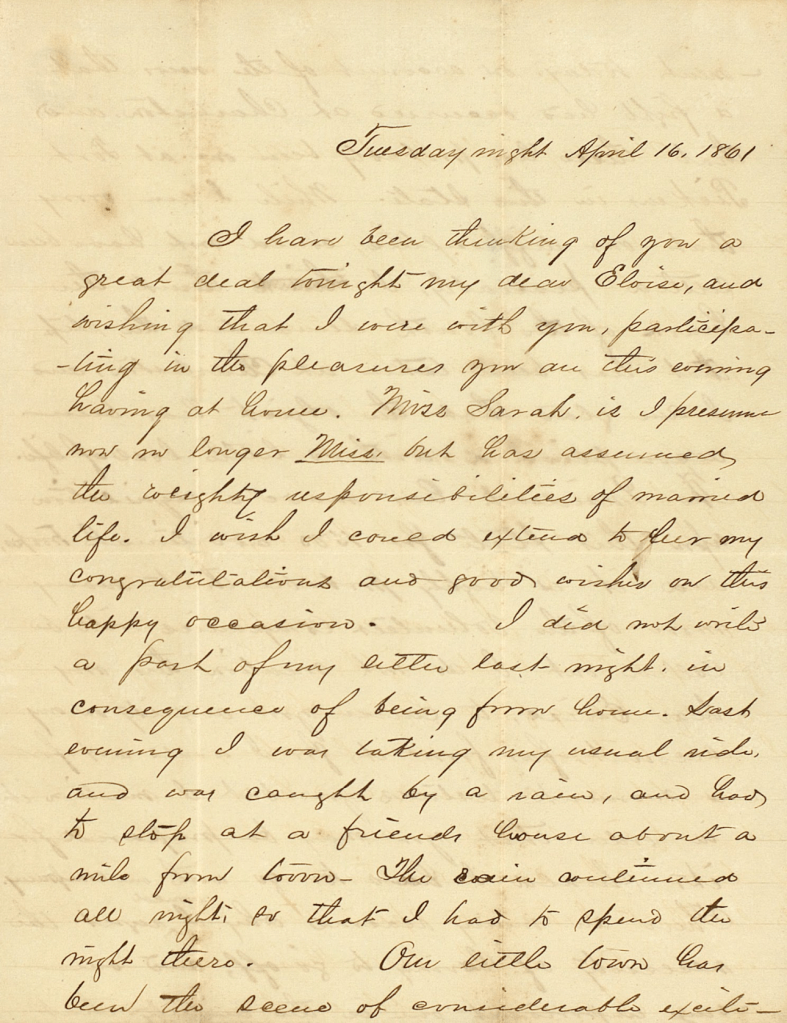
Tuesday night April 16, 1861
I have been thinking of you a great deal tonight my dear Eloise, and wishing that I were with you, participating in the pleasures you are this. evening having at home. Miss Sarah is, I presume now in longer Miss, but has assumed the weighty responsibilities of married life. I wish I could extend to her my congratulations and good wishes on this happy occasion. I did not write a part of my letter last night in consequence of being from home. Last evening I was taking my usual ride and was caught by a rain, and had to stop at a friend’s house about a mile from town. The rain continued all night so that I had to spend the night there.
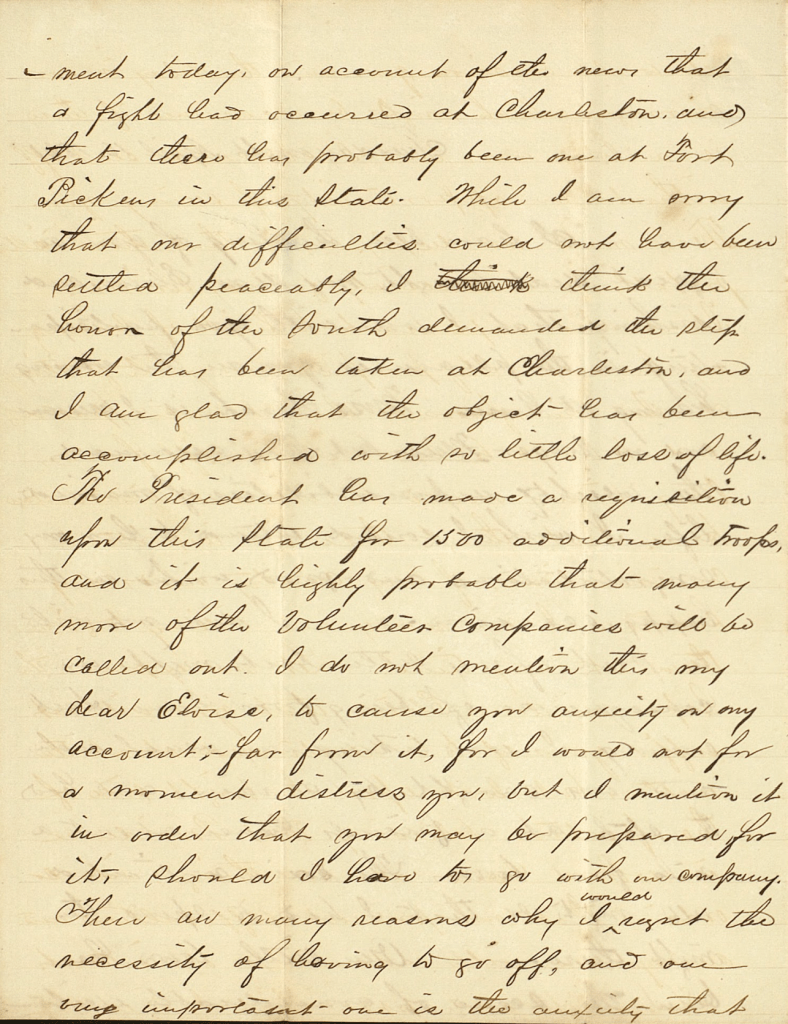
Our little town has been the scene of considerable excitement today on account of the news that a fight had occurred at Charleston and that there has probably been one at Fort Pickens in this state. While I am sorry that our difficulties could not have been settled peaceably, I think the honor of the South demanded the step that has been taken atCharleston, and I am glad that the object has been accomplished with so little loss of life.
The President has made a requisition upon this state for 1500 additional troops, and it is highly probable that many more of the volunteer companies will be called out. I do not mention this, my dear Eloise, to cause you anxiety on my account—far from it—for I would not for a moment distress you, but I mention it in order that you may be prepared for it, should I have to go with our company. There are many reasons why I would regret the necessity of having to go off, and one very important one is the anxiety that it would occasion you, and the delay in our marriage which might be occasioned if there is a long war, and I should be sent off without an opportunity of seeing you. These make me deeply regret that there will probably be a necessity for my services.
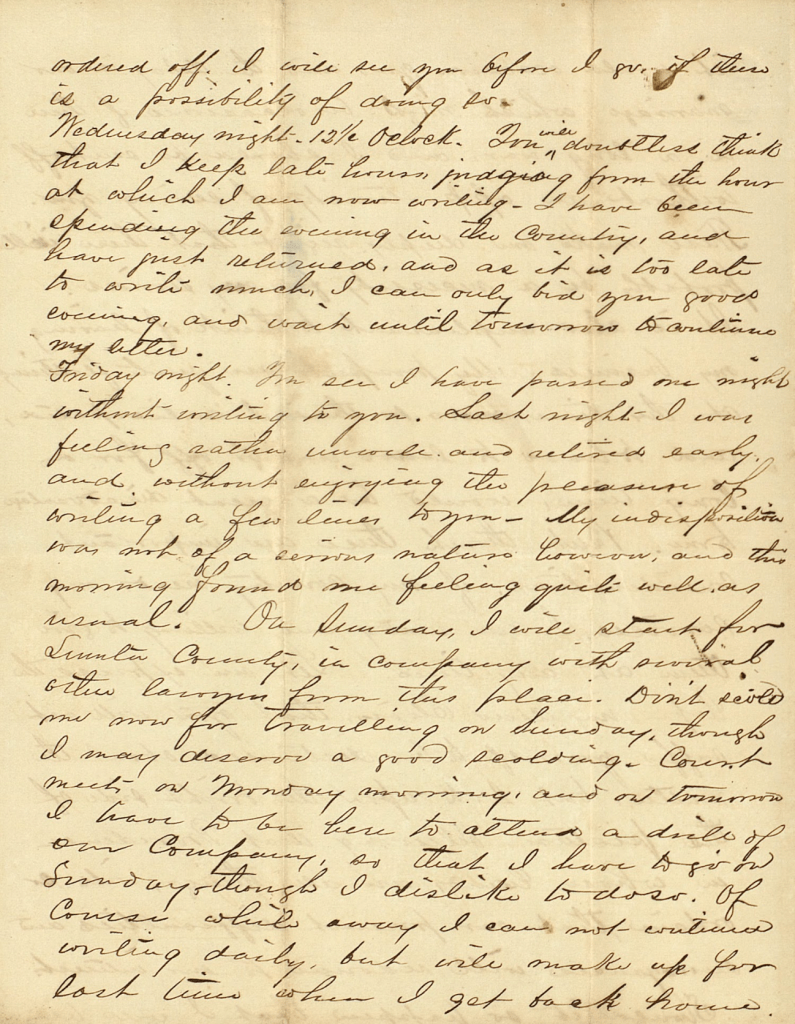
It is also unpleasant to think of leaving my business. My prospects are quite flattering at this time, more so than I anticipated, and to have to leave and go for a long time, would be a great disadvantage to me. But though these are important considerations, if my country needs my services, I am ready and willing to give them at any time. Let me express the hope, my dear Eloise, that you will not suffer yourself to be distressed about the matter, but look upon the bright side of the picture, believing that Providence in whose hands are all things, will so ordain that our present difficulties and annoyances will redound to our interest. Should it so happen that I will be ordered off, I will see you before I go if there is a possibility of doing so.
Wednesday night, 12:30 o’clock. You will doubtless think that I keep late hours judging from the hour at which I am now writing. I have been spending the evening in the country and have just returned and as it is too late to write much, I can only bid you good evening and wait until tomorrow to continue my letter.
Friday night. You see I have passed one night without writing to you. Last night I was feeling rather unwell and retired early and without enjoying the pleasure of writing a few lines to you. My indisposition was not of a serious nature however, and this morning finds me feeling quite well as usual.
On Sunday I will start for Sumter county in company with several other lawyers from this place. Don’t scold me for traveling on Sunday, though I may deserve a good scolding. Court meets on Monday morning and on tomorrow I have to be here to attend a drill of our company, so that I have to go on Sunday though I dislike to do so. Of course while away I cannot continue writing daily, but will make up for lost time when I get back home.
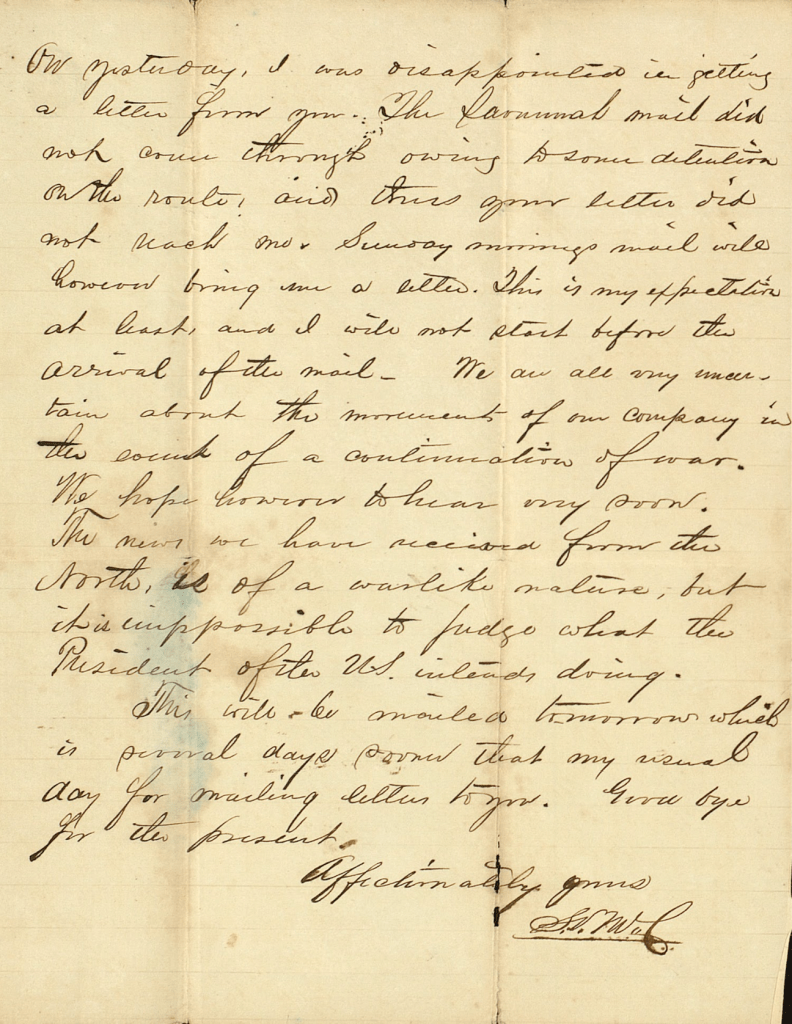
On yesterday I was disappointed in getting a letter from you. The Savannah mail did not come through owing to some detention on the route and thus your letter did not reach me. Sunday morning’s mail will however bring me a letter. This is my expectation at least, and I will not start before the arrival of the mail.
We are all very uncertain about the movement of our company in the event of a continuation of war. We hope, however, to hear very soon. The news we have received from the North is of a warlike nature, but it is impossible to judge what the President of the U. S. intends doing.
This will be mailed tomorrow which is several days sooner than my usual day for mailing letters to you. Goodbye for the present. Affectionately yours, — S. D. McC.
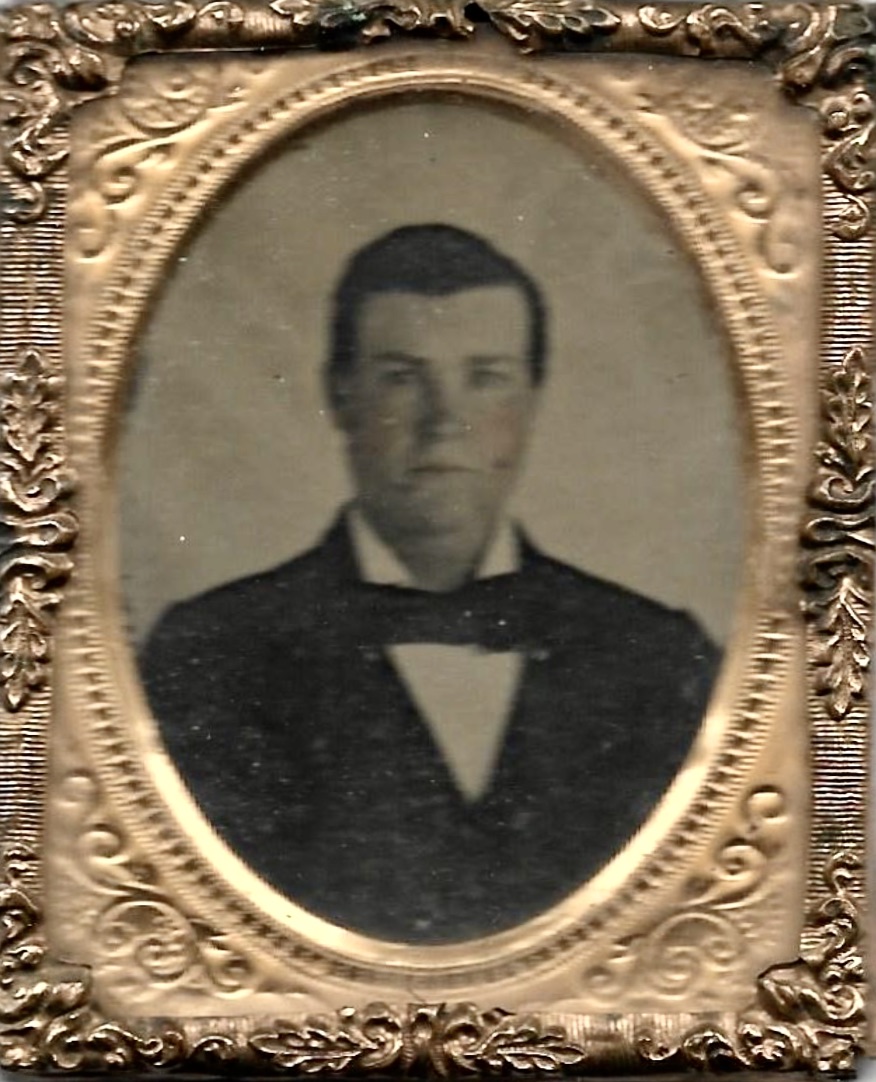
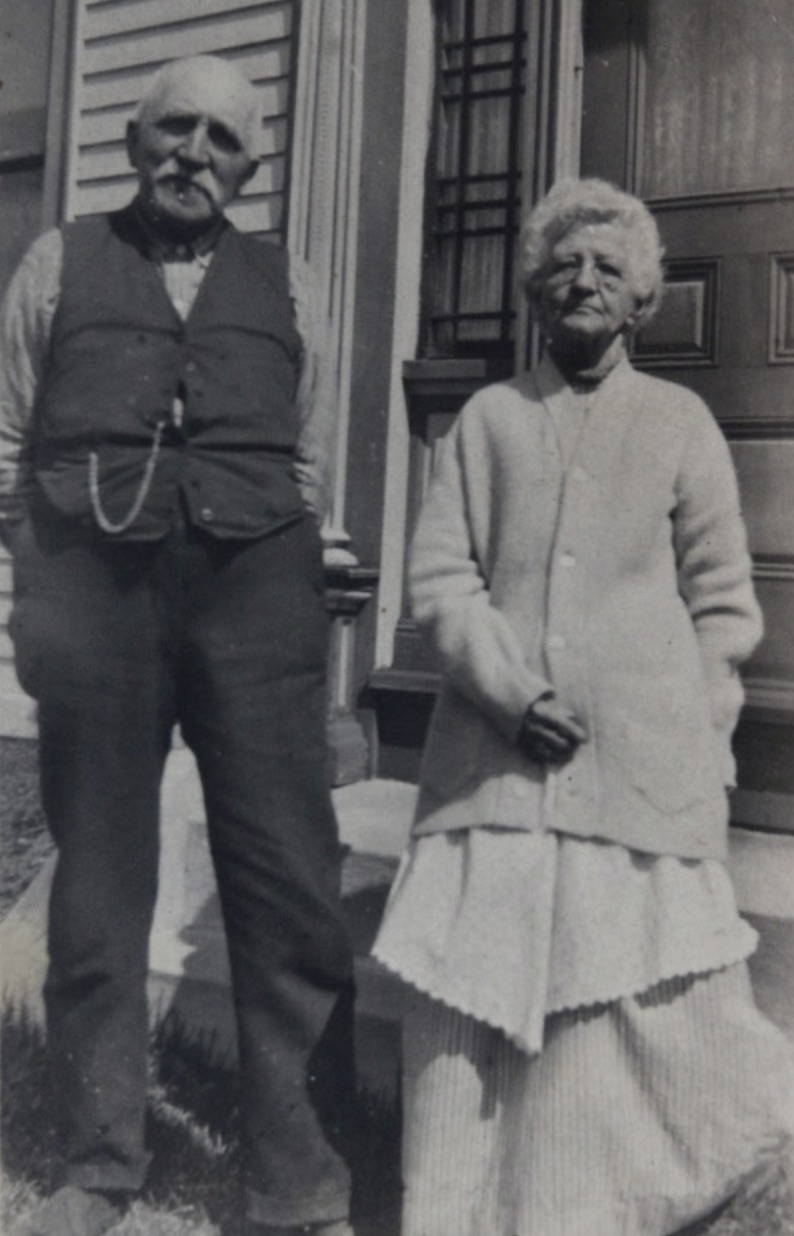
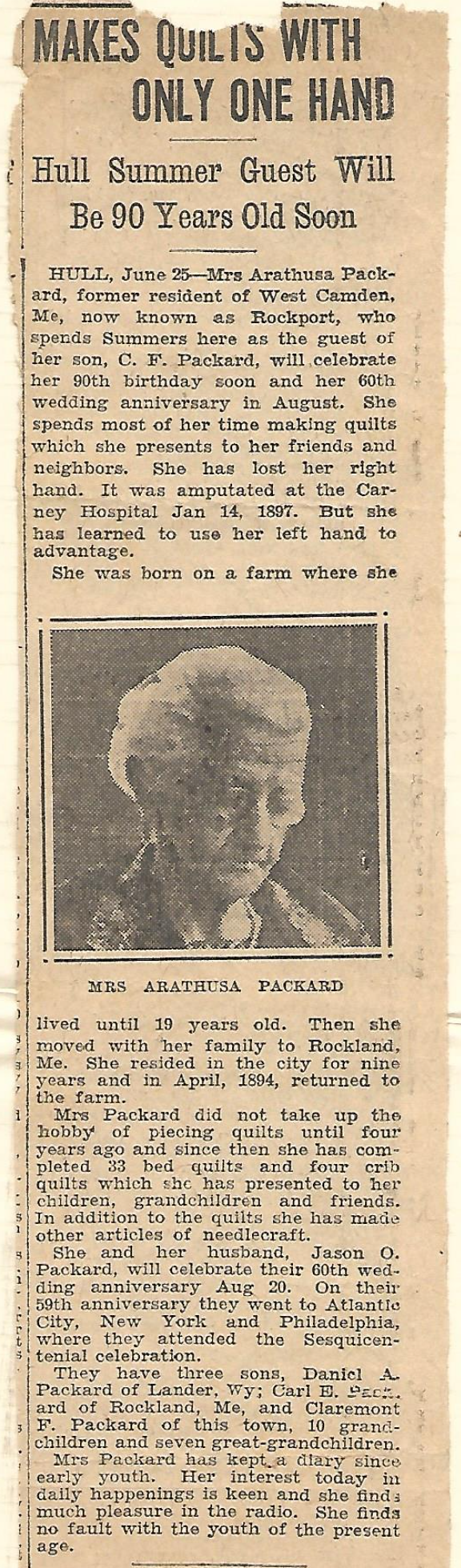
The following letters were written by Jason Oscar Packard (1845-1933) to Arathusa M. Studley (1838-1935) with whom he would marry in 1867. Jason was the son of Daniel and Betsy (Veazie) Packard of Rockport, Knox county, Maine. In 1870, Jason was employed as a house carpenter. But in 1864, when this letter was written, he was taking his mail at 23 South Street, the office of NYC Merchant, Benjamin Franklin Metcalf (1831-1918) and his partner, Duncan. Benjamin was a ship owner and ship broker and at one time maintained a line of sailing vessels between New York and Vera Cruz. He was one of the founders of the New York Stock Exchange and was also a member of the NY Maritime Exchange.
The second letter transcribed below informs us that Jason was a crew member on the Bark Rambler.
Arathusa, a dressmaker in 1860, was the eldest child of Charles and Mary Ann (Fisk) Studley of Camden, Knox county, Maine.
Note: These letters are from the collection of Kate Gilbert and were offered for transcription and publication on Spared & Shared by express consent.
Letter 1
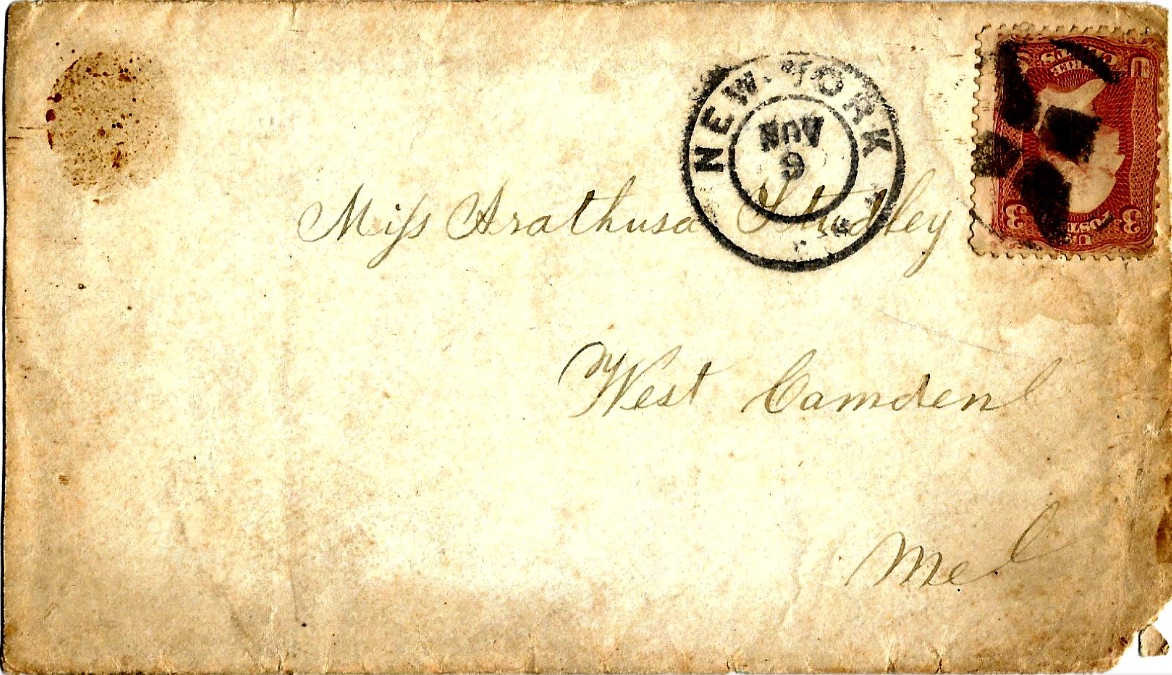
Addressed to Miss Arathusa Studley, Rockville, Maine
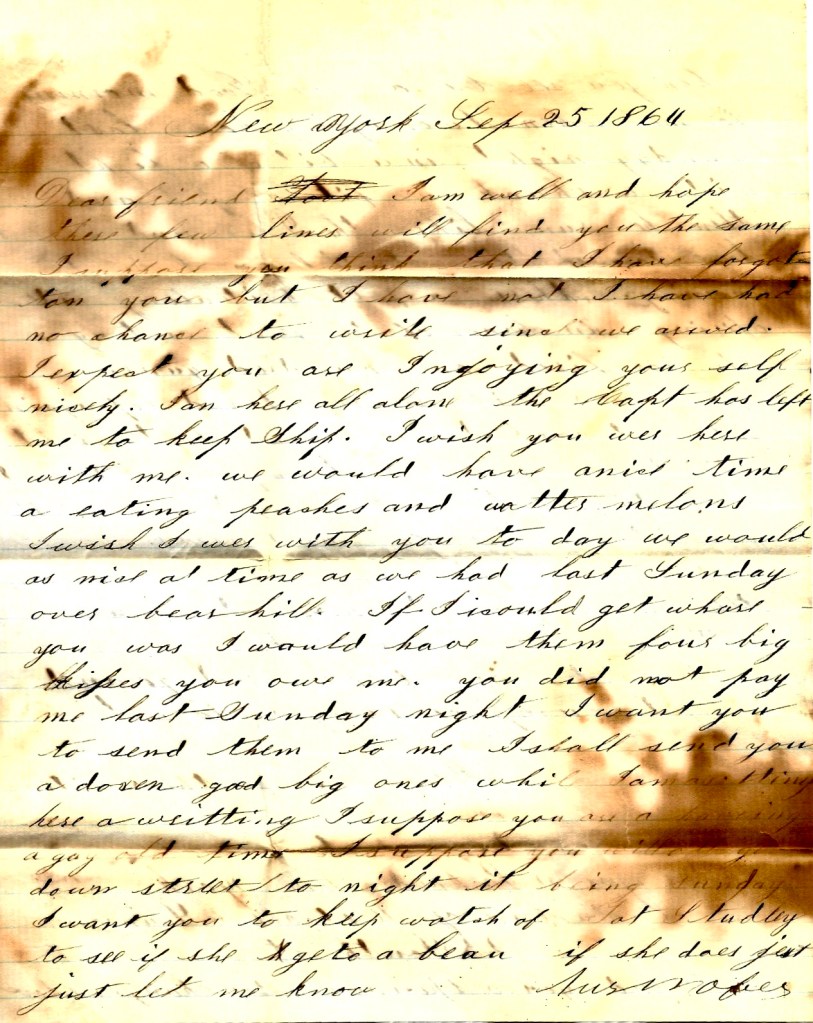
New York [City] September 25, 1864
Dear Friend,
I am well and hope these few lines will find you the same. I suppose you think that I have forgotten you but I have not. I have had no chance to write since we arrived. I expect you are enjoying yourself nicely. I am here all alone. The Captain has left me to keep ship. I wish you were here with me. We would have a nice time a eating peaches and water melons. I wish I were with you today, We would have as nice a time as we had last Sunday over bear hill. If I could get where you was, I would have them four big kisses you owe me. You did not pay me last Sunday night. I want you to send them to me. I shall send you a dozen good big ones while I am sitting here a writing.
I suppose you are a having a gay old time. I suppose you are a going down street tonight, if being Sunday. I want you to keep watch of Toot Studley to see if she gets a beau. If she does, just let me know. Turn over.
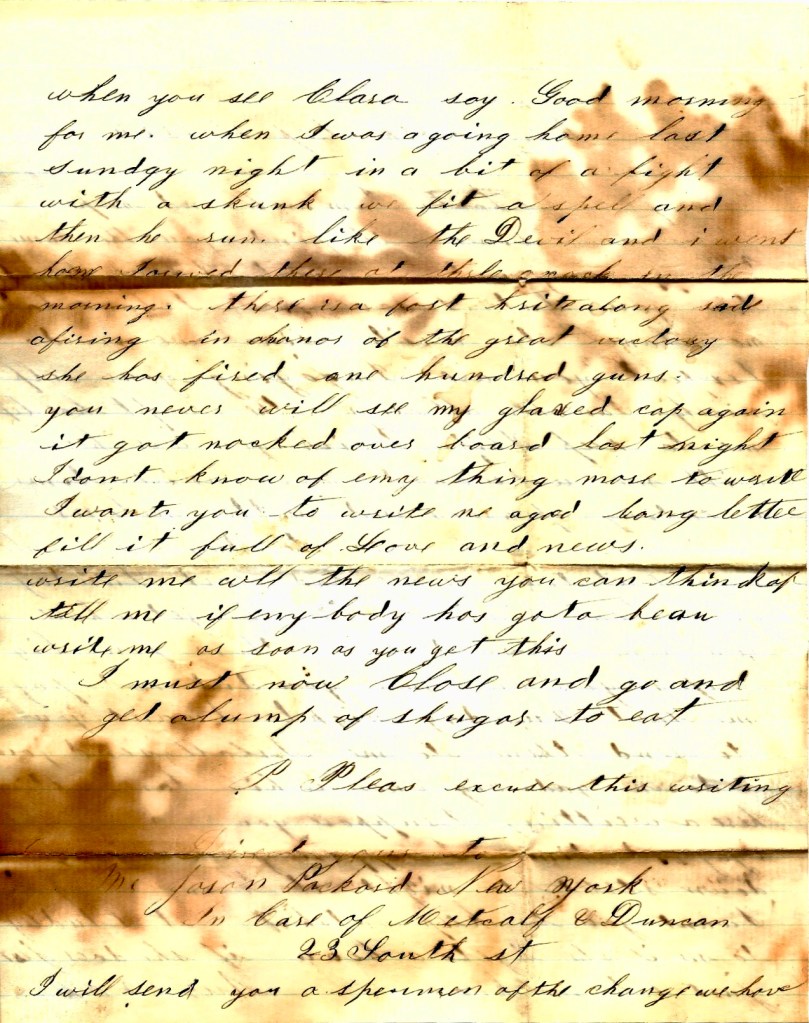
When you see Clara, say good morning for me. When I was a going home last Sunday night [I got] in a bit of a fight with a skunk. We fought a spell and then he run like the Devil and I went home. I arrived there at three o’clock in the morning.
There is a fort right along side a firing in honor of the great victory. 1 She has fired one hundred guns.
You never will see my glazed cap 2 again. It got knocked overboard las night. I don’t know of anything more to write. I want you to write me a good, long letter. Fill it full of love and news. Write me all the news you can think of. Tell me if anybody has got a beau. Write me as soon as you get this.
I must now close and go and get a lump of sugar to eat. Please excuse this writing.
Direct your [letter] to Mr. Jason Packard, New York, in care of Metcalf & Duncan, 23rd South Street.
I will send you a specimen of the change we have.
1 The great celebration was presumably in response to the news of Sheridan’s victory in the Shenandoah Valley (Third Battle of Winchester).
2 A glazed cap is one that was made entirely of enameled cloth, making it waterproof.
Letter 2
Addressed to Miss Arathusa Studley, West Camden, Maine
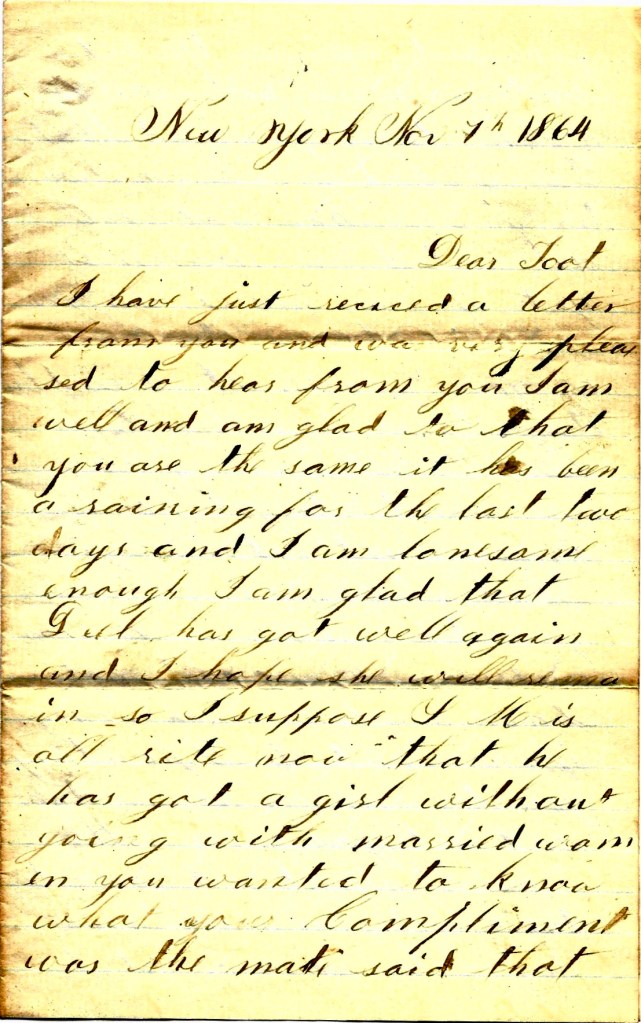
New York [City] November 7th 1864
Dear Toot,
I have just received a letter from you and was very pleased to hear from you. I am well and am glad to [hear] that you are the same. it has been a raining for the last two days and I am lonesome enough. I am glad that Deel has got well again and I hope she will remain so. I suppose J. M. is all right now that he has got a girl without going with married women.
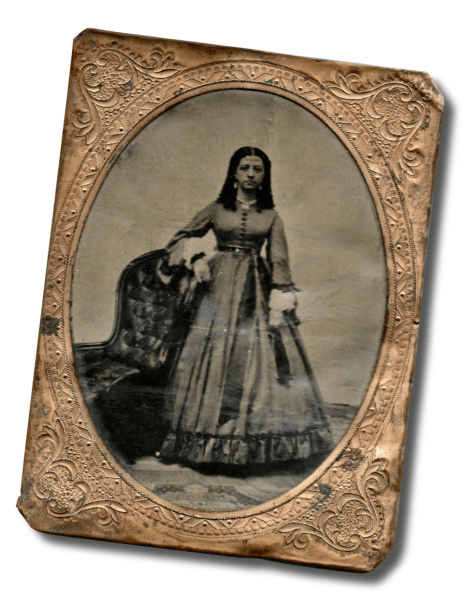
Arathusa M. Studley
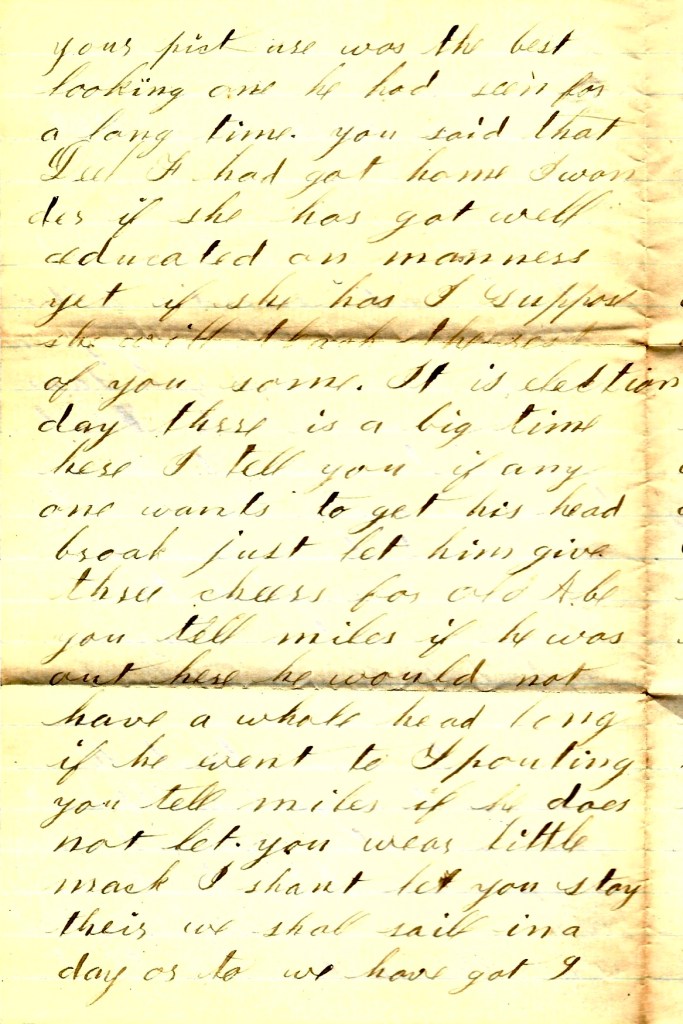
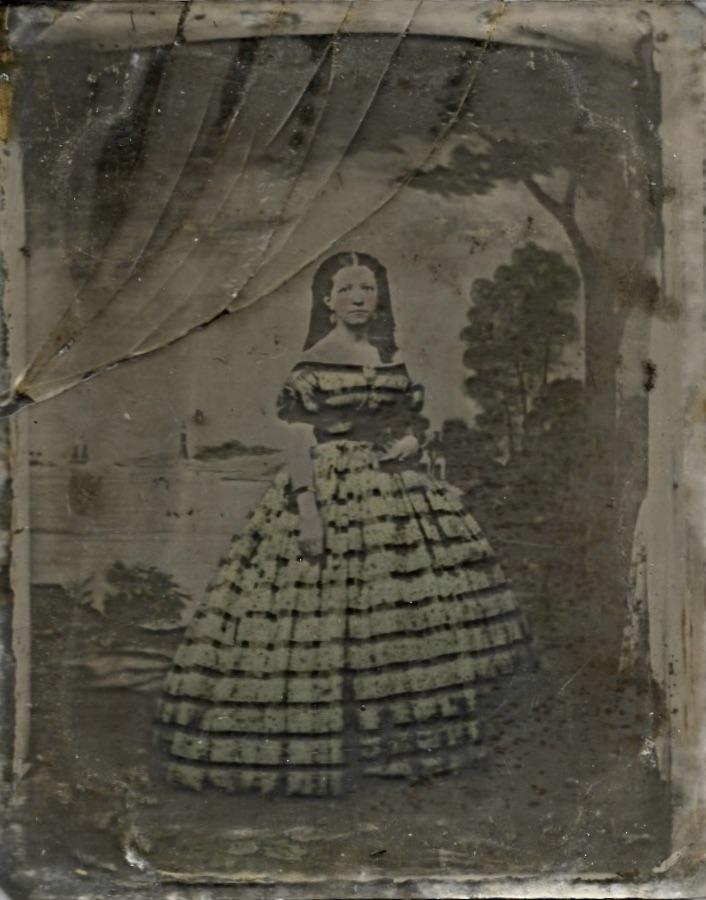
You wanted to know what your compliment was. The mate said that your picture was the best looking one he had seen for a long time. You said that Deel F. had got home. I wonder if she has got well educated on manners yet? If she has, I suppose she will [ ] the rest of you soon.
It is election day. There is a big time here, I tell you. If anyone wants to get his head broke, just let him give three cheers for Old Abe. You tell Miles if he was out here, he would not have a whole head long if he went to spouting. You tell Miles if he does not let you wear Little Mac, I shan’t let you stay there.
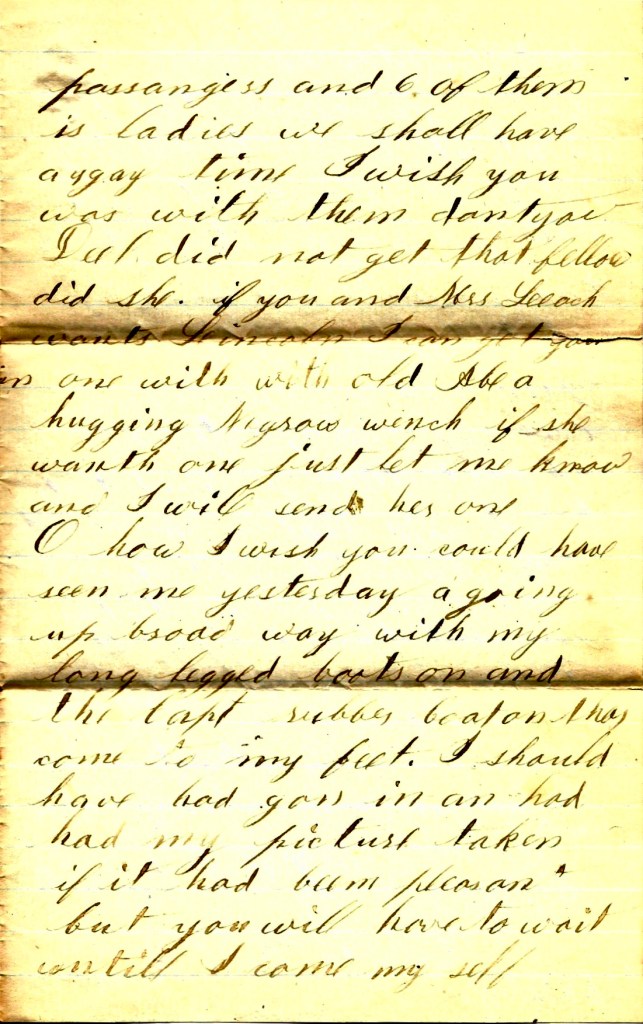
We shall sail in a day or two. We have got nine passengers and six of them is ladies. We shall have a gay time. I wish you was with them, don’t you?
Deel did not get that fellow, did she? If you and Mrs. Leach wants Lincoln, I can get you one with old Abe hugging a Negro wench. If she wants one, I will send her one. Oh how I wish you could have seen me yesterday a going up Broadway with my long-legged boots on and the Captain’s rubber coat on that comes to my feet. I should have had you in and had my picture taken if it had been pleasant but you will have to wait until I come myself.
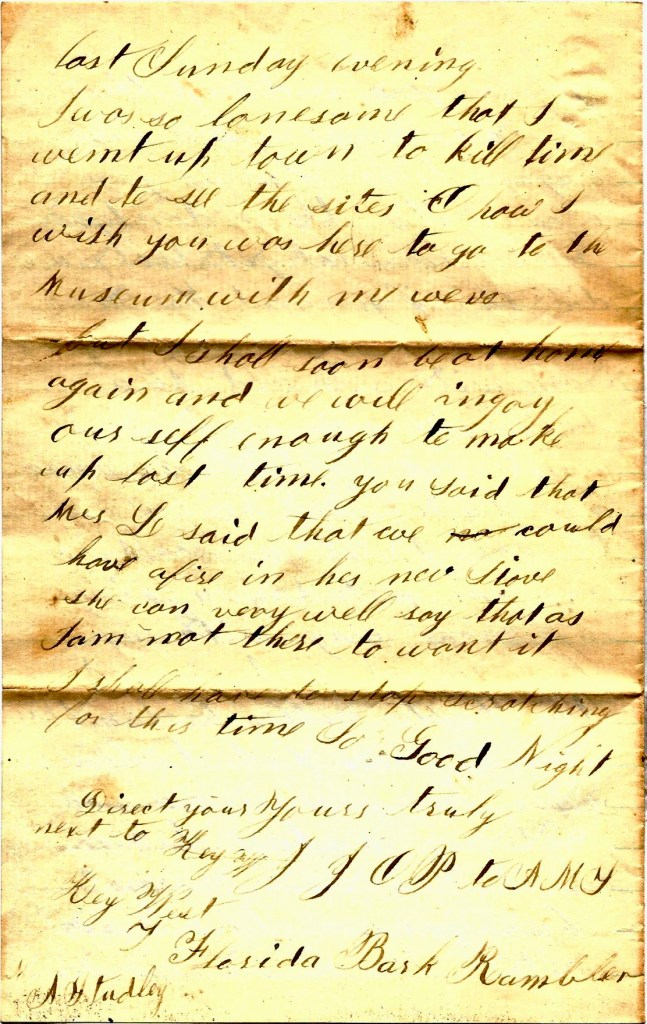
Last Sunday evening I was so lonesome that I went up town to kill time and to see the sights. Oh how I wish you was here to go to the Museum with me. But I shall soon be at home again and we will enjoy ourselves enough to make up lost time. You said that Mrs. Leach said that we could have a fire in her new stove. She can very well say that as I am not there to want it. I shall have to stop scratching for this time. So good night. Yours truly, — J. O. P to A. M. S.
Direct your next to Key West, Florida. Bark Rambler.
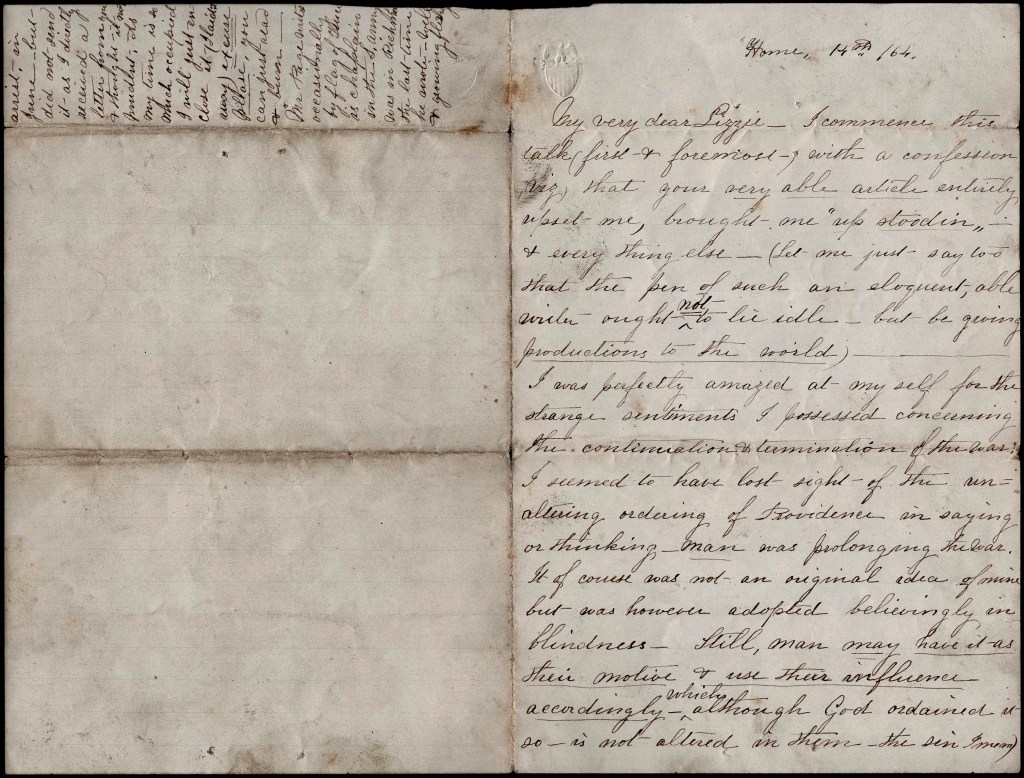
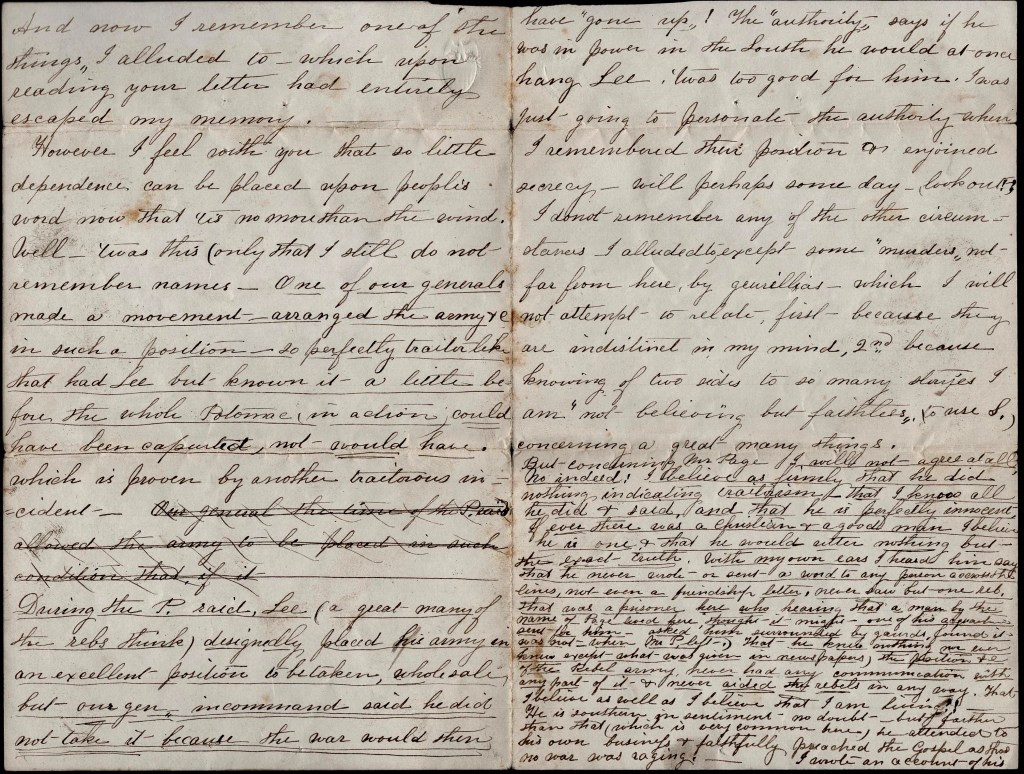
The unsigned letter presents a perplexing challenge regarding the identity of its author, with the initial paragraphs raising concerns about the author’s mental state. In contrast, the subsequent paragraphs that discuss Rev. James Jellis Page (1822-1898), an Episcopal minister originally from Virginia who was living in Brownsville, Fayette County, Pennsylvania at the onset of the Civil War, offer a clearer perspective. It can be reasonably inferred that the letter’s author was likely a parishioner residing near Rev. Page. Notably, Rev. Page maintained a residence Pennsylvania until 1867, when he and his family moved to Fulton County, Kentucky.
Transcription
Home [Month?] 14, 1864
My very dear Lizzie,
I commence this talk (first and foremost) with a confession, viz, that your very able article entirely upset me, brought me “up stoodin” & everything else—(Let me just say too that the pen of such an eloquent, able writer ought not to lie idle—but be giving production of the world).
I was perfectly amazed at myself for the strange sentiments I possessed concerning the continuation & termination of the war. I seemed to have lost sight of the unaltering ordering of Providence in saying or thinking man was prolonging the war. It of course was not an original idea of mine but was however adopted believingly in blindness. Still, man may have it as their motive & use their influence accordingly which although God ordained it so, is not altered in them—(the sin I mean.) And now I remember one of the things I alluded to, which upon reading your letter had entirely escaped my memory.
However, I feel with you that so little dependence can be placed upon people’s word now—that ’tis no more than the wind. Well, ’twas this (only that I still do not remember names). One of our generals made a movement, arranged the army &c. in such a position, so perfectly traitor like that had Lee but known it a little before, the whole Potomac (in action) could have been captured—not would have—which is proven by another traitorous incident. During the P[ennsylvania] raid, Lee (a great many of the rebs think) designedly placed his army in an excellent position to be taken, wholesale, but our general in command said he did not take it because the war would then have “gone up!” The “authority” says if he was power in the South, he would at once hang Lee. “Twas too good for him. I was just going to personate the authority when I remembered that position & enjoined secrecy—will perhaps some day—(lookout!).
I don’t remember any of the other circumstances I alluded to except some “murders” not far from here by guerrillas which I will not attempt to relate, first because they are indistinct in my mind, 2nd because knowing of two sides to so many stories I am “not believing, but faithless,” to use S, concerning a great many things.
But concerning Mr. Page, I will not agree at all. No indeed! I believe as firmly that he did nothing indicating traitorism—that I know all he did and said and that he is perfectly innocent. If ever there was a Christian & a good man, I believe he is one, & that he would utter nothing but the exact truth. With my own ears I heard him say that he never wrote or sent a word to any person across the lines—not even a friendship letter—[and] that he never saw but one Reb that was a prisoner here who hearing that a man by the name of Page lived here [and] thought it might be one of his acquaintance. [It turned out he] was not, when Mr. Page left. That he knew nothing nor ever knew except what was given in newspapers the position &c. of the Rebel army, never had any communication with any part of it, & never aided the rebels in any way. That, I believe, as well as I believe that I am living. He is southern in sentiment—no doubt—but farther than that (which is very common here), he attended to his own business & faithfully preached the Gospel as though no war was raging.
I wrote an account of his arrest in June, but did not send it as I directly received a letter from you & thought it not prudent. As my time is so much occupied, I will just enclose it (I laid it away). Excuse please. You can just read & burn.
Mr. Page writes occasionally by flag of truce, is chaplain in the Southern Army, was in Richmond the last time he wrote, well & growing fleshy.
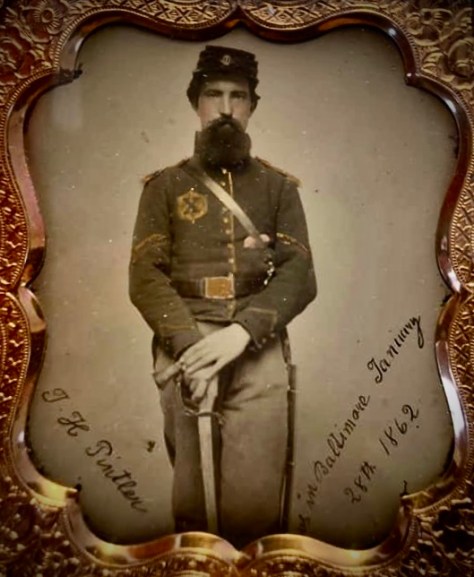
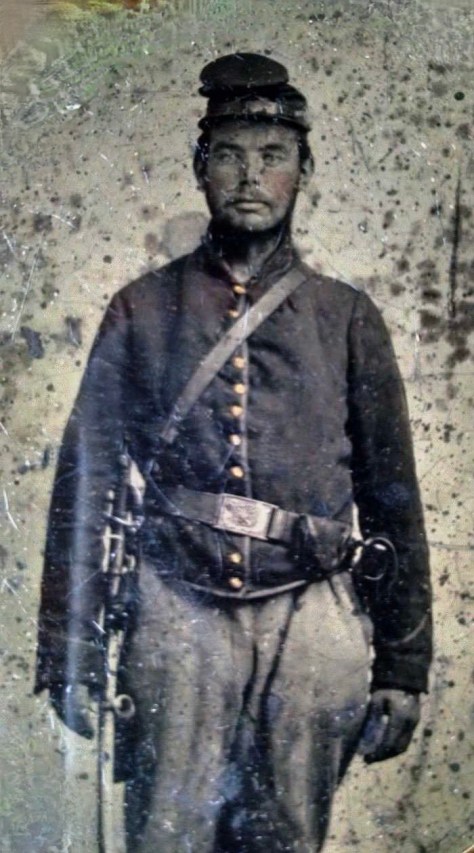
I could not find an image of David but here is an Ambrotype of John H. Pintler who served in Co. C, 1st NY Mounted Rifles. He was killed in Dec. 1862. (Adam Ochs Fleischer Collection)
This letter was written by David Nichols (b. 1829) of New York City who enlisted as a private in September 1862 to serve three years in Co. H, 1st New York Mounted Rifles. He re-enlisted in September 1864 and was transferred later to Co. K. In September 1865, the regiment was designated the 4th Provisional Cavalry. The regiment served until 1864 with the 7th and 4th corps, principally at Fortress Monroe, Norfolk, Suffolk, Portsmouth, Williamsburg and Yorktown, Va., taking part in over 50 battles and skirmishes, but sustaining no severe losses. Its heaviest casualties being at Scott’s mills, Va., in May, 1863, when 28 were killed, wounded and missing.
Muster rolls inform us that David was employed as a longshoreman previous to his enlistment. He stood 5 feet 9 inches tall, with brown eyes, black hair.
Transcription
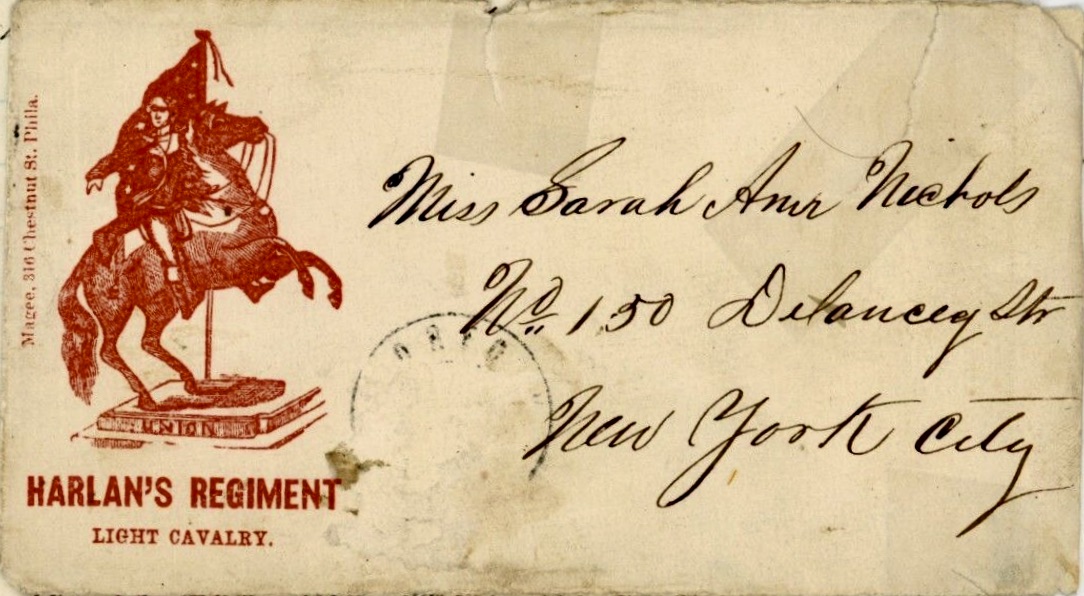
Addressed to Miss Sarah Ann Nichols, No. 150 Delancey Street, New York City; includes a patriotic image of “Harlan’s Regiment, Light Cavalry” which was a Philadelphia Regiment (11th Pennsylvania Cavalry).
In Camp near Suffolk, Va. October 6th 1862
Dear Mother,
I received your letter a few days since and was very glad to hear you were well. I would have answered before this time but we were sent out on a scout on Friday towards Blackwater. We did not get back until Saturday night late. I expected a general engagement with the Rebels as a number of infantry regiments and also cavalry regiments were with us, but for some cause or other we could not get into a fight.
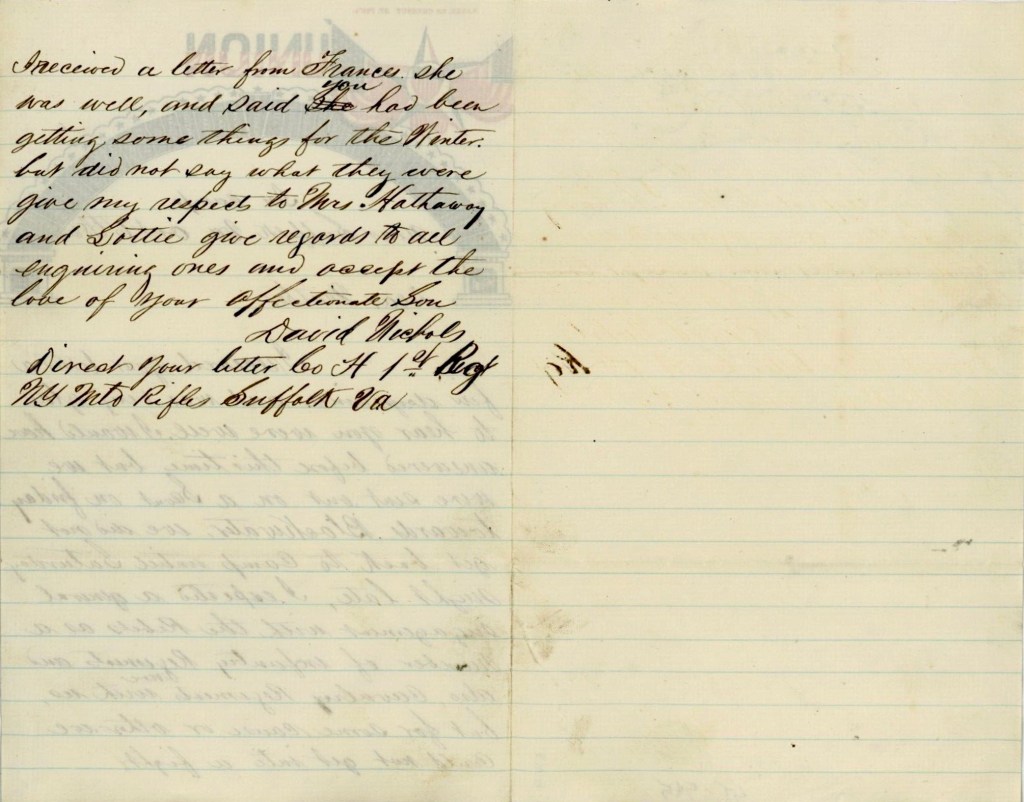
I received a letter from Frances. She was well and said you had been getting some things for the winter but did not say what they were. Give my respects to Mrs. Hathaway and Lottie. Give regards to all enquiring ones and accept the love of your affectionate son. — David Nichols
Direct your letter to Co. H, 1st Regt. N. Y. Mtd. Rifles, Suffolk, Va.
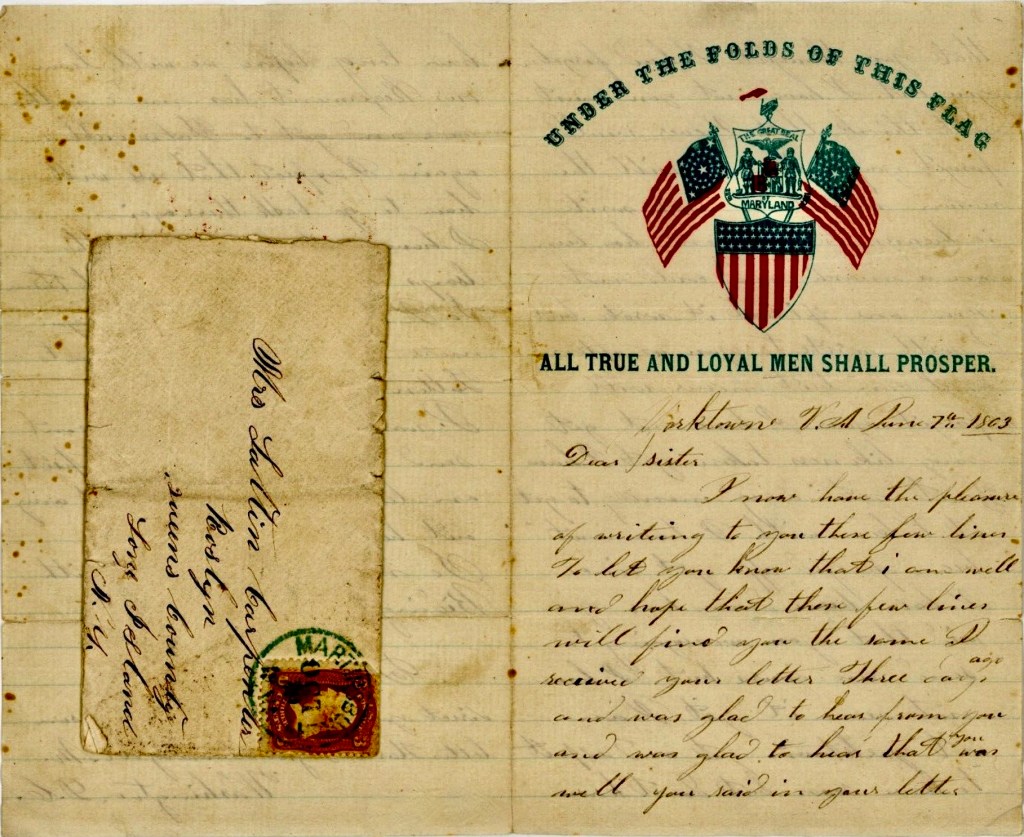
The following letter was written by George William Dickinson (1843-1933) of Co. M, 2nd New York (“Harris Light”) Cavalry. George enlisted in August 1861 at NYC to serve three years. He was subsequently transferred to Co. A (no date) and finally mustered out of the service while on detachment in June 1865 at Alexandria, Virginia.
The following information was posted on a website called Civil War Quilts: George was son of Elbert Dickinson (1814-1874) and Susan Dove (1816-1892) of Queens, New York. Several stories about George’s war experiences survive in newspaper articles but any follow up leads to dead ends. He was either wounded at Hanover Court House or Bull Run, captured at Pawmunkey River towards the end of the war when he was held ten days in Libby Prison in Richmond, Virginia. George was married in the summer of 1862 to Sarah Marie Carpenter (1843-1933), both age 19. Within a month, her husband was off to war, shortly to be shot in the lungs. The bullet worked its way out to become a souvenir but he suffered periodic hemorrhages the rest of his long life, which he attributed to the wound. Twentieth-century newspaper articles and old Civil War veterans may have been confused about places and dates, exaggerating scars and exploits. Sarah’s parents were Jackson and Sarah Craft Carpenter of Sea Cliff on Long Island’s Northern shore, families descended from mid-18th-century settlers. She and George had four children, two boys John & Daniel, and two girls Annie Conrad Abbott and Susan Dickinson Conrad. Towards the end of the 20th century, George obtained a job as caretaker at an estate owned by Charles M. Pratt, a Standard Oil heir who built a family compound and gardens in Glen Cove a few miles east of Oyster Bay.
George wrote the letter to his sister, Caroline Matilda (Dickinson) Carpenter (1845-1885), the wife of Latting Carpenter of Rosyln, Queens county, New York. The couple were married in March 1863.
Transcription
Addressed to Mrs. Lattin Carpenter, Roslyn, Queens county, Long Island, New York
Yorktown, Virginia June 7th 1863
Dear sister,
I now have the pleasure of writing to you these few lines to let you know that I am well and hope that these few lines will find you the same. I received your letter three days ago and was glad to hear that you was well. You said in your letter that you thought I had forgotten you but I have not. You must not think that I ever would forget you for I never will. The reason why I did not write is because the regiment has been on a march and I could not send one if I had it wrote, but I will write to you as often as I can. But I never will forget you.
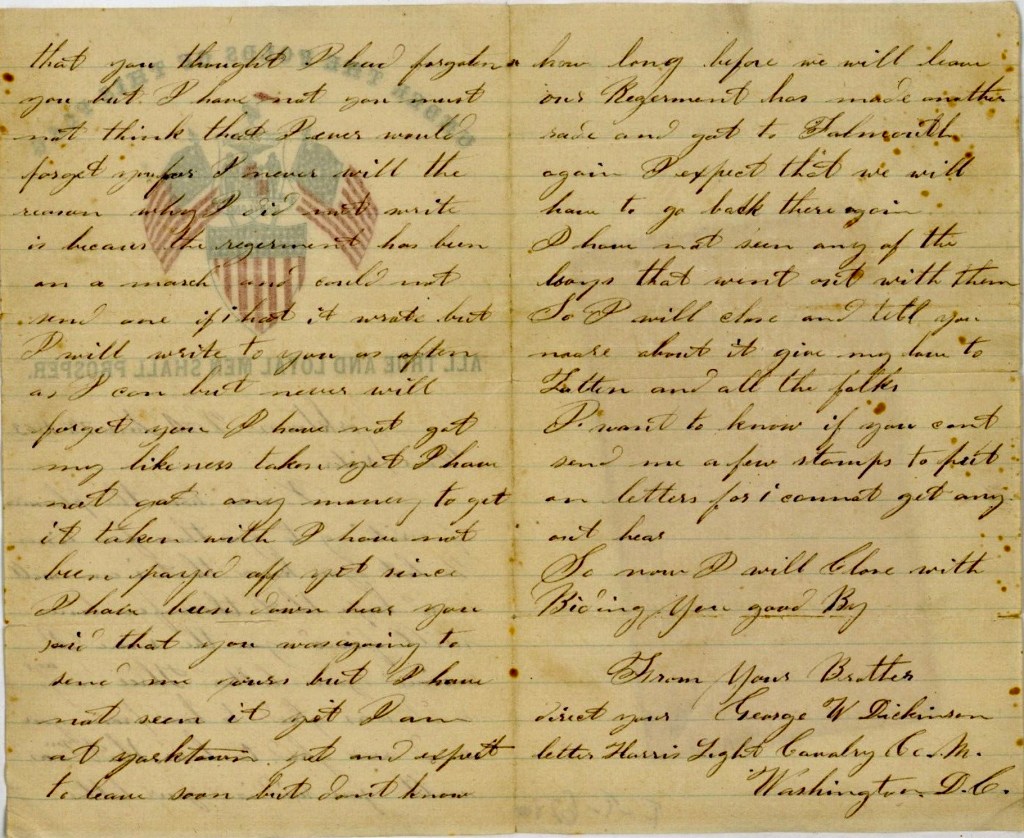
I have not got my likeness taken yet. I have not got any money to get it taken with. I have not been paid off yet since I have been down here. You said that you was a going to send me yours but I have not seen it yet.
I am at Yorktown yet and expect to leave soon but don’t know how long before we will leave. Our regiment has made another raid and got to Falmouth again and I expect that we will have to go back there again. I have not seen any of the boys that went out with them. So I will close and tell you no more about it.
Give my love to Father and all the folks. I want to know if you can’t send me a few stamps to put on letters for I cannot get any out here. So now I will close with bidding you goodbye.
From your brother. Direct your letter to George W. Dickinson, Harris Light Cavalry, Co. M, Washington D. C.
This letter was signed by a soldier named “Wellington” and addressed to his father but beyond that, I’ve not been able to identify him. He appears to have been in temporary duty with his squadron in Iuka while the remainder of his regiment was stationed in Tuscumbia. He also informs us that he anticipated being issued revolving rifles soon which led me to believe he might be with the 2nd Iowa Cavalry but I could not find a member by that name.
Transcription
Iuka [Mississippi] August 30, 1862
My Dear Father,
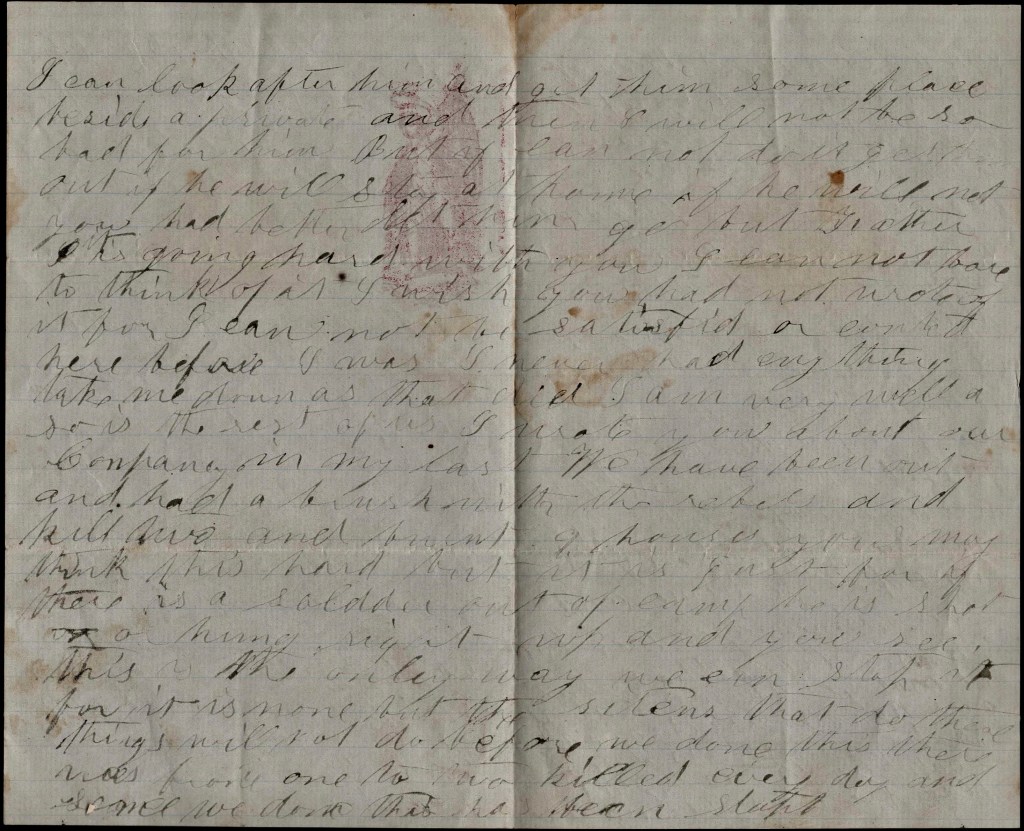
I have just received your letter of 24th and I never was so surprised to think that Cap has enlisted. Now Father, do get him home. I wrote you for a commission. Get it in that regiment if you can. If [not], let it alone. But Father, get him home. He may stand it. There is barely a chance. You know that you thought that I could not stand it but I have stood it as well as any man. But if I can get a place in that regiment, I can look after him and get him some place beside a private and then it will not be so bad for him. But if you can not do it, get him out if he will stay at home. If he will not, you had better let him go but Father, it is going hard with you. I cannot bare to think of it. I wish you had not wrote of it for I cannot be satisfied or content here. Before I was. I never had anything take me down as that did.
I am very well and so is the rest of us. I wrote you about our company in my last. We have been out and had a brush with the rebels and killed two and burnt nine houses. You may think this hard but it is just for if there is a soldier out of camp, he is shot or hung right up and you see this is the only way we can stop it for it is none but the citizens that do these things. Before we done this, there was from one to two killed every day and since we done this, it has been stopped.
We have a good deal of scouting to do but I like it for we have a chance to see a good deal of country. I do not know how long we will stay here but think we will go to our regiment at Tuscumbia but do not know when. We expect to get revolving rifles pretty soon. I have wrote you three letters. I write every time I get one from home and sometimes oftener but I am afraid that you do not get them. All of our teams are drove by darkeys. It is a good help. From Wellington
I could not find an image of Orvill but here is a tintype of Rob Chase of Co. D, 3rd New York Cavalry. (Ancestry.com)
The following letter was written by 19 year-old Orville Baxter (1842-1862) of Co. G, 3rd New York Cavalry. Orvill enlisted at Rodman and served in the regiment until 14 November 1862 when he died of disease at New Bern, North Carolina. Orvill was the son of Benjamin B. Baxter (1797-1858) and Lucy Chamberlin (1805-1866) of Jefferson county, New York.
When Orvill wrote this letter in early December 1861, the regiment was attached to Stone’s Division of the Army of the Potomac, stationed near Poolesville, Maryland.
Transcription
Camp near Poolesville, Maryland December 8, 1861
Dear Uncle,
I take my pen in hand to let you know that I am well and in good health and hope this will find you the same. I’ve written to you but I have not had any answer. I would like to hear from you very well. I have wrote to most all of our folks on the hill but I don’t get but a damn few answers. Maybe they don’t want to write. If they don’t, they can go to hell. I am here and they are there but Uncle Jabe, I don’t want you to go back on me for I want to hear from you and your folks. Tell Uncle Oliver that I am just as round as a peach. Tell the dumb shit fool that I have wrote to him once or [twice] but I don’t get any answer somehow or ruther.
It is very fine weather here yet. We have not had any snow to amount to anything. We expect to stay in our small tents this winter. We can do it and be comfortable. We have pretty good times here now. We drill only once a day but it is not likely that we will drill much longer for it is so damn muddy that we all have to have a general wash after it. It is a sight to see five or six hundred horses on the field at once and making a charge. All hell cannot stop some of the horses. They are as wild as the devil, some of them. We was on drill today and one man fell off his horse and three or four run over him and fell down and there was a fine old pile of them in a hurry. The one that gets up and away first is the best fellow.
There, the belly organ has sounded and I shall have to stop writing now but write soon as you get this and let me know how you are a getting along. Direct your letters to Orvill Baxter, Company G, [James Henry] Van Alen Cavalry.
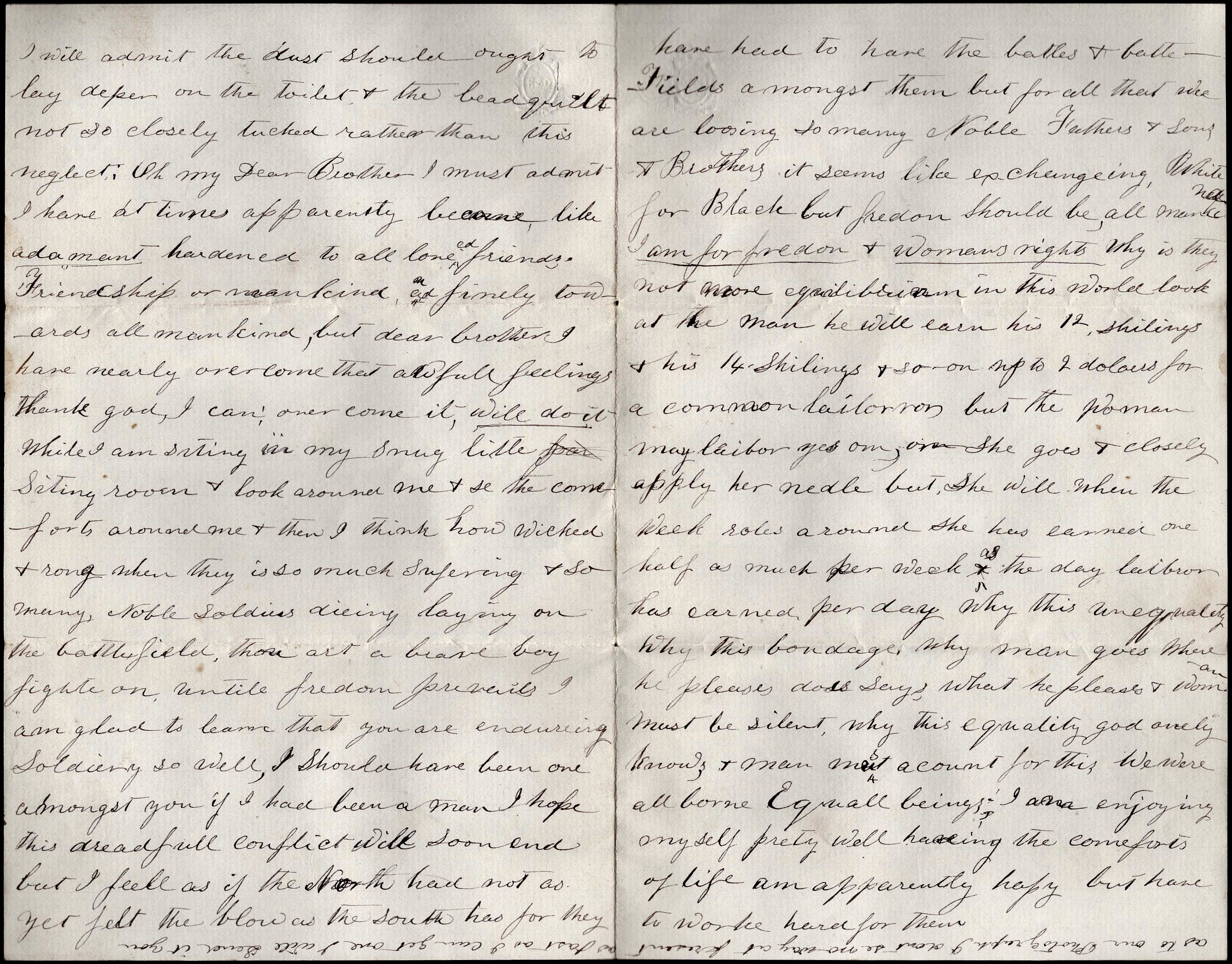
The following letter was written by 33 year-old Margaret Vail (Kelley) Lester (1830-1917), the daughter of David Kelley (1806-1876) and his first wife, Charity Herrick (1806-1832) of Danby, Rutland county, Vermont. David Kelley later moved to DuPage county, Illinois. Margaret was married in April 1848 in DuPage county, Illinois, to James Franklin Lester (1824-1899). In the 1860 US Census, Margaret and James were residing in Marengo, McHenry county, Illinois, where James was employed as a farm laborer and a carpenter. An obituary for Margaret (The Daily Times, Davenport, Iowa, June 28, 1918) informs us that Margaret was born at Danby Four Corners, Vermont, and came to Illinois with her parents when she was 15 years old. She had been educated in the Castleon Seminary in Vermont and entered the teaching profession. Once married, the couple had two children—Emma Frances who died at the age of 16, and James Henry who died in 1917.
Margaret wrote the letter to her half-brother, Thomas Benton Kelley who was serving in Co. E, 8th Illinois Cavalry at the time.
What truly shines in this letter is Margaret’s bold articulation of the argument for women’s equality, challenging the status quo with fierce clarity.
Transcription
November 26, 1863
My dear neglected brother,
Thanksgiving eve & I cannot rest on my pillow another night before I pen you a few broken lines. I have written so little for a year back. It has become a task instead of a pleasure. Is it a possible thing? I will call it a task. No dear, brother, it is not so. But I have apparently made it so. But noble sir, I am with you in imagination, hour after hour, & many a meal do I feel as if my dear good brothers could share with me.
Oh, I have written many & many imagined epistles to you. I am almost sure sometimes I never will be forgiven for my cold neglect. But a promise for the future. My best wishes to Mary. I expect she feels my cold neglect, but come here & see what I have to pass through with & you would not wonder. I will admit the dust should ought to lay deeper on the toilet & the bed quilt not so closely tucked rather than this neglect.
Oh my dear brother, I must admit I have at times apparently become like adamant hardened to all loved friends, friendship or mankind, and finally towards all mankind. But dear brother, I have nearly overcome that awful feelings. Thank God, I can overcome it. Will do it. While I am sitting in my snug little sitting room & look around me & see the comforts around me. And then I think how wicked & wrong when there is so much suffering & so many noble soldiers dying, laying on the battlefield.
Thou art a brave boy. Fight on until freedom prevails. I am glad to learn that you are enduring soldiery so well. I should have been one amongst you if I had been a man. I hope this dreadful conflict will soon end but I feel as if the North had not as yet felt the blow as the South has, for they have had to have the battles & battle fields amongst them. But for all that, we are losing so many noble fathers & sons & brothers. It seems like exchanging White for Black. But freedom should be [for] all mankind. I am for freedom & Womans’ rights. Why is there not more equilibrium in this world? Look at the man. He will earn his 12 shillings & his 14 shillings & so on, up to 2 dollars for a common laborer, but the woman may labor, yes, on and on she goes, & closely apply her needle, but she will, when the week rolls around, she has earned one half as much per week as the day laborer has earned per day. Why this inequality? Why this bondage? Why man goes where he pleases? Does say what he pleases & a woman must be silent? Why this inequality? God only knows & man must account for this. We were all borne equal beings & I am enjoying myself pretty well, having the comforts of life, am apparently happy, but have to work hard for them.
I will return to my thanksgiving supper. We were invited out to one of our neighbors to supper. Enjoyed it much—the whole family. I hope my dear brother was where he could enjoy the necessary comforts if no more. Be patient, for thou shalt be blessed by well doing. Henry’s folks I hardly have seen or heard from for the last three months as usual. I guess the babe, Jane Charity, has been sick all the fall.
I have one boarder & a great deal company & it does seem as if I never should have any respite. Besides, Emma & myself take in work. She goes to school & her studies are crushing her. She is not very stout. She is very industrious. She often speaks of you & of Mary & Mittie, but she is not at home or she would write. She will write soon. Her correspondence is quite extensive. Emma is one good girl & Henry is another T. B. Kelley right over. He would go to the war & who would blame me if I was old enough. That is him to a dot. I have not seen father for nearly a year. It is a year last fall since I was home. E[mma] & Henry was there this fall. Mother, I guess, carries on the hotel & Father stays on the farm a great deal. E. Parish’s sister says mother has the blues. Gets quite hystericky. I believe Pa is a going to move Annetta back to the depot somewhere. I shall go to Henry’s before long. Come home as soon as your time is out or as soon soon as you can.
I hope you will excuse James for not writing. It is not for any ill will. Pleas accept his best wishes. He has a brother at Fort Jackson. Edson [Sportnoble?] was brought home a corps. He was poisoned by the physician by a sponge that was used by a man with erysipelas which caused his death. The doctor’s brother-in-law wanted his office. From your sister M [ ] Lester. My best wishes to M. E. Jones. Tell him we thank him for his photograph & Emma will write to you both soon. Goodbye.
As to our photograph, I don’t see no way at present. As fast as I can get one, I will send it you.
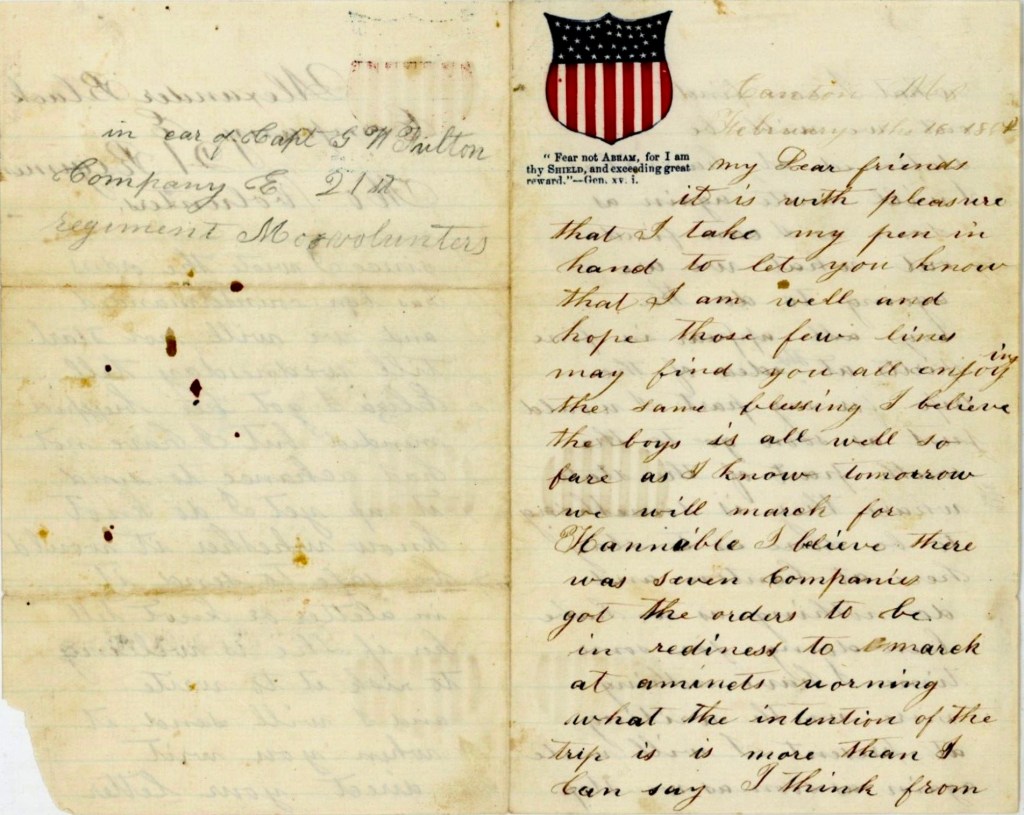
The following letter was written by 21 year-old Alexander Black who enlisted in Co. E, 21st Missouri Infantry. The regiment, once filled with 10 companies totaling 962 men, was mustered into the Union army at Canton on February 12, 1862. A little over a month later, on March 27, 1862, Alexander died of typhoid fever at Hannibal, Missouri.
Transcription
Canton, Missouri February 16, 1862
My dear friends,
It is with pleasure that I take my pen in hand to let you know that I am well and hope these few lines may find you all enjoying the same blessing. I believe the boys is all well so far as I know. Tomorrow we will march for Hannibal. I believe there are seven companies for the orders to be in readiness to march at a minute’s warning. What the intention of the trip is is more than I can say. I think from what I can find out, we will be stationed at Hannibal.
Capt. George W. Fulton, Co. E, 21st Missouri Infantry
I will write again as soon as I can find out what we are a going to do. The boys all appear in fine spirits at the idea of the trip. For my part, I would just as soon go to the south part of the state where they is something to be done as to stay here at Canton and do nothing as we have been doing for some time.
I have nothing more worth writing at present. I will write again as soon as we stop.
Since I wrote, the orders has been countermanded and we will not start till Wednesday. Tell Eliza I got the breast pin mended but I have not had a chance to send it up yet. I do not know whether it would be safe to send it in a letter or not. Tell her if she is willing to risk it, to write and I will send it. When you write, direct your letter to Alexander Black, Company E, 21st Regiment Missouri Volunteers, in care of Capt. G[eorge] W. Fulton
















 Spared & Shared 23