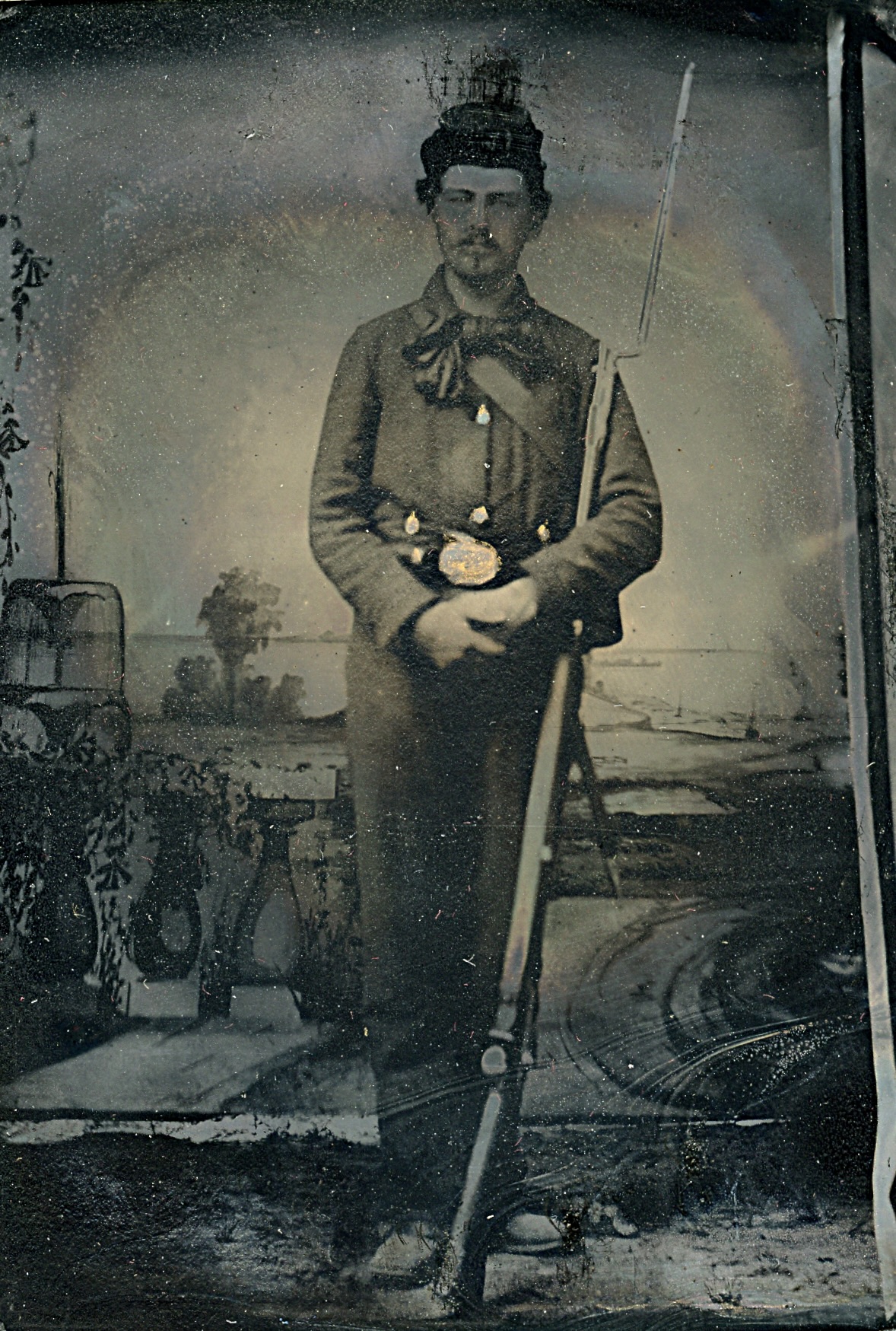
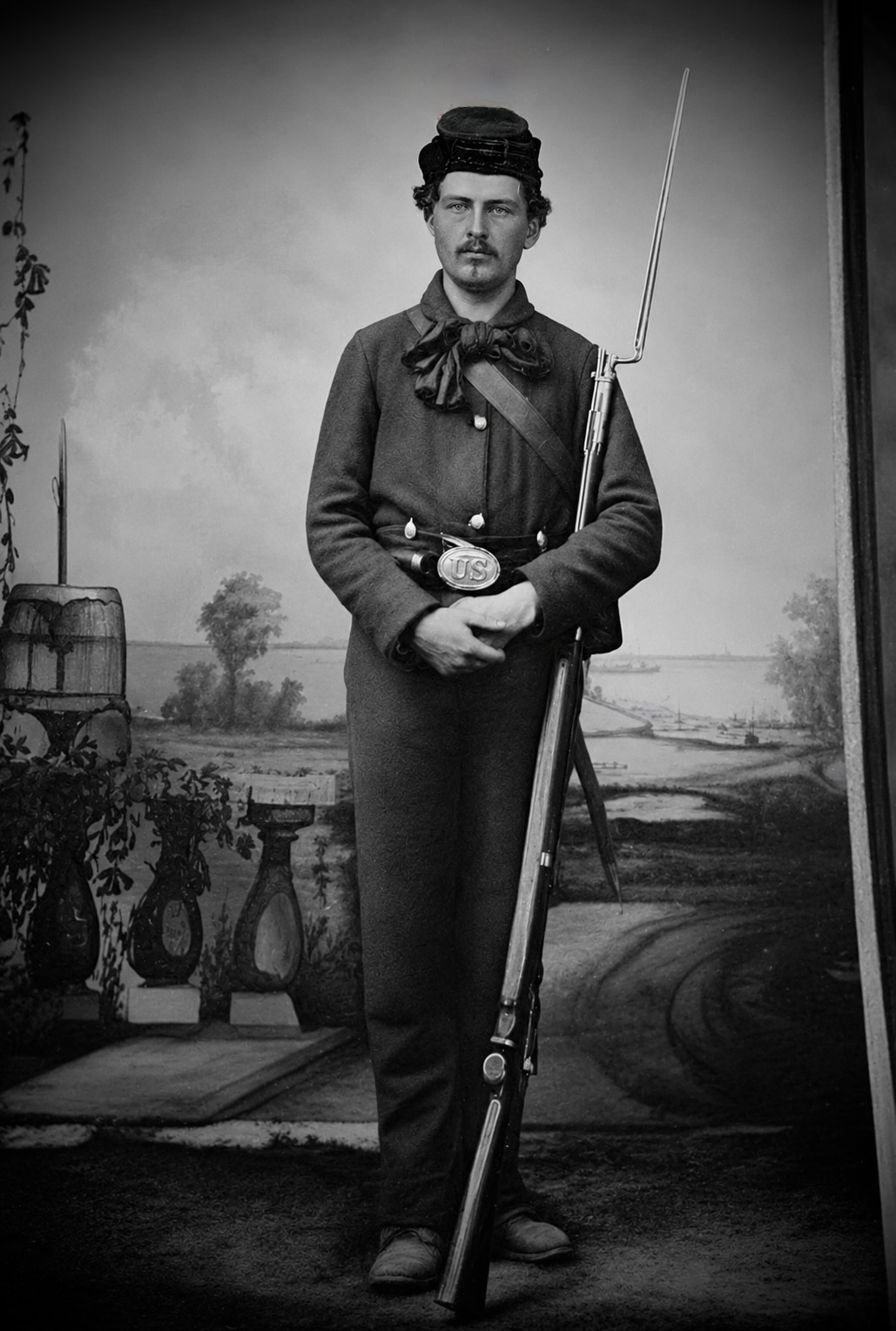
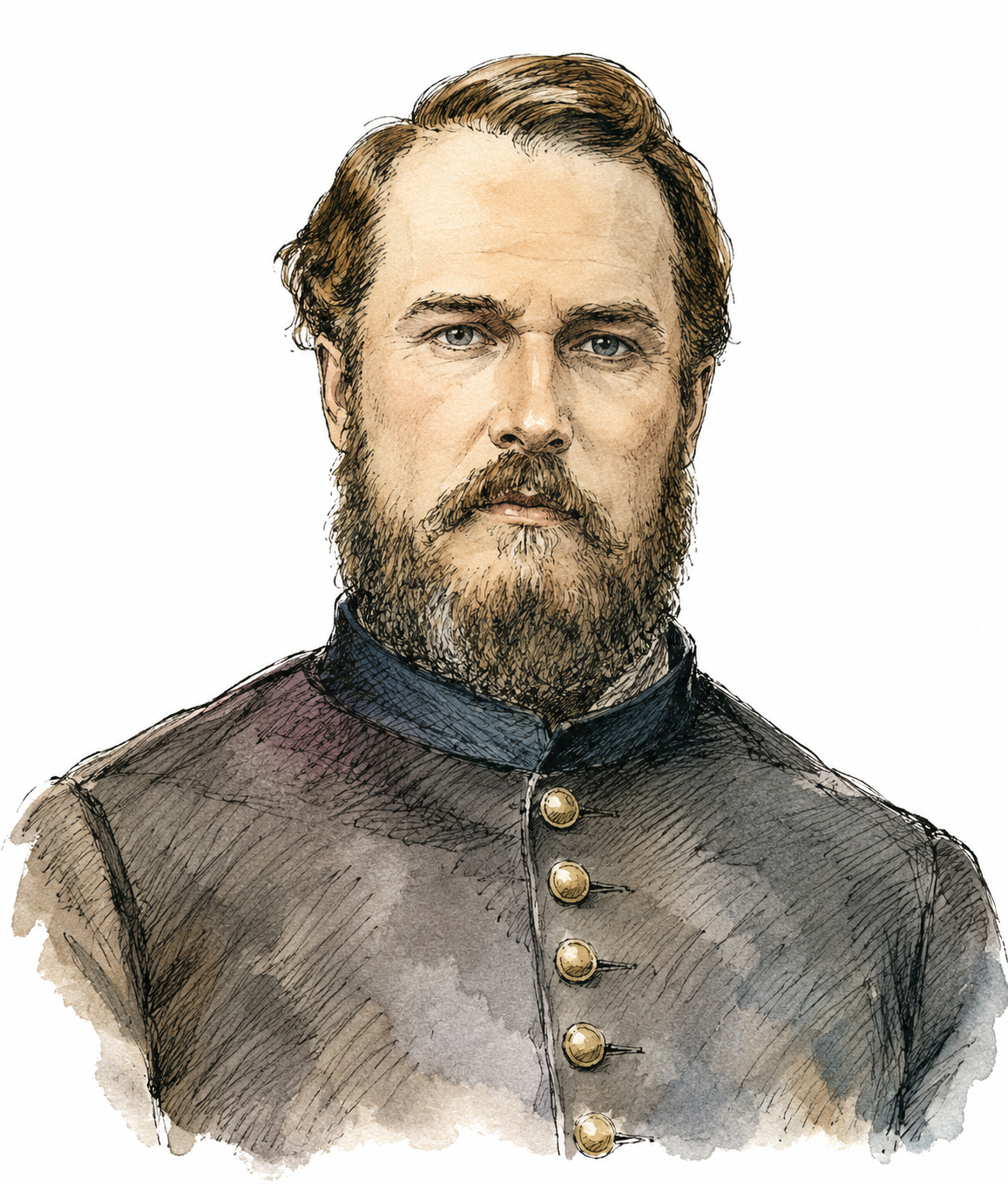
The following grouping of letters consist of two letters (Letters 3 & 4) by Joseph G. Miller (1836-1864) of Co. D, 32nd Iowa Infantry to his sister, Lydia Miller (1830-1917).
Letters 1 & 2 were written by Joseph’s sweetheart Sue Reaper shortly after his enlistment. I have not been able to identify any young woman by that name in Iowa, however, and I have come to the conclusion that it was really Susan L. Hillock (1839-1878) who wrote them. Using her real name, she also authored Letter 6 in late 1865 upon hearing of Joseph’s death in the war. Susan was the daughter of Hugh and Euphenia (Landon) Hillock of Webster City, Hamilton county, Iowa. Both Susan and her sister Abi (or Libbie”) were school teachers in Iowa. Susan later married Benjamin Requa but died in 1878 at the age of 39. Why Susan did not use her real name in Letters 1 & 2 remains a mystery unless they hoped to keep their relationship concealed. In the 1865 letter, it is revealed that she was deeply devoted to Joseph, corresponded regularly with him throughout his service, but had never met any of the Miller family and didn’t even know all their names.
There is also a letter (Letter 5) by Lt. Samuel Wheaton Griffin (1828-1888), a 2nd Lt. in Co. B, 32nd Iowa, to Joseph’s sister Lydia stating he had in his possession some personal effects of Joseph’s that were taken from him after Joseph’s death at Camp Ford in Texas.
Joseph G. Miller was born in New Jersey and came west to Iowa with his parents, Keturah (Morris) Miller (1795-1866) and Gilbert Miller (1793-1877). Joseph was working as a silversmith in Boonesborough just prior to his enlistment at age 26 in August 1862. He was taken prisoner on 9 April 1864 at Pleasant Hill, Louisiana, and died while a prisoner on 28 July 1864 at Tyler, Texas. He is buried in the National Cemetery at Alexandria, La., Section 33, Grave 16.
The following collection of letters are the property of Michael Huston and were offered for transcription and publication on Spared & Shared by express consent.
Letter 1
Nevada, Iowa
October 8, 1862
Mr. J. G. Miller
Dubuque, Iowa
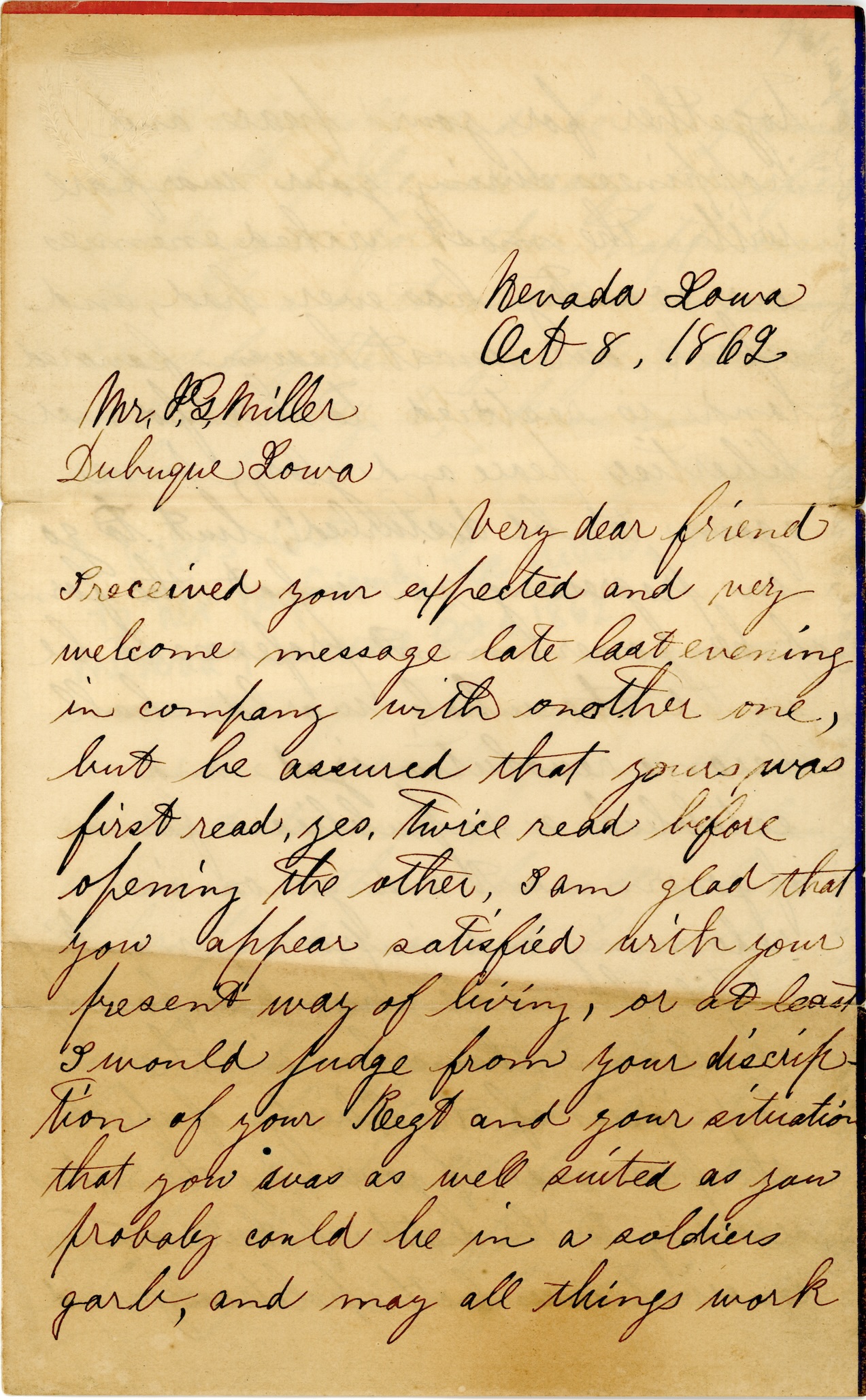
Very dear friend, I received your expected and very welcome message late last evening in company with another one, but be assured that yours was first read—yes, twice read before opening the other. I am glad that you appear satisfied with your present way of living, or at least I would judge from your description of your regiment and your situation that you was as well suited as you probably could be in a soldier’s garb. And may all things work together for your peace and happiness during your warfare with the most wicked enemies our country has ever had. And when our most heaven-favored land is restored to her former liberties peace and glory, never again to be disturbed, but to go on progressing in what the form of her government professes to be until the whole world shall become revolutionized and establish a republican form of government and go on in reforming and improving mankind until the whole human family shall sun themselves in the luxuries of the liberty of speech, the press, and of governing themselves according to the dictates of their own consciences—both politically and theologically—and be in possession of all of the necessary beneficial intelligence for their happiness in this life and the one to come.
I have forgotten my subject and the one I was writing to. I know you would rather have something beside the love of county, &c. and shall now try to say something that may interest you.
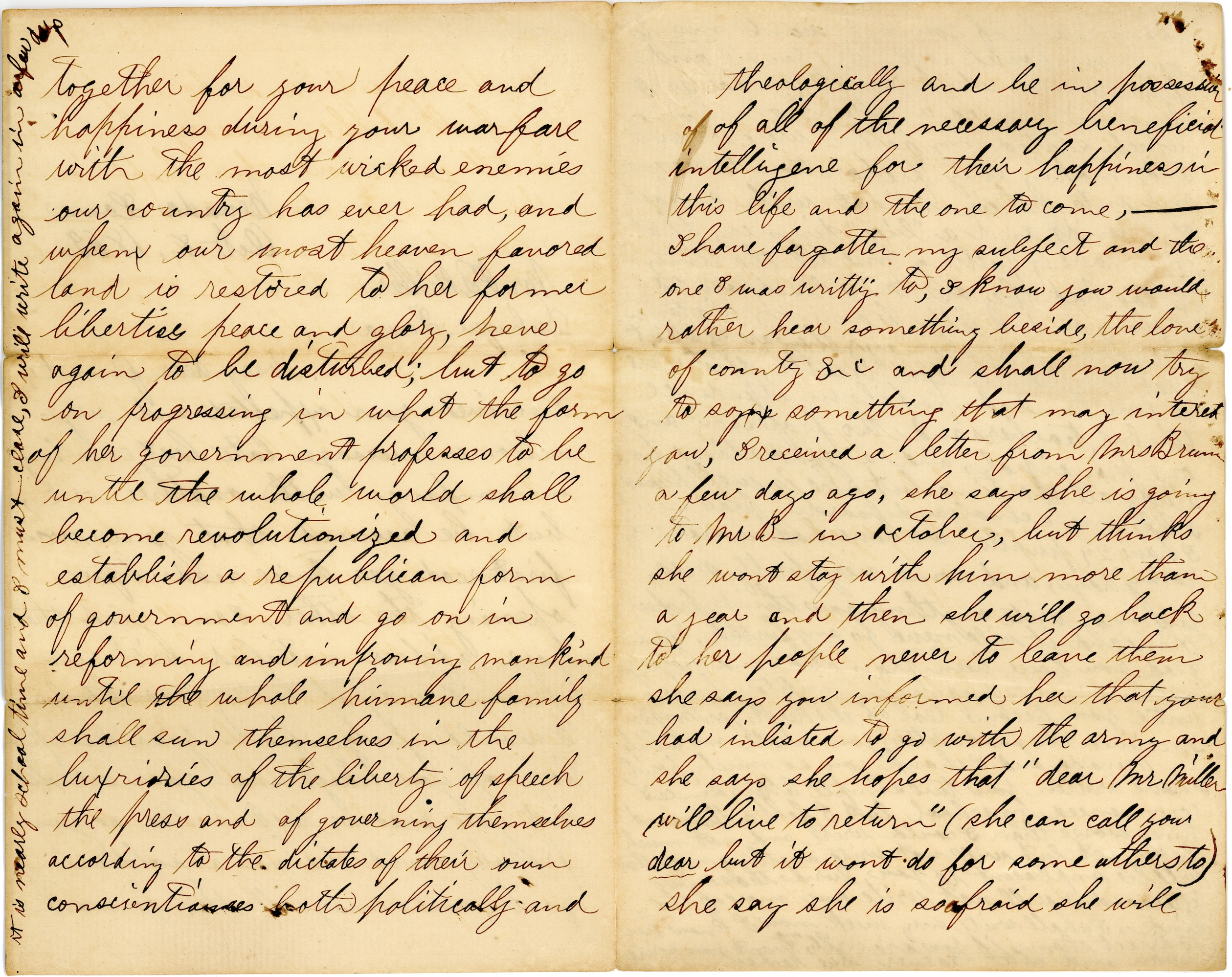
I received a letter from Mrs. Brum a few days ago. She says she is going to Mr. B. in October, but thinks she won’t stay with him more than a year and then she will go back to her people, never to leave them. She says you informed her that you had enlisted to go with the army and she says she hopes that “dear Mr. Miller will live to return.” (She can call you dear but it won’t do for some others to.) She says she is so afraid she will lose track of you and wants me to keep her posted as to where you are and how you are, which I shall do as far as I know.
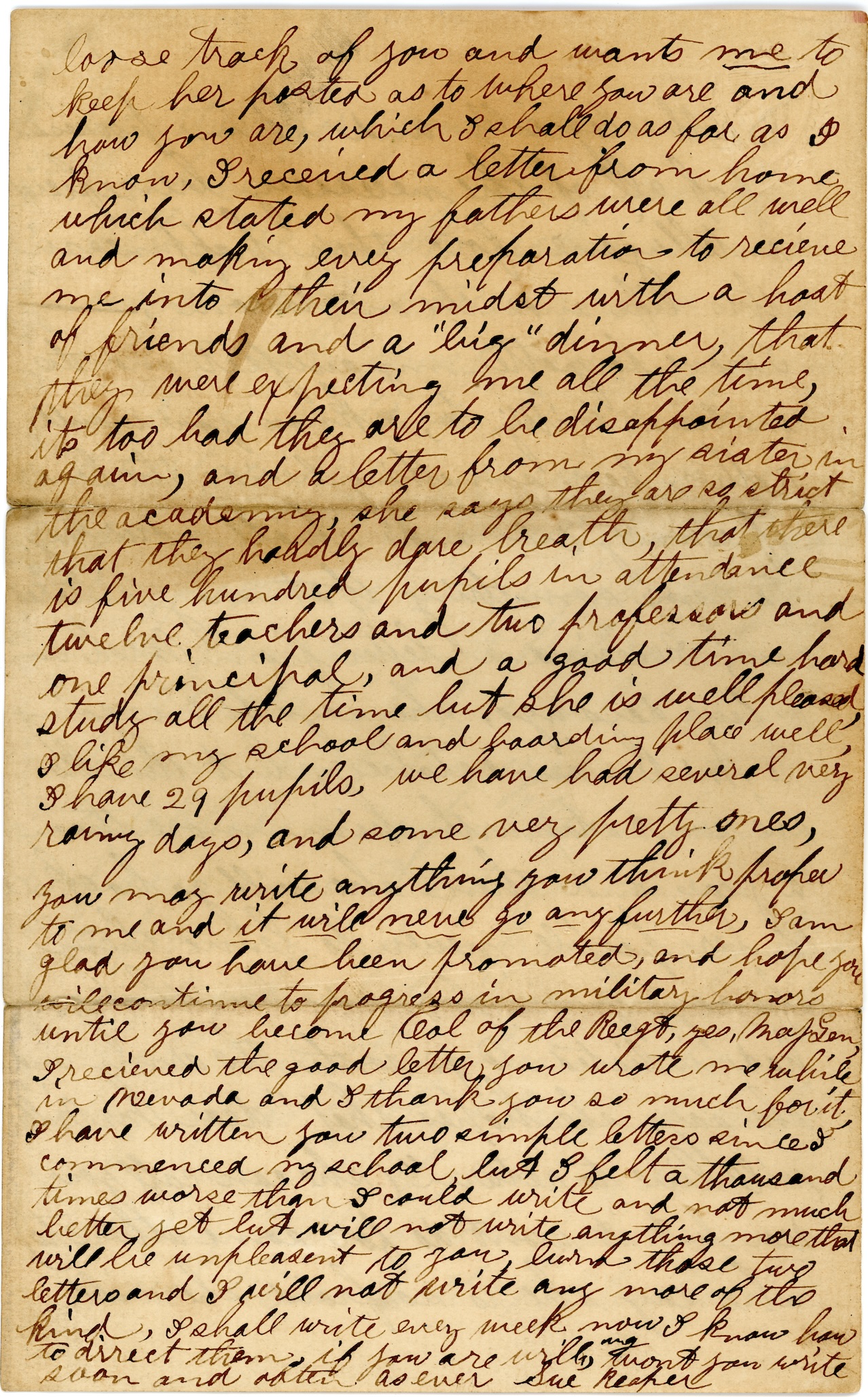
I received a letter from home which stated my father’s [family] were all well and making every preparation to receive me into their midst with a host of friends and a “big” dinner [and] that they were expecting me all the time. It’s too bad they are to be disappointed again. And [I also received] a letter from my sister in the academy. She says they are so strict that they hardly dare breathe [and] that there is five hundred pupils in attendance, twelve teachers, and two professors, and one principal, and a good time hard study all the time. But she is well pleased. I like my school and boarding place well. I have 29 pupils. We have had several very rainy days and some very pretty ones.
You may write anything you think proper to me and it will never go any further. I am glad you have been promoted and hope you will continue to progress in military honors until you become Colonel of the regiment—yes, Major General. I received the good letter you wrote me while in Nevada and I thank you so much for it. I have written you two simple letters since I commenced my school but I felt a thousand times worse than I could write and not much better yet but will not write anything more than wil be unpleasant to you. Burn those two letters and I will not write any more of the kind. I shall write every week now [that] I know how to direct them. If you are well, won’t you write soon and often? As ever, — Sue Reaper
Letter 2
Nevada, Iowa
October 29, 1862
Mr. J. G. Miller
[Camp Franklin]
Dubuque, Iowa
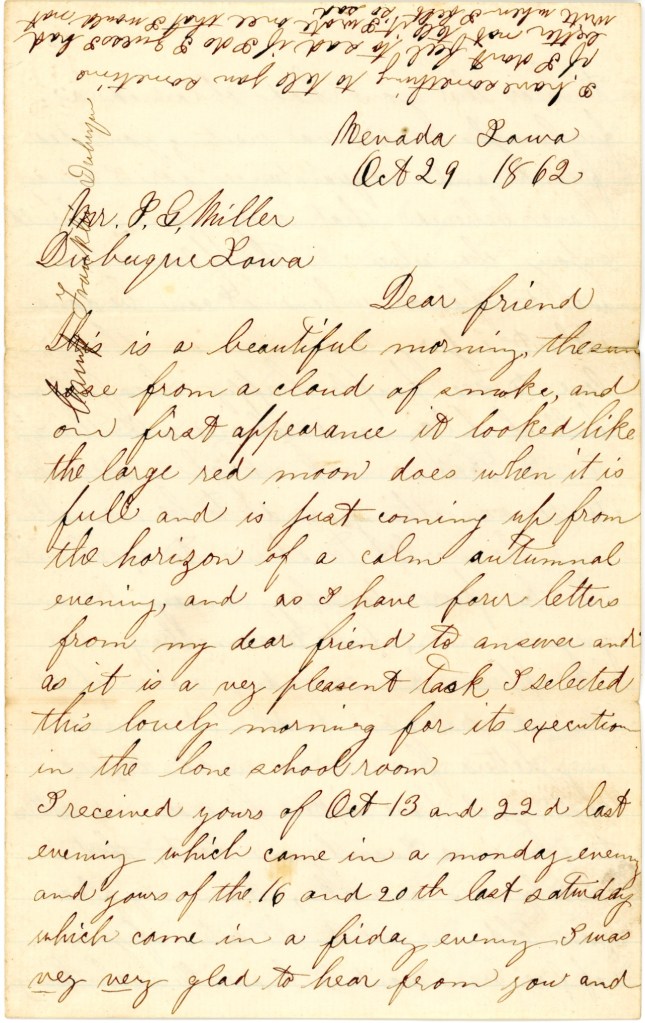
Dear friend. This is a beautiful morning. The sun rose from a cloud of smoke and on first appearance it looked like the large red moon does when it is full and is just coming up from the horizon of a calm autumnal evening. And as I have four letters from my dear friend to answer and as it is is a very pleasant task, I selected this lovely morning for its execution in the lone schoolroom.
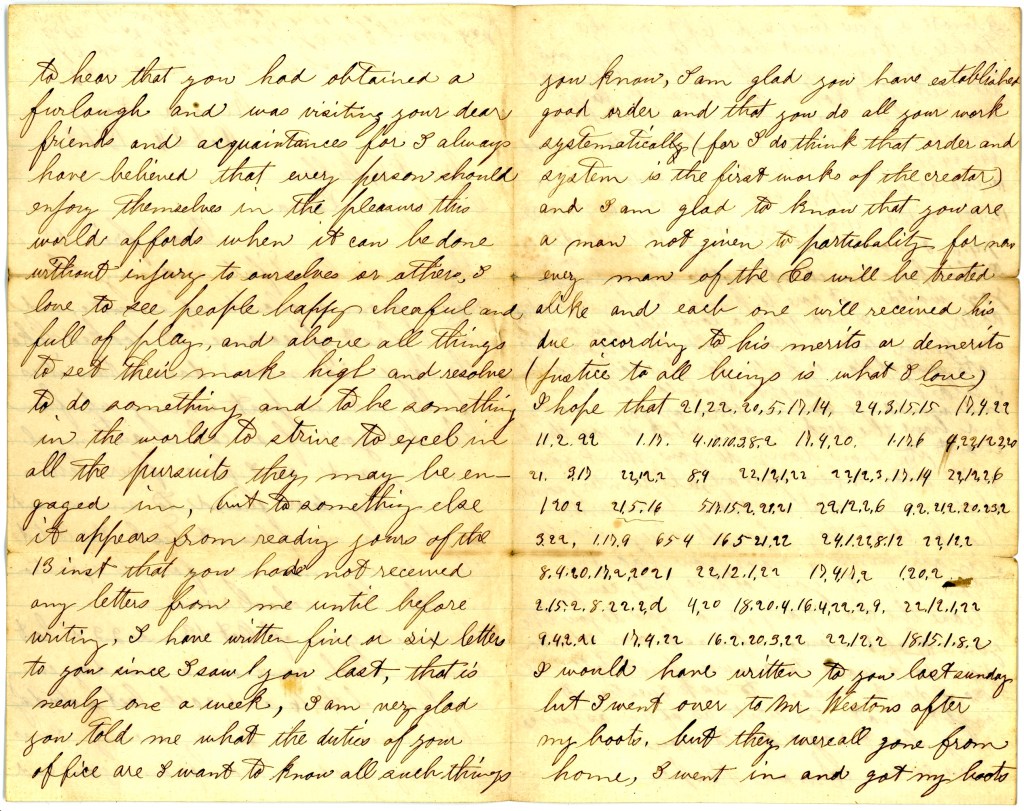
I received youys of October 13th and 22nd last evening which came in a Monday evening and yours of the 16th and 20th last Saturday which came in a Friday evening. I was very, very glad to hear from you and to hear that you had obtained a furlough and was visiting your dear friends and acquaintances for I always have believed that every person should enjoy themselves in the pleasures this world affords when it can be done without injury to ourselves or others. I love to see people happy, cheerful and full of play. And above all things, to set their mark high and resolve to do something and to be something in the world; to strive to excel in all the pursuits they may be engaged in.
But to something else. It appears from reading yours of the 13th inst. that you had not received any letters from me until before writing. I have written five or six letters to you since I saw you last. That is nearly one a week. I am very glad you told me what the duties of your office are. I want to know all such things you know. I am glad you have established good order and that you do all your work systematically (for I do think that order and system is the first works of the creator) and I am glad to know that you are a man not given to partiability for now every man of the company will be treated alike and each one will receive his due according to his merits or demerits (justice to all beings is what I love).
I hope that [21, 22, 20, 5, 17, 14] [24, 3, 15, 15] [17, 4, 22] [11, 2, 22] [1, 17] [4, 10, 10, 3, 8, 2] [17, 4, 20] [1,17, 6] [4, 22, 12, 2. 20, 21] [3, 17] [22, 12,2] [8, 9] [22, 12, 1, 22] [[22, 12, 3, 17,14] [22, 12, 2, 6] [1, 20, 2] [21. 5. 16] [5, 17, 15, 2, 29, 21] [29, 12, 2, 6] [9, 2, 21, 2, 20, 23.2] [3, 22] [1, 17, 9] [6, 5, 4] [16, 5, 21, 22] [17, 4, 17, 9] [1, 20, 2] [2, 15, 2, 8, 22, 2, 9] [4, 20] [18, 20, 4, 16, 4, 22, 2, 9] [11, 12, 1, 22] [9, 4, 2, 21] [17, 4, 22] [16, 2, 20, 3, 22] [22, 12, 2] [18, 15, 1, 8, 2]
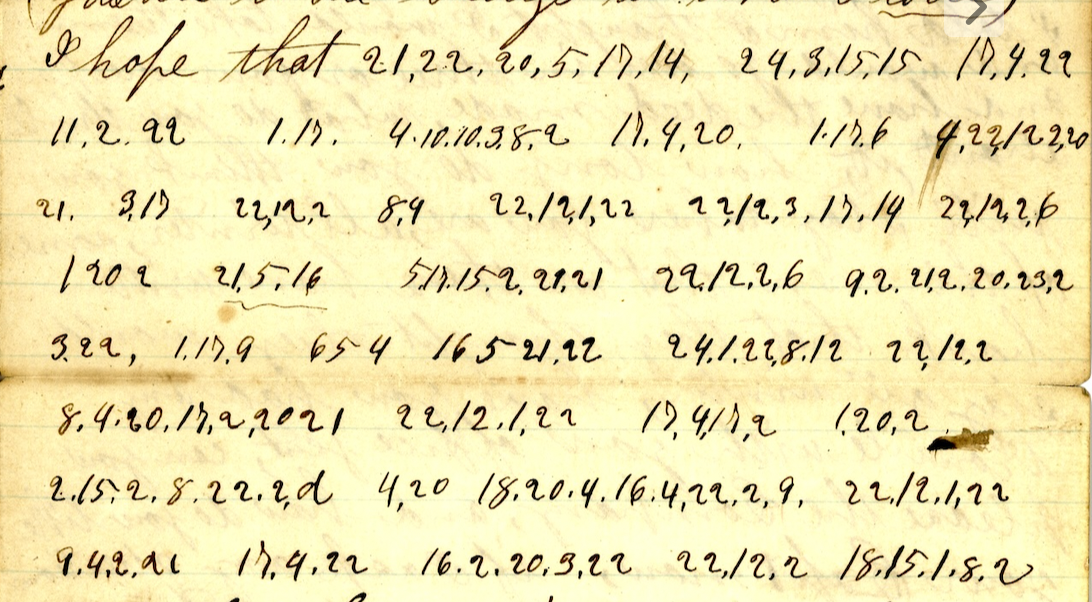
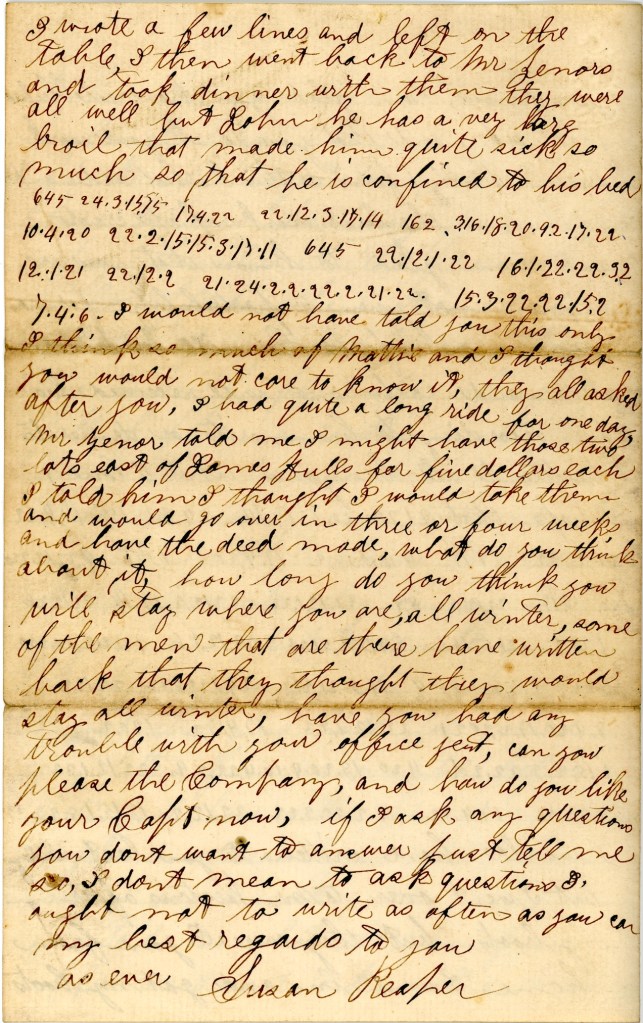
I would have written to you last Sunday but I went over to Mr. Weston’s after my boots but they were all gone from home. I went in and got my boots. I wrote a few lines and left on the table. I then went back to Mr. Zenor’s and took dinner with them. They were all well but John. He has a very large boil that made him quite sick—so much so that he is confined to his bed. [More code]
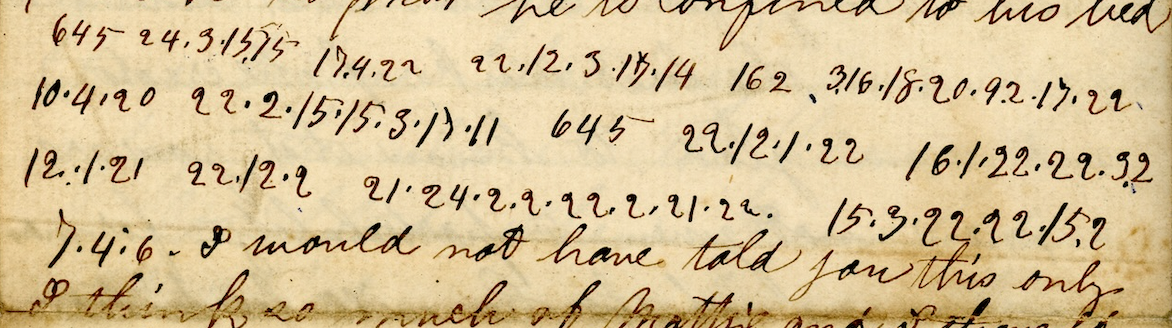
I should not have told you this only I think so much of Mattie and I thought you would not care to know it. They all asked after you. I had quite a long ride for one day. Mr. Zenor told me I might have those two lots east of James Hull’s for five dollars each. I told him I thought I would take them and would go over in three or four weeks and have the deed made. What do you think about it?
How long do you think you will stay where you are. All winter? Some of the men that are there have written back that they thought they would stay all winter. Have you had any trouble with your office yet? Can you please the company? And how do you like your captain now? If I ask any questions you don’t want to answer, just tell me so. I don’t mean to ask questions. I ought not to write as often as can. My best regards to you. As ever, — Susan Reaper
I have something to tell you sometime if I don’t feel too sad if I do. I guess I had better not tell it. I wrote once that I would not write when I felt so sad.

Letter 3
Benton, Arkansas
November 29th 1863
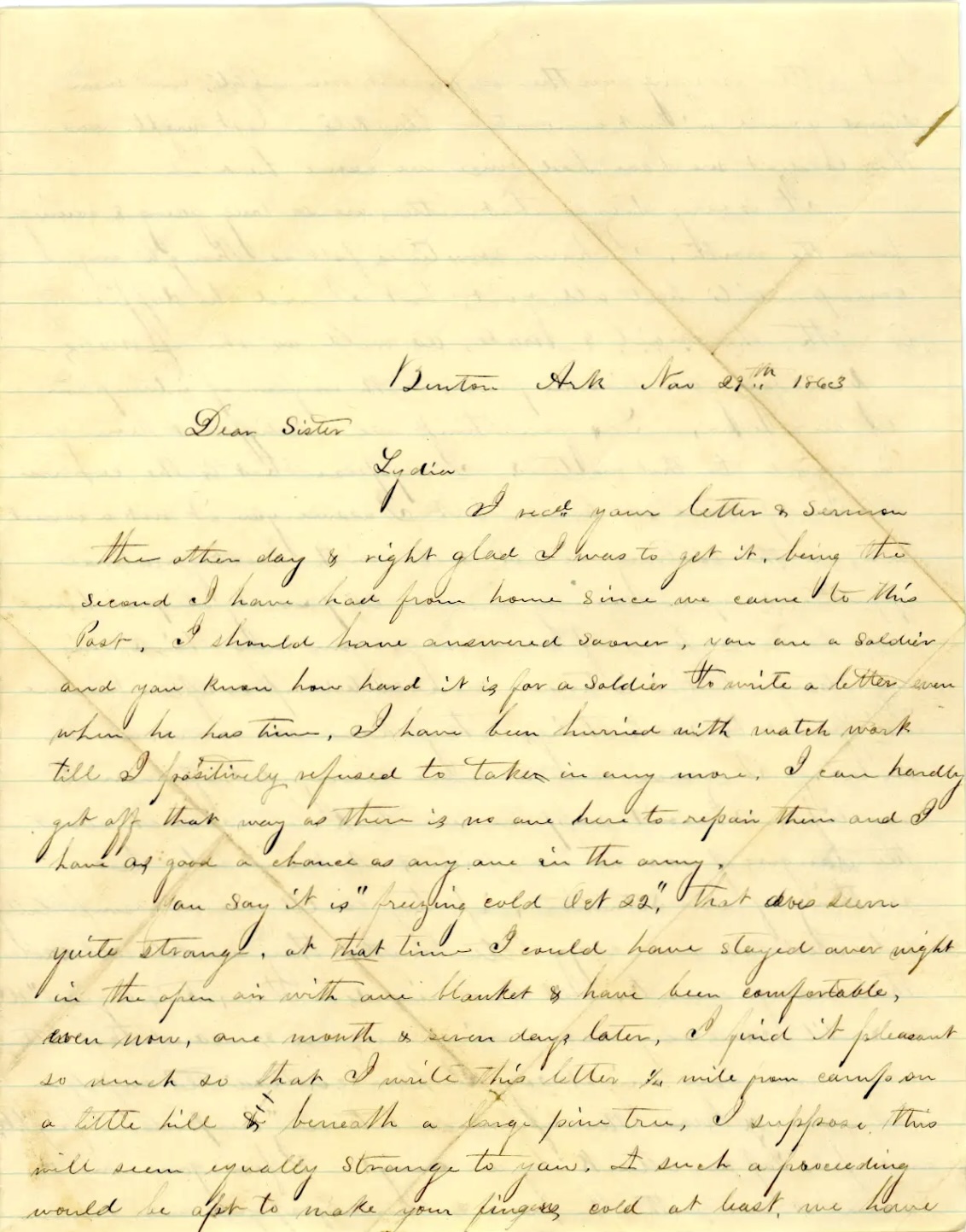
Dear Sister Lydia,
I received your letter & sermon the other day & right glad I was to get it, being the second I have had from home since we came to this post. I should have answered sooner. You are a soldier and you know how hard it is for a soldier to write a letter even when he has time. I have been hurried with watch work till I positively refused to take in any more. I can hardly get off that was as there is no one here to repair them and I have as good a chance as anyone in the army.
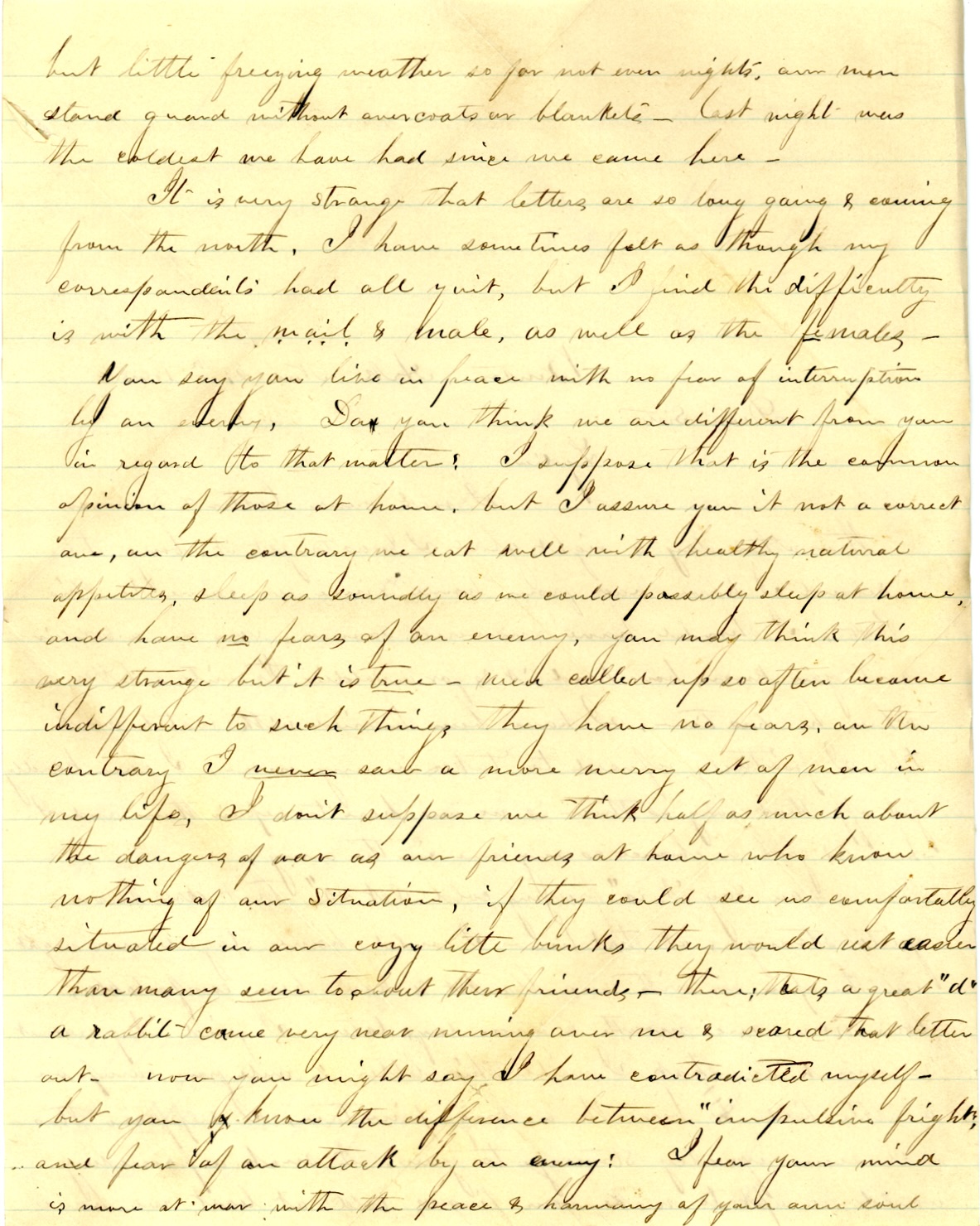
You say it is “freezing cold October 22.” That does seem quite strange at that time. I could have stayed over noght in the open air with one blanket & have been comfortable, even now, one month & seven days later, I find it pleasant—so much so that I will write this letter one quarter mile from camp on a little hill & beneath a large pine tree. I suppose this will seem equally strange to you. Such a proceeding would be apt to make your fingers cold at least. We have but little freezing weather so far—not even nights. Our men stand guard without overcoats or blankets. Last night was the coldest we have had since we came here.
It is very strange that letters are so long going & coming from the North. I have sometimes felt like my correspondents had all quit, but I find the difficulty is with the mail & male, as well as the females.
You say you live in peace with no fear of interruption by an enemy. Do you think we are different from you in regard to this matter? I suppose that is the common opinion of those at home, but I assure you it’s not a correct one. On the contrary, we eat well with healthy, natural appetites, sleep as soundly as we could possibly sleep at home, and have no fears of any enemy. You may think this very strange but it is true. Men called up so often become indifferent to such things. They have no fears. On the contrary, I never saw a more merry set of men in my life. I don’t suppose we think half as much about the dangers of war as our friends at home who know nothing of our situation. If they could see us comfortably situated in our cozy little bunks, they would reast easier than many seem to about their friends. There; that’s a great “d.” A rabbit came very near running over me & scared that letter out.
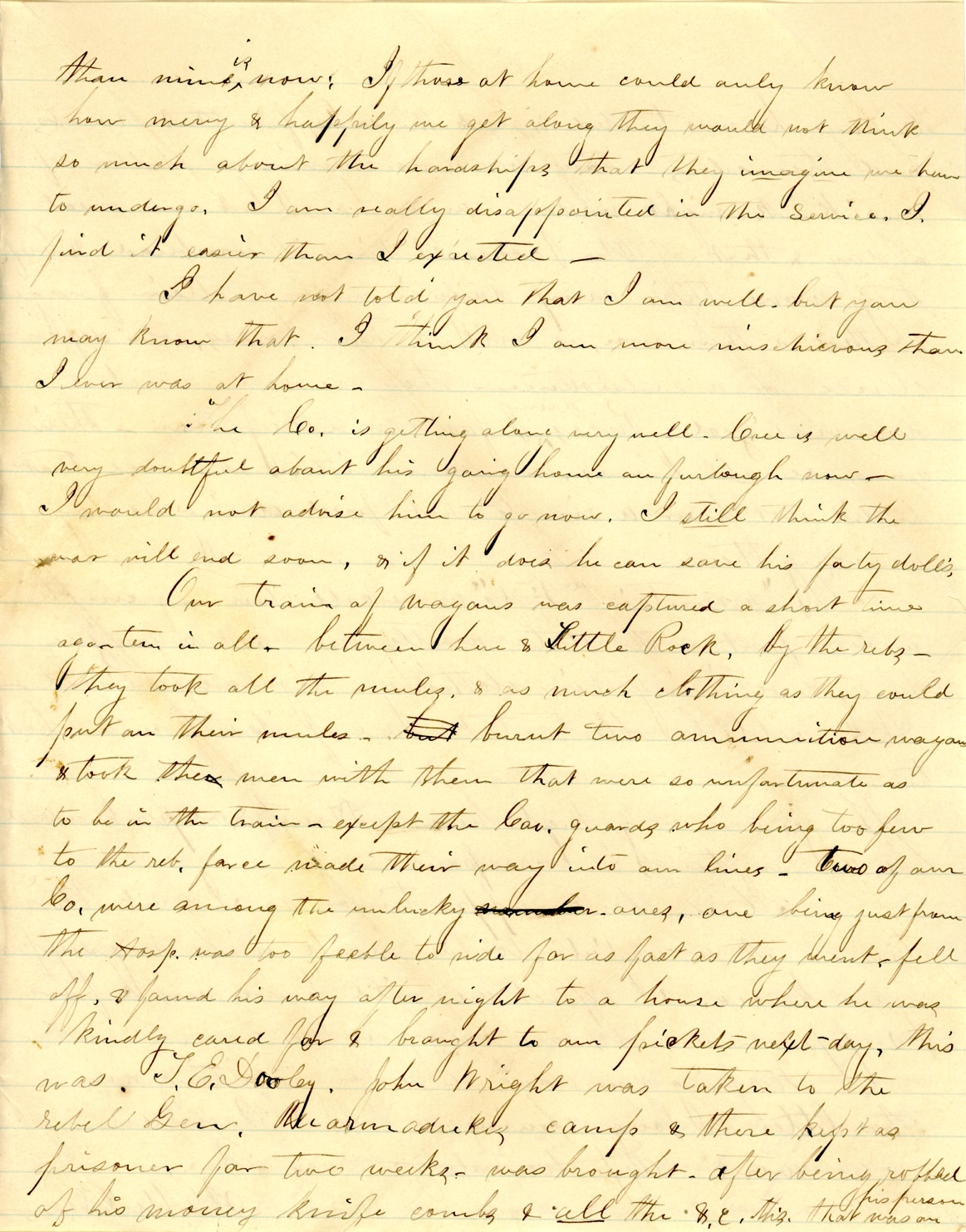
Now you might say I have contradicted myself. But know the difference between “impulsive fright” and fear of an attack by an enemy. I fear your mind is more at war with the peace & harmony of your own soul than mine is now. If those at home could only know how merry & happily we get along, they would not think so much about the hardships that they imagine we have to undergo. I am really disappointed in the service. I find it easier than I expected.
I have not told you that I am well but you may know that. I think I am more mischievous than I ever was at home.
The company is getting along very well. [Stephen Waite] Cree is well. Very doubtful about his going home on furlough now. I should not advise him to go now. I still think the war will end soon & if it does, he can save his party dolls.
Our train of wagons was captured a short time ago—ten in all—between here & Little Rock by the rebs. They took all the mules & as much clothing as they could put on their mules, burnt two ammunition wagons, & took the men with them that were so unfortunate as to be in the train except the Cavalry guards who, being too few to the reb force, made their way into our lines. Two of our company were among the unlucky ones—one being just from the hospital was too feeble to ride for as fast as they went, fell off and found his way after night to a house where he was kindly cared for & brought to our pickets next day. This was T[homas] E. Dooley.
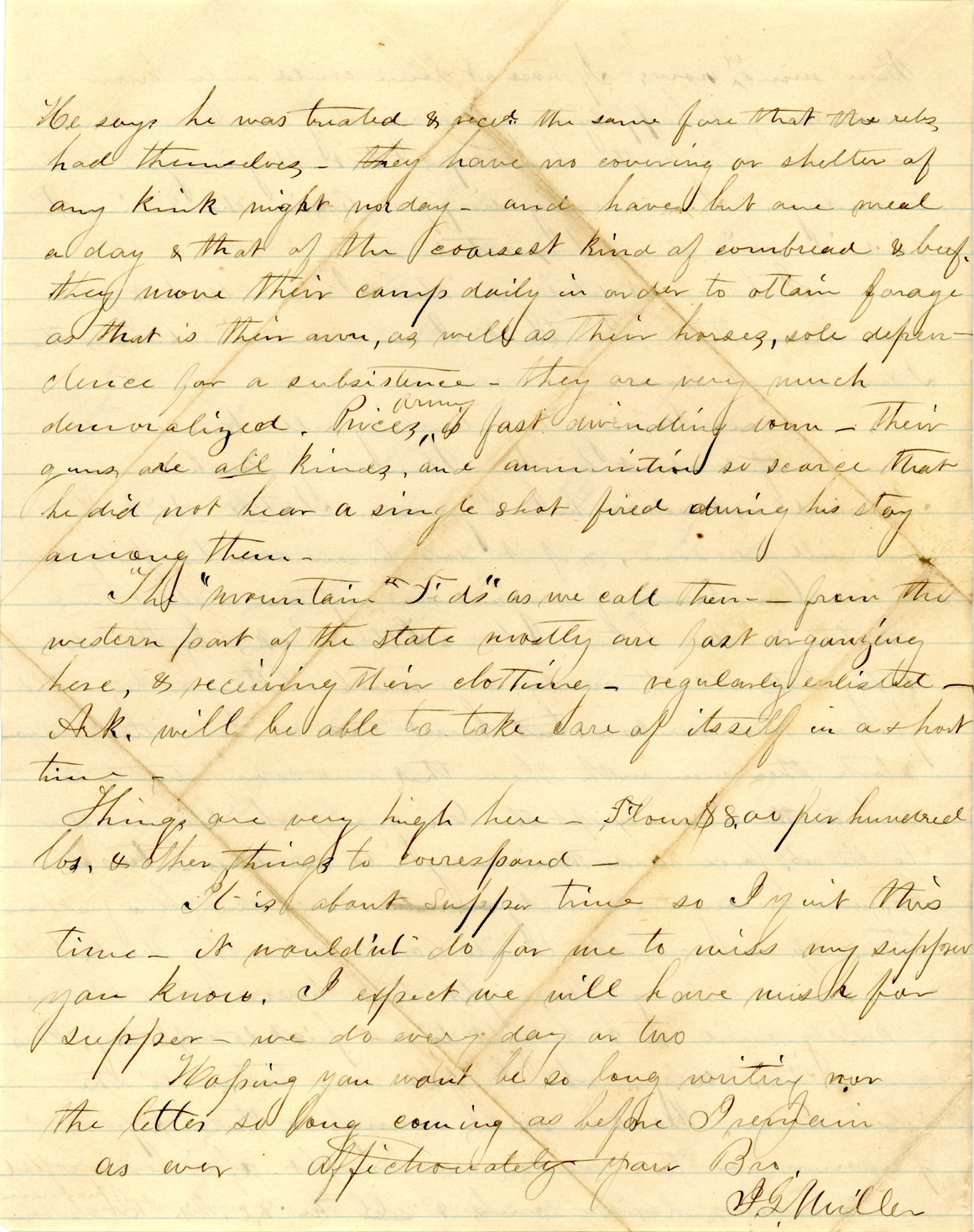
John [E. R.] Wright was taken to the rebel Gen. Marmaduke’s camp & there kept as prisoner for two weeks. Was brought [back] after being robbed of his money, knife, combs, & all the &c. that was on his person. He says he was treated & received the same fare that the rebs had themselves. They have no covering or shelter of any kind, night or day, and have but one meal a day & that of the coarsest kind of cornbread & beef. They move their camp daily in order to obtain forage as that is their own, as well as their horses, sole dependence for a subsistence. They are very much demoralized. Price’s army is fast dwindling down. Their guns are all kinds and ammunition so scarce that he did not hear a single shot fired during his stay among them.
The “Mountain Feds” as we call them, from the western part of the state, mostly are fast organizing here & receiving their clothing—regularly enlisted. Arkansas will be able to take care of itself in a short time.
Things are very high here. Flour $8 per hundred lbs. & other things to correspond. It is about supper time so I quit this time. It wouldn’t do for me to miss my supper, you know. I expect we will have mush for supper. We do every day or two.
Hoping you won’t be so long writing nor the letter so long coming as before. I remain as ever, affectionately your brother, — J. G. Miller
Letter 4
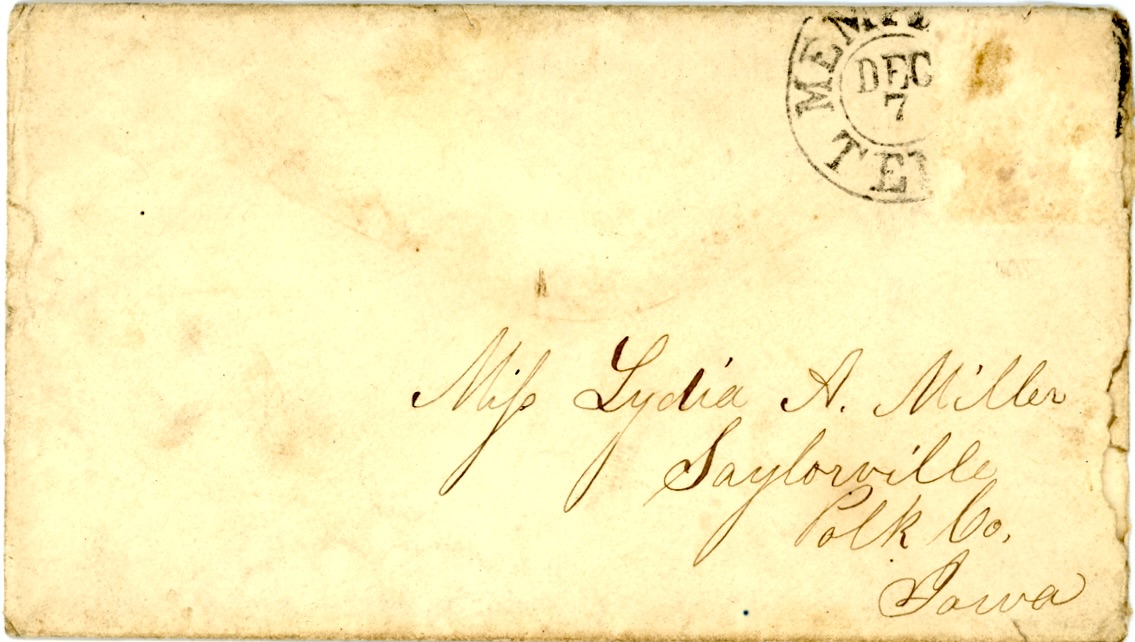
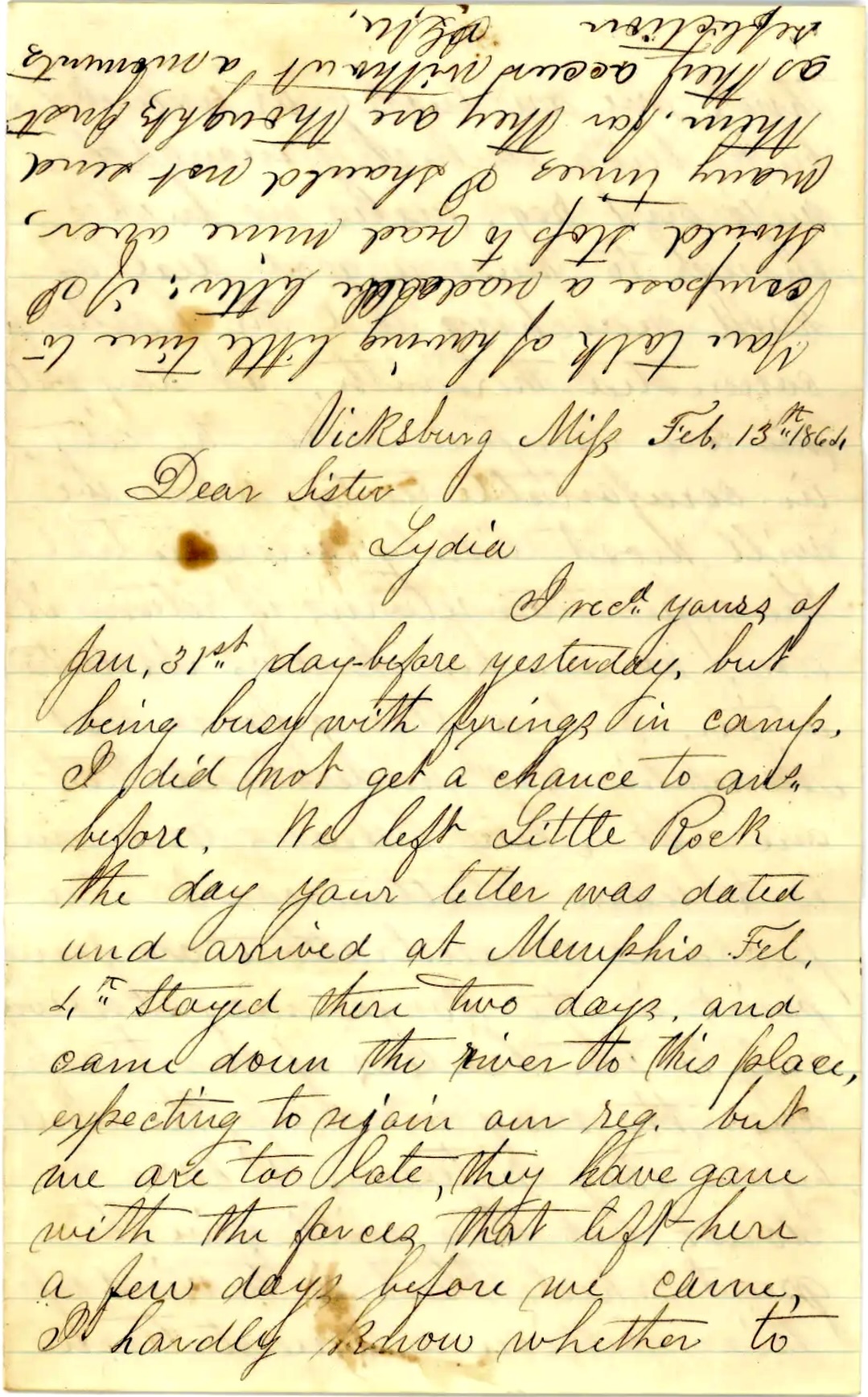
Vicksburg, Mississippi
February 13, 1864
Dear Sister Lydia,
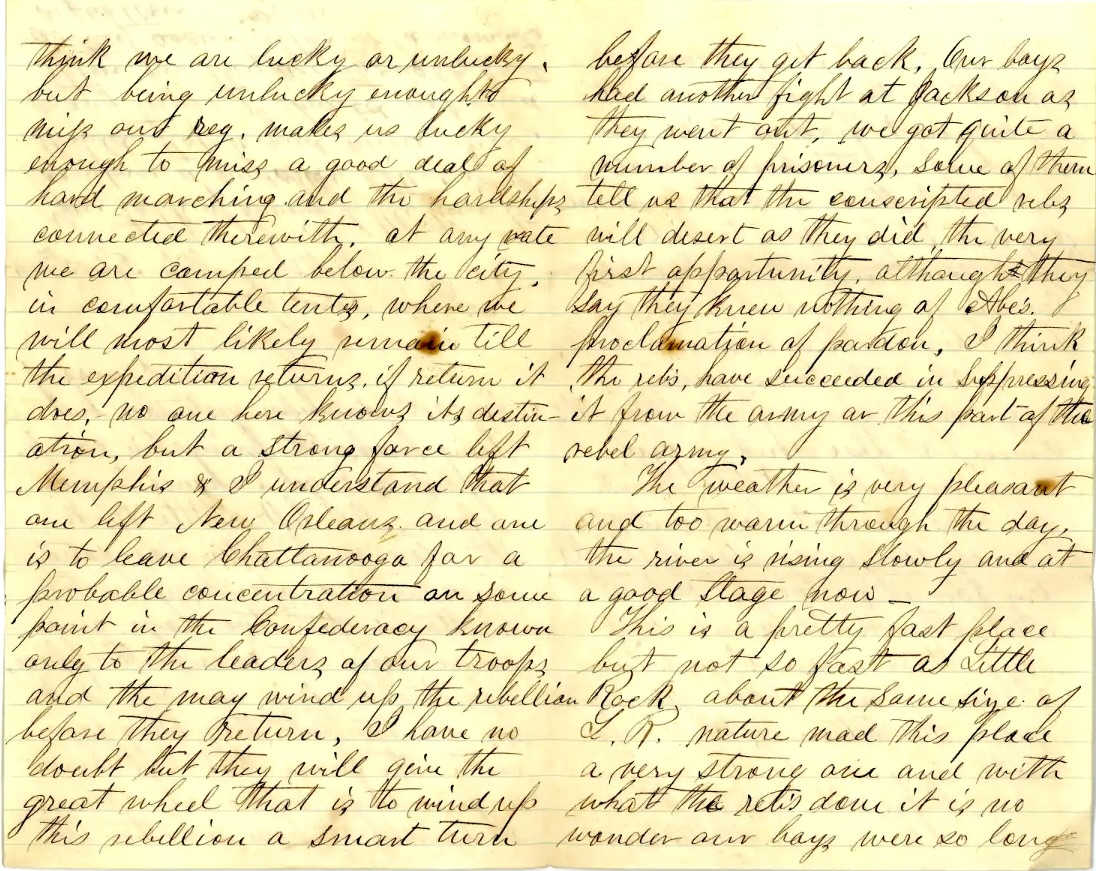
I received yours of January 31st day before yesterday, but being busy with fixings in camp, I did not get a chance to answer before. We left Little Rock the day your letter wasdated and arrived at Memphis February 4th. Stayed there two days and came down the river to this place expecting to rejoin our regiment but we are too late. They have gone with the forces that left here a few days before we came. I hardly know whether to think we are lucky or unlucky, but being unlucky enough to miss our regiment makes us lucky enough to miss a good deal of hard marching and the hardships connected with it.
At any rate, we are camped below the city in comfortable tents where we will mosly likely remain till the expedition returns—if return it does. No one here knows its destination but a strong force left Memphis & I understand than one left New Orleans and one is to leave Chattanooga for a probable concentration on some point in the Confederacy known only to the leaders of our troops and they may wind up the rebellion before they return. I have no doubt but they will give the great wheel that is to wind up this rebellion a smart turn before they get back.
Our boys had another fight at Jackson as they went out. We got quite a number of prisoners. Some of them tell us that the conscripted rebs will desert as they did the very first opportunity although they say they knew nothing of Abe’s proclamation of pardon. I think the rebs have succeeded in suppressing it from the army or [at least] this part of the rebel army.
The weather is very pleasant and too warm through the day. The river is rising slowly and at a good stage now.
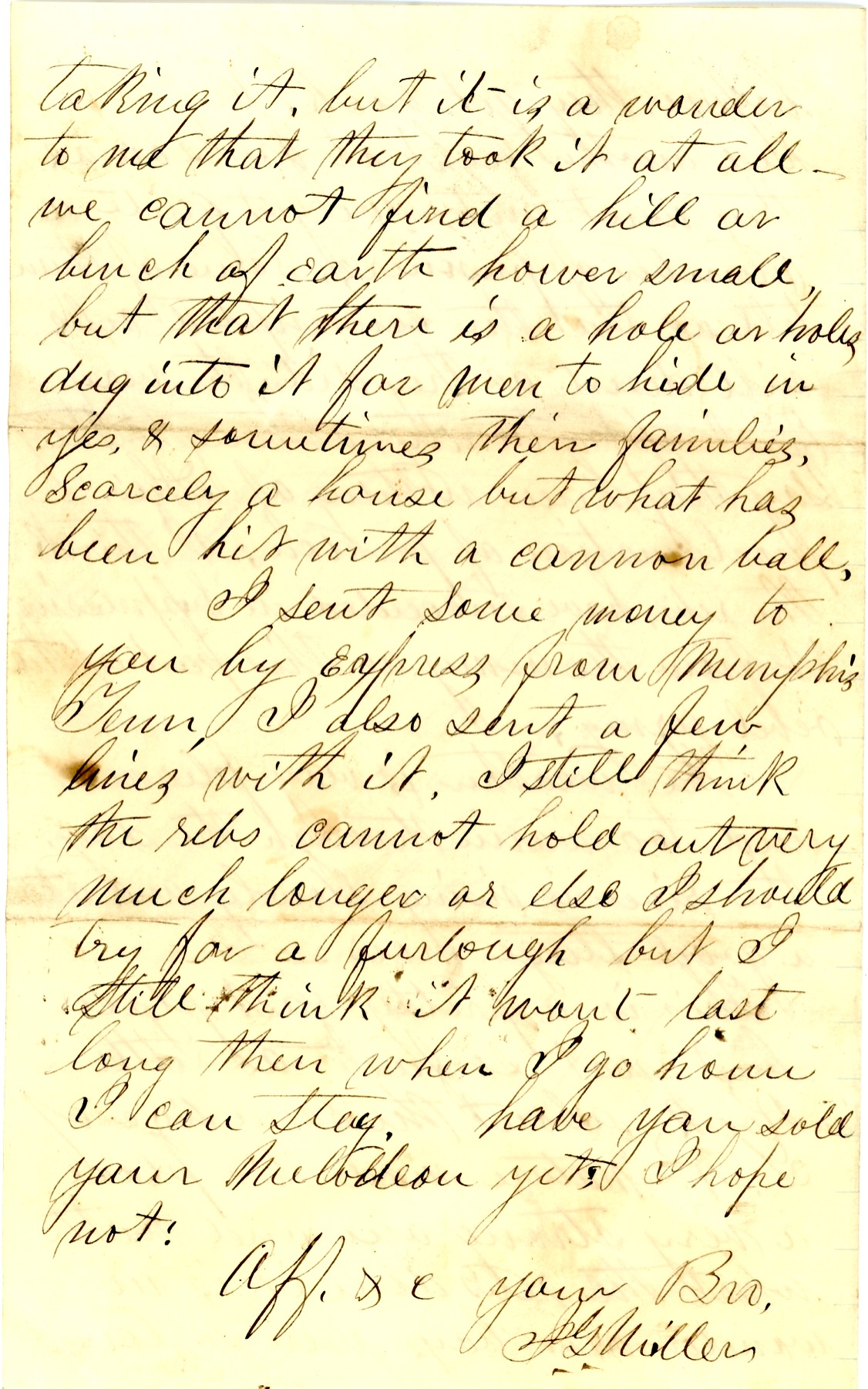
This is a pretty fast place but not so fast as Little Rock—about the same size of Little Rock. Nature made this place a very strong one and with what the rebs done, it is no wonder our boys were so long taking it. But it is a wonder to me that they took it at all. We cannot find a hill or bench of earth however small but that there is a hole or holes dug into it for men to hide in—yes, & sometimes their families. Scarecely a house but what has been hit with a cannon ball.
I sent some money to you by Express from Memphis, Tennesee. I also sent a few lines with it. I still think the rebs cannot hold out very much longer or else I should try for a furlough. But I still think it won’t last long. Then when I go home, I can stay. Have you sold your melodeon yet? I hope not. Affectionately your brother, — J. G. Miller
You talk of having little time to compose a readable letter. If I should stop to read mine over many times, I should not send them for they are thoughts just as they occur without a moment’s reflection. — J. G. M.
Letter 5
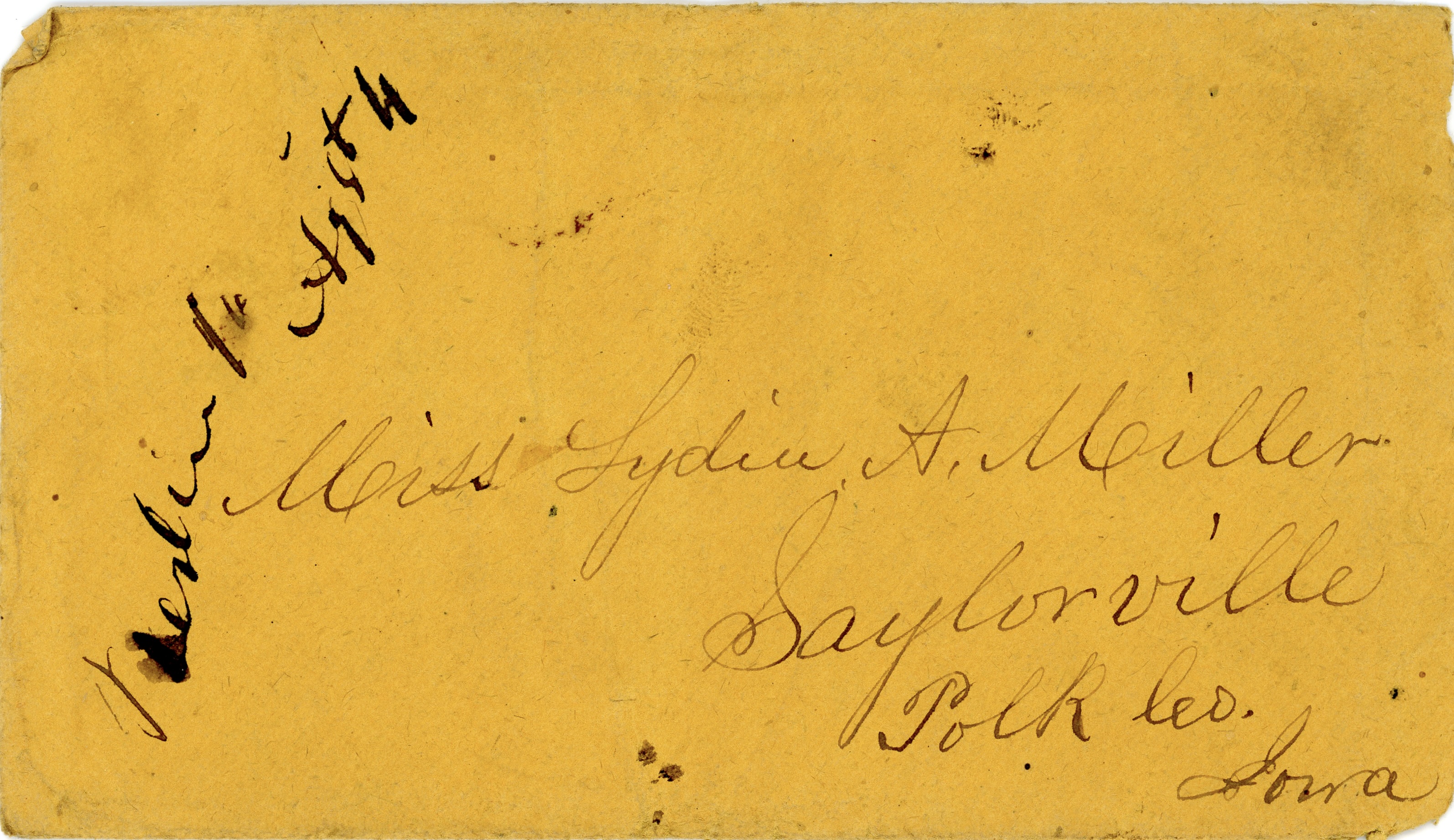
Berlin, Hardin county, Iowa
August 3rd 1865
Miss Lydia A. Miller,
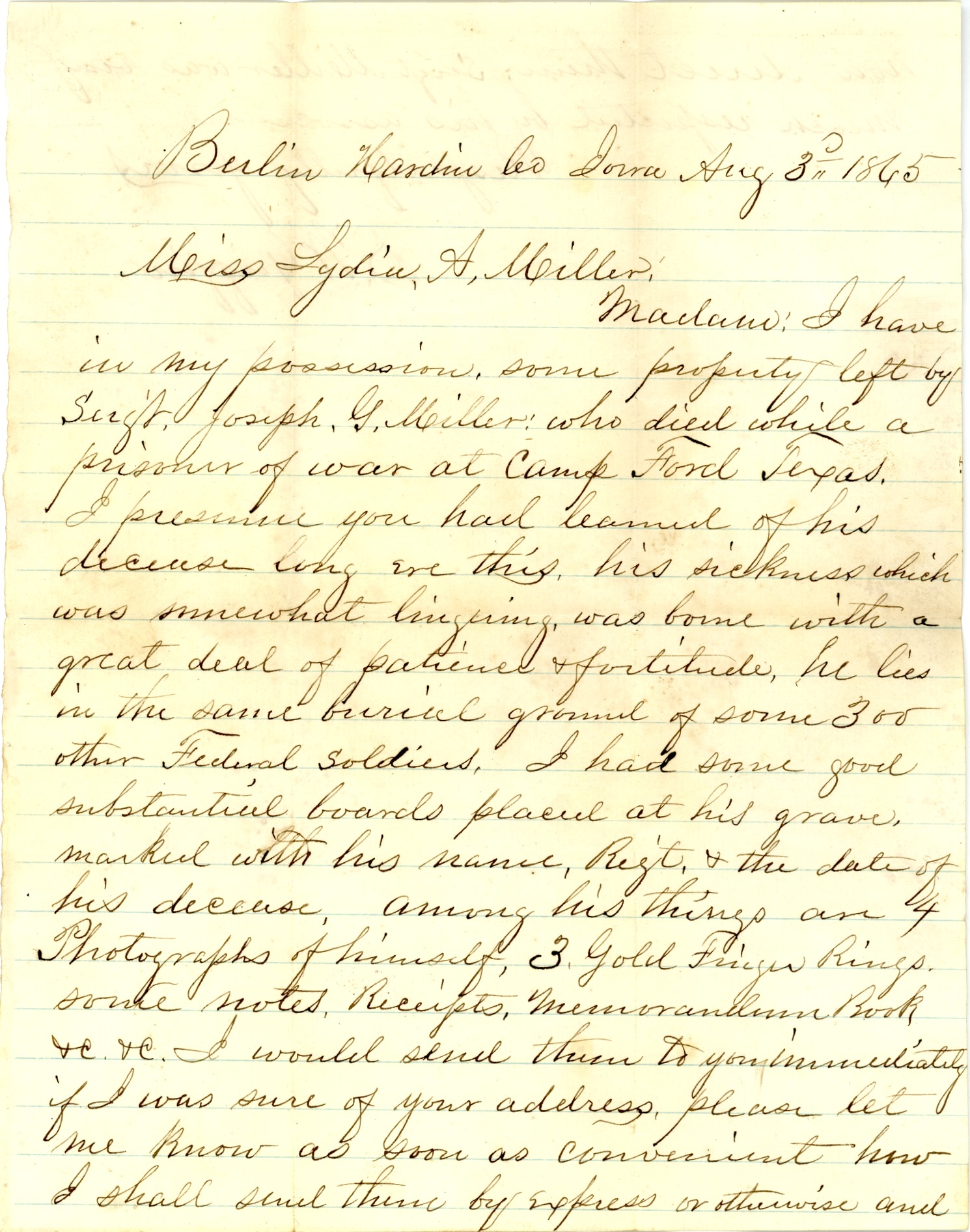
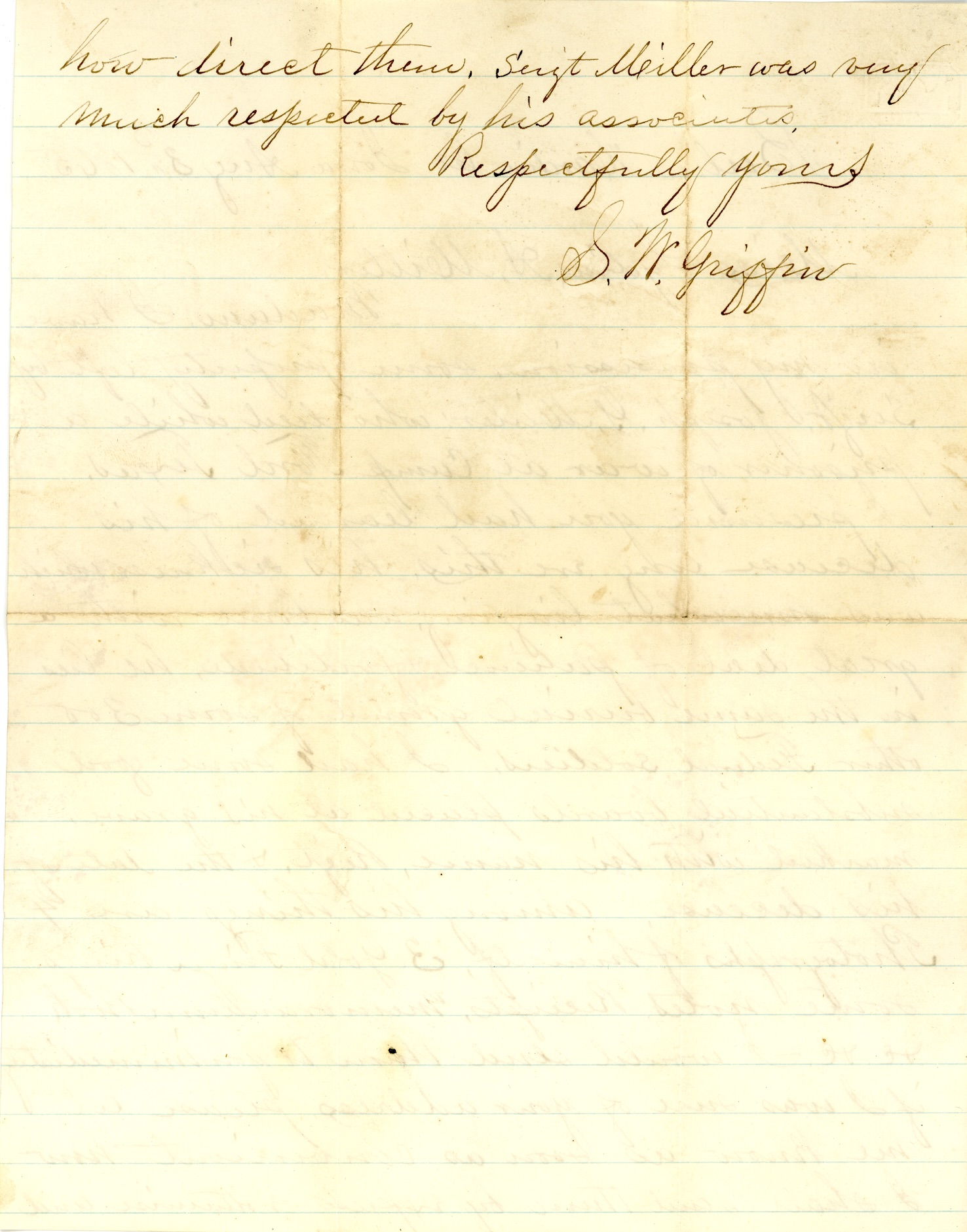
Madam, I have in my possession some property left by Sergt. Joseph G. Miller who died while a prisoner of war at Camp Ford, Texas. I presume you had learned of his decease long ‘ere this. His sickness which was somewhat lingering, was borne with a great deal of patience & fortitude. He lies in the same burial ground of some 300 other Federal soldiers. I had some good substantial boards placed at his grave, marked with his name, regiment, and the date of his decease. Among his things are four photographs of himself, three gold finger rings, some notes, receipts, Memorandum Book, &c. &c. I would send them to you immediately if I was sure of your address. Please let me know as soon as convenient how I shall send them—by Express or otherwise, and how to direct them. Sergt. Miller was very much respected by his associates.
Respectfully yours, — S. W. Griffin
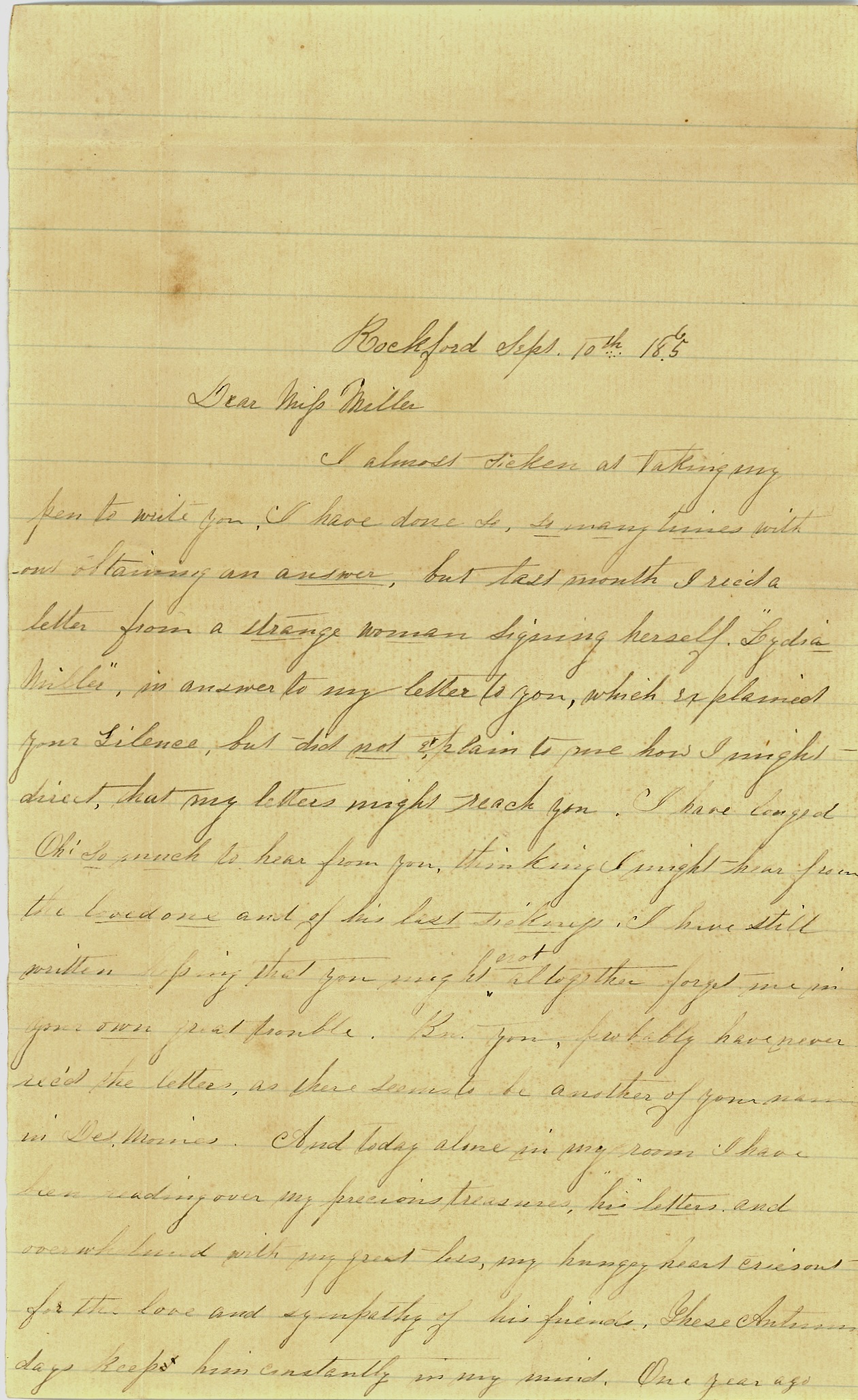
Letter 6
Rockford
September 10th, 1865
Dear Miss Miller,
I almost sicken at taking my pen to write you. I have done so so many times without obtaining an answer. But last month I received a letter from a strange woman signing herself “Lydia Miller” in answer to my letter to you, which explained your silence, but did not explain to me how I might direct that my letters might reach you.
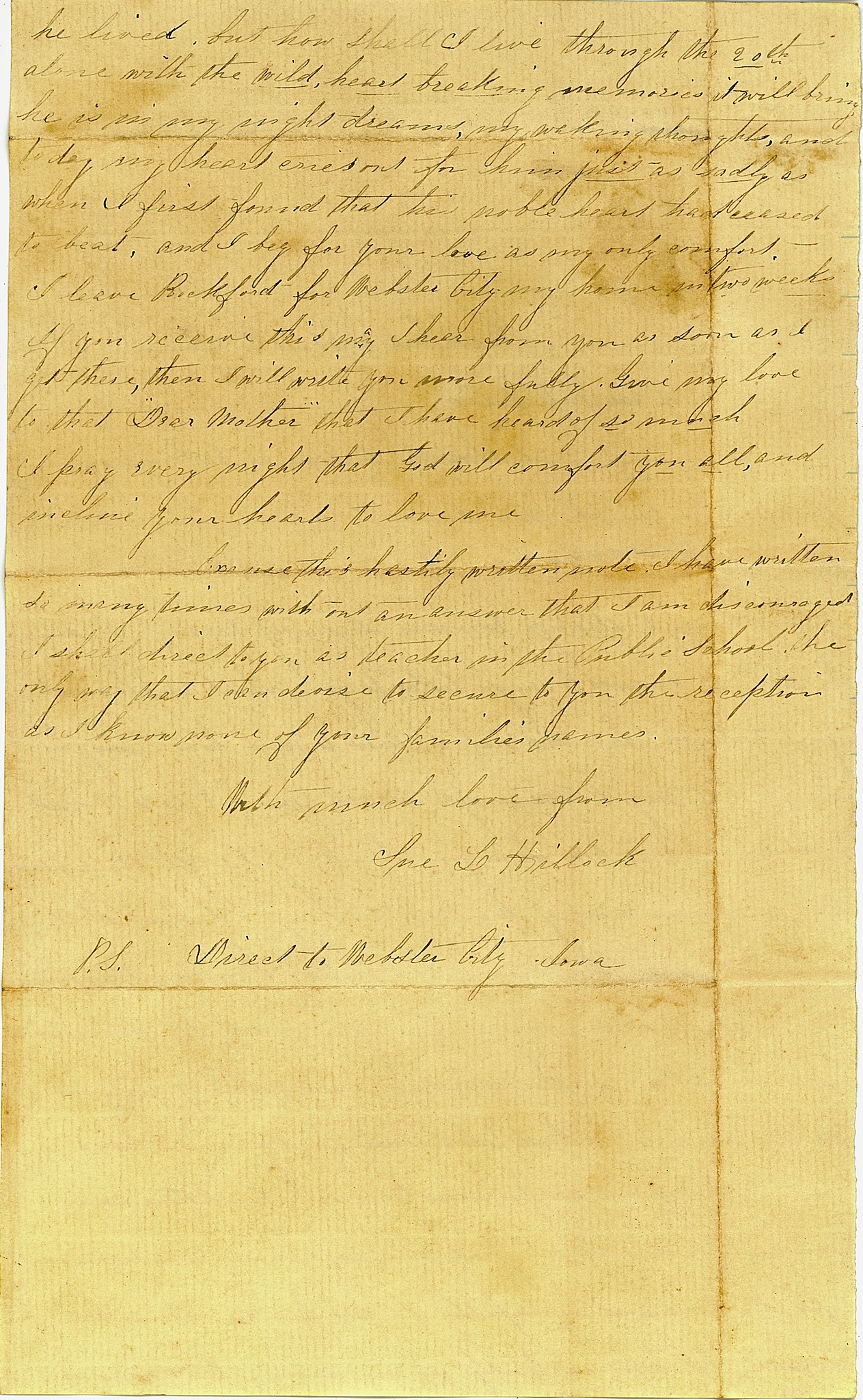
I have longed Oh! so much to hear from you, thinking I might hear from the loved one and of his last sickness. I have still written hoping that you might not altogether forget me in your own great trouble. But you probably have never received the letters as there seems to be another of your name in Des Moines. And today alone in my room, I have been reading over my precious treasures—his letters—and who lived with my great loss, my hungry heart cries out for the love and sympathy of his friends. These Autumn days keep him constantly in my mind. One year ago he lived, but how shall I live through the 20th alone with the wild, heart-breaking memories it will bring. He is in my night dreams, my waking thoughts and today my heart cries out for him just as sadly as when I first found that his noble heart had ceased to beat. And I beg for your love as my only comfort.
I leave Rockford for Webster City, my home, in two weeks. If you receive this, may I hear from you as soon as I get there? Then I will write you more fully. Give my love to that dear Mother that I have heard of so much. I pray every night that God will comfort you all and incline your hearts to love me.
Excuse this hastily written note. I have written so many times without an answer that I am discouraged. I shall direct to you as teach in the public schools—the only way I can devise to secure to you the reception as I know none of your family’s names. With much love, from —Sue L. Hillock
P. S. Direct to Webster City, Iowa