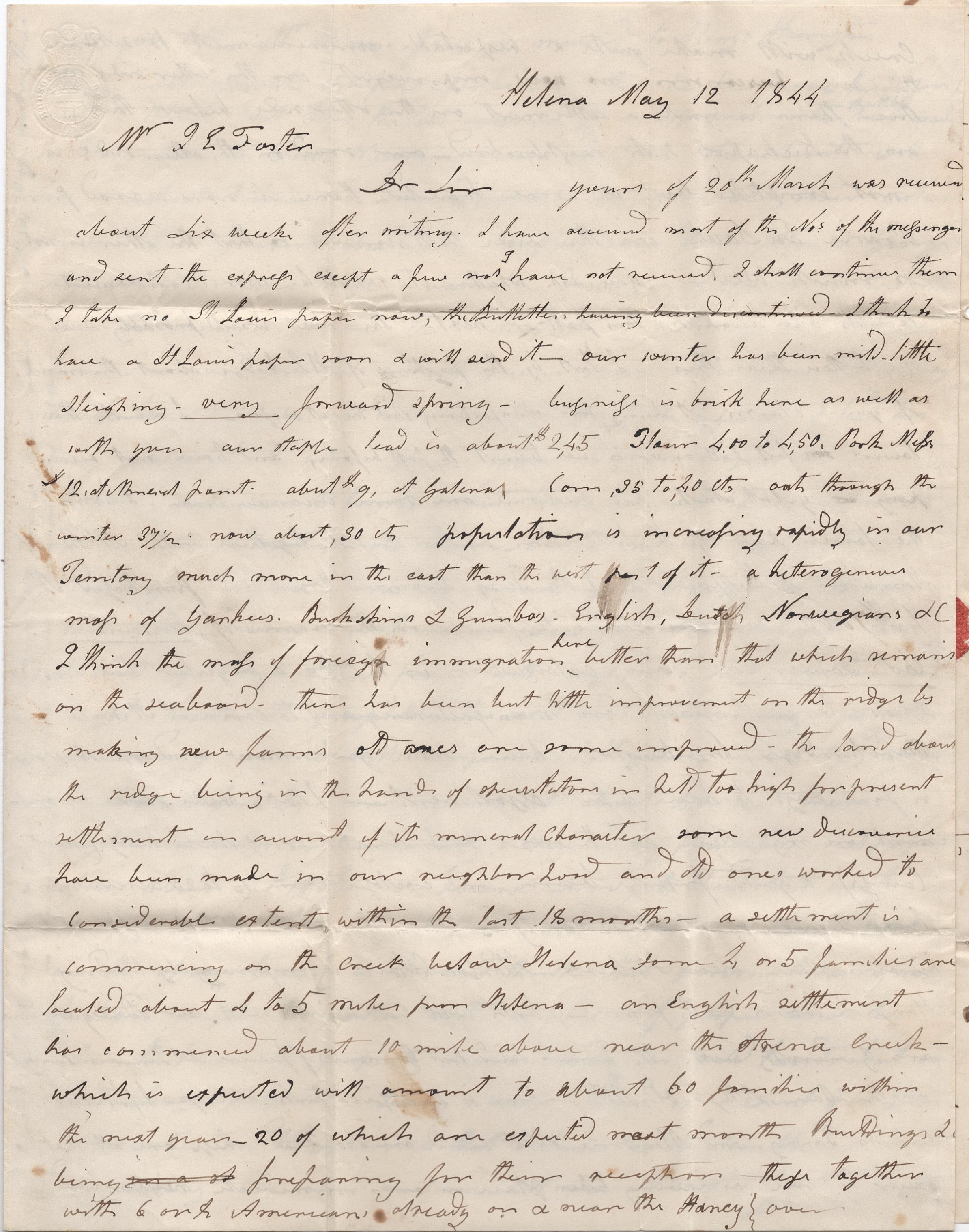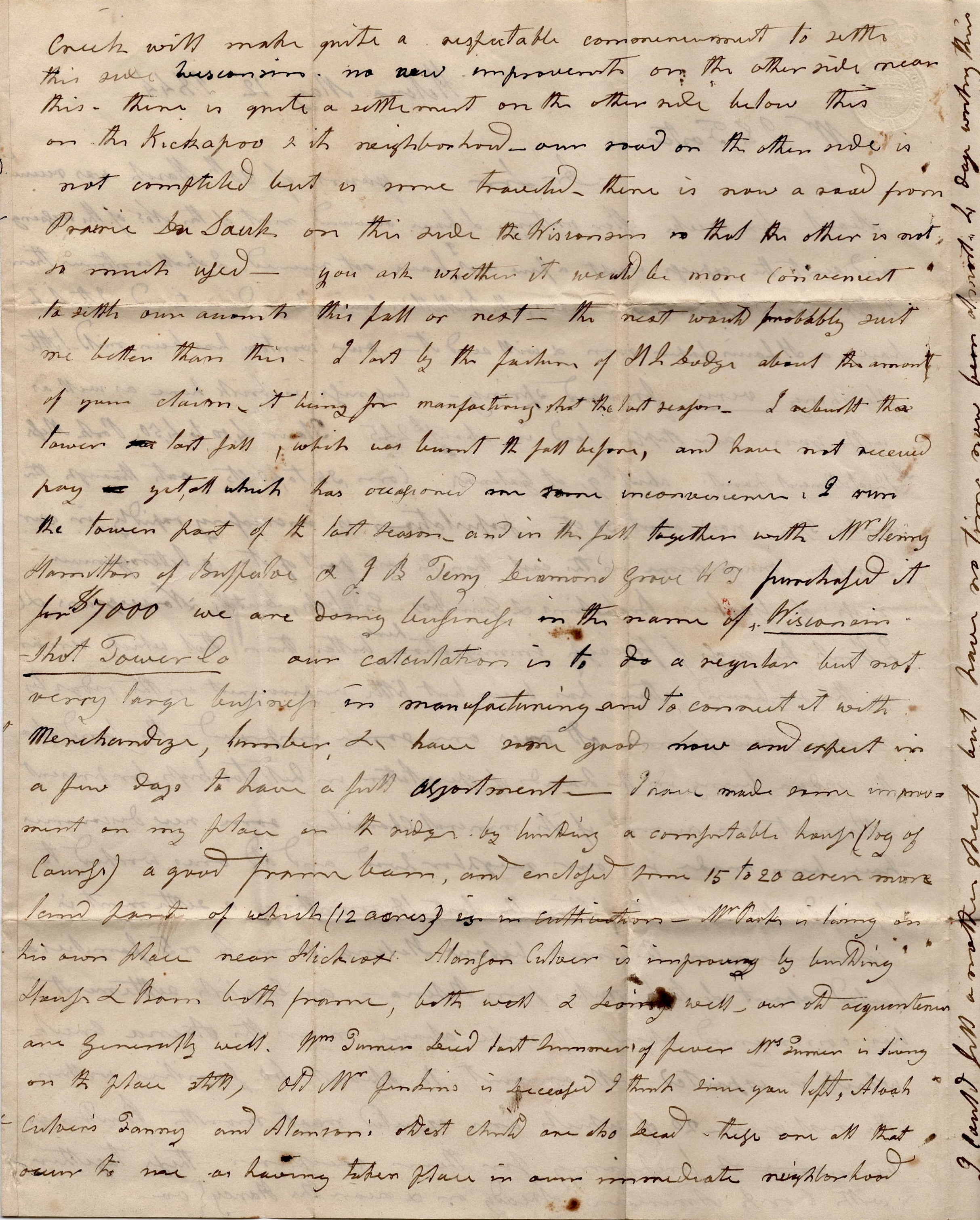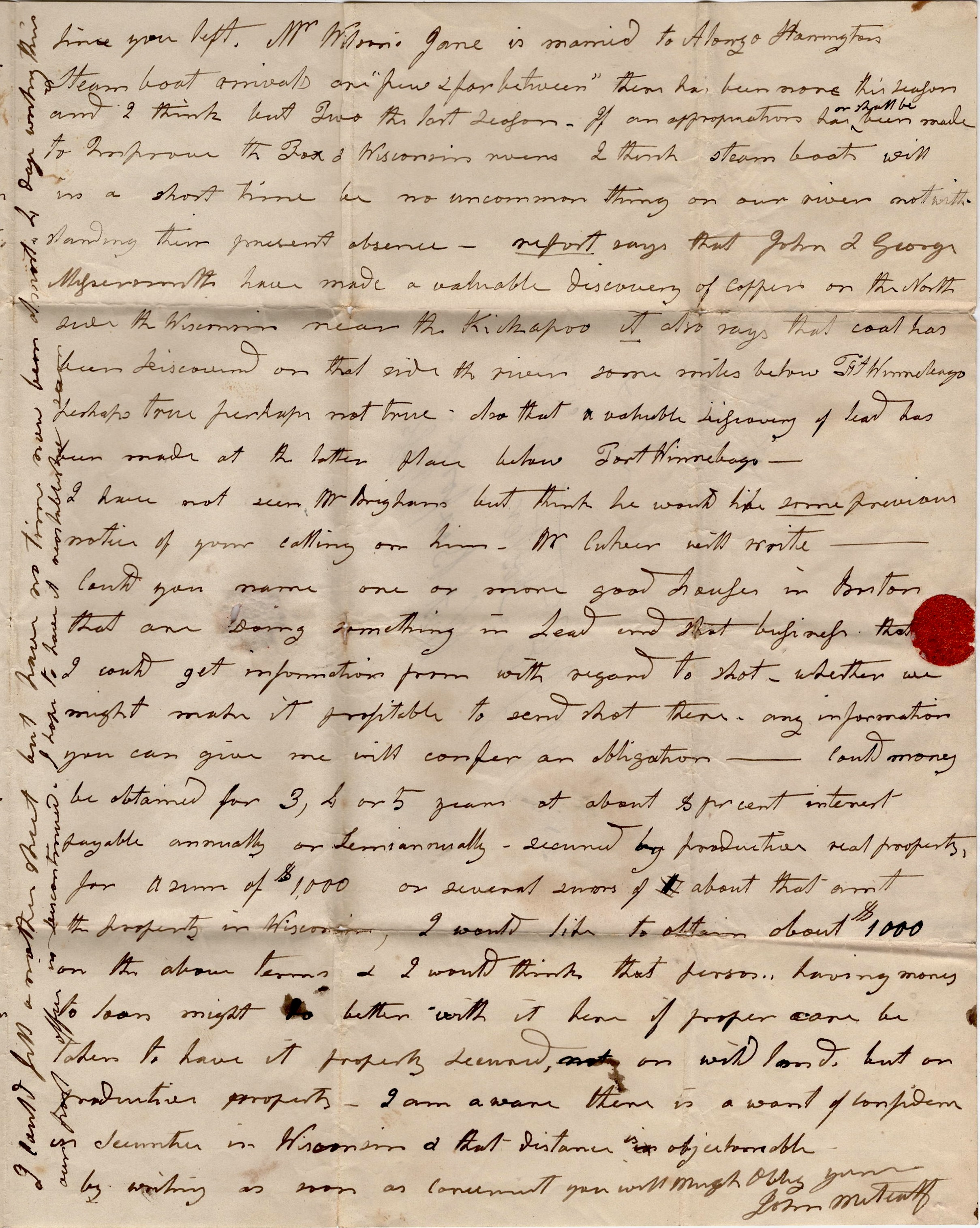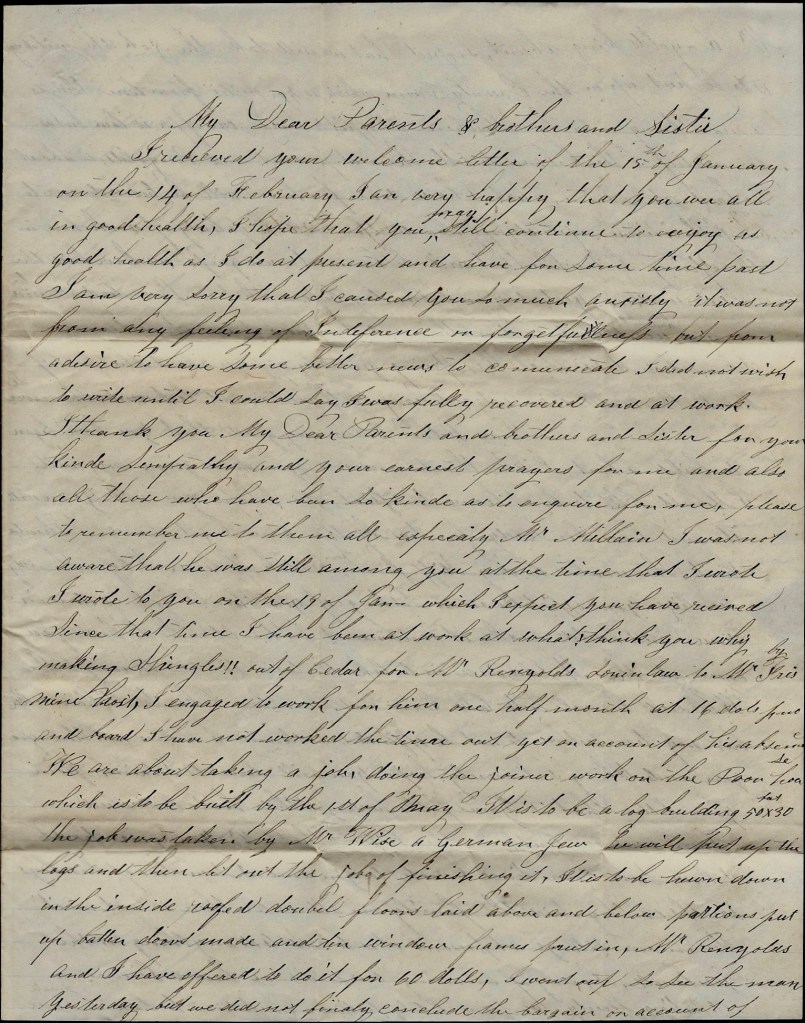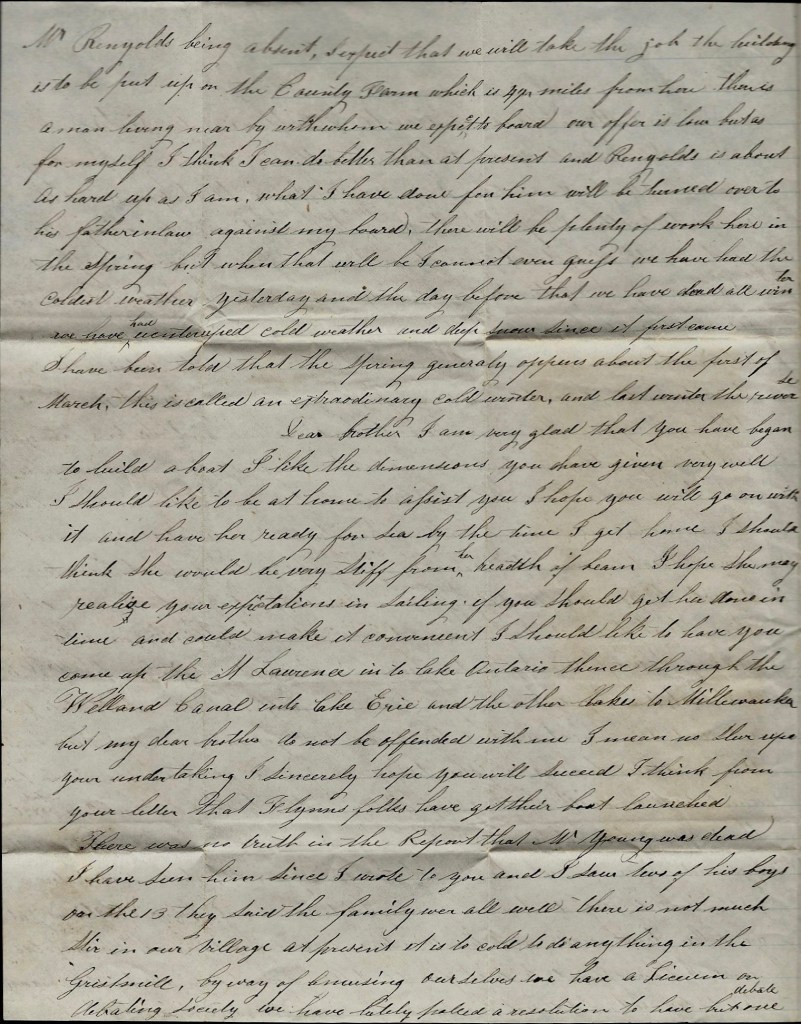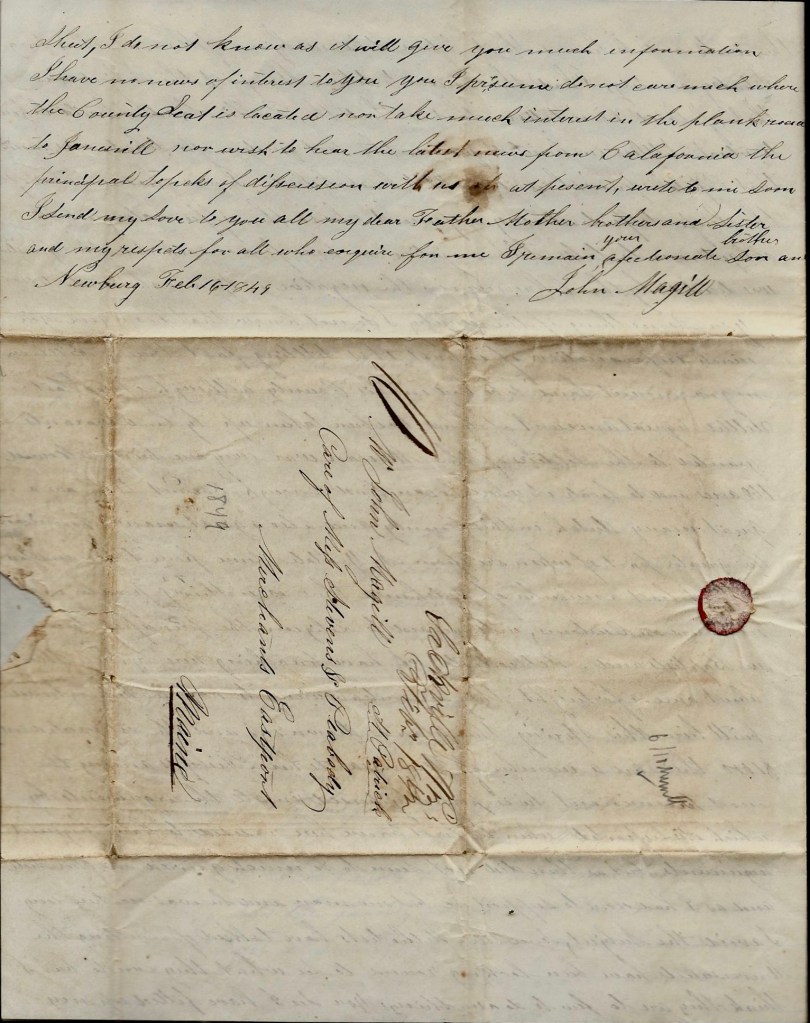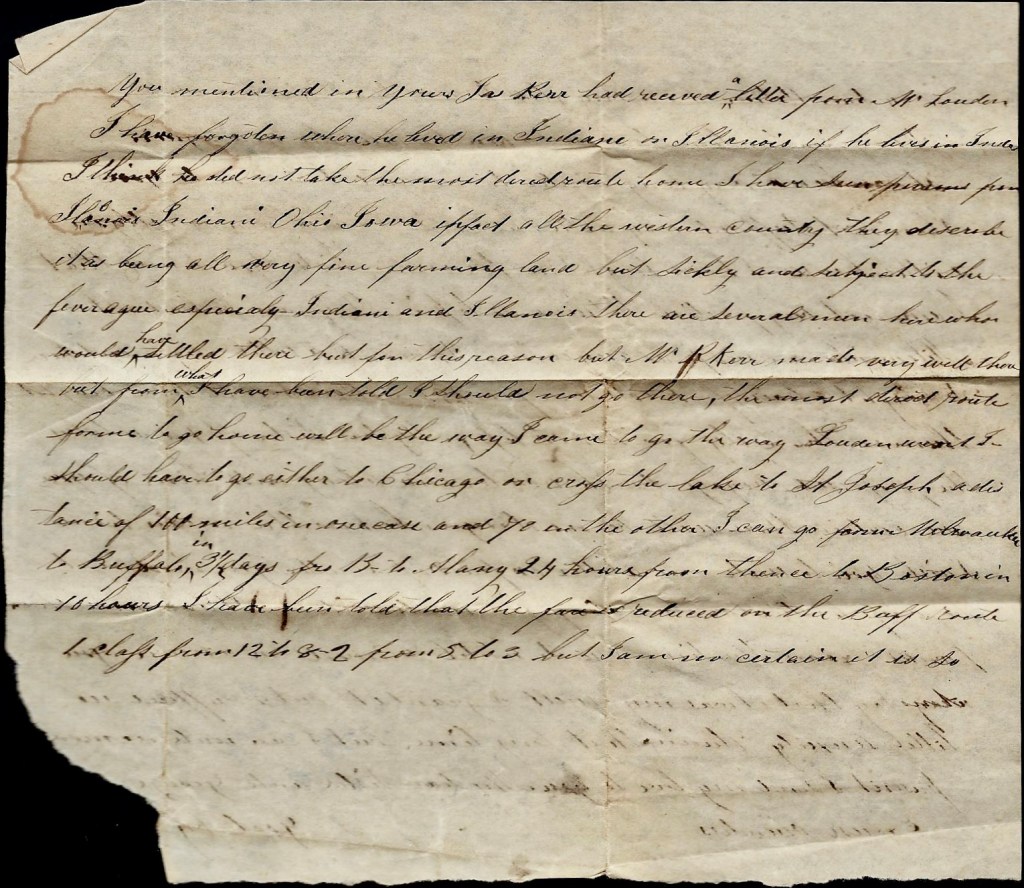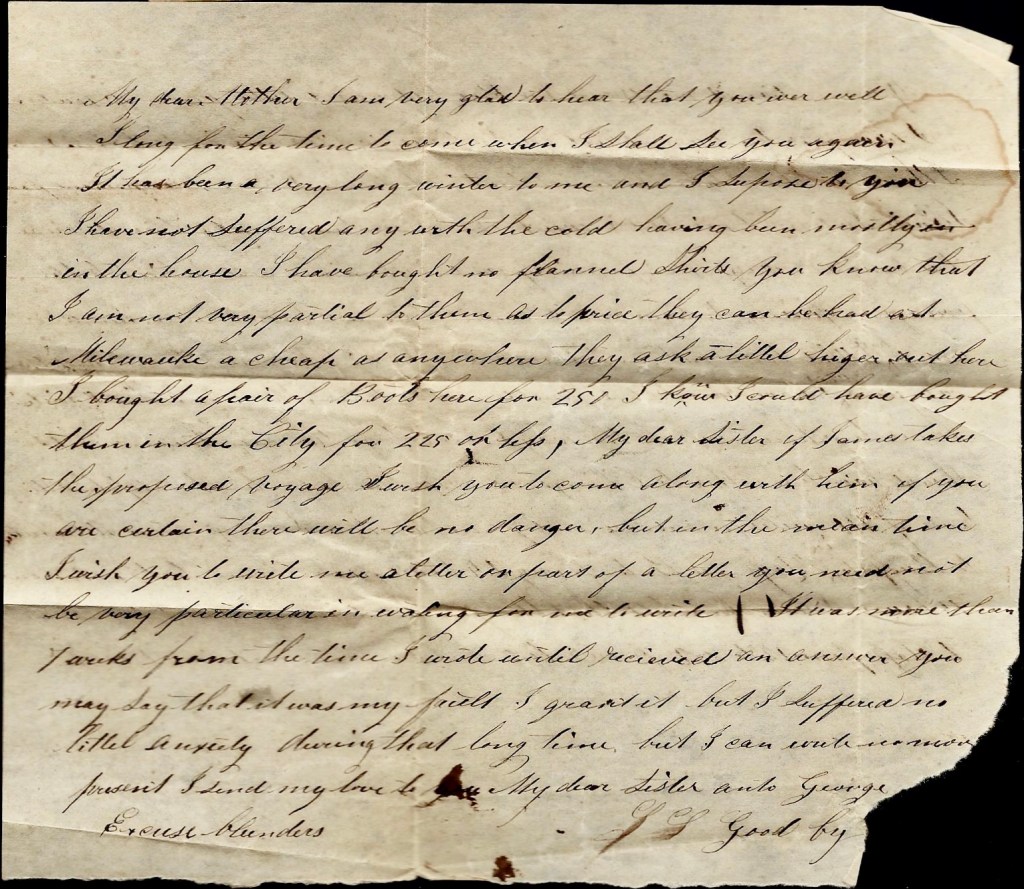
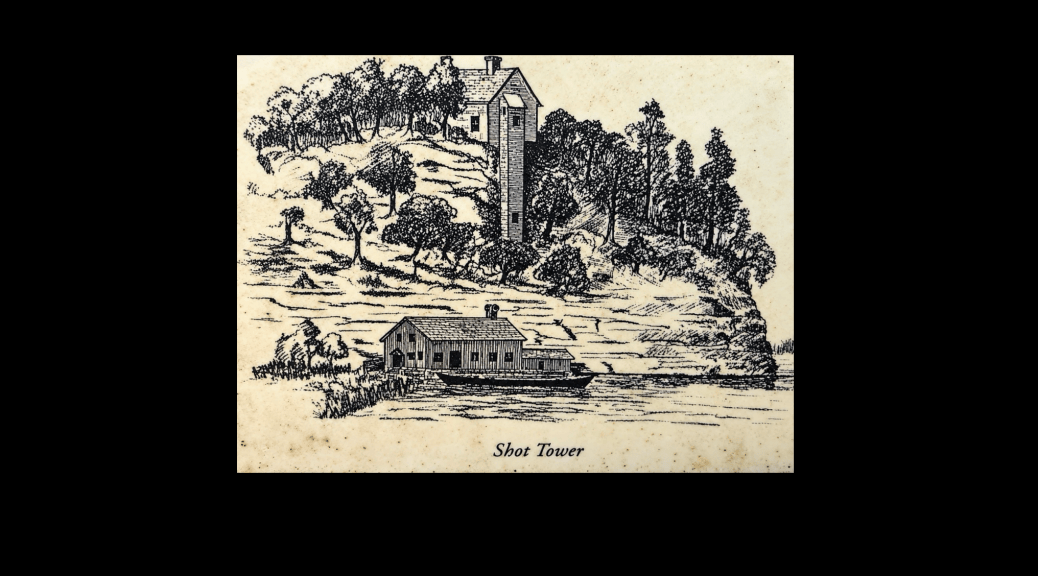
This letter was written by John Metcalf who was employed as shot-dropper for many years at the Helena Shot Tower on the Wisconsin river near present-day Spring Green, Wisconsin. The shot tower was a pioneer industry in southwest Wisconsin that operated for almost thirty years, contributing largely to the early prosperity of this region.
One of the best early descriptions of the Helena shot tower is given in W. R. Smith’s Observations on the Wisconsin Territory, published in 1838. He says: “From this point the road bends abruptly to the east, along the bank of the river, and a ride of two miles or thereabouts, through the site of the town of Helena, brings you to the shot tower and buildings belonging to the Wisconsin Shot Company. Here is a large lumber yard, the lumber being chiefly pine, and brought down the Wisconsin river. Several mechanics’ shops are erected and workmen employed.
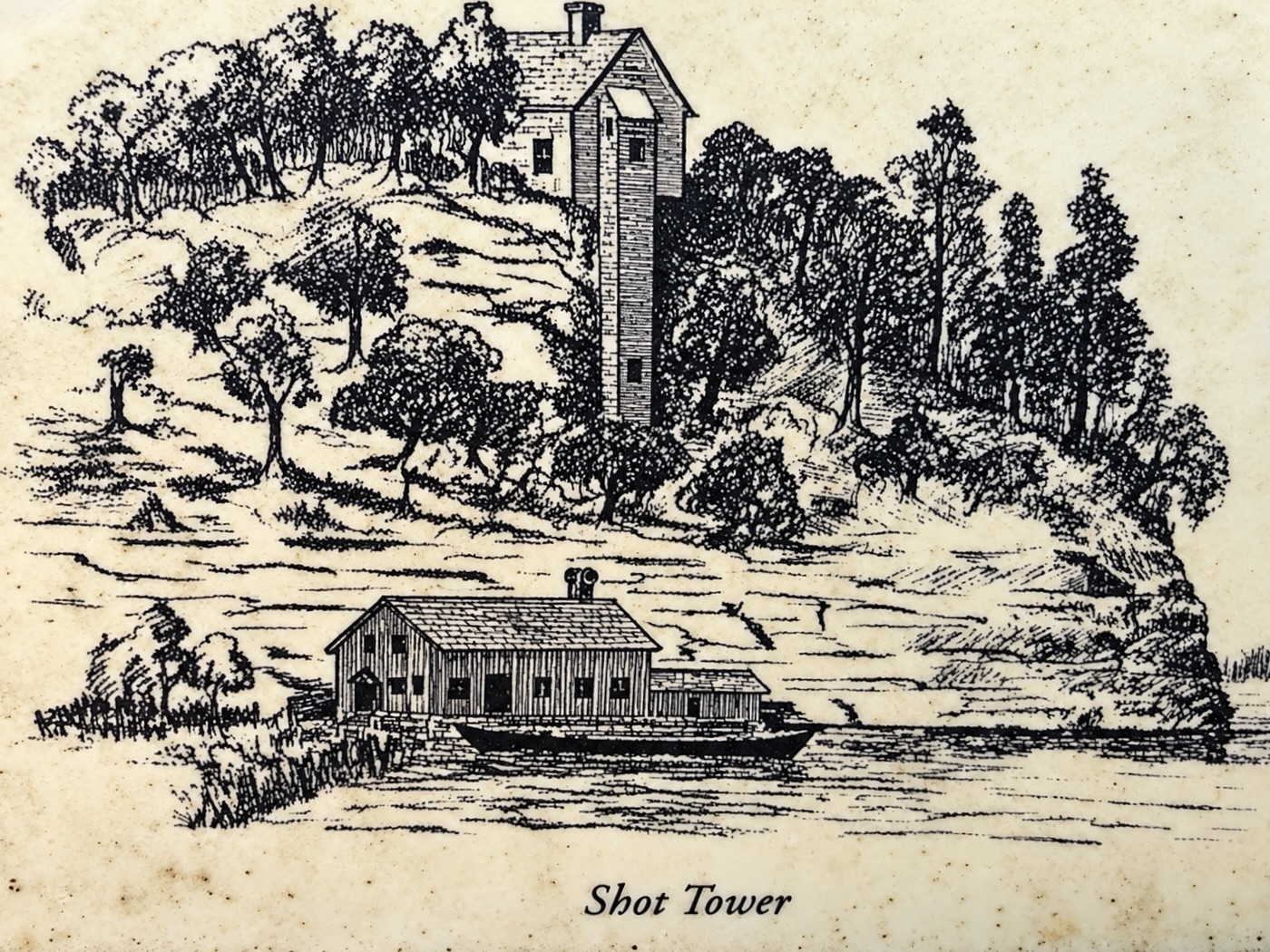
The shot company have a very large assortment of goods and merchandise in their store which is here kept, and on the river bank there is now being built a store house of about fifty by seventy feet, the basement story of stone from the river beach to the top of the bank, and the upper story of frame. “The shot tower is worthy of a description. It is built on the summit of a rocky hill on the bank of Pipe creek, and a gentle descent southward and westward, by which wagons may reach the summit.”
“The 60-foot cliff was a convenient headstart, but Metcalf needed someone to continue a shaft for the remaining 120 feet to ground level. Access to the bottom of the shaft, where the lead shot would be collected, necessitated a 90-foot horizontal tunnel. In 1831 Thomas B. Shaunce, a 22-year-old lead miner in Galena, Illinois, was hired for the task. Shaunce worked mostly alone but received some assistance from a friend named Malcom Smith. They dug with pickaxes and a gad, using gunpowder to loosen the harder rock of the lower layers. Shaunce used a plumb-bob to ensure that he was keeping the shaft perfectly straight, and a windlass to haul out the broken rock. Shaunce calculated where to begin digging the horizontal tunnel by standing across the water and sighting with his rifle directly below the top of the shaft. He dug in from the riverbank, using a line of stakes to maintain his alignment. When he first broke through from the horizontal tunnel to the bottom of the shaft, a blast of air knocked Shaunce unconscious and collapsed one of his lungs.” The project took 187 working days, interrupted in the spring of 1832 when Shaunce and Smith both returned to Galena and enlisted in the Illinois Militia to fight in the Black Hawk War. Shaunce had been contracted to be paid $1000 for his work, but was ultimately offered land instead.
A smelting house was built at the top of the cliff, and the 60-foot drop from there to the opening of Shaunce’s tunnel was enclosed with a wooden shaft. A finishing house was built on the riverbank, where the shot was dried, graded, and sorted. This was joined by a warehouse and docks. In 1836 Whitney sold the property to a group of businessmen from New York for $10,000. Later, in 1845, Cadwallader C. Washburn and a business partner purchased the site. In 1852 they replaced the finishing house and installed steam-operated equipment, nearly doubling the operation’s productivity. The shot tower was operated by a crew of six, producing between 600 and 800 pounds of quality shot per day. Miscast pieces were melted and reused. The finished shot, graded by size, was transported to Milwaukee and then shipped east.
Operations ceased in 1860 during an economic downturn, and the buildings and equipment were sold away. The village of Helena was abandoned soon after. Thomas Shaunce died around 1860 as well. Throughout his life he experienced respiratory trouble from the air blast in the tunnel, and felt he had been cheated of his proper payment.
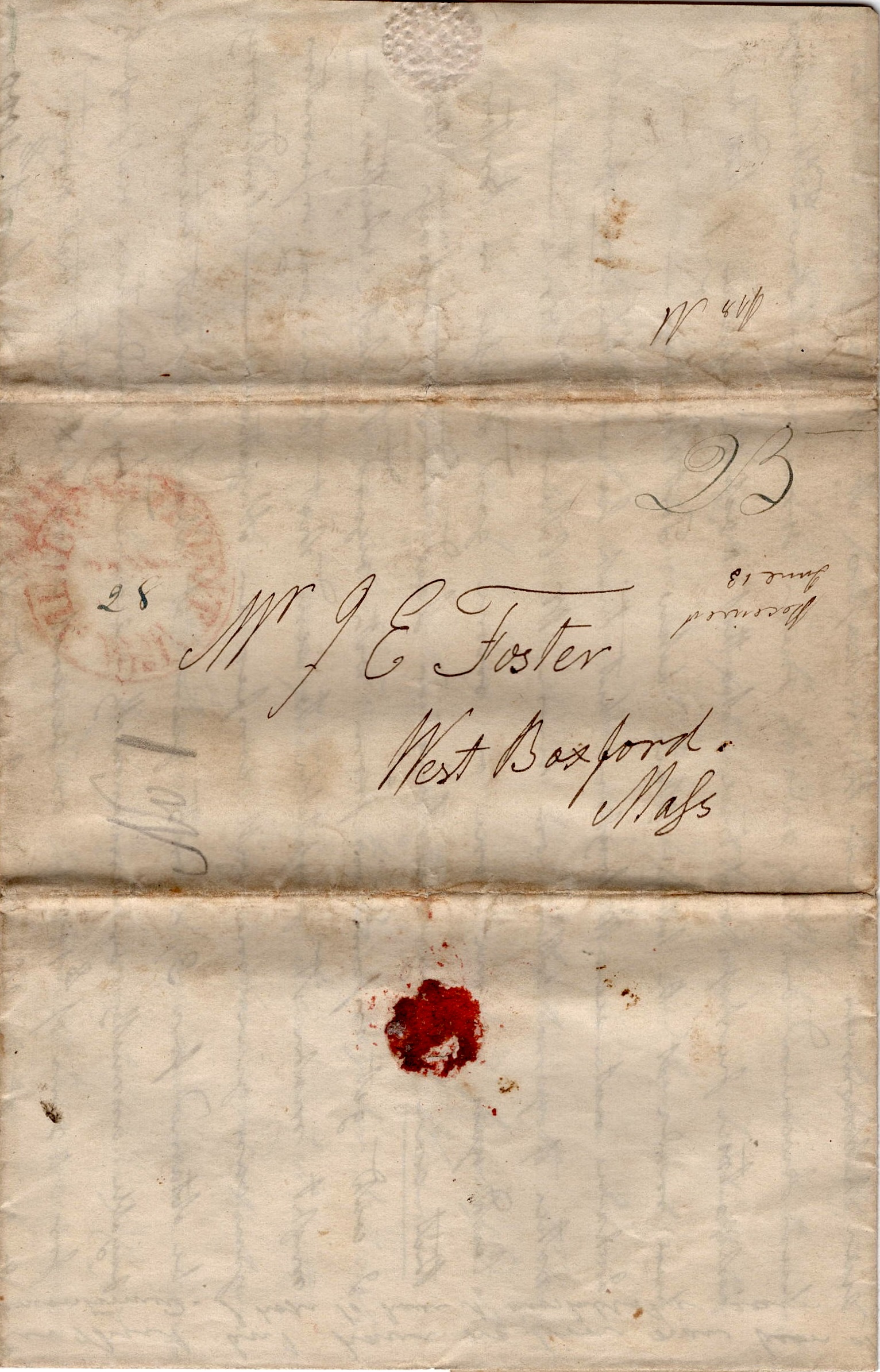
Metcalf wrote this letter to Jonathan Edwards Foster (1814-1867) of West Boxford, Massachusetts. I could not find any record of Foster’s presence in Wisconsin Territory but he clearly knew many of the inhabitants in the area of the Shot Tower where Metcalf lived.
T R A N S C R I P T I O N
Helena [Wisconsin]
May 12, 1844
Mr. J. E. Foster,
Dear sir, yours of the 20th March was received about six weeks after writing. I have received most of the Nos. of the Messenger and sent the Express except a few Nos. I have not received. I shall continue them,. I take no St. Louis paper now, the Bulletin having been discontinued. I think to have a St. Louis paper soon & will send it.
Our winter has been mild—little sleighing—very forward spring. Business is brisk here as well as with you. Our staple lead is about $2.45. Flour $4 to 4.50, pork mess $12 at Mineral Point. About $9 at Galena. Corn .35 to .40 cents. Oats through the winter 37.5; now about 30 cents. Population is increasing rapidly in our Territory—much more in the East than the West part of it. A heterogenous mass of Yankees, Buckskins, & Gumbos [Creoles], English, Dutch, Norwegians, &c. I think the mass of foreign immigration here better than that which remains on the seaboard. There has been but little improvement on the ridge by making new farms. Old ones are some improved. The land about the ridge being in the hands of speculators is held too high for present settlement on account of its mineral character. Some new discoveries have ben made in our neighborhood and old ones worked to considerable extent within the last 18 months.
A settlement is commenced on the creek below Helena. 1 Some four or five families are located about 4 to 5 miles from Helena. An English settlent has commenced about 10 miles above near the Arena Creek 2 which is expected will amount to about 60 families within the next year, 20 of which are expected next month. Buildings are preparing for their reception. These together with 6 or 8 Americans already on or near the Hancy Creek will make quite a respectable commencement to settle this side Wisconsin. No new improvements on the other side near this. There is quite a settlement on the other side below this on the Kickapoo & its neighborhood. Our road on the other side is not completed but is some traveled. There is now a road from Prairie Du Sauk on this side the Wisconsin so that the other is not so much used.
You ask whether it would be more convenient to settle our accounts this fall or next. The next would probably suit me better than this. I lost by the [ ] of N. L. Dodge about the amount of your claim, it being for manufacturing shot the last season. I rebuilt the tower last fall which was burnt the fall before and have not received pay yet, all which has occasioned me some inconvenience. I run the tower part of the last season and in the fall, together with Mr. Henry Hamilton of Buffalo & J. B. Terry, Simond Grove, [ ] purchased it for $7000. We are doing business in the name of Wisconsin Shot Tower Co. Our calculation is to do a regular but not very long business in manufacturing, and to connect it with merchandize, lumber, &c. I have some goods now and expect in a few days to have a full department.
I have made some improvements on my place on the ridge by building a comfortable house (log of course), a good frame barn, and enclosed from 15 to 20 acres more land part of which (12 acres) is in cultivation. Mr. Park is living on how own place near Hickcox. Alanson Culver is improving by building house & barn, both frame, both well & living well. Our old acquaintances are generally well. Wm. Turner died last summer of fever. Mrs. Turner is living on the place still. Old Mr. Jenkins is deceased I think since you left. Alvah Culver’s Fanny and Alanson’s oldest child are also dead. These are all that occur to me as having taken place in our immediate neighborhood since you left.
Mr. Wilson’s Jane is married to Alonzo Harrington. Steamboat arrivals are “few and far between.” There has been none this season and I think but two the last season. If an appropriations has been made to improve the Fox & Wisconsin rivers, I think steamboats will in a short time be no uncommon thing on our river, notwithstanding their present absence.
Report says that John & George Messersmith have made a valuable discovery of copper on the North wide the Wisconsin [river] near the Kickapoo. It also says that coal has been discovered on that side the river some miles below Ft. Winnebago—perhaps true, perhaps not true. Also that a valuable discovery of lead has been made at the latter place below Fort Winnebago.
I have not seen Mr. Brigham but think he would like some previous notion of your calling on him. Mr. Culver will write. Could you name one or more good houses in Boston that are doing something in lead and shot business that I could get information from with regard to shot—whether we might make it profitable to send shot there? Any information you can give me will confer an obligation. Could money be obtained for 3, 4 or 5 years at about 8 percent interest, payable annually or semi-annually, secured by productive real property, for a sum of $1,000, or several [ ] of about that amount the property in Wisconsin, I would like to obtain about $1000 on the above terms & I would think that person having money to loan might do better with it here if proper care be taken to have it properly secured, not on wild land, but on productive property. I am aware there is a want of confidence [ ] in Wisconsin & that distance is objectionable.
By writing as soon as convenient, you will much oblige yours, — John Metcalf
1 This may have been Spring Green which was known locally as Helena Bottoms.
2 This English settlement was probably Dover, Wisconsin. It was settled primarily by members of the British Temperance & Emigration Society (travelling from Liverpool). It grew rapidly in the late 1840s but became a ghost town after the railroad line bypassed the village in favor of Mazomanie.