Category Archives: Illinois Homefront

1862: Charles Henry Morrell to William Henry Taft

How Charles might have looked (W. Griffing Collection)

This letter was written by Charles Henry Morrell (1839-1907), the 23 year-old son of Henry K. and Mary G. (Carter) Morrell of Caroline Centre, Tompkins county, New York. Less than two months previous to the date of this letter, Charles was married to Susan F. Speed and came to Augusta, Hancock county, Illinois. In the 1870 US Census, Charles was identified as a farmer. In the 1880 Census he was identified as a fire insurance agent. In the 1900 Census, he was a life insurance agent.

Charles wrote the letter to his boyhood friend, William Henry Taft (1827-1862)—a carriage maker from Caroline Centre, Tompkins county, New York. William enlisted in September 1862 and was made 2nd Lt. of Co. K, 137th New York Infantry but his military career was incredibly brief. He died of typhoid fever on 30 October 1862 at Knoxville, Maryland. There is little doubt that William never had the opportunity to read this letter before his death.

Much of Charles’ letter pertains to the reception at Augusta, Illinois, given to Brig. Gen. Benjamin Prentiss after his release from captivity in October 1862. It was Prentiss’s Division that was first attacked at Shiloh and which suffered greatly during the opening hours of that battle. Though he was able to reform his command with reinforcements from Gen. Lew Wallace and put up a spirited fight in the “Hornet’s Nest,” he eventually surrendered with 2,200 other soldiers. After the battle he was considered a hero, having held off the rebel army long enough to allow General Grant to organize a counterattack and win the battle.
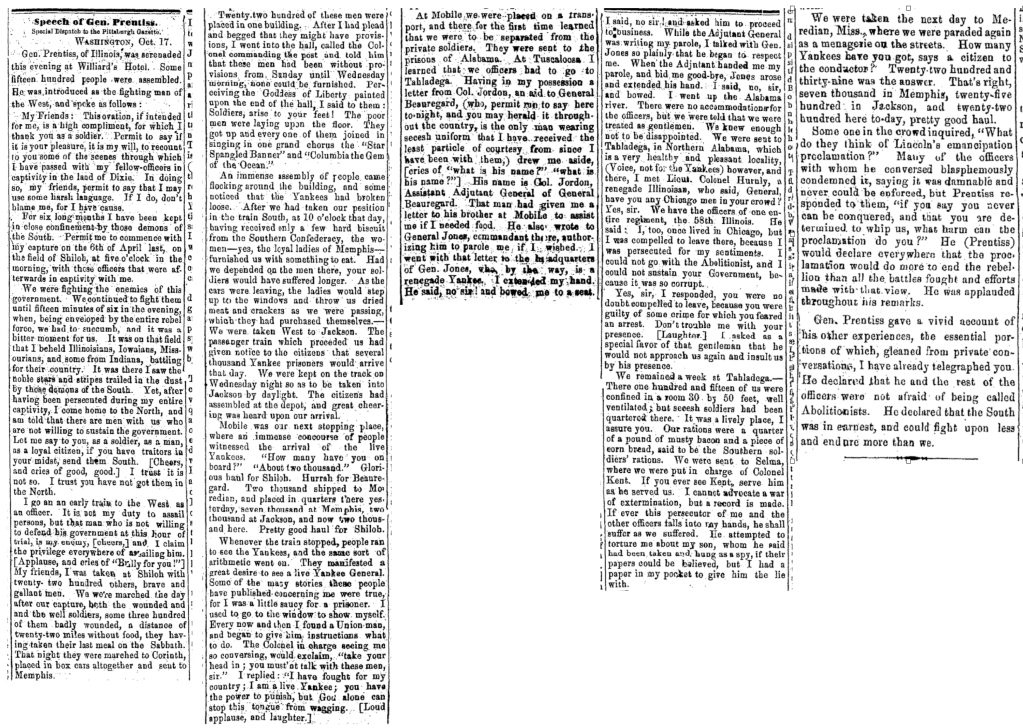
The substance of Gen. Prentiss’s speech given in Augusta, IL, and elsewhere in October 1862 (Wooster Republican, 23 October 1862)

Transcription

Augusta [Illinois]
October 25th 1862

Friend William,

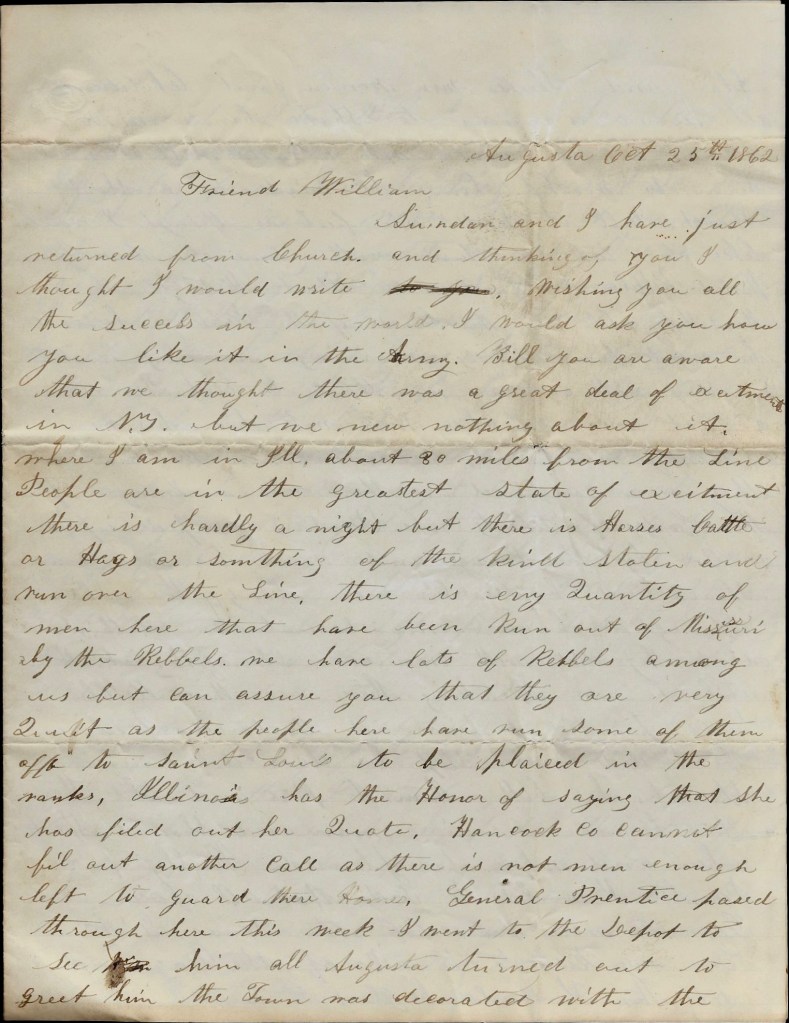
Susan and I have just returned from church and thinking of you, I thought I would write wishing you all the success in the world. I would ask you how you like it in the army. Bill, you are aware that we thought there was a great deal of excitement in New York but we knew nothing about it. Where I am in Illinois—about 80 miles from the [State] line—people are in the greatest state of excitement. There is hardly a night but there is horses, cattle or hogs or something of the kind stolen and run over the line. There is any quantity of men here that have been run out of Missouri by the rebels. We have lots of rebels among us but can assure you that they are very quiet as the people here have run some of them off to St. Louis to be placed in the ranks. Illinois has the honor of saying that she has filled out her quota. Hancock county cannot fill out another call as there is not men enough left to guard their houses.

Gen. Benjamin M. Prentiss—-“I would to God that all of our generals were possessed of the same grit.”

General [Benjamin Mayberry] Prentiss passed through here this week. I went to the depot to see him. All Augusta turned out to greet him. The town was decorated with the Stars & Stripes. Men, women & children all seemed as anxious to shake hands with him as a son would with a father. All Illinois seem to worship him. He made us a short speech. Will, it made me feel as though I would like to take a turn with some of those black-hearted rebels. He gave us a short history of his hardships while in the hands of the rebels. He said [at Shiloh] he went from Sunday morning until Tuesday without a mouthful to eat. There was a great many of his men with him. His men on Tuesday were nearly worn out in the boat that they were confined in. There was an image of the Goddess of Liberty [and] he (Prentiss) jumped upon a box by the image and made his men a Union speech and bade his men sing the Star Spangled Banner and several other national airs which they did with renewed strength. While he was speaking, there was three rebel guns pointed at him and threatened to fire if he did not stop his damned Union speech. He bid them to fire and told them that he was a Union men and should speak when and where he pleased. Bully for Prentiss! I would to God that all of our general were possessed of the same grit.

Give my respects to all of the boys and tell them I should be glad to hear from any of them them.

Well since I have been here, I have been to a little lake about twenty miles from here hunting geese and ducks. Such fun you never saw. It was shooting from morning until night. There was a great many pelicans and swans on the lake. Will, I imagine in ten miles square black with ducks and geese dotted here and there with a flock of swan. They look to be about the height of a man as they sit on the water as white as snow. We went up on Monday and came back on Saturday. We camped in the woods ten miles from any house. Such fishing as would make a York boys eyes stick out. We caught catfish that would weigh from ten to fifty pounds. They say that it is no uncommon thing to catch them that will weigh one hundred & fifty. I can go out on the prairie most any frosty morning and shoot all the game that I can bring in on my back.

Bill, what the devil are people thinking about to stay in New York among the hills and rocks when three is such a vast extent of western country unsettled and far richer than the best garden in New York and as level as a house floor and free from stone. I am only surprised that you ever went back to New York after your visit West. If I can persuade my wife to stay here, you will never see me back to Caroline [Centre, Tompkins county, NY] again.

Will, write to me. I should be very glad to hear from you. Tell me all the news, how you are getting along, and how the boys like it, and what you are all doing. Tell John Cantine to write to me.

From your most affectionate friend, — C. H Merrill

P. S. Direct to Augusta, Hancock county, Illinois

[to] W. H. Taft
1865: Coles Jackson Brown to James B. Brown

This letter was written by Coles “Jackson” Brown (1815-1895), the son of Abram Brown (1777-1862) and Mary Purdy (1783-1873) of Putnam county, New York. Coles was married to Sarah Mary Cowl (1811-1894) in January 1836 and worked as a carpenter in Putnam county, New York, until sometime in the 1850s when he became a farmer in Burns township, Henry county, Illinois.

I feel certain that Jackson wrote the letter to his son, James B. Brown (b. 1844) who enlisted on 9 August 1862 as a private in Co. D, 112th Illinois Infantry (though there seems to be some discrepancy between his census record age and his enlistment record age). James served his full three years, mustering out at Greensboro, North Carolina, on 20 June 1865. In his letter, Jackson responds to his son’s complaint about not getting any letters from home by informing him that: “Well, it is not that there has not any been sent for we send one every week. I think you will get a big mail if you ever get the half of what letters that have ben sent to you.” Of course the 112th Illinois was engaged in the Carolina Campaign at that time and mail was slow to catch up with the regiment.

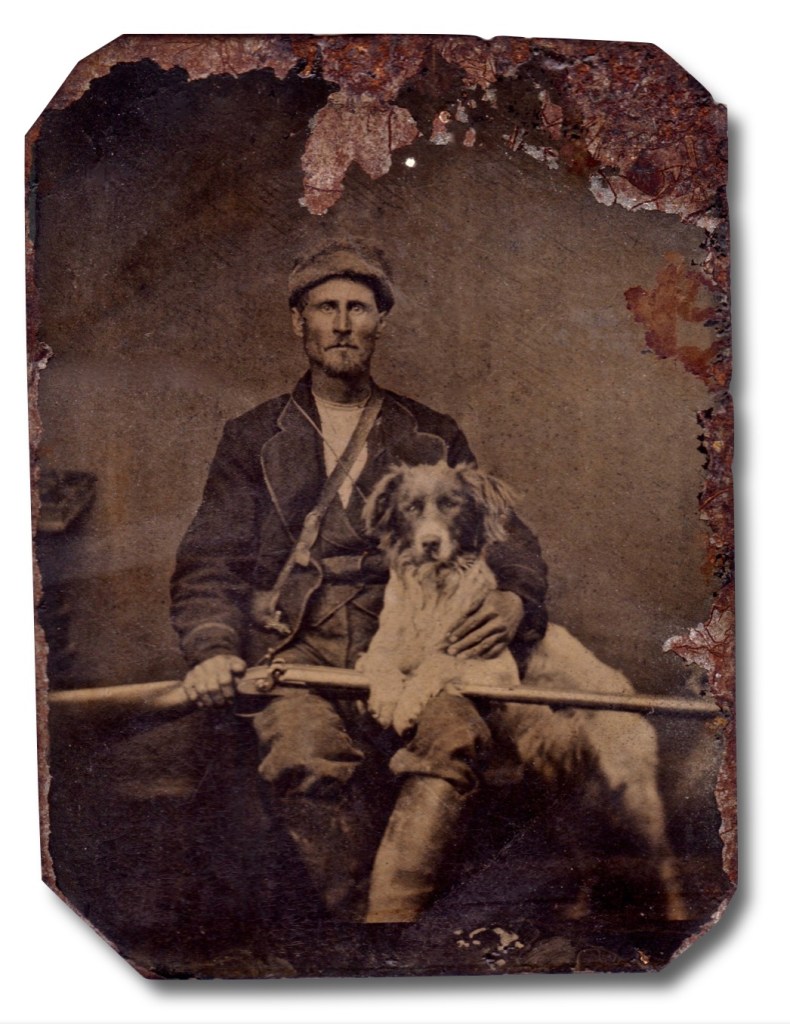
Coles Jackson Brown, ca. 1865

Transcription

[Henry county, Illinois]
March 26th 1865

Dear James,

I now take a few moments to write a few lines to you to let you know that we are all well and enjoying good health. You say you get no letters from home. Well it is not that there has not any been sent for we send one every week. I think you will get a big mail if you ever get the half of what letters that have ben sent to you. Well this will do for this time.

Vails folks have broken up. The old man 1 is going East. Sarah teaches in Kewanee this summer. Mrs. Vail is a going to live in Kewanee. Ed Furst 2 sold the place a few days before he was to make the dead out. The chap backed out. They had a sale which amount to about $1500.

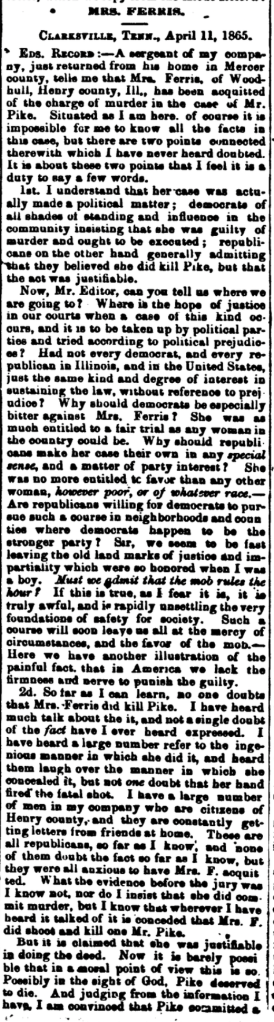
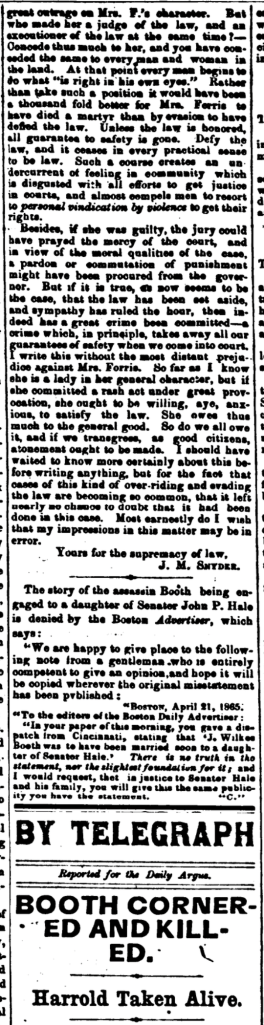
Benjamin has got home from court. That woman Mrs. [Mary] Ferris who shot William Pike had her trial. 3 It occupied nine days. She was cleared. I suppose you heard of the prisoners breaking jail about four weeks before court time. They had caught two but the two that was in for murder, they have not yet been found. There were Irishmen. They killed a man in Annawan.

Samuel and Artemas, ca. 1865

Smith has moved. Parker is a going to build this side of the first holler south of ours. This will get to be a nice street if we ever should build a house and Jonathan should build too. Oh, I must tell you before I forget it, Sam[uel J.] Murphy is married to a Miss [Artemas] Welland 4—a renter on Feslar’s place. Murphy bought a half section of land up of Suthard—paid six thousand dollars. I think he must be some in debt. Also one of 120 acres in Iowa.

Emmaline starts for this place one week from tomorrow. She may be here before this reaches you. It is reported that George is to be married. We do not know how true it is nor to who. Jim don’t come nigh us at all. He has rented Bill Henry Conner’s farm. Bill went away to avoid the draft but has since got back.

This town has been trying to fill her quota by buying men and having them credited to the town. They raised eleven thousand dollars. Because they lacked about $1300, they came home and paid about all of the money back. They have made about four or five efforts to raise men and failed each time. Now I believe they are a going to show bonds on the town and raise the men. This town had 36 men to raise. Burns [township] has put in nine which she thought would be more than her quota but Cambridge got the credit for the men that we had ought to have had credit for. Cambridge had 9 men to furnish. It comes hard on Burns. It takes about one in every three. I think it will take more for there will be a great many that will go away and stay till the draft is passed. Then will return.

George Hamilton 5 has been gone for two or three weeks. I believe he is in Indiana. There has been five left they say last week so you see how patriotic folks are. Rosco is doing first rate. Grows some. Fly and Daisy make a nice little team but I think it best to sell them if they will fetch anything nigh what they are worth. They are small and always will be small. As they are matched, they will I think fetch all they are worth.

Write whenever you can. We have had awful wet and cold weather. We have done nothing yet this spring. I believe I have give you all the news. I remain as ever yours &c., — Coles J. Brown


1 I believe Jackson is referring to Alexander Vail (1804-1894) who lived for a time in Burns township, Henry county, Illinois, with his wife, Sarah Marie Sebring (1805-1867). When Alexander went back to his home state of New Jersey, Sarah remained in Kewanee and taught school to earn income. She died two years later in 1867, her youngest child then 20 years old.

2 Edward Furst (1834-1905) was a German emigrant, his surname actually spelled Fuerst. He was married to Louise Krouse.

3 Information about the trial can be found in the following Evening Argus newspaper article (interesting). Click to enlarge.

4 Samuel J. Murphy (1843-1902) grew up in Washington county, Pennsylvania. He married forst Julia Artemus Welland (1843-1874). After her death he married Julia Florence Hill (1848-1884).

5 George W. Hamilton (b. 1843) was the son of William Hamilton, a farmer in Burns township, Henry county, Illinois. George was one of the local boys identified by name that Jackson claimed had left the state in order to avoid the military draft. He was enumerated back in Burns township at the time of the 1865 State Census in July.

1861: Ann (Updegraff) Starr to Nathan Updegraff Starr

How Ann might have looked in 1861 (Will Griffing Collection)

This letter was written by Ann (Updegraff) Starr (1801-1865), the widow of Merrick Starr (1795-1851), and the mother of Nathan Updegraff Starr (1825-1902) to whom she addressed her letter. Ann wrote the letter letter from Quincy, Illinois, where she resided with her daughter, Hannah (Starr) Willey (1830-1885) and Hannah’s husband, George F. W. Willey (1821-1892)—a native of Germany who previously served in the US 4th Infantry and was a Mexican War Veteran.

Ann grew up near the Quaker village of Mt. Pleasant—a rural farm community in the rolling hills of eastern Ohio. Her parents have been identified as Nathan Updegraff (1750-1827) and Ann Lupton (1767-1833) who came to Ohio in 1802, settling on Short Creek, some two and a half miles northeast of Mt. Pleasant where he built the first mill in the township. She married Merrick Starr in 1824 and raised their family as members of the Quaker faith, attending the Short Creek Monthly Meeting.

Merrick and Ann eventually relocated with their daughter Hannah and her husband George to Worthington, Franklin county, Ohio where Merrick earned a living as a shoemaker; George laboring as a music teacher. After her husband died in 1851, Ann relocated to Quincy, Illinois, with George and Hannah where George found employment as a “professor” of music, no doubt.

Ann’s letter provides us with a glimpse of Quincy, Illinois, in 1861, informs us of the “display and patriotism manifested on the occasion of the Fourth of July, and of the growing fears of a Rebel invasion up the Mississippi river or from the neighboring state of Missouri.

Transcription

Addressed to Mr. Nathan U. Starr, Delaware, Ohio

Quincy [Illinois]
August 4, 1861

My very dear Son,

How swiftly time passes. It is now nearly a month since I received your most welcome letter giving me an account of the Fourth of July with you and although it is out of season, I will tell you a little of the doings here. There was much display and patriotism manifested on the occasion. There was a great military parade—two cavalry companies besides several other companies of soldiers, and firemen, citizens, &c. &c. marched through several streets and around the public square, and also an oration on the square by Rev. Edward Beecher of Galesburg, Ill.—brother of Henry Ward [Beecher], which was fine, and speeches by several citizens.

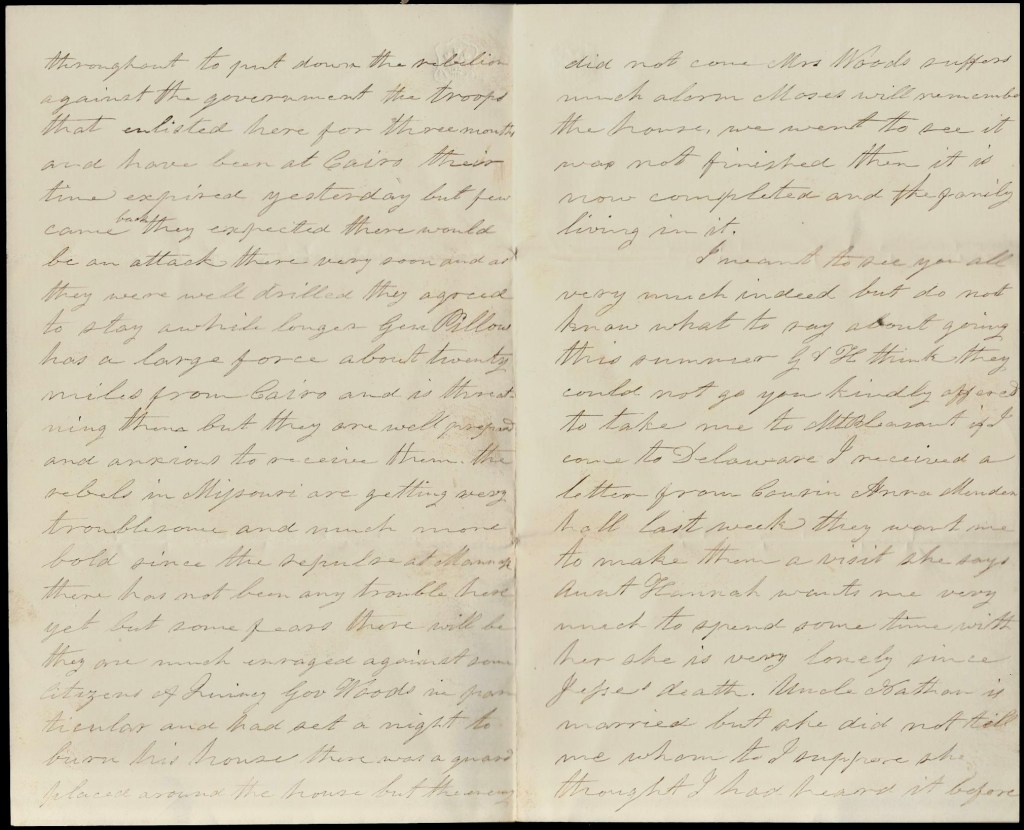
The North seems now to be united and the same feeling throughout to put down the rebellion against the government. The troops that enlisted here for three months and have been at Cairo, their time expired yesterday but few came back. They expected there would be an attack there very soon and as they were well drilled, they agreed to stay awhile longer. Gen. Pillow has a large force about twenty miles from Cairo and is threatening them but they are well prepared and anxious to receive them. The Rebels in Missouri are getting very troublesome and much more bold since the repulse at Manassas. There has not been any trouble here yet but some fears there will be. They are much enraged against some of the citizens of Quincy—Gov. Woods in particular—and had set a night to burn his house. There was a guard placed around the house but the enemy did not come. Mrs. Woods suffers much alarm. Moses will remember the house; he went to see it. It was not finished then. It is now completed and the family living in it.

I want to see you all very much indeed but do not know what to say about going this summer. G[eorge] & H[annah Willey] think they could not go. You kindly offered to take me to Mt. Pleasant if I come to Delaware [Ohio]. I received a letter from cousin Anna Mendenhall last week. They want me to make them a visit. She says Aunt Hannah wants me very much to spend some time with her. She is very lonely since Jesse’s death. Uncle Nathan is married but she did not tell me whom to. I suppose she thought I had heard it before. She said she had written to Moses and had received a letter from him. I suppose she told him all the news. There has been many changes since I was there. Do you ever hear from our friends at Mt. Vernon?

The weather is very warm and dry for the last week. The thermometer has risen to 104 degrees but there has not been much sickness here so far. We are all very well at present. You ask if I ever have any of those attacks to which I have been subject. I have not had any of them for some time and the last two or three were quite light. I hope I have got over them.

[Your wife,] Ollie [Olive Louise Horr], was not well when you wrote. I hope she has has recovered her health. I was glad to hear you & Mand family were well. Please write soon. G[eorge] and H[annah] send much love to you all with many wishes for your present and future happiness. Your affectionate mother, — Ann N. Starr