The following letters were written by Alfred E. Edwards (1841-1876), the son of Lemuel Edwards (1815-1890) and Lorinda T. Marshall (1817-1900) of Avon, Lake county, Illinois. He wrote the letters to his younger sister, Lydia A. Edwards (1846-1929) while serving as a private in Co. B, 96th Illinois Infantry and after February 1864 in the 37th Company, 2nd Battalion Invalid Corps. The Edwards family moved from Herkimer county, New York, to Lake county, Illinois, sometime between 1855 and 1860.
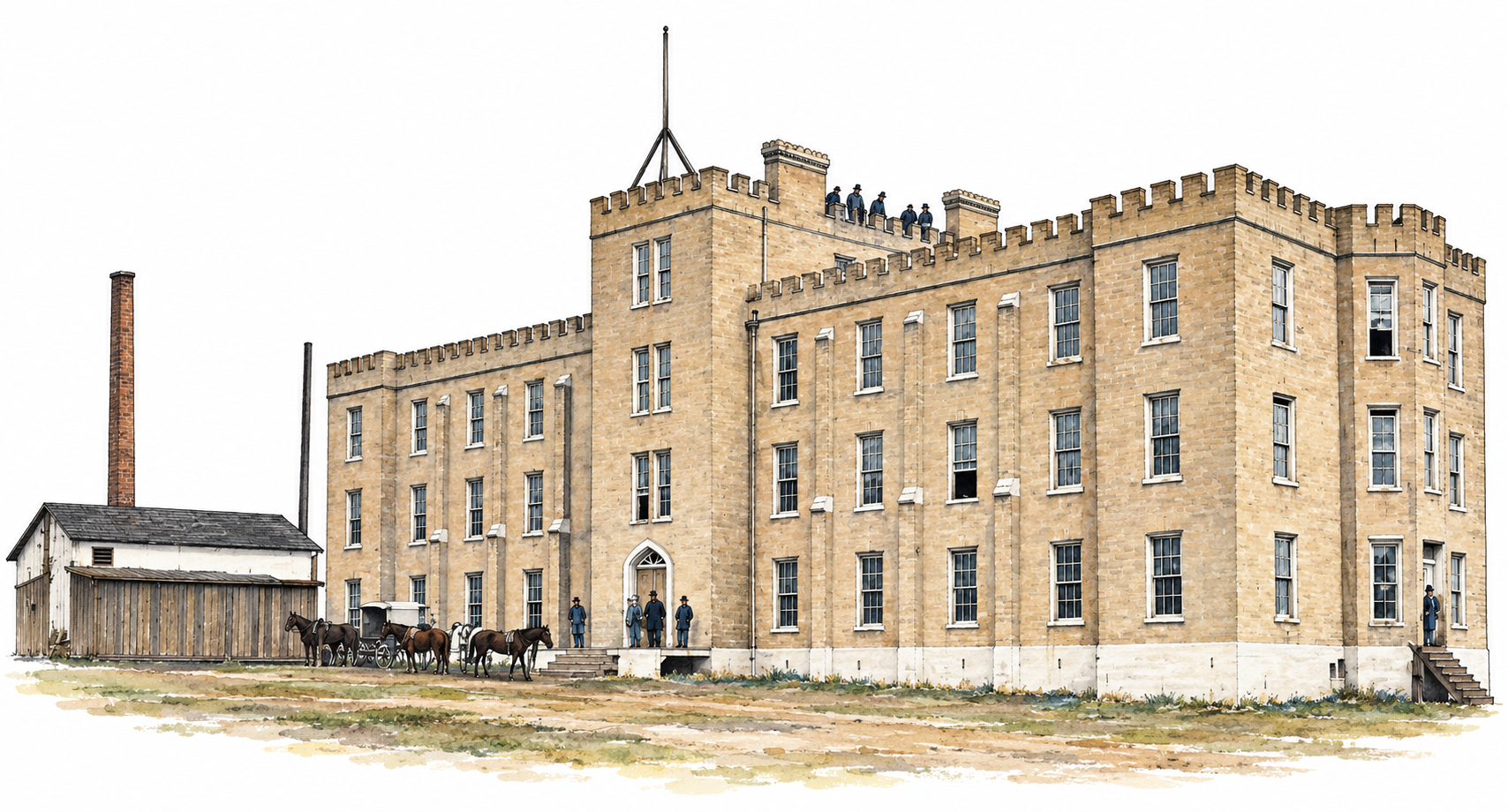
The 96th Illinois was organized in the fall of 1862, drawing four companies from Lake county and four from Jo Daviess county. We learn from Alfred’s letters that he must have sustained some type of injury sometime prior to his entry into the regiment—an injury that affected his jaw and eventually to suffer from acute aphonia (inability to speak) as early as April 1863. After six month’s active service in the field, he was hospitalized in Nashville where he spent several more months on light duty until he was transferred into the Invalid Corps. We learn from his February 1864 letter that the doctor who examined him at that time told him “that I ought to be out of the service for I was nothing but an expense to the government. I told him I was not a going to beg for a discharge. I told him that I could stand it 17 months longer.” And so he remained in Nashville wearing the Invalid Corps uniform and working in Hospital No. 2 and the Officer’s Hospital until he was discharged. The Officer’s Hospital (pictured below) was located in the Literary Department building of the University of Nashville (later called Lindsley Hall).
Alfred did not live long after he left the service. He died at the age of 35, his cause of death given as “consumption” or tuberculosis.
Letter 1
Brentwood Station
[April] 6th [1863] 1
My sister,
I have received yours of the 30th. Was very glad to hear from you once more & [would] like to hear oftener—that is my selfishness for it ain’t been quite a week since I heard from home. Barron is writing but don’t know who to.
We have very good times here and live pretty well. We live on johnny cakes. We bake them ourselves. We have got a bake kettle such as folks use that ain’t got no stoves. I wish you could have a piece but what a pity. Our officers got crazy again yesterday for fear that the rebels would gobble them and we got all ready for them but they did not come near. Our boys carried water for two hours and put it into the rifle pits so that we would have enough to drink. It is well enough to always be ready for the rebels are nothing but men. All the difference there is, they wear butternut clothes & we wear the Union [blue]. For that reason, they aren’t but a a little different.
Our company has gone out on picket today. They have to go once in five days. If our regiment was mustered out tomorrow, there would a great many enlist again. they say they can’t earn $13 [a month] any easier. I believe that I should like to soldier in time of peace but our regiment has had good times beside of the 37. Our regiment is getting rather small. There ain’t over 500 men fit for duty. It beats all how the regiment falls away. Lake county better send enough men to fill up our regiment.
I am comforted with the toothache. I don’t like it pretty much. I had to stop a bit & put some cloves [?] in my tooth 2 and it makes it feel nice & so I am a writing by a candle—something that I haven’t done before since I left home. There is three of us a writing. I am a going to tell you who I tent with. H. Lindsay, J[ames] O’Connel. H[enry] Dombski, O[rville] Barron, J[ames] Litwiler, J[ames] Marble, J[ohn] Washburn, J[ames] Beck, Jerome E[dwin] Potter, J[ames] McMillen.
They just put a dead man in the ambulance wagon right in front of our door. The 92nd hospital tent is right close by ours. There is a couple of women to nurse the sick. They bake pies and they can fix up things nice., I will bet. Tell Jennie to keep up good spirits for I can sympathize a little for her. I wish she only had my health. I feel pretty well but can’t talk—ain’t that curious? I will fetch her by and by. There is a great deal of talk about discharging so many. I guess Uncle Sam wants sound men.
You seem to think that the war will close soon but the 96th don’t think so. It never will be by fighting for we have had to do so much of it. Excuse poor spelling the rest. — Alfred
1 The 96th Illinois Infantry was camped near Brentwood, Tennessee, from March 27th to April 8th 1863. During this ten day period they were camped alongside the 92nd Illinois Infantry. They threw up a strong line of fortifications here and were on heavy fatigue and guard duty before being ordered back to Franklin, TN.
2 I can’t be certain that Alfred wrote cloves but that might make sense as cloves, or oil of cloves, would have been a good treatment for a toothache. Clove oil contains eugenol which produces a numbing effect. This is something a regimental surgeon may have carried with him into the field.


Letter 2
Franklin [Tennessee]
May 18, 1863
Dear sister,
Yours arrived today that was wrote the 15th. That is coming pretty quick. The boys are out a drilling so I will answer it & have it done with. We are making preparation for supper. We are a going to have warm biscuit & won’t be as good as Ma makes but better than hard tacks. A few stewed currants with them. That will make quite a supper for us.
I have been on top of a very high hill today & looked around. The country is a beautiful but I can’t see nobody to work but two nigger wenches. They was ploughing out corn. Oh I wish I could plough once more & I would not care much if I had a farm down here, It’s better looking country than old Illinois. I guess I will have to settle down here when peace is declared.
The boys are sick of soldiering. They have such awful orders to live up to. There was one of the boys out drilling [when] Col. Clark come along and asked him to take his hands out of his pocket He says, “I don’t want to,” in fun but the old colonel out him right under arrest. That is the way the privates suffer it all for the Union. But I don’t like such Union—that’s what’s the matter.
I got those postage stamps all right.
The weather is fine but rather cold for this country. The boys are all feeling well but don’t have much to eat—only what they have to buy. Butter is 75 cents, potatoes 10 pounds so $13 a month don’t amount to much. They say that boxes can’t come through but I don’t believe it. Yet, like all other camp rumors, can’t tell much what we hear down here. There is lots of boxes on the road for the boys. I am glad you are sending me one. Jerome says his folks are sending him one. He says too that his father has been offered $250 for their bay horses, I don’t believe it. Soldiers don’t care much what they do or say.
I have just come in from the doctor. I will try and finish this. My letters don’t amount to much. However, as long as I get one to pay for one, it makes no difference to me. The boys have to get up in the morn at half past three o’clock. That is rather earlier than you have to get up for you can get up when you are a mind to. But it ain’t so here. We have to get up when we ain’t a mind to or carry a heavy knapsack through the hot sun. The folks at home don’t know nothing about soldiering—not until they try it.
My back and sides trouble me. I guess they will always trouble. I guess it will be as Ma said, I won’t get over it right away when I was hurt. My health is pretty good—all but my tongue That has broke at the hinges. If I was to home, father couldn’t hear it whisper as he used to, My tongue would not trouble nobody. Maybe it will be a benefit to me some time if I ever speak again.
Write soon and oblige for this is as good as I can afford. — Alfred E.


Letter 3

Shelbyville, [Tennessee]
July 2, [1863]
Sister Jennie,
We have stopped at last. We may start tomorrow & may stay two months. We don’t know as much as a horse. When he is hitched in the morn, he don’t know where he is a going nor how far. I have heard of mud but God only knows we have seen it too. it rained all the while so night was not very comfortable resting. [We] pile up rails in any shape & make the best of it.

We are camped on the bank of Duck River where the boys are in all the while a washing. They have pulled out two rebs [from the river] which they stepped on, One had an awful gash across his neck. He had $1.10 in his pocket—Confederate script. The rebs say Damn the 7th Pennsylvania with their sabers. They drawed up in a line and dashed on them three times. After the rebs surrendered, some would not dismount [and] the 7th would knock them off. We took 550 through to M[emphis]. They were hacked on the head awfully. Well we have cleaned them out so far & [are] in hopes they will keep on so doing for this is an awful life to live—to have to live three years. 1
I am a little sick to my stomach. It was so hot yesterday, it made me vomit all the afternoon. I wish I could speak aloud once more. I don’t want to never go in the hospital—not as long as I can keep with the regiment.
This county is for the Union. One little boy says we Yanks look better than the rebs for we have new coats. Another one says, “Knock [the] darn hell out of them!” Every house had their flags hung out. We are not allowed to touch nothing. Harvesting is a going on rather lively. Most too much rain. I got a peck of blackberries the other day. I thought of Ma to fix them. Lots of green apples—good big ones.
Jerome got his horse all right. The rebs had this place well fortified but did them no good. This is the road that Buell came through on when the rebs made that dash into Kentucky but I hope that Rosy [Rosecrans] will stand the storm & go right through just as if nothing had happened. That is all that I wish—just keep the ball a rolling & crush this thing. I am ready to do as little as I can. The 96th are the same.
It’s too hot to be comfortable. We throwed our knapsacks away never expecting to see them again. [But] behold, yesterday they came to us. This packing 40 pounds on the backs & a gun with 70 rounds of cartridges is more than I bargained for.
I have to borrow a pen and paper, not very good utensils—you know that. When we are on the march, we can send no mail nor none come to us. Excuse this and write often, Jennie. Give my respects to all of the family. Goodbye, from Alfred
1 Alfred is referring to the Battle of Shelbyville which took place on 27 June 1863—the first major engagement of Rosecrans’ Tullahoma Campaign. Under the command of Col. Robert Minty, the 7th Pennsylvania Cavalry, with swinging sabers, charged the Confederate entrenchments outside of town and then fought hand-to-hand through the streets and stormed a battery in the public square. Joe Wheeler’s cavalry were driven from the town and many of them were trapped attempting to cross the swollen Duck River at a narrow bridge. From that day forward Minty’s command would be known as the “The Saber Brigade.”


Letter 4
Wartrace [Tennessee]
July 12 [1863
I have just received your welcome letter and was glad to hear from you once more. On the 6th, the news was that Vicksburg had fallen on the 4th. The boys appear to rejoice over it a good deal. Capt. Whitney was a going to put me under arrest for not hurrahing for such good news. Also that Lee’s army is cut off. Gen. Beard says he would not be at all surprised if peace was declared in two weeks. I hope so. Jerome has just come in with a nice pail of blackberries. He says there is 40 acres of them. So when he got his things full, he had to shut his eyes up and leave. I wish you had 100th part of them up there.
There is considerable talk in camp about the veteran volunteers. There is some of them think they are 9 months men. they think so strong that they have bet very heavy on the question. They say that the 92nd Regiment and 40th Ohio are going to be mounted. If they do, it will break up our brigade since they belong to it. Our boys say that they want a horse to ride if they do.
Jerome has received two letters and is a writing. One [was] from H. Hanzer. Cars are quite lively through to Tullahoma. Rosecrans has gone into camp there. It is quite sickly in this camp. I have been on the sick list since we have been here. Feel little better. I thought when I commenced this I would have to give it up. There is some of the boys feeling happy up to the sutlers a drinking beer. Father thinks that I am too tight to drink. I guess that is so.
You spoke about Ma coloring my coat. She need not do it. The boys wanted me to get up a box. I told them I would throw mine away first but they insisted on me to send it so I let it rip. If we could only pick up things on the march and send it home, it would have been better. The railroad between Bashville & Louisville has been damaged by the rebs so it has put the mail back some. Some of the boys lose money sending it by mail.
It rains here most of the time. I guess crops will come out the little end of the horn. My writing don’t amount to much so I will close. My best respects to all. I am glad to hear that Jennie is getting better. Write soon, Lydia.
From, Alfred


Letter 5
Estell Springs
[September] 7th [1863]
We are under arching orders so I will drop a few lines. We are a going to Stevenson. We expect to start just as quick as the rest of the brigade comes up for they are scattered all around.
I saw Nell Blatherwick 1 the other day. He was bound for a military prison to serve the rest of his time out. He is as fat as a hog and as full of his nonsense as ever. He is the same old chick. It made me think of home to see him. He would rather be in prison than at the front where shells are flying. He hauled out his pocket book and says I will have to go to playing poker. He had it full. I saw two twenties. No knowing how or much more. He was dressed up to the handle. He is bound to live if anyone is.
We fare well here. Lots of sweet & Irish potatoes. And tell father if he was here he could have all the peaches he could carry. They don’t agree with me nor don’t taste as they used to at home. I wish I was as good as I was one year ago. The doctor gave me half a glass of castor oil. You must know how it went down. George Burnett has gone to the hospital. Don’t tell his folks for the boys hate to let their folks know that they are sick. There is 33 men fit for duty out of Co. B. The 96th is reduced down quite small. One of the Wauconda boys got his discharge at Louisville & expected to be home last Saturday enjoying the sweet comforts of home once more—where the rest of the boys wish they were if we all live in two years more. My life is no better than a thousand others that are in the field. I never saw a soldier yet but would rather be out than in. That is a natural consequence.
The weather is generally pleasant—rather cool nights. A soldier always feels the nights for they have the benefit of the fresh air.
I suppose Lon is enjoying himself with fall work. There was 600 mules just gone by bound for the front. When I get through with this, I shall have a pair of them. There is some splendid ones that belong to the Union.
I suppose our family is well and enjoying themselves as usual. I would like to see them all once more but in hopes sometime. It’s been two weeks since I have heard from [home]. So goodbye. I sent a soldier record home a week ago. Write soon. From Brother, — Alfred
1 Nelson J. Blatherwick (1836-1919) was a farmer from Fremont, Lake county, Illinois. He served in Co. G, 51st Illinois Infantry.


Report of absent members of Co. B, 96th Illinois Vols. Absent from muster, April 29, 1864.

Letter 6
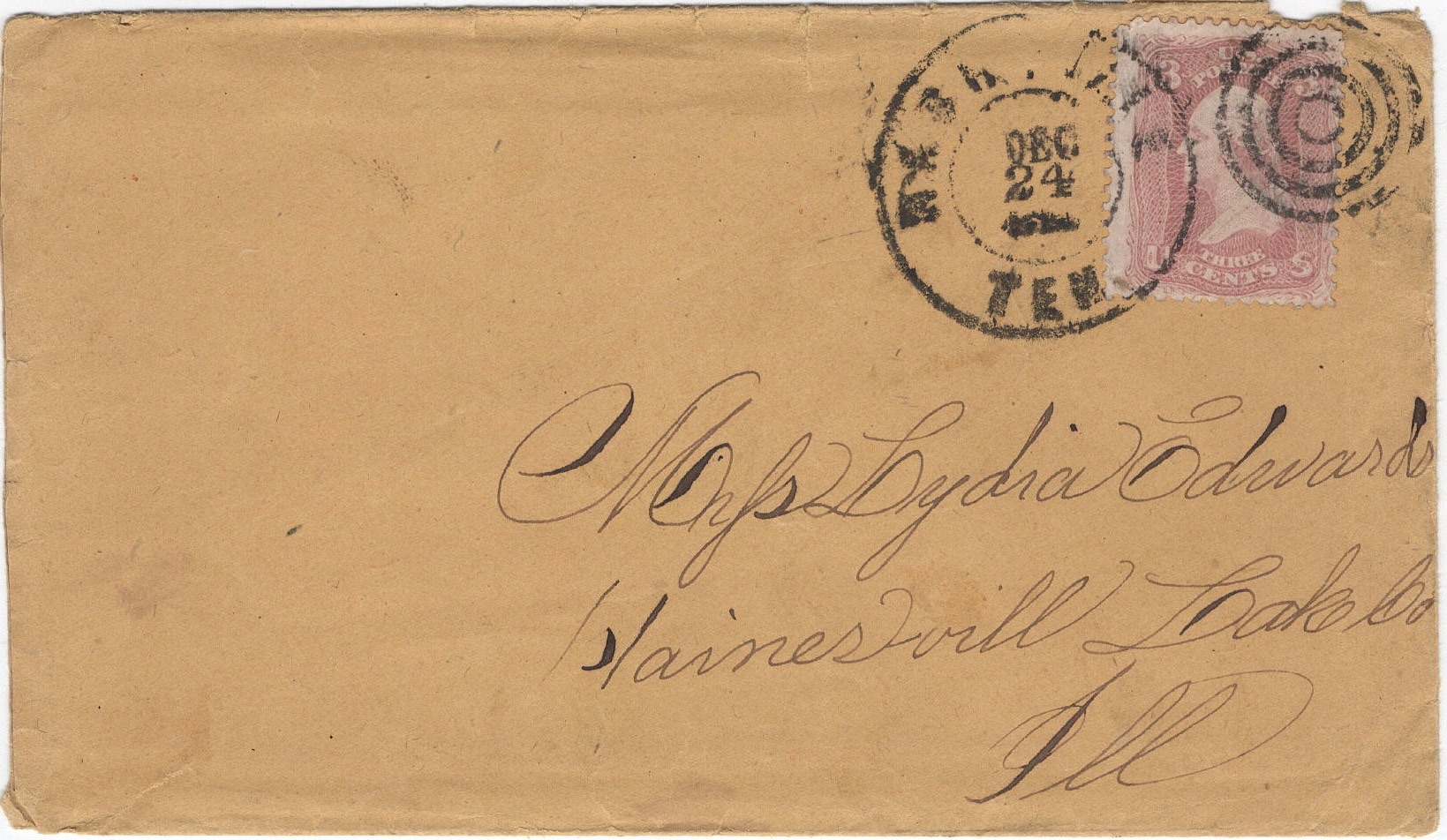
Nashville [Tennessee]
December 23, [1863]
My sisters,
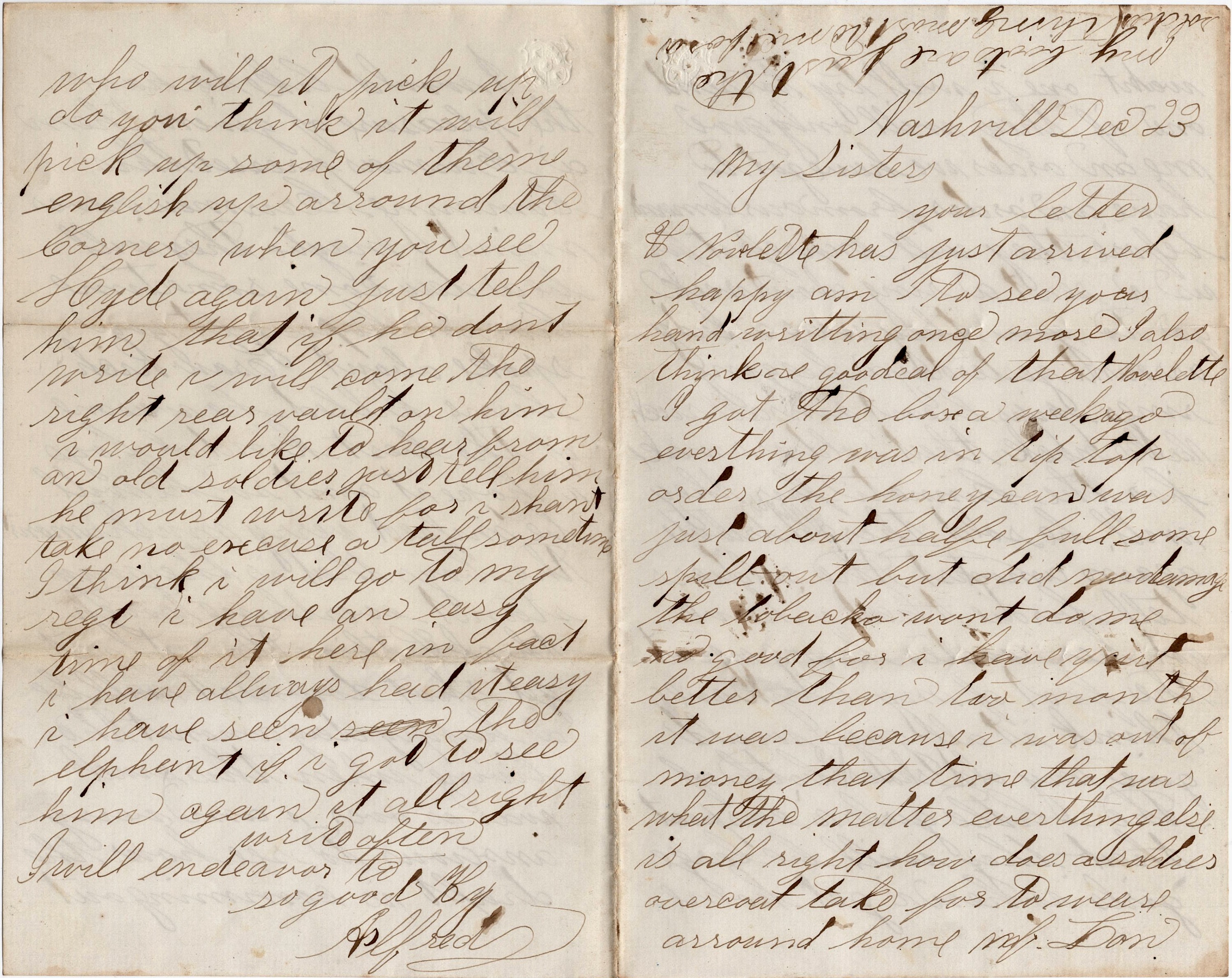
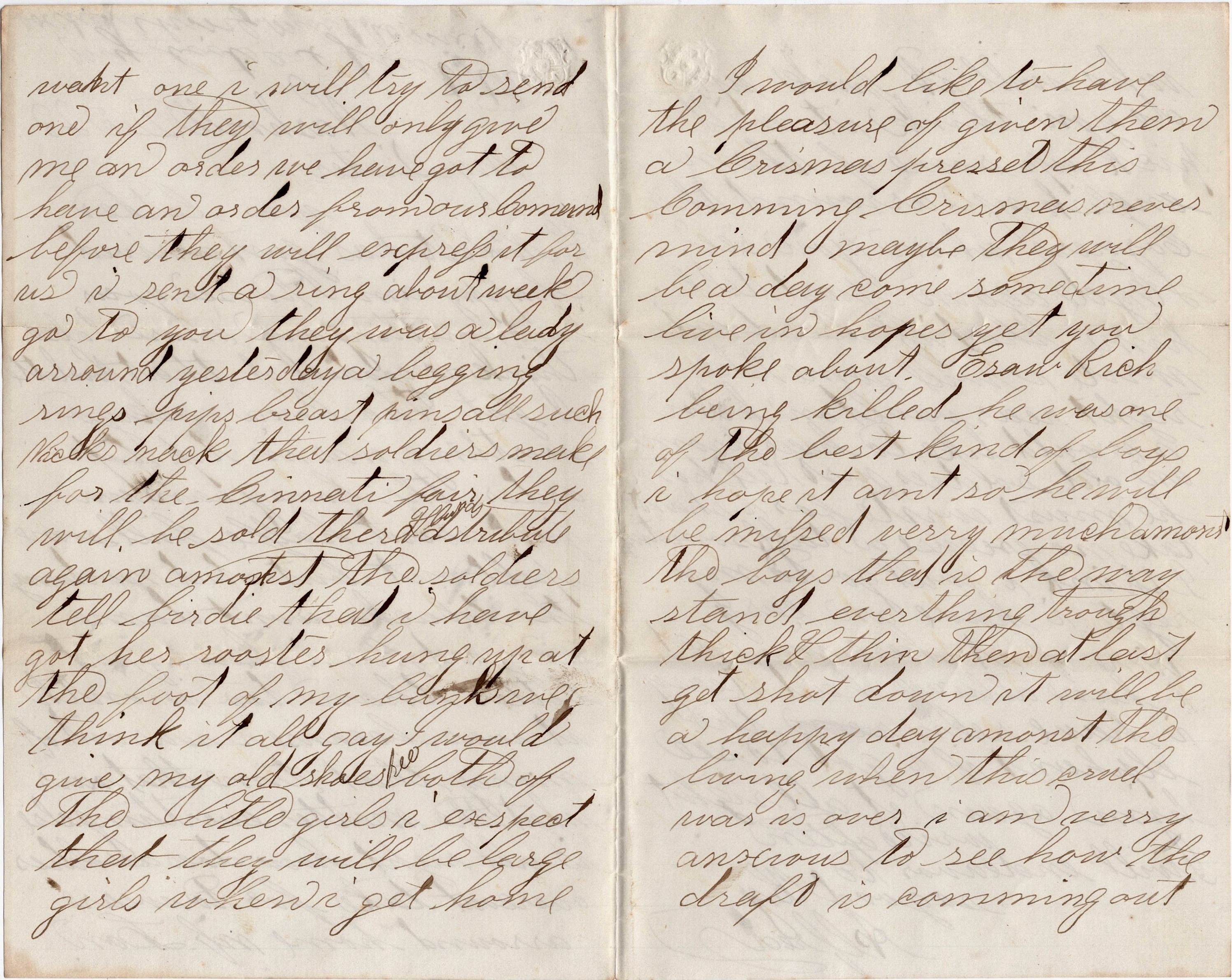
Your letter & novelette gas just arrived. Happy am I to see your hand writing once more. I also think a good deal of that novelette. I got the box a week ago. Everything was in tip top order. The honey can was just about half full. Some spilt out but did no damage. The tobacco won’t do me no good for I have quit better than two months [ago]. It was because I was out of money that time—that was what’s the matter. Everything else is all right. How does a soldier’s overcoat take for to wear around home? If Lon wants one, I will try to send one if they will only give me an order, We have got to have an order from our command before they will express it for us. I sent a ring about a week ago to you. There was a lady around yesterday a begging rings, pipes, breast pins—all such nicknacks that soldiers make for the Cincinnati [Sanitary] Fair. They will be sold there and distributed again amongst the soldiers.
Tell Birdie that I have got her rooster hung at the foot of my bunk. We think it all gay. I would give my old shoes to see both of the little girls. I expect that they will be large girls when I get home. I would like to have the pleasure of giving them a Christmas present this coming Christmas, Never mind. Maybe there will be a day come sometime. I live in hopes yet.
You spoke about Esau Rich being killed. He was one of the best kind of boys. I hope it ain’t so. He will be missed very much amongst the boys. That is the way [it goes]—stand everything through thick & thin, then at last get shot down. It will be a happy day amongst the living when this cruel war is over. 1
I am very anxious to see how the draft is coming out. Who will it pick up? Do you think it will pick up some of them English up around the Corners? 2
When you see Hyde again, just tell him that if he don’t write, I will come the right rear vault on him. I would like to hear from an old soldier. Just tell him he must write for I shan’t take no excuse at all. Sometimes I think I will go to my regiment. I have an easy time of it here. In fact, I have always had it easy. I have seen the elephant. If I got to see him again, it [would] be all right. Write often. I will endeavor to. So goodbye, — Alfred
My boots are just the thing—most too nice for a soldier.
1 Esau Hosea Rich of Avon (1840-1863) served as a private in Co. B, 96th Illinois Infantry with Alfred. He was killed fighting above the clouds at Lookout Mountain on 24 November 1863. His parents were David Rich (1813-1879) and Maria Morrill (1817-1903).
2 “The Corners” was likely Avon Centre near the intersection of what is now Route 83 and Washington Street. Unlike many surrounding areas of Illinois that attracted German emigrants, the Avon Centre and Fort Hill areas were notable for enclaves of English emigrants.
Letter 7
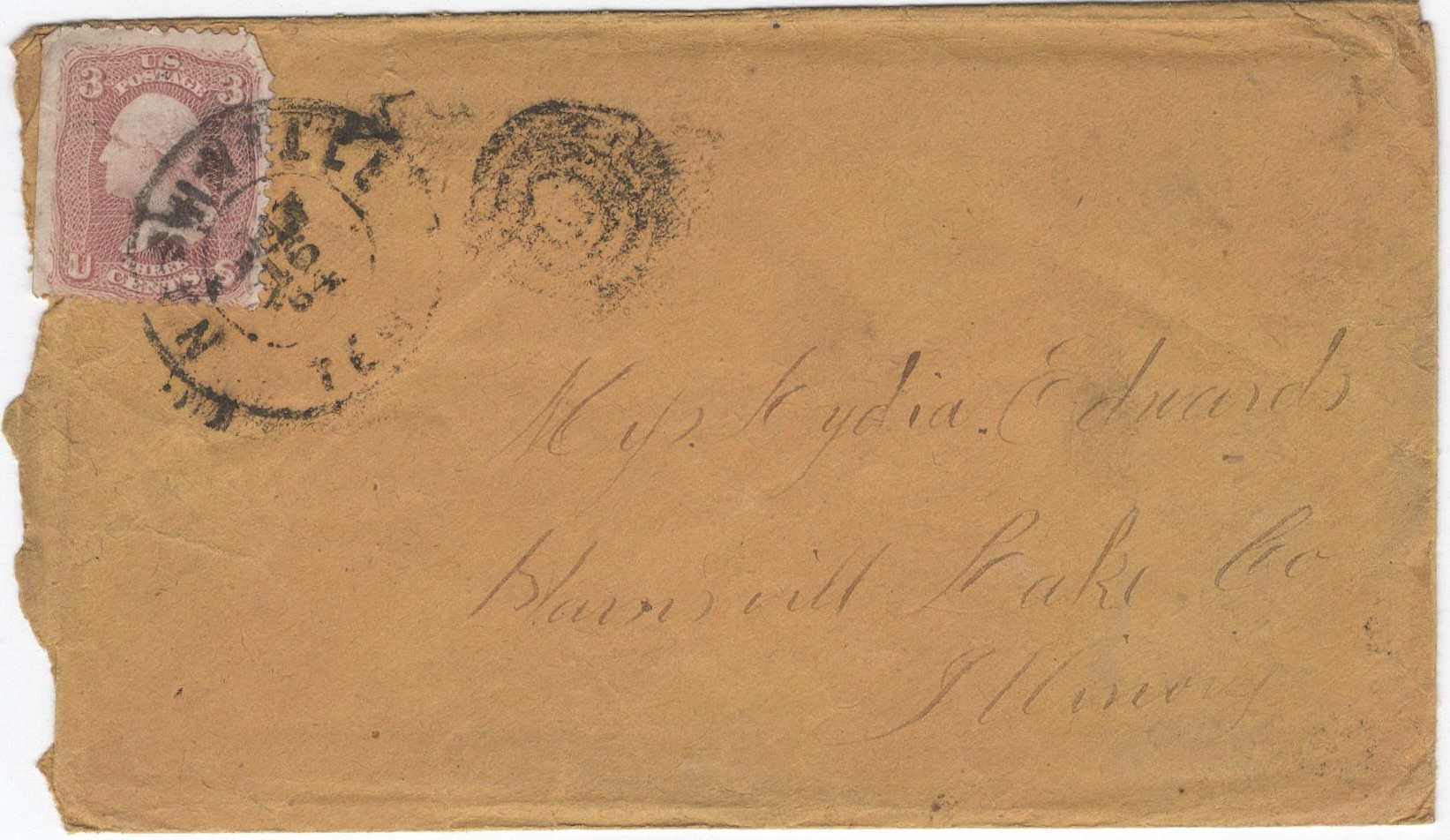
Nashville [Tennessee]
January 15, 1864
My sister,
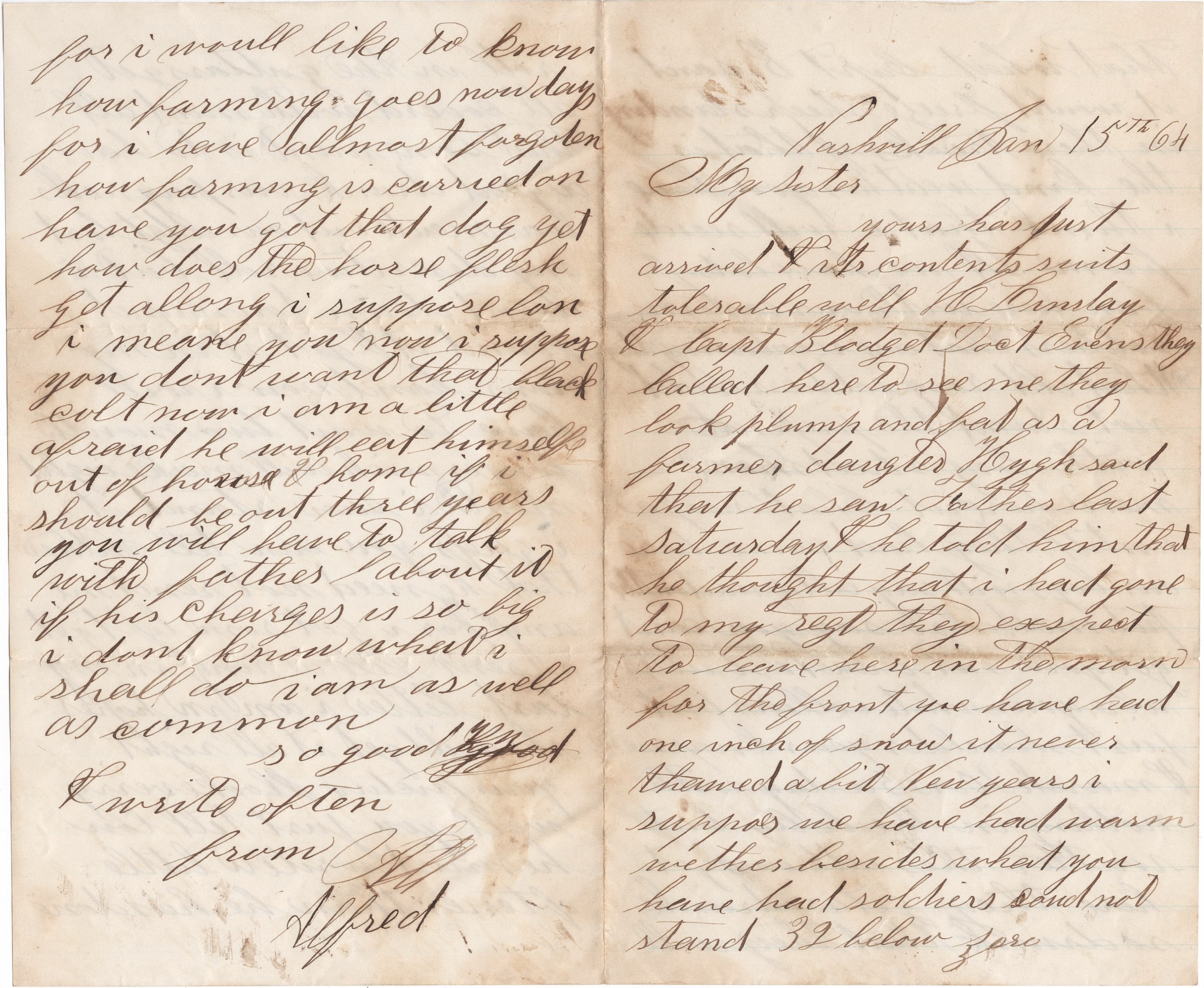
Yours has just arrived *& its contents suits tolerable well. H[ugh] Lindsay & Capt. Blodgett, Doctor Evans—they called here to see me. They look plump and fat as a farmer’s daughter. Hugh said that he saw Father last Saturday & he told him that he thought that I had gone to my regiment. They expect to leave here in the morn for the front.
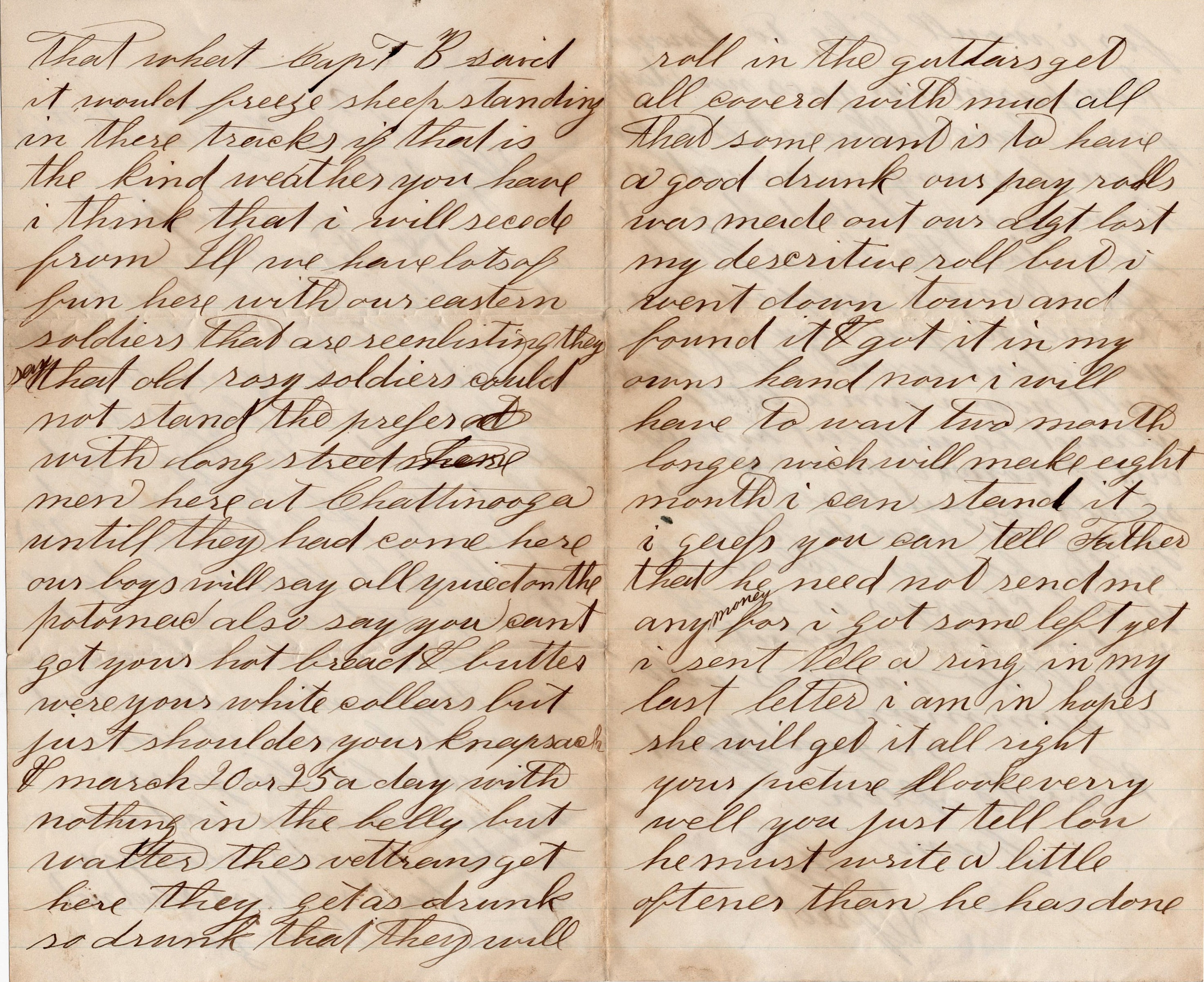
We have had one inch of snow. It never thawed a bit New Years. I suppose we have had warm weather besides what you have had. Soldiers cannot stand 32 below zero, that’s what. Capt. Blodgett said it would freeze sheep standing in their tracks. If that is the kind of weather you have, I think I will secede from Illinois.
We have lots of fun here with our Eastern soldiers that are reenlisting. They say that Old Rosy’s soldiers could not stand the pressure with Longstreet’s men here at Chattanooga until they had come here. Our boys will say, “All quiet on the Potomac.” [We] also say, “You can’t get your hot bread & butter, [nor] wear your white collars, but just shoulder your knapsack & march 20 or 25 miles a day with nothing in the belly but water. The veterans get here, they get drunk—so drunk that they will roll in the gutters, get all covered with mud. All that some want is to have a good drunk.
Our pay rolls was made out. Our adjutant lost my Descriptive roll but I went down town and found it & got it in my own hands. Now I will have to wait two months longer which will make eight months. I can stand it, I guess. You can tell Father that he need not send me any money for I got some left yet. I sent Nell a ring in my last letter. I am in hopes she will get it all right. Your picture looks very well. You just tell Lon he must write a little oftener than he has done for i would like to know how farming goes now-a-days for I have almost forgotten how farming is carried on.
Have you got that dog yet? How does the horse flesh get along? I suppose Lon—I mean you now—I suppose you don’t want that black colt now. I am a little afraid he will eat himself out of house & home. If I should be out [here] three years, you will have to talk with father about it. If his charges is so big, I don’t know what I shall do. I am as well as common. So goodbye. Write often. From Alfred
Letter 8
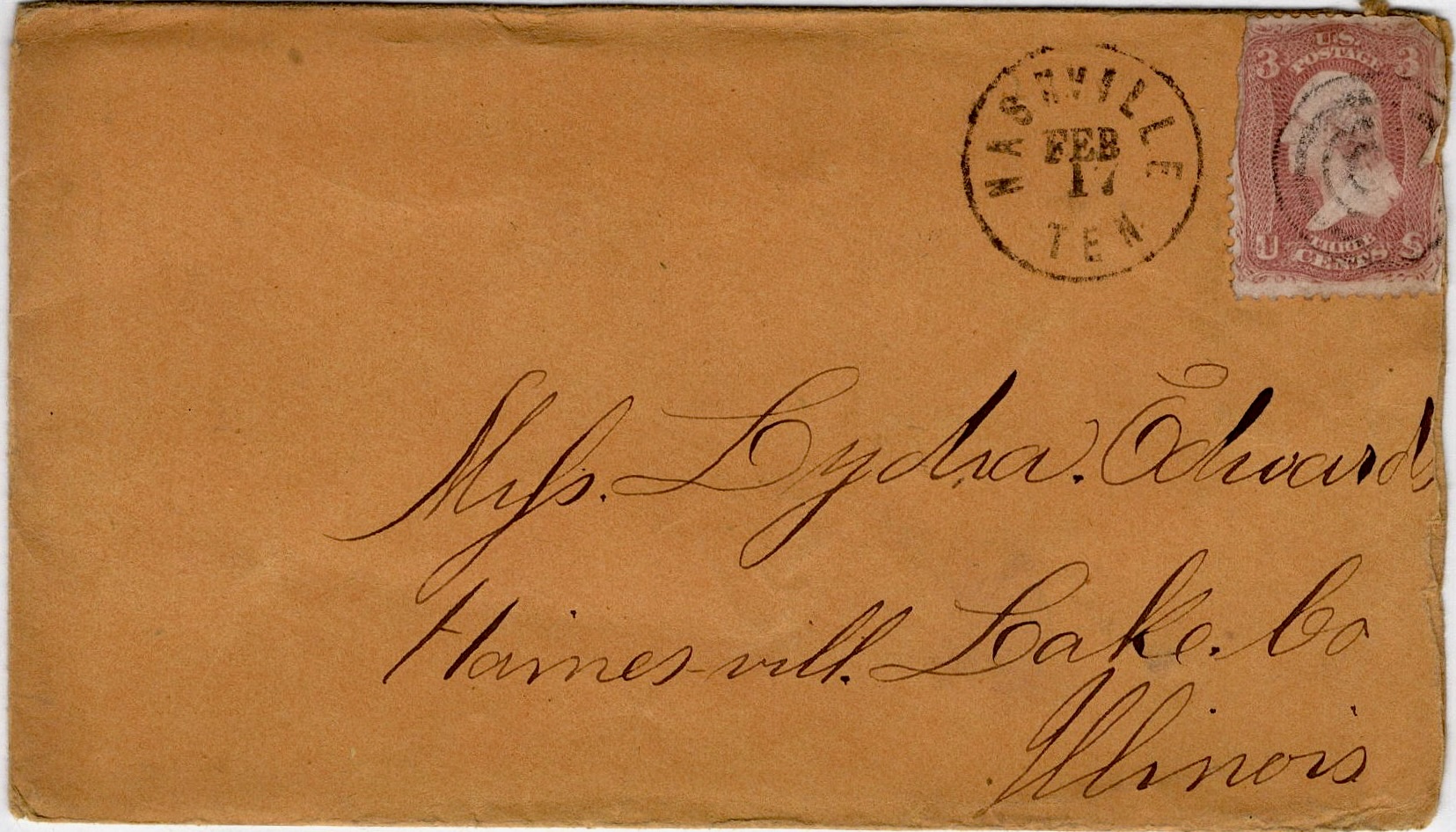
Nashville [Tennessee]
February 21st 1864
My sister,
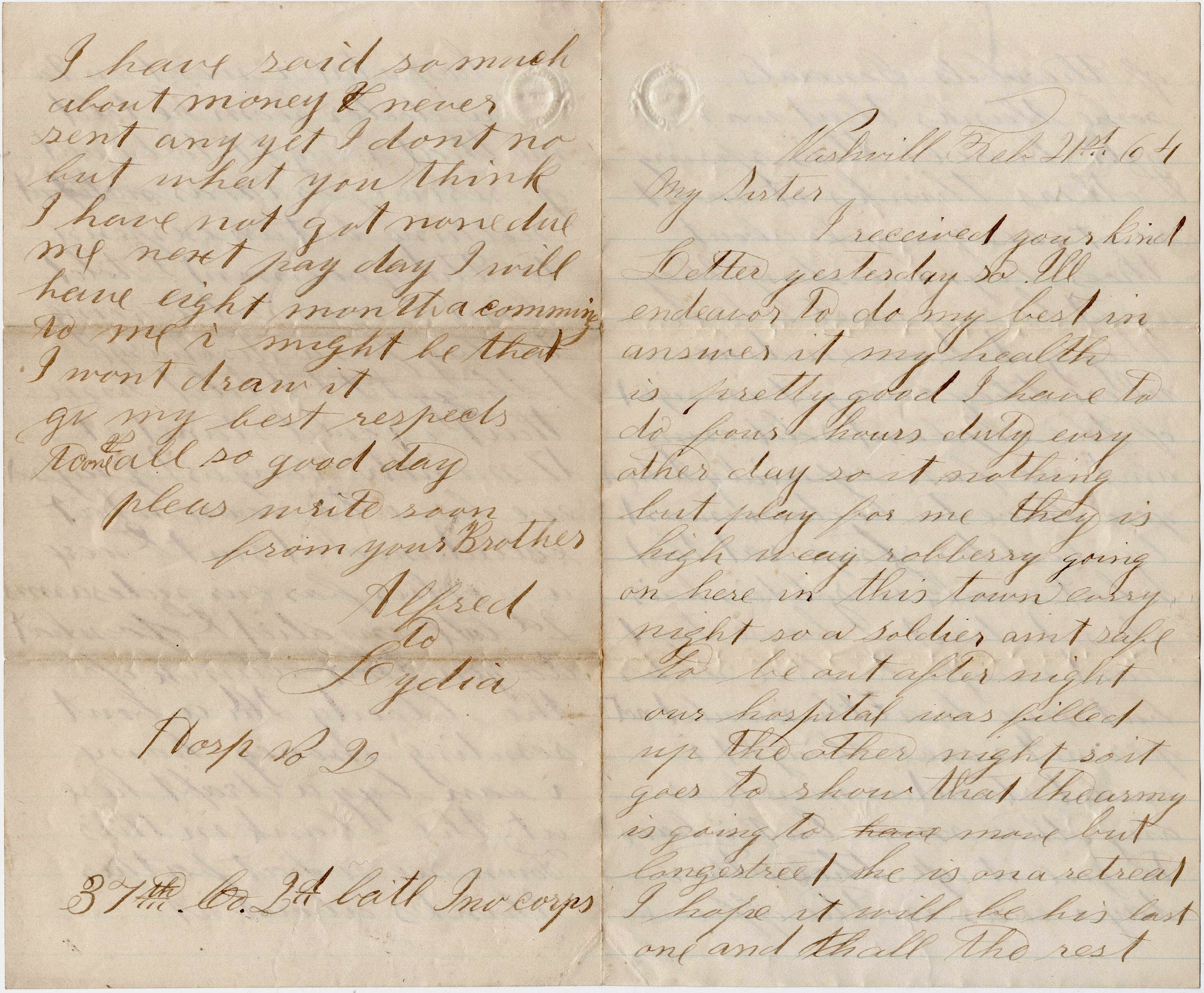
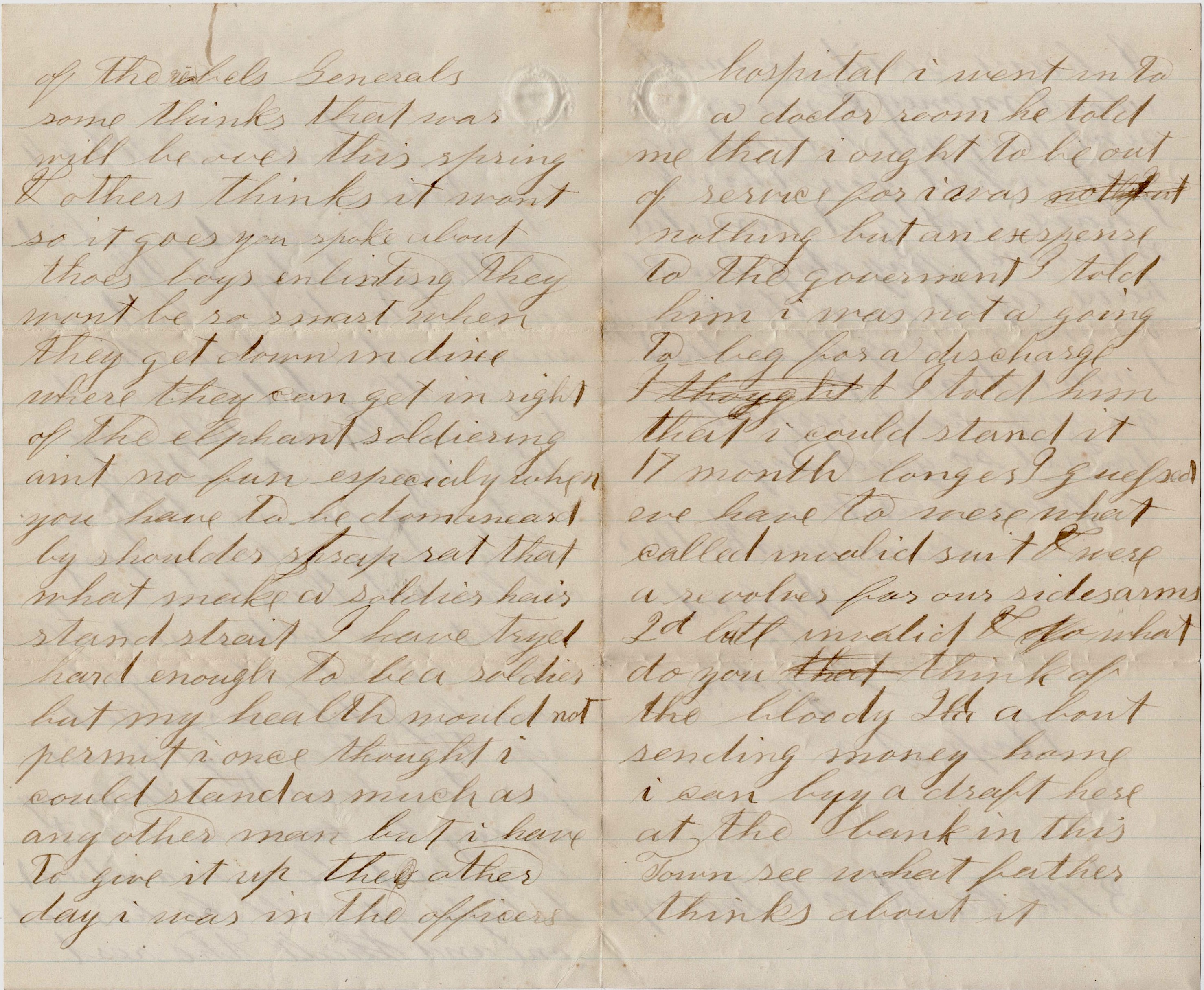
I received your kind letter yesterday so I’ll endeavor to do my best in answering it. My health is pretty good. I have to do four hors duty every other day so it’s nothing but play for me. There is highway robbery going on here in this town every night so a soldier ain’t safe to be out after night.
Our hospital was filled up the other night. So it goes to show that the army is going to move [soon], but Longstreet—he is on the retreat. I hope it will be his last one and all the rest of the rebel generals. Some thinks that this war will be over this spring & others think it won’t. So it goes.
You spoke about those boys enlisting. They won’t be so smart when they get down in Dixie where they can get in sight of the elephant. Soldiering ain’t no fun—especially when you have to be domineered by shoulder strap rot. That’s what makes a soldier’s hair stand straight. I have tried hard enough to be a soldier but my health would not permit. I once thought I could stand as much as any other man but I have to give it up.
The other day I was in the officer’s hospital. I went into a doctor’s room [and] he told me that I ought to be out of the service for I was nothing but an expense to the government. I told him I was not a going to beg for a discharge. I told him that I could stand it 17 months longer. I guess we have to wear what’s called an invalid suit & wear a revolver for our side arms. [It’s the] 2nd Battalion Invalid [Corps]. So what do you think of the “Bloody 2nd?”
About sending money home, I can buy a draft here at the bank in this town. She what father thinks about it. I have said so much about money & never sent any yet, I don’t know but what you think I have not got none due me. Next pay day I will have eight months a coming to me. It might be that I won’t draw it.
Give my best respects to all. So goodbye. Please write soon. From your brother, — Alfred
Hospital No. 2, 37th Company, 2nd Battalion Invalid Corps
Letter 9
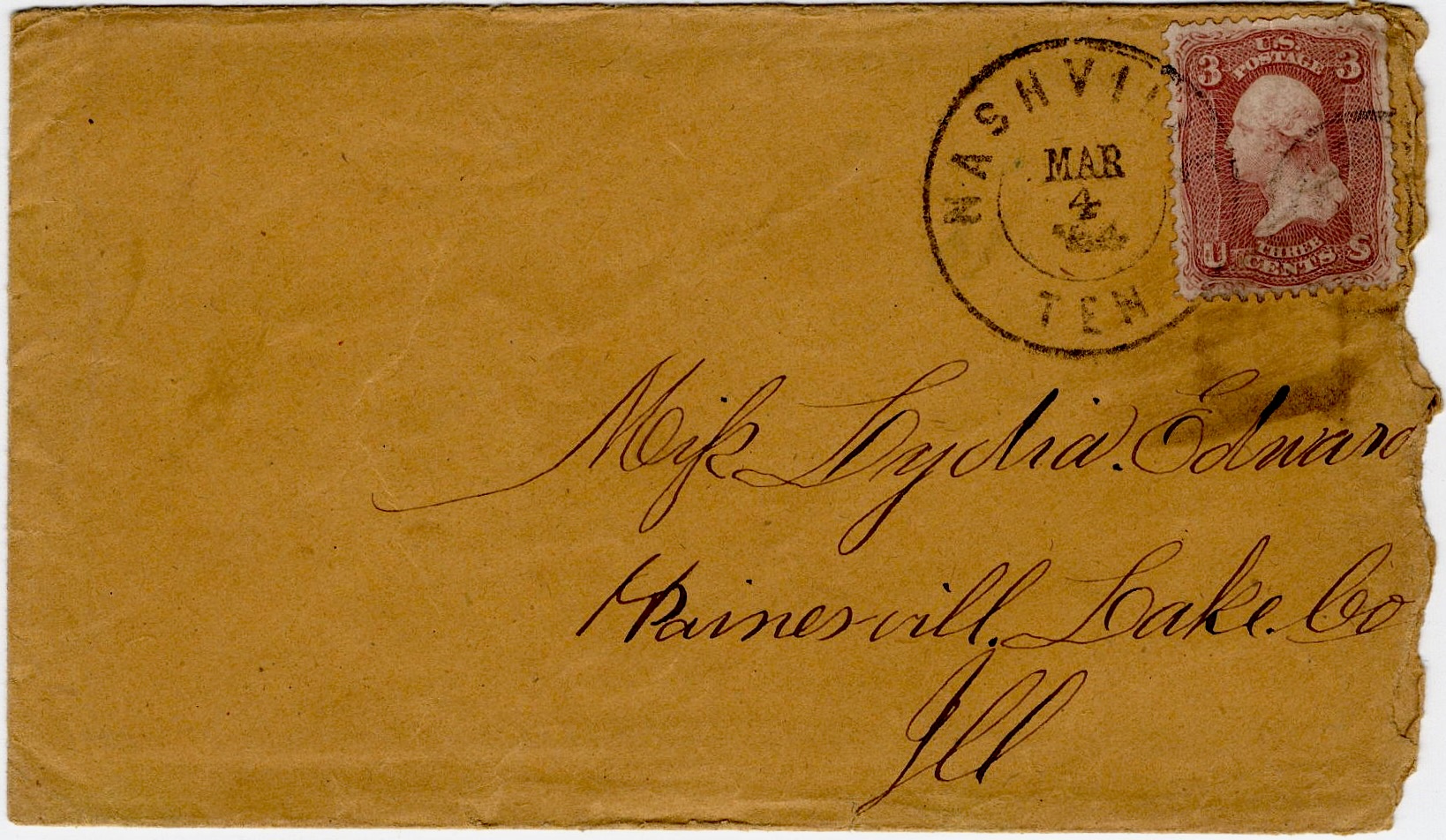
Nashville, [Tennessee]
March 3rd [1864]
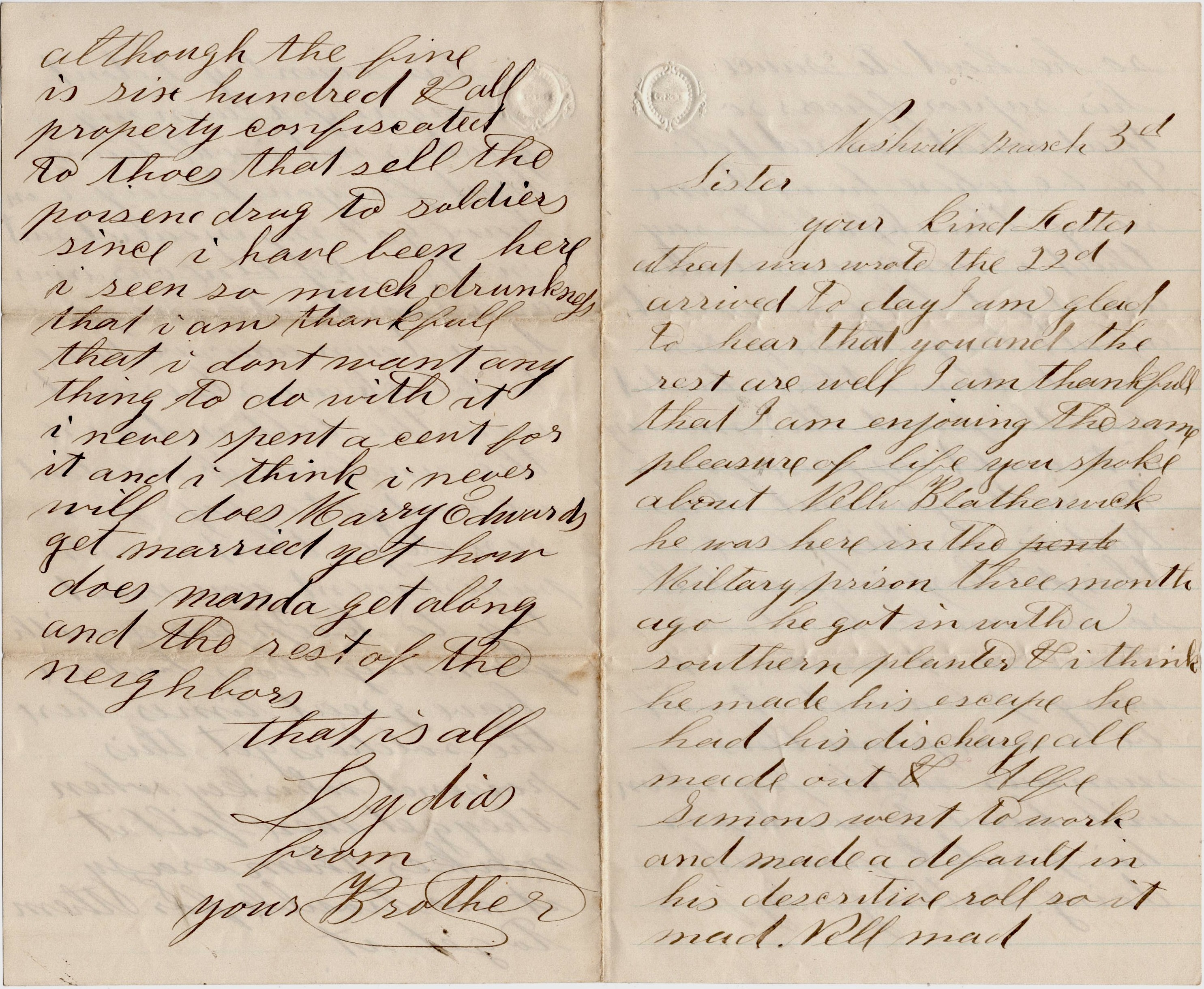
Sister,
Your kind letter that was wrote the 22nd arrived today. I am glad to hear that you and the rest are well. I am thankful that I am enjoying the same pleasure of life. You spoke about Nel[son] Blatherwick. 1 He was here in the military prison three months ago. He got in with a Southern planter & I think he made his escape. He had his discharge all made out & Alf Simons went to work and made a default in his Descriptive roll so it made Nel mad so he had to sass his superior officers so that is what caused Nel to be where he is. I am very thankful to say that I never was under arrest yet.
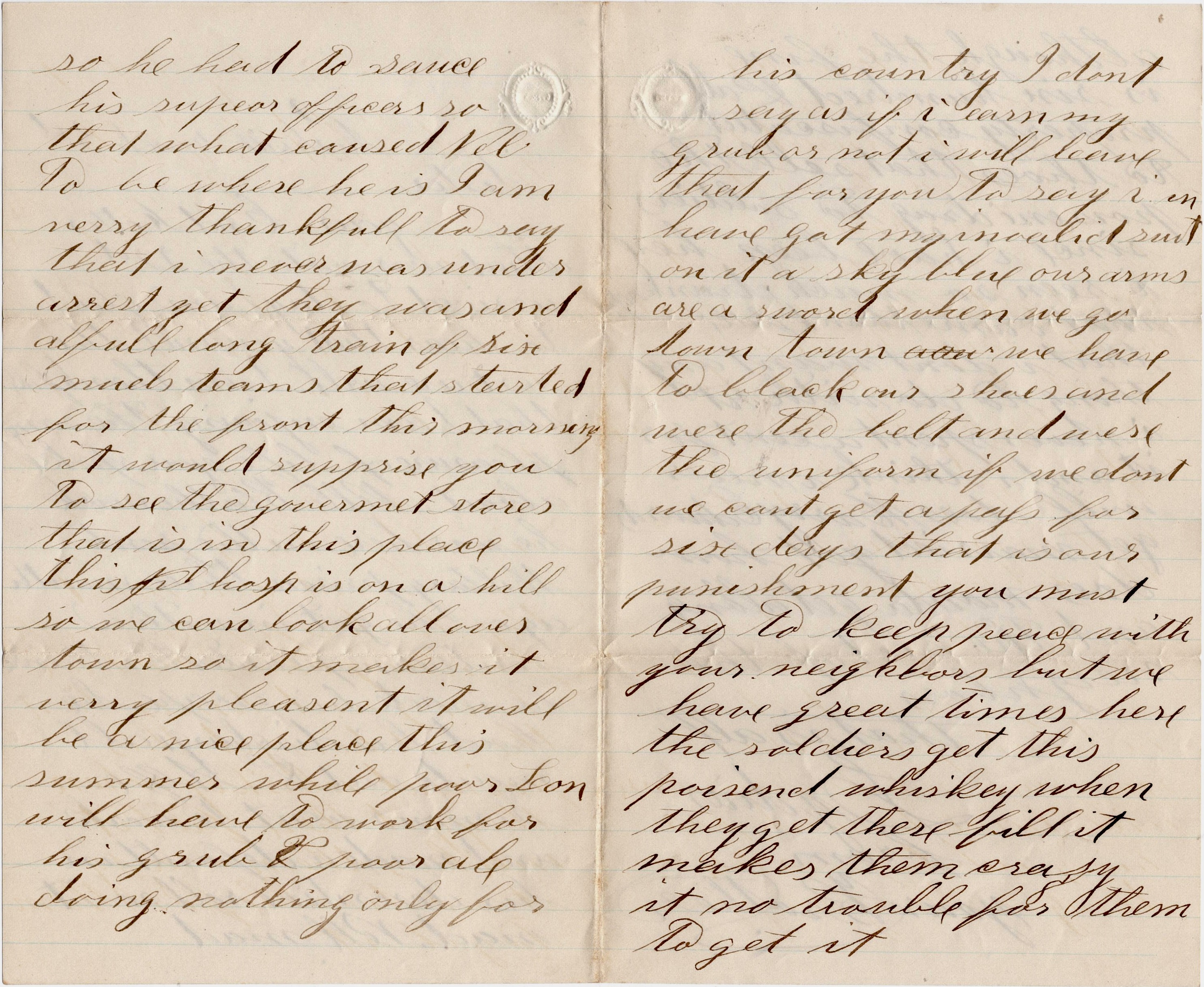
There was an awful long train of six mule teams that started for the front this morning. It would surprise you to see the government stores that in in this place. This hospital [Hospital No. 2] is on a hill so we can look all over town so it makes it very pleasant. It will be a nice place this summer while poor Lon will have to work for his grub & poor Al doing nothing—only for his county. I don’t say as if I earn my grub or not. I will leave that for you to say.
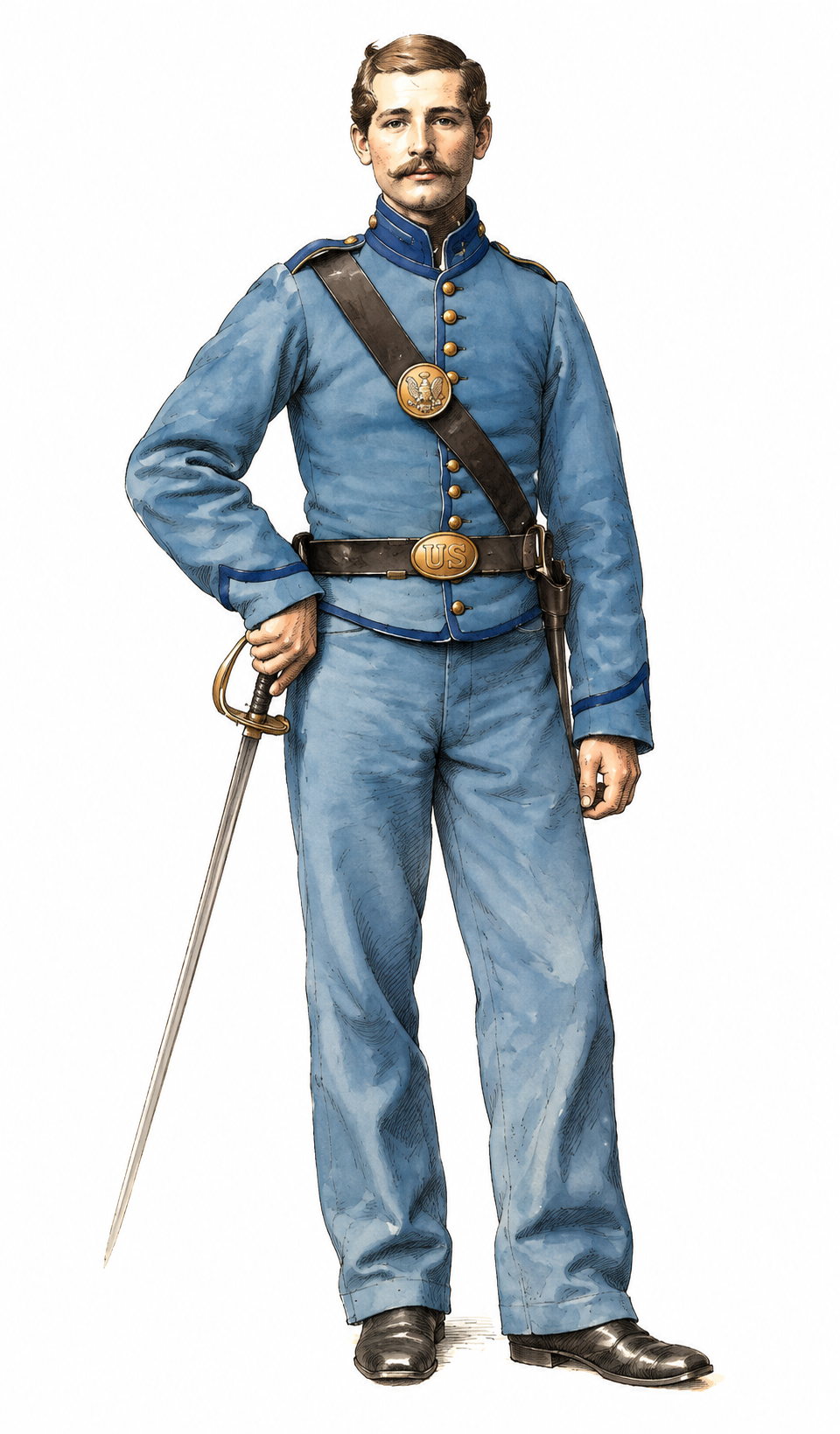
I have got my Invalid [Corps] suit on. It’s a sky blue. Our arms are a sword. When we go down town, we have to black our shoes and wear the belt and wear the uniform. If we don’t, we can’t get a pass for six days—that is our punishment.
You must try to keep peace with your neighbors but we have great times here. The soldiers get this poisoned whiskey. When they get their fill, it makes them crazy. It’s no trouble for them to get it although the fine is six hundred & all property confiscated to those that sell the poison drug to soldiers. Since I have been here, I seen so much drunkenness that I am thankful tht I don’t want anything to do with it. I never spent a cent for it and I think I never will.
Does Mary Edwards get married yet? How does Manda get along and the rest of the neighbors? That is all, Lydia. From your brother.
1 Nelson J. Blatherwick (1836-1919) was a farmer from Fremont, Lake county, Illinois. He served in Co. G, 51st Illinois Infantry.
Letter 10
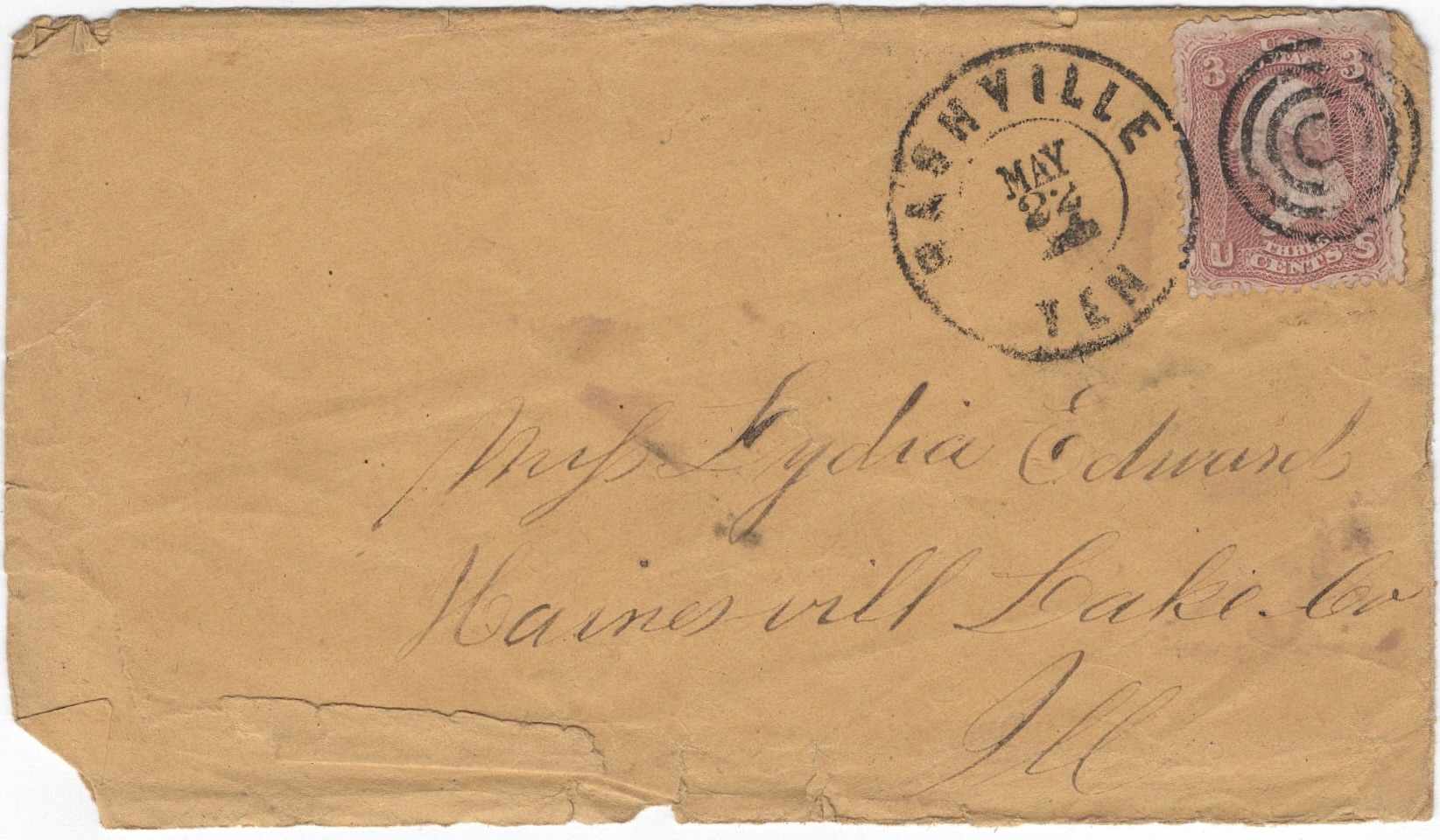
Nashville [Tennessee]
May 21st [1864
Sister,
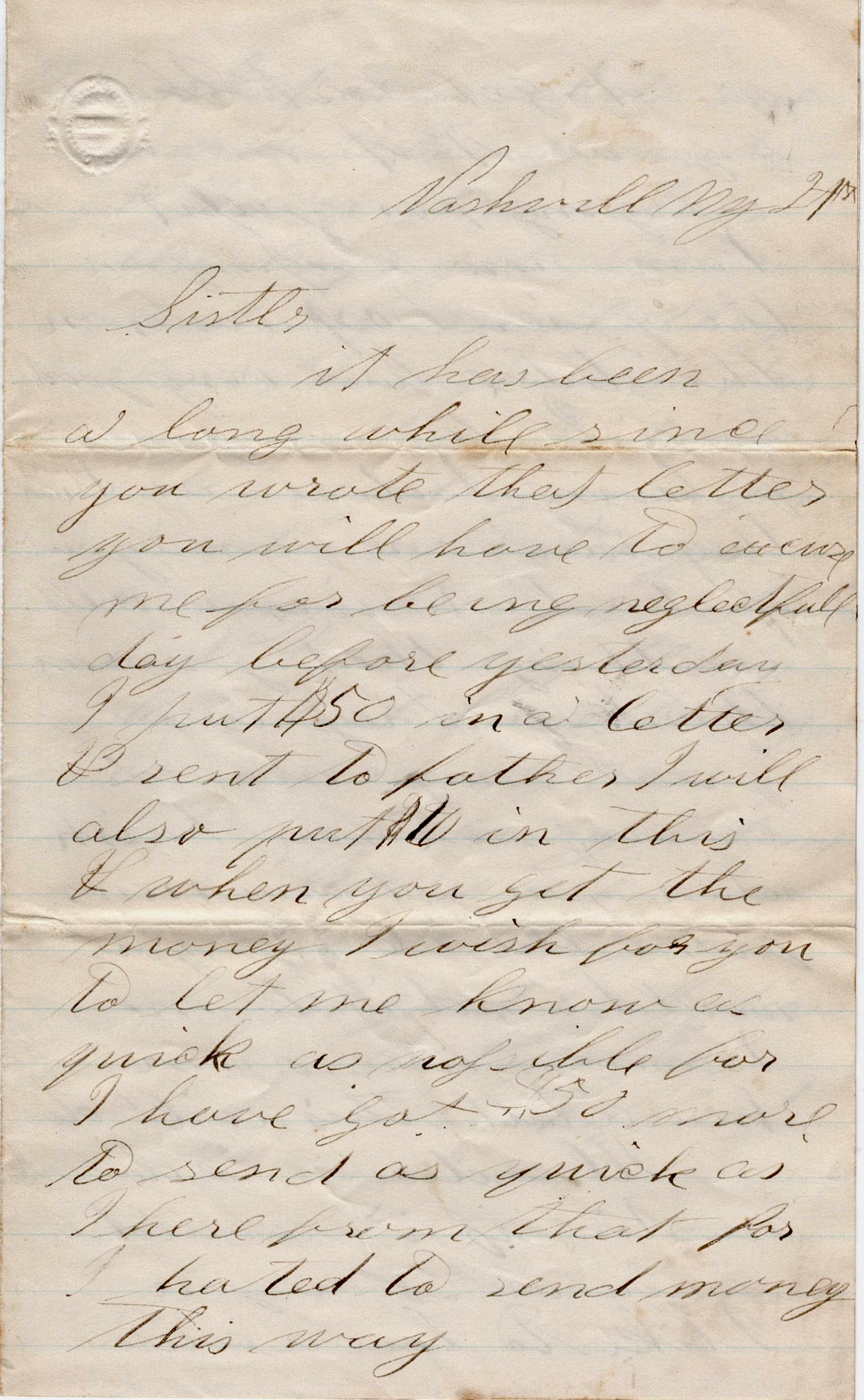
It has been a long while since you wrote that letter. You will have to excuse me for being neglectful. Day before yesterday I put $50 in a letter & sent it to father. I will also put $10 in this & when you get the money, I wish for you to let me know as quick as possible for I have got $50 more to send as quick as I hear from that for I hated to send money this way. If it gets lost, I hain’t [going to] cry over it. [There’s] no use crying for spilt milk.
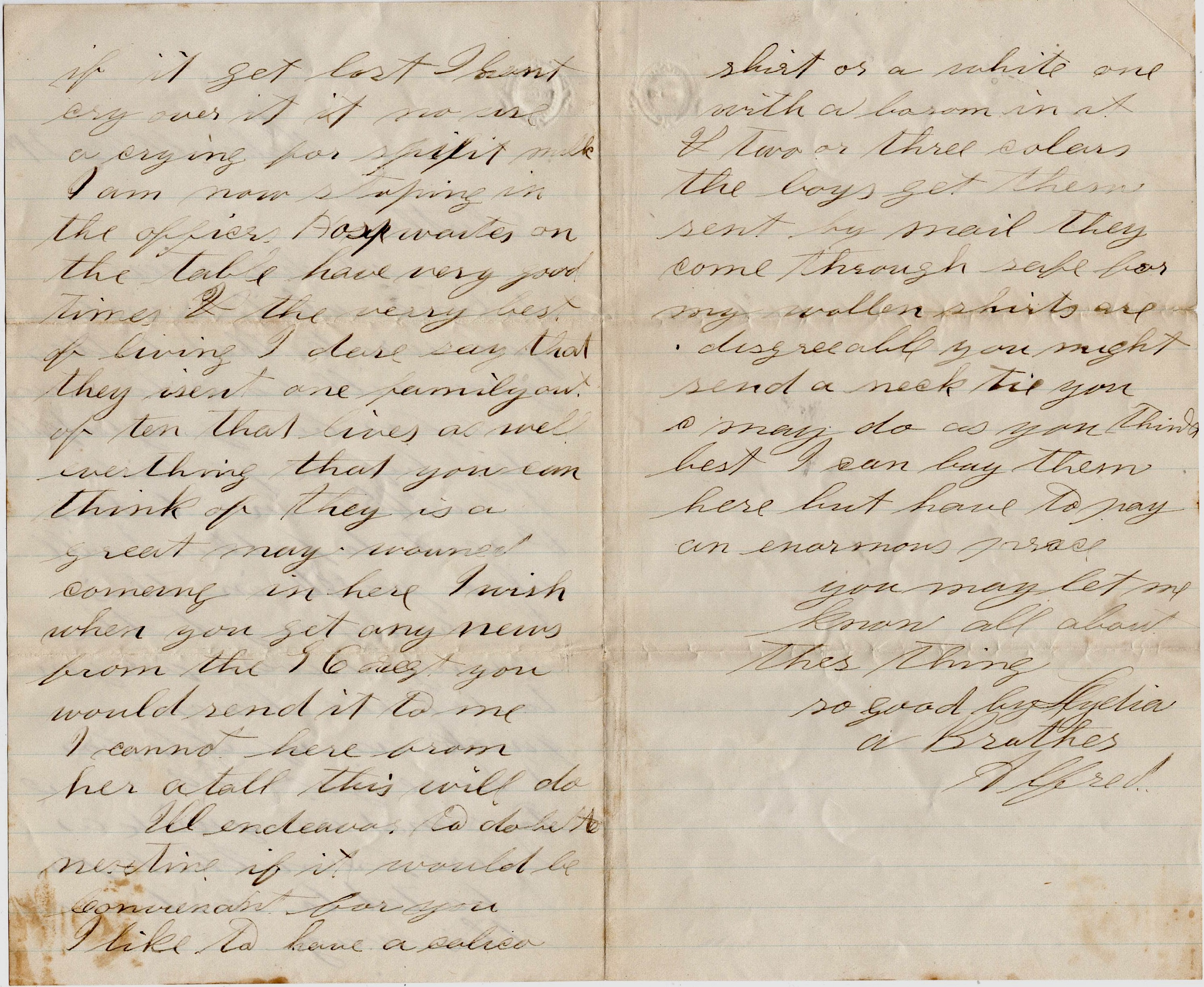
I am now stopping in the officer hospital [where I] wait on the tables. Have very good times & the very best of living. I dare say that there isn’t one family out of ten that lives as well. Everything that you can think of [to eat].
There is a great many wounded coming in here. I wish when you get any news from the 96th [Illinois] Regiment you would send it to me. I cannot hear from here at all. This will do. I’ll endeavor to do [more] next time. If it would be convenient for you, I’d like to have a calico shirt or a white one with a bosom in it and two or three colors. The boys get them sent by mail—they come through safe—for my woolen shirts are disagreeable. You might send a neck tie. You may do as you think best. I can buy them here but have to pay an enormous price.
You may let me know all about this thing. So goodbye Lydia. A brother, — Alfred
Letter 11
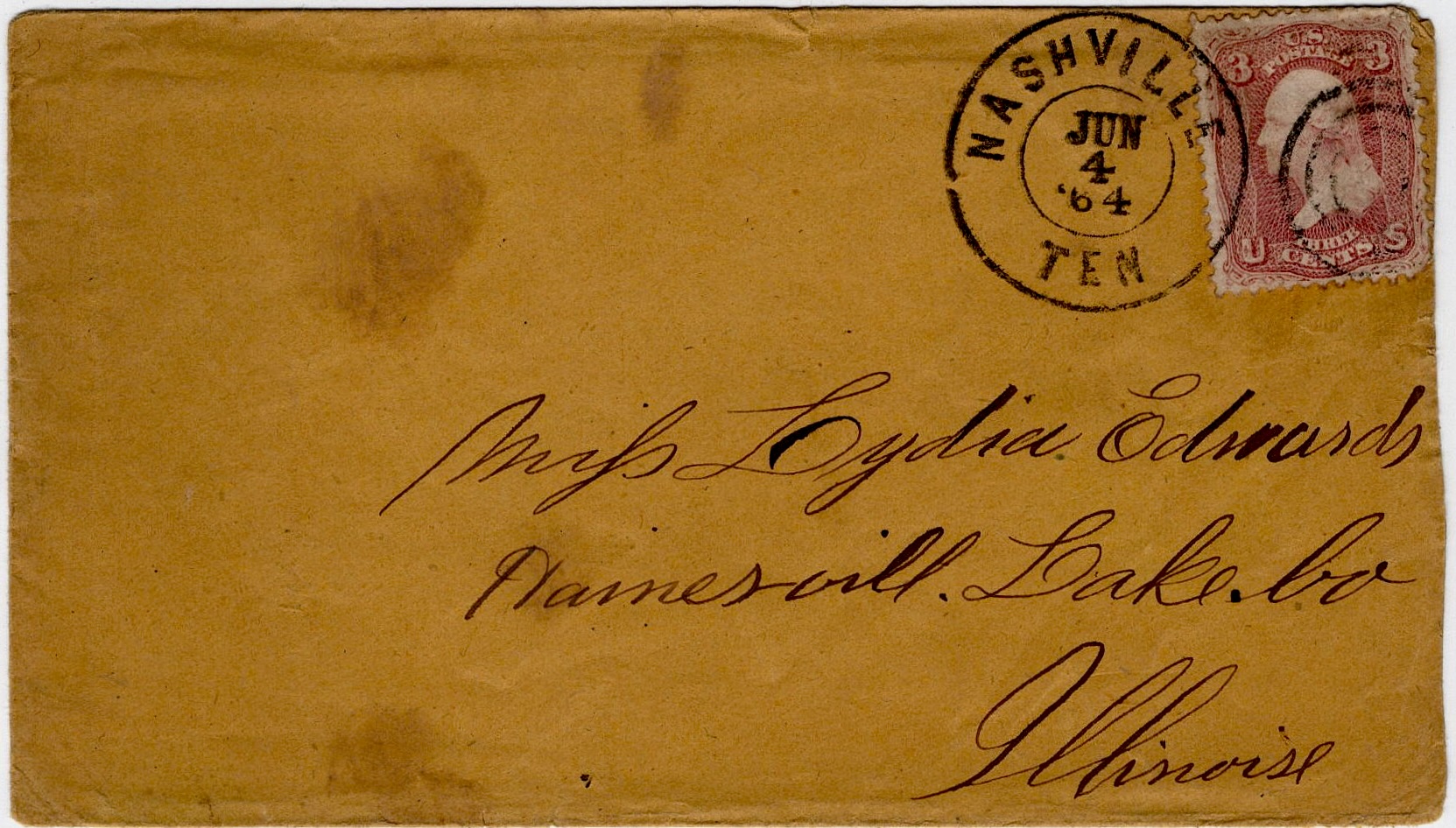
Nashville [Tennessee]
June 4th [1864]
My sister,
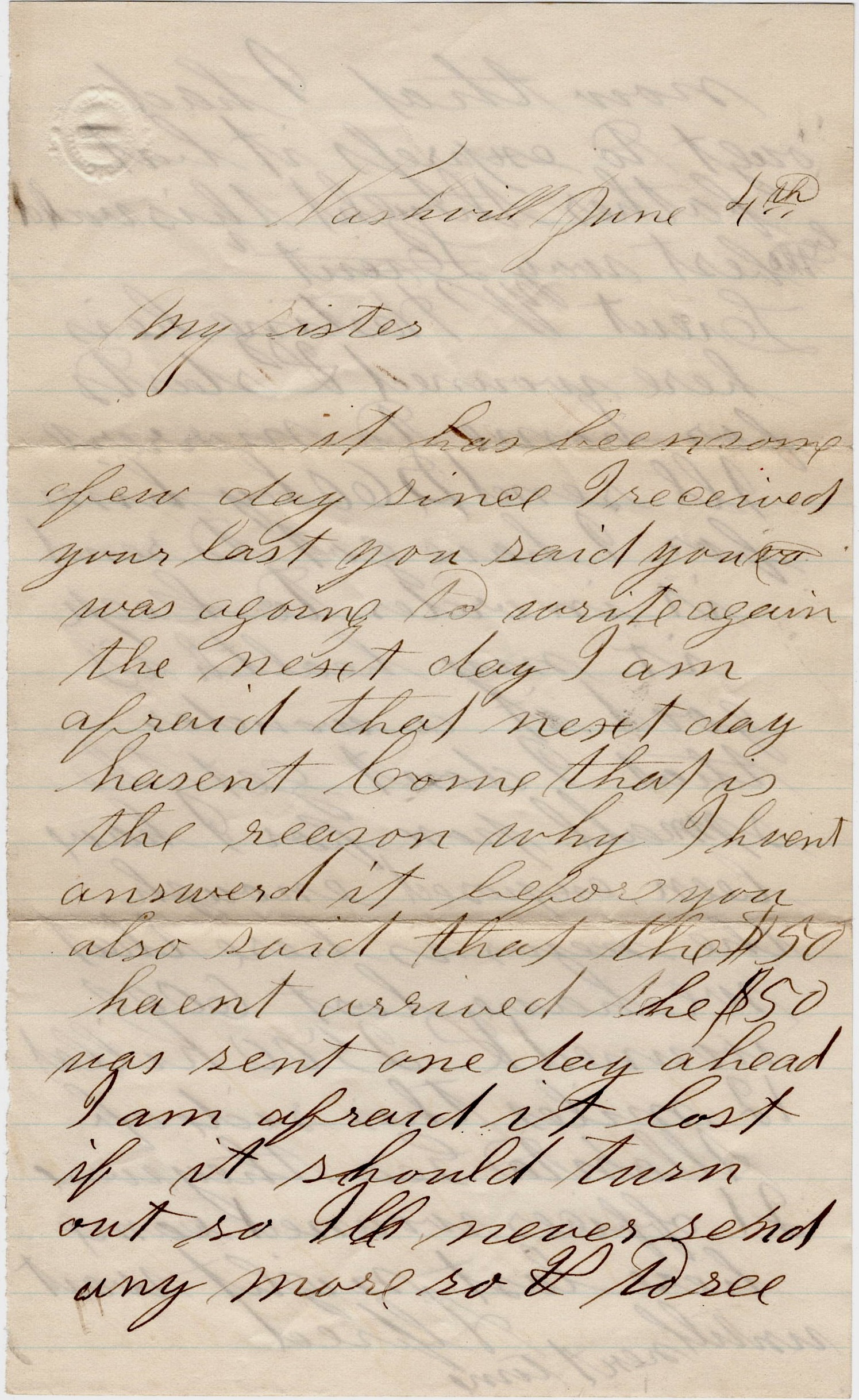
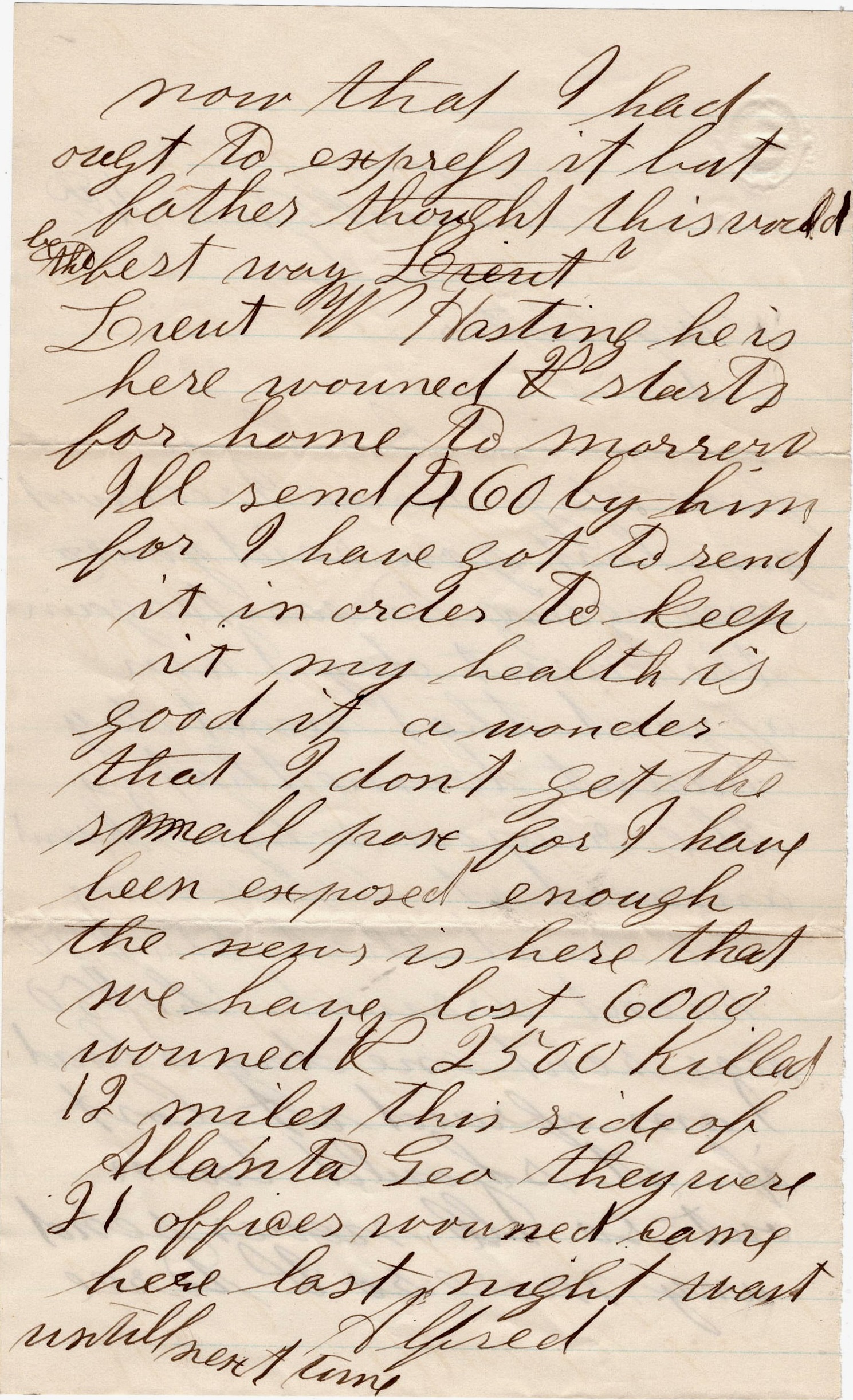
I has been some few days since I received your last. You said you was a going to write again the next day. I am afraid that next day hasn’t come. That is the reason why I haven’t answered it before. You also said that the $50 hasn’t arrived. The $50 was sent one day ahead. I am afraid it’s lost. If it should turn out so, I’ll never send any more so & I see now that I had ought to express it. But father thought this would be the best way.
Lieut. Hasting—he is here wounded & starts for home tomorrow. I’ll send $60 by him for I have got send it in order to keep it.
My heath is good. It’s a wonder that I don’t get the smallpox for I have been exposed enough. The news is here that we have lost 6,000 wounded & 2500 killed 12 miles this side of Atlanta, Georgia. There were 21 officers wounded came here last night. Wait until next time. — Alfred
Letter 12
Nashville [Tennessee]
June 5th [1864]
Sister,
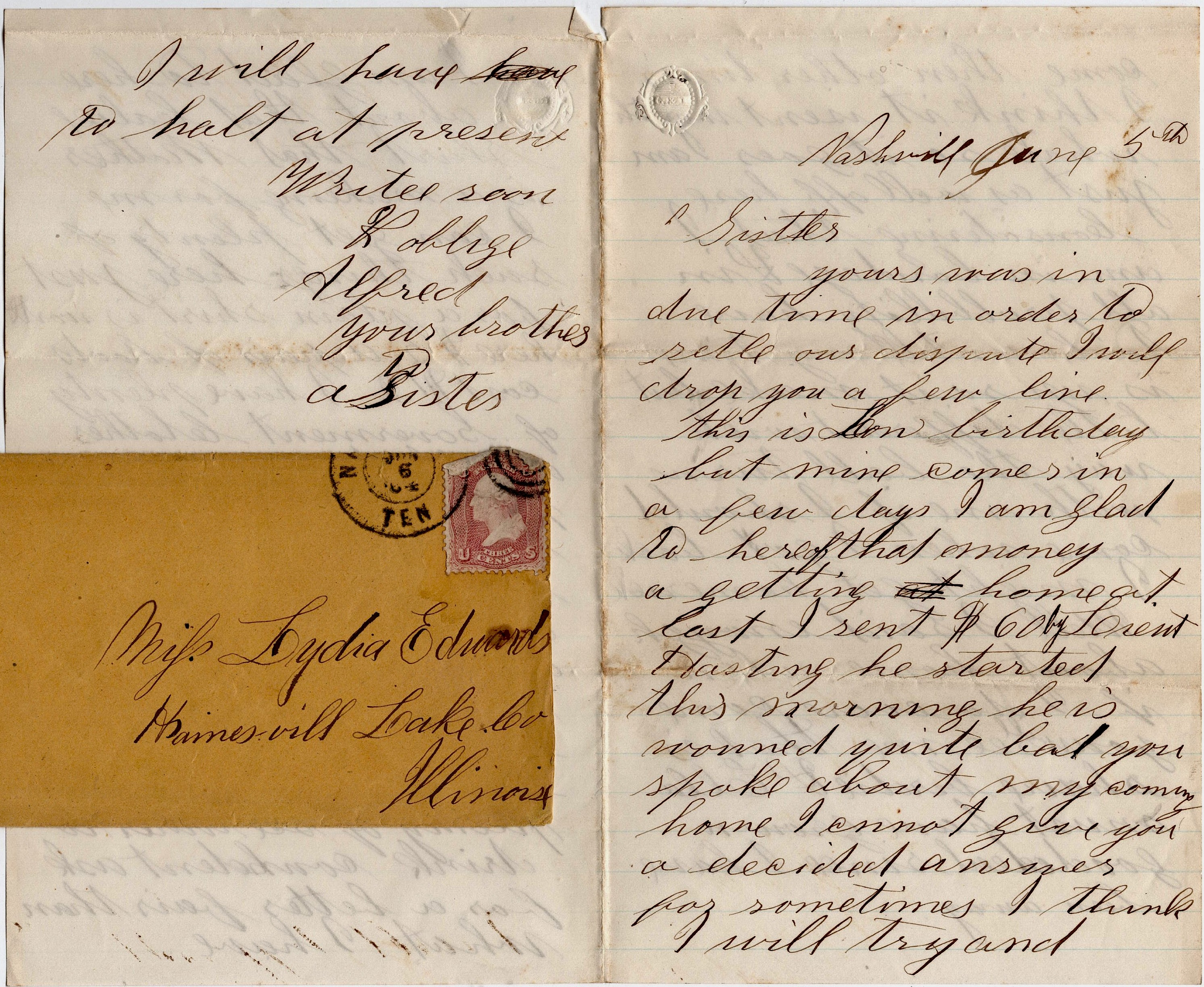
Yours was in due time. In order to settle our dispute, I will drop you a few lines. This is Lon’s birthday but mine comes in a few days. I am glad to hear that money is a getting home at last. I sent $60 by Lieut. Hasting. He started this morning. He is wounded quite bad.
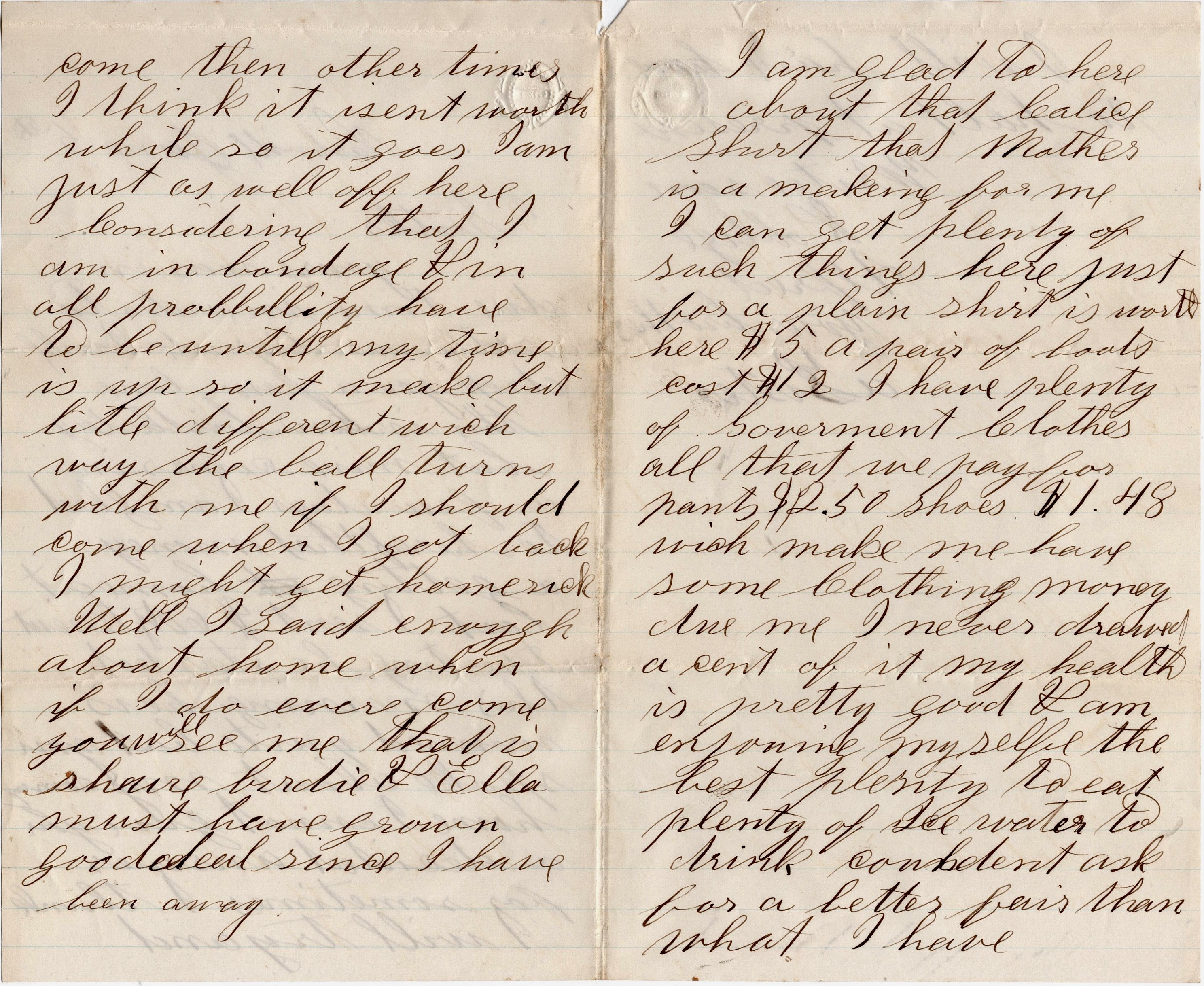
You spoke about my coming home. I cannot gve you a decided answer for sometimes I think I will try and come, then other times I think it isn’t worth while. So it goes. I am just as well off here considering that I am in bondage & in all probability have to be until my time is up so it makes but little difference which way the ball turns with me. If I should come when I got back, I might get homesick. Well I said enough about home. If I ever do come, you will see me. That is sure. Birdie & Ella must have grown a good deal since I have been away.
I am glad to hear about that calico shirt that Mother is a making for me. I can get plenty of such things here. Just for a plain shirt is worth here $5. A pair of boots cost $12. I have plenty of government clothes. All that we pay for pants $2.50, shoes $1.48, which makes me have some clothing money due me. I never drawed a cent of it.
My health is pretty good & am enjoying myself the best. Plenty to eat, plenty of ice water to drink. Couldn’t ask for a better fare than what I have. I will have to halt at present. Write soon & oblige. –Your brother Alfred
Letter 13
[Nashville, Tennessee]
Date?
Sister,
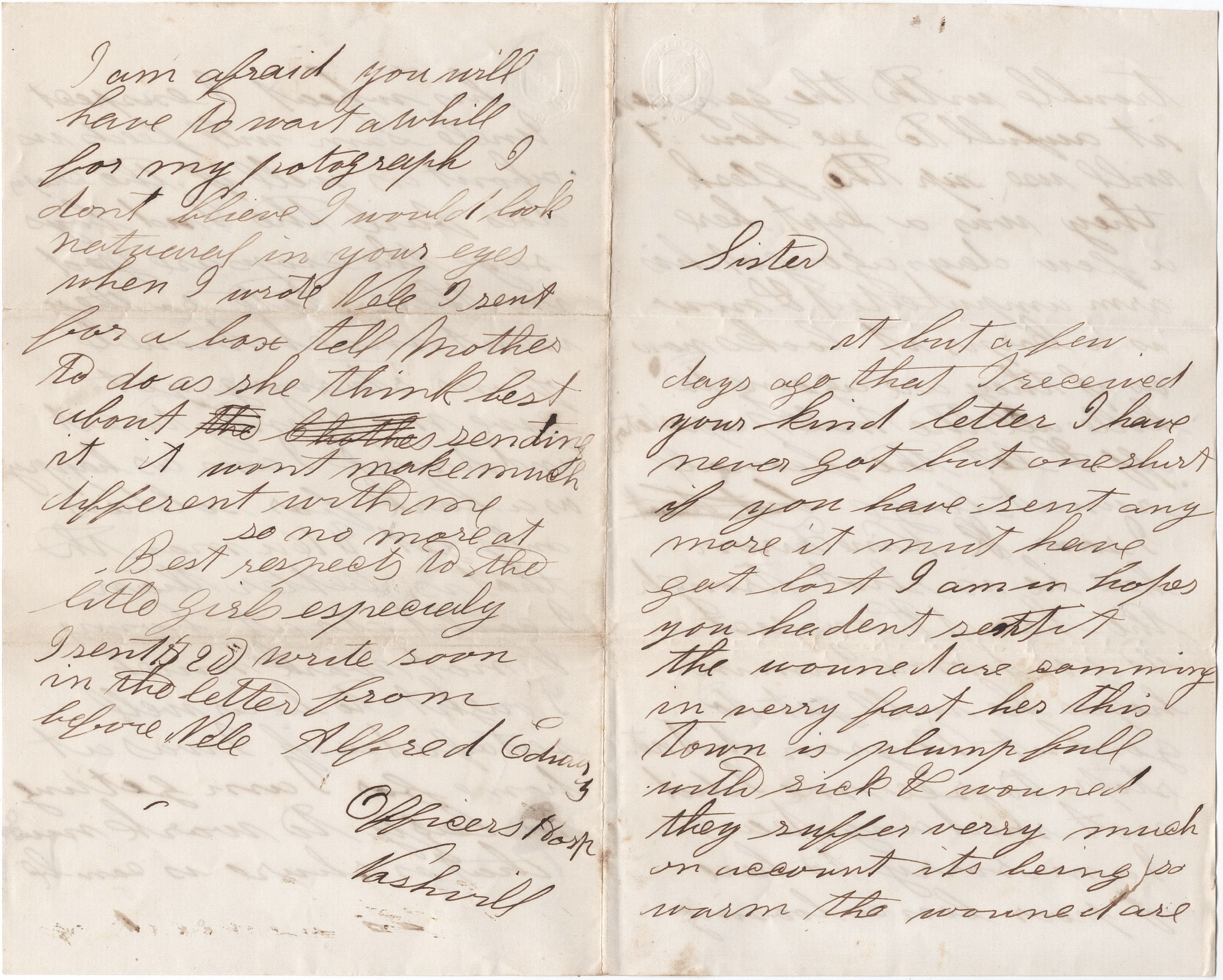
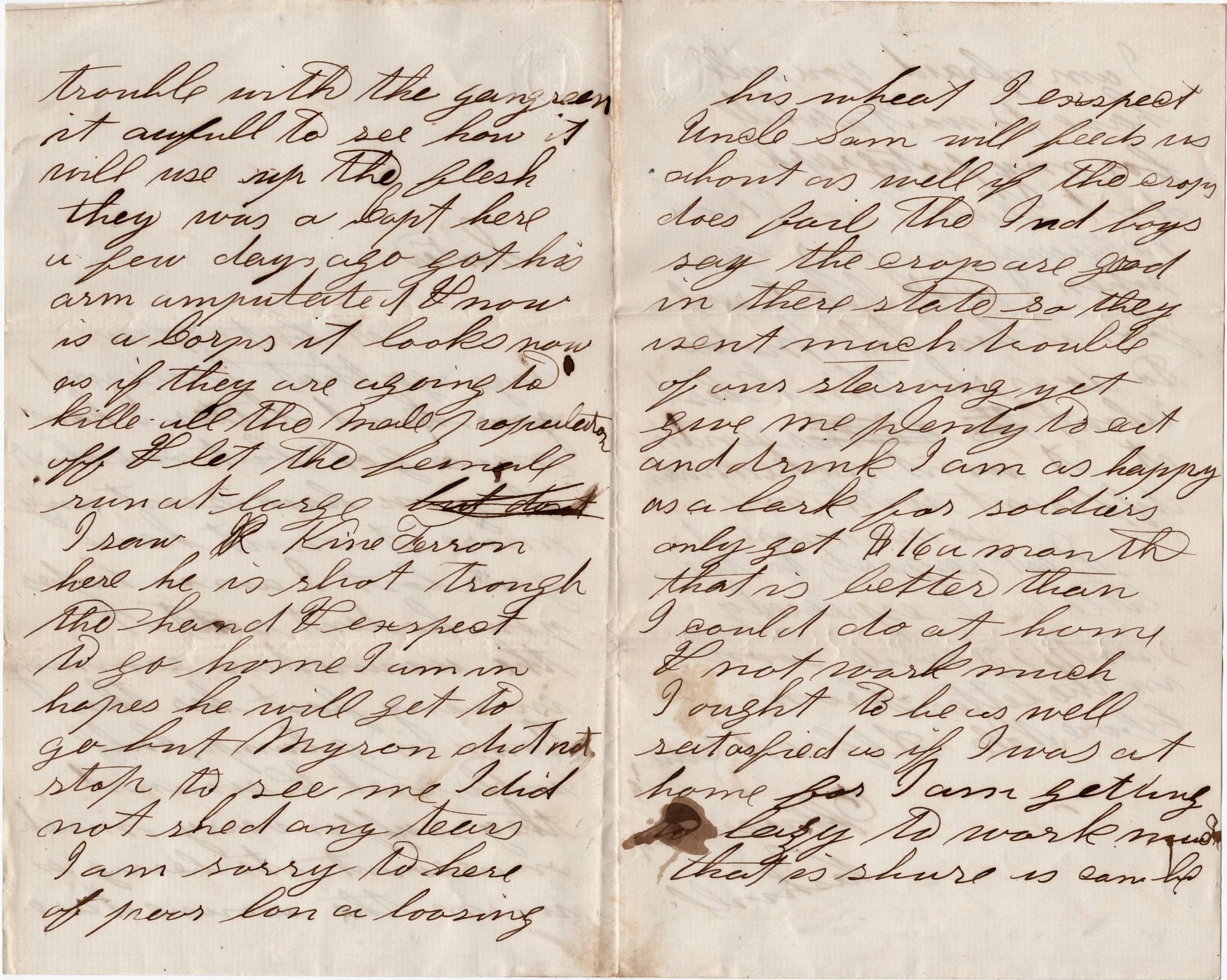
It’s but a few days ago that I received your kind letter. I have never got but one short. If you have sent any more, it must have got lost. I am in hopes you hadn’t sent it.
The wounded are coming in very fast here. This town is plump full with sick & wounded. They suffer very much on account of its being so warm. The wounded are troubled with the gangrene. It’s awful to see how it will use up the flesh. There was a captain here a few days ago got his arm amputated & now is a corpse. It looks now as if they are a going to kill all the male population off & let the females run at large.
I saw Kine Ferron [Sgt. Orskine Ferrond] here. He is shot through the hand & expects to go home. I am in hopes he will get to go but Myron did not stop to see me. I did not shed any tears.
I am sorry to hear of poor Lon a losing his wheat. I expect Uncle Sam will fetch us about as well if the crops does fail. The Indiana boys say the crops are good in their state so there isn’t much trouble of your starving yet. Give me plenty to eat and drink and I am as happy as a lark for soldiers only get $16 a month. That is better than I could do at home & not work much. I ought to be as well satisfied as if I was at home for I am getting lazy to work much, that is sure as can be.
I am afraid you will have to wait for my photograph. I don’t believe I would look natural in your eyes. When I write Nell, I sent for a box. Tell Mother to do as she thinks best about sending it. It won’t make much difference with me.
So no more at present. Best respects to the little girls especially. I sent $25 in the letter from before Nell’s. From Alfred
Officer’s Hospital