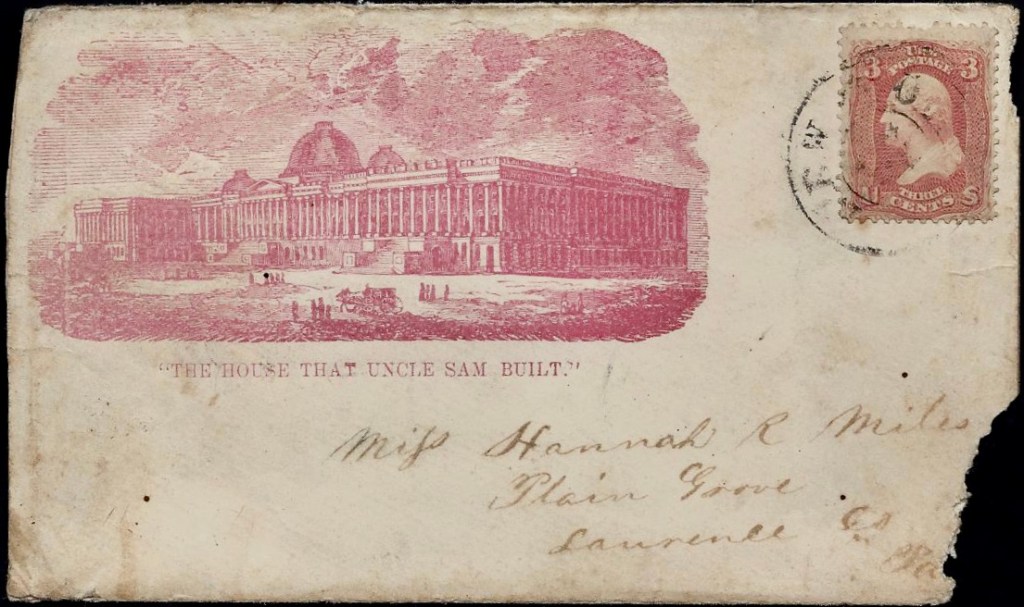
1861: James A Parker to Hannah R. Mills

This account of the Battle of Port Royal was written by Private James (“Jimmy”) A. Parker (1839-1862) who enlisted in Co. E, 100th Pennsylvania Infantry (a.k.a. the “Roundheads”) on 31 August 1861 for three years. 

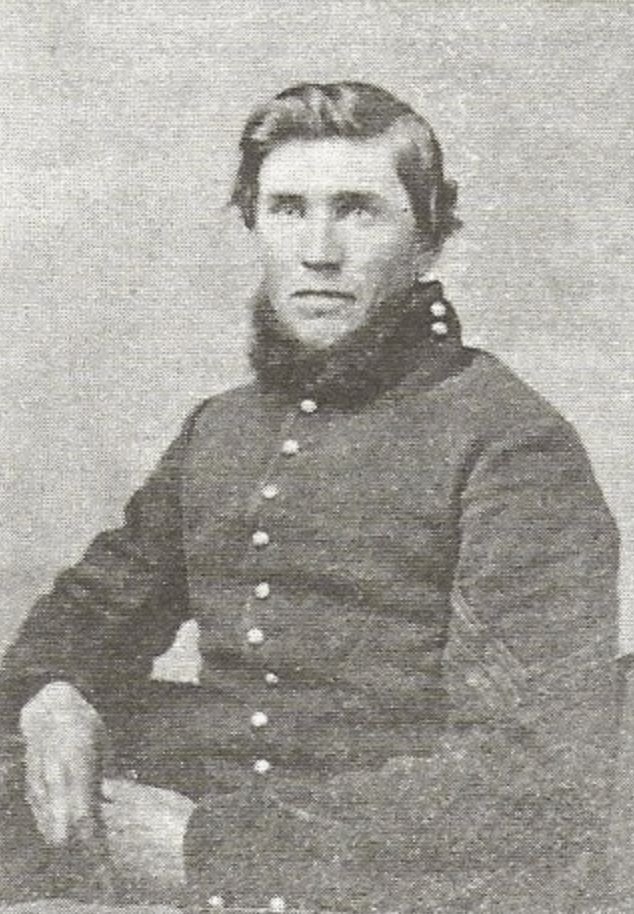
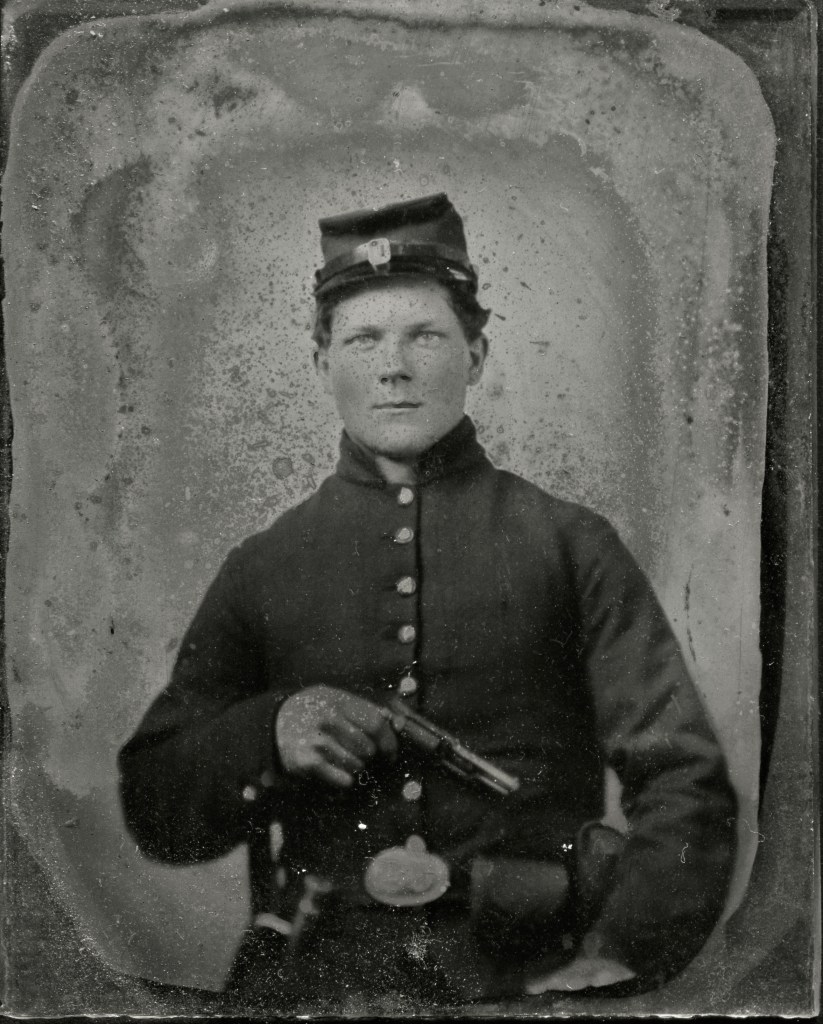
I could not find an image of James but here is a tintype of Pvt. Patrick Creegen of Co. M, 100th Pennsylvania (Karen Creegen Cooper Family Collection)

The regiment was part of the Dupont-Sherman grand “Naval Expedition” of some 15 regiments that were transported from Fortress Monroe to Port Royal, South Carolina, on 75 steamers through a hurricane in late October-early November 1861, culminating in the bombardment and occupation of Forts Walker and Beauregard at Port Royal on 7-8 November 1861. The rebels vacated the forts following the Naval bombardment with little loss—8 killed and 23 wounded on the Union side.

The 100th Pennsylvania were mere observers in the action and soon after were sent to Beaufort on Port Royal Island where they remained for several months. They would not see their first action until the Battle of Secessionville on 16 June 1862, where they attacked a confederate battery (Battery Lamar) that was a threat to Union-secured fortifications on the coast. The assault was suicidal in strategy according to the Brigade Commander, Colonel Leasure, but was ordered by higher command. Battery Lamar was situated on a hill on a peninsula-like piece of land between swamps. Attempts at flanking the battery were thwarted because of difficult mobility through the swamp. The Roundheads had no choice but to make a frontal attack. The battle took its toll on the Roundheads with 13 killed and mortally wounded. This battle essentially ended the Roundheads service on the south coast and they were off to Virginia in July of 1862.

It was in the assault on Battery Lamar that Jimmy Parker lost his life. We know this because his comrade, Eddie Miles, wrote the following to his father on 24 June 1862: 

“And Jimmy Parker is dead [too]. I haven’t [heard] anything about him since the fight. I miss him as much as I would a brother. We have drilled together for a year now. He was as good [a] soldier as ever was. When we was going out that morning to fight, he was as merry as anybody & said we didn’t know who would come back again. We double quicked a mile & a half up to the fort right in front of six cannons & I don’t know how many infantry & they let loose on us with grape shot & canister & log chains & bottles & pikes, nails, & everything they could get into the cannons. It just mowed our men down like a shot gun would a flock of pigeons. Jimmy Parker’s leg was shot off with a grape shot by the thigh & he was left on the field when we had to retreat [where] the Rebels would get him. Some of the boys saw him when we was on the retreat & he was almost dead. He shook hands with them & told them to shift for themselves to keep the Rebels from getting them. There was 4 of our company killed & 9 wounded but some of them was very slightly hurt.” [See 1862: Edward Riddle Miles to William Miles on Spared & Shared 19]

James’ muster roll tells us he was born in Trumbull county (Ohio) but residing in Lawrence county, Pennsylvania when he enlisted in 1861. The 1860 US Census enumerates him in Plain Grove of Lawrence county, living in the household of 51 year-old Andrew Christy (1809-1880) and 52 year-old Abigail (Parker) Christy (1809-1889)—his uncle and aunt, and also 82 year-old Abigail (Hart) Parker—his grandmother and the widow of Joel Parker (1768-1845). James was one of at least eleven children born to Moses Atwater Parker (1802-1889) and Catherine C. Christy (1808-1879) who were farming in Kinsman, Trumbull county, Ohio at the time James went to war.

[See also: 1861: James A. Parker to Andrew Christy on Spared & Shared 22.]

Transcription
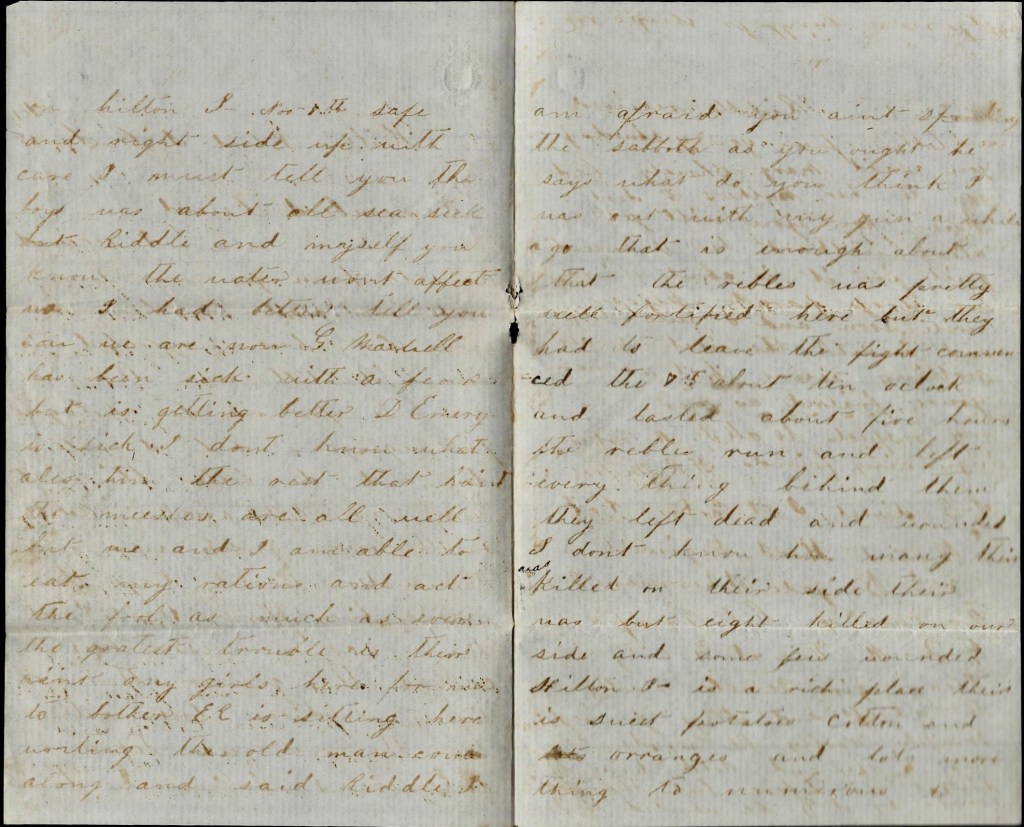
Hilton Head, South Carolina
18 November 1861

Remembered Friend,

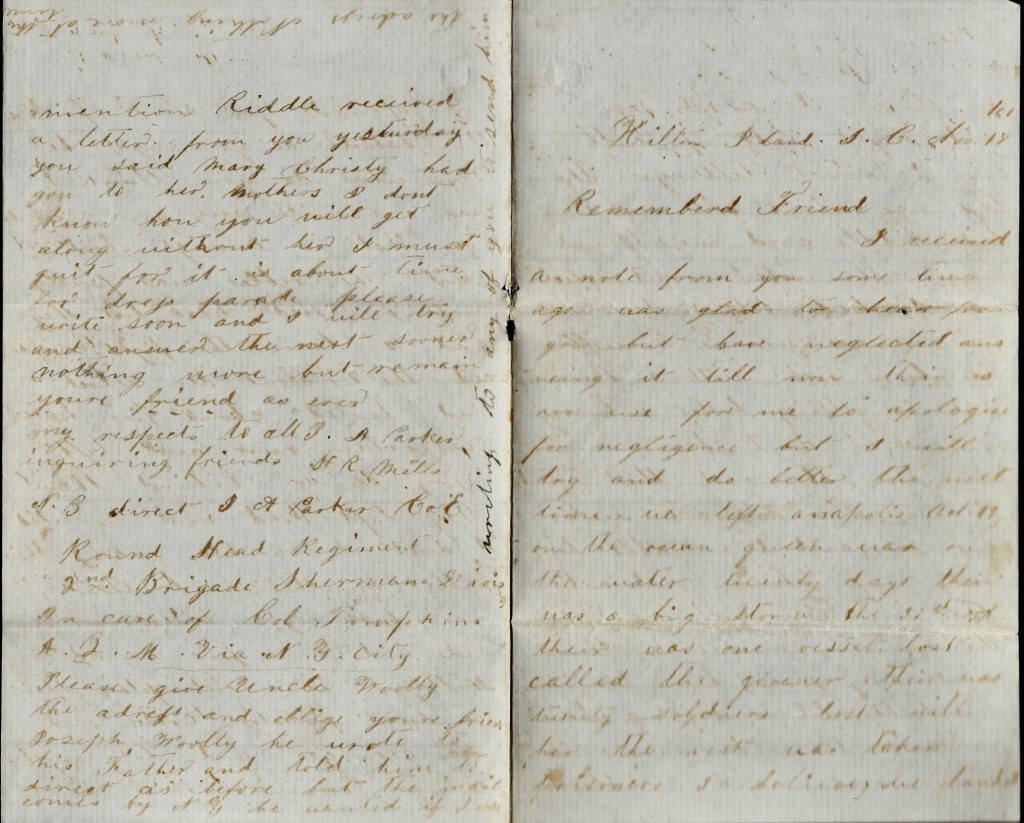
I received a note from you some time ago. Was glad to hear from you but have neglected answering it till now. There is no use for me to apologize for negligence but I will try and do better the next time. We left Annapolis October 17th on the Ocean Queen. Was on the water twenty days. There was a big storm the 31st and there was one vessel lost called the Governor. There was twenty soldiers lost with her. The rest was taken prisoner. I believe we landed on Hilton Head November 8th safe and right side up with care. I must tell you, the boys was about all sea sick but Riddle and myself. You know the water won’t affect us. I had better tell you how we are now. G. Marbell has been sick with a fever but is getting better. D. Emery is sick. I don’t know what ails him. The rest that hasn’t the measles are all well but me and I am able to eat my rations and act the fool as much as ever.

The greatest trouble is there any girls here for us to bother. E. R. is sitting here writing. The old man came along said, “Riddle, I am afraid you ain’t spending the Sabbath as you ought.” He says, “Do you think, I was out with my gun a while ago.” That is enough about that.

The Rebels was pretty well fortified here but they had to leave. The fight commenced the 7th about ten o’clock and lasted about five hours. The Rebels run and left everything behind them. They left dead and wounded. I don’t know how many there was killed on their side. There was but eight killed on our side and some few wounded.

Hilton Head is a rich place. There is sweet potatoes, cotton and oranges and lots more things too numerous to mention. Riddle received a letter from you yesterday. You said Mary Christy had gone to her mother’s. I don’t know how you will get along without her. I must quit for it is about time for dress parade.

Please write soon and I will try and answer the next sooner. Nothing more but remain your friend as ever. My respects to all inquiring friends, — J. A. Parker

to H. R. Mills

N. B. Direct [to] J. A. Parker, Co. E, Round Head Regiment, 2nd Brigade, Sherman’s Division in care of Col. Tompkins, A. Q. M. via N. Y. City

Please give Uncle Woolly the address and oblige your friend. Joseph Woolly, he wrote to his father and told him to direct as before but the mail carries by New York. He wanted to know if I was writing to any of you to send him the address.
1862: John H. Chadwick to Mathew Murdock

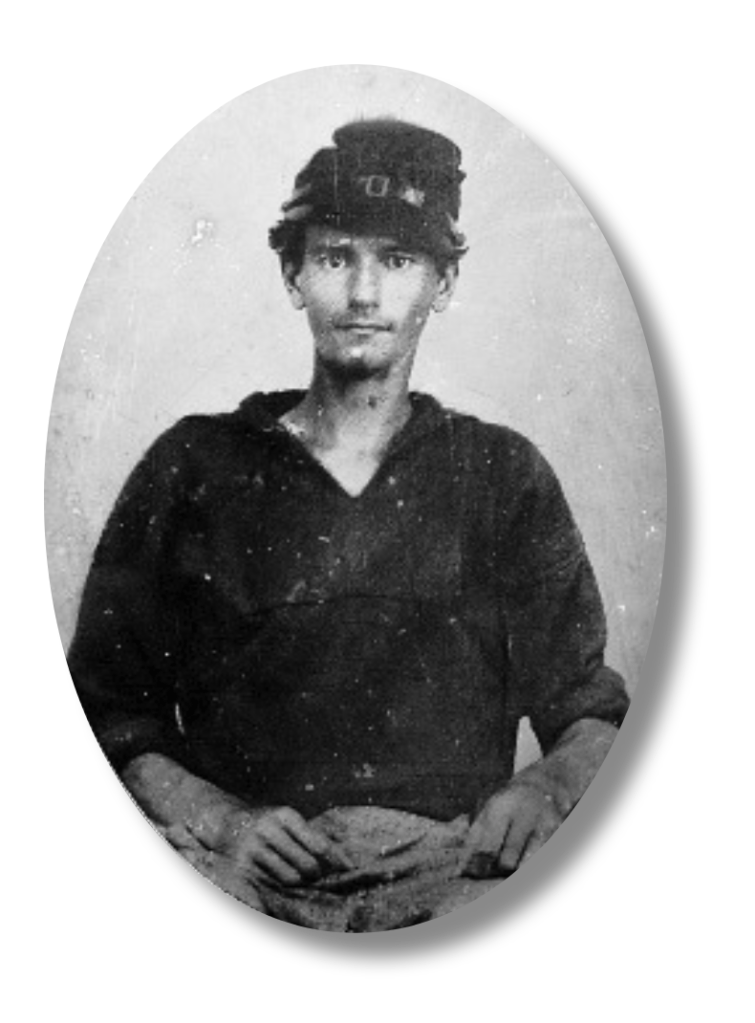
I could not find an image of John but here is one of Pvt. Watson Garrett of Co. G, 12th Connecticut Infantry (Photo Sleuth)

This letter was written by Pvt. John H. Chadwick (1844-1864) of Co. F, 12th Connecticut Infantry. John enlisted on 17 October 1861 and was mustered into the service on 19 November 1861. He was with his regiment until his death on 19 October 1864—killed in action at the Battle of Cedar Creek.

In the 1850 US Census, 5 year-old John was enumerated in his parents home in Seymour, New Haven, Connecticut. His parents were Frederick and Martha E. (Rhodes) Chadwick. In the 1860 US Census, John—now an orphan—was enumerated in the household of Mathew (“Matti”) G. Murdock, a carpenter in Westbrook, Middlesex county, Connecticut. It was Mr. Murdock to whom this letter was most likely addressed.

In his letter, John mentions his older brother Thomas Chadwick (b. 1840) who was working as a blacksmith in Seymour, Connecticut, when he enlisted in the same company as John. Tom survived the war. He also mentions Sergeant Edwin W. Bushnell served in Co. F and was also from the same town of Westbrook, Connecticut.

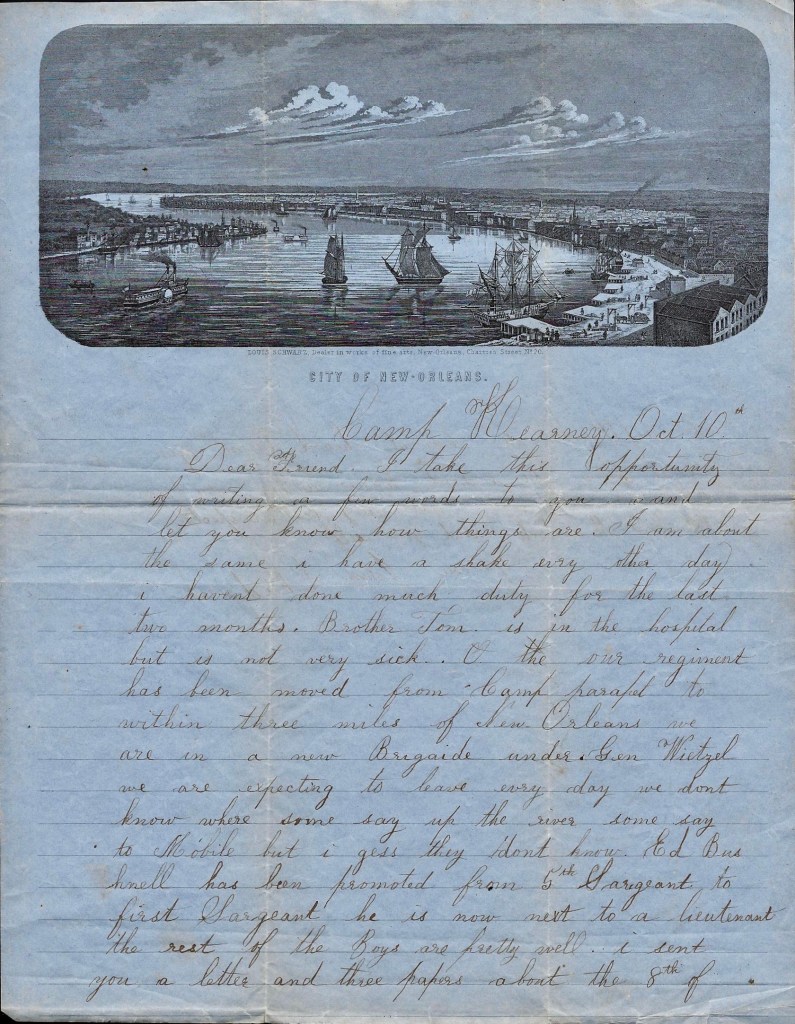
Transcription

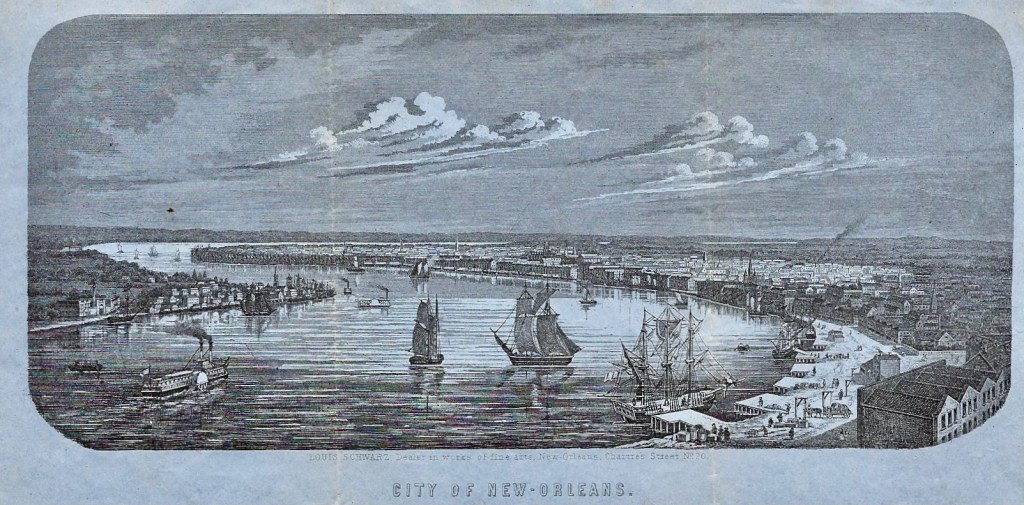
A lithograph of New Orleans on the header of Chadwick’s letter.

Camp Kearney
October 10th [1862]

Dear Friend,

I take this opportunity of writing a few words to you and let you know how things are. I am about the same. I have a shake every other day. 1 I haven’t done much duty for the last two months. Brother Tom is in the hospital but is not very sick. Our regiment [12th Connecticut] has ben moved from Camp Parapet to within three miles of New Orleans. We are in a new Brigade under Gen. [Godfrey] Weitzel. we are expecting to leave every day. we don’t know where. Some say up the river—some say to Mobile, but I guess they don’t know.

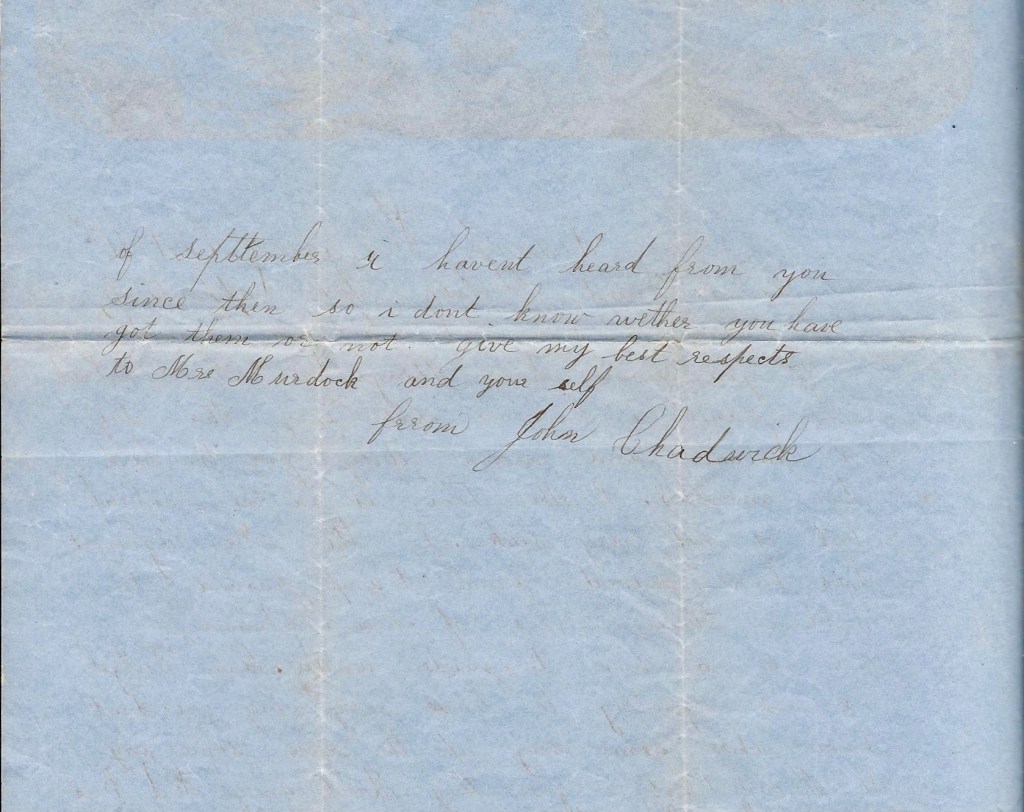
Ed Bushnell has been promoted from 5th Sergeant to 1st Sergeant. He is now next to a Lieutenant. The rest of the boys are pretty well. I sent you a letter and three papers about the 8th of September. I haven’t heard from you since then so I don’t know whether you have got them or not.

Give my best respects to Mrs. Murdock and yourself. From John Chadwick

1 Symptoms of malaria resemble those of flu and can typically last 6–10 hours and recur every second day. However, some strains of the parasite can have a longer cycle or cause mixed symptoms.

1864: E. Amedee Dolhonde and Robert Goldsmith to Isabel Goshorn

These three letters were written by Pvt. Amedee Dolhonde (E. A. Doland) of Co. B, 8th Louisiana Infantry. Joining him in signing the letter was Sgt. Robert Goldsmith of Co. G, 8th Alabama Infantry.

Confederate Prisoners of War at Camp Douglas in Chicago (Civil War in Tennessee Collection)

Amedee Dolhonde (1840-Aft1880) was the son of Jean Baptiste Dolhonde (1798-1860) and Josephina Carolie de Alpuente (180901869) of New Orleans, Louisiana. Apparently, during the war, Amedee signed the payroll “E A. Doland” to simplify his name. During much of the time he was with the regiment, Amedee served as a clerk, presumably because of his excellent handwriting. He was taken prisoner at Gettysburg on 3 July 1863. His muster records include an unusual notation: “Captured in Penn., never fired a gun, took the oath, a skulker & coward.” Another record indicates that he deserted in Pennsylvania and was captured at South Mountain on 4 July 1863. He was paroled at Fort McHenry, Maryland, and transferred to Fort Delaware on 9 July 1863. It appears that he took the oath of allegiance in December 1864. After the war, Ameede returned to New Orleans where he worked as a fisherman.

Robert Goldsmith enrolled as a private in Co. G, 8th Alabama Infantry at Mobile on 25 May 1861. His muster records indicate he went missing at the Battle of Gettysburg and subsequent records inform us that he was taken prisoner on 2 July 1863 and taken to Fort Delaware. He remained a prisoner there until his release on 10 May 1865.

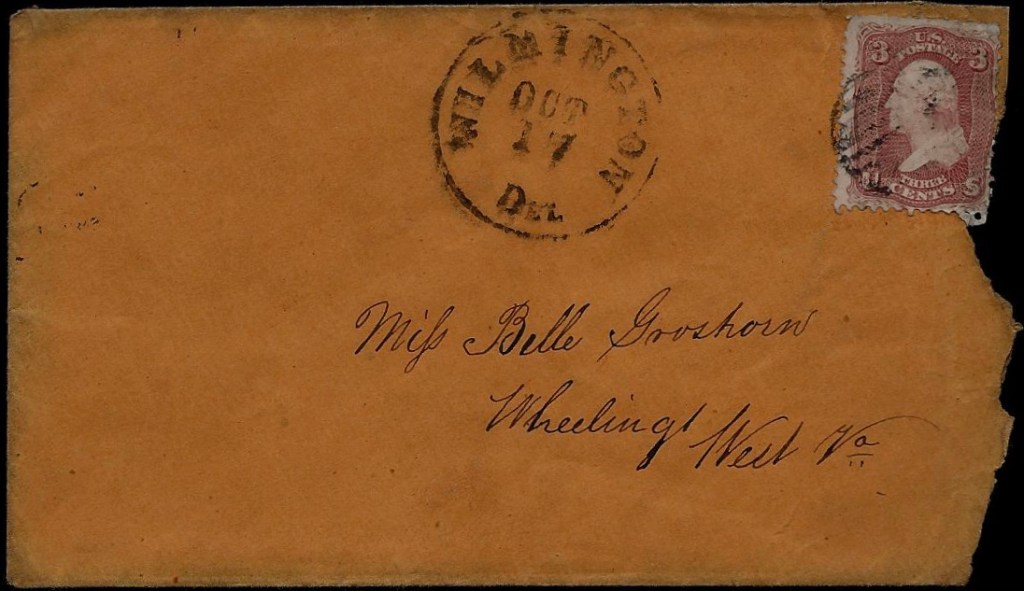
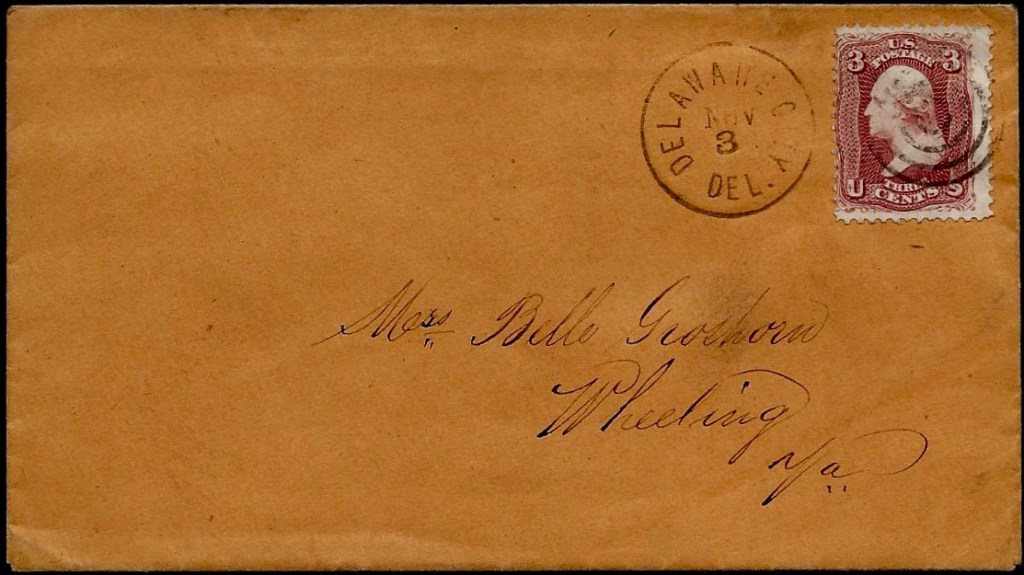
All three of the letters were addressed to Miss Belle Groshorn of Wheeling, West Virginia. Belle’s last name was misspelled; it should have been Goshorn. Isabel Goshorn (1840-1919) was the daughter of a Wheeling dry goods merchant named William Scott Goshorn (1814-1891) and his wife, Priscilla Jane Zinn (1821-1878). Mr. Goshorn was up to the time of the Civil War an Old Line Whig, but afterwards was a Democrat, and through the war his sympathies were with the South. He was a slave owner, and an incident is recalled by his death which made a stir all over the country at the time. A slave woman named Lucinda Johnson (note: her name was Sarah Lucy Bagby) ran away from him and escaped to Cleveland, Ohio. “Mr. Goshorn went after her, reclaimed her and brought her back. Anti-slavery agitators and others in Northern Ohio sought to prevent her return to Virginia and there were exciting scenes in which Mr. Goshorn had a close rub, the populace having been much stirred up by the discussion of the matter and being in a mood to do any slaveholder bodily injury.”

In 1870, Isabel married Joseph S. Irwin (1830-1876).

Sketch of Fort Delaware Prison in March 1864 (Boston Athenaeum Digital Collections)

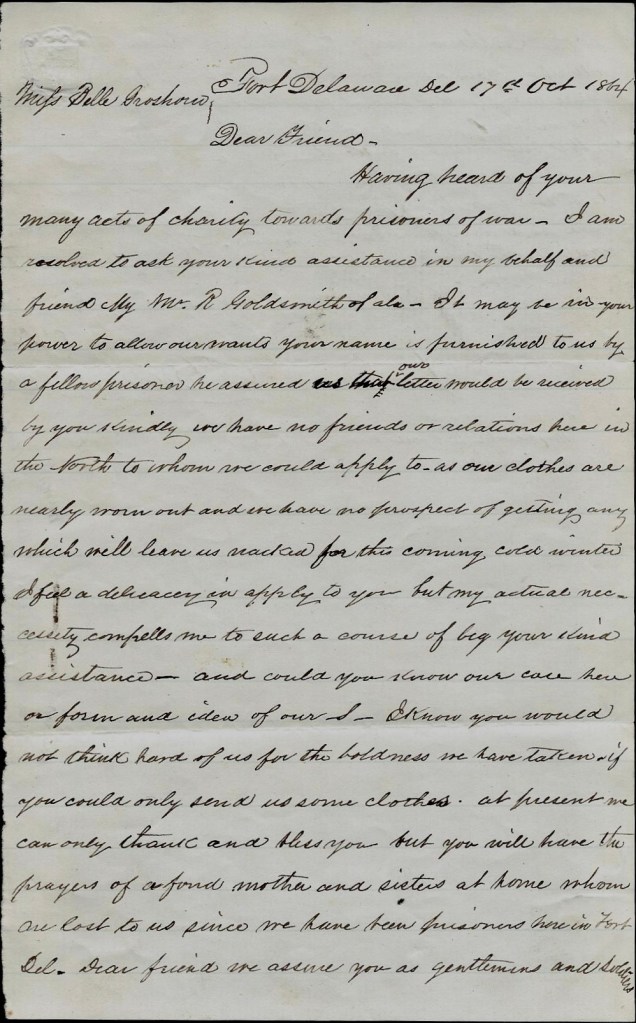
Letter 1

Addressed to Miss Belle Groshorn, Wheeling, West Virginia

Fort Delaware, Delaware
17 October 1864

Miss Belle Groshorn
Dear Friend,

Having heard of your many acts of charity towards prisoners of war, I am resolved to ask your kind assistance in my behalf and friend, Maj. Mr. R. Goldsmith of Alabama. It may be in your power to allow our wants. Yuor name is furnished to us by a fellow prisoner. He reassured us that our letter would be received by you kindly. We have no friends or relations here in the North to whom we could apply to. As our clothes are nearly worn out and we have no prospect of getting any which will leave us naked for the coming cold winter, I feel a delicacy in applying to you but my actual necessity compels me to such a course of beg[ging] your kind assistance. And could you know our care here, or form an idea of our situation, I know you would not think hard of us for the boldness we have taken.

If you could only send us some clothes, at present we can only thank and bless you, but you will have the prayers of a fond mother and sisters at home whom are lost to us since we have been prisoners here in Fort Delaware.

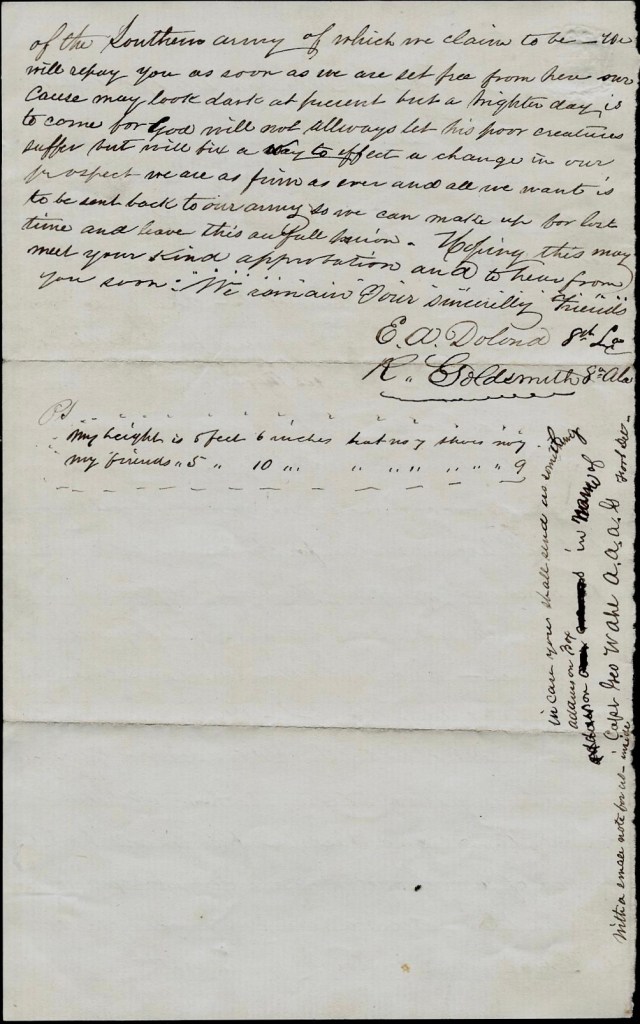
Dear friend, we assure you as gentlemen and soldiers of the Southern army of which we claim to be, we will repay you as soon as we are set free from here. Our cause may look dark at present but a brighter day is to come for God will not always let his poor creatures suffer but will fix a way to effect a change in our prospect. We are as firm as ever and all we want is to be sent back to our army so we can make up for lost time and leave this awful Union. Hoping this may meet your kind approbation and to hear from you soon, we remain your sincerely friends,

— E. A. Doland, 7th Louisiana
R. Goldsmith, 8th Alabama

P. S. My height is 5 feet 6 inches, hat No. 7, Shoes No. 7
My friends is 5 feet 10 inches, hat No. 7, Shoes No. 9

In case you shall send us something, address on box, in care of Capt. George Wahl, A. A. A. G., Fort Delaware with a small note for us inside.


Letter 2

Addressed to Miss Belle Groshorn, Wheeling, Va.

Fort Delaware
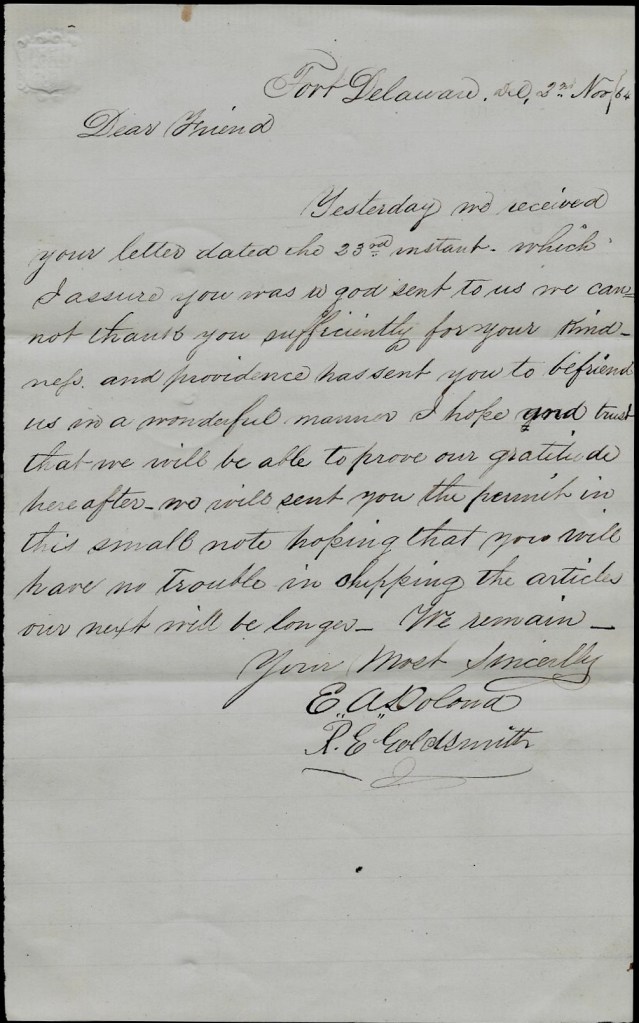
2nd November 1864

Dear Friend,

Yesterday we received your letter dated the 23rd inst. which I assure you was a God send to us. We can not thank you sufficiently for your kindness and providence has sent you to befriend us in a wonderful manner. I hope and trust that we will be able to prove our gratitude hereafter. We will send you the permit in this small note hoping that you will have no trouble in shipping the articles. Our next will be longer. We remain, your most sincerely,

— E. A. Doland & R. E. Goldsmith


Letter 3

Addressed to Miss Belle Groshorn, Wheeling, West Virginia

Fort Delaware
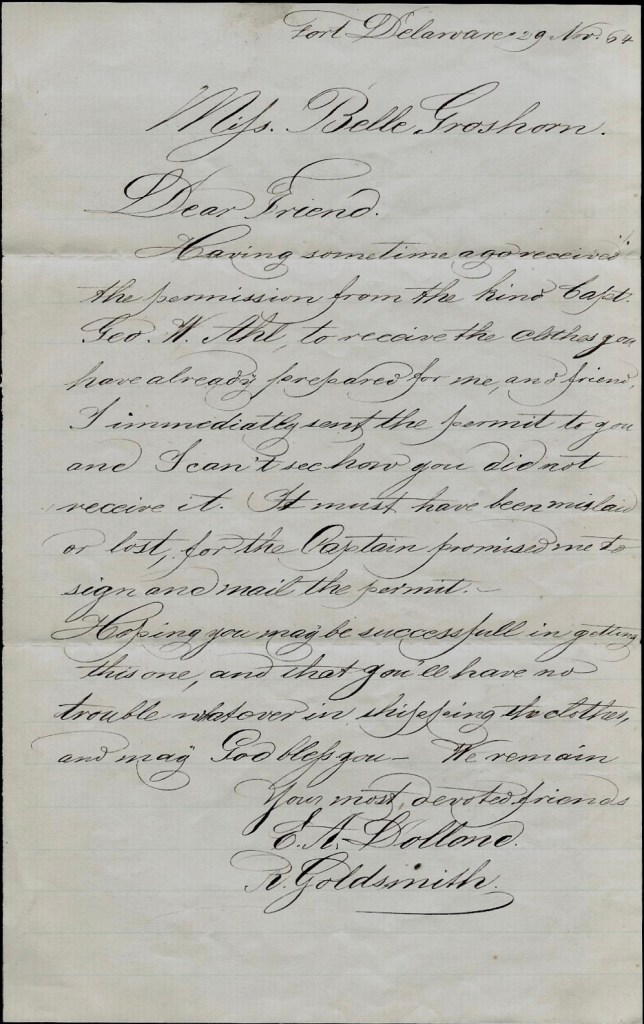
29 November ’64

Miss Belle Groshorn
Dear Friend,

Have some time ago received the permission from the kind Capt. George Wahl to receive the clothes you have already prepared for me, and friend, I immediately sent the permit to you and I can’t see how you did not receive it. It must have been mislaid or lost, for the Captain promised me to sign and mail the permit.

Hoping you mat be successful in getting this one, and that you’ll have no trouble whatever in shipping the clothes, and may God bless you. We remain your most devoted friends, — E. A. Doland, R. Goldsmith

1862: Edward J. Kenney to George W. Kenney

This letter was written by Edward J. Kenney (1809-1874), a Philadelphia clothier, and the father of Lieut. George W. Kenney (1841-1862) of Co. H, 1st California Regiment (71st Pennsylvania Infantry) to whom the letter was addressed, in care of Gen. Winder at Richmond, Virginia, where he was being held as a prisoner of war. A notice of Lt. Kenney’s capture at Ball’s Bluff in October 1861 (he was initially reported as drowned) and recent release from Richmond was published in the Philadelphia Inquirer of 22 February 1862.

Lt. Kenney was taken prisoner by the Rebel army while being treated at the White Oak Swamp Hospital on the 30th June 1862. The Philadelphia Inquirer on 12 August 1862 states that Lt. Kenney died on 2 July 1862 at Nelson’s Farm, Virginia.

A subsequent article appearing in the Philadelphia Inquirer on 15 July 1862 suggests that George died in a Richmond prison after his capture at the White Oak Swamp Hospital. A correspondent for the paper wrote, “He was beloved by all who knew him. Having been associated with him on the battlefield and at home, I had learned to love him for his many good qualities. When in Richmond prison he was the most cheerful of any, strengthened as he was by a firm reliance on the word of God. I saw Major Revere of the 20th Massachusetts who was with Lieut. Kenney at 9 o’clock on Monday evening. His wound having been pronounced mortal all that could be done for him was to lull him to sleep. Dr. Revere of the 20th administered morphine to him. When the Major saw him, the morphine was about taking effect. He only said, ‘tell them that I was ready to die,’ meaning his family.”

Transcription

Philadelphia [Pennsylvania]
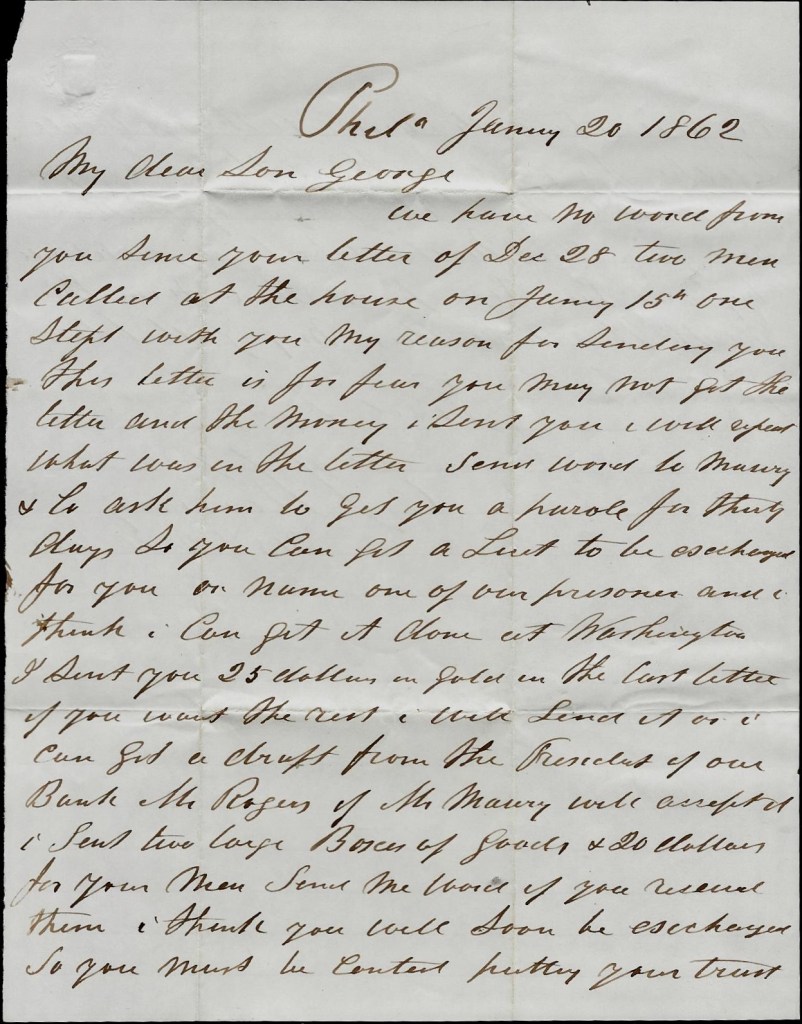
January 20, 1862

My dear son George,

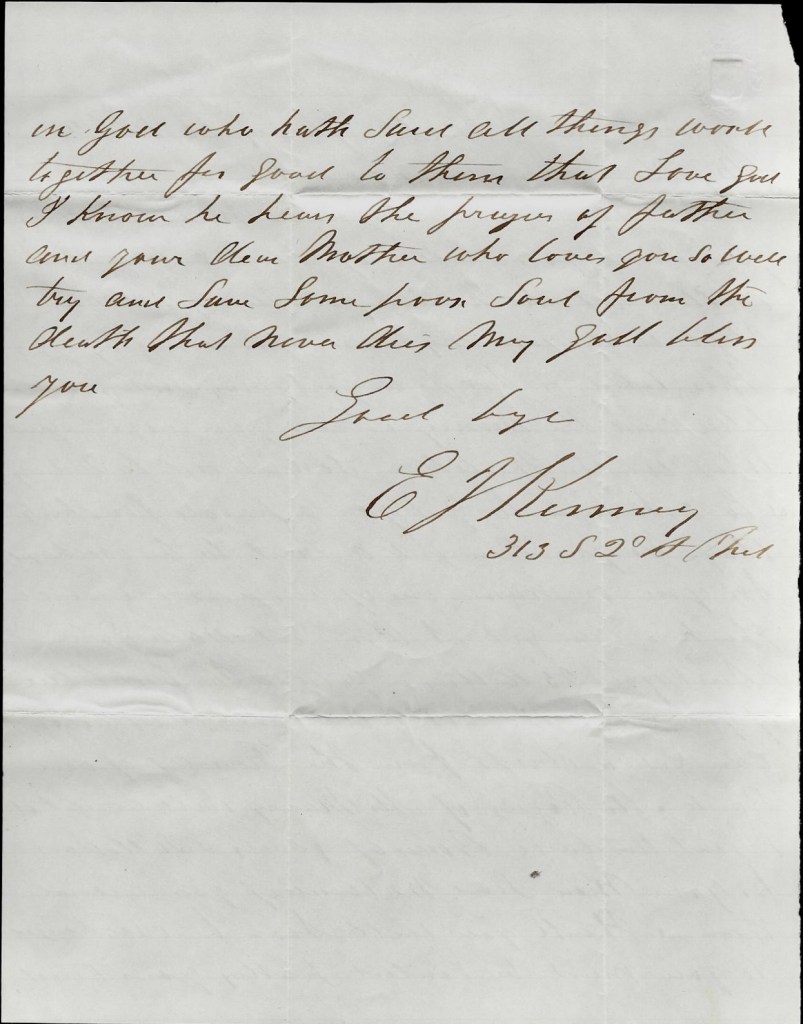
We have no word from you since your letter of December 28th. Two men called at the house on January 15th. One slept with you. My reason for sending you this letter is for fear you may not get the letter and the money I sent you. I will repeat what was in the letter. Send word to Maury & Co.and] ask him to get you a parole for thirty days so you can get a Lieut. to be exchanged for you or name one of our prisoners and I think I can get it done at Washington. I sent you 25 dollars in gold in the last letter. If you want the rest I will send it as I can get a draft from the President of our Bank, Mr. Rogers, if Maury will accept it. I sent two large boxes of goods and 20 dollars for your men. Send the word if you received them. I think you will soon be exchanged so you must be content putting your trust in God who hath said all things work together for good to them that love God. I know he hears the prayer of Father and your dear Mother who loves you so well. Try and save some poor soul from the death that never dies. May God bless you.

Goodbye, — E. J. Kenney, 313 S 2nd St., Philadelphia

1862: George Thomas Perkins to Betsy (Sampson) Perkins

This letter was written by George Thomas Perkins (1836-1880), the son of Dr. Thomas Spencer Perkins (1818-1870) and Betsy Bartlett Sampson (1820-1906) of Boston.

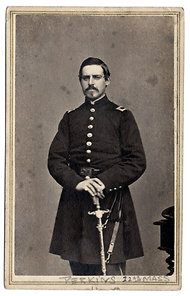
George Thomas Perkins after his promotion to Asst. Surgeon, ca. 1863 (Ron Coddington Collection)

George was born in Plymouth, Massachusetts in 1838. He received an M.D. from Harvard Medical School in 1858. He also attended Johns Hopkins University. Perkins enlisted in the Union army in 1861. He joined the Massachusetts 22nd Infantry Regiment as a hospital steward, and was promoted to assistant surgeon in 1863. He held this position until 1864. He then joined the Massachusetts 32nd Infantry Regiment as an assistant surgeon, and was promoted to full surgeon later that year. He joined the Massachusetts 26th Infantry Regiment, where he served as surgeon until 1865. After the war, Perkins practiced as a physician in Newton Lower Falls, Massachusetts, from 1865 to 1870. He became coroner of Middlesex County in 1869. 

In this letter datelined from Camp Winfield Scott near Yorktown in May 1862 while servicing in the 22nd Massachusetts, George wrote his mother early on the day in which the Confederate troops surreptitiously retreated from Yorktown. Less than two months later, George was wounded in the right lung and captured in the fighting at Gaine’s Mill but was exchanged after five weeks captivity. Lt. Col. Griswold reassured the Perkins family that George was “by no means severely wounded” and that he would “soon be transferred to Turkey Bend where many of our wounded are collected.”

See my friend Ron Coddington’s article entitled, “Left for Dead in Virginia” published on 28 June 2012 which tells the tale of the 22nd Massachusetts at Gaine’s Mill and of Perkin’s wound.

[Note: This letter is from the private collection of Richard Weiner and is published by express consent on Spared & Shared.]

Transcription

Camp Winfield Scott
Near Yorktown, Va.
May 3, 1862

Dear Mother,

I received your letter a few days ago and take this my first chance to answer it. I received a letter from Annie yesterday and shall answer it tomorrow. In it she speaks of not being well. Do please look after her a little and make her take good care of herself for she is more precious to me than all else in this world and I should never be fit for anything again should I loose her. Do be careful of her for my sake.

Our position here is a very trying one. The shot and shell are flying about us in all directions and making the most horrid noise as they hiss through the air. Our works is going bravely on, however, in spite of all the Rebels can do to prevent it. Every morning discovers a new breastwork, road, or bridge. Our men are at work night and day perfecting the works and daily long siege trains pass our camp with large guns and mortars on their way to the breastworks in front. Our brigade is in front and upon the extreme right of the line. The camp of our regiment is upon the banks of the York River making one of the finest camps we have had since we left Massachusetts.

We heard yesterday that New Orleans had been taken. I hope it is so for the sooner this war is ended, the better. For my part, I should like it to end tomorrow that I could return home once more. I never knew what hardship was before I became a soldier, but I do now. I have been hungry and could get nothing to eat. I have been tired and wet through after a hard day’s march through Virginia mud and could get no dry clothes nor place to sleep except in the open fields and have stretched out upon wet ground and slept night after night. But after going through all this, I find my health still good.

Tell Annie she can no longer say that I have weak lungs. Give my love to Annie and the children, keeping a share for yourself. I must now close this disjoined letter hoping to hear from you soon and often. Yours &c.

— George

Tell Annie to write oftener. I wrote to Mother yesterday.

1862: Elias Hane to Jacob Hane

This letter was written by Elias Hane (1844-1864), the son of Jacob Hane (1814-1898) and Eva Warner (1816-1857) of Knox, Albany county, New York.

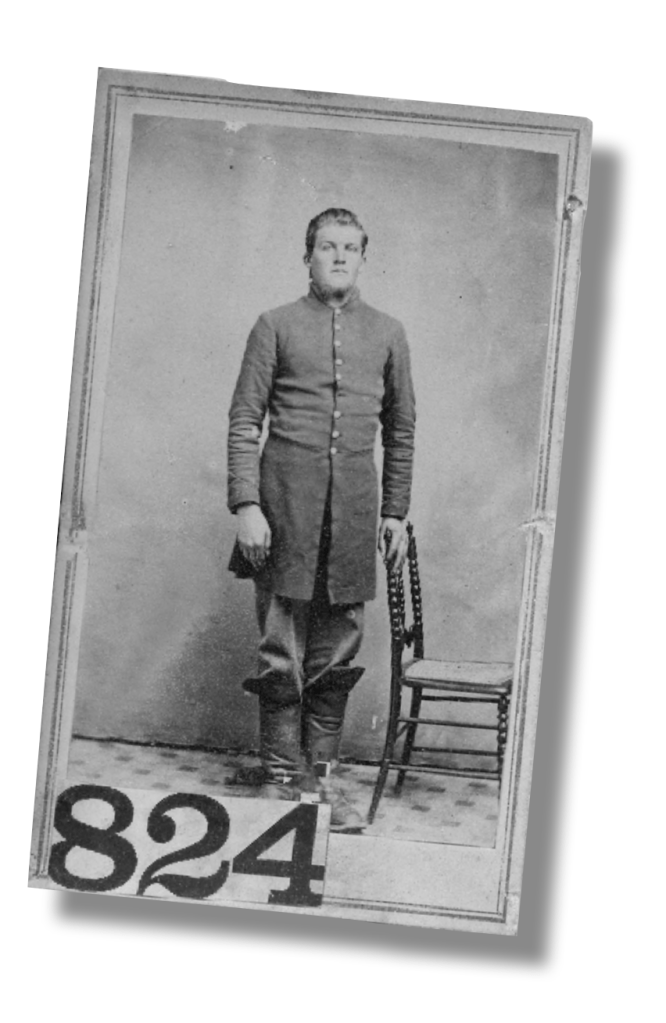
I could not find an image of Elias but here is a CDV of Lucius Hagadorn of Co. F, 7th New York Heavy Artillery (Photo Sleuth)

Elias enlisted at Albany on 18 August 1862 as a private in the 113th New York Infantry but because heavy artillery regiments were needed for the defenses of Washington, D.C., the regiment was converted from infantry on December 10, 1862, and became the 7th New York Heavy Artillery on December 19, 1862. At the time of his enlistment, Elias was described as an 18 year-old farmer who stood 5′ 8″ tall, with hazel eyes and brown hair. After nearly two years service, manning the defenses of Washington D. C., the 7th NY Heavy Artillery was ordered to the battle front to participate as infantrymen in Grant’s Overland Campaign. Elias was wounded less than a month later at the Battle of Cold Harbor on 8 June 1864 and died four days later at Staton Hospital in Washington D. C. after having had his leg amputated.

In his letter, Elias asks his father to let his older brothers Adam Matthias Hane (1836-1863) and Amos Gideon Hane (1839-1864) know of his whereabouts so they could correspond. Adam served in Co K, 91st New York Infantry and died of wounds received on 14 June 1863 in assaulting Port Hudson. Amos served in Co. D, 91st New York Infantry and he died of disease at Cairo, Illinois, on 20 July 1864. The only brother to survive the war who was old enough to serve was Jacob Henry Hane (1842-1895) who did not enlist and was not drafted.

7th New York Heavy Artillery (serving as infantry) preparing to leave the trenches and charge the Confederate line in Barlows charge near Cold Harbor Friday June 3rd, 1864, sketched by Alfred Waud. (Library of Congress)

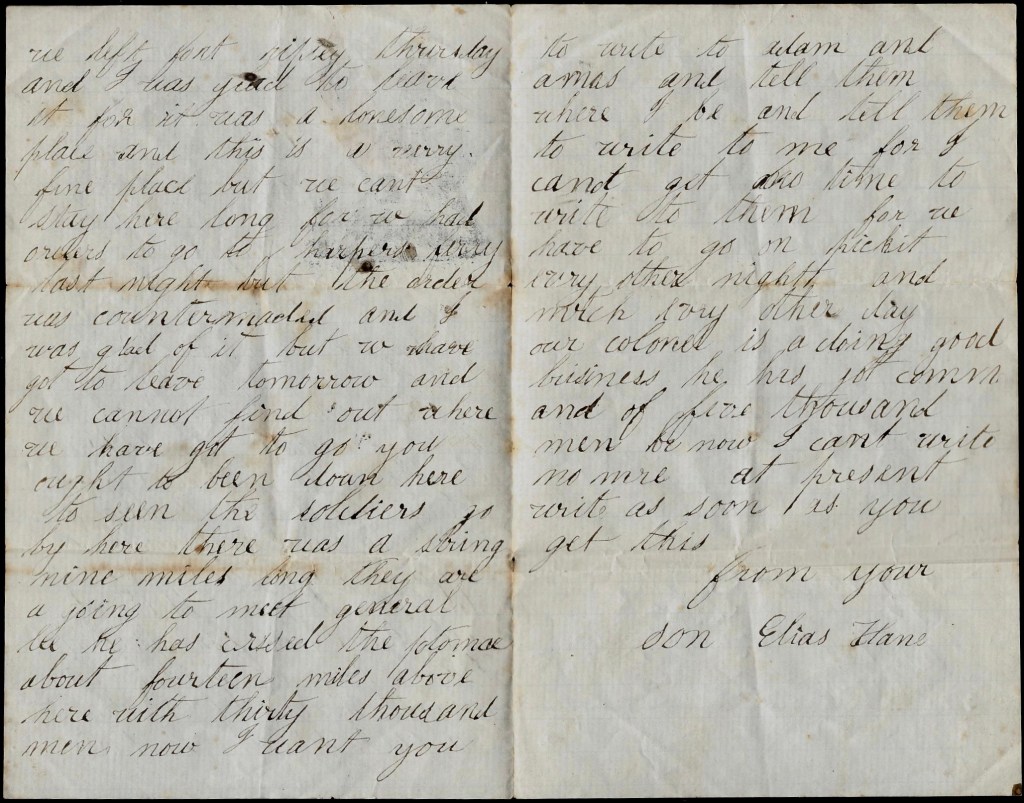
Transcription

Fort Pennsylvania
September 7, 1862

Dear Father,

It is with great pleasure that I now take the opportunity to write a few lines to you to let you know that I am well at present and hope that you are the same. Now I suppose that you will be surprised at getting so many letters from me when you don’t answer any but I suppose that you have too much to do [and] that I will have to forgive you.

I have been on picket two nights since I have been here and I like it first rate. We left Fort Ripley Thursday and I was glad to leave it for it was a lonesome place and this is a very fine place but we can’t stay here long for we had orders to go to Harper’s Ferry last night but the order was countermanded and I was glad of it. But we have got to leave tomorrow and we cannot find out where we have got to go.

You ought to have been down here to seen the soldiers go by here. There was a string nine miles long and they are a going to meet General Lee. He has crossed the Potomac about fourteen miles above here with thirty thousand men.

Now I want you to write to Adam and Amos and tell them where I be for I cannot get no time to write to them for we have to go on picket every other night and march every other day. Our Colonel is a doing good business. He has got command of five thousand me by now. I can’t write no more at present. Write as son as you get this. From your son, — Elias Hane
1864: Henry Clay Thompson to Melinda Brown

I could not find an image of Henry but here is one of Alfred R. Wilson who served in Co. H, 9th Iowa Cavalry (Photo Sleuth)

This letter was written by Henry Clay Thompson (1846-1930), the son of John Quincy Thompson (1814-1856) and Melinda Phillips (1824-1914) of Linn county, Iowa. Henry enlisted on 21 September 1863 as a musician in Co. K, 9th Iowa Cavalry. In April 1864 he was promoted to 8th corporal and mustered out as 3rd Corporal in February 1866.

Henry enlisted at the same time and in the same company with his older brother Jonas William Thompson (1843-1864). Sadly, Jonas died while in the service and the “particulars” of his death are described in the following letter though the exact date is not given. According to a family record, Jonas died on 5 August 1864 at DeVall’s Bluff, Arkansas, at the age of 21.

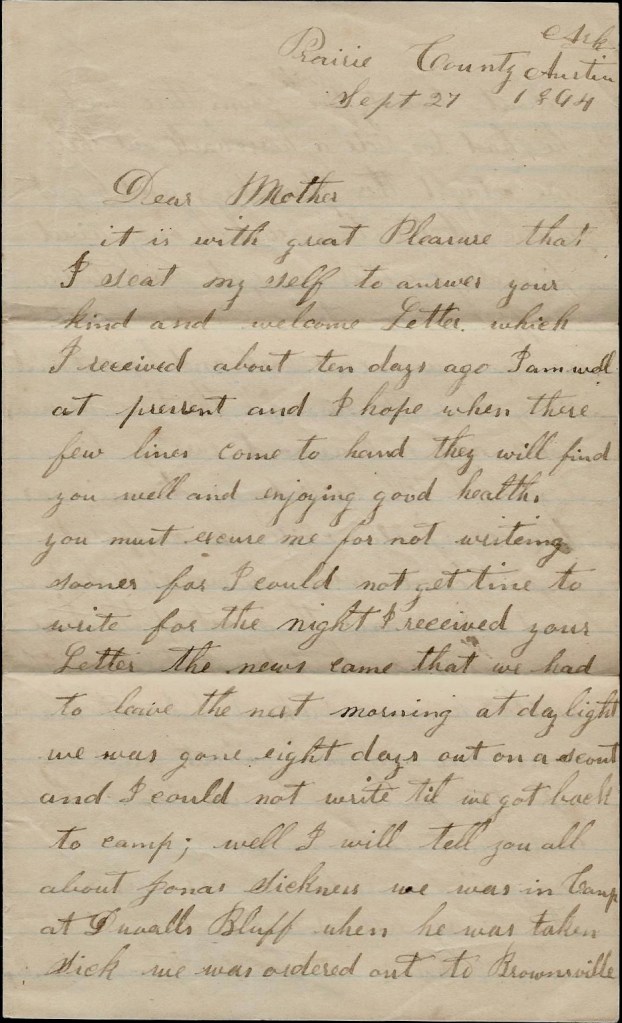
Transcription

Austin, Prairie county, Arkansas
September 27, 1864

Dear Mother,

It is with great pleasure that I seat myself to answer your kind and welcome letter which I received about ten days ago. I am well at present and I hope when these few lines come to hand, they will find you well and enjoying good health. You must excuse me for not writing sooner for I could not get time to write for the night I received your letter the news came that we had to leave the next morning at daylight. We was gone eight days out on a scout and I could not write till we got back to camp.

Well, I will tell you all about Jonas’ sickness. We was in camp at DeVall’s Bluff when he was taken sick. We was ordered out to Brownsville about twenty-five miles from there and he had to ride a horseback out there. We stayed there three days and he got worse all the time and he only lived five days after we got back to the Bluffs. He was taken to the hospital as soon as we got back and I went and stayed with him all the time he was sick and took as good care of him as I could till he died. His disease was the congestive chills. He suffered a great deal while he was sick but he had his senses the most of the time he was sick. He did not talk much while he was sick. I did not hear him say anything about you or any of the family. He was so sick he could not talk much.
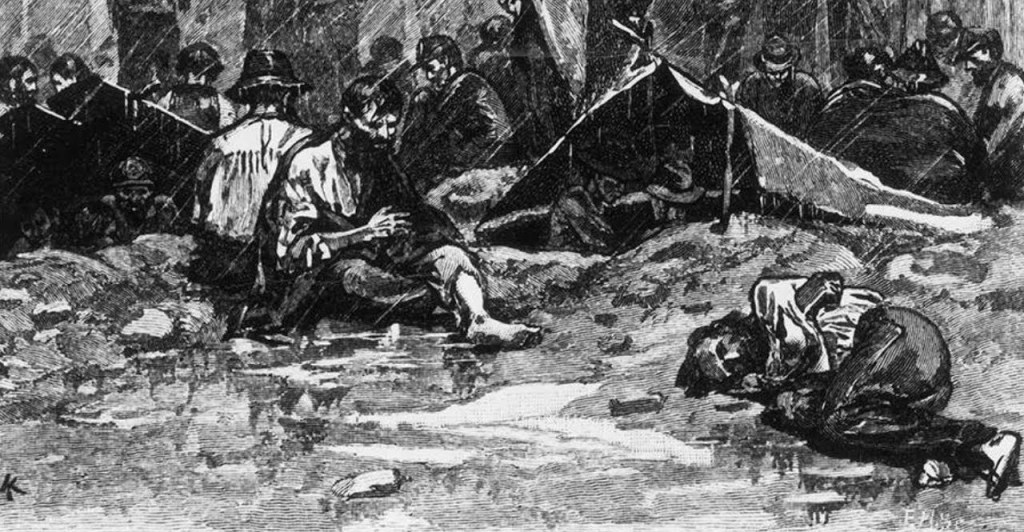
He was buried in his uniform the way all soldiers are buried. Well, I have wrote all the particulars concerning his sickness and death.

Well, about that note of Hearts, I believe he left that note with Bryan. You can write to Bryan and have him collect it and send the money to you. I believe the note was 18 dollars with ten percent interest.

The time seems very lonesome since Jonas died but his time had come and he was called away very sudden. Well, it is getting late and I will have to bring my letter to a close by sending you my love and best respects to all the family. So goodbye. write soon and don’t forget to write all the news.

From your affectionate son, — H. C. Thompson

To his beloved mother, Melinda Brown

1863: Willy to Family & Friends at Home

Ethan P. Allen of the 12th OVC (Ancestry.com)

This letter was written by a soldier named “Willy” who served in Co. F, 12th Ohio Volunteer Cavalry (OVC) while serving as a guard at Johnson’s Island, near Sandusky, Ohio. Unfortunately there are many soldiers by the name of William in the company and he gives no further clues to his identity.

The 12th OVC was organized at Camp Cleveland and mustered into federal service on 24 Nov. 1863. From Dec. 1863-Feb. 1864, the 12th was on duty at Camp Chase in Columbus, Ohio. Half of the regiment was on detached duty at Johnson’s Island near Sandusky, Ohio, during that period. In Feb.-Mar. 1864, the 12th was on duty at Camp Dennison near Cincinnati, Ohio. 

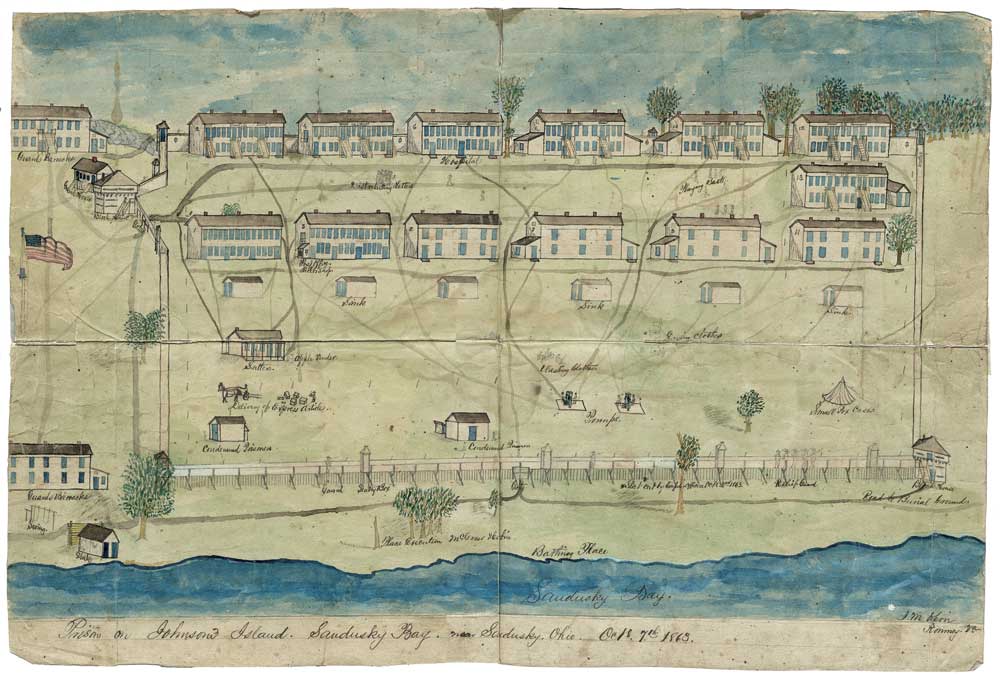
Willy datelined his letter from Camp Herrick which was no doubt named after John F. Herrick, the Lt. Colonel of the 12th OVC. His letter contains a description of an attempt by two prisoners to escape the prison yard by tunneling in mid-December 1863.

Rendering of Prison at Johnson’s Island in October 1863

Transcription

Camp Herrick
December 12th 1863

Dear Friends at Home,

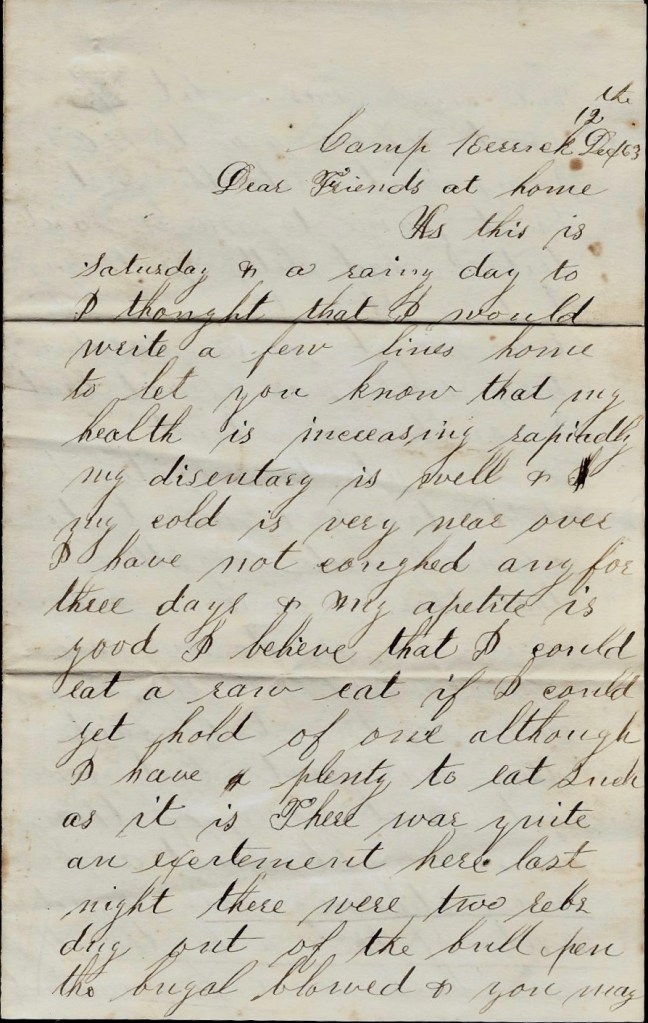
As this is Saturday & a rainy day too, I thought that I would write a few lines home to let you know that my health is increasing rapidly. My dysentery is well & my cold is very near over. I have not coughed any for three days & my appetite is good. I believe that I could eat a raw cat if I could get hold of one although I have plenty to eat—such as it is.

There was quite an excitement here last night. There were two rebs dug out of the bull pen. The bugle blowed & you may bet there was a lot of scart officers in the 12th OVC. I [was] up and out the first [when] Lieut. came to me and said that I had better go to my tent & stay there for fear there might be a hard time & he was afraid that I could not stand it so I went to my tent, laid down, & went to sleep. I had forgotten that there was any rebs out. In about an half of an hour, the companies came to their tents [and] said there was not but two got out. One of them was caught just as he was sticking his head out of the hole. The other came back in a few minutes & gave himself up so then that great scare was over.

I have not done any duty yet and the Orderly [Charles H. Sherburne] says that I need not until I get stout although I feel as well as I ever did. But I hant got my full strength yet.

Our Captain [Merville L. Saunder] has just got back from Columbus. He went to see what he could do about our pay. What he made out I cannot tell.

As this little sheet is most full, I shall have to close. This is from your son & friend, Willy. Address to Camp Herrick, 1st Battalion, 12th O. C., Co. F, Johnson’s Island, Ohio

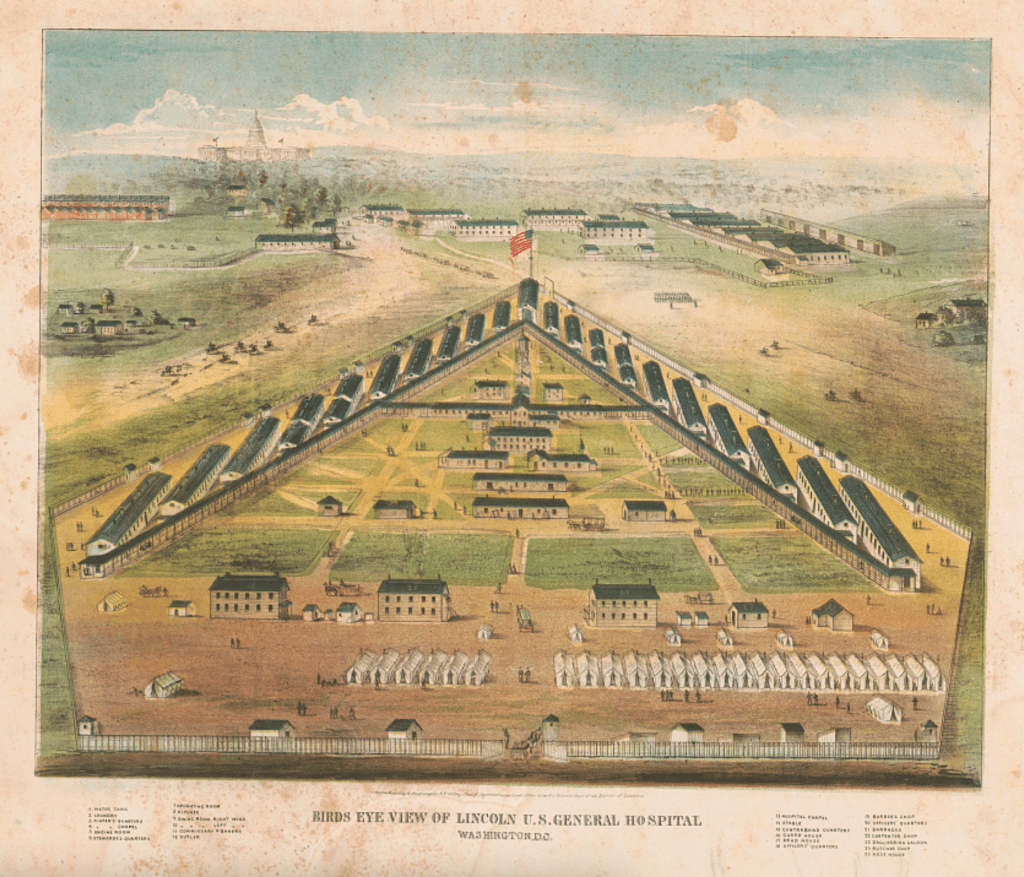
1864: Lincoln General Hospital Patient to Zachariah Philip Dennler

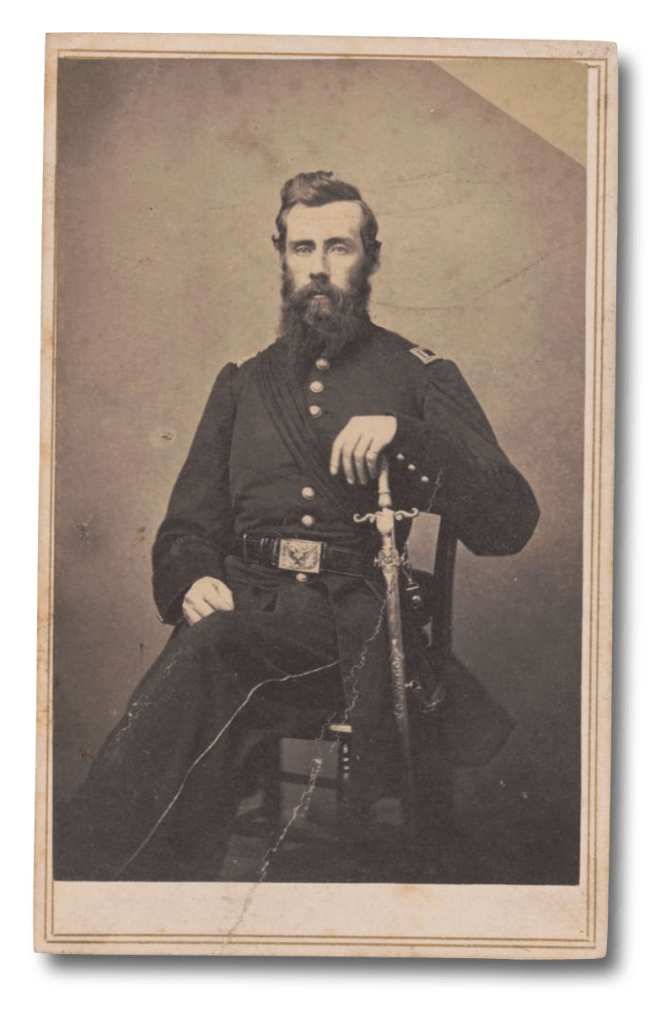
I could not find an image f Zachariah but here is a CDV of Asst. Surgeon Edson E. Boyd of the 112th N. Y. Infantry holding a Medical Service sword.

This letter was written by an unidentified patient of the Lincoln General Hospital that was located at East Capitol and 15th Streets in Washington D. C. It was opened in December 1862 and was the largest of the military hospitals built by the army to take care of Civil War casualties. It was located on Capitol Hill, 15 blocks east of the Capitol building.

The unidentified patient of the hospital addressed the letter to Dr. Zachariah Philip Dennler (1838-1890), the son of Rev. Philip H. Dennler of Lyons, Wayne county, New York. Rev. Dennler was a Lutheran minister from Germany. He married Jane E. Moore of Rheinbeck, Dutchess county, New York. Zachariah was an 1862 graduate of the Geneva Medical College and served as an asst. surgeon with the 10th New York Heavy Artillery from 29 August 1863 until 3 April 1864 and then later in 1865-66 with the 7th USCT.

It should be noted that Dr. Dennler’s medical probe was claimed to have been used to extract the bullet from President Lincoln’s brain. This claim appears in the book, Maple Grove Cemetery (p. 88) authored by Nancy Cataldi in 2006 though the source for this claim is not given, nor can I find any other independent source to corroborate it. It isn’t clear where or what Dr. Dennler was doing at the time of Lincoln’s death which was a couple of months before Dennler signed on with the 7th USCT. Three separate obituary notices for Dr. Dennler in 1890 fail to mention the “probe” claim. Further, the National Museum of American History claims that the surgical instruments used at Lincoln’s Autopsy belonged to Dr. Alfred D. Wilson. See also: Visible Proofs.

Transcription

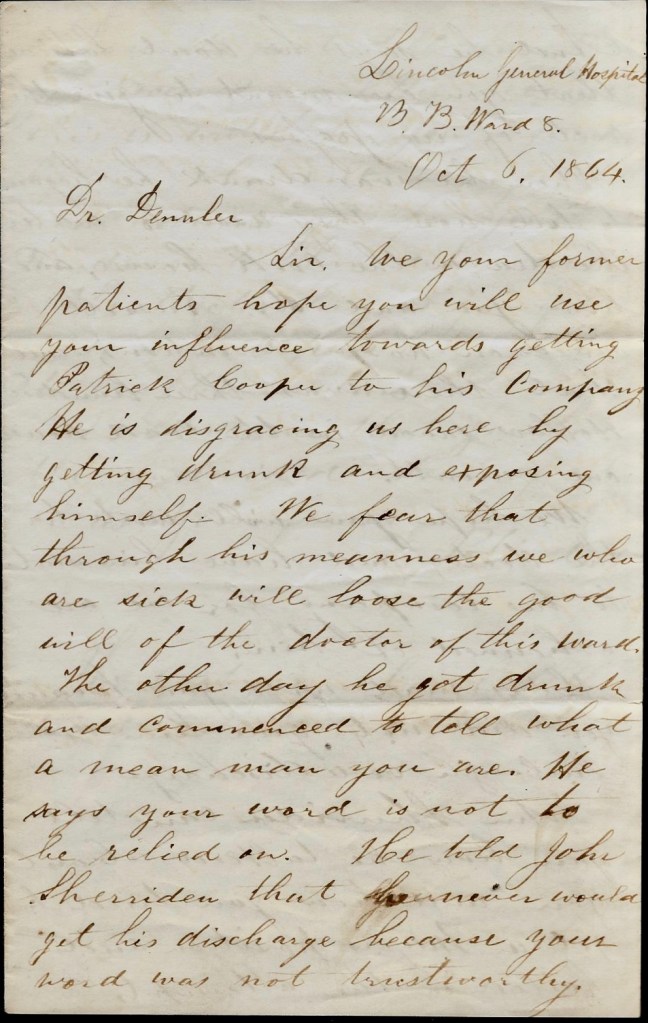
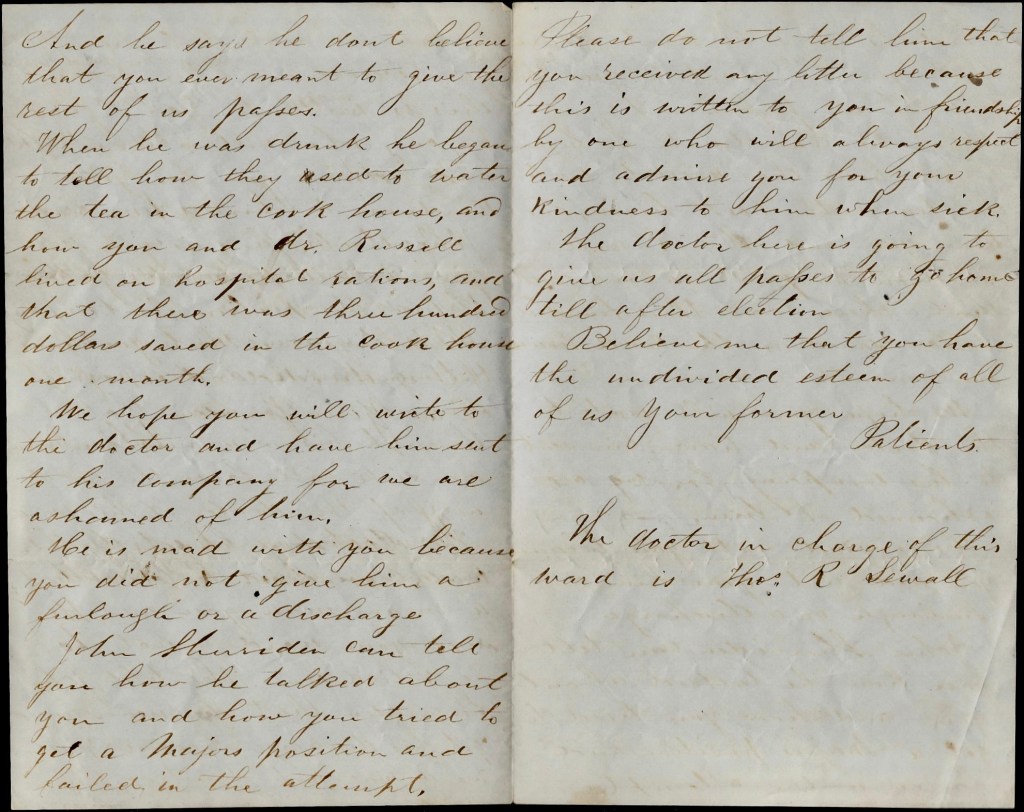
Lincoln General Hospital
B. B. Ward 8
October 6, 1864

Dr. Dennler
Sir,

We your former patients hope you will use your influence towards getting Patrick Cooper to his company. He is disgracing us here by getting drunk and exposing himself. We fear that through his meanness, we who are sick will lose the good will of the doctor of this ward. The other day he got drunk and commenced to tell what a mean man you are. He says your ward is not to be relied on. He told John Sheridan that you never would get his discharge because your ward was not trustworthy. And he says he don’t believe that ever meant to give the rest of us passes.

When he was drunk he began to tell how they used to water the tea in the cook house and how you and Dr. Russell lived on hospital rations, and that there was three hundred dollars saved in the cook house one month.

We hope you will write to the doctor and have him sent to his company for we are ashamed of him. He is mad with you because you did not give him a furlough or a discharge.

John Sheridan can tell you how he talked about you and how you tried to get a Major’s position and failed in the attempt.

Please do not tell him that you received any letter because this is written to you in friendship by one who will always respect and admire you for your kindness to him when sick. The doctor here is going to give us all papers to go home till after the election.

Believe me that you have the undivided esteem of all of us your former patients.

The doctor in charge of this ward is Thomas R. Sewall

1865: John B. Freeman to Mary (Freeman) Goit

This letter was written by John B. Freeman (1840-1868), the son of Job Tarleton Freeman (1810-1891) and Eveline Barnes (1820-1896) of Roxanna, Eaton county, Michigan. Prior to their relocation to Michigan, the Freeman’s lived in Allen township, Hancock county, Ohio, where they were enumerated in 1850. John probably wrote the letter to his sister Mary Kay (Freeman) Goit who was married to William Goit, had an young son named LaQuinnis (b. 1862), and still resided in Ohio where she must have known many of the soldiers who volunteered in the 21st Ohio Infantry who were also former friends of John’s.

I could not find an image of John but here is one of Henry Fox who served in Co. C, 13th Michigan Infantry. (Osman Collection in Photo Sleuth)

John enlisted in Co. H, 13th Michigan Infantry which mustered into service for three years in January 1862. The regiment performed well in many engagements in the western theatre. One of the prominent battles in which the 13th served was the battle of Chickamauga where they were under the command of Col. J. B. Culver, and where they helped to hold the rebels in check from early in the morning until 12 noon. When the thermometer stood at 90 degrees, the regiment charged upon the enemy in a most spectacular movement. In this engagement 107 officers and men were lost, either killed, wounded or missing. 217 took part in the engagement. Such a loss tells how the 13th Michigan sustained its part in this historic engagement far more eloquently than words can describe.

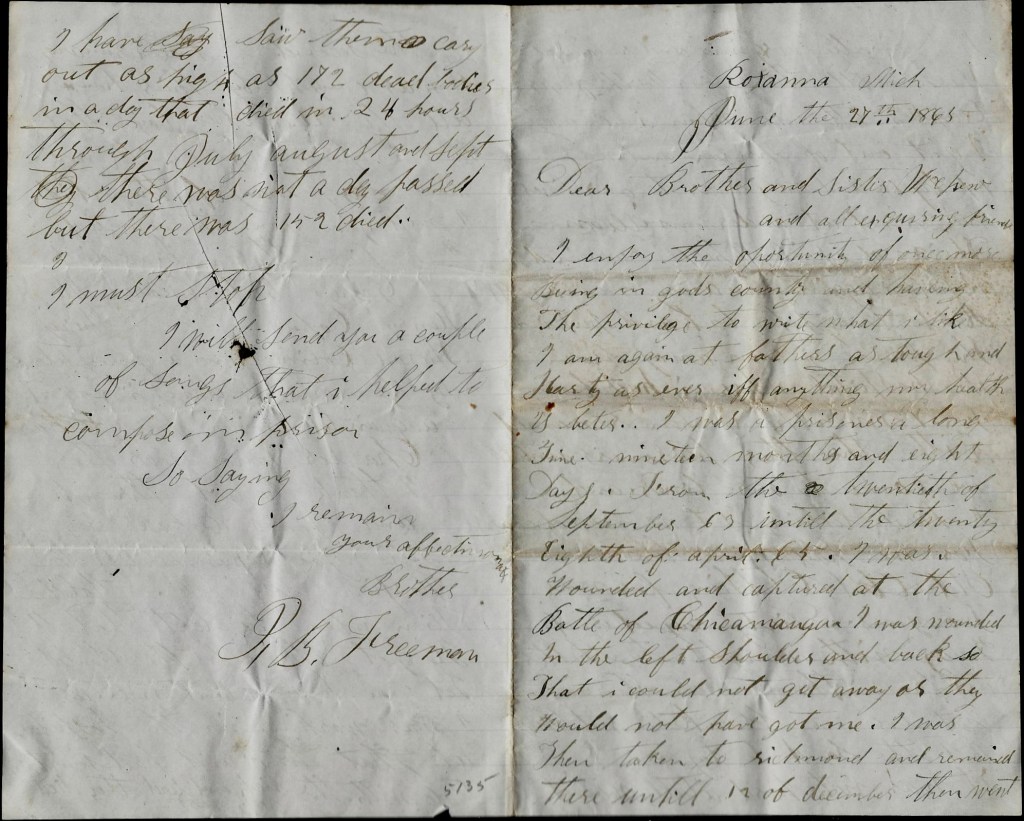
In his remarkable letter, John chronicles his time in captivity from the time of his being wounded and taken prisoner at Chickamauga until he was released at the end of the war, including time spent at Richmond, Danville, and Andersonville, and two escape attempts. And though he claims that he was as “tough and hearty” as ever following his release, he died three years later at the age of 28.

See Major Williard G. Eaton and the 13th Michigan Infantry on the Chickamauga Blog.

Transcription

Roxanna, Michigan
June 27th 1865

Dear Brother and Sister, nephew, and all enquiring friends,

I enjoy the opportunity of once more being in God’s country and having the privilege to write what I like. I am again at Father’s as tough and hearty as ever. If anything, my health is better. I was a prisoner a long time—from the twentieth of September ’63 until the twenty-eighth of April ’65. I was wounded and captured at the Battle of Chickamauga. I was wounded in the left shoulder and back so that I could not get away or they would not have got me. I was then taken to Richmond and remained there until the 12th of December, then went to Danville, Virginia, and remained there until the fourteenth of April except a little while when I ran away. I got out of prison and was 14 days and very near to our lines.

We arrived at Andersonville on the 20th of April where I remained until I again ran away, was caught, and brought back and put in the prison. I run away from the hospital where I had been for 7 months. I then remained with the other prisoners until we came to our lines and a hard-looking set we was of course for we had wore the same old clothing for near two years—dirty, ragged, and lousy with naught to shelter us from the sun or storm—not even a blanket—nothing but the sand to lay on. It was not hard atall, was it? The second time I run away I was caught by their hounds.

Prisoners at Andersonville

All the 21st Ohio boys that were in prison were with me and many of them died. I will give you the names of a few that I know died. George Brets [Co. G], George McMurray [Co.G], Henry Copus [Co. G], and a young fellow by the name of Davis. I was not acquainted with him. Charles Tonoe was there. I think he got through. And James Copus’s boy, little Joe Copus [Co. G]—he left the hospital last fall. I told him when he left that if he got through, he should let you know about me as I was working in the hospital at that time and had something to do with the sick and dead. They died very fast. I have saw them carry out as high as 172 dead bodies in a day that died in 24 hours. Through July, August, and September, there was not a day passed but there was 152 died.

I must stop. I will send you a couple of songs that I helped to compose in prison. So saying I remain your affectionate brother, — J. B. Freeman