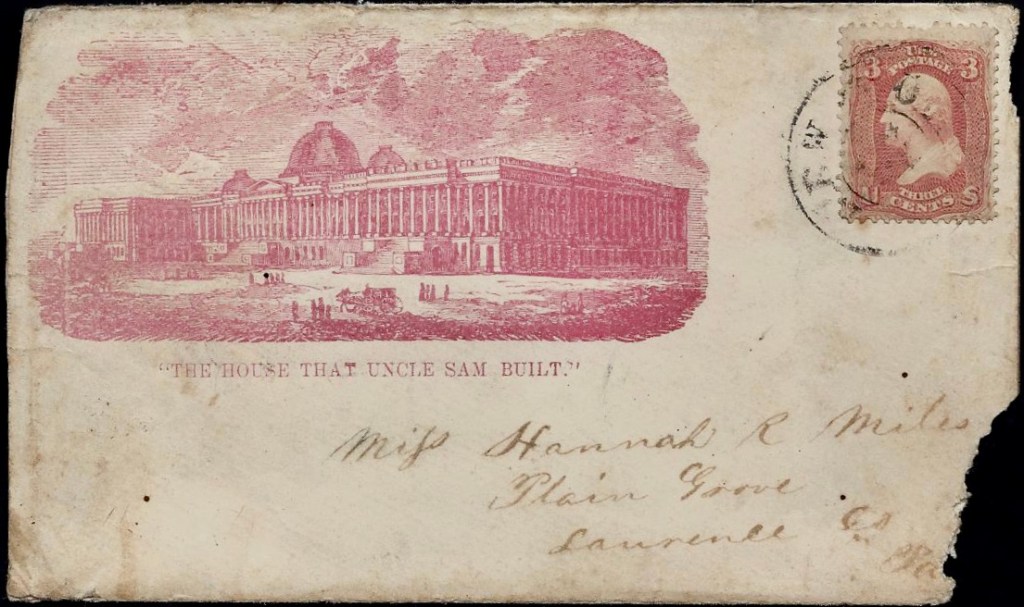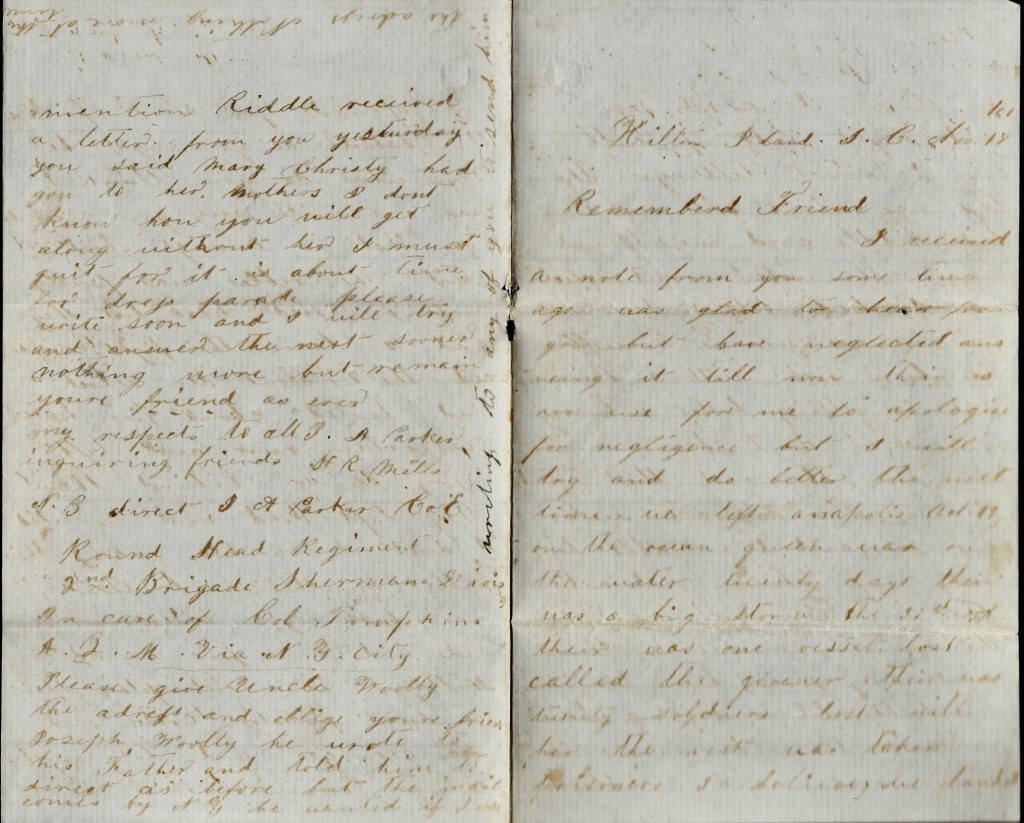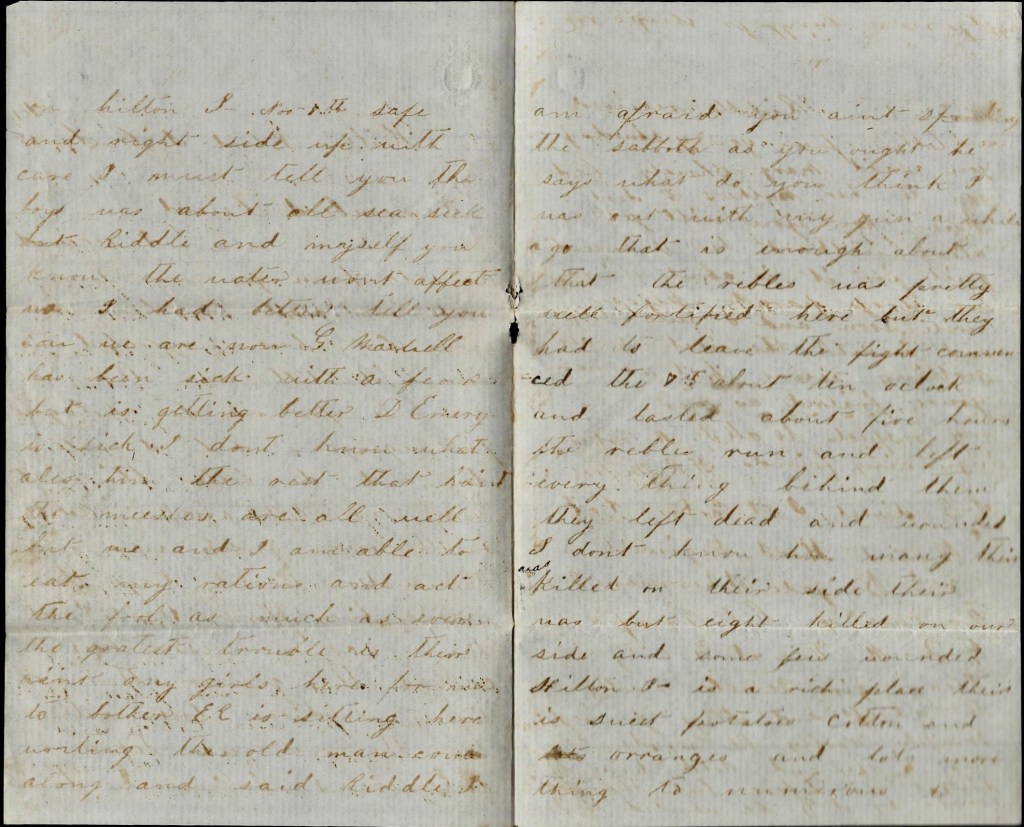
The following letter was written by George Baird Caldwell (1840-1916), the son of Alfred Caldwell and Martha Baird of Washington, Pennsylvania. A graduate of Washington College, he was studying law in the office of the firm of eminent lawyers, Acheson & Wilson, at Washington, Pennsylvania, when the war broke out. When the first call was made for what was known as the “three months men,” George “left his law studies and took the field as a member of the 12th Pennsylvania Regiment, being appointed a corporal in his company, and although small in size, he did his full duty during this term of enlistment.
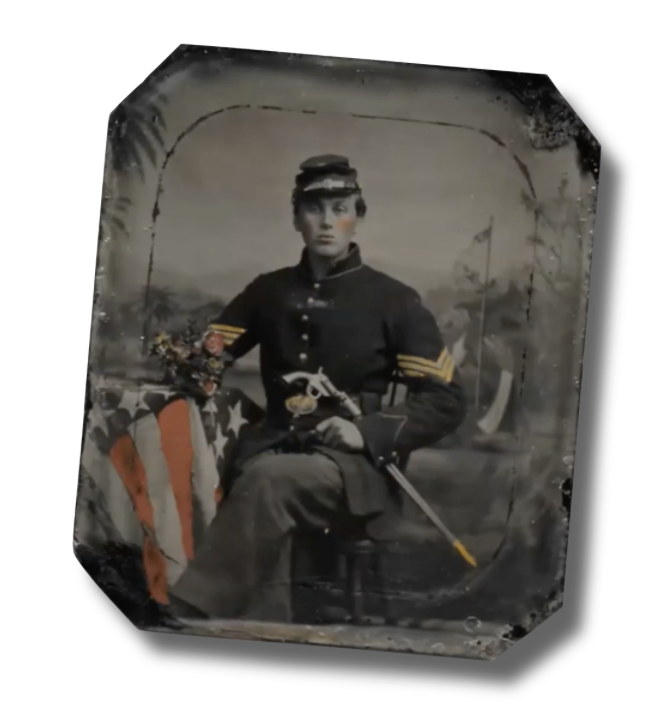
Upon returning home, his regiment having been discharged, George immediately reenlisted at Washington in Co. A of the 100th Pennsylvania Regiment, known as “The Round Head Regiment.” With this regiment he went under Gen. Benham to South Carolina and took part in an abortive attempt by that general to storm the Confederate works in and about the city of Charleston. By request of the loyal governor of Virginia, Mr. Caldwell, after a service of eighteen months in the ranks, was honorably discharged from the Pennsylvania troops by proper authority, for the purpose of receiving a commission in a loyal Virginia regiment being organized, and which was afterwards known as the 12 West Virginia (Union) Infantry. He was commissioned first lieutenant and adjutant of this new regiment, and served with it until practically the close of the war, when he was honorably discharged from the service on account of a reduction of the army, and entered upon the practice of his profession as an attorney-at-law in the city of Wheeling, serving, in all, nearly four years as a soldier.”
“While with his commanders, Gen. Thoburn and Col. Curtis of his own regiment, making reconnaissance, just before the battle of Fisher’s Hill, (called Mount Hope by the Confederates), a Confederate battery of field artillery, securing the range to where this clump of Union officers was gathered on an eminence, threw a shell into their midst, which carried off one leg of the horse upon which Adjutant Caldwell was riding. The next day he went into action on foot. As he was near one end of the Union line, which had pushed forward and covered ground faster than the rest of the assailants, he was one of the earliest to scale the Confederate works, and found himself almost alone when he jumped down amid the enemy. While shouting his commands to the Confederates, who were throwing down their arms and surrendering, to get over the works in the direction from which he had come, and behind the Union lines, a private soldier, who had scaled the works long after he had done so, stooped down, right at the adjutant’s feet, and picked up a Confederate flag or stand of colors, encased in a black oil-cloth case, which had been for some minutes lying at the officer’s feet, unobserved by him. A sergeant of his regiment called to him and asked him to take the colors from this soldier who had picked them up, saying that they rightfully belonged to the adjutant, whose foot was almost on them, and who, as stated, had been in the works long before the man who picked the flag up. He refused to take the captured colors from the enlisted man who had picked them up, because, as he always said, he would not have it charged to him that he had exercised his power as an officer over an enlisted man in such a case, however much justification he might have for it.” [Source: Caldwell Family Records]
T R A N S C R I P T I O N
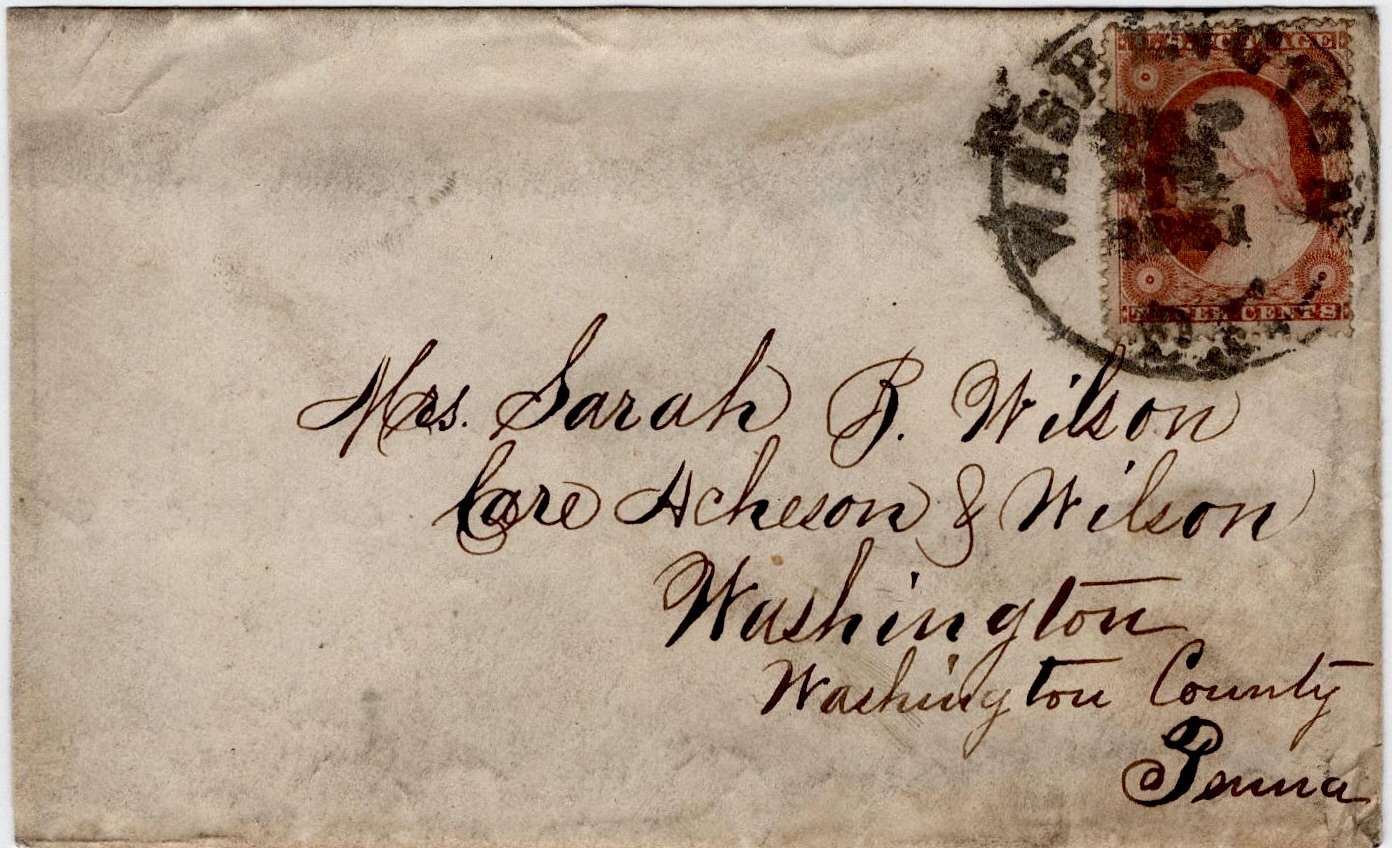
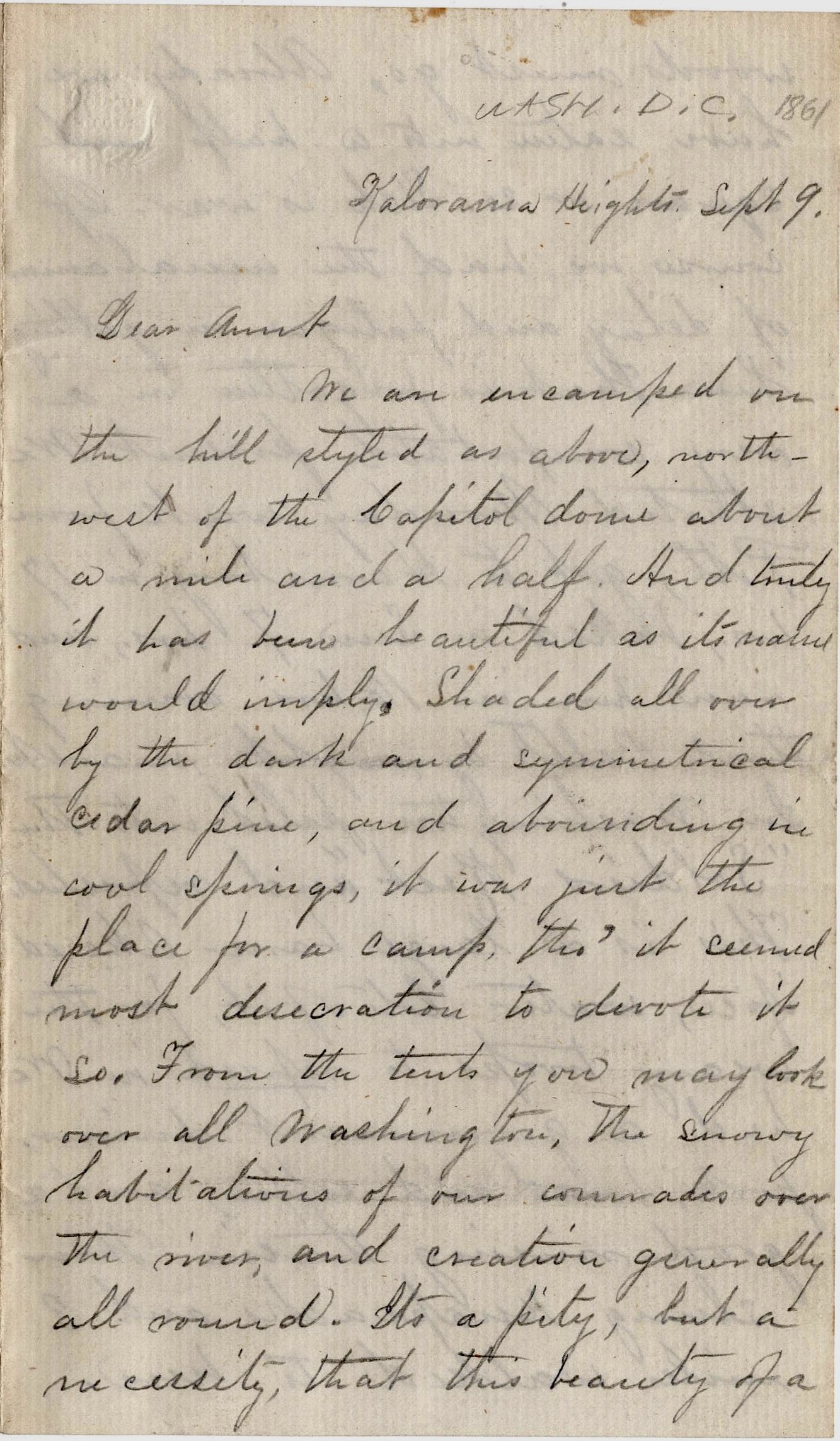
Kalorama Heights [D C.]
September 9 [1861]
Dear Aunt,
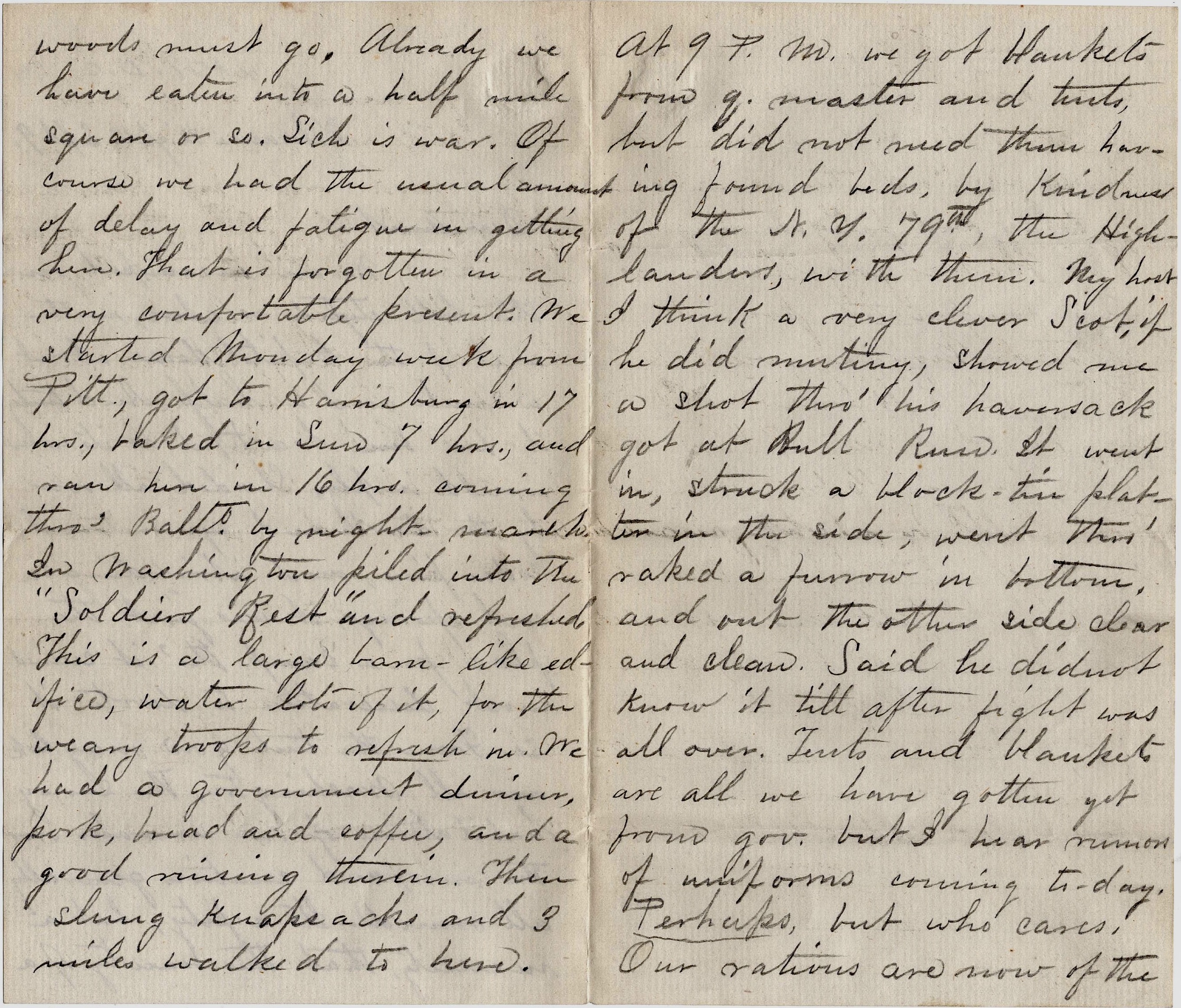
We are encamped on the hill styled as above, northwest of the Capitol dome about a mile and a half. And truly it has been beautiful as its name would imply. Shaded all over by the dark and symmetrical cedar pine, and abounding in cool springs, it was just the place for a camp, tho’ it seemed most desecration to devote it so. From the tents you may look over all Washington. The snowy habitations of our comrades over the river, and creation generally all round. It’s a pity, but a necessity, that this beauty of a woods must go. Already we have eaten into a half mile square or so. Such is war. Of course we had the usual amount of delay and fatigue in getting here. That is forgotten in a very comfortable present.
We started Monday week from Pittsburgh, got to Harrisburg in 17 hrs., baked in sun 7 hours, and ran here in l6 hrs coming thro’ Baltimore by night march. In Washington, piled into the “Soldiers Rest” and refreshed. This is a large barn-like edifice, water—lots of it—for the weary troops to refresh in. We had a government dinner, pork, bread and coffee, and a good rinsing therein. Then slung knapsacks and 3 miles walked to here.
At 9 p.m. we got blankets from quartermaster and tents, but did not need them, having found beds by kindness of the N. Y. 79th—the Highlanders—with them. My host I think a very clever Scot, [even] if he did mutiny, 1 showed me a shot thro’ his haversack got at Bull Run. It went in, struck a black tin platter in the side, went thro’, raked a furrow in bottom, and out the other side clear and clean. Said he did not know it till after the fight was all over.
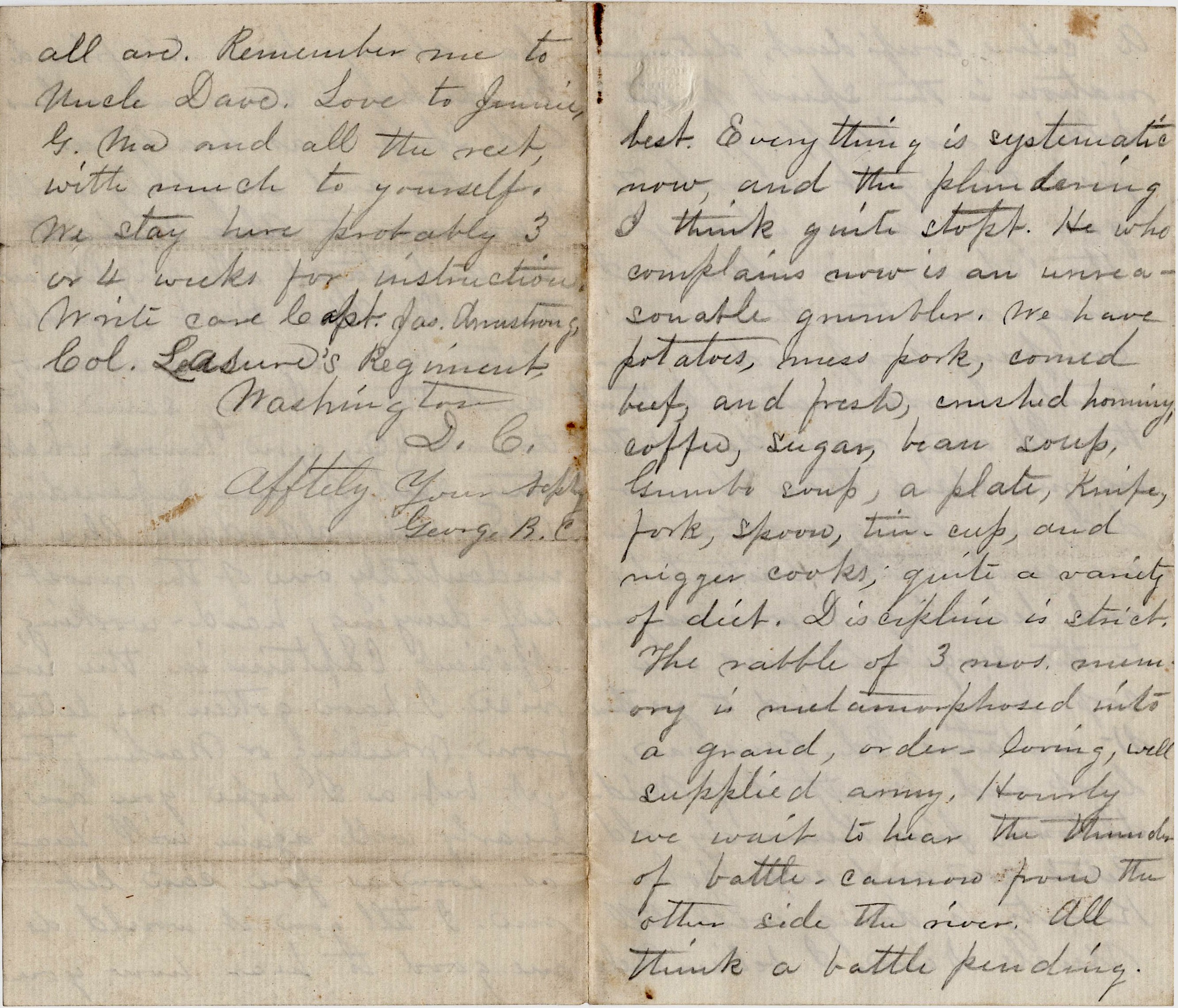
Tents and blanket are all we have gotten yet from the government but I hear rumors of uniforms coming today perhaps—but who cares. Our rations are now of the best. Everything is systematic now, and the plundering I think quite stopped. He who complains now is an unreasonable grumbler. We have potatoes, mess pork, corned beef, and fresh, crushed hominy, coffee, sugar, bean soup, Gumbo soup, a plate, knife, fork, spoon, tin cup, and nigger cooks; quite a variety of diet. Discipline is strict. The rabble of 3 months memory is metamorphosed into a grand, order-loving, well-supplied army. Hourly we wait to hear the thunder of battle cannon from the other side the river. All think a battle pending.
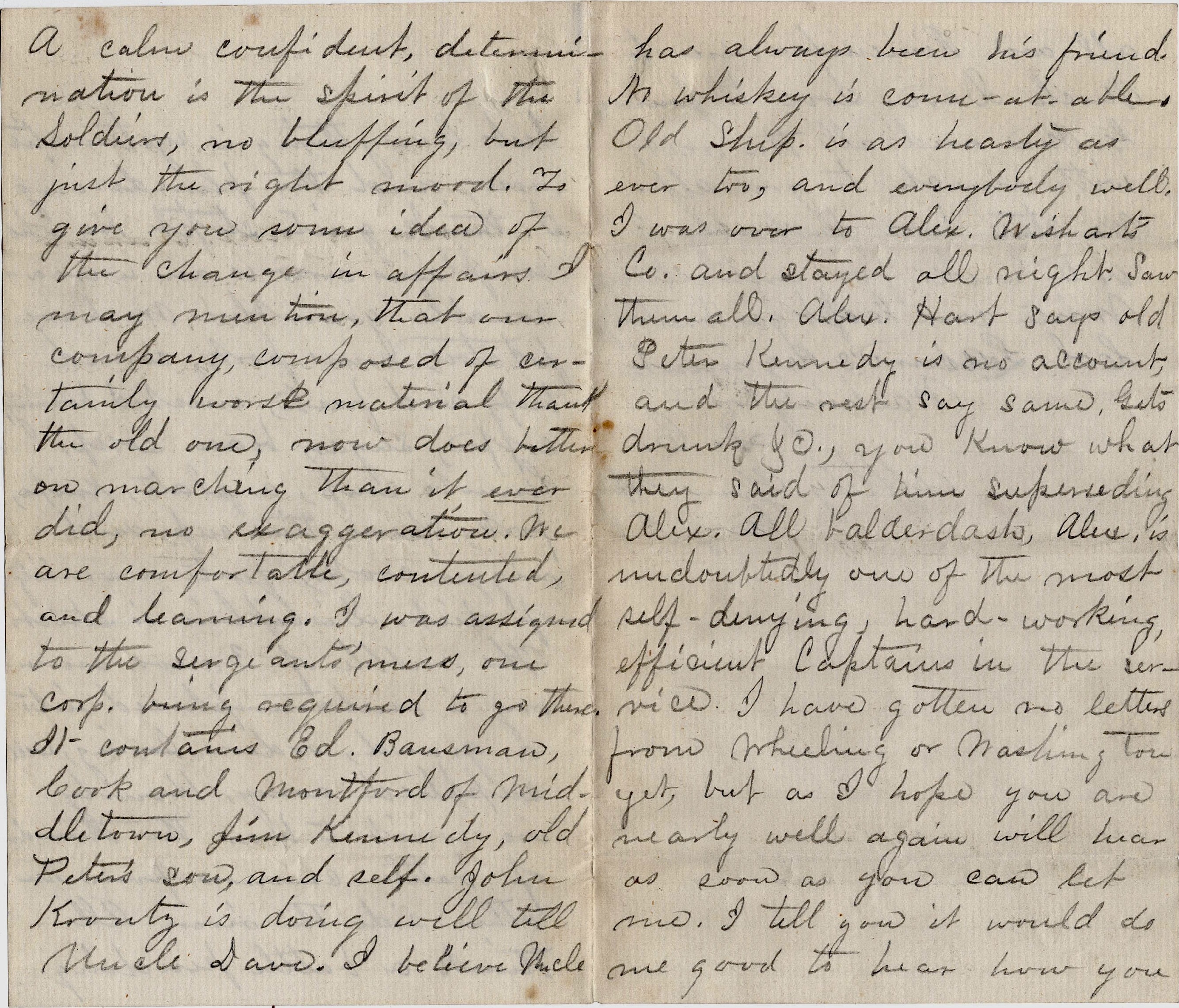
A calm, confident, determination is the spirit of the soldiers—no bluffing, but just the right mood. To give you some idea of the change in affairs, I may mention that our company, composed of certainly worse material than the old one, now does better on marching than it ever did—no exaggeration. We are comfortable, contented, and learning. I was assigned to the sergeants’ mess, one corporal being required to go there. It contains Ed Bausman, [John] Cook and [James W.] Montford of Middletown, Jim Kennedy—old Peter’s son, and self. John Koontz is doing well. Tell Uncle Dave. I believe uncle has always been his friend. No whiskey is come-at-able. Old Ship is as hearty as ever too, and everybody well.
I was over to Alex Wishart’s Co. and stayed all night. Saw them all. Alex. Hart says old Peter Kennedy is no account, and the rest say same. Gets drunk &c. You know what they said of him superseding Alex. All balderdash. Alex is undoubtedly one of the most self-denying, hard-working efficient captains in the service.
I have gotten no letters from Wheeling or Washington yet, but as I hope you are nearly well again will hear as soon as you can let me. I tell you it would do me good to hear how you all are. Remember me to Uncle Dave. Love to Jennie, G’Ma and all the rest, with much to yourself. We stay here probably 3 or 4 weeks for instruction. Write care of Capt. Jas. Armstrong, Col. Leasure’s Regiment, Washington D.C.
Affectionally your Nephew, George B. C.
1 The 79th New York (“Highlanders”) Infantry suffered severe losses at Bull Run, including the death of their Colonel, James Cameron (brother of Secy. of War Simon Cameron). When they did not get a chance to return to New York to recruit and select their own replacement Colonel, they revolted and refused to obey orders or perform fatigue duty in building defenses around Washington D. C.