The following letter was written by W. H. Len, the son of Charles Edura Len and Mary Murdock Casey (1824-1905) of Philadelphia. He wrote the letter in May 1861 to his uncle James Seaman Casey (1833-1899) who was a member of the 7th New York Militia in April 1861, just after the outbreak of the Civil War, and was commissioned as a second lieutenant of the 5th Infantry Regiment in August of the same year. He was promoted to captain in December 1863, and became Commissary of Musters of the Army of the Potomac. He was brevetted major in March 1865 for his actions in the Battle of Fort Stedman.
T R A N S C R I P T I O N
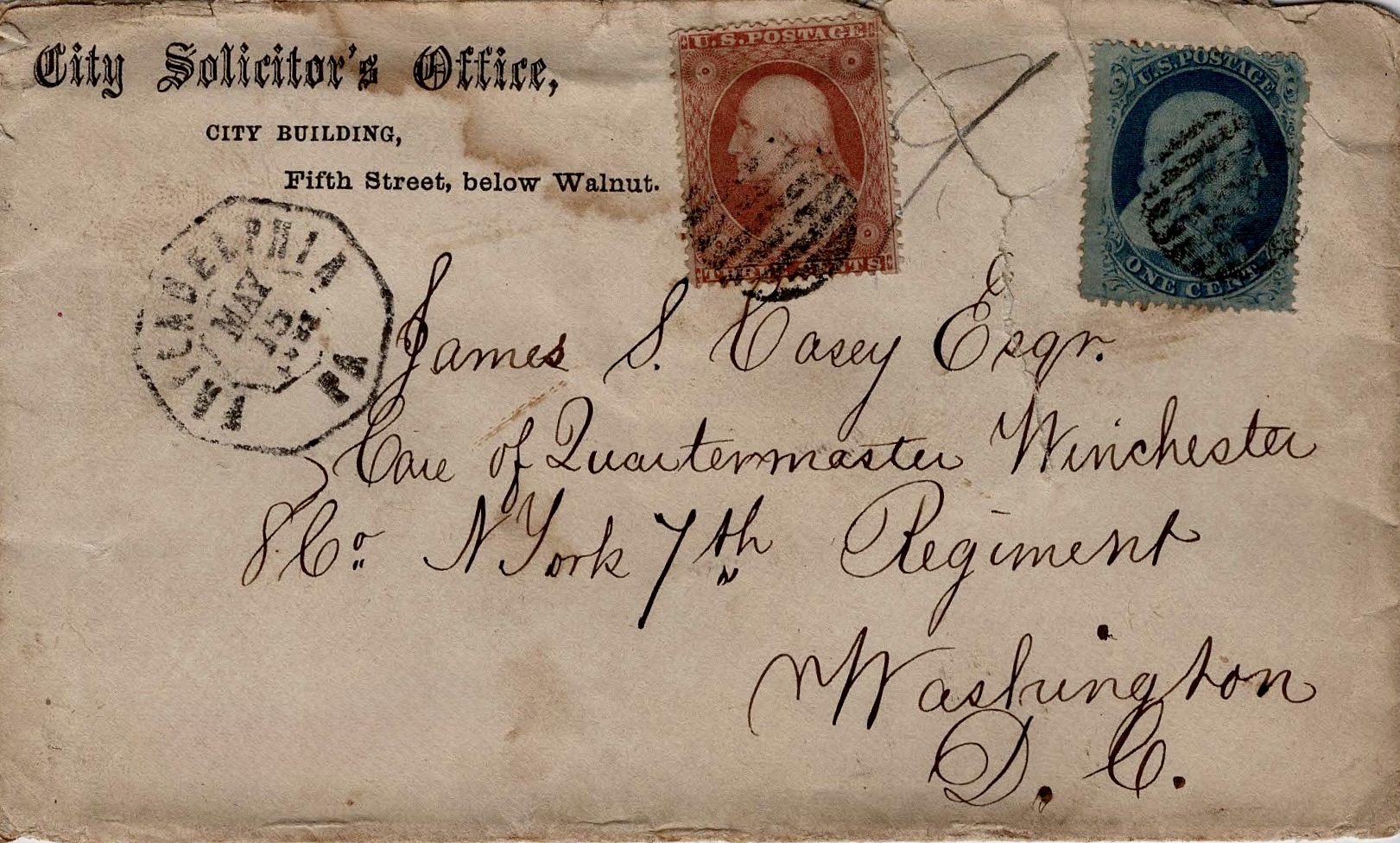
Addressed to James D. Casey, Esqr., Care of Quartermaster, New York 7th Regiment, Washington D. C.
Philadelphia, Pa. May 13th 1861
Dear Uncle,
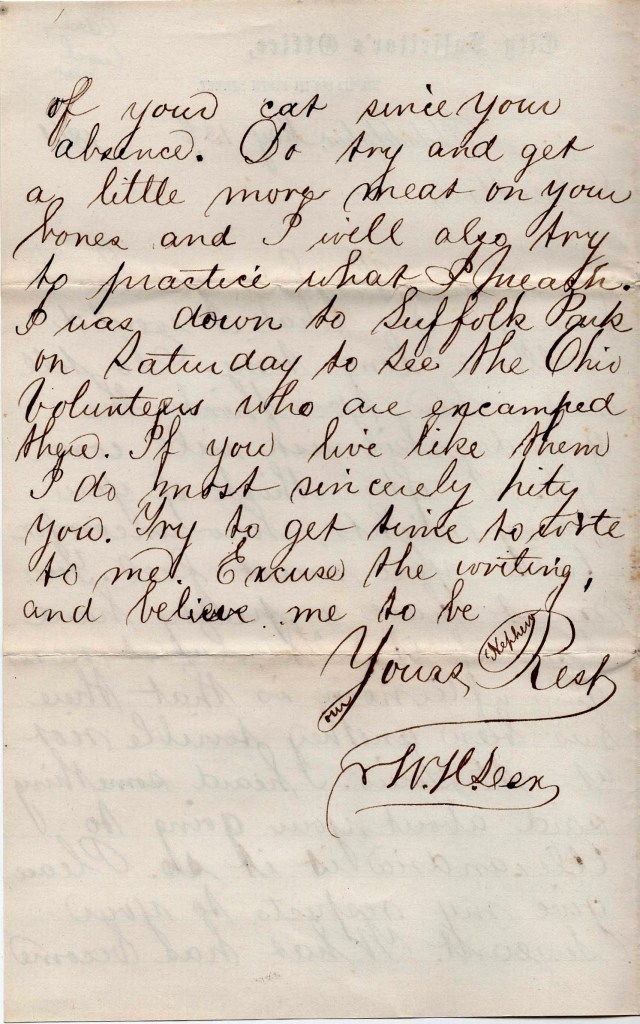
We have not heard from you for what I would call a long time. Do tell me when you think the grand skirmish will come off. I often think of you rainy nights how uncomfortable you must feel. You must have a pretty hard time of it. The latest news this afternoon is that there has been another terrible riot at St. Louis [See the Camp Jackson Affair]. I heard something said about your going to Alexandria. Is it so? Please give my respects to your sergeant. What has become of your cat since your absence? Do try and get a little more meat on your bones and I will also try to practice what I preach.
I was down to Suffolk Park [Racecourse] on Saturday to see the Ohio Volunteers 1 who are encamped there. If you live like them, I do most sincerely pity you. Try to get time to write to me. Excuse the writing and believe me to be yours respectfully, — W. H. Len
The following letter makes a good read but unfortunately the soldier who wrote it only signed his name “John” and there are too few clues within the letter to lead me conclusively to his identity or even the regiment he was in. He does indicate that they were under the overall command of Gen. Henry W. Benham who was responsible for the engineering activities near Petersburg so I’m going to assume this soldier was in either the 15th or 50th New York Engineers. Early in the letter he speaks of constructing the hospitals at the “Point” which would have been City Point. This activity seems consistent with the engineers.
T R A N S C R I P T I O N
Camp near Petersburg [Monday] December 12th 1864
Dear Brother,
We have made quite a move since I wrote you last. I don’t owe you a letter but since I have the time to spare, I thought I would give you a little sketch of our march to this place.
Friday [9 December] was an awful cold day. We went down to the Point [City Point] to work on the hospitals as usual, It was rather hard work to keep warm. Friday night it commenced raining [and] in the morning [10 December] there was an inch and a half of snow on the ground. We went down to work. It grew warmer and made it too muddy to work so we came back to camp at noon. They told us we might get us up some wood for ourselves to last over Sunday [so] we started with a wheelbarrow and got two loads chopped and wheeled up into our shanty. We had to go three quarters of a mile for wood is getting about played out in this section.
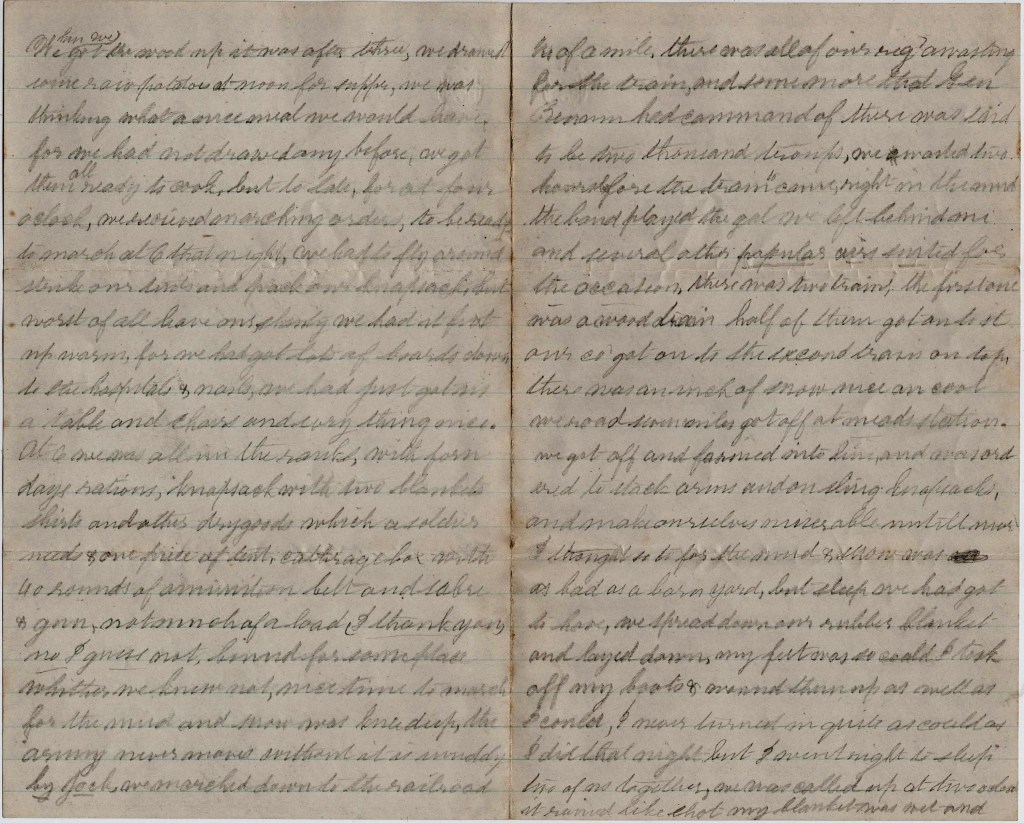
When we got the wood up, it was after three. We drawed some raw potatoes at noon for supper. We was thinking what a nice meal we would have for we had not drawed any before. We got them all ready to cook but too late for at four o’clock we received marching orders, to be ready to march at 6 that night. We had to fly around, strike our tents and pack our knapsacks, but worst of all, leave our shanty. We had it fixed up warm for we had got lots of boards down to the hospitals & nails. We had just got us a table and chairs adn everything nice
At six we was all in the ranks with four days rations, knapsack with two blankets, shirts and other dry goods which a soldier needs & one piece of tent, cartridge box with 40 rounds of ammunition, belt and saber and gun—not much of a load, I thank you. No, I guess not. Bound for someplace whither we knew not. Nice time to march for the mud and snow was knee deep. The army never moves without it is muddy, by Josh.
We marched down to the railroad one quarter of a mile. There was all of our regiment awaiting for the train and some more that Gen. [Henry Washington] Benham had command of. There was said to be two thousand troops. We waited two hours before the train to come right in the mud. The band played, “The Gal we left behind me” and several other popular airs suited for the occasion. There was two trains, The first one was a wood train. Half of them got onto it. Our company got on to the second train on top. There was an inch of snow—nice and cool. We rode seven miles, got off at Meade Station. We got off and formed into line and was ordered to stack arms and unsling knapsacks and make ourselves miserable until night. I thought so too for the mud & snow was as bad as a barn yard, but sleep we had got to have. We spread down our rubber blanket and laid down. My feet was so cold, I took off my boots & warmed them up as well as I could. I never turned in quite as cold as I did that night but I went right to sleep., two of us together.
We was called up at two o’clock. It rained like shot. My blanket was wet and my feet too. We got ready in a short time and marched two hours. We halted and stacked our arms. There was a house nearby and some outbuilding (some General’s headquarters). We had got to have some wood (there was a guard around the buildings). There was no wood near so they commenced pulling down the barn and hog pen. They stripped them pretty quick. There was 50 or 60 fires started in a short time. They hadn’t got fairly to going before the order came to put them all out. If we didn’t, the shells would be a flying around us. I thought we must be amongst them for we heard the picket firing plain when daylight came. We could see our line of works plain.
We ate our breakfast, stayed there until eleven, and then we fell in and marched to where we are now. I tell you, our knapsacks was pretty heavy before we got [here]. Some of the boys threw away one of their blankets, they was so wet and heavy, but I got through with mine and stood it first rate. We got here about noon. There was winter huts built that some soldiers vacated but all mud and snow—pretty shabby for they was built in a hurry. We put our tent cloth on [one] and cleaned them out as well as we could. We had to be pretty thick for their wasn’t huts enough. There was twelve of us together—just as thick as we could stand up. I never felt thecold so much as I did that night. It seemed as though we should freeze. The wind blew hard and froze hard as a rock. It don’t look much like the Sunny South they tel about, and our old tent you could throw your hat through it anywhere.
We are within one mile of Petersburg and in the rear of Fort Petersburg. We can see the steeples at Petersburg and the buildings that they have got our prisoners in. John, you ought to see the guns that they have got mounted on this fort. They look huge, I tell you. They say they could throw a shell into Petersburg with them. I don’t doubt it for they look as though they was capable of doing. The pickets are a firing all the while at each other. I could hear them plain enough when I was at the Point and most too plain here. I would rather [ ] to the rear if they would let me,
John. I must stop for we have had orders to clean up our guns for inspection. I will tell you the rest I have done in another sheet. — George
The following letter was written by Jacob Howard Asher (1840-1917) who was twenty-one years old when he enrolled at Hudson to serve three years in Co. C, 128th New York Infantry. He was mustered in as a sergeant and was promoted to first sergeant in November 1863, and commissioned a 2nd Lieutenant in January 1865. He mustered out of the regiment on 12 July 1865 at Savannah, Georgia.
“Howard” was the son of Jacob Asher (1802-1860) and Ellen Ostrom (1809-1879) of Rhinebeck, Dutchess county, New York. He was working as a teamster prior to his enlistment, at which time he was described as standing 5′ 10″ tall, with dark gray eyes and black hair. After the war, when he returned to Dutchess county, he resumed his career as a teamster.
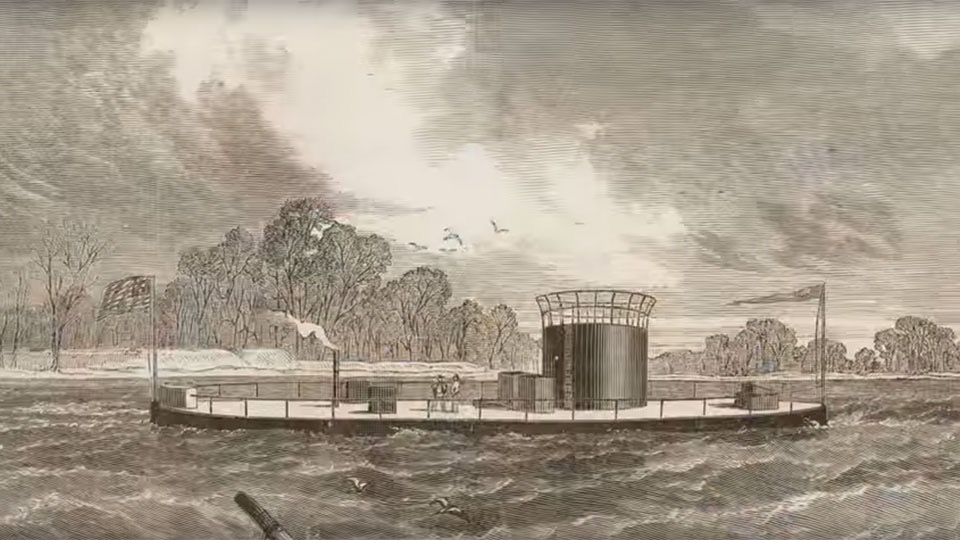
In his letter, Howard describes the journey from Camp Millington near Baltimore, Maryland, to Fortress Monroe aboard the US Mail steamer Arago in early November 1862. He appears to have been informed that the regiment was to be included in an expedition to New Orleans to join Gen. Nathaniel Banks’ Department of the Gulf. The regimental history informs us that sickness and disease infested the ranks while aboard the Arago though Howard does not acknowledge it. He does mention seeing and describing the USS ironclad Monitor, however, which was reported by others in the regiment.
Steamship Arago near Fortress Monroe Monday, November 10, 1862
Dear Cousin George,
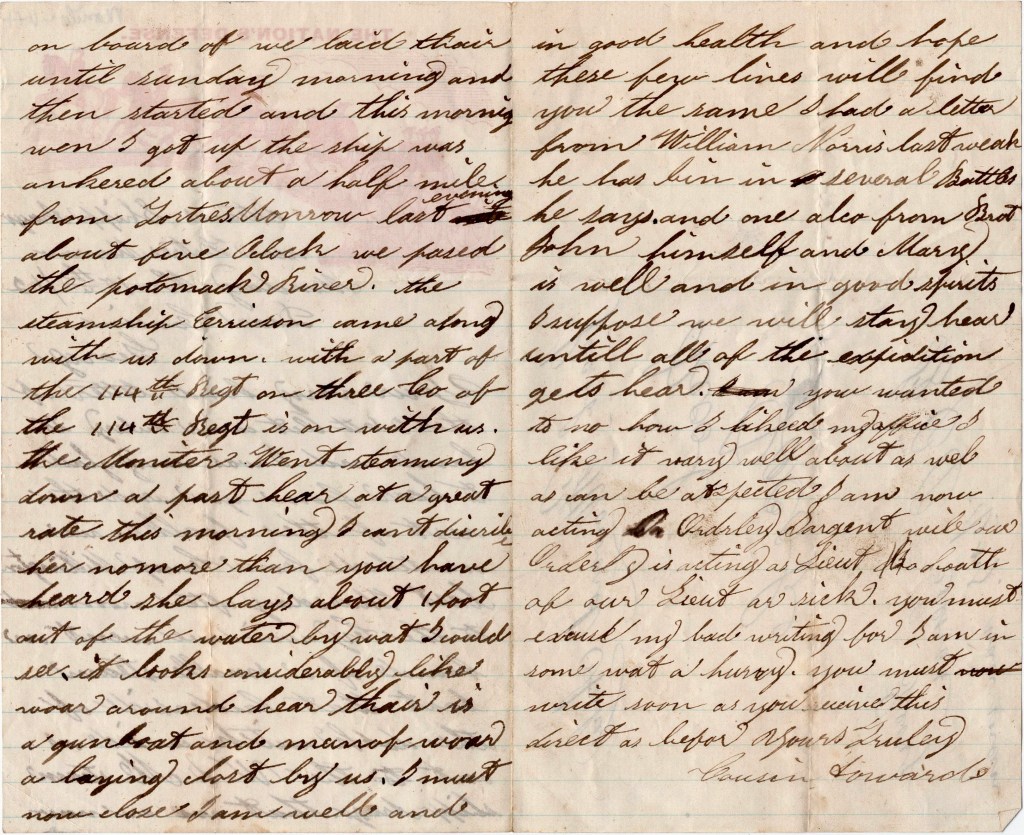
Your very kind letter of the 26th October came duly to hand and I was very glad to hear from you and the rest of the folks. We marched from Camp Millington [in Baltimore, Md.] last Thursday afternoon to the city where we went onboard of a small steamboat that laid aside of the dock which carried us out to the U. S. M[ail] Steamship Arago that we are now on board of. We laid there until Sunday morning and then started and this morning when we got up the ship was anchored about a half mile from Fortress Monroe.
Last evening about five o’clock we passed the Potomac River. The steamship Ericsson came along with us down with a part of the 144th Regiment on [it]. Three companies of the 114th Regiment is on with us. The Monitor went steaming down past here at a great rate this morning. I can’t describe her no more than you have heard. She lays about one foot out of the water by what I could see.
It looks considerably like war around here. There is a gunboat and man-of-war a laying close by us. I must now close. I am well and in good health and hope these few lines will find you the same. I had a letter from William Norris last week. He has been in several battles, he says. And one also from Brother John. Himself and Mary is well and in good spirits.
I suppose we will stay here until all of the expedition gets here. you wanted to know how I liked my office. I like it very well—about as well as can be expected. I am now acting Orderly Sergeant while our Orderly is acting as Lieutenant. Both of our lieutenants are sick. You must excuse my bad writing for I am in somewhat of a hurry. You must write soon as you receive this. Direct as before. Yours truly, — Cousin Howard
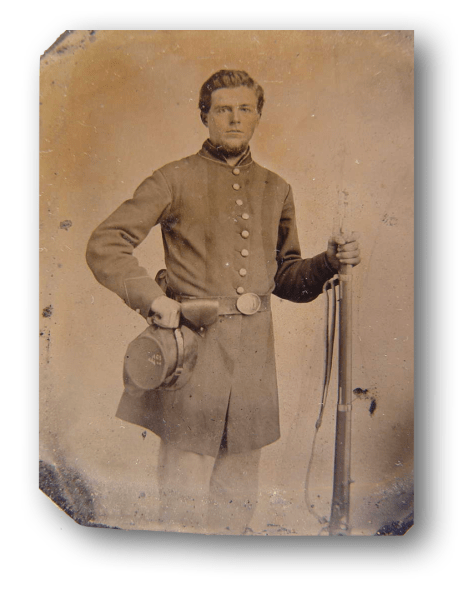
The following letter was written by Nelson W. Shephard (1844-1864), the son of Orrin W. Whephard (1818-1888) and Sarah Ann Demming (1820-1897) of Croton, Newaygo county, Michigan. Nelson was born in 1844 near Grass Lake, and had moved to Newaygo County with his parents, Orrin and Sarah. Before heading off to war, Nelson served some time in Jackson State Prison for burglary before heading off to war in August 1862 when he enlisted in Co. C. 26th Michigan Infantry. Although a poor speller, Shephard provided many details about his experiences in the 26th Michigan in letters home to his parents.
Nelson’s wartime experiences would likely have remained unknown were it not for Nancy Crambit, who discovered his letters among her late husband’s possessions, acquired years earlier at a yard sale. Unwilling to retain them, she surmised that someone in Newaygo County might find them meaningful, prompting her to send them to the local post office. For further details, refer to Smithsonian’s website and their magazine article, Mystery Solved: A Michigan Woman Says She Mailed Civil War Letters to the Post Office.
Nelson was taken prisoner at Ream’s Station, Virginia, on 25 August 1864 and was supposedly listed in Belle Isle Prison at Richmond, Virginia on October 4, 1864. He died in the Confederate Prison at Salisbury, North Carolina on December 18, 1864, where he had been joined by other members of the regiment.
Nelson’s lengthy letter presented here captures his regiment’s movements from Fort Richmond on Staten Island to Brandy Station in November 1863 until early January 1864—particularly the Mine Run Campaign. More of his letters can be found here: 1862-64: Nelson W. Shephard to his Parents on Spared & Shared 22.
T R A N S C R I P T I O N
Addressed to Mr. Orin W. Shephard, Croton, Newaygo County, Michigan
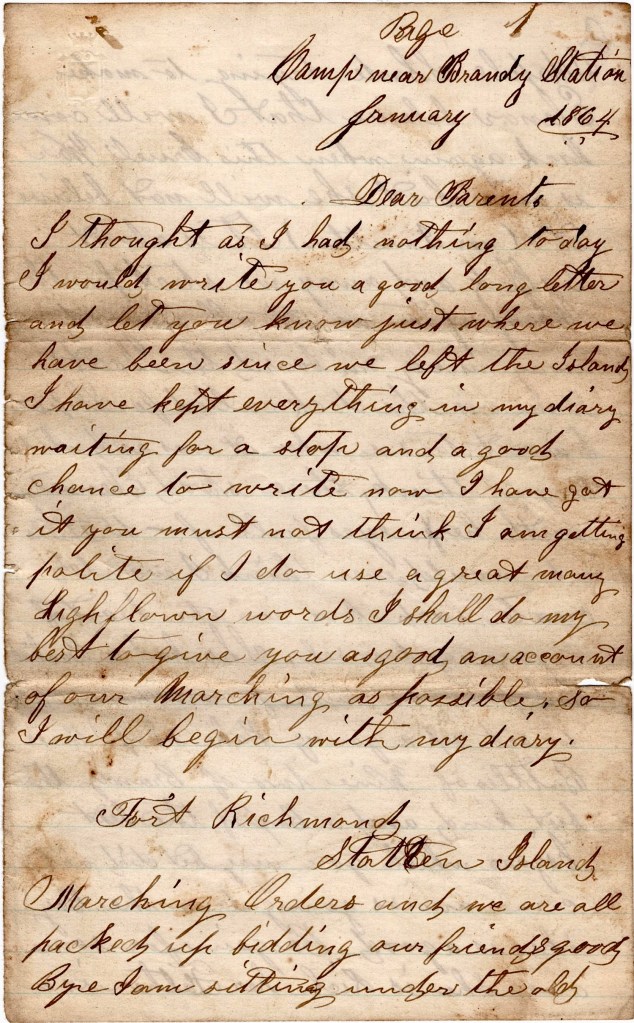
Camp near Brandy Station January 1864
Dear Parents,
I thought as I had nothing today I would write you a good long letter and let you know just where we have been since we left the Island, I have kept everything in my diary waiting for a stop and a good chance to write. Now I have got it. You must not think I am getting polite if I do use a great many highflown [highfalutin] words. I shall do my best to give you as good an account of our marching as possible. So I will begin with my diary.
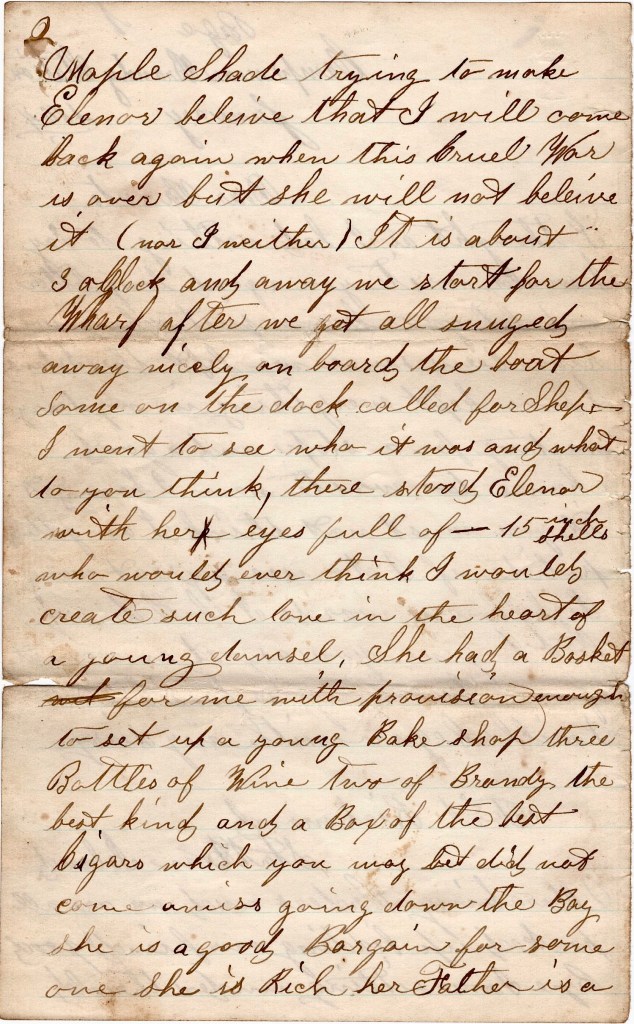
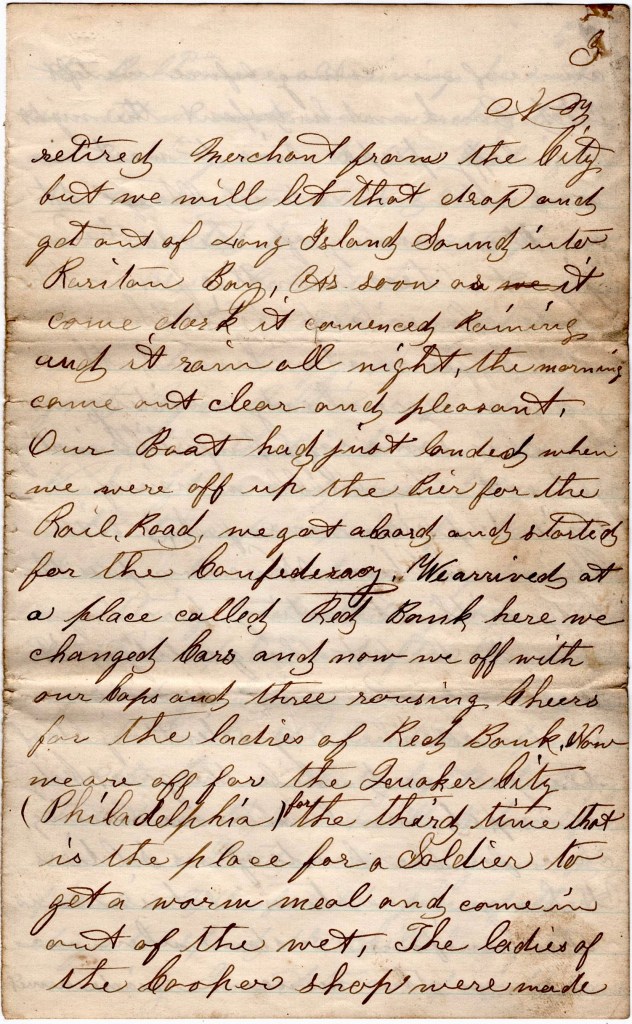
Fort Richmond, Staten Island. Marching orders and we are all packing up bidding our friends goodbye. I am sitting under the old Maple shade trying to make Elenor believe that I will come back again when this cruel war is over but she will not believe it (not I neither). It is about 3 o’clock and away we start for the wharf. After we got all snugged away nicely on board the boat, someone on the dock called for Shep. I went to see who it was and what do you think, there stood Elenor with her eyes full of—–15 inch shells. Who would ever think I would create such love in the heart of a young damsel. She had a basket for me with provisions enough to set up a young bake shop, the bottles of wine, two of brandy—the best kind, and a box of the best cigars which you may bet did not come amiss going down the Bay. She is a good bargain for someone. She is rich. Her Father is a retired merchant from New York City. But we will let that drop and get out of Long Island Sound into Raritan Bay.
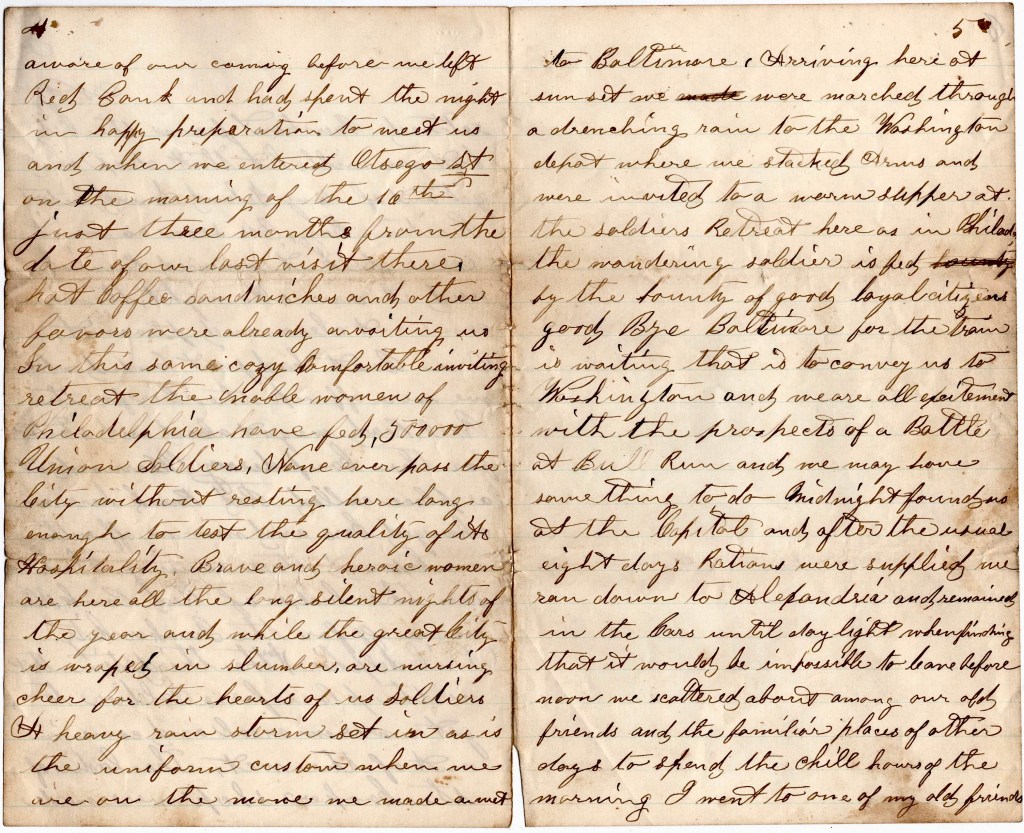
As soon as it became dark, it commenced raining and it rained all night. The morning came out clear and pleasant. Our boat had just landed when we were off up the pier for the railroad. We got aboard and started for the Confederacy. We arrived at a place called Red Bank. Here we changed cars and now we off with our caps and [gave] three rousing cheers for the ladies of Red Bank. Now we are off for the Quaker City (Philadelphia) for the third time. That is the place for a soldier to get a warm meal and come in out of the wet. The ladies of the Cooper Shop were made aware of our coming before we left Red Bank and had spent the night in happy preparation to meet us. And when we entered Otsego Street on the morning of the 16th, just three months from the date of our last visit there, hot coffee, sandwiches, and other favors were already awaiting us. In this same cozy, comfortable, inviting retreat the noble women of Philadelphia have fed 500,000 Union soldiers. None ever pass the City without resting here long enough to test the quality of its hospitaliy. Brace and heroic women are here all the long silent nights of the year and while the great City is wrapped in slumber, are nursing cheer for the hearts of us soldiers.
A heavy rainstorm set in as is the uniform custom when we are on the move. We made a [ ] to Baltimore, arriving here at sunset. We were marched through a drenching rain to the Washington depot where we stacked arms and were invited to a warm supper at the Soldier’s Retreat. Here as in Philadelphia, the wandering soldier is fed by the bounty of good, loyal citizens. Goodbye Baltimore for the train is waiting that is to convey us to Washington and we are all excitement with the prospects of a battle at Bull Run and we may have something to do.
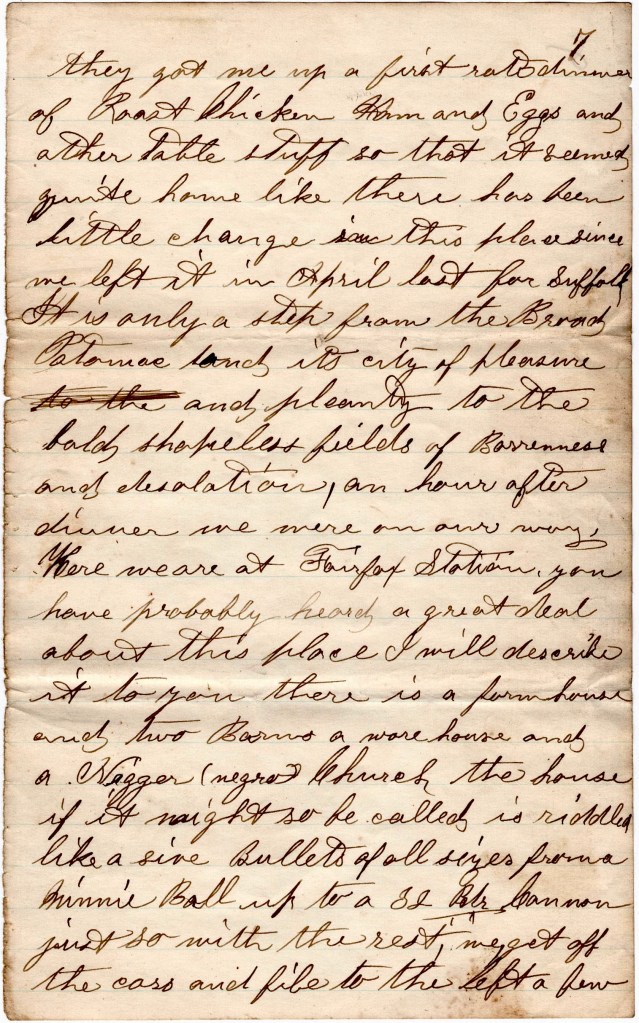
Midnight found us at the Capitol and after the usual eight days rations were supplied, we ran down to Alexandria and remained in the cars until daylight when finding that it would be impossible to leave before noon, we scattered about among our old friends and the familiar places of other days to spend the chill hours of the morning. I went to one of my old friends. They got me up a first rate dinner of roast chicken, ham and eggs and other table stuff so that it seemed quite home like. There has been little change in this place since we left it in April last for Suffolk. It is only a step from the broad Potomac and its cty of pleasure and plenty to the bald, shapeless fields of barrenness and desolation. An hour after dinner we were on our way.
Here we are at Fairfax Station. You have probably heard a great deal about this place. I will describe it to you. There is a farm house and two barns, a warehouse and a Nigger (negro) Church. The house—if it might be so called—is riddled like a sieve. Bullets of all sizes from a Minié ball up to a 32-pounder cannon just so with the rest. We get off the cars and file to the left. A few minutes march brings us to the camp of the 3rd and 5th Michigan Regiments and we are encamped with the Veterans of the Potomac Army. Familiar faces are here and familiar voices greet us from the old Battalions of the Peninsula and Rappahannock. It is a capitol place and we will stop here tonight.
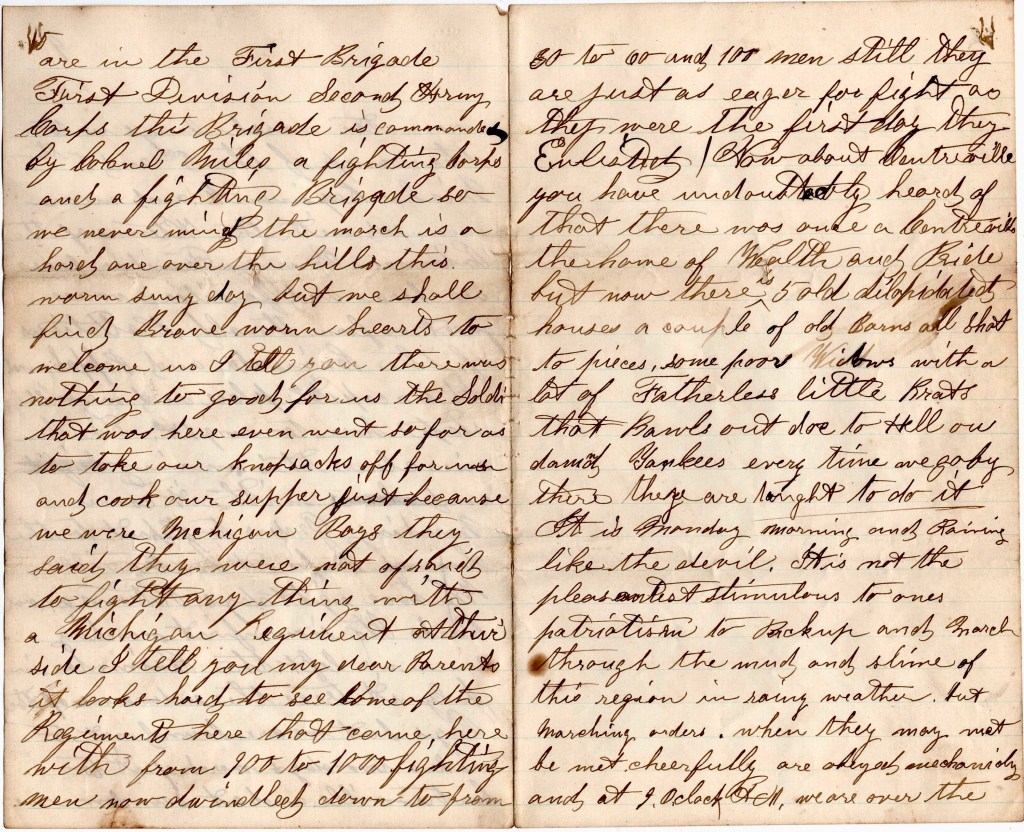
The sun rises clear this morning and with it comes marching orders to report to the Second Corps at Centreville. We have eight days rations on our backs. It is our first marching since we left the Peninsula in July. It tries the endurance of the boys but we are bound not to make a two days march of it to Centreville and at sundown we are in the 1st Brigade, 1st Division, 2nd Army Corps. This brigade is commanded by Colonel Miles—a fighting corps and a fighting brigade, so we never mind. The march is a hard one over the hills this warm, sunny day, but we shall find brave, warm hearts to welcome us, I tell you, there was nothing too good for us. The soldiers that was here even went so far as to take our knapsacks off for us and cook our supper just because we were Michigan boys. They said they were not afraid to fight anything with a Michigan regiment at their side. I tell you, my dear parents, it looks hard to see some of the regiments here that come here with from 900 to 1,000 fighting men now dwindled down to from 30 to 60 and 100 men. Still they are just as eager for fight as they were the first day they enlisted.
Now about Centreville, you have undoubtedly heard of that. There was once a Centreville, the home of wealth and pride. But now there is 5 old dilapidated houses, a couple of old barns all shot to pieces, some poor widows with a lot of fatherless little brats that bawls out, “Go to Hell!” or “Damned Yankees!” every time we go by. There they are tonight to do it.
It is Monday morning and raining like the devil. It is not the pleasantest stimulus to one’s patriotism to pack up and march through the mud and slime of this region in rainy weather, but marching orders, when they may be met cheerfully, are obeyed mechanically and at 9 o’clock a.m. we are over the pontoons that span Bull Run and are marching amid the wrack and ruin of the first and second battles of the same name. This favorite battle ground of the Rebels looks lonely enough in a rainy morning like this. There is so much in all these rude graves—whitened and exposed skeletons of men and animals, broken gun carriages, fragments of shells and muskets scattered around through the tall weeds that have spring up everywhere as if to make the desolation more complete that we are quite ready for another battle to see if we could not make up for what we have lost in these two heavy battles. But we shall not have a chance for General Lee left here this very morning. His campfires are still burning bright. He made up his mind that it would not pay him to fight father Meade.
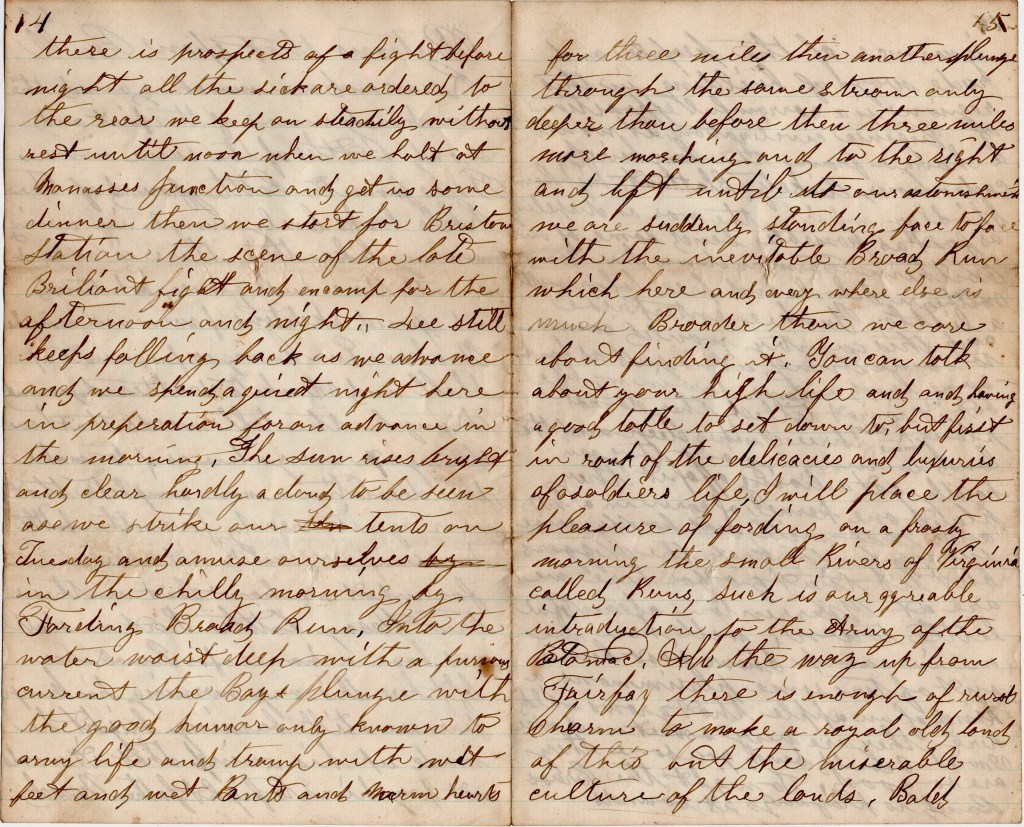
There is prospects of a fight before night. All the sick are ordered to the rear. We keep in steadily without rest until noon when we halt at Manassas Junction and get us some dinner. Then we start for Bristoe Station—the scene of the late brilliant fight—and encamp for the afternoon and night. Lee still keeps falling back as we advance and we spend a quiet night here in preparation for an advance in the morning.
The sun roses bright and clear. Hardly a cloud to be seen as we strike our tents on Tuesday and amuse ourselves in the chilly morning by fording Broad Run. Into the water waist deep with a furious current the boys plunge with the good humor only known to army life and tramp with wet feet and wet pants and warm hearts for three miles. Then another plunge through the same stream, only deeper than before. Then three miles more marching and to the right and left until to our astonishment, we are suddenly standing face to face with the inevitable Broad Run which here and everywhere else is much broader than we care about finding it.
You can talk about your high life, and having a good table to sit down to, but first in rank of the delicacies and luxuries of a soldier’s life, I will place the pleasure of fording on a frosty morning the small rivers of Virginia called Runs. Such is our agreeable introduction to the Army of the Potomac. All the way up from Fairfax, there is enough of rural charm to make a royal old land of this but the miserable culture of the land, bald ignorance of the people and rude ways of building in this region is a sorrowful exposition of Virginia civilization. It wants a change from the long-haired cadaverous, rickety, blatant high-born chivalry, which the war is dispelling as fast as possible. Send some of our Northern farmers down here, some Northern schools, and free labor with a little Yankee enterprise and his country would come to something. It is just as handsome land as I ever saw in my life but it is not tilled. They do not plough more than three inches deep and the land is running out. They can hardly get a living off of it. They plant one kernel of corn in a hill and that will not hardly raise enough to keep the Niggers.
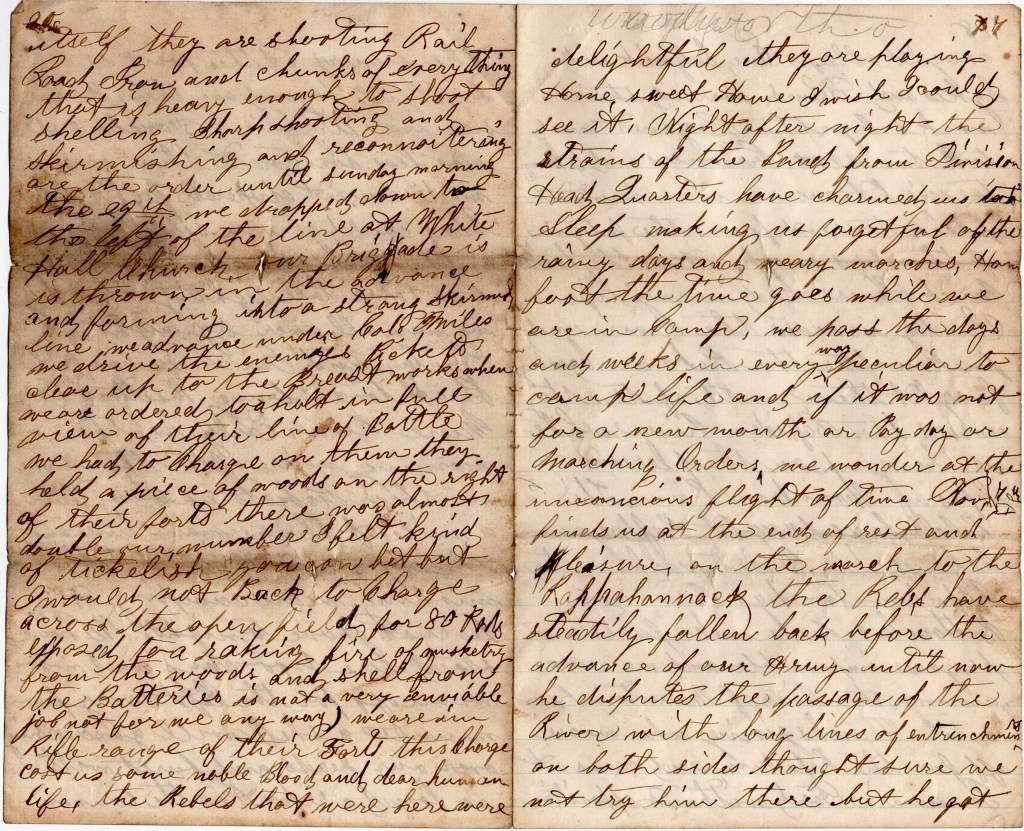
But let that go for her we are at Warrenton—-a beautiful little town. Well, here we are in camp. I have just been out after some persimmons, a kind of apple that grows wild here. They are very sweet and nice. I wish I could send you some. They are so good. Tonight the brass band is playing. It sounds delightful. They are playing Home Sweet Home. I wish I could see it night after night. The strains of the band from Division headquarters have charmed us to sleep, making us forgetful of the rainy days and weary marches. How fast the time goes while we are in camp. We pass the days and weeks in every way peculiar to camp life and if it was not for a new month or pay day or marching orders, we wonder at the unconscious flight of time.
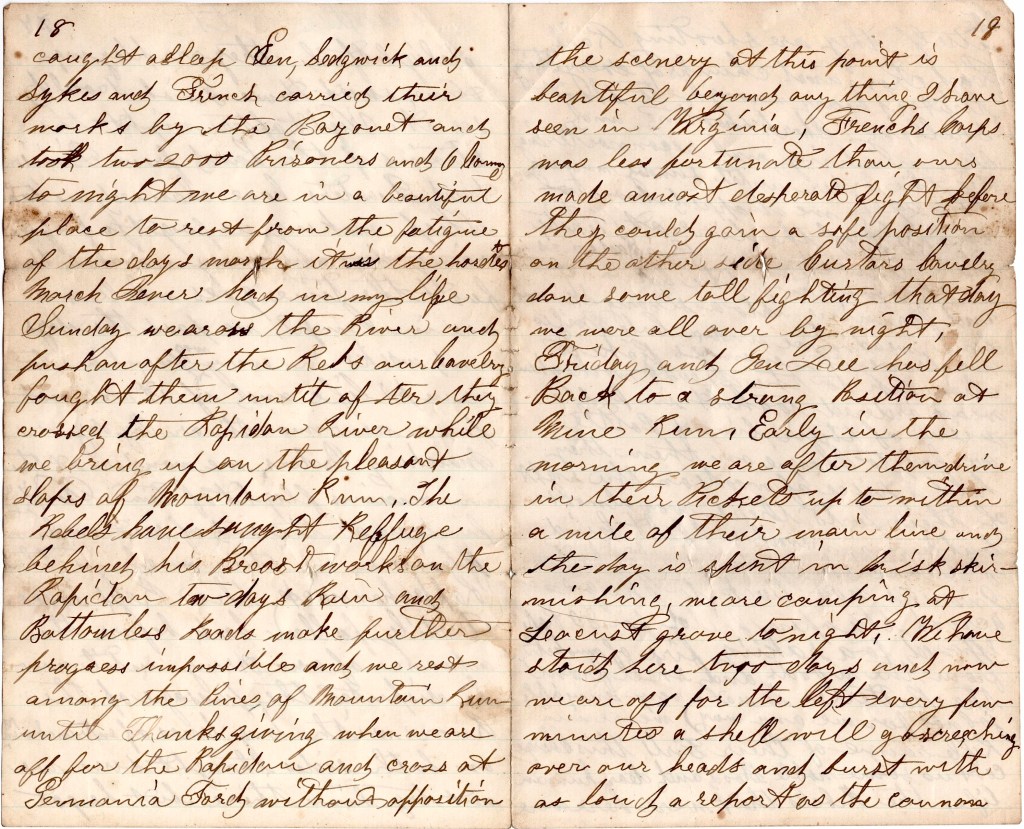
November 7th finds us at the end of rest and pleasure on the march to the Rappahannock. The Rebs have steadily fallen back before the advance of our army until now he disputes the passage of the river with long lines of entrenchments on both sides, thought sure we [would] not try him there, but he got caught asleep. Gens. Sedgwick and Sykes and French carried their works by the bayonet and took 2,000 prisoners and six cannons. Tonight we are in a beautiful place to rest from the fatigue of the days march. It was the hardest march I ever had in my life.
Sunday we cross the river and push on after the Rebs. Our cavalry fought them until after they crossed the Rapidan River while we bring upon the pleasant slopes of Mountain Run. The Rebels have sought refuge behind his breastworks on the Rapidan. Today’s rain and bottomless roads make further progress impossible and we rest among the pines of Mountain Run until Thanksgiving when we are off for the Rapidan and cross at Germania Ford without opposition. The scenery at this point is beautiful beyond anything I have seen in Virginia. French’s Corps was less fortunate than ours, made a most desperate fight before they could gain a safe position on the other side. Custer’s Cavalry done some tall fighting that day. We were all over by night.
Friday and Gen. Lee has fell back to a strong position at Mine Run. Early in the morning we are after them, drive in their pickets up to within a mile of their main line and the day is spent in brisk skirmishing. We are camping at Locust Grove tonight. We have stayed here two days and now we are off for the left. Every few minutes a shell will go screeching over our heads and burst with as loud of a report as the cannon itself. They are shooting railroad iron and chunks of everything that is heavy enough to shoot. Shelling, sharpshooting and skirmishing and reconnoitering are the order until Sunday morning the 29th [when we] dropped down to the left of the line at White Hall Church.
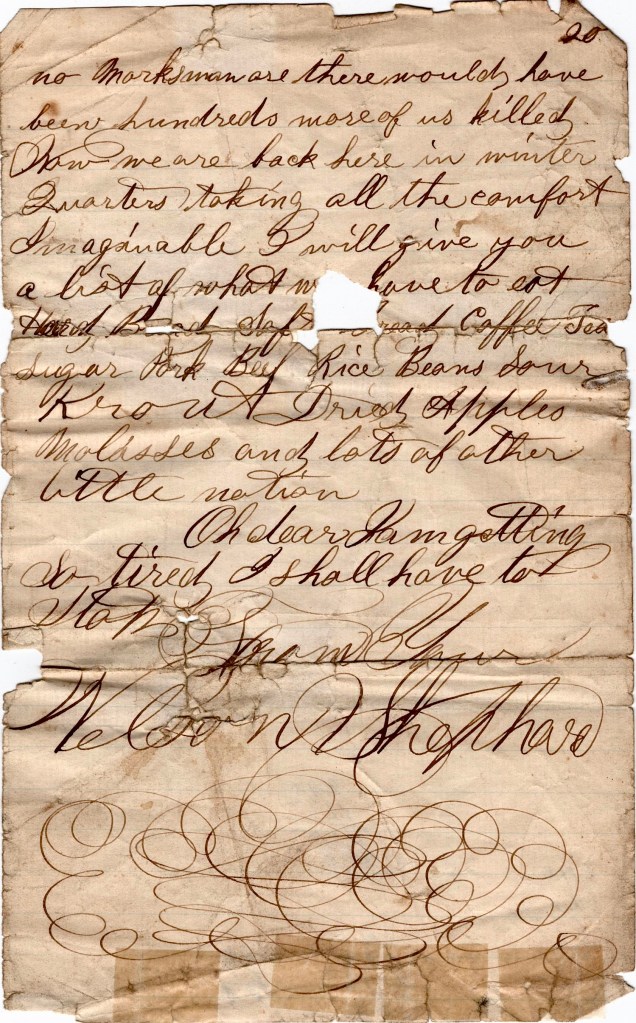
Our Brigade is thrown in the advance and forming into a strong skirmish line. We advance under Col. Miles. We drive the enemy pickets clear up to the breastworks when we are ordered to halt in full view of their line of battle. We had to charge on them. They held a piece of woods on the right of their forts. There was almost double our number. I felt kind of ticklish you can bet but I would not back to charge across the open field for 80 rods exposed to a raking fire of musketry from the woods and shell from the batteries is not a very enviable job—not for me anyway. We are in rifle range of their forts. This charge cost us some noble blood and dear human life. The Rebels that were here were no marksmen or there would have been hundreds more of us killed.
Now we are back here in winter quarters taking all the comfort imaginable. I will give you a list of what we have to eat. Hard bread, soft bread, coffee, tea, sugar, pork, beef, rice, beans, sauerkraut, dried apples, molasses, and lots of other little notion. Oh dear, I am getting so tired. I shall have to stop. From your Nelson Shephard
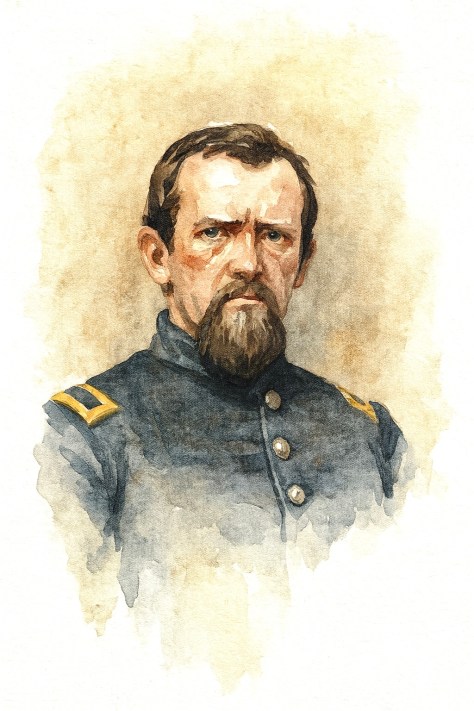
This letter was only signed “Father” but the content reveals that he was most likely a member of Co. H, 1st Vermont Heavy Artillery. This company was at Fort Slocum till March, 1864, then at Fort Bunker Hill till May, 1864 when they were ordered to the Virginia battlefront to be used as infantrymen in Grant’s Overland Campaign. The regiment joined the 6th Army Corps at Spottsylvania Court House on 15 May 1864—little more than a week after Grant launched his campaign.
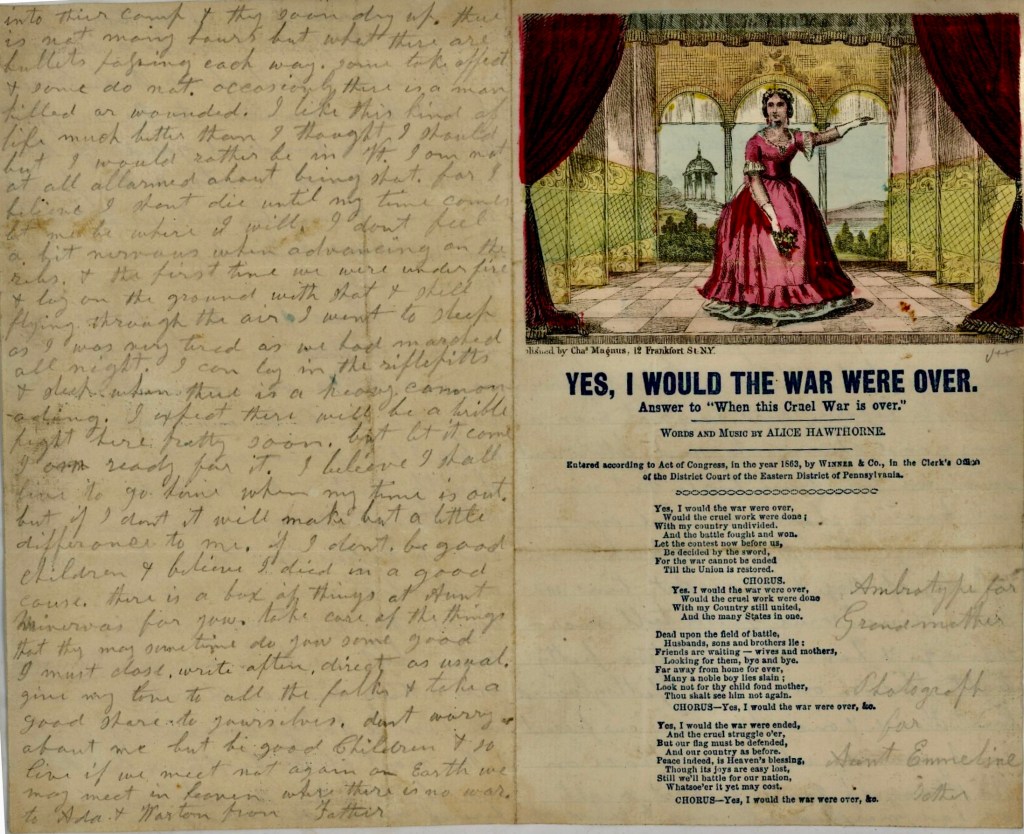
In his letter, he refers to Uncles Levi & Lyman who appear to be serving with him. Likewise he refers to an Aunt Minerva. Since the letter was written to his children, Ada and Walton, these aunts and uncles were most likely the author’s siblings or in-laws. The letter was written on stationery printed with the words to the tune by Alice Hawthorne entitled, “Yes, I would the war were over.” It is annotated in the margin, “Ambrotype for Grandmother, Photograph for Aunt Emeline. — Father.” These are articles that were presumably sent to Aunt Minerva in the box he mentions in the letter.
By posting this information on Spared & Shared Facebook, an astute subscriber named Amanda Champagne McCarty was able to locate a Vermont family that satisfied all of these relationships and I feel certain that the letter can now be attributed to Benjamin F. Strong (1825-1864) of Woodstock who was a 36 year-old mechanic when he entered the service in August 1862 with Levi F. Barnaby (1826-1873) and Lyman Aldrich. Levi was married to Minerva Strong (1836-1912), Benjamin’s sister. Lyman was married to Ellen Blaisdell, sister of Benjamin’s 1st wife Elvira Blaisdell (1833-1860). Benjamin’s and Elvira’s children were Ada Strong (1851-1919) and Frank Walton Strong (1855-1942). After Elvira died in February 1860, Benjamin took Esther D. deCamp (1840-1862) as his second wife and they had a child named Fanny but both mother and daughter died while Benjamin was in the service.
What is most chilling about this discovery, however, is that Benjamin was killed by an enemy sharpshooter on 9 June 1864—just two days after having written to his children: “I am not alarmed about being shot for I believe I shan’t die until my time comes, let me be where I will….I expect there will be a terrible fight here pretty soon, but let it come. I am ready for it. I believe I shall live to go home when my time is out. But if I don’t, it will make but a little difference to me. If I don’t, be good children & believe I died in a good cause.” No wonder the letter was cherished and the words on the song sheet all the more poignant:
Dead upon the field of battle, Husbands, sons and brothers lie: Friends are waiting—wives and mothers, Looking for them, bye and bye. Far away from home for ever, Many a noble boy lies slain; Look not for thy child fond mother, Thou shalt see him not again. Chorus—Yes, I would the war were over.
T R A N S C R I P T I O N
Camp in the field near Cold Harbor, Virginia June 7th 1864
My dear children
As I have a little spare time this morning, I will write a few lines to let you know that I am yet alive & what is more, am well. Uncles Levi & Lyman are well. Uncle Lyman had a letter from home this morn. I received a letter from you a few days ago but I have not had time to write before. There has not been a very good chance to send letters out since we have been here, but now we have a chance to send every morning.
We left [Fort] Bunker Hill on the 12th day of May & since that time we have done some pretty tall marching & have been in two pretty tight places—once near Spottsylvania Court House and once here on our present campground which took place on the 1st day of June just at night. We had marched all day and came up with the main part of the Corps just in time to form and make a charge on the rebs. A part of our regiment, Cos. F, L. K, & H [the 1st Battalion], advanced to the very front to within a hundred yards of the rebel entrenchments & they poured the grape and canister into us like hail. But we were behind a small rise of ground & by laying flat down, we most of us escaped being killed or wounded. There were about 84 lost in our four companies—one man killed and 10 wounded in Co. H. One corporal lost a leg and one sergeant an arm. All have been sent to the General Hospital in Washington. In this last affray, our loss was pretty severe. They think more so than the rebs but we hold our position & are getting very well entrenched.
We have a large amount of artillery & the most of the fighting has been done by it. When the rebs commence firing on us, they send a few shells into their camp & they soon dry up. There is not many hours but what there are bullets passing each way. Some take effect and some do not. Occasionally there is a man killed or wounded. I like this kind of life much better than I thought I should but I would rather be in Vermont. I am not alarmed about being shot for I believe I shan’t die until my time comes, let me be where I will. I don’t feel a bit nervous when advancing on the rebs & the first time we were under fire & lay on the ground with shot and shell flying through the air, I went to sleep as I was very tired as we had marched all night.
I expect there will be a terrible fight here pretty soon, but let it come. I am ready for it. I believe I shall live to go home when my time is out. But if I don’t, it will make but a little difference to me. If I don’t, be good children & believe I died in a good cause. There is a box of things at Aunt Minerva’s for you. Take care of the things that they may some time do you some good.
I must close. Write often. Direct as usual. Give my love to all the folks and take a good share to yourselves. Don’t worry about me but be good children & so life if we meet not again on earth, we may meet in Heaven where there is no war.
The author of this regiment remains unidentified. His surname was most certainly Williams but his initials are less certain. The content of the letter suggests it was written by a member of the 21st Virginia Infantry and after looking at soldiers in that regiment with the surname Williams, I was inclined to attribute the letter to Fields T. Williams (1821-1889), a slave holder in Buckingham County, Virginia, who enlisted in 1861. But I discovered that he was discharged for age in 1863. He also served only as a private in Co. E, 21st Virginia Infantry and the author of this letter seems to be of higher rank. Unless he returned to the service late in the war as a chaplain or in some other capacity, I doubt that this was him.
There was an Ashby Williams in the 21st Virginia and the author’s reference to “Ashby Street” in his camp suggests a connection, but I can’t make out an “A” in his initials. For the moment, our author will
The 21st Virginia marched with Ewell’s Corps and in February 1865 they were encamped southwest of Petersburg near Burgess’s Mill and the “fight” described in this letter refers to the Battle of Hatcher’s run which was fought from February 5 – 7, about six miles southwest of Petersburg, Virginia along Vaughn Road and around Hatcher’s Run.
T R A N S C R I P T I O N
Camp Ewell Monday, February 6th 1865
Mu kind friend Miss Nonnie,
Yours of January 30th was received Saturday evening late. Was very glad to hear from you. Hope your illness is not serious. Guess it is only a temporary inconvenience resulting from the extreme coldness of the weather. Your presence would be an ornament to Ashby Street, I am sure, but the humble occupant of No. (13) does lay to his heart the flattering hop[e] that you will ever visit his camp except in dreams and imaginations and in these often though I suspect them involuntary. You would no doubt admire our town if you were to see it. I thought of sending you a draft of the encampment but since you have had a description of it and I am not a good artist, I have declined to do so.
As to dispatches by rumor, they are equally unreliable in a military and matrimonial connection. I am not going to be married the 22d which information obviates the necessity of an explanation of the day. Besides, you have seen ere this that the President has changed the day to March the 10th. 1 I am aware of the opinion prevailing in your vicinity in regards to Miss T and myself but it is not true. We sustain no other relation to each other than that of friendship and while we are intimate friends, I have not the first reason to suppose we will ever sustain a nearer relation than that of friendship.
So you see that although it may not be an evidence of my sympathy for soldiers, yet I will not cut one out there. I do not know what would be the difficulties that might arise in an effort to gain her as a sweetheart except her own disinclination, though it is presumable that they would be many and serious since as many are aspiring to the enviable relation—perhaps almost as numerous and dangerous as the scaly monsters of the sea who though they suffered me by dint of a manly struggle to reach the Emerald Isle of Somnambulous (thereby creating in me a strong desire to return again) have ever since baffled my most resolute efforts to revisit the charming one whose smiles welcomed and whose soft hand led me to see the lonely islands made an abode of happiness by her presence and society. If those guards of such rich a treasure are ever found asleep, I will do them as I once did the Yankee sentinals and lo! when they awake, I shall have crossed the lines. Oh hope, cheering hope, I fear you are treacherous to your old client. Suffice it to say, I am on the alert and by your permission will contend still longer.
Sunday morning a large congregation assembled at the church and how my spirits—so long depressed—were revived when I glanced at the crowd (as I am always wont to do) and thought I saw hopeful evidences of a reviving interest in religion. But alas, ere the services had fairly begun, orders came to move immediately and in a few minutes, clad in the habiliments of war, we sought the hostile fields. 2
I followed my dear old command on horseback, rode along the lines, and came to my inexpressable regret that my fears expressed to you were too well grounded. Our men fired one round and many of them ingloriously fled without so much as seeing the enemy. Several of my regiment were wounded and I am deeply grieved to tell you one of my best friends and most zealous co-laborers in Christ was mortally wounded—Lieutenant [J C.] Kyle. He fell shot in the head. Has not spoken since. His immortal part seems only to be detained for a short time. He used to raise tunes for me (I am a poor singer). He will never sing for us again. Doubtless his next song will be sounded on the heavenly orchestra. How sad a loss to us. But oh! how much worse the pain to his family. Only yesterday morning I noticed him in his place in the Chapel looking unusually well and cheerful, and before the close of the day he lay senseless and bleeding on the ground.
Our life is like the summer rose Which opens to the morning sky And ere the shades of evening close Are scattered on the ground to die. 3
I feel sad when I think nearly all my intimate personal friends have been killed or captured. But he I hope was prepared. I could not call him back since it is the Father’s will he should go. Let no rude hand distrust the willow that must soon wave over his tomb. Let true hearts and tears preserve and [ ] memory, and let those who would be wise be also prepared.
After returning late yesterday evening, I went to the depot to meet Mr. Whitehead and brought the box into camp last night. I know no epression adequate to signify my gratitude. It cheers me. It makes me feel I am not forgotten though a long way from home. I have seen others receiving boxes and wished my relatives could send me a box, not for the luxuries they contain (which is no small item either) but the affections which arise therefrom. Now I have one—the first I ever received—and I am so proud of it. I thank you for so tangible a proof of your friendship.
My command has gone out again on the line of battle. I hear them fighting now. I must go to them as soon as is practicable. I feel a deep concern. I will give your box which I prize so much to the poor men who are now in the fight and will no doubt get wounded. I know you are willing I should give a part to the wounded. They are as dear as brothers after they are wounded, no matter how they act when well. I am excited and must close. The fight is just commencing. Only a few moments ago we heard the first gun. If any evil befalls any of your neighbors, I will try promptly as possible to inform you.
Yours truly, — F. T. [?] Williams
1 The Confederate Congress invited President Jeff Davis to “appoint a day of public fasting, humiliation and prayer,” Davis chose Friday, March 10, 1865.
2 Correspondence from the 21st Virginia published in the Richmond Dispatch reported that “Until yesterday [Feb. 5, 1865], everything has been, for some time, as quiet as could be desired along these lines. The soldiers are enjoying, with great relish, the presents sent them by their friends. Numbers of boxes are each day arriving, and the men are, comparatively, well satisfied, and the war spirit daily increasing. Yesterday morning, however, just as we had assembled, for the first time, in our chapel for worship, and the second prayer had been concluded,–just as the minister was about to announce his text,–orders were received to move at once. This was announced from the pulpit, with the request that all would remain until the benediction should be pronounced. It was a great scene, and one impressive to every man. The blessing of God was invoked upon each and every one present, and we started out on an expedition, from which some will never return.”
3 These lines are from a poem by Richard Henry Wilde. He died in New Orleans of yellow fever in 1847.
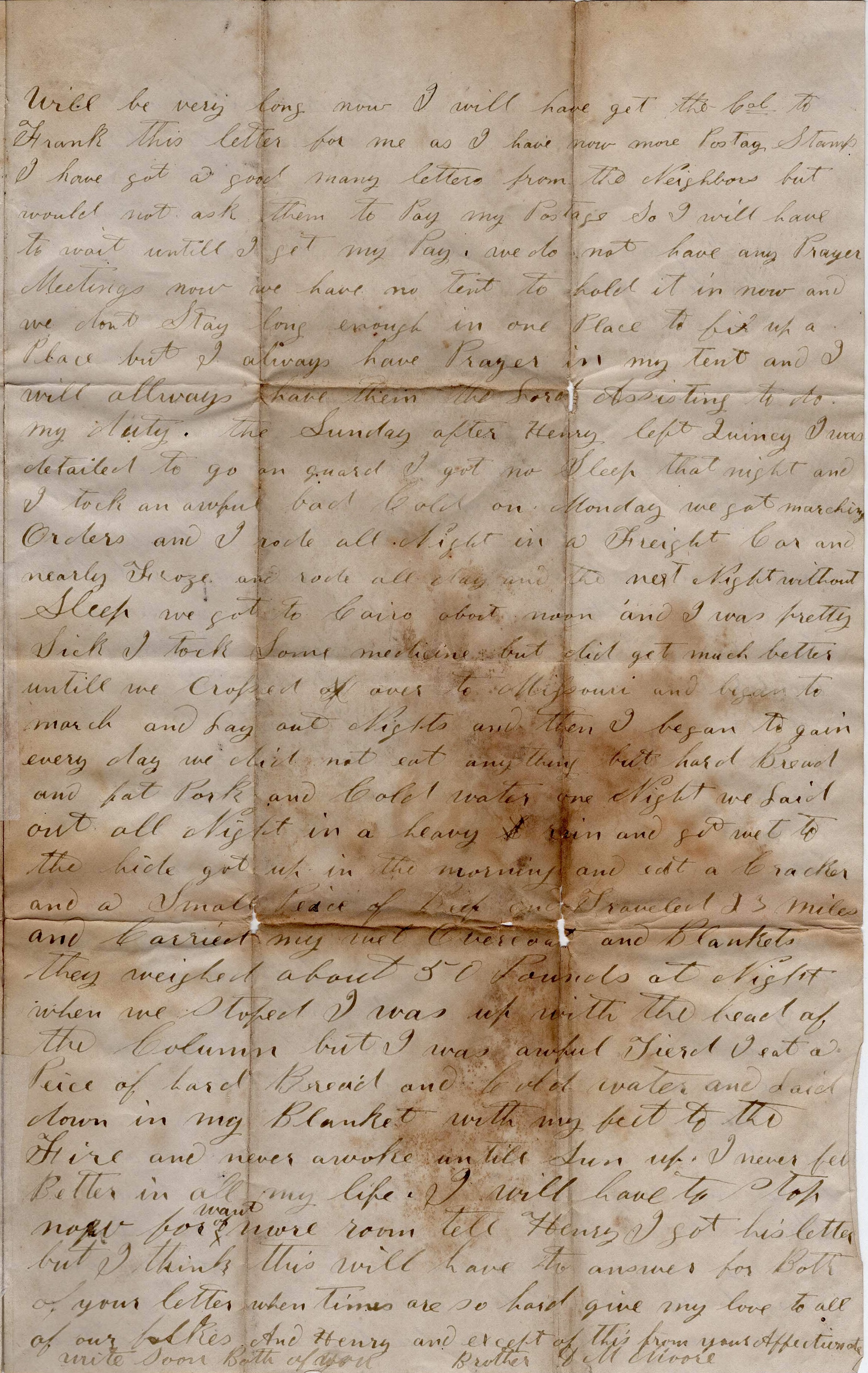
The following letter was written by David M. Moore (1833-1907), the 29 year-old son of Samuel Moore (1802-1863) and Jane Mariah McGaughey (1810-1887) of LaSalle county, Illinois.
David enlisted on 25 September 1861 at Waltham, Illinois, and was mustered into Co. A, 64th Illinois Infantry—“Yate’s Sharpshooters”—as a sergeant in November 1861. He was later commissioned a 2nd Lieutenant of the same company and survived the war.
David’s letter was addressed to one of his sisters. It contains content describing the actions of the 64th Illinois at the Battle of New Madrid, Missouri, and Island Number 10. Specifically, on 12 March 1862, four companies of the regiment including Co. A, conducted a night attack on the Confederate right, driving back their pickets and drawing attention away from other units. They then were tasked with supporting the large siege guns below New Madrid as Union forces captured the town.
T R A N S C R I P T I O N
Camp near new Madrid, Missouri Thursday, March 27, 1862
My dear Sister,
I received your welcome letter this forenoon. I was laying in my tent reading over some old letters I had and it surprised me some when I broke it open and found it was from you. I believe this is the first letter I ever received from you. And this will make the first one I ever wrote to you. And I will try to write to you as long a one as I can to you but I won’t promise to fill up this whole sheet, but will do the best I can.
In the first place. I thank the Lord I am well and have been enjoying good health ever since I left Cairo. I feel as well now as ever I have since I went into the service. I suppose you would like to know how I like the life of a soldier by this time. Well, I don’t like it very well nor never have since I left home, but I am becoming kind of reconciled to it now. I like active service a great deal better than I did laying around camp. There is not so much rowdiness among the boys. They lay down and go to sleep when night comes.
We are now down in the land of Secessia where nearly every man is a Rebel against Uncle Sam. In fact, there are scarcely anybody here but women and Negroes. There is a great many large plantation houses that are entirely deserted. They have left nearly all their furniture in their houses. Their horses and cattle and mules and hogs are all roaming over the country and starving to death. I never seen such destruction in all my life as this war makes. The country was ravaged by the rebel army and what is left, the union army take themselves. The country will not get [over] it for twenty years to come.
You will see that I made a mistake in commencing this letter on the wrong page but I guess you can make it out. You say you miss Poor Oliver at home. Well, I expect you do, for I know I do, but his troubles are all over now. His spirit has gone home to rest as he used to tell Henry and me when he was sick. He wanted to go home it was all he talked about. Well, we have all got the same narrow road to travel .and if we are only faithful to grace already given, we have the promise that we shall have a home in heaven that is a glorious and blessed promise. And it matters little whether we die amid the roar and din of a battlefield or at a calm and peaceful home in the land of peace. So as we live prepared to die, I feel that I love my savior. But I do not love him half as much as I want to. I feel that I am a very unprofitable servant. But I am still as determined as ever to die striving to do His blessed will. He has preserved me thus far through many privations and from the dangers of the battlefield.
On the night of the 12th of this month, at midnight, when we marched out to attack the enemy and draw his attention while the men erected a battery close to the town, I did not know whether I should ever see the light of another day. But blessed be His name. He delivered me out of their hands and cheered me through the dark and dangerous wood [through] which we advanced. And also on the 13th—the day of the battle—when the missiles of destruction were flying in every direction. Every day His mercies are showed forth towards me. Oh pray for me that I may live humble and grateful in His sight everyday. But then I know you will and always do.
You say you miss me at the old school house. Oh, I miss the old schoolhouse, and all of you, and hope and pray that the time may soon come when we can all meet in the old schoolhouse. And that we may all be enabled to praise God more perfectly than we have ever done before.
I am sorry to hear that Henry’s health is so poor since he got home from Quincy and hope he will not expose himself until he gets better. I wish you would try to persuade mother not to worry herself so about me. She has an idea that things are a good deal worse than what they really are and that I am suffering from all sorts of privations and dangers and that this is a sickly country. Where we are now quartered is a nice and healthy place on a sand ridge. There is no swamps near us.
We are now quartered in a large apple and peach orchard. We are put here to protect two pieces of heavy artillery planted here to keep the Rebels from retreating from Island #10 where our fleet of gun and mortar boats are now fighting them. They are in a terrible bad fix. They cannot get up or down the river. I hope they will soon give up the war and return to their allegiance once more and let us return to our homes in peace. I am sure I have seen enough of war to satisfy me on all points.
[Cpl.] Arthur Ames joined us last night. He has got well again and is able to do duty once more. [Capt.] Luther Ames is well and Tommy and Sim[eon] Call are both well. We have been put on our allowance since we have been here but we have plenty to eat now and will after this. It was in account of their taking all the teams to haul the heavy artillery from Cairo to this place. But now all the teams are busy hauling provisions. There is a great army here—between forty and fifty thousand men. But it could be increased to a hundred thousand in five days. The next point they are making for Fort Randolph as soon as the Island is taken and I don’t think that will be very long now.
I will have get the Colonel to frank this letter for me as I have no more postage stamps. I have got a good many letters from the neighbors but would not ask them to pay my postage so I will have to wait until I get my pay. We do not have any prayer meetings now. We have no tent to hold it in now and we don’t stay long enough in one place to fix up a place. But I always have prayer in my tent and I will always have them, the Lord assisting to do my duty. The Sunday after Henry left Quincy, I was detailed to go on guard. I got no sleep that night and I took an awful bad cold on Monday.
We got marching orders and I rode all night in a freight car and nearly froze and rode all day and the next night without sleep. We got to Cairo about noon and I was pretty sick. I took some medicine but did [not] get much better until we crossed over to Missouri and began to march and day and nights and then I began to gain everyday. We did not eat anything but hard bread and fat pork and cold water. One night we laid out all night in a heavy rain and got wet to the hide. Got up in the morning and ate a cracker and a small piece of beef and traveled 23 miles and carried my wet overcoat and blankets. They weighed about 50 pounds. At night when we stopped, I was up with the head of the column, but I was awful tired. I ate a piece of hard bread and cold water and laid down in my blanket with my feet to the fire and never awoke until sun up. I never felt better in all my life.
I will have to stop now for want of more room. Tell Henry I got his letter but I think this will have to answer for both of your letters when times are so hard. Give my love to all of our folks and Henry and accept of this from your affectionate brother, D. M. Moore.
A watercolor of Enoch’s wife, Julia, based on a portrait of her painted by her brother. Circa 1834.
The following letter was written by 28 year-old Enoch Piper Sherman (1810-1843), the husband of Julia-Maria Hoit (1807-1884). The couple were married in 1832 and were the parents of three girls—Eliza (b. 1834), Sarah (b. 1837) and Susan (b. 1838) when this letter was written in October 1838. Enoch was the son of Anthony Sherman (1782-1813) and Sally Piper (1788-1820) of Gilmanton, New Hampshire. Julia-Maria was the daughter of New Hampshire State Legislator Daniel Holt (1778-1859) and Sarah Flanders (1785-1837). She was described as an independent and highly opinionated woman and was particularly critical of the fashion and diet of women in Boston about 1830. [Source: Hoit family papers, 1803-1918, University of Michigan, William L. Clements Library]
Enoch composed this letter in Urbana, Champaign County, Ohio, during his visit with his wife’s elder sister, Eliza Flanders (Hoit) Bean (1806-1893), who was married to Ira A. Bean (1797-1869). Eliza inscribes a note at the conclusion of Enoch’s correspondence. The letter offers a significant insight into the nature of early travel in Ohio, where the reliability of reaching one’s destination on time, or at all, was anything but certain.
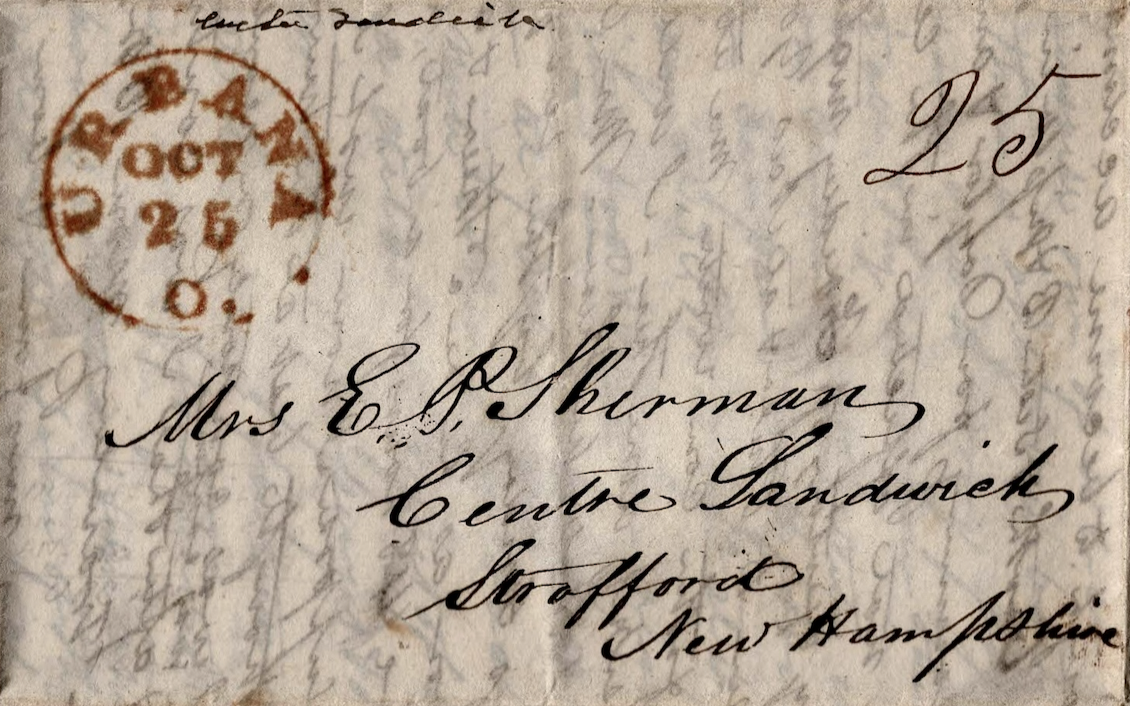
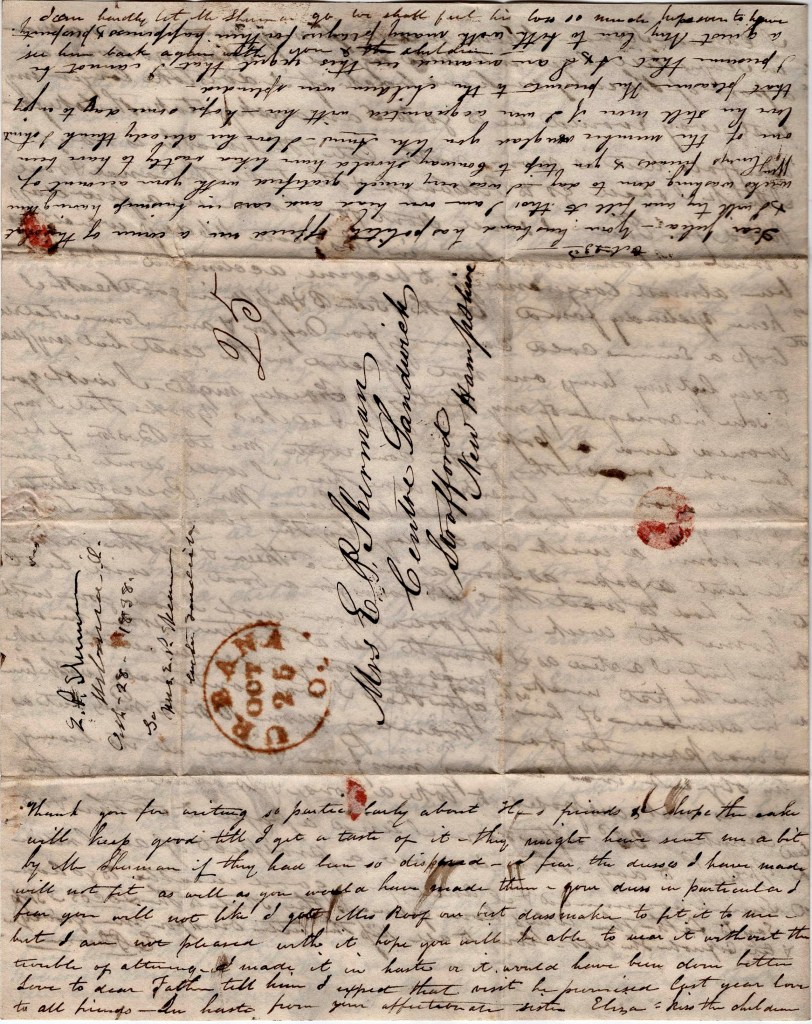
Stampless letter postmarked Urbana, Ohio. Addressed to. Mrs. E. P. Sherman, Centre Sandwich, Strafford [county], New Hampshire
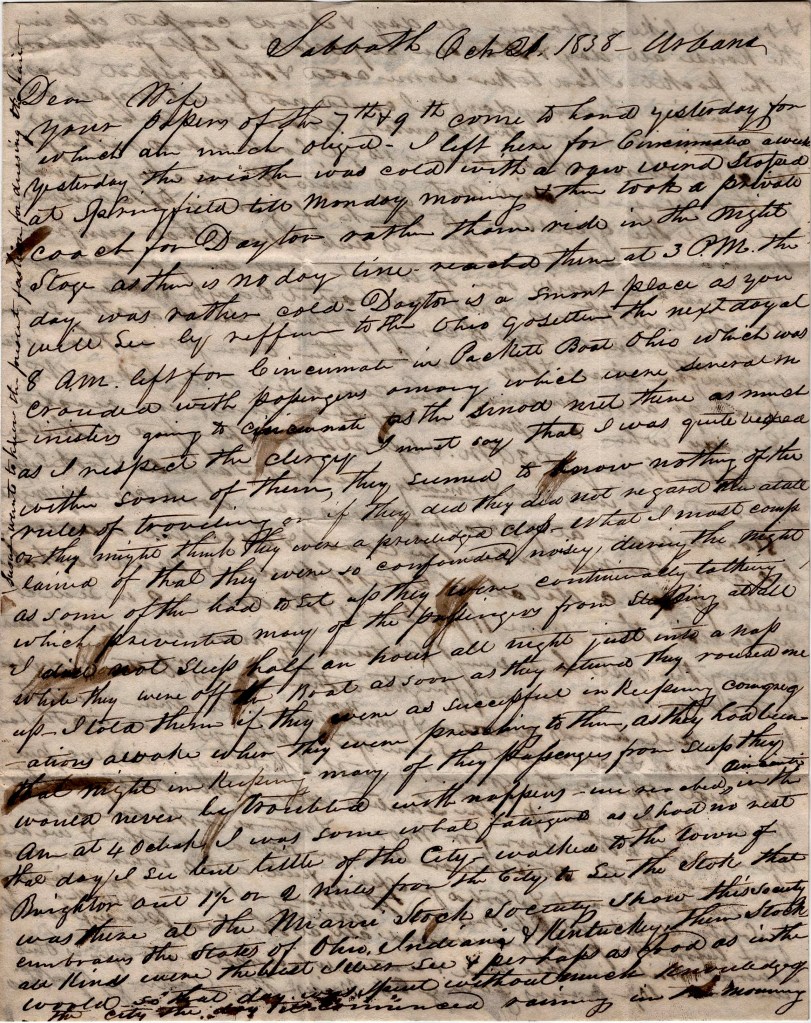
Urbana [Ohio] Sabbath, October 21st 1838
Dear Wife,
Your papers of the 7th & 9th come to hand yesterday for which am much obliged. I left here for Cincinnati a week yesterday. The weather was cold with a raw wind. Stopped at Springfield till Monday morning and then took a private coach for Dayton rather than ride in the night stage as there is no day time. Reached there at 3 p.m. The day was rather cold.
In 1838, a packet boat journey from Dayton to Cincinnati on the Miami and Erie Canal would have taken approximately 16.5 to 22 hours, based on a travel distance of roughly 66 miles and an average speed of 3-4 miles per hour. This journey took 20 hours.
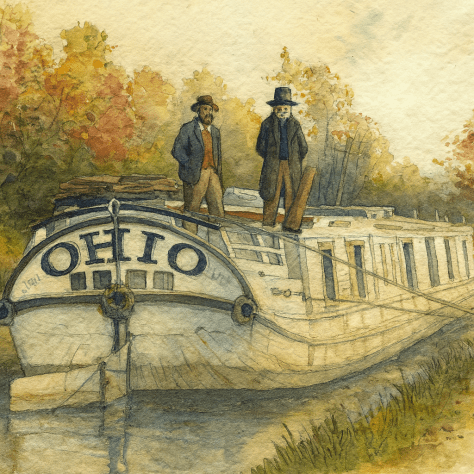
Dayton is a smart place as you will see by referring to the Ohio Gazette. The next day at 8 a.m. left for Cincinnati [on the Miami & Erie Canal] in Packet Boat Ohio which was crowded with passengers among which were several ministers going to Cincinnati as the [Presbyterian] Synod met there. As much as I respect the clergy, I must say that I was quite vexed with some of them. They seemed to know nothing of the rules of traveling or if they did, they did not regard them at all or they might think they were a privileged class. What I most complained of that they were so confounded noisy during the night as some of them had to sit up they were continually talking which prevented many of the passengers from sleeping at all. I did not sleep half an hour all night—just into a nap while they were off the boat. As soon as they returned, they roused me up. I told them if they were as successful in keeping congregations awake when they were preaching to them as they had been that night in keeping many of the passengers from sleep, they would never be troubled with nappers.
Beaker marked by Nathan Lord Hazen (active 1830 –1851), Cincinnati, Ohio, presented at the 1838 Miami County Agricultural Society Fair, held in Miami County, Ohio. Engraved: “The / Miami Valley / Agricultural Society’s / Second best Premium / Awarded to E.B. Squires, / of Butler County O. / For his Black Boar, / Democrat. / 8 Months Old. / October, 1838.” Silver; height 3 ¾ inches.
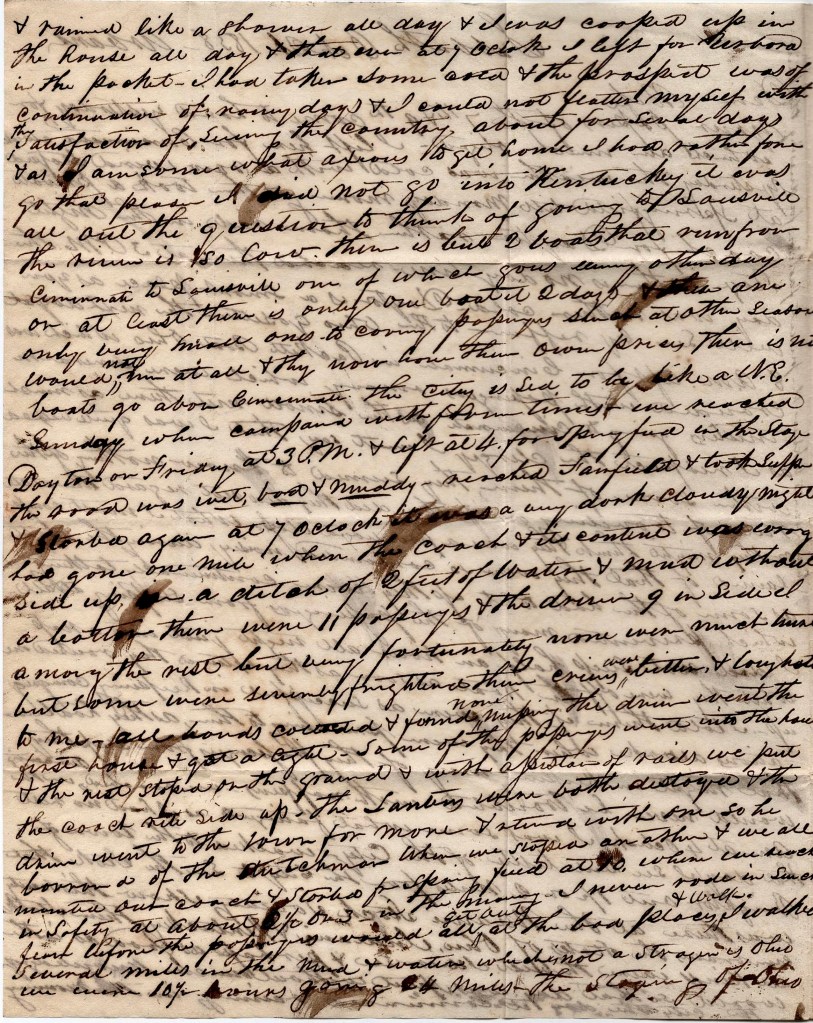
We reached Cincinnati in the a.m. at 4 o’clock. I was somewhat fatigued. As I had no rest that day, I see but little of the city. Walked to the town of Brighton out one and a half or two miles from the city to see the stock that was there at the Miami Stock Society Show. 1 This society embraces the states of Ohio, Indiana & Kentucky. Their stock—all kinds—were the best I ever see & perhaps as good as in the world, so that day was spent without much knowledge of the city. The next day commenced raining in the morning & rained like a shower all day & I was cooped up in the house all day & that even at 7 o’clock I left for Urbana in the packet. I had taken some cold & the prospect was of continuation of rainy days & I could not flatter myself with the satisfaction of seeing the country about for several days & as far as I am somewhat anxious to get home, I had rather forego that pleasure.
I did not go into Kentucky. It was all out of the question to think of going to Louisville. The river is so low, there is but two boats that run from Cincinnati to Louisville, one of which goes every other day or at least there is only one boat in two days, and then one only very small one to carry passengers such at other seasons would not run at all & they now have their own prices. There is not boats go above Cincinnati. The city is said to be like a Eew England Sunday when compared with former times.
We reached Dayton on Friday at 3 p.m. & left at 4 for Springfield in the stage. The road was wet, bad and muddy. Reached Fairfield 2 & took supper & started again at 7 o’clock. It was a very dark, cloudy night. We had gone one mile when the coach & its contents was wrong side up in a ditch of two feet of water & mud without a bottom. There were 11 passengers & the driver, nine inside—I among the rest—but very fortunately none was much hurt but some were severely frightened. Their cries were bitter and [ ] to me. All hands counted & found none missing.
Due to the stage overturning on a muddy road one mile from Fairfield [now Fairborn], Ohio, “We were ten and a half hours going 24 miles” on the way to Springfield, Ohio.
The driver went to the first house & got a light. Some of the passengers went into the house & the rest stopped on the ground and with assistance of rails, we put the coach right side up. The lanterns [on the coach] were both destroyed & the driver went to town for more & returned with one so he borrowed one off the Dutchman when we stopped another & we all mounted our coach and started for Springfield at 10 where we arrived in safety at about 2.30 or 3 in the morning. I never rode in such fear before. The passengers would all get out at the bad places & walk. I walked several miles in the mud and water which is not a strange [thing] in Ohio. We were 10 and a half hours going 24 miles.
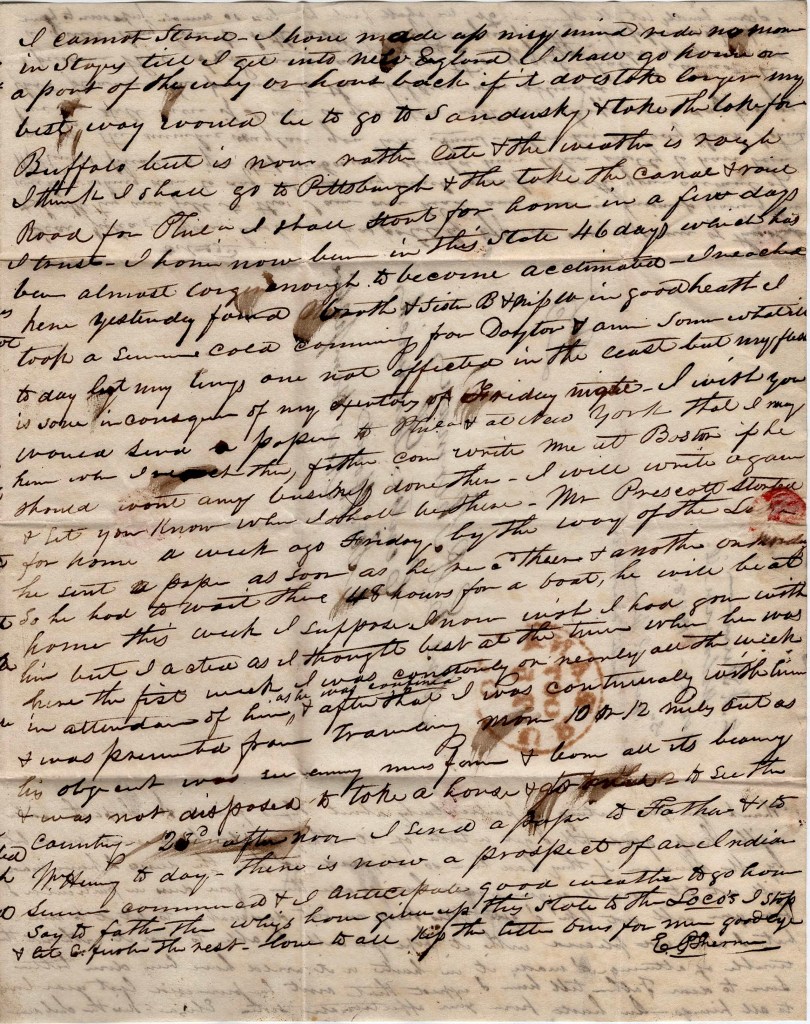
The staging of Ohio I cannot stand. I have made up my mind to ride no more in stages till I get into New England. I shall go home or a part of the way or horseback if it does take longer. My best way would be to go to Sandusky & take the Lake for Buffalo nut is now rather late & the weather is rough. I think I shall go to Pittsburgh & then take the canal & railroad for Philadelphia. I shall start for home in a few days, I trust. I have now been in the state 46 days which has been almost large enough to become acclimated.
I reached here [Urbana] yesterday, found brother & sister B[ean] & Miss W. in good health. I took a summer cold coming from Dayton & am somewhat ill today but my lungs are not affected in the least but my flesh is some in consequence of my exertions of Friday night. I wish you would send a paper to Philadelphia & at New York that I may have when I reach there. Father can write me at Boston if he should want any business done there. I will write again and let you know when I shall be there. Mr. Prescott started for home as week ago Friday by the way of the Lake. He sent a paper as soon as he arrived there [at the Lake] & another on Monday. So he had to wait there 48 hours for a boat. He will be at home this week, I suppose. I now wish I had gone with him but I acted as I thought best at the time. When he was here the first week I was constantly or nearly all the week in attendance of him as he was confined and after that I was contually with him & was prevented from traveling more than 10 or 12 miles. But as his object was to see [ ] farm & learn all its [ ] & was not disposed to take a house & [ ] to see the country.
22nd afternoon. I send a paper to Father & one to Mr. Henry today. There is now a prospect of an Indian Summer commenced & I anticipate good weather to go home. Say to Fsather the Whigs have given up this tate to the Loco’s [Democrats]. I stop & wait to finish the rest. Love to all. Kiss the little ones for me. Goodbye. — E. P. Sherman
[in another hand]
Dear Julia,
Your husband has politely offered me a corner of this sheet & I will try and fill it though I am over head and ears in business, having three weeks washing done today. I was very much gratified with your account of Wm. Henry’s friends & your trip to Conway. Should have liked vastly to have been one of the number. Am glad you like Anne. I love her already. Think I should lover her still more if I were acquainted with her. Hope someday to enjoy that pleasure. The presents to the children were splendid. I presume that A. & S. are married ere this. Regret that I cannot be a guest. My love to both with many prayers for their happiness & prosperity. Thank you for writing so particularly about [ ] friends & I hope this cake will keep good till I get a taste of it. They might jave sent me a bit by Mr. Sherman if they have been so disposed. I fear the dresses I have made will not fit as well as you would have made them. Your dress in particular I fear you will not like. I got Mrs. Roof, our best dress maker, to fit it to me but I am not pleased with it. Hope you will be able to wear it without the trouble of altering. I made it in haste or it would have been done better. Love to dear Father. Tell him I expect that visit he promised last year. Love to all friends. In haste. From your affectionate sister, — Eliza Kiss the children
I can hardly let Mr. Sherman go. We shall feel his loss so much. Hope soon to see him back again with you and the children.
1The Miami County Agricultural Society Fair was held in Miami county, Ohio in October 1838.
2Fairfield, Ohio, is now called Fairborn. It was formed by merging the towns of Fairfield and Osborn.
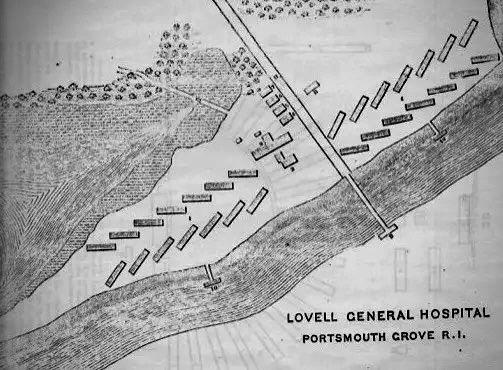
The identity of this soldier has not yet been learned. He was probably from a Massachusetts regiment and it may be that he was wounded in the leg at the Battle of Fredericksburg. The letter provides us with a great description of the Portsmouth Grove Hospital (later Lovell Hospital) in Rhode Island as it appeared in March 1863.
A watercolor of the Portsmouth Grove Hospital with the barracks on either side of the central building (partially hidden by the steamer).
T R A N S C R I P T I O N
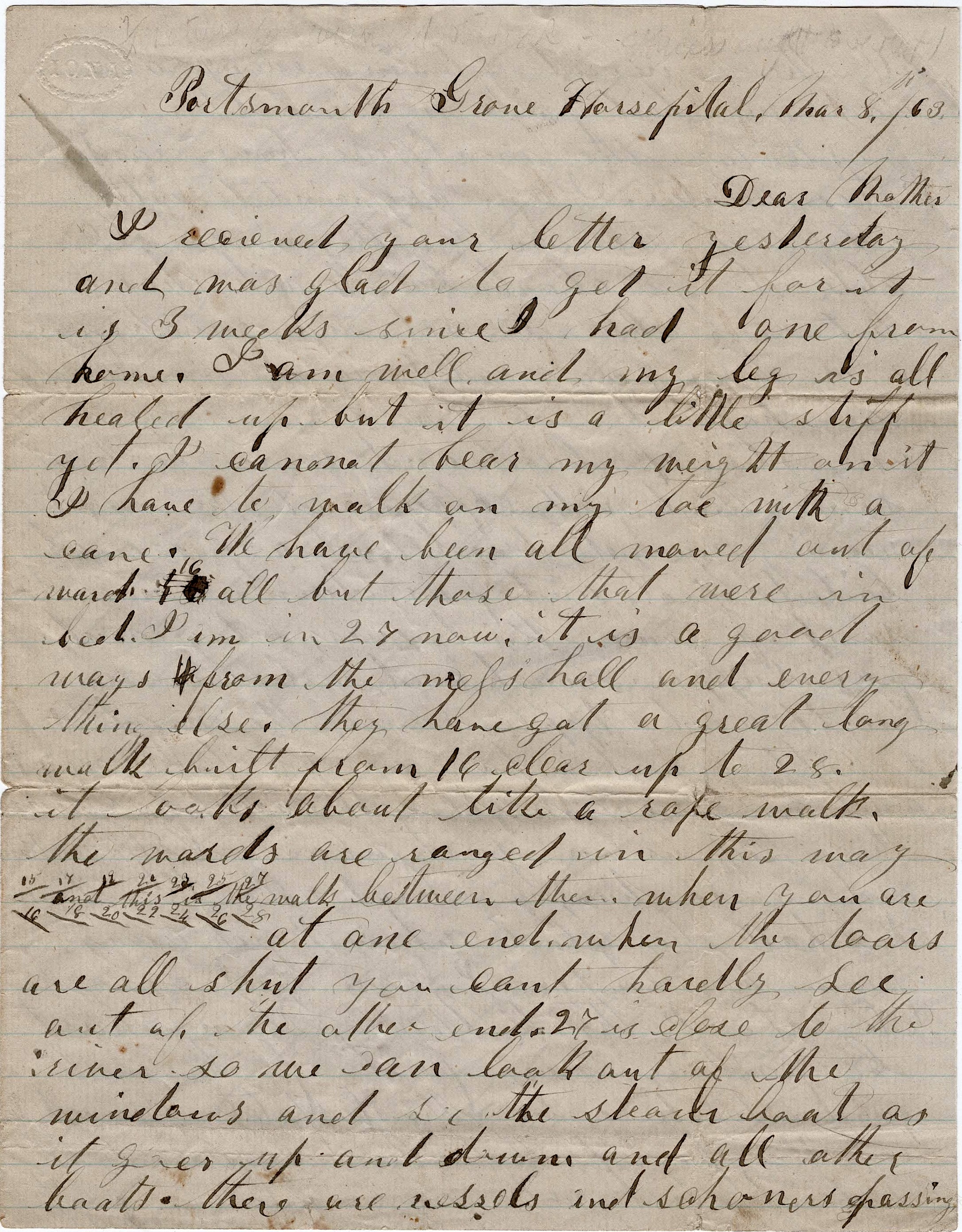
Portsmouth Grove Hospital March 8, 1863
Dear Mother,
I received your letter yesterday and was glad to get it for it is three weeks since I had one from home. I am well and my leg is all healed up but is a little still yet. I cannot bear my weight on it. I have to walk on my toe with a cane. We have been all moved out of Ward 16—all but those that were in bed. I’m in [Ward] 27 now. It is a good ways from the mess hall and everything else.
They have got a great long walk built from 16 clear up to 28. It looks about like a rope walk. The wards are [ar]ranged in this way [sketch] and this is the walk between them. When you are at one end, when the doors are all shut, you can’t hardly see out of the other end.
[Ward] 27 is close to the river so we can look out of the windows and see the steamboat as it goes up and down and all other boats. There are vessels and schooners passing all the time.
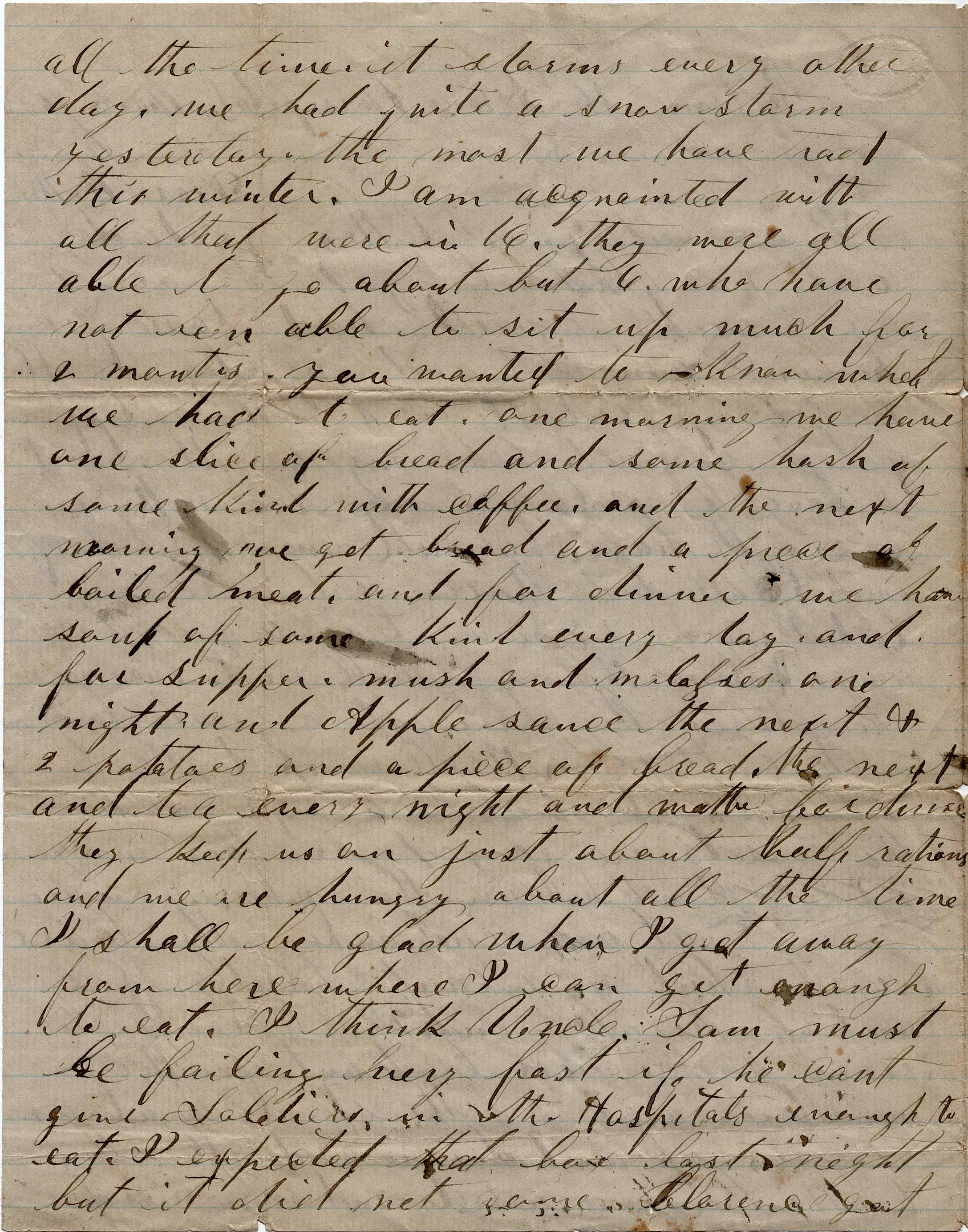
It storms every other day. We had quite a snow storm yesterday—the most we have had this winter. I am acquainted with all that were in [Ward] 16. They were all able to go about but six who have not been able to sit up much for two months.
You wanted to know what we had to eat. One morning we have one slice of bread and some hash of some kind with coffee, and the next morning we get bread and a piece of boiled meat, and for dinner we have soup of some kind every day. And for supper, mush and molasses one night and apple sauce the next, & two potatoes and a piece of bread the next and tea every night. And mother, for dinner they keep us on just about half rations and we are hungry about all the time. I shall be glad when I get away from here where I can get enough to eat. I thinkUncle Sam must be failing very fast if he can’t give soldiers in the hospitals enough to eat.
Alexander Proudfit, Chaplain at Portsmouth Grove General Hospital
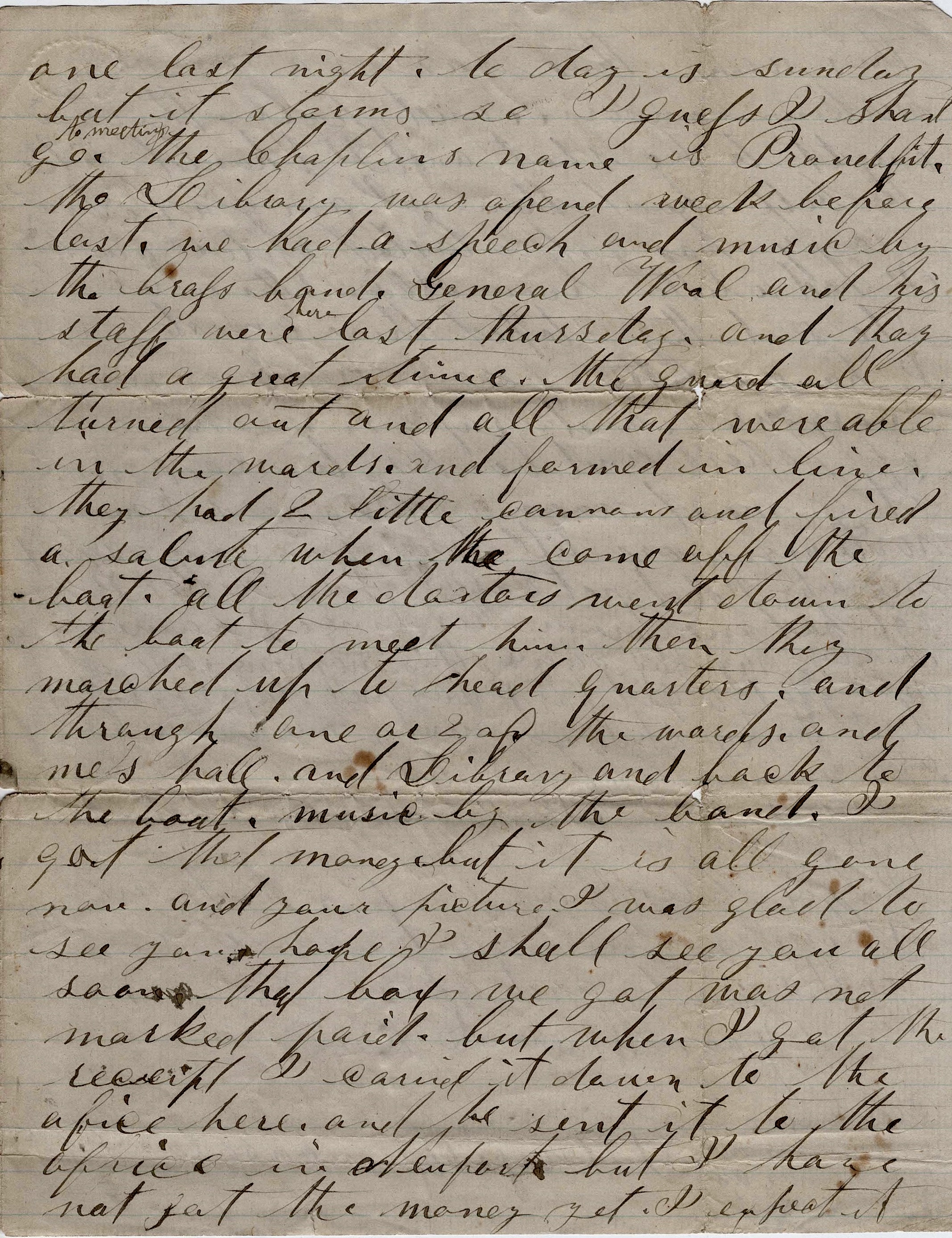
I expected that box last night but it did not come. Clarence got one last night. Today is Sunday but it storms so, I guess I shan’t go to meeting. The Chaplain’s name is Proudfit. The Library was opened week before last. We had a speech and music by the brass band. General Wool and his staff were here last Thursday and they had a great time. The guard all turned out and all that were able in the wards and formed in line. They had two little cannons and fired a salute when they came off the boat. All the doctors went down to the boat to meet him. They then marched up to headquarters and through one or two of the wards and mess hall and library and back to the boat. Music by the band.
I got that money but it is all gone now. And your picture. I was glad to see you and hope I shall see you all soon. That box we got was not marked paid but when I got the receipt, I carried it down to the office here and he sent it to the office in Newport but I have not got the money yet. I expect it this week.
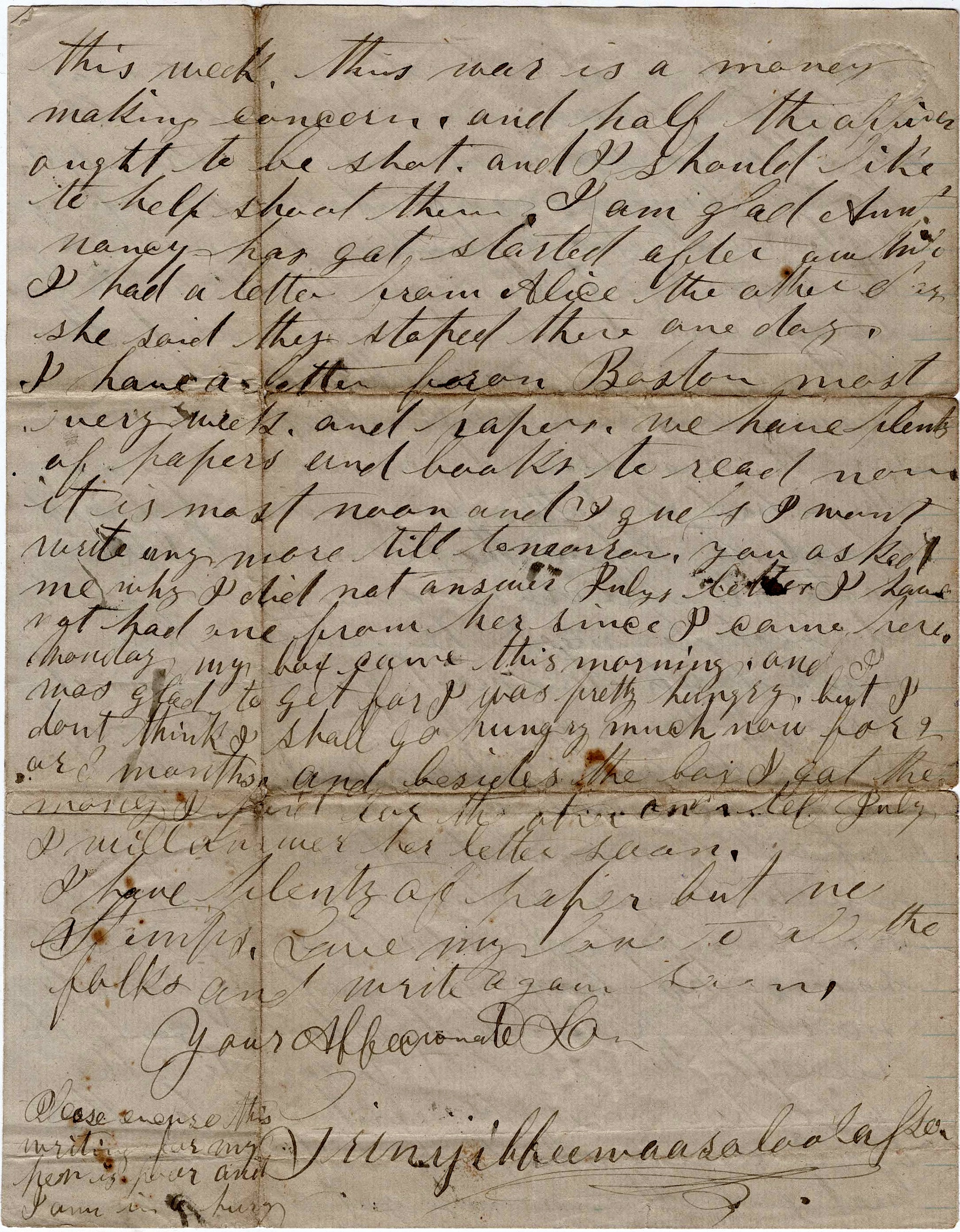
This war is a money making concern and half the officers ought to be shot and I should like to help shoot them. I am glad Aunt Nancy has got started after a while. I had a letter from Alice the other day. She said they stopped there one day. I have a letter from Boston most every week and papers. We have plenty of papers and books to read now. It is most noon and I guess I won’t write any more till tomorrow.
You asked me why I did not answer Julie’s letter. I have not had one from her since I came here.
Monday, my box came this morning and I was glad to get it for I was pretty hungry. But I don’t think I shall go hungry much now for two or three months. And besides the box, I got the money. I paid for the other one. Tell Julie I will answer her letter soon. I have plenty of paper but no stamps. Give my love to all the folks and write again soon. Your affectionate son, — Grinyilleewaasaloolasso
Please excuse this writing for my pen is poor and I am in a hurry.
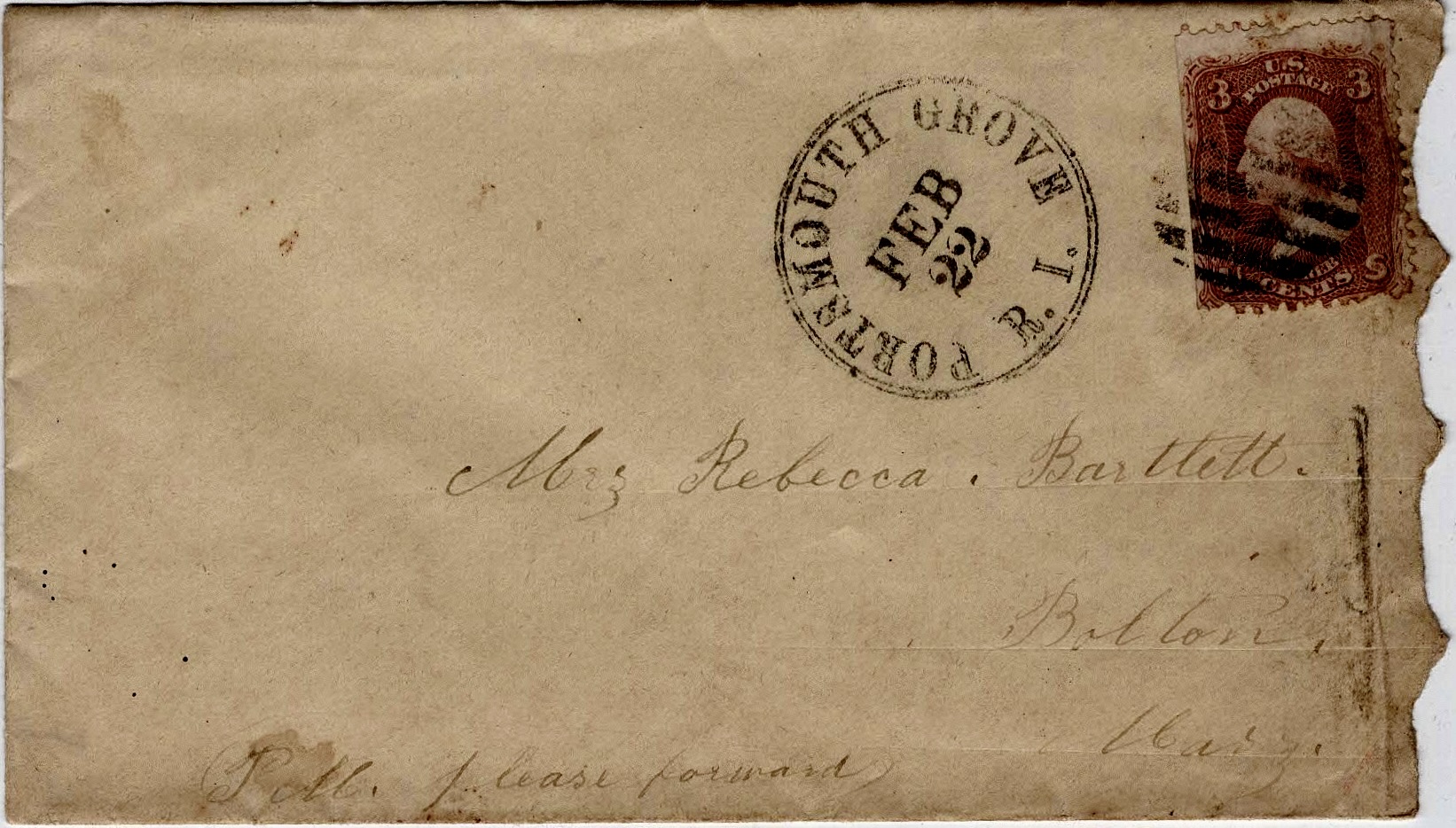
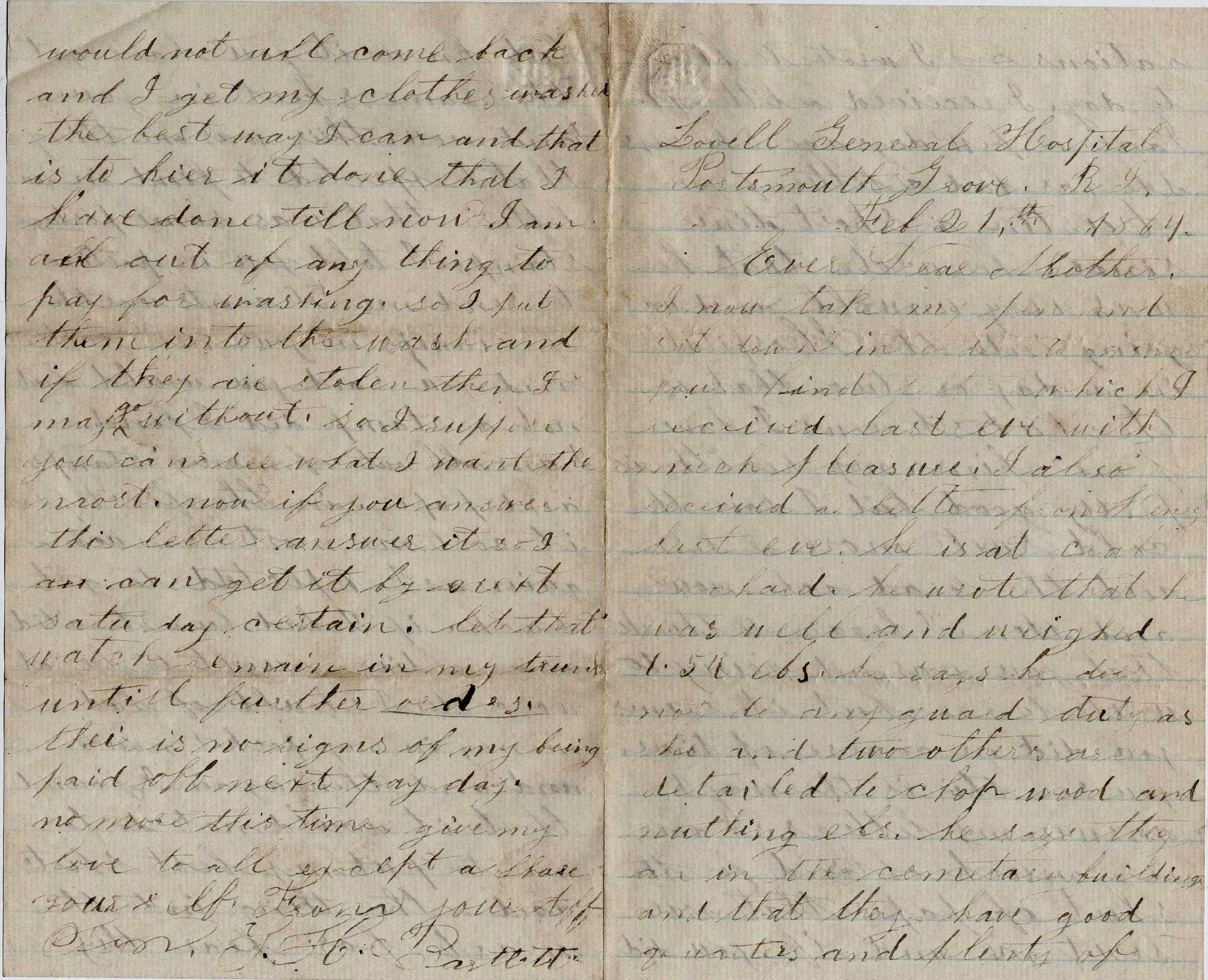
The following letter was written by Theodore Hervey Bartlett (1844-Aft1920), the son of William Bartlett (b. 1799) and Rebecca Howe (1803-1897) of Bolton, Massachusetts. Theodore enlisted in Co. I, 36th Massachusetts Infantry on 23 July 1862 at the same time and in the same company as his older brother, Henry Harrison Bartlett (1841-1921). He was discharged from the service on 8 June 1865 at the expiration of his term of enlistment.
Theodore wrote the letter from the Lovell General Hospital at Portsmouth Grove, Rhode Island, where he appears to have been convalescing from an illness of some kind. He does not indicate how he came to be sent there.
T R A N S C R I P T I O N
Addressed to Mrs. Rebecca Bartlett, Bolton, Massachusetts
Lovell General Hospital Portsmouth Grove, Rhode Island February 21, 1864
Ever dear mother,
I now take my pen and sit down in order to answer your kind letter which I received last eve with much pleasure. I also received a letter from [brother] Henry last eve. He is at Crab Orchard [Kentucky]. He wrote that he was well and weighed 154 lbs. He says he does not do any guard duty as he and two others are detailed to chop wood and nothing else. He says they are in the cemetery buildings and that they have good quarters and plenty of rations. I received a letter from [sister] Jane a few days ago. She says she has had a letter from [brother] Austin a short time since. He wrote that he was very unwell and was going into the hospital in a day or two. That is the latest news I have from him.
My health is pretty good but I have the cold sweats more or less and the headache now and then. I began to think that you was not going to write to me but it seems you did in course of time. You see this is the way I answer my letters. I am very much obliged for the sheet of paper that you sent me and if you did but know it, you have got the same sheet in your hand now.
There was one thing that I expected to find in your letter. That was some postage stamps. I told you in oarticular to send me 50 cents worth of stamps in your next letter and you said you would. But not a stamp did I find. I am all out of money, stamps, and paper. In the first place, it costs me most as much again as I expected to get back. If I had been treated as a soldier, I should of had money in my pocket now. And then again, I found that it would not do for me to put my best shirts and other things into the wash for fear they would not all come back and I get my clothes washed the best way I can and that is to hire it done. That I have done until now. I am out of anything to pay for washing so I put them into the wash and if they are stolen, then I may go without.
So I suppose you can see what I want the most. Now if you answer this letter, answer it so I can get it by next Saturday certain. Let that watch remain in my trunk until further orders.
There is no signs of my being paid off next pay day. No more this time. Give my love to all. Accept a share yourself. From your affectionate son, — T. H. Bartlett


















 Spared & Shared 23