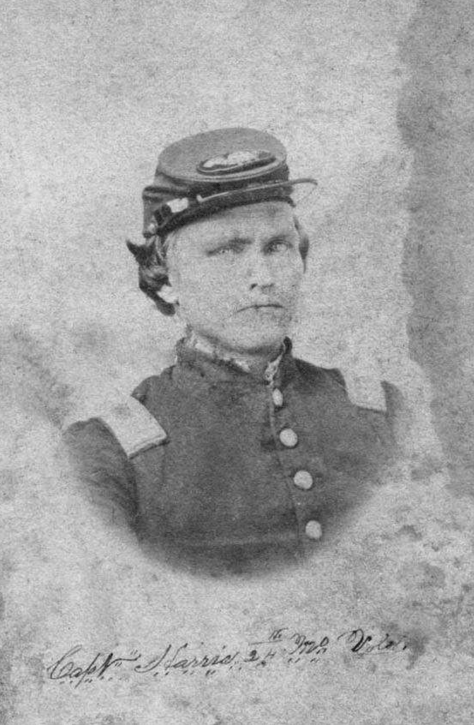
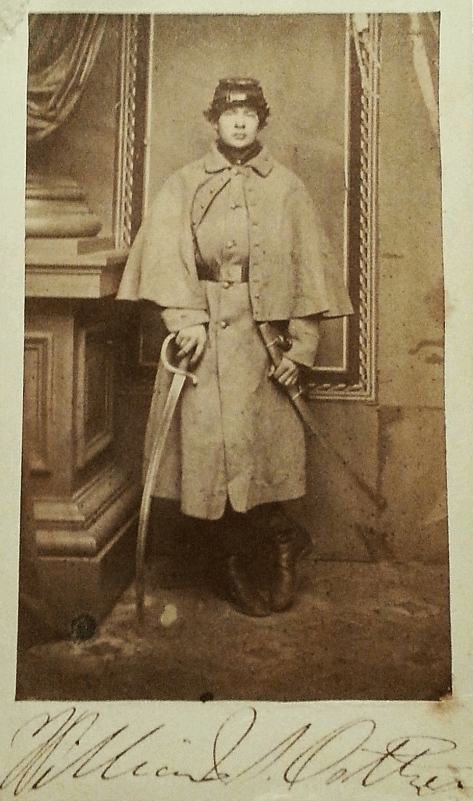
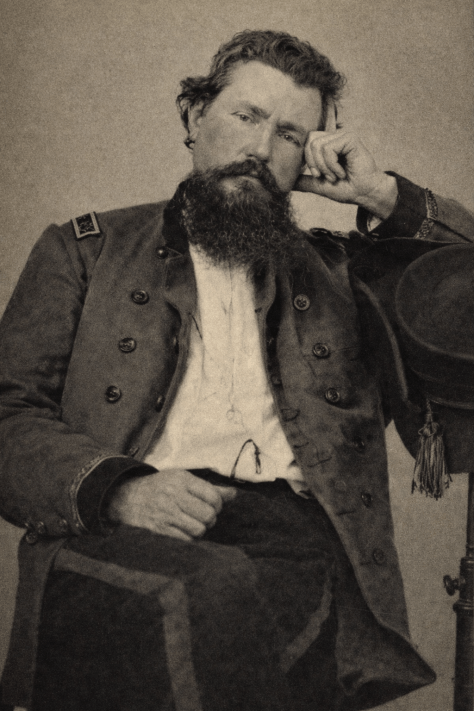
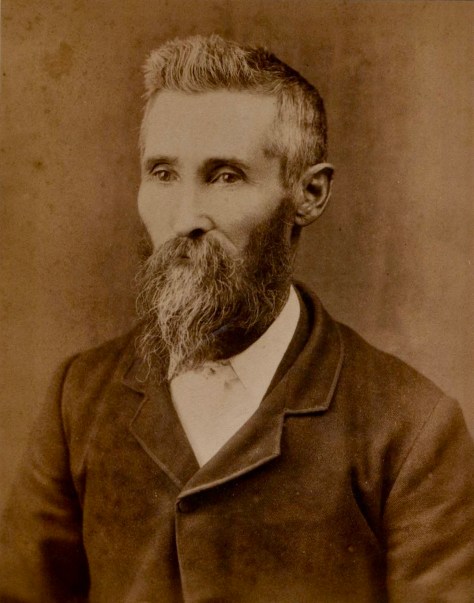
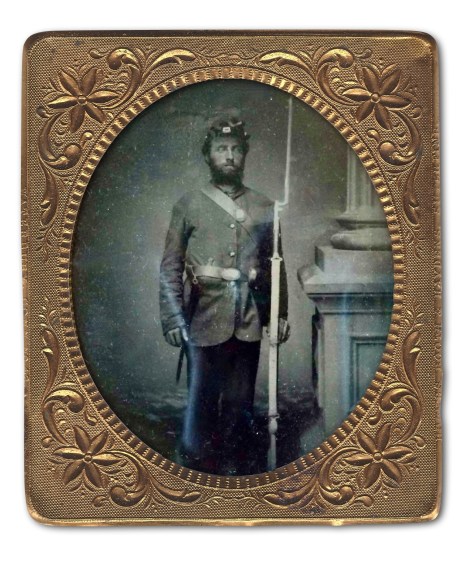
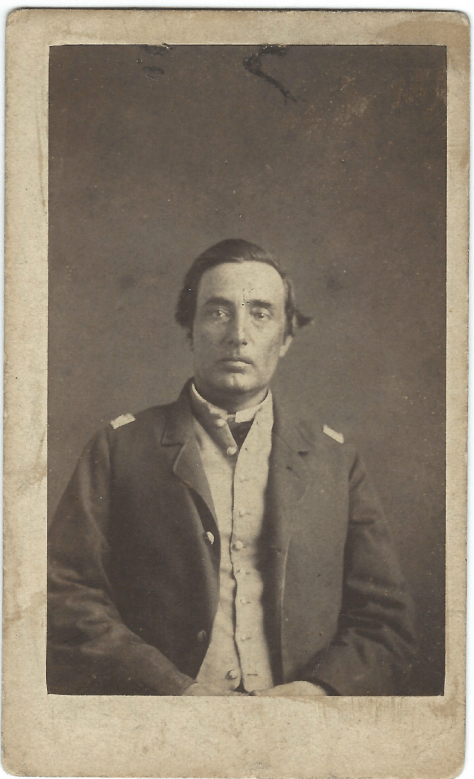
I could not find an image of Howard J. Tyler but here is one of Capt. Wyatt Harris of Co. I, 24th Missouri Infantry (Ancestry.com)
This letter was only signed “Howard” and since he wrote to a young woman in Ingham county, Michigan, I concluded he was from there. However, I could not find any Michigan regiments in the Army of the Southwest at the Battle of Elkhorn Tavern (March 1862) or in the months following. I learned that it was the 24th Missouri Infantry that served as the provost guard for Gen. Samuel R. Curtis and so I concluded Howard must have been a member of that regiment.
Remarkably, the roster of the 24th Missouri Infantry had only one “Howard” among its members, and it was Howard J. Tyler (1846-1864) of Co. H, the youngest son of Isaac Tyler (1800-1872) and Rebecca Rising (1805-1888) of Leslie, Ingham county, Michigan. And who was Howard writing to? He addressed the letter to Almira Longyear (1847-1863), the 15 year-old daughter of Henry William Longyear (1818-1849) and Elizabeth Whitney (1822-1891) of Leslie, Ingham county, Michigan. She died on 3 February 1863; the circumstances of her death are unknown. Almira’s older brother, William D. Longyear (1841-1925) was a drummer boy in Co. C of the 8th Michigan Infantry.
So why would Howard choose to serve in a regiment from Missouri instead of Michigan? It turns out that the Captain of Co. H, 24th Missouri, was Isaac B. Tyler of Cuba, Crawford county, Missouri—probably an uncle. Howard’s death was recorded as 25 May 1864 but I have not learned the cause of death.
T R A N S C R I P T I O N
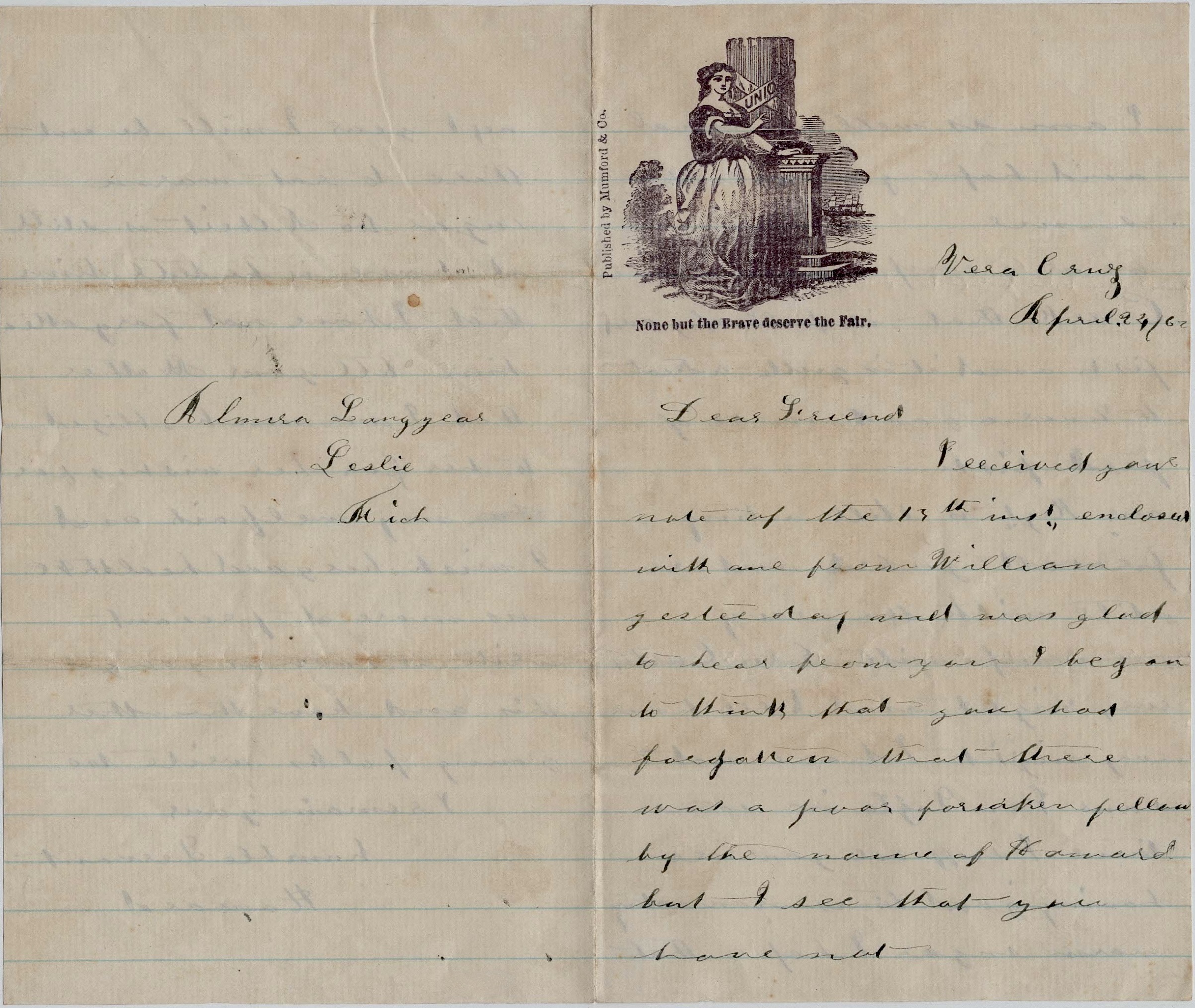
Vera Cruz [Missouri] 1 April 24, 1862
Dear Friend,
I received your note of the 13th inst. enclosed with one from [your brother] William yesterday and was glad to hear from you. I began to think that you had forgotten that there was a poor forsaken fellow by the name of Howard but I see that you have not. I am as well as usual and hope you are the same.
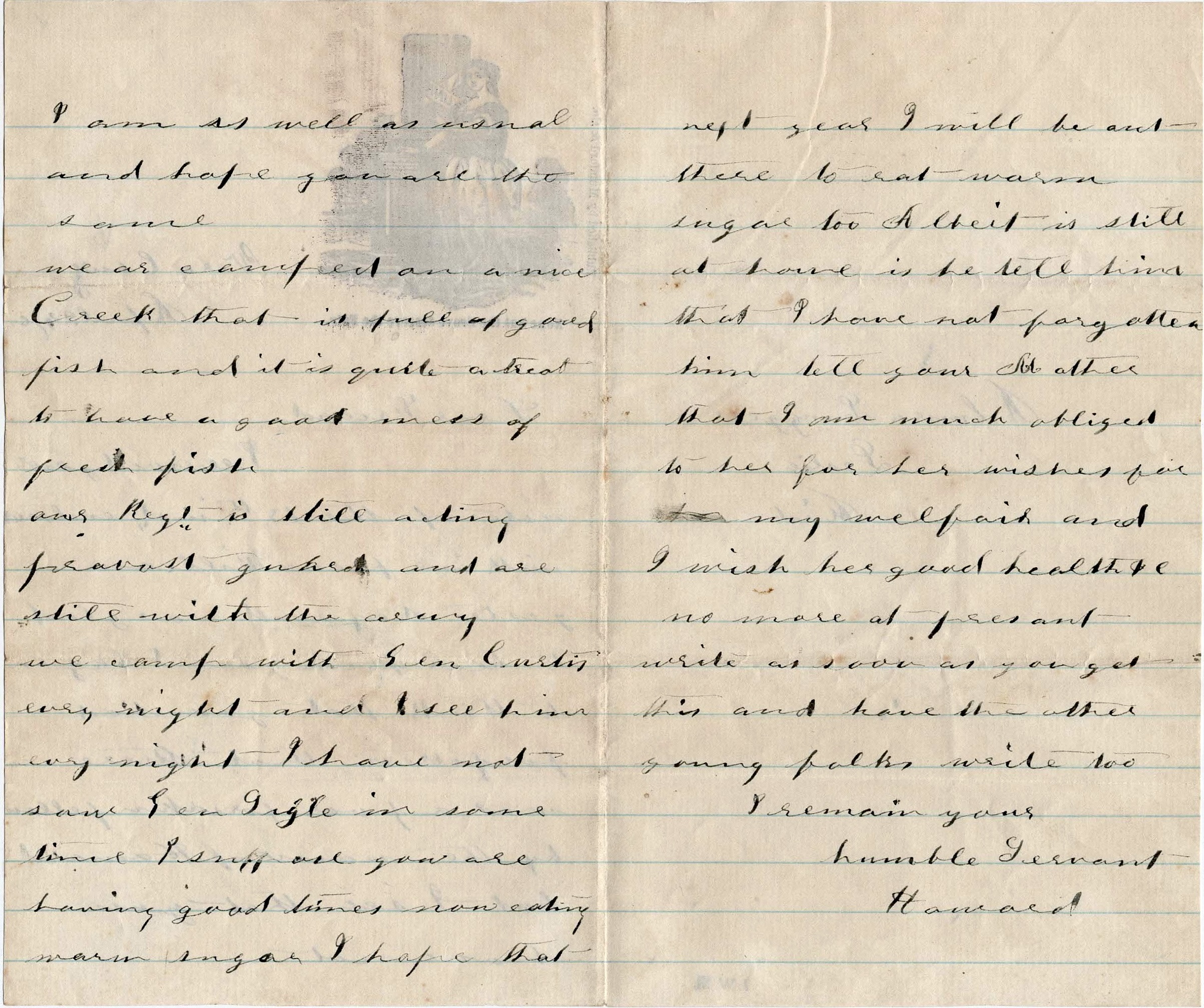
We are camped on a nice creek that is full of good fish and it is quite a treat to have a good mess of fresh fish.
Our regiment is still acting provost guard and are still with the army. We camp with Gen. [Samuel R.] Curtis every night and I see him every night. I have not see Gen. [Franz] Sigel in some time.
I suppose you are having good times now eating warm sugar. I hope that next year I will be out there to eat warm sugar too. Albert is still at home is he? Tell him that I have not forgotten him. Tell your Mother that I am much obliged to her for her wishes for my welfare and I wish her good health &c.
No more at present. Write as soon as you get this and have the other young folks write too. I remain your humble servant, — Howard
1 Vera Cruz was a town located just north of the Arkansas border in Douglas county, Missouri. It was originally called Red Bud but was rename in 1859. It served as the 1st county seat of Douglas county and served as the headquarters of the local Union Home Guard.
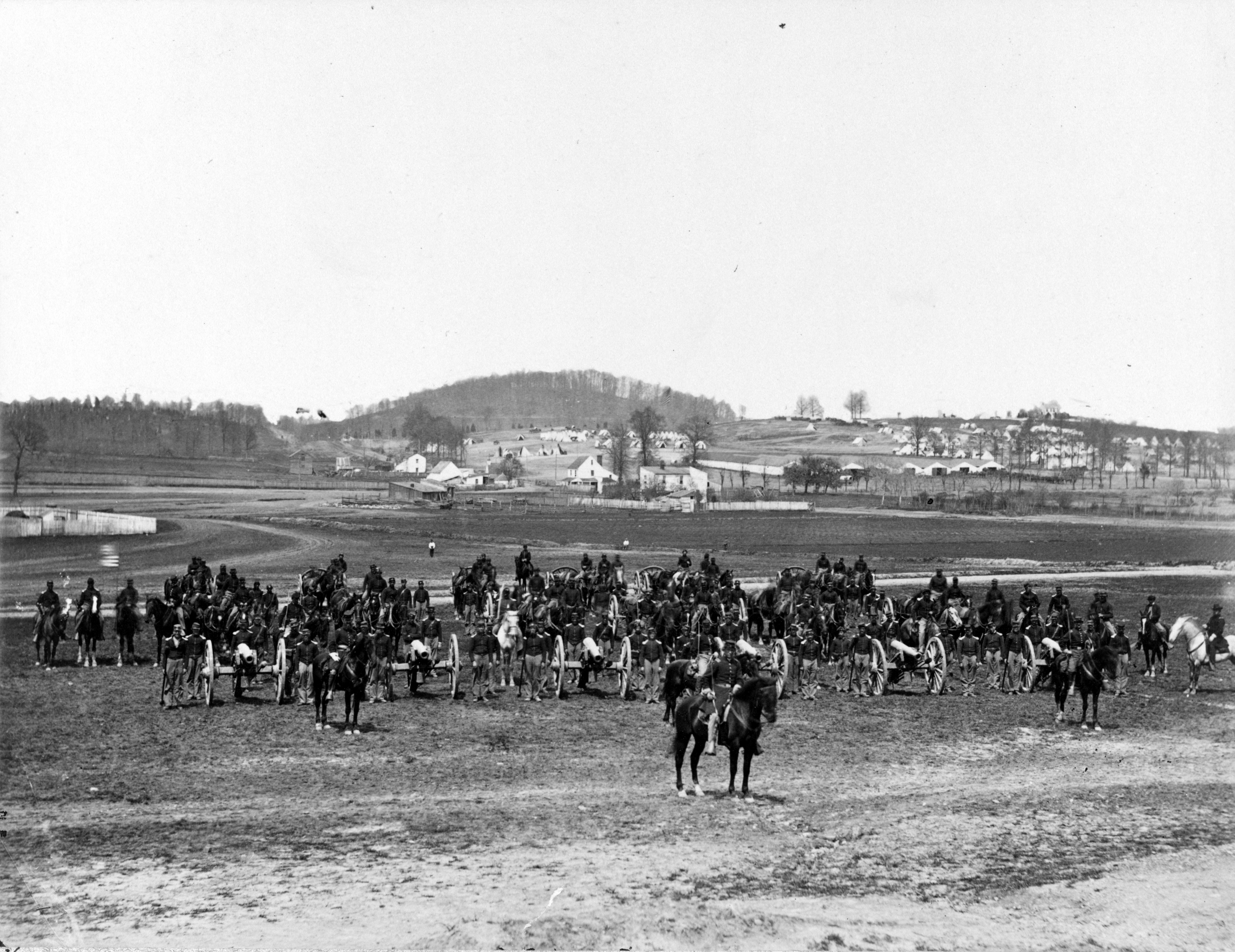
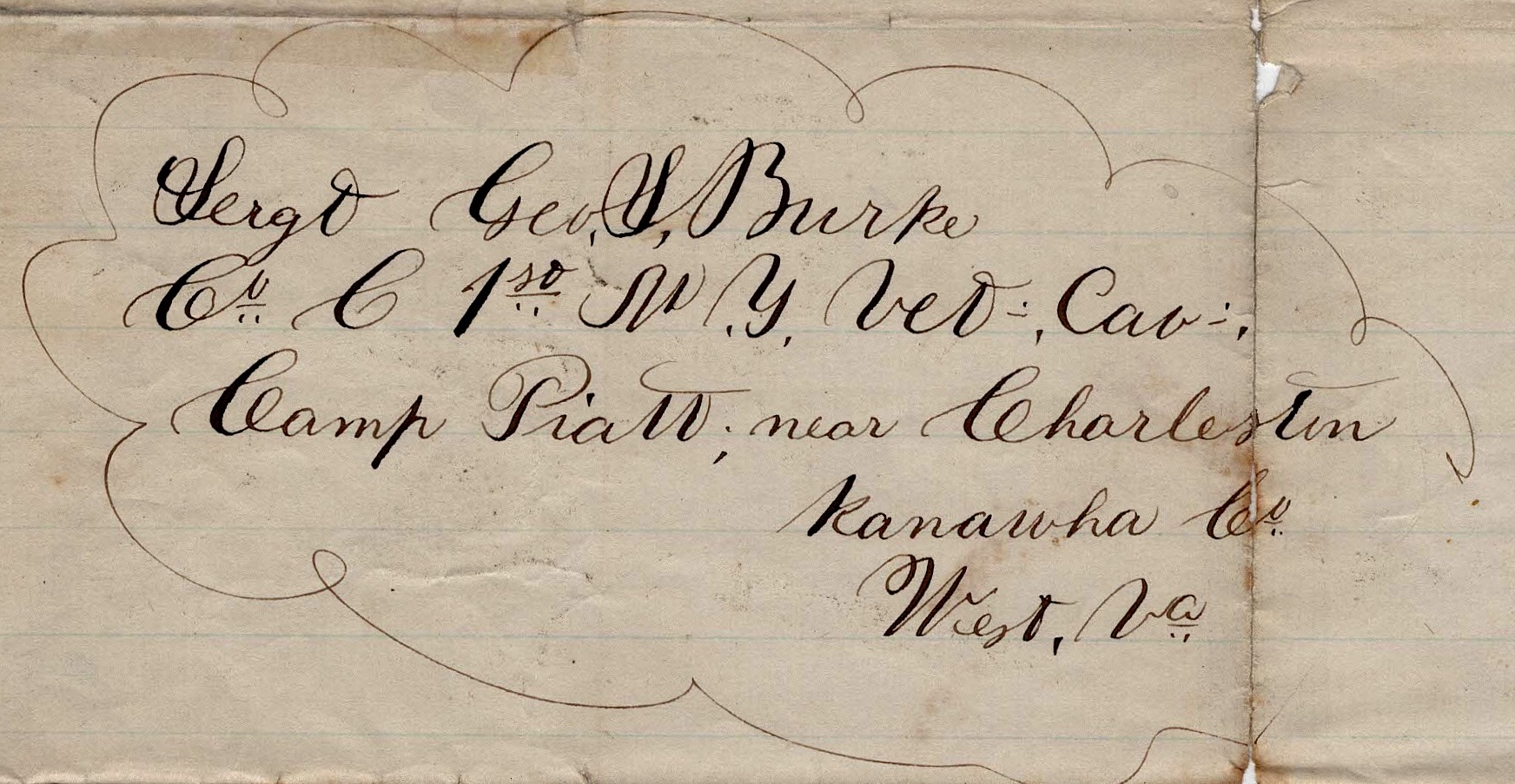
The following letters were written by George S. Burke (1838-1931), the son of Thomas Burke (1799-1879) and Mary Burke (1806-1877) of Irondequoit, Monroe county, New York. George was born in Morristown, New Jersey, on 11 December 1838, and came with his parents to Irondequoit in 1842. When he was 23, he enlisted in Reynolds Battery (Co. L, 1st New York Light Artillery).
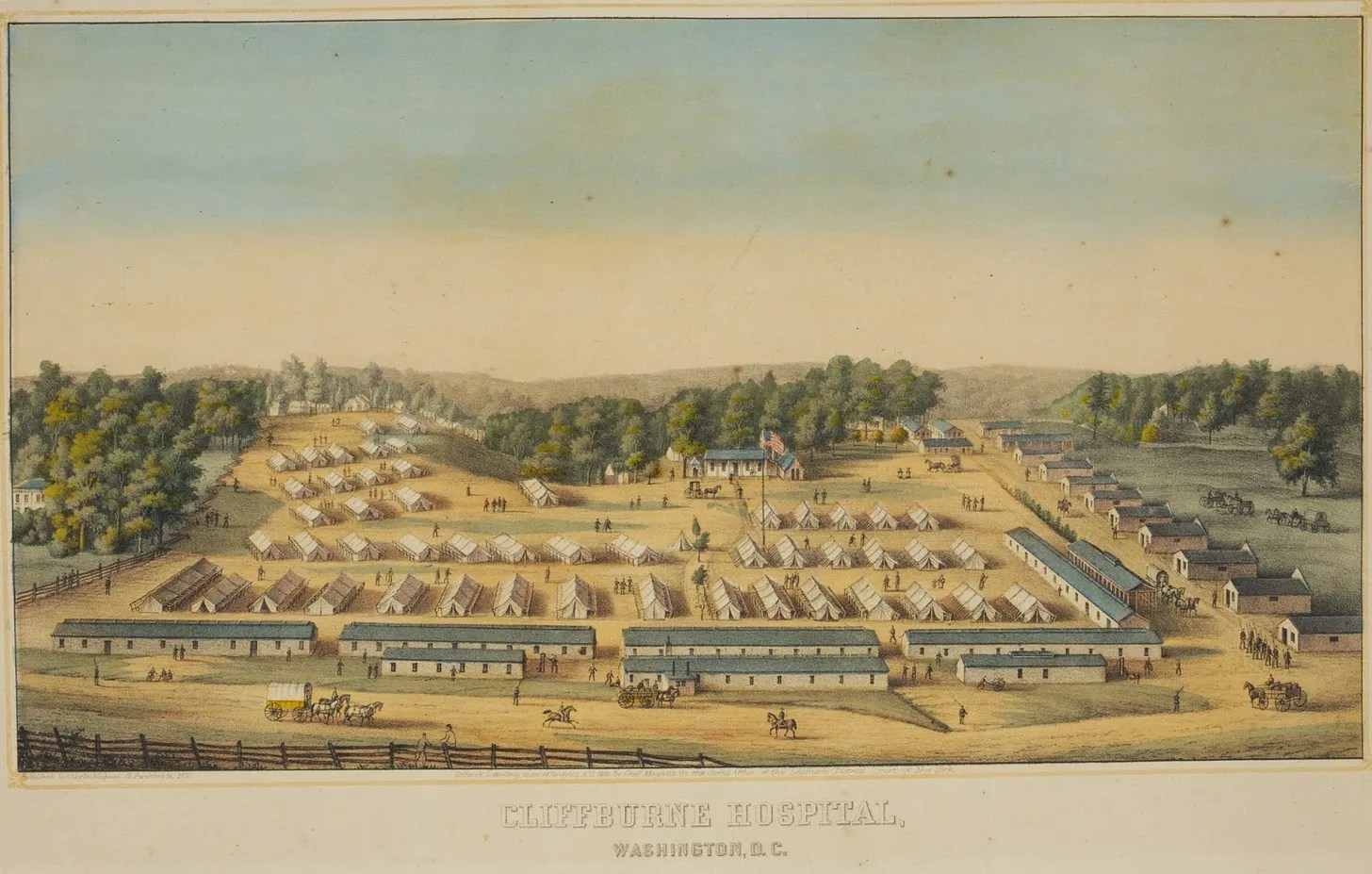
After about a year in the service, he contracted typhoid fever and was sent to Cliffburne Barracks Post Hospital (Depot Camp Invalid Corps) in Washington D. C. where he was subsequently discharged on a surgeon’s certificate in mid-December 1862. After regaining his health, George reenlisted in August 1863 at Rochester, New York, and was mustered in as a private on 10 October 1863, into Co. C, 1st New York Veteran Cavalry with his younger brother James by his side. He was mustered out on 20 July 1865 at Camp Piatt, West Virginia, after receiving promotions to corporal 7/1/1864 and sergeant 9/1/1864.
Letter 1
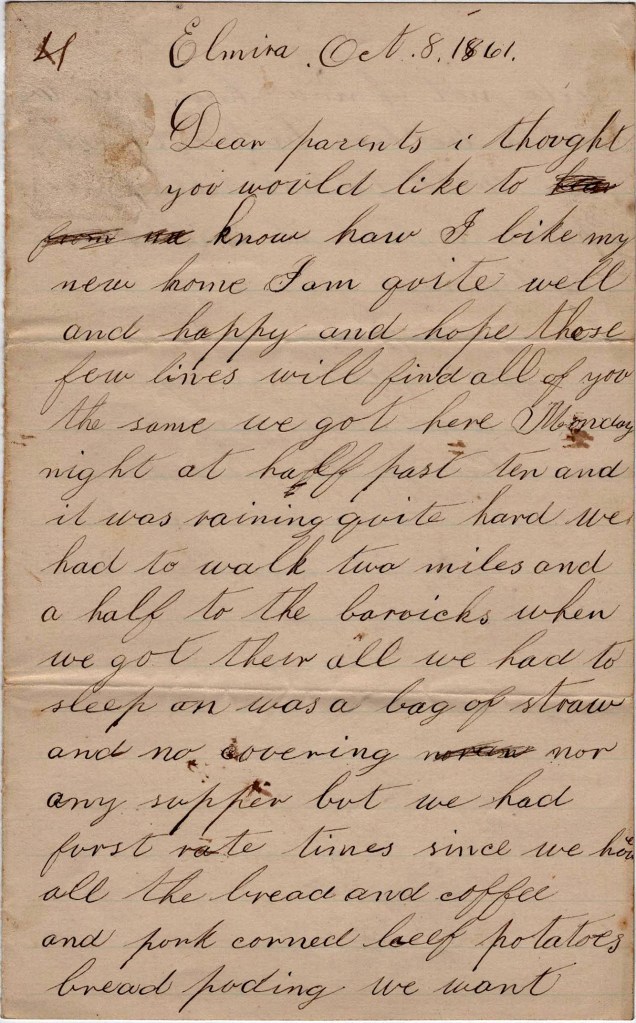
Elmira, [New York] October 8, 1861
Dear Parents,
I thought you would like to know how I like my new home. I am quite well and happy and hope these few lines will find you all the same. We got here Monday night at half past ten and it was raining quite hard. We had to walk two miles and a half to the barracks. When we got there, all we had to sleep on was a bag of straw and no covering nor any supper but we had first rate times since. We have all the bread and coffee and pork, corned beef, potatoes and bread pudding we want.
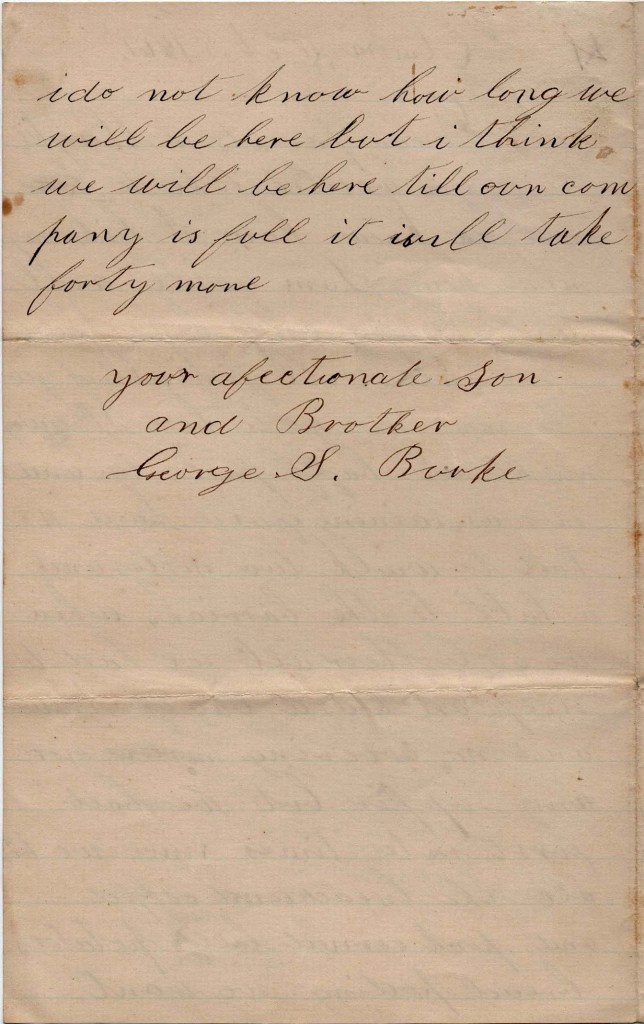
I do not know how long we will be here but I think we will be here till our company is full. It will take 40 more. Your affectionate son and brother, — George S. Burke
Letter 2
Elmira [New York] October 11th 1861
Dear Parents,
I am quite well and happy and hope these few lines will find you the same. We have plenty to eat and nothing to do but drill about two hours a day. We have not got our uniforms yet but we are expecting them every day. We have all we want of beef, mutton, pork, liver, potatoes, bread, coffee, butter, rice, mush and milk, molasses, vinegar, pepper and salt, and beans.
Herman Riley Benedict (1845-1862). Though the surgeon rejected 17 year-old Riley, he must have been reinstated as Muster Rolls indicate he was mustered into Co. L, 1st N. Y. Light Artillery; he died of typhoid fever on 7 July 1862 at Front Royal, Va. His birth date was 6 February 1845.
We do not know how long we will remain here. We heard Tuesday that we would stay here for four or five weeks but I heard last night that we were going to Washington the middle of next week and from that to Missouri. But we can’t tell when we will go or where we will go for one day we hear one thing and the next day something else. We all passed inspection except [Herman] Riley Benedict and Squire Bardwell’s son. Benedict was too young and Bardwell had a fever sore on his shin. Riley will give you ninety cents that I lent him. I have got everything that I want.
Direct your letter to George S. Burke, care of Capt. J. A. Reynolds, Barracks No. 3, Elmira, New York, and he will bring it to me.
I got a paper this morning. All of them down here say that our company is the best looking and the best behaved company there is here. There is 23 companies and about as many more half a mile from here. I would like to know if ye heard from John and if ye did, how he is. Goodbye for a while. Your affectionate son and brother, — George S. Burke
Letter 3
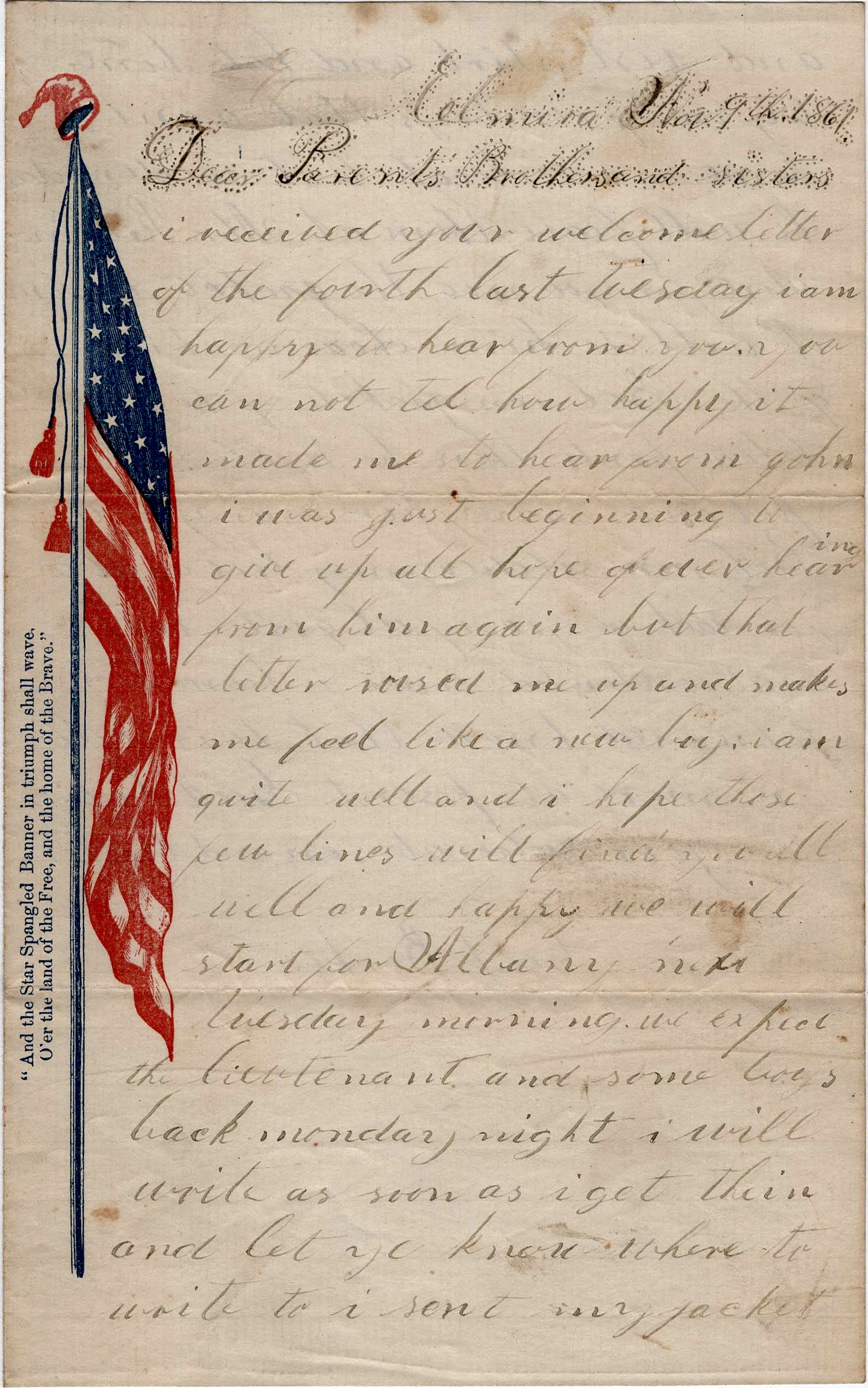
Elmira [New York] November 9, 1861
Dear Parents, Brothers and Sisters,
I received your welcome letter of the 4th last Tuesday. I am happy to hear from you. You cannot tell how happy it made me to hear from John. I was just beginning to give up all hope of ever hearing from him again but that letter roused me up and makes me feel like a new boy. I am quite well and I hope these few lines will find you well and happy.
We will start for Albany next Tuesday morning. We expect the lieutenant and some boys back Monday night. I will write as soon as I get there and let you know where to write to. I sent my jacket and vest, shirt and hat home by one of our boys that went home on a furlough last Wednesday. He will leave them at Mr. Reynolds’ store for you. Give the jacket to Jim. It will do him charm [?] It is one of the Bull Run jackets. If he gets blue pants, then he will be able to put on as many airs as any of the Bull Run soldiers.
My love and a [kiss] for each of you. I feel quite happy and contented since I heard from John and know that he is well. No more at present. Goodbye. Your affectionate son and brother. — George S. Burke
Letter 4
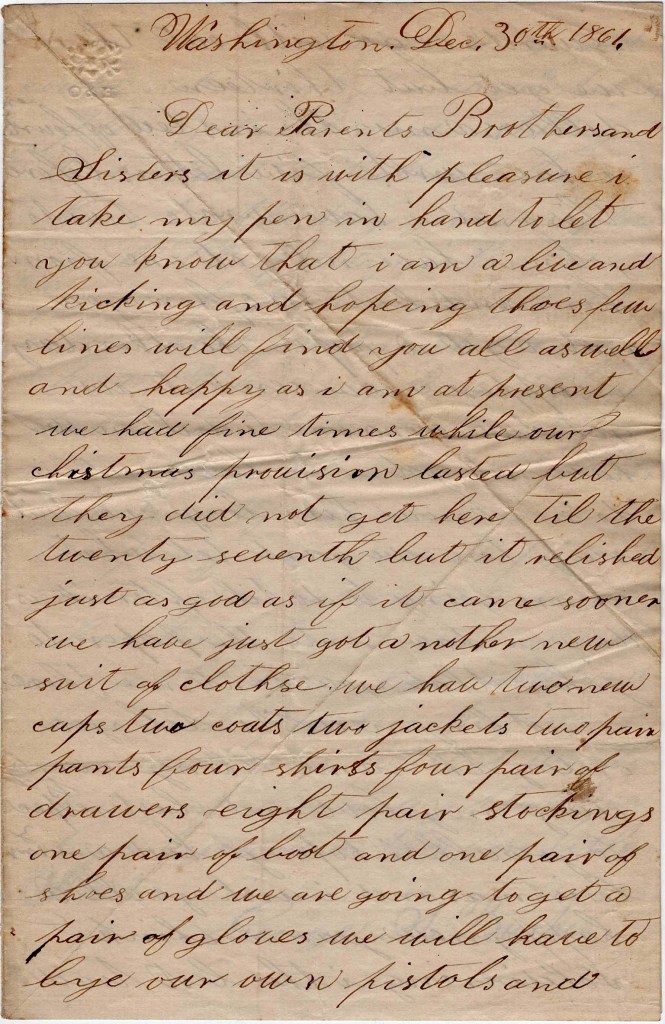
Washington [D. C.] December 30, 1861
Dear Parents, Brothers and Sisters,
It is with pleasure I take my pen in hand to let you know that I am alive and kicking and hoping these few lines will find you all as well and happy as I am at present. We had fine times while our Christmas provision lasted but they did not get here till the 27th, but it relished just as good as if it came sooner.
William S. Ostler also served in Reynold’s Battery.
We have just got another suit of clothes. We have two new caps, two coats, two jackets, two pair pants, four shirts, four pair of drawers, eight pair of stockings, one pair of boots, and one pair of shoes, and we are going to get a pair of gloves. We will have to buy our own pistols and swords or go without them. We get but 13 dollars a month instead of 14. I have wrote five letters before this and I have wrote two to John. I have not got one from him and but two from you. I got a paper the other day. I suppose you sent it.
We have got two cannons to drill on. We have not got our horses yet. I do not know how long we will stay here. We can’t tell what we are going to do till after it is done.
I have sent the paper to John that you sent me. There is nothing new to tell you—only the same thing every day.
My love and best respects to all. I hope ye had a Merry Christmas and I wish ye all a Happy New Year. I think soldiering is the best trade I ever was at. We could not wish for easier times—plenty to eat and nothing to do but drill about four hours in the day. Give my love to all the pretty girls and a kiss for each of you. I am glad to hear that Father’s shoulder is better.
Riley [Benedict] is sick in the hospital but I think he will [be] out in a few days. We have one hundred and twenty-two men in our company.
No more at present. From your affectionate son and brother. Where is Sis and what are ye all doing and how is the potatoes keeping? We have very pleasant weather. It is more like May than December. Goodbye. A kiss for little Ann. — George S. Burke
Letter 5
1863 photo of the 17th New York Battery in front of Camp Barry. Photo by Alexander Gardner. Click to enlarge. Library of Congress.
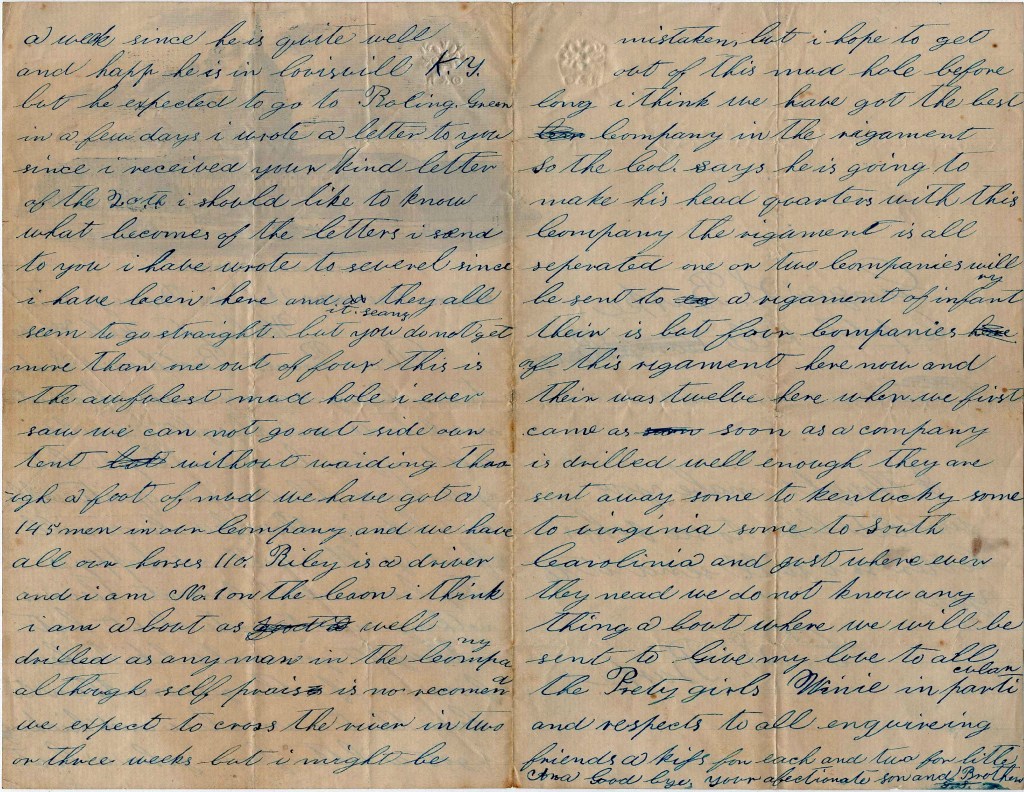
Headquarters 1st New York Light Artillery, Co. L Camp Barry, Washington D. C. February 3, 1862
Dear Parents, Brothers and Sisters,
Today being Sunday and I have not much to do, so I thought I would write a few lines mainly to let you know that I am quite well and hoping these few lines will find ye all as well and happy as they leave me at present. There is nothing new to write about but I thought you would like to hear from me if nothing more than to hear that I am alive and kicking.
I got a letter from John about a week since. He is quite well and happy. He is in Louisville, Kentucky, but he expected to go to Bowling Green in a few days. I wrote a letter to you since I received your kind letter of the 20th. I should like o know what becomes of the letters I send to you. I have wrote several since I have been here and they all seem to go straight. But it seems you do not get more than one out of four.
This is the awfullest mud hole I ever saw. We cannot go outside our tent without wading through a foot of mud. We have got 145 men in our company adn we have all our horses, 110. Riley [Benedict] is a driver and I am No. 1 on te cannon. I think I am about as well drilled as any man in the company although self praise os no recommend. We expect to cross the river in two or three weeks but I might be mistaken. But I hope to get out of this mud hole before long. I think we have got the best company in the regiment, so the Colonel says. He is going to make his headquarters with this company.
The regiment is all separated. One or two companies will be sent to a regiment of infantry. There is but four companies of this regiment here now and there was 12 here when we first came. As soon as a company is drilled well enough, they are sent away—some to Kentucky, some to Virginia, some to South Carolina, and just wherever they need. We do not know anything about where we will be sent to.
Give my love to all the pretty girls—Winnie in particular—and respects to all enquiring friends. A kiss for each and two for little Anna. Goodbye. Your affectionate son and brother, — George S. Burke. Capitol Hill
I thought maybe you would like to see John’s letter so I will send it to you. — G. S. Burke
Letter 6
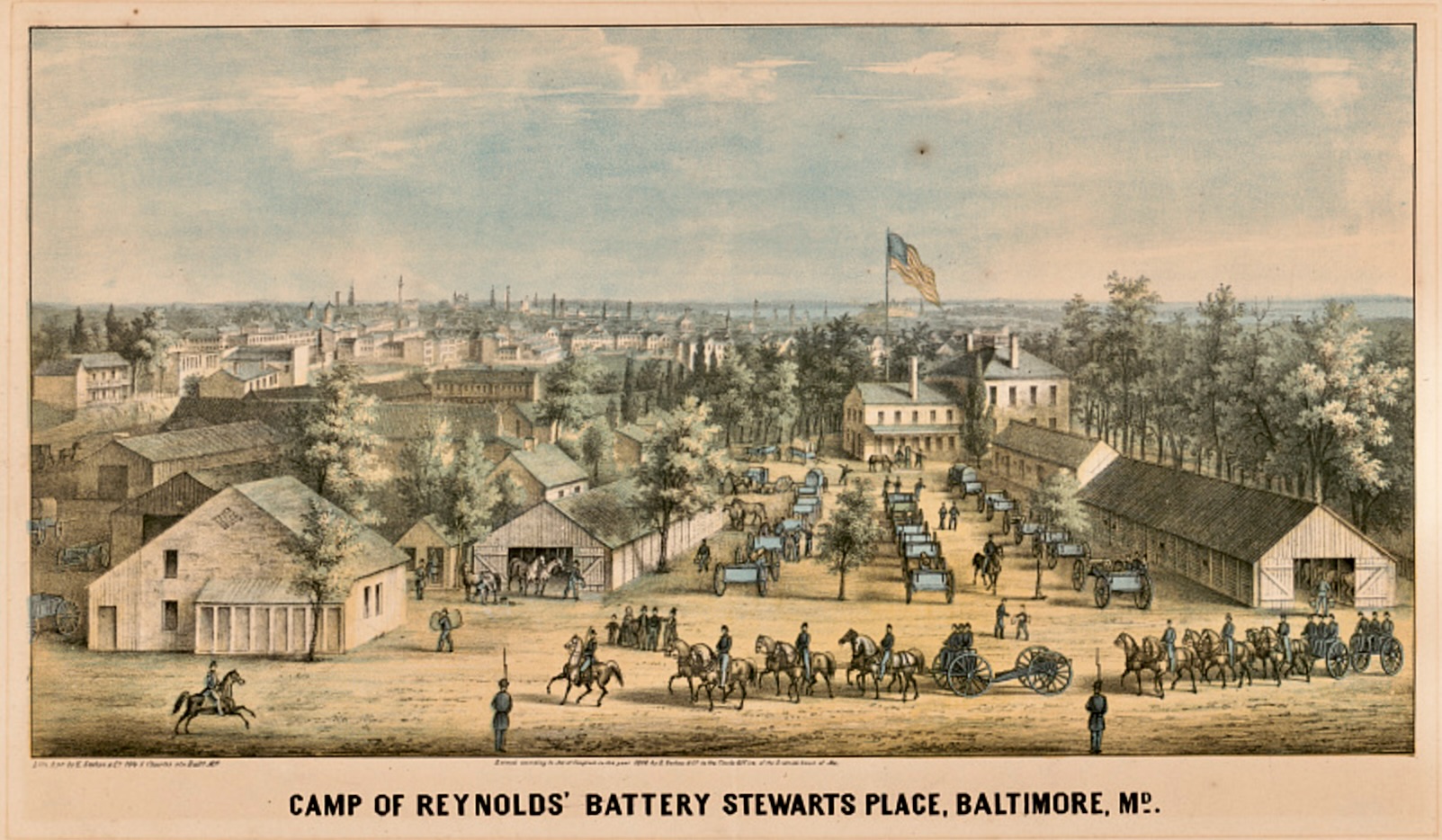
Stewart’s Place Baltimore, Maryland May 21, 1862
My dear parents, brothers and sisters,
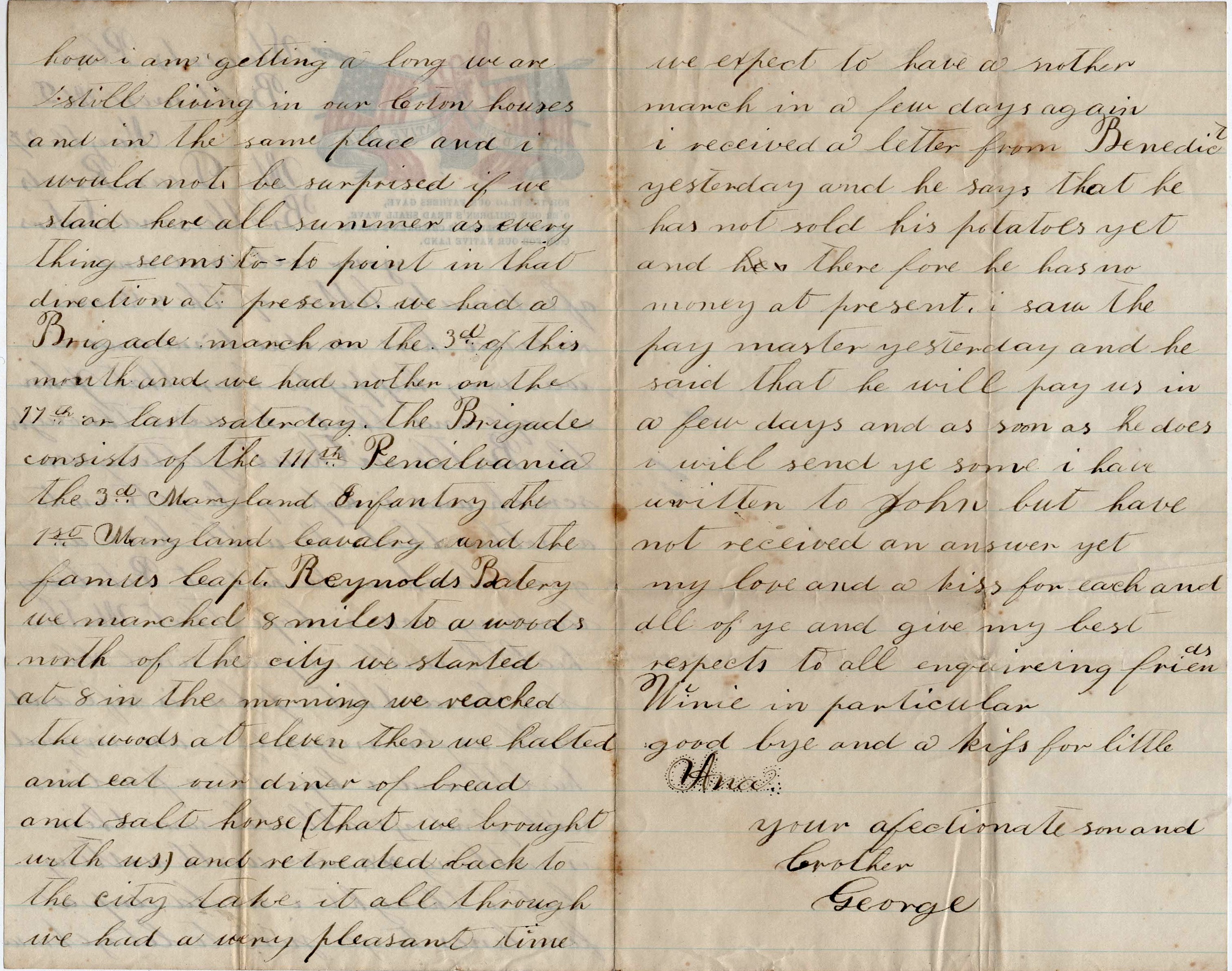
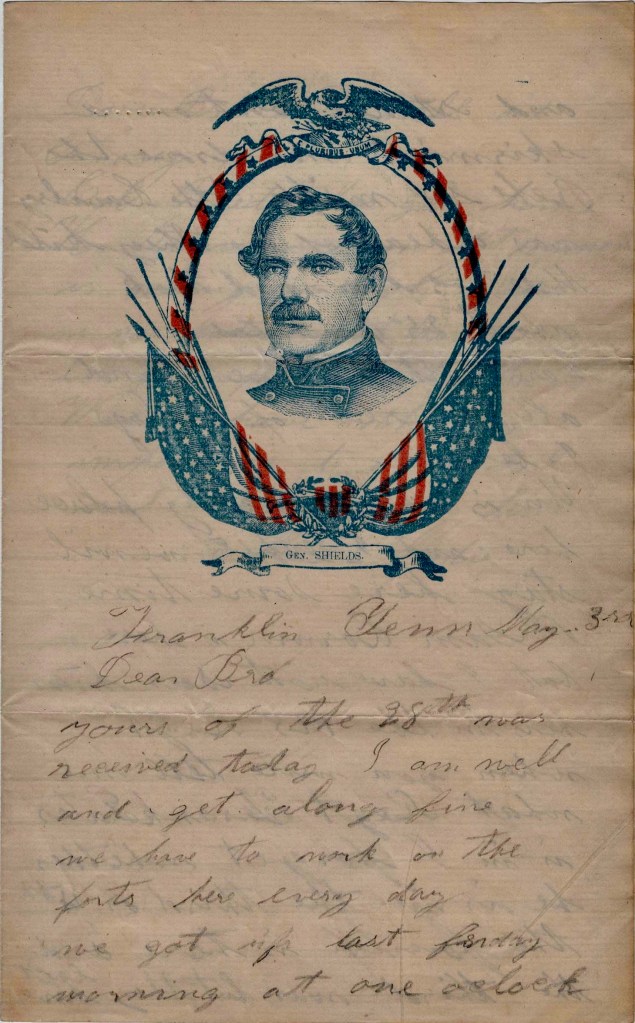
The patriotic imagery in George’s letter, “God and our Native Land.”
I am in good health and I hope these few lines will find ye all the same. There is nothing new worth writing but I thought I would drop a few lines to ye just to let ye know how I am getting along.
We are still living in our cotton houses and in the same place and I would not be surprised if we stayed here all summer as everything seems to point in that direction at present. We had a Brigade march on the 3rd of this month and we had another on the 17th or last Saturday. The Brigade consists of the 111th Pennsylvania, the 3rd Maryland Infantry, the 1st Maryland Cavalry, and the famous Capt. Reynolds’ Battery. We marched 8 miles to a woods north of the city. We started at 8 in the morning. We reached the woods at eleven. Then we halted and eat our dinner of bread and salt horse (that e brought with us) and retreated back to the city. Take it all through, we had a very pleasant time.
Your welcome and affectionate letter of the 5th was received here is due time adn I was very happy to hear that John is safe and that he went through the battle without getting even a scratch. And I hope he will have as good luck as he had at Pittsburg Landing now. I hope that Mother’s health will improve since she has heard that John is safe.
We expect to have another march in a few days again. I received a letter from Benedict yesterday and he says that he has not sold his potatoes yet and therefore he has no money at present. I saw the pay master yesterday and he said that he will pay us in a few days and as soon as he does, I will send ye some.
I have written to John but have not received any answer yet. My love and a kiss for each and all of ye, and give my best respects to all enquiring friends—Winnie in particular. Goodbye and a kiss for little Anna. Your affectionate son and brother, — George
Letter 7
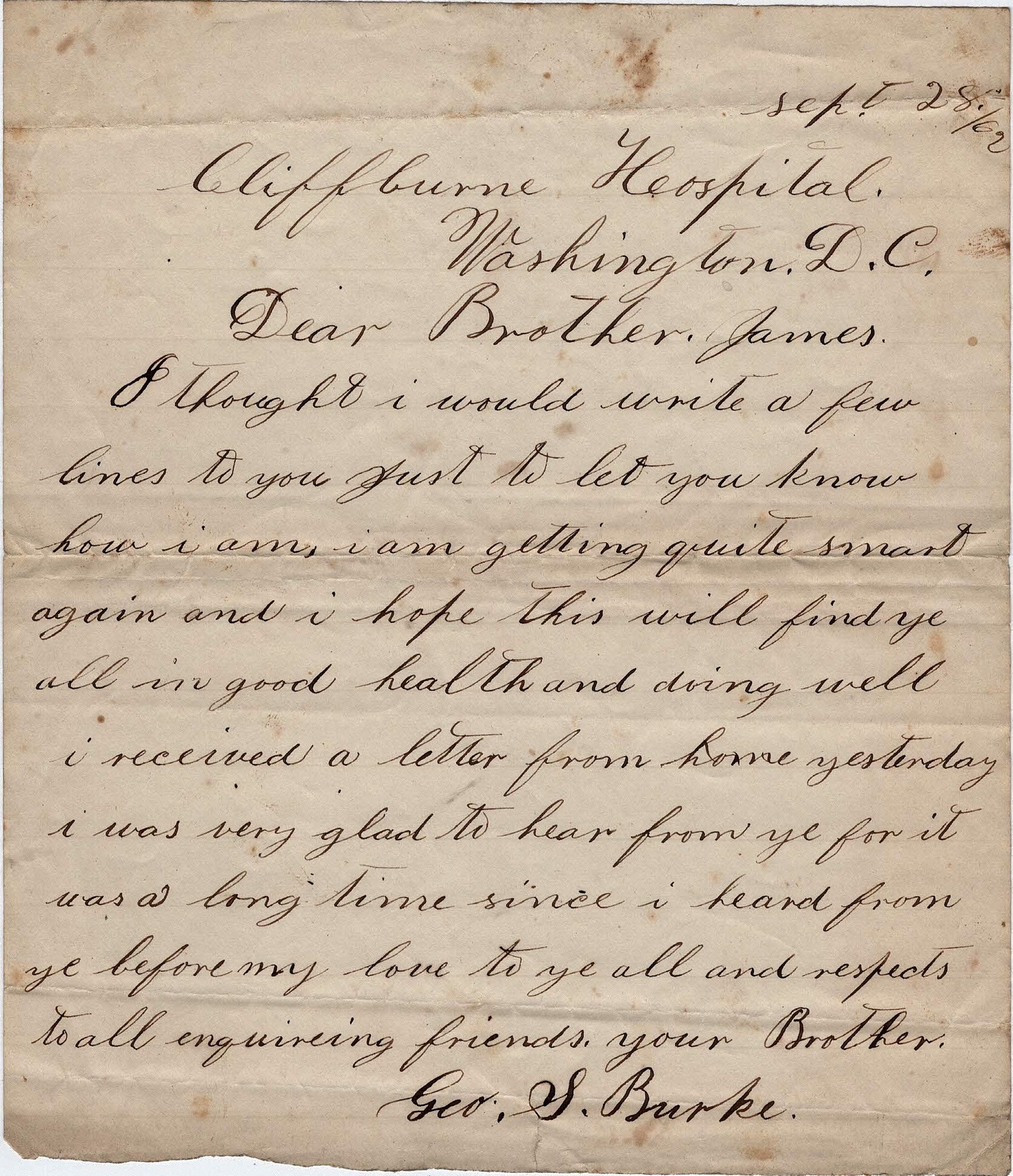
Cliffburne Hospital Washington D. C. September 28, 1862
Dear Brother James,
I thought I would write a few lines to you just to let you know hoe I am. I am getting quite smart again and I hope his will find ye al in good health and doing well. I received a letter from home yesterday. I was very glad to hear from ye for it was a long time since I heard from ye before.
My love to ye all and respects to all enquiring friends. Your Brother, — George S., Burke
Letter 8
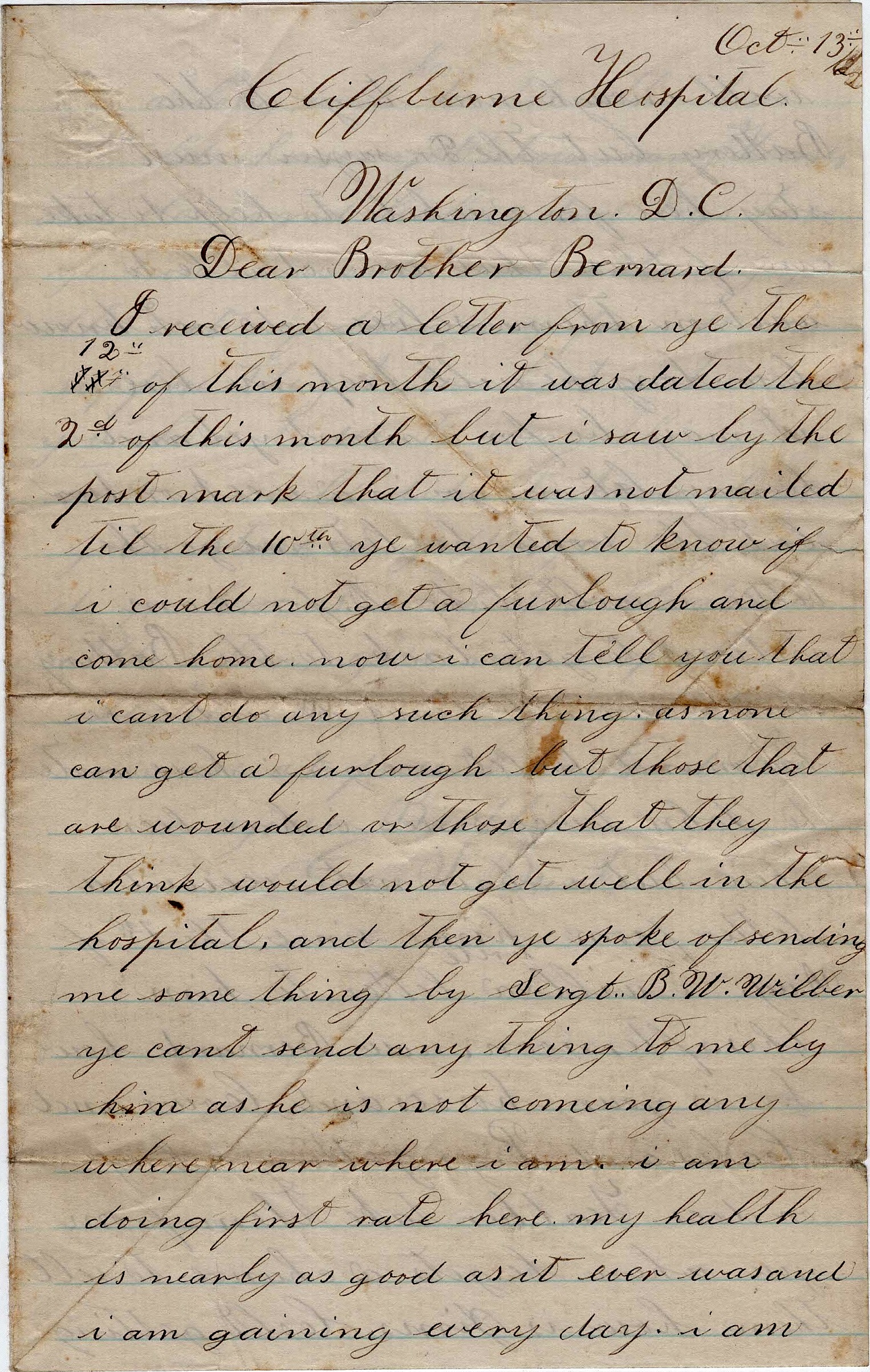
Cliffburne Hospital Washington D. C. October 15, 1862
Dear Brother Bernard,
I received a letter from ye the 12th of this month. It was dated the 2d of this month but I saw by the postmark that it was not mailed till the 10th. Ye wanted to know if I could not get a furlough and come home. Now I can tell you that I can’t do any such thing as none can get a furlough but those that are wounded or those they think would not get well in the hospital. And then ye spoke of sending me something by Sgt. B. W. Wilber. Ye can’t send anything to me by him as he is not coming anywhere near where I am.
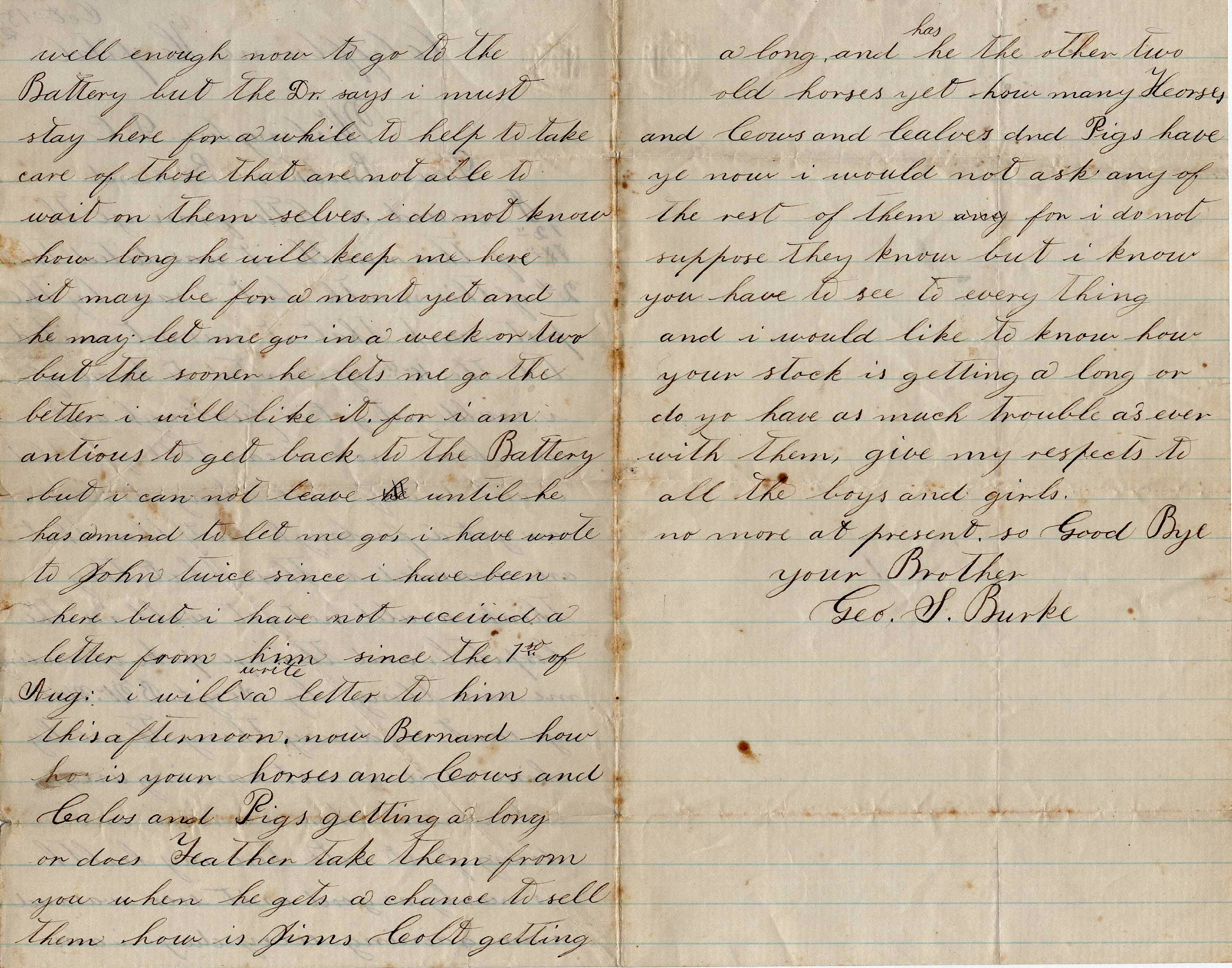
I am doing first rate here. My health is nearly as good as it ever was and well enough now to go to the Battery but the doctor says I must stay here for a while to help to take care of those that are not able to wait on themselves. I do not know how long he will keep me here. It may be for a month yet and he may let me go in a week or two. But the sooner he lets me go, the better I will like it for I am anxious to get back to the Battery. But I cannot leave until he has a mind to let me go.
I have wrote to John twice since I have been here but I have not received a letter from him since the 1st of August. I will write a letter to him this afternoon.
Now Bernard, how is your horses and cows and calves and pigs getting along? Or does Father take them from you when he gets a chance to sell them? How is Jim’s colt getting along? And has he the other two old horses yet? How many horses and cows and calves and pigs have ye now? I would not ask any of the rest of them for I do not suppose they know but I know you have to see to everything and I would like to know how your stock is getting along or do you have as much trouble as ever with them?
Give my respects to all the boys and girls. No more at present. So goodbye. Your brother, — George S. Burke
Letter 9
[Editor’s Note: George wrote this letter while serving in the 1st New York Veteran Cavalry]
Camp near Winchester, Virginia June 16, 1864
Dear Friends at home,
It is with pleasure I take this opportunity of writing a few lines to ye to let ye know that we are both well and hope these few lines will find ye the same. The last letter we got from ye was dated the 19th of April. We have seen some hard times since the last time I wrote to ye and we have done considerable hard fighting. We had a battle on the 5th of this month at Piedmont. We took 1500 prisoners, killing their commander, Gen. [Grumble] Jones. I saw him after he was dead. [see Battle of Piedmont]
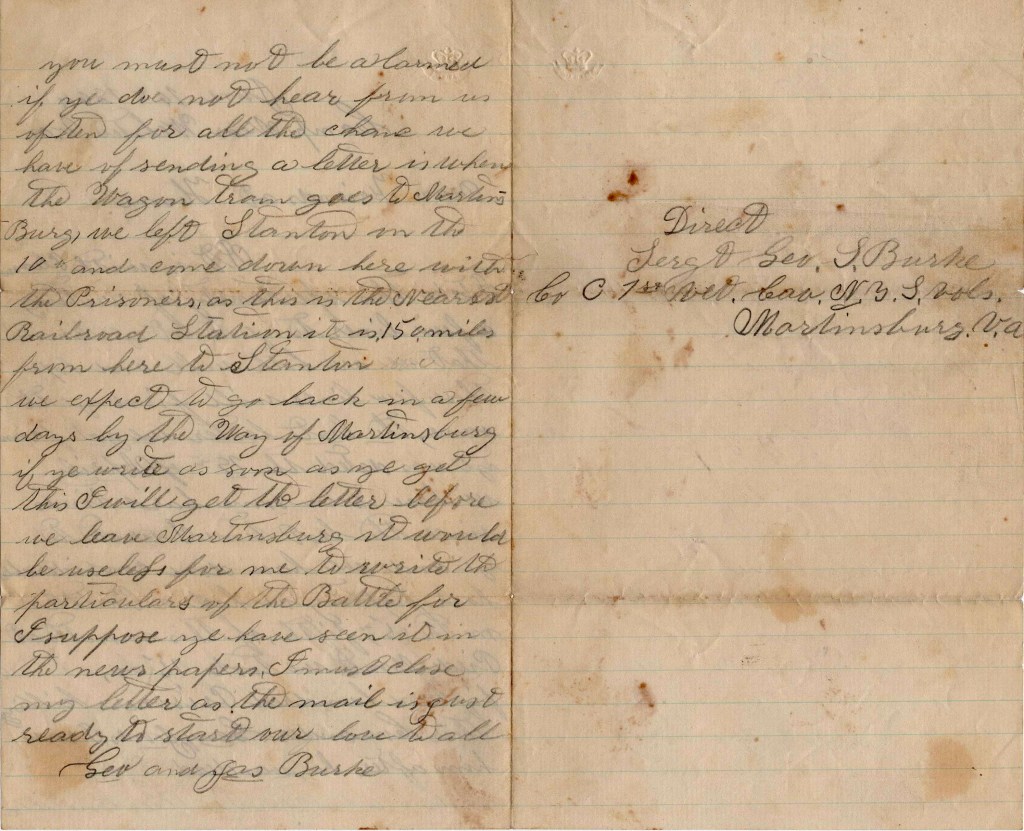
You must not be alarmed if ye do not hear from us often for all the chance we have of sending a letter is when the wagon train goes to Martinsburg. We left Staunton on the 10th and came down here with the prisoners as this is the nearest railroad station. It is 150 miles from here to Staunton. We expect to go back in a few days by the way of Martinsburg. If ye write as soon as ye get this, I will get the letter before we leave Martinsburg. It would be useless for me to write the particulars of the battle for I suppose ye have seen it in the newspapers.
I must close my letter as the mail is just ready to start. Our love to all, — George and James Burke
Direct to George S. Burke. Co. C, 1st Veteran Cavalry N. Y. Vols., Martinsburg, Va.
Letter 10
Camp Piatt, [15 miles. south of Charleston] West Virginia February 27, 1865
Dear Mother,
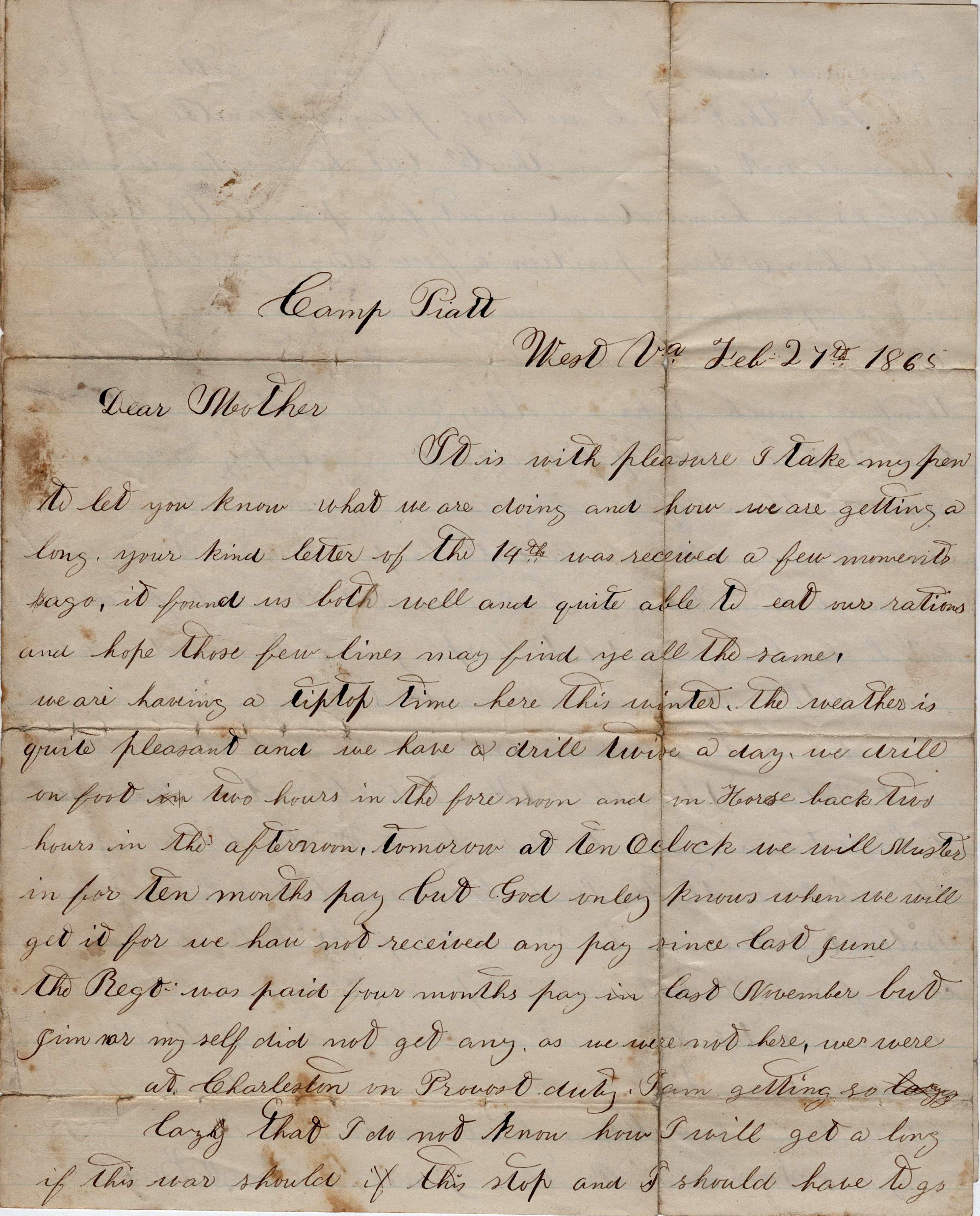
Itis with pleasure I take my pen to let you know what we are doing and how we are getting along. Your kind letter of the 14th was received a few minutes ago. It found us both well and quite able to eat our rations and hope these few lines may find ye all the same.
We are having a tip top time here this winter. The weather is quite pleasant and we have a drill twice a day. We drill on foot two hours in the forenoon and on horseback two hours in the afternoon. Tomorrow at 10 o’clock we will muster in for ten months pay but God only knows when we will get it for we have not received any pay since last June. The regiment was paid four months pay in last November but Jim nor myself did not get any as we were not here. We were at Charleston on Provost Duty. I am getting so lazy that I do not know how I will get along if this war should stop and I should have to go home and work for my living.
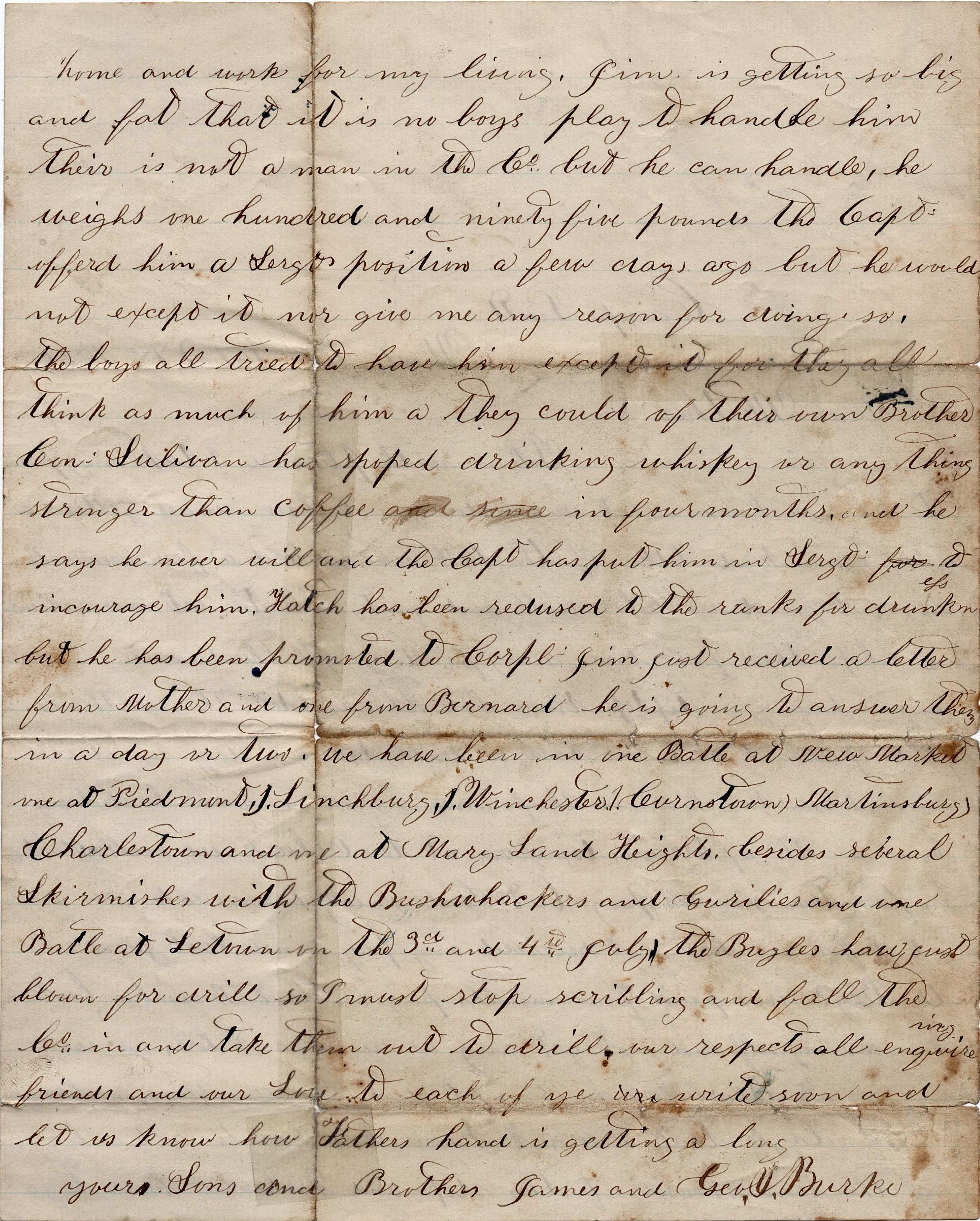
Jim is getting so big and fat that it is no boys play to handle him. There is not a man in the company but he can handle. He weighs 195 pounds. The Captain offered him a sergeant’s position a few days ago but he would not accept it nor give me any reason for doing so. The boys all tried to have him accept it for they all think as much of him as they could of their own brother.
Con. Sullivan has stopped drinking whiskey or anything stronger than coffee in four months and says he never will and the Captain has put him in [as] sergeant to encourage him. Hatch has been reduced to the ranks for drunkenness but he has been promoted to corporal.
Jim just received a letter from Mother and one from Barnard. He is going to answer them in a day or two. We have been in one battle at New Market, one at Piedmont, at Lynchburg, at Winchester, at Kernstown, at Martinsburg, at Charleston, and at Maryland Heights, besides several skirmishes with the bushwhackers and guerrillas and one Battle of Leetown on the 3rd and 4th of July.
The bugles have just blown for drill so I must stop scribbling and fall the company in and take them out to drill. Our respects to all enquiring friends and our love to each of ye. Write soon and let us know how Father’s hand is getting along. Your sons and brothers, — James and George S. Burke
A GAR Photo of George S. Burke, James’ older brother who served with him in the 1st NY Veteran Cavalry
James Burke (b. 1843), the son of Thomas Burke (1799-1879) and Mary Burke (1806-1877) of Irondequoit, Monroe county, New York. James Burke was 21 years old when he enlisted as a private on 12 August 1863 at Rochester, New York. On 10 October 1863, he mustered into Co. C, 1st New York Veteran Cavalry. He was mustered out on 20 July 1865 at Camp Piatt, West Virginia, after receiving promotions to corporal 7/1/1864 and sergeant 9/1/1864.
James served in the same company with his brother, George S. Burke (b. 1839), who served earlier in the war with Reynolds’ Battery, or Co. L, 1st N. Y. Light Artillery. George was a sergeant and rose to the rank of 1st Sergeant by the time he mustered out in July 1865 with his brother.
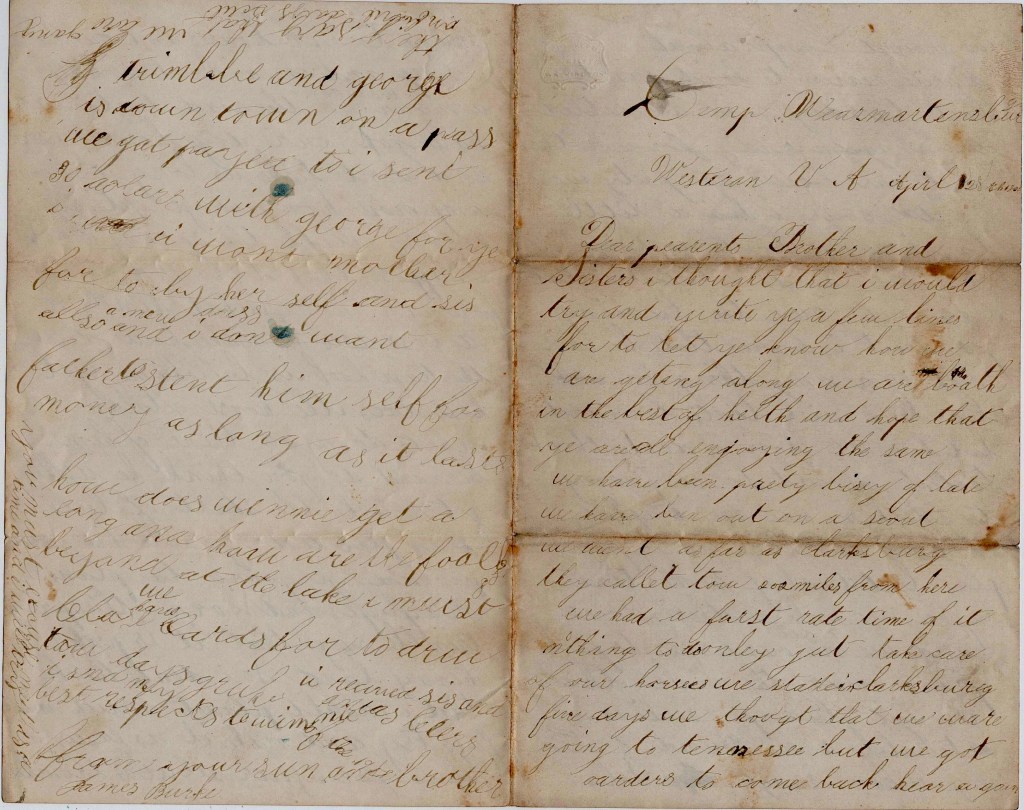
T R A N S C R I P T I O N
Camp near Martinsburg, Western Va. April 20, 1864
Dear Parents, Brother and Sisters,
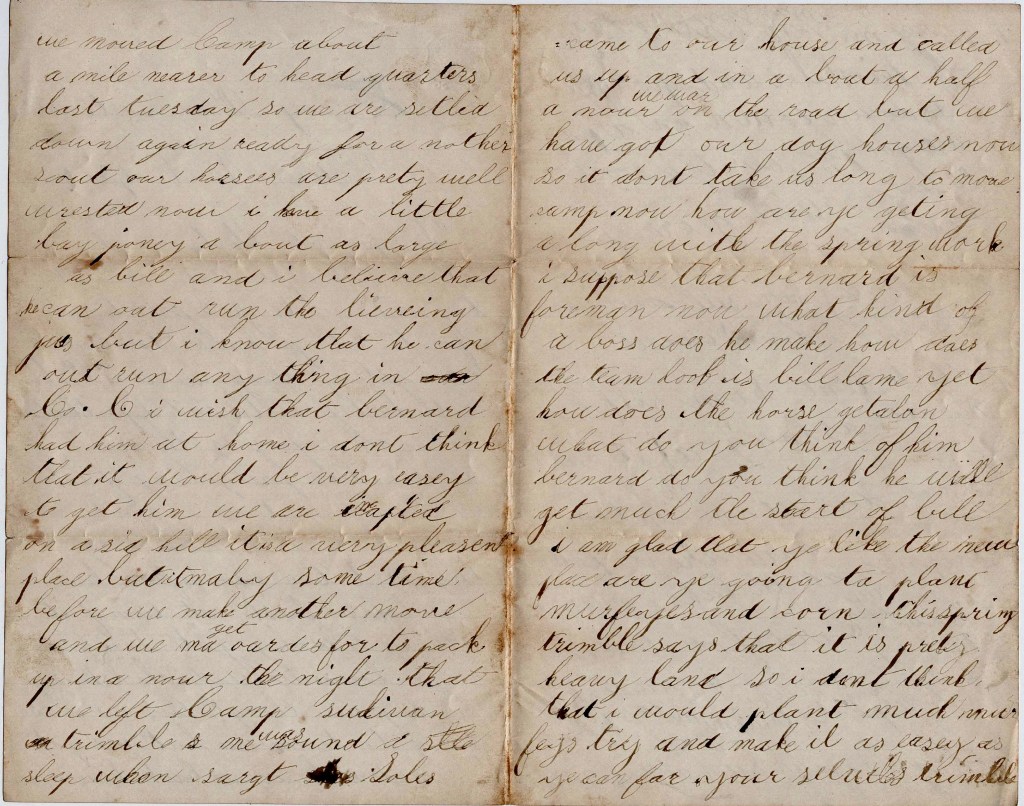
I thought that I would try and write you a few lines for to let you know how we are getting along. We are both in the best of health and hope that you are all enjoying the same. We have been pretty busy of late. We have been out on a scout. We went as far as Clarksburg, they call it, 202 miles from here. We had a first rate time of it. Nothing to do, only just take care of our horses. We stayed in Clarksburg five days. We thought that we were going to Tennessee but we got orders to come back here again.
We moved camp about a mile nearer to headquarters last Tuesday so we are settled down again ready for another scout. Our houses are pretty well erected now. I have a little bay pony about as large as Bill and I believe that he can outrun anything in Co. C. I wish that Bernard had him at home. I don’t think that it would be very easy to get him.
We are encamped on a side hill. It is a very pleasant place, but it may be some time before make another move and we may get orders to pack up in an hour. The night that we left Camp Sullivan, Trimble and me was sound asleep when Sergt. Sales [?] came to our house and called up up, and in about a half an hour we was on the road. But we have got our dog houses now so it don’t take us long to move camp now.
How are ye getting along with the spring work? I suppose that Bernard is foreman now. What kind of a boss does he make? How does the team look? Is Bill lame yet? How does the [new] horse get along? What do you think of him? Bernard, do you think he will get much the start of Bill?
I am glad that you like the new place. Are ye going to plant murfeys [?] and corn this spring? Trimble says that it is pretty heavy land so I don’t think that I would plant murfeys. Try and make it as easy as ye can for yourselves. I, Trimble, and George is down town on a pass. All got paid too. I sent 30 dollars with George for ye. I want Mother for to buy herself, and Sis also, a new dress/ I don’t want Father to stint himself for money as long as it lasts.
How does Winnie get along and how are the folks beyond at the lake? I must close. We have orders for to draw two days grub. My best respects to Winnie. From your son and brother, — James Burke
The following letters were written by John T. Burke (1837-1863), the eldest son of Thomas Burke (1799-1879) and Mary Burke (1806-1877) of Irondequoit, Monroe county, New York. Muster rolls inform us that Sgt. John T. Burke enlisted on 10/15/1861 at Smithland, Kentucky. On 1/6/1862, he mustered into Co. K, 20th Kentucky Infantry. He was killed January 3rd, 1863 at the Battle of Stones River, Tennessee, and is buried at Stones River National Cemetery.
The 1860 US Census identifies John T. Burke’s occupation as a “Nurseryman.” His earliest letter is written from Commerce, Missouri, in December 1860, where he is working as a teacher. A later letter of 25 June is written from Blandville, Kentucky, and here John indicates that he is going to go into partnership with another in a “nursery and orchard business.” He further described the wild landscape of Kentucky stating that “I am going away from here. The country is so wild I cannot go from one house to another without getting lost….”
Returning to Commerce, John enlisted with a Battalion of Home Guards in the early months of the war, only to resign because “I thought it was better to give up my office than to have to act with men that I was ashamed of their deeds even though they were for the Union.” Backtracking once again, John headed to Kentucky and enlisted in the 20th Regiment Kentucky Volunteers. The new regiment suited John, and he describes much related to the general life of the regiment and the soldier, and the politics of regimental officers. One of his more notable letters was written from “3 miles east from Corinth in the woods, May 19th 1862.” In it, John described skirmishing and ultimately taking possession of Corinth, noting the plunder they recovered after the hasty Confederate retreat.
John’s younger siblings were George S. Burke (ca 1839-1931) and James Burke (ca 1843-?) also served in the war. George Burke enlisted as a private on 8/5/1863. On 8/5/1863, he mustered into New York 14th Heavy Artillery. He transferred out on 10/10/1863 and on 10/10/1863, he transferred into “C” Co. New York 1st Vet Cavalry. He was Mustered Out on 7/20/1865 at Camp Piatt, WV, after receiving promotions to Sergt 11/1/1863 and 1st Sergt 3/1/1865. James Burke was 21 years old when he enlisted as a private on 8/12/1863 at Rochester, NY. On 10/10/1863, he mustered into “C” Co. New York 1st Vet Cavalry. He was Mustered Out on 7/20/1865 at Camp Piatt, WV after receiving promotions to Corpl 7/1/1864 and Sergt 9/1/1864.
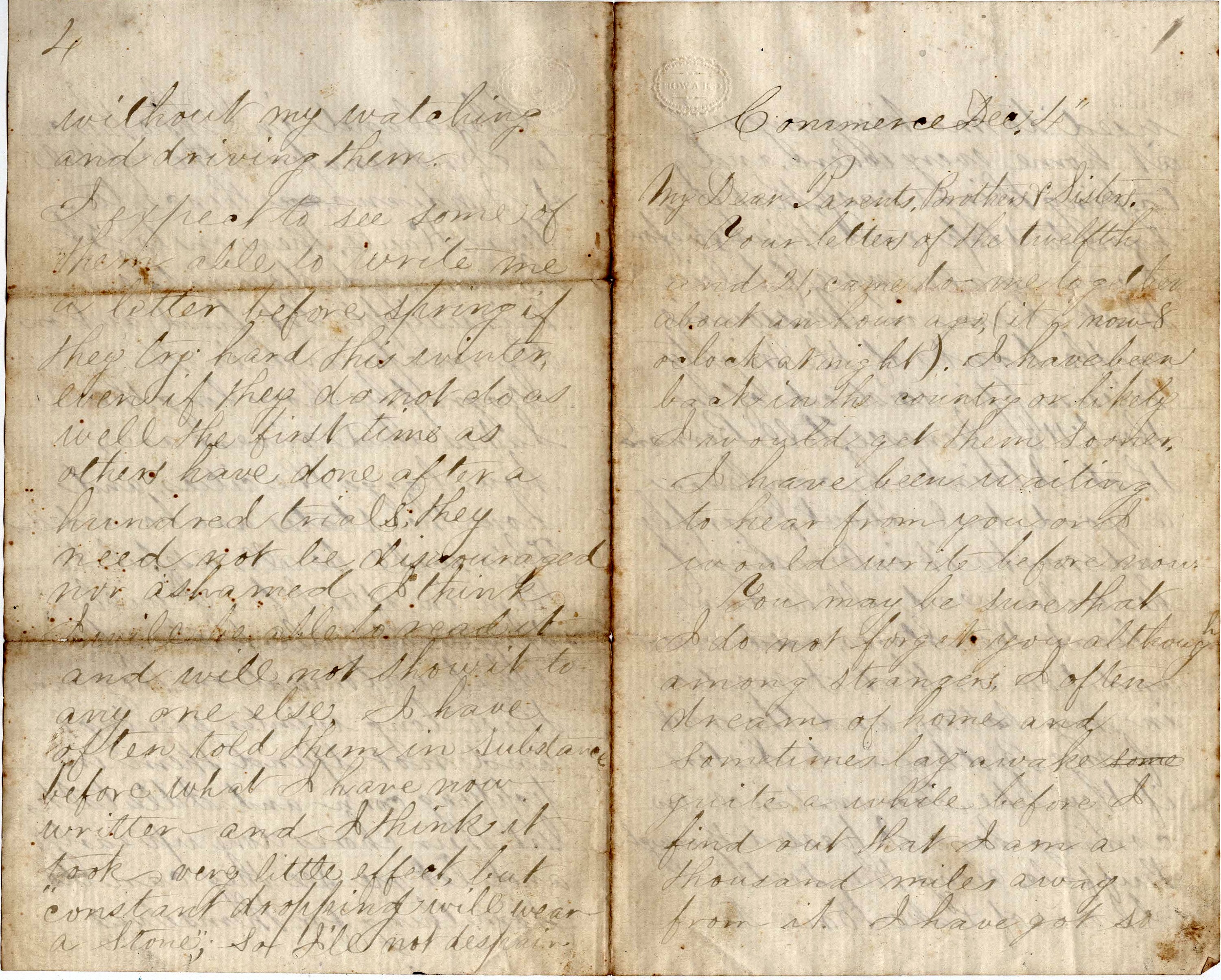
Letter 1
Commerce, [south of Cape Girardeau, Missouri, on Mississippi River] December 4 [1860]
My dear Parents, Brothers & Sisters,
Your letters of the 12th and 21st came to me together about an hour ago (it is now 8 o’clock at night). I have been back in the country or likely I would get them sooner. I have been waiting to hear from you or I would write before now. You may be sure that I do not forget you. Although among strangers, I often dream of home and sometimes lay awake quite a while before I find out that I am a thousand miles away from it. I have got so used to making myself at home everywhere, and taking things easy, that I have to stop and think before I can make myself believe that I am in Missouri on the banks of the mighty Mississippi instead of on the Little Genesee.
Tell Bernard that I think I can learn a good deal about geography and make it interesting if he will read all he can about the States, rivers and towns that I mention in my letters and the rest of my brothers and sisters if they like. For instance, in coming here, I passed through Buffalo, along the south shore of Lake Erie to Cleveland in Ohio, thence to Indianapolis—the capitol of Indiana, thence to Terre Haute, then on to St. Louis and down the Mississippi. Let [him] find out on the map and in the georgraphy [book] how long the lakes and rivers are, how large the cities, and how the States are bounded. This will be all useful to them in after life. I wish they would all pick up what information they can these long winter evenings and not spend them in popping corn and idle talk. Get their chores done up early and let me see they can do something for themselves without my watching and driving them.
I expect to see some of them able to write me a letter before spring if they try hard this winter. Even if they do not do as well the first time as others have done, after a hundred trials, they need not be discouraged nor ashamed. I think t’will be able to read it and will not show it to anyone else. I have often told them in substance before what I have now written and I think it took very little effect. But constant dropping will wear a stone, so I’ll not despair of having a brother to succeed Lincoln yet, or a sister not prepared to move in any responsible society—even in the White House. Let them remember that the President elect was a flat boatman, a rail splitter, and brought up in the woods. Now he is the people’s candidate for the highest office in the world. Hard study has done it all.
But I must leave lectures and Presidents to tell that I am getting tougher, stronger, and healthier every day. When I got here, I was hardly able to ride a horse six miles. Now I could kill a mule or walk seventeen miles as I did yesterday and not tire. I had a few hard shakes [of the ague] last month, but I shook them off.
We had what you would call fine weather for November. The ground froze about three inches on the 24th. We had snow the 23rd, 24th and part of Sunday, the 25th. Last week was fine until Sunday when we got a little more snow and frost that went away yesterday. Today was clear and cold and bracing, healthy weather. I am beside a comfortable fire in a fore place at Reynold’s Hotel in Commerce. I am nearly through with the trees. Had very little trouble with them although these folks are rather slow. I have hardly made up my mind yet as to what I will do this winter. I will write again in about ten days and let you know.
Have patience till then and do not tire the postmaster. I wish I could send this letter by telegraph but I cannot so bidding you all a good night, I remain your affectionate son and brother, — John
As quick as the Banks out here stop breaking, I will send Jim his money. In the meantime, I will talk to Bob Toates, — J. T. B.
I got the papers. Glad you sent them.
Letter 2
Commerce, Missouri April 15, 1861
Dear Parents,
I have been anxiously waiting for a letter ever since March. I received that book you sent me and expected a letter but got none. I knew that you were to move the first of April and I thought you would tell me where to [direct].
I am afraid you have no good news or you would sent it. Let me know the worst. Tell me how you are all getting along. How and where is George and Sis? I receive my paper regularly. The mail boat brings it every Tuesday. If I get a letter from you tomorrow, I’ll answer it immediately and send you all the news I can pick up.
My health is first rate. This country and school teaching agree first rate. This is the finest Spring I ever saw. My school will be out in two weeks. Can I do anything at home to earn my salt? If not, I think I had better stay here until fall. I have better wages and easier work than ever I had at home. Summer has almost commenced. The woods are full of flowers and covered with green.
We are thinking about planting corn this week.
Give my love to all. Where is Jimmy Peacock? Who is selling for George this year? I will write you a longer letter in a few days. Your affectionate son and brother, — John
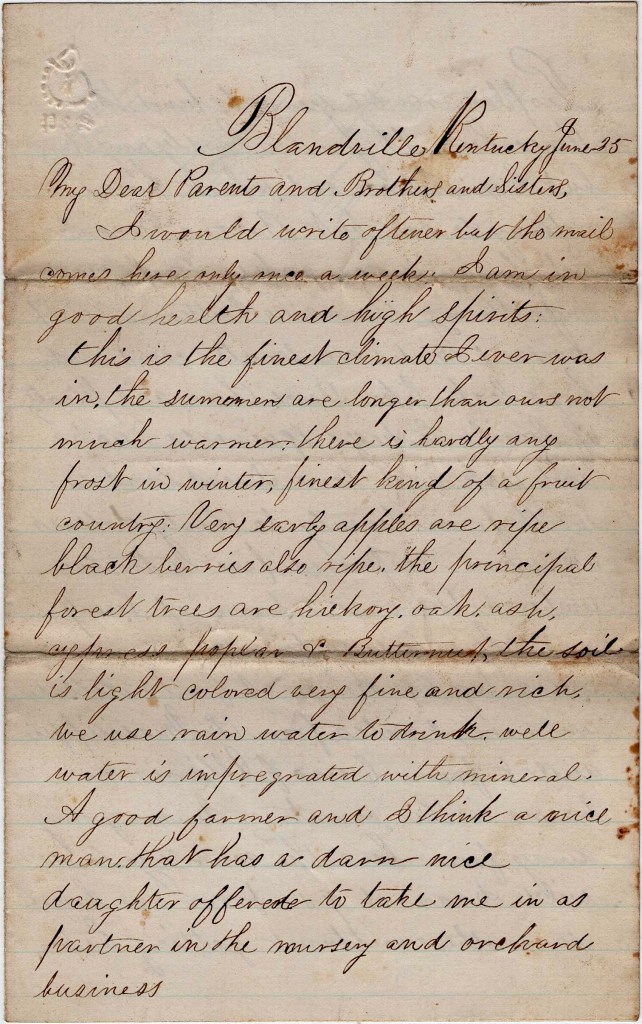
Letter 3
Blandeville, Kentucky June 25, [1861]
My dear Parents and Brothers & Sisters,
I would write oftener but the mail comes here only once a week. I am in good health and high spirits. This is the finest climate I ever was in. The summers are longer than our; not much warmer. There is hardly any frost in winter, finest kind of a fruit country. Very early apples are ripe, blackberries also ripe. The principal forest trees are hickory, oak, ash, cypress, poplar, and butternut. The soil is light colored, very fine and rich. We use rain water to drink. Well water is impregnated with mineral. A good farmer and I think a nice that has a darn nice daughter offered to take me in as partner in the nursery and orchard business.
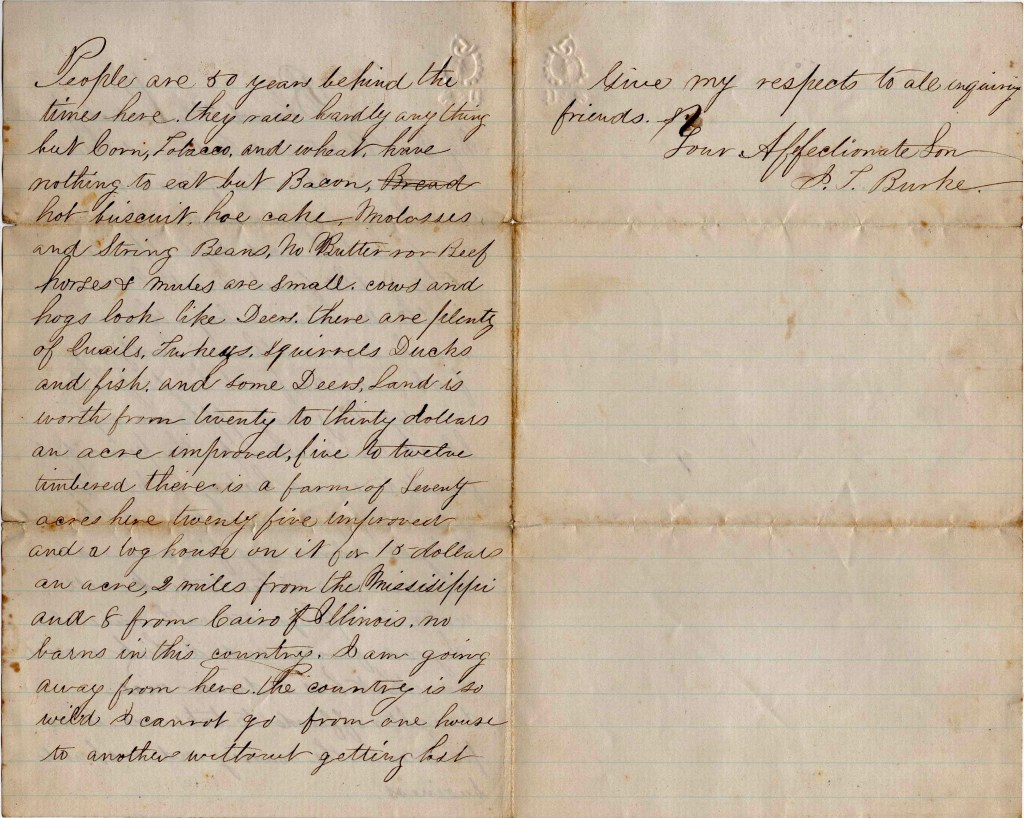
People are 50 years behind the times here. They raise hardly anything but corn, tobacco, and wheat. Have nothing to eat but bacon, hot biscuit, hoe cake, molasses, and string beans. No butter nor beef. Horses and mules are small. Cows and hogs look like deers. There are plenty of quails, turkeys, squirrels, ducks and fish, and some deers. Landis worth from twenty to thirty dollars an acre improved, five to twelve timbered. There is a farm of seventy acres here—twenty-five improved and a log house on it for 15 dollars an acre, 2 miles from the Mississippi and 8 from Cairo, Illinois. No barns in this country. I am going away from here. The country is so wild I cannot go from one house to another without getting lost.
Give my respects to all enquiring friends. Your affectionate son, — J. T. Burke
Letter 4
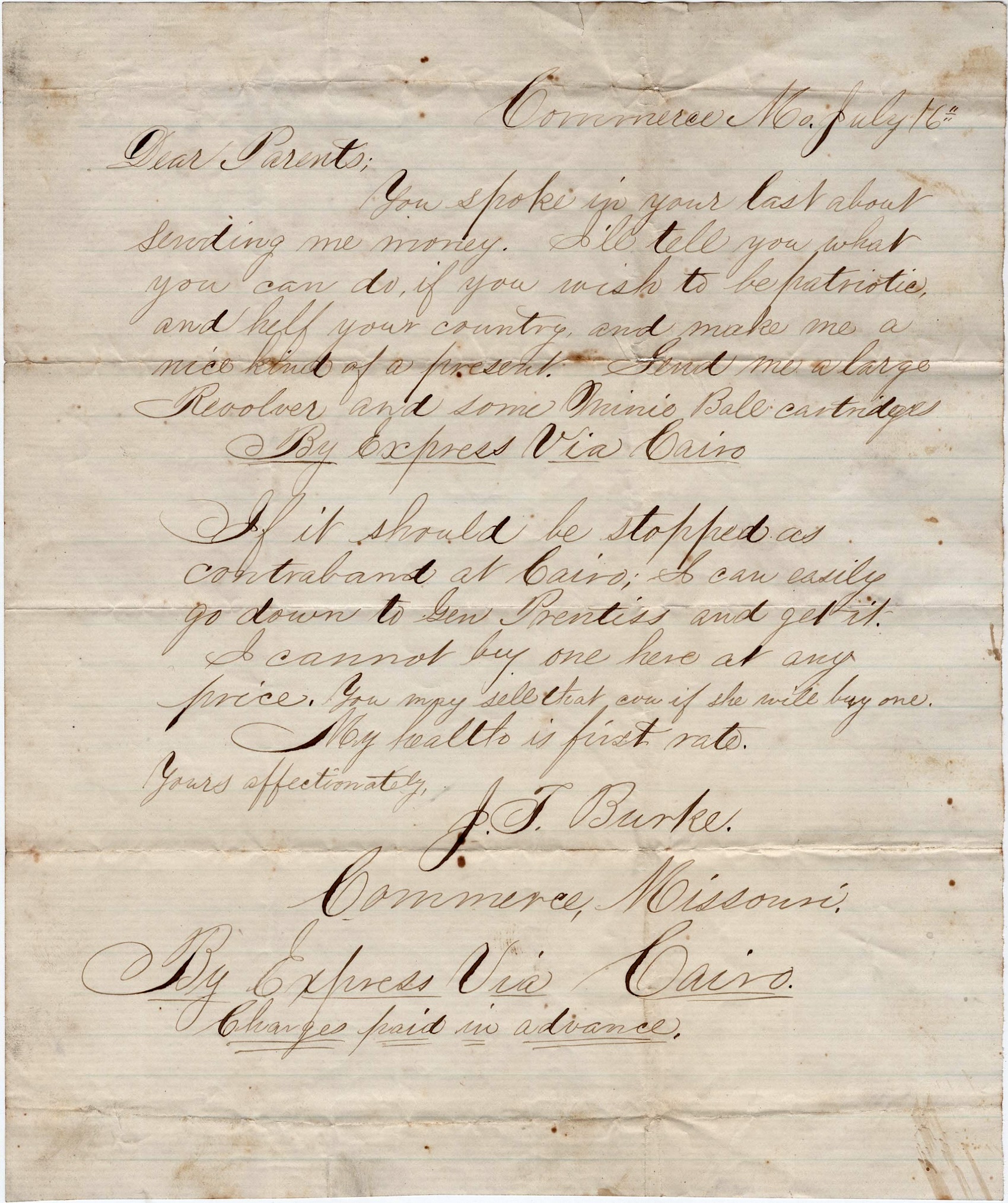
Commerce, Missouri July 16 [1861]
Dear Parents,
You spoke in your last about sending me money. I’ll tell you what you can do if youy wish to be patriotic and help your country, and make me a nice kind of a present. Send me a large revolver and some Minié ball cartridges by express via Cairo. If it should be stopped as contraband at Cairo, I can easily go down to Gen. Prentiss and get it. I cannot buy one here at any price. You may sell that cow if she will buy one. My health is first rate. Yours affectionately, — J. T. Burke
Commerce, Missouri
By Express via Cairo. Charges paid in advance.
Letter 5
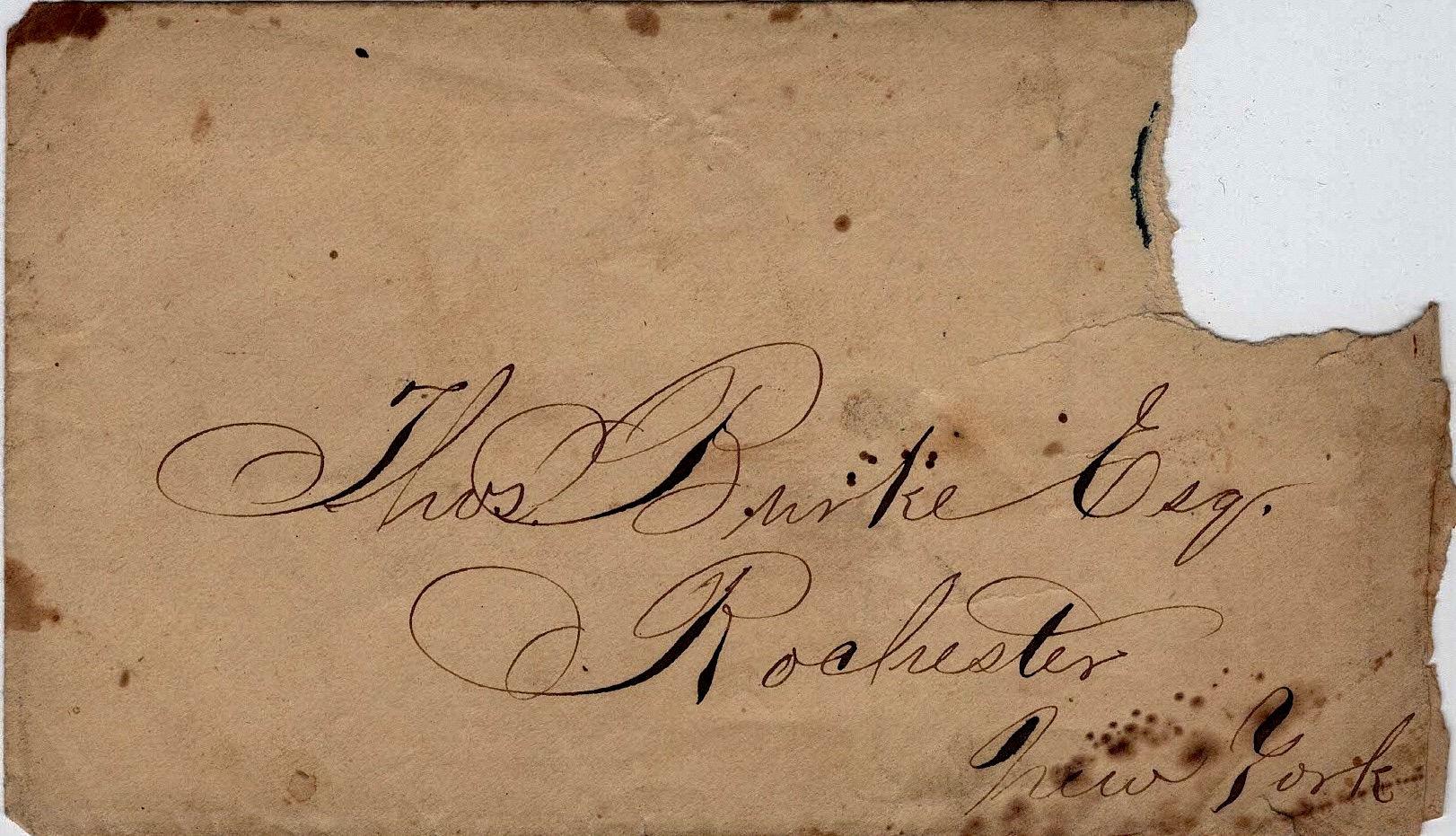
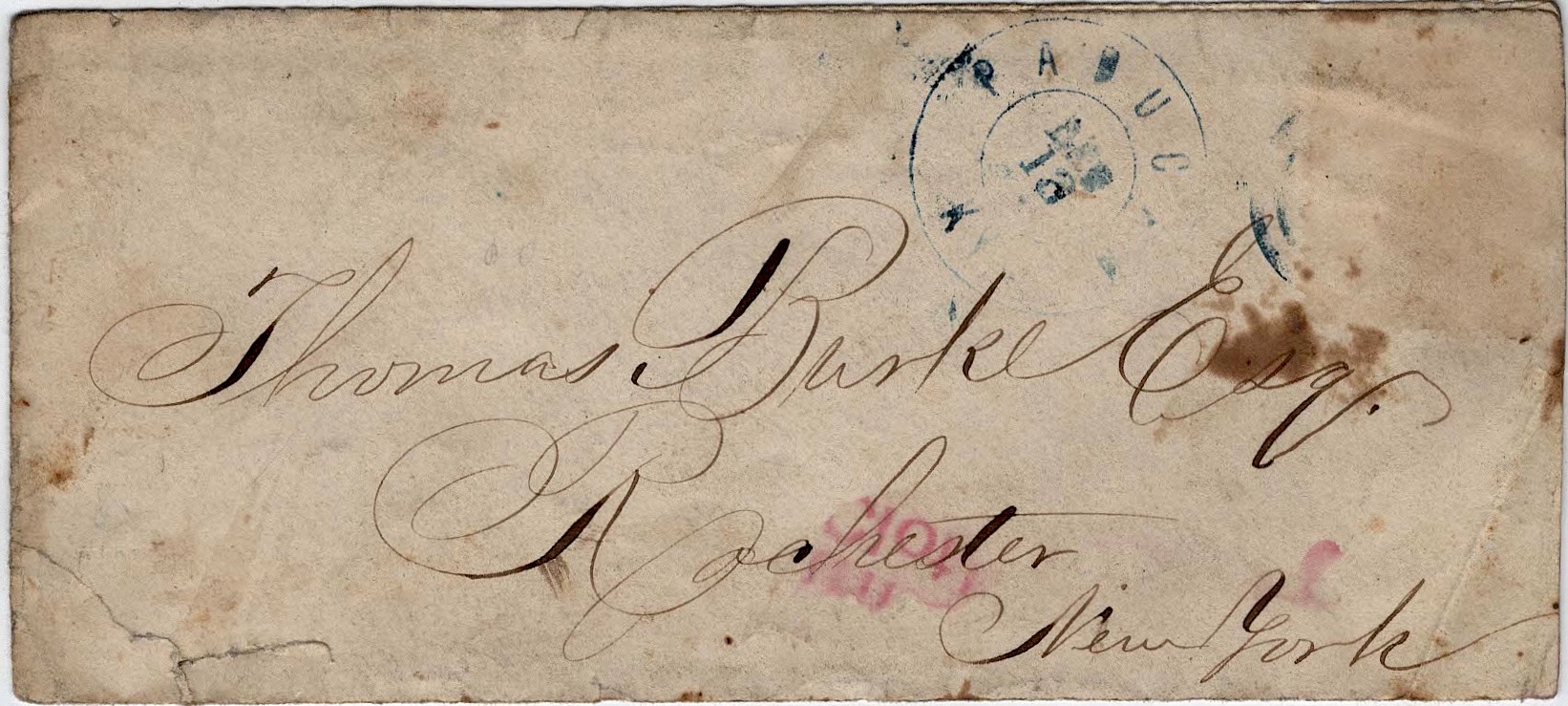
Addressed to Thomas Burke, Esq., Rochester, New York
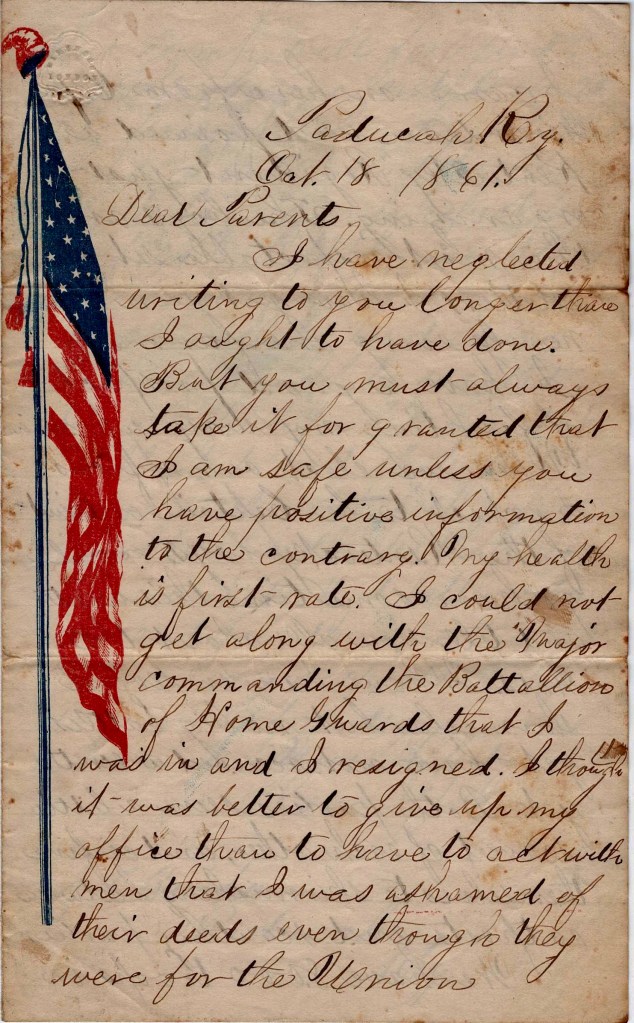
Paducah, Kentucky October 18, 1861
Dear Parents,
I have neglected writing to you longer than I ought to have done. But you must always take it for granted that I am safe unless you have positive information to the contrary. My health is first rate. I could not get along with the Major commanding the Battalion of Home Guards that I was in and I resigned. I thought it was better to give up my office than to have to act with men that I was ashamed of their deeds even though they were for the Union.
I came in here from Cape Girardeau and joined a Kentucky Regiment just organizing. The boys are the most respectable set of soldiers I have yet seen. Nearly every one [are] farmers. I have a good prospect of fighting my way up again. When we elect our officers, I expect to be Captain or Lieutenant of the Kentucky boys. I will go home some time this winter and tell you all about the wars. I have been in several skirmishes but no big battles yet. Have not received a scratch yet. Both parties seem a little scared of each other and confine themselves to skirmishing between outposts and scouting parties.
We have 8,000 troops in this camp, well fortified. Tell George not to enlist at present. When I get settled here, I will send for him if there is any prospect for a fight. But he would soon get tired of lying in camp doing nothing and losing his health. If he wants to try camp life, let him take a blanket and sleep out doors with wet feet a few nights. He had better come on and join the army.
Give my respects to all enquiring friends. Your affectionate don, — John
J. T. Burke, Paducah, Kentucky
Letter 6
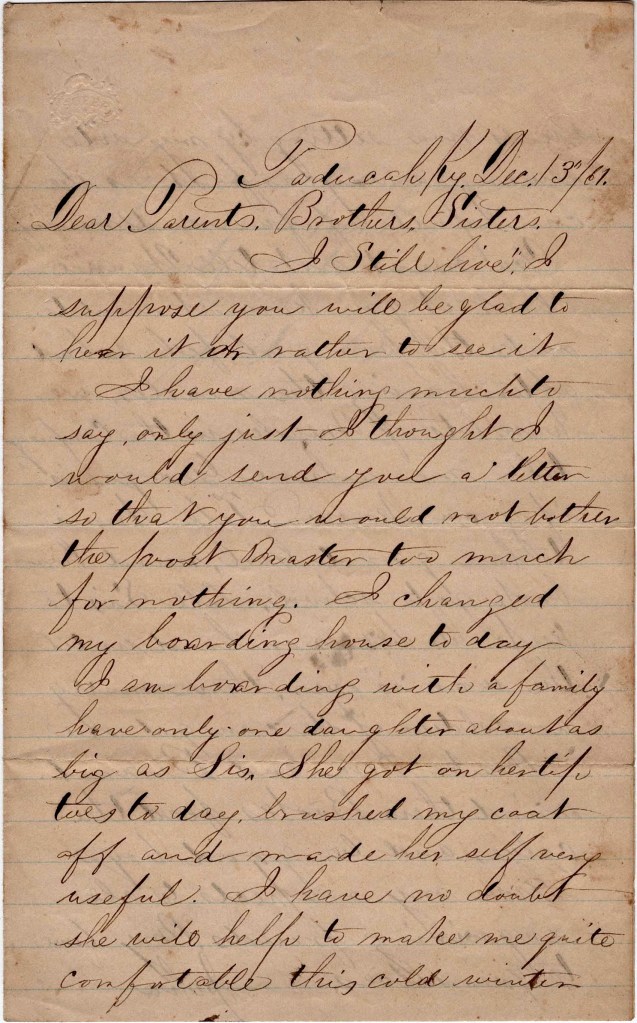
Paducah, Kentucky December 13, 1861
Dear Parents, Brothers & Sisters,
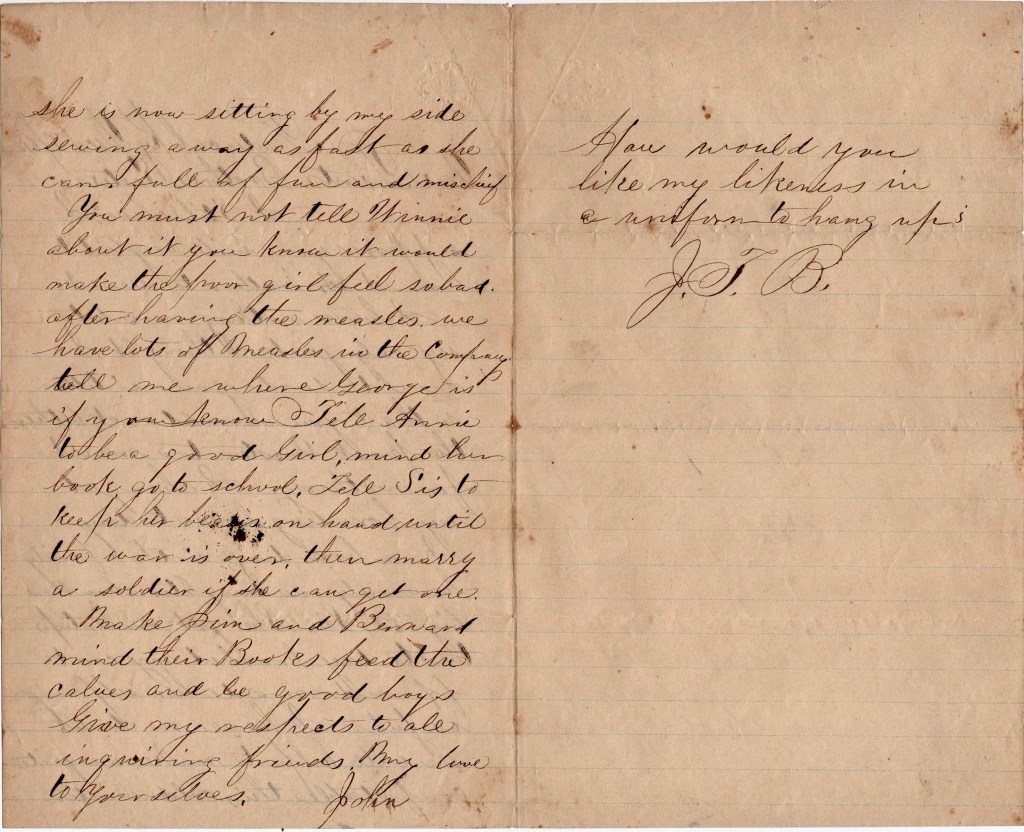
I still live! I suppose you will be glad to hear it or rather to see it. I have nothing much to say—only just I thought I would rather send you a letter so that you would not bother the Post Master too much for nothing. I changed my boarding house today. I am boarding with a family. Have only one daughter about as big as Sis. She got on her tip toes today, brushed my coat off and made herself very useful. I have no doubt she will help to make me quite comfortable this cold winter. She is now sitting by my side sewing away as fast as she can, full of fun and mischief. You must not tell Winnie about it. You know it would make the poor girl feel so bad after having the measles.
We have lots of measles in the company. Tell me where George is if you know. Tell Annie to be a good girl, mind her book, go to school/ Tell Sis to keep her beaus on hand until the war is over, then marry a soldier is she can get one.
Make Jim and Barnard mind their books, feed the calves, and be good boys. Give my respects to all inquiring friends. My love to yourselves. — John
How would you like my likeness in a uniform to hang up? — J. T. B.
Letter 7
[partial letter, undated]
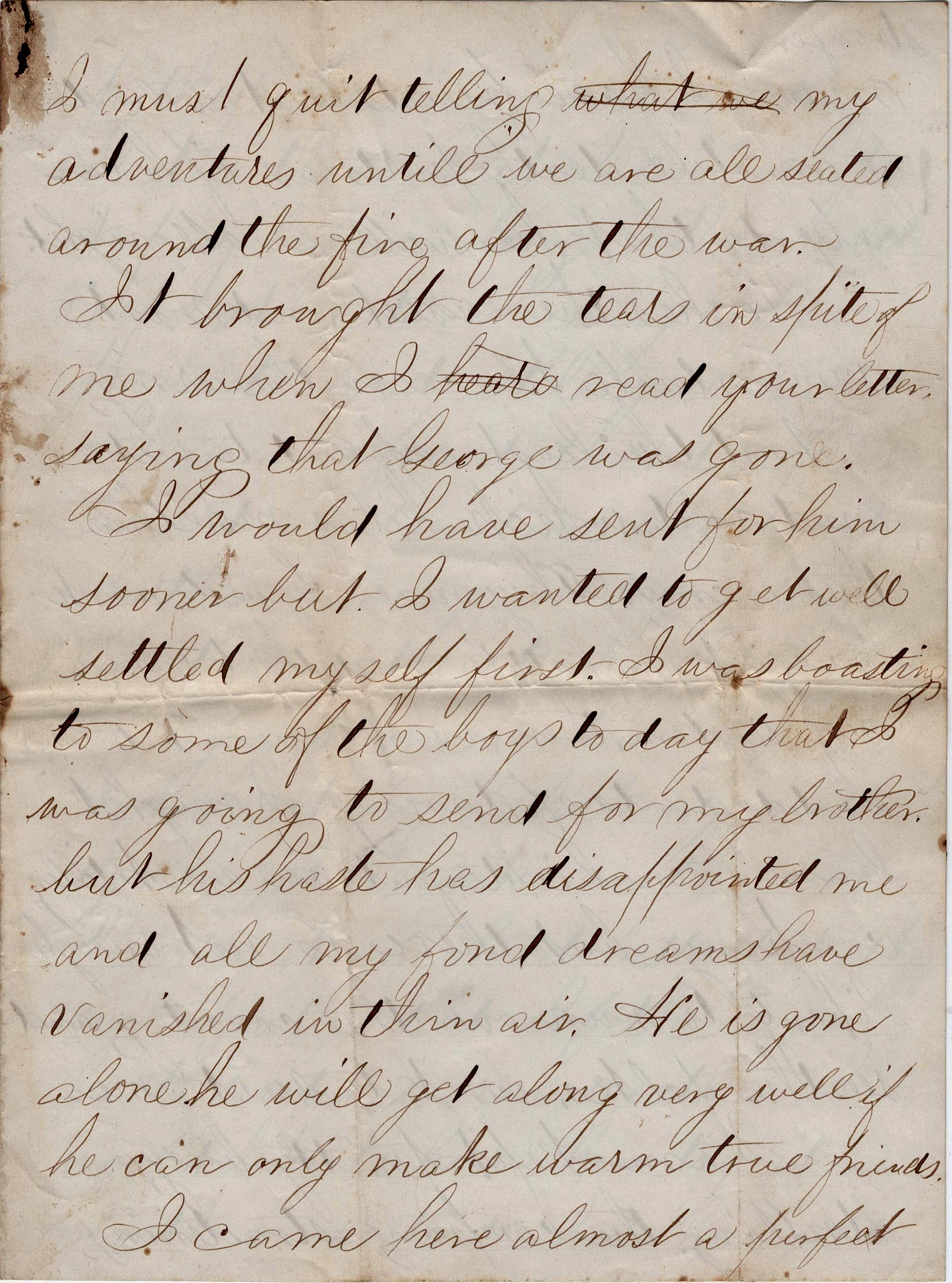
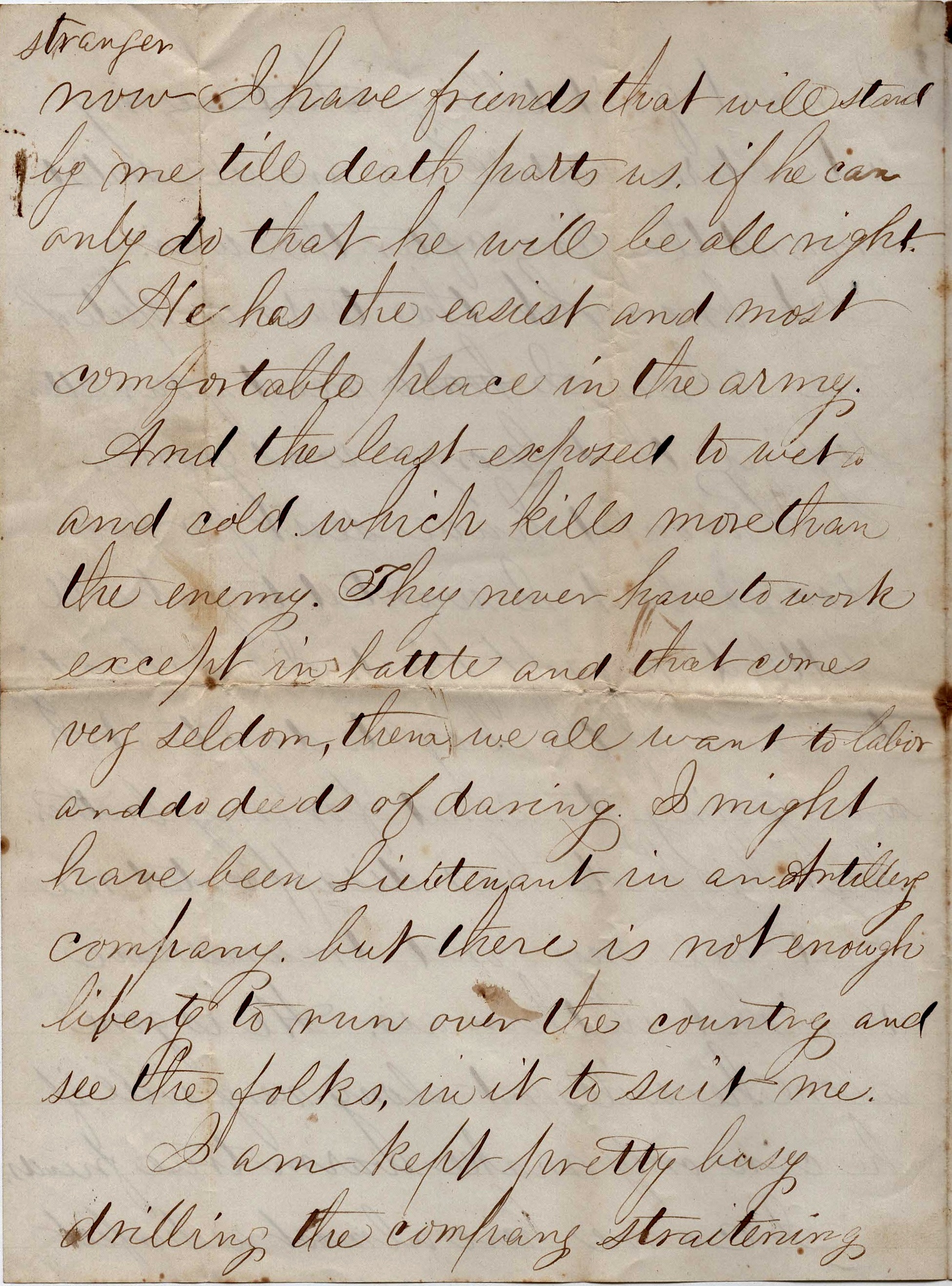
I must quit telling my adventures until we are all seated around the fire after the war. It brought the tears in spite of me when I read your letter saying that George was gone. I would have sent for him sooner but I wanted to get well settled myself first. I was boasting to some of the boys today that I was going to send for my brother but his haste has disappointed me and all my fond dreams have vanished in thin air. He is gone alone. He will get along very well if he can only make warm, true friends. I came here almost a perfect stranger. Now I have friends that will stand by me till death parts us. If he can only do that, he will be all right. He has the easiest and most comfortable place in the army, and the least exposed to wet and cold which kills more than the enemy. They never have to work except in battle and that comes very seldom. Then we all want to labor and do deeds of daring.
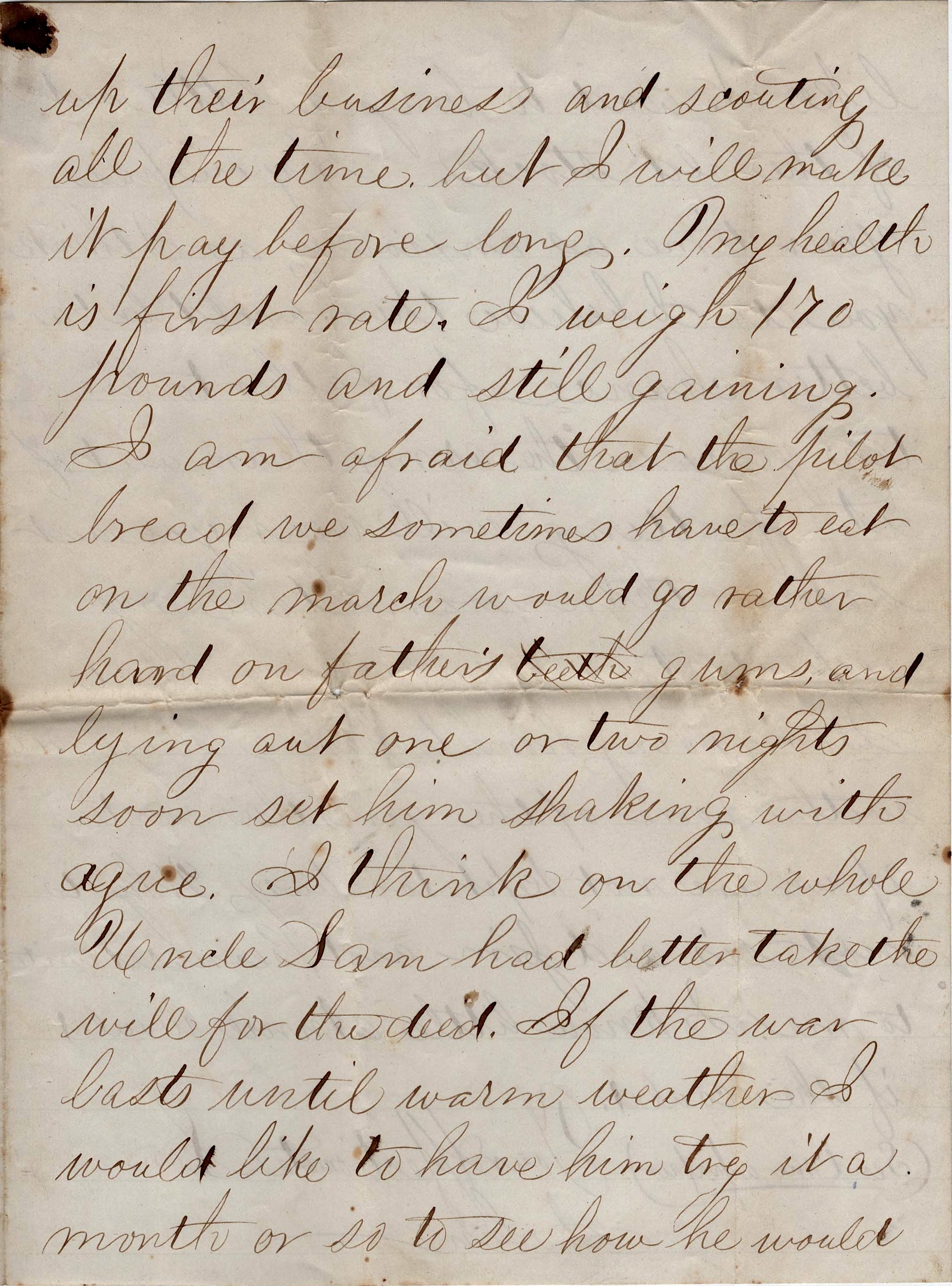
I might have been Lieutenant in an artillery company but there is not enough liberty to run over the country and see the folks in it to suit me. I am kept pretty busy drilling the company, straightening up their business and scouting all the time, but I will make it pay before long.
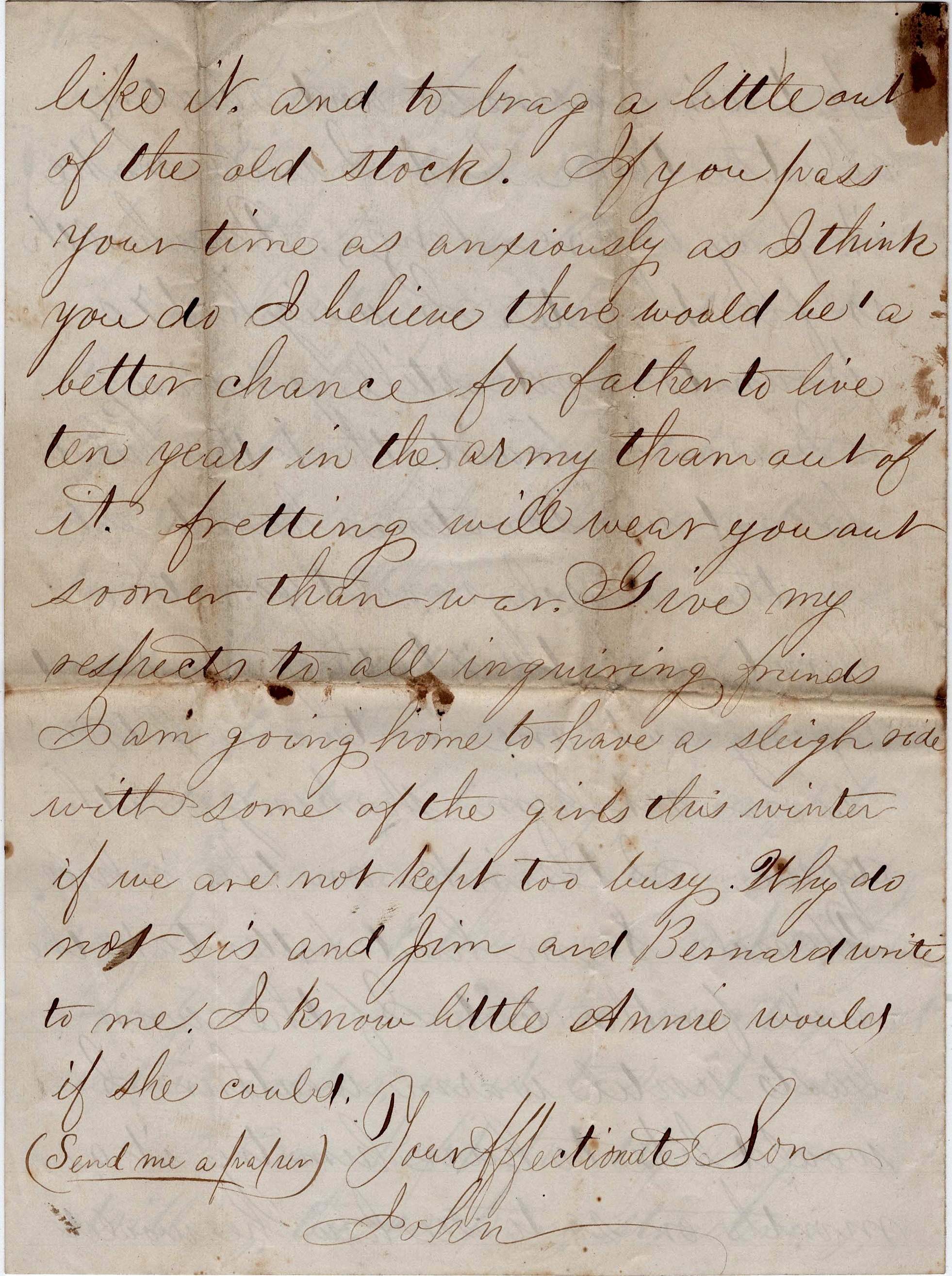
My health is first rate. I weigh 170 pounds and still gaining. I am afraid that the pilot bread we sometimes have to eat on the march would go rather hard on father’s gums and lying out one or two nights soon set him shaking with ague. I think on the whole Uncle Sam had better take the will for the deed. If the war lasts until warm weather, I would like to have him try it a month or so to see how he would like it and to brag a little out of the old stock.
If you pass your time as anxiously as I think you do, I believe there would be a better chance for father to live ten years in the army than out of it. Fretting will wear you out sooner than the war. Give my respects to all inquiring friends. I am going home to have a sleigh ride with some of the girls this winter if we are not kept too busy. Why do not Sis and Jim and Bernard write to me? I know little Annie would if she could. Send me a paper. Your affectionate son, — John
Letter 8
Camp Buell, Smithland, Kentucky January 3rd 1861 [1862]
Dear Parents,
I received yours of the 23rd December today. I was very glad to get it. I began to think there was something wrong about my letters; it was the first I received since coming here.
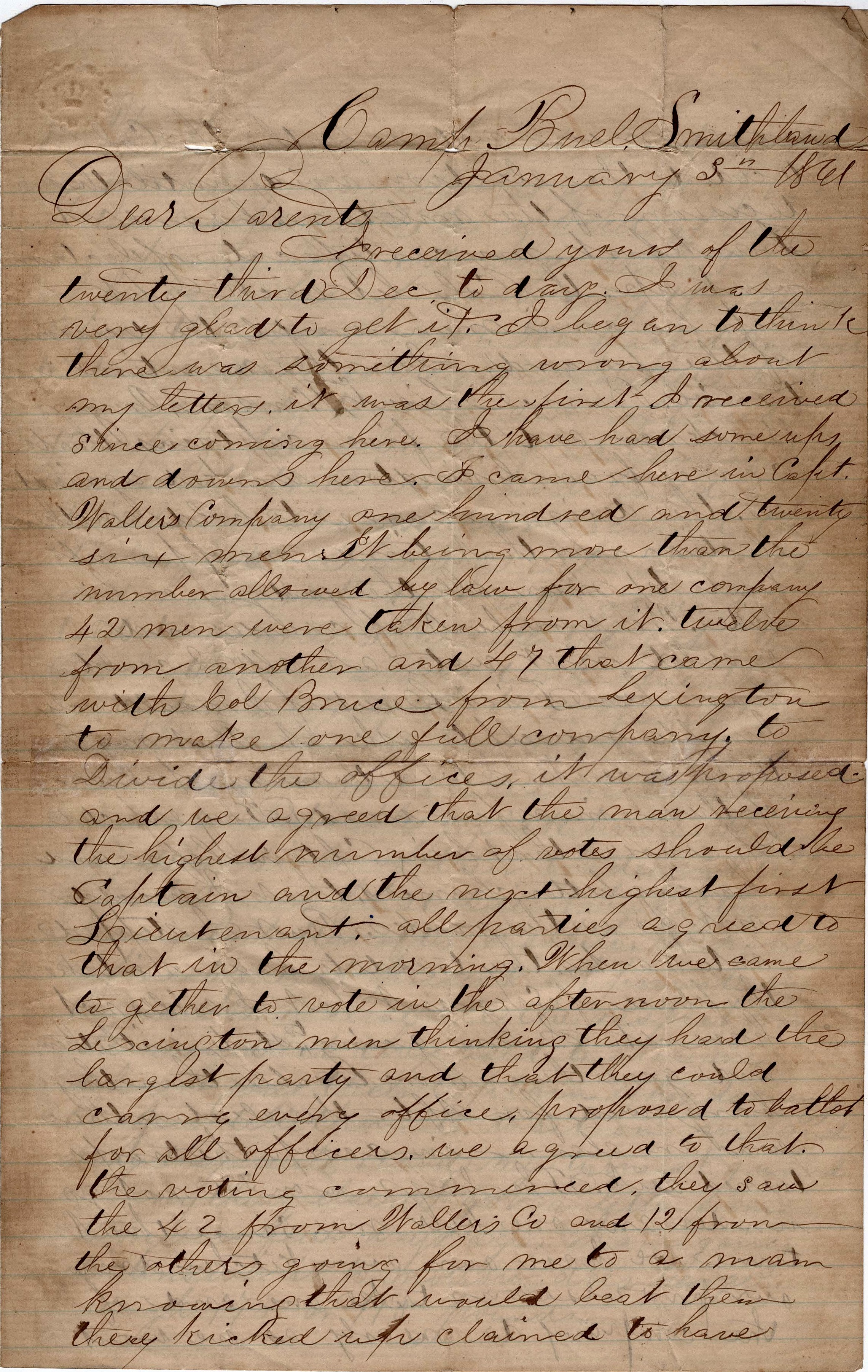
I have had some ups and downs here. I came here in Capt. Waller’s Company [with] 126 men. It being more than the number allowed by law for one company, 42 men were taken from it, twelve from another, and 47 that came with Col. Bruce from Lexington to make one full company. To divide the officers, it was proposed and we agreed that the man receiving the highest number of votes should be Captain and the next highest 1st Lieutenant. All parties agreed to that in the morning. When we came together to vote in the afternoon, the Lexington men, thinking they had the largest party and that they could carry every office, proposed to ballot for all officers. We agreed to that. The voting commenced. They saw the 42 from Waller’s Company and 12 from the others going for me to a man. Knowing that would best them, they kicked up and claimed to have more men and so forth. The Colonel decided the election void until the decision of the military board at Frankfort. My certificate of election went up to the Colonel let each Captain keep his own men until the decision of the board. In the meantime, Col. Bruce, Lieutenant-Colonel Hanson, Major Buckner, and the 5 captains that came from Lexington worked against us. The decision came to hold another election [and] by that time my opponent had 61 men and all the judges on his side. We were beat, of course, and would not vote at all. I could have been 1st Lieutenant if I would only humble myself to ask it. But my temper was up. I told them my opinion of them in a few words. They expected that being Captain before and having better chances that I would not go in the ranks. But I stepped into the ranks. They tried to have me take the place of Sergeant but I will notr have it.
I am going to stay with them and give them more trouble than they bargained for. After the election there was an alarm in camp. The troops turned out. The boys would not go under anyone but me. Since that time, we have our own kitchen, draw our own provisions, take one end of the company [and] do nearly as we want to. We have some friends working for us. We have some hopes of getting out of the scrape yet. The officers of our company are not very smart and I have hopes of crowding them out before the war is over. We have determined to do our duty as Union soldiers but we are going to give our officers their pay for swindling us. Our Captain cannot drill well and hired a drill master. The boys call me Captain and have not done a thing until told to by me. They call the Captain “Mac.”
Our clothing is a very dark blue. The Lexington a grayish blue. We call them graybacks. Whenever one of them comes near our tents, we make him march double quick home. They are getting sick of their trade and talk of making me 1st Lieutenant but I think I can do better after a while. I have a fine time at present [as] a private in the ranks. Receive all the respect from the men that they used to give me when I was their captain. They do everything I tell them to—wait on me and day they will stand my turn at guard or anything else.
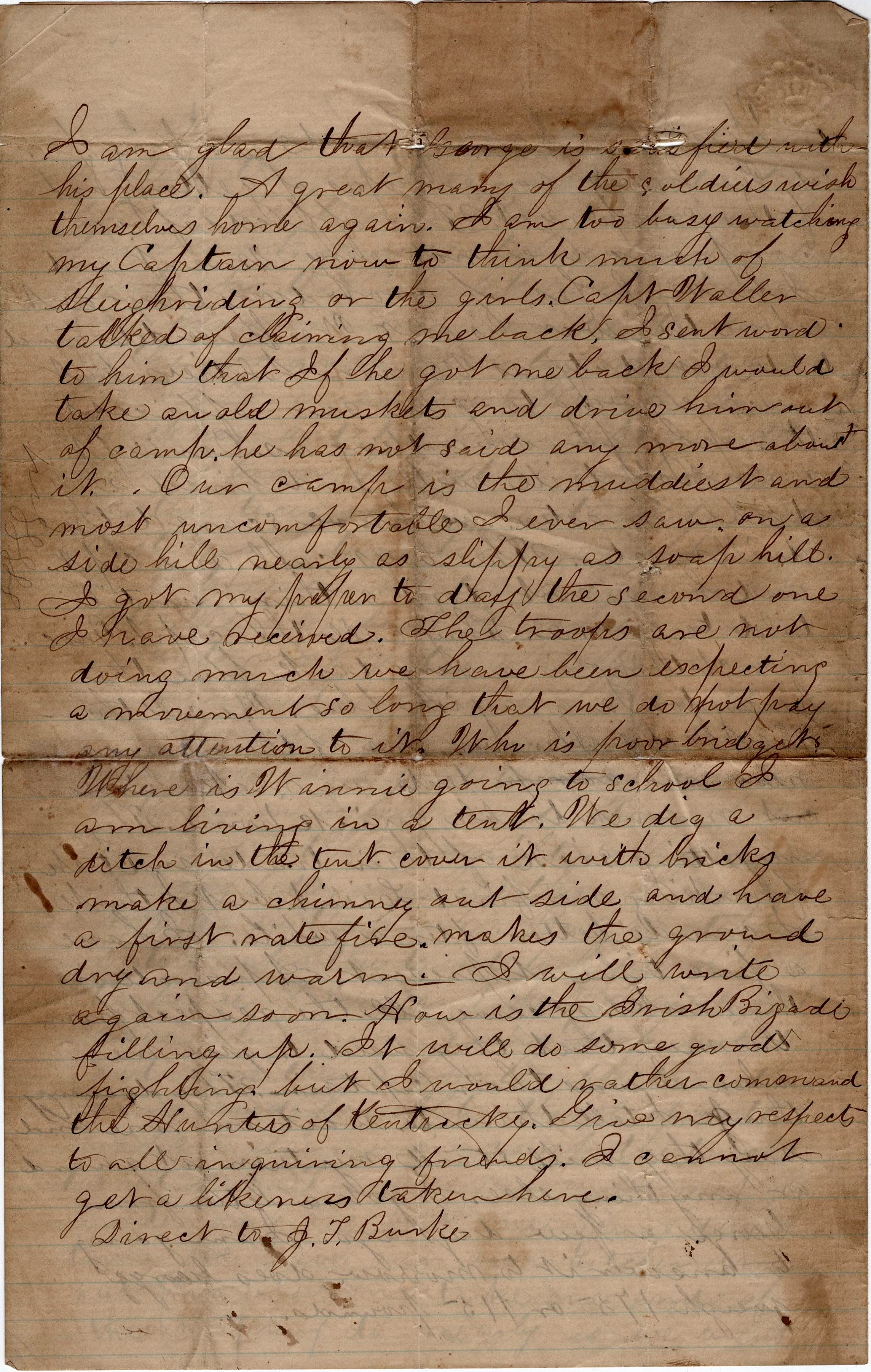
I got a letter from George a few days ago. I am going to answer it tomorrow. Does George weight 175 or 115 pounds? I am glad that George is satisfied with his place. A great many of the soldiers wish themselves home again. I am too busy watching my Captain now to think much of sleigh riding or the girls. Capt. Waller talked of claiming me back. I sent word to him that if he got me back, I would take an old musket and drive him out of camp. He has not said anymore about it.
Our camp is the muddiest and most uncomfortable I ever saw. [It’s] on a side hill nearly as slippery as soap hill. I got my paper today—the second one I have received. The troops are not doing much. We have been expecting a movement so long that we do not pay any attention to it. Who is poor Bridget? Where is Winnie going to school? I am living in a tent. We dig a ditch in the tent, cover it with bricks, make a chimney outside and have a first rate fire. Makes the ground dry and warm. I will write again soon. How is the Irish Brigade filling ip? It will do some good fighting, but I would rather command the Hunters of Kentucky. Give my respects to all inquiring friends. I cannot get a likeness taken here. Direct to J. T. Burke
Letter 9
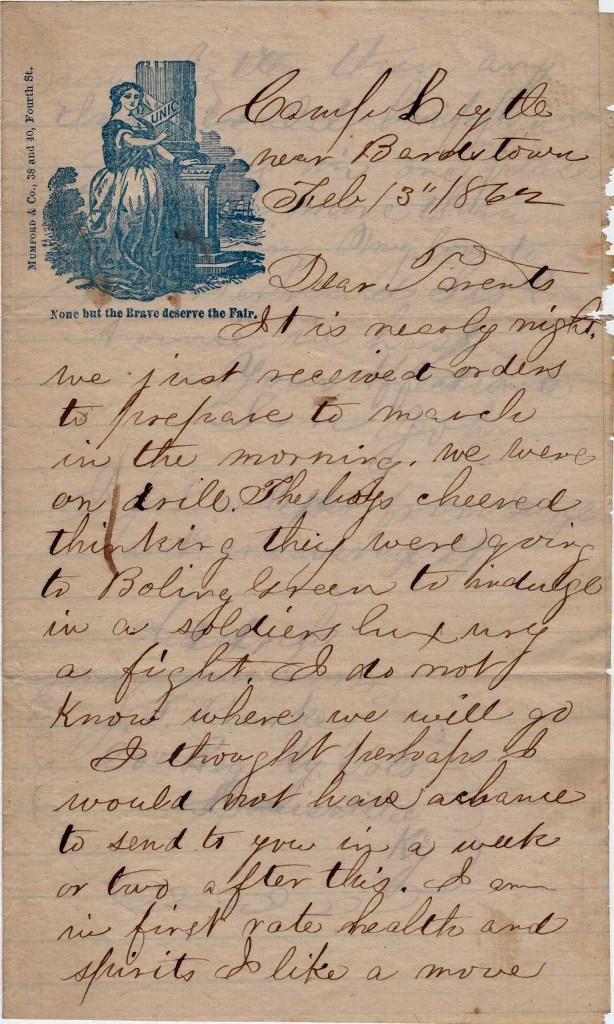
Camp Lytle near Bardstown, [Kentucky] February 3, 1862
Dear Parents,
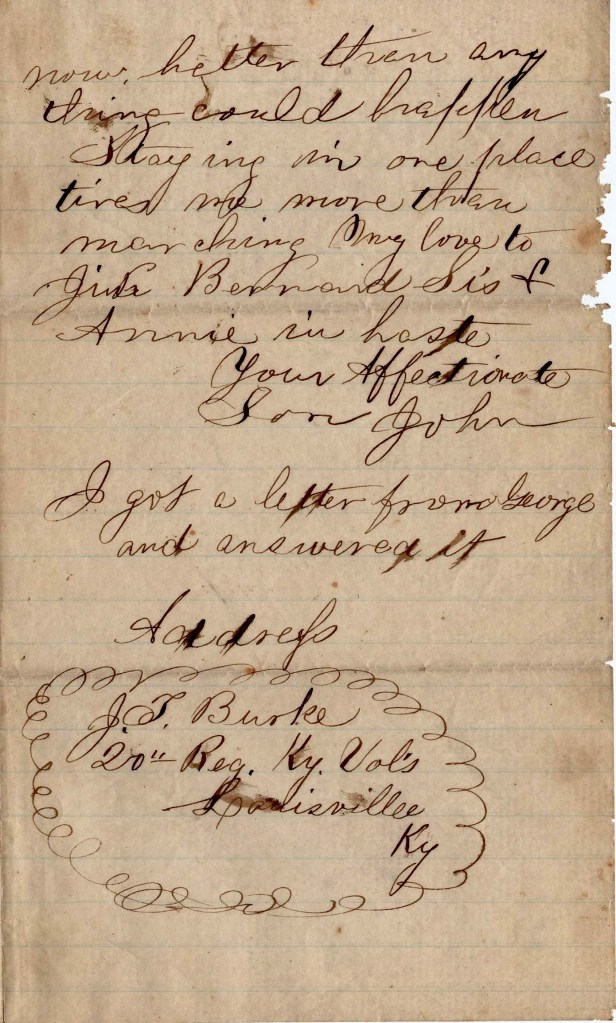
It is nearly night. We just received orders to prepare to march in the morning. We were on drill. The boys cheered thinking they were going to Bowling Green to indulge in a soldier’s luxury—a fight. I so not know where we will go. I thought perhaps I would not have a chance to send to you in a week or two after his. I am in first rate health and spirits. I like a move noq better than anything could happen. Staying on one places tires me more than marching.
My love to Jim, Bernard, Sis, and Annie. In haste. Your affectionate son, — John
I got a letter from George and answered it.
Address J. R. Burke, 20th Regiment Kentucky Volunteers, Louisville, Kentucky
Letter 10
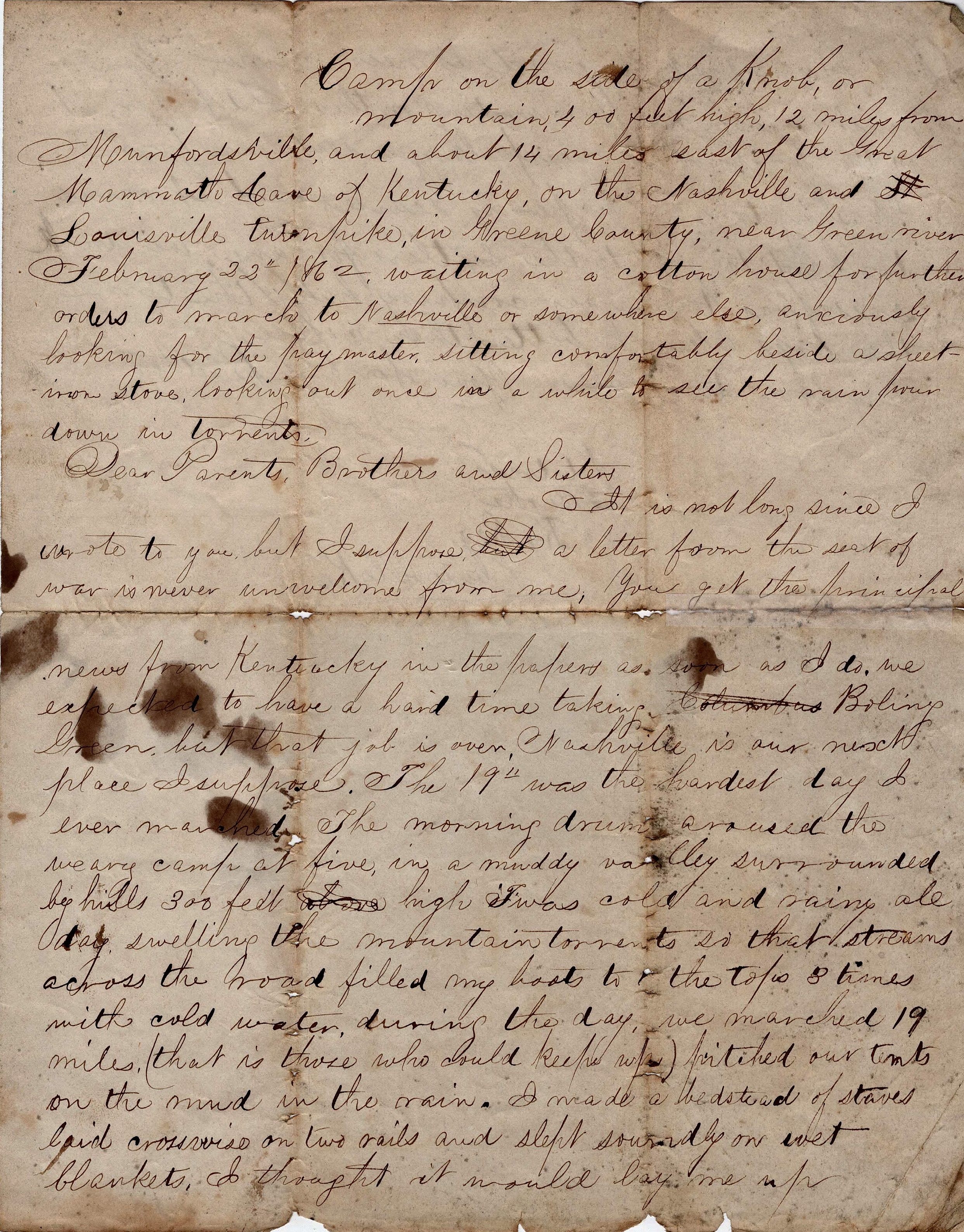
Camp on the side of a knob or mountain 400 feet high 12miles from Munfordsville and about 14 miles east of the Great Mammoth Cave of Kentucky on the Nashville & Louisville Turnpike in Greene County near Green River, February 22, 1862, waiting in a cotton house for the orders to march to Nashville or somewhere else, anxiously looking for the paymaster, sitting comfortably beside a sheet-iron stove, looking out once in a while to see the rain pour down in torrents.
Dear Parents, Brothers & Sisters,
It is not long since I wrote to you but I suppose a letter from the seat of war is never unwelcome from me. You get the principal news from Kentucky in the papers as soon as I do. We expected to have a hard time taking Bowling Green but that job is over. Nashville is our next place, I suppose. The 19th was the hardest day I ever marched. The morning drum aroused the weary camp at five, in a muddy valley surrounded by hills 300 feet high. T’was cold and rainy all day, swelling the mountain torrents so that streams across the road filled my boots to the top three times with cold water during the day. We marched 19 miles (that is, those who could keep up), [then] pitched our tents on the mud in the rain. I made a bedstead of staves laid crosswise on two rails and slept soundly on wet blankets. I thought it would lay me up but I am just as good as new now.
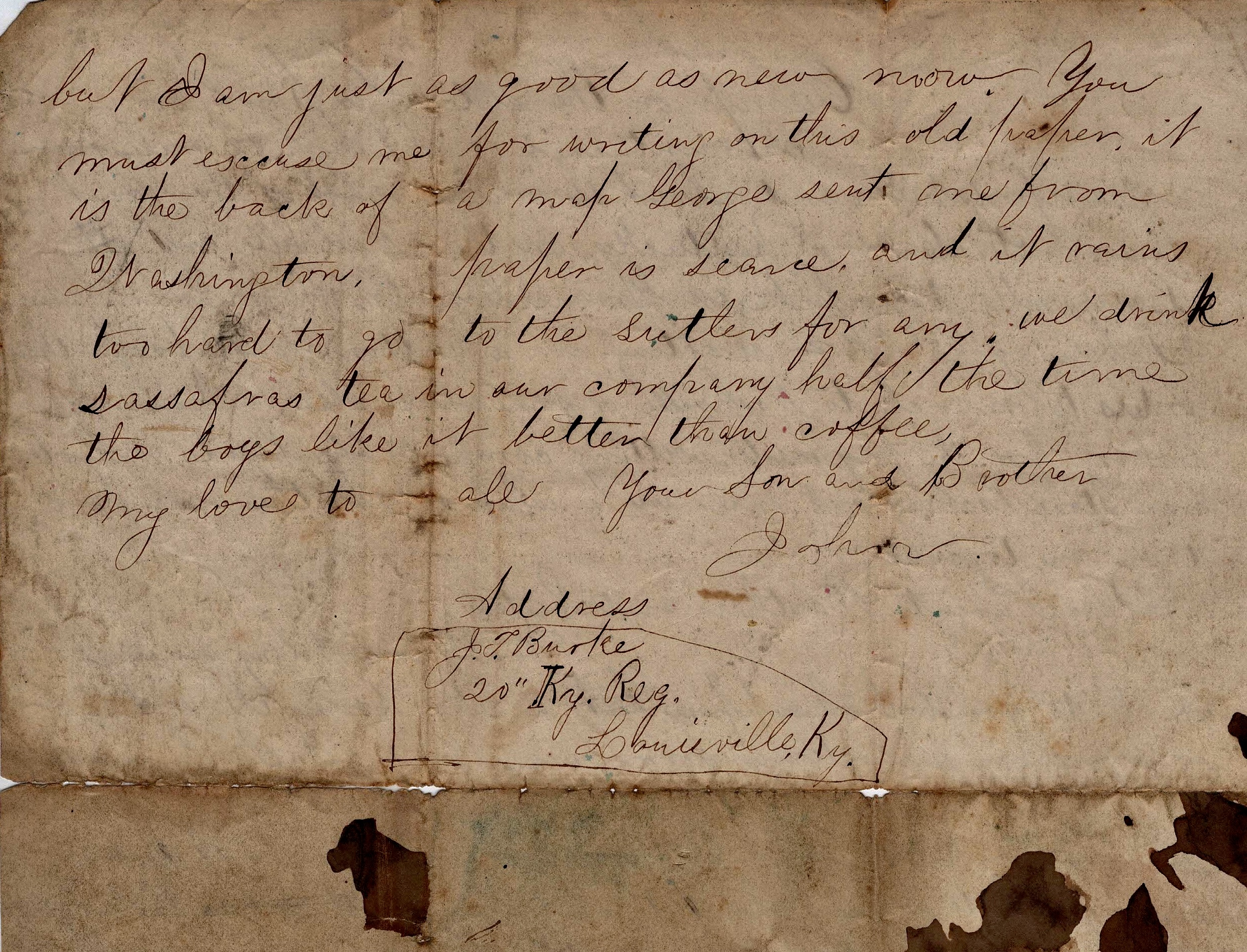
You must excuse me for writing on this old paper. It is the back of a map George sent me from Washington. Paper is scarce and it rains too hard to go to the sutler’s for any. We drink sassafras tea in our company half the time. The boys like it better than coffee. My love to all. Your son and brother, — John
Address to J. T. Burke, 20th Kentucky Regiment, Louisville, Kentucky.
Letter 11
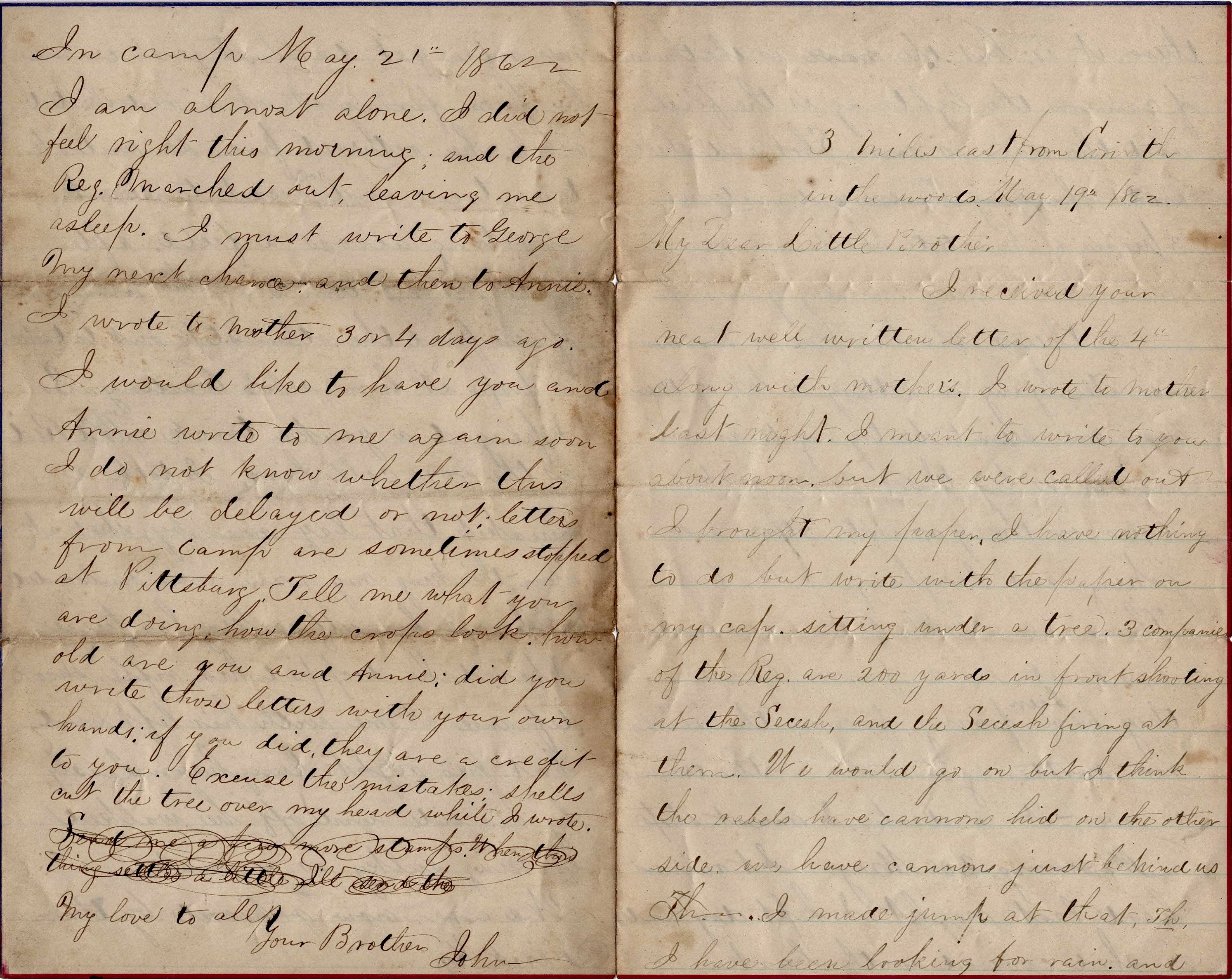
Three miles east from Corinth in the woods May 19th 1862
My dear little brother,
I received your neat, well written letter of the 4th along with Mother’s. I wrote to Mother last night. I meant to write to you about noon but we were called out. I brought my paper. I have nothing to do but write with the paper on my cap, sitting under a tree.
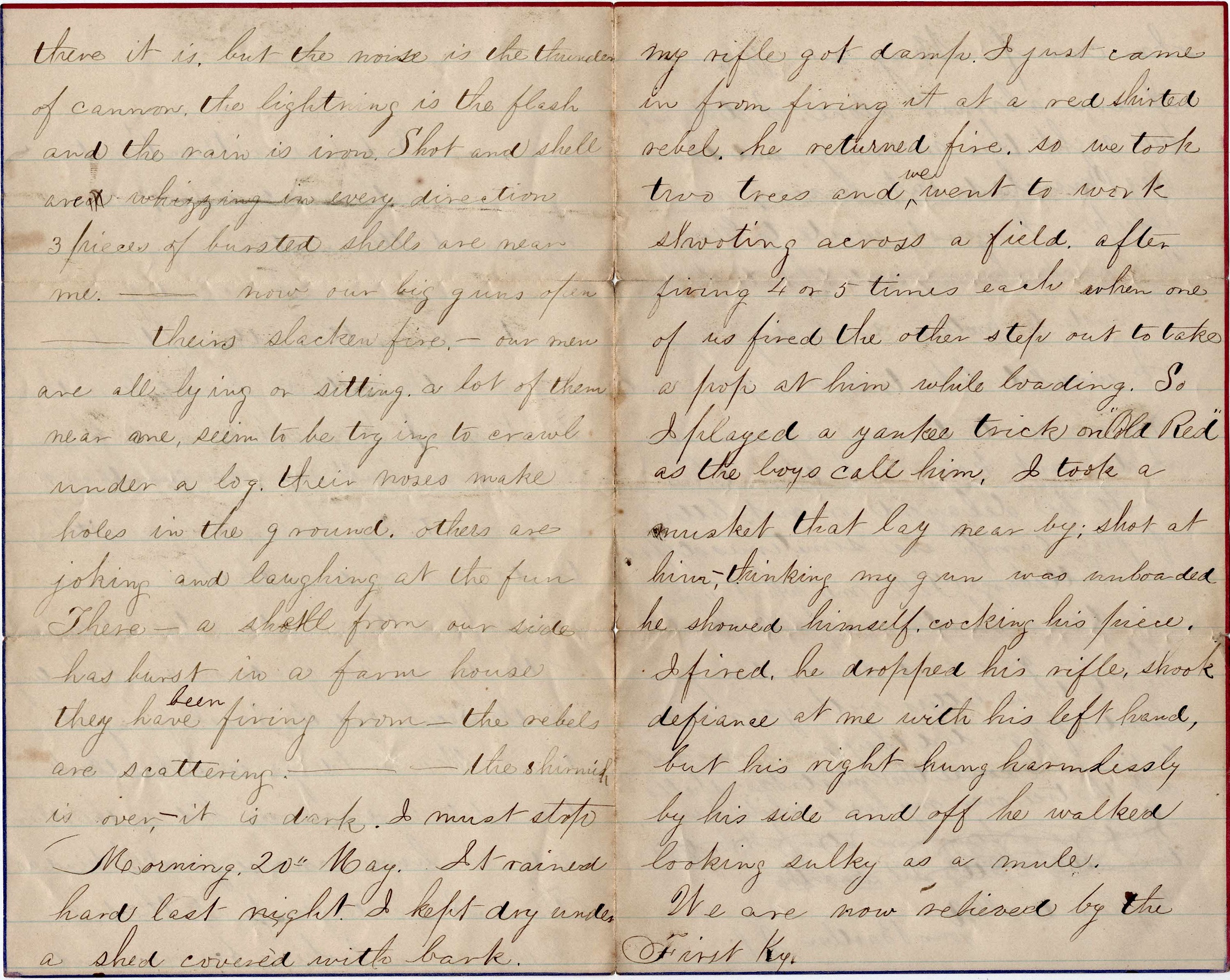
Three companies of the regiment are 200 yards in front shooting at the secesh, and the secesh firing at them. We would go on but I think the rebels have cannons hid on the other side. We have cannons just behind us. I must jump at that. I have been looking for rain. There it is, but the noise is the thunder of cannon. The lightning is the flash and the rain ir iron. Shot and shell are whizzing in every direction. Three pieces of bursted shells are near me. Now our bog guns open. Their slacken fire. Our men are all lying or sitting. A lot of them near me seem to be trying to crawl under a log. Their noses make holes in the ground. Others are joking and laughing at the fun. There—a shell from our side has burst in a farm house they have been firing from. The rebels are scattering. The skirmish is over. It is dark. I must stop.
Morning, 20th May. It rained hard last night. I kept dry under a shed covered with bark. My rifle got damp. I just came in from firing it at a red-shirted rebel. He returned fire so we took two trees and we went to work shooting across a field. After firing 4 or 5 times each when one of us fired, the other step out to take a pop at him while loading. So I played a Yankee trick on “Old Red” as the boys call him. I took a musket that lay near by [and] shot at him. Thinking my gun was unloaded, he showed himself, cocking his piece. I fired, he dropped his rifle, shook defiance at me with his left hand, but his right hung harmlessly by his side and off he walked looking sulky as a mule.
We are now relieved by the 1st Kentucky.
In camp, May 21st 1862. I am almost alone. I did not feel right this morning and the regiment marched out leaving me asleep. I must write to George my next chance and then to Annie. I wrote to Mother three or four days ago. I would like to have you and Annie write to me again soon. I do not know whether this will be delayed or not. Letters from came are sometimes stopped at Pittsburg [Landing].
Tell me what you are doing, how the crops look, how old are you and Annie? Did you write those letters with your own hands? If you did, they are a credit to you. Excuse the mistakes. Shells cut the tree over my head while I wrote. My love to all. Your brother, — John
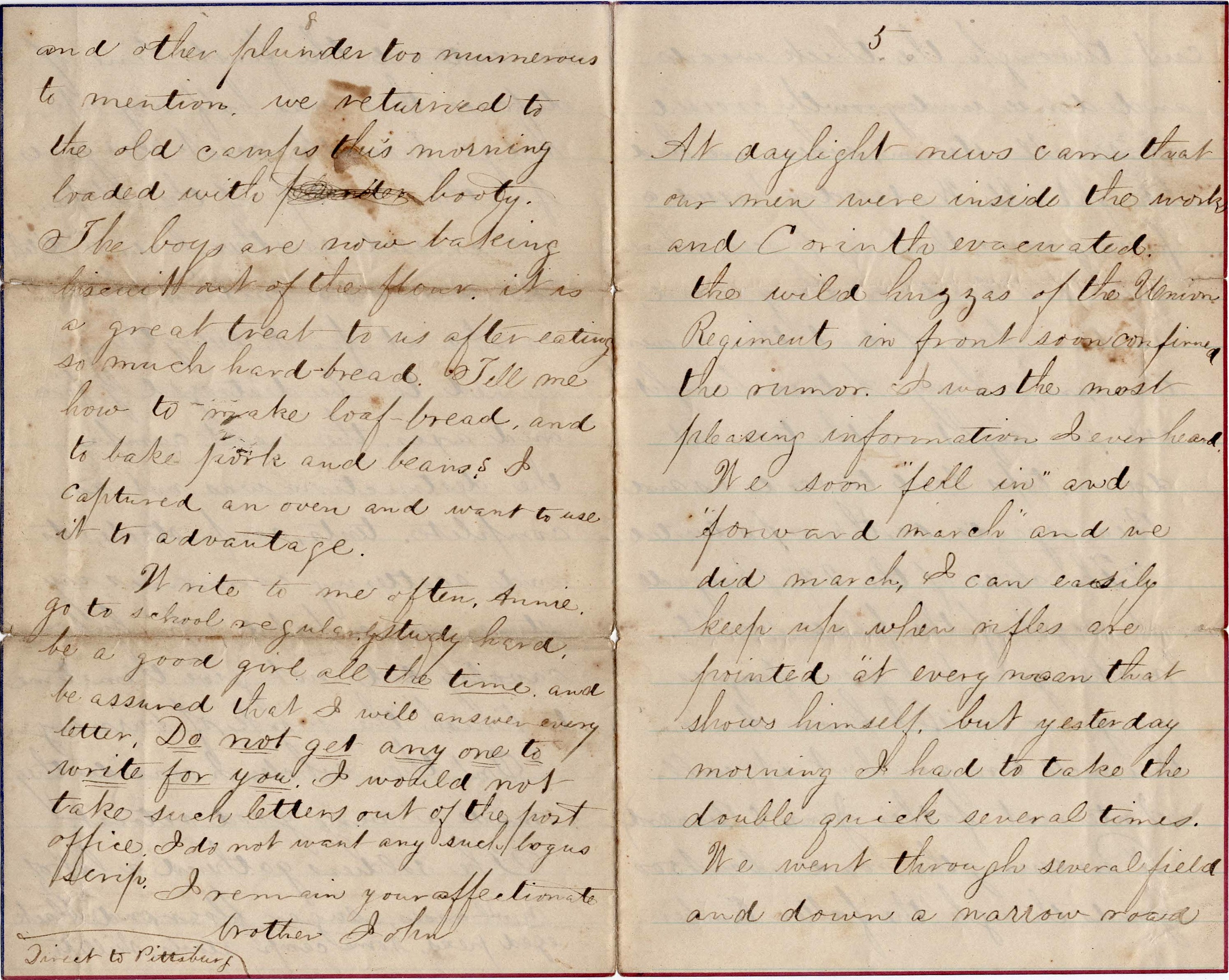
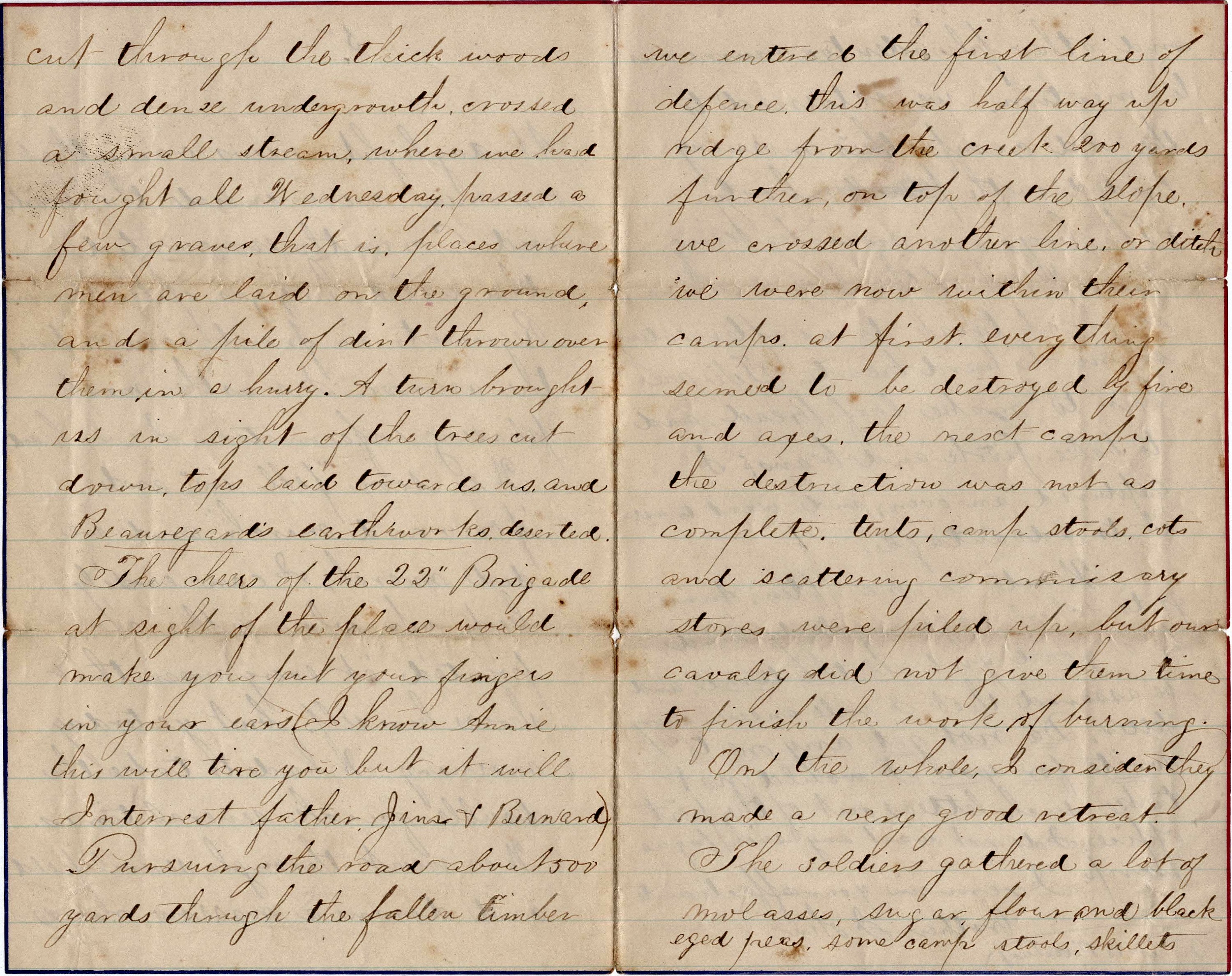
At daylight, news came that our men were inside the works and Corinth evacuated, the wild huzzas of the Union regiments in front soon confirming the rumor. It was the most pleasing information I ever heard. We soon “fell in” and “forward march” and we did march. I can easily keep up when rifles are pointed at every [ ] that shows himself, but yesterday morning I had to take the double quick several times. We went through several fields and down a narrow road, cut through the thick woods and dense undergrowth, crossed a small stream where we had fought all Wednesday, passed a few graves—that is, places where men are laid on the ground and a pile of dirt thrown over them in a hurry. A turn brought us in sight of the trees cut down, tops laid towards us and Beauregard’s earthworks deserted.
The cheers of the 22nd Brigade at sight of the place would make you put your fingers in your ears (I know Annie this will tire you but it will interest Father, Jim and Bernard). Pursuing the road about 500 yards through the fallen timber, we entered the first line of defense. This was halfway up ridge from the creek. 200 yards further, on top of the slope, we crossed another line or ditch. We were now within their camps. At first, everything seemed to be destroyed by fire and axes. The next camp the destruction was not as complete. Tents, camp stools, cots and scattering commissary stores were piled up, but our cavalry did not give them time to finish the work of burning. On the whole, they made a very good retreat.
The soldiers gathered a lot of molasses, sugar, flour, and black-eyed peas, some camp stools, skillets, and other plunder too numerous to mention. We returned to the old camps this morning loaded with booty. The boys are now baking biscuits out of the flour. It is a great treat to us after eating so much hard bread/ Tell me how to make loaf bread and to bake pork and beans. I captured an oven and want to use it to advantage.
Write to me often, Annie. Go to school regularly, study hard, be a good girl all the time and be assured that I will answer every letter. Do not get anyone to write for you. I would not take such letters out of the post office. I do not want any such bogus scrip. I remain your affectionate brother, — John
The following letters were written by Mississippi born and bred, Mary Ellen (Barton) Clark (1833-1888)—the wife of William Spencer Clark (1826-1878) of Holly Springs, Marshall county, Mississippi. Mary’s husband was a native of Vermont and attended Amherst College. In 1850, he was enumerated among the students attending Amherst. Ten years later, in 1860, he was enumerated in Holly Springs where he lived with his wife and three children Rosa (age 4), Eudora or “Dora” (age 2), and Rodger B. (6 months). Also residing in the same household were Peyton Johnson, Frank Ross, Hugh C. Barton, and N. B. Dean (teenagers and presumably students at the boys school where William taught). From the letter we learn that William initially served with the Home Guards, a company of the 9th Mississippi. He later joined Co. B, 35th Mississippi Infantry. He survived the war, returned to Holly Springs to teach school, but died of Yellow Fever in 1878.
In 1860, William Clark was the owner of six slaves ranging in age from 45 to 8. I suspect their given names are mentioned in the portion of the letter dated May 7th.
Letter 1
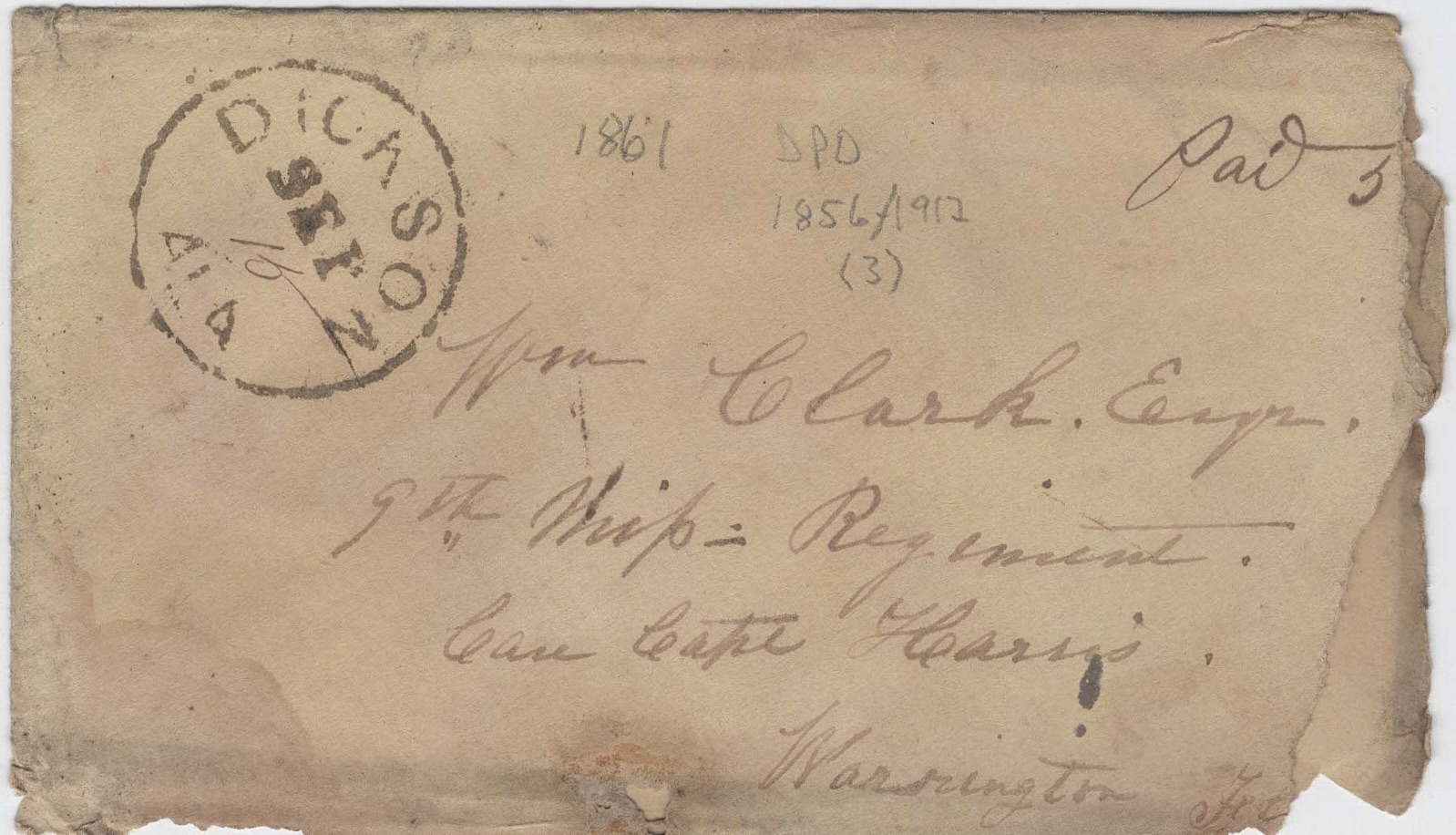
Addressed to Wm. Clark, Esqr. 9th Mississippi Regiment, Care of Capt. Harris, Warrington [Navy Yard] Florida
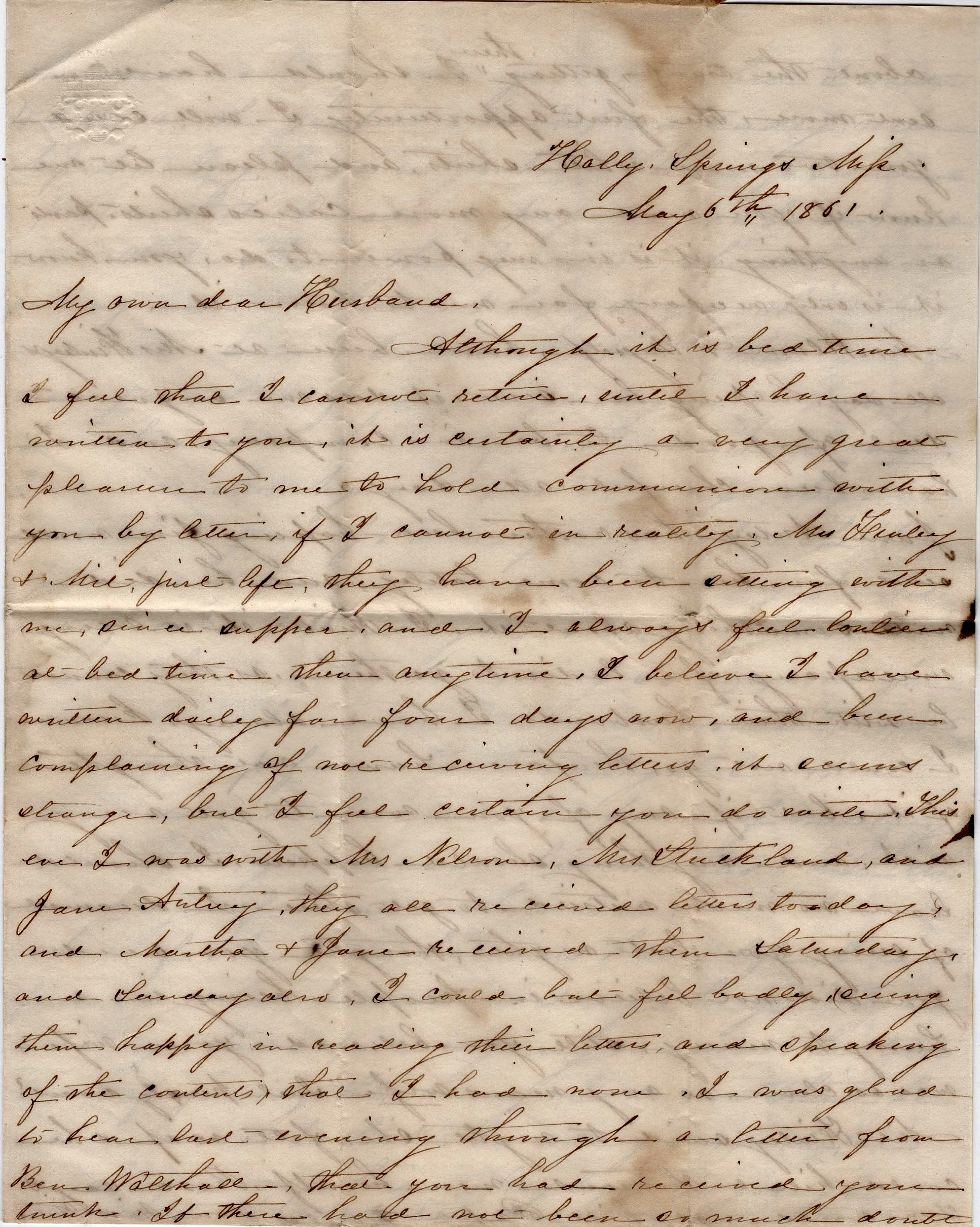
Holly Springs, Mississippi May 6th 1861
My own dear husband,
Although it is bed time, I feel that I cannot retire until I have written to you. It is certainly a very great pleasure to me to hold communion with you by letter if I cannot in reality. Mrs. Finley & Mit just left. They have been sitting with me since supper, and I always feel lonelier at bed time than anytime. I believe I have written daily for four days now and been complaining of not receiving letters. It seems strange but I feel certain you do write.
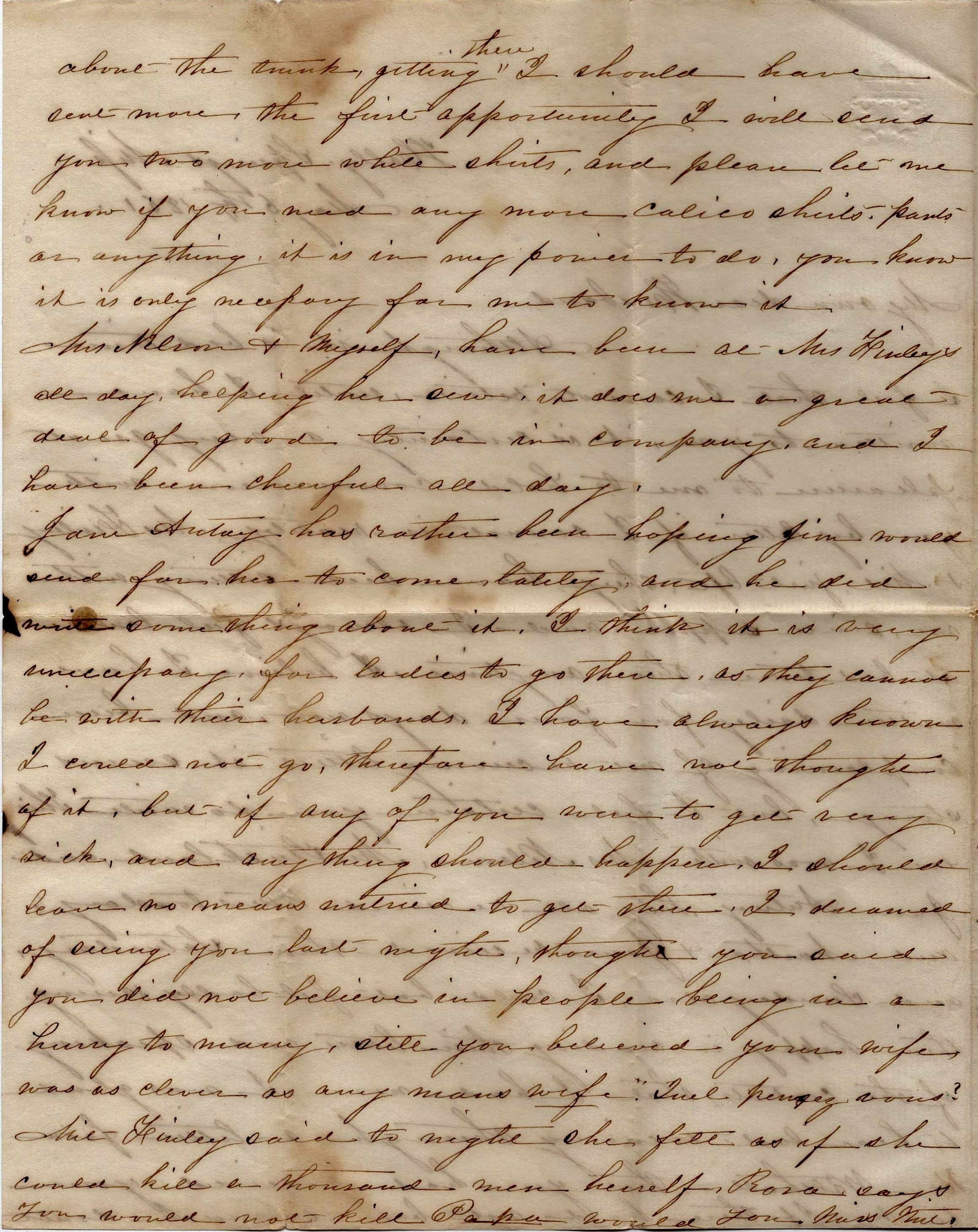
This eve I was with Mrs. Nelson, Mrs. Strickland 1, and Jane Autry. They all received letters today and Martha & Jane received them Saturday and Sunday also. I could but feel badly (seeing them happy in reading their letters and speaking of the contents) that I had none. I was glad to hear last evening through a letter from Ben Walthall that you had received your trunk. If there had not been so much doubt about the trunk getting there, I should have sent more. The first opportunity, I will send you two more white shirts, and please let me know if you need any more calico shirts, pants, or anything, if it is in my poewr to do. You know it is only necessary for me to know it.
Mrs. Nelson & myself have been at Mrs. Finley’s all day helping her sew. It does me a great deal of good to be in company and I have been cheerful all day.
Jane Autry 2 has rather been hoping Jim would send for her to come lately, and he did write something about it. I think it is very unnecessary for ladies to go there, as they cannot be with their husbands. I have always known I could not go, therefore have not thought of it. But if any of you were to get very sick, and anything should happen, I should leave no means untried to get there. I dreamed of seeing you last night. Thought you said you did not believe in people being in a hurry to marry. Still you believed your wife was as clever as any man’s wife. Tuel pensey vous? [Don’t you think so?]
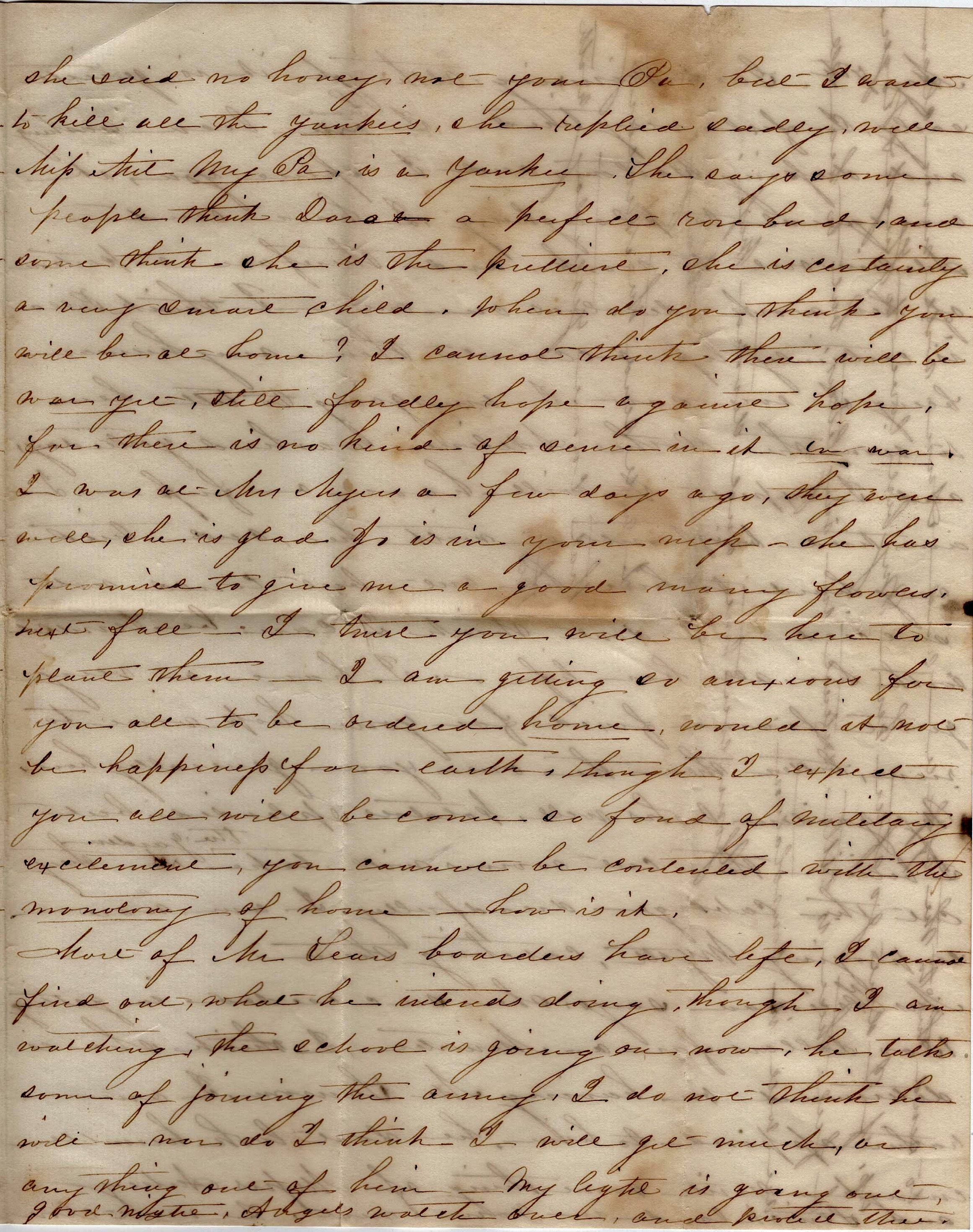
Mit Finley said tonight she felt as if she could kill a thousand men herself. Rosa says you would not kill Papa, would you, Miss Mit? She said, “No honey, not your Pa, but I want to kill all the Yankees.” She replied sadly, “Well, Miss Mit, my Pa is a Yankee.” She says some people think Dora a perfect rosebud and some think she is the prettiest. She is certainly a very smart child.
When do you think you will be at home? I cannot think there will be war yet. Still fondly hope against hope for there is no kind of sense in it in war.
I was at Mrs. Myers a few days ago, They were well. She is glad Jo is in your mess. She has promised to give me a good many flowers next fall. I trust you will be here to plant hem. I am getting so anxious for you all to be ordered home. Would it not be happiness for earth, though I expect you all will become so fond of military excitement you cannot be contented with the monotony of home. How is it?
Most of Mr. Sear’s boarders have left. I cannot find out what he intends doing though I am watching. The school is going on now. He talks some of joining the army. I do not think he will—nor do I think I will get much, or anything out of him. 3
My light is going out. Good night. Angels watch over and protect thee.
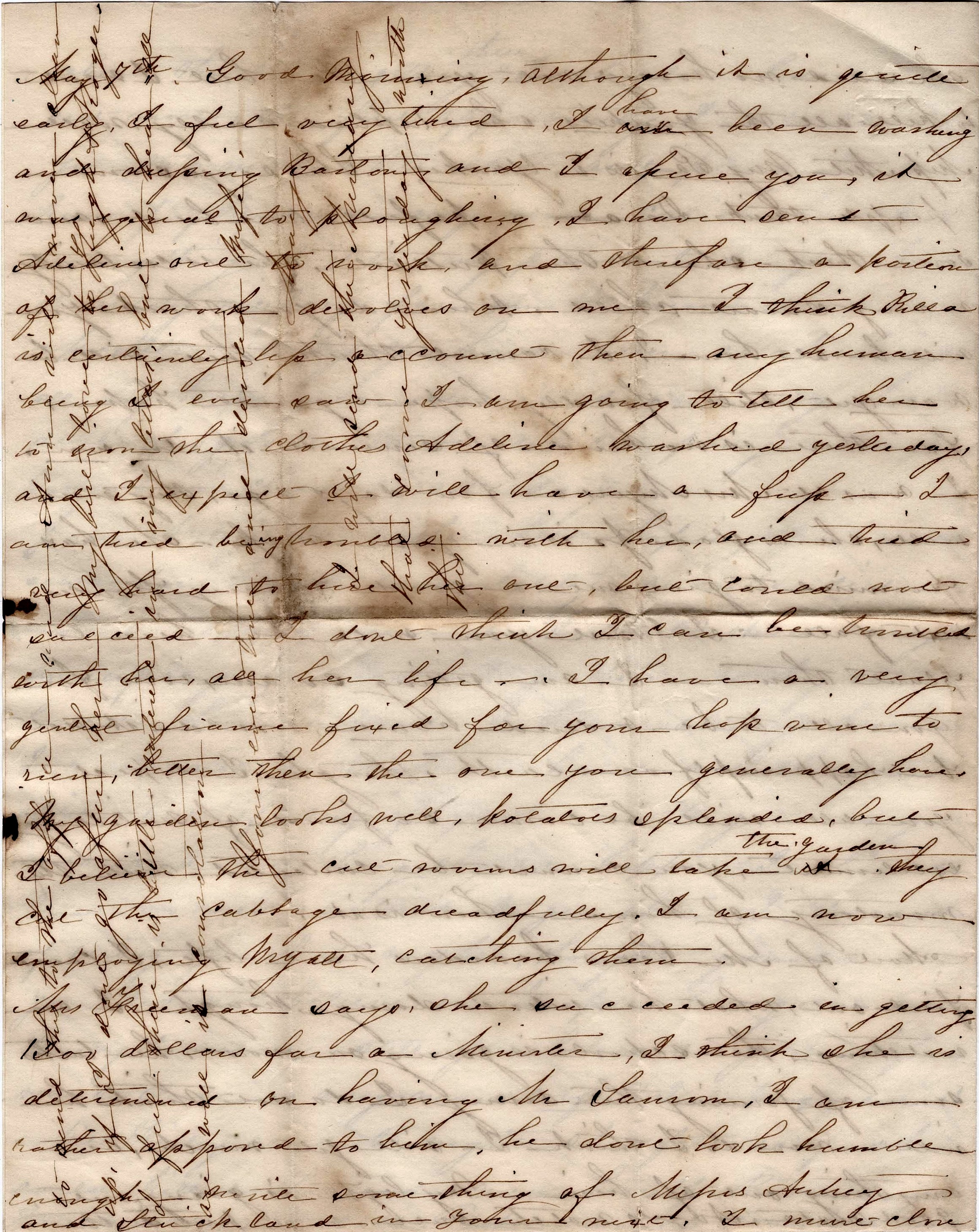
May 7th. Good morning. Although it is quite early, I feel very tired. I have been washing and dressing Barton and I assure you, it was equal to ploughing. I have sent Adeline out to work and therefore a portion of her work devolves upon me. I think Rilla is certainly less account than any human being I ever saw. I am going to tell her to iron the clothes. Adeline washed yesterday and I expect I will have a fuss. I am tired being troubled with her and tried very hard to hire her out but could not succeed. I don’t think I can be troubled with her all her life. I have a very genteel frame fixed for your hop vine to run. Better than the one you generally have. My garden looks well—potatoes splendid. But I believe the cut worms will take the garden. They cut the cabbage dreadfully. I a now employing Wyatt catching them.
Mrs. Freeman says she succeeded in getting 1200 dollars for a Minister. I think she is determined on having Mr. Lawson. I am rather opposed to him. He don’t look humble enough. Write something of Messers. Autrey and Strickland in your next. I must close to send this to the office and Ann will never clean up if I don’t go after her. My best love to Hugh & Roger. I feel there is little interest in my letters but to hear all are well is consolation. Your ever true and devoted wife, — Mary
I will send the Mercury that came yesterday with this.
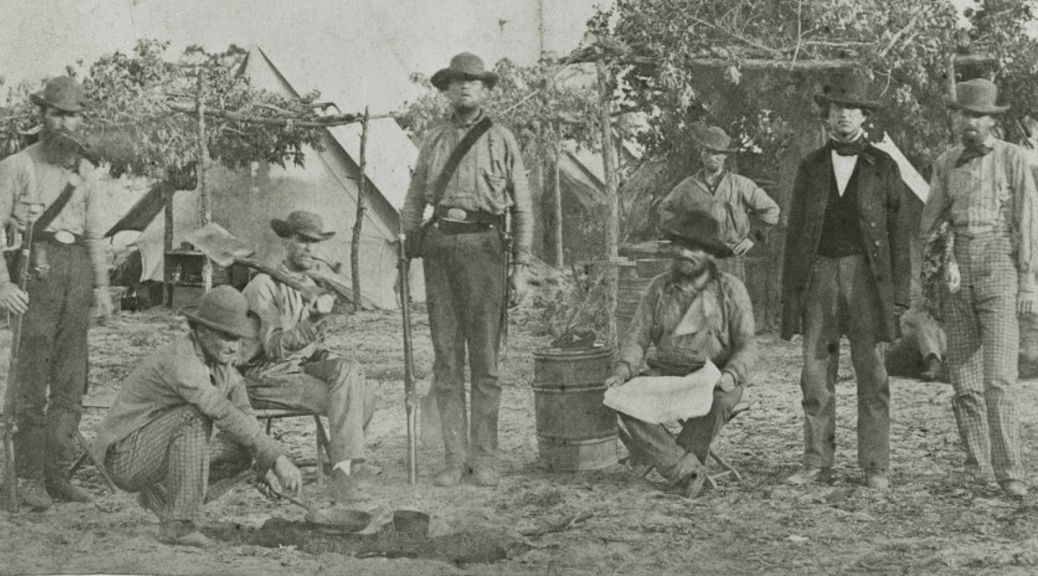
Men from the 9th Mississippi Infantry photographed by J.D. Edwards at the Warrington Navy Yard, Pensacola, FL in 1861.They were there until early 1862, when they were then sent back west, joining forces under Gen. A. S. Johnston and seeing action at Shiloh. The 9th and 10th Mississippi would serve in the Army of Tennessee throughout the rest of the war, in what was known as the “High Pressure Brigade.”
1 Martha Mildred (Thompson) Strickland (1835-1863) was married to William Matthew (“Buck”) Strickland (1823-1908) of Holly Springs, Mississippi. In the second letter, the death of their youngest daughter Madie Strickland (1857-1861) is described. Buck Strickland was a plantation owner and lawyer. He was the 1st Sergeant of Co. D, 9th Mississippi Infantry. A friend of Jeff Davis, he parlayed his connection into a position on the staff of Gen. Bragg and other prominent generals. He was a Major at war’s end. His wife was a native of Spartanburg, South Carolina.
James Lockhart Autry (1830-1862)
2Jane [Valliant] Autry (1835-1912) was married to James Lockhart Autry (1830-1862). James’ father was one of the approximately 187 heroes of the Alamo, killed in March of 1836. He was educated at St. Thomas Hall in Holly Springs where E.C. Walthall, James R. Chalmers, and Christopher H. (Kit) Mott were among his schoolmates. When war came he enlisted in the Home Guards, a company of the 9th Mississippi, where he was made a Lt. After a year’s service, he was made military governor of Vicksburg. In May of 1862, Admiral Farragut demanded the surrender of Vicksburg, to which Autry replied, “Mississippians do not know how to surrender and do not care to learn.” Lt. Col. Autry transferred to the 27th Mississippi Infantry later in 1862. While cheering his men forward in the Battle of Murfreesboro he was struck in the head with a minie ball and killed. After his death on Dec. 31, 1862, his body was returned to Holly Springs and interred in Hillcrest Cemetery with this epitaph: “He died for his country.”
3 Claudius Wistar Sears (1817-1891) was born in Massachusetts and was a graduate of the Military Academy at West Point in 1841—a classmate of John Reynolds and Don Carlos Buell. After a year in the 8th US Infantry fighting Seminoles in Florida, Sears resigned his commission and began teaching school. In 1844 he taught mathematics at St. Thomas’s Hall—a military school in Holly Springs. In 1859 he became the president of the school and commandant of cadets. When many of the students left the school in 1861, so did Sears, accepting a commission as captain of Co. G, 17th Mississippi Infantry on June 1861. He eventually became Colonel of the 46th Mississippi. He was taken prisoner in the surrender at Vicksburg but in March 1864 became a Brigade General. He led the Brigade through the Atlanta and Tennessee campaigns, losing a leg at the Battle of Nashville on 15 December 1864. After the war, he taught mathematics at the University of Mississippi.
Claudius Wistar Sears (1817-1891)
Some time ago I was asked to transcribe the 1864 Diary of Brig. Gen. Sears that described his daily activities between 27 November and 25 December 1864. His entry describing the wound he received at the Battle of Nashville reads as follows: “15th [December]—At daylight received report from my skirmish line that the enemy was appearing in force. Immediately took position in [ ] just north of pike. Was shelled during the day hotly with only one man slightly wounded. Just before sunset the enemy made a charge upon our extreme left, just to my left, and broke our line. We immediately fell back—not in good order. Found my horse just to the rear, very uneasy, in charge of an orderly. Mounted and he soon became quiet. Found my command and was marching by the flank quickly to the rear through a corn stubble. It was getting dark. Felt something strike my foot. Looked down [and] saw my leg swinging helpless. The ball (solid) had ricoched, passed through my poor, dear old horse, and crushed my left leg. As they took me from the horse, he rolled over to the right dead. Thus closed Bill’s long and eventful career in the army since Vicksburg. Was taken to Mr. Ewing’s place on the Franklin Pike where Surgeon [P. J.] McCormick [46th Mississippi] amputated my leg just below the knee. Was immediately placed in and ambulance and we started for the rear. In my long military service, [this was] my first wound of any magnitude. ” To read the diary, go to: https://sparedcreative21.art.blog/2020/04/11/1864-diary-of-brig-gen-claudius-wistar-sears/
The 9th Mississippi Infantry at Pensacola in 1861
Letter 2
Jackson, Alabama July 4th 1861
My own dearest husband,
Three days have passed now since I have received a letter from you but I am not going to complain for you are a very good correspondent. I look forward to tomorrow for a letter without fail. I do wish I could get hold of a good pen. I can scarcely continue to manage this, or write intelligibly with it.
Today is the anxiously looked for 4th [of July] and may it be still more memorable by being the day on which our second independence is declared by the North. I do trust Lincoln’s inaugural may have peace in it. I was in great distress and anxiety of mind Tuesday as I heard you were fighting at Pickens. But now I know it was a false alarm. I trust such alarms will cease some time. I think it cruel to start them. For the last day or two the papers indicate such a decided and rapid change of mind at the North that I now have great hopes of peace. Indeed, I am almost sure of it. Yancey writes t oDavis that his negotiations with England reach his most sanguine expectations. Without a doubt I look for peace by September as I suppose it will occupy time to make the necessary peace treaties. Am I not rather sanguine? But such is only my opinion in which I am pretty much alone. I look for peace so certain by September that I have almost concluded to remain here until then. I do not feel as if I could yet return home with any comfort or composure. I know I am better contented here than I would be there. At any rate, I shall remain here one month if not two months longer.
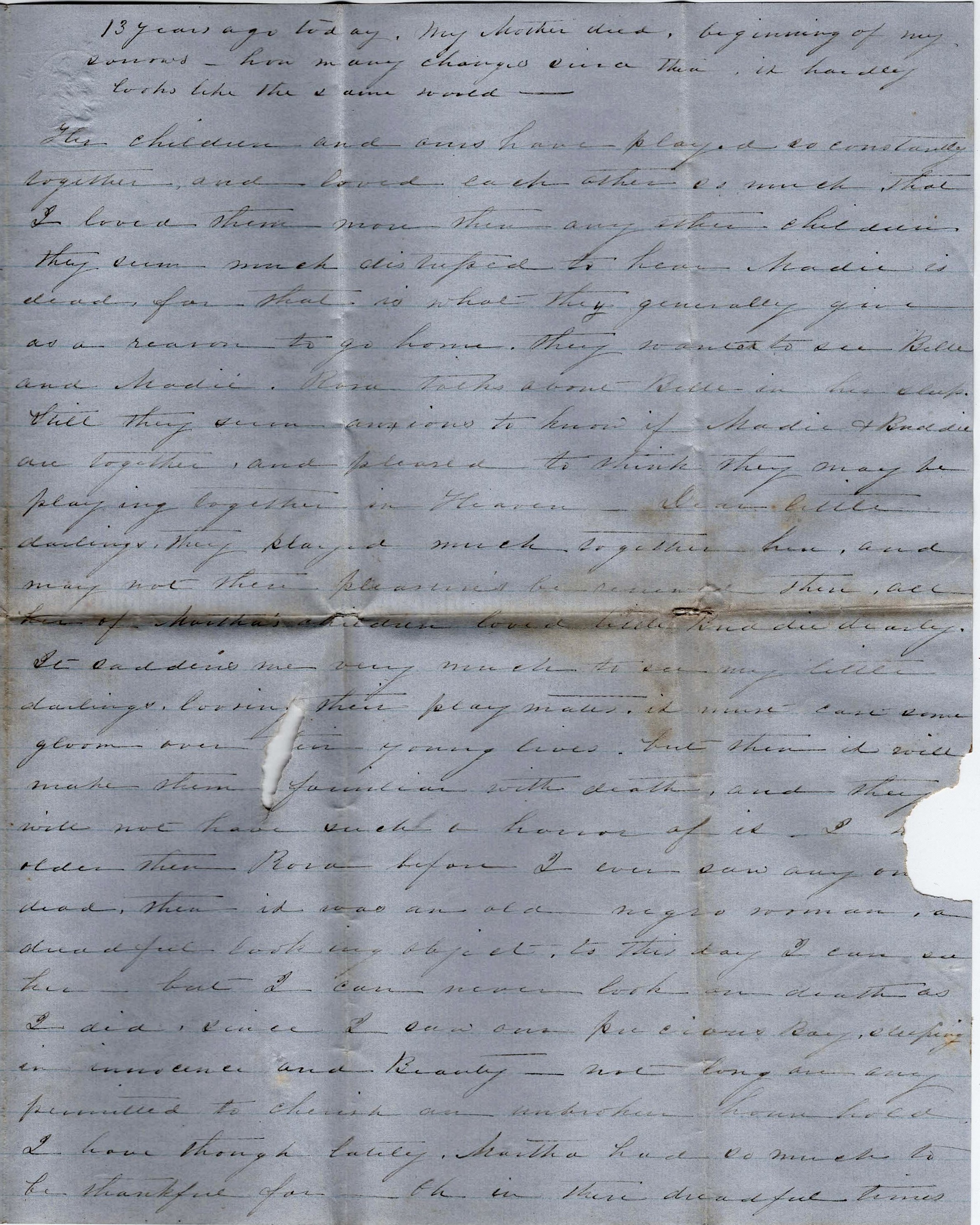
I received a letter from Mrs. Nelson yesterday telling the sad news of little Madie Strickland’s death. She had diphtheria, was sick six days. Mr. Strickland got there Sunday and Madie died Monday 2 o’clock. She was buried Tuesday at 10 o’clock. He was obliged to leave same day. Mrs. Nelson said Martha was composed. Said she knew how poor Mary Clark felt and wanted to see me. But no, she did not know how I felt, for she was not alone in the dark hour of her deep anguish, nor not alone did she stand by the grave, and see her child laid forever from her sight. Poor Martha, she has my heartfelt sympathy. 13 years ago today, my Mother died, beginning of my sorows. How many changes since then. It hardly looks like the same world.
Her children and ours have played so constantly together and loved each other so much that I loved them more han any other children. They seem much distressed to hear Madie is dead for that is what they generally give as a reason to go home. They wanted to see Belle and Madie. Rosa talks about Belle in her sleep. Still they seem anxious to know if Madie and Buddie are together, and pleased to think they may be playing together in Heaven. Dear little darlings, they played much together here and may not [illegible]. It saddens me very much to see my little darlings losing their playmates. It must cast some gloom over their young lives. But then it will make them familiar with death, and they will nit have such a horror of it. I was older than Rosa before I ever saw anyone dead. Then it was an old negro woman—a dreadful looking object. To this day I can see her. But I can never look on death as I did since I saw our precious boy sleeping in innocence and beauty. Not long are any permitted to cherish an unbroken household, I have thought lately. Martha had so much to be thankful for. Oh, in these dreadful times, how few are not in trouble.
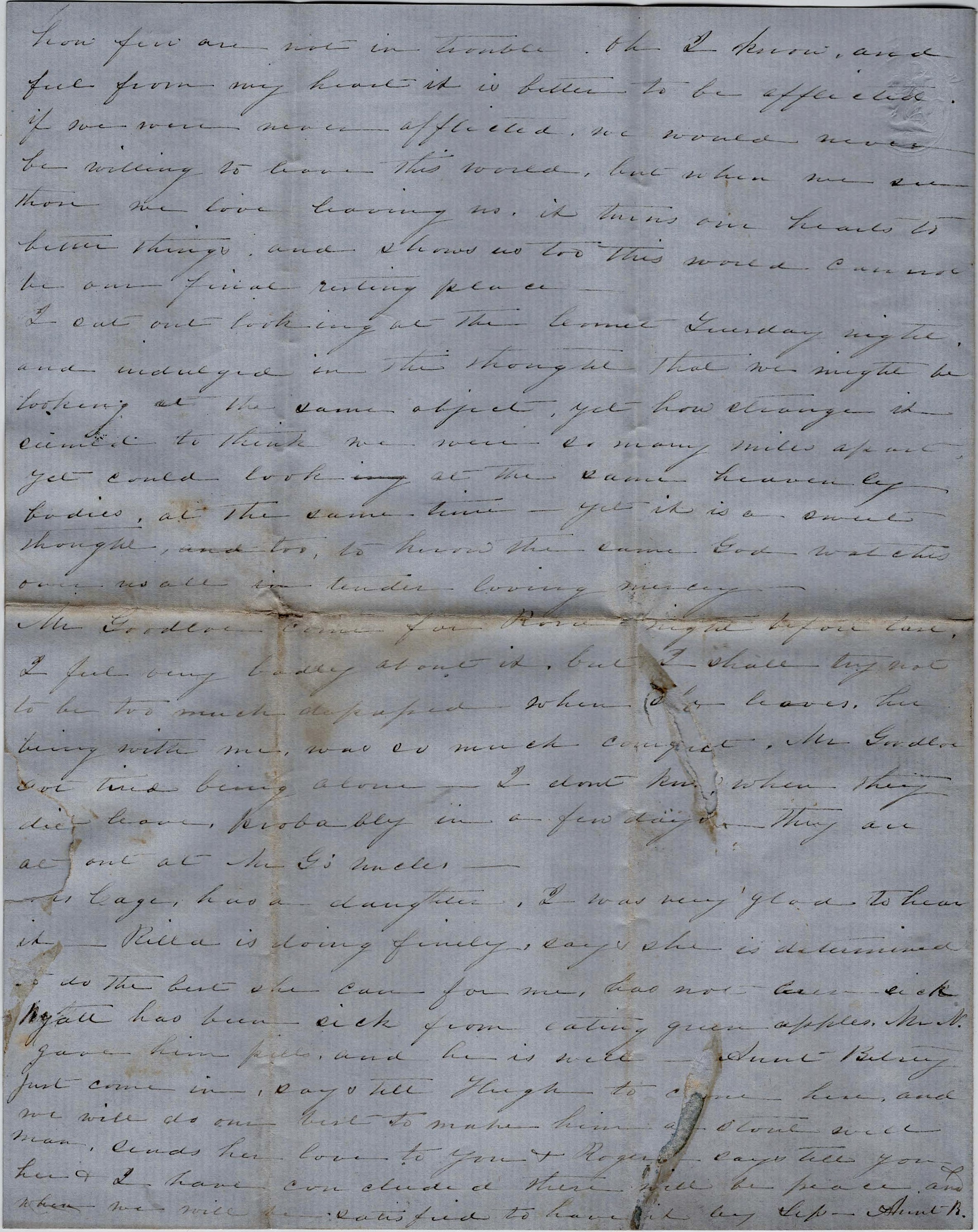
Oh, I know and feel from my heart it is better to be afflicted. If we were never afflicted, we would never be willing to leave this world. But when we see those we love leaving us, it turns our hearts to better things and shows us too this world cannot be out final resting place.
I sat out looking at the Comet Tuesday night and indulged in the thought that we might be looking at the same object. Yet how strange it seemed, to think we were so many miles apart yet could look at the same heavenly bodies at the same time. Yet it is a sweet thought too to know the same God watches over us all in tender loving mercy…
[unsigned]
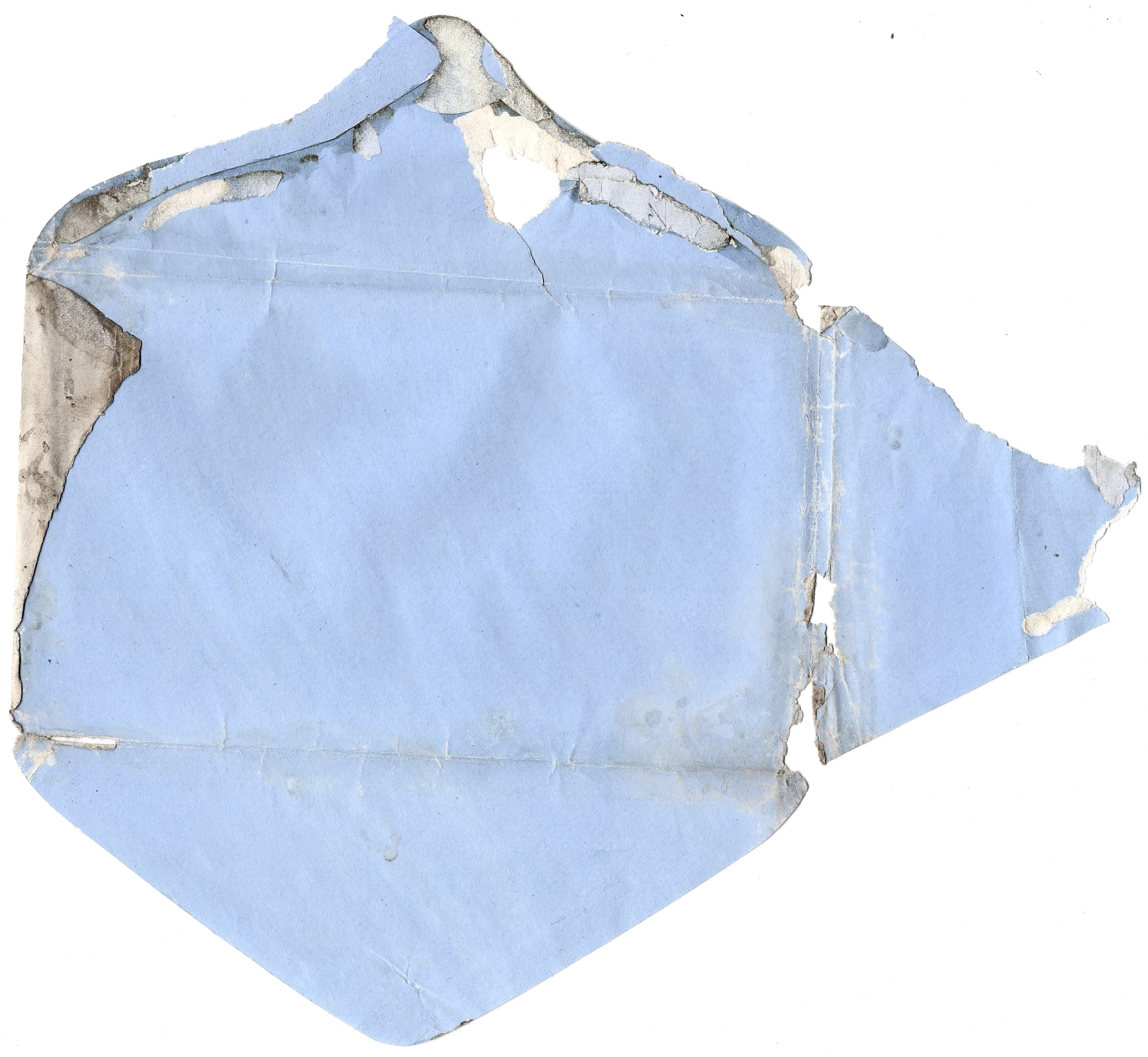
Mary’s letter was mailed in an Adversity Cover—a handmade envelope made from scarce materials like wallpaper, ledger paper, &c.
Excerpt from the 1863 Diary of James Hamilton Mills, 11th Pennsylvania Reserves
James Hamilton Mills just before the Civil War
The following excerpt of the Gettysburg Campaign comes from the 1863 diary of James Hamilton Mills (1837-1904) who was a native of new Lisbon, Ohio. He was working in “mercantile and mechanical pursuits” until the Civil War when he enlisted as a private on 27 April 1861 in Co. G (“The Independent Blues”), 11th Pennsylvania Reserves (40th Pennsylvania Infantry). With his regiment he participated in twenty seven general engagements of the Army of the Potomac, and for “gallant conduct on the field” he was promoted to corporal, first sergeant, first lieutenant and captain and for “heroic conduct in the Battle of the Wilderness and Bethesda Church” he was commissioned brevet-major and brevet-lieutenant colonel. He was mustered out of service at Pittsburg on June 13, 1864.
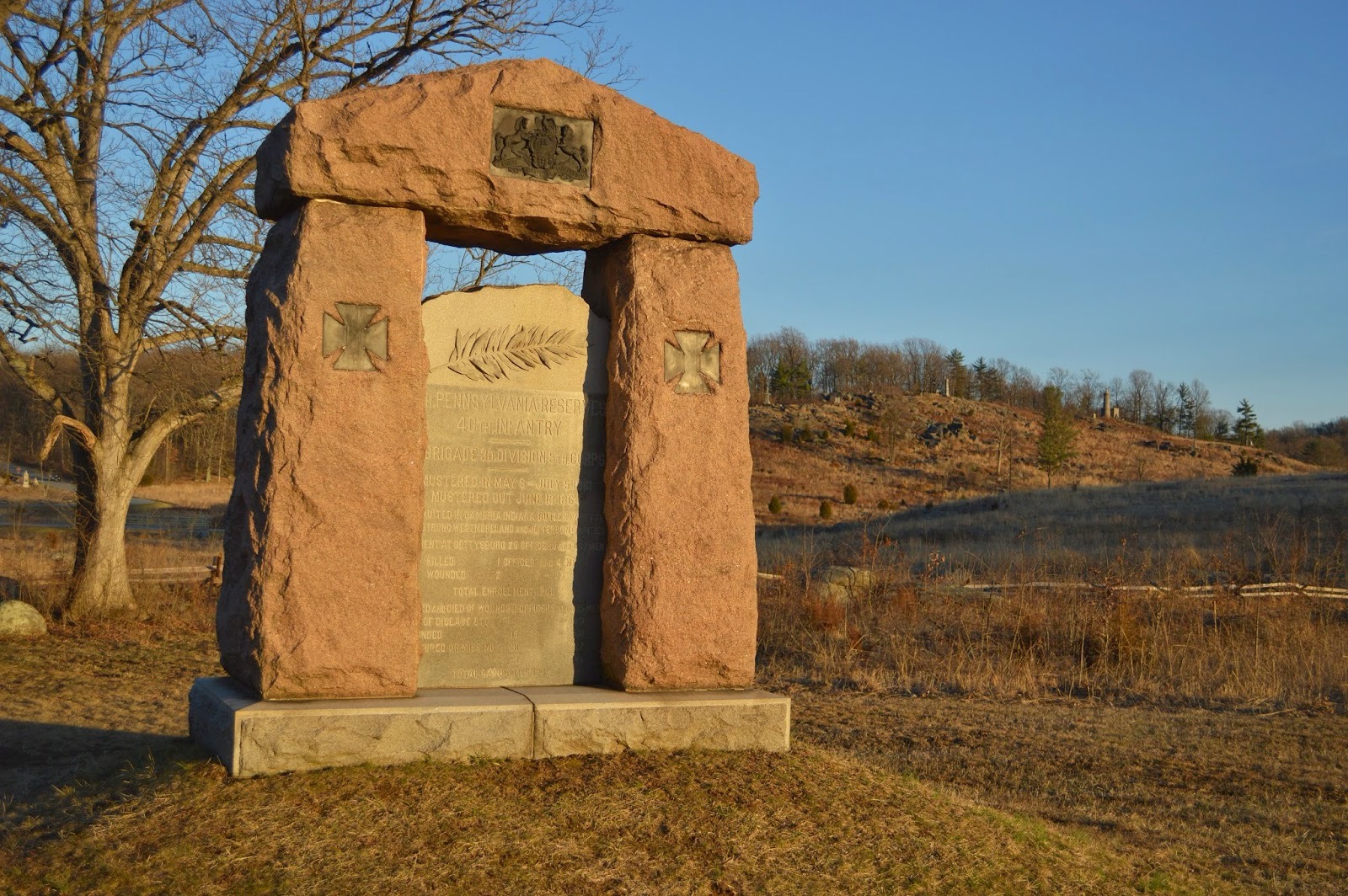
During the Gettysburg Campaign, Mills served as the 1st Lieutenant of his company. Following the battle, on 17 August 1863, he was promoted to Captain. The monument of the 11th Pennsylvania Reserves on the Gettysburg Battlefield is located on the east side of Ayers Avenue just south of Wheatfield Road. On the back of the monument, It reads: July 2nd in the evening charged from the hill in rear to this position and held it until the afternoon of July 3d when the Brigade advanced through the woods to the front and left driving the enemy and capturing many prisoners.
Mills’ 1863 diary is among several diaries of his that are housed at the Montana State Library. It has been digitized recently but apparently never before transcribed and published. I have not shown the images of the diary pages since these can be viewed on line at James H. Mills diary, 1863.
James Hamilton Mills’ 1863 Diary(Montana State Library)
T R A N S C R I P T I O N
Sunday, June 21, 1863—We have been on the qui vive all day. Expecting a fight. Heavy firing from ten a.m. until 7 p.m. in the direction of Aldie. It is likely our cavalry at Thoroughdare Gap. Wrote to Hattie & D. W. Hoppstot. Preaching at 10.30.
Monday, June 22, 1863—Very pleasant today. The roads are in excellent order for marching. The firing yesterday was a cavalry fight. Pleasonton attacked the Rebel Stuart at Middleburg and drove them to Ashby’s Gap, holding the field and capturing 2 guns, 3 caissons, small arms, and prisoners. Our cavalry is beginning to be of service.
Tuesday, June 23, 1863—A little warm. Today we received orders to prepare to march at a moment’s notice.
Wednesday, June 24, 1863—Everything quiet in the forenoon. An inspecting officer from Gen. Heintzelman was around during the day and professed ignorance of our having orders. We were congratulating ourselves on it being a false alarm when at dark an order came to march to Upton’s Hill and so I suppose our play day is over and we are again to go to the front. Letter from Eliza English.
Thursday, June 25, 1863—Left camp at 9 last night and marched to Upton Hill. Reached there at 2 a.m. & camped on the drill ground this morning. It was very uncertain about us moving but about 2 p.m. we fell in and marched up the Leesburg Pike to the crossroad to Fairfax Court House and camped in pine woods. Only the 3rd Brigade is here. The 1st is to join us here tomorrow & the 2nd is to remain at Alexandria. Lucky 2nd.
Friday, June 26, 1863—2nd Brigade joined us at midnight. It rained all the night and only held up this evening. We started a little after 6 this morning and after making a great sound, came on the pike again and marched as far as Broad Run. The march was very severe and the curses of the men were plenty. Received a letter last evening from Hanna & Ramsey. Miss Annie [Jones], the ex-cavalryman is in the Old Capitol [prison] having been caught outside the lines. 1
Saturday, June 27, 1863—Reveille at 4 a.m. Broke camp at 5.30, marched about 4 miles & crossed the Potomac river into Maryland at Edward’s Ferry. Marched some 8 or ten miles up the Potomac and camped for the night. It has rained off and on all day. The roads are not very muddy but the men were very much fatigued. Rumor today that the Rebels have taken Harrisburg. Issued knapsacks and canteens.
Sunday, June 28, 1864—Took a 5 o’clock start this morning. Crossed the Monocacy [river] on a stone aqueduct and marched 10 or 12 miles and camped in the 5th Corps, of which it is supposed we will be the 3rd Division. Gen. Hooker was relieved of the command and Gen. Meade superseded him. Saw R. Townsend. Iti s rumored this evening that we are to march on to Pennsylvania in the morning. A rumor is current that Vicksburg is taken.
Monday, June 29, 1864—Was ordered to be ready to start at daylight this morning. We were up and had tents down just in time to be dry. The rain fell in heavy showers for the remainder of the day. We did not get started until 1.15 o’clock and were delayed until after dark when we made a rush ahead and nearly run ourselves down. Camped for the night at 11 o’clock on top of a range of high hills some 8 miles east of Frederick. Marched through a fine valley.
Tuesday, June 30, 1864—Woke up this morning soaking wet. We did not put up tents last night and the boys were all soaked this morning. Marched very hard today. I was sick and had to ride in the ambulance in the afternoon. Passed through Uniontown, Liberty, and Union Bridge. Camped with 3rd Corps near Uniontown at dark and were mustered for pay at 8 p.m.
Wednesday, July 1, 1863—Left camp at 6 this morning and about 1 p.m. crossed the line into Pennsylvania. Addresses were issued from Division & Brigade commands before crossing and the boys gave three good cheers for Pennsylvania. Stopped five miles south of Hanover. Rations were issued and the wagons sent to the rear. Ammunition inspected and everything in readiness for a fight. There is a fight today at Gettysburg.
Thursday, July 2, 1863—We started at 9 last night and marched until 2 a.m. Men very much fatigued. Turned into a meadow and slept until 5 a.m. Started again and made a hard march to Gettysburg where are now at 1 p.m. Both armies are here and there will be a terrible fight today or tomorrow. 8 p.m. Sure enough we had it today. We arrived in time to save the field. Made a most brilliant charge and drove the rebs as far as the General would let us go. Am on the front skirmishing.
Friday, July 3, 1863—We lost last evening in killed Graves Gallagher. Wounded, S[amuel] L. Potter, Jas. N. Maguire, W[illiam] D. Scott. Held a strong position all day and wanted the rebs to attack us. The great battle was fought today on the right. We gained the day. Took 8,000 prisoners. Made another charge this evening and drove them 1.5 miles. Took many prisoners, one color (15th Georgia) and over 3,000 arms. We are fighting wit hthe 1st Brigade. Are lying tonight a mile in the advance. A very heavy rain after dark. All nearly dead.
Saturday, July 4, 1863—This is a glorious 4th of July. The rebs were whipped all along the lines yesterday and they will have to retreat or be cut to pieces. Gen. Meade is trump with the army and Crawford suits us exactly. We came back to our old position at the stone wall and after standing a most drenching rain, were relieved and taken up on the hill. We lay down on the wet ground and slept soundly.
Sunday, July 5, 1863—Very wet all last night and most of today. We lay quiet until about 5 p.m. when we fell in and marched down around the right flank of the rebs, and halted about 11 o’clock. The roads were terrible but the men are in good heart and kept up well. The rebs are falling back having been completely whipped.
Monday, July 6, 1863—We marched a few miles today and camped. The men are scouring the country in search of extras to eat. I never saw the Army of the Potomac in such good spirits. All are anxious to push on and give the rebs another whipping before they succeed in leaving Pennsylvania. Went to a mill near and got two canteens of old rye for the boys.
Tuesday, July 7, 1863—Started at 7 this morning and made a very rapid march of over twenty miles down the south side of the Blue Mountains. We are heading toward Frederick. The roads are very heavy but I have not heard a grumble from a man. We camped about 5 miles from Frederick and received a mail.
Wednesday, July 8, 1863—It rained all last night and until noon today in torrents. We never made as hard marching go. Crossed the first range of the Blue Mountains and camped near South Mountain and Middleburg. Received official news that Vicksburg was surrendered on the 4th of July. Received supplies of shoes from Quartermaster.
Thursday, July 9, 1863—Left camp at 7 a.m., crossed South Mountain and camped in Boonsboro Valley about 1 o’clock I presume we will lay here long enough to concentrate and then push on. The enemy said to be between Hagerstown and Williamsport. Firing in the evening. Wrote to Hattie.
Friday, July 10, 1863—Broke camp at 5 a.m. and after a little delay, jotted out. Crossed the National Pike and Beaver Run and camped on the west side of Antietam Creek, making about 6 miles. Finding the rebs in force, disposition was made of the forces and a force sent to dislodge them. The dismounted cavalry & a battery of flying artillery did this handsomely. The Bucktails are out and the 11th supports them. There has been a good deal of fighting all along the line today.
Saturday, July 11, 1863—Moved out this morning and formed line of battle expecting the rebs to open on us. Laid en masse until evening and advanced with the entire line about 1.5 miles. The rebs fell back on our advance and did not offer battle. Our artillery is all up now adn we will probably have a fight tomorrow. D. Koons came over to see me. Have not met him for ten years.
Sunday, July 12, 1863—Made a general advance again today about a mile and shifted off to the left. We can see the rebel lines distinctly, having earthworks and barricades erected. Our lines advancing, the rebs fell back from Hagerstown & Funkstown leaving their earthworks. Our troops now occupy them. Very heavy rain in the afternoon. Received letter from S. M. and Hattie.
Monday, July 13, 1863—The 2nd Corps on our left must have worked like beavers last night for they have rifle pits along their entire front this morning. We followed suit and in two hours had formidable earthworks up. Advanced about 2 p.m. until we were under fire of their skirmishers. Fixed up defenses andn expected them to shell us. Heavy skirmishing all along in front, the rebs are obstinate and cannot be driven in. Something is in the wind.
Tuesday, July 14, 1863—Orders to move at 7 a.m. Started forward in column of division en masse and pressed on across the bottom up into the Rebel works. We expected a galling fire but the Rebs were gone—skedaddled. Followed them to the river and caught about 2,000 of their rear guard. They crossed on pontoons, ferries and fords near Williamsport. Camped near the river. Rain in the afternoon.
Wednesday, July 15, 1863—Struck tents at 6 a.m. and marched in the direction of South Mountain. Crossed the old Antietam battle ground at Smoketown and after a rapid march of 22 miles, camped on the southeast side of South Mountain gap. We were very tired and the rear was full of stragglers. Warm and no rain for a wonder.
Thursday, July 16, 1863—Broke camp at 4 a.m. and marched to a camp near Berlin. The pontoons not being here then, will be some delay in crossing the river. Commenced making out the muster and pay rolls. Went to a little rill and had a good wash. The wagons coming up, we got a change of clothing—the first I have had since Vienna.
Friday, July 17, 1863—Very wet today. We just got the rolls finished as orders came to move. We struck tents about 2 p.m. and marched across the Potomac [river] at Berlin. The P. R. C. [Penn. Reserve Corps] was the first one over. Moved out about three miles and camped at Lovettsville with orders to move tomorrow to Purcellville. Wrote to Hattie & Hanna.
Saturday, July 18, 1863—Moved out this morning at 7 a.m. but were delayed in the village for a couple of hours. Finally got off and marched until 12 when we stopped and camped for the day. The Loudon Valley through which we are marching is a fine agricultural country but not equal to the Maryland Valley. The citizens are nearly all women but in buying produce, we find them no so extortionate as in Pennsylvania. The Maryland people are the kindest we have met. Write to Mr. Delo.
Dwight Spencer (1827-1910) “was born in Mansfield, Connecticut, on February 27, 1827. In 1851 he moved to Brooklyn, New York, and was employed as a bookkeeper and as a Sunday School worker until he was ordained in 1863. During the Civil War Spencer was a delegate for the United States Christian Commission. After the war he did evangelistic work and in 1869 became pastor at Fair Haven, Vermont. In 1880 Spencer became superintendent of missions for the Rocky Mountain District of the American Baptist Home Mission Society. His territory included Utah, Idaho, Montana, and Wyoming. During his ten years in this position he started 30 churches and 33 Sunday Schools and built 25 meeting houses. After his tenure in the West, Spencer became secretary for the Wabash District of the Baptist Home Missionary Society for southern Illinois and Indiana and later for the New York District. He held that position until his resignation in 1901.”
From Spencer family papers, 1860-1979 (MC 151). Dwight Spencer papers consist of diaries (1860-1867) concerning his Civil War ministry and later work; an autobiography; and miscellany. James Spencer’s papers consist of biographical materials; correspondence (1871-1939); religious writings; a scrapbook; and miscellany. Collection also includes small subgroups of the papers of James’ wife Cora Spencer; daughters Marion Spencer and Frances Spencer; son Dwight Spencer; and grandson Spencer Wilson.
COAN SCHOOL Opened in April 1863, this was the first school in Norfolk for African Americans. Established by AMA missionary William Coan, the school operated in the Colored Methodist Church on Bute Street. Within a few days after opening, there were 1,200 pupils who would eventually be divided between the Coan School and another one that opened in the Bute Street Baptist Church.
This diary is housed and digital images of its pages can be found at the Montana State Library.
T R A N S C R I P T I O N
May 27, 1864—Arrived at Norfolk from Fortress Monroe about 10 o’clock and reported to Rev. E. N. Crane, the Norfolk agent of the Christian Commission. In the evening attended a meeting of the Convalescent soldiers at Belfour Hospital, Portsmouth. About 100 present. At the close of my address, I said that I should be happy to grasp by the hand as soon as the services were closed as many of the soldiers as would promise me that they would become true soldiers of the Lord Jesus. Accordingly when I had concluded about a dozen came forward and eagerly took my hand. After the meeting at the hospital, attended a meeting of colored children and adults gathered for educational purposes, The school (for such it properly is) is under the direction of Mr. [William] Coan (formerly of New York) assisted by a corps of about 30 young and middle aged ladies together with several soldiers and citizens who from time to time volunteer their services. About 400 children and adults were present and most of them were studious and as far as I examined them, they had made a good degree of progress. After the school exercises were concluded, I addressed the scholars for a short time upon the importance of improving every spare moment in the prosecution of their studies in order that they might acquire sufficient education to fit them for the discharge of their duties which would devolve upon them in their new relations in life. So closed the day.
May 28. I saw this morning a regiment of Union soldiers made up of men who were formerly rebel prisoners but who took advantage of the President’s amnesty proclamation and enlisted in the Union army. They were a good-looking set of fellows. Saw also a gang of prisoners working at street paving under a guard of soldiers and from one of these latter I learned that these prisoners had formerly been citizens of Norfolk and were being punished for acts of rebellion. I could but think how the scales were turned. Here were some of the Southern aristocracy working under a guard of Northern mudsills. Started for the Naval Hospital at Portsmouth and was kindly received by the chaplain Rev. Mr. Stockbridge. About 350 patients in the hospital. After dinner went through the different wards and conversed with about 30 of the patients several of which I found in an interesting state of mind. For particulars, see page 101-103. I was particularly interested in the case of two boys aged respectively 15 & 16 years. The latter was from Boston and was suffering from the effects of a blow which he received by being brought in contact with the walking beam. He told me that his parents opposed his enlisting, that they were in good circumstances, and that he had a good home. He run away and enlisted four different times and his father got him released and that when he still persisted his parents reluctantly gave their consent. He showed me a testament which his mother gave him before he left. Upon the blank leaves of which were written several texts of scripture after which she had written no doubt with tearful eyes. “Dear Eddy be a good boy. I shall never forget you. I shall constantly pray for you. Goodbye.” The other lad was from Baltimore and was an orphan. He told me that he had no relatives unless they were very distant. He had been a Sunday school scholar and had committed several texts from the new testament. He wept while I told him of Jesus—that He would be a friend that would stick closer than a brother. I was also interested in a young many who was dying with consumption. He was from Philadelphia. When he had a good home with kind parents, brothers and sisters who would gladly minister to his wants, could he get home. He had frequently been promised his discharge but through the neglect of officials, he was still detained. I told him of another home and urged him to seek the Savior and thus be fitted to enjoy its society and rest forever. He promised to meet me in Heaven. At 5 o’clock attended a meeting in one of the rooms. I addressed about 50 convalescent mariners. At the close of the meeting, several promised me that they would endeavor to become the children of God. At 7 o’clock I addressed the convalescents at Belfour Hospital. On account of the rain, but few were present. At the close of the services, several lingered to shake hands with me to whom I spoke words of encouragement and advice. Some promised me that they would endeavor to initiate the conduct of the prodigal son and arise and go to God, their Heavenly Father. So the day closed.
Sunday, May 29th 1864—At 9 o’clock, visited the Sunday School (colored) at the Bell Church where I found about 200 children apparently much interested in the study of the word of God. From this school I proceeded to the colored school in Bate Street under the superintendence of Mr. Coan. Here I found about 700 children, listened to their exercises in singing and repeating passages of scriptures. The scholars in both these schools show that they have rapidly improved both in useful information and in deportment. I made a brief address to each school. At 10 o’clock preached to the prisoners in the Union prison. About 100 prisoners were assembled. These are all from the northern army and are suffering punishment for various crimes. They are kept at work during the week at cleaning and repairing the streets. They listened to me attentively. At 11 o’clock preached in the City prison. About 75 prisoners assembled at the close of the service. Several appeared deeply impressed with the text to which they had listened. One young man came to me and wanted to converse privately with me. Promised to meet him in the afternoon At 3 o’clock preached to the 1st United States volunteers at their camping ground. The men were marched up by platoons and formed in solid columns. They listened attentively and I noticed several weeping during the services. The men comprising this regiment were taken prisoners from the rebel army and had since taken the oath of allegiance and enlisted in the Union army. they appeared orderly and apparently engaged in their various duties with a hearty good will. After services, religious papers were distributed among the ranks. There were in the regiment men from every southern state. Some were pointed out to me who had a few days before been taken prisoners at the Battle of the Wilderness and who only remained in the prison camp one night, so heartily sick were they of the rebel service. About forty recruits arrived during the day. Letters were shown from men in the regiment to their comrades in camp telling them how thoroughly they had been deceived in entering the rebel army and urging them to do as they had done and come over on to the side of Union. Nearly every man in the regiment can read and write. The commissioned officers (who were all northern men) bore testimony to their uniform good behavior and orderly conduct said they had rather command them than a regiment of northern men. After this service, I visited the young man in the City Prison above alluded to. I found that he belonged to Gen. Butler’s army and that during a drunken spree he had left his regiment and was afterward arrested for desertion. He was from the interior of New York State where he had parents residing. Said he had a good pious mother who had done for him all a mother could, Acknowledged that he alone was to blame for the suffering whenich he had brought upon him. He appeared truly penitently and said that after the morning service he fully resolved to lead a new life. I urged to seek help from God who alone was able to keep him in the hour of temptation. He promised me to commence praying at once. In the evening, preached in the Presbyterian Church in Portsmouth. A good audience composed largely of soldiers. The audience was attentive and appeared deeply interested. Engaged to preach for them again next Lord’s day. Also met a Baptist brother who wished me to preach in the Baptist Church. So the day closed.
Monday, May 30, 1864—Felt poorly today. In the morning visited the colored schools in Norfolk under the auspices of the American Missionary Association. In these schools there are about three thousand children under the care of forty teachers (white) assisted by several colored. These scholars show a good degree of improvement and appear anxious to learn. Some were well advanced in Geography and Arithmetic and wrote a fair hand.
Tuesday, May 31st 1864—Visited Fortress Monroe and from thence repaired to the Chesapeake and Hampton Hospitals. In these are about six thousand patients. We found in addition to the two chaplains four delegates of the Christian Commission which was as many as the surgeons in attendance (McClellan) would allow as assistants of the chaplains. In these two hospitals the average mortality is about twenty. Saw one poor fellow carried out on a stretcher to the dead house while there. Chaplain Marshall of the Chesapeake Hospital is the most efficient of any chaplain I have yet met with. He has been at the hospital about two years. About a year ago, he went North and collected money sufficient to build a chapel and reading room. He then had the chapel built at the North and brought down all ready for putting up. Entire cost about one thousand dollars. I attended a meeting of convalescent soldiers in this chapel in the evening. A good attendance and much interest manifested. Several soldiers spoke of the goodness of God to them, especially in turning them from paths of sin and folly into ways of righteousness. Several also offered prayers. I addressed the meeting and so the day closed.
Wednesday, June 1st—Assisted Bro. Tisdale at the rooms at Fort Monroe. Attended to the giving out of some delicacies to a part of the 15th Regiment N. Y. Engineers on board the transport Ranger while lying off the fort. Also two hundred books, tracts, and newspapers. To another company of the same regiment on board the transport City of Albany, I gave one hundred newspapers and tracts. Heard of the occupation of the house of Dr. STrong, a Baptist minister near Bermuda Hundred and an amusing incident in regard to the baptizing of his negroes. In the evening left for Norfolk expecting to go to the front, Bermuda Hundred tomorrow.
Thursday, June 2nd 1864—Did not go to Bermuda Hundred as I expected. Was quite sick during the early part of the day. In the evening attended prayer meeting in the High Street Presbyterian Church, Portsmouth—a good meeting. Quite a number of soldiers present. I addressed the meeting a short time. After meeting, addressed several personally upon the subject of religion. Several expressed desires to become Christians and several others told me that they hoped that they were already numbered among the faithful.
Friday, June 3rd—Spent the day in conversing with the soldiers in Belfour Hospital. Conversed with about thirty. Of this number, only four or five were indifferent. Of the others, I found five or six in an enquiring state of mind and I consider their cases as hopeful. The rest were free to acknowledge the claims of religion upon them but were disposed to delay. Nearly everyone asked me to come again and several wished me to bring them books and papers. Met a boy of fifteen who told me that he was an orphan. He came from Albany as a waiter upon an officer. He had a fever which I doubt not will result in death. He told me that he had been to Sunday school, that he wanted to be a good boy. Wanted me to bring him a testament which I did in the afternoon and gave him some advice. Conversed also with Benjamin F. Osborn from New York who has the consumption and who I fear will not live long. He showed me a daguerreotype which his wife had sent him of herself as well as some scraps of beautiful poetry, one of which commencing, “Nearer my God to thee,” I considered as very appropriate in his case. He wept freely while I talked to him and endeavored to point out to him the way of life. I urged upon him the importance of renouncing all his own righteousness and relying alone and solely upon Christ. I think that he is not far from the Kingdom of Heaven.
Saturday, June 4th—I spent the day in visiting at the Belfour Hospital and distributing religious papers. Almost four hundred of the latter were distributed and thankfully received by the soldiers. As opportunity presented, I conversed with the soldiers upon the subject of religion. They generally listened with interest and appeared thoughtful. Found none who could be called despisers of the truth but many neglecters. I have hardly met with a scoffer since I commenced my work. If the soldiers in our hospitals are a fair representation of our army in regard to morals (and I see no reason why they should not be), then may we truly say that never country mustered an army so noble. At the Belfour Hospital is a reading room and library under the management of Mrs. Perry from Massachusetts—a very estimable lady from which the soldiers are supplied with reading matter.
Sunday, June 5th—In the morning went out to the entrenched camp beyond Portsmouth and preached to the soldiers. On account of the rain which immediately preceded the time of the service, there was only a small number present. Immediately after service a young man came up and spoke to me saying that he was a member of the Baptist Church in Fall River, but that he had wandered from God and neglected many duties, I encouraged him to take a decided stand in favor of truth and ever to let his light shine. I also spoke to several others who appeared thoughtful and impressed by the truth to which they had listened. The men were all attentive. Dined with bro. Godfrey in his tent. Returned to Norfolk and attended colored services in th Bell Church. Was witnessed with the introductory prayer in which the minister prayed for the liberty of his brethren in bondage as well as for the success of the Union arms. WhenI remembered that a short time ago such a prayer could hardly have been offered in New York without raising a mob, I could not but think that it was a great change which permitted it now in Norfolk and that too before an audience which but a short time ago were almost everyone slaves. At 5 o’clock went out to the entrenched camp beyond Norfolk and preached to the 38th Regiment (colored). This regiment is composed almost entirely of men who were formerly slaves. The officers speak of them as being orderly—more easy to manage that white men and quick in the art of imitation. They say that they learn to go through with the drill exercise readily. The regiment is not yet full. The men listed with good attention and I hope that my labor may not have been in vain. At 7.30 o’clock, preached in the High Street Presbyterian Church in Portsmouth. The house was quite full and the audience attentive. A large number of soldiers were present and I pray that they may be led to embrace the truth and become followers of the Lord Jesus.
Monday, June 6th—Started for Bermuda Hundred. As we entered the James river, saw the fleet lying outside at its mouth. We soon came to Jamestown where we saw the remains of the first church built upon this continent which was soon after the settlement of the town in 1607. At Wilson’s Landing, saw where the attack was made by the rebels upon Col. Wild’s Colored troops. Fort Powhatan just above and opposite commands the river. At this point lies the iron clad Atlantic taken from the rebels near Savannah. She was captured by the Weehawken and is a dangerous looking craft. Passed Harrison’s Landing, the point to which McClellan retreated after his famous Peninsula Campaign. Arrived at Bermuda Hundred and formed no favorable idea of the place. In fact, it can hardly be called a place unless large fields dotted over with tents is such. There is nothing worthy of being called a house in the vicinity but only here and there a miserable chanty. Visited the Christian Commission tent and returned to the boat of which I passed the night.
Tuesday, June 7th—Started for the Point of Rocks, a place a short distance up the Appomattox from this place. We started for the front, taking a bundle of papers. We first proceeded to the left of the works resting upon the Appomattox, from which point we plainly saw the spires of Petersburg. From this point we continued our course along the works towards the James. My bundle of papers was soon gone, the soldiers actually snatching them from my hand. I was surprised to see the extent of the works thrown up in so short a time. Forests had been cut down and a line of earthworks thrown up from the Appomattox to the James. I should suppose a distance of six miles. The men must have had a mind to work. Just after we passed the center of the works, the rebels favored us with a half dozen shots, the shells exploding just outside our lines. The shrill whistle of these was anything but pleasant. Approaching the James, saw the fleet of monitors and gunboats lying abreast our works and just above them a net of ropes extending across the river to protect the fleet from torpedoes. From a signal station upon the roof of an unfinished house, at this point, with the aid of a glass, we could see the spires of Richmond, and works on the outside of the city over which floated a rebel flag. Looking across the river from this station, I saw a country indescribably beautiful. Fields of corn and wheat already opening for the harvest lay spread out as far as they could reach. About two o’clock heard heavy firing from the peninsula, supposed to be in Gen. Grant’s army. On our return, visited Gen. Gilmore’s Headquarters and were courteously entertained by him for a few moments. He offered to render us any assistance in his power in the prosecution of our work as agents of the Christian Commission. During our travels saw several shot and shell lying upon the field. Returned to Bermuda Hundred and in the evening attended a prayer meeting held in the Christian Commission tent at which a good number of soldiers were present. Several took part in the meeting speaking and offering prayer, anda good spirit prevailed. I addressed the meeting for a few moments. At the close of the meeting, spoke to several who tarried after the meeting had been dismissed.
Wednesday, June 8th—Returned to Norfolk. Nothing occurred worthy of note.
Thursday, June 9th—Spent the day in visiting the Gosport Navy Yard. Distributed about 500 papers, testaments, and other religious books. I spoke from time to time as opportunity presented to those receiving the book or paper urging upon them the importance of religion. On some of the vessels I found the men actually starving for religious reading. I found several boys of 15 or 16 years who had no testaments. I furnished them and one in particular promised to read it daily and to pray. May the Lord grant them His spirit. I was in every instance treated with great courtesy by the officers. I never feel satisfied with such a days work. I always feel at its close that I have not been been half in earnest—that I might have found many more opportunities had my heart been right, of impressing upon those with who I meet the importance of immediate attention to the great subject of religion. May the Lord help me to be more faithful. In the evening attended a prayer meeting in Portsmouth at which a good number of soldiers were present. I addressed them briefly. Near the close of the meeting I requested all those who hoped that they were on the Lord’s side, as well as those who desired to be on His side to manifest it by rising. About half a dozen rose and afterward two of those who had risen spoke acknowledging their wanderins and promising in the future to lead a holy life. We all felt that it was a good meeting.
Friday, June 10th—In the morning took a watch and package of money to a patient at Balfour Hospital named John R. Miller. Found that he enlisted in Mansfield, Conn., my native town, and at once became interested in him. He acknowledged that he had lived a reckless life and said that he had fully resolved to learn from his follies and become a different man. He looked upon his affliction (he had lost a leg) as sent of God to lead him to reflect upon his ways and to turn from his sins. I gave him such advice as I thought suited to his case. Afterward went to Fortress Monroe and took a tug in company with some friends to visit the Rip Raps. From this place, proceeded to Hampton Hospital in company with Mr. Crane. We thought we would go over and visit the remains of Hampton which was burned by the rebel Magruder. There is scarce anything left of this once beautiful town; but instead of fine houses, little slab huts everywhere greet the eye of the visitor. The negroes, the owners and occupants of the huts, have built by the side of the chimneys, which were left standing, and so use the same fireplace that the wealthy proprietors had formerly used. Visited the old church which is said to have been the second built in this country, the bricks of which were brought from England. It is now a mass of ruins, having been burned with the rest of the town, and the burying ground surrounding it shows unmistakable evidences that it has been visited by an unfeeling soldiery. Talked with some of the colored people with whom I met and now at the close of the day, I feel that little or nothing has been accomplished for my Master.
Saturday, June 11th—Spent the day at the Naval Hospital, Portsmouth. I first met a man who professed to be an atheist. I talked with him some time and endeavored to show him the folly of his course and the dangers of his position. I did not feel satisfied with myself, fearing that there had been an effort to display the wisdom of this world rather than that spirit of meekness and love everywhere recommended in the scriptures. Saw the two boys John Williams and Edward Lock referred to on pages 5 & 6. I became more interested in them than on my previous visit. For the latter, I have great hope that a mother’s prayers and counsels may not prove in vain. He appears to be sincere in his desire to become a Christian. For the other lad, I feel sorry. He has no earthly friends. Oh that Jesus may become his friend. Found another boy from Massachusetts who I trust is not far from the Kingdom of Heaven. His brother had recently fallen in battle and he showed me a letter from his sister in which this sad intelligence was communicated to him, and in which she also exhorted him to prepare for death. I conversed with about fifty in all and distributed a number of testaments among the men, they promising to read them. In the evening attended a meeting at which about fifty of the patients were present. I was glad to see a good number with whom I had conversed during the day. I addressed them for a short time and when I had concluded, I asked all who hoped that they were on the Lord’s side as well as all those who had a desire to be on His side to manifest it by rising. Some dozen rose and among those Edward Lock, the lad already referred to. May the Lord keep him and all the rest who with him are trying to take a stand for Jesus. I felt as I retired that my labors had not been in vain.
Sunday, June 12th—In the morning went up to the Taylor farm about six miles from Norfolk in the direction of Fortress Monroe, and preached to the colored people who are living there and managing the farm for the benefit of government. I found Mr. Beale, the superintendent, a very kind man and I should think well fitted for his position. There are about seven hundred colored people on the place including children, a day school, and Sunday school are kept on the farm, and on week days the children are required to work four hours and attend school four hours. About three hundred were present at the services and were very attentive. They were anxious that I should come and see them again. At the close of the service, I distributed about 300 books and papers. At 3 o’clock I preached to the 1st US Volunteers at their camp near Norfolk. Did not enjoy the services as on a former occasion, the Lieut.-Colonel have severely reprimanded the Adjutant for not forming the lines according to orders. I do not think the Adjutant was to blame as I think he did not understand the orders. The Lieut.-Colonel commanded the companies to be dismissed and the lines to be formed again in ten minutes. I felt that the men were not there willingly and could not enjoy the service. However, the men listed to me attentively. At the close of the service, distributed about 300 papers. At five o’clock attended an anniversary service of the (colored) Sunday school under the superintendence of Mr. Coan in the Bute Street M. E. Church. The attendance was large and the services interesting. The scholars showed that the labor expended upon them had not been in vain. I addressed the meeting for a few minutes. In the evening preach in the High Street Presbyterian Church in Portsmouth. The audience was large and the attention good. May the Lord own and bless His truth. I am much interested in this service from the fact that so many soldiers attend it. [page 40]
A post war image of John B. Zarbaugh of Co. G, 21st OVI
The following letter was written by John Bookman Zarbaugh (1837-1919), the son of John Zarbaugh and Mary Bookman of Canal Winchester, Franklin county, Ohio. John served as a private in Co. G, 21st Ohio Volunteer Infantry (OVI) from September 1861 to September 1864. John was married to Mary A. Noss in September 1858. Sometime before 1880, John moved with his family to Portage, Hancock county, Ohio, and by 1900 to North Star, Gratiot county, Michigan. He died in Ithaca, Michigan.
The 21st OVI had a long and glorious military record. They were engaged in many of the major engagements of the Western Theater, including Stones River, Chickamauga, the Atlanta Campaign, and Sherman’s March to the sea and Carolina Campaign. With their five-shot Colt Revolving Rifles, they could be counted on to deliver a murderous fire on any attacking column and helped to repel several assaults on Snodgrass Hill in the Battle of Chickamauga. However, they eventually ran out of ammunition and were surrounded, losing over half their men (243 of 561) to casualties and capture.
Example of reported atrocities. Hartford Evening Press, 4 December 1863
Loss of the field and Union retreat meant leaving dead and dying comrades on the field so the anguish expressed by Zarbaugh at the report of unburied and mutilated corpses was certainly understandable. Though Zarbaugh’s letter contains only hearsay, the reports of Rebel atrocities such as the dead left unburied for a couple of months on the battlefield, and the cutting off of heads and sticking them on stumps or poles was printed in many newspapers in December 1863.
The inkwell used by John B. Zarbaugh during the Civil War.
T R A N S C R I P T I O N
Chattanooga, Tennessee December 16, 1863
Mr. Henry Noss and Catherine Dear Father and Mother,
I seat myself this morning to write you a few lines to let you know that I am yet in the land among the living and in the enjoyment of the blessings of God, which is health and strength. Hoping that these few lines may or will find you and your family in a similar beatitude.
In the first place, I will let you know that I have not forgotten you yet, although it is not very often that I write to you. But I have no doubt you hear of me most every week or two. Well father, I must tell you that I often think of you and your family. But that is all the good that it will do me. I have often wished I could only come there and stay a day or two and see you all. But wishing is all in vain. I do not expect to come home until my time is out if God spares my life and gives me strength enough to go there.
Some say our time will be out in five months and other ones say we have to stay eight months yet. Therefore I shall not make any calculations to come home any sooner than eight or nine months—if I live that long. Father, this last year it seems as though the days were weeks and the months were years. It is going to seem longer than the two last years did. But I think if we have good luck, we will sometime see the day when we can meet again upon this world. But if I should be one of those that should be called to another world, I hope to meet you there and I hope to meet Mother there, and I hope to meet my family there and all the rest of the family at some future time.
Father, I have nothing new to tell you. Everything is quiet. Our men are busy a working upon the railroad between this place and Bridgeport, Alabama. It will take about one month yet before the cars will run to this place. We have been on short rations ever since we are here and I do not expect to get any more until the cars come through. I can tell you we saw harder times here than at any other place since we are in the service.
I will also let you know (but I have no doubt you have heard it long ago), that the rebels did not bury our men at the Battle of Chickamauga. I saw a man yesterday that crossed the battlefield twice—one last week and this week—and he told me that he saw the bones of our men lay upon the ground. Some had their clothes over them yet and some of our men, they cut their heads off and stuck them upon a pole. I say it is ridiculous. Such people should not live. They cannot say that about our army. We have buried all their dead wherever they fell in our hands and they were buried as honorable as our own men. Such an army as they have got can never prosper. They have not the power of God upon their side. I do not think they will hold out much longer anymore for their army is getting reduced every day, more or less.
Father, the weather is very fine down here for this time of the year. It is like spring. We have heavy frosts at night and in day time it is warm and nice like a May day. Father, I wish I could come home to spend the Holly days with you. I would like to help you eat some sausage and other good things tht we have not got in the army. But this wishing is all for nothing. So I will close for this time. Give my best respects to John and Doray and Fanny and tell them I have not forgotten them yet. So no more for today.
I remain your affectionate son-in-law, — John B. Zarbaugh
To Henry and Catherine Noss
I will now bid you good day and may God bless one and all of you is my sincere prayer. — John B. Zarbaugh
Another article on the subject of unburied corpses and mutilation of the dead Union soldiers. The Nashville Daily Union, 13 December 1863
The following letter was written by Sgt. Mander Alvan Maynard (1841-1913) of Co. F, 7th Rhode Island Infantry. He mustered into the regiment on 6 September 1862 and transferred into the new organization on 21 October 1864.
He was the youngest son of Moses William Maynard (1805-1894) and Martha Barnes Brigham (1809-1882) of Worcester, Massachusetts. During the winter of 1861-62 he taught school in Burrillville. The regimental history claims he was with the regiment in the Battle of Fredericksburg but contracted typhoid fever in January 1863 and was sent to hospitals at Baltimore and Portsmouth before rejoining his regiment at Lexington, Kentucky in November 1863. [This letter suggests he was still with the regiment in early March 1863, however.] He mustered out of the regiment in June 1865. In 1866 he married Sarah J. Anthony.
In the 1860 US Census, 18 year-old Mander was enumerated in his parents’ household in Ward 8 of Worcester, Massachusetts. Besides his parents, there was 26 year-old Adda and 23 year-old Malcom, both mentioned in this letter.
I promised you a long letter on this sheet of paper and you shall have it now or as soon as I can finish it. It may take more than one day but I will try to answer the questions in your former letters as fully as possible.
Malcom concludes that Albert M. Smith [of Smithfield, R. I.] is the man I helped off of the battlefield. No sir. He was 2nd Sergeant but got scared before we got to the field and left and instead of his belt &c. being shot off, two men in the company say they helped him take them off. He was not wounded in the least but played it and got discharged. Capt. [Lyman M.] Bennett found out what the matter was and reduced him to the ranks. The person I helped off was William H. Russell 1 and he laid beside me when he was struck by a piece of shell.
The things sent by Lieutenant Hall, I never got. He only came as far as Washington, was taken sick, and discharged. Capt. Goodell sent to him once but when the man called, he [Hall] was so drunk that he knew nothing of the package. Mother writes about sending a box. Don’t ever do so again. While you are waiting for an answer is time enough for a box to come through. You know as well as I how long we shall stay anywhere and whenever the Express Co. will take a box, send it along. You ask what I want. I want three or four handkerchiefs and no more extra clothes to pack around his summer. Butter is always welcome. If you send cake or pies, put them away from all liquids or moisture. If you could send me a pint of good brandy, it is the best thing for the chronic diarrhea of which so many die here. Send me three or four quires commercial note paper and one bunch envelopes to mail. Also a couple of good black pencils. Don’t send any more tea as I have enough to last me two months. A pound of crust sugar would be acceptable. I have the little pail and will try to keep it till I come home.
How is the old flag? Please send me Aaron’s address once more and I will try to write to him. As to my sending a box home by Express, they are all examined and besides, the agent of the Express Co. is sometimes 6 miles off so you need not expect a box from me without someone here is coming on part way at least for if expressed at Washington or beyond, it would not be opened.
I do not think I get all the papers you send but that is not strange for many do not get all their letters and I think I do. That N. O. Delta you spoke of I have not received. We left Falmouth for here Monday, February 9th, and arrived here Wednesday the 11th [aboard the steamer Georgia].
You write that you had a snow storm February 22nd. It snowed and rained here both the 21st and 22nd. Mother writes of my hardships and privations. I do not know as I have been really disappointed since I come out here except in one thing [and] that is our officers. And since Capt. Bennett has left, I can’t find much fault anyway.
As to food, clothing, marches and camps, they are as good as I expected. We do not often have any poor food and if there is any, we manage to get something else. Since I have begun to get better, we lave lived pretty well. We have had our regular meals here; for breakfast—coffee, potatoes and cold meat or beefstake. The latter we have half the time and it is good and enter. For dinner we generally have soup, boiled dish or beans. We have had beans and corn once, cold water or gruel for dinner. For supper, tea and sometimes apple sauce. We have had fresh bread ever since we came here. Last night we had a real milk toast made of this preserved milk in cans. It was very good. We also buy fresh oysters out of the shell for 25 cents per quart and I eat them raw, fried, and stewed. We get eggs at 40 cents per dozen and I boil them myself. Apples 3 for 5 cents—pretty good ones. Oranges 5 cents apiece. Cheese 30 cents per lb. Butter 40 to 50 cents.
My health is improving fast. In pleasant weather I walk out and as the hospital is close to the river (the James), I can see two or three gunboats, 1 monitor, and the wreck of the [USS]Cumberland. They keep a light on her tops nights to prevent other vessels from running into her. Yesterday I walked up to the Negro quarters where we buy our things twice—once in the a.m. and once in the p.m. Tis most as far as Chestnut Street [in Worcester, Mass.]
As to care, I have had as good as any here. I found friends here as I do most everywhere and what anyone has had, I have. So you need not worry about me.
Capt. William Howard Joyce, Co. F, 7th R. I.
Father asks, “Do things here look like home.” No! There are no roads. They drive in one place till they can’t any longer and then drive one side. There is not a fence anywhere within ten miles of where the Army has been and no slatted walls. All the fences they ever had in Virginia were the regular Virginia rail fence and fancy hedges cut down and all burned and let the Army camp a few days near a thick wood and when they leave it, will be thinned out. When we left Falmouth, we had to go two miles for wood and take half green pine then. The teams drew it for us.
He also asks, “Do you like the service as well as you expected?” Yes, nearly. I expected officers who were men too but as a general thing, they are drunk or cross. Our present Capt. [William Howard] Joyce is an Irishman and when not drunk, he is a kind-hearted, good-natured fellow and looks out for our wants. [end of letter is missing]
1 William H. Russell of Dartmouth. Massachusetts, was a private in Co. C. F, 7th Rhode Island Infantry. He was wounded in the Battle of Fredericksburg and transferred to the Veteran Reserve Corps on 12 September 1863. He mustered out of the service in June 1865.
Mander A. Maynard stands at far right in this post war image of veterans.
I could not find an image of Martin but here is one of Ezra Joseph Davy of Co. D, 121st OVI
This letter was written by Martin G. Modie (1840-1911), the son of William Modie (1799-1872) and Margaret Gates (1811-1880) of Chester, Morrow County, Ohio. Martin enlisted as a private in Co. G, 121st Ohio Volunteer Infantry (OVI) in August 1862 and served until April 1865 when he was discharged for disability.
Martin wrote the letter to his brother, George W. Modie (1838-1913) of Company A, 20th Ohio Infantry. George served with the 20th Ohio from October 1861 until July 1865 — nearly the entire four years of the war.
T R A N S C R I P T I O N
Franklin, Tennessee May 3rd [1863]
Dear Brother,
Yours of the 28th was received today. I am well and get along fine. We have to work on the forts here every day. 1 We got up last Friday morning at one o’clock and started out on a skirmish. We drove the Rebs six miles. The cavalry was ahead of us. They killed three or four and took about 25 prisoners.
Col. William Pitt Reid (1825-1879)
Dan Mathew is well and all the rest of the boys I believe. This is a very healthy place here and I expect we will stay here some time. Sam Corwin is here but I have not seen him. He is in the 125th Regiment. When you write, tell me what regiment Frank Gates is in. I forget whether he is in the 3rd or 4th. The 4th in here and the 3rd was but they have left. Dave Breece is well and Emory Wilson [too].
Col. [William Pitt] Reid has gone home. H[enry] Banning from Mt. Vernon is acting as Colonel now. We was mustered last Thursday. We look for our pay for the last of this month. Well, I have nothing of importance to write so I will close for this time. — M. G. Modie
1 Martin does not name the forts but he was likely referring to Fort Granger which was erected in late 1862 and early 1863 under the command of General Gordon Granger. It was located on Figuer’s Hill, northeast of town, overlooking the town, the Harpeth river, and the railroad supply lines.