1864: Samuel Cony Haskell to Mary J. (Cole) Haskell

The following letter was written by Samuel Cony Haskell (1831-1911), the son of George Washington Haskell (1803-1855) and Eleanor Spratt (1801-1889) of China, Kennebec county, Maine. Samuel was married to Mary Jane Cole (1833-1933) prior to 1855 and the couple resided in the town of China at the time of the 1860 US Census. Samuel enlisted on 18 December 1863 as a private in Co. C, 30th Maine Infantry. He transferred later to Co. G and to Co. B. He was described as 5 foot 11 inches tall, with black hair, and dark eyes, He was honorably discharged on 20 August 1865 at Savannah, Georgia.

The 30th Maine was organized at Augusta, Maine, and not long after they were mustered into service in January 1864, they were sent to New Orleans for duty in Louisiana.

Writing to Mary in the midst of the Red River Campaign in late May 1864, Samuel complained: “We have had some hard fighting to get down red river. i hardly know what to write. i wrote all the news when we was in alexandria. i do not know how much of it you have got. we joind the regt the first day of this month. we have been fighting every few days since we came back. we have marched over a thousand miles since we left franklin [Louisiana]. there is about three hundred of us left yet but we are poor ragged and loussey. when we left franklin i wighed 168 lbs. yesterday i waid 140. we have been through enough to kill any man. i have seene the time that i would give a dollar for what i could eat out of our swill pail but i will not try to discribe it. if you knew what i have suffered you would not take much comfort. but they say our march is over for this summer but i am afraid it is not. we are in camp on the bank of the missippia river just below the mouth of red river with orders to be readdy to moove at an hours notice. we expect to take transports for port hudson or new orleans and there go into summer quarters. that is what they tell us. the weather is so hot that we cannot march much. we have had a number of men sun struck the past week. i have stood it well so far but if i was at home gain they could not higher me to inlist. i would not be hired to go through what i have again.” [Source: May 24, 1864 Letter by Samuel C. Haskell posted on Find-A-Grave]

T R A N S C R I P T I O N
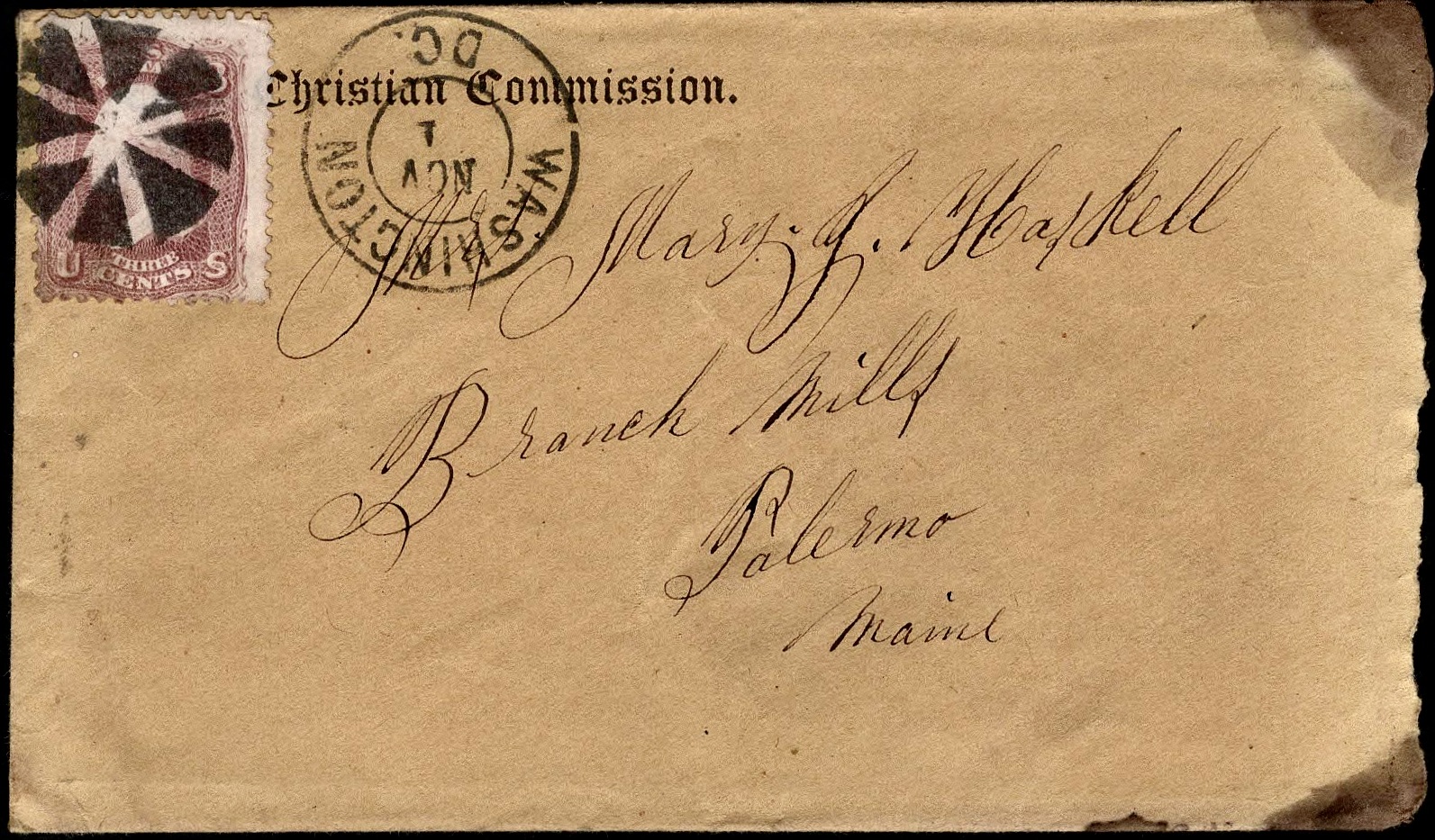
Addressed to Mrs. Mary J. Haskell, Branch Mills, Palermo, Maine

Baltimore [Maryland]
Wednesday morning, October 5, 1864

Dear Mary,

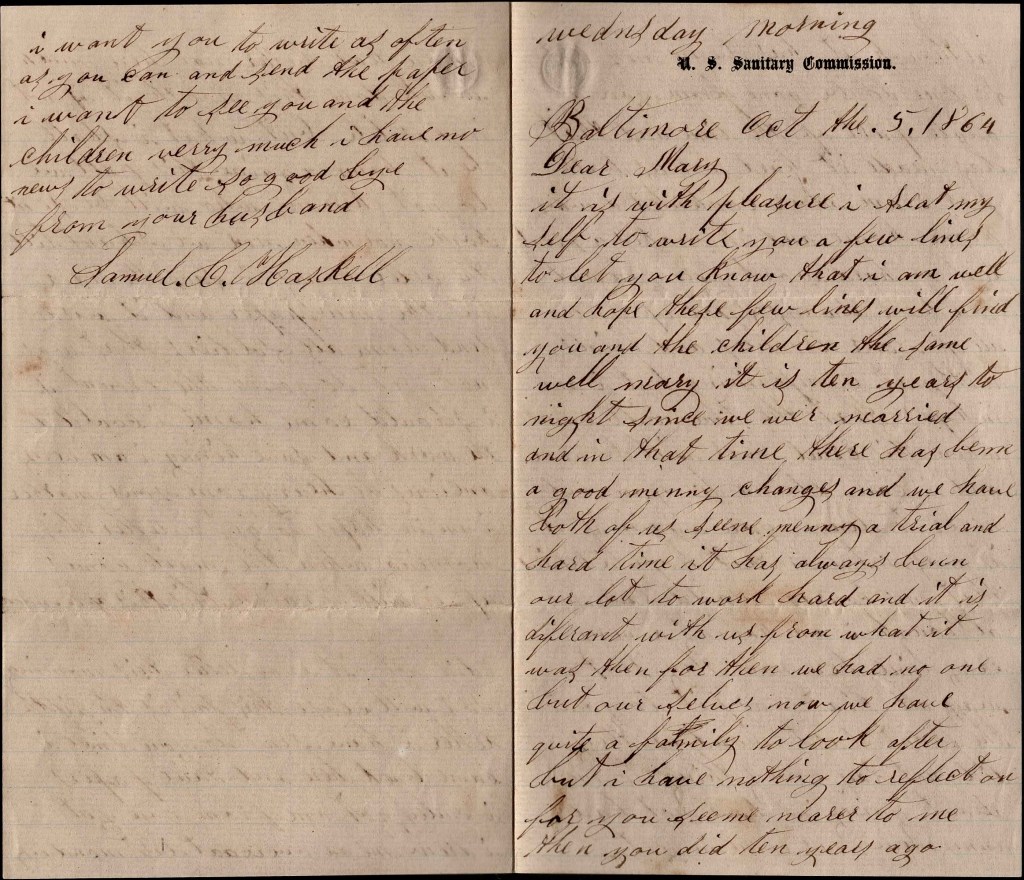
It is with pleasure I seat myself to write you a few lines to let you know that I am well and hope these few lines will find you and the children the same.

Well Mary, it is ten years tonight since we were married and in that time there has been a good many changes and we have both of us seen many a trial and hard time. It has always been our lot to work hard and it is different with us from what it was then for them we had no one but ourselves. Now we have quite a family to look after. But I have nothing to reflect on for you seem nearer to me than you did ten years ago although it has been my lot so far to be gone from you a great part of the time and that has made it hard for us both for I am never contented away from home, and it makes a great deal of hard work for you and you have always stood up under all of your troubles and trials without complaining. But I am in hopes that the time will come when this cruel war will be over and I can return to you and never to leave you again. If it was not for that hope, I believe that my courage would fail me although I am having a very easy time here now.

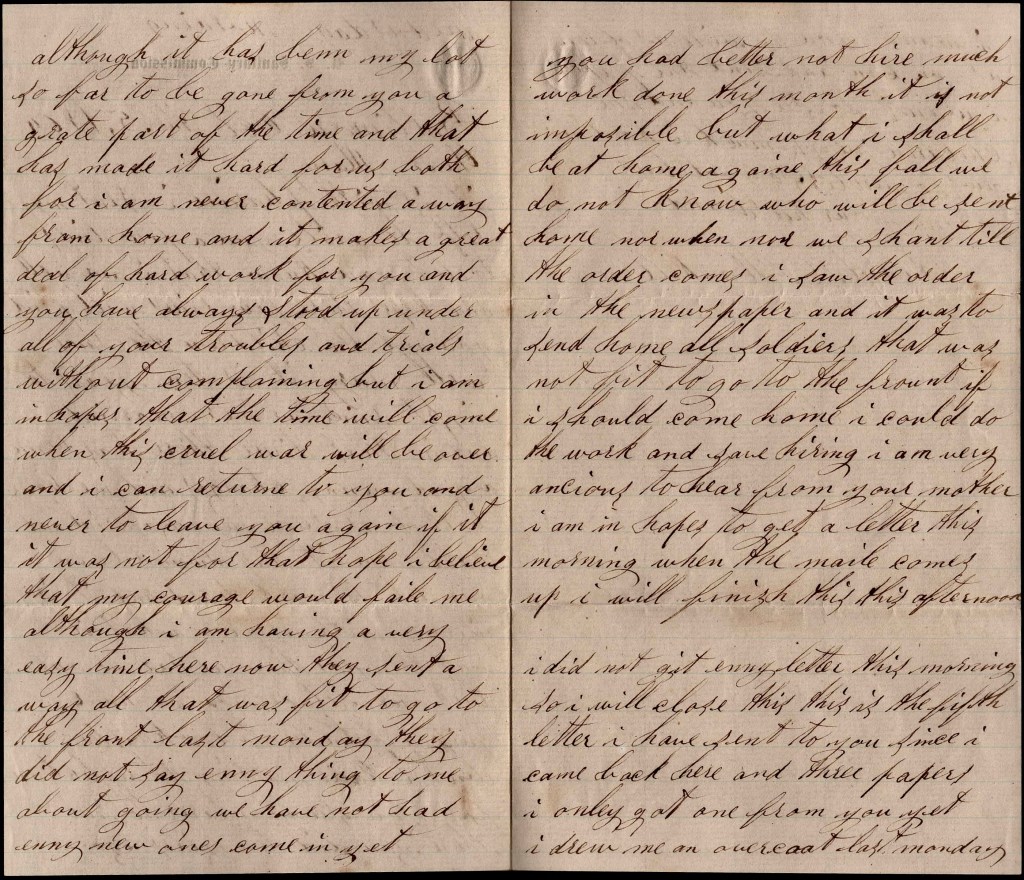
They sent away all that was fit to go to the front last Monday. They did not say anything to me about going and we have not had any new ones come in yet.

You had better not hire much work done this month. It is not impossible but what I shall be at home again this fall. We do not know who will be sent home nor when. Nor we shan’t till the order comes. I saw the order in the newspaper and it was to send home all soldiers that was not fit to go to the front. If I should come home, I could do the work and save hiring. I am very anxious to hear from your mother. I am in hopes to get a letter this morning when the mail comes up. I will finish this this afternoon.

I did not get any letter this morning so I will close this. This is the fifth letter I have sent to you since I came back here and three papers. I only got one from you yet. I drew me an overcoat last Monday. I want you to write as often as you can and send the paper. I want to see you and the children very much. I have no news to write so goodbye from your husband, — Samuel C. Haskell
1863: Thomas Richard Petrie to Gertrude Emily Sanders

The following letter was written by Thomas R. Petrie (1841-1923) of Fairfield, Herkimer county New York, who enlisted on 5 September 1862 when he was 21 years old to serve three years in Co. F, 152nd New York Infantry. He was quickly made a corporal and promoted to sergeant by April 1863 when this letter was penned from Suffolk, Virginia. He was later promoted to 1st Sergeant and was wounded in 1864.

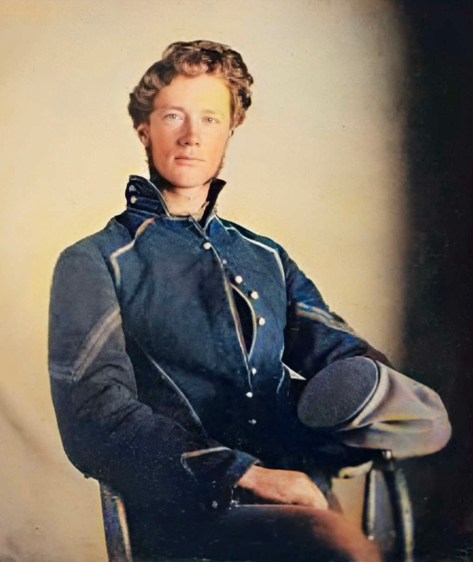
The image included with the letter. My hunch is that this was NOT Thomas for several reasons. Thomas was quickly made a corporal and this soldier appears to be a private; he’s wearing what appears to be a state-issued jacket and these were not issued to the 152nd NY in the fall of 1862; the image is a photograph of an early war tintype so as to make copies. The oval scratches on the original tintype are visible.

When he enlisted, he was described as 5 foot 11 inch tall farmer with hazel eyes and brown hair. He was the son of Robert Petrie (1808-1873) and Margaret Harter (1816-1906) of Fairfield.

Images of this letter were provided to me for transcription by Michelene Johnson who informed me that her mother gave it to her many years ago. She thinks it was among several items purchased in an estate sale in Remsen, New York, back in the 1970’s. A photograph of a young Union soldier was with the letter but it is not labeled and she is uncertain if it was Thomas Petrie.

Two years ago I had the opportunity of transcribing four other letters by the same soldier. You can find them posted here—1863-65: Thomas Richard Petrie to Gertrude Emily Sanders.

T R A N S C R I P T I O N

Headquarters 152nd Regiment N. Y. S. V.
Suffolk, Virginia
April 24th 1863

My dearest friend,

At last we have got into Dixie in earnest and thinking you would perhaps like to hear from your friend, I sit down to write a few lines. You have doubtless heard before this that we have left Washington Tuesday night very unceremoniously and started for parts unknown. We took the boat and away we went down the river. As we passed by the 121st, 34th, and the rest of the Boys at the front, there was great excitement and curiosity among us to know where we were bound for. But time was to answer our questions.

After sailing 18 hours we landed at Norfolk. There we stayed about 12 hours. Then we took the cars for Suffolk where we now are. The cars that we came on were nothing but wool cars—nothing but stakes up to the sides. Don’t you think we had a pleasant ride of 23 miles on those platform cars? And to make our pleasure complete, it rained almost all the way. It is about 250 miles from here to Washington. We have now got so far away from home that I hardly expect to ever get back again.

There is about 60,000 of our men around this city inside of the fortifications and there is a great many more expected soon. About 5 miles from our lines is the Rebel General Longstreet with about 40,000 men. He says that he is going to make this place too hot for the Yankees. He will have a fine time of it if he tries it. There is a great battle expected here soon.

Our general’s name is Peck. Our pickets and the Reb’s pickets are within shooting distance of each other. they exchange papers with each other once in awhile.

Now a word about the appearance of things here. The country does not suit me any better than it did at and around Washington for all everything in the line of agriculture is far advanced of your place. Peach trees are in full bloom and flower gardens are numerous and in all their beauty. But when you’ve said all that can be said of the country and productions, then turn and look at the inhabitants. In the first place, there is but a few of them here although it is quite a large city and those that are here look as if they were sent for.

Well, Git [Gertrude], I am sorry to say that this will be the last time that I shall be able to inform you as to H[amilton] I. Hailes’ health as he was left in Washington in the hospital. Will D. Morey was also left with him. He was suddenly taken sick a few days before we left.

Last night our company stayed in an old barn and we are there at present. Hank and I are well as ever, hoping this may find you the same. Believe me to be as ever your most true and sincere and devoted friend. With love unmeasurable, — Thomas R. Petrie

Write soon. I have not had a letter in it sent to me a long time. They are calling and I must stop writing. Remember me as your friend, — Thomas

Saturday morning, April 25, as I did not send this yesterday, I thought I would write a few lines more this morning. Yesterday we came very near having a little engagement with the Rebs. We were held back as reserve and the other regiments done the fighting. We for once heard the sound of battle and saw the effects thereof.

Give my love to all enquiring friends and write soon. Yours truly, — R. P. Please excuse all imperfections, blots and bad writing. I am writing upon my knee—the soldier’s desk.

1862-63: James William Craig to Nancy (Palmer) Craig

The following letters were written by James William Craig (1825-1863), a native of New Brunswick, Canada, who emigrated to Mars Hill, Aroostook county, Maine in the late 1840s with his wife Nancy (Palmer) Craig (1827-1865). In the 1860 US Census, the couple were enumerated with their children in the same household as Chase Gilman.

According to muster rolls, James enlisted on 14 December 1861 to served in Co. E, 15th Maine Infantry. He died at the Barracks General Hospital in New Orleans on 16 December 1863 after two years of service. The surgeon attributed his death to chronic diarrhea.

Copies of the letters are being sent to me by Bryan White and I will add more of them as he sends them to me.

See also—1863: Isaac Dyer to Lydia (Emery) Dyer. Isaac Dyer was theColonel of the 15th Maine Infantry.

Letter 1

Camp Parapet
Carrollton, Louisiana
August the 17th 1862

Dear Wife and Children,

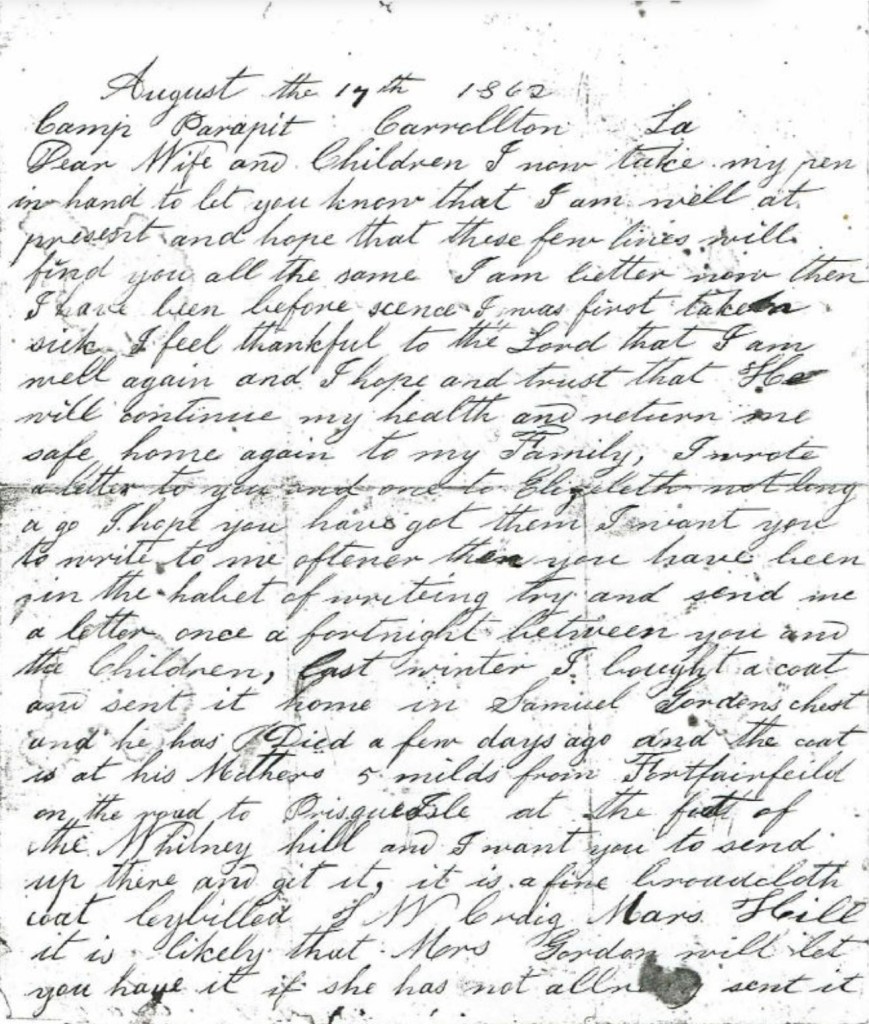
I now take my pen in hand to let you know that I am well at present and hope that these few lines will find you all the same. I am better now than I have been before since I was first taken sick. I feel thankful to the Lord that I am well again and I hope and trust that He will continue my health and return me safe home again to my family. I wrote a letter to you and one to Elizabeth not long ago. I hope you have got them. And I want you to write to me oftener than you have been in the habit of writing. Try and send me a letter once a fortnight between you and the Children.

Last winter I bought a coat and sent it home in Samual Gordon’s chest and he has died a few days ago and the coat is at his Mother’s 5 miles from Fort Fairfield on the road to Presque Isle at the foot of the Whitney Hill and I want you to send up there and get it. It is a fine broadcloth coat labeled J W. Craig, Mars Hill. It is likely that Mrs. Gordon will let you have it if she has not already sent it to you. Let me know the next time you write after you get this letter whether you have got it or not.

Let me know the next time you write what the  people seem to think of the war and the drafting. For my part, I do not have any idea when it will be over. We are same expecting an attack here before long. We have been furnished with new guns—the Enfield rifles. They are a handsomer gun than the ones we had before. They was the Austrian rifle.

I feel a great deal better contented than I did before I got well and I feel thankful that I am well again. And I feel thankful too that God has kept me out of all vile sins and thanks be to his name I do not hanker after any of the lusts of the world and I hope that I will be kept in God’s care and be prepared for death—let it come when it will. I hope these few lines will find you all well and hearty as I am at present. My dear wife and children, Oh may the Lord bless and protect you. I hope and trust in God that we will live to see each other and be a comfort to each other in life yet through the great mercies of our Redeemer.

I have not room to write more at present so goodbye dear wife and children for this time. God bless you. — James W. Craig


1862: Corydon Benton Breese to Elizabeth (Fletcher) Breese

The following letter was written by Corydon Venton Breese (1841-1938), the son of blacksmith Charles Pierson Breese (1808-1898) and Elizabeth Fletcher (1803-1876) of Breesport, Chemung county, New York.

According to muster rolls, Corydon enlisted as a private in Co. C of the 5th New York Heavy Artillery on 1 April 1862. In January 1863 he was transferred into the 5th US Artillery and remained with them until he was taken prisoner at Winchester, Virginia, and sent to Richmond until exchanged and discharged on 9 April 1865.

T R A N S C R I P T I O N

Camp Marshall
Headquarters, Fort McHenry
Co. C, 5th New York Heavy Artillery
July 11, 1862

Mother,

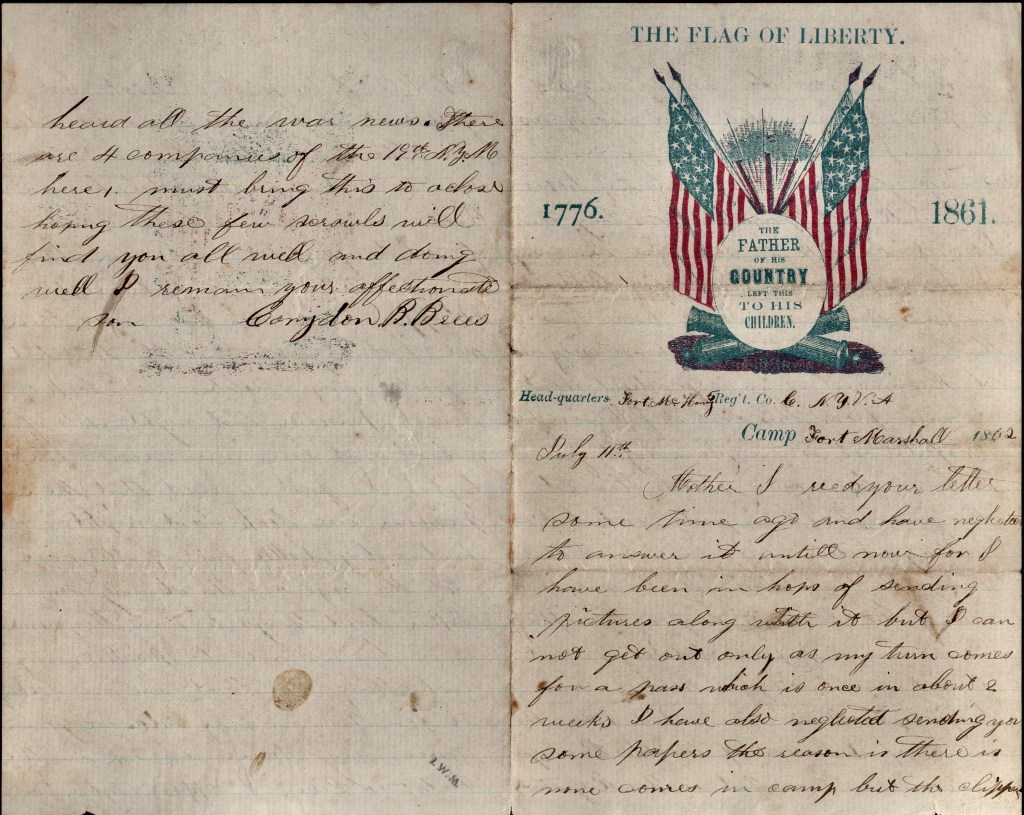
I received your letter some time ago and have neglected to answer it until now for I have been in hopes of sending pictures along with it but I cannot get out only as my turn comes for a pass, which is once in about two weeks. I have also neglected sending you some papers. The reason is there is none comes in camp but the [Baltimore] Clipper which is good for nothing—only New York papers.

I am well and hearty as ever I was in my life and doing first rate. I am in hopes we will get paid before long. Then I will be able to send you some money.

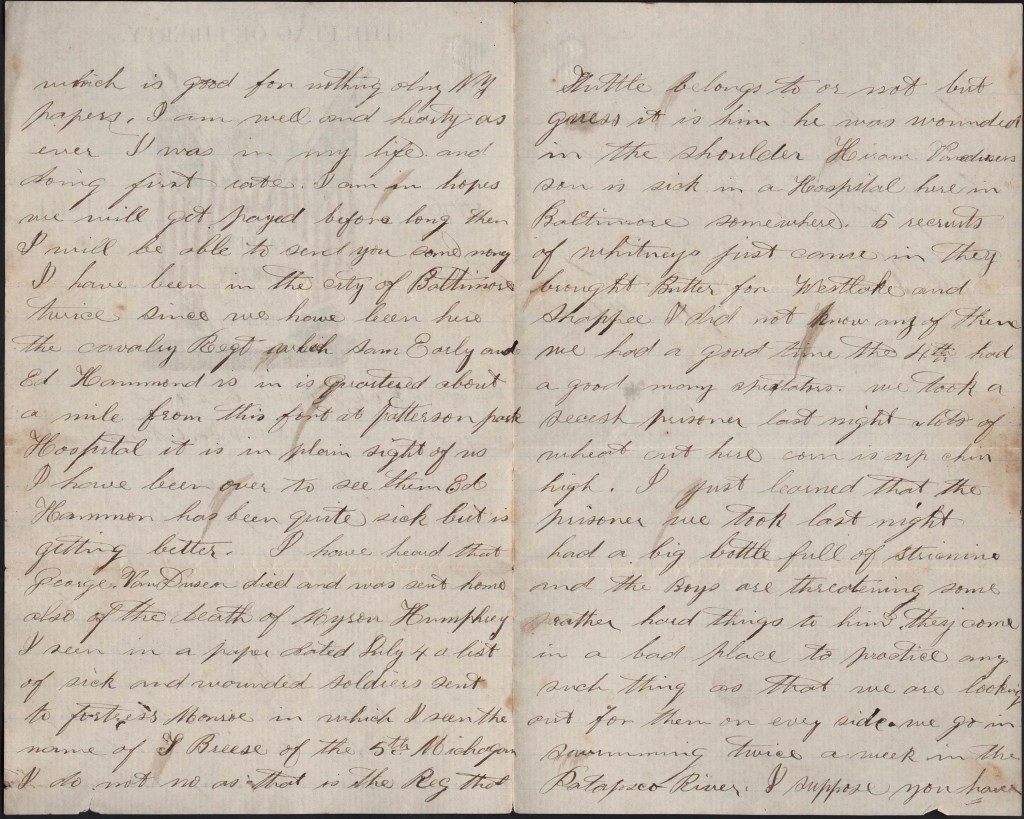
I have been in the city of Baltimore twice since we have been here. The cavalry regiment which Sam Early and Ed Hammond is in is quartered about a mile from this fort at Patterson Park Hospital. It is in plain sight of us. I have been over to see them. Ed Hammon has been quite sick but is getting better. I have heard that George Van Dusen died and was sent home. Also of the death of Myron Humphrey.

I seen in a paper dated July 4th a list of sick and wounded soldiers sent to Fortress Monroe in which I seen the name of T. Breese of the 5th Michigan. I do not know as that is the regiment that Tuttle belongs to or not but guess it is him. He was wounded in the shoulder. Hiram Vandusen’s son is sick in the hospital here in Baltimore somewhere. Five recruits of Whitneys just came in. They brought butter for Westlake and Shoppee. I did not know any of them.

We had a good time the 4th [of July]. Had a good many spectators. We took a secesh prisoner last night.

Lots of wheat cut here. Corn is up chin high.

I just learned that the prisoner we took last night had a big bottle full of strychnine and the boys are threatening some rather hard things to him. They came in a bad place to practice any such thing as that. We are looking out for them on every side. We go in swimming twice a week in the Patapsco River. I suppose you have heard all the war news. There are four companies of the 19th New York Militia here. Must bring this to a close hoping these few scrawls will find you all well and doing well. I remain your affectionate son, — Corydon B. Brees


1859: C. C. P to Mary M. DeGraw

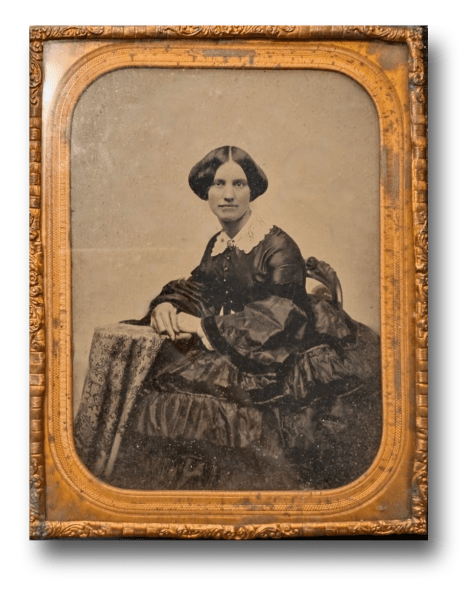
How the author might have look in 1859.

This letter was written by a young woman with the initials C. C. P. and who was most likely a resident of Rahway, New Jersey in 1859. We learn from the letter that she was traveling with a large party of other young women and gentlemen up the Mississippi River in the spring of 1859. She mentions missing her “babies” so I presume she was a married woman though she does not say anything of a husband. She also refers to a man named “Murray” who was traveling with them, perhaps as leader of the party. Might this have been Rev. Nicholas Murray, a leader in the Presbyterian church in New Jersey?

Even without knowing her identity, however, the letter provides us with interesting information about the Passenger Packet named Champion, captained by Enos B. Moore, that operated regularly between New Orleans and St. Louis in the 1857-1861 period. The author gives us a description of some of the ship’s features and of the luxuries afforded steamboat travelers just prior to the Civil War. She also mentions the spring freshet and the difficulties of getting ashore through the muddy floodwaters at Vicksburg.

Steamer Champion typically made the journey from New Orleans up the Mississippi River to St. Louis in four days but may have taken a little longer on this trip due to the strength of the current.

Flood on the Mississippi river in 1859


T R A N S C R I P T I O N


Steamer Champion
Mississippi River
May 8, 1859

My Dear Mary,

I do not know what to think of your long silence in any other way than that you have gone to Philadelphia. I have not had one letter from home yet, and only heard in New Orleans by telegraph. Tonight we expect to get letters from Memphis. We telegraphed at Vicksburg to have them sent to the boat so that we could go on to St. Louis instead of stopping.

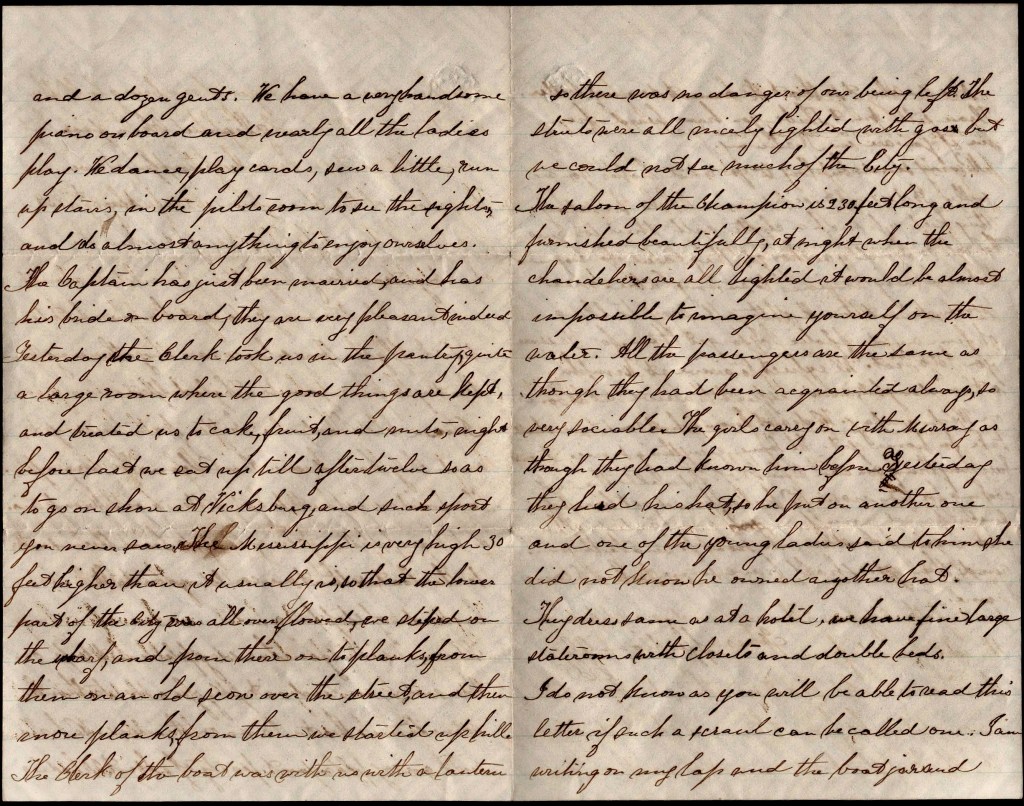
We are having such a very pleasant trip on the river. Indeed, it puzzles me to think sometimes that I am on the river. We have such a very pleasant party of about 20 ladies and a dozen gents. We have a very handsome piano on board and nearly all the ladies play. We dance, play cards, sew a little, run up stairs in the pilot’s room to see the sights, and do almost anything to enjoy ourselves.

The Captain [Enos Bascomb Moore] 1 has just been married and has his bride [Maria (Pratt) Moore] on board. They are very pleasant indeed. Yesterday the clerk [Duvall W. Young] took us in the pantry—quite a large room where the good things are kept—and treated us to cake, fruit, and nuts.

Night before last we sat up till after twelve so as to go on shore at Vicksburg and such sport you never saw. The Mississippi is very high—30 feet higher than it usually is—so that the lower part of the city was all over flowed. We stepped on the wharf and from there to planks, from them on an old scow over the street and then more planks. From them we started up hill. The clerk of the boat was with us with a lantern so there was no danger of our being left. The streets were all nicely lighted with gas but we could not see much of the city.

The saloon of the Champion is 230 feet long and furnished beautifully. At night when the chandeliers are all lighted, it would be almost impossible to imagine yourself on the water. All the passengers are the same as though they had been acquainted always—so very sociable. The girls carry on with Murray as though they had known him before. Yesterday they had his hat, so he put on another one and one of the young ladies said to him she did not know he owned another hat. They dress same as at the hotel. We have fine large staterooms with closets and double beds.

I do not know as you will be able to read this letter if such a scrawl can be called one. I am writing on my lap and the boat jars and shakes so that I cannot do any better. Please tell Aunt Phebe you have heard from me if you are in Rahway.

Murray send his love to you and hopes you are well. It does not seem much like Sunday, they keep up such a chatter with their tongues and laugh so loudly as though they cared for no one. I am very anxious to see my babies once more. Do not think with all my talking of fun and frolic I forget them for I assure you I do not. We expect to arrive at Memphis at midnight and expect to arrive at St. Louis on Wednesday. We do not know what route we shall take for home yet. We have everything so nice to eat here—everything you can think of. I smell the cake cooking for tea now. We have the most beautiful biscuit and muffins ever tasted, The cook is going to show me how to make them and then you shall have some when I come home.

Yours affectionately, — C. C. P.


1 “Captain Enos Bascomb Moore (1823-1903) spent his life piloting steamboats on the Mississippi and Ohio Rivers. He was born in 1823 to Levi and Amanda Moore. He spent his childhood on a small farm on the banks of the Ohio River, seven miles below Portsmouth. Enos and his three brothers gravitated towards river work. Enos’ daughter Mary Moore wrote in her family memoir, “Enos, who had graduated from the country school, was planning to study law at Delaware College, when a chance flatboat loaded with flour and New Orleans bound, lured him aboard; the other two brothers followed and soon all four were careering on the Mississippi.” The oldest brother William left home first and got a job working out of New Orleans for Captain R.C. Young, who operated several boats on the lower Mississippi. Not long after, William sent for Enos, and later the youngest brother Samuel. Enos’ first job was as a night watchman on the boat. Shortly afterwards he became a licensed pilot. William began chartering and operating boats on the Yazoo River, in Mississippi, and Enos invested in his enterprises. Together they built the steamer Hope, and many of the diary entries in this collection refer to money Enos sent to fund these endeavors.

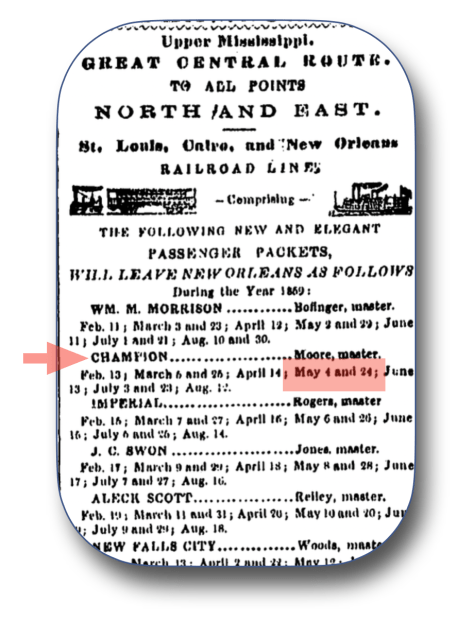
This schedule for the Upper Mississippi states that the Champion was slated to leave New Orleans on 4 May 1859.

Enos continued to pilot riverboats for Captain Young until the blockade went up at Cairo in 1861. During this period he captained the R.C. Young, which caught fire in 1855, and later (1857) the Champion with Young’s son Duvall as clerk. At the start of the war, Enos and William liquefied their assets, sold the Champion, scuttled their steamer Hope, and reportedly retreated to St. Louis with $80,000 in gold. In 1863 the brothers bought a half interest in the foundry and boiler-yard in Portsmouth Ohio. The following year they bought a fourth interest in the packet Bostonia, and in 1866 bought an additional eighth interest. In subsequent years they bought the other half interest in the foundry and machine works and merged their holdings with other pilots to form the Cincinnati, Portsmouth, Big Sandy & Pomeroy Packet Company. William managed business while Enos and Samuel piloted boats on the river. The Packet Company ran six boats, the Bostonia, Fleetwood, Telegraph, Bonanza, Morning Mail, and steamer Ohio. The side-wheeler Bonanza was the largest boat on the Ohio river at the time. The wooden hull was 265ft in length by 43ft in width, with a depth of 7ft. The ship dominated river traffic around Cincinnati from the time it was built in 1876, until the construction of the Chesapeake and Ohio Railway in the early 1890’s. Enos designed the boat and supervised its construction, then captained the vessel until he retired in 1889. Enos was married in Yazoo City, on 9 February 1859, to teacher Maria Prime Pratt (1829-1865), a native of Washington County, New York. Maria died in 1865, leaving behind two daughters, Frances and Mary.[Source: St. Louis Mercantile Library, P-84 Captain Enos N. More Diaries & Correspondence]

1861: Cornelius Van Buren to his Brother

An unidentified member of the 5th New York Infantry (LOC)

The following letter was written by Cornelius Van Buren (1837-1898) who enlisted at New York City on 10 July 1861 as a private in Co. G, 5th New York Infantry—better known as Duryee’s Zouaves. According to muster rolls, he deserted in October 1862 following the Battle of Antietam.

“The 5th New York was recruited in New York City and the immediate vicinity and mustered into the U. S. service for a term of two years, at Fort Schuyler, New York harbor, May 9, 1861. On the 23d it embarked for Fortress Monroe, camped for a few days near Hampton Bridge, then moved to Camp Butler, Newport News, and was attached to Pierce’s brigade. The troops of the 5th led the force at the battle of Big Bethel and lost 5 killed, 16 wounded and 2 missing. In September the regiment was sent to Baltimore for garrison duty and remained there until May, 1862, when it was assigned to Sykes’ brigade, reserve infantry of the Army of the Potomac, and on May 17, to the 3d brigade, and division, 5th corps, with which it fought in the battles of the campaign on the Peninsula. It participated in the siege of Yorktown, the fighting near Hanover Court House, the Seven Days’ battles, losing at Gaines’ Mill 55 killed, 37 wounded and 15 missing, and winning notice by the coolness with which, after heavy loss, the regiment was reformed under fire in order to fill the places of the fallen men. At Malvern Hill, the 5th was active, then spent a short time at Harrison’s landing, and afterward took a prominent part in the battle of the second Bull Run, where, of 490 members present, it lost 117 killed or mortally wounded, 23 per cent, of those engaged, the greatest loss of life in any infantry regiment in any one battle.”

T R A N S C R I P T I O N

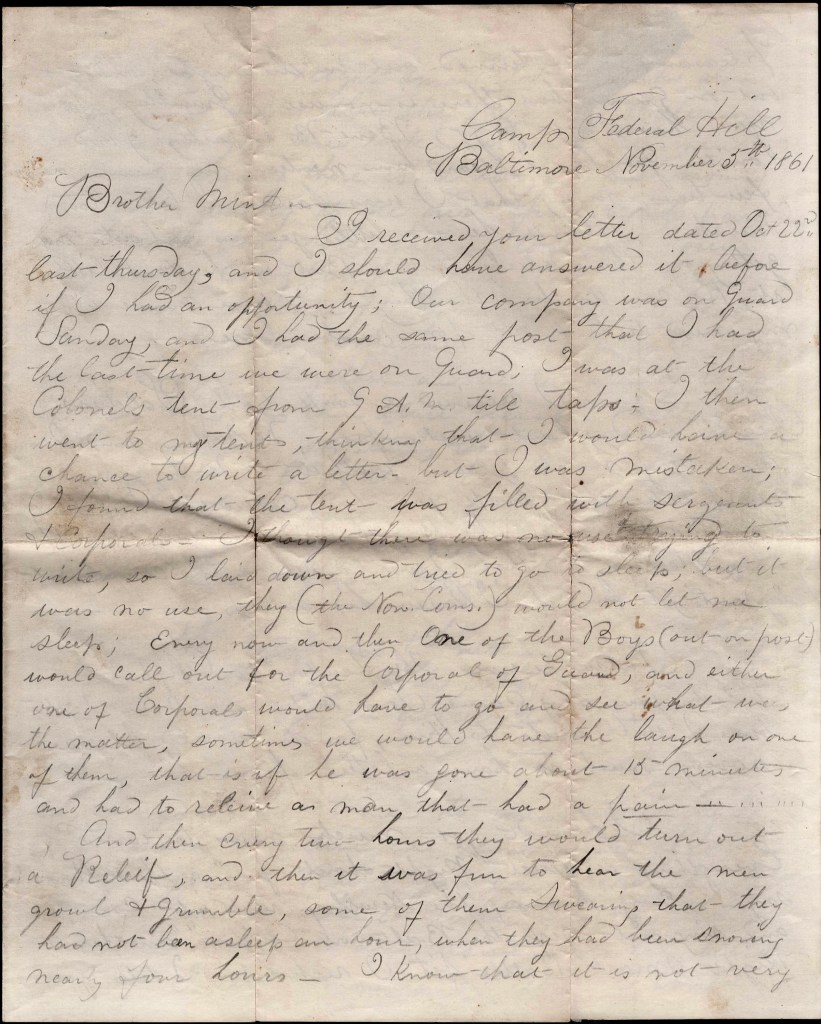
Camp Federal Hill
Baltimore, [Maryland]
November 5, 1861

Brother Minton

I received your letter dated October 22nd last Thursday and I should have answered it before if I had an opportunity. Our company was on guard Sunday and I had the same post that I had the last time we were on guard. I was at the Colonel’s tent from 9 a.m. till taps. I then went to my tent thinking that I would have a chance to write a letter but I was mistaken. I found the tent was filled with sergeants and corporals. I thought there was no use trying to write so I laid down and tried to go to sleep but it was no use—they (the non-coms) would not let me sleep. Every now and then one of the Boys (out on post) would call out for the Corporal of the Guard and either one of the corporals would have to go and see what was the matter. Sometimes we would have the laugh on one of them—that is, if he was gone about 15 minutes and had to relieve a man that had a pain [ ]. And then every two hours they would turn out a relief and then it was fun to hear the men growl and grumble, some of them swearing that they had not been asleep an hour when they had been snoring nearly four hours. I know that it is not very pleasant to be turned out in the night and go out on guard, but there is no use of grumbling for you have got to go.

Bene B. [Benton Bloomer of Co. G?] is pretty good on the growl. I heard him mention my name a few times saying that I was favored a little too much. I think he is a little jealous about my getting in the Orderly tent. But if he don’t like it, he can do the other thing. I have made up my mind to look out for Number One.

I received a book called “Soldier’s Health” one day last week from R. A. King and I am very much pleased with it. It is very much like the book you had called the “Military Hand Book.” Tell Mr. King that I am very much obliged to him and that I would return the compliment by writing to him if I knew his address.

I also received The Leader & Clipper which you say came [from] Tom McKee. When I get time, I will write to him for it would please me very much to have a letter from him.

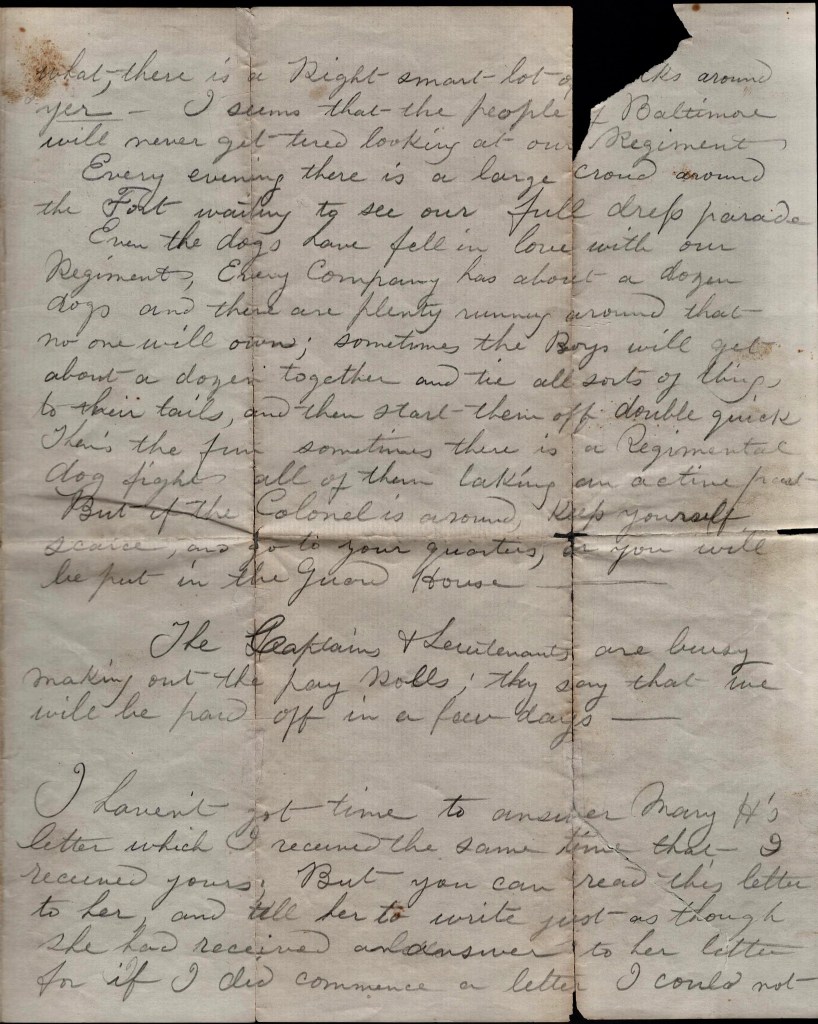
I haven’t got much news to write. Everything is quiet. “Right about you” as the Baltimoreans say. Every morning the newsboys rush into camp and sing out, “Yers the Baltimore Clipper” [or] “Another right smart battle fit, I reckon.” I tell you what, there is a right smart lot of [paper torn] around yer.

It seems that the people of Baltimore will never get tired looking at our regiment. Every evening there is a large crowd around the fort waiting to see our full dress parade. Even the dogs have fell in love with our regiment. Every company has about a dozen dogs and there are plenty running around that no one will own. Sometimes the Boys will get about a dozen together and tie all sorts of things to their tails and then start them off double quick. Then’s the fun. Sometimes there is a regimental dog fight, all of them taking an active part. But if the Colonel’s around, keep yourself scarce and go to your quarters as you will be put in the guard house. 1

The captains and lieutenants are busy making out the pay rolls. They say that we will be paid off in a few days.

I haven’t got time to answer Mary H’s letter which I received the same time that I received yours. But you can read this letter to her and tell her to write just as though she had received an answer to her letter for if I did not commence a letter, I could not write to more than I have written. I remain your affectionate brother, — Cornelius


1 The Colonel of the regiment by this time was Gouverneur Kemble Warren. Private William McIlvaine characterized Warren as ‘very efficient’ but found his personality ‘cold, precise and scientific.’ [Source: Destruction of the 5th New York Zouaves.” by Brian C. Pohanka]

1861: Cassius Newell Baker to “Friend Henry”

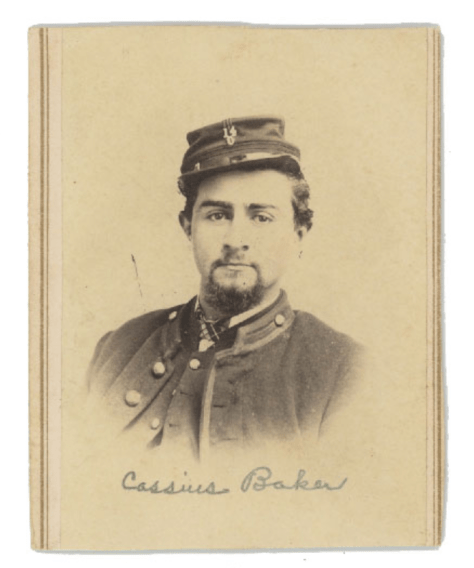
Cassius Baker (ca. 1864)

The following letter was written by Cassius Newell Baker (1844-1919), the son of Harris Porter Baker (1801-1879) and Emily C. Baker (1806-1852) of Mesopotamia, Trumbull county, Ohio. Cassius enlisted as a bugler on 8/20/61 in the 14th Ohio Independent Battery of Light Artillery. He reenlisted in 1864 and mustered out of the Battery on 8/9/65 at Camp Dennison.

After his service, Cassius married and relocated to Pottawattomie county, Kansas, where he worked as a retail grocer in Louisville. He later moved his grocery to Wamego.

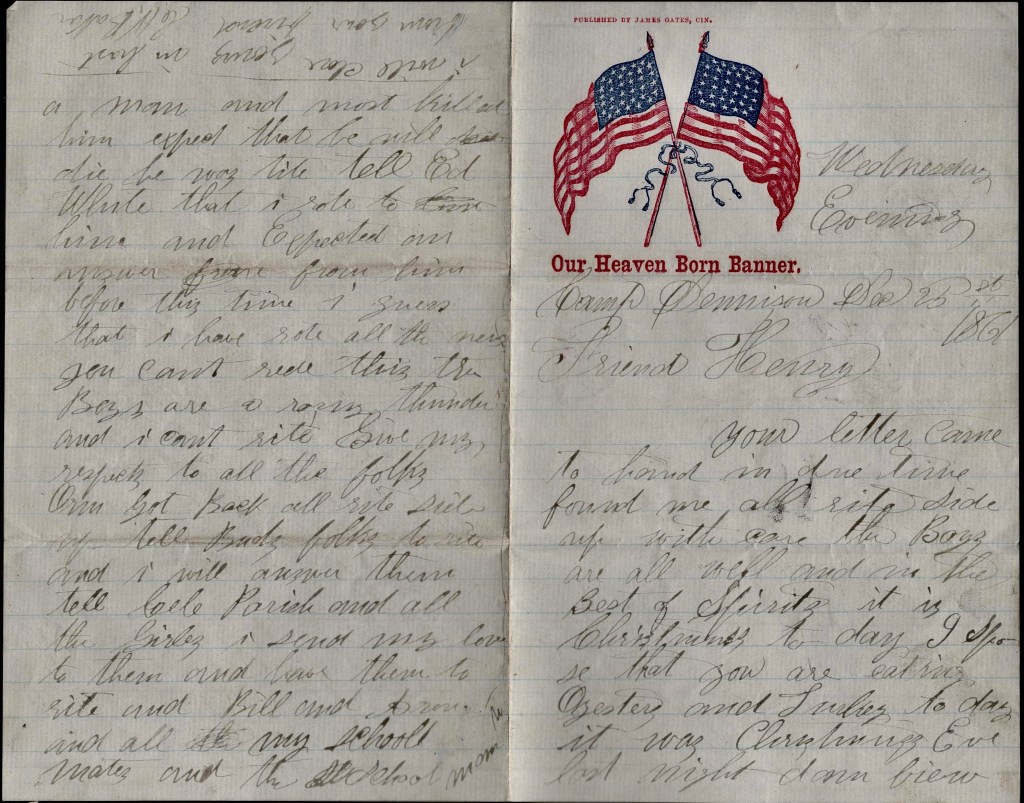
T R A N S C R I P T I O N

Camp Dennison
Wednesday evening, December 25, 1861

Friend Henry

Your letter came to hand in due time [and] found me all right side up with care. The Boys are all well and in the best of spirits. It is Christmas today. I suppose that you are eating oysters and turkey today. It was Christmas eve last night. Few were the things that I got in my stocking but we had a hell of a dance you may bet.

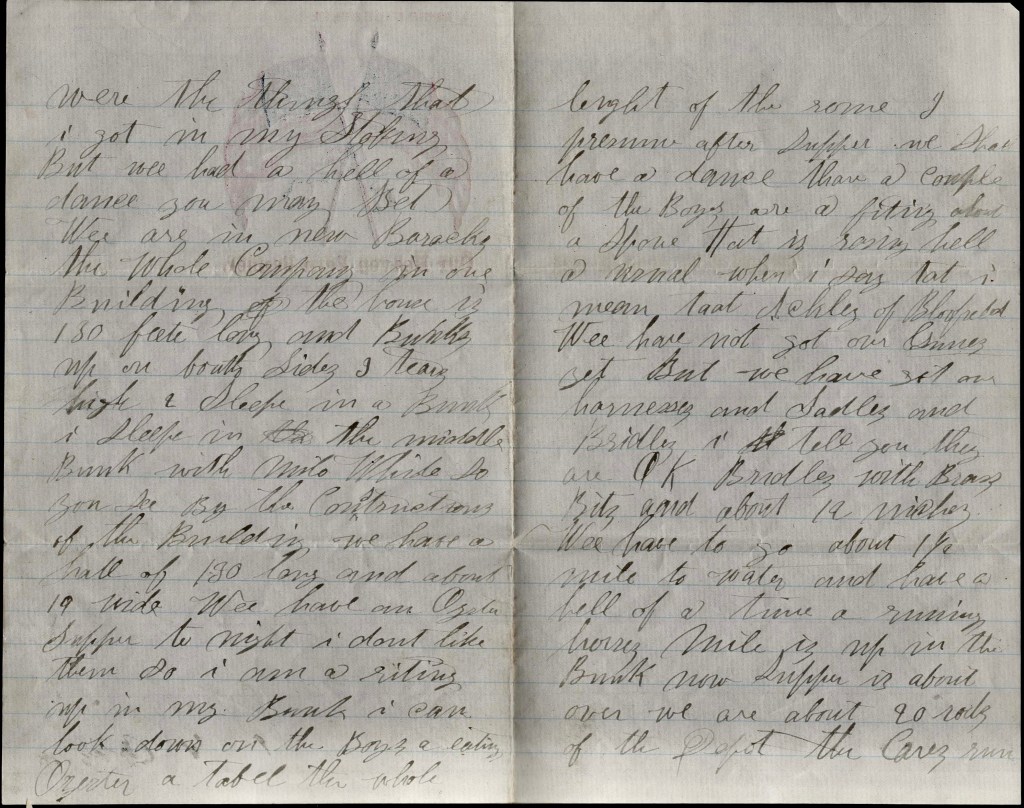
We are in new barracks—the whole company in one building. The house is 130 feet long and bunks up on both sides three tiers high. Two sleep in a bunk. I sleep in the middle bunk with Milo White so you see by the construction of the building we have a hall of 130 [feet] long and about 19 wide. We have an oyster supper tonight. I don’t like them so I am a writing up in my bunk [while] the boys [are] eating oysters [at] a table the whole length of the room. I presume after supper we shall have a dance. Then a couple of the Boys are a fighting about a spoon [?]—that is, [?]. When I say that, I mean taat [?] Ackley of Bloomfeld.

We have not got our guns yet but we have got our harnesses and saddles and bridles. I tell you, they are O. K. Bridles with brass bits and about 12 inches.

We have to go about 1.5 miles to water and have a hell of a time a running horses. Miles is up in the bunk now. Supper is about over. We are about 20 rods (~100 yards) off the depot. The cars run [over] a man and most killed him. Expect that he will die. He was tight.

Tell Ed White that I wrote to him and expected an answer from him before this time. I guess that I have wrote all the news. You can’t read this. The boys are a raining thunder and I can’t write. Give my respects to all the folks. Orm got back all right side up. Tell Bud’s folks to write and I will answer them, Tell Cele Parish and all the girls I send my love to them and have them to write, and Bill and Aaron and all my school mates and the school mom too.

From your friend, — C. N. Baker

1862: Willis Augustus Wolcott to “Friend Pratt”

I could not find an image of Willis here is Solomon Large who was a bugler in the 6th OVC (ancestry.com)

The following letter was written by 35 year-old Willis Augustus Wolcott (1826-1890), the son of Daniel Russell Wolcott (1782-1872) and Philanda O. Atwood (1788-1867) of Orwell, Ashtabula county, Ohio. Willis claimed he was only 30 when he added his name to the muster rolls of Co. K, 6th Ohio Volunteer Cavalry (OVC) in October 1861. He did not remain on the rolls long, however. He was discharged for disability (“heart disease”) on 20 September 1862.

In January 1862 the regiment moved to Camp Dennison for drill instruction. In March it was assigned to Camp Chase to guard Confederate prisoners. The 6th Ohio moved to Wheeling, WV, on 13 May 1862. It entered Union field service, joining Fremont at Strasburg during his pursuit of Jackson down the Shenandoah Valley. On 7 June at the battle of Cross Keys, several Ohio cavalrymen were killed.

After a brief encampment at Strasburg, the regiment moved under Gen. Sigel, who had replaced Fremont. Coming under Gen. Pope’s command, the 6th Ohio faced Confederate fire at Rappahannock for 4 consecutive days. On 29 Aug., after the Second Battle of Bull Run, the 6th Ohio, along with the Union Army, retreated to Alexandria. Having passed the 1862-63 winter campaign guarding the passage of the Rappahannock, the 6th Ohio was reorganized for the spring campaign under the command of Gen. Hooker.

T R A N S C R I P T I O N

Camp Dennison
January 15, 1862

Friend Pratt, dear sir—

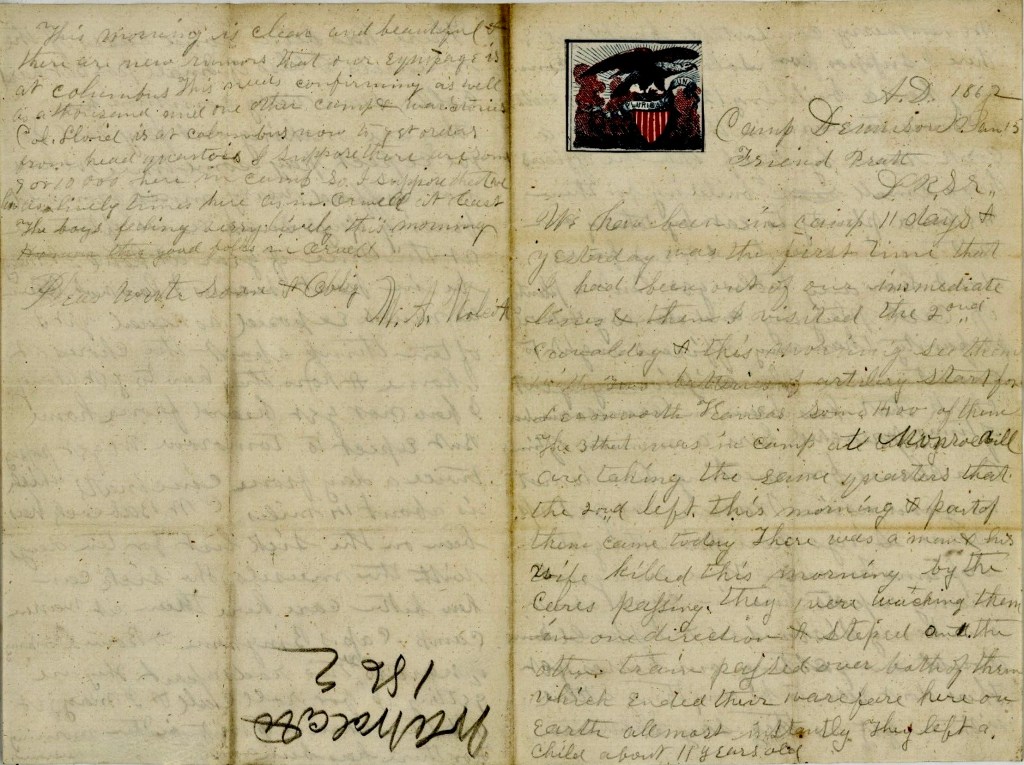
We have been in camp 11 days & yesterday was the first time that I had been out of our immediate lines & then I visited the 2nd Cavalry & this morning see them with two batteries of artillery start for Leavenworth, Kansas. Some 1400 of them. The 3 that was in camp at Monroeville are taking the same quarters that the 2nd left this morning & part of them came today.

There was a man and his wife killed this morning by the cars passing. They were watching them in one direction & stepped out [and] the other train passed over both of them which ended their warfare here on earth almost instantly. They left a child about 11 years old.

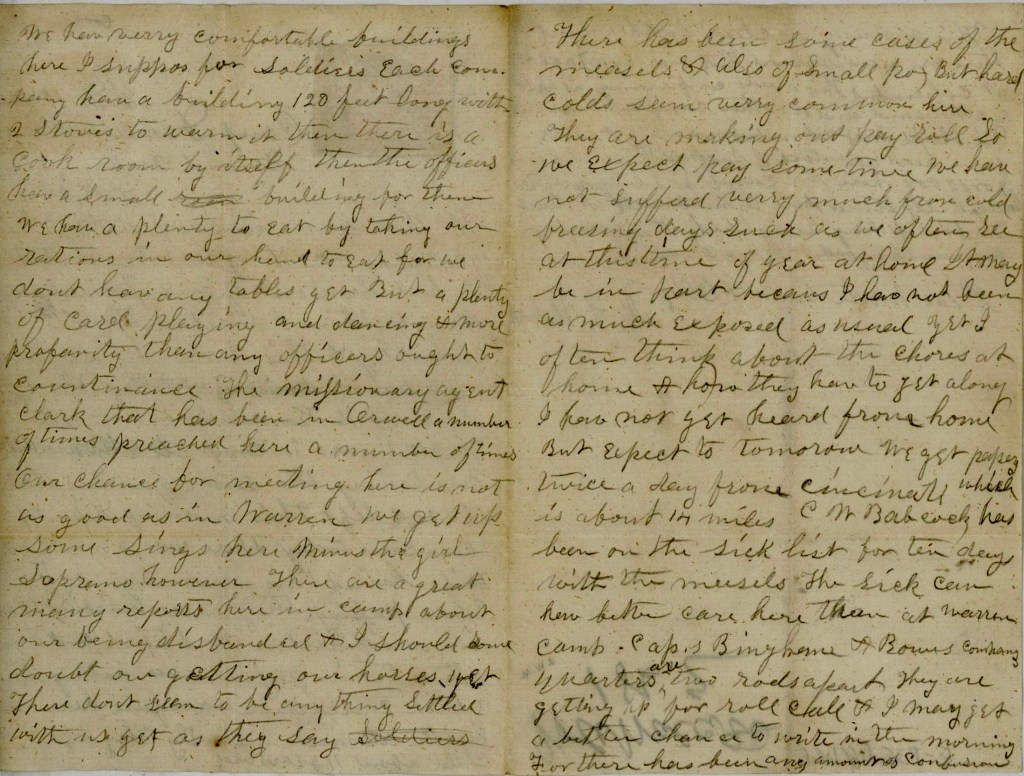
We have very comfortable buildings here, I suppose, for soldiers. Each company have a a building 120 feet long with two stoves to warm it. Then there is a cook room by itself. Then the officers have a small building for them. We have a plenty to eat by taking our rations in our hand to eat for we don’t have any tables yet, But a plenty of card playing and dancing & more profanity than any officers ought to countenance.

The missionary agent Clark that has been in Orwell a number of times preached here a number of times. Our chance for meeting here is not as good as in Warren. We get up some sings here minus the girl soprano, however. There are a great many reports here in camp about our being disbanded and I should some doubt our getting our horses yet. There don’t seem to be anything settled with us yet, as they say.

There has been some cases of the measles and also of small pox but hard colds seem very common here. They are making out pay rolls so we expect pay sometime. We have not suffered very much from cold freezing days such as we often see at this time of year at home. It may be in part because I have not been as much exposed as usual yet. I often think about the chores at home & how they have to get along. I have not yet heard from home but expect to tomorrow. We get papers twice a day from Cincinnati which is about 14 miles.

C. W. Babcock has been on the sick list for ten days with the measles, The sick can have better care here than at Warren Camp. Capts. [Amandar] Bingham and [Charles R.] Bowe’s company quarters are two rods apart. They are getting up for roll call and I may get a better chance to write in the morning for there has been any amount of confusion.

This morning is clear and beautiful. There are new rumors that our equipage is at Columbus. This needs confirming as well as a thousand and the other camp and war stories. Col. [William R.] Lloyd is at Columbus now to get orders from headquarters. I suppose there are some 9 or 10,000 here in camp. So I suppose the [ ] as lively times here as in Orwell. At least the Boys are feeling very lively this morning. How are the goo folks in Orwell?

Please write soon & oblige, — W. A. Wolcott

1861: Caroline Lewis to Maggie Kerney

The following letter was written by 16 year-old Caroline Lewis who was enumerated in the 1860 US Census as a “servant” in the household of Robert Bateman, a gunsmith in Waverly, Pike county, Ohio. Ten years earlier she was enumerated in the household of James Hughes in Jackson, Pike county. She may have been the same Caroline Lewis who married James R. Rhinehart in Pike county on 15 March 1863.

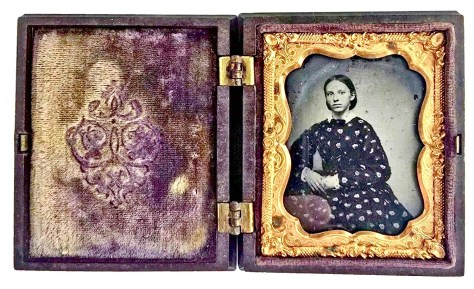
How Caroline might have looked.

T R A N S C R I P T I O N

Waverly, Pike county, Ohio
December 18, 1861

Dear friend,

I seat myself this afternoon to let you know how I am getting along these hard times. I have been sick. I have had the bilious fever and am just able to sit up now. But Maggie, I do hope this will find you well and hearty.

I would like to see you and have a good talk with you. You know we use to have some good times. I want you to write to me and tell me all the news. Tell Lib Grimes I sent my love to her. Tell her to write to me. Tell me how you and Ike gets along these hard times. You must not let him go to war. Tell me who has gone to war. Tell Lib to hold tight to Davis and not let him go to war. But I don’t believe he will go—he is afraid he will get shot. Don’t you believe he is? Tell Lib I said so. Tell Ike and Sam Adams that I would like to see them a little bit. And tell Ike I ain’t forgot the night the Wide Awakes marched at Holland—the [same] night I got throwed off of the Black.

Tell Frank and Henrietta I send my love to them. Tell your mother I send my love to her. Well, I will bring my letter to a close. Give my love to all enquiring friends and keep a good share of it yourself. No more at present. But I remain as ever your friend, — Caroline Lewis

to Maggie Kerney

A Song [to the] Tune [of] Dixie

Listen my friends unto my song
I’m for the Union right or wrong
Hurray, Hurrah—Hurrah, Hurrah
If I was a man to the wars I’d go
When duty calls, I’d never say no
Hurrah, Hurrah—Hurrah, Hurrah

Chorus

Hurrah for the Union
Hurrah, Hurah
On Union’s land I’ll take my stand
I’ll live and die in Union’s land
Hurrah, Hurrah—Hurrah for the Union

The Union must and shall be saved
There is no use of being afraid
Hurrah
Let freedom’s banner o’er us wave
And be a shield for the true and brave
Hurrah!

Chorus

Ye sons of freedom hark the call
Defend your country one and all
Hurrah
Although no active part I’d take
of each young man a soldier I’d make
Hurrah

Chorus

You must remember danger nigh
for hark unto disunion’s cry
Hurrah
With a ‘God bless all’ and a safe return
to all that fight for the Union
Hurrah, Hurrah

Chorus

No more. January 26, 1862


1864: David Evans Moore, Jr. to Friend William

The following letters is signed “David” and so I can’t be 100% certain it was written by David Evans Moore, Jr. (1840-1920) but I consider him the one most likely to have penned the letter while serving in the Rockbridge Artillery in mid-April 1864. David was the son of David E. Moore (1797-1875) and Elizabeth M. Harvey (1809-1888). He was just concluding his junior year at Washington College in Lexington, Rockbridge county, Virginia, when he joined the battery in late April 1861. He enlisted as a private but had worked his way up in rank to 3rd Sergeant by the time this letter was written. He was with the Battery at the surrender at Appomattox Court House where the members tore up their flags and distributed the remnants as mementoes rather than turn them over to the Union army. After the war, he returned to Lexington where he was employed as a school teacher and a lawyer.

David wrote this letter on the eve of Grant’s Overland Campaign. The Rockbridge Artillery participated in the Battle of Spotsylvania Court House in May 1864 but was only lightly engaged during the remainder of the campaign, Once the fighting reached Petersburg, the Rockbridge Artillery deployed near Drewry’s Bluff and New Market Heights. On July 27, while harassing Union gunboats on the James River during the First Battle of Deep Bottom, the battery lost four cannon when Union infantry drove off the battery’s supports. Four replacement tubes were quickly issued, and they continued to harass ship traffic on the James River for the remainder of the summer. During the autumn, the Rockbridge Artillery manned entrenchments at Fort Harrison and Fort Gilmore along the Richmond line. On September 29, 1864, Union troops overran Fort Gilmore and then Fort Harrison; the Rockbridge Artillery withdrew from both positions without a loss. It went into winter quarters at Fort Alexander until the fall of Petersburg and Richmond on April 2, 1865.  [Source: First Rockbridge Artillery.]

Bradley Schmehl’s painting of the Rockbridge artillery at Cross Keys and Port Republic with Stonewall Jackson.

T R A N S C R I P T I O N

Artillery Camp near Frederick’s Hall
Louisa County, Virginia
April 18, 1864

Friend William,

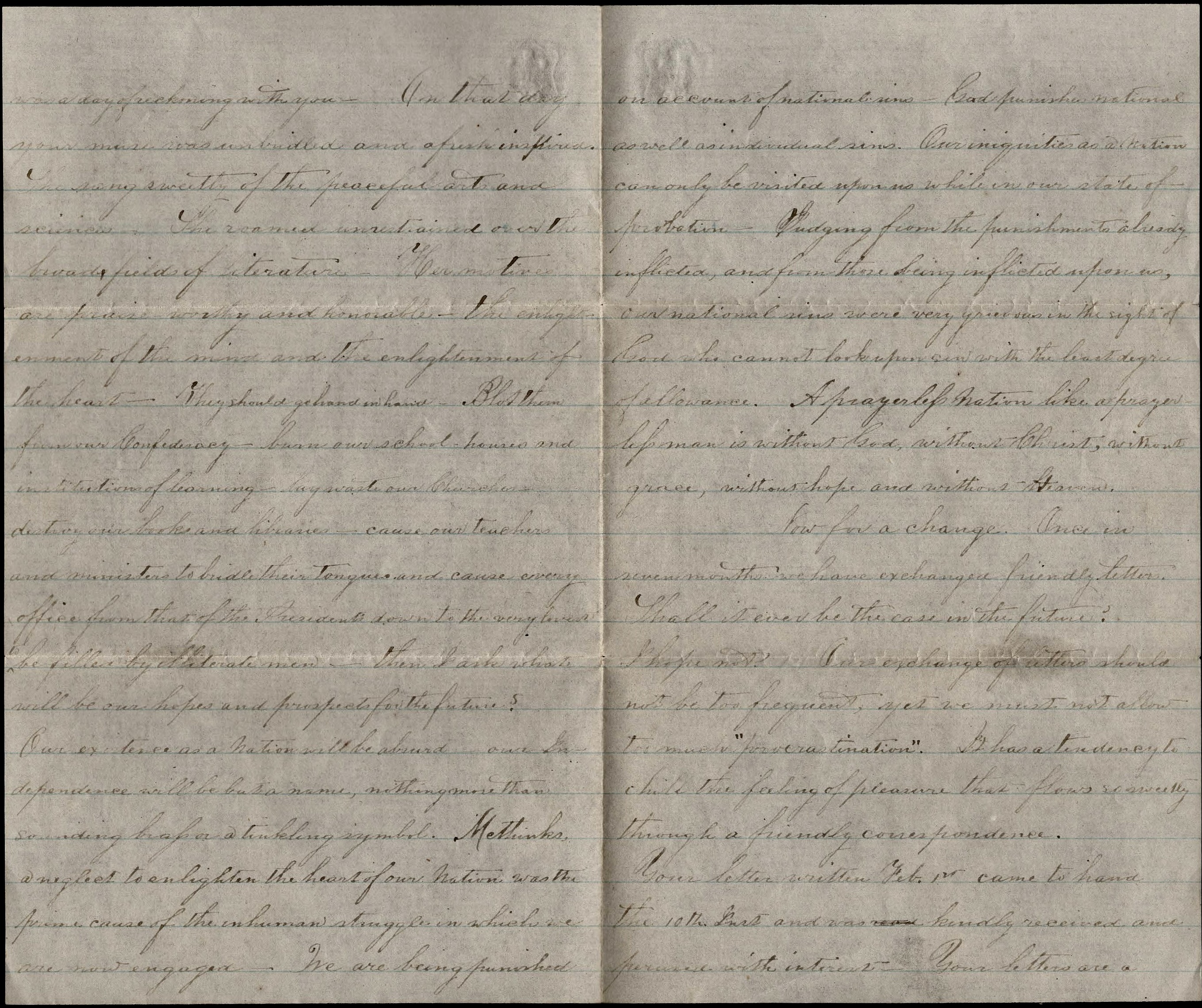
My muse sang so much about the horrors of war and so long that you did not recover from the effects for five months, It is a source of regret to me that your muse was silent so long. I had almost concluded that you had hung your hoop so high upon the willow that you never would be able to reach it. Had I not remembered your procrastination habit, I mist certainly should have given up every hope of receiving a letter from you. I looked long and anxiously for a kind missive penned by thine own hand and not in vain. A new year or month often reminds of resolutions already made and not strictly kept. While thinking about forming new plans and new resolutions, we are forcibly reminded of those sadly neglected and shamefully broken.

The 1st of February perhaps was a day of reckoning with you. On that day your muse was unbridled and afresh inspired. She song sweetly of the peaceful arts and sciences. She roamed unrestrained over the broad fields of literature. Her motives are praiseworthy and honorable—the enlightenments of the mind and the enlightenment of the heart. They should go hand in hand. Blot them from our Confederacy. Burn our school-houses and institutions of learning. Lay waste our churches. Destroy our books and libraries. Cause our teachers and ministers to bridle their tongues and cause every office from that of the President’s down to the very lowest to be filled by illiterate men. Then I ask what will be our hopes and prospects for the future?

Our existence as a Nation will be absurd. Our independence will be but a name—nothing more than sounding brass or a tinkling cymbal. Methinks a neglect to enlighten the heart of our Nation was the prime cause of the inhuman struggle in which we are now engaged. We are being punished on account of our national sins. God punishes national as well as individual sins. Our iniquities as a Nation can only be visited upon us while in our state of probation. Judging from the punishments already inflicted, and from those being inflicted upon us, our national sins were very grievous in the sight of God who cannot look upon sin with the least degree of allowance. A prayerless Nation like a prayerless man is without God, without Christ, without grace, without hope and without Heaven.

Now for a change, Once in seven months we have exchanged friendly letters. Shall it ever be the case in the future? I hope not. Our exchange of letters should not be too frequent, yet we must now allow to much “procrastination.” It has a tendency to chill the feeling of pleasure that flows so sweetly through a friendly correspondence. Your letter written February 1st came to hand the 10th inst. and was kindly received and perused with interest. Your letters are a great treat to me. Mr. Lowry brought the letter to the regiment. I was absent on furlough at the time. The letter was then sent to Rockbridge. From some defect in the mail arrangement, it did not come while I was at home. Finally, however, it found its way to the “old homestead.” After a long time, it came to me. The gentleman of my company who sent it to Rockbridge told me that it was from my sweetheart on my return to the company. He could not tell me what gentleman of Captain G’s company gave it to him but told me it was from Salem as I inspected at once that it was from you. Sometime afterwards I saw Mr. Lowry. He told me that you sent it. I have a slight acquaintance with Mr. Lowry and Mr. Hubbert. I saw Mr. Hubbert on yesterday. He is quite well. I understood from him that you are a candidate for the clerkship of the county. I wish you all success on election day. If I had a vote, you should have it.

From the best information I can obtain, we shall leave here the first of next week. We shall go either in the neighborhood of Gordonsville or Orange Court House. We are too far from the front in case the Yanks should make a sudden dash. In a couple of weeks, there will be fine grazing for our horses at the front. This is not a grass country. It will be with reluctance that I shall leave my comfortable quarters, yet I think it perfectly right to do so. I prepared on yesterday for an active campaign by sending my extra baggage home. There are many pleasant associations connected with this encampment and neighborhood. I have formed some very pleasant acquaintances with the fair sex since I have been here. Two of my friends and myself went into the country on a visit yesterday evening. We met with three young ladies whose acquaintance we had previously formed. They conversed fluently, performed well upon the piano and sang so sweetly for us, The time passed away very pleasantly indeed and too rapidly for me. We did not get to camp till 12 o’clock. We intended to leave at 9 p.m. It was not our fault we remained so late. There are some nice young ladies in this section of country.

Rev. Mr. H. White, who has been with our regiment as missionary during the winter, left on yesterday for the purpose of preaching about three weeks to the congregations of which he is pastor. He then expect to be with us again. The Spirit of God has been in our midst and I think He is still with us. I received a letter from brother John not long since. He is still in Mississippi. He is well. Father’s family was well as usual when I heard last. I received a letter on the 10th. I received to excellent and interesting letters from your sisters last week. I shall answer them soon. I send my love to all the family. Please write soon. — David