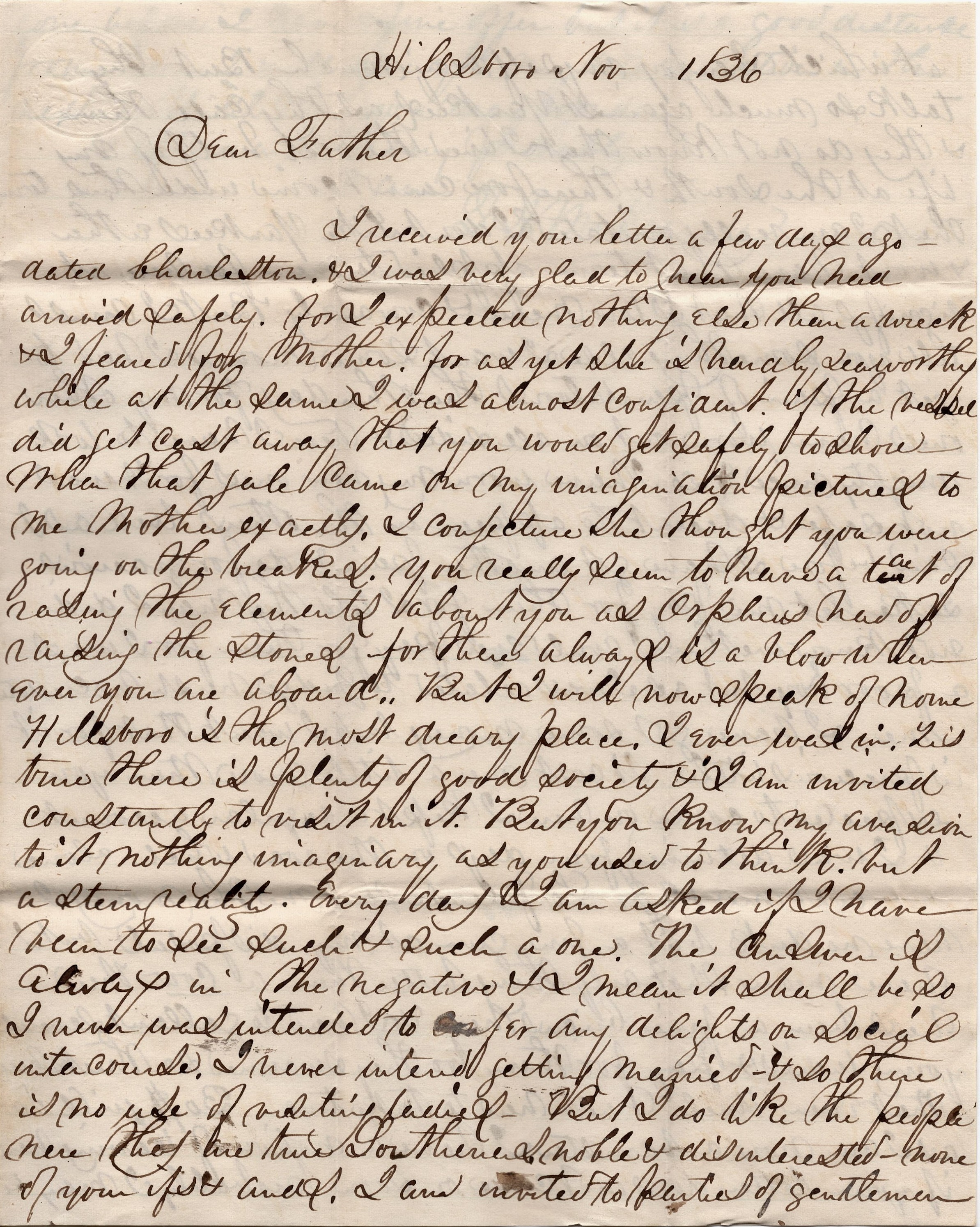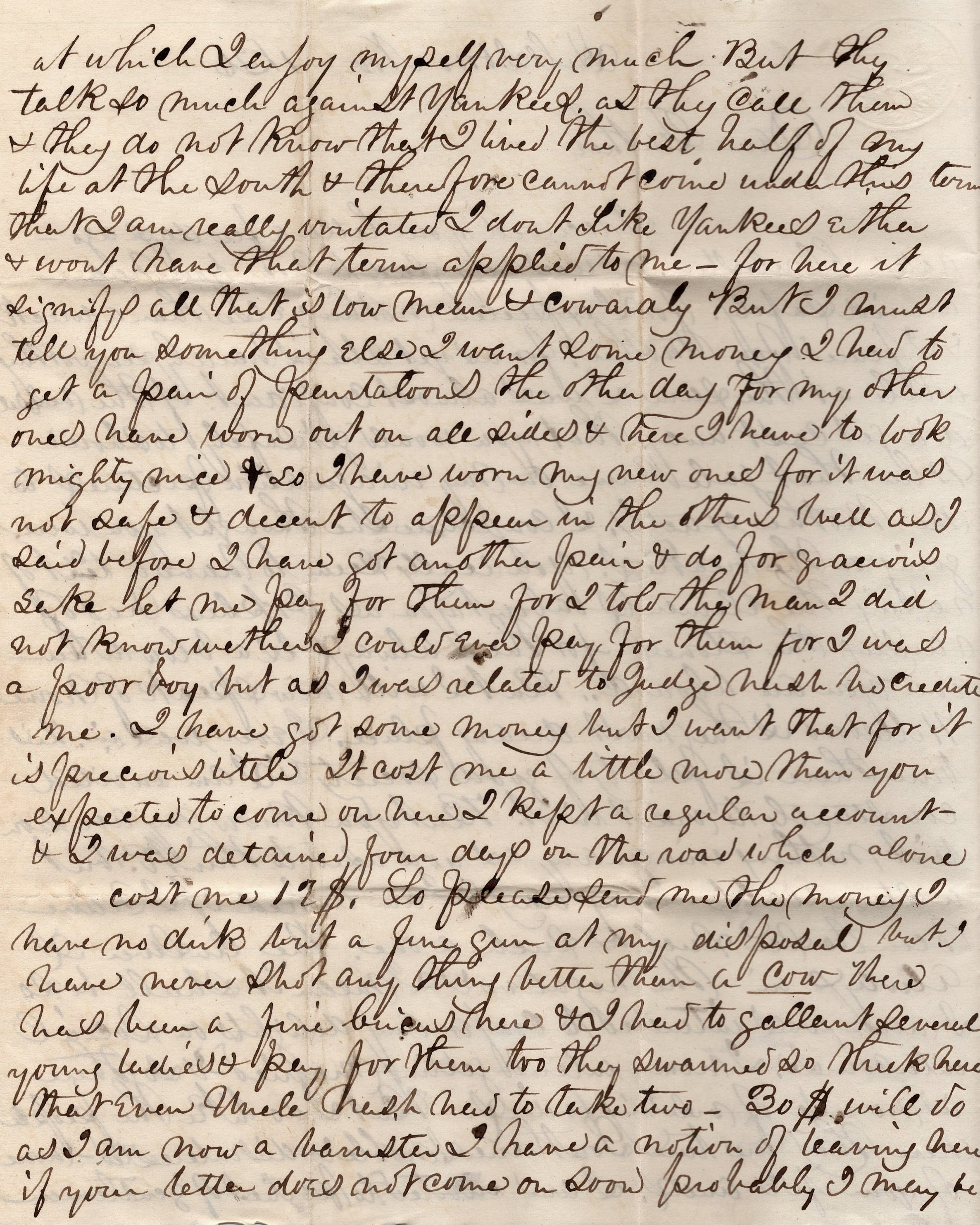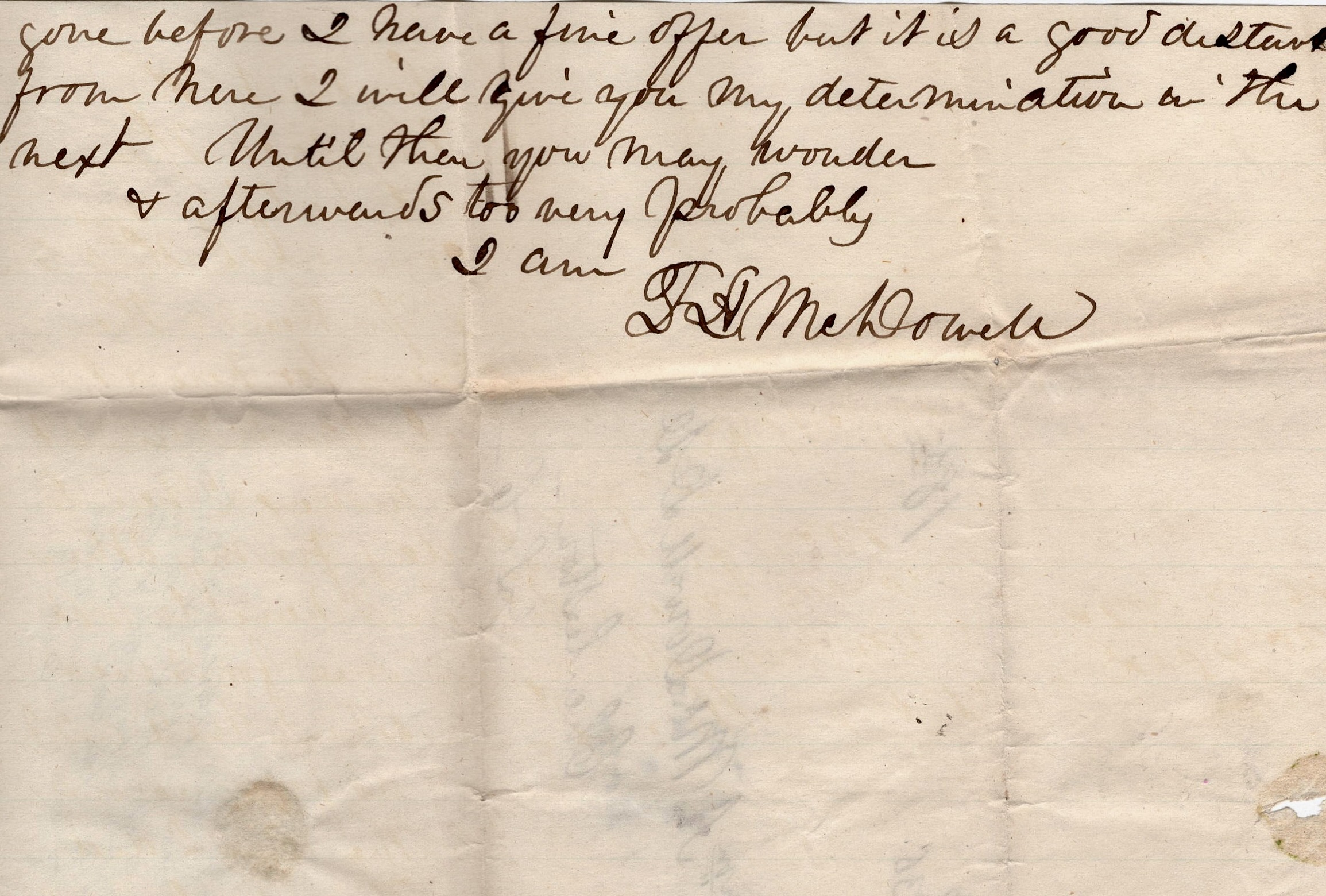
This letter was written by Frederick Henry McDowell (1818-1850), the son of William Anderson McDowell (1789-1851), a Prebyterian clergyman and Doctor of Divinity who served as the corresponding secretary for the Board of Domestic Missions of the Presbyterian Church. William was born in New Jersey but received his DD degree in 1827 from Franklin College (now the University of Georgia). [See Biographical Sketch]
Eighteen year-old Frederick wrote his letter in November 1836 from Hillsborough, North Carolina, describing the community as the “most dreary place I ever was in.” We learn from the letter that he was a nephew of Frederick Nash, chief justice of North Carolina, who moved to Hillsborough in 1807. The last paragraph suggests there was some kind of disturbance in or about the village of Hillsborough that threatened the lives of its citizens. I can only conjecture that this might have to do with threats of a slave uprising in which the “young ladies” felt particularly vulnerable.
Frederick’s letter also gives us a definition of the word Yankee as it had come to be accepted in common parlance by 1836 in North Carolina. “Here it signifies all that is low, mean, and cowardly.”
Frederick died on 1 March 1850 at the age of 32. He is probably the same individual by that name who received an A.M. degree from Princeton in 1839.
T R A N S C R I P T I O N
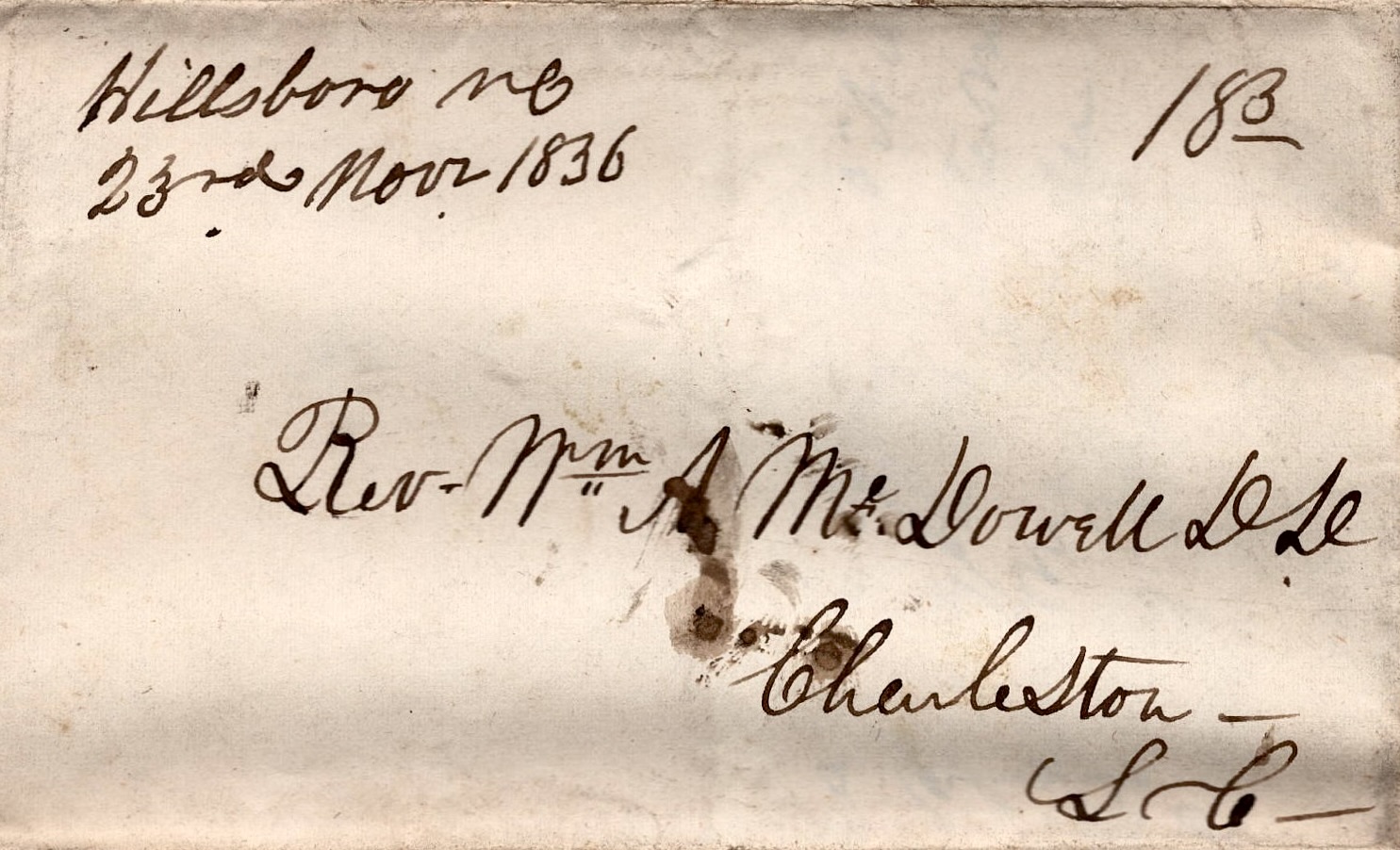
Hillsboro [North Carolina]
November [23rd] 1836
Dear Father,
I received your letter a few days ago dated Charleston & I was very glad to hear you had arrived safely for I expected nothing else than a wreck & I feared for Mother for as yet she is hardly seaworthy while at the same [time] I was almost confident if the vessel did get cast away, that you would get safely to shore. When that gale came on, my imagination pictured to me Mother exactly. I conjecture she thought you were going on the breakers. You really seem to have a tact of raising the elements about you as Orpheus had of raising the stones for there always is a blow whenever you are aboard.
But I will now speak of home. Hillsboro is the most dreary place I ever was in. It’s true there is plenty of good society & I am invited constantly to visit in it. But you know my aversion to it nothing imaginary as you used to think, but a stern reality. Every day I am asked if I have been to see such & such a one. The answer is always in the negative & I mean it shall be so. I never was intended to confer any delights on social intercourse. I never intend getting married & so there is no use of visiting ladies. But I do like the people here. They are true Southerners, noble & disinterested—none of your ifs and ands. I am invited to parties of gentlemen at which I enjoy myself very much. But they talk so much against Yankees, as they call them, & they do not know that I lived the best half of my life at the South & therefore cannot come under this term that I am really irritated. I don’t like Yankees either & won’t have that term applied to me—for here it signifies all that is low, mean, and cowardly.
But I must tell you something else. I want some money. I had to get a pair of pantaloons the other day for my other ones have worn out on all sides & here I have to look mighty nice & so I have worn my new ones for it was not safe & decent to appear in the others. Well, as I said before, I have got another pair & do for gracious sake, let me pay for them for I told the man I did not know whether I could ever pay for them for I was a poor boy but I was related to Judge [Frederick] Nash to credit me. I have got some money but I want that for it is precious little. It cost me a little more than you expected to come on here. I kept a regular account & I was detained four days on the road which alone cost me $12. So please send me the money.
I have no dirk but a fine gun at my disposal but I have never shot anything better than a cow. There has been a fine fracas here & I had to gallant several young ladies & pay for them too. They swarmed so thick here that Uncle Nash had to take two. $30 will do as I am now a barrister. I have a notion of leaving here if your letter does not come on soon. Probably I may be gone before I have a fine offer but it is a good distance from here. I will give you my determination in the next. Until then, you may wonder & afterwards too very probably. I am, — F. H. McDowell