The following letter was written by Pliny Kidder (1817-1860), a civil engineer and the son of Peter Kidder (1781-1835) and Sophia Shumway (1790-1850) of Oxford, Worcester county, Massachusetts. His death notice requested papers in Maine and Vermont to copy so he must have spent time there.
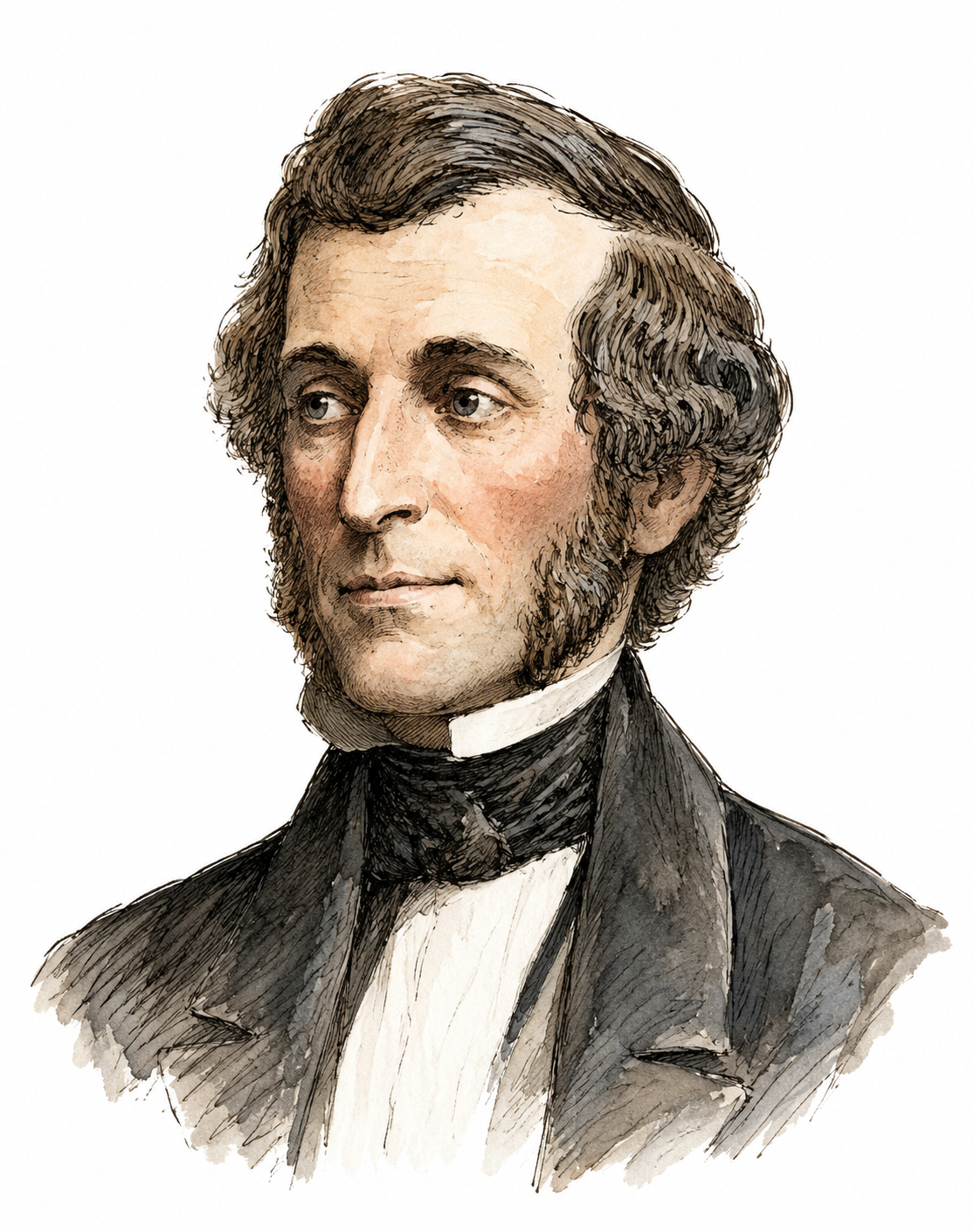
The letter was directed to Thomas Scott Williams (1812-1874), the son of Solomon Williams and Martha Baker of Bozrah, Connecticut. He grew up there and was by profession a civil engineer. He assisted in the survey of the Boston and Albany Railroad and Boston City Water Works, and was for several years Superintendent of the Boston and Maine Railroad. Afterwards, he was engaged in business in Boston, Massachusetts, as a dealer in railroad supplies and finally settled in Auburndale, Massachusetts.
Though is no mention of railroads made in Pliny’s letter, but I must conclude that the letter describes an attempt to survey the ground for a possible railrad to be constructed between the important Mississippi landing at Columbus, Kentucky, directly into the interior agricultural markets of West Tennessee. It wasn’t until 1861 that the railroad line between Mobile, Alabama, and Columbus, Kentucky, was completed, however.
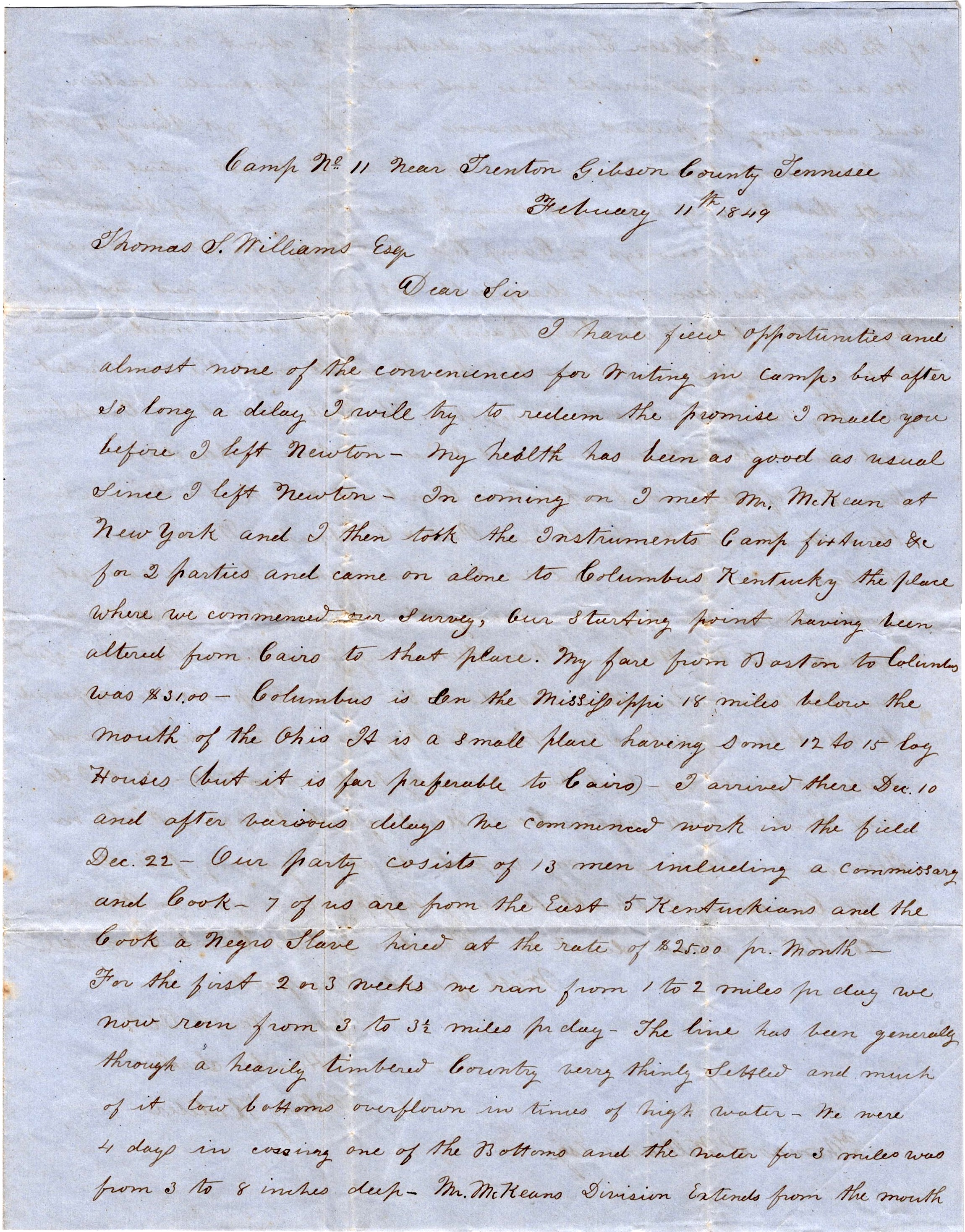
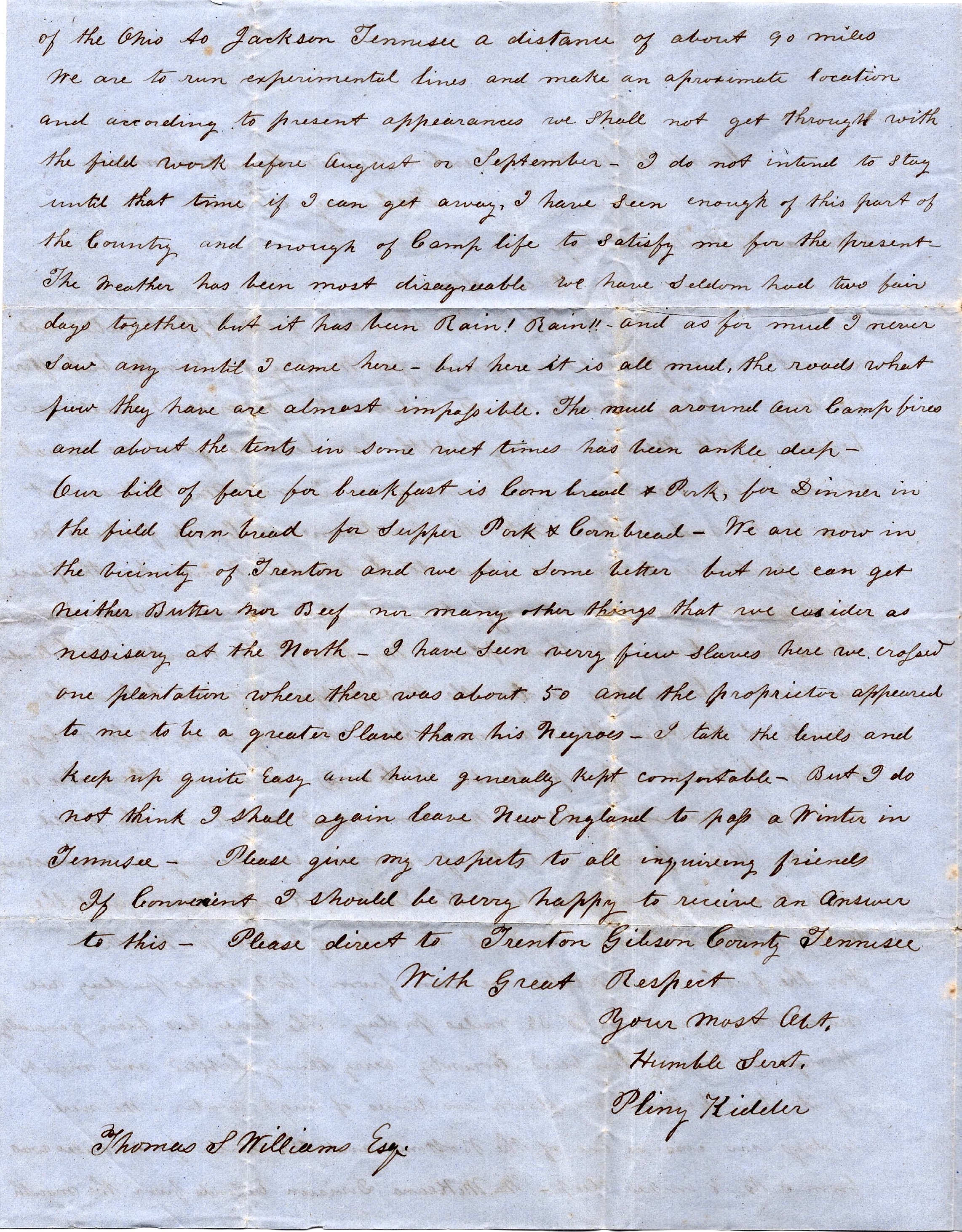
T R A N S C R I P T I O N
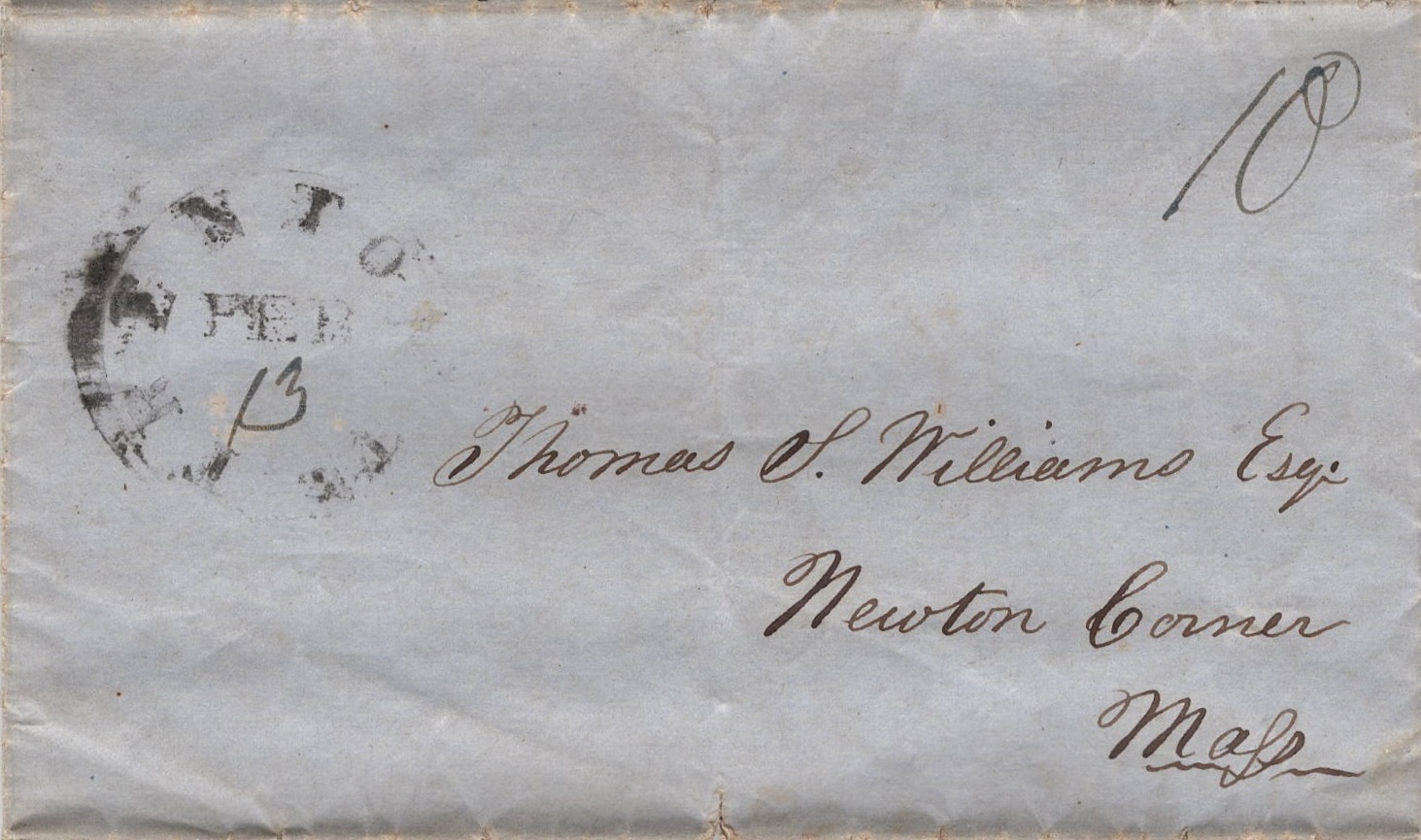
Camp #11 near Trenton, Gibson County, Tennesse
February 11th 1849
Thomas S. Williams, Esq.
Dear Sir.
I have few opportunities and none of the conveniences for writing in camp, but after so long a delay, I will try to redeem the promise I made you before I left Newton. My health has been as good as usual, since I left Newton. In coming on, I met Mr. McKean at New York and I then took the Instruments Camp fixtures, &c., for 2 parties and came on alone to Columbus, Kentucky, the place where we commenced our survey—our starting point having been altered from Cairo to that place.
My fare from Boston to Columbus was $31. Columbus is on the Mississippi [River] 18 miles below the mouth of the Ohio. It is a small place having some 12 to 15 log houses (but it is far preferable to Cairo). I arrived there Dec. 10 and after various delays, we commenced work in the field Dec. 22. Our party consists of 13 men including a commissary and cook. Seven of us are from the East, 5 Kentuckians, and the cook a Negro slave, hired at the rate of $25 per month.
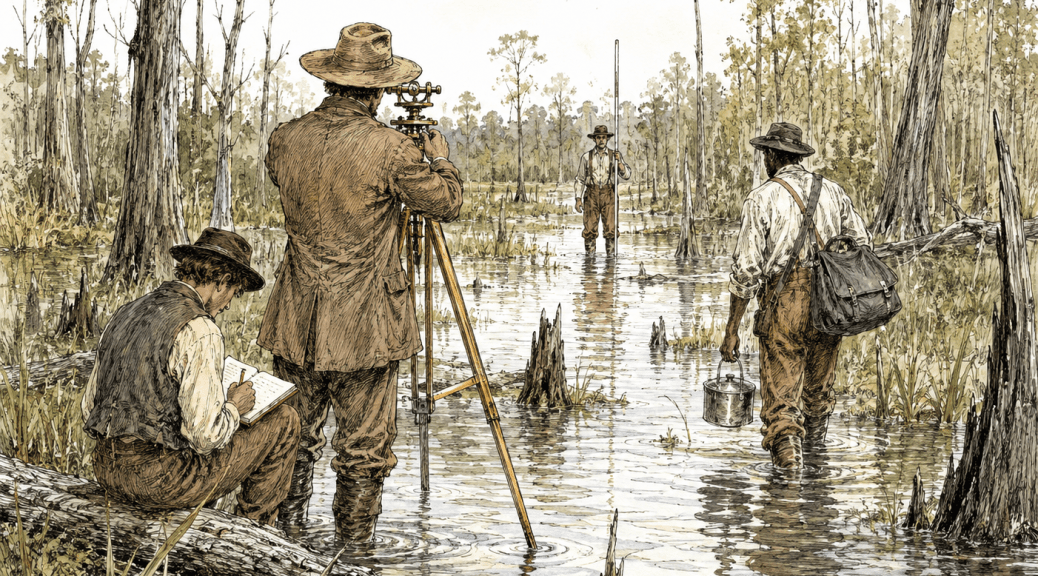
For the first 2 or 3 weeks, we ran from 1 to 2 miles per day. We now run from 3 to 3 ½ miles per day. The line has generally been through a heavily timbered country, very thinly settled, and much of it low bottoms overflown in times of high water. We were 4 days in crossing one of the bottoms and the water for 3 miles was from 3 to 8 inches deep.
Mr. McKean’s Division extends from the mouth of the Ohio to Jackson, Tennessee—a distance of about 90 miles. We are to run experimental lines and make an approximate location and according to present appearances we shall not get through with the field work before August or September. I do not intend to stay until that time if I can get away. I have seen enough of this part of the country and enough of camp life to satisfy me for the present. The weather has been most disagreeable. We have seldom had two fair days together but it has been Rain! Rain!! and as for mud, I never saw any until I came here. But here it is all mud. The roads—what few they have—are almost impassable. The mud around our camp fires and about the tents in some wet times has been ankle deep.
Our bill of fare for breakfast is cornbread and pork. For dinner in the field, cornbread. For supper, pork & cornbread. We are now in the vicinity of Trenton and we fare some better but we can get neither butter nor beef nor many other things that we consider as necessary at the North. I have seen very few slaves here. We crossed one plantation where there was about 50 and the proprietor appeared to me to be a greater slave than his Negroes. I take the levels and keep up quite easy and have generally kept comfortable. But I do not think I shall again leave New England to pass a winter in Tennessee.
Please give my respects to all my inquiring friends. If convenient I should be very happy to receive an answer to this. Please direct to Trenton, Gibson County, Tennessee. With great respect, your most Humble Servant, — Pliny Kidder