This letter is only signed “Arthur” but I’m confident he served in Co. D, 12th New Hampshire Infantry and there are only two soldiers with that name—Arthur L. Hannaford (1844-1935) and Arthur Kimball (1839-1910), both residents of Belknap county, New Hampshire. I feel confident it’s one of these two but am leaning toward Arthur Hannaford simply because he was closer in age to Amos Chattle, mentioned in the letter, and to the letter’s recipient. Arthur was the son of Alfred Hannaford (1806-1875) and Lurana Sawyer Smith (1809-1876) of Sanbornton. After the war he was employed as a carpenter.
The following letter was written by John N. Dockham who was 23 years old when he enlisted in Co. G, 12th New Hampshire Infantry in August 1862 ; b. Gilford; age 23; res. Charlestown, Mass., credited to Gifford; mustered out June 21, ’65. Post Office address., Gilford.
He wrote his letter to his friend Frank J. Robinson (1843-Aft1892), the son of Joseph Wells Robinson (1816-1864) and Matilda G. Crockett (1811-1863) of Lake Village (now Lakeport), Laconia, Belknap county, New Hampshire.
Dockham’s parents were Morse Brown Dockham (1812-1918) and Matilda R. Saltmarsh (1818-1856).
T R A N S C R I P T I O N

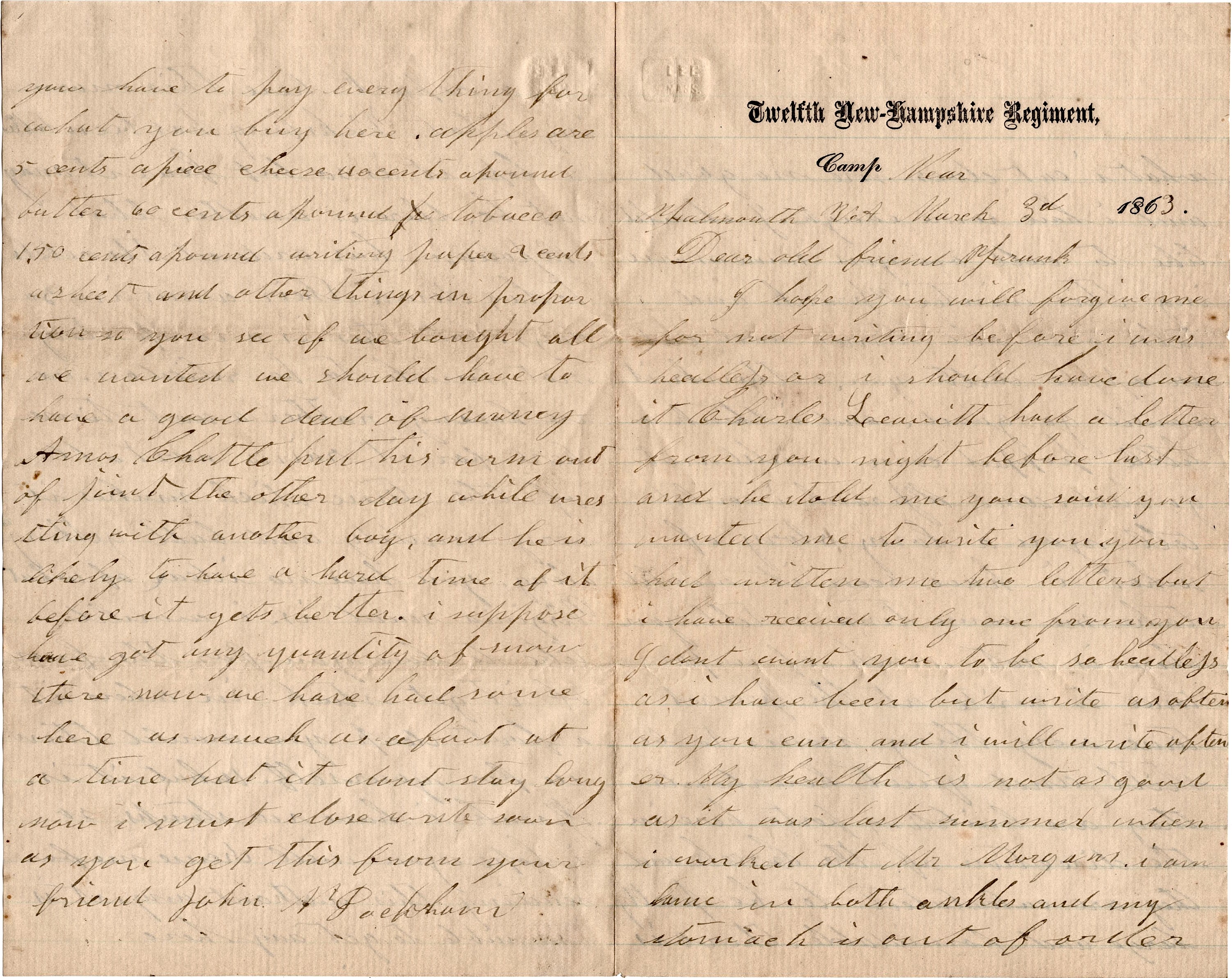
12th New Hampshire Regiment
Camp near Falmouth, Va.
March 3rd 1863
Dear old friend Frank,
I hope you will forgive me for not writing before. I was heedless or I should have done it. Charles Leavitt had a letter from you night before last and he told me you said you wanted me to write you. You had written me two letters but I have received only one from you. I don’t want you to be so heedless as I have been but write as often as you can and I will write oftener.
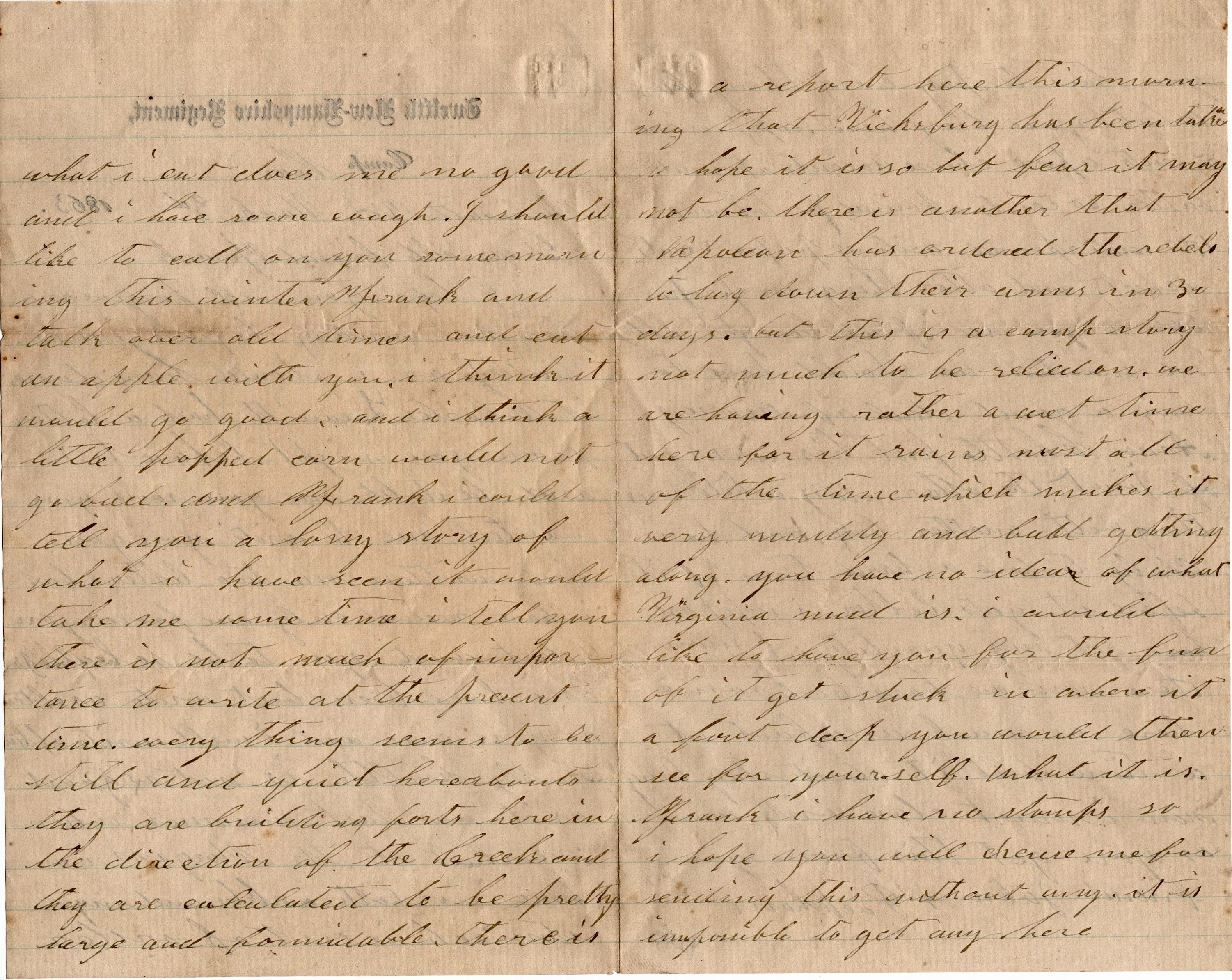
My health is not as good as it was last summer when I worked at Mr. Morgan’s. I am lame in both ankles and my stomach is out of order. What I eat does me no good and I have some cough. I should like to call on you some morning this winter, Frank, and talk over old times and eat an apple with you. I think it would go good and I think a little popped corn would not go bad. And Frank, I could tell you a long story of what I have seen. It would take me some time, I tell you.
There is not much of importance to write at the present time. Everything seems to be still and quiet hereabouts. They are building forts here in the direction of the creek and they are calculated to be pretty large and formidable. There is a report here this morning that Vcksburg has been taken. I hope it is so but fear it may not be. There is another that Napoleon has ordered the rebels to lay down their arms in 30 days but this is a camp story not much to be relied on.
We are having rather a wet time here for it rains most all of the time which makes it very muddy and bad getting along. You have no idea of what Virginia mud is. I would like to have you for the fun of it get stuck in where it is a foot deep. You would then see for yourself what it is.
Frank, I have no stamps so I hope you will excuse me for sending this without any. It is impossible to get any here. You have to pay every thing for what you buy here. Apples are 5 cents apiece. Cheese 40 cents a pound. Butter 60 cents a pound. Tobacco $1.50 cents a pound. Writing paper 2 cents a sheet and other things in proportion. So you see, if we bought all we wanted, we should have to have a good deal of money.
Amos Chattle 1 put his arm out of joint the other day while wrestling with another boy and he is likely to have a hard time of it before it gets better. I suppose [you] have got any quantity of snow there now. We have had some here—as much as a foot at a time. But it don’t stay long now.
I must close. Write soon as you get this. From your friend — John N. Dockham
1 Amos Chattle (1844-1919) was the son of Thomas and Nancy (Bowman) Chattle of Laconia, Belknap county, New Hampshire. He served in Co. D, 12th New Hampshire Infantry. The history of the regiment states that “he received a fracture of the right elbow by being accidentally thrown down during the winter before Chancellorsville, from the effects of which he was afterwards discharged. Before this he promised to make one of the best of soldiers, but thus early had to succumb to the inevitable. His father and brother Horace were in the 8th New Hampshire.” The former died of sickness at Camp Stevens, La., and the latter was killed at Port Hudson. Another brother, Noah, served in the 15th New Hampshire and was also killed at Port Hudson.