The following letters were written by George Washington (“Wash”) Vosburgh who was 24 years old when he enlisted as a corporal in August 1862 at Canajoharie, New York, to serve three years in Co. K, 115th New York Infantry. He was promoted quartermaster-sergeant on January 1, 1864 and mustered out of the service on 24 June 1865 at Albany. His muster records state that Wash was a farmer by occupation and stood 5’5″ tall with dark hair, black eyes.
Wash and his comrades of the 115th New York had the misfortune of being among a handful of regiments that were at Harpers Ferry in September 1862 when Stonewall Jackson’s men descended on the town and were surrendered by poor leadership. They were scorned and mocked by the public as “Harper’s Ferry Cowards” even though they were poorly drilled and had barely been issued weapons. With few exceptions, most of the captured men were paroled and sent to Camp Douglas in Chicago to await their exchange. When they were returned to duty, they were sent to South Carolina to join the Department of the South but did not see any real action until 1864.
See also Wash Vosburgh papers, 1862-1866. Letters to his friend Ella describing his military experience, including service in coastal South Carolina and Florida and in the battle of Cold Harbor and siege of Petersburg. The collection also includes several letters written (1865-1866) from the oil fields of Titusville, Pa., where Vosburgh was a merchant. 1 linear ft. Located at Bentley Historical Library, University of Michigan.
Letter 1
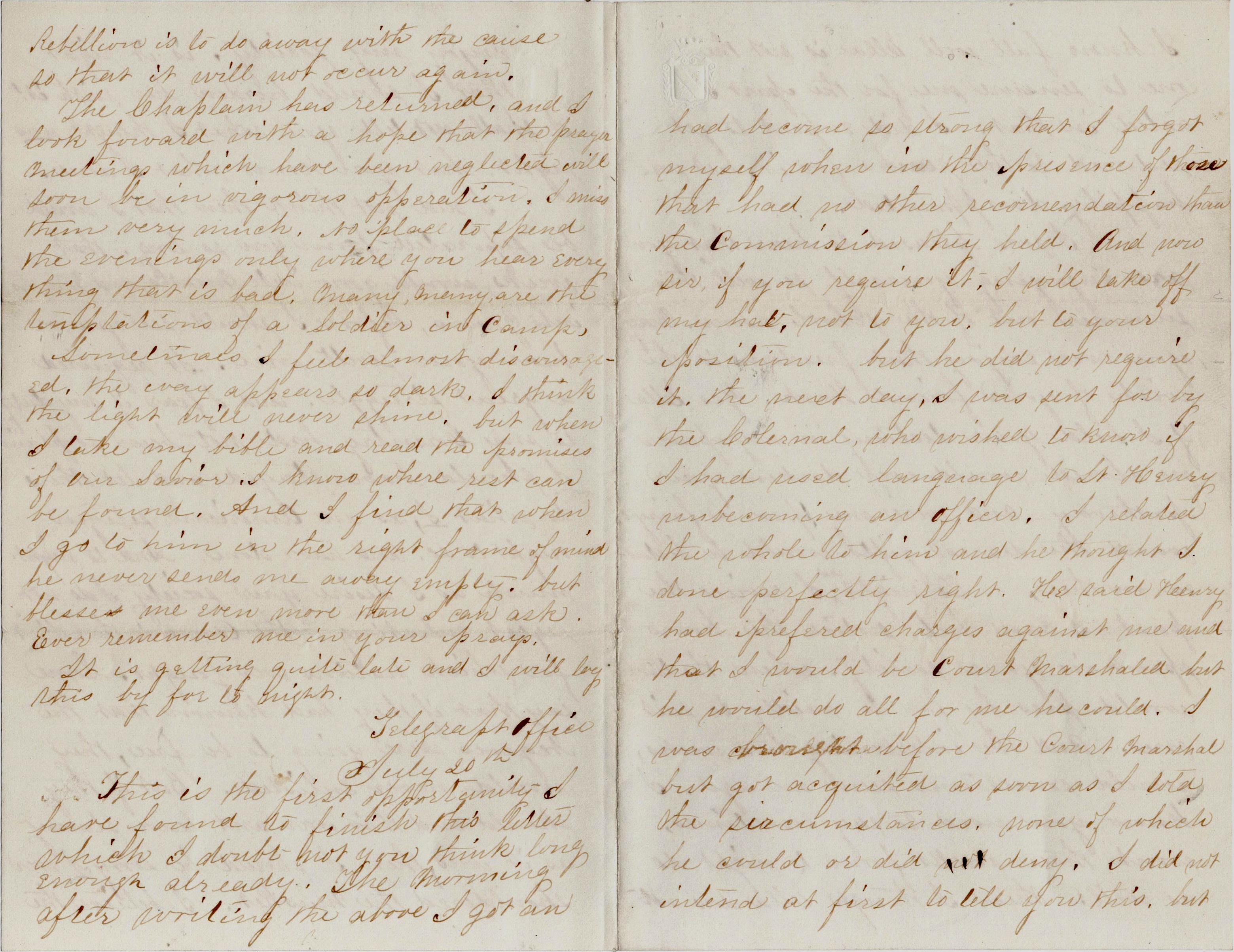
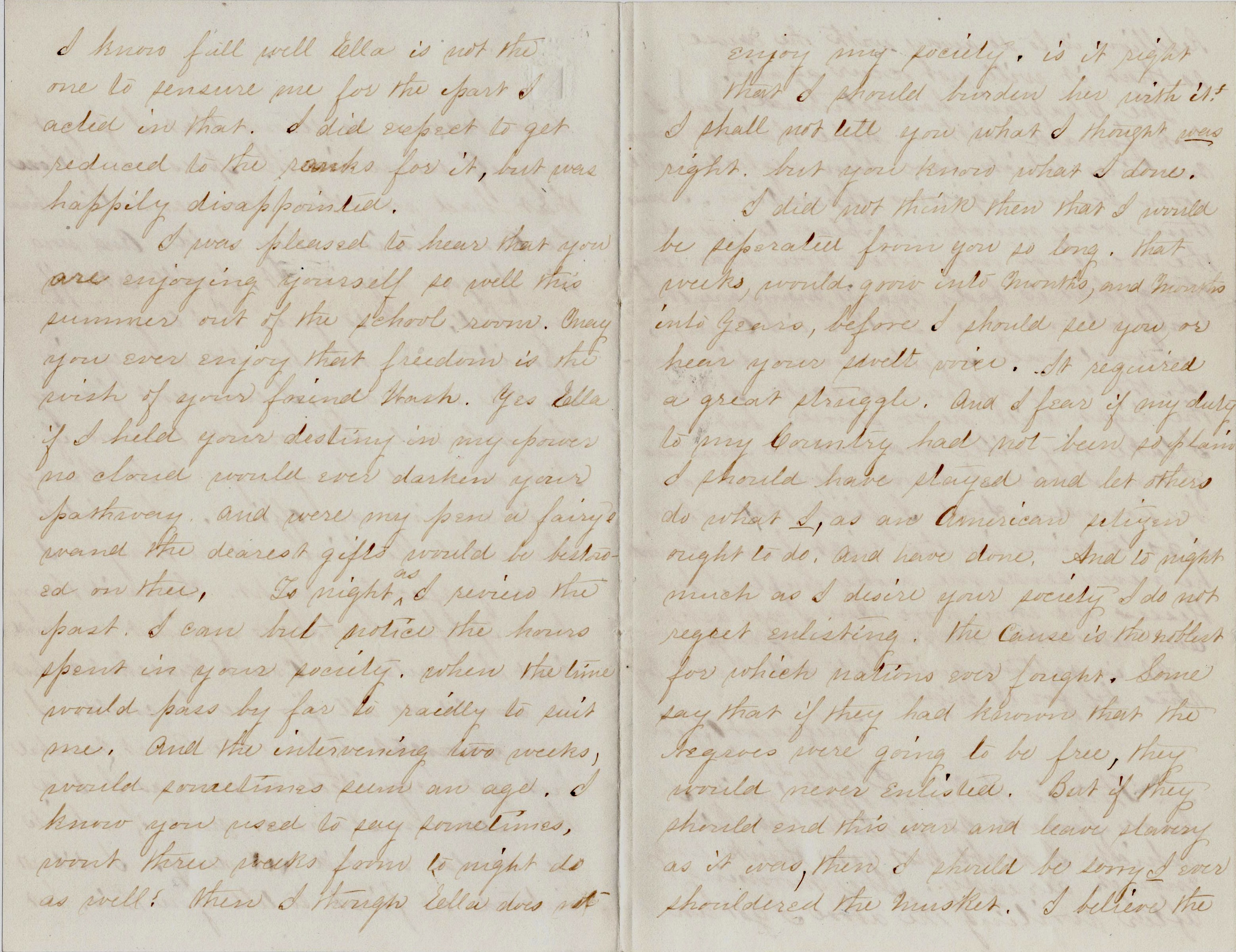
[Partial letter, July 1864] ….had become so strong that I forgot myself when in the presence of those that had no other recommendations than the commission they held. And now, sir, if you require it, I will take off my hat, not to you, but to your position. But he did not require it. The next day I was sent for by the Colonel who wished to know if I had used language to Lt. Henry unbecoming an officer. I related the whole to him and he thought I done perfectly right. He said Henry had preferred charges against me and that I would be court-martialed but he would do all for me he could. I was brought before the court-martial but got acquitted as soon as I told the circumstances, none of which he could or did deny. I did not intend at first to tell you this but I know full well Ella is not the one to censor me for the part I acted in that. I did expect to get reduced to the ranks for it, but was happily disappointed.
I was pleased to hear that you are enjoying yourself so well this summer out of the school room. May you ever enjoy that freedom is the wish of your friend Wash. Yes, Ella, if I held your destiny in my power, no cloud would ever darken your pathway. And were my pen a fairy’s wand, the dearest gifts would be bestowed on thee.
Tonight as I review the past, I can but notice the hours spent in your society when the time would pass by far too rapidly to suit me. And the intervening two weeks would sometimes seem an age. I know you used to say sometimes, “Won’t three weeks from tonight do as well?” Then I thought Ella does not enjoy my society. It is right that I should burden her with it? I shall not tell you what I thought was right, but you know what I done. I did not think then that I would be separated from you so long—that weeks would grow into months, and moths into years before I should see you or hear your sweet voice. It required a great struggle. And I fear if my duty to my Country had not been so plain, I should have stayed and let others do what I, as an American citizen, ought to do, and have done.
And tonight, much as I desire your society, I do not regret enlisting. The cause is the noblest for which nations are fought. Some say that if they had known that the Negroes were going to be free, they would never enlisted. But if they should end this war and leave slavery as it was, then I should be sorry I ever shouldered the musket. I believe the Rebellion is to do away with the cause so that it will not occur again.
The chaplain has returned and I look forward with a hope that the prayer meetings which have been neglected will soon be in vigorous operation. I miss them very much. No place to spend the evenings only where you hear everything that is bad. Many, many are the temptations of a soldier in camp. Sometimes I feel almost discouraged—the way appears so dark. I think the light will never shine. But when I take my bible and read the promises of our Savior, I know where rest can be found. And I find that when I go to Him in the right frame of mind, He never send me away empty, but blesses me even more than I can ask. Ever remember me in your prayers. It is getting quite late and I will lay this by for tonight.
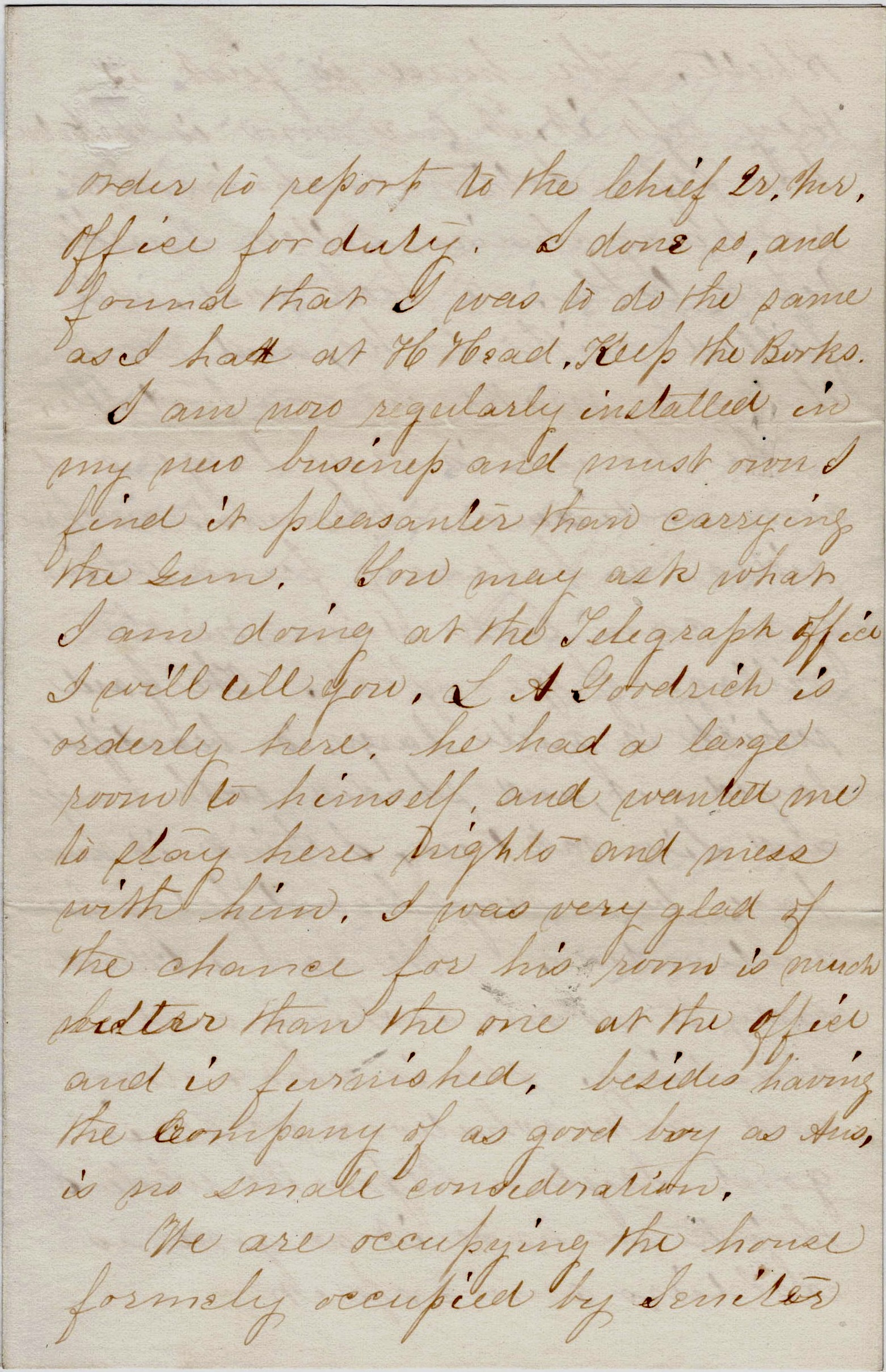
Telegraph office. July 20th. This is the first opportunity I have found to finish this letter which I doubt not you think long enough already. The morning after writing the above, I got an order to report to the Chief Quartermaster’s Office for duty. I done so and found that I was to do the same as I had at Hilton Head—keep the books.
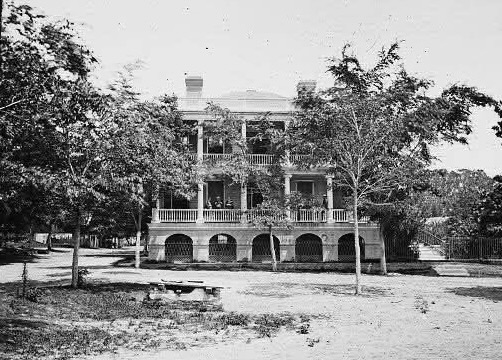
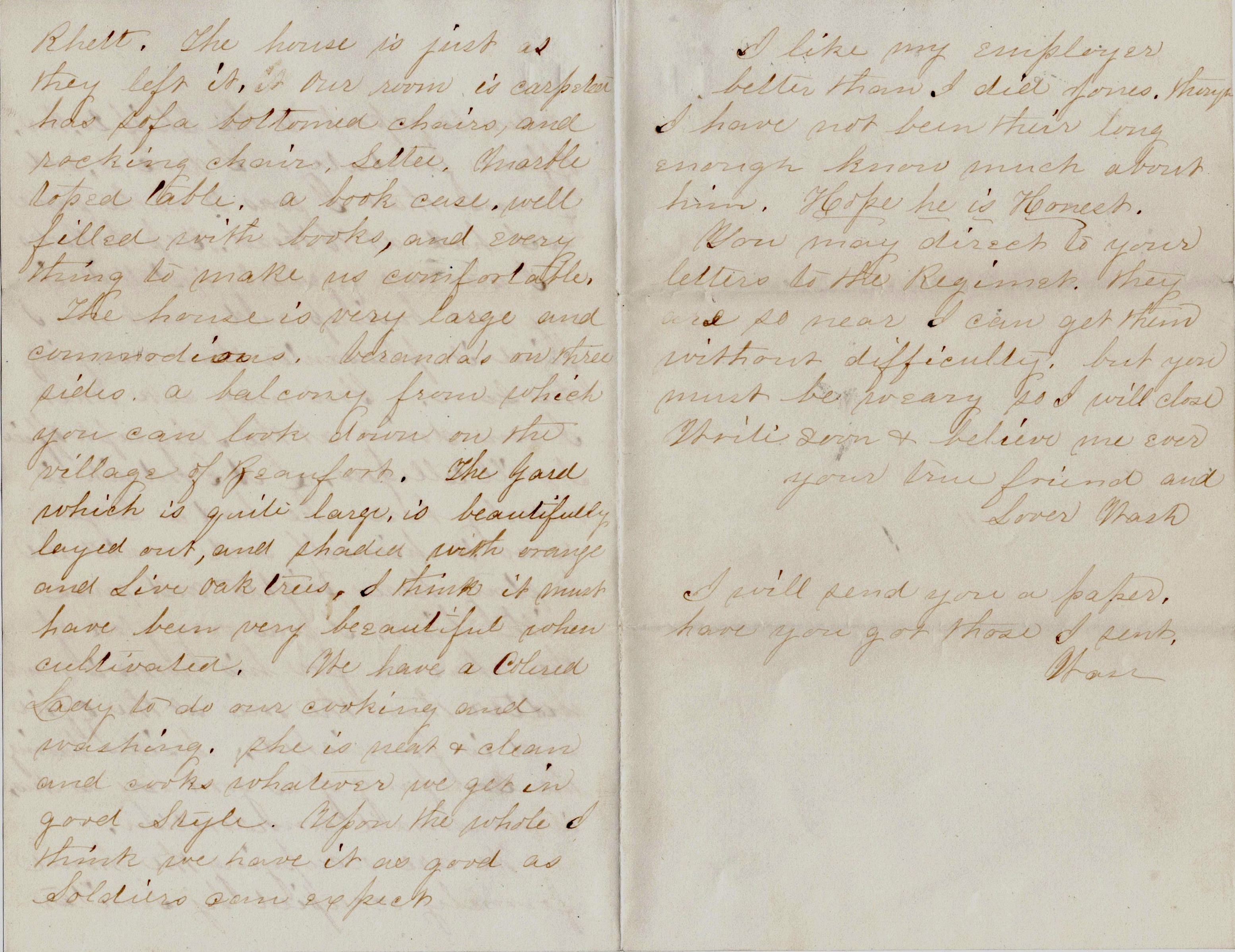
I am now regularly installed in my new business and must own I find it pleasanter than carrying the gun. You may ask what I am doing at the Telegraph Office. I will tell you. L[ewis] A. Goodrich is orderly here. He had a large room to himself and wanted me to stay here nights and mess with him. I was very glad of the chance for his room is much better than the one at the office and is furnished. Besides, having the company of as good boy as Aus is no small consideration. We are occupying the house formerly occupied by Senator [Edmund] Rhett. The house is just as they left it. Our room is carpeted, has sofa bottomed chairs, and rocking chairs, settee, marble topped table, a book case well filled with books, and everything to make us comfortable. The house is very large and commodious. Veranda’s on three sides, a balcony from which you can look down on the village of Beaufort. The yard which is quite large is beautifully laid out and shaded with orange and live oak trees. I think it must have been very beautiful when cultivated. We have a colored lady to do our cooking and washing. She is neat & clean and cooks whatever we get in good style. Upon the whole, I think we have it as good as soldier’s can expect.
I like my employer better than I did Jones though I have not been there long enough to know much about him. Hope he is honest.
You may direct your letters to the regiment. They are so near I can get them without difficulty but you must be weary so I will close. Write soon & believe me ever your true friend and lover, — Wash
I will send you a paper. Have you got those I sent? — Wash
Letter 2
Beaufort, South Carolina
August 11, 1863
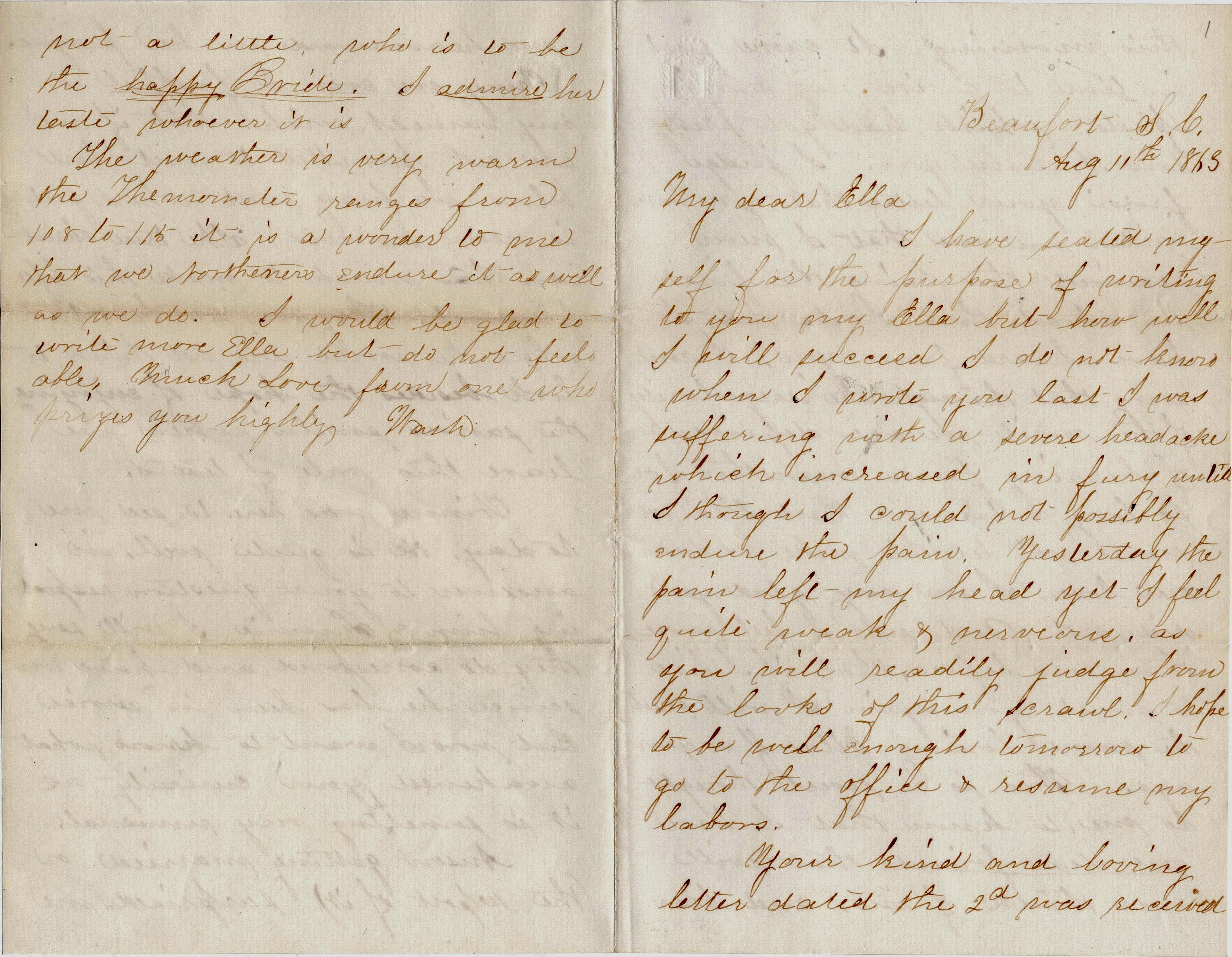
My dear Ella,
I have seated myself for the purpose of writing to you my Ella but how well I will succeed I do not know. When I wrote you last, I was suffering with a severe headache which increased in fury until I thought I could not possibly endure the pain. Yesterday the pain left my head yet I feel quite weak & nervous as you will readily judge from the looks of this scrawl. I hope to be well enough tomorrow to go to the office & resume my labors.
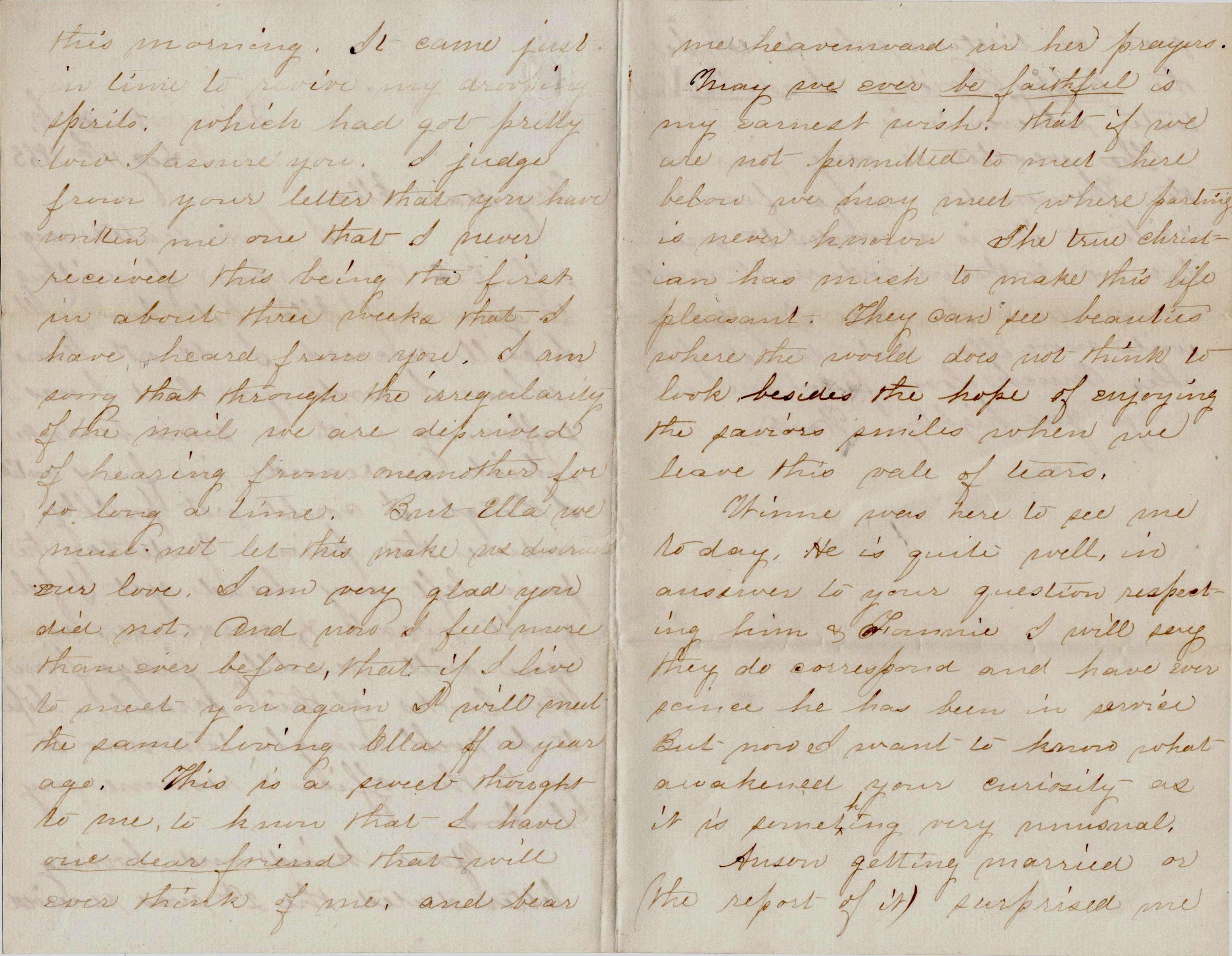
Your kind and loving letter dated the 2nd was received this morning. It came just in time to revive my drooping spirits which had got pretty low, I assure you. I judge from your letter that you have written me one that I never received, this being the first in about three weeks that I have heard from you. I am sorry that through the irregularity of the mail we are deprived of hearing from one another for so long a time. But Ella, we must not let this make is distrust our love. I am very glad you did not. And now I feel more than ever before that if I live to meet you again, I will meet the same, loving Ella of a year ago. This is the sweet thought to me—to know that I have one dear friend that will ever think of me and bear me heavenward in her prayers. May we ever be faithful is my warmest wish. that if we are not permitted to meet here below, we may meet where parting is never known. The true Christian has much to make this life pleasant. They can see beauties where the world does not think to look, besides the hope of enjoying the Savior’s smiles when we leave this vale of tears.
Winne was here to see me today. He is quite well, in answer to your question respecting him, & Fannie, I will say they do correspond and have ever since he has been in service. But now I want to know what awakened your curiosity as it is something very unusual. Anson getting married (or the report of it) surprised me not a little. Who is to be the happy bride? I admire her taste, whoever it is.
The weather is very warm. The thermometer ranges from 108 to 115. It is a wonder to me that we Northerners endure it as well as we do, I would be glad to write more, Ella, but do not feel able. Much love from one who prizes you highly, — Wash
Letter 3
Beaufort, South Carolina
September 6th 1863
My own dear Ella,
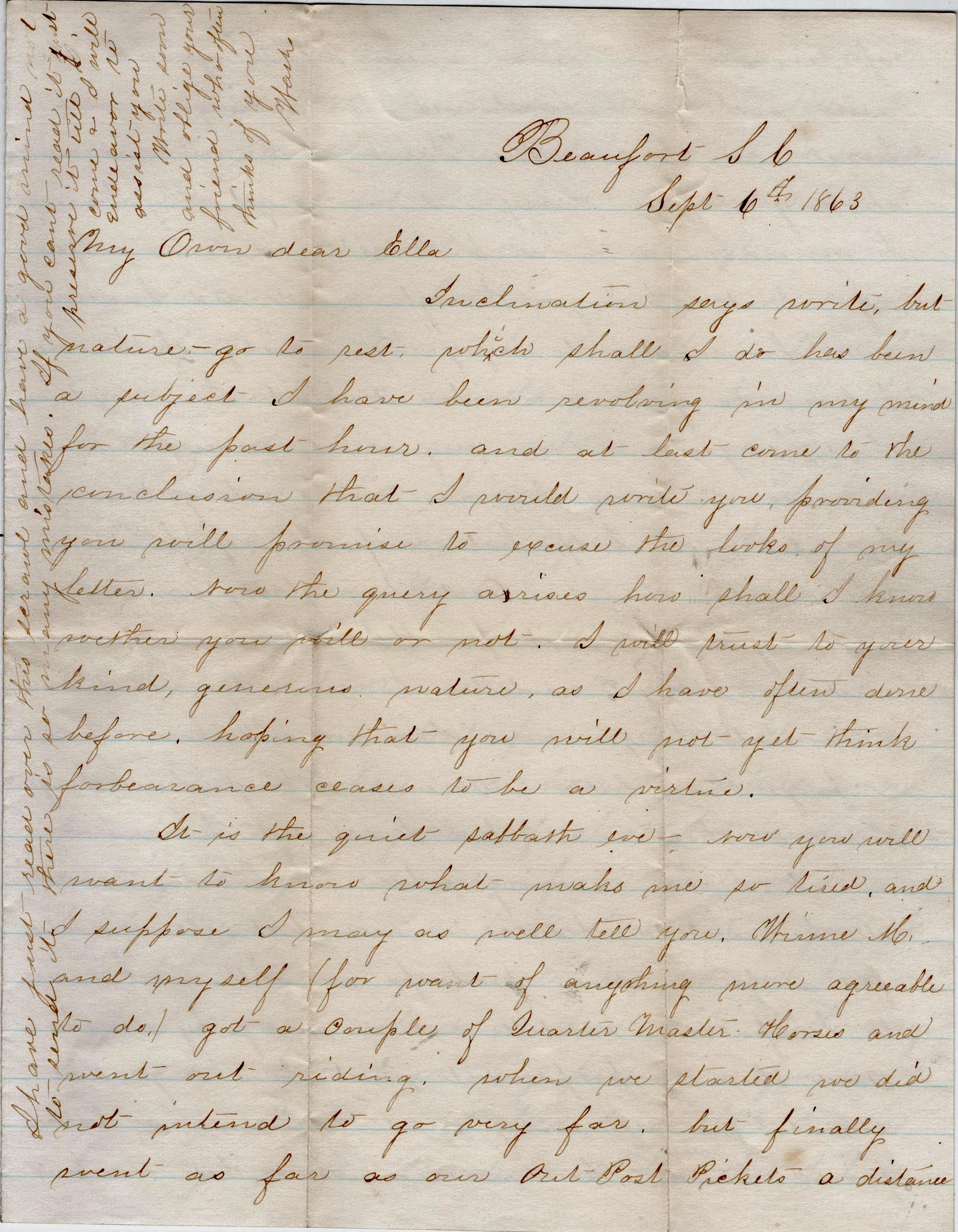
Inclination says write, but nature go to rest. Which shall I do has been a subject I have been revolving in my mind for the past hour and at last come to the conclusion that I would write you providing you will promise to excuse the looks of my letter. Now the query arises, how shall I know whether you will or not. I will trust to your kind, generous nature as I have often done before, hoping that you wil not yet think forbearance ceases to be a virtue.
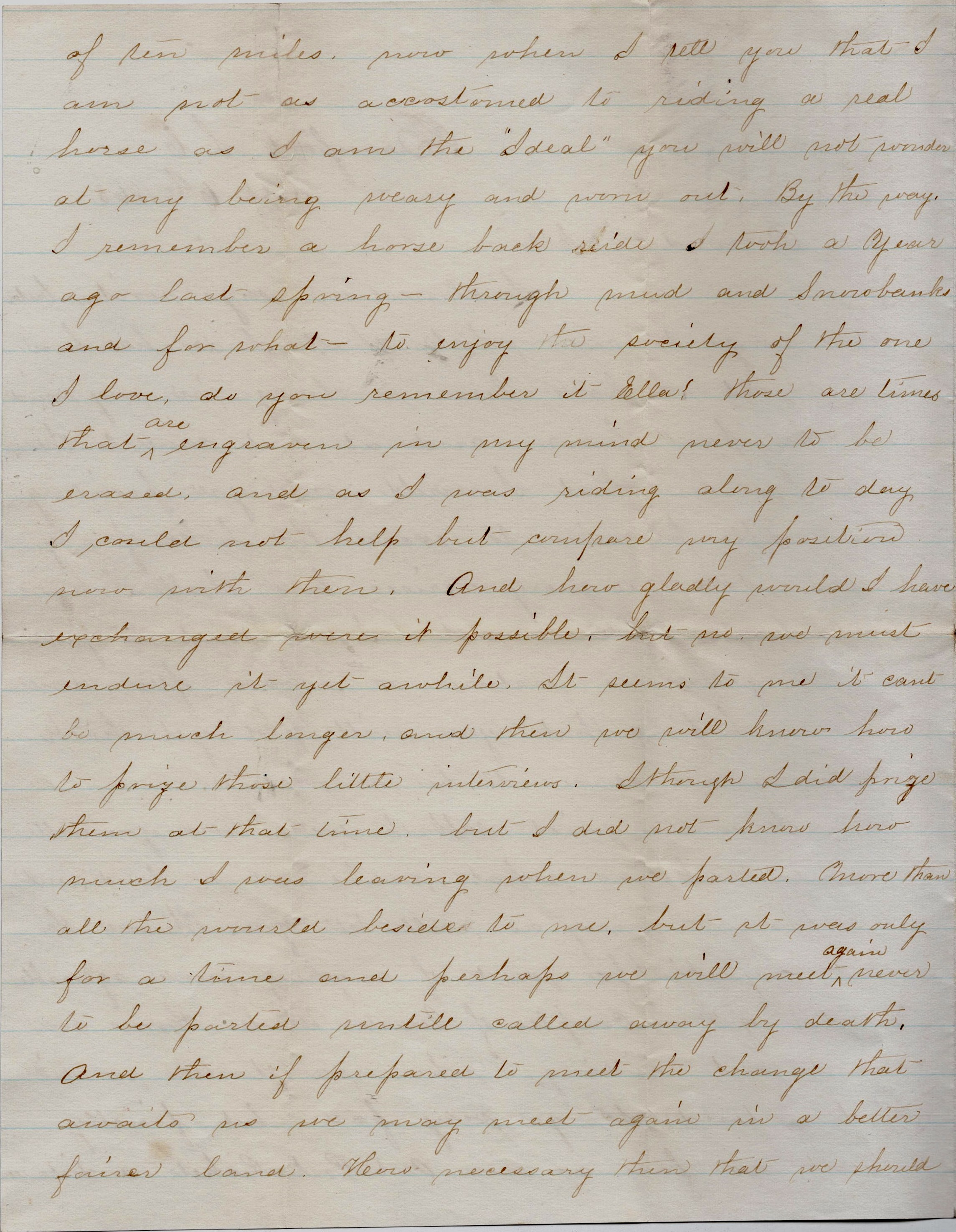
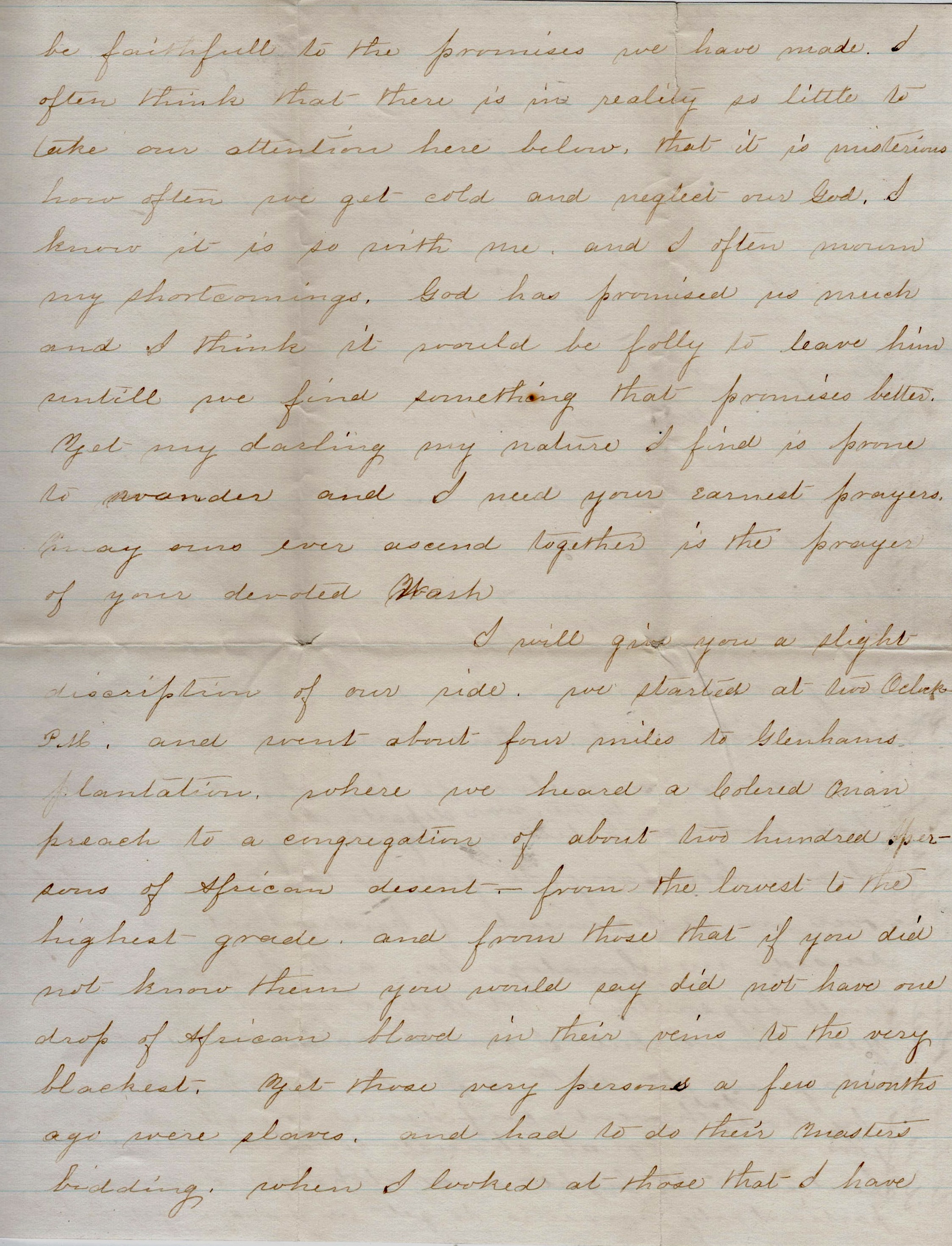
It is the quiet Sabbath eve. Now you will want to know what makes me so tired and I suppose I may as well tell you. Winne M. and myself (for want of anything more agreeable to do) got a couple of quartermaster horses and went out riding. When we started, we did not intend to go very far, but finally went as far as our outpost pickets—a distance of ten miles. Now when I tell you that I am not as accustomed to riding a real horse as I am the “Ideal” you will not wonder at my being weary and worn out. By the way, I remember a horse back ride I took a year ago last spring—through mud and snowbanks and for what—to enjoy the society of the one I love. Do you remember it, Ella? Those are times that are engraved in my mind never to be erased. And as I was riding along today I could not help but compare my position now with then. And how gladly would I have exchanged were it possible. But no, we must endure it yet awhile. It seems to me it can’t be much longer, and then we will know how to prize those little interviews. Although I did prize them at the time, but I did not know how much I was leaving when we parted—more than all the world besides to me. But it was only for a time and perhaps we will meet again, never to be parted until called away by death. And then, if prepared to meet the change that awaits us, we may meet again in a better, fairer land. How necessary then that we should be faithful to the promises we have made. I often think that there is in reality so little to take our attention here below—that it is mysterious how often we get cold and neglect our God. I know it is so with me, and I often mourn my shortcomings. God has promised us much and I think it would be folly to leave Him until we find something that promises better. Yet my darling my nature I find is prone to wander and I need your earnest prayers. May ours ever ascend together is the prayer of your devoted Wash.
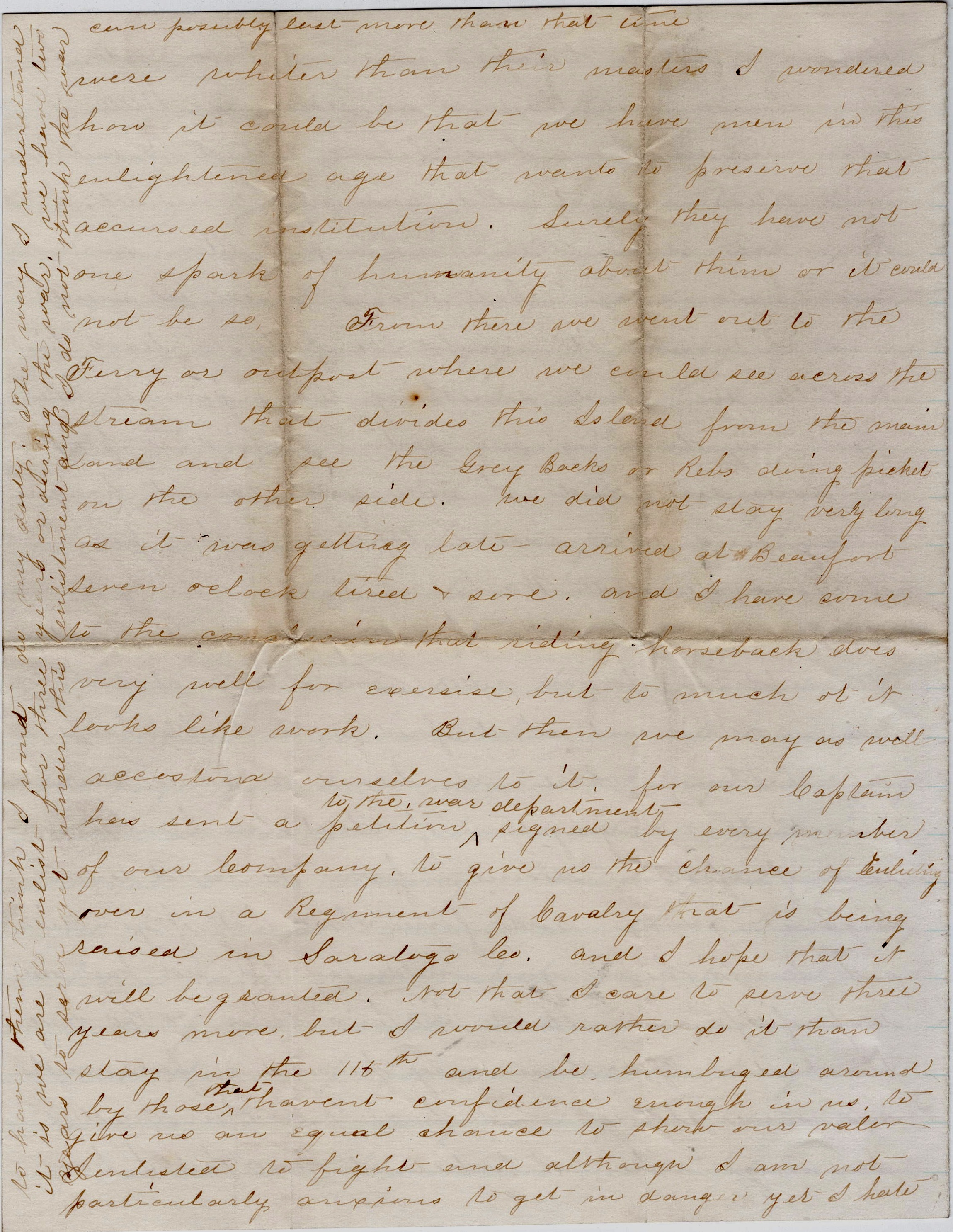
I will give you a slight description of our ride. We started at two o’clock p.m. and went about four miles to Glenhams Plantation where we heard a Colored man preach to a congregation of about two hundred persons of African descent, from the lowest to the highest grade, and from those that if you did not know them you would say did not have one drop of African blood in their veins to the very blackest. Yet those very persons a few months ago were slaves and had to do their masters bidding. When I looked at those that I have seen were whiter than their masters, I wondered how it could be that we have men in this enlightened age that want to preserve that accursed institution. Surely they have not one spark of humanity about them or it could not be so.
From there we went out to the Ferry or outpost where we could see across the stream that divides this island from the mainland and see the Grey Backs or Rebs doing picket on the other side. We did not stay very long as it was getting late. Arrived at Beaufort at seven o’clock tired & sore and I have come to the conclusion that rifing horseback does very well for exercise but too much of it looks like work. But then we may as well accustom ourselves to it for our Captain has sent a petition to the War Department signed by every member of our company to give us the chance of enlisting over in a regiment of cavalry that is being raised in Saratoga county and I hope that it will be granted. Not that I care to serve three years more but I would rather do it than stay in the 115th [New York] and be humbugged around by those that haven’t confidence enough in us to give us and equal chance to show our valor. I enlisted to fight and although I am not particularly anxious to get in danger, yet I hate to have them think I won’t do my duty. The way i understand it is we are to enlist for three years or during the wart. We have two years to serve yet under the enlistment and I do not think the war can possibly last more than that time.
I have just read over this scrawl and have a good mind not to send it—there is so many mistakes. If you can’t read it, just preserve it till I come & I will endeavor to assist you. Write soon and oblige your friend who often thinks of you. — Wash