My passion is studying American history leading up to & including the Civil War. I particularly enjoy reading, transcribing & researching primary sources such as letters and diaries.
I could not find an image of William but here is one of Robert R. Russell of Co. H, 160th New York Infantry (Missing Letters File)
The following letter was written by William C. Guest (1839-1875) who enlisted as a private at Sodus, New York, on 9 September 1864 to serve in Co. C, 160th New York Infantry. He survived the war and was discharged on 1 June 1865 in Washington D. C.
Regrettably there is no family tree information on this branch of the Guest family that I could find on-line. The letter was addressed to “Dear Father” but the envelope was addressed to James A. Guest who was born in Cattaraugus county, New York, in 1831 so he would be too young to be the author’s father. My hunch is that James was an older brother who had previously served in the Civil War in the 26th New York Battery and was, by May 1865, working as an express agent in Belle Plaine, Iowa, where he was enumerated in the 1870 census. Sometimes letters and envelopes get mixed up, or sometimes a letter from one child gets forwarded to another. James’ military records indicate that his parents were Henry Guest and Rachel Beadle of Seneca county, New York.
The 160th New York Infantry was organized and later recruited from the counties of Cayuga, Seneca, Wayne, Ontario, Allegany, Erie and Wyoming. By the time William enlisted (or was drafted) into the regiment, they had seen action in the Department of the Gulf, the fall of Port Hudson, and the Red River Expedition. By the fall of 1864 when William joined them, they had returned to the East and specifically to the Shenandoah Valley where they fought with Gen. Sheridan against Gen. Early’s men. They sustained many casualties in the battles of Opequan and Cedar Creek.
William’s letter tells us about the trip to Washington D. C. to participate in the Grand Review in May and, while enroute, witnessing the Lincoln Funeral Train not long after it had left Washington on its way north to Baltimore on 21 April 1861. He also refers to the remains of John Wilkes Booth being on the gunboat Montauk at the Navy Yard.
[Note: This previously unpublished letter was graciously made available for transcription and publication on Spared & Shared expressly by the Sic Parvis Magna, Gratias Lesu Collection.]
Transcription
Addressed to Mr. James A. Guest. Belle Plaine, [Benton County] Iowa
Camp Stoneman Near Washington D. C.
May 1, 1865
Dear Father,
Your kind letter was received some time ago by Jimmie while we laid at Summit. The 4th of April we broke camp at Summit Point and went up the Valley above Winchester where the whole division assembled in a line of encampments. We remained there for four day and all of this time the cavalry was up in the Valley ahead of us scouring the Valley. They went up as far as Mount Jackson and only met with a few guerrillas and captured six of them which I had the chance of seeing as they passed along the pike, And at this time I had the chance of seeing the largest force of cavalry I ever witnessed including the 22nd New York and seeing some of the Lyons boys as they passed along in the column. I should think the column would extend in distance from one end to the other four miles distance including the whole line of them.
After remaining up there the four days, we was all ordered back to Summit Point and remained there 4 or 5 days and then was ordered to report to Washington. We all came by railroad stored and packed in the cars for 24 hours. Jimmie and myself and a number of others rode on top of the cars and slept there all night, and the weather rainy and misty. We had the pleasure of seeing the funeral train of our lamented President Lincoln. It passed us as our train stopped to wood and water between the Relay House and Washington, the road being double tracked.
Day before yesterday Jimmie procured a pass and visited Washington. He with John Layton who is there at the Campbell Hospital visit the places of interest and curiosity of Washington.
We are doing very heavy picket duty on this side of Washington. Orders are no persons are allowed to pass out or in with a pass [unless] signed by Gen. [Christopher C.] Augur or Secretary [Edwin] Stanton. It seems that Booth, the murder[er] is captured and his remains lie in state on board of a monitor [USS Montauk] in the Navy Yard at Washington. 1
Everyone seems to have the impression that the war is over and that we will see our homes [in] less than three months. Good feeling manifested here at the news of the surrendering of Johnston. It makes the boys in the regiment still talk more stronger about going home. Jimmie received a letter from Marier Jones. She said all was well and that John [was] there and his leg was very fast improving but some lame yet. Also last night Jim received a letter from Mrs. Lyman. All [were] well but Mr. Lyman. He had the rheumatism very bad. Also that Neu__ Vanderbilt was living with his wife in [the same] house with his mother and worked her farm this summer and also that Sanford works their farm again this season and that Mrs. Brown’s girls were living with her this summer. Also that Mr. Brown had been there to visit them. And also that Charley Rozell was clerking it for Owen Klink somewhere in the army for an army sutler.
Jimmie is still Orderly of this company and is well. He is today busy making out his pay rolls of this company. We now have four months pay due us to to today—the first of May.
With my love and best wishes, I remain your son, — William C. Guest
Co. C., 160th New York State Vols., 1st Division, 3rd Brigade, 19th Army Corps, Washington D. C.
Our regiment is very small. It only contains 250 men and it left Auburn with 840 men. We have a full view of Washington from this camp.
1 Readers are referred to another letter I transcribed in 2021 that was penned by Henry Washington Landes who served as a guard aboard the USS Montauk describes witnessing the autopsy of Booth performed onboard. See Henry Washington Landes Letters & Diaries.
This letter was written by Assistant Surgeon Edwin Ruthven Brush (1836-1908), the son of Dr. Salmon Mortimer Brush (1804-1887) and Seviah Lovegroove (1817-1890) of Cambridge, Lamoille county, Vermont. Edwin married Amy R. Fletcher in 1860 and had 3 children.
Edwin R. Brush was drafted and entered the service on 17 July 1863 as a Private in Co. H, 2nd Vermont. An 1858 graduate of the University of Vermont and a practicing physician prior to his service, Dr. Brush was elevated to Asst. Surgeon in his company on 15 October 1863. He was mustered out on 15 July 1865 at Washington, D. C.
In this letter, Edwin provides his wife with some details of the Second Battle of Rappahannock Station during the Bristoe Campaign—a glorious Union victory. On November 7, the Union army forced passage of the Rappahannock River at two places. A dusk attack overran the Confederate bridgehead at Rappahannock Station, capturing more than 1,600 men of Jubal Early’s Division. Fighting at Kelly’s Ford was less severe with about 430 casualties, but the Confederates retreated allowing the Federals across in force. On the verge of going into winter quarters around Culpeper, Lee’s army retired instead into Orange County south of the Rapidan River. The Army of the Potomac occupied the vicinity of Brandy Station and Culpeper County.
For a great description of this battle, published in 2013, see Edward Alexander’s post entitled, “The Federal Charge at Rappahannock Station, 150 Years Ago.” Edward’s article explains more fully what Edwin meant when he wrote in his letter, “The manner in which our men commenced the attack was about as cool as anything as I ever heard of.”
An artist’s rendering of the Second Battle of Rappahannock Station published in Harper’s Weekly on 28 November 1863
A number of Edwin’s letters have come to me for transcription from multiple sources, his letters to Amy having been sold off separately to different buyers in the last couple of years. Previously I have transcribed five of his letters which may be found here: Edwin R. Brush, Co. H, 2nd Vermont (3 Letters) Edwin R. Brush, Co. H, 2nd Vermont (2 Letters)
[Note: This previously unpublished letter was graciously made available for transcription and publication on Spared & Shared expressly by the Sic Parvis Magna, Gratias Lesu Collection.]
Transcription
Camp at Brandy Station November 9, 1863
Dear wife,
I received yours of November 3rd yesterday while we were on the march to this place. It made me feel very happy to get it. We left Warrenton on the morning of the 7th and arrived at Rappahannock Station at noon when we found ourselves near the Rebels and gave them fight which resulted in their total defeat. Our regiment was in the reserve and did not have any fighting to do but we were in range of the Rebs artillery a few minutes but no one was hurt although one fellow had a narrow escape, a shell having struck the ground right under his feet which knocked him down. We did not stay in that place a great while but moved up the road and got under cover of an embankment where they could not get at us but the shells flew over our heads, striking on a knoll beyond. They were twenty-pound shells.
We took from the rebels about 1,800 prisoners, 7 pieces of artillery, and their pontoon bridges. The 6th Maine, which numbers about six hundred men took 1,600 men at one battle and there were about 200 taken afterwards. Our loss was about 300 in all. How many rebels were killed, I do not know. The same day the 3rd Corps had a fight at Kelly’s Ford where they took quite a lot of prisoners. The manner in which our men commenced the attack was about as cool as anything as I ever heard of. We stopped in an open field in sight of the rebel sharpshooters, we built up some fires, got our dinner just as though we were in camp. After dinner, we started in line of battle with our skirmish line in front. Our line of skirmishers marched up within a short distance of the rebs when they were fired upon by the rebs and they returned the fire along the whole line when the Johnnies run. Our men then went up to the top of a knoll when the artillery opened upon them but the shot did not do much harm. We soon got our artillery in position and played upon them pretty smartly for awhile. They kept up the firing until about dark when the boys made the charge on the fortifications which the rebs had thrown up and took the prisoners which I spoke of. 2
When they made the charge, they were ordered to uncap their gun and go in which they did in good shape. In coming over the field, I saw in one place where the battery was taken, eleven rebels laying side by side dead. It looked rather rough I can tell you. I did not care to look after any more dead rebs although there were more near there and they were burying them. In one corner there was a place that was pretty bloody and our men took seven stand of colors which was the cause of it. There was one fellow that had a bayonet wound through him, another one—a lieutenant—was killed by a blow with a musket. One of the Maine boys did it after ordering him to surrender which he refused to do saying that he would die first. Upon that, the other fellow hit him with the breach of his gun, breaking his skull in.
That night our regiment were out on picket and I slept on the ground without any tent over me. Two of us slept together with a half tent and a rubber blanket under us and two blankets over us, it being a pretty cold night and as we could not have any fire, I did not sleep any too warm. Last night we did a little better. We cut down a tree and built up a good fire which lassted till morning but after all, it was not like being with you to make up a good feather bed for me to sleep in. But after all, I cannot say that I am dissatisfied with the service. I am so much better off than some poor, sick fellows that I know.
I wish you would send me a piece of buckskin gloves. I do not want a very heavy pair. I want them so that I can drive in them and not have them bungling. I am sorry I wrote what I did about your [not] writing as I got a letter from you the same day that I mailed mine and another yesterday, but hope you will not feel bad about it.
About those shirts, the surgeons wear fancy colors a good deal. I do not care if you make mine the same. I was glad to hear that you had got some fine [things] because I think you deserve them, and Amy, you know I want you should have everything you wish for. Amy, I shall try and not get any bad habits in the army and hope you can trust me. When I think of you, how can I get any bad habits after all of your kindness to me when I know how bad it will make you feel. Amy, how I do miss your company. It seems as though I could not wait for the time to come when I shall see you.
Give my love to all and kiss our little darling for me. This from your dearest, — Edwin
1 “The Sixth Maine’s cheer sounded like a ‘terrible panther-like yell’ according to its adjutant. ‘So small a number of men never before made such an uproar… Men were seized with the wildest transports of rage and frenzy. We seemed to be marching against a blind, inscrutable force, which defied all of our efforts to reach it or grapple with it. The only relief seemed our continuous yell, which every man kept up until the fortifications in front of us were reached.’ Once the Union soldiers reached the works, Anderson recalled that now ‘the air was filled with a medley of shouts, shrieks and groans, calls to surrender, yells of defiance, imprecations and curses and through and above all other sounds the increasing crash of musketry.’…”A normally pious and reserved officer in the Sixth Maine known as the ‘praying sergeant’ entered the earthworks ‘with an infuriated yell, and with profanity which was fierce and appalling, he aided with bayonet and clubbed musket in speedily dispersing the enemy around us.’ So ferocious was the fighting that William J. Seymour of Hays’ Brigade believed the Union soldiers were “stimulated by the free use of whiskey,” a claim that reveals a mindset of the defenders but one that is not supported by evidence. ‘The enemy poured in yelling like so many demons, many of them being in a state of beastly drunkeness.’ A Confederate prisoner later told his captors: ‘We all allowed that the whole Army of the Potomac were coming, you’uns kept up such a wicked yelling.’” [Source: “The Federal Charge at Rappahannock Station, 150 Years Ago.”]
2 In all, 1,670 Confederates were killed, wounded, or captured in the brief struggle, more than eighty percent of those engaged. Union casualty figures, by contrast, were small: 419 in all. For the North the battle had been “a complete and glorious victory,” an engagement “as short as it was decisive,” reflecting “infinite credit upon all concerned.” Maj. Gen. Horatio G. Wright noted that it was the first instance in which Union troops had carried a strongly entrenched Confederate position in the first assault. Brig. Gen. Harry Hays claimed to have been attacked by no less than 20,000 to 25,000 Union soldiers—a figure ten times the actual number. The battle had been as humiliating for the South as it had been glorious for the North. Two of the Confederacy’s finest brigades, sheltered behind entrenchments and well supported by artillery, had been routed and captured by an enemy force of equal size. Col. Walter H. Taylor of Lee’s staff called it, “the saddest chapter in the history of this army,” the result of “miserable, miserable management.” An enlisted soldier put it more plainly. “I don’t know much about it,” he said, “but it seems to be that our army was surprised.”
I could not find an image of Beneville but here is one of Pvt. James A. Morrison of Co. D, 34th Pennsylvania Infantry
The following letter was written by Beneville Schock (1824-1863), the son of John Shock (1784-1866) and Elizabeth Mary Faust (1789-1884) of Petersburg, Huntingdon county, Pennsylvania. He probably wrote the letter to his older sister Sarah (Schock) Fisher (1823-1882) and her husband Jacob Fisher (1818-1882) who lived in the same vicinity as his parents. Though Beneville spelled his last name “Shock” in this letter, the spelling on the family headstones is “Schock” so I have spelled it that way here.
Beneville was recruited into Co. I, 5th Pennsylvania Reserve Corps (34th Pennsylvania Volunteers) on 24 August 1862, only a few weeks prior to writing this letter. He joined the seasoned veterans of his regiment after the Second Battle of Bull Run so the battle scenes he describes in this letter at South Mountain and Antietam are the first he ever witnessed, prompting him to conclude, “War is a dreadful and horrible thing. May it soon be over.”
Beneville died on 4 February 1863 at Windmill Point, Virginia—the location of a large Union field hospital. His cause of death is not known but it was probably due to disease.
To read letters from other members of the 34th Pennsylvania Infantry that I have transcribed and published on Spared & Shared previously, see: George Mickle Brown, Co. A, 34th Pennsylvania (1 Letter) Albert Rake, Co. B, 34th Pennsylvania (1 Letter) Alfred M. Smith, Co. C, 34th Pennsylvania (1 Letter)
[Note: This previously unpublished letter was graciously made available for transcription and publication on Spared & Shared expressly by the Sic Parvis Magna, Gratias Lesu Collection.]
Transcription
Camp near Sharpsburg, Maryland September 30th 1862
Dear brother-in-law and sister,
I take the present opportunity to inform you that I am well at this time and hope that these few lines may find you in the same state of health.
I arrived at Washington City on the 6th of September and marched across the Long Bridge into Virginia 9 miles and back the same night. The next day early we started from Washington to Frederick and marched all that week. On the 14th we arrived at South Mountain or Hagerstown Heights about the middle of the afternoon when our Brigade was marched to the right with the Old Bucktails Regiment in advance when very soon the muskets began to crack in our advance. The rebels had taken a position on a high ridge or mountain very steep and rocky but our army drove them from it with great loss. We fought till it was so dark that we could not see anymore. They left that night and we followed them till the 16th in the evening when they made another stand near Sharpsburg. 1
When our Brigade was marched in advance, the Bucktails again took the lead. The rebels had a battery in our advance. They gave us a pretty good shelling that evening till it was dark when our regiment was put on picket duty and as it was quite dark, we marched within a few steps of the rebels when they fired into our regiment, but as it was quite dark, they did not much injury. Our regiment returned the fire when they ceased for a little while. When they fired again, our regiment returned the fire again when they ceased till break of day when they commenced again.
Our Brigade was drawn in line of battle and advanced toward them. We had a pretty sharp time for about an hour when fresh troops were brought up and we were withdrawn from the field and did no more fighting that day. We only lost a few men in our regiment. The battle continued all day without intermission. 2 The rebels fought bravely but could not stand the Yankees. In the night and the next day they got away as fast as they could and got over into Virginia again.
“War is a dreadful and horrible thing. May it soon be over.”
On the 19th we marched over the battleground. It was a horrible sight. The dead were not yet buried. The fields and woods were laying full of them, their faces all swollen and black. War is a dreadful and horrible thing. May it soon be over. We have been encamped near Sharpsburg for the last ten or twelve days. We don’t know when we will leave this but I don’t think it will be long before we leave this. We live pretty well here, has plenty of good water which we don’t have all the time. I have got to like soldiering pretty well.
Now I want you to write me a long letter and let me know what is going on in Shavers Creek Valley and the Warrior’s RIdge. I have not heard anything from home since I left them. I have wrote three letters home but got no answer. No more for the present.
Yours truly, — Benaville Shock
Co. I, 5th Regiment P. R. C. Washington D. C. in care of Col. [Joseph W.] Fisher
1 “The Bucktail regiment commanded by Colonel McNeil, was deployed as skirmishers in front of the division, and was closely followed by the whole line of battle; the enemy’s outposts were rapidly driven in, forced from the hills, and routed from the ravines, until suddenly the regiments of the First Brigade arrived at a cornfield, ‘full of rebels,’ protected by a stone wall at the foot of the abrupt mountain side; the Bucktails received a terrific volley of musketry, which brought them to a halt; General Seymour, who was on the ground with his men, seeing that this was the critical moment, called out to Colonel Roberts, commanding the First Regiment, to charge up the mountain, and at the same instant, turning to Colonel Fisher, of the Fifth Regiment, whose men were coming up in well dressed lines, he exclaimed: ‘Colonel, put your regiment into that cornfield and hurt somebody.’ ‘I will, General, and I’ll catch one alive for you’ was the cool reply of Colonel Fisher. The Second regiment, commanded by Captain Byrnes, and the Sixth, Colonel Sinclair, were ordered forward at the same time. The men of the Fifth leaped the stone wall, immediately captured eleven prisoners, and sent them back to the General.” The regiment steadily ascended the rugged side of the mountain under a heavy fire of artillery and musketry, and after a severe struggle, lasting five hours, carried the heights with the triumphant division and planted its standard upon the summit. It entered the engagement with three hundred and fifty-seven men. Its loss was one killed and nineteen wounded. [PA-Roots]
2 “On the 16th, [the regiment] crossed Antietam Creek, and moving to the right, engaged the enemy at four P. M., and was engaged at intervals during the night. The battle was renewed at daylight on the following morning, and raged with unabated fury on that part of the line where the Reserves were posted during the early part of the day, the Fifth not being relieved until one P. M.”[same source as previous footnote]
I could not find an image of Henry but here is a tintype of Cpl. Richard K. Woodruff of Co. I, 15th Connecticut Infantry (Jeffrey Kraus Collection)
This letter was written by Cpl. Henry D. Lewis (1841-1937) of Co. H, 15th Connecticut Infantry. Henry was the son of Lucien Franklin Lewis (1804-1882) and Susan Hitchcock (1814-1875) of Naugatuck, New Haven county, Connecticut. Henry served from August 1862 until June 1865.
Henry wrote the letter to his cousin, Charles Dwight Lewis (1841-18xx), the son of Asahel H. Lewis (1807-1895) and Harriet Newell Horton (1818-1907) of Naugatuck, New Haven county, Connecticut.
Mentioned in the letter is another cousin, Rufus W. Lewis (1836-1909) — the son of Lawrence Sterne Lewis (1804-1884) and Nancy L. Hull (1810-1881) of Naugatuck. Rufus also served in Co. H, 15th Connecticut Infantry until his disability caused his reassignment to Co. E, 18th Veteran Reserve Corps in 1863.
Addressed to Mr. Charles D. Lewis, Naugatuck, Connecticut
Suffolk, Virginia Monday, March 16, 1863
My dear cousin Charlie,
When I wrote you last, I forgot where I was, but if I don’t have my letters very well connected, you will consider that we are subject to many changes, and it is unnecessary for me to make excuses. In your letter which you last wrote, you mentioned riding on the cars & I think that you must have heard about it from Sam. Speaking about Sam puts one in mind that he is a pretty fast boy. Florence says that he beats his brother entirely going to see the girls, and its my opinion that if he is worse than me, he must be pretty well up in the world. Sam it seems thought that there was danger of your becoming entangled in the meshes of love & I hope if such is the casae, that he has been kind enough to do his best to help you out—that is, if you needed any help.
You asked in your letter if there were any such hills in Virginia as in Old Connecticut. I reckon there are some & there were some in the rear of the City of Fredericksburg which none were able to climb—at least none of the Union soldiers. We had a fine place for encampment at Newport News & it really seemed much like home because I had such a view of the water. I sometimes fancied when looking across the James river that I was looking across Long Island Sound & that Long Island was in the distance for the river is from six to seven miles wide.
During our stay in Newport News, I had a pass one day to visit Fortress Monroe. I went on the boat free of charge and returned having quite an interesting time. I could not get in the fort but I saw the famous guns—the Lincoln and Floyd. I tel you, they were monsters. One weighed 52,005 pounds and the other 49,097, if I remember rightly. The heaviest one carries a shot which weighs 500 lb. and has carried a shot to Sewall’s Point, a distance of upwards of five miles. The heaviest one is a rifled gun and the ball is part of iron and part of lead. The lead is expanded by the powder when fired and fills the grooves. The heaviest shot are of this shape [sketch] and the slug shot this [sketch]. These latter are considered the most effective for the demolishing of iron clads & weigh 450 lbs. These shot are about two feet long and 15 inches in diameter. Shell are also used of the same shape. The size of the gun I can not very well describe. I should think it was at least twenty feet long and the diameter at the breach is as good as five feet. I should like first rate to have you see them. I should hate to be on the Merrimac or any ironclad & have such a shot fired at the vessel. The fort is built for nine hundred guns but there are only about 850 mounted now, yet the work is going on.
The “Lincoln Gun” at Fortress Monroe was actually a 15-inch Rodman Columbiad LOC)
We left Newport News last Friday on board of a boat and arrived at Norfolk in about three hours and spent the night there. The next morning we went on a train of cars & after riding through a wilderness, or through Dismal Swamp as it is put down in Geography, we find ourselves in the town of Suffolk surrounded by a wilderness. For seven or eight miles we rode through a part of the Great Dismal Swamp and I think it dismal too. It is the most dismal place that I have been in, that is certain. It is a real saucy looking hole. We are surrounded by swamps and forests & there is nothing to be seen after we get away from the trenches and fortifications which surround us. The Dismal Swamp is southwest from us and we are on low, level, and damp ground—just the place for fevers. We are distant from Norfolk 23 miles & from Norfolk to Fort Monroe is 18 miles, and we are only seven or eight miles from North Carolina.
I am quite well and in pretty good spirits considering the dismal country which surrounds us. I have weighed once within two or three weeks 148 lbs. and under, if you can beat that. Write soon. Give my best respects to all the friends, Uncles, Aunts, and cousins.
The following letter was written by Daniel W. George (1843-1876), the son of Roswell and Julia George. He wrote the letter to his cousin, Edward Warner in Acworth, New Hampshire.
I could not find an image of Daniel but here is Joseph H. Whitehouse, a drummer boy who served in Co. D, 5th New Hampshire Infantry (Ancestry)
Daniel named Acworth as his birthplace at the time of his first enlistment as a private in Co, D, 1st New Hampshire Infantry on 24 May 1861. He mustered out three months later on 9 August 1861. Later, in September 1861, he reenlisted in Co. E, 5th New Hampshire Infantry, in which regiment he was serving at the time he wrote this letter from Falmouth, Virginia, just after the Battle of Fredericksburg in which they participated and suffered heavy casualties. Daniel survived the war, mustering out on 28 October 1864, and later (1867) married Sarah C. Russell in Ashburnham, Massachusetts.
The 5th New Hampshire, sometimes called “the Fighting Fifth,” sustained more battle deaths than any other regiment—nearly 300 killed or mortally wounded in their four years of service. They were ably led by Colonel Edward E. Cross until he was mortally wounded himself at Gettysburg. At the Battle of Fredericksburg, the regiment entered the fray on the heels of the Irish Brigade where they immediately fell under heavy fire of shell, grape and canister. When the Irish Brigade stumbled, the 5th continued their ascent on the enemy works but were also cut down. “My brave boys never faltered,” Col. Cross later wrote of the attack.
Transcription
Addressed to Edward Warner, Esq., Acworth, New Hampshire
Camp near Falmouth, Va. December 19, 1862
Dear Cousin,
With much pleasure I take my pen in hand to let you know that I am alive and well. I have been in a great many hard places since that I left New Hampshire and expect to go into some more before I get home. Last Saturday I was in a battle and a hard one too. This regiment lost one hundred and seventy-eight men killed and wounded and there is eight for duty now in the 5th New Hampshire Vols. I got two guns shot out of my hands and got knocked over in the bargain, lamed my back but I have got over it now so that I am alright. Morrison [George] 1 got shot through the thigh. It was a flesh wound. Joseph George 2 got hit but not bad.
I have been in nine battles and this is the first time that I have got hit atall. I have been well through this campaign and hope to remain so. I have been with the regiment wherever they have been—through thick and thin.
We are expecting to go to some place to garrison but I don’t know whether we shall go or not. I hope so at any rate.
Eddy, I want you to get me three or four postage tamps and I will make it all right with you if ever I come home for I can’t get them here for love or money. Tell Marden to write and Frank too and I will answer them if I can. Give my love to Aunt and Uncle and all inquiring friends. I can’t think of any more now. Please write soon. Goodbye.
This from your cousin, — Daniel W. George
Excuse this dirt.
1 Morrison A. George was a resident of Acworth and served in Co. E, 5th New Hampshire Infantry.He was 21 when he enlisted in September 1861 and was wounded on 1 June 1862 at Fair Oaks, on 13 December 1862 at Fredericksburg, and then promoted to corporal in November 1863. He mustered out in October 1864.
2 Joseph E. George was a resident of Acworth and was 25 when he enlisted in Co. E, 5th New Hampshire Infantry on 12 August 1862. He was discharged in May 1865.
The following letter was written by Benjamin Willson Briggs (1842-aft1920) to his older sister Rhoda Sophia Briggs (1840-1921). They were the only children of Asa Barnard Briggs (1785-1863) and Jane Winslow (1788-1870) of Pierrepont, St. Lawrence county, New York. Rhoda was yet unmarried in 1865 when this letter was written but married Howard William Burt in 1875. Benjamin married in 1867 to Jane S. Striver (1843-1919) in Springfield, Illinois.
From the content of the letter and from the envelope it appears that in 1865, Benjamin was working for the Assessors’s Office of the US Internal Revenue Service, 8th Illinois District. We know that he married Jane in Springfield in 1867 which leads us to conjecture that he may be the same “Benjamin W. Briggs” of Pekin indicted in 1876 on petty charges of conspiring to defraud the United States in matters related to tax collecting. Later in life he appears to have taken his family to Omaha, Nebraska, where he worked as a baggage agent.
In this letter, Benjamin describes the emotional impact on himself and the community of Bloomington, Illinois, upon receiving news of the assassination of President Abraham Lincoln. He also shares a remembrance of having been at a Ford’s Theatre performance the previous September when the news of the fall of Atlanta was announced, in stark contrast to the news of the assassination. He also, surprisingly, shares his wonderment that an assassination attempt had not been made previously during Lincoln’s daily sojourn to the cottage he kept at the Soldier’s Home. Finally he mentions briefly the arrest and near hanging of a resident in Bloomington who celebrated Lincoln’s death.
[Note: This previously unpublished letter was graciously made available for transcription and publication on Spared & Shared expressly by the Sic Parvis Magna, Gratias Lesu Collection.]
Transcription
Bloomington, [Illinois] April 16, 1865
Dear Sister,
I have received two letters from you since I have written to you. I will now endeavor to answer them both at once but I am afraid that it will be but a poor attempt for I do not feel much like writing letters today. The excitement occasioned by the terrible news of yesterday has not yet entirely subsided and therefore it is difficult for me to keep my thoughts together long enough to get them upon paper. Abraham Lincoln is no more!
No longer ago than day before yesterday the people here were all elated at the glorious prospects before them. Recruiting to be stopped and the expenses reduced. Surely the end was drawing nigh. All were gay and joy gleamed from every countenance. All were congratulating each other that this cruel war was over. What a contrast was yesterday—a fearful gloom overshadowing every countenance while the doleful gun, the tolling bell, and the city draped in mourning told of the terrible bereavement which the Nation had been doomed to suffer. The greatest and noblest of men, the national Chief Magistrate, had been stretched upon a bloody bier by the hand of a skulking assassin. Citizens looked each other in the face in blank astonishment while deep in their eyes was a troubled look that bespoke of sorrow mingled with terrible vengeance.
Last summer while I was at Washington I twice visited Ford Theatre. Once, while there, in the very midst of a play, the stage manager came forward and said, “Ladies and Gentlemen, official intelligence has just been received that Atlanta is ours. Gen. Sherman’s forces entered it at three o’clock this morning,” and he added with a triumphant air, “you can see what a man can do that gets up in the morning.” The applause was loud and long. Every loyal heart was full and every loyal mouth was open. The audience nearly all arose to their feet, hats and handkerchiefs were waved, and cheer after cheer was lustily given. The old theatre resounded with the welcome of good news. The tumult would subside at times at times seemingly to be renewed again with greater vigor. When the joy had spent itself, silence again resumed its sway and the play proceeded.
Daily National Republican, W. D. C., 3 September 1864. Mr. William Jermyn Florence (1831-1891)—who made the announcement according to the newspaper clipping—and his wife, Malvina Pray, were actors performing a Benefit at Ford’s Theatre on that evening.William’s actual surname was Conlin. He generally portrayed an Irishman and she a Yankee.
While sitting there that night enjoying the good news and the theatre, how little did I think of the awful, great, real tragedy so soon to be enacted there. I looked at the private boxes well. I remember they were filled with military personages, and the stars upon their shoulder straps told that they ranked of the first order. Abraham Lincoln was not there and it would have perhaps been well for him if he had never have gone there; and yet not there alone was he exposed to the assassin’s bullets. Always about six o’clock in the evening he would leave the Executive Mansion for his cottage in the suburb of the city. On that occasion he always had a body guard and there were always from ten to twenty curiosity seekers there eager to see him take his departure. Any man with nerves steady and strong enough to take unerring aim could easily have sent the deadly bullet on its awful mission then, and I thought to myself that by taking the precaution to become acquainted with the grounds, and have a secure hiding place looked out in case that he should effect his escape, he could stand half a chance to get away even though he did the deed before the very face and eyes of a body guard of fifty men all mounted and armed to the teeth.
The southern people must have ben actuated by a blind and bigoted vengeance to have plotted such a scheme as the one which they have carried into execution. They know not what is for their own good and they care less. They have killed a great and noble man—one whose bosom was incapable of harboring a single revengeful feeling—one who though he has been stern and unceasing in his endeavors to crush the rebels, has always held the olive branch to their view and who has declared to them that if they would lay down their arms, he would exercise “justice tempered with mercy.” Who will pardon Jeff Davis now? Aye, the bullet that laid Abraham Lincoln low killed the southerners best friend and roused a longing for revenge in northern men that one generation cannot clear away.
I cannot stop to tell you of what was done here today. How a man said if he thought the news was true, he would swing his hat high—how the mob got after the wrong man—how they finally got the right man—and how, but for the vigilent energies of the police, they would have swung him higher than he could have swung his hat. 1
It is getting dark and I must close. I have written much longer than I thought I possibly could when I sat down. My love to all with a big slice for yourself.
Your affectionate brother, — B. W. Briggs
1 I could not find and newspaper account of this incident in Bloomington, Illinois, but I don’t doubt it. There were numerous incidents of Union soldiers being arrested for saying similar things upon hearing of the assassination of the President.
I could not find an image of William but here is one of Ezra Joseph Davy of Co. D, 121st OVI
The following letters were written by William Y. Joslin (1836-1923), the son of Jonas Joslin (1807-1886) and Lucy Butterfield (1807-1886) of Liberty, Delaware county, Ohio. William was married to Rachel S. Case (1837-1905) in 1855 and they had two children, Jenette (“Netty”) and Irvin by the time William enlisted in August 1862 as a private in Co. C, 121st Ohio Volunteers (OVI). In the 1860 US Census, the Joslin’s were enumerated in Dublin, Delaware county, Ohio.
The 121st OVI participated in the battle of Perryville in October 1862. Then, in January, 1863, it moved into Tennessee, joined Rosecrans, and was actively employed until September, when it participated in the hard fought battle of Chickamauga, with a loss of 87 men. The Regiment took part in the battles of Lookout Mountain and Mission Ridge, and in May, started on Sherman’s Atlanta campaign, taking part in all of the battles along the way. In the fall of 1864, it operated against Hood in Alabama and then joined Sherman’s march to the Sea and through the Carolinas. After Johnston’s surrender it marched via Richmond to Washington, participated in the Grand Review, and was mustered out at Columbus, Ohio, June 12, 1865. William mustered out with his company as a corporal at war’s end.
I once more seat myself to answer a kind letter that I received from your precious hand. It finds me improving in health very much. I don’t have any diarrhea now nor have had for over a week and my breast is getting better but I have a very lame back yet and that is most that is the trouble with me now so you needn’t feel alarmed about me for that is not dangerous.
Well, Rachel, as for getting a discharge is almost a thing impossible or a furlough the same. A man has got to be pretty badly afflicted before he can get either. I spoke to the old doctor this morning after I got the letter about examining me and he said that I better wait a while yet. I suppose he thinks that he can doctor me up so that I will be able to do duty in the hospital, if not in the field. But as for soldiering and field duty, I don’t much expect to do much more of it unless I feel better than I have this spring. But maybe I may be able to do hospital duty again. If I do, you must try and do the best you can and make the time pass off as fast as possible and think that you have got a beloved husband that thinks enough of his country to go in peril of his life to fight the battles for the country that our forefathers fought for us, although it was the hardest thing that ever came over me to leave my dearest little family and go. But I make as much calculations on getting home as I do on going to bed at night. So you may think that I hain’t give up ever getting home again.
You wanted to know what I wanted you to do with the 20 dollars that I sent you. Use what you want of it and keep some by you for you may need it occasionally. Did you get you a tea kettle and stove boiler when you was in Delaware? Tell me when you write again. You asked me how much it cost me to send my overcoat. It cost 25 cents. It was rolled up in a round roll and had two leather straps around it and a paper pinned onit directed to Mrs. William Joslin in care of Mr. Hastings, Richwood, Union county, Ohio. And W. Joslin worked in letters on the lining in the back of it if I remember right. Did you see the letters of my name on my overcoat that you remember of when I was home?
Letter 2
Camp of the 121st OVI near the Chattahoochie river July the 14th, 1864
My dear wife & children.
I seat myself this morning to write a few lines in answer to yours of the 5th of July. It came to hand last evening and found me quite unwell. I have had the headache and a lame back and the diarrhea for the last two days but I have been taking some medicine and feel some better this morning. I have received that letter that Lucretia sent to me but I haven’t answered it yet. But I think I must today. You spoke about sending me some envelopes. I would be very glad if you would send about two or three packages of envelopes and a whole ream of the best kind of letter paper and let me hear what it cost you there so if I want to sell any of it that I will know what to ask a quire for it. You can send it by mail and it won’t cost more than ten or fifteen cents.
Well, Rachel, we have been in this camp about three days but I don’t know how long we will stay here—maybe a week or two and maybe not longer than today. We drawed some new clothes yesterday and there is some talk of getting our pay before we leave here but there ain’t nothing certain about it. If we do, I don’t expect to get more than four months pay this time.
Well, Rachel, you said that you wanted to know what I thought about you taking in some boarders. I don’t know anything about the folks in Lewisburg but I expect they are like they are in all other little towns. There would be some that would have something to say about it so I would not advise you to keep any for I don’t want anyone to have a chance to start any of their lies on you. But as for renting a part of the house, I have no objections to that if you think the family would be company for you and if he is good for the rent. You can do what you think best about it. What can you rent a part of it for? Let me know when you write to me again.
You asked me if I was with my cousin when he was shot. I was not. I was about a half a mile from him. He only lived about 5 or 6 minutes after he was shot and his messmate was with him and he said that he was sensible and talked as rational as a well person and he said that he wanted to be buried decent and where his folks could find him.
Well, I believe I have wrote all the news for the present and as for the news of the fight, you can see that in the papers plainer than I can tell you. So now, I will close hoping to hear from you once a week anyhow. Direct as before to Co. C, 121st OVI, Chattanooga, Tenn. Goodbye for now, — William Joslin
to Rachel S. Joslin
Letter 3
[Before Atlanta] August 16th 1864 Mrs. Rachel S. Joslin
My kind and affectionate wife,
I seat myself this afternoon to inform you that I am well and hoping this may find you and the dear little children enjoying the same blessing—good health. Well, you spoke in your letter about Mr. William Hunter in the 17th Ohio Vols. I went and saw him this forenoon and found him well and hearty. He is a very genteel appearing young man and a good-looking fellow. I think that he will be over to see me in a day or two and if we stay close together, I shall go and see him often. He told me that he received a letter from his sister last evening.
Well, Mrs. Joslin, I would be very happy to get home & get acquainted with Mr. and Mrs. Hunter for I have no doubt but they are good neighbors to live with and I think by the description of your little house and the situation of it, that it is a nice, pleasant piece of property and I would advise you to keep it until I return home, if I am so lucky as to get there, which I expect to.
Well, Rachel, I have no doubt but you see very sad, lonesome houses but to think of the way that our women in the North are situated and how much better they are provided for than the women here in the South—the principal part of the women and children here goes half naked and I think about half starved by the looks of them. There is four families living right here in our camp close to the line of breastworks where the musket balls are flying around the house and their little children running around the yard where there is as much danger as [where] we are and it seems rather hard. But they have a cave to go into at night and in the daytime when the Rebels [are] throwing their shells. But they are [mostly] in their house daytimes. It seems hard. But let them quit this fighting and go to their homes and we will do the same.
“One of the caves at Atlanta made by citizens to escape shells during the bombardment—from a sketch by our special artist”
Well, I think we will have a shower this afternoon from the appearances at the present. Well now, I think I have written all that would interest you at the present so I will close by asking to write soon and oblige your affectionate husband, — William Y. Joslin
Give my best wishes to Mr. and Mrs. Hunter and tell them their son is well. Please direct to Co. C, 121st OVI via Chattanooga, Tennessee
Well, Netty, can you and Irvin get your likenesses taken and send them to your good pa if he will send the money to you? — Wm. Y. Joslin
The following diary (or series of small diaries) were kept by Joseph Lawrence Murray (1840-1927) during his service in the Civil War. Joseph was the son of Henry Murray and Rebecca Lininger of Cairo, Louisa county, Iowa. In the 1860 US Census, 19 year-old Joseph was enumerated as the oldest child in his parent’s household. His younger siblings were 17 year-old Henry, 14 year-old Eliza, 8 year-old John P., and 4 year-old Rebecca.
According to military records, Joseph enlisted on 21 January 1862 and was mustered three days later as a private into Co. E, 16th Iowa Infantry under the able command of Colonel Alexander Chambers (1832-1888)—an 1853 graduate of West Point who had previously fought in the Third Seminole War and was still in the Regular Army when the Civil War began. As we learn from Joseph’s diary, the regiment was formed quickly and hustled into the field of action before it had time to be properly equipped and drilled, receiving cartridges for their muskets for the first time only as they disembarked from the boat at Pittsburg Landing. Only ten days before being sent onto the battlefield at Shiloh, Joseph confessed to his diary that “most all the guys I’ve talked to don’t even know how to load their guns, including myself.”
“This is a test of your courage and discipline!” shouted Colonel Chambers to his men as he led them onto the battlefield; it certainly wasn’t a test of their drilling for they had had none. “This was hard to believe for us guys who had just a few days before now were all home in Iowa, ” wrote Joseph as he witnessed wounded and panic-stricken soldiers stream past their column heading to the rear.
Following the Battle of Shiloh—the 16th Iowa Regiment now part of “Crocker’s Iowa Brigade”—Joseph’s diary takes us on the march to Corinth where, during a brief but desperate fight with the rebels, Joseph shares his experience in killing a Rebel with his bayonet. “The look that was in his eyes I will never forget,” wrote Joseph. “His blood hit me right in the face. As I pushed my tip further in the chest, he never made a sound. He just stared—eyes wide open as his life was leaving him.”
General Sterling Price’s Buffalo Mittens taken as a relic of war by Joseph L. Murray, 16th Iowa Vols.
Following the siege of Corinth, Joseph describes the march to Bolivar, the Battle of Iuka, the 2nd Battle of Corinth, and the pursuit of Price and Van Dorn’s army immediately after. From his diary we learn that the 16th Iowa came so near capturing Gen. Sterling Price that he only escaped with his life, leaving all his headquarter’s baggage in a camp to become the treasured souvenirs of Joseph and his comrades. For his war relic, Joseph came home with the buffalo mittens of Gen. Price while several of his comrades cut up the General’s buffalo blanket. A description of these relics are included near the end of Joseph’s second diary.
Joseph’s diary then describes the Vicksburg Campaign, including the mine explosion in late June 1863 when the men of the 16th Iowa “were ordered to push forward” and “surged straight ahead at the Rebels only to be met by counter attack by the enemy. At that moment it was hand-to-hand combat for what seemed to be hours and hours,” wrote Joseph. “At least five men fell at my hands and those Rebels came out of everywhere although a lot of them were killed. So were many of us.”
In the third diary, Joseph describes the entire Atlanta Campaign which came to it successful conclusion before he and the other veterans of the 16th Iowa could finally get a furlough. The fourth diary describes the march to Savannah and the Carolina Campaign.
Joseph’s diaries may be one of the best descriptions of the 16th Iowa Infantry’s record of service as I have not found any published works devoted exclusively to that unit although there are some written on “The Iowa Brigade.” Joseph was a zealot, both in terms of his faith as well as his patriotism. Anyone publishing Joseph’s war experience and searching for an appropriate title could do no better than “God bless the Union!” which he frequently used to sign off his day’s journal entries. Joseph entered the war as a green recruit, unfamiliar with the use of firearms, but eager to do his part to save the Union, including shrugging off some battle wounds and enduring the hardships and rigors of three years of war, compiling a war record to be proud of.
[Editor’s note: Joseph’s diaries are from the Sic Parvis Magna, Gratias Lesu Collection and remain in private hands. They were graciously made available expressly for transcription and publication on Spared & Shared. ]
Transcription
Diary 1
Joseph’s first diary spans the period from 20 March 1862 to 9 April 1862
20 March 1862—at 8 o’clock we are headed down to the levee. I’m told we have to wait until the quartermaster with his detail got the commissariat loaded, putting it upon our steamer and the two little barges, one on either side. It’s noon and all is ready and we marched on board, some going upon the steamer and soe upon the barges. Finally it’s 2 p.m. and we’re leaving Davenport for St. Louis. Citizens turn out in large numbers. My Ma gave me this book to write in whenever I get a chance so I’ll try to keep when I can.
21 March 1862—I had a pretty stiff introduction to my first night on a steamboat. My bunkmate, William Webster Butler, and I lay down on the deck with our heads to the smoke stack instead of our feet in order to avoud lying with our heads down hill. At 8 a.m. we landed at Montrose where two companies were transferred from our boat to another boat in order to lighten our boat for the purpose of passing through the rapids just above Keokuk in safety. About noon we are going on shore so we can cook some provisions. It’s dusk and we just returned to the boats. We are being transferred to another boat which lay at Keokuk. At night, while our steamboat proceeded down the river, we the 16th Iowa Infantry and the German Iowa Regiment have been consolidated so our regiment is called the Sixteenth Iowa Infantry, I was told. From St. Louis we will be marching to Benton Barracks. I try to write in my book as best I can because we have not yet hit any problem yet.
22 March 1862—We just left Keokuk. It’s daylight and I don’t know how long we will be on the steamer this time. Well, I’ll write some more a little later. They are saying we are going to tie up for the night. They are saying we could encounter a “secesh” battery on the banks. The weather is delightful and riding on the waters can be very enjoyable during such a time.
23 March 1862—We started down the river again at daylight and reached St. Louis at 3 p.m. We landed and marched to Benton Barracks where we were to be at home. Just as we left the boat, it commenced to rain a downpour. We marched the whole way in the rain which soaked our clothes heavily. When we got to the Barracks we built fires to dry our clothes before retiring for the night.
Benton Barracks in St. Louis, Missouri
24 March 1862—This morning we finished drying our clothes after which we cleaned up. There are several thousand troops—infantry, cavalry, and artillery here in camp. These barracks are ordinary frame structures and built around the drill grounds. Today we received our arms with no ammunition, and field equipment. I’m already missing home.
26 March 1862—New troops are arriving all the time and there are something like forty thousand men in the Barracks at present. This camp has the appearance of being nearer the seat of war. It is a novel experience for us country boys to see so many men all armed for war, some on guard duty, others leaving for the front, while still others are arriving. The commissary work of the camp is thorough and organized. Each company has a detail of cooks which serves a week at a time and then is relieved by another shift. The cooks go to the quartermaster and get the rations for five days at a time. The food is being cooked in kettles hung in a row in the rear of the Barracks and is served on long stationary stables, each accommodating a full company.
27 March 1862—We cleaned up today preparing for our first inspection and review at Benton Barracks. One of the guys, George Bedford, 1 said we should be doing drills soon. Funny thing is most all the guys I’ve talked to don’t even know how to load their guns including myself. We had our first inspection today and General Review at five o’clock. We were on dress parade but we haven’t done any drilling yet.
1Bedford, George. Age 21. Residence Deep Creek, nativity Canada West. Enlisted Jan. 13, 1862. Mustered Jan. 28, 1862. Killed in action Sept. 19, 1862, Iuka, Miss.
28 March 1862—Nothing of importance today. Camp life is a big change from life at home. In the army every man simply obeys orders. He knows his place and keeps it. Our officers are normally kind to us—especially if you are trying to do your duty. It’s my turn to go on camp guard for the first time. It takes at least five hundred men to go around the camp and I [am] glad to do it because sleep don’t come easy now-a-days. Me and two brothers—and yes, they are real brothers (one is Joseph L. Wood and the other is John H. Wood 2)—are on guard duty with me. They told me their family has been in every war America has seen.
2Wood, John W. [Alternate name John H. Wood] Age 20. Residence Mill Rock, nativity Missouri. Enlisted Jan. 3, 1862. Mustered Jan. 28, 1862. Died May 12, 1862, Camp near Shiloh, Tenn.
29 March 1862—I hear that over on the west side of camp that a soldier was engaging in cleaning his rifle today when by some movement it was accidentally discharged and hit and killed another soldier on the other side of the ground. I say prayers for his family. This is not the first time since we have been here either.
30 March 1862—No news of importance. There are troops from all over the western states here in camp and working together in harmony. Very warm and pleasant. There are soldiers drilling almost all the time. We get the St. Louis paper in camp every morning and keep posted on the movements of all parts of the army in the field. I don’t get a lot of time to write so I am trying to write down what I can in the time I have.
A CDV of Alexander Chambers from later in the war when he was a General.
31 March 1862—Our commander is Colonel [Alexander] Chambers. I hear he was the captain of the Eighteenth Regiment Infantry of the regular Army and had been acting as Mustering Officer for Iowa troops since the commencement of the war. And I can see he has lots of military training and experience in the war. We still have not done any drilling yet. The food is OK—plenty of bacon and potatoes to eat. The Colonel says we will be moving out soon. That’s good because me and the guys are getting anxious and are ready to fight. Well, time to get some sleep. I’ll write tomorrow if God wills.
1 April 1862—Reveille sounded this morning at 2 o’clock. We jumped out of our bunks, packed our knapsacks, and got started for the steamboat. Colonel Chambers and our regiment have been ordered to proceed to Pittsburg Landing, Tennessee. Upon arriving, we will be assisting Gen. Grant. So this is it, I[‘m] heading to the war to serve my country. Before leaving, me and the guys prayed together that we make it back home to our family. Well, I have to stop now. Time to leave.
2 April 1862—Today the sun shines. I won’t be able to write as much as before. It is important for me to pay attention to our commanding officers because the further we get away from Benton, the more the intensity builds up. Our company still has not received any ammunition yet. My old friend David Hiller 3 from Louisa county and I was talking about home. As we were talking, we heard firing sounds come from the banks to the right side. I started to laugh thinking that I have not reached the war yet and am already hearing the enemy. Then I said, got to keep our eye open.
3Hiler, David. (Veteran.) Age 21. Residence Louisa, County, nativity Ohio. Enlisted Dec. 23, 1861. Mustered Jan. 28, 1862. Re-enlisted and re-mustered Feb. 28, 1864. Promoted Second Corporal May 1, 1864. Wounded in right side July 4, 1864, Kenesaw Mountain, Ga. Promoted Fourth Sergeant. Mustered out July 19, 1865, Louisville, Ky.
5 April 1862—I haven’t been able to write much. The closer we get to Pittsburg Landing, the more I can hear the fighting in different areas. We should be in the field by tomorrow morning. I know I won’t be sleeping much tonight. I don’t think any of the guys will be tonight. Time to get some supper and a nap before it gets late. I don’t want to hit the battle tired.
6 April 1862—It is sunrise and we cannot only hear the cannons, you can feel every time they fire, or it might be the gunfire from the gunboat. All I can think is God be with us all. One of the guys—Lorenzo Chrisman 4—is telling me that there’s no time for writing in my book. Colonel Chambers said we are going straight to the hunt as soon as we touch the ground. We will receive ammunition when we reach land but we will fight. God bless the Union.
4Chrisman, Lorenzo D. Age 28. Residence Polk County, nativity Illinois. Enlisted in Co. D on Jan. 5, 1864. Mustered Jan. 5, 1864. Wounded in left side and arm severely July 21, 1864, Nickajack Creek, Ga. Discharged for disability June 1, 1865, Keokuk, Iowa.
9 April 1862—On April 6th we arrived at Pittsburg Landing as planned. The fight at Shiloh had already begun and the roar and rumbles of the conflict at the front line was heard as we were leaving the boat. They were handing out ammunition as we were getting off the boat so we were loading our guns for the first time that morning. There were wounded men and panic stricken soldiers began to arrive from the front line with talk of disaster to our Union troops indicating that the Rebels were superior in numbers and were victorious on every part of the field. This was hard to believe for us guys who had just a few days before now were all home in Iowa. Our commander yelled that this is the test of our courage and discipline, that is even before we are ordered forward to meet the enemy. The order come and our regiment marched bravely and proud to the front under the leadership of our gallant Colonel Chambers to aid the troops who were being advanced on by the enemy.
We strongly stood our ground in the conflict from 8:30 to 10:30 a.m.—the time it took to reach the battlefield. We come across more men returning but let me say this, of the men from the state of Iowa, not one of us ran from battle, While we were crossing an open field where the rebels were positioned, some of our men were wounded. Our regiment was lined on the right of this field in the back of a fence. Colonel Chambers orders us to lie down. After the greater part of the enemy’s fire passed harmlessly over us, there were several men wounded including my first bunkmate, William Butler, was wounded severely, not even a bull dog into battle from our position. [?] Colonel Chambers ordered us forward to the edge of timber to close range of the enemy. Many of our regiment were wounded including Colonel Chambers at that time by cannon and muskets.
For nearly an hour our regiment held its ground against a much larger force of the enemy supported by artillery when it was ordered to [retreat] before the destructive force or be captured. A retreat had been ordered [and] while retreating our regiment got mixed up with other regiments because of Col. Chambers injury. I think he got shot in the side or somewhere like that but I can tell he was in plenty pain. I seen Gen. Sherman and his troops pass by and Gen. Grant walking with a crutch. 5
5 In Grant’s Personal Memoirs he mentions having wounded his ankle in a fall on his horse just prior to the Battle of Shiloh and stating that “for two or three days after I was unable to walk except with crutches.”
Col. told us that we are going to be now raised by the gallant Lieut. Col. A[ddison] H. Sanders who posted us in the rear of the Battery during the remainder of the fight and those who had been mixed up forming line was back to their own regiments. I could hear pitiful cries of wounded and dying men on the field and it could be heard throughout the night. A thunderstorm passed through the area and rhythmic shelling from our gunboats made the night miserable and [ ]. The next day we held the same position in rear of the battery during the fight. It rained all night.
The battle was renewed this morning at 6 o’clock. Yesterday all our horses in the field and [ ] were killed or wounded. [That was the same] as the enemy. The enemy picked off our most prominent officers in this charge. Company E had it greatest loss of the day. Also wounded the first day was Pvt. John L. Wood, the brother of Joseph H. Wood whom I held ground with. I seen a ball strike a man and take his head right off his body. There is dead men everywhere and the Rebels were still fighting desperately while falling back all the while with a great slaughter of men. The dead lay so close that one could walk on dead bodies for some distance without touching the ground. There were thousands dead on the battlefield, and hundreds of dead horses not counting the men severely wounded, not yet dead, but surely are dying. What an awful sight for anyone to witness—the dead lying as far as I can see in the field.
We were told to bury our dead by their companies and all the same company in the same grave. We were ordered to bury the rebels side by side in a large grave and all horse carcasses were to be burned. Sadly to say at this time we still are not assigned to any brigade. I’ll write again when I get a chance. This battle has lasted a long time, We are being ordered to Corinth from here. While Gen. Grant’s army advance, we were finally organized as a brigade. It consisted of the Thirteenth Iowa, Eleventh, Fifteenth, and Sixteenth [Iowa] and Colonel Crocker is our commander and they now give us the name of “Crocker’s Iowa Brigade.” I’ve now got the hang of all things and it has been much easier to load my musket. The only thing I have to get use to is the smell of the dead. It is a smell that I wish not to have to smell ever again. I could not write everything that I wish to but I will try to do the best I can as long as I get some time to do so.
A German soldier gave me this bible to read. He was severely wounded and died of his wound. His name is Adolph Knocke 6 from Davenport, Company A, Fourteenth Infantry. He was disabled from his wounds. I will try…[illegible]
6Knocke, Adolph. Age 44. Residence Davenport, nativity Germany. Enlisted Oct. 23, 1861. Mustered Jan. 14, 1862. Discharged for disability July 31, 1862, Corinth, Miss. See Co. A, Fourteenth Infantry.
Diary 2
Joseph’s second diary spans the period from 20 May 1862 to 7 October 1862
20 May 1862—Not much going on. Things are a little quiet today. I’m not hearing cannons so much. They’re not so brisk at this movement but as for the skirmishers, they fire all along the line.
21 May 1862—The rebels tried to drive our line back and surely they failed at it. Today there was very heavy cannon[ading] and skirmishing going on. I am told that Gen. Pope and his men are under attack. Gotta go.
28th May 1862—It’s been very hard fighting. We got cannons on the left and firing on the right. Some of our lines have been driven back but we rallied and we regained our ground. At this time we have taken some prisoners and there were many killed on both sides.
31st May 1862—There’s not that much fighting except for the Rebels that are still firing. We got more prisoners but on the 29th there was heavy cannon fire on the left side and the pickets were dealing with heavy fighting. Gen. Pope has cut the railroad. The Second Iowa Cavalry I’m told burned a car of trains and had taken stands of arms and all [on] the 30th. They told us that Corinth had been evacuated during the night and while the Rebels were leaving, the Rebels burned the depot and several houses and a lot of other property and blew up their powder magazine. They even burned a lot of their own supplies at they could not retreat with. At daylight our forces entered Corinth still in pursuit of the Rebels. Like I said, today is Saturday and we’re dealing with the last of these running Rebels fleeing from Corinth.
Marcellus M. Crocker led the Iowa Brigade following the Battle of Shiloh
1 June 1862—Corinth at this time is deserted. It gives the look of dilapidation, so much has been destroyed of it. It looked to be a fine place at one time in the past. It had a couple of railroads that ran through its town. You can tell the importance of education by the schools they had there. It seems to be a very rich and well [ ] formerly [ ] as I said. As of April we are now a full brigade consisting of us, the Sixteenth, the Eleventh and the Thirteenth and Fifteenth Regiments of Iowa Infantry. And Col. M[arcellus] M. Crocker of the Thirteenth Iowa is now our gallant commander. 7
At Shiloh we lost from our regiment at least 15 men, not counting officers. At least a hundred of our regiment was wounded and there were some missing also, During our siege of Corinth our regiment with full brigade participated in the evacuation of Corinth to loosen the Rebels stronghold. At that time, Gen. Grant had ordered an assault upon the fortifications. The full evacuation took place last night. Our regiment now are in camp near Corinth. We will remain here until we are given orders to move.
4 June 1862—I’m told that some of the troops are returning to Pittsburg Landing. Part of them will be assisting the army in eastern Tennessee and the other will be going with other forces down the good old Mississippi.
5 June 1862—Were given orders and one day ration. I hear Gen. Buell and the Army of Ohio are planning to move into central Tennessee. The sun is beaming down on the head of us soldiers.
6 June 1862—We just were told to strike our tents at 7 a.m. and prepare to march. We marched back through Corinth and back into camp about one mile from town and we were told that we would be going out on picket the next day. Was on picket all day long. We were relieved in the evening. We were about two miles out in very high timbers. it was by a main road that led into town, There’s not much water and the taste is bad too. We had to go far just to get drinking water and water to wash our clothes.
9 June 1862—Today we are building fortifications on a massive and large scale. I know that Corinth is an important point for either side in this war. It is a key area for the control of Mississippi and Alabama. There are lots of men left from the Army of the Tennessee. Those under the command of Col. [Gen.] Halleck were sent to other commands to be of reinforcement. I wrote my father and mother and sent some greenbacks inside of it. We built our wedge tents up from the ground and built bunks for our beds. No lying on the ground today. Will be resting in a bunk. I noticed how a lot of the fields in Corinth were completely destroyed during our siege of Corinth.
13 June 1862—Once again coming off picket we were relieved by the Eleventh Iowa. I do not have much idle time here to be writing besides keeping camp and cleaning our own clothes and picket duty, fatigue duty on these fortifications. The six Division was ordered to go and cut trees around the fortifications around the camp. Were told that they cut trees. The Colonel told us the reason we cut trees so that they fall to the front forward so that they would fall outwards towards an approaching enemy. The branches of the trees are cut to a real sharp point. They call this an abatis. In such a short time I have seen so much. In such a little time I have witnessed death in many forms. Seeing dead bodies ain’t that bad now. I figure as long as I’m seeing them, I’m still here. Thank God.
18 June 1862—Under the circumstances I am doing well here today. Those who were wounded in the Battle at Shiloh and those who were given a pass home because of sickness they had encountered, were now returning to their commands. We have no Sunday service but the guys make sure to have prayer meeting when we get a chance to.
23rd of June—Nothing of importance at all. Picket duty and drilling during the day. Wash my clothes and get ready for supper. As I look across the grounds, I see some of the men giving their clothes to the Colored women to wash for them. Not I. I will gladly do mine myself.
28th June 1862—Plenty rain this morning. It smells so good and fresh. We spent all day cleaning up and polishing our belt, shoes, cartridge boxes, and muskets. We are always ready to move in a moment’s notice.
4th July 1862—The weather is pretty warm today. It makes me think of back home with the folks. This is some of our first 4th of July in the army. Parts of today is sad. The guys of the battery of our brigade took guns outside camp and fired a salute in a celebration of this day. It’s getting close to supper time OK. As I think back to the Battle of Shiloh, there lay at least 20 thousand men lay dead or wounded on the battlefield. I remember looking around and there was legs and arms and even heads just sitting there. Shiloh was a horrible scene. Now being under the command of M. M. Crocker. Shiloh was my first taste of endurance. It was what prepared me for what I am dealing with at this present moment. I remember the march toward Corinth. It was only 22 miles but it took weeks to get there. The weather could not have been worse at that time. Maj. Gen. Henry Halleck. We had to cut our way through thick forest and the terrain was rugged as it could have been. A lot of the soldiers are getting sick from this southern weather. Some die from their sickness losing the battle.
When we were about ten miles out from Corinth, I remember the Rebels began their attacks on us. Colonel Halleck ordered us to dig trenches as the enemy tried to advance. Our trenches were made to conform with the nature of the ground following the crest of the ridges. They consist of a single ditch and a parapet only designed to cover us against those projectiles coming from the enemy. Corinth was another test of our endurance, digging trenches and fighting at the same time. On the 25th of May, the fight got very intense. We got information from a Rebel soldier that an attack was being ordered by Beauregard but we were too strong at the time, out-numbering them by at least two to one. As the rebels advanced towards us, we were ordered to advance. It was a small but deadly fight. I remember I and a Rebel running at one another with our musket in hand. He lunged but was too late and too slow because I hit him in the chest. The look that was in his eyes I will never forget. His blood hit me right in the face. As I pushed my tip further in the chest, he never made a sound. He just stared—eyes wide open as his life was leaving him.
After our deadly battle in Shiloh, the rebels retreated to the city of Corinth and because of their wounds, all the houses and buildings had become hospitals. Because of the rebels’ overwhelming numbers of their casualties, more than ever the Rebels thought they could hold the city od Corinth. At the time, all that was on my mind was Beauregard, the commanding officer of the Rebels. We knew that by taking control of Corinth we would be getting control of the Mississippi Valley. We knew they were weak from the Battle of Shiloh. Under the command of Colonel Halleck, this was the largest amount of soldiers I had ever seen at this time. Despite our size, Col. Halleck had us digging trenches every night and day, staying to be prepared for any sneak attack. As I looked at those Rebel eyes of death through my Union eyes. God bless the Union.
We were planning a large siege of the City of Corinth. We got word that a lot of the Rebel soldiers had been falling sick and Colonel Halleck said it was time to put Beauregard on the wing. In some of the positions of the Rebels, we found Quaker guns which were logs painted black to give the appearance that they were real guns. That was dumb but clever for a try. The Rebels were jumping trains with their sick and wounded heading southward, hoping to find safety from us Union men. When the trains would return, we would hear loud cheers coming from the Rebels but we had Rebels sneaking to our side and telling us that there is no hope of reinforcements coming, or at least not enough to help. The Rebel soldiers that come to us with information said that Beauregard had ordered the enemy to begin evacuating the city of Corinth and those that tried to stand while leaving were wither killed or taken prisoners so the cheering of the Rebels was a hoax planned and acted out by Beauregard and their officers. When we finally marched into the city of Corinth, we found it to be deserted. So Beauregard and his army had escaped. We did not pursue the running Rebels. Colonel Halleck said we needed to take hold of the city of Corinth. Colonel Halleck was promoted and Grant was now the commanding officer. Gen. William S. Rosecrans felt it better that we should build better fortifications to defend against any surprise attack on the city Corinth.
Colonel Halleck ordered a series of batteries to be built. I heard Gen. Rosecrans say that he believed an inner line of batteries would be better protection for the railroad so we began building forts. One morning we were working and came upon Rebels. A skirmish took place and the enemy retreated. Periodically we had skirmishes with the Rebels with the Union coming out on top. God bless the Union. Right now our troops are spread throughout this area. While the biggest part of the army was under the command of Col. Halleck, we the Sixteenth march to the orders of Col. Crocker and Maj. Belknap and the Fifteenth Iowa were inside the works to guard.
28 July 1862—Colonel Crocker gave the orders to prepare to march. We are heading to Bolivar to stop the advance of the enemy. He has heard that the enemy is planning an attack. The guide that was leading us took us down the wrong path which caused us to be at the point we started at, almost. I heard the guide was tied and taken to Corinth. The roads here are very dusty. because we were marching on high grounds, water was not very easy to come by and when we did get some, the taste was not much to talk about at all. We marched for fifteen miles and bivouacked for the night. the weather is hot but with all that we carry, it seems much hotter. The roads are so dusty and with all us men marching on it, the dust clouds are easily kicked up. A soldier named Orlando Stout also of Company E fell behind out of ranks and has been taken prisoner by the enemy. it is important that we stay close to one another when marching.
30 July 1862—We camped in a plantation said to be owned by a general of the Rebel army so it was ours now. We killed all cattle that we wanted and took plenty of honey—all that we can carry with us. We marched on fifteen miles again, We started at eight in the morning marching. We arrived at Bolivar at noon. We camped 2 miles east of town on the banks of the Hatchie river. We camped within a nice area of timber. The shade felt so good but the weather being so hot, it was hard to carry knapsacks and accoutrements and keep up with the company but I did. I had to. The officers are expecting us to be attacked at this place and have put three or four hundred negroes to work throwing up breastworks.
1 August 1862—Everyone is at work cleaning up the camp. We keep a very clean camping ground and it sits right on the bank of the river. Our whole entire Crocker Brigade is at this camp and is in the command of the gallant General Crocker. The colonel has been feeling sick lately. His health has ben not doing well. We continue to change our command but we still carry the title of Crocker’s Iowa Brigade. When we headed back towards Corinth, there were lines the whole way so we would not to stop and engage constantly. Some of the men would call them skirmishes but I say they were battles. There’s nothing small about the amount of men who died during that time. As we got closer to Iuka, the Rebels had the fords all around. We fought and would move the lines back some two or three miles each time and the more we came close to Iuka, the more the Rebels made themselves visible. They claimed this to be one of their stronghold positions.
15th September 1862—At this time our regiment is back under the command of Colonel Chambers. We are about 2 miles outside of Iuka on road named Burnsville. The information that has been given to us is that Gen. Price has a strong presence of troops in and around the city. As we continue to fight, this was slowing down our movement and time of arrival to support the other troops waiting to be reinforced. The Rebels were strong in force so we were waiting for a plan to be ordered of how to take the Rebels.
17 September 1862—Before reaching Iuka as we advance today towards the city, we were ordered to the left to reinforce Colonel [John B.] Sanborn and Colonel [Jeremiah C.] Sullivan who were being hit heavily by the enemy. By the position you could tell that they had set up prior to us arriving. When we reached the front line we immediately went into hand-to-hand combat. The Rebels were charging forward. General Grant and Commander Ord was supposed to be coming to reinforce our lines against Price and his Rebels but they haven’t shown yet. Last I heard they were fifteen miles out.
As we rushed forward against the Rebels, while the balls and rifle shell pass over head, we—the 16th—fought blow for blow with the enemy, never backing down unless we are ordered to go backwards. Nothing but top honors go to Gen. Rosecrans for his gallant leadership. I just killed two Rebels. The first I shot through his chest. The second [was in] hand-to-hand combat. When my blade went into his chest, he was yelling and the first thought that came to mind was do they have schools here in the South because even in death, they seem to have no education. With blood spewing out his mouth, he was yelling something that surely did not sound like English.
Our line is between the two—Sanborn’s Brigade on my left and [Charles S.] Hamilton’s Division on the right at this time. We are the only regiment from Crocker’s Brigade on the front line. There were five batteries moving ahead, even then, we had less than the Rebels. We were able to hold them off from advancing while in line of battle. We drove the Rebel pickets in. The Eleventh Iowa was on a high piece of ground and waiting for their orders to advance [when] a line of Rebels came forward and fired a few shots from a battery of four-pounders. But then our battery of heavy guns lying in front of us opened up on theirs and stopped all that. They were running for cover. When the Rebels first began their attack, I was taking me a small nap. Two balls went straight over me, striking one of the men behind me. Gen. Rosecrans said the Rebels are moving back—that’s good. It’s evening now and we got word that the enemy are retreating.
We fought hard, being out numbered three to one. We were successful. A lot of Union boys died here last evening. Reinforcements never come. We—the Sixteenth Iowa of Crocker’s Brigade—were detached from our brigade and sent forward. We were the only regiment from our brigade engaged in the fight [and on the ] front line till the end. Our losses at this time I am writing is fourteen from my regiment. During the night all was quiet as the brigade fell back to the last line of the fortification which extended almost around the town had been built in the last few days and here we lay in the line of battle all night. The Rebels commenced to throw shells into town. The Rebels threw some ten or twelve shells before our battery could get the range of them but when they did, they opened on them some sixty-four pounders and soon put the Rebel’s battery out of commission. [ ] charged to the left with my regiment which was advancing to support a battery.
About 10 o’clock the Rebels made a charge to our right and tried to break our lines at that point but failed. This was being done by the [3rd] Texas Cavalry 8 dismounted. They came clear over the hill, driving some of our artillery away from their guns but they were soon over powered. Some were killed, some we took prisoner. Their colonel ran forward and tried to plant their flag where we were and I immediately killed him. Many rebels were dead in front of me laying three or four deep and their blood ran in streams down the trenches. The Rebels finally withdrew about 4 o’clock leaving heir dead and wounded. Our regiment moved to the left in support of a battery and engaged for the rest of the day. As of now we only had one killed but 17 wounded. The Eleventh [Iowa] had 3 killed and the Thirteenth [Iowa] had one killed. We are moving forward. I’ll write again if the Lord allows. God bless the Union and our beloved army.
8 On 19 September 1862, the regiment suffered its worst losses of the war in the Battle of Iuka, with 22 killed, 74 wounded, and 48 captured. During the battle, the 3rd Texas Cavalry was assigned to Hebert’s brigade in Lewis Henry Little’s division. A few weeks earlier, the 3rd Texas Cavalry sent their horses to graze so they fought the battle on foot. Hebert ordered the regiment to form a skirmish line and advance into a ravine in front of the Union positions. As Colonel Hinchie P. Mabry led the 3rd Texas Cavalry forward, Union riflemen and artillery opened fire at a range of 150 yd (137 m). Sergeant W. P. Helm watched as a round shot beheaded his company commander, while canister shot chopped a lieutenant and a private in half. Soon Hebert’s brigade attempted to seize the 11th Ohio Battery, which became the focus of the fighting. Part of the 3rd Texas Cavalry helped the 1st Texas Legion rout the 48th Indiana Infantry Regiment and reach the top of the ridge. Sam Barron saw four men killed near him while Sergeant Helm claimed that 27 of 42 men from his company were casualties. The 3rd Texas Cavalry lost some men to friendly fire when the 1st Texas Legion mistakenly shot at them. After a terrific struggle, the 3rd Texas Cavalry and other units captured the Ohio battery. Barron remarked of the Federal gunners, “the brave defenders standing nobly to their posts until they were nearly all shot down.” Colonel Mabry was wounded in the ankle. [Wikipedia]
21 September 1862—We have got rest in a camp that the Rebels vacated. Their tents are badly torn but there are wooden bunks that are in pretty good shape for sleeping. Our wounded are being cared for and we just buried our dead. A detachment of our army are still in pursuit of the Rebels and we’re now being ordered to engage in that pursuit. Iuka will be fully evacuated by evening. We have been ordered to return to Corinth, the Rebel forces were being rapidly concentrated for an attack, and it was evident that another battle is going to soon occur at or near Corinth. We also knew that the enemy would make a desperate struggle to regain possession of Corinth so all our Union forces were ordered to concentrate for its defense. Our once so gallant commander Colonel Chambers was wounded in the Iuka Battle, I think in the neck and side. I pray for him. He was a great man to serve under.
Pvt. Andrew Shiner Drake served with Joseph in Co. E, 16th Iowa Infantry. Drake, born in New Jersey, enlisted on 29 October 1861 in Muscatine, Iowa. He died on 22 September 1862 in Jackson, Tennessee due to the effects of chronic diarrhea. He is buried in Corinth, Mississippi. [Stan Hutson Collection]
3 October 1862—We formed a line on the left side of Cane Creek. To our left was a battery in front of our line and to the left of them was two lines held by Kissat [?] Road lead by [John] McArthur as word went through the ranks that Price and Van Dorn had combined their forces to strengthen their attack on Corinth. As the Rebels were watching from a distance, they began to move forward. Shells were passing overhead. The battery to my left began to respond. As we were ordered to march forward, there were outer line rifle pits covering the right side of the city but there were none on the left where we fought. We had three batteries—one in front and two behind. We kept marching at their line and they had three sharpshooters that were picking some of the men off. Once Colonel Crocker got a handle on where the sharpshooter was, they were handled and we continued to keep charge at the enemy.
This bloody fight [lasted] the whole day and evening until the enemy fell back in their lines, not yet or fully retreating to their lines behind them. They would come right back even with their losses. In the process, as they kept pushing forward, the battery to our left front [decided] to abandon the battery and get behind our lines. Surrendering men were killed and many more would have been wounded but we bravely stood our ground until the enemy began the retreat back behind their lines. This lasted all the way into the evening. We can still see them from a distance. We held our position and settled for the evening keeping watch on the enemy.
Peter Kiene served with Joseph in Co. E, 16th Iowa Infantry. He was wounded and taken prisoner in the 2nd Battle of Corinth on 3 October 1862 [Mark Warren Collection]
4 October 1862—Sunrise, the battle was back at full force again and it was real hard fighting, mainly off to the right side of us and we soon fell back to the first line of breastworks. We were flanked and had to pull back to the second line of breastworks, regrouped and at Colonel Crocker’s orders, began to to push forward. We could hear gun fire in the city. Then we received word that the Rebels had gotten between two lines and entered the city. We held them off until reinforcements came and then we went forward—deadly forward. Later in the day we gained control of the battle and were told that Van Dorn and Price were calling for the Rebels to retreat as we were the pursuing side now. We were very tired and worn. About evening there was some very heavy cannonading. As we were very worn out and fatigued, but every man was willing to go on if it meant the capture of General Price.
5 October 1862—As we passed the hospital of the Confederates on the Corinth [Road], formed a line of battle. We could hear some very heavy cannonading out on Hatchie River in our front. Gen. Hurlburt had cut off the retreat of the rebels at the bridge crossing the river but still after a hard fight, they still got away and continued their retreat to the south on the east side of the river. We resumed our pursuit of them until night fall. The Second Iowa Cavalry was ordered back to Corinth while we will be in high pursuit of Price.
6 October 1862—We started this morning at daylight and crowded the Rebels very hard all day, capturing their trailers and some of their artillery, ammunition, arms, and caisson. I never saw such an attack in all my life. It was like a stampede. We had the Rebels on the run and their Gen. Price right there with them. I just wanted to capture Price and punish him for all the people of the good state of Iowa whose family was taken because of this rebellion. As we continued the attack, they continued to run south. They were driving their wagons and artillery through the timber and over fallen trees two and three at a time, wiggling through the standing timber as best they could with every Rebel for himself. Some of their men—the artillery men—their cannons off the running gear, and was throwing them into gullies and covered them with leaves. Everything imaginable was thrown along the road by these running Rebels—tents, bake ovens, corn meal, fresh beef, and a great many other things, They even burned up some of their supplies to keep it from ever falling into our hands.
General Price had set a camp that he used as his headquarters. [When he became] aware that we were on the attack to get him, he ran and left everything behind. We captured some of General Price’s headquarters supplies. Among it was a buffalo robe and a pair of gloves made of buffalo fur which I took as a souvenir. These were the personal effects of Gen. Price, commander of the Confederate army, running for his life, leaving all his possessions. Well, still I want to capture him or Van Dorn—any of them I’m glad to have. I also cut some patches of all of Price’s uniform. The rest of the guys cut up the buffalo robe into pieces and all took a part as souvenirs also and we didn’t stop marching forward until 1 a.m.
Joseph’s “souvenir” or war relic—“a pair of gloves (mittens) of buffalo fur…that were the personal effects of Gen. [Sterling} Price, commander of the Confederate Army.”
7 October 1862—We were all very tired yet still willing and anxious to go on if only we could capture Price or even a part of his officers. Leaving our bivouac at eight o’clock this morning we gain started after Price. We soon come upon the rebels and shelled their rear guard almost all day. We took a great many of the prisoners. It is reported that they are breaking up battlefield. I seen at least eighteen of their dead. From the looks of them, they died from their wounds. They were lying side by side and almost black in the face which I was told had something to do with drinking a mixture of water, vinegar, and gun powder. We had barrels of vinegar, one for each regiment, so stationed as to permit us to come and help ourselves to it. Our quartermaster in hastily removed the commissary’s supply back to the inner lines during the battles somehow left these barrels for use.
Well as for now I am running out of paper in this book so until I get another one and if God allows me to continue to live through these battles and then survive the war. They say before its over we will take Louisiana and Georgia and all these other southern states if God wills. If I do not survive this War of Rebellion or any battle herein, this is to show that I loved the United States and fought for its unity, willing to die for this cause. So far I have marched under some of the most honorable command and officers in this war.
Diary 3
Joseph’s third diary spans the period from 22 April 1863 through the Atlanta Campaign. A corner of the diary pages has been chewed by rodents.
22 April 1863—We got orders to move again and our tents and it commenced raining. We marched to the boat through mud at least a mile as we got on the boat with our equipment and took time to get sleep. We [ ] at Milliken Bend about five miles from Duckport Landing about nine. We got off the boat and marched. Pitched our tents and set up camp. We will be here until the end of the week. Then we were told to turn over our tents and prepare to march. We marched about ten miles and then camped out over night. We are headed across land to get to the better area of Vicksburg.
27th April 1863—It’s raining pretty hard but we have been ordered to march. Its been about ten miles. We are somewhere by Richmond, Louisiana. We found a cotton house and stayed there over night.
28th April 1863—We are ordered to march again this morning. We marched about three miles again. This time there was this large plantation that we camped out in over night. I think it belonged to Senator Holmes. I am told that we may be here a few days.
30th April 1863—We have been ordered to march to Bruinsburg [Mississippi] and assist Gen. Grant’s army on their campaign to Vicksburg. As we reached Grand Gulf, we engaged the enemy near Port Gibson. This was around the first of May and successfully moved the Rebels.
3rd May 1863—We engage once again with the Rebels time time at Mile [?] Creek. We defeated them both times. They sustained heavy losses. Gen. Grant then ordered us to move out with rapid movement and march to the north in order to seperate garrison of Vicksburg from the covering army of Johnston. This movement was followed by a battle at Raymond on May 12th. It was successful. The enemy stood many losses once again.
14th May 1863—We engage once again with the enemy lines out at Jackson and was successful, not having much of a loss but the enemy was defeated again.
16th May 1863—We continued to advance forward. As we march we came across the Rebels line at Chapel Hill and engaged once again and they retreated back as continued to advance.
17th May 1863—These Rebel lines just keep on passing up. As we approach Big Black River, they fired shells on us but were not successful. We found our line and engaged and successfully defeated them, taking prisoners and killing those that not got away with the Rebels having lost more than we had. The march was successful. I am told we are moving toward Vicksburg next. We have been on the front line separated from our brigade fighting along with or behind Gen. Grant’s army. Cannon [balls] continue to fly overhead. A few struck our lines and men were killed.
18th May 1863—Today I was on picket. My regiment was out on scout up the Big Black River to cut a raft. We are now under the command of Colonel [William] Hall of the Eleventh Iowa. Our first Colonel Chambers was still out on account of his wounds received at Iuka and we also were under the command of [Lt.] Colonel [Addison] Sanders for some time even though he was wounded in Corinth, he continued to lead until he was removed to get his health in place again. After Sanders was relieved, [Lt.] Colonel [William] Purcell took command. At this time there was at least 20 of our regiment there in place at Vicksburg waiting for the order to come through. We have lost a lot of men at this time. I never knew when we were sailing here on the boat that we would head into the Rebel hands like this. We march over two hundred miles in a fortnight and have fought six hard battles in as many days and we felt we were ready to take Vicksburg by storm. The attempt to take the city and let free the water of the Mississippi have already cost us at least ten thousand men killed or wounded and now we stand here ready to be sacrificed for the Union and I can hear some of Grant’s soldiers saying that we should attack the enemy lines at once. We have formed a semi-circle around Vicksburg rebels and fortifications. Sherman’s army held the right and McClernand on our left side while McPherson’s guys held up the center. Our set position was not yet complete because there was a gap on the left side for a few days but later we got that closed. Our lines were nearly eight miles long and confronting us are fortifications that have been pronounced by Sherman to be stronger than the words of Sevestopol because the soldiers defending them were veteran and they were on their own soil.
They were telling us the Rebels under the order of General Johnston were trying to build up their position along Black River to attack Gen. Grant’s army in the rear because the enemy believed that Grant was at a loss from where he was positioned. The Rebels had at least nine major fortifications that anchored their lines, each covered the roads and railroads that constituted our best avenue of approach. Rifle pits connecting the major works made the Rebel lines more or less continuous. They had set Vicksburg up like an entrenched camp more than a fortified place. And using much of its strength to the difficult ground obstructed by fallen trees in its front which rendered rapidity of movement and ensemble coordination in an assault impossible. Terrain obstacles and their fire worked in concert to stop our attacks. Enemy fire and artillery raked our lines and flanked as they plunged into the ravine where they had wire that would entangle us, and they had these pits that were covered with grass that also broke up our rushing forward. General Smith’s Brigade did make it to the top of the hill dodging artillery shells the rebels rolled down on them from some Redon. At nightfall we fell back to our lines. By then our flagstaff was in three pieces and the flag itself had as many as fifty holes in it. As we come back behind our lines, we had to leave lots of dead soldiers behind that were killed. There has been thousands of men killed. I thought that the first battle was the worse that I had been in but this has been the most deadly battle thus far.
26th May 1863—I only have a few minutes to write. This has been a horrible fight. The Rebels have his city locked from all angles. I expect that they would have planned this raid like all the others. There is not a regiment or brigade that has not stood many losses during this fight. Johnston and his Rebels have held their ground. Every time we charge, a lot of men die. Knowing that is the chances of war, a lot of our leading officers have been killed or wounded but us men of the Iowa [Brigade] continue to march forward and we will see the end of the war to the end as God stands witness to these words I speak. We are close to getting control of this battle. The fortifications and batteries are a strong part of the problem. Well I got to get back into the thick of it now.
5th July 1863—Gen. Grant ordered all supplies cut off from the town Whites. We are being told that Grant was putting together a siege plan, not by advancing by force. Commander Hall ordered us to dig trenches around the town in a zig zag fashion that brought us closer to the enemy lines which I thought was very tactical thinking. He had us dig underneath the Rebels and plant barrels of black powder under the Rebel’s works and at his order they blew them and at the same time we were ordered to push forward so we surged straight ahead at the Rebels only to be met by counter attack by the enemy. At that moment it was hand-to-hand combat for what seemed to be hours and hours. At least five men fell at my hands and those Rebels came out of everywhere although a lot of them were killed. So were many of us. Also it took hours of killing before we were ordered to fall back behind our lines, leaving all of our dead and wounded on the battlefield facing the lines of the enemy. We blew our black powder mines a second time but this time we did not advance as we waited in line for orders. Cannon shells were being fired daily by our artillery that was positioned around the town and the heavy fire from our fleets but on the river their food supply had been cut off. I was told that horses, dogs, cats, and even rats had become a source of diet and food supply for the Rebel soldiers and civilans alike in the town.
Finally on the 3rd of July, Pemberton, the General of the Rebels, came out to discuss a safe surrender to Gen. Grant. Although it was said that he was named the “Unconditional,” yet this “surrender” our honorable commander Grant agreed to parole Gen. Pemberton’s men. The next morning the 4th of July, the Rebel soldiers began piling out and stacking their guns. The civilians of Vicksburg did not get to celebrate the 4th of July but the Union did for claiming the siege of Vicksburg after just one part of this battle. At least nine thousand men lay dead and that was just in the beginning of battle. We really lost more soldiers to sickness than to battle.
6th July 1863—We have advanced to Jackson, Mississippi. We got a short rest from the field. We are ordered to guard the ammunition and subsistence train. it was a short rest from battle but it did not last too long. We still had some skirmishes while guarding the train. I have to stop now.
22 September 1863—Grant has now been promoted to Lt. General of the full Union army. He is now general-in-chief and General Sherman has replaced Grant as the commander of Military Division of the Mississippi. Our General Hall told me that Sherman said that President Lincoln said that Richmond, Virginia, and Atlanta, Georgia, were important territory for the Union to gain control of so that was the word around camp for some time. One thing was for sure, that we were going to join with Sherman as we were also under General McPherson, Army of the Tennessee.
14th October 1863—We have been on the move constantly back and forth fighting along the way non stop. We are in Canton. The Rebels are here so the fighting continues. Got to go. I’m on guard duty.
7 December 1863—Rainy day in camp. Will be moving out to start on march to the Meridian. The Rebels seem to be just about everywhere.
10 December 1863—Still raining and we are still skirmishing throughout the day. They continue the worse back though they try to stand.
11 December 1863—Nothing special today except on guard.
March 1864—Most of the Iowa Infantry Volunteers have been allowed to go on furlough but the majority of us, the 16th Iowa Crocker Brigade are kept in battle on the front lines and serving in what ever way we are needed.
10th April 1864—Now in Clifton, Tennessee marching to connect up with Sherman’s army and march towards Atlanta and head towards Ackworth. I heard Grant and Gen. Meade went after Lee’s army in Virginia and we, the 16th Iowa, are now with Sherman’s army marching toward Atlanta.
23rd June 1864—The rest of the infantry is back from furlough. The Iowa infantry are back strong again and ready to fight. We have marched with Sherman’s army for two months now, fighting all the way and we are almost there. I shot two more raccoons and cut their tails to take home to my mother. She can put them on a hat or something. Now after 70 miles of marching and hard fighting all the way, maneuvering in and out of battle, our path to Atlanta became blocked by imposing Rebel fortifications on Kenesaw Mountain near Marietta, Georgia. It took at least one day to get past these country rebels and move them back so we could execute our plan of attack.
26th June 1864—We fought hard and managed to make the rebels wilt from the path that they were blocking us. Got to go. On the 24th June we were told to prepare for an all out assault on the enemy the morning of the 27th June at 8:30 a.m.
27th June 1864—It’s a warm morning and death is in the air. We have been ordered to prepare for the attack. Will write later.
7 July 1864—General Sherman ordered an all out frontal assault on the 27th of June. We, the 16th Iowa, advanced against the enemy on the north side of Kenesaw Mountain. McPherson of the Tennessee Army, while his Corps under General Logan assaulted Pigeon Hill on the southwest corner, while at the same time Gen. Thomas made a strong attack on Cheatam Hill at the center of enemy lines. See now [that] Atlanta is critical to capture because it held four important railroad lines that supplied the Rebel army and was known for its military manufacture arsenal in its own right. Atlanta held the nickname the “Gate City of the South” and it wore that name well. If we could capture it, it would open then deep south to the Union. General Grant’s orders to Sherman was to move against Johnston’s army, to attack and break it up, get into the center of the interior of the enemy’s country as far as we can, and inflict major damage as we can against the enemy. Destroy their war resources.
Back on the 27th June, the day we started our assault at Kenesaw Mountain, our artillery opened a ferocious bombardment with over 200 guns on the enemy’s works, and the enemy responded to the call unkindly. Kenesaw smoked from all the fire blazing across it like a volcano. We began to move forward soon after, itching to fight with the enemy. At 8:30 a.m. our forst three brigades began to move and attack. General Smith’s Division and Gen. Logan’s Corp and us and the Army of the Tennessee fighting against [William W.] Loring’s Corp on the southern end of their line. Our lines are now in close contact and it’s heavy fighting going on at every side with heavy artillery. As fast as we gain position, the enemy has another line all ready for us.
I see that Kenesaw is the key to the Georgia country. We weakened the enemy lines by hitting them on the northern outskirts of Marietta and the northeastern end of Kenesaw Mountain with our infantry and cavalry and made a firing assault on their southwestern end of Little Kenesaw Mountain while the Thomas army was attacking the Rebel fortifications in the center of their lines. The Rebels reset their lines from Kenesaw Mountain to Little Kenesaw Mountain. General Hood attempted an attack but failed south of Little Kenesaw. General Hall stalls our infantry about fifteen miles north of Atlanta because the roads were a mess and our railroad supply lines would be dominated by Johnston’s position on the top of Kenesaw Mountain. This whole Georgia country is a vast fort. They had at least fifty miles of connected trenches with abatis and furnished battery. We continue to gain ground fighting; these southern boys will fight.
10th July 1864—On the 8th we struck up battle ferociously again. McPherson out maneuvered Gen. Johnston by advancing t his right and crossing over the Chattahoochee near the mouth of Sope Creek which was the last area holding us from entering Atlanta. Well, the Rebels color officer was killed and in their retreating, they were running backwards and did not get their flag which was so full of holes that the Rebels, I guess, felt it not worth getting killed over. Guys from the Brigade tearing it into pieces to remember the taking of Kenesaw Mountain of Georgia. I got a small piece of it. As we continued to march forward, we wanted Atlanta and we wanted it now. But afraid for the danger of Atlanta, the rebel army began to withdraw their army and then we were told that their leader Jefferson [Davis] relieved Johnston on the morning of the 17th of July 1864 and replaced him with General Hood. The 18th is the first day in the month it seems that there is not a sound of heavy battle.
24th July 1864—Hood has tried twice to attack—once at Peachtree Creek on the 20th, and Atlanta and Decatur on the 22nd. But once again failed. Each try is closer to its capture completely.
30th July—general Hood tried again on the [ ] at a place called Exra Church and he suffered enormous casualties without any tactical advantage. In August we took hold of Atlanta and thank God I was approved for a thirty day furlough. Remember most of our Brigade went on furlough back in April but the 16th Iowa was at the front line and was needed until the end of the Atlanta Campaign.
26th of August—I’m great today. I am on my way home. Can’t wait to see my father and mother, brother and sister.
Well, just got home today. The whole family was here to greet me. What a blessing to be back around family and friends. Well. I think I’ll be leaving this book home. It won’t go back into service with me.
Atlanta Campaign. I will never forget the first battle of that campaign. It was a place called Rocky Face Ridge that the enemy Johnston made a stand with his Rebels. I remember we were ordered to hit his left flank near the town of Resaca where Johnston also had a supply line on the Atlanta Railroad. But we were stopped in our tracks by a small rebel force entrenched on the outskirts of Resaca and so we pulled back to Snake Creek. We were told that Sherman was coming our way towards Resaca because Johnston had took up position there. I remember that full scale fighting erupted in Resaca on the 14th-15th of May and we flanked Johnston by crossing the Oostanaula river and Johnston withdrew and then there there also skirmishing erupted at [ ] back in [ ] and more fighting back on Johnston’s Cassville line in May also. I’m just remembering to write what I could not because I was always in the field front line. I remember Rebel Generals Hood and Polk had orders [from] Johnston to withdraw his army from Cassville and the line across the Etowah River and Johnston’s army had set their lines at Altoona Pass south of Cartersville. Sherman and his army turned Johnston’s left and he abandoned his railroad supply line and he then advanced to Dallas. I’ll never forget Johnston and his army was forced to meet us in the open for a fight not forgotten. We fought at a place called New Hope Church and Pickett’s Mills and Dallas also.
Back in June I experienced my first hard rain in Georgia so we turned back to the railroad to get our supplies and Johnston had a new supply line. it was called the Hatchie Mountain line northwest of Marietta. There was also Lost Mountain, Pine Mountain, and Brush Mountain. After 11 days of heavy rain we were ready to move out again. I remember we spotted a group of enemy officers up on Pine Mountain and General Sherman ordered one of his artillery to open fire and so-called “Fighting Bishop” (Gen. Polk) was of that group of officers killed and they withdrew quickly from Pine Mountain. We fought a very strategic but hard fight against the enemy and as I said before, I watched the enemy color officer get shelled and got me a souvenir. Well I’m home now. I just wanted to [ ] to because I could not [ ] the way. I’ll start a new book when I return in September.
Diary 4
Joseph’s 4th diary…
Well on my way back from furlough. It was great being back home with my family spending time with my father and mother, and brothers. There was a lot of people that came to see us off. It was sad but [ ]. I was glad and ready to go back into the war. I seen a few wives of men I knew who had been killed or died from disease and it was also a sad moment seeing them too knowing that me and their husband had left there together and only I returned. But I told them everything I could about their husband and that he died honorably and how great a person they were during this war.
5 October 1864—I arrived in Atlanta about 9:00 evening. Last night I stayed all night with a soldier and his family in one of his vacant rooms. I had breakfast there the next morning with them. Then I grabbed my knapsack and all and headed for the headquarters of the 17th Army Corps. From there I went to the headquarters of the Iowa Brigade and about midday joined my company and I was glad to see the boys again. I had received lots of mail while I was in route. Atlanta is quite a city. The building structures are very nice.
6 October 1864—The camp of the 17th Army Corps is about two miles outside of the city. We have a very nice camp here. The boys built good bunks out of old lumber in their wedge tents. Our tent had been stored in Huntsville, Alabama, and after the fall of Atlanta had been sent forward. Gen. Sherman’s entire army is in camp here and strongly fortified just south of Atlanta. The army is to be paid out at camp. The muster roll have to be paid by the pay master.
7 October 1864—I noticed that Atlanta was very empty. Then one of the guys told me that General Sherman had ordered a evacuation of all citizens due to a lack of food supply coming into the city because there was only one railroad coming in from the North to Atlanta and the Rebels were almost every day destroying some portion of it. One of the boys told me that General Sherman had notified Hood to come with wagons to a station south of Atlanta and take care of the citizens. While I was on furlough, they say many southerners took the Oath [of Allegiance]. Some said that they would rather die first so some did and others were taken prisoner.
8 October 1864—We just got word that there is a strong rebel force in Fairburn, Georgia. We marched about 6 miles and went into bivouac for the evening. We received a message from D. Cole of the 24th Iowa saying his regiment is now in Shenandoah, Virginia. We march about six miles before [we] came upon the rebels rear guard. There was some skirmishing with them. I caught a light wound in my hand but not bad enough to slow me down. I fatally wounded the rebel that did this to me. The nurse wrap[ped] me and I continued with my company.
9 October 1864—We are ordered to head towards Big Shanty, arriving here this afternoon. We camped. The 15th and the 17th Army Corps are sent here to put the railroad track in repair. The Rebels tore up about nine miles of tracks, burned the ties, and twisted the rails. The engineer has to get out new ties and large details of our men have to cut down lumber and hew the ties and it is reported that the Rebels are headed north.
10 October 1864—A large detail from our regiment was put to work on the railroad, Me and two other of the boys took french leave this morning and went to the top of Kenesaw Mountain. It is a grand view from atop the mountain, but we paid for this sight-seeing. When we returned, we found that our command had left. They were ordered to move quickly to Altoona, Georgia, so we had to move fast to catch up with them. Our bunk mates were carrying our knapsacks, haversacks, canteens, and rifles. They were as thankful as we were that we caught up with them for it was a heavy walk on them.
11 October 1864—The weather has been cool most of the week. Our entire Corps started early today going as ordered to Kingston. We marched through to Cartersville where we went into camp for the night. We got word that there was some very hard fighting yesterday in Altoona, Georgia, and there was heavy loss of life on both sides, but Hood did give up the mission of trying to capture the place. We hear that Hood is now moving towards Rome, Georgia.
12 October 1864—We were ordered to move out early this morning. We got within 7 miles of Rome, Georgia, by midnight and we camped for the night. We had to move very slow on account of the teams giving out. Our horses and mules are getting very thin. This is because of the scarcity of forage and then the roads are very rough which made it hard on them. Hood’s forces are said to be about thirty thousand men of all arms and we are in fine shape. We received a large mail at Kingston. I received a letter from my father and mother.
13 October 1864—We left our teams behind at Kingston and they did not catch up with us until this morning. We stayed in camp all day. About sundown we received orders to start for Adairsville, some fifteen miles from Rome. We left our teams and all artillery behind and marched through a byroad, reached Adairsville late midnight. I rested and then was placed on guard duty for the remainder of the evening.
14 October 1864—At Adairsville. We took a train composed of box carss to Resaca. We arrived about 5 in the morning. We at once was ordered to form a line of battle and we laid in line all day and the remainder of our corps soon came and later the 14th ARmy Corps arrived to assist us. The 1st Division of our Corps was sent out after the Rebels. We found them out about 4 miles out on the railroad by Resaca and Dalton, where General [John M.] Corse had flagged Gen. Sherman for reinforcements as Hood was trying to capture the place. We had about one million rations at Altoona. Sherman flagged back, hold the fort, I am coming. General Corse sent back saying that we would hold the fort to the death if need be/ The Rebels already destroyed about fifteen miles of track. We engaged in a skirmish there in which the Rebels captured all of the 17th Iowa as prisoners except a few of us but they were at once paroled. It was said that the commander of the post at Dalton surrendered the place without firing a single shot. It’s being said that the Rebels ae heading for the mountains and if they make it there before our army it will be hard to trap them because they are in their own country and of course amongst their many friends and families.
15 October 1864—We are now after the Rebels at the south entrance of Snake Creek Gap. Here we formed a line of battle and the skirmishing began. A small force of the Rebels were behind some old works that we had built last spring while advancing on Resaca. Finally we made a charge upon them and routed them. We lost at least fifty killed or wounded. The enemy then fell back through the pass, blockading it for at least nine miles by throwing trees across the roads and we did not succeed in getting through the pass until late evening. The 15th ARmy Corps was in our rear.
16 October 1864—We left camp early this morning and went about eight miles. We passed through Goose Neck Gap. It was about forty miles long and quite narrow. The Rebels did not take time to block this gap. As we advanced we come upon the Rebels and engaged in a skirmish. The Rebels are still falling back to the north. We are now in a mountain type country and thinly settled because it is so rough and rocky. The trees are of Chestnut and all varieties of Oak.
17 October 1864—We lay camped all day. At dusk we marched about four miles and again went into camp. The weather has been very pleasant for the last few days. The muster rolls of our non-Veterans of our regiment were made out today. They received their discharge papers because their three year sacrifice will be up tomorrow. There are twelve from our company, two of them I had become close friends with—Samuel Metcalf and Albert B. Stiles [both in Co. E, 11th Iowa Infantry]
18th October 1864—We started early this morning and got to Lafayette at about nine o’clock. We were there for about two hours before picking up and marching. We are heading to Summerville, Georgia. Went into camp about four miles from town. The Rebs are still moving north through Blue Mountains. I have two days rations left in my haversack this morning. When we received orders from the quartermaster it would have to run us for four days and we could not draw any until that time and there was no news from the eastern army and God bless the Union.
19 October 1864—We entered Summerville about ten o’clock and was there [until] about noon. Well, I have to go. We are being ordered to move out once again. Rebels have been spotted.
20 October 1864—We started early this morning and marched at least fifteen miles. We camped for the night near Cave Springs. Large foraging parties were sent out which brought in great quantities of provision and feeds, this area having not been run over by our armies. Cave Springs is this little village sixteen miles south of Rome, Georgia. The citizens all left their homes when hearing our armies were approaching. It was put on picket duty and as of now, all is pretty quiet.
2nd November 1864—-We started early this morning. After marching some time we camped near Van Wert, Georgia. It was raining all day. The roads became so slippery that it made for hard marching. Some men were giving out and had to be hauled for portion of the trip. The men were beginning to grow weary as we continue to march. Still raining and getting fatigued. We finally camp in Dallas, Georgia. Time to get some rest. Will write again soon.
4 November 1864—Left Dallas this morning, marched ten miles and then camped near Lost Mountain. I went out with a foraging party from our regiment. We got five heads of cattle and seven nice hogs and some cane molasses and corn meal. We also searched for cabbage but the negroes had no idea what we were talking about. I could hear them telling one of our guys that they never heard of such a thing before in their life. We found very few town folks at the homes. The ones that were there were poor families. Their men were away with the Rebel army do it has been quiet.
6 November 1864—Our Division has moved closer to town and camped there. We received orders to remain a few days, to draw clothing, and receive our pay. This was great news. We took vacant houses and proceeded to build bunks and ranches with the lumber covering them with our rubber ponchos. We, the 16th Iowa, went out with the regimental team for foraging. About nine, trains come in over the railroad from the North loaded with provisions for the army stationed at differrent points along the line and at Atlanta guys are pretty happy in town. I write soon.
7 November 1864—It is quiet and cool and cloudy. The guys from the 11th Iowa have received six months pay this day besides another installment of the bounty. We are preparing to evacuate Atlanta. The general quartermaster is loading every train going north with the surplus commissariat and all extra army baggage. It is reported that our army is going to fall back as far as Chattanooga and we are ordered to destroy the railroad as we go. There is talk that the Army of the Tennessee is going on a long expedition further south.
12 November 1864—Our corps marched out on the railroad between Marietta and Big Shanty and tore it up, burning all the ties and bending the iron. The iron rails were thrown into the fires and then twisted up. The last train went north about noon and more mail will be sent out from this part of the army for forty days. They tell us the telegraph lines between Atlanta and the North were cut soon after the last train left. The railroad from Dalton south wherever Sherman’s army goes is to be destroyed and all stations and public buildings burned.
13 November 1864—We started early morning heading towards Atlanta. After about twenty miles, went into camp for the night. The 20th ARmy Corps is stationed at the railroad bridge crossing the Chattahoochie River. We will soon destroy that bridge also and the track clear to Atlanta. The front of us is very quiet. We were ordered to burn everything in our camp yesterday that we did not need and it seems that everything in sight is being burned and every man seems to think he has a free hand to touch the match. This nice little town called Marietta will doubtless be burned before the last of Sherman’s army leaves this place.
14 November 1864—We marched five miles, then camped a mile south of Atlanta. We destroyed the railroad tracks in Atlanta and burn all the public buildings. There is a fine large station here and a nice engine house but we burned both. Most citizens are gone from Atlanta. The 14th, 15th, 17th, and 20th Army Corps in camp in the vicinity of Atlanta. They are concentrating here for the purpose of making a grand raid down south. We are ordered to take 40 days rations with us consisting of hard tack, coffee, sugar, salt, pepper, candles and soap, but we are told to forage for meat as we march the country.
15 November 1864—We are heading for the southern coast somewhere and I don’t care so long as we are being led by General Sherman. The Army of the Tennessee has the right side and the Army of the Cumberland is moving towards Milledgeville, Georgia. We have about sixty thousand men of all arms and we are in very fine spirits and eager in this campaign. We went into camp for the night about 12 miles from Atlanta and there is nothing to forage in this country at this time. All is quiet. No rebels yet in sight.
16 November 1864—Reveille sounded this morning early. We had to march over twenty-five miles. We went into camp tired and worn. We were all day on a byroad on the inside of the Right Wing and although this country is heavily timbered, yet we are blessed with a good road. We seen some fine plantations. The 14th and 20th Corps were the Left Wing. The 15th and 17th were right and both of them being covered by our cavalry. There was some skirmishing up front center but we pushed them back and the rebels began to retreat.
17 November 1864—We broke camp early morn, marched eighteen miles and then camped for the night. The 13th and us, the 16th [Iowa] had train guard. We had guard of the rear and the 13th had the front of the brigade. We marched through some really nice country today. It is good country for foraging. There was plenty of fresh pork and all the sweet potatoes we could grab. The weather is nice and we have not seen the rebels today yet.
19 November 1864—There was rain last evening so the roads are slippery today and this is hilly country [which] makes for difficult marching. We went about fifty miles and camped. Our Division was in the rear of the 17th Corps. The infantry marching at one side of the road so that the artillery and wagon trains could move together and all go into camp early and at the same time. The citizens after hearing that we were getting close, left their homes and headed for Macon. We passed through Hillsboro and the town was deserted as we burned many of the houses as we passed. I could hear the sounds of cannon off to my right towards Macon.
20 November 1864—It is still raining and the roads are full of mud. It makes it very hard for the artillery to keep up with the infantry. There are some nice, clean plantations along the way which have had good crops this season and we find plenty of sweet potatoes and fresh pork. We are on short rations now and therefore have to forage a great deal. We also found enough forage for our horses and mules so as for now everyone is getting their share of fillings.
21 November 1864—It has rained all day and the mud is causing problems for the artillery. Our regiment has been put on train guard. We corral the wagons about four miles in the rear where the 1st Division of the 17th Corps went into camp. The weather has turned cold. We left the camp early this morning with our wagon train and caught up with our division at Gordon where they were camped last night. Gordon is 15 miles from Milledgeville and is the junction of the railroad running from here to Savannah, General Sherman with the Left Wing of our army passed through here ahead of us, remaining in this town three or four days. We left Gordon about non and marched ten miles on a byroad off the right of our corps and camped near Irwinton, the county seat of Wilkinson county which was a nice little town but like every other place we pass through, it is deserted—the citizens running away at our approaching and they would leave everything with their negroes and all is quiet in the front.
24 November 1864—I lay in camp all day. I took a shot in my right shoulder back in Atlanta near Kenesaw Mountain. They took me to a field hospital, cleaned it, wrapped it, and sent me back into camp and I have been on the front lineever since but now it is beginning to turn green and black all around the wound. But I pray to God that I can hold off until the end. It has not slowed me down yet so I will fight until the end—God bless the Union.
25 November 1864—The rebels are still in front of us and could hear cannonading off to the left of me. We, the 14th and 17th [Army Corps] are on the move destroying property. The 17th Army Corps has burned all the railroad property from Gordon all the way down to the Oconee river. The 1st Brigade from our division has burned two railroads for some miles in this area. We were skirmishing in the front of us and to the right of our lines. I’ll write again later.
26 November 1864—Our brigade marched out early this morning to relieve the 1st Brigade at the railroad bridge across the Oconee river and the rebels being just beyond this point. We burned the bridge and after waiting there some time got orders to march back to Toomsboro. We reached there about seven o’clock in the evening. Went into camp. The 15th came in on the same road in order to cross the river by our pontoon bridge which the engineer’s started to build late in the evening after we had driven the rebels from the river and we took some prisoners.
27 November 1864—The 15th [Army] Corps had an engagement with the rebels near Macon and after the fight, the Rebels fell back and began to scatter, leaving their dead and wounded on the field. Their loss was about one thousand and while we lost about five hundred, they say the force was mainly state militia that out from town to oppose our approaching army. It is reported that the rebels are concentrating about fifty miles in front of us and are strongly fortified on the Ogeechee river. We only have two-thirds rations at this time but we have plenty to eat.
28 November 1864—We marched eight miles this morning and then camped for the rest of the day. As my shoulder is beginning to look bad from the wound, one of the officers says it is looking as if it is getting infected. The 15th Corps is on the right of us about two miles and the 14th and the 20th with Kilpatrick’s Cavalry are off to our left out towards Augusta, Georgia. I noticed that they have nice farms in this area.
29 November 1864—Almost every day since leaving Atlanta, a large number of negro women, children, and old men come. Some of them had walked miles to see our army come marching by. The soldier in the ranks would engage them in conversation and the odd remarks the negroes would make were often quite amusing. They were asked many questions. One, as a joke [and] a favorite with the boys, was to ask the mulatto woman to marry them. The answers would invariably be in the affirmative. These answers would cause changes and break the monotony of our long weary march.
30 November 1864—Our general direction is southeast and the west side of Savannah and Macon railroad. We went ten more miles and went into camp on the banks of the Ogeechee river. The roads were bad. It was like one continuous swamp. We came across a small farm occupied by a poor woman and some children, all the men and larger boys beig off with the Rebel army and the rebels have been keeping close on our rear. It has been reported that General Wheeler and his cavalry are in the rear. The boys all declare that it is the best place for him to be justas long as he doesn’t get too close. Since leaving Atlanta, we have been marching both day and night. We have been fighting the Rebels here and there and we have destroyed one thousand miles of railroad and burned millions of dollars of property, camping in the swamps of Georgia.
1 December 1864—Fog is heavy this morning. Our division cross the Ogeechee river this morning. The other two divisions of the Corps crossing last night. We cross near Benton station on the Savannah Railroad. Our brigade destroyed the railroad today all the way from Benton station north to Sebastopol on the road running to Augusta. Our entire Corps destroy fifteen miles of railroad.
2 December 1864—Well, I’m now in the field hospital near [illegible] is beginning to get worse and I was told to have my wound taken care of. When I reach Atlanta I will be transported to Marietta, Georgia, then to Nashville, to Chicago, and then Davenport, Iowa to Camp McClellan for surgery. I am being entirely disabled from field service at this time. My father and mother know I’m on my way back.
10 December 1864—Hospital. The doctor came in and asked to see my tongue. I stuck it out a distance at him. He looked at it and then nodded his head at me and began writing on his board. A half hour later the pill man came in ad gave me two pills and some wine to drink them down with after. I put my cap on and took a walk down to the commissary an order of apples for ten cents, some small, some large, and they were very ripe but they were very good.
11 December 1864—Today I put in for a furlough. I also have to go to Doctor Banpsted for a examination. I have to go see the doctor. I’ll write later. Well, just got back from my exam and Doctor Bampsted said that I have a general disability and he wrote in his recommendations that he would recommend a furlough if I was better the next few days. So more pills and more wine. My mother and brother came to see me today, That’s always a blessing.
12 December 1864—Again handed Maj. Stotton the request concerning the furlough. He and six others looked at me and said they would have me up and looking good in a few weeks if I would just give it time. That means I’ll be back with my company soon & I hope not in the field or on the front line but I would be willing if they would let me.
13 December 1864—I got my pill and went down t see the 11th Cavalry boys before they left for Memphis. I found them all in good spirits. I spent the day with them. I overdid myself and open up my wounds again. Had to have the Doctor reseal my wounds. I really enjoyed myself with those guys. I hate to see them leave but glad to see them go. My condition for some reason had gotten worse. I think my wound got infected again.
14 December 1864—Am not feeling very well today for some reason. Took my pills and had some wine. I can’t complain. I am alive and I saw my family. I will beat this sickness. I did not come this far through the wart to give in to this now.
15 December 1864—Stayed in the hospital today. In addition to getting my pills, I got an extra bottle of porter wine. I wrote a letter, or rather sent one, and went and visited with some of the boys to get in info. on the upkeep of the war. Some of them are being mustered out tomorrow. I am always glad to see them. They keep me strong and pressing forward.
16 December 1864—Took a bath early today before dinner and came down with a cold. It must be because of my wound infection because I would never get sick like this before in my life, One of the boys come in today from my company and told me the rebels are on the run but not before killing and wounding many of our guys. Well, I pray that this war will be over soon. I want to finish my full term. I was told I will be able to.
17 December 1864—Had inspection today. I also had a severe headache and a bad case of the chills along with vomiting.
21 December 1864—More pills and wine. The same continues and I got a pass into town. Quite cold out there. Got back and stayed in the hospital all day.
25 December 1864—My Christmas was in the hospital this year. My dinner was chicken soup at one. After that I got to go down town and return and was to the convalescent dinner at 3:30 .m. It was composed of roast pork, beef and ham, and pie, cakes, pudding and other good things so I spent Christmas and at six o’clock p.m. I had a dish of custard.
26 December 1864—Stay at the hospital all day. Then went downstair in company with M. C. McHue and had a short snack and enjoyed that day and returned.
27 December 1864—Went down town, took supper with Captain Wells and enjoyed the conversation. My writing ain’t as easy as before. My shoulder causes my whole side to hurt, even when I use my hand for writing.
1 January 1865—Got up at seven o’clock a.m. and made my bed, combed my head, and washed my face. Ate breakfast and finished reading my book from last night. Then the doctor came around and wanted to know how I felt today. I told him I feel like drinking a bottle of porter wine so he sent me whiskey and I burnt it up and then went down and then went down to the commissary and took up dinner with the boys and it was a good dinner and in the evening I went back up and wrote my brother a letter. The Colored population was celebrating the 2nd Anniversary of their freedom. It was Black. I should be heading back into the war soon. I keep you posted as best you can. This is a new year. God bless the Union and God bless America.
4 February 1865—We remain in the line of battle all night, not being allowed to build any fires. This morning we moved out about two miles. The rebels moved out during the night. We remained here fortifying the vicinity during the night. Our teams and batteries came across the bridge the following morning. General Mower’s Division lost several men here at the bridge yesterday morning morning at the bridge at the same time we were crossing below. Today the rebels are quiet.
5 February 1865—The atmosphere is clear and it is getting quite warm. We remained in our rifle pits all day but had to put our shelter tents for we actually had to suffer from the heat. All is quiet so far in the front for now and we had company inspection this morning. We are looking to take the Carolinas. Our Division, after successfully crossing the river, affected a lodgment on the main Charleston road just before the arrival of eight regiments which was sent to make god the enemy position.
6 February 1865—The weather has changed again and it has been cold and drizzly all day. We left the trenches at seven o’clock this morning and went ten miles which seemed like we were marching all day and this country area is very swampy. We had a great deal of corduroy to build and the rebels blocked our way by burning a bridge over a deep channel in the swamp. There was skirmishing in the front of us. We were ordered to leave all our surplus bacon in the company parade ground.
7 February 1865—We had another day of cold, drizzly rain. We left our bivouac at seven o’clock. We marched until about fourteen miles and stopped for the night. With every mile the road got better as we gained the higher ground and the forage got better and better. Just after we stacked arms and camping in for the night, our regiment was ordered to fall in again. We went out on the Augusta and Charleston railroad to burn the bridge over the Edisto river but the rebel pickets, on hearing our approach, but it was too dark to see anything, all hasten across the bridge and set fire to it themselves, and this saved us the trouble and we went back, reaching our camp about midnight after going about ten miles.
8 February 1865—We started out on the railroad at seven this morning and destroyed about ten miles of tracks. We then went back to camp for the rest of the night and all day and all is quiet at the moment in the front.
9 February 1865—We remained in camp until early afternoon. Then we went forward again about ten miles and set up camp on the east side bank of the Edisto river. The 1st Division waded the river to drive the enemy back so that the Engineers with our Corps could lay the pontoons for the Corps to cross the fifteenth. Me and the boys were thinking about all the fried bacon we left behind for the negroes and poor people in the vicinity and all other supplies for they had nothing before we left. The Corps cross the river about a mile above and a great deal of property is being destroyed by our army on this raid. The familiar clouds of smoke are becoming more numerous every day. Wheeler out to our left. We can count from ten to twenty of the red clouds, like in heaven every night.
10 February 1865—We stayed in camp all day. We sent large foraging parties out and they brought in lots of forage, both pork and potatoes, also food for the animals. The farms are kept up by the negro women and old men, those who could, both white and black being in the army. Mail was pretty much large today. It was the first received this month, I received two letters and two packages. Things have been quiet for some time.
11 February 1865—Today has been pretty good weather. We started out at 8 o’clock this morn and we went about 12 miles and we began skirmishing in the front and our forces moved the enemy from its strong position. So far my wounds have been healing pretty good and have not been slowing my movement at all.
12 February 1865—Our Division was ordered to relieve the 3rd Division on the skirmish line this morning. They were ordered down the river about a mile, laid the pontoon, then crossed over the river. We started skirmishing early that morning and this has been going on all day along the line for a distance of at least fifteen miles. We were throwing shells over the river into Orangeburg. They, the rebels, retreated about one o’clock. We cross the bridge about two hours later and took control of this town. Orangeburg sits on the north bank of the Edisto River and there is a railroad running from CHarleston to Columbia. This town has been deserted for some time except for the rebels that were stationed here to fight. Once removed, it is now fully deserted. One of the negroes told me before the war began there was population of three thousand. We were ordered to destroy the railroad here and then camped for the night. It is starting to get quite [cold] here in the evening.
13 February 1865—Our Corps move out about seven this morning and as we moved, we destroyed at least 25 miles of the railroad, then marched fifteen more miles. We were on the state road from Charleston to Columbia, then went into camp. This was the better road that we had been on so far and the field doctors are keeping my wounds well maintained. When the Confederates had good position, the could not make a stand and hold them for they could delay us for a time at the main crossing of the river and there was always some part of our army reaching the same area at the river by a byroad which after arriving here would go forward at the rebel lines and sometimes at the rear would move them out of the defenses, and moved their lines back out of our movements. This town was blazing with fire when we approached the town and we were told that the fire was set by the Jews in revenge for the rebels setting fire to their cotton—about fifty bales—when they were leaving this place so we help them to extinguish it.
14 February 1865—Our commander wanted to see how fast we could march because we march out fifteen miles in three hours. That was pretty fast under the condition. We went twelve more miles and then went into camp for the evening. The rebels are still retreating ahead of us so all is quiet at this moment.
15 February 1865—It has rained all day and this morning is very cold. By eight o’clock we were back on the move. Went about ten miles while pushing the rebels back. With the 15th Corps to the right of us was driving them back behind the fortification on the south bank of the Congaree River, Then we had the regular artillery fight until late evening. We were in the thick smoke of the burning pine. This has been the conditions for the last few days now. We become so blacken some times from the smoke that we would resemble negroes.
16 February 1865—It has started early this morning, cannonading had begun in front of us followed by some all out skirmishes and we routed the rebels from the works and driven them across the Congeree river. The 15th Corps then marched along the south bank of the river above the city of Columbia to the forks where the Saluda on the Broad rivers form the Congaree, and crossed the Saluda on the pontoon. While our regiment is behind on train guard and did not come into action. We were moving forward and with our Corps went into camp for the night on the south bank of Congaree just opposite of Columbia, the State Capitol, and all is pretty quiet at this time. My wounds have been holding up.
17 February 1865—The 17th Army Corps remained all day on the south bank of the Congaree river near the Salida Cotton Mills while the 15 Corps early this morning cross the river. I think about the campaign across Georgia. Our orders were of tight marching and before this raid through the Carolina country. We have received more orders to be stripped of all unnecessary articles. General Sherman himself only had a fly tent for the evenings. Because of my wounds now, I really hate carrying heavy knapsacks. I made a frame out of cracker boxes eight inches square by four inches deep and put it in my knapsack. Then I rolled up my fly tent which was four by seven feet and around it a poncho which is rubber put in on my knapsack and was ready for the march. Before I was wounded, I could easily march forty miles a day and could do it without becoming fatigued and also carrying my rifle and cartridge box, five days rations and canteen filled with water. When we entered Columbia we found that the rebels had already left it. In the meantime the 13th Iowa Regiment being on the skirmish line in front of the city cross the river in skiffs and after a little skirmishing, succeeded in placing our flag on their State House before any of the 14th Corps even got into town. So we were actually the first to enter the town of Columbia. The corps crossed the river late in the afternoon and went into camp a short distance from us.
18 February 1865—Columbia was almost completely destroyed by fire past evening and only a few building are left untouched and there are many people without places to live this morning. Columbia was a very well kept city at one time. It was sitting on the Congaree at the front of its navigation. Three railroads passed through this town. They had a new State House going up which I believe to be the State Capitol of the Southern Confederacy. Last night we passed the shed where the fine marble columns were being stored.
19 February 1865—This morning I led the boys in prayer before moving out to march out on the railroad this morning to destroy at least seven miles of tracks and then we are to return to camp. We left our knapsacks. I could hear the sound of loud and large explosions blown in Columbia and it is reported that our army has blown up that new state house. God bless the Union.
20 February 1865—We went on marching northward today about fifteen [miles]. We destroyed at least six miles of railroad. All the railroads within 2 miles of Columbia have been destroyed. Every tie has been burned and every rail has been twisted like a corkscrew. I was just told by one of the guys and they were saying that yesterday a terrible accident took place in Columbia while a detail from the 15th Army Corps were casting fixed ammunition into the river, one of the men dropped a shell on the bank of the river which exploded and set off other ammunition which ignited into a pretty large blast killing many men and wounding at least 20 to 25 others. They said when General Sherman got wind of what had happened, he responded by saying that one of his soldiers is worth more than all that ammunition or even the City of Columbia. God bless the Union.
The sound of explosion in Columbia which we heard yesterday was due to the destruction of our men of the fix ammunition found there. General Sherman saved the beautiful state building though it bore some of the earmarks of our shots and shells. The burning of Columbia resulted from the Confederates setting fire to the bales of cotton in the streets. Then at night some of our Union soldiers, drinking poor graded wines and whisky, burning with revenge, set fire to some vacant houses. The 17th Army Corps camped here last night and this morning moving north along the railroad. A lot of the town has been burned. When we left the railroad, we headed towards the east, going into camp by the Nolene river. There are many refugees here in Winnsboro, These are well-to-do citizens that have come from all parts of the South. They came from Vicksburg and Atlanta and other places which are too many to name. They came to this state, this small town [and] thought they were safe from the coming of the Yankees. They were wrong.
21 February 1865—We left camp about noon and went into camp and went forward about ten more miles. Our 1st Brigade took the railroad and they destroyed it as they went along. Things have been pretty quiet for now and we have camp for the rest of the evening.
22 February 1865—We moved out at six o’clock this morning and marched about 20 miles and we, our Brigade, tore up about five miles of railroad while moving through.
23rd February 1865—Broke camp at seven o’clock this morning and went fifteen miles going into camp at Liberty Hill at noon. We cross the Wateree river at Perry’s Ferry on a pontoon bridge that the 15th Corps had laid and crossed just ahead of us. Our Division led the advance in the 17th Corps, the other division going into camp in the rear of us for the evening. All is well and quiet at this time.
A sample of Joseph’s handwriting. All four diaries were recorded in pencil but remain in mostly legible condition despite the condition of the diaries themselves.
24 February 1865—Up early at seven in the morning. Our division again leading the advance. We went twenty-five miles and it was all the way in a fearful rain and I mean hard rain too accompanied massively by heavy wind and the roads are getting very rough. Some of our foragers have been badly butchered by the enemy calvary over the last few days. With such atrocities that I have witnessed with mine own eyes, make the battlefield seem like kids playing grounds. One terrible thing I witnessed was one of our couriers was hanged on the road in plain sight with a note attached to his body saying “death to all foragers.” It shows how much we were truly hated in this South. And at another place I seen three of our men shot dead with the same note attached to their bodies also. But the most ridiculous thing I seen was yesterday in the direction of Chesterfield. We found 21 of our infantry lying dead in a ravine with their throats cut. There was no note or reason left for such a wicked act.
25 February 1865—It has rained all day and night. We marched 15 miles through mud. My regiment is on train guard today. We had to wade through Little Lynches Creek. It had flooded [and] it was at least waist deep. The 20th Army Corps crossed before us and lifted the dam before we come across it. The supply train had a hard time crossing. The water entered the wagon boxes and wet all our hard breads. We lost lots of cattle in the flood also. These hills are freightful and very muddy. God be with us.
12 March 1865—The 15th Army Corps came in today. The engineers laid the pontoons across the river. Fayetteville is just across the river on the east bank of the river and the head of navigation ninety miles from Wilmington on the coast. A boat come up this morning from Wilmington. We did not burn much of the town—only the public buildings were burned.
13 March 1865—The 17th Army Corps crossed the river this morning and marched a mile where we halted till late this afternoon when we moved forward a few miles and then camped for the night. A few boats come up from Wilmington today. They will be loaded with refugees and contraband confiscated by Sherman’s army the last few days.
16 March 1865—We had a thunder storm about two o’clock p.m. and then it rained all day. We went twelve miles in heavy mud. Once again our division was taking the lead front line which is an honor. We crossed the south river after dark on the stringers of the bridge. The rebels have burned a part of this bridge, Our engineers have to lay the pontoon for our artillery to be able to cross. This country is very poor and forage is very scarce. All is quiet.
18 March 1865—Yesterday was pretty rough. We moved out pretty early today, the 3rd Division being in the advance. We had to cross a wide swamp which was knee deep. Our crossing was very slow because we had to lay a large amount of corduroy so the artillery and trains could pass over the deep holes. A lot of us are almost barefooted and our clothing is nearly worn out. This morning our men drew some shoes sent from home Washington. God bless this.
19 March 1865—We are now marching through fine country. The roads were good and there were no swamps to cross. There were good crops here last season. The can tell that there’s plenty of forage so we filled our knapsacks. I could hear some heavy loud cannonading off to the left of us in the front line of the 20th Corps but all is still here for my division.
20 March 1865—Reveille sounded at one a.m. this morning. With the 15th Army Corps moving in front, we took up the line of march and moved about 15 miles where we found the rebels sitting fortified on the west side of the Neuse river near Bentonville. We drove them back inside their works, then formed a line of battle, moving closer to their works as we could and built a line of rifle pits. The rebels are said to be about thirty thousand men under the order of General Johnston and General Schofield is coming this way from the coast.
21 March 1865—We advance our battle line a half a mile, driving in the rebel skirmishers and we lost a lot of men in killed and wounded. All our artillery had to go into action and the roar of the cannons was fearful but the rebels made no reply. Their count in killed and wounded was also large. There was hard skirmishing on both sides. The 5th and 24th under the command of General Ord joined us today, thus reinforcing our army. Now the Union is in fine spirits.
23 March 1865—An order from General Sherman was read this morning stating that the campaign was over and that we had actually won the war. This battle proved to be our last and we then began to call it the Battle of Bentonville. Johnston was to surrender at Raleigh, North Carolina. Now we could prepare to take a short rest. We left the rifle pits at seven o’clock and camped within a few miles of Goldsboro. Our army is concentrating there and we are to get supplies, rest up, and prepare for another campaign.
24 March 1865—We left camp at seven this morning and marched to Neuse river and cross near Goldsboro on a pontoon bridge. As we went through town, we were reviewed by General Sherman, passing him by platoon form while marching to martial music. We looked pretty hard after such a long raid. We were ragged and almost barefooted but we felt repaid for we had accomplished the task which we had set out to do when we left Savannah.
26 March 1865—The 11th Iowa was sent out with a foraging train to get corn and fodder for the mules and horses of our brigade. They went 13 miles to get the feed. I being on camp duty did not go. A train of cars came in from New Bern loaded with supplies for the army and the quartermaster received clothing for our regiment.
27 March 1865—We cleaned up our camp today and are building ranches with expectation of staying here awhile. We have a nice camp ground with plenty of fresh water at our hands. Large foraging parties are being sent out for corn and fodder. All is quiet in the front. Nothing of importance being said. God bless the Union. I’ll write again soon.
28 March 1865—It is very rainy today. We are now in spring quarters. Some of the guys in the regiment get teams from the quartermaster and go out to vacant houses and barns and get lumber to build ranches. Jed Moore and William Green brought in a load of lumber today and this afternoon built a small house for us and I drew a pair of pants and blouse, a pair of drawers, and a pair of socks. Our regiment out on dress parade has the appearance of a new regiment. God bless the Union.
31 March 1865—Cloudy and windy today. We are ordered to have company drill four hours a day and dress parade at five o’clock in the evening, and this is all the duty we have to perform. We don’t even have camp guard or provost duty. There is no picket duty either. the 20th Army Corps is out in front of us. We are drawing full rations now and have plenty of clothing. This is fine soldiering from just back awhile ago wading through swamps and muddy lands. God bless the Union.
6 April 1865—The weather is good. Our company had two hour drills today. Our brigade was inspected by General Smith today and a statement was read to us today by the Assistant Adjutant General of our brigade stating our losses in Richmond and also that of the enemy. Our loss was seven thousand dead and two thousand taken prisoner while the enemy was forty thousand dead and wounded and prisoners.
9 April 1865—Our division was inspected by General Smith. Two regiments did not pass and were sent back to the ranches to get themselves up to Union army standards, then come back at four o’clock for inspection again. We, the 16th [Iowa], were complimented for our neat and uniformed appearance. We were ordered to come to General Smith’s Headquarters for Dress Parade at five o’clock this day. The two failing regiments were ordered to come also to see our regiment go through the manual of arms and our dress parade.
10 April 1865—Rain all day. Our entire army moved forward today. Some moved early. We left about 10 o’clock this morning. While we were waiting, some of the boys from the 24th Iowa Regiment that arrived at Goldsboro came over to our ranches for a visit from Homer Curtis of Company G, 24th Iowa. The 15th and the 17th Army Corps formed the Right Wing; the 23rd Corp in command of Gen. Schofield, the Center. 14th and 20th Corps form the Left Wing. Some cannons blast off to the left.
12 April 1865—We marched at eight o’clock this morning about five miles, all the way through a swamp area and then news came that General Lee had surrendered his army to General Grant. It was glorious news to hear. The next morning we started for Raleigh, One of the two regiments sent in front of us was ordered to halt while we were ordered into the front of them. As we passed by them, they could not find words strong enough to express their contempt for our regiment. As we were marching past the whole regiment, [we] began to sing aloud John Brown’s Body lies a Moulderin’ in the Grave as We go Marchin’ On. God bless the Union.
14 April 1865—We marched twenty-one miles, crossed the Neuse river at noon ands passed through Raleigh about dusk, going into camp about four miles west of town and not a building was burned. Our regiment had the advance while the 11th and 13th [Iowa] had train guard.
15 April 1865—We marched only five miles and went into camp again and news just came from the front that Johnston had stopped fighting for the purpose of surrendering his army to General Sherman. It rained hard all day but we don’t mind that because of the great news. We had just received the surrender of Johnston. God bless the Union. All is well with the soldier.
16 April 1865—The weather is warm and pleasant. We remained in camp all day and all is quiet in the front and both armies a resting under the flag of the truce. Neither army is allowed to change position while the agreement is enforced. God bless the Union this war is almost over, All is well.
17 April 1865—Just received horrible news that our President Abe Lincoln has been killed, assassinated at Washington in a theater and also Secretary Seward and his son and when the news came of the death of our President the safety guards were placed at houses to protect the families from violence. When the [news was] received, General Sherman at once commanded an answer from General Johnston by tomorrow in regard to the surrender. There was a soldier from another company that was put under arrest for saying that the President should have been shot three years ago. He was only with the company a short time. He enlisted for a big sum of money. I’m on picket this morning. All through the war the President was spoken of as Abe. Rest in peace to our great President.
18 April 1865—General Sherman went out to the front on the cars and the two generals agreed to the terms of the surrender of Johnston’s army. Both armies are to go into camp and to remain until the terms of surrender have been approved by the War Department at Washington. We are ordered to go into camp in the vicinity of Raleigh and the rebels in the vicinity of Chapel Hill. We come in from picket this morning after 2 p.m. All is well in the front.
24 April 1865—We march to Raleigh this afternoon and was reviewed by Lieutenant General Grant and Major General Sherman. The review stand was in front of the Governor’s Mansion. The army was glad to see their old commander once again. We received orders to move out in the morning since the terms of the surrender was not yet approved by the War Department at Washington but we are hoping that Johnston surrenders without anymore fighting and all is well here now.
25 April 1865—We broke camp at seven this morning and started to move forward with our division taking up the rear. We marched six miles and went into camp for the night. All is quiet in the front. Deserters from Johnston’s army are still coming in from the front. They declare that they do not wish to fight any more because they know that their cause is lost. They also express the belief that Johnston will surrender without any more fighting anymore. All is well.
26 April 1865—We remain in camp all day. Lieutenant General Grant and Major General Sherman went to the front early this morning and the report just come in to us that Johnston has surrendered his entire army to Sherman. There is great rejoicing in our camp at this time. Johnston is to retain one-seventh of his small arms until his men start for their homes. It is time for celebrating because the war is over—yes, it has ended. God bless.
2 May 1865—By one p.m. we were at home again and enjoying ourselves. We are now waiting for orders to start for our homes and we are wondering which way we will go. Some say that we will go back to the coast and take a ship for New Orleans but I’ll leave that to General Sherman. He has never yet made a mistake leading us so far through this war for the Union has accomplished what was set out and ordered by our leader and commanders in and through the war. God bless.
28 May 1865 [date wrong]—We received orders to start for Washington this morning. We are all in great spirits today. I will surely be home soon with my family once again, not having to return again. God bless the Union and all the commanding officers who have given their life for this cause of unity here in America. The negroes are also yelling and celebrating this great time of freedom, stepping to music as we left our camp singing and shouting. Long live the Union of America.
3 June 1865 [date wrong] —We marched twenty miles today. The crops and country look fine. There are a great amount of rebel soldiers here who have returned from the armies of Johnston and Lee. Our army for the first time is passing through this country without destroying this place. That is a sign this war has ended. The 15th Infantry is in advance of us and we at this time are bring up the rear. This country is looking good. The sun is out, bright and shining.
6 May 1865—We cross the state line into Old Virginia this morning at one o’clock. We crossed the Meherrin river and after marching 26 miles for the day, went into camp and there is fine roads out here. We just got news that the men who shot the President and Sward and his son have just been caught. One of the men is a man named Booth—not caught alive. They have been killed by officers of the Union army. All is well now here. The following officers were in command of the different departments. Major Gen. O. O. Howard was in command of the Army of the Tennesee. General John H. Logan commanding the 15th [Army] Corps.
Joseph L. Murray, 1865, Iowa Regiment
Very rare “Reward of Merit” certificates awarded to Joseph most likely for school work in the 1850s.
The following letter was written by Jacob Bruckart Eshleman (1843-1864), the son of Jacob S. Eshleman (1813-1889) and Fanny Bruckart (1816-1890) of West Hempfield township, Lancaster county, Pennsylvania. The letter was mailed to his older brother, John B. Eshlen (1839-1906).
Jacob enlisted at the age of 19 on 29 August 1862 to serve as a private in Co. B, 45th Pennsylvania Infantry. His name appears on muster roles as Echelman but the family gravestones spell the name as he has signed this letter, Eshleman. He was taken prisoner at Poplar Springs Church, Virginia, on 30 September 1864 and ultimately taken to the stockade at Salisbury, North Carolina, where he died of disease. On June 4, 1883, Jacob applied for a father’s pension but did not receive it. On December 2, 1887, Fanny applied for a mother’s pension and did receive it.
Jacob wrote this letter less than three weeks before the Battle of Fredericksburg in which his regiment was held in reserve and suffered no casualties. They were, as stated in the letter, attached to the 3rd Brigade (Leasure), 1st Division (Burns), 9th Army Corp (Willcox). The regiment was brigaded with the 36th Massachusetts and the 100th Pennsylvania.
To read letters by other members of the 45th Pennsylvania Infantry that I have transcribed and posted on Spared & Shared, see: Lawrence P. Williams, Co. D, 45th Pennsylvania (1 Letter) William B. Glenn, Co. E, 45th Pennsylvania (3 Letters) Homer S. Thompson, Co. E, 45th Pennsylvania (1 Letter) Henry Tyrus Rice, Co. G, 45th Pennsylvania (1 Letter) Eli Smith, Co. G, 45th Pennsylvania (1 Letter) William Chase, Co. I, 45th Pennsylvania (2 Letters) Thomas Layton, Co. I, 45th Pennsylvania (1 Letter)
I could not find an image of Jacob but here is one of George Henry Bockus of Co. G, 45th Pennsylvania Infantry
Transcription
Fredericksburg, Va. November 26th 1862
Dear brother,
I will inform you a few lines to let you know that I am well. I received your letter of the 17th and that pin cushion. I was glad to get it but there is something wanting yet and that is a shears or scissors.
Tell father to come down for he can find us. It is strange that you did not send something with Welch for I am the only one in the company that did not get anything. Benjamin got a pair of boots and cigars and a pair of gloves and some other things. But it is all right. Tell father to come right on sight.
Washington Hershey says that his father is coming down and that he drawed his bounty $41.44 cents so I suppose you drawed mine, and father can take of that money to pay his fare. They may have all that but when I send for a little, I want you to send it. When father comes, let him be prepared to leave $5 here for me. And tell them to bake some custard and cakes and bring some [ ] along and two good cotton shirts—dark colored, and two pair of cotton stockings, boots, and a pair of gloves, and a good pair at that. A yard of that good pocket strip for pockets in my overcoat and blouse. Tell him to come to Washington D. C. and then to Aquia Creek. He must enquire for the regiment. If it ain’t there, then come up the river to Fredericksburg along the railroad and after the army.
The regiment is in the 1st Division, 3rd Brigade, 9th Army Corps. But I think we will stay here for the Colonel reported his regiment not fit for duty. There are not more than 350 men fit for duty now. I wish we would stay.
Amos Hogendobler 1 is close with us. He was picked up as a straggler and put under arrest. It was the greatest wonder in the world that I kept after for we march 15 and 20 miles every day for 4 days and with our knapsacks on. If Hogendoblers want to send anything to Amos, he can bring it along. Tell him to come as soon as he possibly can.
Your brother, — Jacob Eshleman
To John Eshleman
1 Amos Hogendobler was not in the 45th Pennsylvania Infantry. Rather, he served in Co. K, 34th Pennsylvania Infantry. He was also from Lancaster county, Pennsylvania.
I could not find an image of Daniel but here is one of David Laraw (Laro) of Co. L, 2nd NY Veteran Cavalrywho was about the same age.David drowned in Dec. 1864.
The following two letters pertain to the death of 18 year-old Pvt. Daniel H. Williams (1845-1863) of Co. M, 2nd New York Veteran Cavalry. Daniel died of typhoid fever on 23 July 1863 at the General Hospital in New Orleans. His remains were laid to final rest in the Chalmette National Cemetery in St. Bernard Parish, Louisiana, Section 52, Plot 4086. Daniel H. Williams was son of John and Sarah (“Sally”) Williams of Newburgh, Orange County, New York. Pension records indicate that Sally was dependent on her son’s wages, however, as her husband abandoned her in 1858. Sarah applied for and received a pension in 1868 for her son’s service that terminated with her death in 1895.
One of the letters was written by Thomas Crosby who was drafted into Co. M and who also died at the US Army General Hospital in New Orleans. His death occurred on 22 September 1864. The other letter was written by someone named “M. L. Shipman” who was not in the same regiment; in fact, he may not have even been in the military service. He may have been a civilian volunteer in the hospital. I have transcribed both letters as written without corrections to spelling or grammar. This is not my custom as it makes searching for key words less successful on the internet but there is little in these letters that lend themselves to searches.
According to pension records, Daniel enlisted in the 2nd Veteran Cavalry Regiment (nicknamed the “Empire Light Cavalry”) at New York City on 1 December 1863. It was stationed at Washington during the ensuing winter, whence it embarked for New Orleans, and there joined the Department of the Gulf. Its entire term New York Regiments 203 of service was spent in the South, where it formed part of Arnold’s cavalry division, 19th corps. Assigned to the 5th cavalry brigade, it took part in Banks’ Red River campaign, in which it was 18 times in action. It was assigned to the 4th cavalry brigade on its return and through June, July and August was engaged in a number of raids and scouting expeditions, meeting with some losses.
Letter 1
Addressed to Mrs. Sarah Williams, Newburgh, Orange county, New York
U. S. Barracks General Hospital Neworleans, La July 24th 1864
Mrs. Williams,
Madam, I take this opertunity to perform a duty witch as regards the human family we ow one a nother but it is a sad duty for me to inform you of the sickness of your son he came here the 18th of this month verry sick with the Typhoid Fevor and all though he had as good care as a soaldier can bestow he did not have that care that he should have for one of his age (A Mothers care) and last night 15 minutes before 11 o’clock he breathed his last to day he wil be burried with all the honors of a soaldier during his ilness here he was most of the time sense less therefore I cannot tel you what his last words were that is all that I have to say if there is eny thing that you wish to find out concerning your son, you wil have to write to the chaplain of this hospital and he wil inform you he is the best man for sutch buisness that I ever saw.
yours truly. — M. L. Shipman, Chief Nurce of Ward 29, Barracks US Hosptl, Neworleans, La
Letter 2
U. S. A. Hospital July 24th
Mrs. Williams,
I am sorry to state to you that your sun Daniel H. Williams one that belongs to Mi Company was taken very sick with the Tyfoid Fever and died last nite it is a hard job fore me to rite such bad news to you I came with your sun to the Hospital sick altho I dun all I cold for you poor sick boy But He hast gone to a better World then this Before we left the Regment your sun sent you 80 dolrs by Adams Express Co. I will send the receipt His discharge was maid out but he was to sick to come.



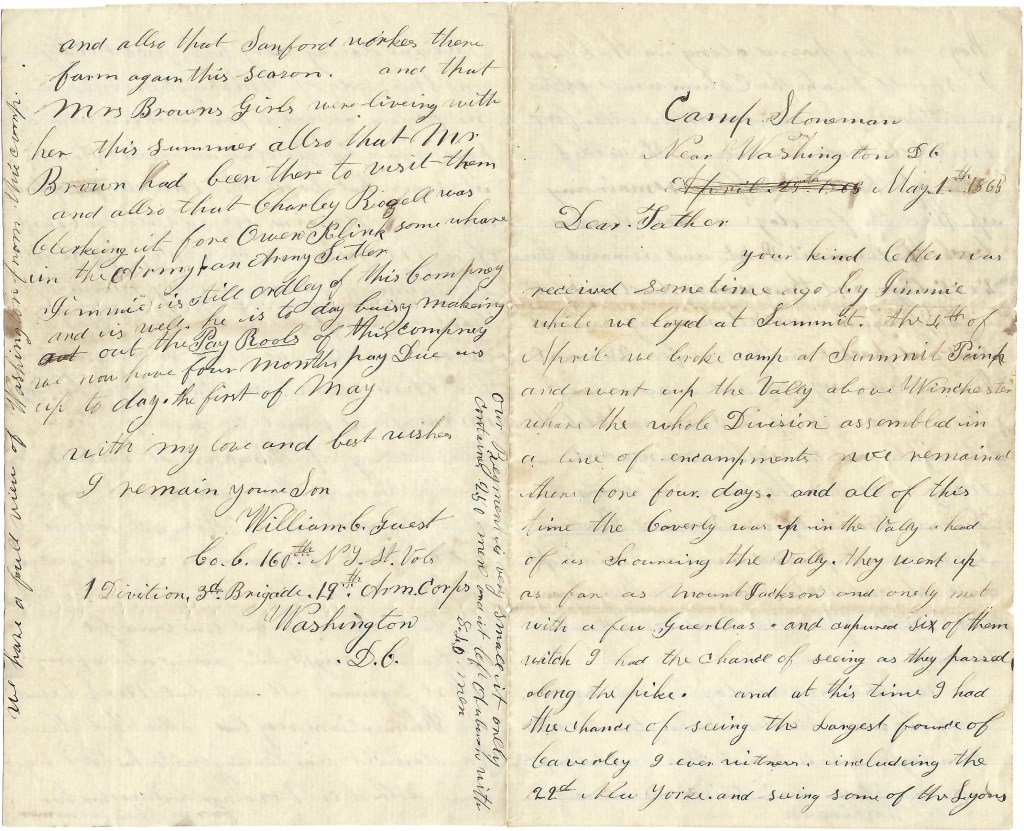
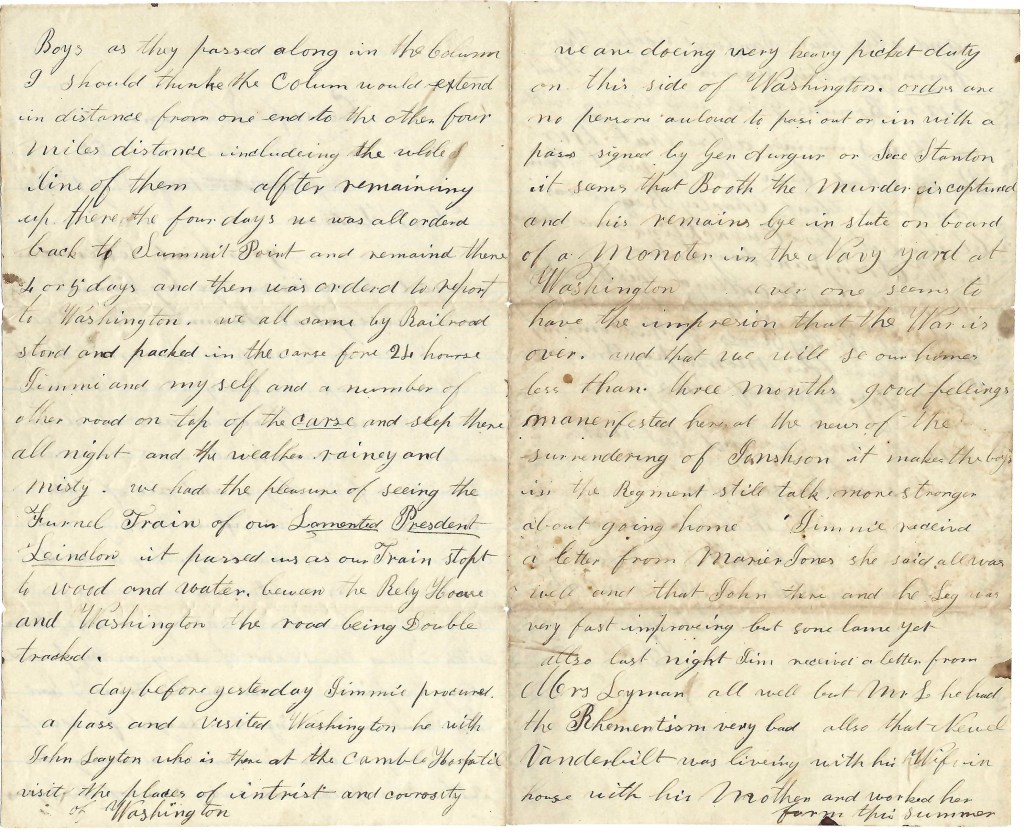
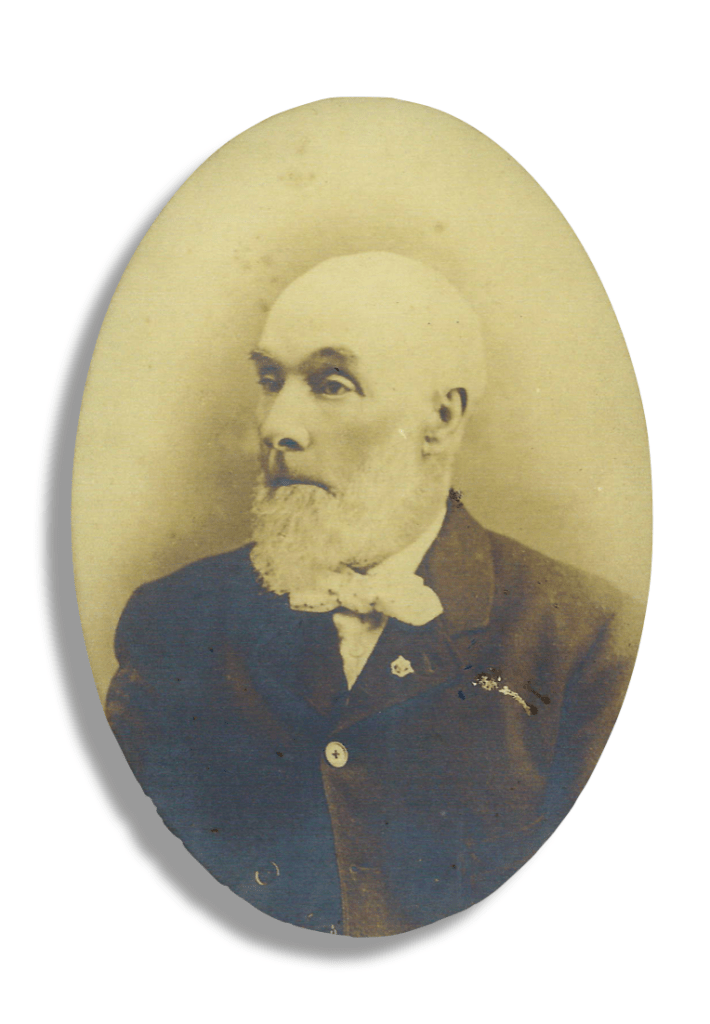
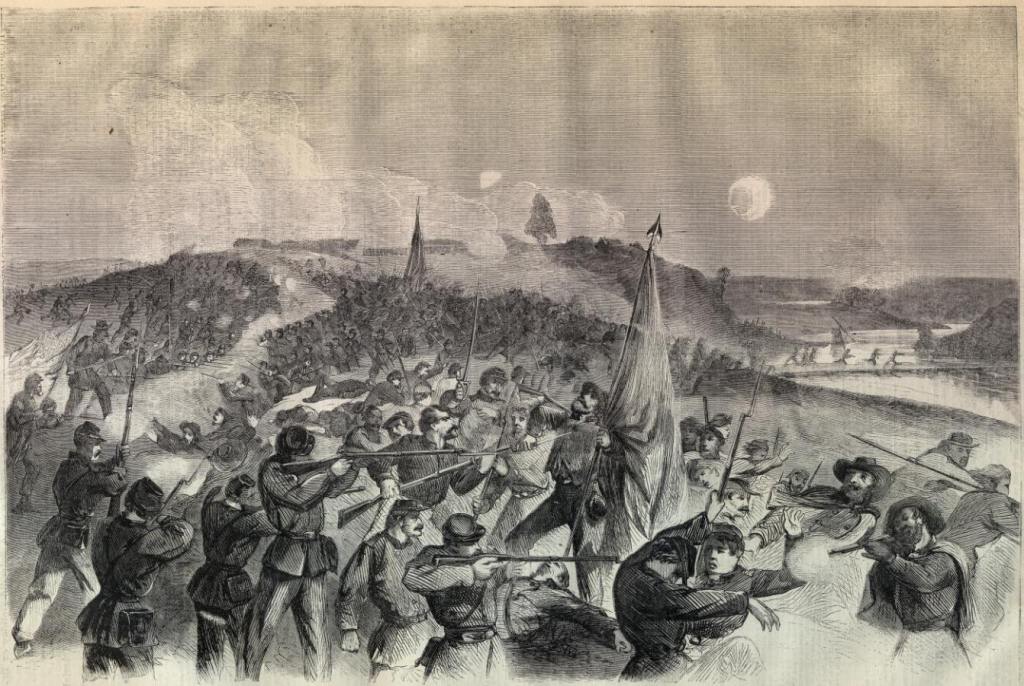


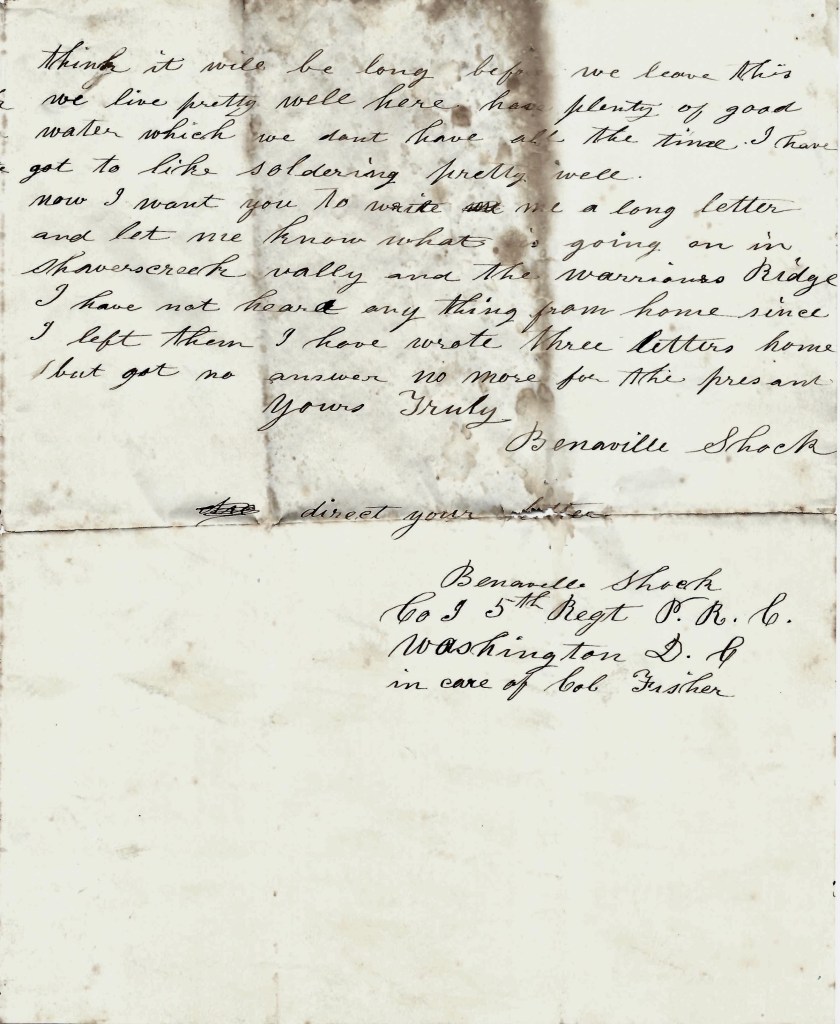
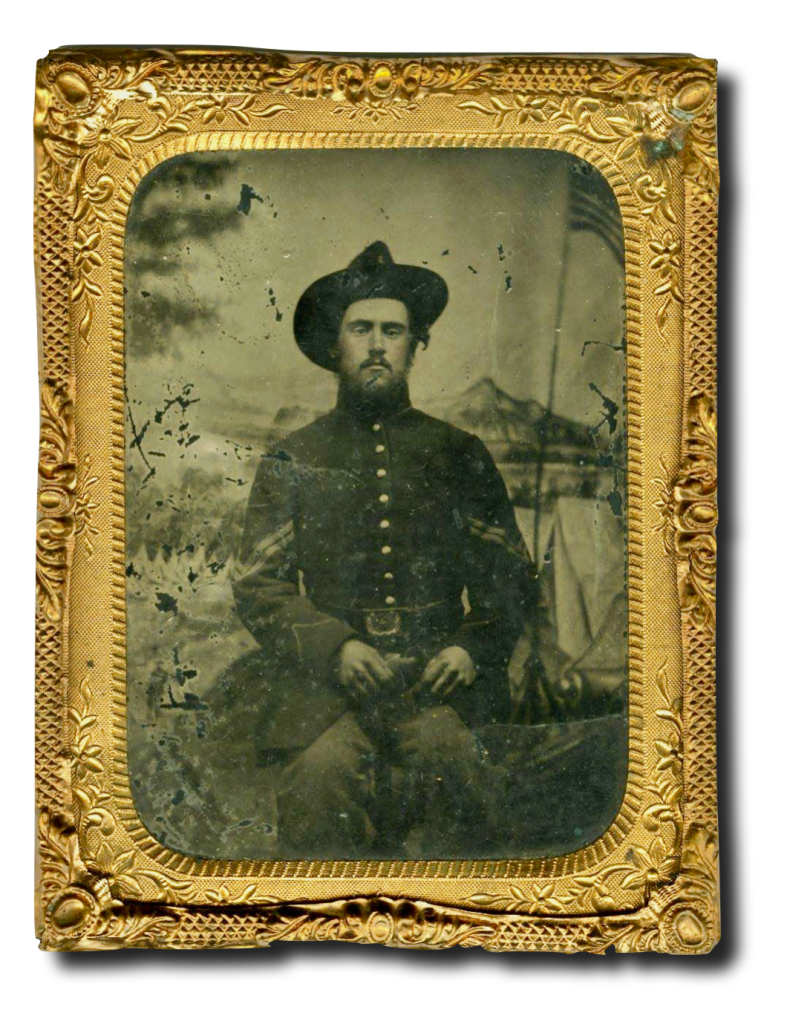
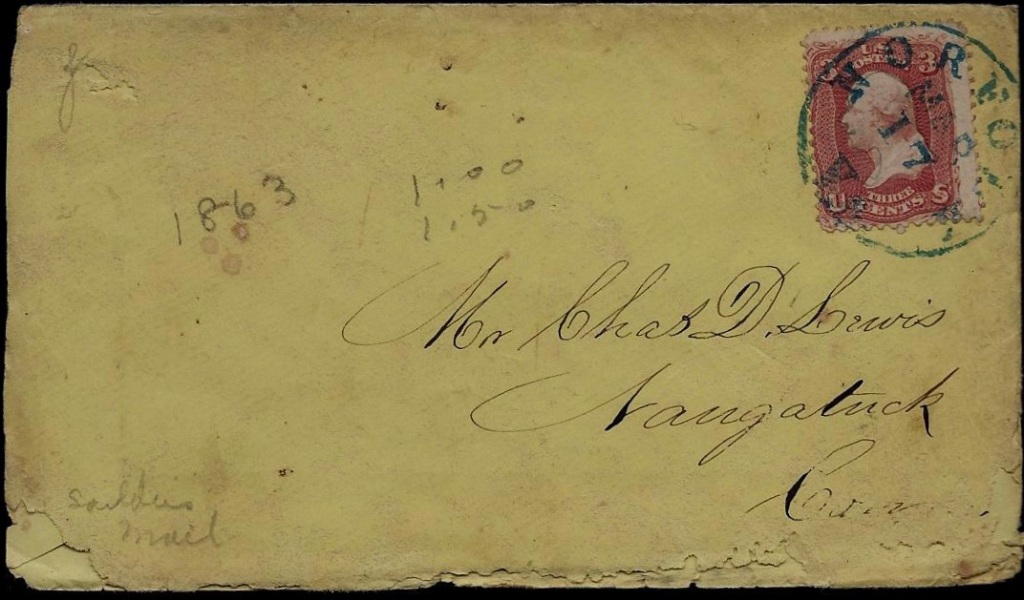
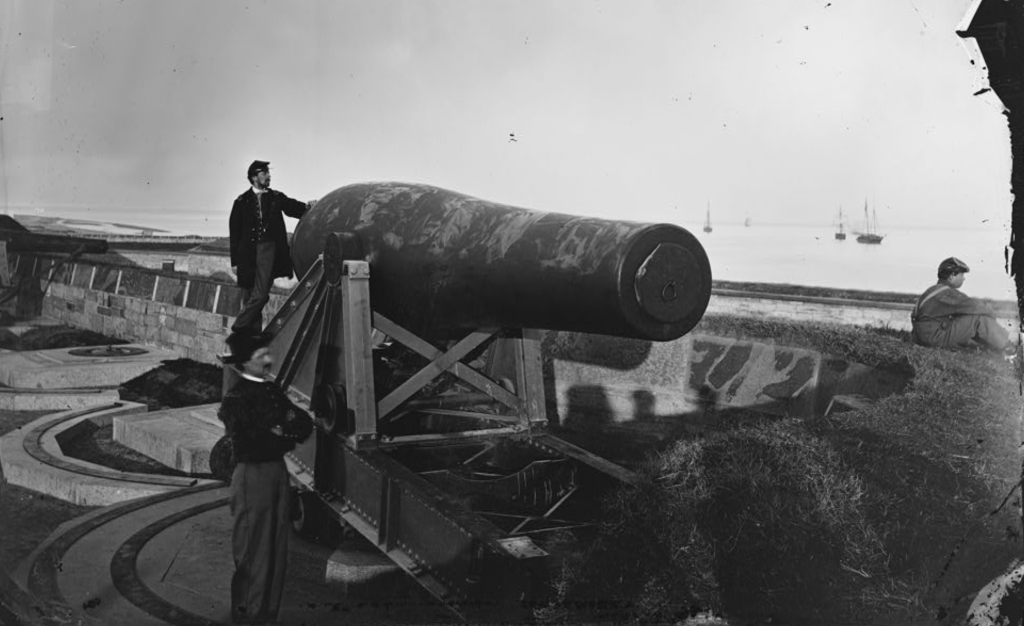
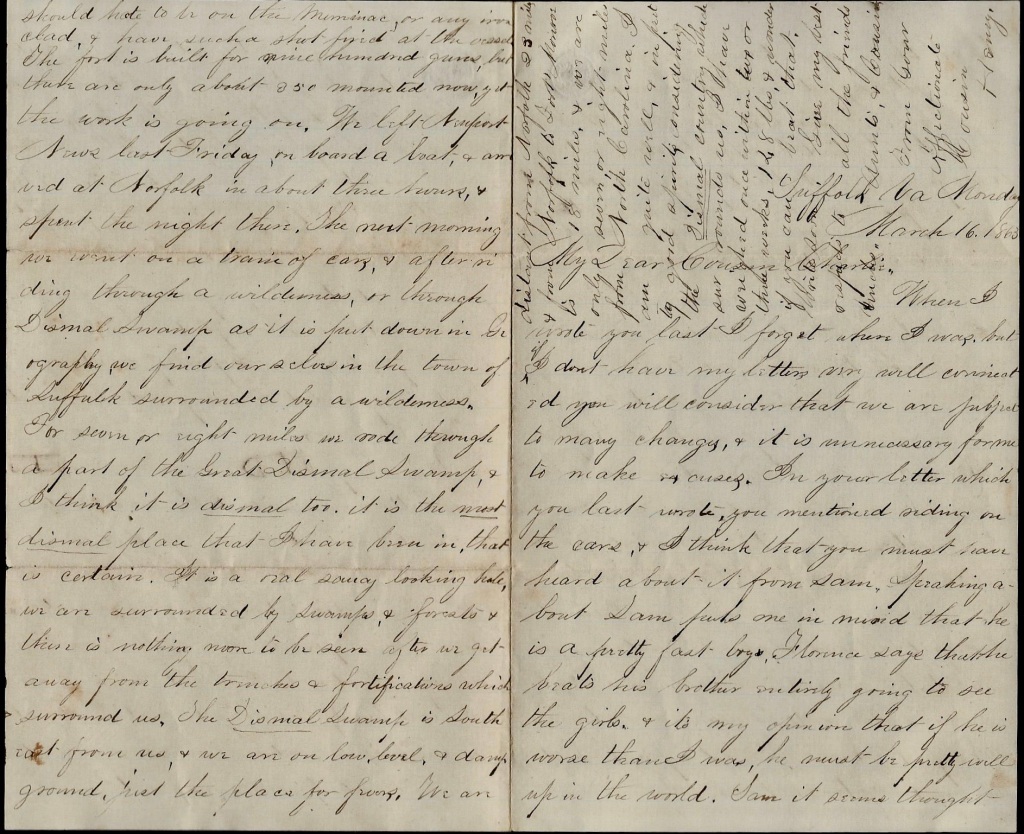
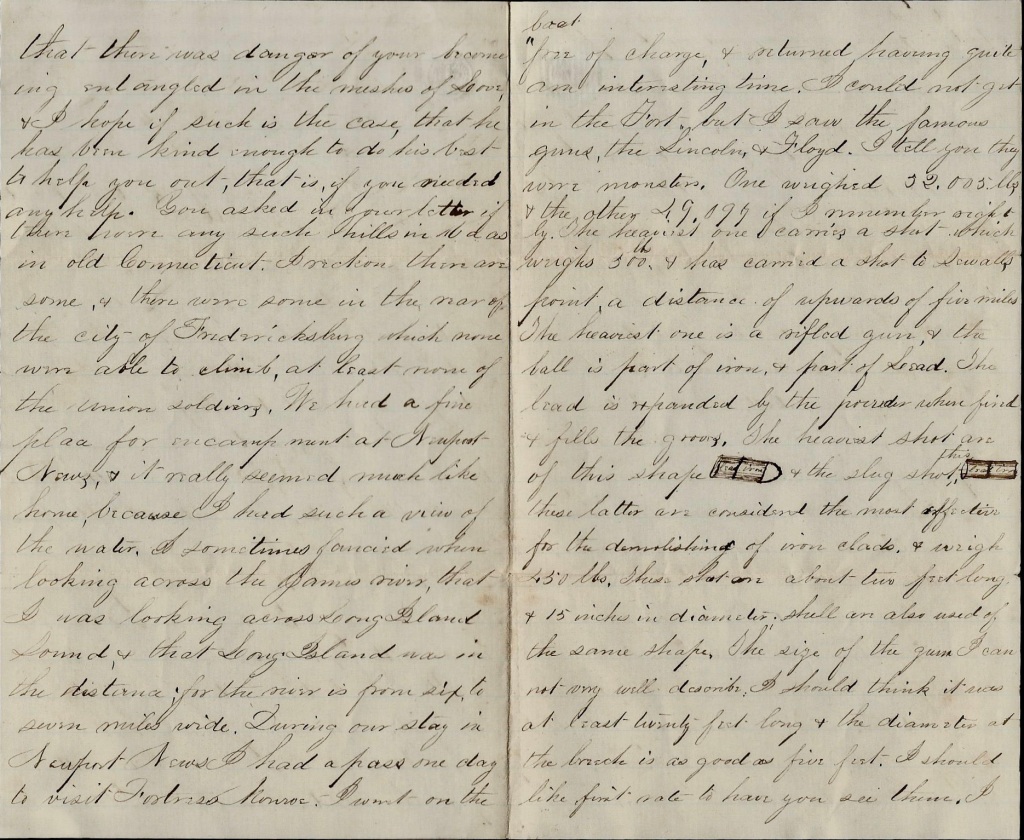
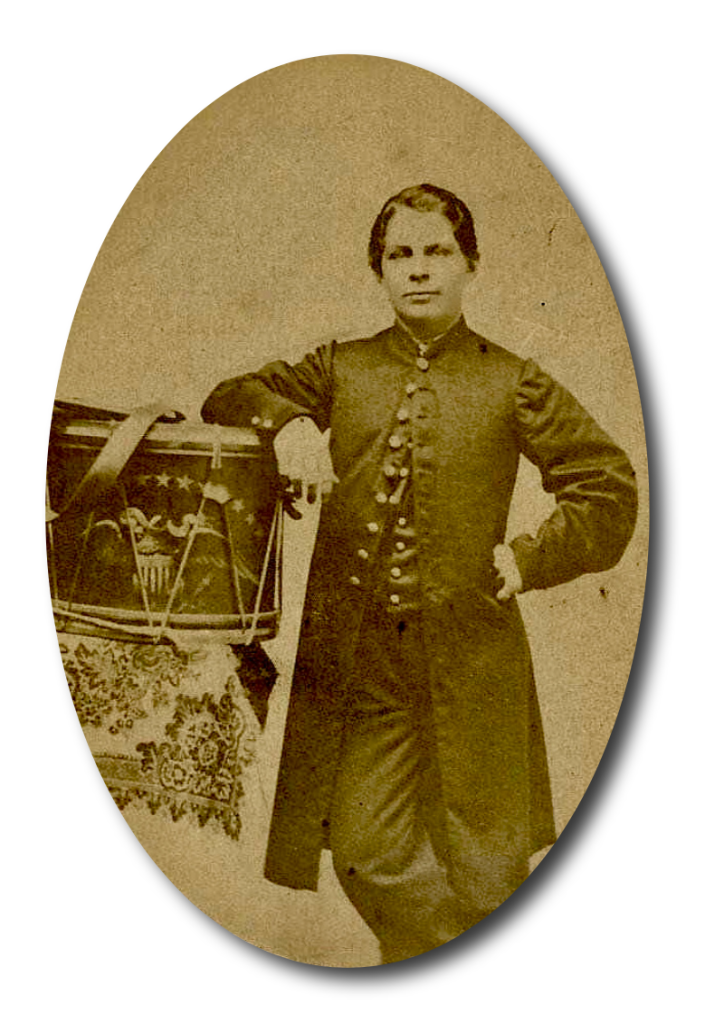
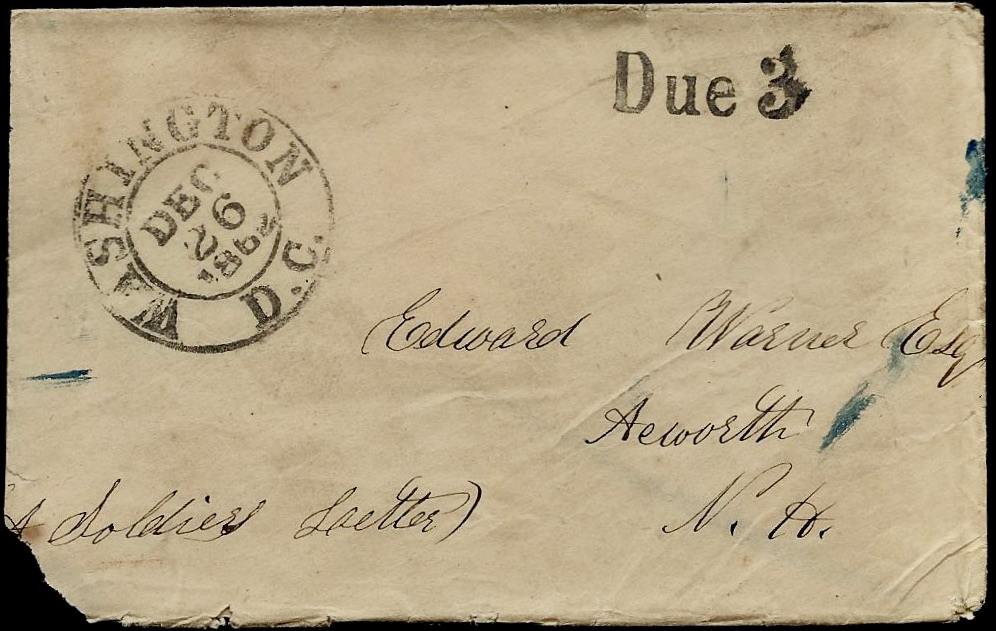
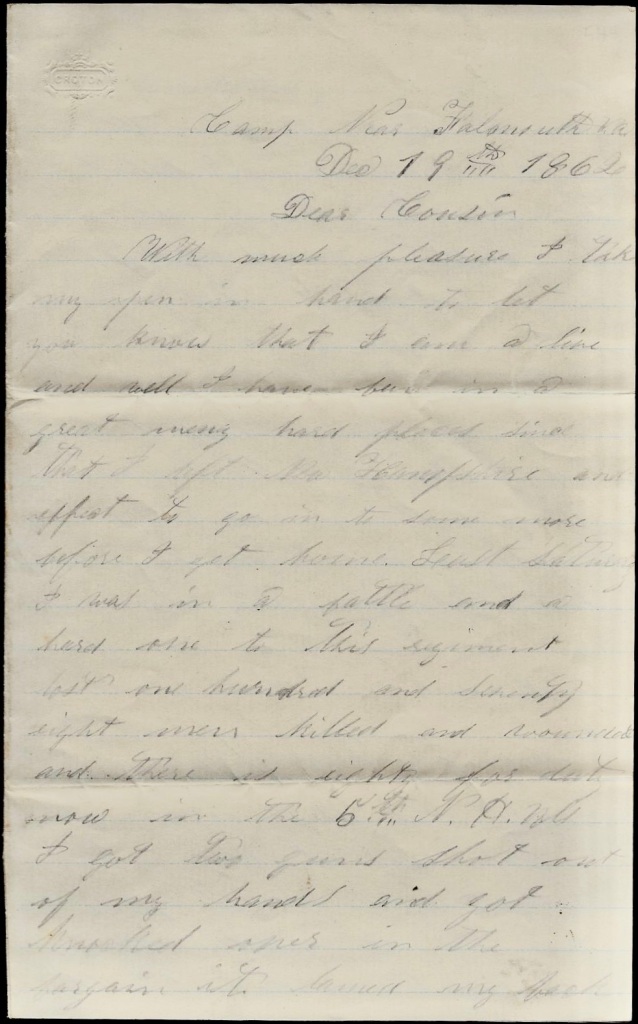
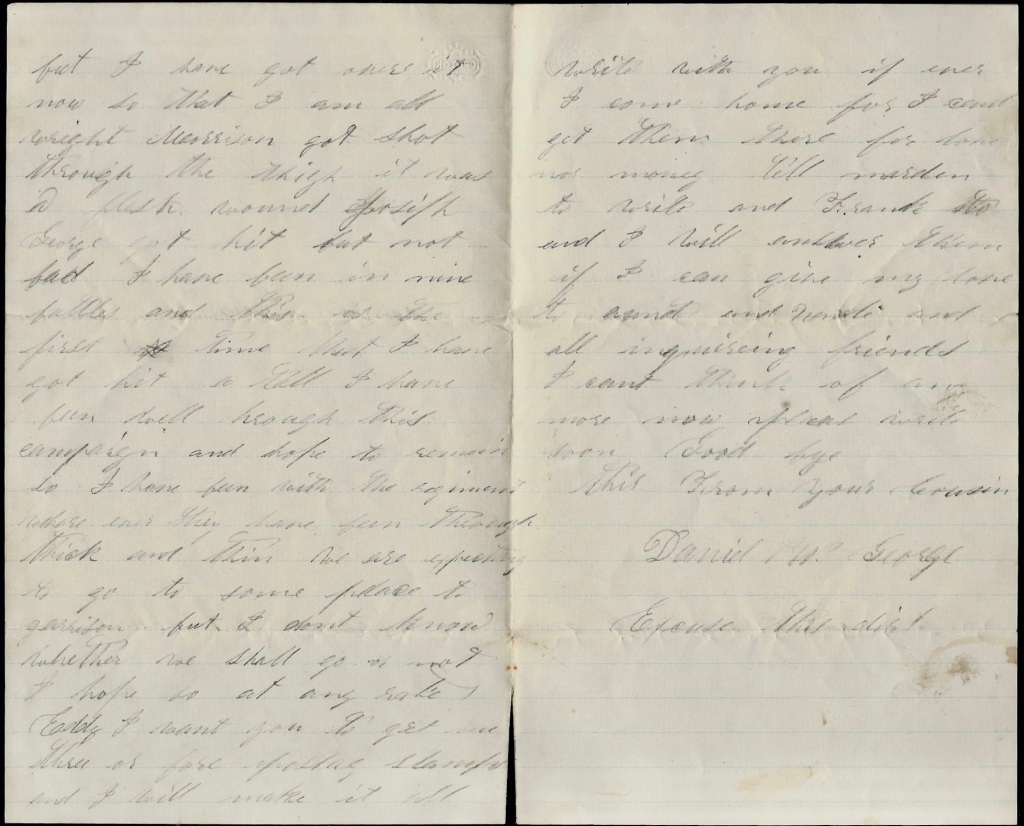
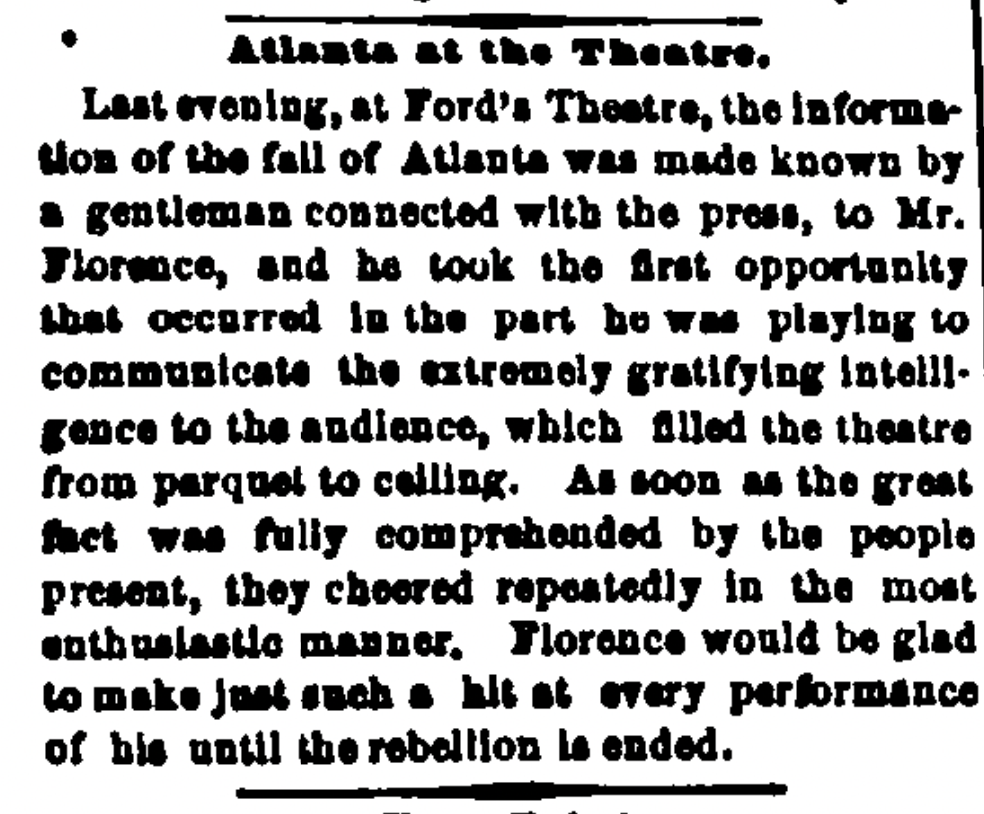


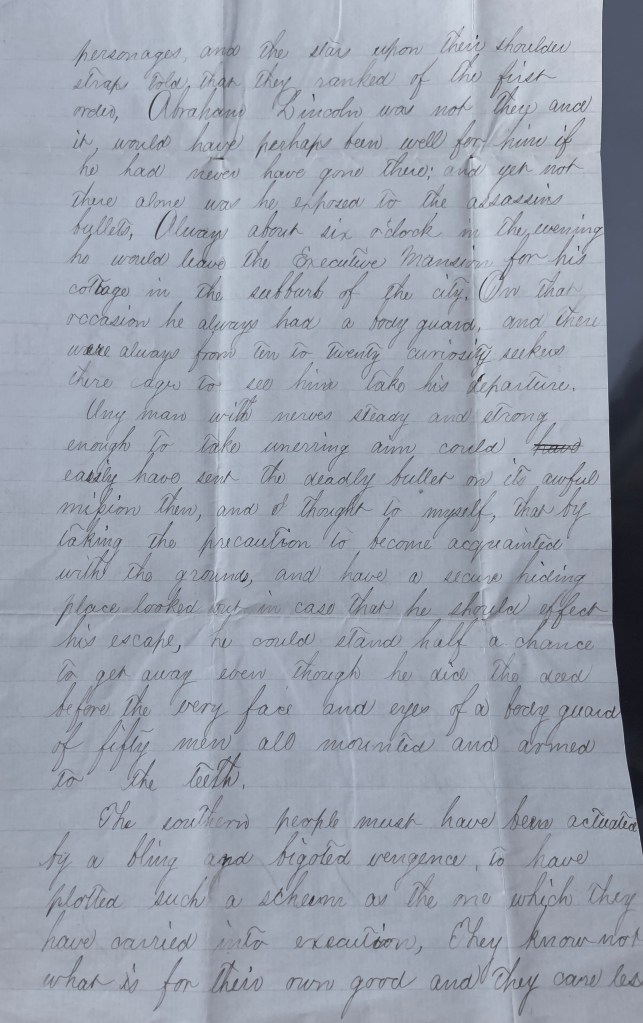


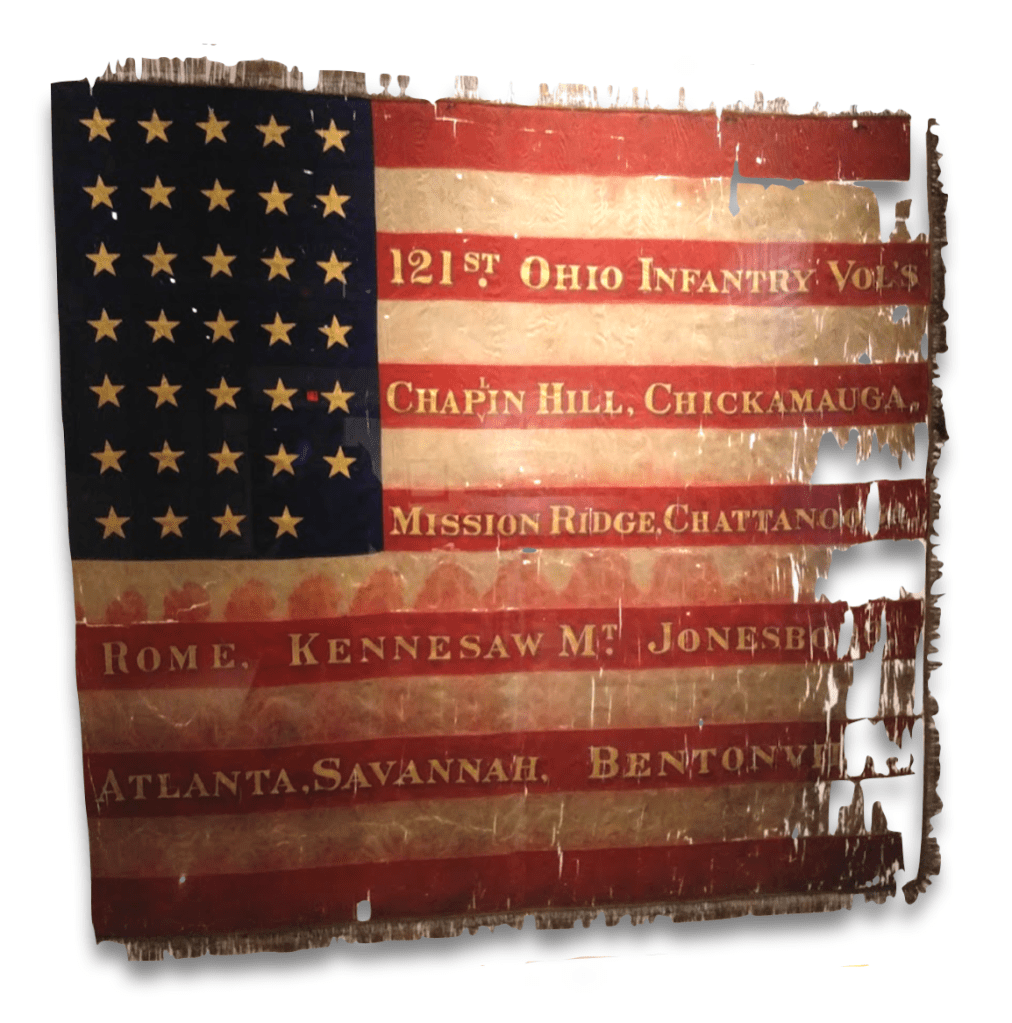
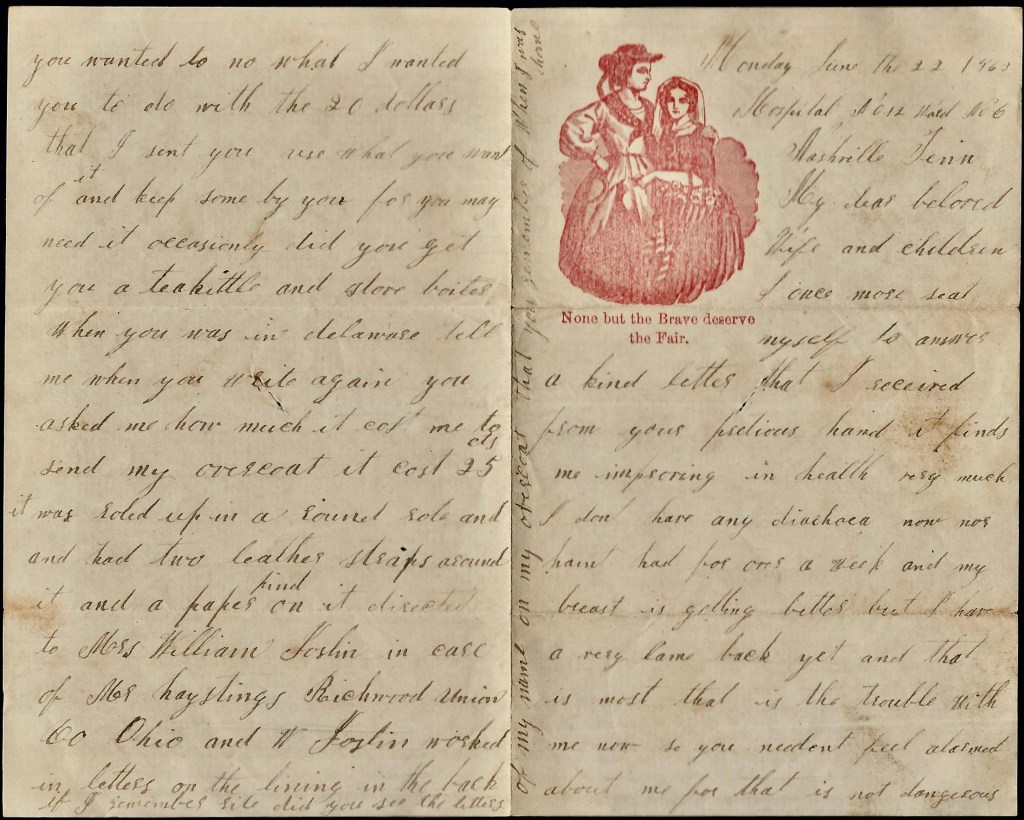
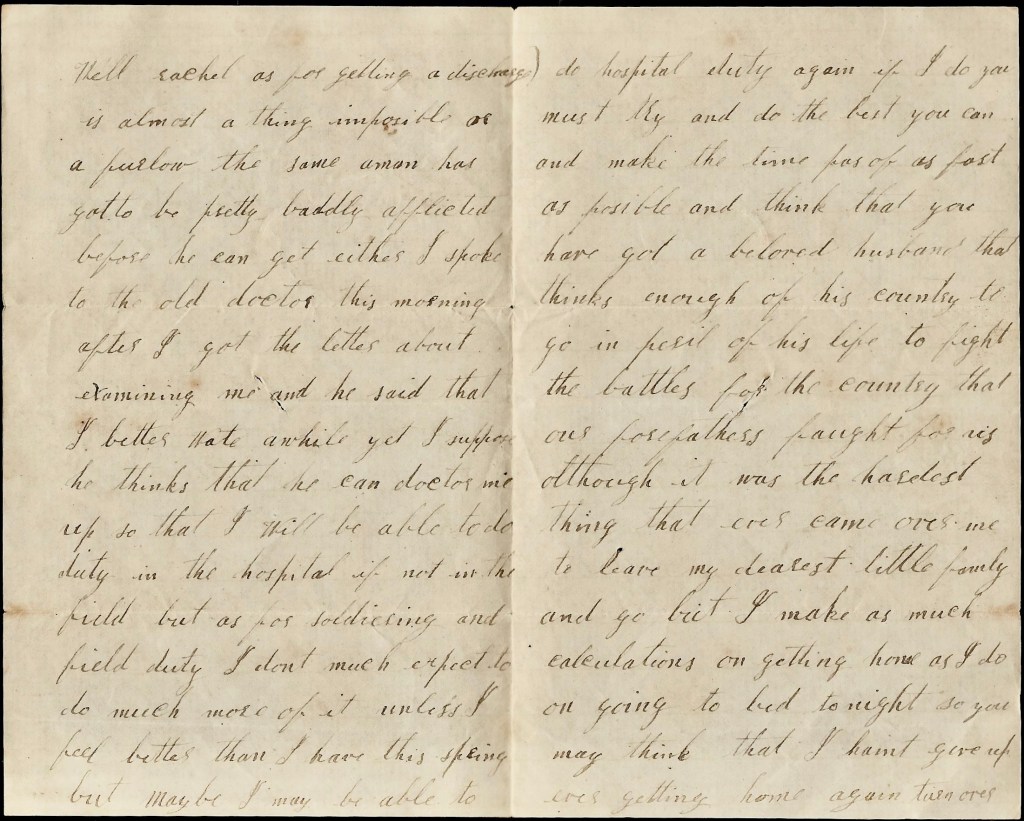


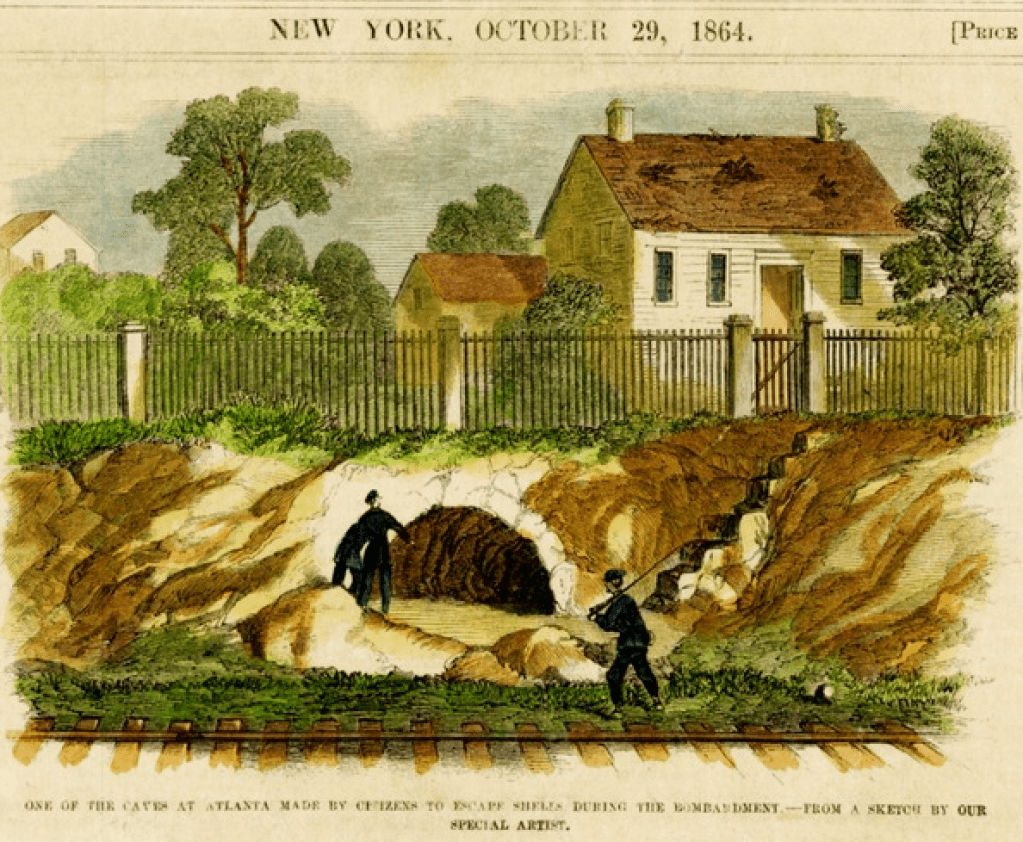

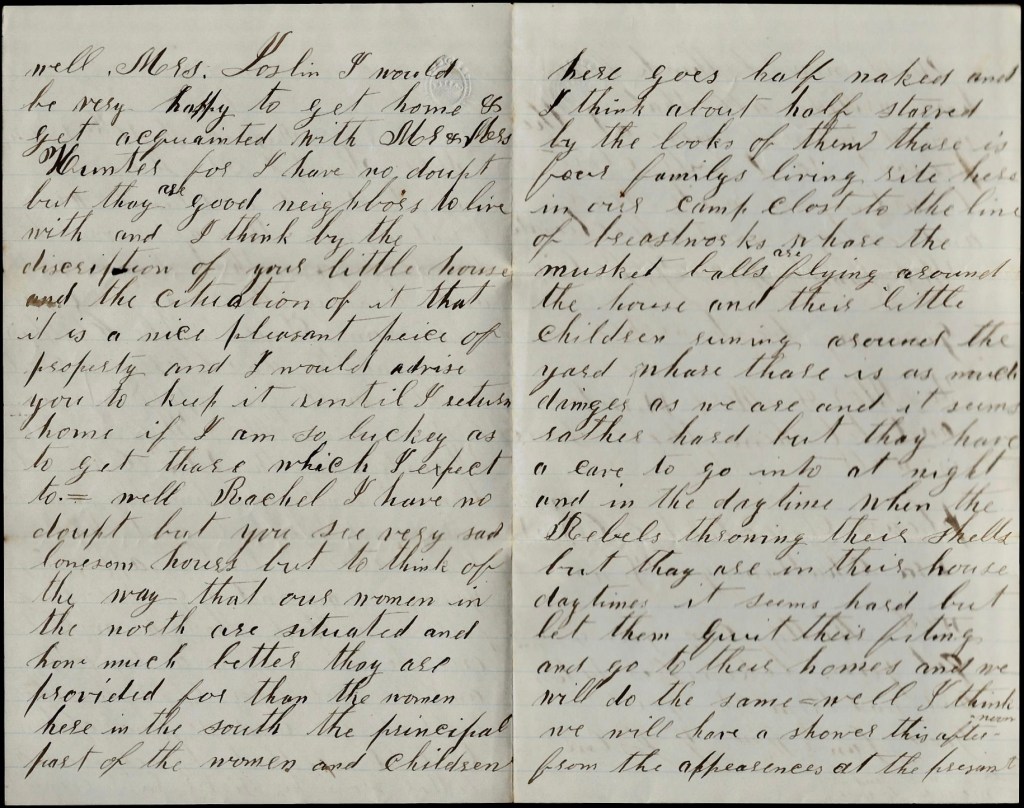

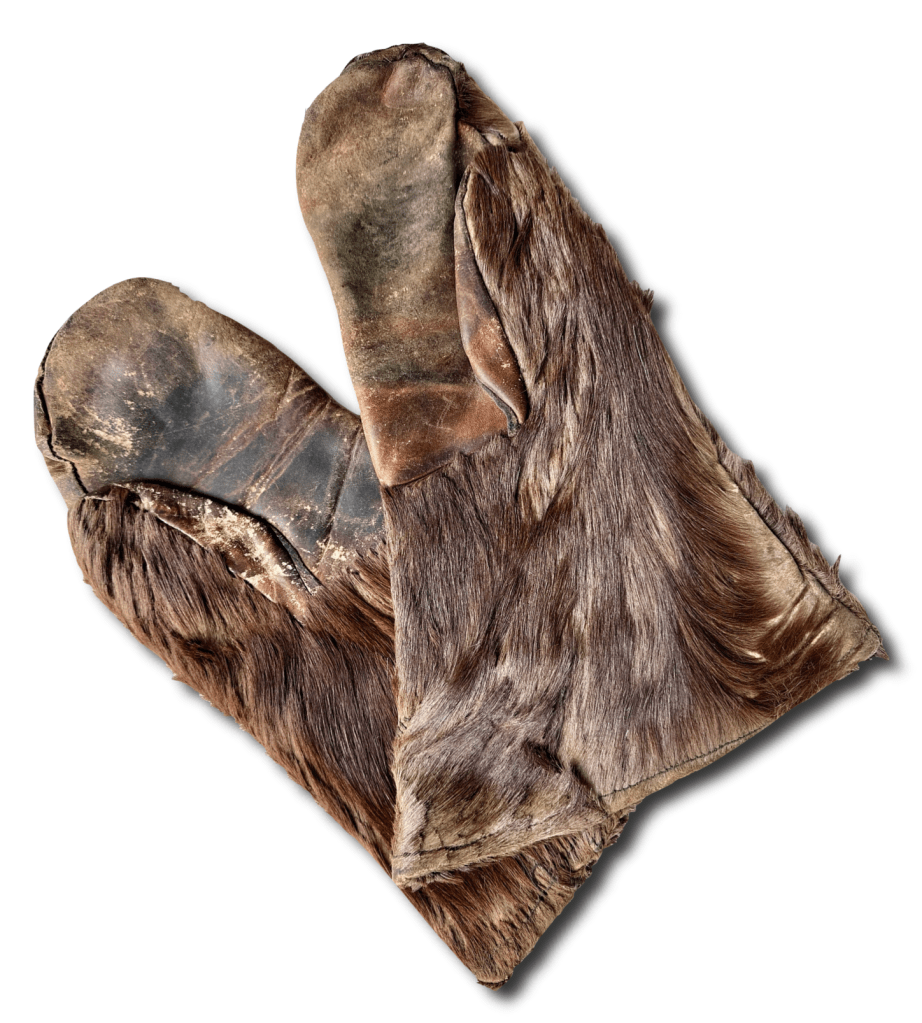

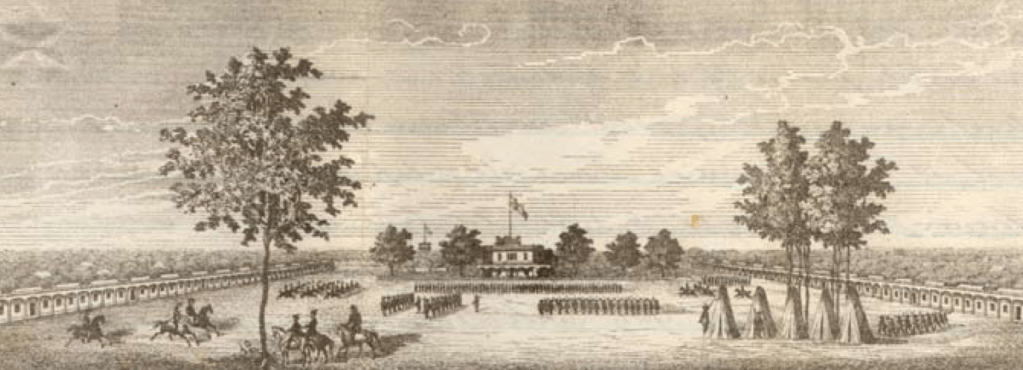
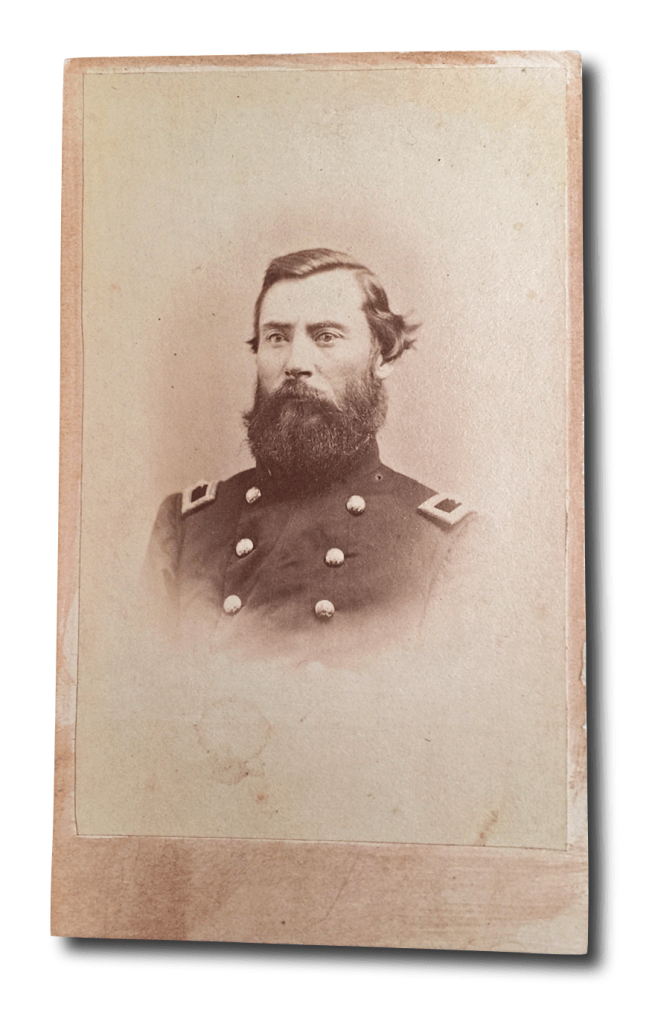

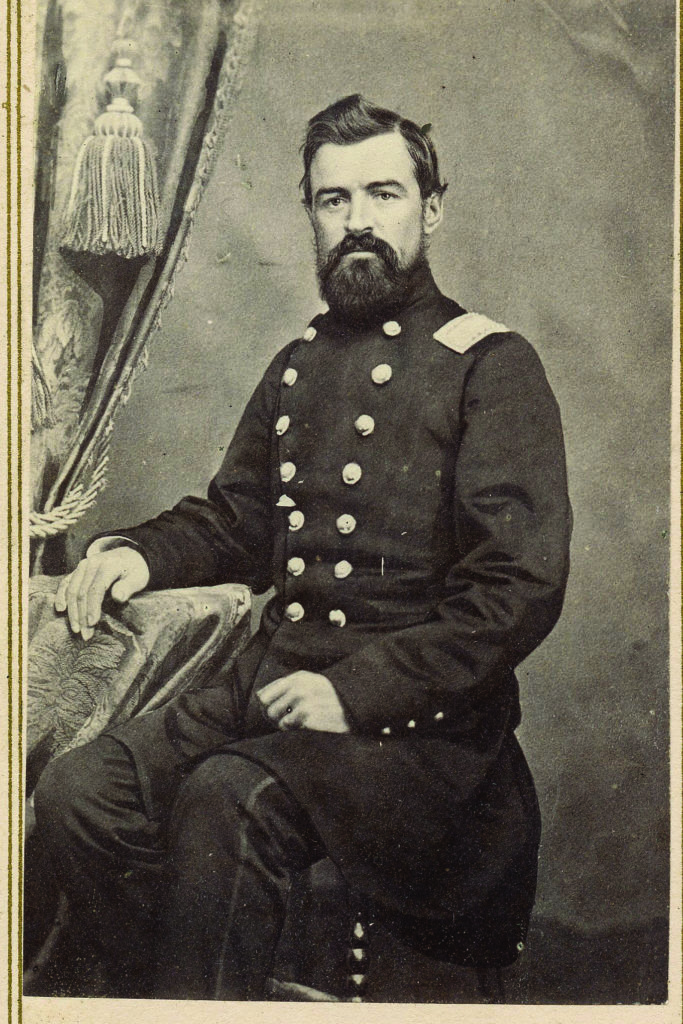
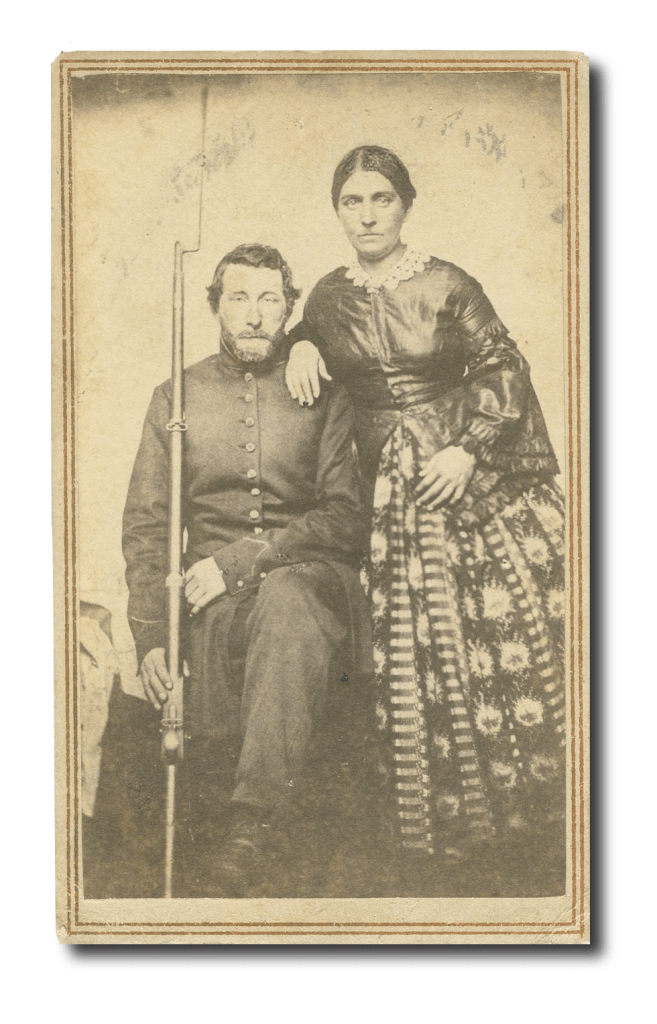


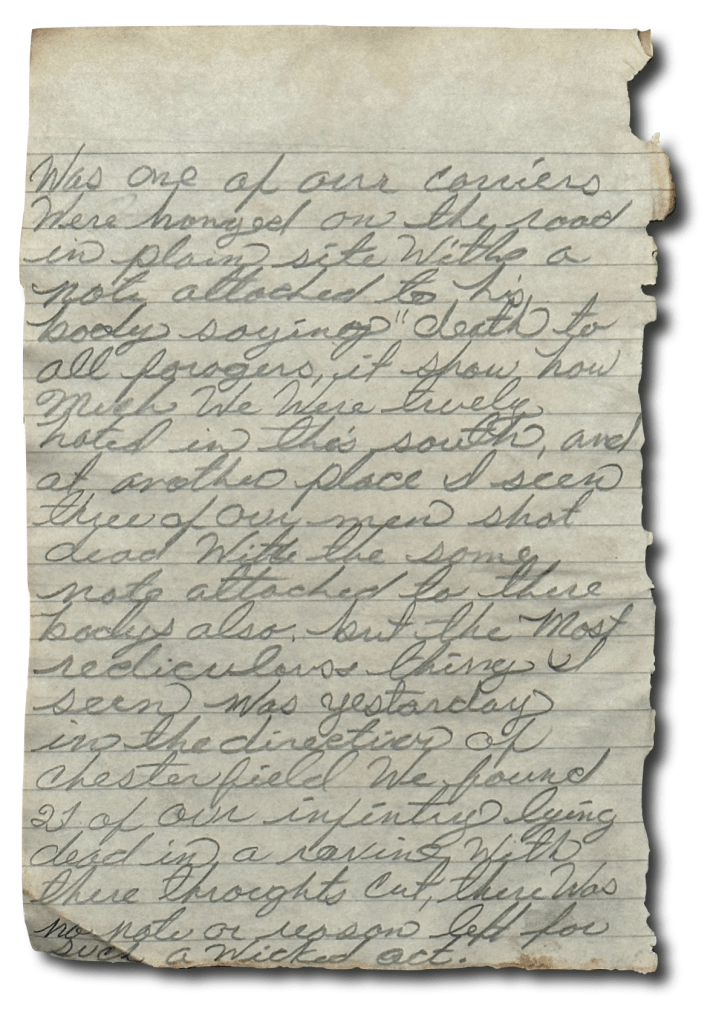



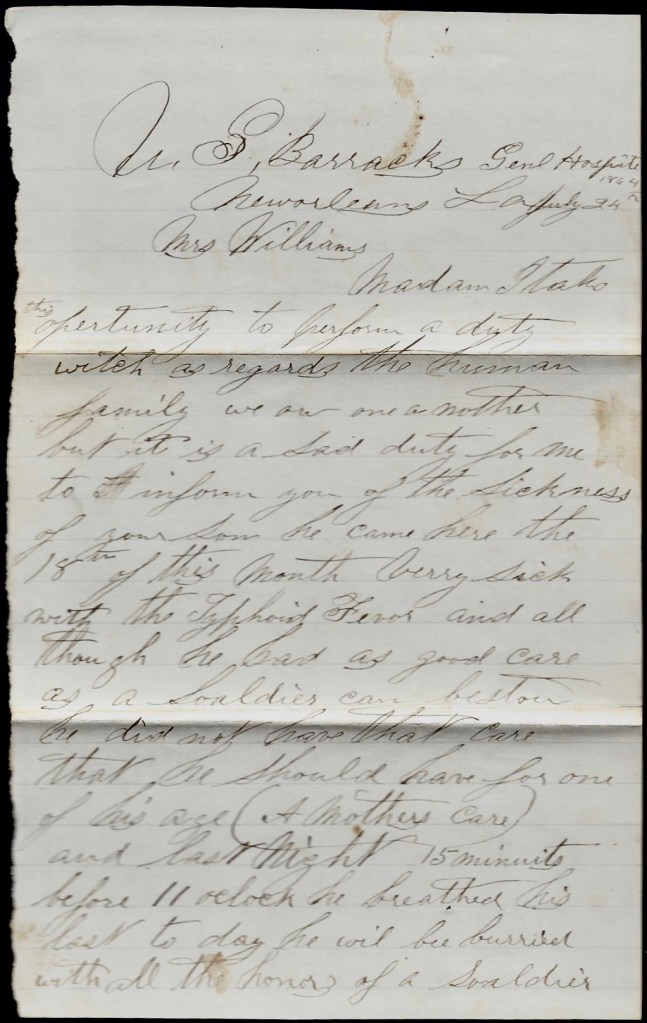
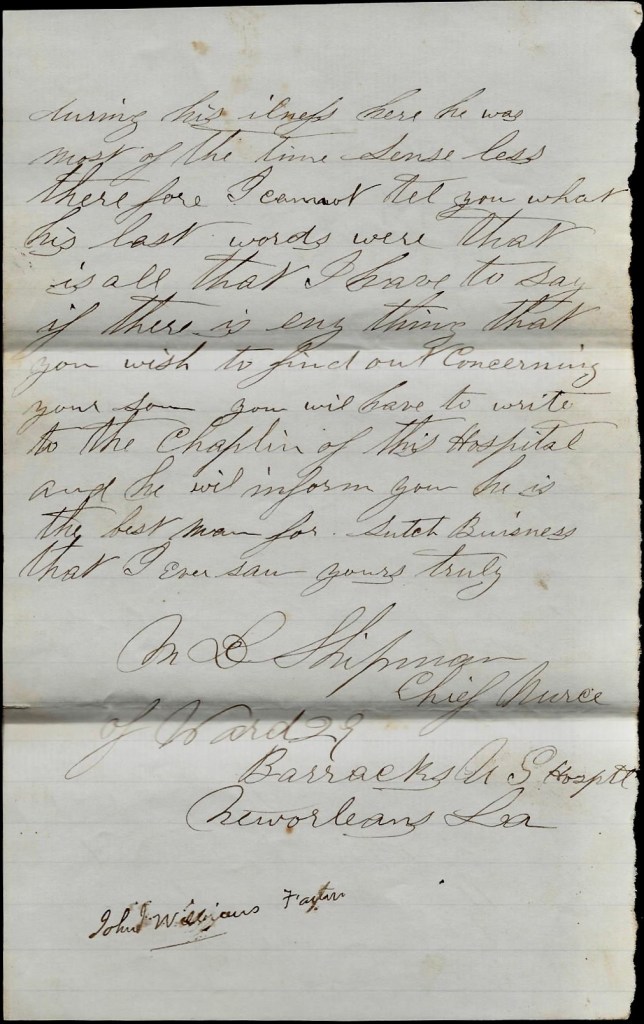
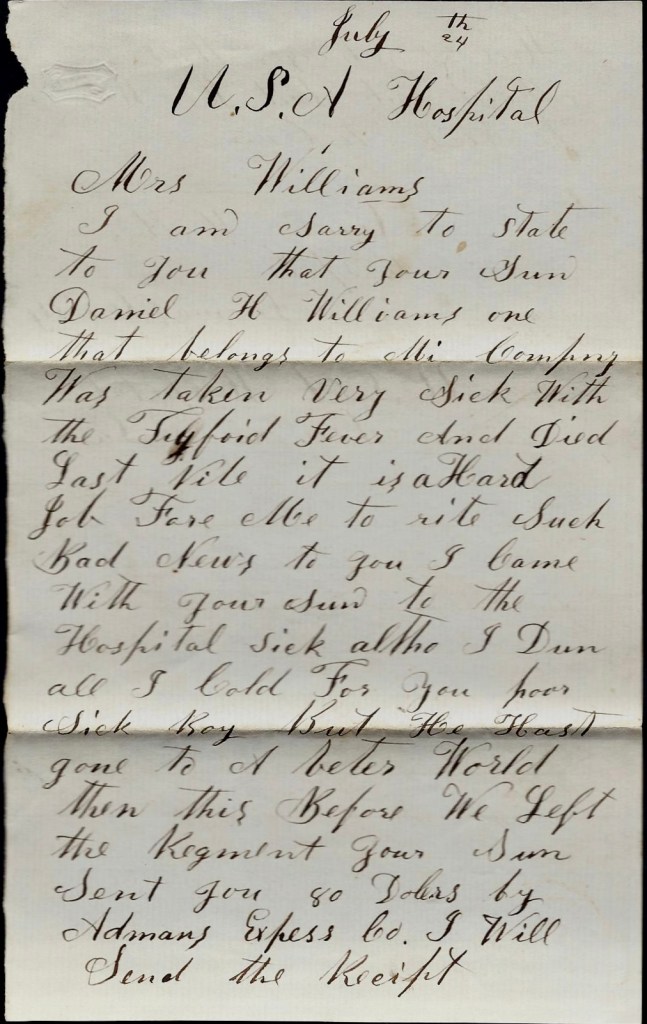
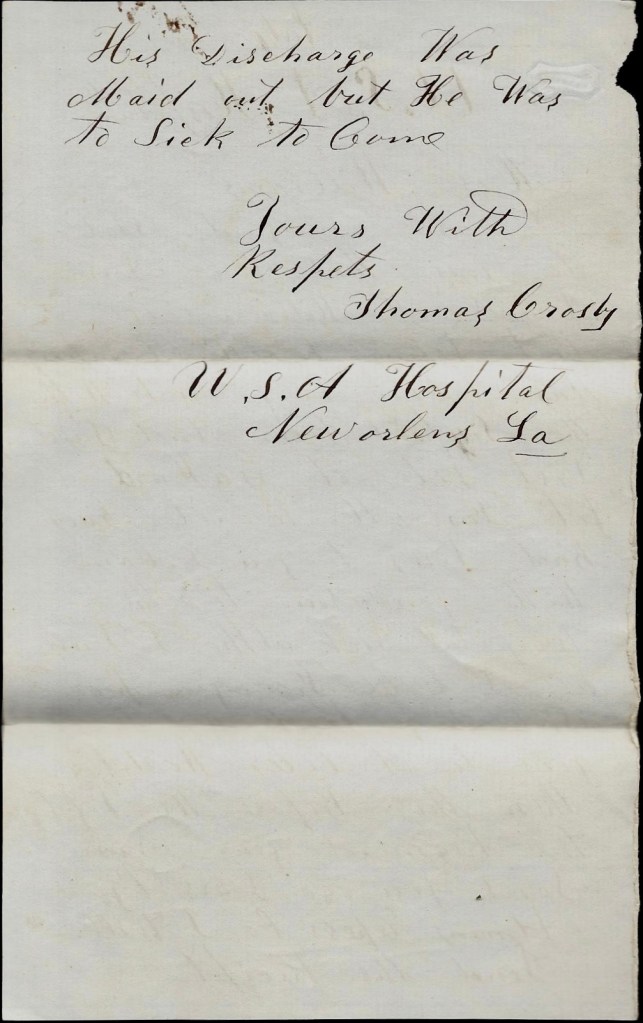
 Spared & Shared 23