My passion is studying American history leading up to & including the Civil War. I particularly enjoy reading, transcribing & researching primary sources such as letters and diaries.
The following letter was written from China Grove, Alabama, by Lt. George Washington Wright, formerly of the 1st Florida Regiment, but serving as a 2nd Lieutenant in Co. A, 6th Alabama Cavalry when this letter was penned on 16 April 1863.
Lt. George Washington Wright, Co. A, 6th Alabama Cavalry
6th Cavalry Regiment was organized at Pine Level, Alabama, during the spring of 1863. It contained men from Montgomery, Coffee, Tallapoosa, Pike, Barbour, Macon, Henry, and Coosa counties. The unit was brigaded under Brig.-General James Holt Clanton, served for a time in Florida, then in August became part of the garrison at Montgomery. Later it was attached to Armstrong’s command and saw action in various conflicts during the Atlanta Campaign. In August, 1864, the regiment returned to Clanton’s Brigade and fought at Bluff Springs, Florida, and in southern Alabama. With less than 200 men it was included in the surrender of the Department of Alabama, Mississippi, and East Louisiana. Its commanders were Colonel C. H. Colvin, Lieutenant Colonel Washington T. Lary, and Major E.A. McWhorter.
George’s letter informs his sister of the less than desirable encampment of the battalion “in a dense growth of poisonous weeds which have so poisoned the men that all of them present the appearance of having been in a big fuss and got their eyes banged up. Some have both eyes closed, some only one, while others have their lips swollen to the size of hen’s eggs.”
Transcription
China Grove [Pike county, Alabama] April 16 [1863]
Dear Louisa,
Having on my last clean shirt and a probability of not being able to make a shift for some days to come reminds me of the importance of having the colored shirts which you promised to make for me. They will suit camp much better that the white shirts in the double respects of being less easily soiled and more appropriate to this kind of life. I do not know that this letter will reach you nor will you be surprised when you come to know how finely we are situated and the many facilities we have for writing and reading letters by mail.
Our situation is eligible and desirable in many respects. First of all, we are free from all temptation afforded by a proximity to a city. Secondly, we are free from all the allurements that might tempt and cause delinquencies in a neighborhood where there were women and other civilized attractions so the men are always ay their post, having no place to go to. We have very good water too, of a brownish tinge and fine to make the liver act. And in addition to all our tents, we are pitched in a dense growth of poisonous weeds which have so poisoned the men that all of them present the appearance of having been in a big fuss and got their eyes banged up. Some have both eyes closed, some only one, while others have their lips swollen to the size of hen’s eggs. And the evil effects of the weed was inevitable—the men having all to lie down upon the ground until shelters could be erected. I have escaped more fortunately that the rest. My mouth is sore only a little.
The sagacity of our commander is very much felt in his selection of this place. I would write further but have no time. Your brother, — W. W. Wright
Address:
G. W. Wright Maj. [C. H.] Colvin’s Battalion Clanton Legion
Lt. G. W. Wright, Capt. Armstrong, commanding Major Colvin’s Bat Clanton Legion China Grove, Alabama
The following letters were written by Edgar B. Bennett (1842-1918), the son of Smith Bennett (1807-1875) and Susan Snow (1809-1851) of Monroe, Connecticut. He served in Battery K, 1st Connecticut Heavy Artillery. He remained with his battery until March 25, 1865 when he was slightly wounded and taken prisoner during the Battle of Fort Stedman ¹ (in front of Petersburg) and confined in Libby Prison for five days until he was paroled. On April 9, 1865, while on parole, he married Mary E. Marsh (1849-1919), daughter of Lewis and Evaline (Stone) Marsh.
Several years ago I transcribed and published 15 letters that Edgar wrote during the war. See 1863-65: Edgar B. Bennett to Mary E. Marsh. Four of those letters were also written from Fort Richardson—a detached redoubt in Arlington, Virginia, that was part of the defense ring surrounding Washington D. C.
Edgar wrote most of the other letters in 1864 from Redan No. 2 and Redoubt Anderson, fortifications on the Bermuda Hundred line south of the James River, not far from Petersburg, Virginia. Enclosed with many of the letters (including this one) are swatches of silk purported to be cut from the Regimental flag of the First Connecticut Heavy Artillery. The color of the swatches seem to match those advertised in an on-line auction claiming to have hand-written provenance to support it.
Letter 1
[Note: This letter is from the personal collection of Richard Weiner and was transcribed and published on Spared & Shared by express consent.]
Fort Richardson June 11th, 1863
Dear Mary,
It is with the greatest of pleasure that I now seat myself to answer your kind and affectionate letter which came to hand today. I was so glad to hear from you and that you were well. I am well and hope this may find you all enjoying the same great blessing. I am glad you have got my last picture. I also sent you some others the next day and I think they must have reached you by this time. There is a great battle progressing on the Rappahannock now.
Yesterday Fort Lyons blew up killing 26 and wounded 14 but it is thought there is more in the ruins but I hope not. 1 But there has some kind and loving sister lost her brother by it. Oh! how many a poor mother has lost her only son in this war and never to see him more on earth. But dear Mary, this will learn us all a lesson that never will be forgotten. I know it will me. It has been to me the greatest lesson I ever learned, and to many others. But when I left home, I did not expect the war would last till this time. But it has and I am afraid it will last for 2 or 3 years to come yet for there is not as much signs of its coming to close now as there was 18 months ago. I want to see peace again, but we will not till Abe ——- then there will be some hopes of it. But not till then. But they are getting the Negroes to fighting and I am glad of it. They have now in service 35,800 Negroes so the government will not want so many white soldiers from the North.
Yes, Mary, next summer I hope to be in Burlington if nothing happens and hope to meet you there. I wish I was where I could call in and see you this eve, but no, I cannot. Mary, I shall always try to be a good boy and if I try, I know I can.
The weather has been very pleasant this Spring but it changes so often. It is so warm one day [such that] we can hardly stand the heat, and the next it is so cold we want overcoat and mittens.
I have not seen anything planted this Spring here for if they did, it would do them no good for there is too many soldiers here that everything would be stolen from them. There is but one thing we can get that we want that is milk and that is not very plenty and that is two-thirds water. Everything is very high. There has been a few strawberries here but there is so many to pick them we cannot get more than one apiece. I can’t think of any news at present so I shall have to close.
Give my love and best wishes to your Father and Mother. My most affectionate love to you. I shall remain you true friend, — E. B. Bennett
Fort Richardson [Alexandria, Va,] Friday Eve, August 7th 1863
Dear Mary,
It is with pleasure that i now seat myself to write you a few lines as I have just received your affectionate letter. I was so glad to hear from you. When I wrote to you one week ago tonight, I told you I should go over to Fort Lyons on Saturday the next day and I done as I told you, I went there and was very glad I did for I saw your uncle and a number of others that I knew. your uncle and myself had our pictures taken together so he had one and I have one myself. I would send it to you but they are not good ones for the day was too warm and they were taken in a tent. But if you wish for it, I will send it to you. I had a nice visit with your uncle.
We do not get any news here from the army and we know nothing about it at all. In fact, we don’t get any news at all from any part. It is too warm for the army to move anywhere now. We have not had any rain at all for a long time and it is very warm here. Last Sunday there was 7 men in our regiment was sun struck. One of them died instantly. The others are very feeble. Our doctor was also sun struck and he has not been able to get off from his bed since Sunday and Monday there were 13 sun struck in Washington City. The people here say it is about as warm as they ever knew it to be.
I am well and hope this may find you in the same good health.
Mary, I do not think of any more to write so I will close by sending my love and best wishes to your father and mother, mu kindest and affectionate love to you. I remain your true friend. I hope, dear, we shall all live to meet again once more for I long for the time to come when we may see each other. I will now bid you a happy good night. From your ever loving friend, — Edgar
A tintype of William Carman, Co. A, 115th Pennsylvania Infantry, found in the Pension Office Records in Washington D. C.
The following letters were written by William F. Carman (1827-1863) of Co. A, 115th Pennsylvania Infantry. According to the pension application, he “died from wounds received at Chancellorsville, Va., May 3, 1863. He left a widow, Emma Carman, and a fifteen year-old daughter, Josephine Carman, of Philadelphia. “Mr. Carman was a shirt cutter. He was a respectable, active, and industrious man, and always took good care of his family.”
I have not been able to find a biographical sketch for William that tells us anything about his parentage but from what I have been able to cobble together, it appears he was born and raised in Baltimore, Maryland. He was, it seems, the oldest child of William Carman (1785-@1855) and Susanna Townsend (1801-1862). The couple were married in the Methodist Church in Baltimore on 23 January 1825. William (the father) was a cripple and made a meagre living cutting hair. Besides William, there were two younger sons—John (“Jack”) F. Carman (b. 1835), and Thomas J. Carman (b. 1837). Thomas, the youngest, was the only son still living at home in 1862 when these letters began, though he enlisted in the US Navy in August 1862 and was assigned to the Steamer United States. Thomas must have been well suited for the Navy for he could apparently drink and fight with the best of the Baltimore rowdies.
An early-war recruiting poster for what would become part of the 115th Pennsylvania commanded by Col. Robt. Emmett Patterson (LOC)
“William F. Carman called his new bride ‘Emma’ when they were married in Baltimore, Maryland in May 1848. Their daughter, Josephine, arrived soon after. By the time the 1860 Federal census was taken, the family had moved from Baltimore to the 3rd Ward of Philadelphia. William worked as a shirt cutter before enlisting on April 2, 1862 to serve a three-year term in the Union army. This left Emma alone to raise their teenage daughter and eventually find a means of support as the Army was slow to pay the soldiers.
William was devoted to Emma. Emma’s pension file contains thirty-two handwritten letters from William spanning eleven months, the earliest one dated July 1, 1862…The last from William letter is dated June 6, 1863 and appears to be the last one Emma received from him. His death came three days later on June 9.
Emma’s pension file does not provide information on how – or even if – she and Josephine were notified of William’s death, but it does document Emma’s struggles to survive without him. As her mental state spiraled downward, we see her lose grip of William’s letters and his “likeness” in an effort to establish herself as his “legal widow” within the strict bureaucratic government system brokered by the Pension Bureau, only to be overturned in the end by a Special Agent with his ear to a churning neighborhood rumor mill.”
Jackie Budell, an Archives Specialist at the National Archives has meticulously researched Emma’s twenty-year struggle to obtain and maintain a pension for her husband’s service. It is far too long to repeat here so I will merely refer readers to her article entitled, “Why William Carman’s Tintype was in his Widow’s Pension File.”
Suffice it to say that Emma may have had a checkered past and there is evidence that the home William and Emma kept at No. 4 Bath Street in Baltimore before moving to Philadelphia may have been disreputable too. I was able to find an article published in the Baltimore Sun on 15 February 1858 in the “Local Matters” column that was titled, “Another Murderous Affray—Four Men Stabbed and One Shot” described as “one of the most sanguinary affrays without resulting in the death of either of the parties that has occurred in this city for some time.” The article describes the drunken attack and stabbing of William Carmen by his brother Thomas. “The house is occupied by a man named William Carman and his wife, and is notorious as a place for the resort of the dissolute.”
Letter 1
Camp Hamilton Fortress Monroe, Va. July 1st 1862
My dear and affectionate wife,
It is with pleasure I write to you to let you know that I am well at present and hope these few lines will find you the same.
We left Harrisburg about a week ago and [have] been traveling ever since. I arrived in Baltimore the same day and seen Tom Carman and George Elliott and Reddy also. Went and seen my mother. She didn’t know me. She took me for Jack and began to cry. But Tom knew me and told her that it was me. He has two fine children. I hadn’t many minutes to stop with them. I was on guard, We left Baltimore the next day in the steamboat for Fortress Monroe. Got there the next day and we have been busy ever since…
We were mustered in for pay today and soon as we get pay, I’ll send you some money. Tom and Mother send their love to you and Josephine. Write soon as you get this and let me know how you are getting along.
Direct your letter to Fort Hamilton, Fortress Monroe, Va.
— William Carman
Letter 2
Harrison Landing, James River July 31, 1862
Dear Emma,
I received your letter last night and was glad to hear that you was well. I wrote two letters to my Mother and I got two. She says that she has received a letter from John. You know her John is the brother that was in Richmond. He has been a soldier in the Richmond army. He is married and got two children. Tom is enlisted in the Navy. You must write and let me know all that is going on in the city but don’t send me nothing—only what I write for.
We are under marching orders and now more boxes are received at the landing. You must tell me in the next letter whether the relief money has stopped or not and also send me a sheet of paper in the letter. I was very glad to find the postage stamps that I wrote for. The five cents I bought some tobacco with. I wanted it very bad.
I hope by the next letter I write to you that I will be able to send you some money and if they pay me all, I can send you a good sum of it.
I send my love to you and Josephine and Harriet and Sam. Tell Sam we expect to go to Washington. Give my love to all my enquiring friends. No more at present but remain your husband, — William Carman
Direct as before. William Carman, Co. A, 115th Regt. P. V., Patterson’s Brigade, Hooker’s Division, Fortress Monroe, or elsewhere.
Letter 3
Harrison’s Landing James River August 8th 1862
Dear wife,
Your kind letter come to hand last night. Was glad to hear that you was well. I also received one letter from my Mother. She says that she ain’t very well at present. Tom thinks he will come to Fortress Monroe. If he doesm he will have something to do.
On last Monday evening we had orders to march about half past four o’clock. We marched nearly all that night till we came to a place called Malvern Hill. Here we sat down and rested for an hour, then got ready for to go into the field for a fight. Our men marched up bravely. The fight lasted one hour. The artillery and gunboats done all the work. Our men were only drawn up in line. The shot and shell fell very thick for awhile [and when] the Rebels could not stand it any longer, they retreated. We took two hundred and fifty prisoners, five hundred head of cattle, killed and wounded about fifty. There was some of our men killed and wounded—about twenty-five. We stayed there all that day and all that night nearly when we took up the line of march for camp. We arrived next morning. There was nobody hurt in our regiment.
The men are all well except some few. We have the same Captain [Patrick O’]Murphy 1 yet. We are under marching orders all the time but don’t know where we will go but it makes no difference where I go. I will write to you if I live and when you don’t hear from me, you may just assure [yourself that something is the matter. I haven’t [received] no pay since I enlisted—that is the 4th of April. The pay master is paying off our division now. It won’t be long now before we get paid. When you write to me, always send me a sheet of paper and stamp and envelope.
I am well at present. Give my love to Mrs. and Mr. Wallis and to Fred and Frank. Tell them that I ain’t forgotten them. Also to Tom Richardson and also to you and to Josephine. No more at present but remain your husband, — William Carman
Send me twenty-five cents if you can spare it in your next letter but I hope to be paid before it reaches me.
1 Patrick O’Murphy served as the captain of Co. A, 115th Pennsylvania Infantry from the time the regiment was mustered into service on 21 April 1862 until he was discharged on 25 June 1863. From William’s letters it does not appear that O’Murphy sent much time in the field with his company.
Letter 4
Alexandria, Virginia Sunday, September 14th 1862
My dear and affectionate wife, Emma Carmans,
Your kind letter came to hand last night and I was glad to hear that you was well. We are still encamped near Alexandria but there are nothing new going on here at present. We don’t know how long we will stay here. I also received a letter from my Mother. She says things is very dull in Baltimore. She got a letter from Tom. He is on board the United States Steamer now laying in Norfolk, Va.
Dear Emma, I am very much obliged to you for sending me the silk and needles, Also the stamps and paper for I hadn’t none for to write on. Give my love to Josephine. Tell her that in 48 hours after the pay master comes, she will receive it. We are expecting him every day now.
Dear Emma, I send my best love to you. Also give my best respects to Mr. and Mrs. Wallis and to Fred and Frank. Tell them that I am well but I feel very sassy at present. No more at present but remain your affectionate husband, — William Carman
Please send me three envelopes as I haven’t got none. I have paper. Direct your letter as before.
Letter 5
Camp Hooker near Alexandria, Va. September 23rd 1862
My Dear Wife,
Your letter I received this day after coming into camp after a week’s absence and was glad to hear that you was well at present but I was very sorry that I could not go to Philadelphia on account of having no money.
Dear wife, you speak about Fanny the dog. I suppose he thought he would see me for I ought to have been there at the same time because I had a furlough for one week and couldn’t get no further than Washington. There I had to stop on account of having no money. There I remained a week till it was time for me to go to camp.
The first day I got in Washington I come across my old friend, Robert Rainey, and I stopped at his house the whole time. He sends his best respects to you. When I was in Washington, I went three days to the General Paymaster Office for to see our paymaster and they told me he was paying our regiment but he ain’t come to camp yet. But I hope he will be here this week for I am getting tired of waiting for him.
I am very glad you seen Capt. O’Murphy. I suppose he told you all about the [Second] Bull Run fight. Give my respects to Fred and Frank. Tell them that I am well. Also to Mrs. and Mr. Wallis [Wallace?] and to Mrs. Laws. I don’t hear anything about the regiment that James is in at all.
Tell Josephine that I hope to send her present next week if the pay master comes.
Letter 6
Camp Hooker near Alexandria, Va. September 24, 1862
Dear Wife,
After writing my letter, I received one from my sister bringing me the melancholy news of my Mother’s death. She died on Sunday, half past three o’clock which makes me feel very sorry. I was the only one she wished to see. My sister got a letter from me just in time to read it to her before she died for she was looking every minute to hear from me before she died. There wasn’t one of the boys at home to see her.
I send my best love to you and to Josephine. Also to Mr. and Mrs. Wallace. Also to all my inquiring friends. Give my respects to Harriet Laws and Ginny and Sissy. Don’t forget to give my respects to Fred and Frank. Tell them that they must write.
Dear Emma, please to send me a few postage stamps as soon as you can for I have none at present. I think we will be paid this week or the first of next. No more at present but remain your husband, — William Carman
Direct your letter to me, William Carman, Co. A, 115th Regt. P. V., Patterson’s Brigade, Washington D. C. , or elsewhere.
Letter 7
Camp Hooker near Alexandria, Va. September 29, 1862
My Dear Wife,
Your kind letter dated 26th inst. came to hand on Saturday night and I was glad to hear that you was well but I feel very sorry to think that the people impose on you since I left. But dear Emma, try and keep quiet till I get paid and if I get all that is coming to me, I will send you the biggest half of it and then you be careful how you spend it because we don’t get paid when we want to.
Dear Emma, when I was in Washington, I didn’t enjoy myself one bit although I had all I wanted to eat and drink. But that didn’t satisfy me for I wanted to get home to see you and Josephine. If we don’t get paid this week, God knows when we will be paid. But anyhow, when I do get my money, I want you to buy Fanny as much meat as as she can eat.
Tell Josephine to have patience and wait a little longer for mine in nearly played out. You say that you wished that I had wrote for you to come to Washington but that would have been an expense for nothing. And besides, it would take a good deal of money and things is very dear in this place for they charge three prices for one. All strangers have to have a pass from the government to travel south while this war lasts. Some of the soldiers think that this war will be over this winter and God grant it may for I am got my full of it.
In your letter was five envelopes and three postage stamps and this sheet of paper. Also a ten-cent piece which I was very glad to see. It didn’t frighten me the least for I just wanted a plug of tobacco which made me very glad to see the ten-cent piece.
I wrote a letter to you to tell about the death of my mother which I don’t know whether you got it or not. It had no stamp on it. I have no more to say at present but I send my best love to you and Josephine. Also give my respetcs to all my inquiring friends.
Your husband, — William Carman
Letter 8
Camp Hooker near Alexandria, Va. October 4th 1862
My Dear Wife,
The pay master has come and paid us and the men were all glad to see him but they didn’t get as much as they expected for they took some money to pay for the clothing they had drawn.
Dear Emma, I enclose you twenty-five dollars which five of it you must give to Josephine for the present I promised to her. I intended to send Josephine more but couldn’t. You can tell her [it was] on account of helping to pay the funeral expenses of my mother.
Dear wife, you must answer this letter as soon as you get it for I have a little more money to send you. I didn’t like to send it all in one letter for fear that it might not come to you. I want you to send me twenty-five cents worth of postage stamps and nothing else.
I had to send twenty dollars to Baltimore which leaves me five after I send you some more. We will get paid every two months now so the paymaster says and that won’t be long a coming now and I can send you more money. Don’t forget Fanny. Be sure to get some meat for her. I send my best love to you and Josephine. Give my best respects to Fred and Frank and to Mr. and Mrs. Wallace. You can tell them that I am well and if I live to come home, I mean to have a good time of it. No more at present but remain your husband, — William Carman.
Direct to me: Co. A, 115 Regiment P. V., Grover’s Division, Patterson Brigade, Washington D. C. or elsewhere.
Get your coal and wood for the winter and be careful that nobody cheats you in making change.
Letter 9
Camp near Alexandria, Va. October 9th 1862
Dear Emma,
Your kind letter I received last night and was glad the money came safe to you. I was afraid that somebody might take the letter out of the bag before it did leave camp as there are a great many men goes to it for to put their letters in it. I knew that when it got to Mrs. Devine, it was all safe. The money I sent to Baltimore I have no answer yet but I hope it went safe.
Dear Emma, I enclose ten dollars more in this letter which I hope will reach you safe and soon as you get it, write to me without delay. I also send you six of them postage stamps back as some of them has been in use and the others have no gum on them for to make them stick. You go and take them back to the person that you bought them from and when you buy stamps again, go to the post office where you will get them right and you won’t be cheated.
Dear Emma, you needn’t to think of coming out here for we haven’t no accommodations here for ladies. And besides that, it is a good ways from Alexandria and none of our men are allowed to go to the town without a pass. If they do, they are picked up by the Provost Marshal and taken and put in the slave pen where they stay for two weeks before they get out.
We are under marching orders and we don’t know how long we will be here but I hope they will countermand them for I don’t care about going to fight anymore this winter. I would like to stay here or somewhere about the neighborhood this winter.
I am very glad to hear that Sam Laws is well for he must have seen a hard time of it.
Now Emma, don’t you go and spend all your money in furniture that ain’t one bit of use to you. It will be six or seven weeks before I get anymore but soon as I get paid again I will send you some more. Send Fred and Frank my best respects. Also give my respects to Mr. and Mrs. Wallace. You can tell them I am well, I also send my love to you and Josephine. And tell Josephine I was very sorry I couldn’t send her more of a present that I did. I have no more to say but remain your husband, — William Carman
Direct your letter as before.
Letter 10
Camp Kearny, Va. October 15, 1862
Dear Wife,
Your kind letter I received last night and was glad to hear that it came safe to you with the money. I got a letter from my sister at the same time and she says that she hasn’t heard nothing from Thomas or John but soon as she hears from them she will write and let me know. John is in Wheeling, Virginia, and is married.
Dear Emma, we expected the rebels last night. We had orders to lay by our guns all night but the rebs didn’t come. They must have gone some other way.
Dear Emma, I am very much obliged to you for sending me the postage stamps and envelopes and I am very sorry that I haven’t nothing for to send you in return but as soon as I get paid, I will send you some more money which I hope won’t be very long. I don’t want you to send me anything for I don’t want nothing at present, but I feel very thankful for what you have already sent me. I am well and I hope these few lines will find you the same. You must giver my kind respects to Mr. and Mrs. Wallace and to Fred and Frank if you see him anymore. And you tell Frank that he won’t find sailor life like home.
Dear Emma, I send my best love to you and Josephine. Is Josephine doing anything now or is she living home with you. Reason I ask the question, I seen her name in one of the Baltimore papers where she was to dance. I haven’t no more to say at present but give my respects to all my enquiring friends.
Very respectfully your husband, — William Carman
Letter 11
Camp Van Lear, Virginia October 29th 1862
My dear Emma,
Your kind letter come to hand and I was glad to hear that you and Josephine was well. I am very much obliged to you for your kindness for sending me the postage stamps and paper. I have enough to last me some time and I don’t want nothing else now at present.
You say that you would like to come down here but you take a fool’s advice and stay home for this is no place for ladies for there ain’t nothing but men and boys down here and some of them ain’t got no manners about them whatever. Besides that, it would be a great deal of trouble and expense for nothing. You would have to get a pass just as a negro before you could go anywhere and there ain’t no accommodation whatever for there ain’t no place that you could stay at night at and it is very disagreeable weather just about this time of the year for the roads are knee deep with mud. We have had a very rainy week of it.
“You needn’t to take this likeness around for a show nor laugh at it for the man that took it [did] the best he could out here.”
Dear Emma, I can only send you my likeness but if there are any way of getting a furlough or [my] getting to Philadelphia this winter, I will try to come. You needn’t to take this likeness around for a show nor laugh at it for the man that took it [did] the best he could out here.
Give my respects to Mr. and Mrs. Wallace and to Fred. Also to Cody Carlson when you see him. I would like very much to see Fred and Cody. I haven’t heard nothing from Baltimore since I wrote you last. Don’t neglect Fanny.
We will be mustered in for pay in a week’s time. I send my love to you and Josephine and very much obliged to Josephine for her kind offer but I shan’t write for nothing at present. Write soon as you receive this. No more but remain your husband, — William Carman
Direct your letter as before. Let me know how Sam Laws is when you hear.
Letter 12
Virginia November 22 [should be November 2], 1862
Dear wife,
Your kind [letter] I received this morning after three days marching in the rain. I am well at present but I am very sorry that you have been sick.
We are on our way to Aquia Creek. Our General [Frank] Patterson shot himself this morning about daylight. Nobody knows the cause of it. 1
No more at present but remain your husband, — William Carman
I send my love to you and all my enquiring friends. You must excuse this for it is raining and we have no shelter to get under to write. Send a few stamps for I have only one.
1 Patterson was at Catlett’s Station when he withdrew his brigade upon hearing unconfirmed reports of a Confederate troop presence nearby. Sickles accused him of retreating without orders and called for a military board of inquiry to court-martial him. However, on November 2, Patterson was found dead in his tent of a self-inflicted gunshot wound. Initially it was not clear whether his death was accidental or a suicide. But an article in The Baltimore Sun from 29 November 1862 cites an eyewitness, Capt. Vreeland of the 8th New Jersey Volunteer Infantry who was with him in his tent at the time. Vreeland states that Patterson “committed the act while under a temporary insanity … so suddenly was the rash act committed that (I) could not stay his hand.”
Letter 13
Bristoe Station, Virginia November 5, 1862
Dear Emma,
What is the matter you don’t write? I would like to hear from you.
We expect to have a battle soon. The whole army is moving towards Richmond. I am well at present and we will get paid in a few days. The weather is very cold and it is snowing very fast at present.
I send my love to you and Josephine and to Mr. and Mrs. Wallace. Also to Fred and Cody Carlson. No more at present. Your husband, — William Carman
Direct your letter the same as you always did and I will get them. I will send you some money soon. Find enclosed 3 stamps. They are damaged. Take them where you got them. Let me know how you like the likeness.
Letter 14
Virginia November 15, 1862
My dear wife,
Your kind letter dated the 8th inst. came to hand and I am glad to hear that you are well. We have been on heavy marching ever since the first of the month. My instep hurt me very much. We have just camped. I don’t know the name of the place but it is in Virginia. I can see the Blue Ridge Mountains very plain. We won’t be here long.
Your letters I get sometimes on the road as we march along but we can’t answer them always. Direct your letter to Washington the same as you always do.
Dear Emma, I thought that you were sick or locked up in my imagination that I didn’t hear from you sooner. We expect to have one of the greatest battles that ever was but I hope it will be a failure for they won’t let us settle down nowhere and I am tired for I want to go into winter quarters.
We expect to get paid this week. I will send you some money. Do you get the relief money yet? I send my love to you and Josephine and to Mr. and Mrs. Wallace. Also to Devin and all his children.
Give my best respects to Fred and Cody Carlin. Also don’t neglect Fanny if you have moved. No more at present but remain your husband till death. — William Carman
I am glad you are fixed for the winter. Send me the number of the house. Captain O’Murphy is in Philadelphia yet.
Letter 15
Camp near Fredericksburg, Va. November 30, 1862
My dear wife,
Your kind letter dated the 20th inst. came to hand this morning and I am glad to hear that you are all enjoying yourselves. We have been on the march ever since the first of the month. We are near Fredericksburg, Virginia. Here we expect to have a great battle before long. I think they will shell the city before they can take it. The rebels are on one side of the river and we are on the other.
The weather is very nice but I don’t think I can get home for some time yet for our pay master ain’t made his appearance yet. I wish he would come so I could send you some money before Christmas.
Dear Emma, I wish you would send me twenty-five cents and soon as I get paid I will send you some money.
Our pickets talks to one another across the river. There are three hundred thousand rations drawn here every day for the soldiers.
I send my best love to you and Josephine. Also to Mr. and Mrs. Wallace. Give my best respects to Fred and Frank. Also to Cody Carlin when you see him. I haven’t hear nothing from Baltimore yet.
Write soon as you get this and don’t forget to send me twenty-five cents for I want to get some tobacco. No more at present. Your husband, — William Carman
Direct your letter as before.
Letter 16
Camp Front of Fredericksburg, Va. December 7, 1862
Dear Emma,
Your kind letter I received this morning and I am very sorry to hear that you were sick. The papers all came to me and the stamps. Please send me one small piece of tobacco in the next papers you send me so I get it this day week.
There is a young man in our company named Allen who told me that his son would come out with Captain O’Murphy in about two weeks and his name is Allen. Lives at 505 Catherine Street. He will call to see you. You can send me one pound of chewing tobacco by him so I get it by Christmas and two handkerchiefs of cheap cotton. That is all. I will send you the money U get as soon as I get paid.
I am very glad you are fixed comfortable and I would give most anything to be home for this kind of soldiering is enough to kill the Devil. We have nothing comfortable whatever. It is very cold, snow on the ground, and nothing but a blanket to cover with, hardly any tents. My fingers is very cold writing this.
I hardly know what to say. Don’t forget to send me a piece of tobacco in the next paper.
Dear Emma, I am well at present and I hope when these few lines reach you, that you will be the same. I send my love to you and Josephine. Send me a small piece of tobacco every time you wend me the newspaper. Put it inside so it won’t be seen.
Letter 17
Camp near Fredericksburg, Va. December 25, 1862
Dear Wife,
I was glad to receive your kind letter and paper. Also the letter paper and stamps you set to me. And I feel very glad you have seen Captain O’Murphy and Tommy Allen wrote to Captain O’Murphy and told him in his letter that he wasn’t in the battle. That is all true enough for he was with the doctor about three miles from our line when we were under fire and had to retreat back. It was one of the hardest fought battles we have had yet. Men that had been in all of the battles said it was—-just at this moment the Sergeant brought me another letter dated the 22nd inst. from you. Don’t send me no gloves for I have got a pair from the government. Don’t rob yourself to send me anything. You can send me a pipe as I lost the one you bought me and the handkerchiefs. Don’t send me any more papers that cost 8 cents for it is too much to pay for them.
I have been very sick since I wrote to you last but thank God, I have got well once more. This is Christmas Day and all we have for breakfast is one cup of coffee and hard crackers is all we got. It is a very poor Christmas for the soldiers. They can get nothing for love nor money for there are no places to buy anything.
You can give my best respects to Captain O’Murphy when you see him. The men would all like to see him. Our Col. [Robert Emmet] Patterson ain’t been with us for some time and I don’t think he will be with us anymore. Our Colonel’s name is [William] Olmstead now. 1
I send my love to you and Josephine and soon as I get paid, I will send you some money. There is four months pay coming to us and I think if we stay here we will get paid. I hope we will. Give my respects to sister Wallace and to Mr. Wallace for I think often of them. Give my best respects to Fred and tell him I hope I will see him some of these days. The weather was coudy this morning but it has turned out to be a fine day and I hope you all had a happy Christmas. Goodbye till you hear from me again, — William Carman
This is some of the paper you sent me.
1 Lt. Colonel William Omstead commanded the 115th Pennsylvania at the Battle of Fredericksburg due to the absence of Col. Patterson.
Letter 18
Camp near Falmouth, Va. January 10th 1863
My dear wife,
Your kind letter I received about a week ago and one paper and a plug of tobacco you sent me and it was very good. The only thing the matter with it was it didn’t last long enough. You said that you would go and see Capt. O’Murphy that the relief company had sent you a card to be signed and if he didn’t sign it, you would send it to me. But I suppose he signed it. I would have wrote to you sooner but I was waiting to hear from you about the card. You must try and learn when Capt. O’Murphy is coming out so I will get the tobacco he has. I don’t think he will be out here for some time and if he don’t come soon, you can get it and send it by Express if they will bring it. Also send me a pipe to smoke.
Our lieutenant is sick and he is going for to leave us and go home. I think he got enough of soldiering. 1
I wrote in the last letter to send me the Inquirer or the Sunday Dispatch whenever you could. They are cheaper than those other papers and just as much news in them. I send you a letter I got from my sister which you can read, Fred Edwards is very lucky in getting home.
I am well at present and we expect to get paid soon and I will send it to you for I know that you must want some money. I send my love to you and Josephine and to sister Wallace and to Mr. Wallace. I think of you all every day and night.
Mrs. Devine is very good to you in answering your letters. Give my best respects to her. Please send me a postage stamp in your next letter as I haven’t none. No more at present but remain your affectionate husband, — William Carman
1 Probably 2nd Lieutenant William H. Lechler who was discharged on 30 January 1863, although 1st Lieutenant Michael J. Dunn was also discharged on 11 February 1863. John Blair was promoted to 1st Lieutenant from Commissary Sergeant on 1 May 1863.
Letter 19
Camp near Falmouth, Va. January 16, 1863
My Dear Wife,
Your kind letter dated the 10th inst. I just received this morning and I was very happy to hear that you was well. I received the tobacco you sent me and was very glad of it. We are now building our log cabins for to go into winter quarters but I don’t think we will remain in them very long.
Dear Emma, I know it is very hard to get money and it seems harder to me that they don’t pay the soldiers so they could send their money home to their wives. But as soon as I get paid, I will send it to you for I know you must want it now. It is nearly five months since they paid us and I think it is pretty near time that we were paid as they promised to pay every two months which they don’t.
Don’t forget to send me the pipe. If Capt. O’Murphy don’t come out soon, you send it by mail in a paper. Get a nice light one like the one you got before and I am a thousand times obliged to you for sending me the twenty-five cents and four postage stamps for I had none.
I am well and send my love to you and Josephine…No more at present but remain your husband till death, — William Carman
P. S. If Captain O’Murphy ain’t out in ten days time, you will please send the pipe to me by mail and fill it full of tobacco so I will have a nice smoke when I get it and be thinking of home at the same time and the one that is so dear to me.
Letter 20
Camp near Falmouth, Va. February 9, 1863
Dear Wife,
Your kind letter reached me this morning and I was glad to hear that you were well. I also got the paper and tobacco and the postage stamps and I am very thankful to you for sending them to me. Our pay master ain’t paid us off yet but soon as he does, I will send you some money for I know you want it.
Dear Emma, it is very hard to get a furlough in our company as we have no captain or lieutenant—they have all resigned—and we have nobody to command us now. I don’t expect to see Capt. O’Murphy out here anymore. The only ones that get furloughs is those that are sick in the hospital and only one man out of every hundred is allowed to go home. I would like very much to come home for about ten days but I don’t think I can at present. I think we will go to Washington very soon as the army is moving every day and if we go to Washington, I will let you know. There might be some chance of getting home then.
Dear Emma, give my best respects to Samuel Laws and tell him I am glad that he got home and I would like to be home to see him but I hope it won’t be long before the war is over now.
I got a letter from Baltimore telling me that Tom was in the Navy Hospital at Portsmouth, Va. [N. H.] sick. I meant to send it to you but I lost it. I send my love to you and Josephine…No more at present but remain your husband, — William Carman
Letter 21
Camp near Falmouth, Va. February 17th 1863
My dear wife,
Your kind favors came to hand this morning and I am always glad to hear from you and to know that you are well and also I hope that Josephine will take good care of herself and save her money and not spend it foolish for money is very hard to get now—even when earned. For my part, I think they treat the soldiers very bad for they only pay the men when they see fit where they ought to get paid every two months. However, don’t send me anything more that will cost so much postage till I send you some money which I hope won’t be very long.
We are still in our log houses yet. We expect to move shortly. We have very little time for ourselves as our company is very small—only 12 men. I heard from Capt. O’Murphy yesterday saying that he would leave on Monday night at 11 o’clock for to take charge of his company but I don’t think he will. The weather is bad for it is snowing and I got to be out all night.
Dear Emma, I’m very much obliged to you for sending the handkerchief but I would [have] liked it much better if it had been colored. But it is a good handkerchief.
You give my respects to Sam and tell him I am very glad he has got home.
I send my love to you and Josephine…No more at present but remain your husband, — William Carman
Letter 22
Camp near Falmouth, Va. March 1, 1863
Dear wife,
We got mustered in for pay yesterday and we will get paid about the middle of this month and then I will send you some money so you can get what you would like. I dreamed the other night that [our dog] Fanny came running into the tent to me and I couldn’t get her out. I got a letter from sister which I enclose to you.
Dear Emma, please send me an envelope and a sheet of paper in your next letter. I am well and I hope these few lines will find you the same. You must excuse me for not writing more for I ain’t got time for we have to go out on picket and it will be four days before we get back to camp again.
I send my best love to you and Josephine…No more at present but remain your husband, — William Carman
Letter 23
Camp near Falmouth, Va. March 14th 1863
Dear Wife,
Your kind favors I received and was glad to hear from you and all of my friends and would like to be at home for to see you all once more but we have no captain and we have no chance to get a furlough at present. But soon as we get paid, I will try to get one for ten days. There are very few men get furloughs in our regiment. They are most all officers that get them.
Dear Emma, I heard from [brother] Thomas. He has got home but didn’t get no pay yet. He says he is going to work. He sends his best respects to you and Josephine.
I think we will move soon as it is all the talk but we don’t know where. We are kept very busy. Hardly any time to wash a shirt. We are all the time doing something. The roads is very bad. I will have to stop for I got to go after wood. I send my love to you and Josephine. I will send you some money next week if the pay master comes. Give my best respects to all my friends. I’m very sorry that Frank Spicer drank himself to death. If he had been out here, he might have been living yet. I don’t drink any more. No more at present but remain your husband, — William Carman
I think you may look for some cash in your next letter.
Letter 24
Camp near Falmouth, Va. March 23, 1863
Dear wife,
I received your kind letter and was glad to hear from you and all my friends and to know that you are well.
Captain [Patrick] O’Murphy is out here but hasn’t taken command of his company yet. He come on the 14th of March. His leg is very bad. I don’t think he ever will be able to take command of us. I would have wrote sooner but thinking the pay master would be here every day so I could send you some money. I hope by the time this reaches you that I may be paid for it has been seven months since I got any money and I know that you must stand in need of some. No more at present but I send you my love to you and Josephine….Very respectfully your husband, — William Carman
P. S. I also send my best respects to Mr. and Mrs. Wallace. Some of the soldiers is betting that the war will be over in two months but I hardly think it will. Write soon as you can and let me know how the times is in Philadelphia. No more. — William Carman
Letter 25
Camp near Falmouth, Va. April 11, 1863
Dear wife,
It gives me great pleasure to have the chance to write to you and let you know that I am well at present, hoping these few lines will find you the same. I haven’t much to say but I would like to be home and see you for it seems to me a long time and it will be as long again before I get my discharge.
Our regiment has been just eighteen months in service but I will try to get a furlough soon as the pay master pays us. He ought to have been here long ago but hasn’t come yet. They will owe me eight months pay this month and I think it very hard that we don’t get paid. But I hope they will pay us soon now as they say they will.
Mr. Allen’s little boy is out here with Capt. O’Murphy and will leave for home next week and will call and see you.
Dear Emma, please send me two or three postage stamps as they are hard to get here and as soon as I get paid, I will send you some money for I know you want it for it vexes me every day for to think that they don’t pay me. I only can send my love to you and Josephine and all my enquiring friends. No more at present, but remain your dear and affectionate husband, — William Carman
My letter hereafter will be directed to you as Mrs. William Carman.
Letter 26
Camp near Falmouth, Va. April 17, 1863
Dear Wife,
I received your letter with the likeness last evening as we were getting paid and was glad to hear you are well as I am to be able to send you some money. I send you $30 by Adams Express which you will call and get at the Office as soon as you receive this. I would have sent you more but we did not get paid in full. We are to get paid every two months from this time.
We are to march every hour and know not where we are going to. I am on guard and cannot get a chance to write myself.
I cannot send it by Express so I will enclose it in this letter. I am well as usual. Yours, &c. — Wm. Carman
Write soon. Very seldom I get ink.
Letter 27
Camp near Falmouth, Va. Monday morning, April 27, 1863
My dear wife,
Your kind letter I received and was glad to hear you got the money I sent you. They didn’t pay me only one half that was coming to me. If they had paid me all, I could have sent you seventy-five dollars but as it is, I couldn’t. They say they will settle up with me the first of January but if I live I will be home before that. I didn’t keep no money for myself for I knew that you must stand in need of all I sent…
We have got to go on picket this morning at 7 o’clock and it is near that time. Now write soon as you get this. No more at present but remain your husband, — William Carman
Thee is no news yet but expect to mover every hour.
Letter 28
Hospital 2rd Division, 3rd Army Corps Potomac Creek May 16, 1863
Dear Wife,
I received your letter of the 30th yesterday. I was wounded in the Battle of Chancellorsville on the 3rd of the month by a gunshot in the left hip besides three slight wounds on the same leg. I am in no danger and not much pain. I expect this hospital will be broken up and we will be sent to our respective states in a short time.
You mention that you sent me a handkerchief and some papers, I have not got them yet.
Out of our company we lost 2 killed and three wounded and two missing. I will close by sending my love to you and Josephine. I hope to see you soon. I remain yours, — Wm. Carman
Write soon. Direct to the regiment. I will get it.
Letter 29
[written by some hand other than William’s]
Camp near Falmouth, Va. Hospital about a mile from camp May 29th 1863
My darling and affectionate wife,
I received your letter this day by my friend Thomas K. Allen which I am glad to hear that you are well and in good health. Thanks be to God, I am in good spirits myself. My wound is getting better. We expect to be going to Philadelphia in a few days. They say that the regiment will be going home to recruit again and take the sick to Philadelphia where they will be treated better than they are here.
We expect to be paid 3 months pay on Monday. I will send you some home then…I have no more to say to you at present but I hope that I will be home soon. Mr. Allen is well and all the boys—only the two that was killed—[Patrick] Ward and[Richard] Thunder. God be with them.
I am your affectionate husband until death, — William Carman
N. B. Goodbye but not for ever. Kiss this in memory of me.
Letter 30
[written by some hand other than William’s]
Second Division, Third Corps Hospital Near Aquia Creek, Va. June 6th 1863
Dear Wife,
I write these few lines to you hoping to find you in good health only I am not out of bed yet. My furlough I have ready to put in and I hope to get home in a few days. There was two of our regiment went home this day. I have not received them handkerchiefs. I do not know what is the reason, I do not know. Thomas K. Allen is here doing duty at the Provost Marshall’s. He is a great comfort to me. He comes twice a day to see me. Tell his wife he is here and tell her to direct her letter as the directions of mine. I have no more to say to you at present. Hoping to be able to see you before long. Give my best respects to Mrs. Diven and all friends.
I have no more to say to you at present but I remain your affectionate husband until death, — William Carman
In this letter to the deceased’s brother-in-law, Lieutenant Benjamin Alvord is following up on a previous communication regarding the death of Lieutenant Constant Freeman, 4th Regiment U.S. Infantry. Freeman was a graduate of the West Point Class of 1838 who was commissioned a 2nd Lieutenant and who died on duty at Ft. Wayne in Indian Territory on 17 November 1839.
Constant was the son of Ezekiel Freeman (1762-1825) and Rebecca Price (1761-Aft1839). The letter was addressed to John LeMessueries Smith (1802-1844), the husband of Constant’s older sister, Sophia Price Freeman (1814-1894).
A post Civil War image of Benjamin Alvord
Lieutenant Benjamin Alvord (1813-1884) was an 1833 graduate of West Point (his classmates included future Civil War Union Generals John G. Barnard and Rufus King, as well as future Civil War Confederate Generals Henry C. Wayne and Daniel Ruggles. He was on frontier duty when he wrote this letter, and thereafter engaged in the Florida War with the Seminole Indians, the Mexican War, and the Civil War, being breveted a brigadier general in 1865 for his long and faithful service. His entire service during the Civil War years were in the American Northwest, where he spent much of his time mediating between Indians and White settlers (who for the most part repeatedly broke treaties with the Native Americans). Resigning his Volunteer commission in August 1865, he was sent to the East, where he became Paymaster of New York City, New York. His subsequent military service was in the paymaster department, eventually being promoted to Brigadier General and Chief Paymaster of the United States Army.
Originally called Camp Illinois, what became Fort Wayne was built on the south side of the Illinois River near present-day Watts, Oklahoma; it was named in honor of General Anthony Wayne, commonly referred to as “Mad Anthony,” a notable figure in the Revolutionary War. Construction was begun on October 29, 1838, by Company C of the Seventh Infantry of the U.S. Army, commanded by Captain John Stuart. After the death of Captain Stuart on December 8, 1838, four companies of dragoons were stationed there under the command of Lieutenant Colonel Richard B. Mason in summer 1839 to relieve Stuart’s infantry. By this time, it had supplanted Fort Coffee, which had been constructed farther south in 1834. Lt. Col. Mason and companies E, F, G, and K of the First Dragoons arrived at Fort Wayne on June 16, 1839. Eighty men became ill, including Lt. James M. Bowman. Deemed “unhealthy” by military authorities, the fort was moved north by Mason’s troops to Spavinaw Creek on the southwestern edge of Beaty’s Prairie in the Cherokee Nation, four miles from Maysville, Arkansas.
Though Lt. Alvord asserts that ague was not the cause of Lt. Freeman’s illness, the symptoms described suggest to me that he and many of the other soldiers were probably suffering from malaria. Cases of cerebral malaria can cause paroxyms that were often mistaken for epileptic fits.
Transcription
Fort Wayne, Arkansas (60 miles N. E. of Ft. Gibson) December 5, 1839
Dear Sir,
Understanding that you are the brother-in-law of the late 1st Lieutenant Constant Freeman of the 4th Regiment U. S. Infantry, I address this communication to you, with a view to add a little to the information conveyed in my first letter. On the 18th ultimo. I wrote to Mrs. Freeman announcing the very melancholy intelligence of the death of her son who died at this post on the 17th ultimo. That letter I enclosed to Capt. F. A. Smith, Corps Engineers, Washington City. Learning that Mrs. Graham (mother of Lieut. Graham, 4th Infantry) would probably know where to direct it, I requested Capt. Smith to call upon Mrs. Graham and ascertain the residence or address of Mrs. Freeman in Baltimore so as to forward the letter. In that letter, I endeavored to give a long and minute account of his illness and I trust that it has been received.
I think I made one mistake in it. I stated that previous to the epileptic fit which carried him away, he had been 20 days under the effects of an intermittent fever. I should have said a bilious remittent fever. The fever came upon more violently at some times than at others but it was not a fever & ague.
This post is garrisoned by four companies of the 1st Regiment Dragoons under command of Lieut. Col. Mason and also one company of the 4th Regt. Infantry, temporarily stationed here & to which Lieut. Freeman belonged. All deeply, very deeply, deplore the loss we have sustained and sincerely sympathize with the friends of the late deceased. But it is especially felt by his regiment stationed at Fort Gibson from whom I have repeatedly heard since his decease. They heard the news of his death with universal grief and sorrow. That an officer of such promising talents, so you and so cheerful, so much esteemed and beloved, so full of life and happiness, should thus early be cut off, is truly melancholy. We do not pretend to offer his friends consolation; but in justice to ourselves we cannot fail to express these sentiments on this occasion.
A neat, substantial paling, 12 feet by 9, has been erected around his grave. A head board (painted & which will last many years) has been prepared having the following inscription cut upon it. “In memory of Constant Freeman, Lieut. U. S. Infantry, born at Baltimore 8 May 1819, died at Fort Wayne, 17 November 1839.”
I leave here myself very soon but some of his friends here contemplate next spring to plant within the paling some shrubbery or some prairie flowers which they may transplant from the surrounding country.
By the 95th ARticle of War, the duty of taking charge of his effects devolved upon the second in command, Capt. J. H. K. Burgwin of the 1st Regt. of Dragoons. He will (as soon as he is able to do so) foward a list of his effects which are here or at Fort Gibson, and also of all demands against his estate. The delay in the matter is occasioned by his not learning all that was necessary from Fort Gibson. He is now absent and at Fort Gibson & will doubtless attend to the matter. When he writes, I presume he will submit the question as to how his friends wish his effects to be disposed of—whether to have them sold here, reserving such articles his friends would like as mementoes of him, or forward them to the North.
Your communications on all these matters should be addressed to Capt. Burgwin. I do not expect I shall remain in Arkansas two months longer and expect to repair with my company to Fort Gibson in a few days.
I am, very respectfully, your obedient servant, — Benjamin Alvord, Lieut., USA
[to] J. L. M. Smith, Esqr.
P. S. His sword and sash, perhaps his uniform and some of his books, besides of course all his private papers are probably the articles his friends would most value. The claims against his estate I understand are large but I do not know what amount of pay was due him.
The following letter was written by Weldon Edwards Davis (1838-1863), the son of Edward (“Ned”) Davis (1806-1895) and Rebecca (“Becky”) O. Pitchford (1812-1900). Weldon grew up on his father’s plantation, “Lake O’ the Woods,” some 15 miles south of the city of Warrenton, Warren county, North Carolina. Weldon’s station in life as the son of a wealthy planter family combined with an above average education received at the University of North Carolina (A. B. 1861) no doubt resulted in his election as Third Lieutenant of Co. B (the “Nat Mason Guards”), 30th North Carolina Infantry, when they were organized in August 1861. His rise in rank did not take long. By late September 1861 he was promoted to 2nd Lieutenant and by the first of May 1862 to 1st Lieutenant. When Capt. William C. Drake resigned his commission on 10 December 1862, Weldon was elevated to command of the company, though he would not receive his official commission until 13 June 1863. Company records suggest that Weldon commanded his company as early as the summer of 1862 (at Malvern Hill) in the absence of his captain. He remained the captain of his company until he was cut down in the fighting at Kelly’s Ford on 7 November 1863 with a shattered leg that resulted in his capture, amputation, and death in Douglas Hospital in Washington D. C. on 22 November 1863.
The digitized transcript of the following letter can be found with many others of the Davis family in a collection housed at the Wilson Special Collections Library at UNC entitled, “Rebecca Pitchford Davis Letters, 1855-1899.” The collection does not state where the original letters may be found except to say they were “in private hands in 1955.” The type-written transcripts were donated to the library in 1958 by Blanche Egerton Baker who is credited with having performed them.
Normally I do not post transcripts performed by others, especially when I cannot verify the accuracy of the transcript against the original handwriting, but as a courtesy to a Spared & Shared follower and a descendant of Weldon’s parents named Betsey Brodie Roberts who kindly provided me with a PDF of family letters, I have decided to post three of Weldon’s letters—one of them describing the Battle of Chancellorsville and the other two from before and after the Battle of Gettysburg. Historians will recall that the 30th North Carolina joined the 2nd, 4th, and 14th North Carolina regiments in a brigade led by Stephen D. Ramseur and they had the honor of leading Stonewall Jackson’s flank attack on Hooker’s army at Chancellorsville.
Betsey informs me that the original letters are “still in Chapel Hill” but they do not appear to be digitized. I found a partial transcript of the Chancellorsville letter that was published on page 150 in a book entitled, “Mama, I am yet still alive: A composite Diary of 1863 in the Confederacy” by Jeff Toalson. I could not find evidence that the other two had ever been published. Betsy also informs me that some of the family letters may have been published in 1956 in the book, “Rebel Boast” by Manly Wade Wellman but I could not verify that.
Letter 1
Camp near Fredericksburg, Va. May 14, 1863
Dear Ma,
I wrote to you the day after I got back to camp from the battlefield and will now write according to promise, fearing that letter may not have reached its destination. We left the battlefield Wednesday the 6th inst., about 3 o’clock in the evening and marched back to our same old camp (about fifteen miles) without ever stopping to rest. For a good part of the way the rain was falling almost as hard as I ever saw it, and the mud was almost half leg deep a great part of the way.
Our regiment had 29 killed and about 125 wounded; don’t know how many of them have since died. Our Brigade carried into the fight a little over 1400 men and nearly 700 of them were killed, wounded and taken prisoners. Fortunately the number of killed was small compared to the number of wounded and most of the wounds were only slight.
From the jacket cover of William Thomas Venner’s book
Our Brigade suffered more than any I have heard of. We were in the hottest of the fight for nearly four hours and twenty minutes. Saturday night the Yankees threw up a breastwork and then cut down the trees for fifty yards all along in front of it. Sunday morning [May 3rd] we had to charge that breastwork over the tops and logs of those trees, and in that charge we suffered heavily. The Yankee flag was flying over the works until we got in about 40 yards of it, and then it got away from us. But I think our regiment killed many a Yankee in their retreat from that place. Their dead lay scattered through the woods for over two hundred yards. At that breastwork I witnessed a circumstance that I had never heard of before. There was a brigade of our men on our left who came to the works just before we did, and when we came up, that brigade was on one side, and a Yankee brigade on the other side of the works, and each man would stoop down to load his gun and then poke it over the top to shoot, then dodge back to load again, nothing between them but the thickness of the works.
Bob and Amos Williams stood up well all through the fight and both came out without a scratch. Ben Davis was taken sick late Saturday evening and did not get in the fight. If I had known the fighting was going to end Sunday evening I could have saved sugar and coffee enough to have lasted me a month or two. We got some of the nicest soap you ever saw and many of the boys supplied themselves with writing paper for some time to come. I didn’t even save a streaked cotton shirt as many as there were and bad as I needed them.
None of the wounded of our company have died since Sunday that I have heard of. All were sent to Richmond the Saturday after the fight. I went nearly all over the battlefield after the fight and I feel confident there were ten Yankees killed to one of our men. Can’t say anything about the proportion of the wounded. Yankee papers and Confederate papers may say what they please, but our army knows we have whipped them this time for they have seen it to their own satisfaction and there can be no doubt of it for we were two days on the field and each and every man could see for himself.
But for the hard rain Tuesday, we could almost have ruined the Yankee army. Our army formed three sides of a square and the river the fourth side. The Yankees were in there and the shot and shell from our artillery could meet in the centre. We had everything ready to begin upon them Tuesday when the rain fell in such torrents as to break it up and that night they skedaddled across the river.
Tell Pat I have safely passed through one more fight and intend to come home before the next one if I possibly can. There doesn’t seem to be much chance for it now though.
As ever, your affectionate son, — Weldon
I will send three Yankee letters I picked up on the field, more because they came from Yankeedom that for their contents, There may be a little extra postage on them. Your son, — Weldon
Letter 2
Carlisle, Pennsylvania June 28, 1863
Dear Ma,,
Your letter of June 3rd came to hand this morning, being the first mail we have received since leaving Fredericksburg. I was very glad indeed to get it too for it seems to have been so long since I had heard from home. I wrote to you from Hagerstown, Maryland, but don’t know that you will ever get that letter or this one either, for there is no regular mail and I gave it to a citizen who promised to send it to Winchester.
Our progress from Fredericksburg to Carlisle has been a series of complete victories, so easily won that we have not yet fired a gun. It is only 18 miles from here to Harrisburg and I hear that the Pennsylvania militia are preparing to meet us there. I never saw our army in finer condition for fighting in my life. Everybody seems to be in good spirits: there are but few sick ones, though some have sore feet.
The people about here are the most surprised that you ever saw. They say they thought nearly all the southern soldiers were killed long ago and the rebellion about to be crushed. Little did they think three weeks ago that their state would be invaded at this time. We are now quartered (that is, three North Carolina brigades) 1 in the old U. S. Barracks just in the edge of town. They consist of seven or eight buildings, each about one hundred yards long, and each containing about fifty or sixty rooms, besides numerous other smaller buildings. This place reminds me very much of Chapel Hill.
Saw Tom today. He is well. Said he wrote home only two or three days ago. There is so much news to tell that I never can think of writing it all. Hope I may be able to get home after awhile and give it all then. There is no danger of our suffering for anything to eat in this campaign for I have seen more wheat that I ever saw in all my life together before. There is very little woodland about here and the whole face of the earth is almost one big wheat lot with large clover and grass lots scattered here and there.
When I wrote home from Hagerstown, I only found out about fifteen minutes before dark that there would be an opportunity to send a letter next morning so I had to write mostly in the dark, and it was so dark that I could not make out the words after I had written them which will account for the bad writing.
Bob Williams says to tell his folks that he is all right, well and hearty as ever, and so am I with the exception of a cold and slight headache. When you write to any of us, just mention the company, regiment, brigade, division, and corps, Winchester, Virginia. I have a nice little Yankee portfolio with just as much paper as I want but it is all small like this sheet.
Nothing more at present. As ever your son, — Weldon
1 Hokes, Steuart’s, and Ramseur’s Brigades.
Letter 3
Hagerstown, Maryland July 8th 1863
Dear Ma,
Your letter of the 3rd inst. came to hand while we were in Carlisle, Pennsylvania. It seems that you had no idea at that time that we were going to Maryland so soon. Well we knew nothing of it either. A few days before starting we learned the army was going to start somewhere pretty soon but where to, we could not tell. The Yankee prisoners taken at Gettysburg say that they did not know we had left Fredericksburg until the 12th. We had gotten to Front Royal in the Valley [and] had been on the march eight days. I wrote home from Hagerstown before [but] don’t know though that you ever received my letter. From there we went into Pennsylvania for the purpose of collecting horses and cattle. Our army went to within 18 miles of Harrisburg, [but] hearing that the Yankees were collecting in our rear, we were forced to turn back [and] met them at Gettysburg on Wednesday the 1st of July—the anniversary of the Malvern Hill fight—and whipped them again. Took ten thousand prisoners. Also took their hospitals with all their wounded. The dead Yankees lay over the battlefield almost as thick as they did at Chancellorsville.
The Yanks retreated to the foot of the mountains where they made another stand, and their position was such a strong one that we could do nothing with them. I am afraid rather lost by it. There were two wounded in our company—Bob Williams slightly on top of his head, and Lieut. Loughlin’s brother, slightly through the leg just above the knee. Wharton Green was wounded very badly; also Lt. Mosely of the 12th. All of our neighborhood boys escaped unhurt except Bob Williams. Gus Kearney was killed. The 12th Regiment actually clothed itself in honor this fight. Three regiments of their brigade were taken prisoners, but the 12th kept fighting, would not surrender, and by itself held the line marked but for their whole brigade.
During the fight our wagon train went to the rear for a place of safety but went too far and a few Yankee cavalry made a dash on them, run off the Guard, and destroyed thirty or forty and carried off a few others. Our baggage wagon was among those destroyed so I have lost all my clothes again. They have sent for the mail to go off. I have time to write no more.
As ever, your son, — Weldon
P. S. I wrote a letter while at Carlisle but have had no chance to send but will send it now though it is out of date. — Weldon
Capt. Weldon E. Davis is buried in Arlington Cemetery
I could not find an image of Wilson but here is one of Milton Hart of Co. H, 8th Michigan Infantry, killed in action at Spotsylvania. (Dan Binder Collection)
The following letter was written by Wilson John Baldwin (1845-1881), the orphaned son of John G. Baldwin (1819-1855) and Maria Cronkhite (1820-1857) of Flint, Wayne county, Michigan. Wilson wrote the letter to his aunt who probably raised him after his mother’s death in 1857.
Wilson enlisted at the age of 17 as a private in Co. G, 8th Michigan Infantry on 27 August 1862. This regiment had the distinction of having served in both the Eastern and the Western Theaters of the war, marching and fighting in practically all of the Southern States from the Mississippi river to the Atlantic Ocean. He was with his regiment on 19 August 1864 at the Second Battle of Weldon Railroad (Globe Tavern) when he was severely wounded in the arm which required amputation to save his life. He was discharged for his wounds on 8 June 1865.
After the war he lived in Detroit where he worked as a clerk.
Transcription
Near Fredericksburg, Va. February 6th 1863
Dear Aunt,
I take this opportunity to answer your letter which I received last night. I expect that we will leave here in a few days. Troops have been a moving today. We are to go to Fortress Monroe and then probably in some southern expedition. Some say to North Carolina and others to Charleston or to Florida or to the Gulf but we do not know. Most of the soldiers wish to go. I think that I had rather go South for it is too cold to soldier it here and we are getting short of wood. We do not get half enough to keep us warm. You had not better send a box for it would be quite uncertain.
William Parker is sick. He has the fever and Warren is driving his team until he gets well. Mark has got a letter from you last night. I also got three papers.
I was out on picket day before yesterday. It was snapping cold when we went out. When we came off, it begun to snow. It snowed all day. It turned to rain then and rained all night.
When we go to Fortress Monroe we shall march to Aquia Landing and then take a boat. Capt. [Horatio] Belcher, our captain, got back from the State of New York where he has been for the last six weeks. Brush Fenton, the Colonel’s son, has got back. He is our First Lieutenant. He was wounded at Bull Run. Our Second Lieutenant is John J. Phillips. Harrison Williams is made Orderly Sergeant of Co. A.
The rebels seem to know our doings about as well as we do. The other day, a few days after Hooker was made commander, they asked who our General was. We told them Burnsides but they said it wasn’t. That it was Joe Hooker.
— Pvt. Wilson Baldin, Co. G, 8th Michigan Infantry, 6 February 1863
The rebels seem to know our doings about as well as we do. The other day, a few days after Hooker was made commander, they asked who our General was. We told them Burnsides but they said it wasn’t. That it was Joe Hooker.
They have been building a bakery for this brigade. It is not quite done yet. I suppose that Darwin is going to school and enjoying himself finely. You must write how Jenny gets along and about James Parsons—in what regiment and company. I shall write as soon as we reach our destination. I shall write for the box as soon as I see fit. It will come quite acceptable—especially butter.
The following letter was written by 31 year-old Henry Gleason Clark (1832-1907) to his older brother, Normal L. Clark (1830-1873). The brothers were the oldest sons of Samuel Clark (1799-1840) and Sabrah Cole (1806-1896). After their father died, their mother remarried to Lawrence McNamee (1805-1888) of Coleburg, Delaware county, Iowa.
As a young man, Henry went to California during the gold rush but returned to Clayton county, Iowa in 1853 and settled on a farm in Fayette county in 1860. He was married to Josephine Amelia Otis in 1859 and had at least three children.
Norman also went to California as a young man and never returned to live in Iowa. In 1861 he relocated to Idaho where he worked in the placer mines. He finally settled down and became the sheriff of Alturas county, Idaho. He died at age 43 in Rocky Bar, Elmore county, Idaho.
Transcription
Addressed to Norman L. Clark, Esq., Virginia City, Idaho Territory
Clermont, Fayette county, Iowa March 27th 1864
N. L. Clark,
Dear brother, I write this with the expectation of sending it through by a couple of Norwegians. I heard through a letter from James M. Potts written from Salt Lake that you were at Virginia City. I do not know that it is necessary to make any excuses for not writing before as I believe you now stand debtor on that score to more than one letter.
I hope I shall find timber enough in the incidents of three or four years life to make at least a presentable sheet. My social correspondence during that time has been very limited & you know one grows dull from want of practice in anything. About 4 years ago I overleaped that terrible Benedictine barrier and became what is generally termed a practical man. The natural cares incumbent upon my present life, such as spanking babies (for I have two of them), keeping up an establishment, and the minor items tend to bring out all the business faculties of a man, and use up the most of those leisure moments which he had formerly dedicated to social intercourse with our friends (as you will become fully convinced should you ever make the same step) though you may claim this is an objection, it has the redeeming trait of fixing our purposes and doing away with that vacillating mind which all Benedicts are cursed with.
But enough of this. I do not propose to try to influence you to enter the matrimonial state, so will change the subject and commence anew upon my own occupation which is simply farming. This I know you do not envy me, but it has its pleasures as well as everything else. But even to wave these one cannot always consistently follow that which suits his own taste the best. I entered here for the purpose of making money on the investment and partly (for I then intended to go to California) vulgarly speaking, for the purpose of laying a nest egg to fall back on provided I failed in that expedition. I came up here for the purpose of improving ,y land so that I could sell it. I have since I came built two houses, broke up 250 acres, and fenced (or will have fenced this spring) about 450 acres. Am beginning to make some money on it. I got off from it last year (rent and all) 1400 bushels of wheat, 450 of oats, and somewhere between 1000 and two thousand bushels of corn & sold $230 worth of pork. But last year was an extra good year. I do not expect the same next.
I have my farm dived by a road running through it into three farms—one of 160 acres, one 295 acres, one 282 acres. I live on the largest, The all have plenty of water (springs) and good meadow and upland. I shall endeavor to sell the two smallest this summer. There is a railroad coming which will get within 7 miles of me this summer & will finally pass within two miles of me. I think under the excitement which generally precedes a road, that I will have no trouble in selling. I shall probably not sell the other farm until the times become more settled.
My oldest little buck (Ewing) has just come in and says tell his uncle to come home next week and bring him some candy and raisons and apples.
Although I have but little doubt about the final political and National result of our present struggle, still it is very difficult forming an opinion as to the financial or commercial result. Thus, had I everything in greenback, I would not known to invest in outside of farming that would not be attended with considerable risk. At farming, we are sure of enough to eat and drink. By the bye, how do you stand upon our present political troubles and if you stand by the old flag, who are your choice for the next standard bearer? Has the daring Path Finder Fremont ot that sturdy unconditional man Butler lost cast in your eyes? Some dislike them because they use too hard a club, but they are favorites here and among the soldiers. We cannot see the necessity of exposing ourselves to the bite of a serpent and using a feather to kill him when there is a good stout club convenient. We believe that the feather and red tape arrangement has cost us more money and men that would quell two rebellions.
Now for local news. I will begin with Uncle Amasa. Poor uncle. He is no better nor do I expect he ever will be. Better death a thousand times than to be in his situation. Mother has very good health. Has just returned from making us a long visit. Uncle Mc. came up after her. His health is also good. Baily and wife and two little girls were out here today. They are all well and prospering. Ben is at Vicksburg. Thinks hard of you because you do not write him. Write him by all means.
Sam is here and at Colesburg off and on. He starts next month to Massachusetts to accept a situation offered him in a factory. Uncle Charles is at Chatfield. I think he has lost much of his tack as a business man. Will trust any damned cuss that will put on a good face and then surse the whole worth as a damned set of thieving Yankees. Lute Glasgow died in Chatfield last summer. Uncle Ephraim and Aunt Mary are now in Colesburg. Uncle E. is so tight, he can’t hardly shut his eyes for fear he will lose a chance to make a penny.
Perry Perkins and wife are now stopping at Uncle Mc.’s. Reny is in very poor health. Jerrymah Page was arried again a few days ago. Potts family were all well the last I heard from them. McKeay is going to Idaho. Jim Simmons is worse off than nothing and don’t try to be any better. Old Dad Mallory & Wiltse have both married new wives. Give love to [ ] and a welcome home to both of you whenever you find time to come.
The following letters were written by Thomas Goakey (1844-1883) who enlisted in Co. C, 55th Illinois Infantry, on 5 January 1864. According to his military record, Thomas was wounded in the fighting near Atlanta, Georgia, on 3 August 1864 but recovered and joined his regiment at Goldsboro, North Carolina. He mustered out of the regiment at Little Rock, Arkansas, on 14 August 1865.
Thomas was the son of Justin Goakey (1783-1871) and Mary Eliza Hudson (1815-1887) of Harrison, Winnebago county, Illinois.
Letter 1
March 17, 1864
My dear Sister,
I take my pen in hand to let you know that I am well at present and hope these few lines will find you enjoying the same health at present.
Josephine, I will tell you what happened between here and Nashville. The train was captured at Murfreesboro and it was burnt up as we learn here. Gus is well and Henry too and all the other boys.
I received your letter March the 5th. No more at present. From Thomas Goakey
So goodbye. I send my best respects to all enquiring friends.
Letter 2
Dallas, Georgia May 31, 1864
Dear Brother,
I take the opportunity to write you a few lines today to let you know that I am well at present and hoping these few lines will find you the same as it leaves me at present.
Oh Joe, they have been very heavy fighting here day before yesterday and night before last. The rebels charged on our works and they were nicely piled up here them for they were cut down like grass with a scythe and the soon scaddle [skedaddle] back on double quick times.
Joe, I got your letter May 15th. I was at Snakes Gap near Resaca, Georgia, about four or five miles from the battlefield and I am today about two miles in the rear guarding the Division trains. Oh, Joe, they is heavy skirmishing today.
Joe, tell Mother and Father that I am well and rugged. Never had better health in my life than I have now.
No more at present. From Thomas Goakey
Do goodbye for this time.
Letter 3
Big Shanty, Georgia June 14, 1864
Dear Mother,
I take my pen in hand to address you a few lines to let you know that I am well and hope these few lines will find you in the same [health] as it leaves me at present time.
Mother, I have got two letters from home since the Seventeen of April and I don’t see what is the matter—the mail, or [un]less there is no one to home to write to us down here, or what is the matter with it. Mother, are you all dead or all alive? I am sure that I don’t know what is the matter with you and the rest of the folks for I am one of the boys.
Mother, how does Joe and Elic get along with the work and how [do] the crops look? And how does Old Irish Settlement get along this season? Are they quiet yet, or not?
So goodbye for this time. No more. From your son, — Thomas Goakey
I send my respects to all enquiring friends. Direct your letters to Thomas Goakey, Co. C, 55th Regt. Illinois Infantry, 2nd Division, 1st Brigade, 15th Army Corps
Letter 4
January 1st 1865
Dear Father,
Sir, it is with pleasure that I take my pen in hand to let you know how I am at present and hope these few lines will find you the same as it leaves me, Father, I have not seen Gus yet but I hope that I will see him before long in nothing happens before long, and I think they won’t for there is a fair prospect to go to the boys before long. And if they is, I think that I will start for them soon as I can get out of this God forsaken hole for this place is th last place that God ever made for it is the crumbs of the leaving of the rest for it is in the valley of the valleys. No more at present.
January 6th, 1865
My dear father, I take my pen in hand to let you know that I am in the hospital at present and I am about as well as I was when I left you the last time at home. Father, I just have signed the pay roll this morning for two months pay and as soon as I get it I will send some of it to you by Express and if you need it, you can use it as soon as you get it for anything.
Father, I have not done a bit of duty since I left home on the 15th day of November. I have fared hard since I left home this last time for the road was cut and we fare slim for awhile. But now we are faring very well at present for we have all that we want to hear here now.
So no more at present. From your son, — Thomas Goakey
So goodbye for this time.
Letter 5
Goldsboro, North Carolina March 29, 1865
Dear Father,
It is with pleasure that I find myself seated down to write you a few lines. Mother, I am well at present and hope that these few lines will find you the same as it leaves me at this time. I received your kind and welcome letter Sunday the 26th day of March with two dollars in it and was glad to get it. I have received a letter from Josephine and one from Elic and was very glad to hear from them.
Mother, give me the reason why you don’t want me to write to them or less it is on the sly. If that is the matter, I want to know it so that I can write and give them another address so their man won’t find it out for a bit longer who it is.
Mother I have seen Gus and he is well at present and he says that he had a good time on the march through Georgia and South and North Carolina and that is enough. Tell Mary that she can’t expect much of a letter from me at this time so she will not feel bad for I have not got time to write to all of them at once. I send [my] best respects to all inquiring friends. So goodbye.
No more at present. From your son, — Thomas Goakey
To his mother, Eliza Goakey
Direct your letter to the company and regiment.
Letter 6
Camp near Richmond, Va. May 11, 1865
Dear Mother,
It is with pleasure that I take my pen in hand to write to you once more and to let you know that I am well at present and hope these few lines will find you the same as it leaves me at this time. Gus is well too and we expect to start for Washington City in a day or two and we don’t know how long we will stay there. We are to be reviewed there and then we will muster out of the service in a few weeks and then I think we will be at home by the 4th day of July 1865.
No more at present for this time. From your son, — Thomas Goakey to his mother
So goodbye for this time.
Letter 7
Louisville, Kentucky June 10, 1865
Dear Mother,
It is with pleasure that I take my pen in hand to inform you how I am at this time. I have a bad cold and that is all. Gus is well too and hope that these few lines will find you the same as it leaves me at this time. Mother, we are to be paid in a few days and then I will send part of it home and keep part of it to but a few postage stamps.
I send to you so you and the rest can write once or twice a week for you must not think that we are going home tight off for we can’t so that little thing when we are a mind to.
I must bring my letter to a close by saying write soon as you get this. From your son, — Thomas Goakey
To his mother, Eliza Goakey. Direct to Louisville, Ky.
I could not find an image of Gus but here is a CDV of Henry Joslin who also served in Co. C, 55th Illinois Infantry (Austin Sundtrom Collection)
The following letters were written by Augustus (“Gus”) C. Goakey (1838-1911), the son of Justin Goakey (1783-1871) and Mary Eliza Hudson (1815-1887) of Burritt township, Winnebago county, Illinois.
Augustus was mustered into Co. C, 55th Illinois Infantry in October 1861. At the time of his enlistment he was described as a 5′ 8″ tall, black-haired, black-eyed, 23 year-old farmer. He mustered out on 24 August 1865.
Gus’ obituary states that he was in “some of the notable engagement and most hotly contested battles” in the Civil War. “He was for 120 consecutive days under the fire of the enemy, all of which is recorded on his discharge” papers. “He joined Sherman’s ranks at the beginning of the eventful campaign…and remained with him until the army was mustered out at Washington D. C.
[Note: These letters are from the personal collection of Austin Sundstrom are were transcribed and published on Spared & Shred by express consent.]
Letter 1
Memphis, Tennessee August 5th 1862
Ever remembered Mother,
Once more I take time to write a few lines to you to let you know where I am. Well, I am in the army yet and in Memphis—that stronghold of the rebels. But it did not prove so strong as they thought it would at that time. I am well as can be expected after our long & wearied marches. I got somewhat wore out then but am getting better fast now. It is pretty hot weather here but we do not have much to do here for for the Niggers do all the work on the fort and let the soldiers rest & recruit up. There is no special news to write this time.
Tell Jule that job of Riley’s was to her two hundred dollars.
The fruit down here is ripe and fit to eat so we get all we can eat of the fruit.
The reason why I did not write any sooner was because we was on the march all the time & could not mail a letter if I did write. The regiment is more healthier than it was two months ago.
Give my best respects to all the folks. Write soon. Direct your letters to Memphis.
— Augustus Goakey
Letter 2
Camp Opposite Vicksburg February 21, 1863
Dear Mother,
I now take the opportunity of letting you know that I am well and hope that these few lines will find you enjoying the same blessing of life.
I received your kind letter last Tuesday and was very much pleased to hear from you. I was pleased to hear your health was so good. If I was at hom now I would change someway or another so that we could get along better. It comes very hard to me to hear in almost every letter that I get to hear that you have so much fuss with Jule. I may get home some day or another to settle all this trouble.
Tell Thomas to do the best he can. Tell the whole three of the boys to stick together as brothers should so and not be fighting and quarreling all the time. I thought that I had a brother once but now he is worse than a stranger to me. And tell Tom and the rest not to serve one another in this way. Tell them all—Jule with the rest—that they will not get mad over what money I send home hereafter.
If you can get some postage stamps handy, send me some for they are very scarce down here.
It has been very bad weather here for the last two weeks. It rains nearly all the time. No more at present. Write soon. I remain your son, — Augustus
Letter 3
Goldsboro, Ga. [should be North Carolina] April [?] 1865
My dear beloved Mother,
With pleasure I take this present occasion of addressing you these few lines to inform you that I am well at this present time. Still hoping that these few lines may find you enjoying the same good blessing.
I received a letter from you a few days ago. I was glad to hear from you. I have not had the opportunity to write sooner.
We left Beaufort on the 27th of January. We had quite a difficult march through swamps and [ ]. We had to fight the enemy in a great many places. We are now at Goldsboro, N. C. You will think that the enemy are very strong but they are not. You have a great many conflicting reports from Richmond. I think that when we make two more marches, this war will be over. I don’t think that our troubles will last long. O am in hopes that I will be home in 2 or 3 months. If not in that time, I will in two years.
I got a letter from my brother Joseph. He is at Memphis, Tennessee. He was well at the time.
Jones is now with me. It is a great comfort to me to be with him. He is well and hearty. Charles was here to see me since we was here. He is well. I will write to my sister and I’ll see if she will answer it. You will please send me 50 cents postage stamps. If I don’t write often, I have not forgotten the dear ones I left behind me when I come in the army.
I will close for the present. I still remain your true and affectionate son, — Gust Goakey
I could not find an image of Jonathan but here is a double 6th plate tintype of Pvt. John J. Wisner of Co, K, 151st PA—a Reading, Pennsylvania boatman before the war. After his 9 month term in the 151st expired in July, 1863, he enlisted in the 46th PA and participated in the Atlanta Campaign and Sherman’s March. By the early 20th Century, Wisner was declared by his wife to be “insane” with his “mind such a blank that she [could] not obtain from him the names of his comrades or anything related to his service.” He died in 1919. (Charles T. Joyce Collection)
The following letter was written by 18 year-old Jonathan S. Ebling (1844-1925), the son of Jacob Ebling (1821-1860) and Maria Stamm (1813-1883) of Berks county, Pennsylvania. Jonathan wrote the letter to his sister Mary E. Ebling (1845-1870) not long after his enlistment in Co. G, 151st Pennsylvania Infantry. This regiment was raised in the fall of 1862 and mustered for nine months’ Federal service on 4 November 1862 at Harrisburg.
The regiment did not experience their first engagement with the enemy until the Chancellorsville Campaign while they were attached to Reynold’s 1st Corps. The corps duty during the campaign was to create a diversion near Fredericksburg while the rest of Hooker’s army made a flank move on the rebels. But when rebel batteries opened on the 1st Corps from across the Rappahannock river, some men of the untested 151st to break ranks and run for cover. The 1st Corps later guarded the river crossing at United States Ford while Union troops were withdrawn.
The regiment finally had the opportunity to test its mettle at the Battle of Gettysburg where they were engaged in the first day’s fighting on McPherson Ridge and later, on the third day, in repulsing Pickett’s charge. Days later, they were discharged from duty, their term of service expired. After the war, they were sometimes referred to as the “Schoolteachers’ Regiment” due to its war-time enrollment of at least sixty teachers.
Transcription
Camp Simon October 13th 1862
Dear Sister,
I thought it proper to set myself and write a few lines to you for I know that you are very anxious to hear from me and I like it pretty well but we ain’t got such a good table as we had in Reading. But we won’t hunger. We get good bread but very hard crackers. But them we soften up in our coffee. We get good coffee and sugar enough to put in. We have got some ham cooked off but for this dinner we have some fresh meat and some potatoes and we get bean soup and rice [ ] and soup.
There was about 7,000 soldiers came in the camp on Sunday that were gone up to Chambersburg on Saturday and night.
I would not take ten dollars for all that I have seen already if I should not see it. We have tents where we live in and each one is got a new good blanket and there is six in each tent. I and George Kershner and Lewis Kershner and Christian Koenig and William Stamm and Jonathan Kreitz. We six are at home in one tent and your cakes we eat on Sunday dinner. They all said they were so good but we can buy cakes and pies and all such kind of things. We have a store in the camp. But our uniforms, we can’t tell when we [will] get them.
On Sunday we had a preacher and we had a kind of a meeting. We have good times here. We did not drill yet. We just loaf about in the camp. Our camp is about one mile on the other side of Harrisburg near the Susquehanna River.
This is all for this time. I will write soon again but don’t forget to write soon back. Directions on the other side.
Jonathan S. Ebling, Camp Simon, Harrisburg, in care of Capt. H. Weand

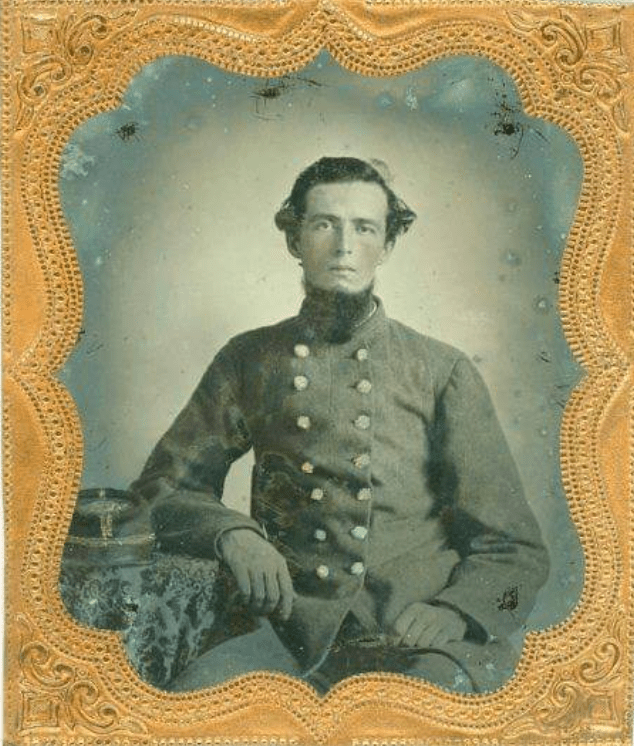
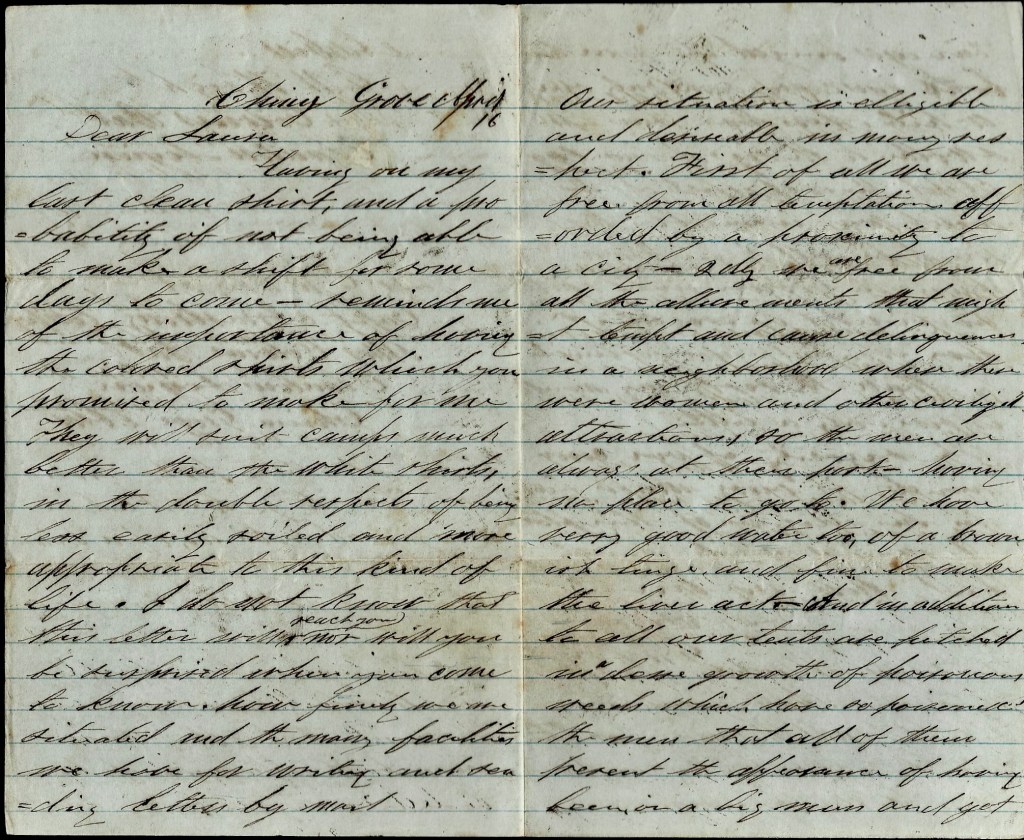

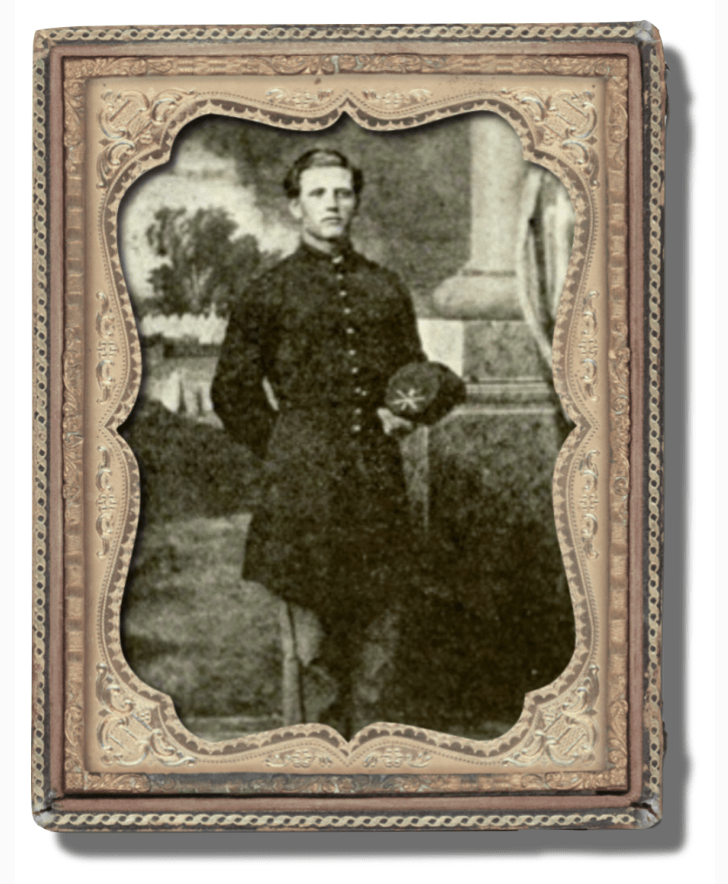
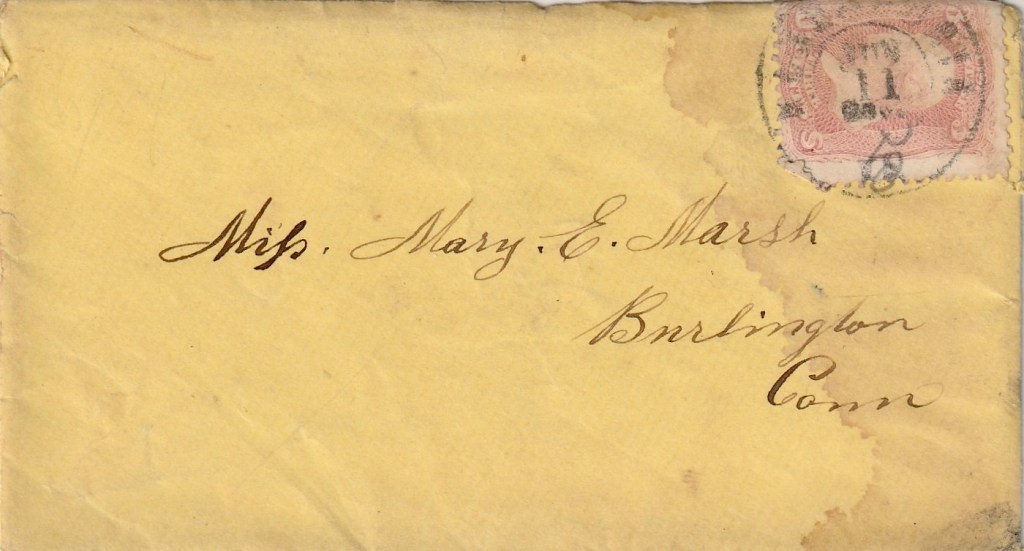

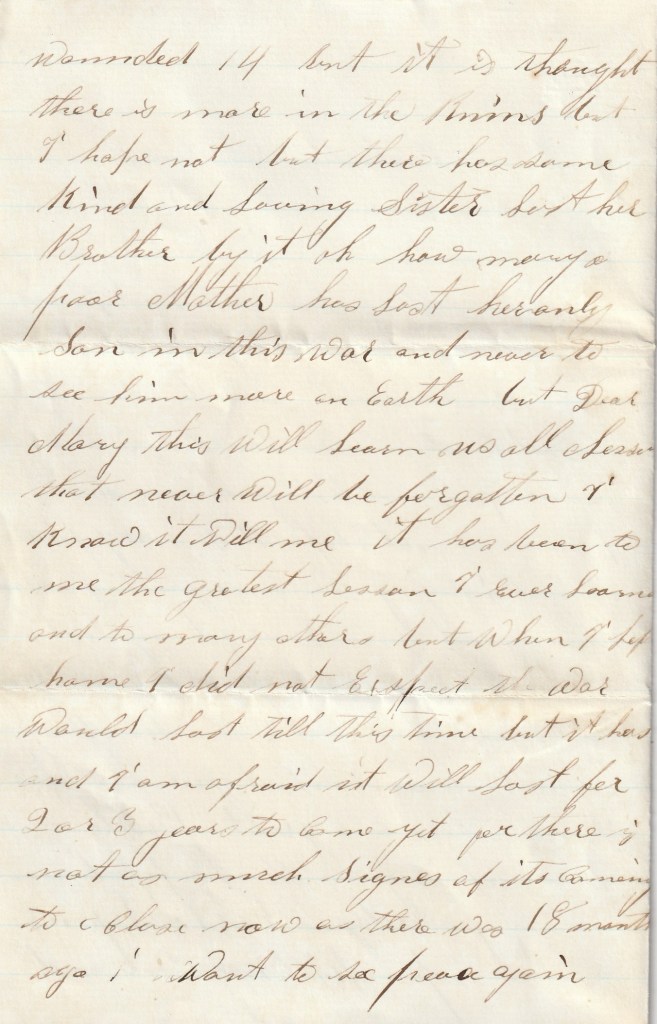


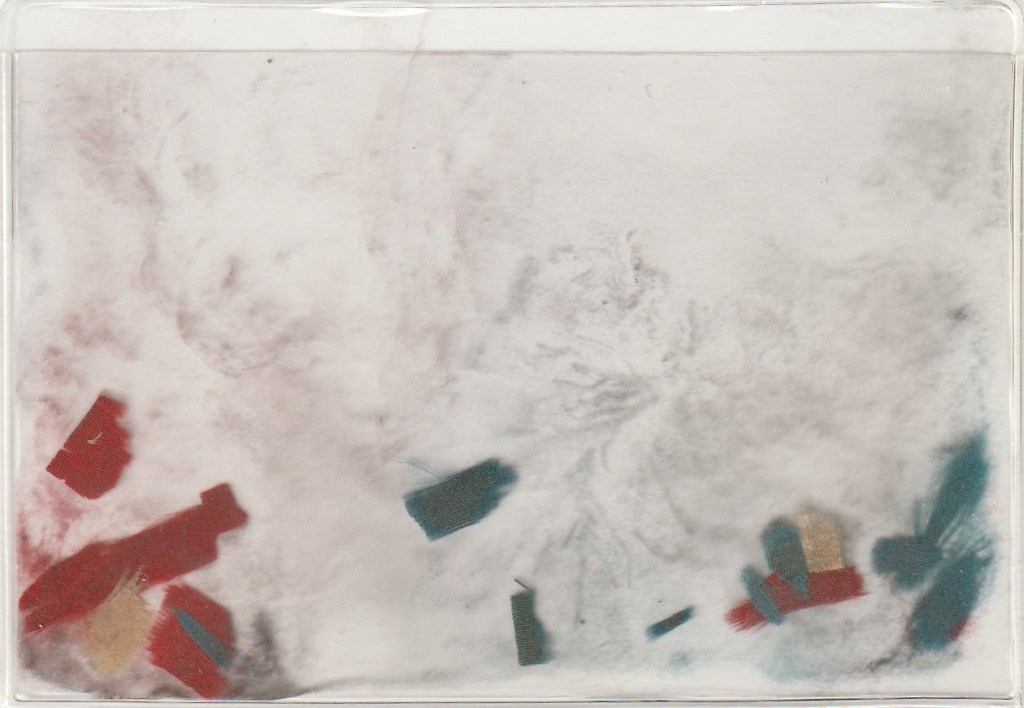


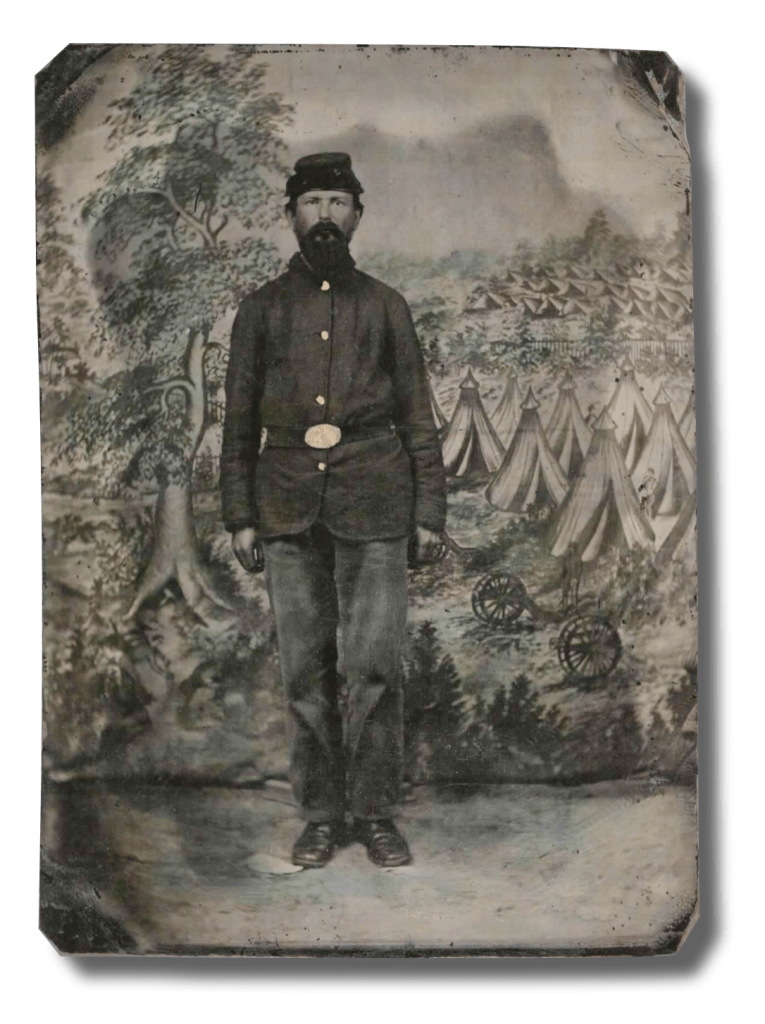


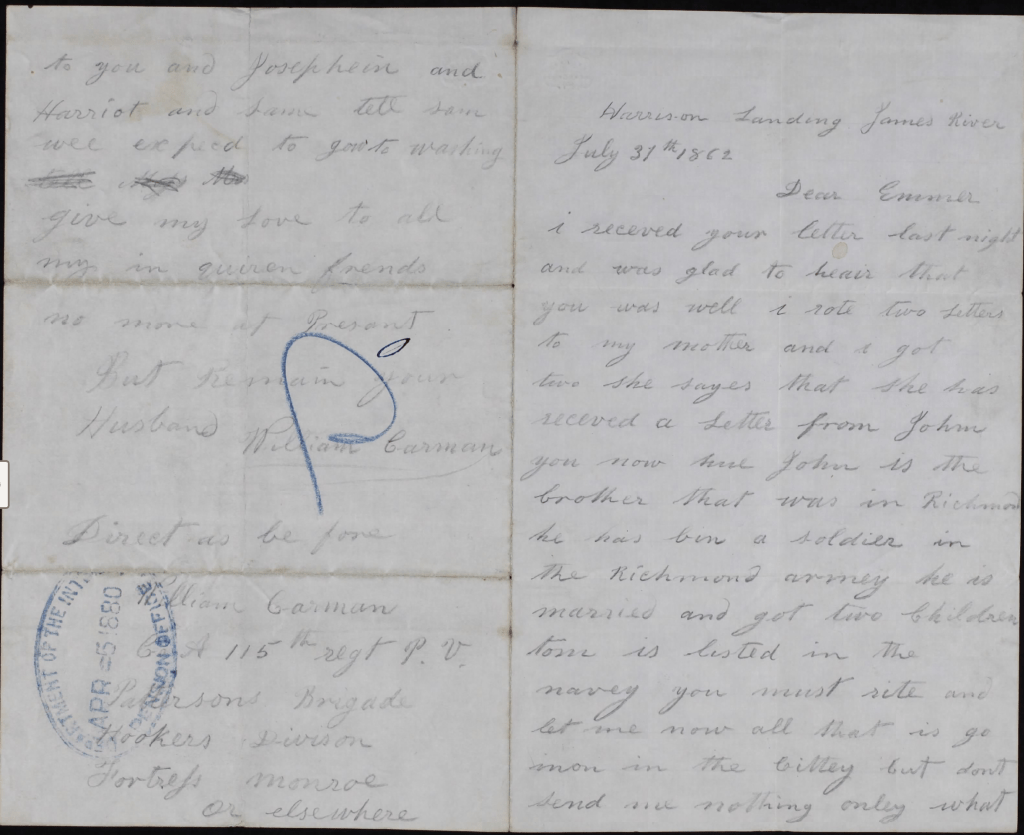

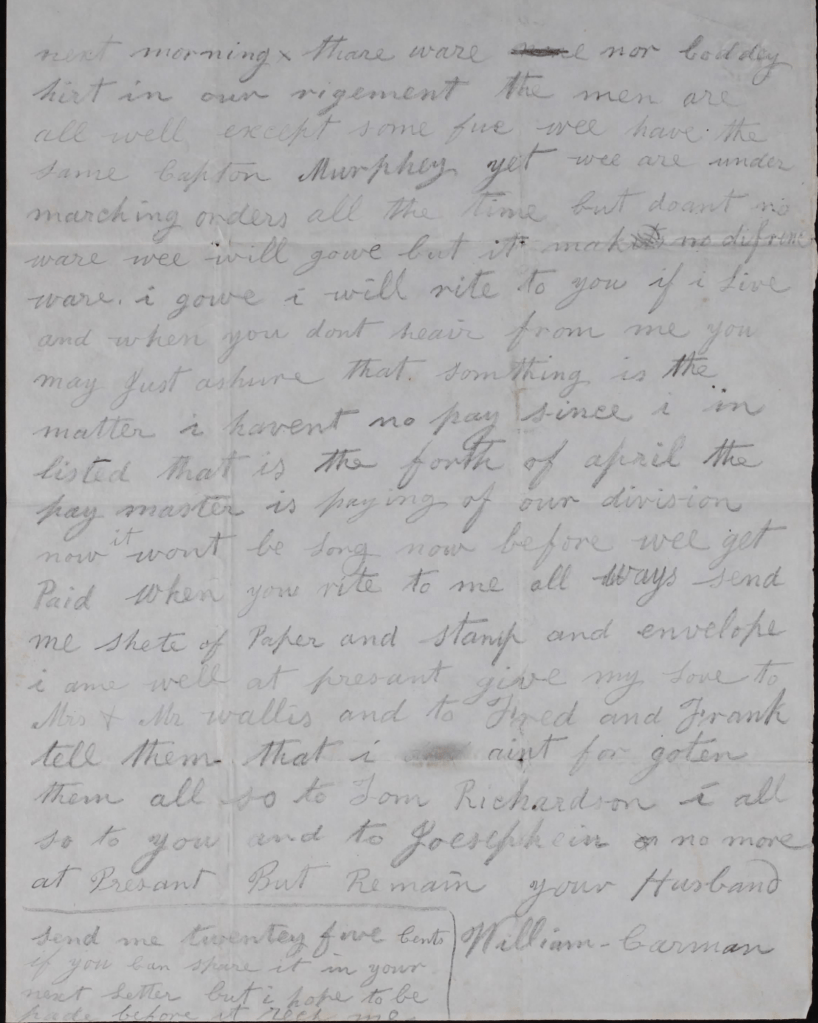


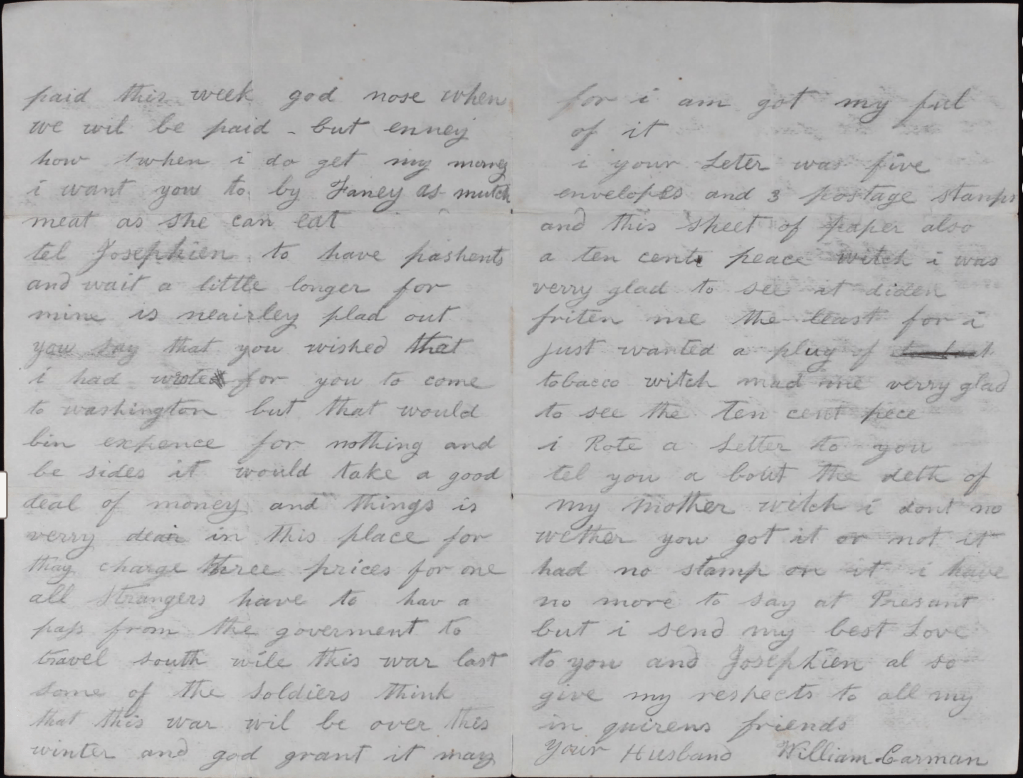


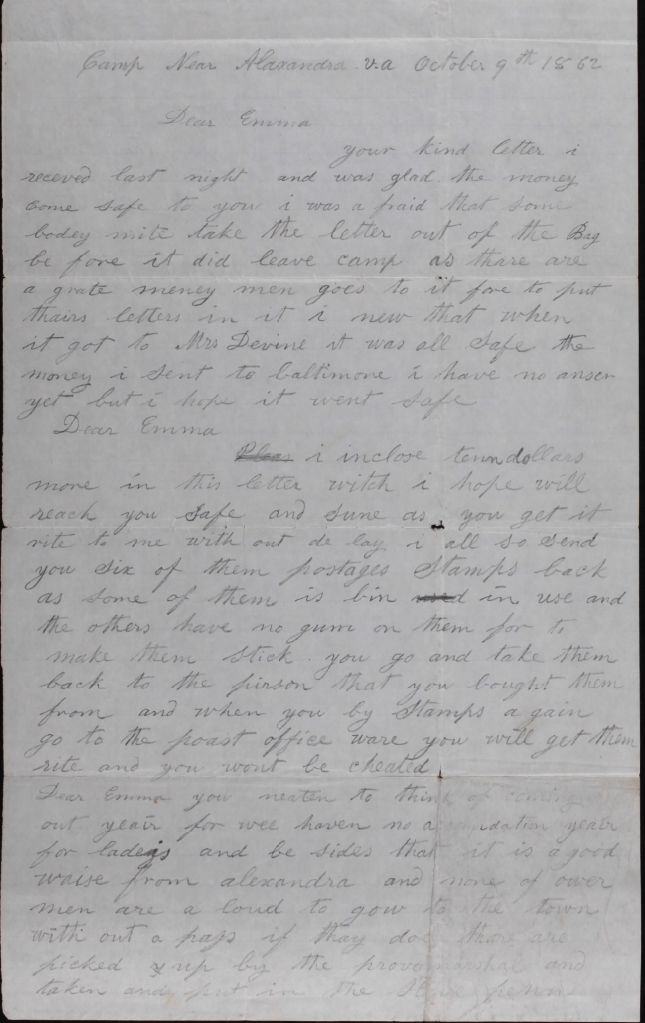

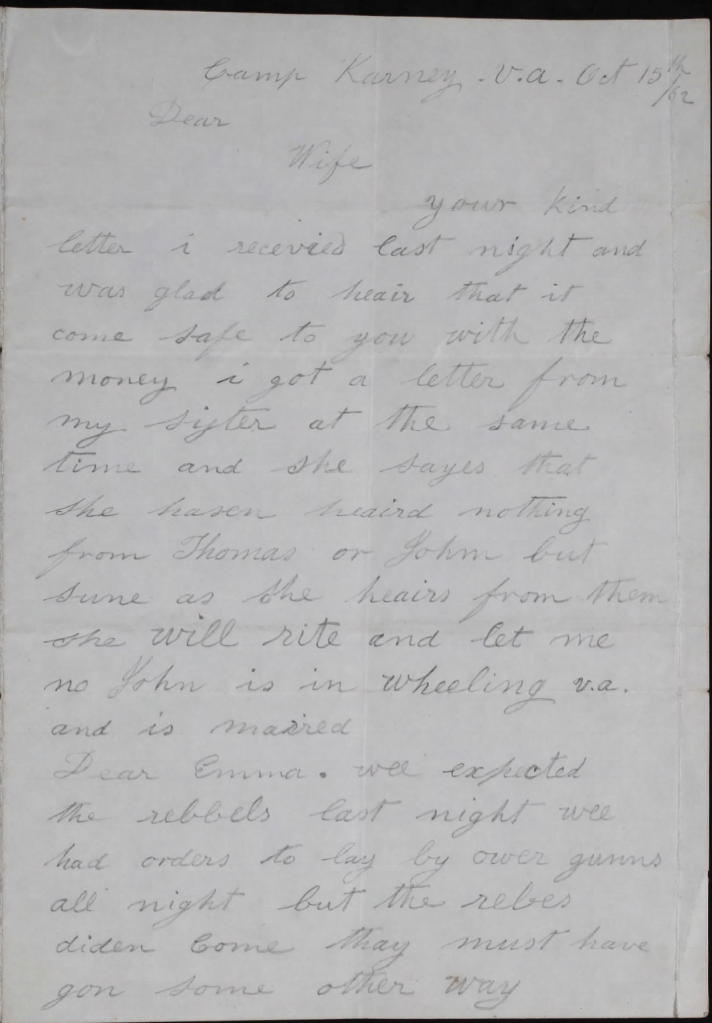


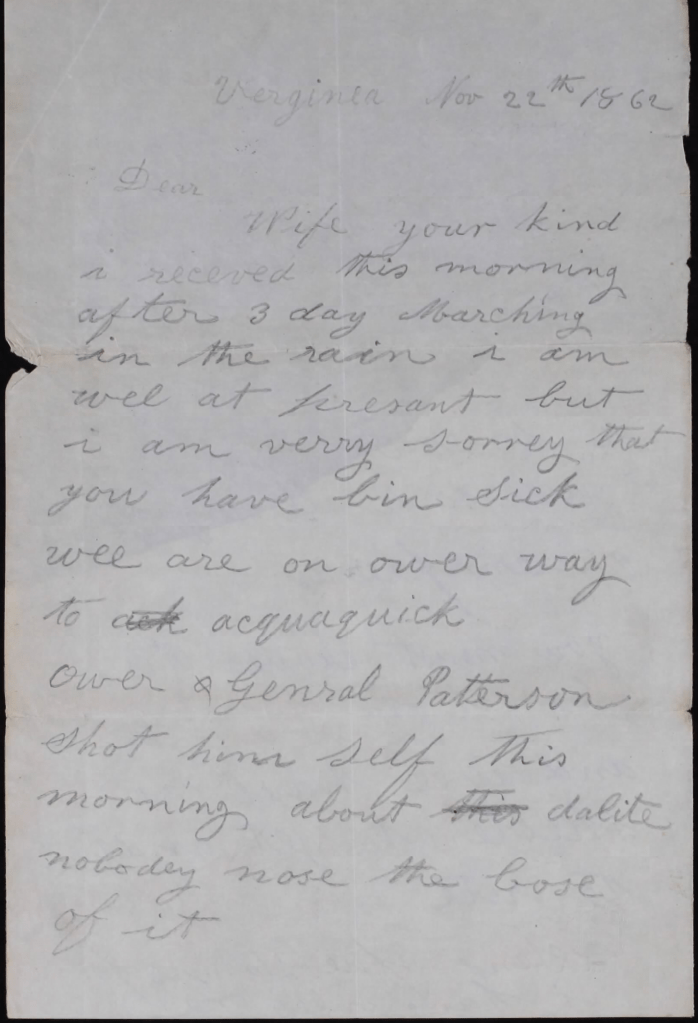


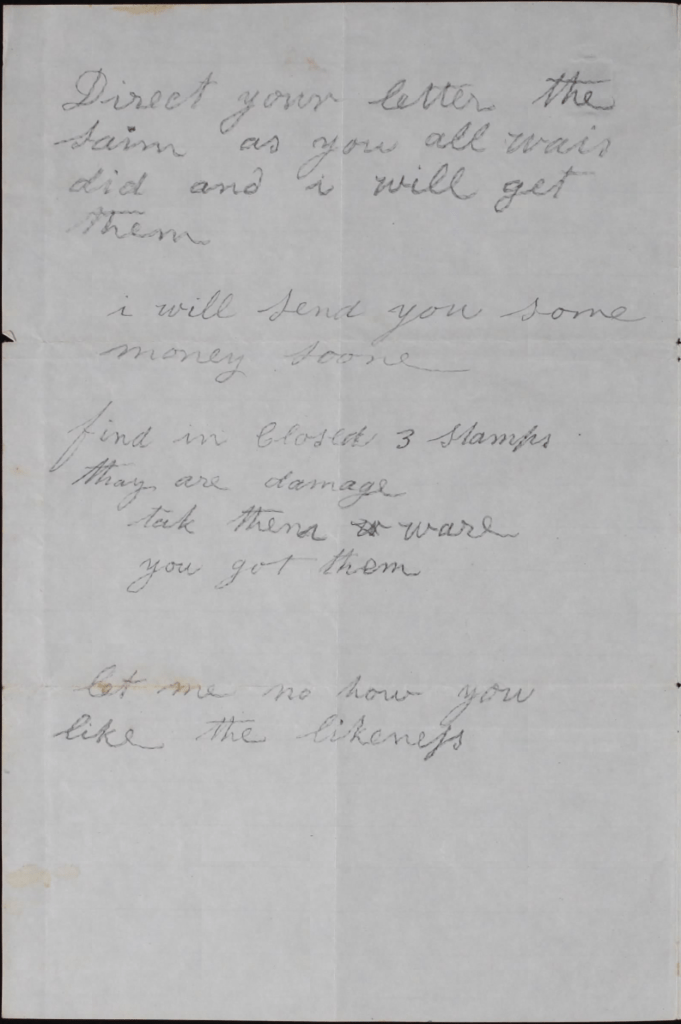
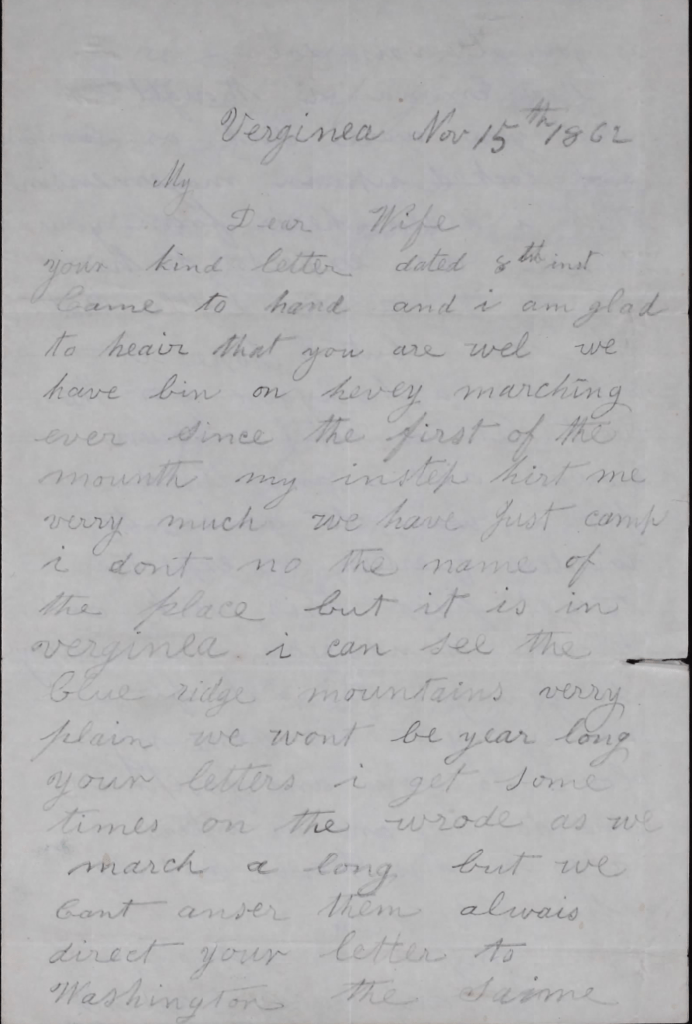
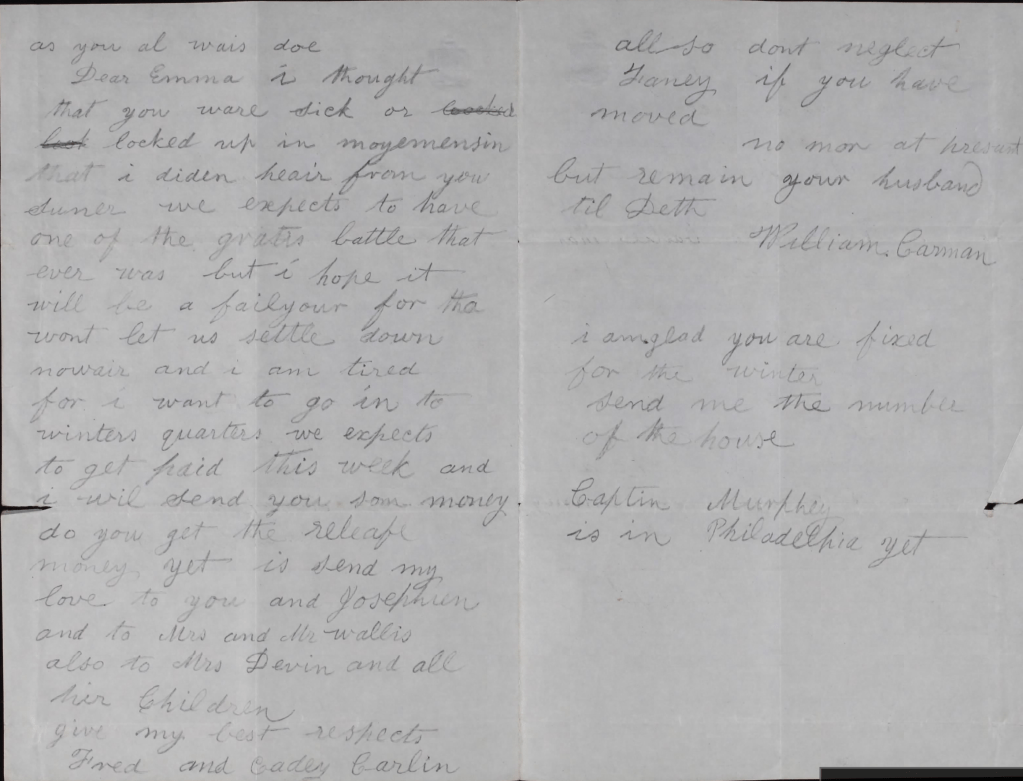


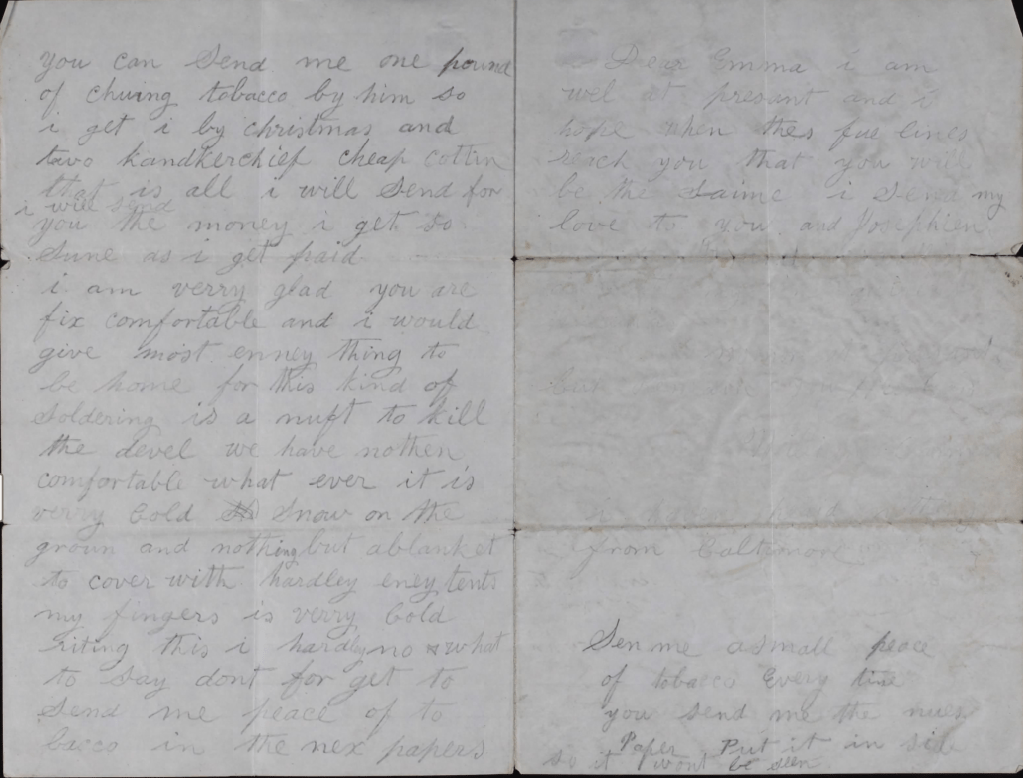
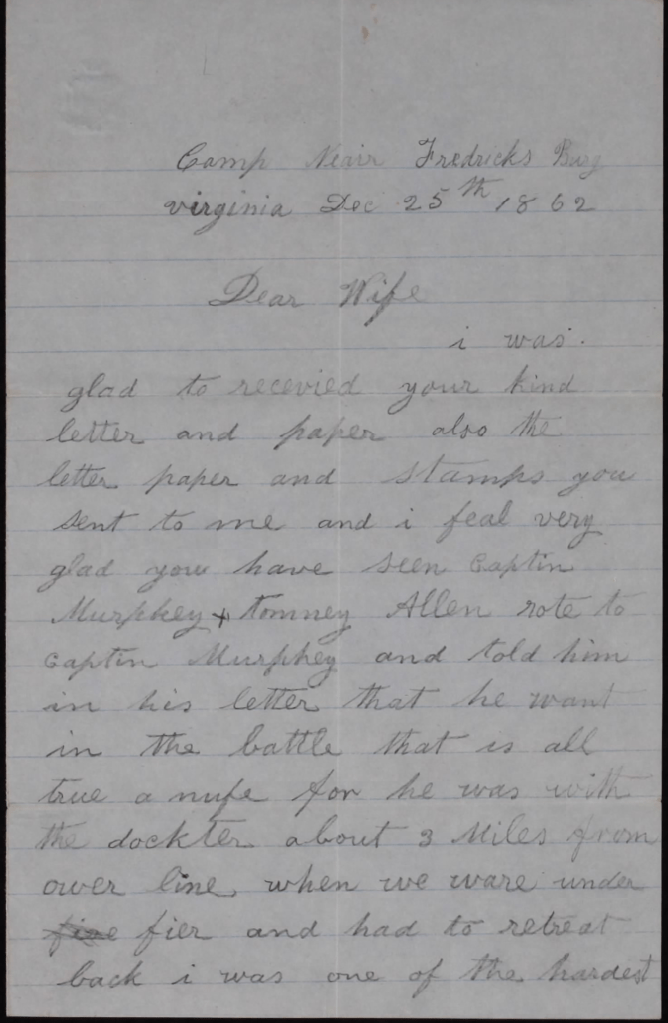

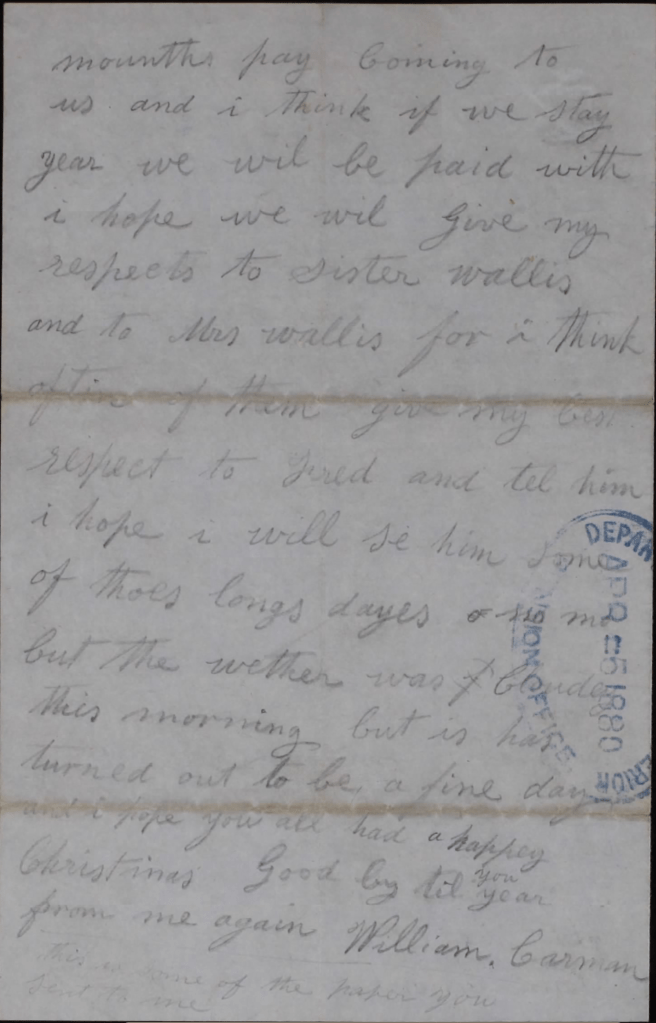
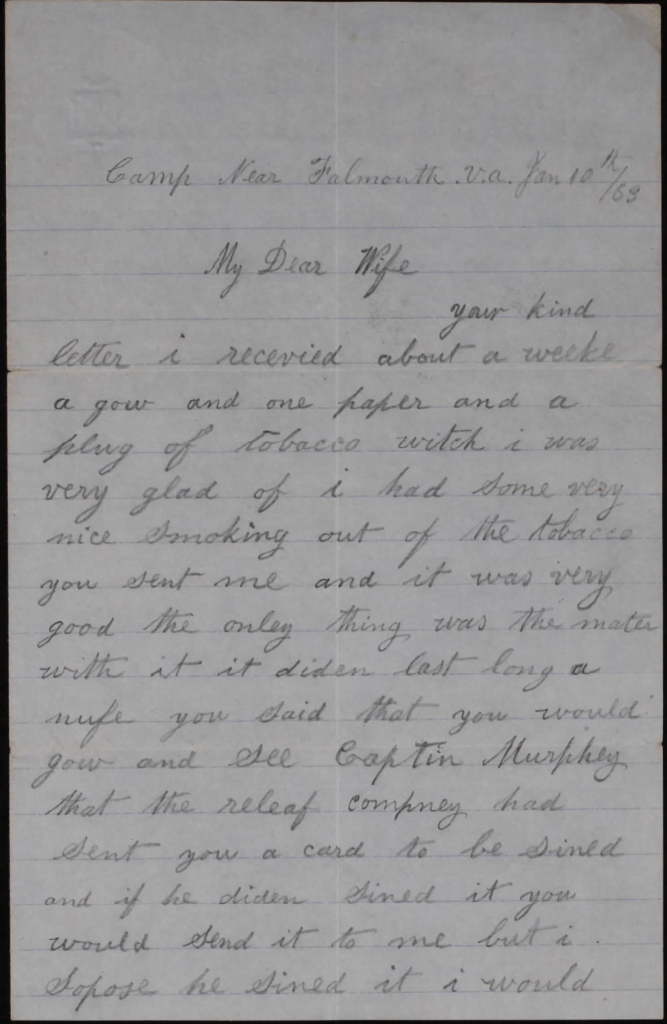

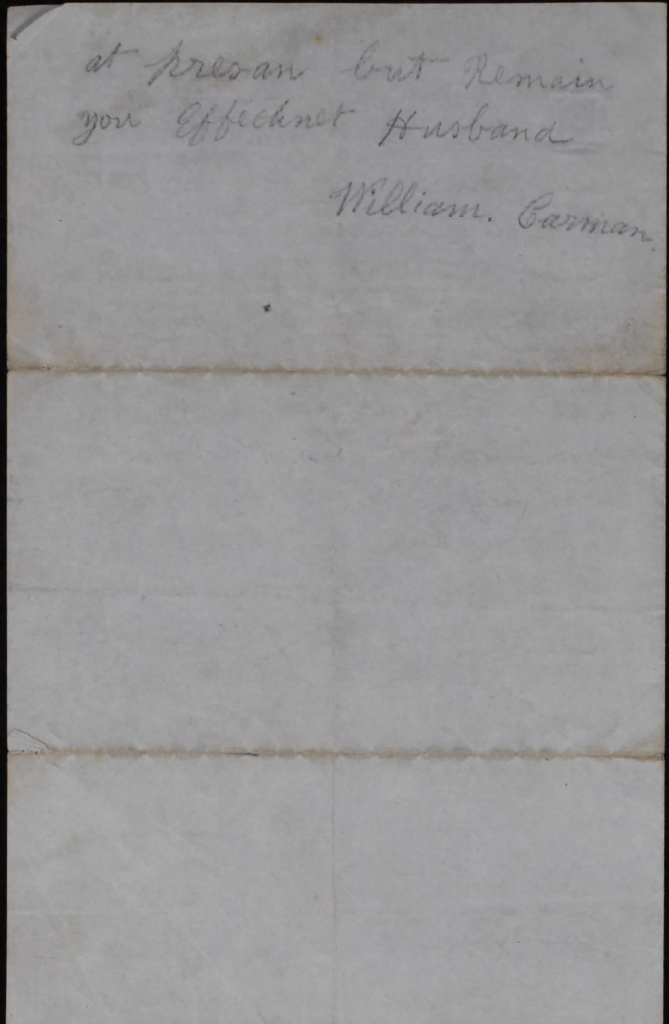


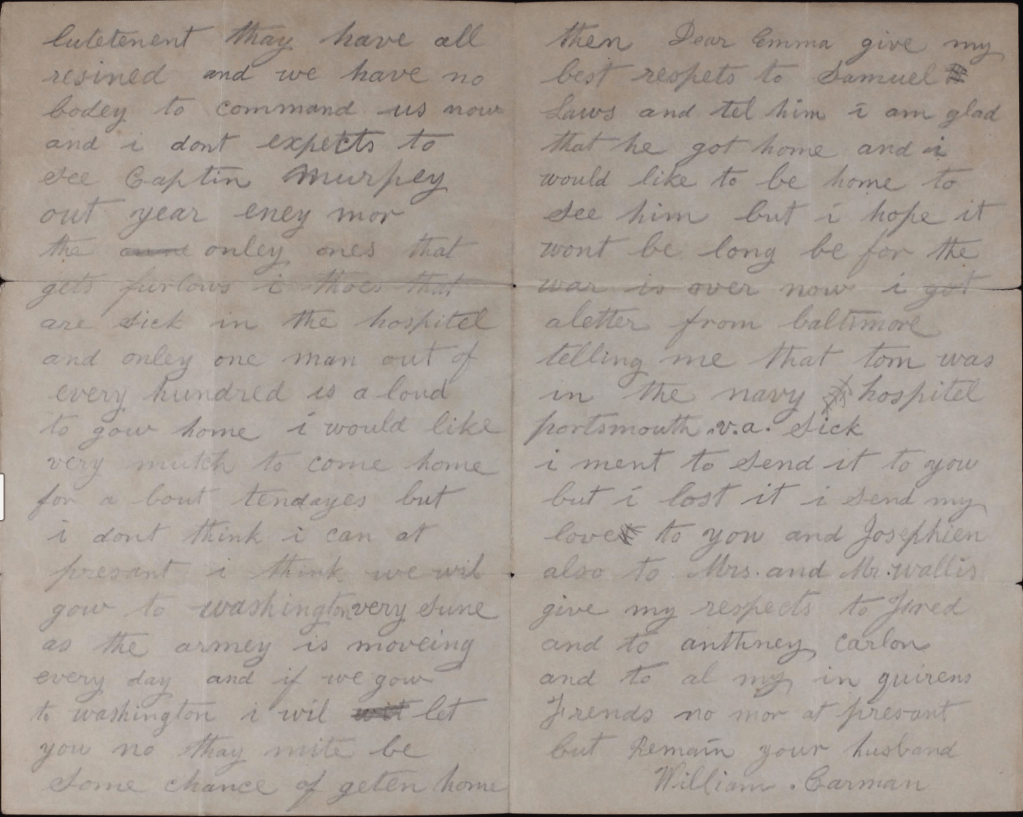


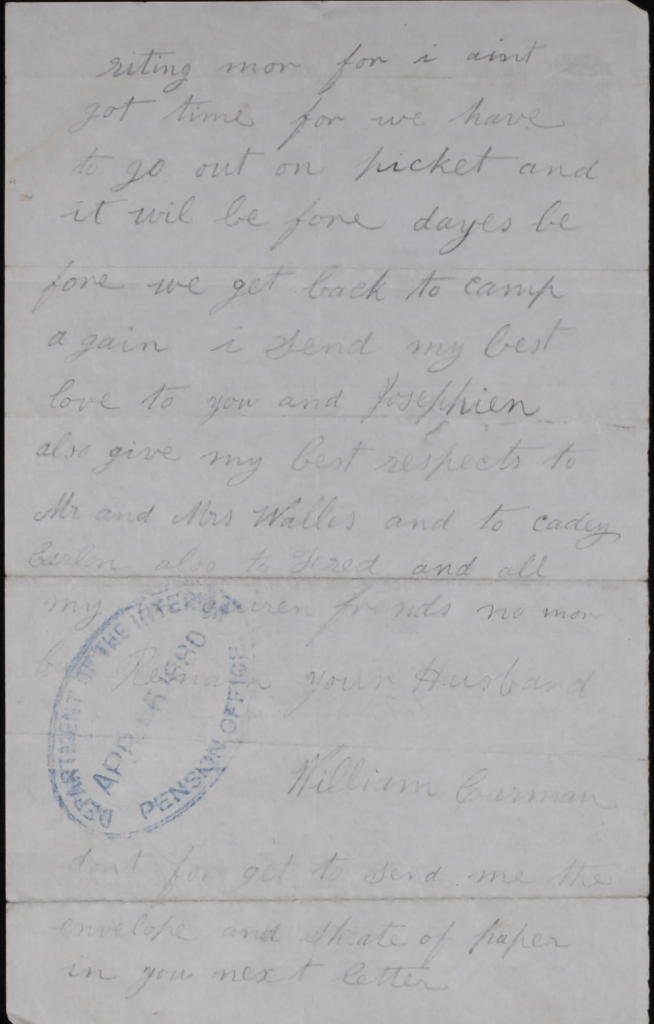

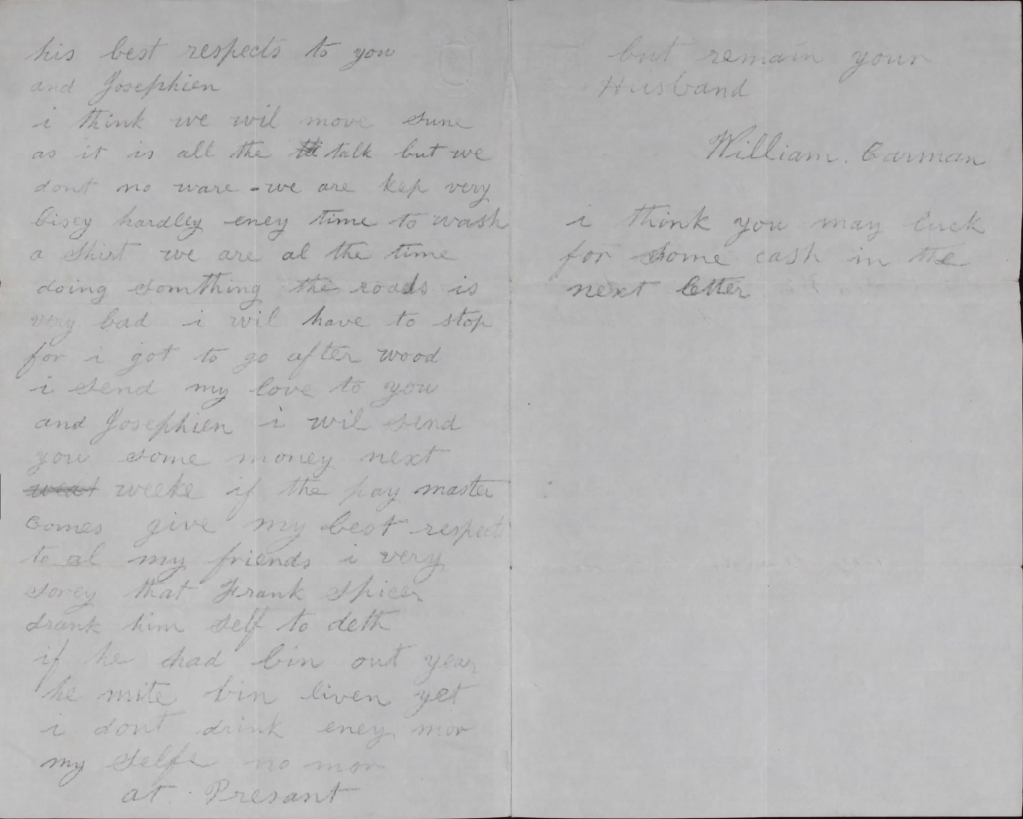


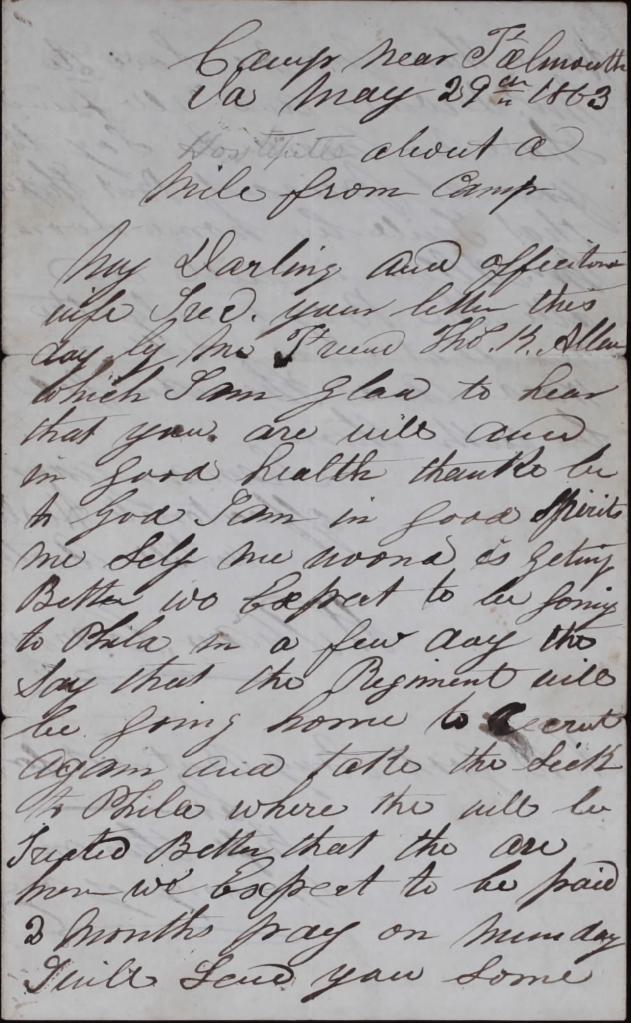


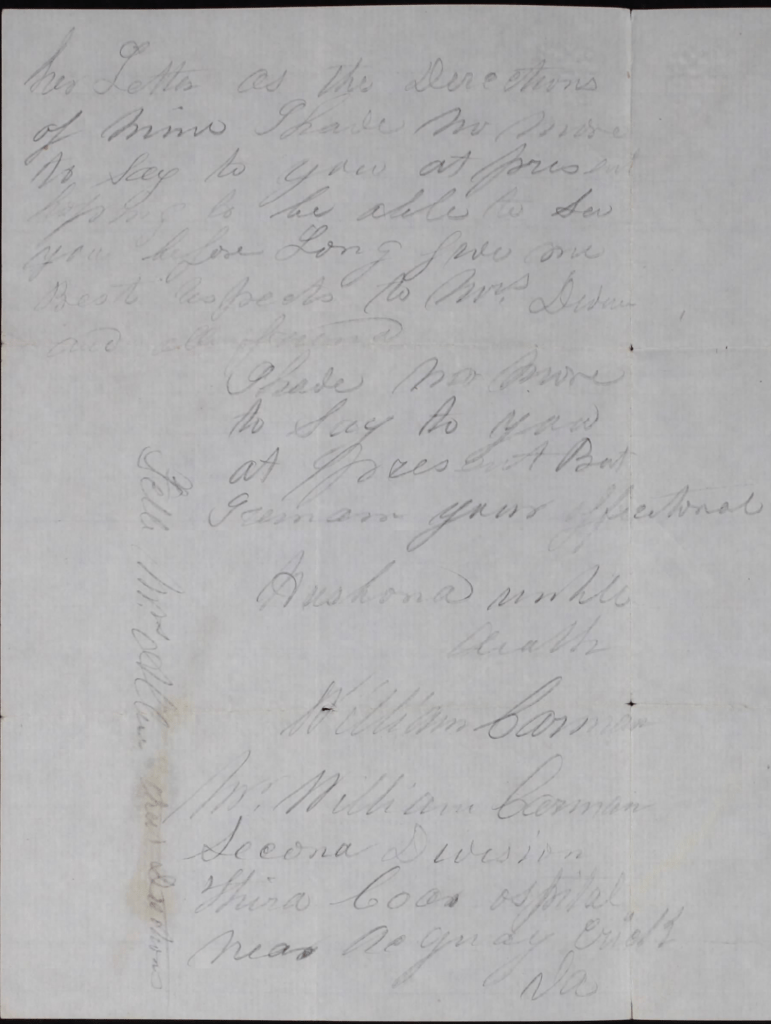
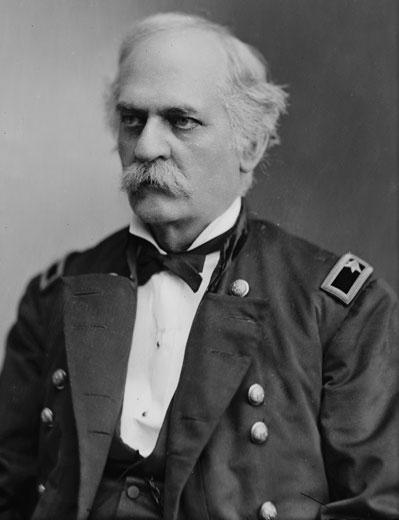
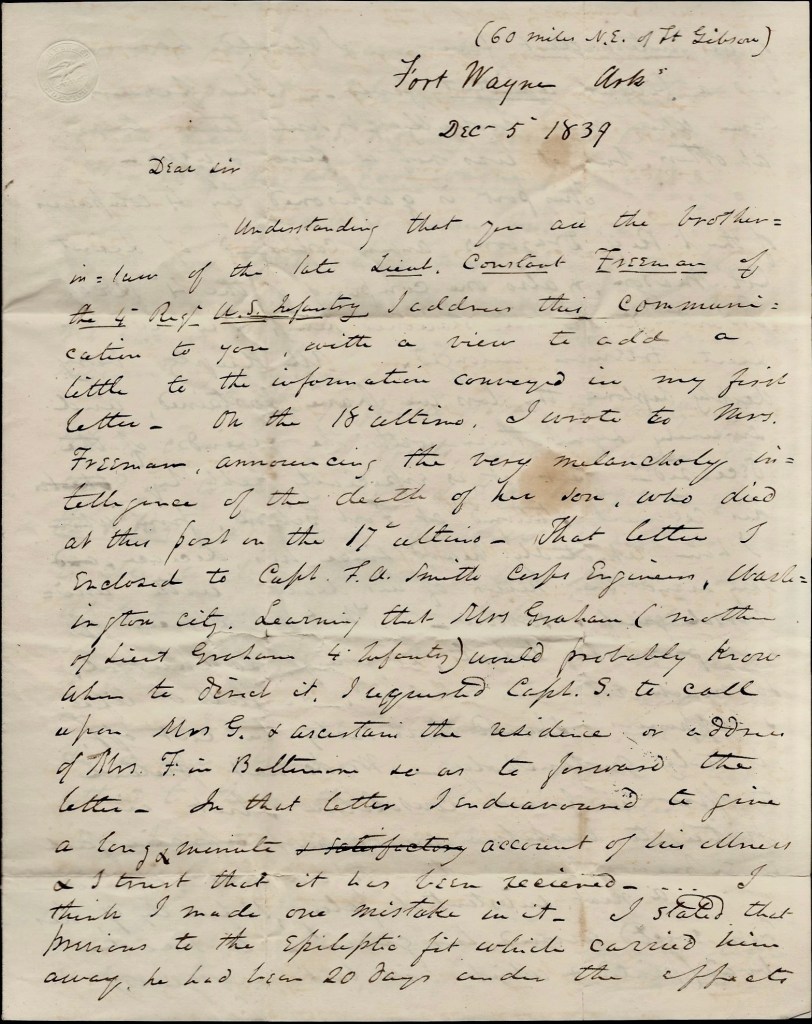




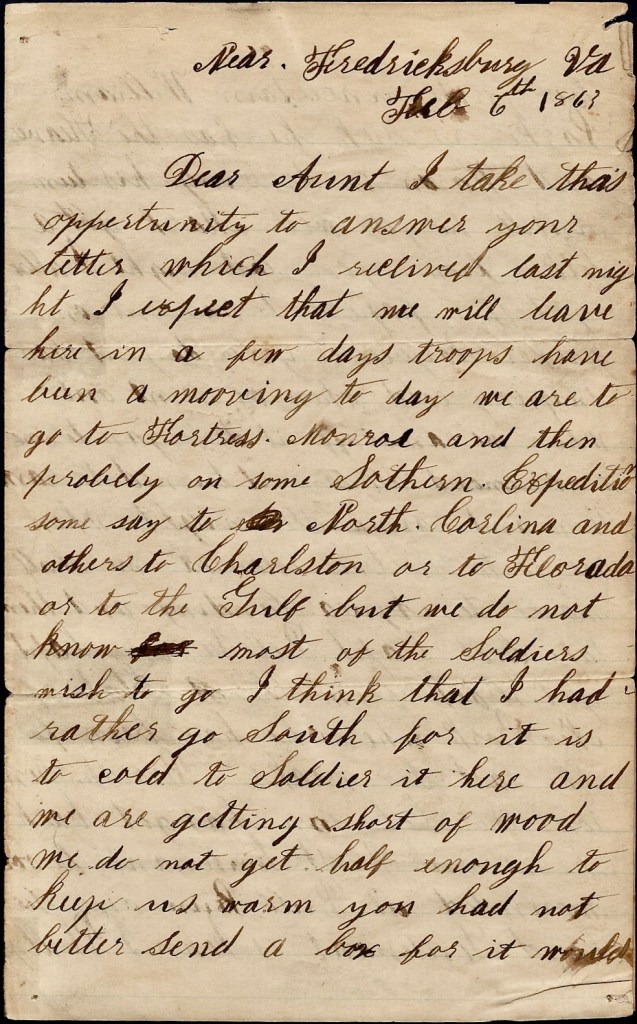
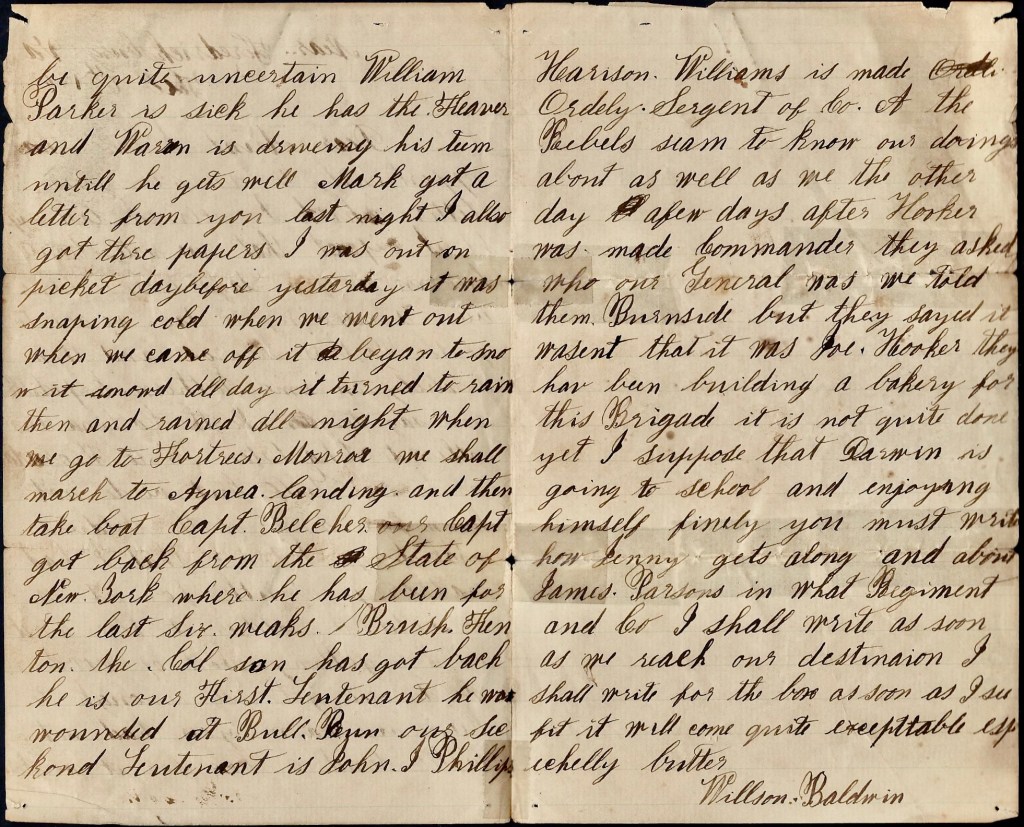


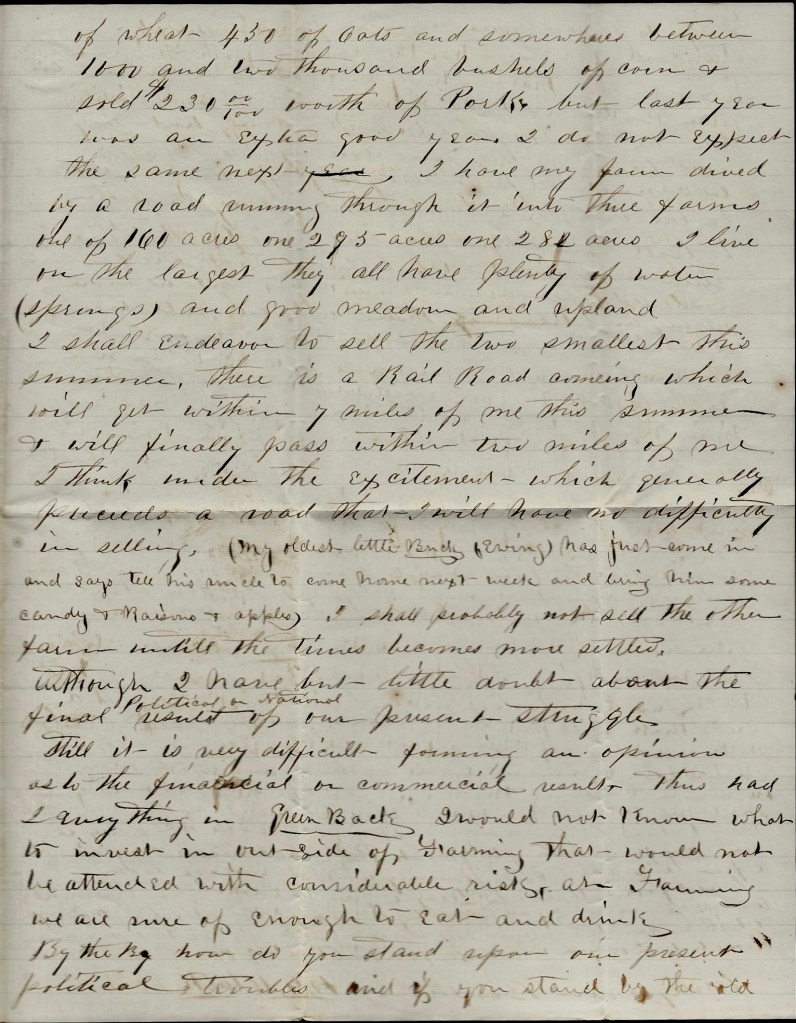


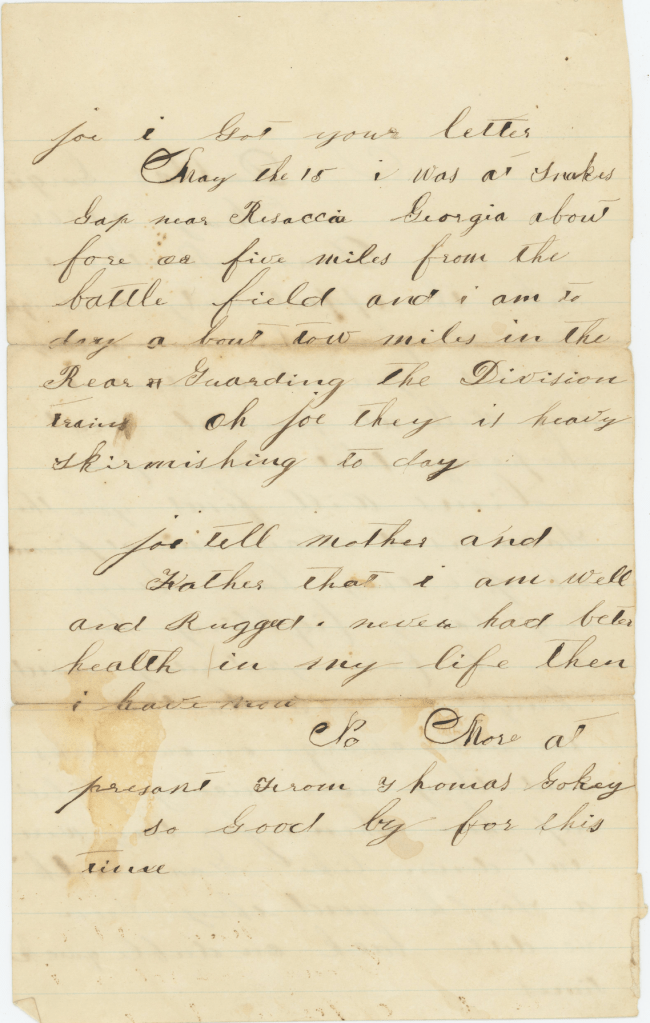

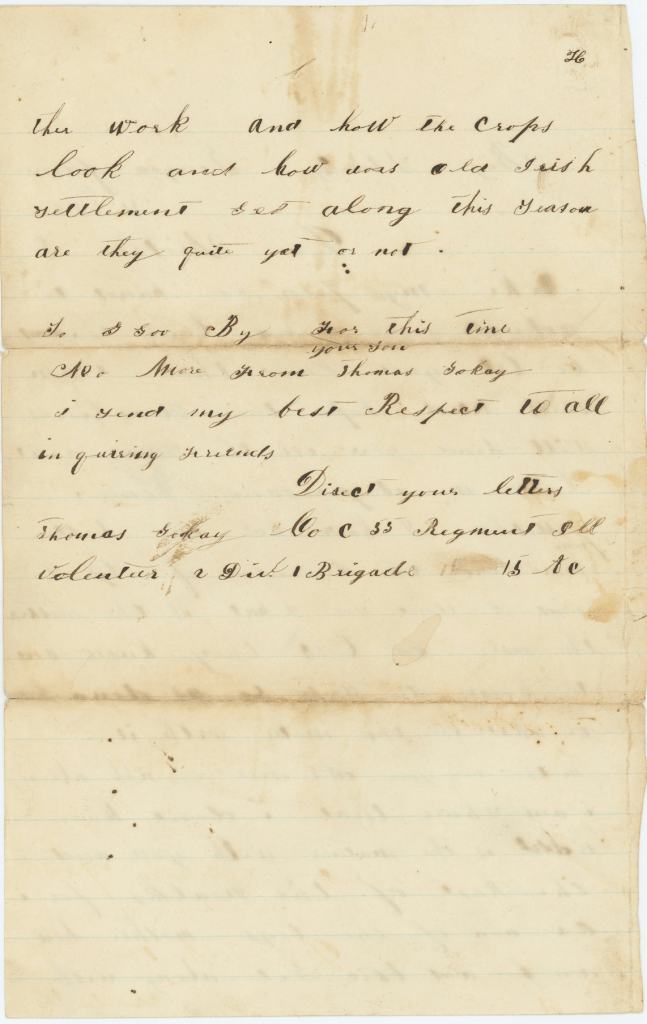
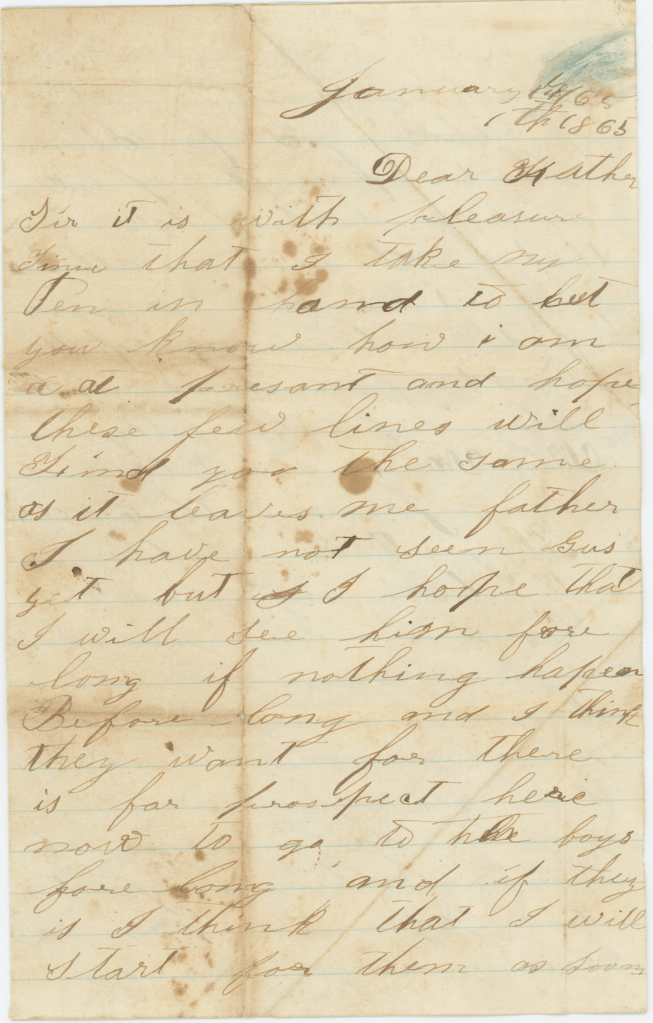

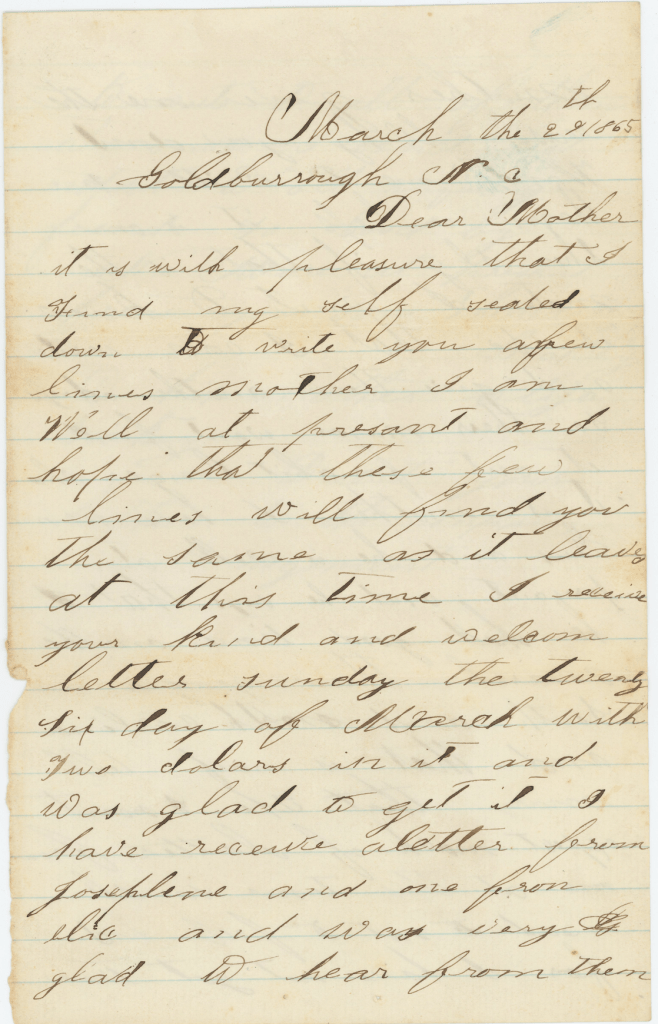


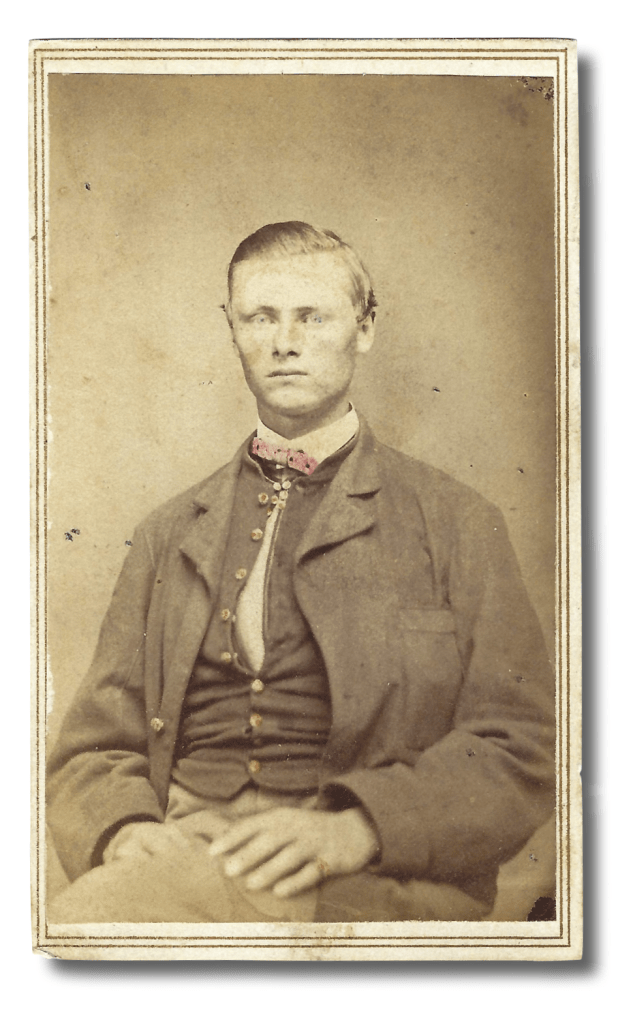

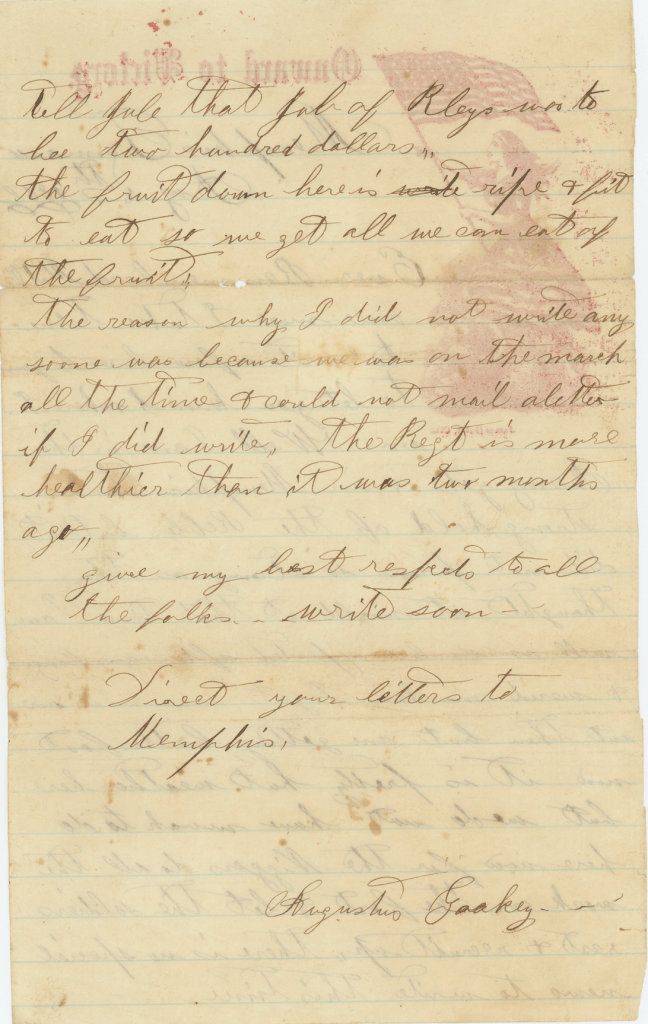

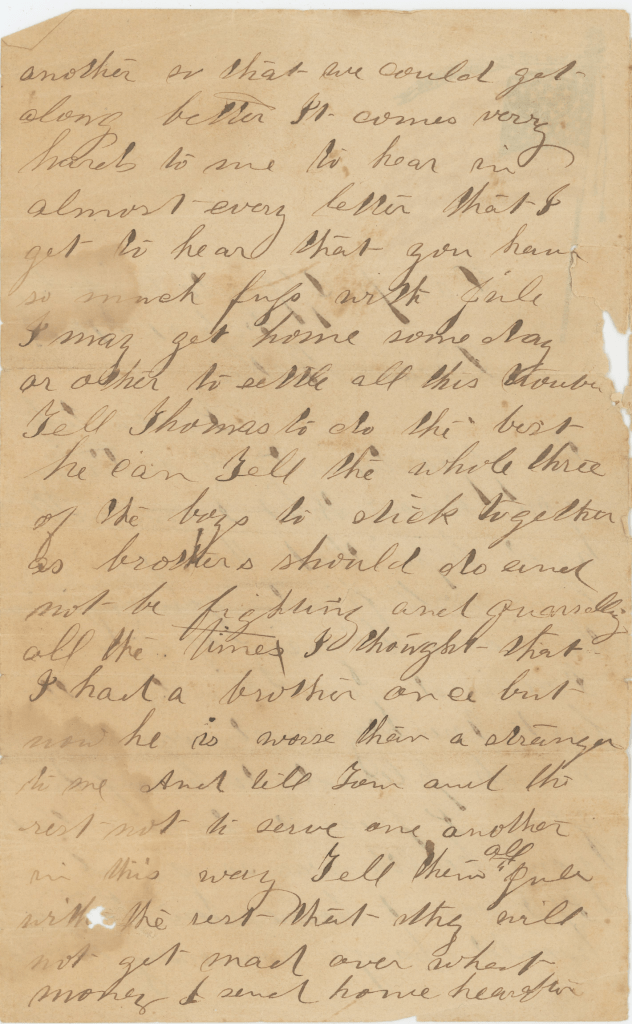


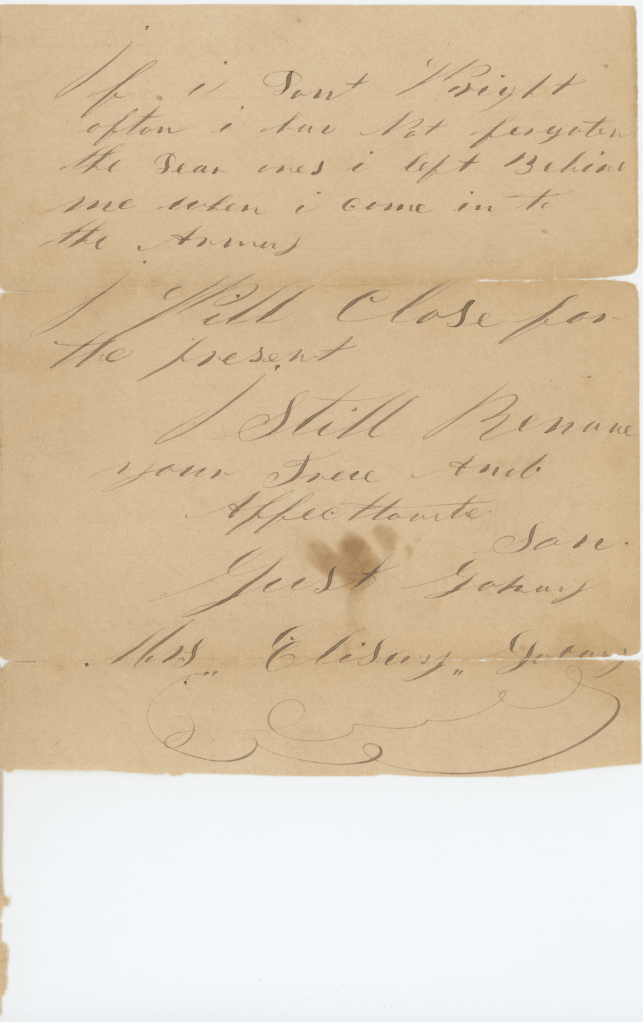
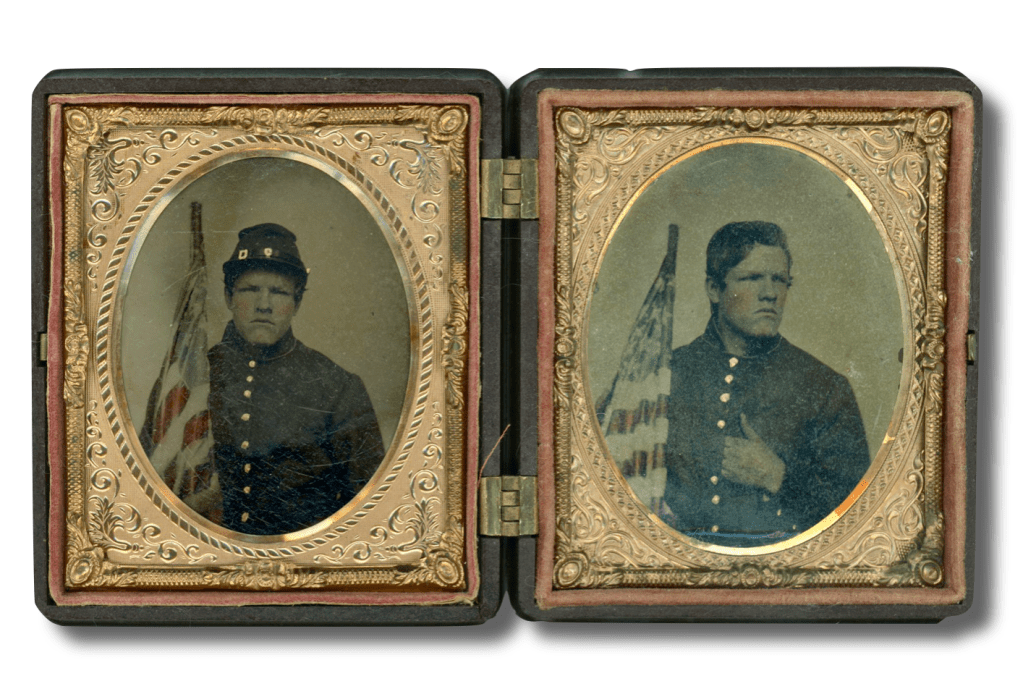
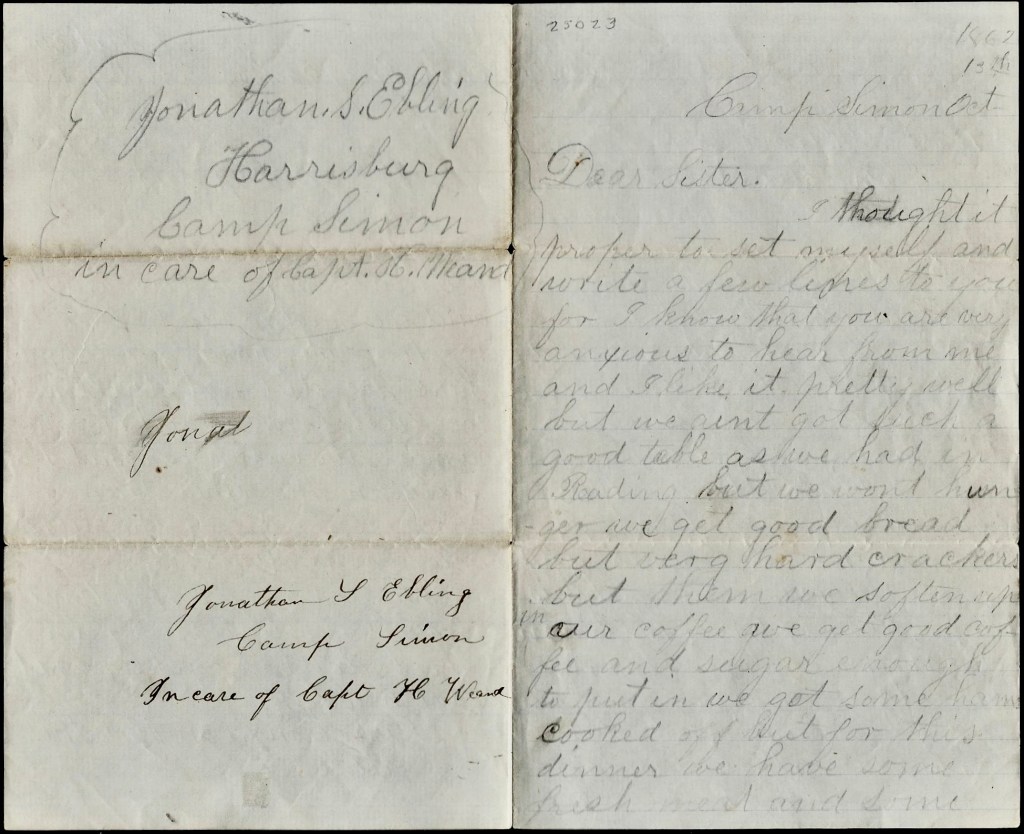

 Spared & Shared 23