All posts by Griff

My passion is studying American history leading up to & including the Civil War. I particularly enjoy reading, transcribing & researching primary sources such as letters and diaries.

1863: George Erwin Comstock to George Throop

George Erwin Comstock

The following letter was written by George Erwin Comstock (1839-1911), the son of Isaac W. Comstock (1808-1883) and Catherine W. Erwin (1809-1852) of Fayette county, Iowa. Erwin enlisted as a private in Co. C, 12th Iowa Infantry on 14 September 1861 and was promoted to a corporal on 8 December 1862. Erwin was with his regiment at Shiloh where they fought valiantly the first day, holding back the enemy until Buell’s army arrived. Erwin was among the number taken prisoner on that day while the few remaining members of the 12th were assigned to the “Union Brigade.”

Erwin’s letter was datelined in late February 1863 at Benton Barracks in St. Louis after they had been exchanged and were ready to be reorganized. We learn from the letter that many of the members took french leave to make visits home while they were awaiting exchange.

After the war, Erwin became a butcher and settled in Westfield.

Erwin wrote his letter to his friend, Sgt. George Throop (later Lieutenant), with the Chicago Mercantile Battery. See Throop-Vaughan family papers, 1838-1928.

See also:
Owen Weed Nims, Co. I, 12th Iowa (1 Letter)
Edward H. Wells, Co. I, 12th Iowa (1 Letter)

To read more: A Perfect Picture of Hell: Eyewitness Accounts by the Civil War Prisoners from the 12th Iowa by High H. Genoways and Ted Genoways, 1998.

A large albumen image of members of Company C 12th Iowa Infantry taken at Benton Barracks on January 8, 1863. These soldiers were all captured in the Hornet’s Nest on April 6, 1862, and this image was taken shortly after their parole.
The following excerpt is found on page 161 of “The University Recruits Company C 12th Iowa Infantry U.S.A 1861-1866” by Charles B. Clark and Roger B. Bowen.
“Captain Warner struck a deal with a photographer in St. Louis by which a member of Company C could have a dozen photographs taken for $3.00, a twenty-five percent reduction. Warner would keep a photograph of each man, send a second to Miss Elizabeth Sorin at Upper Iowa University, with ten going to the Company member. This became a big project, lasting until departure from St. Louis in April. Numerous trips had to be taken into the City for sittings, for picking up the photographs, mailing some, trading others. Woods (Philo Woods) sent a couple of photographs home, mailed one to sister Samantha, traded another to Henry Grannis, old Upper Iowa University chum and color bearer for Company C and the 12th Iowa. A group picture of Company C was also taken and appears on the next page.”

Image from the collection of Michael Huston.

Transcription
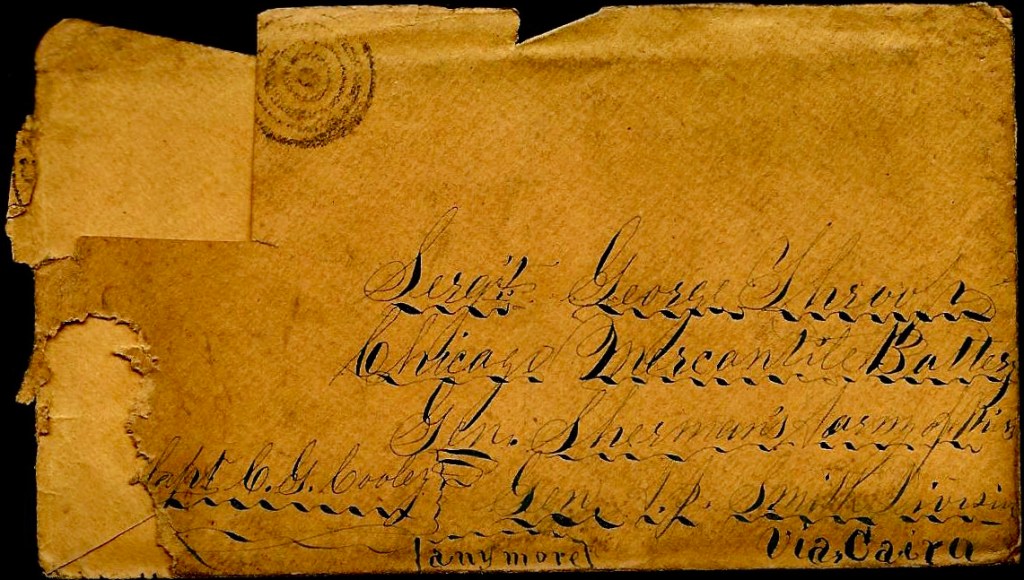
Addressed to George Throop, Chicago Mercantile Battery, Gen. Sherman’s Army of Mississippi, Gen. A. J. Smith’s Division
Capt. C. G. Cooley

Benton Barracks
St. Louis, Missouri
February 25th 1863

Dear Friend George,

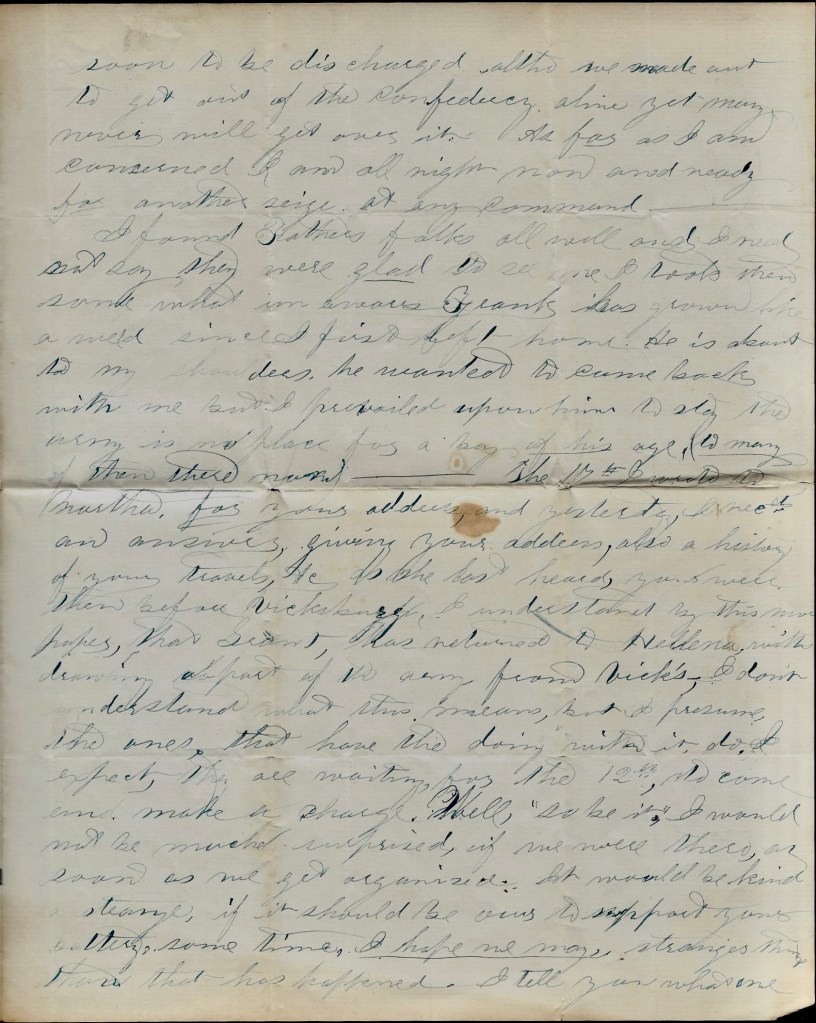
Perhaps ere this you have thought that I was a going to keep silent, but not so. But to begin with, I ask your pardon for not writing as I agreed to. Since I last saw you, I have ben home [and] had a grand time, I assure you. I remained at St. Louis about a month after leaving Chicago last fall before I received pay after which I took a french furlough, that being the only way as Gen. Halleck had issued an order that no furloughs should be given to any except wounded soldiers. This cut us out and Benton Barracks, I assure you, is any place but a good one for soldiers in our condition—the ague handing around some (ailing me) other thing and some another, but all in a poor condition. Notwithstanding, it was a direct violation of the military law yet they instantly saw the need of our going somewhere to recruit and thought that home would be as good a place as any. But of course did not say it out loud, but we were not so dull of apprehension but what we were bold enough to venture. Consequently, off we went.

I started in about two hours after I got my pay. One principal difficulty was to get out of the Barracks which was pretty well guarded at the gates and there being so many going at a time we were afraid it would cause suspicion. That was one reason I hurried off so. I made out to get out all night but as you well know by this time, it wants a soldier that has seen a little service. At any rate, I only had five sentinels to pass at one gate all within 3 rods of each other, but on I went with[out] any particular trouble.

In going home, I did not go by the way of Chicago, consequently did not see your folks. We remained at home 4 weeks when we received the official orders that we were exchanged and to report at Benton Barracks by the 1st of January which we did with a hearty good will—every man that was able. Some of our company were left at home because they were not able to come. Considerable many have been discharged and we are badly broken up. Out of the 105 men that first went in to camp with all in the full bloom of youth have dwindled away to a small squad. There are twenty-five of us here and 16, I believe that are in the Union Brigade. Some of these are soon to be discharged. Although we made out to get out of the Confederacy alive, yet many never will get over it. As far as I am concerned, I am all right now and ready for another siege at any command.

I found Father’s folks all well and I need not say they were glad to see me. I took them somewhat unawares. [My brother] Frank has grown like a weed since I first left home. He is about to my shoulders. He wanted to come back with me but I prevailed upon him to stay. The army is no place for a boy at his age (too many of them there now).

The 17th I wrote to Martha for your address and yesterday I received an answer giving your address, also a history of your travels, &c. as she last heard. You were then before Vicksburg. I don’t understand what this means but I presume the ones that have the doing with it do. I expect that are waiting for the 12th to come and make a charge. Well, “so be it.” I would not be much surprised if we were there as soon as we get organized. It would be kind of strange if it should be us to support your battery some time. I hope we may. Stranger things that that has happened.

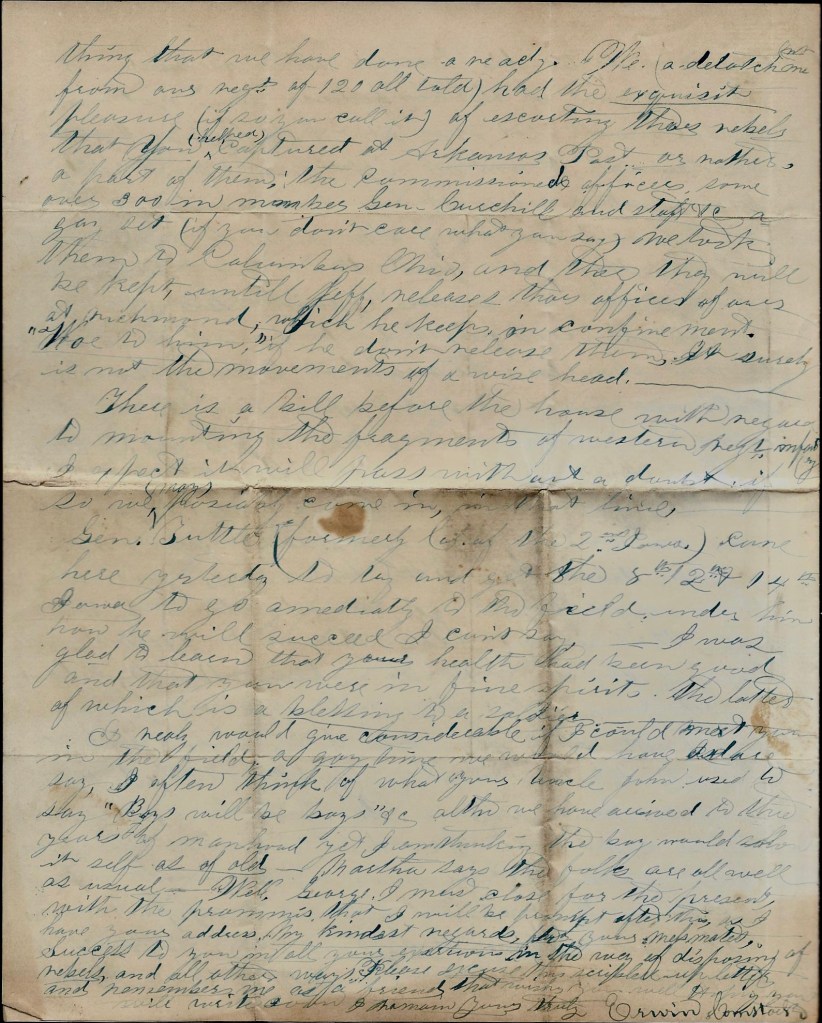
I tell you what one thing we have done already. We (a detachment from our regiment of 120 all told) had the exquisite pleasure (if so you call it) of escorting those rebels that you helped capture at Arkansas Post, or rather a part of them, the commissioned officers some, over 300 in number, Gen. [Thomas] Churchill and staff, &c. a gas set (if you don’t care what you say). We took them to Columbus, Ohio, and there they will be kept until Jeff releases those officers of ours at Richmond which he keeps in confinement. “Woe to him,” if he don’t release them. It surely is not the movements of a wise head.

There is a Bill before the House with regard to mounting the fragments of wester regiments (infantry_. I expect it will pass without a doubt. If so, we may possibly come in, in that time.

Gen. Tuttle (formerly Colonel of the 2nd Iowa) came here yesterday to try and get the 8th, 12th, and 14th Iowa to go immediately to the field under him. How he will succeed, I can’t say.

I was glad to learn that your health had been good and that you were in fine spirits, the latter of which is a blessing to a soldier.

I really would give considerable if I could meet you in the field. A gay time we would have, I dare say. I often think of what your Uncle John use to say, “Boys will be boys,” &c. Although we have arrived to the years of manhood, yet I am thinking the boy would stay itself as of old. Martha says the folks are all well as usual. Well, George, I must close for the present with the promise that I will be prompt after this as I have your address. My kindest regards to your messmates. Success to you in all your exertions in the way of disposing of rebels, and all other ways. Please excuse this scribbled up letter and remember me as a friend that wishes you well. Hoping you will write soon, I remain yours, truly, — Erwin Comstock

1865: Eberle Benton Underwood to Nellie Louise (Underwood) Stanford

The following was written by Eberle Benton Underwood (1839-1925), the son of Willin Underwood (1800-1872) and Lovisa Rawson (1819-1844) of New Baltimore, Stark county, Ohio. Before and after the war, Eberle worked as a painter but during the Civil War he served as a private in Co. B, 6th Ohio Volunteer Cavalry (OVC).

I could not find an image of Eberle but here is one of Solomon Large who was a bugler in Co. H, 6th Ohio Cavalry (Ancestry)

After spending the winter of 63-64 fighting Mosby’s guerrillas, in the spring of 1864 the 6th OVC joined Ulysses S. Grant’s movement on Richmond, participating in several battles while serving in the Cavalry Corps, under Gen. Philip H. Sheridan. It was involved in the Union cavalry operations during the Overland Campaign and the Siege of Petersburg, as well as taking part in the Battle of Trevillian Station. In 1865, the regiment was in the Battle of Five Forks, and during the Appomattox Campaign, in the Battle of Sayler’s Creek. The 6th Ohio Cavalry marched in the Grand Review of the Armies in May 1865, and then exited service at Petersburg, Virginia, on August 7, 1865. During its term of service, the 6th Ohio Cavalry lost 5 officers and 52 enlisted men killed and mortally wounded, and 4 officers and 177 enlisted men by disease, for a total of 238 fatalities. More than 1700 men served in the ranks at various times, however, the field strength of the regiment rarely exceeded 500 men at any given time.

Eberle wrote the letter to his sister Nellie Louise (Underwood) Stanford (1842-1921), the widow of Vactor (“Van”) B. Stanford (1837-1864 who died on 5 June 1864 at Chattanooga, Tennessee. Van served in Battery A, 1st Ohio Light Artillery. After reenlisting for three more years, and marrying Nellie while at home on Veteran’s furlough in February 1864, Van was with Sherman’s army in the march on Resaca, Georgia, when he was severely wounded by a premature discharge of his cannon. He lingered for three weeks before he died.

Transcription

Addressed to Mrs. Nellie Stanford, M____, Stark county, Ohio

Camp south of Petersburg
Tuesday, January 30, 1865

Dear Sister,

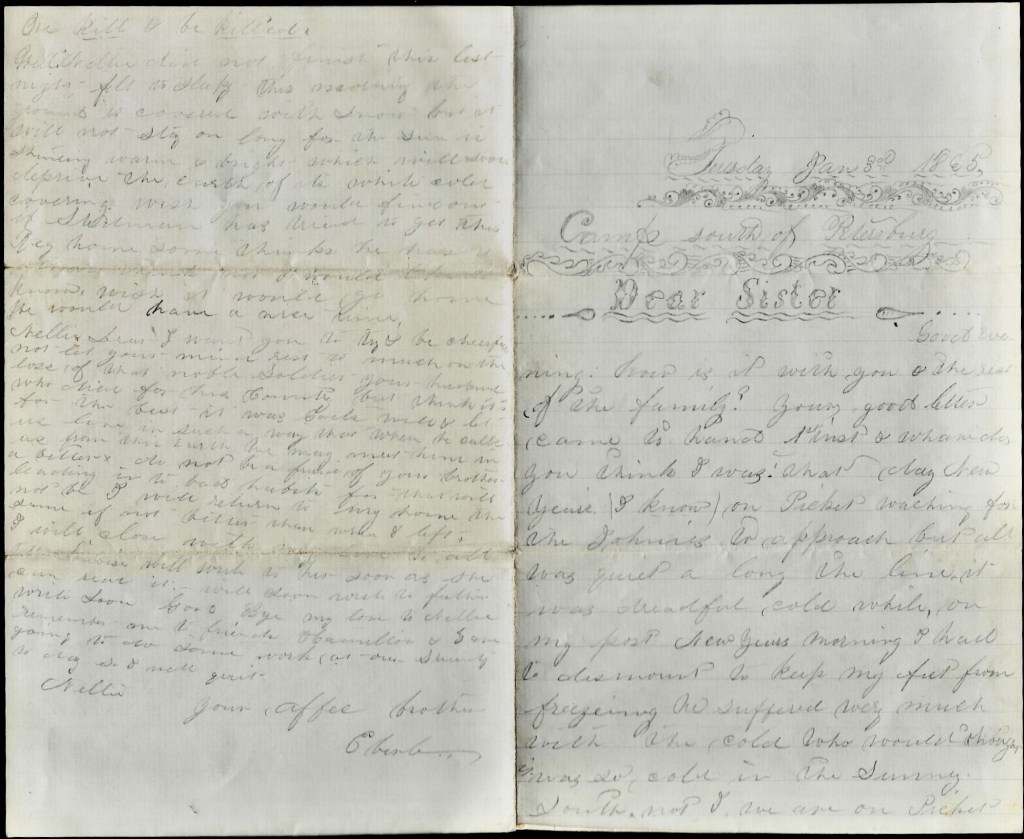
Good evening. How is it with you and the rest of the family? Your good letter came to hand 1st inst. & where do you think I was that day—New Years? I know, on picket, watching for the Johnnies to approach. But all was quiet along the line. It was dreadful cold while on my post. New Years morning I had to dismount to keep my feet from freezing. We suffered very much with the cold. Who would of thought it was so cold in the Sunny South? Not I.

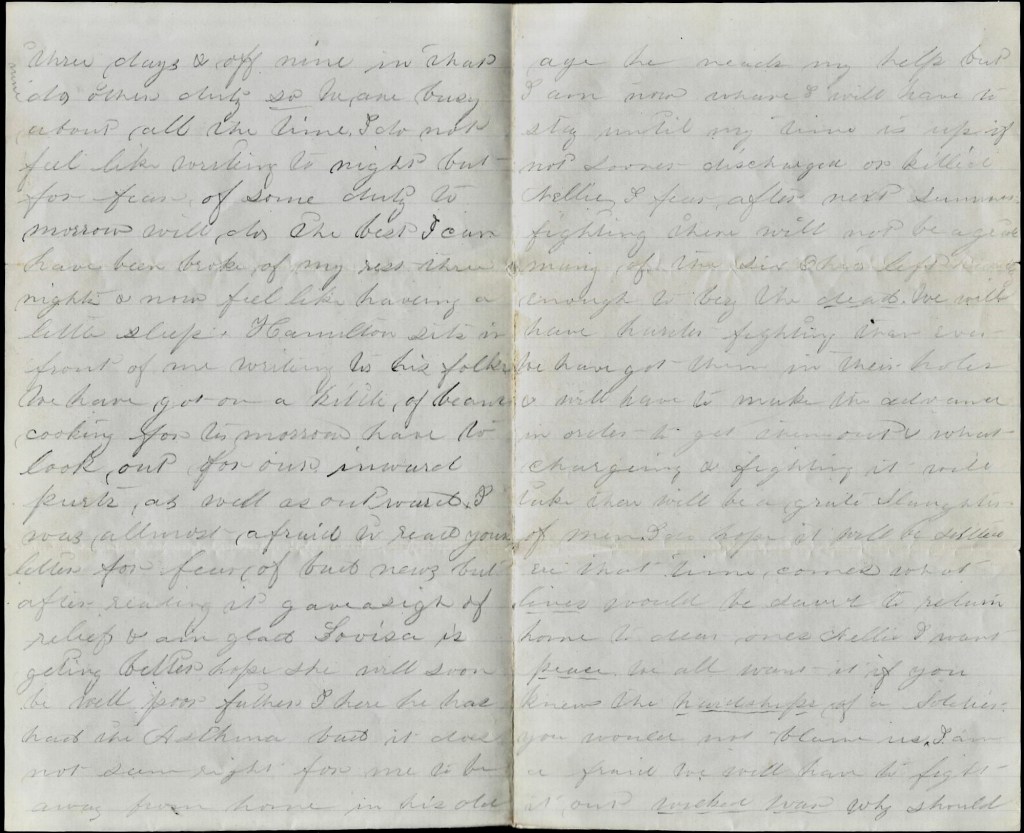
We are on picket three days and off nine. In that time we do other duty so we are busy about all the time. I do not feel like writing tonight but for fear of some duty tomorrow, will do the best I can. Have been broke of my rest three nights & now feel like having a little sleep. Hamilton sits in front of me writing to his folks. We have got a kettle of beans cooking for tomorrow. Have to look out for our inward parts as well as outward.

I was almost afraid to read your letter for fear of bad news but after reading it gave a sigh of relief & am glad Lovisa is getting better. Hope she will soon be well. Poor father, I hear he has had the asthma but it does not seem right for me to be away from home in his old age. He needs my help but I am now where I will have to stay until my time is up, if not sooner discharged or killed.

“I fear after next summer’s fighting there will not be a great many of the Sixth Ohio left—barely enough to bury the dead. We will have harder fighting than ever. We have got them in their holes & will have to make the advance in order to get them out…it will be a great slaughter of men.”

— Pvt. Eberle Underwood, Co. B, 6th OVC, near Petersburg 1.30.65

Nellie, I fear after next summer’s fighting there will not be a great many of the Sixth Ohio left—barely enough to bury the dead. We will have harder fighting than ever. We have got them in their holes & will have to make the advance in order to get them out & what charging & fighting it will take then will be a great slaughter of men. I do hope it will be settled ere that time comes. What lives would be saved to return home to dear ones.

Nellie, I want peace. We all want it. If you knew the hardships of a soldier you would not blame us. I am afraid we will have to fight it out. Wicked war! Why should we kill & be killed?

Well, Nellie, I did not finish this last night. Fell to sleep. This morning the ground is covered with snow but it will not stay on long for the sun is shining warm & bright which will soon deprive the earth of the white cold covering. Wish you would find out if [Col. William] Stedman has tried to get this regiment home. Some thinks he has and some think not. I would like to know. Wish it would go home. We would have a nice time.

Nellie dear, I want you to try and be cheerful and not let your mind rest too much on the loss of that noble soldier—your husband—who died for his country. But think it’s for the best. I was God’s will & let us live in such a way that when He calls us from this earth, we may meet Him in a better [world]. Do not be afraid of your brother leading into bad habits for that will not be. I will return to my home the same, if not better than when I left.

I will close with my love to all. Tell Lovisa I will write to her soon as she can read it. Will son write to Father. Write soon. Goodbye. My love to Nellie. Remember me to friends. Hamilton & I are going to do some work on our shanty today so I will quit.

Your affectionate brother, — Eberle

1864: Joseph H. Corbin to his Father

This letter was written by Joseph H. Corbin (1846-1932) who enlisted in the 44th Ohio Infantry which was later converted into the 8th Ohio Volunteer Cavalry (OVC). Joseph served in Co. G.

Transcription

Harrisburg, Pa.
August 6th 1864

Dear Father,

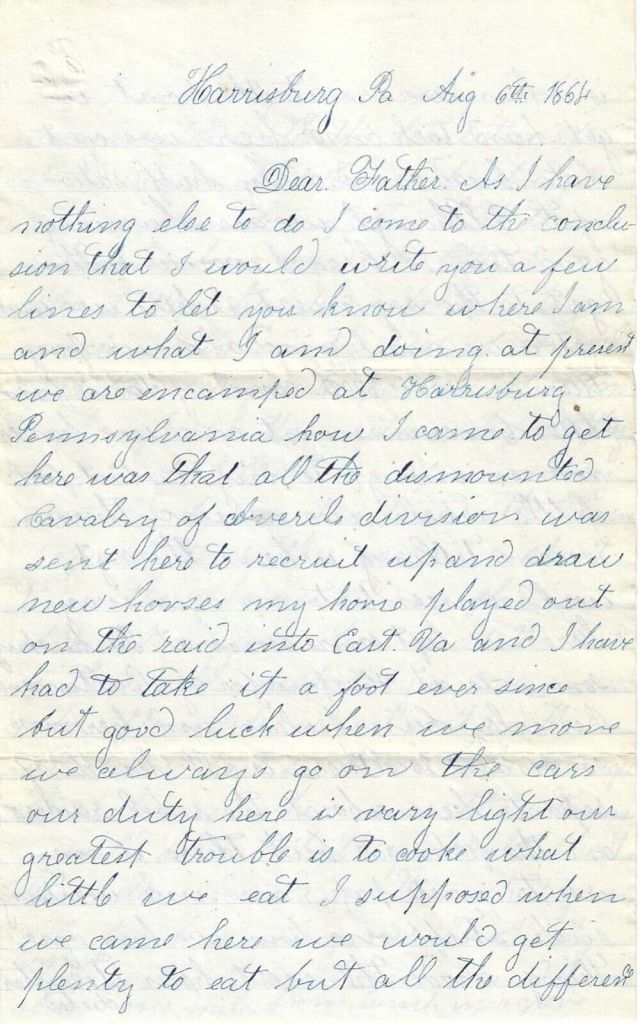
As I have nothing else to do, I come to the conclusion that I would write you a few lines to let you know where I am and what I am doing at present.

We are encamped at Harrisburg, Pennsylvania. How I came to get here was that all the dismounted cavalry of Averill’s Division was sent here to recruit up and draw new horses. My horse played out on the raid into East. Va. and I have had to take it a foot ever since. But good luck when we move. We always go on the cars. Our duty here is very light. Our greatest trouble is to cook what little we eat. I supposed when we came here we would get plenty to eat but all the difference is when we are at the front, we get hard tack, and here we get light bread and only half rations of it.

Although we are having good times here, I would rather get to the regiment where we can get our mail and also our pay. There is now $202 coming to us from the government and we haven’t money enough to buy what few little articles we need. There is no telling when the regt. will concentrate. On our way here, we left some men at Parkersburg, some at Harpers Ferry, Baltimore, Beverly, Cumberland, and here and so on.

There is all kinds of reports here about the rebel raiders on the Potomac but there is no use to waste papers and ink writing such stuff.  One hour we hear one thing and the next hour it is contradicted.

I suppose you are very well acquainted with the localities of Hagerstown, Md. & Chambersburg, Pa. and a number of other little towns between here and the Potomac.  About three hundred rebel cavalry made a raid in the rear of Averill and burned [the] greater portion of Chambersburg and then retired. At first they demanded $100,000 in specie or they would burn the town. The citizens refused to do this and in a short time their houses was in flames. A rebel major who was at the head of the work was shot by a citizen who afterwards went out on the street and put six more holes through the reb Major. Whenever the citizens would see a reb, they would shoot him down and say that’s what you get for burning our property.

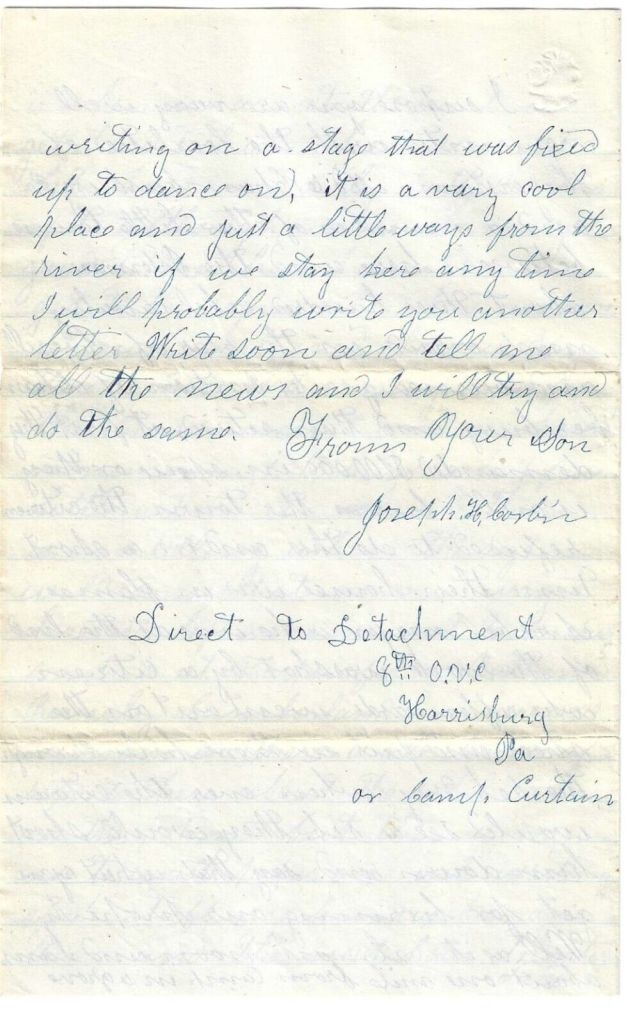
Well it’s almost noon and I am about one mile from Camp in a grove writing on a stage that was fixed up to dance on. It is a very cool place and just a little way from the river. If we stay here any time, I will probably write you another letter. Write soon and tell me all the news adn I will try and do the same.

From your son, Joseph H. Corbin

Direct to Detachment, 8th O. V. C., Harrisburg, Pa. or Camp Curtain

1862: John Tucker to General Magruder

The following “letter” appears to have been intended as a jest and was probably enclosed with another letter written home by John Tucker of the Confederate Service. As there were dozens of John Tucker’s serving in the Confederate army, it’s difficult to say with certainty which one was the author though most of them did not join the service until after this letter was written and many of them only served in the western theatre. I think there is a good possibility that it might have been written by the John Tucker who served in Brander’s company, Virginia Light Artillery (“Letcher Artillery”) that was organized in Richmond during the winter of 1861-62.

Whoever wrote it was probably in winter quarters at Yorktown under the command of General John B. Magruder.

Transcription

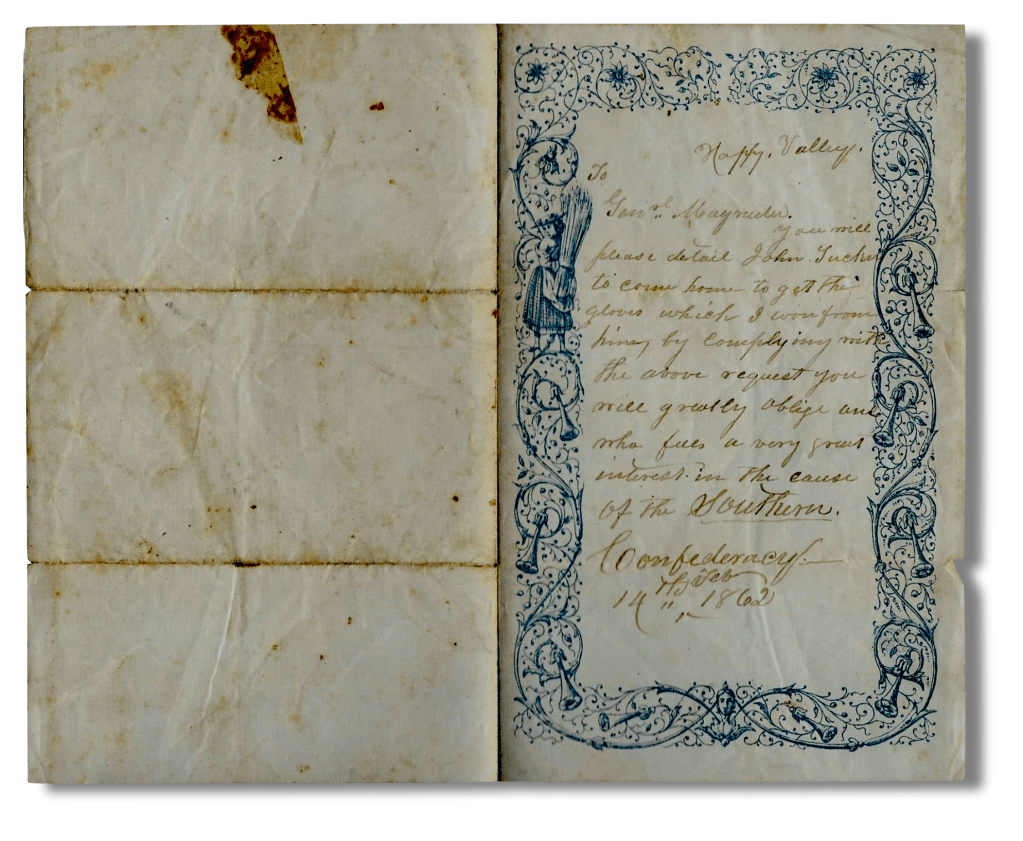
Happy Valley

To General Magruder,

You will please detail John Tucker to come home to get the gloves which I won from him. By complying with the above request, you will greatly oblige one who feels a very great interest in the cause of the Southern Confederacy.

14th February 1862

1857: Henry Lane Kendrick to John Caldwell Tidball

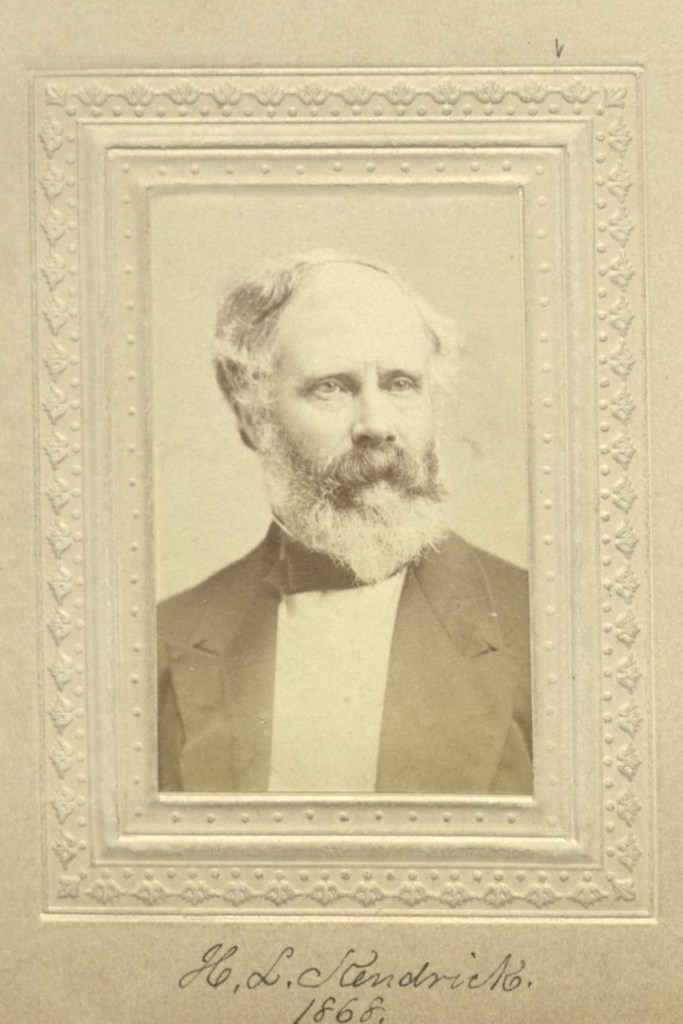
The following letter was written by 46 year-old Henry Lane Kendrick (1811-1891) who gradiated from West Point in 1835. He served as Assistant Professor of Chemistry, Mineralogy and Geology at West Point from 1835 to 1838 and principal Assistant Professor, 1838 to 1847. Kendrick was promoted to 1st Lieutenant, 2nd Artillery, June 16, 1837 and Captain, 2nd Artillery, June 18, 1846.

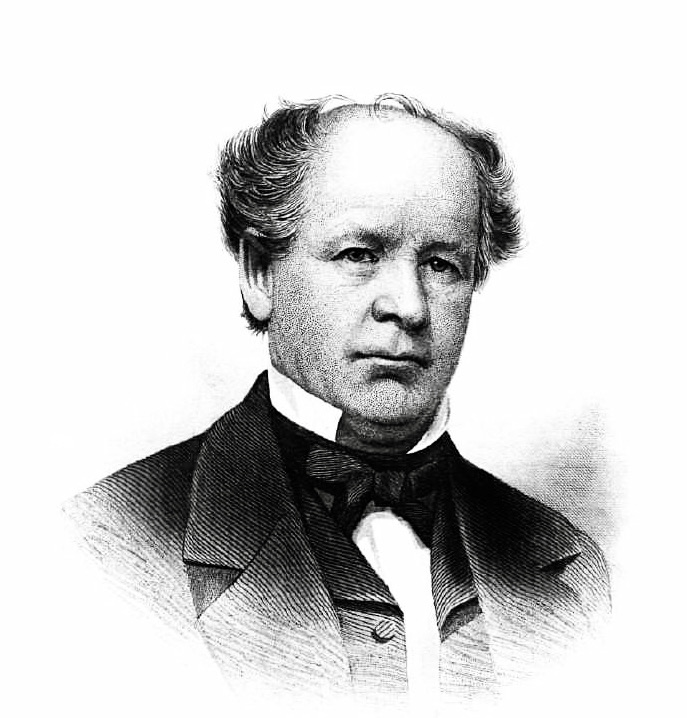
Henry Lane Kendrick

He was in service in the theater during the Mexican War with the 2nd Artillery, participating in the Siege of Vera Cruz, March 10-29, 1847; Battle of Cerro Gordo, April 17-18, 1847; Skirmish at Amazoque, May 14, 1847; and Defense of Puebla, September 13-October 12, 1847 and as Acting Ordnance Officer, December 10, 1847 to June 16, 1848. On October 12, 1847 he received a brevet promotion to Major for gallant and meritorious conduct in the Defense of Puebla. Kendrick was a man most West Point graduates serving in Mexico knew because he taught there from 1838-1847.

Following the Mexican War, Kendrick was on frontier duty in command of an artillery battalion against the Navajo Indians, 1849-1851; commanding escort of Topographical party exploring Indian Country from Zuni River, NM to San Diego, CA, 1851-1852, and between Republican Fork and Arkansas River, 1852. He was in command of Ft. Defiance, NM, 1852-1857 and at the Military Academy as Professor of Chemistry, Mineralogy and Geology, March 3, 1857 to December 13, 1880. In 1859 he was a member of the Board of Assay Commissioners at the U.S. Mint, Philadelphia. He declined a promotion to Brigadier-General of Volunteers in 1861 to remain at West Point, retiring December 13, 1880 after forty- five years service.

Henry wrote the letter to John Caldwell Tidball (1825-1906), an 1848 graduate of West Point. He served in the Third Seminole War fought against the indigenous Seminole tribe, and accompanied an exploring expedition to California in 1853–1854. In 1859 he was sent on the Army’s expedition to Harper’s Ferry, Virginia, to suppress John Brown’s raid.

Fort Defiance, New Mexico Territory (now Arizona)

Transcription

Ft. Defiance, New Mexico
January 31, 1857

Dear Tidball.

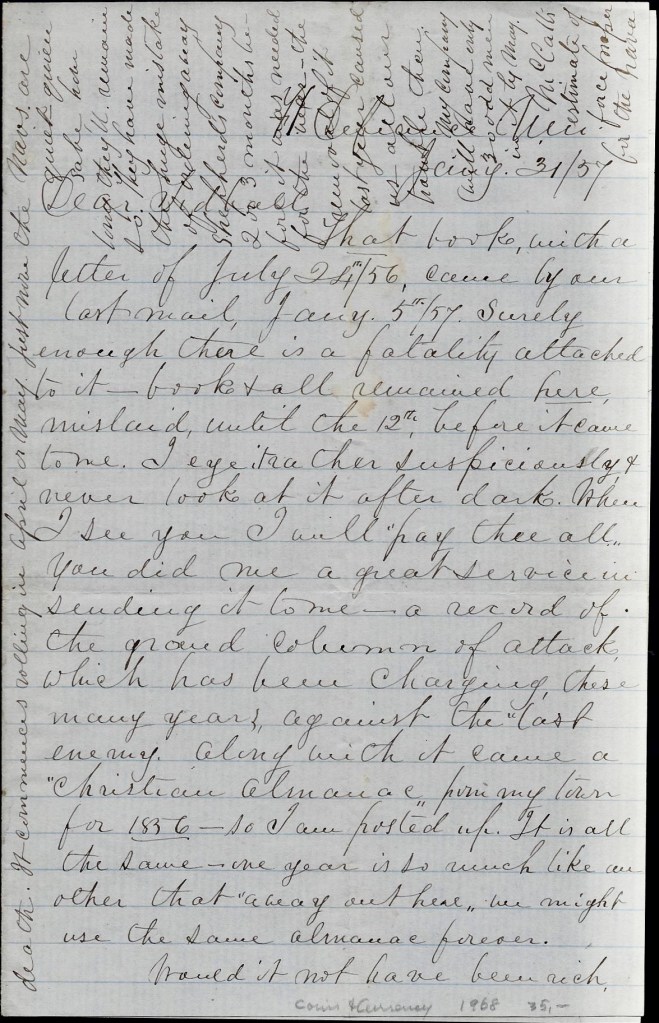
That book, with a letter og July 24th, 1856, came by our last mail, January 5th, 1857. Surely enough there is a fatality attached to it—book and all remained here, mislaid, until the 12th before it came to me. I eye it rather suspiciously & never look at it after dark. When I see you, I will “pay thee all.” You did me a great service in sending it to me—a record of the grand column of attack which has been charging these many years against the “last enemy.” Along with it came a “Christian Almanac” from my town for 1856. So I am posted up. It is all the same—one year is so much like another that “a way out here” [that] we might use the same almanac forever.

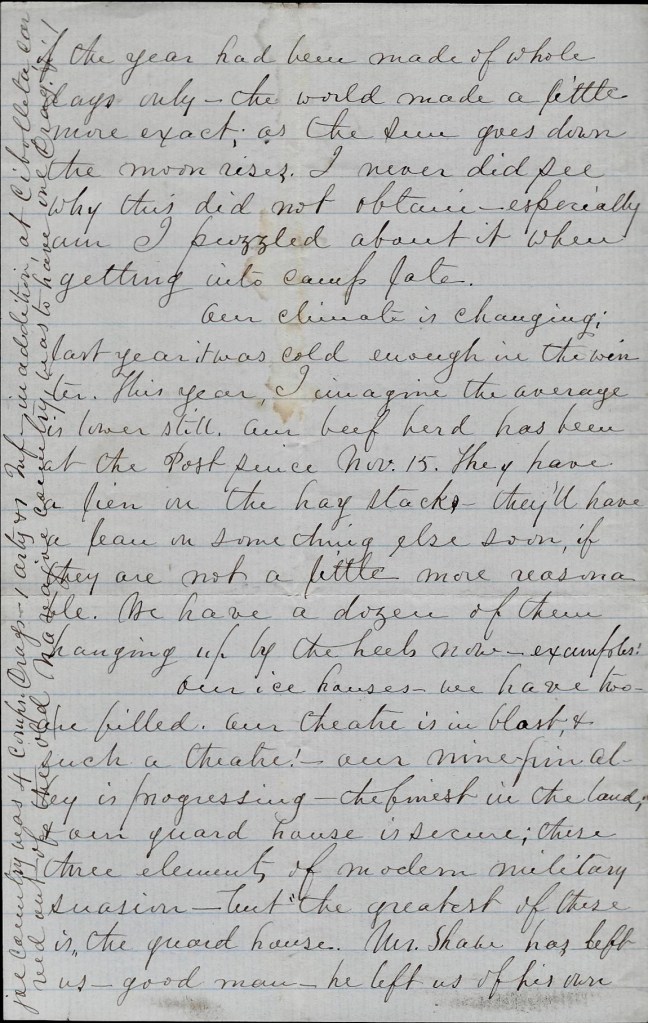
Would it not have been rich if the year had been made of whole days only—the world made a little more exact; as the sun goes down the moon roses. I never dis see why this did not obtain—especially am I puzzled about it when getting into camp late.

Our climate is changing. Last year it was cold enough in the winter. This year, I imagine the average is lower still. Our beef herd has been at the post since November 15th. They have a lien on the hay stacks. They’ll have a lean on something else soon if they are not a little more reasonable. We have a dozen of hem hanging up by the heels now—examples!

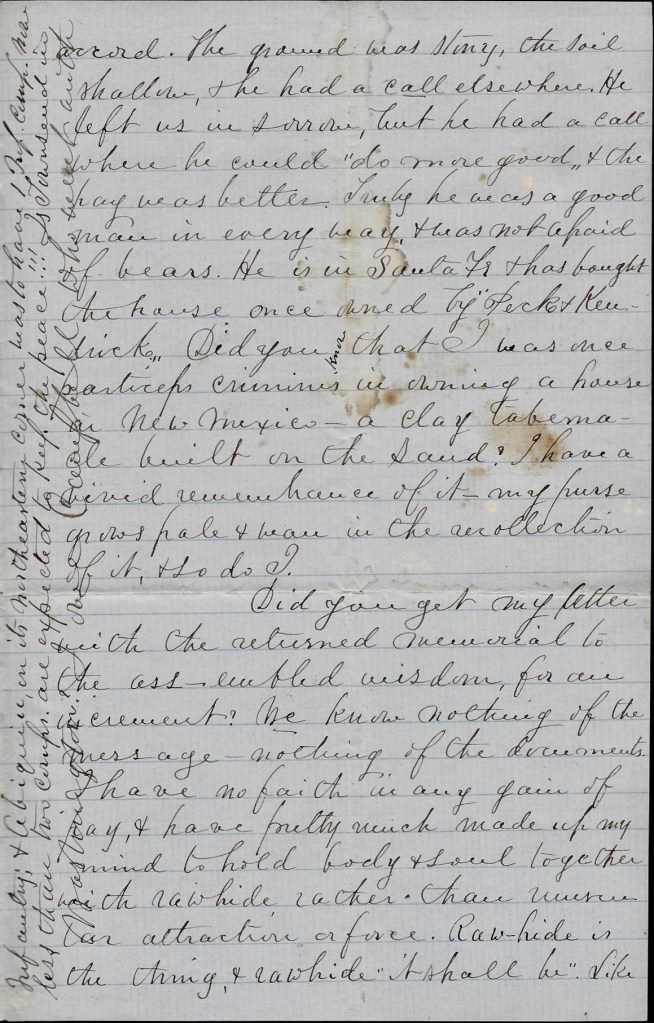
Our ice houses—we have two filled. Our theatre is in blast & such a theatre! Our nine pin alley is progressing—the finest in the land; and our guard house is secure. These three elements of modern military suasion—but the greatest of these is the guard house. Mr. Shabe has left us—good man. He left us of his own accord. The ground was stony, the soil shallow, and he had a call elsewhere. He left us in sorrow, but he had a call where he could “do more good” and the pay was better. Truly he was a good man in every way & was not afraid of bears. He is in Santa Fe & has bought the house once owned by Peck & Kendrick. Did you know that I was once particeps crimines in owning a house in New Mexico—a clay tabernacle built on the sand? I have a vivid remembrance of it. My purse grows pale and [ ] in the recollection of it, & so do I.

Did you get my letter with the returned memorial to the assembled wisdom, for an increment? We know nothing of the message—nothing of the documents. I have no faith in any gain of pay & have pretty much made up my mind to hold body and soul together with rawhide rather than [ ] attraction or force. Rawhide is the thing, and rawhide “it shall be.” Like water in the days of Gil Blas. its virtues are infinite, albeit they are unknown out of this [ ].

February 10th. Our mail is just in from the livery. Nothing beyond N. Mexico. Whether the Indians, or the storms on the plains, or faithless contractors in Missouri have the mail. It is all the horrible same to us. Congress will have adjourned before we read of its first day session. Truly we are a painfully great people.

If the mail has been cut off by Indians, I fear the mail from Santa Few may have been lost & it, January 1st, Santa Fe had my application in it to Army Headquarters to be ordered in with at least the organization of my company. Can you feel gently, very gently, in order to discover whether it has reached anywhere? Under the supposition that I may go it it will be best not to send me things, of much money value.

There is to be a campaign against the Mogollones to avenge [Henry Lafayette] Dodge‘s death. It commences rolling in April or May. Just now the Navahos are quiet–quien sabe. How long they’ll remain so. They have made the huge mistake of ordering away Shepherd’s company 2 or 3 months before it was needed for the war. The removal of it last year caused us all our trouble then. My company will have only 30 odd men in it by May. McCall’s estimate of force proper for the Navajo country was 4 companies dragoons, 1 artillery, and 1 infantry, in addition, at Cibolleta, carved out of the old Navajo country, was to have one dragoon and one infantry & Abiguin, in its northeastern corner was to have 1 infantry company, now less than two companies are expected to keep the peace!!! Is Townsend in Washington? I owe Campbell who went with you to California, which I intend to pay as soon as I can find anything to pay with. Regards to him/

Yours most truly, — H. L. Kendrick

1864: Thomas Wright Oziah to his cousin Ann

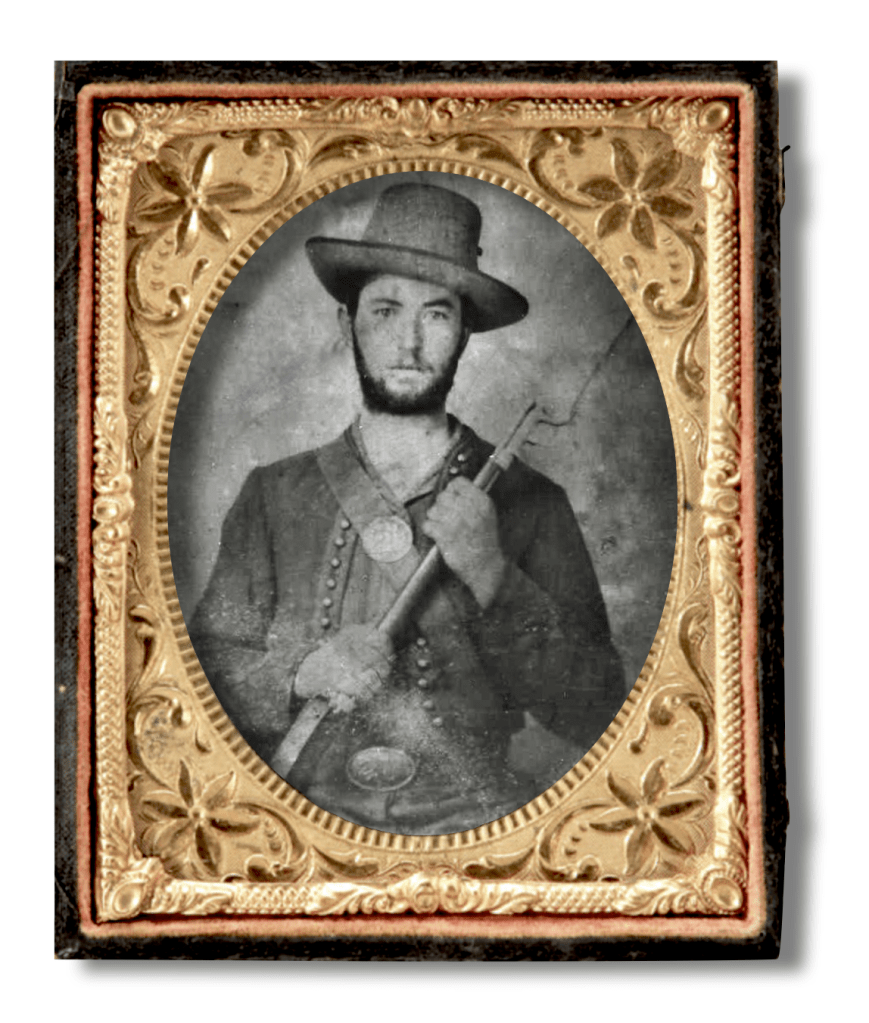
I could not find an image of Thomas but here is Luman Fowler (1841-1924) who served in Co. C, 19th Illinois Infantry wearing his enlistment Zouave uniform. Ancestry.com.

The following letters were written by Thomas Wright Oziah (1836-1908) of Co. B., 19th Illinois Infantry. Company B was raised in Stark county, Illinois, most of the members mustering into State service in May 1861 and into the United States Service for three years on 17 June 1861.

At the time that Thomas mustered into the regiment, he was described as a 25 year-old, brown-haired, blue-eyed “Miller” who towered over his comrades at 6 foot, 1 inch. During a portion of his time in the service, Thomas was detailed to the 14th Army Corps Headquarters to serve as a clerk for General Thomas.

After the war, Thomas married in 1867 to Hannah I. Meredith, and resumed his employment as a miller in Stark county. His parents were Anthony Oziah (1793-1848) and Anna Jayne (1797-1876). In his letter, Thomas mentions two brothers—James K. Oziah (1839-1879) who served in Co. I, 65th Illinois Infantry, and David Jayne Oziah (1819-1895), Co. B, 47th Illinois Infantry. Another brother, George W. Oziah (1832-1863) of Toulon, served in Co. F, 112th Illinois Infantry and died on 14 March 1863 at a hospital in Lexington, Kentucky.

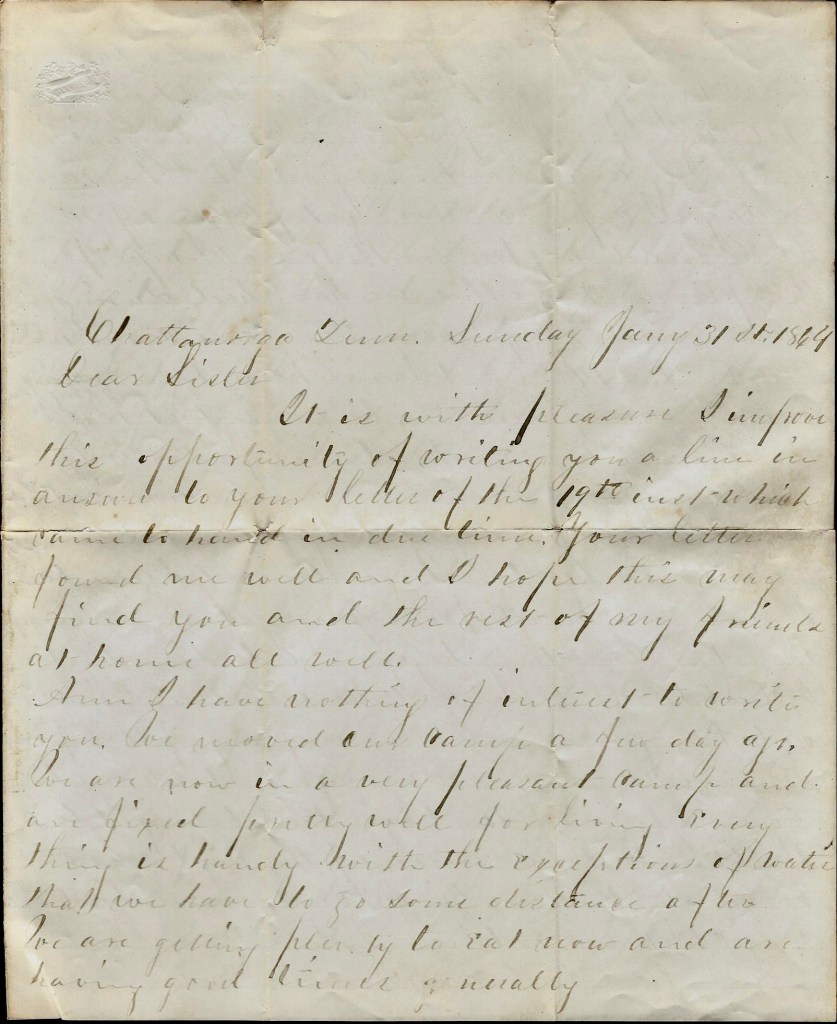
Letter 1

Chattanooga, Tennessee
Sunday, January 31, 1864

Dear Sister,

It is with pleasure I improve this opportunity of writing you a line in answer to your letter of the 19th inst. which came to hand in due time. Your letter found me well and I hope this may find you and the rest of my friends at home all well.

Ann, I have nothing of interest to write you. We moved our camp a few days ago. We are now in a very pleasant camp and are fixed pretty well for living. Everything is handy with the exception of water that we have to go some distance after. We are getting plenty to eat now and are having good times generally.

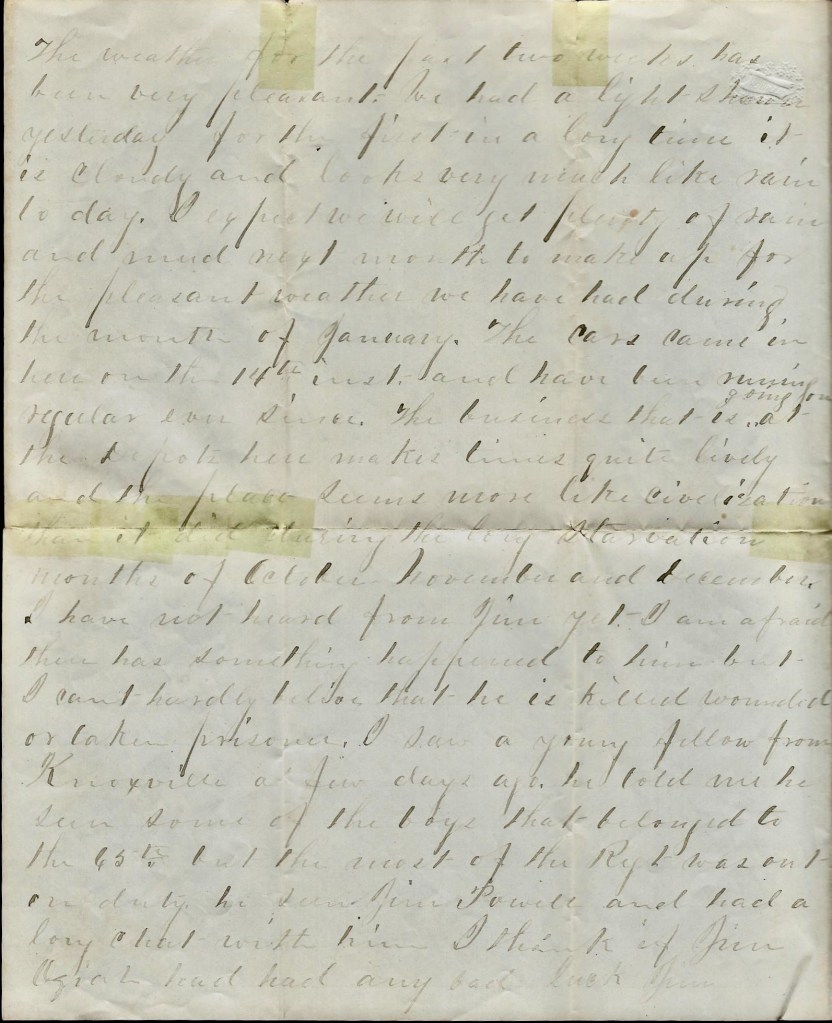
The weather for the past two weeks has been very pleasant. We had a light shower yesterday for the first in a long time. It is cloudy and looks very much like rain today. I expect we will get plenty of rain and mud next month to make up for the pleasant weather we have had during the month of January.

The cars came in here on the 14th inst. and have been running regular ever since. The business that is going on at the Depots here makes times quite lively and the place seems more like civilization than it did during the long starvation months of October, November, and December.

I have not hear from Jim yet. I am afraid there has something happened to him but I can’t hardly believe that he is killed, wounded, or taken prisoner. I saw a young fellow from Knoxville a few days ago. He told me he seen some of the boys that belonged to the 65th but the most of the regiment was out on duty. He saw Jim Powell and had a long chat with him. I think if Jim Oziah had had any bad luck, Jim Powell would have said something about it to this fellow. It was about four weeks ago that he seen Jim Powell.

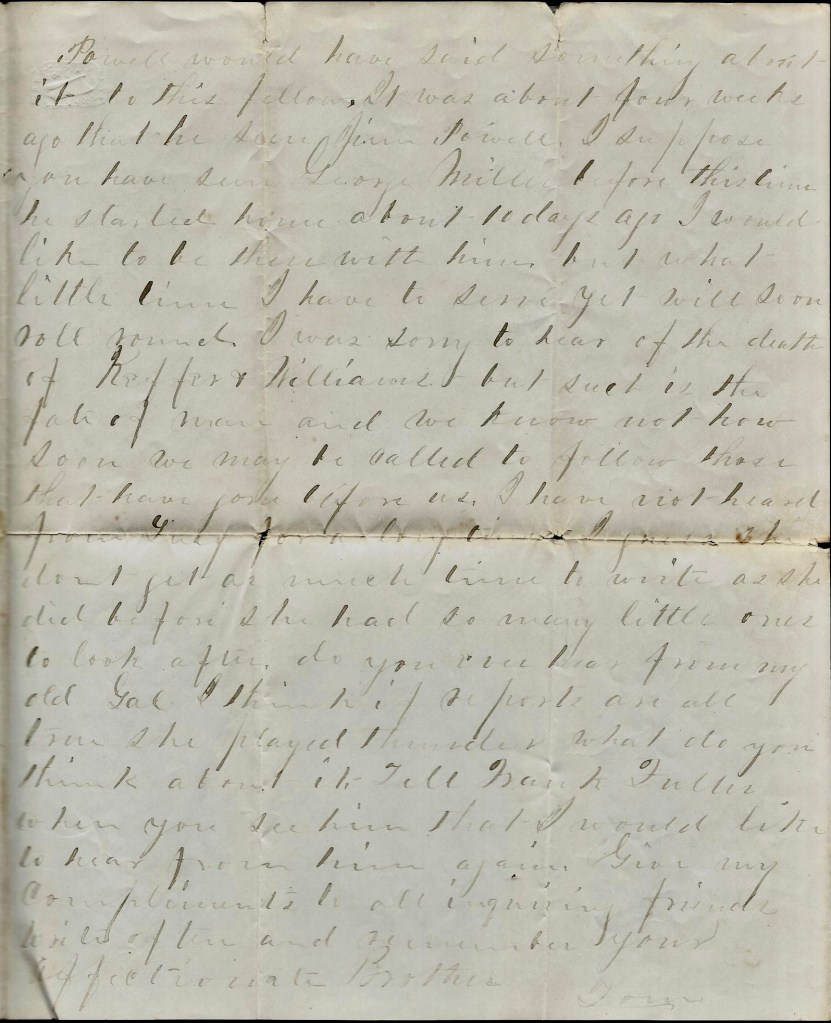
I suppose you have seen George Miller before this time. He started home about 10 days ago. I would like to be there with him but what little time I have to serve yet will soon roll round. I was sorry to hear of the death of Keffer &Williams but such is the fate of man and we know not how soon we may be called to follow those that have gone before us. I have not heard from Lucy for a long time so I guess she don’t get as much time to write as she did before. She had so many little ones to look after. Do you ever hear from my old gal? I think if reports are all true, she played thunder. What do you think about it?

Tell Frank Fuller when you see him that I would like to hear from him again. Give my compliments to all inquiring friends. Write often and remember your affectionate brother, — Tom


Letter 2

Graysville, Georgia
March 12th 1864

Dear Sister,

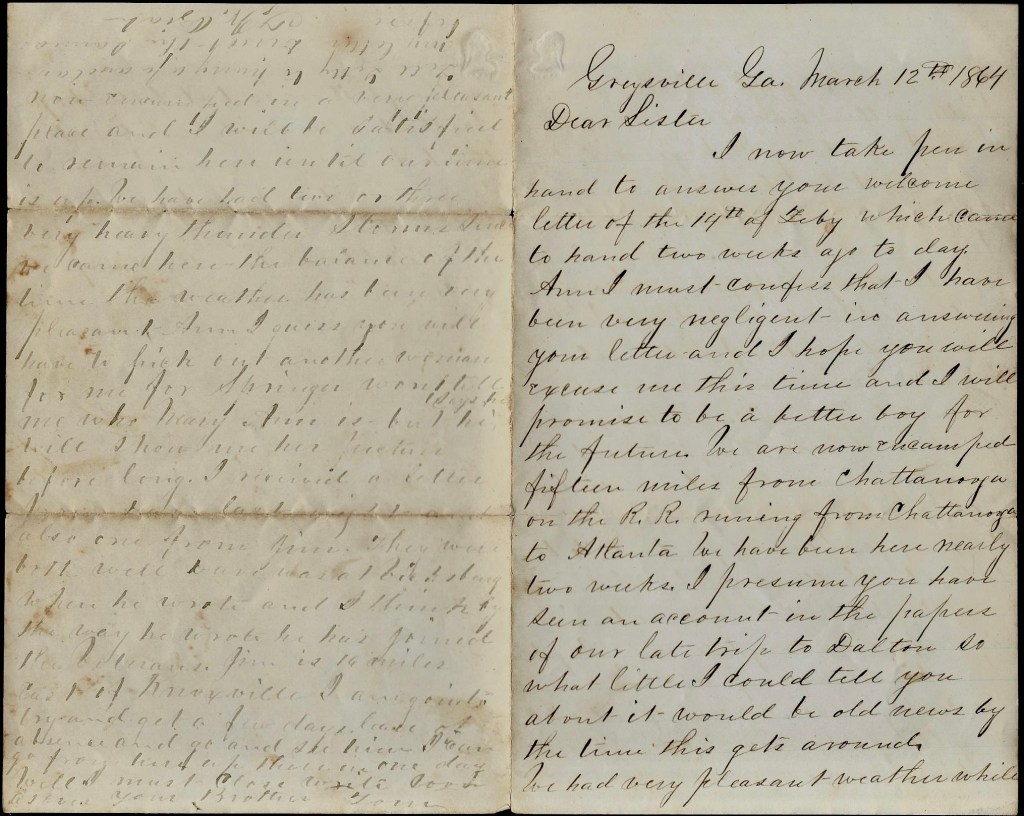
I now take my pen in hand to answer your welcome letter of the 14th of February which came to hand two weeks ago today. Ann, I must confess that I have been very negligent in answering your letter and I hope you will excuse me this time and I will promise to be a better boy for the future.

We are ow encamped fifteen miles from Chattanooga on the railroad running from Chattanooga to Atlanta. We have been here nearly two weeks. I presume you have seen an account in the papers of our late trip to Dalton so what little I could tell you about it would be old news by the time this gets around.

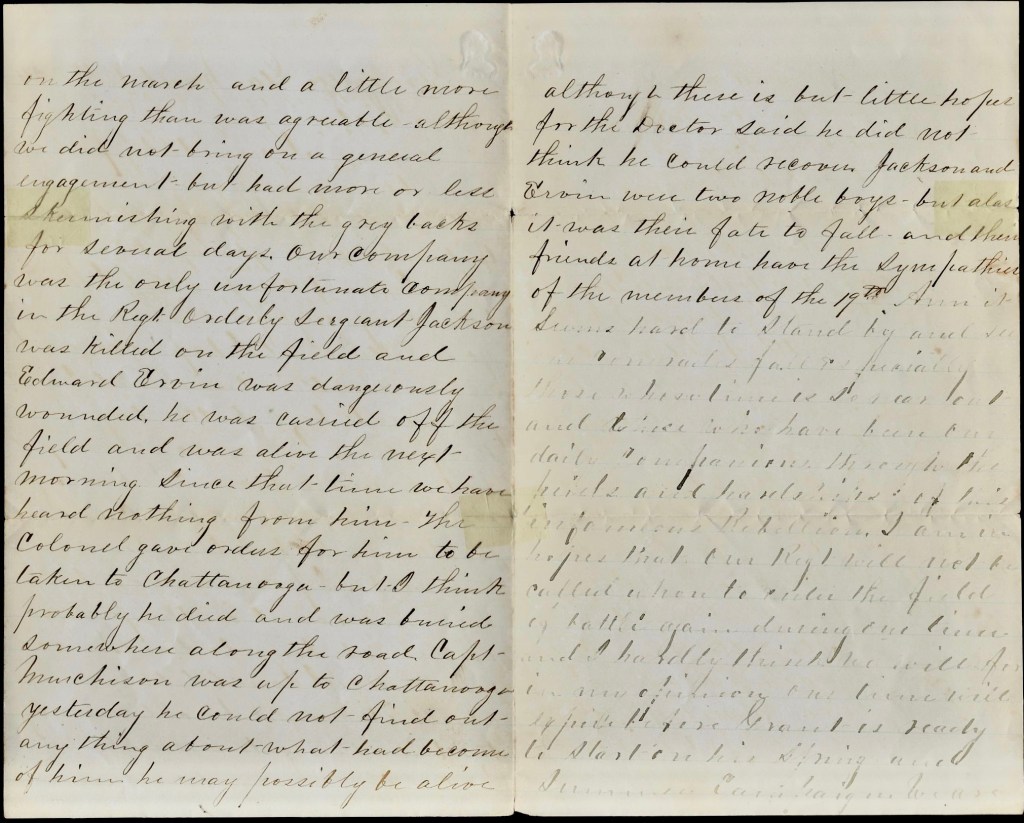
We had very pleasant weather while on the march and a little more fighting than was agreeable although we did not bring on a general engagement but had more or less skirmishing with the gray backs for several days. Our company was the only unfortunate company in the regiment. Orderly Sergeant [James] Jackson was killed on the field and Edward Ervin was dangerously wounded. He was carried off the field and was alive the next morning. Since that time we have heard nothing from him. The Colonel gave orders for him to be taken to Chattanooga but I think probably he died and was buried somewhere along the road. Capt. [Alexander] Murchison was up to Chattanooga yesterday. He could not find out anything about what had become of him. He may possibly be alive although there is but little hope for the doctor said he did not think he could recover. Jackson and Ervin were two noble boys. But alas, it was their fate to fall and their friends at home have the sympathies of the members of the 19th.

Ann, it seems hard to stand by and see our comrades fall—especially those whose time is so near out and those who have been our daily companions through the trials and hardships of this infamous rebellion. I am in hopes that our regiment will not be called upon to enter the field of battle again during our time and I hardly think we will for in my opinion our time will expire before Grant is ready to start on his spring and summer campaign.

We are now encamped in a very pleasant place and I will be satisfied to remain here until out time is up. We have had two or three very heavy thunder storms since we came here. The balance of the time the weather has been very pleasant. Ann, I guess you will have to pick out another woman for me for Springer won’t tell me who Mary Ann is but he will show me her picture before long. I received a letter from Dave last night and also one from Jim. They were both well. Dave was at Vicksburg when he wrote and I think by the way he wrote, he has joined the Veterans. Jim is 16 miles east of Knoxville. I am going to try and get a few days leave to go from here up there in one day.

Well, I must close. Write soon. As ever, your brother, — Tom

Tell Letty to hurry up and answer my letter. Direct the same as before. — T. W. Oziah

1862-63: Henry Burton Stone to Sarah (Benjamin) Stone

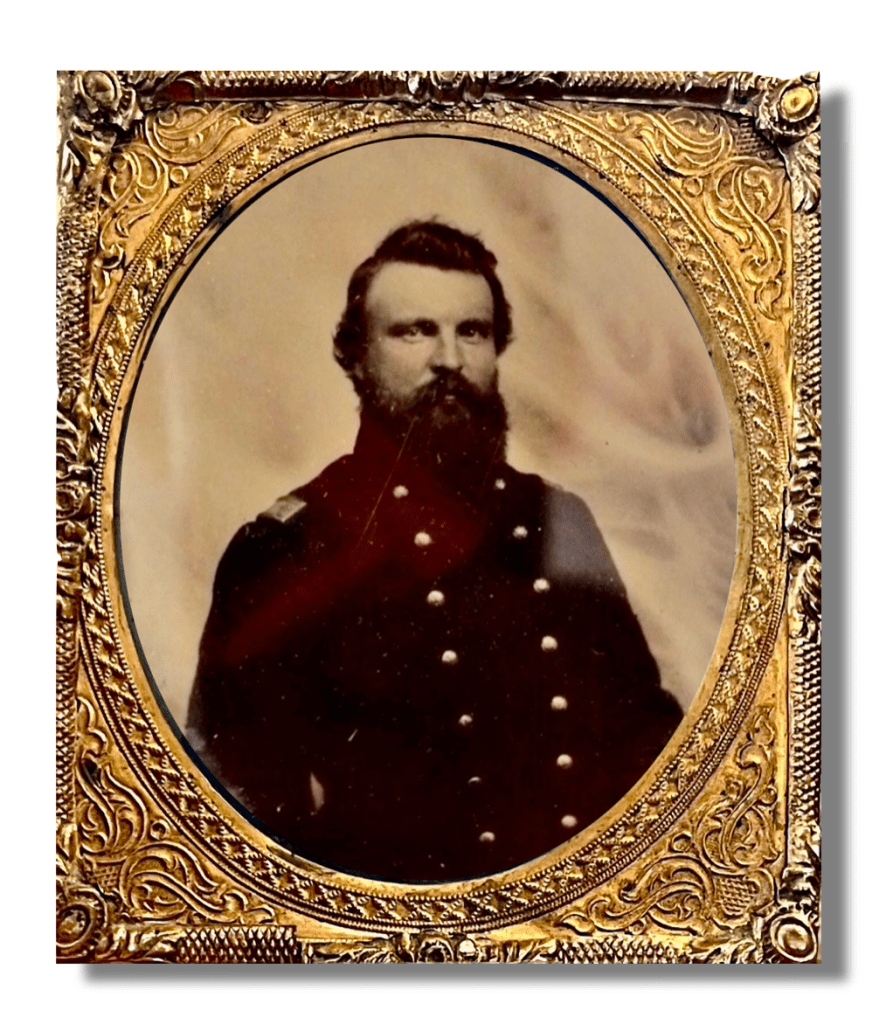
Lt. Col. Henry Burton Stone of the 5th Connecticut Infantry

My friend John Banks sent me the following message recently and asked if I would be willing to share it on Spared & Shared.

“I recently received from a family member a remarkable cache of photos and letters pertaining to Lt. Col. Henry Burton Stone (1827-1863) of the 5th Connecticut who suffered a severe thigh wound at Cedar Mountain on Aug. 9, 1862, and died months later in captivity in Charlottesville, Va. Stone was initially buried there and then removed for final burial in Culpeper National Cemetery, presumably after the war.

In addition to a letter from Stone to his wife while he lay in captivity, there are two remarkable letters from Confederate surgeon John S. Davis to friends of Stone back in Connecticut. They detail the care for Stone, his final days, etc.—heartrending stuff. I wrote a short story on Stone in my second book, but to my knowledge the letters have never appeared anywhere in their entirety. I also wrote a short article on Lt. Col. Henry B. Stone on my Civil War Blog entitled, “Wounded at Cedar Mountain, officer ‘sleeps on the enemy’s soil.'”

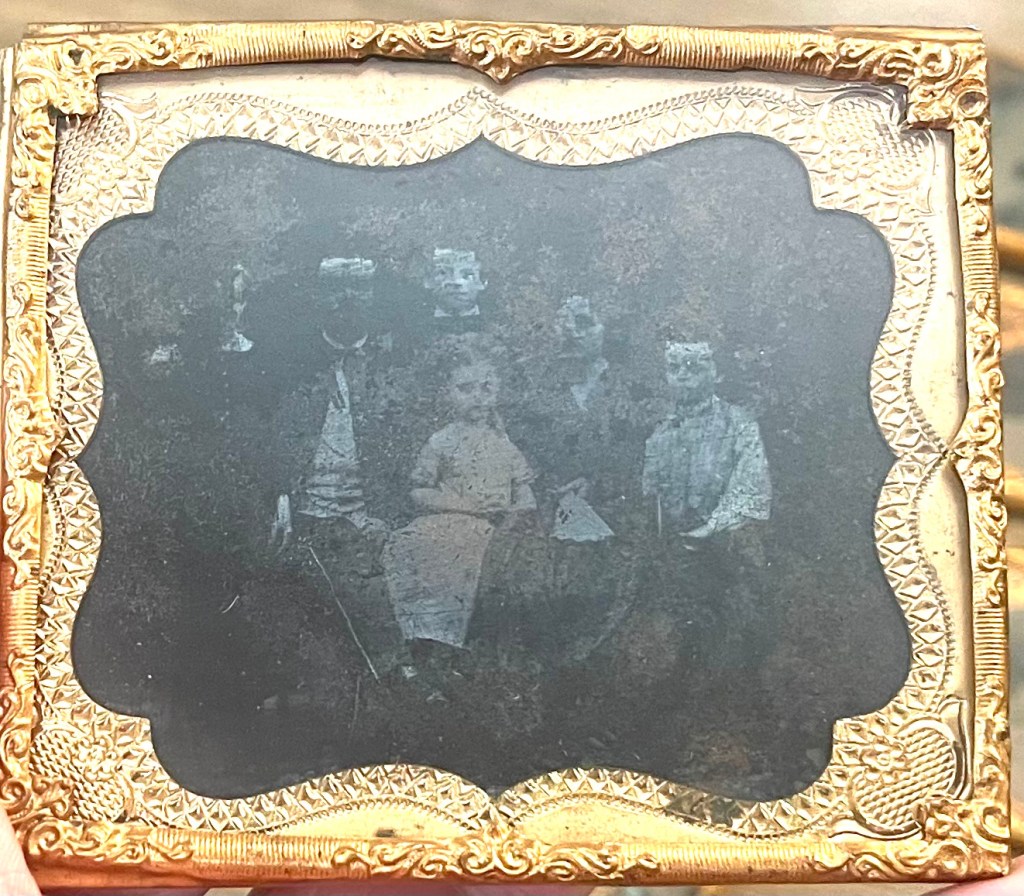
The small collection includes a sixth-plate ruby ambrotype of Stone in uniform, a pre-war image of Stone; two images of his sons, Melville and Theodore; two letters from the Confederate surgeon, John S. Davis, who treated him while in captivity until his death; and a letter from Stone to wife while he lay in captivity. There is also a family image that is poor.”

Letter 1

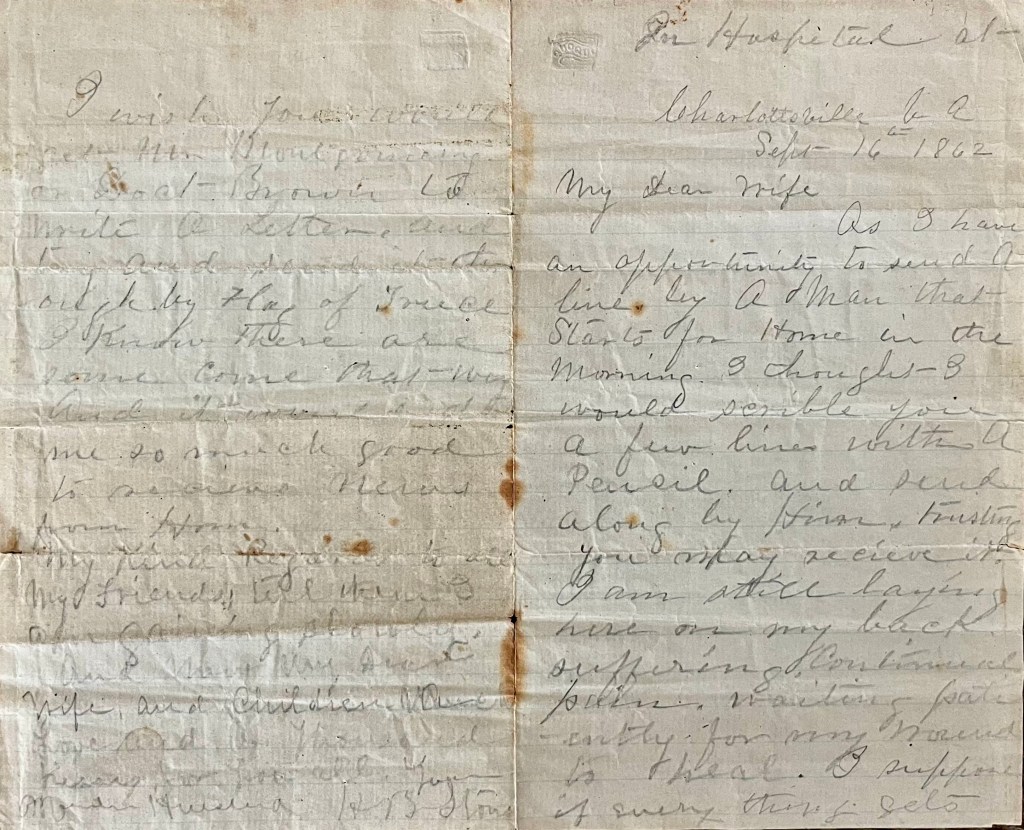
In Hospital at Charlottesville, Va.
September 16, 1862

My Dear Wife,

As I have an opportunity to send a line by a man that starts for home in the morning, I thought I would scribble you a few lines with a pencil and send along by him, trusting you may receive it.

I am still laying here on my back suffering continual pain waiting patiently for my wound to heal. I suppose if everything gets along as well as usual, I shall have to lay here in this position about 4 weeks longer when they will take it out of the splint and allow me to move about more in bed. I hope in two or three months to be able to hobble about on crutches if no other disease takes hold of me.

How anxious I am to hear from some of you and about the regiment. How many were killed and wounded? I know nothing about it—only what I saw before I was shot. I am anxious to know if my horses and trunk and baggage were saved and sent home. The loss of them would be the loss of 6 or 7 hundred dollars or more. Doct. Bennett promised to look after them if occasion should require, and probably did, if not killed or wounded.

How anxious I am to get able to be paroled (if they parole officers now). But I must wait patiently and so must you. I wish you would get. Mr. Montgomery or Doct. Brown to write a letter and try and send it through by Flag of Truce. I know there are some come that way and it would do me so much good to receive news from home.

My kind regards to all my friends. Tell them I am gaining slowly and send my dear wife and children love and a thousand kisses for you all. Your husband, — H. B. Stone


Letter 2

John S. Davis, the Confederate surgeon who treated
wounded 5th Connecticut officer Henry Stone.
(Special Collections, University of Virginia Library)

General Hospital
Charlottesville [Virginia]
January 21st 1863

Wm. A. Montgomery, Esq.,

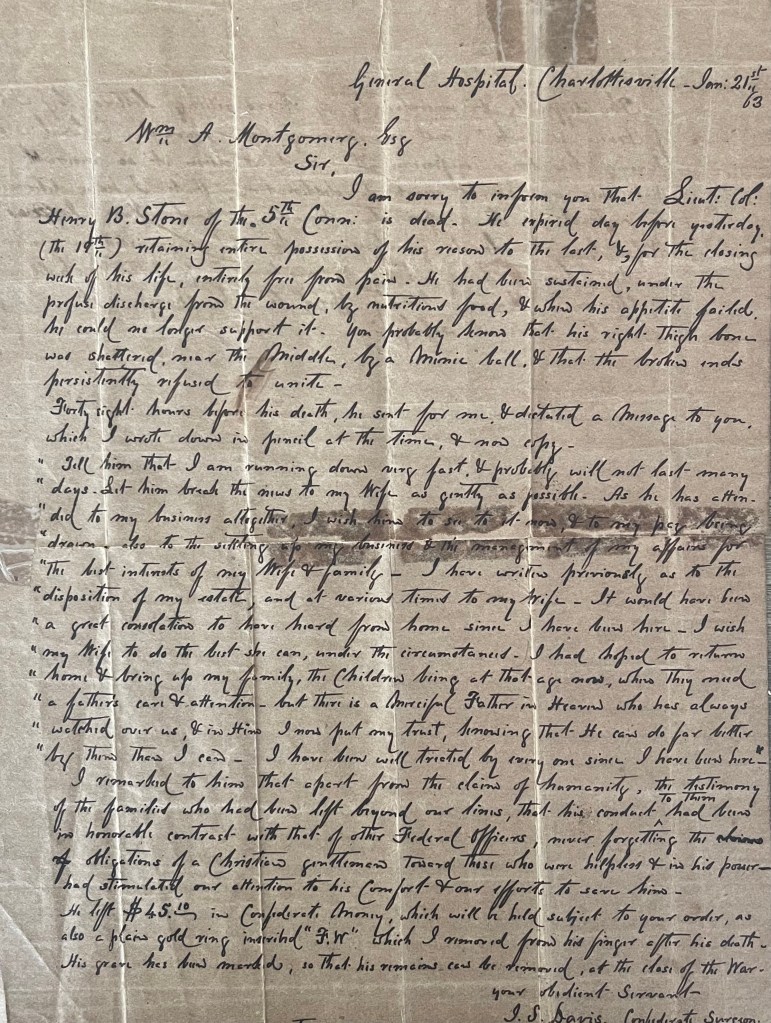
Sir, I am sorry to inform you that Lieut. Colonel Henry B. Stone of the 5th Connecticut is dead. He expired day before yesterday (the 19th) retaining entire possession of his reason to the last, &, for the closing week of his life, entirely free from pain. He had been sustained under the profuse discharge from the wound, by nutritious food, & when his appetite failed, he could no longer support it. You probably know that his right thigh bone was shattered near the middle by a minié ball & that the broken ends persistently refused to unite.

Forty-eight hours before his death, he sent for me & dictated a message to you which I wrote down in pencil at the time and now copy.

“Tell him that I am running down very fast and probably will not last many day. Let him break the news to my wife as gently as possible. As he has attended to my business altogether, I wish him to see to it now, & to my pay being drawn. Also to the settling up my business & the management of my affairs for the best interests of my wife and family. I have written previously as to the disposition of my estate, and at various times to my wife. It would have been a great consolation to have heard from home since I have been here. I wish my wife to do the best she can under the circumstances. I had hoped to return home & bring up my family, the children being at that age now when they need a father’s care and attention, but there is a merciful Father in Heaven who has always watched over us and in Him I now put my trust, knowing that He can do far better by them than I can. I have been well treated by everyone since I have been here.”

I remarked to him that apart from the claim of humanity, the testimony of the families who had been left beyond our lines, that his conduct to them had been in honorable contrast with that of other Federal officers, never forgetting the obligations of a Christian gentleman toward those who were helpless & in his power had stimulated our attention to his comfort & our efforts to save him. He left $45.10 in Confederate money which will be held subject to your order, as also a plain gold ring inscribed “F. W.” which I removed from his finger after his death. His grave has been marked so that his remains can be removed at the close of the war.

Your obedient servant, — J. S. Davis, Confederate Surgeon

The difficulty & uncertainty of transmitting letters by Flag of Truce us such (not one having ever reached Colonel Stone during his long confinement) and I deem it so desirable that this one should reach its destination that I have determined to entrust it to a private hand and Mrs. Jeff [smudged], the wife of a Maryland gentleman who had manifested and interest in the Colonel, being about to visit her parents and child in Baltimore, having kindly offered to take charge of it. I hope you will receive it safely.


Letter 3

General Hospital
Charlottesville [Virginia]
February 21, 1863

Dr. E. A. Brown,

Dear sir, your letter of the 4th inst., inquiring the condition of Lieut. Col. Stone, has just reached me. I am sorry to inform you that he died here on the 20th of January. Immediately after, I wrote at some length to Mr. Montgomery of Danburg, communicating such facts as I thought might interest the friends of the deceased & conveying certain messages which he entrusted to me when he saw that his death was approaching. Feeling more than usual anxiety that the letter should reach its destination, & having learned by experience that the “Flag of Truce” is uncertain, I gave it to a Maryland lady whose husband had been very kind to the Colonel, and who, having been long separated from her child in Baltimore, was about to attempt her return. She promised to mail it as soon as she passed the Federal lines, & but for her detention it would long since have been received. I am hopeful that it may arrive soon.

Overwhelmed with business, I fear that my memory will not enable me to reproduce its contents. I recollect he requested “Mr. Montgomery” to settle up his affairs, to draw his arrears of pay from the government, and to manage his estate for the benefit of his widow and children. He expressed entire resignation to his fate, & cheerfully entrusted to the covenant care of his God the interests of those whom he left in sorrow. Throughout his long confinement he had received the same care and attention that we bestow on Confederate soldiers and strenuous efforts were made to stimulate the failing appetite which hastened, if it did not occasion, the fatal result.

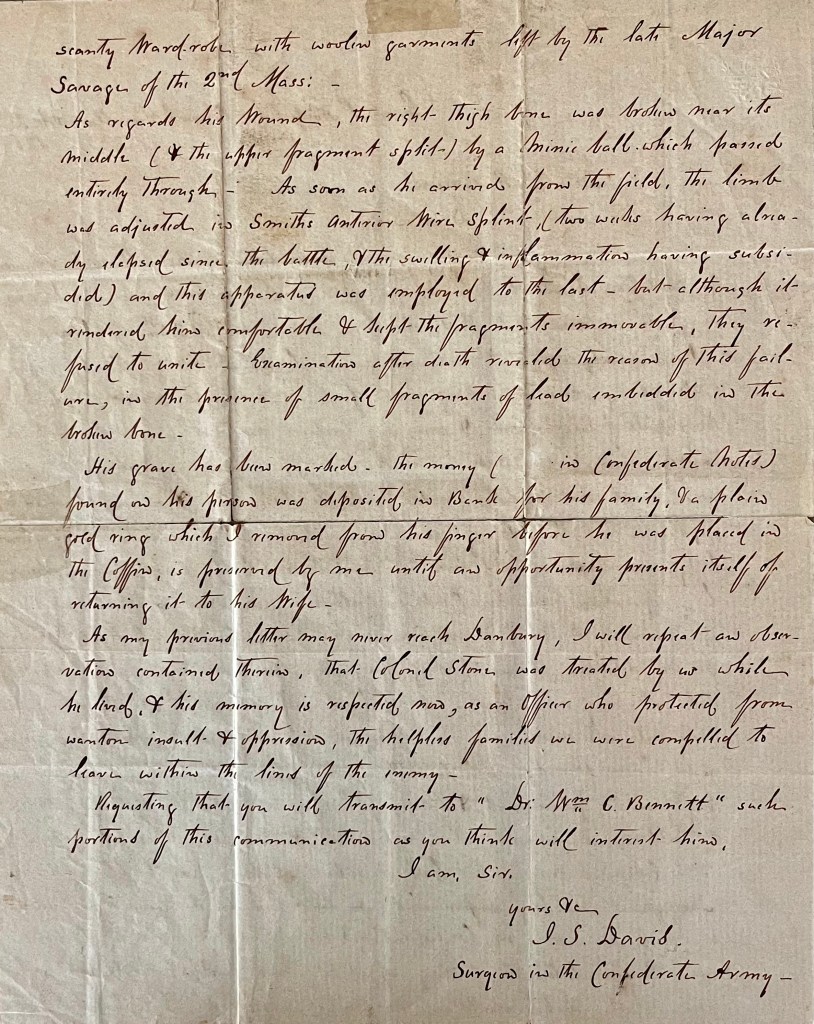
As winter approached, I replenished his scanty wardrobe with woolen garments left by the late Major Savage of the 2nd Massachusetts.

As regards his wound, the right thigh bone was broken near its middle (and the upper fragment split) by a minié ball which passed entirely through. As soon as he arrived from the field, the limb was adjusted in Smith’s Anterior Wire Splint (two weeks having already elapsed since the battle & the swelling & inflammation having subsided) and this apparatus was employed to the last—but although it rendered him comfortable & kept the fragments immovable, they refused to unite. Examination after death revealed the reason of this failure in the presence of small fragments of led embedded in the broken bone.

His grave has been marked. The money in Confederate notes found on his person was deposited in bank for his family & a plain gold ring which I removed from his finger before he was placed in the coffin is preserved by me until an opportunity presents itself of returning it to his wife.

As my previous letter may never reach Danbury, I will repeat an observation contained therein—that Col. Stone was treated by us while he lived & his memory is respected now as an officer who protected from wanton insult and oppression the helpless families we were compelled to leave within the lines of the enemy.

Requesting that you will transmit to “Dr. Wm. C. Bennett” such portions of this communication as you think will interest him, I am, Sir, yours &c. — J. S. Davis, Surgeon in the Confederate Army

1863: Daniel Bacon Messinger to Darwin W. Esmond

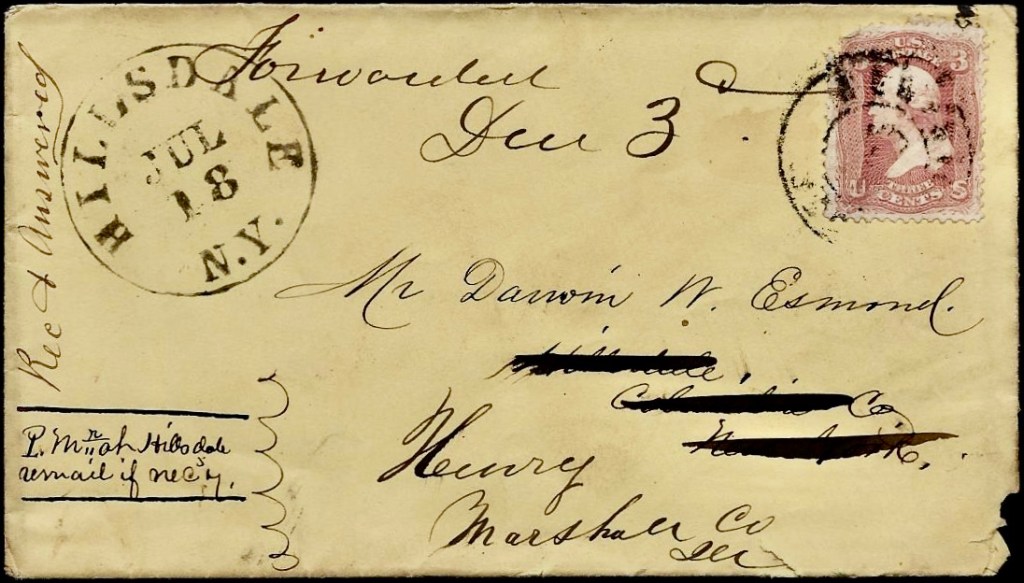
The following letter was undoubtedly written by 27 year-old Daniel Bacon Messinger, who was enumerated in the Draft Registration Records taken in June 1863 (just prior to the date of this letter) as a resident—a “surgeon”—of Hillsdale, Columbia county, New York. A search of military records reveals that he was not in the service, however, at the time that he wrote this letter from the headquarters of the 6th Missouri Cavalry at Camp Wright on 2 July 1863. The location of the camp is not given but it is presumed they were among the troops laying siege to Vicksburg at the time. How or why Daniel came to be at the camp remains a mystery but my hunch is that he was hired as a civilian to augment the medical staff. Civilian doctors were hired during the Civil War but held no commissions and did not wear uniforms. There was little or no military board review for volunteer or contracts surgeons either. It is estimated that as many as 5500 civilian doctors assisted the military during the war.

Daniel attended the University of Michigan in 1864 and in 1871 graduated from the Bellevue Medical College of New York. He was born in Egremont, Berkshire county, Massachusetts, on 7 May 1836, the son of William Henry Messenger (1793-1852) who emigrated from Massachusetts to Michigan before his death in 1852. His mother was Annie Winchell (1793-1877).

Transcription

Addressed to Mr. Darwin W. Esmond, Henry, Marshall county, Illinois

In the Field
Headquarters 6th Missouri Cavalry
at Camp Wright
July 2, 1863

Darwin Esmond, Esqr.,

Dear Cousin. You promised me when I parted with you that all letters you received from me wold be duly answered. You said this in a smiling manner but I presume you were in earnest and that you will keep your word. I have for several obvious reasons neglected writing to you and therefore, you will not be surprised to receive a letter from me at this late date. I have the satisfactions of informing you that I am very well though how long I may be is a dubious proposition for the weather is very dry & hot & being camped on level ground and among timber (something like I have seen in “openings” in Michigan or the blue grass region of Kentucky), the breezes do not play through my tent to tent to the extent I would like.

But the nights are beautiful now, cool and pleasant, and during these moonlit nights I have frequently been impressed with the requisite beauty of the scene spread before me—the fading campfires, the pale radiance of the glinting moon beams on the foliage and tents, squads of our troopers coming in from a scout or going out to relieve pickets, the swelling cadence of a few singing praises to God, the mellow notes of the bugle calling retreat to quarters—-all this and more attracts my notice & thrills me with its peculiar power.

A. R. Waud’s sketch of a nighttime encampment

The regiment was raised in southwest Missouri and many of the officers and men are of the fearless type of frontiersmen. They have been in over 20 fights & have not been whipped but once and then [only] by overpowering numbers. The chaplain quit some time since in Missouri having been elected member of Legislature. Whiskey, poker, and Seven Up 1, etc. etc. are sometimes heard of here. And the only way I can tell when the Sabbath comes is by the extra number of negro wenches gaudily dressed who perambulate about the camp, visiting the cooks and servants of the officers. One ambulance driver and two cooks for surgeon’s mess & hospital on blocks. I write you these trifles incident to camp in lieu of anything more important knowing that you get by telegraph all the interesting army news long before you could by letter.

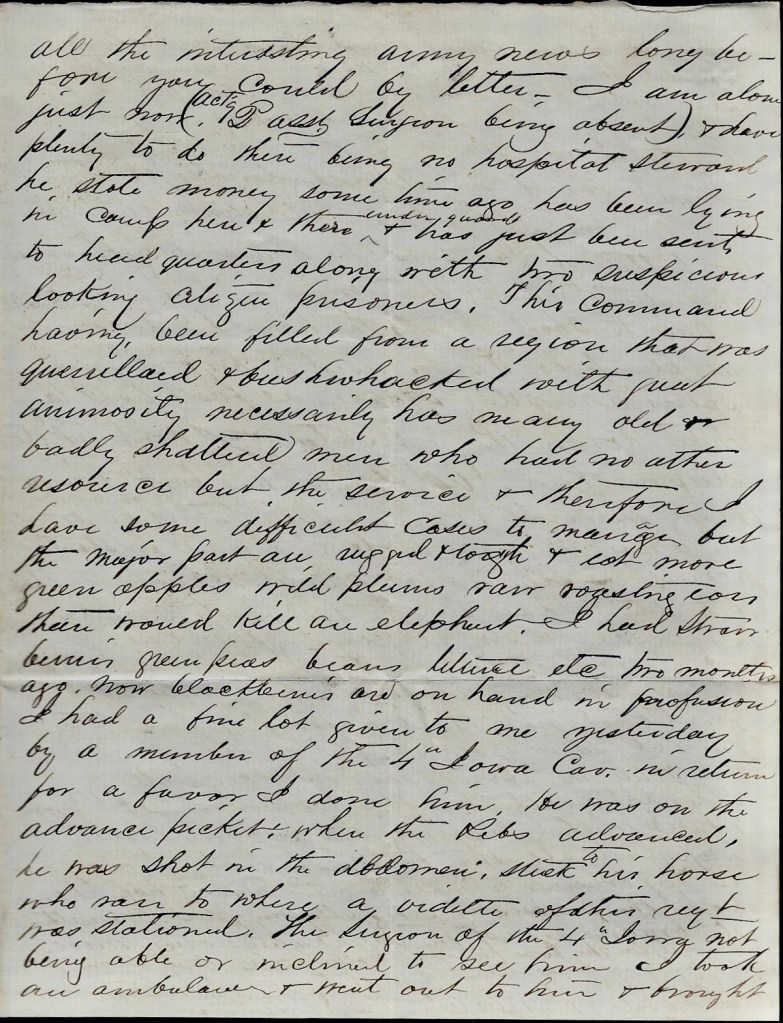
I am alone just now (acting 2nd Asst. Surgeon being absent) & have plenty to do, there being no hospital steward. He stole money some time ago, has been lying in camp here and there under guard, and has just been sent to headquarters along with two suspicious-looking citizen prisoners. This command having been filled from a region that was guerrilla’d and bushwhacked with great animosity necessarily has many old & badly shattered men who had no other recourse but the service & therefore I have some difficult cases to manage. But the major part are rugged and tough and eat more green apples, wild plums, raw roasting ears than would kill an elephant. I had strawberries, green peas, beans, lettuce, &c. two months ago.

Now blackberries are on hand in profusion. I had a fine lot given to me yesterday by a number of the 4th Iowa Cavalry in return for a favor I done him. He was on the advance picket when the Rebs advanced. He was shot in the abdomen, stuck to his horse who ran to where a vidette of another regiment was stationed. The surgeon of the 4th Iowa not being able or inclined to see him, I took an ambulance and went out to him and brought him into our camp. He had concluded he would have to sink or swim along until he saw me. One would of a ball through the left lung he has recovered from, is young and tough, and will recover & join his regiment soon.

I met one of my old school mates at the Division Hospital & had a pleasant reunion & chatted of “Lang Syne.” He had a very romantic narrative—more so than mine.

Owing to short rations, the horse I ride is not as plump as “Prince” used to be & I find spurs are getting scarce. As fasts as I lay them down, they get stolen & I don’t like to sleep in them. Asst. Gardner has lost divers (he says innumerable) knives & says that if he was on a jury, he would sentence a man for stealing a knife same as for murder. I have only had three stolen. I have seen the last pants a man had taken. This is a very free country down here.

I wish you to give me the Hillsdale [New York] news—in fact, anything you think will interest me for I have not heard a word from there since I saw you so put on your thinking cap and tell me about my “julockeys” all.

This hot weather has taken me down 15 lbs. from what I weighed last winter, but my health is improving all the time just now. I may have an opportunity to make a visit home & hope I can have the pleasure of seeing all of my friends and breathe the bracing air of the Saghkanics once more. Give my love to your Mother and all. Write soon. Yours truly, — D. B. Messinger

Address Care of Col. Clark Wright, 6th Cav. Mo., 9th Division, 13th Army Corps, Dept. of the Tennessee


1 Seven-up was a popular card game in the Civil War. It was also known as “Old Sledge” or High Low Jack.”

1863: Horatio Dalton Newcomb to Sumner Wells

The following letter was written by Horatio Dalton Newcomb (1809-1874) of Louisville, Kentucky. He wrote the letter to Sumner Wells of Chicopee, Massachusetts. The following biographical sketch of Newcomb appears in the Biographical Encyclopedia of Kentucky of the Dead and Living Men of the Nineteenth Century, published in 1878:

Horatio Dalton Newcomb

Newcomb, Horatio Dalton, merchant and manufacturer, son of Dalton Newcomb, a distinguished farmer of Massachusetts, was born August 10, 1809, at Bernardston, near Springfield, Massachusetts. He received a good practical education, and, after working on his father’s farm for a time, he taught school in his native state, but, being dissatisfied with his prospects in that direction, took the agency for a book, and traveled through several of the states, finally locating at Louisville, Kentucky, in 1832. He engaged, for a while, as clerk in a small business house; afterwards, in various mercantile enterprises, but which he accumulated some means; entered the commission house of E.E. Webb; was soon after admitted to partnership, and began a career of remarkable mercantile success. In 1837, he went into the liquor business; and subsequently established a large grocery trade, with his brother, Warren Newcomb, under the style of H.D. Newcomb & Bro., becoming one of the largest grocery establishments in the West. In 1863, his brother retired from the business, and a few years afterwards died in New York, a millionaire. The house soon became Newcomb, Buchannan & Co., devoting themselves entirely to operations in whisky. In 1850, after the projection of the Cannelton Cotton Mills, at Cannelton, Indiana, by J.C. Ford, Hamilton Smith, and others, when the enterprise was on the eve of a failure, he came forward with a large secured capital, placing the establishment on a sure foundation, and, though his commercial interests were valuable, a great part of his fortune was made in connection with the Cannelton Mills. In 1856, in connection with his brother, Dwight Newcomb, he leased the Cannelton Coal Mines, form which he retired after several years’ successful operation, In 1871, having amassed a large fortune in the legitimate channels of trade, he abandoned active commercial pursuits for his own interests, and devoted himself, with great energy, to the cause of the Louisville and Nashville Railroad, and was its most influential and substantial friend. He took large stock in the road; worked hard for its success, loaning his own credit for the establishment of that of the company; for sixteen years was one of its directors; at the death of Hon. James Guthrie, in 1859, became its president; as such carried the road through its financial embarrassments; and, for some time, bore the financial burdens of the company. Mainly through his great business ability and inexhaustible resources, the Louisville and Nashville Railroad was made the most successful and powerful railroad enterprise in the South. While actively engaged in business pursuits, he never lost sight of the interests of the city. After the burning of the Galt House, through his instrumentality, chiefly, the present magnificent hotel was built. He was one of the organizers of the Louisville Board of Trade, and was its first president; erected some of the finest buildings, and was variously concerned in most movements of importance to the city of Louisville. He was a man of marked peculiarities, as well as marked talents. He was a clear-sighted financier, steady and self-confident rather than aggressive, at all times conservative and safe; was valued among his acquaintances for his liberality and kindness of disposition; his tastes were always upward, and, although not ostentatious in his patronage, he was concerned in all art and public improvements; possessed of extraordinary gifts, he had few equals in the business world, and the withdrawal of such great resources as he possessed was a loss to his adopted city. He died of apoplexy, at his house in Louisville, in 1874, and probably left behind him no enemies, for he was a man singularly without malice. Mr. Newcomb was twice married; first, in 1838, to Miss Cornelia W. Read. The only remaining child of this marriage is H. Victor Newcomb, of Louisville, Vice-President of the Louisville and Nashville Railroad. In 1872, he was married to Miss Mary C. Smith, eldest daughter of John B. Smith, of Louisville, a lady who has ever been distinguished for her beauty of person, and brilliancy of mind and manners.
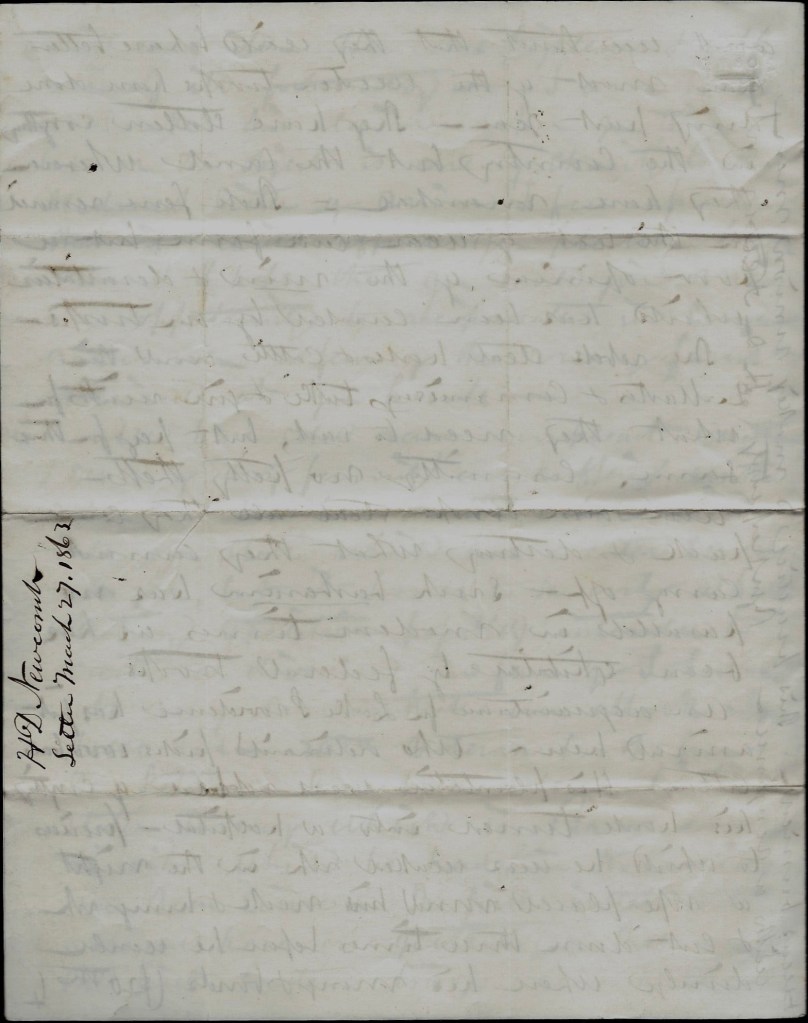
Transcription

Louisville, Kentucky
March 27, 1863

Sumner Wells, Esq., Chicopee [Mass.]

Dear sir, enclosed please find check of my firm upon E. D. Morgan [ ] New York for $5,000 in accordance with your telegram of this date. I presume that you have dated the purchase of a home for my sister in accordance with my instructions of 20th inst.

You will have the title examined & be assured that it is all right. Should the home require any repairs, have them done. You will also have the house insured against loss by fire. I presume that an insurance of $2500 or $3000 would be sufficient. I leave this point to your good judgement. You will have the deed made to Dwight Newcomb & when recorded, forward the same to me. Also a statement of all other expenses. I am sorry to make this claim upon your time but as the object is one of charity to a widowed sister of mine, I feel assured that it would afford you pleasure to act and I hope that you will give me an opportunity to reciprocate in some manner a few of the many favors received at your hands.

We have cold, raw, unpleasant weather & some of my family are suffering with colds. We fear another rebel raid into our state which has created some alarm, but it proves to be only a horse stealing expedition possibly intended to create a diversion in favor or Johnston who may contemplate an attack upon Rosecrans.

20th Veteran troops from the Potomac have been ordered to this state among which is Burnside’s old division which he had in North Carolina. The first installment arrived here yesterday. These are the first Eastern troops we have had and we trust that they will behave better than most of the Western troops have done this past year. They have stolen everything in the country but the land wherever they have marched. Those few removed from the seat of war confirm but a poor opinion of the men & desolation which has been caused by our troops.

The rebels steal horses and cattle and the quartermaster and commissary take and give receipts for what they need to eat, but pay for the same, committing no petty thefts. Our own troops steal all they can pack and destroy what they cannot carry off. Such barbarism has no parallel in modern times as has been exhibited by federal troops.

An acquaintance from Lake Providence has just arrived here who ordinarily picks 1,000 bales cotton. His plantation was robbed of everything, his house turned into a hospital previous to which he was waked up in the night, a rope placed round his neck, and hung up and cut down three times before he would divulge where his money and bonds were buried. This practice is making Union men with a vengeance.

Yours respectfully, H. D. Newcomb

1862-63: Clark Swett Edwards to Maria A. (Mason) Edwards

The following letters were written by Lieutenant Colonel Clark Swett Edwards (1824-1903), the son of Enoch Edwards (1774-1863) and Abigail McLellan (1779-1843). He wrote the letters to his wife, Maria Antionette (Mason) Edwards (1828-1885).

Col. Clark Swett Edwards

In 1848, Edwards came to Bethel, Maine, and with Edward Eastman as partner, bought out the trading business of Kimball and Pattee. The store stood where the Ceylon Rowe once stood on the northwest corner of the Common. A year later they moved another building up in line with their store and that of John Harris and finished the three stores into a block under one roof. This string of buildings burned during the Civil War and was later rebuilt. Edwards sold out to Mason and built a store near the “foot of Vernon Street where he traded until 1858 when he sold out.” During these years he also built several houses in various parts of the Bethel Hill village and “in various ways contributed to the growth and prosperity of Bethel Hill”.

When the Civil War broke out, “Mr. Edwards took out recruiting papers and was chosen Captain of the first company organized under his call in the county.” His company, Bethel Rifle Guards, reported to Portland and became Company I, 5th Maine Volunteer Regiment. While the regiment was assigned to the Army of the Potomac, Edwards was promoted to become regimental commander with the rank of colonel. Later he was promoted to Brevet Brigadier General. Clark Edwards’ term of service ended in 1864 but the regiment went on to serve many major engagements including the Wilderness campaign and was in the siege of Petersburg. It was said of Edwards that he was “unflinching under fire, often led his men into action, and achieved a brilliant record for conspicuous bravery.”

To read other Clark S. Edwards letters I’ve transcribed and published on Spared & Shared, see:
Clark Swett Edwards, F&S, 5th Maine (26 Letters)
Clark Swett Edwards, Co. I, 5th Maine (2 Letters)

Letter 1

In camp near White Oak Church, Va.
Sunday evening, December 22, 1862

My dear wife,

I thought I would write you a few lines again tonight. I am as you see still in camp at the place I dated my last from. I have but little to write as I wrote all in my last. I also commence a letter to the boys but as I wrote it as I could find time, I think it will hardly pay to send them and it is in such poor hand that it would bother them to read it. But as I wrote it, I will send it to you and you can correct it and do as you please with it. Some part of it is readable but take in all and it is rather a broken up mess. I have no chance or convenience to write and you must excuse all blunders.

Corp. Henry L. Tibbetts of Co. E, 5th Maine Infantry

I expect you all have been in trouble again for the last week or till you received our letter but thank God, we are all safe—or at least none killed in the last great fight. One poor fellow died last night by the name of [James C.] Shedd. He was well yesterday morning. The Dr. told me his death was caused by exposure as the weather is very cold. But you need not worry about me as I have a plenty of bedding and a warm tent, but do not know how soon it will be onward as it is about time for the papers to ask, why don’t the army move?

The boys are all here now, or the sick ones from Belle Plain come up today. Bryce [Edwards] is about the same—not able to do duty. Dan Stearns about the same. The Bethel Boys are all well. We have not got our pay as yet but are in hopes of it this week. Capt. W. says he is a going to resign soon. No changes in the regiment of late. My regards to all. — C. S. E.

Letter 2

Headquarters 5th Maine Vols.
Camp near White Oak Church, Va.
February 22, 1863

My Dear Wife,

Your kind letter of the 15th inst. is received and it is with much pleasure that I now answer it. I must say I am very sorry to cause you so much trouble in feeling in regard to my not visiting you at home. But still I have made an effort more than once within the last month to obtain a leave. These little things you speak of as being prepared for my palate will not come amiss for you & the little ones. You speak of Neal being at home. I hope he will have a good time and return to his Battery. You speak of the deep snow you are having in Maine but still you are not so far ahead of us as you might be. It is snowing here now and there is not less than a foot, and in many places it is much deeper as it is drifted quite bad.

The changes in the weather here is quite sudden as in New England. Yesterday was very pleasant and the little feathered songsters was busy in tuning up his sweet notes in singing in the trees at my door. As I lay on my cot and have the songs of the robin. It reminded me of beloved ones far away. I could but think how differently we were situated. You in that land of snow and ice with the little ones clinging to you for protection, while I am here in the sunny South (as I then thought). But today the weather is almost as boisterous as it is with you. Such weather even would do credit to the North and part of Maine.

You say you are glad I have confidence in my new commander. I would say that I always had confidence in all of my commanders, but express my opinion that some were much better superiors to others and that at often time the inferior was placed over the superior. I hope you understand me. That is where I have been misrepresented heretofore. But I will not write upon that subject as I never know when to leave off.

It is now twelve at noon and the cannons belch forth thunder in every direction, but do not start, as it is only in memory of one where name is sacred on the lips of every true American. I forget that I am writing to you instead of others and will continue to answer your letter. You touch me off a little on the jacket, but when you talk of extravagance in the army, you should look a little around home. It would not be called extravagance for a lady to have her bonnet changed four times a year to keep in fashion. Also, it is not called extravagance when a set of furs cost a hundred dollars or a shawl cost fifty when a government blanket that cost two would be quite as comfortable. It is extravagancy that make so many poor at the North. You go into the city and you will see the silks and satin upon the beggars as well as upon the rich. The deception is so extensive that one is not known by the cloth he wears. Many wolves are now found in sheep clothing and many traitors hearts are now wrapped in a tinsel jacket. Officers are like women in many things—if they cannot make themselves conspicuous in fights, they will do it by wearing good jackets. Woman is oftentimes seen advertising with good clothes instead of attending to her domestic affairs at home. I think it would be quite well if we were all a little more prudent in some things as well as others. I have no doubt you will be gratified in regard to the jacket—that is, in seeing it. Romans had better stay with Romans. And it can be applied in more than one instance.

I am glad Del T. is at home as he is is a very fine fellow, brave and generous. I have never yet heard a word against him. You speak of Kate going to Lowell. In one of your late letters you spoke of her going to Gibson and thought she [was] not strong enough. I do not understand you. You speak of the boys coming here as sutlers. I must know soon as I am bound to have one. The place would have been filled long ago if I had not been expecting them here. Sis you say is still at home. I sent an order through the Ear Department ten days ago ordering them back and I presume it will reach him in a day or two, if it has not already. I shall pity his wife but still I think she will not suffer much unless the Conscript Acts take away Neil Hastings, M__ Wormell, John Abbott, & others.

In regard to Sis prayers about Mack B., I fear they will not be heard as I shall let him go to Maine and shall also get him commissioned if possible as he has earned the place. He is one that has never been away from a single fight and is deserving of a good place. He is just like thousands of others that in envious. You say Hormell is still fussing about John. My advice to him is to dry up and the sooner the better, and instead of getting his boy out of the army, he had better take the two now with him and go forth to battle for his country as my opinion is he could be spared from the place he now fills. Such patriotism is easier talked of than felt.

You say to my Walker folks that John is quite well but he has letters to write to others as well as them. You ask my advice about sending Frank to school to the Dr. My answer is yes, to be sure. Also Nelley. In the first place, I want to do all we can for the children in the way of starting the aright in the world, and again it would be some help to the Dr. My regards to him and wife when you see them. The neighbors you say are the same as ever. I was in hopes there would have been some improvement before this as there is room. You say Mary will come or called to see me (Bully for her). I am glad I am not forgotten by the ladies. I sent her a Valentine a few days ago but do not tell her who sent it as she would not call to see me again. You say when I come home you will have a few invited friends as we have some such left. Yes, but in adversity the cold shoulder is often turned when it should be far different. Friends can be bought in every market and many at low figure. A glass of whiskey will make friends in the army. Oysters will make friends in our country villages. But such friends as a general thing is a curse in the days of affliction and a friend in need is a friend indeed—an old saying but a true one. The friendship of the Farrington you speak of is true and one such a friend is worth thousands of boughten ones, as it comes from a true heart. The army is a good place to study human nature. While a man is in power, he has friends. But when the table is turned, his friends soon vanish. Jackson, while in command of the 5th Maine, was lauded to the skies, but as soon as he left, his pretended friends were his bitter enemies, and the same doctrine will apply at home…

I had two ladies to dine at my tent yesterday. One was a Mrs. Eatore from Portland—a clergyman’s wife, and the other a Miss Fogy from Callas. They were employed by the Sanitary Committe and doing much good, I hope. I have nothing new to write—only would say that Silas P. Festes was here a day or two ago to obtain the place of sutler (but I did not see it). Dan Sternes is not very well. Maj. Millet is still at Maine. Also three or four more of my officers…

I am alone in my tent today as it storms so the boys do not get out much. Regards to all, — C. S. E.