My passion is studying American history leading up to & including the Civil War. I particularly enjoy reading, transcribing & researching primary sources such as letters and diaries.
I could not find an image of Amos but here is one of Henry Benjamin Davis who served in the 64th Illinois and was killed at Marietta, Georgia, in August 1864. (Ancestry.com)
The following remarkable letter was written by Amos Reeves (1835-Aft1910) of Sterling, Whiteside county, Illinois, who enlisted as a private in Co. B of the 64th Illinois Infantry (“Yates’ Sharpshooters”) in November 1861. In his four-page letter to his cousin, Amos tells the tale of his capture along with James Fitzgerald of his company by Gen. Philip Roddey’s guerrillas in northwest Alabama on 29 May 1863. For the next several weeks the captives were shuffled under guard from one Confederate encampment to another while Amos says he tried “to make the best of a bad bargain.”
While a prisoner, Reeves learned that many of the rebels who guarded him were conscripts and had little interest in waging war. He says that he worked deceptively with his captors to gain favor whenever possible and to encourage rebels to desert, reassuring them that they would not be exchanged back to the Confederate army where they would be shot as deserters. Eventually Reeves and Fitzgerald were delivered to Libby Prison in Richmond, Virginia, where Reeves claimed they remained but four days before being exchanged and delivered to Camp Parole in Annapolis and later to Washington D. C. where he wrote the letter in August 1863.
Reeves was eventually sent back to Illinois, reenlisted as a veteran, and then ordered to his regiment where he resumed service and mustered out on 11 July 1865 at Louisville, Kentucky. Apparently Fitzgerald had had enough, He did not reenlist as a veteran and mustered out on 31 October 1864.
It does not appear that Amos ever married. He was enumerated in the 1910 US Census and he was mentioned in The Rockford Daily Register-Gazette in April 1897 where he was credited with having invented a “shoe scraper and cleaner which can be opened and closed so that is it not dangerous when there are children around…it cleans both the sole and the side of the foot.”
[Note: This letter is from the personal collection of Richard Weiner and was transcribed and published on Spared & Shared by express consent.]
Transcription
Addressed to Miss A. E. McClane, Sterling, Illinois
Parole Camp, Virginia August 11, 1863
My dear Cousin Lida.
Though far away and long silent, I often think of thee and memory and fancy bring many pleasing pictures to my mind, and though I see many dark pictures and gloomy clouds, the bright ones are the prettiest and I love to look at them.
It has been a long time since I have had an exchange of thought & sentiment with you though I have heard from you (I saw a letter Jennie sent to Stephen) and I always think you are among friends and enjoying life.
Well, my dear cousin, I am enjoying life. Life is as dear to me as ever though I remain in the army. I expect that you have heard that I have been making the Rebs a visit. So I have and had an interesting time of it though I was an unwilling guest. A sergeant of my company, Joseph Fitzgerald, and I were captured on the 29th of May and were robbed of our money, hats, and boots, &c. and we found ourselves among robbers, murderers, highwaymen, and that we would have to take things easy and not hoist false colors but keep our colors covered at times and then sometimes I could hoist before them the good old flag with all its glories and blessings and the pictures of the American Revolution, its heroes, the levers of justice, the cowboys and skinners, the tories and savages, and then I showed them their own perfidy and treachery.
But while I was with Gen. Roddey’s Guerrillas, I passed for a good Vallandigham man among the officers and most of the men and I found many of them that were conscripts and only wanted a chance to escape. They were ashamed of their crowd and as they had been told by their officer we made every deserter enlist or we sent them around for exchange so as to get one of our soldiers for them, they were afraid to come over. So I told them the truth and during the ten days that I stayed in their camp, there were over 30 of them deserted and went to our camp. Then I was taken to Tuscumbia, Alabama, where I stayed a week and found friends. Some of the men who were guarding us were good Union men and a good lady sent us a plenty of milk and some nice biscuits and butter twice and some ginger cake once. Then we were taken to Huntsville—Gen. Pillow’s Headquarters. From there to Chattanooga, then almost to Knoxville when the Yankees came in ahead of us and tore up the road and we had to go back, and then down to Atlanta, Ga., and from there to Augusta, Ga., then to Columbia, S. C., and Raleigh, N. C., Petersburg, and Richmond, Va. Stopped in Richmond in Libby Prison four days, then came by the way of the James River & Fort Monroe to Annapolis and from there to Washington D. C.
And here I found lots of friends (of whom I will tell in my next) and have been seeing the sights & learning all I could and trying to make the best of a bad bargain. I am sorry that I delayed writing so long and I wish I could give you a full history of my expedition.
I could not find an image of Philip but here is John Murphy who served in Co. A of the 34th New York Infantry. He enlisted at the age of 54. (Jim Jezorski Collection)
The following letters were written by Philip J. Crewell (1840-1917) who enlisted for two year’s service on 1 May 1861 and entered Co. F, 34th New York Infantry as a corporal. The 34th New York Infantry, a two years regiment, were known as “The Herkimer Regiment,” and they served in the 2nd Corps, Army of the Potomac. They saw action at Yorktown; at Fair Oaks, where they lost 97 men, killed, wounded and missing; they lost heavily in the 7 Days Battles; at Antietam, they lost 154 men, killed, wounded, and missing; and they also fought at Fredericksburg and Chancellorsville. Philip was discharged on 30 June 1863.
On May 1, 1863, the day prior to the Battle of Chancellorsville, six companies of the regiment mutinied and refused to fight on the grounds that their two year enlistment terms had expired, although in fact this was still almost two months away. Brig. Gen John Gibbon, who commanded the division that the 34th New York was in, brought up the 18th Massachusetts and gave them orders to shoot the men of the 34th New York if they wouldn’t fight. The regiment reformed and served dutifully during the Second Battle of Fredericksburg two days later. On June 30, the 34th New York mustered out and the two year men went home, the remaining companies, who had signed up for three years of service, being transferred to the 82nd New York Infantry.
Philip’s first letter also contains an account of a mutiny that occurred in the ranks of the 34th New York Infantry—this one taking place a year earlier. Philip’s version of events appear markedly different than the official newspaper accounts which don’t quite tell the whole story. Philip’s second letter describes in great detail the Battle of Antietam and his third letter was written approximately three weeks before the Battle of Chancellorsville.
Philip was the son of John Crewell and Alida Luke of German Flatts, Herkimer county, New York.
Letter 1
Camp West Point, or 3 miles up the Pamunky River from West Point to Richmond May 12th 1862
J. J. Crewell,
Brother, I now sit down to answer your letter of the 6th. I was very glad to receive a letter from you and to hear from you all, Now as to the boys and myself, I have not been well for about 10 days but I can say that I am well today. My ailment was the measles working in my head. I had caught a very bad cold and it all seemed to work in my head till it broke and then I am all right in a day or two. The rest of the boys are in good health, hoping these few lines will find you all the same.
Now as to the warfare, there hasn’t any happened of late that I shall speak of more than we still mean to invade on after the rebels and get them out of existence as soon as possible. The show is now that they mean to make a stand 3 miles this side of Richmond but that will be of not much account for we have fources coming from three different ways on them and I don’t think that there will be much fighting for us to do. Our division is the third reserve adn the battle must be a hard one when we have to come in.
We move on towards Richmond today. There’s 60,000 ahead of us within but short distance of the rebels. The fight will soon open there. This thing has got to come to a close in short.
Hartford Daily Courant, 11 June 1862
Now a little circumstance that has happened in the regiment. Last evening at dress parade, there was two companies that mutinied and stacked their arms. And now [I will tell you] the cause for it. In the first place, Co. A has held the right of the regiment ever since we have been in the service and Co. F is next. So Old Gorman 1 thought he would make a change in the regiment because his son [Richard L. Gorman 2] was in Co. C—that is the color company and he didn’t know but what if we were brought into action that his son would be in a little more danger than the rest of the companies. So Co. A if they had to rank to the senior captain, we would be the 4th and Co. A that was held to the right of the regiment would be the 9th comany. The companies that have stacked arms are A and B and the officers are Capt. [Davis J.] Rich [of Co. D], Capt. [William L.] Oswald [of Co. A], Lieutenant [Benjamin H.] Warford. These are the three officers. The talk is that the officers will be sent to Fort Lafayette and the privates to the rip raps to Fortress Monroe. There they will have to handle stone till their time is out and not receive one cents worth of pay. They was offered their arms this morning again but would not accept of them.
That is all. Write soon and as often as you can. Sell my [ ] if you can no matter what the rest says. I will be satisfied. From your brother, — Philip Crewell
Hoping soon to all meet again.
1 Willis Arnold Gorman (1814-1876) served as a Major in Gen. Lane’s regiment of Indiana Volunteers in the Mexican War where he was severely wounded at the Battle of Buena Vista. He was appointed governor of the territory of Minnesota in 1853 and later served in the Minnesota legislature. In the Civil War he began his service as the Colonel of the 1st Minnesota but was promoted to Brigadier-General of volunteers in September 1861 and commanded a Division that included the 34th New York during the Peninsula Campaign. According to Philip’s letter, the mutiny in the 34th originated from Gen. Gorman’s desire to have his son’s company’s letter designation changed which upset the seniority hierarchy of the officers in the regiment.
2 Richard L. Gorman was 26 years old when he enlisted on 27 April 1861 at St. Paul, Minn., to serve as a private in the 1st Minnesota Infantry. On 1 January 1862 he received a commission as 1st Lieutenant of Co. C, 34th New York Infantry. Richard was promoted to Captain of Co. A on 24 June 1862. He resigned his commission on 2 March 1863.
Clipping from the Cincinnati Daily Commercial. Monday, 2 June 1862
Letter 2
[Note: The following letter is from the private collection of Keith Fleckner and was offered for transcription and publication on Spared & Shared by express consent.]
Camp Bolivar Heights, Virginia Sunday, October 5th 1862
Brother,
Today I will try and give you a better description of the Battle [of Antietam] and the feelings of that day’s fight and the feelings of the 34th [New York Infantry] ever since they left their homes. Now as to the 17th day of last month, or ever since we left Tenleytown on the march to face the Rebels in Maryland, every soul of the 34th was anxious to once move to meet them face to face with the instrument of death in their hand. We all marched forward with a brave and willing tread, willing to grapple with our enemy at any moment. And so we marched forward till within sight of the butternut’s colored coats and there we laid whilst they were fighting for two days, and when they would throw a shell over in our camp, everyone was willing to face the messenger of death on equal footing.
So the next morning we were ordered to take eighty rounds of ammunition and every hand worked with a willingness to be ready at the time that we were to march. We all moved off together—some 30 thousand or more. We moved on, and about halfway between our camp and the line of battle, there was a stream of water of three feet deep that we had to ford, and every man moved forward getting wet up to his body, but not a word was spoken. Every eye looked forward to catch the first sight of the battlefield, for the earth was shaking with the heavy sound of cannon. Onward we moved and soon we came in sight of the enemy’s guns, and then we formed a line of battle and then pressed forward, passing over the battlefield where there lay thousands of dead.
Sedgwick’s Division was in front and Gorman’s Brigade on the left, and the left of that was the 34th—without any support whatever. Now they said that 34th was ordered by the left flank and that whilst attempting to execute the order under a most intense fire from their enemy’s lines. In the first place, we were marched right up in front, there being a heavy knoll between us and the enemy that is in the woods. We advanced to the brow of the knoll just so we could look down the other side, and there the enemy were, eight deep, laying with their faces down, within 15 rods [80 yards] of us. They lay there waiting to have us show our whole bodies, but we had too quick an eye and took our chances for the first fire. The order was given to hold low and so we did. We held in the face of the first line and the word was given, “fire!” when the whole line opened with one sheet of fire and lead which lifted them from the dirt, but to fall again, for our aim was sure. Them that was left run out of the woods, or attempted to, but a good many bit the dust.
We drove the whole line before us and they, seeing our left unsupported, they came back with five times our number, and then we held our ground till we were ordered back. When we left our lines, the rebels was within two rods of us, and had it not been for the knoll, they being coming up one side and we went down the other, or they would have shot every one of us. But their balls all went over [our heads], or the heaviest fire. Now, how could we have run so quick and held our ground till we fired 13 times, so that is the way we run.
Now, about the time we left home. When we left home there was some that said that Herkimer Country had got rid of all their loafers and thieves and that if they all got killed, or half of them, they wouldn’t be missed. But who has won the name of honor for that old county, and had her name among the highest? None but them that they call loafers. But when them loafers went to serve their country’s cause, they didn’t sell their lives for $2.00 and two but for $11 and no more. We have come and won the honor that they have to crow over, and we feel as though a share of that bounty had out to be ours. No more.
Your Brother, as ever — Philip Crewell
Good morning
Letter 3
Camp Falmouth, Va. Thursday, April 10, 1863
Father & Mother, sisters and brothers,
As I told you I would write before a move or battle if I had the opportunity and so I will write one letter to you all for I can’t write any more in one than in the others. We were to move yesterday morning at six o’clock but a heavy rain set in which has kept back the move. But today it is cleared up very nice. We expect orders every day or every moment to march. We have eight days rations ready. give in my knapsack and three in my haversack. They have taken all our clothes that wasn’t needed but I was on picket so I hadn’t any chance to send anything. I would liked to of sent off my dress coat and also a blanket for I have too much to carry but when I throw them I will stay with them whether I get taken prisoner or not.
But the time will seem long before I shall write again as I have no paper nor ink nor any to take along. But it seems still longer for me to wait for a letter from some of you. I have looked with an anxious eye when the mail arrived to see if I couldn’t hear from you but [I was] disappointed as usual.
Oh how I dread this next coming battle. It is likely all we ever will go in but then there is so few of us and still we have to take our place as a regiment in battle and fight five times our number, and by all appearance, they put great confidence in winning the next coming battle and without we fight with the determination of either dying on the battlefield or else conquer our enemy, why they will think that we don’t mean to fight because our time is so near out. But if I have to fight so much greater the odds as we have in other battles, why I don’t think the Old 34th will be very apt to stand.
But, [what] is the use of me writing to have your minds if I am to be spared and get through all safe. Why it will be so we must trust for the best. But after the firsts of May. I think my fighting is done with. The damn pay master hasn’t been around yet nor will he till after the next battle is over with for fear if there is any of the Boys skins out and they court martial them if they have their pay, they are all right. But if we have any money coming, they can take it. But the bounty they can’t touch nor have we had a chance to touch it.
Well, I haven’t much to write. The wagon train is moving up to the right. The talk is that Stonewall Jackson is in the rear of us with 50,000 men. If so, we will have to fall back. But I think we will have to cross the Rappahannock again and then a death struggle will take place for the Rebels look at the next battle as closing the war in [their] favor or else [our] crushing them forever.
Now I know this will make you feel uneasy but trust in my next if I am spared to write that you may hear better news. Write soon and don’t wait so long. I will have to send this without my stamp for I have neither money nor stamps. No more. I remain your son and brother, — Philip Crewell
The following letter was written by John B. Hammer of Hamilton, Butler county, Ohio, to his friend, James Clark Holbrook (1817-1895). James was married to Eliza Jane McDill (1822-1901) in May 1845 and we learn that he relocated to Randolph county, Illinois, sometime previous to the date of this letter. In the 1850 US Census, James was enumerated in Sparta where he practiced law.
I believe John B. Hammer was approximately the same age as Holbrook and may have emigrated to Hamilton, Ohio, from Pennsylvania, possibly with a brother named Logan Hammer.
Hammer’s letter speaks of the Hydraulic company in Hamilton, prospects for a railroad to be built to Cincinnati, and of the recent Butler count elections in which the Whigs defeated the Locofocos [Democrats].
Transcription
Addressed to James C. Holbrook, Esqr., Sparta, Randolph county, Illinois
Hamilton, Butler county, Ohio October 27, 1845
Dear Holbrook,
Numerous conflicting & portentions of evil are the conjectures entertained particularly in the circle of your more immediate acquaintance here since your departure for the West concerning your hazardous adventure and final destination. The fact of their not having heard anything from you since your departure together with the anxiety they feel in your welfare, had led them to interchangeably indulge in such ominous surmises as (I hope all visionary & foundationless); perhaps he has taken passage upon one of those unfortunate steamers that has been blown to pieces by the explosion of the boiler & participated in the dire calamity of his fellow passengers, the horrible accounts of which the columns of our ephemerial journals are literally filled. I wonder if the old craft upon which he has taken passage has not been foundered by running afoul of one of those dangerous breakers who so much infest our western waters & render it rather a precarious undertaking to travel thereon. Or it may be he has been caught out of port in a storm and been shipwrecked upon some of the sterile, rugged coasts of the Mississippi. But notwithstanding this difference of opinion of what may have been your fate, yet we are unanimous in this—that either some sad mishap had befallen you during your journey or else you have proven remiss in your duty in not writing. I therefore assume the responsibility of addressing you a few lines & if you are safely moored in the haven of your anticipated destination, to awaken you if possible to a sense of your delinquency in not letting us hear from you.
As I was confined to my room by illness at the time you took your leave of our village, I am consequently unaware of the occupation you have determined upon pursuing in the West—whether lawing, teaching, farming, or preaching—all of which laudable professions I believe you have considerable knowledge and some experience. However, having heard nothing to the contrary, & knowing that the profession of the law stands first in your estimation, I suppose your efforts will be directed in this line. But it whatever occupation you may deem most conducive to your feelings and interest, may fortune smile & your every effort be crowned with its merits and reward.
I still remain at the office of the old firm, Bebb & Reynolds. Things here have assumed within the last twelve months quite a different aspect for though the old office & those familiar objects by which I am immediately surrounded remain unaltered & the same, yet that almost total revolution, or rather annihilation that has been effected among its once jovial inmates has forced upon me the conviction of the truth of the old adage that man is the creature of circumstances. This seems to be more particularly the case among the fraternity of this old office…I stand almost companionless & alone forming the centre and circumference of our numerous and once happy circle. In this condition, bowed down by the spirit or ennui, I turn with the mingled emotions of pleasure and regret to gaze upon the once cheerful hearth around which we were wont to while away the leisure hours of the cold winter evenings; but which is now cheerless, desolate, and forsaken. With pleasure as it serves as a memento to awaken afresh those moments—yea hours—of happiness which it was once our lot to enjoy. With regret upon the reflection that those scenes can never again be renewed, I have the consolation of having the moody reflection dispelled by an occasional personal intercourse with some of our old companions—particularly Drayer and Ebenezer, known to you perhaps as well the trite appellation of the Eunuchs of our fraternity.
Upon the subject of general news, I have but little to say as there is nothing at present transpiring in our town that would attract the attention of the most careful of observer. Business of all kinds is unusually dull and the complaints of the lawyer, the merchant, the mechanic, and the husbandman greet your ears upon all corners of our streets.
There is, however, some excitement here upon one topic (particularly among the stockholders of the Hydraulic company) & that is concerning a railroad which has been some time under contemplation connecting Hamilton and Cincinnati. The engineers have already viewed several routes, & present indications speak favorably of its ultimate completion. The Cincinnatians are warm on the subject. The Hydraulic fever, I understand, is also up in Rossville; there being some talk of constructing a water power there similar to that in Hamilton. I think this excitement is but momentary & will die with its object unaccomplished. 1
The weather here at present & for two or three weeks past has been transcendentally beautiful—we having what is called the genuine Indian Summer—the most beautiful season of the revolving year. The health of our towns is improving rapidly; the frosty mornings contributing to abate to a considerable extent the chills & fevers so prevalent here a short time since. Deaths are seldom to be heard of—but one happening among our adult inhabitants at least of which I have heard since your departure—viz: Jacob Mires.
The Ohio elections of which I suppose you have already heard is cheering to the friends of law and order (the Whigs having a majority of 24 on joint ballot in the Legislature). The Whigs of our town and vicinity have had some capitol fun with the Locofocos here upon the occasion of our election last Tuesday. As an unusual occurrence here, there was little or nothing said about either men or measures previous to the election—at least in the ranks of the Whigs. Stokes as usual had been copious and pathetic in his appeals to the democracy (notwithstanding the silence of the Whigs) to turn out to a man and save the country from ruin. They came to the polls more than ordinarily elated with the reflection of their anticipated triumph. All went swimmingly on until about 2 o’clock p.m. when the Whigs, in pursuance of some preconcerted plan of a few who were fond of fun, came pouring in from all directions in such numbers as to terrify & utterly confound the Locofocos. Stokes broke gasping for breath for his office for a new supply of tickets. Oliver mounted a swhiched poney standing hard by and ere the shouts of hurrah boys, or, “By God we are beaten!” had died upon the breeze might be seen sending his way at the top of his cargers speed for the black bottours and Wilkins vociferated “To arms! to arms! The Coons [Whigs] are upon us in an unguarded moment,” while upon the opposite corner of the Public Square might be heard as the echoes of his lion-like voice, the shouts of Old Rolly to rally! “Rally! friends of democracy & save the liberties of your country from the subverting hands of whiggery which is about to grasp them.” In a few moments, all was confusion & uproar, and in all directions might be seen the dismayed leaders of the Locofocos urging their almost bewildered serfs to the onset.
Scarcely had our ear caught the first tolls of the town clock as it was striking 4 when down went the window & put a stop to the flood of Whig votes which were still pouring in. Something like order & harmony was now soon restored among the rabble. But when the returns began to come in from the contiguous townships & where the formerly received a majority of from two to three hundred was now but 27 not a loco could be seen; & a glimpse of one of those infernal critters would have been worth all the menageries in the country. At seven in the evening, office holders row presented a dismal and ominous appearance; with bolted doors and barred windows. Everything assumed that death-like awful silence which is witnessed on visiting at the silent hour of midnight some old deserted grave yard. While around the dimly burning lamps within might be seen in small groups the terrified inmates with pencil in hand eagerly calculating the results of the election. Their majority was reduced some 6 or 7 hundred in the country—a consequence of failure to turn out on the part of the locos rather than any boost in the whig vote.
I heard from Calve Campbell a few days ago; he is at Germantown & flourishing finely. J. B. Drayer 2 sends his everlasting compliments & his best wishes for your success. He told me to say he was in good spirits notwithstanding he is the defeated candidate for State Attorney. He got at last term of court here some 4 or 5 new cases which came very acceptable as his only case was just disposed of.
Give my respects to the partner of your hopes & joys, &c. and to all the little Holbrooks. I remain yours in friendship, — John B. Hammer
N. B. I forgot to mention that my health is unusually good at present—better than it has been for a long time previous.
P. S. Answer soon. Drayer was the Whig nominee for State Attorney and of course was beaten. Rather a bad beginning in the political arena.
1 “By the mid-1800s, Hamilton had become a significant manufacturing city, producing machines and equipment used to process the region’s farm produce. Completed in 1845, the Hamilton Hydraulic System spurred one of Hamilton’s greatest periods of industrial and population growth from 1840 to 1860. Hamilton Hydraulic was designed to be a system of canals interlocking with natural reservoirs to bring water from the Great Miami River into the city as a power source for future industry. Four miles to the north of Hamilton, a dam was built to funnel water into the Hamilton Hydraulic System along with two reservoirs to store extra water for the new system. The Hamilton Hydraulic System was a high risk/high reward project: while the City of Hamilton did not have many businesses that would need the power when construction began in 1842, if it could be successfully completed, the power generated by the system would bring in more industry. The gamble proved to be a successful one as the project attracted many businesses to the area, including the Beckett Paper Company in the late 1840s.” [City of Hamilton, Butler county, Ohio.]
2 John Breitenback Drayer (1823-1891) was born in Lebanon, Pennsylvania, and lived in Butler county, Ohio in the 1840s. He was a lawyer who moved to Henry county, Iowa, prior to the Civil War and was Captain of Co. H, 30th Iowa Infantry from 23 September 1862 to 23 March 1863 (6 months).
I could not find an image of Emmett but here is one of Madison Walts who served with Emmett in Co. I, 14th NY H.A. (Photo Sleuth)
These letters were written by Emmett H. Waller (1843-Aft1890) who enlisted in late December 1863 at Burke, New York, to serve three years in Co. I, 14th New York Heavy Artillery. He was mustered into the company officially on 4 January 1864. At the time of his enlistment, he gave his birthplace as Pierrepont, St. Lawrence county, New York, his occupation as “mechanic,” and he was described as standing 5 feet 7 inches tall, with blue eyes and dark hair. A note in the muster roll abstracts claims that he was on detached duty from the regiment, serving as a clerk in the headquarters of the 1st Division, 9th Army Corps.
Emmett was the son of Asabel Waller (1799-1876) and Jerusha Dorothy (1804-1881) of St. Lawrence county, New York. Emmett’s father earned his living as a joiner and also served as the postmaster in East Pierrpont.
After he was discharged from the service in 1865, Emmett moved to Muskegon, Michigan, where he worked he opened a business under the name “Waller & Beerman” selling pianos, organs, and sewing machines. Emmett did not marry Lucy to whom he sent “a hundred kisses” to close the following letter. He did not marry until 1881 when he took Elizabeth (“Betsy”) Houghton as his wife.
Letter 1
Emmett wrote this letter from Elmira, New York. It was sent on official stationery of the “Headquarters Depot for Drafted Men” which was operated almost as rigidly as the prison sited there for Confederate soldiers. By this late date in the war, drafted men had to be watched closely to make certain they did not desert as many of them were there involuntarily. Rigid rules were laid down to keep draftees in camp while they were being organized and drilled for assignment to Union regiments.
Addressed to Miss Lucy F. Waite, Russell, St. Lawrence county, New York
Headquarters Depot for Drafted Men Elmira, New York April 3rd 1864
Your letter was received safe and sound and I was glad to hear from you so soon although it pained me very much to learn of your illness. You said if you had been a soldier you would have been reported unfit for duty. Yes, and I would have done your fatigue duty for you and all the time if I could have the honor.
Livey, I am afraid you work too much and too hard. You must not work so as to hurt yourself as you are well aware that you are not able to and you ought to be very careful—not do any heavy work such as lifting.
As to my ride home on Monday, I had a very pleasant time and all the time wished that Lucy was along with me. Yes, and that I could have introduced her into my father’s family as a member and to know that she was mine. Yes, my heart was in enough [word missing], I will bet you. You know that and you remember that tree or little knoll where I kissed your lovely face. You will remember about that, I presume. I speak of it often enough to have you…
Since I was at home or since I came [here], we have had a foot of snow fall in one night and the next night all gone again so I did not have time to get a sleigh ride.
Since I have got back, am having very nice times. I just made out Telegrams and Special Orders for the A.A.A. General and issue the passes to all soldiers on detached service. The passes have to be recorded making a good deal of work. It commenced with the 31st of March, all soldiers found in this city without a pass from my signature are put in the guard house. We all have to wear our uniforms now. An order—No. 16—reads thus: “All soldiers found in the city without the prescribed uniform, the patrol guard are ordered to arrest and confine in the guard house.” I did not like it much when I made it but it was the old Colonel’s orders. I will close. I have written so much of the last few days, I am tired. It is not a very long letter but I write so much oftener than you do, that you must excuse. I hope when this reaches you, you will be a great deal better and able to be around enjoying yourself.
— E. H. Waller
You must answer this as soon as time will admit and oft oblige a friend. Hundred kisses to close with and a smiling countenance is read your answer.
Letter 2
Addressed to Miss Lucy F. Waite, Canton, St. Lawrence county, New York
In Camp Fort Haskell January 28, 1865
Lucy,
I have written you so often of late and have received no answer. I well know the reason—or at least think this it, that you were offended at the photograph I sent you entitled “excuse my back, sir.” The reason I sent it was this. It was given me and I thought it a very comical picture and still not bawdy. I sent it with the idea that you would laugh at the novelty and think, yes, and know, that I meant no evil intent. You have often told me that I was gentlemanly in conversation, never used vulgar language, and God knows I never thought of wrong in your presence, nor any other, but that of true devotion. I have often thought, yes, and hourly, that had I not sent it, I would give hundreds of dollars and then the thought has entreat my mind can it be that she has only been waiting for me to do something for you to say farewell.
Oh! I fear for myself what my end will be here. I am in the land where the enemy’s missiles fly thick and fast, and since I came, I have not felt the least fear of. I do not care it seems whether I lay my bones here or not. Were I dead, my mind would be at rest and you would not be troubled with my declarations of love. You would feel at rest that you were freed from a troublesome trouble.
I have been on picket 24 hours and on fort guard 4 hours only since I joined this Regiment, but visit the picket line every night to trade with the Johnnies and visit. The Johnnies meet us half way and often come into our lines—called picket pits, we promising them that they may go back and we let them too. [But] sometimes our officers finding them in our pits, keep them. This is wrong when they had the promise to go back. There was a Lieutenant of theirs come over last night and stayed by his own request. They are deserting very fast. They reported last night that Charlestown was taken by our folks; also that we took Gen. Joe Johnston. I have not invested much stock in this yet; perhaps it is true. I will close now and go down and see the Johnnies and have a chat. Then on the morrow if nothing happens, I will finish this. It is now 10 o’clock eve. Goodbye.
Good morning, Lucy. I left you last eve to go down and see the Johnnie Rebs and met four of them at our picket pits. They had cartloads of tobacco and wanted hard tack bread meat coffee knives and almost everything but tobacco. They say they will starve in a short time. Their only hope now is that they be a settlement and cessation of hostilities. They have the story now that there is an armistice of 80 days. The most of them say they are only waiting for their pay which they expect to get on or before the 15th day of March. Then they can buy things with their money and desert to our lines. We have various rumors—first, that we are to be relieved and move to the left; others that we are going to New York; and others that we are to go to Baltimore. I think we shall stay here and fight just when there is any fighting to do.
I was over to see Alvah Beach’s grave the other day. It is only a few rods from here. Many of the 14th boys are buried around these works. It is but a few rods from here where our regiment made the charge on the 30th of July at the great explosion [see Battle of the Crater] and this very ground was fought over. There are dead you can see their bones laying between the picket posts on top of their knapsacks just as they fell. It is horrible—horrible! The boys tell me that there was some of them lay there for 3 and 4 days wounded and unable to walk or crawl that had to lay there and starve to death, they hearing them groan all the time, but darst not go after them. One boy had a brother in this place. He heard his groans for 3½ days [and] finally could not endure it longer. He got a long rope and threw it to him in the night and succeeded in getting him and saving his life. He had his thigh broken.
Becker Collection 22484 detail. “Siege of Petersburg — Charge into the Crater.” Andrew McCallum, artist.
I am not well now. Yesterday I went to the doctor for medicine. I cannot speak a loud word on account of a severe cold on my lungs. The doctor excused me yesterday from all duty. Gave me 4 quinine powders to take one every three hours. I did take one every three hours and threw them in the fire today, I did not go near him and tomorrow he goes home on a furlough. Just as well. Doctors in the army are a nuisance.
I received a letter from home this week saying my Mother had gone to Ogdensburgh on a visit. My brother’s wife who lives there is very sick. Her old complaint consumption. I fear she will go this time to her long home. I will close for this time and wait an answer. — Emmett
Co. I. 14th New York Heavy Artillery, Washington, D. C.
This letter was written by Rachel Maria (Crossman) Bolles (1823-1886), the wife of Lorenzo Bolles, Jr. (1822-1869). The couple were married in 1852. For both Rachel and Lorenzo, it was their second marriage. Lorenzo’s first wife, Ann Aurelia Ellsworth, died in 1852 after 7 years marriage. Fachel’s first husband, Pliney Merrick Sibley died in 1844 after two years marriage. The Bolles’ children included Mary Lucretia Bolles (1850-1931), Lorenzo Bolles (1854-1944), Carrie M. Bolles (1856-1940), and Anna Sophronia Bolles (1862-1938).
Rev. Lorenzo Bolles was a Methodist minister. At the time that Rev. Bolles enlisted as the chaplain of the 21st Iowa Infantry, he was serving as a minister and financial agent for a group of eastern Methodists who were planning to move wholesale onto 1,000 acres they had purchased in Iowa as a group. They had made arraignments for a “Colony House” where people could stay with their families until their farms or businesses were created and then they would move, allowing the next group of settlers a place to come to. A financial panic ended the project in the late 1850’s with only the first group of settlers making it to Iowa.
[Note: This letter is from the personal collection of Mike Huston and was transcribed and published on Spared & Shared by express consent.]
Transcription
Addressed to L. Bolles, Jr., St. Louis, Mo., 21st Reg. Iowa Volunteers, In the Field
Sand Spring [Iowa] December 31st 1862
My very dear husband,
Your dear, kind, long-looked for, and much wished-for letter of 19th was received last Friday eve. I read it three times before going to bed and again in the morn. I don’t know but I should have read it again but Harriet hadn’t laughed at me. I presume I shall read it several times more before I get another. That is the way I usually do. It is a little like talking with you to read over your letters. Oh, how I do want to see you this eve. I believe I should kiss you a thousand times. That you would enjoy, no doubt.
I do home that you will come home as soon as spring if it is only for a few weeks. It would be a great comfort to us all thought it would be very hard to have you go back.
I rejoice that the time of Emancipation is so near at hand, but the Lord only knows what the result will be. I hope it will bring the war to a close soon.
We are all quite well now. I have some cold. So has the babe, but we are both getting over it. Carrie is not as well as she was before being sick. She looks pale. Her skin is yet low. I am very choice of her—perhaps too much so though I let her go out to take the air every pleasant day. I feel the need of your council when the children are sick.
It has been very warm and pleasant for two weeks past. People are planting. I haven’t got our house plastered yet. Marsh got some lime off Mr. Spence but Mr. [Mylo] Byington could not work it. Martin brought me some today that was left of their house so perhaps it will be done if Mr. Byington does not go East. Mr. George Boing is here now. I suppose it will be decided whether he goes or stays. Mrs. [Anna L. Isham] Byington’s sister is to be married this week and come out here on a visit.
I haven’t seen Mrs. Byington for a long time. She has not visited me since you left. Has called several times. I sometimes think she has been talked to by our neighbors until she don’t like us as well as she used to. I was invited down there to a party two weeks ago but did not go. Parties are getting to be quite common though there is a certain few invited. Mrs. [Mary] Hubbard gave one last week for those that she thought had been slighted (this week she is have the other set). Her guests were Mr. Campdell and wife, Mr. [William Henry] Sherwood and wife, Reed and wife, Yarion and wife, Ompstead and wife, Mrs. [William] Haslem 1 and myself. She give me my choice to go in and visit with them or wait until the other set. Said she wanted very much that I should go then but if not, I must next time. I thought I could select my one company so I just stayed at home and shall do so this week if I happen to be invited but I don’t expect to be. Those parties have already caused some hard feelings.
Mrs. Battles was here last Sunday. She is feeling anxious about Benny. 2 He was in the battle at Fredericksburg. The other two have got their discharge and gone home. The wife of one of them was buried ten days before he got home. 3 Harriet has a letter from Lid. Her father wants you to write him what you are doing and what you think about the war and he will have it put into the Palmer Journal.
I enclose to you Mr. Claflin’s kind letter. He directed to St. Louis, then crossed it and directed to Sand Spring, Dubuque county. Mr. Spence said he was going to write to you last week.
The children intended to write this week but their letters are not ready so they must wait until next time. Carrie is delighted with her letter. She shows it to everyone that comes in. She thinks all the world of her father and I expect our little Annie does for she always laughs when we talk to her about you. She has got to be a great, fat girl. It makes my arms ache to take care of her. She has found out since she was sick that it is more pleasant to sit in lap than in the cradle though she is pretty good and as sweet as a rose. What would you give to see her. I wondered how you and Huslam get along keeping house. Do you keep clean? Wonder if you ever wash your clothes or starch your dicky. I should like to spend the winter with you if I could but if you can come home and stay with me next summer, I will not complain. Mrs. Haslem got a letter from her sweet heart this eve. It seems to do her much good to get a letter as it does me.
How do you like your new situation. Suppose it is pleasanter than hospital service. What is your pay now? What was it in the hospital? I can think of a thousand things that I want to say to you that I cannot write but I must close with much love to you from us all. May Heaven’s richest blessings rest upon you and your labors. Take good care of your health and keep out of danger if you can.
From your affectionate wife, — R. M. Bolles
1 Private William Haslem served in Co. K, 21st Iowa Infantry.
2 Benjamin (“Benny”) Battles (1839-1913) was the son of Otis Battles (1810-1890) and Sally Burt (1814-1882) who lived at Sand Spring, South Fork, Delaware county, Iowa at the time of the 1860 US Census. Benny enlisted in August 1861 in Co. G of the 18th Massachusetts Infantry. He was engaged with the Regiment in 1862 in the Peninsula Campaign, including the Siege of Yorktown, Second Bull Run, Antietam, Shepherdstown, and Fredericksburg. He was wounded in the right hand at the battle of Fredericksburg on Dec. 13, 1862 and hospitalized at Judiciary Square Hospital, Washington, DC for two weeks before being furloughed home. He was discharged due to disability with a Surgeon’s Certificate at Boston, MA on April 1, 1863.
3 The Battles other sons who served in the Union army included Otis L. Battles (1833-1906) and Nathaniel M. Battles (1836-1870). Otis was married in 1856 to Samantha Ann Barrows (1835-1911). Nathaniel was married to Celia A. Goodwin (1841-1862) who died on 13 October 1862 at Wareham, Massachusetts. Nathaniel—a cabinet maker—served in Co. H, 29th Massachusetts. He was discharged for disability on 21 October 1862.
The early date of this letter makes it more difficult to confirm the identity of its author but my hunch is that E. H. Fletcher was the son of Col. Robert Fletcher (1786-1865) and Nancy Sprague (1788-1853) of Kennebec county, Maine. He seems to have been a young man, probably in his early 20s, looking for “facilities for making money” in the grip of the Financial Panic of 1837.
Fletcher wrote the letter to his friend, Dr. Jonah Spaulding (1778-1870) of Somerset county, Maine.
What’s most interesting about the letter are not only the author’s direct observations of the Mississippi river valley but his discovery that the Mississippi cotton plantation slaves were “kindly treated” and apparently were “happier and much better off than the poor people at the North.”
Transcription
Addressed to Jonah Spaulding, Esqr., Bingham, Maine
Natchez, Mississippi March 16, 1838
Worthy Friend,
In looking over my journal, I find I have not written a word to you since I left home. I now hasten to accomplish the delightful task, but not without experiencing the sharpest pangs of ingratitude for neglecting it so long. I hope you will condescend to excuse me this time, and I will be more punctual in future.
After leaving the beautiful valley of the Kennebec and turning my back upon all that was near and dear to me, I was resolved to see the far famed western country—also the southern, before I returned. I was anxious to see with my own eyes what I had heard so much about. I therefore bent my course towards Illinois by the way of New York, thence up the Hudson river, and so on across Lake Erie, and Michigan to Chicago. After staying a few days in Chicago, I traveled in various directions about the country, making all the enquiries of a greenhorn from Yankee Town, and getting what information I could in relation to business, lands, and healthiness of the country. I was very much pleased with all, and the facilities for making money I consider to be far superior to those of Maine, and I was surprised to see with how much less labor it requires to cultivate the soil there than in Maine. I can assure you, it gladdens the heart of a New Englander who has there emigrated for the purpose of bettering his fortune and being sure when he sows and plants of harvesting something.
They are deprived of many comforts, tis true, such as schools, good roads, but they are every day improving. What can a young man do in Maine without a capital, I ask? And I will answer—nothing. Then let him emigrate like his forefathers to a country where he can.
After spending a few weeks very agreeably traveling about the country, I left Chicago, traveled by stage to Peoria on the Illinois river, there took a steamboat for St. Louis where I safely arrived, and spent one week cruising in that vicinity, then took passage for no particular place down the Mississippi River. I arrived safely at Natchez, and like the location of the town, and having an agreeable situation offered me in a store, I accepted and here I still remain.
Natchez is a small city—population about 6,000. Is situated on the eastern bank of the river, 300 feet above the level of the river and 300 miles above New Orleans. It is surrounded by large cotton plantations which extend throughout the state. Country level and I need not say the soil is fertile. Here is a chance for our good Abolitionists at the North to look into the condition of the slaves. They are generally kindly treated and I candidly believe they are happier and much better off than the poor people at the North. As for the society, it is not so good as it might be. It is composed of all classes of people from every part of the world. Young men who come here are too apt to get into the general train of dissipation though I hope your friend is an exception to that general routine.
As to the healthiness of the southern country, I do not think it so healthy as New England but with care and prudence, I do not apprehend much danger.
I have an agreeable situation and am contented and happy as you could reasonably expect. I am confined to the store for the most part of the time. My salary for this year is $1,000 and boarded. My employers are first rate business men, all of which is rather pleasant you know. My health never was better. The weather for the past winter has been warm and agreeable. I have not seen a flake of snow since I left the North.
A man in this country can make money much faster than at the North, or West, if he has his health. I think there is a much better chance for enterprise.
Well, I understand there has been quite a change in our little village since I left. My young associates are mostly married. Besides, there has been a great reformation among them. I hope it is all for the best. As for myself to have a firm belief in the universal salvation of all mankind is a source of pleasure greater than I can here express. I look forward anticipating the greatest of pleasures in once more visiting my relations and friends, having the pleasure of again shaking the friendly hand with you, and finding all in health and prosperity. I must now close my hasty scrawl by earnestly soliciting you to write me as soon as convenient. My respects to your family. Also Doct. Zackr and all the friends. It is now 12 o’clock at night and I must bid you good night.
Respectfully, — E. H. Fletcher
I cannot write all I wish to for want of room. Business is quite brisk with us. I hope you enjoy a good sleigh ride occasionally. I think I would, give me a chance. The genuine depression in the money market is still continuing but must be easier soon.
James Morris wearing the uniform of the 150th Pennsylvania Volunteers (Ancestry.com)
The following letters were written by James Morris (1837-1863), the son of British emigrants Richard Morris (1810-1871) and Jane Harrison (1806-1887). Richard and Jane both emigrated separately, met and married each other in Patterson, New Jersey in 1830. Jane had been in the United States four years working in the textile mills as a weaver. After marriage the couple lived in New York City for a time and in 1837 moved to the English settlement in Rome township, Crawford county, Pennsylvania, where Richard took up farming. It was here in Crawford county, in October 1837, that James was born. At the time of the 1860 US Census, James was enumerated in his parents household as a 23 year-old “farm laborer.” He had at least four younger brothers and one younger sister. An older brother, Edward (1831-1912), born in New York, was married to Ellen Harrison (1836-1906) in 1854 and living on his own in Rome township.
After the surrender of Fort Sumter in 1861, President Lincoln issued a proclamation on 15 April appealing to all loyal citizens to “favor, facilitate, and aid in this effort to maintain the honor, the integrity, and the existence of our National Union and the perpetuity of popular government. These were words that struck a chord in James Morris and he willingly stepped forward immediately to join the Erie Regiment, which is described below:
“The camp of the three months’ regiment (“Erie Regiment”) was established on a piece of vacant ground in Erie at the southeast corner of Parade and Sixth streets, where volunteers poured in from all parts of the northwest. More offered in a few days than could be accepted, and many were reluctantly compelled to return home. As a sample of the spirit of the time, the borough and township of Waterford sent forward nearly 100 men. Five companies were recruited in Erie alone, but of these full one-half were from other places. It was considered a privilege to be accepted, and those who failed to pass muster or arrived too late were grievously disappointed. The regiment left Erie for Pittsburgh at 2 P.M. on Wednesday, the 1st of May, being accompanied by Mehl’s Brass Band. A vast crowd was at the railroad depot to witness its departure, and many affecting farewell scenes were witnessed. The regiment reached Pittsburgh at 9 A.M. the next day, and took up its quarters in Camp Wilkins. A number of its members were discharged because the companies to which they were attached exceeded their quota. On the 5th of May, the regiment was presented with a camp flag by the ladies of Pittsburgh, in the presence of 10,000 spectators. It received arms and uniforms on the 29th of May, and was carefully drilled every day that it remained camp. For some reason, the regiment was never called into active service, and it returned to Erie on Saturday evening, July 20. An immense concourse welcomed the soldiers at the railroad depot, and escorted them to the West Park, where a public supper had been prepared by the ladies of the city. But one member died during the absence of the regiment.” [History of Erie County, Pennsylvania 1884, by Samuel P. Bates]
James’s letters—written while a member of the 1st Regiment Pennsylvania Volunteers—are relatively few in number and difficult to read due to their condition, but they give us a good look of the activities of the three month regiment that camped and drilled first at Camp Wilkins near Pittsburgh and later at Camp Wright further up the Allegheny River. The regiment never saw any action and, in fact, was never really properly drilled, clothed, or equipped to do so. The 1817 flintlock muskets they were eventually issued would have been worthless in battle except as clubs. Morale, disorder, and lack of discipline ruled the day if we can believe James’s letters.
Remnants of the regiment were soon after organized into the 83rd Pennsylvania Volunteers but James did not reenlist with them. He waited until September 1862 to enlist in Co. I, 150th Pennsylvania Volunteers (the “Bucktails”). He was mortally wounded at the Battle of Gettysburg and died at Fort Schuyler on 18 July 1863.
James’s parents: Richard and Jane (Harrison) Morris
Letter 1
Addressed to Mr. R[ichard] Morris, Crawford county, Titusville, Penn.
Camp Wilkins 1 May 5, 1861
Dear father and mother,
I am well at present and most of our company are. There is only two on the sick list. There is a few that complains. There is a few have went home. There was too many in the company. There is a great deal of grumbling about the rations. They certainly [are] very small. I could eat three rations and make a good hearty meal. I shouldn’t want so much coffee—they allow for a pint apiece. Our victuals are very good but there is not enough. There is plenty of men in our company that is more hearty than I am.
Some of our men made doors through their quarters and would go down to Pittsburg to see the women and drink whiskey. The Colonel has given very strict orders against it. Yesterday our orderly and sergeant examined our quarters and found 3 back doors in them. He tried mine twice before he was satisfied. It goes pretty hard with most of us to be confined and not allowed to go where we please but shall stand it the three months. If we remain undismissed from service, we do not know whether we will have to stay here to be ordered on to Harrisburg. We expected to be in Harrisburg before this time. We have been over a week and I do not see any more chance of leaving here than when we came here but our captain says our stay here will be short but it may be to keep up our spirits.
Some of our company does not care how they get through the drill. Yesterday Captain Morgan told us that he would take part of us and make what he calls an untrained squad and give them extra hours drill. I do not want to get in this squad if I can help it. Some of our company is too much interested in what is passing about them to mind the drill and sometimes I cannot help minding things about us. Our quarters are close to the railroad. One of the coal cars run off the track and then was trying to get it on again and it fell over the embankment and broke in two the boards that compose our quarters but it did not hurt anyone. The volunteers appreciated the coal for their own use. The men who own it have got a man watching it.
I have not been out of our encampment yet. Our captain had the military rules and regulations read to us today. A good many of our company cannot realize that they have to come under the rules of the United States Army. I did not think that the rules were so strict as they are. We have a good set of officers, I think, but on account of victuals, there is a great deal of discontent. I feel discontented on that account. Many others feel the same. I am well satisfied, I think, that in a place like Pittsburgh the troops might have something like enough to eat. If we were in a place where we could not get it, there would be some excuse for us being so short of provisions. Today our dinner was soup nearly as thin as water with a little biscuit in it and a piece of bread not larger than two biscuits that they sell in the stores and a little piece of beef not two solid inches in it. I happened to get hold of an extra cup of soup and some fruit as well. I begin to think that what John said at Crossley’s about the [ ] for there is so much discontent about the victuals.
Since dinner, we have had a long drill and we will have another in a few minutes which will be the last tonight except going to supper and The Roll being called at half past 9 o’clock, then again at 5 in the morning. I can get along first rate only on account of what the company grumbles about so much. There is another regiment company on parade at present. As soon as they get through, we will have to go one parade. The part of the business is conducted by Col. McLane. If I get out of the camp, I will have a coat round me and see some of the things about the city.
Our parade is over and we have got tired. We had all we wanted this time. The railroad that passes here must have a great deal of business to do for the cars are running past here every few minutes and two at a time sometimes. This campground was formerly the fair ground but now it has two regiments—or nearly—in it. The railroad passes along one side of it. There was stalls two sides of it and these stalls are six feet wide— four of us quarter in each stall. I have got a good double blanket and have been very comfortable considering the weather has been rather cold and wet and very muddy. It froze on Wednesday the 3rd, and I thought pretty hard and there has been one frost since.
The trees are partly out in leaf. The fruit trees were out in bloom between Erie and Cleveland. The Lake was very rough and the waves came into shore and they would splash up on the platform that the cars run on at the depot. I was sick the day that we left Erie I did not have as pleasant a time as I should have had if I had been well. I have felt pretty well ever since and wish this may find all my relations the same. Send me word in your letters how all the folks are and give my best respects to my friends and relations. I am going to write and good long letter and would like your best endeavors to be done in answer to the same. If I had the money, I could write anytime but I have not got the means to buy necessaries that I should have. It is a mistaken idea that the government provides everything, or at least it has proven at present.
I want to know how my things are getting along—if either of my mares has had a colt yet and how [illegible due to crease in paper] and send me word how [ ] and Stackpole are, and how the Smiths are getting along and what they are doing in the Mill. Give my best respects to David and Jane Crossley. If you like, you can let them read this if you want.
I have just been to see a wrestle in front of our quarters, but the Colonel came and ordered us to our quarters and he put a stop to it. In less than five minutes there were 6 or 700 on the ground. In less than five minutes, the ground was as clear as ever of a crowd.
May 9th. Today I have to go on guard. Tomorrow I shall get a pass if I can and have a trip about town. This morning there was a frost. The weather is pleasant though the wind was still very still and the air was very thick with smoke and we could not see very far away.
These few lines are for Will and Billy. It will interest them I think. It is about the ladies. As we came through Pittsburgh everyone seemed to think alike about the ladies. They are not half as handsome as the Erie ladies are—that is, taking both together. I have seen some some handsome women here but take them altogether, they are not handsome. I didn’t have any chance to see them in Cleveland. We only staid long enough to change cars. [illegible due to crease in paper] … and how Richard is, or where he is, and how Edward is, and if you have been killing sheep lately. If you have, I should like to hear how you are making out in the business, if you feel inclined to tell.
If either of you was in my place, you would feel as if you would like to be master of your own time. Although you might take it pretty well, but never enlist before you have considered things over. Always look before you leap. I did, but if I had known what I know now, I don’t think I should have volunteered although I feel satisfied. They are very strict and it is fineable for swearing. The fine is one 6th of a dollar for the first offense and the punishment increases for every act of disobedience. They do not put this in force, but they could if they wanted to do it. Answer these few lines as soon as you get them if you write at all. I want to know how the boys would like to have come under these rules. The boys in our company do not like it but they cannot help themselves now—we have been so used doing as we pleased that it is very hard for some of us to comply with the commands. Our company averages the largest men on the field at present. As we passed through Pittsburgh, there was a great many complimentary remarks made on our company. One of them deserted us or he has not showed himself for 24 hours and the captain has been out all night and till 11 o’clock today. I guess he has been after William but I don’t know whether he has or not for they say that Jonathan Watson is in Pittsburgh at present and will be on the parade ground today. If he is, will send this letter if I can and if I can’t, I will post it tomorrow. Send me word how the bees are getting along and how sweets are getting along with my place. Let Edward read this letter. I want you to send me some money and be sure it is good so I will have no trouble with it. I want to get some things so I am able to write to you whenever I think proper.
Direct your letters to Private James Harris, Camp Wilkins, Col. McLane’s regiment, Co. F., Capt. Morgan, Pittsburgh City, Pennsylvania
With love to all, I remain truly your obedient son, — Jas. Morris
1 Camp Wilkins was established in April 1861 at the Allegeny County fairgrounds which were located on the south side of Penn Avenue between the present 29th and 32nd Streets and extended to the Pennsylvania Railroad in Lawrenceville. As of 3 May 1861, Camp Wilkins contained 16 companies (about 1200 volunteers) including ten companies from Erie under the command of Col. John W. McLane and Lieut. Colonel Benjamin Grant. “The recruits slept four abreast in the cattle stalls, using straw for bedding and knapsacks for pillows.” The companies bivouacked at the fairgrounds by the first of May included the Garibaldi Guards commanded by Capt. Hardtmeyer, the Duncan Guards commanded by Capt. Duncan, the Chartiers Valley Guards commanded by Capt. Smith, the Anderson Guards commanded by Capt. Hays, and the Iron City Guards commanded by Capt. Gormly.[Pittsburgh Gazette, 2 May 1861]
Letter 2
[Camp Wilkins] May 12th 1861
Since I wrote the last, I have been out of the camp. There was four of us went out together [into Pittsburgh]. We went into a glass factory and seen them make bottles and into one of the rolling mills and in Uncle Sam’s cannon and ball manufactory and into the water works that supply Pittsburgh with water. The power employed there is tremendous and must have cost a great deal of money. Uncle Sam’s men were at work making cannon and balls and shells.
The Farmer’s Cabinet, June 7, 1861
They are finishing a cannon—it was four feet through the breech and has a twelve inch bore, is sixteen feet long and weighs 23 tons. It carries a ball of 650 pounds. There is 102 cannon on the hills about Pittsburgh.
There is a report that we should be disbanded or volunteer for three years. If that is the caae, there will be a good share of our company will return home again for there is a good many of us are much dissatisfied. Col. McLane says that the papers are not the Colonel of the regiment and I think he ought to know whether we are to be disbanded or not for he has just come from Harrisburg and I think he has seen the Governor.
We have not got our arms yet and if we don’t get some clothing, I don’t know what I shall do as I have got no change. Anyone that volunteers should have one good suit of clothing and some shirts with him and a good pair of boots. I think that we will not be disbanded before the three months are out. All the suit we have got yet is a fatigue dress [which] consists of our pants and shirt and jacket and they did not come from the government. I believe that five or six blankets are all we have got. The rest of the blankets [were] bought with the money that was got in Titusville and by some of the volunteers themselves. I think we would not be to blame if we should be disbanded and not volunteer again.
Yesterday the ladies of Pittsburgh gave us supper and a very nice one it was. There was enough for two suppers. The government allow $2.75 cents a week for board and we do not get enough to eat. There is four another company that board themselves and it costs them [illegible due to crease in paper]…what we get is good common victuals—beef, bread, biscuit, beans, pork, pepper, salt, vinegar, and potatoes are all we draw for rations. I have no idea of enlisting for three years until things change considerably. There is other causes that do not suit me. Some of the men are very disrespectful to the officers and won’t obey them. When on parade, they will talk and keep moving around instead of being still. Some of the other companies act worse than we do—that is, they are not as well drilled as we are and some of [them] is a great deal better than us.
It is the fault of some of the men for they will not obey orders and they spoil the looks of the company. Some of them grumble about their officers when they are not to blame. The officers have been too good with them. Some folks cannot appreciate a favor. If the officers say anything rather sharp or cross, they will sass back again. I believe the officers are to blame sometimes but the men oftenest. There was one of our company named Bishop threwHenan (this is the name he goes by) and put his arm out of joint. His arm is getting better now.
It is thought that there will be a battle fought in Virginia. Some men from Virginia were admitted into our camp last week on both sides of me. Some of the men have been trying to get out of our quarters. With love to you all, I remain your loving brother and son, — J. Morris
Letter 3
Camp Wilkins May 21st 1861
Dear father and mother,
Wishing these few lines may find you all in good health as it leaves me at present. I do not know what we will have to do yet. There is a great many stories in camp. Some think that we will have to go home again. Some says that we will have to enlist for three years. There is several other stories but I place no confidence in any of them. I shall send this letter by our captain. He is going to Titusville tonight and if you have not sent the money by letter, send it with Captain Morgan in a letter. I expect a letter now. I cannot send you much news now for I have little time to write just now. Soon as I get a letter from you, I shall write again. Send me the [money] now and give my best respects to all enquiring friends. I want you to send me all the news.
I had a walk on top of one of the mountains that overlook Pittsburgh. Allegheny looked very beautiful. There is not so much smoke here as there was when we first came here and we can see about better. There has been two frosts since I wrote last.
Some of the company says that we will get our months wages as that time went but I don’t trust such stories for they don’t find us clothing and other necessaries that we should have had. If our Battalion had been used right, it is altogether likely that they would have enlisted again but they way things are, they will not do it. I think I have talked with most of the company and find them dissatisfied with not being better provided for and to add to this, we are getting very lousy. We got them sleeping at the guard house.
If there is any letters come from England to me, send them in your next letter.
One of our men said he went to the guard house and in the door met a louse and it asked him for a chaw of tobacco. Another was sitting in a corner with a man’s cap on its head.
If you can send me $10, it will make me so I can get along pretty well. Be sure and send me some anyway. Excuse this poor writing for I have had to hurry so I could send this with Capt. Morgan. So goodbye dear friends. From yours truly, — James Morris
Letter 4
Titusville [Pennsylvania] May 26, 1861
James, I have received your note by favor of Captain Morgan and I shall take it up to your folks tomorrow. They are all well and hurrying their work as fast as they can but they are very uneasy about your not writing to them. If you can send them a letter so as to inform them of your location, do so as often as possible.
Our family are all well at present. Thomas signed the roll in the new company but it is doubtful if they are called for. Yours in haste, — David Crossley
Camp Wilkins May 28th 1861
Dear cousin,
I have just received this letter and am glad to hear from you this morning. We received marching orders this morning and are to be equipped today. The officers are to meet this forenoon and decide where we will go. The secesh have taken Uniontown and Morgantown. The news came to camp this morning about 2 o’clock. We are much excited here in camp. We are much pleased at having the chance to leave here.
I have wrote three letters to my folks and have got no answer yet. Yesterday I was thinking that my folks had forgot me but it seems they haven’t got my letters. One was sent on the 13th of this month. If they wrote, I shall get the letter because it will follow McLane’s regiment. This morning there is not a word of discontent uttered. I would have liked to have got a letter from my folks for letters are much prized by a soldier.
The directions to me are Private James Morris, Company F, Care of Captain Morgan, McLane’s Regiment, Camp Wilkins, Pittsburgh Post Office
D. C., you must excuse my sending this letter back again. When I received it, I had borrow paper and so I used this. Write again soon as you can for we shall leave tomorrow morning. I shall write to them as soon as I get a chance. Send this letter to my father and mother. So goodbye. In haste, — Jas. Morris
Letter 5
Addressed to R. Morris, Crawford county, Titusville, Penn.
[Camp Wilkins] May 29, 1861
Dear Father and Mother, Brother and friends,
I would be very glad to hear from you. I have wrote three letters to you and have got no answers yet from you. I sent one from Erie by Obed Stackpole just as I left Erie. Then I wrote one about the 9th or 10th of May, and the last on the 13th and sent it by Captain Morgan in care of David Crossley and I got an answer in two days. After it came to his hands, he sent me word that you were anxious to hear from me and I understand by it that you had not got a letter yet. I wish you may get this quickly. The letter I sent you by post I gave it to one of the lieutenants and he might have lost it in one of his whoring scrapes. He had charge of the letters while one of the captains was away.
Yesterday, there was a great excitement in camp. Our regiment was ordered to be ready to march this morning, but in the afternoon it was countermanded. I believe that Uniontown was the place we were ordered to. I heard tonight that Harper’s Ferry was burnt, but I place no confidence in the report for here in camp every man you meet tells you news except the Colonel is giving you a pretty fair dose of his. I have heard so many tales from one another that I don’t believe any of the stories. The newsboys fetch the Pittsburgh Dispatch in here night and morning to sell and of all the papers that I’ve read, it can tell the most sensible stories about the war that can be got up. Sometimes it tells the truth though one company’s got their arms but I am not sure about it.
There was three other companies that was ordered to get ready to march with us. The Meadville Company was one of those. Our Colonel came round in the morning and gave the orders. It would have done you good to have heard the cheers that our company gave him on hearing the news. I believe it suited all of us—but countermanding [the order] did not suit us. I think it quite likely that we will be ordered into active service soon but we may not be needed. I hope that we will be ordered on duty pretty soon.
There is very little business going on in Pittsburgh now. I went to the copper manufactory yesterday and one of the glass works. They was not doing much.
If you get my letter of the 13th, you will know what news I want the boys to write to me. Tell Billy Morris I think my brother will write without asking—at least he ought to do it. Sometimes I feel discontented although I don’t usually show it for it would be foolish to make such rows as my comrades does sometimes.
Beginning of this week our Orderly Sergeant put James McClintock in the cooking department. Today he made the bacon too salty—so salty that we could not eat it. Such a row about it you never saw. Jim had done well before this but the orderly turned him and his other cooks out of their office. The new cook did well. He made us a good supper. I thought was no use making such a row about it as they did. Perhaps it is better as it is. Then some of the boys are not as respectful to their superior officers as they might be and not exert themselves very hard.
I am sorry to say the Titusville boys are represented in the guard house more than suits their captain. James McClintock was in there last night. Perhaps that had something to do with his cooking. He was drunk was the reason he got into the guard house. Then one other thing that don’t suit me is some of the under officers has used their boot leather too freely and one has used his hand and slapped one of the privates on the face. None of us like this very well. Most of our officers I like very well. I have no trouble with any of the officers. I like our Captain and Orderly the best and have nothing to say of the rest.
I want you to send me 10 or $15 for I must have some things. I don’t expect pay till our three months are out but still we may. But it is doubtful. There is none of us has got much of anything issued. I have got nothing yet. I must have a pair of shoes soon or I will be bare foot like some of my companions have been. Most of them are pretty well off now for shoes.The shoes are the only thing we have got from the government yet. A good many think that Gov. Curtin is a villain. There is a screw loose somewhere.
Uniontown was to have been occupied by secession regiments. I believe it is a lie. So goodbye friends for it is time to put out our lights.
Am well and wishing you all the same. I bid you goodbye. Yours truly, — James Morris
Letter 6
Camp Wilkins June 3 & 4, 1861
Dear Father and mother,
I received your kind letter yesterday and glad I was to get it for I began to think that I should leave here before I should get a letter from you. It is now said that I shall be sent to a new camp up the Allegheny [river] 12 miles distant from here. This new camp ground is mostly praised as being a handsome place and well-suited for this purpose. It has 100 acres in it and part of it is on ground that will be very pleasant for us soldiers after being cooped up in a 20-acre lot and a good part of it covered in buildings and a part of it is a swamp. When it rains it is partly covered with water and so wet all over that we cannot drill.
Tomorrow we shall have a review of all the companies. Everyone that can play ball or mess will have to attend excepting those that are excused by the doctor, so says the Colonel. This will include Henan. He got threw by one of our company and his arm put out of joint and he is carrying it in a sling. He is not able to drill but is able to play ball first rate, only he does not use his arm.
I have just got this letter from Edward with note enclosed in it. Since writing the line above, I have been to the Allegheny [river] and had a swim and feel first rate. There were 15 or 20 of us and while going to the river we saw some of our company that have been to our new camp fixing up our quarters on the railroad. I have seen 4 or 5 engines at a time. There are two tracks. It is uphill grade 37 feet to the mile, 40 feet, I believe, is as high as this car can raise with any sort of decent train of cars going up there have sometimes 3, sometimes 18 or 20. Coming down they have more on the Kittaning road. they do not take so many for they do not have so much business to do. This road is about half a mile away, directly in front of our quarters.
When we are on parade and there is not 1,000 people present, I think it is not well attended. One Sunday we had preaching in the campground and it was supposed that there was from 5 to 7 or 800 people on the ground. One day I remember that there was a good many handsome girls on the ground. I heard a man say that they came from the country. I supposed that it was so but since I have been in camp I have found out that there is a great many handsome women in Pittsburgh and besides this they are kind to us soldiers.
I am wearing a good cotton shirt just now made by one of the Pittsburgh ladies. They are a great deal better to us than Uncle Sam. He has not found me one cent’s worth of anything yet. They have brought our muskets into our quarters this morning. Captain says they are flintlocks. Such an arrangement as this is about what we must expect from Gov. Curtin. Yesterday we had some trouble with the commissary about our rations. He gave us 3 days rations when we were going to Uniontown and he was going to make us live on them 4 days. When we went to his office on Sunday, we said we had got our rations except 44 pounds of beef and some beans and [ ] and some soap. We got these and had just past Col. McLane’s quarters when our Orderly came and told us to stop and wait a minute. We did and went to the Colonel. Then he came to us and ordered us to go to the cook house. I don’t know what for between the Colonel and Orderly Sergeant but our Captain went to the commissaries and found he could make nothing by it so he went to the Colonel and says he, “By God, Colonel, if my men can’t have something to eat, I shall march them out on the street.” The Colonel said he did not care for the rations; his men must have something to eat, so he made out an order for us and we got what we wanted.
Sometimes when we come off drill or parade, the ladies will pass in front of our quarters. I have heard them say how hard it does look. It is hard in my quarters for my companions have been very lazy. We all sleep together but they was so careless, I did not like it and I have got lousy with sleeping one night in the guard house when I was detailed for guard. I think I have got rid of them now. That was one reason why I built a bunk for myself and have been very comfortable ever since. My bunk is six feet from the ground and none of our company betters it. I keep it to myself and keep their things off it.
I would like to finish my letter but I must put my light out for the reveille has beaten for tonight. I will finish my letter or post it. I have to go to the new camp this morning…Our captain said we will be mustered into three years service or for during the war. I don’t know whether I shall enlist again or not. Sometimes I think that I will and sometimes I think that I will not enlist again. Mother, I see by your letter that Richard would have liked it if he had known that I was going. I would like to have his company adn perhaps if he is very anxious, I think that I can get him changed to my company. I know that I can if we are enlisted into 3 years service. I believe I should go for during the war and if so, I should like to have Richard for company. But still, even if he does enlist, I want him to do it with his eyes wide open and not have anyone but himself to blame if he should not like it. I know that there is one half of our company that will not enlist again. If we enlist again, I shall come home to see you before I go again and it is very likely that we shall have a chance…
I must give Richard a list of what a soldier has to endure. Then he can judge what he will do. A soldier’s life consists of sleeping on a board without any covering and a brick for a pillow. A board makes a very good bed and straw makes a very [good] bed cushion. A soldier sometimes will get half enough to eat—sometimes more than you want, but oftener less and not as clean as it might be. And have to stand guard wet or dry when your turn comes and always be ready to fall into ranks. One half of our company never is enough…
There is one or two things that I might mention. One of them is that the ladies treat the soldier. So does the gentlemen too. The other is that if you enlist, you will find out what hard times is at home. They will tell you that you will have your uniform and arms in less than any time. I have got safely over believing such stories as this and if you can believe me, you will. If Richard wants to know anything of me, he can write and it will be duly answered.
I have just got my supper to say we have been to our new camp nut have not done much work. In the forenoon, I felt very weary. the new camp is 3 miles above 9 Mile Island. Father will know where this island is. I guess. There is some pretty places along the river. The rye is headed out and the [ ] is just beginning to stand up. the [ ] are in bloom. There is green peas in market and cucumbers. Potatoes are from six to eight inches high. I saw black berries in bloom and red and white clover. It don’t seem natural to me to see the trees so green and everything looking so nice when I have nothing to do with it. I heard that Douglas is dead. He died of the typhoid fever. I have not heard anymore news about it….
My ink stand just tipped over and spilt the ink onto the letter and spoilt the looks of it.
This letter is not very connected as I have been writing at it about 6 or 7 times and is is not what it ought to be. You must excuse it.
A week or two since there was a fire between here and the river. It burnt up a large barn and a lot of lumber. The buildings are not close so it did not do much hurt. There has been a murder committed in Allegheny last night. The man was stabbed with a butcher knife in the neck and cut his jugular in two. He threw out his murderers and fell dead. You will get all the particulars in the papers. I have not heard all about it yet and what I do know, may not be correct. I do not like changing our camp because we cannot go to any place worth seeing. It will be better for some of my companions for it will keep them sober and they will not be passing the guards all the time. I could pass the guard just now if I wanted to. Three of the boys were away when roll was called tonight.
I think that I have written you a long letter…In my next letter to you I will get new directions. It will be to Walton Station, Camp McCall. It is named in honor of a general. So goodbye to you all. I close my letter/ From your loving son, — James Morris
P. S. Give David this letter and if you like, you may let him read these letters and give him and family my best respects and the same to all my family and relations/ I want Will to send me a letter
Letter 7
Camp Wright Hulton Station June 11, 1861
Dear Father and Mother,
Tis a pleasant day and we have just returned from drilling. We made some very unmilitary movements. Such drilling as we made this morning is a dishonor to our company. We could not even march. I think that we have lost considerable of our order. We are getting ragged and I can add lousey just now. There is a louse hunt in our quarters. There is more than half of us engaged in it. I don’t think that if we were armed and equipped, we would make near as good a company as we would have done four or five weeks since.
I have just done cooking my clothes and have not found any of the lice. I caught some at Camp Wilkins but I think that I have got rid of them. If I haven’t, I will be—that is all.
Our Colonel has went to Harrisburg and Washington. When he gets back, we will know what we will do. There is ten companies in our regiment and to judge from appearances, they will not average over 20 men for during the war to each company. I mean to stick to my company as long as it is one. If it is disbanded, I am not certain what I will do. If our company does not go for during the war, our Captain is going to fall into the ranks and go to the war whether we do or not and some of our officers will do the same. There may be quite a number of us go but still tis uncertain. — Jas. Morris
Camp Wright June 12th 1861
This morning it is raining so we won’t have to drill which will suit us all pretty well to have nothing to do. The Colonel has not returned yet. I hope when he returns that things will be satisfactorily settled. Some of the men refuse to go on duty/ I am glad to say that our company has done its duty in this line. Fifteen of Co. [ ‘s] men refused to do any drilling yesterday. Their captain detailed six ofthem to go on guard last night. The men went to the Corporal of the Guard and before they would go on guard, they went into the guard house. The corporal sent for six more but I don’t know how they made out. They swore they had not enough to eat and wouldn’t do duty. Take it all together, we have done pretty well lately. We, as a general thing, have had enough to eat but some of the companies grumble. Sometimes the cook destroys and wastes a good deal of provisions. At first the commissary cheated us but I think they don’t now.
Two of our company have the measles and there is two or three are sick or unable to do duty. The guards round our encampment are armed with clubs, wooden swords, and they make a very warlike appearance. There is several curiosities stationed at the passes out of camp. If it was no so long since I had seen any armed men—I should say that had muskets, our camp present a very warlike and soldier-like appearance. Men marching around with ragged worn-out clothes. My fatigue dress will last a few days if I can get something to mend them with. I am wearing my old boots yet. I have thought of buying a pair of shoes but I believe that I won’t till I get out of Pennsylvania State Service. When I enlist again in this kind of service, it will be when this state is in the position mentioned in St. Mark, Chapter 3 and last clause of the 29th Verse. Then if I felt as I do now, it would be uncertain whether I enlisted or not.
I would like to come home on a visit if I could get away but I don’t know whether I can or not. I think it is quite likely that I shall go for during the war. There is nothing to hinder me from doing it and why shouldn’t I go on. If the company does, I will go anyhow. But if it is disbanded, I may do otherwise. It is said that there is over 3,000 troops here and 8 or 900 at camp Wilkins. Some say that there is only 2 companies in the last named place.
There has been a battle at Great Bethel and the Federal forces were beaten. 90 killed and 100 wounded by account. It seems that the Colonel that lead their regiment let them stand and be shot at. The Federal forces had to retreat. The big cannon I mentioned in my first letter has been sent from Fort Pitt and they was shipping it for Fortress Monroe. As they was shipping it on skids, one of them broke and it fell into twenty feet of water and sank six feet into the mud. It weighs 50,000 lbs. and will cost considerable to raise it up again. It is thought that some traitor had something to do with it. I will enclose the account of it in this letter.
I have not got any more letter and it is time I should so a kind goodbye to you all and no more at present from yours truly, — Jas. Morris
Letter 8
June 12th [1861] Camp Wright Hulton Station
Dear Father, Mother and brothers,
[First couple lines are illegible.] Tomorrow we leave here in the morning. Our captain is recruiting and has got 61 in all. My last news says that there are only 150 men in the regiment that will go during the war. That is less than I expected. Our captain will get a full company I think. That shows our captain is popular among the men.
Our crew has made a great deal of noise at night and three of the companies were intending to report our company, but part of them has joined us and we will have enough to make a company and that is all we care for. Some says we will rue it—rue going and doing our duty. Do you think so? Tell me what you think about it. What would our friends say to have us all come back when called to duty? But if Pennsylvania calls for volunteers another time, they won’t be apt to get me into their service, and I must say I am glad to get out of it and so is every man in this regiment. Your papers must tell you how the Penn ragged Fifth has got along. The Volunteers of Penn have little to thank the government for and much to thank the people for.
I know several who stole eatables such as cakes and milking cows. It looks rather hard to see men with holes through their pants you could put a hand in. Mine is in the same condition and they are not so bad as plenty others. I hope our company will have a little more pride than they have shown. You little know how cleanliness and a nice uniform will affect us soldiers. Soon as our dresses became spoiled, our company lost what pride they had.
It is after roll call now and things have been in a row this evening. The men collected at grocery and some sort of a row commenced. The officer of the day ordered them to go to their quarters and they commenced to go away when guards were brought out and ordered to charge the crowd. Then the crowd ran away and the guard after them with the bayonet. It is said that three were hurt but one of theirs was not. He sleeps below me in a bunk.
There is no knowing whether we shall leave this place or not. There certainly is a change in camp. It is said that some of the men have left and went home. If they have, they have deserted. I wish every man would which is their companies and would keep the regiment full. I don’t like our regiment to be filled up with Pittsburg Company. Still I would as soon have them as any in camp. They seem to be clever fellows.
Camp Wilkins Hulton Station June 13th 1861
Dear Father and Mother,
We are still in camp and no signs of being ordered away from here. It was stated in the Pittsburgh Chronicle that we had to leave here yesterday at four o’clock, but we are still here and will be till we are all sworn in for during the war.
Captain says that he won’t enlist for three years. A good many of our men won’t go for during the war. I wish I knew what Richard has to say about enlisting. I can sleep soundly as a board with my blanket wrapped around me. I have a first rate place to sleep. I made my place up on the joists and are not troubled with my companions getting onto my bed. I have got a stand to write on and a little shelf to put little things on and nails and some small cord to hang my clothes on. We have got things fixed up nicely here in camp—much more comfortable than we had things at the other camp.
We may move from here any hour. The Colonel it is said has got back. One of the officers has been to the headquarters……[illegibly faded]…..all that will go for three years have to be ready tomorrow morning to go to Harrisburg. Thence to Chambersburg. Our arms and equipment are waiting for us at Harrisburg. There is 87 of our company willing to go for three years and during the war. I think there will be more yet that will go. When we get to Harrisburg, if they try to [ ] us anymore will be a mess. Our Company ain’t going to stand it much longer. We have been kept here til we look like old Nick. Those that don’t go for during the war may be sent home or perhaps kept there for home defense. Some will go to other companies and enlist again. A good many are tired of Penn Service and so am I. I want to get out of it soon as possible and I hope will be. If I was going to enlist again, it would be into an independent company.
I should like to see you all and bid you all a kind goodbye but I think it is now impossible. I wish I had Richard for a companion but I would not persuade him or anyone else to go and enlist but let every tub stand on its own bottom. If I rue, my fault is my own.
There is a good deal of fun and a good deal of annoyance to be borne amongst so many. Still there is a good many first rate fellows. I like the Pittsburg boys very well. They seem so free and sociable. I expect that most of them will fill up our regiments. I will know tomorrow how things will go. If we are fooled about this movement, there will be trouble in camp. It has been a good deal of trouble for the officers to get along with the men as it is, and if they are fooled, it will certainly make us more discontent still. It appears no trouble to write, but is a pleasure. I have a good deal of spare time that I can employ in this way.
June 14th, 1861
Dear father and mother,
Our regiment is a complete wreck. We can’t leave this morning and I don’t know when it will. It might go tomorrow but things is very disordered and then men do most as they like. Our company is all on the ground yet but you will see some of them in Titusville before long, I think. The officers feel our situation as much as we do but still they won’t show it as much and try to keep the men quiet. Our lieutenant says he never saw such a scrape before. I consider the men blameless for the course they are taking. Still if soldiers can’t bear more than we have, they had better stop while the chance is open. That we have been used meanly, there is no one can deny. Old Penn will not gain much by using her soldiers in the manner she has. This regiment was well drilled and it is a pity to lose it now when the business is settled. I shall write again. Perhaps tis as well that I can’t come home for I could only stay two or three days and if we go on, I shall be on the ground and ready to move. So no more from your loving son and brother, — Jas. Morris
Col. got back last night.
Letter 9
Camp Wright Hulton Station June 14th 61
Dear Father and Mother,
We leave here tomorrow morning for Harrisburg is the news at present but there may be some countermanding done yet. The whole regiment should have been on the field and took a vote on going for three years but about one-third did not attend to the parade so the Colonel told the Captain to find out how many go for the terms stated above. There was 28 of our company stepped out and done their duty. The Captain has got about sixty men on his list of recruits. It is likely that we will get enough to make up his old number. He could take 100 men if he could but it is not likely he will get that number.
I shall post this letter as I leave the camp. If I have time I shall perhaps send you some more news tomorrow but I may not have time. It won’t be any use answering this letter that you get the next. It may follow this pretty quick so you won’t have to wait long for another letter.
I believe that 250 men will be all the men that will go out of this regiment. The home boys will be in Titusville soon next week, I think. Likely you will know as soon as I do for we may leave here before they do. They might not leave for sometime after. All the time Co. F was a company, I have only missed one roll call. I have told you the reason I missed that one. I have enjoyed better health since I left Titusville than I ever did before. I have only had the headache twice. Today ached pretty smartly but I think that it was my own fault for after roll call I laid down again instead of washing myself. The boys said they were going to break up house keeping and kept up such a racket I did not sleep until after 12 and in the morning I got very cold and did not sleep long. Its likely be the same about noise tonight.
Camp Wright Hulton Station June 15th 61
Dear Mother and Father,
I take my (unintelligible) you that the ordered is so complicated that we cannot get away from here by 4 o’clock and some say that we are to stay here. The remainder of the three (unintelligible) a great many of the men swears they want to do a hands turn.
June 15th 1861 Some say that so much ordering and counter ordering has done its worst day. Our regiment will never see active service. It was determined to have [ ] but disappointed from first to last. Our Col. has done his best endeavors for us, I believe. I have two papers that have accounts of what has been done here and money [ ] them from one. I don’t think there is a man that will go against a call from Old Penn. I consider that our fingers have been burnt badly and assume won’t be again. My name has been put down on the last papers. I think I will be home the beginning of August when my time is out. Perhaps we will be discharged sooner. I wish I had a honorable one in my pocket now and so does all the Erie Regiment. So no more tonight.
—James Morris
Letter 10
Camp Wright Hulton Station June 19th 1861
Dear Father and Mother.
I went to the post office last night and put a letter in the box and came back to my quarters in the quartermaster’s office. They came to the station last night and I found father’s letter waiting for me dated the 14th…[letter largely unintelligible due to faded ink]
Letter 11
Camp Wright June [July] 1st
Today opens rather roughly. Fighting seems to be the order of the day. The first fight was in the Captain’s quarters. The third Lieutenant called the Captain a liar and the Captain gave him the chance to fight. He did not take it up so that ended. The Captain went to Pittsburg and then Lieutenant Story and the first lieutenant had a fight. Then they ceased and Story came near having a third then two men got to fighting. They were parted. Two of the company had a fight.
Camp Wright Hulton Station June [July] 2, 1861
Today has been very wet and a heavy rain fell this afternoon but is dried up now. The Captain has been away and we have done no drilling. I have slept nearly all day. There is so little to draw attention that I scarcely ever take the trouble to leave the campground without it is to go and swim or wash my clothes or go out on parade. I have now got a pair of shoes—the only article of clothing I have got except some got from other sources. Some of our company take long walks in the country and often get their names picked at roll call at 4 o’clock in the afternoon. Sometimes they come back drunk and half crazy. Captain Shannon and a squad of men went it was to capture some secessionists that was spying round camp but it turned out that they had been across the river and took them whiskey from from an establishment and turned it out on the ground and they served several more they came.
June [July] 2nd
We have been target shooting and time has passed off better than it did yesterday. It was cold this morning and I wore my overcoat and was very warm then. We did not make out very well shooting. The muskets are more trouble than they are worth. If I enlist again, I would want something that would be sighted so a person could hit an ox at twenty yards anyway,
I have had the boxing gloves on twice. The first time I had my left eye blacked. Today I hurt my little finger at the bone and way in the back part of the hand. So much for the boxing. It is the cause of my writing so poor.
There has been two fights today in the regiment—in Company A and C. Fighting appears to be fine fun for fine fellows.
There is a tremendous comet in the heavens. It was first seen the last of June and can be seen at present very plainly. There has been and is a good bit of talk about going home this week. Our time is out the Twentieth. No more today. — Jas. Morris
June [July] 3rd
Three Cheers for Company F. Gay old fight this morning. Go it boys. More fighting, the more fun. Boys take a chance from anyone. This is getting to be the order of the day in our regiment.
This day has passed over very quietly. We will have to drill or be fussing round all day tomorrow. We have been out in the county and in a ravine. We done some target shooting—firing nearly two rounds. I think with a musket a man might hit a battalion at 1st or 2nd rounds but still it would have to be good shooting. There has been nothing else of any interest today that I remember now.
July 4th
It being celebrated this morning, the Drum Major fired 13 guns as a national salute. There has been a good deal of musket shooting this morning. Things are pretty quiet just now. Nothing of any consequence except a kind of melee fight in Co K and a knockdown fight with a bottle in Co. E. Our company had been pretty quiet today except some went to town and by their story, tricked up a ways with the conductor and Brakemen. They rode to town and back without paying. Those that went to town say that the home guard in Pittsburg made a [ ] appearance. Not as much to be seen today.
July 5th
Nothing of importance today except the men that had the bottle knock down went to the woods and had a jaw about it and one of them backed out. There has been a good deal of talk about pay. Lieutenant Grant has went to Harrisburg to see about it. The paymaster offered to pay for a month and a half but they would not accept of it. They mean to have all our none. Our time is out on the 21st and some say on the 27th. It was on the 27th that we was sworn in.
I saw a lieutenant knocked down or at least it amounted to the same thing. His great coat tore badly. It was by a private in Co. [ ], I think. Things are very quiet except the private fight. There was no more fighting till our marching orders was Countermanded. So often it is about roll call now which will end things for tonight as nearly.
July 6th
Nothing of importance Today. Our company are on guard duty. No more fighting that I know of. They say 3 of our men lying sick in their quarters.
July 7th
Nothing of interest. Pay tomorrow is the talk at present. Those can believe it that have a good stock of credulity on hand.
Dull as ever. Nothing to be seen worth going there. Slept for there has been a nice shower this afternoon. It is fine now and the sun shining beautifully. William Hany was here today. He stayed for an hour or two. Making rings and playing cards is the order of the day here most of the time. We have not got our pay nor have I any hope of getting it. The boys that talk of getting it tomorrow I wish would dry up till they have some reason to expect pay. Some of the soldiers that went to Mexico got their pay 10 years after. One or two have got it since the Erie regiment was formed.
Letter 12
Camp Wright Hulton Station July 8th 1861
Dear Mother,
I received your kind and affectionate letter just before dinner and are real glad to learn that you are all well and enjoying the blessings of health the same as I am at present. I am glad to receive any letters because camp life is so dull here. There is 3 or 4 thousand troops here at present. Some of them have just raised the flag pole. We have been twice into the country two or three miles target shooting. We shot at a common sized door and scarcely ever hit it. These muskets are nothing to be compared with the rifle for being deadly weapons.
Now I think I must give you some little light in reference to the way we get our meals. It will be supper time in a little while. Then if you was here, you would see us turn out, some with a cup in hand and some a knife, fork, spoon and cup just as we please about it. The reason that part of us keep our eating tools is because some of the cups are small and we are getting short them and the rest of the eating instruments for some of the boys leave dishes on the ground and some of them will break forks and if they get mad at the cook, or do not get enough to eat as a common thing, they will send their dishes on the ground and if a piece of meat don’t suit them, it will be apt to do the same thing as the dishes. I don’t pity the boys because they are so careless with what they have. I think that our rations are small but a good deal of the fault is in the cook room/ If you was to see our meat sometime, I believe you would think it rather hard. But we don’t notice it much without it is too bad the shoulder of pork always looks hard. But we don’t find fault with it.
Thee is some talk about the Colonel having sold his chance of going to the war for $18,000 dollars. When we went to Camp Wilkins, the 18th had left the day before.
Some say we will be home this week but I am not of the knowing ones. I cannot say how it will be….I will send you the picture of our colonel and some of the rest of his staff of officers. It is some worn but you can see his features plain enough…
I remain your loving son, — James Morris
Direct to Private James Morris, Company F, Capt. Morgan. Col. McLane’s Regiment, Camp Wright. Hulton Station, Allegheny County, Pa.
Letter 13
July 9th—Rather rainy and wet today but pleasant this evening. It has been pay day for part of our regiment. The rest of us will get our pay tomorrow. There is some talk that we will see active service yet. Our time is out on the 21st but if we mustered into active service for the United States they can keep for 30 days longer. There is some talk of them [ ing] us out of half a month. Time will show how things will turn out.
10th—rather wet today. Rained 2 or 5 inches. One fight in our company between Charles Evens and A. T. Noah [?]. The [ ] were beaten and it suited me and a good many more besides. The only thing [newsworthy was] the countermanding of our pay. This [ ] a rumble in our quarters and there would have been a fight if Picket had any grit about John him]. John Mac gave him all the chance that he had, his first under his nose could do. I believe there was another fight in our regiment but I don’t know in what company.
11th—There has been a good deal of dissatisfaction about our pay. The Lieutenant Colonel made us a speech and I think it has helped to keep some of the men quiet. One company would not come out on duty today. The Colonel cleared the groceries and shut them up. This kept them from gathering around the depot so things have passed off quiet by the evening to what I expected.
12th—We have done our share of deserting this day. We had regimental drill in the forenoon and company drill. The Colonel gave us a little speech and hit the point exactly I think. He said that soldiers should not grumble and if the government could not pay us the paltry sum of $17.23 cents, we could do without it. He said there was no doubt that we had been treated meanly by the government but that did not clear us of our obligation and we should remember those that sent us. He said that he was commander of this regiment and would command it. He concluded with saying that if there was any that wanted to leave, he would discharge and pay them and send them home as they came. He said he had lost $1,000 dollars himself. He said that we had been used ill but by the Eternal, we should have our rights (cries of good, that’s the talk, &c.).
This evening the reveille was beaten and we went out on dress parade. Col. said the order [ ] taken their stations. He told us that the government had sent orders for the regiment to be paid off. There was a general hurrah. The Colonel appeared to be relieved. Then it appeared as if it was going to rain very soon so he ordered us to dispense with dress parade this evening. All the men appeared satisfied but before we get our pay, a counterman may come.
13th—Rather wet and cold and nothing worth mentioning. The warring business continues same as ever. It is all we have to do except drilling and with it being wet there has only been parade this afternoon.
14th—Here in camp it has been a very fine day but a little cool. I have been to meeting on Bethel Hill…Our camp preacher Dean gave a first rate sermon. I believe it was the most interesting discourse I have ever heard. It was one complete string of anecdotes. I believe they are having prayer meeting yet.
15th—The boys are quite over the excitement and have little to draw their attentions. We have our morning drill and dress parade in the afternoon and as ever, there is prayer meeting on the hill this evening. It is said that tomorrow is pay day. Everything is tomorrow with us. Roll call is beating and I must answer now.
16th—In the forenoon, little to draw attention. Everything is still. A little talk of not getting our pay but this afternoon we have drawn 17 dollars and 27 cents and it is said that we have been on parade for the last time and it is also said that we march for Erie tomorrow. There is 1 or 2 companies to leave in the morning.
17th—There has been a good many of us on Pittsburgh. We have bought a good many clothes this evening. There was only a few of our camp.
21st—I believe besides 4 or 5 officers, it is said that we have marching orders for Erie. I saw one of our camp put off the cars while we was in Pittsburgh. There was a man drummed out of camp. He belonged to the Somerset Company. The Erie boys gave him a free pass home on the railroad. Everyone seems sorry for the poor fellow. I have packed things partly up.
Letter 14
For Miss Eleanor [ ], Whaley Lancashire England, in care of Thomas Wa__
Rome township, Crawford county, Pa. August 22, 1861
Dear Cousin,
I received your welcome letter and was happy to hear from you. I thought you was not going to write to me or had not received my letter and I should have wrote to you soon if you had not wrote to me. I thought it more curious that you did not write because mother says you answer letters promptly…
Dear Eleanor, since I last wrote, the curse of treason and rebellion has ben broken out in our beautiful land and we have to draw the sword or bow down and be slaves to our Southern Brethren. Rather than they should trample our flag in the dust, is it not better to meet the ruffianly crew on their own soil and hold our honor good and keep one of the best flags waving that has ever been the emblem of nationality. All the North asks of the South is for them to lay down their arms, swear allegiance and go peacefully to their homes and respect the flag they have tried to dishonor and send their representatives and Congressmen as they did before the rebellion. Nothing short of this will satisfy all Union loving men.
There is a few secessionists in these parts, but they keep pretty still and it is well for them for in the United States, it is dangerous to say anything in favor of secession. I served three months under the President’s Proclamation but was not in active service. But I mean to enlist if things begin to turn against us. But I am in hopes that the rebels may be driven from their stronghold soon and this war be ended. Still it may last a long while yet.
There has been several battles. The great Battle at Manassas Junction was lost. In the beginning our troops were victorious. They drove the rebels in at Bulls Run, but there was a panic created by the bugle being blown amongst the teamsters—it is supposed by some rebel. Then teamsters, soldiers and citizens retreated within our lines. The report of Gen. McDowell says in killed, wounded and missing at Bulls Run Battle were 481 killed, 1011 wounded, and 1216 missing, or a total of 2,708. Some of our men went home and some has returned making our loss all together about 2,000.
Enclosed in this letter I send you an account of the Missouri Battle so I shall trouble you with accounts of the war this time.
I am well and have had good health most of the time. Since I wrote last, Mother is well and so is father and all our relations. You asked how I like R. Crossley. I must say very well but I have not seen very much of him. He says he is going to England in the fall. I think it doubtful whether David Crossley goes to England at present but if he does, I will send you word. I would like to have you come and see us and I think you could make a very pleasant visit. I am in hopes that about a year from now to be able to cross the water and see you and the rest of my friends if I have good luck. ..
I can’t be absolutely certain of the identity of these correspondents but am reasonably confident that the letter was written by George “Manly” Norris (184801934), the son of George Norris (1812-1862) and Amelia Avinger (1812-1883) of Vance’s Ferry (near Santee), Orangeburg county, South Carolina.
Manly wrote the letter to a brother whom he calls “Budder.” This may have been Daniel Keating Norris (1846-1905) who served in the 2nd South Carolina Artillery. Apparently with Budder or encamped nearby was another brother, Joseph (“Joe”) Furman Norris (1849-1923) who enlisted in 1864 at the age of 17 in Co. D, 19th Battalion, South Carolina Cavalry.
In his letter, Manly mentions his brother Thomas P. Norris (1842-1865) who served as a 1st Sergeant in Co. F, 2nd South Carolina Artillery. Thomas was wounded at the Battle of Bentonville N.C. March 19th 1865, from the effects of which he died three days after.
[The following letter is from the personal collection of Greg Herr and was transcribed and published on Spared & Shared by express consent.]
Transcription
March 3rd [1864/5]
Dear Budder,
Ma received a letter from you and Joe last week and was very glad to hear that you and Joe was well. We are all well and I hope these lines will find you and Joe enjoying the same health,
Gabe and Emer [Emma] Avinger, I and Harrison Dorsan went up to the cave up to the old Chapel yesterday. We enjoyed ourselves finely. We went in the cave about 20 feet. We would have went through it if there was no so much water in it. There are hundreds of names in it. I seen some there ever since 1780. We all wrote our names in there. I seen Brother Edward’s name in one of the part of the old Chapel.
I got an introduction to Harrison’s sister yesterday. She is not very pretty. I expect Harrison will start today for camps. Mr. Dorson’s school will commence next week. I expect he will have a pretty good school. I am going to town next week. I haven’t heard from Tom in a week or more. The last time I heard from him he was well.
Budder, I have sent the books you wrote for by Mr. Dorson. I expect you have got them before now. Sam Preacher went to Columbia but did not succeed in getting his exemption signed. He wants too much waiting on. He made Nelly sash for him all day last Saturday.
I hear that your fare is pretty good—cornbread without salt. What’s Joe do for milk? If he don’t get milk, tell him to take coffee. Budder, we work Dunkey in the plow and carriage. She draws fine in the carriage. I am going to draw her in the buggy before very long. I think she will draw the buggy noble. She trots pretty fast in harness.
When you come home, Ma will have some pretty cloth for our pants. It is dyed a deep blue. Ira started for Virginia this morning. Bill Bull is home. He will stay until the reserves are called out. [Ira] Porter Bull is gone to Spartanburg to school. I will close as I know no more to write by telling you what you know already.
I am your brother, — Manly.
I don’t know how to direct this letter. I will direct it as good as I can. Write soon and tell me the correct way to direct a letter to you. Tell Joe to write soon also. I am going to see some girls this evening.
This letter was written by Dwight H. Howland (1839-1866), a farmer from Gill, Massachusetts, who enlisted on 13 September 1861 as a musician, later as a private, in Co. C. 27th Massachusetts Infantry. He remained with the regiment until 133 August 1864 when he transferred to the 38th U. S. Colored Troops to serve as the Quartermaster Sergeant. Dwight was listed as “absent sick” (suffering from chronic diarrhea) for the months of January, February, and March, 1865. He seems to have been present April, May and June but was discharged from the service for disability on 8 July 1865. Though he “survived” the war, he died on 7 January 1866 in Tinmouth, Vermont, where he was buried next to his parents.
Dwight was the orphaned son of Consider Howland (1809-1856) and Lydia P. Stafford (1813-1864) of Tinmouth, Rutland county, Vermont.
[This letter is from the private collection of Greg Herr and was transcribed and published on Spared & Shared by express consent.]
Transcription
Addressed to Miss Jennie Palmer, Wallingford, Vermont
Camp of the 38th U. S. C. Troops Deep Bottom, Va. September 4th, 1864
Cousin Jennie,
I am at liberty today to do about as I please so will pen a few lines in answer to your welcome letter that was received yesterday. I was very glad to hear from you as I always am. I still jog along nearly the same as usual although I am at present suffering with a very hard cold, but that is of but little consequence when compared with a thousand other ills that I might have here in this low, unhealthy place. It is very sickly here now. The weather is fine but it is bad for us Northern men. The days are hot and the nights cold—so cold that 2 wool blankets are none too much to sleep under.
When I last wrote you we were in front of Petersburg. Now we are at what is called Deep Bottom, some 12 miles from our last camp. We are on the north side of James river on a high bluff about 5 miles from Bermuda 100. All of the 18th S. C. are in this vicinity but only 1 Brigade here. We have a very strong place here and one that would cost the Rebs dear should they undertake to take it from us. Three gunboats lie here near us. One of them is a torpedo boat that was taken from the Rebs some time ago.
We are doing nothing but picket duty here. Half of the regiment are on one day, the other half the next. That is far easier than the duties they had to do when in front of Petersburg. There they had to be on duty all the time and be under fire at that.
I don’t know how long we will stay here but probably not long. Then we will have to go into the trenches again. I hope Petersburg & Richmond will be taken before long if it is agoing to be such work as this. I am sick of it and will be glad when they go over the Bey [?]. We got the news last night that Atlanta was in our hands. Hope it is so but am afraid it is too good to be true.
The 27th [Massachusetts] time expires now soon. I almost wish I was one of the number that was going home. Poor fellows. They will be glad to get out of it. Suppose you expect John home this fall. Hope his health will be good so that he can enjoy himself after 3 years of hardship. I can think of nothing more to write so with much love, I will bid you goodbye for this time. Remember me to your brother and all of our friends & relatives that you chance to see.
I remain your affectionate cousin, as ever, — Dwight
Address D. H. Howland, 38th Reg. U. S. C. Troops, 2nd Brigade, 3rd Division, 18th A. C., Fort Monroe, Virginia
I could not find an image of Abram but here is one of Reuben J. Stotz who also began his service in the 153rd NYV as a 2nd Lieutenant. (Photo Sleuth)
The following letter was written by 2nd Lt. Abraham V. Davis (1838-1891) who enlisted on 23 October 1862 at Johnstown, New York, in Co. D, 153rd New York Infantry. He was promoted to a 1st Lieutenant on 6 March 1863 and transferred to Co. B on 5 June 1863. He was then made the Adjutant of the regiment on 1 December 1863. He was promoted to Major of his regiment on 15 September 1865 but never mustered at that rank.
Abraham (or “Abram”) was born in Mayfield, Fulton county, New York. He married Catherine Veeder (1846-1931) in 1881 and died ten years later in Canajoharie, Montgomery county, New York.
Prior to the Civil War, at the time of the 1860 US Census, Abraham was enumerated as a farm laborer on the farm of J. C. Leonard in Johnstown, Fulton county, New York.
Transcription
Alexandria [Virginia] April 3, 1863
My friends,
Your letter bearing date March 21st has just been received. I am so mad since I read it that I can hardly contain myself. It is the first time that I ever had the name of being lazy to my knowledge however much I might have deserved it. Well Capt. David H. Cuyler might have said so for a man that talks as much as he does must naturally say some things that are not true. I will tell you about how things are conducted in our company so that you can judge for yourself. The Captains do not go on picket duty. They perform the arduous duty of Officer of the Day. That is, they go to bed and sleep about as well as though they were not on duty at all. Our captain also goes after wood each day which takes about six or right hours. I have been on picket lately every other day, have to go the rounds every night at 12 o’clock and get little or no sleep and then when I get a night’s sleep in camp, I have to get up for roll call in the morning. I have not been excused a day from duty since I was sick.
Perhaps [Capt. David] Spaulding does not like it because the officers of his company are not promoted. I have been recommended for 1st Lt. in Co. B. I knew there was a vacancy in the company but did not intimate to anyone that I wished to be promoted. The first intimation that I had, it was from the Colonel [McMartin] himself. He told me his intention, giving me to understand at the same time that he did not do it as a personal favor but for the good of the regiment. He has sent my recommendation to the Governor. I expect to hear from it in a few days.
George came over the day before yesterday and returned to his regiment again last night. He is well but not as fleshy as he has been. I had almost given up hearing from you. I don’t see why your letter was so long on the road. I received a letter from Willard the other day that was full as long coming as yours. I would like to come home and help Mother put down the carpets—especially the new ones—but don’t think that it would be policy for me. I try and behave myself as well as I did at home but do not seem to get much credit for it there though I think I do here. I have nothing now to write you except that we were called out in line of battle the other night but it did not amount to anything serious.
I sent $300 dollars home with Doctor Peake the other day. You will undoubtedly receive it before this reaches you. I came off picket this morning and now have to take charge of the company on inspection so I can write no more at present. My love to all. Yours respectfully, — A. V. Davis
P. S. I will answer Willard’s letter as soon as I receive it.

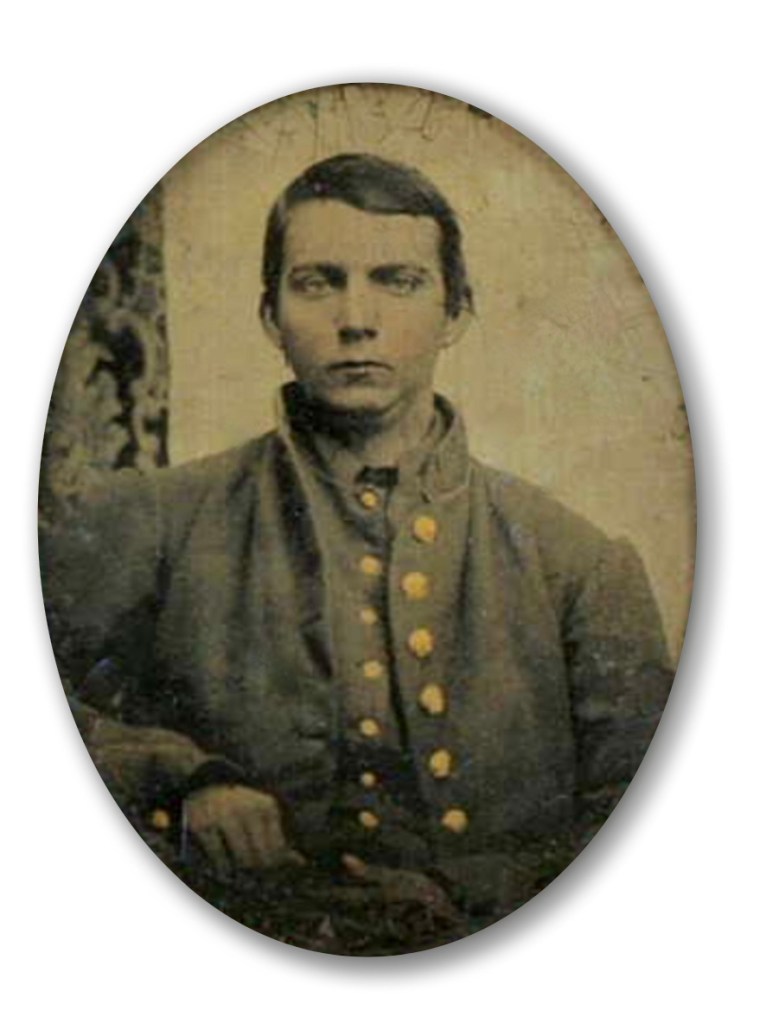

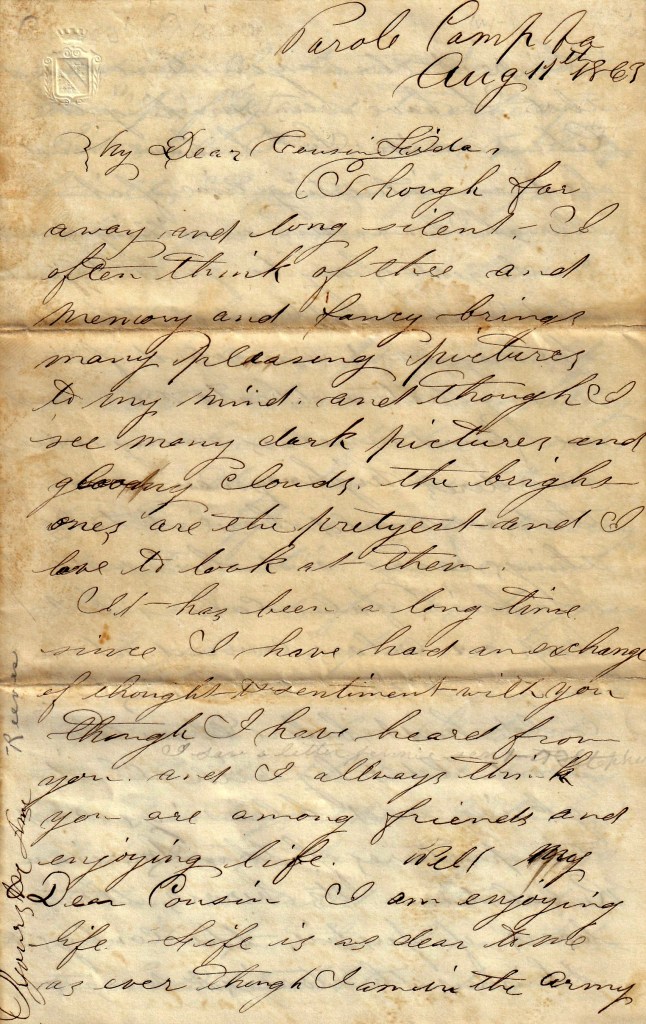
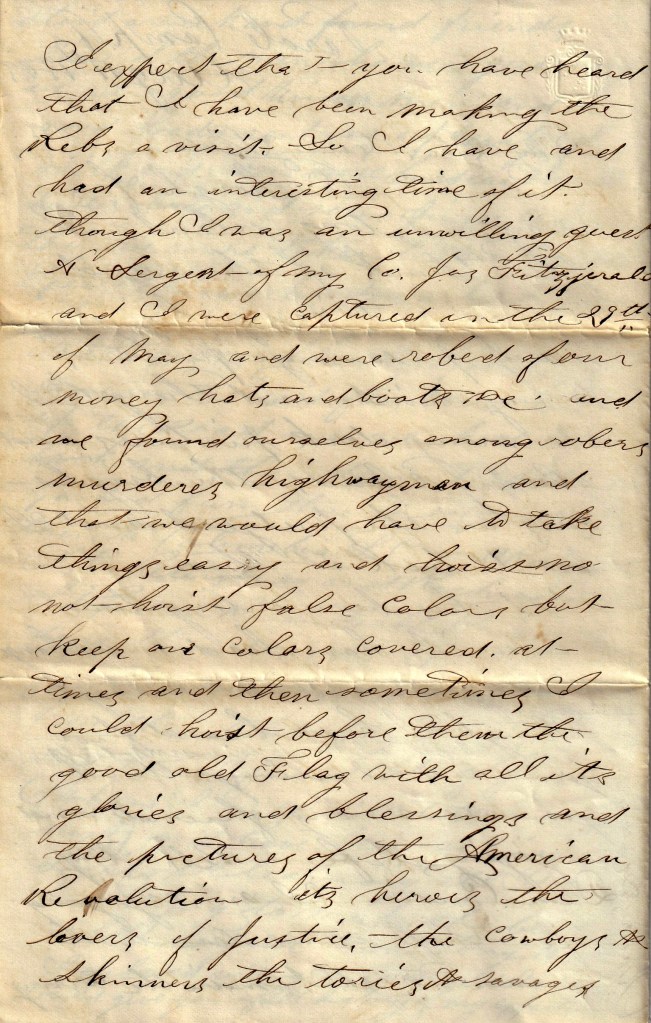


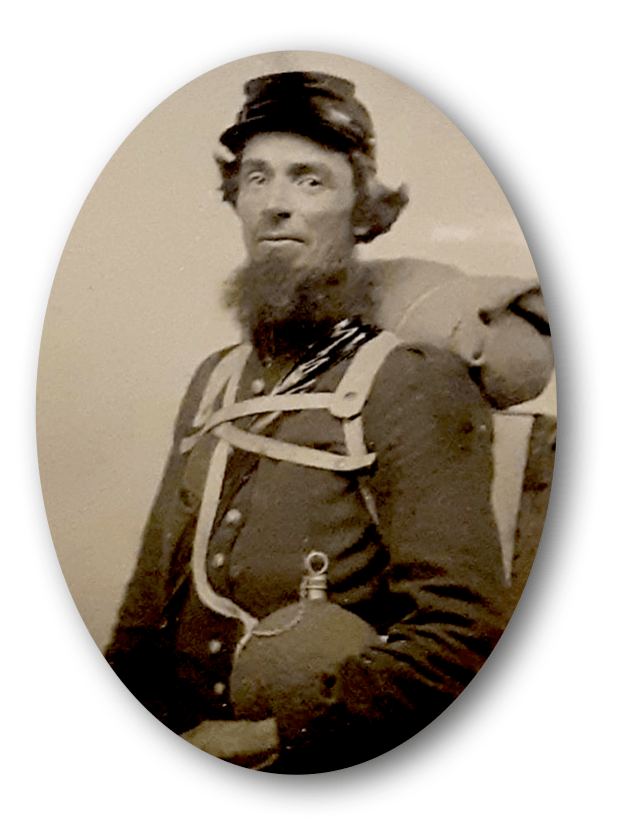


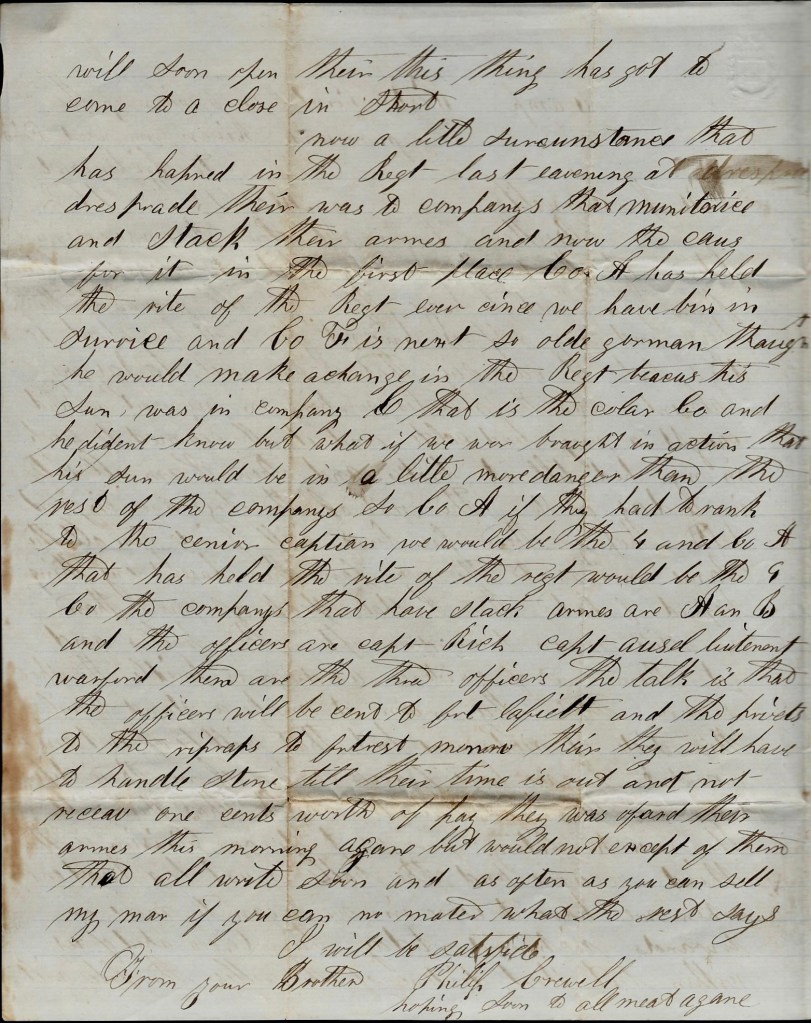
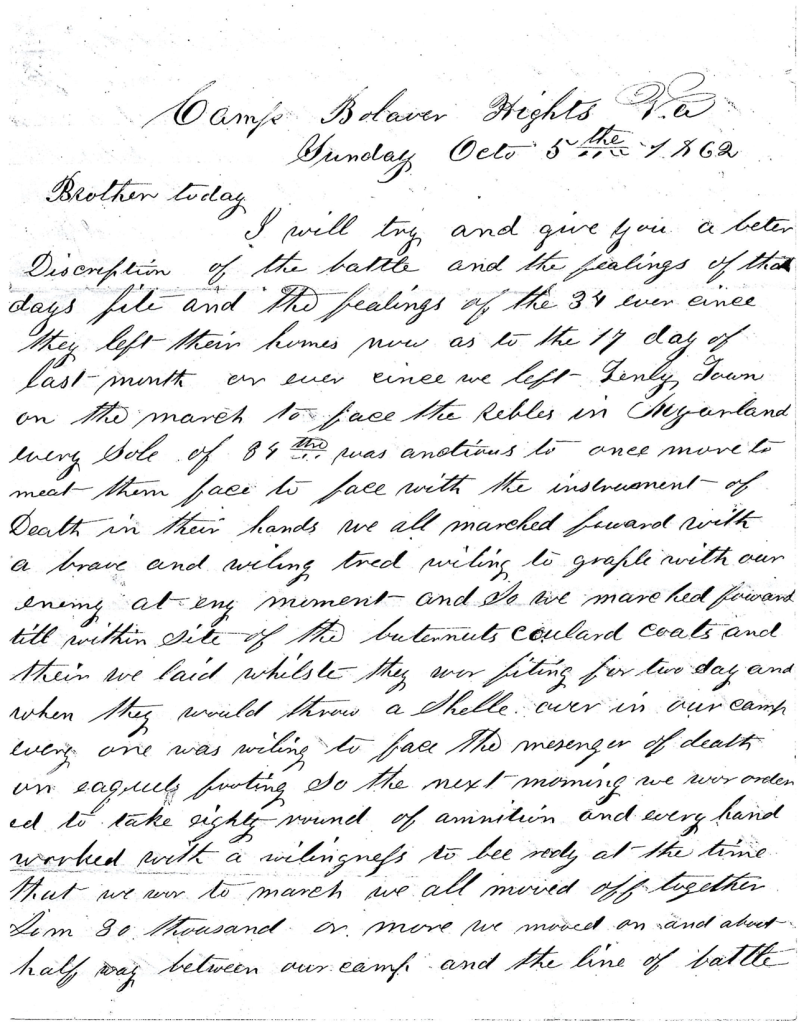
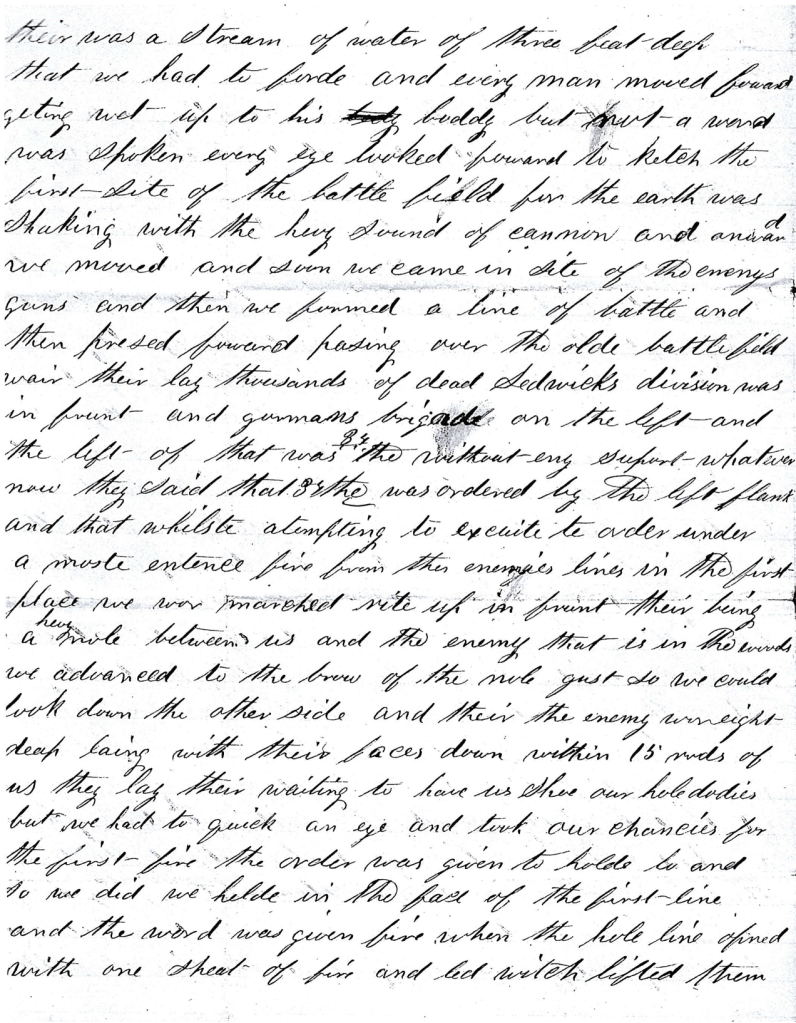
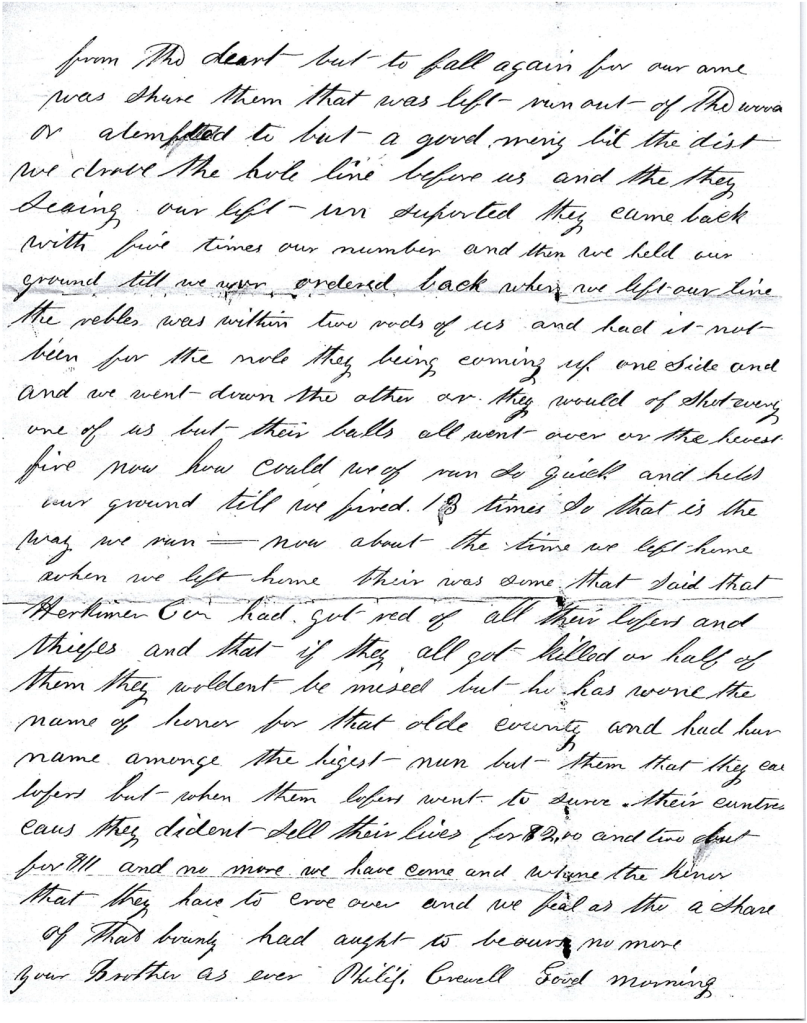
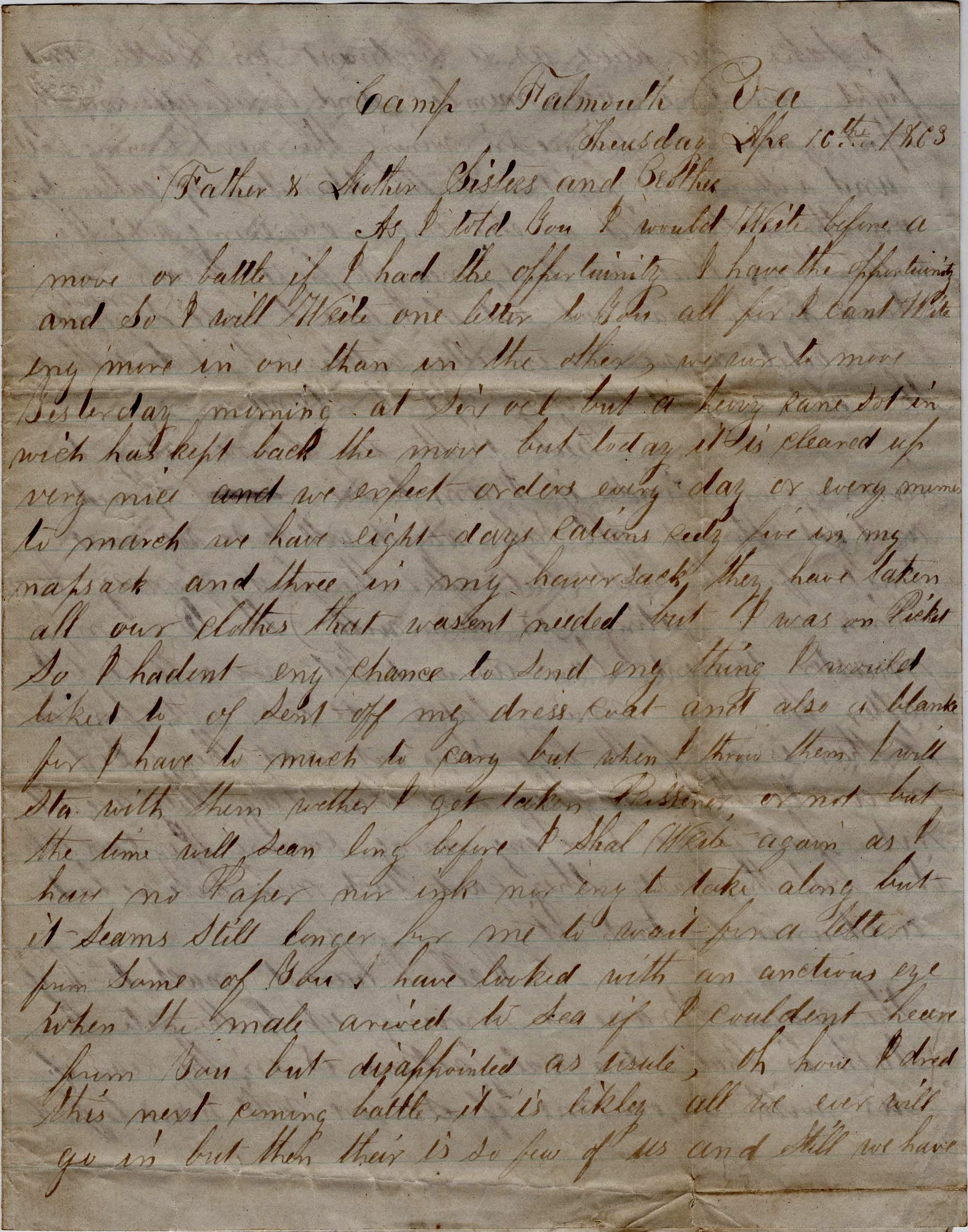

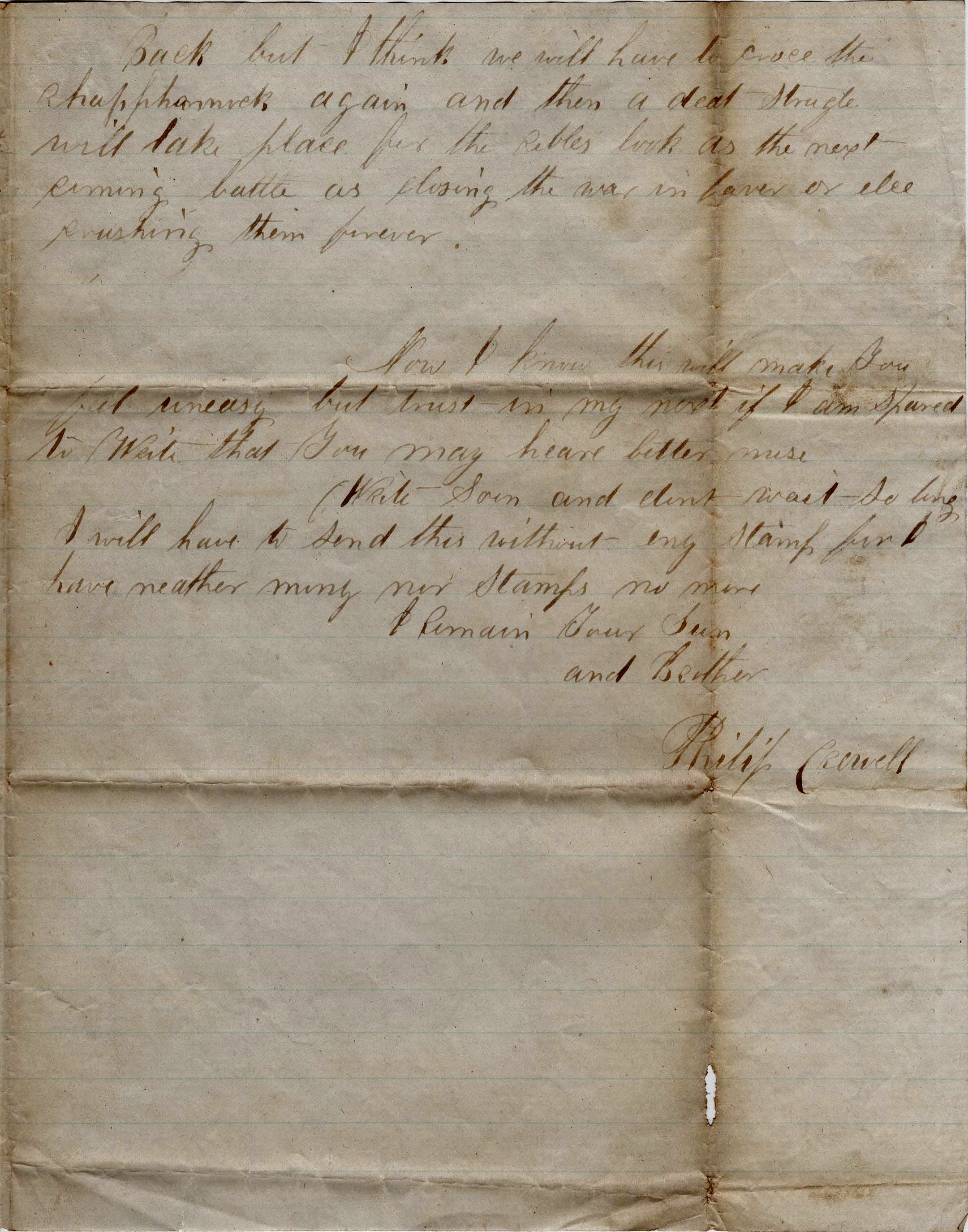


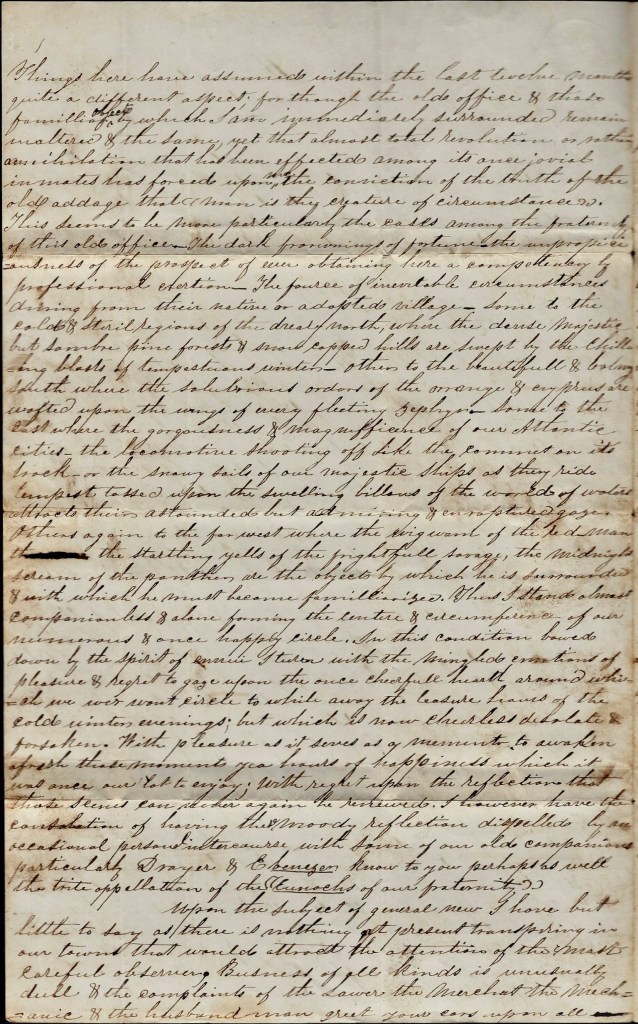
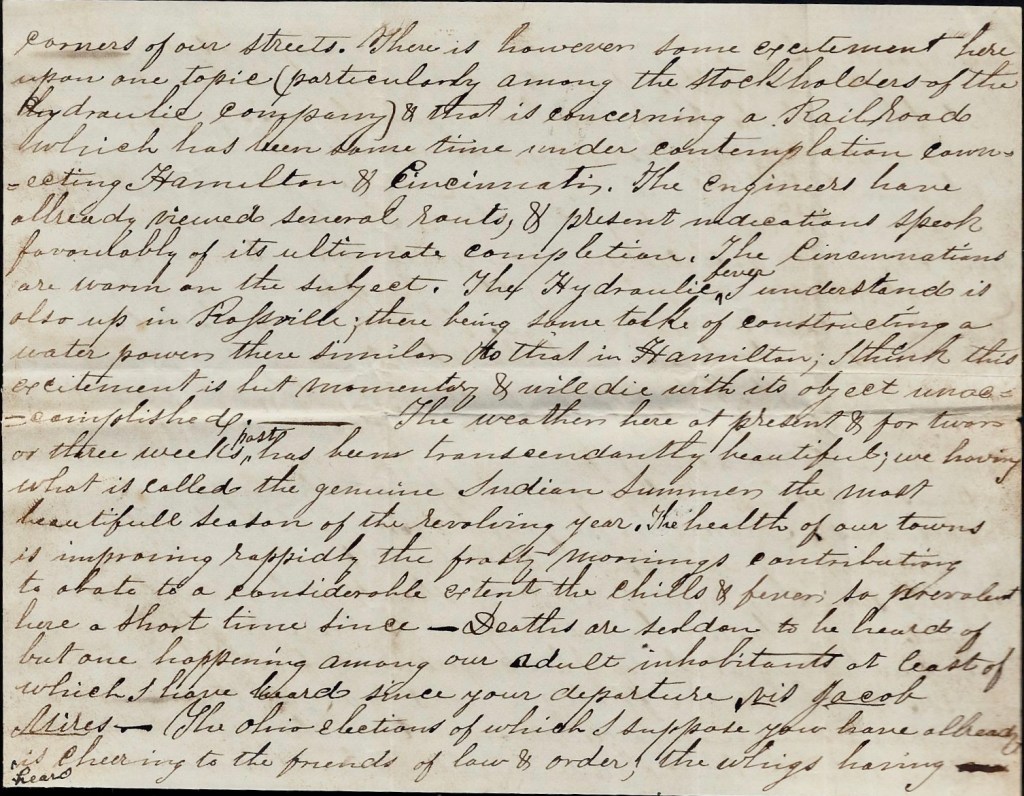

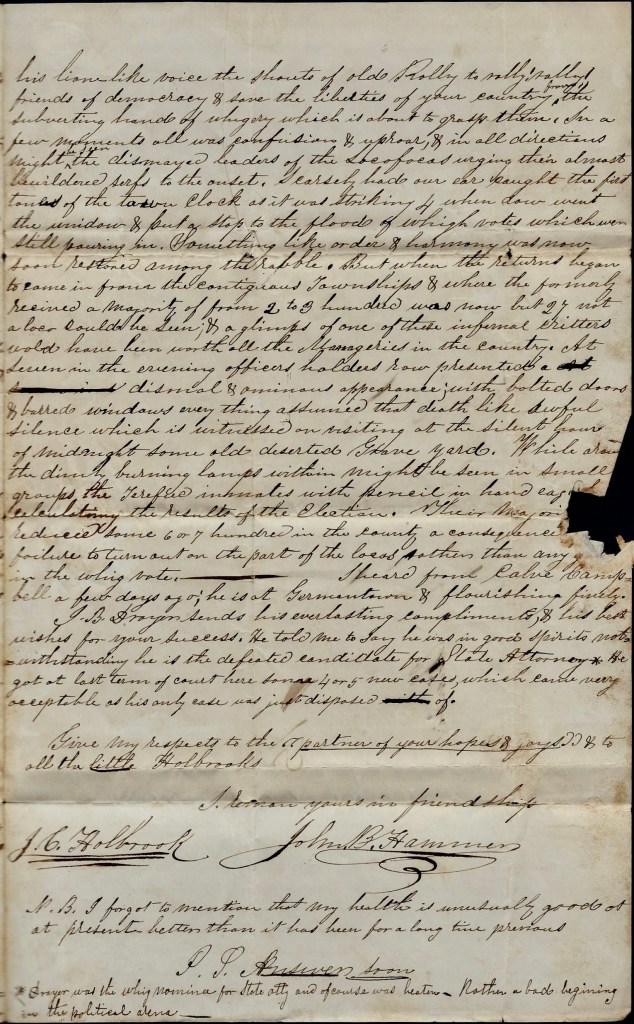
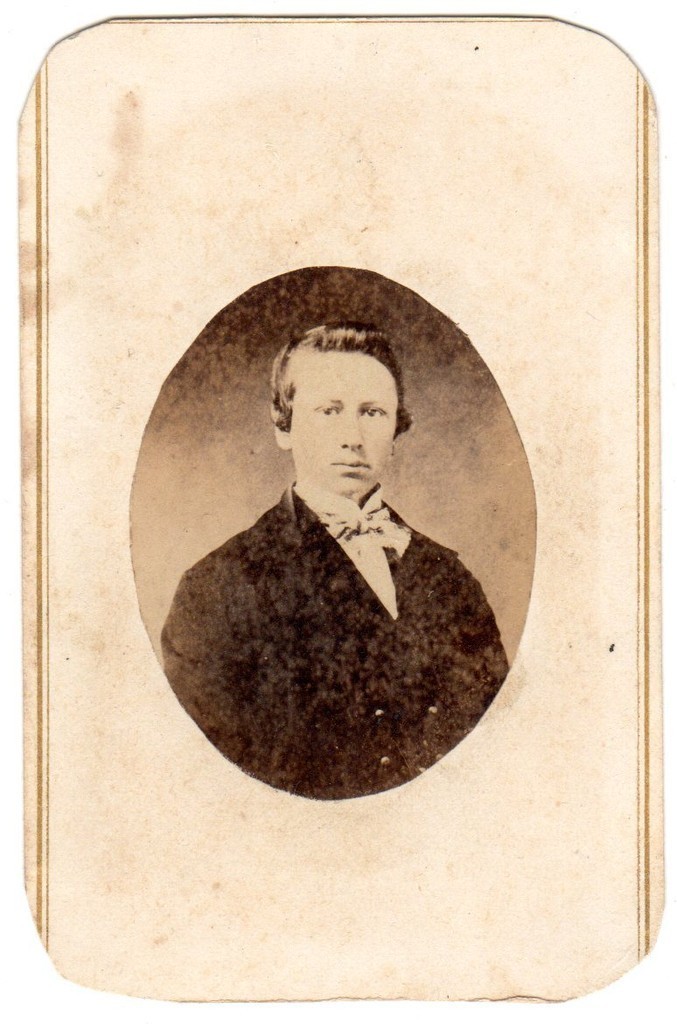
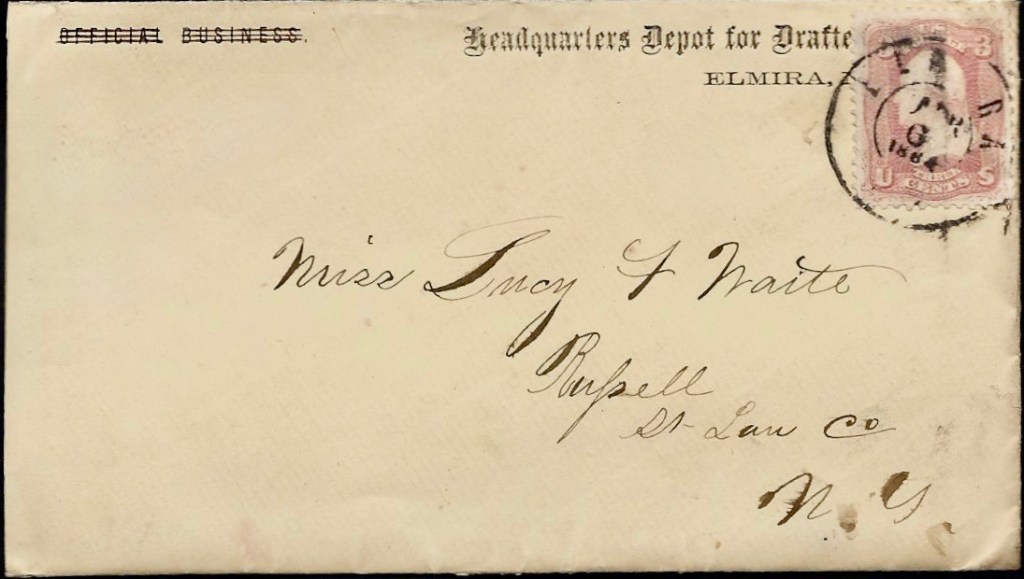
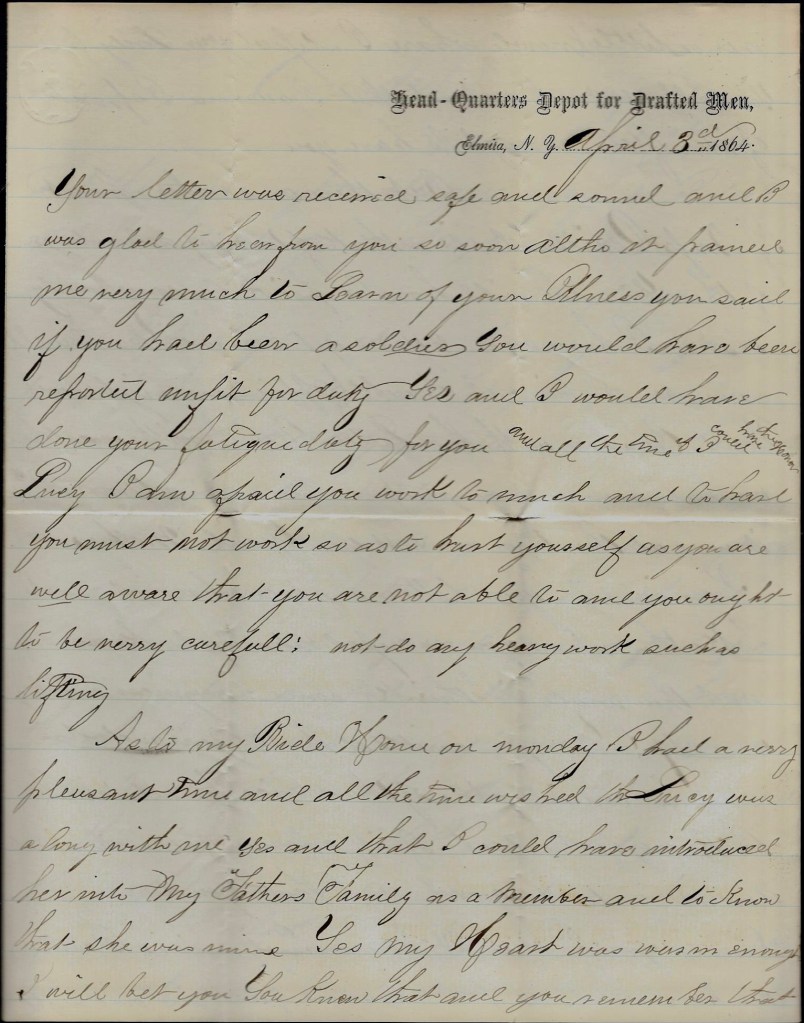

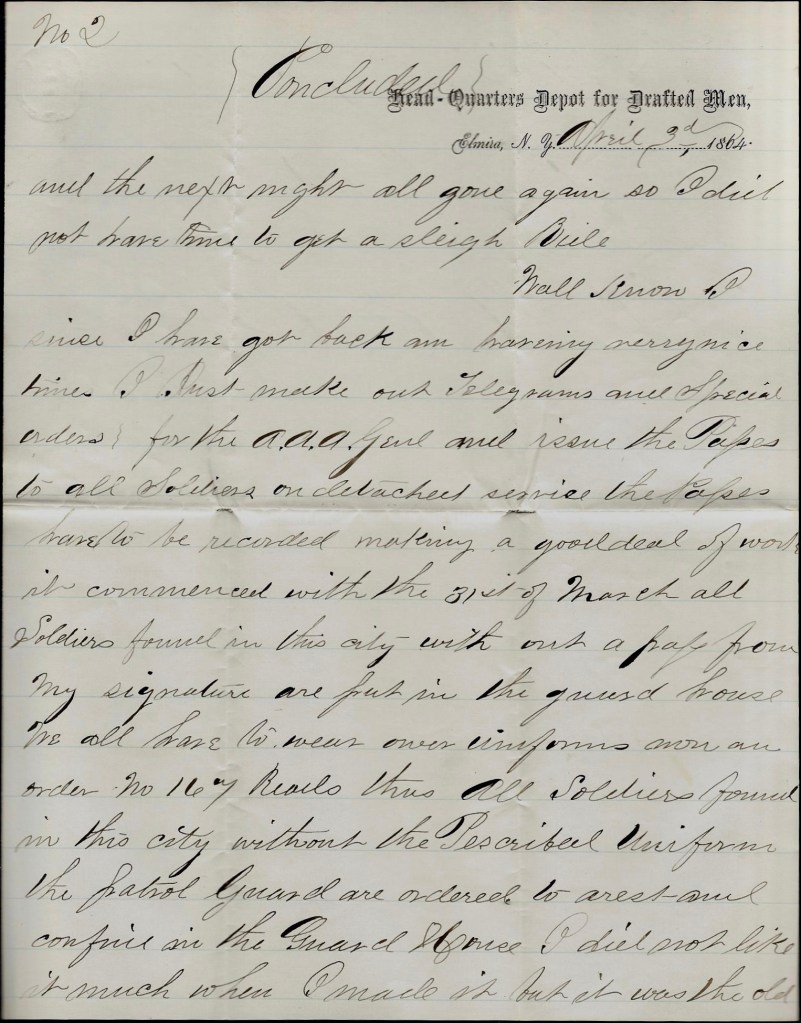
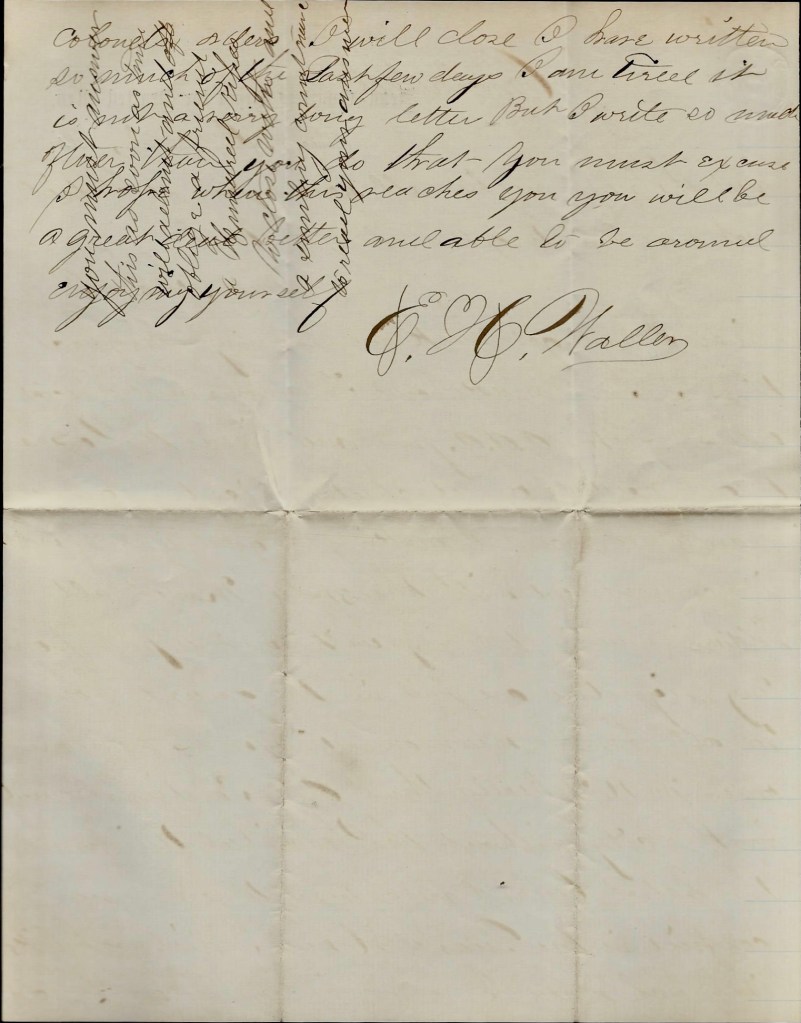
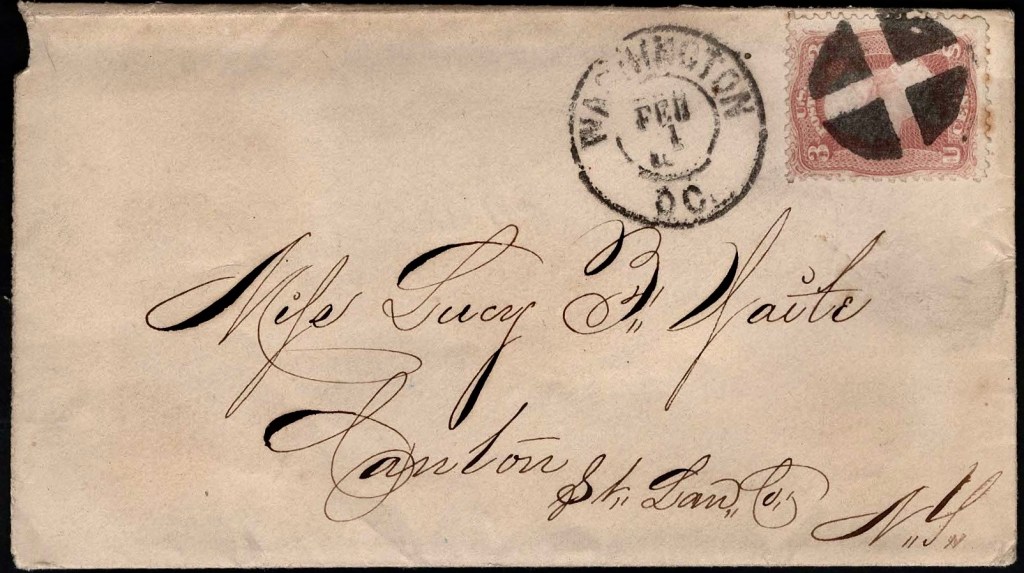


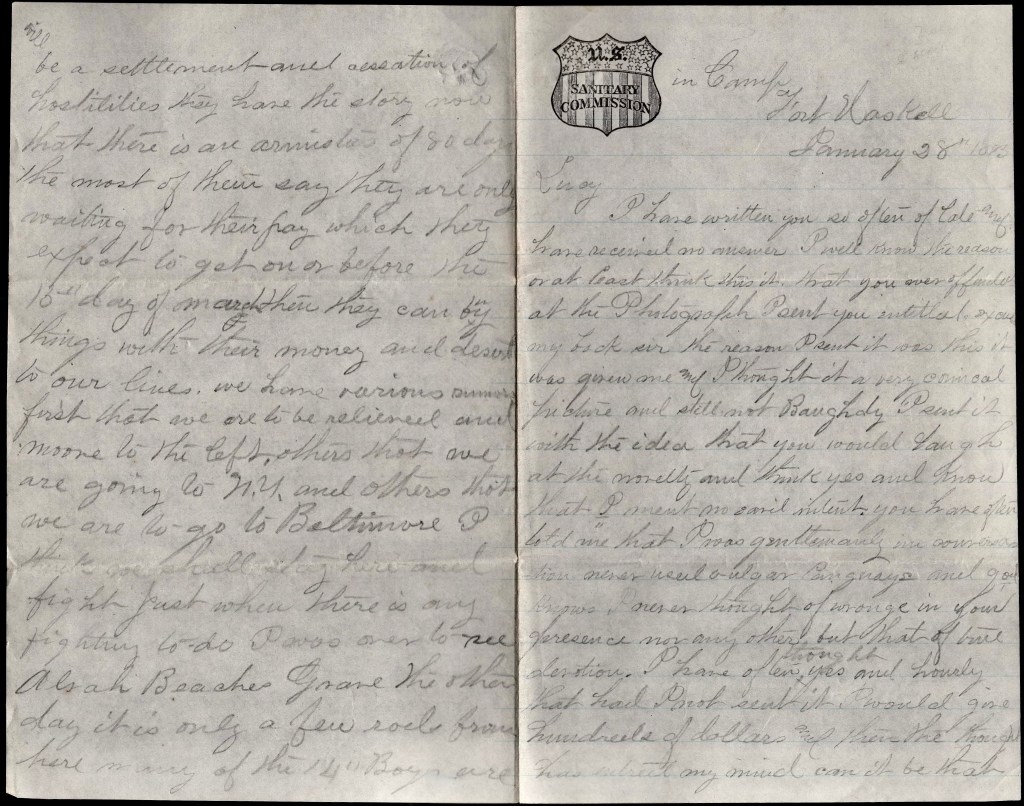
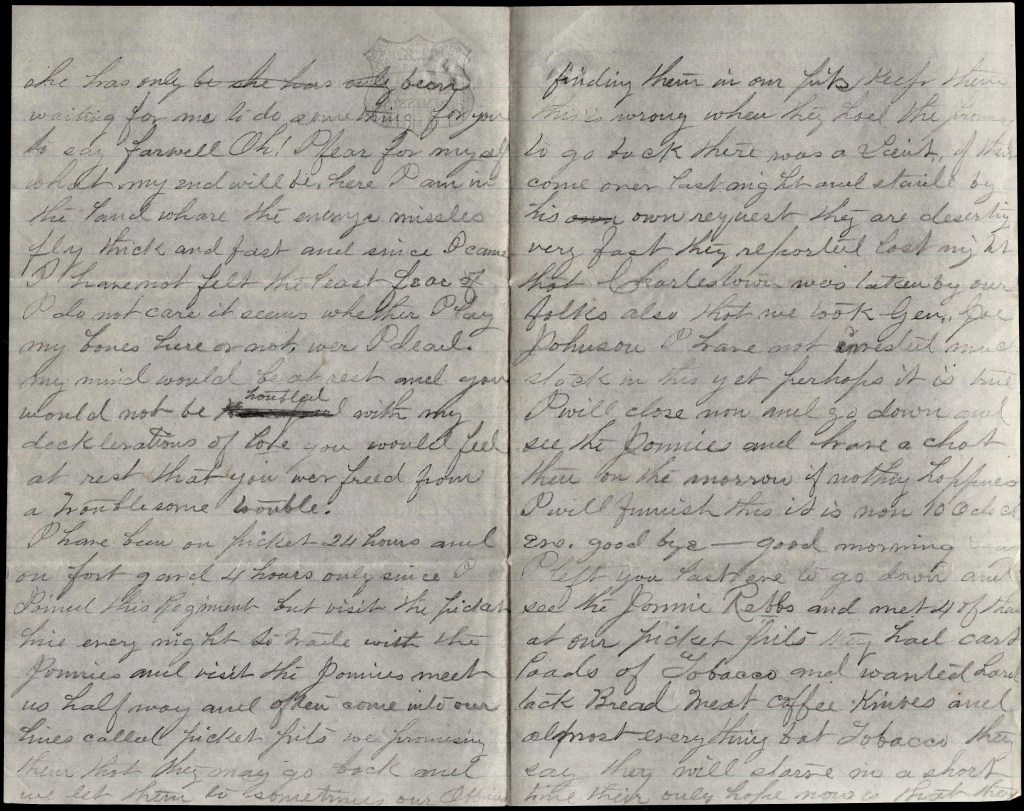

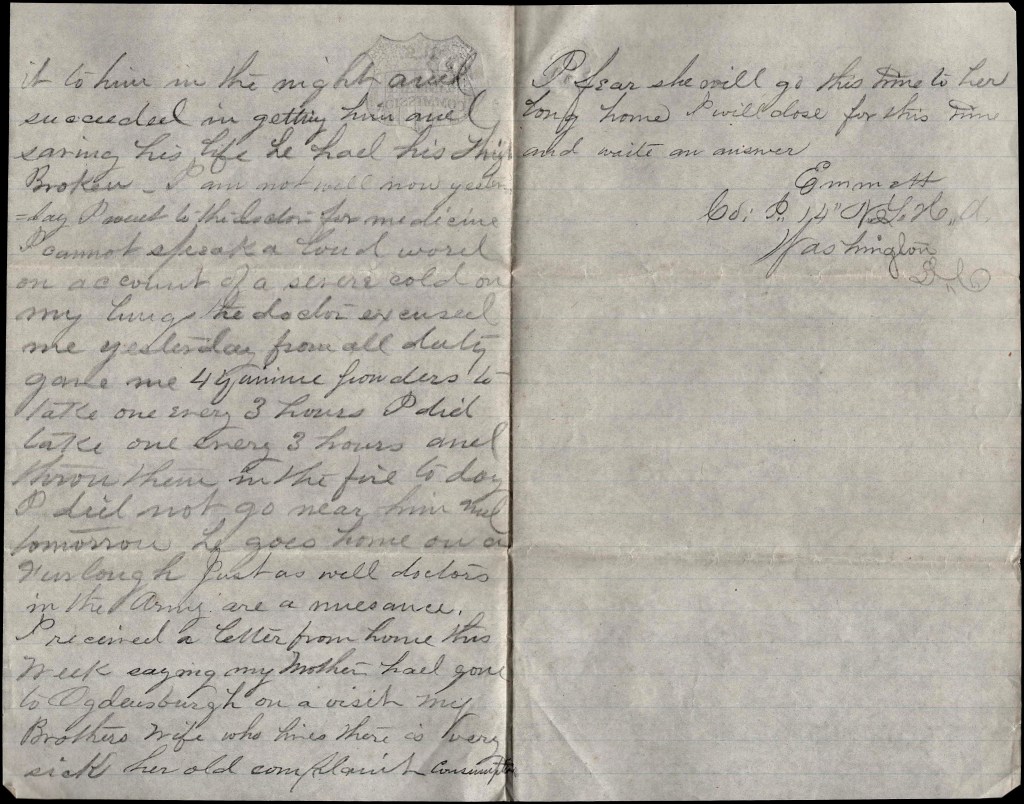
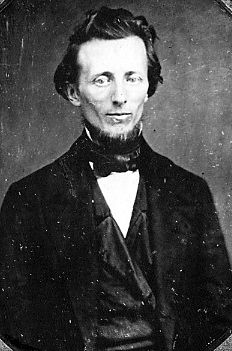


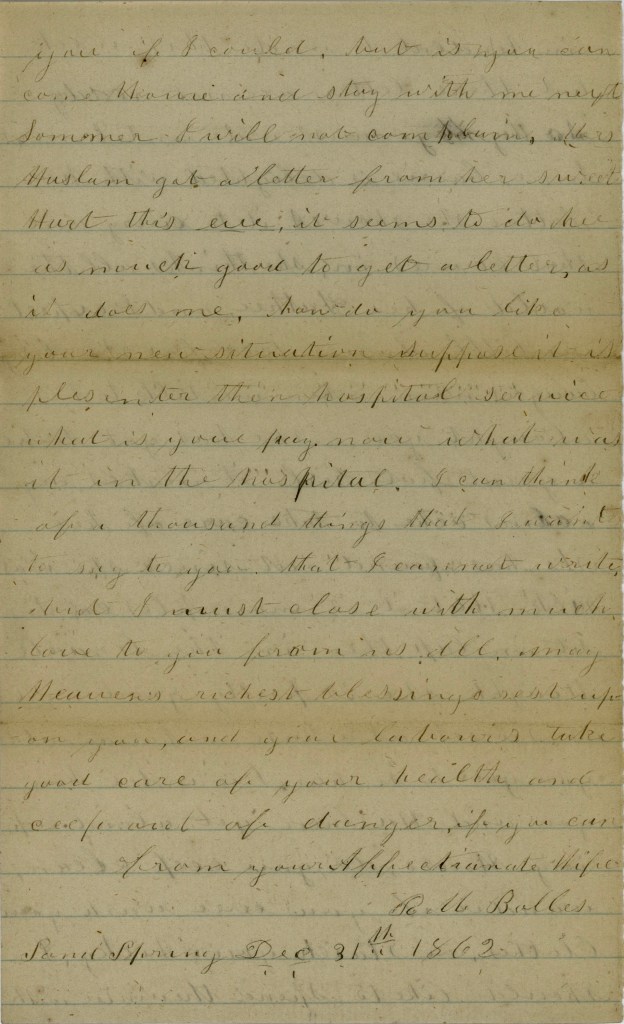
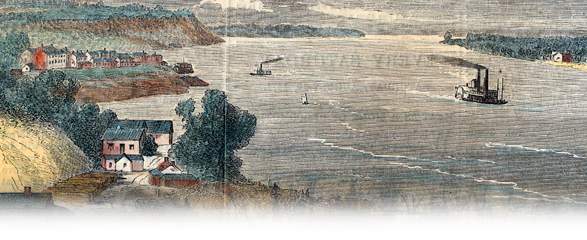


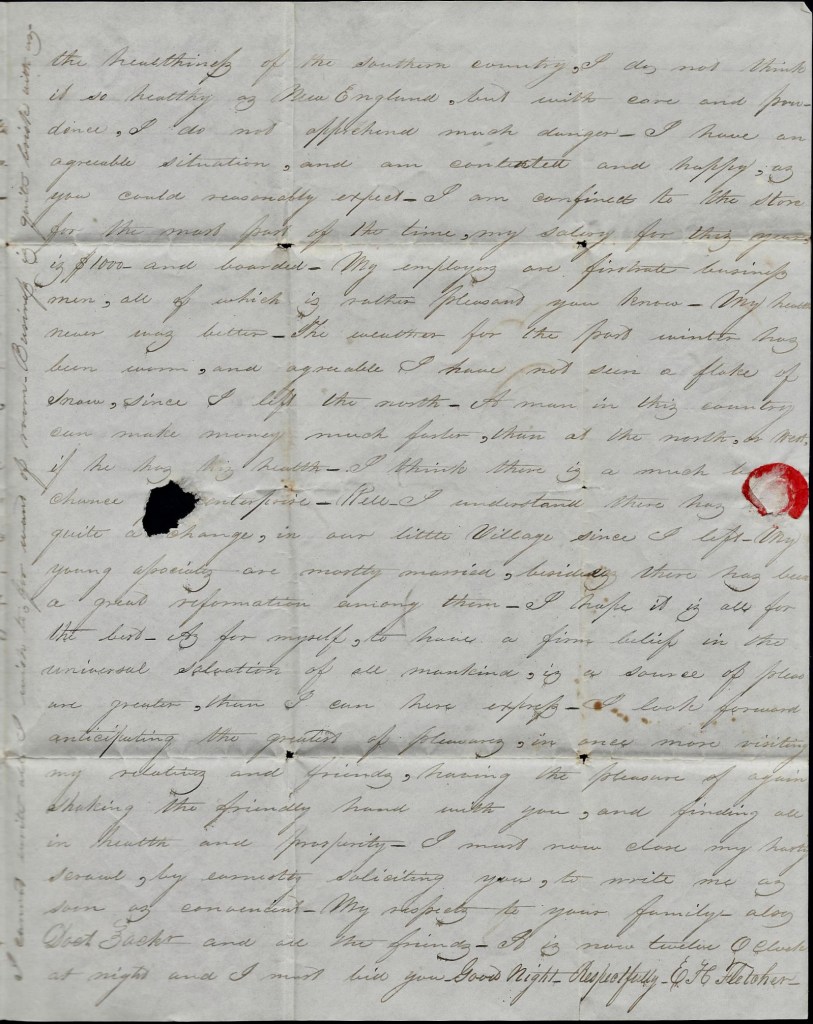
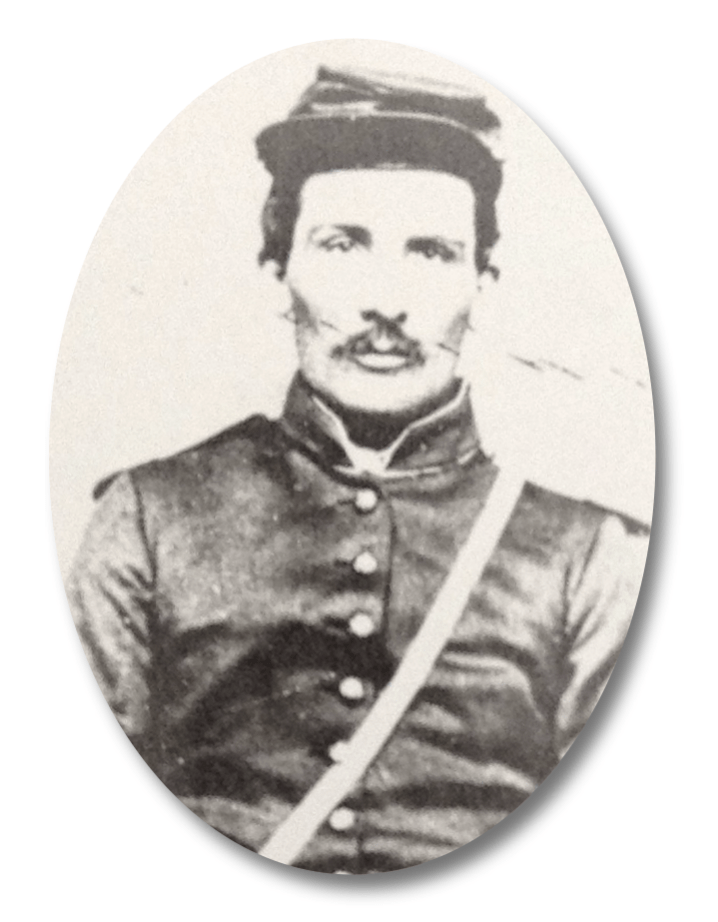
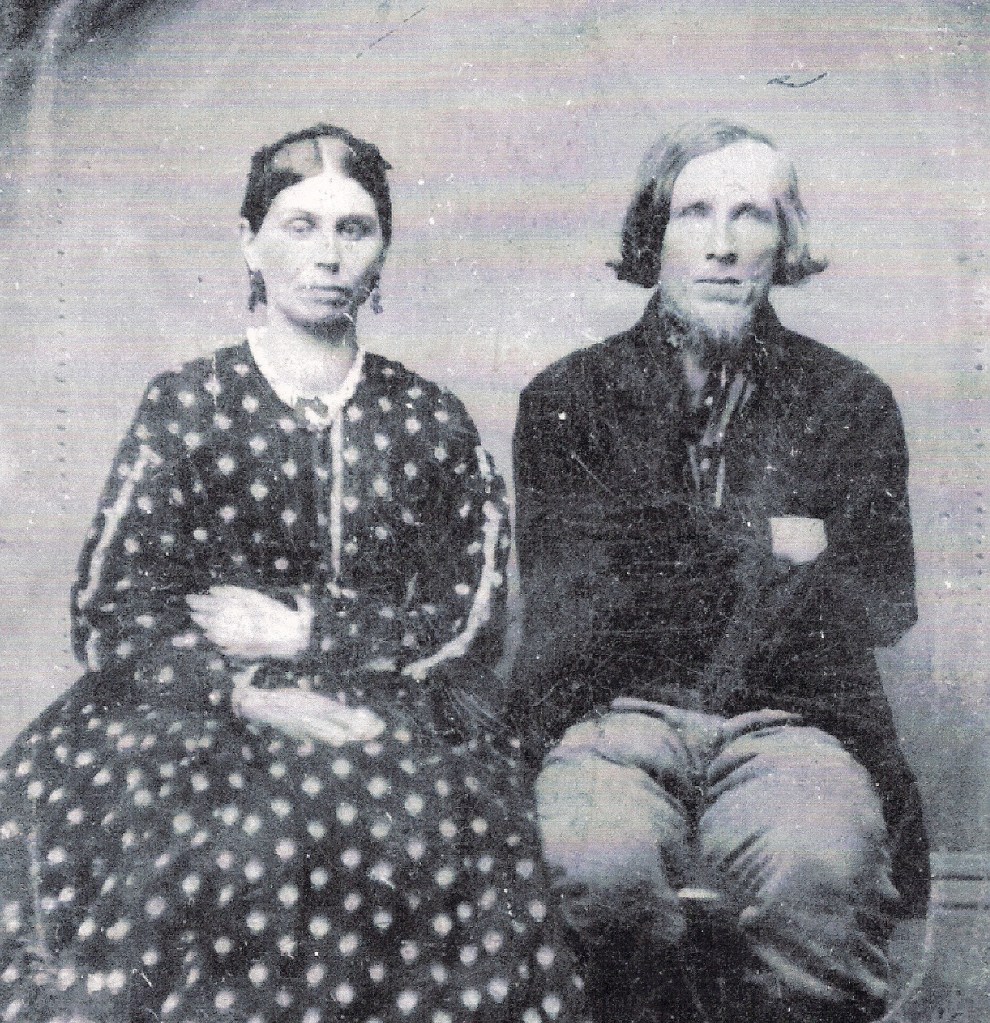
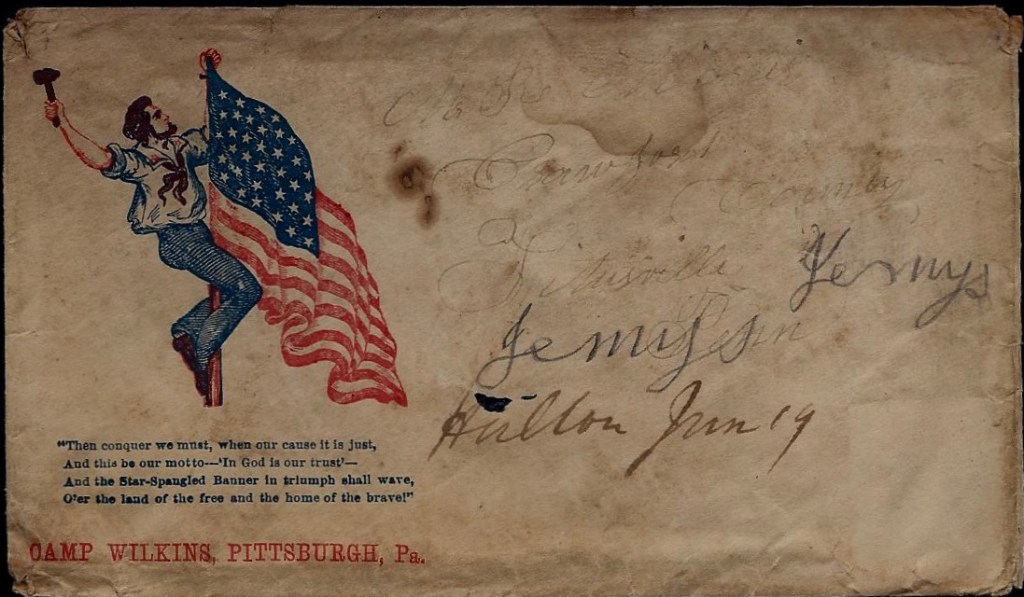


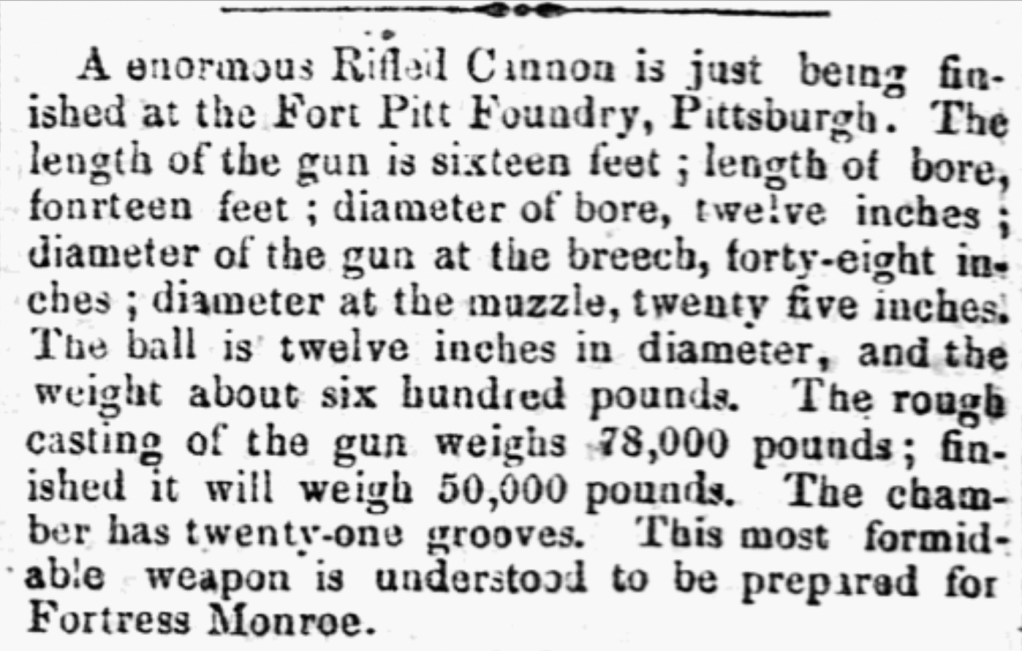
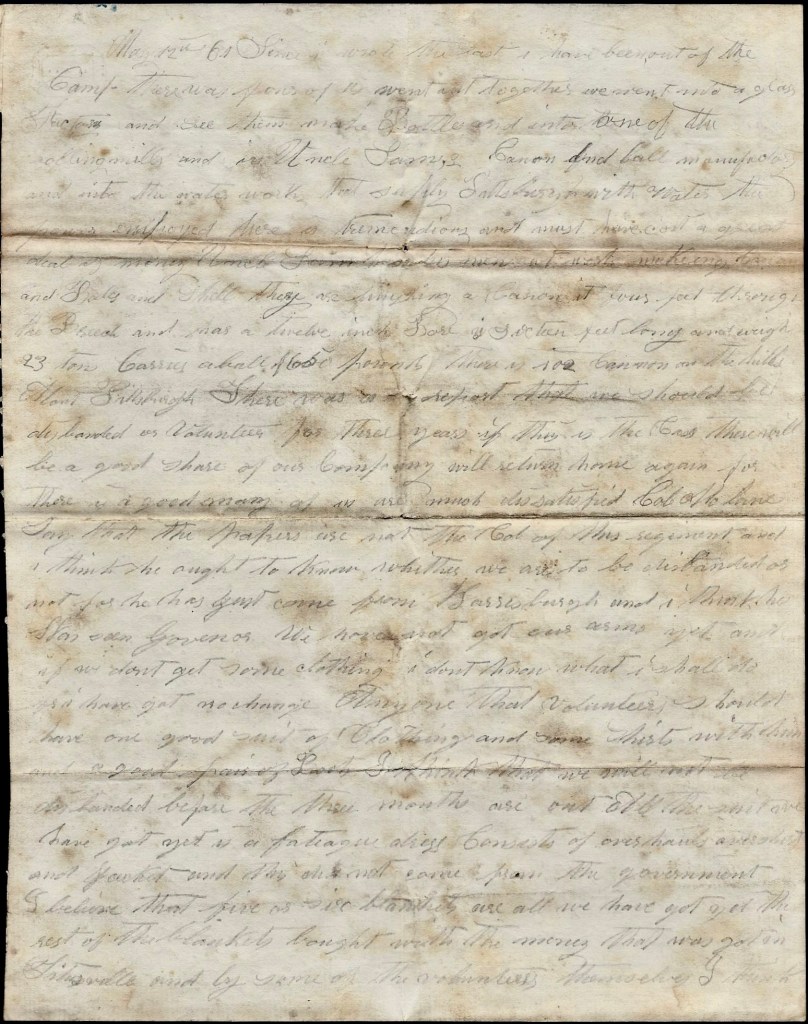
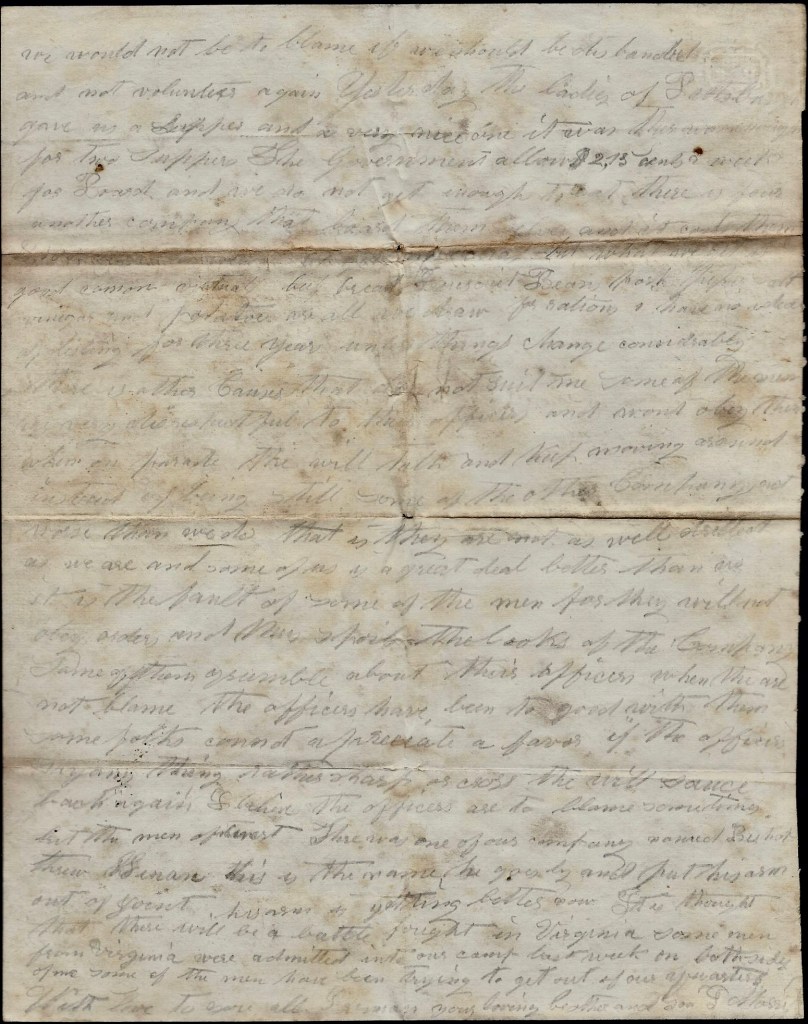
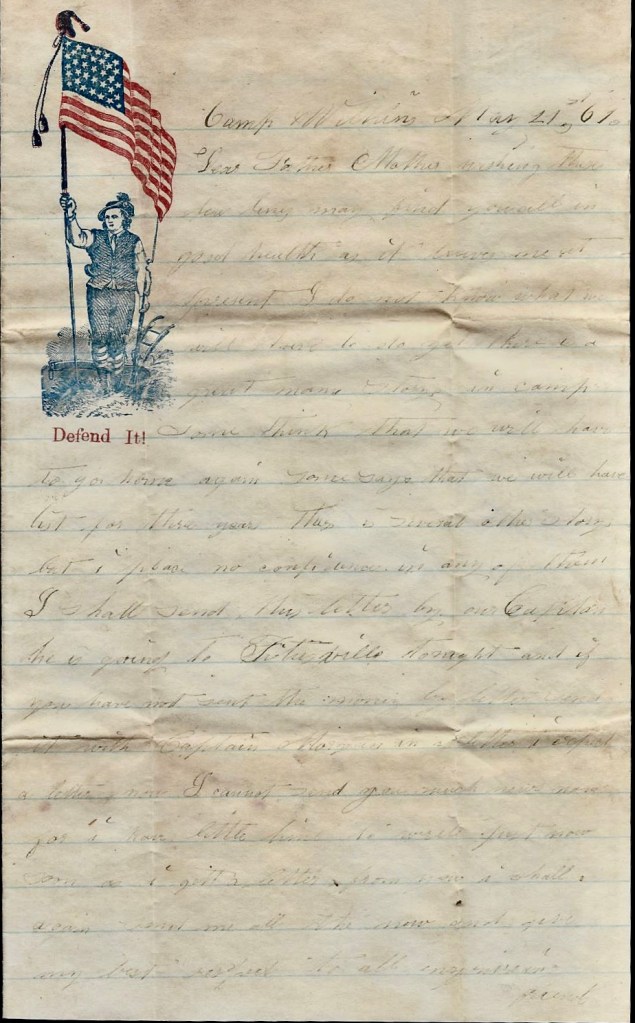
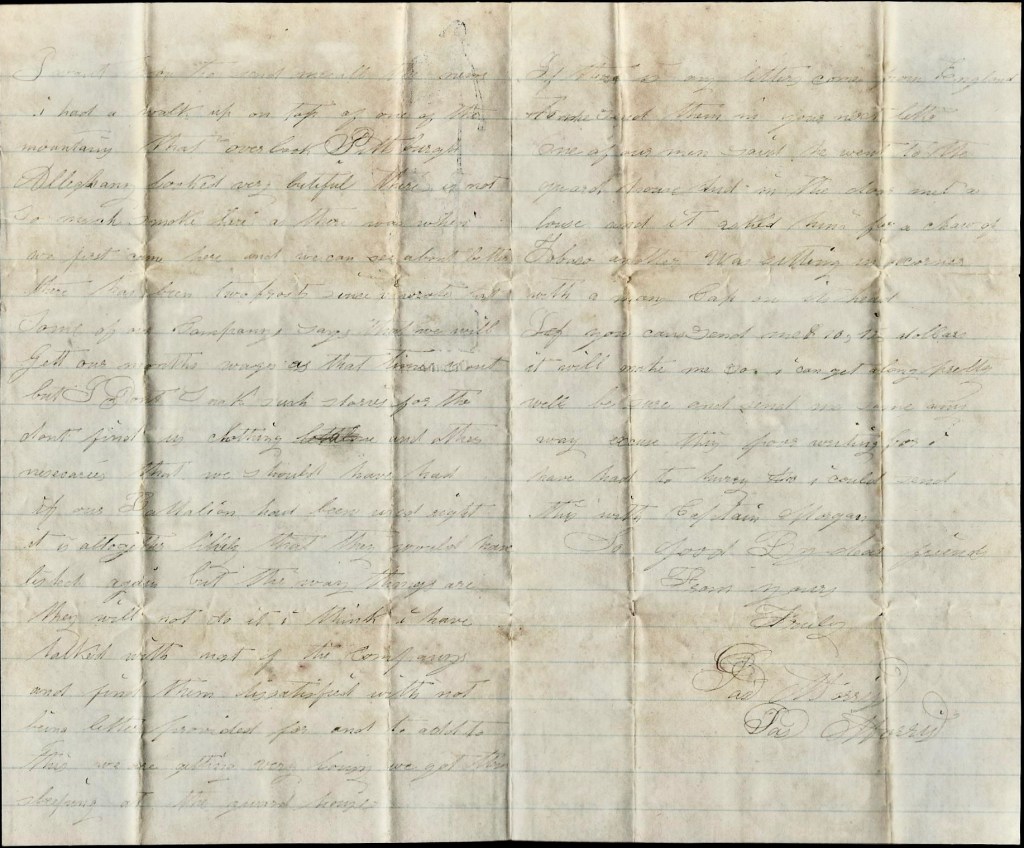

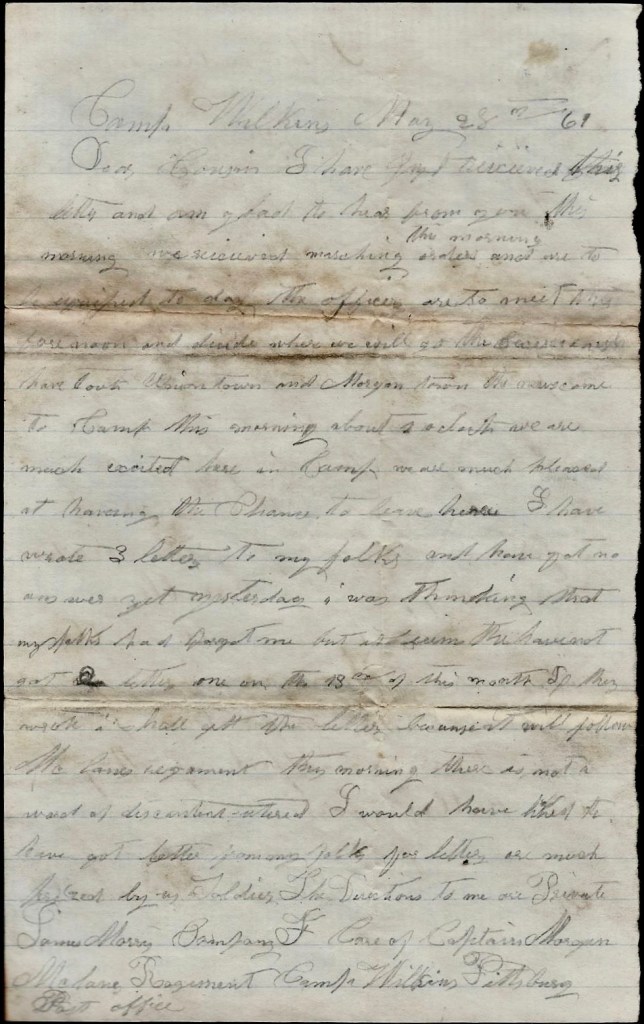

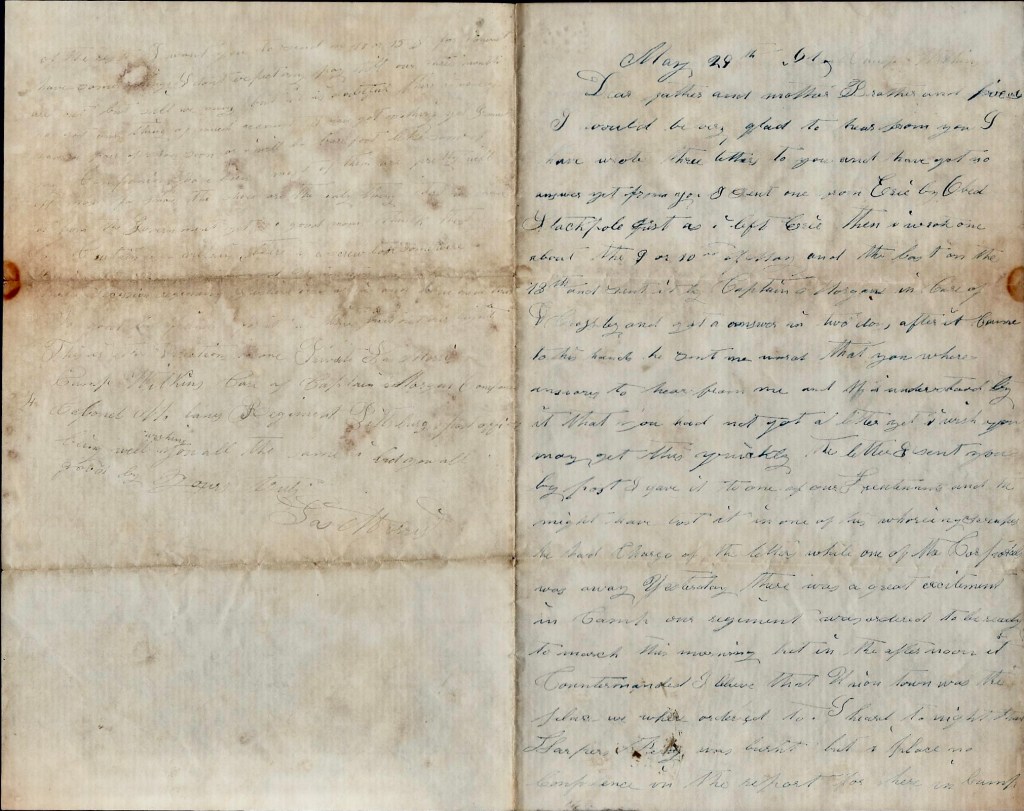

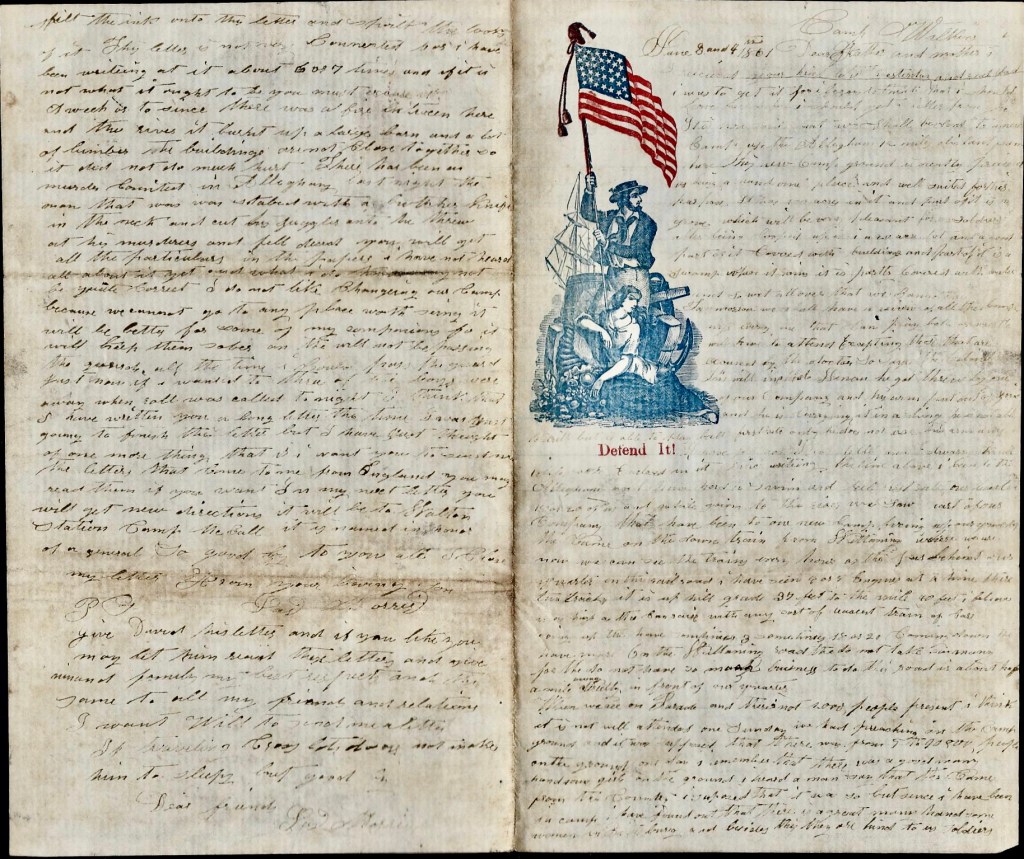


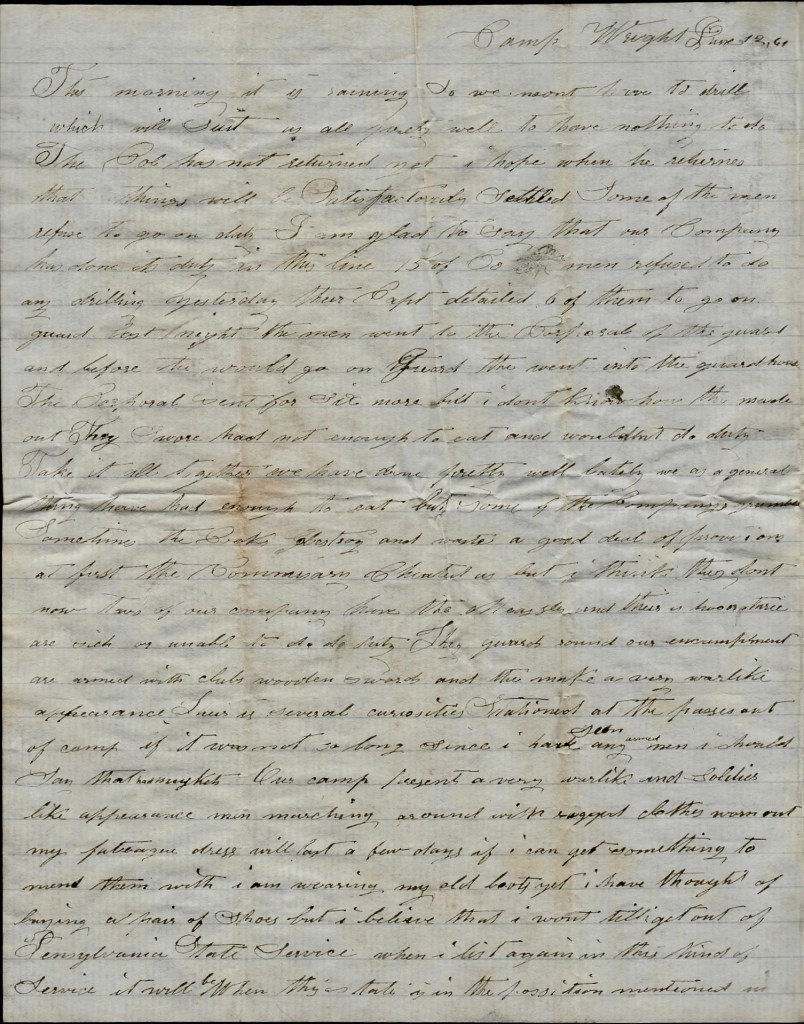





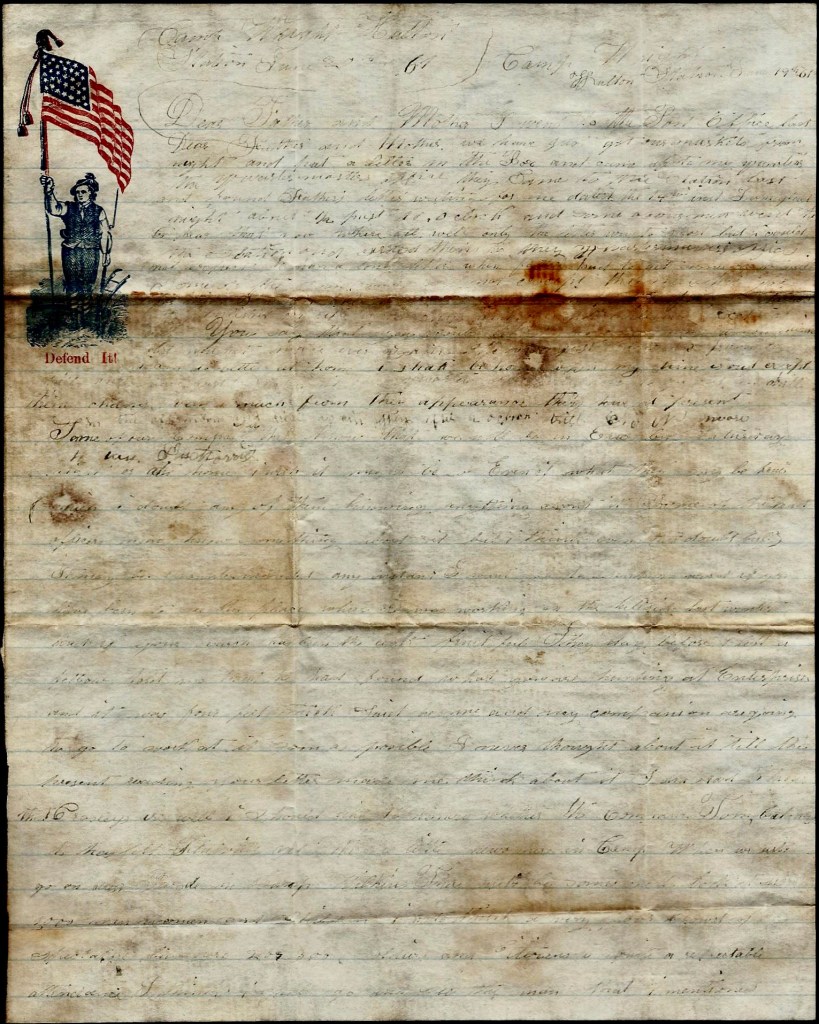


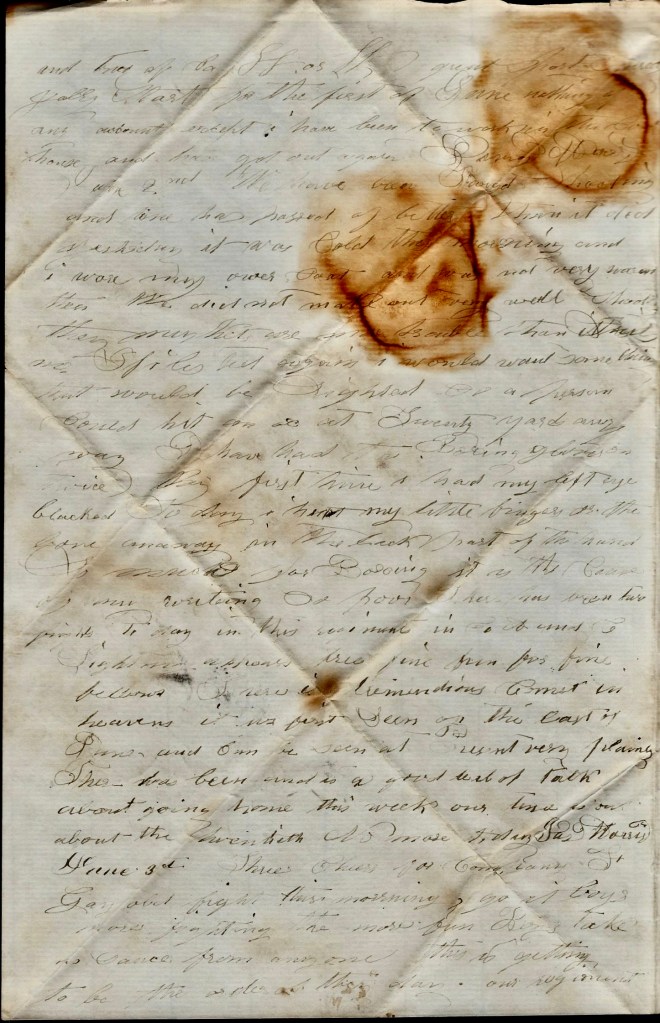


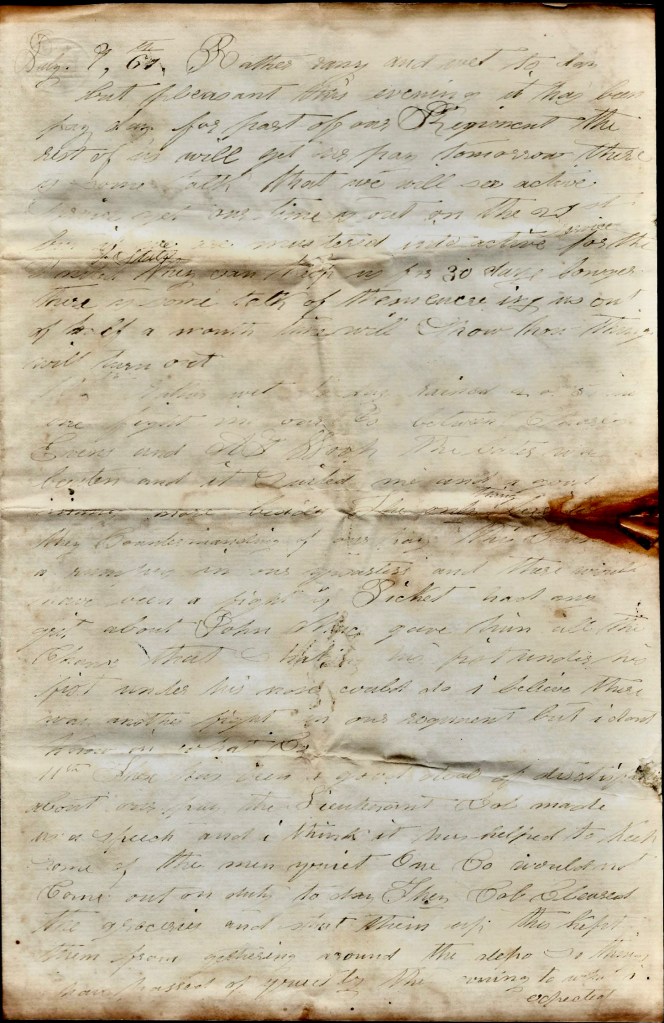
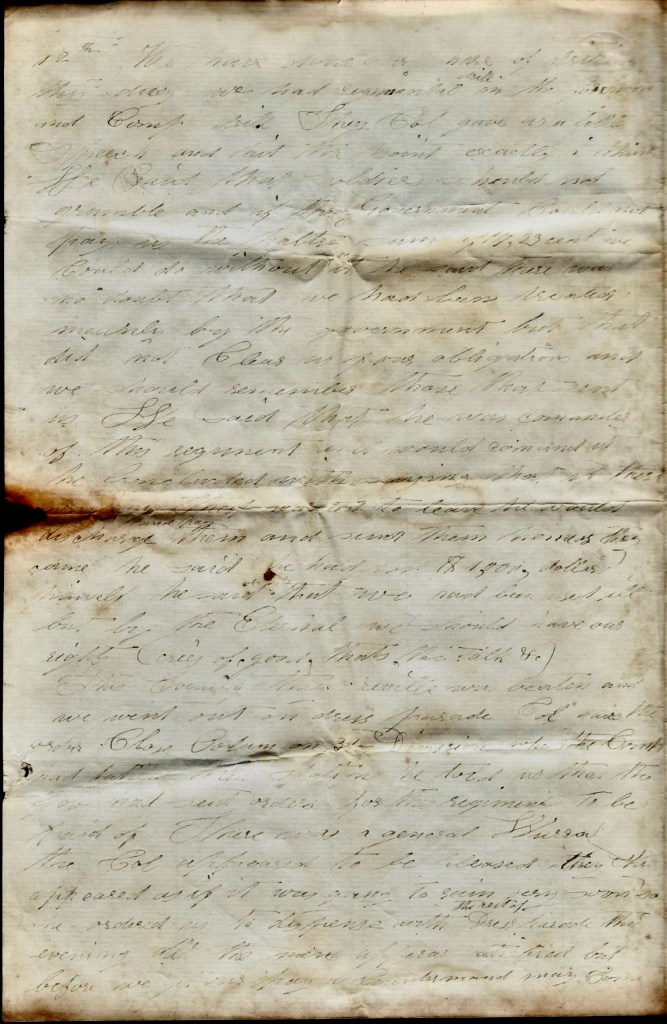

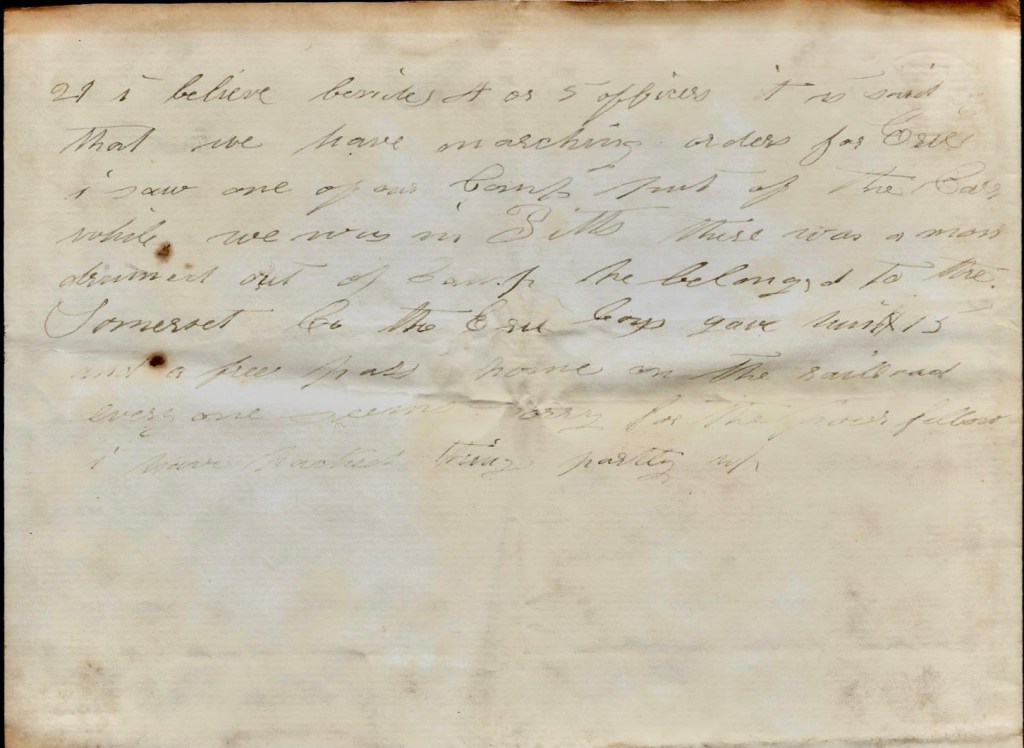
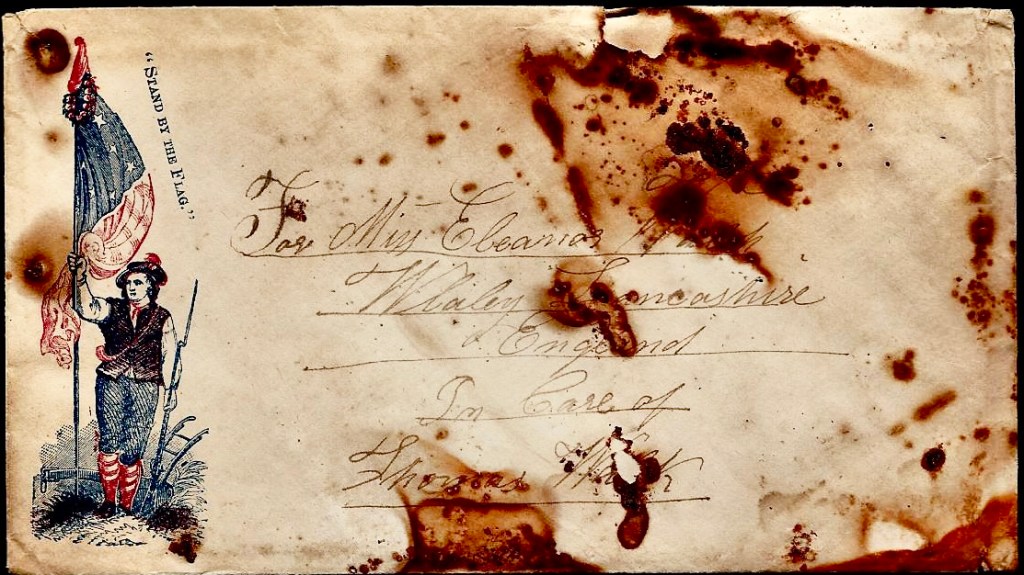
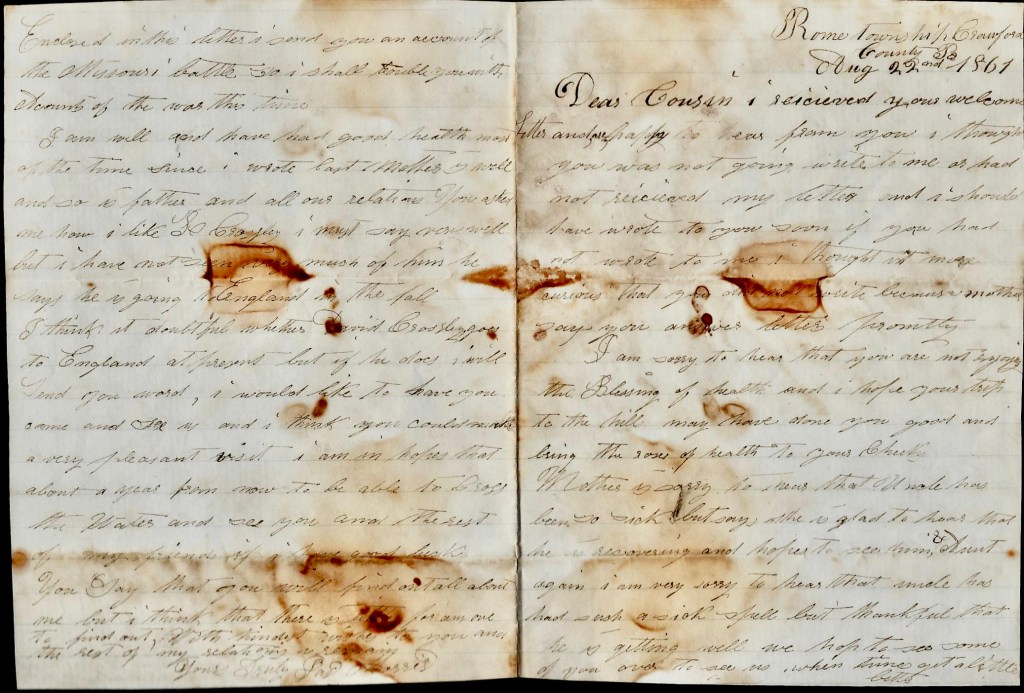
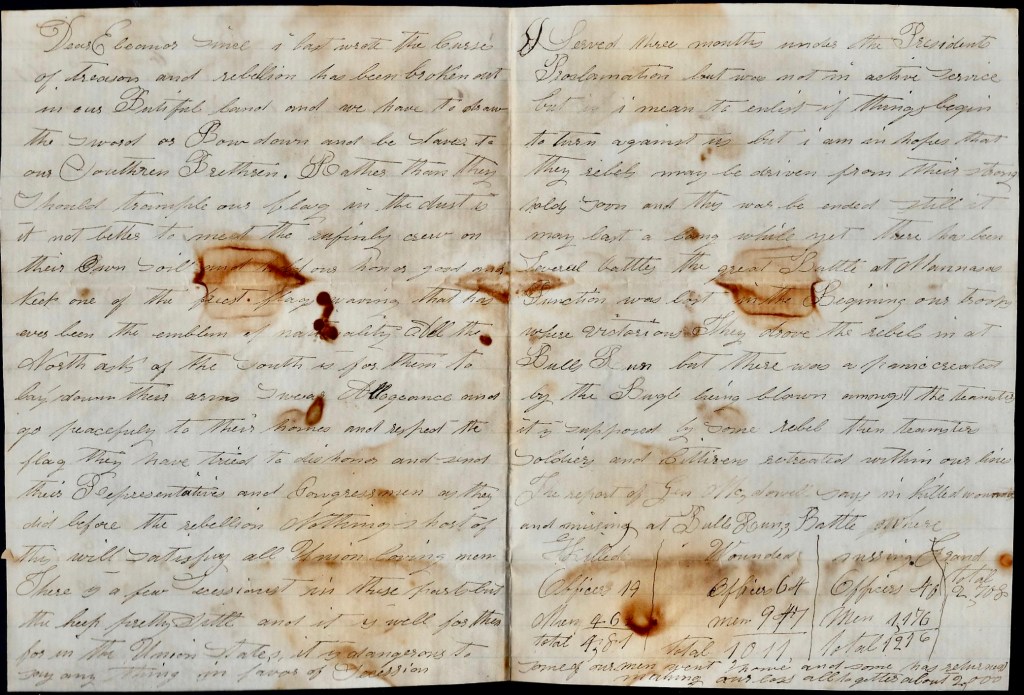

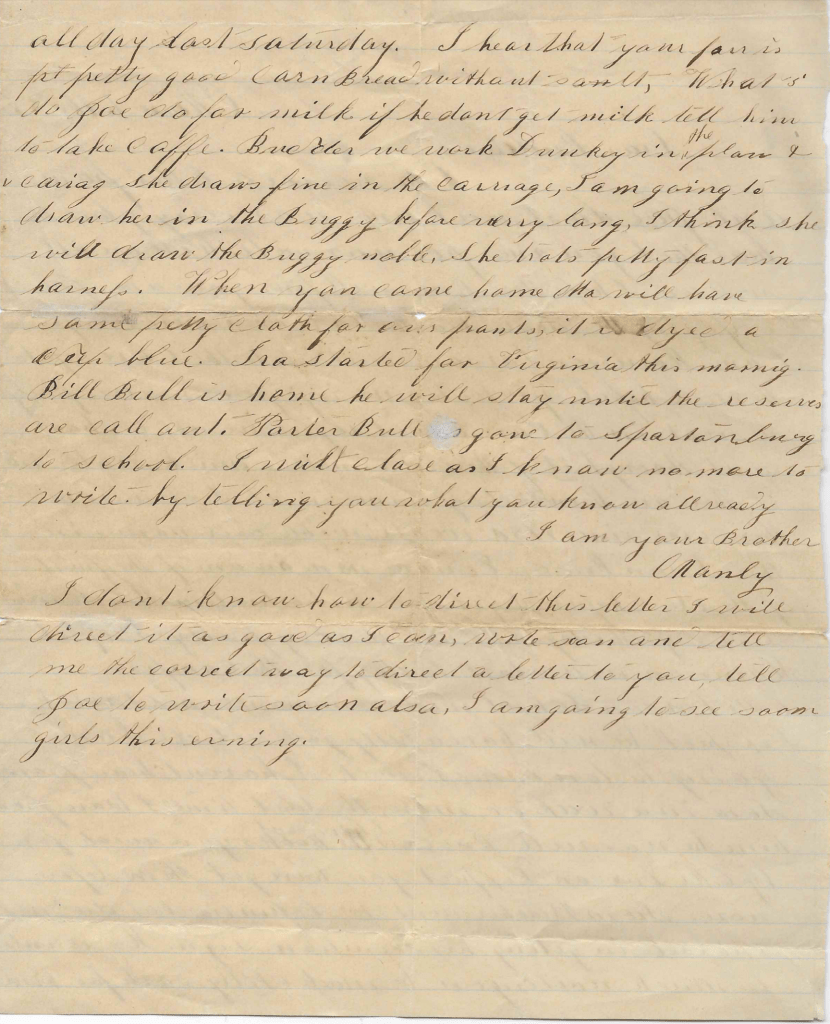


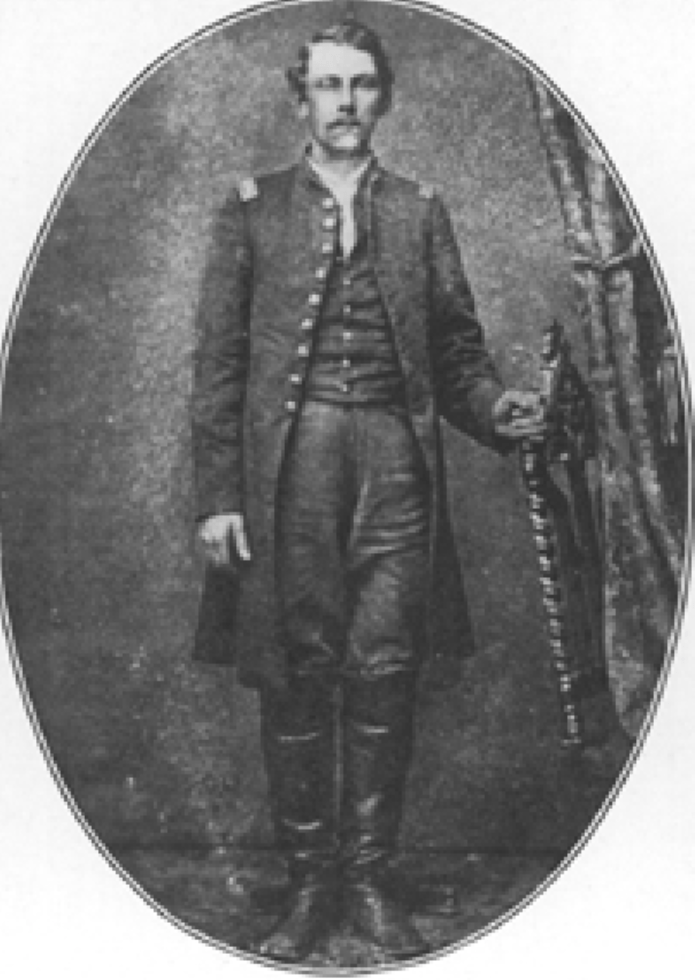


 Spared & Shared 23