My passion is studying American history leading up to & including the Civil War. I particularly enjoy reading, transcribing & researching primary sources such as letters and diaries.
The following well-written letter was penned on a cold, wintery, January night in 1864 by John R. Bowles of Co. F, 6th Virginia Cavalry. He wrote the letter while on detached duty “recruiting horses for service” in Nelson and Botetourt counties of Virginia. According to muster records, Bowles enlisted as a private on 15 January 1863 at Mount Crawford. In November and December, 1863, his records state that he was “detailed to attend to horses of Cavalry Division near Ivy Depot.” By the summer of 1864 he had been promoted to a corporal, and by war’s end he was a sergeant. A note on his muster record informs us that he was formerly a resident of Baltimore, Maryland, and that he intended to return there after the war.
What makes this letter unusual is that it was addressed to his friend Ned who was clearly living in the North—probably in Maryland, and the letter had to be smuggled through enemy lines with little or no expectation of a response. Ned isn’t identified but my hunch is that he was a former schoolmate.
Transcription
Rockfish Valley, Nelson county, Va. January 6th 1864
My Dearest Friend Ned,
By the dim and uncertain glare of my campfire to night, I will attempt to write you a few lines as I have just heard of a good opportunity of forwarding a letter through the lines. Have you thought of me often, old friend? And have you ever wondered whether I reverted to you in my retrospections? If you have, you may case for the future from such uncertain speculations for you are my companion yet—present in mind though absent a long ways and separated by distance and armies.
Just imagine yourself with me tonight in my winter hut of logs and mud with a glowing fire cracking and popping like shrapnel shells around you and three messmates reclining upon beds of the “softest chestnut boards” we could find and a lively conversation upon foxes and fox hunting with rich imaginative embellishments annexed and a pot of rice and boiled rabbit upon the floor and you have our introductory appearance exactly. Well, having made your bow, as I am done my supper, I will monopolize your company so just seat [yourself] by my side upon my blanket and we will talk of old times and present circumstances.
How are you and how are you getting along? Are you in business for George W. H. yet? How do you like your location now and what profits do you realize? What do you think of things in general? When were you in Baltimore? How are the people there and who’s married and who ain’t? Have you read Jeff’s Message and what do you think of it? Uncle Abe seems to be a little weak or very impudent, I don’t know which.
If you could see my jowls and hear our mischief, you wouldn’t conclude my apprehensions of starvation were felt nor suppose that the spirit of our army was broken. I have had a splendid time lately, Ned. I am now and have been for two months upon detached duty recruiting horses for service in this and Botetourt counties. I get good fare, have light duties, not much restricted and plenty of friends, both make and female. Invitations to dinner and evening candy-stews are frequent and our soldier boys stand in high repute. I have some fine lady friends—the first feminines I have conversed with since I have been in the army—and you may suppose that I am “making hay, &c.” quite rapidly in strict accordance with the ancient adage. How I wish often times that you could share their company with me.
We will rejoin our regiment early next spring in ample time for fighting. Well, Old fellow, I have smelt gunpowder very often since we parted and do not care if I never offend my nose again by the scent. I have been in twenty odd engagements during last year and witnessed spectacles such as the battlefield only presents. But such descriptions are woefully frequent in the newspapers so I will not attempt any superfluous representations. I spent a fifteen day furlough in Lynchburg, New Glasgow, & Amherst county recently amongst my relatives and had an old fashioned time of fatness and plenty. Miss Helen Christian is well and spoke kindly of you. We correspond regularly. She writes a good letter and is a fast friend of mine, I believe. I wish I could send you a letter she wrote me a few days since.
I stayed all night at Cousin Martha Staples’ last month, but Cousin Mary is still in Missouri. Do you ever hear from John Trowbridge? What are his sentiments? How is honest Old Zane? I would like to see him. Send him my love. How is John Black? I presume your acquaintance has considerably increased in Zanesville by this time. How do you like them?
I wrote a long letter to Mother & Sisters today 1 which I hope they will get. Your journals still contain accounts of prospective sufferings and ultimate starvation for us, but I will take the privilege of a freeman and contradict any such assertions most unqualifiedly if you please. We laugh at misrepresentation and consider it an evidence of their longing for such results as they cannot obtain upon the battlefield. I was at Gettysburg and much wanted to get home, but our artillery ammunition was exhausted and we had to lose the advantage of success and a gloriously planned campaign, worthy our incomparable commander in chief.
As to our “homespun,” it is very serviceable and does not interfere with a clean sight along a gun barrel at all. The times seem to indicate a prolonged struggle, Ned, but Providence still rules the universe though Lincoln sits in the chair.
The weather has been excessively cold and the New Year came blustering into power like a young giant. May he have good things in store for us. The snow is falling heavily now and rests upon the everlasting mountains around us like locks of hoary-age. The boys are snoring around now and as the fire is going out and the ink too, I must prepare to bid you good night with a hope that you will visit me in my slumbers. I wish you could answer this. Goodbye, Ned. Your sincere friend, — John R. Bowles
1 A photocopy of the 4-page letter Bowles wrote to his mother and sisters in Baltimore, Maryland, on 6 January 1864 can be found in the Library of Virginia. Accession No. 38884. In that letter Bowles states that he had been given a furlough to acquire horses for the company and regiment, that he had been able to visit relatives in Botetourt County, Virginia, and sending news of them home. Bowles comments on the battle of Gettysburg. He also asks how his family and friends in Baltimore are doing and describes some aspects of life as a soldier.
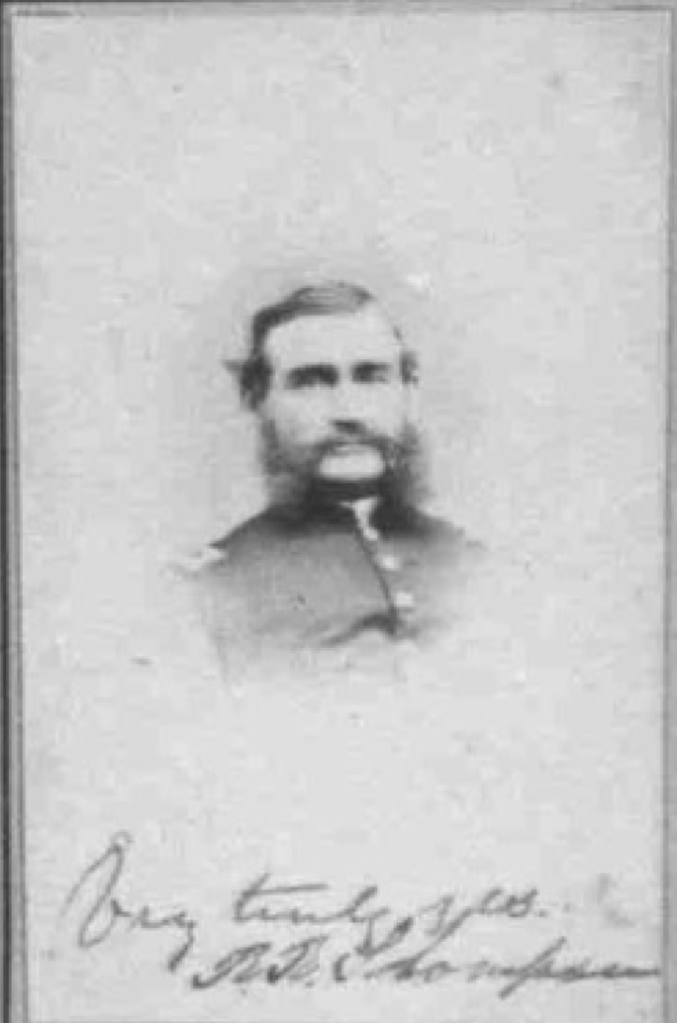
Robert Richard Thompson wearing his officer’s uniform later in the war.
The following letter was written by Sgt. Robert Richard Thompson (1823-1864) who enlisted on 16 August 1862 in Co, H, 13th New Hampshire Infantry. A month later he was promoted to 1st Sergeant. On 1 June 1863, Robert was commissioned a 2nd Lieutenant of Co. D and 13 months later promoted to 1st Lieutenant. Sadly, though he was “full in the faith all will come out right yet,” he was killed in the fight at Chapin’s Bluff, Virginia, on 29 September 1864.
Robert wrote the letter to his wife, Annie Lucia Baldwin whom he married in 1859. They had two girls prior to Robert’s enlistment.
Transcription
Addressed to Mrs. R. R. Thompson, Coos, Coos County, New Hampshire
Washington D. C. October 9th 1862
My Dear Wife,
We arrived here last evening & a hard journey we had of it. We left Concord last Monday morning about half past 5 o’clock. The regiment were entertained by the citizens of Nashua & a very fine entertainment it was too. The Colonel, Lieut. Colonel, one company and one officer of our company & the Adjutant of the regiment are in it so you see the Nashua people are much interested in the regiment.
At 1 o’clock p.m., we started for Norwalk to take the boat for Jersey City, thence to Washington direct by cars. We remained in Baltimore from 6 o’clock a.m till 11 o’clock a.m. We were from that time till 9 in the evening traveling 40 miles. I do not know the cause of delay. We had to lie on the soft side of a board last night. Today I learn we leave to report to Gen. Casey and to camp on Munson Hill on the south side of the Potomac. I believe we shall be near the 17th Maine. I will write more in detail after we are settled. I have not been in the city.
How much I have thought of you on my way here. How lonesome you must be! But my dear wife, do not mourn my absence too much. I am very well & contented.
Does darling Jennie enquire why Papa does not come to bed now? It makes my heart ache to think it is necessary to be separated from you, but believe me, I am full in the faith all will come out right yet.
Troops are coming in at a great rate. I must close now for I must prepare to leave. From your most affectionate husband, — Robert
The following letter was written by Charles Warren (1835-1920) who entered the service as a sergeant in Co. B, 11th Connecticut Infantry, and soon after their first Battle of Newbern, described here, was promoted to 1st Sergeant. Warren later (July 1863) became Captain of Co. G, then Major (November 1864) and in command of the entire regiment in the last stages of the war. He was mustered out as the Colonel of the 11th Connecticut and after the war published a regimental history. Indeed, near the end of this letter he confesses, “It seems to me that I could write a volume about what I see.”
An obituary published on 4 November 1920 in The Press (Stafford Springs, Connecticut) informs us that Warren was “one of the most respected men in Stafford” when he died, having lived most of his life in the town. It says he worked as a young man in a local mill until 1850 when he entered into a partnership with Henry Thrall in the whole sale leather business in Boston which is where he worked until the Civil War began. He then returned home to join the 11th Connecticut, rose through the ranks to lead it by war’s end, and proudly asserted that he had participated in each and every battle in which the regiment was engaged.
After the war, Warren returned to Stafford where he entered the mercantile business and carried on with it until he sold out in 1881 to take a position as President of the Stafford Savings Bank.
In this letter, Warren gives us an incredible, eye-witness account of the Battle of Newbern in which the 11th Connecticut played a prominent role in what would be the first of many battles. We learn that it made quite an impression on him, as he related to his Boston friend, “It was a sickening sight that met us—dead horses, mangled men, broken cannon, knapsacks, guns, &c. were strewn in every direction. I shall never forget that sight—never, never. It is the sad side of a victory & no one knows anything about it until they see it as it is.”
[Note: This letter is from the personal collection of Richard Weiner and was transcribed and published on Spared & Shared by express consent.]
Transcription
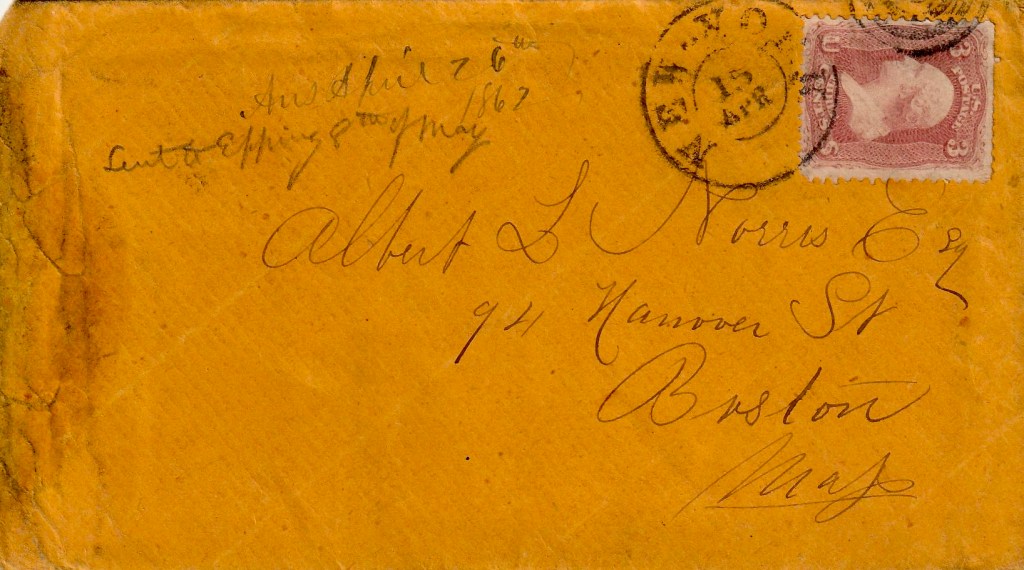
Addressed to Albert L. Norris, Esq., 94 Hanover Street, Boston, Mass.
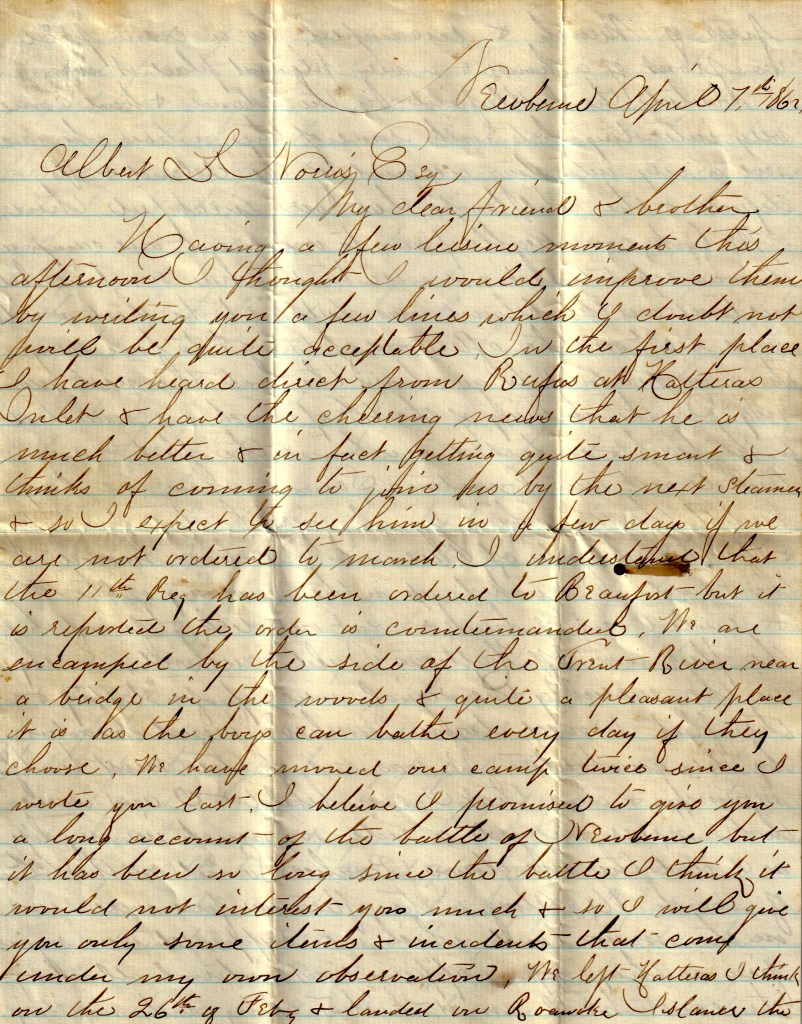
Newbern [North Carolina] April 7, 1862
Albert L. Norris, Esq. My friend and brother,
Having a few leisure moments this afternoon, I thought I would improve them by writing you a few lines which I doubt not will be quite acceptable. In the first place, I have heard direct from Rufus at Hatteras Inlet & have the cheering news that he is much better & in fact, getting quite smart & thinks of coming to join us by the next steamer & so I expect to see him in a few days if we are not ordered to march. I understand that the 11th Regiment has been ordered to Beaufort but it is reported the order is countermanded. We are encamped by the side of the Trent River near a bridge in the woods & quite a pleasant place it is as the boys can bathe every day if they choose. We have moved our camp twice since I wrote you last.
I believe I promised to give you a long account of the Battle of Newbern but it has been so long since the battle, I think it would not interest you much & so I will give you only some items & incidents that came under my observation.
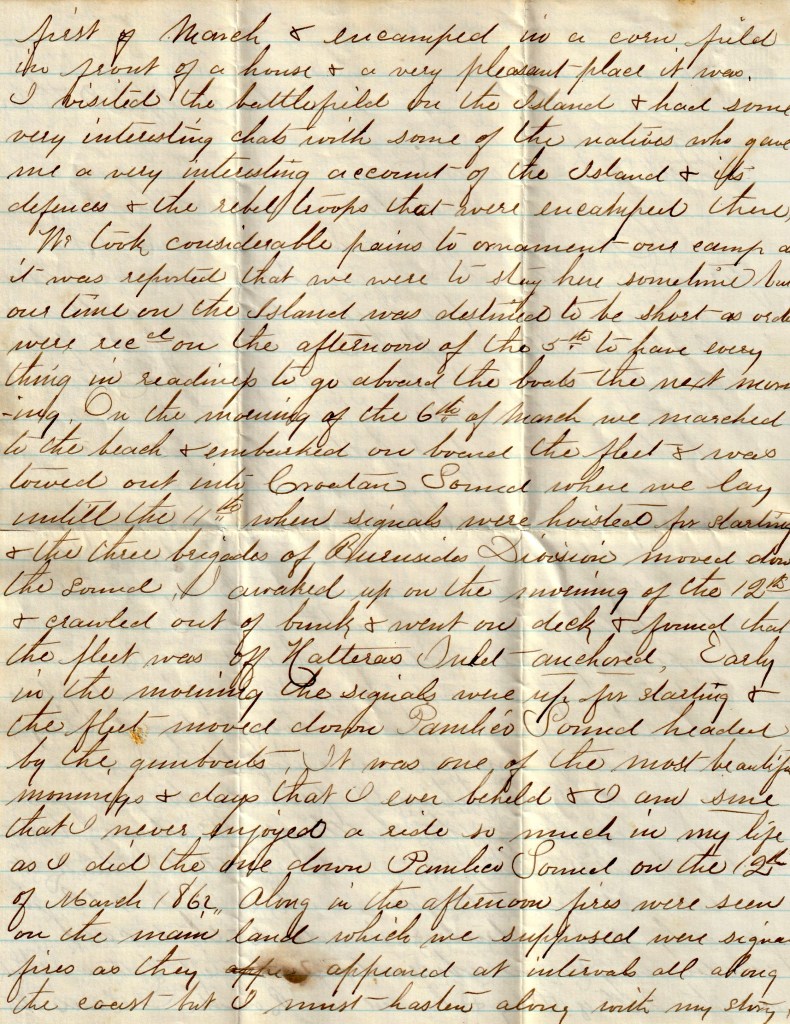
We left Hatteras I think on the 26th of February and landed on Roanoke Island the first of March & encamped in a corn field in front of a house & a very pleasant place it was. I visited the battlefield on the island and had some very interesting chats with some of the natives who gave me a very interesting account of the island and its defenses and the rebel troops that were encamped there. We took considerable pains to ornament our camp as it was reported that we were to stay here some time but out time on the island was destined to be short as orders were received on the afternoon of the 5th to have everything in readiness to go aboard the boats the next morning.
On the morning of the 6th of March, we marched to the beach and embarked on board the fleet and was towed out into Croatan Sound where we lay until the 11th when signals were hoisted for starting & the three brigades of Burnside’s Division moved down the Sound. I awaked up on the morning of the 12th and crawled out of bunk & went on deck & found that the fleet was off Hatteras Inlet anchored. Early in the morning the signals were up for starting & the fleet moved down Pamlico Sound headed by the gunboats. It was one of the most beautiful mornings & days that I ever beheld & I am sure that I never enjoyed a ride so much in my life as I did the one down Pamlico Sound on the 12th of March 1862.
Along in the afternoon, fires were seen on the mainland which we supposed were signal fires as they appeared at intervals all along the coast but I must hasten along with my story.
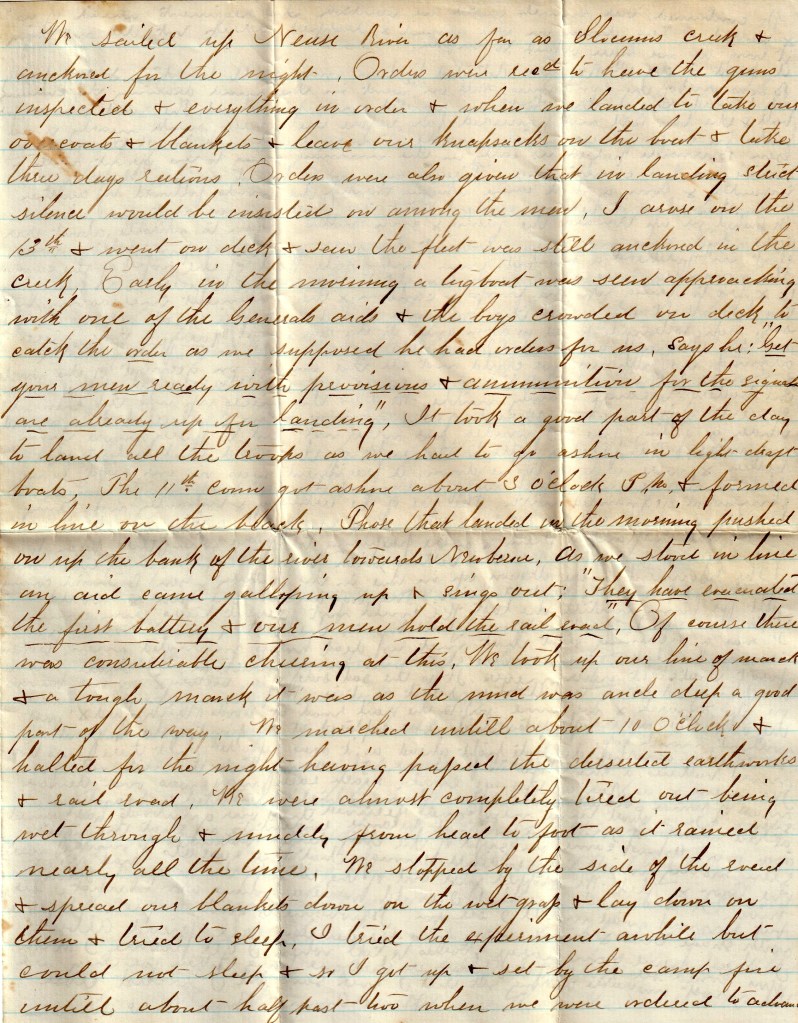
We sailed up Neuse River as far as Slocum’s Creek and anchored for the night. Orders were received to have the guns inspected & everything in order & when we landed to take our overcoats & blankets & leave our knapsacks on the boat & take three days rations. Orders were also given that in landing, strict silence would be insisted on among the men. I arose on the 13th & went on deck & seen the fleet was still anchored in the creek. Early in the morning a tugboat was seen approaching with one of the Generals aides & the boys crowded on deck to catch the order as we supposed he had orders for us. Says he, “Get your men ready with provisions and ammunition for the signals are already up for landing.” It took a good part of the day to land all the troops as we had to go ashore in light draft boats.
The 11th Connecticut got ashore about 3 o’clock p.m. and formed in line on the beach. Those that landed in the morning pushed on up the bank of the river towards Newbern. As we stood in line, an aide came galloping up and sings out, “They have evacuated the first battery & our men hold the railroad.” Of course there was considerable cheering at this.
We took up our line of march & a tough march it was as the mud was ankle deep a good part of th way. We marched until about 10 o’clock & halted for the night having passed the deserted earthworks and railroad. We were almost completely tired out, being wet trough and muddy from head to foot as it rained nearly all the time. We stopped by the side of the road and spread our blankets down on the wet grass and lay down on them and tried to sleep. I tried the experiment awhile but could not sleep and so I got up and sat by the camp fire until about half past two when we were ordered to advance.
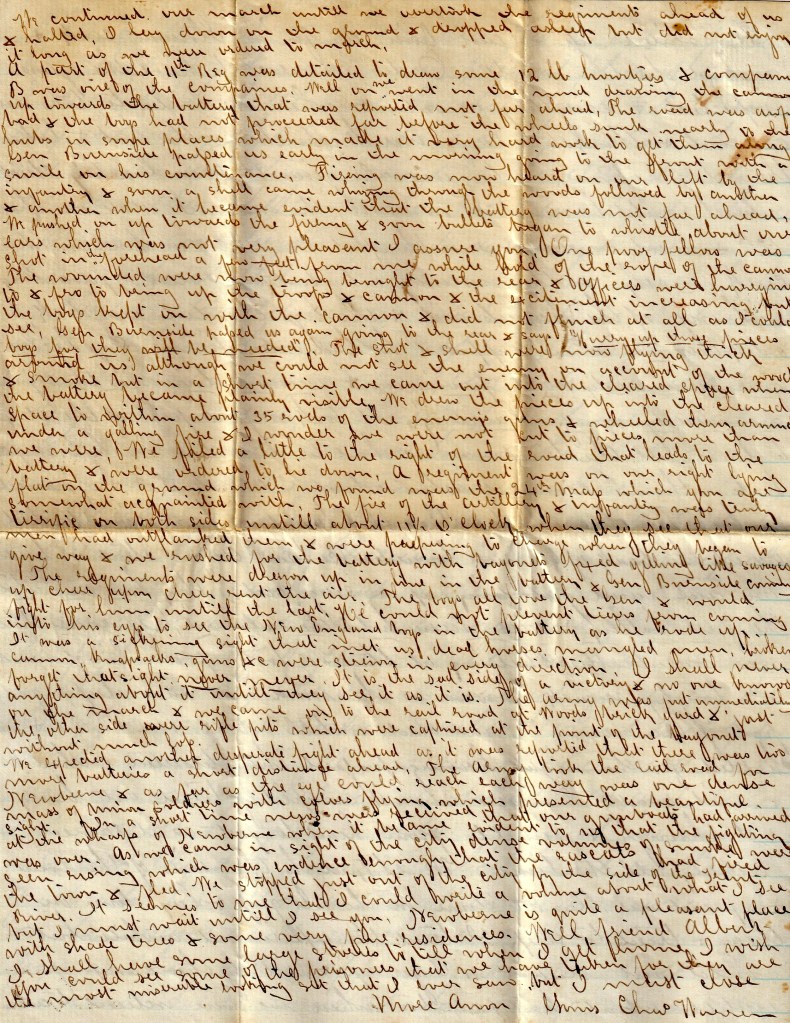
We continued our march until we overtook the regiments ahead of us and halted. I lay down on the ground & dropped asleep but did not enjoy it long as we were ordered to march. A part of the 11th [Connecticut] Regiment was detailed to draw some 12-pound howitzers & Co. B was one of the companies. Well, on we went in the mud drawing the cannons up towards the battery that was reported not far ahead. The road was awful bad & the boys had not proceeded far before the wheel sunk nearly to the hubs in some places which made it very hard work to get them along.
Gen. Burnside passed us early in the morning going to the front with a smile on his countenance. Firing was now heard on our left by the infantry and soon a shell came whizzing through the woods followed by another and another. When it became evident that the battery was not far ahead, we pushed on up towards the firing and soon bullets began to whistle about our ears which was not very pleasant, I assure you. One poor fellow was shot in the forehead a few feet from me while he had hold of the rope of the cannon. The wounded were now being brought to the rear & officers were hurrying to and fro to bring up the troops and cannon & the excitement increasing but the boys kept on with the cannon & did not flinch at all as I could see.
Gen. burnside passed us again going to the rear and says, “Hurry those pieces, boys, for they will be needed!” The shot and shell were now flying thick around us although we could not see the enemy on account of the woods and smoke but in a short time we came out into the cleared space where the battery became plainly visible. We drew the pieces up into the cleared space to within about 35 rods [200 yards] of the enemy’s guns and wheeled them around under a galling fire & I wonder we were not cut to pieces more than we were.
We filed a little to the right of the road that leads to the battery and were ordered to lie down. A regiment was on our right lying flat on the ground which we found were the 24th Massachusetts which you are somewhat acquainted with. The fire of the artillery and infantry was truly terrific on both sides until about 11:30 o’clock when they see that our men had outflanked them and were preparing to charge when they began to give way & we rushed for the battery with bayonets fixed, yelling like savages.
Map shows the 11th Connecticut Infantry advancing by the railroad and then ordered to the right to replace the 27th Massachusetts (under the “S” in FOSTER), on the left side of the Old Beaufort Road, the 24th Massachusetts on the right side of that same road. The two howitzers are planted in the middle of the road near the edge of the clearing.Directly opposite the swampy clearing ahead lay the Confederate works anchored by the 16 guns of Brem’s and Latham’s Batteries.
The regiments were drawn up in line of the battery and Gen. Burnside coming up, cheer upon cheer rent the air. The boys all love the General and would fight for him until the last. He could not prevent tears from coming into his eyes to see the New England boys in the battery as he rode up.
It was a sickening sight that met us—dead horses, mangled men, broken cannon, knapsacks, guns, &c. were strewn in every direction. I shall never forget that sight—never, never. It is the sad side of a victory & no one knows anything about it until they see it as it is.
The army was just immediately on the march and we come on to the railroad at Woods brick yard and just the other side were rifle pits which were captured at the point of the bayonet. We expected another desperate fight ahead as it was reported that there was two more batteries a short distance ahead. The army took the railroad for Newbern and as far as the eye could reach each way was one dense mass of Union soldiers with colors flying which presented a beautiful sight.
In a short time, news was received that our gunboats had arrived at the wharf at Newbern when it became evident to us that the fighting was over. As we came in sight of the city, dense volumes of smoke were seen rising which was evidence enough that the rascals had fired the town and fled. We stopped just out of the city by the side of the Trent River. It seems to me that I could write a volume about what I see but I must wait until I see you.
Newbern is quite a pleasant place with shade trees and some very fine residences. Well, friend Albert, I shall have some large stories to tell when I get home. I wish you could see some of the prisoners that we have taken for they are the most miserable looking set that I ever saw. But I must close. More anon.
Less than a year following Arkansas Statehood, 22 year-old John Covington Burch (1815-1875) penned the following letter from the new state capitol to his sister America Glovinia Emeline Burch (1813-1893) in Washington City, District of Columbia. Covington and his older sister were the oldest of several children born to Col. Samuel Birche (1787-1846) and Susannah Maria Wilson (1790-1873).
Samuel Burch was a government clerk in Washington City who also served in the militia during the War of 1812. A story posted by a descendant in Ancestry.com claims that when the British army were marching on Washington, Samuel attempted to be excused from his duties as a soldier to stay in the city and do what he could to rescue House documents to prevent them from destruction. He was finally relieved of his duties so that he could accomplish the task but by the time he arrived back in the city, nearly all of the wagons and carts had been taken up for hauling valuables away by the citizens. He was finally able to secure one ox and cart and remove some few things but much was lost that might have been saved had he been relieved sooner.
From this letter we learn that Covington entertained the idea of relocating to the frontier state of Arkansas, beyond the Mississippi. I can’t find any evidence that he ever moved there, but if he did, he did not remain long for he eventually accepted an appointment to serve as the Journal Clerk of the U. S. Senate—a position he held until June 1850 when he was dismissed and replaced by a Democrat from Indiana. There is also evidence in the newspapers that, like his father, Covington worked as a “General Agent” at Washington to assist veterans in securing their claims for pensions or land claims.
Having secured land in Arkansas, it seems that Covington intended to return to Arkansas by January 1, 1838. He apparently took a slave with him to Arkansas when he traveled there in 1837 and left him there to be hired out with Col. Lockart in Little Rock until he returned.
Transcription
Stampless cover addressed to Miss A. G. E. Burch, Care of Col. S[amuel] Burch, City of Washington, D. C., Postmarked Little Rock, Arkansas
Little Rock, Arkansas April 27th 1837
My dear sister,
Having an idle moment to spare, I know not how I can better employ it than by scribing a few lines to you, and the other “dead ones” at home.
I have just returned to the Rock from a visit to a Mr. Bradley’s—a young gentleman living on the Arkansas [River] about twenty miles from the Rock, who came out to Arkansas last fall and settled. He is a friend of mine. I went to Mr. Bradley’s for the purpose to look at land, and, Oh such a time as I had of it, through cane brakes and swamps, swimming bayous, wading creeks, and as Major Peay says: so forth & so forth & so forth. I think it probable that I will purchase of Mr. Bradley as he has made me an excellent offer.
Tell father that I have redeemed Uncle Artis’ land. 1 Tell him though not to tell Uncle Artis of it until I come home. I believe that both of the tracts are good.
I have become acquainted with pretty much all the big people of Arkansas such as Gov. [James Sevier] Conway, 2 Judge [Charles Anthony] Caldwell, 3 &c. &c. &c.
I intend to leave tomorrow for the Wachita [Quachita] country and shall be absent about twelve days and after my return to this place, shall turn my steps homewards.
I have hired John to Col. [William S.] Lockart, 4 one of Judge Caldwell’s son-in-laws, for six dollars per month, from now until January. He gave me his note for the amount due 1st January.
Give my best love to Father, Mother, brothers, relatives and friends one and all. Also to the servants and receive for yourself the renewed assurances of affection and esteem. From your brother, — Covington
P. S. Excuse mistakes as I write in a hurry.
1 Uncle Artis was likely John Artis Willson (1776-1841), brother of Covington’s mother. He was a resident of Washington City in the 1830 census.He was a lawyer and a US Marshal of the District during the Jefferson and Monroe Administrations.He is believed to have fathered several children with Maria Ford, his slave.
2 James Sevier Conway (1798-1855) served as the 1st Governor of Arkansas from 1836 to 1840. Conway was born in Tennessee and migrated to Arkansas Territory in 1820, purchasing a large cotton plantation in Lafayette county.
3 Col. Charles Anthony Caldwell, or Judge Caldwell, (1785-1844) was a native of Virginia but came to Kentucky with his parents as a child and was married in Fayette county to Ann Nancy Venable (1788-1813). After her death, he married Sarah Anderson (1799-1837). He appears to have relocated to Arkansas Territory about 1830 and served as a state representative from Saline county prior to his appointment as Judge.
4 Col. William S. Lockart (1810-1850) was married to Georgia Anderson Caldwell on 23 August 1836 in Saline county, Arkansas.For Lockart, it was his second marriage; his first wife, Nancy M. Kellum died in 1831. Lockart was born in South Carolina but lived in Alabama for a time before coming to Arkansas in the mid 1830s.
The following diary segments are from an 1874 diary kept by Roland Henry Woolf (1850-1914) who indicated on the inside cover that he was from Eldorado, Fayette county, Iowa. His parents were Henry Woolf (1824-1919) and Amanda Pitcher (1828-1877) who are buried in West Union, Fayette county, Iowa. In the 1860 US Census the Woolf family was enumerated in Jacksonville, Chickasaw county, Iowa. Ten years before that, they were enumerated in Union, Branch county, Michigan where Roland was born.
From Roland’s diary we learn that he was working as a traveling salesman throughout most of 1874, selling crockery. He spend the first two months of the year on a trip to the East coast and then to Florida—a trip that seems to have been part business, part pleasure. By the end of February he has returned to the upper midwest where he resumes his traveling salesman duties. I have only transcribed the first part of the diary describing his travels to the east coast, to Florida, and then his return to Chicago by way of New Orleans. The remainder of the entries pertain solely to sales.
1874 Diary inscribed on inside cover, “Return to R. H. Woolf with Burley & Tyrell, Chicago, Illinois, or R. H. Woolf, Eldorado, Fayette county, Iowa.”
Transcription
Burley & Tyrrell’s “Crockery, CHina, & Glassware” store on Wabash Avenue in Chicago (1872)
9 January 1874—Made arrangements with John Tyrrell of Burley & Tyrrell for 1874. Also called on Biggs Spencer & Co. and partly made arrangements with them for 1874.
Saturday, January 10, 1874—Cincinnati, St. James Hotel. Called on Tempest, Brockmann, 1 Richmond Street. Manufacturers of WG [white granite] & CC [Cincinnati canners] ware. Called on Frederick Dallas, Manufacturer of WG CC yellow ware, Hamilton Road. 2
Pottery manufactured by Burley & Co., Chicago. Arthur G. Burley and his brother-in-law, John Tyrrell partnered in 1852.
1 The Tempest, Brockmann & Co. was a pottery business established in Cincinnati in 1862 during the American Civil War. Christian E. Brockmann arrived in Cincinnati from Germany in 1848 and started the pottery on Richmond Street in the West End.Their firm was the first to produce commercial whiteware in the Ohio Valley.
2 Frederick Dallas, a native of Scotland, was the founder of the Hamilton Road Pottery in Cincinnati. He came to the United States in 1838 and established his pottery in 1856.Dallas claimed to be the first party in Cincinnati to manufacture a kiln of white granite and C.C. ware. The first definite evidence of this is an advertisement in the 1869 Williams Directory. By 1875, the year after this diary, Dall was no longer producing Rockingham and yellow war—only white granite, C. C. ware, and Parian marble ware, employing 100 hands with a capacity of $100,000 per annum.
Sunday, 11—St. James Hotel. Went to Exposition Building. Also east and west end of city. Also listened to a descriptive sermon in evening at 1st Presbyterian Church on 4th Street by W. F. Johnson, 12 years missionary to India.
Monday, 12—Made arrangements with Frederick Dallas to sell goods on commission in Iowa, Wisconsin, & Minnesota. Also took samples. Hotel expenses St. James Cincinnati from Saturday noon, $8.50. Ticket Cincinnati to Parkersburg, Washington, Baltimore, & Philadelphia on a Pullman Sleeper $10.50
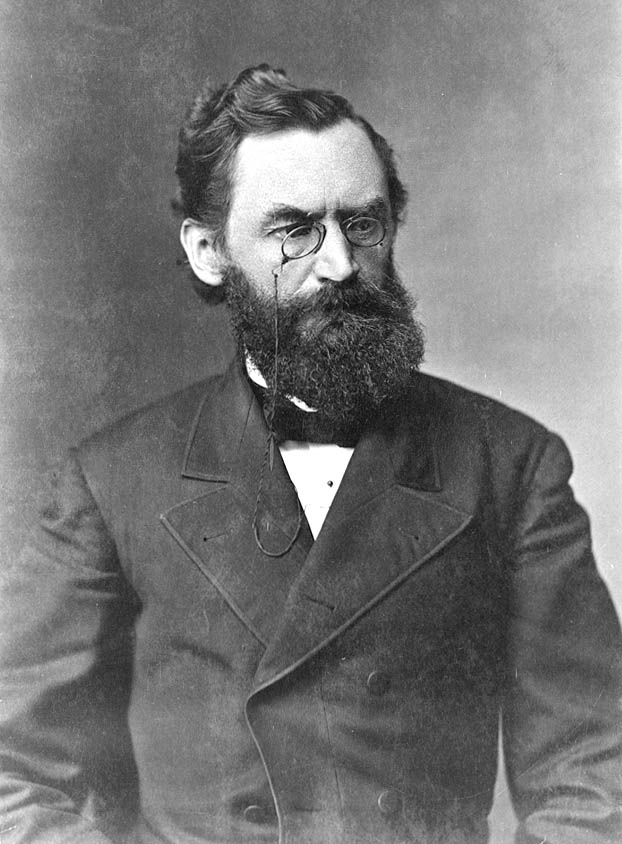
Carl Schurz, US Senator from Missouri, 1869-1875. Circa 1877
Tuesday, January 13, 1874—…after we leave Grafton, follow up the Valley of Cheat River nearly to top of Allegheny Mountains, Grandest scenery in the world. Railroad runs 9 miles top of mountains. Down east side 17 miles, grade averages 122 feet to mile. Then down Potomac River to south side of Harper’s Ferry, cross Potomac, iron bridge, “Point of Rocks”, down north side to Washington.
Wednesday 14th—National Hotel $4 Washington City, D. C. Pennsylvania Ave. “Willard’s” Senate chamber speech by [Carl] Schurz of Missouri on Finances & against inflation of the currency. Visited Naval Academy & Capitol grounds. Ford’s Theatre in evening, German actors Janauschek in Shakespeare’s Henry VIII. Hotel expenses National $6.30
Advertisement in “The Capital” of Sunday, 11 January 1874
Thursday 15th—Passed through Baltimore. Continental Hotel in Philadelphia, Pa., corner of Chestnut, $4 per day. Philadelphia to New York. Hotel Continental $3.20.
Friday, January 16, 1874—Sturtevant House, Broadway, New York. $4 per day. Went to Central Park. Took a Central Park car from Sturtevant House north on Broadway & 7th Avenue. A. T. Stewart’s corner Broadway & 10th. J. Vogt & Co., Park Place. Wallack’s Theatre, corner 13th & Broadway. Lester Wallack in “Man of Honor.” 3 [ ] in Trinity Church corner of Broadway and Wall. Broadway runs north and south…
3 John Johnstone Wallack (1820-1888) was an American actor-manager. He used the stage name John Lester until 1858 when he first acted under the name of Lester Wallack. He was the manager of the second Wallack’s Theater from 1861 until 1882.
Saturday 17—Hotel expenses Sturtevant $13.00 Ticket from New York to Jacksonville, Florida [on the [Atlantic & Coach Line $35.50.
Monday, January 19, 1874—Weldon, North Carolina. Passing through turpentine distilleries south of Weldon and rosin factories. Also through the swamps of N. Carolina and moss region. The nNegroes pull it from the trees and put in the water for 6 months, then it turns [into[ Black Moss. Also passed through cotton plantation north of Florence, South Carolina. Monday afternoon, Charleston, S. C.
Tuesday. 20—Savannah, Ga. Situated at outlet of Savannah river. Also a port of entry. W. Gibbs & Co., importer of Guano from Phoenix Islands in the South Pacific ocean. It is a mixture of bones, shells, &c. Savannah is a city of 26,000. Stopped at Pulaski House. $4 per day. Savannah exports cotton in large quantities to Liverpool. Thermometer 60 degrees.
An 1880 stereograph of the National Hotel in Jacksonville, the largest of six hotels in the city in 1876.
Wednesday, 21—Grand National Hotel, Bay Street, Jacksonville, Florida. The G. National is the largest hotel in the city. $4 per day. On St. John’s River. Jacksonville population 30,000. Port of entry.
Thursday, January 22, 1874—Took a drive in the afternoon east on the shell [road]. Went three miles and saw the former residence of Tallary [?]. Made arrangements with Mrs. Mary Barse, Duval Street near ocean for two weeks board at $1260 per week. Met Mr. & Mrs. Van Wick’s of Chicago.
Friday 23—at Jacksonville. Thermometer 80 degree. Took a stroll down town. Ladies promenading the street wearing summer costumes, hats, lawn dresses, carrying fans and parasols. Gentlemen wearing straw hats and carrying umbrellas, also linen coats.
Saturday 24—Started at 9 a.m. in a two [ ] scull for South Point, 5 miles from Jacksonville and returned at 12 noon. Mr. Vanwyck mentioned Marietta, Georgia, 20 miles from Chattanooga as a favorite resort of consumptioners. It is 1200 above sea level.
Sunday, January 25, 1874—Attended 1st Methodist Episcopal Church in morning on Duval Street. The Methodists have two white churches, one a Negro one. Also two colored churches. Attended Sunday School of 1st. M. E. in afternoon. Attended Baptist Church in pm. Thermometer 50 degrees.
Monday 26th—Maj. Samuel Barse, Duval Street near ocean. Mr. Gibbs, manufacturer of stoves. Albany, New York. Mr. & Mrs. Gibbs boarding with Mrs. S. Barse. Mr. & Mrs. Searl, importer Japanese goods. Mr. & Mrs. [George W.] Markens, wholesale grocer, and Mrs. and Mrs. Van Wyke.
Tuesday 27—Trip on the Clifton to “Florida Winter Home,” then up the Arlington River. Water oak—shade tree of Jacksonville. Also Oleander & Palmetto. White Pine. Bought some pineapples & bananas from a vessel from West Indies.
Wednesday, January 28, 1874—At apartments on Duval Street. Saw Sir St. George Gore—a baron from England on a hunting expedition up Indian River. Income $250,000 per annum. 4
4 Sir St. George Gore (1811-1878) was a wealthy Irish nobleman from County Donegal who came frequently to the United States to hunt and fish. His favorite animals to hunt were the American bison and he claimed to have personally killed 2,000 of them, and almost as many elk. Gore’s hunting expeditions were legendary and drew loud protests from US officials who claimed he was killing game that the Indians needed to survive.
5 “On the recommendation of Secretary of the Treasury Salmon P. Chase, Francis Elias Spinner was appointed by President Lincoln as Treasurer of the United States and served from March 16, 1861, until his resignation on July 1, 1875. Within 60 days of his assuming office, the expenditures of the federal government increased dramatically due to the Civil War. He was the first to suggest the employment of women in government offices. During the Civil War, many of the clerks of the Treasury Department joined the army, and Spinner suggested to Secretary Chase the advisability of employing women. After much persuasion, his suggestion was taken up, and he carried it into effect successfully, though not without much opposition. The women were first employed to count money, and later took up various clerical duties. He eventually hired over 100 women, paid them well, and retained them after the war was over. Spinner’s signature on an 1862 issue United States Note. He signed the different series of paper money in a singular handwriting, which he cultivated in order to prevent counterfeiting. His signature on the “greenbacks” of the United States was the most familiar autograph in the country.”
Thursday 29—At apartments on Duval Street, “Parepa Rosa“, the songstress died the 24th. Boarded a schooner from Nassau, Braham Islands and bought pineapples & bananas.
Friday 30—At apartments on Duval Street. Met Mr. and Mrs. Dickinson from Chicago. “Live oak” a tree that remains green all the time. David Livingston, the African explorer. died June 1873. Saw dispatch in NY Herald of 27th. Took a stroll up St. Johns. Over to Brooklyn with J. N. Searl. importer Japanese goods.
Saturday, January 31, 1874—Mr. Searl gave me a Bamboo watch chain made by the Japanese from bamboo reed, each link separate. Met M. Fullam and family from Chicago—a lumber merchant 12th Street. Call on Mr. White, McCormick Block, Mrs. Van Wyck’s brother-in-law.
Sunday, February 1—Attended church 1st Methodist South 11 a.m. Also Presbyterian in evening.
Monday, 2—Mr. and Mrs. Van Wyck, Mr. & Mrs. Dickinson, Mr. & Mrs. Gibbs, Miss Lewis & R. H. W. took a 6 seat scull and went up St. Johns [river] to Brooklyn and across the river. Recrossed river one mile in 10 minutes. Temperature 68 degrees.
Tuesday, February 3, 1874—Apartments on Duval Street. Mr. and Mrs. Van Wyck, Mr. & Mrs. Gibbs, left for Mellonville, 210 miles on “Star Light.” Mr. White, Mrs. Van Wyck’s brother-in-law, McCormick’s Block. Call on him.
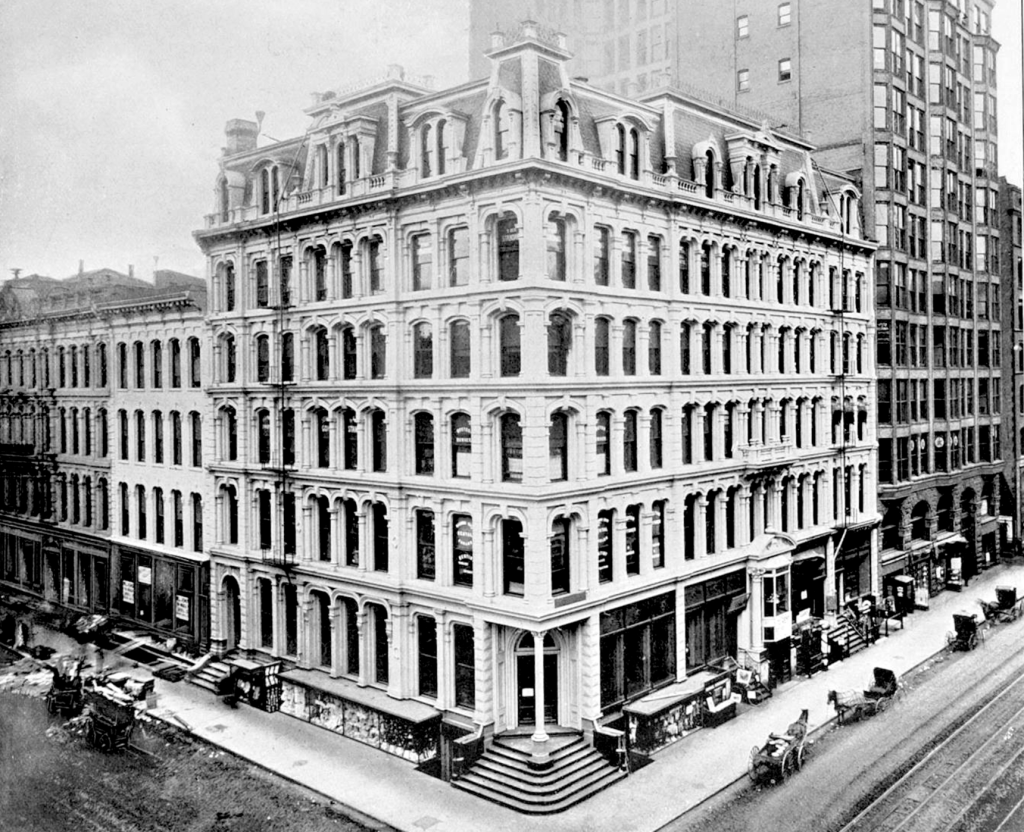
The McCormick Block, Dearborn and Randolph Streets in Chicago.
Wednesday, 4—Ticket to Polatka and return.
Thursday, 5—Paid Mrs. Barse 2 1/4 weeks board $27. Left cash at D. G Ambler Bank on Houghton $100. Ticket Jacksonville to New Orleans via Cedar Keyes.
Friday, February 6, 1874—Gainsville 68 miles from Cedar Keyes. The country between Baldwin & Cedar Keyes is a low flat country. Sandy & covered with yellow pines. Principal export, cotton, turpentine & rosin. Col. Sturgeon, U. S. A.
Saturday, 7—Cedar Keyes, Florida. Made one of a party to visit [J. Eberhard] Faber’s Cedar Mills. Met Mrs. Com[modore Foxhall Alexander] Parker, USN. Also Mr. Jabez Sparks [1819-1884] and daughter [Julia Frances Sparks (1847-1912)—the future wife of Hiram Parker (1841-1918], Pottsville, Pennsylvania.
Sunday, 8—Left Cedar Keyes on Emily for the Wm. P. Clyde, 9 miles out with Ex-Gov. [Samuel T.] Day of Florida, Dr., wife [Celeta Cook Weeks], son and two daughters. All for Austin, Texas. 6
6 Ex-Governer Samuel T. Day moved to Caldwell county, Texas, and died there on 26 December 1877.
Monday, February 9, 1874—On board the Wm. P. Clyde, Gulf of Mexico. Clyde, Capt. Livingstone, commander, length 210 feet, burthen 580 tons. Propellor & 2 masts. Thackara, Purser.
Tuesday, 10—On boat Clyde—New Orleans, Key West, and Havana Steamship Company. Saw two sharks following the ship. Also a school of porpoise. Clyde bound from Havana to New Orleans. East Pass, the bar at outlet of Mississippi, 110 miles from New Orleans.
Wednesday, 11—Arrived at New Orleans 10 a.m. H. Cassidy European Hotel opposite the St. Charles on Gravier, corner Carondelet.
Thursday, February 12, 1874—Ticket on Henry Ames7 for St. Louis, $20. Visited all the principal parks of New Orleans. went to the southern limits of the city. Canal Street, principal street of city. Royal Camp of Common. Gratiot Levee.
7 The steamer Henry Ames may have been the same vessel that factored into the story of the sinking of the Sultana a decade earlier. She finally met her demise later in 1874 when she hit a snag at Waterproof, Louisiana, and went down with the loss of three lives and a cargo valued at $130,000.She was one of the ships in the Merchants’ Southern Line Packet Company established in 1870. Her captain was J. West Jacobs who had formerly captained the steamer Ira Stockdale on the Quachita River.
Advertisement for the Henry Ames
Friday, 13—On board Henry Ames. Memoranda of Florida—production of Florida, south of frost line on St. John’s and Indian [Rivers]. Pineapple, orange, lemons, grapes, banana, coconuts. mulberries, sweet potatoes. Exports to North, vegetables, oranges and lemons, pecans, & moss.
Saturday, 14—On boat Henry Ames. Thermometer 65 degrees, Cloudy. Memoranda of New Orleans. Visited principal points of interest. Steam ships from Liverpool, Genoa, Hamburg, Cork, Havre, West Indies. Saw preparation for Mardi Gras on 17th [Fat Tuesday].
Sunday, February 15, 1874—On board Henry Ames off Baton Rouge. Sugar plantations in sight from bank. Stopped at Port Hudson to take on board sugar for St. Louis. Casks containing 1,224 f.
Monday, February 16—On board Henry Ames off Natchez, Mississippi. Heavy fog. Boat stuck in mud. Four hours on sand bar.
Tuesday, 17—On board Ames. Capacity 1,800 tons. Length 280 feet. Time from New Orleans to St. Louis, 6 days.
Wednesday, February 18, 1874—Henry Ames off Vicksburg, Mississippi. growing colder 46 degrees.
Thursday, 19—On board Henry Ames.
Friday, 20—Memphis, Tennessee on board H. Ames.
Saturday, February 21, 1874—On board Henry Ames.
Sunday, 22—Mark Twain was writing funny pieces on boat when 1st Mate called out “Mark Twain”=12 feet so Samuel Clemens called himself Mark Twain. He used to be clerk on boat with Captain Jacobs of Henry Ames.
S. Clemens, pilot on Mississippi with Capt. J. W[est] Jacobs, now of Henry James.
Tuesday, February 24, 1874—Southern Hotel, St. Louis, Mo. on 5th Street. $4 per day. Called on crockery houses. Frederick Dallas will be here 25th, so says Manning & Co. Viewed the St. Louis Bridge–3 span iron. Ticket to Chicago $11.
Wednesday, 25—Woods Hotel [Chicago]. Received letters from M. F. I., M. T., etc.
[Roland is back in Chicago before the end of February 1874 and this is when some of his entries are shorter but also some long. He doesn’t stay long in Chicago and it’s on to Waukegan Illinois, Racine Wisconsin, Union Grove, Burlington, Elkhorn, Freeport, Evansville, Madison, Palmyra, Janesville, Oshkosh, and more. He’s taking “teams” so I’m assuming horse teams. He’s back home in Eldorado by the 1st of April and travels all over Iowa. On July 5th he boards the steamer “Miniapolis” and heads to McGregor on the Mississippi River. Then he writes this entry on July 15, 1874:]
Wednesday, July 15, 1874—Last night was the great fire in Chicago. Burning 60 acres between Vanburen St. and Clark St. and Mich Ave. Loss estimated at 5,000,000. Buildings, homes, Mich. Ave. St. James, Woods and hotels.
The following letter was written by James Taylor Eubank, Jr. (1842-1873), the son of James T. Eubank (1815-1867) and his first wife Sarah Dempsey of Covington, Kentucky. Before the war, James helped care for the family thoroughbred horses but he eventually enlisted as a corporal in Co. B, Jessee’s Battalion of Kentucky Mounted Rifles on 22 July 1862. Just a week later, on 29 July, he received a head wound and was taken captive in a skirmish at Mt. Sterling and eventually transferred to the military hospital at Rock Island, Illinois, where he was held until at least early 1864 when the following letter was written.
J. T. wrote the letter to his cousin, Susan Lucy (Barry) Taylor (1807-1881), who operated a benevolent society out of Newport, Kentucky, that supplied aid and comfort to Confederate prisoners of war confined in Yankee prisons. She was the daughter of William Taylor Barry (1784-1835) who served as a US Congressman, was the US Postmaster General under President Andrew Jackson, and who also was a US Senator and Governor of Kentucky. Susan was married to Col. James Jones Taylor (1802-1883) in 1824.
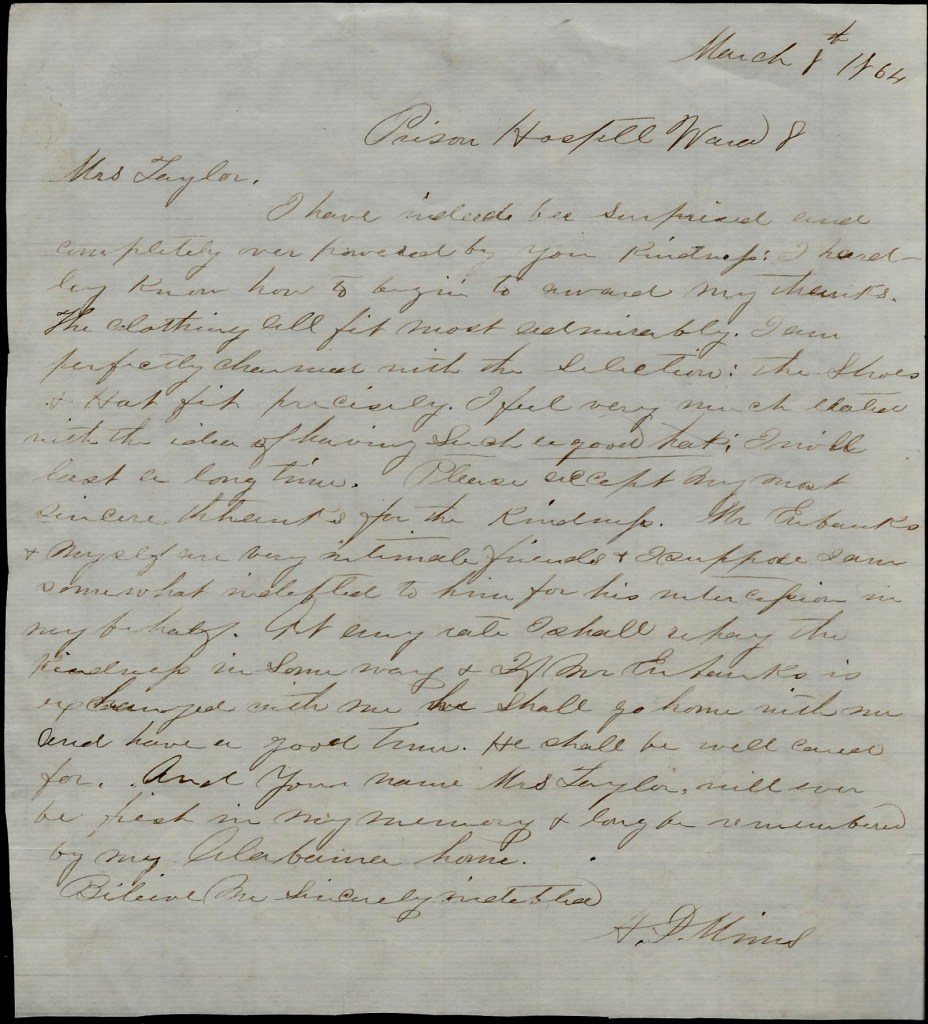
J. T.’s letter requests his cousin to supply a fellow prisoner with articles of clothing he was in need of. The prisoner’s name was Dr. Alexander Dowsing Mims (1839-1878), a native of Alabama who operated an apothecary shop in Mobile before the war. He was the son of Shadrach Mims (1804-1885) and Elizabeth Downing (1809-1895) of Autauga county, Alabama. Mims was an 1860 graduate of the Medical School at the University of Pennsylvania. During the war, Mims served as a private in Co. H, 3rd Alabama Cavalry, though he was often detached as working as a medical attendant. He was taken prisoner near Strawberry Plains, not far from Knoxville, TN., on 4 December 1863. It does not appear that he was paroled until May 1865.
The second letter appearing here is Alexander Mim’s reply to Mrs. Susan Taylor thanking her for the clothes she sent to him.
This color sketch of the federal prison on Rock Island, a small strip of land in the Mississippi River between Rock Island, Illinois, and Davenport, Iowa, was found in a letter written by Confederate soldier James W. Duke to his cousin (presumably a woman) in Georgetown, Kentucky. The sketch was drawn by a soldier identified only as H. Junius, and it apparently is the item described in Duke’s letter as “the picture of our row of Barracks.” Rock Island prison was authorized in July 1863. When finished, it consisted of eighty-four barracks, 82 feet long and 22 feet wide, arranged in six rows of fourteen each, and surrounded by a high fence. Each barrack contained two stoves for cooking, but potable water was scarce and at times nonexistent. From December 1863 until the end of the war, Rock Island held between five thousand and eight thousand Confederate prisoners, many of whom arrived before the facility was completed. (LOC)
Letter 1
Military Prison Rock Island, Illinois Hospital Ward 3 February 17, 1864
Dear Cousin,
I have a young Alabama friend here (Dr. [A. D.] Mims) who has charge of Hospital Ward 8 attending to our sick. He is very much in need of clothing [and] is very far from home & friends. Consequently I thought I would ask of you to send him a few articles. I would not ask the kindness of you but for my Father’s having contributed so much already & knowing you were much more able to meet the demand. Dr. Mims is quite a small man, wears pants size 31 in., shoes or boots No. 4, socks 9, hat 6 5/8, coat 2.
My wound has been rather painful lately. The Dr. extracted several fragments of bone from the wound. My health is good otherwise. I received a letter from Aunt A. M. Smiley this morning. Hoping you will not think asking too much, I remain very truly your cousin, — J. T. Eubank, Jr.
Letter 2
Prison Hospital, Ward 8 March 8th 1864
Mrs. [Susan L.] Taylor,
I have indeed been surprised and completely over powered by your kindness. I hardly know how to begin to award my thanks. The clothing all fit most admirably. I am perfectly charmed with the selection: the shoes & hat fit precisely. I feel very much elated with the idea of having such a good hat. It will last a long time.
Please accept my most sincere thanks for the kindness. Mr. Eubanks & myself are very intimate friends & I suppose I am somewhat indebted to him for his intercession on my behalf. At any rate, I shall repay the kindness in some way & if Mr. Eubanks is exchanged with me, he shall go home with me and have a good time. He shall be well cared for. And your names, Mrs. Taylor, will ever be fresh in my memory & long be remembered by my Alabama home.
The following letter was written by Jeremiah Woolston Duncan (1810-1854), the son of John Duncan (1776-1852) and Elizabeth Woolston (1778-1851). He wrote the letter from New Orleans in February 1844 to his older brother, John A. Duncan (1806-1868) of Wilmington, Delaware.
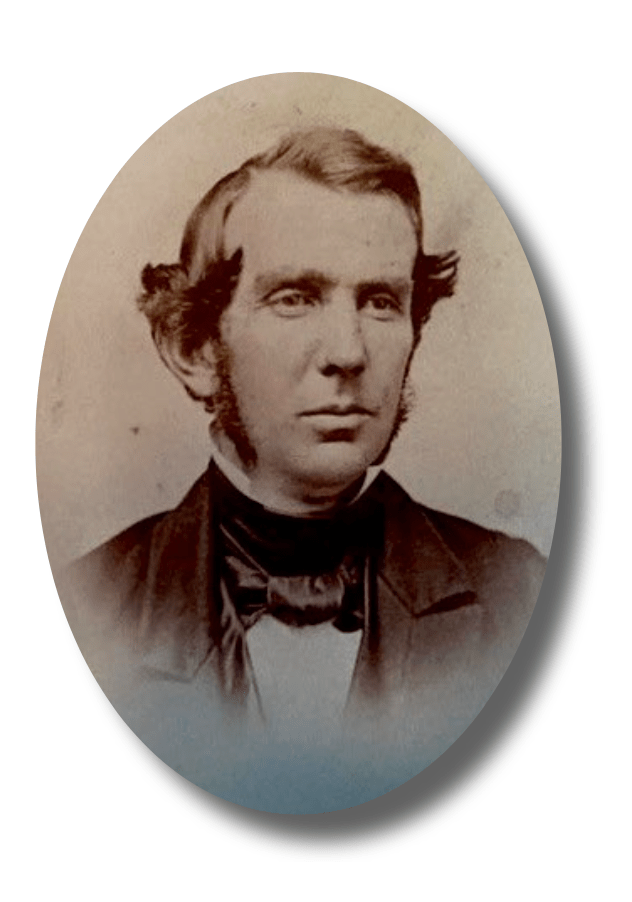
Jeremiah Woolston Duncan
Jeremiah was married in 1833 to Elizabeth Strode Brinton (1810-1859) and the couple had two children by the time of this 1844 letter. They would have at leasts four more children, the last two after the family moved to the fledgling city of Chicago in 1849.
“Jeremiah was born in Baltimore, Maryland in 1810. He received, in common with all the other members of his father’s family, a good English education, but his active and enterprizing nature early asserted itself, and while still but a boy in years, he proceeded of his own volition to Philadelphia, where he became a clerk in a hardware store, remaining till he was twenty years of age. He then went into partnership, in Wilmington, with his brother, John A. Duncan, in the hardware business. In 1830 he withdrew from the firm and went into the lumber business with Baudy Simmons and Company, of Wilmington. He afterwards retired, also, from this firm and went into the West India trade and wholesale grocery business, in partnership with Matthew and Andrew Carnahan, in the same place. He next erected a steam saw mill on the “Old Ferry” property. In 1850 he removed to Chicago, where he engaged extensively in the lumber business. He owned large tracts of land in Michigan, near the straits of Mackinaw, and the town of Duncan, in that vicinity, was named in his honor. But the life he now led subjected him to frequent and severe exposures, and carried away by his activity and energy, he paid too little regard to his health. It thus happened that in the prime of his vigorous and most valuable life he contracted a fatal sickness. He returned to Wilmington and died, December 31, 1854. Mr. Duncan was a man highly respected in all his wide circle of acquaintance, and warmly regarded among his friends. His activity and energy were remarkable, and the results proportionate.” [Source: History of New Castle County, Delaware]
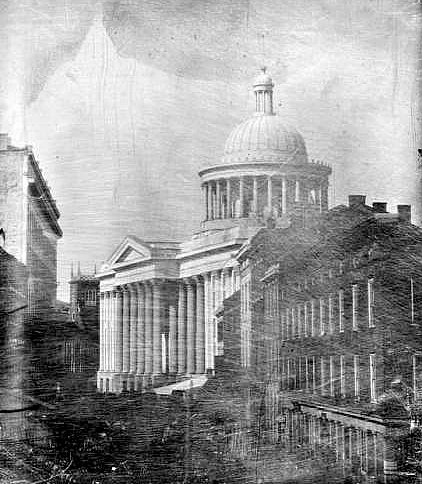
The St. Charles Exchange Hotel in New Orleans in 1847 (Courtesy of Fred Diegel)
[Note: This letter is from the private collection of Richard Weiner and was transcribed and published on Spared & Shared by express consent.]
Transcription
Addressed to Mr. John A. Duncan, Wilmington, Delaware, via Philadelphia
St. Charles Exchange Hotel 1 New Orleans February 22, 1844 2
Dear John,
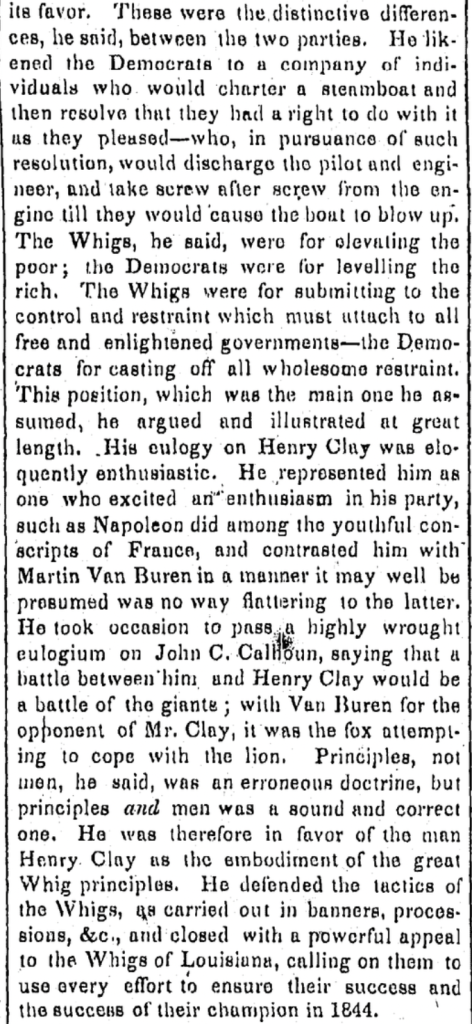
Having a little leisure before dinner, I thought I would improve it by writing you a few lines. Today here you will observe by a paper I mailed to you this morning, is a busy one. There is a great gathering of the Whigs of Louisiana beside a grand military parade, sham battle, &c. about going on at this moment—2 o’clock—and most of the business is stopped on account of it. Many stores closed.
The Daily Picayune, 22 February 1844—“All will be life, marching, music and animation”
Yesterday was another gala day being Mardigra [Mardi Gras 3] on which occasion carriage of men and women ride about the city in mask & all kinds of grotesque forms imaginable & form a procession the B[ ] throwing dust and flour in their faces at the corners (and by the way, you never saw a dusty city—it is here about ankle deep—and as far as flour, until yesterday we had a little rain which reversed the matter into mud half shoe deep). The citizens consider the turn on yesterday pretty near a total failure—nothing much but ordinary women & rowdies whereas heretofore respectable people used to parade. Old Harry stay much of his time at [illegible] & is to be here tomorrow & hold a sort of Levee in our spacious dining room. 4
This is the finest hotel I ever was in—much ahead of the Tremont or Astor House but, O Harry, how they plaster it on $3 per day or $15 per week if you stay a week at a time. This city is like all other cities—plenty of people here for the business at this time but the prospect for a lively spring trade is pretty good. The wharves look beautiful today. The immense number of ship with all their flags displayed—ships of many nations. It is really a pleasing sight. Steam boats by dozens a belching like volcanoes. I must say I really hate these high pressure boats. With all I had heard about the immense boats on the Mississippi, I am disappointed. The Empire on the North River would eat one of the largest for a breakfast. But there is a great quantity of them going & coming all the time and full of freight.
The substance of Prentiss’s speech The Daily Picayune, 23 February 1844
February 24. I had to knock off for dinner. I have not found time sure to get at it again until this morning at 7 o’clock. If you ever saw a swarm of bees, this house has been one for three days past. I was at a great Whig gathering last night & they began to call for [Seargeant Smith] Prentiss of Mississippi who addressed the convention the day before & one continual cry for at least one hour.
I have ridden out round the city, down the Shell Road & Cr & taken a general survey. Went on the Parade [ground] after the Battle had been fought & see company after company of Frenchmen—all small men and all commanded in French—not a word in English. These French here are great military men. The 2nd Municipality, you could not be from New York in which most of the business is done & in the 1st and more in the 3rd. you will hear all the negroes talk French. I had not been down in the 3rd before the afternoon of the parade the whole of which I spent in that part of the town as it was a complete holiday.
The idea I had formed of the levee was a very enormous one. It to be sure is much higher than the rest of the city, but a stranger may land on it and walk into the city & not observe it. I could write you an hour more but must close. I have some other writing to be done this morning. Give my love to my dear wife & little ones & all your folks & to all my friends my best respects.
From your affectionate brother, — Jeremiah W. Duncan
P. S. Shall have much to talk [about] when I see you. T. H. Larkin is here. Old Mr. Handy of Chil & the 2 McMain Boys & sundry others.
1“The St. Charles was the first large building erected above Canal Street. Within its walls, over the next hundred years, half the business of the city was to be transacted and half the history of the state of Louisiana was to be written. The hotel was designed by noted architect James Gallier. It was the grandest hotel in the South, in fact, the first of all great American hotels. Oakey Hall, who later became the mayor of New York, said of it, ‘Set the St. Charles down in St. Petersburg, and you would think it a palace; in Boston, you would christen it a college; in London, it would remind you of an exchange; in New Orleans, it is all three.’ Mr. Hall was unable to contain his surprise at finding in the city of New Orleans something far grander than anything New York could boast of. The hotel had a magical effect upon the quarter of the city in which it stood. It rapidly built up the First District, known as the American sector. Around it, as a center, gathered the traffic and trade of the city. Churches sprang up near it; stores and dwellings spread out in every direction. St. Charles Street, which did not extend far above the hotel, became the most animated thoroughfare in the United States.”
2 Jeremiah’s visit to New Orleans in February 1844 was just prior to a fire in the summer of 1844 which destroyed about seven blocks of buildings between Common and Canal Streets, near the Charity Hospital.
3 After decades of suppression (under Spanish rule) the Mardi Gras parade was reinstated in New Orleans in 1837 (at least the first recorded). It remained popular until the early 1850s when it began to wane, but then was reinvigorated in 1857.
4 “Old Harry” is often an alternative name for the Devil but in this case it is referring to Henry Clay, the Senator from Kentucky, who was being nominated again by the Whig Party as their choice for President in 1844.
I could not find an image of John Sowers but here is one of John “Conrad” Grimm of Co. B, 28th Pennsylvania Infantry(Ancestry.com)
This letter was written by John Sowers, who enlisted in August 1861 in Co. N, 28th (“Goldstream” Regiment) Pennsylvania Infantry. The extra companies in this regiment, including Co. N, were transferred into 147th Pennsylvania Infantry when it was organized in October 1862. John Sowers entered Co. C of the 147th P. V. as a private but was later promoted to corporal. The regiment participated in the Battles of Chancellorsville and Gettysburg before fighting in Tennessee at the Battle of Lookout Mountain and during the Chattanooga-Ringold Campaign. The 147th also participated in the Atlanta Campaign advancing through Northwest Georgia during June and July 1864. Sowers was wounded at Pine Knob, Georgia on 15 June 1864. He died from his wounds in Nashville on 6 July 1864 and was buried in the National Cemetery there (Section I, Grave 367) under the name John Sower.
John was the son of Henry Sowers (1797-@1875) and Sophia Reicheldeofer (1806-Aft1851) of Carbon county, Pennsylvania. John had an older brother who also gave his life in the Civil War. Penrose Sowers (1831-1864) served in Co. K, 81st Pennsylvania Infantry, the “Fighting Chippewas.” He was killed on 12 May 1864 at the Battle of Spotsylvania.
Transcription
Berlin, Maryland November 28, 1861
Respected Father & Mother,
I seat myself down to drop a few lines to you. I am well, hoping and wishing that these few lines may find you and mother enjoying the same state of health. I must say, father, the army has become quite a home to me. I must say, father, I like it much better than I thought I would.
Our company is still out on picket duty along the Potomac river and our enemy is still on the other side of the Potomac river. We can see the Rebels every day.
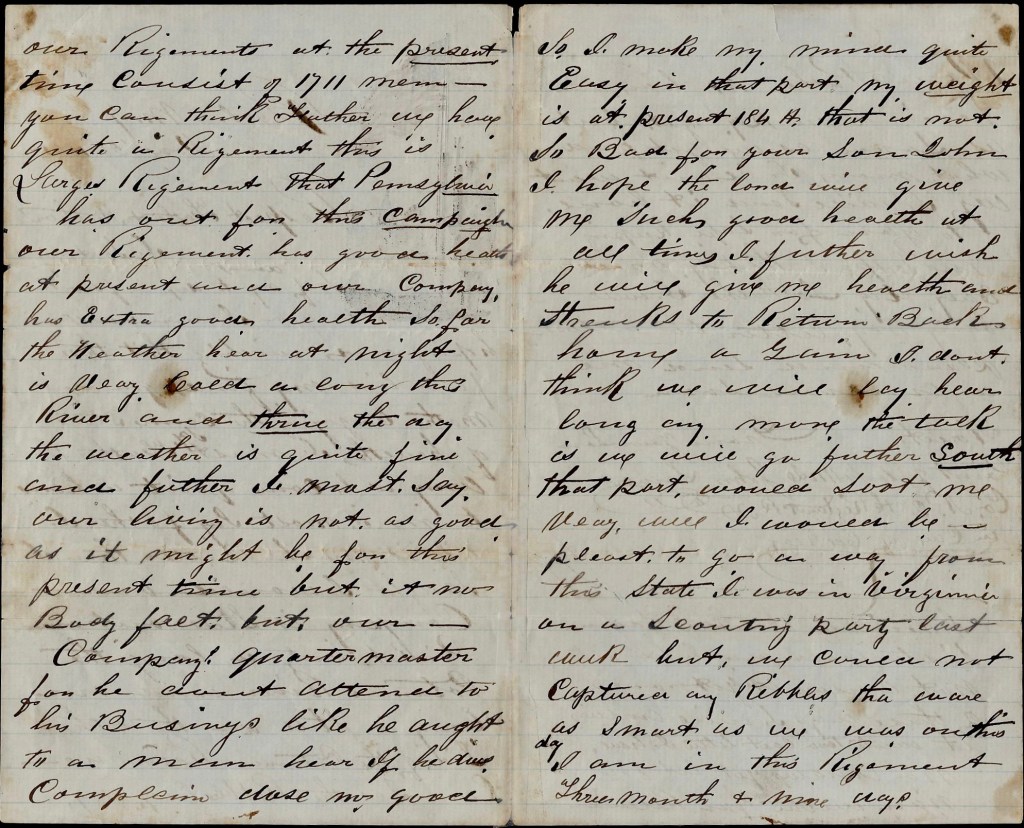
Our regiment at the present time consists of 1,711 men. You can think, father, we have quite a regiment. This is the largest regiment that Pennsylvania has out for the campaign. Our regiment has good health at present, and our company has extra good health so far.
The weather here at night is very cold along this river and through the day the weather is quite fine. And further I must say our living is not as good as it might be for this present time. But our quarter master don’t attend to his business like he ought to. My weight at present is 184 lbs. That is not bad for your son John. I hope the Lord will give me such good health at all times. I further wish he will give me health and strength to return back home again.
I don’t think we will lay here long. The talk is we will go further south. That part would suit me very well. I would be pleased to go away from this state. I was in Virginia on a scouting party last week, but we could not catch any Rebels. They were as smart as we was on this day. I am in this regiment three months and nine days. Father, we have received no pay yet, but as we get paid, what money I don’t want, I will send it home to you for safe keeping. We expect the paymaster every day. So father, I will bring my letter to a close.
From your son, — John Sowers
Direct Point of Rocks, Maryland Co. N, 28th Regiment P V., in care of Col. [John] Geary
The following letter was written by Isaac Newton Montgomery (1843-1883), the son of James Montgomery (1800-1882) and Mary Crees (1815-1890) of St. Thomas township, Franklin county, Pennsylvania.
Isaac’s letter refers to the death of Nicholas M. Bowers (1841-1863) who was mortally wounded in the leg on 3 May 1863 at the Battle of Chancellorsville when his regiment, the 126th Pennsylvania Infantry, was assaulted by a superior force on the Union right, near Ely’s Pond. They held their position until the last of their ammunition was gone but were finally forced to yield ground and retire. Fifty-eight men in the regiment were killed or wounded, some of them left on the field to be taken captive. Nicholas’ leg wound was so severe, he could not leave the field and he was held by the Confederates for 12 days before he was exchanged, his wound untreated. He died the day following his release. Nicholas served in Co. H.
Isaac addressed the letter to his friend, David Hafer (1837-1921) who served as a private early in the war in Co. I, 79th Pennsylvania, but later in Co. D, 158th Pennsylvania. David was married in 1858 to Sarah Ann Bowers (1836-1904), the sister of Nicholas.
Transcription
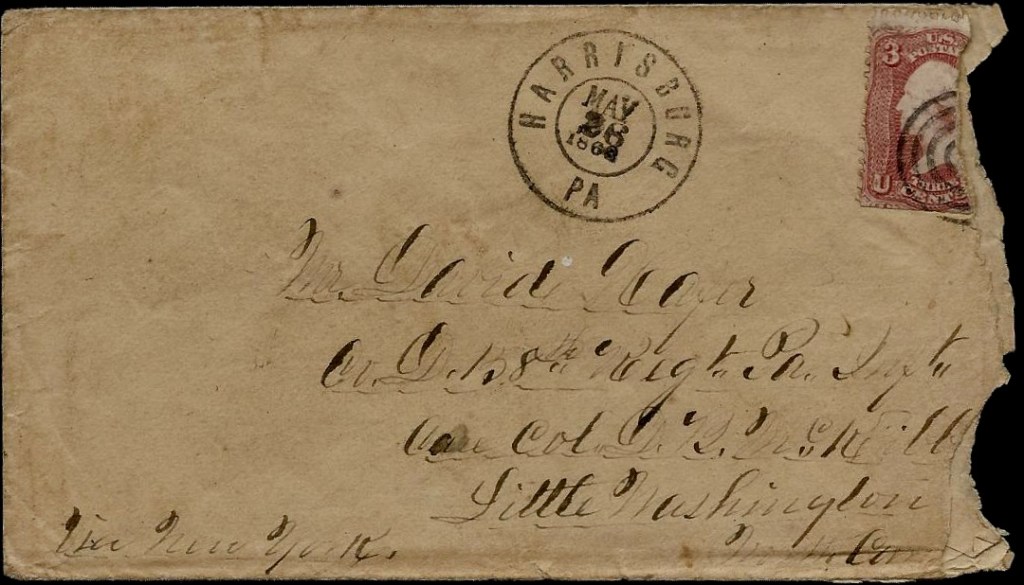
Addressed to Mr. David Hafer, Co. D, 158th Regt. Pa. Infantry, Care of Col. D. B. McKibble, Little Washington, North Carolina
St. Thomas [township, Franklin county], Pennsylvania May 24, 1863
Mr. David Hafer—my dear friend,
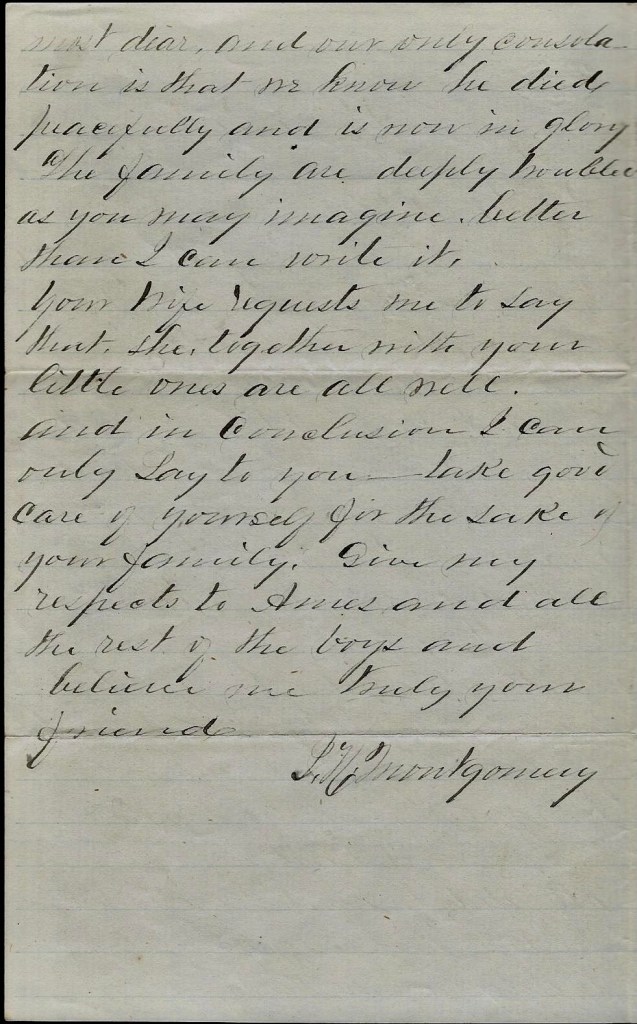
I am sorry to inform you that our friend and brother, Nickolas M. Bowers is no more. He was but a short time with his regiment when it was ordered into battle and at Chancellorsville, on Sunday May 3rd, he fell wounded in the leg below the knee. The leg was very much shattered and after repeated trials he was left in the hands of the enemy and was not brought over until the 15th. His wound had not been attended to and he died on the 16th. Thus my friend, we today mourn the loss of one most dear, and our only consolation is that we know he died peacefully and is now in glory.
The family are deeply troubled as you may imagine—better than I can describe it.
Your wife requests me to say that she, together with your little ones are all well. And in conclusion, I can only say to you, take good care of yourself for the sake of your family. Give my respects to Ames and all the rest of the boys and believe me truly your friend. — I. N. Montgomery
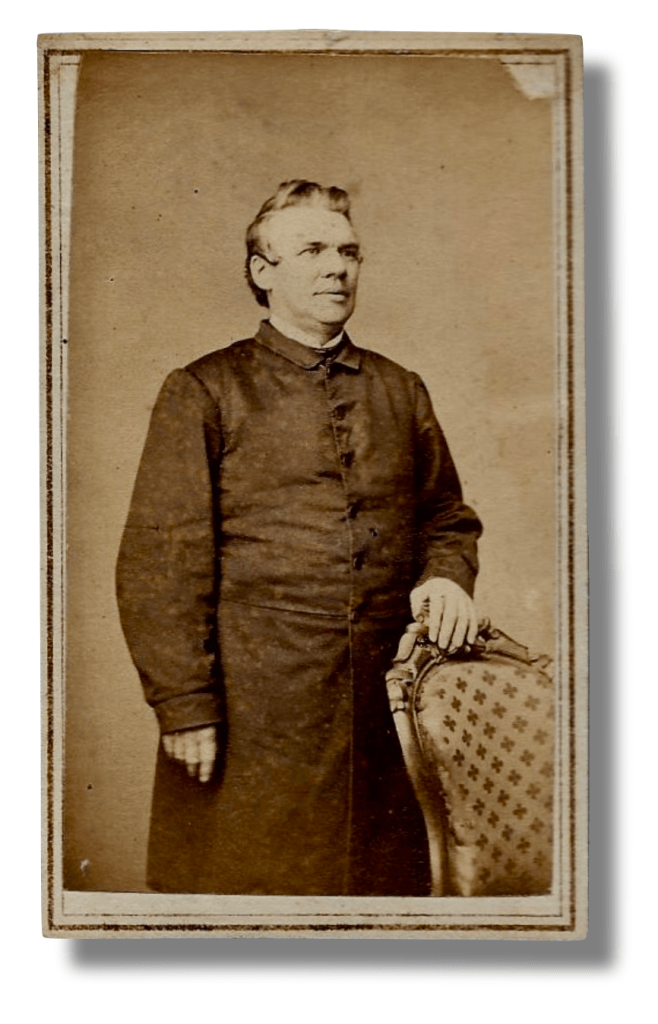
The following letter was written by Rev. Edward Brown Furbish (1837-1918), the son of Dependence Hart Furbish (1806-1882) and Persis H. Brown (1803-1872) of Portland, Cumberland county, Maine. Edwards was married in October 1862 to Grace Harrison Townsend (1840-1914).
Rev. Edward Brown Furbish
An 1860 graduate of Yale College, Edward was 25 years old when he volunteered to serve as the chaplain of the 25th Maine Infantry in September 1862. Organized at Portland, Maine, the regiment was mustered for nine months service and sent to Washington D. C. in mid-October. The regiment served garrison duty in the defenses of Washington, D.C., October 18, 1862, to March 24, 1863. Moved to Chantilly, Virginia, March 24, and on picket duty there until June 26. (Temporarily attached to XII Corps, Army of the Potomac.) Moved to Arlington Heights June 26, then ordered home June 30. The 25th Maine Infantry mustered out of service July 10, 1863.
Among the duties an army chaplain was frequently called upon to perform was to write letters informing loved ones at home of the death of their husbands, sons, brothers or fathers. In this letter, Edward refers to the death of “Mr. Kimball.” This was no doubt Isaac Kimball (1839-1862) of Casco, Maine, who enlisted on 29 September 1862 at the age of 23 to serve in Co. F, 25th Maine Infantry. Isaac died of typhoid fever in the regimental hospital on 24 November 1862. Isaac worked as a boatman just prior to his enlistment, probably in the lumber business.
Transcription
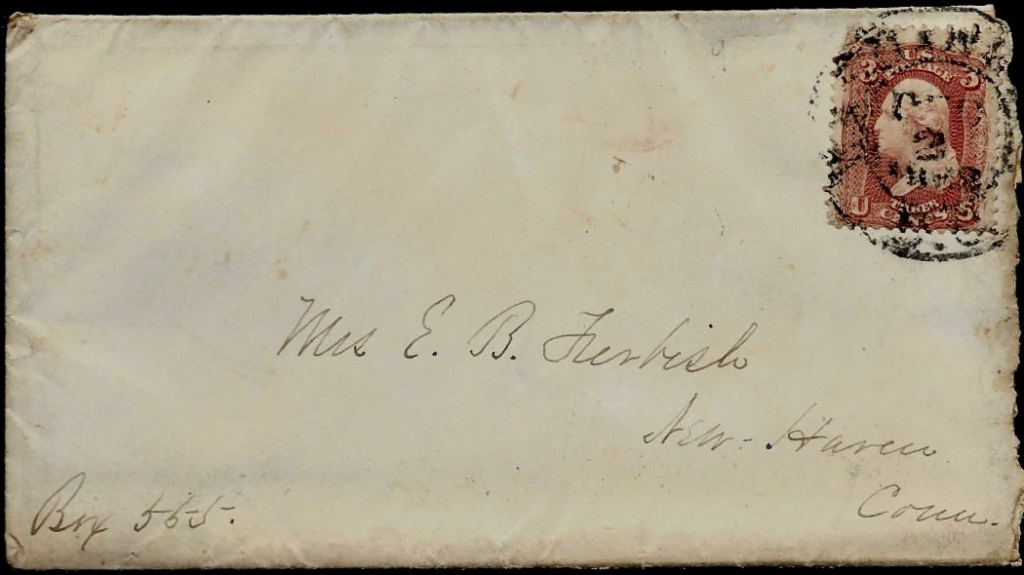
Addressed to Mrs. E. B. Furbish, New Haven, Connecticut
Arlington Heights Camp Tom Casey December 1, 1862
My own Gracie,
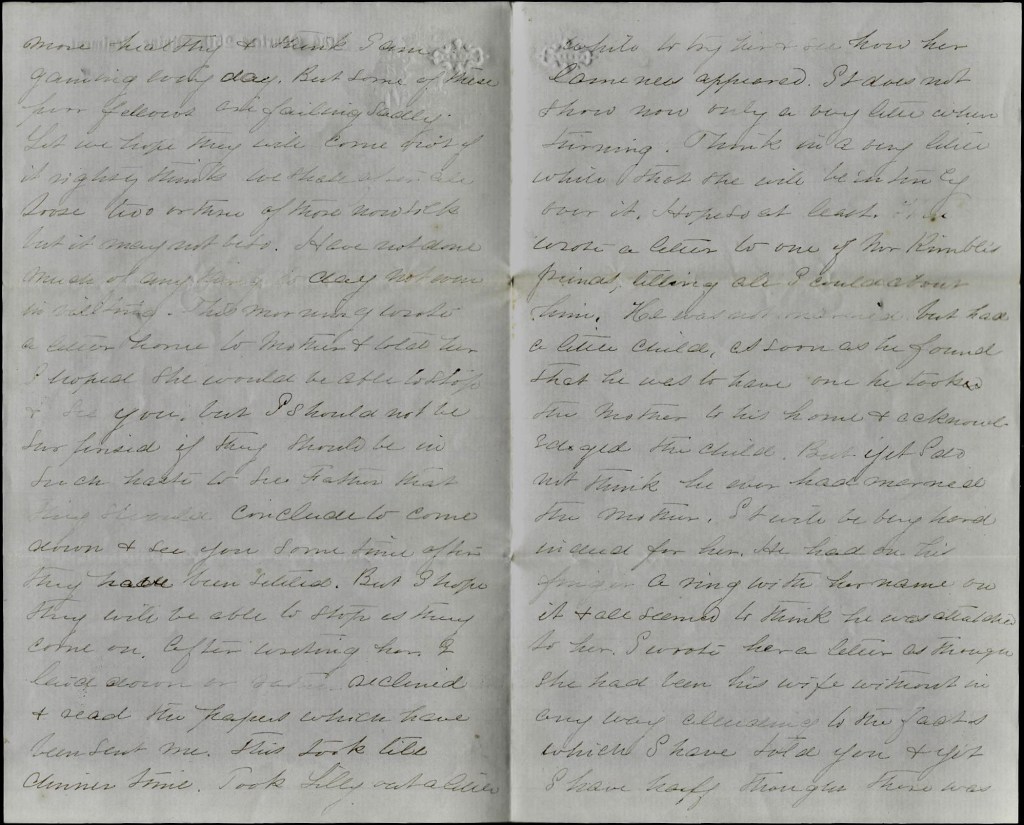
No one would think it was the first day of December here who has lived in New England. It is warmer & milder here than it can be with you. We keep a little fire in our tents, but only a little. It is like our early Spring or Fall days. The grass about my tent has looked quite green, but I will think not thrive much longer. I am now in the Chapel Tent among the sick. There are but two who are dangerously sick here, and one may die. That is why I am here tonight. Do not know how long I shall remain. I am very well indeed. Have never felt more healthy & think I am gaining every day. But some of these poor fellows are failing sadly, yet we hope they will come out of it. Think we shall after all lose two or three of those now sick, but it may not be so.
Have not done much of anything today—not even in visiting. This morning wrote a letter home yo Mother and told her I hoped she would be able to stop and see you, but I should not be surprised if they should be in such haste to see Father that they should conclude to come down and see you sometime after they have been settled, but I hope they will be able to stop as they come on. After writing her, I laid down—or rather reclined—and read the papers which have been sent me. This took till dinner time. Took Lilly out a little while to try her and see how her lameness appeared. It does not show now—only a little when turning. Think is a very little while she will be entirely over it. Hope so at least.
Then I wrote a letter to one of Mr. Kimble’s friends telling all I could about him. He was not married but had a little child. As soon as he found that he was to have one, he took the Mother to his home & acknowledged the child, but yet I do not think he ever had married the Mother. It will be very hard indeed for her. He had on his finger a ring with her name on it & all seemed to think he was attached to her. I wrote her a letter as though she had been his wife without in any way alluding to the fact which I have told you & yet I have half thought there was another whom he loved more perhaps than the Mother of his child which may have deterred him from marrying. He had no relatives other than a brother’s wife. All the rest of the family had died as suddenly as he. The notice in the paper was that he had no relatives & yet he left a child & the mother. What a comfort it would be if she could only bear his name & feel that the one she loved was in the sight of the world her husband. She will have a hard path to walk in this life. Hope she may meet her lover in heaven, or at least may here be comforted.
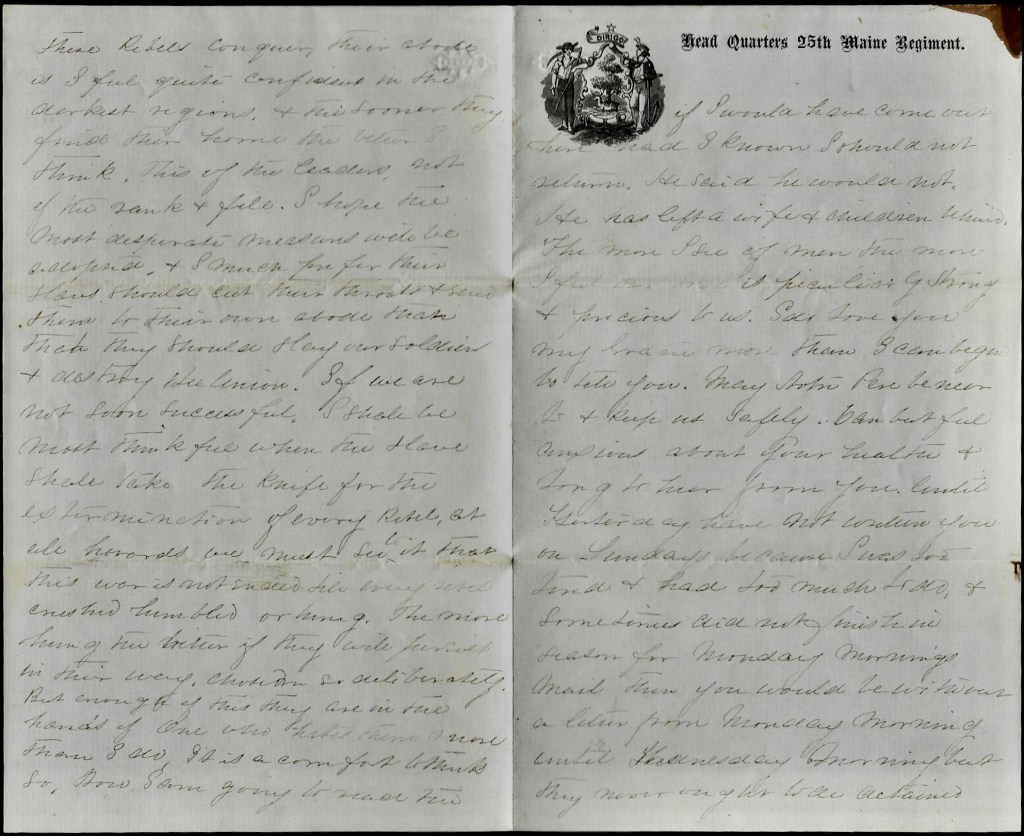
There are a good many sad hearts here in this world who do not know enough to seek comfort from the Source of all blessings, but it is given unto us. Dr. True asked me tonight if I would have come out here had I known I should not return. He said he would not. He has left a wife & children behind. The more I see of men, the more I feel our love is peculiarly strong & precious to us. I do love you my Gracie, more than I can begin to tell you. May Notre Pere [Our Father] be near us & keep us safely. Can but feel anxious about your health & long to hear from you. Until yesterday have not written you on Sundays because I was too tired & had too much to do, & sometimes did not finish in season for Monday morning’s mail, then you would be without a letter from Monday morning until Wednesday morning, but they never ought to be detained longer than that. I write every day & have excepting Sunday’s so you ought to receive six letters a week. Last week I think I only sent five letters. Will it do if hereafter I only send them once in two days or four a week? Think after all it will be difficult to refrain from writing as it will be for you to do without them & so the letters will come to you as usual I presume.
Do not know why letters the first of the week are detained unless it is that they mail last of all the soldier’s letters & only then when there is time & as there are more letters written Sunday than on any other day. Presume that our mails are laid over in Washington one day sometimes. When I can, [I] send the letters to you by a friend going to the city & he drops them in & then they go in the mail first sent & do not wait to be distributed until the last. Feel quite confident your letters have all reached [me].
The Second & Third Brigades of Casey’s Division have been ordered to go into winter quarters. The First will doubtless be removed. All whom I see think our regiment very highly favored in every respect. These opinions come to me out of the regiment.
There is nothing new to write. Everything goes on well. I do hope [General] Burnside will not go into winter quarters till he has Richmond & slain enough Rebels to make it pay to rest a while. It has taken a great burden off my mind in coming out here. I envy no one at home while the war lasts. Of two evils, we must choose the least. It is better to fight to the death than let these Rebels conquer. Their abode is I feel quite confident in the darkest regions & the sooner they find their homes, the better I think. This of the leaders—not of the rank & file. I hope the most desperate measures will be adopted & I much prefer their slaves should cut their throats & send them to their own abode than that they should slay our soldiers & destroy the Union. If we are not soon successful, I shall be most thankful when the slave take the knife for the extermination of every rebel at all hazards. We must see to it that this war is not ended until every rebel is crushed, humbled, or hung. The more hung the better if they will persist in their way, chosen so deliberately.
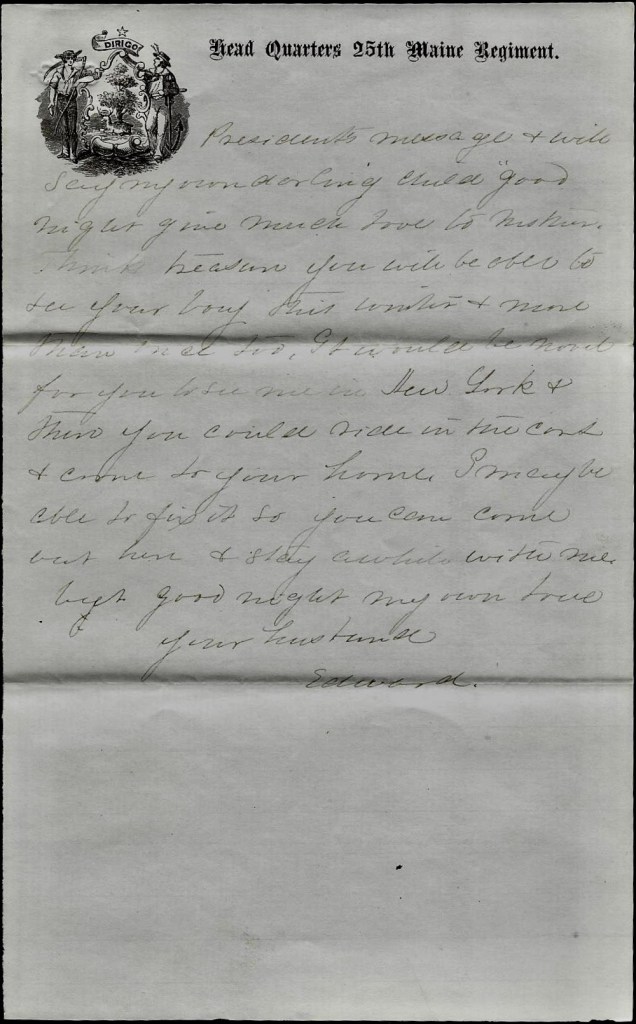
But enough of this. They are in the hands of the One who hates them more than I do. It is a comfort to think so. Now I am going to read the President’s Message & will say my own darling child, “good night.” Give much love to Mother. Think you will be able to see your boy this winter & more than once too. It would be novel for you to see me in New York & then you could ride in the cars and come to your home. I may be able to fix it so you can come out here and stay awhile with me. Good night my own true. Your husband, — Edward



















 Spared & Shared 23
.jpg)