My passion is studying American history leading up to & including the Civil War. I particularly enjoy reading, transcribing & researching primary sources such as letters and diaries.
This letter was written by Sallie S. Green (1845-1917), the daughter of Bishop William Mercer Green (1798-1887) and Charlotte Isabella Fleming (1810-1860) of Jackson, Hinds county, Mississippi. She would later marry John Mercer Cotten (1842-1915), a veteran of Co. G, 7th Tennessee Infantry and Co. K, 7th Tennessee Cavalry.
Transcription
Madison Station January 22d 1865
Dear Brother,
As I have written Lilly two letters, I think it is your turn now. I have been here ever since I left Jackson except last Sunday when I went out to church. I staid all day with Aunt Johnson & promised to go back in two or three days to stay with them, but [illegible] I have not broke them yet. I have got to go to bed today to keep off one. I have not had heard a word from home but hope you are all well. The railroad has been out of order & there has only been two trains to Jackson since I came. Sister Ella is having chills as bad as we were, only hers comes every third day. I am having a very pleasant time but as soon as I pay a short visit to Maggie Britton, I think I shall start home. Tell Lilly [that] Mary Cameron has been to call on me & sends her best love to her. Tell Pa [that] sister Ella says please get her a bolt of unbleached domestic & bring it with him next time he comes & she will pay him immediately. She wants to send the money but the mails are so uncertain she is afraid to trust it. I’m told it could be bought for four dollars a yard but she says she will give five, if the price has raised as it is seven dollars here.
I would write you a longer letter but I can tell you everything so much better when I see you that I will close now with love to all. Your affectionate sister, — Sally
The following letter was written by Brigadier General John Louis Taylor Sneed (1822-1901), the son of Junius Sneed (1791-1843) and Julia Rowan Taylor (1795-1827). He was married to Mary Ashe Shepperd (1829-1919) in 1848.
John was born in Raleigh, North Carolina and educated at Oxford male academy in North Carolina. After relocating to Tennessee, he became a member of the legislature in 1845 and captain of a Tennessee company in the Mexican War. He was attorney-general of the Memphis judicial district in 1851, attorney-general of the state of Tennessee in 1854-59, and in 1861 was commissioned a brigadier-general of the provisional army of the state of Tennessee.
Sneed’s views on secession and the course that Tennessee should follow are best summarized in a letter that he wrote from Memphis in mid-April 1861 to the editor of the Weekly Standard in Raleigh, North Carolina, and published therein on 15 May 1861. It read:
“The spell that has bound me with an utmost oriental idolatry to the Union and the Constitution of our fathers is broken by the duplicity of a sectional President, and by the instinct of self-preservation, whose oracles all trident men would do well just now to counsel and to follow. Be it right or wrong, be its authors. blessed or accursed, be its consequences good or bad, revolution is upon us, and it must be met as becomes a brave and a free people, who are struggling for rights inalienable and dear…I had believed in the better policy to achieve our rights in the Union than to endure our wrongs out of it. Hence, I have looked not to the politicians of the North, but to the people themselves, for a reaction which would restore peace and fraternity amongst us….but even this last hope of the Union men has been dashed to the earth by the insane policy of the Republican Party to excite and keep alive the war pains, so as to forestall all reflection and all efforts at a peaceful solution of our troubles. I am, therefore, for revolution.”
“Sneed was placed in command of the volunteer encampment at Fort Randolph, Tennessee (near Memphis), and later led the “River Brigade” in Major General Leonidas Polk’s army. Sneed’s war service was brief, but praiseworthy. He even survived the daily panicking of his superior, Major General Gideon Pillow. The Tennessee army was transferred to Confederate service in August, 1861. Sneed, however, was one of three generals in that force (all prewar Whigs) who were not, despite the governor’s urgings, subsequently appointed generals in the regular Confederate army. In 1862 Sneed attempted to raise a regiment of infantry, but the Federal advance ended those plans. Governor Harris later appointed Sneed to settle accounts between the Tennessee provisional army and the Confederacy.
Sneed’s letter, datelined from Greensboro, North Carolina, in April 1864 expresses optimism for the future of the Confederate States of America and praises the leadership of Jefferson Davis following a personal meeting with the President. His purpose for gaining an audience with Davis was called a “business interview” in this letter which may have been in connection with his bid to represent the Memphis district in the Confederate Congress at Richmond. His purpose for being in North Carolina is also unclear unless it was to visit relatives who still resided there.
After the war General Sneed returned to Memphis and rebuilt his legal career. A “high-toned, honorable gentleman,” Sneed served as a judge of the Tennessee Supreme Court from 1870 to 1878, judge of the Court of Arbitration in 1879, judge of the Court of Referees from 1883 to 1884, and chancellor of the Eleventh Chancery Division of Tennessee from 1894 to 1900. Sneed also served as a Democratic elector in 1880, vice president of the American Bar Association in 1882, president of the Memphis law school from 1887 to 1893, and was an unsuccessful candidate for the U.S. Senate in 1887. General Sneed died on July 29, 1901, in Memphis, and is buried in Elmwood Cemetery.” [More General in Gray, by Bruce S. Allardice]
John wrote the letter to his cousin Sallie Green (1845-1917), the daughter of Bishop William Mercer Green (1798-1887) and Charlotte Isabella Fleming (1810-1860) of Jackson, Hinds county, Mississippi.
Transcription
Greensboro, North Carolina April 10th 1864
My Dear Sallie,
In my anxiety to hear from you all, I enclose two letters in one envelope—this one to you and the other for Lillie—two tickets in a lottery, trusting that one, at least, will draw a prize. I need not assure you that an answer to each of them would be none the less dear because of its uncertainty. Both of you having greatly won upon my affections. I had indulged the hope that after my reiterated importunities, you would attach yourselves, sans ceremonie to my lists of correspondents—and in view of the fact, that “Cousin John’s” time was much engrossed with the business of his present public mission, you would generously waive your assured rights to the “first letter.” In this, I have been disappointed, and thus, “The best laid schemes of men and mice. Gang aft agley.”
But there will be no excuse for you now, and I will expect a long, loud, gossiping letter in due course of mail.
Well, Sallie, “me darling,” how are you getting along? Are you still the bonnie buoyant, blithesome lassie that you were? Or has some misadventure of the heart, or the troubles incident to “grim visaged war” wrinkled your smooth front, and subdued you to the sadness now so common among our once happy people? I hope you are the same. There is no use, as my old friend “Moreland” would say, “to barbecue one’s mind about troubles we cannot help.” We have the authority of one will: Shakespeare, also who told his friend in his own quaint style, “But for the edification of all future ages,) that “Carking care hath less power to bite, Him who scoffs at it and sets it light.” But yet there are troubles which human creation cannot, and should not “scoff at,” but should accept them, as the special ministrations of God—to woo us from the vanities of this mortal life, and wise us to himself.
Of such, this war has been alas! so mournfully prolific. I trust, dear Sallie, that there is no blood yet upon the “lintel of your door.” And if it does come, I trust that you. will see what the brave people of the South must all be brought to see—that God is leading them through a sea of troubles to an independent nationality. That He intends these sorrows, by the way, as monuments of His justice and His mercy—and has made them pungent and terrible that the memory of them may be but the more enduring.
President Jefferson Davis—“a very extraordinary man—the very man of God’s nomination to ride upon the whirlwind and direct the storm.”
I have been much of late in Richmond. Everything looks encouraging and men speak confidently of the prospect of closing the war this year. I saw the President and had a business interview with him. He is looking well. He impressed my mind which had been prejudiced against him, as being a very remarkable man. Now that I have seen and judged him in person, I positively like him. I had always admired his administration abilities—but there is that about him when his official cap is on, that impresses all about him with the idea that he is a very extraordinary man. Calm—always self poised—quick to apprehend—prompt to execute—with more upon his brain—and yet the coolest head amid the millions of sufferers around him. He seemed to me the very man of God’s nomination to “ride upon the whirlwind and direct the storm.” Add to this that withal, he is a devoted Christian and you have the “highest type of man.”
I heard fully from my bonnie wife and kindred in Tennessee a day or two since. All well, resolute and hopeful. Love to all. Affectionately yours, — John L. T. Sneed
This letter was written by a young woman named “Carrie”—probably Caroline—who addressed her letter to a “dear friend.” The letter was included in a small archive of letters including the two that were written by George H. Woolen (Woollen) of Co. B, 27th North Carolina Infantry. He was no doubt the “brother” of the recipient of this letter who was a Prisoner of War at Point Lookout, Maryland at the time. The “dear friend” is never identified in the body of the letter but must surely have been either Nancy (“Nannie”) Woollen (1846-1866) or her sister, Susan F. Woollen (1850-1868)—probably the former. Nancy’s younger brother, “Eddie” Woollen is the only family member mentioned by name.
The letter was datelined from “The Grove” on 16 May 1864. The Grove was probably the name of Carrie’s homestead which I presume was in North Carolina and possibly even in Guilford county where the Woollen family lived in Greensboro.
Your highly prized and much welcome letter came safe to hand on last mail day. I eagerly embrace the first opportunity to answer it. You must not expect a very long or a very interesting letter from me tonight as I have been very sick for the past four or five days with a nervous headache. I would not write tonight but I do not like to have to do wait for another week before answering your letters. I am very glad to hear that your Ma’s health is improving and am in hopes she will soon be enjoying the blessing of perfect health.
I have not any news to communicate unless I were to give you some of the war news. You doubtless learned more concerning our late engagements than consequently am better posted. But I think from all accounts we may look for a speedy close of the war and a return of peace. I think our prospects now are very bright and cheering. What a joyful day it will be to each and everyone—joyful, though sad to many a poor heart when they think of the loved and dear ones that will never return, but sleep their last sleep far from home and friends without a stone to mark their last resting place—many whose bone lie bleached on the hillside exposed to the scorching rays of a summer sun or the chilling blasts of winter. My heart grows sad when I think of [how] we have suffered and what we will have to suffer before the end. I have lost several dear relatives and friends during this unholy war and I truly sympathize with every bereaved heart.
I commenced writing this last night but sister made me stop as she said she was afraid it would make me sick. But I feel better this morning that I have for several days.
You spoke of hearing from your brother recently. It has been some time since I heard from him. I have not received a letter from him since I wrote to you last. I should like to have seen the exchanged prisoner to have asked about all my friends at Point Lookout. I have several confined there. I hope that the time is not far distance when they can return home in safety, there to remain in peace and quietude.
You must excuse all bad writing for my pen is not the best I ever saw. Neither is my ink very good. My love to you, your Pa, Sister, & Brother Eddie [Woollen], reserving a fair share for yourself. My pen has at last refused to do its office and I am under the necessity of having recourse to my pencil to conclude. Hoping to hear from you again, I remain your true friend, — Callie
P. S. I want you to drop the formal Miss to my name. It sounds too cold or distant. As ever, — Callie
The following two letters were written by Pvt. George Hendrix Woolen (1839-1864) of Co. B, 27th North Carolina Infantry. George enters the service on 28 April 1862 when he was 23 years old. He was taken prisoner at Bristoe Station, Virginia, on 14 October 1863 and died a POW on 19 September 1864 at Point Lookout, Maryland.
In the 1860 US Census, George was enumerated in the household of his parents in Greensboro, Guilford county, North Carolina. His parents were Benjamin Ellis Woollen (spelled with two “L”s) and Susannah Hendricker. Benjamin worked as a cabinet maker and a farmer.
Men of the 27th North Carolina were recruited in Orange, Guilford, Wayne, Pitt, Lenoir, Perquimans, and Jones counties. It was assigned to General R. Ransom’s, J.G. Walker’s, and Cooke’s Brigade. After fighting at New Bern, the 27th saw action in the Seven Days’ Battles and at Sharpsburg and Fredericksburg. During the spring and summer of 1863 it served in North Carolina, South Carolina, and in the Richmond area.
It appears that after the Seven Days’ Battles, George became too ill to remain with his regiment and was either in the hospital or placed on detail. From the second letter, written from Danville, Virginia, in July 1863, me might infer that George was on detached service working as a guard at the Union prison there. Three months later, he was taken a prisoner himself.
An unidentified Confederate soldier (Fleischer’s Auctions)
Letter 1
Near Richmond, Virginia August 28, 1862
Dear Pa,
I seat myself this morning to pen you a few pages. I ought to have written to you before now but we have been moving about so that I had no opportunity of writing. We left Petersburg—yesterday was a week, got to Richmond as week ago today. Moved over here Saturday morning. The wagons started Saturday evening after our tent to Petersburg. I got permission to go along to get our box as Lieutenant [John H.] McKnight left it there. I got what was left. It was all gone but part of the honey, coffee, and a few potatoes. James Wiley was there. He thought we was gone to Jackson and sold some and eat the rest. I got back here Monday evening. Stephen and I ate some of the honey and drank some coffee that night.
Tuesday morning we had orders to march. I have been unwell ever since Saturday night and Dr. excused me and told me to stay until I got well. They all left Tuesday morning for Jackson. I suppose that is where they are gone. I haven’t heard yet. There is three others is left with me—James [R.] Wiley, Wilbur [F.] Owen, and [H.] Smiley Forbes. We all went out to the Seven Pines Battlefield yesterday. I was almost broke down when we got back. It is three miles from here. I seen a great many Yankee notions where their camps had been. I have no idea how long I will stay here. There is not much chance to send a letter to, or get one from, the office here since the regiment left.
The morning they left I thought I would have to go and Stephen and me had our honey and coffee put in Lieut. [John A.] Sloan’s box to carry along, and after the doctor told me to stay, I tried to get some of it but they had the box nailed up so I got none except a little which I had put in a bottle for me and Stephen’s use until we got there. I’ve got that saved. I hope we will have better luck with the next box. If I had money plenty, I could get plenty to eat. Eleven dollars per mont won’t go far here. They sell a cooked chicken for $1.50.
I would like to hear from you all. How does your corn look? Have you got much fruit? Tell Ma to dry a heap for I am in hopes I will get home in time to help eat it for I hope and pray the war will end by Christmas. If it does, I will be at home by spring if I live. They are going to be granting furloughs before long to the sick. If I get sick, I hope I will get to go home. The doctor came round to see us awhile ago. he says I am taking the ganders [jaundice]. I feel yaller [yellow] in spots about as big as the whites of my eyes. I have just been eating a spice muskmelon. It was splendid I tell you. I gave fifty cents for three.
How is Aunt Nancy and Julina Kirkman? Tell Aunt Nancy if I never see her again in this world, I will strive to meet her in heaven. I seen Web Woollen last Saturday. He was well and [looked] as well as I ever saw him. Stephen was well when he left here. Also John Coltrane and Sam Young. James Will get a discharge. He will be at home before long, I think. Capt. Adams told him if he could get home, it would be all right. If he had told me that, I would [be] home in a week, but I don’t think he will ever tell me that.
I must close and try to send my letter to the office. I will try and write to you again before long. You all need not be uneasy. If I was to get bad sick, I would write a letter or have one written to you immediately. Give my love to all enquiring friends. If you write to me, direct to Richmond. I guess you will wonder how I keep my paper so clean. Tell Ma I put on my clean new socks yesterday. I hear good news from Old Jackson.
Write soon. It may be I will get you letter. I wrote a few lines to cousin Mat the day I was in Petersburg. I remain as ever your affectionate son, — G. H. Woollen
Liberty or death
P. S. Tell Eddy to treat the girls on melon and tell them he is treating them for me.
Letter 2
Danville, Virginia July 12th 1863
Dear Pa & Ma,
Glad I am to inform you I have returned to Danville safe [but] taken a [ ] cold from being out in the rain and marching through the mud although we did not march more than 25 miles all together. The Yankees have left and we were ordered back here. I sent word to you all by William Ward. Had you heard anything about my leaving? I know Ma is uneasy about me. I feel better this morning than I have for some time. I would like to hear from you all very much.
I suppose you have had plenty of rain. I tell you I never saw the like before in my life. I think I saw at least 2,000 acres of corn washed down and ruined. Also a lot of wheat. It made me feel bad to look at it. Some men lost nearly all their crop as it was nearly all bottom land.
Hoes does your corn look and your melons do? I have a notion to try for a transfer to Salsbury. How do you think it would do? If I get transferred, I will come by home. I think I could do better in Salisbury. I saw Dick in Richmond Wednesday night. He was well. He told me he was going out to my regiment ext day. He said he expected he would stay with them some time. He said he saw Capt. [John] Sloan and told him he was going out today with them, They are near Richmond.
I have the same place I had before I left. Give my love to all my friends. I hope to hear from you all soon. I will close as I want to go to church.
When you write, give me all the news. If you see anyone coming over here with the wagon, tell them to find me for I want to send Dick’s clothes home. Has cousin May and Pat been to see you all yet? I will write to some of you again soon. I haven’t made much money since I was at home but I spent about twenty dollars last week for something to eat while we were out.
Mad, did the medicine do you any good? If it did, you had better get some more. Tell Titia and Fannie I don’t know when I will get them shoes—not until I make some money. Tell Eddie I will try and send him another dollar before for his time. So goodbye. Your affectionate son, — H. H. Woolen
The following letter was written by 39 year-old Jonathan Hersey Ayres (1824-1887), a private in Co. B, 14th Virginia Infantry. He wrote the letter to his older brother, William Buford Ayres (1820-1892). They were the sons of John Wesley Ayres (1787-1848) and Mary C. Powers (1788-1859) of Bedford county, Virginia. They had two brothers who fought for the Confederacy but did not survive the war. Elijah Quarles Ayers (1823-1862) served in Co. K, 28th Virginia Infantry. He was mortally wounded at the Battle of Seven Pines. Richard Pleasant Ayres (1827-1864) served in Co. I, 58th Virginia Infantry. He was taken prisoner at the Battle of Gettysburg and died the following year at Point Lookout, Maryland.
In this letter, Jonathan informs his brother that he had returned safely to Richmond just in time to witness a huge fire of the Public Warehouse used to store government supplies. This fire took place on March 10th in spite of a torrential rainstorm. By the time he wrote this letter, Jonathan had been in the service for more than 21 months. His muster rolls indicate that he went into the hospital sick at Richmond on 29 June 1862 and that he was still there through December. Beginning in January 1863, he was detailed as ward master in Hospital K 20 in Richmond. On 2 March 1863, he requested a 7 day leave of absence from Surgeon V. W. Harrison so that he might visit his home in Bedford county and make some arrangements for his “two motherless children there.”
This letter was written just two weeks before the Richmond Women’s Bread Riot (see image below) of April 2, 1863. The situation in Richmond in the spring of 1863 was the result of an unusual sequence of bad luck. A massive snowstorm struck the city in March, and the melting snow turned roads into muddy paths, which made it difficult to transport what little food was being grown on nearby farms into town. In addition, the city’s proximity to the war and the continued influx of wounded soldiers, civil servants, and government staff placed further stress on an already overburdened system.
After the war, Jonathan returned to Liberty, Bedford county, Virginia where he earned his living as a miller/farmer.
Transcription
Hospital No. 20 1 [Richmond, Va.] March 16, 1863
Dear brother,
I this evening take my pen in hand to let you know that I returned to Richmond on Tuesday night safe & found all things right at the hospital though there was the largest fire burning when I arrived I ever saw. One side of the Petersburg Depot was on fire. Loss very heavy. One thousand hotheads of tobacco burned with corn & an immense quantity of other articles. 2
We have not received any patients as yet though it will not be long. First the hospital was reported for duty this morning. I have no news which would interest you on the war subject. There is no new moves making as yet that we are apprised of.
After returning to Gran’s, he told me that I ought to collect a debt that I hold against Old big Billy Creasy Estate. That it could be gotten & I will get you to attend to it. You will find it. either in the wallet on big Pocket Book. It is an order from Wm. J. Creasy to me on Wm. Creasy excepted & W. T. Nichols witness to it. The Principal near 40$. You can carry it to court & Gran can tell you who is the Administrator & collect it, &c. & let me know about it.
I had a rough & muddy ride from Mrs. Tinsleys on Sunday night. It rained hard. Though I waited till the rain was over, I had to ride to Liberty in the rain, got my feet wet & suffered with cold all the way down, which stiffened me up & has caused the rheumatism to work in me though I now feel right well again. We are about through here for something to eat. I haven’t ate a half pound of meat since I returned owing to its being so old and strong. Bread & coffee & walnuts I get in the street is my present diet. I hope [for] some patients soon so we can get something else to eat.
My stay with you all was quite limited though it was a great satisfaction to me. I left Jim when I left Grans right sick & would be glad to hear from her. She complains with headaches and her breath was out of order. There is nothing I think of at present more to write. Therefore, I close hoping these lines may find you all well. So nothing more but as ever your brother til death, — J. H. Ayres
To Wm. B. Ayres
1 General Hospital #20 was also called Royster’s Hospital and First Alabama Hospital. It was formerly the tobacco factory of J. B. and A. L. Royster for Royster Brothers and Company. The First Alabama Hospital was first located in Manchester, Virginia. After 1862 it was at 25th and Franklin Streets in Richmond and became General Hospital #20. It opened before June 1862. A report of June 4, 1862 lists 44 patients but the building had a very large capacity.
2About half past 12 o’clock on Tuesday night that part of the Public Warehouse known at Brown’s Addition, fronting 20 feet on Canal street, opposite the packet landing, and 130 feet on 8th street, was discovered to us on fire in the upper stories, occupied for past for storage purposes by the Confederate Government. Owing to the combustible nature of the contents of the upper story the flames soon enveloped the whole building. (which was of brick,) and extending downwards set fire to many hundred hogsheads of tobacco, the property of individual citizens and firms both in the Confederacy and foreign countries, but for which the State of Virginia is responsible. When the fire got well started nothing could stop it but the exertions of the Fire Brigade, with the steam engine and other help, which was vigorously applied on the occasion, preventing the spread of the fire to the other property adjoining and on the opposite side of the street. By the failing of the wells of Brown’s addition to the Public Warehouses, some of the sheds under which tobacco was stored in hog heads several tiers deep, they were set on fire, but luckily at this point a surplus of water prevented the damage that seemed likely to ensue. A number of bales of cotton, belonging to the James River Manufacturing Company and Manchester Cotton Factory, were stored on 8th street, in front of the burning building, and caught fire several times, but being quickly deluged with water were not materially injured — The loss by this fire is computed at two hundred thousand dollars. It was certainly the most destructive conflagration with which our city has been visited for some years, and whether caused by accident or design is to be equally deplored. We heard yesterday evening the rumor that the State of Virginia intended to institute a strict investigation, so that the blame of the calamity might be determined. The part of the warehouse destroyed was probably worth forty thousand dollars. Eight hundred hogsheads of tobacco were burned, which, at present prices, ($500 per hhd,) would amount to $400,000; but the state paying only the original valuation, will only lose in this item about $160,000. Two hundred hhds, of the tobacco belonged to the Rothschilds, of Paris, and were at one time the subject of a suit in the C. S. District Court, when they were sought to be sequestered as the property of August Belmont, of New York, and alien enemy. The above enumeration comprises most of the loss accruing to the State. The Confederate States Government lost $3,000 bushels of shipstuff, 1,000 bushels of bats, 300 bushels of corn, and 100,000 empty cotton grain bags, besides other property of which no list could be obtained. The loss of grain etc., can be determined by the present market value. The from this fire Illuminated the whole horizon for miles, and the best was most intense. Even at 1 o’clock yesterday the smouldering remnants were emitting fitful glares and the most uncomfortable odor. There were very few persons present, considering the extent of the conflagration. The rain fell during the while in torrents. — The Daily Dispatch: March 12, 1863. Richmond Dispatch. 2 pages. by Cowardin & Hammersley. Richmond. March 12, 1863. microfilm. Ann Arbor, Mi : Proquest. 1 microfilm reel ; 35 mm.
The 1st New York Engineers at work on Morris Island earlier in the war when they were used extensively for building earthworks. By 1864 and 1865, they spent their time built corduroy roads, dredged the Dutch Gap Canal, and built pontoon bridges.
This 1865 diary was kept by Merritt L. Pierce (1842-1869), the son of Proctor Pierce (1811-1874) and Huldah Ann Reed (1816-1872) of Morrisonville, Schuyler Falls, Clinton county, New York. Merritt was 22 years old when he enlisted on 31 August 1864 at Troy as a private in Co. L, 1st New York Engineers. His decision to join the Engineers was clearly a last minute decision. Just days earlier he intended to enlist in the Navy but found the lines too long to wait in. Less than a year later, he mustered out of the regiment as an artificer on 30 June 1865 at Richmond, Virginia.
Merritt died of consumption (tuberculosis) in 1869 at the age of 28 but not before marrying Mary S. Mead (1845-1922).
[Note: The following diary is from the personal collection of Carolyn Cockrell. Merritt Pierce was her maternal 2nd great-grandfather. The diary images were made available for publication by express consent. The transcription of the diary was done by Chuck Cockrell.]
January 1865
January, Sunday, 1. 1865—Camp near Jones Landing. Clear & cold, wind west. Dutch Gap was blown out today. I remained in camp with the company. Ed[gar Reed] went to Co. E with their mail.
Monday, 2—Clear & cold in morning. Quite pleasant in p.m. I remained in camp for I had a painful boil.
Tuesday, 3—Cold & cloudy in morning. Snowed in p.m. about one inch. I am still obliged to remain in camp.
January, Wednesday, 4. 1865—Cloudy & cold. I am still in camp but am getting better quite fast. Think I shall be able to go on duty tomorrow.
Thursday, 5—Cold but pleasant. Did not feel quite well enough to go on duty. Will [Beckwith] is at work getting out timber for bridge.
Friday, 6—Cloudy & quite warm. Looked like rain. Went on detail cutting timber for the bridge. Did not work very hard.
January, Saturday, 7. 1865—Warm & pleasant. I am on detail cutting railing for bridge. Will is on the same detail.
Sunday, 8—Cold but pleasant. We are not on detail today, except those that missed roll call during the week.
Monday, 9—It has rained all day quite hard. Did not do any duty. Received a letter from Safford Taylor.
January, Tuesday, 10. 1865—It is very unpleasant. Rained most of the day. No work.
Wednesday, 11—Clear & pleasant. Am on detail cutting railing for bridge.
Thursday, 12—Warm, clear & pleasant. Had the day to ourselves. Wrote a letter home & played gentleman the rest of the day.
January, Friday, 13. 1865—Very warm & pleasant. I had a detail of Niggs & teams to get out posts & braces for bridge.
Saturday, 14—Wind south. Looks like rain. Am on the same detail.
Sunday, 15—Very warm & pleasant. We remained in camp all day. In the evening some twenty of us went to meeting. The meeting was held by the Christian Commission about a half a mile from camp.
January, Monday, 16. 1865—Clear & pleasant. I was detailed to work on the bridge. Did not work much. Will & myself helped to row a small boat across the river three times & back for our day’s work.
Tuesday, 17—Cloudy & cold in the morning but quite pleasant most of the day. Will & I got a pass & went to City Point. Had a first-rate time. We saw Frank Ketchum 1 & got our pictures taken.
1Franklin Soules Ketchum, son of Henry Ketchum and Mary Ann Soules (see town register of soldiers), brother of Hiram Henry Ketchum and Sylvia L. Ketchum who married Israel Stickle who was in the 1st New York Volunteer Engineers. He was a Sergeant Major in the 16th New York Volunteer Infantry with his brother who subsequently reenlisted into the 1st New York Volunteer Engineers. Frank Ketchum was discharged due to disability in fall of 1862.
Wednesday, 18—Wind northeast. Cloudy & quite cold. Am on detail rafting timber for bridge. I received this diary from home. I am very much obliged to them.
January, Thursday, 19. 1865—Cold & cloudy, wind north. Am not on duty today. Wrote a letter home & sent them my picture. [James] Cummings & myself carried dinner to the detail at work on the bridge. We took a boat ride.
Friday, 20—Clear & pleasant, wind east. Am on detail cutting timber for bridge. Did not work much. Saw Versal Spalding. It is ration day. We have a fresh supply of good grub, sure.
Saturday, 21—It has stormed hard all day, wind northeast. Went to commissary & bought 4 loaves of bread & 5 pounds flour in company with Will. Cost 55 cents. The boys in our tent have got their boxes. We did not get our mail today. Don’t like it much.
January, Sunday, 22. 1865—Unpleasant, quite foggy, rained some in a.m. Remained in camp in forenoon. Worked about 2 hours in p.m. getting out stringers. Had a good sing with Whitney, Thomas & Johnson. Have enjoyed myself pretty well.
Monday, 23—Rainy & unpleasant. Deep mud. Worked on bridge in forenoon. Remained in camp in afternoon. Some picket firing last night. The boys are raising cane tonight throwing boots & hard tack at each other.
Tuesday, 24—Clear & pleasant, wind west. We were ordered out of camp at five in the morning with our arms & equipment on. Went to Jones Landing. Were ordered on board several barges & be ready to sink them. Heavy cannonading all night & part of forenoon. Were ordered into camp at 3 o’clock p.m.
January, Wednesday, 25. 1865—Clear & rather cold, wind west. Heavy firing of gunboats all night at Reb ram sunk yesterday. I have been at work cutting spiles. Ed has gone to City Point. Will is not well. Had short cake for supper.
Thursday, 26—Clear & rather cold, wind west. Was on detail cutting spiles in forenoon. Remained in camp in p.m. & did my washing. There is but little firing today from gunboats. Received a letter from home last night.
Friday, 27—Clear & cold, wind west. Worked on bridge all day. Saw a monitor pass up the river. Received a paper from home.
January, Saturday, 28. 1865—Clear & very cold, wing northwest. Were sent to work on bridge but it was too cold & the lieutenant ordered us back to camp. Will & I bought 4 loaves [of] bread, 10 pounds potatoes, 37 ½ cents. Doctor here today.
Sunday, 29—Clear & very cold, heavy northwest wind. Worked on bridge in a.m. & part of p.m. Cut two spiles in afternoon. The roads are very good. Dust flies all day. Drew bread today.
A work party placing mortars at the Crows’s Nest (visible above tree at right center) overlooking the James River opposite Dutch Gap.
Monday, 30—Clear & pleasant, wind northwest. Was detailed to work on bridge but got excused & went to Crows Nest Battery in company with Corporal Whitney. Received a letter from home with one dollar 50 enclosed.
January, Tuesday, 31. 1865—Clear, warm & pleasant. Worked on the draw of the bridge. There was crossing on the new bridge today & large number troops crossed on it. I have got some cold & sore throat.
February 1865
February, Wednesday, 1–Warm & pleasant, wind north. Worked on bridge today. Received a letter from George [Pierce]. Also, one from Mark. Answered a letter.
Thursday, 2—Pleasant in morning but cloudy & chilly most of the day, wind north. Most of the company worked on the bridge. I did not go on duty. Had sore throat. They are going to put in the draw to the bridge tonight.
February, Friday, 3. 1865—Cloudy & unpleasant. The company worked on bridge. I remained in camp. Feel much better than I did yesterday. Received a call from John Kelly. Will remained in camp, did not feel well.
Saturday, 4—Warm, clear & pleasant, wind west. Have been on detail grinding axes. The company working on bridge. Heavy firing toward Petersburg. Received a paper from home & one from Will S[cribner]. Very still in out tent tonight.
Sunday, 5—Clear & rather cold, wind northwest. Remained in camp. Went to Jones Landing. Saw eleven hundred of our prisoners from Richmond. They look very bad.
Lt. William Henry Baldwin (Dave Morin Collection)
February, Monday, 6. 1865—Clear & rather cold in forenoon, pleasant in afternoon, wind north. Worked on the bridge. Put on railing. Two recruits for our company. Lieutenant [William H.] Baldwin came back. Three cheers for him.
Tuesday, 7—Cold & heavy storm from northeast. Remained in camp. It’s a dreary day to me.
Wednesday, 8—Cloudy & unpleasant, wind west. Worked at the bridge. Lieutenant Baldwin took command of Co. L. Received a paper from home.
February, Thursday, 9. 1865—Clear & rather cold, wind northwest. Worked at the bridge. Received a letter from home. Went to meeting in evening. Heard a good sermon.
Friday, 10—Clear & pleasant, wind southwest. I was left in camp to drill. Had a good time of it. Wrote a letter home. It is quite still in the barracks tonight. Drew bread & candles today. Received 25 cents in a letter.
Saturday, 11—Clear, warm, still, & pleasant. Worked on bridge in forenoon. Finished the bridge today. Had a game at ball in afternoon & wrote a letter for Almon Emery. We expect [ ] tomorrow. Received clothing.
February, Sunday, 12. 1865—Clear & cold with a heavy northwest wind. Went down to meeting but no preaching so we came back & spent the day as best we could reading & singing. It is the coldest night we have had this year.
Monday, 13—Clear & very cold in forenoon but quite pleasant in afternoon, wind north. The company drilled today. Mr. [John] Hunter, Mr. [Peter F.] Burdick, Will, & myself built a fire in the woods to keep warm.
Tuesday, 14—Clear & quite pleasant. We were on drill (the company) a.m. & p.m. Lieutenant [John] Archer took command of Co. L. I went to meeting in the evening in company with Mr. Hunt.
February, Wednesday, 15. 1865—Raining & unpleasant all day. Inspection ordered but did not appear on inspection on account of rain. Had a good sing with Whitney, Johnson, & company. Went to commissaries. I weighed 160 pounds.
Thursday, 16—Clear & pleasant. No details today. The company on inspection. Have orders to march at 7 tomorrow morning.
Friday, 17—Cloudy & unpleasant, rained some in afternoon. Started for headquarters early in morning. Arrived there about 10 o’clock a.m. Formed our shanty in very bad conditions. Fixed it so we slept comfortably.
February, Saturday, 18. 1865—Clear, still warm & pleasant. Worked all day fixing up our tent. Have things quite comfortable tonight.
Sunday, 19—Clear & pleasant, wind north. No details today. Have enjoyed myself first rate. Had a sing with Whitney, Johnson, & company. Received a paper from home.
Monday, 20—Clear, warm & pleasant. Most of company on detail. Will & I on wood detail. We hung two axes & ground them in a.m. I did my washing. Will & I helped to load 4 loads of wood in p.m. Received a letter from home.
February, Tuesday, 21. 1865—Clear, warm & pleasant, wind north. Chopped wood for camp. Wrote letter home.
Wednesday 22—Clear & pleasant. Worked quite hard chopping wood. Washington’s birthday. Salute of 41 guns fired. Turned over my gun to Frank Regan.
Thursday, 23—Raining & unpleasant all day. Worked loading wood in forenoon. Inspection in afternoon did not amount to much.
February, Friday, 24. 1865—Clear & pleasant, wind north. Worked all day loading wood. The 2 teams drew 20 loads. Frank R. is sick. Had a sing in evening. Some clouds at night. Looks like rain.
Saturday, 25—Cloudy & unpleasant all day. I did not work in woods. Will & I ground our axes & cut some firewood for ourselves then played gentlemen. Received a paper from home.
Sunday, 26—Clear & very warm. On inspection in forenoon. Dress parade in afternoon. Had a good sing with Whitney, Frank Regan. Does not get any better.
February, Monday. 27. 1865—Clear & pleasant, quite warm. Chopped wood for camp. Mr. Hunter on our detail. Received a letter from home. Folks all well.
Tuesday, 28—Cloudy & unpleasant, rained some in a.m. The regiment mustered for pay in a.m. Inspection in p.m. Uncle Sam owes me 129 dollars. Wrote letter home. Frank very sick.
March 1865
March, Wednesday, 1—Cloudy & unpleasant, wind east. Cut wood in forenoon. Went for a load of cedar in p.m. with Corporal [William] Claude [Company M]. Frank went to hospital. Wrote a letter home last night. We feel quite lonesome.
March, Thursday, 2. 1865—Rained quite hard all day. No details. 27 recruits for our regiment. Frank Regan no better.
Friday, 3—Cloudy & unpleasant. Co. L marched to Point of Rocks to take charge of pontoon bridge. Stayed in tool house first night.
Saturday, 4—Heavy southwest wind, rained some in forenoon, rather pleasant in p.m. I stopped in lieutenant’s tent at night. Did not do much at quarters. Had a nail inspection.
March, Sunday, 5. 1865—Clear & cold in morning, pleasant in p.m., wind north. Whitney, Thomas, Reed & myself built a tent together. Was on guard. [Michael] Glennan & [Charles] Berry * under arrest.
* Charles Berry is also known as Charles Krensser or Creusere (1845-1922) born in Paris; immigrated to Brooklyn in 1854; became a citizen after the war; married Mary Mahoney then Evelyn Burt and died in Detroit. Ancestry info seems pretty good. There is a photo of him in old age.
Monday, 6—Clear & pleasant, wind north. Worked on tent. Built chimney, etc. Most of our quarters built today. Have got things quite comfortable tonight.
Tuesday, 7—Clear, warm, & pleasant. Did not drill today. Ed went to Bermuda for mail. I received a letter from home. Will & I went for a load of wood.
March, Wednesday, 8. 1865—Cloudy & unpleasant, rained some, wind south. Was on drill a short time in morning. It rained some & we stopped work. I wrote a letter home.
Thursday, 9—Cloudy & unpleasant in forenoon, quite pleasant in p.m. The company on drill in p.m. All took a good boat ride. Whitney & Thomas arrested for missing roll call.
Friday, 10—Raining & unpleasant in forepart of the day, cleared off in afternoon. We took boat ride in afternoon. Lieutenant [Charles D.] Otis * takes command of Co. L. Wrote a letter for Almon Emery.
* Lt. Charles Otis (1832-1905) is also know as Charles Cowdrey; born in Plymouth, New Hampshire; married Eleanora Sanburn; died in Queens.
March, Saturday, 11. 1865—Clear & rather cold, wind north in a.m., south in p.m. On drill about 5 hours. Thomas on guard. Whitney on wood detail. Reed went after the mail as usual. Had sing in evening.
Sunday, 12—Clear & pleasant, wind southwest. Inspection in a.m. & p.m. Received a letter from home. Wrote a letter to Julia Moore. Went to meeting in a.m. Walked out with Whitney & Thomas in p.m.
Monday, 13—Clear & very pleasant, wind southwest. We laid a pontoon bridge for first time. Did first rate too. Captain Lion present. Whitney on guard. Thomas wrote to his [ ].
March, Tuesday, 14. 1865—Clear & very warm, wind south. Laid bridge in forenoon. Loaded pontoon wagons in p.m. Worked very hard. Washed some clothes in afternoon.
Wednesday, 15—Wind southwest, cloudy & looks some like rain. Worked on pontoon wagon train in a.m. Took up pontoon bridge in p.m. Received a letter & paper from home.
Thursday, 16—Heavy south wind quite warm. Signed payroll & got my pay, 64 dollars. Went on drill in p.m. Wrote a letter home. Drew 2 loaves of bread. [Alfred] Hewitt paid me 3.50. Ed went for mail in afternoon.
March, Friday, 17. 1865—Clear & rather pleasant, wind west. We built one bridge in forenoon & took it up. Also one in p.m. Wrote a letter for Almon Emery. Went to church in evening.
Saturday, 18—Clear & pleasant, wind west. On detail fixing wagons for inspection in a.m. Laid bridge & took it up in p.m. Ed & C. Tomas went to City Point. No mail today.
Sunday, 19—Clear & very pleasant. Inspection in a.m. & p.m. Went to church in a.m. & evening. Saw Charlie Ford at the hospital. Wrote a letter home. The text in evening was this—the wages of sin is death.
March, Monday, 20. 1865—Clear & very warm. On drill in forenoon & p.m. Went to Sanitary Commission. Got some paper & thread. Fixed up a box to send home. Bought a blanket, gave 2.00.
Tuesday, 21—Cloudy & unpleasant, rained in p.m. I was on drill in a.m. On detail in p.m. laying fence. Ed went to City Point. Took a box of clothing to send home. Wrote a letter to M.
Wednesday, 22—Clear & quite cold in morning, heavy west wind. Took up bridge & loaded it on wagons in a.m. Helped to drive across bridge a drove of mules. Ed on detail. Got marching orders. Went to meeting in evening. Text 39th [ ].
March, Thursday, 23. 1865—Clear with a heavy west wind. Am on detail loading chess & putting boats together. [Patrick] Donnelly & [Charles] Berry got back from furlough. Let Almon have 2 dollars. Went to meeting in evening. Heard good sermon.
Friday, 24—Clear & rather cold, heavy west wind. Got marching orders in morning. Started for somewhere with pontoon train in p.m. Went as far as Deep Bottom & stopped for the night. Very cold night.
Saturday, 25—Cloudy & looks some like rain. Got up at ½ past 2 in morning. Started at daylight. Arrived at Chickahominy River at 2 o’clock p.m. Built a bridge across. Fixed a tent & stopped for the night.
March, Sunday, 26. 1865—Clear & rather cold, wind north. Took up the bridge in morning & started back. Halted just above Deep Bottom. Lost one of our Engineers Officers & one sharpshooter. Stopped at James River for night.
Monday, 27—Clear & very pleasant. Started for Broadway Landing early in morning. Arrived at Broadway in p.m. one o’clock. Worked the rest of p.m. loading boats on barge. Part of Co. L going to North Carolina, the rest to Hatcher’s Run.
Tuesday, 28—Clear & pleasant. Started on. March[ed] twenty-five miles. Arrived at Weldon Railroad at dark. Sheridan’s Cavalry with us. Also, Potomac Army. Went into camp about 8 o’clock at night.
March, Wednesday, 29. 1865—Clear, warm, & pleasant, wind south. Started in good season. Arrived within one mile of Hatcher’s Run about noon. Stopped there for the night. Looks like rain. Southside Railroad taken.
Thursday, 30—Wind south, rained hard all day. Remained in camp all day. Some fighting in afternoon. Saw a great many wounded men. Also, some Reb prisoners.
Friday, 31—Rainy in morning but quite pleasant most of the day. Went to front to build a bridge across Hatcher’s Run. Fighting all day. Did not get back until one o’clock morning.
April 1865
April, Saturday, 1. 1865—Clear, heavy west wind. Remained in camp. Fixed up quarters. Heavy firing all day. Our lines are advanced. A good many Johnnies taken prisoners. Received a letter from home. Wrote home.
Sunday, 2—Clear, warm & pleasant. Two inspections in a.m. Struck tents at noon & marched to signal station. Heavy cannonading all night. Petersburg captured this morning. Stopped near signal station for the night.
Monday, 3—Warm & pleasant. Richmond captured. We are on the road to Lynchburg. Saw Grant & Meade. Stopped for night. Some 2 miles on Southside Road. Looks as if the Rebs left here in a great hurry.
April, Tuesday, 4. 1865—Cloudy & quite cold in morning, pleasant most of the day. Started forward at 9 o’clock morning. Came 22 miles on Southside Road. Boys caught some sheep, hens, etc. I am on guard.
Wednesday, 5—Some cloudy in morning but warm & pleasant through the day. Started in good season. Marched all day. Arrived at Nottaway Station in evening. Stopped 2 hours. Then marched until morning.
Thursday, 6—Cloudy & some raining in morning, pleasant the rest of the day. Stopped a short time to rest & eat, then went on. Arrived at Burkeville at noon. Stopped there overnight. We hear good news all the time.
April, Friday, 7. 1865—Lousy & unpleasant most of the day. Cleared off just at night. Start off in good season. Marched all day & laid a bridge across the Appomattox at Farmville. Got through 12 o’clock [at] night.
Saturday, 8—Clear, warm & pleasant. Took up bridge & started on after the army. Stopped for the night some 12 miles from Farmville. It is reported we have captured 40,000 prisoners. I feel very tired tonight.
Sunday, 9—Clear, warm & pleasant. On our way toward Lynchburg in good season. Went into park at 3 o’clock. Lee has surrendered his army to Grant but many doubt it. But however it is so, we are living high.
April, Monday, 10. 1865—Rainy & unpleasant most of the day. Started out in afternoon & marched [un]til night toward Appomattox Court House. Passed a battlefield on our way. Saw several citizens today, all well.
Tuesday, 11—Unpleasant, foggy all day, quite muddy. Started off quite early on our way back to Petersburg. Marched until 4 o’clock p.m. & stopped at Davis Hill [?]. Several Reb parole cavalry passed us at night. Ed & I on picket.
Wednesday, 12—Cloudy & still in forenoon, heavy southwest wind in p.m. Started on our way in good season. Arrived at Prospect Station at 12 o’clock. [ ] teams. Ate dinner. Went on. Did not go far. Bad roads. Stopped for night, 12 miles from Farmville.
April, Thursday, 13. 1865—Clear & pleasant, wind west. Broke camp & travelled nearly to Farmville & camped for the teams are most played out. I had a good supper at a farmhouse. Did not get back until 10.
Friday, 14—Very clear, warm & pleasant. Broke camp at 9 o’clock. Arrived at Farmville at noon. Stopped for the night three miles beyond Farmville. Built a bridge across Bush River. The roads are very poor.
Saturday, 15—Unpleasant, it has rained most of the day. We have come 6 miles today. Very bad roads. Went into camp quite early. I killed a beef & we are faring first rate. The country does not look very fine here abouts.
April, Sunday, 16. 1865—Clear & pleasant, wind west. Broke camp at 7 o’clock. Arrived at Burkeville at tow o’clock pm. & went into park. Ate dinner, then unloaded train. Camped for the night. Reported Lincoln, Seward shot.
Monday, 17—Clear, warm & pleasant. Remained in camp [un]til night when we took the cars but did not make more than 10 rods for the reason that the cars ran off the track. There is a great many Johnnies waiting for transportation.
Tuesday, 18—Clear, warm & pleasant, wind southwest. Started for Peterburg at 8 a.m. Arrived at Peterburg at 5 p.m. It is quite a large town. Had warm bread & cheese for supper. Ed & myself are on guard.
April, Wednesday, 19. 1865—Clear, warm, pleasant. Took cars for Richmond at 9 o’clock. Arrived there at 12 o’clock. Went to where the rest of our company was & stopped for the night. Received a letter from George & one from home.
Thursday, 20—Warm & pleasant, some cloudy & rained a little in afternoon. Wrote a letter home in a.m. Moved camp to south side river in p.m. Ed & I fixed up a tent together. Camp is pleasant.
Friday, 21—Clear, warm & pleasant, wind south. Remained in camp in forenoon. Cleaned my gun. Wrote a letter for Almon. Fixed my tent. Worked on bridge in p.m. Ed is quite sick. Received a letter from home.
April, Saturday, 22. 1865—Cloudy, wind southwest. Worked on bridge all day & finished it.
Sunday, 23—Cloudy & quite cool, wind blows quite hard from the west. Inspection in forenoon. Wrote a letter home, also to Julia. Wrote a letter for Almon Emery. Some of the boys are quite blue tonight.
Monday, 24—Clear & pleasant. I remained in camp in forenoon. Was on detail to unload a boat of lumber boards. Ed is sick. 30 recruits for Co. L. Abner Baker one of them.
April, Tuesday, 25. 1865—Clear, very warm & pleasant. On drill in forenoon. Remained in camp in p.m. Received a letter from home. Ed is some better. A squad of men away on detail.
Wednesday, 26—Clear, warm & pleasant, wind south. I am on guard. Ed is better, is doing duty in office. I wrote a letter for Almon.
Thursday, 27—Clear & pleasant. I remained in camp in a.m. Went all through Richmond in company with Mr. [John H.] Hatton. It is a beautiful city. Visited Castle Thunder, Libby Prison, the Capitol, Jeff’s house & many curiosities.
April, Friday, 28. 1865—Clear & pleasant most of the day, a slight squall in p.m. Worked on bridge all day & quite hard too. Reported surrender of Johnson. Booth shot dead.
Saturday, 29—Cloudy, wind south, rained some just at night. Worked on bridge below here. Took part of it down & put it on barge & took it to Richmond. Worked pretty hard.
Sunday, 30—Clear & pleasant but looks like [rain] tonight. Inspection at 8 morning. Mustered in afternoon. Wrote a letter home, also one for Emery.
May 1865
May, Monday, 1, 1865—Cloudy & quite cold. Remained in camp all day. Wrote a letter to Miss Mary [S. Mead]. Borrowed 19 dollars of Abner Baker. Ed at work in office.
Tuesday, 2—Some cloudy, quite cool, wind northwest. On detail to get a stick of timber from shipyard in a.m. Remained in camp in p.m.
Wednesday, 3—Clear & pleasant, wind northwest. On detail loading timber. Moved into a tent with Whitney.
May, Thursday, 4, 1865—Clear, warm & pleasant, wind west. I am on guard. Received a letter from Elder [C. C.] Hart. 5th Corps came here today. Mr. Goodridge came to our camp at night.
Friday, 5—Clear & very warm. Remained in camp in forenoon. Eddy Stickles came here to camp. Went to 91st Regiment in p.m. Saw Mr. [Cyrus W.] Gavin, Charles Pascal, [Gilbert] Jesse.’
Saturday, 6—Clear & very warm, wind southwest. 3rd Corps passes through Richmond on their way to Washington. I am on detail all day. Worked on the bridge 1 in a.m. Unloaded barge in p.m.
1 This is the first entry Merritt makes in his diary of working on “the bridge.” He is referring to Mayo’s Bridge over the James River at Richmond which was destroyed by fire except for the stone piers. The Richmond Whig announced on 4 May 1865 that the bridge was going to be rebuilt. The Engineers worked quickly. By 13 June 1865, the Richmond Whig announced that the bridge would be completed by the end of the week. A week later they announced it was open to foot traffic and that it would soon be ready for vehicles. By the end of June 1865, the bridge was completed and the two pontoon bridges were taken up.
Ruins of Mayo’s Bridge over James River at Richmond, 1865
May, Sunday, 7, 1865—Clear & pleasant. Inspection of quarters in a.m. Went to church in company with Abner Baker. Heard a good [ ] sermon. Wrote a letter for A. Emery.
Monday, 8—Clear, heavy south wind. Worked on bridge. Received two papers from home. Did not do much. Will on guard. Ed still remains in camp.
Tuesday, 9—Cloudy & rained some in course of day. Worked on bridge. Got one stringer across the canal. Received a letter from how. Lost my pocketbook & found it. [Ransome C.] Alford is looking on.
May, Wednesday, 10, 1865—Clear, pleasant, wind south. Worked on bridge. Sherman’s troops crossing river today. Sent box [of] clothes home. Wrote letter home. Ed is getting quite smart. Two men under arrest.
Thursday, 11—Clear & warm, wind south, looks like rain at night. Sherman’s troops passing all day. Worked on bridge. Had whiskey for supper. Whitney is a little unwell.
Friday, 12—Cloudy & cold in morning but pleasant most of the day, had a severe thunderstorm last night. Am on guard today. Wrote a letter for A. Emery. Took a boat ride at night.
May, Saturday, 13, 1865—Clear & very warm. Smith & I went to 118th. Saw [William] Bidwell & Ed[ward K.] Stickle. It is reported the 24th Corps is to leave next Tuesday. We took a sail in the evening.
Sunday, 14—Clear & pleasant, slight wind from south. Went to Baptist church in forenoon. Received a letter from home & answered it. Whitney & Will are sick.
Monday, 15—Clear & pleasant. At work unloading timber at the bridge. Took a boat ride at night. Hewitt left camp to work in sawmill. Will is some better, also Whitney. Ed not on detail.
May, Tuesday, 16, 1865—Clear, warm & pleasant, wind southeast. I am not on detail. Half of company is off detail now every day. Received a letter from Miss M. & answered it. Took a boat ride.
Wednesday, 17—Clear, warm & pleasant, wind south. Worked on bridge. Worked quite hard for me. Drew on pair of pants, one pair of shoes, one blouse. Will on sick list. Whitney, too.
Thursday, 18—Very warm, wind southwest & some cloudy. Took a boat ride in forenoon. Went to Richmond in p.m. with [Christopher] Soulia. Had a glass [of] beer. Will & Co___ still in camp. Co. H and M are here to camp.
May, Friday, 19, 1865—Clear & pleasant, wind south, clouded up & rained some at night. Worked on bridge. Boys got back last night from Fredericksburg.
Saturday, 20—Cloudy & showers, wind southeast. Remained in camp all day. Took a boat ride in afternoon. Received a letter from home.
Sunday, 21—Clear & pleasant most of the day. Rained some, just at night. Went to Episcopal church in forenoon. Remained in camp in p.m. & wrote a letter home. Will is sick.
May, Monday, 22. 1865—Clear most of the day & very warm. Remained in camp in a.m. Worked on bridge in p.m. Tom Clary came here today.
Tuesday, 23—Clear, cool & pleasant, wind west. Remained in camp in forenoon. Worked on bridge in p.m. Tom Clary here. Will B. is sick, also Smith, Thomas. Whitney on detail for first time in a week.
Wednesday, 24—Clear, pleasant, slight wind from west. Worked on bridge in forenoon. Remained in camp in afternoon. Tom Clary here, gave me a cutlass. Will is still on sick list. Thomas has news, we expect to leave soon.
May, Thursday, 25, 1865—Clear & pleasant. Worked on bridge. Wrote letter to Saff[ord Taylor]. Received a letter from Julia. I am not very well. Thomas is sick. 4 of Co. E boys fell from bridge, were badly hurt.
Friday, 26—Rained all day, heavy northeast wind. Remained in camp all day. Wrote a letter to Julia Moore. [Smith] Thomas promoted to Sergeant, also [Henry S.] Reed & [James] Douglas.
Saturday, 27—Cloudy & rained most of the day. Detail went out in forenoon. I did not go out. Very lonesome day. Did not receive any mail.
May, Sunday 28, 1865—Clear & pleasant. Inspection in morning. Went to Baptist church in Manchester in company with Whitney & Burdick. Heard good sermon. Webber starts for New York.
Monday, 29—Clear most of the day, quite pleasant. Am on trusses detail. Worked a short time in morning. Remained in camp all day. Ed received a letter from home. Kirby Smith, same.
Tuesday, 30—Clear, warm & pleasant. Remained in camp in forenoon. Worked on bridge in p.m. Received a letter from home.
May, Wednesday, 31, 1865—Clear & very warm. Remained in camp in forenoon. Wrote a letter home. Worked on bridge in p.m. I helped to put in three braces. Ed & I went in swimming.
June 1865
June, Thursday, 1—Very warm & pleasant, wind west. No details today (fast day). Went to first Baptist Church in morning. Whitney got singing book (Carmen). We had a good sing.
Friday, 2—Warm, clear & pleasant. Worked on bridge. Went to Richmond with Smith. Got a bottle of ink. Received a letter from home.
June, Saturday, 3, 1865—Clear & very warm, slight wind from west. Wrote part of a letter home. Will & I went to a farmhouse & got all the cherries we wanted. Worked on bridge in afternoon.
Sunday, 4—Clear & very warm. Inspection in forenoon. General Hall inspected us. I wrote a letter home in p.m. Received a letter from Miss Mead. Am not very well.
Monday, 5—Clear & very warm in forenoon. Cloudy in p.m. & had quite a hard shower. Ed is ordered to the regiment with some 30 others from Co. L. I went with them. Received a letter from George [Pierce], all well.
June, Tuesday, 6, 1865—Cloudy & quite cool, wind north. I am on guard. Ed is in the adjutant’s office at work. Colonel Hall says we are going home & no humbug. I stayed in guardhouse at night.
Wednesday, 7—Some cloudy in morning but clear & pleasant most of the day. Went down to Co. L in forenoon. Got a gun. Review of a part of the 24th Corps in p.m. Wrote a letter to M.
Thursday, 8—Clear & very warm. Went to Co. B to stop for a while. Am on detail in p.m. Ed also. I feel quite unwell today. Received a letter from Saff Taylor.
June, Friday, 9, 1865—Clear & pleasant, wind south. Went to doctor in morning a.m. On light duty. Did not do any. Ed & I lay under a shade tree most of the day. Went to camp Co. L in p.m. Received a letter from home.
Saturday, 10—Cloudy, wind west. Went to doctor. Am on light duty. Remained in camp all day. Ed went to Co. L in p.m. I feel much better today.
Sunday, 11—Some cloudy, wind west, very pleasant. Started for camp Co. L early in morning to remain there. Moved in with Whitney. Went to church in a.m. Heard good sermon. Wrote letter home. Walked out with Will.
June, Monday, 12, 1865—Some cloudy, very pleasant. Went to Richmond with Will B. in a.m. Worked on bridge in afternoon. Began to plank the bridge today. Muster roll here.
Tuesday, 13—Clear & warm in a.m., showery in p.m. Am on guard today. Went fishing in a.m. & swimming in p.m. Did not do much on bridge for want of timber. Ed received letter.
Wednesday, 14—Very warm, some cloudy in p.m. Went blackberrying. Did not get many. Wrote letter for Emery. [Joseph Schliter] & [Charles] Berry have been fighting today.
June, Thursday, 15, 1865—Cloudy & lowery part of the day. Will, Ed & myself sent home a box I carried to Richmond. Whitney & I on bridge but work under Captain King. Had a good supper.
Friday, 16—Cloudy, warm & muggy. Whitney, Will & I worked on bridge, finished fixing braces on north side bridge. Whitney & myself went to Richmond in p.m. Had some ripe apples.
Saturday, 17—Clear in a.m., showers in p.m. Remained in camp in a.m. George Farnsworth came to camp. I got pass & went to City Point with him.
June, Sunday, 18, 1865—Clear & pleasant. Started for Manchester 8 a.m. Arrived at Petersburg 9 a.m., at Manchester, 11 a.m. Versal Spalding came with us. Received paper from home, George letter.
Monday, 19—Clear in forenoon, rained in p.m. Am on guard today. Went to Richmond with Will in a.m. Thomas on bridge detail. Ed is working on muster rolls.
Tuesday, 20—Clear in a.m., cloudy in p.m., heavy shower at night. Am off duty today. Went to Richmond to carry box for Ed. George Farnsworth came to camp. Will went to City Point. Received a letter from home.
June, Wednesday, 21. 1865—Cloudy in a.m., very warm in p.m. Remained in camp & wrote a letter home in a.m. Worked on bridge in afternoon. The boys had an Irish wake at night.
Thursday, 22—Clear & very warm, rained some at night. Remained in camp in forenoon. Worked on bridge in p.m. Worked pretty hard. Received a letter from home. All well.
Friday, 23—Clear & very warm. Went to Richmond in forenoon after gun. Did not get any. Worked on bridge in p.m. & I worked very hard. Ed found me a gun.
June, Saturday, 24, 1865—Clear & very hot. Remained in camp in forenoon. Worked on bridge in p.m. I worked very hard. General Hall says we will be mustered out Wednesday.
Sunday, 25—Some cloudy & very warm. Inspection in forenoon. Officers very particular. George Farnsworth came to camp. Will & I went to Manchester with him.
Monday, 26—Clear & very warm. Went to Richmond in forenoon with Ed. Had a good dinner. Worked on bridge in pm. Teams passed on the bridge today. Major King crossed first.
June, Tuesday, 27, 1865—Clear & pleasant. All the company on detail in a.m. We finished Mayo Bridge in forenoon. Abner Baker & myself went to Richmond. Got some papers & a book.
Wednesday, 28—Clear, warm & pleasant, wind south. Drilled a short time in forenoon with guns. Remained in camp in p.m. Captain [Richard W.] Coe came to Co. L. Expect to be mustered out tomorrow.
Thursday, 29—Clear & warm, wind southwest. Went to headquarters & was mustered out of U.S. service in forenoon. Remained in camp in p.m. Expect to leave for home Saturday.
June, Friday, 30, 1865—Clear most of the day & very warm, wind southwest. Remained in camp all day. Struck tents in forenoon. Slept in cars overnight. Expect to leave in morning.
July 1865
July, Saturday, 1—Clear & very warm in a.m., heavy showers in p.m. The regiment takes transportation for Baltimore. Started from Richmond ½ past 9 o’clock a.m. On guard today.
Sunday, 2—Cloudy & cool most of the day. Sailed all day. Arrived in Baltimore at 5 pm. Went to soldiers home. Took supper (poor one too). Took cars at 8 in eve for Philadelphia. [ ] all night.
July, Monday, 3. 1865—Clear & pleasant. Arrived in Philadelphia 6 a.m. Went to Volunteer’s Restaurant & took breakfast (good one too). Took cars for Amboy, 9 o’clock a.m. Arrived in Amboy ½ 3 p.m. Took boat arrived in New York at 5.
Tuesday, 4—Clear & pleasant, wind west. We have the day to ourselves. Whitney & myself took walk in morning. Great fire works in evening. Will & myself went to City Hall. Got back a little past 9.
Wednesday, 5—Clear & pleasant. Remained at the Armory. Expect to [get] paid tomorrow. Went to Billina & took my gun. A good share of boys drunk. Went about the city where I chose.
July, Thursday, 6. 1865—Clear & pleasant. I am still in the city & not much signs of getting paid up. The regiment assembled & marched to Mechanics Hall. Heard speach.
Friday, 7—Clear & quite warm. Ed & I called on Billina in forenoon. Mr. Herrick in p.m. Borrowed 10 dollars of Mr. Herrick. Took supper at the 8th Armory. Will, Ed, I went to Erie [Hotel].
Saturday, 8—Clear & pleasant. I feel first rate today. Had a god night’s rest. Went to 8th Armory in morning. Found out that we should be paid off Tuesday next. Will received a letter from home.
July, Sunday, 9. 1865—Clear & pleasant. We are still at the Erie Hotel. Went to Episcopal church in morning. Remained at the Erie the rest of the day.
Monday, 10—Clear & pleasant. Went up to 8th Armory in morning. The company got paid. We are still waiting patiently for pay. I feel pretty well tonight.
Tuesday, 11—Rainy in forenoon, pleasant in p.m. Went to 8th Armory in morning. General Hall said we were to be paid on Thursday. Went up on Broadway in p.m. Ate supper at the Armory.
July, Wednesday, 12. 1865—Cloudy but rather pleasant. Took breakfast at the Continental Hotel. Rambled about the city in a.m. Visited Barnum’s Museum in p.m. Saw sights. Don’t get paid.
Thursday, 13—Some cloudy, wind southwest. Went to Amory at 10 a.m. to get paid but are put off another day. Barnum’s museum took fire & burned up.
Friday, 14—Clear & pleasant. Reported at 8 a.m. Signed payroll & was paid 2 p.m. Bought suit clothes, 40. Took steamer for Troy at 6 p.m. Am happy to know that I am free man.
July, Saturday, 15. 1865—Some cloudy but pleasant. Arrived in Troy 8 a.m. Took breakfast at Troy House. Called on Fred Bullis. Called on E. Beckwith. Went to Albany. Saw Harvey Dodge.
Sunday, 16—Rainy & unpleasant. Went to church in forenoon in company with Mrs. Beckwith. Remained at Mr. Beckwith’s in p.m. Had a good sing. Enjoyed myself well.
Monday, 17—Rainy & unpleasant in forenoon. Pleasant in p.m. Took cars for Whitehall 7 a.m. Arrived in Whitehall at 10 o’clock. Took boat & arrived in Plattsburgh at 6 p.m. Got home, just dark.
July, Tuesday, 18. 1865—Clear & pleasant, wind west. Went to Grandpa’s in forenoon. Called on Mrs. Beckwith’s people in p.m. Went to Morrison at night.
Wednesday, 19—Cloudy & looks like rain. Went to west lot in forenoon. Killed a woodchuck. Went to mill in p.m. Rains some at night.
Thursday, 20—Cloudy, wind west, quite pleasant. Went to Falls with some rolls[?]. Aunt Mag went with me. Went fishing up Henry Brook. Caught 25 trout.
July, Friday, 21. 1865—Cloudy & looked like rain in a.m., quite pleasant in p.m. Remained at home in forenoon. Went to Morrisonville in p.m.
Saturday, 22—Clear, warm & pleasant. Went to Grandpa’s in a.m. Settled with Ed & Will for boxes. Went to Plattsburgh in p.m. Got two teeth filled & check cashed.
Sunday, 23—Clear & pleasant. Went to church in a.m. & p.m. Heard two excellent sermons. Took Sib & Mary Mead home. Had a pleasant time.
July, Monday, 24. 1865—Clear & quite warm, wind southeast. Went to west lot & cut a load of hay. William Weaver came her at night. Let him 150 dollars.
Tuesday, 25—Clear in forenoon, rainy in pm. George & I cut a load of hay & got it in. [unreadable] helped mow.
Wednesday, 26—Cloudy, heavy west wind. Finished mowing up to west lot. Came home at night. Had garden peas for dinner.
July, Thursday, 27. 1865—Cloudy in forenoon, pleasant in p.m. George & I finished haying to west lot. Worked until 9 o’clock. Mr. Mead, Mary, & [Charlotte] Lot Dodge called at George’s.
Friday, 28—Clear & very warm. Dred [?] a load of oats & corn to Mr. Howe. There was 1797 lbs oats, 498 lbs corn. Price corn 1.00 70 pounds, oats, 55 cts. 92 lbs.
Saturday, 29—Cloudy, wind west. Went to upper wood lot. Made bargain to sell a part of it. Went to Morrisonville in evening to sing. Did not sing much.
July, Sunday, 30. 1865—Clear & very pleasant. Went to church in forenoon & afternoon. Heard a very good sermon from Elder Brown. His subject was the society in heave. Had very good singing.
Monday, 31—Clear & pleasant, wind south. Went to west lot in forenoon. Drew some rails for fence. Remained at home in pm. Baker is cutting hay for us. Frank went to [George’s?].
August 1865
August, Tuesday, 1—Clear, warm & a fine hay day. Finished cutting grass.[ ] I helped Beach. Sold Mrs. O’Brien 25 acres of wood lot. She let us have a cow & a two-year-old heifer towards it.
August, Wednesday, 2. 1865—Clear & warm. Worked for Beach in forenoon. Finished haying. George & I went to Plattsburgh in p.m. Will B. & I went to Mr. [Silas]Taylor’s. Saw Safford.
Thursday, 3—Clear & very warm. Got some stone for George’s cistern & put them in. George is quite sick today. Will & I went to Morrisonville at night.
Friday, 4—Some cloudy but very warm. Went to [ ] got some plank for George’s [ ] shed floor in a.m. Helped him to lay it in p.m. & cut the grass in lane & got it in barn.
August, Saturday, 5. 1865—Clear & pleasant. Went to see Eddy in forenoon. Went to covenant meeting in p.m. Will Beckwith & myself went to Smith Mead’s in eve.
Sunday, 6—Clear in forenoon, cloudy & looks like rain in p.m. Went to church. Attended a concert at the Methodist house. Took Sib & Mary M. home.
Monday, 7—Cloudy with heavy west wind. Took grist to mill. Wet to west lot. Helped George fix cistern. Alfred Parrott came here.
August, Tuesday, 8. 1865—Clear, heavy west wind. Worked to lot cutting rye. Did not do much.
Wednesday, 9—Clear, warm & pleasant. Worked for James Henry. Drew three loads of wheat from Plattsburgh. Received a letter from Whitney. Miss Fuller & Jule to George’s.
Thursday, 10. —Clear & pleasant, wind south. Took Miss Fuller & Jule home. Went to mill in p.m. to get two pigs of Mr. Henry. It looks like rain.
The following letters were written by Charles A. Wood (1838-1864) who was born in Poughkeepsie, New York and later moved to Willimantic, Connecticut, where he worked as a clerk before the Civil War. He mustered into Co. H of the 7th Connecticut Volunteers on 5 September 1861 as a first sergeant. He was promoted to second lieutenant in March 1863. On 28 May 1863, during a furlough in May 1863, he was married to his sweetheart, Maria Dean—the recipient of these letters. He was promoted to first lieutenant of Co. G in early May 1864, but died shortly after on 15 May 1864 from wounds received at the Battle of Drewey’s Bluff the previous day.
The letters, written days apart, contain descriptions of the brief (45 minute), but important, Battle of Successionville on 16 June 1862. Charles provides yet another account of the ill-advised attack on the Tower Battery, later named Fort Lamar, constructed by the Confederates on James Island. Ironically, in the following letters, Charles makes it clear to his sweetheart that he would rather die than be a cripple. He would eventually get his wish. On 14 May 1864, during the Battle of Drewry’s Bluff, Wood was mortally wounded when a shell severed his left leg. An amputation was performed but proved to be in vain, and he died from shock the following day.
Two days after the battle at Drewry’s Bluff, Charles’ captain, John B. Dennis, wrote to Maria the sad news of her husband’s death: “It is with feelings of pain that I am compelled to write you that sad news of your husband’s fate at the battle of Chester Hill[Drewey’s Bluff]. While nobly doing his duty, he was mortally wounded by a shell from the enemy, it severing his left leg entirely, but we thought that he would come out all right. But the constant fatigue & exposure which he had undergone…had so weakened him that he could not stand the shock. His leg was amputated and he died the next morning the 15th of May. You will mourn him as your lost husband and we all mourn him as brave officer and good comrade…. P.S. Perhaps you did not know that he was just promoted to a 1st Lieut. Which was the case.”
[Note: These letters are from the personal archive of Richard Weiner and were transcribed and published on Spared & Shared by express consent.]
Union troops charge on Rebel grape & canister at the Battle of Secessionville, 16 June 1862
Letter 1
Addressed to Miss Maria Dean, Willimantic, Conn.
James Island, South Carolina June 17th 1862
My dear, dear Maria,
I write to let you know that I am safe after returning from a hard fought battle of yesterday the 16th. We were repulsed with heavy loss. The battle was fought about two miles from our camp at a strong fort 1 the Rebels had built. The first gun was fired at 4 o’clock in the morning. The intention was to take the fort by storming. The 8th Michigan was ordered to charge on it and they done it nobly [but] they was repulsed. 2 The 7th Connecticut was then ordered to charge and went up to the fort on a double quick but we was repulsed. They cut us down like grass. Other regiments was then ordered forward but it was no use. It was impossible for us to get in the fort.
The 79th New York made a gallant charge but was repulsed. Our general, seeing it was impossible to take the fort at the point of the bayonet, ordered at retreat. I think our regiment is the only one that came off the field in good order. The loss in our regiment is 90 killed & wounded, in Company H, 11 wounded, none killed, but probably one or two will die. The Willimantic Boys suffered the most in our company. Corp. Charles E. Hooks has lost his left arm. Tell John to tell his Mother when he sees her. David Cronan, Michael Flynn will probably lose an arm each. Benjamin Sanford is wounded in the head. All I have mentioned are from Willimantic. Our Brigade went in battle with less than 2,000 men and lost 373 killed, wounded, and missing. It is composed of the 7th Conn., 28th Mass., 8th Michigan, 79th New York. I have not heard the loss of the other Brigades yet but they will probably equal our own. 3 The [1st] Connecticut Battery [under Capt. Alfred P. Rockwell] done very good service. We helped them to work their guns.
Dear Maria, it is impossible to give a correct account of the battle now. I will in a day or two. I knew you would hear of the battle and be anxious to know if I was dead or alive. Thank God I escaped uninjured while others fell all around me. I am sorry we are defeated. I feel very bad about it but we done all the men could do. I cried when the order came to retreat. I wanted to go forward and gain the day. How I ever came off the field alive in a miracle. The bullets whistled by my ears like hail stones. They never fired on us until we got within about 300 yards of them. Then they poured grape & canister shot at us until we were obliged to fall back. 4 It was murder to march men up to these cannons as we were but the men went. They did not flinch.
Someone will be blamed for this foolish movement. 5 We were ordered up in front of their cannon to be murdered with no possible chance of success. The Rebels bayoneted our wounded while they lay on the field. One was taken [prisoner] in the act. I understand he is to be hung today.
Dear Maria, I am so thankful my life was spared. I would write more but I am very much fatigued. I need rest. Goodbye, my dear. Don’t worry about me. I will be all right again in a day or two. You will probably read a full account of the battle in the newspapers. I will write again soon. I was acting 2nd Lieutenant in the battle. The boys say I done my duty. I did not run. I am ready to do it again if they will only give us good generals to lead us on.
Direct to Co. H, 7th Conn. Vols., Hilton Head, South Carolina
Forever yours. 10,000 kisses for you. — Your dear Charlie
1 The earthen fort constructed by the Rebels at Secessionville was built in the rough shape of an “M” bordered on each side by marsh. There were nine cannon mounted in the fort consisting of an 8-inch Columbiad in the center, flanked on either side with a 24-pounder rifled gun, 1 24-pound smoothbore, and an 18-pounder. Two additional 24-pounder rifled guns were mounted on his northern flank. The fort was so situated that any opposing force advancing on it had to compress its attacking lines or get bogged down in the marshy mud. [American Battlefield Trust]
2 Capt. George Profit of Co. K, 8th Michigan Infantry survived that battle and wrote his father later the same day: “The news of today has been solemnized by the precious lives of hundreds of brave men, and the hand of the just historian will have just cause to tremble as it records the history of the Battle of James Island that is so indelibly written in the sacred blood of our brothers and sisters. In my tears of sorrow, I can but rejoice and bless God that I yet remain to tell the tale of woe. While I write, my eyes are filled with the cries and moans of men in agonizing pain. May a peaceful future reward these, their days of sorrow.” To read the entire letter, see The Sorrows of an ill-spent Day: A Wolverine at Secessionville, Dan Masters’ Civil War Chronicles, 28 Feb. 2021.
After Harvey Martin of the 7th New Hampshire had an opportunity to speak to some of his friends from the 3rd New Hampshire who had taken part in the attack on Tower Battery, he wrote his uncle that they reported it “a very hard battle and the Rebels were superior by a large force. They stated that they [the Rebels] had three batteries. When drove from one, they had a road prepared under ground so they could retreat back to the next battery without being seen so they had all the advantage of our troops. They state there was about one thousand of our men killed and wounded. Now they have ordered our troops off of the island and they are mounting their gun boats and are going to shell them out. They say that the island is so surrounded by gunboats that they cannot get off of the island without being blown up and I wish that none come out alive. ” [See 1862: Harvey H. Martin to Samuel Osborne on Spared & Shared 7]
3 Among the other regiments ordered into the fight at Secessionville were the Roundheads of the 100th Pennsylvania Volunteers. In his diary entries for 16-19 June 1862, Christopher C. Lobingier, a member of Co. A, wrote:
Monday, June 16, 1862—Weather very cloudy. Appearance of rain. Early in the morning the pickets were called in and ordered to join the regiment which had passed before daylight to make an attack. I started to follow after and join the regiment but was unsuccessful. Several had tried before me and could not get in it during the fight. The fight soon commenced. Our men made several bayonet charges. They drove the enemy once, I think, from their rifle pits and tried several times to drive him from the fort [Tower Battery] at the point of the bayonet but was unsuccessful every attempt. Our loss and slaughter was terrible. Our men were cut down like grass before the scythe. Retreated in good order.
Tuesday, June 17, 1862—Weather very cloudy, cold, wet and disagreeable. I never saw more disagreeable and wet weather. Very cold for the climate. It reminded me of our cold March or April rains at home. We were obliged to crawl in our narrow tents and remain there all day with scarcely room to turn. The Michigan 8th lost the most in the late battle. They were all cut to pieces. Highlanders loss was very heavy. It is thought the Roundheads lost less than any regiment engaged. One member of Co. A was shot through the hand. One of the Highlanders and one Roundhead was buried today. Both died of their wounds.
Wednesday, June 18, 1862—Weather very cloudy in the morning but ere long the clouds disappeared and then was quite a change from yesterday. The sun shone forth and the day was pleasant and we were so fortunate as to get our clothes dry. I started early in the morning in search of a haversack. Went some two or three hundred yards the other side of where we had the skirmish. I found an old one lying by one of the houses where we were stationed when skirmishing. Generals [Henry] Benham and [Isaac I.] Stevens were out viewing things. Benham said he would not attempt again to take the forts at the point of the bayonet but would hold our position.
Thursday, June 19, 1862—Weather cloudy but a fine sea breeze blew all day and therefore the weather was very pleasant. Just before sun setting we had a very heavy shower of rain but it continued but a short time. I was idle all day—nothing to do. Everything quiet. No firing or shelling since the battle. The Secesh prisoners and our wounded soldiers were taken to Hilton Head. The big gun carriages were taken up today. A flag of truce was taken yesterday to the enemy. They said our dead were buried and the wounded (45) taken to Charleston. They sent a flag and visited to exchange prisoners. It was rumored through camp that Richmond had not fallen yet but on the 13th, our army had it surrounded within 3 miles.” [The 1862 Civil War Diary of Christopher Columbus Lobingier, Co. A, 100th Pennsylvania Roundheads]
Another “Roundhead” named Edward R. Miles of Co. E, 100th Pennsylvania Vols., did not mince words when he wrote his father on 24 June 1862 that, “We are planting siege guns to shell them out of the forts. I don’t know when we will make another attack on them. I don’t want it to be another slaughter like the last one was. Our General made a perfect botch of it that day. It was General Benham. He is under arrest for it now. Old General Hunter ordered him to Hilton Head & arrested him for running the infantry up on the fort when he knowed they couldn’t take it with infantry. We lost 1,000 men out of two brigades in two hours fighting. General Stevens said it was hotter fire than Bull Run was. I never saw such a time [as] it was and there didn’t a man run off the field. When we retreated, we walked off as cool as if we was going up to breakfast & not a bit of dodging about it.” He then spoke of the death of his friend Jimmy Parker. “I haven’t [heard] anything about him since the fight. I miss him as much as I would a brother. We have drilled together for a year now. He was as good [a] soldier as ever was. When we was going out that morning to fight, he was as merry as anybody & said we didn’t know who would come back again. We double quicked a mile & a half up to the fort right in front of six cannons & I don’t know how many infantry & they let loose on us with grape shot & canister & log chains & bottles & pikes, nails, & everything they could get into the cannons. It just mowed our men down like a shot gun would a flock of pigeons. Jimmy Parker’s leg was shot off with a grape shot by the thigh & he was left on the field when we had to retreat [where] the Rebels would get him. Some of the boys saw him when we was on the retreat & he was almost dead. He shook hands with them & told them to shift for themselves to keep the Rebels from getting them. There was 4 of our company killed & 9 wounded but some of them was very slightly hurt.” [See 1862: Edward Riddle Miles to William Miles on Spared & Shared 19.]
One of the boys of the 8th Michigan killed in the Battle of Secessionville on 16 June 1862 was Leroy M. Dodge of Co. B. His body was never recovered from the battlefield and he was probably one of the Union soldiers buried in a mass grave by the Confederates. See 1861: Leroy M. Dodge to Samuel Green.
4 Most reports state that the attacking Union lines were within two hundred yards of the fort when Col. Lamar ordered the Columbia to fire. It blasted “grapeshot, nails, iron chain and glass directly at the Union center, tearing a great hole through the Federal lines.” [Battle of Secessionville, American Battlefield Trust]
A letter by Edward B. Sage of Co. E, 7th Connecticut published on Spared & Shared 18 claimed that the rebels “use most anything to fill up their cannon—scraps of iron and bottles—anything to pull death. The air in front of the battery was filled with everything to cut and slay.” [see 1862: Edward B. Sage to Calvin Sage]
5 Maj. General David Hunter relieved Brig. Gen. Henry Benham of his command for disobedience after the battle, citing the 10 June directive forbidding an attack on Charleston or Fort Johnson, and placed under arrest. On 27 June, Hunter ordered the abandonment of James Island and by 7 July, all Union forces were gone. A Judge Advocate General of the US Army later decided that Benham’s attack was justified and not prohibited by the directive but Benham would never be given a field command again. He maintained that the battle was a “reconnaissance in force.”
Letter 2
Addressed to Miss Marie Dean, Willimantic, Conn.
James Island, South Carolina June 20th 1862 8 miles from Charleston & in sight of Fort Sumter
My Dear Maria,
I wrote you on the 17th stating that I had just returned from a hard fought battle. I wrote in a great hurry and did not give you a good idea of the nature of the battle. I was very much fatigued & completely tired out at the time I wrote but I feel a great deal better now & ready for another fight.
On the morning of the 16th at one o’clock, all the regiments on this island was got ready to march with one day’s rations and 60 rounds of cartridges. We did not know if we was to go in battle or where we was to go but it didn’t make any difference. A soldier is obliged to go where he is ordered even if it is in the cannon’s mouth.
Everything being ready, we moved slowly up towards the Rebels lines. We first met their pickets about three-quarters of a mile from their fort, (the 8th Michigan & 7th Connecticut Regiments were on the advance). Their pickets fired on us, killing three of our men. It made our boys wild to see the men lay dead at their feet. We quickly returned the fire, killing one Rebel and then we charged on them. They run like sheep but we overtook them and captured them.
We kept moving slowly forward until within about six hundred yards of the fort when we charged bayonets and went up to the fort on a double quick. They did not fire on us until we was about 300 yards from the fort. Then they opened on us with canister & grapeshot & cut our men down like grass. But we did not flinch. We marched right up to the fort & tried to climb up on the parapet and get in the fort but it was no use. It was almost impossible to get on the parapet. And when a man did, they would run a bayonet through him and push him back into the ditch below.
Capt. John B. Dennis, Co. H, 7th Conn. Vols. —“I never saw him but once on the battlefield during the fight and that was when the first gun was fired.”
Capt. [Edwin S.] Hitchcock [Co. G] of our regiment is the only officer I saw succeed in getting on the parapet & he was killed almost instantly. He was a brave and good captain and his company mourn his loss. Everybody says that Capt. [John B.] Dennis run and is a coward. Gen. Wright saw him running off the field and stopped him & took his name and told him he would attend to his care hereafter. All I have to say is that I never saw him but once on the battlefield during the fight and that was when the first gun was fired.
At one time I could not muster but 8 men in our company. Col. [Joseph Roswell] Hawley come along and asked me where the rest of our company was. I told him I had just sent 5 men off wounded. He asked me where Capt. Dennis was. I told him I did not know. I told him all the men I could muster was 8 and I had kept with the colors all the time. He said you have done right, stick by them and never give them up. Col. Hawley is a brave man. Nobody can say I run or retreated until I had orders to. I would rather die than be disgraced (would you not).
An artist’s rendering of the Battle of Secessionville appearing in the Regimental History of the Seventh Connecticut by Stephen W. Walkley (1905). Rockwell’s 1st Connecticut Battery of 4 guns may be the battery in the foreground, set up in a cotton field.
At one time I thought we would all be killed before we could get off the field. Our regiment fell back about half a mile in rather bad order but the fire from the fort was too hot for any human beings to endure. We rallied again & formed in line and marched up to cover the [1st] Connecticut Battery that was hot at work throwing shells at the Rebels. We was ordered to lay down and not expose ourselves to the enemy’s fire anymore than was necessary. I tell you, Maria, the shot and shell whizzed over our heads like hail stones. We helped them to work their guns until they got out of ammunition, then we were obliged to withdraw which we was very sorry to do with the disgrace of being beaten. We have not lost ground, but we have been repulsed with considerable loss.
“Our men done well. They done all that men could do. They marched up to the fort like heroes and was shot down like dogs.”
–Sgt. Charles A. Wood, Co. H, 7th Connecticut Vols., 20 June 1862
It was a foolish movement to march on their batteries with so small a force as we had anyhow. It is impossible to take the fort at the point of the bayonet. Our men done well. They done all that men could do. They marched up to the fort like heroes and was shot down like dogs.
Saturday morning, June 21st. My dearest, a mail came in last evening as I was writing to you. It brought me a letter from you & one from home. Oh how glad I was to get them. I concluded not to write any more until morning so I will finish my war story first.
As we marched from the field, we met stragglers & wounded men all along the route to our camp. The first thing to be done after returning to our camp was to call the roll to see how many men was missing. Twenty-five was missing from our company at first but they have all come in. None of of our company were taken prisoners but 11 were wounded. Six of them have been sent to the General Hospital at Hilton Head.
Corp. Charles E. Hooks, Co. H, 7th Conn. Vols. following his discharge—“A brave man. He done his duty without fear even after he lost his arm.”
Corporal [Charles E.] Hooks will be sent home as soon as he is able to go. Hooks is a brave man. He done his duty without fear even after he lost his [left] arm. He was unwilling to leave the field but the boys picked him up and carried him off the field. Such sights as I saw on the 16th of June, I never wish to see again. It was horrible to see the poor wounded & bleeding men lay on the ground asking for help. I gave many a poor wounded fellow a drink of water out of my canteen. Anyone would naturally think to see killed & wounded men falling around you it would frighten a person, but it does not. It only makes you more anxious to fight. You forget all fear. It is so with me at least & I have heard others say the same thing.
The loss in our regiment is 90 killed, wounded and missing. The Rebel loss is probably as heavy as our own. Some of the other regiments say the 7th run but it is not so. Some of the men run, I know, but take the regiment as a body, it done well. It was the only regiment that marched off the field with a Battalion front.
“I thought I would rather be killed than lose an arm or be wounded in any way to cripple me for life. I should be obliged to give you up for you would not want a cripple for a husband. And if I cannot have you for my wife, I do not care to live.”
— Sgt. Charles A. Wood, Co. H, 7th Conn. Vols., 21 June 1862
Dear Marie, I am so glad I was not killed or wounded. I often thought of you on the battlefield. I wondered what you would say if you knew where I was & what I was doing. I thought I would rather be killed than lose an arm or be wounded in any way to cripple me for life. I should be obliged to give you up for you would not want a cripple for a husband. And if I cannot have you for my wife, I do not care to live.
Maria, how I wish I was with you. How happy I would be. Will the time ever come when we are to wed? I hope it may come soon. I do want to see you so very much. You asked me if I was going in my brother’s store again if I returned. Maria, I hardly know what I will do if I return. I have not made any calculations but one thing is certain, I want you to be wherever I am. I do not want to be separated from you again. We will get married as soon as I get home if you are willing. Let me know if you are willing to or not. I think if you are willing to wait so long for me, I ought to marry you at the first possible opportunity, don’t you think so? I wish you was my wife now. Then you would network in the mill. I am so sorry for you but what can I do. Will you do as I say, Maria?
If you only will, you need not work in the mill another day. Now dear Maria, do not feel offended at what I say. If I thought you would, I would not make the proposition. you know if we were together we would get married but it is impossible for me to be with you at present so let us consider ourselves as husband and wife (will you?). If you will, you will do me a very great kindness. I feel very sorry to have you work in the mill…I will send you money to use in any way you see fit. I know you have money but I want you to use mine. Now dear Maria, for God’s sake, do not take any wrong meaning to what I say. May God strike me dead if I would ever wrong you in any way…
Dear Maria, if you will stop working in the mill, you will oblige me very much indeed. You say Mary Abell has left the mill now. Why don’t you? You are not strong enough to work so many hours as they require their help to work in the mill. You will make yourself sick again. Do be careful of yourself, won’t you? I hope when you receive this letter you will inform the agent of the Thread Mill that you are done working in a mill.
You asked me if the weather down here is as warm now as it is in July and August up North. Yes, today is as warm as any day I ever saw in July or August in Connecticut. I wish we might be ordered North before it gets any warmer but I see no prospect yet. We have got some hard fighting to do here before we can go home. But we can do it. We are not discouraged because we were repulsed last Monday. We are working night and day building batteries to shell them out of their entrenchments. Charleston must fall and they know it. But they hate to give it up to Massachusetts & Connecticut troops.
We went up to their lines with a flag of truce the next day after the battle to ask them if they had buried our dead. They was very polite and acted quite human. They said we fought well and marched up to their batteries like heroes. They say we never can take their batteries. Wait awhile and we will show them.
Dear Maria, I have written quite a long letter and I must close. Please answer this as soon as you receive it and let me know if you will stop work in the mill. I hope you will & comply with my request in regard to other matters if you take what I have said just as I mean. I know you will comply with my requests. Give my love to your Mother. What is John’s baby’s name?
From your ever dear Charlie. Here is a kiss. Direct to Co. H, 7th Connecticut Vols. Hilton Head, S. C.
The following letter was written by Willard R. Wetherell (1832-1863), the eldest son of Bradford Wetherell (1803-1887) and Sophronia Randall (1809-1892) of Russell, St. Lawrence County, New York. He wrote the letter to his younger brother, Darius B. Wetherell (1838-1930) just as he was reaching his maturity of 21.
In his letter, datelined from Harmony, Vernon county, Wisconsin, on 13-16 January 1859, 27 year-old Willard stresses to his brother the importance of a good education and congratulates him on staying in school. He also speaks of the Pikes Peak gold fever that has struck the inhabitants of Vernon county and of the numerous offers he has had to rent cheaply the farms of many of those desiring to take off for the gold fields. His letter says the folks were inflicted with the “yellow fever” which I infer to be gold fever and says that that one of those affected was Alexander Lowrie (1839-1880) who would later serve as a captain in the 6th Wisconsin, part of the vaunted Iron Brigade.
The second half of the letter is devoted to giving his younger brother some advise should he decide to leave the family farm and seek his fortune in the world. He ends by reassuring him that should he leave home, he can always return to the family circle where he will be welcome.
Two years later, Willard would enlist and be mustered in as a corporal in Co. D, 60th New York Infantry on 30 October 1861 at Ogdensburgh, New York. He died on 12 March 1863 at the general Hospital in Harper’s Ferry, a victim of chronic diarrhea.
[Note: This letter is from the private collection of Greg Herr and was transcribed and published on Spared & Shared by express consent.]
Transcription
Harmony, Wisconsin January 13th 1859
Dear Brother,
I have once more had the pleasure of reading a letter from you bearing date of 23rd. I was extremely glad to hear from you & also to learn that you are attending school this winter. The older you grow, the more you will see the need of an education. See to it. Improve your time well, as you will see the time when you will feel sorry.
There has been good sleighing since it commenced but not much snow—not over 8 or 10 inches at a time. We had one week of severe weather the first of the month (January) but is quite mild now.
I am a boarding at H. Allen’s. He is a Yankee of the pure stock. He is a teaching school about 2 miles from here (in Newton). I attend the evening schools which is more agreeable than it was last winter (6 miles from white folks, alone that half the time). I am not making a great deal this winter. I have been old & steady for 2 years but I am now getting young again. The principle fever here at the present time is the yellow fever. It is very contagious. Almost every man, boy, & some of the women have got it. Barlow, F. Banger, 3 of the Allens (Martin, Levi, and Truman A.) & also Alexander Lowrie & hundreds of others I could mention if you and I were acquainted with them. But strange to say, there is no deaths among them.
They are a going from this place in companies to the gold diggings in Kansas. They think of starting in March, take oxen and wagons and provisions enough for 6 or 8 months (of course they will get rich in that time). It is about 11 or 12 hundred miles from here. Almost every man wants to rent his farm. I have had three after me to take their farms. They offer to find me everything (board & washing), seed, team, &c., and yes, a woman too, and give me one-third. And I have almost a mind to take a farm (as I can’t go too). I do not believe that half will go that say they are. If they do, there will be a great many widows.
James Lowrie has taken the gristmill at S[pringville]. The old miller and all his boys are a going. I hope they will do well but I am afraid they will not all of them.
January 16th. I have just received a letter from Loran. He is is Oak Grove yet getting hoop poles at 4 dollars per thousand. He appears to be in good spirits. Says the gold fever is raging there to an alarming rate.
Three years & over have rolled by since we have had the consolation of conversing with each other, otherwise than the silent movings of the pen, & you have come almost that period when you must act for yourself. What is the course you intend to pursue (if you will allow me the question)? You, I am well aware, have no trade aside from farming. Do you intend to remain there in sight of your nativity home, or are you a going to run the risk of having your eyes picked out for globe lamps. As many appear to think if they get out of the sight of home, that their eyes will be sold for globe lamps and their teeth sold for ivory. But sir! let me tell you, you may read of all the things that is going on, you have but a picture, which in traveling you have a reality which, you will never know as long as you stay within the bounds of your own town.
You are about to launch your little bark upon this broad world of strife & to baffle with the flood-wood of scoundrels that daily infest every harbor and depot to decoy the unexperienced into their dens, there to pick from his pockets the last cent of his earnings. But there is a remedy for all of this—have few words & less friends (or those that would be) with those that you are not acquainted with. Keep your eye in the alert and with a feeling of self-competency, you can overcome that feeling of I can’t go away from home. I do not advise you to go away from home if you do not want to. But if you should, may you go with a feeling that when you wish to rest for a time, you can find a place in the old circle where you were a welcome guest & I hope you ever will be.
I must close with my best wishes to all. Your affectionate brother, — Willard R. Wetherell
The following letters were written by John Ravenscroft Green (1830-1890), sometimes referred to to as “J. R.” or “Rave.” He was named after Bishop John Ravenscroft. John was the son of Bishop William Mercer Green (1798-1887) and Charlotte Isabella Fleming (1810-1860) of Jackson, Hinds county, Mississippi. He married 1st to DeLainey VanDusen McGahey, and 2nd to Hannah Lavina Lee. He became a physician after the Civil War and lived in southern Indiana for a time.
The 48th Mississippi Infantry was organized in November, 1862, at Fredericksburg, Virginia, using the 2nd Mississippi Infantry Battalion as its nucleus. Many of the men were from Jackson, Yalobusha, Warren, and Claiborne counties. It served in Featherston’s, Posey’s, and Harris’ Brigade and fought with the Army of Nourthern Virginia from Fredericksburg to Cold Harbor. The 48th was then active in the Petersburg siege south of the James River and the Appomattox Campaign. It sustained 4 casualties at Fredericksburg, had 10 killed and 44 wounded at Chancellorsville, and twelve percent of the 256 engaged at Gettysburg were disabled.
Letter 1
Camp 48th Mississippi Regiment in trenches near Petersburg, Va. July 3rd 1864
My dearest sister,
This is the first opportunity that I have had for some time of getting a letter through, as the communication has been cut off with the South for some weeks. Nothing of great interest has occurred here lately. Our Brigade has been on the march back and forth for ten days assisting the cavalry in repelling the raiders. We captured several hundred of the scamps together with between six and seven hundred negroes that they had stolen in their route through the country.
The weather has been extremely warm for ten or twelve days—so much so that nearly all of the men are completely broken down and especially myself. I have gotten so that I cannot see to walk at night but hope that it is only temporary. If I don’t get better soon, I will be compelled to go to the hospital & I would rather be most anywhere else than there. I fid that I cannot stand infantry service an if I should get through this campaign safely, I shall resign & join some other branch of service.
I wrote to you that I had seen our cousin Sam. He looks well. How I wish I could hear from some of you. Do write as soon as you get this. Have you heard from [brother] Berke[ley] lately? And his is [brother] Dunk [Duncan] getting on? we have heard from Capt. Coffee. He is a prisoner at Fort Delaware. Tel Berke when you write that he must try and look him up and tell him that I am rejoiced to hear that he is safe. Hope that poor Burke will soon be at liberty although there is no telling when he will be exchanged now. This war seems to be just in its prime at this time, but there is no telling when it will end. God only knows. Although men may feel confident that the end is not far off, yet I think none of us can even conjecture as to that anxiously looked for time. But we must all trust in God and be of good cheer for nothing but Divine interposition will in my opinion tend to close this scene of blood.
If I could keep my health, I would not care so much how long the war lasted although I am heartily tired of it, I assure you, and I long for the time to come when I can once more be at home to enjoy the [ ] of all the loved ones there & not be limited to a short furlough of thirty days. I suppose that Father is still on his visitation and I sincerely hope that he has not been molested by the enemy at any time since he left home.
I would like very much to hear from Jim. What does he propose to call the baby & have you seen it yet. Give much love to them when you write and tell Jim that I think that he might write me a short note anyhow. My kindest regards to Wm. A. and Miss Fannie. Also Mrs. Ross & family, Miss Julia included. Much love to all the family & many kisses to dear All and be sure and write soon to your affectionate brother, — J. R. Green
Letter 2
Camp 48th Mississippi Regiment Near Petersburg, Va. February 5th 1865
My dear Father,
It has been but a short time since I mailed a letter to Sallie but as one is due you, and I have an opportunity of sending it now by one of our surgeons, Dr. Peel of the 19th Mississippi, I will avail myself of the opportunity. Drs. Peel & Croft have both been transferred to Mississippi. Dr. P. will go [illegible]
…so great; that scarcely any officer below the rank of Lt. Col. can afford it. I should think that [brother] Dunk [Duncan] would find no difficulty in obtaining a short leave now as the roads in [illegible] put a stop to all movements [illegible]. What can be the reason that I never hear from Jim? I hope that he is doing well.
Nothing of importance has occurred in this department lately. I suppose you have heard ere this that Misses Stephens [illegible]….once more breath the air of freedom and peace. I will continue to trust in God and endeavor to resign myself to my fate whatever it may be….
My best love to all with kisses to bother dear Sallie and Lizzie. Also my respects to Mrs. Ross and family. I feel quite sick all at once or I would fill up this sheet. Write when you have time and remember me in your prayers.
Your truly affectionate son, — J. Ravenscroft Green
The following partial letter, though unsigned, was written by 32 year-old John H. McMillin of Co. B, 91st Indiana Infantry. The regiment was organized at Evansville, Indiana, in October 1862 and had duty in Kentucky until June 1863 when they joined in the pursuit of Morgan’s raiders. They were then ordered to Nashville and back to Kentucky again until January 1864 when they were sent to Cumberland Gap. They remained there until May 1864 and then participated in the Atlanta Campaign and the march through the Carolinas. John entered the service as a private and mustered out as a corporal at Salisbury, North Carolina on 26 June 1865.
I presume that John was the same farmer enumerated in the 1860 US Census in Johnson township, Gibson county, Indiana, and recorded as a Hoosier native, a farmer, and born about 1832. In the household with his was his wife, Sarah J., born in Kentucky about 1839), and their daughter Lucinda, born in Indiana in 1860. Sarah Jane’s maiden name may have been Wilkison but I haven’t confirmed that. Gibson County is adjacent to Warrick County in the toe of southwestern Indiana.
The sketch below, drawn by a member of the regiment, shows what the camp of the 91st Indiana looked like at Cumberland Gap at the time of this letter.
This view was drawn by First Lieutenant Lewis L. Spayd of Company E of the 91st Indiana Infantry, which arrived at the gap in January 1864 and remained through May before marching to join Sherman in his march through Georgia. Spayd presumably drew this view either while at the gap or from memory soon thereafter.
Transcription
Cumberland Gap, Tenn. March 25, 1864
Mrs. Sarah J. McMillin Dear wife & child,
It is once more with pleasure and with thankfulness to God that I seat myself to write to write to you a few lines to let you know that I am well at present and I do most sincerely hope and pray that those lines may find you both well and happy. Well, Jane, it is just one year ago this evening since I was at home if I recollect right. Will it be another yet before I get to see you, my dear wife and sweet little babe. Alas, we cannot tell. God alone is able to tell. It appears like the time has been short but it looks long and gloomy ahead. Oh Jane, I would give all this work to be at home with you tonight but oh vain wish—it cannot be.
When I look back over the past year and over the many hardships with the exposure through which I have passed, it does hardly seem reasonable to think that me or anyone else could stand it. Yet I don’t know as I can say that it has injured me any. It must be that we are protected by God or else we would wear out. And now let us look back and see if we have done anything to merit His care and protection. Alas—no. You can scarcely see one good deed. And if you get a glimpse of one, it is surrounded with such evil deeds that it is with worth nothing. We are certainly of all men the most miserable yet at times I feel like as if God, for Christ’s sake, would pardon me. I try to do right but it appears that the more I try to do right, the oftener I do wrong.
And now, Jane, I know you will pity me. And I believe if I was at home, I could do better for there I could shun those who are continually trying to see how wicked they can be. There I could have the association of Christians. There I could hear the gospel proclaimed and explained. But here we are debarred from all of that and bound to mingle and to associate with wickedness in all its most heinous shapes. All this the private soldier has to encounter with temptations too numerable to pen on paper. And yet I have stood the storm in a great many things. But in a great many more, I have erred. But Jane, sometimes I nearly give up. Oh it is awful. And without the assistance of a higher power, I fear I shall fail. God help me. But perhaps you will say, “Why don’t you quit associating with the wicked? Why not seek out the religious of your company and associate with them?” Oh, they are very scarce. There is perhaps three or four that does not swear and…
…expect to have to be up all night but one of the [paper torn] time for me to put on my relief so by that I got to sleep from twelve o’clock until four. Well our duty is very light at present. If it was not, for what scouting we have to do, we would see as easy a time here as we could ask for. But the weather is so changeable here that I fear it will be very sickly after the weather gets warmer. This is the changeablest place I ever saw. It snows or everyday or two. Yesterday and the day before it snowed in the forenoon and rained in the evening. We don’t have more than one pretty day out of a week.
“There is hundreds of dead horses and mules lying around here and if there is not something done with them, the stench from them will kill us faster this summer than ever the rebel bullets have done yet.”
–John H. McMillin, Co. B, 91st Indiana Infantry, 25 March 1864
Well, Jane, there is hundreds of dead horses and mules lying around here and if there is not something done with them, the stench from them will kill us faster this summer than ever the rebel bullets have done yet. There is a great deal of mismanagement in the army and this place has certainly received its share of the mismanagement. And if things don’t change, the war will last for years yet. But I hope that there will be a good man raise up after awhile who will go in for the good of the nation and for the speedy termination of the war.
Well, the Rebs say if we can fill up the last call of the President that we can take any place in the Southern Confederacy and we can scarcely help filling the call by about. Why don’t the loyal [paper tear] and put a stop to the war? Oh, it would be the greatest blessing that could be bestowed on man if the war could only cease. Many is young man that might be saved from filling a drunkard’s grave or perhaps worse, a felon’s grave for vice is certainly growing and the longer the war lasts, the deeper the root of evil is planted in their natures.
Well, Jane, now you will want to know how we get such large paper as this half sheet as it was confiscated last Monday from a rebel. We stopped at a house and found this with several other things and some of the boys brought it in and I swapped with them for this, Jane, so that I could write you a great big letter. I guess you will get tired of reading it but if you do, let me know and I shall write shorter ones after this.
Well, Jane, it has been some time since I have received a letter from you but as our mail comes very irregular, it is nothing strange. But I shall expect two or three this evening. Well, I wrote to you some time ago about my and Will’s business. I wrote to Jno. N. Hart 1 some time late last winter concerning it but he has failed to answer it. I want you as soon as the weather will permit you to go up to Warrick and see him and write to me as soon as you can. Let me know just what he says and if it can’t be fixed without me, you will get some responsible lawyer to write…
1 Possibly John Nelson Hart (1820-1893) of Warrick county, Indiana.



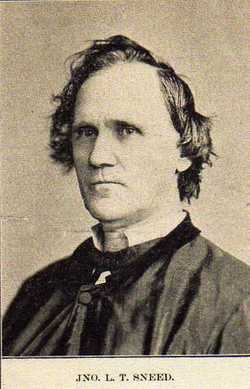


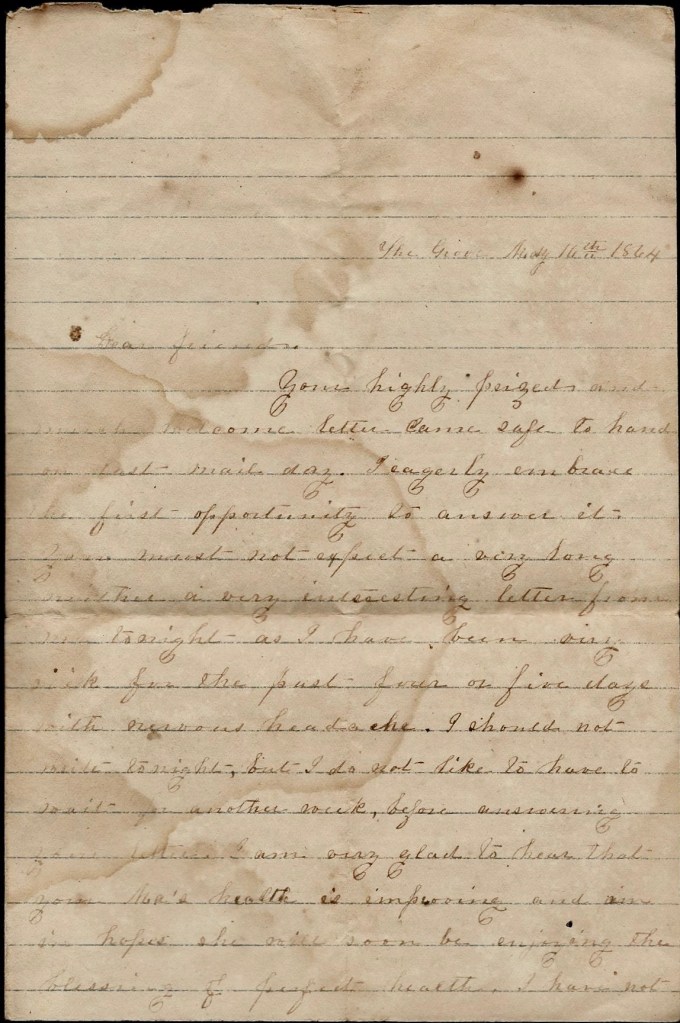


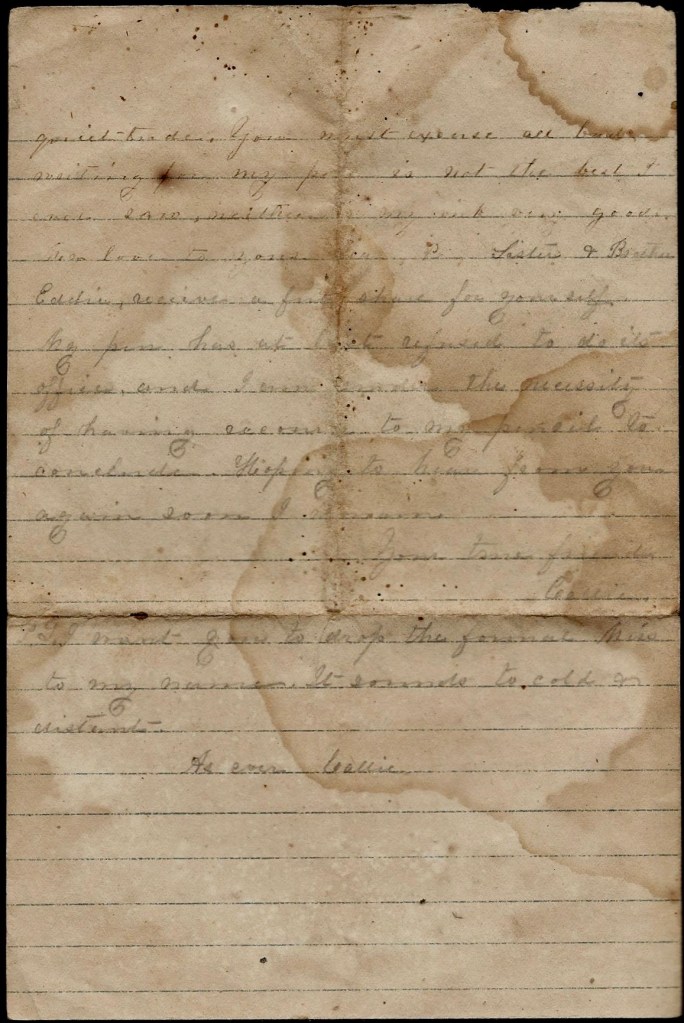
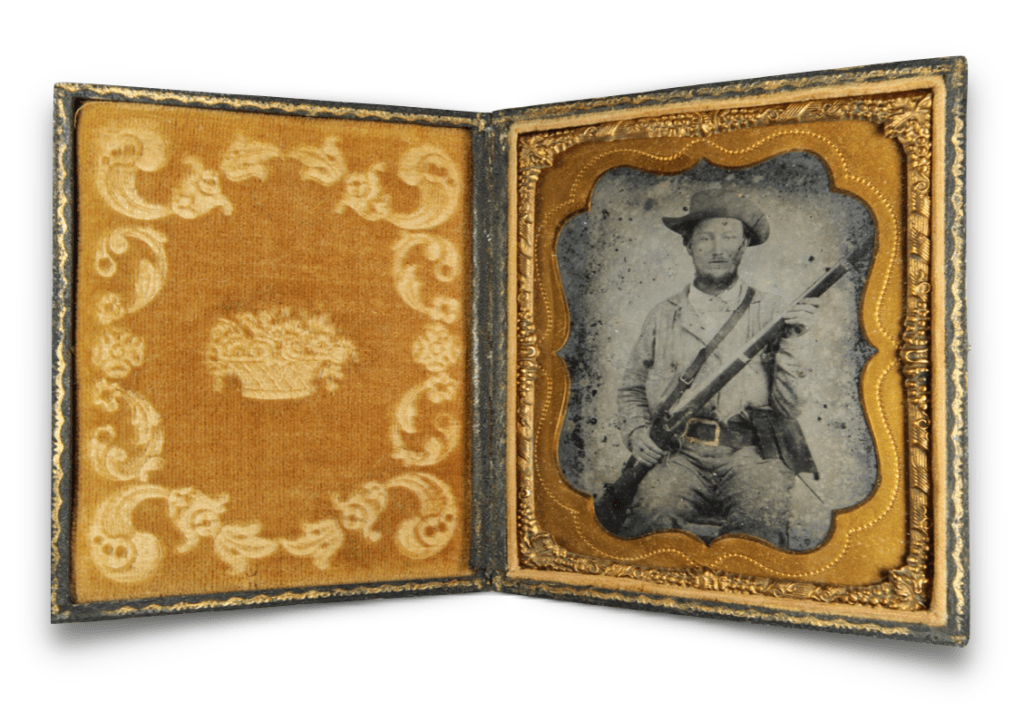
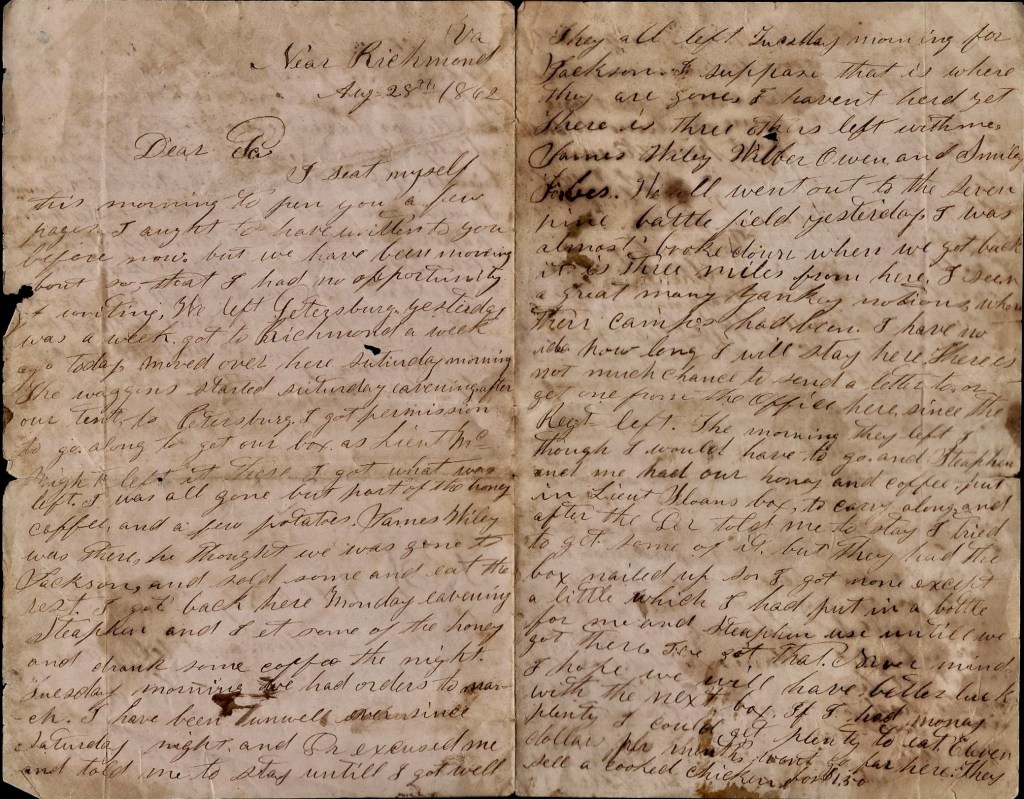


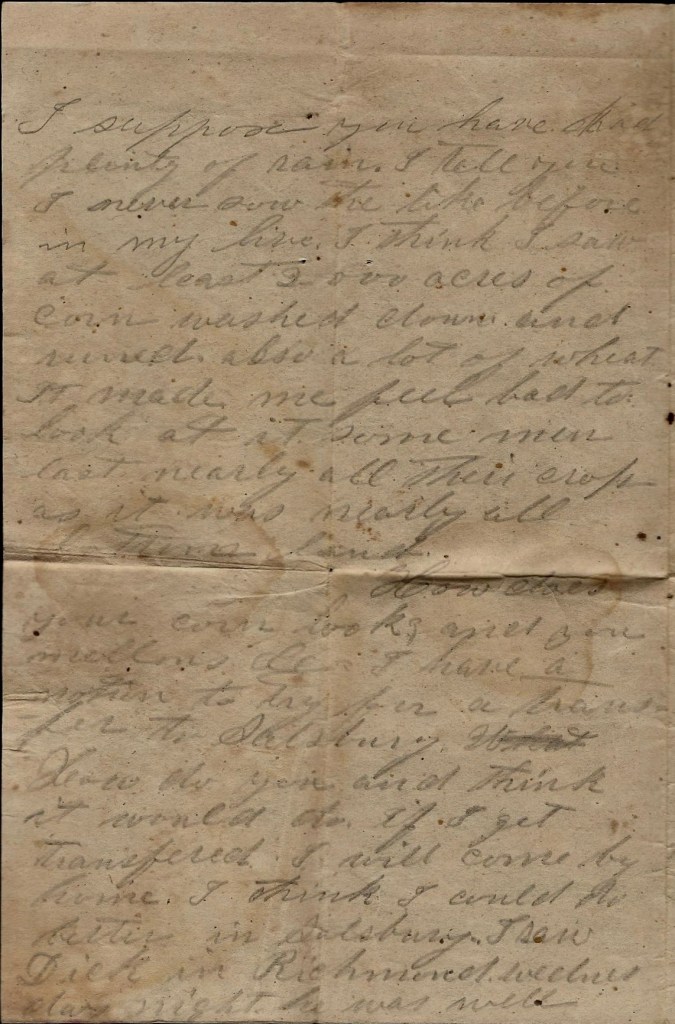


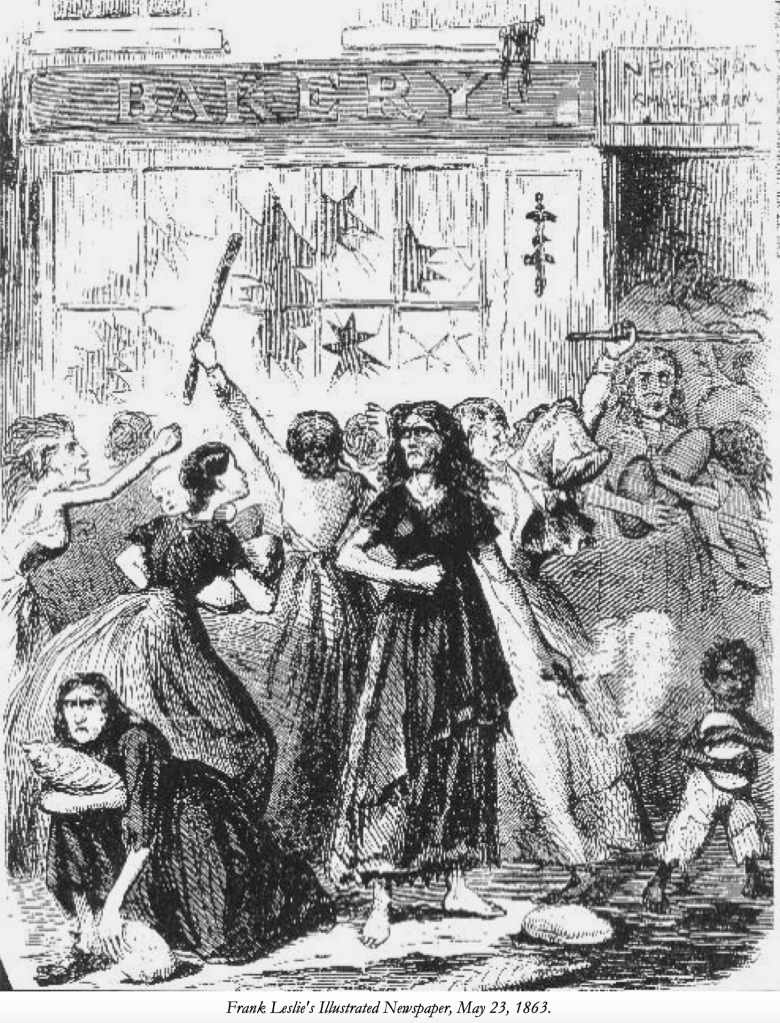

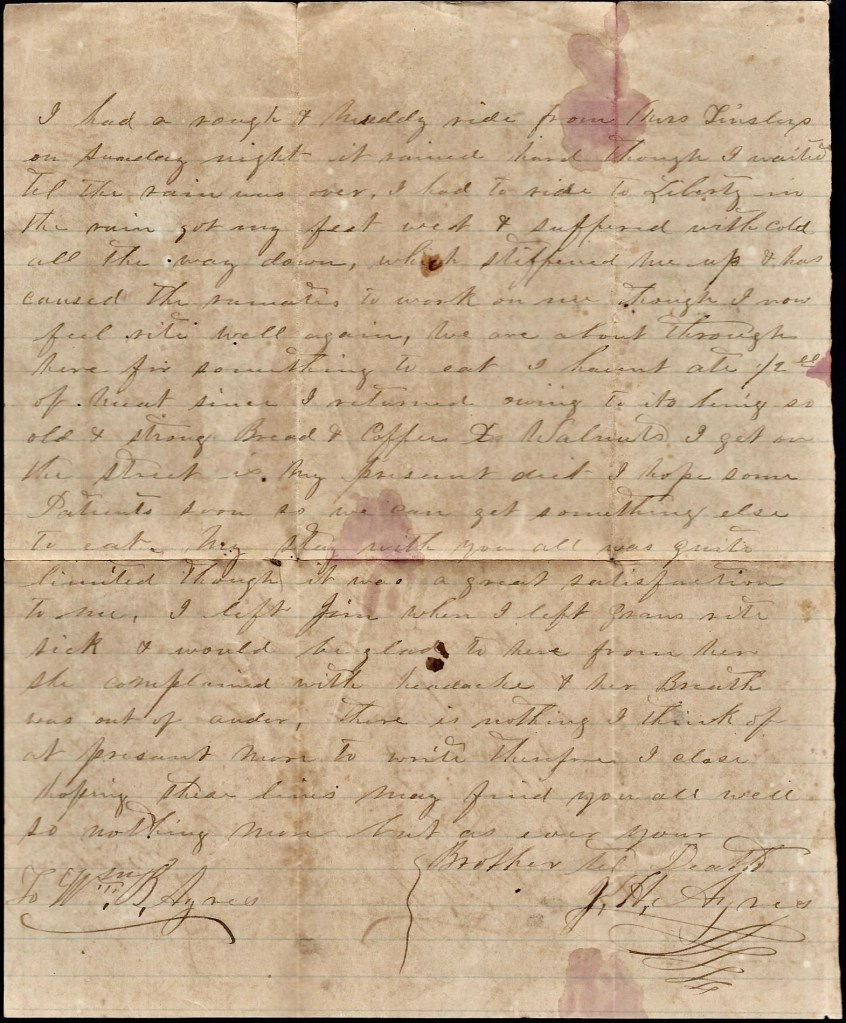
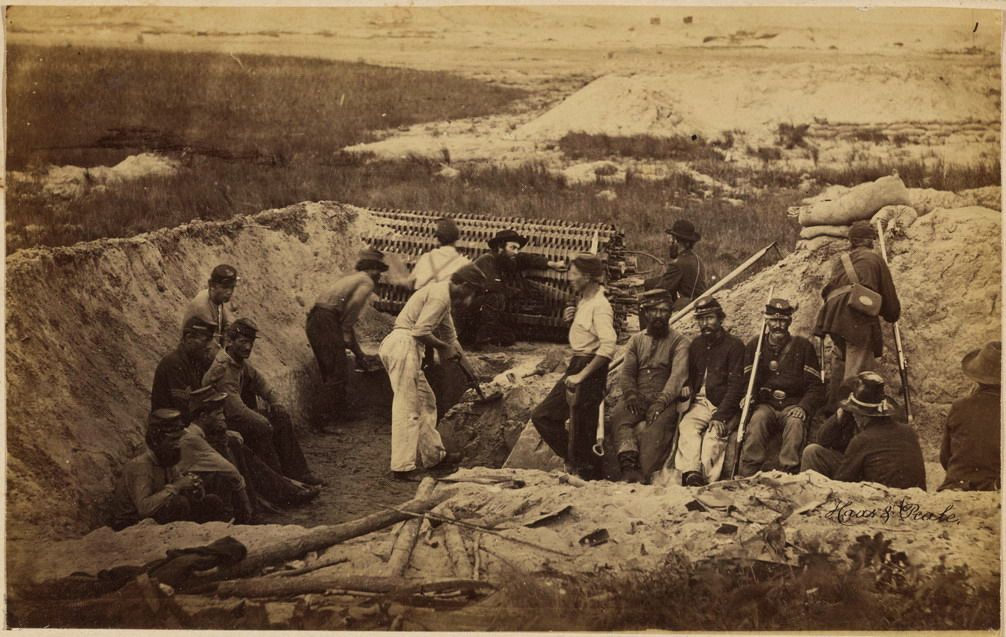
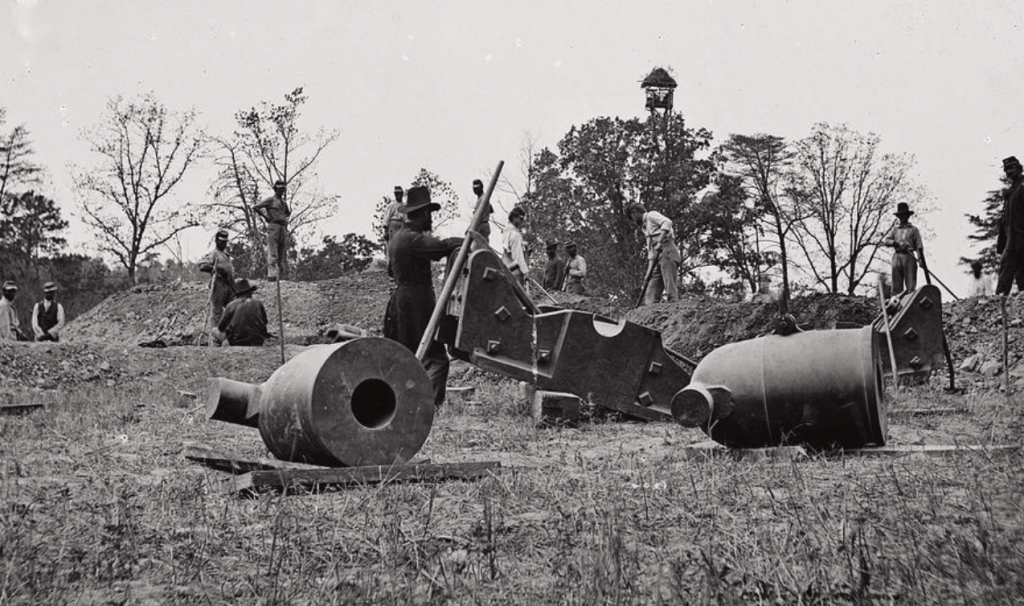

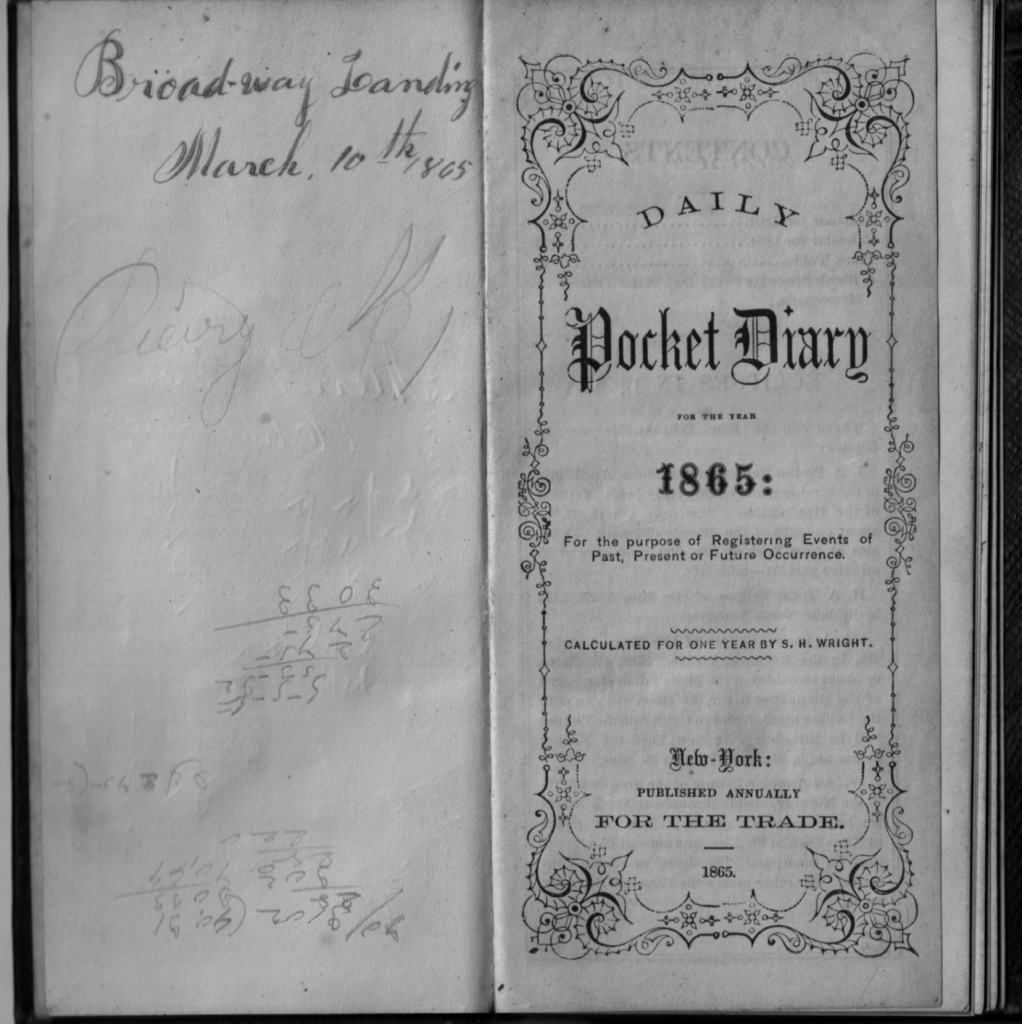
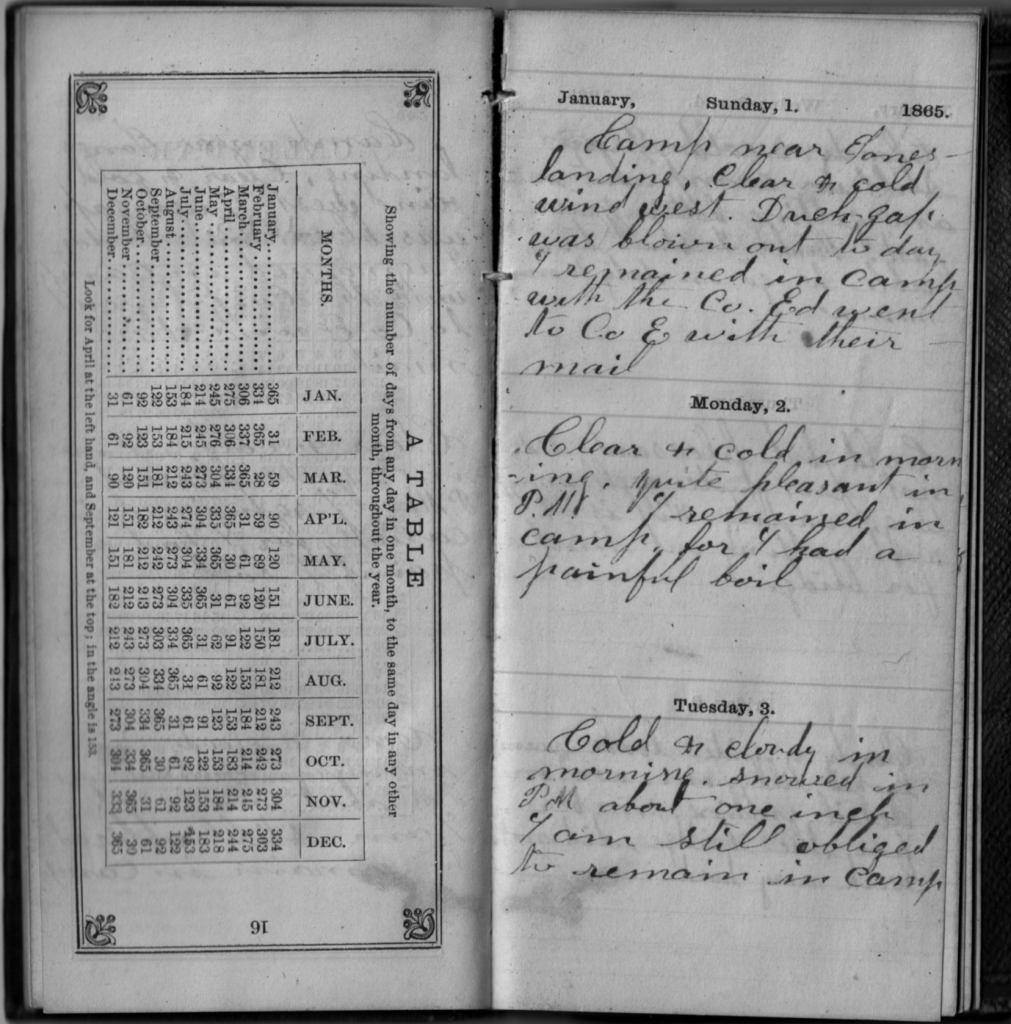

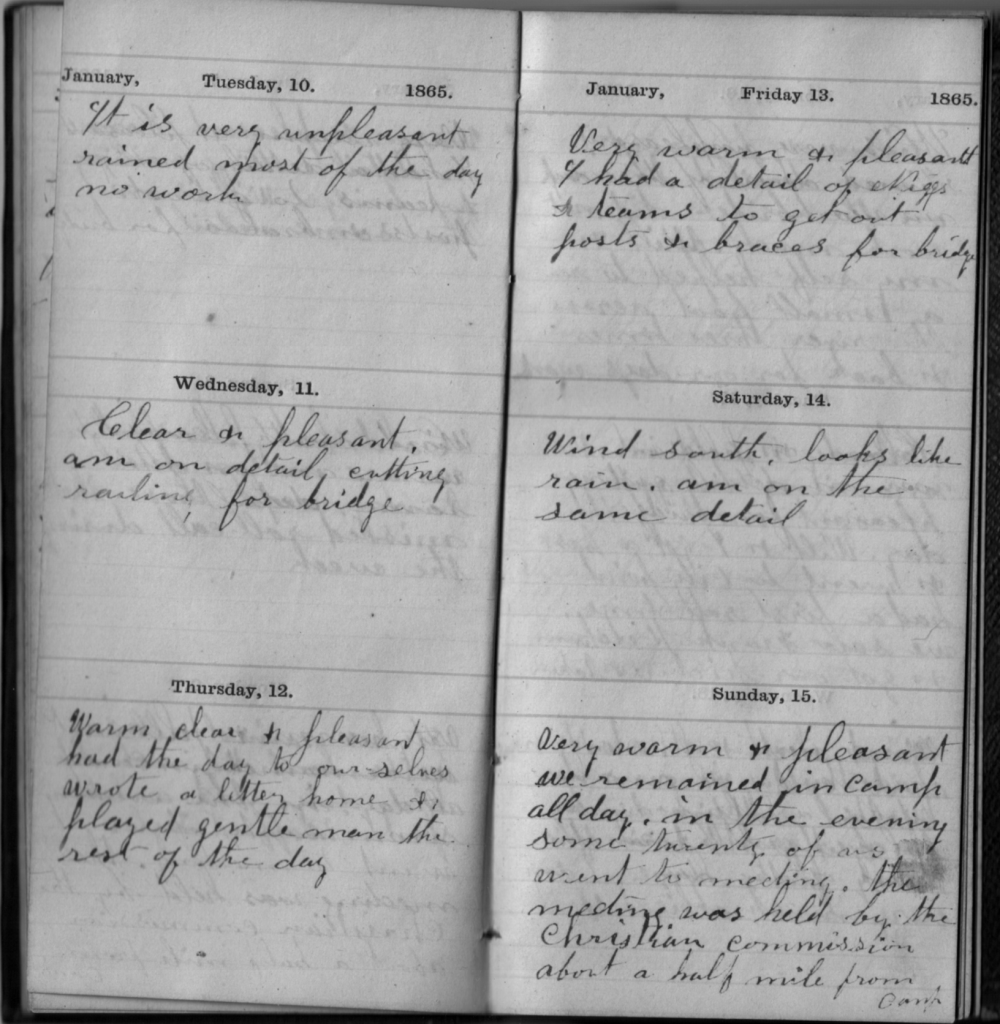

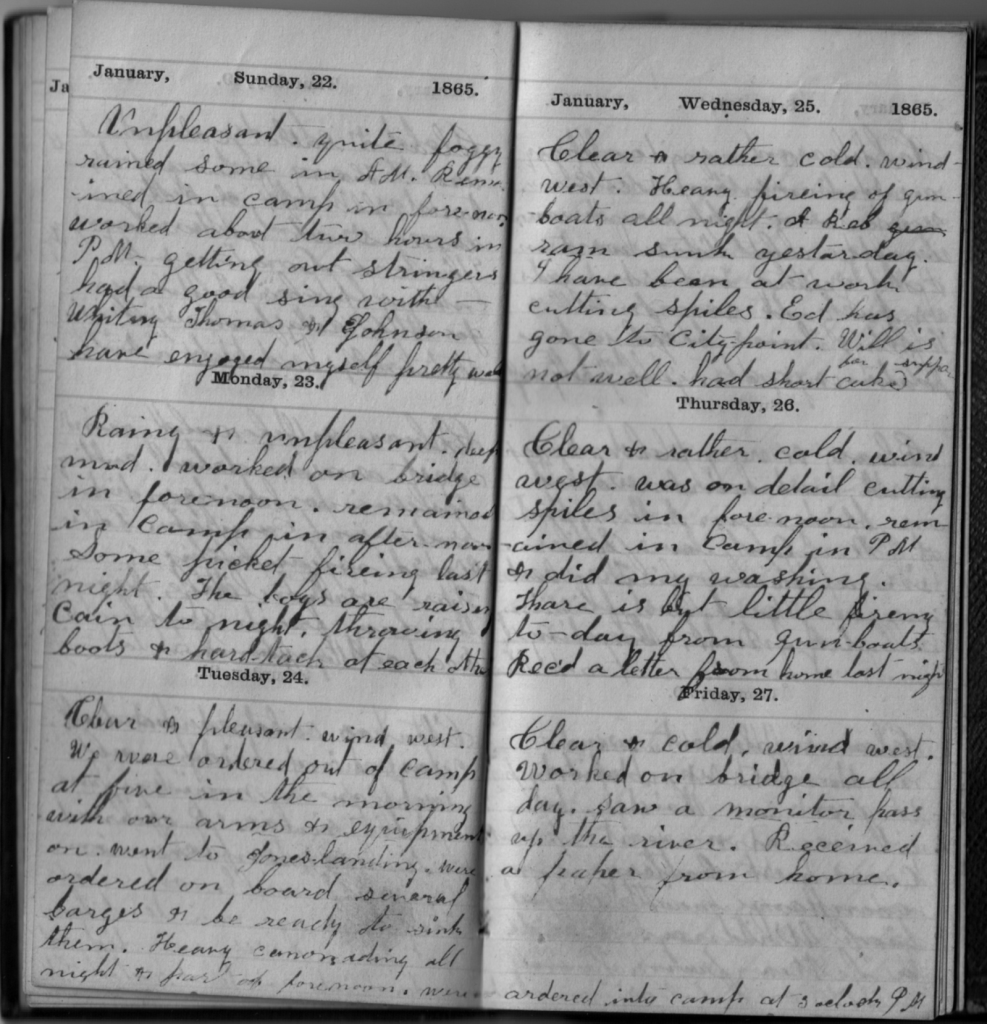

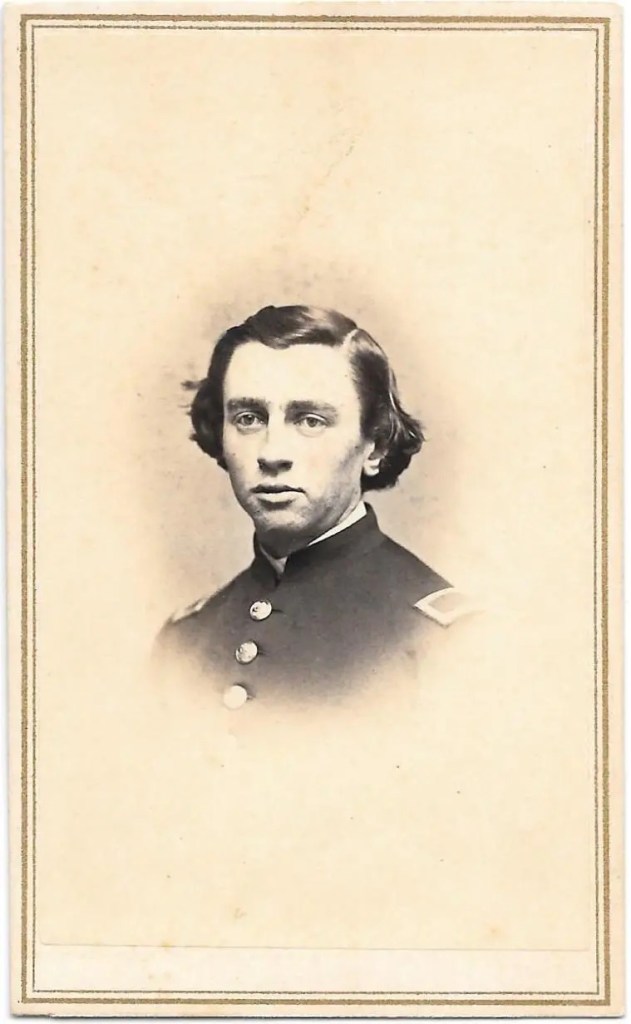
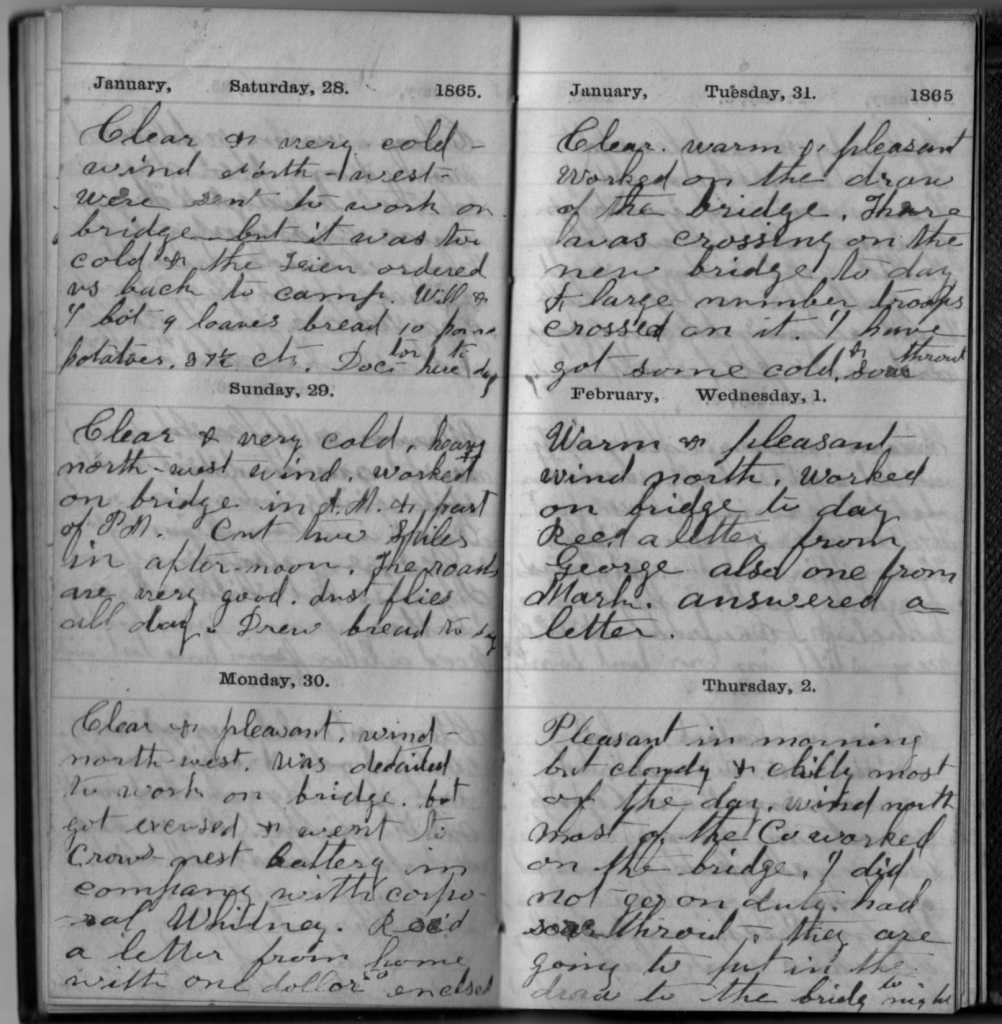
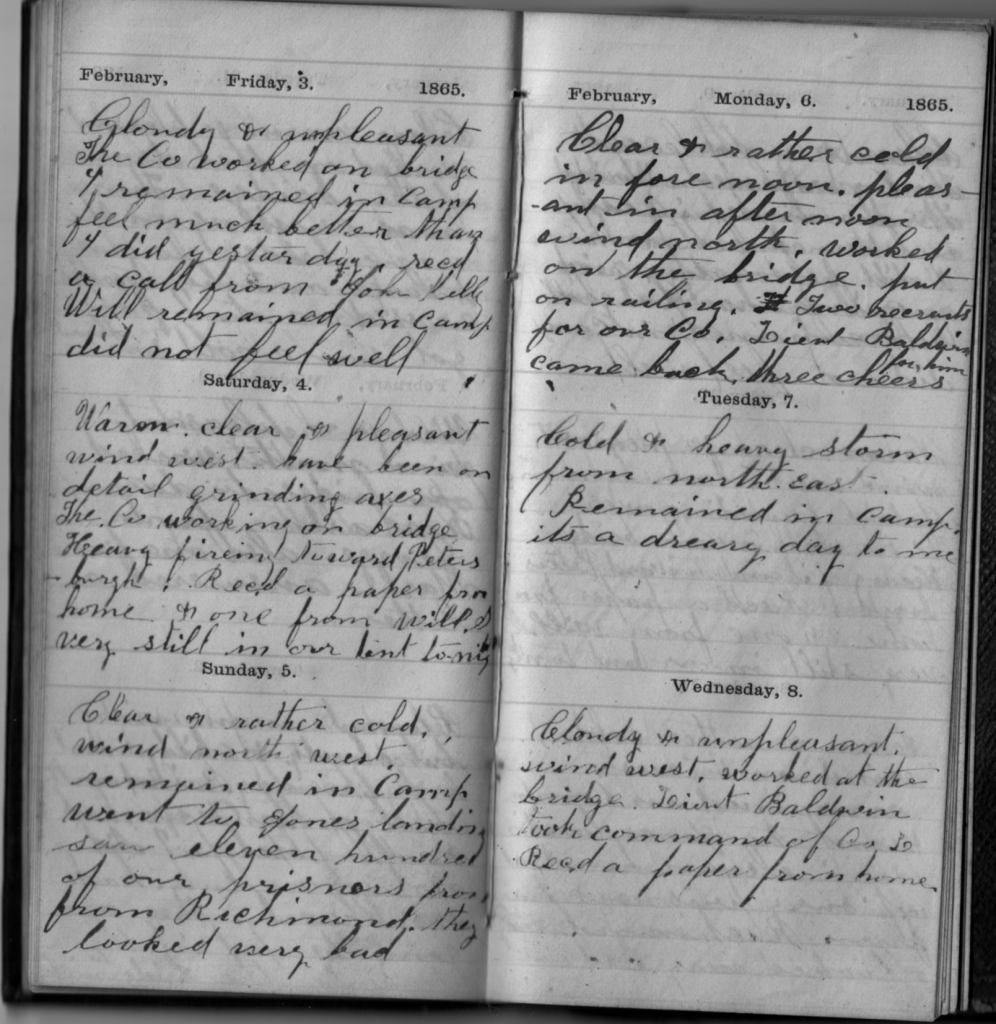

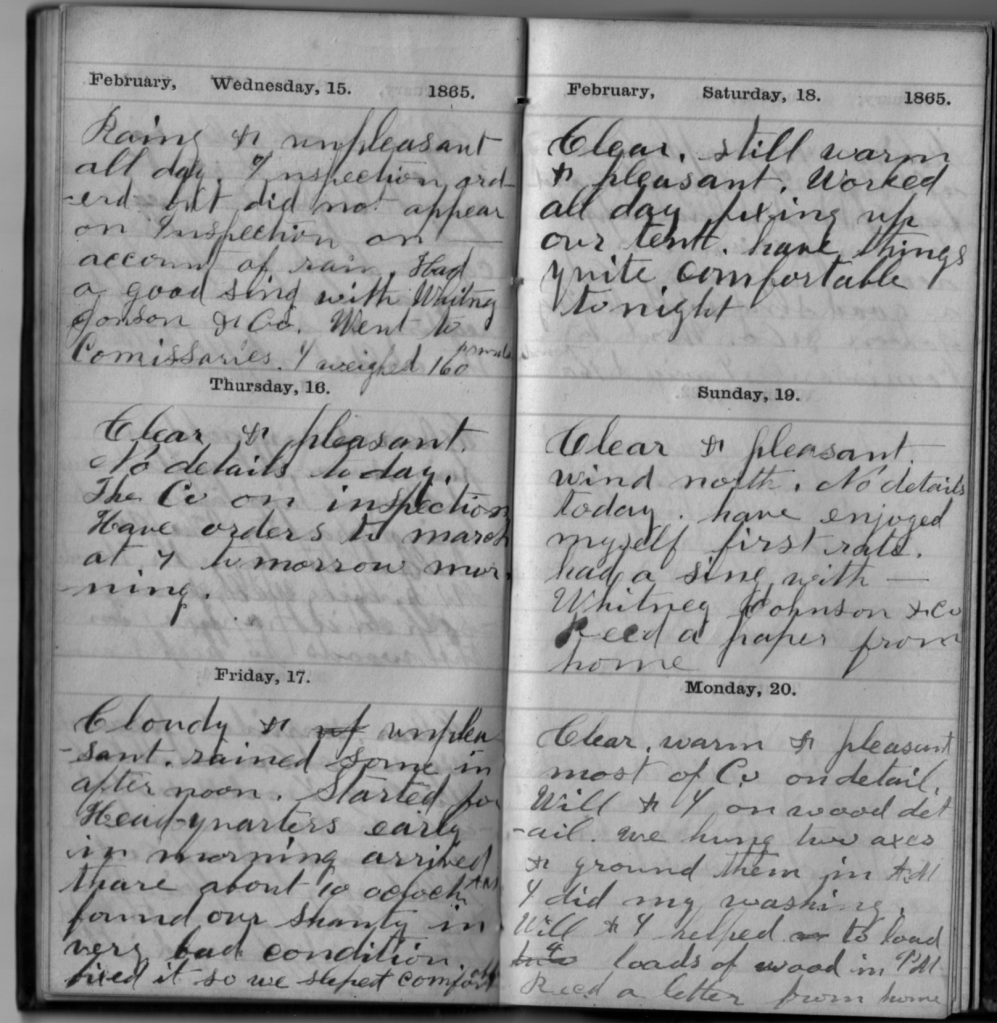
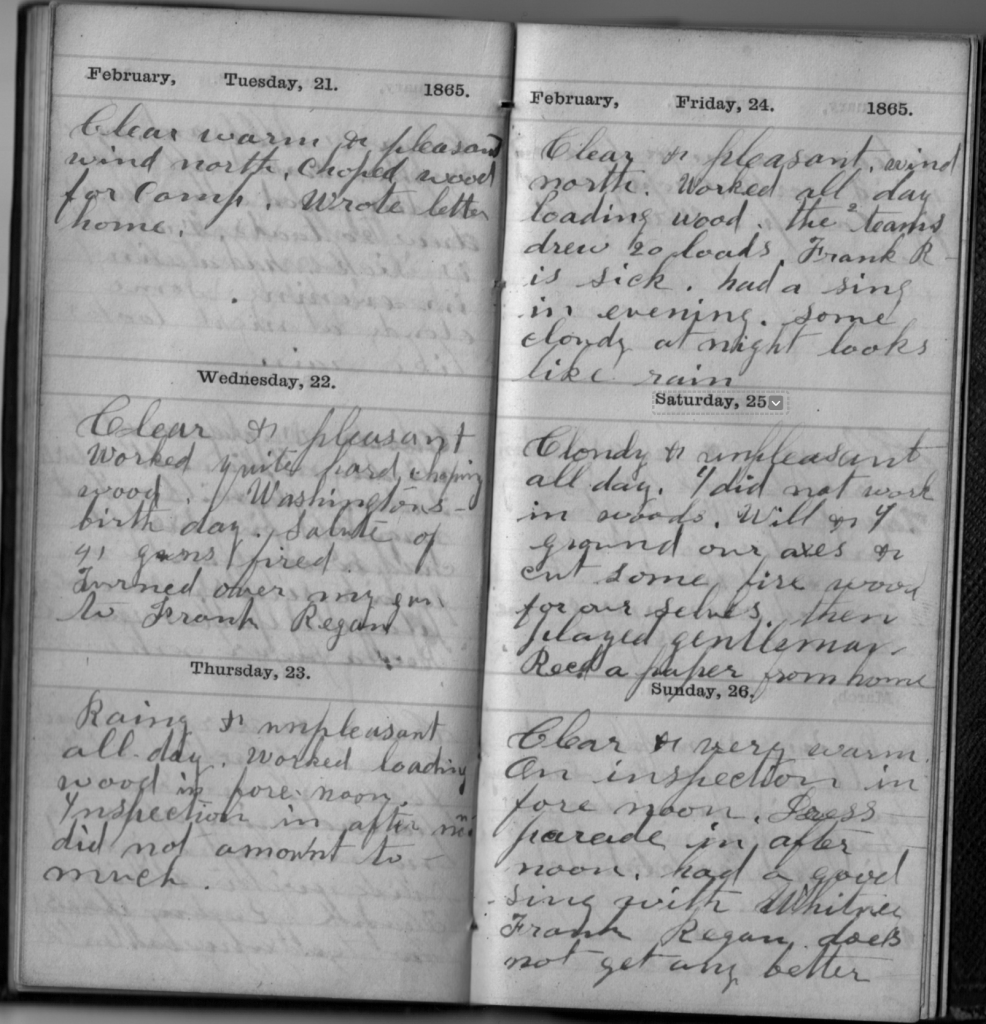
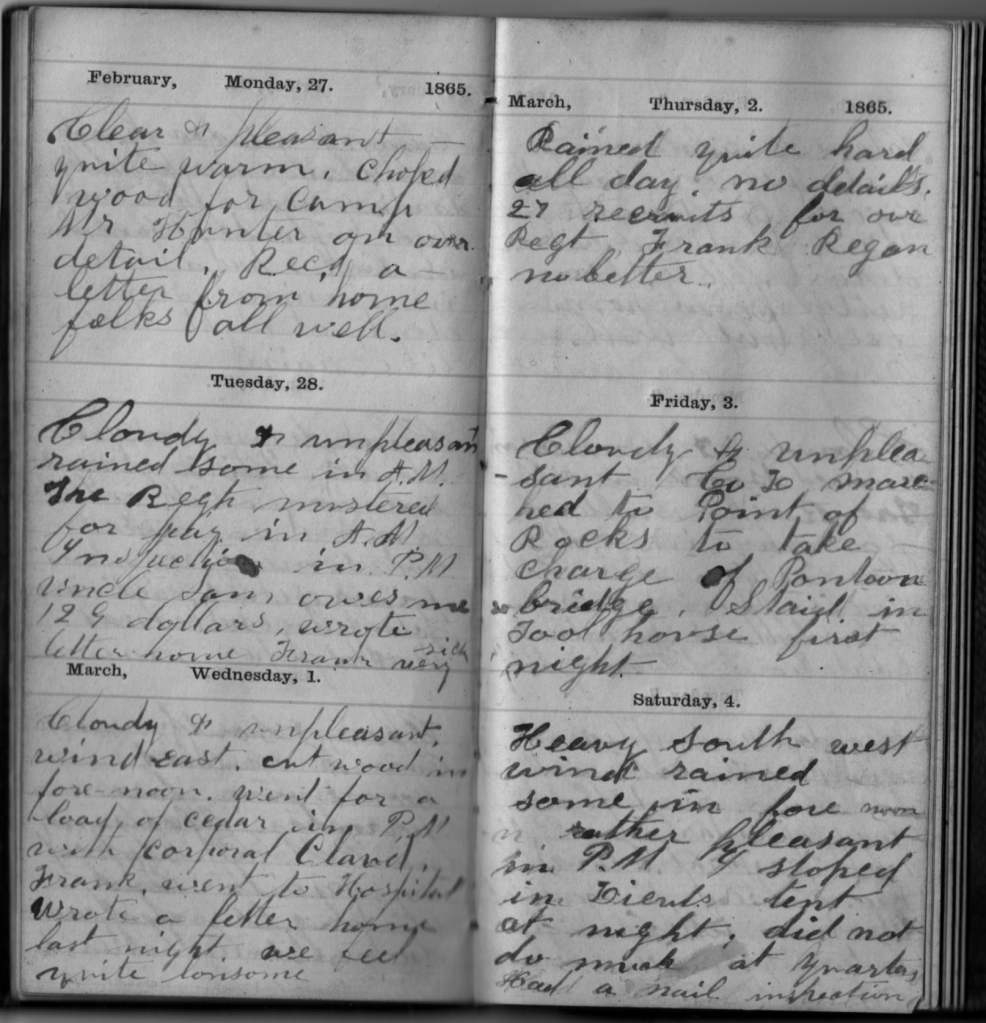

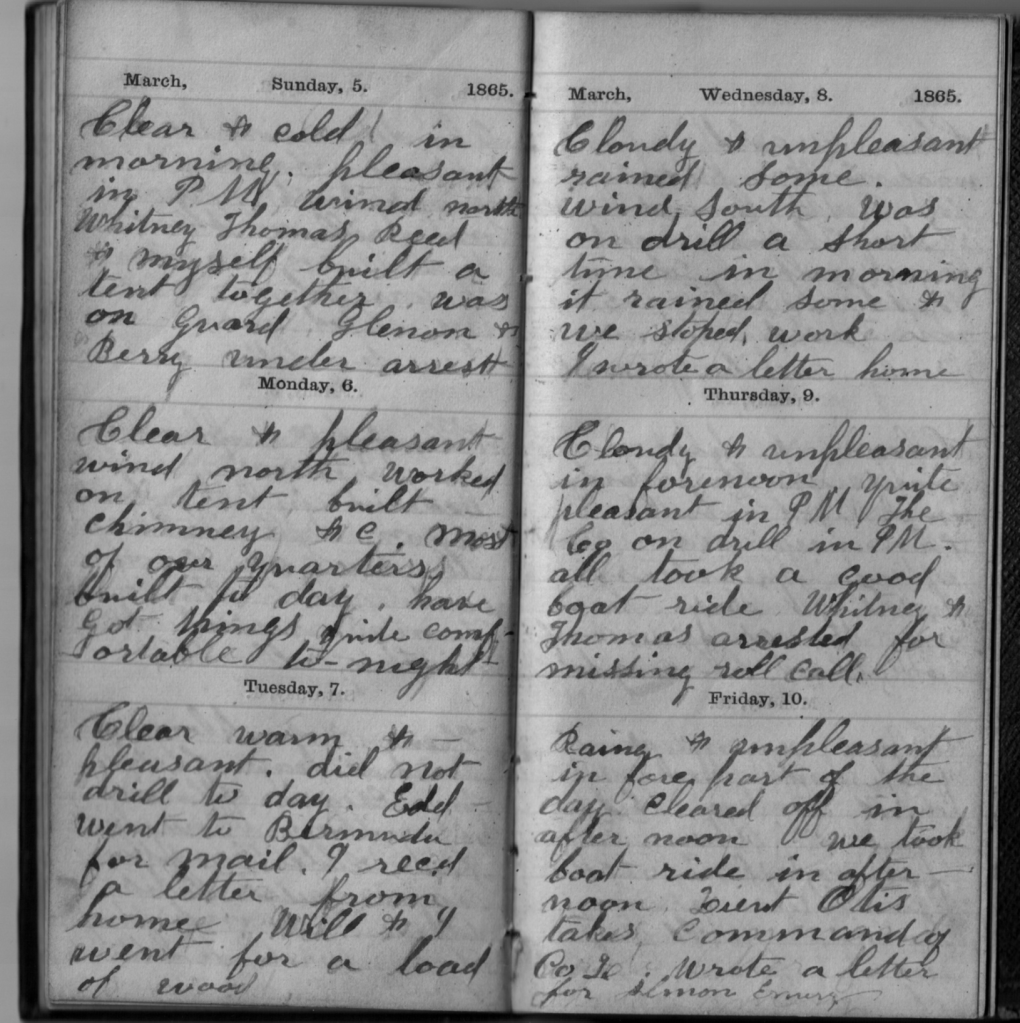

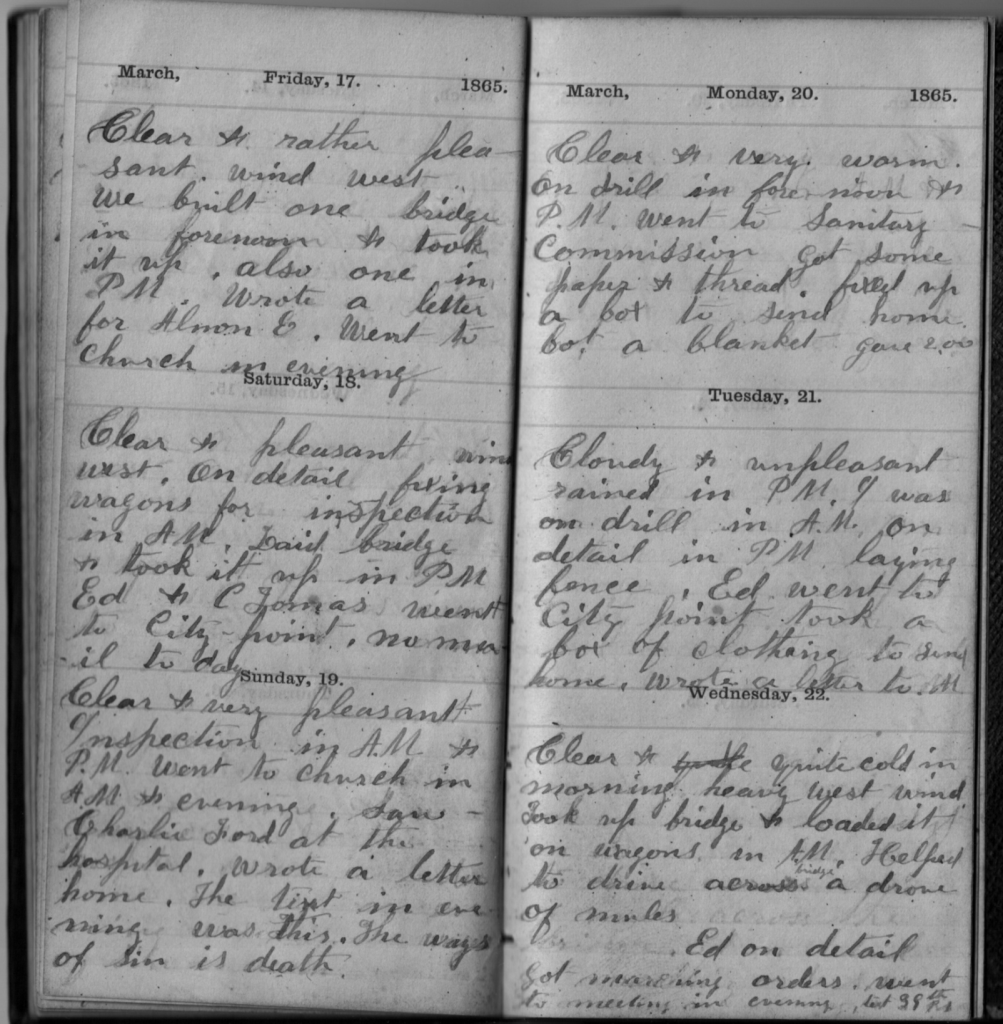

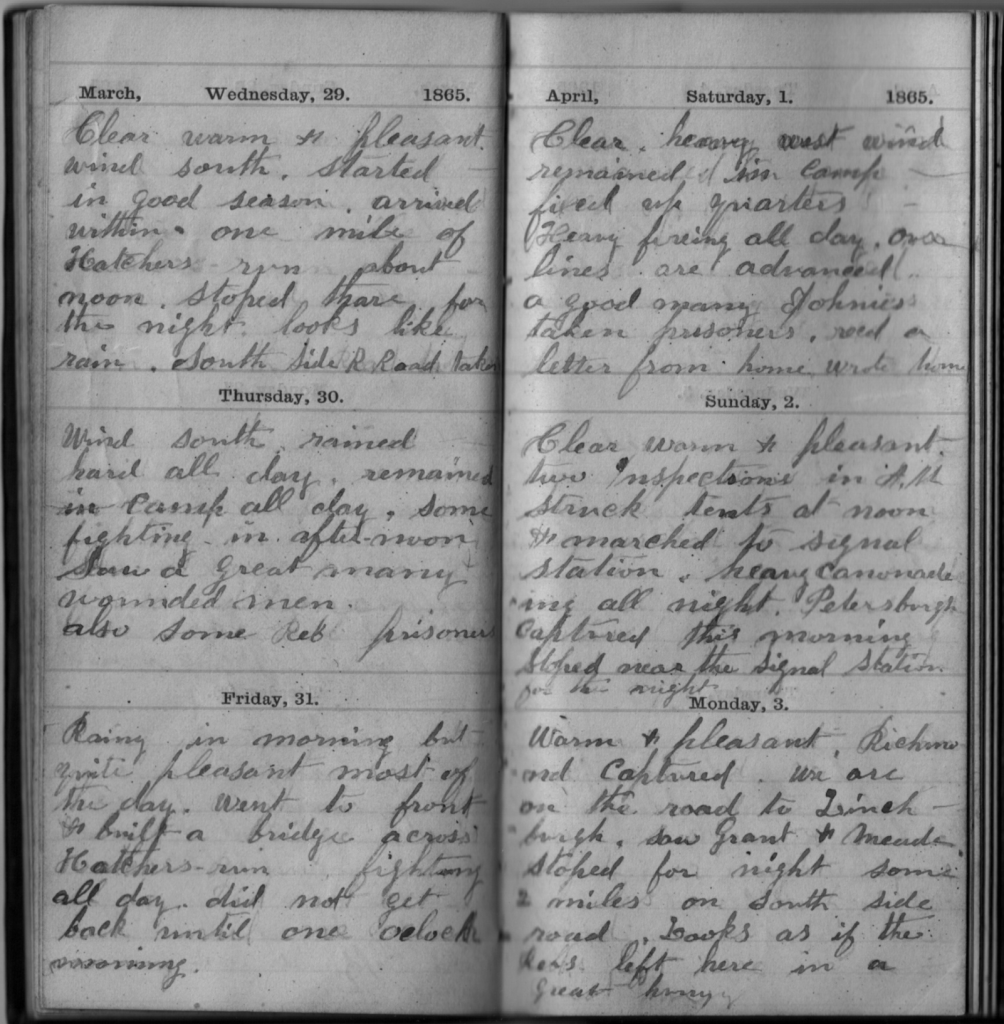


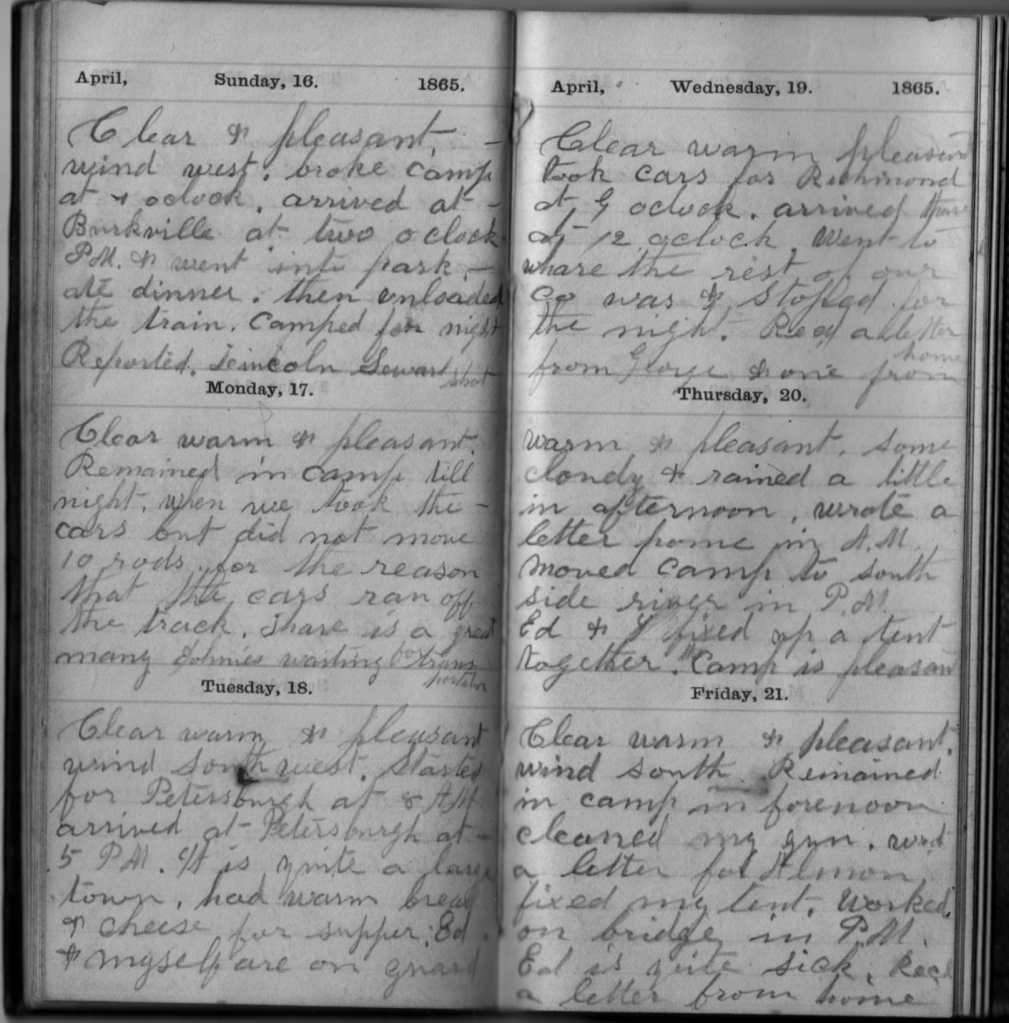


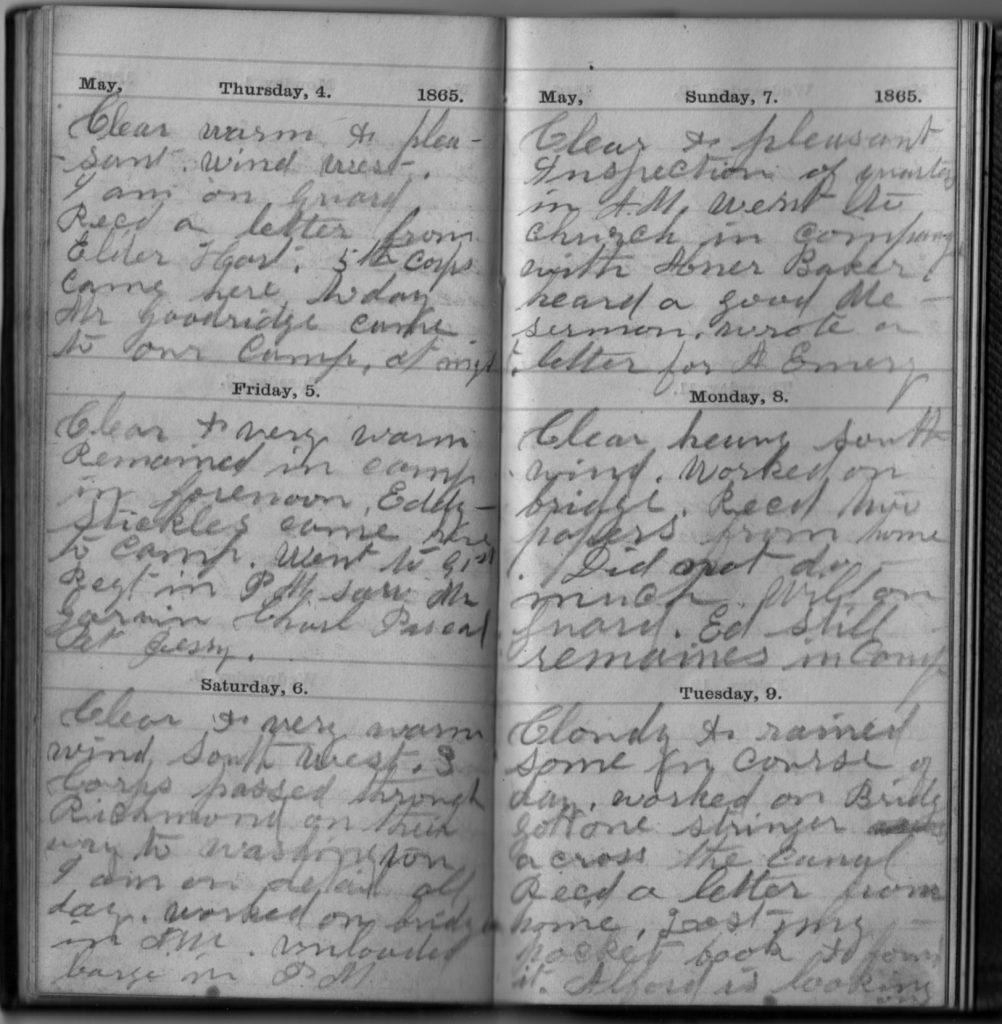
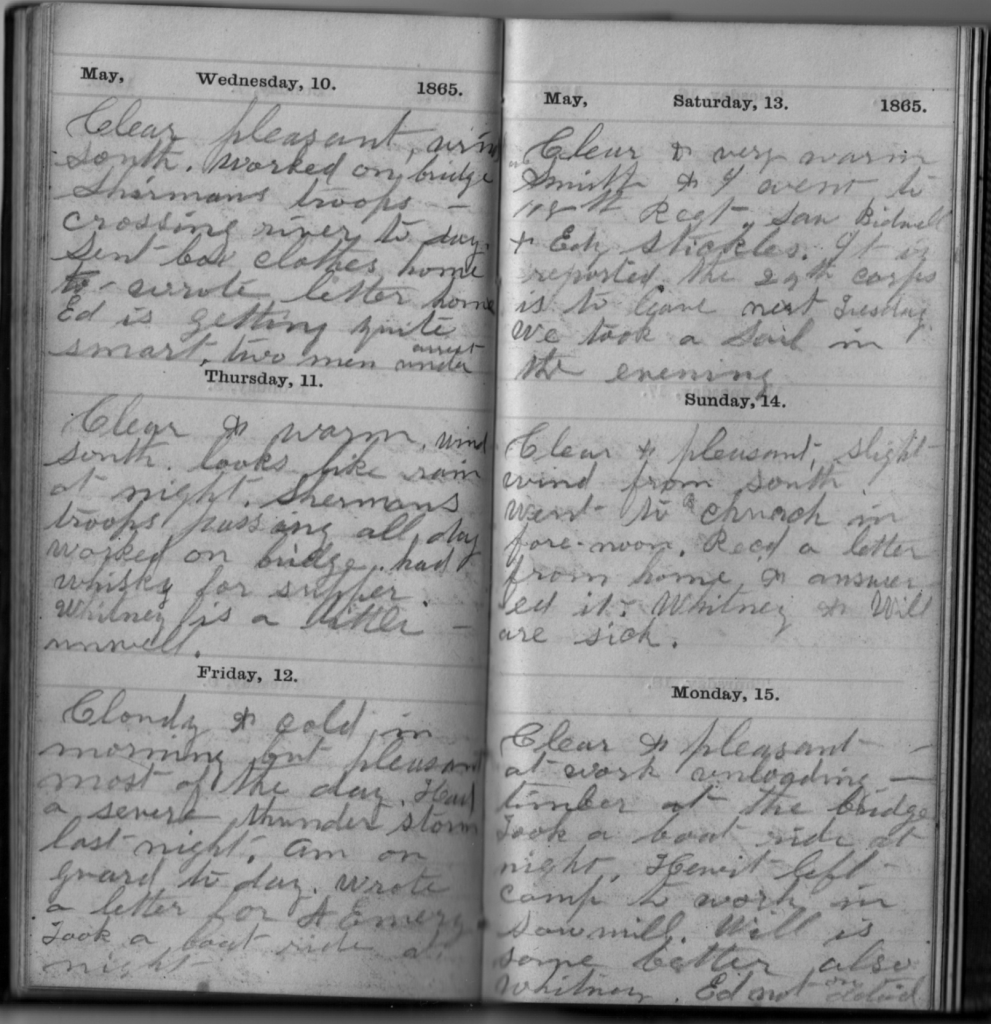

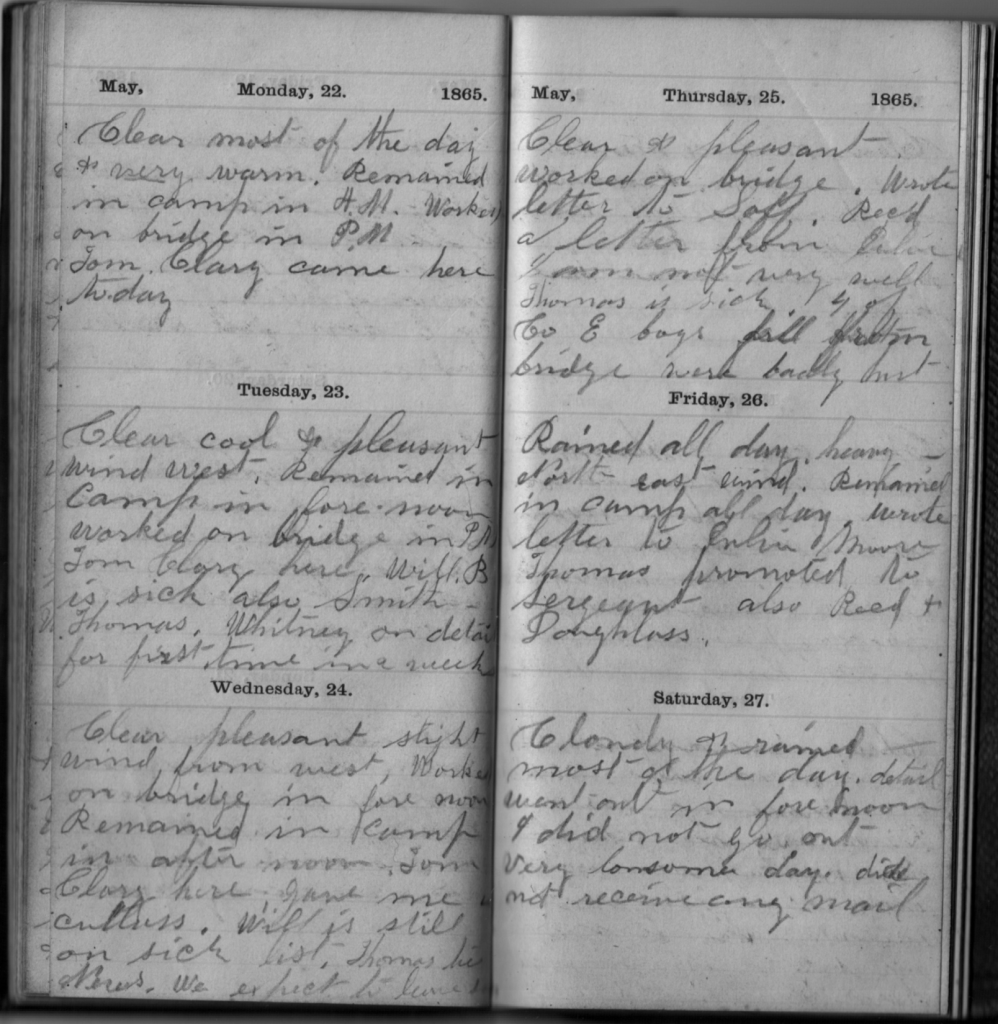
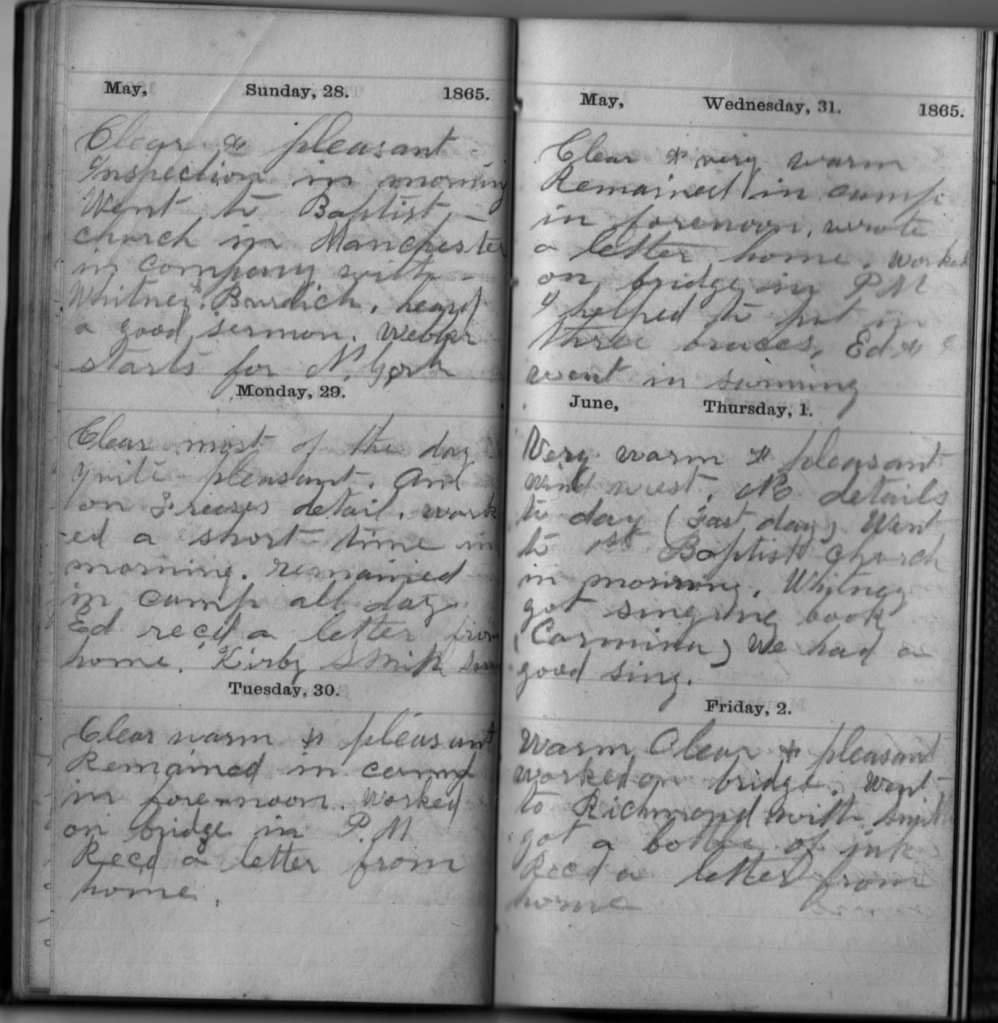
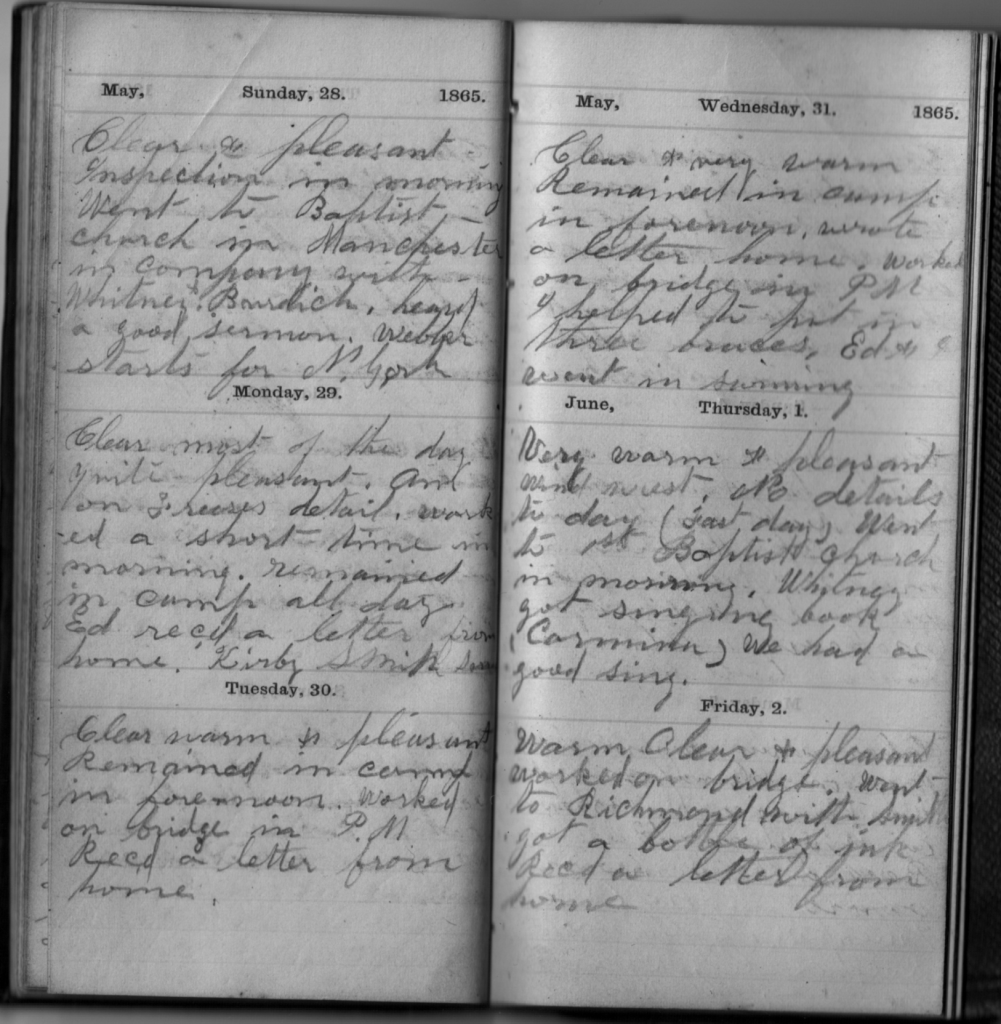
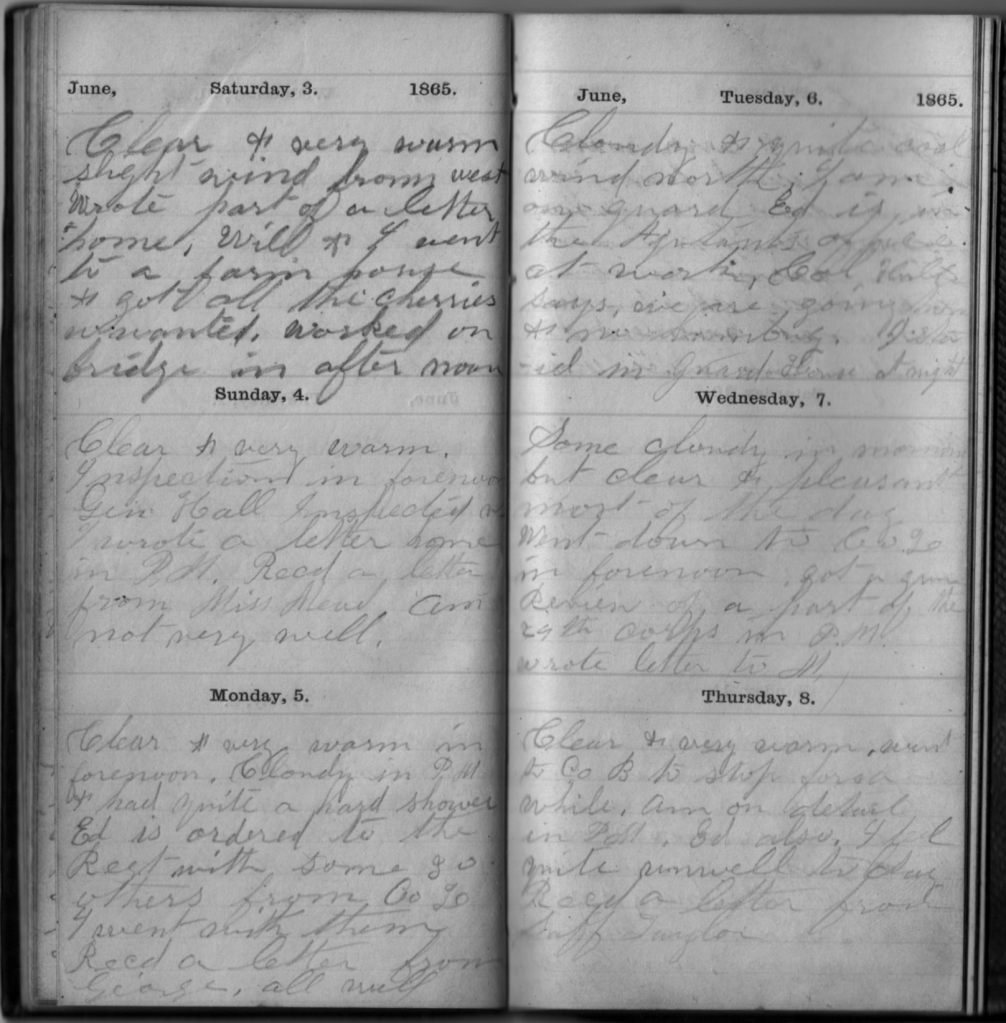
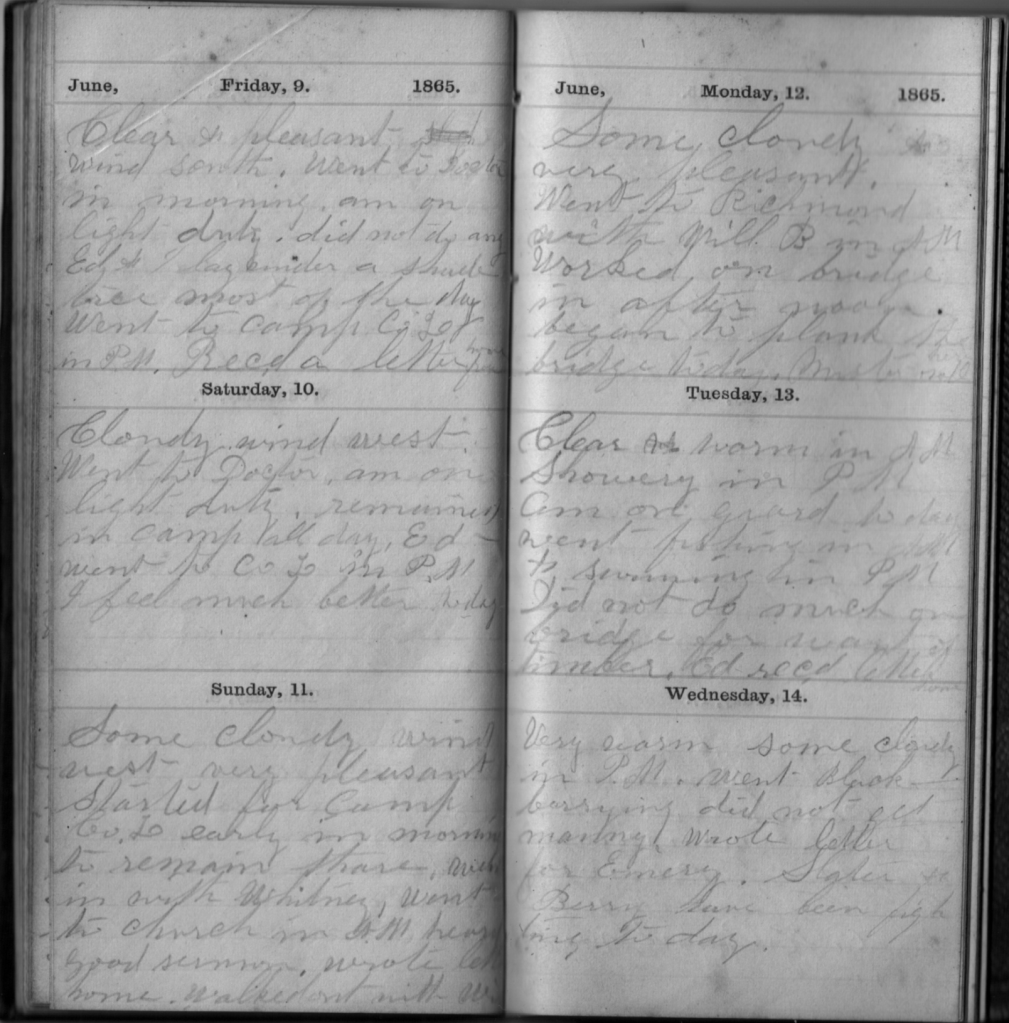
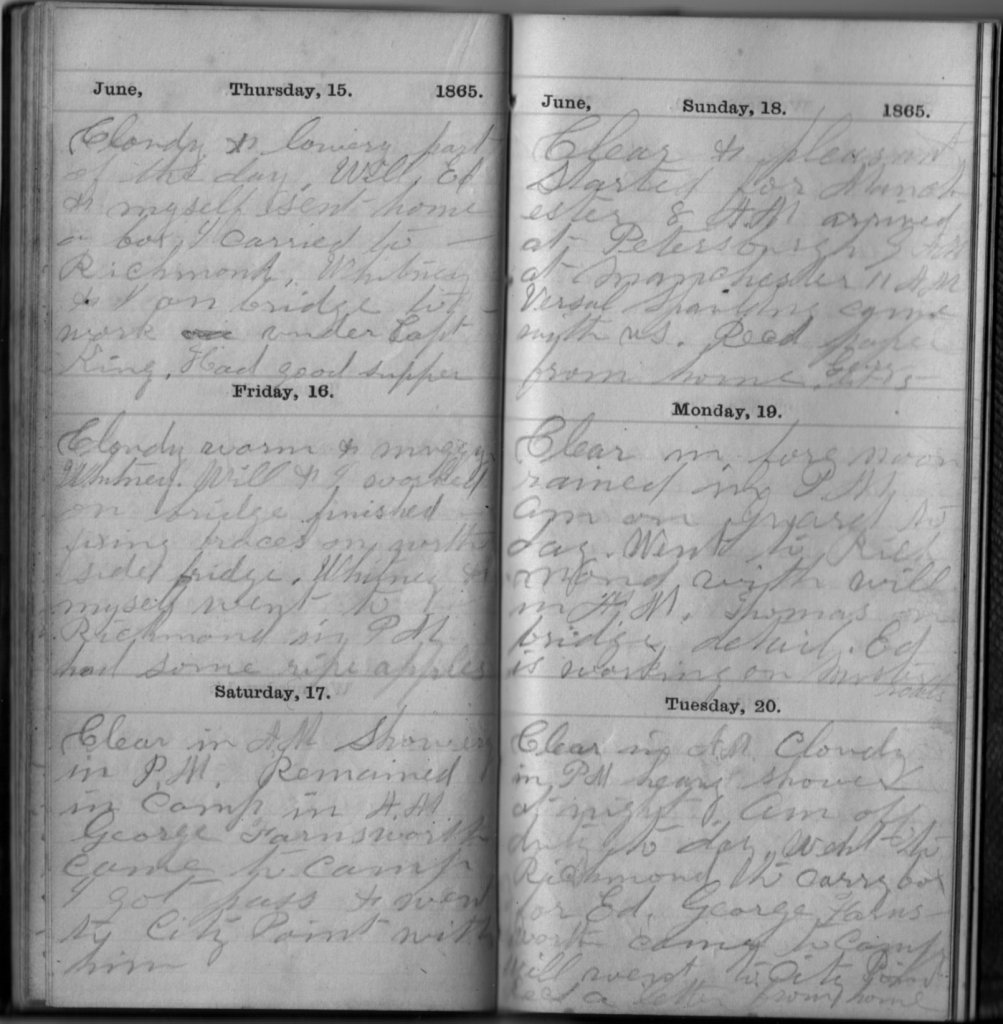
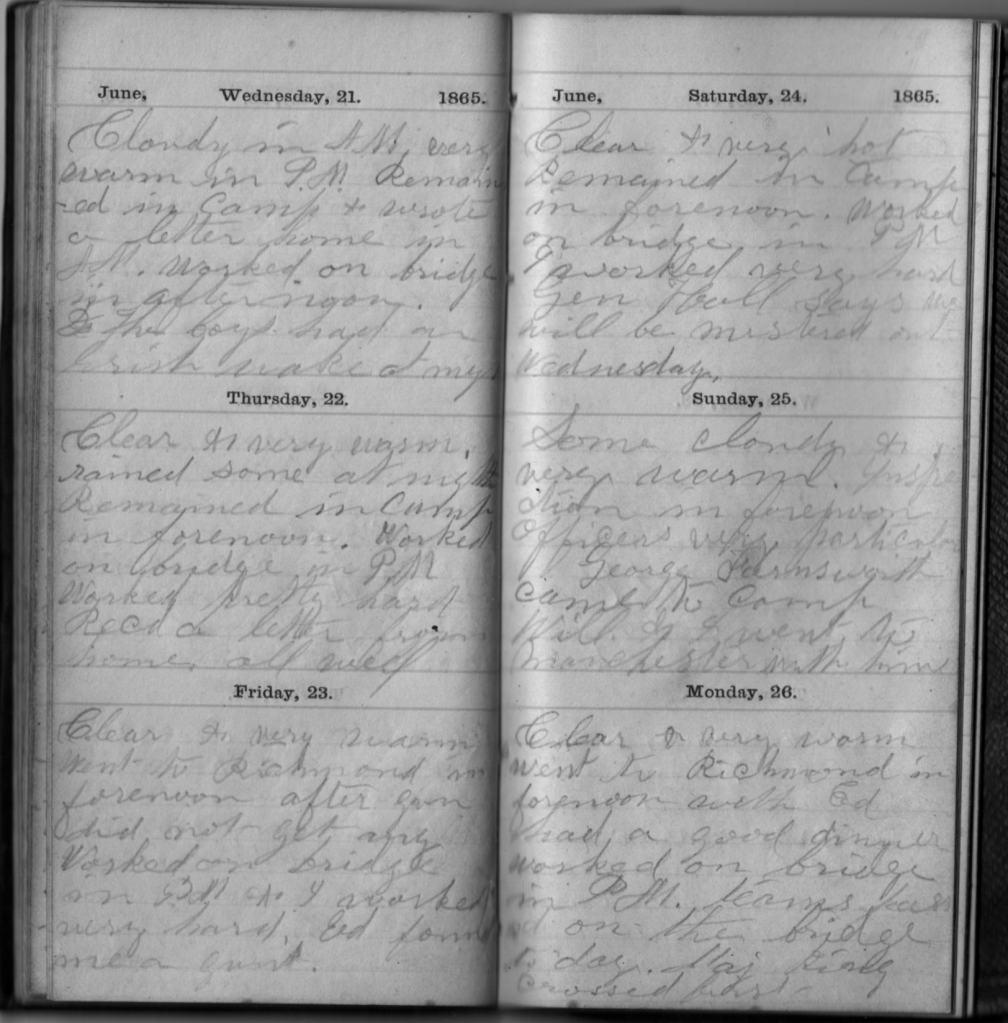
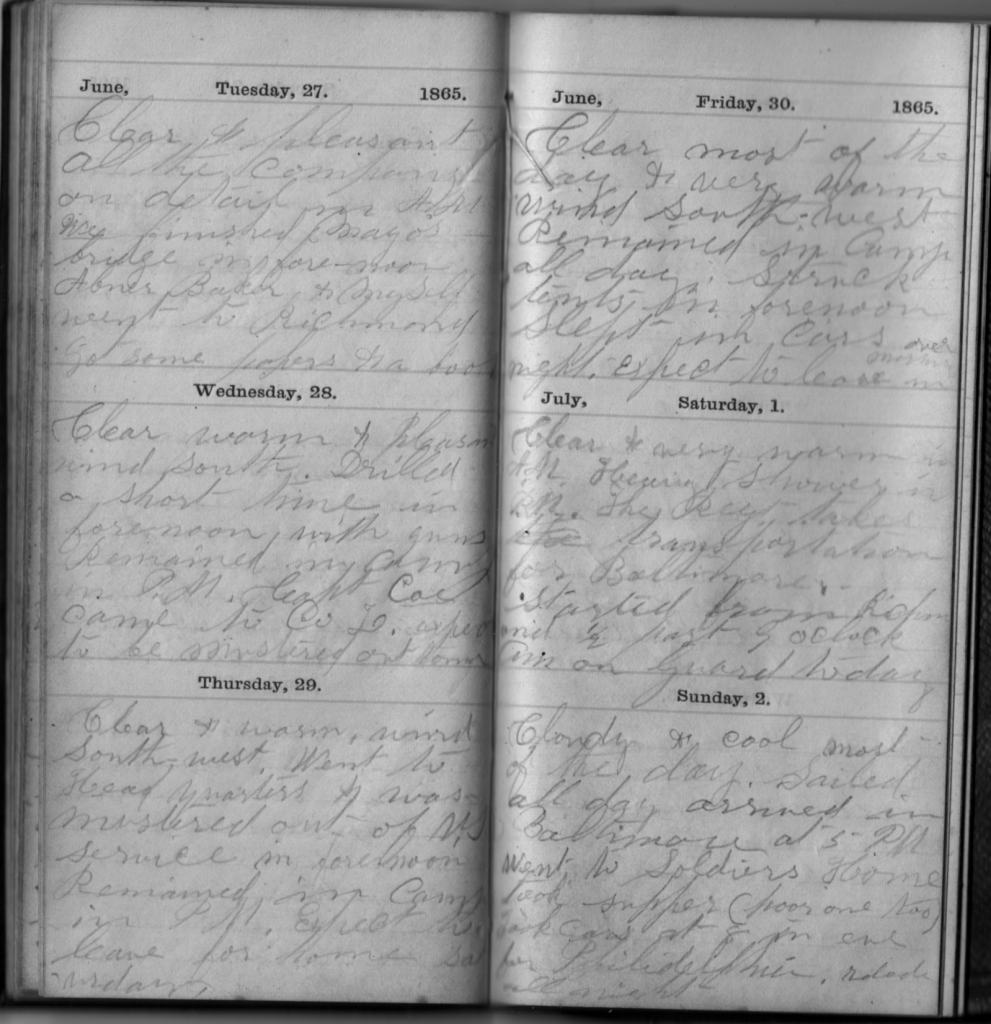


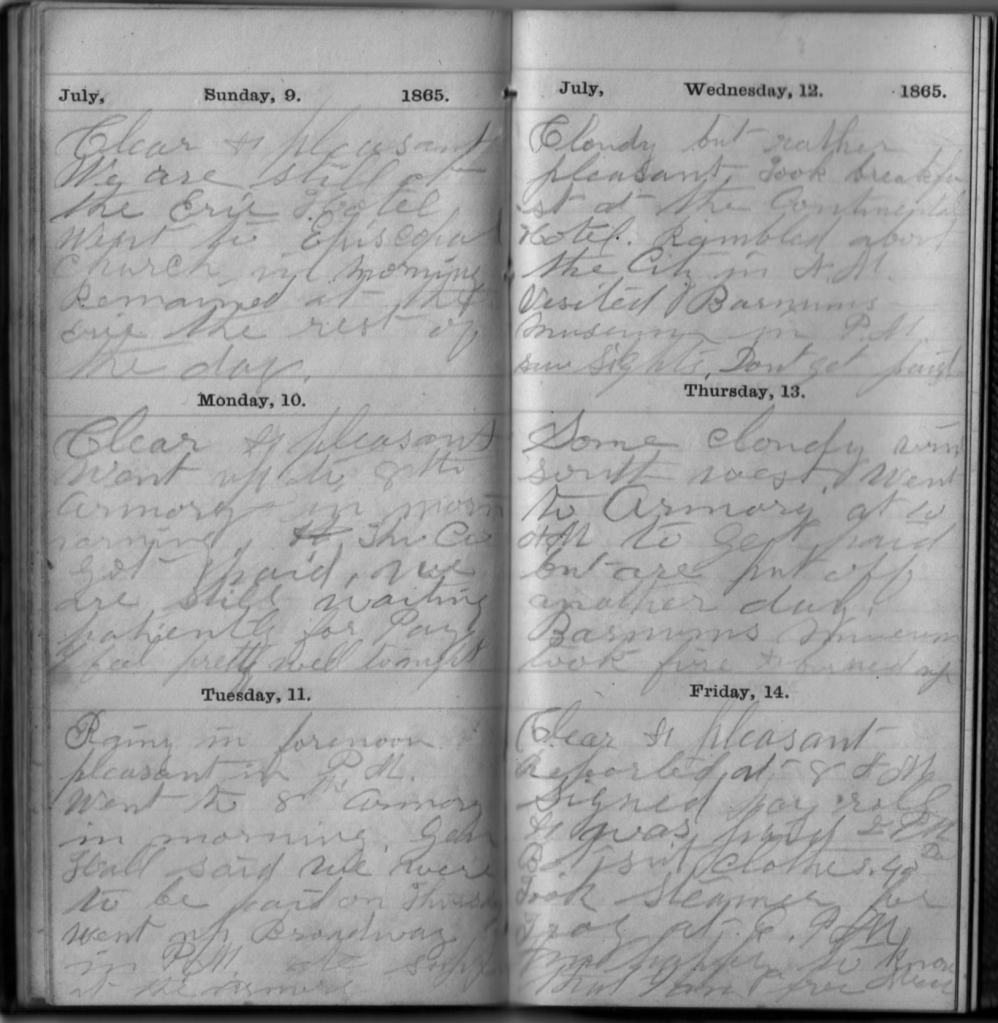


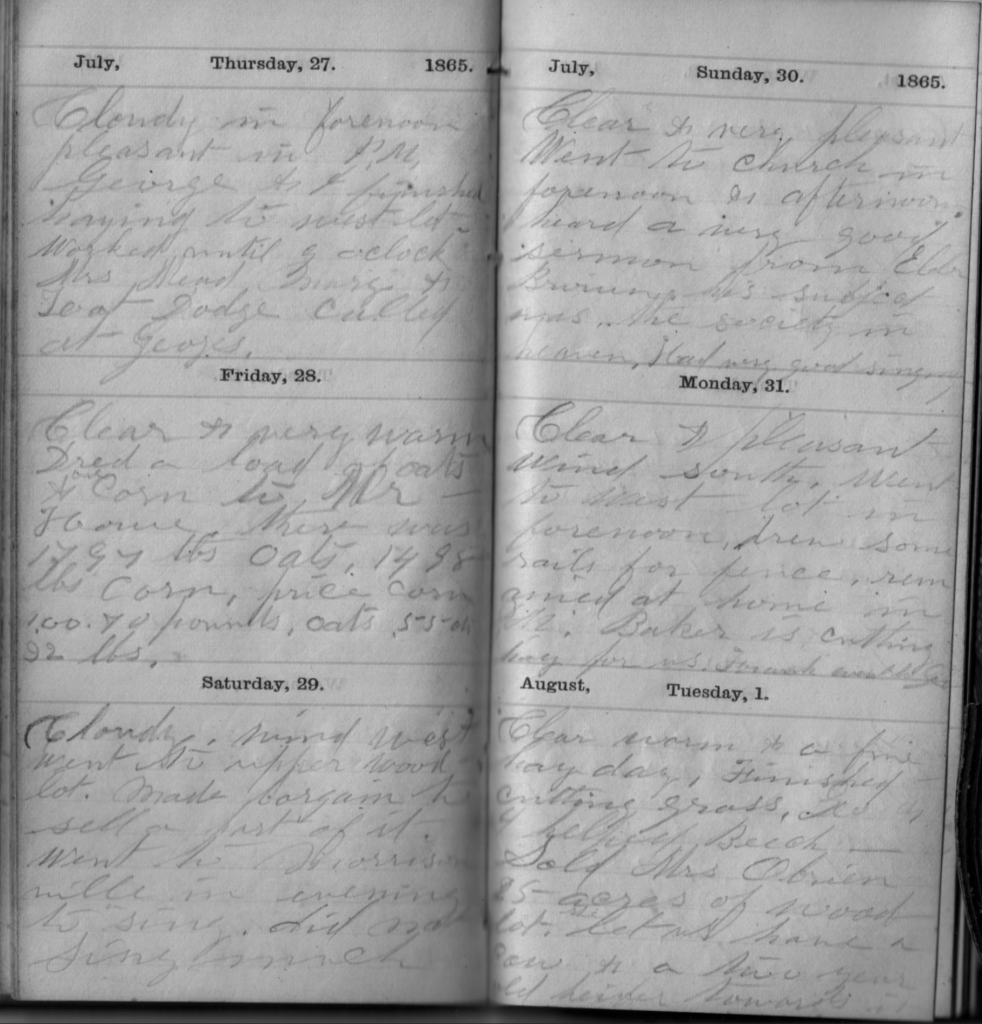
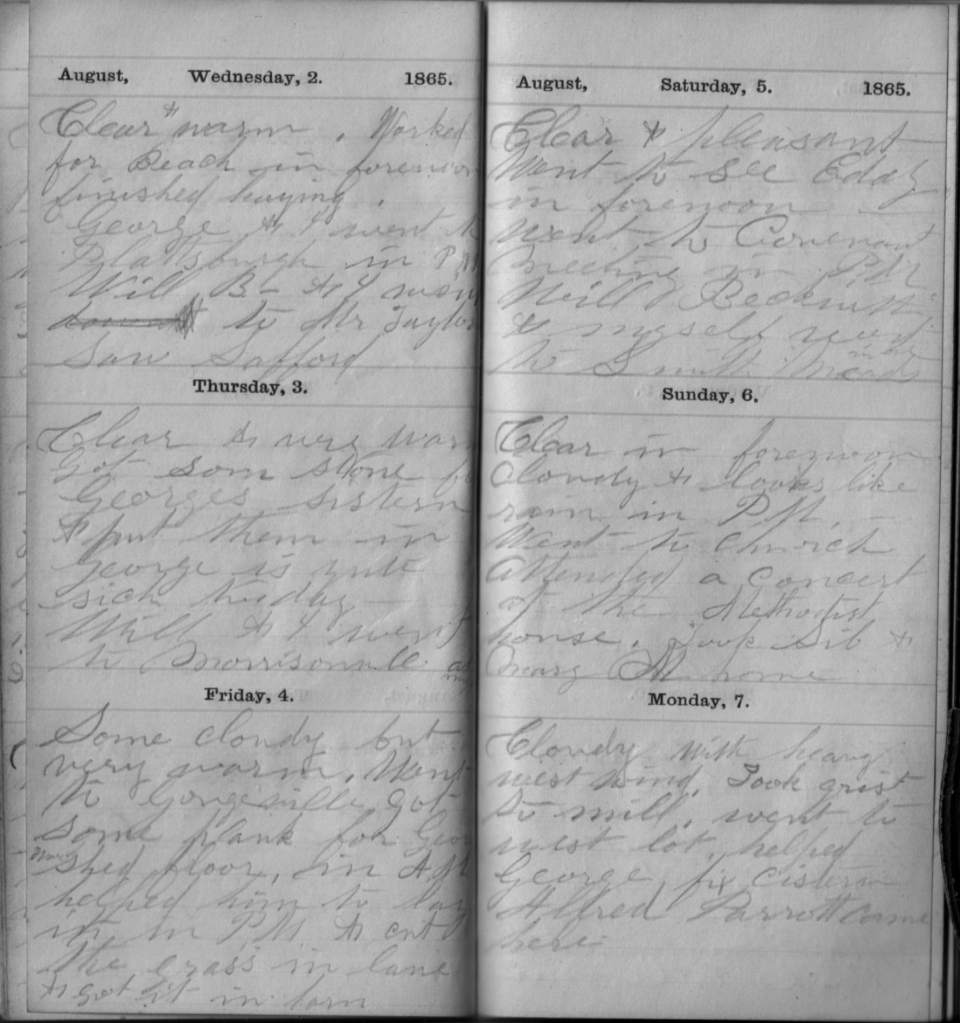
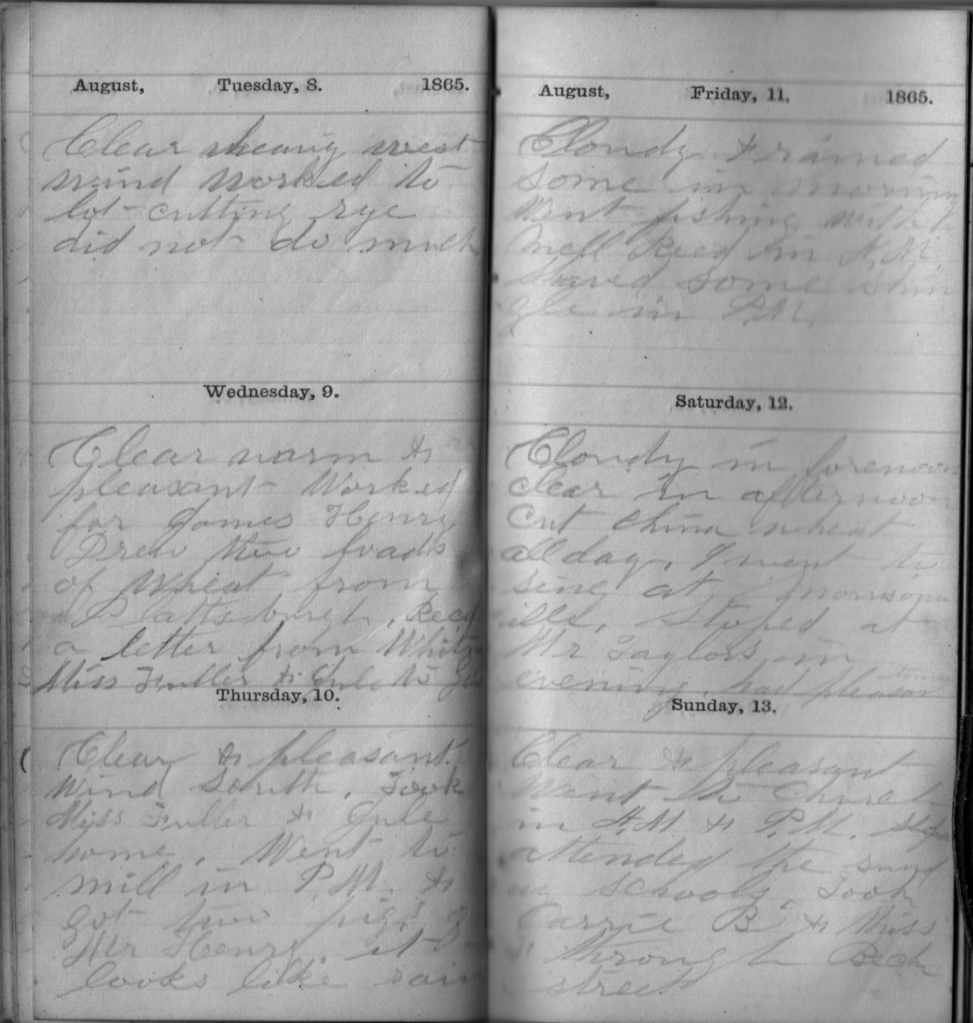
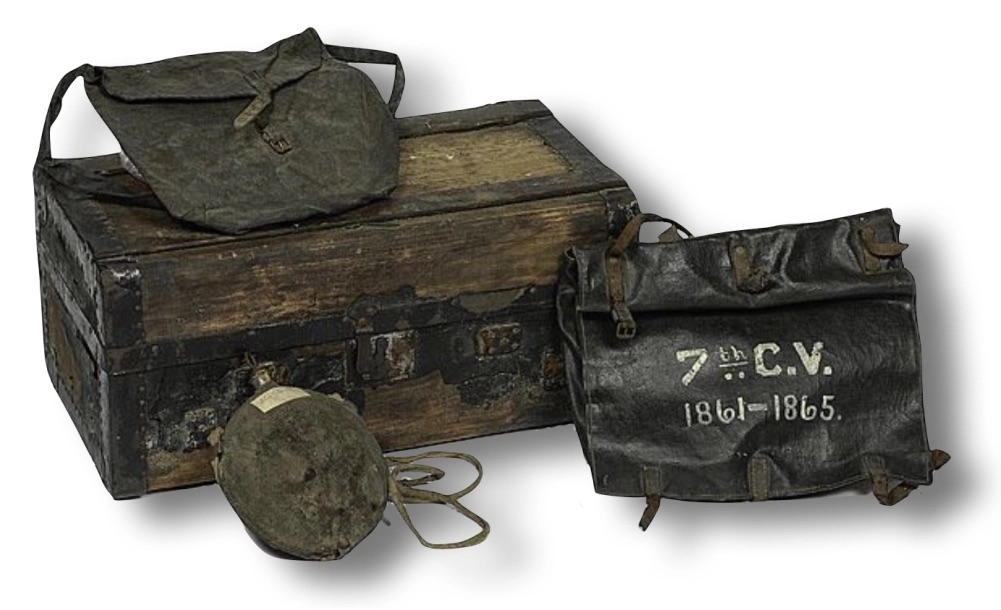

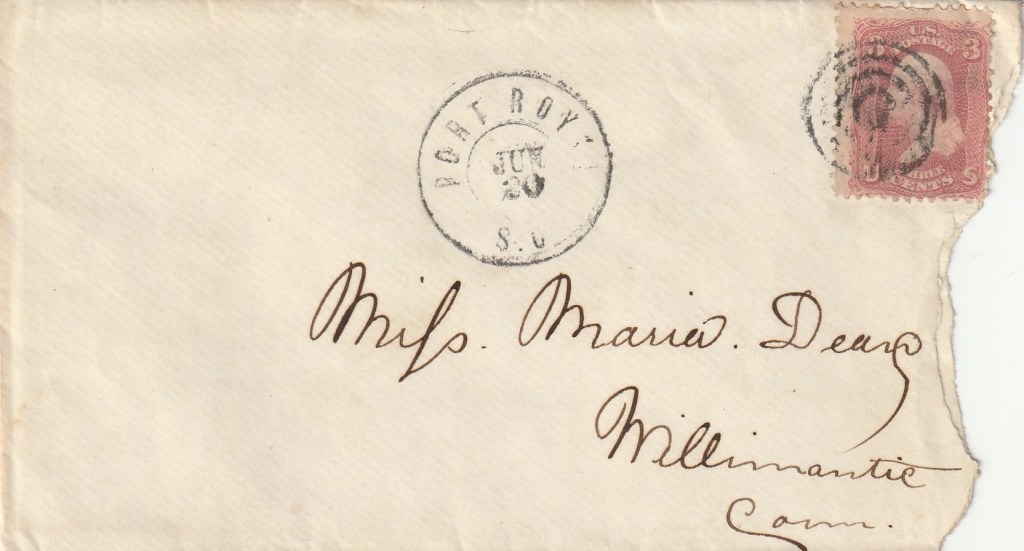
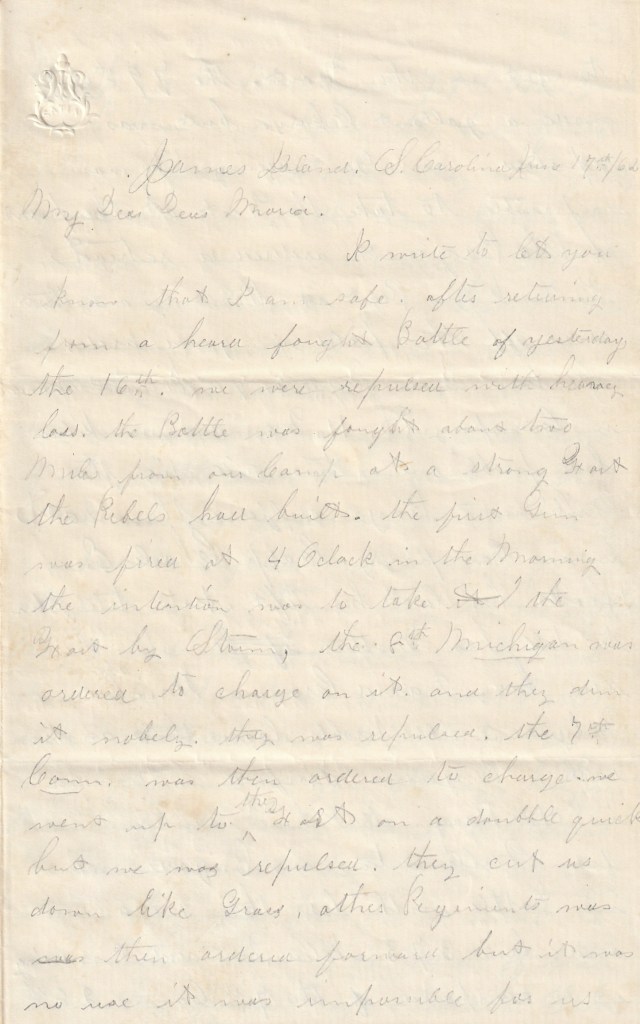
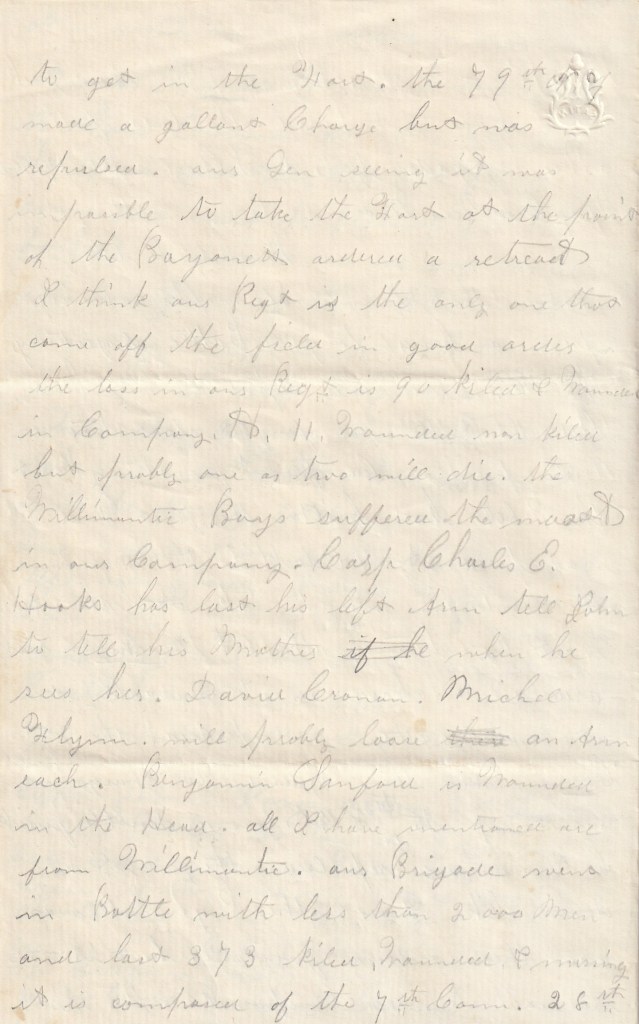

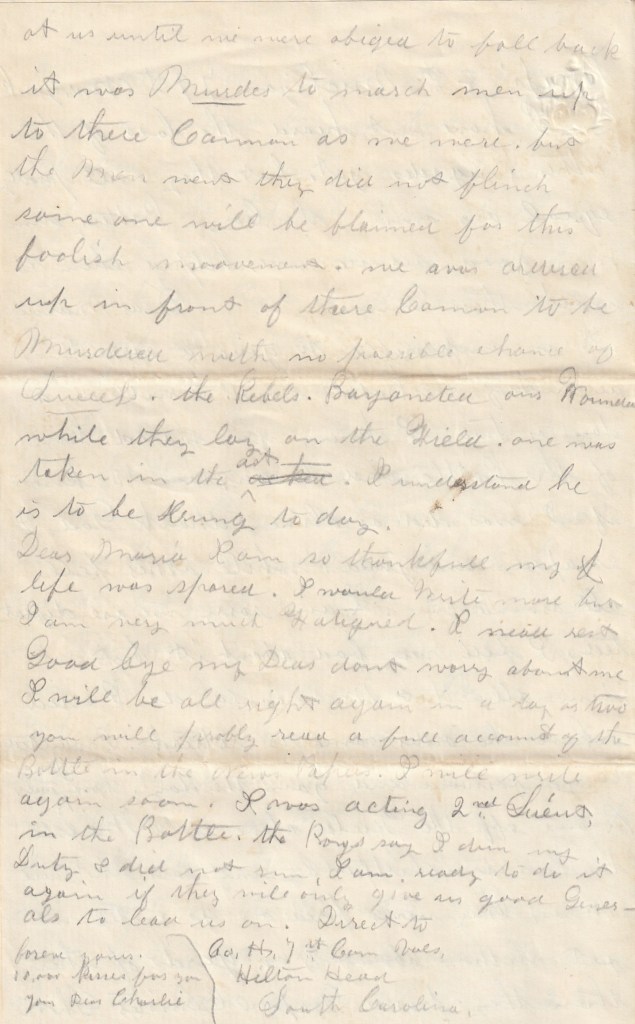

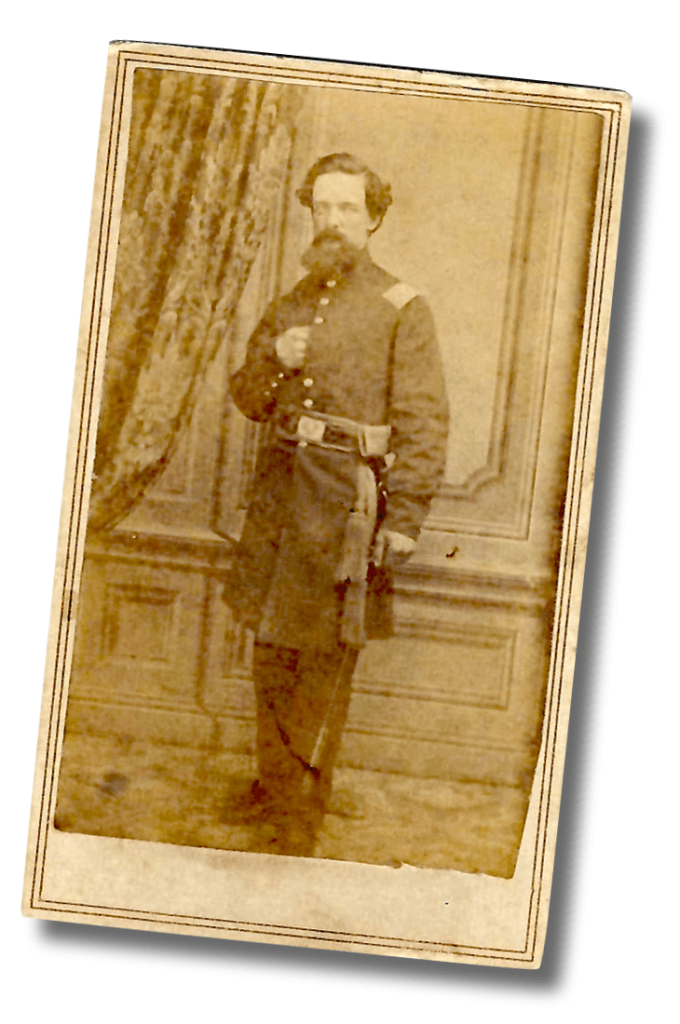
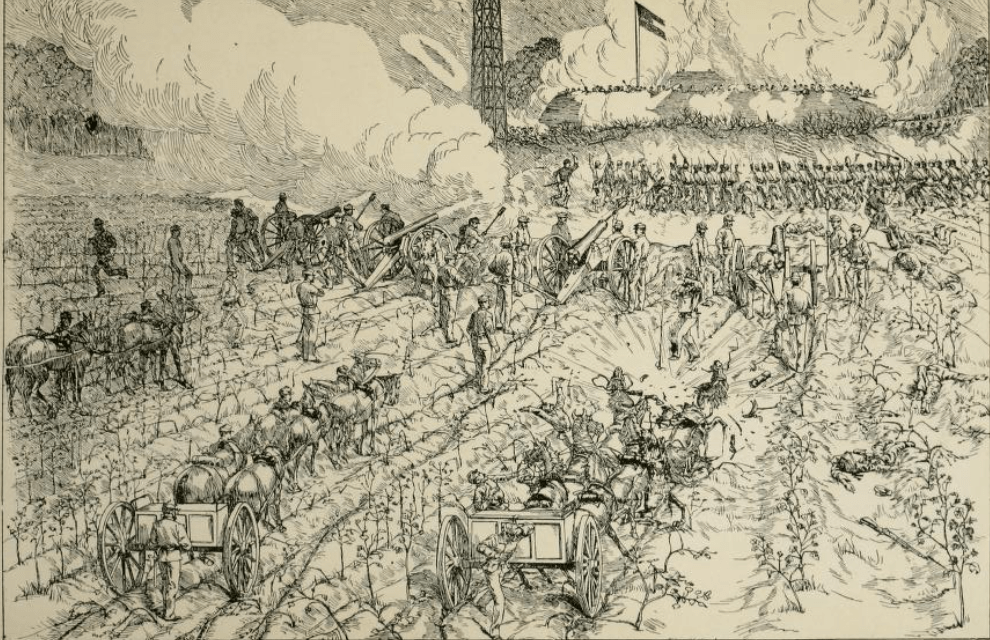

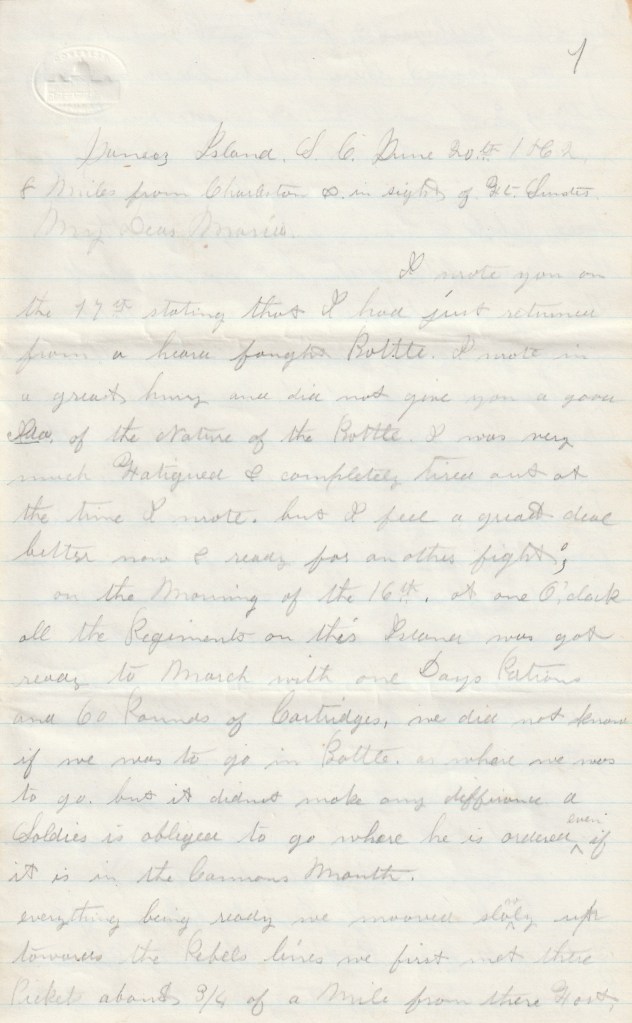
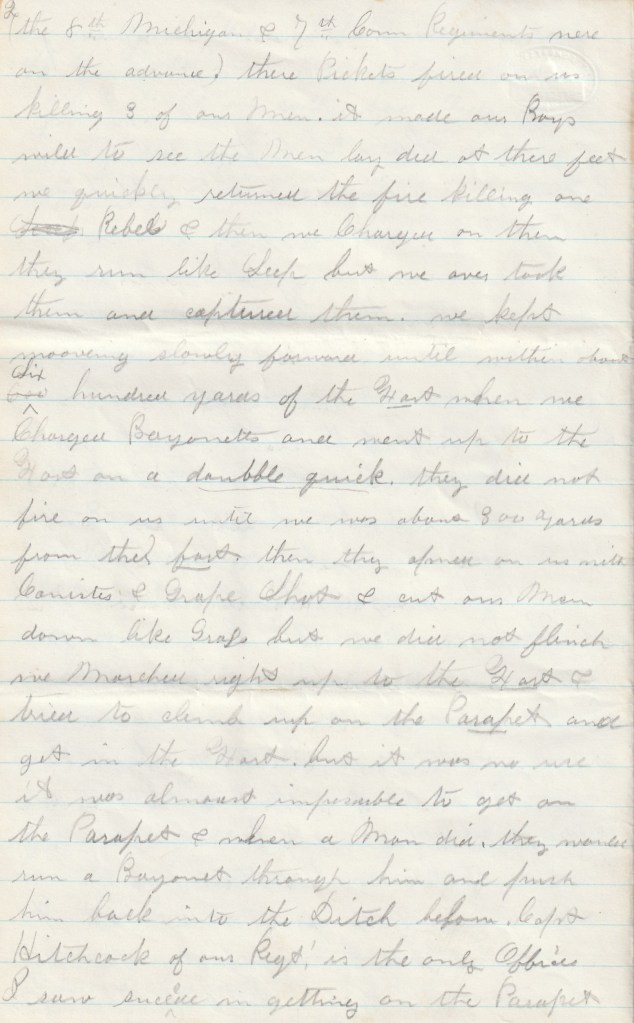
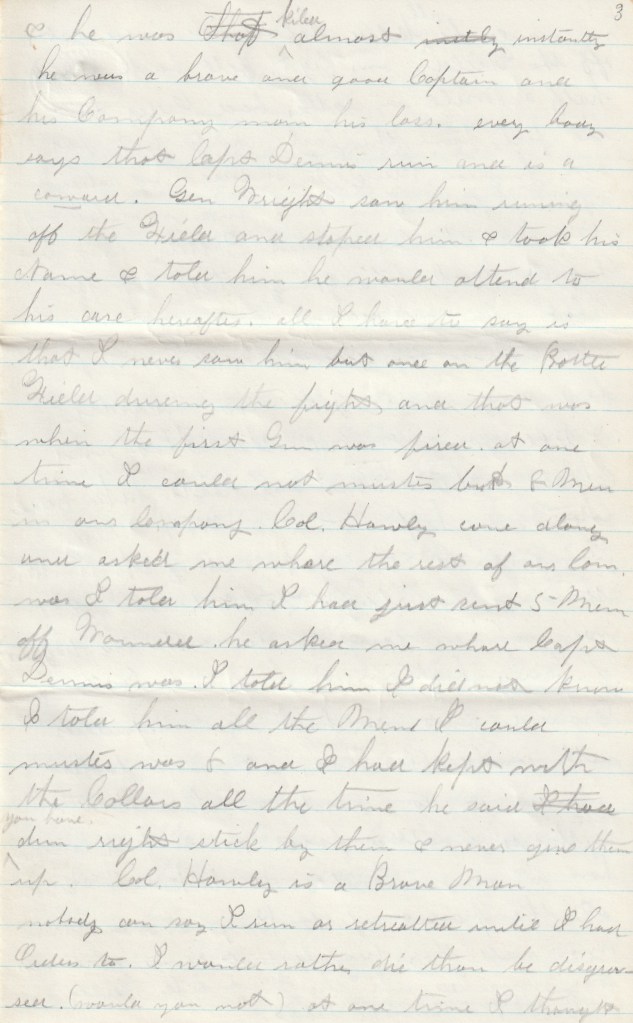

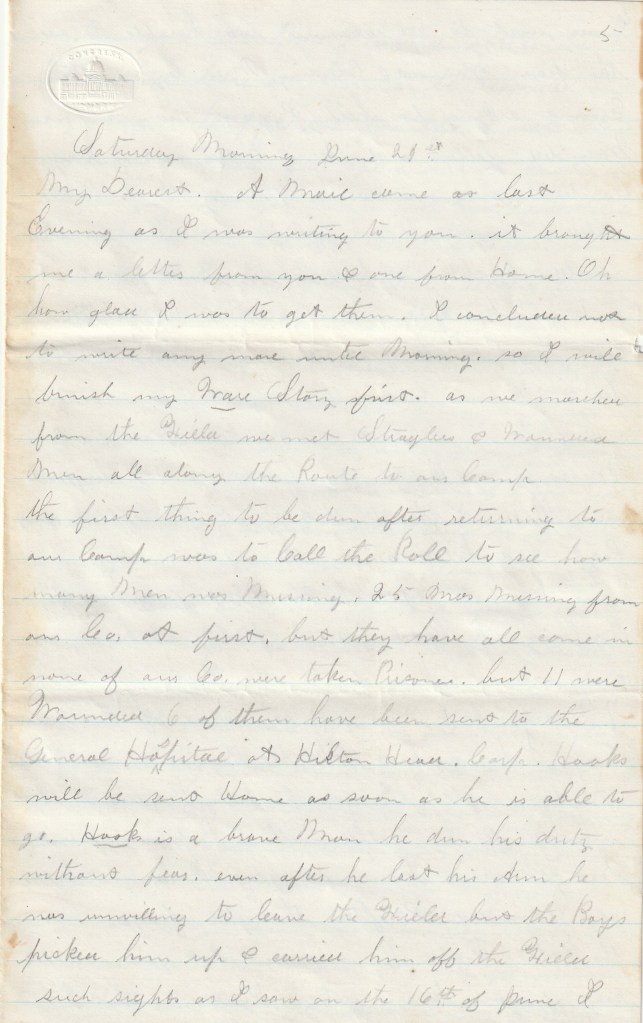
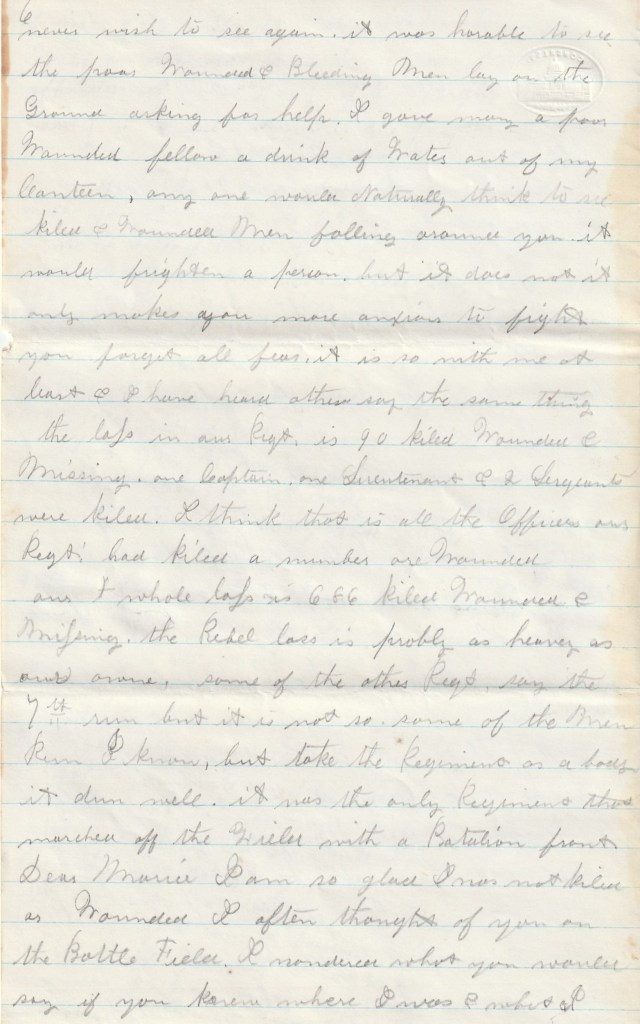

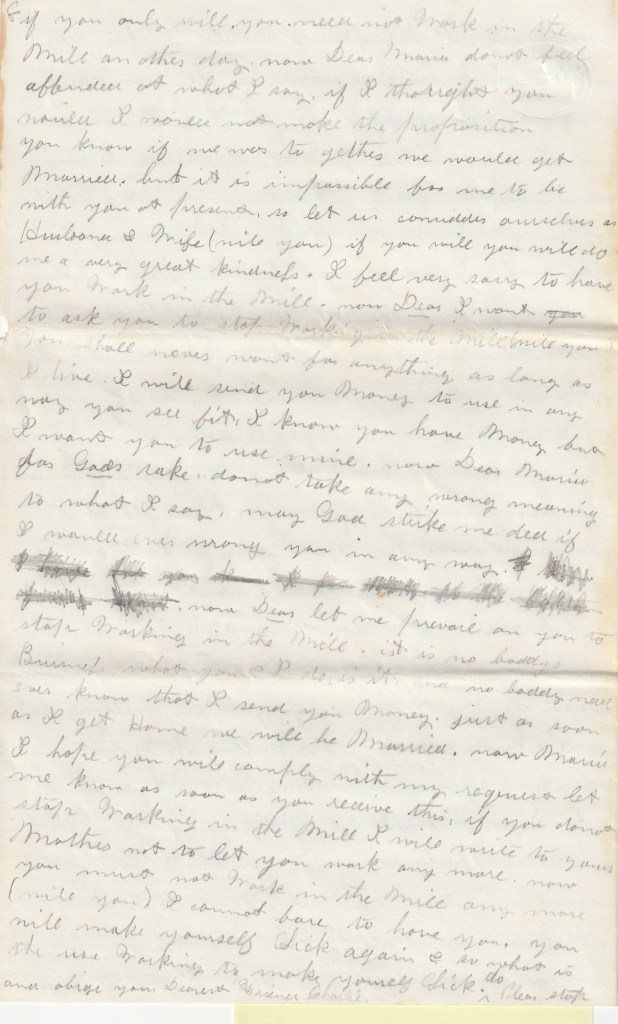
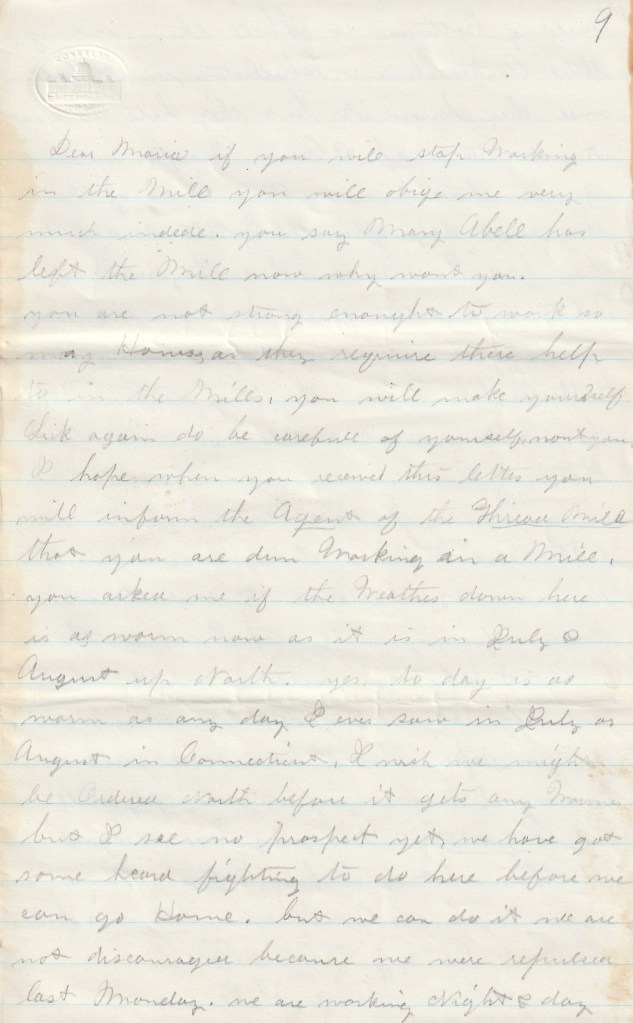

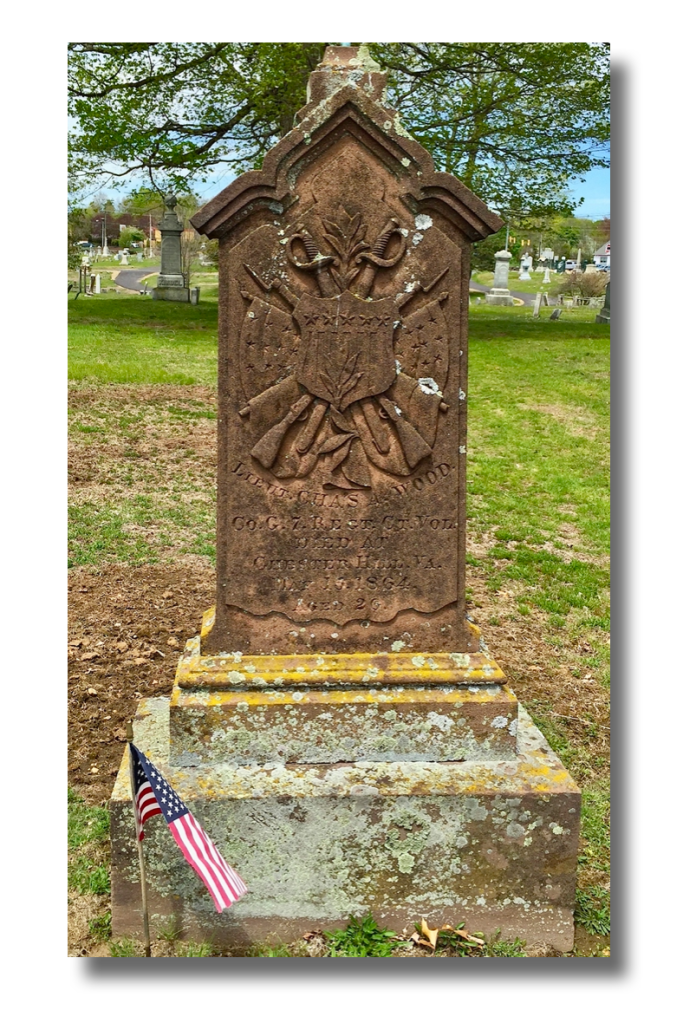

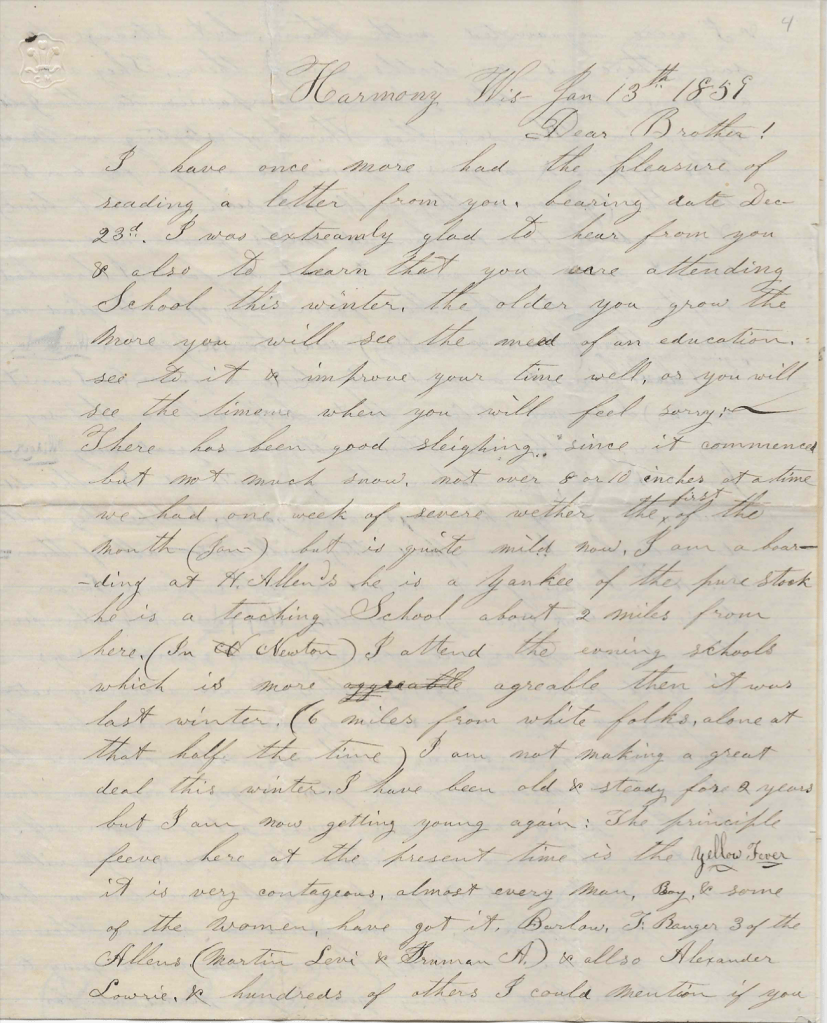
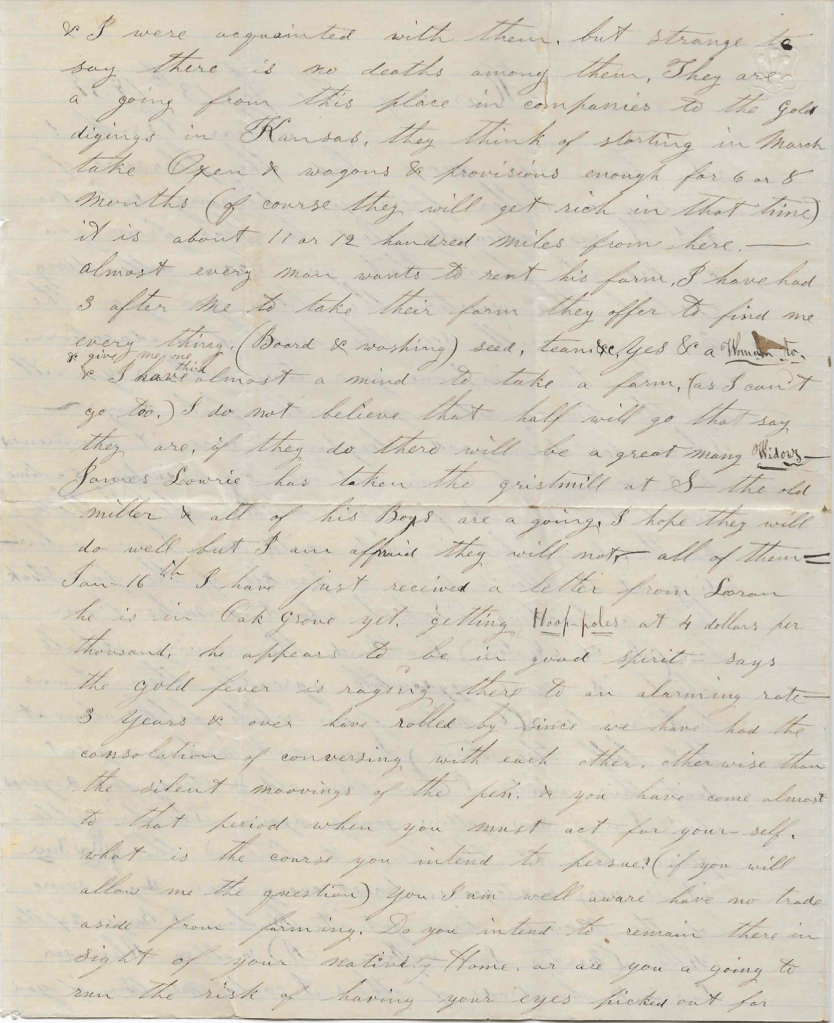
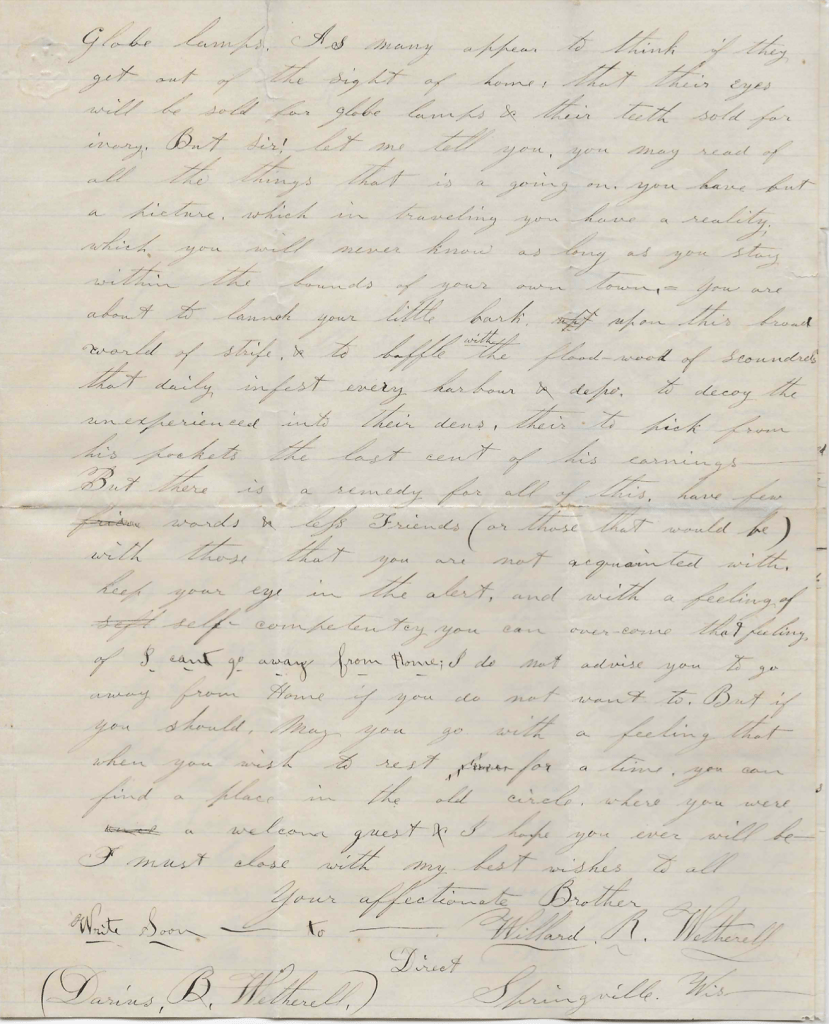
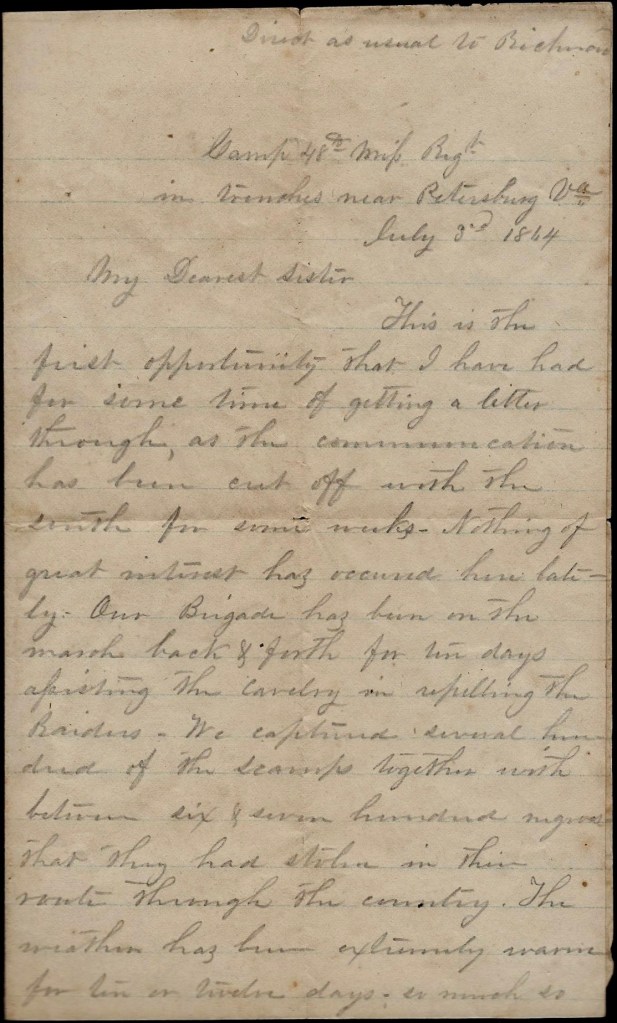
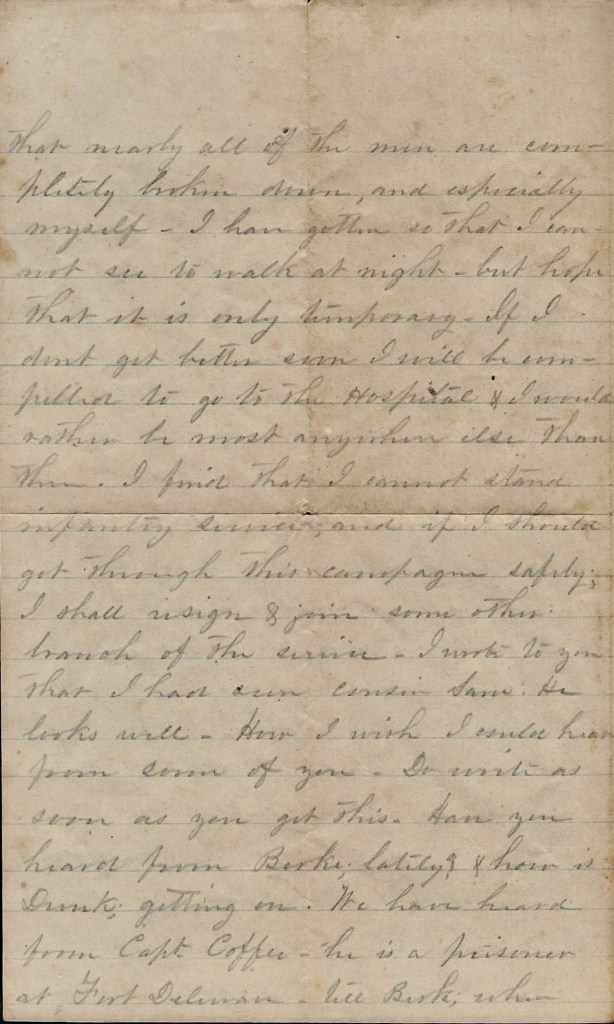
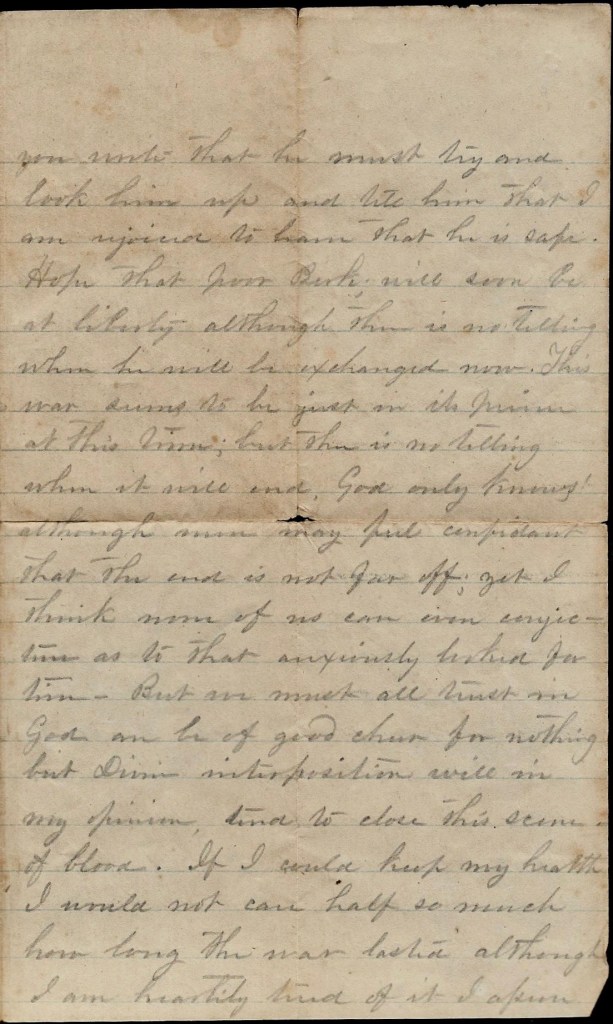
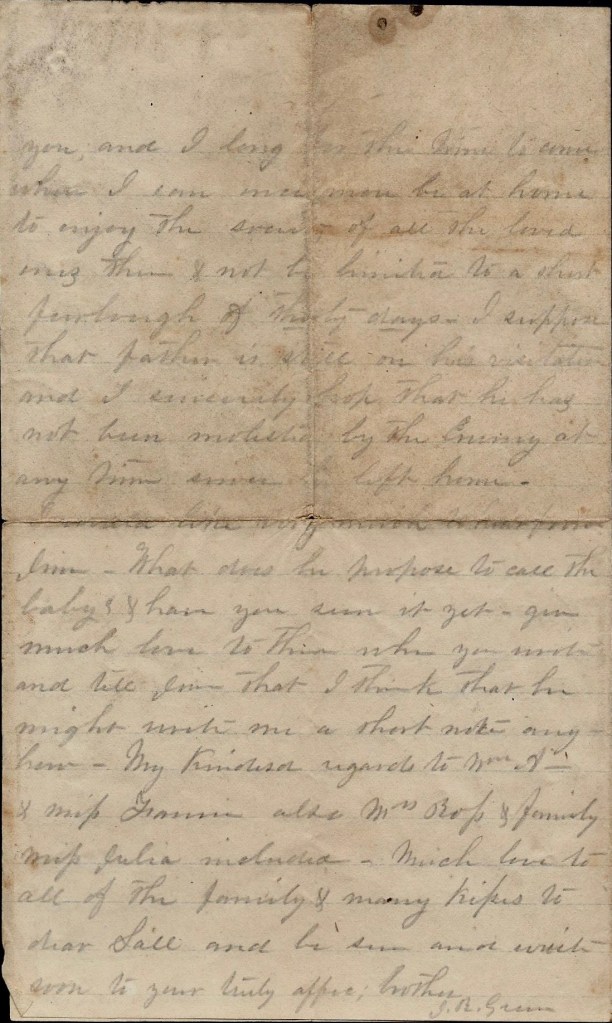


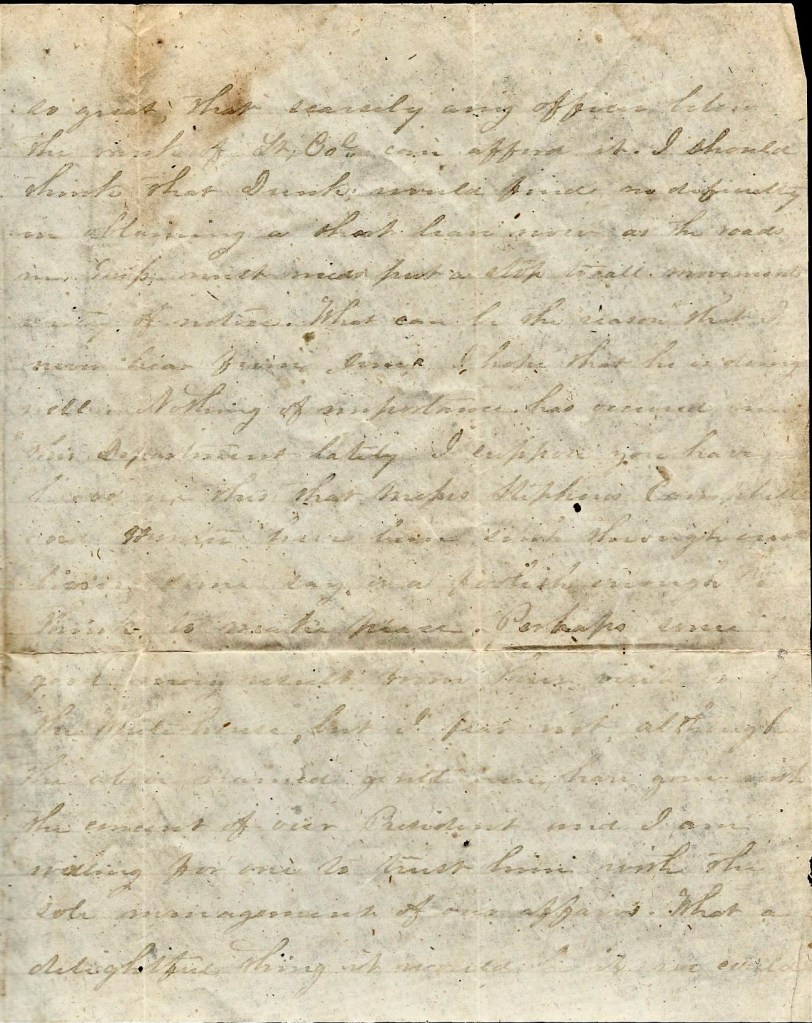
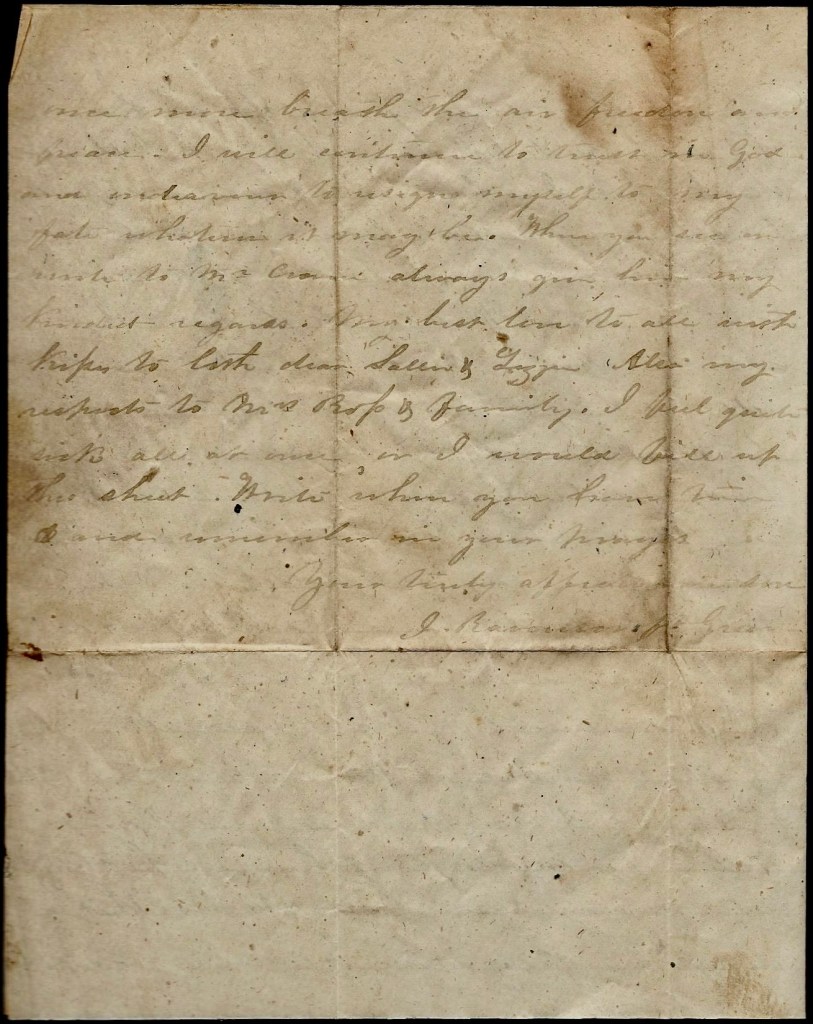
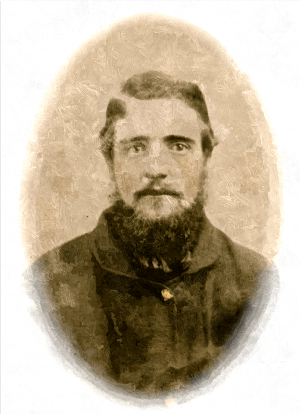

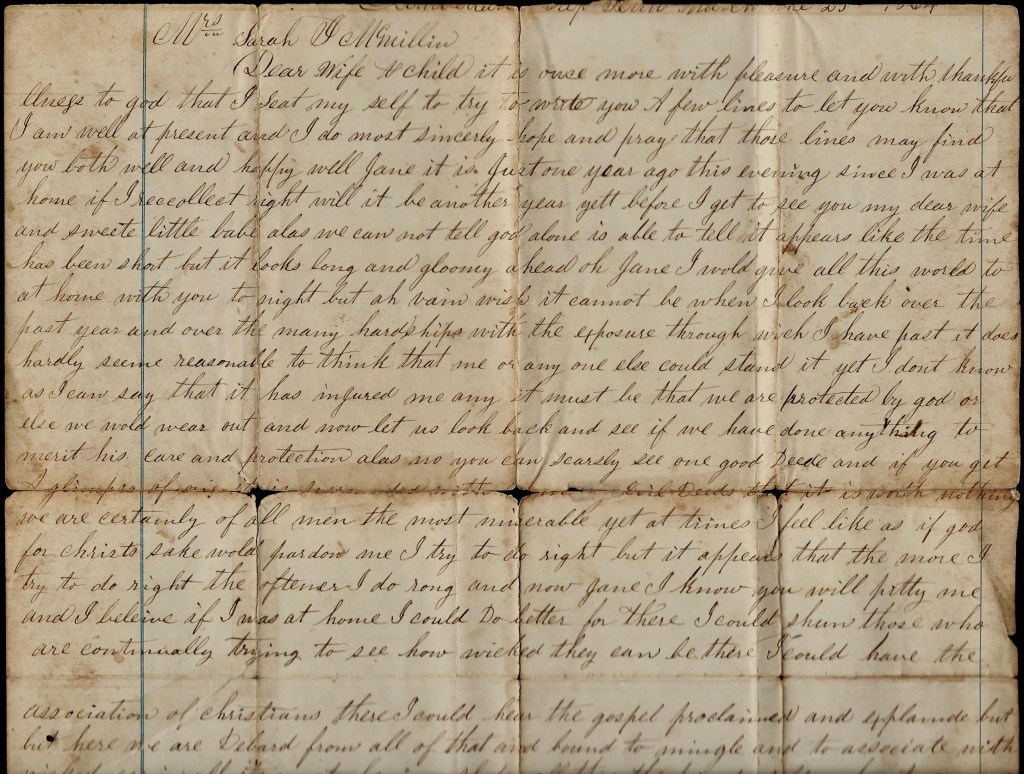


 Spared & Shared 23