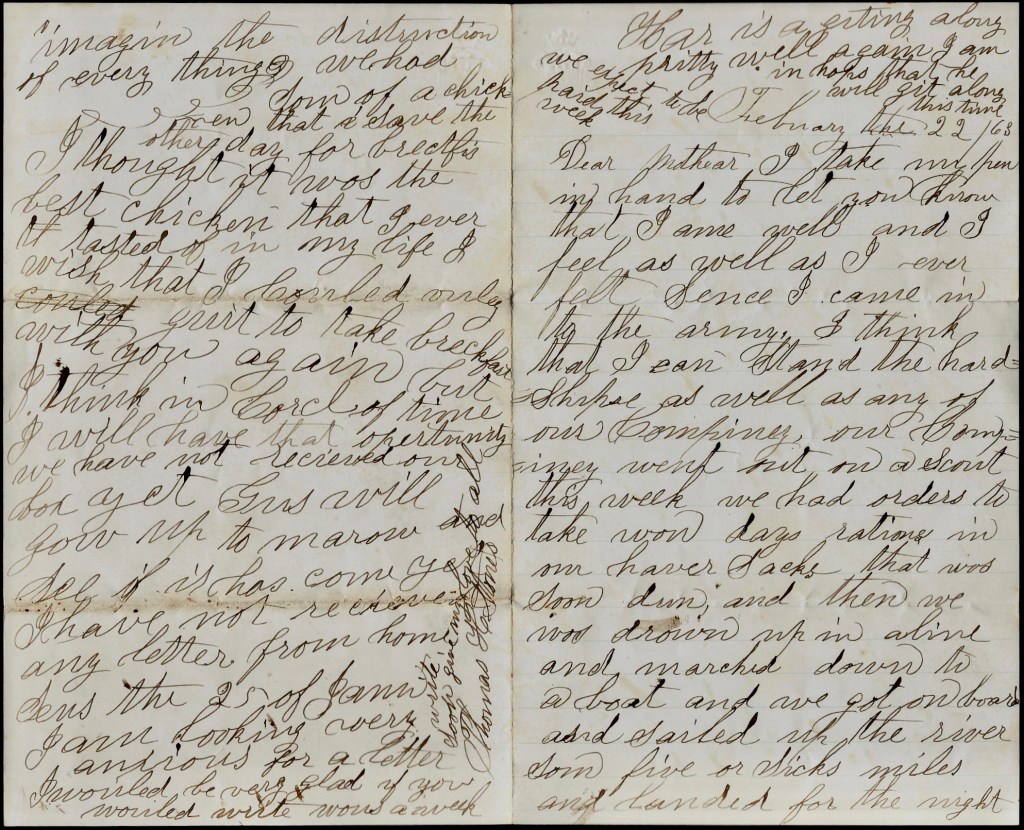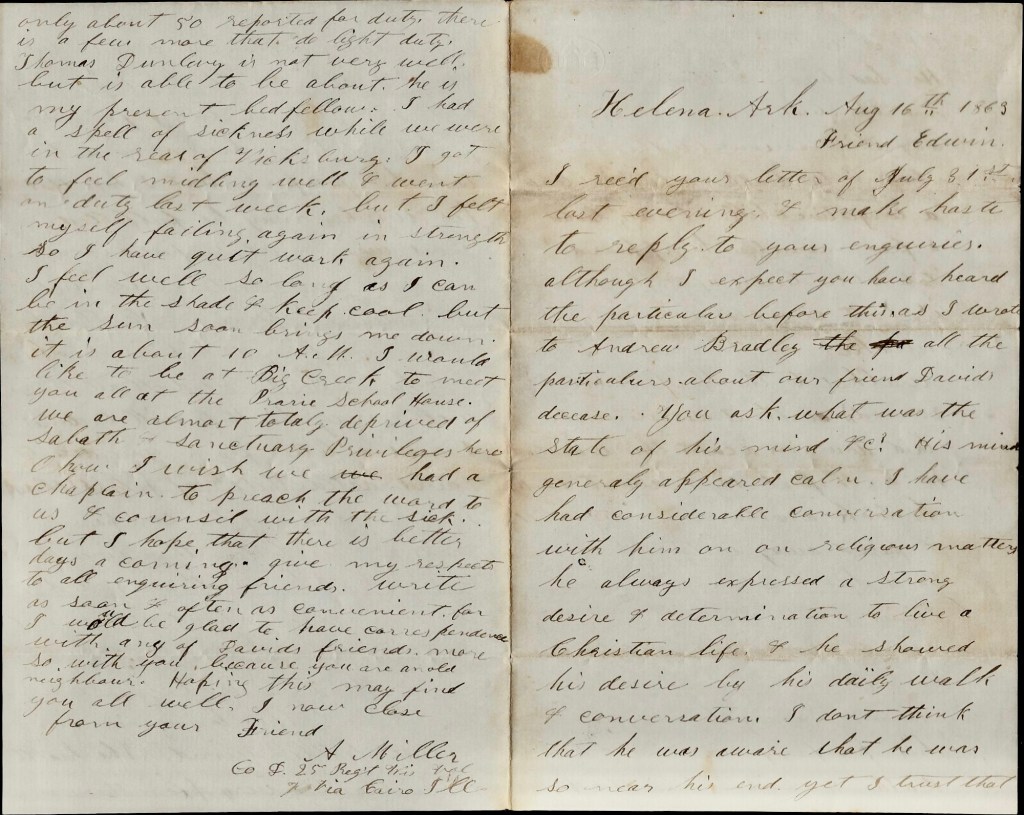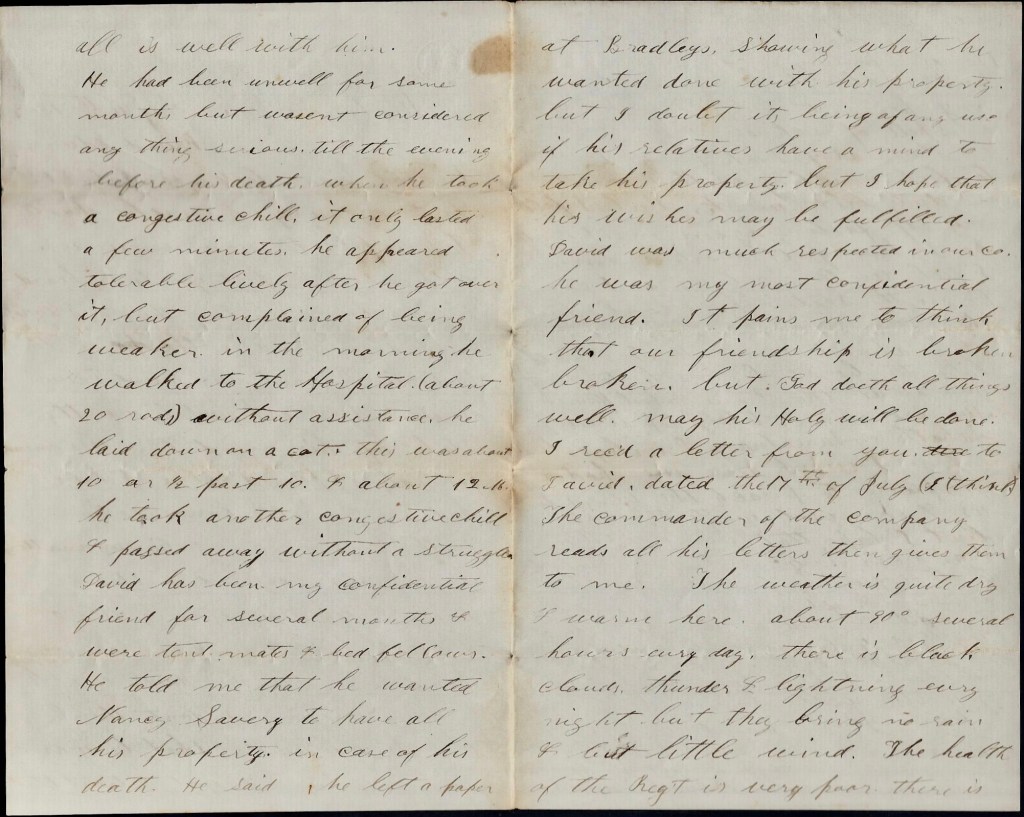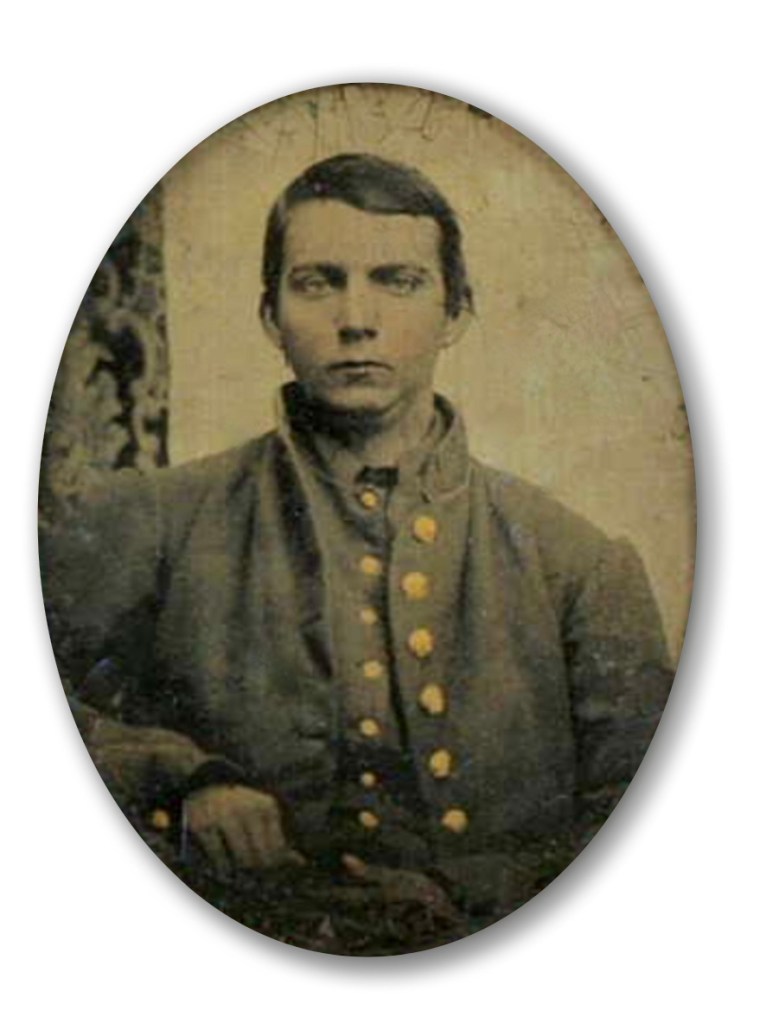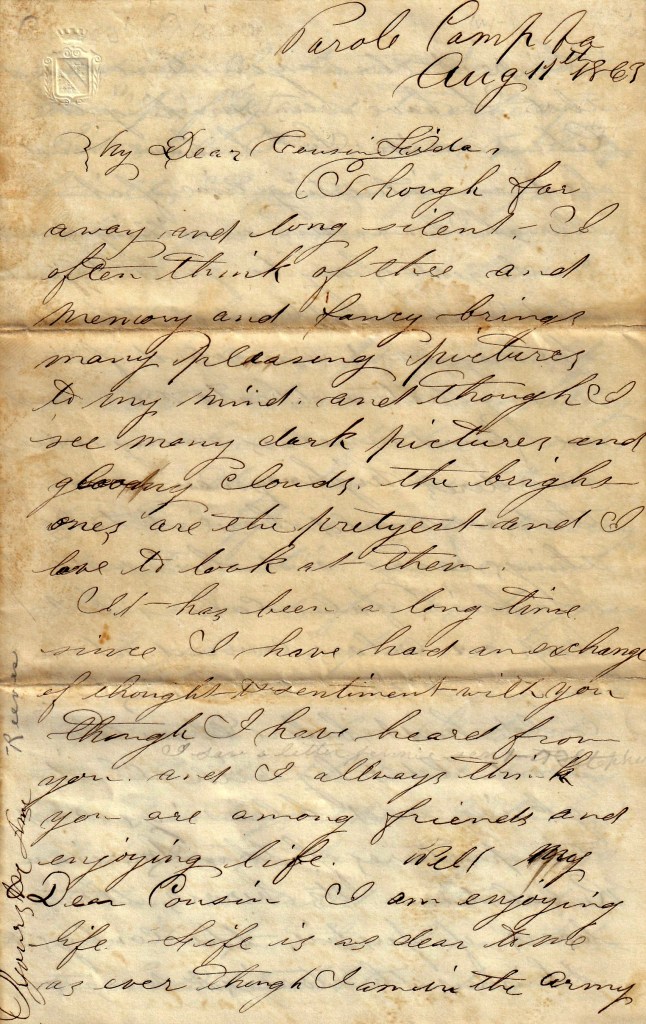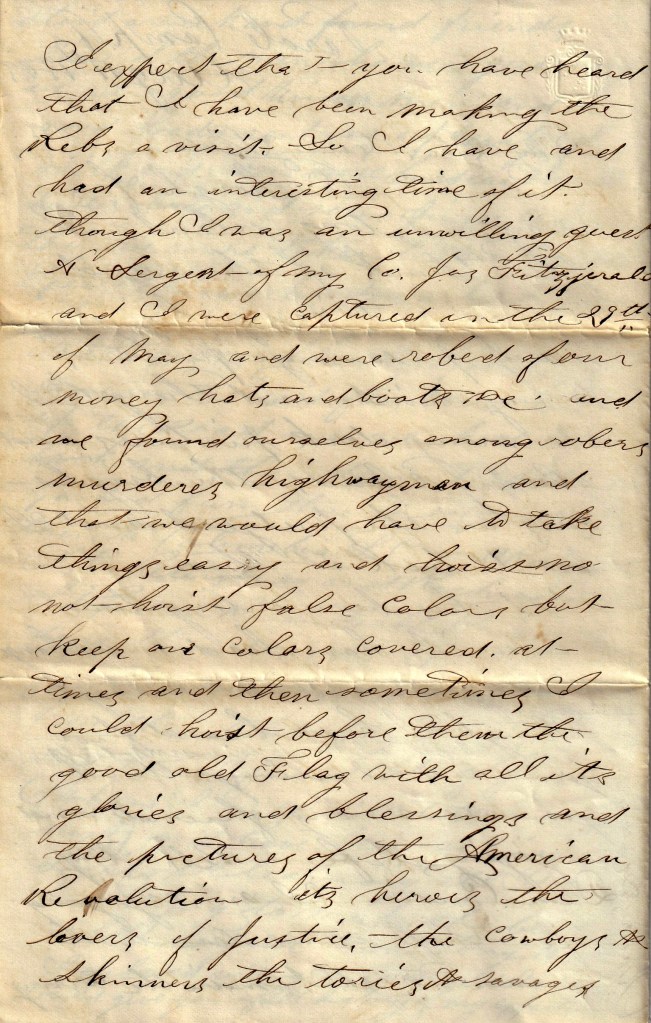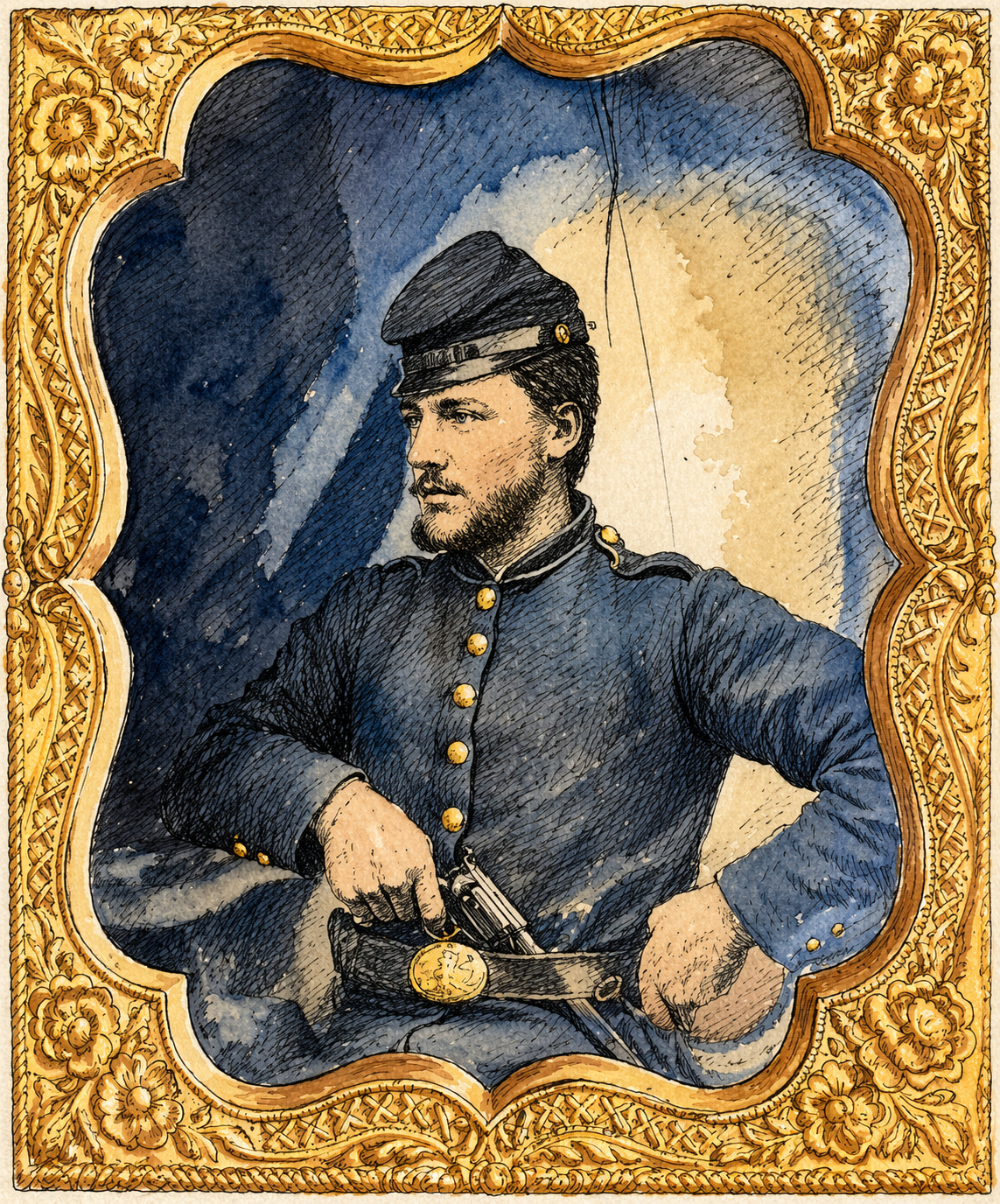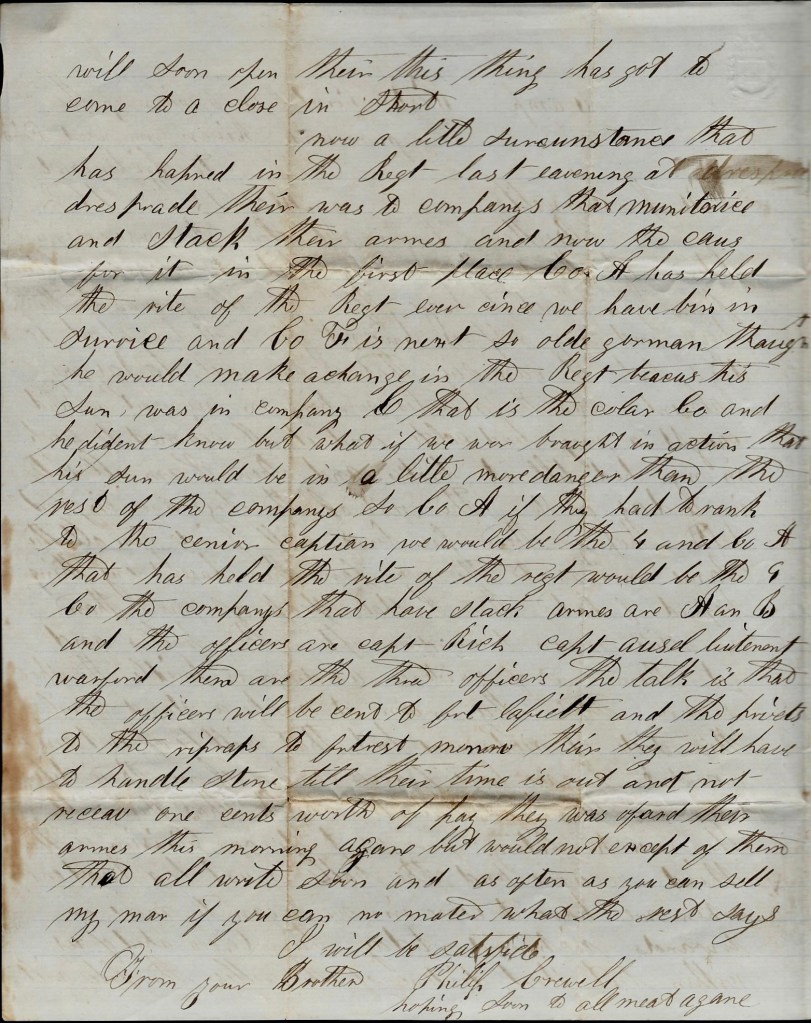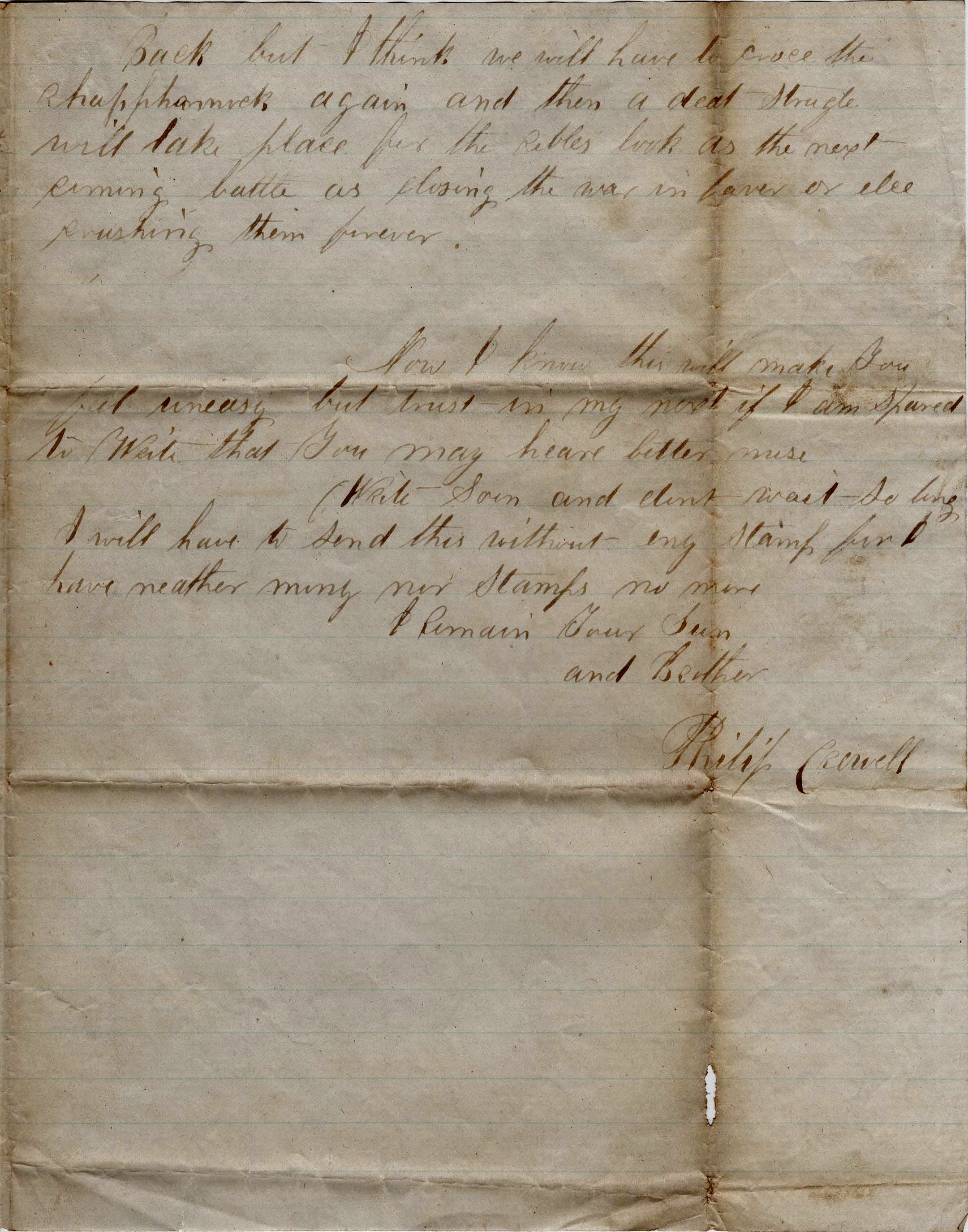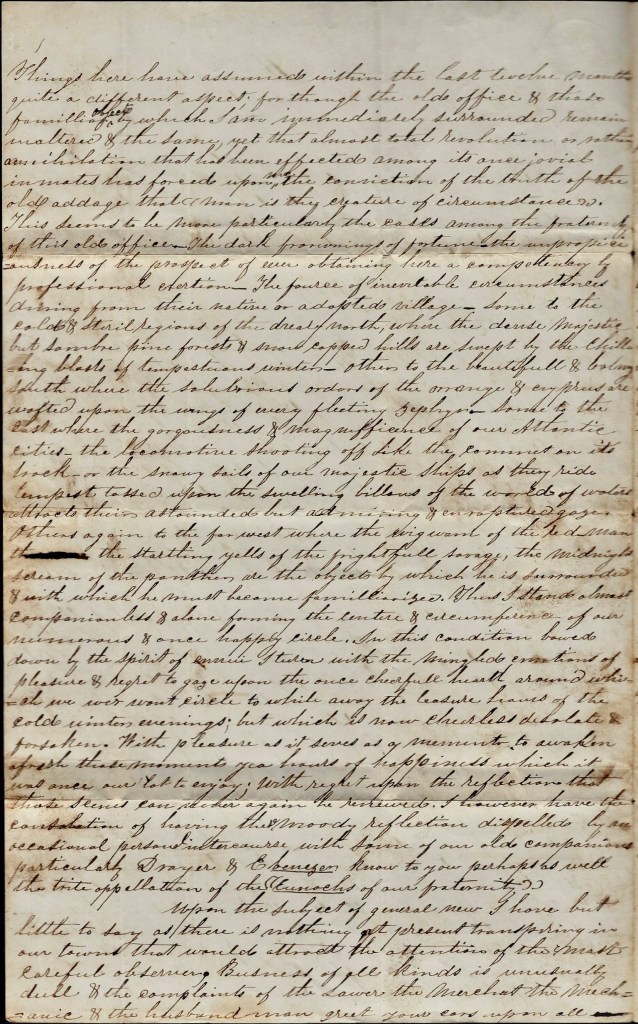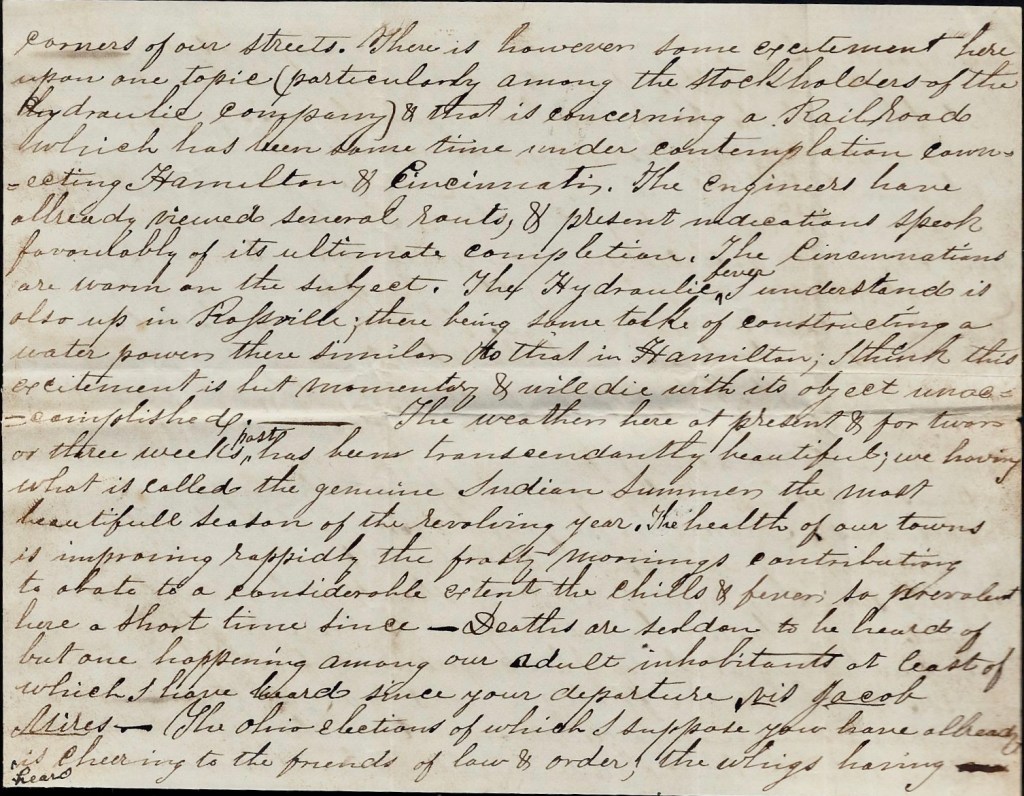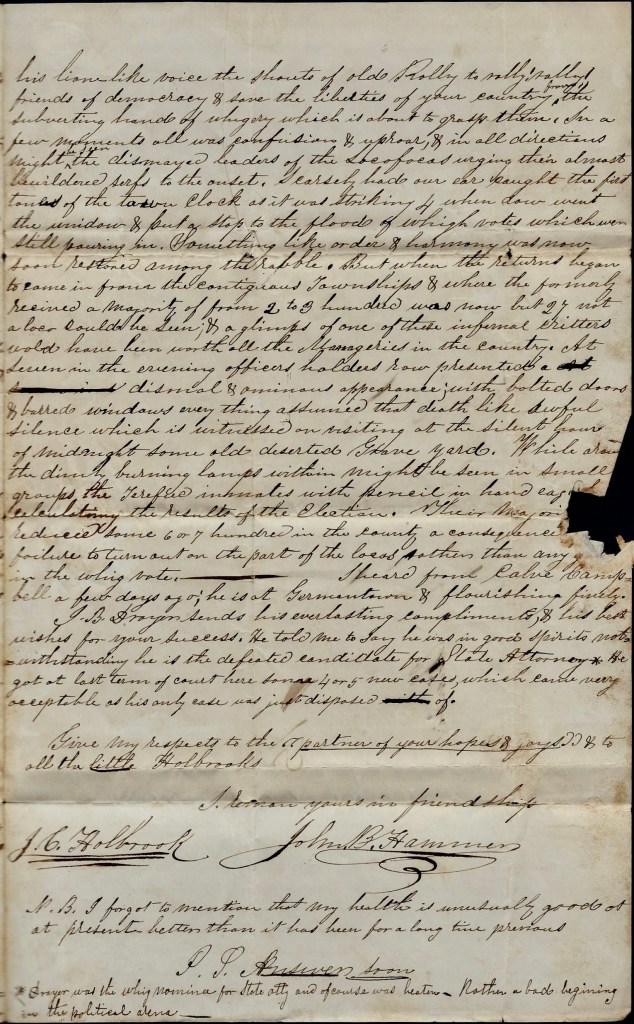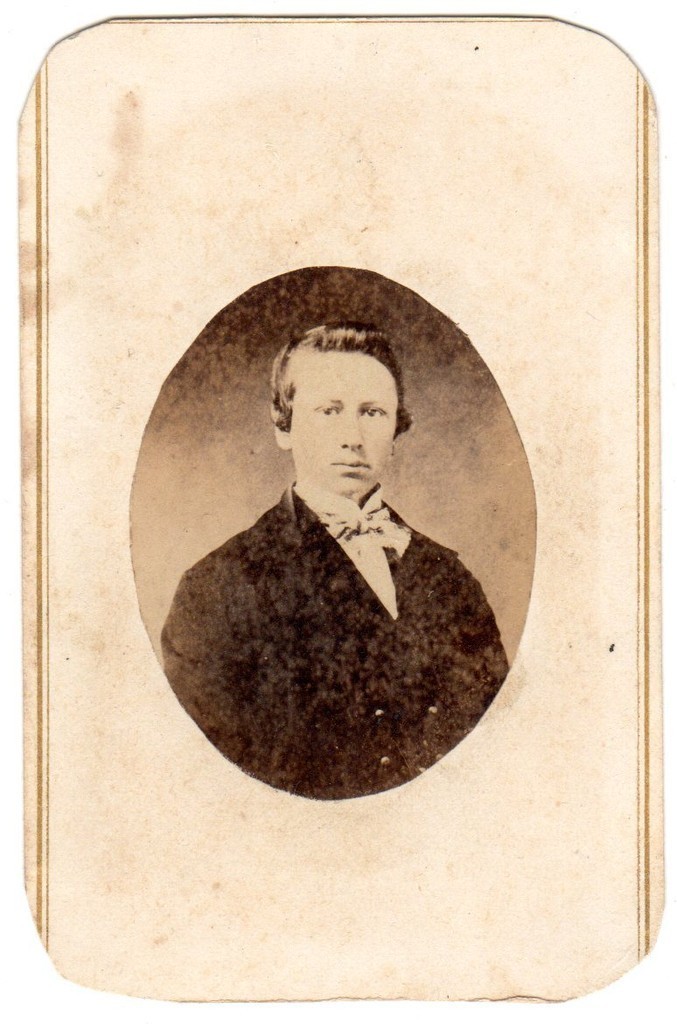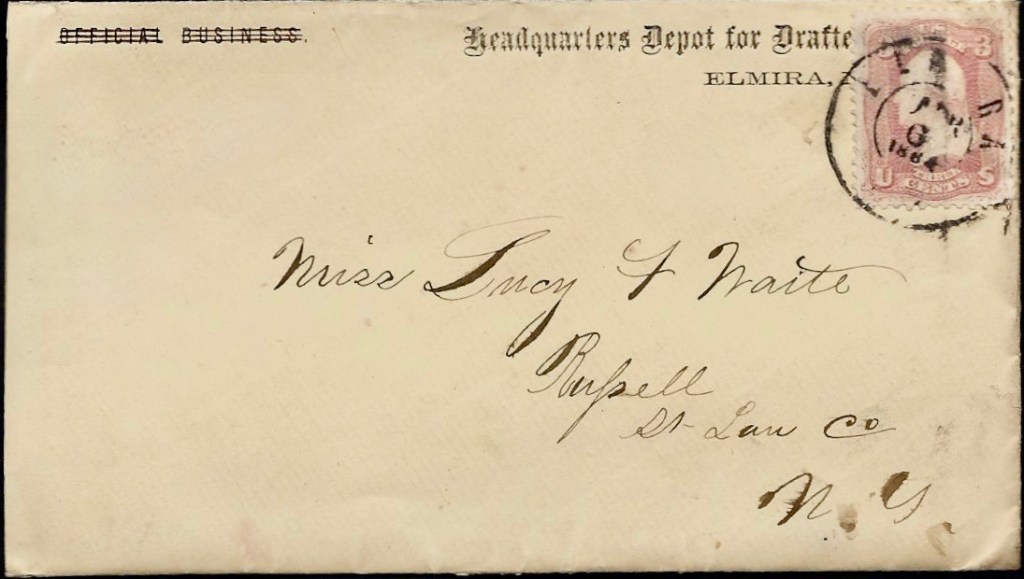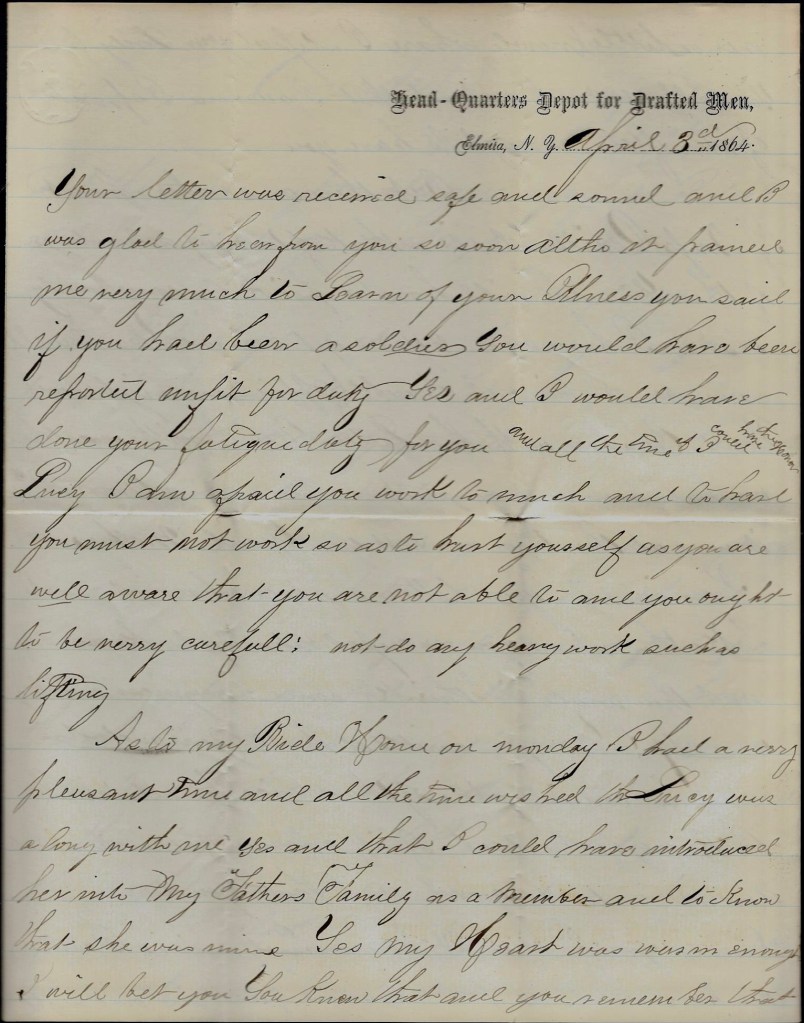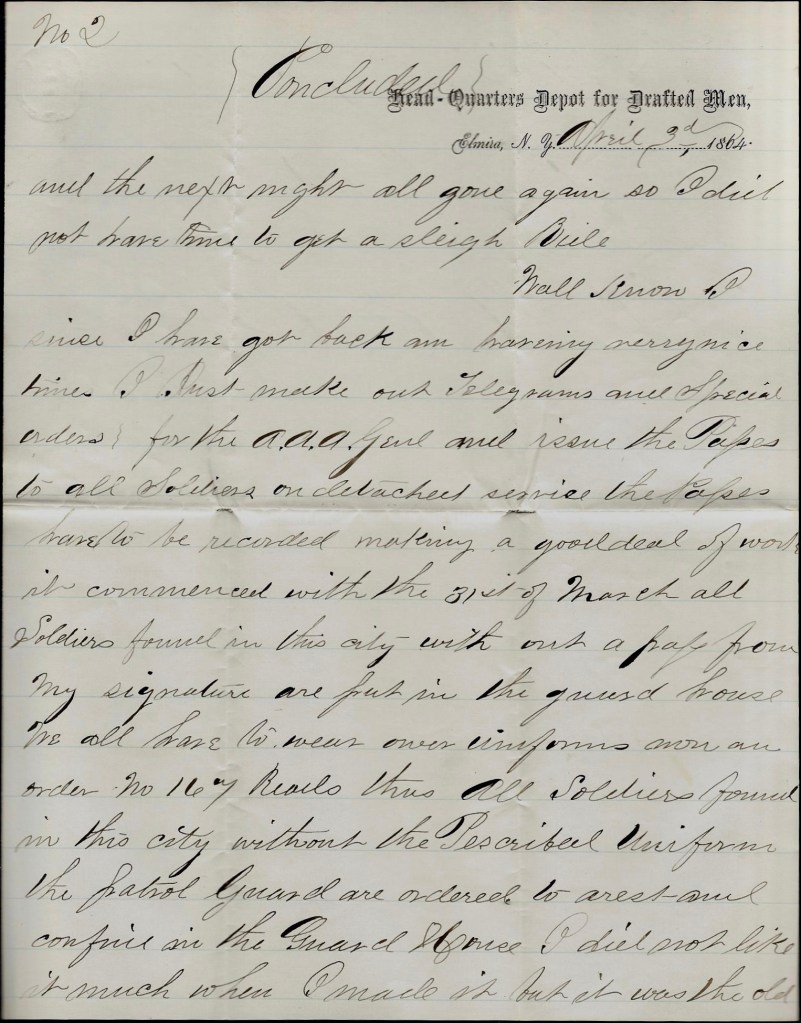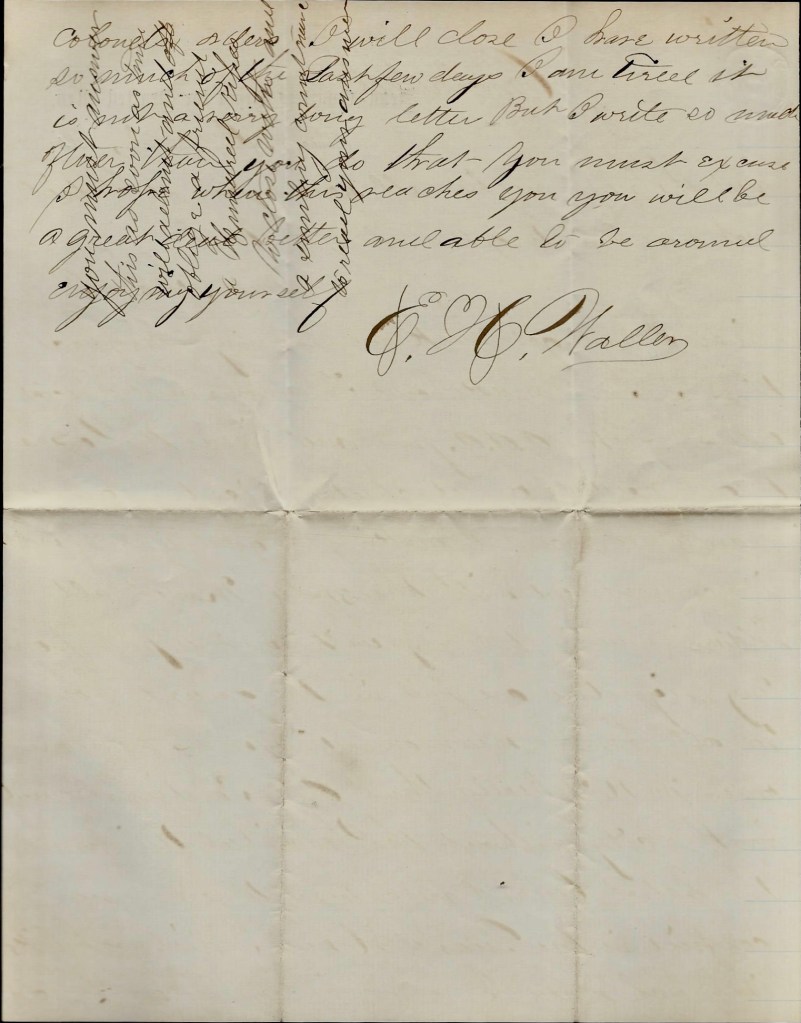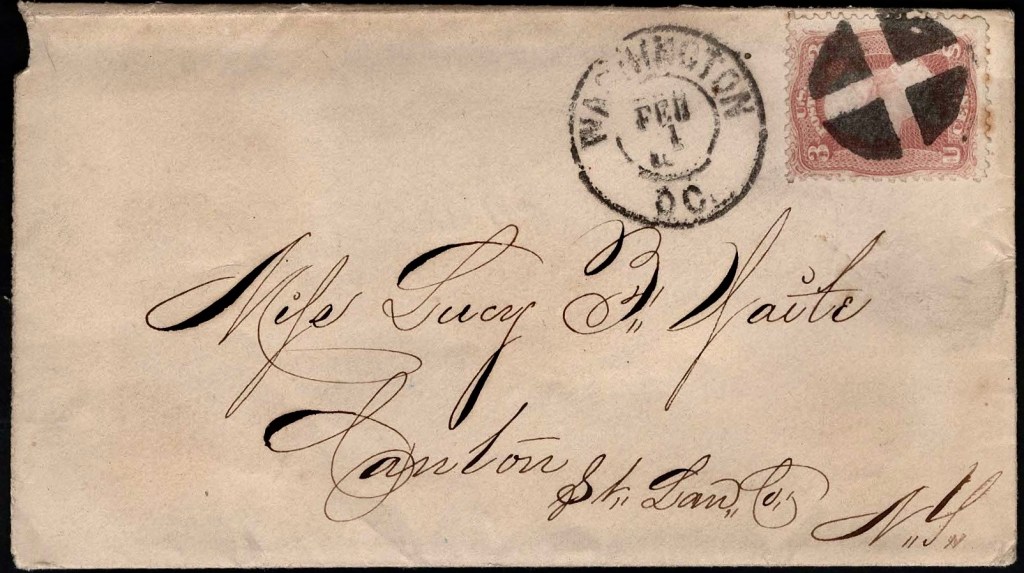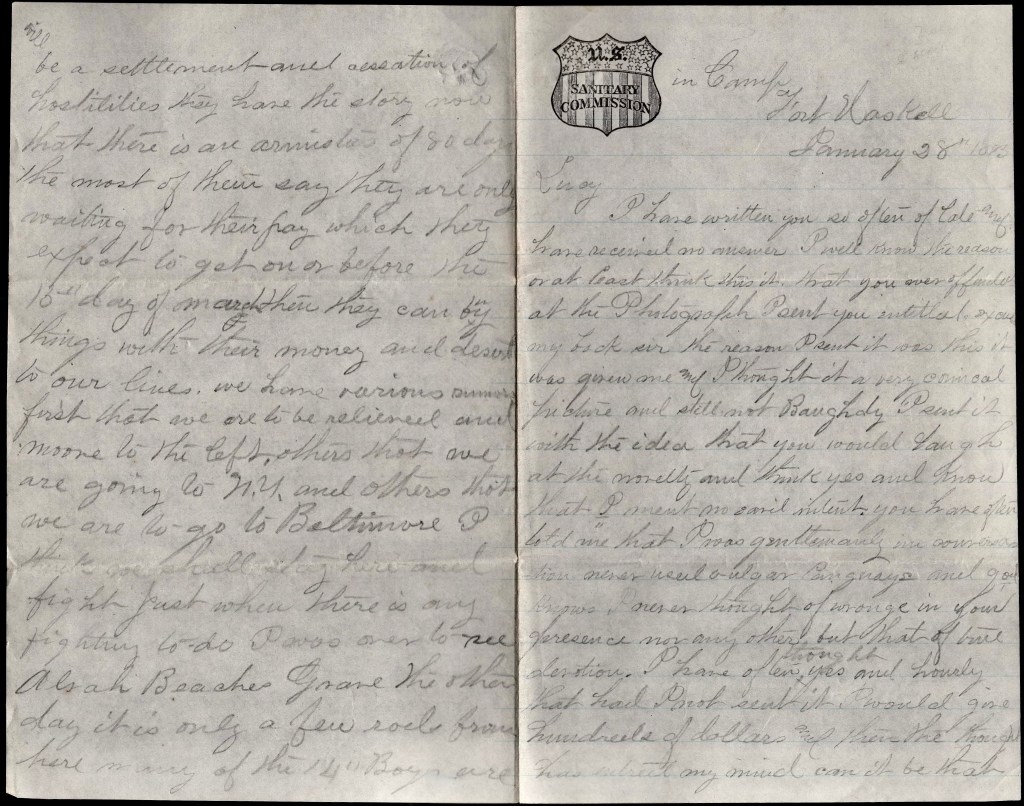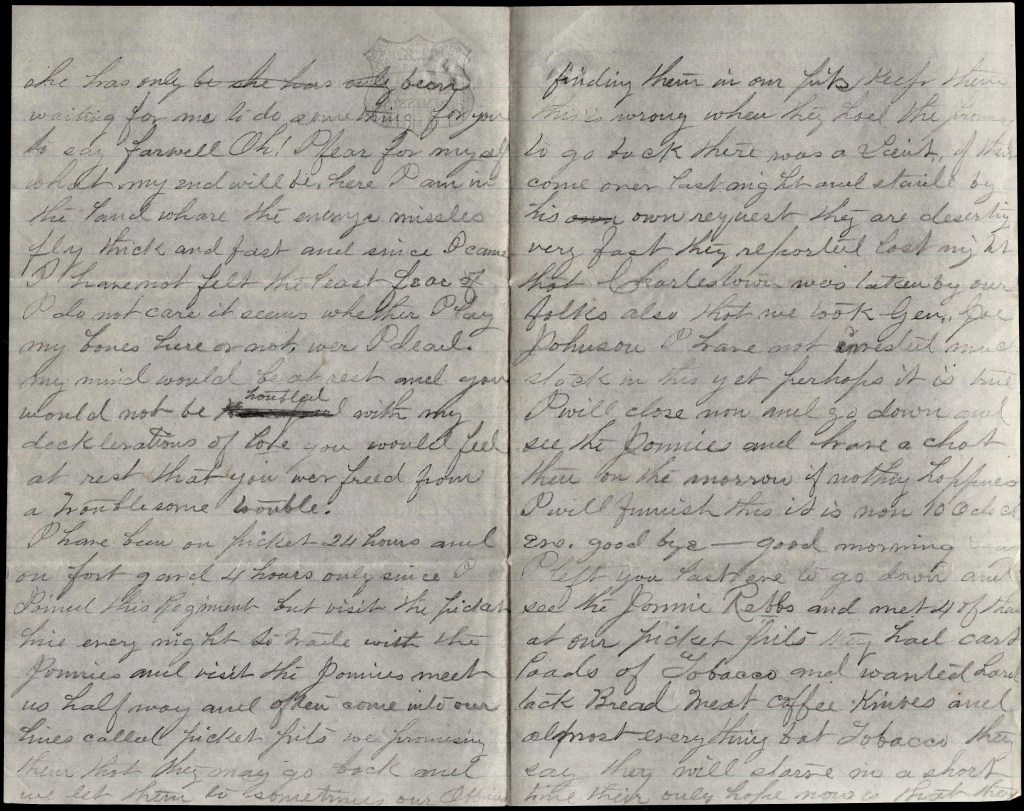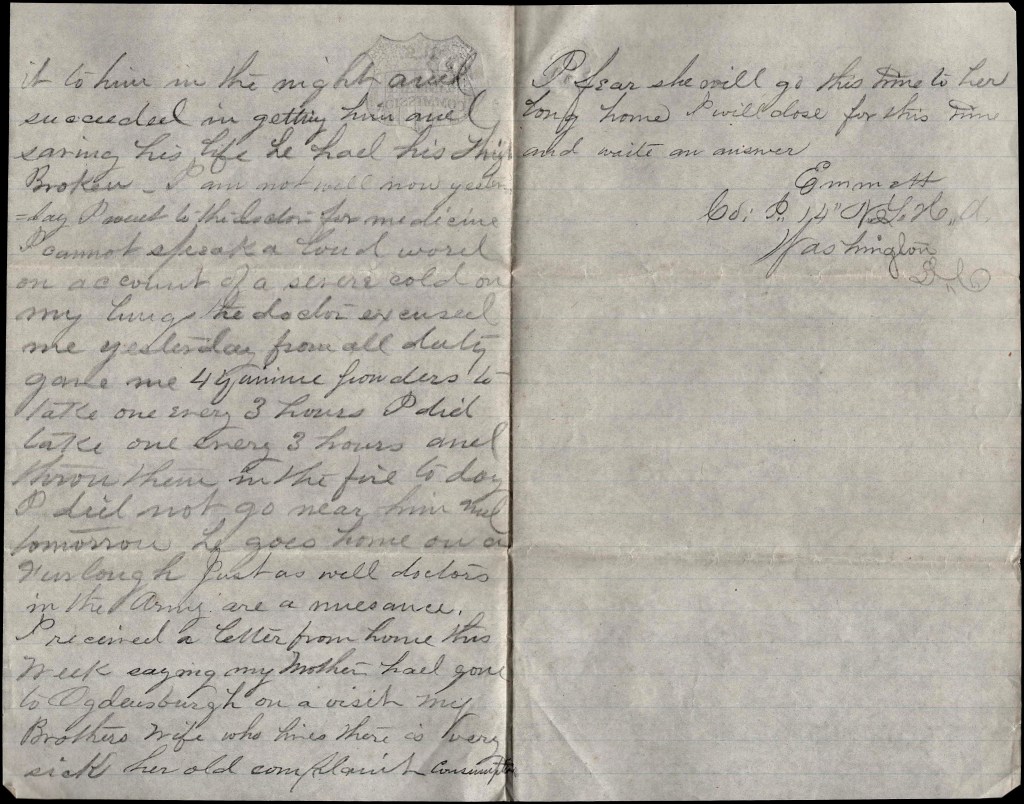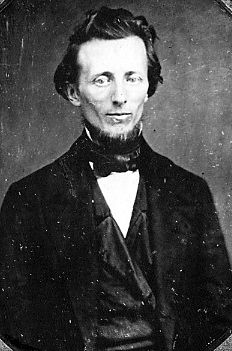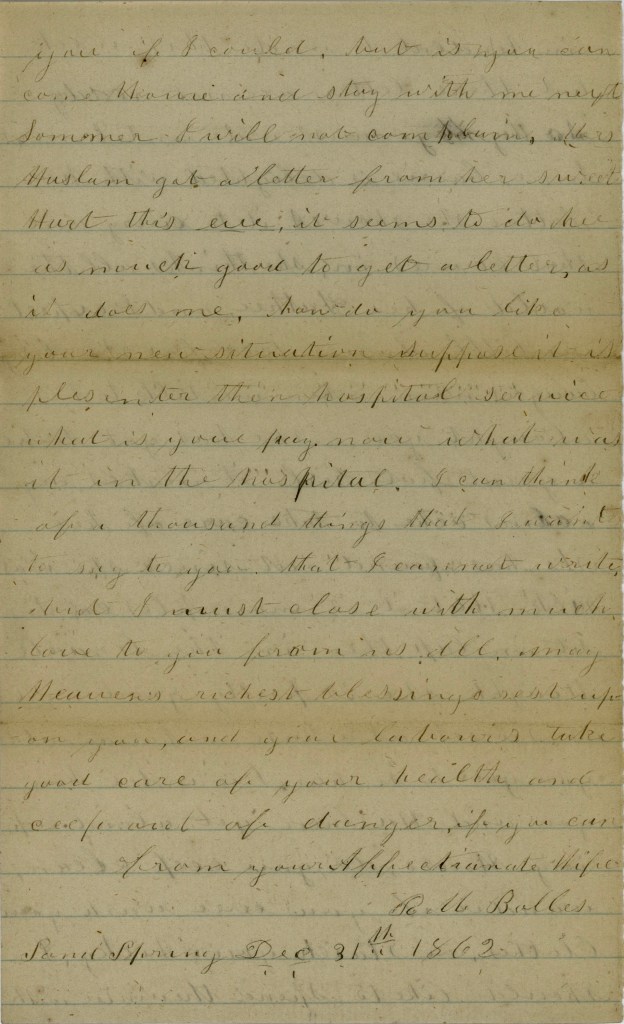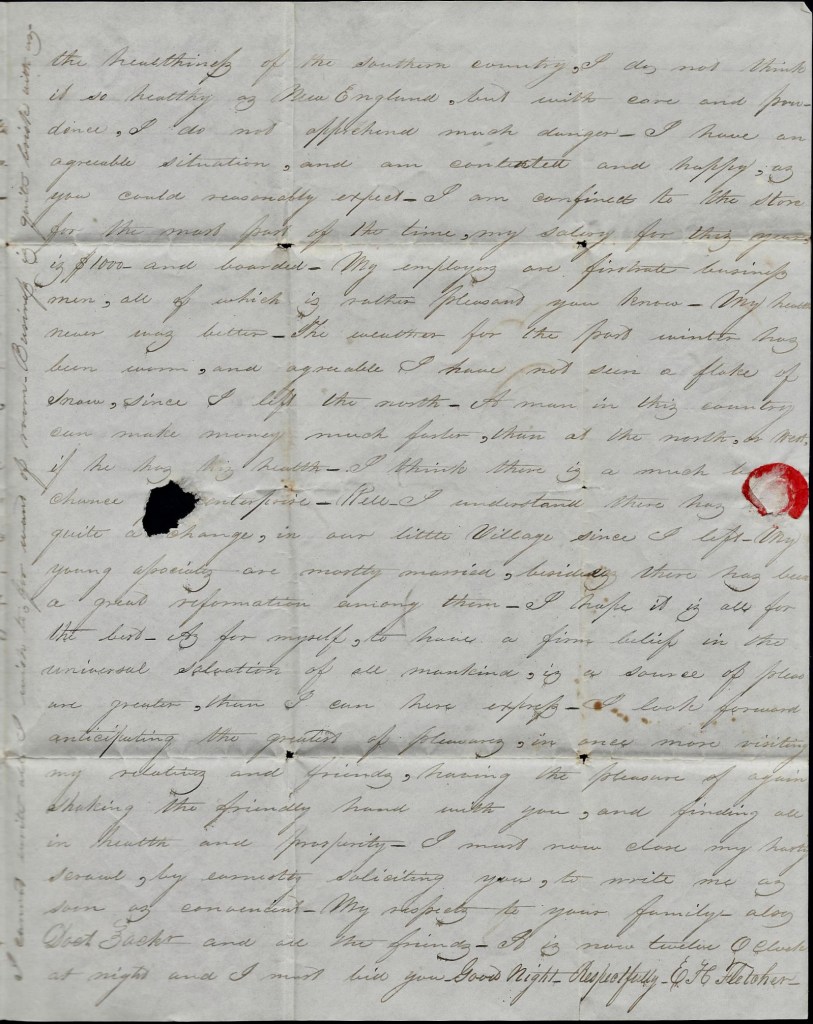
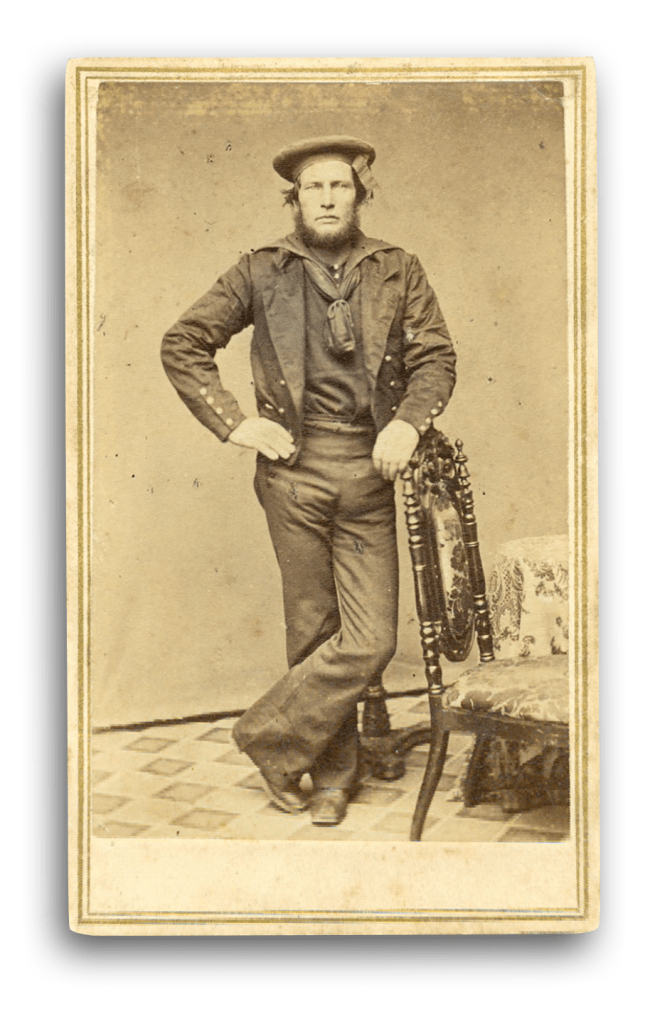
These three letters were written by Allan McDougall Campbell (1835-1874), the son of Allan McDougall Campbell and Martha Matternley (1802-18xx) of Nova Scotia. At the time of the 1850 US Census, Allan was living under his mother’s roof in Westchester county, New York, his mother an apparent widow. At the time of the 1860 US Census, Allan was living in a New York City boarding house with his younger brother Donald working as a postal carrier. His brother Donald was working as a sign painter. It appears that Allan received his naturalization papers in August 1857.
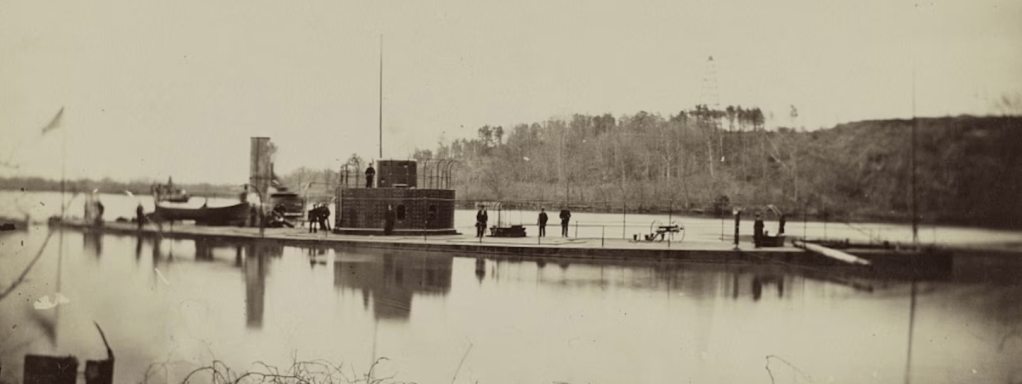
It was in August 1863 that 29 year-old Allan enlisted in the US Navy. At that time he was described as standing just shy of 5 and a half feet tall, with grey eyes and auburn hair. He may have been the same Allan Campbell who served earlier in the Navy aboard the USS North Carolina, enlisting in August 1861. Both of the following letters were written while Allan served aboard the USS Montauk, a single-turreted Passaic-class monitor launched in 1862 and part of the South Atlantic Blockading Squadron. She may be best remembered as the vessel on which the autopsy of John Wilkes Booth was performed in late April 1865.
After he was discharged from the Navy, Allan returned to New York State, settling in Morrisania, Westchester county, where he found employment as a brick mason and married Annie Walker Fisher (1845-1938).
Letter 1
Iron Clad Montauk
Off Charleston, S. C.
December 3rd 1863
Dear Mother,
I received Don’s letter on Sunday I think it was, but could not get a chance to write till today for I have been made cook of our mess which takes most of my time. I took [the position] because it adds seven dollars and a half to my month’s wages and that you know is something [in] these times although I scarcely [have] any time to myself. The work is not hard nor warm.
I was very glad to hear from you. I wish you folks would write oftener for you don’t know how nice it is to get a letter here. Every mail that comes I stand coveting every letter that is called off. Do write—any of you. Don’t wait for an answer. Tell Johnny to write and tell me what the fire department are doing, &c.

Mother, tell George to write something about his wife & Willie. Tell him they have found out that I play a little on the banjo and I was taken on board of the Massachusetts with the officers to buy a banjo from the young fellow that sent you my letter from Philadelphia. I seen him and bought the banjo from him. The chief paid ten dollars for it so we have music every night by order of the Lieut. There is a young fellow by the name of Charley Wicks—a regular comical genius. He plays the bones like sixty. The way they found me out was I heard a guitar in the officer’s room one night. The next night I asked one of the men to borrow it. The Chief, whose it was, brought it out. I sung the Duck Song which I had to repeat for the Captain & then for the Lieutenant and there was nothing but bothering all the time. We are going to get up a kind of a concert for New Years night so you see we are not without some fun.
December 4th. I had to leave off yesterday to get supper ready.
On the 18th of last month, we saw [Forts] Moultrie and Johnson firing on the [USS] Lehigh the first thing in the morning. She, being up on picket, had got aground during the night. The rebels discovering her fix opened fire on her. We were ordered up to tow her off. We went up and engaged Moultrie, and sent a boat under cover of our smoke with a line to the Lehigh. While going, a shell burst over it but fortunately hurt no one. The struck our deck once on the deck with a round shot right alongside the fire room hatch, doing no other damage, [but] making a dent in the deck and knocking a sand bag into splithereens.
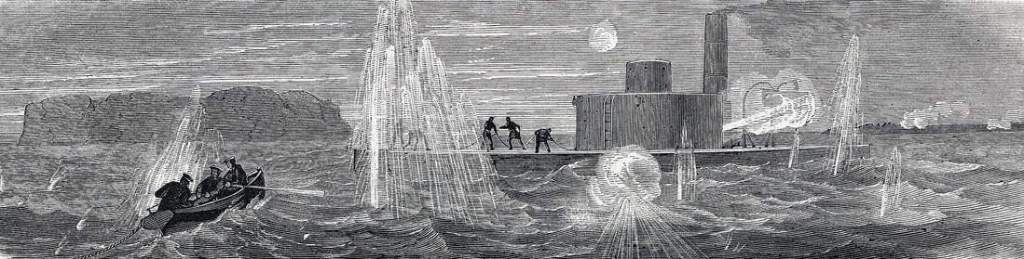
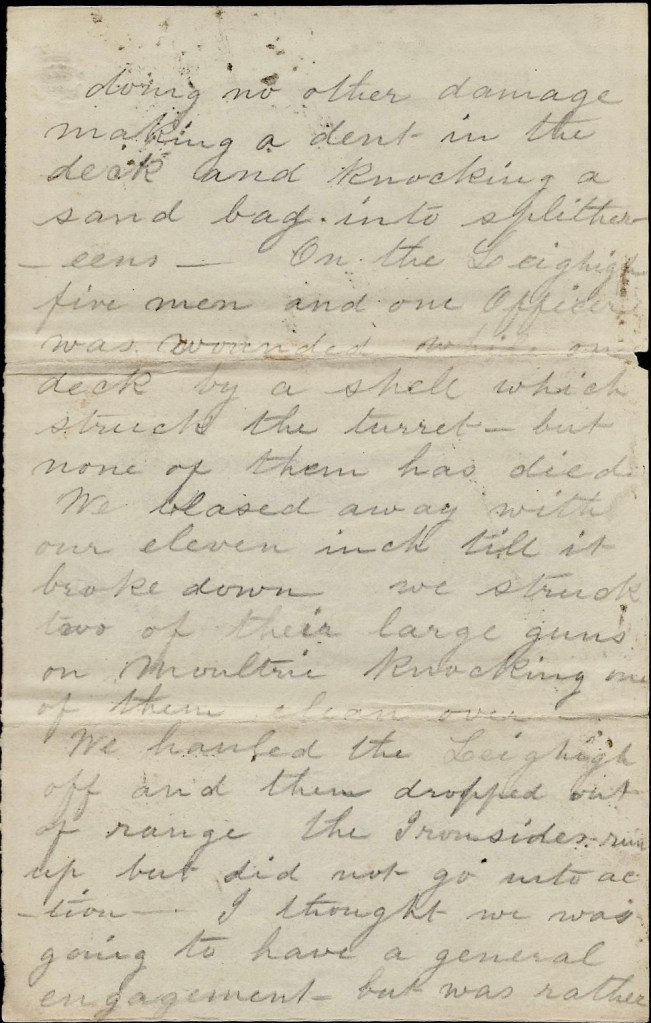
On the Lehigh, five men and one officer was wounded while on deck by a shell which struck the turret but none of them has died. We blasted away with our eleven inch till it broke down. We struck two of their large guns on Moultrie, knocking one of them clean over.
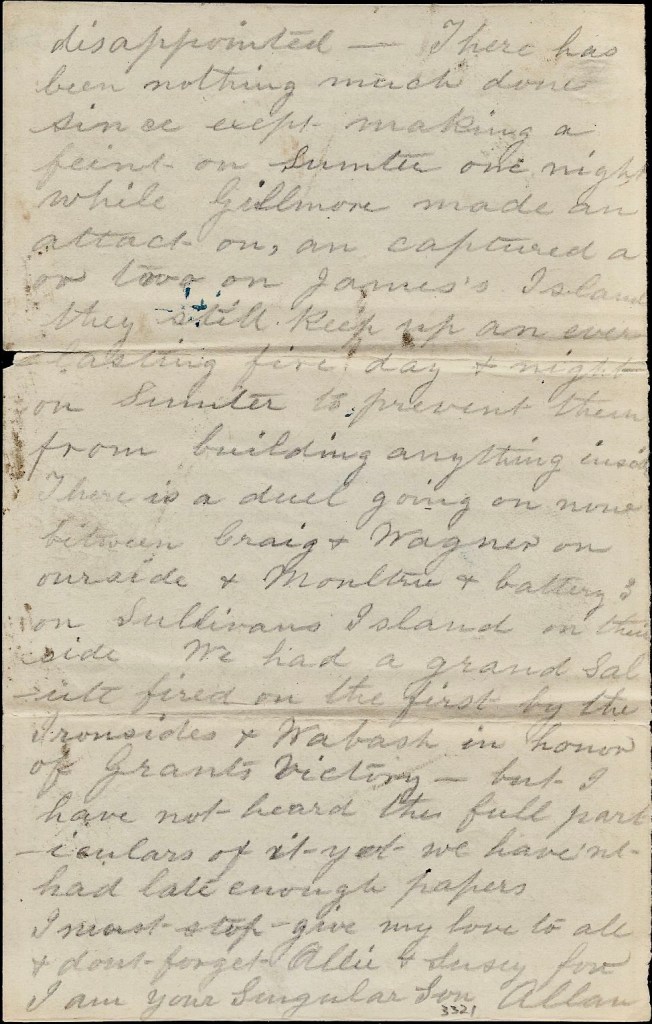
We hauled the Lehigh off and then dropped out of range. 1 The [USS] Ironsides run up but did not go into action. I thought we was going to have a general engagement but was rather disappointed. There has been nothing much done since except making a feint on [Fort] Sumter one night while [Gen. Quincy] Gillmore made an attack on and captured one or two [rebel forts] on James Island. They still keep up an ever-lasting fire day and night on Sumter to prevent them from building anything inside. There is a duel going on now between [Forts] Gregg and Wagner on our side and [Fort] Moultie and Battery No. 3 on Sullivans Island on their side.
We had a grand salute fired on the first by the Ironsides and Wabash in honor of Grant’s victory but I have not heard the full particulars of it yet. We have not had late enough papers. I must stop. Give my love to all and don’t forget Ollie and Susey for I am your singular son, — Allan
1 Allen’s letter claims it was the USS Montauk that rescued the USS Lehigh—not even mentioning the presence of the USS Nahant—but history has recorded that both the Montauk and Nahant came to Lehigh’s rescue and that it was a launch from the Lehigh that succeeded in attaching a tow line to the Nahant who in turn pulled them off the sandbar. The full story can be found here: The Sailors Who Saved USS Lehigh.


Letter 2
Montauk
March 8th 1864
Dear Mother,
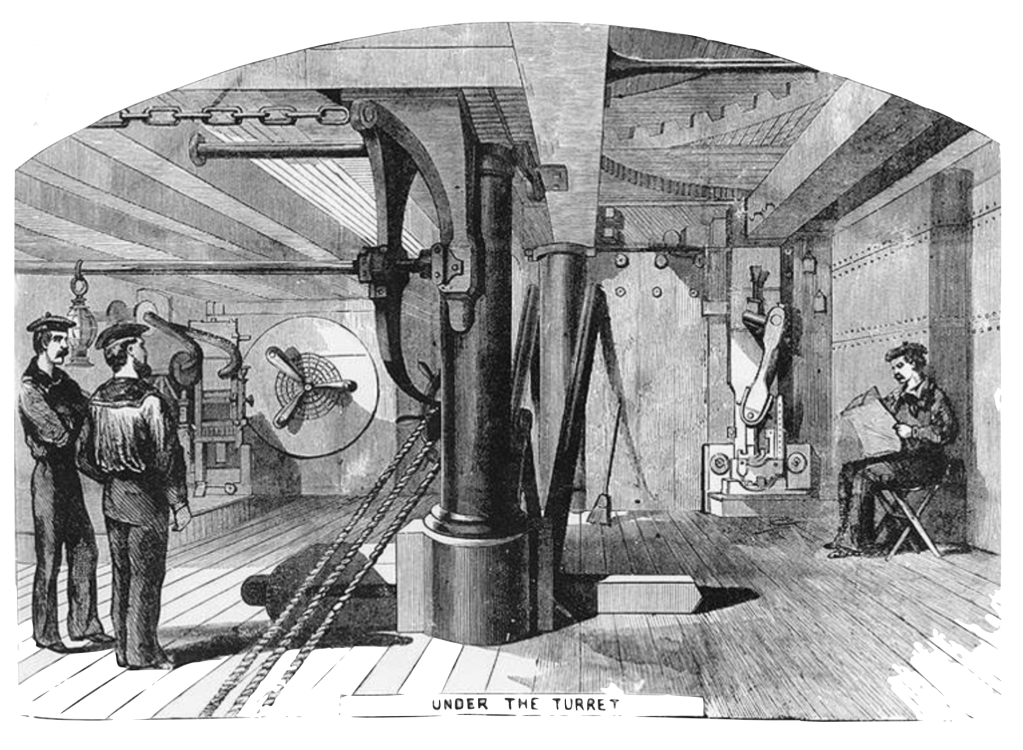
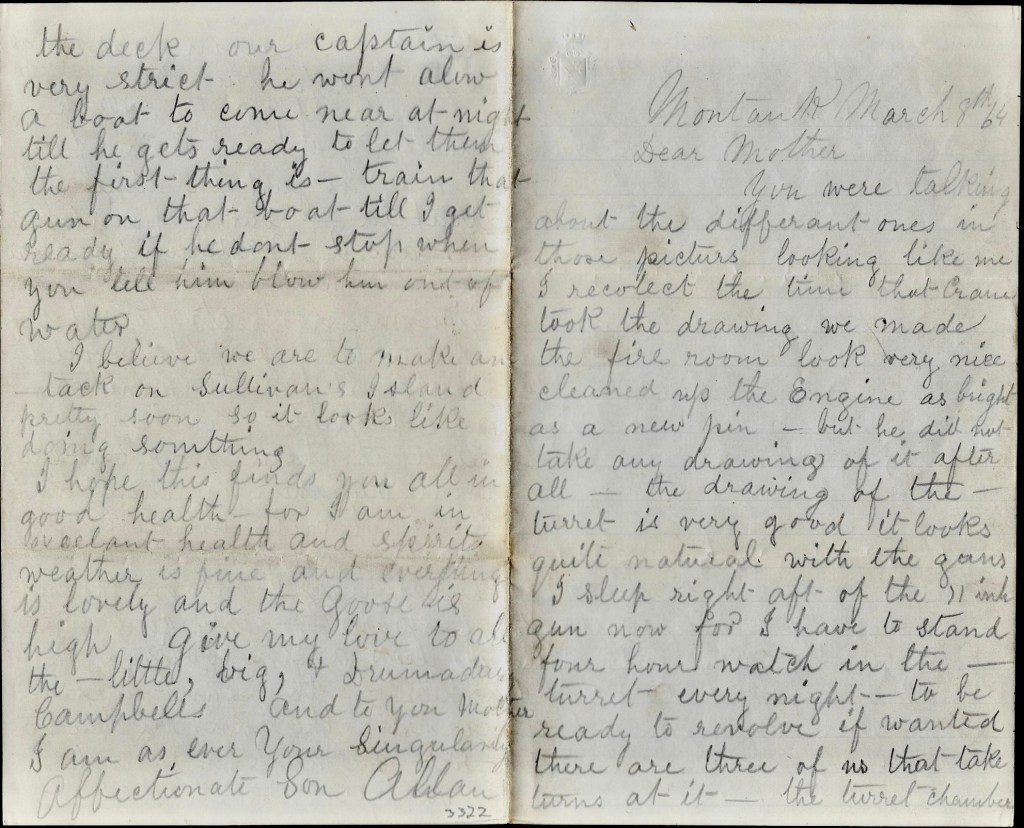
You were talking about the different ones in those pictures looking like me. I recollect the time that [William T.] Crane 1 took the drawing. We made the fire room look very nice, cleaned up the engine as bright as a new pin, but he did not take any drawing of it after all. The drawing of the turret is very good. it looks quite natural with the guns. I sleep right aft of the 11 inch gun now for I have to stand four hours watch in the turret every night to be ready to revolve if wanted. There are three of us that take turns at it. The turret chamber [drawing] is very well [done] too.
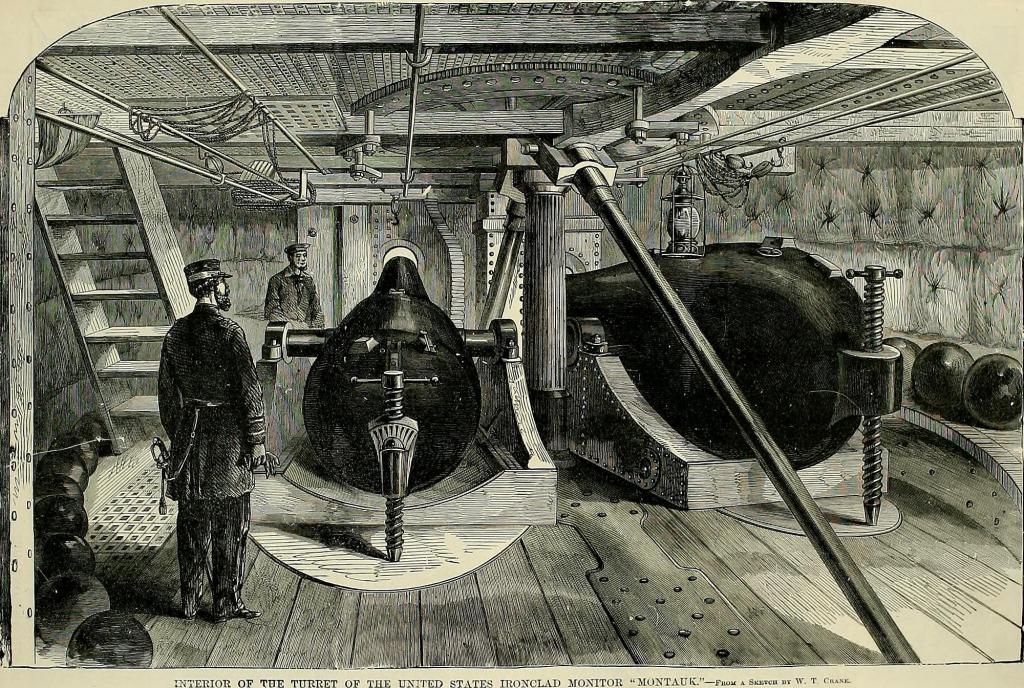
The man sitting reading is one of the firemen who was there at the time. It looks something like him but the rest is not so good. The chief sent a drawing of our concert on Christmas night to Harper’s or Frank Leslie’s but they haven’t put it in yet, I believe.
I have but very little time to write now for I am cook again & hardly get a chance to wash and mend my clothes and you must excuse my bad writing for it is so dark that I can’t see the lines.
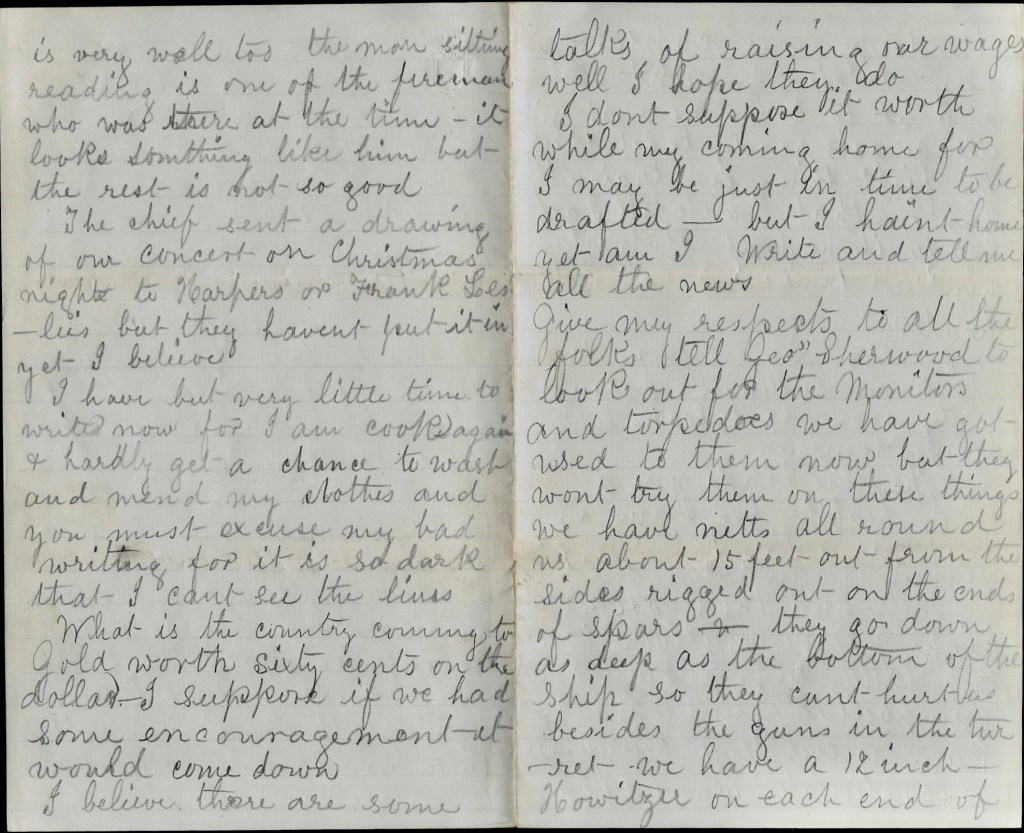
What is the country coming to? Gold worth sixty cents on the dollar? I suppose if we had some encouragement, it would come down. I believe there are some talks of raising our wages. Well i hope they do. I don’t suppose it worth my while my coming home for I may be just in time to be drafted. But I hain’t home yet, am I? Write and tell me all the news.
Give my respects to all the folks. Tell George Sherwood to look out for the Monitors and torpedoes. We have got used to them now but they won’t try them on these things. We have nets all around us about 15 feet out from the sides rigged out on the ends of spars. They go down as deep as the bottom of the ship so they can’t hurt us. Besides the guns in the turret, we have a 12-inch Howitzer on each end of the deck. Our captain is very strict. He won’t allow a boat to come near at night till he gets ready to let them. The first thing is to train that gun on that boat till I get ready. If he don’t stop when you tell him, blow him out of the water.
I believe we are to make an attack on Sullivan’s Island pretty soon so it looks like doing something.

I hope this finds you all in good health for I am in excellent health and spirits. Weather is fine and everything is lovely and the goose is high. Give my love to all—the little, big, & Drumaday Campbells. And to you Mother. I am as ever your singular affectionate son, — Allan
1 William T. Crane worked as a “special artist” for Frank Leslie’s Illustrated newspaper which published 244 of his drawings. In addition, under orders from General Quincy A. Gilmore, Crane drew a series of sequential views of Fort Sumter in Charleston Harbor in the summer of 1863 depicting the stages of the fort’s demolition during a prolonged Union bombardment.
Letter 3
Off Charleston, South Carolina
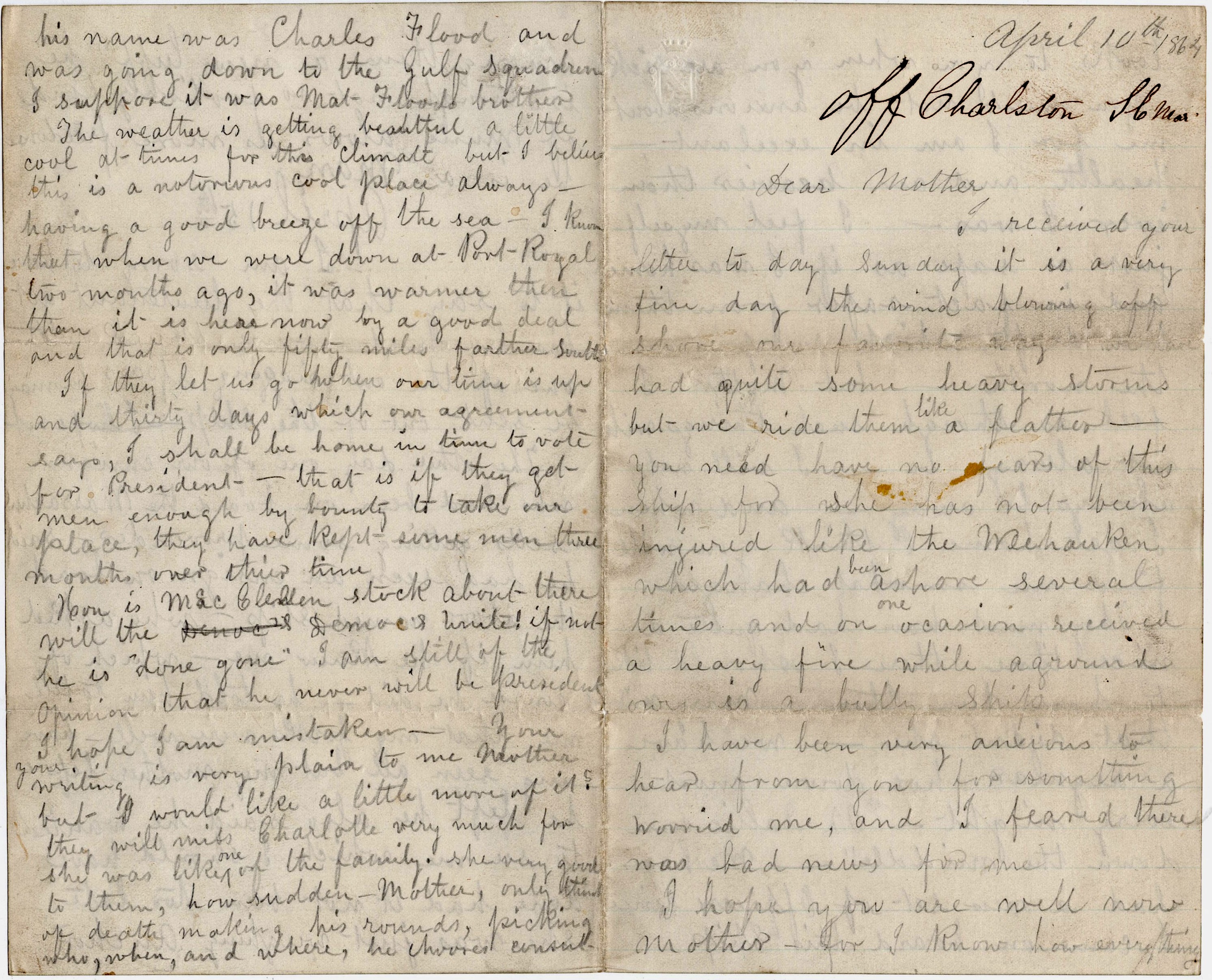
April 10th 1864
Dear Mother,
I received your letter today—Sunday. It is a very fine day, the wind blowing off shore, our favorite way. We have had quite some heavy storms but we ride them like a feather. You need have no fears of this ship [Montauk] for she has not been injured like the Weehauken which had been ashore several times and on one occasion received a heavy fire while aground. Ours is a bully ship.
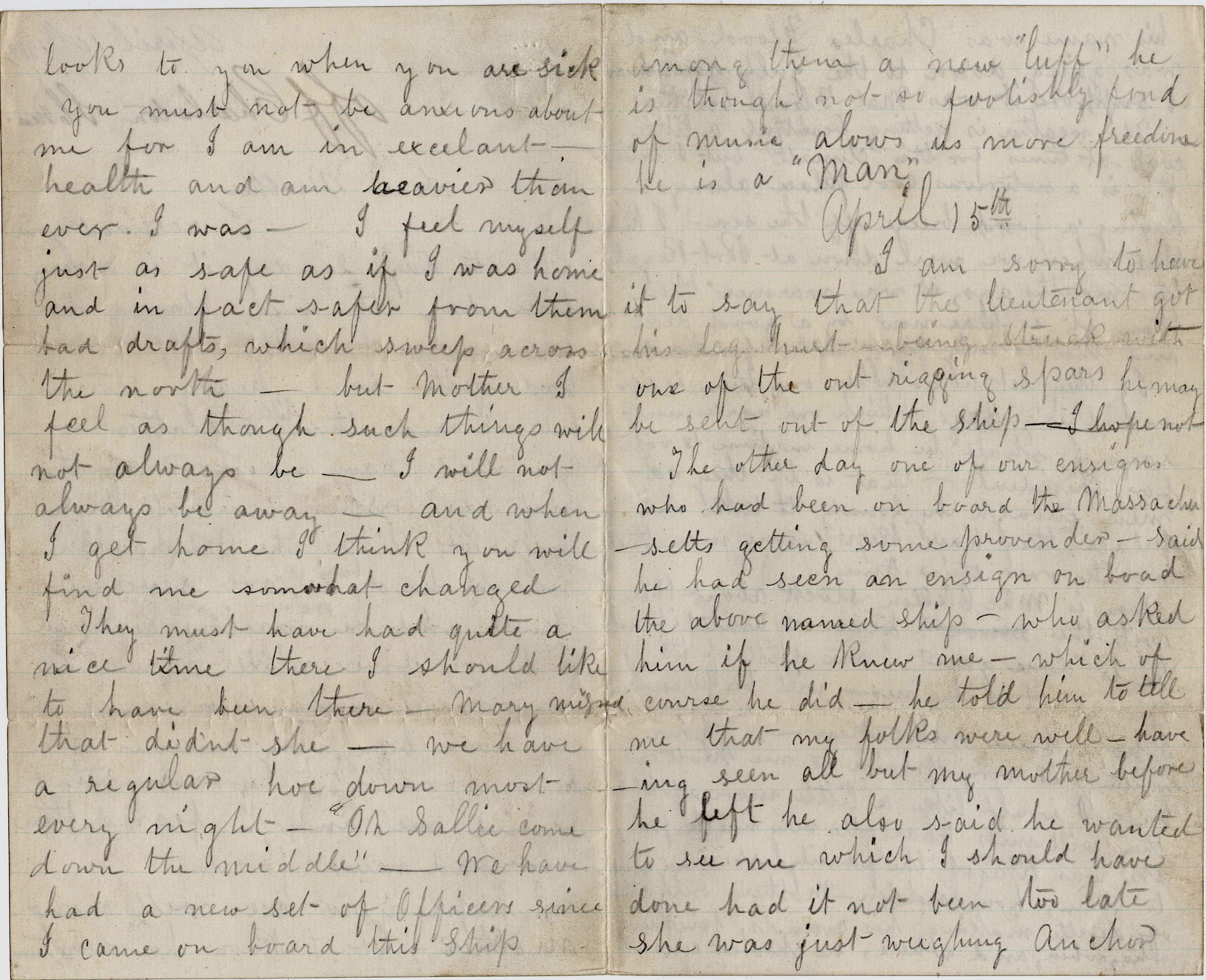
I have been very anxious to hear from you for something worried me and I feared there was bad news for me. I hope you are well now, Mother, for I know how everything looks to you when you are sick. You must not be anxious about me for I am in excellent health and am heavier than ever I was. I feel myself just as safe as if I was home and in fact, safer from them bad drafts which sweep across the North. But mother, I feel as though such things will not always be, I will not always be away—and when I get home, I think you will find me somewhat changed.
They must have had quite a nice time there. I should like to have been there. Mary missed that, didn’t she? We have a regular hoe down most every night. “Oh Sallie, come down the middle.” We have had a new set of officers since I came on board this ship—among them a new “Luff” [Lieutenant]. He is though not so foolishly fond of music [and] allows us more freedom, He is a “man.”
April 15th—I am sorry to have it to say that the Lieutenant got his leg hurt, being struck with one of the out rigging spars, He may be sent out of the ship. I hope not. The other day one of our ensigns who had been on board the Massachusetts getting some provender—said he had seen an ensign on board the above-named ship—who asked him if he knew me—which of course he did. He told him to tell me that my folks were well, having seen all but my mother before he left. He also said he wanted to see me which I should have done had it not been too late. She was just weighing anchor. His name was Charles Flood and was going down to the gulf Squadron. It suppose it was Mat Flood’s brother.
The weather is getting beautiful—a little cool at times for this climate—but I believe this is a notorious cool place always having a good breeze off the sea. I know that when we were down at Port Royal two months ago, it was warmer then than it is here now by a good deal and that is only fifty miles farther south.
If they let us go when our time is up and thirty days which our agreement says, I shall be home in time to vote for President—that is, if they get men enough by bounty to take our place. They have kept some men three months over their time. How is McClellan’s stock about there? Will the Democratic[crat]s unite? If not, he is “done gone.” I am still of the opinion that he never will be President. I hope I am mistaken.
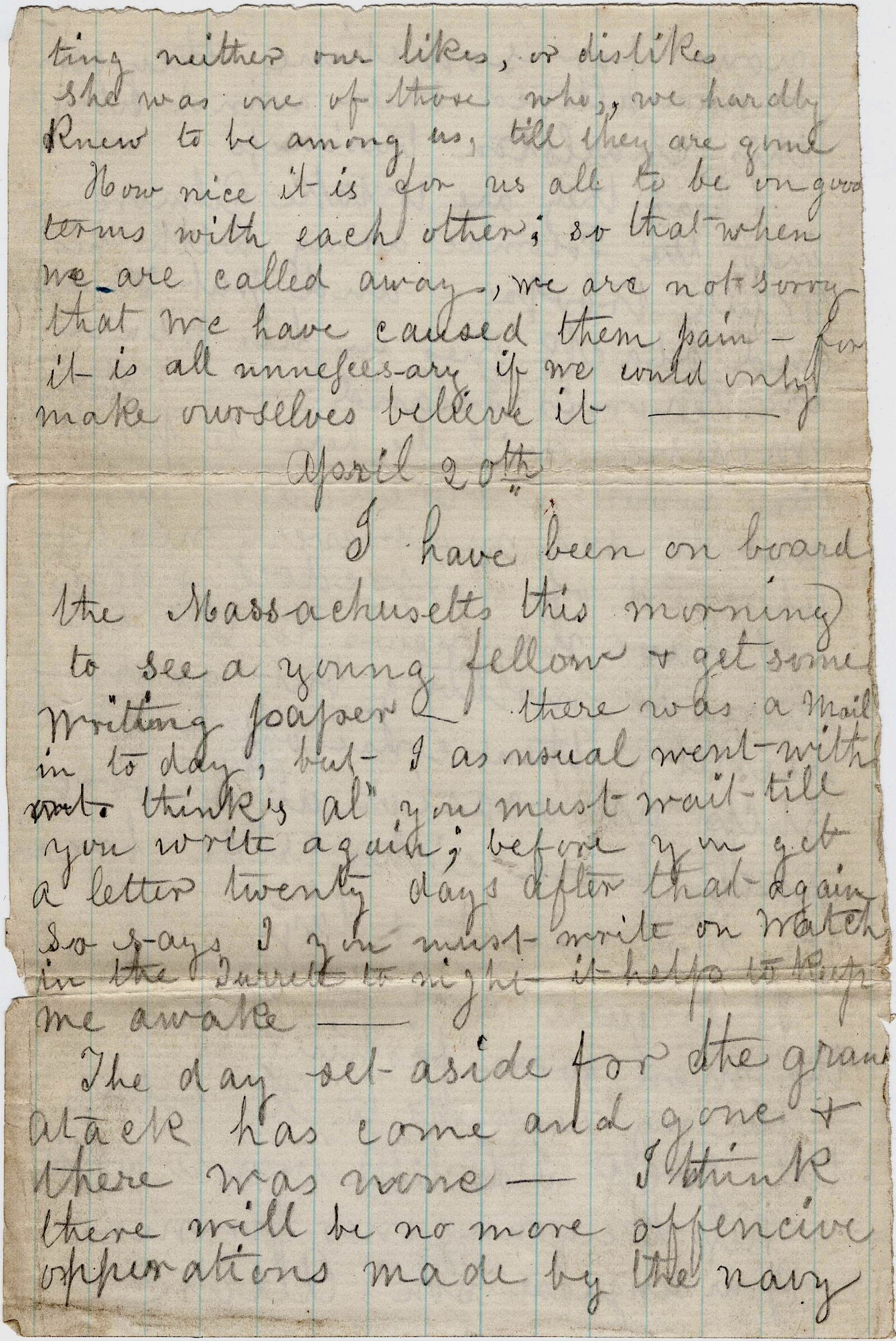
Your writing is very plain to me, Mother, but I would like a little more of it. They will miss Charlotte very much for she was like one of the family. She’s very good to them. How sudden, Mother. Only think of death making his rounds, picking who, when and where he chooses, consulting neither our likes or dislikes. She was one of those who we hardly knew to be among us till they are gone. How nice is it for us all to be on good terms with each other; so that when we are called away, we are not sorry that we have caused them pain—for it is all unnecessary if we could only make ourselves believe it.
April 20th—I have been on board the Massachusetts this morning to see a young fellow & get some writing paper. There was a mail in today but I as usual went without. Thinks I, “Al, you must wait till you write again before you get a letter twenty days after that again. So says I, you must write on watch in the turret tonight. It helps to keep me awake.
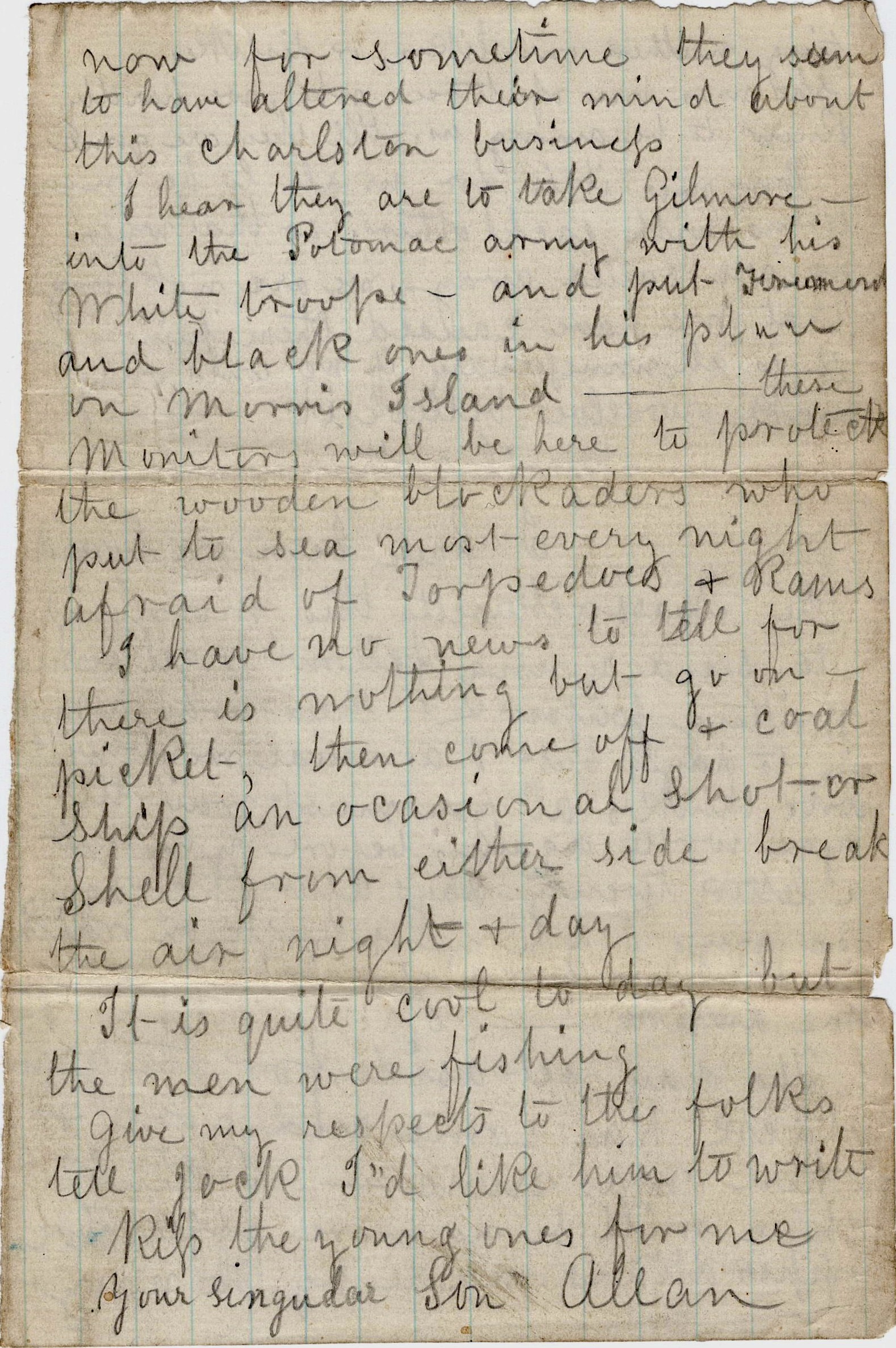
The day set aside for the grand attack has come and gone & there was none. I think there will be no more offensive operations made by the navy now for sometime. They seem to have altered their mind about this Charleston business. I hear they are to take Gilmore into the Potomac Army with his white troops and put Frémont and black ones in his place on Morris Island. These Monitors will be here to protect the wooden blockaders who put to sea most every night afraid of torpedoes & rams.
I have no news to tell for there is nothing but go on picketm then come off & coal ship, an occasional shot or shell from either side break the air night and day.
It is quite cool today but the men were fishing. Give my respects to the folks. Tell Jock I’d like him to write. Kiss the young ones for me, Your singular son, — Allan