My passion is studying American history leading up to & including the Civil War. I particularly enjoy reading, transcribing & researching primary sources such as letters and diaries.
The following letters were written by William Edgar Oakey (b. 1844) who enlisted at 18 years of age in August 1862 to serve as a private in Co. A, 127th New York Infantry. He mustered out with the company at Charleston, South Carolina, on 30 June 1865.
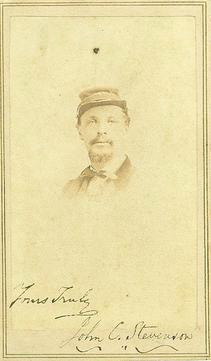
I could not find an image of William but here is a CDV of John C. Stevenson who mustered in and out of the same company with William.(Ancestry.com)
William was the son of Rev. Peter Davis Oakey (1816-1895)—a Presbyterian Clergyman—and Nancy Simpson (1818-1879) of Jamaica, Queens county, New York. (Note: the name is spelled Oakley at times.)
To read other letters by member if the 127th New York Infantry that I have transcribed and published on Spared & Shared, see:
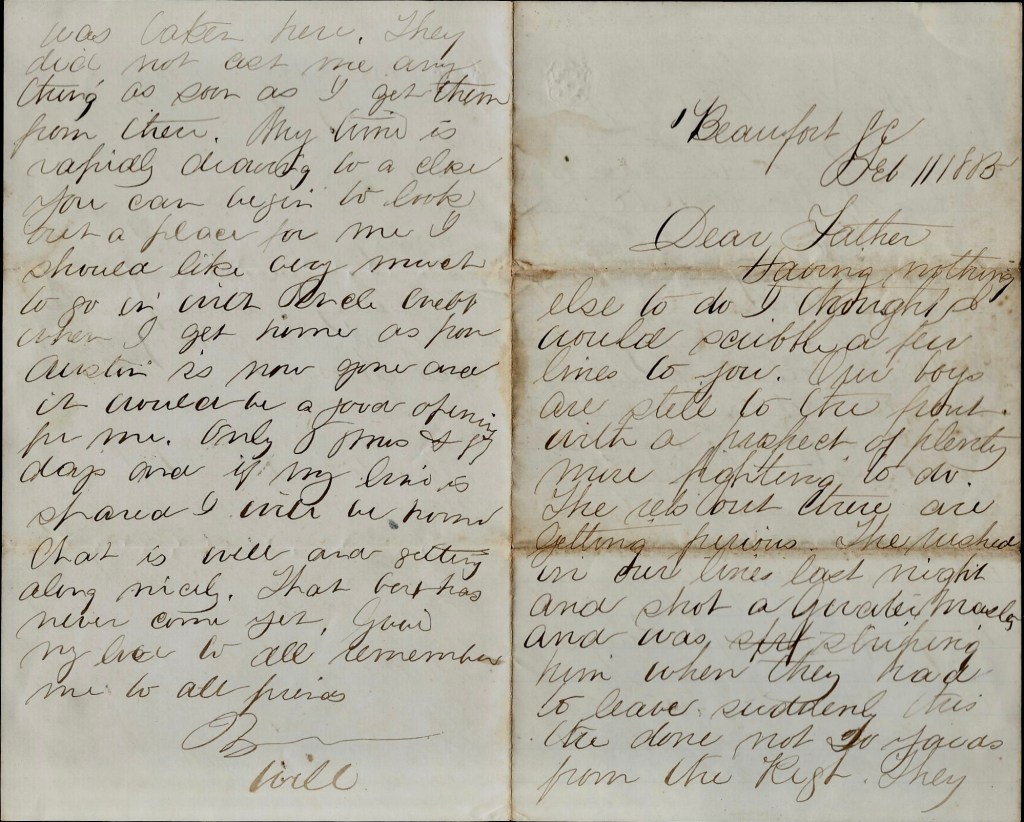
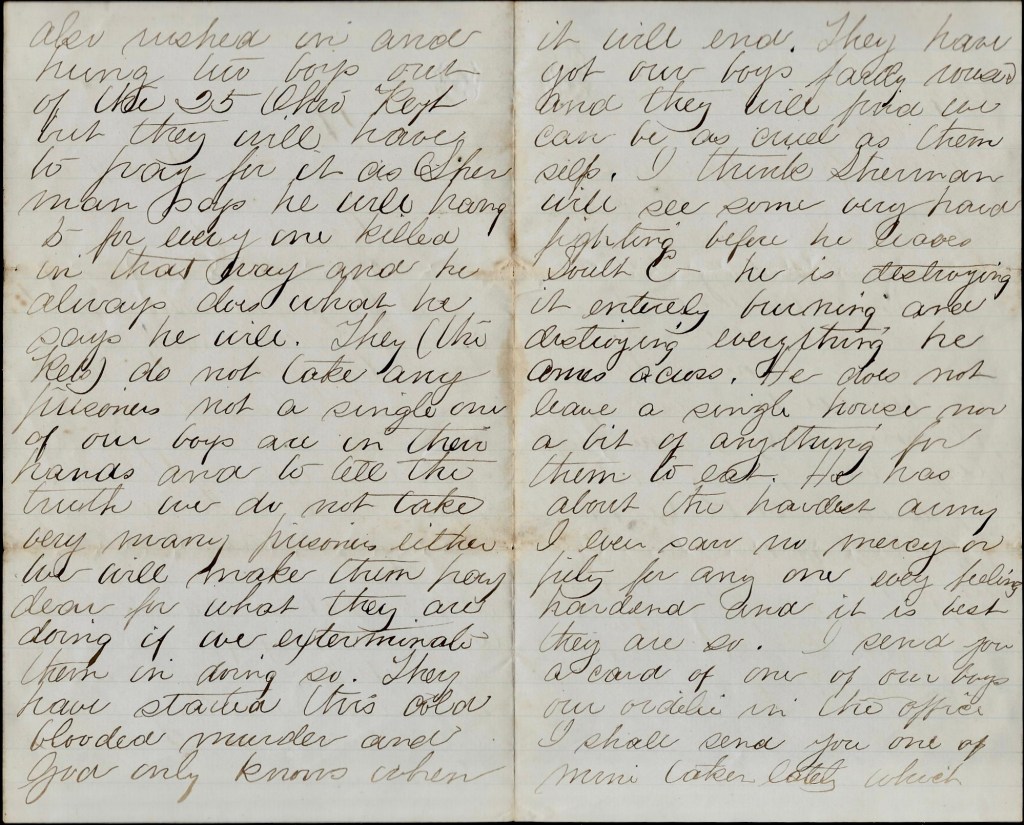
Having nothing else to do I thought I would scribble a few lines to you. Our boys are still to the front with a prospect of plenty more fighting to do. The rebs out there are are getting furious. They rushed in our lines last night and shot a quarter master and was stripping him when they had to leave suddenly. This they done not 20 yards from the regiment. They also rushed in and hung two boys out of the 25th Ohio Regiment but they will have to pay for it as Sherman says he will hang 5 for every one killed in that way and he always does what he says he will. They (the Rebs) do not take any prisoners. Not a single one of our boys are in their hands and to tell the truth, we do not take very many prisoners either. We will make them pay dear for what they are doing if we exterminate them in doing so. They have started this cold-blooded murder and God only knows when it will end. They have got our boys fairly roused and they will find we can be as cruel as themselves.
I think Sherman will see some very hard fighting before he leaves South Carolina. He is destroying it entirely—burning and destroying everything he comes across. He does not leave a single house nor a bit of anything for them to eat. He has about the hardest army I ever saw—no mercy or pity for anyone—every feeling hardened—and it is best they are so.
I send you a card of one of our boys—our Orderly in the office. I shall send you one of mine taken lately which was taken here—they did not cost me anything—as soon as I get them from there. My time is rapidly drawing to a close. You can begin to look out a place for me. I should like very much to go in with Uncle Crebb when I get home as poor Austin is now gone and it would be a good opening for me. Only 6 months and 17 days and if my life is spared, will be home. Chas. is well and getting along nicely. That box has never come yet. Good [bye]. My love to all. Remember me to all friends. — Will
Letter 2
Beaufort, South Carolina February 18, 1865
Dear Father,
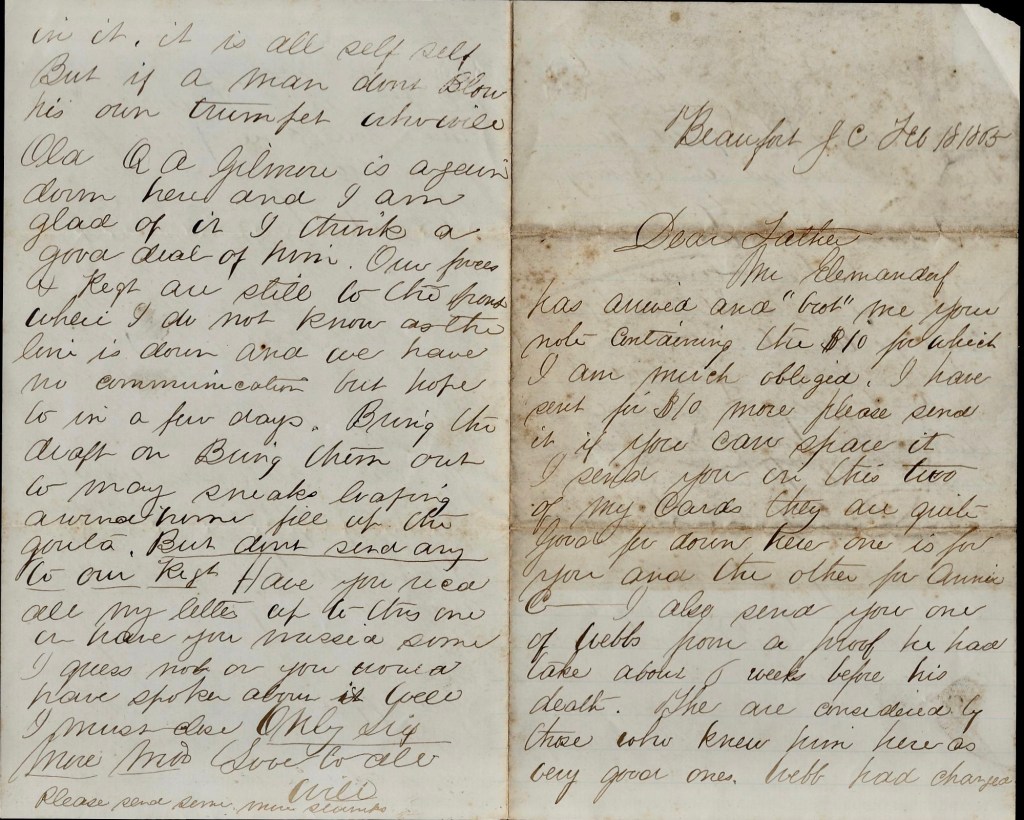
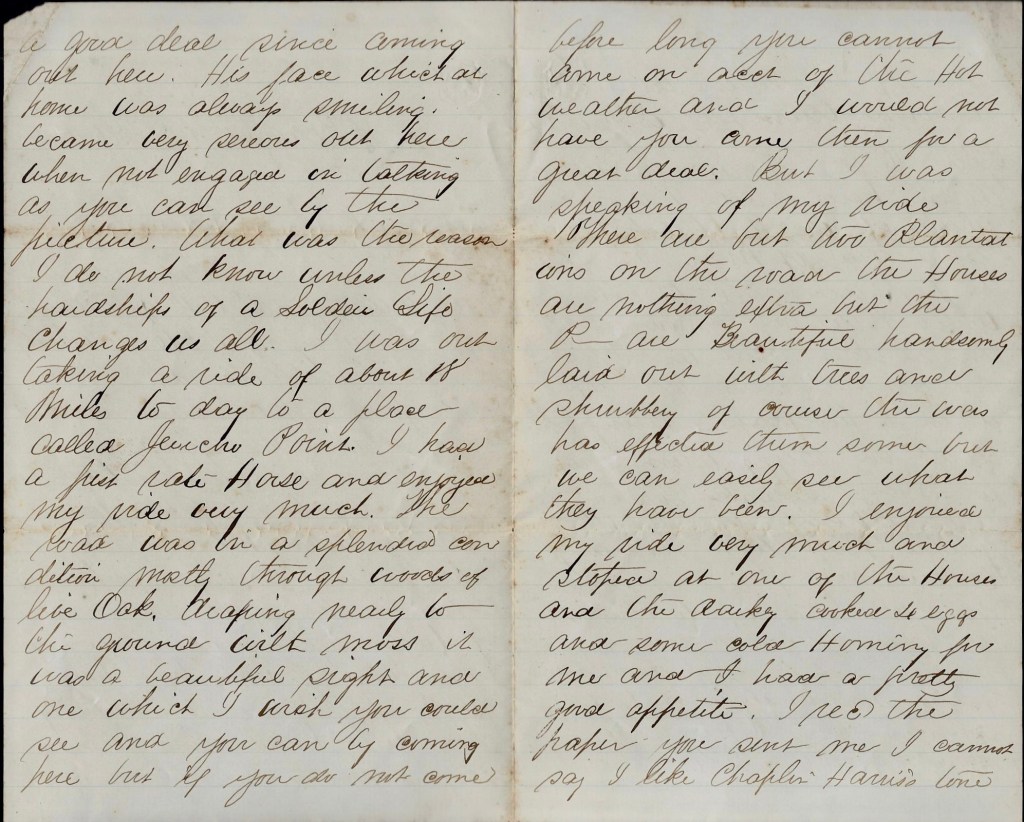
Mr. Elemanderf has arrived and brought me your note containing the $10 for which I am much obliged. I have sent for $10 more. Please send it if you can spare it. I send you in this two of my cards. They are quite good for down here. One is for you and the other for Annie C____. I also send you one of Webb’s from a proof he had taken about 6 weeks before his death. They are considered by those who knew him here as very good ones. Webb had changed a good deal since coming out here. His face which at home was always smiling became very serious out here when not engaged in talking as you can see by the picture. What was the reason, I do not know unless the hardships of a soldier’s life changes us all.
I was out taking a ride of about 18 miles today to a place called Jericho Point. I had a first rate horse and enjoyed my ride very much. The road was in a splendid condition mostly through woods of live oak, dropping nearly to the ground with moss. It was a beautiful sight and one which I wish you could see and you can by coming here but if you do not come before long, you cannot come on account of the hot weather and I would not have you come then for a great deal. But I was speaking of my ride.
There are but two plantations on the road. The houses are nothing extra but the plantations are beautiful—handsomely laid out with trees and shrubbery. Of course the war has affected them some but we can easily see what they have been. I enjoyed my ride very much and stopped at one of the houses and the darkey cooked 4 eggs and some cold hominy for me and I had a pretty good appetite.
I received the paper you sent me. I cannot say I like Chaplain Harris’s tone in it. It is all self self. But if a man don’t blow his own trumpet, who will ? Old [Quincy Adams] Gilmore is again down here and I am glad of it. I think a good deal of him. Our forces & regiment are still to the front. Where? I do not know as the [telegraph] line is down and we have no communication but hope to in a few days. Bring the draft on. Bring them out. Too many sneaks loafing around home. Fill up the quota. But don’t send any to our regiment.
Have you received all my letters up to this one or have you missed some? I guess not or you would have spoken about it. Well, I must close. Only six more months. Love to all. — Will
Please send some more stamps.
Letter 3
Beaufort, South Carolina April 24, 1865
Dear Father,
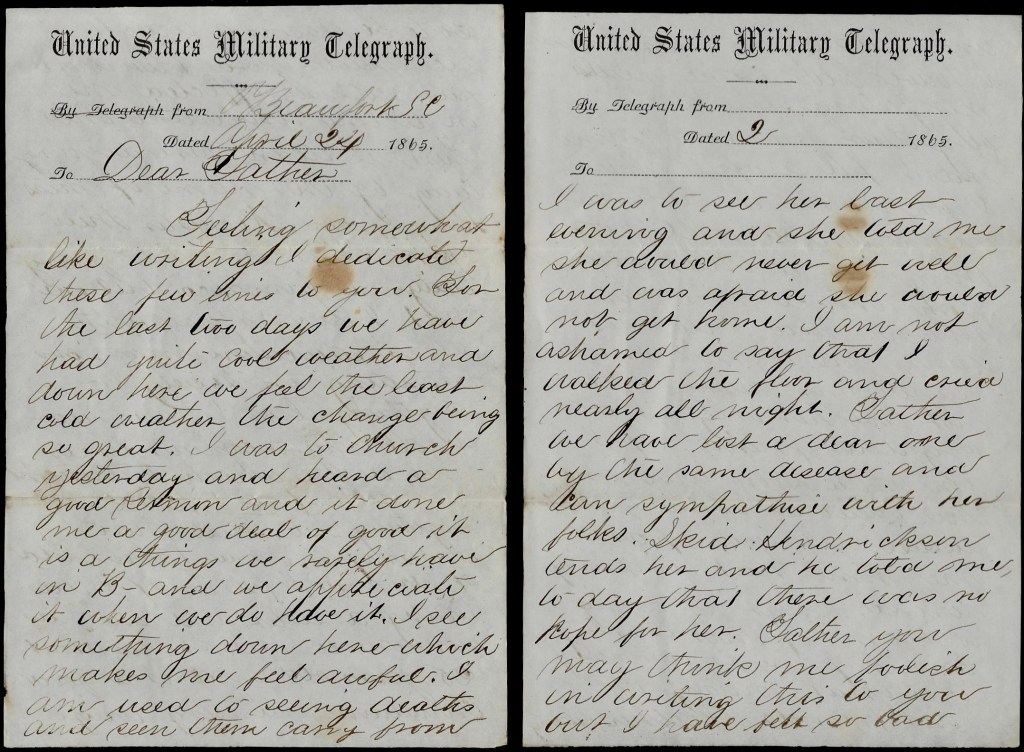
Feeling somewhat like writing, I dedicate these few lines to you. For the last two days we have had quite cool weather and down here we feel the least cold weather—the change being so great. I was to church yesterday and heard a good sermon and it done me a good deal of good. It is a thing we rarely have in Beaufort and we appreciate it when we do have it.
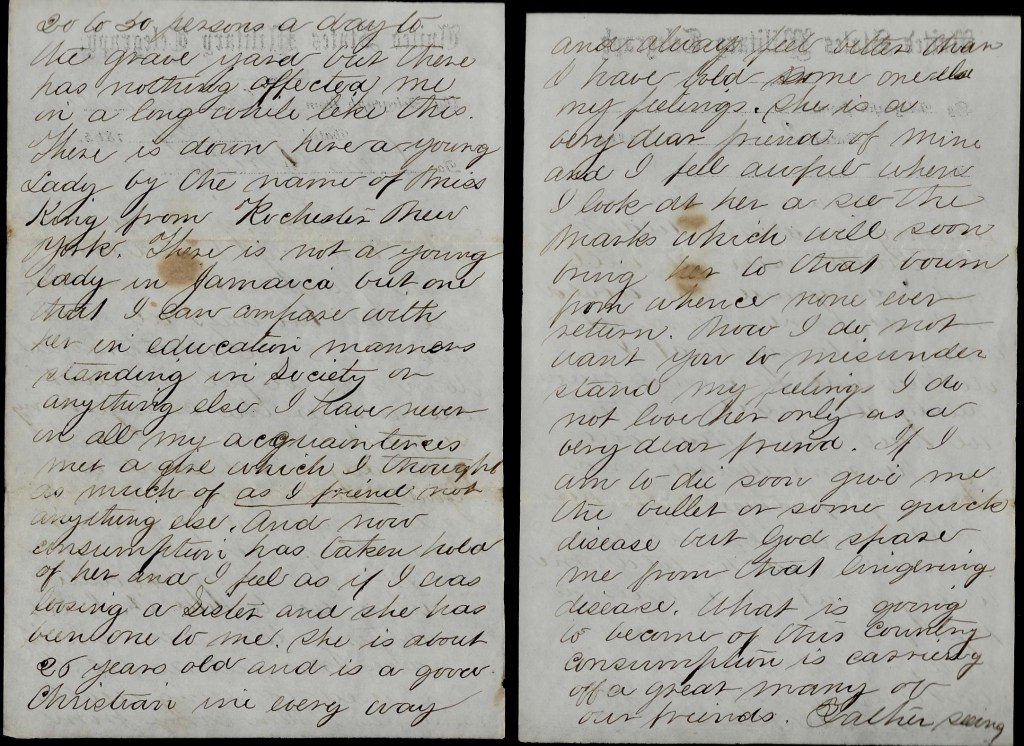
I see something down here which makes me feel awful. I am used to seeing deaths and seen them carry from 20 to 30 persons a day to the grave yard, but there has nothing affected me in a long while like this. There is down here a young lady by the name of Miss King from Rochester, New York. There is not a young lady in Jamaica [Long Island] but one that I saw compare with her in education, manners, standing in society, or anything else. I have never in all my acquaintances met a girl which I though so much of as a friend nor anything else. And now, consumption has taken hold of her and I feel as if I was losing a sister and she has been one to me. She is about 25 years old and is a good Christian in every way and always feel better than I have told someone else my feelings. She is a very dear friend of mine and I feel awful when I look at her and see the marks which will soon bring her to that [ ] from whence none ever return. Now I do not want you to misunderstand my feelings. I do not love her only as a very dear friend. If I am to die soon, give me the bullet or some quick disease but God spare me from that lingering disease. What is going to become of this country? Consumption is carrying off a great many of our friends. I was to see her last evening and she told me she would never get well and was afraid she could not get home. I am not ashamed to say that I walked the floor and cried nearly all night. Father, we have lost a dear one by the same disease and can sympathize with her folks. Skid Hendrickson tends her and he told me today that there was no hope for her. Father, you may think me foolish in writing this to you but I have felt so bad.
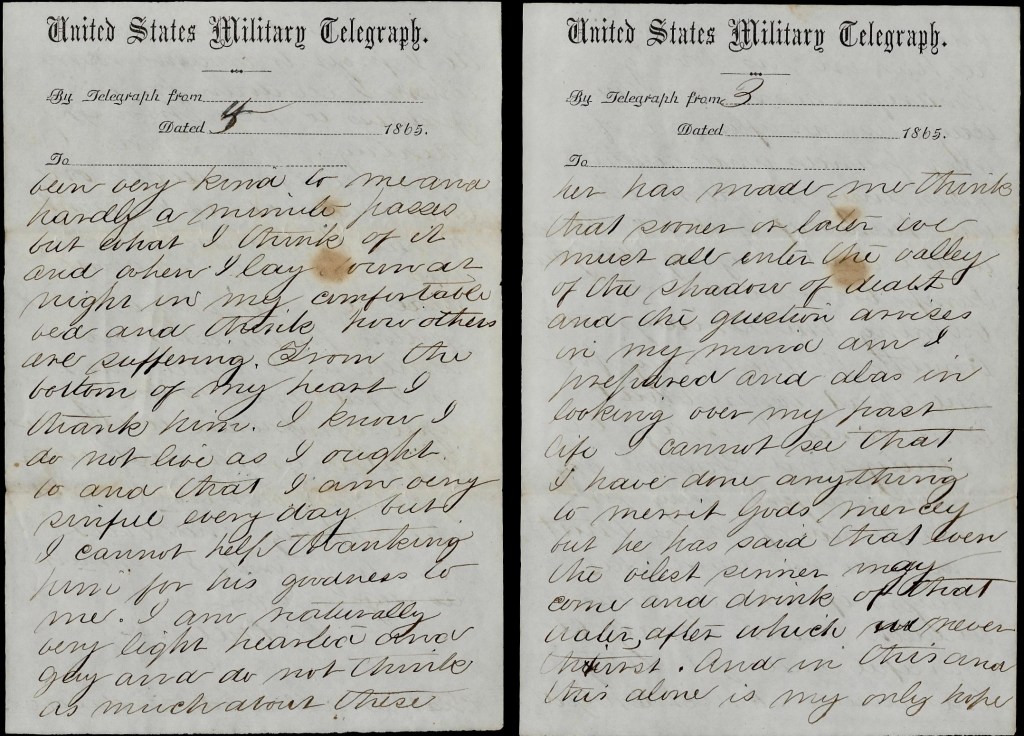
Father, seeing her has made me think that sooner or later we must all enter the valley of the shadow of death and the question arises in my mind, am I prepared? And alas, in looking over my past life, I cannot see that I have done anything to merit God’s mercy. But He has said that even the vilest sinner may come and drink of that water after which we never thirst. And in this and this alone, my only hope and thanks be to Him. He has in his loving kindness shown me the way. As one after one of my friends and relatives pass away, it seems like the hand of God pointing to me and saying, “Let your lamp be trimmed and burning—the Bride groom cometh.” Father, pray for me that when that times comes, I may be ready and Father, in your prayers, pray for this friend of mine that God who has said the prayers of the righteous [ ] much may be merciful and yet stay this distance which Oh God, as I should but never do, I forget to thank Him when I lie down for his goodness to me through the ay. You know I do not talk much on this subject as I think too much show has but I think a good deal. Do not think me foolish for what I have written as I write just as I feel and knowing you sympathize with me, I feel a great deal better. Give my best love to all the family and with love to yourself, I remain as ever, your Will
The following letters were written by 43 year-old Pvt. William (“Bill”) Buford Ayers (1820-1892) of Co. B, 28th Virginia Infantry who was recruited into the regiment on 17 August 1863 at Bedford, Virginia, for the duration of the war.
A middle-aged Reb holding a flintlock musket
William was the son of John Wesley Ayers (1787-1848) and Mary C. Powers (1788-1859) of Bedford county, Virginia. He was married in 1856 to Charlotte Morgan Lukens (1839-1920). Several of William’s brothers fought for the Confederacy. Pvt. James Wayne Ayers (1812-1890) of Lowry’s Company, Virginia Light Artillery. John and Samuel served in Co. I, 58th Virginia Infantry. Another brother, Elijah Quarles Ayers served with William in the 28th Virginia, Co. K, from the time of its formation until his death on 10 August 1862 from wounds received at the Battle of Seven Pines on 1 June 1862. A younger brother, Richard P. Ayers, served in Co. I, 58th Virginia Infantry and later transferred to Co. F, 2nd Virginia Cavalry until he was taken prisoner at Gettysburg and died of disease as a POW at Point Lookout, Maryland in January 1864. Jonathan Hersey (“Herse”) Ayers (1824-1887) served in Co. B, 14th Virginia Infantry.
Letter 1
Union prisoners being guarded by Rebel troops on Belle Isle at Richmond, Virginia.
Camp Lee (west side of Richmond, Va.) November 8th 1863
I again take my seat to drop you a few lines to let you know how we are a getting along. I and Cap are both well and hearty & have been & I hope when these few lines come to hand, you may all be enjoying the same great blessing. I have no strange news to write. We have moved in to our winter quarters. They are very comfortable plank houses with brick chimneys in the middle. They are set in the rear of head quarters. There is about one hundred men to a house. There is six men to a bunk, 3 in a berth. I and Cap & Wm. B. Jones sleep together. We sleep very warm. We have 12 blankets. I have 3 and a oil cloth. Cap has 2. Jones has 7.
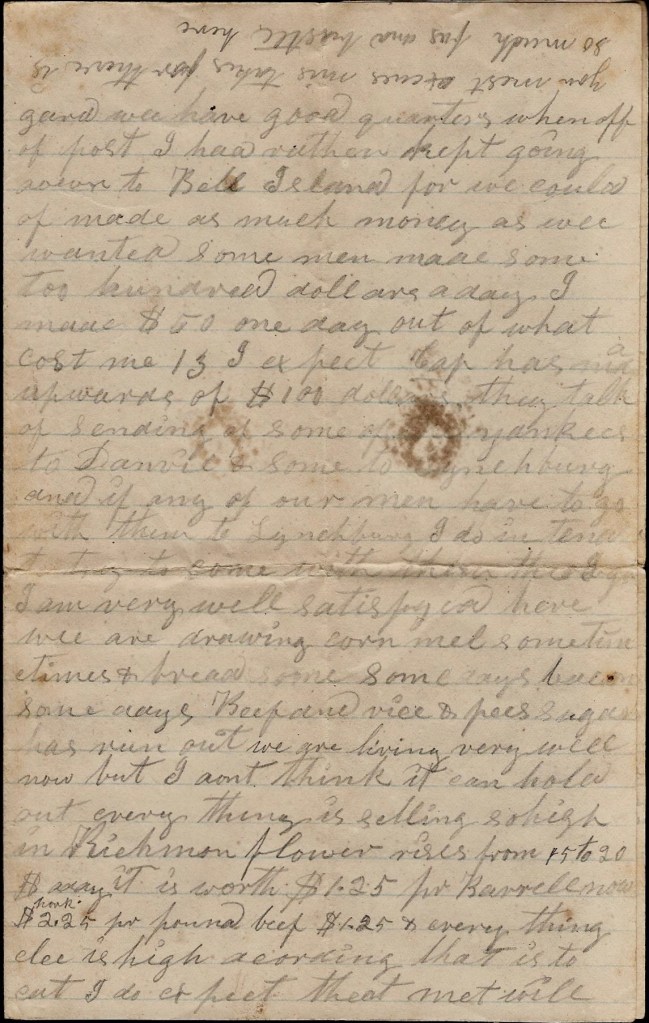
We are guarding. The Yankees has little now down close to the Rocketts [Landing]. We have a long walk. We leave our camp at 8 o’clock in the morning & get back about ten next day. It is a very good place to stand guard. We have good quarters when off of post. I had rather kept going down to Belle Island for we could of made as much money as we wanted. Some men made some two hundred dollars a day. I made $50 one day out of what cost me 13. I expect Cap has made upwards of $100 dollars. They talk of sending some of the Yankees to Danville & some to Lynchburg and if any of our men have to go with them to Lynchburg, I do intend to try to come with them.
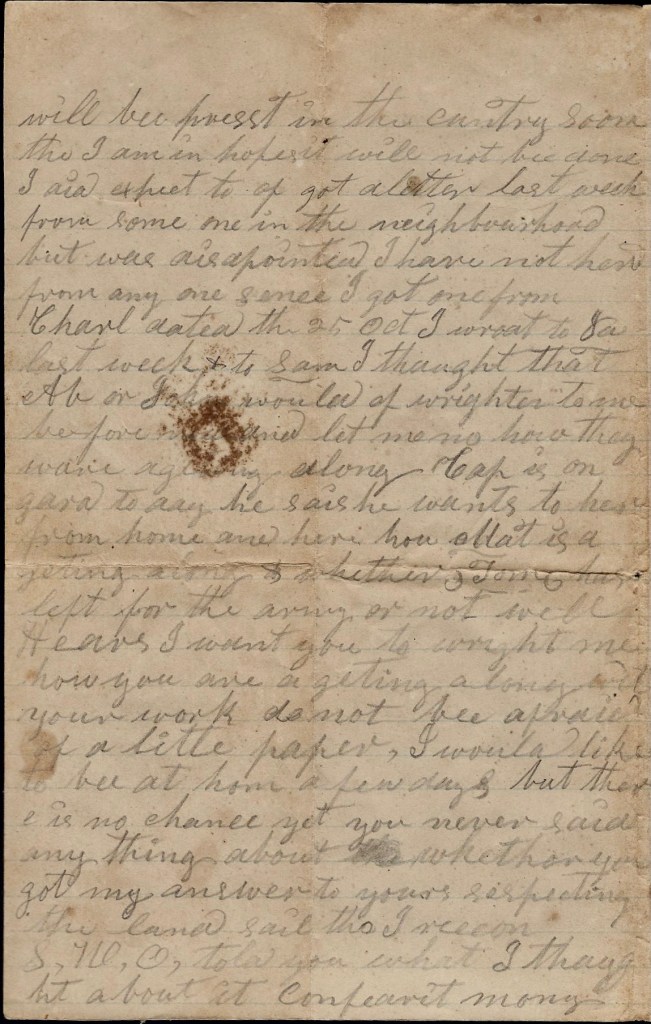
I am very well satisfied here. We are drawing corn meal sometimes & bread some days. Bacon some days, beef and rice & peas. Sugar has run out. We are living very well now but I don’t think it can hold out. Everything is selling so high in Richmond. Flour rises from 15 to 20 dollars a day. It is worth $1.25 per barrel now. Pork $2.25 per pound. Beef $1.25 & everything else is high according that is to eat. I do expect that meat will be pressed in the country soon though I am in hopes it will not be done.
I did expect to of got a letter last week from someone in the neighborhood but was disappointed. I have not heard from anyone since I got one from Charl[otte] dated the 25th of October. I wrote to James last week 7 to Sam. I thought that Ab or John would of written to me before now and let me know how they were a getting along.
Cap is on the guard today. He says he wants to hear from home and hear how Mat is a getting along and whether Tom has left for the army or not.
Well, Herse, I want you to write me how you are a getting along with your work. Do not be afraid of a little paper. I would like to be at home a few days but there is no chance yet. You never said anything about whether you got my answer to yours respecting the land sale though I reckon S.W.O. told you what I thought about it. Confederate money will not buy land about here now.
Well, Herse, if I had the chance of being free now and had the chance to trade here, I could make as much money as i would want. Shoes are worth from $20 to 50. Boots $15 to 75. If I had my leather made in shoes and here, it would bring a pile. Well, Charl[lotte], I want to see you very bad. I hope I have your prayers to sustain me this out of trouble. [I’m] hoping the time will soon come that we will soon see each other on earth. But if it is not our lot, I hope to meet you in heaven. Take care of the children. I must close hoping to hear from you all soon. You have my best wishes. May God bless you all is my prayer. So no more but remain your husband and brother till death. — Wm. B. Ayers
to C. M. Ayers & J. H. Ayers
You must excuse mistakes for there is so much fuss and bustle here.
Letter 2
Camp Lee June 9th 1864
Dear Brother & Wife,
I take this opportunity to let you know that our company has been disbanded & the most of us have to go to the field. I expect to go to the 28th Regiment & all the rest of the Bedford boys will go there too.
Well, Herse, I have sent another box to Liberty by the express. I started it today & I want you to get it home as soon as you convenient so they may be saved. They are packed very tight and are sort of damp. You will see a list of each man’s things sent in the box. you can open to take out my & Cap’s things. The box is J. B. Miles, his wife, so when it comes. Also E[dward] T. Nances’ wife also, so they may get them.
I am sorry to have to leave here on account of being convenient to the Post Office. I fear I cannot hear from you all often when I leave here. I don’t think anything will hurt me if I can shun the balls. I can hope for the best if the worst comes. I do not want any of you to be uneasy about me for I am going to try to take care of number one. Those lines leave me well and hope when they come to hand, it may find you all well.
Cap was sent before the board today & was sent back to the hospital again. He is about like he has ben for some time. I do not know where to tell you where to send your letters to till I get to my command. you can write to Cap. He may stay here some time. Our army is close round Richmond. I expect you know as much about the war news as I can tell. I have seen all of the late cavalrymen here so I will sign off hoping you all may be spared to live & make out well.
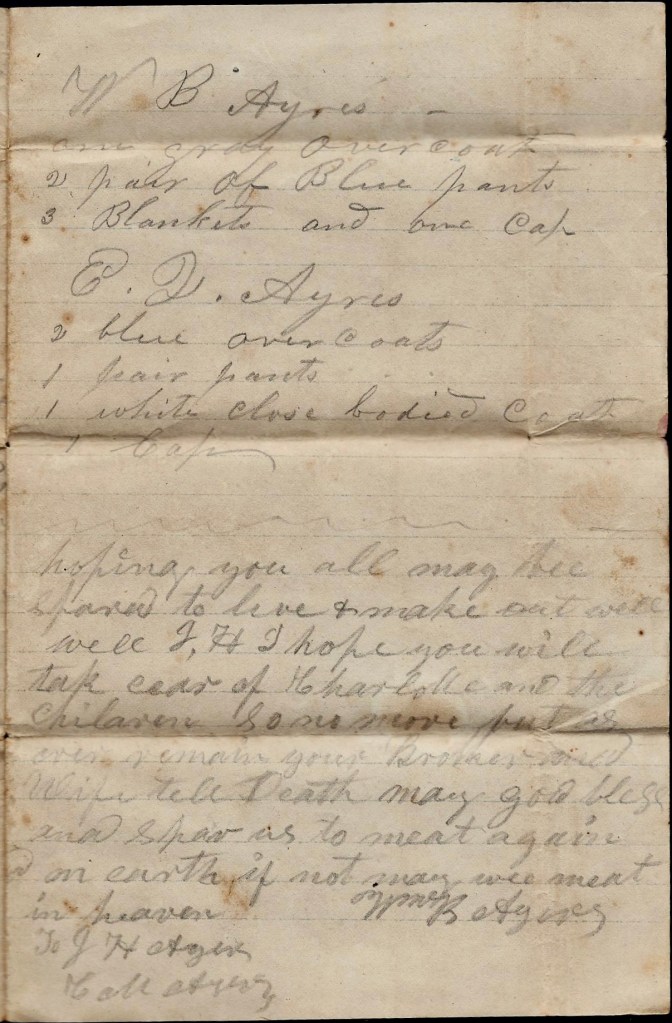
Well, J. H., I hope you will take care of Charlotte and the children. So no more but as ever, remain your brother and wife [husband] till death. May God bless and spare us to meet again on earth. If not, may we meet in heaven. — Wm. B. Ayers
to J. H. Ayres & C. M Ayers
[List of clothing sent in box belonging to W. B. Ayres, E. Q. Ayres, E. G. Nanees, and J[oseph] R. Miles.]
Letter 3
Camp near Chester Station June 19th 1864
Dear wife,
I take this chance to send you a few lines as Mr. Wi____ K______tt is in camp. I have no good news to write. I left Camp Lee [the] 9th & got to the Regiment the 12th. Then started the next day on a march. We went some 15 miles that day & rested 2 days. Then we had a forced march across the south side of the James River where we met up with the Yankees & gave them a hot time for awhile & drove them out of our breastworks. We lost some few killed & some wounded. We are right in front of them now in our breastworks firing into each others pickets. We had a hot skirmish fight yesterday. We had several killed & some wounded. I guess we will have a hot time here soon.
I was in one skirmish fight. The balls whistled like bees round me but none never touched me. One ball went through E[dward] T. Nance’s pants & burnt his skin a little. We have had a very hard time since I have been with the company though I have stood it very well. I feel very well today & I hope I may have good health so I may be able to do my duty as a soldier.
Dear wife, I do not want you to make your self uneasy about me. If I ever have the misfortune to never see you again. I hope you may be spared to have good health so you can raise our children [even] if we are run over with the Yanks. I hear the Yankees is up in Bedford [County] now. I am afraid they may come in to our neighborhood & destroy all you have to live on though I hope they may be drove back from there.
I am in the 28th Regiment, Company B, from Craig county. They are quite clever men & I am very well pleased. All of our Bradford boys are here with me. I saw J. M. J. Ayers the 11th but did not have the opportunity of talking to him. He was well. I left Cap at the hospital at Camp Lee. He was no better. Tell [my brother J. H. [Ayres] I am in hopes he can stay at home so he can make something to go on.
Well I must close for this time as I am in a hurry. My respects to you and to all who may enquire after me. May God bless and spare us to see each other again is my prayer. So goodbye for this time. From your true husband, — Wm. B. Ayres
to C. M. Ayres
Direct as follows:
William B. Ayres Richmond, Virginia Pickett’s Division Hunton’s Brigade 28th Regiment Va. Vol. Company B
N. B. I sent a box of clothes by the express to Liberty the 9th and sent you a letter to that effect. if you did not get it, you can send for the things—i.e., mine and Caps, Jo Miles, and E. T. Nance’s.
Letter 4
Camp Chester October 16th 1864
Dear Wife,
I again seat myself to drop you a few lines to let you know that I am tolerable well and hope when this comes to hand it may find you all enjoying the best of health. I am at a loss of what to write to you at this time for it has been so long since I have got any letter from Bedford that I do not know what to think is the cause. I received yours of the 24th of September. That was the last I have heard from anyone up there. This is the 4th letter I have written since I have got one. I am more than anxious to hear from you all & the relation generally.
I can say we are at the same place where we have been ever since we crossed the James River. It is thought now we will stay here this winter. We have put up very good log huts for winter quarters. I have a good one with a brick chimney to it. It is very good cool nights. We have had some very heavy rains of late & some very heavy frosts.
As for war news, I do not know what to say but it does seem like the men are becoming very tired now & I fear from the present prospect it will go on for a long time yet if we can hold out with men & provisions. But the most of the men say they will not stay any longer than next spring. Times here is very hard & from what I learn, it is getting so in the country. I fear the women and children will suffer this winter as well as the soldiers. There is a good many desertions now but if men have their wives and children in want, I fear the army will be broken up.
There has been no fighting in our front. There was a fight on the north side of the Darbytown Road [see Battle of Darbytown Road] Wednesday and we whipped the Yanks.
Well, Charl[otte], under the late order, I guess [my brother] Herse has left for the army by this time & all the rest of the detailed men & I do not [know] how you will make out. I want you to write to me what for a crop you all have made this year & how the molasses & corn turned out, and what is the chance for another year’s meat. I have most forgot about the killing of hogs. If you think you will be scarce of meat and you have not sold those two little steers, you had better fatten one and kill it for a beef though I want you to do what you think is the best for I have [no way to] help you now. I do not know what Herse is a doing or has done; consequently I cannot advise much what you had better do. If Ab has not gone in the service, I am in hopes he will write me soon and give me the points. Also tell Cap to write and let me know how he is a getting along. Tell him B. Leftwih is [in] our company.
Well, as I cannot get any letters by the mail, Mr. R. Debo is at home and if you can contrive a letter to him when he comes back, he will bring it. Well, I will close for this time as I do not think of more than will interest you at this time. I have written so often since I have heard from you all I do not want to say more.
J[oseph] R. Miles sends his respects to you all. He looks somewhat thin but is well except a bad cold. E[dward] T. Nance is improving. C. W. Allen is well.
Charl[lotte], you do not know how bad I do want to see you and the children. you must take care of them & do the best you can. May God bless us and grant us the privilege of seeing each other once more in peace is my prayer. From your true friend and husband, — W. B. Ayers
To C. M. Ayers
Letter 5
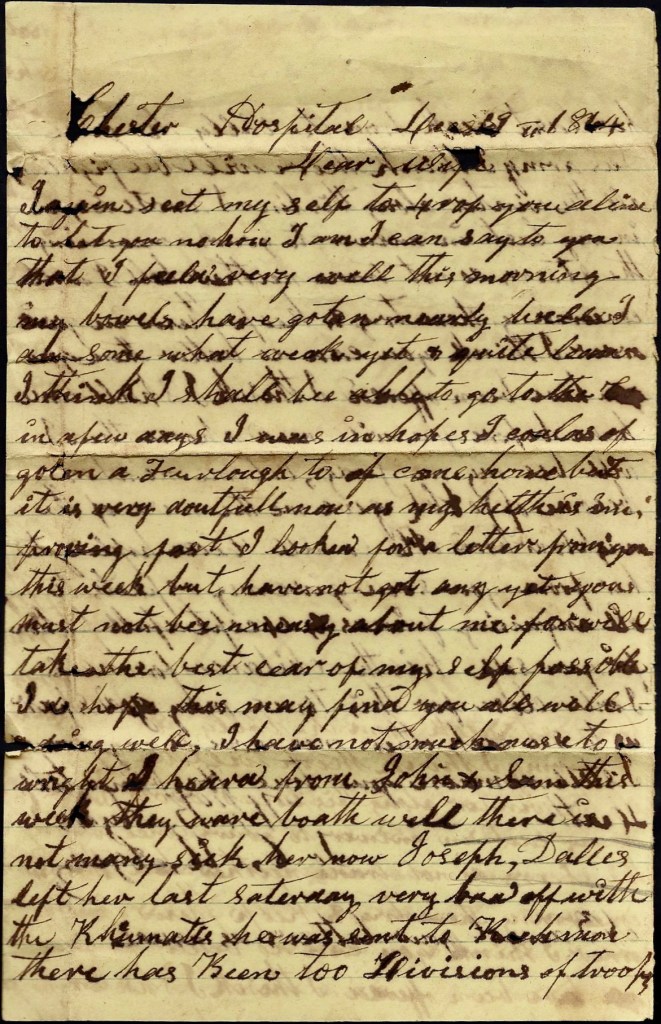
Chester Hospital December 19th 1864
Dear Wife,
I again seat myself to drop you a line to let you know how I am. I can say to you that I feel very well this morning. My bowels have got nearly well. I am somewhat weak yet & quite lame. I think I shall be able to go to the regiment in a few days. I was in hopes I could of gotten a furlough to come home but it is very doubtful now as my health is improving fast. I looked for a letter from you this week but have not got any yet. You must not be worried about me for I will take the best care of myself possible. I do hope this may find you all well and doing well.
I have not much news to write. I heard from John & Sam this week. They were bother well. There is not many sick here now. Joseph Dalles left here last Saturday very bad off with the rheumatism. He was sent to Richmond. There has been two divisions of troops here last week from the alley to join Lee’s army. I think there will be fighting all the winter along this line.
I wrote to you in my last letter in answer to yours concerning the steers. Do not trade neither till I write concerning them. Try and keep them in good order. I think you can do better than you have been offered. I think I shall come home before you will need a horse. Then I will be my own judge. Let me know what became of Ab. Give me the news of the neighborhood. So I will close hoping to hear from you son. Give my respects to all enquiring friends & accept a full portion for yourself. Kiss the children for me. So I will close for this time. May God spare us to see each other once more is my prayer. I still remain your true husband till death. — Wm. B. Ayers
To C[harlotte] M. Ayers
N. B. Direct your letters as usual.
Letter 6
Camp near Chester January 22, 1865
Dear Wife,
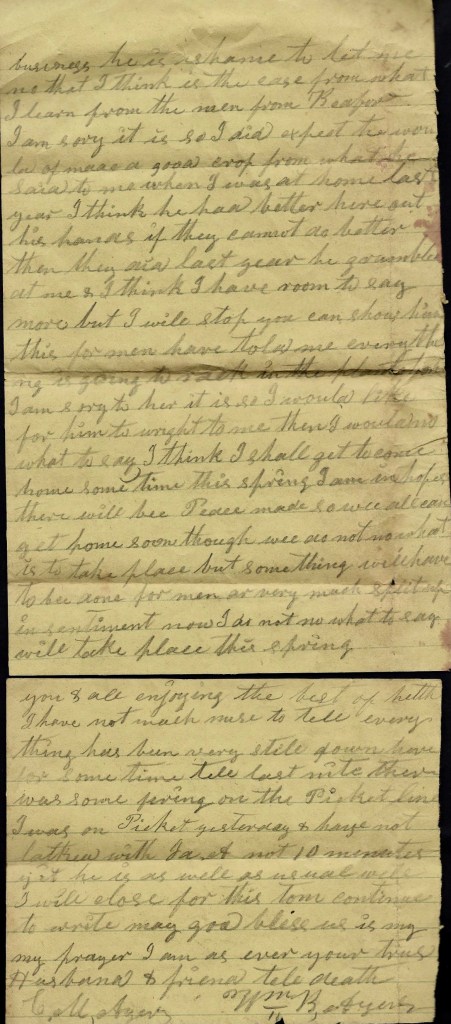
I am glad to inform you that I received yours of the 14th & of the 7th & was glad you was beset with health. I received those things you sent by Jas. A. & Cap alright. Jas. got here yesterday. Cap went to Camp Lee. I am in hopes he will have the luck to come back home again from what Jas. said about him. I was much pleased with your present to me as a Christmas & New Year’s gift. I do not know when I can pay you for it but I am in hopes I can come & bring it myself though I do not know when it will be. I was glad to have [my brother] Herse had the good luck to come home. I tried to get a furlough to come home while he was there but there is no chance now for me. I’m at a loss to know what to say to him to do as he has been so dilatory about writing to me. I guess he does not want me to know what he is a doing with things at home else he would of let me know. He has done such sorry business, he is ashamed to let me know that I think is the case from what I learn from the men from Bedford. I am sorry it is so. I did expect he would be of made a good crop from what he said to me when I was at home last year. I think he had better hire out his hands if they cannot do better than they did last year. He grumbled at me & I think I have room to say more but I will stop. you can show him this for men have told me everything is going to rack in the plantation. I am sorry to hear it is so. I would like for him to write to me. Then I wouldn’t have to say.
I think I shall get to come home sometime this spring. I am in hopes there will be peace made so we all can get home soon though we do not know what is to take place but something will have to be done for men are very much split up in sentiment now. I do not know what to say will take place this spring. I am in [hopes] from what I can learn that things will change soon. If not, I do not know what the people in the country will do for I learn the press masters are taking most everything that the women and children will do to live. But I believe everybody is for self now and I fear that God is for not many. Tell [my brother] Hearse to write & give me a history of his travels if he will not of home & our business.
This leaves me quite well at this time hoping it may find you & all enjoying the best of health. I have not much news to tell. Everything has been very still down here for some time till last night there was some firing on the picket line. I was on picket yesterday and have not talked with Jas. A. not ten minutes yet. He is as well as usual. Well, I will close for this time. Continue to write. May God bless us is my prayer. I am as ever your true husband & friend till death, — Wm. B. Ayers
to C. M. Ayres
Letter 7
Camp near Chester February 5, 1865
Dear wife,
I again will try and answer yours of 22nd and of the 30th. I was very uneasy when I heard [our son] Milton was sick though you said you would attend to him. That I was satisfied you would do. You said [my brother] Herse had been to Lynchburg & had got 100 dollars [ ] for the Brandy. That looks like a big price but if he has to buy anything, it will not count much—at least from what you said in your last. Herse had not gone back when you wrote.
You said you all was laid up with bad colds. I was sorry to hear that but its common with as cold winter like this has been. Last Friday and Saturday was as cold here as I ever saw. The James River was frozen solid from bank to bank. It would of bore a man to of crossed on it. I saw it myself. I went to see John & Sam at Chaffin’s Farm. I guess they are both at home now from what I have [heard] since I left them. They looked like they were very well smoked & was sick of their hard times [I] am down with the same complaint but I cannot help myself. But I am in hopes there is a better day coming soon. If not, it will be a heap worse. Some men are hope up with the idea of peace as there is men gone to Washington on that business. I fear it will be to no effect.
There is not much [fighting] on our lines. Looks like peace. But the boys have a good deal of fun playing ball. Times is hard & rations scarce. But the men looks very well. From what I learn, we are doing better than some in the country. We never eat but twice a day. I have had plenty for some time but Old Jeff did not furnish it….You said in one of your letters to me something about sending Laura to school. I want her to go all good weather. Tell her she must be smart and learn how to read for Pap when he comes home.
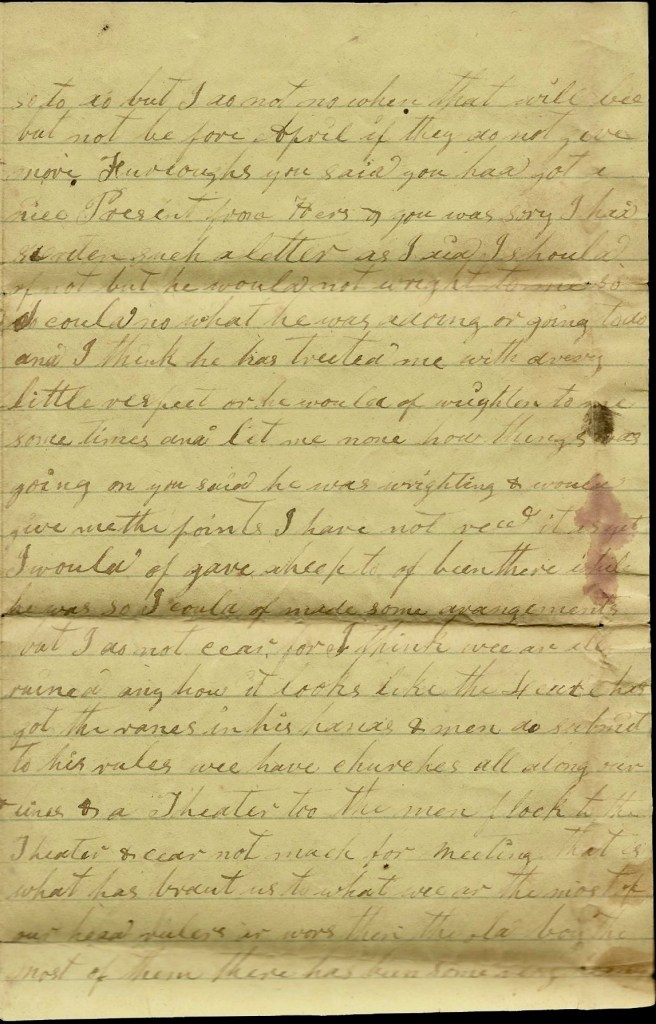
You said I must come and bring you a present. I would so to do but I do not know when that will be but not before April if they do not give more furloughs. You said you had got a nice present from Herse & you was sorry I had written such a letter as I did. I should of not but he would not write to me so I could know what he was a doing or going to do and I think he has treated me with very little respect or he would have written to me sometimes and let me know how things was going on. You said he was writing and would give me the points. I have not received it as yet. I would of have gave a heap to of been there while he was so I could of made some arrangements but I do not care for I think we are all ruined anyhow. It looks like the [ ] has got the reigns in his hands & men so submit to his rules. We have churches all along our lines & a theatre too. The men flock to the theatre & care not much for meeting. That is what has brought us to what we are. The most of head rulers are worse than the old boys, the most of them.
There has been some very heavy shelling over towards Petersburg for the last two days. That does not sound much like peace. Well, Charl[lotte], you must not be uneasy about me. Try and do the best you can for yourself & children till I can come. I am in hopes [brother] Herse will write to me before he goes back. This leave me well as common. I am gaining in flesh very fast. The health of our company is very good now. You must excuse bad writing for my eyesight is so I cannot see to write. I guess I have said enough for this time as I said too much in my last. I want you to tell John I want him to not to forget to do what he promised he would do for me concerning a [ ]. Jas. & T is well. I have not heard from Cap yet [or] what he is doing. My love to you. Kiss the children for me. Give my respects to all. — Wm. B. Ayers
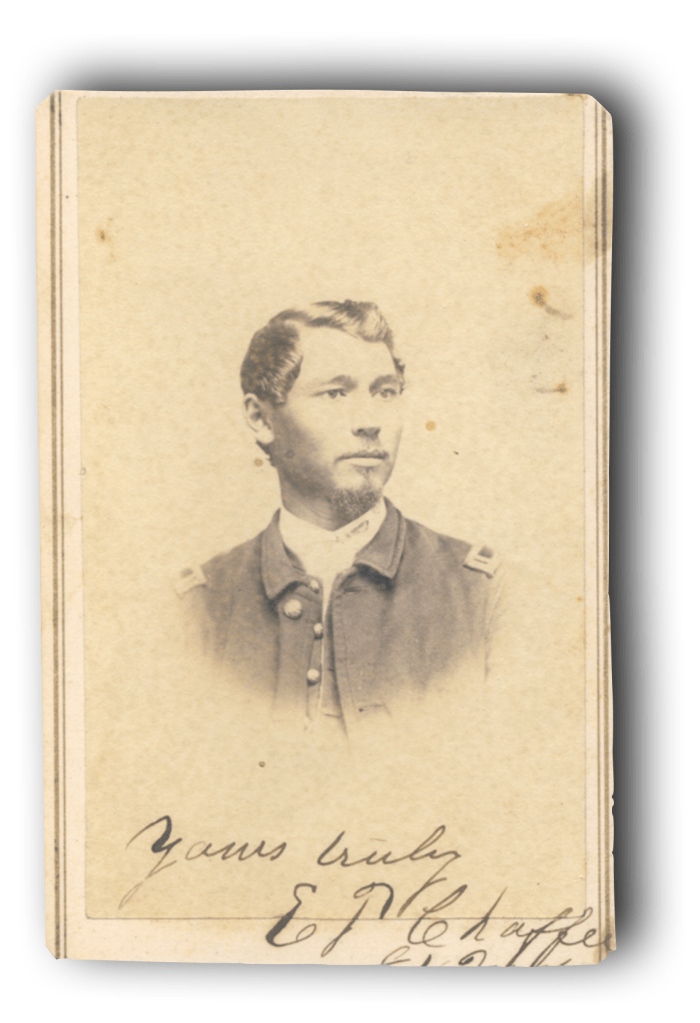
The following letter was written by Ebenezer (“Eb”) Thayer Chaffee (1841-1922) of Winchester, Randolph county, Indiana, who enlisted on 25 August 1862 as a private in Co. K, 84th Indiana Infantry, and was promoted to sergeant major in January 1863, and again to 1st Lieutenant in September 1864. He was serving as the adjutant of the regiment in the F&S regimental headquarters when he wrote this letter in February 1865. He mustered out of the regiment on 14 June 1865 at Nashville, Tennessee.
Eb was the son of William and Abigail (Thayer) Chaffee. He was married after the war to Martha Jane Stewart (1841-1912) and settled in Hartford, Blackford county, Indiana, where he worked as a hardware merchant. He was admitted to the Home for Disabled Veterans at Danville, Illinois, in 1907, and died in 1922 at the National Soldiers’ Home at Marion, Indiana.
Eb presumably wrote the letter to his older brother, Dr. William Carey Chaffee (1835-1927).
[Note: This letter and the image of Chaffee are from the personal collection of Dale Niesen and are published on Spared & Shared by express consent.]
Transcription
Headquarters 84th Indiana Volunteers Huntsville, Alabama February 1st 1865
Dear Will,
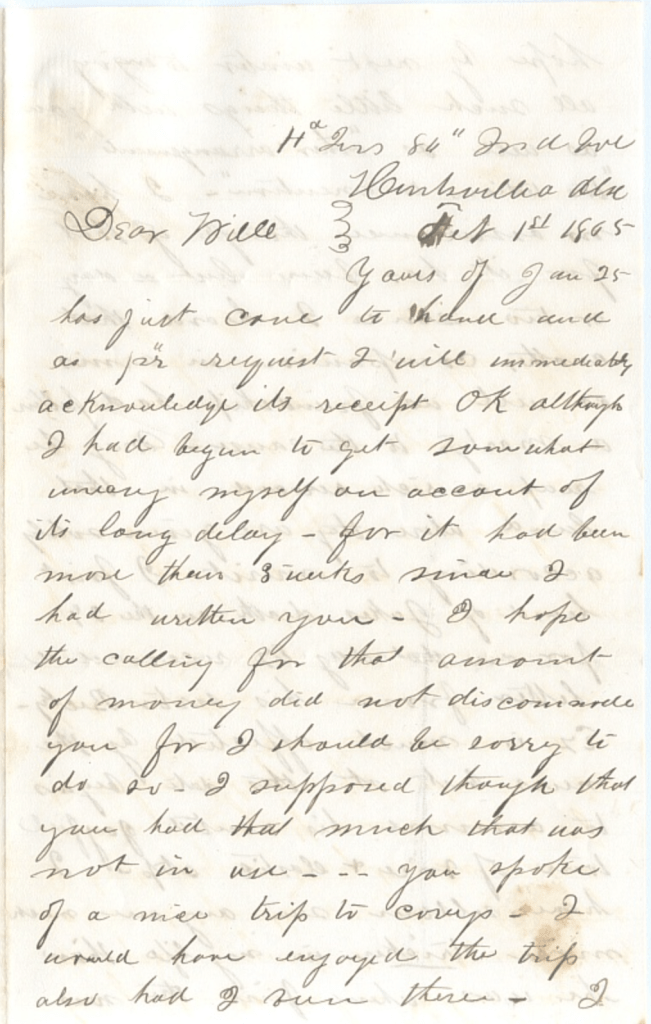
Yours of January 25th has just come to hand and as per request, I will immediately acknowledge its receipt ok although I had begin to get somewhat uneasy myself on account of its long delay—for it had been more than 5 weeks since I had written you. I hope the calling for that amount of money did not discourage you for I should be sorry to do so. I supposed though that you had that much that was not in use.
You spoke of a nice trip to Corey’s. I would have enjoyed the trip also had I been there. I hope by next winter to enjoy all such little things with you as well as “other arrangements too tedious to mention.” I have no assurance though of that for it has been but a day or two since I heard that another companion in arms as well as friendship had fallen a martyr to the cause. May he reap a rich reward in that land where they are given solely according to merit. I first heard of Jake’s death on the 29th for on that day Ez 1 received a letter from his sister Becky. Ez is much affected by the news but at this date begins to assume his wanted joyful tone of voice & elastic step. I have seldom seen anyone much more stricken in my life than he was when first the news arrived. The boys all feel his loss and sympathize with Ez in his bereavement.
In reference to Henry Chue, I can’t give you much news as it is not known yet what will be done with him. He is now in arrest at Brigade Headquarters awaiting trial by court martial. If he can prove what he says, nothing will be done with him and he will be released and allowed to go home. I hope that nothing bad will befall him for I always thought well of Henry and considered him a good boy.
Well, I must stop. I remain &c. yours truly, — Eb
1 Ezra Mann Stahl (1839-1913) joined Co. K, 84th Indiana Infantry in November 1862 and was mustered out on 14 June 1865 as the Sergeant Major of the company. He was the son of Abraham Stahl (1809-1889) and Elizabeth Waltz (1808-1875). Ezra’s younger brother, Sgt. Jacob Stahl, also served in Co. K, 84th Indiana Infantry. He died on 22 January 1865 from wounds he received at Rocky Face Ridge, Georgia on 9 May 1864.
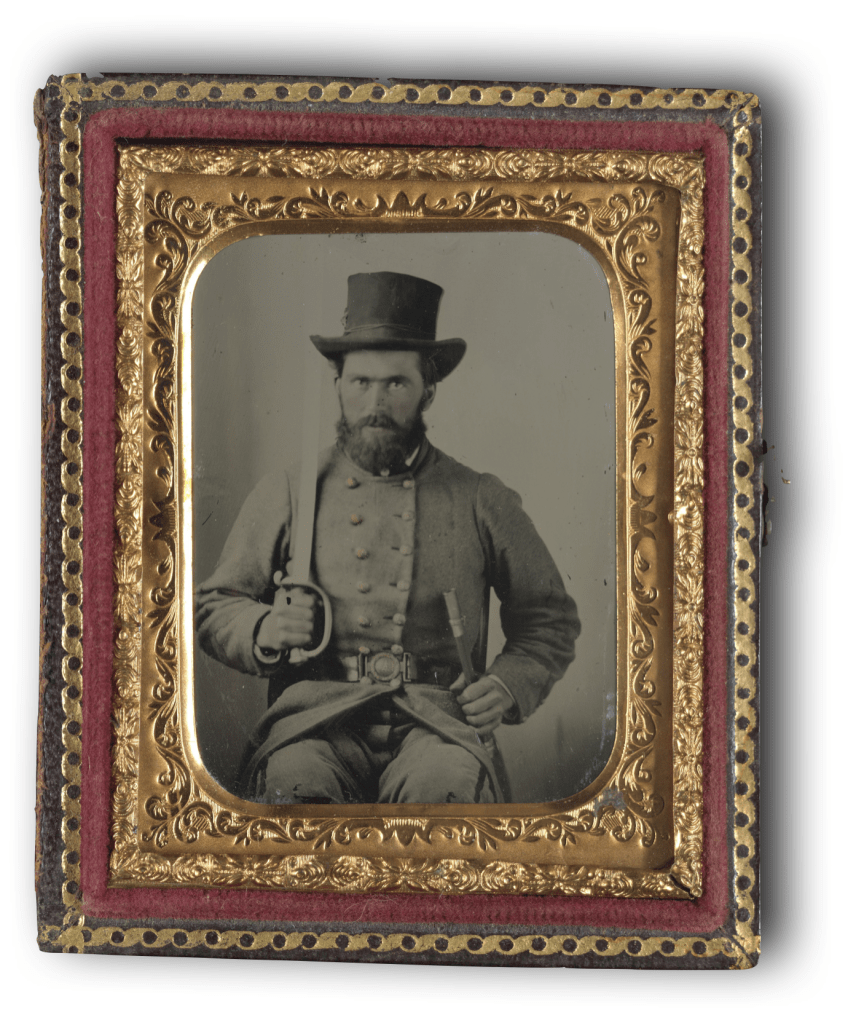
I could not find an image of James but here is one of Luther Hart Clapp of Co. C, 37th Virginia Infantry (LOC)
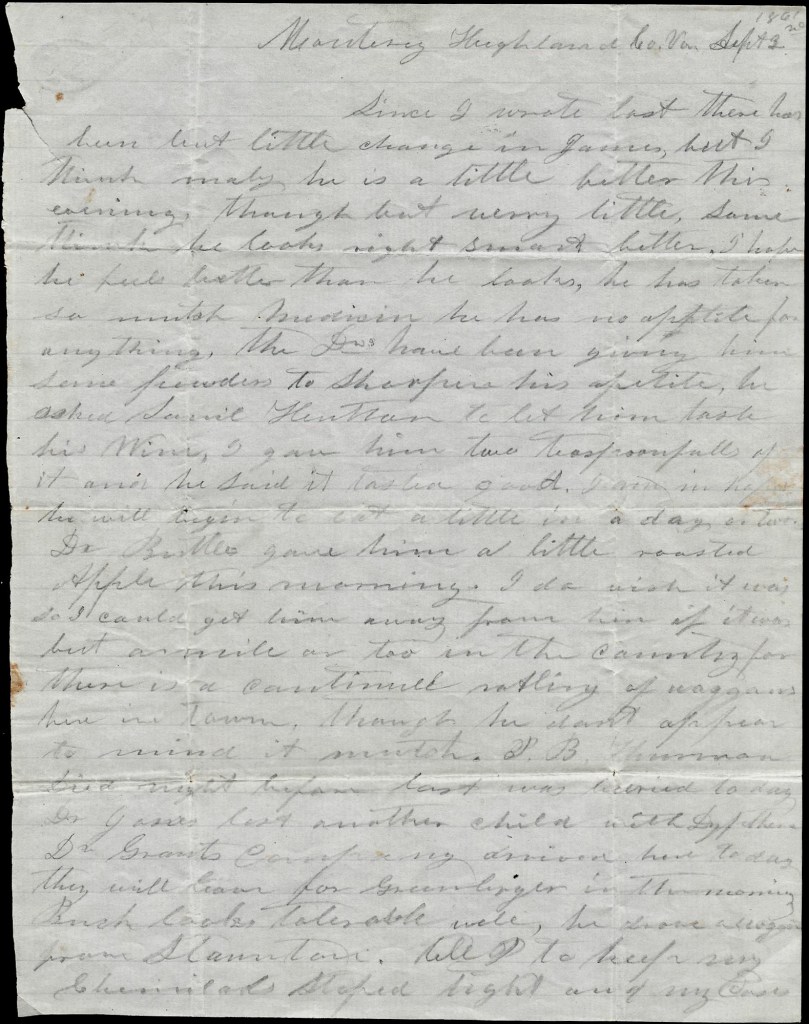
The following letter was written by Andrew Haller Nye (1834-1918) from Monterey, Highland county, Virginia, where he was attending to his older brother, James Alexander Kincannon Nye (1833-1861) of Co. F (“Glade Spring Rifles”) of the 37th Virginia Infantry. They were the sons of John R. Nye (1797-1871) and Sarah McDonald Kincannon (1807-1878) of Washington county, Virginia.
James was married in September 1858 to Ann Eliza Byars. He died of typhoid fever while in the service at Monterey just two days after this letter was written.
Andrew later served in the war himself, enlisting in March 1864 to serve in Levi-Barr’s Light Artillery. He was taken prisoner at Sailor’s Creek and held until 1 July 1865.
Transcription
Monterey, Highland county, Virginia September 3rd 1861
Since I wrote last there has been but little change in James but I think maybe he is a little better this evening, though but very little. Some think he looks right smart better. I hope he feels better than he looks. He has taken so much medicine he has no appetite for anything. The doctors have been giving him some powders to sharpen his appetite. He asked Samuel Hutton 1 to let him taste his wine. I gave him two teaspoonfuls of it and he said it tasted good. I am in hopes he will begin to eat a little in a day or two.
Dr. Butler gave him a little roasted apple this morning. I do wish it was so I could get him away from here if it was but a mile or two in the country for there is a continual rattling of wagons here in town, though he don’t appear to mind it much.
P. B. Thurman 2 died night before last [and] was buried today. Dr. Gaines lost another child with dypyheria.
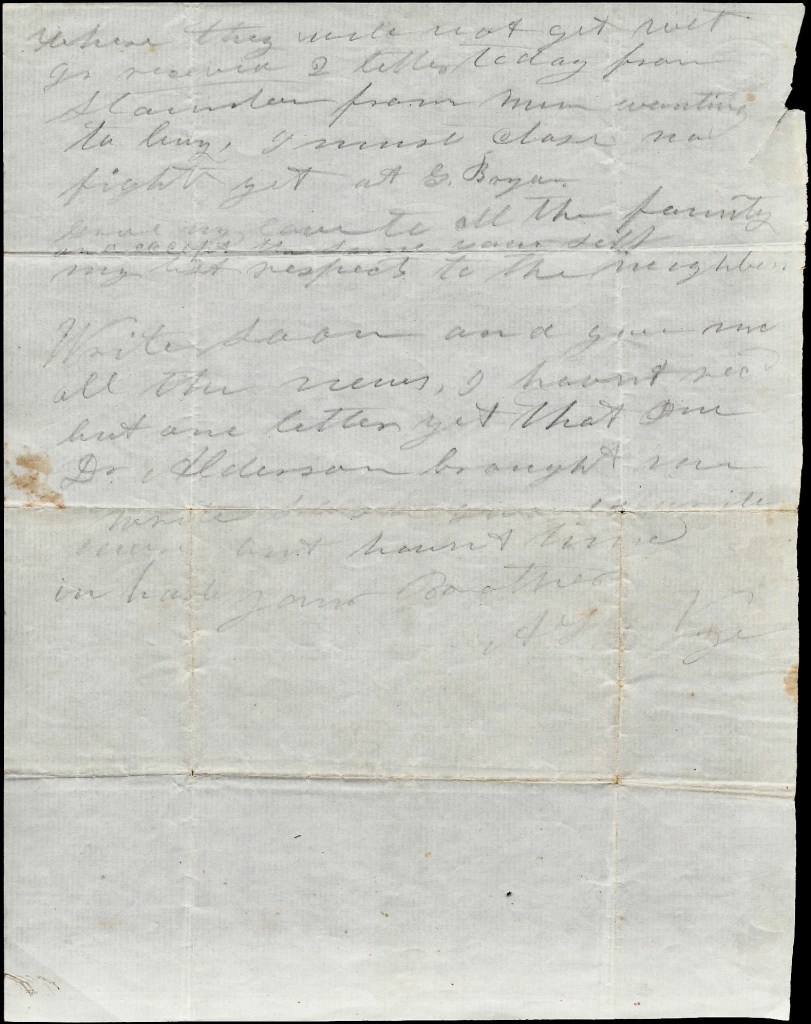
Dr. [Robert E.] Grant’s company (Co. H, 37th Virginia] arrived here today. They will leave for Greenbrier in the morning. Bush looks tolerable well. He drove a wagon from Staunton. Tell P. to keep my ch____ stopped tight and my cases where they will not get wet. I received a letter today from Staunton from men wanting to buy. I must close. No fight yet at Greenbrier.
Give my love to all the family and accept the same yourself. My best respects to the neighbors. Write soon and give me all the news. I haven’t received but one letter yet that Dr. [Christopher C.] Alderson brought me. I would write more but haven’t time. In haste, your brother, — A. H. Nye
1 Samuel John Hutton (b. 1838) enlisted on 25 April 1861 at a 2nd Lieutenant in Co. F, 37th Virginia Infantry. He was from Glade Spring, Washington county, Virginia.
2 17 year-old Powhatan B. Thurman enlisted on 5 May 1861 at Glade Spring, Washington county, Virginia, as a private in Co. F, 37th Virginia Infantry. He died at Monterey, Virginia, on 1 September 1861.
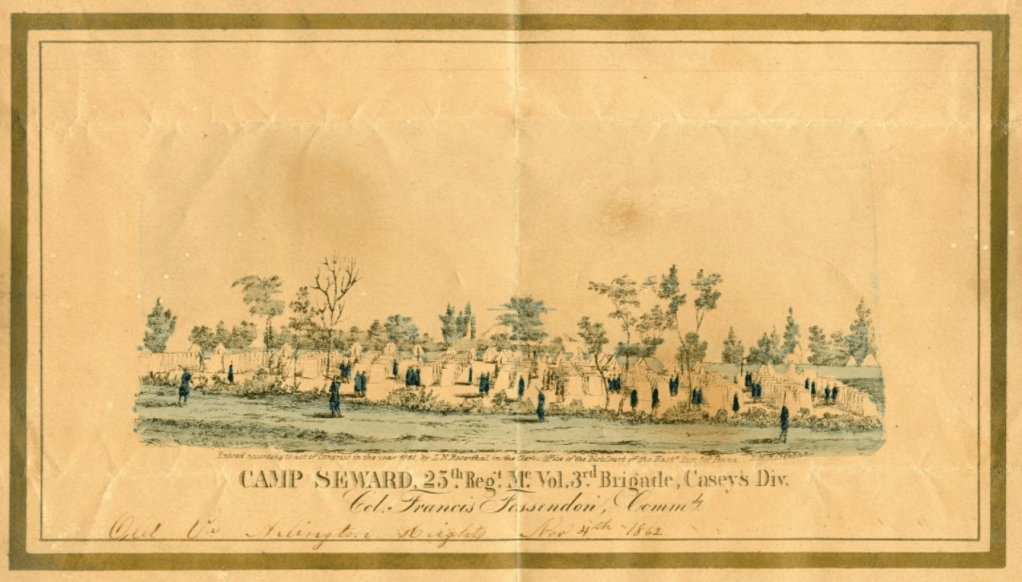
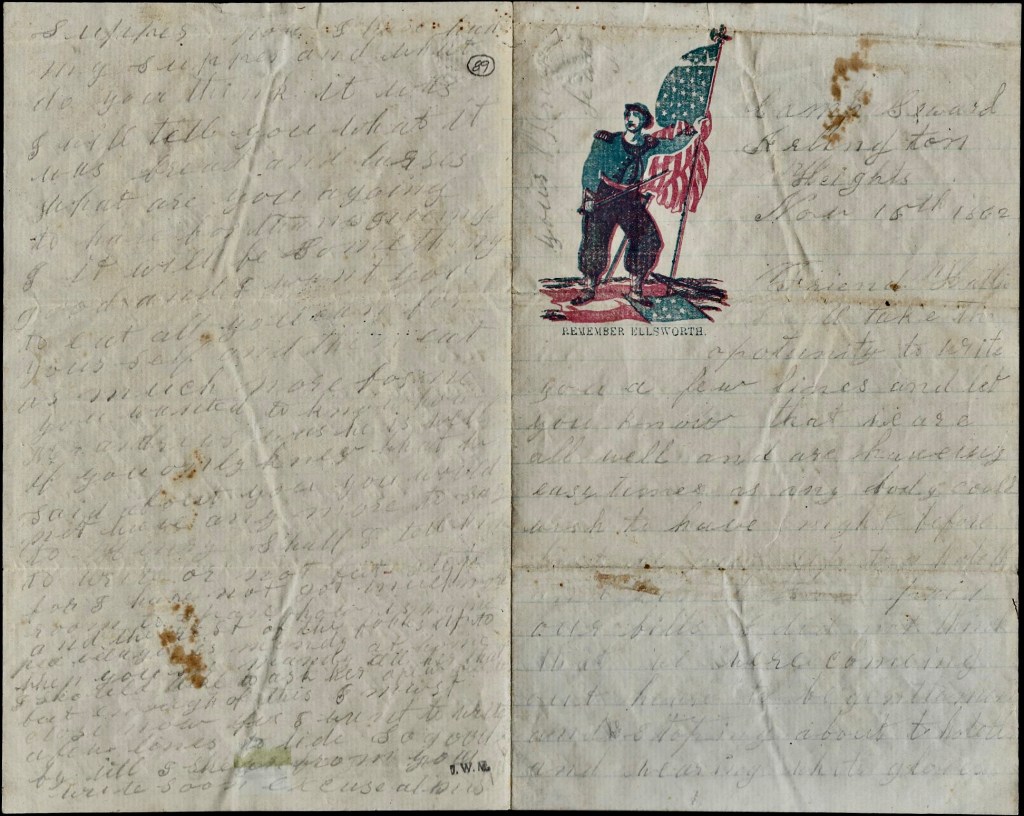
I cannot make out the surname of this soldier whom I believe served in the 25th Maine Infantry. This regiment mustered into service on 29 September 1862 for nine-months’ and was stationed at Camp Seward, Arlington Heights, Virginia, on November 4, 1862. The camp, located across the Potomac River from Washington, D.C., provided defense fortifications for the city during the war. Camp Seward was named for William Seward, Lincoln’s Secretary of State and former rival for the presidency.
The print below is one of many that Rosenthal’s Lith., a printing company in Philadelphia. made of Civil War encampments. This one is signed L. N. Rosenthal. Louis was one of four brothers in the company. They were pioneers in chromolithograph printing. Soldiers probably could buy prints that showed their regiment.
Transcription
Camp Seward Arlington Heights November 15, 1862
Friend Hattie,
I take this opportunity to write you a few lines and let you know that we are all well and are having easy times as anybody could wish to have. Night before last we went up to a hotel and we [ ] paid our bills. I did not think that we were coming out here to be gentlemen and stopping about to hotels and wearing white gloves and such things as them. I thought that we were coming out here to fight. But we are having high [times], growing fat, ugly and black.
But how do you get along down in Soddom? You said that you had quite a party and I am glad to hear that parties are not quite all stopped yet. But Hat, to tell you the truth, I have not seen but one white girl since we have been out here—or at least what I call white. The rest of them are paddies and dutch girls. I was over to Washington and I saw one Northern girl and some talk with her. She belong in Bangor and had a brother sick in the hospital in this city. But enough of this.
Who do you think came to our camp today? It is Bill Noyes. 1 He says that he is a going back to his regiment pretty soon and that they have seen some good times and some hard ones, but he looks well now and he says when they heard from the regiment last, they had about one hundred and fifty members.
I must get my supper now for the rest have all got theirs and I shall lose it if I don’t go after it. So good [bye] till after supper.
Now I have had my supper and what do you think it was? I will tell you what it was—bread and [mo]lasses. What are you a going to have for Thanksgiving? I [hope] it will be something good. And I want you to eat all you can for yourself and then eat as much more for me. You wanted to know how Mr. Andrews was. He is well. If you only knew what he said about you, you would not have anymore to say to Henry. Shall I tell him to write or not? But [I must] stop for I have not got much more room to spare. How is Maine and the rest of the folks up to Pea [?] Village. Is Mandy at home? When you see Mandy, tell her that I should like to ask her a few questions. But enough of this. I must close now for I want to write a few lines to Lide. So goodbye till I hear from you. write soon. Excuse all [mistakes].
Your friend, — Lewis [ ]
1 There were two soldiers by the name William Noyes who served in Maine Regiments that may have been the one referenced in this letter. One was William S. Noyes (1840-1911) of Saco, York county, Maine. He enlisted on 24 June 1861 as a private in Co. C, 5th Maine Infantry. He was taken prisoner at First Bull Run and confined at Richmond for a time. He then served as a hospital steward in 1862. The other William Noyes served in Co. E, 10th Maine Infantry. He was wounded on 9 August 1862 at Cedar Mountain, Virginia. He gave his residence as North Yarmouth, Maine.
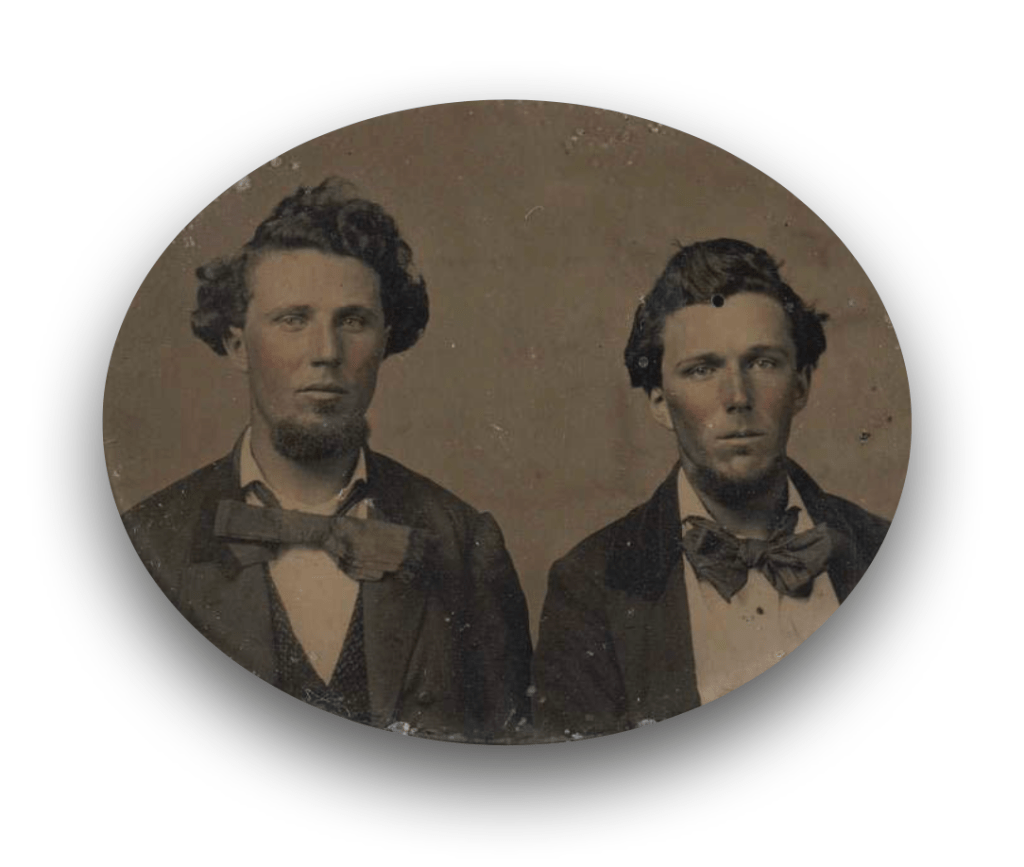
I could not find an image of Charles Roberts and his older brother Tom who served with him in Co. C of the 94th OVI, but here is one of George and Samuel Detrick who served in Company A. (Library of Congress)
The following letters were written by Charles Roberts who was 18 years old when he enlisted in 5 August 1862 to serve three years in Co. C, 94th Ohio Volunteer Infantry (OVI). This regiment was mustered into service at Camp Piqua on 24 August 1862 and four days later, without uniforms or camp equipage and never having been drilled as a regiment, it was ordered to Kentucky, that state being then invaded by Confederate forces under Kirby Smith. But a veteran regiment could not have behaved better than it did in the affair at Tate’s ferry, where it was first under fire and lost 2 men killed and 6 wounded. With the exception of some hard work in the trenches in defense of Louisville, and a participation in two or three “grand reviews,” the regiment had a very easy time until the movement began which resulted in the battle of Perryville and the driving of Bragg’s Confederate army from Kentucky. Charles’ first letter was written from Camp Buell in Kentucky.
Charles’ second letter was written after the Battles of Lookout Mountain and Missionary Ridge where the regiment played a prominent part, being in the grand charge upon the ridge. It was then with Sherman on his march to Atlanta though Charles was wounded on 14 May 1864 at the Battle of Resaca, Georgia, in the first battle of that campaign. He survived the wound to muster out with the company on 5 June 1865.
Charles was the son of wagon-maker Israel Roberts (1807-1883) and Elizabeth Coddington (1809-1861) of Brown township, Miami county, Ohio.
[Note: These letters are from the personal collection of Greg Herr and were transcribed and published on Spared & Shared by express consent.]
Letter 1
[Camp Buell] September 21, 1862
My Dear Father,
I take this opportunity to let you know that I am well at present and hope you are enjoying the same blessing. Jim and Tom are well. I want you to send me a little money if you please.
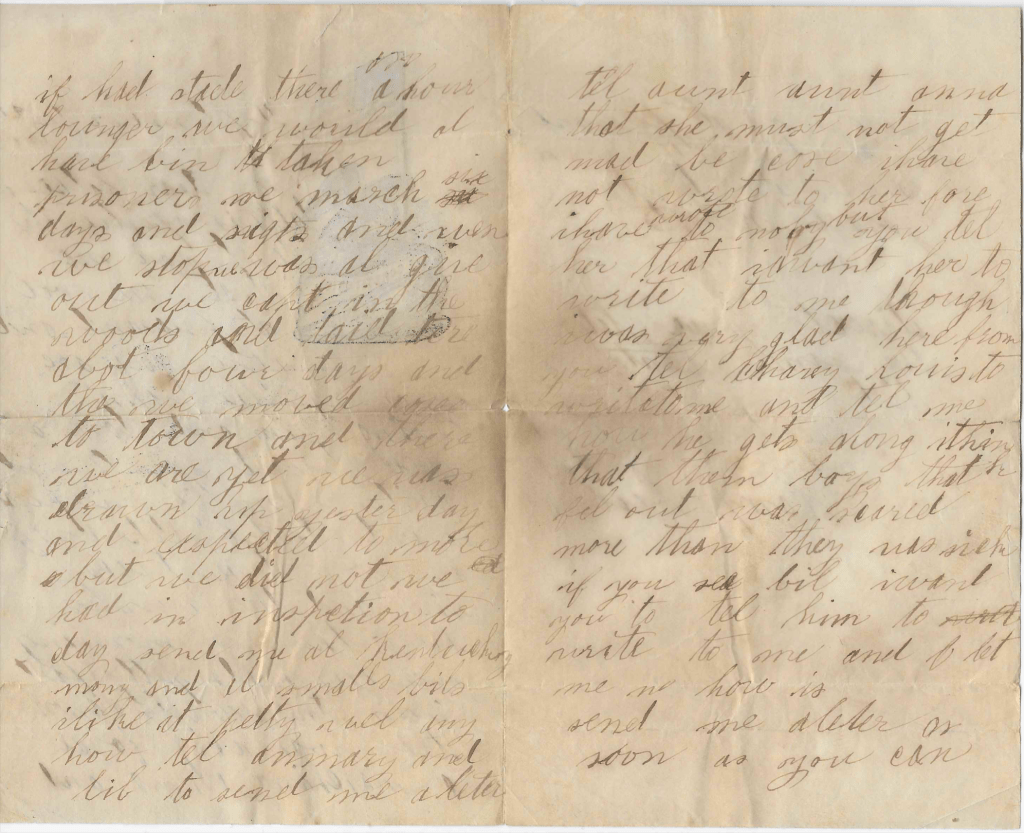
I heard the bullets buzz anyhow at [the] Kentucky river and the bombs flew the next morning over our heads pretty fast. I seen the rebel’s cannons. There was a big force a marching on us and if [we] had stayed there for an hour longer, we would all have been taken prisoner. We marched six days and nights and when we stopped, was all give out. We camped in the woods and stayed for about four days and then we moved over to town and there we are yet.
We was drawn up yesterday and expected to move but we did not. We had an inspection today.
Send me all Kentucky money and in small bills. I like it pretty well. Anyhow, tell Aunt Mary and Lib to send me a letter. Tell Aunt Anna that she must not get mad because I have not wrote to her for I have wrote to nary but you. Tell her that I want her to write to me though. I was very glad to hear from you. Tell Charley Louis to write to me and tell me how he gets along. I think that them boys that fell out was scared more than they was sick. If you see Bill, I want you to tell him to write to me and let me know how he is.
Send me a letter as soon as you can. No more at present but write soon. — Charles Roberts
To Israel Roberts
Direct your letters the same that you did. September 1862, Camp Buell
Letter 2
The 1st of the month [December 1863?]
Dear Father,
I take my pen in hand to let you know that I am well at present and all the rest of the boys is too and I hope when these few lines come to hand, that you will be enjoying the same good blessing.
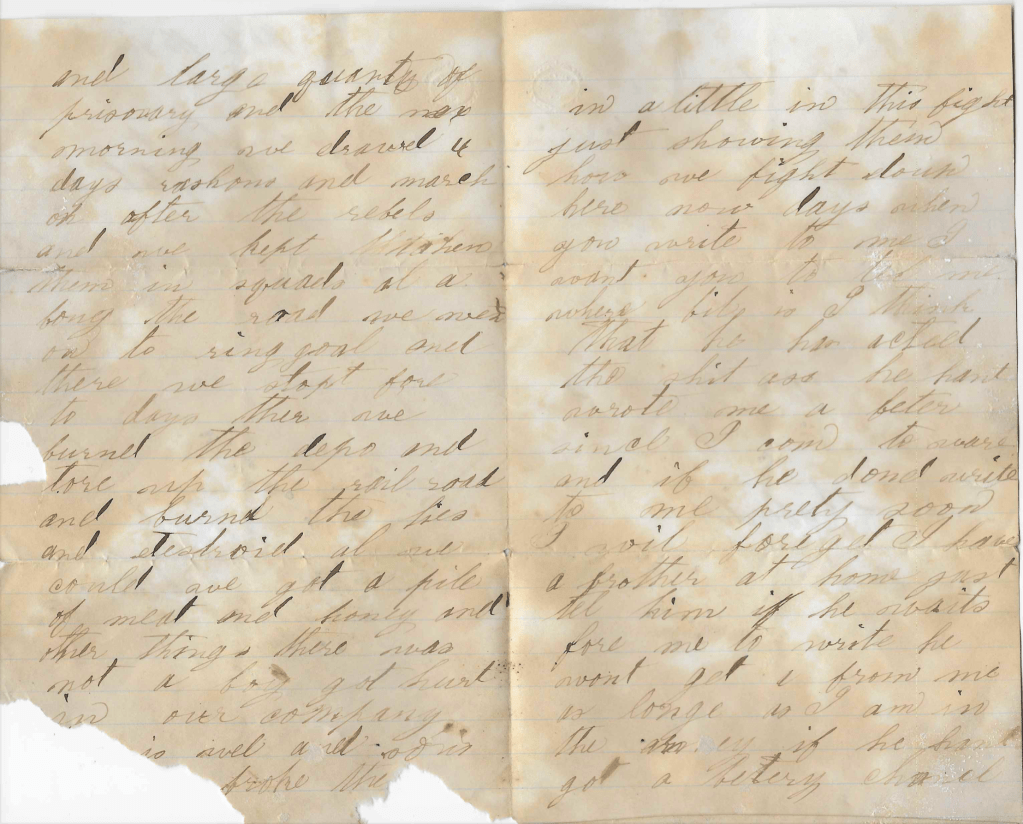
We have had another big fight since I wrote to you but I come out safe. We charged Lookout Mountain in one day and the next day we marched [ ] and charged in [ ] and there [ ] and large quantity of prisoners. And the next morning we drawed 4 days rations and marched off after the rebels and we kept taking them in squads all along the road. We went on to Ringgold and there we stopped for two days. There we burned the depot and tore up the railroad and burned the ties and destroyed all we could. We got a pile of meat and honey and other things. There was not a boy got hurt in our company. All is well and so is [paper torn]….broke the [ ] in a little in this fight just showing them how we fight down here now days.
When you write to me, I want you to tell me where Billy is. I think that he has acted the shit ass. He hain’t wrote to me a letter since I come to war and if he don’t write to me pretty soon, I will forget I have a brother at home. just tell him if he waits for me to write, he won’t get one from me as long as I am in the army. If he hain’t got a better chance to write to me than I have to him, why I don’t know.
Give my love to all. Write soon. — C. Roberts
To Israel Roberts
1863
Letter 3
[May or June] 1864
Dear sister,
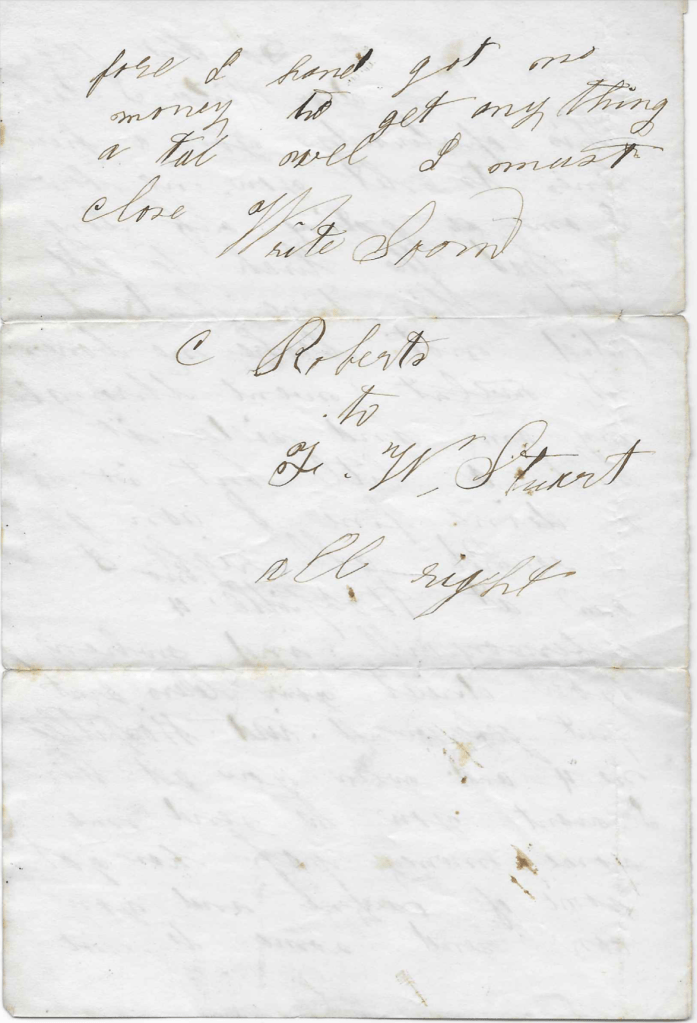
I take this opportunity [to write] you a few lines to let you know how I am getting along. I had the luck to get hit this time but it did not break no bones. It went through my arm and side. It hurt a little but it is a doing fine. I can go around all right. I am at a hospital at Jeffersonville [Indiana] and when you direct your letters, just put Jeffersonville, Indiana, Hospital No. 4, and when you get this, I want you to send me some money. Pap has got some of mine and you can send some to me for I han’t got no money to get anything at all. well i must close. Write soon.
— C. Roberts
To F. W. Stuart
All write.
Letter 4
General Hospital Branch No. 4 Jeffersonville [?], Indiana This is the 7th of this month [1864]
Dear Sister,
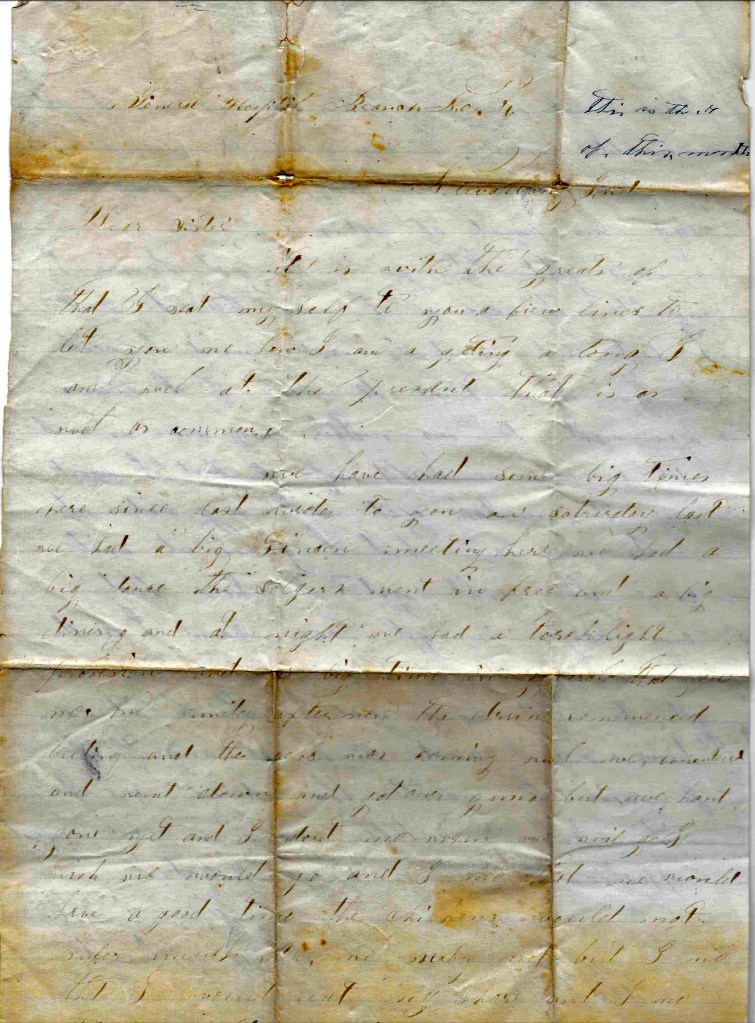
It is with the greatest of [pleasure] that I seat myself to [write] you a few lines to let you know how I am a gettin along. I can’t do much at the present—that is, as much as common.
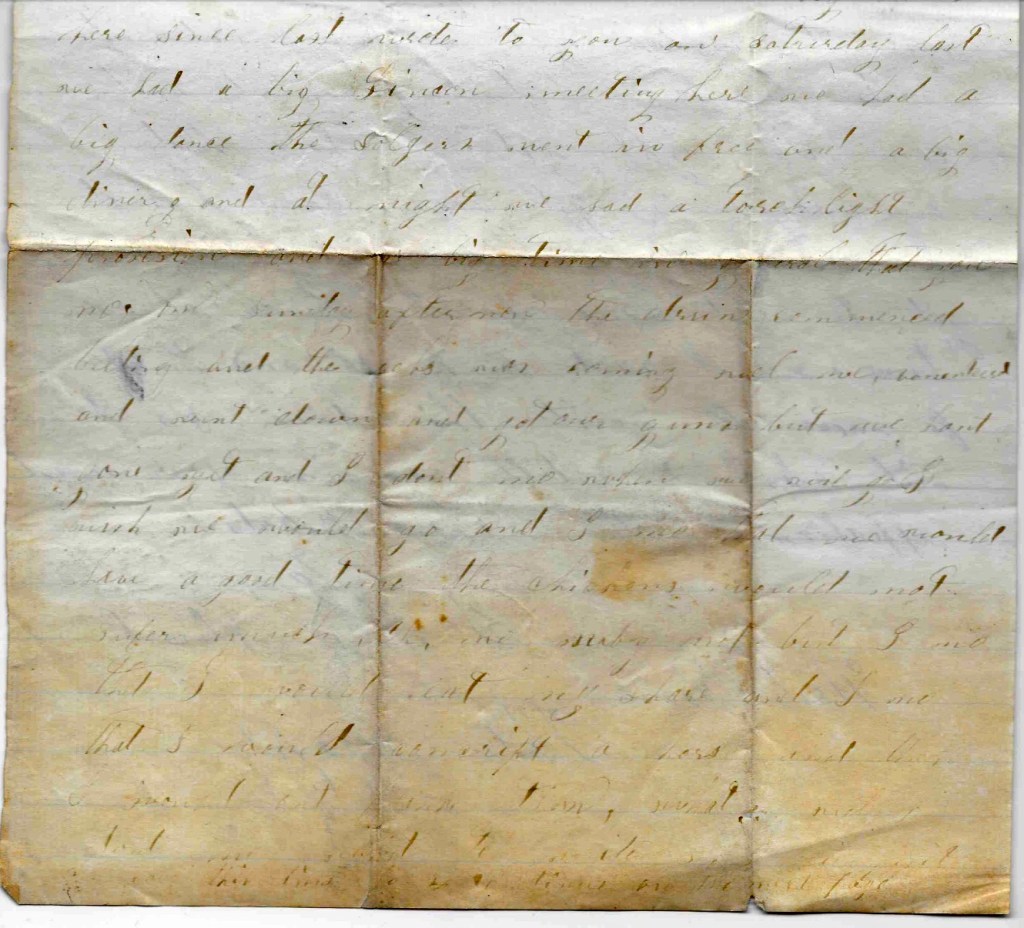
We have had some big times ere since last I wrote to you. On Saturday last we had a big Lincoln meeting here. We had a big dance. The soldiers went in free and a big dinner and at night we had a torchlight procession and it was as big time in general that you know, but suddenly, afterward the drum commenced beating and the Rebs was coming and we [ ] and went down and got our guns. But we ain’t done yet and I don’t know when we will. I wish we would go and I know that we would have a good time. The chickens would not suffer. Oh no, maybe not, but I know that I would eat my share and I know … [illegible]
Well, I will finish my letter this morning. I got your letter yesterday. I was glad to hear from you. that money comes very handy for I ain’t been paid off yet.
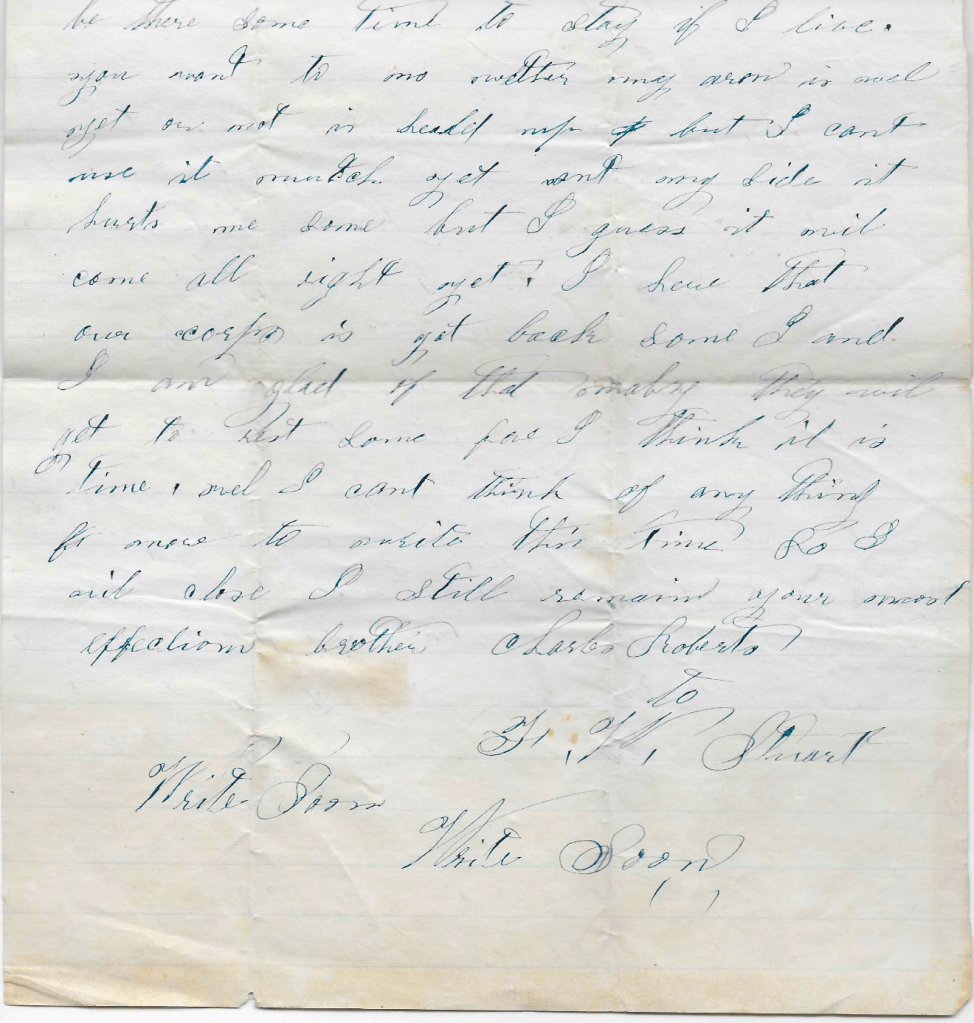
I am glad that Jim has got home. I would not care if I was there too but I ain’t and so it is never mind. I will be there some time to stay if I live. You wanted to know whether my arm is well yet or not. It’s healed up but I can’t use it much yet and my side—it hurts me some, but I guess it will come all right yet.
I hear that our Corps is got back and I am glad of that. Maybe they will get to rest some for I think it is time. Well, I can’t think of anything more to write this time so I will close. I still remain your most affectionate brother, — Charles Roberts
I could not find an image of Garret but here is Joseph W. Bullington of Co. F, 25th Illinois Infantry. Like Garret, he was killed in the fighting before Atlanta in 1864. (David Hann Collection)
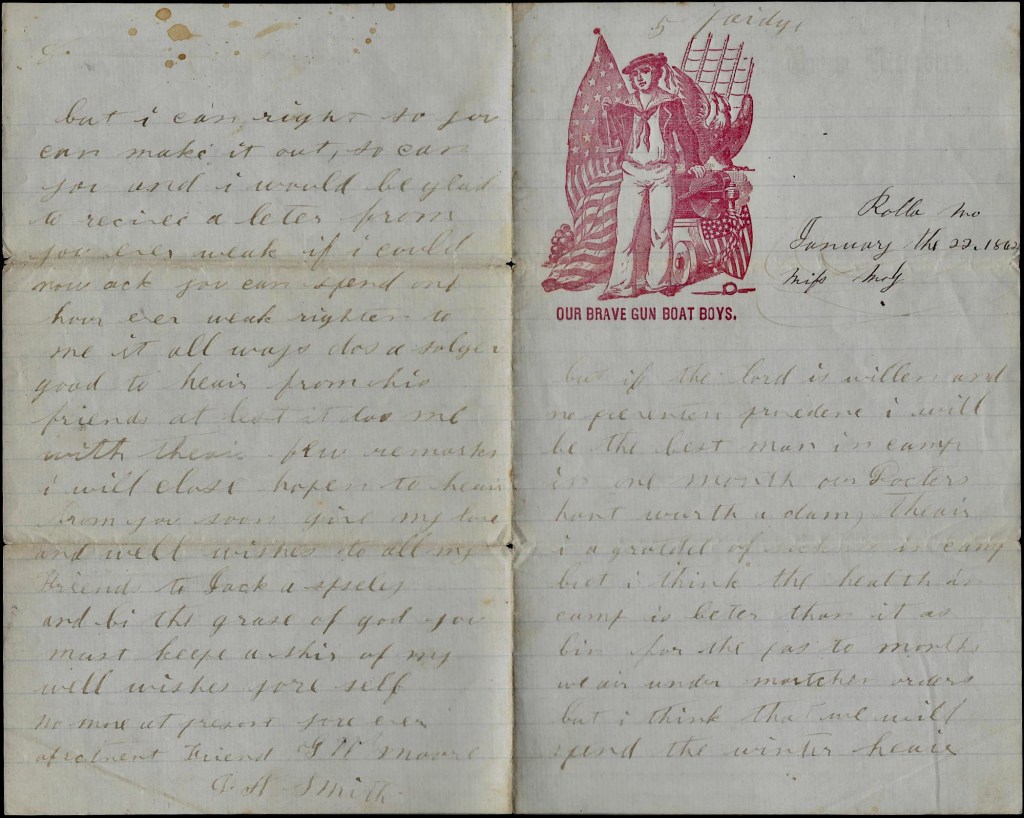
The following letter was written by Pvt. Garret Moore (1838-1865) of Co. C, 25th Illinois Infantry. Garret was the orphaned son of Garret Moore (18xx-1838) and Catherine Bailey (18xx-Bef1850) of Champaign county, Illinois. He had some older siblings but he was raised by others. In the 1850 US Census he was enumerated in the household of the Alexander Argo family. In the 1860 US Census, he was enumerated in the household of the James Swearingen family.
Garret enlisted on 4 August 1861 at Homer, Illinois, and was with his regiment in Rolla, Missouri, from mid-November 1861 until early February 1862 when they embarked on the campaign that would eventually lead to their first engagement—the Battle of Pea Ridge in northern Arkansas. Garret was seriously wounded at Kennesaw Mountain on 23 June 1864 and died of his wounds a week later at Chattanooga, Tennessee. His muster records indicate he stood 5′ 9″ tall, with brown hair and hazel eyes.
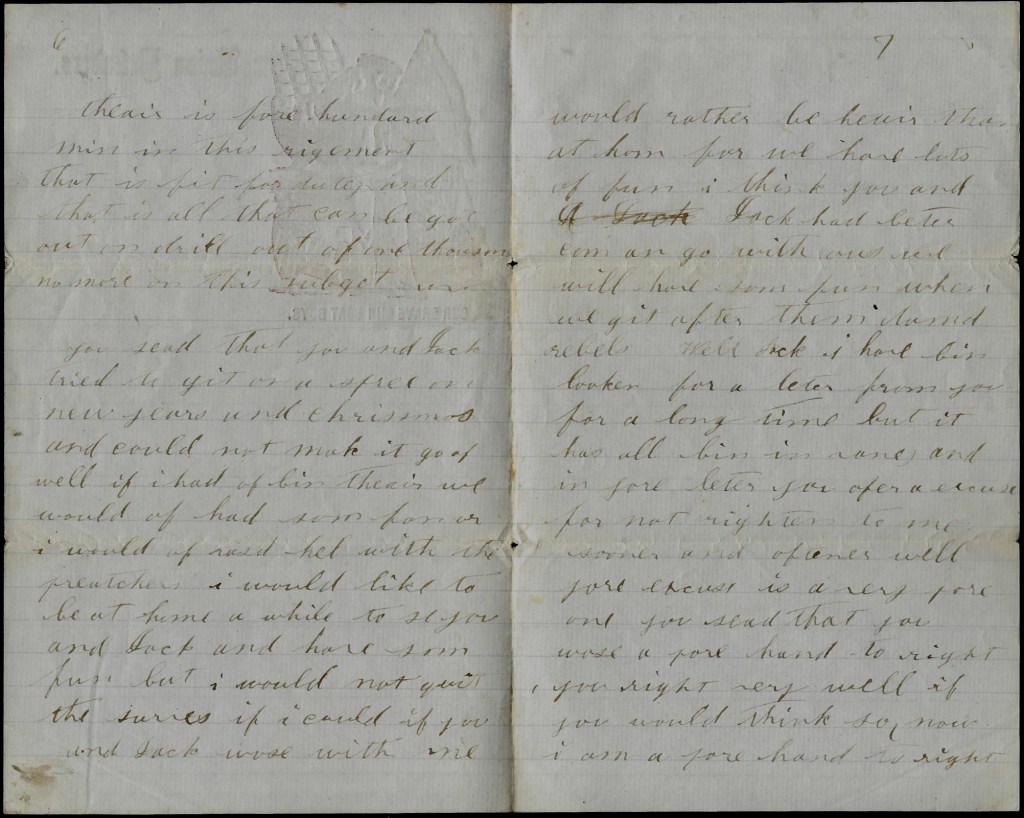
Transcription
Rolla, Missouri January 5, 1862
My old friend Achley,
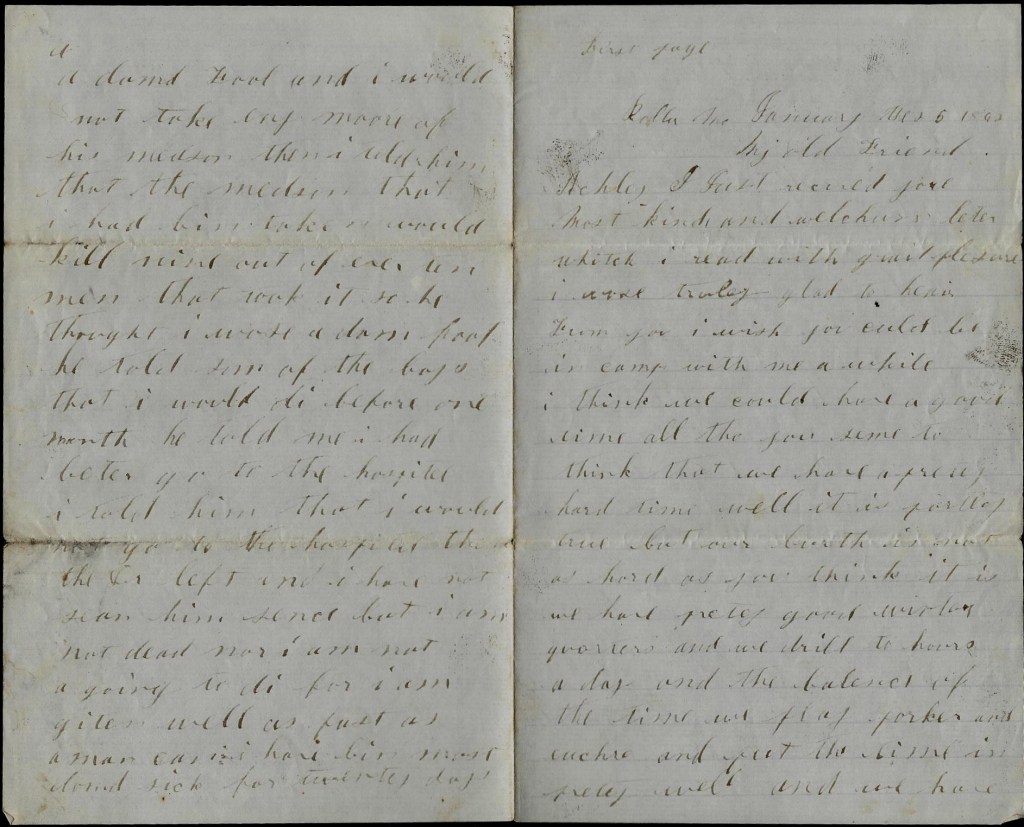
I just received your most kind and welcome letter which I read with great pleasure. I was truly glad to hear from you. I wish you could be in camp with me awhile. I think we could have a good time although you seem to think that we have a pretty hard time. Well, it is partly true, but our berth is not as hard as you think it is. We have pretty good winter quarters and we drill two hours a day and the balance of the time we play poker and euchre and put the time in pretty well and we have plenty to eat—such as it is.
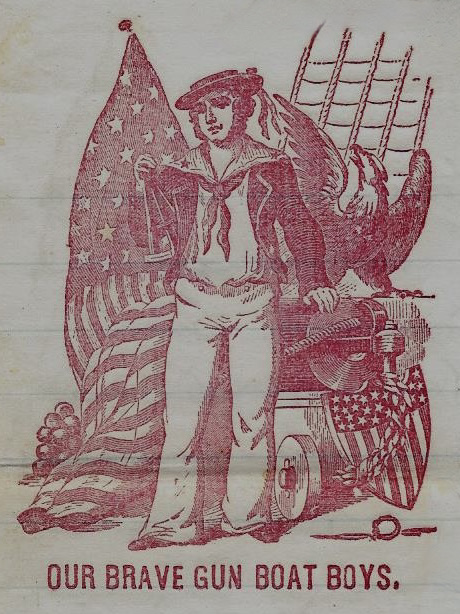
The patriotic image on Garret’s stationery
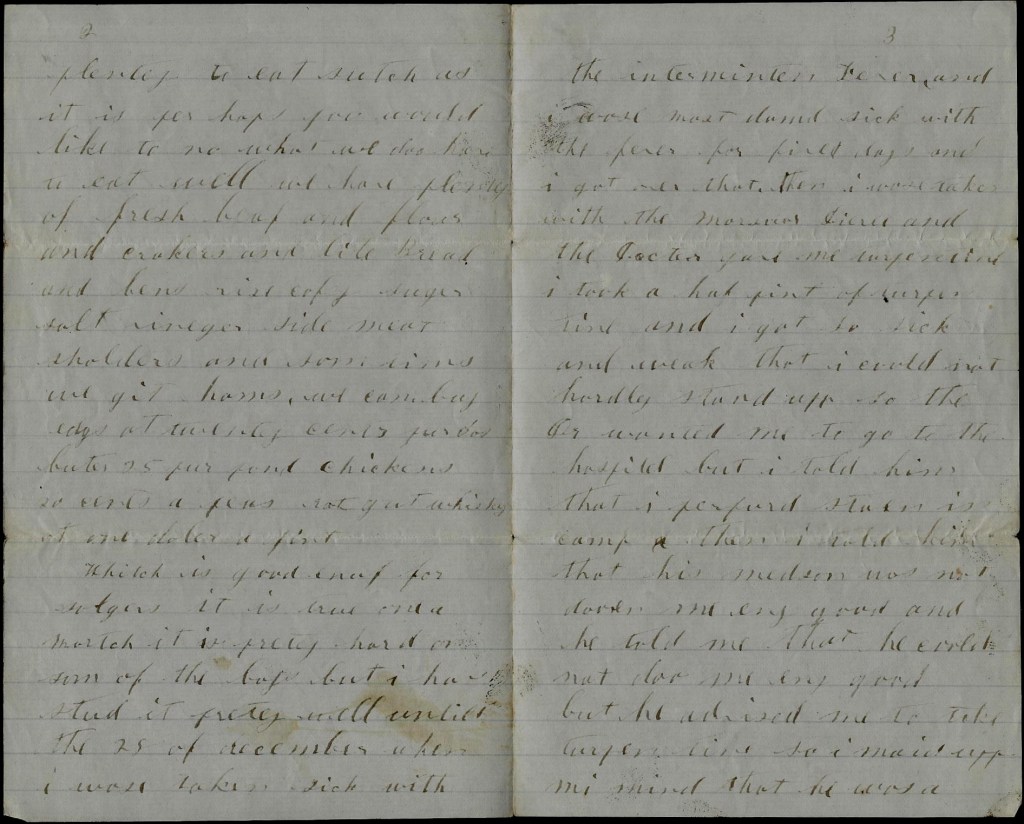
Perhaps you would like to know what we do here to eat. Well, we have plenty of fresh beef and flour and crackers and light bread and beans, rice, coffee, sugar, salt, vinegar, side meat shoulders and sometimes we get hams. We can buy eggs at twenty cents per dozen, butter 25 per pound, chickens 20 cents apiece, rot gut whiskey at one dollar per pint which is good enough for soldiers.
It is true [that] on a march, it is pretty hard on some of the boys but I have stood it pretty well until the 28th of December when I was taken sick with the intermittent fever and I was most down sick with the fever for five days and I got over that. Then I was taken with the m____ diarrhea and the doctor gave me turpentine. 1 I took a half pint of turpentine and I got so sick and weak that I could not hardly stand up so the Dr. wanted me to go to the hospital but I told him that I preferred staying in camp. Then I told him that his medicine was not doing me any good and he told me that he could not do me any good but he advised me to take turpentine so I made up my mind that he was a damned fool and I would not take any more of his medicine. Then I told him that the medicine that I had been taking would kill nine out of every ten men that took it so he thought I was a damn fool. He told some of the boys that I would die before one month. He told me I had better go to the hospital. I told him that I would not go to the hospital. Then the doctor left and I have not seen him since but I am not dead nor I am not a going to die for I am getting well as fast as a man can. I have been most down sick for twenty days but if the Lord is willing and no preventing Providence, I will be the best man in camp in one month. Our doctors hain’t worth a damn. There is a great deal of sickness in camp but I think the health in camp is better than it has been for the past two months.
We are under marching orders but I think that we will spend the winter here. There is four hundred men in this regiment that is fit for duty and that is all that can be got out on drill out of one thousand. no more on this subject now.
You said that you and Jack tried to get on a spree on New Years and Christmas and could not make it go off. Well, if I had of been there, we would of had some fun or I would of raised hell with the preachers. I would like to be at home awhile to see you and Jack and have some fun but I would not quit the service if I could, If you and Jack were with me, I would rather be here than at home for we have lots of fun. I think you and Jack had better come and go with us. We will have some fun when we get after them damned rebels.
Well, Jack, I have been looking for a letter from you for a long time but it has all been in vain and in your letter you offer an excuse for not writing to me sooner and oftener. Well, your excuse is a very poor one. You said that you was a poor hand to write. You write very well if you would think so. Now I am a poor hand to write but I can write so you can make it out. So can you, and I would be glad to receive a letter from you every week if I could. Now, Ach, you can spend one hour every week writing to me. It always does a soldier good to hear from his friends—at least it does me.
With these few remarks, I will close hoping to hear from you soon. Give my love and well wishes to all my friends, to Jack [ ] and by the grace of God you must keep a share of my well wishes for yourself. No more at present. Your ever affectionate friend, — G. W. Moore
— to J. A. Smith
1 Civil War soldiers often complained that the treatment surgeons prescribed for diseases was worse than the disease itself. Most soldiers, like Garret, refused to go to hospitals for fear they would never come out alive. Oil of turpentine was often prescribed by physicians for the treatment of typhoid fever during the Civil War. Turpentine oil-soaked rags were also used to wrap wounded to stop the spread of gangrene. It was used less commonly, I think, for the treatment of diarrhea as it only induced bloody vomiting, dehydrating the body further and compounding the problem. Large doses probably resulted in liver damage.[See Oil of Turpentine: Sheet Anchor of 19th Century Therapeutics by Vincent J. Cirillo, January 2021]
I could not find an image of Thomas but here is one of Samuel Taylor McFadden who served in the same company of the 32nd OVI (Ancestry.com)
The following letter was written by Thomas J. Jackson (1840-1862) of Co. A, 32nd Ohio Volunteer Infantry (OVI). Thomas enlisted as a private on 12 July 1861 and rose in rank to corporal before he was killed in the Battle of McDowell (also known as Battle of Sitlington’s Hill) on 8 May 1862 at McDowell, Virginia. In the engagement, the 32nd OVI had six men killed and fifty-three wounded. Thomas was buried at Grafton, West Virginia.
Thomas was the son of Jesse Hendrix (1816-1898) and Mary A. Warren (1815-1891) of Augusta, Carroll county, Ohio. Thomas’s father was a shoemaker by trade. At the time of the 1860 US Census, 19 year-old Thomas will still living at home with his parents and working as a school teacher. Carroll county is in northeast Ohio about 50 miles due west of Pittsburgh, Pennsylvania.
To read letters by other members of the 32nd OVI that I have transcribed and published on Spared & Shared, see:
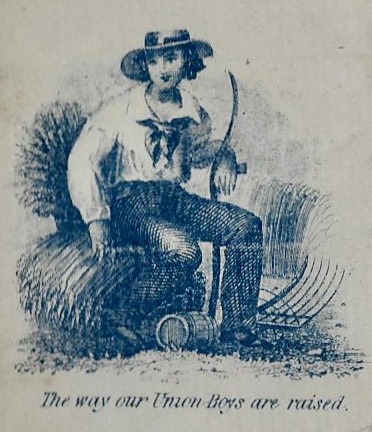
Patriotic stationery used by Thomas for his letter
Beverly, Virginia December 16, 1861
Miss Haskey,
When I carefully read your last letter, I perceived from the tenor of your writing that it was aggravating to some, for you to write to me. If I thought it would lower you in the estimation of your friends or bring disgrace on your family, I would not write another letter. You did not say whether you was opposed by writing to me or others. I interpreted it to the former. Please enlighten me as to which it is in your next. If it should be from the fact that I am a soldier battling for the rights of our common country, I feel sad for the one that may say so.
As for what other country gossip may say about our writing, I place no stress on it. All the letters I have written heretofore to you have been merely friendship. If this mars their feeling, they will have to recover as best they can. I have met with opposition heretofore. It always has a tendency to excite a person and makes me more attentive to such matters than I otherwise would be. Please state the particulars and then I shall be better prepared in the future to meet emergencies and know how to devise means to escape opposition.
The letter that you and [my sister] Birtha wrote, I read and then showed it to the other boys. It contained some grand suggestions. yet for all you said about us boys having a bother, I do not believe you meant what you said.
You will see from the heading of this letter that I am at Beverly. On yesterday morning three companies from the regiment left the mountain. Also there was nine detailed out of the remaining companies to go along for the purpose of building quarters at the aforesaid place. Jim Watson and myself are the only ones of the Augusta boys that was detailed. We had a very tiresome walk. The woods are extremely bad. It was with difficulty that we made the march. I do not think I ever was as tired in my life. I could hardly navigate. We (five of us) slept in an old saw mill in a small rom the sawyers occupied. Today we set our tent and will probably commence to work tomorrow. The remainder of the regiment will be here in a few days.
I do not think we will stay long. I think we will either go to Buchanan or to Ohio. There are a great many in the regiment that are unfit for duty. Our boys are all well and are in good spirits.
Oh yes! there is one question I want to ask you. Did you write to Hen[ry A.] Jackson before he wrote to you? Some of the boys told him that he wrote first and he denied it. I will make the same request of you that you did of me—that is, to destroy the letters you get from me and not let any person get hold of them.
Sam McClellan has gone home on furlough. Henry Chain is here at Beverly. He arrived on last Monday. All the things that he brought for us boys are at Webster. I suppose you will have some grand times at school this winter. I hope to hear from the school before long. Write as soon as you can conveniently. I shall wait with eagerness to hear from you again.
Direct to Beverly, Randolph county, Va., in care of Capt. [Jackson] Lucy, Company A. With much respect, I subscribe my name as your sincere and lasting friend, — T. J. Hendrix
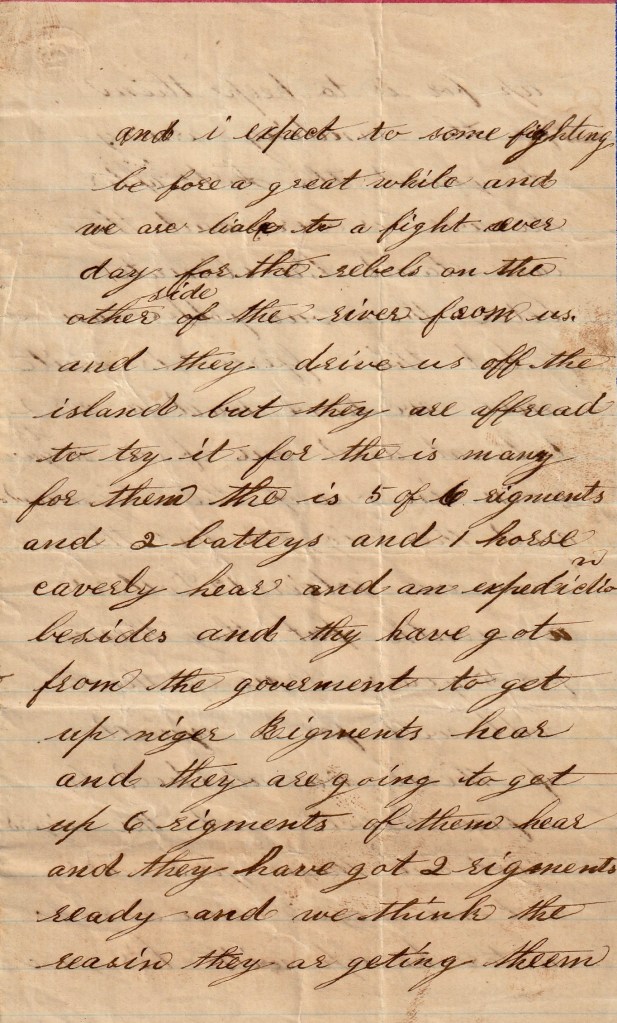
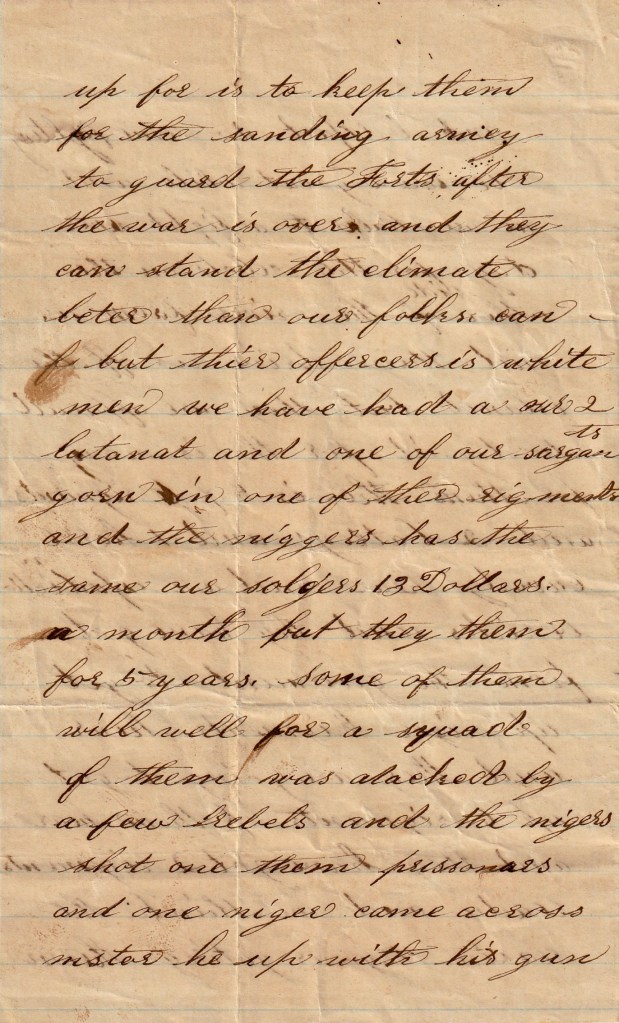
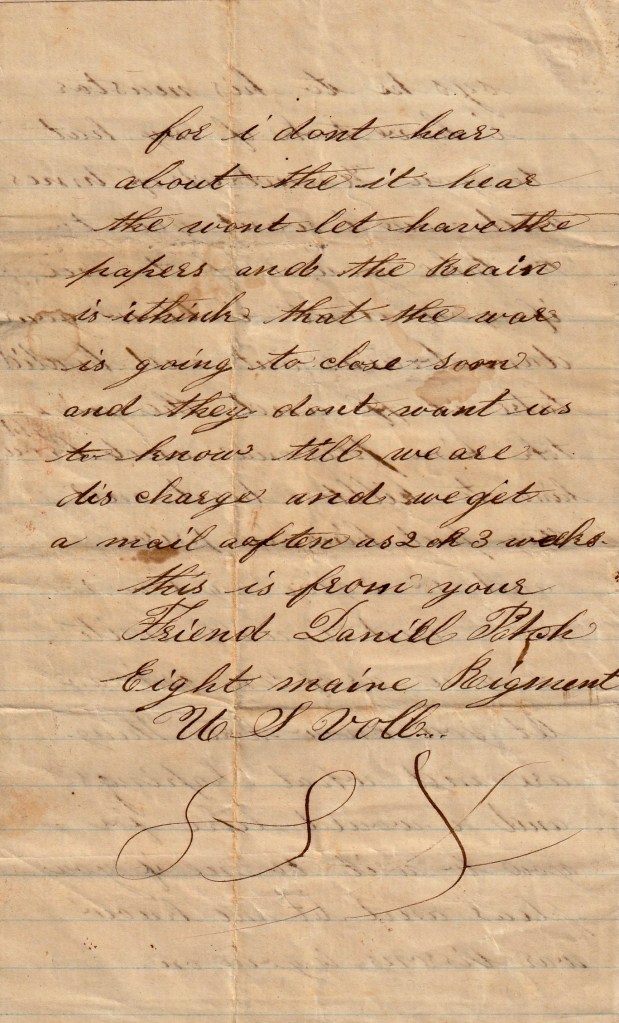
The following partial letter was written by Daniel Patch (1841-1862) of Co H, 8th Maine Infantry to an unnamed friend regarding his observations, expectations, and reactions about contemporary events in his life as a soldier. Notable is his rendering of a story about an African American soldier who “came across” his old master on the battlefield—a poignant and distinctly unusual event: “he up with his gun sys he to his mastar i have took of my hat to you Hundreds of times and now i want you to take yourn of to me if you don’t i blow your dam brains out and he did take it off.”
I could not find an image of Daniel but here is Sgt. James Henry Hobbs who also served in Co. H, 8th Maine Infantry. (Andrew Garton Collection)
Although the first part of Patch’s letter is missing and its precise date and location are unknown, circumstantial evidence points to the time and place being the Fall of 1862 in the coastal southern region of South Carolina (most likely Hilton Head or the surrounding area). Elements of what eventually became the 1st SC Volunteer Infantry, Colored, were first organized in the Department of the South by Gen. David Hunter at Hilton Head in May of 1862 (and without official approval from Washington) by recruiting freed male slaves from the Hilton Head area, where Patch’s Regiment was present for at least some of the time. This was a period of frequent small skirmishes between Union and Confederate forces in the area and the 1st S. C. were known to have soldiers involved in some of these, so that it would not be surprising for a black soldier to come in contact with his ex-master (as either a Confederate soldier or sympathizer). It would also be quite possible for Patch to know about the event described in the letter since both the 8th Maine and 1st S. C. were located near each other, and, for that matter, as Patch himself mentions, multiple 8th Maine soldiers had already transferred to black units as officers. Finally, Patch is known to have died of typhoid on 11 December 1862 in a Port Royal Hospital so the letter would have to have been written prior to that time. Disease was particularly a problem for troops stationed in Southern coastal areas, with 11.6% of the 8th Maine soldiers, including Patch, dying of illness.
Although the striking confrontation described in the letter between the black soldier and his ex-master may be apocryphal, other references to such an occurrence exist, although none found by me are clearly tied to the letter’s description. In any event, the confrontation was striking enough to Pvt. Patch to include it in his letter home.
Daniel was the son of George Washington Patch (1809-1896) and Elizabeth Call (1816-1902) of York Village, Yorm county, Maine.
[Note: This letter is from the personal collection of Richard Weiner and was transcribed and published on Spared and Shared by express consent. Likewise, the research and description of the contents was provided by Richard.]
Transcription
…and I expect to [see] some fighting before a great while and we are liable to fight everyday for the rebels on the other side of the river from us and they drive us off the island but they are afraid to try it for there is [too] many for them. There is 5 or 6 regiments and two batteries and one horse cavalry here and an expedition besides and they have got [authorization] from the government to get up nigger regiments here and they are going to get up 6 regiments of them here. And they have got two regiments [al]ready and we think the reason they are getting them up for is to keep them for the standing army to guard the forts after the war is over and they can stand the climate better than our folks can. But their officers is white men. We have had our 2nd Lieutenant and one of our sergeants go in one of their regiments and the niggers has the same [pay as] our soldiers—13 dollars a month—but they [have] them for five years.
Some of them will [fight] well for a squad of them was attacked by a few rebels and the niggers shot one of them prisoners and one nigger came across [his former] master. He up with his gun, says he to his master, I have took off my hat to you hundreds of times and now I want you to take yourn off to me. If you don’t, I’ll blow your damn brains out. And he did take it off and the nigger took him prisoner and brought him to Hilton Head and they put him in prison.
And so I give my love to you all and I will write to you as often as I can [and] let you know how things are and what happens. And I would like for you to write to me if you please and let me know [about the war] besides [what] is going on for I don’t hear about it here. They won’t let [us] have the papers and the reason is I think that the war is going to close soon and they don’t want us to know till we are discharged. And we get a mail as often as 2 or 3 weeks.
This is from your friend — Daniel Patch, 8th Main Regiment, US Vols.
The following letter was written by 39 year-old Rebecca Ann (Gustine) Minor (1813-1887), the daughter of James Parker Gustine (1781-1818) and Mary Ann Duncan (1790-1863). Rebecca was born in Carlisle, Pennsylvania, but raised in Philadelphia. She married in 1829 Capt. William John Minor (1808-1869) and lived most of the time in Natchez at the family residence they called Concord.
Minor owned three sugar cane plantations: the 1,900-acre Waterloo Plantation in Ascension Parish, Louisiana, as well as the 6,000-acre Southdown Plantation and the 1,400-acre Hollywood Plantation in Terrebonne Parish, Louisiana. However, as an absentee plantation owner, he did not live on those plantations. He hired overseers to make sure the slaves were working on the land. He corresponded via mail with his overseers regularly, sending them precise instructions while living in Natchez himself. Moreover, his sons lived on the plantations part of the time. From 1855 to 1861, his son Stephen lived on the Waterloo Plantation until he joined the Confederate States Army; in 1862, his other son Henry took over.Another son, William, lived at the Southdown Plantation and also managed the Hollywood Plantation.
He served as the second President of the Agricultural Bank in Natchez, Mississippi. He was well connected among the planter elite, and visited planters Duncan F. Kenner (1813–1887) and Henry Doyal as well as the McCollums, the Cages, and the Gibsons. He read De Bow’s Review and kept a diary. Politically, he was a supporter of the Whig Party. He was in favor of tariffs on sugar, which meant more profit for domestic sugar producers like himself.
During the Civil War of 1861–1865, he supported the Union and opposed secession, as he believed that would be bad for the sugar industry. However, he was arrested by Union forces with his son Henry in Houma in 1862; they were released a week later in New Orleans. Meanwhile, Unionists stole sugar and molasses from his Hollywood and Southdown plantations, under the false pretext that it had been deserted, even though overseers and servants were there. Minor was on friendly terms with Union Generals Benjamin Butler (1818-1893) and Lorenzo Thomas (1804-1875), whose forces protected Concord (his Adams County, Mississippi, plantation) on September 29, 1863, and on March 10, 1864. Both during and after the war, Minor asked for reparations for the financial losses he had endured due to the theft of commodities by Unionist forces, to no avail. By 1863, he had realized his slaves had become unwilling to work; they also killed hogs and sheep.
Because of General Order No. 12 imposed by Union General Nathaniel P. Banks, he was forced to pay them wages. Slaves, who had gotten used to working “under the threat of punishment,” were not motivated by their salaries; as a result, Minor tried to reduce their wages if they failed to work. By 1865, Minor paid one third of the crop profit at the Waterloo Plantation to his slaves. He signed a work contract with his slaves at the Southdown and Hollywood plantations whereby they agreed to work ten hours every day except for Sundays and received specific hourly wages as a result. Moreover, Minor agreed to clothe, feed and house them all. Minor was a supporter of Abraham Lincoln, whom he called “the most conservative & ablest man in the Washington Government.” He deplored his assassination, as he believed Lincoln would have been fair to Southern agriculturalists. [Wikipedia]
Transcription
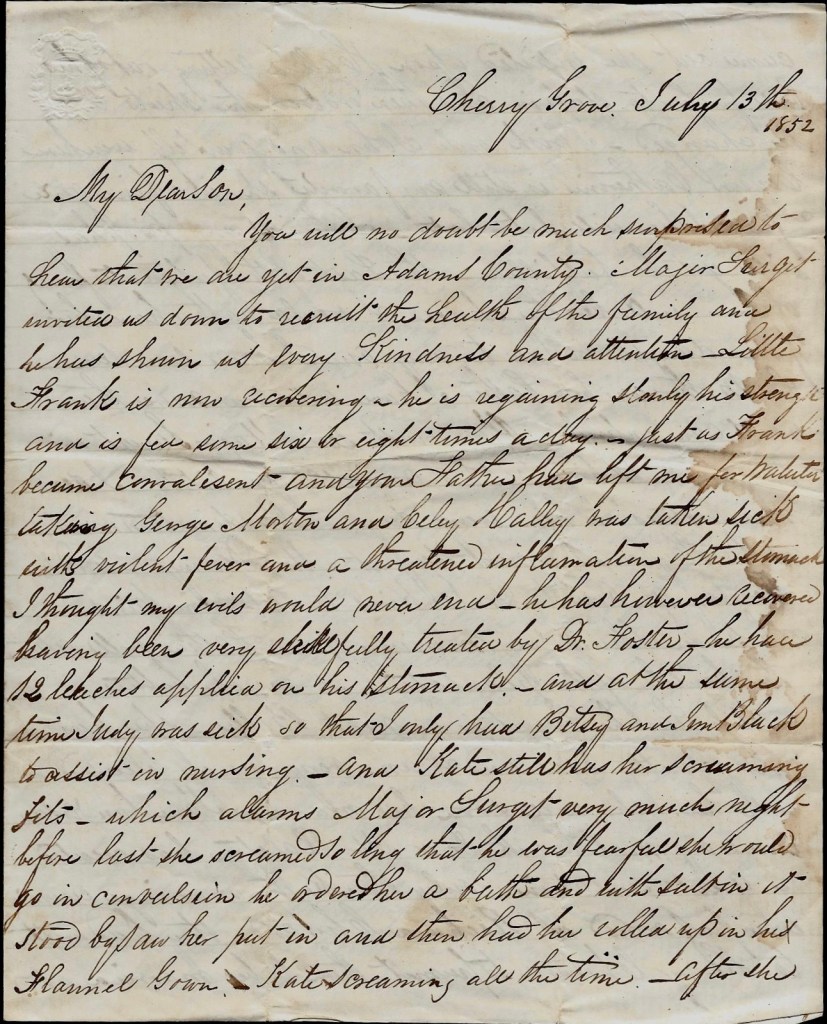
Cherry Grove [Plantation] 1 July 13th, 1852
My Dear Son,
You will no doubt be much surprised to hear that we are yet in Adams county. Major [James Pierre] Surget invited us down to recruit the health of the family and he has shown us every kindness and attention. Little Frank is now recovering. He is gaining slowly his strength and is fed some six or eight times a day. Just as Frank 2 became convalescent and your Father had left me for Waluter [?] taking George Morton, and Celey Halley was taken sick with violent fever and a threatened inflammation of the stomach. I thought my evils would never end. He has however recovered having been skillfully treated by Dr. Foster. He had 12 leaches applied on his stomach and at the same time Indy was sick so that I only had Betsy and Jim Black to assist in nursing. And Kate 3 still has her screaming fits—which alarms Major Surget very much. Night before last she screamed so long that he was fearful she would go in convulsion. He ordered her a bath and with salt in it stood by, saw her put in, and then had her rolled up in his flannel gown—Kate screaming all the time. After she came out, she insisted upon Hally’s getting out of his bed for her to sleep in and then ordered the sheets to be changed. I wish only John and yourself were here.
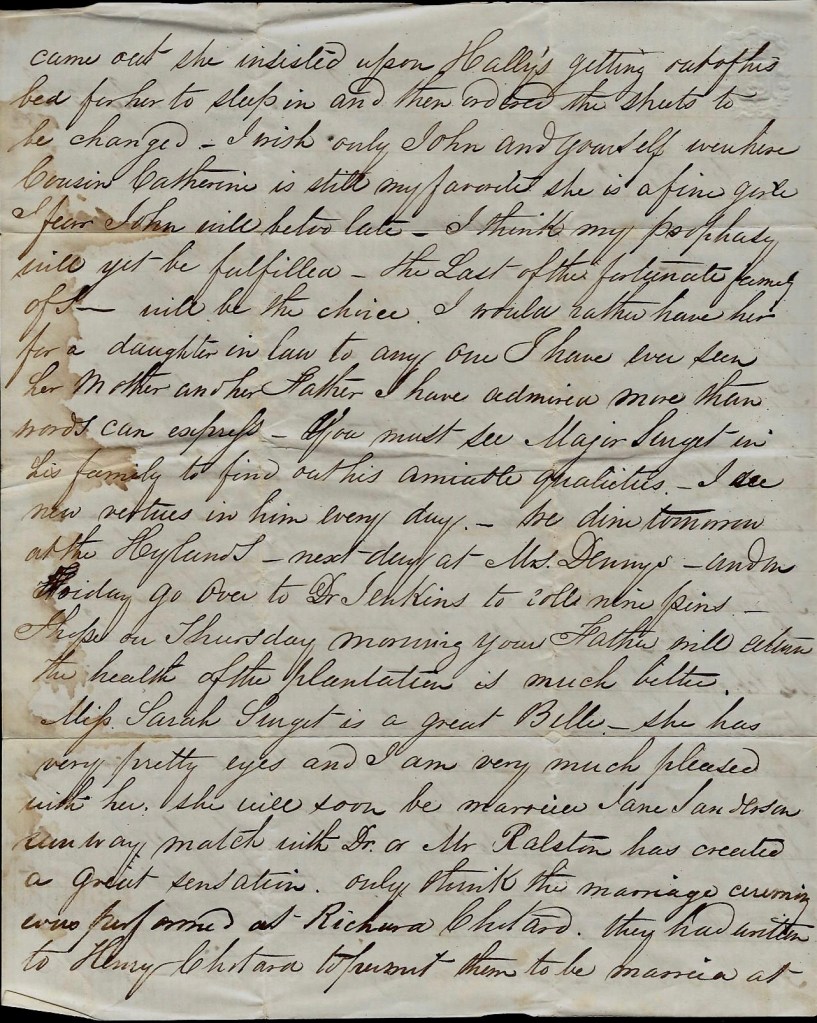
Cousin Catherine 4 is still my favorite. She is a fine girl. I fear John will be too late. I think my prophesy will yet be fulfilled. The last of the fortunate family of S[urgets]—-will be the choice. I would rather have her for a daughter-in-law to any one I have ever seen. Her Mother and her Father I have admired more than words can express. You must see Major Surget in his family to find out his amiable qualities. I see new virtues in him every day.
We dine tomorrow at the Hylands, next day at Mrs. Denny’s, and this Friday go over to Dr. Jenkins to roll nine pins. I hope on Thursday morning your Father will return. The health of the plantation is much better. Miss Sarah Surget is a great belle. She has very pretty eyes and I am very much pleased with her. She will soon be married. Jane J. Anderson [ ] match with Dr. or Mr. Ralston has created a great sensation. Only think the marriage ceremony was performed at Richard Chitard. They had written to Henry Chitard to present them to be married at Minorca. Henry refused. I regret Richard had not sent them off. I could fill your sheets with much news but I have not the time as I must write to Aunt Sarah.
Tell John I saw Miss Dunbar this morning. Also Dr. Jenkins who gave me the news of him. I hear of his presenting bouquets to Ladies and that he is a favorite among the fair sex. I will write to him very soon. Only imagine me moving about when the thermometer is at 96 on the galley. I am more than ever anxious to return to Natchez and should not regret (excepting parting with Mr. and Mrs. Kenner) that I never return to Waterloo.
My dear son, I must scold you. you ought never to write anything that is vulgar. Now I think Mrs. Woodman’s message was decidedly so. I am sorry to find you paid this disagreeable and foolish woman any attention, and I fear she has paid court to you and flattered you. Madam Montgomery is not a Lady. She received too marked attention from gentlemen. I wish you to improve in your style of writing. Take pains with the penmanship and the style must be pure to please me. Recollect I am not able to give you a copy—but you have education. Take every advantage.
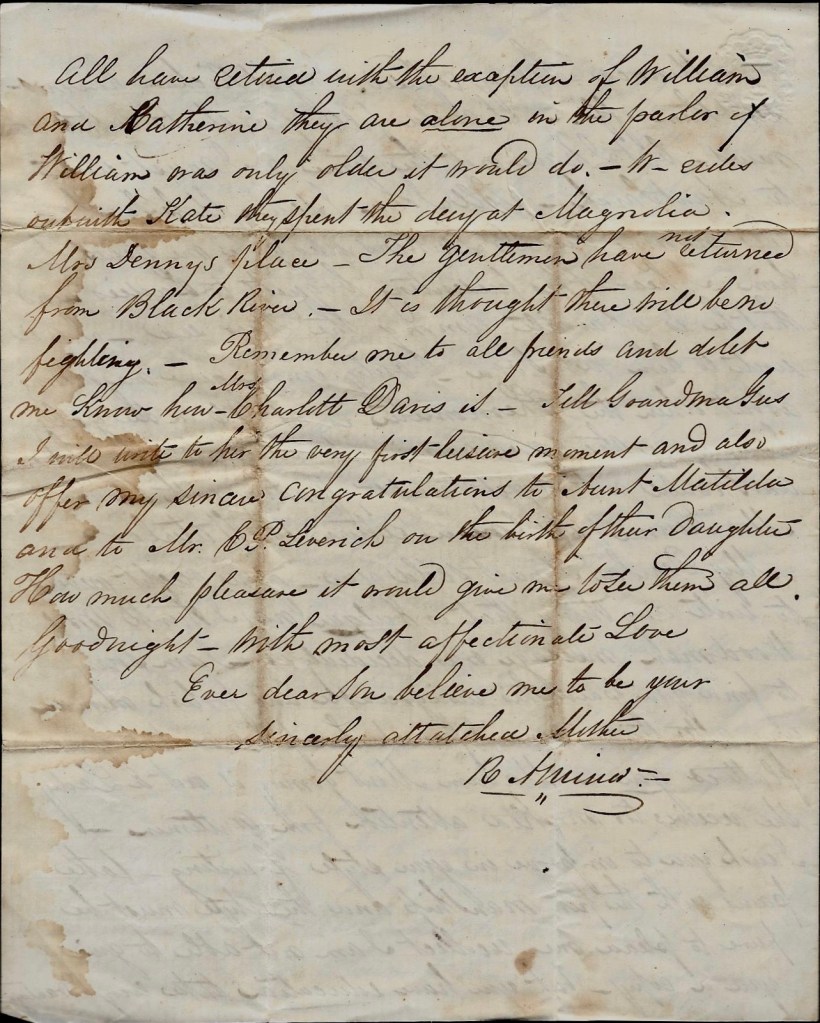
All have retired with the exception of William and Catherine. They are alone in the parlor. If William was only older, it would do. William rides out with Kate. They spent the day at Magnolia—Mrs. Denny’s place. The gentlemen have not returned from Black River. It is thought there will be no fighting.
Remember me to all friends and do let me know how Mrs. Charlotte Davis is. Tell Grandma Gus I will write to her the very first leisure moment and also offer my sincere congratulations to Aunt Matilda and to Mr. C[harles] P. Leverich on the birth of their daughter. How much pleasure it would give me to see them all. Goodnight. With most affectionate love, ever dear son [and] believe me to be your sincerely attached Mother, — R. A. Minor
1 Cherry Grove Plantation is located five miles from Natchez in Adams county on Second Creek. The mansion was built by Pierre Surget (1731-1796), a French planter, in 1788, over 2,500 acres of an English land grant, granted to him by the Spanish government. As such, it is one of the earliest private residences in Natchez. After his death, his widow Catharine (Hubbard) Surget expanded the grounds of the property. By 1850, the house belonged to their son James Pierre Surget (1785-1855), with sixteen house servants in residence. Cherry Grove has been in the continuous ownership of the same family since 1788 and has remained always a working plantation. It remains in the family of Surget descendants. Cherry Grove Plantation is today one of the best preserved and most complete plantation complexes in the Natchez area. The original plantation residence constructed by Pierre Surget and his wife Catharine burned in the mid-nineteenth century, and the present picturesque and architecturally significant residence was constructed about 1865 by Pierre Surget’s grandson James Surget, Jr. The form of the house, which consists of a residence constructed upon a fully raised basement with a central five-bay block and flanking single-bay wings, has the regionally early single-pile plan with rear “cabinet” rooms enclosing each end of a rear gallery recessed under the rear slope of the roof. Likewise, the facade of the central block features a gallery that is recessed under the front slope of the roof. These features suggest the possibility that the present house may have taken its basic form from the earlier house which burned. The original flanking wings with octagonal bays and gable-end balconies represent the concession of the builder to the popular taste of the 1860s. The collection of plantation outbuildings is exceptional and includes an unusual tenpin frame alley building with attached late-nineteenth century gymnasium, smoke house, detached kitchen building, corn crib, stables, privy, sheep stalls, and barns. Hand-hewn cypress troughs for feeding and watering the stock are rare plantation survivals, and the plantation cemetery containing the graves of Pierre and Catharine Surget and their descendants is located within sight of the main dwelling house. The plantation gains added significance from its long history of family ownership. Pierre Surget, originally a seaman by trade, was the patriarch of the Surget family in Natchez, a family that formed one of the largest planting dynasties in the entire South. Pierre’s son Frank was described by one contemporary historian as the most extensive landholder and successful planter in Mississippi.
2 Francis (“Frank”) Octave Minor was born in 1847.
3 Katherine (“Kate”) Lintot Minor was born in 1849.
4 Catherine Surget (1834-1926) was married first to James Gustine Minor (1839-1860) in 1853. She married second John Duncan Minor (1831-1869) in 1855.Catherine’s collection of letters are housed at the University of Michigan.

























 Spared & Shared 23