My passion is studying American history leading up to & including the Civil War. I particularly enjoy reading, transcribing & researching primary sources such as letters and diaries.
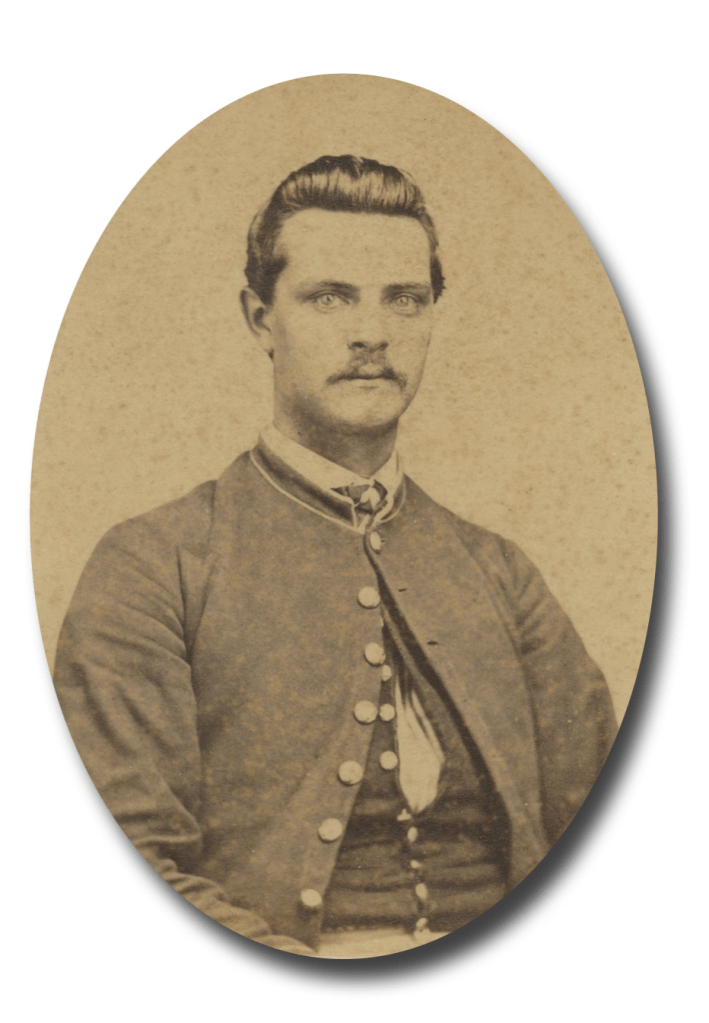
I could not find an image of William but here is one of John Davenport who also served in the 15th Iowa Infantry (Roger Davis Collection)
These three letters were written by William (“Bill”) Spates (1842-1863), the son of Thomas Purnell Spates (1799-1864) and Levica Scott (1805-1854) of Oskaloosa, Mahaska county, Iowa.
When William enlisted in Co. C, 15th Iowa Infantry in January 1863, he gave Indiana as his birthplace and Rose Hill, Iowa, as his current residence. He entered the service as a private and had been promoted to corporal prior to 6 June 1863 when he was detailed for Orderly Sergeant of Co. B, Tenth Louisiana Colored Volunteers (later designated the 48th US Colored Infantry Regiment). According to the muster rolls of the 48th USCT, William was never mustered as the Orderly Sergeant because he died on 25 June 1863 of fever at Goodrich Landing, Louisiana.
To read other letters published on Spared & Shared by 15th Iowa Infantry soldiers, see: Cyrus E. Ferguson, Co. A, 15th Iowa (1 Letter) Cyrus E. Ferguson, Co. A, 15th Iowa (9 Letters) John A. Wheelock, Co. A, 15th Iowa (2 Letters) John A. Wheelock, Co. A, 15th Iowa (2 Letters)
[Note: These letters are from the private collection of Mike Huston and are published on Spared & Shared by express consent.]
Letter 1
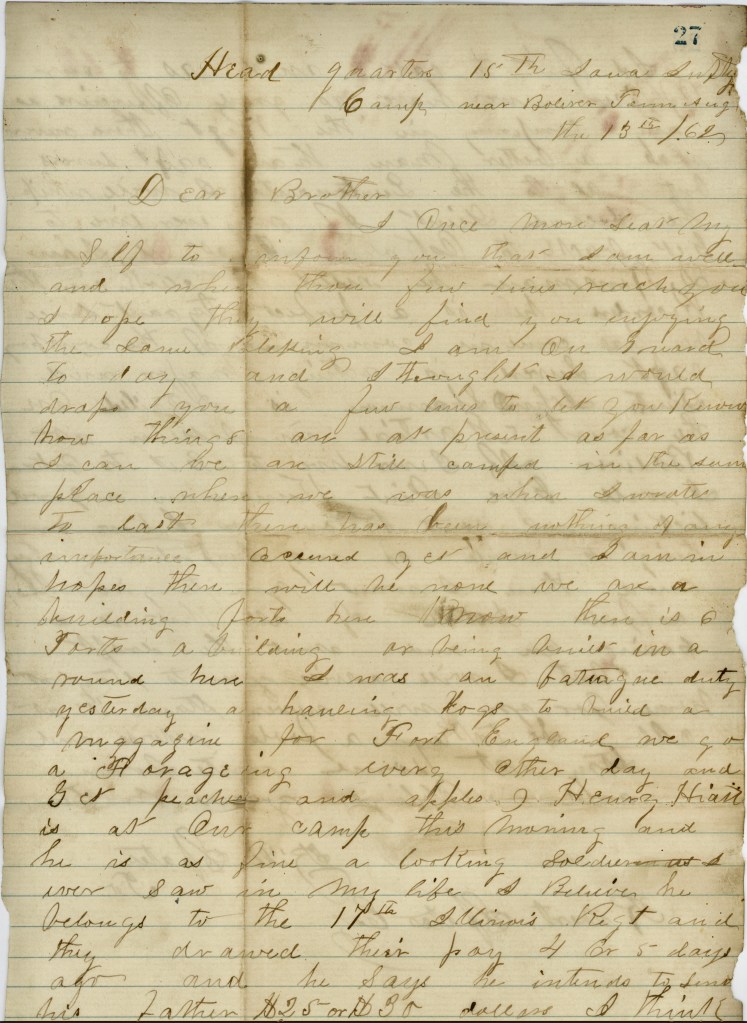
Headquarters 15th Iowa Infantry Camp near Bolivar, Tennessee August 13th 1862
Dear Brother,
I once more seat myself to inform you that I am well and when these few lines reach you, I hope they will find you enjoying the same blessing. I am on guard today and I thought I would drop you a few lines to let you know how things are at present as far as I can. We are still camped in the same place where we was when I wrote to [you] last. There has been nothing of any importance occurred yet and I am in hopes there will be none. We are a building forts here now. There is 6 forts a building or being built in a round here. I was on fatigue duty yesterday a having to go to build a magazine for Fort England. We go a foraging every other day and get peaches and apples.
Henry Hiatt is at our camp this morning and he is as fine a looking soldier as I ever saw in my life.. I believe he belongs to the 17th Illinois Regiment and they drawed their pay 4 or 5 days ago and he says he intends to send his father $25 or $30 dollars. I think it will be a good idea if he does.
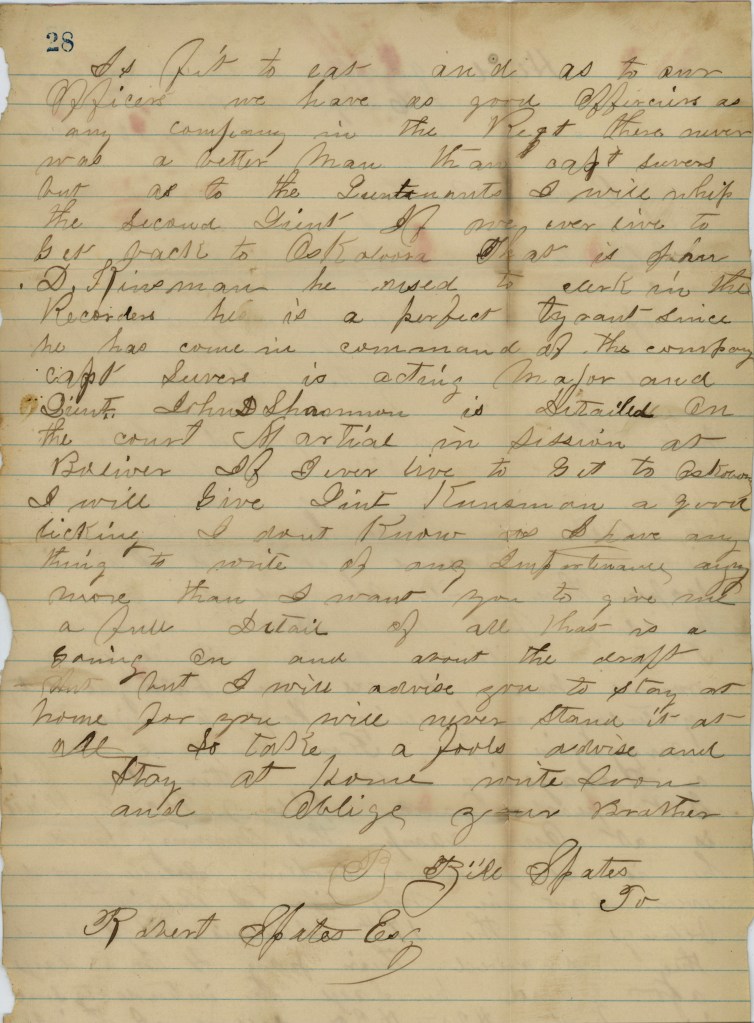
You wanted to know how we lived. We live sometimes like gentlemen and some times like hogs. We draw flour and ham and pickled pork every five days and beef every morning. We have built a bake oven and we have bread that is fit to eat and as to our officers, we have as good officers as any company in the regiment. There never was a better man than Capt. [James A.] Seevers. 1 But as to the lieutenants, I will whip the Second Lieutenant if we ever live to get back to Oskaloosa. That is John D. Kinsman. He used to clerk in the Recorder’s [Office]. He is a perfect tyrant since he has come in command of the company. 2 Capt. Seevers is Acting Major and Lieut. John D. Shannon is detailed on the court martial in session at Bolivar. If I ever live to get to Oskaloosa, I will give Lieut. Kinsman a good licking.
I don’t know as I have anything to write of any importance any more than I want you to give me a full detail of all that is going on and about the draft but I will advise you to stay at home for you will never stand it at all. So take a fool’s advise and stay at home. write soon and oblige your brother.
— Bill Spates
To Robert Spates, Esq.
1Seevers, James A. Age 29. Residence Oskaloosa, nativity Virginia. Appointed Captain Dec. 31, 1861. Mustered Dec. 31, 1861. Resigned Nov. 27, 1862, Tennessee.
2Kinsman, John D. Age 20. Residence Oskaloosa, nativity Iowa. Enlisted Oct. 17, 1861, as First Sergeant. Mustered Dec. 31, 1861. Promoted Second Lieutenant April 23, 1862. Killed in battle Oct. 3, 1862, Corinth, Miss.
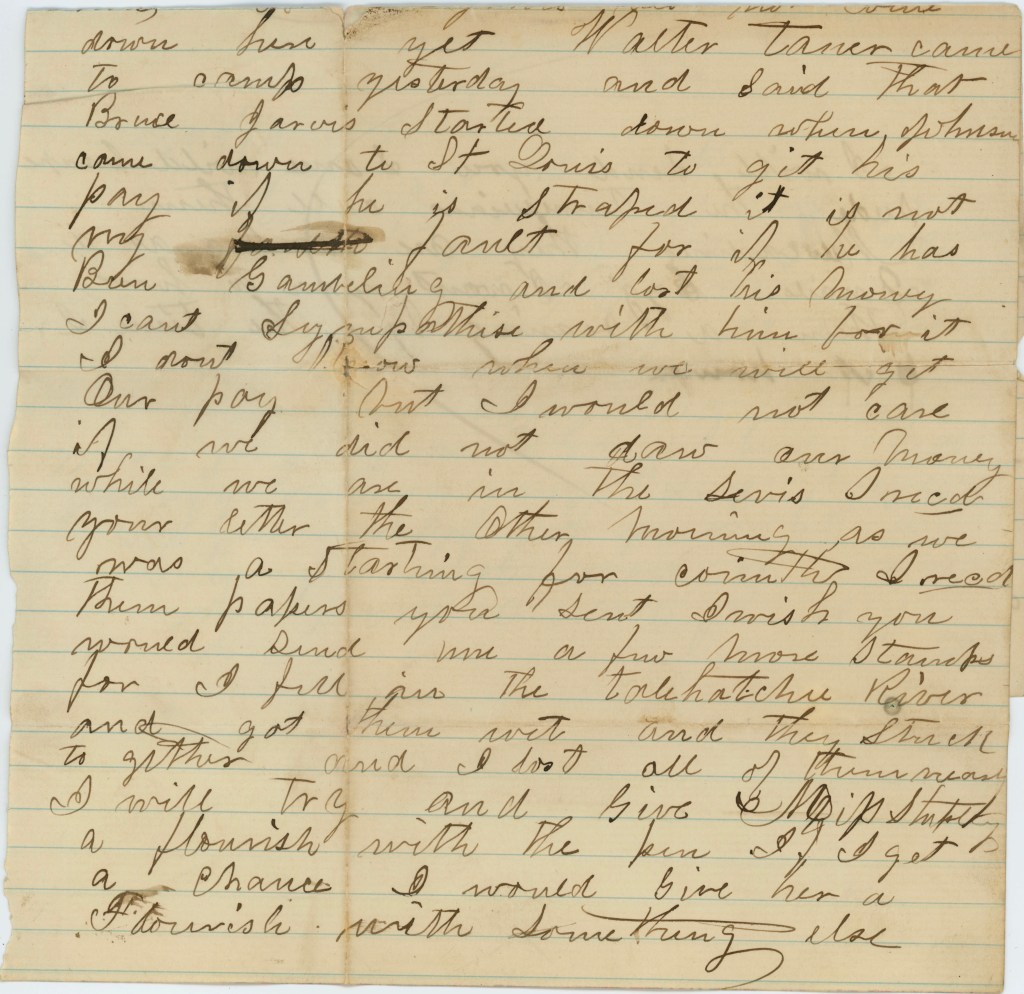
I seat myself to drop you a few lines. We received orders to be ready to march by 3 o’clock Friday morning and started from Bolivar to Corinth and was two days and a half on the road. We are camped about 2 miles and a half from Corinth—a little east, and a supporting the Tenth Ohio Battery. We are camped close to the picket line of Company C, 7th Iowa. Bruce Jarvis 1 has not come down here yet. Walter Tanner 2 came to camp yesterday and said hat Bruce Jarvis started down when Johnson came down to St. Louis to get his pay. If he is strapped, it is not my fault for if he has been gambling and lost his money, I can’t sympathize with him for it. I don’t know when we will get our pay but I could not care if we did not draw our money while we are in the service.
I received your letter the other morning as we was a starting for Corinth. I received them papers you sent. I wish you would send me a few more stamps for I fell in the Tallahatchie River and got them wet and they stuck together and I lost all of them nearly. I will try and give Miss [ ] a flourish with the pen if I get a chance. I would give her a flourish with something else.
Bob, I am afraid this Union is about gone up or as our byword is, “played out” for ninety days. Our Generals has not done anything in the East.
I will close. Give my respects to all of my friends. Send me something good to eat if you please. Farewell and excuse my writing for I have one of the meanest pens you ever saw. I have run out of gas.
Your humble servant, — Bill Spates
I will send you some wild grapes seeds. The Tennesseans call them Muscadines. They are as big as a snail’s egg. I want you to have them a bearing by the time I get home.
1 There was no Bruce Jarvis on the rolls of the 15th Iowa Infantry.
2Tanner, Walter A. Age 25. Residence Hopewell, nativity Ohio. Enlisted Oct. 17, 1861, as Third Corporal. Mustered Dec. 31, 1861. Killed in battle Oct. 3, 1862, Corinth, Miss.
Letter 3
La Grange, [Tennessee] November 29, 1862
Dear Brother,
I take the present opportunity of dropping you a few lines to let you know where I am. I arrived at La Grange yesterday evening. The Regiment left yesterday morning for Holly Springs and I and 4 more of the same regiment are here. I don’t know when I will get a chance to go to my regiment. The whole army is on the move and I expect will have a fight before a great while. There was about 70 thousand troops on their way to some place, God only knows where for I don’t.
I am well or about as I was when I left home. I think I will get a discharge when I get to the regiment or at least I intend to do my best towards getting one. I had not time to call on you for money so I gave Johnson a draft on you for $15. I suppose it will make no material difference to you. It did not cost me a cent for me to come down here. I came down to St. Louis with the 33rd Regiment and then I got a Transportation to my regiment.
Give my love and respects to all y old friends and especially to E. J. Shipley. Write soon and often. Your brother, — William Spates
This letter was written by William Henry Scarbrough (1842-1903), the son of James Scarbrough (1807-1896) and Elizabeth Breckenridge (1816-1904) of Liberty, Knox county, Ohio. The Scarbrough family were farmers and active members of the Methodist Episcopal Church.
William enlisted on 12 August 1862 to serve in Co. B, 96th OVI. Prior to his promotion to corporal in April 1863, he participated in the battles of Chickasaw Bluffs and Fort Hindman. He was with his regiment in the rear of Vicksburg when he wrote this letter in mid-June 1863 but became ill and was sent to the hospital on 4 July where he remained for a couple of weeks. He returned to his regiment and participated in the battle of Grand Coteau where he was wounded in the left index finger, was promoted to sergeant in December 1863, and and participated in the battles of Sabine Crossroads, Fort Gaines and Morgan, Spanish Fort and Mobile, Alabama.
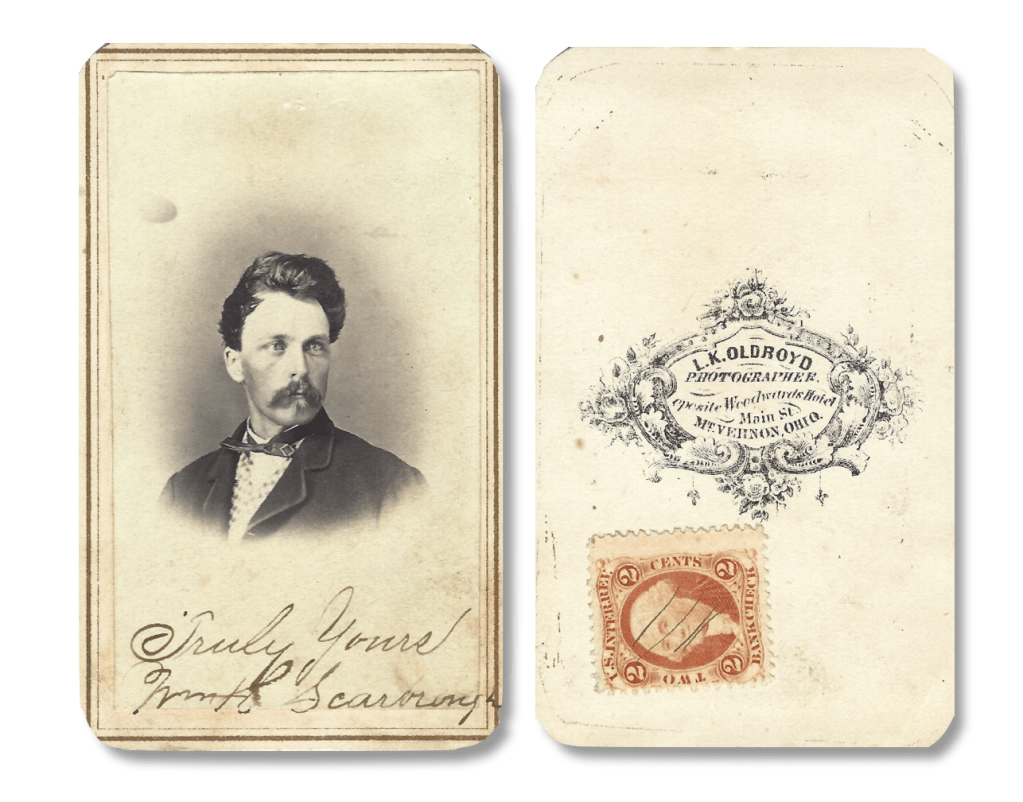
William H. Scarbrough of Mt. Vernon, Ohio. Photographer L. K. Oldroyd w. tax stamp. (Paul O’Neill Collection)
Advertisement for Oldroyd’s Gallery in the Mt. Vernon Republican, December 1864.
Previously published Spared & Shared letters by members of the 96th OVI: Albert S. Coomer, Co. C, 96th Ohio (3 Letters) Alfred Alverson Thayer, Co. C, 96th Ohio (3 Letters) Joseph C. Arnold, Co. E, 96th Ohio (3 Letters)
Addressed to Mr. James Scarbrough, Mt. Vernon, Knox County, Ohio
Rear of Vicksburg, four miles on the Battlefield June 17, 1863
Dear Parents,
This beautiful morning finds me seated for the purpose of writing you a few lines. However, I do not owe you any letter but if I did not write when I only received letters, I would not write very often. Since last writing you, nothing of interest has occurred more than usual. Last Sabbath morning as Orderly Lore and myself were laying in the beautiful shade with our Testaments in our hands and talking of home and the pleasant times we have had and soon hope to enjoy again, we were called—or rather aroused—by a Rebel shell which soon brought us to our feet and instead of reading our Bibles, had to lay in the rifle pits the balance of the day. Such is the theme of war. You do not know from one minute to another what you will be called on to do. Persons not acquainted or used to the Army would think it a strange place. I do not mind the hardships of war anymore for tis of no use. I thank God for sparing my life through so many dangers and hardships and good health. Since coming here, many of our boys have taken sick with disease, chills, and fever. Consequently the duty we have to perform (which is very heavy) comes harder upon those that are well.
John Law is not very well at this time but is now improving slowly. I wrote a letter stating that I would like if you could send me a couple of good woolen shirts—something of good quality. I am nearly out of anything in the shirt line and do not like the army shorts. If you have any chance, send them, or if you think it safe to Express them.
If you want to see a map of Vicksburg and of the charges [that have] been made and where the Federal Army lays and even [the] 96th [OVI], look in Leslie’s Illustrated Newspaper. It is being made and will be sent to him soon. You can see the position of all out forces and 20th, 96th, or any regiment you wish to see. I have nothing more of interest to communicate. I hope to hear from you all soon.
Send me postage stamps. I am out and will have to frank this letter. My love to all friends after reserving a share for yourselves. Yours topographically and fraternally, — William H. Scarbrough, soldier boy.
[to] James and Elizabeth Scarbrough
Direct to camp near Vicksburg, Miss., 96th Regiment OVI, Company B, Care of Capt. Joseph Leonard
I could say many things concerning the army but will be useless for the papers can and will give you a better statement than myself. I hope to hear from you soon.
1Lt.& Adjutant Henry Augustus Cheever, 17th Massachusetts Infantry (Memorial History)
This letter was written by Henry Augustus Cheever (1839-1905), the son of Ira Cheever (1798-1876) and Mehitable Gardener Felt (1802-1882) of Chelsea, Suffolk county, Massachusetts. He was captain of the Chelsea Wide-Awakes in the Lincoln Presidential campaign and also served as a member of Co. F, 7th Mass. Vol. Militia before the war. Henry received a commission as a 1st Lieutenant early in the war and was assigned to the 17th Massachusetts where he was appointed adjutant.
Later in the war, Adjutant Cheever was severely wounded at Batchelders Creek in North Carolina, He was wounded on the morning of 1 February 1864 and was taken prisoner but survived the surgery and recovered to return home. He went into the mercantile business after he war but eventually went to work for the Treasury Department and processed pension claims.
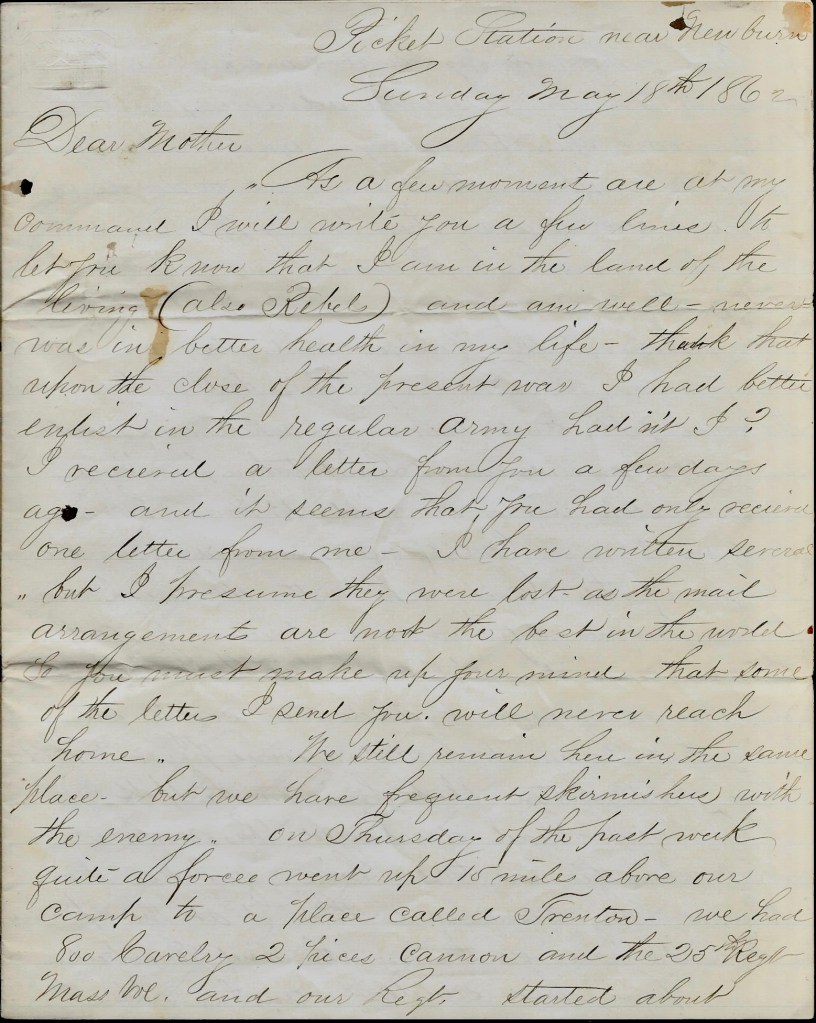
In this May 1862 letter, penned from New Bern after the Union occupancy, Henry tells his mother about the skirmish at Trenton Bridge that took place on 15 May 1862. He also shares his views of the New Bern inhabitants, their customs, farming methods, and the weather in general in the South. He includes some details of a long conversation held with Rebel officers during a flag-of-truce.
Transcription
Picket Station near New Bern, [North Carolina] Sunday, May 18th 1862
Dear Mother,
As a few moments are at my command, I will write you a few lines to let you know that I am in the land of the living (also Rebels) and am well—never was in better health in my life. Think that upon the close of the present war, I had better enlist in the Regular Army, hadn’t I? I received a letter from you a few days ago and it seems that you had only received one letter from me. I have written several but I presume they were lost as the mail arrangements are not the best in the world. So you must make up your mind that some of the letters I send you will never reach home.
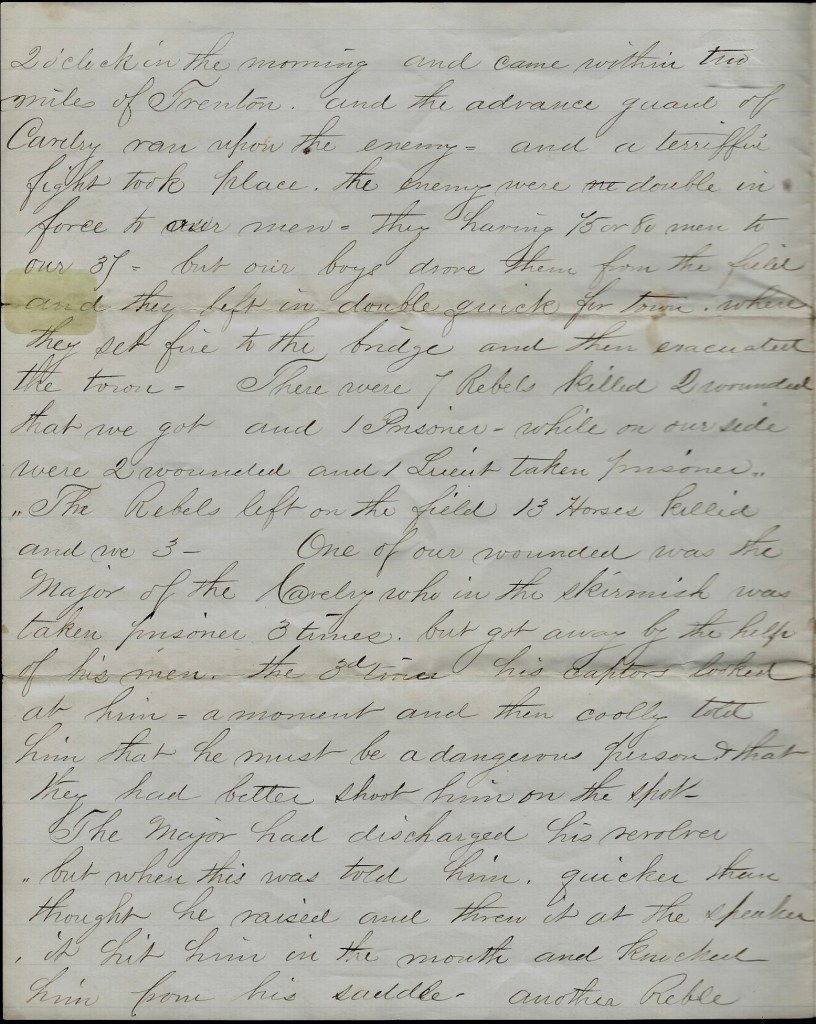
We still remain here in the same place but we have frequent skirmishes with the enemy. On Thursday [15 May 1862] of the past week quite a force went up 15 miles above our camp to a place called Trenton. We had 800 cavalry [3rd N. Y. Cavalry], 2 pieces of cannon, and the 25th Regt. Massachusetts Vol. and our [17th Mass.] regiment. [We] started about 2 o’clock in the morning and came within two miles of Trenton and the advance guard of the cavalry ran upon the enemy and a terrific fight took place. The enemy were double in force to our men, they having 75 or 80 men to our 37, but our boys drove them from the field and they left in double quick for town where they set fire to the bridge and then evacuated the town. There were 7 Rebels killed, 2 wounded that we got, and one prisoner, while on our side were 2 wounded and 1 Lieutenant taken prisoner. The Rebels left on the field 13 horses killed and we three.
One of our wounded was the Major 1 of the [3rd New York] cavalry who in the skirmish was taken prisoner three times but got away by the help of his men. The 4rd time his captors looked at him a moment and then cooly told him that he must be a dangerous person and that they had better shoot him on the spot. The Major had discharged his revolver but when this was told him, quicker than thought, he raised and threw it at the speaker. It hit him in the mouth and knocked him from his saddle. Another Rebel who helped take the Major raised his saber to cut him down, but at this moment one of our captains struck the Rebel with his sword and cut his right arm off so it hung by the skin. In consequence of this, the Major got away. He is a nice man and a very powerful one. All this took place in less time than I have written. The rest of the cavalry and troops were a mile behind the advance guard but we came up on the double quick to give them a volley, but were too late.
I was in command of the Pioneers and was ahead of the regiments and in rear of the cavalry. After we halted three of our companies were sent out to search the woods and C. C. had a skirmish and killed 4 more. After remaining here a while, we started for home, having marched 30 miles in less than 12 hours and through mud and water up to our knees. The object of the expedition was to capture and steal a lot of horses as this department is greatly in need of them. But they got the alarm and took them away.
Father wished to know concerning the people, habits, customs, &c. I should be very happy to inform him but as there are no people here save negroes, I can’t enlighten him much. When the town was evacuated, the people left also. Some few have returned but not many. There are poor whites here but they are far worse than the negroes for they are so lazy that they won’t work and the consequence is that they steal and starve.
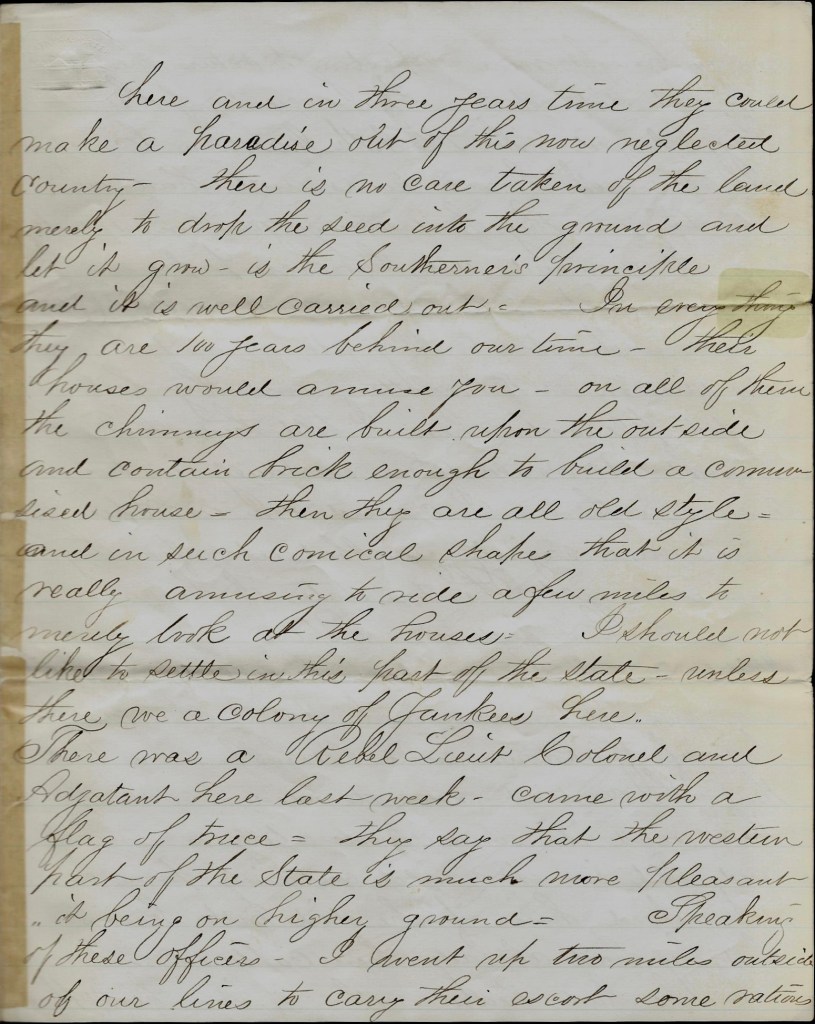
The weather is at the present like our July weather. We have frequent thunder showers. I have read and heard tell of a thunder storm in the Southern States but I must confess that my imagination was not strong enough to conceive what a storm could take place. A person must experience one in order to realize the beauty of it. Peaches and plums are fast ripening, strawberries in quantity, only we hardly dare venture into the fields to gather them for fear that the Rebels may pick us up. It is a sad looking sight to look over the broad fields of the plantations and see their barrenness for no one has planted anything save the negroes who only look out for themselves. Let a hundred live Yankees come down here and in three years time they could make a paradise out of this now neglected country. There is no care taken of the land, merely to drop the seed into the ground and let it grow—is the Southerner’s principle—and it is well carried out. In everything they are 100 years behind our time. Their houses would amuse you. On all of them the chimneys are built upon the outside and contain brick enough to build a common-sized house. Then they are all old style and in such comical shape that it is really amusing to ride a few miles to merely look at the houses. I should not like to settle in this part of the state unless there be a colony of Yankees here.
There was a Rebel Lieutenant Colonel 2 and Adjutant here last week came up with a flag-of-truce. They say that the western part of the state is much more pleasant—it being on higher ground. Speaking of these officers, I went up two miles outside of our lines to carry their escort some rations as they brought none, expecting to return the same day but did not. There were 20 of them. They belonged to the 1st North Carolina Cavalry. I was with them three hours and had a jolly time. They had many questions to ask and I answered all that were proper. They are sick of the war and wish it over. They talk it out. They felt anxious to know my opinion on the matter and they felt or acted pleased when I told them tht I thought it would close virtually in two or three months. I carried up 30 papers which were eagerly grabbed at for they cannot get the true state of the case from the Confederate papers.
I gave one of them a New York Herald in which was a editorial which stated the fact that if Yorktown and Norfolk were taken, that the contest was decided. One of them read it and came along to me and told me it would certainly prove so. I asked him if he did not know that they had already been captured? No, he had heard nothing of it. He supposed they were still in their hands. They were very much surprised at learning the fact. When I parted with them, I told them I hoped that if it was my fate to be taken prisoner, I hoped I might fall into their hands for I felt sure the would treat me well. They gave me the prices of their uniforms. Overcoat $35 (worth $5), pants $17 (worth $3), boots $20 (worth $5), coffee 150 and 200 per pound and other articles in the same proportion.
But I must close. Please tell Electa Brown that I will answer her letter very soon. Also convey my compliments to Anna Misley and say I should be very happy to hear from her. If I had any photograph, I would send her one. Also Electa. But I have none and there are no means of having any taken here so I shall have to wait until I arrive in some Northern City. Give my regards to my friends. Remember me to Sarah Young & Fred. Please write soon. From your son, — Hen
1 The name of the Major is never given in this letter but the Regimental roster indicates that the Major at the time was 35 year-old George W. Lewis of Elmira, New York.
2 The Lieutenant-Colonel of the 1st North Carolina Cavalry at the time was James Byron Gordon who later became a Brigadier General in the CSA.
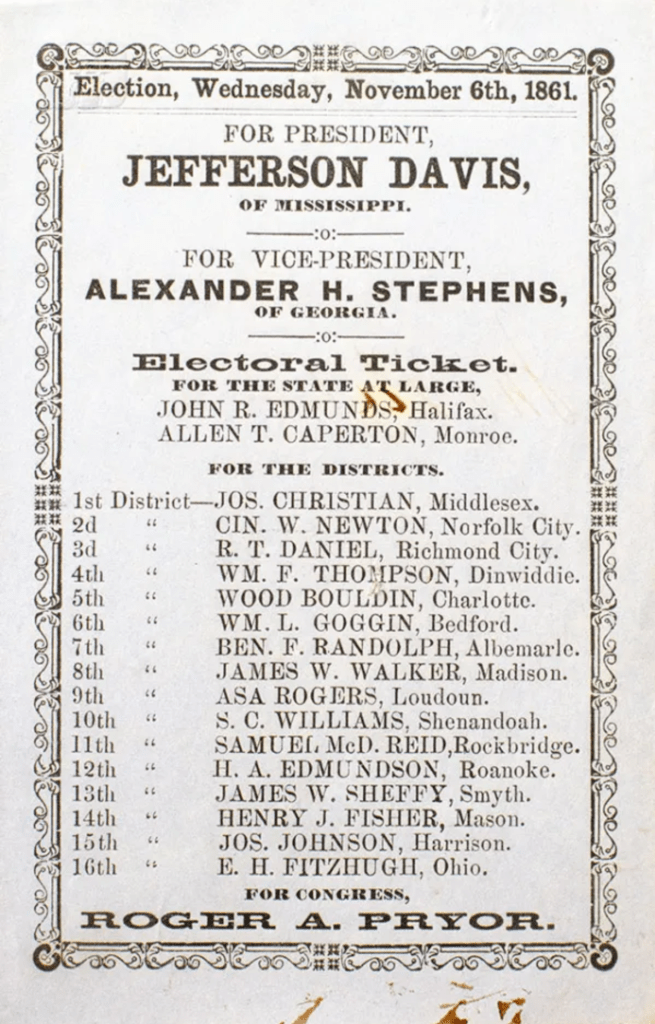
The following handwritten document is a very rare Virginia electoral ticket endorsing Jefferson Davis for president and Alexander H. Stevens for vice president. It also lists John R. Edmunds of Halifax and Allen T. Caperton of Monroe “for the state at large,” and various other men “for the districts.” The election took place on Wednesday, 6 November 1861. This election was the only presidential election under the Permanent Constitution of the CSA. Jefferson Davis and Alexander H. Stephens had been previously elected President and Vice President only under the Provisional Constitution.
This ballot was signed on the verso by James F. Ross, the voter who cast the Virginia ballot. Most likely the voter was 40 year-old James Franklin Ross (1821-1894), the son of John W. Ross (1788-1876) and Susannah Thomas (1794-1831) of Loudoun county, Virginia. James was married in November 1851 to Mary Jane Gochnour (1832-1929). Sometime after 1870, the Ross family relocated to Geary county, Kansas.
The Gilder Lehrman Institute of American History houses a similar ballot that was cast by William Fern but it was a printed ballot, as were most of the ballots. It was only when the pre-printed paper ballots were depleted that electors submitted hand written ballots.
Transcription
For President, Jeff Davis Vice President, Alex H. Stevens [Stephens]
Electors
[At large]
Jno R. Edmonds [of Halifax] A[llen] T. Caperton [of Monroe]
[Districts]
Joseph Christian [of Middlesex] C[incinnatis] W. Newton [of Norfolk City] R. T. Daniel [of Richmond City] W[illiam] F. Thompson [of Dinwiddie] Wood Bouldin [of Charlotte] W[illiam] L. Goggin [of Bedford] B. F. Randolph [of Albemarle] James W. Walker [of Madison] Asa Rogers [of Loudoun] Sam[uel] C. Williams [of Shenandoah] Sam[uel] M[cDowell] Reid [of Rockbridge] Henry A. Edmundson [of Roanoke] J[ames] W. Sheffey [of Smythe] H[enry] J. Fisher [of Mason] Joseph Johnson [of Harrison] E. H. Fitzhugh [of Ohio]
The handwritten Confederate Election Ballot, November 1861
A sample of the Printed Ballot that was widely distributed for elector’s use
These two letters were written by George deCharms (1839-1862), the son of Rev. Richard deCharms (1796-1864) and Mary Graham (1803-1880) of Philadelphia, Pennsylvania. It appears that George’s father abandoned his mother in the 1850s, leaving him at a very young age to try to supplement the meagre income earned by his mother and siblings. In the 1850 US Census, George was enumerated in his father’s household in Moyamensing Ward 2 of Philadelphia. His father’s occupation was recorded as “Welfare and Religious Services.” The children at that time included 14 year-old Sarah, 13 year-old Mary, 11 year-old George, 10 year-old William, 8 year-old Richard, 7 year-old Fideath, and 5 year-old Virginia. By 1860, Mary had moved her family to Cincinnati where George worked as a printer, and his sister Mary worked as a school teach and brother Richard was a law student.
Marker noting the location of the artillery duel at Greenbrier Bridge on 3 October 1861
At the age of 22, George enlisted as a private in Co. A, 6th Ohio Volunteer Infantry (OVI) on 20 April 1861. Enlisting with him was his brother Willie, age 21. The 6th OVI departed Camp Dennison for western Virginia, arriving at Grafton in modern-day West Virginia on July 2, 1861. The regiment next proceeded to Philippi and then to Laurel Hill, both in present-day West Virginia. The 6th helped additional Union forces to drive Confederate soldiers from Laurel Hill and pursued the retreating Southerners to Corrick’s Ford, where the Federals killed the enemy commanding officer, General Robert Garnett, on July 13, 1861. Following this engagement, the 6th marched to Beverly, Virginia (modern-day West Virginia), before moving to Elkwater in present-day West Virginia in August 1861. It was while at Elkwater that George wrote the first letter.
On November 19, 1861, the 6th departed Elkwater for Parkersburg, Virginia (modern-day West Virginia). The regiment next boarded steamers and sailed down the Ohio River to Louisville, Kentucky, where the organization joined the Army of the Ohio’s Fifteenth Brigade, Fourth Division. It was here that George wrote the second letter.
George would not long afterward arrange a transfer to the 54th Ohio Infantry where he would be made a 2nd Lieutenant and be one of five officers of the 54th OVI who were killed at the Battle of Shiloh. See—1864: Thomas Kilby Smith to Mary DeCharms.
These two letters were found in George deCharms’ pension file, offered as proof to the Pension Bureau by George’s mother that he supported her by sending home money to her.
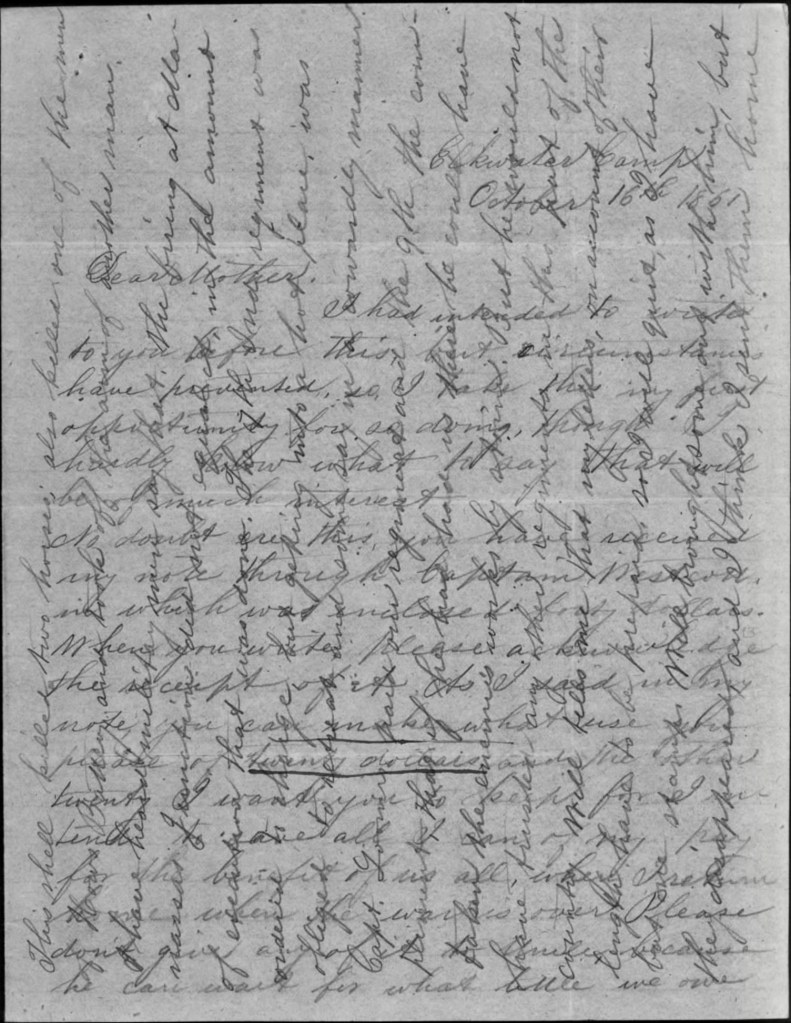
Letter 1
Elkwater Camp [West Virginia] October 16, 1861
Dear Mother,
I had intended to write to you before this but circumstances have prevented, so I take this my first opportunity for so doing though I hardly know what to say that will be of much interest.
No doubt ere this you have received my note through Captain [Marcus A.] Westcott in which was enclosed forty dollars. When you write, please acknowledge the receipt of it. as I said in my note, you can make what use you please of twenty dollars and the other twenty I want you to keep for I intend to save all I can of my pay for the benefit of us all when I return home when the war is over. Please don’t give any of it to Uncle because he can wait for what little we owe him. I mention this because if he knows I sent you any, he will not hesitate to ask for it. No doubt he will want you to pay what he lent Will out of it, and he has no right to do so out of my funds. Will and I will pay him what both of us owe, when the next pay day comes round. You need not say anything to him about it. However, I hope Father will not come to Cincinnati to make you miserable. If he does, don’t let him take or threaten you out of your money, and I think you ought not to let him come to the house.
We are very unsettled at present. Rumors are flying about camp that our regiment is going to Kentucky. How true it is, I do not know. I only hope it may be so. I don’t see how it is possible to stay here. The farmers around here say that it is impossible for wagons to travel the roads around here in the winter.
[Missing a page]
…with the 6th, and I shall endeavor to get out of it, for I don’t think his place can be filled.
I suppose you have seen an account of the battle [See Battle of Greenbrier River] that occurred near here a short time ago [on 3 October 1861]. Our regiment had not the honor of being there but yet it did not matter much for the fight was between the artillery alone. Capt. Howe of the regular army who was in command of Howe’s Battery there and which did most of the work there says, “All the armies in Europe might be a thousand years before they would experience as much heavy firing in so short a time.” This battery and Loomis’s [Michigan] Battery fired for two hours and forty minutes at the rate of a shot every three minutes. In that time, 1282 rounds were fired and every shot took effect.
The enemy lost nearly 400 killed while our loss was only ten killed and wounded. 1 The only effectual shot the enemy made was caused by a shell which they had not time to cause to explode by putting in the fuse, so busy were they kept at work. This shell killed two horses; also killed one of the men of Howe’s Battery and took off the arm of another man. I have heard military men say that the firing at Manassas Junction did not equal it in the amount of execution that was done. The 17th Indiana Regiment was ordered to charge but getting into a hot place, was obliged to retreat and some say in a cowardly manner.
Capt. Loomis paid our regiment and the 9th the compliment that if he had had us there, he could have taken the enemy’s works by storm. But he would not have trusted any other regiments in this part of the country.
Will tells me that my letters, on account of their length, have to be prepaid so I will quit as I have but one stamp. Will brought some out with him but they disappeared and I think I sent them home in the envelope I sent by Capt. Westcott. If so, send them out or take a half dollar out of the money I sent and buy the worth of that in stamps and send to me when you wish.
With love to all, I remain your affectionate son, — George
1 “Though the engagement was sharp and spirited, the losses were not heavy. Each side, however, magnified the loss of the enemy. Reynolds, who thought Jackson’s 1,800 men had grown to 9,000, reported the Confederate loss in killed and wounded was about 300. Not to be outdone, Jackson reported that Reynolds’ loss in killed and wounded “is estimated at from 250 to 300, among them an officer of superior rank. Our own was very inconsiderable, not exceeding 50 in all.” Actually, when the returns were all in, it was found that the Federals lost eight killed, and thirty-five wounded, for a total of forty-three. The Confederates had six men killed, thirty-three wounded, and thirteen missing; these turned up in Reynolds’ report as prisoners.” [Source: The Battle of Greenbrier River]
Letter 2
Louisville, [Kentucky] December 3, 1861
Dear Mother,
As you see by the date of this, I am now in town, partly to avoid extra duty I have to perform in camp on account of two-thirds of our regiment being absent, either here or in Cincinnati, which our officers are unable to collect together; many of whom I am afraid will never return unless some inducement is offered. In our company there was not over fifteen or twenty men and half those are now sick, who are here to do duty. They take as many men on guard out of the two or three hundred men present as they did when the whole regiment was on hand; so that those who are present have to stand guard all the time as was my fix.
The camp is on a plowed field and now since it has snowed, the mud is awful. The first night the regiment went out they had no tents so that most of the men came to town. Many of them go out and report themselves and becoming discouraged at the dreary look of things, turn round and come back to town. I am afraid that the Bully 6th has played out. Col. [William K.] Bosley will never get as much out of it as he has heretofore. I have regretted every time that Will and I did not return with you and Mary on the boat. We could have done it just as well as not. We might have stayed several days just as well as not for a great many have gone further than Cincinnati and returned, and nothing has been said to them.
If we had only thought of going with that Captain that took such a family to Mary to Gen. Buell, I have no doubt we could have got a furlough. Several mothers have got their sons furloughs in that way.
I have not heard anything from the old fellow yet. Julius Stewart has gone to Cincinnati and he said he would call on you all. I have had several chances to go home and wanted Willie to go with me but he thought it was not right to go without leave and I won’t go without him.
I hope Uncle will succeed in getting me a commission for I don’t think there will be much honor gained by staying in the 6th. General Buell says that he is going to make an example of this regiment and I have no doubt he will for he is a hard man. I am afraid he will send us on board ships to some garrison sp that we will have no chance at all. Mother, I wish you would send me a five dollars by mail or in a note by Julius. I thought I should not need any more than I retained but there are some things that I need and would like to have it if you can spare it out of that ten dollars I gave you. But if you need it very much, don’t send it for I can wait till next pay day.
Perhaps we may yet get a furlough. If not, give my love to all at home and to all the relations and remember me as ever your affectionate son, — George
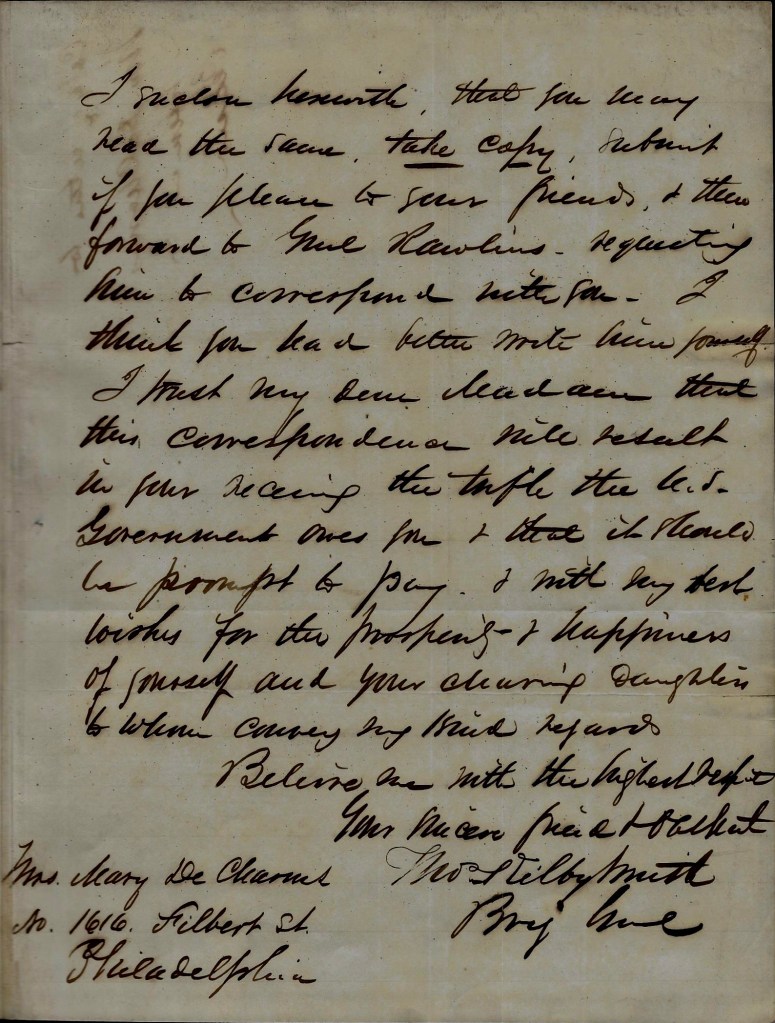
This letter was written by Brig. General Thomas Kilby Smith (1820-1887) as a favor to his friend Mary De Charms who sought a pension for the death of her son 2Lt. George De Charms of Co. C, 54th Ohio Infantry. George was killed in action at the Battle of Shiloh on 6 April 1862 while fighting with the 54th Ohio Infantry that was led at the time, by then ColonelSmith. For a great account of the 54th OVI at Shiloh, I’ll refer readers to “My boys from Cleveland, for God’s sake, do your duty!” The 54th Ohio Infantry at Shiloh, by Dan Masters.
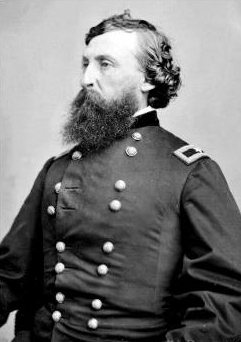
Brig. Gen. Thomas Kilby Smith
Pension records indicate that Mary did not file her claim until after the death of her husband Richard in March 1864 who left her and her three daughters with no means of support other than what they could raise teaching school. It appears that even before her husband’s death, however, Mary relied heavily on the money made by George before and during his time in the service as her husband had abandoned her 17 years before and had since published material indicating his disloyalty to the US Government. Though the Pension Bureau did not dispute that her son was a fallen soldier and eligible for a pension, they questioned he was an officer as no record could be produced—until Thomas K. Smith generated the letter which he claims to have enclosed with the following letter. The pension record contains a letter dated 27 April 1865 which states that George’s commission as 2nd Lieutenant was awarded and backdated to 13 December 1861. 1
Mary lived until March 1880 during which time she received a pension for her son’s service.
A letter by Col. Smith contained in George de Charm’s Pension Record, dated 4 May 1862, not long after the Battle of Shiloh, reads: “Lieut. De Charms died as a soldier should die, with his face to the foe, died trusting in God, with his honor bright. He fell early in the fight of Sunday, shot, fell in front, the ball piercing the centre of his breast a little below his throat. His last and only words as he fell were, ‘Tell my friends I died like a man. I die happy in the service of my country.’ His remains were found and decently interred on Wednesday following. His brother [William] was present at the interment. His person has been rifled of his watch, money & valuables by the enemy. The battlefield of Pittsburgh or ‘Shiloh’ as it should be called properly is drenched with the blood of patriots, honeycombed with their graves. Partial newspaper correspondents who unfortunately are the historians of our country have failed to do Ohio justice in their vague & false reports of the battle—reports too often made to purposely forestall public opinion. Ohio has been nobly represented but none of her sons have been more heroic or deserve more praise than Lieutenant George de Charms….But what is all this to a Mother’s heart? Ah! how well I know how it pains…the tear wells to my own eye as I write. God help us. I would give anything to call him back again. I had learned to love him for his soldierly qualities, his earnest honest wit. But he has gone…”
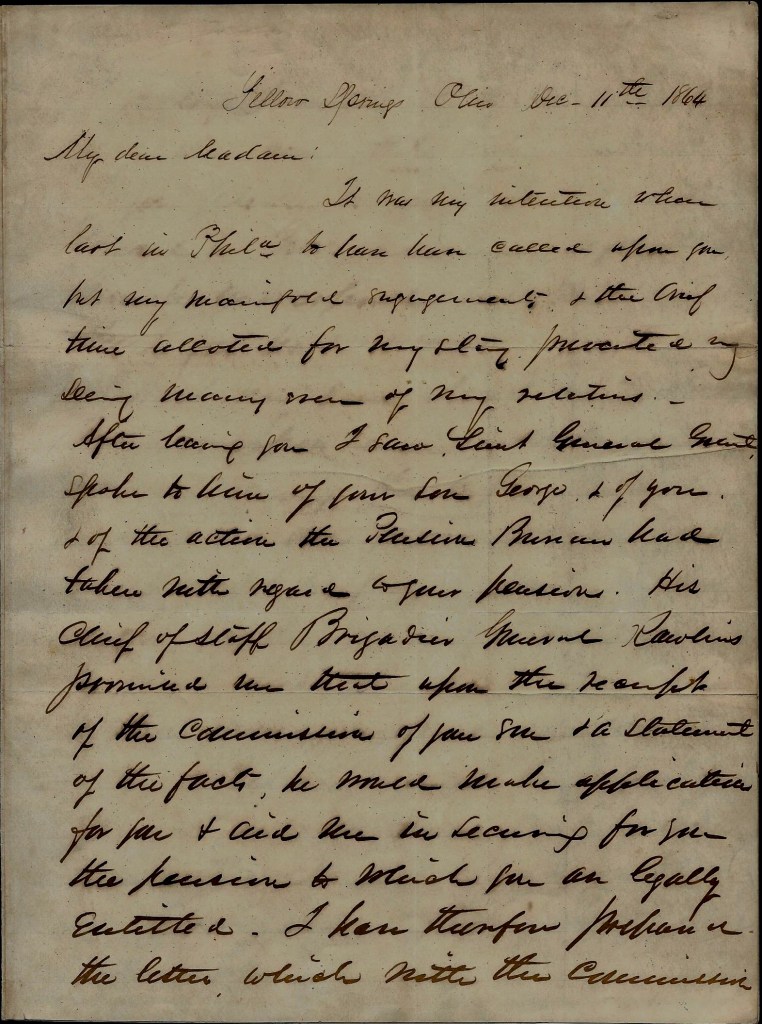
Transcription
Yellow Springs, Ohio December 11, 1864
My dear madam,
It was my intention when last in Philadelphia to have called upon you but my manifold engagements and the brief time allotted for my stay prevented my seeing many even of my relations.
After leaving you, I saw Lieut. General Grant, spoke to him of your son George, and of you, and of the action the Pension Bureau had taken with regard to your pension. His Chief of Staff, Brigadier General [John A.] Rawlins promised me that upon the receipt of the commission of your son and a statement of the facts, he would make application for you & aid me in securing for you the pension to which you are legally entitled. I have therefore prepared the letter which with the commission I enclose herewith, that you may read the same, take copy, submit if you please to your friends, & then forward to General Rawlins requesting him to correspond with you. I think you had better write him yourself.
I trust, dear Madam, that this correspondence will result in your receiving the trifle the U. S. Government owes you and that it should be prompt to pay. I with very best wishes for the prosperity & happiness of yourself and your charming daughters to whom convey my kind regards.
Believe me with the highest respect, your sincere friend and obedient servant, — Thomas Kilby Smith, Brig. Gen’l.
Mrs. Mary De Chams No 1616 Filbert Street Philadelphia
1 The following two letters are on file at the Ohio History Archives:
December 10, 1861 R. Buchanan, Cincinnati, Hamilton County, Ohio. To Governor William Dennison. Letter recommending George De Charms for the appointment of Lieutenant in the 54th Regiment, Ohio Volunteer Infantry; and stating that De Charms had served in the 6th Regiment, Ohio Volunteer Infantry from its organization, was about 23 years old, large and muscular, and was well educated and a good soldier, and that he had no hesitation in saying that if appointed, De Charms would do credit to the service. 1 p. [Series 147-19: 206]
December 10, 1861 John W. Caldwell, No. 379, Main Street, Cincinnati, Hamilton County, Ohio. To Governor William Dennison. Letter stating that he had seen testimonials of the merits of George De Charms, a Private in Company A, 6th Regiment, Ohio Volunteer Infantry, that he had also seen the suggestion of Colonel T[homas] K[ilby] Smith that he might have use for De Charms as a 2nd Lieutenant in the 54th Regiment, Ohio Volunteer Infantry, and Smith’s request for De Charms’ transfer, and that he cheerfully concurred in the request for De Charms’ immediate transfer to the 54th Regiment, Ohio Volunteer Infantry. 1 p. [Series 147-19: 203]
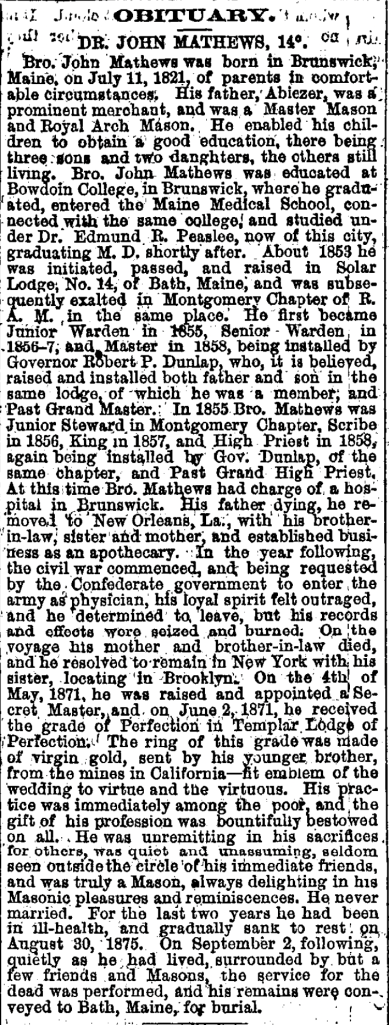
This letter was written by John Mathews (1821-1875), the son of Abiezer Mathews (1788-1856) and Ruth Eastman Page (1791-1861) of Bath, Lincoln county, Maine. John was an 1845 graduate of the Medical College at Bowdoin and practicing medicine in Bath at the time of the 1850 US Census where he was enumerated in his parents household along with two younger sisters, Martha and Mary, and two younger brothers, Philip and Emory. His father’s occupation was given as “Writing Master” at the time though an obituary claims he was a “prominent merchant.” An advertisement for John’s medical practice in Bath informs us that his office was located in the Granite Block on Front Street in Bath.
In the late 1850s, John relocated to New Orleans with his brother-in-law, sister Martha L. Carter, and mother and established an apothecary. When the Civil War began not long after, he was “requested by the Confederate government to enter the army as a physician,” but his “loyal spirit” would not allow him to do so and he decided to return to New York though his “records and effects were seized and burned.” As if this weren’t enough, his mother and brother-in-law died on the trip back to New York, leaving only his sister and himself to settle in Brooklyn.
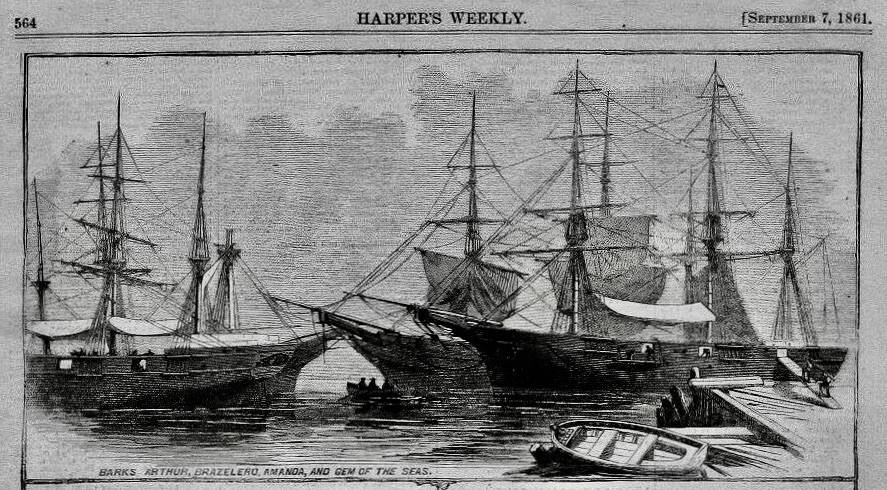
John enlisted in the U. S. Navy in 1861. He reported to the USS E.B. Hale as Assistant Surgeon. He was transferred to the US Bark Gem of the Sea in October 1861, and joined the South Atlantic Blockading Squadron off the South Carolina coast. She ran British blockade runner Prince of Wales aground off Georgetown 24 December. She captured blockade runner Fair Play 12 March 1862, schooner Dixie 15 April 1862, and schooner Mary Stewart 3 June. Nine days later she took schooner Seabrook off Alligator Creek. On 1 July she took possession of four rice-laden lighters up the Waccamaw River. Mathews was discharged on 18 September 1863 due to rheumatism. After hhe war, Mathews settled in Brooklyn, New York, where he practiced medicine. His residence was at 239 Fifth Avenue at the corner of Carroll Street. He died in 1875 and was buried in Bath, Maine.
Asst. Surgeon John Mathews posted this letter while serving aboard the Union bark Gem of the Sea—a “fast sailer” and a very prolific blockade vessel and raider during the Civil War. Writing to his sister, Mathews spends much of the letter recounting the terrible plight of ex-slaves who were abandoned by their owners on North Island at the mouth of Georgetown Bay in South Carolina. Mathews, at least from his perspective, had a prominent role in the salvation of these unfortunate individuals.
[Note: This letter is from the private collection of Richard Weiner and is published on Spared 7 Shared by express consent.]
Bark Gem of the Sea being fitted out for naval service at New York Navy Yard in 1861
Transcription
Gem of the Sea Georgetown Entrance, South Carolina August 1, 1862
Dear Sister,
Your letter with the “bon bons,” also Philip’s with papers, have all been received. I wrote Philip a few lines last week which I suppose he has received, though whether he has been able to find it out is a doubtful question. I had but a few moments and a great deal to do.
We are still inside Georgetown bar, and how long we shall remain here I cannot tell. I do not know which is worst—the flies, mosquitoes, fleas and heat, or rolling and pitching about outside. We have to suffer anyhow, but I believe it is pleasanter outside.
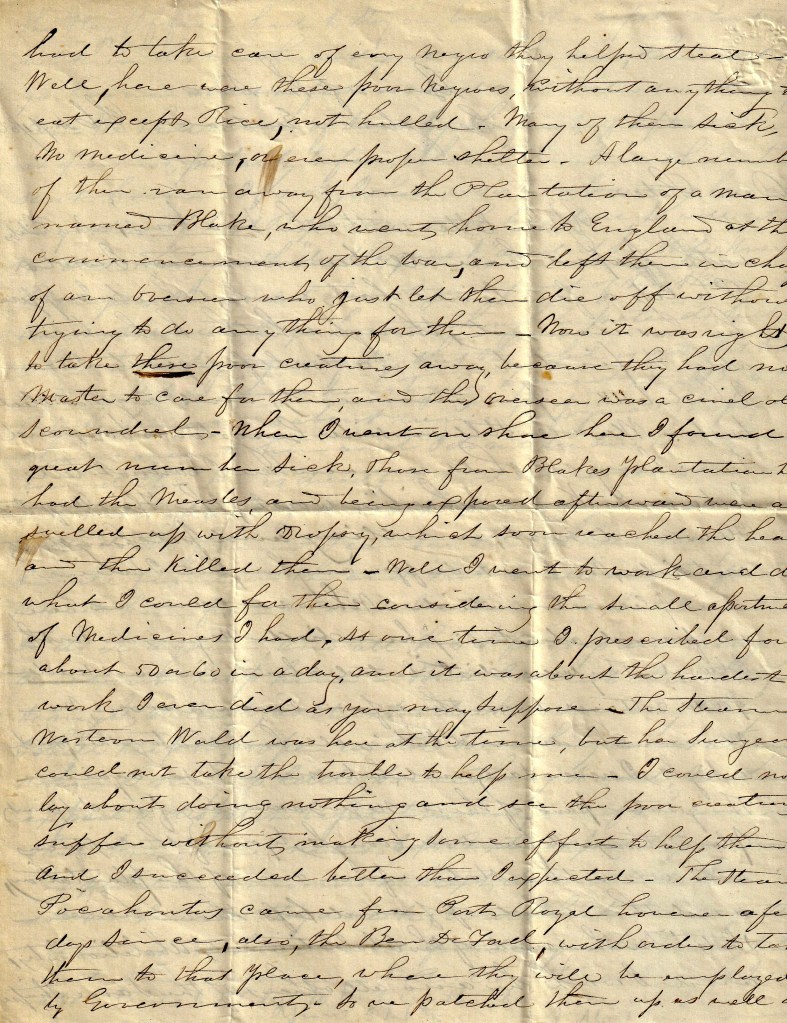
When we came in here, we found about six hundred negroes on North Island. 1 They were distributed about in and under 9 or 10 cottages, two or three families in a room—men, women, children and babies all huddled together. Such a sight I never saw and hope never to see again. The greater part of these negroes ran away from different plantations. A part were brought by one of the captains who was on the station from one of the plantations and then went off and left them here. That’s like the most of the abolitionists and I wish he and all others of the same stripe had to take care of every negro they helped steal.
Well, here were these poor negroes without anything to eat except rice, nut hulled. Many of them sick. No medicine or even proper shelter. A large number of them ran away from the plantation of a man named Blake who went home to England at the commencement of the war and left them in charge of an overseer who just let them die off without trying to do anything for them. Now it was right to take these poor creatures away, because they had no master to care for them, and the overseer was a cruel old scoundrel. 2
When I went on shore here I found a great number sick. Those from Blake’s plantation had the measles and being exposed afterward were all swelled up with dropsy which soon reached the heart and then killed them. Well, I went to work and done what I could for them considering the small assortment of medicines I had. At one time I prescribed for about 50 or 60 in a day and it was about the hardest work I ever did as you may suppose.
The fate of the negroes treated by Surgeon Mathews on North Island. Published in the Columbus, Ohio, “Crisis” on 20 August 1862.
The steamer Western World was here at the time but her surgeon could not take the trouble to help me. I could not lay about doing nothing and see the poor creatures suffer without making some effort to help them and I succeeded better than I expected. The steamer Pocahontas came from Port Royal, however, a few day since, also the Ben DeFord 3 with orders to take them to that place where they will be employed by Government. So we patched them up as well as possible and sent them off. About 500 of them including the men and children went on the Ben DeFord. I went on board to cheer them up as they thought a great deal of me. Such a scene I never expect to see again, and it would be of no use to attempt to describe it.
We have still some negroes here as they keep coming. Also four white families. We had eight white persons on the Bark for some days that came down from Georgetown and one of them who is still on board (a lady of course) was confined ten days since with a little girl. Of course I had to officiate on the occasion. If she is able, will let her be carried on shore in the morning as the accommodations are not exactly suitable for a lady though we did have four on board for about a week though it turned everything topsy-turvy and us officers almost out of house and home. They are all on shore now with the exception of the sick one and I hope she will be able to go tomorrow.
The surgeon of the Pocahontas and myself take turns in attending to the sick on shore and have fixed up a place for an office where we can deal out medicines. It is a nice cool place and is an agreeable change at least. It is awful hot on board the vessel and the flies—Oh Lord! I never had an idea of being really tormented by them before. Then we have any quantity of red ants, but the rats really have the possession. I have a list of 32 men who had had their fingers and feet eaten more or less by these nuisances. They are everywhere present and as bold as ever—bolder than those in New Orleans. I wish the Flag Officer had to stay on board this vessel about a week in this weather and just as she is now, she would go home about as fast as wind and water would carry her.
We shall be out of stores by the first of September at farthest—probably before—when I think we shall be sent home. 4 If not, I shall insist in leaving her at any rate. If Captain Baxter 5 goes on as he has done, he will get the Old Harry [devil] on the “double quick,” and if his wife knew of his capers, she would almost jump out of her skin. He does not want to go home though he pretends he does while he is saying every day that the vessel is not fit to sail and ought to go home, he is trying to prevent it. But I think his race is about run. The paymaster has preferred charges against him and I do not see how he can get around it. He is dreadful good to me all at once but he is afraid of me as he knows me evidence would be the death of him. I can see through him easily, and he will find in the end that I will not lie for him. I saved him from a court martial once, but I would not do it again, and all his soft soap and cringing now won’t help him.
But I must close this for tonight at least as it is too dark to see anything. I shall keep this open until something comes along when I may have a little something to add. We soon expect a dispatch vessel tomorrow and if she comes, we shall have some news. Capt. [Irvin B.] Baxter expects to go on an expedition tomorrow or next day on a little steamer. Hope we will stay a week. I think I shall go this time as we have uncomfortable quarters enough here but she is worse. I will close this as I want to write a few lines to Philip 6 to put in the same envelope. Yours affectionately, — J. Matthews
1 North Island is the northernmost sea island in a chain extending to the northern border of Florida. It’s approximately nine miles long and was by 1820 there were more than 100 beach houses on the island where wealthy plantation owners would try to escape the summer heat and mosquitoes. An article published by Jason Lesley in the Coastal Observer (16 May 2015) informs us that by the time of the Civil War, there were 18,000 slaves and only 2,000 whites in the Georgetown District. “Confederate troops abandoned the defense of North and South islands, and in May 1862 Union ships sailed up the Waccamaw River to rice plantations where they took 80 slaves on board as contraband and transported them to North Island. Hundreds of slaves were removed from plantations and quartered on North Island, but food was scarce and soldiers treated them little better than overseers in the rice fields. Most were transferred to the Union base at Port Royal where they joined the Union Army or were put to work in camps. The end of the rice economy left planters impoverished for decades. Summer houses blown away by hurricanes couldn’t be replaced. In 1884 because of unpaid taxes, North Island, South Island and part of Cat Island were sold to retired Civil War general E.P. Alexander, who had visited the island to hunt and fish in the early 1880s.”
2 These slaves came from the rice plantation of Arthur Middleton Blake. In 1860, there were as many as 538 slaves living on his plantation. The plantation bordered the Santee River near Cape Romain and was used as a Confederate regimental headquarters for protecting ships running the Union blockade. Navy steamers fired on the plantation in 1862, invaded and burned the buildings and about 100,000 bushels of rice. Nearly 400 slaves, it was said, boarded the Navy steamers, some of whom may have been dropped off on North Island. Blake purchased this plantation from his cousin in 1843 and returned to England in 1861 when the war began.The overseer described by Mathews as a “cruel old scoundrel” was a Scotchman named John McGinnis who worked for Mr. Blake some seven years before the war. [Official Records of the Union & Confederate Navies.]
3 The steamer Ben DeFord apparently made several trips to North Island to pickup slave refugees. In an articles published in the New York Semi-weekly Tribune on 30 December 1862, it was reported that the “steamer Ben DeFord left this pretty little town [Beaufort, D. C.] on a trip to North Island, S. C. about fifteen miles below Georgetown, S. C. for the purpose of gathering up the contrabands who were assembled there, and who managed to escape from the districts in the neighborhood of the Santee and Peedee Rivers…Several trips to North Island and Fernandina, Florida, has always succeeded in gathering up a large number of contrabands, and obtaining a large number of able-bodied recruits for the 1st South Carolina Volunteers.”
4 The Boston Semi-weekly Advertiser reported on 22 October 1862 that the “Barque Gem of the Sea, Lieut. Commanding J. B. Baxter, from Georgetown, S. C., Sept. 30, arrived at this port on Saturday. The following is a list of her officers. Lieut. Commanding J. B. Baxter; Executive Officer, Peter F. Coffin; Acting Master, H. B. Carter; Assistant Surgeon, John Matthews; Acting Paymaster, H. A. Strong; Masters’ Mates, Wm. C. Malley, Geo. H. White, and J. G. Crocker.”
5 The Barque “Gem of the Sea” was commanded by Acting Volunteer Lt. Irvin B. Baxter. Apparently his first initial was often mistaken for a “J.”
6 “Philip Mathews enlisted in the 14th Brooklyn on September 8th 1862 and was assigned as a Private in Co “D.” Falling ill in April 1863, Mathews was transferred to a hospital at Aquia Creek Virginia where he spent much of the spring. Back with the regiment in time to be listed as Missing in Action at Gettysburg on July 1st he did not rejoin his company until January of 1864. Mathews’ pre-war experience as a druggist’s apprentice finally caught the Army’s attention on his return and on January 22nd 1864 he was detached from his Regiment to serve as a Hospital Steward at the hospital of the 4th Division, 5th Corps Army of the Potomac. When the original 1861 enlistments of 14th Brooklyn men expired in May 1864, Mathews was formally transferred to Co “I” of the 5th New York Infantry but remained serving at the hospital. On August 2nd 1864 a medical board consisting of Army surgeons performed a formal examination of acting Hospital Steward Philip Mathews and he was found qualified to fill the position of Hospital Steward in the regular army. Determined competent, he was discharged from volunteer service and reenlisted in the Regular Army the following week where he would serve until August 1866.Following his military service, Philip Mathews returned to Brooklyn where 1870 found him working as a “drug clerk” and living with his physician brother in the home of a dentist. By 1875 brother John had his own home and their sister Martha had also moved in along with several boarders. Philip was drawn westward by the end of the decade and 1879 found him living in Los Banos California where he continued to work as druggist. The 1880 US Census found him in the hills of Sonora as a “miner.” Apparently, he did not find success in the gold fields as on March 22nd,1881 “A strange man” was found in Fallon’s Hotel in the town of Columbia California and “after several hours’ suffering died.” This unfortunate man was Philip Mathews and a Coroner’s inquest later determined the unhappy druggist has committed suicide by taking poison. In a hotel room on the opposite coast as his family, Mathews took his own life only a week short of his 53rd birthday, perhaps another victim of the Civil War.” [Source: Faces of the Franklin Guard, Co. D, 14th Brooklyn]
The light house on North Island as it looked in 1893
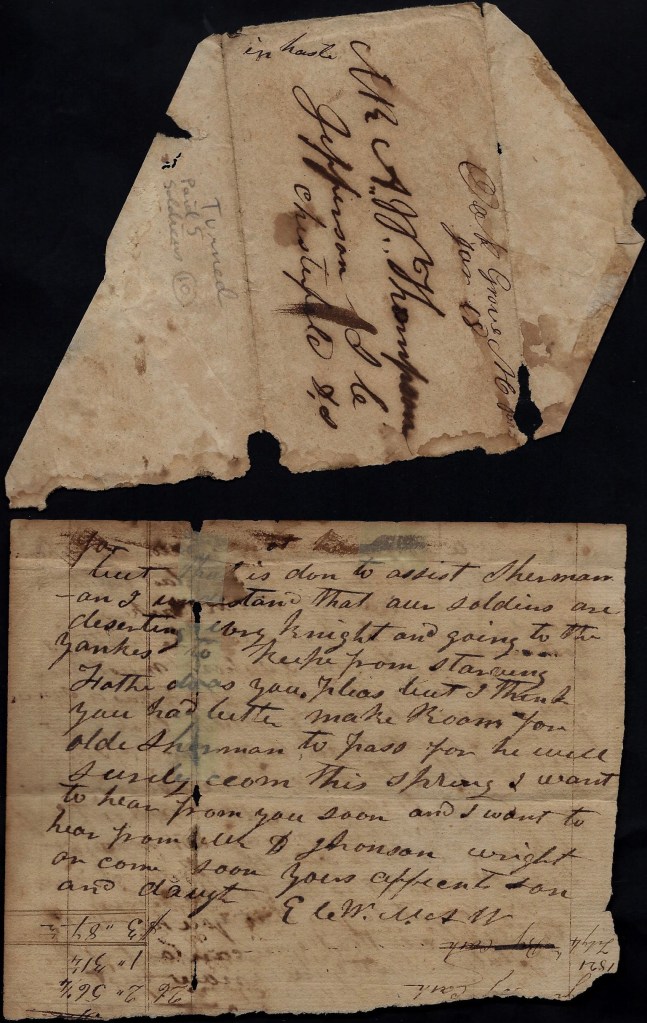
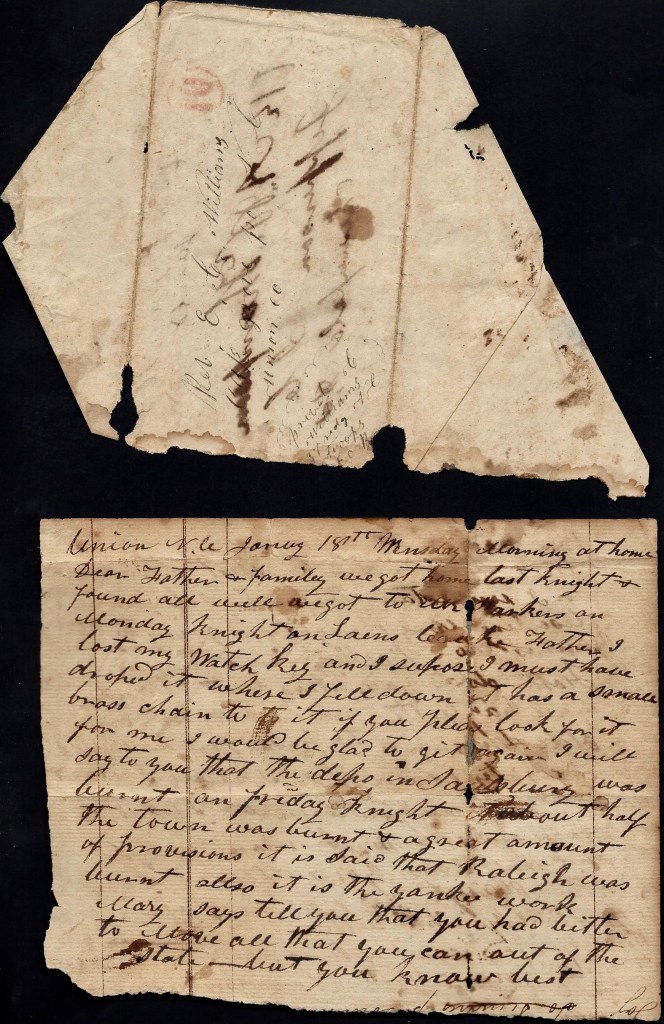
This letter was written by Elam Culbertson Williams (1819-1891), the husband of Mary Ann (Thompson) Williams (1828-1915), to his father-in-law, Ashiel Washington Thompson of Jefferson, Chesterfield county, South Carolina. Elam was ordained as a minister in 1845 and served as pastor for Meadow Branch Church, Wingate, North Carolina, from 1846 to 1855. Prior to the Civil War, held property in Mecklenburg county, North Carolina, including more than 30 slaves.
In his letter, Elam advises his father-in-law to move his property out of way of Sherman’s army who were anticipated to pass through South Carolina on their way north.
Sherman’s troops burning a railway depot in South Carolina.
Transcription
Union, North Carolina January 18th [1865] Wednesday morning at home,
Dear Father & Family,
We got home last night and found all well. We got to Mr. Parker’s on Monday night on Lane’s Creek. Father, I lost my watch key and I suppose I must have dropped it where I fell down. It has a small brass chain [attached] to it. If you please, look for it for me. I would be glad to get it again.
I will say to you that the depot at Salisbury was burnt on Friday night. About half the town was burnt and a great amount of provisions. It is said that Raleigh was burnt also, It is the Yankee work. Mary says [to] tell you that you that you had better to move all that you can out of the state, but you know best for [ ] but that is done to assist Sherman. And I understand that our soldiers are deserting every night and going to the Yankees to keep from starving.
Father, do as you please, but I think you had better make room for Old Sherman to pass for he will surely come this spring. I want to hear from you soon and I want to hear from Mr. D. Johnson. Write or come soon. Your affectionate son and daughter, — E. C. W. & M. A. W.
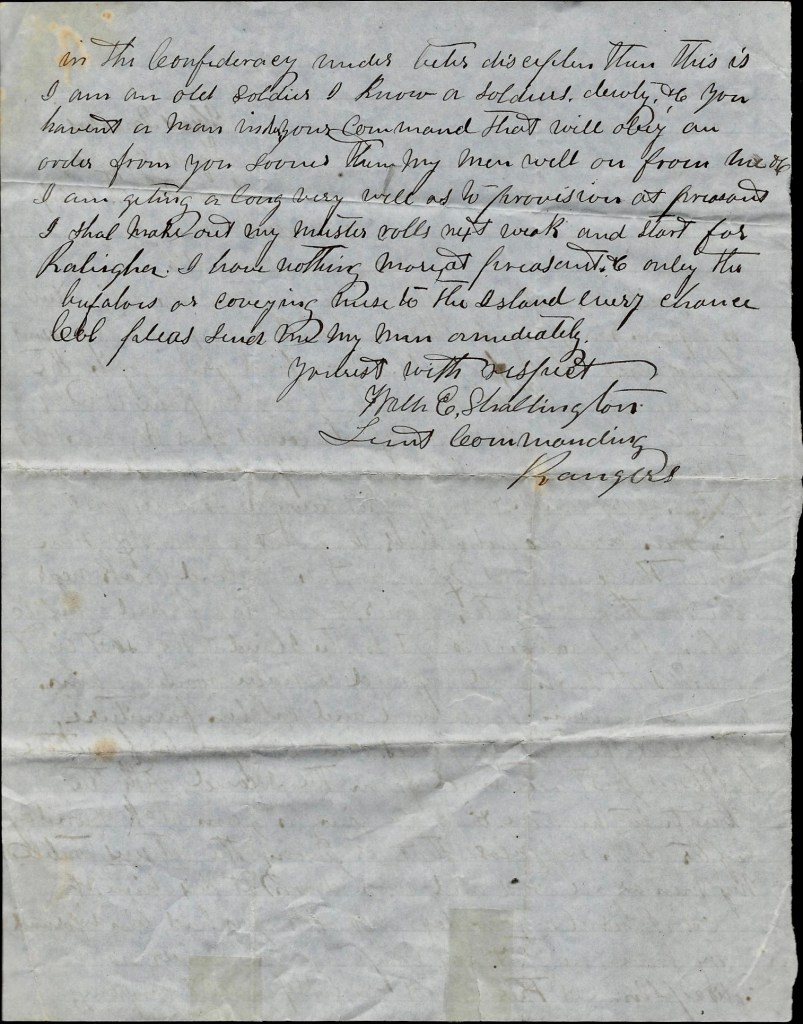
This letter was written by William Edward Shallington (1839-1921), the son of David Pender Shallington (1811-18xx) and Penelope Barnes (1814-1870) of Edgecombe county, North Carolina. William enlisted early in the Civil War as a private in Co. I, 3rd North Carolina Infantry. He remained with that regiment until January 1863 when he transferred to Capt. William H. Spencer’s Company of Independent Cavalry (“Spencer’s Rangers”) where he was awarded a commission as 1st Lieutenant. In February 1864, after Capt. Spencer and a few other rangers were taken captive in a surprise raid at Fairfield, Lt. Shallington took command of the Rangers.
In the spring of 1864, the Confederate army reestablished control over most of Tyrrell county which had been under Union occupation for almost two years. Gum Neck fell under the administration of Colonel George Wortham of the 50th North Carolina Regiment who established his headquarters at Plymouth. During the period that followed, conflicts necessarily arose between the roving Confederate bands—such as Spencer’s Rangers—and the local residents who had always been loyal to the Union, or who had “turned traitor” to the Confederacy and taken the Oath of Allegiance to the United States government. In common parlance, the term “buffaloes” was used to refer to any individual—black or white—who opposed the Confederate cause. See NCPedia, “Buffaloes.”
In the following letter, Lt. Shallington speaks of hunting down “buffaloes”—in this case, refugees—who were attempting to flee to the east side of the Alligator river in Tyrree county. [Readers are referred to an excellent article by Roy T. Sawyer entitled, Life on the Alligator River, published in Tyrrell Branches, Spring 2012.]
Transcription
Headquarters Tyrell County, North Carolina June 17th 1864
Col. George Wortham, dear sir,
I avail myself of the opportunity of writing you a few lines to inform you of my health. My health is very good at present, hoping that these few lines may find you enjoying the [same] blessing of health, &c. The health of my company is very poor &c. Colonel, I wish—that is, if you could spare my men that I sent you—to send them to camp as I stand in need of them very much. My picket duty is so heavy [and] all my men are becoming sick. I sent a squad of men under the command of a sergeant to Second Creek near the mouth of Alligator River and they found a buffalo making preparations to get to the island. They shot eight rounds at him and supposed to have wounded him. He was moving household and kitchen furniture. They cut the boat to pieces and destroyed his furniture. He had just returned from the island with the boat to move.
I am going to Gum Neck Monday after some buffaloes that are giving the citizens trouble. My men are all tired and worn down at this time.
Colonel, I heard a few days ago that you had been informed by someone that my company was under no discipline. Colonel, there is not an independent company in the Confederacy under better discipline than this is. I am an old soldier. I know a soldier’s duty. You haven’t a man in your command that will obey an order from you sooner than my men will or from me.
I am getting along very well as to provisions at present. I shall make out my muster rolls next week and start for Raleigh. I have nothing more at present—only [to report that] the buffaloes are conveying men to the island every chance. Colonel, please send me my men immediately.
Yours with respect, — Will E. Shallington, Lieut. Commanding Rangers
This letter was written by Franklin (“Frank”) Gray Pitt (1827-1871), a physician and slaveholder from Lower Conetoe township, Edgecombe county and the son of Col. Joab Phillips Pitt (1795-1854) and Elizabeth Shirley (1806-1841). In the 1850s, Frank and Dr. John Howard formed a medical practice together at Sparta, advertising their services regularly in Tarboro’s The Southerner.
In June 1861, Frank volunteered to serve in the 30th North Carolina Infantry and was elected Captain of Co. F (“The Spartan Band”). He served with the regiment until 11 March 1862 when he resigned his commission and returned home for the purpose of raising a cavalry company.
From a history of North Carolina Regiments in the Civil War, we learn that Frank organized the Edgecomb Partisan Rangers, with himself as Captain, Van B. Sharpe as 1st Lieutenant, Bennett P. Jenkins as 2nd Lieutenant, and Mark B. Pitt as 3rd Lieutenant. This company was incorporated into the 7th Regiment Confederate Cavalry as Co. I where they served until the 16th North Carolina Cavalry Battalion was organized in July 1864. Near the end of the war, Capt. Pitt took overall command of the 16th N. C. Cavalry Battalion until early April 1865 when he broke down from exhaustion and was captured.
Frank’s forage requests may be found in his Compiled Service Record beginning in April of 1864. The requests were made to, and approved by, Col. Wortham at Plymouth so this letter was no doubt written to Col. George Wortham, his commanding officer. George Wortham was a lawyer from Granville County, North Carolina.
What is most curious about this letter is the reference to a slave named George who was being pursued by Capt. Pitt although his reason for doing so is vague. A clue is offered by Pitt’s statement that “the Buffaloes” might come with him. According to the NCPedia, the origin of the word Buffalo during the Civil War era “is contested” and remains an ongoing area of research for historians. The best intelligence that has emerged is that the term “buffaloes” was first used to describe the North Carolina Union Volunteers of Eastern North Carolina. Later in the war, the meaning of the word was expanded to refer to any individual opposed to the Confederate cause.
Transcription
Camp near Pettigrew’s Chapel [Creswell, Washington County, North Carolina] June 8th 1864
Colonel [Wortham],
I send two men to you as couriers and will station two half way between here and Plymouth. This will reduce me to twenty men for duty. I have to keep ten on picket at a time. This will have my men on picket duty every other night and day. I shall have none to scout now. This will give Lt. [Van B.] Sharpe near 30 men.
Colonel, I want to know if I have any control or command of the courier line. If I have, I shall change the number of men at post for I learn there is five men near Cross Roads Meeting House more than necessary. If I have no control of it, of course I cannot alter it.
I have been trying to get this boy George & have not succeeded yet for he is very shy and his master is not all right. I shall continue to try and get him & the Buffaloes that come with him. I do not think the negro carried against his will for he has been with them all the time. It is going to be very hard duty for my men here now. I do not see how I can keep up a scout below now. Let me hear from you. I will do all in my power at anything.
Yours truly, — F. G. Pitt, Capt. Commanding Cavalry






















 Spared & Shared 23