All posts by Griff

My passion is studying American history leading up to & including the Civil War. I particularly enjoy reading, transcribing & researching primary sources such as letters and diaries.

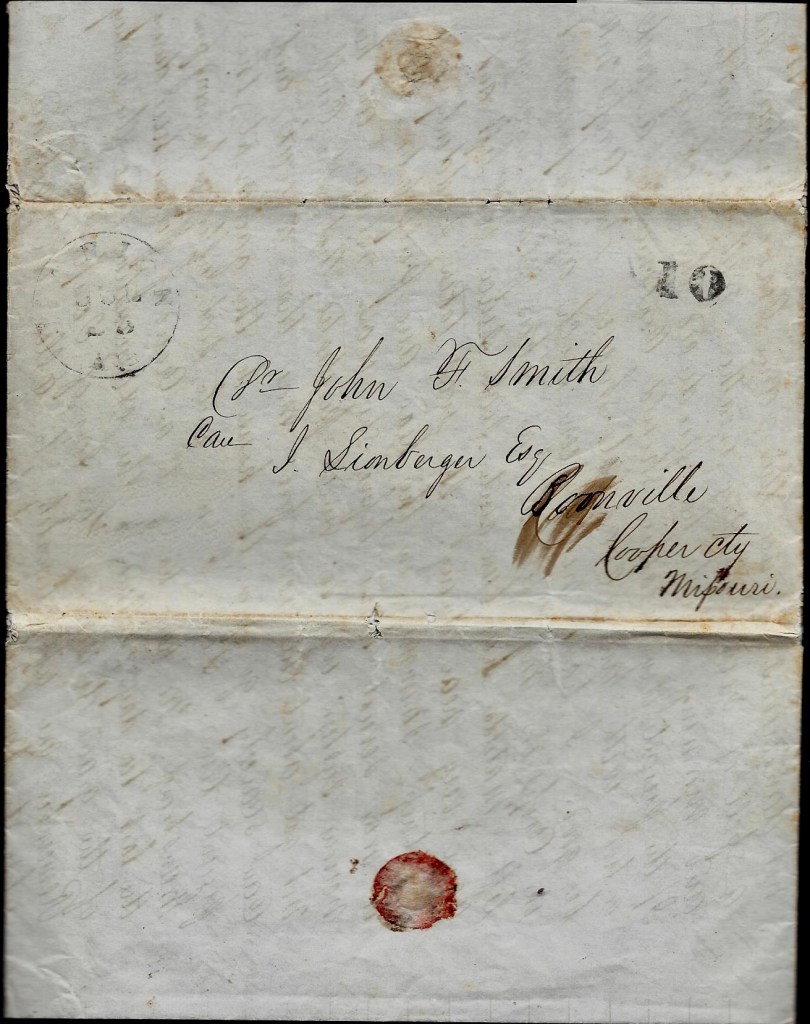
1850: Lewis Conner Tutt, Sr. to John F. Smith

This letter was written by Lewis Conner Tutt, Sr. (1817-18xx), the son of Richard Johnson Tutt (1772-1840) and Mildred Conner (1776-1837) of Culpeper, Virginia. Lewis was married in February 1844 to Matilda Josephine Jones (b. 1826) and together they raised half a dozen children or more—of whom was Lewis (Jr.) who served as a sergeant in Roddy’s Escort, Alabama Cavalry.

From his post war “Amnesty & Pardon” papers we learn that Lewis was “by profession a merchant and since immigrating to [Alabama, was always] engaged in merchandizing and farming.” He claimed to have “never sought or held political office nor in any manner a public man but devoted all his time and energies to his business.” He went on to describe the hardship he now faced having had “the larger portion of his estate swept away by the emancipation of slaves (he had owned 14) and other losses sustained in consequence of the war.” He made it clear that he had supported the Constitutional Union Party and therefore voted for Bell & Everett in 1860 hoping to avoid the “calamities which have befallen our country.” He pointed out that he never was in the Confederate army or service, and only offered aid to ease the helpless and suffering families in his county. Furthermore, he had already begun to hire freedmen “at liberal compensation—those he formerly held as slaves.”

Lewis wrote this letter to his brother-in-law, Dr. John F. Smith who married his sister, Mary “Ellen” Tutt (b. 1813) on 12 October 1841 in Rappahannock, Virginia.

Judson Female Institute, Marion, Alabama

Transcription

Marion, [Perry county, Alabama]
July 26, 1850

Dr. John F. Smith,
Dear Sir,

You will no doubt think it strange that I have not written to you before this, but after your expressing so much doubt in regard to the time you should leave Pontotoc in Mississippi and your promise to write to me from Memphis, I concluded to wait until I heard from you before I wrote. I received your first letter after leaving Pontotoc about a week since from St. Louis and your last from Boonville day before yesterday. I did not know until I heard from you at St. Louis whether or not you had left Pontotoc, or if you had, what route you had taken—whether by land all the way, or by Memphis. I am sorry now that I did not write for I expect you have been anxious to hear from this place. For the same reason that I did not write, I thought it best not to ship your trunk until I heard from you which I did as soon as I received your letter from St. Louis.

I was very much pleased to learn that notwithstanding your hard and fatiguing trip that you had all arrived safely with the exception of your sickness. I felt very uneasy all the time until I heard from you all and from your symptoms in St. Louis, was not much surprised to learn that you were sick after getting to Boonville. I am very glad to learn that you are improving and hope your health will be entirely restored.

The horse you left in Greensboro died the day after you left. The tavern keeper wrote me he could do nothing with him and could find no one who could. I am satisfied from all I can learn that his disease was not the glanders. Brazelton appeared to be very much astonished—declared he knew that he knew of nothing that was the matter with him and said that he was willing to do anything that it was right and proper that he should do to give you satisfaction. I thought I would not press the matter on him as the note was not due until I heard from you. I think you done well to sell your horse in Memphis, taking everything into consideration.

Your affairs stand pretty much as they did when you left—everything being entirely easy. I shall collect a little money from the Judson [Female Instutute], I think, during the examination which takes place next week. The Howard [College] and the [Marion Female] Seminary examinations are both over. We have had very dull times here since you left and some of the hottest weather I think I ever felt. A part of the time we have had a great deal of rain but for the last week it has been dry.
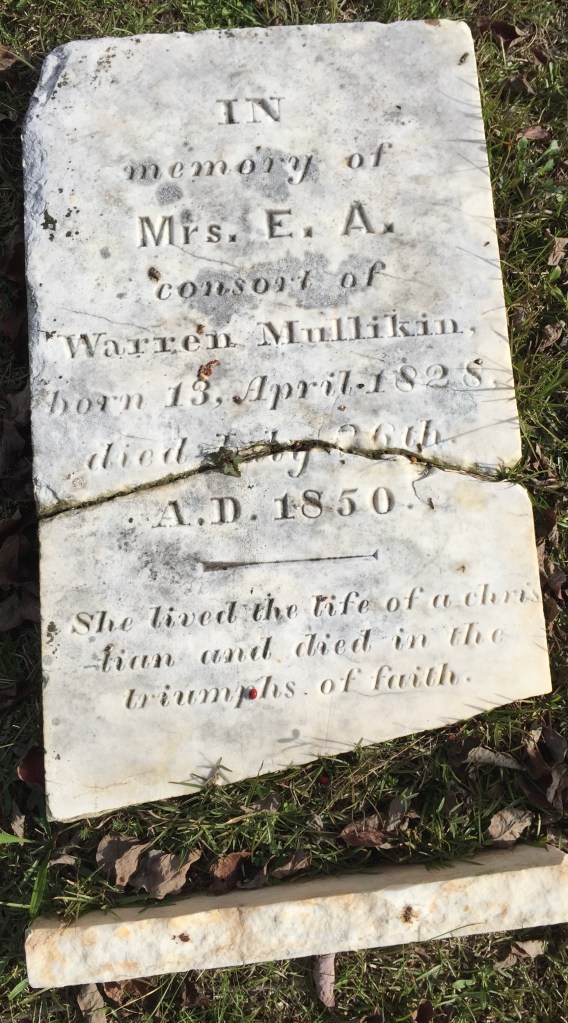
Toppled & shattered headstone of Elizabeth, consort of Warren Mullikin. He married her sister less than two years later (you could say he “got a mulligan?)

We have at this time a considerable amount of sickness—typhus and billious fever. My girl Elvira has had a very hard spell and is just recovering. Warren Mullikin’s wife 1 was buried today. She died after about three or four days illness. A Miss Johnson, granddaughter of Mrs. Rutledge, died a few days since. Miss Neal is not expected to live and there have been several deaths amongst the negroes. Dr. [Samuel] Johns, James [Anderson] Howze, and Mr. [Hector] McLane are all sick at this time, but I suppose not dangerous. Since the rains ceased, we have had a spell of very hot, dry weather with cool nights and mornings which has produced the sickness.

If the present dry weather should continue for a week or two, with an occasional shower, our crops will be good. I have never seen such an improvement in crops in my life as has taken place since you left.

Matilda has been sick since you left and came very near dying. She was taken suddenly with faintness, swimming in her head and palpitations. It was several hours before she was relieved and her nervous system was so much prostrated that she could not get about the room for more than a week, and can scarcely go from the house to the garden at the present time. Lewis I found quite sick after returning from Greensboro. We have had quite a crowd of persons here during the last ten days attending the examinations and the meeting of the Grand Division of the Sons of Temperance.

Remember me affectionately to Ellen and Edward. Also to Mr. Turner and family and relatives generally. Matilda desires to be kindly remembered to Ellen & yourself, and requests particularly that sister Ellen should write to her. You need not feel any uneasiness about any of your matters here for there is not the least occasion for it. I will write you again in three or four days. Write me as often as you can.

Yours, — L. C. Tutt

Say to sister Ellen that I will write to her in a few days and that she must not wait for my letter to write. Tell her to write and give me all the news in Missouri.

1 Warren Mullkin (1821-1860), a collector in Perry county, was married to Elizabeth A. Patterson (1828-1850). She died on 26 July 1850. “She lived the life of a christian and died in the triumphs of faith” according to her gravestone, which lies broken on the ground in the Marion Cemetery. The couple had been married less than four years.
1865: Coles Jackson Brown to James B. Brown

This letter was written by Coles “Jackson” Brown (1815-1895), the son of Abram Brown (1777-1862) and Mary Purdy (1783-1873) of Putnam county, New York. Coles was married to Sarah Mary Cowl (1811-1894) in January 1836 and worked as a carpenter in Putnam county, New York, until sometime in the 1850s when he became a farmer in Burns township, Henry county, Illinois.

I feel certain that Jackson wrote the letter to his son, James B. Brown (b. 1844) who enlisted on 9 August 1862 as a private in Co. D, 112th Illinois Infantry (though there seems to be some discrepancy between his census record age and his enlistment record age). James served his full three years, mustering out at Greensboro, North Carolina, on 20 June 1865. In his letter, Jackson responds to his son’s complaint about not getting any letters from home by informing him that: “Well, it is not that there has not any been sent for we send one every week. I think you will get a big mail if you ever get the half of what letters that have ben sent to you.” Of course the 112th Illinois was engaged in the Carolina Campaign at that time and mail was slow to catch up with the regiment.

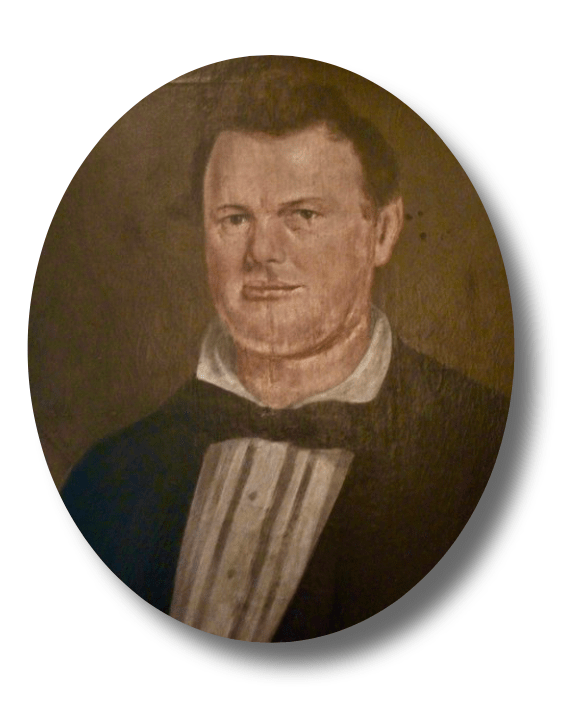
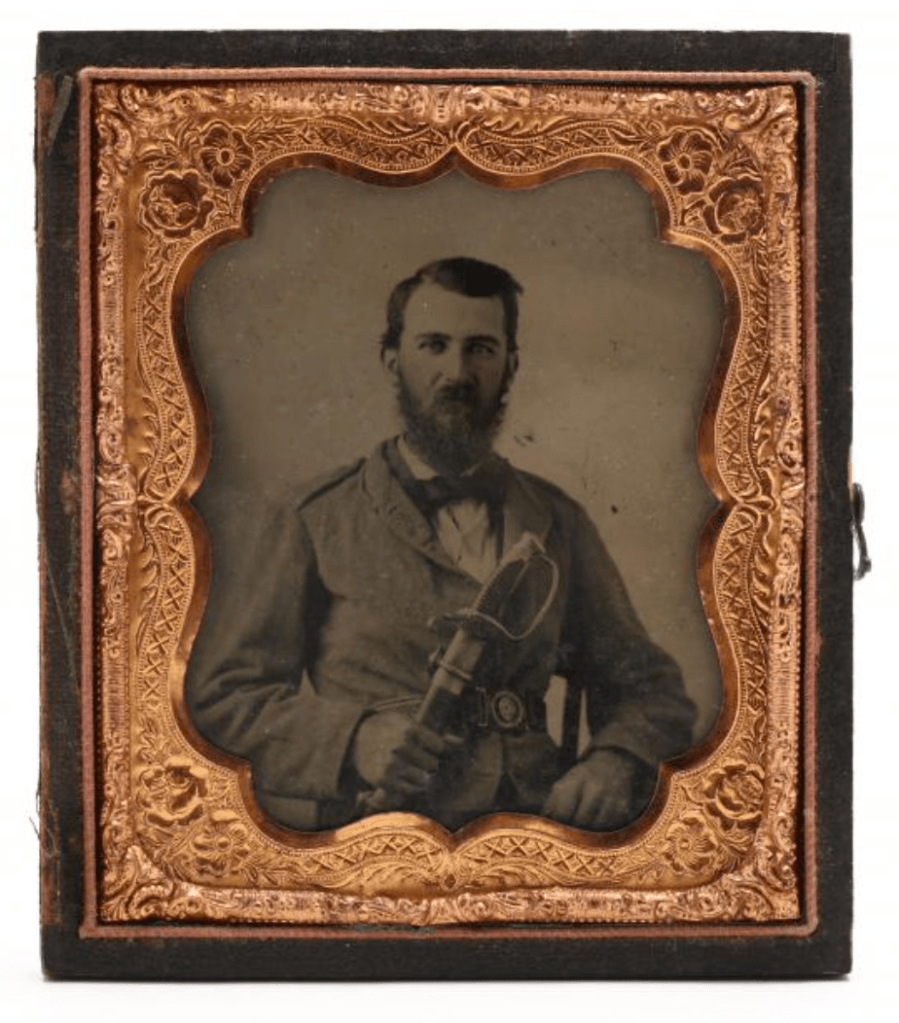
Coles Jackson Brown, ca. 1865

Transcription

[Henry county, Illinois]
March 26th 1865

Dear James,

I now take a few moments to write a few lines to you to let you know that we are all well and enjoying good health. You say you get no letters from home. Well it is not that there has not any been sent for we send one every week. I think you will get a big mail if you ever get the half of what letters that have ben sent to you. Well this will do for this time.

Vails folks have broken up. The old man 1 is going East. Sarah teaches in Kewanee this summer. Mrs. Vail is a going to live in Kewanee. Ed Furst 2 sold the place a few days before he was to make the dead out. The chap backed out. They had a sale which amount to about $1500.

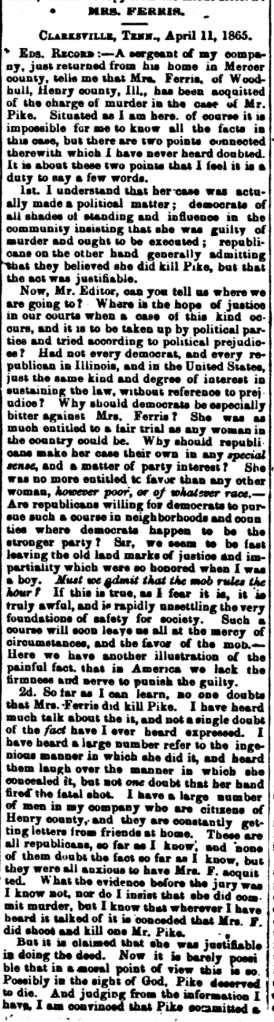
Benjamin has got home from court. That woman Mrs. [Mary] Ferris who shot William Pike had her trial. 3 It occupied nine days. She was cleared. I suppose you heard of the prisoners breaking jail about four weeks before court time. They had caught two but the two that was in for murder, they have not yet been found. There were Irishmen. They killed a man in Annawan.

Samuel and Artemas, ca. 1865

Smith has moved. Parker is a going to build this side of the first holler south of ours. This will get to be a nice street if we ever should build a house and Jonathan should build too. Oh, I must tell you before I forget it, Sam[uel J.] Murphy is married to a Miss [Artemas] Welland 4—a renter on Feslar’s place. Murphy bought a half section of land up of Suthard—paid six thousand dollars. I think he must be some in debt. Also one of 120 acres in Iowa.
Emmaline starts for this place one week from tomorrow. She may be here before this reaches you. It is reported that George is to be married. We do not know how true it is nor to who. Jim don’t come nigh us at all. He has rented Bill Henry Conner’s farm. Bill went away to avoid the draft but has since got back.

This town has been trying to fill her quota by buying men and having them credited to the town. They raised eleven thousand dollars. Because they lacked about $1300, they came home and paid about all of the money back. They have made about four or five efforts to raise men and failed each time. Now I believe they are a going to show bonds on the town and raise the men. This town had 36 men to raise. Burns [township] has put in nine which she thought would be more than her quota but Cambridge got the credit for the men that we had ought to have had credit for. Cambridge had 9 men to furnish. It comes hard on Burns. It takes about one in every three. I think it will take more for there will be a great many that will go away and stay till the draft is passed. Then will return.
George Hamilton 5 has been gone for two or three weeks. I believe he is in Indiana. There has been five left they say last week so you see how patriotic folks are. Rosco is doing first rate. Grows some. Fly and Daisy make a nice little team but I think it best to sell them if they will fetch anything nigh what they are worth. They are small and always will be small. As they are matched, they will I think fetch all they are worth.

Write whenever you can. We have had awful wet and cold weather. We have done nothing yet this spring. I believe I have give you all the news. I remain as ever yours &c., — Coles J. Brown


1 I believe Jackson is referring to Alexander Vail (1804-1894) who lived for a time in Burns township, Henry county, Illinois, with his wife, Sarah Marie Sebring (1805-1867). When Alexander went back to his home state of New Jersey, Sarah remained in Kewanee and taught school to earn income. She died two years later in 1867, her youngest child then 20 years old.

2 Edward Furst (1834-1905) was a German emigrant, his surname actually spelled Fuerst. He was married to Louise Krouse.

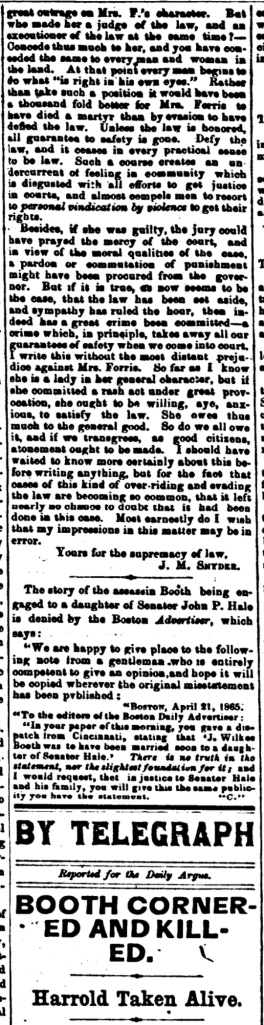
3 Information about the trial can be found in the following Evening Argus newspaper article (interesting). Click to enlarge.

4 Samuel J. Murphy (1843-1902) grew up in Washington county, Pennsylvania. He married forst Julia Artemus Welland (1843-1874). After her death he married Julia Florence Hill (1848-1884).

5 George W. Hamilton (b. 1843) was the son of William Hamilton, a farmer in Burns township, Henry county, Illinois. George was one of the local boys identified by name that Jackson claimed had left the state in order to avoid the military draft. He was enumerated back in Burns township at the time of the 1865 State Census in July.

1865: Charles Wesley Peden to Benjamin Jefferson Hill

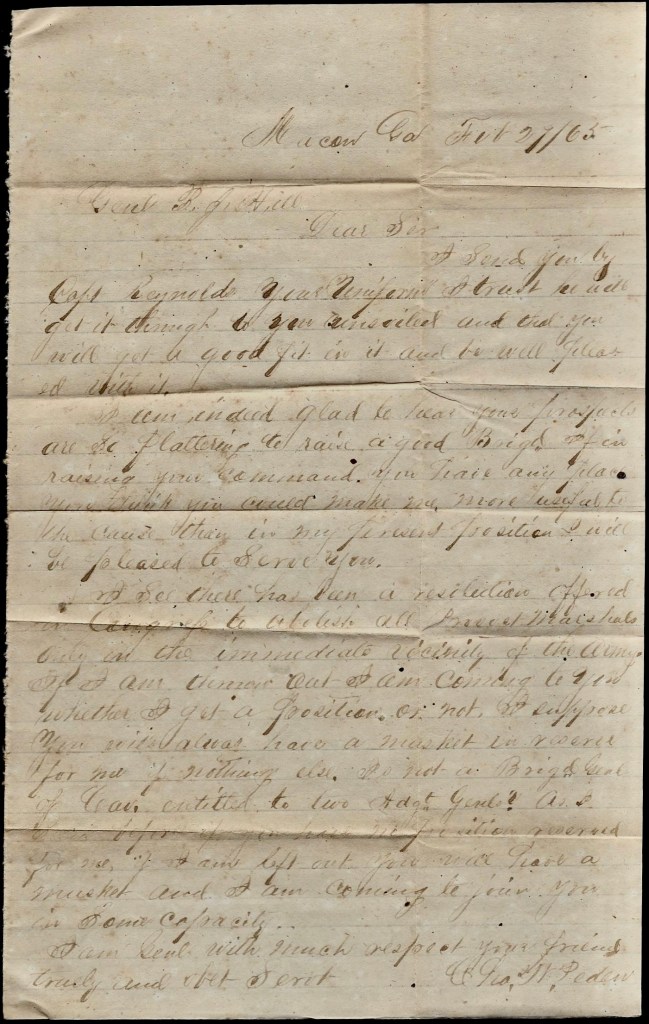
This letter was written by Capt. Charles Wesley Peden (1834-1889) who began his service in the Confederate army as a 1st Lt. of the Rock City Volunteers, but beginning in April 1862 he became a Provost Marshal and filled posts for various lengths of time in Corinth (MS), Tullahoma (TN), Shelbyville (TN), Chattanooga (TN), and Atlanta (Ga). With the fall of Atlanta in September 1864, Capt. Peden’s Provost Marshal’s office was relocated to the Macon Arsenal in Macon, Georgia, where he wrote this letter. Macon was a center of textile manufacturing and supplied cloth for officer’s uniforms and other needs of the Confederate army.

Charles grew up in Campbellsville, Giles county, Tennessee, the son of Elisha and Frances (Chenault) Peden. He became a dry good merchant in Nashville after the war and was married to Sarah Luella Tenison (1852-1925) in the 1870s.

Charles wrote the letter to General Benjamin Jefferson Hill (1825-1880), a native of McMinnville, Tennessee, who was a merchant politician prior to the Civil War. He began his service as Colonel of the 5th Tennessee Volunteers (Prov. Army of Tennessee) and then in the Confederate Service as Colonel of the 35th Tennessee, organized in time to participate in the Battle of Shiloh and at Corinth. Later in the war he served as Provost Marshal of the Army of Tennessee (Feb thru Aug 64), and then was promoted a Brigadier General of cavalry in November 1864 under Lt. Gen. Bedford Forrest.

Transcription

Macon, Georgia
February 27, 1865

General B. J. Hill
Dear Sir,

I send you by Capt. Reynolds your uniform. I trust he will get it through to you unsoiled and that you will get a good fit in it and be well pleased with it.

I am indeed glad to hear your prospects are so flattering to raise a good Brigade. If in raising your command you have any place you think you could make me more useful to the cause, than in the present position, I will be pleased to service you.

I see there has been a resolution offered in Congress to abolish all Provost Marshals only in the immediate vicinity of the Army. If I am thrown out, I am coming to you whether I get a position or not. I suppose you will always have a musket in reserve for me if nothing else. Is not a Brigadier General of Cavalry entitled to two Adjutant Generals? As I said before, if you have no position reserved for me—if I am left out, you will have a musket and I am coming to join you in some capacity.

I am, General, with much respect, your friend truly, and obedient servant.

1863: William N. Green to James H. Green

This letter was written by William N. Green who first entered the Confederate service as a 27 year-old private in Co. F (“the Bibb Grays”), 11th Alabama Regiment in June 1861. While serving in that regiment, he was wounded in the left arm at the Battle of Seven Pines but not so badly that he could not fight with his regiment at Gaines’ Mill, Frazier’s Farm, 2nd Bull Run, and Antietam. In January 1863, he was elected to a 2nd Lieutenant’s rank in Co. B (“the Scottsville Guards”), 44th Alabama Infantry and the following month, we learn from this letter that he was transferred to Co. F (“Dan Steele Guards”) where he was in temporary command due to the absence of Captain [Henley G.] Sneed and the illness of 1st Lt. Oakley. Muster rolls show him serving as the 2nd Lieutenant of Co. F, 44th Alabama Regiment until September when he went home on furlough, having been wounded at the Battle of Chickamauga on 19 September 1863. When he returned the following month, he had been promoted to Captain of Co. F and led his company in the fighting at Knoxville on 29 November 1863. He was admitted to General Hospital No. 4 in Richmond on 26 April 1864 suffering from intermittent fever but discharged and returned to duty on 8 May 1864 in time to lead is company at Spotsylvania and subsequent battles until he was discharged on 29 November 1864 from his wounds.

In the 1860 US Census, William was enumerated as a 32 year-old merchant at Six Mile, on the west side of the Cahaba river in Bibb County, Alabama. He was unmarried and living alone at the time of the census in July of that year. His age differs by five years with that recorded at his enlistment in 1861.

James Hamilton Green, planter from Bibb county, Alabama

William wrote the letter to his uncle, James Hamilton Green (1806-1878) of Mars, Bibb county, Alabama. I could not find William in the census records after the war but he may have been the same William N. Green who married Elizabeth C. Gradick on 18 November 1872 at Selma, Dallas county, Alabama. (Note: surname sometimes spelled Greene in records.)

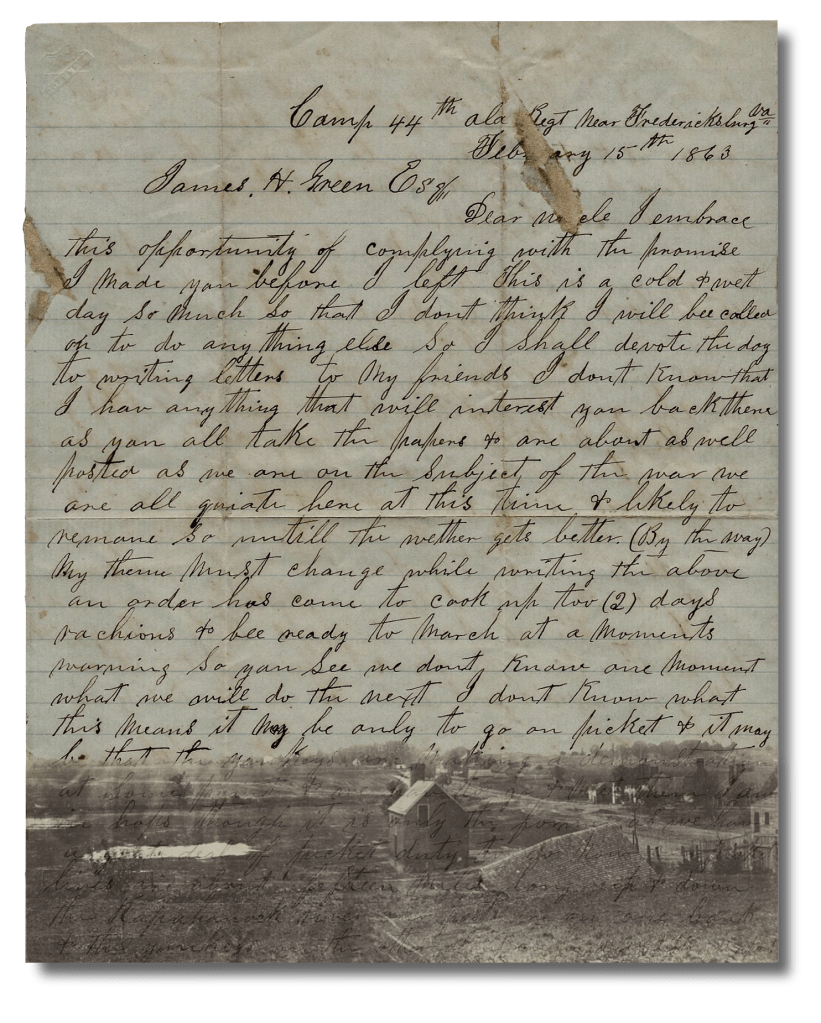
William’s letter to his uncle conveys the monotony of camp and picket duty on the Rappahannock River in February 1863, two months after the Battle of Fredericksburg and one month after Burnside’s Mud March. It’s reminiscent of numerous letters I have transcribed by Union soldiers from their encampment at Falmouth on the other side of the river but it’s more rare to find them penned by Confederate soldiers. On the very same day, perhaps at the very same moment that William wrote his letter on one side of the river, George S. Gove of Co. K, 5th New Hampshire Infantry—also a 2nd Lieutenant—wrote the following on the other side: “Nothing has happened worth writing about. We have the same thing day after day with nothing to vary the monotony. It has been raining all day but is clearing off now. We have had a good deal of rainy weather & the mud has been very deep all the time. Of course no foreword movement could be made.” 

Lt. Green’s Letter with a post-battle image of Fredericksburg taken in early 1863 showing muddy Hanover Street at right angling up the hill to Marye’s House in center distance. A snowbank can be seen on the field at left. A couple days after this letter was written, Fredericksburg was hit by another snowstorm.

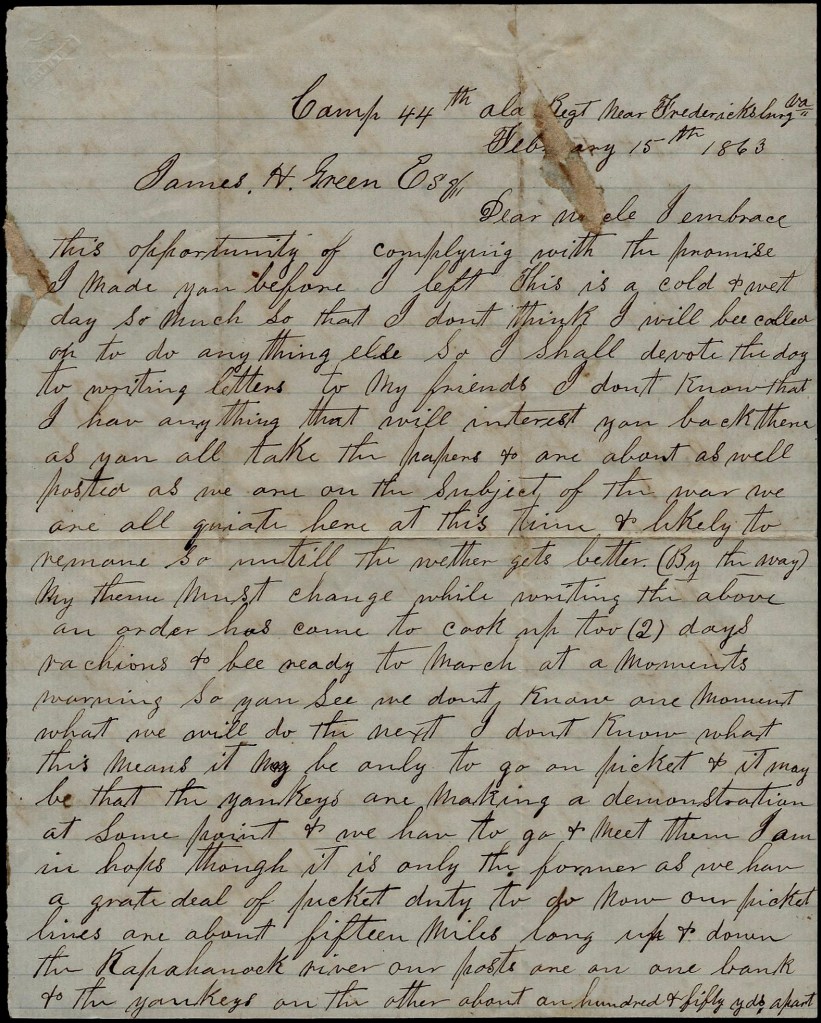
Transcription

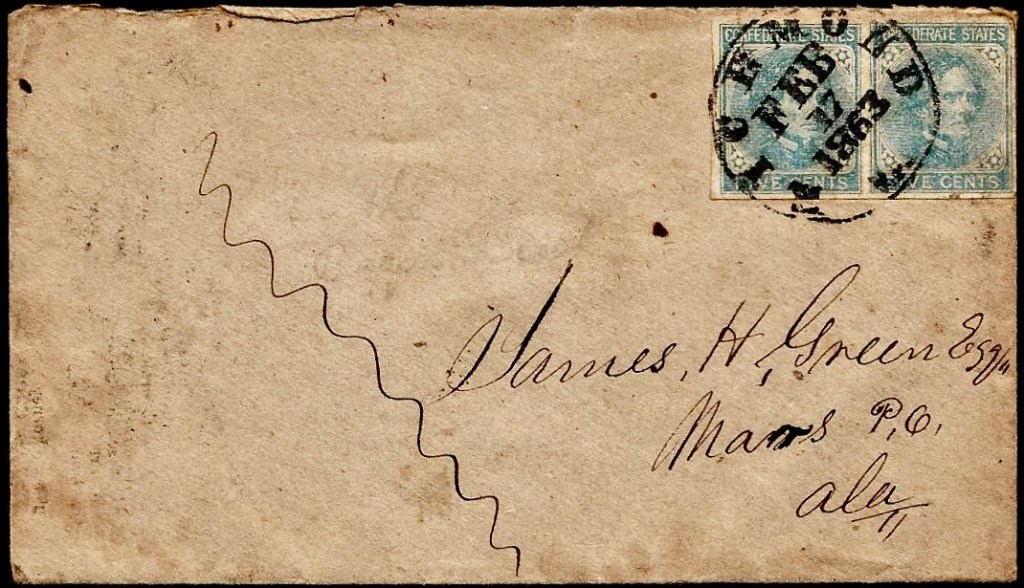
Addressed to James H. Green, Esq., Mars P O., Alabama

Camp 44th Alabama Regt. near Fredericksburg, Va.
February 15th 1863

James H. Green, Esq.
Dear Uncle,

I embrace this opportunity of complying with the promise I made you before I left. This is a cold & wet day—so much so that I don’t think I will be called on to do anything else so I shall devote the day to writing letters to my friends. I don’t know that I have anything that will interest you back there as you all take the papers & are about as well posted as we are on the subject of the war. We are all quiet here at this time & likely to remain so until the weather gets better. By the way, my theme must change. While writing the above an order has come to cook up two (2) days rations to be ready to march at a moment’s warning. So you see, we don’t know one moment what we will do the next. I don’t know what this means. It may be only to go on picket and it may be that the yankeys are making a demonstration at some point & we have to go & meet them. I am in hopes though it is only the former as we have a great deal of picket duty to do now. Our picket lines are about fifteen miles long up and down the Rappahahannock river. Our posts are on one bank & the yankeys on the other about an hundred & fifty yards apart.

“We have a ‘fighting Jo Hooker’ to contend with now so there is no telling when we will have to fight as he will have to do something soon or be superseded as that is their rule, though the roads are so bad now I think it out of the question for him to do much at present.”

—Lt. William N. Green, Co. F, 44th Alabama, 15 Feb. 1863

We have a “fighting Jo Hooker” to contend with now so there is no telling when we will have to fight as he will have to do something soon or be superseded as that is their rule, though the roads are so bad now I think it out of the question for him to do much at present.

When I commenced this, I intended to write you a long letter but I shall have to cut it short & prepare for marching. I will write you again soon when I have more time.

As you will see from the heading of this, I have changed my position. I am now in Co. F of this regiment—Capt. [Henley G.] Sneed’s company, acting as Second Lieut. I am now in command of the company as Capt. Sneed is at home & Lieut. Oakley is sick. You must write on the reception of this & give me all the news. Tell John 1 to write if his arm will admit of it. I learned that he got wounded in Tennessee though I am in hopes it is getting well by this time. He seems to be unfortunate in getting wounded & fortunate too in its being no worse.

Give my kindest regards to all the family & receive the same to yourself from your nephew, — Wm. N. Green


1 John Randolph Green )1844-1924) was William’s cousin who served in Co. F (“Tuscaloosa Rifles”), 50th Alabama Infantry. During the war he was wounded in both thighs and had his right arm broken. He was wounded in April 1862 at the Battle of Shiloh, Tennessee. He was severely wounded later that year on 31 December 1862 at the Battle of Murfreesboro, Tennessee. According to his own words, Green was placed in a cavalry unit as a 1st Lieutenant about 2 months before the end of the war. Green survived the war and in 1866 he moved to Kentucky for 2 years before returning home. Later in life he lived in the Confederate Soldier’s Home in Verbena, Alabama. He died on 8 December 1924 and is buried there at the what is now known as Confederate Memorial Park; the location of the old soldier’s home.

1866: Nellie (Riegel) Nickerson to Sarah Gertrude (Riegel) Groff

This letter was datelined from Bayou Sara, Feliciana Parish, Louisiana, in mid-February 1866 and written by Nellie (Riegel) Nickerson—the 19 year-old wife of Azor Howitt Nickerson (1837-1910). Nellie was the daughter of John Riegel (1818-18xx) and Susan Adams Ingol. Nellie’s sister, to whom she addressed her letter, was Sarah Gertrude (Riegel) Groff (b. 1844), the wife of Johnson R. Groff of Mechanicsburg, Pennsylvania. Unfortunately for Nellie, her marriage to Azor was brief—she died of spotted fever at Fort Boise, Idaho, only 14 months later.

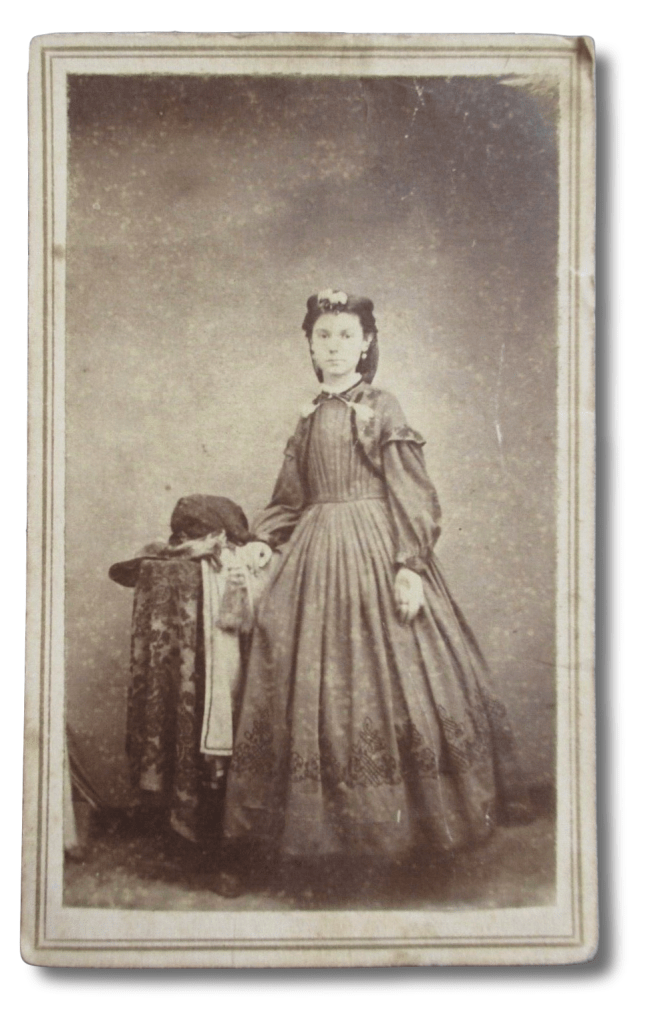
There is no surviving image of Nellie that I have found but here is a young woman about her age wearing apparel that dates to about 1866.

But what was Nellie’s husband doing in Bayou Sara, Louisiana, in February 1866? A Washington Post article researched and written by William Horne informs us that Azor was there as an agent of the Freedmen’s Bureau tasked with protecting the interests of the former slaves who were being hired to work for wages on the sugar and cotton plantations. Protecting their interests meant providing them assistance in the way of food, shelter, medical aid, schools and legal assistance. Indeed, the Freedmen’s Bureau Louisiana Field Office list of personnel gives “A. H. Nickerson” as “Agent and Asst. Subassistant Commissioner” from January 1865 to May 1866. Nellie’s letter was written in the winter time when the risk of disease was relatively low but apparently during the previous summer of 1865, a small pox epidemic erupted in the area, hitting the black communities particularly hard where, clustered in cramped quarters, the disease spread rapidly unchecked. Allegedly Nickerson colluded with the white planters to keep the infected blacks out of the village (where he was living with his wife), which essentially “condemned them to almost certain death.” Later, Nickerson accused the mayor of attempting to spread the disease, even by going so far as to infect him with it, by sending diseased blacks to his office hoping to run both him and the Bureau out of the parish and thereby maintain elements of hierarchy reminiscent of slavery. [See “In the hands of racist officials…” by William Horne]

Nickerson had a long a controversial post-war career best summarized on the Arlington National Cemetery website that highlights events captured in a book entitled, “The Tarnished Saber: Major Azor Nickerson, USA, His Life and Times” by Angelo D. Juarez.

[Note: This letter is from the private collection of Richard Weiner and is published on Spared & Shared by express consent.]

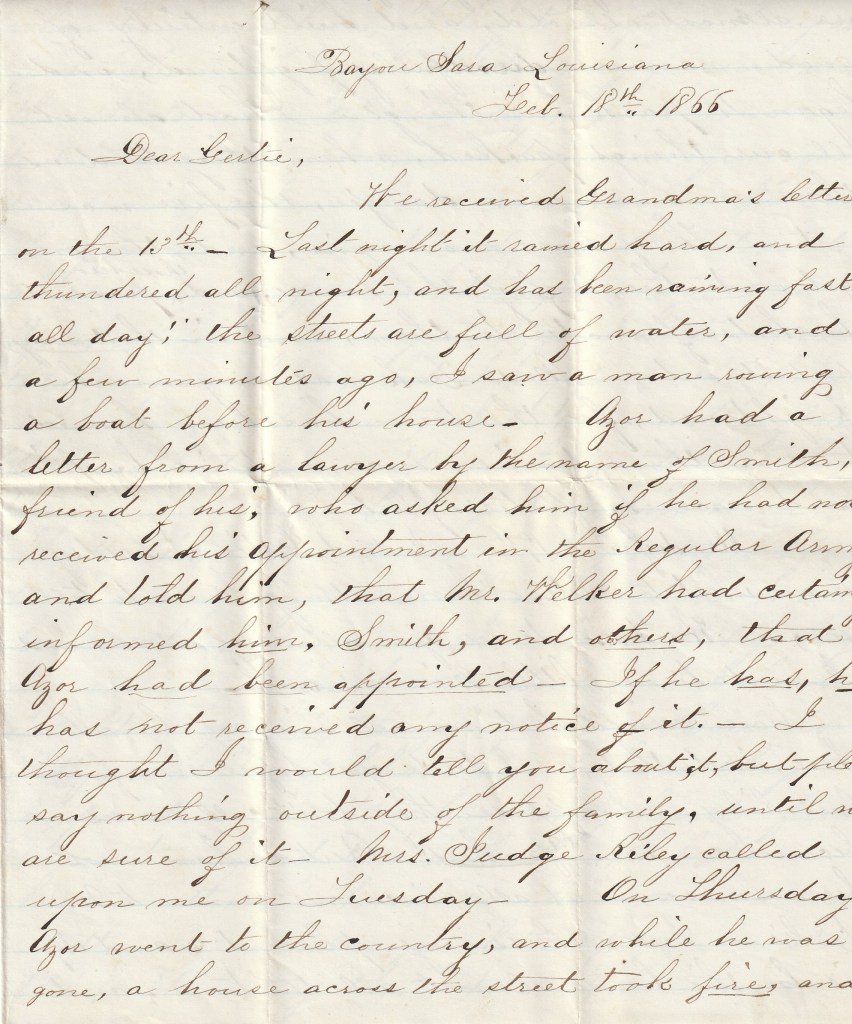
Transcription

Bayou Sara, Louisiana
February 18, 1866

Dear Gertie,

We received Grandma’s letter on the 13th. Last night it rained hard, and thundered all night, and has been raining fast all day. The streets are full of water and a few minutes ago, I saw a man rowing a boat before his house. Azor had a letter from a lawyer by the name of Smith, friend of his, who asked him if he had not received his appointment in the Regular Army and told him that Mr. Welker had certainly informed him—Smith, and others, that Azor had been appointed. If he has, he has not received any notice of it. I thought I would tell you about it, but please say nothing outside of the family until we are sure of it. 1

Mrs. Judge Riley called upon me on Tuesday. On Thursday Azor went to the country an while he was gone, a house across the street took fire and as it was a very windy day, and the houses are almost all old and built entirely of wood, we were dreadfully frightened. and began to pack our things. I had almost all our things packed when they told us there was no more danger—the fire was out. They have no engine and the men got onto the roof of the house and those below passed buckets of water to them, and in that way, put it out. Mrs. Leak was very much frightened for the town has been burned two or three times—one or twice by fires and once by Porter’s fleet. 2

Monday, February 19th. Indeed, Gertie, I hardly know what to write. I have nothing new to tell you. We want to see you all very much and I want to see little Minnie so much.

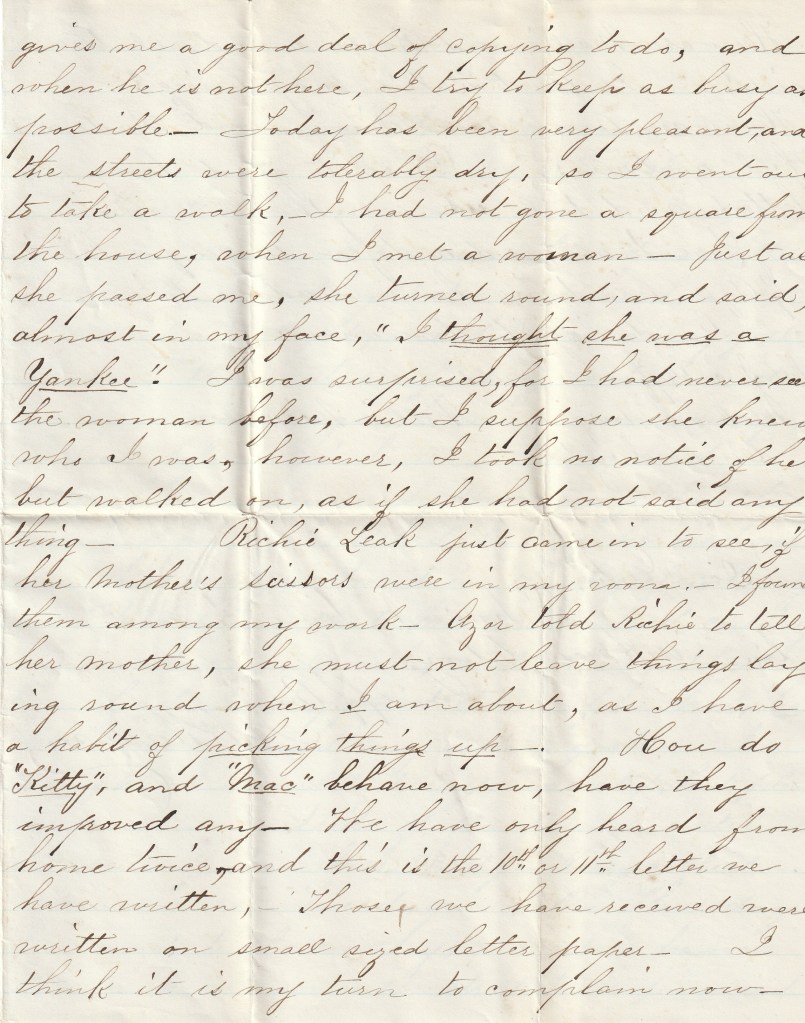
I have received but one call since we have been here and that, as I told you before, was from Mrs. Riley. I suppose they don’t call on us because we are “Yankees” but I have not been lonesome at all since we came to Mr. Leake’s. 3 Mrs. Leake is very pleasant and Azor is in the house almost all the time and gives me a good deal of copying to do, and when he is not here, I try to keep as busy as possible.

Today has been very pleasant and the streets were tolerably dry, so I went out to take a walk. I had not gone a square from the house when I met a woman. Just as she passed me, she turned round and said, almost in my face, “I though she was a Yankee!” I was surprised for I had never seen the woman before but I suppose she knew who I was, however. I took no notice of her but walked on as if she had not said anything.

Richie Leake just came in to see if her mother’s scissors were in my room. I found them among my work. Azor told Richie to tell her mother she must not leave things laying around when I am about as I have a habit of picking things up.

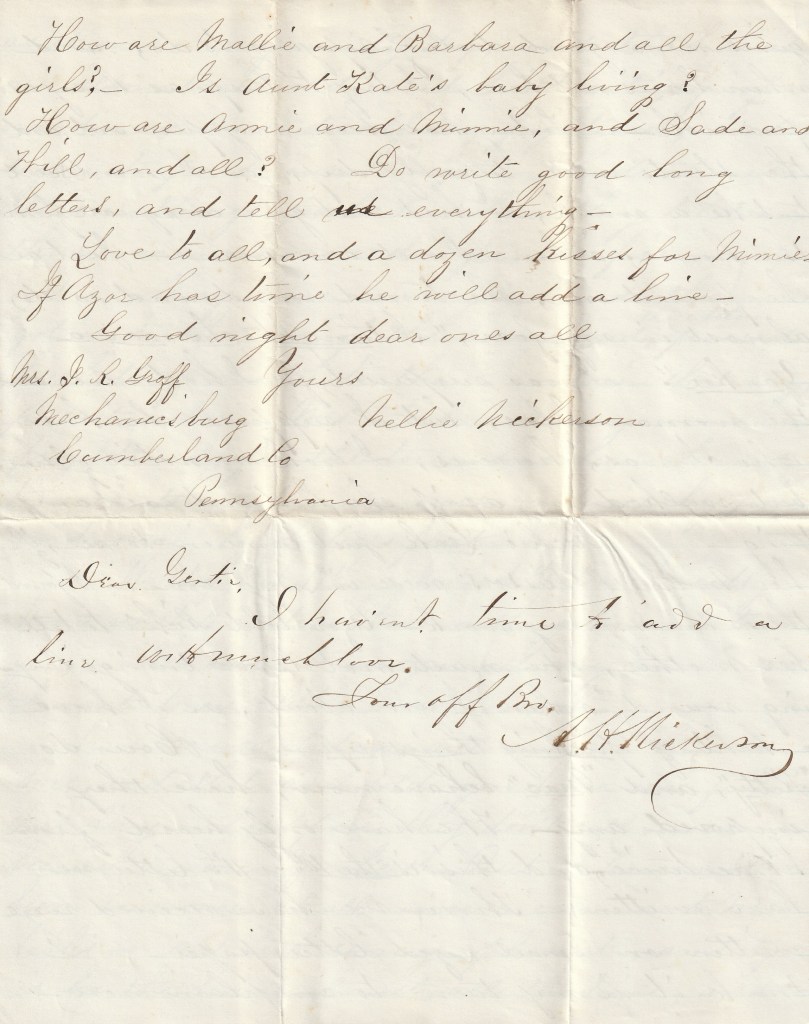
How do “Kitty” and “Mac” behave now? Have they improved any? We have only heard from home twice and this is the 10th or 11th letter we have written. Those we have received were written on small sized letter paper. I think it is my turn to complain now. How are Mollie and Barbara and all the girls? Is Aunt Kate’s baby living? How are Annie and Minnie and Sade and Will and all? Do write good long letters and tell everything.

Love to all and a dozen kisses for Minnie. If Azor has time, he will add a line. Goodnight dear ones all. Yours, — Nellie Nickerson

To Mrs. J. R. Groff, Mechanicsburg, Cumberland county, Pennsylvania

Dear Gertie, I haven’t time to add a line. With much love, your affectionate brother, — A. H. Nickerson

1 President Andrew Johnson approved the nomination of 2nd Lt. Azor H. Nickerson to 1st Lt. in the 14th Regiment of Infantry, Regular Army on 23 February 1866. Azor was a captain in the Veteran Reserve Corp at the time he was discharged from the army but apparently was being reinstated in the post war regular service at a lower rank.

2 On 10 August 1862, the US Gunboat Essex shelled the town while a small landing party set it ablaze. All the buildings within two blocks of the river were destroyed. More destruction occurred in the months to follow, virtually leveling the town and no doubt accelerating the resident’s hatred for Yankees.

3 Mrs. Leake was Elizabeth Henrix Pollard who married Richard Marcellus Leake in 1848 in Missouri. Their daughter “Richie” was born in 1854. After Nickerson and his wife left Bayou Sara in the spring of 1866, Richard M. Leake served in the same role as Nickerson for September-October 1866 until he was shot and killed during a labor dispute with William Reynolds—the Irish blacksmith and carriage maker in Bayou Sara.

1864: Albert D. Clark to Annette Longcoy

This letter was written by Albert D. Clark (1840-1909) who, at 21 years of age, enlisted on 6 September 1861 as a sergeant in Battery A, 1st Ohio Light Artillery. He mustered out in September 1864. Prior to his enlistment, Albert was working as an iron moulder at Franklin Mills, Ohio.

Albert was the son of John Finney Clark (1813-1901) and Eliza S. Dunning (1814-18xx) of Franklin township, Portage county, Ohio. The following biographical sketch comes from a county history:

“Our subject was reared and educated in Kent. He enlisted April 24, 1861, and served as Sergeant in Company A, First Regiment Ohio Light Artillery, and was Acting Orderly over two years, and commanded the Second Section of artilleries over a year. He was in the battles of Shiloh, Stone River, Chickamauga (he was recommended for promotion for bravery on the battlefield of Chickamauga by Maj. Wilbur F. Goodspeed), and was in many other engagements, and honorably discharged at Chattanooga, Tenn., September 12, 1864, paying a flying visit to friends in Ohio. He then went into the Quartermaster’s Department at Johnsonville, Tenn., serving eighteen months as Assistant Superintendent of laborers of that place, also in the vicinity of Nashville. When Johnsonville, Tenn. was evacuated by the Union forces he went to Nashville, thence to Franklin and Duck River; returning to Nashville took passage on the transport “New York” for Eastport, Miss. On the steamer’s arrival at her destination he accepted and filled the position of Chief Receiving Clerk under Lieut. Samuel W. Treat, commanding river and railroad transportation. On resigning this position he returned to Ohio. He then went West and engaged in railroading, visiting all the principle cities of the West. In 1869 he returned to Kent, and accepted a position as foreman in the brass foundry of the A & G W. R. R., which he held until 1883, when he embarked in his present business. He was married August 18, 1870 to Sarah J., daughter of Harvey C. and Flora B. Newberry, of Kent.”

Albert wrote the letter to Antoinette Longcoy (1842-1910), the daughter of David and Abbie (Woodward) Longcoy of Portage county, Ohio. She later married Samuel Putnam (1835-1909), an older brother of Col. Haliman Sumner Putnam. Col. Putnam was an 1857 graduate of West Point and was appointed Col. of the 7th New Hampshire. He commanded the 2nd Brigade in the attack on Fort Wagner during which he was shot through the head and left on the field.

I could not find an image of Albert but here is an albumen print showing members of the 1st Ohio Light Artillery posted on Civil War Faces by Thomas Molocea in 2017

Transcription

Headquarters Battery A, 1st OVLI [Ohio Volunteer Light Artillery]
Camp Brough, Nashville, Tennessee
April 24th 1864

Miss Annett Longcoy, Franklin, Ohio,

You will undoubtedly be surprised at my assumed boldness in approaching you as our former acquaintance was very limited indeed, but I assure you there is no offense intended. I have become somewhat acquainted with a plot which concerns you and others that I shall mention before I close. A certain few of the Battery that are noted for their malicious character & gossiping qualities assembled together and concocted the following scheme for the purpose of obliterating the dull monotony of camp life. Each one was to hand in his name and also that of some young lady. The addresses were numbered & corresponding numbers on cheques to be drawn. In this manner your address fell to one that I know you would not want to court acquaintance with, The person that entered your address done so under an assumed name so it is impossible for me to tell you who it was. The other person is Miss Mary Metlin. The person who received her address told me he was not a going to write. But should he do so yet, Miss Metlin & you, Miss Longcoy, must act at your own pleasure in regard to forming a correspondence. I have acquainted you with the characters of these two gentlemen and also the means that were employed in obtaining your addresses. Out of respect for you and Miss Metlin, as young ladies of high standing in society, and also to put you on guard against the approach of these inconsiderate men. The I become acquainted with these proceedings is not known by the persons interested and should you conclude to reply to their productions, I would request that you keep your informant’s name a secret as it will avoid hard feelings.

My respects to all enquiring friends. Yours in haste. From your friend, — A. D. Clark

1863: Loel Chandler Hakes to Elizabeth (Hamilton) Hakes

I could not find an image of Loel but here is one of Delos M. Phillips who served in the same company & regiment. (Photo Sleuth)

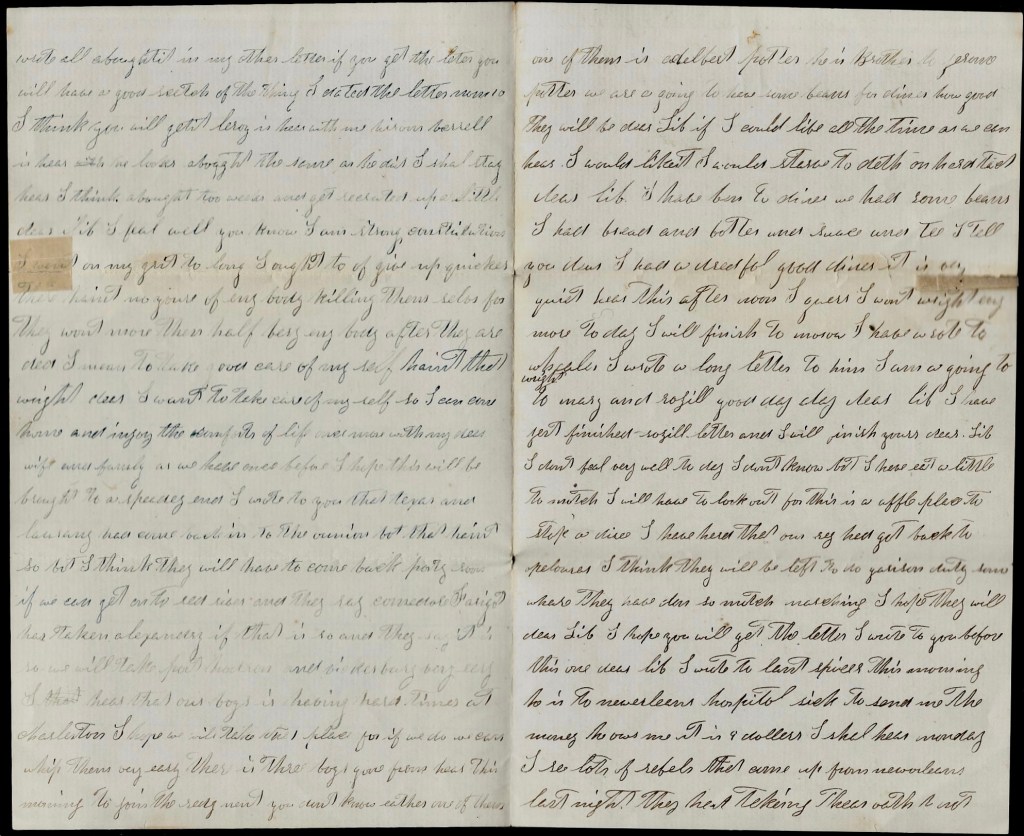
This letter was written by 22 year-old Loel Chandler Hakes, a farmer from Wellsville, Allegany county, New York, who accepted a bounty of $50 from his village and enlisted on 5 September 1862 to serve three years in Co. H, 160th New York Infantry. According to his enlistment papers, he stood 5′ 11″ tall and had black hair and blue eyes. Though claiming to have a strong “constitution,” the rigors of camp life eventually proved too difficult for him as he was discharged for disability with the rank of sergeant on 13 May 1864.

Loel was the son of Billings Hakes (1797-1878) and Lucy Maria Pierce (1812-1871). He was married on 7 January 1861 to Elizabeth Hamilton (1839-1901), whom he called “Lib” and branded “the best wife in Allegany county.”

Loel wrote the letter from a hospital in Brashear City, recruiting from exhaustion incurred by the long march in recent weeks when the regiment—in Gen. Wetzel’s Brigade—moved from Brashear City up to the mouth of the Atchafalaya, skirmishing with the enemy most of the way

Transcription

Addressed to Mrs. Elizabeth Hakes, Wellsville, Allegany Co., New York

Camp near Brashear City [La.]
May 1, 1863

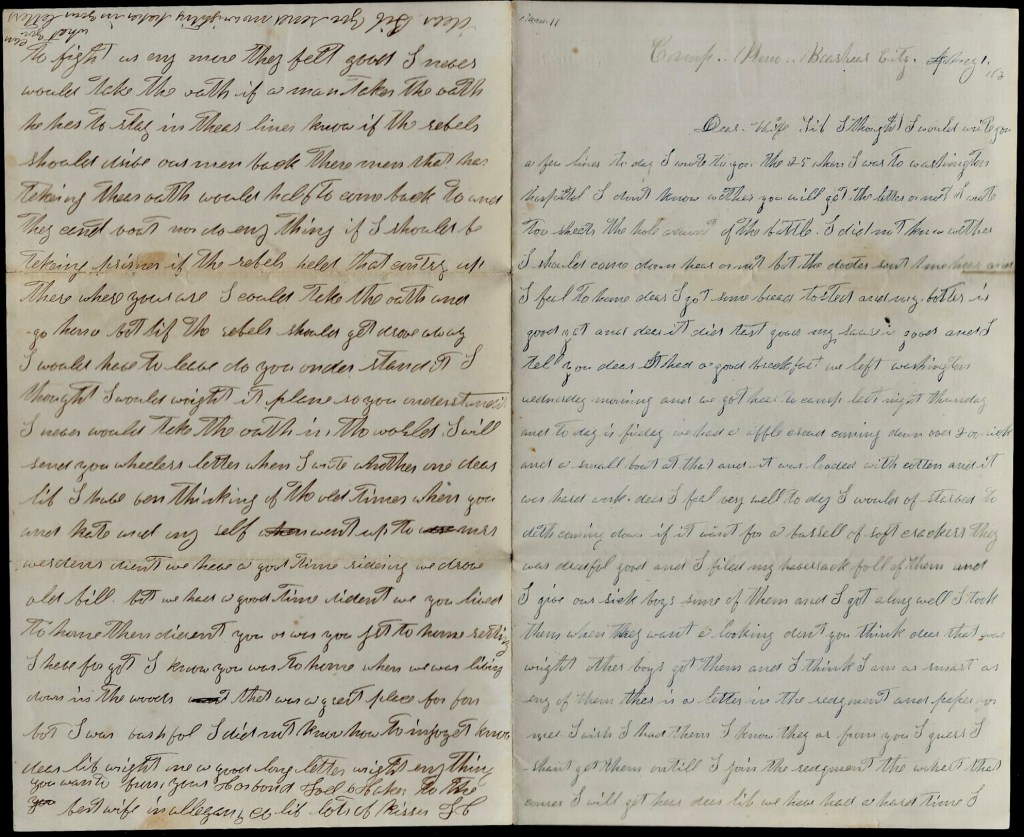
Dear wife Lib,

I thought I would write you a few lines today. I wrote to you the 25th when I was to Washington Hospital. I don’t know whether you will get the letter or not. I wrote two sheets the whole account of the battle. I did not know whether I should come down here or not but the doctor sent me here and I feel to home.

Dear, I got some bread toasted and my butter is good yet and dear, it did taste good. My sausage is good and I tell you dear, I had a good breakfast.

We left Washington Wednesday morning and we got here to camp last night Thursday and today is Friday. We had an awful crowd coming down—over 200 sick and a small boat at that—and it was loaded with cotton and it was hard work. Dear, I feel very well today. I would of staved to death coming down if it wasn’t for a barrel of soft crackers. They was dreadful good and I filled my haversack full of them and I give our sick boys some of them and I got along well. I took them when they wasn’t a looking. Don’t you think, dear, that was right? Other boys got them and I think I am as smart as any of them.

There is a letter in the regiment and paper for me. I wish I had them. I know they are from you [but[ I guess I won’t get them until I join the regiment. Dear Lib, we have had a hard time. I wrote all about it in my other letter. If you get the letter, you will have a good sketch of the thing. I dated the letter No. 10. I think you will get it. Leroy is here with me. Hiram Burrell is here. He looks about the same as he did. I shall stay here, I think, about two weeks and get recruited up a little.

Dear Lib, I feel well. You know I am [of] strong constitution. I went on my grit too long. I ought to give up quicker. There hain’t no use of anybody killing themselves for they won’t more than half bury my body after they are dead. I mean to take good care of myself. Hain’t that right, dear? I want to take care of myself so I can come home and enjoy the comforts of life once more with my dear wife and family as we have once before. I hope this will be brought to a speedy end.

I write to you that Texas and Louisiana had come back into the Union but that hain’t so. But I think they will have to come back pretty soon. If we can get onto Red River and they say Commodore Farragut has taken Alexandria. If that is so and they say it is, so we will take Port Hudson and Vicksburg very easy. I hear that our boys is having hard times at Charleston. I hope we will take the place for if we do, we can whip them very easy.

There is three boys gone from here this morning to join the regiment. You don’t know either of them. One of them is Adelbert Potter. 1 His is brother to Jerome Potter. We are a going to have some beans for dinner. How good they will be. Dear Lib, if I could live all the time as we can here, I would like it. I would starve to death on hard tack. Dear Lib, I have been to dinner. We had some beans. I had bread and butter and sauce and tea. I tell you, dear, I had a dreadful good dinner. It is very quiet here this afternoon. I guess I won’t write anymore today. I will finish tomorrow. I have write to [ ]. I wrote a long letter to him. I am going to write to Mary and Rozell. Good day, dear Lib.

I have just finished Rozell’s letter and I will finish yours. Dear Lib, I don’t feel very well today. I don’t know but I have eat a little to much. I will have to look out for this is an awful place to stop and die. I have heard that our regiment had got back to Opelousas. I think they will be left to do garrison duty somewhere. They have done so much marching, I hope they will.

Dear Lib, I hope you will get the letter I wrote to you before this one. Dear Lib, I wrote to Corp. [Daniel T.] Spicer this morning—he is to New Orleans Hospital sick—to send me the money he owes me. It is 9 dollars. I shall hear Monday. I see lots of rebels that come up from New Orleans last night. They had taken the oath to not fight us any more. They felt good. I never would take the oath. If a man takes the oath, he has to stay in their lines. Now if the rebels should drive our men back, their men that has taken the oath would have to come back too and they can’t vote nor do anything. If I should be taken prisoner if the rebels held that country up there where you are, I could take the oath and go home but if the rebels should get drove away, I would have to leave. do you understand? I thought I would write it plain so you understand it. I never would take the oath in the world.

I will send you Wheeler’s letter when I write another one. Dear Lib, I have been thinking of the old times when you and Kate and myself went up to Mrs. Werden’s. Didn’t we have a good time riding? We drove old Bill. But we had a good time, didn’t we? You lived to home then, didn’t you, or was you just to home resting? I have forgot. I know you was to home when we was living down in the woods. That was a great place for fun but I was bashful. I did not know how to enjoy it. Now dear Lib, write me a good long letter. Write everything you want to.

From your husband, — Loel C. Hakes

To the best wife in Allegany county—Lib

Lots of kisses


1 Adelbert Potter was a private in Co. H, 160th New York Infantry.

Hakes’ Monument in Woodlawn Cemetery in Wellsville, NY

1862: Bedford Brown to Mary (Simpson) Brown

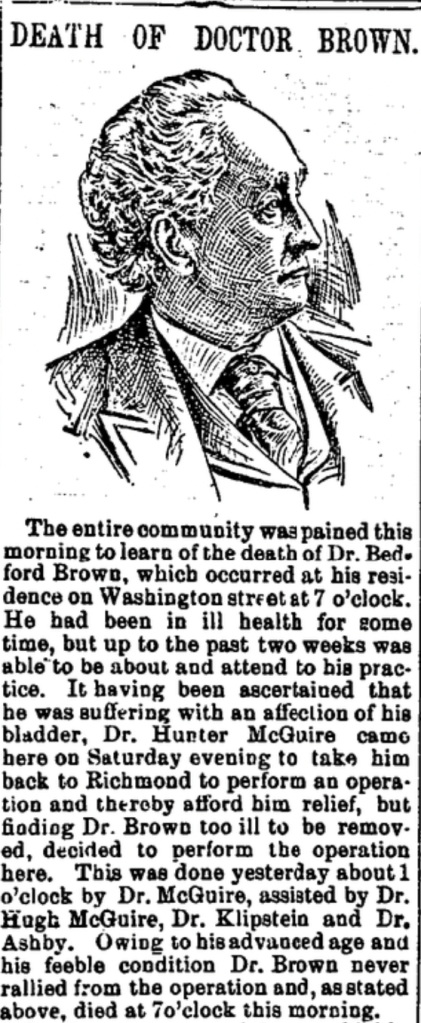
Though it is only signed “Bedford,” I feel certain this letter was written by 39 year-old Dr. Bedford Brown (1823-1897) of Caswell, North Carolina. Brown grew up on the Rose Hill Plantation, the son of US Senator and planter Bedford Brown (Sr.) (1795-1870) of Caswell county, North Carolina—a leader in the “States Rights” faction of the southern Democratic party and a close personal friend of Andrew Jackson. Sen. Brown was very much his own man, and stood toe to toe with John C. Calhoun on the floor of the Senate when their opinions differed. He has been eulogized as a man that was “true to his convictions in all with an idea that all white men were free and equal and though little lower than the angels perhaps were crowned with glory and honor from above.” [The Times (Richmond, Va), 14 Sep 1897, emphasis added]

I could not find an image of Bedford wearing his uniform but here is William R. Hughes who was a surgeon in the 31st North Carolina. He’s wearing a short military jacket and a NC Belt Plate.

Young Bedford was tutored by the same schoolmaster as Robert E. Lee. At age 21, he was sent to Lexington, Kentucky, to read medicine with Dr. Benjamin Dudley, graduated at Transylvania University, and also from Jefferson College in Philadelphia in 1854. He was married to Mary Elizabeth Simpson (1827-1907) in 1852 and by the time this letter was written in 1862, the couple had at least four children, though only two were still living. After practicing medicine in Albemarle and Fauquier counties, Dr. Brown went back to his father’s plantation but when the war began, he offered his services as a surgeon in the 24th North Carolina Regiment and was assigned to Floyd’s Brigade, serving in West Virginia. Then he was assigned to “Gen. Gustavus Smith’s staff and later surgeon of Daniel’s Brigade. He served under Gen. Lee and Gen. Stonewall Jackson as well, and during the latter part of the war had to leave the service though he was long inspector of camps and hospitals in North Carolina and thereabouts.” After the war he settled and opened a practice in Alexandria, Virginia.

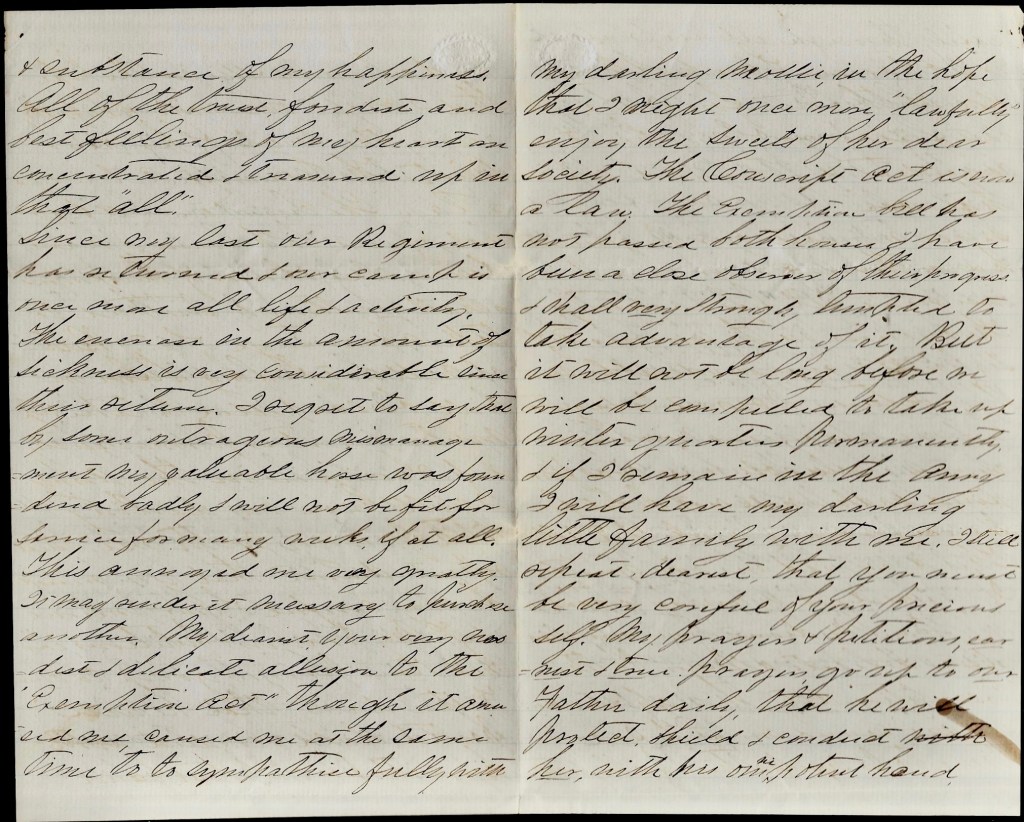
This letter was written just after Lee’s Army of Northern Virginia—including Brown’s former regiment, the 24th North Carolina—had been turned back at Antietam and were being driven back (some would say allowed to retreat) “with thousands of sick, wounded & broken down men straggling” into Virginia. In his letter, Brown acknowledges his wife’s plea for him to consider taking advantage of the Exemption Bill which came to be called the controversial “Twenty-Slave Law.” Brown reminds her that the Bill was not yet a law (it passed the Confederate Congress on 11 October 1862) but does not hint further whether he would consider exempting himself. We know from his service record that he did not.

See also: Bedford Brown tar Healer

Transcription

Near Drury’s Bluff
September 27th 1862

My own sweet & precious wife,

Your very dear & treasured letter of the 23rd inst. came to me promptly last night. Your letters, dearest one, are very precious to me. Their tone, style & expressions remind me so much of her who is so fondly treasured by me. Indeed, my own sweet Mollie, your tender & loving letter afford me exquisite pleasure. They make my heart leap and bound with delightful emotions of sympathetic love and fondness. The the happy, very happy information that “All” were well. That “All” means really “All.” It is in truth all to me. It is the all with which my fond & devoted heart is snapped up with. It is the very sum and substance of my happiness. All of the trust, fondest and best feelings of my heart are concentrated & treasured up in that “all.”

Since my last, our regiment has returned & our camp is once more all life & activity. The evenness in the amount of sickness is very considerable since their return. I regret to say that by some outrageous mismanagement, my valuable horse was foundered badly and will not be fit for service for many weeks, if at all. This annoyed me very greatly. It may render it necessary to purchase another.

My dearest, your very [n____dist] & delicate allusion to the “Exemption Act”—though it amused me—caused me at the same time to sympathize fully with my darling Mollie, in the hope that I might once more “lawfully” enjoy the sweets of her dear society. The Conscript Act is now a law. The Exemption Bill has not passed both houses. I have been a close observer of their progress & shall [be] very strongly tempted to take advantage of it, but it will not be long before we will be compelled to take up winter quarters permanently & if I remain in the army, I will have my darling little family with me. I still repeat, dearest, that you must be very careful of your precious self. My prayers and petitions, earnest & true prayers go up to our Father daily, that He will protect, shield, and conduct her with His omnipotent hand safely through all her trials, who is the treasure of my heart, & preserve her to me in future.

I was surprised to learn of the death of my old friend B. Guinn. As you say, I fear that he was taken away badly prepared to meet his maker.

One of our officers heard a rumor in Richmond this morning that our army was falling back from the Potomac. There is no doubt that our army is in a suffering condition. There being thousands of sick, wounded & broken down men straggling—our Northern Virginia in a starving condition. Now dearest one, may our Father manifestly spare thee to me, preserve our little darlings to us. Kiss them for me. My love to all at Pa’s. Respects to Miss N.

Ever dearest, your true & loving husband, — Bedford

1864: Ernest Leolin Lapham to Ella Lapham

This letter was written by Ernest Leolin (“Lee”) Lapham (1846-19xx) who was 18 years old when he enlisted on 25 February 1864 to serve three years in Co. G, 25th Ohio Volunteer Infantry. He began his service as a private, was promoted to corporal on 1 August 1865, and made sergeant before he was mustered out in June 1866. Since the original members of the 25th OVI mustered out of the service on 16 July 1864 after their three years service, all that remained in the regiment were those original members who reenlisted as veterans and the new recruits. The only battlefield experience these new recruits would have was at the Battle of Honey Hill in South Carolina where the regiment’s losses in killed and wounded was 150.

Ernest was the son of Stephen Lapham (1821-1896) and Lucinda M. Hall (1823-1904) of Republic, Scipio township, Seneca county, Ohio. He was employed as a carpenter prior to his enlistment. After he was discharged from the service, Ernest came home to marry Sarah Jane (“Jennie”) McVay (1846-1918). He farmed for a time with his father-in-law in Shelby county, Ohio, and then relocated to Newton, Harvey county, Kansas, where he worked as an agent for a mining company.

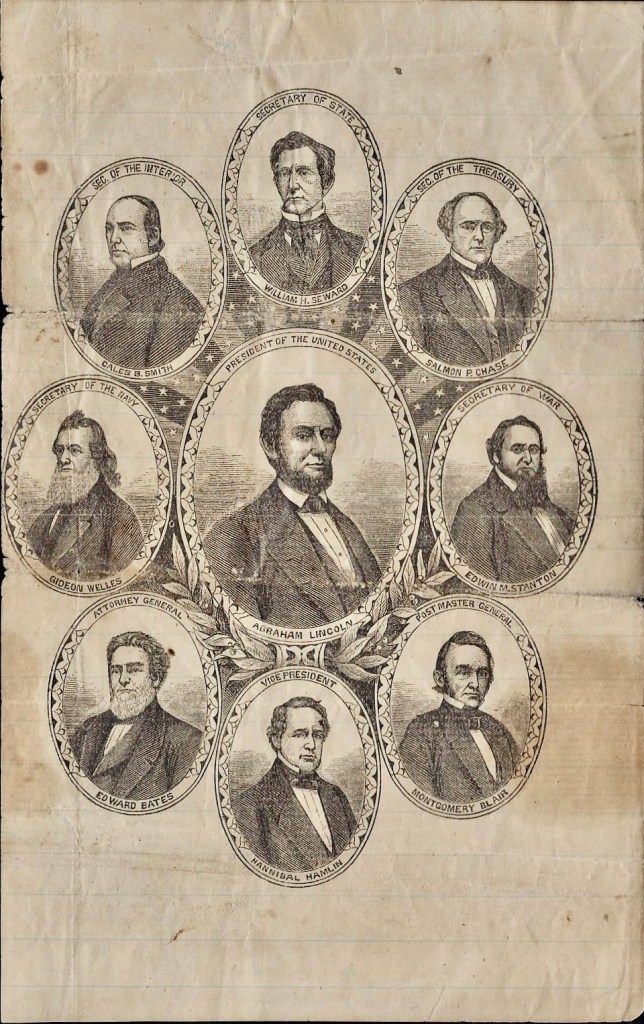
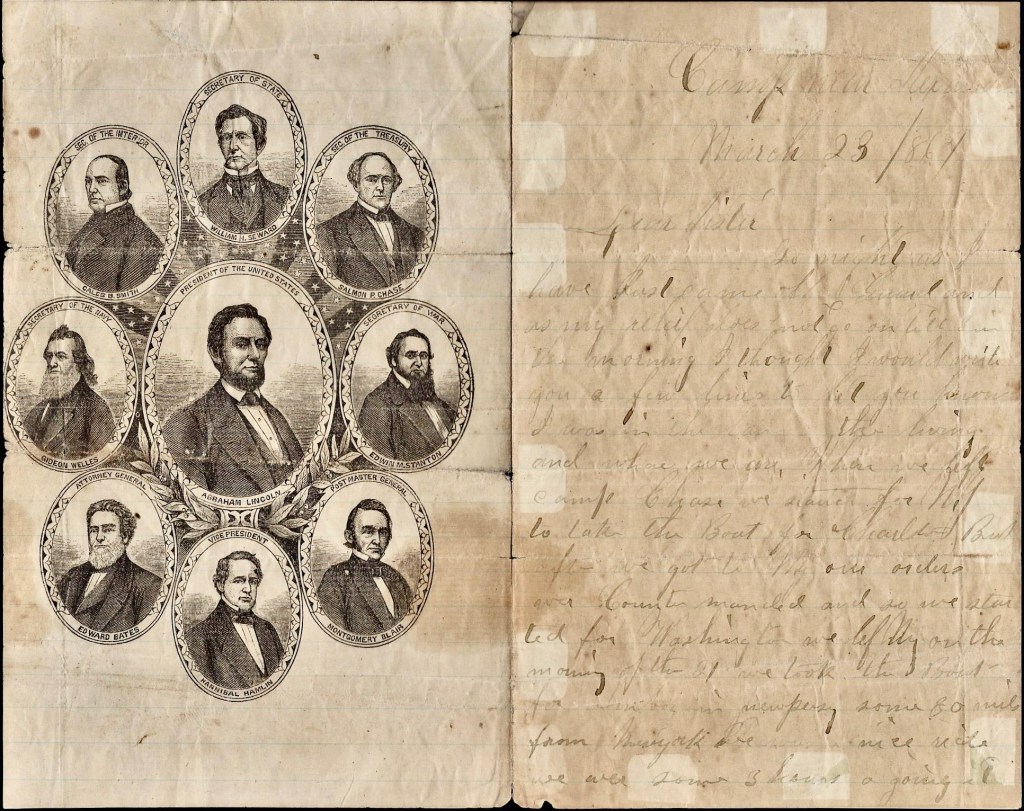
Lee Lapham wrote his letter on stationery that included an engraving of President Lincoln and his Cabinet at the time (1864)

Transcription

Camp near Alexandria, Virginia
March 23, 1864

Dear Sister,

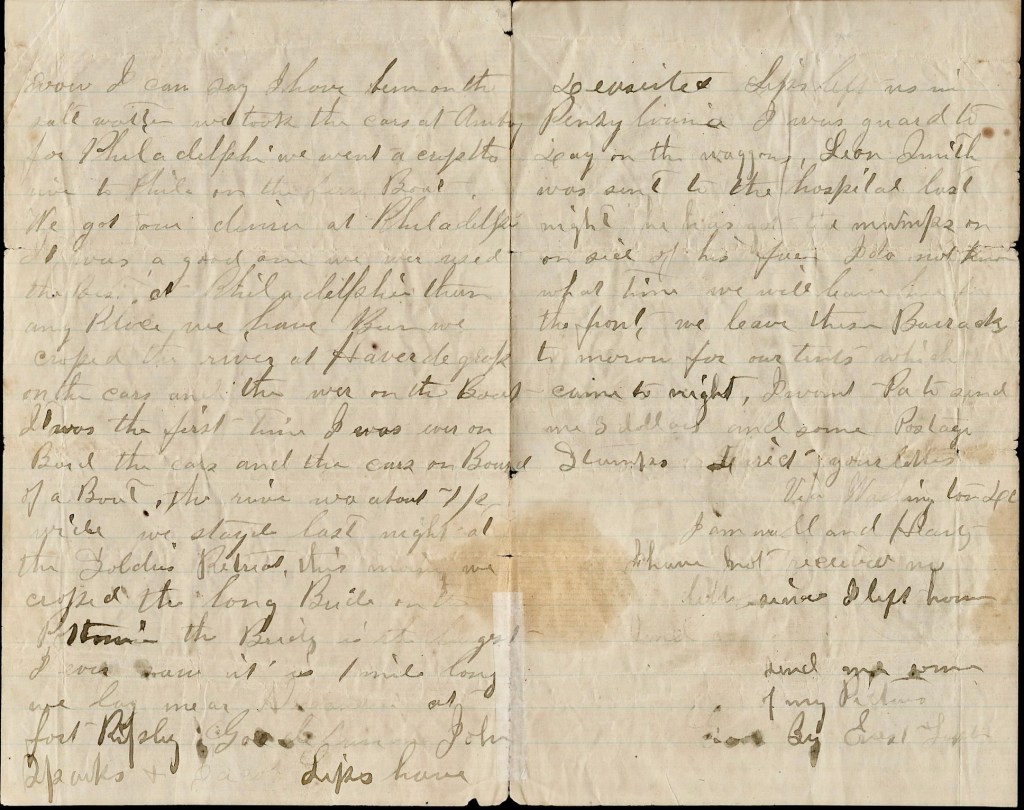
Tonight as I have just come off guard and as my relief does not go on till 8 in the morning, I thought I would write you a few lines to let you know I was in the land of the living and where we are. When we left Camp Chase, we started for New York to take the boat for Charleston but after we got to New York, our orders were countermanded and so we started for Washington. We left New York in the morning of the 21st [March]. We took the boat for Amboy in New Jersey some 80 miles from New York. We had a nice ride. We were some 3 hours a going it. Now I can say I have been on the salt water. We took the cars at Amboy for Philadelphia. We went across the river to Philadelphia in the ferry boat. We got our dinner at Philadelphia. It was a good one. We were used the best at Philadelphia than any place we have been.

We crossed the river at Havre-de-Grace on the cars and they were on the boat. It was the first time I was ever on board the cars and the cars on board of a boat. The [Susquehanna] river was about half mile wide. We stayed last night at the Soldier’s retreat. This morning we crossed the Long Bridge over the Potomac. The bridge is the longest I ever saw. It is 1 mile long. We lay near Alexandria at Fort Ripley.

Good___, John Sparks, and Jacob Lips have deserted. Lips left us in Pennsylvania.

I was guard today on the wagons. Leon Smith was sent to the hospital last night. He has got the mumps on one side of his face. I do not know what time we will leave here for the front. We leave these barracks tomorrow for our tents which came tonight. I want Pa to send me 3 dollars and some postage stamps. Direct your letters to Washington D. C. I am well and hearty. I have not received any letters since I left home.

Send me some pictures. Goodbye, Ernest Lapham

1860: Sheridan S. Sabine to Charles A. Choate

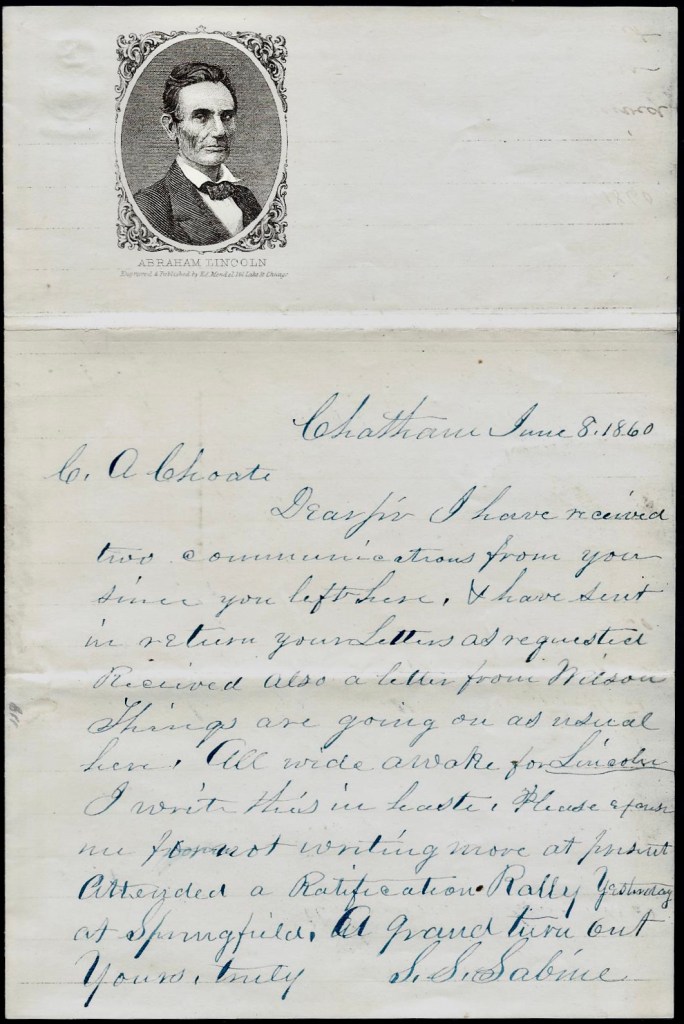
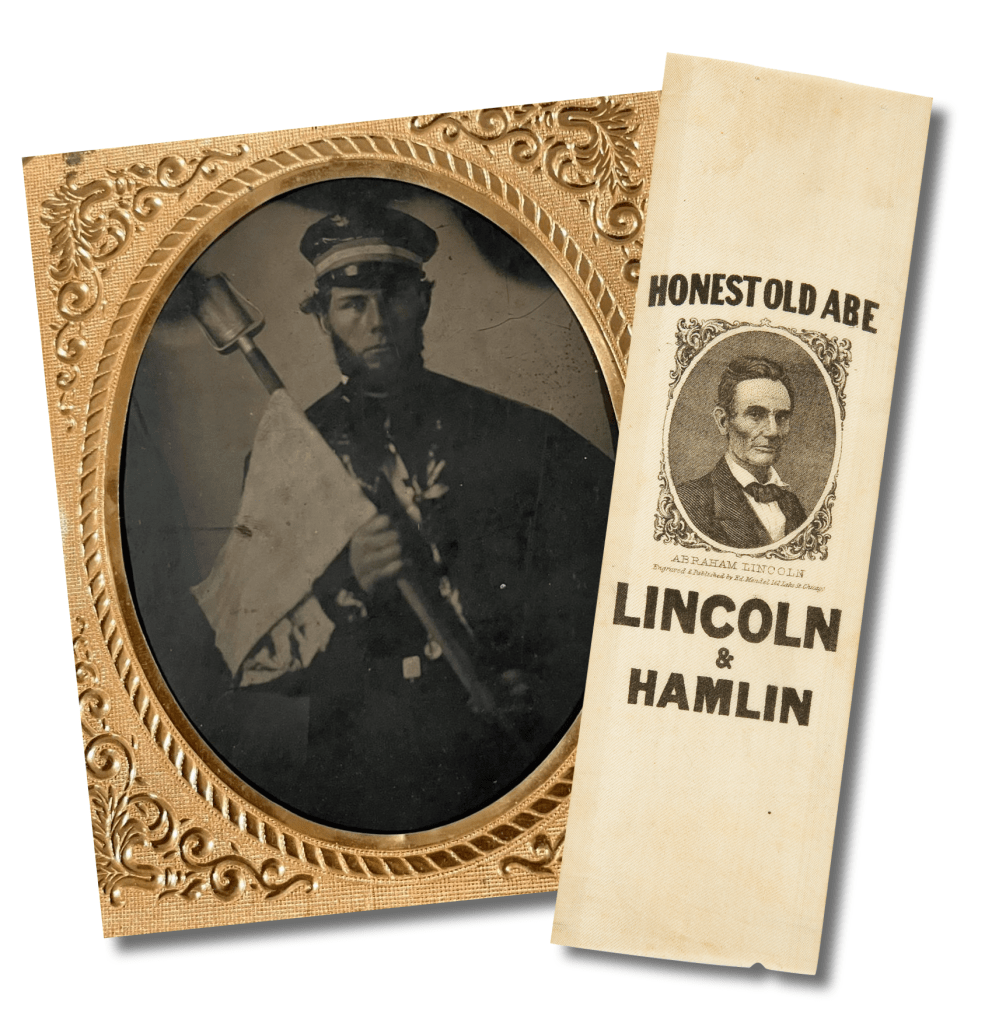
This brief letter was written on extremely rare stationery incorporating an engraving of Abraham Lincoln by the well-known Chicago engraver, Edward Mendel. 1 I have seen this engraving on a campaign ribbon, poster, and an envelope but not on stationery previously. For most voters, this was the image of Lincoln that served to introduce him to the American public.

Unfortunately I cannot confirm the identity of the correspondents but believe them to be Sheridan S. Sabine and Charles Augustus Choate—both patriotic youths of Illinois who would have been the kind to have campaigned for Lincoln and participated in Wide Awake torchlight parades. Twenty-one year-old Sheridan (1839-1876) was a joiner in Chatham whose father was postmaster, allowing himself and family to send mail without paying postage (a perk of the postal employees). When the new President called for soldiers, Sheridan took the oath as a volunteer on 27 July 1861, as a corporal in Co. A, 3rd Illinois Cavalry. He served out his full three years with the company, mustering out on 5 September 1864.

Eighteen year-old Charles A. Choate (1842-1915) was a young college-bound student whose father, Charles Choate, was an 1823 graduate of Bowdoin College and physician who settled down as a farmer in Montebello township, Hancock county, Illinois, when his heath failed—his home on a bluff overlooking the Mississippi river.

An 1860 Lincoln Campaign Ribbon with Mendel’s engraving of Lincoln and an unidentified Wide Awake torch bearer from the personal collection of Adam O. Fleischer

Transcription

Chatham [Sangamon county, Illinois]
June 8, 1860

C. A. Choate
Dear Sir,

I have received two communications from you since you left here & have sent in return your letters as requested. Received also a letter from Wilson. Things are going on as usual here. All wide awake for Lincoln. I write this in haste. Please excuse me for not writing more at present. Attended a Ratification Rally yesterday at Springfield. A grand turn out. 2

Yours truly, — S. S. Sabine

1 “Edward Mendel, for many years a lithographer in this city, and known as a man who has been closely identified with Chicago’s business  interests for over a quarter of a century, died at his residence, No. 2321 Wabash avenue, yesterday evening at 7:30 o’clock. For many  months the insidious but deadly Bright’s disease had been assailing his system, and at last the foe became the victor. Mr. Mendel was  born in Berlin, Germany, in 1828, receiving his education in that country and learning the trade of a mapcarver. When 22 years of  agehe came to America. Engaged for a short time at his trade in Cincinnati, he soon came further West and ere long was at work in  Chicago, and was also employed for a while on a surveying corps.

About the year 1853 be began the work of lithographing. He started in this business on Lake street; near La Salle, occupying the old  John Link Building. His business began to enlarge, and about three years before the great fire he moved into the First National Bank  Building, located at the southwest corner of State and Washington streets. There the fire found him and there the fire left him, well nigh penniless at best, so far as his business interest was concerned. Not daunted by adversity, he again began business at the corner  of State and Twenty-second streets, afterward moving down to the Hoffman Building on Fifth avenue, between Madison and Monroe  street. He rapidly regained his former position and again moved, this tie to the fourth floor of the Times Building on Fifth avenue, which  latter place he occupied up to the time of his death.


As a man of close attention to business, of industry, of loyal devotion to the work which claimed much of his time and talent, Mr.  Mendel was known by a large circle of business friends. A man of native reticence and averse to courting society he yet left a strong  impression of his own individuality upon those who knew him. Mr. Mendel had become the possessor of a good deal of valuable city  property, owning the Mendel Block, on the northeast corner of Pacific avenue and Van Buren street, a number of houses on Wabash  avenue aside from his residence, and other property which would perhaps bring wealth close up to a half a million dollars. In 1863  Mr. Mendel was married in this city to Miss Sarah Joy, by whom he has had three children, Edward and Albert, two of them now living,  the eldest on now nearing manhood. Thirty years of active business life in Chicago, conducted upon the careful and conservative  principles which governed his life, could not but have won Mr. Mendel many friends, who will join their sympathy to the sorrow of the  bereaved family.” [Obituary posted in Inter Ocean, April 5, 1884]

2 A “Ratification Rally” was merely a campaign rally to endorse the Republican nominee for President of the United States.