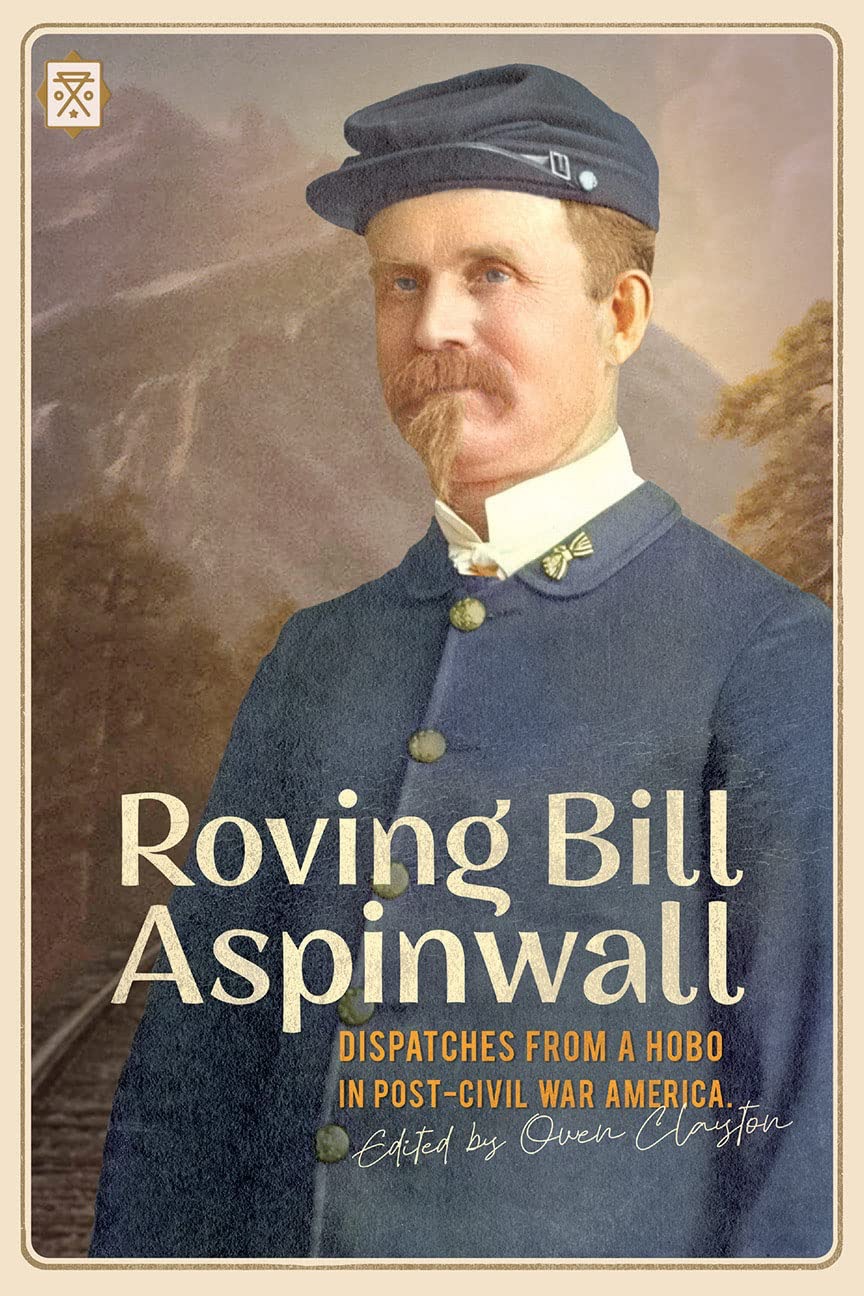
The following letter was written by William W. Aspinall [or Aspinwall] (1845-1921) of Co. H, 47th Indiana Infantry. He was the son of Dyson Aspinwall (1804-18xx) and Sarah Ann Haines (1824-18xx) of Pleasant Mills, Adams county, Indiana. An English emigrant, Dyson made his living as a woolen manufacture. William was born in May 1845 in Mechanicsburg, Champaign Co., Ohio. He became a “woolen worker” until he enlisted in the 47th Indiana Volunteers in 1861. On May 16, 1863, he was wounded at the Battle of Champion Hill, Miss., but served until the end of the war. Afterward he became known as “Roving Bill” because he lived the vagabond life of a hobo. Reverend James McCook of Hartford, Conn., began a correspondence with Bill as he roamed the U.S. from coast to coast. The Reverend published Bill’s letters to him in a nine-part series of articles titled “Leaves from the Diary of a Tramp” from 1893 until about 1901. It’s described as follows: “Born one of 23 siblings, married 5 times, wounded fighting for the Union in one of the bloodiest battles of the American Civil War, kicked out of numerous jobs and soldiers’ homes for drunkenness, and having spent decades wandering as a penniless vagabond, Bill also kept up a 24-year correspondence with John James McCook, Professor of Modern Languages at Trinity College, Hartford, Connecticut.” Bill passed away at the Ohio Veterans Home in Sandusky on 14 Nov. 1921, and was buried in the Veterans’ Home cemetery.
The 47th Indiana Infantry Regiment moved to Memphis, Tennessee, in June 1862 and served on occupation and garrison duty there through July 1862, before moving onward to Helena, Arkansas, on July 24, 1862. William’s letter includes a description of the 17 June 1862 Battle of St. Charles on the White River in Arkansas. In that battle, a Confederate shore battery fired a 32-pounder shell into the boiler of the Union Gunboat Mound City, causing a catastrophic explosion. The blast killed 125 men. 82 men were killed instantly by scalding or trama. See—The Deadliest Shot: The Doomed White River Expedition, by Donald Barnhart, Jr. on HistoryNet.
T R A N S C R I P T I O N
Near Memphis [Tennessee]
[Probably Sunday, June 22, 1862]
Well Luke,
You say that you get lonesome on Sundays. I think that you will pass away a good many lonesome Sundays before I get back although we may get back before I think we will.
Well Luke, it is a getting most time to go out on Dress Parade. I will finish when we come back. Well, we have come in front Dress Parade. We [had] a very good Dress Parade. We drilled the manuel of arms a little. There is a good many citizens comes to see us. We have good music and they like tto hear it. The 34th has a brass bands. I guess they never heard any music until we came.
There is a good many boats a coming and going. The gunboats is laying before the city—that is, the part of them, the Flagship Benton, the Louisville, and Mound City are here. The others have gone down the river. One of them got blowed up down there. They went up the White River [where] the Rebels had a battery of Parrott guns. They shot a ball into the boiler and blowed the whole top of the boat and scalded 150 men to death. But they took the battery and one thousand prisoners so they didn’t come out so bad after all. The 46th Regiment was done it [attacked the fortifications on land]. Their Col. [Graham N.] Fitch was commander.
Luke, you must take care of yourself and tell Gary to give John Studabaker hell for he is a damned old cheat. He would steal the coppers off of a dead nigger’s eyes.
I must close for Dave Stockham wants to write a few lines. Give my respects to all enquiring friends. — William W. Aspinall


