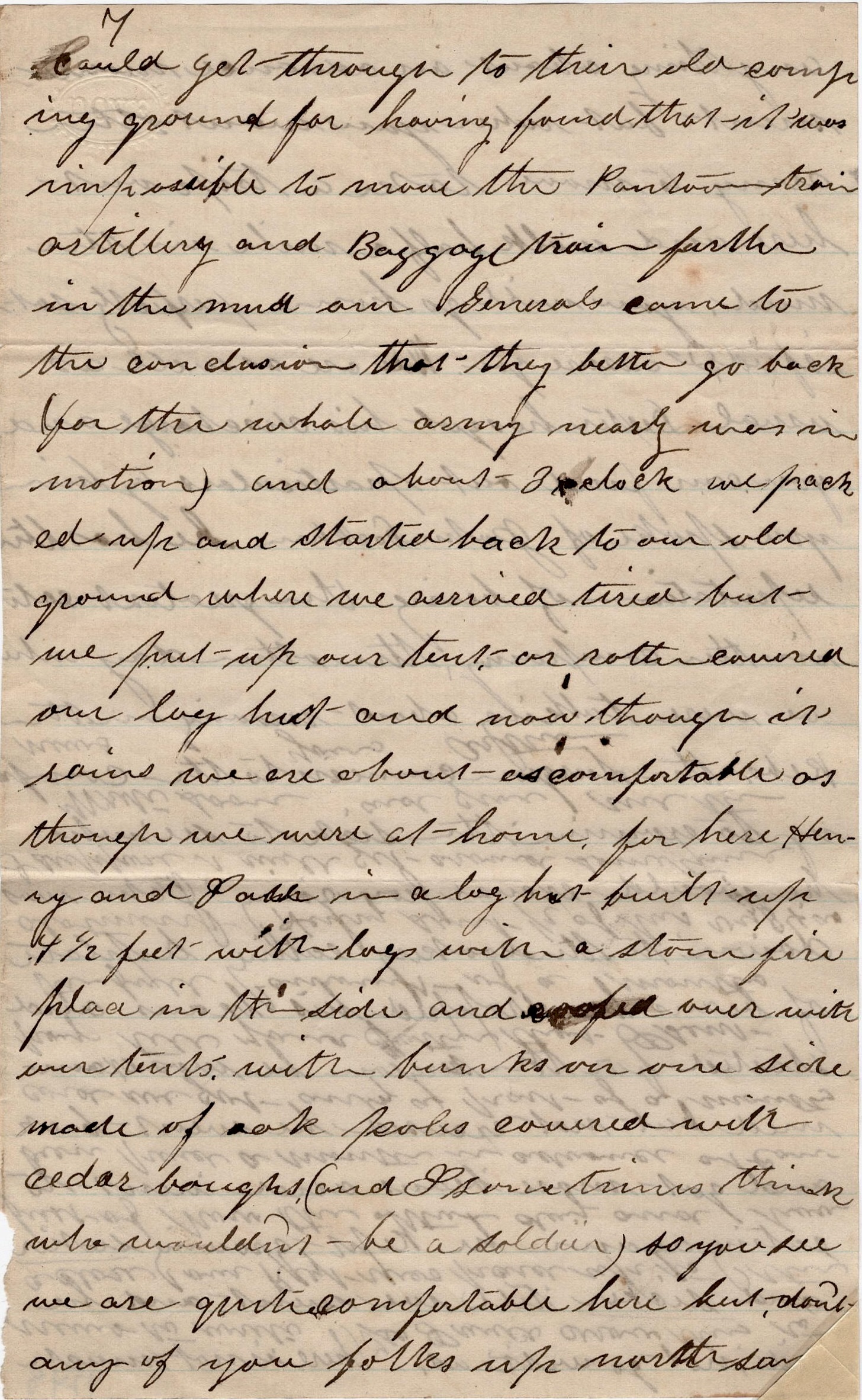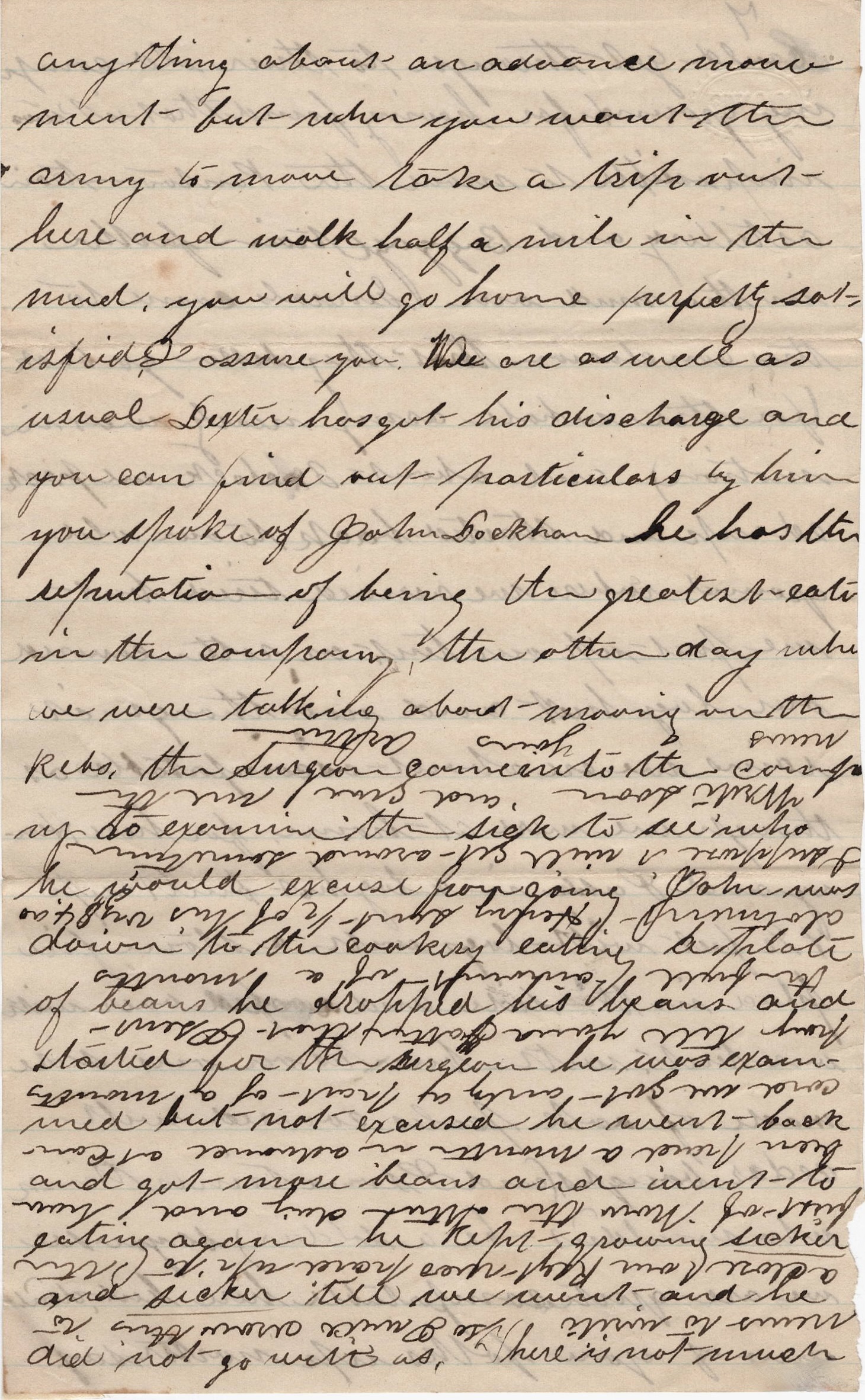

The following letter was writen by Arthur St. Clair Smith (1841-1895) of Co. G, 12th New Hampshire Infantry. Arthur was the oldest son of Joshua R. and Clarissa C (Crockett) Smith. “Arthur St. Clair left the academy at New London in 1861, and went home to enlist, but his widowed mother, his father having been accidentally killed in California three years before, persuaded him to return to his school, where he impatiently remained until the new call for troops in 1862, when “I could no longer study.” as he says, “and went home again to enlist.” Assisted by Adjutant-General Colby, he enlisted forty or fifty men for Company G, but waiving his claim to rank was elected first sergeant, instead of lieutenant, as he might have been. His brother, Henry J., of the same company, was killed at Gettysburg.”
“In all the battles of the regiment to Cold Harbor, but Gettysburg and Wapping Heights, when he was still suffering from a severe wound received in arm at Chancellorsville, where his equipments were perforated with bullets. At Cold Harbor he was struck five times, being wounded twice, and having musket or grape shot through hat, haversack, and coat. He says: “I shall never forget my ambulance ride with Captain Shackford from Cold Harbor to White House landing.” Rejoined the regiment after the Siege of Petersburg, was present at the battle of Bermuda Hundred, and led a provisional battalion, that he commanded for a while, into Richmond. Of Captain Smith’s services at Danville, Va., see pages 302 and 310, chapter XV.”
“After the war he received the degree of L. L. B., from the Albany Law School, N Y., and settled in Cedar Rapids, Iowa. He has been judge of the municipal court, and was elected to the legislature by several thousand plurality though a candidate of the minority. He died December 19, 1895.” [Source: Find-A-Grave]
Arthur wrote his letter to his cousin, Frank J. Robinson (1843-Aft1892), the son of Joseph Wells Robinson (1816-1864) and Matilda G. Crockett (1811-1863) of Lake Village (now Lakeport), Laconia, Belknap county, New Hampshire.
T R A N S C R I P T I O N
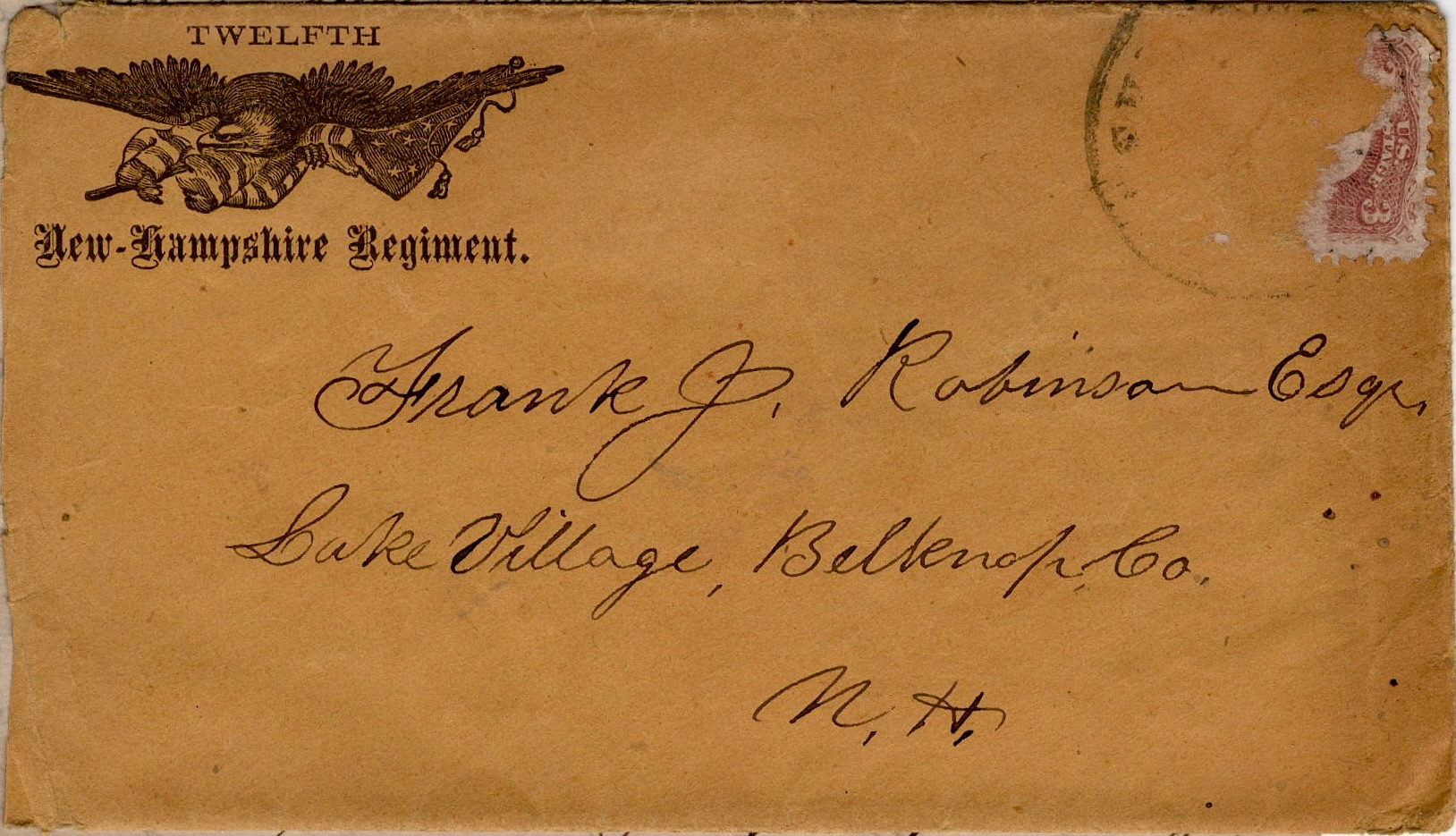
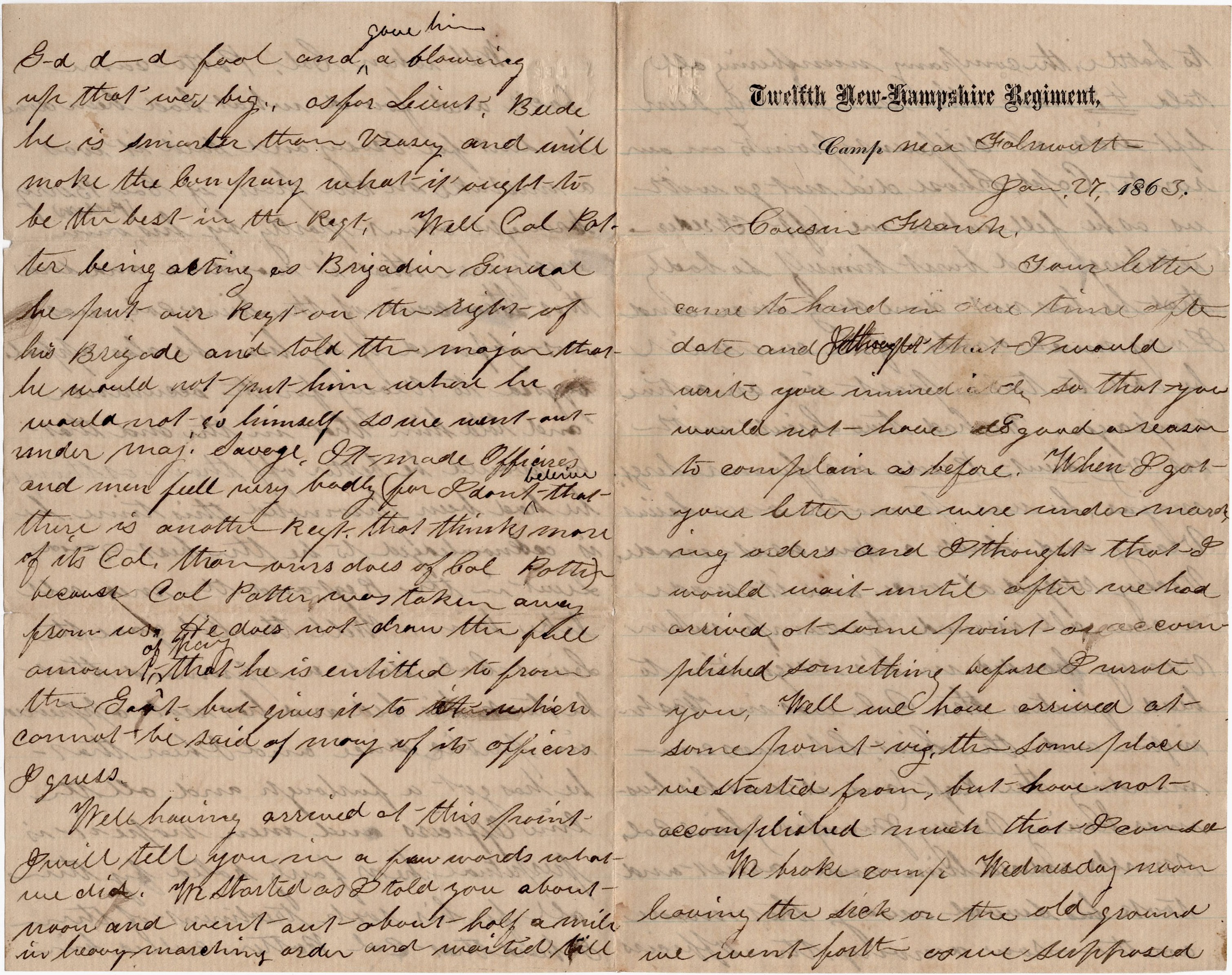
12the New Hampshire Regiment
Camp near Falmouth
January 27, 1863
Cousin Frank,
Your letter came to hand in due time after date and I thought that I would write you immediately so that you would not have a good reason to complain as before. When I got your letter we were under marching orders and I thought that I would wait until after we had arrived at some point or accomplished something before I wrote you. Well, we have arrived at some point—viz: the same place we started from, but have not accomplished much that I can see.
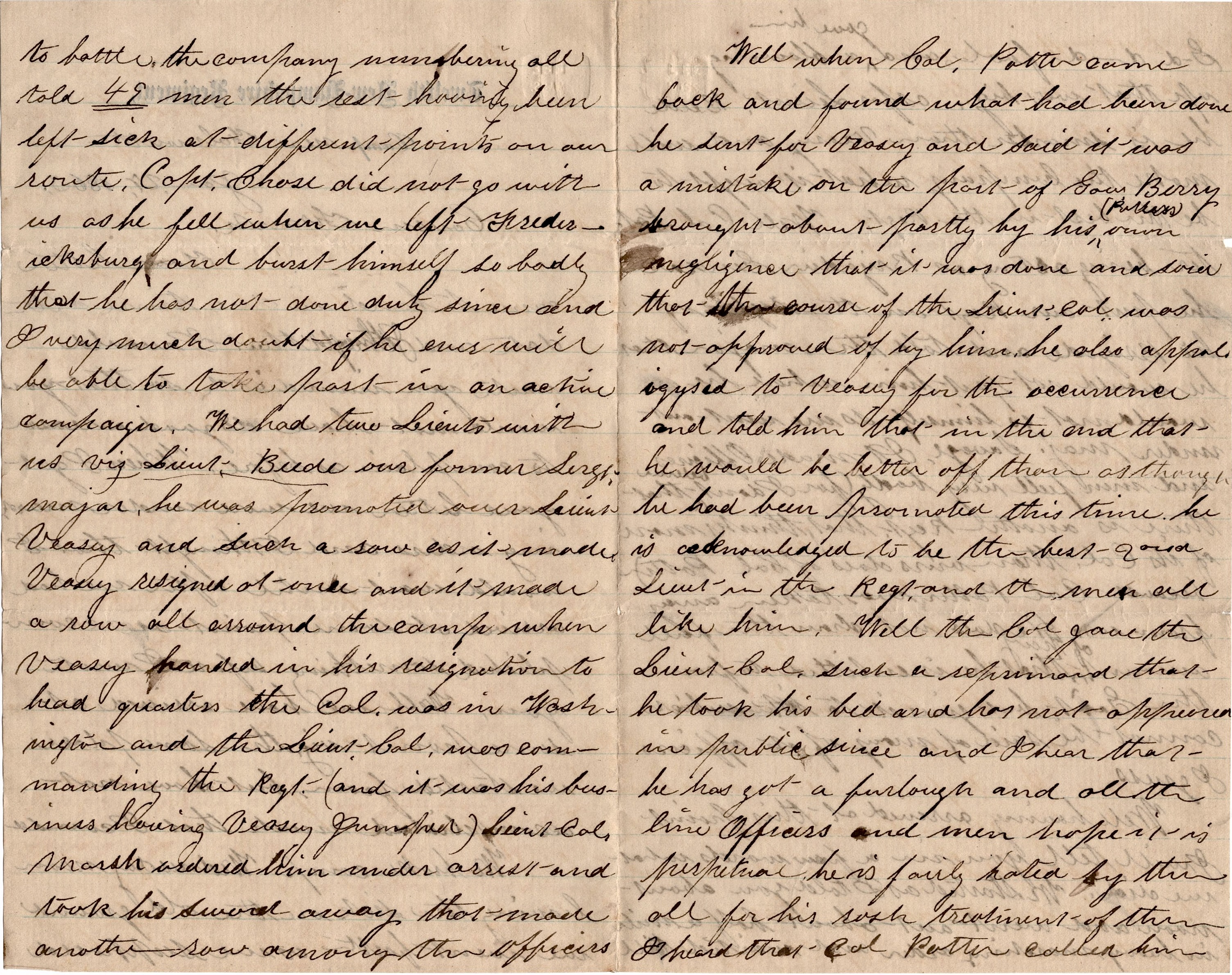
We broke camp Wednesday noon, leaving the sick on the old ground. We went forth as we supposed to battle, the company [Co. G] numbering all told 49 men—the rest having been left sick at different points on our route. Capt. [Charles W.] Chase did not go with us as he fell when we left Fredericksburg and burst himself so badly that he has not done duty since and I very much doubt if he ever will be able to take part in an active campaign.
We had two lieutenants with us—viz: Lieut. [Edwin E.] Beede, our former sergeant-major. He was promoted over Lieut. [John S.] Veasey and such a row as it made. Veasey resigned at once and it made a row all around the camp. When Veasey handed in his resignation to headquarters, the Colonel was in Washington, and the Lieut.-Colonel was commanding the regiment (and it was his business having Veasey jumped). Lieut.-Col. [John F.] Marsh ordered him under arrest and took his sword away. That made another row among the officers.
Well when Col. [Joseph H.] Potter came back and found what had been done, he sent for Veasey and said it was a mistake on the part of Gov. Berry brought about partly by his own negligence that it was done and said that the course of the Lieut.-Col. was not approved of by him. He also apologized to Veasey for the occurrence and told him that in the end that he would be better off then as though he had been promoted this time. He is acknowleged to be the best 2nd Lieut. in the regiment. The men all like him.
Wel the Colonel gave the Lieut.-Col. such a reprimand that he took his bed and has not appeared in public and I hear that he has got a furlough and all the line officers and men hope it is perpetual. He is fairly hated by them all for his treatment of them. I heard that Col. Potter called him a God damned fool and gave him a blowing up that was big. As for Lieut. Beede, he is smarter than Veasey and will make the company what it ought to be—the best in the regiment.
Well Col. Potter being acting as Brigadier General, he put our regiment on the right of his brigade and told the Major that he would not put him where he would not go himself so we went out under Major [George D.] Savage. It made officers and men feel very badly (for I don’t believe that there is another regiment that thinks more of its Colonel that our soes of Col. Potter) because Col. Potter was taken way from us. He does not draw the full amount of pay that he is entitled to from the government, but gives it to it which cannot be said of many of its officers I guess.
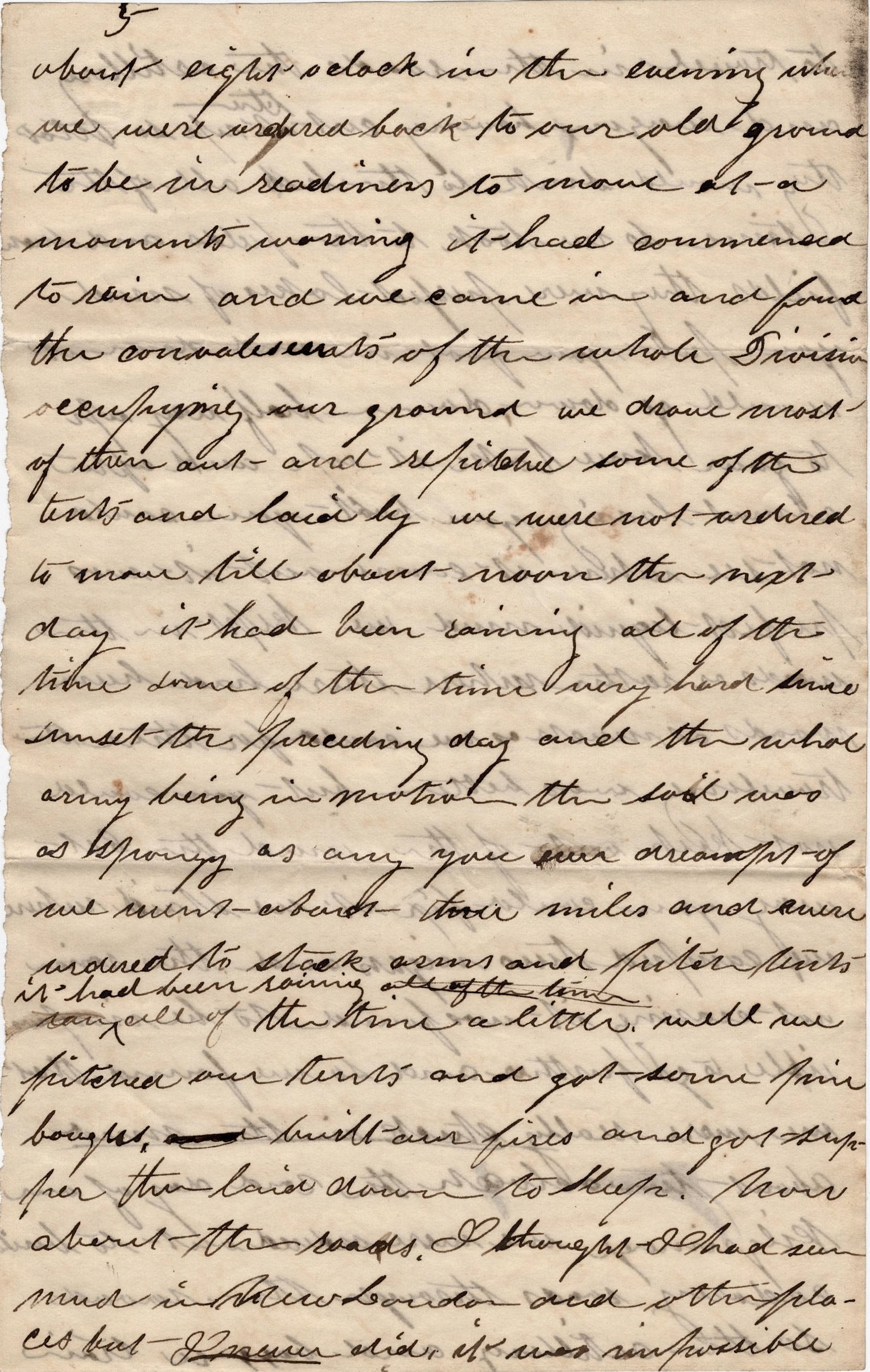
Well, having arrived at this point, I will tell you in a few words what we did. We started as I told you about noon and went out about half a mile in heavy marching order and waited till about eight o’clock in the evening when we were ordered back to our old ground to be in readiness to move at a moment’s warning. It had commenced to rain and we came in and found the convalescents of the whole Division occupying our ground. We drove most of them out and repitched some of the tents and laid by. We were not ordered to move till about noon the next day. It had been raining all of the time, some of the time very hard since sunset the preceding day and the whole army being in motion, the soil was as spongy as any you ever dreamed of. We went about three miles and were ordered to stack arms and pitch tents. It had been raining all the time a little. Well we pitched our tents andgot some pine boughs, built our fires, and got supper, then laid down to sleep.
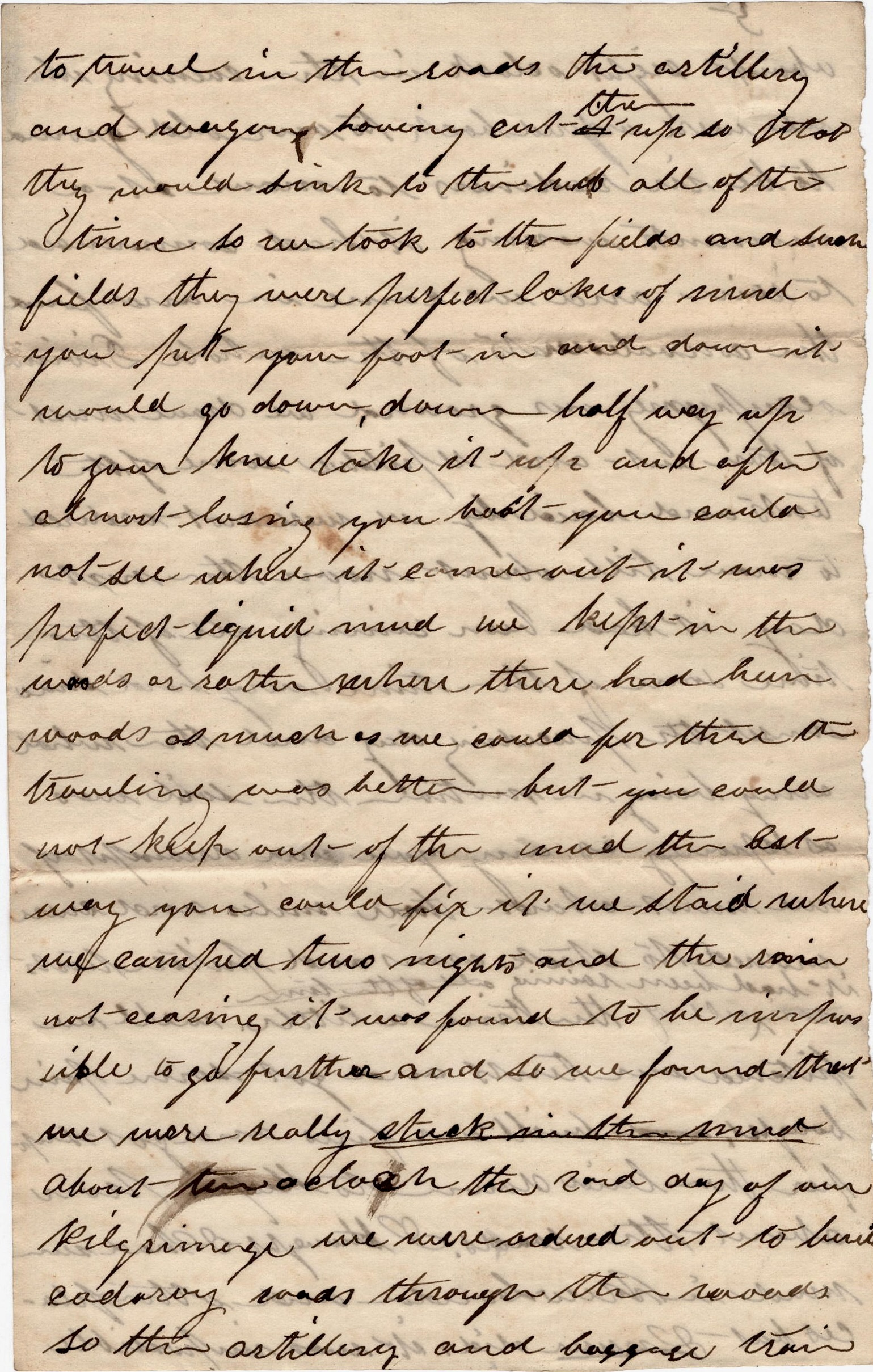
Now about the roads. I thought I had seen mud in New London and other places but I never did. It was impossible to travel in the roads, the artillery and wagons having cut them up so that they would sink to the hubs all the time so we took to the fields and such fields! They were perfect lakes of mud. You put your foot in and down it would go—down, down, half way up to your knee. Take it up and often almost losing your boot. You could not see where it came out, it was perfect liquid mud. We kept in the woods or rather where there had been woods as much as we could for there the traveling was better, but you could not keep out of the mud the best way you could fix it.
We staid where we camped two nights and the rain not ceasing, it was found to be impossible to go further and so we found that we were really stuck in the mud. About ten o’clock the 2nd day of our pilgrimage, we were ordered out to build corduroy roads through the woods so the artillery and baggage train could get through to their old camping ground for having found that it was impossible to move the pontoon train, artillery andbaggage train further in the mud, our generals came to the conclusion that they better go back (for the whole army was in motion) and about 3 o’clock we packed up and started back to our old ground where we arrived tired but we put up our tent, or rather covered our log hut and nowm though it rains, we are about as comfortable as though we were at home for here Henry and I are in a log hit built up 4.5 feet with logs with a stone foreplace in the side and covered over with our tents with bunks onone side made of oak poles covered with cedar boughs (and I sometimes think who wouldn’t be a soldier!).
So you see we are quite comfirtable here but don’t any of you folks up North say anything about our advance movement but when you want the army to move, take a trip out here and walk half a mile in the mud. You will go home perfectly satisfied, I assure you.
We are as well as usual. Dexter has got his discharge and you can find out particulars by him. You spoke of John Dockham. He has the reputation of being the greatest eater in the company. The other day when we were talking about moving on the Rebs, the surgeon come to the company to examine the sick to see who he would excuse from going. John was down to the cookery eating a plate of beans. He dropped his beans andstarted for the surgeon. He was examined but not excused. He went back and got more beans and went to eating again. He kept growing sicker and sicker till we went and he did not go with us.
There is not much news to write so I will draw this to a close. Our regiment was paid up to the first of November. At Concord we got only a part of a month’s pay. Tell your father that I sent the full amount of a month’s allotment. Henry sent half of his—viz: $4. I suppose I will get around sometime. Write soon and give me the news. Yours, — Arthur