The following letter was written by John H. Griffin whom I am not able to identify conclusively. There were a couple of soldiers by that name in the Confederate service from Virginia but there is nothing in their records that would link them to Botetourt county.
Peachy Gilmer Breckinridge
Griffin wrote the letter to Emma Walker (Gilmer) Breckinridge, the wife of Cary Breckinridge (1796-1867) of Fincastle, Botetourt county, Virginia. He wrote the letter to let her know that her “boys” had all survived the Battle of Manassas (First Bull Run). Emma had three sons who served the Confederacy in uniform. The eldest son, Peachy Gilmer Breckinridge (1835-1864) entered the service as Captain of Co. K, 28th Virginia Infantry and later transferred to the 2nd Virginia Cavalry. A second son, James Breckinridge (1837-1865) entered the service as a 1st Sergeant in the 30th Virginia Cavalry (later designated 2nd Virginia Cavalry). The third son, Cary Breckinridge, Jr. (1839-1918), entered the service as a 2nd Lieutenant with his brother in the 30th Virginia Cavalry. Cary was the only one to survive the war of the three.
All three boys participated in the First Battle of Manassas. The 28th Virginia was attached to the Fifth Brigade commanded by Col. P. St. George Cocke. The 30th Virginia Cavalry was attached to the 1st Brigade commanded by Brig. Gen. Milledge L. Bonham.
Transcription
Addressed to Mrs. Cary Breckinridge, Fincastle P. O., Botetourt county, Va.
Gordonsville, [Virginia] 24 July 1861
Dear Madam,
I left Manassas yesterday & promised your brother William to perform the very pleasant duty of informing you of the safety of your Boys. I sincerely congratulate you & your family on the result & especially that they should have shared the honor of contributing to so glorious a victory—which must lead to such important results.
The property captured is estimated to be worth not less than a million of dollars ($1,000,000).
Very respectfully & truly yours, — Jno. H. Griffin
The following Civil War diary was kept by William Joseph Mottern (1840-1905) who enlisted at the age of 22 on 15 August 1862 as a private in Co. A, 33rd Iowa Infantry. He was promoted to corporal in August 1863 and mustered out at New Orleans on 17 July 1865.
William’s grandparents were Nicholas Mottern and Elizabeth Hobough of Sullivan county, Tennessee. His father, Deadrick Mottern, was one of ten children born to the couple. Deadrick died at the age of 26 in 1846 but not before marrying and have a couple of children. Unfortunately we don’t know the name of William’s mother who apparently also died prior to the 1850 US Census for in that year, William was living with his Aunt Mary (Mottern) Jordan and her husband, John J. Mottern in Marion county, Iowa, who apparently raised him.
After the war was over, William returned to Iowa where he married Mary Margery Brown (1841-1937) in March 1868 and they had one son named Ellsworth Eugene Mottern (1871-1933).
Transcription
[Note: This diary is in the possession of Travis Core, Pleasantville, Iowa— a g-g-g grandson of William Joseph Mottern]
SEPTEMBER 1862
Camp Tuttle, Oskaloosa, Mahaska county, Iowa. September 9, 1862 Mess No. 6: W. L. Brown, foreman, S. A. Gose, W. J. Mottern, W. W. Cradick, P. Walter, Joe Hunter, J. Worth, Milton Miner, Hiram Miner, John J. McElroy< John Johnson. This composes our mess. They are all good Boys I think. We take it by days cooking. On the 25th of September [1862], we was called out to be mustered into the US Service at Oskaloosa.
NOVEMBER 1862
November 15th 1862—Was very cold morning. This was the day that the 33rd Regiment received their orders to move for St. Louis.
DECEMBER 1862
Sunday morning, December 14, 1862—On board the steamer Rowena this morning. December 25, 1862—Columbus, Kentucky. This day we was laying in camp waiting for an attack from the enemy but they had not attacked us by 3 o’clock in the evening but as to the reason why is unknown to me. 26th—Columbus, Kentucky. Still we are waiting for an attack of the rebels today. The ground is very wet and muddy here. Last night was the first time the 33rd lay in their tents and i got very wet but I feel very well today and at this time I am sitting on a stump listening at the cannons firing and the guns cracking.
JANUARY 1863
January 2nd 1863—Camped two miles south of Union City, Tennessee on the Columbus Railroad in a nice scope of timber such as beach and poplar. Here we taken our New Year’s dinner of fresh pork and crackers & coffee which went well to a hungry soldier. January 8th 1863—We left Columbus, Kentucky for Memphis today. I am sitting at the wheelhouse [Steamer J. D. Perry] writing this about 45 miles above Memphis. It is very pleasant today and I feel good.
FEBRUARY 1863
February 1, 1863—Helena, Arkansas. February 1st find me still on the banks of the Old Mississippi River sitting in my little tent thinking how many dreary days we have to spend before this rebellion shall come to a close and we will have the privilege to return to our native homes and enjoy the pleasures of home, sweet home once more. February 5, 1863—Today the ground is covered with snow and the snow is still falling here while I am sitting in my tent. The other boys are reading novels, some smoking, ad I myself am whiffing a cigar. Friday, February 6th—Near Helena, Arkansas. At this time I am sitting on the root of an old beach tree guarding one of the roads leading from Helena to St. Francisville on White River. I am about one mile from Helena and I would like to be still further from such a place if I could but as I am governed by higher authority, I enjoy myself as best I can. I am placed in a large ravine. On either side of me is high hills and on those hills are very fine timber such as poplar, beech, white oak, and ash. The land here is very poor. this is a brief description of this place at present time. February 17th 1863—[Took steamer Lebanon No. 2 on the Yazoo Pass.] Camped on the Yazoo Pass on Geneal Alcorn’s farm in the State of Mississippi. We are well quartered in the Negro houses here. We have had some trouble with the secesh scouts but have not had any man killed yet but we have had several skirmishes with them.
MARCH 1863
March 3rd 1863—Today we are lying in the Coldwater [river]. March 8th 1863—Still on board the Lebanon No. 2 on the Tallahatchie River. Sunday morning. March 12th–Today we are waiting for orders to march on to the Rebels. It is now 9 o’clock in the morning. March 20th—Today we are an hour way up the Tallahatchie River. we expect to have to fight our way back if we get back at all.
APRIL 1863
April 2nd 1863—Still finds me on the old camp ground on the Tallahatchie River. Nothing has been done yet to remove the Rebel fort but soon think we will give the another trial. April 4, 1863—We started up the Tallahatchie today which is the 5th of the month. We are still an hour up the river. As to where we will stop, I cannot tell yet. April 9th—Helena, Arkansas. On the 8th this month we arrived back to this place off of our expedition down the Tallahatchie River. We started February 24th and returned April the 8th. Today we are lying on the boat waiting further orders.
MAY 1863
May the 14th 1863—Helena, Arkansas. Today finds me on guard at General Prentice’s Headquarters on the Wharf Boat. The weather is fine this morning and things seem to be going off finely in regard to the war. May 29th 1863—Just come in from picket and I feel very much worried from the walk I had to take before I could reach camp and worse than all, I could not sleep for the mosquitoes—they was so numerous. They stole a vast amount of my precious blood which I did not like to have spilled in such a manner. The weather is very hot at this time. Yours in haste.
JUNE 1863
June 1st—Today we received $26 which was our pay for the months of March & April. June 14th—Sunday. Today we are all quiet in our tents. Some [are] reading, some sleeping. Today the weather is very warm. Today the 3rd Iowa Cavalry started to Vicksburg. They are a noble set of Boys and no doubt they will do good work if they have the chance to try their hand. They have been here at this place eleven months today. June 29th—Still finds us at Helena. All is quiet here and has been for some time…I have gone to the timber to relieve the old picket…[illegible].
AUGUST 1863
August 16th 1863—Camped on White river in a nice shady grove. we left Helena on the 11th August. Arrived here on the 15th. had a very dusty trip. will lay here a few days and then cross the river and proceed to Little Rock. August 18th—Still in camp on the white river though we expect to leave soon. Some of the troops are across the river. The weather is still hot here. August 21st—Still on the White River. August 22nd—In camp [illegible] August 26th—In camp 30 miles up. We camped on the White River at DuVall’s Bluff on the railroad leading to Little Rock. This is a very nice place [location] for a town. Has all been burnt up by the enemy troops. August 29th—Still in camp on the river. We are looking all the time to march. 31st—We leave the Bluff and go 7 miles and camp.
SEPTEMBER 1863
September 1st—We marched 22 miles to Brownsville. Here we are still on the 2nd. September 9th 1863—In camp on Bayou Meto two miles from Arkansas River and six miles below Little Rock. But little fighting done yet. The [Rebels are] supposed to be in their fortifications about 4 miles from this point here. We have tolerable good water and plenty of the best of beef and pork. September 10th—Little Rock fell to the Union troops. September 11th—we are laying on the banks of the Arkansas river waiting for orders. 13th—Still on the bank of the river but we will cross today. The weather is pleasant at this time. Still the weather is pleasant on the 25th of September.
18 year-old John H. Anderson enlisted in Co. I, 33rd Iowa Infantry (Iowa Civil War Images)
OCTOBER 1863
October 9, 1864—On board steamer Sallie List 40 miles below Memphis. The weather is mild. I left Little Rock the 4th of October with 325 prisoners—one Major, four Captains, several Lieutenants. Leave Little Rock October 4th, arrive at St. Louis 13th. Leave 15th [and] arrive at Little Rock 29th, 1863. Weather pleasant on the river. October11th—Still on the river on board steamer Hawk Eye State 3 miles below commerce on the night of 11th. We lie at New Madrid. Next Columbus. Next Cairo. Next Cape Girardeau.
NOVEMBER 1863
Nov 28th – The weather is cold and dreary today.
DECEMBER 1863
December 3rd—Weather dry and pleasant today. I have been working on Fort Steele. Things are quiet here. 7th—Things all quiet. Plenty of rain today. 8th—Pleasant and warm. 9th—The weather lowery. Signs of more rain. Other things going briskly. 10th—Nothing very important going on. 11th—Still raining tonight. All things going on fine. 17th—Cold and very high winds. Other things all quiet. 28th—Weather still pleasant and rather cool. All quiet here at this time. Weather cool and pleasant at this time. I have just finished a letter to Frank H. Brown, Little Rock, Ark. 31st—Today it has snowed nearly all day which the first snow that has fell here this winter. This is New Years Eve. Sixty-three is nearly gone and Sixty-four will soon be here. All quiet here. Things going off smoothly. Duty light and plenty to eat which is all that we need. Little Rock, December 31st, 1863 — Wm. J. Mottern. So ends 63, State of Arkansas, U. S. of A.
JANUARY 1864
“Today a Rebel Spy by the name of David O. Dodd was hung at this place…”
January 1st, 1864—Things all quiet. Weather cold. The ground covered with snow. Today we Bury L. E. Collings in the Little Rock Cemetery east of town. 3rd—Nothing going on in camp more than usual. 4th—Still the ground is covered with snow and it is sleeting at this time. Things are very dull here. Duty light. Nothing more than camp guard. 5th—Things all quiet. I am on camp guard today. The snow and ice is still on the ground. Things all slow. 6th—Things all quiet today. 7th—Weather still cold.8th—Snow slowly melting off. Weather pleasant. Today a rebel spy by the name of David O. Dodd was hung at this place. He had when taken up a plot of all the forces at this place and their situation and number of men we had here. He was only 18 years old—nice looking young man. But he met with bad fate. Other things here all quiet. 9th—Weather pleasant. Things all quiet. 10th—Sabbath today. The snow is fast melting away. I was at the Episcopalian Church at Eleven A.M. Also at three P.M. Nothing of any note passing. 11th—Still the weather is moderating and the snow is nearly all gone off the ground. 12th—Today the weather has been very pleasant. 13th—Still pleasant. 14th—Today the weather has been pleasant but this evening the wind is blowing and it is getting cold. 15th—Today I am in camp guard. Nothing of importance a stir. 16th—Sunday. Plenty of rain today. Things all quiet. 18th—Nothing of Importance transpired today. Weather warm and pleasant. Today the boys—or a part of them—organized a society called the Soldiers Reform. 19th—Company drill 10 till 11 A.M. Weather still pleasant. Army Regulations read to the company. 20th—Drill today. Weather pleasant. January 21, 1864—Nothing more than company drill today. Weather pleasant. 22nd—Nothing more than company drill. 23rd—Weather pleasant today. Drilled in the bayonet exercise. 24th—Drill in the bayonet exercise. 25th—Weather pleasant. Drill has been the business of the day. The northern mail came in. I received one letter from F. Brown, Wheeling, Iowa. One from W. H. Brown, St. Louis, Mo. 26th—Nothing of importance afloat. 27th—Today the regiment was inspected by the Inspector General. In the afternoon, I paid the 4th Iowa a visit. Did not stay long. 28th—Weather pleasant. Today the northern mail came In. Also the Pay Master came to pay the troops at Little Rock and other adjoining points. 29th—The weather still pleasant and warm. 30th—Today the 3rd Division had a grand review. The troops looked well and some good marching. Tonight it is raining and has the appearance of being bad weather for some time. 31st—Today I am on guard. Today it has rained most all day. This finished the month.
FEBRUARY 1864
February 1st—Nothing of importance going on today. 2nd—Weather pleasant. The wind high. 3rd—Today we had target shooting and it terminated in Osias Nichold being the best shot. Nothing new afloat at this time. 4th—Nothing more than company drill. 5th—Weather pleasant. 6th—Weather still nice but some colder. Company drill and from ten till eleven in the bayonet exercise. 7th—Nothing new today. Company inspection at nine a.m. 8th—On guard today. Nothing new going on today. 9th—Today I went to town and spent the afternoon. The weather is very pleasant at this time. February 10, 1864—Today we received our pay for the months of November and December. 11th—Nothing new more than the northern mail came in. I received one written January 25th, other 27th same month. 12th—Nothing new going on today. 13th—Weather very pleasant today. Things all quiet here at this time. 14th—On guard today. It has rained nearly all day and tonight it is still raining. 15th—Nothing more than company drill. 16th—Nothing of importance. 17th—Today we had regiment inspection. The regiment was in fine trim. We was inspected by A. A. Inspector General Whipple. February 18, 1864—On picket today on the Benton Road south of Little Rock. Weather very cool for the South. 19th—Weather cool today. Written one letter to Mrs. Mary Jordan. 20th—Nothing unusual going on today. 21st—Today we have company inspection. I also was at the Episcopal Church 11 a.m. Weather pleasant. Tonight we had two new recruits to the camp. 22nd—On camp guard today. Nothing new going on here at present. 23rd—Nothing more than company drill and dress parade. 24th—Company drill from 10 a.m. till eleven. 25th—Company drill from 10 a.m. till eleven. 26th—Today the regiment is on Brigade Drill in the afternoon but I am on the sick list and am not taking any part with them. 27th—Nothing new today. On police duty today. 28th—Today is Sabbath. We have company inspection. Tonight it is raining very hard. 29th—Cold and sleeting all day. Today we was mustered for pay by C. H. Macke, Lieut.-Col. This finishes the month of February.
William Harris was 22 years old when he enlisted as a private in Co. C, 33rd Iowa Infantry (Iowa Civil War Images)
MARCH 1864
March 1, 1864—Company drill. 2nd—Company drill. 3rd—On picket guard today. Nothing new transpired. 4th—Company drill from 10 till 11 a.m. Taken a stroll to town in the afternoon. 5th—Received one letter from J. T. Jordan dated February 16th. The regiment on battalion drill today. 6th—Sabbath. Nothing more than company inspection. The mail came in from the North. Received one letter from J. T. Jordan; one from F. H. Brown. 7th—Company drill today. Nothing new. Nine recruits has come to camp in the last month. 8th—Company drill from 10 a.m. till 11. Battalion drill from 2 p.m. till four. Nothing more. 9th—On picket today on the Benton Road south of town. It has been very wet all day. Nothing unusual transpired during the day and night. 10th—Cold and windy. Company drill 10 till 11 a.m. 11th—Help to haul two loads of wood today. Tonight the news come that we are on marching orders—our destination not known. 12th—Weather cool. Nothing new. 13th—Sabbath. I went to the Episcopal Church. Today we are packed up ready to march. Whether we will go or not is hard to tell. Time will prove. 14th—Still in camp on camp guard today. Weather cool with high winds. The 3rd Division passed review today. 20th—Sabbath. On camp guard today. Weather cool. Nothing new going on. 21st—Nothing new going on today. 22nd—Tonight we are trying to start on the march. We start tomorrow at 10 a.m. for parts not known to me. 23rd—Today we left Little Rock. Travel 10 miles. Go into camp on the Benton Road south of Little Rock. We are camped in an old field close to water. March 24, 1864—Today we are the rear guards of our brigade. [We] march 15 miles [and] go into camp 1 mile southwest of Benton, in Saline County. It has rained all afternoon. The roads are very bad. 25th—Today we march 8 miles and go into camp on a nice little stream of water. 26th—Today we march 16 miles. Go into camp at Rockport on the Ouachita River, Hot Springs County. The country over which we traveled today has been very broken and but little settlement. 27th—Cross the Ouachita River and travel 8 miles. Country very broken. 28th—Travel 10 miles. Country very Broken. Today we are rear guard of the whole division. 29th—Marched 8 miles to Arkadelphia. After supper we was ordered back 3 miles to guard supply train. 30th—Marched back to the division rear. We are living in camp close to town. 31st—Today we lie at Arkadelphia.
APRIL 1864
Elkin’s Ferry Battlefield, Civil War Trust
April 1st—Today we left the above named place and traveled 12 miles. We passed some of the nicest country that I have seen in Arkansas. Went into camp at a small town by the name of Spoonville. 2nd—Left Spoonville and traveled some 8 miles and was attacked by the rebels in our rear. They aimed to take our supplies. 29th Iowa and 50th Indiana was engaged in the fight. Halted at place by the name of Okabona for night. 3rd—Left the above named place and went four miles and camped close to river by the name of Little Missouri. 4th—Today we have been lying all day waiting for the enemy to attack us. This morning at 7 a.m., they attacked our front and had a pretty hard skirmish. Finally quit by the enemy. We had on our side 3 or four killed and 17 wounded. [See Engagement at Elkin’s Ferry] 5th—Still we are lying on the above named place. It is now near 7 a.m. and we expect they will attack the rear today some time. We are waiting for the rest of our forces to come up. The weather is very warm here all this time. 6th—Today our regiment moved to the front, crossed Little Missouri River, went some two miles and come to a small field [where we] formed in line of battle. Sent out skirmishers to find out [where] the enemy was placed, but they had all left but a few that was left to cover their retreat. The cavalry chased them some 6 miles and quit. We moved on some 3 miles and went into camp on the bluffs of the river. April 7, 1864—The army has been here all day. There has been no force out—only the cavalry scouts. We are waiting for General Thayer’s forces to join us. They are still in our rear. We are camped on a nice ridge close to a nice little stream of water. We have plenty of pine knots to burn and branches of the same kind of timber to make tents to lie under. 8th—Still in camp. Expect to lie here all day. Last night we had a very hard rain. Things all quiet today. 9th—Still in camp. Today the Fort Smith troops are crossing the river. They will be up tonight. I am on picket tonight. The night is very cool and some little rain is falling. We are posted in a nice camp of oak, pine and dogwood [trees]. 10th—Still on picket. This morning the army is moving out. We will soon be relieved. This Is a very pleasant morning. Leave camp and travel 4 mile and come up to the rebel force on D’Ane Prairie. We had some skirmishing with them and considerable cannonading. They fell back some two miles and night come on and we had to stop the chase. About 8 p.m., they commenced to shell us. You bet they raised us out of the grass. Finally they quit after our batteries shelled them awhile. 11th—Today we lie on the ground where we was yesterday till 3 p.m., then we advanced some 2 miles and had some heavy skirmishes with the enemy. We lie on the prairie till dark, then we fell back to the old camp. Then our company went out as skirmishers for the night. We got very wet during the night. It rained very hard. 12th—Up again this morning we are. Today we advance on the enemy and drive them out of their fortifications. Then we march 8 miles and go in camp for the night. 13th—Today we lie in camp till 1 a.m. Then we march 5 miles and camp for the night. 14th—Start at one p.m. and go some two miles and an order came to stack knapsacks and go to Camden—a distance of 28 miles. We started and traveled till ten at night. Then we halted for the remainder of the night. 15th—We started against daylight and had not gone more than five miles till we come to the rebel force. Again we had some very hard skirmishing for some 3 hours. Finally they pulled up and left. Then we moved on to Camden, we taking possession of the town about sundown. It is a very nice town what I have seen. 16th—Today we are lying In camp. We will move to another camp today. 17th—Yesterday we moved our camp to where we are at the present time. We have a very nice camp at this time. We have built rail pens for shanties so we are doing fine. 18th—Still in camp. Things going off finely so far. Some little skirmishing with the rebels but no serious damage done. The weather here is very pleasant at this time. April 19, 1864—Today I am picket guard. Today we drawn four ears of corn for our days rations. 20th—Come off of picket guard today. Today we received mail from the North. Also we had seven recruits to come to the company. 21st—I am in camp. The weather is very pleasant. Things are going off lively here now. 22nd—In camp all day. Things all quiet. 23rd—Today I am on picket guard 1 p.m. Today the rebels attacked one of our picket posts on the Shreveport Road. They brought three pieces of artillery to bear on our men, but they did not do any serious damage to us. They shelled awhile and then moved to the right. We expected an attack on the place the next day. 24th—This morning I come off picket. They have been expecting an attack today on this place but up to this time, things have gone off quiet. It is now 12 noon. I think they will not come. 26th—Today we lie in the line of battle all day and at night. The troops evacuated the town of Camden, went some 3 miles, and stopped till morning. 27th—Today we travel eighteen miles and camp for the night. 28th—Today we move out early and travel till 5 p.m. and stop for the night at a town by the name of Princeton. 29th—Leave Princeton. Travel some 12 miles and the rebels attacked our rear and skirmish with them till night come on and put a stop to the chase at night. Our regiment was called out to hold the enemy in check till morning. We lie all night without sleep or anything to eat. 30th—Morning come and we fell down under the hill and they began to fire on our skirmishers again. We held them in check till the 29th Iowa formed in line and then we fell back to make our coffee which was all we had. But before we could get that drank, the fight began. Then we was ordered up on the double quick. Our company and Co. B was thrown out on the left of the regiment as skirmishers. Then we went into them for good. The fight lasted from 7 till 1 p.m., during which time there was as heavy musketry and as fast as ever has been since this war broke out. Our regiment lost 129 men killed, wounded, and missing. In the [afternoon], we fell back and crossed the Saline River and went into camp for the night.On the 30th of April 1864 on the Saline River, Thomas Canady and John Hunt, both belonging to Co. G, 40th Iowa was killed. The Battle on Saline river lasted from early in the morning till one o’clock. we had no artillery engaged. The enemy used three pieces until our men taken them from them. [See Battle of Jenkin’s Ferry]
The Battle of Jenkins’ Ferry
MAY 1864
May 1st—This morning we leave the Saline River and travel all day and night. Stop this morning and eat a bite. 2nd—Start again and travel till within 10 miles of Little Rock and go into camp for the night. 3rd—Today we arrive in Little Rock after a march of 40 days over the hills and valleys of Arkansas. 4th—Today we are in same old camp we used to occupy. Things are quiet here today. 5th—Nothing new going on here at the present. 6th—Still In camp. Weather pleasant and warm. All quiet today. 7th—On detail today at division headquarters. Drawing clothing for the brigade. 8th—Regimental inspection at 9 a.m. _____ at 11 AM. Weather pleasant and warm. Things all quiet. 9th—Weather unpleasant today. Some rain falling today. I drew one woolen blanket, one hat, one pair of shoes, [and] two pair of socks. 10th—Nothing new going on. Weather still rough and some rain falling. 11th—Weather pleasant today. Today I am detail to help load cannon on the cars to be taken to St. Louis for the [Mississippi Valley] Sanitary Fair [May 17-June 17, 1864].
12th—Nothing new going on at this time. Today we have a detail working on fortification. 13th—Nothing of importance going on here. All quiet today. 14th—Saturday all quiet here. Weather pleasant. 15th—Sunday inspection today at nine a.m. Today I attended M[ethodist] E[piscopalian] church at town. 16th—Nothing going on. Only the work on the fortifications. This is going on lively. 17th—This morning there fell a very heavy shower of rain at 4 p.m. Today we have regimental inspection. Things all quiet today. No inspection on the account of rain. 18th—Today I am on picket. The regiment had Inspection at 4½ p.m. today. 19th—This morning I come off picket guard. All quiet at camp. Weather warm. 20th—All quiet here. Drill from nine to ten a.m. Weather pleasant. May 21, 1864—Weather pleasant today. Captain Paris Totten of Co. I was buried at this place. He was wounded in the battle on the Saline River.
22nd—Sunday morning all quiet and pleasant here. Inspection at 9 nine a.m. today. 23rd—All quiet today. Duty heavy. We received mail today. I received one letter from J. T. Jordan dated May 14th. 24th—On camp guard today. All quiet here. 25th—Weather pleasant here. Things all quiet at this time. 26th—All quiet here. Company drill 9 to 10. Other things all quiet today. Weather pleasant at this time. 27th—Weather pleasant at this time. Nothing new at present time. 28th—All quiet today. Weather pleasant. 29th—Weather very warm and sultry. 30th—Everything going on fine here at this time. Still continue to fortify here. Nothing else of importance going on. 31st—Nothing new going on today.
Stephen Stolzer was 19 years old when he enlisted as a private in Co. E, 33rd Iowa Infantry (Iowa Civil War Images)
JUNE 1864
June 1st— All quiet today. Weather pleasant. 2nd—All quiet today. 3rd—Nothing new going on today. 4th—Heavy raining today. Very cool. 5th—All quiet today. Weather clear and pleasant. 6th—Some rain today at four p.m. Today we had general inspection. General [Daniel Edgar] Sickles reviews the troops of this place. 7th—All quiet today. Weather pleasant with some signs of rain. 8th—Today I am on camp guard. Weather cloudy. Some rain falling. Today all quiet in camp. 9th—All quiet today. Nothing of importance going on. June 10, 1864—Still all quiet today. Weather pleasant and nice. Some signs of rain. 11th—Saturday. In camp today. Today we was to have regimental inspection but the rain hindered that. It will come off tomorrow if the weather will admit. 12th—Sunday. Weather pleasant. Nothing new going on. Went to Presbyterian Church at night. 13th—Monday. On fatigue today chopping timber wood from six to ten, then from four to ½ past 6. 14th—Tuesday. In camp today not doing anything. Visit town in afternoon. Weather pleasant and nice. All very cool. 15th—Wednesday. All quiet today. Nothing unusual going on. Weather pleasant. 16th—Thursday. All quiet at this time. Northern mail come in today. One letter from J. T. Jordan. 17th—Friday. All quiet today. Weather pleasant today. Regiment was inspected by the Division Inspector General. 18th—On picket guard today. weather very warm. All quiet on picket. 19th—Sunday. Come off picket guard. Attend Presbyterian Church today. Weather very warm. 20th—Monday. Have brigade review today. Weather very warm. All quiet today. 21st—Tuesday. All quiet today. Expect to have inspection today but it is raining so it will not go off. 22nd—Wednesday. All quiet today. Six a.m. today we had regimental inspection. It has rained a goodly portion of the day. 23rd—Thursday. All quiet today. We have battalion drill today. Weather very warm at this time. 24th—Friday. On fatigue duty chopping timber. Rains in the afternoon. All quiet here now. 25th—Saturday. Today we have brigade drill from 5 to 7 p.m. Weather very warm. Nothing more at this time. 26th—Sunday. Company inspection today. Attend church at the Episcopal Church today. Have meeting in camp tonight. 27th—Monday. All quiet yet some talk of fight here now. June 28, 1864—Tuesday. All quiet yet. Nothing new going on here now. 29th—Wednesday. On camp guard today. Battalion drill this evening. 30th—Thursday. All quiet today in camp. Weather warm.
John Richards was 18 years old when he enlisted as a private in Co. A, 33rd Iowa infantry (Iowa Civil War Images)
JULY 1864
July 1, 1864—All quiet today. 2nd—Brigade drill this morning from 5 to 7 a.m. today. Weather warm. 3rd—All quiet today. Weather very warm. On picket today. 4th—All quiet today. National salute fired today at twelve noon. 5th—Weather warm yet. Battalion drill. 6th—All quiet today. Weather warm. 7th—Weather still warm. All quiet today. 8th—On camp guard today. All quiet in camp. Weather very warm. 9th—All quiet today. 10th—All quiet today. Weather very warm. 11th—On prison guard today. All goes off quiet on guard. 12th—Come off prison guard this morning. Weather warm. 14th—Nothing new going on at present. All quiet. 15th—Regimental inspection today. Weather very warm. 16th—On camp guard today. All quiet here. 17th—All quiet today. Weather very warm. 18th—Company drill from 8 to 10 a.m. Weather warm. 19th—All quiet today. Weather warm. 20th—All quiet today. Received mail from North today. Weather warm at this time. 21st—All quiet today. July 22, 1864—All quiet today. Weather pleasant. 23rd—Nothing new going on here. Weather rather cool. All quiet today. 24th—All quiet today. Weather pleasant. 25th—All quiet. 26th—On camp guard today. The northern mail come in this morning. All quiet here at this time. 27th—Boys raising thunder at present in my camp. All quiet here at this time. weather pleasant. Duty heavy at the present. 28th—All quiet today. 29th—All quiet. 30th—Start for Lewisburg on detail of six days. We take passage on board the steamer Carrie Jacobs. 31st—On board steamer. Weather pleasant.
Samuel Allen Rice served as the Colonel of the 33rd Iowa Infantry (Iowa Civil War Images)
AUGUST 1864
August 1st—Still on board. Things pass off well. Arrive at Lewisburg late in evening. 2nd—Leave Lewisburg for Little Rock. Arrive at Little Rock three p.m. Find the boys in camp all lively when I return. 3rd—Nothing new going on here at this time. 4th—All quiet. I help haul one load of wood today. 5th—Go on picket today. Have a very nice time until night—then I suffer much from the mosquitos. Nothing unusual transpires while on duty. 6th—Come off picket this morning. Weather pleasant. Return to camp and wash and comb my head. Then lie down and take a nice sleep for a couple of hours. 7th—All quiet in camp today. Weather pleasant. 8th—Nothing new going on today. 9th—Today it has rained very hard. All quiet. 10th—Nothing new. Weather pleasant. 11th—Today it is raining. All quiet here. This day one year ago, we left Helena, Arkansas, for Little Rock. We arrived at Little Rock on the 10th of September. 12th—Weather cloudy and some rain falling. All quiet here at the present time. 13th—All quiet today. Some rain today. The mail arrived today from the North. At the time I am writing it is just half past eleven at night. All quiet and still at this time. 14th—All quiet here. August 15, 1864—Today we received pay to the amount of $84 dollars. 16th—All quiet here. Weather cloudy. 17th—On fatigue today on Fort Steele. Things all quiet here at this time. It looks very much like rain to night. 18th—Rains nearly all day. 19th—Weather cool and plenty of rain. We received mail today. 20th—On picket today. All quiet where we are at this time. 21st—Sunday. All quiet in camp. Today we buried Robert Hicks of our company. He died in the night of the 20th of fever. 22nd—All quiet today. 23rd—On picket today. 24th—All quiet today. 25th—Weather very warm today. 26th—All quiet here today. 27th—On picket today on the Pine Bluff Road one mile and a ½ south of town. 28th—Sunday. Weather cloudy. Some rain today. 29th—Weather pleasant and clear today. All quiet here. 30th—On camp guard today. On second relief. It has rained all the forenoon nearly. All quiet here yet. 31st—Today was mustered for pay for the months of August and July.
Michael J. Clarahan was 23 years old when he enlisted in Co. B, 33rd Iowa Infantry (Iowa Civil War Images)
SEPTEMBER 1864
September 1st—Today it has been very warm. 2nd—On picket today west of Little Rock—close to State prison. 3rd—Come off picket this morning. Weather very warm here at present. 4th—All quiet today. September 5, 1864—Last night we lie in the rifle pits all night expecting the rebels would give us a fight next morning but they did not come. 6th—Come to camp today and taken a little rest. 7th—On fatigue today all day. No fight yet. 8th—On picket today west of Little Rock. Things all quiet today. 9th—Come off picket today. Things all quiet in camp. 10th—All quiet today. On fatigue drawing rations for regiment. 11th—Sabbath. On camp guard today. 12th—Come off camp guard this morning. All quiet here at present. 13th—Slightly Sick. 14th—Same as above. 15th—One small pill at 3 pm. Fever accordingly. 16th—All quiet in camp. 17th—On fatigue today. 18th—Sabbath. All quiet today. Weather pleasant. 19th—Weather cool and pleasant. All quiet at camp. 20th—On picket today. All passed off quiet. 21st—Come off picket this morning. All quiet in camp. 22nd—In camp today. Weather cool and pleasant. All quiet around the Rock. 23rd—On camp guard today. All quiet here. Weather warm for September. 24th—Nothing going on in camp today. 25th—All quiet today. At church at 11. Went on fatigue at night at R. R. Depot. Worked till 2 a.m. 26th—In camp all day working on my cabin. All quiet. September 27, 1864—On picket guard. Showery all day. 28th—Come off picket today. Weather lowery. All quiet in camp. 29th—All quiet in camp. Weather rather cool. Went to town today. Nothing new going on around Little Rock. 30th—Nothing new going on in camp.
OCTOBER 1864
October 1st—On picket today on Benton Road south of Little Rock. 2nd—Sunday morning come off picket. All quiet in camp. 3rd—Weather cool today. Weather Showery. Things quiet. Northern mail today. One letter from home. 4th—All quiet. One hundred guns fired today in of honor of Sheridan’s Victory. Weather very muddy. 5th—On fatigue today [working] on fort. Weather cool and pleasant. 6th—In camp all day. All quiet. Weather pleasant. 7th—In camp all day. Things all quiet here. 8th—On camp picket today west of Rapley Road. 9th—Come off picket today. All quiet in camp. 10th—Weather pleasant. All quiet today. 11th—Weather pleasant. On fatigue today. 12th—All quiet in camp. Weather is pleasant. 13th—All quiet today. 14th—On camp guard today. Some rain falling in the evening. 15th—All quiet today. Weather pleasant. 16th—Weather pleasant. All quiet around camp. 17th—On camp guard today. Weather pleasant. 18th—Come off camp guard today. Went to town in the forenoon. 19th—Weather pleasant. I went to timber today. 20th—All quiet today. Weather pleasant. 21st—Nothing new going on today. weather pleasant. On fatigue at night unloading cars at depot. 22nd—Brigade drill today from 2 p.m. to 4. Weather cool and pleasant. 23rd—Sabbath. weather pleasant. work on kitchen today. Nothing new going. 24th—On picket guard today. weather pleasant. 25th—Come off picket today. Weather lowery. All quiet in camp. 26th—All quiet in camp today. Battalion drill from 2 p.m. to 4. 27th—All quiet today. Weather rather cool/ Work on cabin today. 28th—All quiet today. 29th—On picket today. Relieved at twelve. October 30th—Leave Little Rock [with forage train] for Ft. Smith [—a distance of 180 miles—] at one p.m. March 8 miles and camp for the night. On picket tonight. 31st—Came off picket this morning. Today [Companies] A & F are rear guards for train. March 10 miles and camp on the Purloin River. Country broken.
A sample of Mottern’s Handwriting in Diary
NOVEMBER 1864
November 1st 1864—Leave Purloin River and go 16 miles and [companies] A, F & D was in the center of train today. Rained all afternoon. Roads bad. Camp on a very nice little field. 2nd—Travel 2 miles, cross Cadron River. Go two miles and camp. Go foraging. Have bad luck. Get lost in the swamps. Finally get out by the assistance of a Negro guide. 3rd—Finish crossing train and remain in camp on the bank of the Arkansas River. Weather rather cool. On camp guard tonight. All going off nicely so far. 4th—Come off camp guard. March 12.5 [miles]. Arrive at Lewisburg at one p.m. Go in camp on a very rough ridge. Still close to the Arkansas river. 5th—Leave Lewisburg, march 10 miles and camp for the night. Roads bad. All quiet tonight. No camp. 6th—In camp today. train is not moving today. Lying, waiting to get forage. 7th—Leave the above-named place, march 14 miles, and camp on a large plantation. Roads good today. Weather pleasant. Plenty of forage, hogs and cattle. November 8, 1864—March 11 miles. Fired on today by one bushwhacker but done no damage to us. All going off fine. Camp at one p.m. and hold election. Camp on a nice stream called Illinois Bayou. Pass Rushville today. 9th—Cross Illinois Bayou and march 15 miles and camp on Big Piney. Roads hilly today. All quiet today. 10th—March 18 miles and camp at Clarksville on Spadra Creek. Good roads today. All quiet. Clarksville—county seat of Johnson county. Town mostly burned. 11th—Lie by today to get forage to last through the 18th. Arkansas infantry and 54 U.S. Colored met us here today. Here we see the ranges of the Mulberry Mountains. 12th—March 15 miles. Cross Little Horse Head & Big Horse Head today—both small streams—and pass through Horse Head Gap in the mountains. 13th—March 16 miles. Cross White Oak Creek and camp on or close to the creek. Today we crossed the road from ozark to Huntsville, Arkansas. 14th—March 15 miles and camp. Cross Mulberry Creek today. Have to wade the creek. On guard tonight in train. 15th—March 14 miles. Arrive at Van Buren one p.m. Roads good today. Camped on the Arkansas river. 16th—Nothing new today. Lie in camp all day. Weather cool here. 17th—Leave Van Buren at 10 a.m. and march 14 miles. Cross Little Frog. [Note: It appears that Mottern and the members of his regiment turned around at this point and began their return to Little Rock. Most likely it was at this location that the train was met by members of Maj. Thomas Derry (3rd Wisconsin Cavalry) who had preceded the supply train with dispatches to Fort Smith and on their return, met the supply train and escorted it safely back to Fort Smith. See Fort Smith Expedition.] 18th—March 16 miles. Cross Big Frog. Mulberry camp on the same ground we did as we we went up. Roads bad. 19th—Camp on same ground as we went up. Road bad today. Camp on Horse Head. 20th—March from Horse Head Gap to Clarksville 16 miles. Cross Spadra [Creek and] camp on old camp. Roads good today. Very cool. 21st—March 16 miles. Cross [Big] Piney. Roads good today. Weather very cool. 22nd—March 18 miles. Cross the Illinois Bayou and march to Pott’s Plantation. 23rd—March 17 miles. Roads good today. Weather pleasant. Camp on a nice stream, name not known to me. 24th—Pass Petit Jean Mountains. March from Pontramos to the Arkansas river. Pass Lewisburg. 25th—March 4 miles. Cross Cadron river. Roads bad today. Camp on same ground we did 3rd night. 26th—March 14 miles. Camp on Pauline Creek. Roads bad and very stoney. 27th—March 18 miles. Arrive at Little Rock at 4 p.m. March to old camp and go into quarters. 28th—All quiet in camp. 29th—On fatigue today. Weather pleasant. 30th—All quiet. No news today.
DECEMBER 1864
December 1, 1864—Nothing new today. All quiet. 2nd—Weather pleasant and warm. 3rd—Same as above. 4th—On picket today south of town. All pass off quietly. 5th—Came off picket today. Weather pleasant today. All quiet in camp. 6th—All quiet today. Weather pleasant. Go to town in afternoon. 7th—High winds today. Rather cool. All quiet in camp. 8th—On picket today. Weather very cool. Today we have four recruits to our company—H. Miner, Spurgeon, Strait, Metcalf. 9th—Came off picket today. Weather cool. All quiet in camp. No news today. 10th—All quiet in camp today. weather cool. 11th—No news today. Very cool. [Pages missing] 20th—Weather cool today. All quiet in camp. 21st—Weather cool and high wind. 22nd—On fatigue today chopping wood for picket line. weather pleasant. 23rd—Weather pleasant today. Company drill today. All quiet in camp. No news today. 24th—On picket guard south of town on Rapley Road. Weather pleasant. 25th— Come off picket today. Weather pleasant. Some rain today. today I went to town [and] from there to 40th Iowa. Find the boys all right. 26th—In camp today. weather pleasant. 27th—On picket guard today south of town on Wright’s Farm. weather very cool. 28th—Came off picket this morning. weather still cool. all quiet in camp. no news of any importance. 29th—Nothing new going on here. 30th—On fatigue today on the fortification. 31st—Today we have muster for November and December. All quiet in camp. weather pleasant. Nothing new going on worth notice. This finishes ’64.
JANUARY 1865
On camp guard today. Weather pleasant. All quiet in camp. 2nd—Nothing new today. Company drill 2 hours. weather pleasant. 3rd—All quiet today. 4th—Nothing new going on in camp. 5th—On picket guard today. Rains all day. 6th—Come off picket guard today. It snowed considerable—the first that has fallen here this winter. 7th—All quiet in camp today. weather pleasant. 8th—Sabbath morning. Nothing new. In camp all day. Go to Presbyterian Church at night. 9th—On picket today. Rains all day and snows at night. All passed off quietly on guard. 10th—Came off picket today. weather clear and pleasant. Snow melting off swiftly. All quiet in camp. 11th—Weather pleasant. All quiet in camp today. Go to town in afternoon. 12th—weather pleasant and nice. All quiet in camp. 13th—On picket on Rapley Road south of town. Weather pleasant. 14th—Came off picket today. Weather still pleasant and nice. 15th—Inspection today. Attend Catholic Church at 11 a.m. Weather pleasant. 16th—All quiet in camp. Monthly inspection today. Inspected by Capt. Barnes of [General Edward S.] Salomon’s Staff. 17th—All quiet in camp. 18th—All quiet in camp. on fatigue today on fort. 19th—On picket guard today on Ripley Road. 20th—Came off picket guard today. We was reviewed by Major. Gen. Reynolds.
FEBRUARY 1865
February 14th—Leave Little Rock at 5 a.m. Arrived at DuVall’s Bluff at one p.m. Embark on steamer Paragon at 5 p.m. 15th—Arrive at mouth of white River at 2 p.m. Now lying in camp. weather pleasant. 16th—Embark on steamer [ ] at [ ] a.m. weather pleasant. 17th—Weather pleasant and warm. We are some 40 miles above Vicksburg. Arrive at Vicksburg at one p.m. Leave at 6 p.m. 18th—Travel all night. Arrive at Natchez at daylight. Stay there but a short time. 19th—Arrive at New Orleans at 2 p.m. Cross the river to Algiers on the opposite side from New Orleans. 20th—Still in camp. All passing quietly today. Have regimental inspection. 21st—Still at Algiers. all passing off quietly. The troops are passing down the river all day. 22nd—Very showery all day today. we sent our regiment teams around today. Today I paid a visit to the [ ]. 23rd—Leave Orleans for Lakeport. Arrive there at 8 p.m. Go off the cars and go into an old house for the night. 24th—Move to another house and camp. 26th—Leave Lakeport for Dauphin Island on steamer Zephyr. 27th—Arrive at Ft. Gaines on Dauphin Island. Then we move to Navy Cove 4 miles. 28th—On detail today hunting wood. Mustered for pay today. Dauphin Island 140 miles from Lakeport.In camp on the beach of the Gulf of Mexico in Alabama at Mobile Point.
MARCH 1865
March 1st 1865—Still in camp on Mobile Point. All quiet here. 2nd—Weather pleasant and nice. No news today of any importance. 3rd—All quiet today. William Brown and I went down on the bay and caught a fine mess of oysters. 4th thru 7th [No entries] 8th—Today our division was reviewed by Maj. General Osterhaus. 9th—On the 9th, the forts around Blakely fell into our hands. 11th—Leave Blakely on the night of the 11th and march to landing on the bay. Embark in boats on 12th and cross the bay and take possession of Mobile. 13th—Leave Mobile and march out on Mobile and Ohio Railroad some 5 miles to Whistler Station. We have a small skirmish with the enemy. 14th—Rained all day. Nothing new going on in camp today. 15th—On packet St. Stephens Road. All quiet for today. We are 11.5 miles from Whistler Station, Alabama, on Mobile & Ohio Railroad. 17th—Leave Mobile Point today. March 9 miles and camp. Advance guards today. 18th—March all day. Rear guards today. Some bad roads today. 19th—Marched all day. Roads very bad. Only move 6 miles. On picket at night. 20th thru 24th [No entries] 25th—Leave Fish River and march 5 miles. 16th Corps in advance. Roads good. All quiet today. 27th—Commence bombardment on Spanish Fort on the 27th. 28th—Still being in our works around the line. 31st—Commence at 8 a.m. with all the artillery on the rebel works. weather very pleasant here at this time.
APRIL 1865
April 1st—On skirmish line today. No one in the company hurt. we was very close to a rebel fort. April 4th—Today things are quiet with the exception of the artillery firing that is kept up pretty lively. April 8th—This evening our artillery opened all round the lines on the enemy. April 23rd—Read the news today of the murder of Abraham Lincoln. April 25, 1865—Today 5 companies of our regiment embarked on the gunboat and went up the Tombigbee River.
The following letters were written by William Edgar Oakey (b. 1844) who enlisted at 18 years of age in August 1862 to serve as a private in Co. A, 127th New York Infantry. He mustered out with the company at Charleston, South Carolina, on 30 June 1865.
I could not find an image of William but here is a CDV of John C. Stevenson who mustered in and out of the same company with William.(Ancestry.com)
William was the son of Rev. Peter Davis Oakey (1816-1895)—a Presbyterian Clergyman—and Nancy Simpson (1818-1879) of Jamaica, Queens county, New York. (Note: the name is spelled Oakley at times.)
To read other letters by member if the 127th New York Infantry that I have transcribed and published on Spared & Shared, see:
Having nothing else to do I thought I would scribble a few lines to you. Our boys are still to the front with a prospect of plenty more fighting to do. The rebs out there are are getting furious. They rushed in our lines last night and shot a quarter master and was stripping him when they had to leave suddenly. This they done not 20 yards from the regiment. They also rushed in and hung two boys out of the 25th Ohio Regiment but they will have to pay for it as Sherman says he will hang 5 for every one killed in that way and he always does what he says he will. They (the Rebs) do not take any prisoners. Not a single one of our boys are in their hands and to tell the truth, we do not take very many prisoners either. We will make them pay dear for what they are doing if we exterminate them in doing so. They have started this cold-blooded murder and God only knows when it will end. They have got our boys fairly roused and they will find we can be as cruel as themselves.
I think Sherman will see some very hard fighting before he leaves South Carolina. He is destroying it entirely—burning and destroying everything he comes across. He does not leave a single house nor a bit of anything for them to eat. He has about the hardest army I ever saw—no mercy or pity for anyone—every feeling hardened—and it is best they are so.
I send you a card of one of our boys—our Orderly in the office. I shall send you one of mine taken lately which was taken here—they did not cost me anything—as soon as I get them from there. My time is rapidly drawing to a close. You can begin to look out a place for me. I should like very much to go in with Uncle Crebb when I get home as poor Austin is now gone and it would be a good opening for me. Only 6 months and 17 days and if my life is spared, will be home. Chas. is well and getting along nicely. That box has never come yet. Good [bye]. My love to all. Remember me to all friends. — Will
Letter 2
Beaufort, South Carolina February 18, 1865
Dear Father,
Mr. Elemanderf has arrived and brought me your note containing the $10 for which I am much obliged. I have sent for $10 more. Please send it if you can spare it. I send you in this two of my cards. They are quite good for down here. One is for you and the other for Annie C____. I also send you one of Webb’s from a proof he had taken about 6 weeks before his death. They are considered by those who knew him here as very good ones. Webb had changed a good deal since coming out here. His face which at home was always smiling became very serious out here when not engaged in talking as you can see by the picture. What was the reason, I do not know unless the hardships of a soldier’s life changes us all.
I was out taking a ride of about 18 miles today to a place called Jericho Point. I had a first rate horse and enjoyed my ride very much. The road was in a splendid condition mostly through woods of live oak, dropping nearly to the ground with moss. It was a beautiful sight and one which I wish you could see and you can by coming here but if you do not come before long, you cannot come on account of the hot weather and I would not have you come then for a great deal. But I was speaking of my ride.
There are but two plantations on the road. The houses are nothing extra but the plantations are beautiful—handsomely laid out with trees and shrubbery. Of course the war has affected them some but we can easily see what they have been. I enjoyed my ride very much and stopped at one of the houses and the darkey cooked 4 eggs and some cold hominy for me and I had a pretty good appetite.
I received the paper you sent me. I cannot say I like Chaplain Harris’s tone in it. It is all self self. But if a man don’t blow his own trumpet, who will ? Old [Quincy Adams] Gilmore is again down here and I am glad of it. I think a good deal of him. Our forces & regiment are still to the front. Where? I do not know as the [telegraph] line is down and we have no communication but hope to in a few days. Bring the draft on. Bring them out. Too many sneaks loafing around home. Fill up the quota. But don’t send any to our regiment.
Have you received all my letters up to this one or have you missed some? I guess not or you would have spoken about it. Well, I must close. Only six more months. Love to all. — Will
Please send some more stamps.
Letter 3
Beaufort, South Carolina April 24, 1865
Dear Father,
Feeling somewhat like writing, I dedicate these few lines to you. For the last two days we have had quite cool weather and down here we feel the least cold weather—the change being so great. I was to church yesterday and heard a good sermon and it done me a good deal of good. It is a thing we rarely have in Beaufort and we appreciate it when we do have it.
I see something down here which makes me feel awful. I am used to seeing deaths and seen them carry from 20 to 30 persons a day to the grave yard, but there has nothing affected me in a long while like this. There is down here a young lady by the name of Miss King from Rochester, New York. There is not a young lady in Jamaica [Long Island] but one that I saw compare with her in education, manners, standing in society, or anything else. I have never in all my acquaintances met a girl which I though so much of as a friend nor anything else. And now, consumption has taken hold of her and I feel as if I was losing a sister and she has been one to me. She is about 25 years old and is a good Christian in every way and always feel better than I have told someone else my feelings. She is a very dear friend of mine and I feel awful when I look at her and see the marks which will soon bring her to that [ ] from whence none ever return. Now I do not want you to misunderstand my feelings. I do not love her only as a very dear friend. If I am to die soon, give me the bullet or some quick disease but God spare me from that lingering disease. What is going to become of this country? Consumption is carrying off a great many of our friends. I was to see her last evening and she told me she would never get well and was afraid she could not get home. I am not ashamed to say that I walked the floor and cried nearly all night. Father, we have lost a dear one by the same disease and can sympathize with her folks. Skid Hendrickson tends her and he told me today that there was no hope for her. Father, you may think me foolish in writing this to you but I have felt so bad.
Father, seeing her has made me think that sooner or later we must all enter the valley of the shadow of death and the question arises in my mind, am I prepared? And alas, in looking over my past life, I cannot see that I have done anything to merit God’s mercy. But He has said that even the vilest sinner may come and drink of that water after which we never thirst. And in this and this alone, my only hope and thanks be to Him. He has in his loving kindness shown me the way. As one after one of my friends and relatives pass away, it seems like the hand of God pointing to me and saying, “Let your lamp be trimmed and burning—the Bride groom cometh.” Father, pray for me that when that times comes, I may be ready and Father, in your prayers, pray for this friend of mine that God who has said the prayers of the righteous [ ] much may be merciful and yet stay this distance which Oh God, as I should but never do, I forget to thank Him when I lie down for his goodness to me through the ay. You know I do not talk much on this subject as I think too much show has but I think a good deal. Do not think me foolish for what I have written as I write just as I feel and knowing you sympathize with me, I feel a great deal better. Give my best love to all the family and with love to yourself, I remain as ever, your Will
The following letters were written by 43 year-old Pvt. William (“Bill”) Buford Ayers (1820-1892) of Co. B, 28th Virginia Infantry who was recruited into the regiment on 17 August 1863 at Bedford, Virginia, for the duration of the war.
A middle-aged Reb holding a flintlock musket
William was the son of John Wesley Ayers (1787-1848) and Mary C. Powers (1788-1859) of Bedford county, Virginia. He was married in 1856 to Charlotte Morgan Lukens (1839-1920). Several of William’s brothers fought for the Confederacy. Pvt. James Wayne Ayers (1812-1890) of Lowry’s Company, Virginia Light Artillery. John and Samuel served in Co. I, 58th Virginia Infantry. Another brother, Elijah Quarles Ayers served with William in the 28th Virginia, Co. K, from the time of its formation until his death on 10 August 1862 from wounds received at the Battle of Seven Pines on 1 June 1862. A younger brother, Richard P. Ayers, served in Co. I, 58th Virginia Infantry and later transferred to Co. F, 2nd Virginia Cavalry until he was taken prisoner at Gettysburg and died of disease as a POW at Point Lookout, Maryland in January 1864. Jonathan Hersey (“Herse”) Ayers (1824-1887) served in Co. B, 14th Virginia Infantry.
Letter 1
Union prisoners being guarded by Rebel troops on Belle Isle at Richmond, Virginia.
Camp Lee (west side of Richmond, Va.) November 8th 1863
I again take my seat to drop you a few lines to let you know how we are a getting along. I and Cap are both well and hearty & have been & I hope when these few lines come to hand, you may all be enjoying the same great blessing. I have no strange news to write. We have moved in to our winter quarters. They are very comfortable plank houses with brick chimneys in the middle. They are set in the rear of head quarters. There is about one hundred men to a house. There is six men to a bunk, 3 in a berth. I and Cap & Wm. B. Jones sleep together. We sleep very warm. We have 12 blankets. I have 3 and a oil cloth. Cap has 2. Jones has 7.
We are guarding. The Yankees has little now down close to the Rocketts [Landing]. We have a long walk. We leave our camp at 8 o’clock in the morning & get back about ten next day. It is a very good place to stand guard. We have good quarters when off of post. I had rather kept going down to Belle Island for we could of made as much money as we wanted. Some men made some two hundred dollars a day. I made $50 one day out of what cost me 13. I expect Cap has made upwards of $100 dollars. They talk of sending some of the Yankees to Danville & some to Lynchburg and if any of our men have to go with them to Lynchburg, I do intend to try to come with them.
I am very well satisfied here. We are drawing corn meal sometimes & bread some days. Bacon some days, beef and rice & peas. Sugar has run out. We are living very well now but I don’t think it can hold out. Everything is selling so high in Richmond. Flour rises from 15 to 20 dollars a day. It is worth $1.25 per barrel now. Pork $2.25 per pound. Beef $1.25 & everything else is high according that is to eat. I do expect that meat will be pressed in the country soon though I am in hopes it will not be done.
I did expect to of got a letter last week from someone in the neighborhood but was disappointed. I have not heard from anyone since I got one from Charl[otte] dated the 25th of October. I wrote to James last week 7 to Sam. I thought that Ab or John would of written to me before now and let me know how they were a getting along.
Cap is on the guard today. He says he wants to hear from home and hear how Mat is a getting along and whether Tom has left for the army or not.
Well, Herse, I want you to write me how you are a getting along with your work. Do not be afraid of a little paper. I would like to be at home a few days but there is no chance yet. You never said anything about whether you got my answer to yours respecting the land sale though I reckon S.W.O. told you what I thought about it. Confederate money will not buy land about here now.
Well, Herse, if I had the chance of being free now and had the chance to trade here, I could make as much money as i would want. Shoes are worth from $20 to 50. Boots $15 to 75. If I had my leather made in shoes and here, it would bring a pile. Well, Charl[lotte], I want to see you very bad. I hope I have your prayers to sustain me this out of trouble. [I’m] hoping the time will soon come that we will soon see each other on earth. But if it is not our lot, I hope to meet you in heaven. Take care of the children. I must close hoping to hear from you all soon. You have my best wishes. May God bless you all is my prayer. So no more but remain your husband and brother till death. — Wm. B. Ayers
to C. M. Ayers & J. H. Ayers
You must excuse mistakes for there is so much fuss and bustle here.
Letter 2
Camp Lee June 9th 1864
Dear Brother & Wife,
I take this opportunity to let you know that our company has been disbanded & the most of us have to go to the field. I expect to go to the 28th Regiment & all the rest of the Bedford boys will go there too.
Well, Herse, I have sent another box to Liberty by the express. I started it today & I want you to get it home as soon as you convenient so they may be saved. They are packed very tight and are sort of damp. You will see a list of each man’s things sent in the box. you can open to take out my & Cap’s things. The box is J. B. Miles, his wife, so when it comes. Also E[dward] T. Nances’ wife also, so they may get them.
I am sorry to have to leave here on account of being convenient to the Post Office. I fear I cannot hear from you all often when I leave here. I don’t think anything will hurt me if I can shun the balls. I can hope for the best if the worst comes. I do not want any of you to be uneasy about me for I am going to try to take care of number one. Those lines leave me well and hope when they come to hand, it may find you all well.
Cap was sent before the board today & was sent back to the hospital again. He is about like he has ben for some time. I do not know where to tell you where to send your letters to till I get to my command. you can write to Cap. He may stay here some time. Our army is close round Richmond. I expect you know as much about the war news as I can tell. I have seen all of the late cavalrymen here so I will sign off hoping you all may be spared to live & make out well.
Well, J. H., I hope you will take care of Charlotte and the children. So no more but as ever, remain your brother and wife [husband] till death. May God bless and spare us to meet again on earth. If not, may we meet in heaven. — Wm. B. Ayers
to J. H. Ayres & C. M Ayers
[List of clothing sent in box belonging to W. B. Ayres, E. Q. Ayres, E. G. Nanees, and J[oseph] R. Miles.]
Letter 3
Camp near Chester Station June 19th 1864
Dear wife,
I take this chance to send you a few lines as Mr. Wi____ K______tt is in camp. I have no good news to write. I left Camp Lee [the] 9th & got to the Regiment the 12th. Then started the next day on a march. We went some 15 miles that day & rested 2 days. Then we had a forced march across the south side of the James River where we met up with the Yankees & gave them a hot time for awhile & drove them out of our breastworks. We lost some few killed & some wounded. We are right in front of them now in our breastworks firing into each others pickets. We had a hot skirmish fight yesterday. We had several killed & some wounded. I guess we will have a hot time here soon.
I was in one skirmish fight. The balls whistled like bees round me but none never touched me. One ball went through E[dward] T. Nance’s pants & burnt his skin a little. We have had a very hard time since I have been with the company though I have stood it very well. I feel very well today & I hope I may have good health so I may be able to do my duty as a soldier.
Dear wife, I do not want you to make your self uneasy about me. If I ever have the misfortune to never see you again. I hope you may be spared to have good health so you can raise our children [even] if we are run over with the Yanks. I hear the Yankees is up in Bedford [County] now. I am afraid they may come in to our neighborhood & destroy all you have to live on though I hope they may be drove back from there.
I am in the 28th Regiment, Company B, from Craig county. They are quite clever men & I am very well pleased. All of our Bradford boys are here with me. I saw J. M. J. Ayers the 11th but did not have the opportunity of talking to him. He was well. I left Cap at the hospital at Camp Lee. He was no better. Tell [my brother J. H. [Ayres] I am in hopes he can stay at home so he can make something to go on.
Well I must close for this time as I am in a hurry. My respects to you and to all who may enquire after me. May God bless and spare us to see each other again is my prayer. So goodbye for this time. From your true husband, — Wm. B. Ayres
to C. M. Ayres
Direct as follows:
William B. Ayres Richmond, Virginia Pickett’s Division Hunton’s Brigade 28th Regiment Va. Vol. Company B
N. B. I sent a box of clothes by the express to Liberty the 9th and sent you a letter to that effect. if you did not get it, you can send for the things—i.e., mine and Caps, Jo Miles, and E. T. Nance’s.
Letter 4
Camp Chester October 16th 1864
Dear Wife,
I again seat myself to drop you a few lines to let you know that I am tolerable well and hope when this comes to hand it may find you all enjoying the best of health. I am at a loss of what to write to you at this time for it has been so long since I have got any letter from Bedford that I do not know what to think is the cause. I received yours of the 24th of September. That was the last I have heard from anyone up there. This is the 4th letter I have written since I have got one. I am more than anxious to hear from you all & the relation generally.
I can say we are at the same place where we have been ever since we crossed the James River. It is thought now we will stay here this winter. We have put up very good log huts for winter quarters. I have a good one with a brick chimney to it. It is very good cool nights. We have had some very heavy rains of late & some very heavy frosts.
As for war news, I do not know what to say but it does seem like the men are becoming very tired now & I fear from the present prospect it will go on for a long time yet if we can hold out with men & provisions. But the most of the men say they will not stay any longer than next spring. Times here is very hard & from what I learn, it is getting so in the country. I fear the women and children will suffer this winter as well as the soldiers. There is a good many desertions now but if men have their wives and children in want, I fear the army will be broken up.
There has been no fighting in our front. There was a fight on the north side of the Darbytown Road [see Battle of Darbytown Road] Wednesday and we whipped the Yanks.
Well, Charl[otte], under the late order, I guess [my brother] Herse has left for the army by this time & all the rest of the detailed men & I do not [know] how you will make out. I want you to write to me what for a crop you all have made this year & how the molasses & corn turned out, and what is the chance for another year’s meat. I have most forgot about the killing of hogs. If you think you will be scarce of meat and you have not sold those two little steers, you had better fatten one and kill it for a beef though I want you to do what you think is the best for I have [no way to] help you now. I do not know what Herse is a doing or has done; consequently I cannot advise much what you had better do. If Ab has not gone in the service, I am in hopes he will write me soon and give me the points. Also tell Cap to write and let me know how he is a getting along. Tell him B. Leftwih is [in] our company.
Well, as I cannot get any letters by the mail, Mr. R. Debo is at home and if you can contrive a letter to him when he comes back, he will bring it. Well, I will close for this time as I do not think of more than will interest you at this time. I have written so often since I have heard from you all I do not want to say more.
J[oseph] R. Miles sends his respects to you all. He looks somewhat thin but is well except a bad cold. E[dward] T. Nance is improving. C. W. Allen is well.
Charl[lotte], you do not know how bad I do want to see you and the children. you must take care of them & do the best you can. May God bless us and grant us the privilege of seeing each other once more in peace is my prayer. From your true friend and husband, — W. B. Ayers
To C. M. Ayers
Letter 5
Chester Hospital December 19th 1864
Dear Wife,
I again seat myself to drop you a line to let you know how I am. I can say to you that I feel very well this morning. My bowels have got nearly well. I am somewhat weak yet & quite lame. I think I shall be able to go to the regiment in a few days. I was in hopes I could of gotten a furlough to come home but it is very doubtful now as my health is improving fast. I looked for a letter from you this week but have not got any yet. You must not be worried about me for I will take the best care of myself possible. I do hope this may find you all well and doing well.
I have not much news to write. I heard from John & Sam this week. They were bother well. There is not many sick here now. Joseph Dalles left here last Saturday very bad off with the rheumatism. He was sent to Richmond. There has been two divisions of troops here last week from the alley to join Lee’s army. I think there will be fighting all the winter along this line.
I wrote to you in my last letter in answer to yours concerning the steers. Do not trade neither till I write concerning them. Try and keep them in good order. I think you can do better than you have been offered. I think I shall come home before you will need a horse. Then I will be my own judge. Let me know what became of Ab. Give me the news of the neighborhood. So I will close hoping to hear from you son. Give my respects to all enquiring friends & accept a full portion for yourself. Kiss the children for me. So I will close for this time. May God spare us to see each other once more is my prayer. I still remain your true husband till death. — Wm. B. Ayers
To C[harlotte] M. Ayers
N. B. Direct your letters as usual.
Letter 6
Camp near Chester January 22, 1865
Dear Wife,
I am glad to inform you that I received yours of the 14th & of the 7th & was glad you was beset with health. I received those things you sent by Jas. A. & Cap alright. Jas. got here yesterday. Cap went to Camp Lee. I am in hopes he will have the luck to come back home again from what Jas. said about him. I was much pleased with your present to me as a Christmas & New Year’s gift. I do not know when I can pay you for it but I am in hopes I can come & bring it myself though I do not know when it will be. I was glad to have [my brother] Herse had the good luck to come home. I tried to get a furlough to come home while he was there but there is no chance now for me. I’m at a loss to know what to say to him to do as he has been so dilatory about writing to me. I guess he does not want me to know what he is a doing with things at home else he would of let me know. He has done such sorry business, he is ashamed to let me know that I think is the case from what I learn from the men from Bedford. I am sorry it is so. I did expect he would be of made a good crop from what he said to me when I was at home last year. I think he had better hire out his hands if they cannot do better than they did last year. He grumbled at me & I think I have room to say more but I will stop. you can show him this for men have told me everything is going to rack in the plantation. I am sorry to hear it is so. I would like for him to write to me. Then I wouldn’t have to say.
I think I shall get to come home sometime this spring. I am in hopes there will be peace made so we all can get home soon though we do not know what is to take place but something will have to be done for men are very much split up in sentiment now. I do not know what to say will take place this spring. I am in [hopes] from what I can learn that things will change soon. If not, I do not know what the people in the country will do for I learn the press masters are taking most everything that the women and children will do to live. But I believe everybody is for self now and I fear that God is for not many. Tell [my brother] Hearse to write & give me a history of his travels if he will not of home & our business.
This leaves me quite well at this time hoping it may find you & all enjoying the best of health. I have not much news to tell. Everything has been very still down here for some time till last night there was some firing on the picket line. I was on picket yesterday and have not talked with Jas. A. not ten minutes yet. He is as well as usual. Well, I will close for this time. Continue to write. May God bless us is my prayer. I am as ever your true husband & friend till death, — Wm. B. Ayers
to C. M. Ayres
Letter 7
Camp near Chester February 5, 1865
Dear wife,
I again will try and answer yours of 22nd and of the 30th. I was very uneasy when I heard [our son] Milton was sick though you said you would attend to him. That I was satisfied you would do. You said [my brother] Herse had been to Lynchburg & had got 100 dollars [ ] for the Brandy. That looks like a big price but if he has to buy anything, it will not count much—at least from what you said in your last. Herse had not gone back when you wrote.
You said you all was laid up with bad colds. I was sorry to hear that but its common with as cold winter like this has been. Last Friday and Saturday was as cold here as I ever saw. The James River was frozen solid from bank to bank. It would of bore a man to of crossed on it. I saw it myself. I went to see John & Sam at Chaffin’s Farm. I guess they are both at home now from what I have [heard] since I left them. They looked like they were very well smoked & was sick of their hard times [I] am down with the same complaint but I cannot help myself. But I am in hopes there is a better day coming soon. If not, it will be a heap worse. Some men are hope up with the idea of peace as there is men gone to Washington on that business. I fear it will be to no effect.
There is not much [fighting] on our lines. Looks like peace. But the boys have a good deal of fun playing ball. Times is hard & rations scarce. But the men looks very well. From what I learn, we are doing better than some in the country. We never eat but twice a day. I have had plenty for some time but Old Jeff did not furnish it….You said in one of your letters to me something about sending Laura to school. I want her to go all good weather. Tell her she must be smart and learn how to read for Pap when he comes home.
You said I must come and bring you a present. I would so to do but I do not know when that will be but not before April if they do not give more furloughs. You said you had got a nice present from Herse & you was sorry I had written such a letter as I did. I should of not but he would not write to me so I could know what he was a doing or going to do and I think he has treated me with very little respect or he would have written to me sometimes and let me know how things was going on. You said he was writing and would give me the points. I have not received it as yet. I would of have gave a heap to of been there while he was so I could of made some arrangements but I do not care for I think we are all ruined anyhow. It looks like the [ ] has got the reigns in his hands & men so submit to his rules. We have churches all along our lines & a theatre too. The men flock to the theatre & care not much for meeting. That is what has brought us to what we are. The most of head rulers are worse than the old boys, the most of them.
There has been some very heavy shelling over towards Petersburg for the last two days. That does not sound much like peace. Well, Charl[lotte], you must not be uneasy about me. Try and do the best you can for yourself & children till I can come. I am in hopes [brother] Herse will write to me before he goes back. This leave me well as common. I am gaining in flesh very fast. The health of our company is very good now. You must excuse bad writing for my eyesight is so I cannot see to write. I guess I have said enough for this time as I said too much in my last. I want you to tell John I want him to not to forget to do what he promised he would do for me concerning a [ ]. Jas. & T is well. I have not heard from Cap yet [or] what he is doing. My love to you. Kiss the children for me. Give my respects to all. — Wm. B. Ayers
The following letter was written by Ebenezer (“Eb”) Thayer Chaffee (1841-1922) of Winchester, Randolph county, Indiana, who enlisted on 25 August 1862 as a private in Co. K, 84th Indiana Infantry, and was promoted to sergeant major in January 1863, and again to 1st Lieutenant in September 1864. He was serving as the adjutant of the regiment in the F&S regimental headquarters when he wrote this letter in February 1865. He mustered out of the regiment on 14 June 1865 at Nashville, Tennessee.
Eb was the son of William and Abigail (Thayer) Chaffee. He was married after the war to Martha Jane Stewart (1841-1912) and settled in Hartford, Blackford county, Indiana, where he worked as a hardware merchant. He was admitted to the Home for Disabled Veterans at Danville, Illinois, in 1907, and died in 1922 at the National Soldiers’ Home at Marion, Indiana.
Eb presumably wrote the letter to his older brother, Dr. William Carey Chaffee (1835-1927).
[Note: This letter and the image of Chaffee are from the personal collection of Dale Niesen and are published on Spared & Shared by express consent.]
Transcription
Headquarters 84th Indiana Volunteers Huntsville, Alabama February 1st 1865
Dear Will,
Yours of January 25th has just come to hand and as per request, I will immediately acknowledge its receipt ok although I had begin to get somewhat uneasy myself on account of its long delay—for it had been more than 5 weeks since I had written you. I hope the calling for that amount of money did not discourage you for I should be sorry to do so. I supposed though that you had that much that was not in use.
You spoke of a nice trip to Corey’s. I would have enjoyed the trip also had I been there. I hope by next winter to enjoy all such little things with you as well as “other arrangements too tedious to mention.” I have no assurance though of that for it has been but a day or two since I heard that another companion in arms as well as friendship had fallen a martyr to the cause. May he reap a rich reward in that land where they are given solely according to merit. I first heard of Jake’s death on the 29th for on that day Ez 1 received a letter from his sister Becky. Ez is much affected by the news but at this date begins to assume his wanted joyful tone of voice & elastic step. I have seldom seen anyone much more stricken in my life than he was when first the news arrived. The boys all feel his loss and sympathize with Ez in his bereavement.
In reference to Henry Chue, I can’t give you much news as it is not known yet what will be done with him. He is now in arrest at Brigade Headquarters awaiting trial by court martial. If he can prove what he says, nothing will be done with him and he will be released and allowed to go home. I hope that nothing bad will befall him for I always thought well of Henry and considered him a good boy.
Well, I must stop. I remain &c. yours truly, — Eb
1 Ezra Mann Stahl (1839-1913) joined Co. K, 84th Indiana Infantry in November 1862 and was mustered out on 14 June 1865 as the Sergeant Major of the company. He was the son of Abraham Stahl (1809-1889) and Elizabeth Waltz (1808-1875). Ezra’s younger brother, Sgt. Jacob Stahl, also served in Co. K, 84th Indiana Infantry. He died on 22 January 1865 from wounds he received at Rocky Face Ridge, Georgia on 9 May 1864.
I could not find an image of James but here is one of Luther Hart Clapp of Co. C, 37th Virginia Infantry (LOC)
The following letter was written by Andrew Haller Nye (1834-1918) from Monterey, Highland county, Virginia, where he was attending to his older brother, James Alexander Kincannon Nye (1833-1861) of Co. F (“Glade Spring Rifles”) of the 37th Virginia Infantry. They were the sons of John R. Nye (1797-1871) and Sarah McDonald Kincannon (1807-1878) of Washington county, Virginia.
James was married in September 1858 to Ann Eliza Byars. He died of typhoid fever while in the service at Monterey just two days after this letter was written.
Andrew later served in the war himself, enlisting in March 1864 to serve in Levi-Barr’s Light Artillery. He was taken prisoner at Sailor’s Creek and held until 1 July 1865.
Transcription
Monterey, Highland county, Virginia September 3rd 1861
Since I wrote last there has been but little change in James but I think maybe he is a little better this evening, though but very little. Some think he looks right smart better. I hope he feels better than he looks. He has taken so much medicine he has no appetite for anything. The doctors have been giving him some powders to sharpen his appetite. He asked Samuel Hutton 1 to let him taste his wine. I gave him two teaspoonfuls of it and he said it tasted good. I am in hopes he will begin to eat a little in a day or two.
Dr. Butler gave him a little roasted apple this morning. I do wish it was so I could get him away from here if it was but a mile or two in the country for there is a continual rattling of wagons here in town, though he don’t appear to mind it much.
P. B. Thurman 2 died night before last [and] was buried today. Dr. Gaines lost another child with dypyheria.
Dr. [Robert E.] Grant’s company (Co. H, 37th Virginia] arrived here today. They will leave for Greenbrier in the morning. Bush looks tolerable well. He drove a wagon from Staunton. Tell P. to keep my ch____ stopped tight and my cases where they will not get wet. I received a letter today from Staunton from men wanting to buy. I must close. No fight yet at Greenbrier.
Give my love to all the family and accept the same yourself. My best respects to the neighbors. Write soon and give me all the news. I haven’t received but one letter yet that Dr. [Christopher C.] Alderson brought me. I would write more but haven’t time. In haste, your brother, — A. H. Nye
1 Samuel John Hutton (b. 1838) enlisted on 25 April 1861 at a 2nd Lieutenant in Co. F, 37th Virginia Infantry. He was from Glade Spring, Washington county, Virginia.
2 17 year-old Powhatan B. Thurman enlisted on 5 May 1861 at Glade Spring, Washington county, Virginia, as a private in Co. F, 37th Virginia Infantry. He died at Monterey, Virginia, on 1 September 1861.
I cannot make out the surname of this soldier whom I believe served in the 25th Maine Infantry. This regiment mustered into service on 29 September 1862 for nine-months’ and was stationed at Camp Seward, Arlington Heights, Virginia, on November 4, 1862. The camp, located across the Potomac River from Washington, D.C., provided defense fortifications for the city during the war. Camp Seward was named for William Seward, Lincoln’s Secretary of State and former rival for the presidency.
The print below is one of many that Rosenthal’s Lith., a printing company in Philadelphia. made of Civil War encampments. This one is signed L. N. Rosenthal. Louis was one of four brothers in the company. They were pioneers in chromolithograph printing. Soldiers probably could buy prints that showed their regiment.
Transcription
Camp Seward Arlington Heights November 15, 1862
Friend Hattie,
I take this opportunity to write you a few lines and let you know that we are all well and are having easy times as anybody could wish to have. Night before last we went up to a hotel and we [ ] paid our bills. I did not think that we were coming out here to be gentlemen and stopping about to hotels and wearing white gloves and such things as them. I thought that we were coming out here to fight. But we are having high [times], growing fat, ugly and black.
But how do you get along down in Soddom? You said that you had quite a party and I am glad to hear that parties are not quite all stopped yet. But Hat, to tell you the truth, I have not seen but one white girl since we have been out here—or at least what I call white. The rest of them are paddies and dutch girls. I was over to Washington and I saw one Northern girl and some talk with her. She belong in Bangor and had a brother sick in the hospital in this city. But enough of this.
Who do you think came to our camp today? It is Bill Noyes. 1 He says that he is a going back to his regiment pretty soon and that they have seen some good times and some hard ones, but he looks well now and he says when they heard from the regiment last, they had about one hundred and fifty members.
I must get my supper now for the rest have all got theirs and I shall lose it if I don’t go after it. So good [bye] till after supper.
Now I have had my supper and what do you think it was? I will tell you what it was—bread and [mo]lasses. What are you a going to have for Thanksgiving? I [hope] it will be something good. And I want you to eat all you can for yourself and then eat as much more for me. You wanted to know how Mr. Andrews was. He is well. If you only knew what he said about you, you would not have anymore to say to Henry. Shall I tell him to write or not? But [I must] stop for I have not got much more room to spare. How is Maine and the rest of the folks up to Pea [?] Village. Is Mandy at home? When you see Mandy, tell her that I should like to ask her a few questions. But enough of this. I must close now for I want to write a few lines to Lide. So goodbye till I hear from you. write soon. Excuse all [mistakes].
Your friend, — Lewis [ ]
1 There were two soldiers by the name William Noyes who served in Maine Regiments that may have been the one referenced in this letter. One was William S. Noyes (1840-1911) of Saco, York county, Maine. He enlisted on 24 June 1861 as a private in Co. C, 5th Maine Infantry. He was taken prisoner at First Bull Run and confined at Richmond for a time. He then served as a hospital steward in 1862. The other William Noyes served in Co. E, 10th Maine Infantry. He was wounded on 9 August 1862 at Cedar Mountain, Virginia. He gave his residence as North Yarmouth, Maine.
I could not find an image of Charles Roberts and his older brother Tom who served with him in Co. C of the 94th OVI, but here is one of George and Samuel Detrick who served in Company A. (Library of Congress)
The following letters were written by Charles Roberts who was 18 years old when he enlisted in 5 August 1862 to serve three years in Co. C, 94th Ohio Volunteer Infantry (OVI). This regiment was mustered into service at Camp Piqua on 24 August 1862 and four days later, without uniforms or camp equipage and never having been drilled as a regiment, it was ordered to Kentucky, that state being then invaded by Confederate forces under Kirby Smith. But a veteran regiment could not have behaved better than it did in the affair at Tate’s ferry, where it was first under fire and lost 2 men killed and 6 wounded. With the exception of some hard work in the trenches in defense of Louisville, and a participation in two or three “grand reviews,” the regiment had a very easy time until the movement began which resulted in the battle of Perryville and the driving of Bragg’s Confederate army from Kentucky. Charles’ first letter was written from Camp Buell in Kentucky.
Charles’ second letter was written after the Battles of Lookout Mountain and Missionary Ridge where the regiment played a prominent part, being in the grand charge upon the ridge. It was then with Sherman on his march to Atlanta though Charles was wounded on 14 May 1864 at the Battle of Resaca, Georgia, in the first battle of that campaign. He survived the wound to muster out with the company on 5 June 1865.
Charles was the son of wagon-maker Israel Roberts (1807-1883) and Elizabeth Coddington (1809-1861) of Brown township, Miami county, Ohio.
[Note: These letters are from the personal collection of Greg Herr and were transcribed and published on Spared & Shared by express consent.]
Letter 1
[Camp Buell] September 21, 1862
My Dear Father,
I take this opportunity to let you know that I am well at present and hope you are enjoying the same blessing. Jim and Tom are well. I want you to send me a little money if you please.
I heard the bullets buzz anyhow at [the] Kentucky river and the bombs flew the next morning over our heads pretty fast. I seen the rebel’s cannons. There was a big force a marching on us and if [we] had stayed there for an hour longer, we would all have been taken prisoner. We marched six days and nights and when we stopped, was all give out. We camped in the woods and stayed for about four days and then we moved over to town and there we are yet.
We was drawn up yesterday and expected to move but we did not. We had an inspection today.
Send me all Kentucky money and in small bills. I like it pretty well. Anyhow, tell Aunt Mary and Lib to send me a letter. Tell Aunt Anna that she must not get mad because I have not wrote to her for I have wrote to nary but you. Tell her that I want her to write to me though. I was very glad to hear from you. Tell Charley Louis to write to me and tell me how he gets along. I think that them boys that fell out was scared more than they was sick. If you see Bill, I want you to tell him to write to me and let me know how he is.
Send me a letter as soon as you can. No more at present but write soon. — Charles Roberts
To Israel Roberts
Direct your letters the same that you did. September 1862, Camp Buell
Letter 2
The 1st of the month [December 1863?]
Dear Father,
I take my pen in hand to let you know that I am well at present and all the rest of the boys is too and I hope when these few lines come to hand, that you will be enjoying the same good blessing.
We have had another big fight since I wrote to you but I come out safe. We charged Lookout Mountain in one day and the next day we marched [ ] and charged in [ ] and there [ ] and large quantity of prisoners. And the next morning we drawed 4 days rations and marched off after the rebels and we kept taking them in squads all along the road. We went on to Ringgold and there we stopped for two days. There we burned the depot and tore up the railroad and burned the ties and destroyed all we could. We got a pile of meat and honey and other things. There was not a boy got hurt in our company. All is well and so is [paper torn]….broke the [ ] in a little in this fight just showing them how we fight down here now days.
When you write to me, I want you to tell me where Billy is. I think that he has acted the shit ass. He hain’t wrote to me a letter since I come to war and if he don’t write to me pretty soon, I will forget I have a brother at home. just tell him if he waits for me to write, he won’t get one from me as long as I am in the army. If he hain’t got a better chance to write to me than I have to him, why I don’t know.
Give my love to all. Write soon. — C. Roberts
To Israel Roberts
1863
Letter 3
[May or June] 1864
Dear sister,
I take this opportunity [to write] you a few lines to let you know how I am getting along. I had the luck to get hit this time but it did not break no bones. It went through my arm and side. It hurt a little but it is a doing fine. I can go around all right. I am at a hospital at Jeffersonville [Indiana] and when you direct your letters, just put Jeffersonville, Indiana, Hospital No. 4, and when you get this, I want you to send me some money. Pap has got some of mine and you can send some to me for I han’t got no money to get anything at all. well i must close. Write soon.
— C. Roberts
To F. W. Stuart
All write.
Letter 4
General Hospital Branch No. 4 Jeffersonville [?], Indiana This is the 7th of this month [1864]
Dear Sister,
It is with the greatest of [pleasure] that I seat myself to [write] you a few lines to let you know how I am a gettin along. I can’t do much at the present—that is, as much as common.
We have had some big times ere since last I wrote to you. On Saturday last we had a big Lincoln meeting here. We had a big dance. The soldiers went in free and a big dinner and at night we had a torchlight procession and it was as big time in general that you know, but suddenly, afterward the drum commenced beating and the Rebs was coming and we [ ] and went down and got our guns. But we ain’t done yet and I don’t know when we will. I wish we would go and I know that we would have a good time. The chickens would not suffer. Oh no, maybe not, but I know that I would eat my share and I know … [illegible]
Well, I will finish my letter this morning. I got your letter yesterday. I was glad to hear from you. that money comes very handy for I ain’t been paid off yet.
I am glad that Jim has got home. I would not care if I was there too but I ain’t and so it is never mind. I will be there some time to stay if I live. You wanted to know whether my arm is well yet or not. It’s healed up but I can’t use it much yet and my side—it hurts me some, but I guess it will come all right yet.
I hear that our Corps is got back and I am glad of that. Maybe they will get to rest some for I think it is time. Well, I can’t think of anything more to write this time so I will close. I still remain your most affectionate brother, — Charles Roberts
I could not find an image of Garret but here is Joseph W. Bullington of Co. F, 25th Illinois Infantry. Like Garret, he was killed in the fighting before Atlanta in 1864. (David Hann Collection)
The following letter was written by Pvt. Garret Moore (1838-1865) of Co. C, 25th Illinois Infantry. Garret was the orphaned son of Garret Moore (18xx-1838) and Catherine Bailey (18xx-Bef1850) of Champaign county, Illinois. He had some older siblings but he was raised by others. In the 1850 US Census he was enumerated in the household of the Alexander Argo family. In the 1860 US Census, he was enumerated in the household of the James Swearingen family.
Garret enlisted on 4 August 1861 at Homer, Illinois, and was with his regiment in Rolla, Missouri, from mid-November 1861 until early February 1862 when they embarked on the campaign that would eventually lead to their first engagement—the Battle of Pea Ridge in northern Arkansas. Garret was seriously wounded at Kennesaw Mountain on 23 June 1864 and died of his wounds a week later at Chattanooga, Tennessee. His muster records indicate he stood 5′ 9″ tall, with brown hair and hazel eyes.
Transcription
Rolla, Missouri January 5, 1862
My old friend Achley,
I just received your most kind and welcome letter which I read with great pleasure. I was truly glad to hear from you. I wish you could be in camp with me awhile. I think we could have a good time although you seem to think that we have a pretty hard time. Well, it is partly true, but our berth is not as hard as you think it is. We have pretty good winter quarters and we drill two hours a day and the balance of the time we play poker and euchre and put the time in pretty well and we have plenty to eat—such as it is.
The patriotic image on Garret’s stationery
Perhaps you would like to know what we do here to eat. Well, we have plenty of fresh beef and flour and crackers and light bread and beans, rice, coffee, sugar, salt, vinegar, side meat shoulders and sometimes we get hams. We can buy eggs at twenty cents per dozen, butter 25 per pound, chickens 20 cents apiece, rot gut whiskey at one dollar per pint which is good enough for soldiers.
It is true [that] on a march, it is pretty hard on some of the boys but I have stood it pretty well until the 28th of December when I was taken sick with the intermittent fever and I was most down sick with the fever for five days and I got over that. Then I was taken with the m____ diarrhea and the doctor gave me turpentine. 1 I took a half pint of turpentine and I got so sick and weak that I could not hardly stand up so the Dr. wanted me to go to the hospital but I told him that I preferred staying in camp. Then I told him that his medicine was not doing me any good and he told me that he could not do me any good but he advised me to take turpentine so I made up my mind that he was a damned fool and I would not take any more of his medicine. Then I told him that the medicine that I had been taking would kill nine out of every ten men that took it so he thought I was a damn fool. He told some of the boys that I would die before one month. He told me I had better go to the hospital. I told him that I would not go to the hospital. Then the doctor left and I have not seen him since but I am not dead nor I am not a going to die for I am getting well as fast as a man can. I have been most down sick for twenty days but if the Lord is willing and no preventing Providence, I will be the best man in camp in one month. Our doctors hain’t worth a damn. There is a great deal of sickness in camp but I think the health in camp is better than it has been for the past two months.
We are under marching orders but I think that we will spend the winter here. There is four hundred men in this regiment that is fit for duty and that is all that can be got out on drill out of one thousand. no more on this subject now.
You said that you and Jack tried to get on a spree on New Years and Christmas and could not make it go off. Well, if I had of been there, we would of had some fun or I would of raised hell with the preachers. I would like to be at home awhile to see you and Jack and have some fun but I would not quit the service if I could, If you and Jack were with me, I would rather be here than at home for we have lots of fun. I think you and Jack had better come and go with us. We will have some fun when we get after them damned rebels.
Well, Jack, I have been looking for a letter from you for a long time but it has all been in vain and in your letter you offer an excuse for not writing to me sooner and oftener. Well, your excuse is a very poor one. You said that you was a poor hand to write. You write very well if you would think so. Now I am a poor hand to write but I can write so you can make it out. So can you, and I would be glad to receive a letter from you every week if I could. Now, Ach, you can spend one hour every week writing to me. It always does a soldier good to hear from his friends—at least it does me.
With these few remarks, I will close hoping to hear from you soon. Give my love and well wishes to all my friends, to Jack [ ] and by the grace of God you must keep a share of my well wishes for yourself. No more at present. Your ever affectionate friend, — G. W. Moore
— to J. A. Smith
1 Civil War soldiers often complained that the treatment surgeons prescribed for diseases was worse than the disease itself. Most soldiers, like Garret, refused to go to hospitals for fear they would never come out alive. Oil of turpentine was often prescribed by physicians for the treatment of typhoid fever during the Civil War. Turpentine oil-soaked rags were also used to wrap wounded to stop the spread of gangrene. It was used less commonly, I think, for the treatment of diarrhea as it only induced bloody vomiting, dehydrating the body further and compounding the problem. Large doses probably resulted in liver damage.[See Oil of Turpentine: Sheet Anchor of 19th Century Therapeutics by Vincent J. Cirillo, January 2021]
I could not find an image of Thomas but here is one of Samuel Taylor McFadden who served in the same company of the 32nd OVI (Ancestry.com)
The following letter was written by Thomas J. Jackson (1840-1862) of Co. A, 32nd Ohio Volunteer Infantry (OVI). Thomas enlisted as a private on 12 July 1861 and rose in rank to corporal before he was killed in the Battle of McDowell (also known as Battle of Sitlington’s Hill) on 8 May 1862 at McDowell, Virginia. In the engagement, the 32nd OVI had six men killed and fifty-three wounded. Thomas was buried at Grafton, West Virginia.
Thomas was the son of Jesse Hendrix (1816-1898) and Mary A. Warren (1815-1891) of Augusta, Carroll county, Ohio. Thomas’s father was a shoemaker by trade. At the time of the 1860 US Census, 19 year-old Thomas will still living at home with his parents and working as a school teacher. Carroll county is in northeast Ohio about 50 miles due west of Pittsburgh, Pennsylvania.
To read letters by other members of the 32nd OVI that I have transcribed and published on Spared & Shared, see:
Patriotic stationery used by Thomas for his letter
Beverly, Virginia December 16, 1861
Miss Haskey,
When I carefully read your last letter, I perceived from the tenor of your writing that it was aggravating to some, for you to write to me. If I thought it would lower you in the estimation of your friends or bring disgrace on your family, I would not write another letter. You did not say whether you was opposed by writing to me or others. I interpreted it to the former. Please enlighten me as to which it is in your next. If it should be from the fact that I am a soldier battling for the rights of our common country, I feel sad for the one that may say so.
As for what other country gossip may say about our writing, I place no stress on it. All the letters I have written heretofore to you have been merely friendship. If this mars their feeling, they will have to recover as best they can. I have met with opposition heretofore. It always has a tendency to excite a person and makes me more attentive to such matters than I otherwise would be. Please state the particulars and then I shall be better prepared in the future to meet emergencies and know how to devise means to escape opposition.
The letter that you and [my sister] Birtha wrote, I read and then showed it to the other boys. It contained some grand suggestions. yet for all you said about us boys having a bother, I do not believe you meant what you said.
You will see from the heading of this letter that I am at Beverly. On yesterday morning three companies from the regiment left the mountain. Also there was nine detailed out of the remaining companies to go along for the purpose of building quarters at the aforesaid place. Jim Watson and myself are the only ones of the Augusta boys that was detailed. We had a very tiresome walk. The woods are extremely bad. It was with difficulty that we made the march. I do not think I ever was as tired in my life. I could hardly navigate. We (five of us) slept in an old saw mill in a small rom the sawyers occupied. Today we set our tent and will probably commence to work tomorrow. The remainder of the regiment will be here in a few days.
I do not think we will stay long. I think we will either go to Buchanan or to Ohio. There are a great many in the regiment that are unfit for duty. Our boys are all well and are in good spirits.
Oh yes! there is one question I want to ask you. Did you write to Hen[ry A.] Jackson before he wrote to you? Some of the boys told him that he wrote first and he denied it. I will make the same request of you that you did of me—that is, to destroy the letters you get from me and not let any person get hold of them.
Sam McClellan has gone home on furlough. Henry Chain is here at Beverly. He arrived on last Monday. All the things that he brought for us boys are at Webster. I suppose you will have some grand times at school this winter. I hope to hear from the school before long. Write as soon as you can conveniently. I shall wait with eagerness to hear from you again.
Direct to Beverly, Randolph county, Va., in care of Capt. [Jackson] Lucy, Company A. With much respect, I subscribe my name as your sincere and lasting friend, — T. J. Hendrix

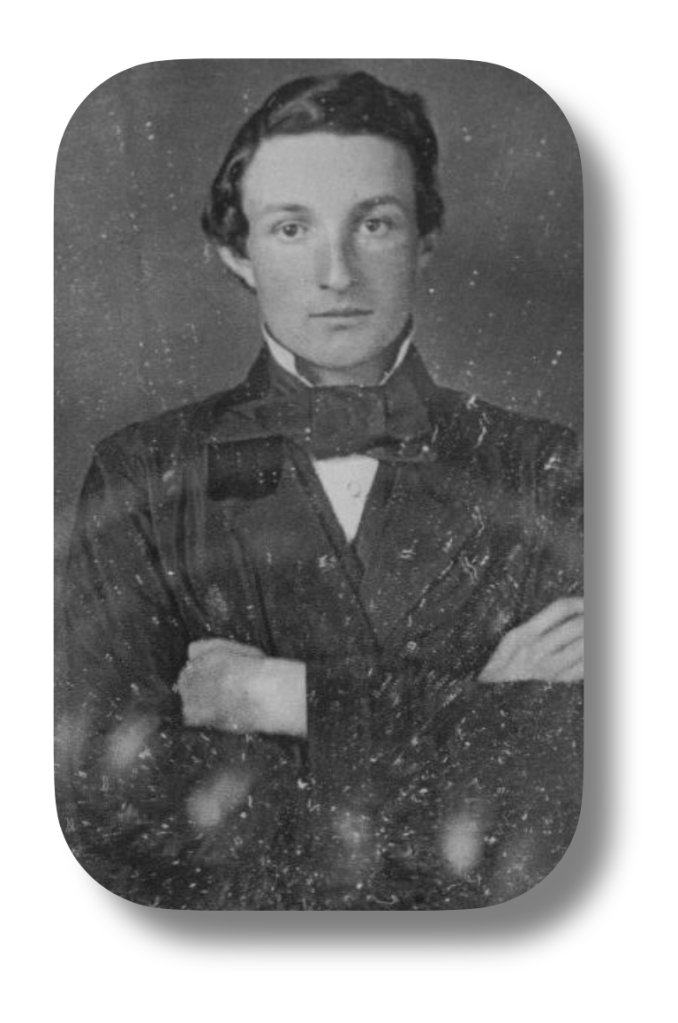
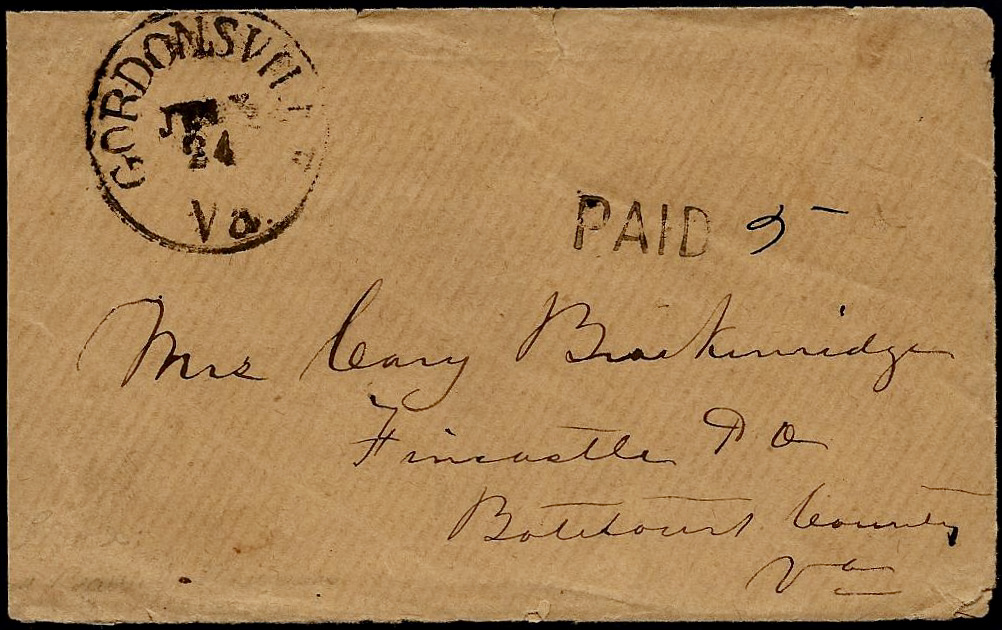


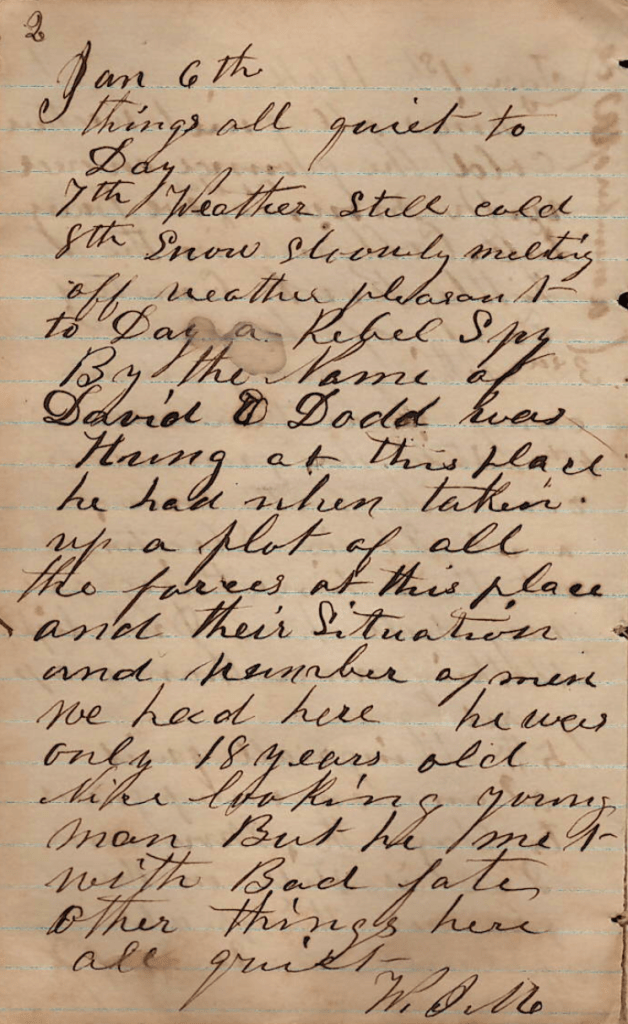
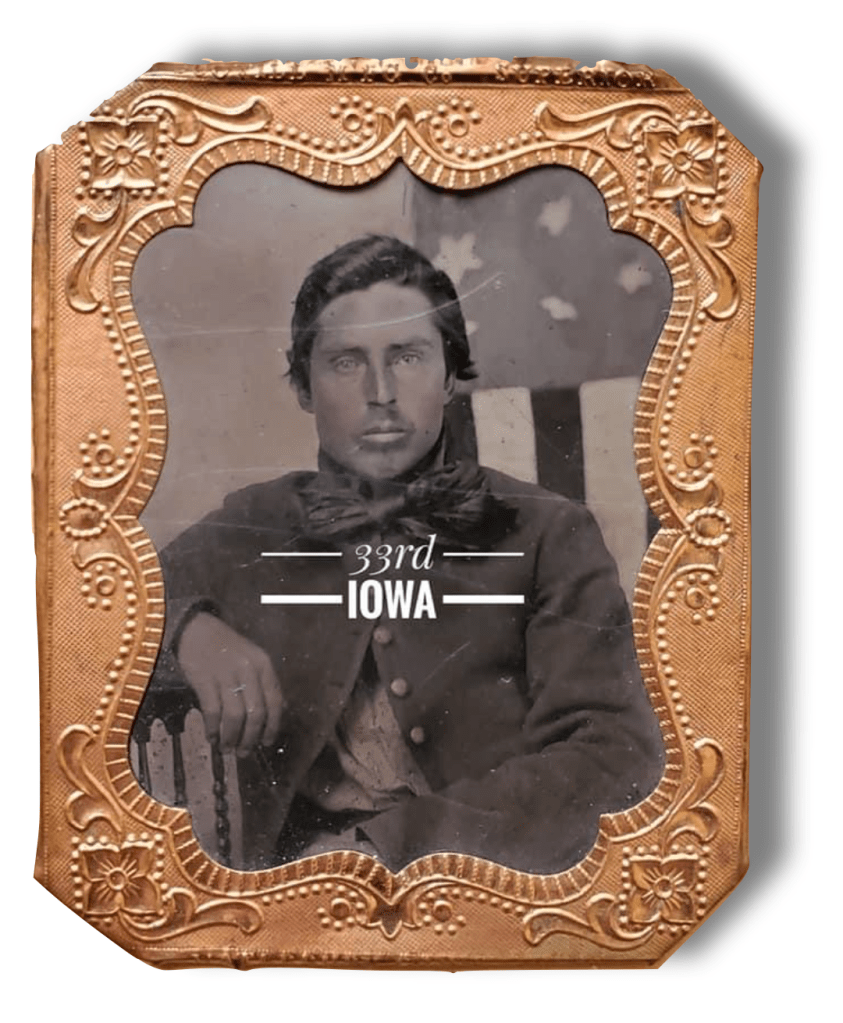


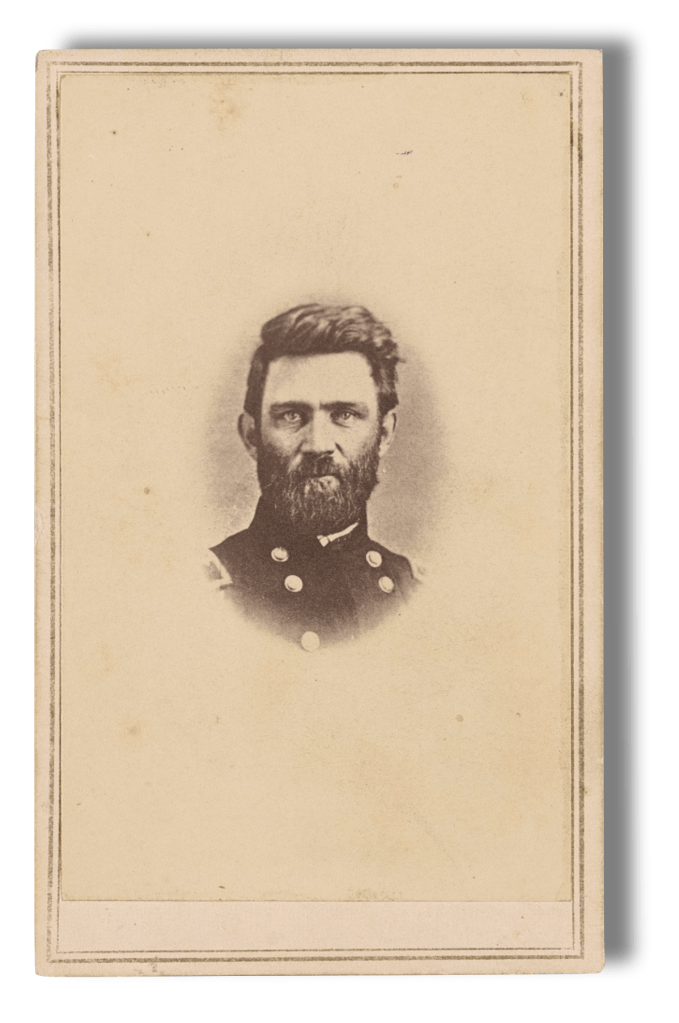
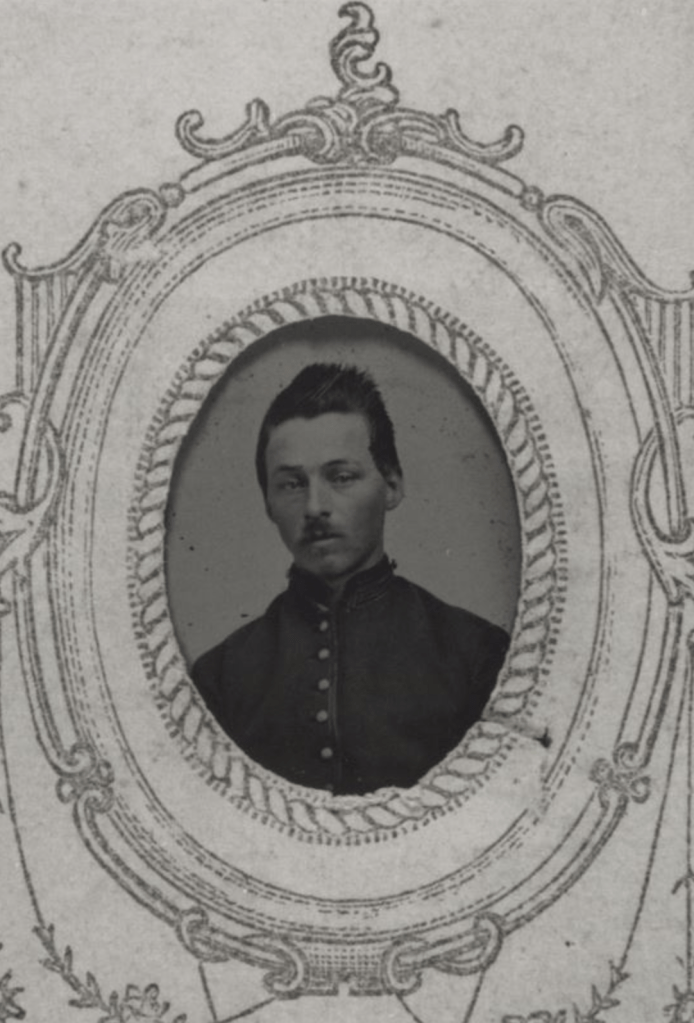
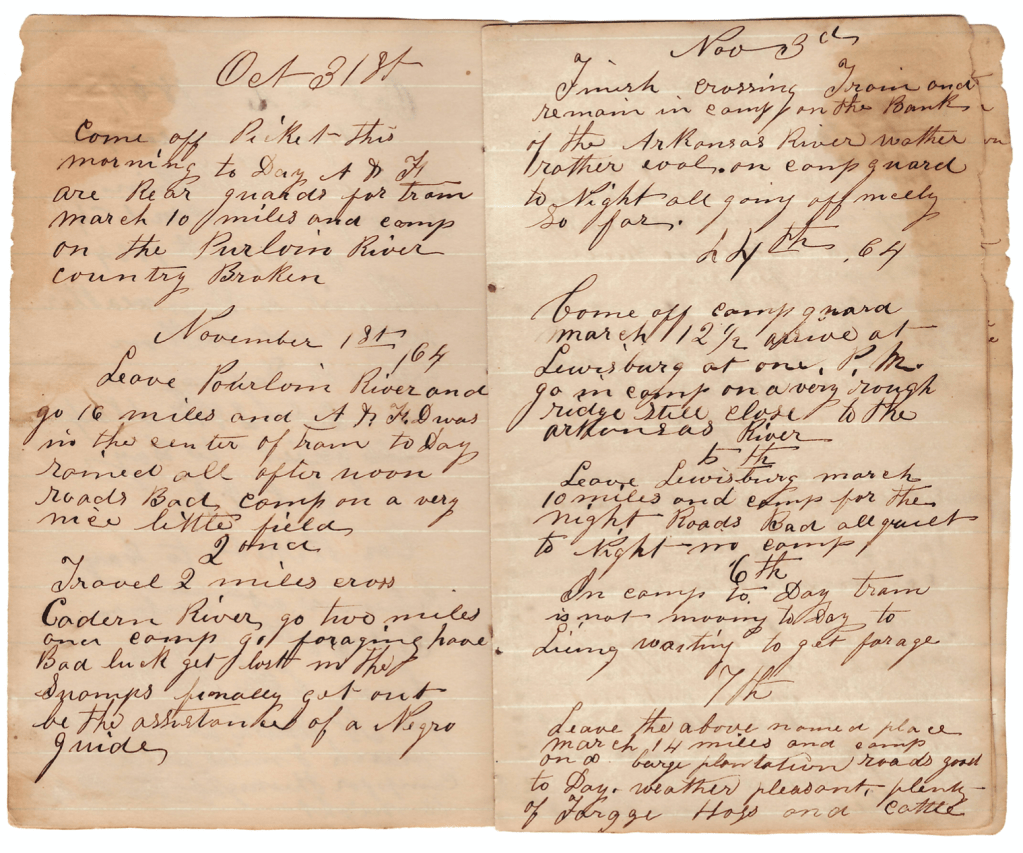
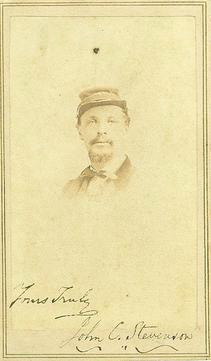
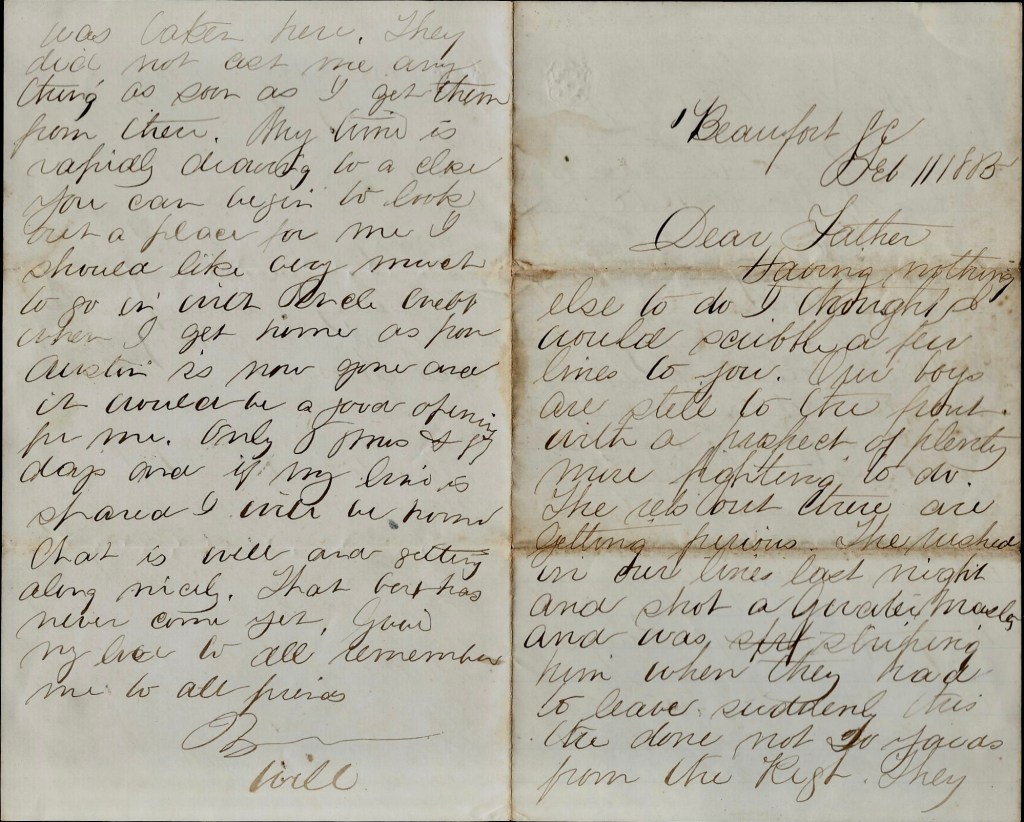
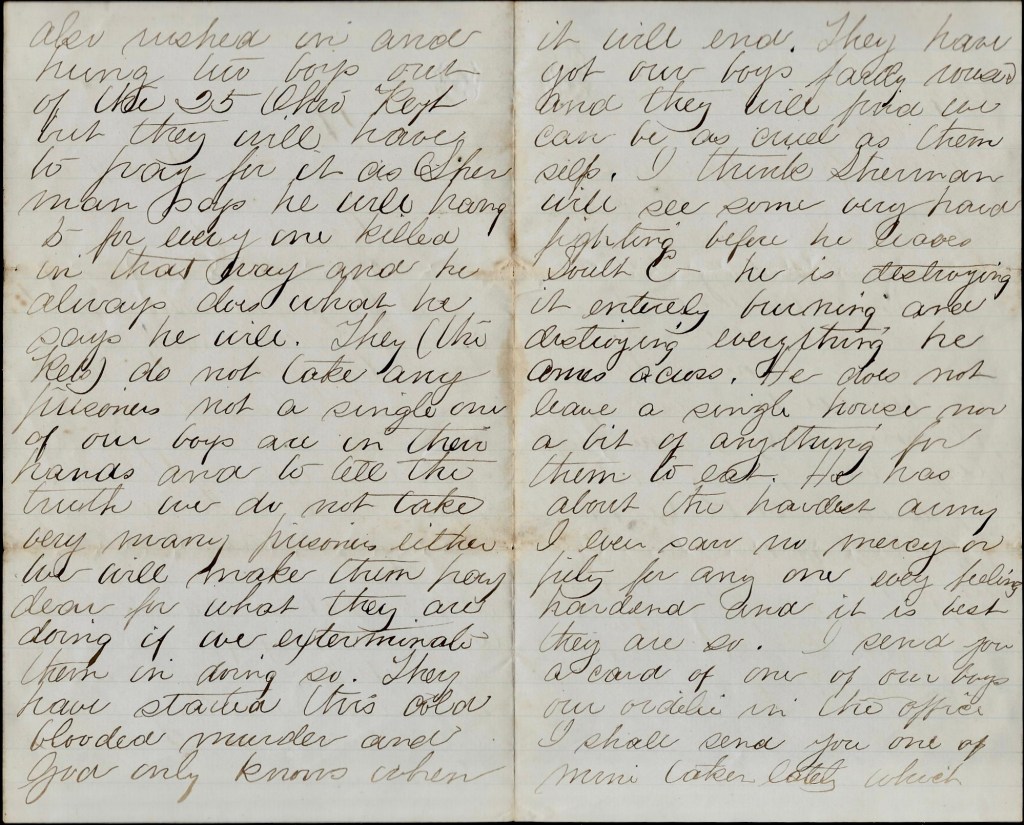
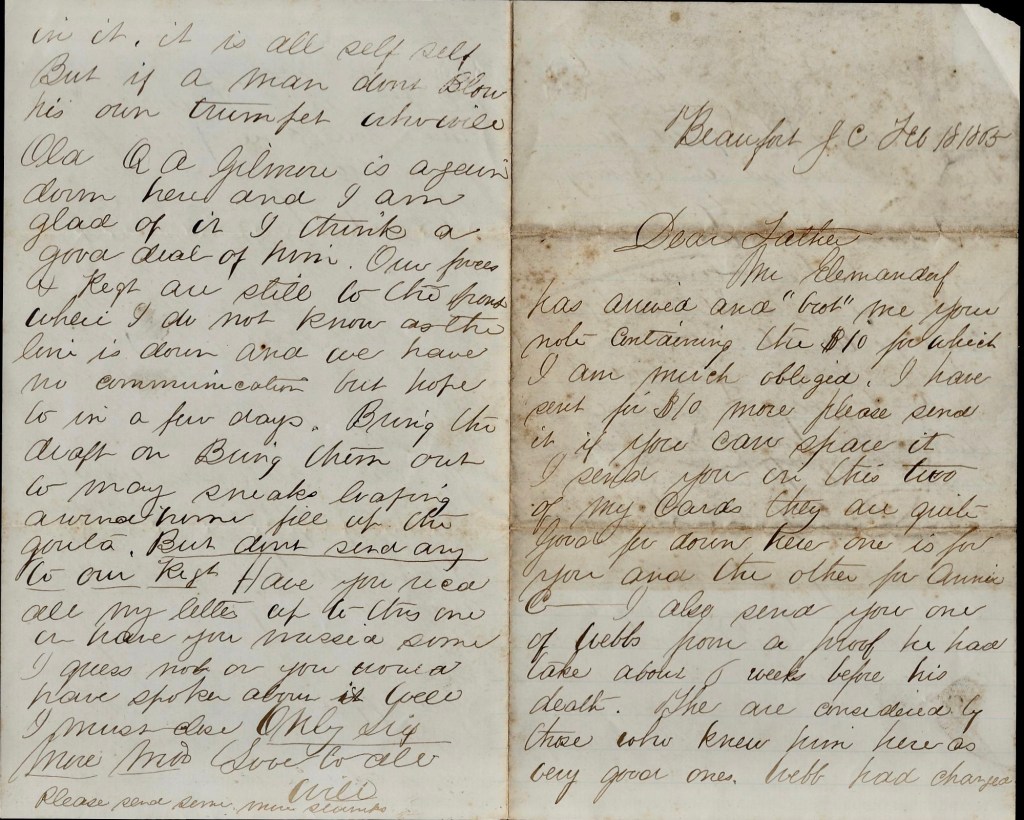
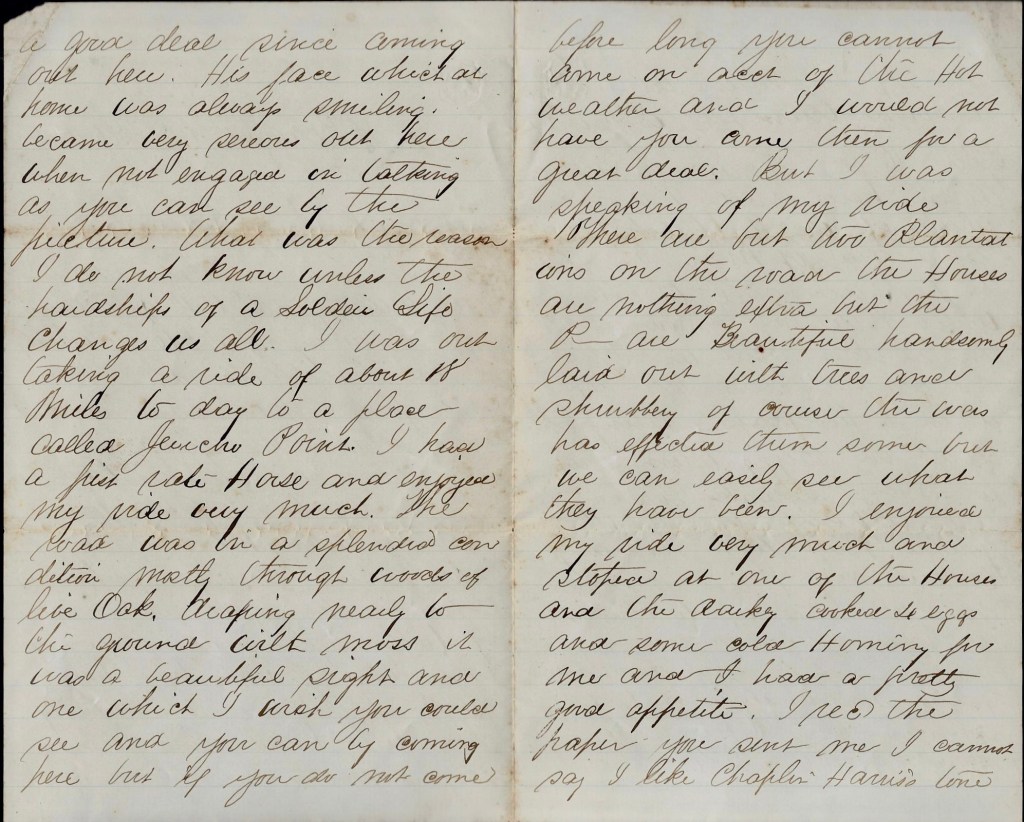
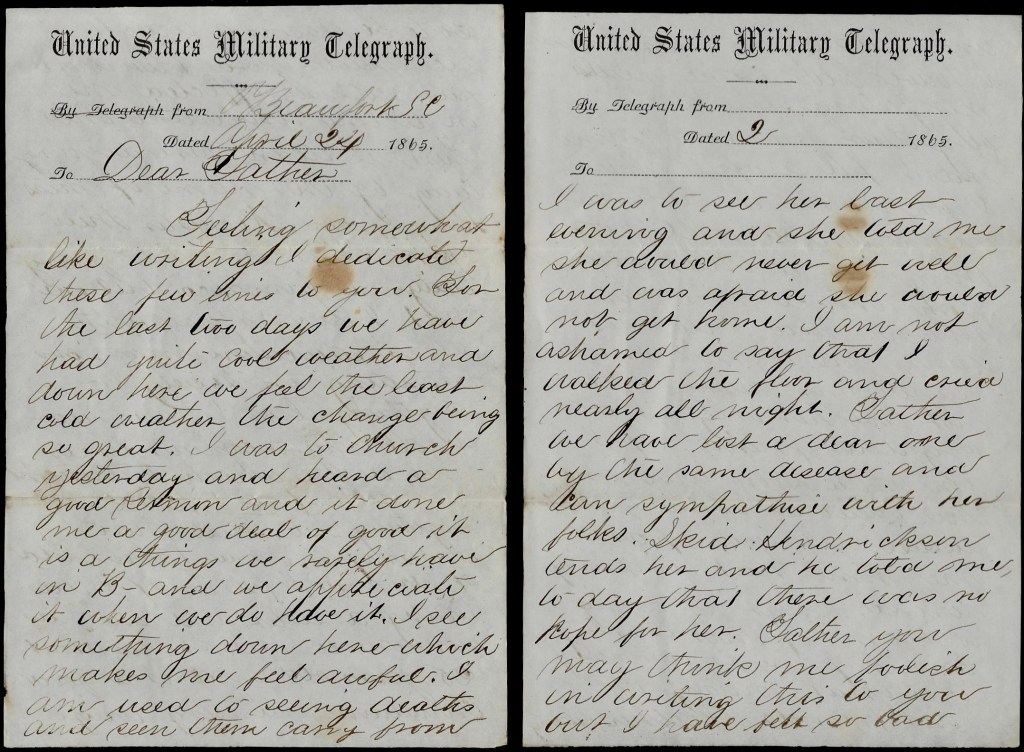
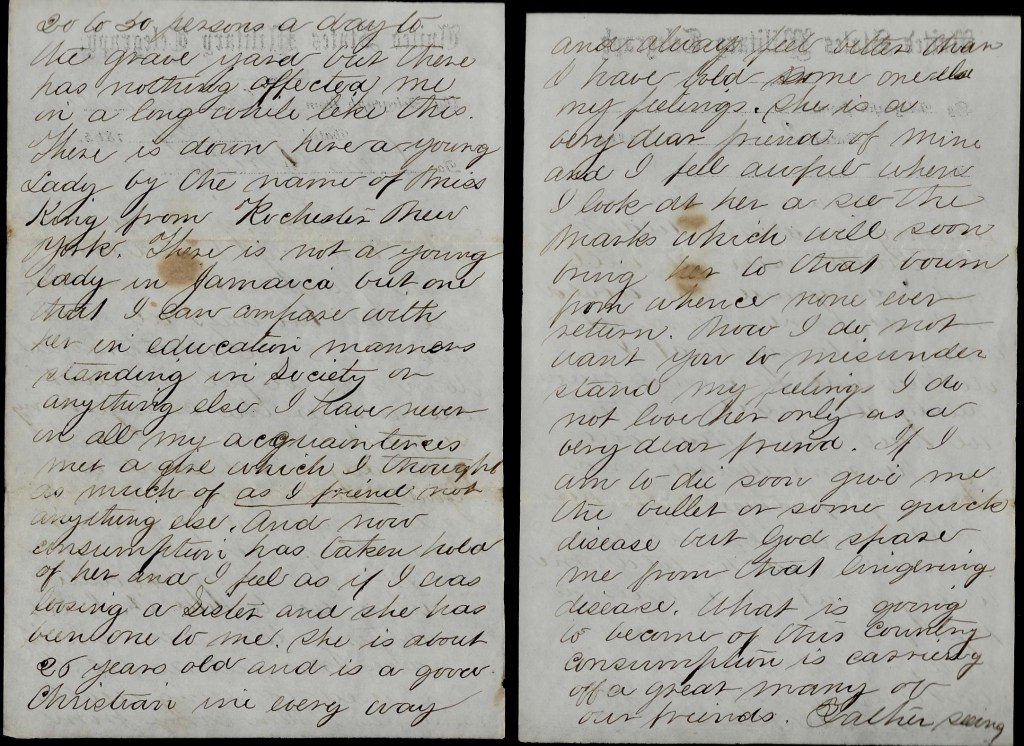
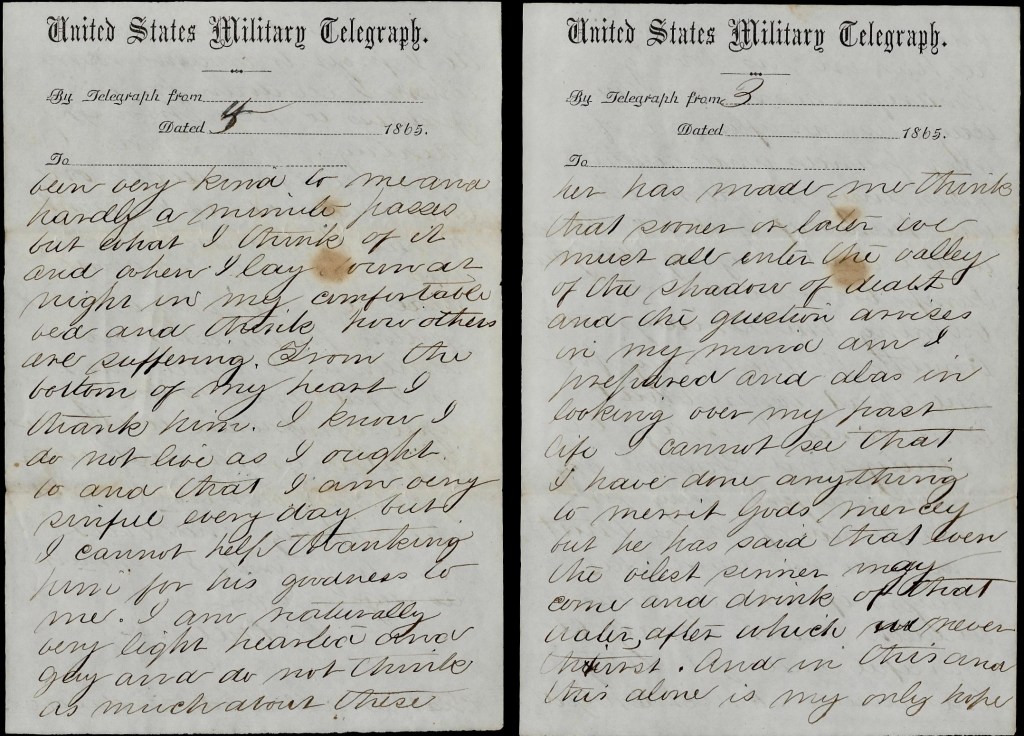


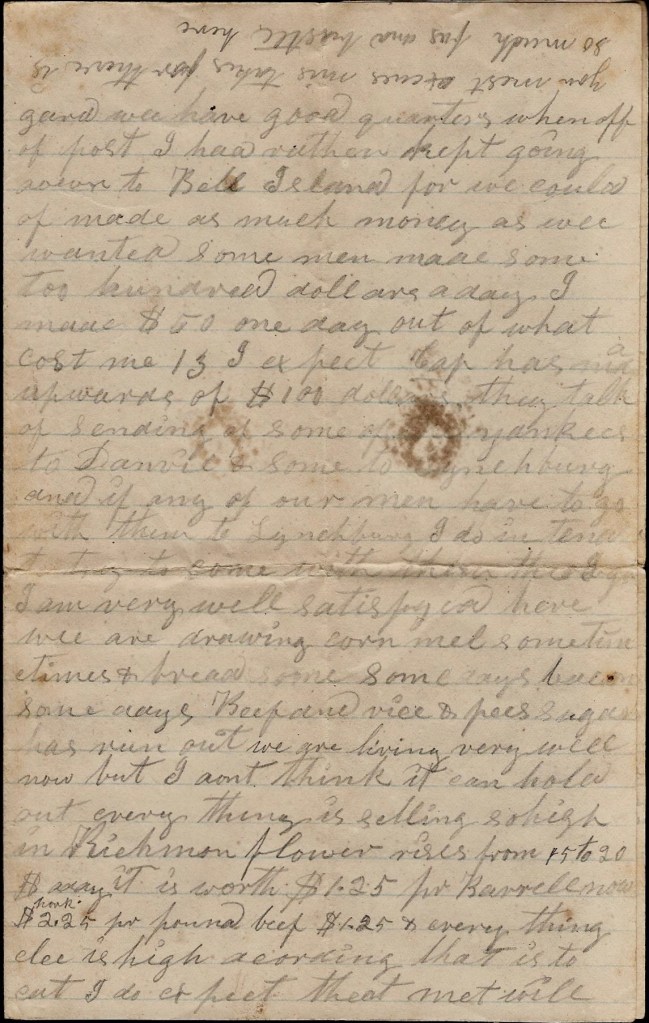
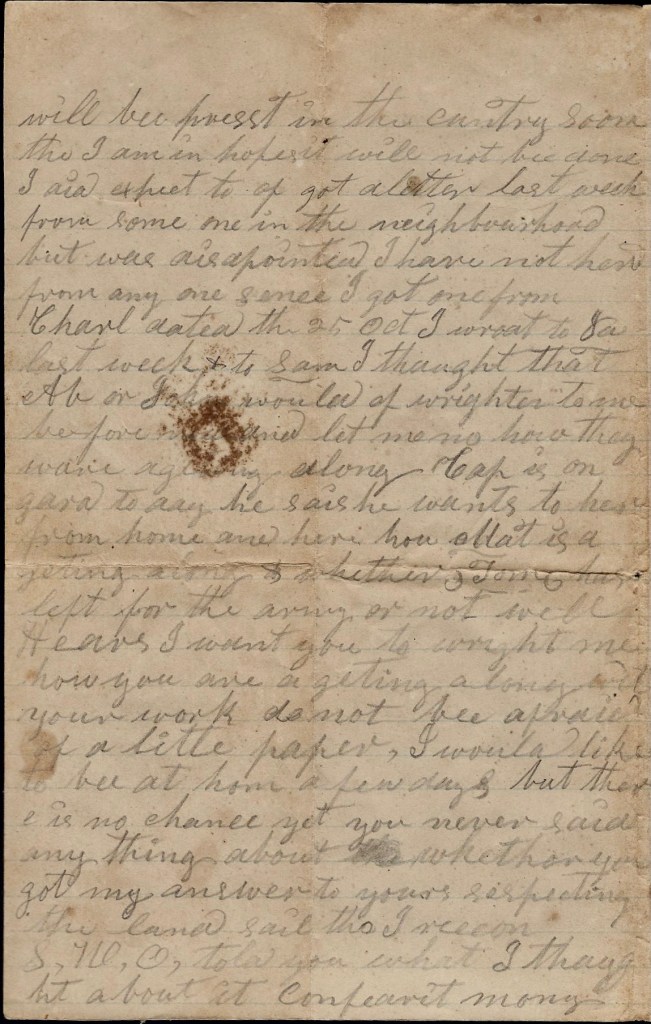


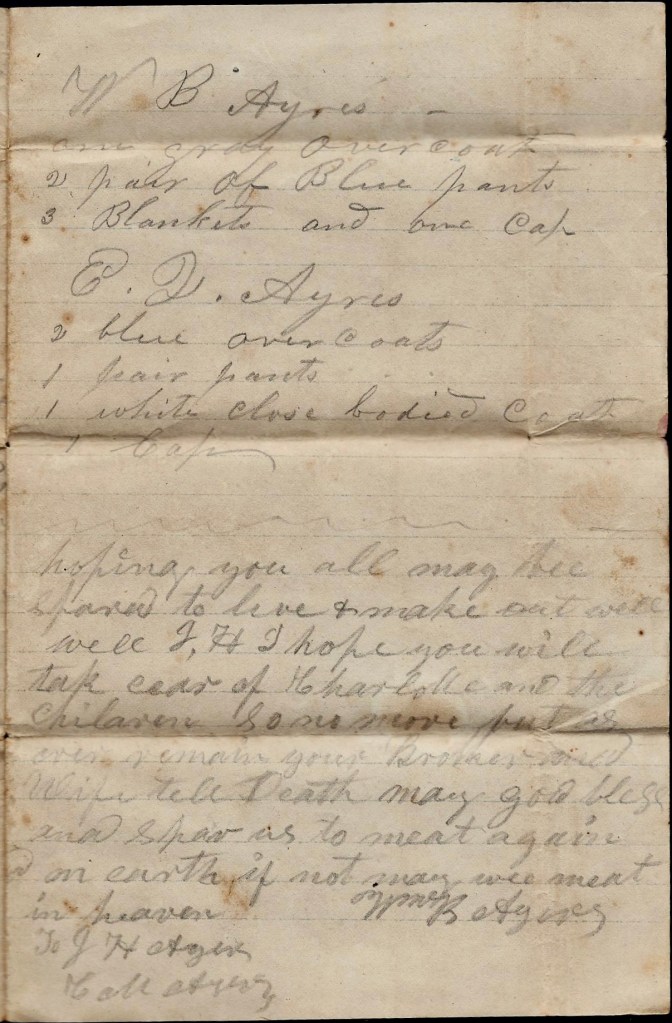


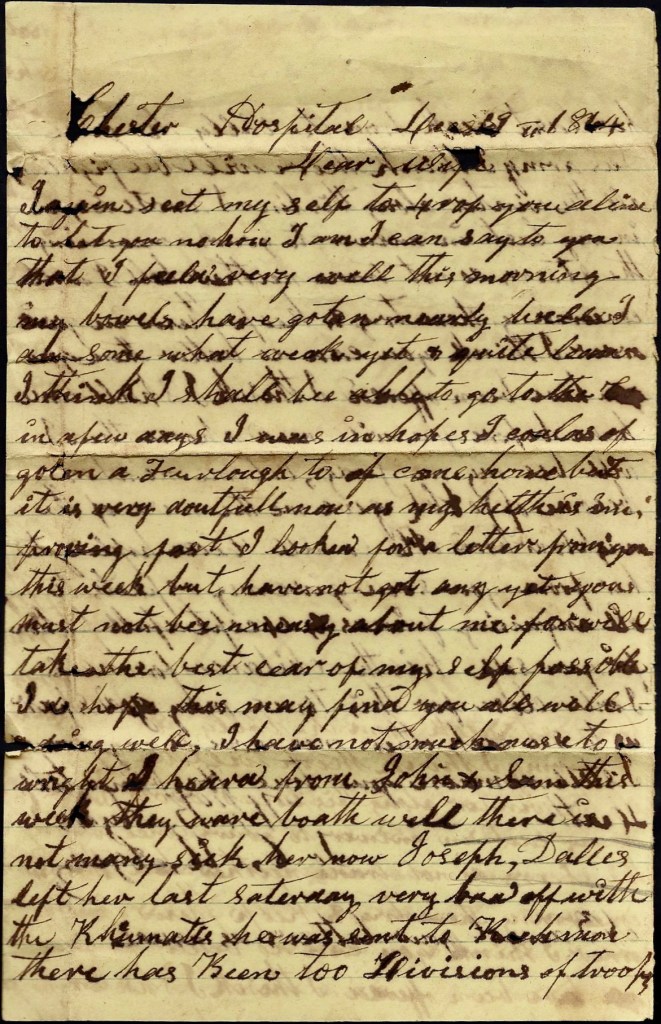


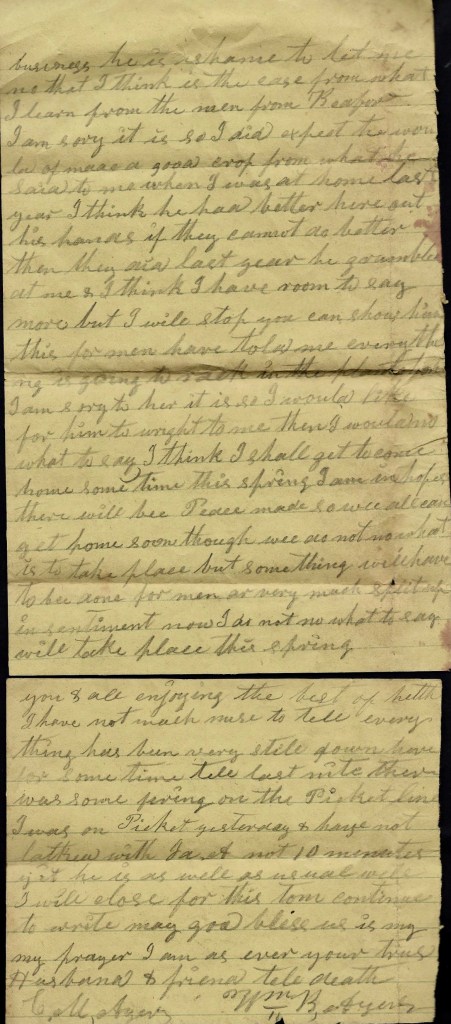


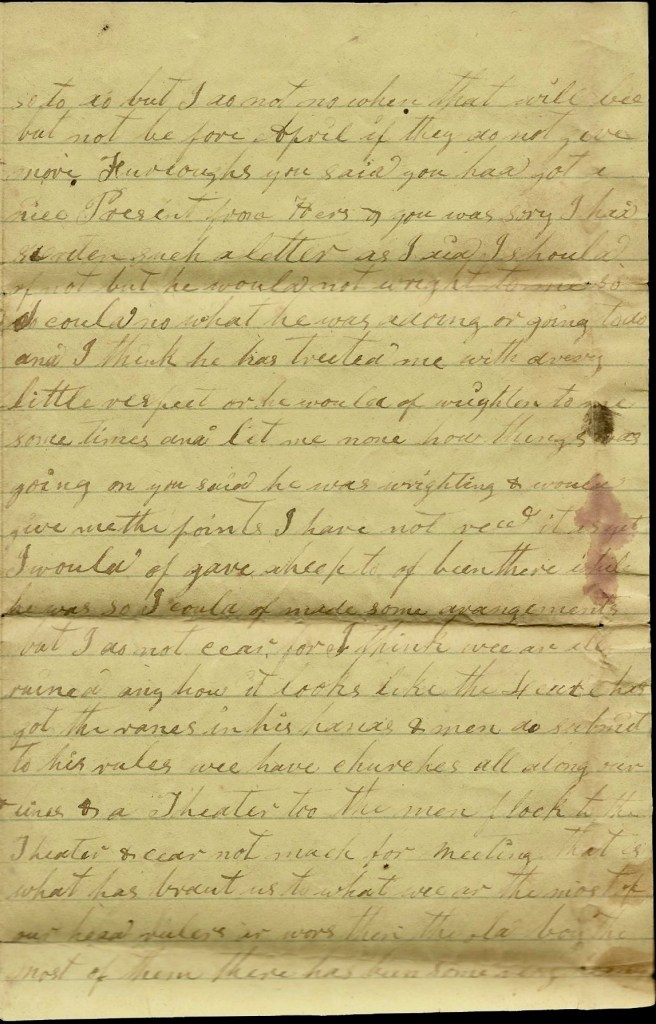

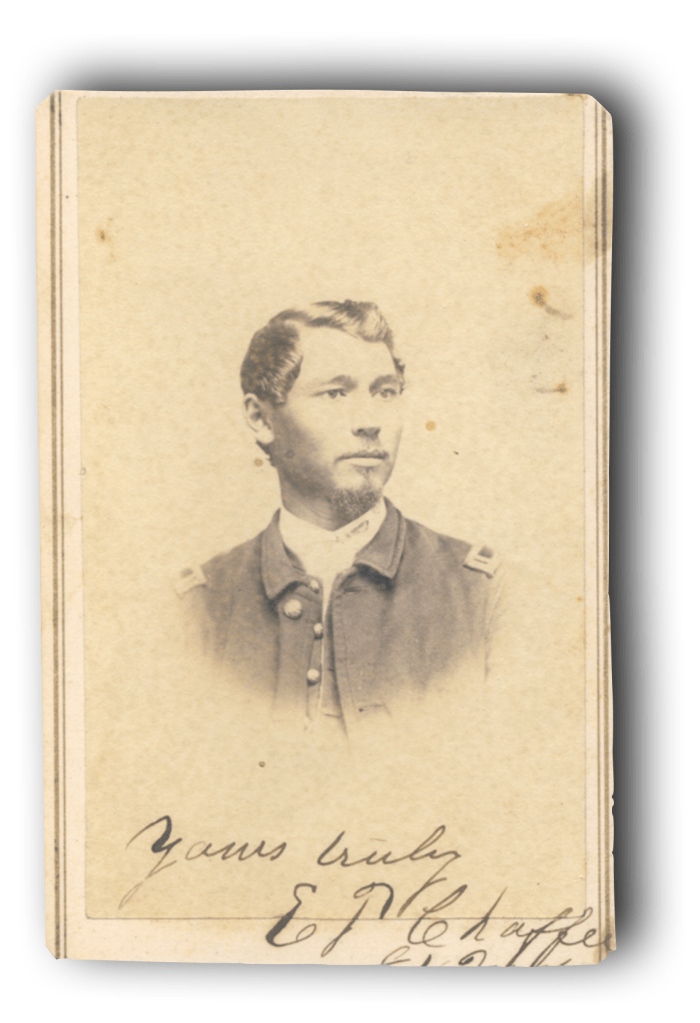
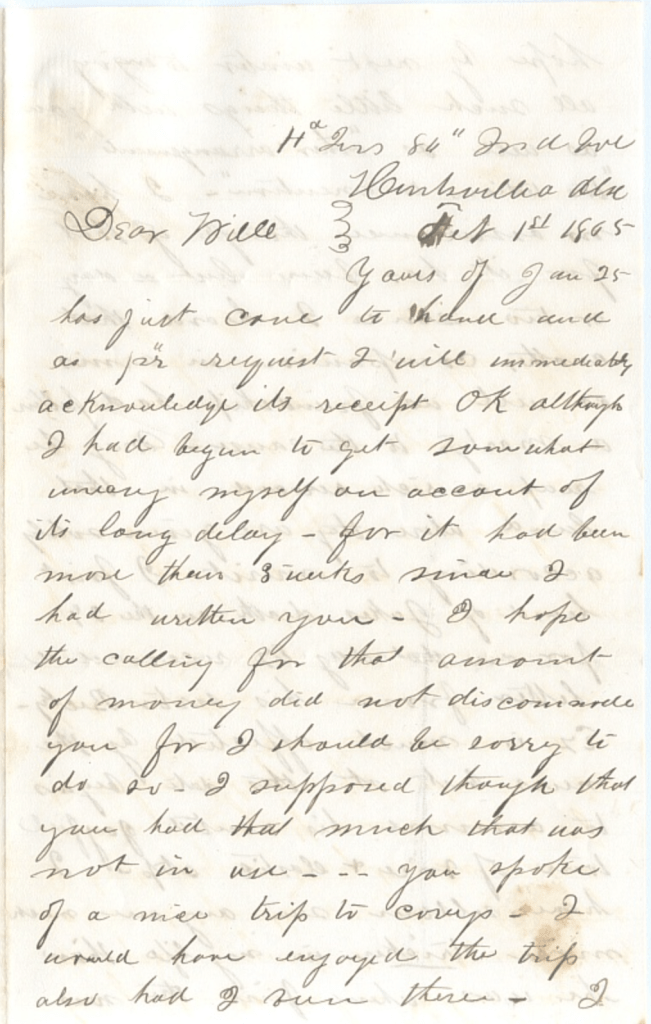

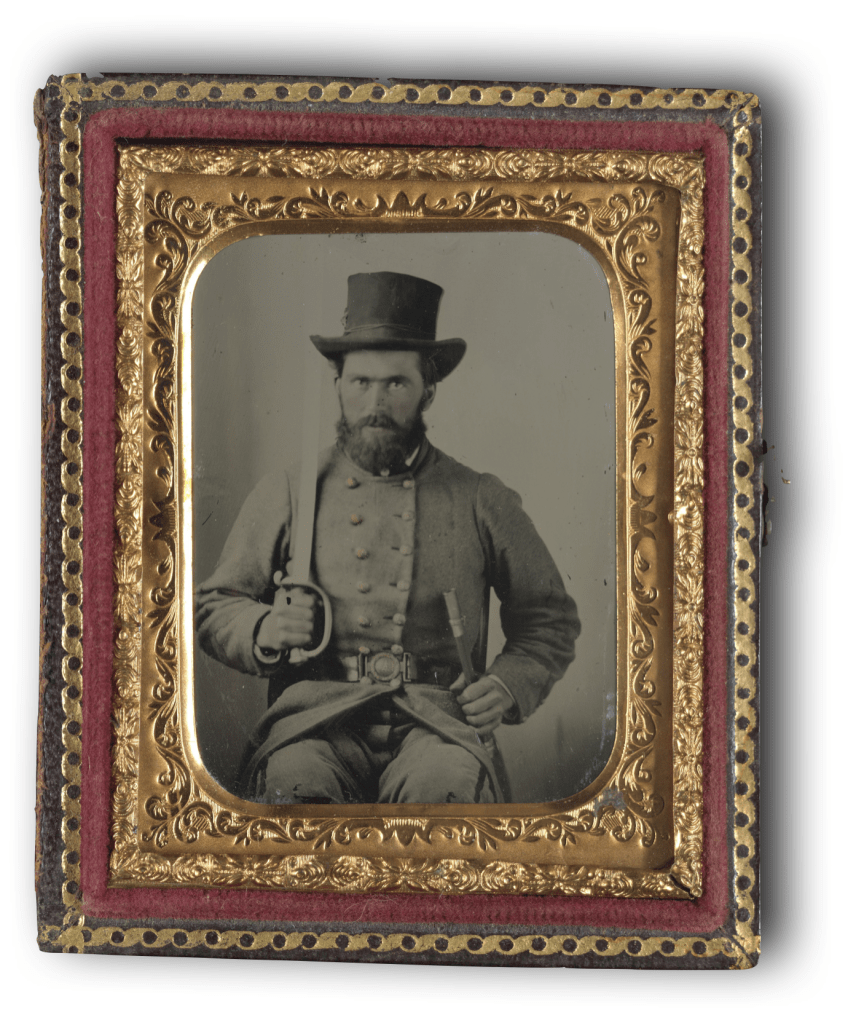
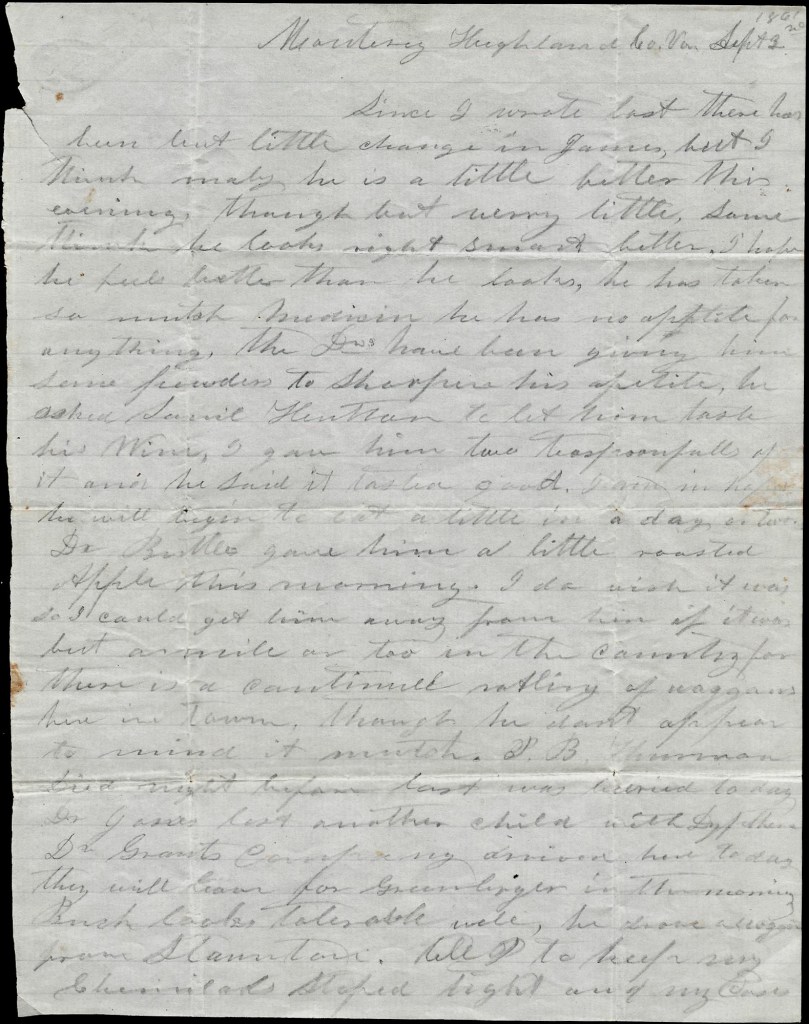
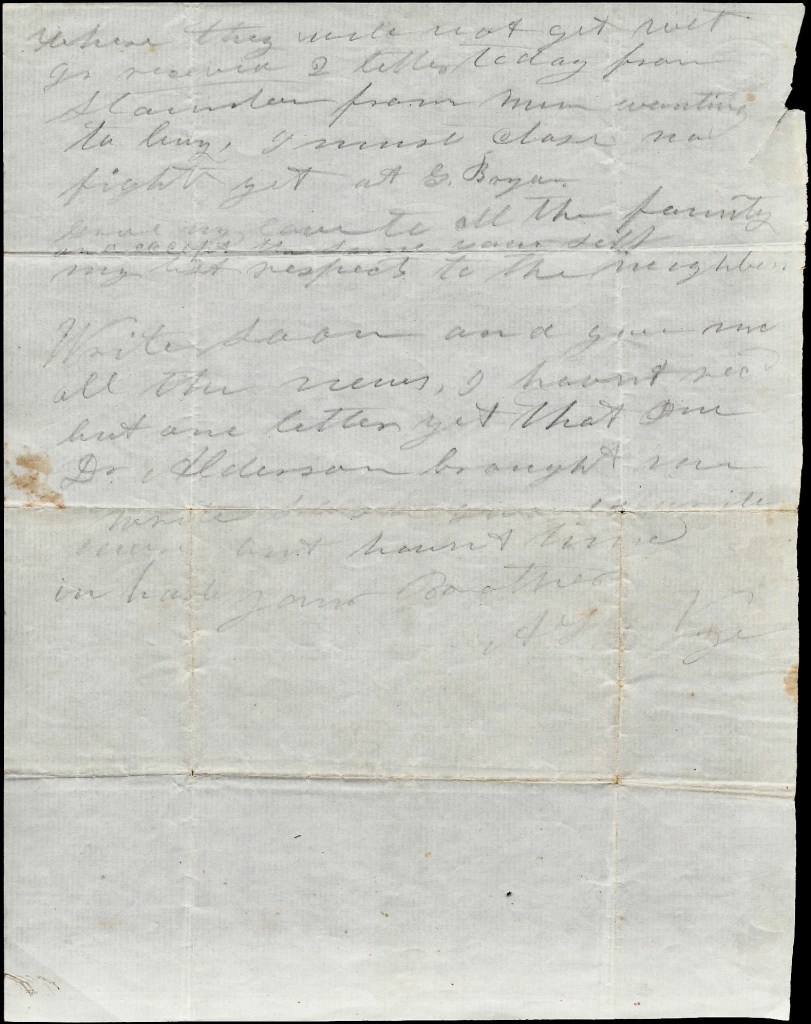
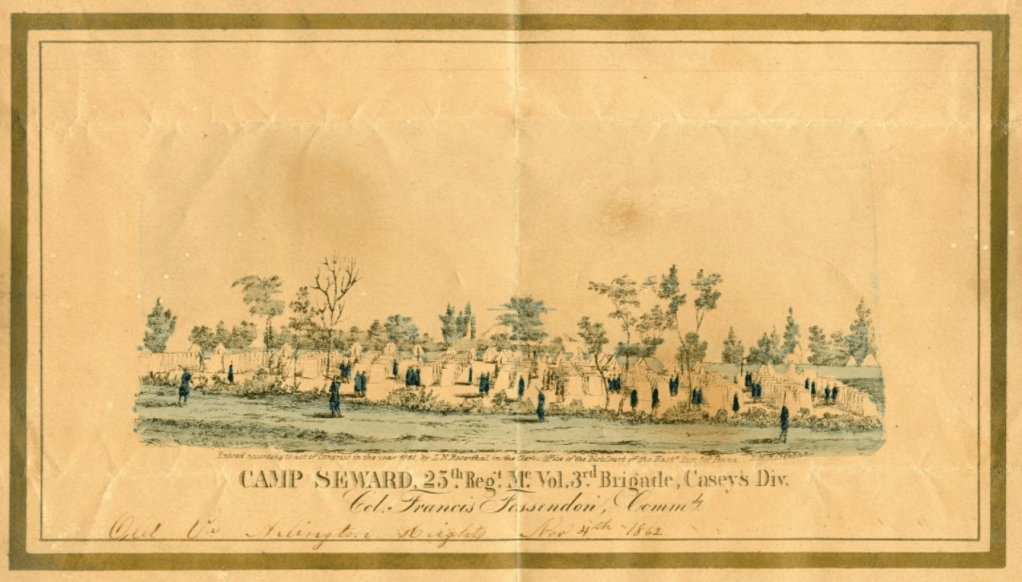
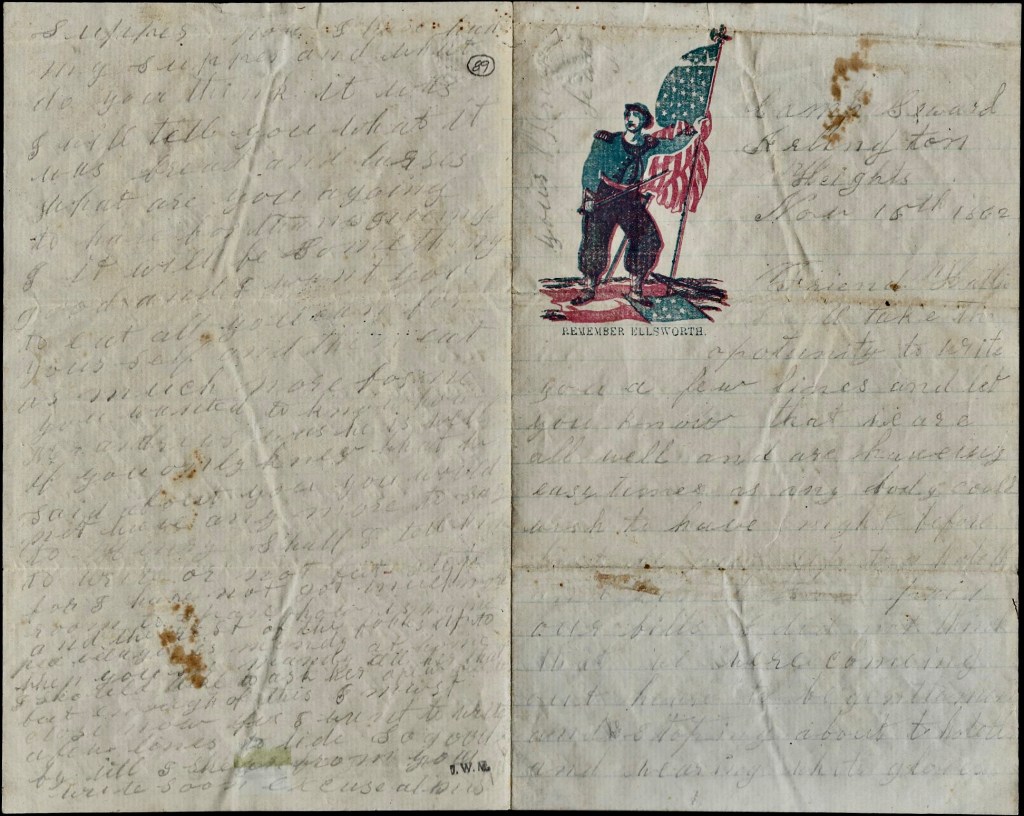

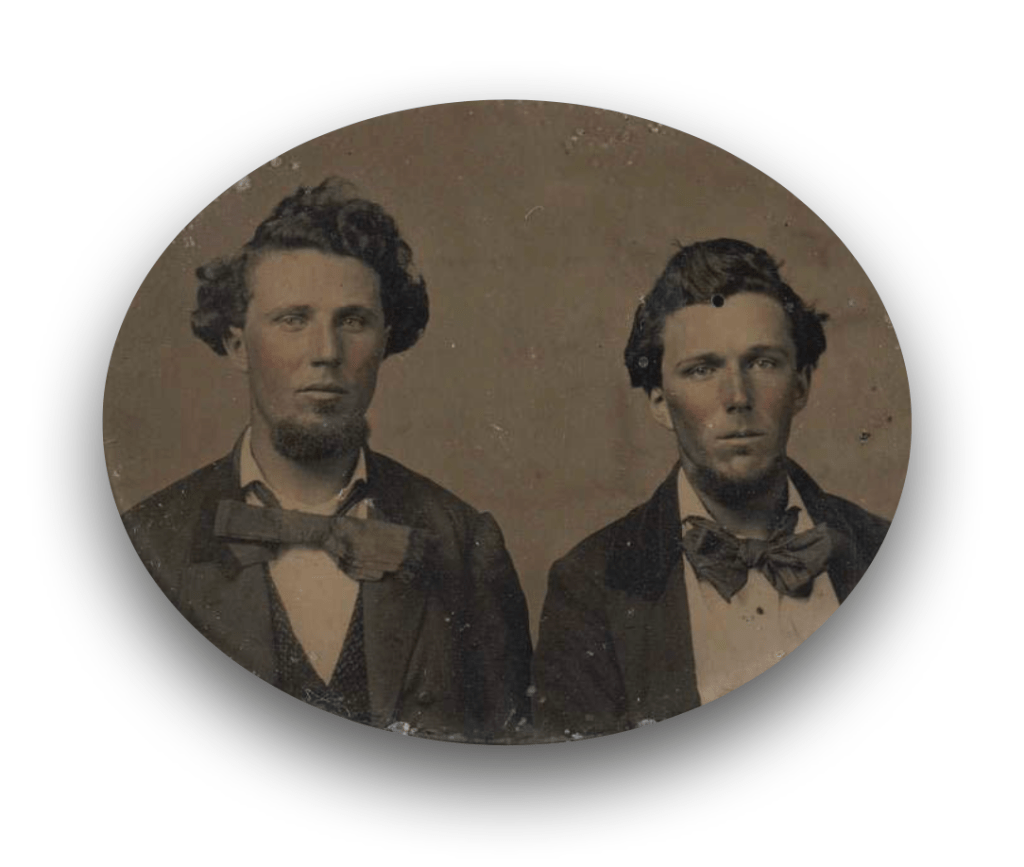


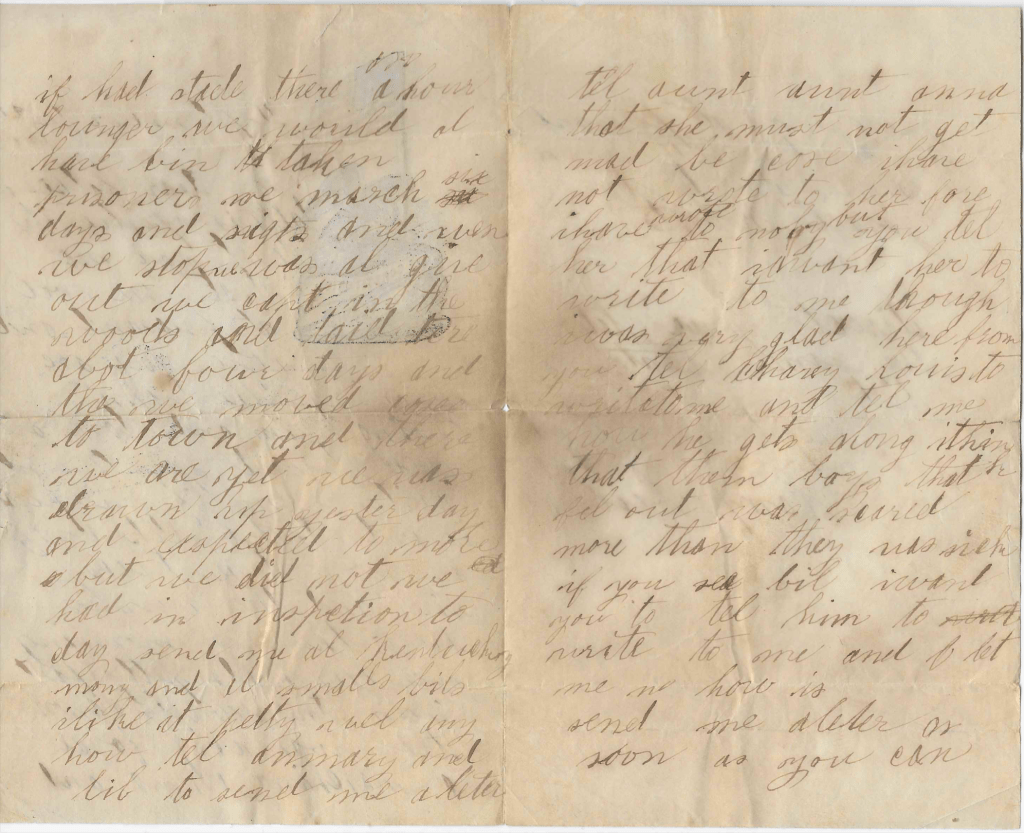

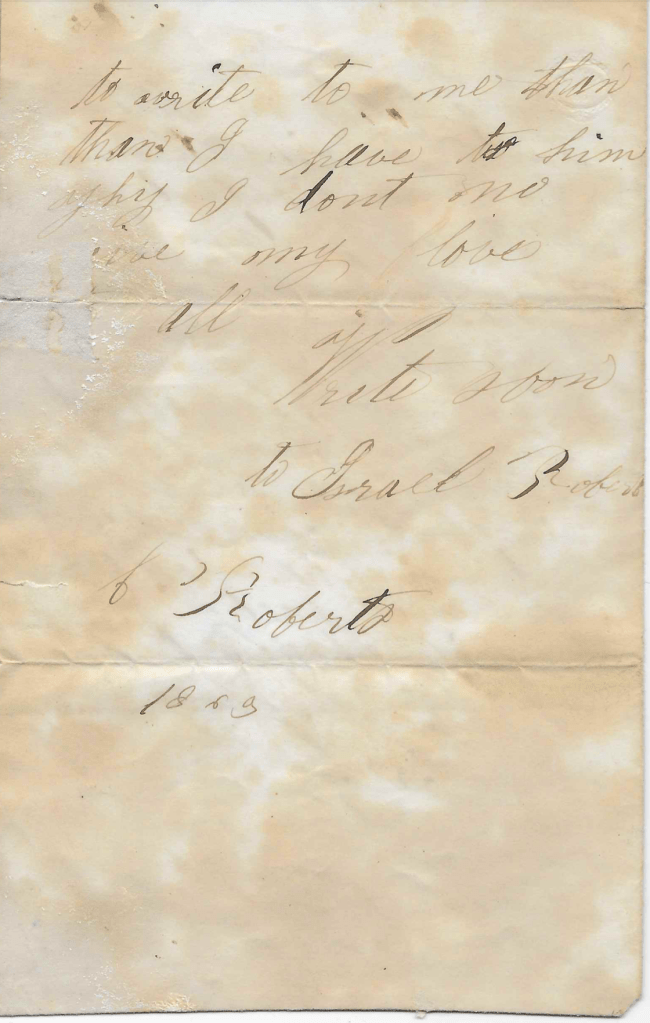
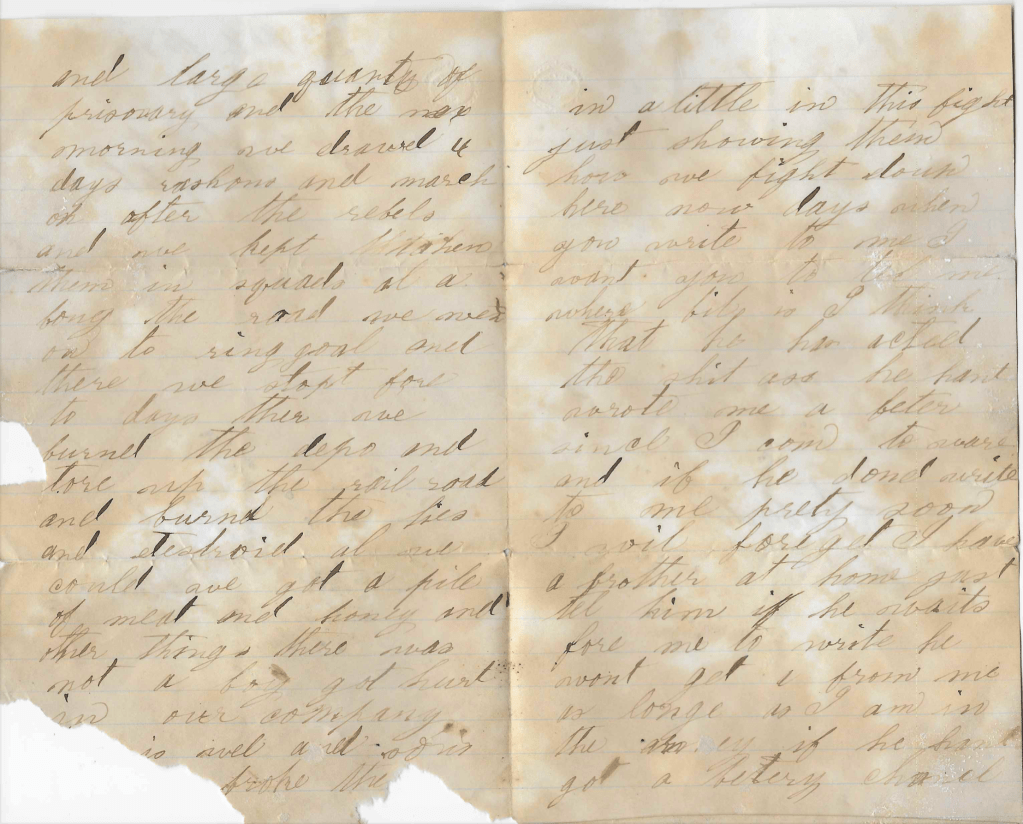



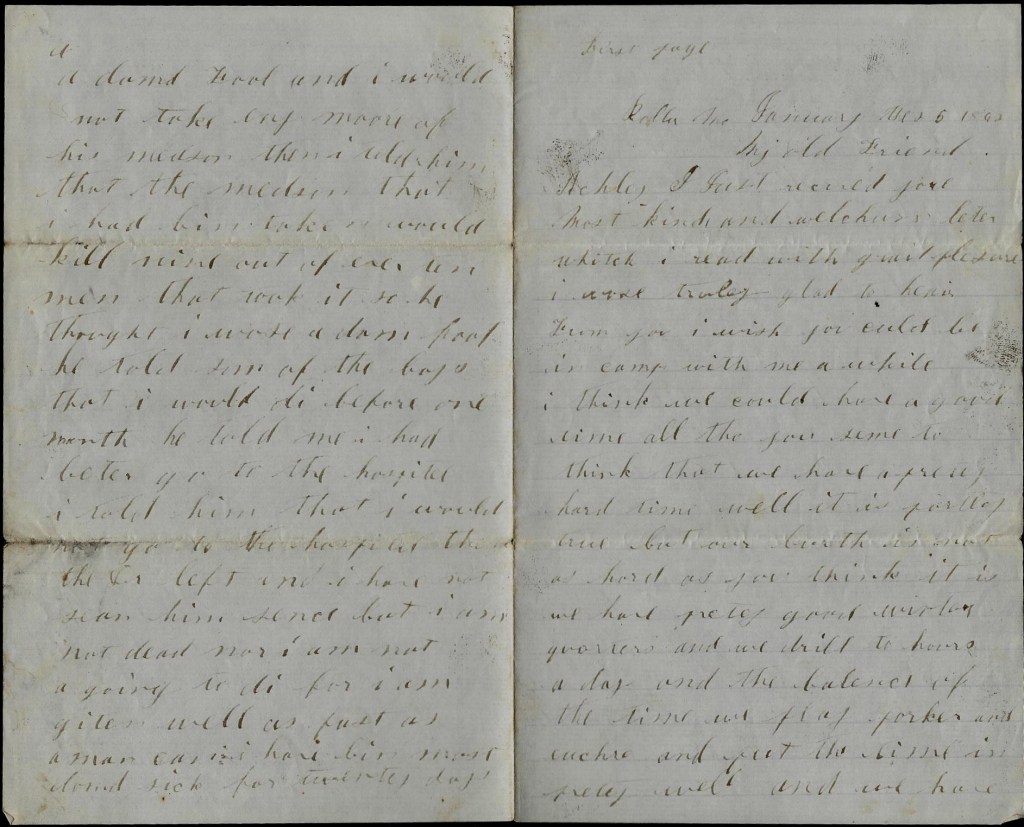
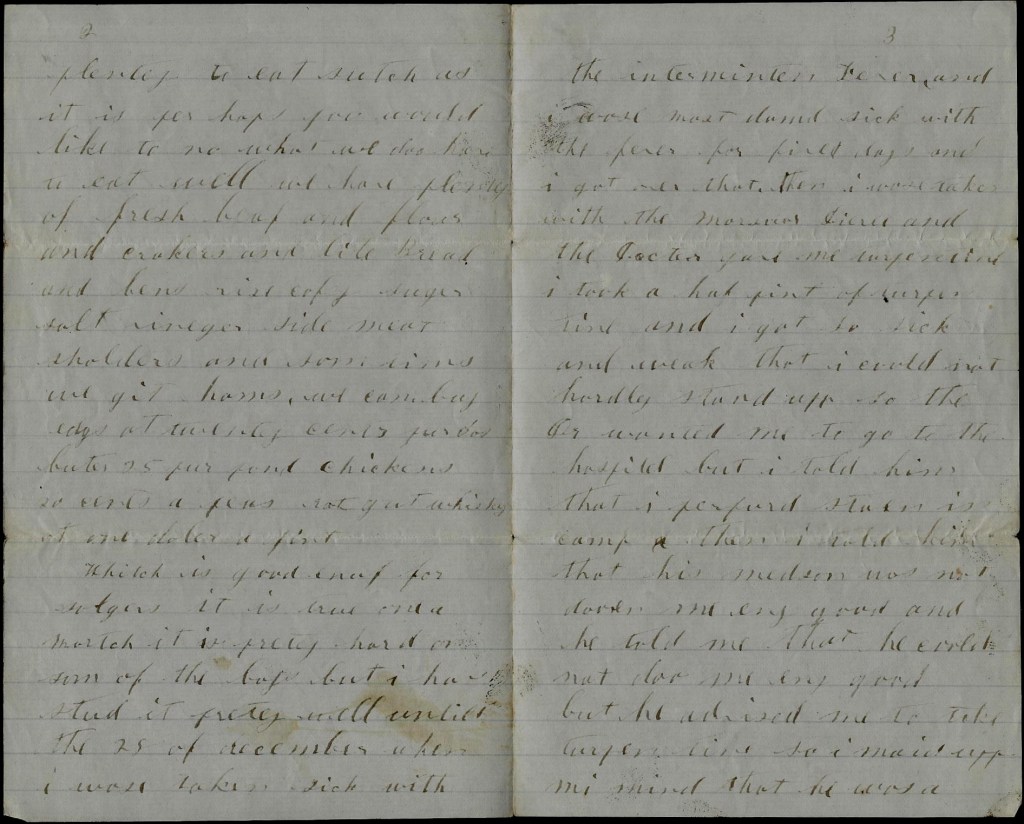
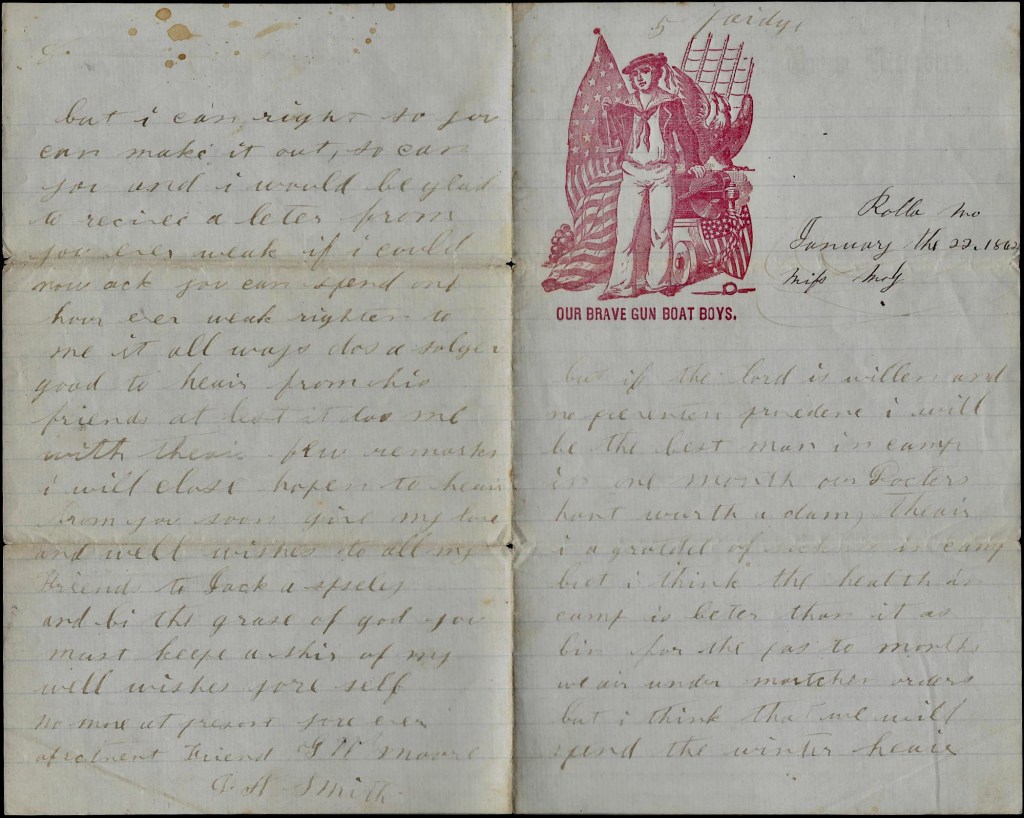
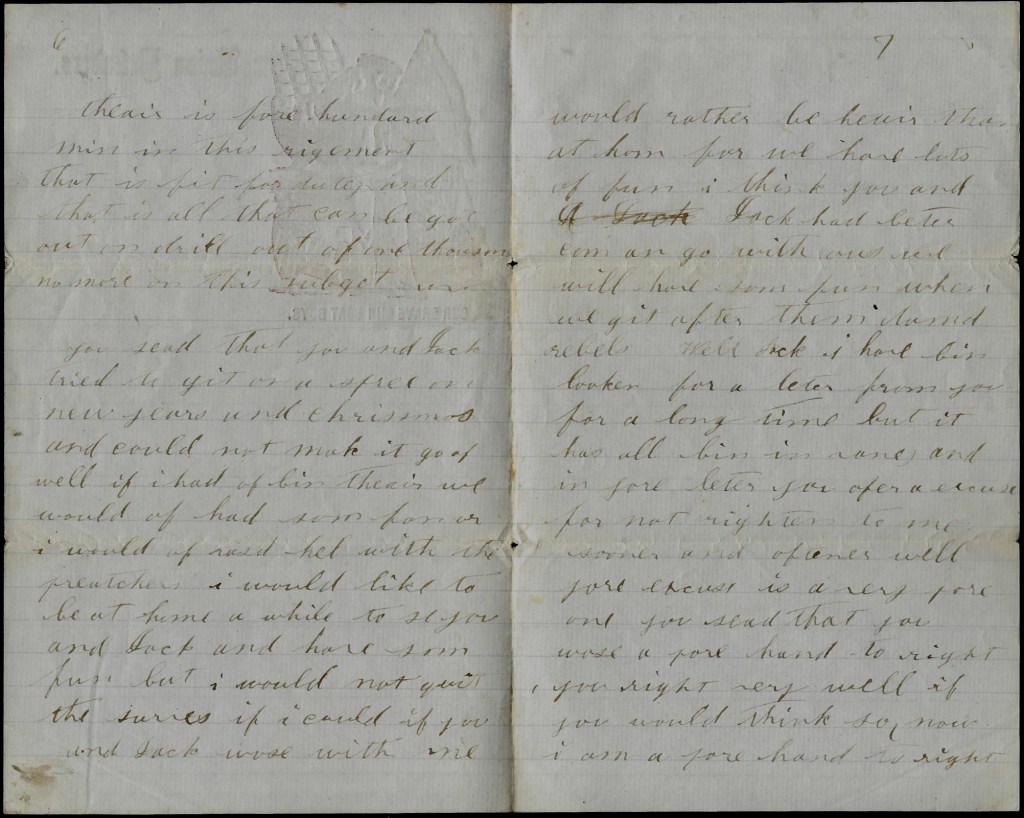



 Spared & Shared 23