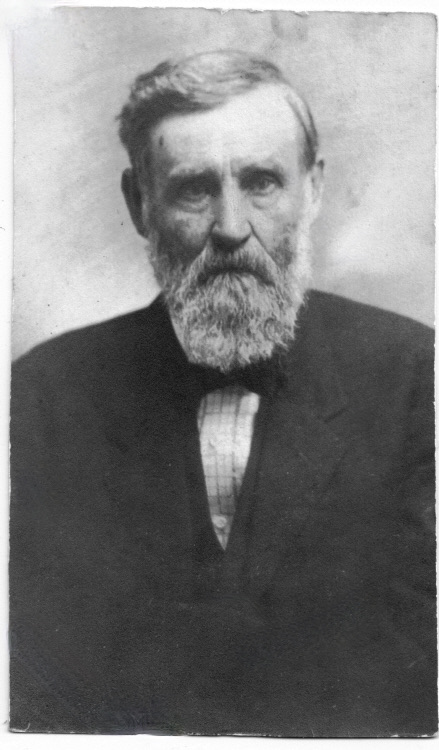
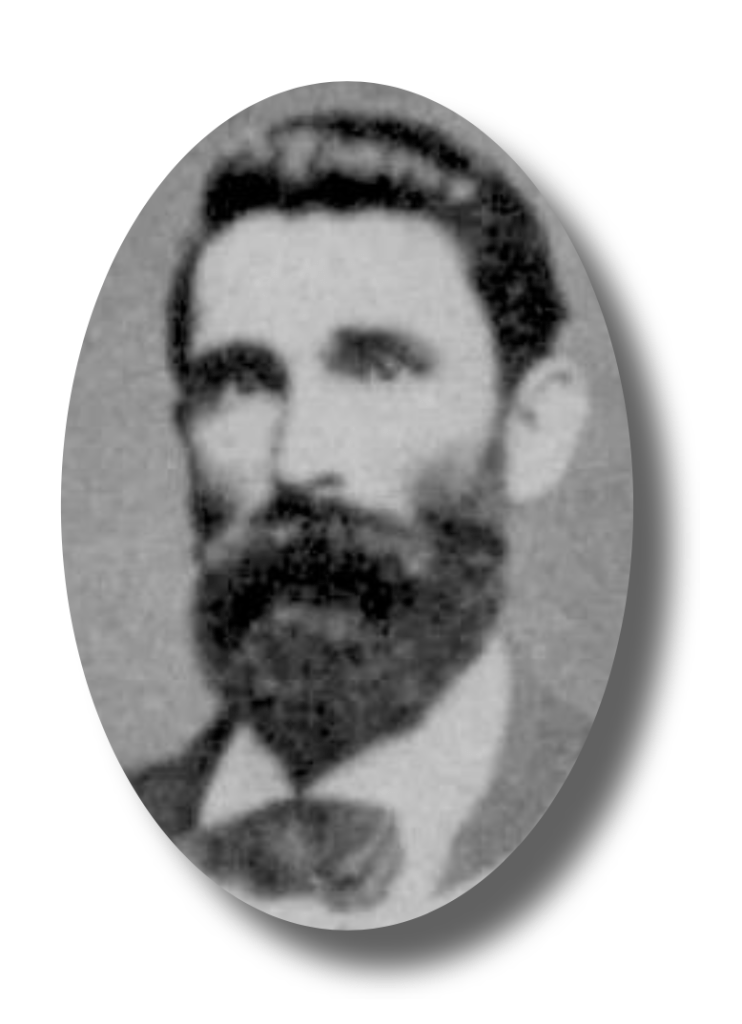
I could not find a photograph of Daniel Worthley but here’s an early-war ambrotype of a Massachusetts man. (Dan Binder Collection)
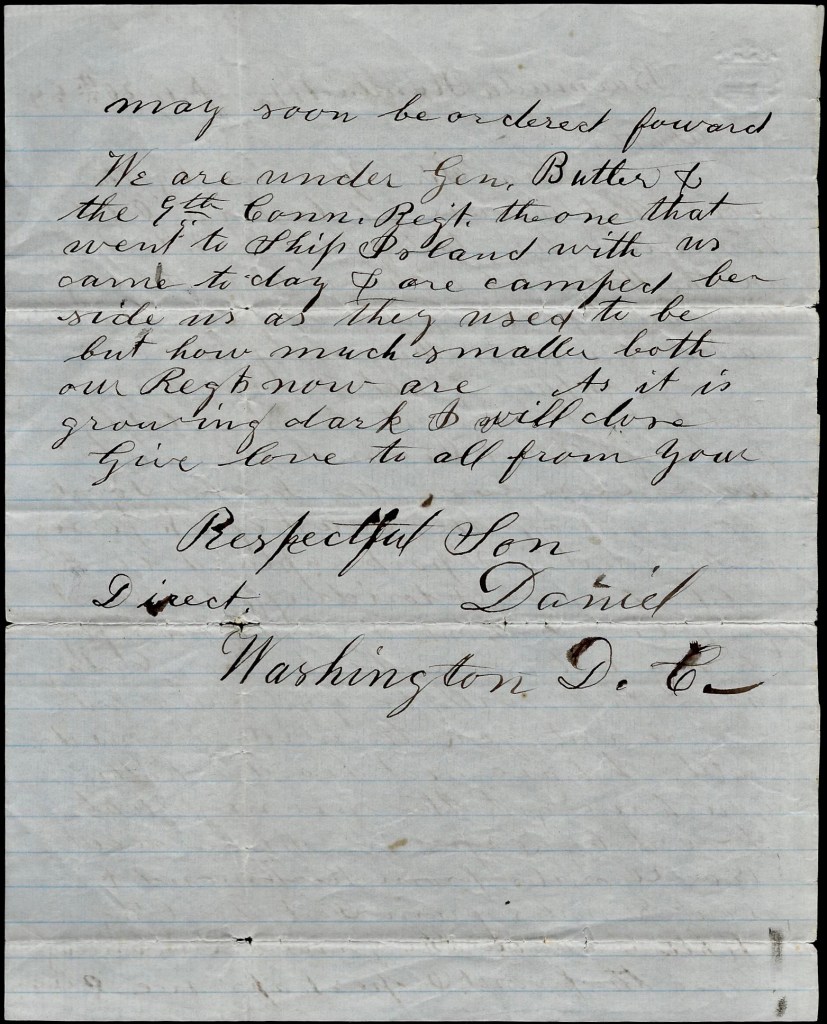
This letter was written by Private Daniel Edward Worthley (1836-1913) of Co. I of the 26th Massachusetts Infantry. This regiment was organized in the fall of 1861 and spent the first three years of the war in the Department of the Gulf. In July 1864, they were transferred to the Army of the Shenandoah and were on the Bermuda Hundred front from mid-July to the 1st of August when they were sent to the valley to participate in Sheridan’s Valley Campaign. They would see some serious fighting in the day’s ahead—at Third Winchester, Fisher’s Hill, and Cedar Creek. After the last named battle, Worthley and 44 other men of the 26th Massachusetts were captured while guarding a forage train at Newton, Virginia. He was exchanged in February 1865 and mustered out at Savannah.
Daniel was the son of Luke Worthley (1809-1878) and Elizabeth Poor (1810-1891) of Andover, Essex county, Massachusetts. He mustered out of the regiment in August 1865. Daniel’s siblings included Phebe Marian Worthley (1836-1913), Lewis T. Worthley (1842-1924), Abbie R. Worthley (1844-1901), and Luke Worthley (1849-1901).
You see by the above that we are at last in Old Virginia. We started from New Orleans on the 11th instant & arrived here today. We had a pretty fair voyage—some rainy towards the end of it.
I suppose that I may have not got letters sent to me lately for two of the New Orlean mail steamers have been lost. The Locust Point was sunk off the coast of New Jersey and the Electric Spark captured by the rebels steamer Florida off the coast of North Carolina. I think I can get a reply to my letters in about 5 or 6 days now. That will be quite pleasant & I want you to write immediately. I have not heard whether you have got the money that I sent by Express.
We are about 15 or 20 miles from Richmond & about 8 miles from Fort Darling. While I write, the guns are booming along the front & perhaps we may soon be ordered forward.
We are under Gen. Butler & the 9th Connecticut Regiment—the one that went to Ship Island with us 1—came today & are camped beside us as they used to be. But how much smaller both our regiments now are. As it is growing dark, I will close. Give love to all. From your respectful son, — Daniel
Direct to Washington D. C.
1 The 9th Connecticut and the 26th Massachusetts were the first of twenty-seven Union infantry regiments to see service on Ship Island during the Civil War. They sailed together aboard the SS Constitution in late November 1861 and reached Ship Island on 2 December 1861.
The following letter was written by Joseph Clark Addington though I can’t be certain whether it was by Joseph Clark Addington, Sr., or Jr. The Addington family was from Norfolk, Virginia, long occupied by Union troops at the time this letter was written in March 1863. For many years prior to the Civil War, Joseph, Sr. (1813-1880) earned a living as a school teacher in that city. He and his wife, Virginia Harwood were married in 1836 and had as many as ten children, one of whom was Joseph, Jr. who enlisted in Co. C, 6th Virginia Infantry when the war began in 1861. He was discharged for disability, however, in 1861, and I’m not certain what he did and where he was for the balance of the war though clearly he could not return to Norfolk after that city fell to Union troops. Another son of Joseph, Sr. was named John Howard Addington (1838-1862) who served in Co. E, 4th Kentucky, and lost a leg at Shiloh. He was taken prisoner there and died in Louisville on 12 May 1862.
While both Joseph Sr. and Jr. probably both had excellent handwriting, my hunch is that this letter was written by Joseph, Jr. (1842-1909) who worked as a clerk before and after the war.
Transcription
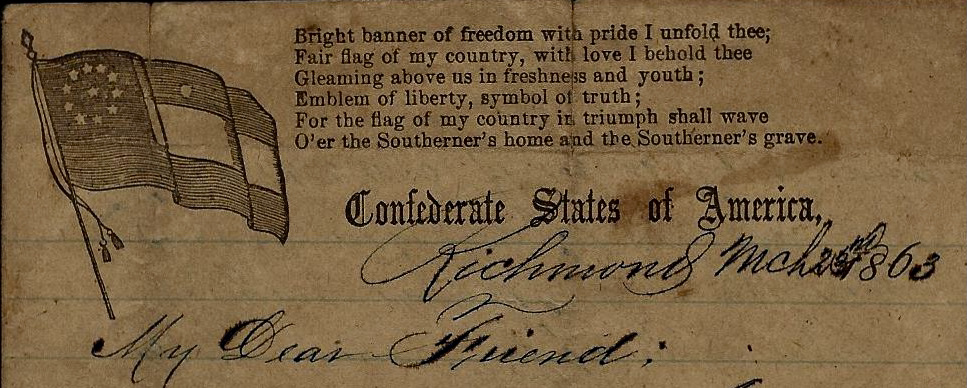
Patriotic stationery with poem, “Bright Banner of Freedom…”
Richmond [Virginia] March 23rd 1863
My Dear Friend,
I wrote to you at Goldsboro, North Carolina, some six or seven weeks since, but have received not a line in answer. The supposition which has since been confirmed was that it had not reached its destination. After writing my letter spoken of above, I learned that you were ill (or rather sick) and had gone home. I hope when this reaches you, it will find you enjoying fine health, &c. I hear from Mrs. Archer frequently through Miss Ada. Miss Lucy Gilliam who has been confined for some time is now at Pittsburg at her Aunt Emily Battis. Her mother is with her also. The last I heard from her was this morning through her father who has just returned from Pittsburg. He reports her quite well. Think she will soon be well.
Give my highest regards to all my acquaintances in your brigade—particularly Capt. Martin and Lieut. Lindsey, accepting a large portion for yourself. Excuse this brief note. Will write one more at length when I hear from you. Write soon. By so doing, you will greatly oblige your friend, — Jos. C. Addington
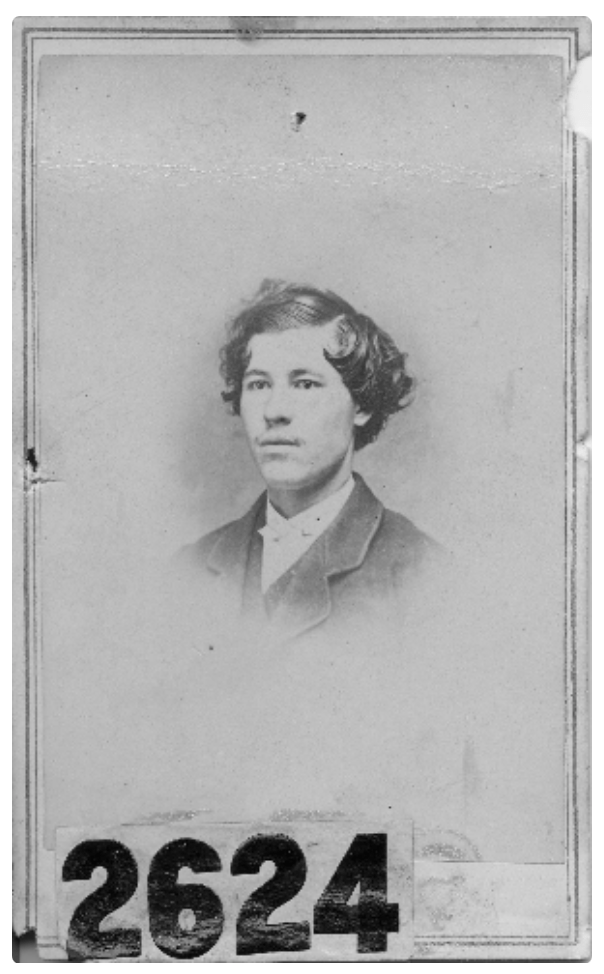
I could not find an image of John but here is a CDV of Lorenzo D. Lisdell who also served in Co. C, 153rd New York Infantry (Photo Sleuth)
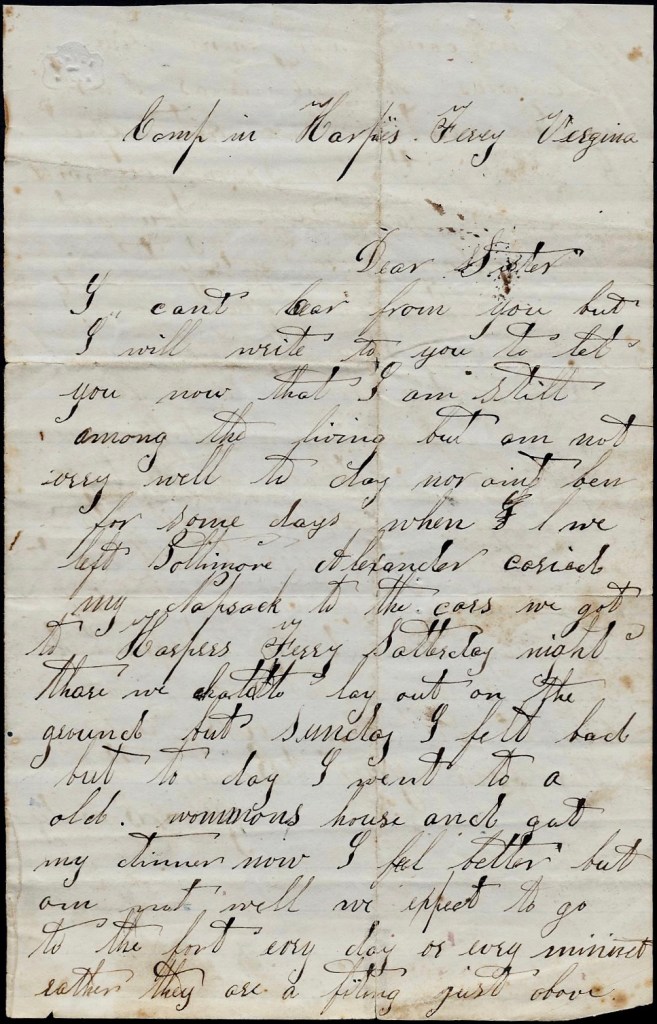
The following letter was written by John Grandy (1843-1864), the son of Lyman Grandy (1804-1877) and Miranda Crandall (1817-1890) of Charleston, Montgomery county, New York. He wrote the letter to his younger sister, Mary L. Grandy (1847-1932).
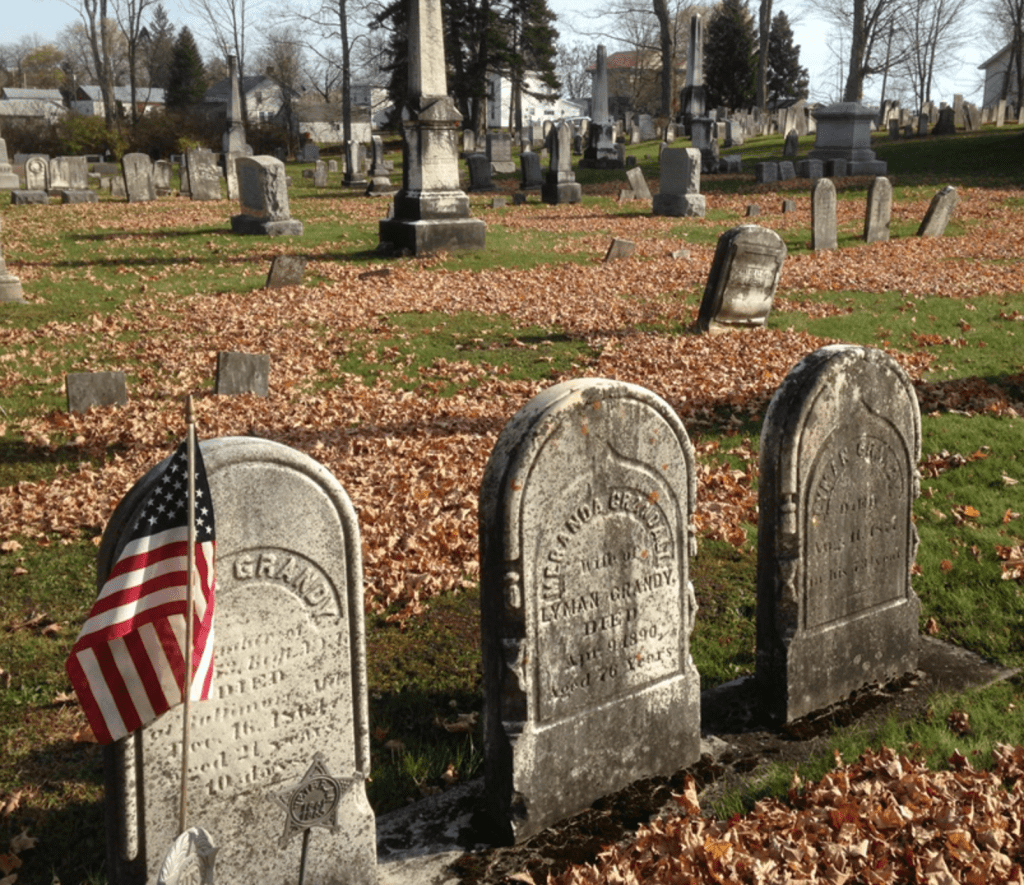
John was a 20 year-old carpenter when he was recruited into Co. C, 153rd New Infantry on 1 September 1864. In his enlistment records, he was described as standing just north of 5′ 9″ tall with light hair and blue eyes. In this letter, penned at Harper’s Ferry, he had just arrived from Baltimore and had not yet been sent forward to the regiment. The letter has a tenor of foreboding within it which is poignant as he was soon to be mortally wounded (gunshot in right thigh) on 19 October 1864 in the fighting at Cedar Creek. He died in a Baltimore hospital on 16 November 1864. He now lies buried next to his parents in the Christian Church Cemetery at Charleston Four Corners, New York.
For Lyman and Miranda Grandy, John was the second son they had lost during the Civil War. John’s older brother, Corp. George W. Grandy was killed at Gettysburg while serving in Co. D, 1st Minnesota Infantry. He was buried in a mass grave with other members of his regiment.
John Grandy lies buried in a grave next to his parents in the Christian Church Cemetery at Charleston Four Corners, New York
Transcription
Camp in Harper’s Ferry, Virginia [September 1864?]
Dear Sister,
I can’t hear from you but I will write to you to let you know that I am still among the living but I am not very well today nor ain’t been for some days. When we left Baltimore, Alexander carried my knapsack to the cares [for me]. We got to Harper’s Ferry Saturday night. There we had to lay out on the ground but Sunday I felt bad but today I went to a old woman’s house and got my dinner. Now I feel better but am not well.
We expect to go to the front every day—or every minute rather. They are a fighting just above here [in the Valley]. We can hear them fire the cannons here. It is as close as I want to be but expect I will have to go soon. You will hear of the battle before you get this.
Mary, when you get this, learn these verses and when I come home, sing them for me. I would like to hear from home to hear how Father was getting along and all the rest of the folks. As soon as we get to our regiment, then I will write again. We ain’t doing anything but laying around on the ground. Tell Charley that he is taking comfort at home.
Yours truly. This from your brother, — John Grandy
Mr. Charles Grandy, Leatherville Road, Rural Grove, Montgomery [New York]
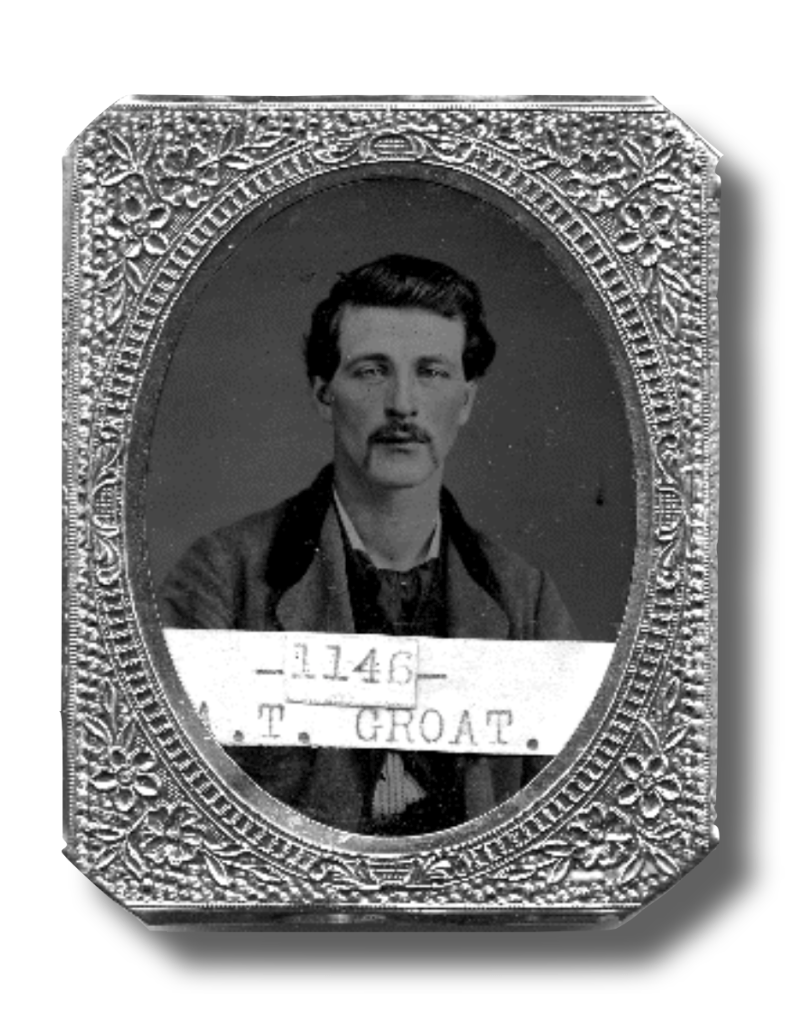
I could not find an image of Walter but here is a tintype of Alfred T. Groat who also served in Co. G, 72nd New York Infantry (Photo Sleuth)
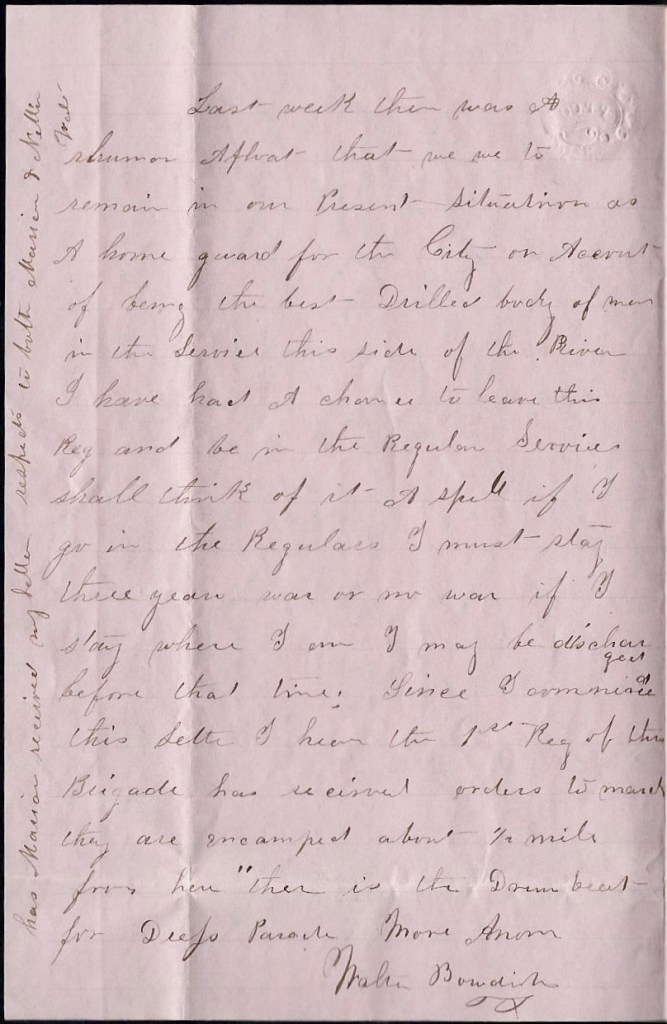
The following letter was written by Walter A. Bowdish (1839-1862), the son of Daniel Platt Bowdish (1812-1861) and Martha Caroline Granger (1813-1894) of Portland, Chautauqua county, New York.
Walter enlisted on 24 July 1861 as a private in Co. G, 72nd New York Infantry—Sickles’ Excelsior Brigade. He was known to have been wounded in the fighting at Turkey Bend (Malvern Hill) on July 1, 1862 and was carried as missing in action following that date. No identifiable body was ever recovered and all of the records of soldiers in Rebel prisons were examined following the pension application filed by Walter’s mother. Lt. James A. Smith of Co. I claimed he attempted to help Walter off the battlefield but Walter’s leg wounds were so severe (his blood “flowing in jetts” indicating a severed artery) that he had to leave him after struggling only a few steps. There was one letter written by Alfred found in his mother’s pension application submitted as proof of Walter’s sending her money while in the service. It was dated 2 May 1862 and I have included a transcript of it below.
Walter wrote the letter to Maria Agnes Fellows (1840-1911), the daughter of John Andrews Fellows (1806-1888) and his second wife, Olive Thwing (1809-1884) of Portland, Chautauqua county, New York. Agnes never married, though she clung to this letter the remainder of her life, dying in 1911.
Transcription
Addressed to Miss Agnes Fellows, Portland, Chautauqua county, N. Y.
Camp Caldwell Monday, September 30th 1861
Miss Agnes Fellows Dear Agnes,
Long had I waited for a reply to my last letter and had concluded that you were offended with the same. But Saturday the long looked for letter came. It had been very long on the way but the contents rewarded e for the anxiety it had caused me. Agnes dear, that letter has been perused many times since received. It has caused a new interest in my present situation.
You say in your letter that I was not too bold in writing as I did. You also wanted me to consider before going farther. I honor you for those words, yet I must say that this has not been the work of nor impulse of a few days or weeks, but has long been on my mind. The thought that your pure mind would revolt at my love has unlocked a secret in my breast. The night you attended the concert at Fredonia with me was a night of tumult on my heart. Oh how I longed to whisper in your ear that eve a tale of love. But the thought of slight acquaintance and a rejection kept it back.
Agnes dear, I can not write as I could talk to you were you here, but be assured that I love you deeply, truly and fondly. My love is no boyish love but a deep and lasting one. All I ask is a kind thought or word from you occasionally until my return. If with God’s mercy I am permitted, then will I convince you that I am serious in what I say.
Think not of your misfortune but as one of the dispensations of an “All wise Providence.” Bear it with the thought that it does not make you look any the less in my eyes. But to the contrary. endear you in my eyes and makes me long to be with you and protect you with an ever helping hand. Write to me, Agnes, and tell me truly whether you can return the love of the lone soldier boy. If you cannot, let this secret remain locked in your breast and forget that I ever offered the love of a true and honest heart to the kind and lovely Agnes Fellows.
The soldier in his far off tented field turns his thoughts to a loved home or some dear one. Why should not I as well? Waiting anxiously a reply to these few lines, I remain yours truly, fondly, and devotedly, — Walter A. Bowdish
[On a different sheet]
Our present situation is at the old camp (Caldwell). We cannot tell how long we stay here but I think not long as we have orders not to leave the camp on any account and to keep our knapsacks packed. Our forces on the other side of the [Potomac] river has begun to advance and are already in possession of Munson Hill and Fairfax Court House. This has been done without the loss of a single life.
Friday and Saturday there passed over the Long Bridge into Virginia over 180,000 troops. Things begin to look warlike now. On our regiment being reviewed by President Lincoln, he said we were the best body of men but one he had seen.
Last week there was a rumor afloat that we were to remain in our present situation as a home guard for the City on account of being the best drilled body of men in the service this side of the [Potomac] River. I have had a chance to leave this regiment and be in the Regular service [and] shall think of it a spell. If I go in the Regulars, I must stay three years—war or no war. If I stay where I am, I may be discharged before that time.
Since I commenced this letter I hear the 1st Regiment of the Brigade has received orders to march. They are encamped about half a mile from here. There is the drum beat for dress parade. More Anon. — Walter Bowdish
Letter 2
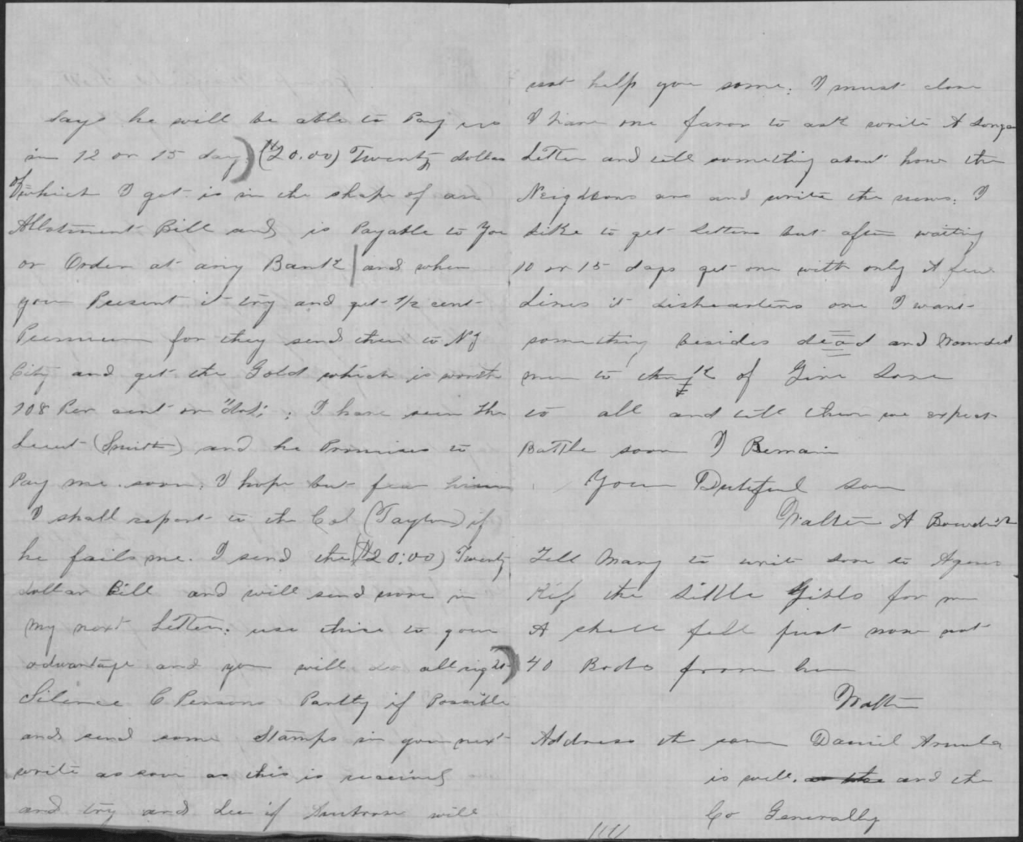
[Note: The following letter was found in the Pension Application File for Walter A. Bowdish. It was probably one of his last letters home.]
Camp Winfield Scott Near Yorktown, Virginia May 2nd 1862
Dear Mother,
Yours of the 26th came duly to hand this morning finding me at camp but not very well, having just returned from picket duty yesterday morning, the 30th. We laid in sight of the Rebs Battery all day and night in the midst of a heavy rain. We went into the trenches in the course of the night. Our pickets were driven in and then we stopped the Rebels there. They fell back to their Battery and then commenced firing shell. Some fell close to us but no one injured. In half hour they ceased firing.
At 8 o’clock we returned to camp, found the Pay Master and got two months pay. This morning we were mustered in for two months more and the pay master says he will be able to pay us in 12 or 15 days. ($20) twenty dollars of which I got is in the shape of an Allotment Bill and is payable to you or Order at any Bank, and when you present it, try and get half cent premium for they send them to New York City and get the gold which is worth 708 percent on the dollar. I have seen the Lieut. (Smith) and he promises to pay me soon, I hope, but fear him. I shall report to the Col. (Taylor) if he fails me. I send the $20 dollar bill and will send more in the next letter. Use them to your advantage and you will do all right…
I must close. I have one favor to ask. Write a long letter and tell something about how the neighbors are and write the news. I like to get letters but after waiting 10 or 15 days, get one with only a few lines, it disheartens one. I want something bedsides dead and wounded men to think of. Give love to all and tell them we expect battle soon. I remain your dutiful son, — Walter A. Bowdish
The following letters were written by Joseph Stras Peery (1839-1925), the son of Harvey George Peery (1801-1869) and Rebecca Williams (1805-1890) of Tazewell county, Virginia. After receiving an elementary education in Tazewell, he attended Emory and Henry College.
At the start of the Civil War, Joseph enlisted in August 1861 in Co. G, 45th Virginia Infantry at Gauley. He was promoted to sergeant by April 1862 and commissioned a lieutenant by July 1862. He was captured at the Battle of Winchester on 19 September 1864 and sent to Ft. Delaware shortly after. On the date of his release, 17 June 1865, he was described as standing 6 feet tall, with blue eyes and light hair.
In 1868 married Livonia Ravina Brown. His post war occupation was farmer and merchant. He died 7/7/1925 at Glade Spring, Washington County, Virginia at the age of 87.
These letters, like others Joseph wrote from prison, were strictly censored. They were not allowed to discuss what was going on inside the prison nor share their attitude about events occurring outside. Rules required that all letters be written on one side of the paper and they could only be sent to relatives in the North or to relatives in Union-occupied southern states unless under a flag-of-truce. If correspondents were not actually relatives, letters were often addressed as “dear cousin.”
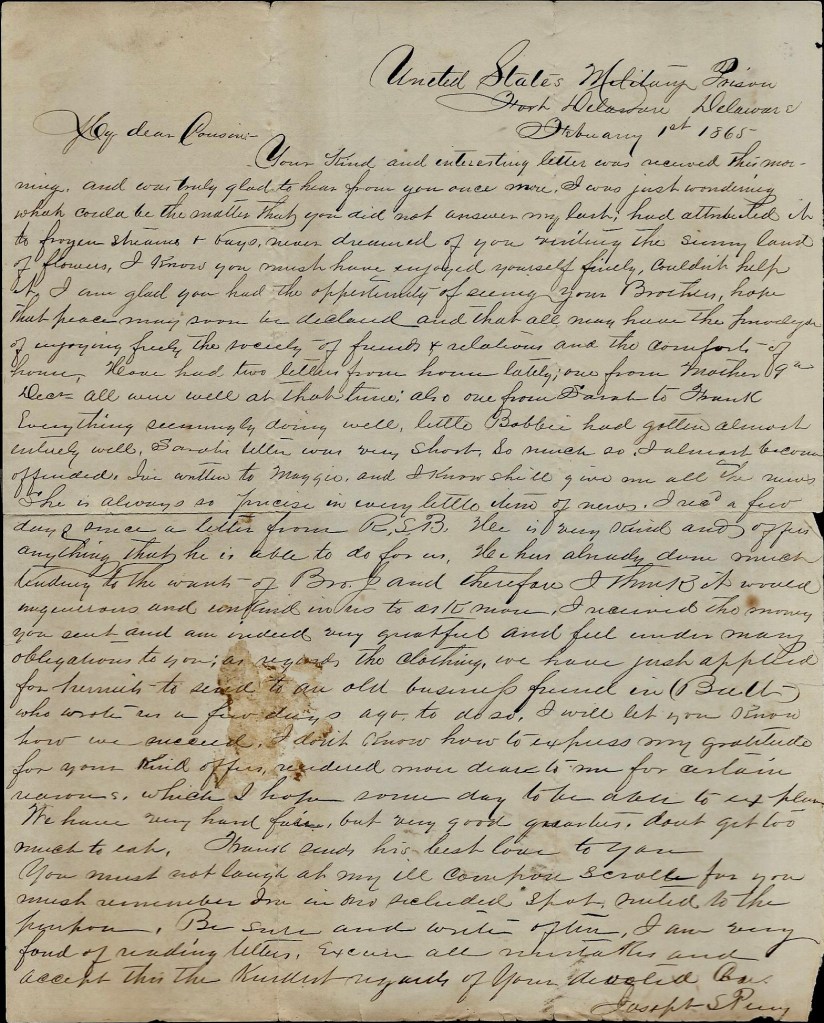
Letter 1
United States Military Prison Fort Delaware, Delaware February 1st 1865
My dear cousin,
Your kind and interesting letter was received this morning and was certainly glad to hear from you once more. I was just wondering what could be the matter that you did not answer my last. Had attributed it to frozen streams & bays. Never dreamed of you visiting the sunny land of flowers. I know you must have enjoyed yourself finely. couldn’t help it. I am glad you had the opportunity of seeing your Brothers. Hope that peace may soon be declared and that all may have the privilege of enjoying freely the society if friends and relations and the comforts of home.
Have had two letters from home lately—one from Mother, 9th December, All were well at that time. Also one from Sarah to Frank. Everything seemingly doing well. Little Bobbie had gotten almost entirely well. Sarah’s letter was very short. So much so I almost became offended. I’ve written to Maggie and I know she’ll give me all the news. She is always so precise in every little item of news.
I received a few days since a letter from R. S. B. He is very kind and offers anything that he is able to do for us. He has already done much tending to the wants of Brother J[ames] and therefore I think it would be ungenerous and unkind in us to ask more. I received the money you sent and am indeed very grateful and feel under many obligations to you. As regards the clothing, we have just applied for permits to send to an old business friend (in Baltimore) who wrote us a few days ago to do so. I will let you know how we success. I don’t know how to express my gratitude for your kind offers rendered more dear to me for certain reasons which I hope some day to be able to explain.
We have very hard fare but very good quarters. Don’t get too much to eat. Frank sends his best love to you. You must not laugh at my ill composed scroll for you must remember I’m in no secluded spot noted to the purpose. Be sure and write often. I am very fond of reading letters. Excuse all mistakes and accept this the kindest regards of your devoted cousin, — Joseph S. Peery
Letter 2
Fort Delaware, Delaware March 29, 1865
Dear Cousin,
According to your request, I write again on the reception of your kind letter. It is pretty much as you said—nothing to do, but you know that no one is apt to be fond of writing unless they get answers equally in number to letters written. Now I think you must be a long time answering my letter—so long I’d given it up—that you did not intend doing so. Consequently I wrote you another and sent you a ring, the workmanship of a prisoner. A very poor thing it was. However, I thought you would value it as it was from your lovely cousin. Well, I was very agreeably surprised this morning with a letter from my dear sister. I’d written home and complained of sister Sarah not writing. She claimed that she was not indebted to me in that respect. One thing I know—that is, I’ve written to her often enough but it may be that she has never received any or but few.
Mr. Brittain had been at home, only for a short time, ten days. Would leave the day she wrote, the 6th of March. All were well. I intend writing soon. Will give them your message. As to me forgiving you for not sending such as you mentioned, I don’t think that there is anything to forgive for I am already indebted to you more perhaps that I’ll ever be able to return. We are all well and getting along as well as usual. Get “hard tack” twice a week for dinner, something new of late.
Frank sends much love to you. Noe I don’t want you to delay answering this letter. Never trouble yourself about those articles mentioned. I received a few lines from a friend at Johnson’s Island. James was well and I expect he was thinking like myself—that you was not very prompt in reply. I shall expect to hear from you soon.
Believe me as ever your devoted cousin, — Jo. S. Peery
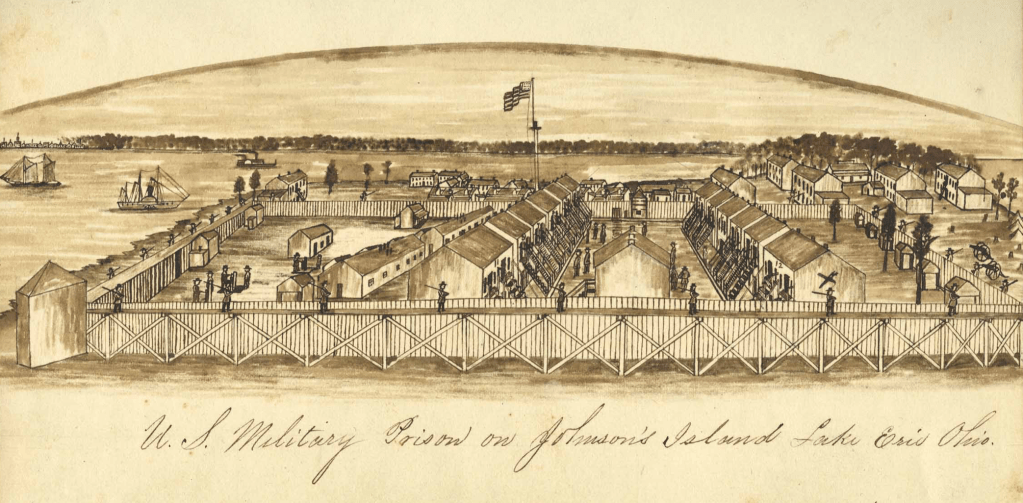
The following letter was written by James Spotts Peery (1837-1905) who entered the Confederate service as a 1st Lieutenant of Co. G, 45th Virginia Infantry in May 1861. By July 1862 he had been promoted to Captain of his company. He was wounded and taken prisoner on 5 June 1864 at Piedmont, Virginia, and transferred into the officer’s prison at Johnson’s Island (Ohio) on 22 June 1864 where he wrote this letter in January 1865.
When James took the Oath of Allegiance to be released from prison on 15 June 1865, he was described as 28 years old, standing 5 feet, 10 inches tall, with hazel eyes and dark hair. He gave his residence as Jeffersonville, Virginia.
James was the son of Harvey George Peery (1801-1869) and Rebecca Williams (1805-1890) of Tazewell county, Virginia.
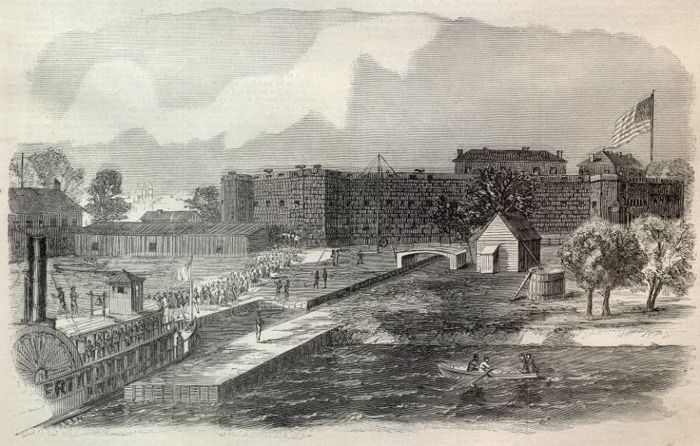
The military prison on Johnson’s Island, Lake Erie, Ohio(Encyclopedia Virginia)
Transcription
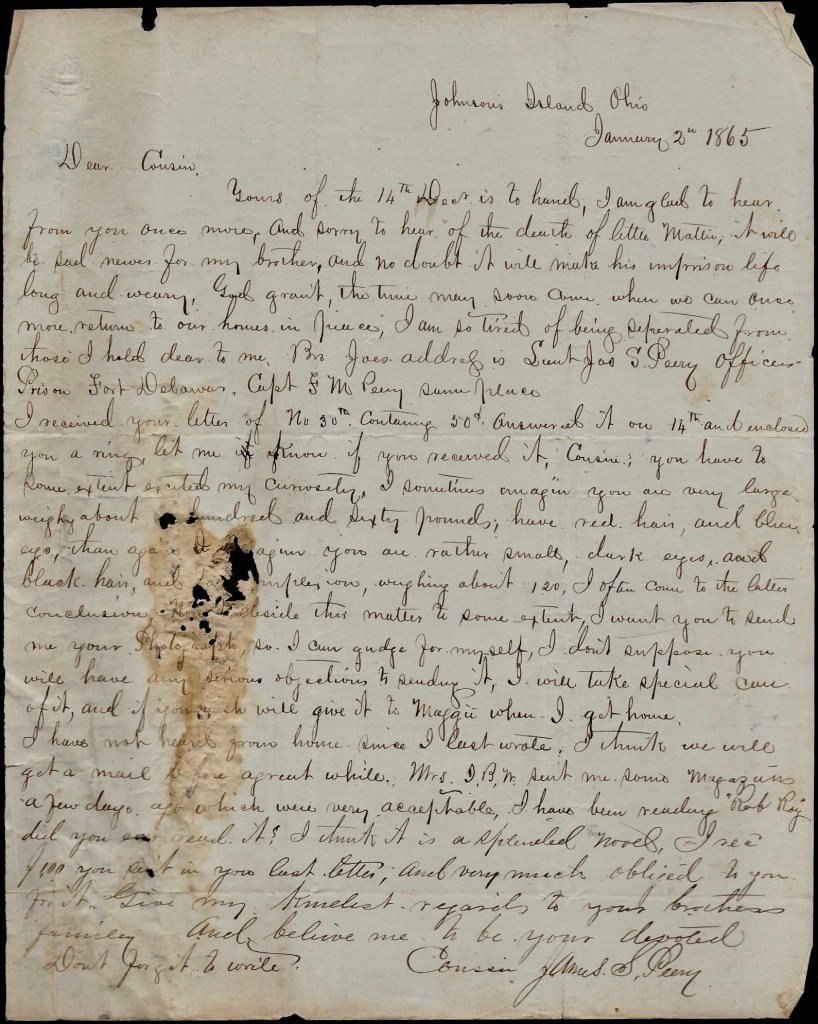
Johnson’s Island, Ohio January 2nd 1865
Dear Cousin,
Yours of the 14th December is to hand. I am glad to hear from you once more and sorry to hear of the death of little Mattie. It will be sad news for my brother and no doubt it will make his imprisoned life long and weary. God grant the time may soon arrive when we can once more return to our homes in peace. I am so tired of being separated from those I hold dear to me. Brother Joe’s address is, Lieut. Jos. S. Peery, Officer’s Prison, Fort Delaware, Capt. F. M. Peery, same place.
I received your letter of November 30th containing 50 cents. Answered it on 14th and enclosed you a ring. Let me know if you received it.
Cousin, you have to some extent excited my curiosity. I sometimes imagine you are very large, weighing about a hundred and sixty pounds; have red hair and blue eyes. Then again I imagine you are rather small, dark eyes, and black hair, and [ ] complexion, weighing about 120. I often come to the latter conclusion. Now to decide this matter to some extent, I want you to send me your photograph so I can judge for myself. I don’t suppose you will have any serious objections to sending it. I will take special care of it and if you wish, will give it to Maggie when I get home.
I have not heard from home since I last wrote. I think we will get a mail before a great while. Mrs. J. B. W. sent me some magazines a few days ago which were very acceptable. I have been reading “Rob Roy.” Did you ever read it? I think it is a splendid novel. I received $1 you sent in your last letter and very much obliged to you for it. Give my kindest regards to your brothers family. And believe me to be your devoted cousin, — James S. Peery
Two unidentified members of the 6th Virginia Cavalry, wearing battle shirts and with Colt .36 caliber Navy revolvers
The following letter was written by William Dickenson Stone (1836-1908), the son of Edmund Stone (1805-1840) and Nancy Chapman Dickenson (1809-1854) of Cartersville, Pittsylvania county, Virginia. William did not marry until after the war, in 1867, to Mary Rosa Parker (1848-1931)—12 years his junior. He lived in Franklin county, Virginia, after the war.
During the Civil War, William entered the service as a private on 27 May 1861 in Co. E, 6th Virginia Cavalry. He was commissioned a lieutenant on 20 April 1862 and often signed the pay rolls as commander of his company. The regiment fought in Jackson’s Valley Campaign and in the conflicts at Second Manassas, Brandy Station, Upperville, Fairfield, Bristoe, Mine Run, The Wilderness, Todd’s Tavern, Spotsylvania, Haw’s Shop, and Cold Harbor. The regiment went on to take part in Early’s Shenandoah Valley operations and the Appomattox Campaign.
William’s letter makes a reference to the Confederate victory at Chickamauga in northern Georgia where Bragg’s army turned back Rosecrans’ army, forcing them to retreat back to Chattanooga. “We all are perfectly elated with the good news from Bragg’s army and I am at this moment anxiously awaiting the arrival of the mail to hear further particulars but must confess I feel some little apprehension from the fact that army has always been so unsuccessful. But Longstreet is there now which will doubtless change the tide of events for he has veteran soldiers who have never known defeat.”
Transcription
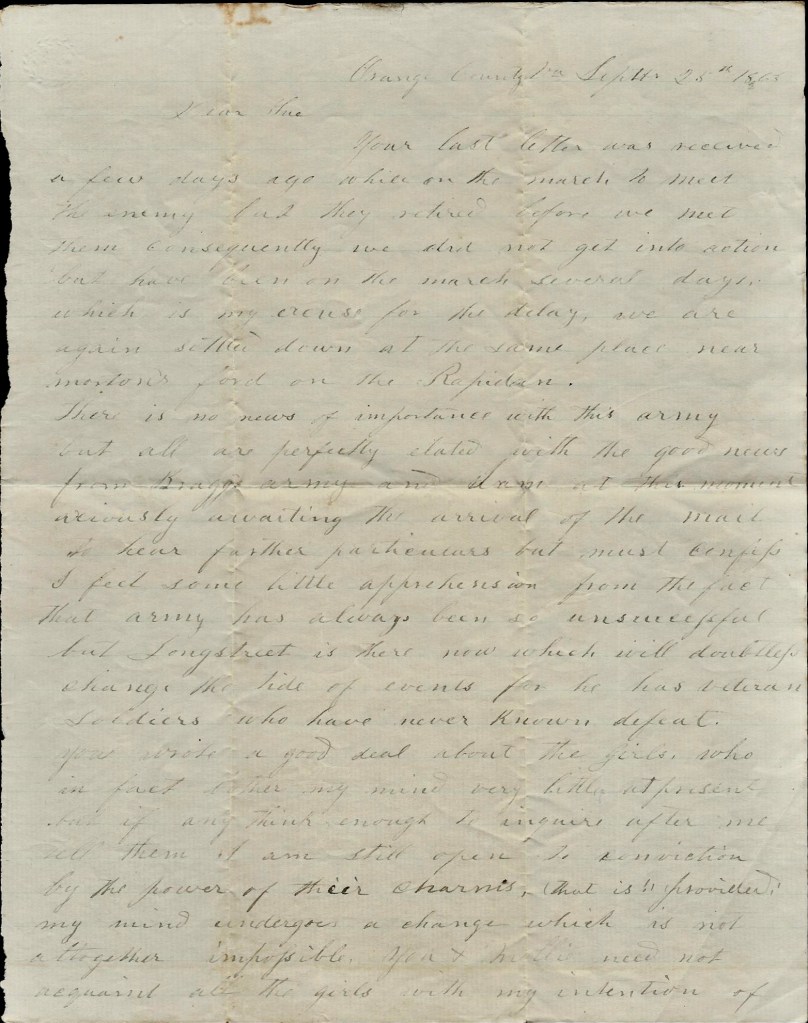
Orange county, Virginia September 25, 1863
Dear Sue,
Your last letter was received a few days ago while on the march to meet the enemy but they retired before we met them. Consequently we did not get into action but have been on the march several days which is my excuse for the delay. We are again settled down at the same place near Morton’s Ford on the Rapidan.
There is no news of importance with this army but all are perfectly elated with the good news from Bragg’s army and I am at this moment anxiously awaiting the arrival of the mail to hear further particulars but must confess I feel some little apprehension from the fact that army has always been so unsuccessful. But Longstreet is there now which will doubtless change the tide of events for he has veteran soldiers who have never known defeat.
You wrote a good deal about the girls who in fact bother my mind very little at present but if any think enough to enquire after me, tell them I am still open to conviction by the power of their charms (that is!) provided my ind undergoes a change which is not altogether impossible. You and Mollie need not acquaint all the girls with my intention of living a bachelor’s life. Then they would barely respect me for none but marrying men are popular with them and I don’t care to be kicked out of society entirely before my time comes of my own choice.
Everything is so dull here. There is nothing to write about. Tell Sallie her letter was received yesterday and I will write to her tomorrow or next day. This leaves myself and friends well. Write soon. Direct to Orange County, 6th Virginia, Lamar’s Brigade.
My love to all anxious friends and accept the warmest love of your absent brother, — Wm. D. Stone
The following letter was written by Daniel Green Martz (1839-1891), the son of Hiram Martz (1800-1861) and Hannah Asbury Mathews (1803-1861) of Harrisonburg, Rockingham county, Virginia. Daniel was married in April 1860 to Lydia Ann Sellers (1838-1924) and had a young son at the time he enlisted on 3 June 1861 at Lacey Springs, Virginia, to serve as a Lieutenant in Co. H, 10th Virginia Cavalry. After he failed to be reelected, he was discharged from the regiment in May 1862.
Martz later reenlisted as a private in Co. G, 10th Virginia Infantry and was taken prisoner in December 1863 and initially sent to Camp Chase in Ohio; then transferred to Fort Delaware on 15 April 1864 where he wrote this letter three weeks later. He was exchanged on 11 October 1864 and returned to his regiment for the remainder of the war. He was paroled on 20 April 1865 at New Market, Virginia.
Confederate prisoners arriving at Fort Delaware
Transcription
Fort Delaware May 5th [1864]
Mrs. Lydia A. Martz—dear Lydia,
I have just received your short note of 21st March and was much pleased to hear of your general good health but sorry to hear of you suffering with toothache. I am well—all except a slight sore on my neck coming from diphtheria, an enlargement of the gland. It is much better, nearly well. I have not let you know of my throat being sore on account of its making you uneasy. All danger is now past. Indeed, I hope this may find you entirely well. Also Sissie and all my relations and friends.
Louis Wood is well. Why don’t some of my relations write to me? I think they might. I am sorry to hear of Grandmother’s ill health. Hope she is well before this time. What has taken cousin Mikie to South Carolina? Get Uncle Dorilas 1 to see W. D. Liout and let me know whether I received the position I applied for, Wrote on larger paper and write me longer letters. I hope to see you soon. Be of good cheer. My love to all. Kiss and embrace Sissie for me, Many kisses for you. Affectionately your husband. — Daniel G. Marty
[to] Lydia A. Martz
Direct to Fort Delaware, Division 28.
1 Dorilas J. Martz (1802-1872) served in the 97th Virginia Regiment (Spitzler’s)
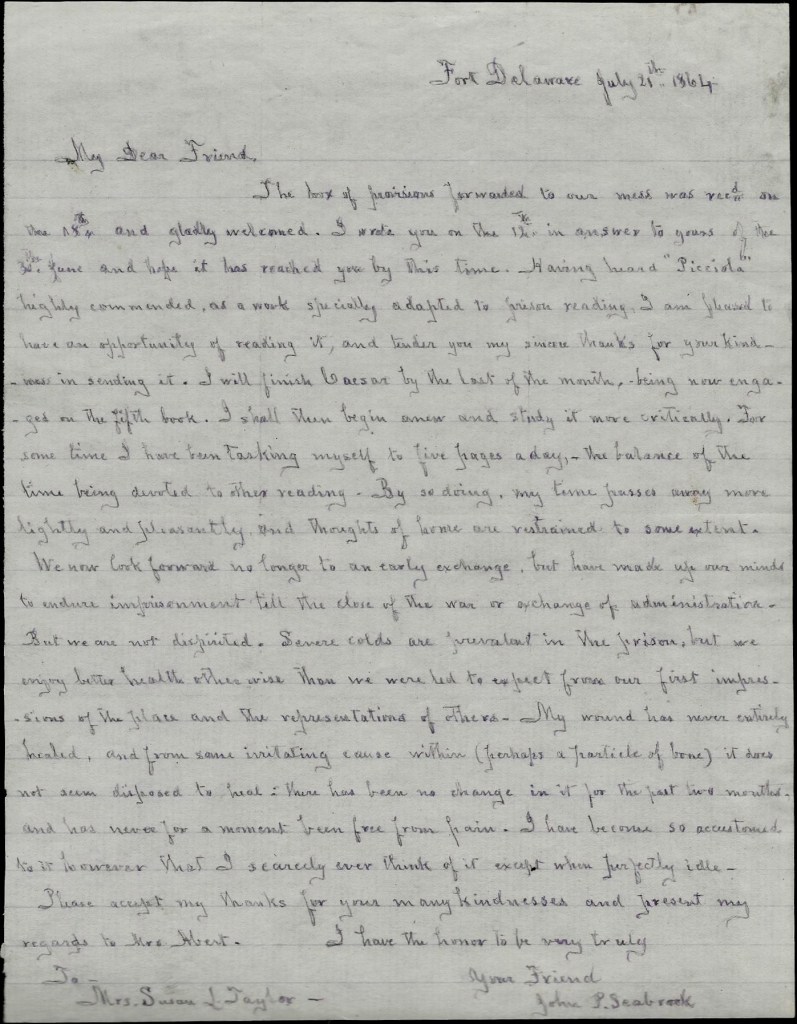
The following POW letter was written by Lt. John P. Seabrook (1835-1927) of Co. I (“Alabama Grey’s”), 38th Alabama Infantry. Seabrook’s regiment was organized at Mobile in May 1862 and took an active role in the campaigns of the Army of Tennessee from Chickamauga to Nashville. Seabrook was taken prisoner in the fighting at Missionary Ridge on 25 November 1863. He was first taken to Louisville, then Camp Chase in Ohio, and finally to Fort Delaware. According to muster rolls, Seabrook had most of his right arm amputated at the US Hospital in Nashville before being released into the prisoner system in mid-February 1864. Seabrook was finally paroled at Fort Delaware on 14 September 1864 and forwarded for exchange to Aiken’s Landing, Virginia. He returned to duty on 27 September 1864 and was with his regiment at Fort Blakely when it was surrendered on 9 April 1865. He was sent for a few weeks to Ship Island as a POW until exchanged on 6 May 1865.
Seabrook wrote the letter to Susan Lucy (Barry) Taylor (1807-1881), the wife of Col. James Jones Taylor (1802-1883) of Newport, Kentucky—located adjacent to Covington. The couple were wed in 1824 and had at least six children—three of who are mentioned in this letter; James Taylor (1833-1876), John Taylor (1836-1914), and Barry Taylor (1839-1887). Mrs. Taylor was the daughter of Hon. William T. Barry (1785-1835) who was a Kentucky Democratic politician who served as the first Cabinet level Postmaster General under President Andrew Jackson. Susan operated a benevolent society out of Newport, Kentucky, that supplied aid and comfort to Confederate prisoners of war confined in Yankee prisons.
Confederate prisoners arriving at Fort Delaware
Transcription
Fort Delaware July 21, 1864
My dear friend,
The box of provisions forwarded to our mess was received on the 18th and gladly received. I wrote you on the 12th in answer to yours of the 30th June and hope it has reached you by this time. Having heard “Picciola” highly commended as a work specially adapted to prison reading, I am pleased to have an opportunity of reading it, and tender you my sincere thanks for your kindness in sending it. I will finish Caesar by the last of the month, being now engaged on the fifth book. I shall then begin anew and study it more critically. For some time I have been tasking myself to five pages a day—the balance of the time devoted to other reading. By so doing, my time passes away more lightly and pleasantly and thoughts of home are restrained to some extent.
We now look forward no longer to an early exchange, but have made up our minds to endure imprisonment till the close of the war or exchange of administration. But we are not dispirited. Several colds are prevalent in the prison but we enjoy better health otherwise than we were led to expect from our first impressions of the place and the representations of others.
My wound has never entirely healed and from some irritating cause within (perhaps a particle of bone) it does not seem disposed to heal. There has been no change in it for the past two months and has never for a moment been free from pain. I have become so accustomed to it, however, that I scarcely ever think of it except when perfectly idle.
Please accept my thanks for your many kindnesses and present my regards to Mrs. Abert. I have the honor to be very truly your friend, — John P. Seabrook
Cyrus Miner, Co. K, 5th Iowa Infantry (John Wernick Collection)
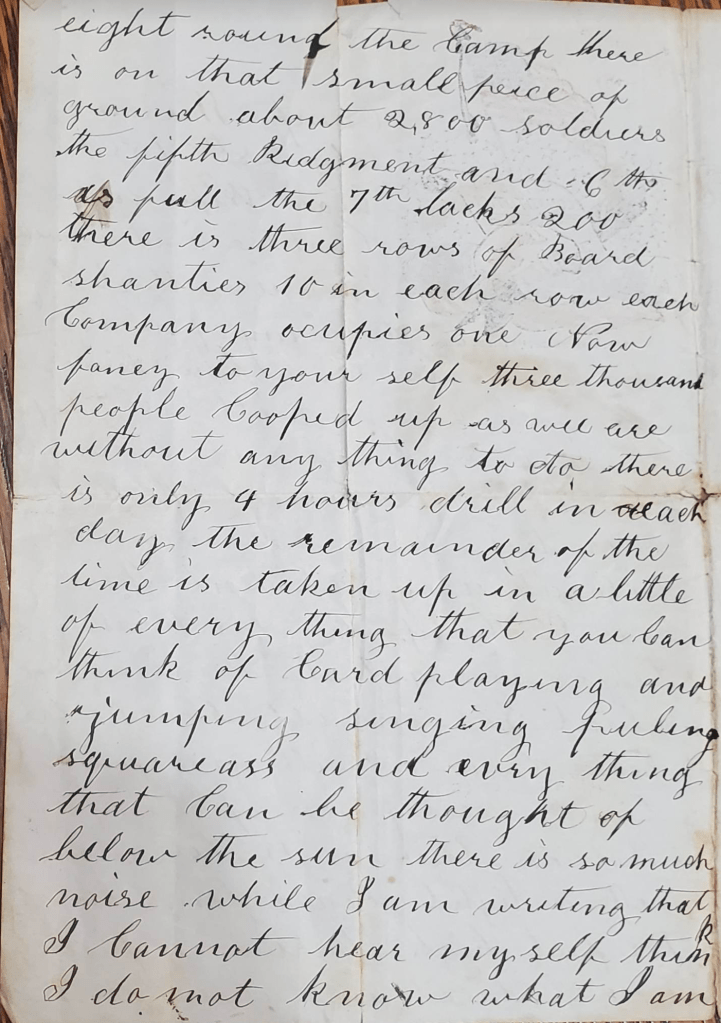
The following letter was written by Cyrus Miner (1822-1888) of Co. K, 5th Iowa infantry who enlisted as a musician (drummer) on 15 July 1861. He wrote the letter to his wife, Sarah (Fay) Miner (1822-1889) and his four children. In the 1860 US Census, Cyrus and his family were enumerated in Linton, Allamakee county, Iowa, where Cyrus was employed as a carpenter. Ten years earlier, the family resided in Jones county, Iowa.
Cyrus began his service in Co. K but was later transferred to the regimental band and then transferred out on 1 October 1864.
The letter is particularly noteworthy for its great description of Camp Warren which was located outside of Burlington, Iowa, in July 1861. It’s comparable to another letter by William Codling, a private in Co. E of the 5th Iowa who wrote to his friend ten days earlier saying that Camp Warren was “on the Burlington Fairground two miles from town. There we are about 2300 men of us penned up on about thirty acres of ground with a high board fence and guarded on all ends and sides. We are allowed to go to town to the river twice a week to bathe but then under the command of an officer.” [See William Codling]
[Note: This letter is from the personal collection of John Wernick and was transcribed and published on Spared & Shared by express consent. He also owns the image of Cyrus Miner.]
Transcription
Camp Warren July 28, 1861
Dear Wife and Children,
It is with pleasure that I take my pen in hand to write a few lines to you. I am well and hope these few lines will find you blessed with the same blessing.
Our trip down the river was without any accident. There was 6 companies on board before we got to Burlington, about 500 in all, besides the boat’s crew.
I will give you a faint description of Camp Warren. There is 15 acres enclosed with a tight board fence about 7 and and half feet high. There is picket guard placed one about every eight round the camp. There is on that small piece of ground 2800 soldiers. The 5th Regiment and 6th are full. The 7th lacks 200. There is three rows of board shanties, 10 in each row. Each company occupies one.
Now, fancy to yourself three thousand people copped up as we are without anything to do. There is only four hours drill in each day. The remainder of the time is taken up in a little of everything that you can think of—card playing and jumping, singing, pulling squares, and everything that can be thought of below the sun. There is so much noise while I am writing that I cannot hear myself think. I do not know what I am writing or what I want to write. Damn the confusion.
Now a little about our grub. Each man is entitled to 18 ounces of bread, 20 ounces of beef, or 12 of pork, 2 ounces of coffee, 2 ounces sugar, salt and vinegar. Pepper as much as we want to use per day. No potatoes yet.
There is some sickness in the camp but not as much as I expected. There is only about 20 out of 2800—that is, 20 in the hospital, but there is one half in camp got the shits. I am blessed. I never felt better. I beat reveille 5 in the morning, retreat at sunset, tattoo at 9 in the evening. The taps at 9:30. Then every candle is blown out. Then everyone that is out after that is walked off to the guard house and kept there until morning. Then they are put on guard the next 24 hours or put to cleaning out the quarters or some mean work such as cleaning back house. There is no use in getting under guard.
It is two weeks today since we got in camp and I have not missed one call. I can go out every day after guard mounting—that is a nine in the morning. Then I have nothing to do until sundown. Farewell for this time. Direct to Camp Warren, Burlington, Iowa