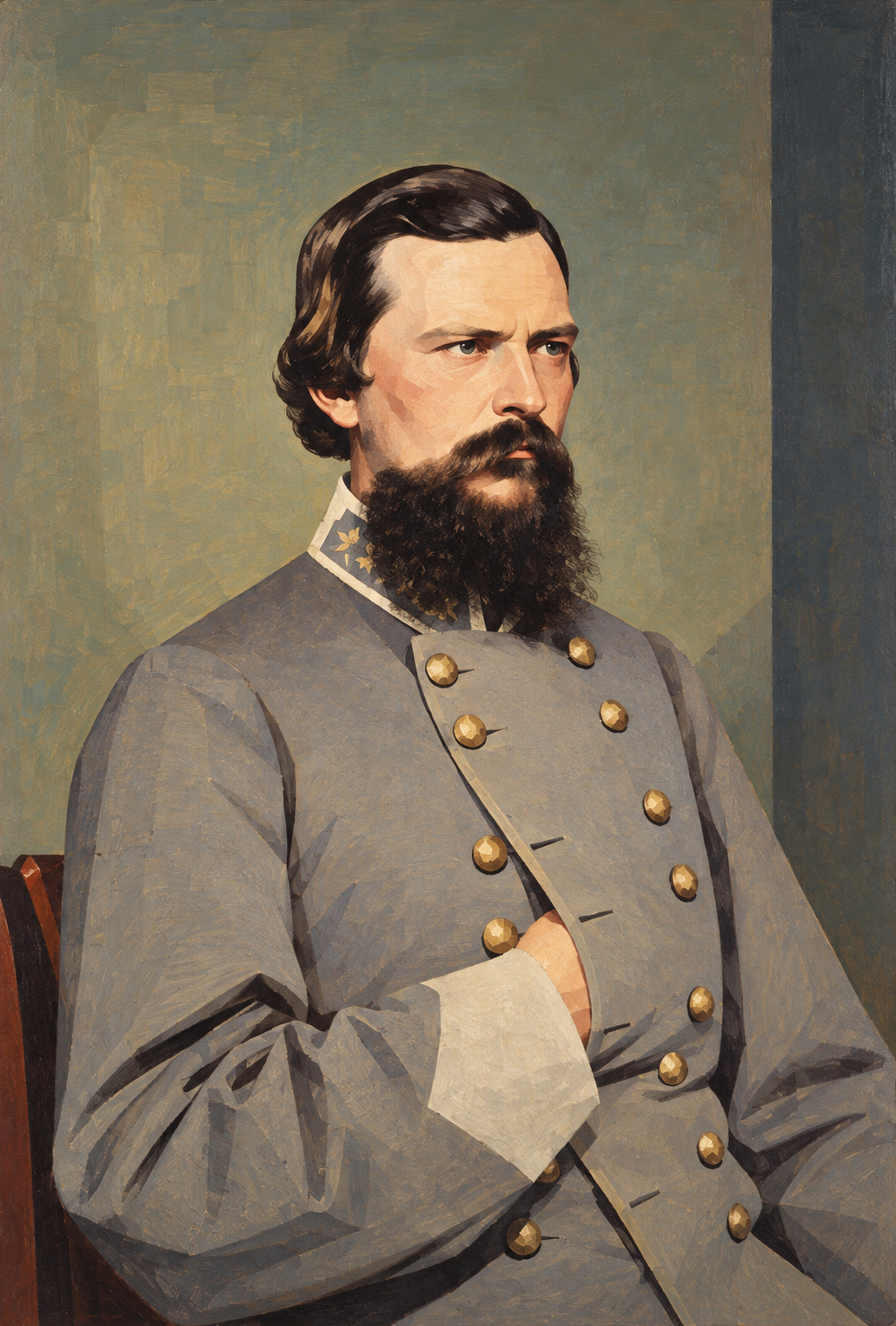
Robert Brank Vance (1828–1899), elder brother of North Carolina Governor Zebulon B. Vance, began his Confederate military service in 1861 by raising a company known as the Buncombe Life Guards and becoming colonel of the 29th North Carolina Infantry. His regiment served in East Tennessee, participated in the defense of Cumberland Gap, and accompanied General Edmund Kirby Smith during the Kentucky Campaign of 1862. At the Battle of Stones River (Murfreesboro) in December 1862, Vance distinguished himself in combat, losing his horse to an artillery shell. His service earned him promotion to brigadier general on March 4, 1863. Following a prolonged illness, he was assigned command of Confederate forces in the mountainous region along the North Carolina–Tennessee border, where he conducted raids against Union supply lines. On January 14, 1864, after capturing a Union wagon train near Knoxville, Vance and most of his command were themselves captured by Federal cavalry.
Following his capture, Vance was held in several Northern prisons, including facilities in Nashville, Louisville, Camp Chase in Ohio, and finally Fort Delaware on Pea Patch Island. During his confinement at Fort Delaware, he was photographed in May 1864 alongside several prominent Confederate prisoners, including Brigadier General Meriwether Jeff Thompson. His eventual release was aided by the Reverend Nathaniel G. Taylor, a Union sympathizer whom Vance had previously held prisoner in Tennessee but had treated kindly and released. Through Taylor’s intervention, President Abraham Lincoln granted Vance a special parole permitting him to purchase clothing and other necessities for fellow Confederate prisoners. In March 1865, Lincoln granted Vance a conditional pardon, allowing him to return home to North Carolina on the condition that he take no further part in the war.
Vance wrote the letters to Jane Eliza (Brown) Bestor (1820-1885), the wife of John Rollin Bestor, Sr. (1813-1867). This Baltimore couple had twin sons who served in the Maryland Guard that became Co. B, 21st Virginia Infantry. Eliza seems to have corresponded with numerous Confederate officers seeking information about her sons. The Bestor brothers’ letters have been transcribed and may be found at 1861-65: The Bestor Brothers of Baltimore.
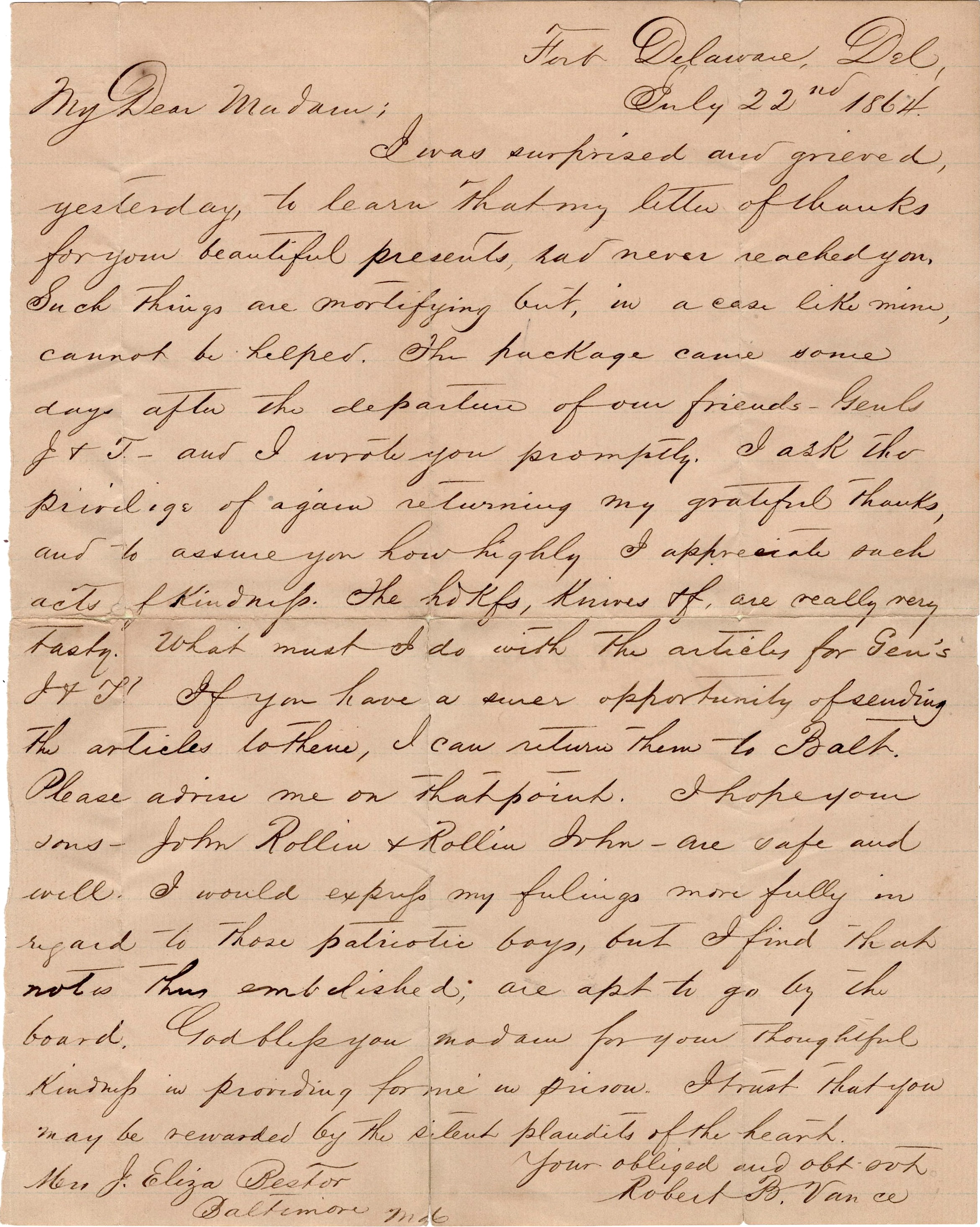
Letter 1
Fort Delaware, Delaware
July 22nd 1864
My Dear Madam:
I was surprised and grieved yesterday to learn that my letter of thanks for your beautiful presents had never reached you. Such things are mortifying but, in a case like mine, cannot be helped.
The package came some days after the departure of our friends –Generals J[ohnson] & T[hompson]—and I wrote you promptly. I ask the privilege of again returning my grateful thanks and to assure you how highly I appreciate such acts of kindness. The handkerchiefs, knives & forks are really very tasty. What must I do with the articles for Gen’s J[ohnson] & T[hompson]? If you have a surer opportunity of sending the articles to them, I can return them to Baltimore. Please advise me on that point.
I hope your sons John Rollin & Rollin John are safe and well. I would express my feelings more fully in regard to those patriotic boys, but I find that notes thus embellished are apt to go by the board. God bless you, madam, for your thoughtful kindness in providing for me in prison. I trust that you may be rewarded by the silent plaudits of the heart.
Your obliged and obedient servant, — Robert B. Vance
To Mrs. J. Eliza Bestor, Baltimore, Maryland
Letter 2
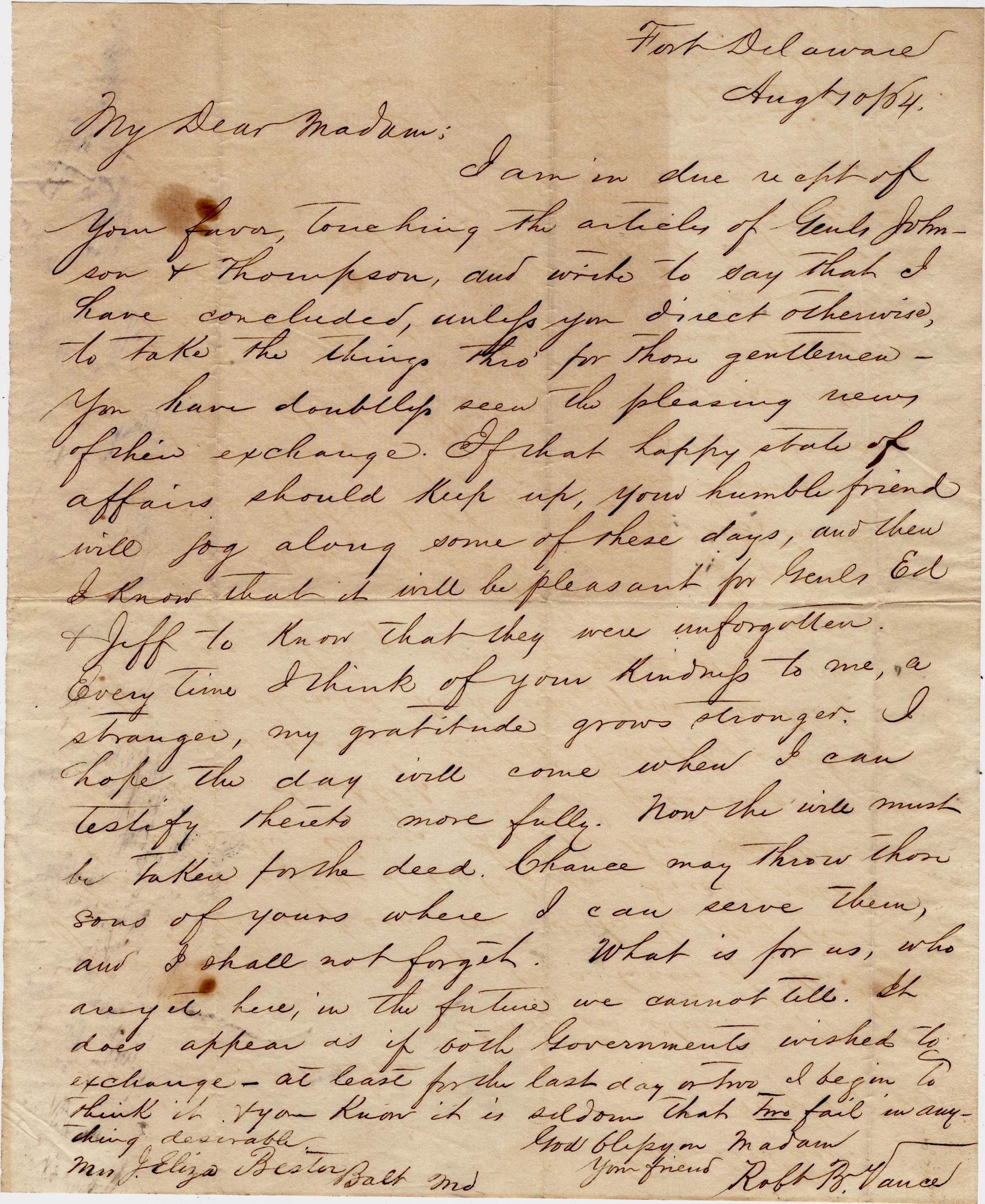
Fort Delaware, Delaware
August 10, 1864
My dear Madam,
I am in due receipt of your favor, touching the articles of Genl’s [Edward] Johnson & [Jeff] Thompson, and write to say that I have concluded, unless you direct otherwise, to take the things thro’ for those gentlemen. You have doubtless seen the pleasing news of their exchange. If that happy state of affairs should keep up, your humble friend will jog along some of these days, and then I know that it will be pleasant for Genls Ed [Johnson] & Jeff [Thompson] to know that they were unforgotten.
Every time I think of your kindness to me—a stranger—my gratitude grows stronger. I hope the day will come when I can testify thereto more fully. Now the will must be taken for the deed. Chance may throw those sons of yours where I can serve them, and I shall not forget. What is for us, who are yet here, in the future we cannot tell. It does appear as if both Governments wished to exchange—at least for the last day or two. I begin to think it & you know it is seldom that two fail in anything desirable.
God bless you Madam. Your friend, — Robert B. Vance
To Mrs. J. Eliza Bestor, Baltimore, Maryland
Letter 3
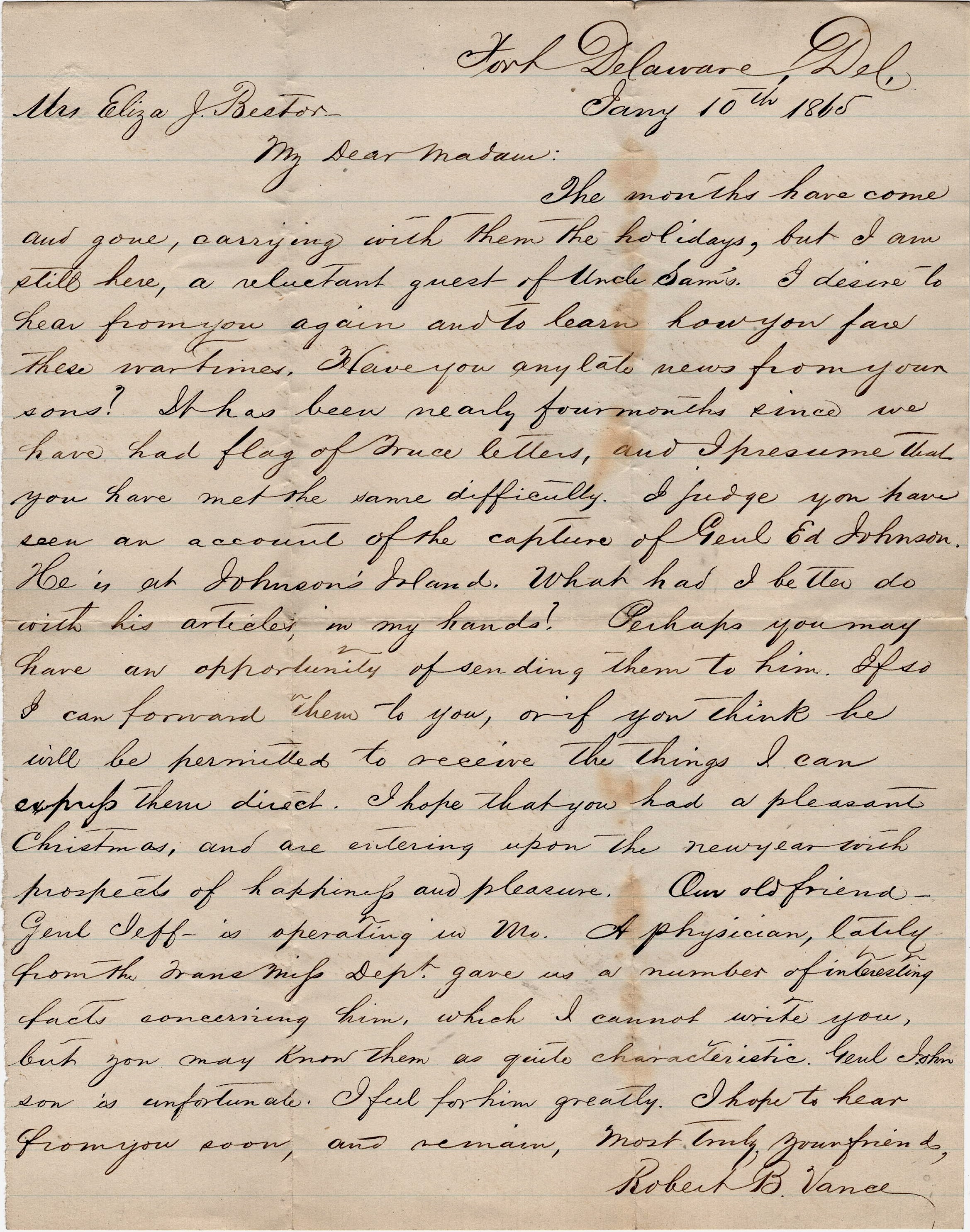
Fort Delaware, Delaware
January 10, 1865
Mrs. Eliza J. Bestor
My dear madam. The months have come and gone, carrying with them the holidays. But I am still here—a reluctant guest of Uncle Sam’s. I desire to hear from you again and to learn how you fare these war times. Have you any late news from your sons? It has been nearly four months since we have had flag of truce letters and I presume that you have met the same difficulty.
I judge you have seen an account of the capture of Gen. Ed[ward] Johnson. He is at Johnson’s Island. What had I better do with his articles in my hands? Perhaps you may have an opportunity of sending them to him. If so, I can forward them to you, or if you think he will be permitted to receive the things, I can express them direct.
I hope that you had a pleasant Christmas and are entering upon the new Year with prospects of happiness and pleasure. Our old friend, General Jeff [Thompson], is operating in Missouri. A physician lately from the Trans Mississippi Department gave us a number of interesting facts concerning him which I cannot write you, but you may know them as quite characteristic. Gen. Johnson is unfortunate. I feel for him greatly.
I hope to hear from you soon and remain most truly your friend, — Robert B. Vance
Letter 4
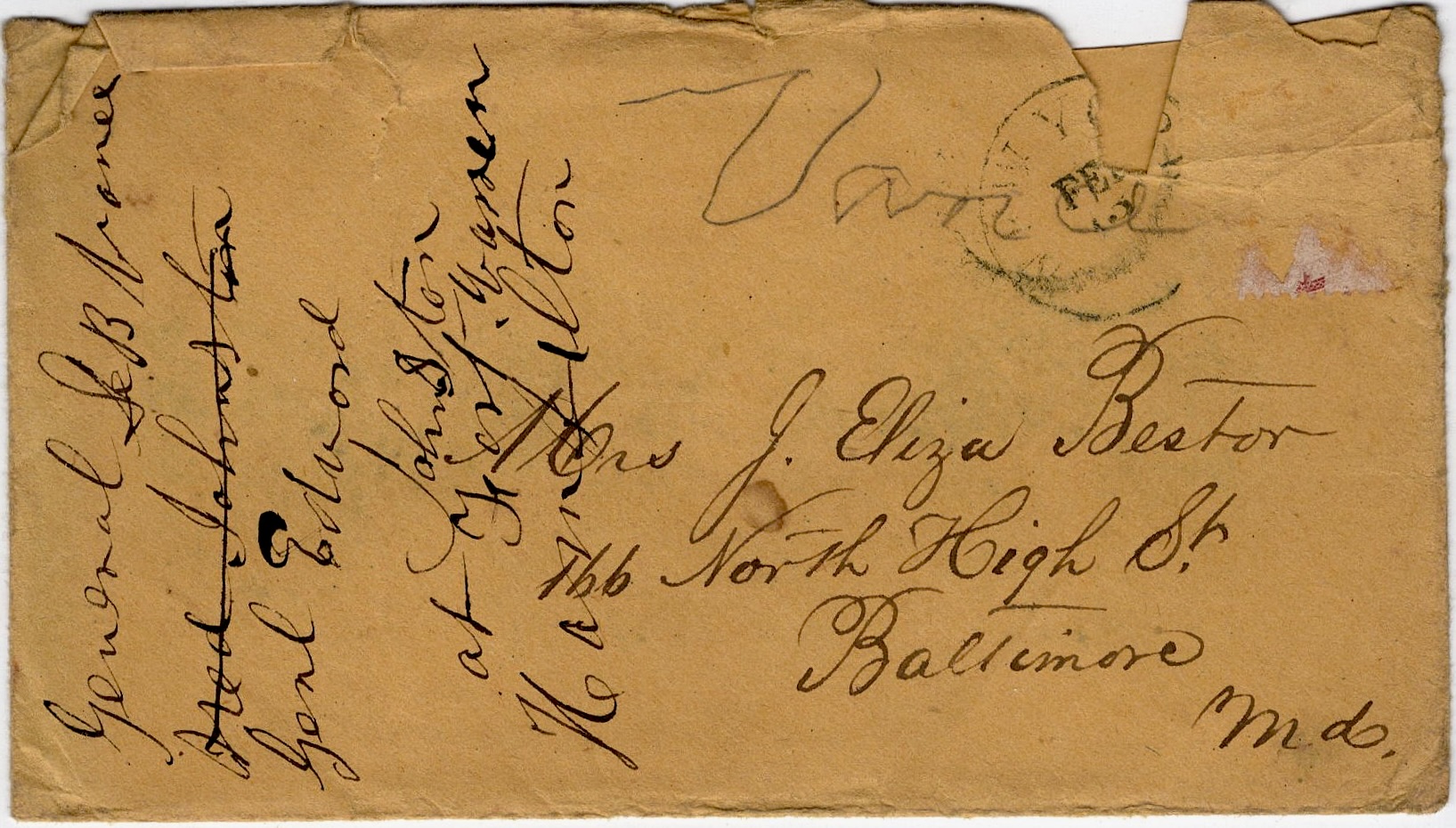
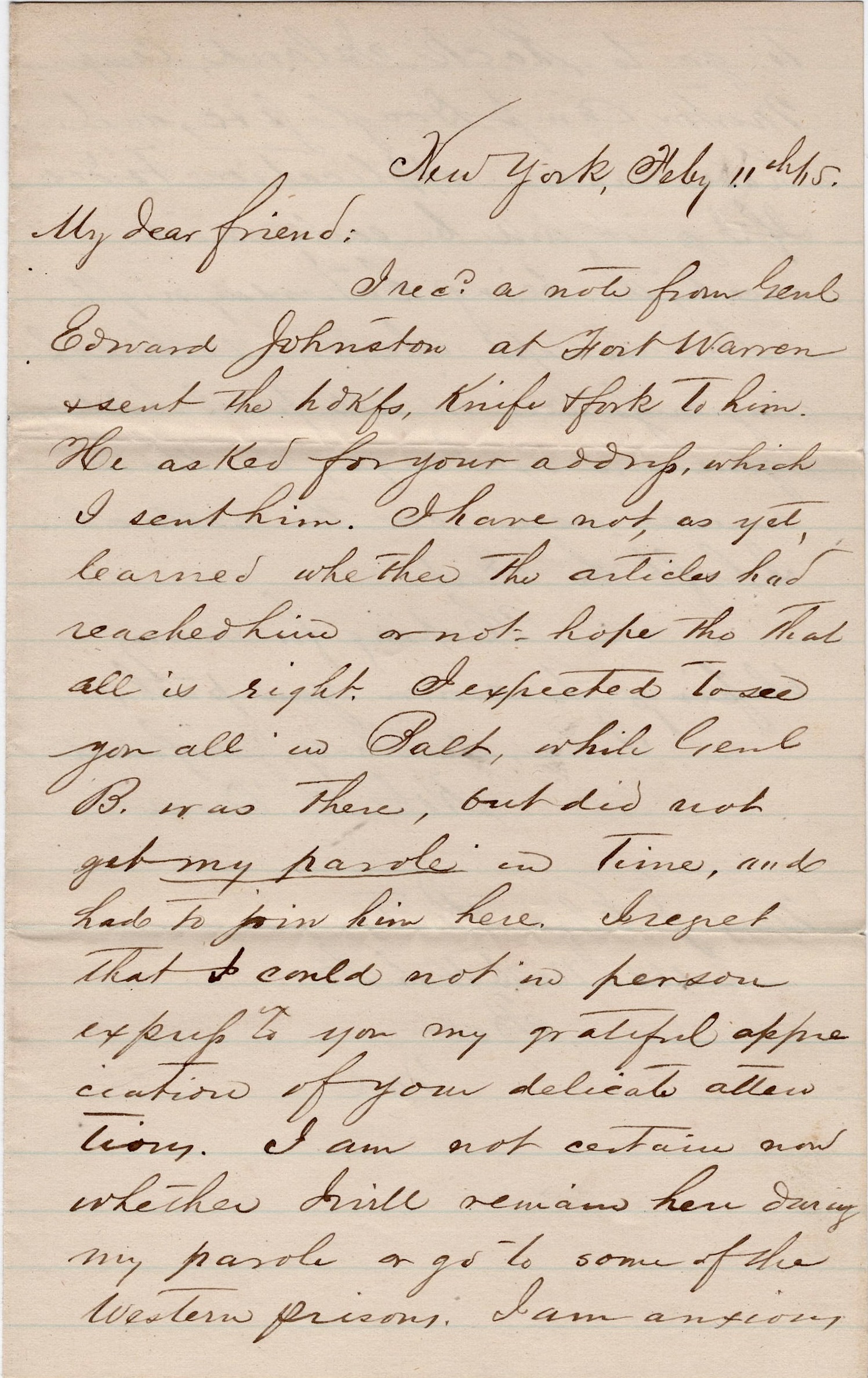
New York
February 11, 1865
My dear friend:
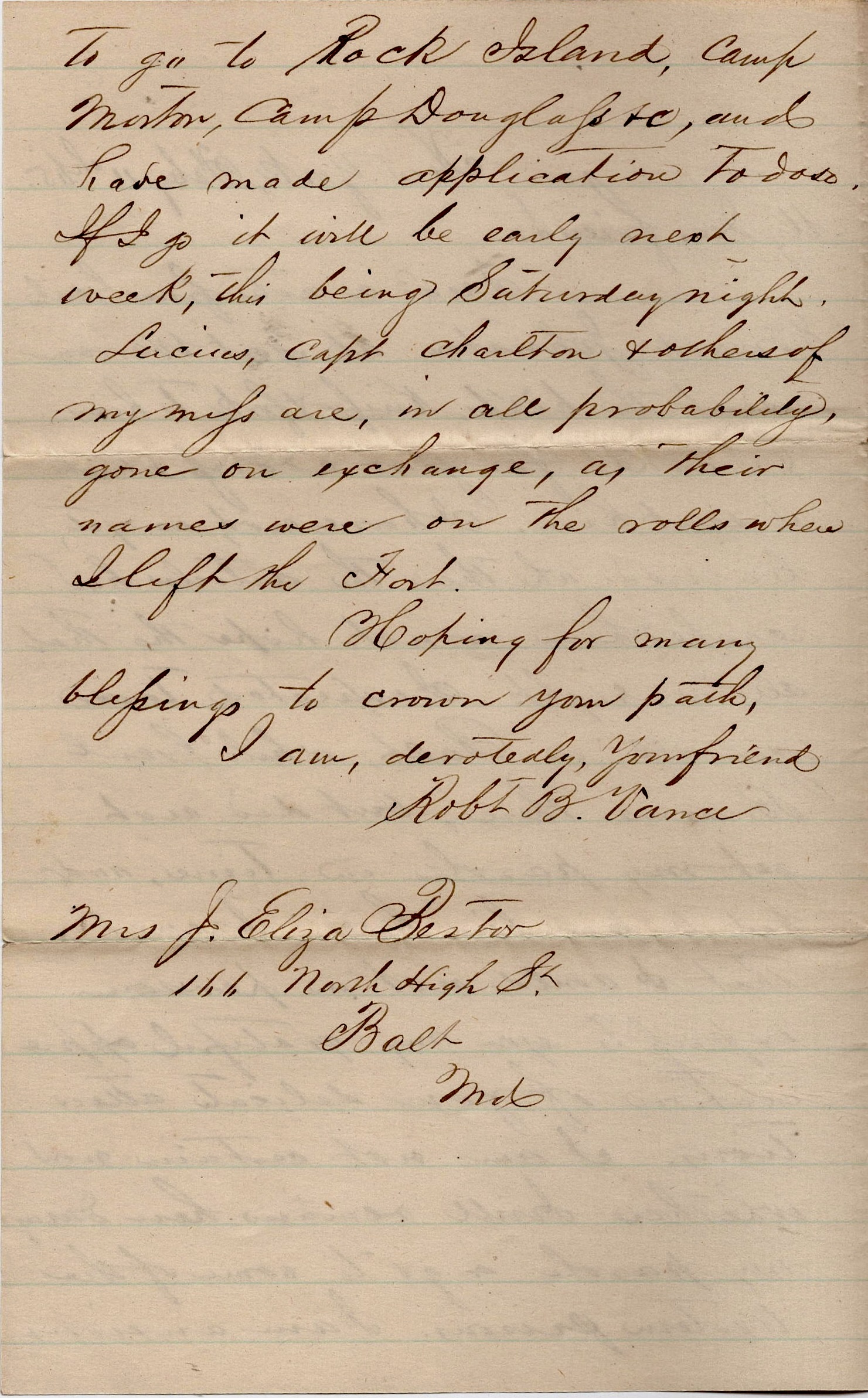
I received a note from Gen. Edward Johnson at Fort Warren & sent the handkerchiefs, knife & fork to him. He asked for your address which I sent him. I have not as yet learned whether the articles had reached him or not. Hope though that all is right. I expected to see you all in Baltimore while Genl. B. was there but did not get my parole in time and had to join him here. I regret that I could not in person express to you my grateful appreciation of your delicate attentions. I am not certain now whether I will remain here during my parole or go to some of the Western prisons. I am anxious to go to Rock Island, Camp Morton, Camp Douglass, &c., and have made application to do so.
If I go, it will be early next week, this being Saturday night. Lucius [Heylin Smith], Capt. Charlton [Hunt Morgan], 1 & others of my mess are, in all probability, gone on exchange, as their names were on the rolls when I left the Fort [Delaware]. Hoping for many blessings to crown your path, I am, devotedly your friend, — Robt. B. Vance
1 Capt. Charlton Hunt Morgan was a brother-in-law of Gen. John Hunt Morgan, and a captain in the 2nd Kentucky Cavalry Regiment. He was confined in 1864 at Fort Delaware.