My passion is studying American history leading up to & including the Civil War. I particularly enjoy reading, transcribing & researching primary sources such as letters and diaries.
The following letter was written by Franklin Monroe Hollister (1824-1893) to his wife, Lucy Dutton (Williams) Hollister (1823-1908). The couple were married in Muskingum county, Ohio, on 30 December 1852. Frank was born at Groton, New York, the oldest child of Asa Hollister and Lucretia Page. In June 1861, Frank worked as a civilian blacksmith/carriage smith in Zanesville. A Veterans Schedule reveals that Frank later served as a private in Co. C, 159th Ohio Infantry for three months (100 day Ohio National Guard) during the summer of 1864. Their duty assignment at that time was to guard railroad bridges along the Philadelphia, Wilmington & Baltimore Railroad.
Frank’s letter gives us a glimpse of the war excitement in Zanesville, Ohio, in mid-June 1861, two months after the firing on Fort Sumter.
T R A N S CR I P T I O N
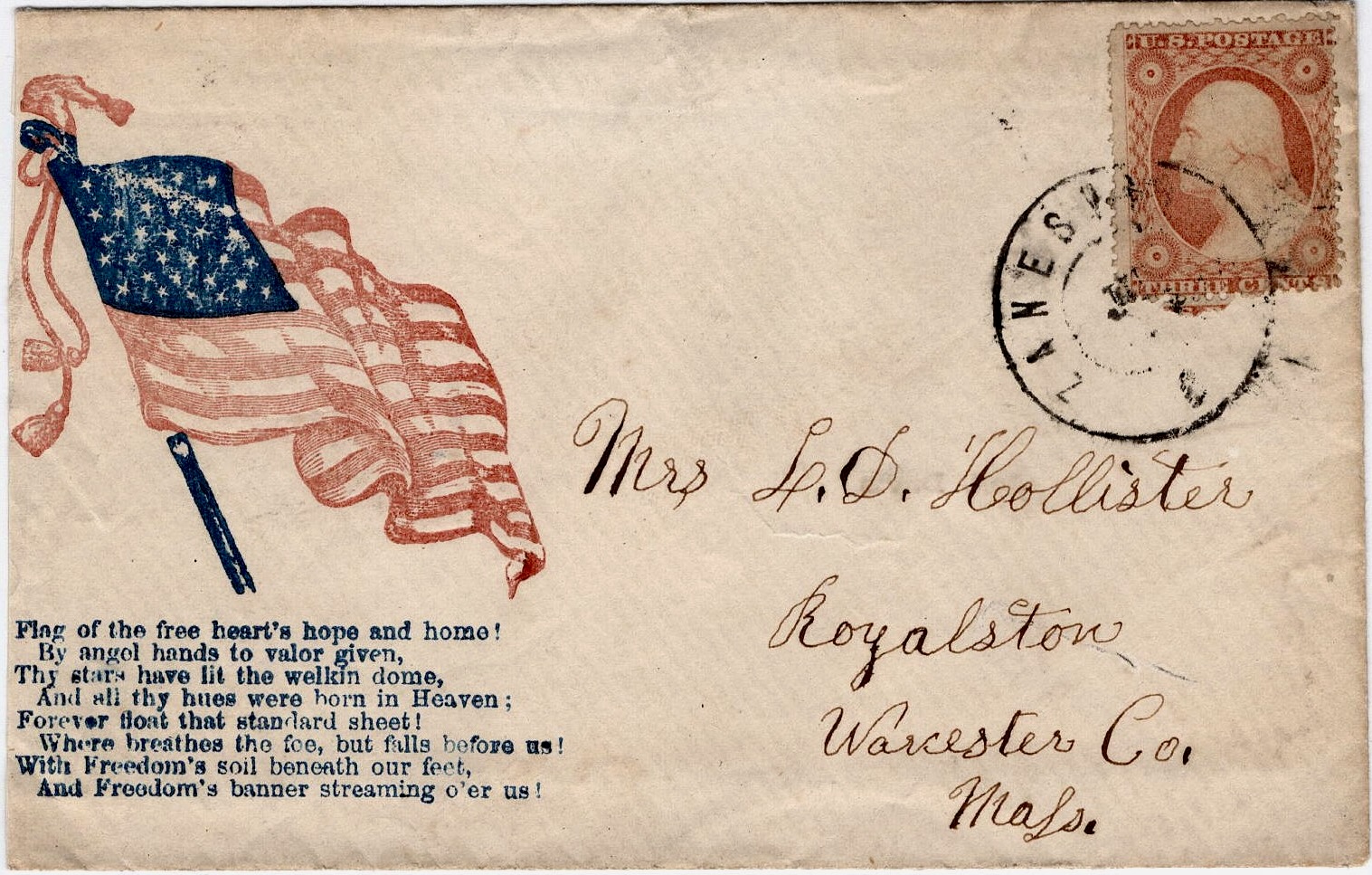
Addressed to Mrs. L. D. Hollister, Royalston, Worcester county, Mass.
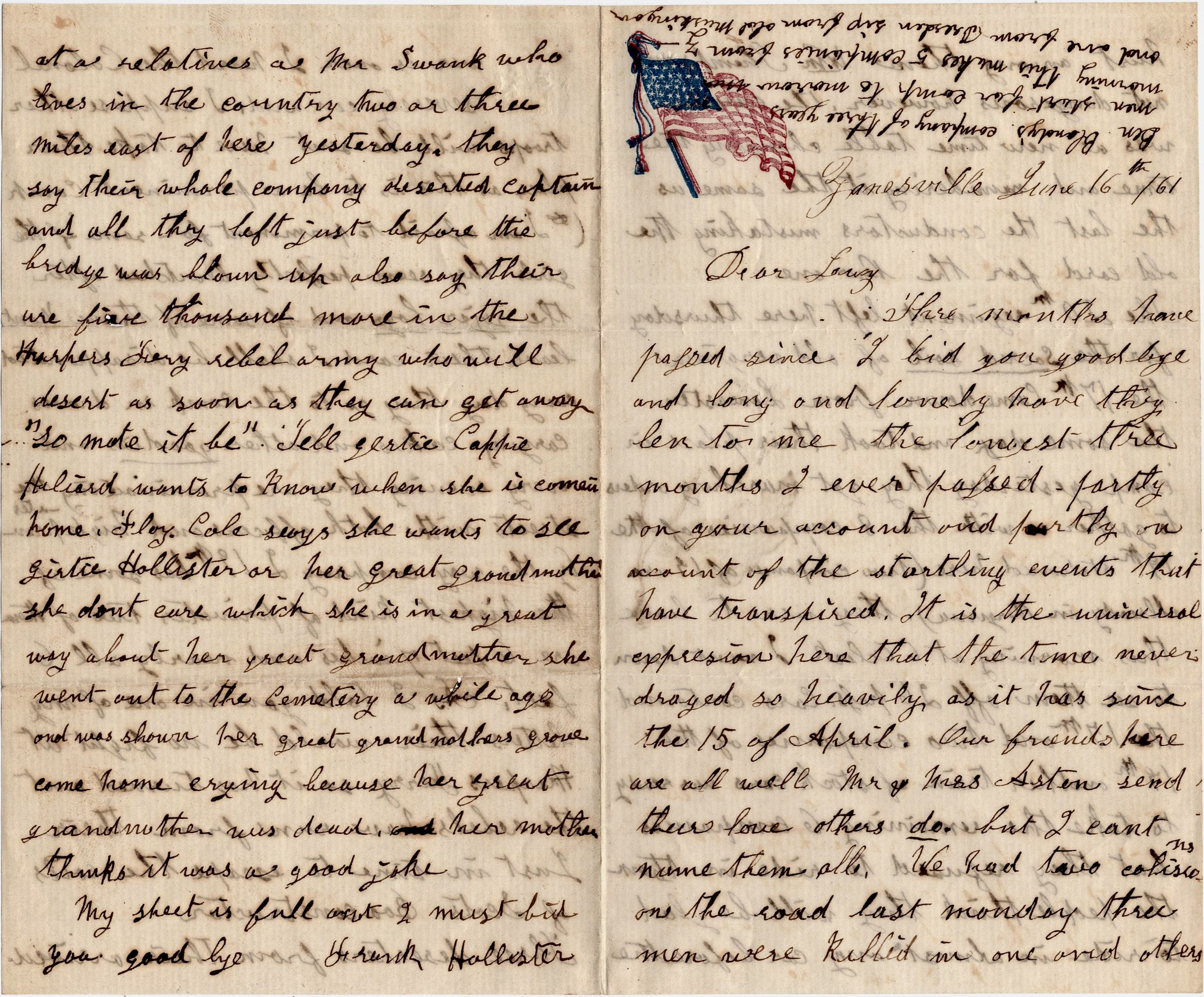
Zanesville [Ohio] June 16th 1861
Dear Lucy,
Three months have passed since I bid you goodbye and long and lonely have they been to me—the longest three months I ever passed, partly on account of your account, and partly on account of the startling events that have transpired. It is the universal expression here that the time never dragged so heavily as it has since the 15th of April. 1
Our friends here are all well. Mr. & Mrs. [Howard] Aston send their love. Others ditto. But I can’t name the all.
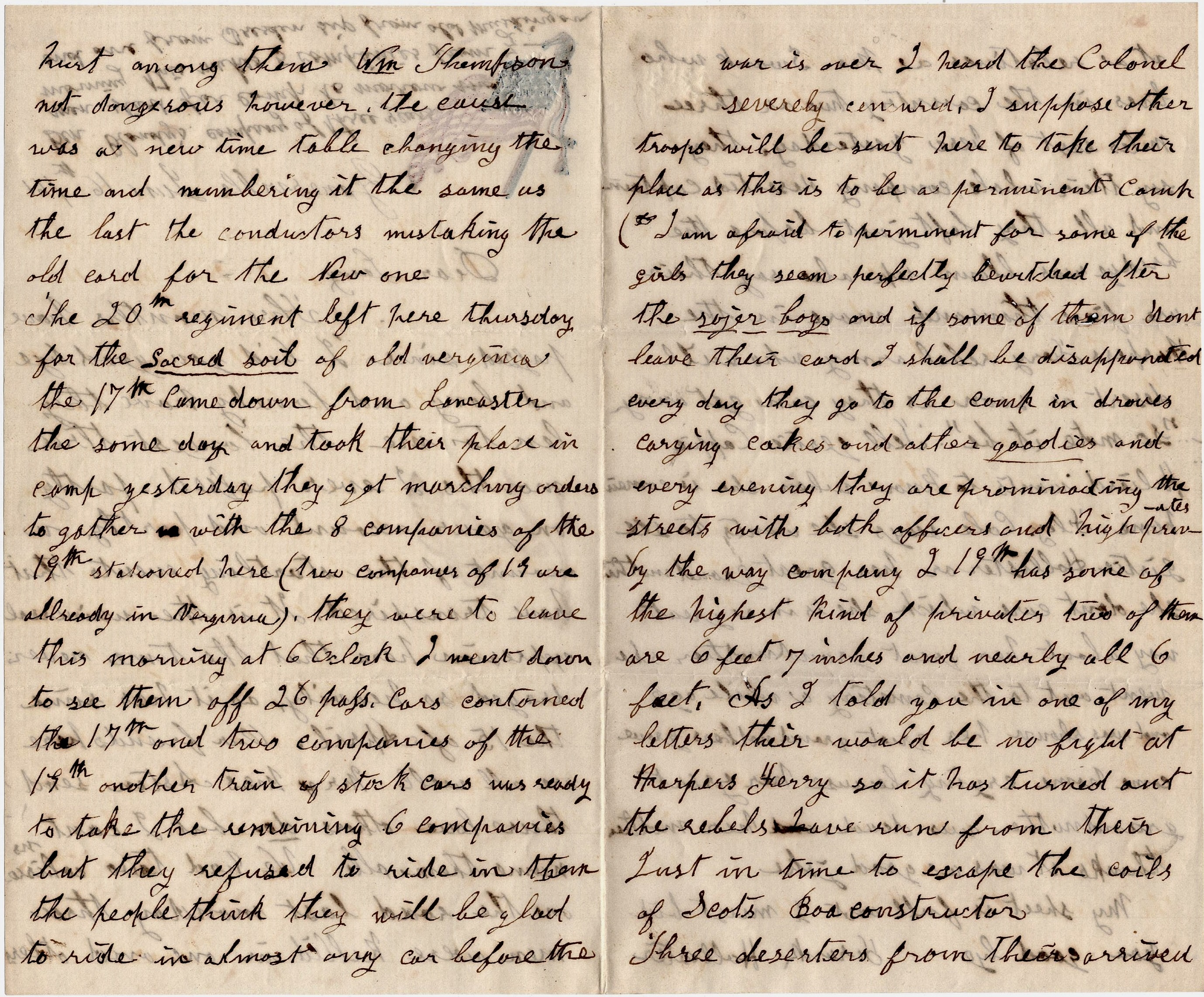
We had two collisions on the [raid]road last Monday. Three men were killed in one and others hurt. Among them William Thompson—not dangerous however. 2 The cause was a new time table changing the time and numbering it the same as the last, the conductors mistaking the old card for the new one.
The 20th [Ohio] Regiment left here Thursday for the sacred soil of Old Virginia. 3 The 17th came down from Lancaster the same day and took their place in camp yesterday. 4 They got marching orders to gather with the 8 companies of the 19th stationed here (two companies [A & B] of the 19th are already in Virginia). They were to leave this morning at 6 o’clock. I went down to see them off. Twenty-six passenger cars contained the 17th and two companies of the 19th. Another train of stock cars was ready to take the remaining 6 companies but they refused to ride in them. The people think they will be glad to ride in almost any [type of] car before the war is over. I heard the Colonel [Samuel Beatty, 19th Ohio Infantry] severely censured. 5
I suppose other troops will be sent here to take their place as this is to be a permanent camp (I am afraid too permanent, for some of the girls they seem perfectly bewitched after the sojer boys and if some of them don’t leave their card, I shall be disappointed. Every day they go to the camp in droves carrying cakes and other goodies and every evening they are promenading the streets with both officers and high privates. 6
By the way, Company I, 19th [OVI] has some of the highest kind of privates. Two of them are 6 feet 7 inches [tall] and nearly all 6 feet. As I told you in one of my letters, there would be no fight at Harpers Ferry so it has turned out. The rebels have run from there just in time to escape the coils of Scott’s boa constructor.
Three deserters from there arrived at a relatives—a Mr. Swank, who lives in the country two or three miles east of here yesterday. They say their whole company deserted, captain and all. They left just before the bridge was blown up. Also say there are five thousand more in the Harpers Ferry rebel army who will desert as soon as they can get away. “So mote it be.”
Tell Gertie [that] Cappie Hiliard wants to know when she is coming home. Floy. Cole says she want to see Gertie Hollister or her great grandmother, she don’t care which. She is in a great way about her great grandmother. She went out to the cemetery a while ago and was shown her great grandmother’s grave. [She] came home crying because her great grandmother was dead. Her mother thinks it was a good joke.
My sheet is full and I must bid you goodbye. — Frank Hollister
Ben Blandie’s company of three year’s men start for camp tomorrow morning. 7 This makes five companies from Zanesville and one from Dresden, six from Old Muskingum.
1 On April 15th, President Lincoln issued a proclamation asserting that the states which enacted ordinances of secession were in a state of insurrection, subsequently calling for 75,000 troops to quell this upheaval.
2 Possibly the same William Thompsonenumerated at Zanesville in the 1860 US Census who was born about 1835 in Maine and working in Zanesville in the Carriage business.
3 The 20th Ohio Infantry (3 months) finished their organizing and drilling in Zanesville, ohio, before receiving orders to West Virginia. They were organized at Columbus.
4 The 17th Ohio Infantry (3 Months) were mustered into service at Camp Anderson in Lancaster under the command of Colonel John. M. Connell on 5 June 1861, to date from 27 April 1861. They saw service briefly in West Virginia.
5 A drummer boy in Co. H of the 19th Ohio Infantry (3 months) wrote in his diary that eight of the companies were sent to Camp Goddard, one mile from Zanesville. It was located on the grounds of the Agricultural Society of Muskingum county (Fairgrounds)—situated in a valley surrounded by beautiful wood-covered hills. The camp was “25-30 acres in size and surrounded by a fence with substantial buildings for quarters,” he wrote. [See Diary of an Ohio Volunteer]
6 “The ladies of Zanesville, God bless their kind hearts and pretty faces, have shown themselves to be true, genuine daughters of freedom. We have received from them substantial evidences in the form of various little luxuries, such as we have not had since we left our own loved homes, of the goodness of their hearts, and the interest that they take in the welfare of those who have undertaken to vindicate the rights of our government and sustain the honor of our common country. Long may they live to greet the gallant boys of the old’ Buckeye State with their kindest and most bewitching smiles; and may they live to see the enemies of our country annihilated, and freedom established from the far East to the far West, and from the chilly North to the farthest part of the sunny South; and then long may they live to enjoy that freedom which their fair hands has so much contributed to establish.” [Diary of an Ohio Volunteer, page 22]
7 Benjamin A. Blandy (or Blandie) served as the 1st Lieutenant of Co. D, 78th Ohio Infantry (3 years men) recruited out of Zanesville. Their Colonel was Mortimer D. Leggett.
The following letter was written in two parts—the first part by Emma Maria (Cruger) Irving (1805-1867), and the second part by her husband, Dr. John Beaufain Irving (1800-1881). The letter was addressed to John’s mother, Hannah Margaret (Corbett) Irving (1775-1865), the relict of Jacob Aemilius (1767-1816). Hannah was residing in Drummondsville [Niagara Falls] Ontario, Canada, when this letter was written in February 1864. Dr. John B. and Emma (Cruger) Irving are depicted in the header based on family portraits.
In March 1846, Dr. John B. Irving—a prominent physician, author, and rice planter—purchased the 670-acre Kensington Plantation located along the eastern branch of the Cooper River in Huger (Berkeley County), just outside of Charleston, South Carolina. Dr. Irving famously documented regional antebellum life in his 1842 book, A Day on Cooper River. The main house on this plantation burned down in 1924. Major portions of the original plantation are under conservation easements today to protect the historic site. It had been previously owned by Elias Octavus Ball (see Slaves in the Family by Edward Ball, 1998).
The Irving family strongly supported the Confederacy. Because of their allegiance, Dr. Irving and his family lost their entire fortune, land, and properties by the end of the war. Following the collapse of the plantation system, the family was forced to leave South Carolina. He relocated to New York at the age of 65 to rebuild his life. His son, Aemilius Irving (1824-1873), lived in Cordesville, South Carolina, where he passed away unmarried in 1873. Another son, John Beaufain Irving II (1826-1877), went on to become a well-known portrait artist. Both sons are mentioned in this letter.
T R A N S C R I P T I O N
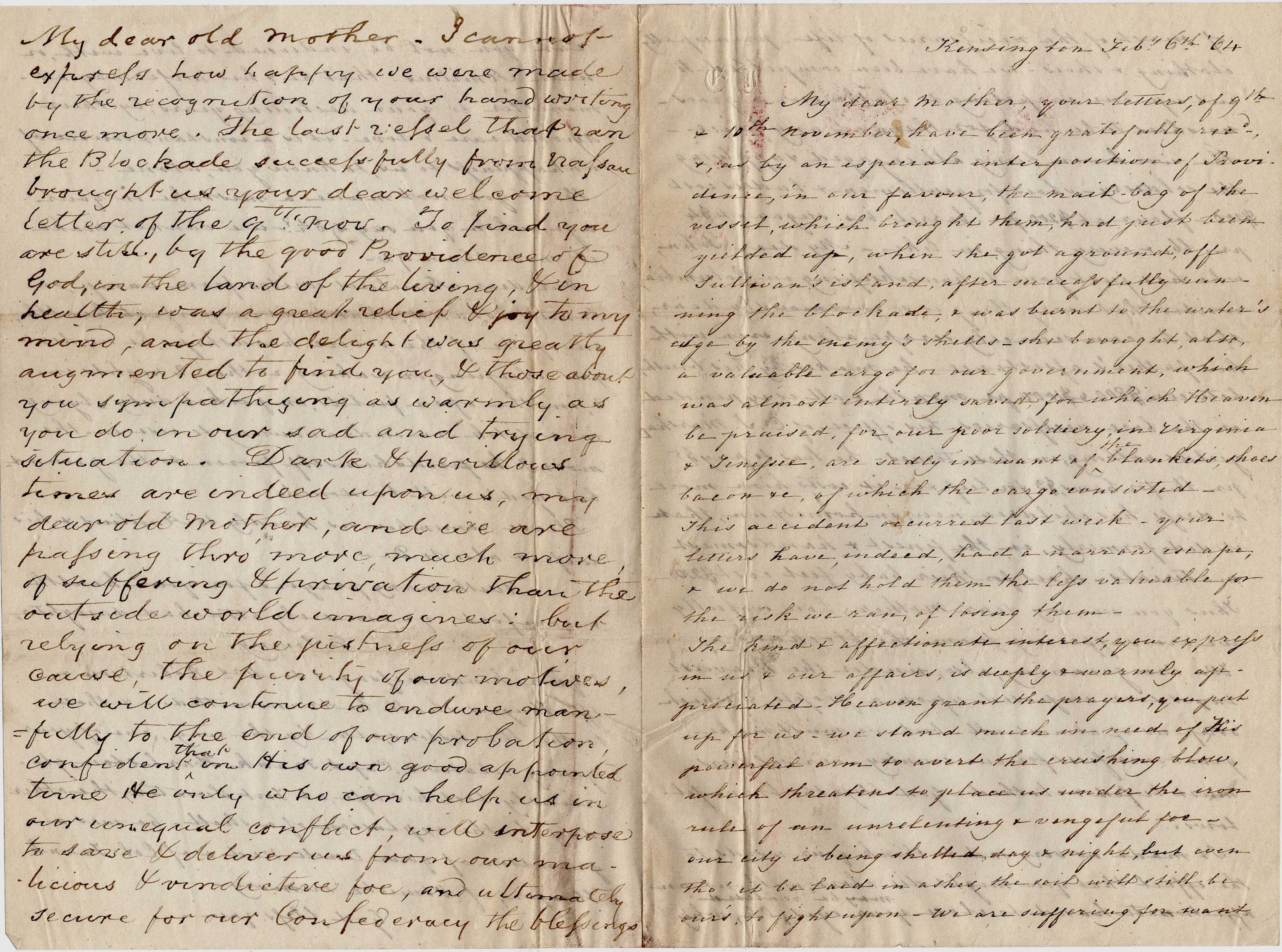
Kensington February 6th 1864
My dear Mother,
Your letters of 9th & 10th November have been gratefully received & as by an especial interposition of Providence in our favor, the mail bag of the vessel which brought them had just been yielded up when she got aground off Sullivan’s Island, after successfully running the blockade, & was burnt to the water’s edge by the enemy’s shells. She brought also a valuable cargo for our government which was almost entirely saved for which Heaven be praised, for our poor soldiery in Virginia & Tennessee are sadly in want of the blankets, shoes, bacon, &c. of which the cargo consisted. This accident occurred last week. Your letters have, indeed, had a narrow escape & we do not hold them the less valuable for the rish we ran of losing them. 1
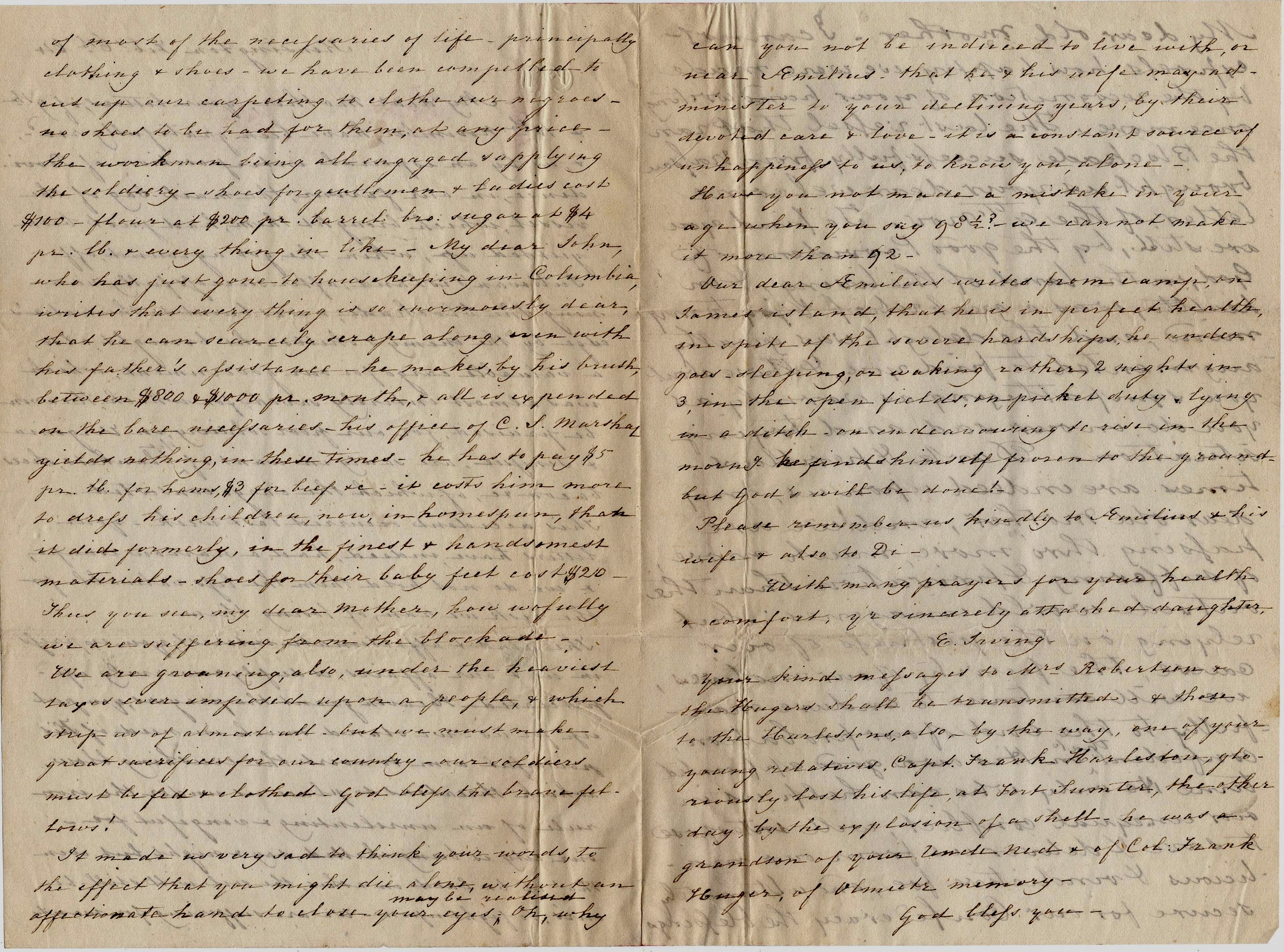
The kind & affectionate interest you express in us & our affairs is deeply & warmly appreciated. Heaven grant the prayers you put up for us. We stand much in need of His powerful arm to avert the crushing blow which threatened to place us under the iron rule of an unrelenting & vengeful foe. Our city is being shelled day 7 night, but even though it be laid in ashes, the soil will still be ours to fight upon. We are suffering for want of most of the necessaries of life—principally clothing & shoes. We have been compelled to cut up our carpeting to clothe our negroes. No shoes to be had for them at any price—the workmen being all engaged supplying the soldiery. Shoes for gentlemen & ladies cost $100, flour at $200 per barrel, brown sugar at $4 per lb., and everything in like.
My dear John [Beaufain Irving, II), who has just gone to housekeeping in Columbia, writes that everything is so enormously dear that he can scarcely scrape along even with his father’s assistance. He makes by his brush between $800 and $1.000 per month and all is expended on the bare necessaries. His office of C. S. Marshall yields nothing in these times. He has to pay $5 per pound for hams, $3 for beef, &c. It costs him more to dress his children now in homespun than it did formerly in the finest and handsomest materials. Shoes for their baby feet cost $20. Thus, you see, my dear Mother, how awfully we are suffering from the blockade. We are groaning also under the heaviest taxes ever imposed upon a people and which strip us of almost all. But we must make great sacrifices for our country. Our soldiers must be fed and clothed. God bless the brave fellows!
It made us very sad to think your words to the effect that you might die alone without an affectionate hand to close your eyes may be realized. Oh, why can you not be induced to live with or near Aemilius—that he and his wife may administer to your declining years by their devoted care and love. It is a constant source of unhappiness to us to know you alone.
Have you made a mistake in your age when you say 98 1/2? we cannot make it more than 92.
Our dear Aemilius writes from camp on James Island that he is in perfect health in spite of the severe hardships he undergoes—sleeping, or waking rather, two nights in three in the open fields, on picket duty, lying in a ditch, or endeavoring to rise in the morning he finds himself frozen to the ground. But God’s will be done!
Please remember us kindly to Aemilius & his wife & also to Dr. With many prayers for your health and comfort, your sincerely attached daughter, — E[mma] Irving
Your kind messages to Mrs. Robertson & the Hugers shall be transmitted & those to the Harleston’s also. By the way, one of your young relatives, Capt. Frank [Huger] Harleston, gloriously lost his life at Fort Sumter the other day by the explosion of a shell. He was a grandson of your uncle Ned and of Col. Frank Huger of Olm___ memory. God bless you.
[In a different hand]
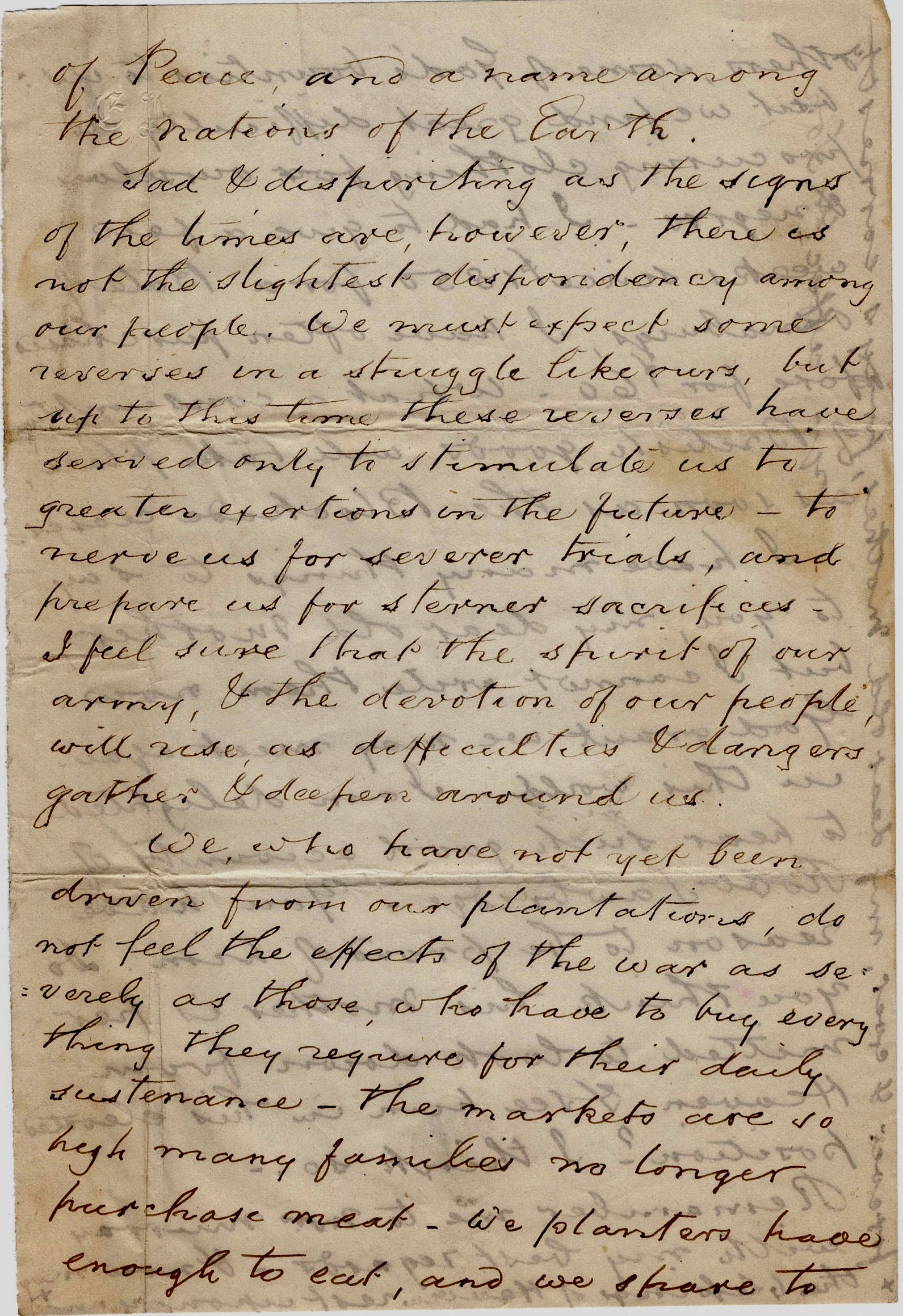
My dear old Mother. I cannot express how happy we were made by the recognition of your handwriting once more. The last vessel that ran the blockade successfully from Nassau brought us your dear welcome letter of the 9th November. To find you are still, by the good Providence of God, in the land of the living & in health was a great relief & joy to my mind, and the delight was greatly augmented to find you & those about you sympathizing as warmly as you do in our sad and trying situation.
Dark and perilous times are indeed upon us, my dear old mother, and we are passing through more—much more, of suffering & privation that the outside world imagines. But relying on the justness of our cause, the purity of our motives, we will continue to endure manfully to the end of our probation, confident that in His own good appointed time our unequal conflict will interpose to save & deliver us from our malicious & vindictive foe, and ultimately secure for our Confederacy the blessings of peace, and a name among the nations of the Earth.
Sad & dispiriting as the signs of the times are, however, there is not the slightest despondency among our people. We must expect some reverses in a struggle like ours. But up to this time, these reverses have served only to stimulate us to greater exertions in the future—to nerve us for severer trials and prepare us for sterner sacrifices. I feel sure that the spirit of our army & the devotion of our people will rise as difficulties & dangers gather & deepen around us.
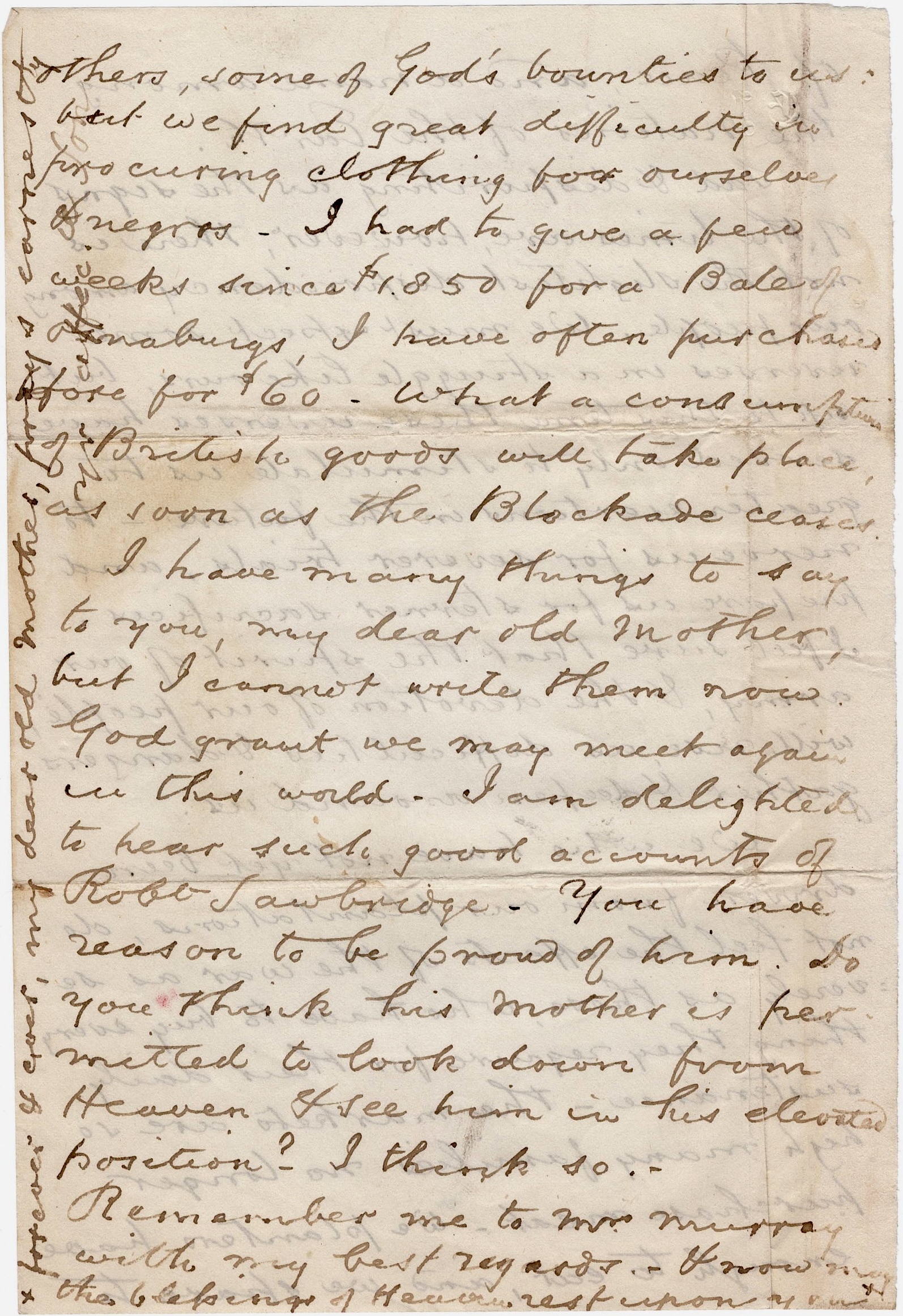
We have not yet been driven from our plantations, do not feel the effects of the war as severely as those who have to buy everything they require for their daily sustenance. The markets are so high many families no longer purchase meat. We planters have enough to eat and we share to others some of God’s bounties to us. But we find great difficulty for ourselves & negroes. I had to give a few weeks since $1,850 for a bale of [ ]. I have often purchased before for $60. What a consumption of Brotish goods will take place as soon as the blockade ceases.
I have many things to say to you, my dear old mother, but I cannot write them now. God grant we may meet again in this world. I am delighted to hear such good accounts of Robert Towbridge. You have reason to be proud of him. Do you think his mother is permitted to look down from Heaven & see him in his elevated position? I think so.
Remember me to Mrs. Murray with my best regards. & now, may the blessings of Heaven rest upon you forever & ever, my dear old mother, prays earnestly your affectionate son.
1 The blockade runner was the side-wheeled Presto. “At daylight on February 2, 1864, Union blockaders discovered that the blockade runner Presto had run ashore just to the east of Fort Moultrie while attempting to enter the harbor. Admiral Dahlgren noticed the stranded vessel and ordered the advance monitor to open fire at a range of 2,500 yards on the steamer. The other monitors advanced and began a general fire on the steamer. Union land batteries also opened fire and by morning large holes in the hull and wheel boxes appeared. Confederate batteries answered in return. By 1 PM the mainmast was cut away and the vessel was in flames. Several shells passed through below the waterline and most likely damaged machinery and cargo. The wreck was bombarded for a couple of more days causing it to burn to the waterline. The Passaic had picket duty the night of the 3rd and stationed a picket boat near the stricken vessel to detect any enemy movement on her. From February 2-4 Union land batteries fired 769 projectiles from 30-pounders to 300-pounder Parrotts at the wreck. During this time Confederate batteries on Sullivan’s and James Islands returned a steady barrage at the Union batteries. By the end of the Union cannonade the hull was shattered and had the appearance of breaking apart. A Boston Herald article reported a shell from a 200-pounder Parrott from Fort Wagner nearly cut the vessel in two. Union forces later gathered intelligence that the steamer was the Presto from Nassau.” [Source: Shipwrecks off Sullivan’s Island During the Civil War.] Reports are that the Presto carried a cargo of lead, bacon and spirits when it was driven ashore. But when Confederate soldiers rushed out to salvage the ruined cargo, instead of bring back vital military goods, they recovered the massive stash of liquor which led to the “Grand Drunk.” [See The Grand Drunk]
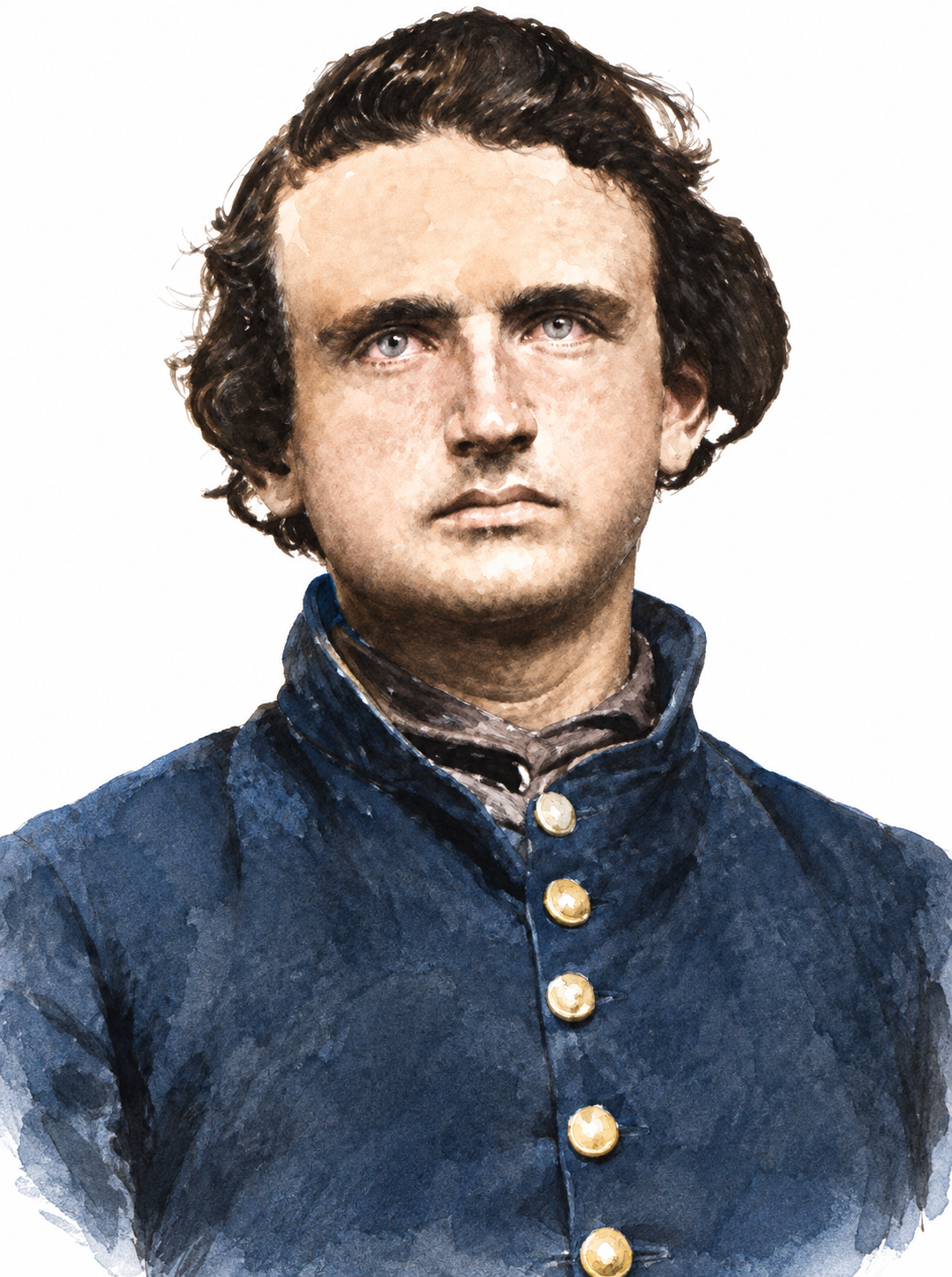
I could not find an image of James but here is one of Pvt Dennis Crowley who also served in the 96th Illinois Infantry (Ancestry)
This letter was written by James A. Beck (1843-1931) to his father, Irish emigrant James Beck of Gages Lake, Lake county, Illinois. James enlisted when he was 18 years old as a private in Co. B, 96th Illinois Infantry and served three years. He mustered out of the service on 10 June 1865. After he returned home from the war, James married Abigail E. Smith (1847-1939) and took up farming in Gurnee, Lake county, Illinois.
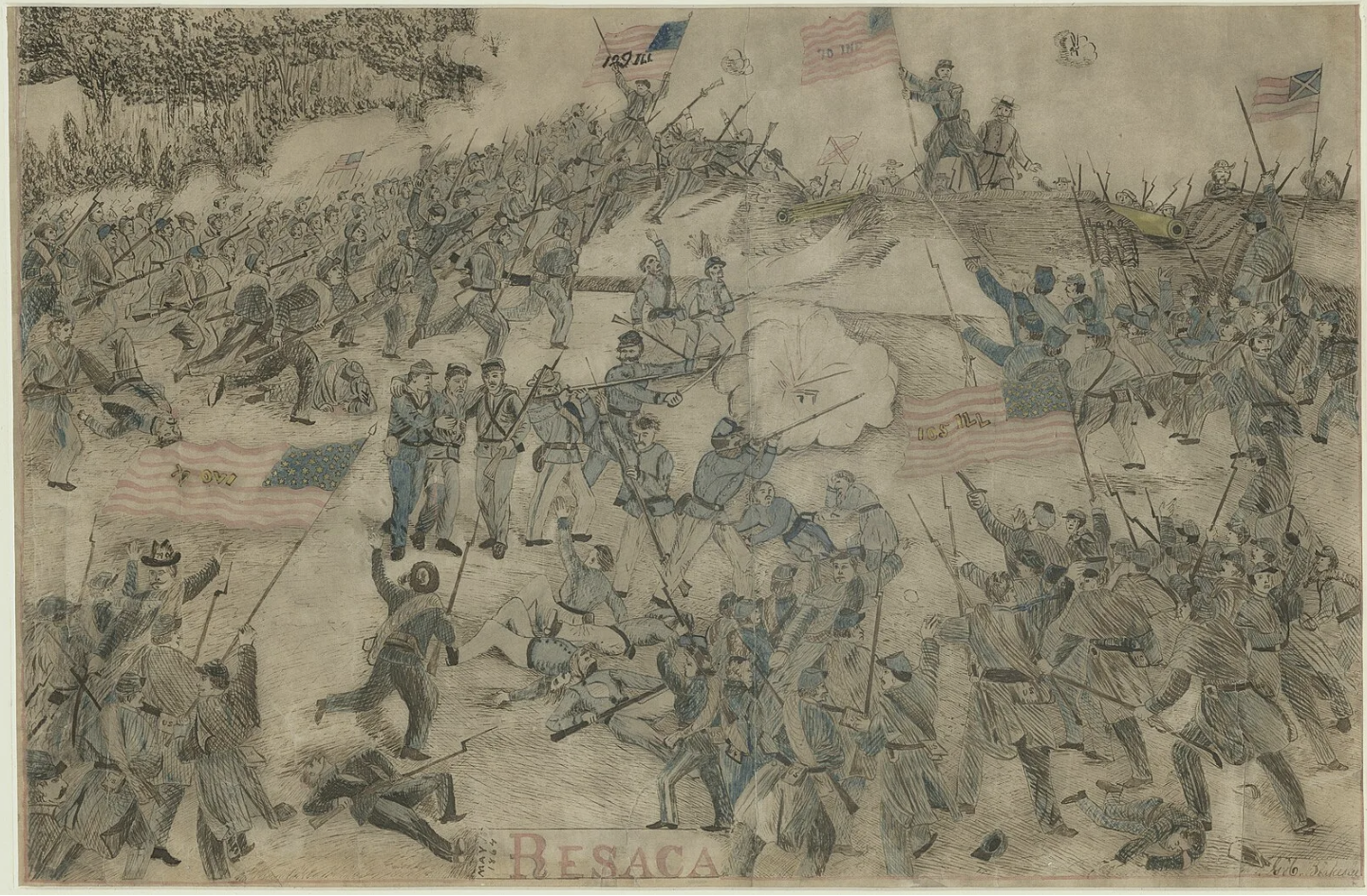
Beck’s letters describes the early engagements of the 96th Illinois Infantry on the Atlanta Campaign, including the harrowing, chaotic engagement and narrow escape at the Battle of Resaca on 14 May 1864 which he called “a damd hard fight.” As Joe Johnston’s forces mounted a strong counterattack under the command of Gen. John Bell Hood, the 96th Illinois and 115th Illinois Regiments (in the 4th Army Corps) found themselves outflanked by Confederate troops that led to a disorganized hasty retreat. According to the History of the Ninety-Sixth Regiment, nearly half of the men who survived emerged with bullet holes through their clothing. As stated in his letter, the Union flank was bolstered by the timely arrival of Joe Hooker’s 20th Army Corps.
A Soldier’s depiction of the Battle of Resaca
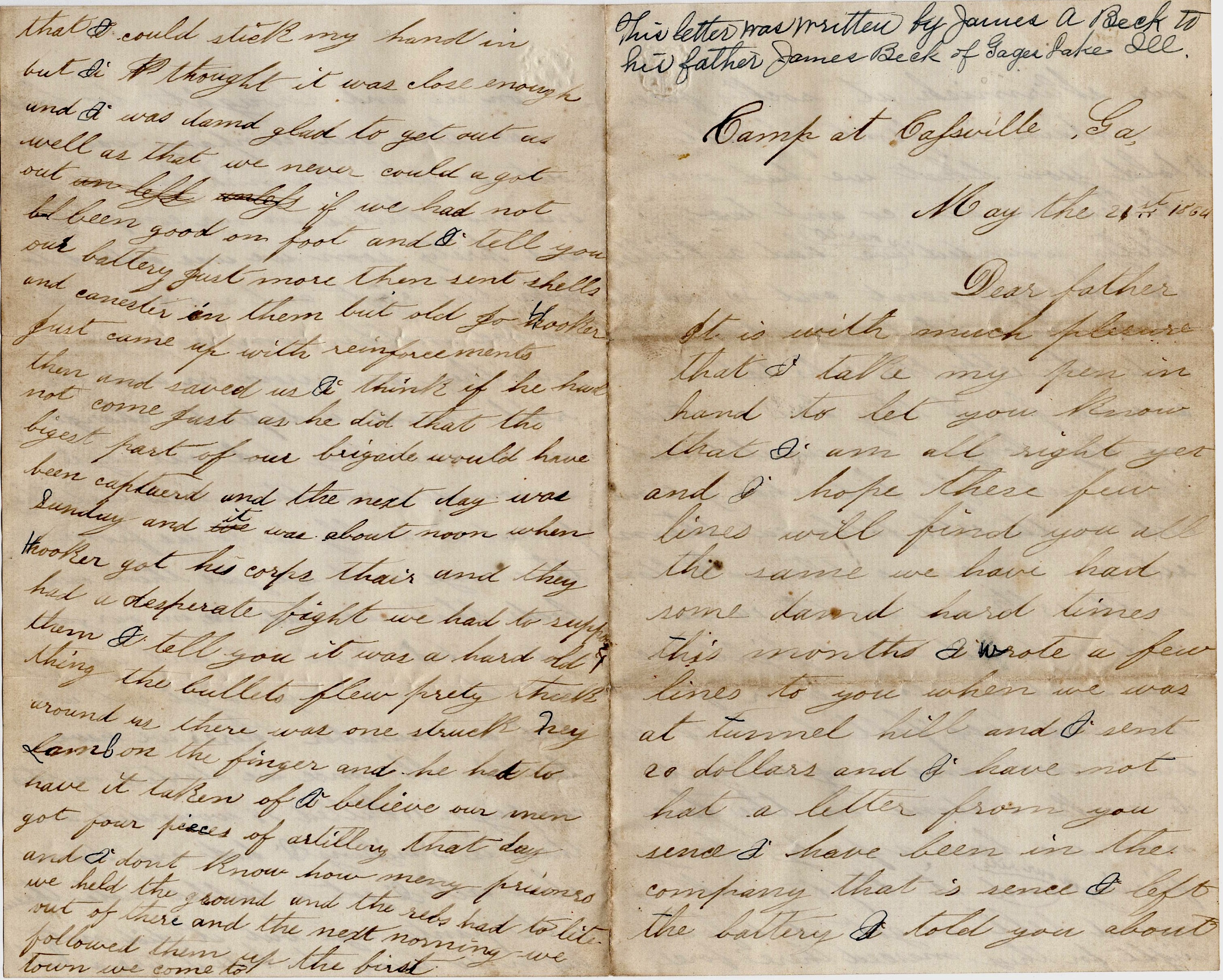
T R A N S C R I P T I O N
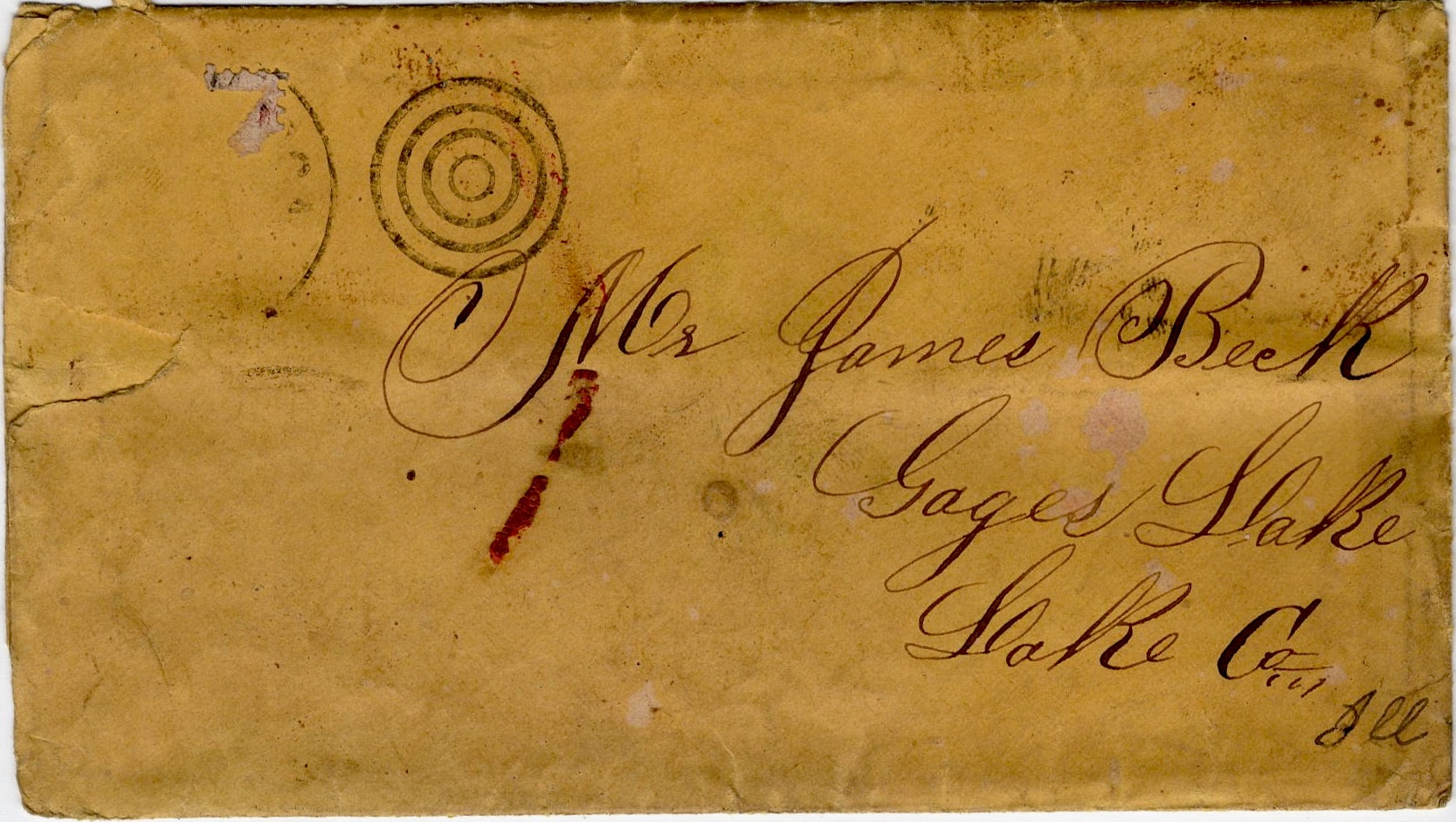
Directed to Mr. James Beck, Gages Lake, Lake county, Illinois
Camp at Cassville, Georgia May the 21st 1864
Dear father,
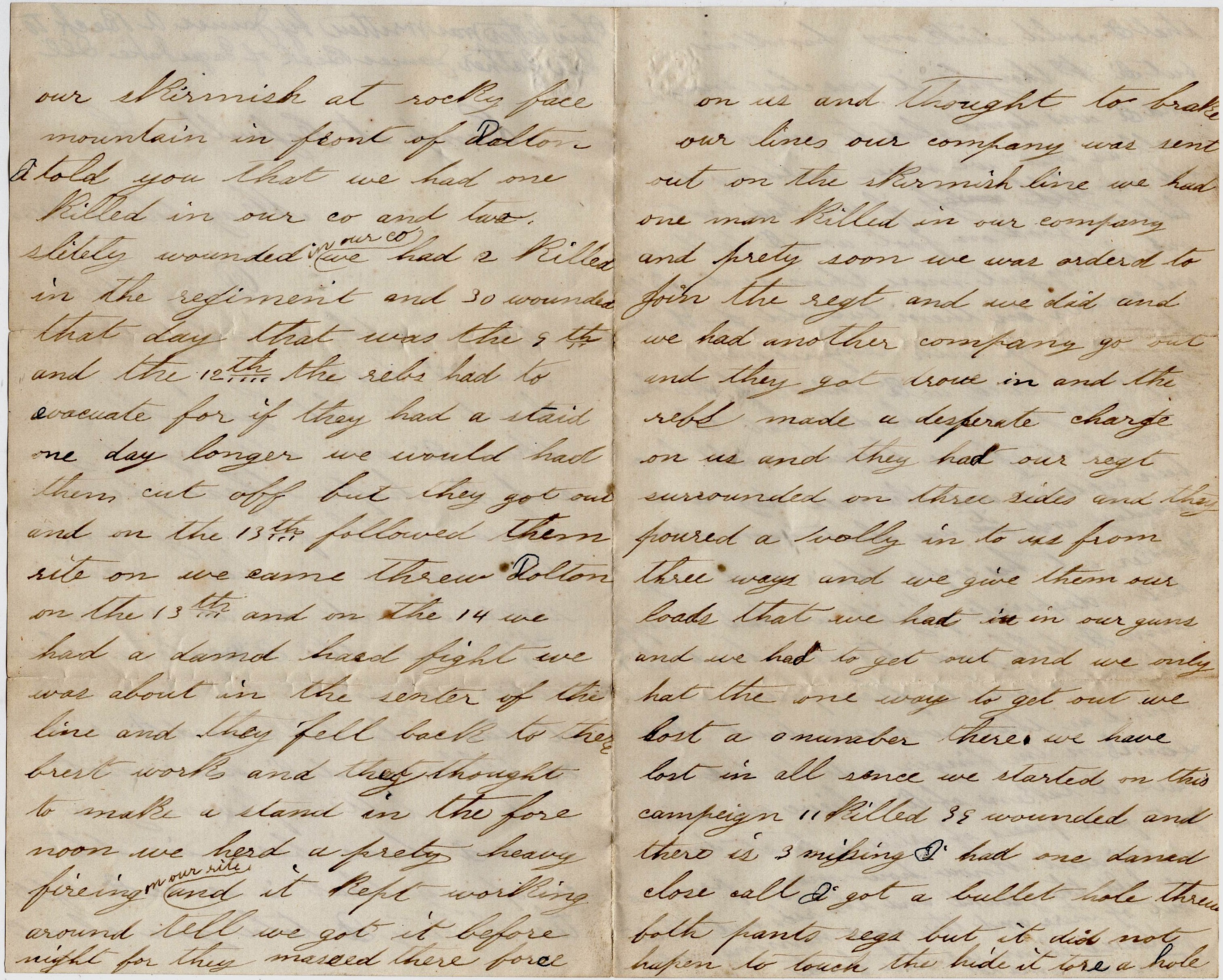
It is with much pleasure that I take my pen in hand to let you know that I am all right yet and I hope these few lines will find you all the same. We have had some damned hard times this month. I wrote a few lines to you when we was at Tunnel Hill and I sent 20 dollars and I have not had a letter from you since I have been in the company—that is, since I left the battery.
I told you about our skirmish at Rocky Face Mountain in front of Dalton. I told you that we had one killed in our company and two slightly wounded in our company. We had 2 killed in the regiment and 30 wounded that day. That was the 9th and the 12th the rebs had to evacuate for if they had a stayed one day longer, we would had them cut off. But they got out and on the 13th followed them right on. We came through Dalton on the 13th and on the 14th, we had a damned hard fight. We was about in the center of the line and they fell back to their breastworks and they thought to make a stand in the forenoon.
We heard a pretty heavy firing on our right and it kept working around till we got it before night for they massed their force on us and thought to break our lines. Our company was sent out on the skirmish line. We had one man killed in our company and pretty soon we was ordered to join the regiment and we did and we had another company go out and they got drove in and the rebs made a desperate charge on us and they had our regiment surrounded on three sides and they poured a volley into us from three ways and we give them our loads that we had in our guns and we had to get out. And we only had the one way to get out. We lost in all since we started on this campaign 11 killed, 35 wounded, and there is 3 missing.
I had one damned close call. I got a bullet hole through both pants legs but it did not happen to touch the hide. It tore a hole that I could stick my hand in but I thought it was close enough and I was damned glad to get out as well as that. We never could a got out if we had not been good on foot and I tell you, our battery just more than sent shells and canister in them. But Old Joe Hooker just came up with reinforcements then and saved us. I think if he had not come just as he did, that the biggest part of our brigade would have been captured.
And the next day was Sunday and it was about noon when Hooker got his corps there and they had a desperate fight. We had to support them. I tell you, it was a hard old thing. The bullets flew pretty thick around us. There was one struck Ney [Nate] Lamb [of Co. G] on the finger and he had to have it taken off. I believe our men got four pieces of artillery that day and I don’t know how many prisoners out of there and the next morning we followed them up. The first town we came to…[unfinished & unsigned letter]
The following letter was written by Addison “Lee” Ewing (1837-1914) of Haubstatd, Indiana. He enlisted and mustered into Co. C, 63rd Indiana Infantry og May 1, 1862, and was promoted to 2nd Lieutenant on 2 October 1862, which rank he held throughout the Atlanta Campaign which he describes in this letter. Later, in October 1864, he was promoted to Captain of Co. I. and then resigned due to disability in April 1865.
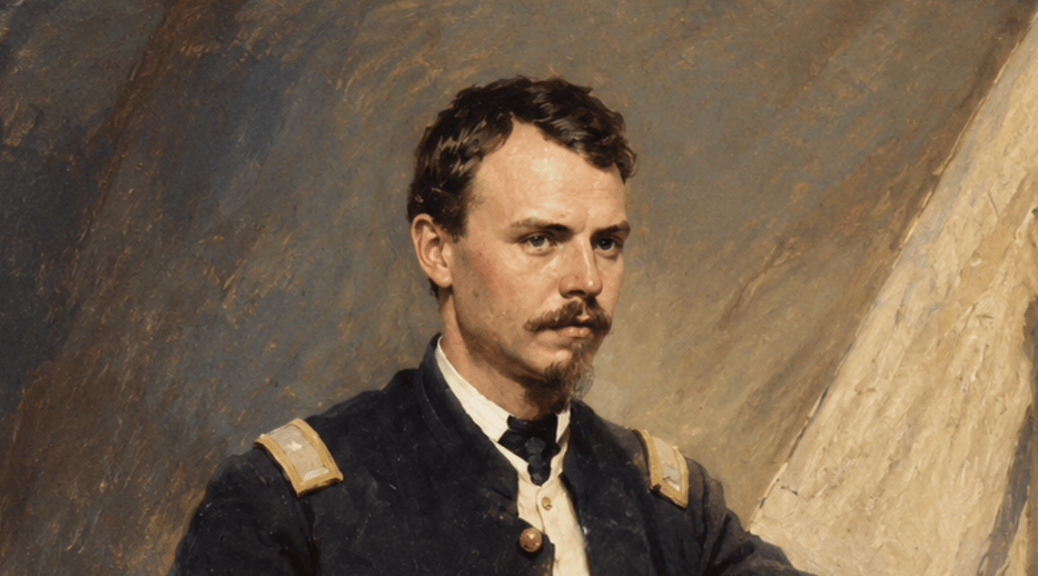
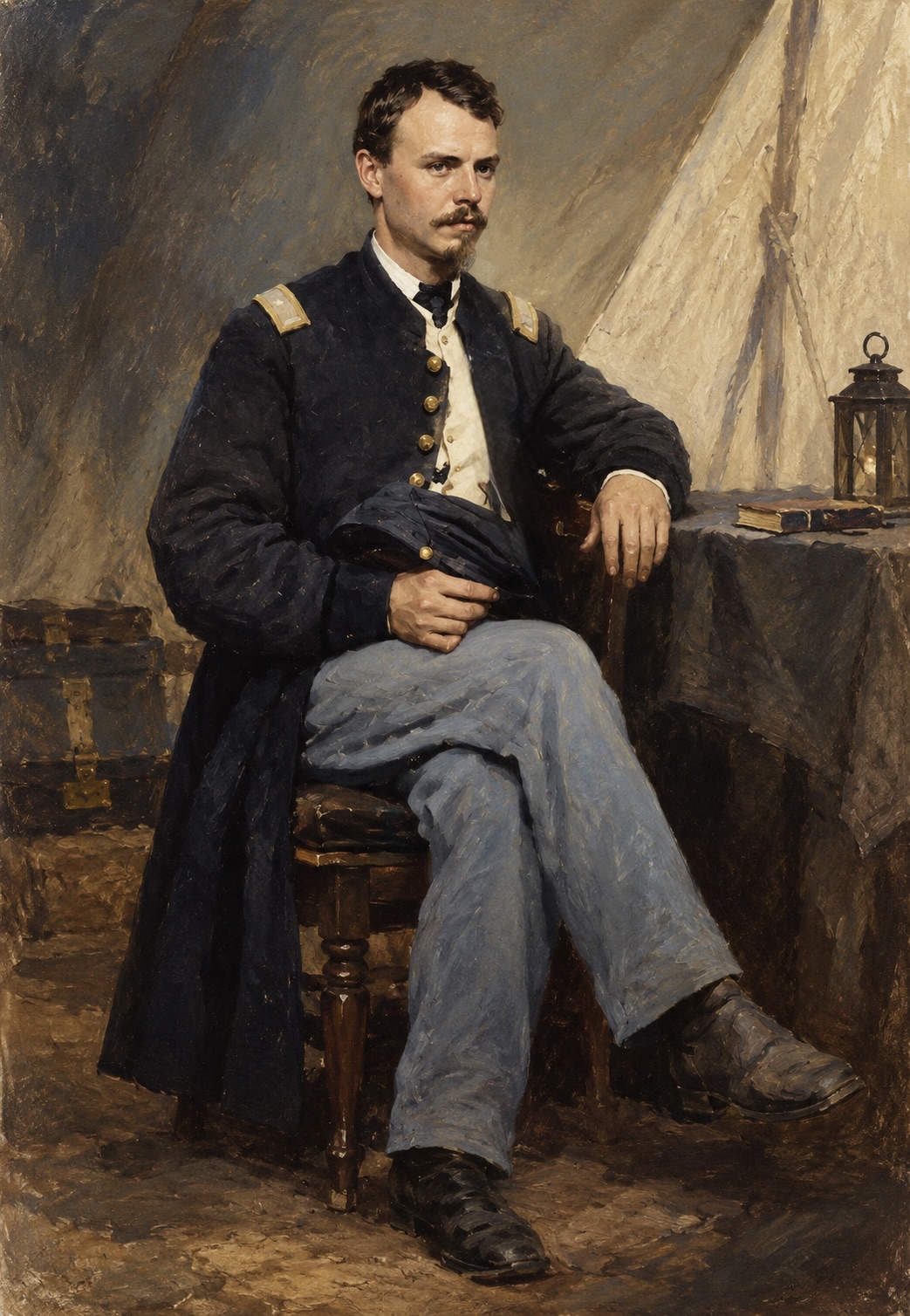
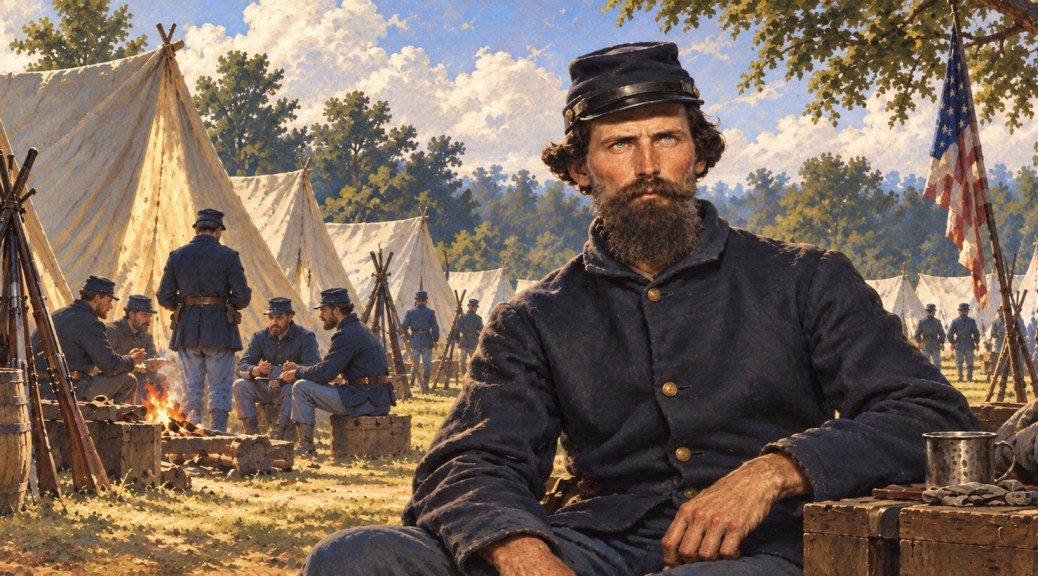
Capt. Addison Lee Ewing, 63rd Indiana Infantry (AI generated painting from tintype on Find-A-Grave)
As he mentions in the letter, the regiment saw its first real battle at Second Bull Run on 27 May 1862. They were not seriously tested again until the Atlanta Campaign where they fought at Rocky Face Ridge and Resaca. At the latter place the brigade, with the 63d in the front line, charged across an open field, more than half a mile in extent, under terrific fire and took a portion of the enemy’s works, its loss being 18 killed and 94 wounded. It overtook the enemy at Cassville and drove him all the following day.
It took position at Dallas, where it lay in entrenchments until June 1, under the fire of three batteries, and was in line of battle from June 3 to 6. It was then in reserve until the 15th when it again took the front line near Lost Mountain. It was under fire at the Kennesaw line, crossed Nose’s Creek under a heavy fire, and was then in entrenchments until July 1. It reached Atlanta July 20 and was in the engagement of the 22nd. It was in various movements about Atlanta until Sept. 5 and then moved to Decatur, where it remained until Oct. 4, when it joined the force sent to intercept Hood.
From Dalton it marched to Nashville and Pulaski and then fell back before Hood’s advance, being engaged daily. It participated in the battle of Franklin, repulsing repeated assaults, was also at the battle of Nashville; joined in the pursuit of Hood as far as the Tennessee River; moved on Jan. 16, 1865, for Alexandria, Va., and sailed from there on Feb. 3, for Fort Fisher, N. C.
T R A N S C R I P T I O N
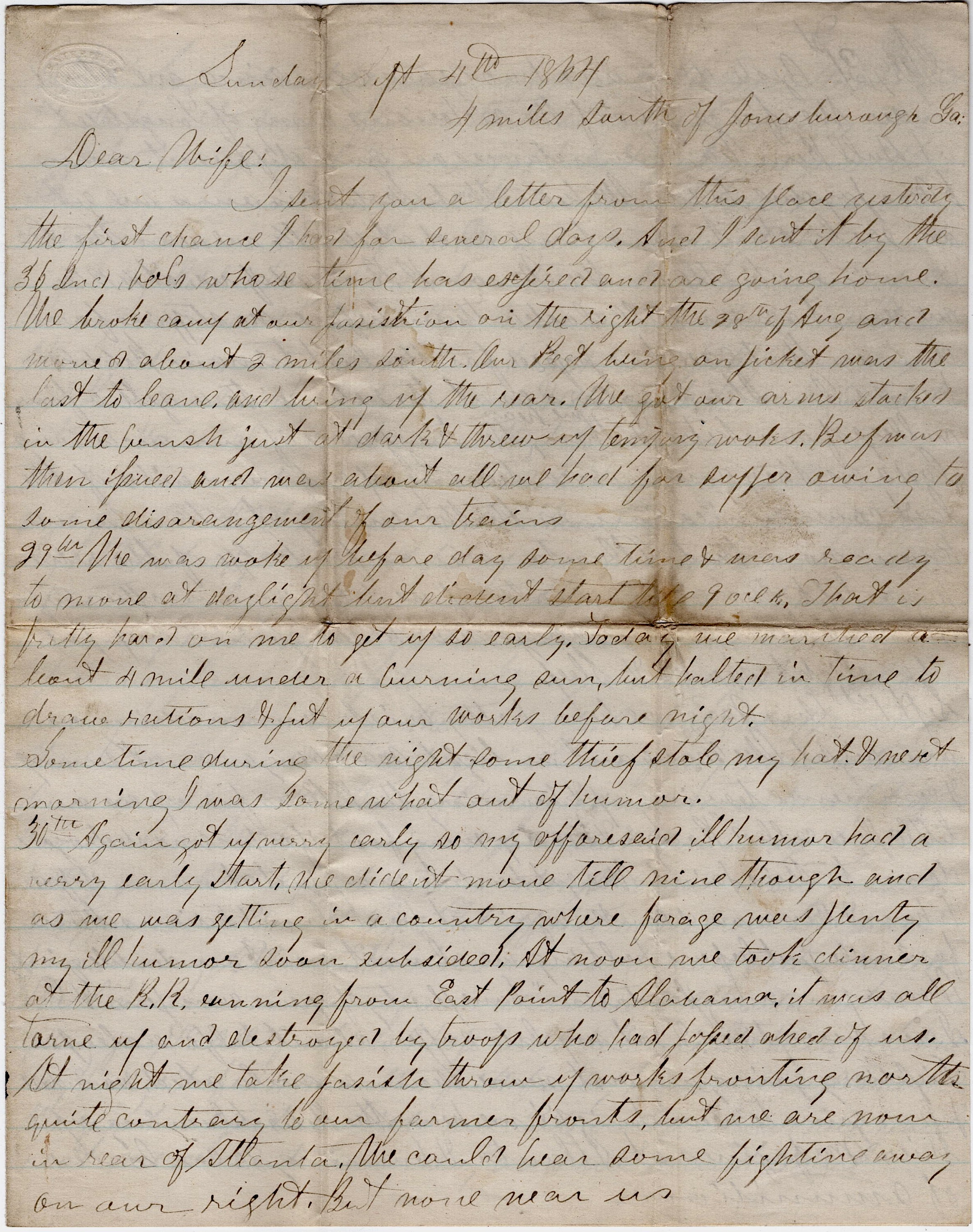
Sunday, September 4th 1864 4 miles south of Jonesboro, Georgia
Dear Wife,
I sent you a letter from this place yesterday—the first chance I had for several days. And I sent it by the 36th Indiana Volunteers whose time had expired and are going home.
We broke camp at our position on the right the 28th of August and moved about two miles south. Our regiment being on picket was the last to leave, and bring up the rear. We got our arms stacked in the brush just at dark & threw up temporary works. Beef was then issued and was about all we had for supper owing to some disarrangement of our trains.
29th. We was woke up before day some time & was ready to move at daylight but didn’t start till 9 o’clock. That is pretty hard on me to get up so early. Today we marched about 4 miles under a burning sun, but halted in time to draw rations & put up our works before night. Some time during the night some thief stole my hat & next morning I was somewhat out of humor.
30th. Again gorgeous up very early so my aforesaid humor had a very early start. We didn’t move till nine though and as we was getting in a country where forage was plenty, my ill humor soon subsided. At noon we took dinner at the railroad running from East Point to Alabama. It was all tore up and destroyed by troops who had passed ahead of us. At night we take [ ] throw up works fronting north, quite contrary to our former fronts. But we are now in rear of Atlanta. We could hear some fighting away on our right but none near us.
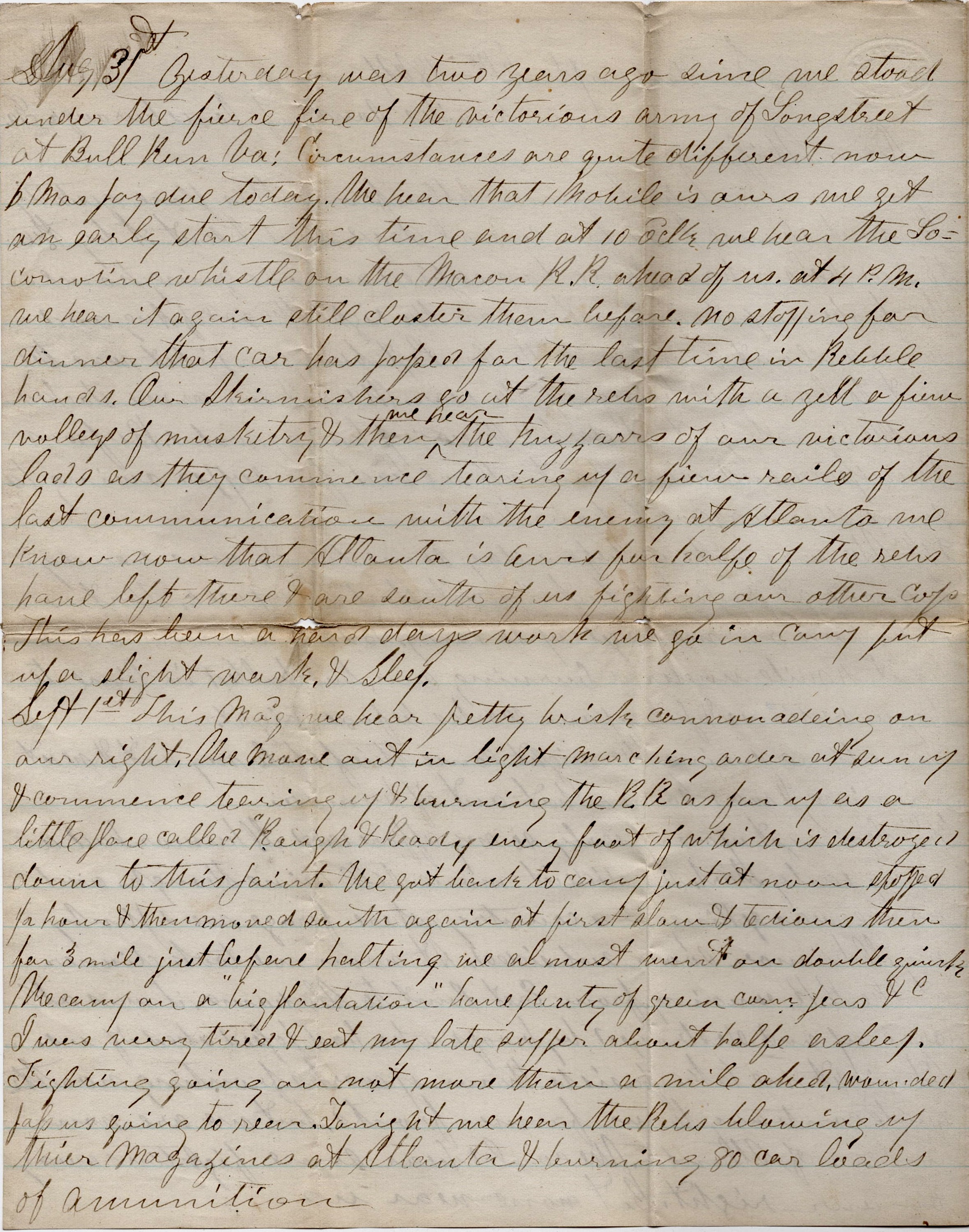
August 31st. Yesterday was two years ago since we stood under the fierce fire of the victorious army of Longstreet at Bull Run, Virginia. Circumstances are quite different now. Six months pay due today. We hear that Mobile is ours. We get an early start this time and at 10 o’clock we hear the locomotive whistle on the Macon Railroad ahead of us. At 4 p.m. we hear it again still clearer than before. No stopping for dinner. That car has passed for the last time in Rebel hands. Our skirmishers go at the rebs with a yell, a few vollies of musketry, and then we hear the huzzah’s of our victorious lads as they commence tearing up a few rails of the last communications with theenemy at Atlanta. We know now that Atlanta is ours for half of the rebs have left there & are south of us fighting our other Corps. This has been a hard days work. We go in camp, put up a slight work & sleep.
September 1st. This morning we hear pretty brisk cannonading on our right. We move out in light marching order at sun up & commence tearing up & burning the [Macon & Western] railroad as far up as a little place called Rough & Ready, every foot of which is destroyed down to this point. We got back to camp just at noon, stopped half hour &then moved south again, at first slow & tedious, then for three miles just before halting we almost went on double quick. We camp on a “big plantation,” have plenty of green corn, peas, &c. I was very tired & eat my late supper about half asleep. Fighting going on not more than a mile ahead. Wounded pass us going to rear. Tonight we hear the Rebs blowing up their magazines at Atlanta & burning 80 carloads of ammunition.
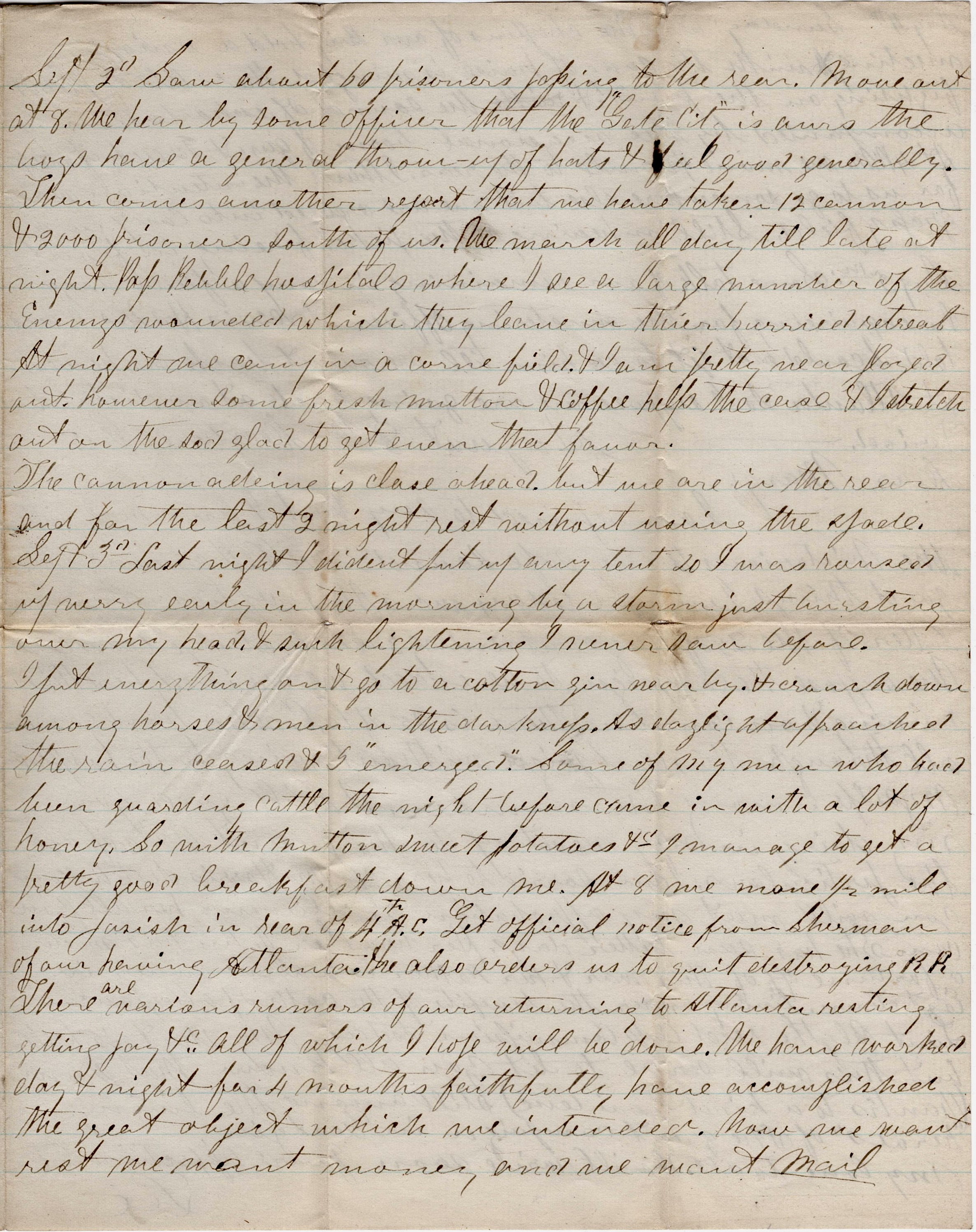
September 2nd. Saw about 60 prisoners passing to the rear. Move out at 8. We hear by some officer that the “Gate City” is ours. The boys have a general throw up of hats & feel good generally. Then comes another report that we have taken 12 cannon and 2,000 prisoners south of us. We march all day till late at night. Pass rebel hospitals where I see a large number of the enemy’s wounded which they leave in their hurried retreat. At night we camp in a corn field & I am pretty near fagged out. However, some fresh mutton & coffee helps the case & I stretch out on the sod glad to get even that favor.
The cannonading is close ahead but we are in the rear and for the last two nights rest without using the spade.
September 3rd. Last night I didn’t put up any tent so I was roused up very early in the morning by a storm just bursting over my head & such lightning I never saw before. I put everything on and go to a cotton gin nearby and crouch down among horses and men in the darkness. As daylight approached, the rain ceased & I “emerged.” Some of my men who had been guarding cattle the night before came in with a lot of honey so with mutton, sweet potatoes, &c. I manage to get a pretty good breakfast down me. At 8 we move half a mile into [ ] in rear of the 4th Army Corps. Get official notice from Sherman of our having Atlanta. He also orders us to quit destroying railroads. There are various rumors of our returning to Atlanta resting, getting pay, &c., all of which I hope will be done. We have worked day 7 night for four months faithfully, have accomplished the great effort which we intended. Now we want rest. We want money, and we want mail.
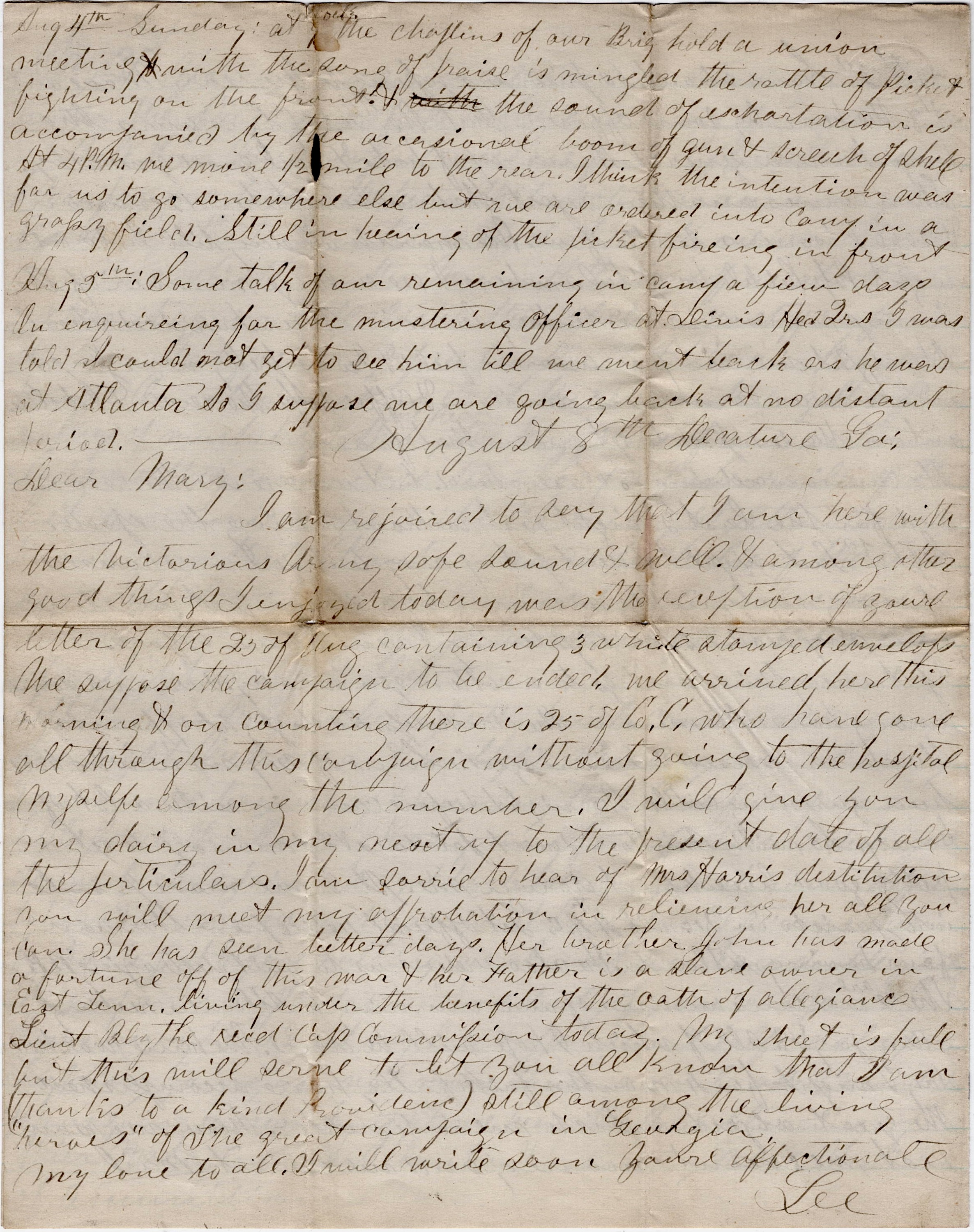
August [September] 4, Sunday at [ ] o’clock. The chaplain’s of our Brigade hold a Union meeting with the song of praise is mingled the rattle pf picket fighting on the front & the sound of exhortation is accompanied by the occasional boom of gun & screech of shell. At 4 p.m. we move half mile to the rear. I think the intention was for us to go somewhere else but we are ordered into camp is a grassy field. Still in hearing of the picket firing in front.
August [September] 5th. Some talk of our remaining in camp a few days. In enquiring for the mustering officer at Division Headquarters, I was told I could not get to see him till we went back as he was at Atlanta so I supposae we are going back at no distant period.
August [September] 8th Decatur, Georgia
Dear Mary, I am rejoiced today that I am here with the victorious army safe, sound & well & among other good things I enjoyed, today was the reception of your letter of the 25th of August containing three white stamped envelopes. We suppose the campaign to be ended. We arrived here this morning and on counting, there is 25 of Co, C who have gone all through this campaign without going to the hospital, myself among the number. I will give you my diary in my next up to the present date of all the particulars. I am sorry to hear of Mrs. Harrison’s destitution. You will meet my approbation in relieving her all you can. She has seen better days. Her brother John has made a fortune off of this war & her father is a slave owner in East Tennessee living under the benefits of the Oath of Allegiance. Lieut. Blythe received a captain’s commission today.
My sheet is full but this will serve to let you all know that I am (thanks to a kind Providence) still among the living “heroes” of the great campaign in Georgia.
My love to all. I will write soon. Yours affectionately, — Lee
These letters were written by James Anderson (1840-18xx) who enlisted at Staten Island to serve three years in Co. F, 72nd New York Infantry. He mustered in as a private on 21 June 1861, was promoted to corporal no long after, and won his sergeant’s strips on 20 May 1863 — just after this letter was penned to his sister.
In the letter written just after the Battle of Chancellorsville (Letter 4), James informed his sister of the death of their colonel and of the heavy losses suffered by the 72nd New York Infantry [3rd Excelsior Regiment]. Major Leonard’s after action report claimed that of the 29 officers and 411 enlisted men of the 72nd entering the action at Chancellorsville, 104 were either killed, wounded, or listed as missing—one-fourth of the entire command. While searching the battlefield for missing and wounded under a flag-of-truce days days later, some boys of the 72nd learned the details of their colonel’s death causing the men to weep. Col. Stevens’s body was removed from a temporary burial at the Wilderness Church and sent home to Dunkirk.
Later in the war, Sgt. James Anderson of Co. F served as the Third Excelsior’s regimental color bearer—a dubious honor to be sure as it made him an immediate target in any assault. Indeed, he was twice wounded in action—first on 27 November 1863 at One-Mile Run, Virginia, and second, on 19 June 1864 before Petersburg which effectively ended his service.
Letter 1
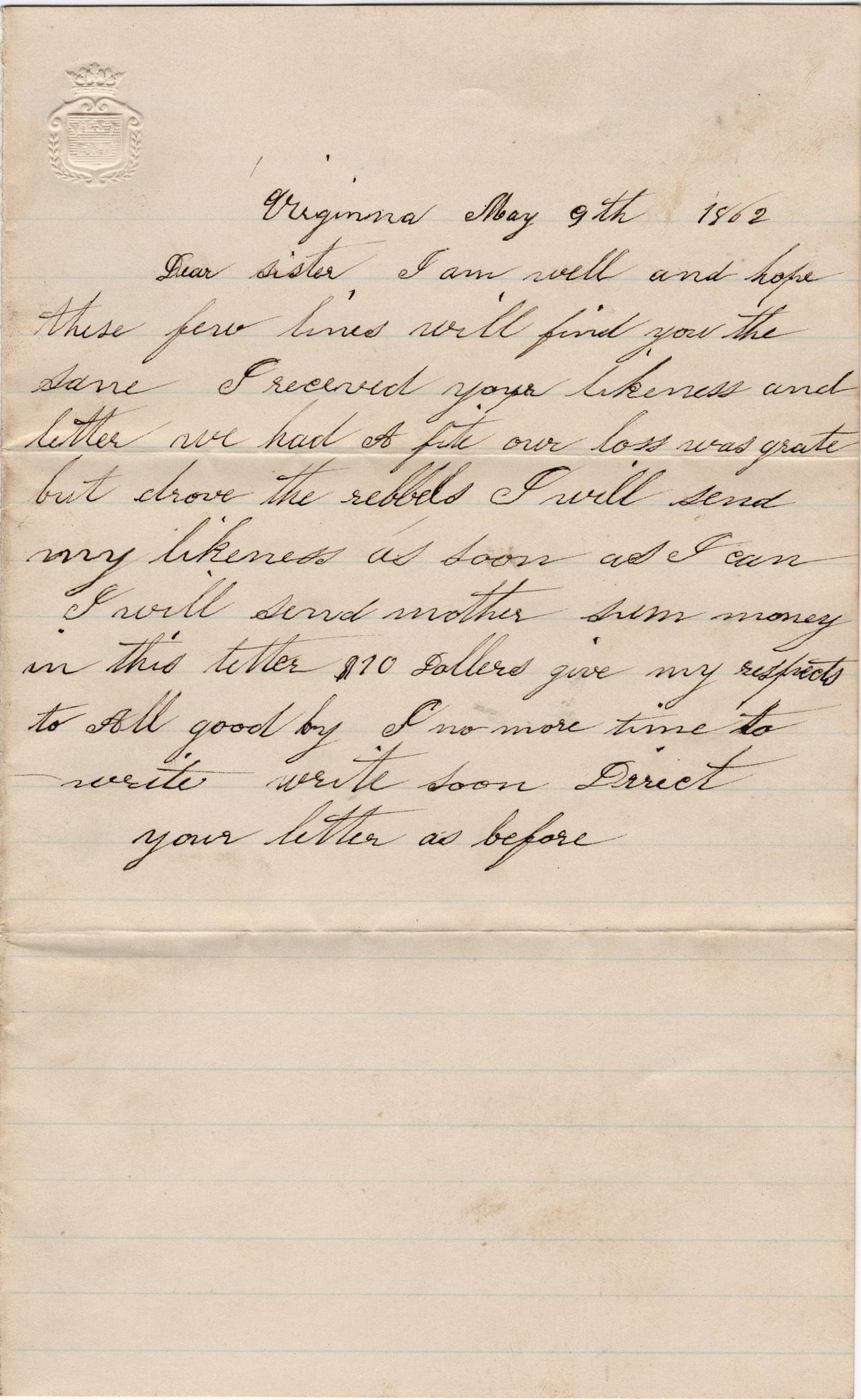
Virginia May 9th 1862
Dear Sister,
I am well and hope these few lines will find you the same. I received your likeness and letter.
We had a fight. Our loss was great but drove the rebels. I will send my likeness as soon as I can. I will send mother some money in this letter, $10.
Give my respects to all. Goodbye. I’ve no more time to write, Write soon. Direct your letter as before. [unsigned]
Letter 2
[The only time the 72nd New York camped on or near the White Oak Swamp was in late June 1862 during the Seven Days Battles. They fought there on 30 June 1862 in the Battle of White Oak Swamp as the Union Army retreated to the James River.]
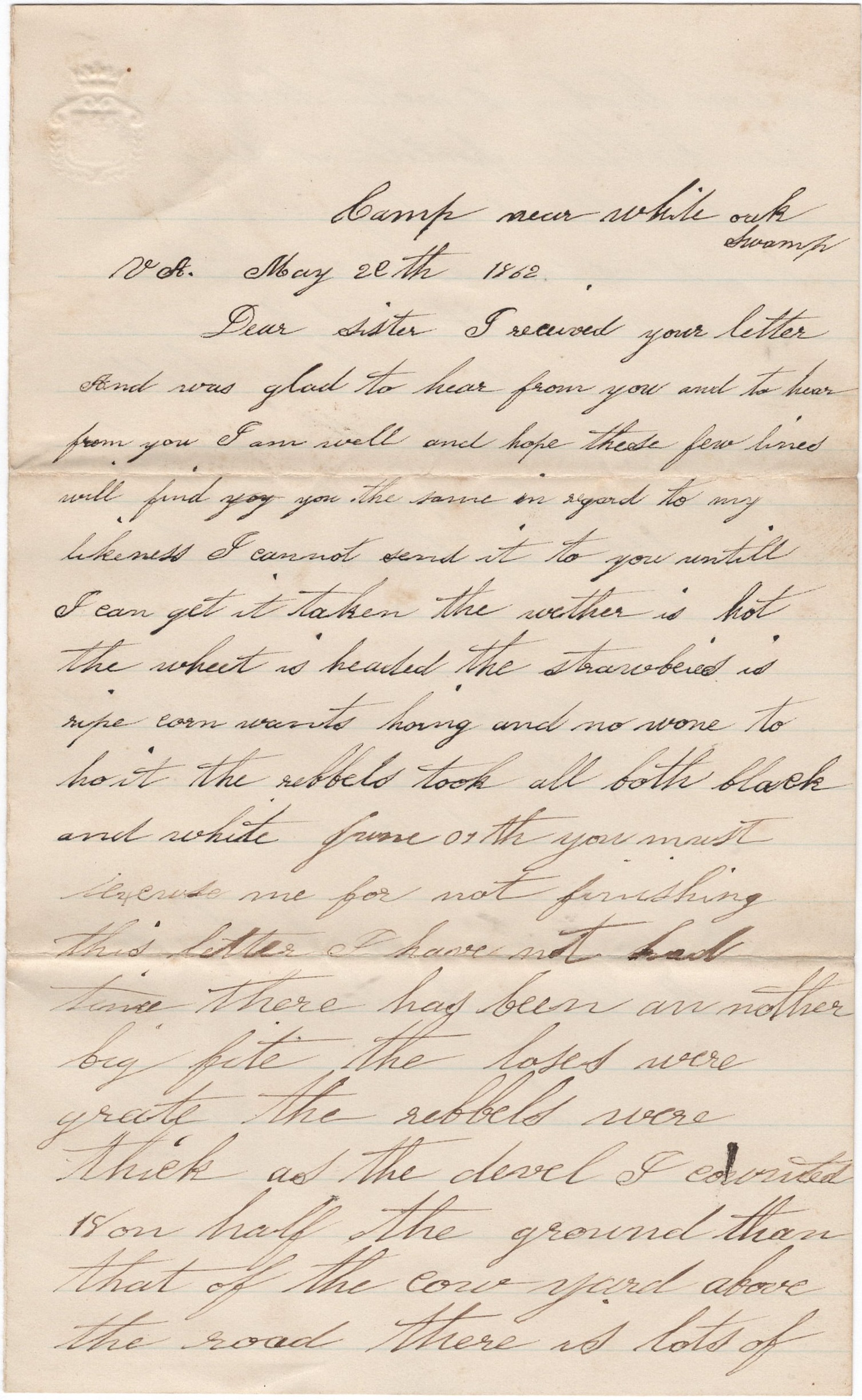
Camp near White Oak Swamp, Virginia May 2?. 1862 [see note above]
Dear Sister,
I received your letter and was glad to hear from you. I am well and hope these few lines will find you the same. In regard to my likeness, I cannot send it to you until I can get it taken. The weather is hot. The wheat is headed. The strawberries is ripe. Corn wants hoeing and no-one to do it. The rebels took all—both black and white—from [the fields].
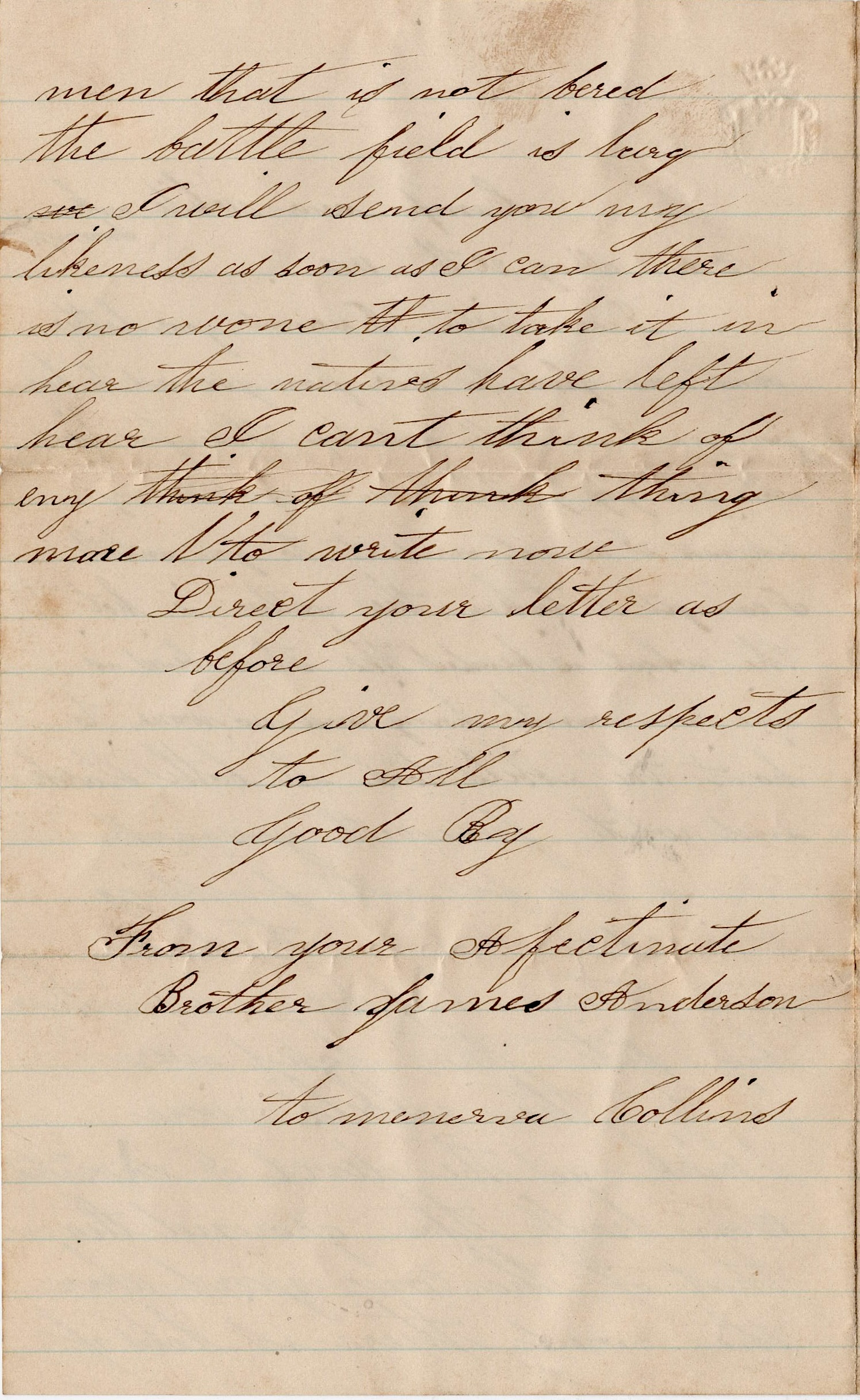
You must excuse me for not finishing this letter. I have not had time. There has been another fight. The losses were great. The rebels were thick as the devil. I counted 18 on half the ground than that of the cow yard above the road. There is lots of men that is not buried. the battlefield is large.
I will send you my likeness as son as I can. There is no one to take it in here. The natives have left here.
I can’t think of anything more to write now. Direct your letter as before. Give my respects to all. Goodbye from your affectionate brother, — James Anderson
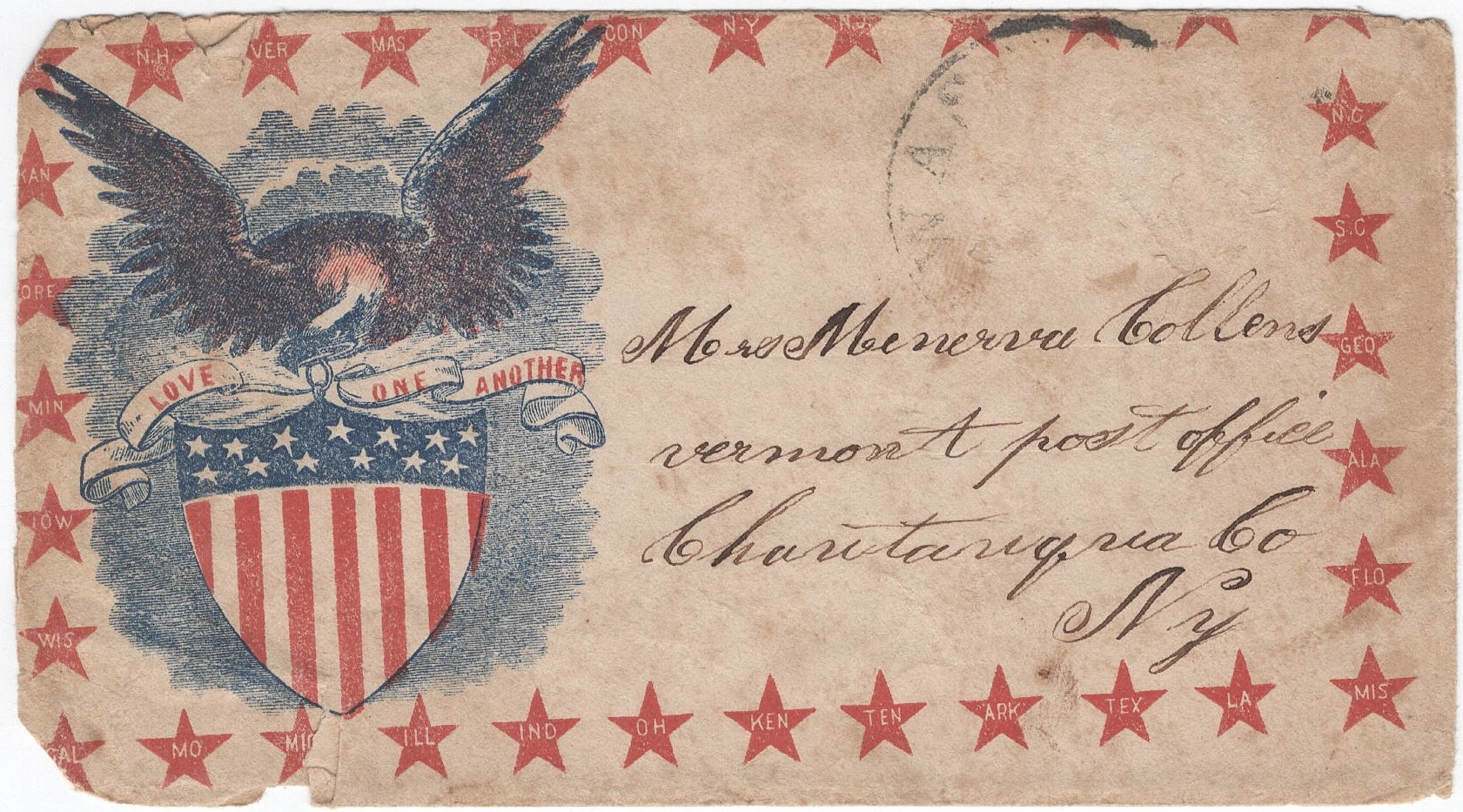
to Minerva Collins
Letter 3
Virginia July 13, 1862
Dear Sister,
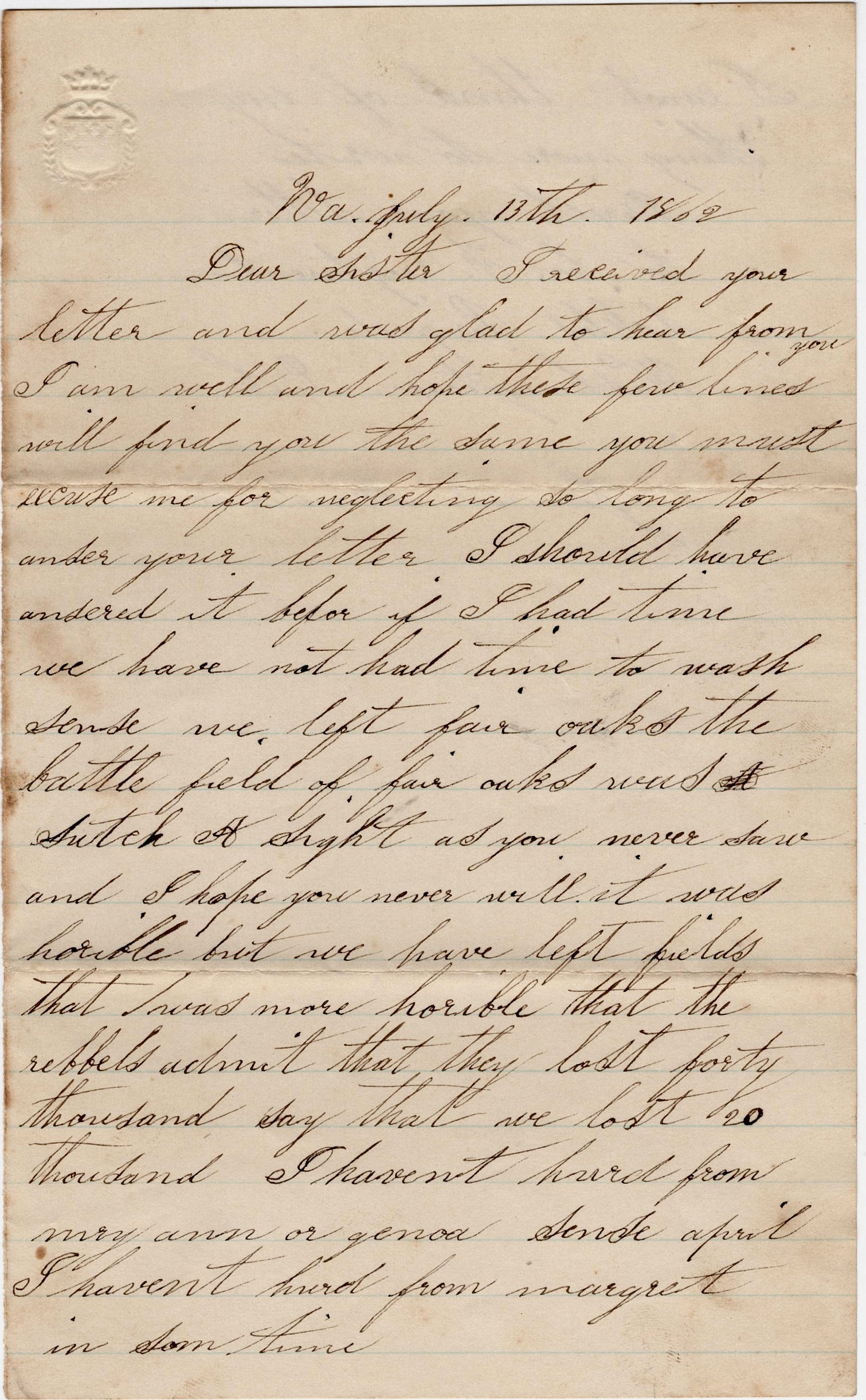
I received your letter and was glad to hear from you. I am well and hope these few lines will find you the same. You must excuse me for neglecting so long to answer your letter. I should have answered it before if I had time. We have not had time to wash since we left Fair Oaks. The Battle of Fair Oaks was such a sight as you never saw. I hope you never will. It was horrible. But we have left fields that was more horrible that the rebels admit that they lost forty thousand. [They] say that we lost twenty thousand. I haven’t heard from Mary Ann or Genoa since April. I haven’t heard from Margaret in some time.
I can’t think of anything more to wrote. Direct your letter to Co. F, 3rd [Excelsior] Regiment, Sickles Brigade, Washington D. C.
— James Anderson
Letter 4
[This letter is from the private collection of Richard Weiner and is published by express consent.]
May 18, 1863
Dear Sister,
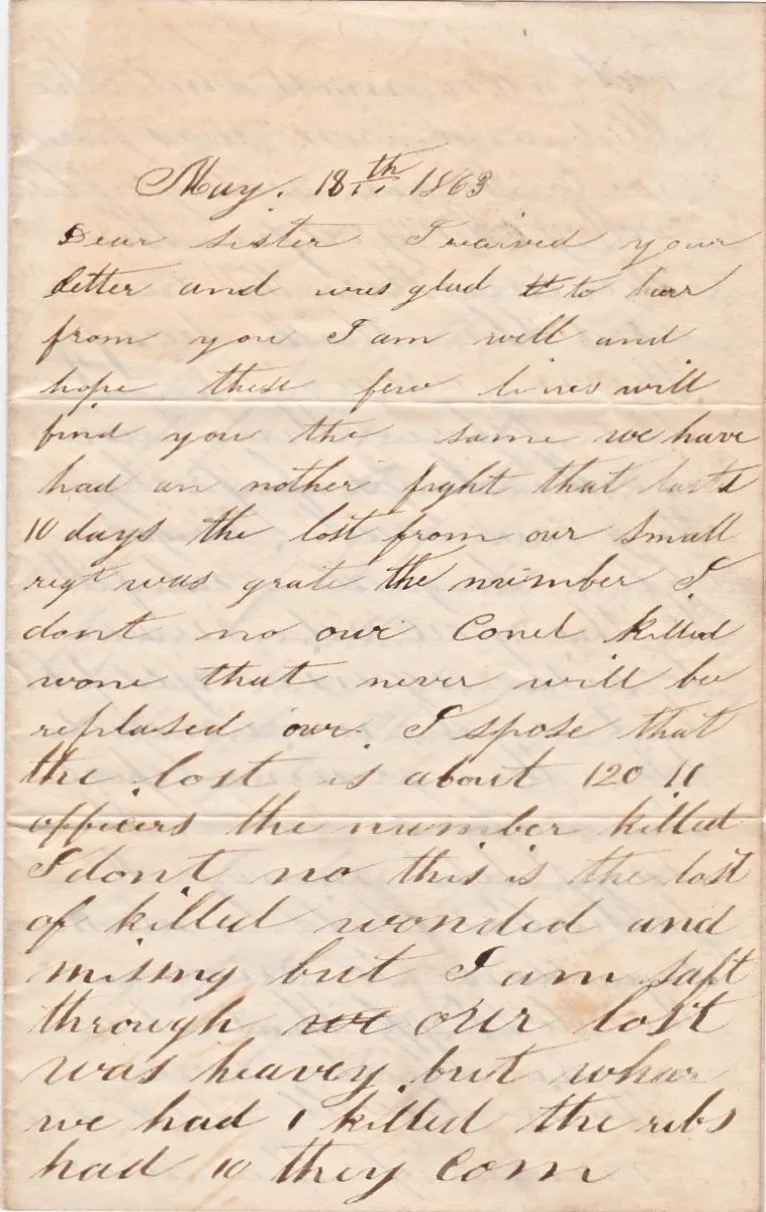
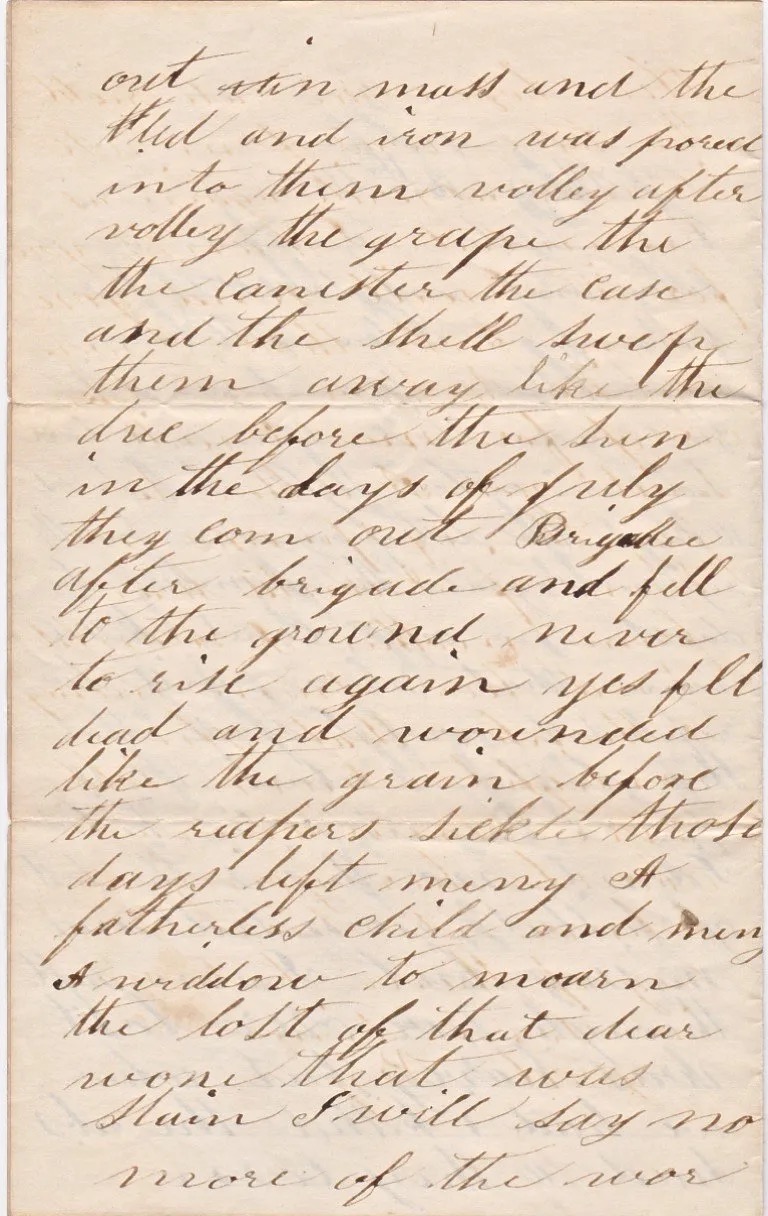
I received your letter and was glad to hear from you. I am well and hope these few lines will find you the same. We have had another fight that lasts 10 days. The loss from our small regiment was great — the number I don’t know. Our Colonel [William O. Stevens was] killed — one that never will be replaced. I suppose that the loss is about 120 — 10 officers. The number killed I don’t know — this is the loss in killed, wounded and missing. But I am safe though our loss was heavy. But where we had 1 killed, the rebs had 10. They come out en mass and the lead and iron was poured into them volley after volley. The grape, the canister, the case and the shell swept them away like the dew before the sun in the days of July. They come out brigade after brigade and fell to the ground never to rise again. Yes, fell dead and wounded like the grain before the reaper’s sickle. Those days left many a fatherless child and many a widow to mourn the loss of that dear one that was slain. I will say no more of the war.
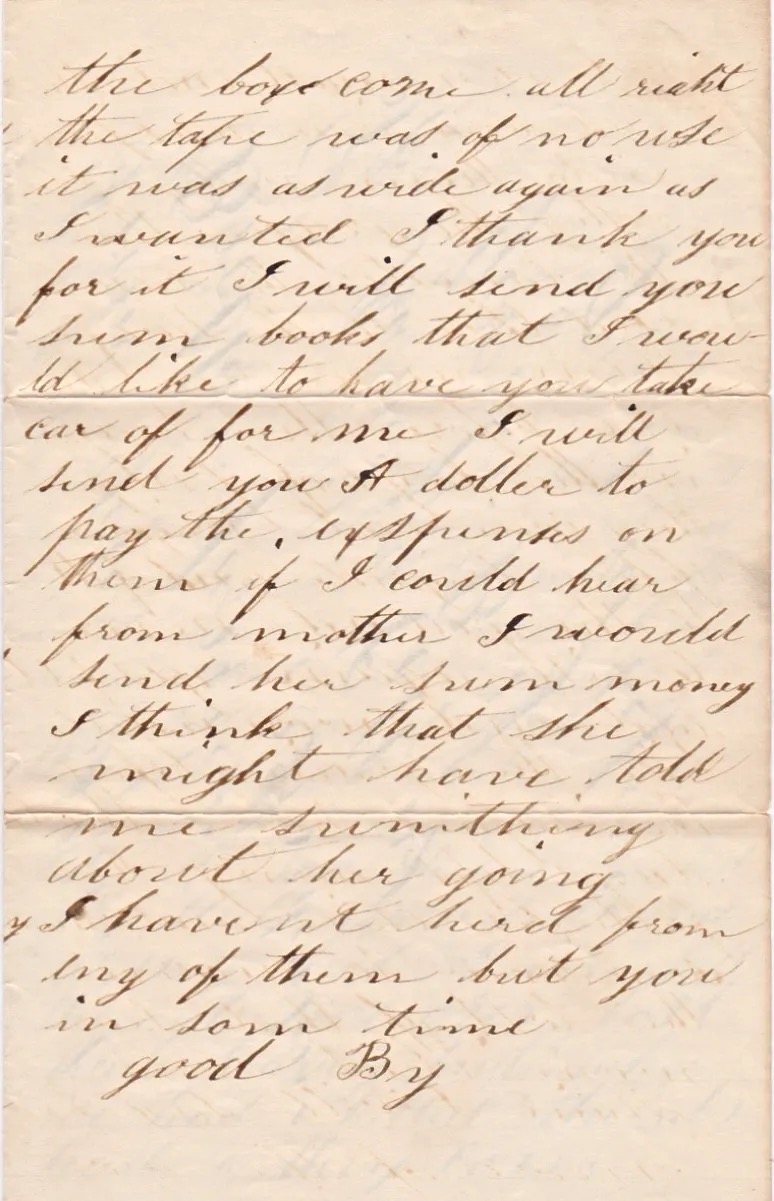
The box come all right. The tape was of no use. It was as wide again as I wanted. I thank you for it. I will send you some books that I would like to have you take care of for me. I will send you a dollar to pay the expenses on them. If I could hear from mother, I would send her some money. I think that she might have told me something about her going. I haven’t heard from any of them but you in some time.
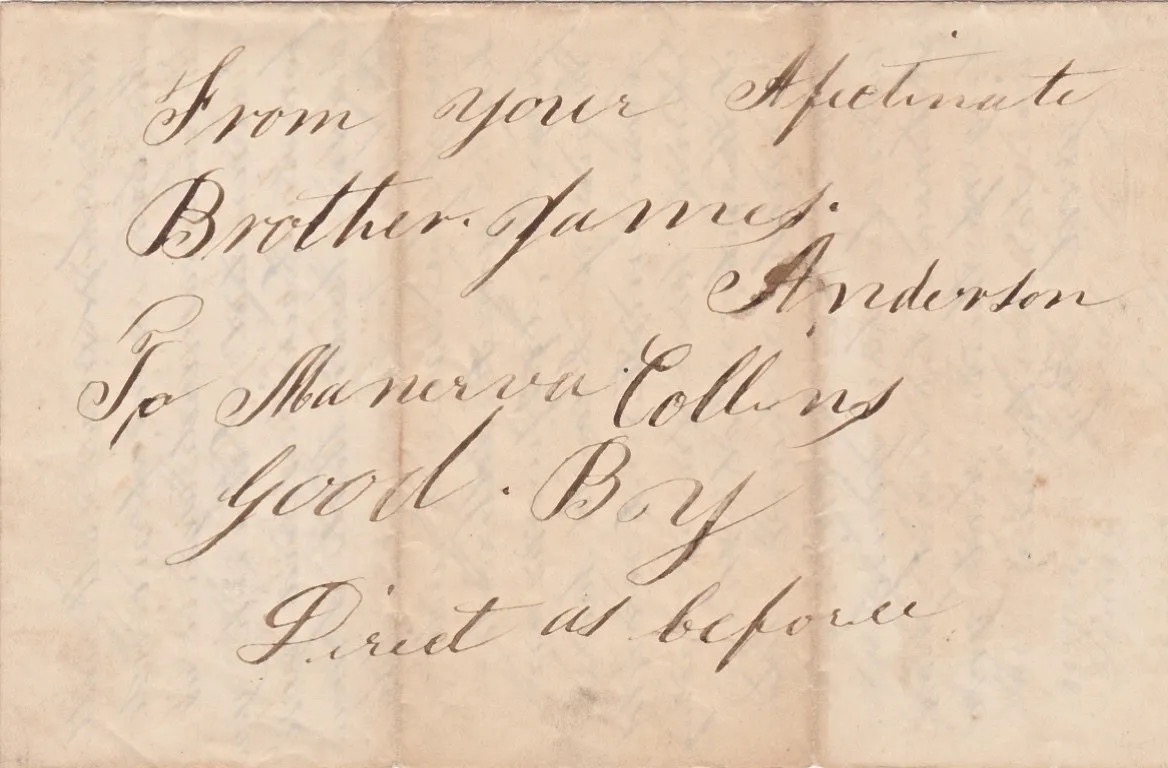
Goodbye. From your affectionate brother, — James Anderson
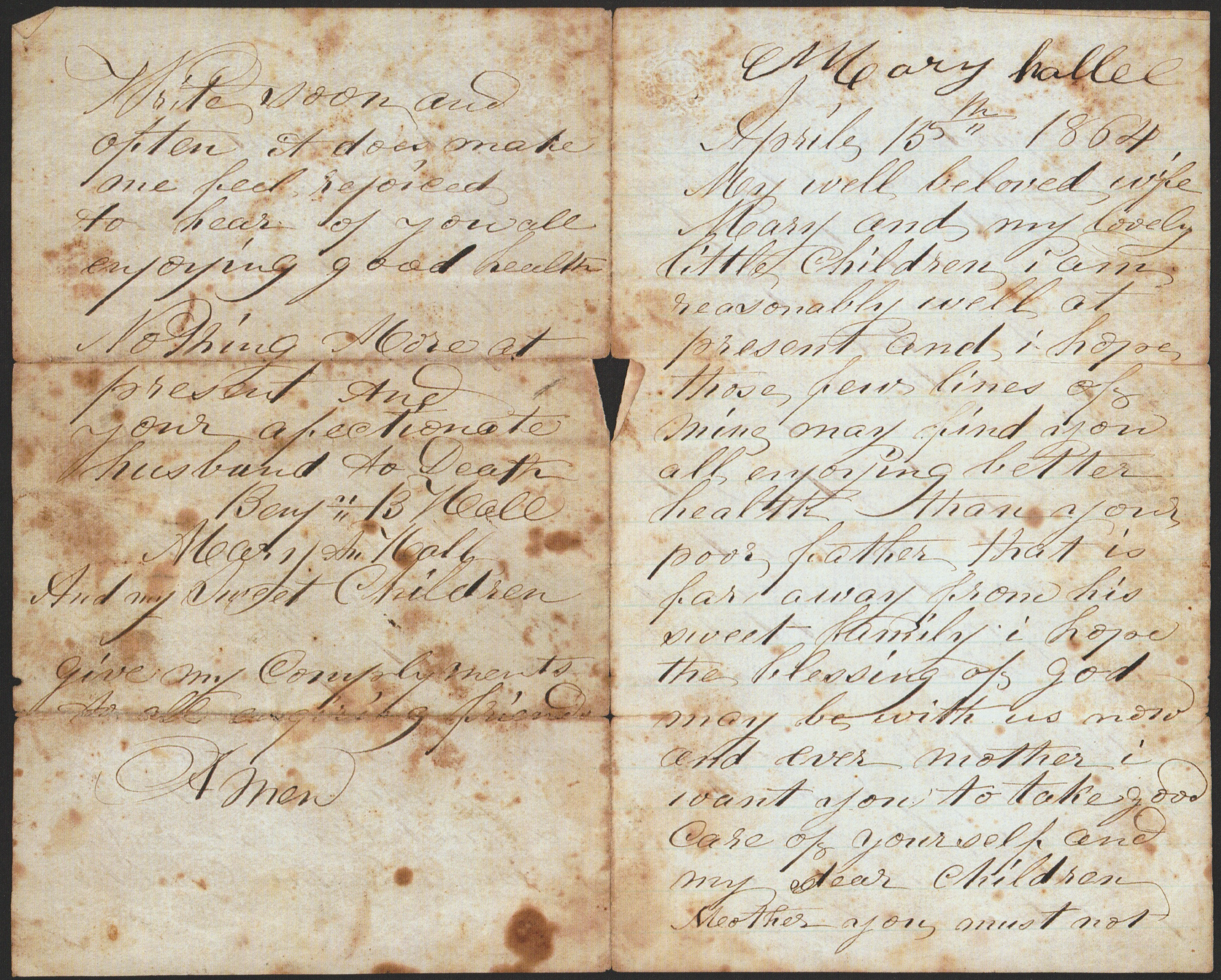
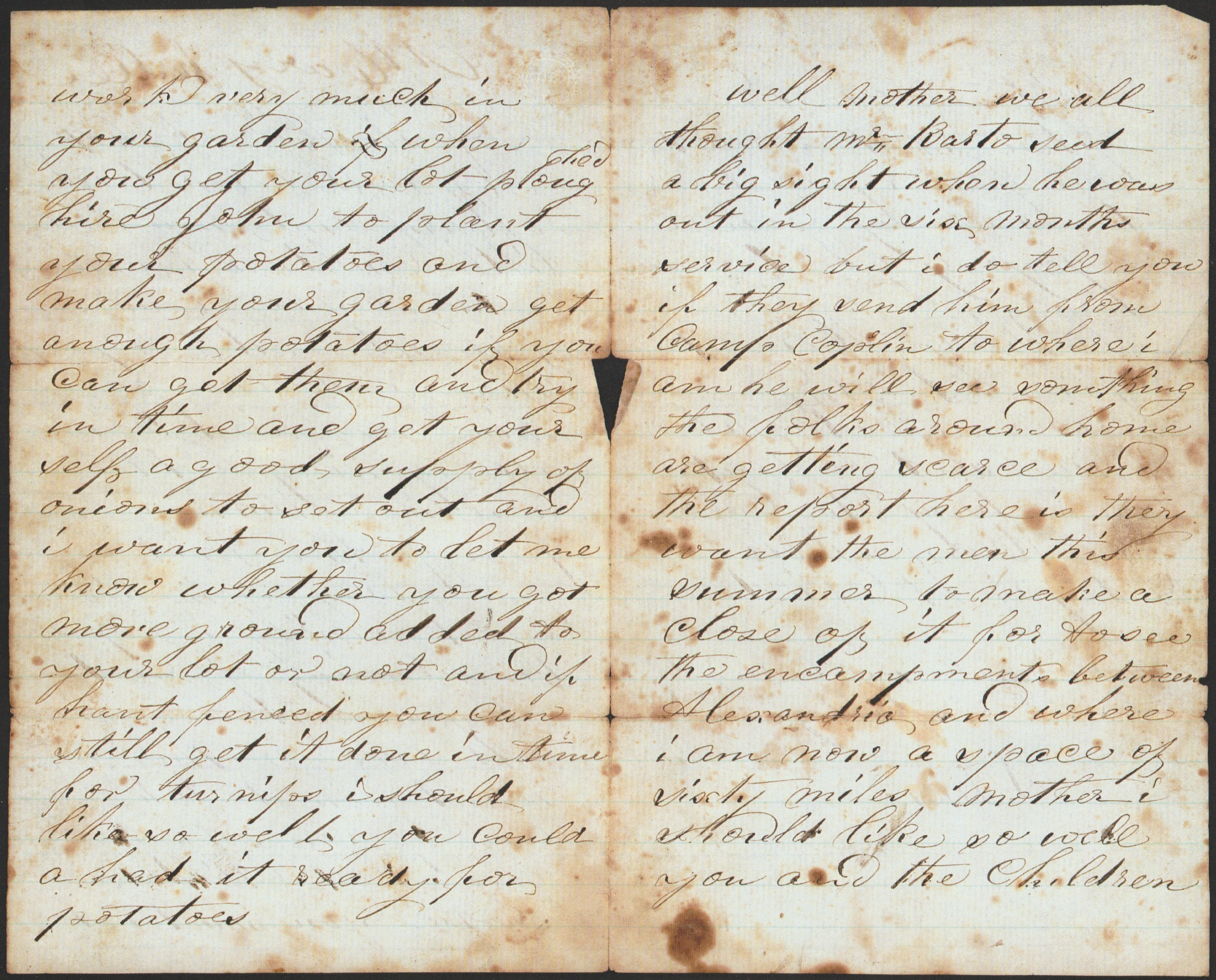
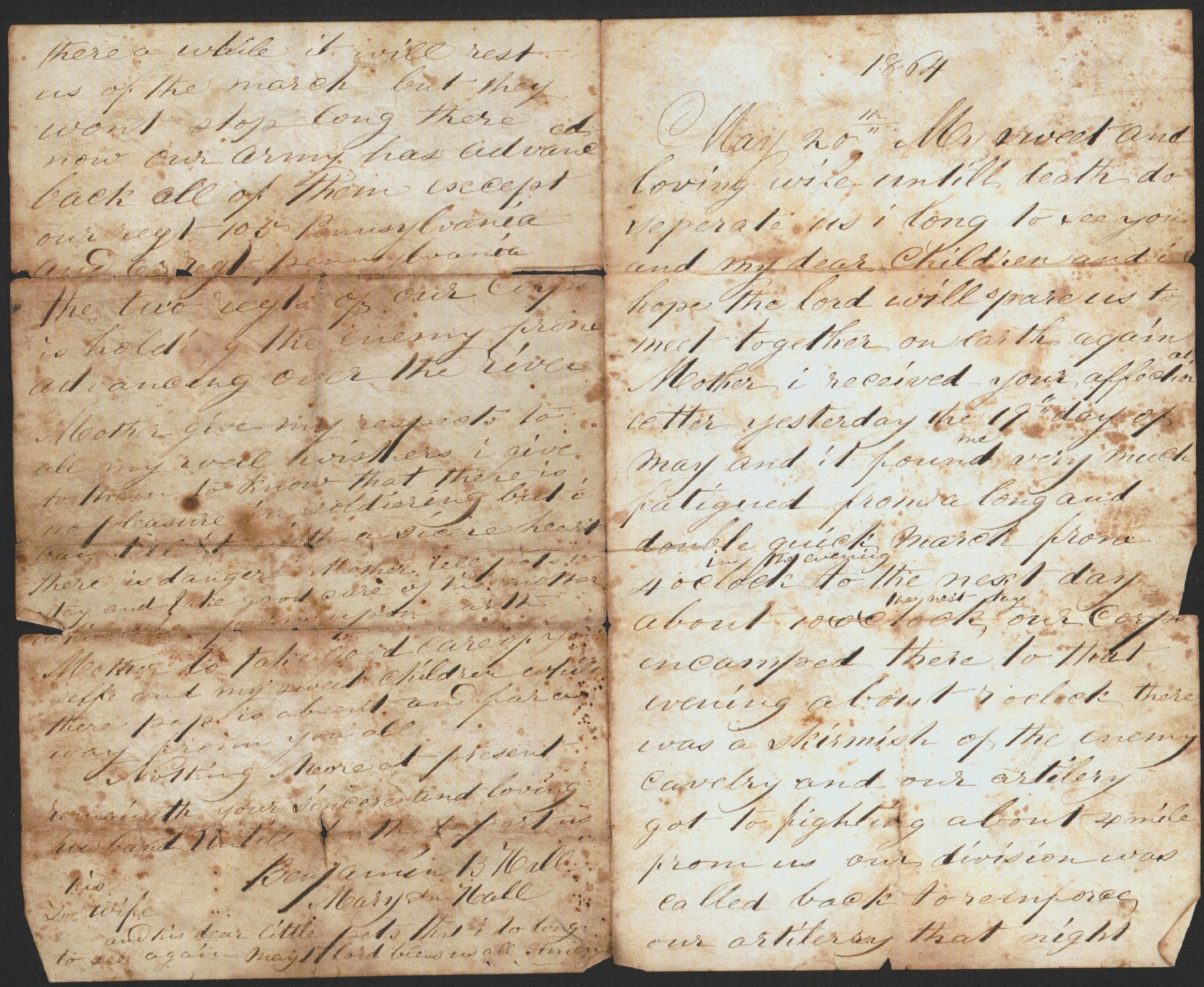
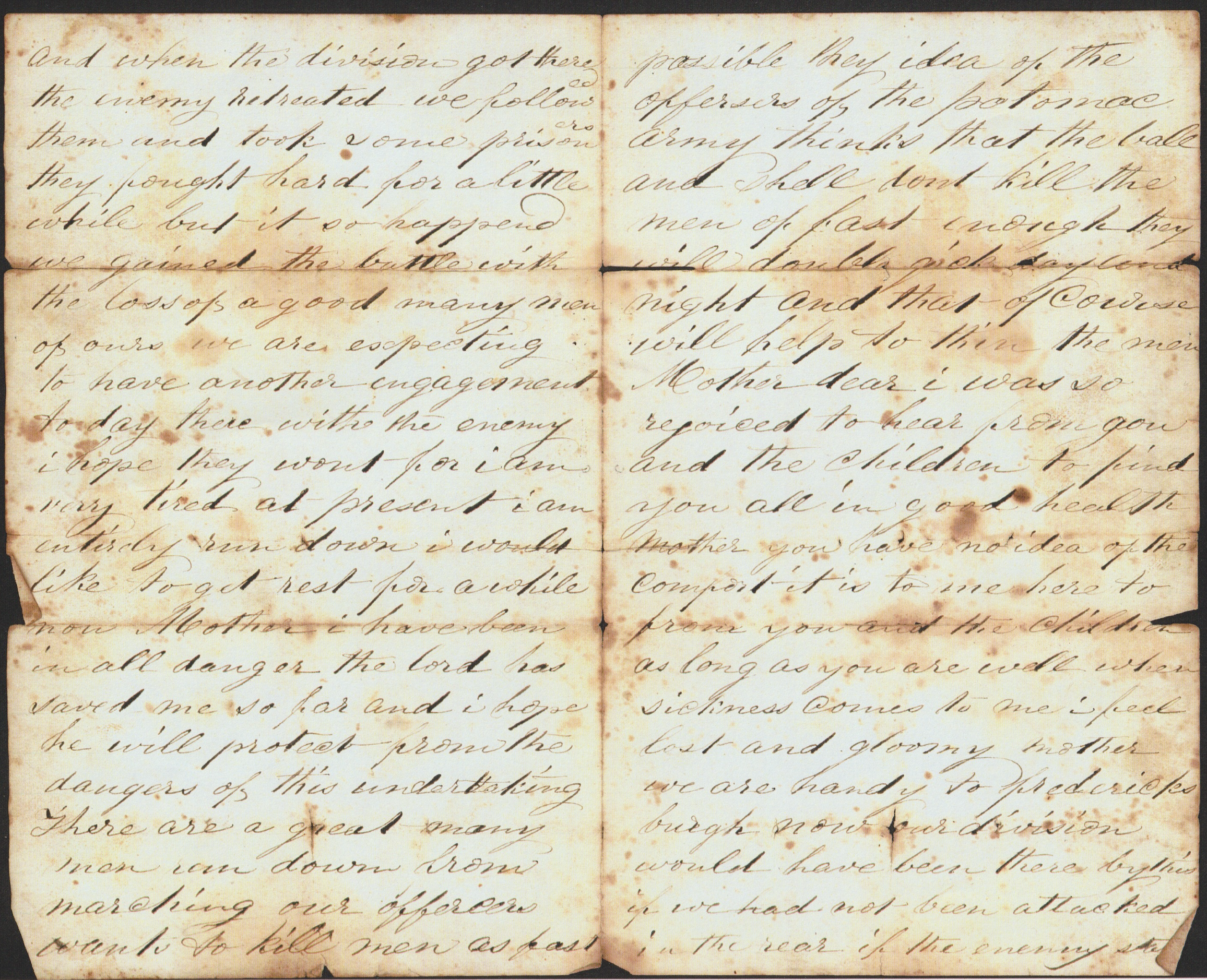
“I am Barbara Blake, the great-great granddaughter of Benjamin B. Hall [of Co. F, 105th Pennsylvania Infantry]. I have in possession two of his letters he wrote home right before he was captured and died in Andersonville, Georgia in 1864. I was informed that Brian Rhinehart from Civil War Records said you would be interested in publishing these on your site and transcribing them for research. I would love for my great-great grandfather’s letters to be used in this way. Two letters he wrote were passed down from mother to daughter and I think they may be the only letters he wrote as he was captured shortly after the last letter. Since he passed, I am the fourth daughter to possess them and will be passing them down to my daughter as well. There are two letters, one from April 1864 and one from May 1864 and his tintype photo. I had these copied a few years ago and the originals are between acid free paper to protect them. I also included my transcription of them, they were very hard to read, but you may be able to read what I could not. I think your project is wonderful.”
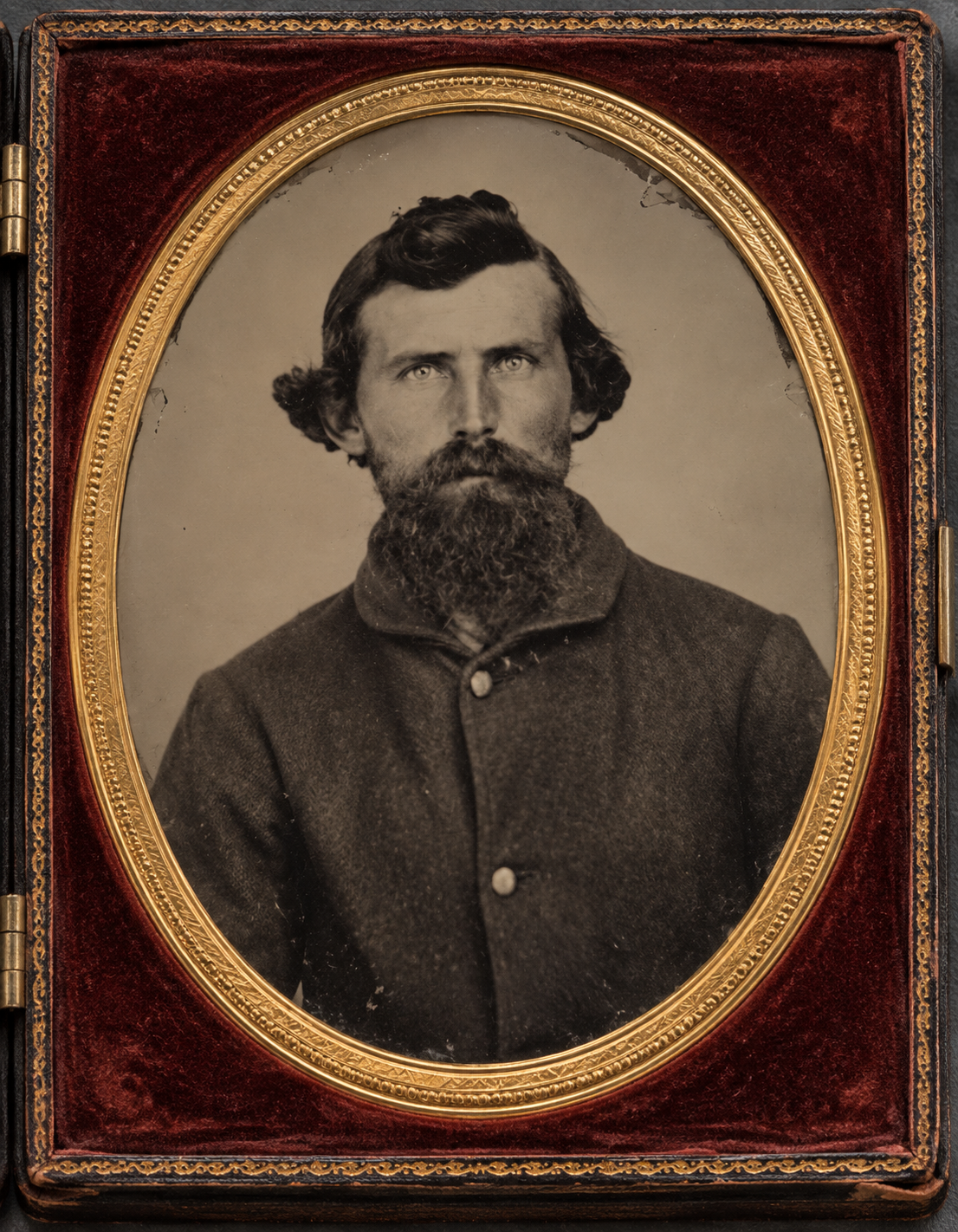
Benjamin B. Hall, Co. F, 105th Pennsylvania Infantry (courtesy of Barbara Blake)
Benjamin B. Hall (1824-1864) was a 39-year-old farmer compelled to register for the draft in Mahoning Township, Indiana County, Pennsylvania, in June 1863. By this time, the war had persisted for nearly three years. On 29 February 1864, a leap year, the now 40-year-old Ben took the solemn oath at Pittsburgh to serve in the U.S. Army. Those who enlisted alongside him that day were not the youthful, idealistic volunteers of 1861; instead, they were middle-aged family men—draftees fully aware of the hardships and dangers that awaited them.
Ben’s service record is short. Prisoner of War records reveal that he died of “scorbutis” (lack of Vitamin C) while at Andersonville Prison in Georgia. His date of death was given as 17 July 1864, just four and a half months after he entered the service and only two months after his capture. It would be a full year before his widow could obtain the proof necessary to file for a widow’s pension. Her application reveals important facts about their family. It tells us her maiden name was Mary Ann Porter (b. 1838) and that she married Benjamin on 25 April 1857. Together they had two children, Elizabeth (b. 1860) and Susannah (b. 1863). Mary Ann was illiterate—signed her name with an “x.” The pension record also informs us, by testimony of Ben’s captain, that he was taken prisoner at the Battle of Spottsylvania Court House on 12 May 1864. He must have been mistaken, however, for Ben’s second letter reveals he was still with the regiment when he datelined it on 20 May 1864. That letter informs us that he was serving in the rear guard so my hunch is he was taken prisoner shortly after having sent off his letter. His fatigue may have added to the risk of capture as those lagging behind a marching regiment were often gathered up as prisoners by enemy cavalry.
Over the years I have transcribed several letters by members of the 105th Pennsylvania Infantry. These include:
My well, beloved wife Mary and my lovely little children,
I am reasonably well at present and I hope those few lines of mine may find you all enjoying better health than your poor father that is far away from his sweet family. I hope the blessing of God may be with us now and ever. Mother, I want you to take good care of yourself and my dear children.
Mother, you must not work very much in your garden. When you get your lot ploughed, hire John to plant your potatoes and make your garden. Get enough potatoes if you can get them and try in time and get yourself a good supply of onions to set out. And I want you to let me know whether you got more ground added to your lot or not, and if [it] ain’t fenced, you can still get it done in time for turnips. I should like so well [if] you could a had it ready for potatoes.
Well, Mother, we all thought Mr. Barto 1 see’d a big sight when he was out in the six months service but I do tell you, if they send him from Camp Coplin [Copeland] to where I am, he will see something. The folks around home are getting scarce and the report here is they want the men this summer to make a close of it for to see the encampments between Alexandria and where I am now—a space of sixty miles.
Mother, I should like so well [to see] you and the children. Write soon and often. It does make me feel rejoiced to hear of you all enjoying good health. Nothing more at present, and [I remain] your affectionate husband to death, — Benj. B. Hall
To Mary Ann Hall and my sweet children
Give my compliments to all enquiring friends. Amen.
1 Possibly George Washington Barto (1840-1918) from Indiana county who served just a few weeks in Congress. I, 74th Pennsylvania Volunteers in 1862. His wife was Sarah Porter—possibly a relative of Ben’s wife.
Letter 2
May 20th 1864
My sweet and loving wife until death do separate us,
I long to see you and my dear children and I hope the Lord will spare us to meet together on earth again. Mother, I received your affectionate letter yesterday the 19th day of May and it found me very much fatigued from a long and double-quick march from 4 o’clock in the evening to about 10 o’clock the next day. Our Corps encamped there to that evening about 7 o’clock. There was a skirmish of the enemy cavalry and our artillery [who] got to fighting about 4 miles from us. Our Division was called back to reinforce our artillery that night and when the Division got there, the enemy retreated. We followed them and took some prisoners. They fought hard for a little while but it so happened we gained the battle with the loss of a good many men of ours.
We are expecting to have another engagement today there with the enemy. I hope they won’t for I am very tired at present. I am entirely run down. I would like to rest for a while now.
Mother, I have been in all danger. The Lord has saved me so far and I hope he will protect me from the dangers of this undertaking. There are a great many men run down from marching. Our officers want to kill men as fast [as] possible. The idea of the officers of the Potomac Army thinks that the ball and shell don’t kill the men off fast enough [so] they will double quick [us] day and night and that, of course, will help to thin the men.
Mother dear, I was so rejoiced to hear from you and the children [and] to find you all in good health. Mother, you have no idea of the comfort it is to me to hear from you and the children as long as you are well. When sickness comes to me, I feel lost and gloomy.
Mother, we are handy to Fredericksburg now. Our Division would have been there by this [time] if we had not been attacked in the rear. If the enemy stays there a while, it will rest us of the march. But they won’t stop long there now. Our army has advanced back, all of them except our regiment, 105th Pennsylvania, and [the] 63rd Regiment Pennsylvania. The two regiments of our Corps is holding the enemy from advancing over the river. 1
Mother, give my respects to all my well wishers. I give to them to know that there is no pleasure in soldiering but I can tell it with a sincere heart there is danger. Mother, tell Pots to stay and take good care of his mother while [she is living?] upon earth. Mother, do take good care of yourself and my sweet children while their Pap is absent and far away from you all.
Nothing more at present. I remaineth your sincere and loving husband until death do part us. — Benjamin B. Hall
To wife Mary Ann Hall and his dear little pets that I so long to see again. May the Lord bless us all. Amen
1 It’s not clear what river Ben is referring to but I suspect it was the Po or No River near Spotsylvania.
“Attached are two letters from my great-great-grandfather, Dr. Henry Francis Conrad, written while he was an assistant surgeon with the 111th Pennsylvania Volunteer Infantry and then when he found out he had been appointed surgeon of the 174th Pennsylvania Infantry (Drafted Militia).” This was the message sent me by John R. Conrad in August 2026, who further informed that both letters were addressed to Henry’s wife, Julia Annastacia (Adams) Conrad. He told me that he had obtained scans of the originals from a relative named Elaine Conrad, who most likely had given the originals to the Blair County (PA) Genealogical Society. He also sent me a transcript of a letter Dr. Conrad wrote to his local newspaper while serving with the 174th in Beaufort, South Carolina. The letter was not signed nor dated, but Dr. Conrad was the only member of the 174th from Blair County and the handwriting matched that of the two letters.
Henry Francis Conrad (1832-1872) was from Newry, Blair county, Pennsylvania. He was a graduate of St. Francis University (Loretto, Pa.) in 1855 and married Julia in Hollidaysburg on 23 December 1856. He served as an Assistant Surgeon with the 111th Pennsylvania from 8 August 1862 to 13 January 1863 when he was transferred to the 174th Pennsylvania (Drafted Militia) to serve as Full Surgeon. He was discharged from the service on 16 January 1864 and returned to Hollidaysburg to practice medicine but died of consumption eight years later in 1872.
Over the years I have transcribed a number of letters by members of the 111th Pennsylvania. These include:
I have transcribed only one from a member of the 174th Pennsylvania (Drafted Militia):
John W. Snyder, Co. K, 174th Pennsylvania Drafted Militia (1 Letter)
Letter 1
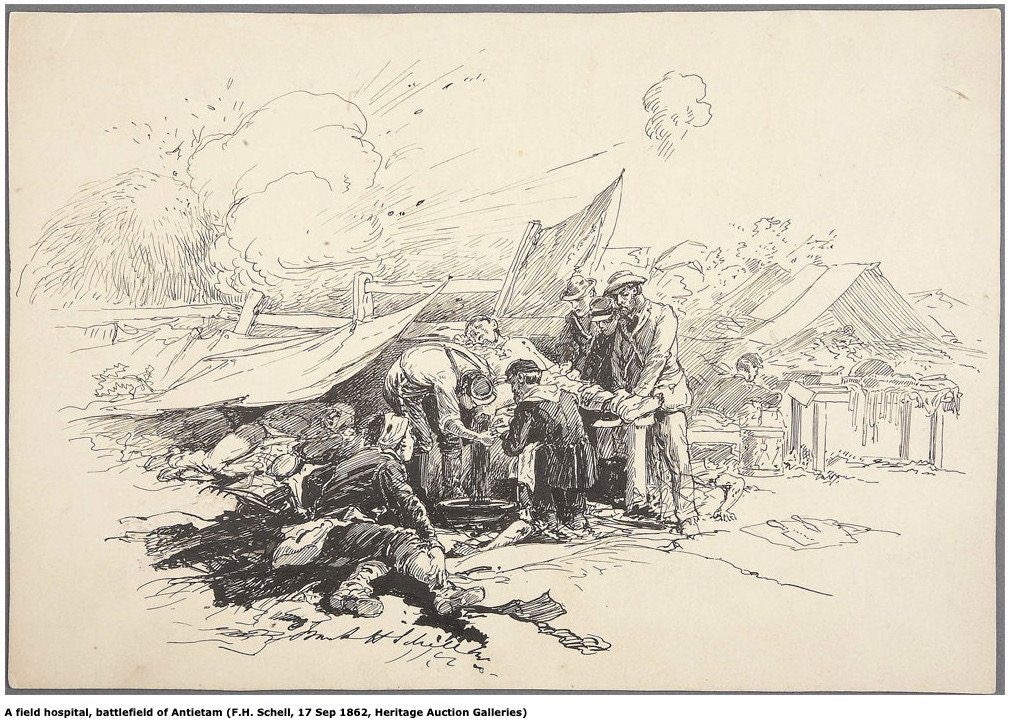
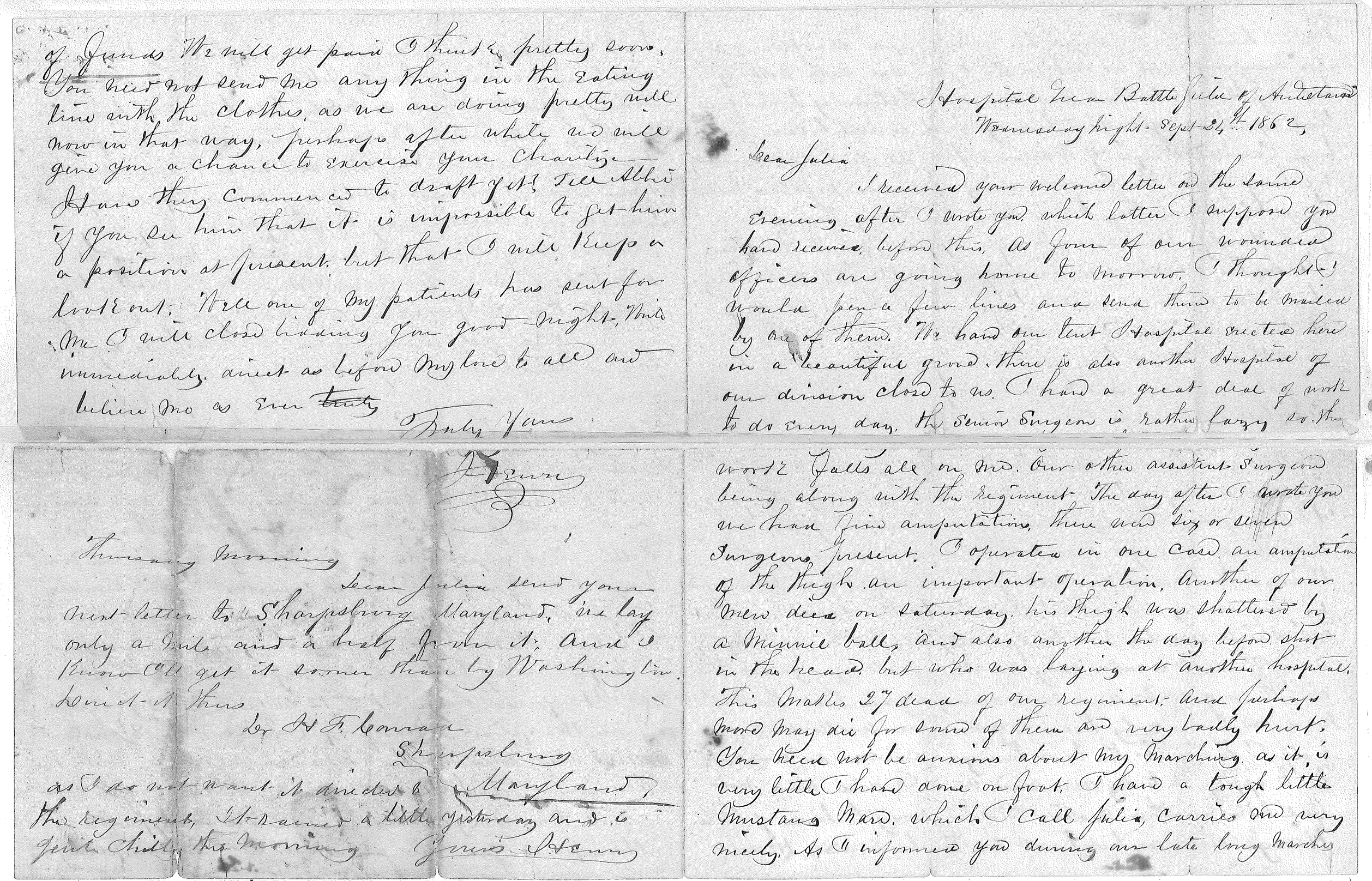
Hospital near Battlefield of Antietam 1 Wednesday night, September 24th 1862
Dear Julia,
I received your welcome letter on the same evening after I wrote you which letter, I suppose, you have received before this. As four of our wounded officers are going home tomorrow, I thought I would pen a few lines and send them to be mailed by one of them.
We had our tent hospital erected here in a beautiful grove. There is also another hospital of our division close to us. I have a great deal of work to do every day. The Senior Surgeon is rather lazy so the work falls all on me, our other Assistant Surgeon being along with the regiment. The day after I wrote you we had five amputations there and six or seven surgeons present. I operated in one case—an amputation of the thigh, an important operation. Another of our men dies on Saturday. His thigh was shattered by a Minié ball, and also another the day before, shot in the head but who was laying at another hospital. This makes 27 dead of our regiment and perhaps more may die for some of them are very badly hurt.
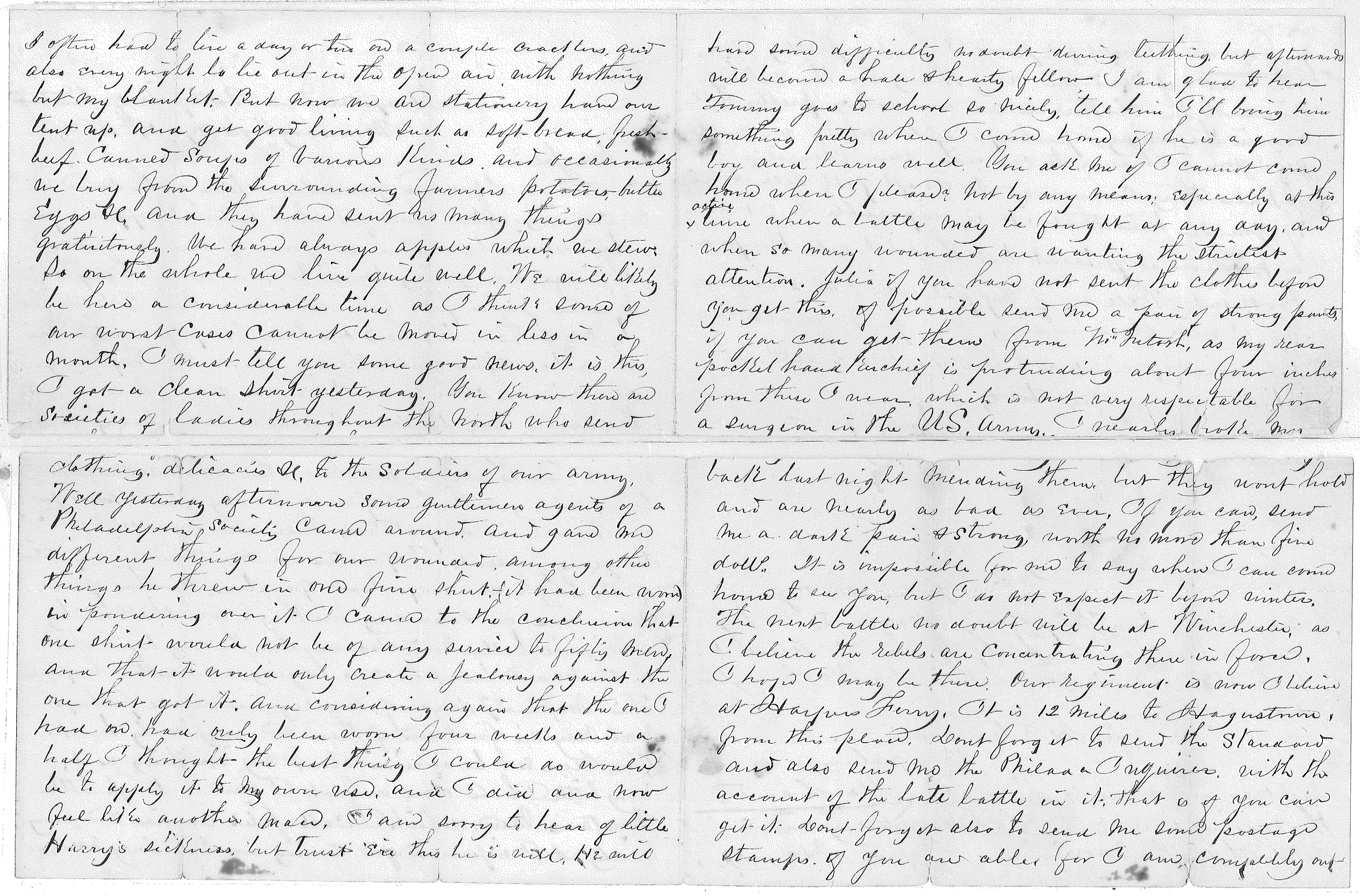
You need not be anxious about my marching as it is very little I have done on foot. I have a tough little mustang mare which I call Julia—carries me very nicely. As I informed you during our late long marches, I often had to live a day or two on a couple crackers and also every night to lie out in the open air with nothing but my blanket. But now we are stationery, have our tent up, and get good living such as soft bread, fresh beef, canned soups of various kinds, and occasionally we buy from the surrounding farmers potatoes, butter, eggs, &c. and they have sent us many things gratuitously. We have always apples which we stew. So on the whole, we live quite well.
We will likely be here a considerable time as I think some of our worst cases cannot be moved in less than a month. I must tell you some good news. It is this—I got a clean shirt yesterday. You know there are societies of ladies throughout the North who send clothing, delicacies, &c. to the soldiers of our army. Well yesterday afternoon some gentlemen agents of a Philadelphia Society came around and gave me different things for our wounded. Among other things, he threw in one fine shirt (it had been worn). In pondering over it, I came to the conclusion that one shirt would not be of any service to fifty men, and that it would only create a jealousy against the one that got it, and considering again that the one I had on had only been worn four weeks and a half, I thought the best thing I could do would be to apply it to my own use, and I did. And now feel like another man.
I am sorry to hear of little Harry’s sickness but trust ‘ere this he is well. He will have some difficulty no doubt during teething but afterwards will become a hale & hearty fellow. I am glad to hear Tommy goes to school so nicely. Tell him I’ll bring him something pretty when I come home if he is a good boy and learns well.
You ask me if I cannot come home when I please. Not by any means—especially at this active time when a battle may be fought at any day and when so many wounded are wanting the strictest attention. Julia, if you had not sent the clothes before you get this, if possible, send me a pair of strong pants if you can get them from McIntosh as my rear pocket handkerchief is protruding about four inches from those I wear, which is not very respectable for a surgeon in the US Army. I nearly broke my back last night mending them but they won’t hold and are nearly as bad as ever. If you can, send me a dark pair & strong, worth no more than five dollars.
It is impossible for me to say when I can come home to see you, but I do not expect it before winter. The next battle no doubt will be at Winchester as I believe the rebels are concentrating there in force. I hope I may be there. Our regiment is now, I believe, at Harpers Ferry. It is 12 miles to Hagerstown from this place. Don’t forget to send the Standard and also send me the Philadelphia Inquirer with the account of the late battle in it—that is, if you get it. Don’t forget also to send me some postage stamps if you are able for I am completely out of funds. We will get paid, I think, pretty soon. You need not send me anything in the eating line with the clothes as we are doing pretty well now in that way. Perhaps after awhile we will give you a chance to exercise your charity.
Have they commenced to draft yet? Tell Abbie if you see him that it is impossible to get him a position at present, but that I will keep a lookout. Well, one of my patients has sent for me. I will close bidding you good night. Write immediately. Direct as before. My love to all and believe me as ever truly yours, — Henry
Thursday morning. Dear Julia, send your letter to Sharpsburg, Maryland. We lay only a mile and a half from it and I know I’ll get it sooner than by Washington. Direct it thus:
Dr. H. F. Conrad, Sharpsburg, Maryland—-as I do not want it directed to the regiment. It rained a little yesterday and is quite chilly this morning.
1 The 111th Pennsylvania Regiment was part of the 2nd Brigade, 2nd Division, 12th Army Corps during the Battle of Antietam. Their hospital was probably established with other regiments of the 12th Army Corps at the Smoketown Field Hospital, set up immediately after the 17 September 1862 battle in an oak grove just one mile north of the main battlefield (near the intersection of Smoketown and Keedysville roads). It was the largest hospital in the area and there were wounded men treated there for many months.
Letter 2
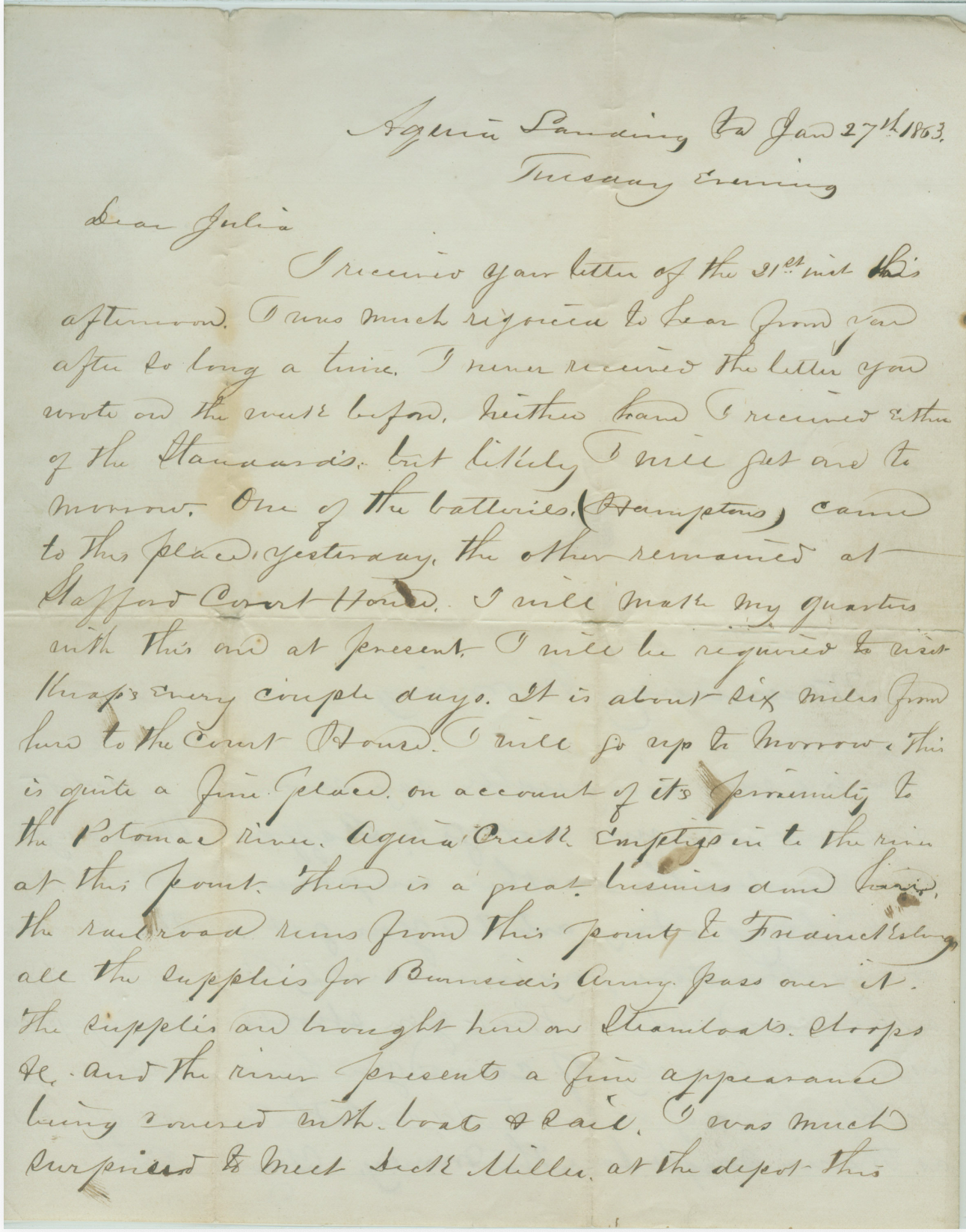
Aquia Landing, Va. January 27th 1863 Tuesday evening
Dear Julia,
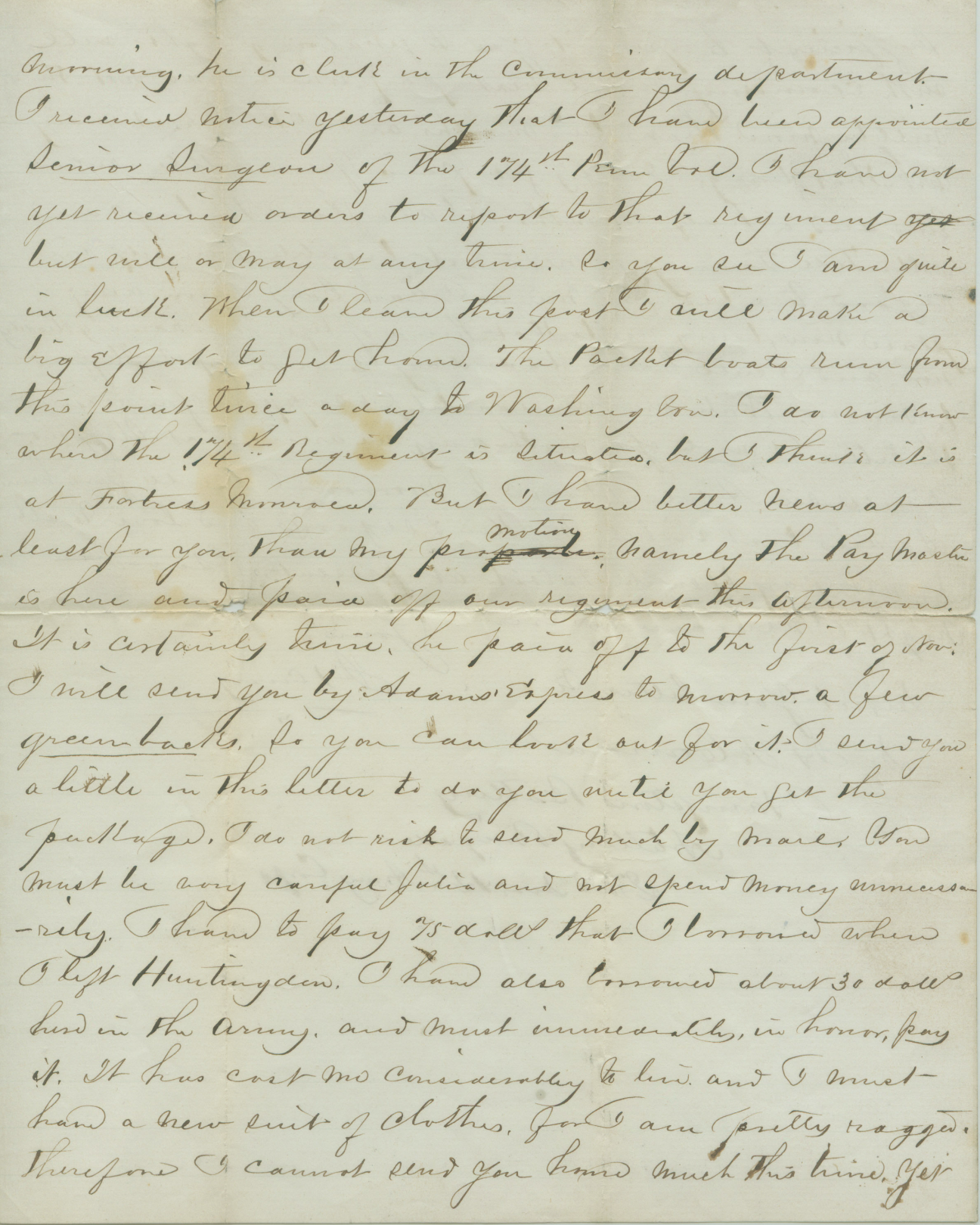
I received your letter of the 21st inst. this afternoon. I was much rejoiced to hear from you after so long a time. I never received the letter you wrote on the week before. Neither have I received either of the Standards, but likely I will get one tomorrow. One of the batteries (Hampton’s) came to this place yesterday. The other remained at Stafford Court House. I will make my quarters with this one at present. I will be required to visit Knapp’s [Battery] every couple days. It is about six miles from here to the Court House. I will go up tomorrow.
This is quite a fine place on account of its proximity to the Potomac River. Aquia Creek empties ito the river at this point. There is a great business done here. The railroad runs from this point to Fredericksburg. All the supplies for Burnside’s Army pass over it. The supplies are brought here on steamboats, sloops, &c. and the river presents a fine appearance, being covered with boats and sail.
I was much surprised to meet Dick Miller at the depot this morning. He is clerk in the commissary department.
I received notice yesterday that I have been appointed Senior Surgeon of the 174th Pennsylvania Volunteers. I have not yet received orders to report to that regiment but will or may at any time. So you see I am quite in luck. When I leave this post, I will make a big effort to get home. The packet boats run from this point twice a day to Washington. I do not know where the 174th Regiment is situated but I think it is at Fortress Monroe.
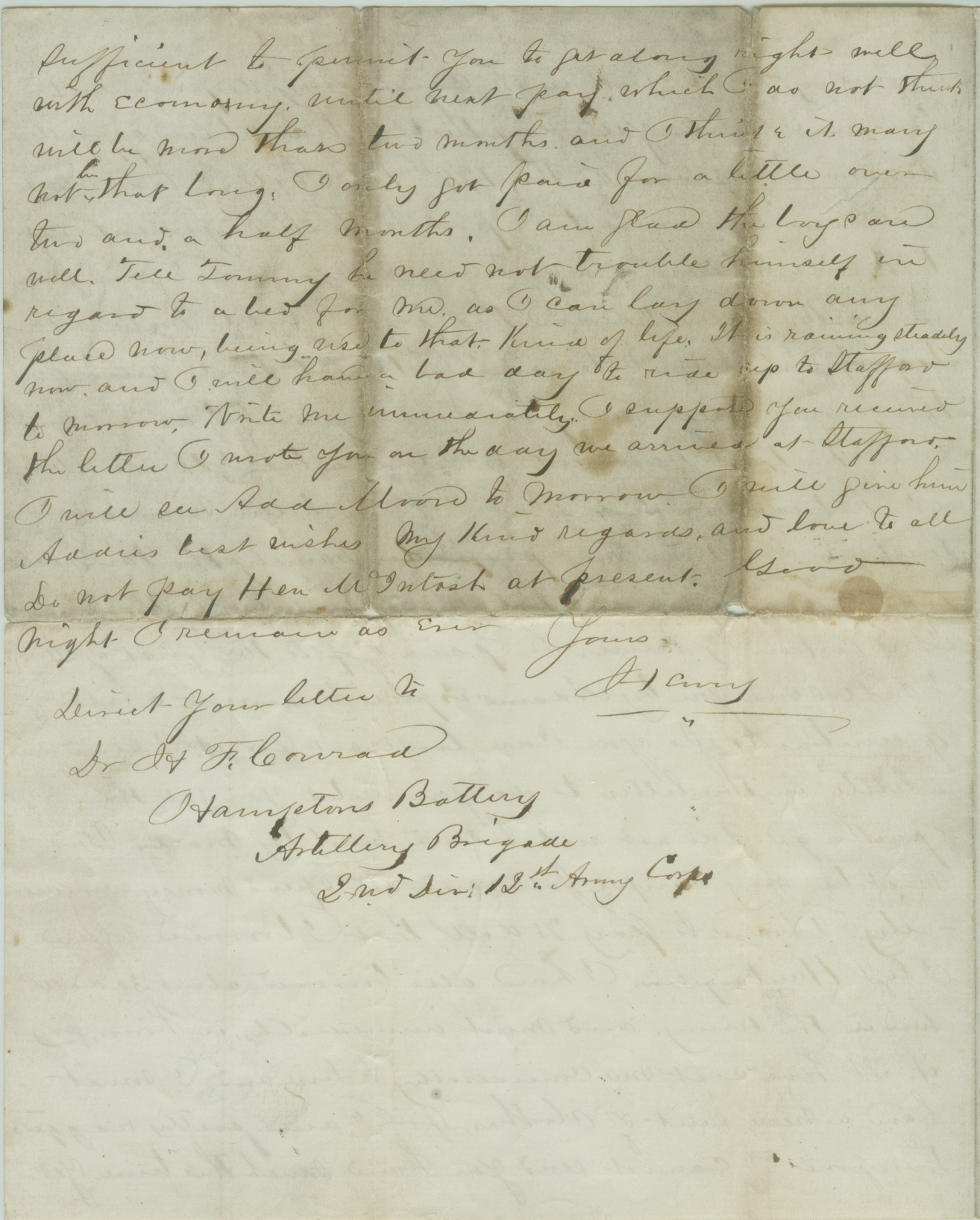
But I have better news at least for you than my promotion. Namely, the paymaster is here and paid off our regiment this afternoon. It is certainly time. He paid off to the first of November. I will send you by Adams Express tomorrow a few greenbacks so you can look out for it. I send you a little in this letter to do you until you get the package. I do not risk to send much by mail. You must be very careful, Julia, and not spend money unnecessarily. I have to pay 75 dollars that I borrowed when I left Huntingdon. I have also borrowed about 30 dollars here in the army and must immediately, in honor, pay it. It has cost me considerably to live and I must have a new suit of clothes for I am pretty ragged. Therefore, I cannot send you home much this time. Yet sufficient to permit you to get along right well with economy until next pay which I do not think will be more than two months and I think it may not be that long. I only got paid for a little over two and a half months.
I am glad the boys are well. Tell Tommy he need not trouble himself in regard to a bed for me as I can lay down any place now, being used to that kind of life. It is raining steadily now and I will have a bad day to ride up to Stafford tomorrow. Write me immediately. I suppose you received the letter I wrote you on the day we arrived at Stafford. I will see Add Moore tomorrow. I will give him Addie’s best wishes. My kind regards and love to all. Do not pay Hen McIntosh at present. Good night. I remain as ever yours, — Henry
Direct your letters to Dr. H. F. Conrad, Hampton’s Battery, Artillery Brigade, 2nd Division, 12th Army Corps
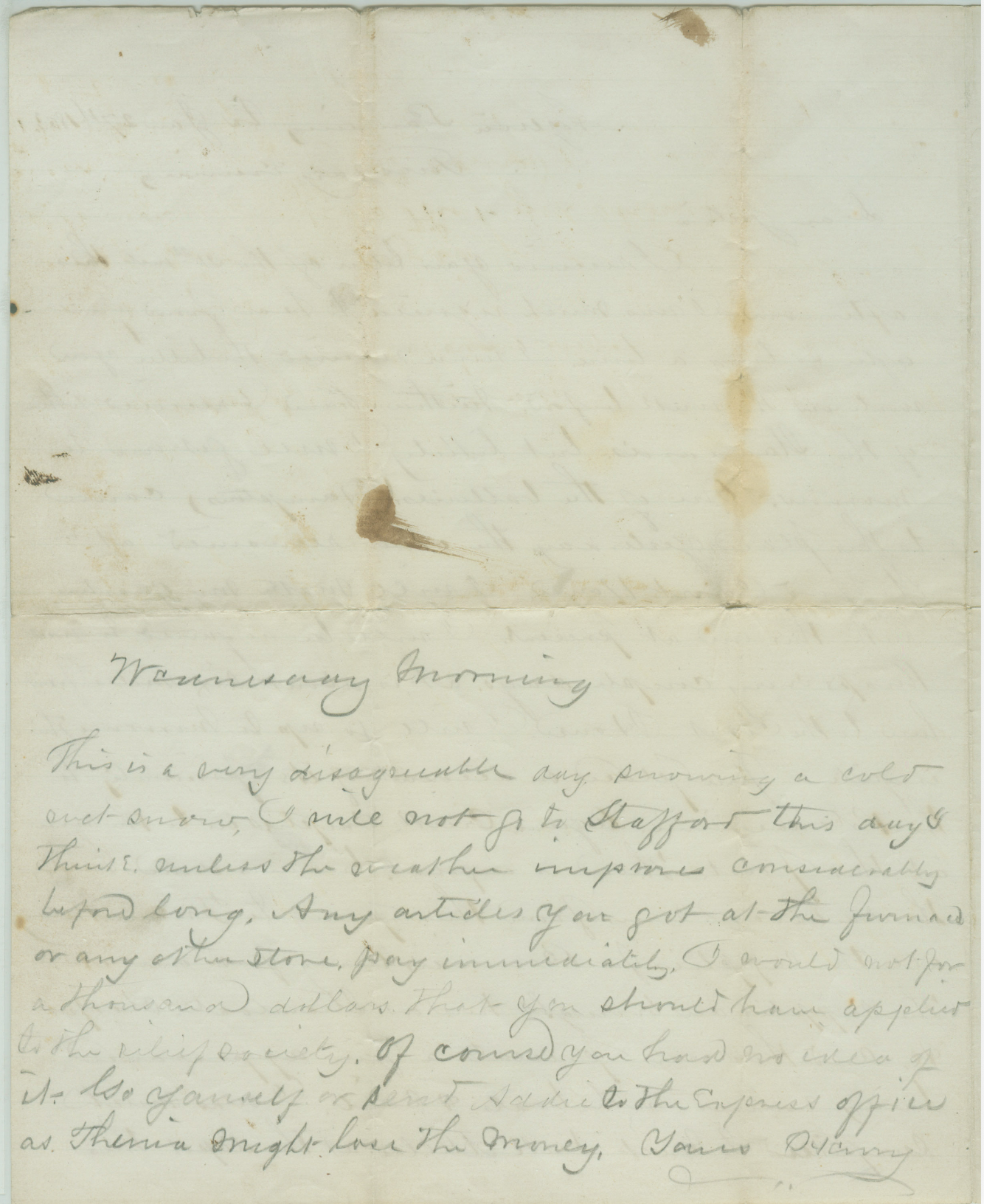
Wednesday morning [in pencil]. This is a very disagreeable day—snowing a cold wet snow. I will not go to Stafford this day, I think, unless the weather improves considerably before long. Any articles you get at the furnace or any other store, pay immediately. I would not for a thousand dollars that you should have applied to the Relief Society. Of course you had no idea of it. Go yourself or send Addie to the Express office as Thenia might lose the money. Yours, — Henry
Letter 3
[Editor’s Note: The following transcript was provided to me by John R. Conrad who stated that it was a letter his ancestor, Dr. Henry F. Conrad, wrote to his local newspaper, the Democratic Standard (Hollidaysburg, Pa.) while serving with the 174th Pennsylvania Vols. in Beaufort, South Carolina. The letter was not signed, but he was the only soldier in the 174th from Blair County, Pennsylvania, and the handwriting matches the handwriting in the two earlier letters.]
Dear Standard. 1 I have several times seated myself to drop you a friendly line, but always some unforeseen circumstance presented itself to prevent my carrying out my purpose. But indeed I must confess that life is here so monotonous and inactive that I have little to write about. Even when the opportunity was offered us to do something for our country and destroy the dull uniformity of quiet camp life, it was denied us. I have referenced to the time the gunboat, Washington, 2 was captured on Coosaw River, some six or seven miles above this area. The commander of this regiment, Col. John Nyce 3—an efficient & brave soldier—urgently requested the privilege from higher authority on the morning of this capture to proceed with part of his own regiment and one or two batteries of the 3rd Rhode Island Light Artillery, and prevent the ability of recovering the ordinance on board that boat and—if necessary—give them a specimen of the fighting quality of Bucks County Dutchmen. But from causes not known and most mysterious to us all, the request was refused and the Confeds were permitted to cross over to our side of the river (she was sunk on this side), raise her, tow her across to the mainland, and, as federals inform us, are now repairing her for their own use. All was within six or seven miles of our forces in the harbor and consisting of eight regiments of infantry and three batteries of artillery which could be brought into action if necessary, besides saying nothing of the gunboats lying in the river. But the Authorities seemed perfectly unconcerned and uninterested. But this appears as I’m provoking & dwell upon what I would willingly if possible eradicate from my memory forever.
We are encamped about a half mile west of Beaufort, and are pleasantly situated in a perfectly level field of about two hundred acres. In fact, the whole island is a level plain and I would judge is very fertile for particular products as corn, beans, peas, and I have been informed, cotton. Beaufort, situated in a bend of the Coosaw River, has been and is still a lovely place. The streets are lined with beautiful shade trees of live oak, locust, and others peculiar to this region whose spreading boughs cast a cooling shade over the sidewalks and attract a pleasant breeze which is quite refreshing on these hot sweltering days. The houses are generally built back from the street with a yard in front enclosed by a neat railing fence painted white, or a stone wall capped by an iron railing. The buildings are perfectly embowered in trees and shrubbery. The orange, fig, Jasmine, Magnolia, & Oleander abound—the two latter being now in full bloom. The gardens are beautified by a profusion of flowers of many varieties which diffuse a fragrant perfume throughout the atmosphere, soothing to the senses. Notwithstanding, an inconsiderate, vandal-like soldiery has produced considerable devastation dilapidation by tearing down the enclosures of parks, gardens, and even cemeteries. Still, sufficient remains to fully attest that Beaufort has been the abode of wealth, enormousness, & ease, and at one time almost, I might say, a perfect Eden.
There are stationed at present on this island, five Pennsylvania regiments, namely the 52nd, Col. Dodge; 55th, Col. White; 104th, Col. Davis; 174th, Col. Nyce; 176th, Col. Lechler. Col. Nyce appears to stand this Southern climate admirably, his extensive proportions are not in the least reduced, and he has the credit of having the cleanliest and most tidy and as thoroughly a drilled regiment as is on the island if not in the department.
There are two Negro regiments here both on pickets on the further end of the island. Apropos of Negro soldiers, they were as you are aware, in the late expedition to Jacksonville, Florida. The Republican press made a great blow about their superior bravery & fighting qualities. Now as the darkies say down here, “we can’t shurn it,” for we happen to know better having it from good authority that they would not at all stand firm, but cut and run at the first regular volley from the Rebs. And it is my opinion and always has been that a “Nigger” will not endure the screaming shell, whistling minie, or the smell of gunpowder.
Speaking of this Florida expedition, I would state that a regiment associated with it and now encamped on this island, has covered itself with an infamy which in the eyes of an enlightened and civilized people time alone will efface. I have reference to the wanton destruction of Jacksonville by fire. Most all the inhabitants who remained in the place were true to the Union and had placed themselves under the protection of the Union forces. So much had they identified themselves with the union cause that they had even been outlawed with the rebels. But their sincere loyalty did not protect them. The members of the above regiment with some blacks urged on by their white officers, with a vandalism worthy of the barbarous Malays, applied the flaming torch to all parts of the most flourishing and beautiful town of Florida—the resort of Northern invalids—reducing it to a heap of ashes & smoldering ruins. To their other outrages they have added that of Church robbery. Entering a church, they commenced sacking it, tore up a expensive organ and afterwards robbed the church of everything valuable and hallowed by those who had worshipped there, the barrels of the altar books, pictures, &c. Nothing escaped their rapacious hands. After they had completely sacked the building it was set fire to and was reduced to ashes with the rest of the divine place. I myself saw, after the return of the expedition to this place, some of the articles taken from this church by this wicked act of barbarianism, the inhabitants—men, women, and children—were left with nothing but the canopy of heaven to shield them from the vicissitudes of the weather, the pelting storm or the scorching rays of the sun. Some came here in the transports and more remained to be exposed to mercies of the rebel horde without food and houseless. And to suffer, heaven only knows what, for their loyalty.
And yet all this damnable outrage and crime is proper against humanity and marked at and no cognitions favored of it by those in authority but that heaven smile upon and assist our cause, or make it frown, when such wickedness is permitted. But then this we do know, that the members of the 8th Maine Regiment are looked upon by all honorable soldiers in this island department as abolition vagabonds, and their companionship with ease discarded. We do not now, as some time ago, see the Abolition papers so crowded with resolutions from different regiments proclaiming to the world their great patriotism, their determination to die beneath the glorious old flag, if necessary, and their denunciation of Copperheads in the North, _______ ______ _______ treasury ____ else. Now we consider these resolutions as altogether a poppy-cock arrangement—as though the loyalty of those individuals been brought into question that it is necessary for them to come out in those public manifestations to sustain it. We think not. The secret of the matter is this. They are gotten up in regiments, commanded by Abolition officers who are generally democrats for political purposes and to produce in the minds of the soldiers a prejudice against the Democratic Party at home and to produce the impression that some but not all foes are loyal and the great pillar upon which the Nation must stand [end of letter]
1 This letter was written by a soldier of the 174th Pennsylvania Regiment to the Hollidaysburg, Pennsylvania, Democratic Standard, but the 174th was from Bucks and Northampton Counties in eastern Pennsylvania. The only soldier in the unit from Blair County was Dr. Henry F. Conrad, the regimental surgeon. A comparison of the handwriting of this letter with that of known letters of Dr. Conrad strongly suggests that this letter was written by Dr. Conrad. Given the events noted in the letter, it was written after April 7 and before early June, 1863, probably in the middle of April.
2 On 9 April 1863, the 243-ton gunboat USS George Washington was ambushed, burned and sunk by Confederate artillery near Chisholm Island six miles north of Beaufort on the Coosaw River. She ran aground while navigating the shallow waterways near the Port Royal Ferry, and before she could get off, she was ambushed by the the Beaufort Volunteer Artillery and Nelson’s Light Artillery. One shot struck and exploded the ammunition magazine resulting in her catching fire and sinking in shallow water.
3 John Nyce (1831-1880) was colonel of the 174th Pennsylvania Infantry Regiment, a drafted unit that served from November 19, 1862 until August 7, 1863, when it was mustered out at Philadelphia, PA. It served most of that time on garrison duty in South Carolina, primarily in and around Port Royal and Hilton Head.
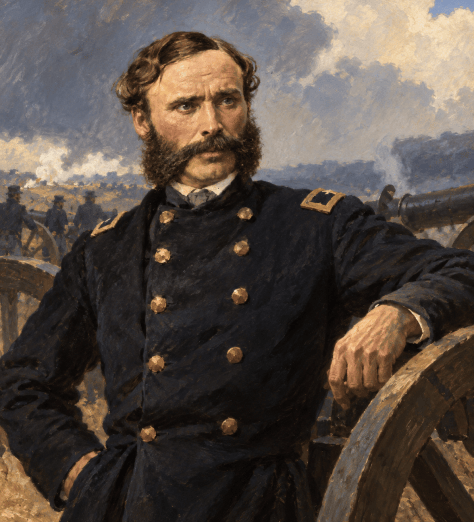
Freeman McGilvery, (1823-1864), “the progeny of Scot-Irish immigrants, was born on October 27, 1823 to Robert and Elizabeth Chase McGilvery in the hamlet of Prospect, Maine. Growing up in the Down East area south of Bar Harbor, it was only natural that he would be drawn to a life at sea. He left home at age eleven as a sailor “to earn a livelihood for himself and his indigent friends.” Trained early in hard work and industry, McGilvery was soon self-reliant. Before the war, he had amassed a significant fortune as a “master mariner.” After working at sea and traveling to places from Brazil to Hawaii, he engaged in the mercantile business. When it failed, he again took to the sea. By the time the clouds of war amassed, McGilvery had married and was considered “master of one of the finest ships of the Old Bay State” of Massachusetts. He was in Rio de Janeiro when he learned of the Confederate firing on Fort Sumter. He immediately set out for home, and arrived months after the war had begun. It seems odd that McGilvery offered his services to the artillery branch of the Union army rather than the Navy. He began the war with the rank of captain, and recruited enough men to form the 6th Maine Battery in early 1862.” [Source: Freeman McGilvery: Devoted to the Union by Diana Loski]
Colonel Freeman McGilvery
In the first of 3 letters from this small collection of McGilvery’s letters, he informs his brother that his 6th Maine Battery was snubbed in receiving credit for the role they played in the Battle of Cedar Mountain—its first engagement. This was primarily due to false reports distributed by other officers and published in the Bangor Daily News. McGilvery’s outrage led him to write Maine Governor Israel Washburn and let him know that “my brave men retain all the credit due them.” The truth was that his battery fought in a highly exposition on the Union left where they had to fight an artillery duel against Confederate batteries that held higher ground. They did not panic and flee as some reported but held their position, leaving multiple dead or exhausted soldiers on the field.
When the 2nd letter was written on 3 May 1863, the 6th Maine Battery was stationed on duty at Dumfries, Virginia, under the command of Lieut. Edwin B. Dow, McGilvery having been promoted to Major in February 1863. Though they missed the Battle of Chancellorsville which was underway at the time, McGilvery’s letter written from the Union supply base at Aquia Landing, roughly 15 to 20 miles away, speaks of the heavy cannonading that was taking place. It may have been the artillery duel that occurred between Hazel Grove and the Chancellor House, or from the heavy bombardment against Confederate positions on Marye’s Heights, possibly both, as they occurred simultaneously. Miraculously he reports hearing cannon firing at “more than one a second” during the morning hours.
During the Battle of Gettysburg,McGilvery played a monumental role in saving the Union line on July 2, 1863, through his brilliant and decisive command of artillery. After the Third Corps line collapsed at the Peach Orchard, McGilvery recognized a critical, unprotected gap on Cemetery Ridge that the advancing Confederates were poised to exploit. Acting quickly—without waiting for orders—he assembled a makeshift line of roughly 39 cannon—including the heroic, sacrificial stand of the 9th Massachusetts Battery—to buy precious time. His makeshift artillery line—now often referred to as McGilvery’s Plum Run Line—successfully halted the Confederate assault under General William Barksdale, anchoring the Union center until infantry reinforcements could arrive. McGilvery’s rapid tactical assessment and aggressive use of artillery proved to be one of the most critical, yet frequently overlooked, turning points of the entire battle. McGilvery’s third letter was written nearly four weeks after the Battle of Gettysburg and speaks of his promotion to Lieutenant Colonel of the Maine Mounted Artillery.
McGilvery finally got the commission as Colonel he sought in September 1863 and he continued to command the Artillery Reserve Brigade until the Overland Campaign where he served with distinction. He was promoted to Chief of Artillery for the 10th Corps in August 1864 but he died from an overdose of anesthesia in early September 1864 during a routine operation to remove a finger wound that had festered.
In July 2015, I transcribed five letters by a sergeant named Edward (“Ned”) Wiggin, Jr. who served under McGilvery in the 6th Maine Battery. He rose in rank to lieutenant and eventually captain of the battery. His five letters include:
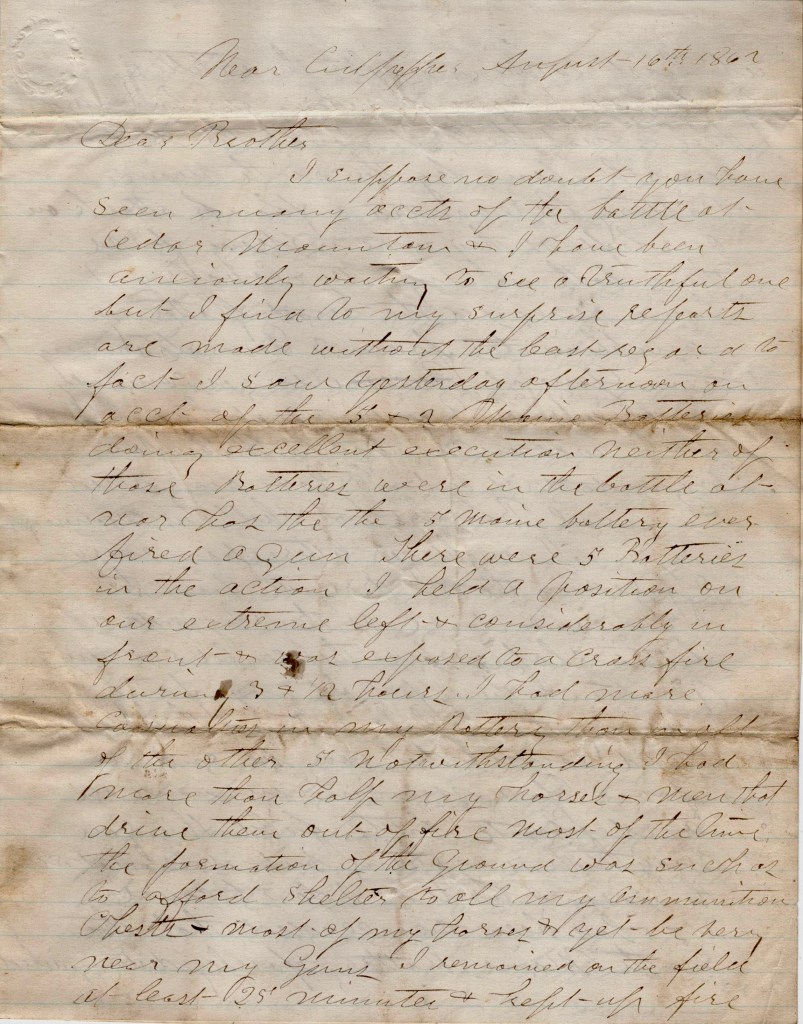
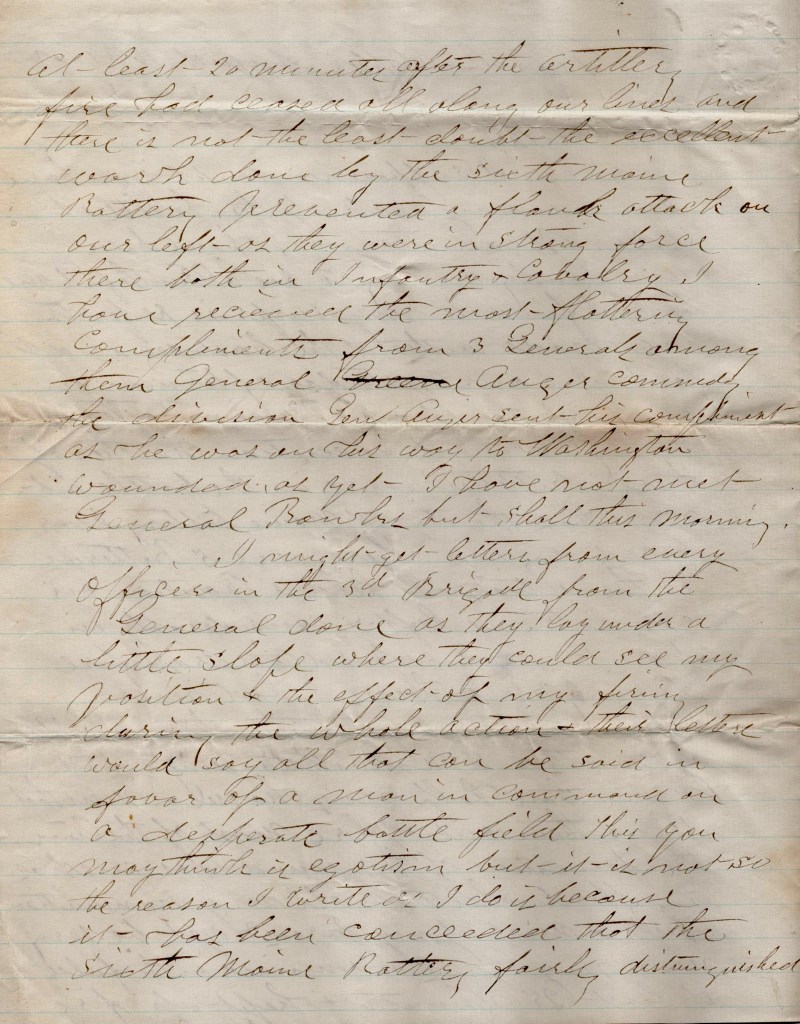
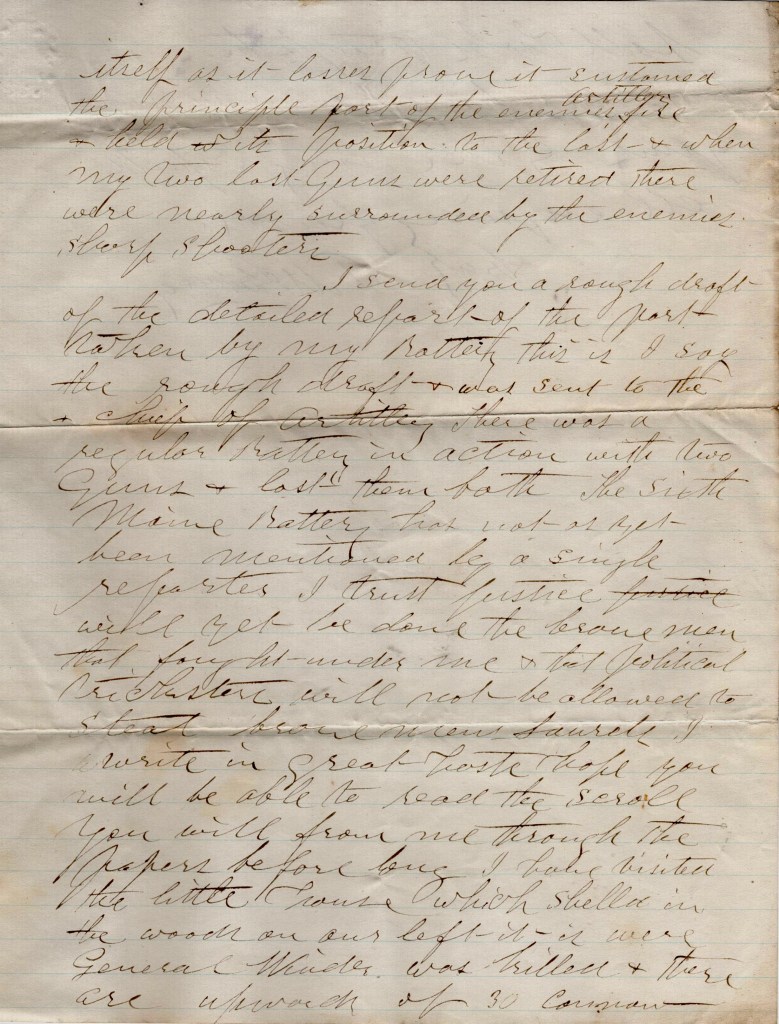
I suppose no doubt you have seen many accounts of the battle at Cedar Mountain & I have been anxiously waiting to see a truthful one but I find to my surprise reports are made without the least regard to fact. I saw yesterday afternoon an account of the 5th & 2nd Maine Batteries doing excellent execution. Neither of those batteries were in the battle at [Cedar Mountain] nor has the 5th Maine Battery ever fired a gun. There were five batteries in the action. I held a position on our extreme left & considerably in front & was exposed to a cross fire during three and a half hours. I had more casualties in my battery than in all of the other five, notwithstanding I had more than half my horses & men that drive them out of fire most of the time. The formation of the ground was such as to afford shelter to all my ammunition chests & most of my horses & yet be very near my guns. I remained on the field at least 25 minutes & kept up fire at least 20 minutes after the artillery fire had ceased all along our lines and there is not the least doubt the excellent work done by the Sixth Maine Battery prevented a flank attack on our left as they were in strong force there, both in infantry & cavalry.
I have received the most flattering compliments from 3 Generals, among them General [Christopher C.] Augur, commanding the division. Gen. Augur sent his compliment as he was on his way to Washington wounded. As yet I have not met General [Nathaniel] Banks but shall this morning.
I might get letters from every officer in the 3rd Brigade from the General down as they lay under a little slope where they could see my position & the effect of my firing during the whole action. Their letters would say all that can be said in favor of a man in command on a desperate battlefield. This you may think is egotism but it is not so. The reason I write as I do is because it has been conceded that the Sixth Maine Battery fairly distinguished itself as its losses prove it sustained the principle part of the enemy’s artillery fire & held its position to the last & when my two last guns were retired, they were nearly surrounded by the enemy’s sharp shooters.
I send you a rough draft of the detailed report of the part taken by my battery. This is I say the rough draft & was sent to the Chief of Artillery. There was a Regular Battery in action with two guns & lost them both. The Sixth Maine has not as yet been mentioned by a single reporter. I trust justice will yet be done the brave men that fought under me & that political tricksters will not be allowed to steal brave men’s laurels.
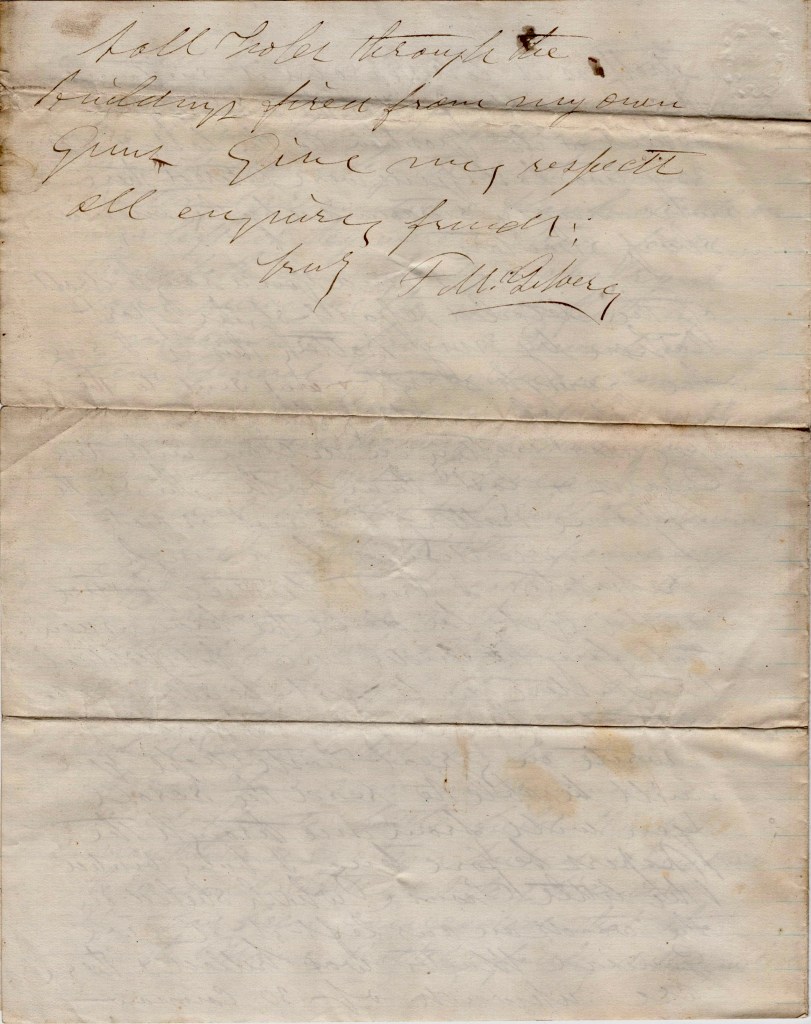
I write in great haste. Hope you will be able to read the scrawl. You will [hear] from me through the papers before long. I have visited the little house which [we] shelled in the woods on our left. It is where [Major] Gen. Winder was killed & there are upwards of 30 cannon ball holes through the buildings fired from my own guns. 1
Give my respects to all enquiring friends. Fraternally, — F. McGilvery
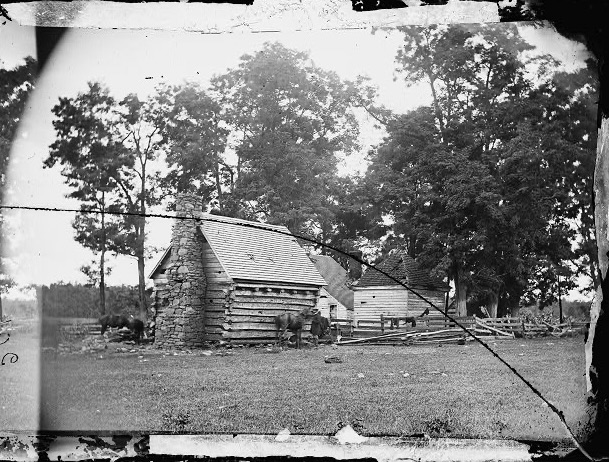
Rev. Philip Slaughter’s farmstead near Cedar Mountain (Slaughter’s Mountain)
1 The buildings McGilvery refers to were no doubt the farmstead of Rev. Philip Slaughter which was riddled with cannon balls from the 6th Maine Battery. Confederate Gen. Charles S. Winder was not using the house as a formal headquarters but he was struck by a shell fragment nearby and mortally wounded. The Library of Congress holds a photograph with the caption. “Battlefield of Cedar Mountain House riddled with cannon balls in which Gen. Winder was killed” (pictured above).
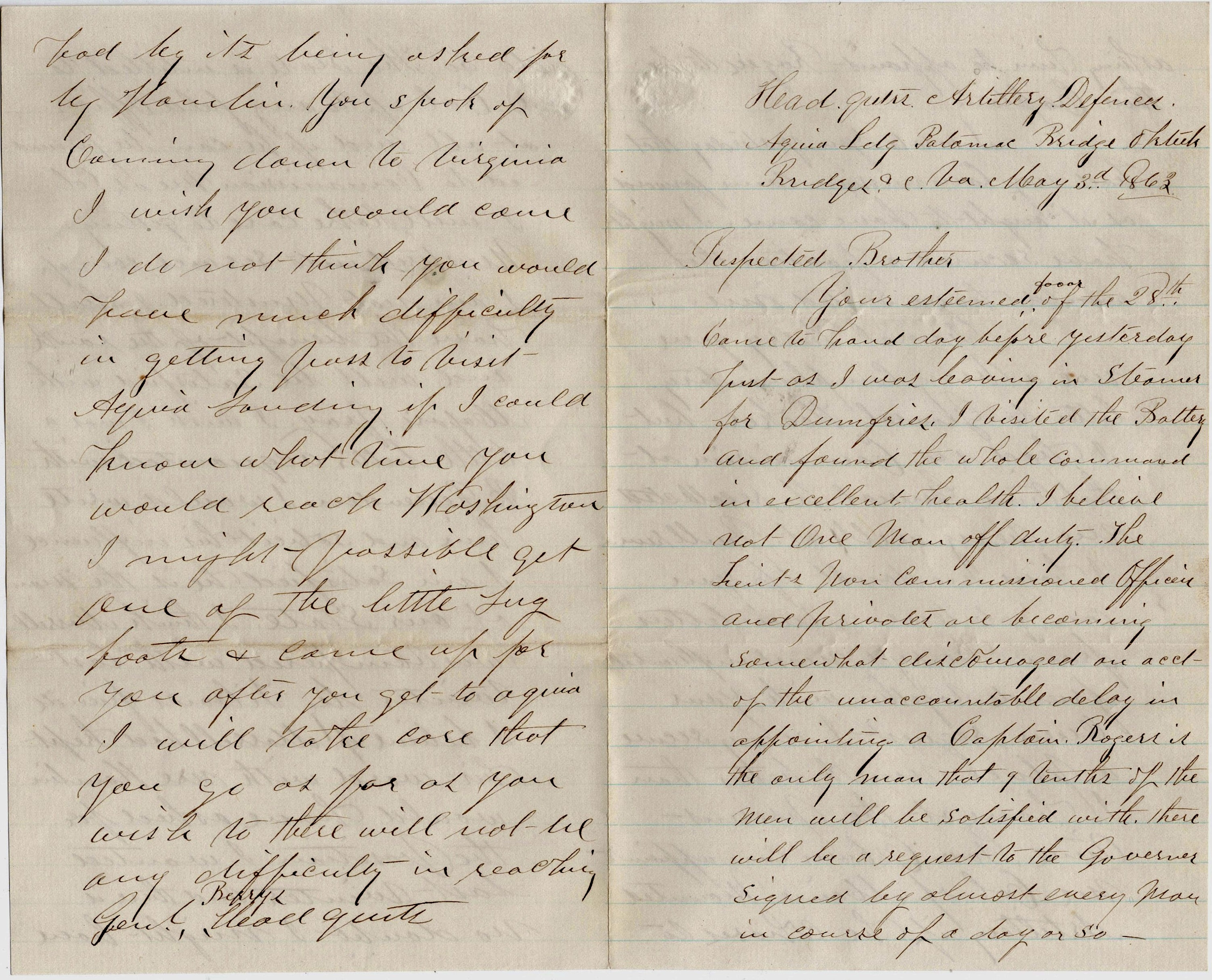
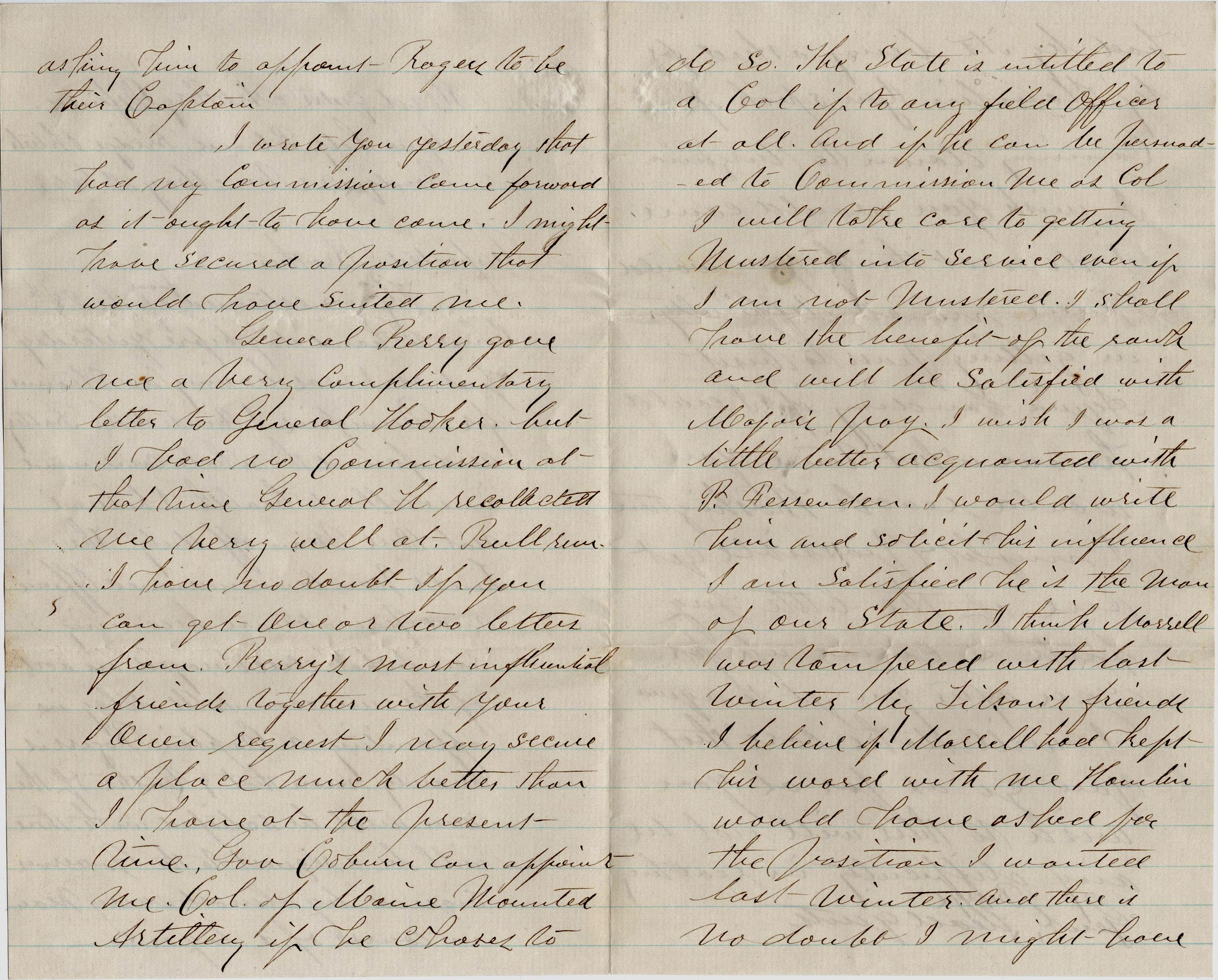
Your esteemed favor of the 28th came to hand day before yesterday just as I was leaving in steamer for Dumfries. I visited the Battery and found the whole command in excellent health. I believe not one man off duty, The lieutenants, non-commissioned officers, and privates are becoming somewhat discouraged on account of the unaccountable delay in appointing a captain. Rogers is the only man that nine tenths of the men will be satisfied with. There will be a request to the Governor signed by almost every man in course of a day or so asking him to appoint Rogers to be their captain.
I wrote to you yesterday that had my commission come forward as it ought to have come, I might have secured a position that would have suited me. General [Hiram G.] Berry gave me a very complimentary letter to Gen. Hooker but I had no commission at that time. General Hooker recollected me very well at [Second] Bull Run. I have no doubt if you can get one or two letters from Berry’s most influential friends together with your own request, I may secure a place much better than I have at the present time. Gov. [Abner] Coburn can appoint me Colonel of Maine Mounted Artillery if he chooses to do so. The state is entitled to a Colonel if to any field officer at all. And if he can be persuaded to commission me as Colonel, I will take care to getting mustered into service. Even if I am not mustered, I shall have the benefit of the rank and will be satisfied with Major’s pay.
I wish I was a little better acquainted with P. Fessenden. I would write him and solicit his influence. I am satisfied he is the man of our state. I think Morrill was tampered with last winter by Tilson’s friends. I believe if Morrill had kept his word with me, [Vice President] Hamlin would have asked for the position I wanted last winter and there is no doubt I might have had by its being asked for by Hamlin.
You spoke of coming down to Virginia. I wish you would come. I do not think you would have much difficulty in getting a pass to visit Aquia Landing. If I could know what time you would reach Washington, I might possibly get one of the little tug boats & come up for you. After you get to Aquia, I will take care that you go as far as you wish to. There will not be any difficulty in reaching Gen. [Hiram G.] Berry’s Headquarters. 1
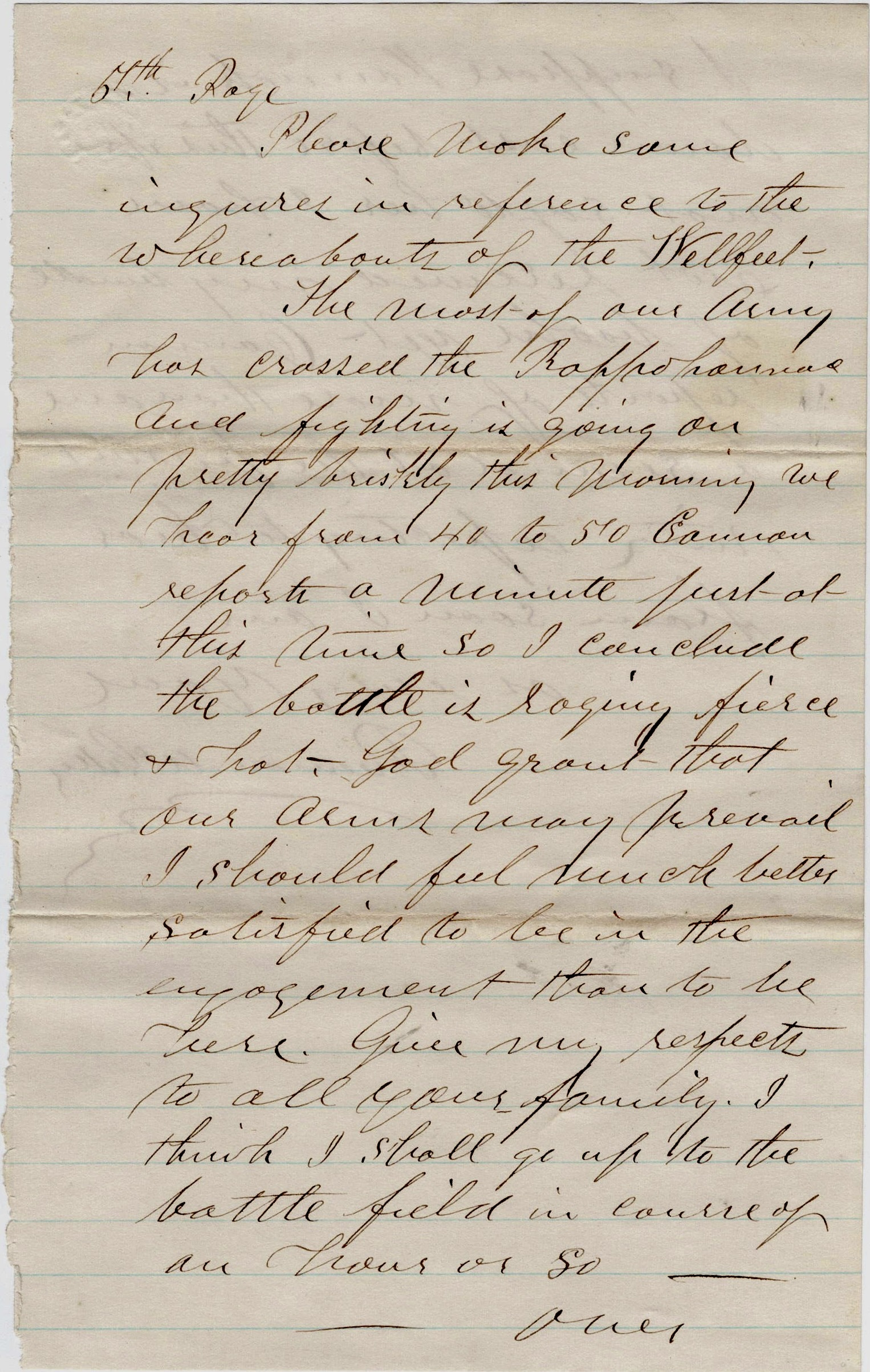
Please make some enquiries in reference to the whereabouts of the Wellfeet.
The most of our army has crossed the Rappahannock and fighting is going on pretty briskly this morning. We hear from 40 to 50 cannon reports a minute just at this time so I conclude that battle is raging fierce and hot. God grant that our arms may prevail. I should feel much better satisfied to be in the engagement than to be here. Give my respects to all your family. I think I shall go up to the battlefield in course of an hour or so.
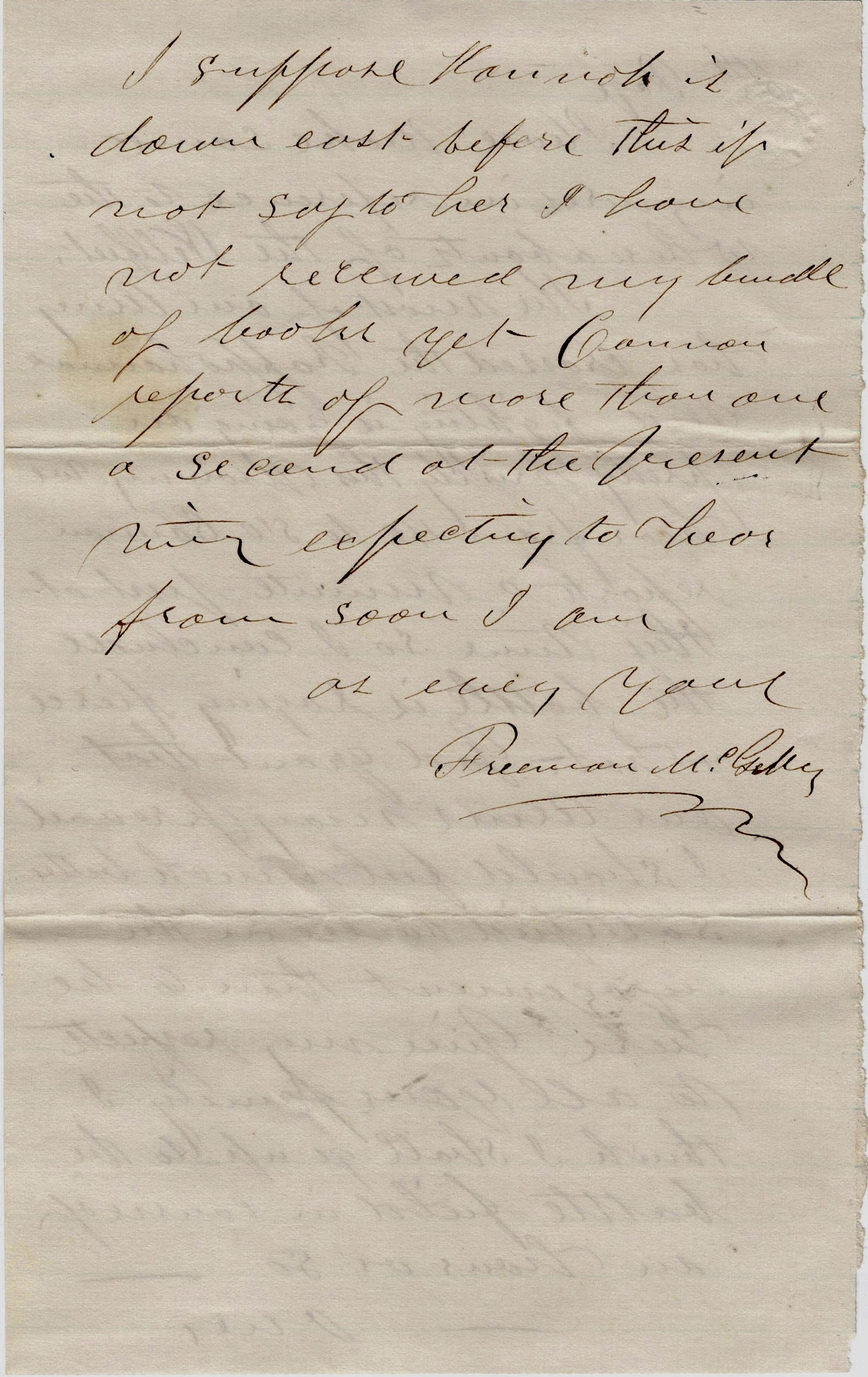
I suppose Hannah is down East before this. If not, say to her I have not received my bundle of books yet. Cannon reports of more than one a second at the present time. Expecting to hear from [you] soon. I am as ever yours, — Freeman McGilvery
1 Ironically, Gen. Hiram G. Berry was killed by at sharpshooter early in the morning on 3 May 1863—the very day that McGilvery wrote this letter. Berry entered the Battle of Chancellorsville in command of the 2nd Division of the III Corps.
Letter 3
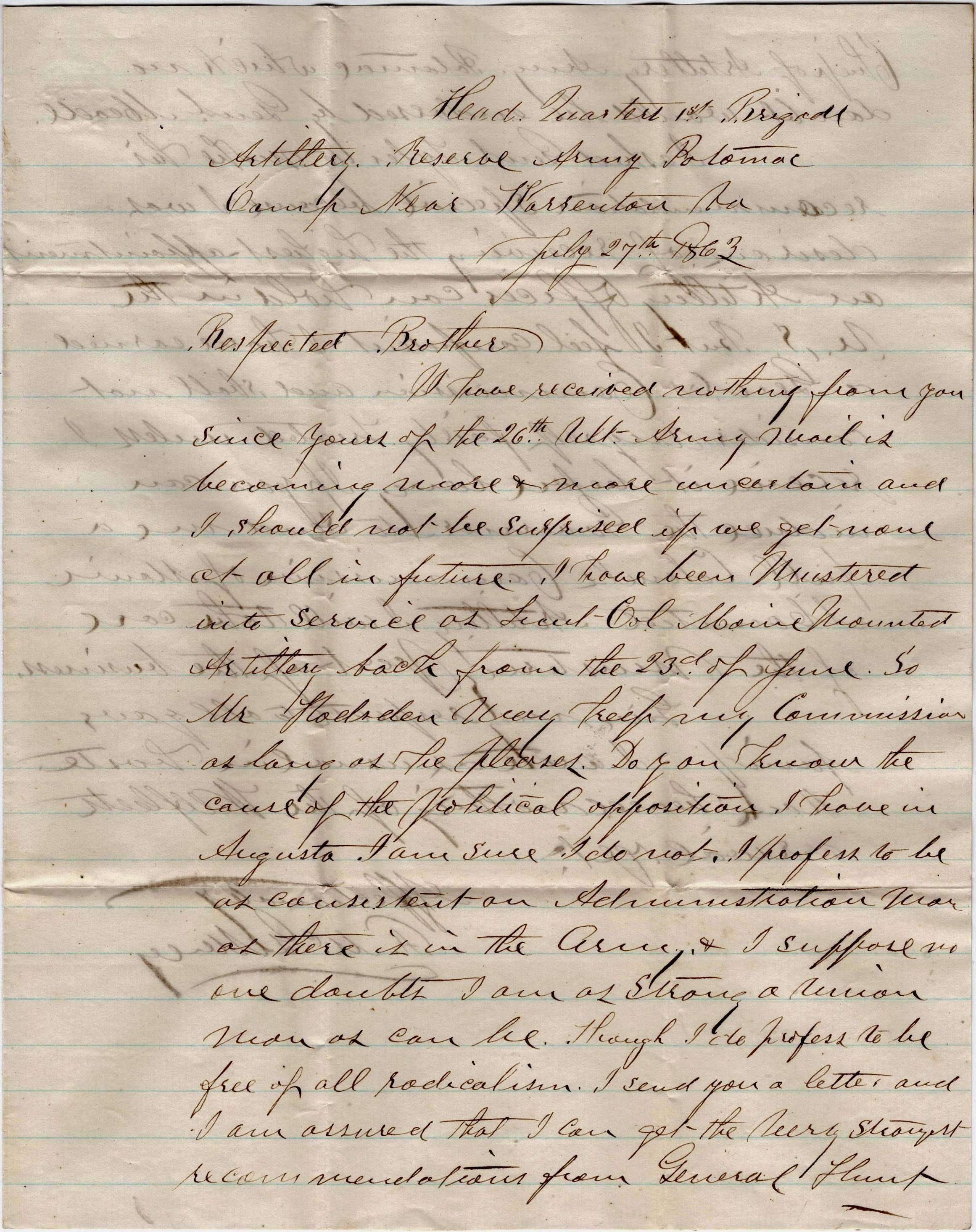
Headquarters 1st Brigade Artillery Reserve, Army of the Potomac Camp near Warrenton, Virginia July 27th 1863
Respected Brother,
I have received nothing from you since yours of the 26th ult. Army mail is becoming more & more uncertain and I should not be surprised if we get none at all in future. I have been mustered into service as Lieut. Colonel Maine Mounted Artillery, back from the 23rd of June. So Mr. [John L.] Hodsdon [Adj. Gen. of Maine] may keep my commission as long as he pleases. Do you know the cause of the political opposition I have in Augusta? I am sure I do not. I profess to be as consistent an Administration man as there is in the army & I suppose no one doubts I am as strong a Union man as can be though I do profess to be free of all radicalism.
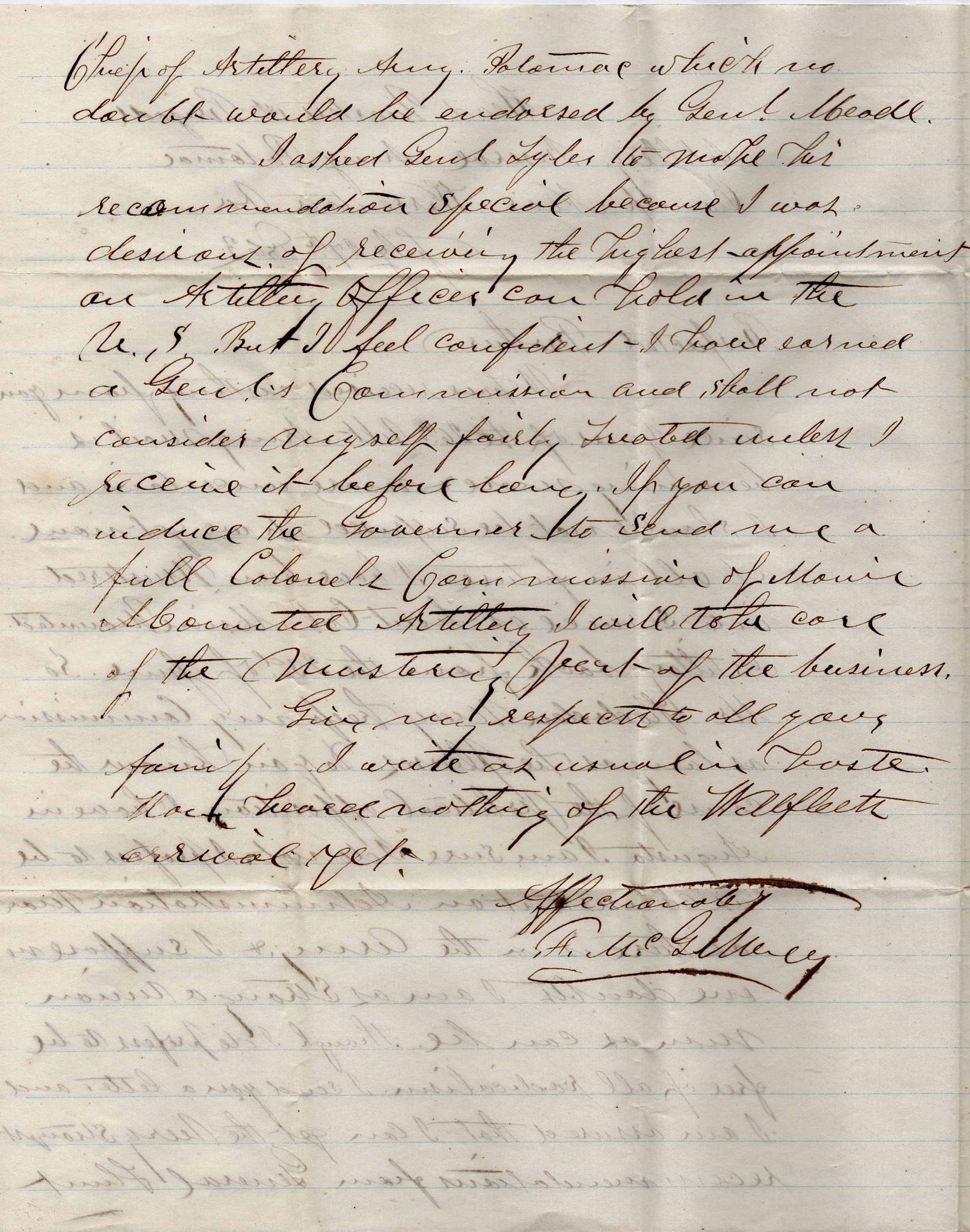
i send you a letter and I am assured that I can get the very strongest recommendation from General Hunt, Chief of Artillery, Army of the Potomac, which no doubt would be endorsed by Gen. Meade.
I asked Gen. [Robert O.] Tyler to make his recommendation special because I was desirous of receiving the highest appointment an Artillery officer can hold in the U. S. but I feel confident I have earned a General’s commission and shall not consider myself fairly treated unless I receive it before long. If you can induce the Governor to send me a fill Colonel’s commission of Maine Mounted Artillery, I will take care of the mustering part of the business.
Give my respects to all your family. I write as usual in haste. Have heard nothing of the Wellfleets arrival yet.
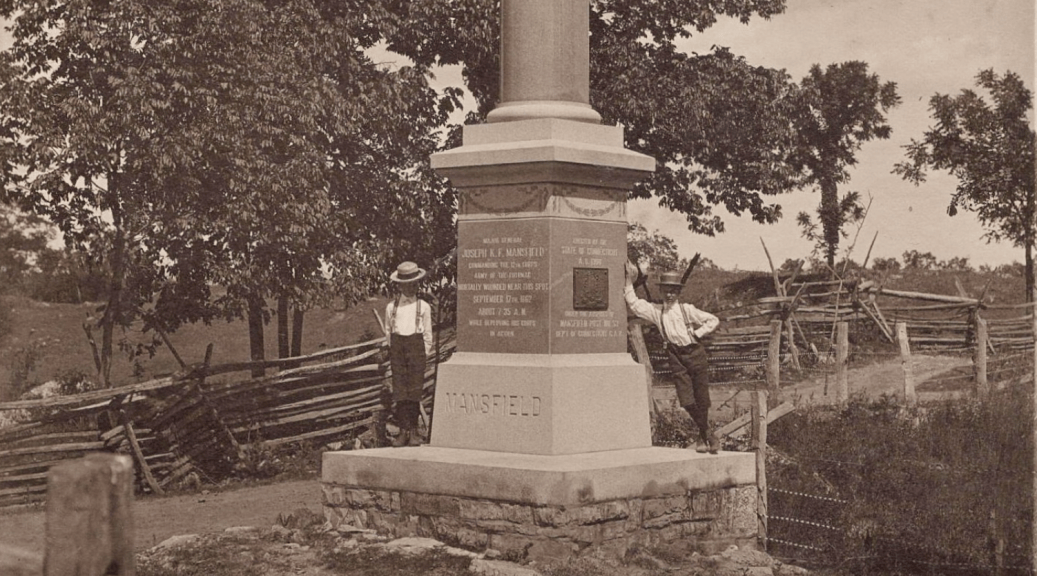
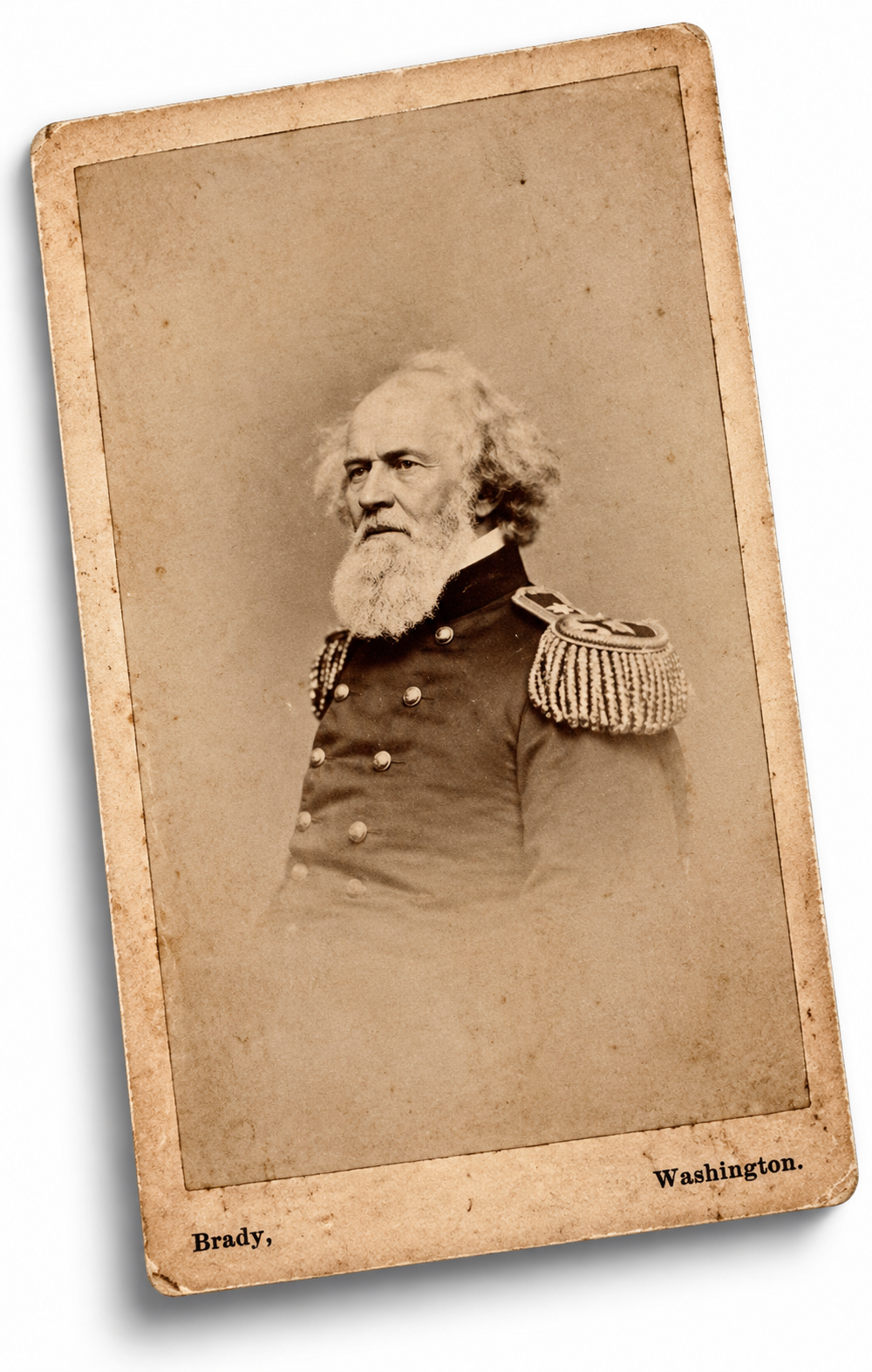
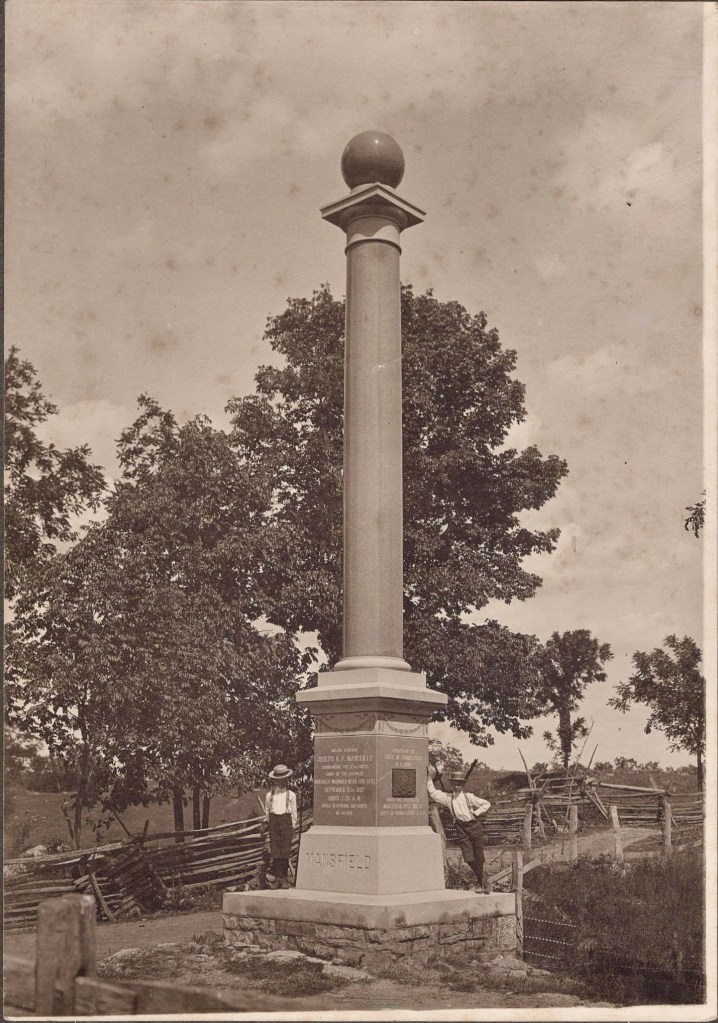
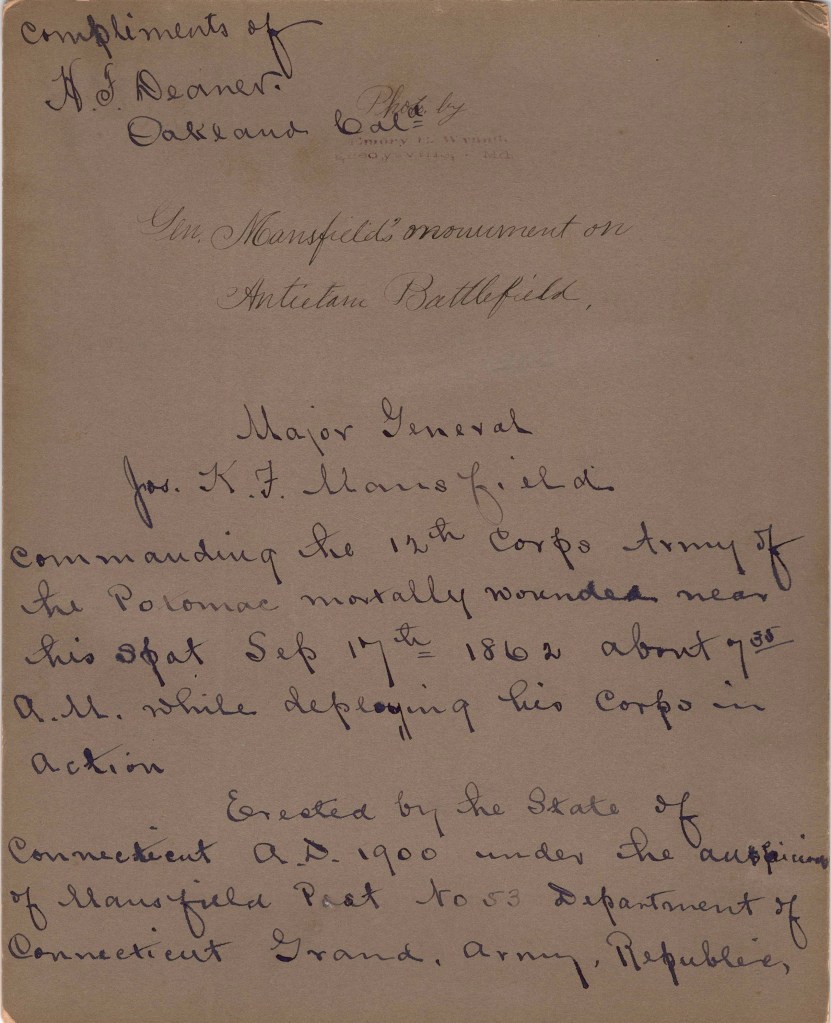
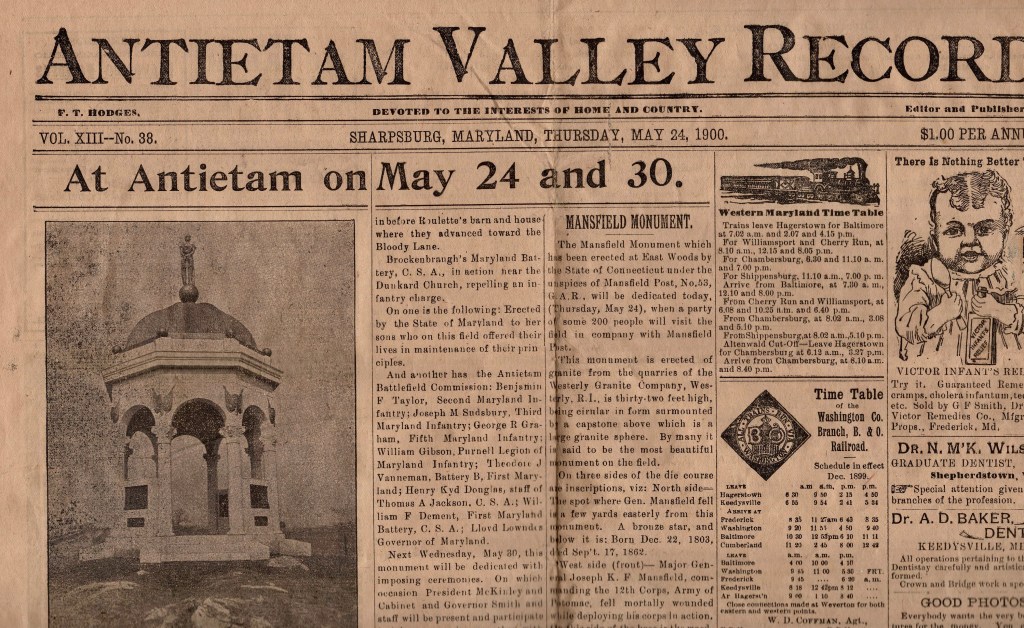
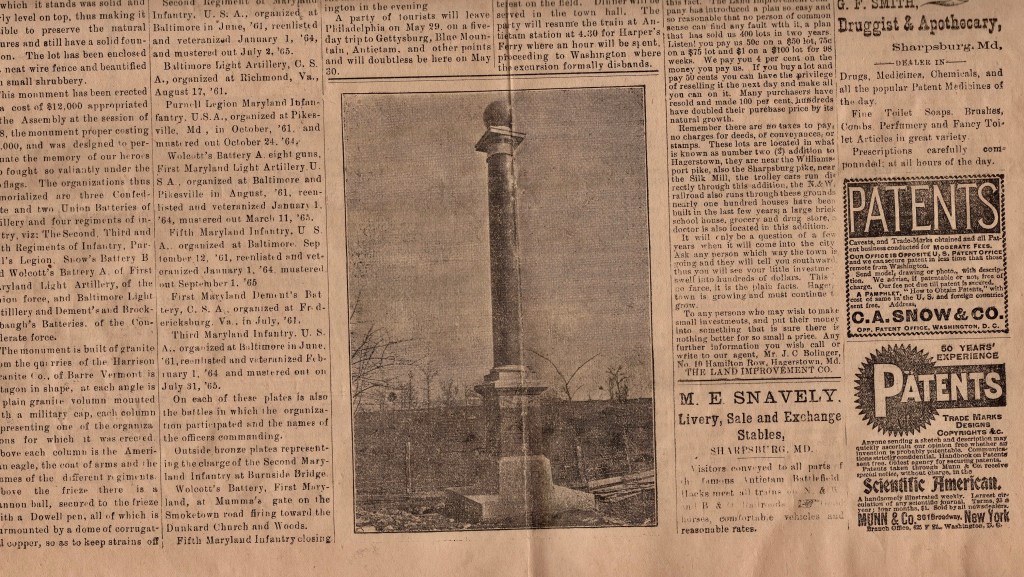
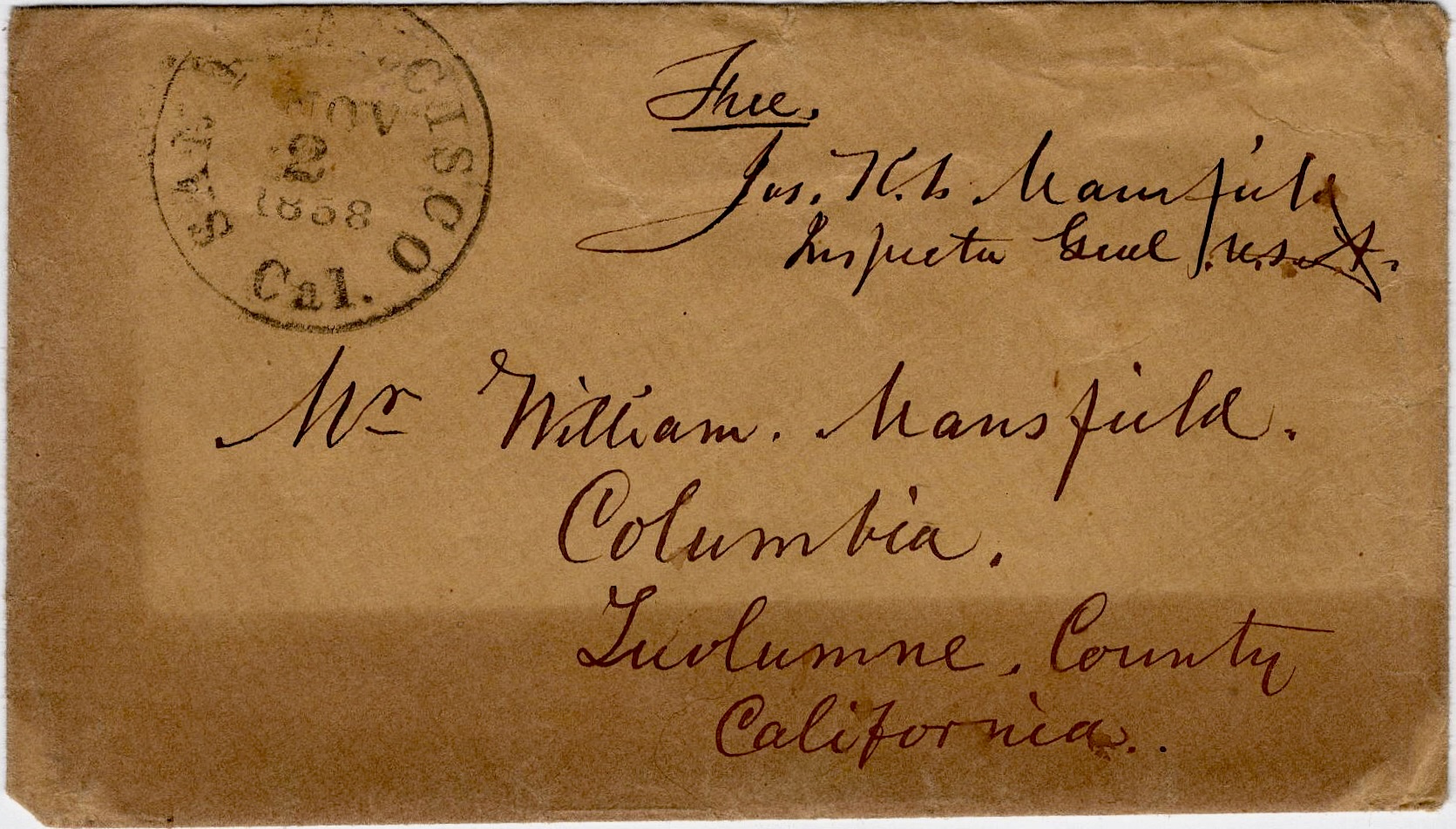
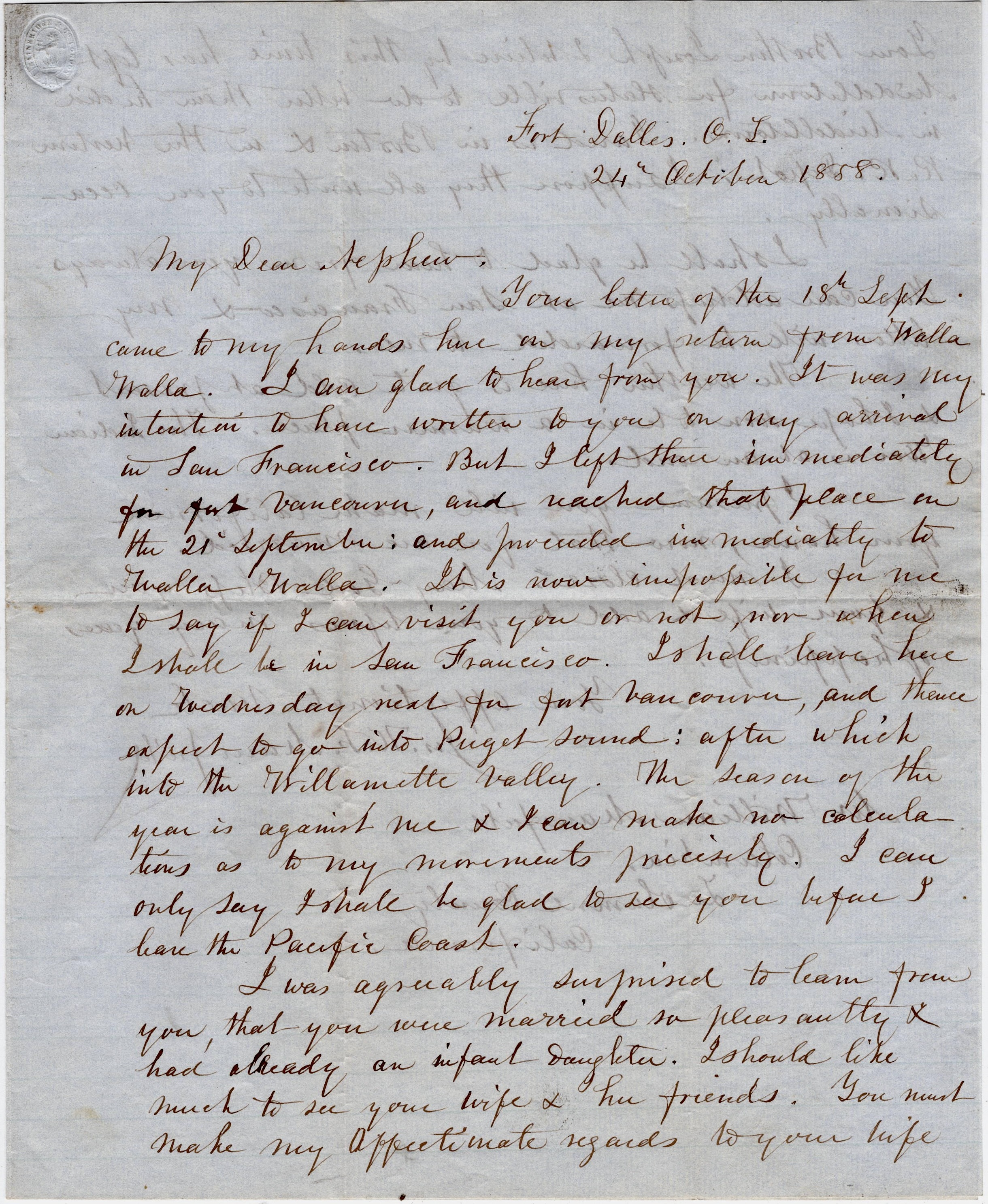
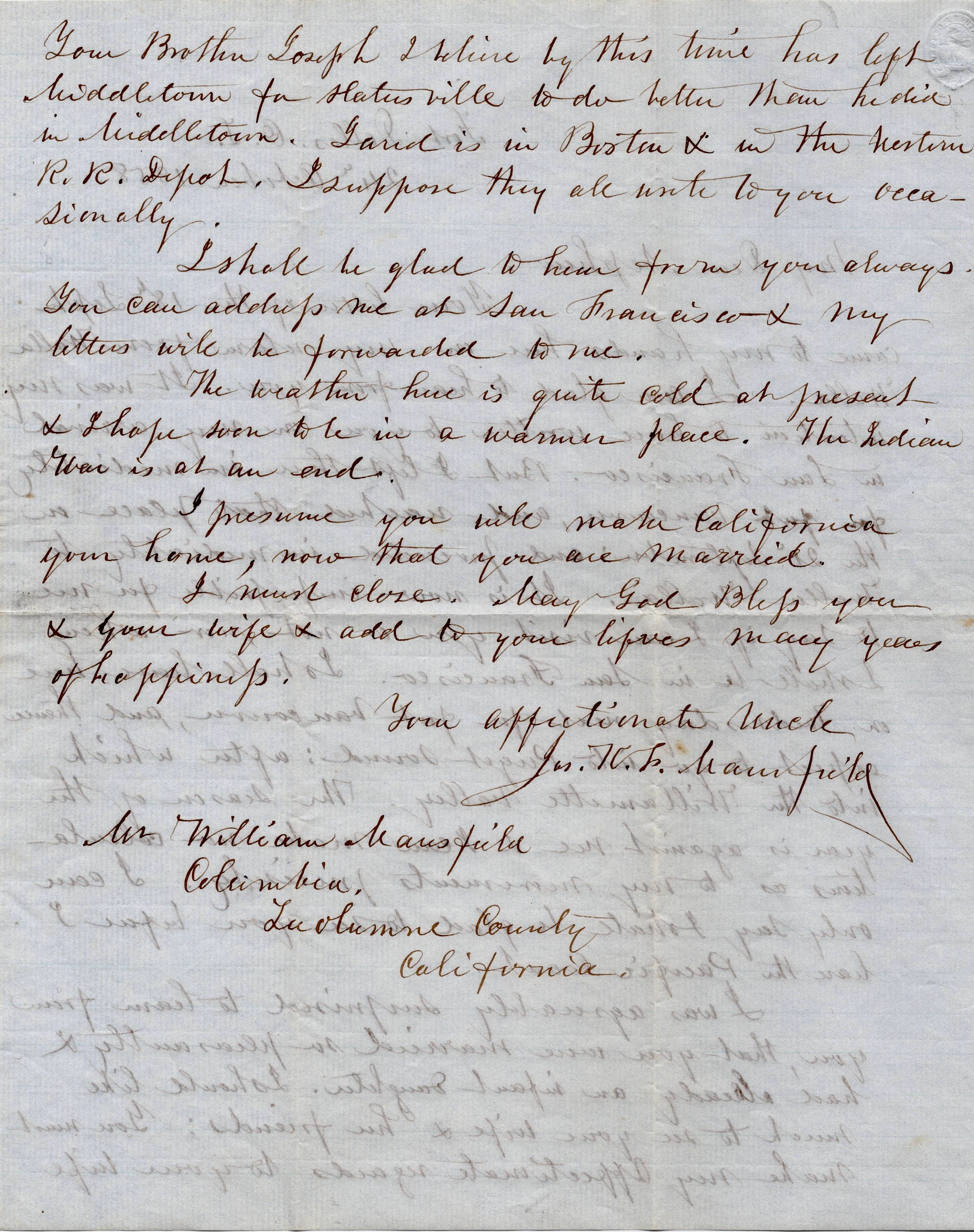
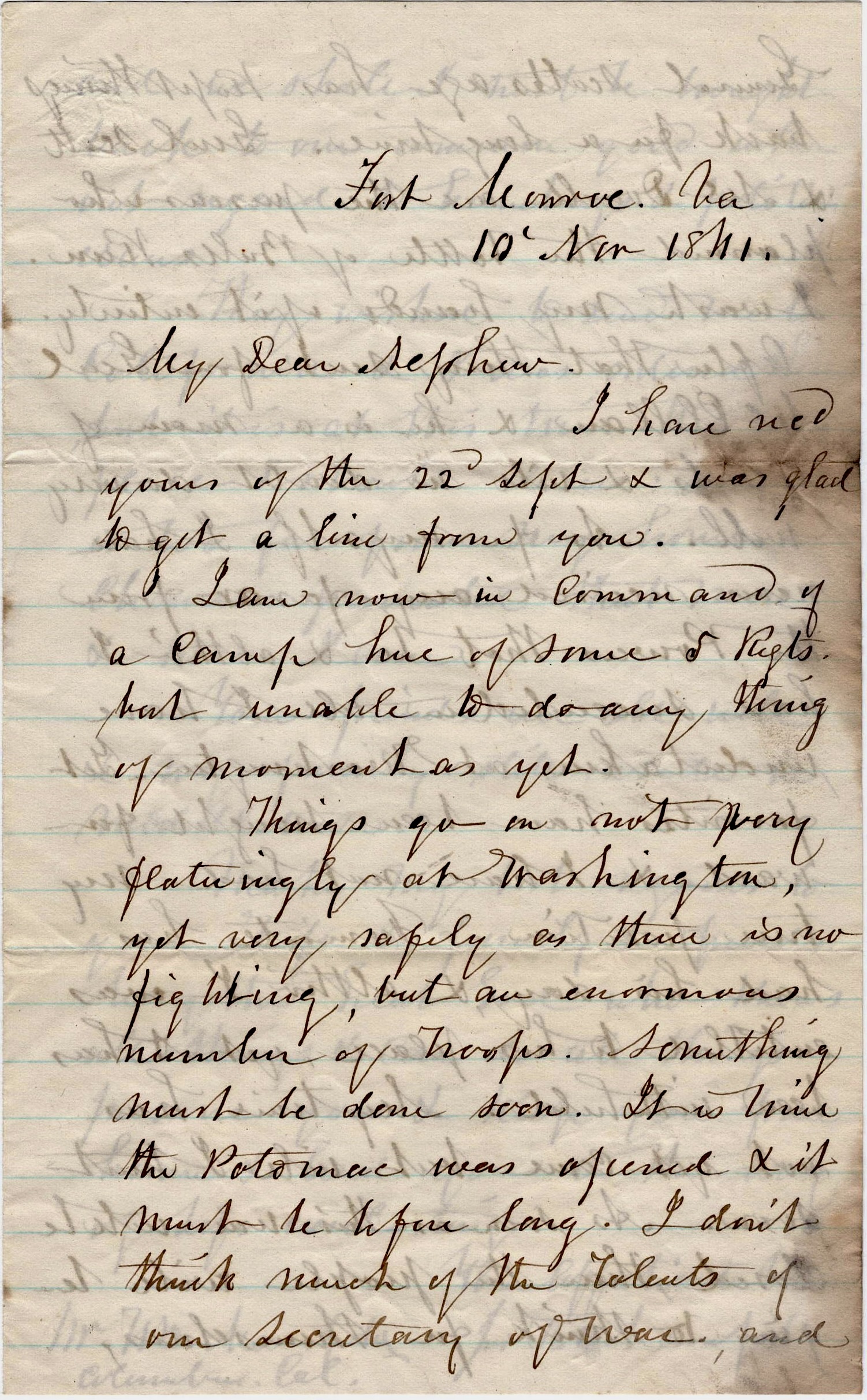
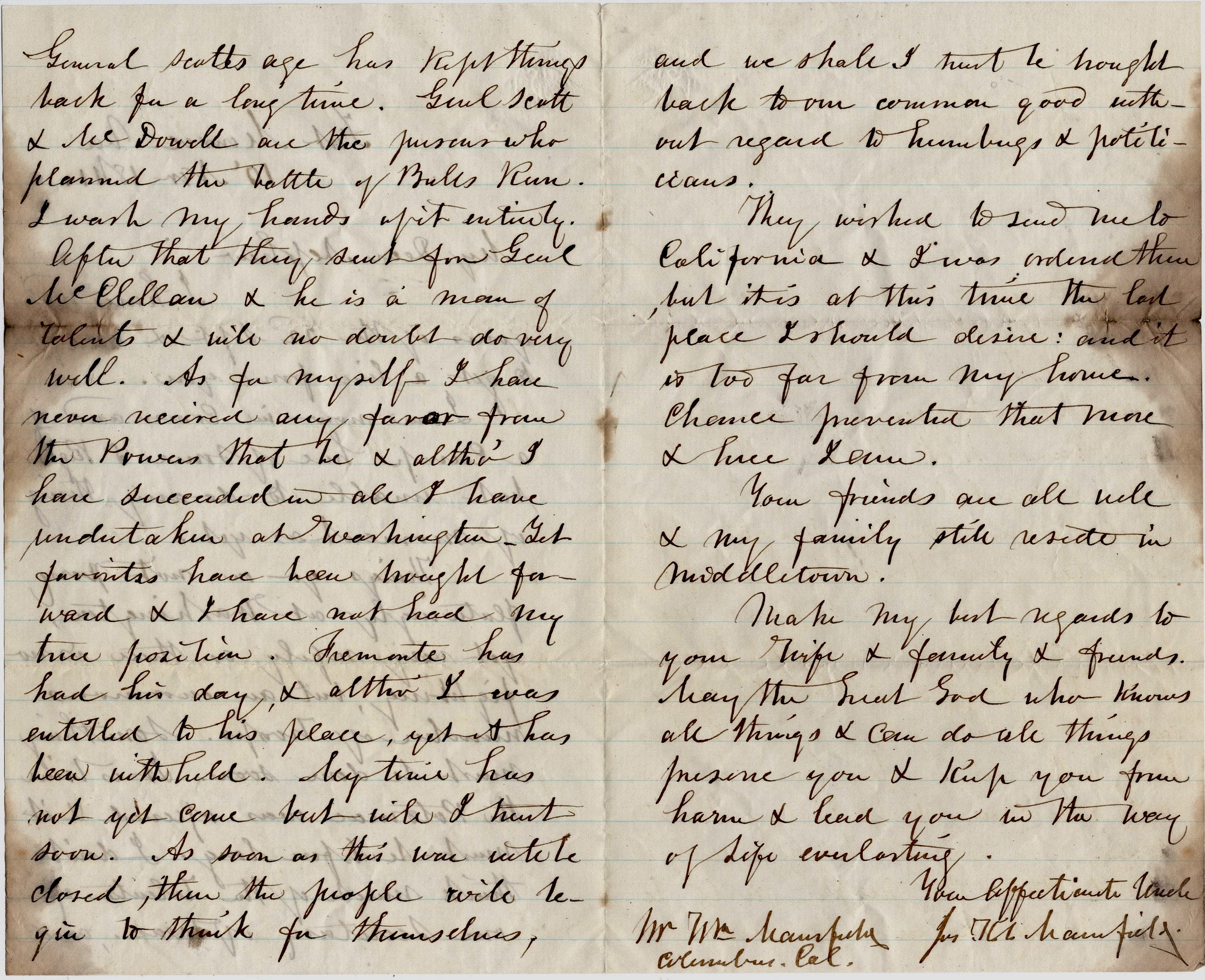
The following letters from a private collection were written by Joseph King Fenno Mansfield (1803-1862)—a career army officer who was killed at the Battle of Antietam. Mansfield grew up in Middletown, Connecticut, and entered West Point when he was only 14 years old. He graduated 2nd in a class of forty in 1822. Advancement came slowly in the peacetime army and he was promoted to first lieutenant in 1832 and captain in 1838. During the Mexican–American War, he received a brevet promotion to major for the action at Fort Brown, Texas, on May 9, 1846. He was wounded in the leg at the Battle of Monterrey, and he received a brevet promotion to lieutenant colonel for his actions there. He was appointed a brevet colonel for the Battle of Buena Vista in 1847. After the war he was promoted to colonel and Inspector General of the U.S. Army on May 28, 1853. It was while serving in this capacity when he wrote the first letter from Fort Dalles in Oregon Territory in 1858.
At age 58, Mansfield was the old general to die in combat during the Civil War.
At the start of the Civil War, Mansfield commanded the Department of Washington (April 27 – August 17, 1861), and was promoted to brigadier general on May 6, 1861. General-in-chief Winfield Scott recommended Mansfield for command of the volunteer army being raised in Washington D.C. that spring, but the strong political influence of Treasury Secretary Chase resulted in the command going to Irvin McDowell instead. Mansfield was not considered the best choice due to his relatively advanced age (58). In the second letter, written from Fort Monroe in Virginia in November 1861, Mansfield makes it clear he felt snubbed and attributes it to his lacking political support in Washington. [See Irvin McDowell: The Most Unpopular Man in America by Michael C. Hardy]
On the morning of September 17, 1862, at the Battle of Antietam, Mansfield personally led the XII Corps into the ferocious fighting near the East Woods. Spotting the 10th Maine Regiment firing into the trees, Mansfield mistakenly believed they were hitting their own men and rode to the front line to order them to halt. Moments after the soldiers convinced him they were indeed engaging Confederate forces, Mansfield was mortally wounded in the chest by a rebel bullet. He died the following morning, becoming the oldest Union general to fall at Antietam. He was posthumously promoted to major general of volunteers for his gallant service and is buried in Middletown, Connecticut.
Both of these letters were written to William Mansfield (1829-1908), the youngest son of his brother Henry Stephen Mansfield (1786-1851). William was married in Columbia, Tuolumne county, California, to Sally Ann Burt in July 1857 where William was employed as an engineer managing water delivery to the placer and hydraulic mining operations in Tuolumne county. William died in an industrial accident in 1908.
The monument erected on the Antietam battlefield by the State of Connecticut in 1900 honoring Joseph K. F. Mansfield. This photograph was found with the two letters along with the newspaper clipping announcing its dedication.
Letter 1
Franked “Free” Jos. K. F. Mansfield, Inspector General USA
Fort Dalles, Oregon Territory 24th October 1858
My dear Nephew,
Your letter of the 18th September came to my hands here on my return from Walla Walla. I am gad to hear from you. It was my intention to have written to you on my arrival in San Francisco but I left there immediately for Fort Vancouver and reached that place on the 21st September and proceeded immediately to Walla Walla. It is now impossible for me to say if I can visit you or not, nor when I shall be in San Francisco. I shall leave here on Wednesday next for Fort Vancouver and thence expect to go into Puget Sound; after which into the Willamette Valley. The season of the year is against me & I can make no calculations as to my movements precisely. I can only say I shall be glad to see you before I leave the Pacific Coast.
I was agreeably surprised to learn from you that you were married so pleasantly & had already an infant daughter. I should like much to see your wife & her friends. You must make my affectionate regards to your wife. Your brother Joseph I believe by this time has left Middletown for Slateswill [R. I.] to do better than he did in Middletown. Jared is in Boston & in the Western Railroad Depot. I suppose they all write to you occasionally.
I shall be glad to hear from you always. You can address me in San Francisco & my letters will be forwarded to me.
The weather here is quite cold at present & I hope soon to be in a warmer place. The Indian War is at an end.
I presume you will make California your home now that you are married. I must close. May God bless you & your wife & add to your lives many years of happiness.
Your affectionate Uncle, Jas. K. F. Mansfield
[to] Mr. William Mansfield, Columbia, Tuolumne county, California
Letter 2
Fort Monroe, Virginia 10 November 1861
My dear Nephew,
I have received yours of the 22nd September and was glad to get a line from you.
I am now in command of a camp here of some 5 regiments but unable to do anything of moment as yet.
Things go on not very flatteringly at Washington, yet very safely as there is no fighting, but an enormous number of troops. Something must be done soon. It is time the Potomac was opened & it must be before long. I don’t think much of the talents of our Secretary of War and General Scott’s age has kept things back for a long time. Gen. Scott & McDowell are the persons who planned the Battle of Bulls Run. I wash my hands of it entirely.
After that they sent for Gen. McClellan & he is a man of talents and will no doubt do very well. As for myself, I have never received any favor from the powers that be & although I have succeeded in all I have undertaken at Washington, yet favorites have been brought forward & I have not had my true position. Frémont has had his day & although I was entitled to his place, yet it has been withheld.
My time has not yet come but will, I trust, soon. As soon as this war will be closed, then the people will begin to think for themselves and we shall, I trust, be brought back to our common good without regard to humbugs & politicians.
They wished to send me to California & I was ordered there but it is at this time the last place I should desire, and it is too far from my home. Chance prevented that more & here I am. 1
Your friends are all well & my family still reside in Middletown.
Make my best regards to your wife & family & friends. May the Great God who knows all things & can do all things preserve you & keep you from harm & lead you in the way of life everlasting.
Your affectionate Uncle, — Jos. K. F. Mansfield
to Mr. Wm. Mansfield, Columbus, California
1 Early in 1861, the Lincoln Administration considered sending Mansfield to California to take command of the Department of the Pacific which was commanded by Brig. Gen. Albert Sidney Johnston, suspected of being disloyal to the Union given his strong ties to Texas. But Scott prevailed in his arguments for keeping Mansfield in the East as one of the few experienced officers he could trust. Scott sent Bull Sumner to California instead.
The following letters were written by Guy C. Marshall (1829-1862) who was practicing medicine in New York City from 1856 through 1861 when he volunteered to served as the Regimental Surgeon of Berdan’s Sharp Shooters.
On 27 May 1862, during the Battle of Hanover Court House, Dr. Marshall was operating on wounded soldiers at a field hospital when their position was over run by Martindale’s Confederate Brigade. But Marshall did not abandon his patients, He remained at his post and was taken a prisoner. He never rejoined his regiment again. He was sent to Libby Prison in Richmond where he witnessed treatment so severe that he complained to President Jefferson Davis who retaliated by taking away any privileges he might have otherwise enjoyed. This led to his demise. He died on 25 July 1862.
The initial letter was composed during the author’s tenure as a physician in New York City, yet it conveys the profound sense of an impending conflict—mere weeks prior to the Battle of Bull Run. The subsequent letter emerged from the Union’s siege lines before Yorktown, describing the very day on which the Rebel army would abandon their fortifications under the cover of darkness.
Letter 1
13 Abingdon Square New York [City] July 2nd 1861
My friend Jenny,
No, I’ll not think of it any longer, but at it I’ll go and write you this afternoon—such is my resolution after sitting & thinking for some little time whether I should continue writing or go upstairs & have a nap—for not marvelously strong, ny professional duties in the morning fot me more a little quiet “siesta” after lunch than for aught else. But I have just been writing Will in answer to a letter received from him this morning in which he says they are out of patience, that I have neither written nor come myself, as they have been expecting me for the past two weeks. But I am happy to say that fortune has so far favored me with daily improving health that I fear that I shall be obliged to disappoint them in most if not all their anticipated pleasure.
I should be more than delighted to go and remain the summer with them but to do so in the present condition of affairs would necessitate my giving ip the most if not all my practice which I could not think of doing unless absolute necessity demanded it, in consideration of my health. I am much better—yes, very much better—and while I am thus favored, I thin it necessary to attend first to my business affairs. In doing that, I retain the staff in my own hand and one which I need more than all—sickness incurred money expenses. And returning health finds me saddled with many bills calling for payment. These cannot be neither met nor left—and what can I do but the best I am able under the circumstances [than to] remain and work away at them the best I can. Then it cannot be said that I folded my hands & sat down to the results, let them be what they may.
And so I can fancy you a County School Ma’am. I shall not tell you now, however, how you have figured in my imagination since I received your letter, nor yet how often as such you have trespassed within the sanctum sanctorum of thought. I trust it may agree with your bodily health. I think it will, and do not over tax the nervous system—for that have every care. Since my sickness, how much I learned to value health. How much to care for its preservation.
Will’s letter contained no particulars of interest save that they were all well. I have heard nothing from Lydia Rime as yet. Her friends feeling & heartfelt sympathies did not trouble her long. But I found tis just as well—at least it makes very little difference just now to me.
We have but little news here now but this war excitement—it continues on and unabated. Our beautiful parks are turned into drill room and military barracks while the streets are musical with the sound of the fife and drum & the heavy tramping hither & thither of soldiers arriving and departing for the seat of war. Thirteen thousand left New York last week. Wound to Heaven that some powerful arm might be interposed to stop all this war & bloodshed—to the excitement which is daily created here by the reception of dispatches there seem to be no end—the booming of cannon, the ringing of bells, the parade of military funerals makes it almost a theatre of war among us.
Write soon & all the news. — Guy
Jenny, we have strawberry shortcake for breakfast every morning. Do you?
Letter 2
Headquarters Berdan Sharp Shooters Gen. Porter’s Division near Yorktown, Virginia [Saturday] May 3rd, 1862
My friend Jenny,
I have this afternoon received your right welcome letter and improve this my earliest opportunity to answer. Since receiving it, have had my supper a la camp style & visit our worthy chaplain, taken quite a ride on horseback out toward the outskirts of our defenses, We crossed pontoon bridges, galloped over the new made roads of the soldiers, saw a group of our pickets & the watchful sentinel stealthily watchful, yet cooly pacing his lonely quiet beat—for tis all still & quiet there. You would not dream that you were between two immense armies where flew the bullets & too often sped the whistling, crashing death-dealing shell—sometimes for hours in quick succession. The booming cannon and the ringing shell make quite strange music—quickly echoing and re-echoing from side to side from shore to shore and then again for hour to hour all is quiet as the gun never did. I imagine that even military discipline would so control men in such an immense body as we have here & [ ] such perfect quiet. Three Sabbaths I have been here & each one has been as quiet as the Sabbath morn of a country village—to indeed beautiful to see—but Gen. McClellan is a Sunday man & observes the day strictly.
We are at present quite pleasantly encamped 2.5 miles from Yorktown in sight & near the York River where lie our gunboats & our water batteries that keep strict watch of the Rebels and their doings & keep them in good order. We have had several smart skirmishes with the enemy—have lost of sharp shooters 5 killed, 10 wounded, & one we fear mortally wounded & taken prisoner & now in the hands of the Rebels. Three, yes four weeks today we have been here before Yorktown & each day hoping yet dreading the coming of the conflict that shall test the strength of the armed hosts of the Peninsula. Our army numbers now nearly 100 thousand men while that of the enemy is of about equal strength. 1
Day after day we watch its every movement & wait anxiously the result of each inquiry. While night after night we look carefully to see that all things are in readiness for the moment and cover down upon our little pile of straw to a light sleep of watchful anxiety. A soldier’s life upon the eve of battle is one of fearful anxiety and if so for the soldier, what is it for the officer who has management of the affair together with the responsibility of the men whom he commands? I have enough in my own department & the thought of the coming conflict & the fearful work before me makes me shudder while I look with feverish anxiety to the minutia of wants and preparations for untold suffering.
I have heard nothing from home since leaving Washington. I am glad to hear from Lydia, K___. Earl & more than all that [ ]. Remember me kindly to her when again you write. And write soon and often as you can. Nothing is more pleasant in camp than a letter from those we love. Remember me kindly to all and that I am still, — Guy
1 This passage in Guy’s letter confirms that right up until Confederate Gen. Magruder evacuated his fortifications at Yorktown, he managed to delude Gen. McClellan into believing that he had at least twice as man men he had, if not three times. The lack of reliable intelligence led McClellan into a month-long siege instead of an immediate attack.