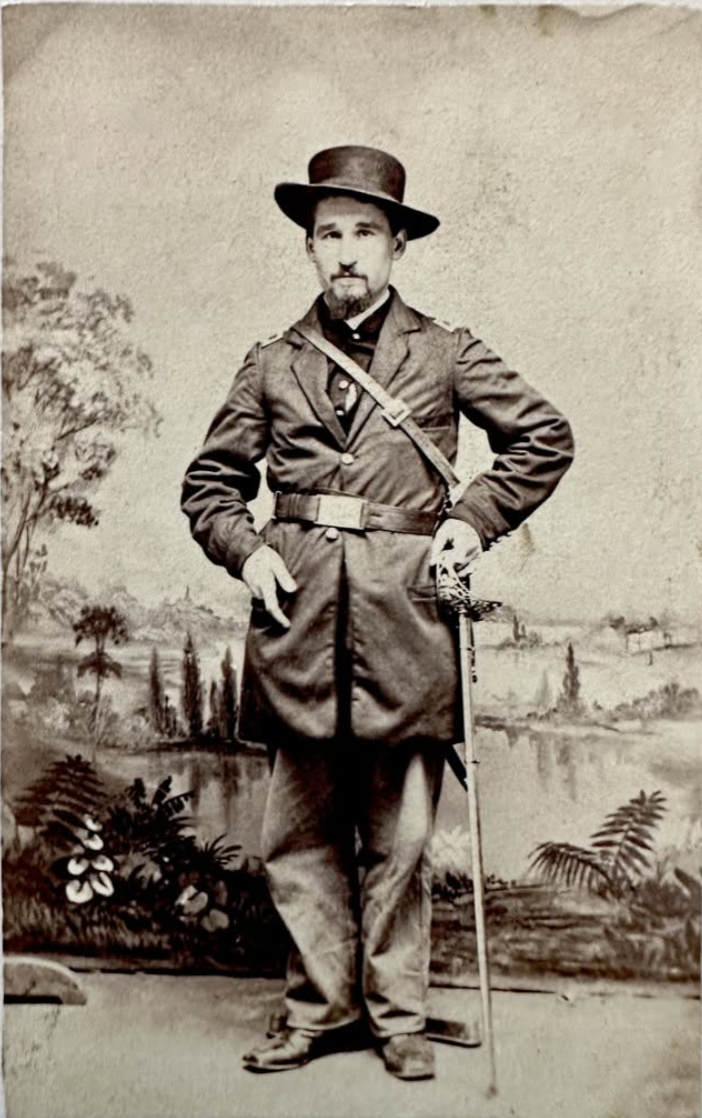
The following letter was written by Pvt. Edwin Charles Crossett (1844-1915) of Co. B, 10th Vermont Infantry. An obituary the Barre Daily Times (23 Jan. 1915) states that Edwin “was born in Waterbury June 15, 1844, the son of Gerry and Rachel (Wright) Crossett. He married Priscilla D. Johnson (1839-1903) of Waterbury who died a number of years ago…Mr. Crossett was a veteran of the Civil War and was very prominent in Edward Dilingham post, G. A. R. of this village. He was in Co. B of the 10th Vermont regiment.” Military records inform us that he enlisted on 30 July 1862, mustered in on 1 September 1862, and mustered out on 16 February 1865. It also records that he was wounded on 19 October 1864 at Cedar Creek, Virginia, which was the reason for his premature discharge.
He datelined his letter 23 January 1862 but he should have written 1863. The regimental history informs us that they mustered into U. S. service on 1 September 1862 and left Brattleboro on the 6th, reaching Washington on the 8th, and went into quarters at Camp Chase near Arlington Heights the next day. On the 17th the regiment was posted along the Maryland side of the Potomac River in little camps of three companies each from Muddy Branch to Edward’s Ferry, and ordered to guard the fords.
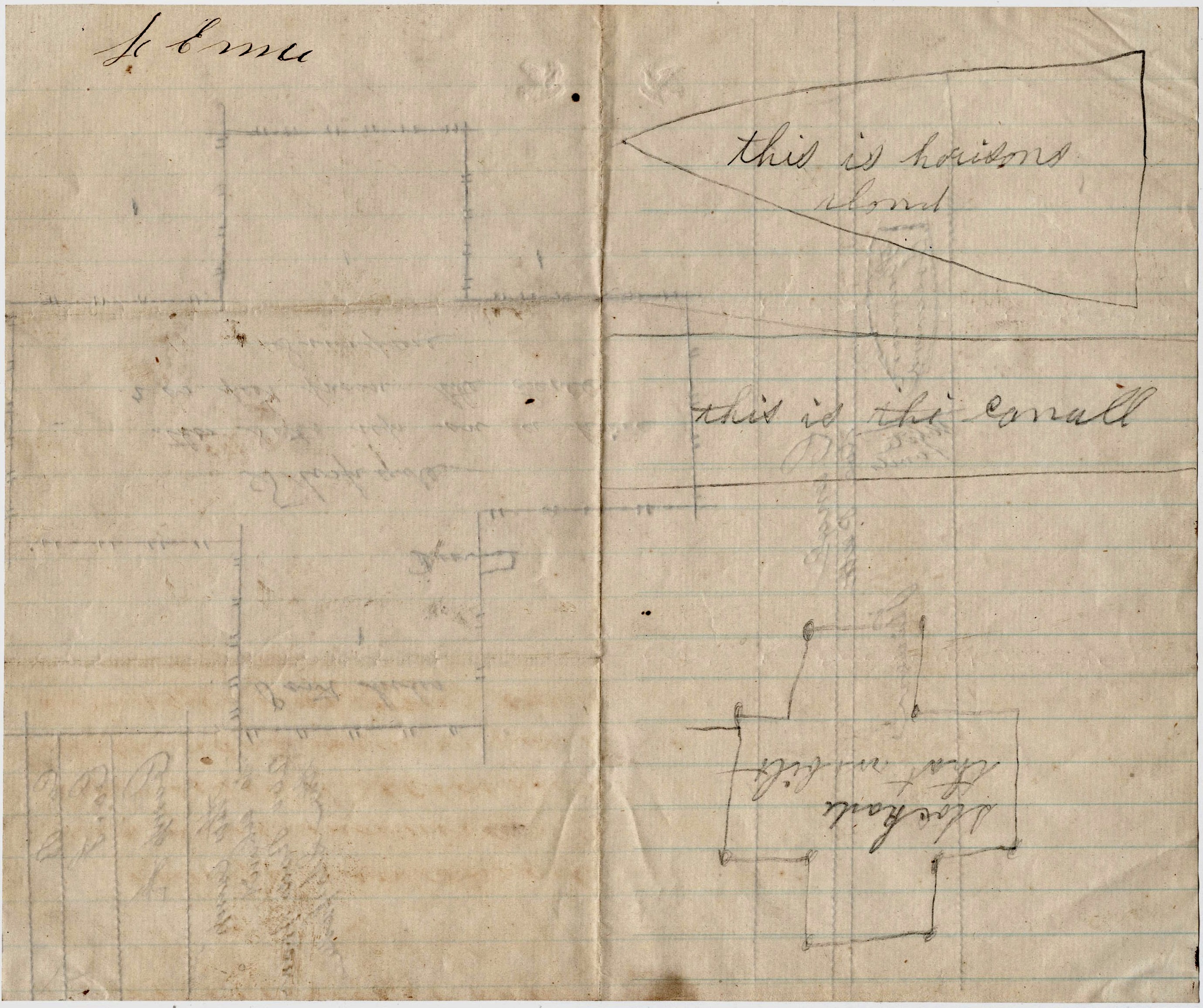
Edwin’s letter doesn’t impart much news but he enclosed a very interesting hand-drawn map that notes the camp of Cos. B, G & K of the 10th Vermont Infantry who were stationed at Conrad’s Ferry in late December 1862. “During the American Civil War, Companies B, G, and K of the 10th Vermont Infantry Regiment were stationed on guard duty at Conrad’s Ferry along the Potomac River in Maryland from late December 1862 until April 19, 1863, where they built and manned defensive stockades.” The spelling is atrocious, but I can make out labels that read, “This is Harrison’s Island” and “This is the [C&O] canal.”
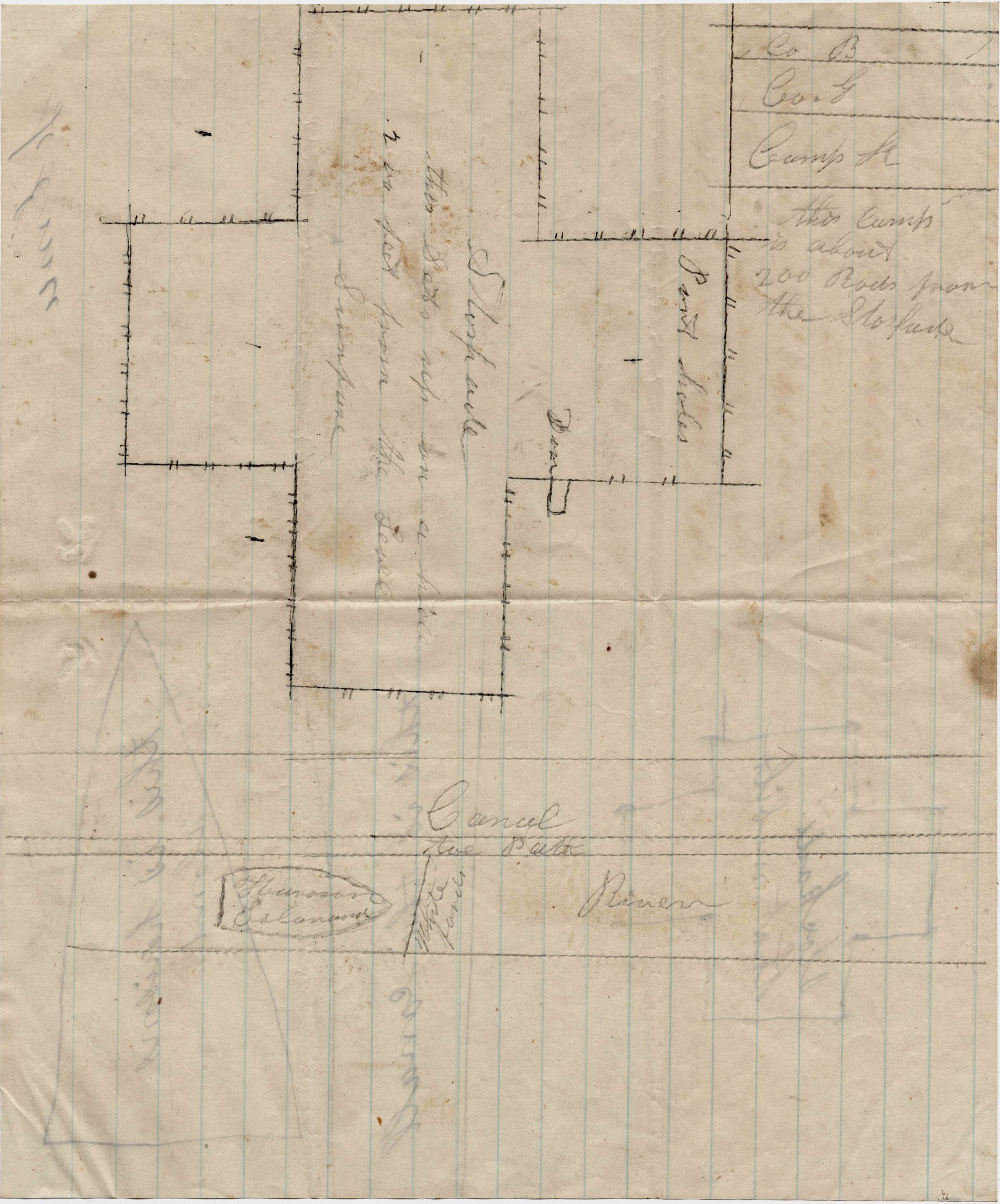
Aside from labeling the camp of Cos. B, G, and K in the upper right-hand corner of this second drawing, which he indicates was “about 200 rods [1100 yards] from the stockade,” he provides a sketch of the stockade (not to scale) on the Maryland side ofthe Potomac, which he claims was on a hill rising 200 feet above the surrounding land overlooking the canal and White’s Ford, with Harrison’s Island in the Potomac River beyond. Only the outline of the stockade is drawn which appears to be in the shape of a Greek Cross. The location of 4 or 5 port holes are indicated on each of the 12 sided structure.
This sketch indicates that the stockade was situated near White’s Ford, below Harrison’s Island, rather than in proximity to Conrad’s Ferry, leaving the precise location ambiguous. It is believed that the 10th Vermont initially established their camp near Offutt’s Cross Roads, while detachments from the regiment constructed a crescent-shaped earthwork and timber fortification near White’s Ford along the C&O Canal. However, this drawing fails to depict a crescent-shaped structure. Companies B, G, and K were transferred from Offutt’s Cross Roads to Conrad’s Ferry in late December. The description refers to “the stockade we built,” suggesting it was indeed constructed, yet the precise location remains unclear. If it were built near White’s Ford, it would have had to be set back from the canal at some distance, as the topography gradually rises to a height of 200 feet on the Maryland side of the river valley in that area.
Edwin’s drawing of the stockade reveals that it was built in the shape of a Greek Cross with portal holes in each of the 12 sides and one doorway.
T R A N S C R I P T I O N
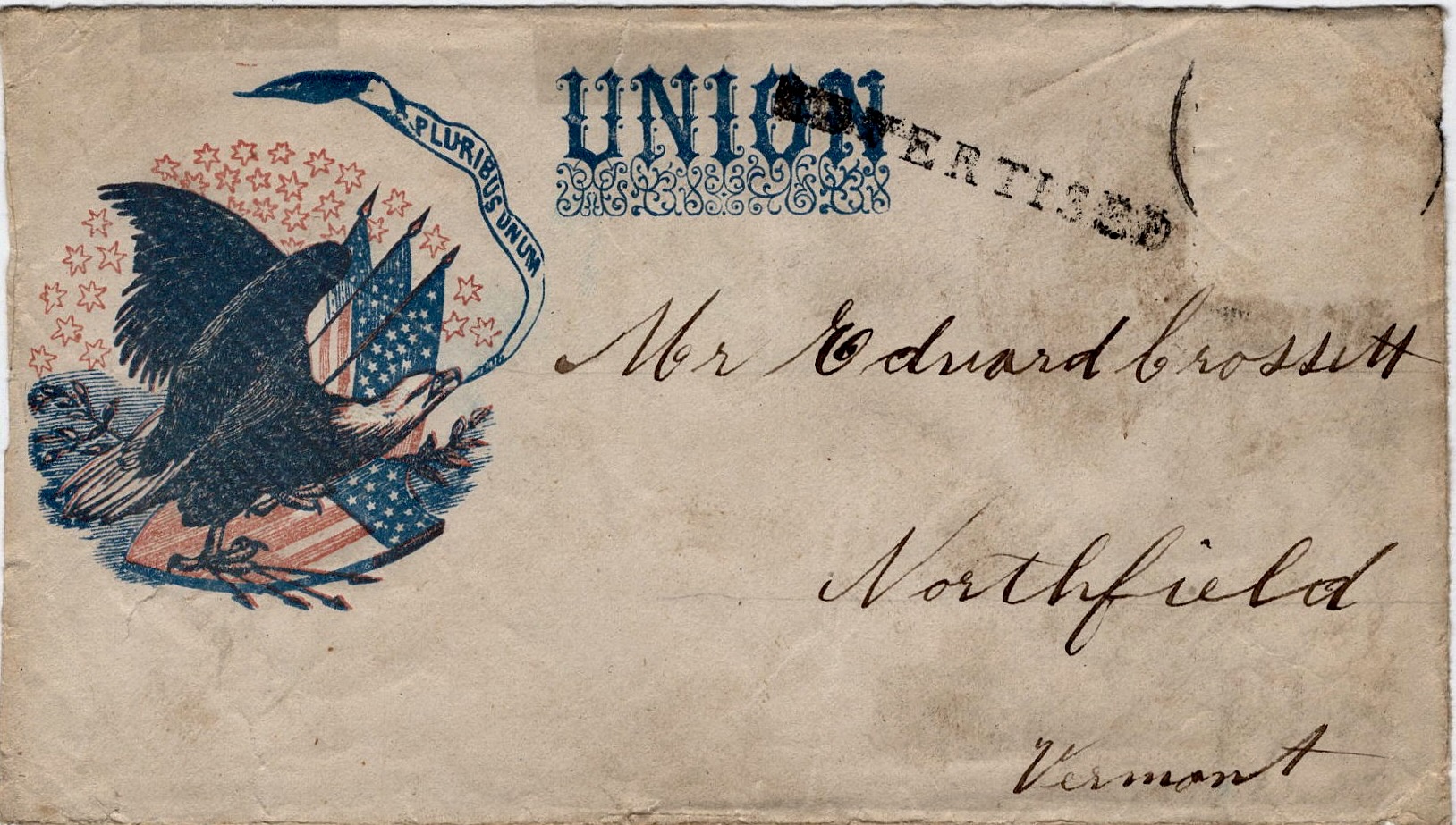
Directed to Mr. Edward Crossett, Northfield, Vermont
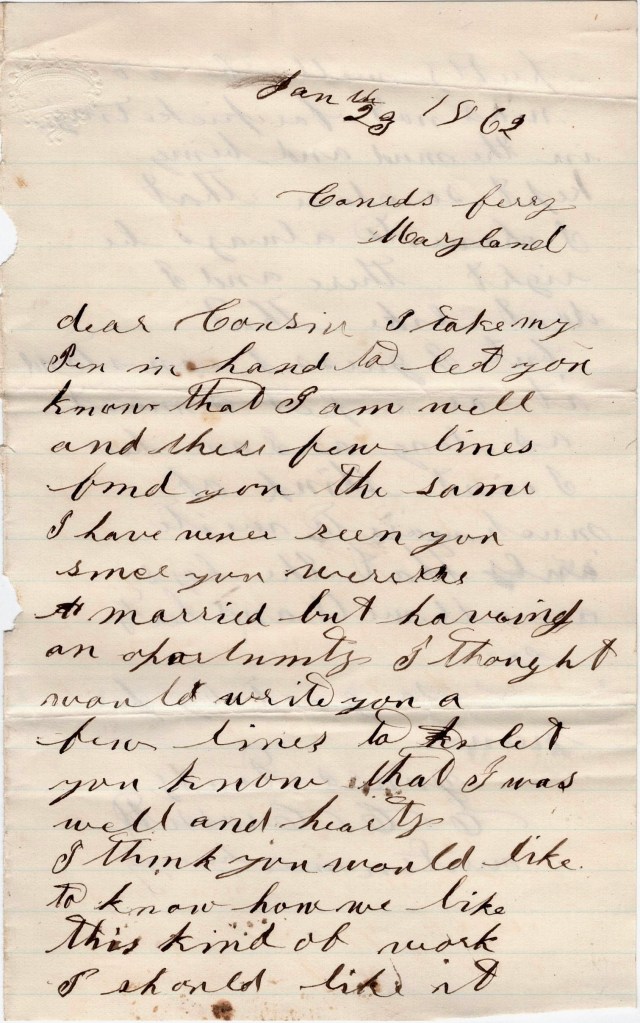
Conrad’s Ferry, Maryland January 23, 1862 [1863]
Dear cousin,
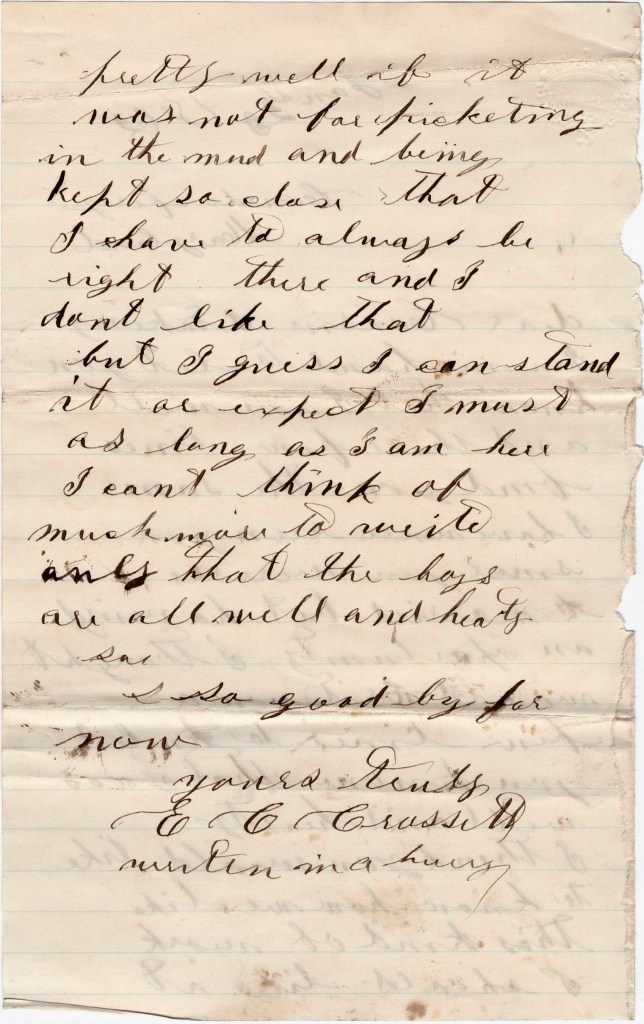
I take my pen in hand to let you know that I am well and [hope] these find lines find you the same. I have never seen you since you were married but having an opprtunity, I thought [I] would write you a few lines to let you know tat I was well and hearty. I think you would like to know how we like this kind of work. I should like it pretty well if it was not for picketing in the mud and being kept so close that I have to always be right there and I don’t like that. But I guess I can stand it or expect I must as long as I am here.
I can’t think of much more to write—only that the boys are all well and hearty. So goodbye for now. Yours truly, — E. C. Crossett
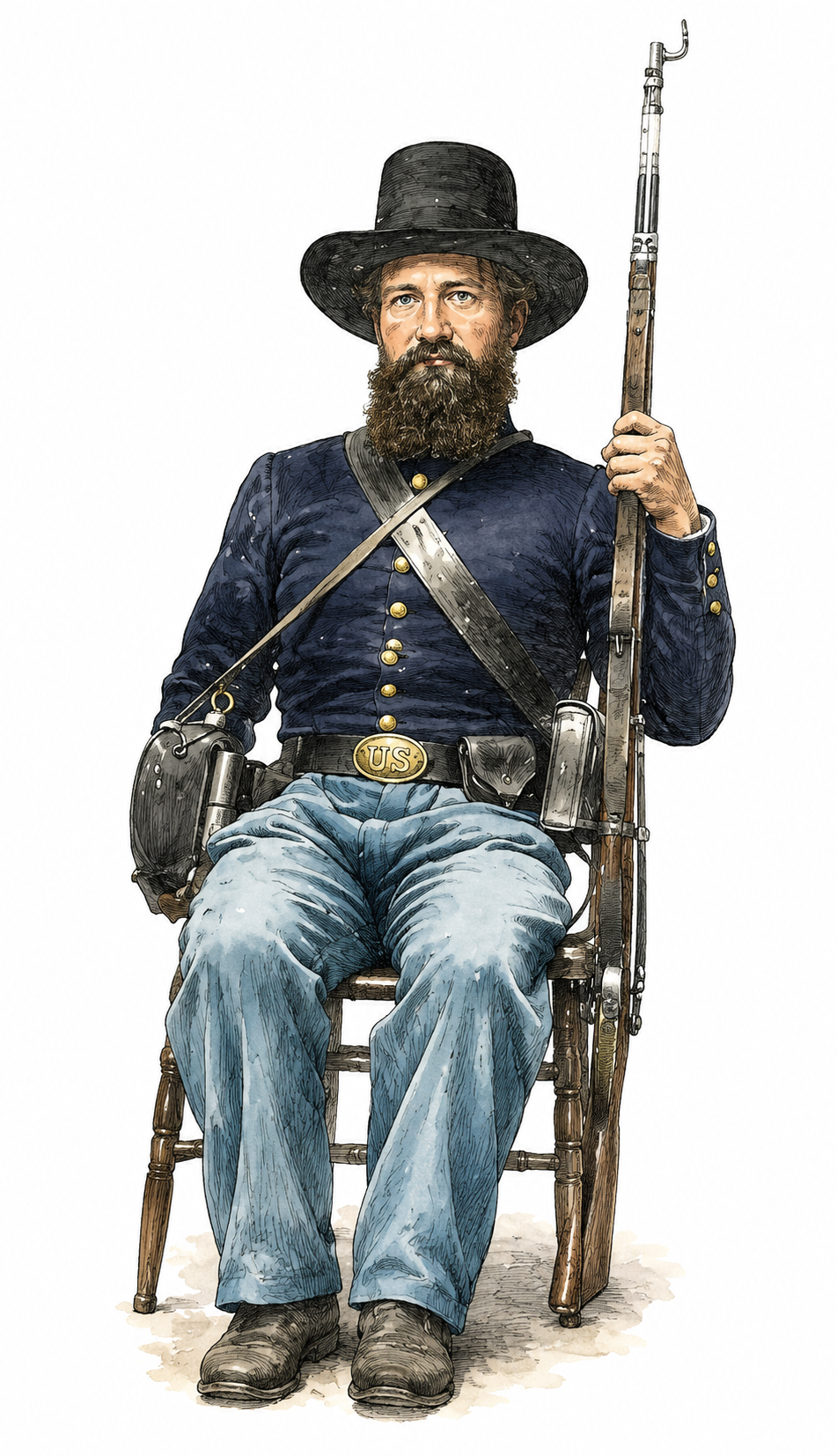
I could not find an image of George but here is one of John H. Miller who was also in Co. B, 116th Illinois. John enlisted as a sergeant in Co. B on 17 March 1863 and was promoted to 2nd Lieutenant and then 1st Lieutenant of the same Co. (Al Niemiec Collection)
The following letter was written by George H. Welty (1833-1917) who enlisted in Co. B, 116th Illinois Infantry, serving as wagoner until he was mustered out in June 1865.
His obituary claims that he was married to Anna Enterline in 1858 and came to Illinois from York county, Pennsylvania, settling on a farm near Oreana. He served from August 1862 to June 1865 and was with Sherman’s army on his march to the sea. After the war he came to Decatur but soon afterward moved again to the farm and in 1874 moved back to Decatur.
Welty wrote this letter from winter quarters at Larkinsville, Alabama. They arrived there on 9 January 1864 after an exhausting string of brutal campaigns and rail movements. They remained stationed there to guard the strategic Memphis and Charleston Railroad until May 1864, when they joined the Atlanta Campaign.
[Note: This letter is from the personal collection of Evan Hammon and was made available for transcription and publication by express consent.]
T R A N S C R I P T I O N
Larkinsville, Alabama January 17th 1864
Dear Friends, Mr. & Mrs. Sifleet,
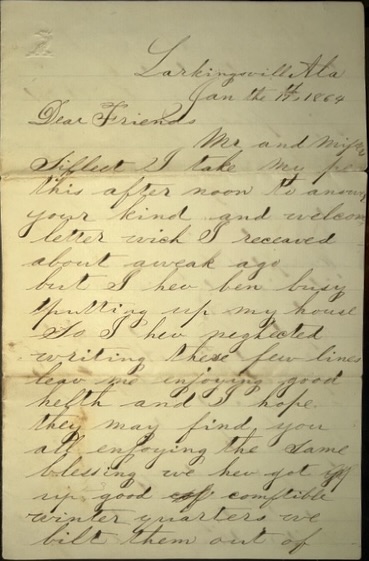
I take my pen this afternoon to answer your kind and welcome letter which I received about a week ago but I have been busy putting up my house so I have neglected writing. These few lines leave me enjoying good health and I hope they may find you all enjoying the same blessing.
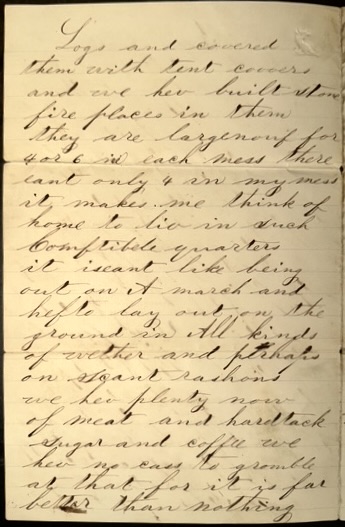
We have got up good, comfortable quarters. We built them out of logs and covered them with tent covers and we have built stone fireplaces in them. They are large enough for 4 or 6 in each mess. There ain’t only four in my mess. It makes me think of home to live in such comfortable quarters. It isn’t like being out on the ground in all kinds of weather and perhaps on scant rations. We have plenty now of meat and hardtack, sugar and coffee. Have have no cause to grumble at that for it is far better than nothing.
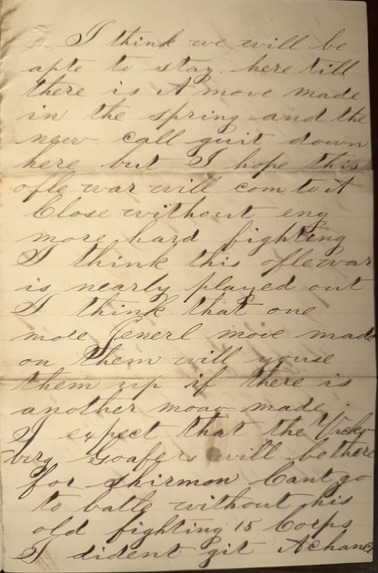
I think we will be able to stay here till there is a move made in the spring and the new call quit down here but I hope this awful war will come to a close without any more hard fighting. I think this awful war is nearly played out. I think that one more general move made on them will use them up. If there is another move made, I expect that the Vicksburg Gophers1 will be there for Sherman can’t go to battle without his Old Fighting 15th Corps.
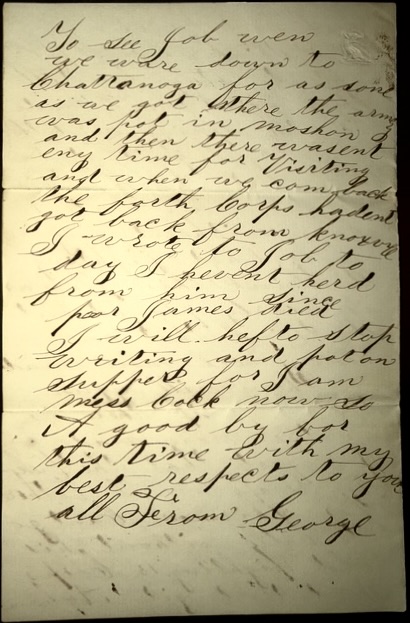
I didn’t get a chance to see Job when we were down to Chattanooga for as soon as we got there, the army was put inn motion and then there wasn’t any time for visiting. And when we came back, the 4th Corps hadn’t got back from Knoxville. I wrote to Job today. I haven’t heard from him since poor James died.
I will have to stop writing and put on supper for I am mess cook now. So goodbye for this time. With my best respects to you all, from George
1 The 116th Illinois was called upon to digging sap-works, trenches and protective earthworks during the siege of Vicksburg that contemporaries and fellow troops likened their relentless tunneling to gophers.
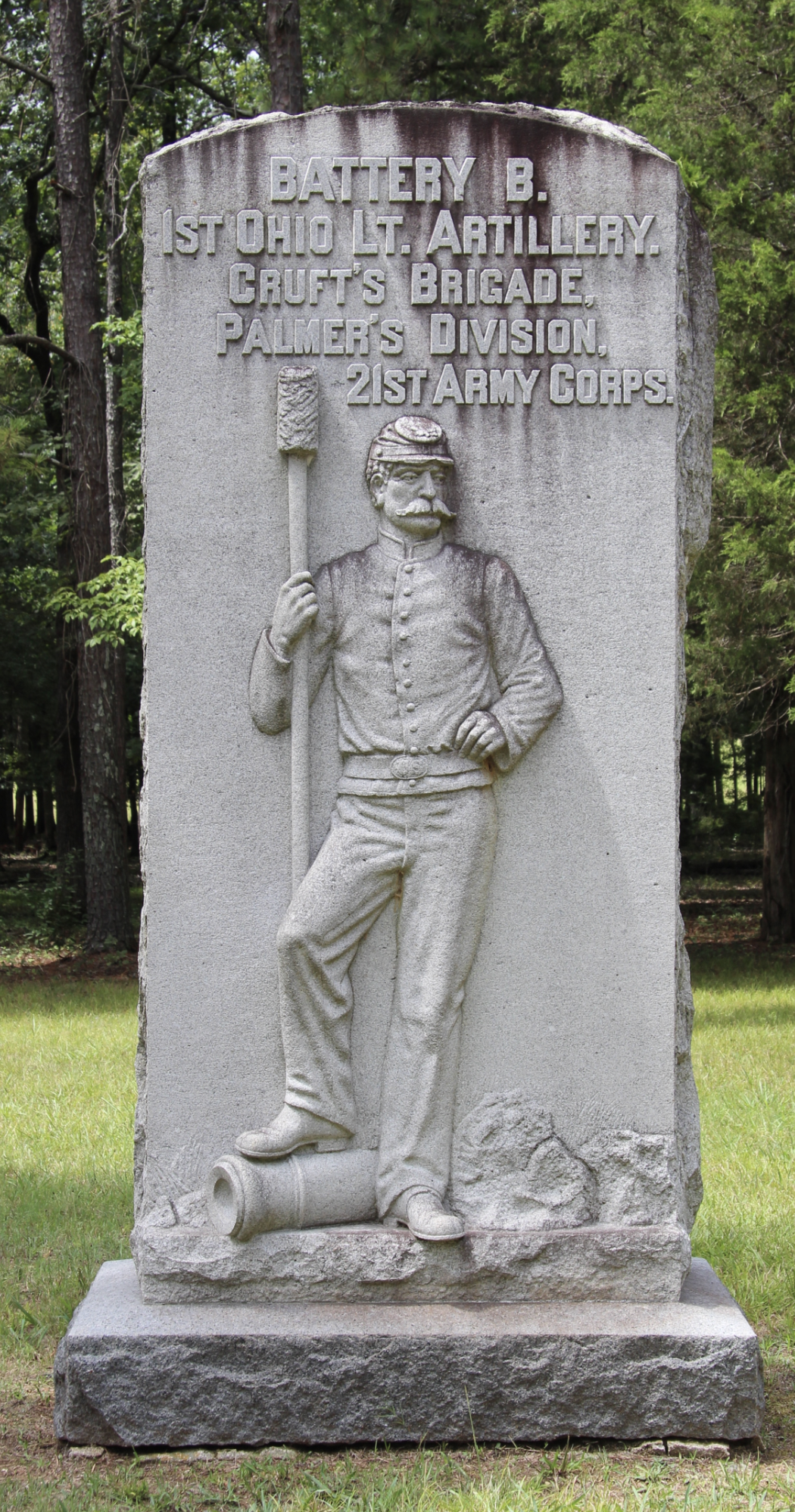
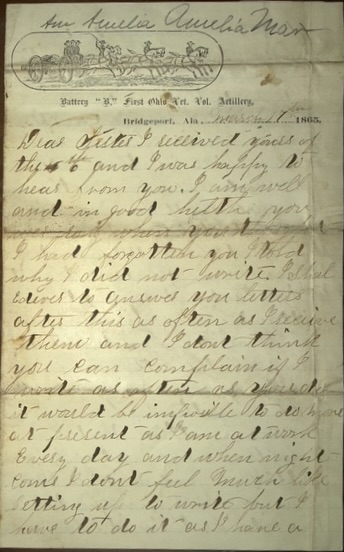
The following letter was written on stationery of Battery B, 1st Ohio Veteran Volunteer Artillery and was signed “Charlie” but I am unable at this time to confirm his identity. He wrote the letter to Amelia Marx (1848-1900), the daughter of Fred and Catherine (Moers) Marx, both German Jewish emigrants to the United States. Amelia married Joseph Strauss (1846-1932) in 1875. Amelia had a brother named Moses Marx, a baker by trade, who enlisted at age 18 in Battery B, 1st Ohio Artillery in August 1862 but was discharged on disability in late March 1863.
The only other soldier listed on the roster was “Thomas Marks” who was 43 when he enlisted in 1863. His General Index Card spells his name variously as Marks or Marx so I’m going to assume that Charlie was his middle or first name. Census records do not show a Charles or Charlie, or Thomas for that matter, but if he were born in 1820, he would have most likely been living on his own by 1850.
[Note: This letter is from the personal collection of Evan Hammon and was offered for transcription and publication on Spared & Shared by express consent.]
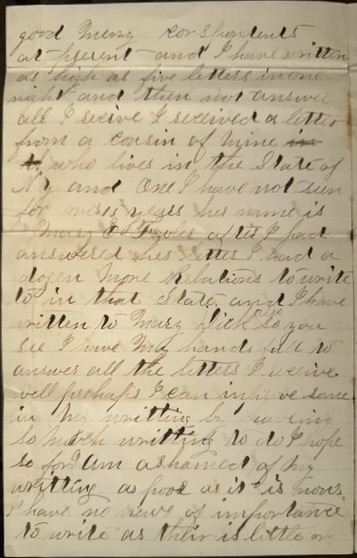
I received yours of the 4th and I was happy to hear from you. I am well and in good health. You were wrong when you said I had forgotten you. I told why I did not write. I shall endeavor to answer your letters after this as often as I receive them and I don’t think you can complain if I write one as often as you do. It would be impossible to do more at present as I am at work every day and when night comes, I don’t feel much like sitting up to write but I have to do it as I have a good many correspondents at present and I have written as high as five letters in one night and then not answer all I receive.
I received a letter from a cousin of mine who lives in the state of New York and one I have not seen for over 15 years. Her name is Mary E. Fowler. After I had answered her letter, I had a dozen more relations to write to in that state and I have written to Mary Dick also so you see I have my hands full to answer all the letters I receive. Well perhaps I can improve some in writing by having so much writing to do. I hope so for I am ashamed of my writing as poor as it is now.
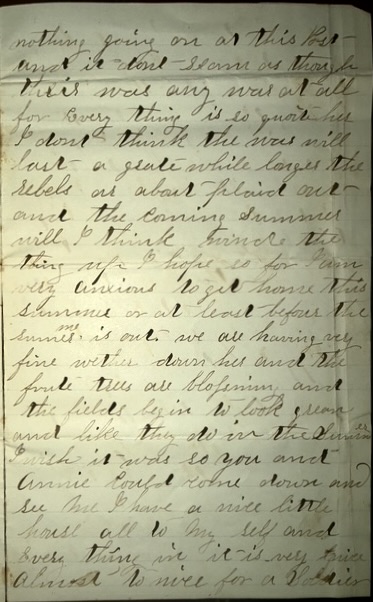
I have no news of importance to write as there is little or nothing going on at this post and it don’t seem as though there was any war at all for everything is so quiet here. I don’t think the war will last a great while longer. The rebels are about played out and the coming summer will, I think, wind the thing up. I hope so, for I am very anxious to get home this summer—or at least before the summer is out.
We are having very fine weather down here and the fruit trees are blossoming and the fields begin to look green and like they do in the summer. I wish it was so you and Annie could come down and see me. I have a nice little house all to myself and everything in it is very nice—almost too nice for a soldier.
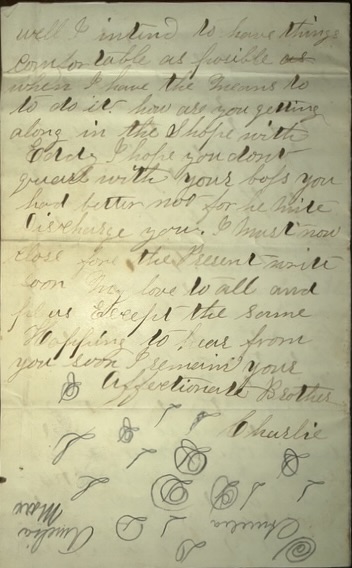
Well, I intend to have things comfortable as possible when I have the means to do it. How are you getting along in the shop with Eddy? I hope you don’t quarrel with your boss. You had better not for he will discharge you. I must now close for the present. Write soon. My love to all and please accept the same. Hoping to hear from you soon, I remain your affectionate brother, — Charlie
The following letter was written by Oscar Easley (1835-1885) to his wife, Amy (Freeman) Easley (1844-1918) of Ipava, Fulton county, Illinois. The couple were married in October 1859 and their first born child, Marion Easley (1860-1928) is mentioned.
Oscar was recruited as a private into Co. F, 84th Illinois Infantry in August 1862 and remained with the regiment until August 1864 when he transferred to Co. K of the 1st US Veteran Volunteer Engineering Corps to work on pontoon bridges. A biographical sketch for Oscar claims that he was a farmer and sawmill owner in Fulton county. He was born in Freeport, Harrison county, Ohio, and came with his parents to Illinois when he was only a year old. His father was Isaac Easley and his mother was Mary Norris. They died in 1861 and 1859, respectively. During the war, Oscar fought at Stones River (“the first time that I came into line of battle to be shot at,” as he states in this letter, and later in the battles of “Chickamauga, Resaca, &c.”
[Note: This letter is from the private collection of Evan Hammon and was made available for transcription andpublication on Spared & Shared by express consent.]
T R A N S C R I P T I O N
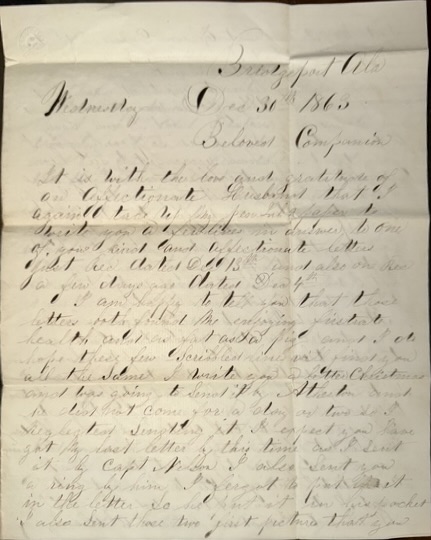
Bridgeport, Alabama Wednesday, December 30th, 1863
Beloved Companion,
It is with the love and gratitude of an affectionate husband that I again take up my pen and paper to write you a few lines in answer to one of your kind and affectionate letters just received dated December 13th and also one read a few days ago dated December 4th.
I am happy to tell you that those letters both found me enjoying first rate health and as fat as a pig and I do hope these few scribbled lines will find you all the same. I wrote you a little Christmas [morning] and was going to send it by Attleston [?] and he did not come for a day or two so I neglected sending it. I expect you have got my last letter by this time as I sent it by Capt. Nelson. I also sent you a ring by him. I forgot to put it in the letter so he put it in his pocket. I also sent those two pictures that you sent me. I have sent eleven dollars in the three lost letters [illegible due to crease in paper] whether you get them or not.
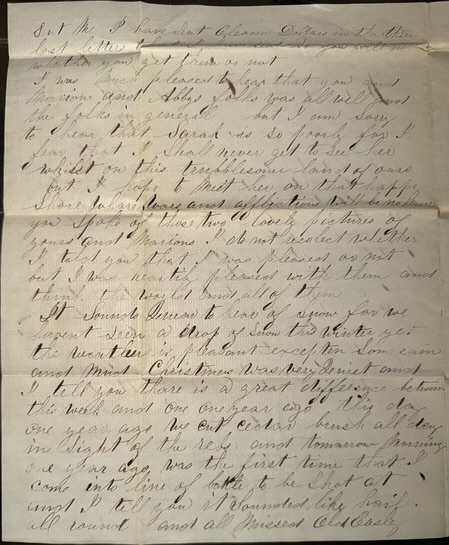
I was much pleased to hear that you an Marion and Abby’s folks was all well and the folks in general but I am sorry to hear that Sarah was so poorly for I fear that I shall never get to see her whilst on this troublesome land of ours. But hope to meet her on that happy shore where wars and afflictions will be no more. You spoke of those two lovely pictures of yours and Marion’s. I do not recollect whether I told you that I was pleased or not but I was heartily pleased with them and think the world and all of them.
It sounds queer to hear of snow for we haven’t seen a drop of snow this winter yet. The weather is pleasant excepting some rain and mud. Christmas was very quiet and I tell you, there is a great deal of difference between this week and one year ago. This day one year ago, we cut cedar brush all day in sight of the rebs and tomorrow morning one year ago was the first time that I came into line of battle to be shot at and I tell you, it sounded like hail all round and all missed Old Easley.
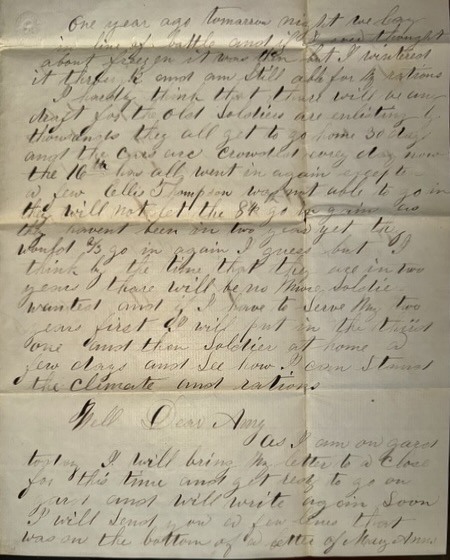
One year ago tomorrow night we lay in line of battle and if I ever thought about freezing, it was then. But I wintered it through and am still able for my rations.
I hardly think that there will be any draft for the old soldiers are enlisting by thousands. They all get to go home 30 days and the cars are crowded every day now. The 16th has all went in again except a few. Ellis Thompson was not able to go in. They will not let the 8th go in again as they haven’t been in two years yet. They would two thirds of them go in again, I guess, but I think by the time that they are in two years, there will be no more soldiers wanted. And if I have to serve my two years first, I will put in the third one and then soldier at home a few days and see how I can stand the climate and rations.
Well, dear Amy, as I am on guard today, I will bring my letter to a close for this time and get ready to go on guard and will write again soon. I will send you a few lines that was on the bottom of the letter of Mary Ann’s.
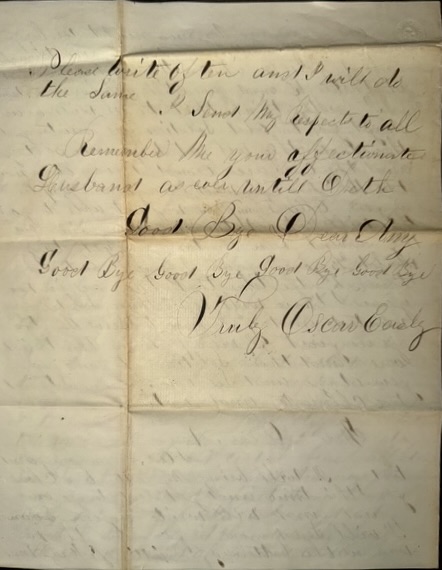
Please write often and I will do the same. I send my respects to all. Remember me, your affectionate husband, as ever until death. Goodbye, dear Amy, goodbye. Goodbye. Goodbye. Truly, — Oscar Easley
Pip: Letters written in mud, written in grief, written with a pen strapped to an injured finger — Griff has been finding the ones that cost something to write.
Mara: This episode covers two stretches of American correspondence: soldiers and civilians writing through the Civil War, and letters that cross the line from news into something more personal. Let's start with the war letters.
Civil War Correspondence
Pip: These letters share a texture — men writing home from camps that are going nowhere, in weather that is actively hostile to the entire enterprise of warfare.
Mara: Arthur St. Clair Smith sets the scene precisely. Writing from Camp near Falmouth in January 1863, he describes what history would call the Mud March, and his verdict is direct: "We found that we were really stuck in the mud."
Pip: That line does a lot of work. The army set out to cross the Rappahannock, the roads dissolved, and the whole operation folded back on itself — same camp, same ground, nothing accomplished.
Mara: Smith's letter to his cousin Frank Robinson fills in the human side of it: the promotion dispute that got Lieutenant Veasey placed under arrest, the colonel who reportedly called his subordinate a quote-unquote God damned fool, the men building corduroy roads through the woods just to get the artillery back to where it started.
Pip: There is something almost cosmically deflating about an army spending two days building roads so it can retreat more efficiently.
Mara: John N. Dockham, also of the 12th New Hampshire and also writing to Frank Robinson just weeks later, confirms the same conditions from a different angle. Prices in camp are brutal — apples five cents apiece, butter sixty cents a pound — and his health is already failing. He's lame in both ankles and his stomach is out of order.
Pip: And yet he still invites Frank to come experience Virginia mud firsthand, purely for the fun of it.
Mara: Meanwhile, George Storrs Ladd's 1864 letter to his sister Fannie is a different register entirely — brief, practical, almost cheerful. He's in the Signal Corps and needs two small flags sewn from white cloth with a red square in the center, to wear on his cap as a badge. He also asks for comic papers, because he has hours to fill.
Pip: The contrast with the Munford letter is considerable. Robert Samuel Munford writes to Cornelia Hall — the fiancée of chaplain William Curtis Johnston, who has just died of typhoid pneumonia in Munfordville — and the letter runs across three days in February 1863, growing more detailed and more tender as it goes.
Mara: Munford writes with one functional hand, having been shot in the right arm and shoulder in 1861. He describes Johnston's final morning: reading Cornelia's letter by the fire, telling Captain Victor it was from "a lady he feared he loved too devotedly," and his last words directed to the adjutant — "Miss Hall first."
Pip: A man arranging his goodbyes in order of priority. That detail lands.
Mara: Munford also navigates the insurance policy, searches the chaplain's valise for the key to his trunk, and closes by asking Cornelia what he should plant at the grave. The letter is bureaucratic and heartbroken in equal measure, which is its own kind of document.
Pip: From soldiers writing about mud to a father writing about something harder — let's move to the personal letters.
Family And Personal Letters
Pip: Julius Theodore Barrett writes to his three children from Louisville in September 1862 — and the weight of the letter comes from what the reader knows that he does not: he will be killed at Stones River in December.
Mara: He frames the letter as being for their "amusement and instruction," and then describes a young orphaned boy found asleep in camp, already hardened by loss. He writes, "although we are hundreds of miles apart, yet we can write our thoughts on paper and Uncle Sam will carry it as you direct."
Pip: He closes by asking whether they are kind to their mother, whether they study their books — questions that read differently once you know they are among his last words to them.
Mara: Pliny Kidder's 1849 letter to railroad engineer Thomas Scott Williams covers different ground — a surveying expedition through the bottoms of West Tennessee, where the mud is ankle-deep around the campfires and the bill of fare is cornbread and pork, three meals a day. He concludes he will not leave New England again to pass a winter in Tennessee.
Pip: Mud, it turns out, is the common thread — across wars, across decades, across every kind of letter.
Mara: Next time, more from the archive.
Pip: What stays with me is how many of these letters are written under physical difficulty — a strapped pen, failing health, rain that won't stop.
Mara: And yet they wrote anyway. That's what the archive preserves — the effort of staying in contact across distance and disaster.
The following letter was written by Andrew Louis McFarlane (1822-1898) who initially enlisted in late March 1862 as a private in Co. D, 109th Pennsylvania Infantry and then transferred to Capt. James D. M’Gill’s Light Artillery in Knap’s Independent Battery E. Although Andrew’s letter expresses hope that he will receive a positive response to his application for a commission as officer in the US Colored Troops (USCT), I could find no record that he was even examined, let alone commissioned. It looks as though he did not join the battery until 1 March 1864 and he did not muster out until 14 June 1865.
Andrew was the son of Francis McFarlane (1762-1846) and Mary McWilliam (1777-1859). His first wife, Mary E. Larimer (1826-1863) died in 1863. His second wife—19 years his junior—Jennie A. Davis (1841-1914) lived until 1914. Jennie’s obituary claimed she was the widow of “Col. McFarlane.”
Andrew was born in New Castle, Lawrence county, Pennsylvania. At the time of his enlistment and after the war, he lived in Westmoreland county, Pennsylvania, where he was a farmer near Tinker Run.
Back in 2019 I transcribed two letters that were not signed that I knew to have been written by a member of Knap’s Battery. With this letter, based upon the handwriting, I’m able to conclude that these other two letters were also written by Andrew L. McFarlane. See—1864-65: Andrew Louis McFarlane to His Family.
[Note: This letter is from the personal collection of Evan Hammon and was made available for transcription and publication on Spared & Shared by express consent.]
T R A N S C R I P T I O N
Bridgeport [Alabama] April 18, 1864
Well I wrote a letter yesterday and I got one this morning. I got provision and hardware that you sent me. The pens were very good ones. Well maybe I will be home before harvest on a furlough at least. I will if I get what I have applied for. I have made application for a commission in a Colored Regiment. I have the application written out and am waiting on the 109th [Pensylvania] Regiment coming back. I want to get Capt. [Alfred] McGittigen’s recommendations for what time I was in the 109th. I have got [a] very good recommendastion from Captain M’gill for what time I have been in the battery, and after I get McGilligen’s, I will get General Geary’s and then I will send it to Nashville and if there is room, they will send me a notice and I will have to appear there before a Board of Examiners. And if I pass, I will get my commission and be discharged from the battery adn get all my bounty and pay.
Thomas Morgan is going to get a commission in a Colored Regiment. His application is sent to Nashville. There are two or three more trying for commissions. I am going to give it a middling hard twist [and] if I don’t get through, it will not be because I do not try. All that get through are entitled to 30 days furlough.
I suppose our trip down the Tennessee will be in the papers soon. I have had one of the infernalest sore necks ever you seen. There was a boil on one side of it as big as a teacup. I had a poltice on it two weeks and had it lanced three times by the doctor. It is getting better. I was sunburnt too. All the skin came off my ears. You would thought to seen my ears that I had been dogged some place.
Well, I will close this letter. This is Sunday evening. I will be on guard tonight. Write soon. Write soon. — A. L. McFarlane
Home
I will send a note that we captured when we took the post office at the town down the Tennessee River. It is not worth anything but you can say you have something that belonged to the rebels.
A post-war watercolor of Caleb Abijah Ensign drawn from poor quality image on Find-A-Grave.
The following letter was written by Caleb Abijah Ensign (1838-1931), the son of Horace Lyman Ensign (1814-1896) and Lucinda Cecelia Parks (1815-1882) of Defiance county, Ohio. Caleb wrote the letter while serving as adjutant and 1st Lieutenant of Co. M, 1st Michigan Engineers & Mechanics. He wrote the letter to William Oren Ensign (1841-1918) and Hebert Dwight Ensign (1844-1898)—his uncles though both of them were younger in age than he was. Both William and Herbert served in the 14th Independent battery, Ohio Light Artillery.
Note: This letter is from the private collection of Evan Hammon who made it available for transcription and publication on Spared & Shared by express consent.
T R A N S C R I P T I O N
Headquarters Defenses, Stevenson, Alabama August 11, 1864
Dear Uncles,
After leaving you I felt much like cussing to think “Pill box” should have known so much—or that he couldn’t have known more. In fact, I was so irritated that I shouldn’t have known you were so long in leisure in time to have improved it while I was with you that I soon ascertained what i might of you.
I have no great deal of news to write you. A letter from home mentions Uncle Ed and family well and as far as known all the rest of the friends.
I sought out Elmer Rand this morning who tells me he had a letter from his father a few days since stating that Uncle Caleb had come to a melancholy end by putting his head into the machinery of an engine which crushed his head instantly. This is very sad information indeed! I can hardly comprehend how one formerly ever jovial, light-hearted, and clear-headed should have become so unbalanced.
I think I shall leave this place before you come back in September. If this gets to you, I will try to let you know where I shall be about the time you go home.
We have had some very warm weather here and some genuine thunderstorms of late. The rains are impeding our work much by softening the ground over which we haul our heavy timber.
But as Gen. Grant was waiting for rains before he could move his army, I suppose what we cn’t do here in the West, he may make up in doing before Richmond.
I presume you are at the action front. I do not know whether your Brother has been in action during the late fighting for I am so busy I do not search the papers. Letters from Lysander indicate him to be still at Knoxville and well.
I am at present engaged beyond my duties as Adj. in making drawings of the defenses here [see map below] and I find myself considerably fatigued tonight. Hoping soon to hear from you and of your well being, I am very affectionately yours, — Caleb
[to] Wm. O. & Herbert Ensign, 12th O. V. Light Artillery
Address C. A. Ensign, Lieut., 1st Michigan Engineers, via Chattanooga, Tennessee
A post war AI-generated watercolor of Martin Van Buren Waite based on a very poor resolution image on Ancestry.com
The following letter was written by Martin Van Buren Waite (1841-1923), the son of Martin Waite (1809-1897) and Lavina Louise Adams (1816-1850) of Ellington, Outagamie, Wisconsin. He wrote the letter to his sister, Esther Waite (b. 1843) while serving in Co. D, 1st Wisconsin Infantry. Muster rolls reveal that he mustered into the company on 5 September 1861 and remained with the company until 19 September 1863 when he was taken prisoner at the Battle of Chickamauga. He mustered out of the regiment at Milwaukee on 14 October 1864.
In his letter, written less than a month before the Battle of Chickamauga where he was taken prisoner. Martin wrote his sister of his hunch that “There is a big battle to come off before long.”
This letter is from the private collection of Evan Hammon and was made available for transcription and publication on Spared & Shared by express consent.
T R A N S C R I P T I O N
Camp near Stevenson, [Alabama] [Sunday] August 23, 1863
Dear Sister,
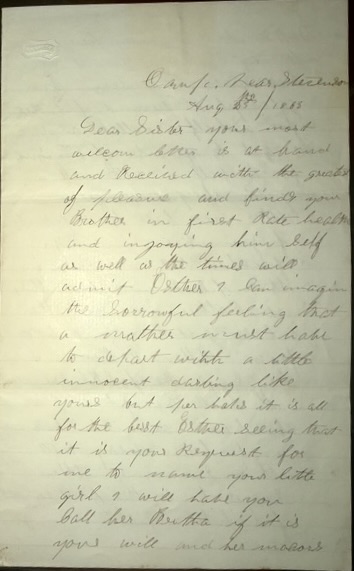
Your most welcome letter is at hand and received with the greatest pleasure and finds your brother in first rate health and enjoying himself as well as the times will admit. Esther, I can imagine the sorrowful feeling that a mother must have to depart with a little innocent darling like yours but perhaps it is all for the best. Esther, seeing that it is your request for me to name your little girl, I will have you call her Bertha if it is your will and her Maker’s.
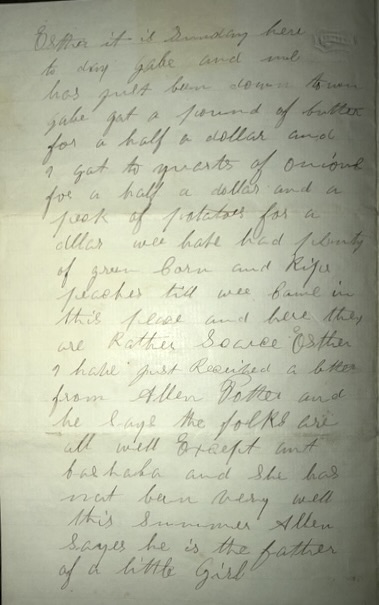
Esther, it is Sunday here today, Gabe [Gabriel Cornish] and me has just been down town. Gabe got a pound of butter for a half dollar and I got a quart of onion for a half a dollar and a peck of potatoes for a dollar. We have had plenty of green corn and ripe peaches till we came in this place and here they are rather scarce.
Esther, I have just received a letter from Allen Potter 1 and he said the folks are all well except Aunt Bathsheba [Waite Potter] and she has not been very well this summer. Allen says he is the father of a little girl.
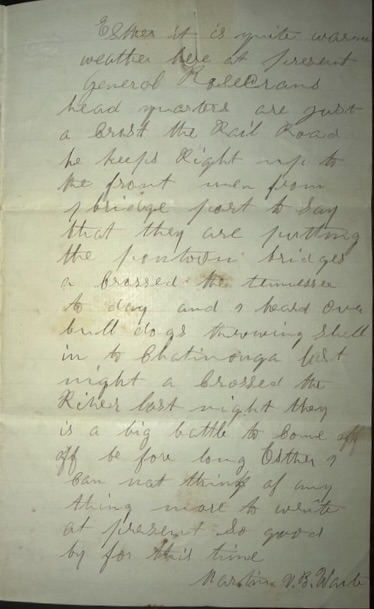
Esther, it is quite warm weather here at present. General Rosecrans’ Headquarters are just across the railroad. He keeps right up to the front. Men from Bridgeport say that they are putting the pontoon bridges across the Tennessee [River] today and I heard [ ] bull dogs throwing shells into Chattanooga last night across the river last night. There is a big battle to come off before long.
Esther, I cannot think of anything more to write at present so goodbye for this time. — Martin V. B. Waite
1 Allen Potter (1839-1913) was Martin’s cousin, the son of William Potter (1809-1875) ad Bathsheba Waite (1811-1876) of Leon, Cattaraugus county, New York.
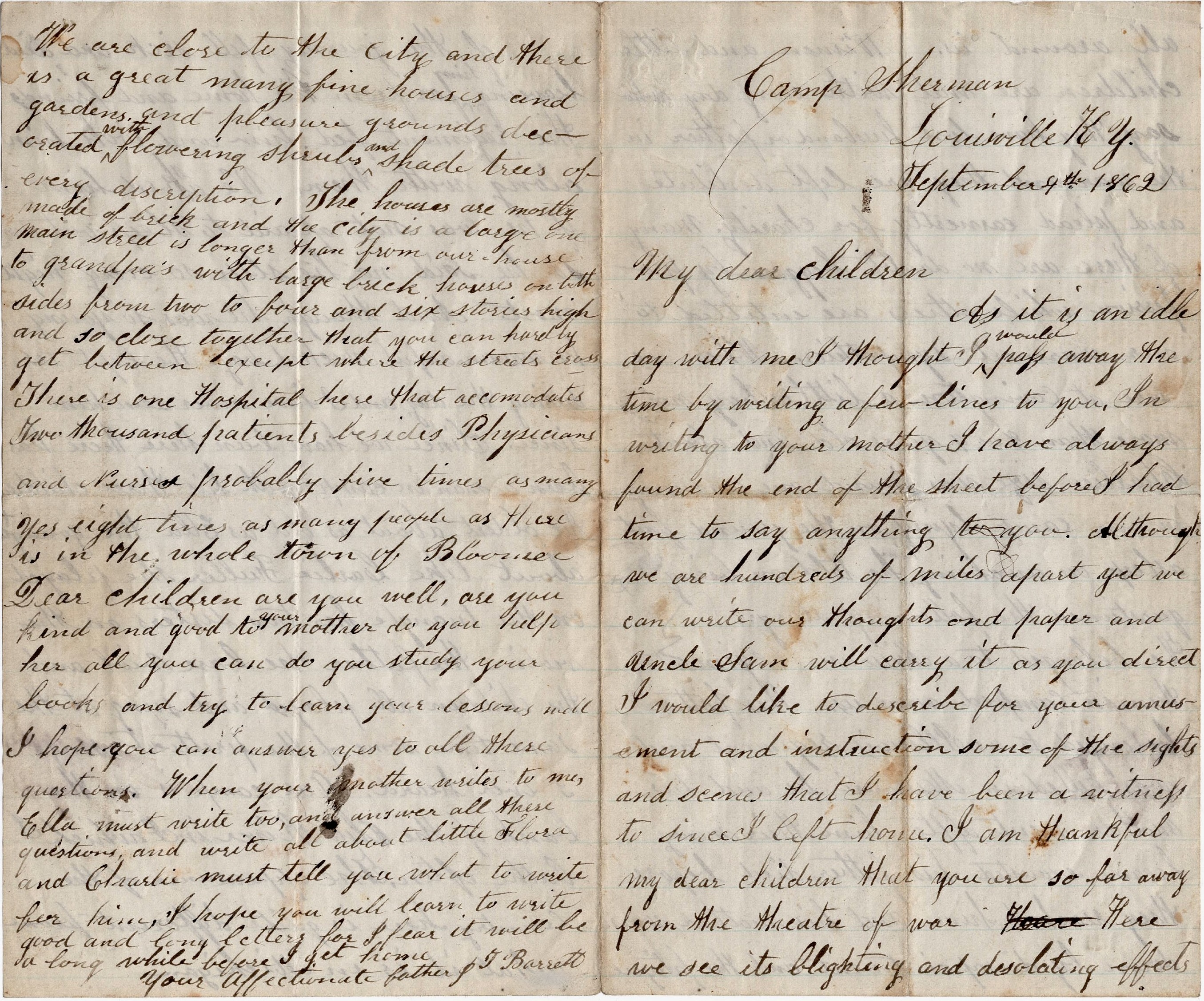
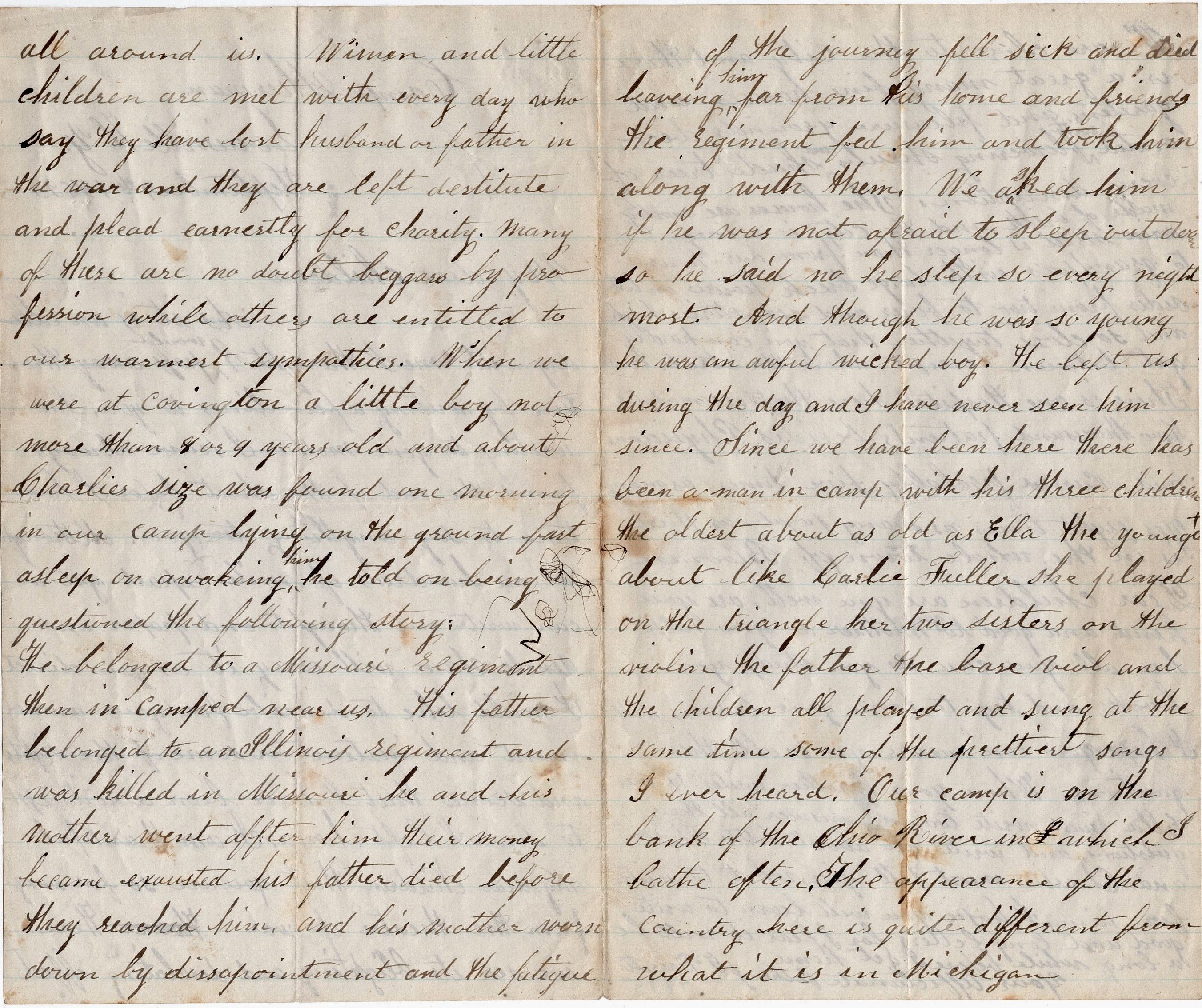
The following letter was written by Julius Theodore Barrett (1823-1862) of Bloomer, Michigan, who kissed his wife of 12 years, Mary Jane (Patrick) Barrett (1826-1897), and his three children, Ella (age 11), Charlie (age 9), and Flora (age 3) to enlist in Co. K, 21st Michigan Infantry on 12 August 1862. He served just over four and a half months before he was killed “by gunshot wound” at the Battle of Stones River on 31 December 1862.
In this heart-wrenching letter from the banks of the Ohio River near Louisville, Julius communicates to his children, for their “amusement and instruction,” a glimpse into the harrowing sights and scenes he has observed since departing from home. He recounts the war’s “blighting and desolating” impacts on the citizens he met in Kentucky, alongside descriptions of various scenes in Louisville. Our awareness of his impending death renders the act of reading this letter all the more difficult.
T R A N S C R I P T I O N
Camp Sherman Louisville, Kentucky September 9th 1862
My dear children,
As it is an idle day with me, I thought I would pass away the time by writing a few lines to you. In writing to your mother, I have always found the end of the sheet before I had time to say anything to you. Although we are hundreds of miles apart, yet we can write our thoughts on paper and Uncle Sam will carry it as you direct.
I would like to describe for your amusement and instruction some of the sights and scenes that I have been a witness to since I left home. I am thankful, my dear children, that you are so far away from the theatre of war. Here we see its blighting and desolating effects all around us. Women and little children are met with every day who say they have lost husband or father in the war and they are left destitute and plead earnestly for charity. Many of these are no doubt beggars by profession while others are entitled to our warmest sympathies.
When we were at Covington, a little boy not more than 8 or 9 years old and about Charlie’s size was found one morning in our camp lying on the ground fast asleep. On awakening him, he told on being questioned the following story. He belonged to a Missouri regiment then in camp near us. His father belonged to an Illinois regiment and was killed in Missouri. He and his mother went after him. Their money became exhausted, his father died before they reached him, and his mother wore down by disappointment and the fatigue of the journey, fell sick and died leaving him far from his home and friends. The regiment fed him and took him along with them. We asked him if he was not afraid to sleep out doors so. He said no—he slept so every night most. And though he was so young, he was an awful wicked boy. He left us during the day and I have never seen him since.
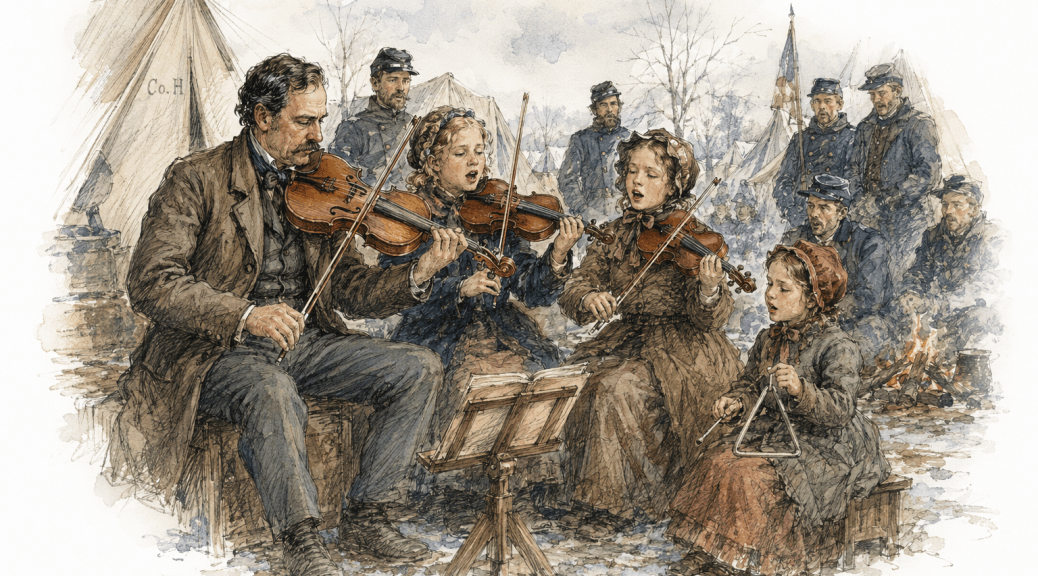
Since we have been here, there has been a man in camp with his three children, the oldest about as old as Ella. The youngest about like Carlie Fuller. She played on the triangle, her two sisters on the violin, the father the base viol and the children all played and sung at the same time some of the prettiest songs I ever heard.
Our camp is on the bank of the Ohio River in which I bathe often. The appearance of the country here is quite different from what it is in Michigan. We are close to the city and there is a great many fine houses and gardens and pleasure grounds decorated with flowering shrubs and shade trees of every description.The houses are mostly made of brick and the city is a large one. Main Street is longer than from our house to grandpa’s with large brick houses on both sides from two to four and six stories high and so close together that you can hardly get between except where the streets cross. There is one hospital here that accommodates two thousand patients, besides physicians and nurses, probably five times as many—yes, eight times as many people as there is in the whole town of Bloomer.
Dear children, are you well? Are you kind and good to your mother? Do you help her all you can? Do you study your books and try to learn your lessons? Well I hope you can answer yes to all these questions. When your mother writes to me, Ella must write too, and answer all these questions and write all about little Flora and Charlie must tell you what to write for him. I hope you will learn to write good and long letters for I fear it will be a long while before I get home.
Arthur St. Clair Smith later in war when serving as Captain of Co. K, 12th New Hampshire Infantry
The following letter was writen by Arthur St. Clair Smith (1841-1895) of Co. G, 12th New Hampshire Infantry. Arthur was the oldest son of Joshua R. and Clarissa C (Crockett) Smith. “Arthur St. Clair left the academy at New London in 1861, and went home to enlist, but his widowed mother, his father having been accidentally killed in California three years before, persuaded him to return to his school, where he impatiently remained until the new call for troops in 1862, when “I could no longer study.” as he says, “and went home again to enlist.” Assisted by Adjutant-General Colby, he enlisted forty or fifty men for Company G, but waiving his claim to rank was elected first sergeant, instead of lieutenant, as he might have been. His brother, Henry J., of the same company, was killed at Gettysburg.”
“In all the battles of the regiment to Cold Harbor, but Gettysburg and Wapping Heights, when he was still suffering from a severe wound received in arm at Chancellorsville, where his equipments were perforated with bullets. At Cold Harbor he was struck five times, being wounded twice, and having musket or grape shot through hat, haversack, and coat. He says: “I shall never forget my ambulance ride with Captain Shackford from Cold Harbor to White House landing.” Rejoined the regiment after the Siege of Petersburg, was present at the battle of Bermuda Hundred, and led a provisional battalion, that he commanded for a while, into Richmond. Of Captain Smith’s services at Danville, Va., see pages 302 and 310, chapter XV.”
“After the war he received the degree of L. L. B., from the Albany Law School, N Y., and settled in Cedar Rapids, Iowa. He has been judge of the municipal court, and was elected to the legislature by several thousand plurality though a candidate of the minority. He died December 19, 1895.” [Source: Find-A-Grave]
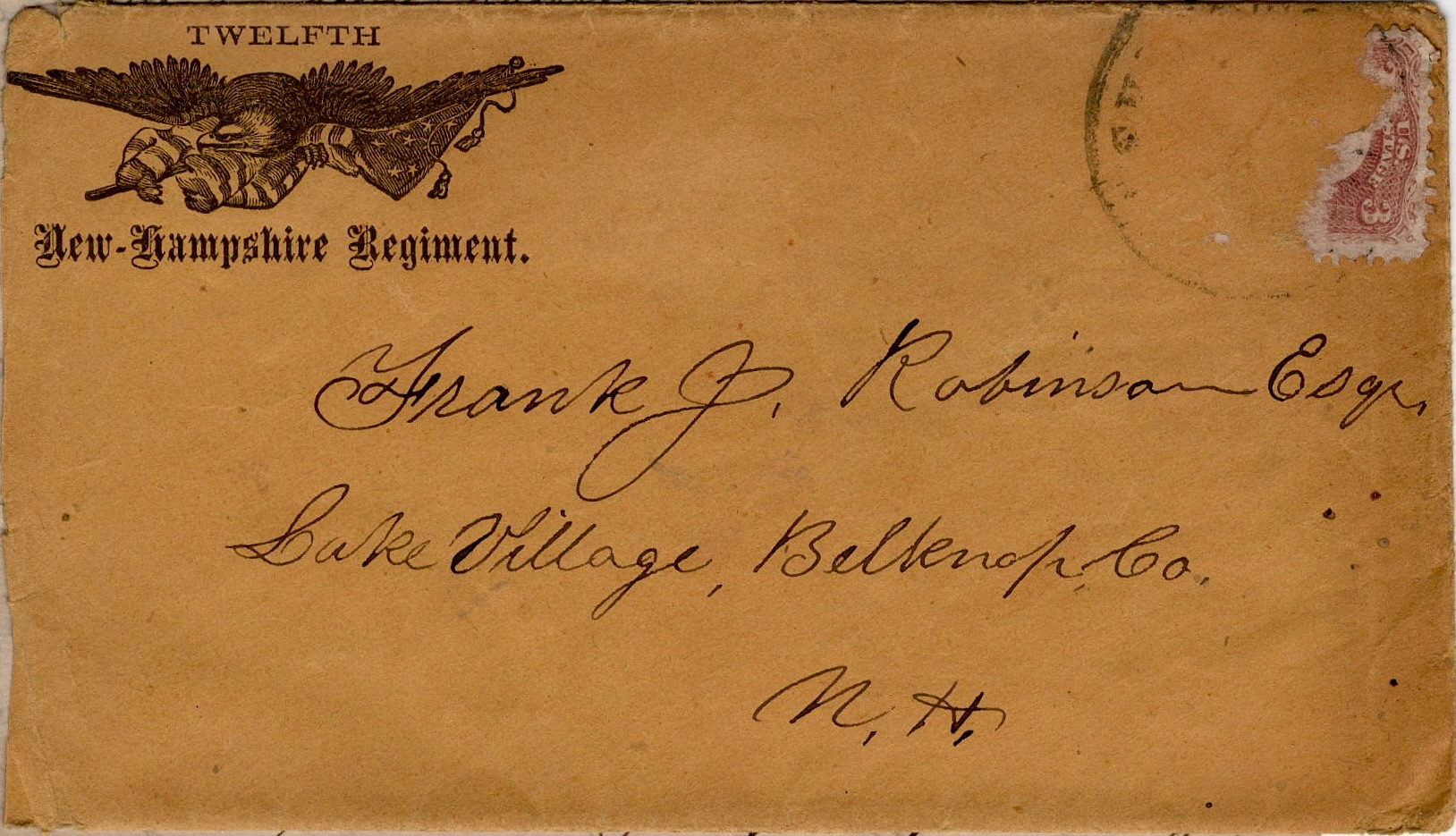
Arthur wrote his letter to his cousin, Frank J. Robinson (1843-Aft1892), the son of Joseph Wells Robinson (1816-1864) and Matilda G. Crockett (1811-1863) of Lake Village (now Lakeport), Laconia, Belknap county, New Hampshire.
T R A N S C R I P T I O N
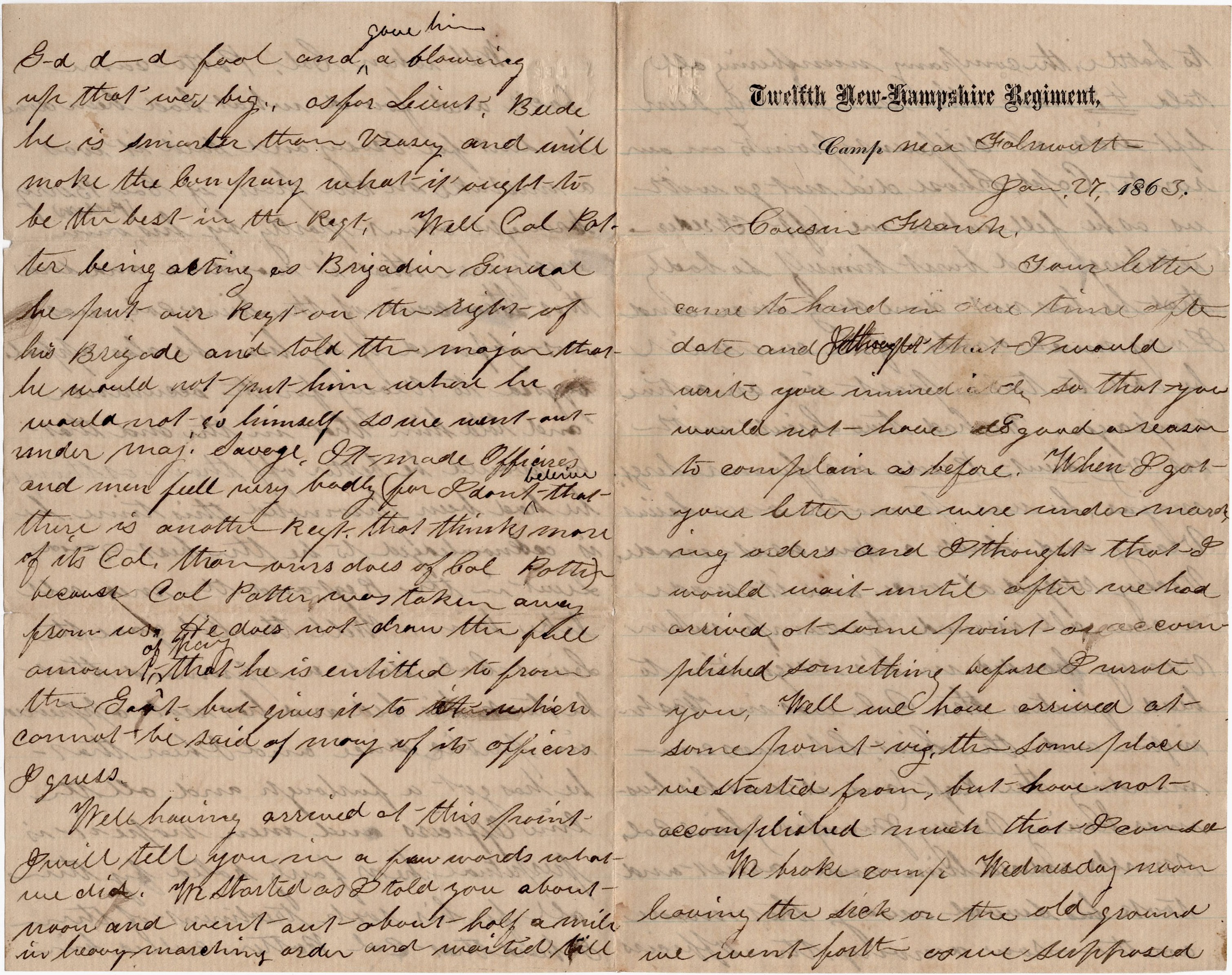
12the New Hampshire Regiment Camp near Falmouth January 27, 1863
Cousin Frank,
Your letter came to hand in due time after date and I thought that I would write you immediately so that you would not have a good reason to complain as before. When I got your letter we were under marching orders and I thought that I would wait until after we had arrived at some point or accomplished something before I wrote you. Well, we have arrived at some point—viz: the same place we started from, but have not accomplished much that I can see.
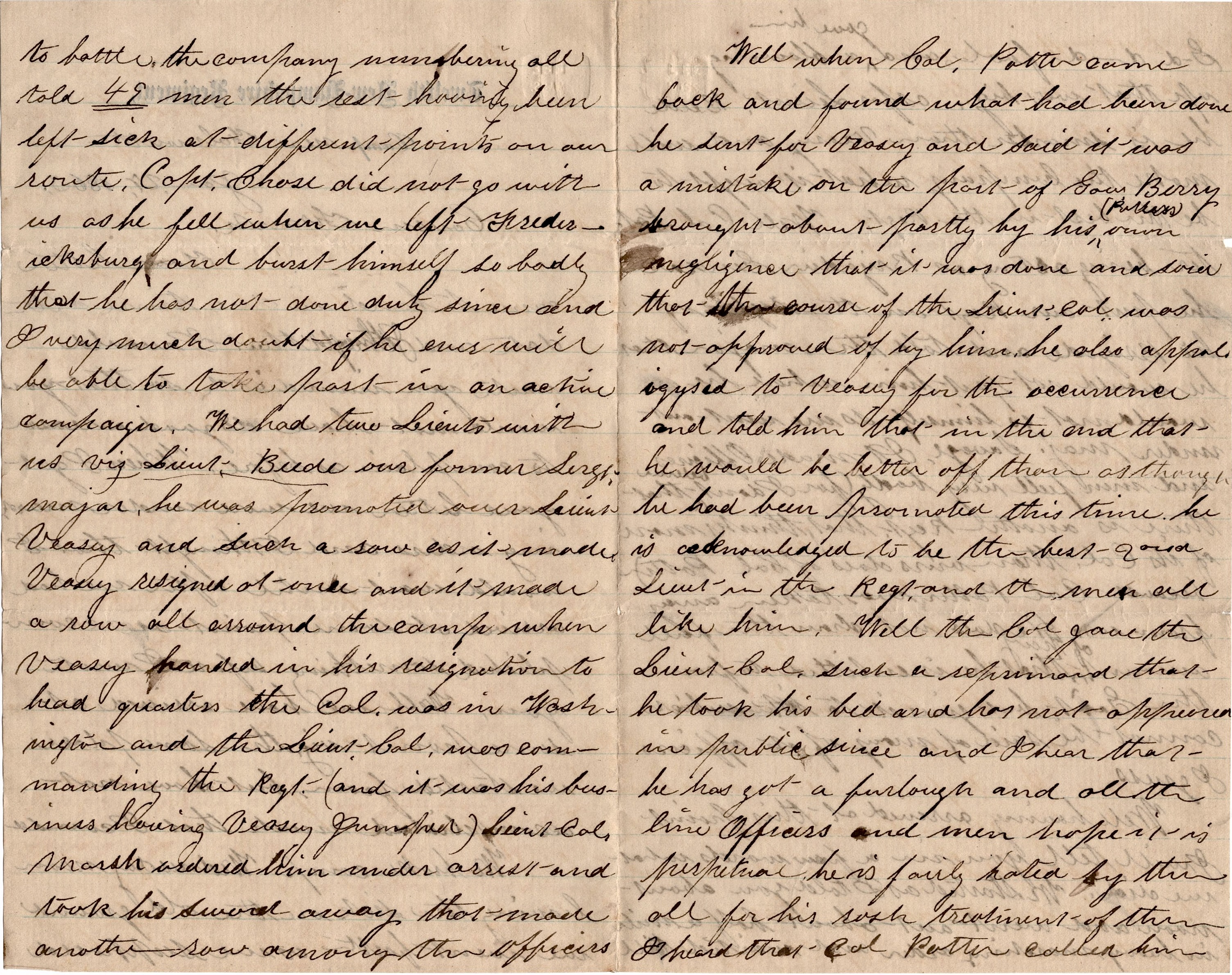
We broke camp Wednesday noon, leaving the sick on the old ground. We went forth as we supposed to battle, the company [Co. G] numbering all told 49 men—the rest having been left sick at different points on our route. Capt. [Charles W.] Chase did not go with us as he fell when we left Fredericksburg and burst himself so badly that he has not done duty since and I very much doubt if he ever will be able to take part in an active campaign.
We had two lieutenants with us—viz: Lieut. [Edwin E.] Beede, our former sergeant-major. He was promoted over Lieut. [John S.] Veasey and such a row as it made. Veasey resigned at once and it made a row all around the camp. When Veasey handed in his resignation to headquarters, the Colonel was in Washington, and the Lieut.-Colonel was commanding the regiment (and it was his business having Veasey jumped). Lieut.-Col. [John F.] Marsh ordered him under arrest and took his sword away. That made another row among the officers.
Well when Col. [Joseph H.] Potter came back and found what had been done, he sent for Veasey and said it was a mistake on the part of Gov. Berry brought about partly by his own negligence that it was done and said that the course of the Lieut.-Col. was not approved of by him. He also apologized to Veasey for the occurrence and told him that in the end that he would be better off then as though he had been promoted this time. He is acknowleged to be the best 2nd Lieut. in the regiment. The men all like him.
Wel the Colonel gave the Lieut.-Col. such a reprimand that he took his bed and has not appeared in public and I hear that he has got a furlough and all the line officers and men hope it is perpetual. He is fairly hated by them all for his treatment of them. I heard that Col. Potter called him a God damned fool and gave him a blowing up that was big. As for Lieut. Beede, he is smarter than Veasey and will make the company what it ought to be—the best in the regiment.
Well Col. Potter being acting as Brigadier General, he put our regiment on the right of his brigade and told the Major that he would not put him where he would not go himself so we went out under Major [George D.] Savage. It made officers and men feel very badly (for I don’t believe that there is another regiment that thinks more of its Colonel that our soes of Col. Potter) because Col. Potter was taken way from us. He does not draw the full amount of pay that he is entitled to from the government, but gives it to it which cannot be said of many of its officers I guess.
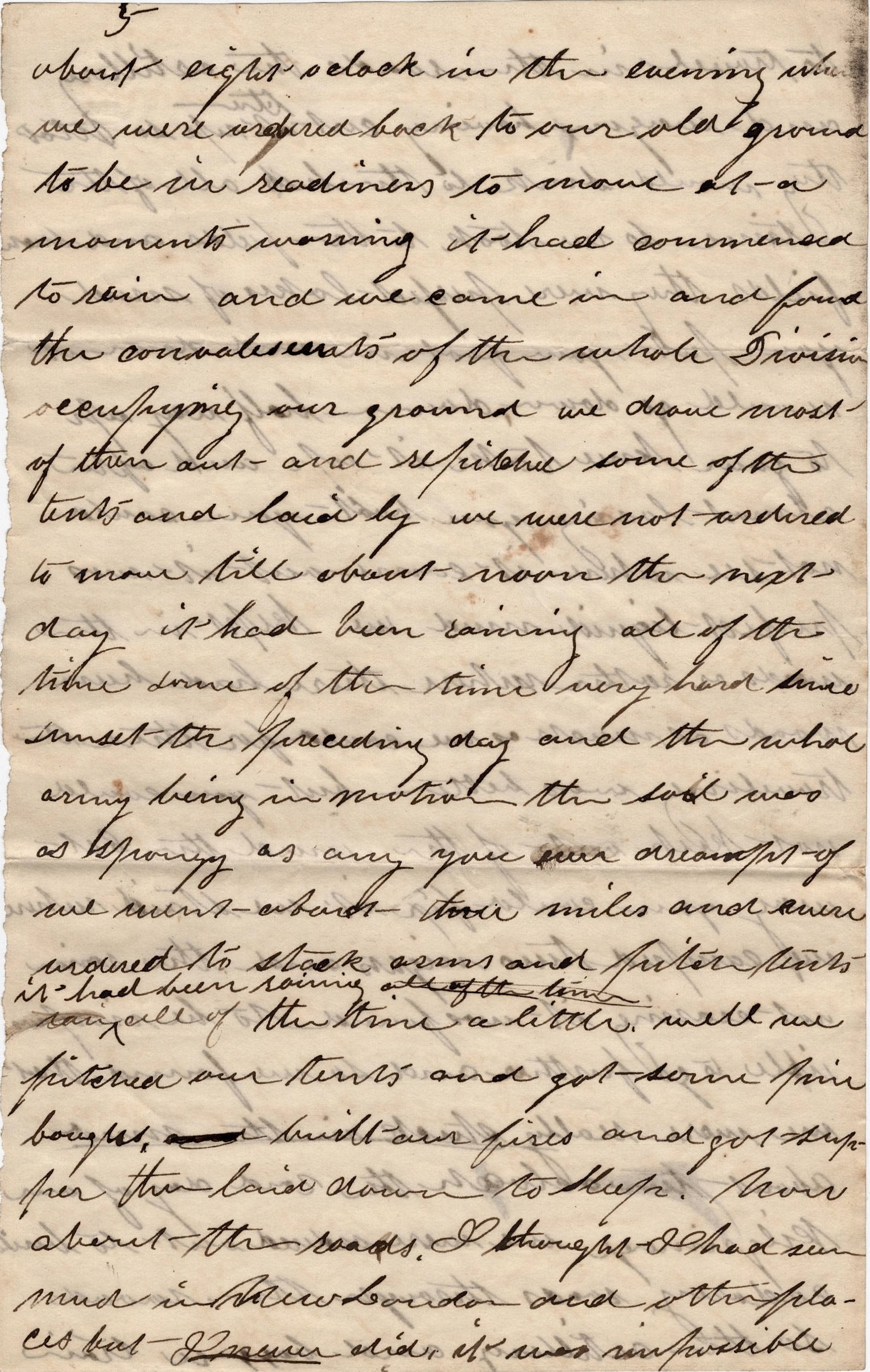
Well, having arrived at this point, I will tell you in a few words what we did. We started as I told you about noon and went out about half a mile in heavy marching order and waited till about eight o’clock in the evening when we were ordered back to our old ground to be in readiness to move at a moment’s warning. It had commenced to rain and we came in and found the convalescents of the whole Division occupying our ground. We drove most of them out and repitched some of the tents and laid by. We were not ordered to move till about noon the next day. It had been raining all of the time, some of the time very hard since sunset the preceding day and the whole army being in motion, the soil was as spongy as any you ever dreamed of. We went about three miles and were ordered to stack arms and pitch tents. It had been raining all the time a little. Well we pitched our tents andgot some pine boughs, built our fires, and got supper, then laid down to sleep.
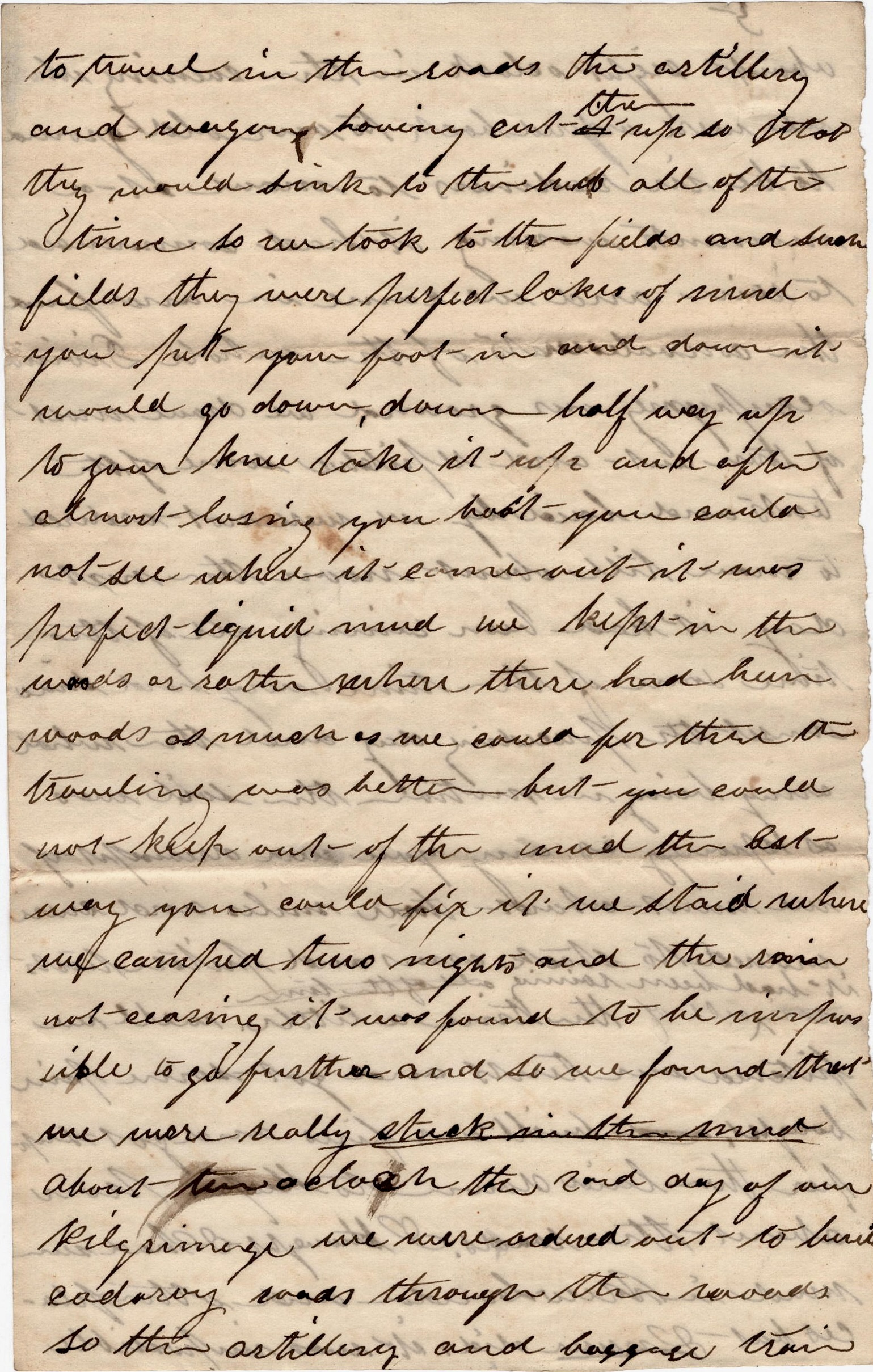
Now about the roads. I thought I had seen mud in New London and other places but I never did. It was impossible to travel in the roads, the artillery and wagons having cut them up so that they would sink to the hubs all the time so we took to the fields and such fields! They were perfect lakes of mud. You put your foot in and down it would go—down, down, half way up to your knee. Take it up and often almost losing your boot. You could not see where it came out, it was perfect liquid mud. We kept in the woods or rather where there had been woods as much as we could for there the traveling was better, but you could not keep out of the mud the best way you could fix it.
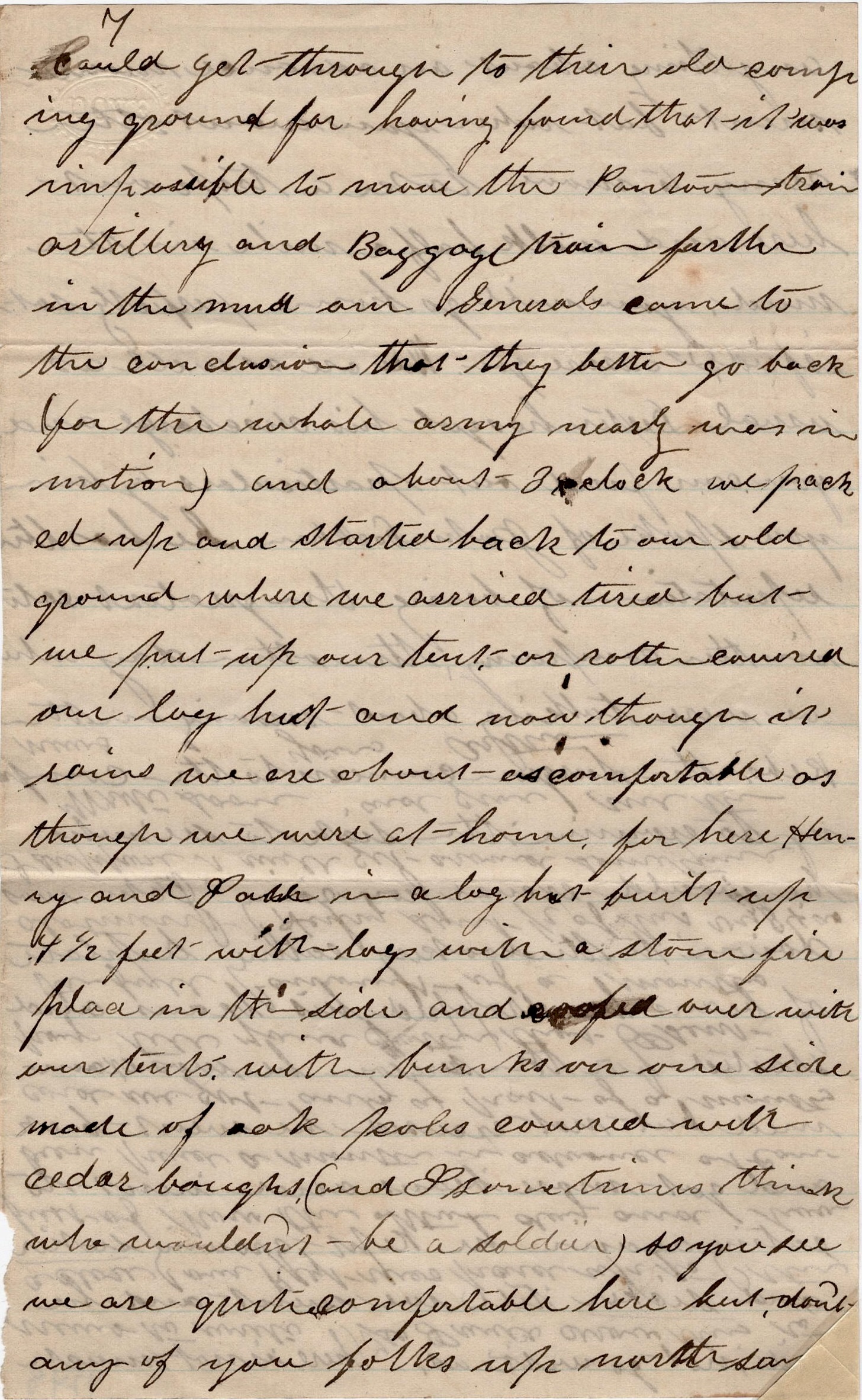
We staid where we camped two nights and the rain not ceasing, it was found to be impossible to go further and so we found that we were really stuck in the mud. About ten o’clock the 2nd day of our pilgrimage, we were ordered out to build corduroy roads through the woods so the artillery and baggage train could get through to their old camping ground for having found that it was impossible to move the pontoon train, artillery andbaggage train further in the mud, our generals came to the conclusion that they better go back (for the whole army was in motion) and about 3 o’clock we packed up and started back to our old ground where we arrived tired but we put up our tent, or rather covered our log hut and nowm though it rains, we are about as comfortable as though we were at home for here Henry and I are in a log hit built up 4.5 feet with logs with a stone foreplace in the side and covered over with our tents with bunks onone side made of oak poles covered with cedar boughs (and I sometimes think who wouldn’t be a soldier!).
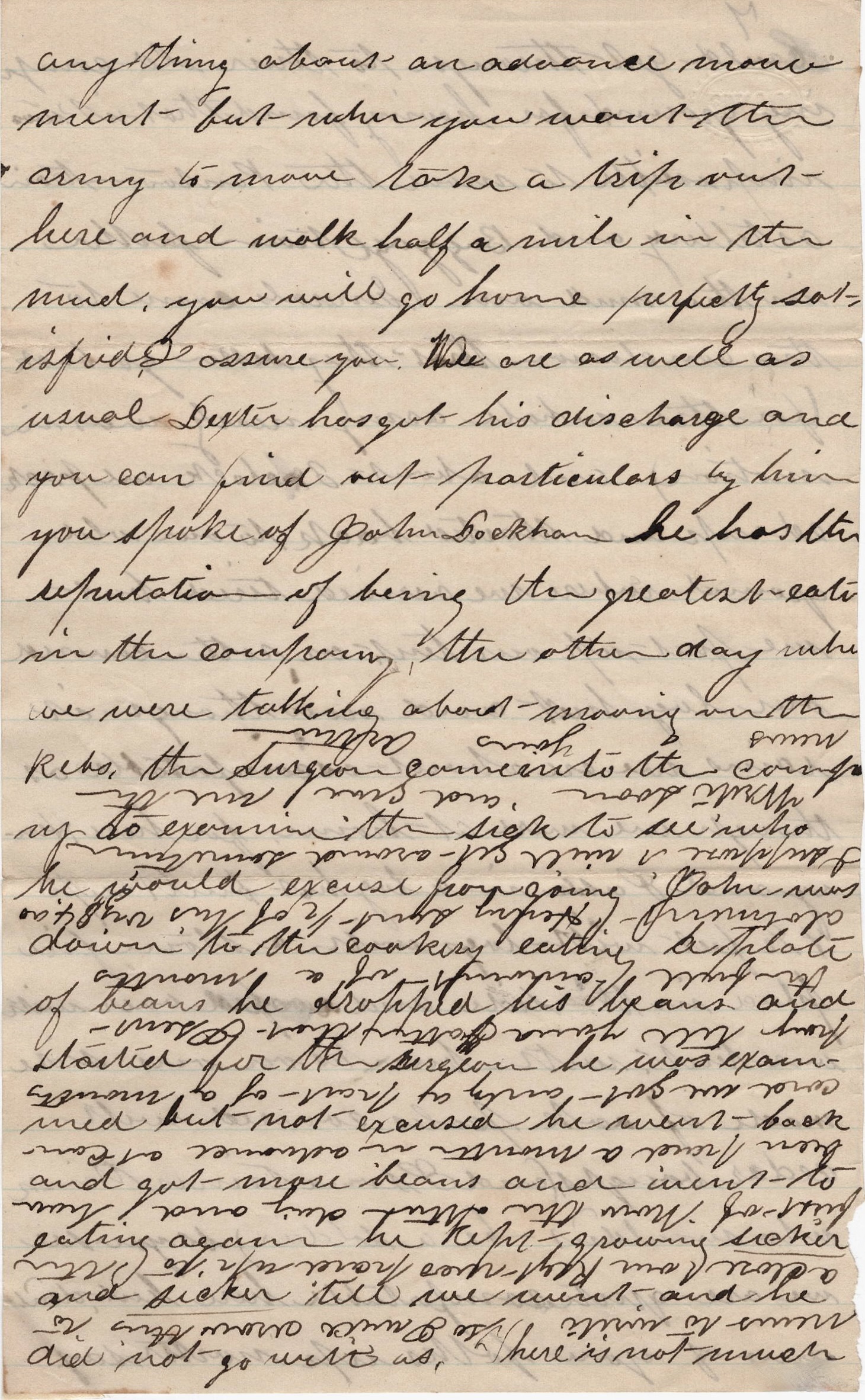
So you see we are quite comfirtable here but don’t any of you folks up North say anything about our advance movement but when you want the army to move, take a trip out here and walk half a mile in the mud. You will go home perfectly satisfied, I assure you.
We are as well as usual. Dexter has got his discharge and you can find out particulars by him. You spoke of John Dockham. He has the reputation of being the greatest eater in the company. The other day when we were talking about moving on the Rebs, the surgeon come to the company to examine the sick to see who he would excuse from going. John was down to the cookery eating a plate of beans. He dropped his beans andstarted for the surgeon. He was examined but not excused. He went back and got more beans and went to eating again. He kept growing sicker and sicker till we went and he did not go with us.
There is not much news to write so I will draw this to a close. Our regiment was paid up to the first of November. At Concord we got only a part of a month’s pay. Tell your father that I sent the full amount of a month’s allotment. Henry sent half of his—viz: $4. I suppose I will get around sometime. Write soon and give me the news. Yours, — Arthur